

Yield farming on Polygon and BNB Chain looks like a simple choice until you compare what each chain actually pays, what it costs to get in and out, and how much of that advertised APY survives contact with reality. This guide cuts through the noise. You will see the real stablecoin yields on Venus, Aave, Curve, and PancakeSwap, the mechanics behind liquid staking tokens like sPOL and slisBNB, and the structural risks most comparison articles leave out, from Polygon's exchange-custodied staking problem to BSC's emissions-driven farm culture. You also get a side-by-side comparison table, a 10-minute pool evaluation checklist, step-by-step setup instructions, and a clear answer on which chain suits your capital, your time, and your risk tolerance. Whether you are parking your first $500 or rotating a serious portfolio, this is the comparison you can actually act on.
Table of Contents:
- Introduction: Yield Farming on Polygon vs BNB Chain (BSC) Explained
- Why Comparing Yield Farming on Polygon and BNB Chain Matters Right Now
- Who This Yield Farming Guide Is For: Beginners, Traders, and Long-Term Investors
- How We Evaluated Yield Farming on Polygon vs BNB Chain: Methodology and Sources
- Key Takeaways: Yield Farming on Polygon vs BNB Chain at a Glance
- 📊 Polygon vs BNB Chain (BSC): Core DeFi Metrics Comparison
- Yield Farming Basics: How Yield Farming Works on Polygon and BNB Chain
- What Is Yield Farming, Really, and Why Does the Chain You Farm On Matter?
- How Yield Farming Works on Polygon: POL Staking, Low Fees, and the Aggregator Layer
- How Yield Farming Works on BNB Chain (BSC): BNB, BEP-20 Tokens, and the Binance Flywheel
- The Yield Farming Metrics That Actually Matter: Real Yield, TVL Depth, Emissions, and Risk-Adjusted APY
- Yield Farming Risks Explained Simply: Impermanent Loss, Smart Contract Risk, Depeg, and Liquidity Risk
- Yield Farming Glossary: Every Term You Need Before You Deposit a Single Dollar
- 📊 Understanding Impermanent Loss: The ETH/USDC Pool Scenario (50/50 Split)
- Yield Farming on Polygon: Opportunities, Protocols, and Hidden Risks
- Polygon DeFi Ecosystem Overview: TVL, DEX Volume, and Liquidity Trends
- The Best Yield Farming Strategies on Polygon
- Stablecoin Yield Farming on Polygon: Low-Fee Liquidity Provision and High-Frequency Harvesting
- POL Staking and Liquid Staking: sPOL, MaticX, and Restaking Yield
- Yield Aggregators and Auto-Compounding Vaults on Polygon: Beefy, Yearn, and ICHI
- Concentrated Liquidity and DEX Yield Farming on Polygon: Uniswap, QuickSwap, and Balancer
- Points, Airdrops, and Incentive Farming on Polygon
- POL Staking Concentration: The Hidden Risk Every Polygon Yield Farmer Should Understand
- Gas Fees, Bridging Costs, and Capital Efficiency for Yield Farming on Polygon
- Is Yield Farming on Polygon Still Worth It? Pros and Cons
- 📊 Dominance of USDC on Polygon Network
- Yield Farming on BNB Chain (BSC): Opportunities, Protocols, and Hidden Risks
- BNB Chain DeFi Ecosystem Overview: TVL, Throughput, and the Binance Effect
- The Best Yield Farming Strategies on BNB Chain (BSC)
- Stablecoin Yield Farming on BSC: Venus, Lista DAO, and Wombat Exchange
- PancakeSwap Yield Farming: CAKE Emissions, Liquidity Pools, and Real Yield
- Liquid Staking and CDP Strategies: slisBNB and Layered Yield Farming on BSC
- Fixed-Rate and Structured Yield Farming on BNB Chain
- Points, Airdrops, and Incentive Farming on BSC
- Inflationary Emissions vs Sustainable Yield: Reading BNB Chain APYs Correctly
- Gas Fees, MEV, and Execution Risk for Yield Farming on BSC
- Is Yield Farming on BNB Chain Still Worth It? Pros and Cons
- 📊 BSC Ecosystem Scale: Core DeFi vs. Emerging RWAs
- Yield Farming on Polygon vs BNB Chain: Side-by-Side Comparison
- APY Comparison: Stablecoin Yield, Blue-Chip Yield, and Ecosystem Token Yield
- Gas Fees and Cost Efficiency: Yield Farming on Polygon vs BNB Chain
- Liquidity Depth and Exit Risk: Why APY Means Nothing If the Pool Is Dry
- Security and Smart Contract Risk: Audits, Exploits, and Protocol Maturity
- Ecosystem Incentives and Reward Sustainability Compared
- Yield Farming on Polygon vs BNB Chain: Full Comparison Table
- 📊 Yield Farming APY Ranges: Polygon vs BNB Chain (Snapshot)
- Key Trends Shaping Yield Farming on Polygon and BNB Chain
- Real Yield vs Inflationary Farming: How Investor Priorities Are Shifting
- Liquid Staking, Restaking, and Layered Yield Farming Strategies
- Stablecoin Yield and the Payments Narrative on Polygon and BSC
- Real-World Assets (RWAs) and Institutional Yield Farming
- Fixed-Rate Lending and Structured Yield Products
- Cross-Chain Yield Farming and Capital Rotation Between Polygon and BNB Chain
- AI Agents and Automated Yield Farming: Hype vs Reality
- Regulatory Developments Affecting Yield Farming and DeFi Yields
- 📊 Key Trends Impact and Maturity Index on Polygon vs BNB Chain
- Challenges and Risks in Yield Farming on Polygon vs BNB Chain
- Impermanent Loss and Divergence Risk in Volatile Liquidity Pools
- Stablecoin Depeg Risk: Why "Safe" Yield Farming Pools Aren’t Risk-Free
- Smart Contract Exploits, Rug Pulls, and Bridge Risk
- The Liquidity Drought Problem: How High APY Traps Your Capital
- Centralization Risks: Exchange-Custodied Staking and Validator Concentration
- Token Emissions, Dilution, and Unsustainable APY
- Tax, Reporting, and Compliance Considerations for Yield Farmers
- 📊 The Dilution Trap: Constant APY vs. Eroding Token Price (BSC Example Scenario)
- How to Choose: Yield Farming Strategy by Investor Profile
- Yield Farming on Polygon: Who It Suits Best
- Yield Farming on BNB Chain (BSC): Who It Suits Best
- Small-Capital Yield Farming: When Cross-Chain Farming Stops Making Sense
- Stablecoin Yield Seekers vs High-Risk Yield Farmers: Two Different Playbooks
- The 10-Point Yield Farming Due Diligence Checklist
- Position Sizing, Harvesting, and Profit-Taking Discipline
- 📊 Yield Farming Decision Matrix: Suitability Score by Investor Profile
- How to Start Yield Farming on Polygon and BNB Chain: Step-by-Step
- Setting Up Wallets and Bridges for Yield Farming on Both Chains
- How to Evaluate a Yield Farming Pool in 10 Minutes
- Tracking Yield Farming Performance: The Best Analytics Tools
- Yield Farming Security Best Practices: Approvals, Hardware Wallets, and MEV Protection
- 📊 The 10-Minute Yield Farming Pool Evaluation Workflow
- Conclusion: The Future of Yield Farming on Polygon and BNB Chain
- Yield Farming on Polygon vs BNB Chain: Frequently Asked Questions
- Q1. Which chain pays higher stablecoin yields right now: Polygon or BNB Chain?
- Q2. Is Polygon's DeFi ecosystem too small to farm safely compared to BSC?
- Q3. What is the biggest hidden risk specific to Polygon yield farming right now?
- Q4. How does impermanent loss differ between Polygon and BSC liquidity pools?
- Q5. Are the high APYs on BSC farms actually sustainable, or am I being diluted?
- Q6. What is sPOL, and does it make Polygon staking more attractive?
- Q7. Is PancakeSwap V3 safe to farm, or is the concentrated liquidity risk too high?
- Q8. Can I farm on both Polygon and BSC without losing money to bridges?
- Q9. How much can I realistically earn farming stablecoins on each chain?
- Q10. What is the tax situation for yield farming, and does it differ between chains?
- Q11. What are the most important metrics to check before depositing into any farm?
- Q12. Should I choose Polygon or BSC for my first yield farming position?
Introduction: Yield Farming on Polygon vs BNB Chain (BSC) Explained
Let me guess why you clicked on this. You have some USDT or USDC sitting in your wallet, doing absolutely nothing. Maybe you have a little BNB or POL too, and you keep hearing people talk about "putting your crypto to work" like it is the easiest thing in the world. Then you open a DeFi dashboard, see forty different pools with numbers that look like typo errors, and quietly close the tab because it all feels like a lot.
I get it. I have been there. My first real attempt at yield farming went something like this: I bridged funds to a chain I had barely heard of, deposited into a pool because the APY was flashing at me like a slot machine, and then spent the next three weeks watching a token I could not pronounce slowly bleed value against my stablecoin. I earned something like $11 in rewards and lost $40 in bridge fees. It was a masterclass in learning things the hard way.
So here is the thing. Yield farming on Polygon and yield farming on BNB Chain (BSC) are two of the most accessible entry points into DeFi for anyone who refuses to pay Ethereum mainnet gas fees. Both chains are fast, both are cheap, and both have mature ecosystems with real protocols, real liquidity, and real risks. But they are not the same beast. Not even close. And if you treat them like interchangeable farming venues, you will eventually pay for that mistake.
Why Comparing Yield Farming on Polygon and BNB Chain Matters Right Now
Here is the uncomfortable truth about DeFi in general, and these two chains in particular: the gap between them has never been wider, and the noise around APYs has never been louder.
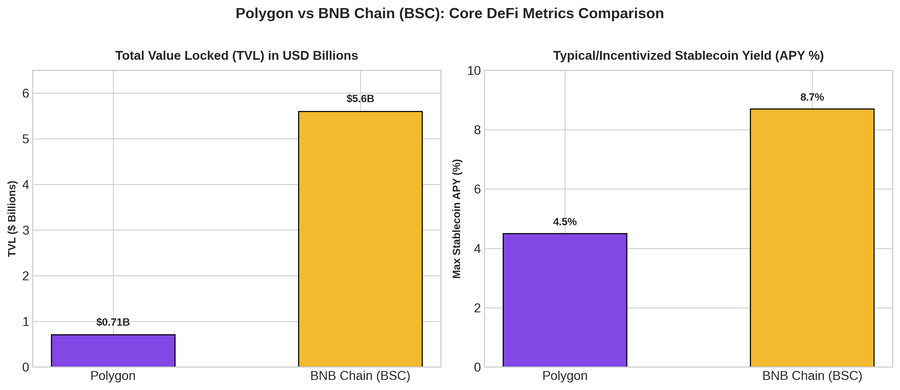
BNB Chain is sitting on roughly $5.6 billion in total value locked, making it one of the heaviest DeFi ecosystems in crypto by raw deposits. PancakeSwap alone moves more volume than most centralized exchanges, and Venus Protocol has quietly become a multi-billion dollar lending market that even institutional players take seriously. When people say BSC is still relevant, they are not coping. They are looking at the numbers. In fact, BNB Chain has been on a quiet tear, with DEX volumes at points surpassing Solana, which is not something you would have predicted a couple of years ago.
Polygon tells a different story. Depending on which snapshot you look at, its DeFi TVL hovers somewhere between $670 million and $757 million. That is not nothing. But it is a fraction of BSC's weight. And yet, Polygon has something BSC does not: a genuine institutional narrative. Polymarket runs on Polygon. Stablecoin payments are finding a home there. The chain has repositioned itself as the settlement layer for real-world activity, not just degen farming. Whether that translates into better farming yields for you and me is a question this article exists to answer.
So why does this comparison matter right now? Because capital is not infinite. Every dollar you park in a Polygon stablecoin pool is a dollar you did not park in a Venus lending market on BSC. And with stablecoin yields on BSC ranging from a sleepy 2.7% on Venus to an incentivized 8.72% on PancakeSwap, the difference between a lazy deposit and a deliberate strategy can be hundreds of dollars a year on a modest bankroll. That is real money. Not "quit your job" money, but "pay for a decent vacation" money.
There is another reason this comparison is worth your time. Both chains have changed significantly in the past year. BSC has grown louder and more aggressive, with incentive programs, fixed-rate lending experiments, and a pipeline of new protocols that keep pulling liquidity in. Polygon has grown quieter and more strategic, leaning into payments, real-world assets, and staking infrastructure. Those are two very different trajectories. If you are farming on autopilot and have not looked at either chain since the last cycle, you are probably leaving money on the table, and in some cases, taking on risks you do not even know exist.
Who This Yield Farming Guide Is For: Beginners, Traders, and Long-Term Investors
I want to be upfront about who I am writing this for, because too much crypto content pretends to serve everyone and ends up serving no one.
This guide is for you if you have used a wallet before. You know how to swap tokens. You have probably bridged something at least once and grimaced at the fee. You are not looking for a PhD thesis on automated market maker mathematics. You want to know where the yield is, how risky it actually is, and whether you should bother moving your money from one chain to another. If that sounds like you, you are in the right place.
If you are a complete beginner who has never touched a self-custody wallet, that is fine too. The basics section will not leave you behind. But I am going to assume you understand that "APY" is not a promise, "TVL" is not a safety net, and "audited" does not mean "impossible to hack." Those three misconceptions have cost people more money than any bear market ever could.
For the traders reading this, the ones who already know their way around a concentrated liquidity position, I have not forgotten you either. There is plenty of nuance here about emissions schedules, liquid staking derivatives, and the real cost of harvesting rewards too often. The deep dives on Venus, Lista DAO, PancakeSwap, and Polygon's staking mechanics are written with you in mind. You will find specifics on yield ranges, pool depth, and protocol-level risks that go beyond the surface-level "top 10 farms" lists you have probably already scrolled past.
And for the long-term investors, the ones who just want a sensible place to earn 4% to 6% on stablecoins without checking charts every day: yes, there is a playbook for you too. It involves fewer clicks and more patience than the degen strategies, and honestly, it is probably the one I would recommend to my own family. Slow and boring beats fast and rekt almost every single time in this space.
One more group deserves a mention: the "I tried DeFi once and got burned" crowd. Maybe you got liquidated during a flash crash. Maybe you fell for a fake token approval. Maybe you just got tired of paying gas fees to move money around. Whatever happened, I am not here to judge. I have made every mistake in the book, including a few that are not in the book yet. This guide is designed to help you re-enter with clearer expectations and better guardrails, not to sell you on hype.
How We Evaluated Yield Farming on Polygon vs BNB Chain: Methodology and Sources
Here is how I approached this. No vibes. No "trust me bro." Just data that anyone can check, plus the kind of practical context that only comes from actually using these protocols.
- For liquidity and protocol scale, I leaned on DefiLlama, which has become the closest thing DeFi has to a Bloomberg terminal. When I say BSC has billions in TVL and Polygon has hundreds of millions, those are DefiLlama numbers, not my imagination.
- For yield ranges, I cross-referenced protocol documentation and recent ecosystem analyses, including breakdowns of Venus lending rates, PancakeSwap farm incentives, Lista DAO's slisBNB mechanics, and Curve stable pools on BSC.
- For Polygon's staking mechanics and the risks around delegation, I looked at validator documentation and independent explainers that actually bother to explain how rewards are calculated, not just what number is displayed on a dashboard.
I also paid attention to what has changed recently, because stale data is one of the biggest traps in DeFi content. BSC has been on a quiet tear, with DEX volumes at points surpassing Solana and a growing ecosystem of fixed-rate and structured yield products. Polygon has been dealing with a different kind of evolution, one where staking concentration and protocol governance are becoming as important as raw yield. These are not abstract concerns. They affect whether the APY you see today is actually going to be there next month.
What I did not do: I did not chase the highest APY I could find and present it as a headline. If a pool offers 200% on a token with a market cap smaller than my coffee budget, it does not belong in a serious comparison. The yields discussed here are ones you can actually access with reasonable liquidity, a decent night's sleep, and a realistic chance of exiting without destroying the pool price. I also avoided protocols with anonymous teams, unaudited contracts, or a history of exploits, because a 30% APY is meaningless if your principal disappears overnight.
Finally, I tested things myself where possible. Bridged funds, deposited into pools, harvested rewards, and withdrew on both chains. That hands-on experience shapes the recommendations here more than any spreadsheet ever could. If a process was annoying, slow, or expensive, I say so. If a protocol surprised me with how smooth it was, I say that too.
Key Takeaways: Yield Farming on Polygon vs BNB Chain at a Glance
Before we dive into the weeds, here is the short version. If you only read this section and nothing else, you will still walk away knowing more than most people farming on these chains.
The catch? Those emissions are inflationary, and the best farms often require you to babysit your position or accept token exposure you did not ask for. If you want high APY with deep liquidity and you are willing to stay active, BSC is the more natural home.
The biggest hidden risk is not impermanent loss. It is centralization. On Polygon, exchange-custodied POL staking has become a genuine concern, with major exchanges controlling a meaningful share of staked supply. That affects governance and long-term network health in ways that do not show up on a yield dashboard. On BSC, the proximity to Binance is both a blessing and a question mark. It gives the chain liquidity and attention that other ecosystems would kill for, but it also means you are trusting a certain degree of counterparty concentration, even when you are using "decentralized" protocols. Neither chain is immune to this, and ignoring it is how smart farmers get surprised.
Small capital changes the math completely. If you are farming with under $1,000, cross-chain farming is almost never worth it. Bridge fees, gas costs on both ends, and the time it takes to manage two positions will eat your yield alive. Pick one chain, learn its protocols, and stay put until your bankroll justifies the complexity. I have seen people with $500 portfolios try to farm on three chains at once. They are not earning yield. They are donating it to bridges.
The best yield is the one you actually understand. This sounds like a cliché, but it is the single most important lesson I have learned in DeFi. A 6% Venus lending position you comprehend fully is worth more than a 40% farm on a protocol you cannot explain to a friend. Every time. No exceptions. The moment you stop understanding where the yield comes from is the moment you become the yield.
Fees and liquidity matter more than headline APY. A pool advertising 20% APY with $50,000 in liquidity is a trap. You will move the price on entry, move it again on exit, and lose more to slippage than you ever earned in rewards. Always check the depth of the pool, not just the number on the banner. On both Polygon and BSC, there are pools with millions in liquidity and modest yields that will treat you far better than the flashy ones.
Both chains are worth watching, but for different reasons. BSC is where the action and volume are. Polygon is where the infrastructure and institutional adoption are heading. If you are an active farmer, BSC deserves most of your attention. If you are a patient investor or someone building a long-term position in DeFi, Polygon's trajectory is worth following closely, even if the yields are less exciting today.
Now, let us get into the details. Grab a coffee, open a fresh tab, and let us figure out which chain actually deserves your capital.
📊 Polygon vs BNB Chain (BSC): Core DeFi Metrics Comparison
How to Interpret This Visual
When evaluating where to deploy your stablecoins, looking past the marketing hype requires comparing two fundamental health metrics: Total Value Locked (TVL) and Max Stablecoin APY.
The dual-bar chart above breaks down these metrics side by side. On the left, the Total Value Locked (TVL) panel shows the stark contrast in ecosystem scale. BNB Chain holds roughly $5.6 billion in locked capital, reflecting massive liquidity depth, heavy institutional lending markets (like Venus), and high trading volumes (via PancakeSwap). In contrast, Polygon hovers around $0.71 billion, representing a more streamlined, specialized ecosystem prioritizing institutional narratives and efficient payments.
On the right, the Max Stablecoin APY panel highlights what this means for your yield. BNB Chain's aggressive incentive programs and heavy protocol activity push incentivized stablecoin returns up to 8.7%, while Polygon's stablecoin yield pools typically top out closer to 4.5%.
How to Utilize This Data in Your Strategy
If you are an active yield farmer managing a moderate to large bankroll, BNB Chain's deeper liquidity pools and higher APYs offer greater earning potential—provided you actively manage token emissions and protocol risks. However, if you are working with a smaller portfolio or prioritize a quieter, lower-cost environment aligned with long-term infrastructure, Polygon's leaner TVL and modest yields offer a stable alternative that avoids the intense churn of degen farming. Always weigh the TVL depth against the headline APY to ensure your capital can enter and exit the pool without suffering severe slippage.
Yield Farming Basics: How Yield Farming Works on Polygon and BNB Chain
Before we start comparing yields, protocols, and risks, we need to get one thing straight: yield farming is not magic money. It never was, and it never will be. But it is also not as complicated as the dashboard warriors make it look. Once you understand the mechanics, the vocabulary, and the chain-specific quirks, everything else becomes a lot less intimidating.
Think of this section as the foundation. If the introduction was us grabbing coffee and talking strategy, this is the part where we open the hood and look at the engine. No jargon without translation, no assumptions about what you already know, and no sugarcoating the parts that can actually hurt you. I have made enough mistakes in DeFi to fill a small book, and the goal here is to help you skip a few chapters of that book.
What Is Yield Farming, Really, and Why Does the Chain You Farm On Matter?
The classic version looks like this. You deposit a pair of tokens into a liquidity pool on a decentralized exchange. Traders swap against that pool, and every swap generates a small fee. That fee gets distributed to everyone who provided liquidity, proportional to their share. The protocol might also throw in some extra rewards in its native token to keep you around. That is liquidity provision, and it is the engine behind most of what people call yield farming.
But yield farming also includes lending. You deposit USDC into a lending market like Venus or Aave, borrowers pay interest, and a slice of that interest flows back to you. It is less flashy than liquidity provision, but it is often more predictable, and for stablecoin holders, it is frequently the most sensible starting point. I know plenty of people who tried to be heroes with exotic farms and ended up wishing they had just parked their stablecoins in a boring lending pool.
There is a third category worth mentioning: staking. You lock your tokens to help secure a proof-of-stake network, and you earn rewards for doing so. On Polygon, this means staking POL. On BNB Chain, it means staking BNB or using liquid staking derivatives. Staking is the least exciting corner of yield farming, but it is also one of the most reliable, and it forms the base layer for a lot of more advanced strategies.
Now, why does the chain matter? Because the chain determines your costs, your liquidity, and your risk exposure. Farming on Ethereum mainnet means paying gas fees that can eat an entire month of yield in a single transaction. Farming on Polygon or BNB Chain means paying pennies, which changes the math completely. It also determines which protocols you can access, how deep the pools are, and how quickly you can exit if things go sideways. A 12% APY on a chain where you cannot withdraw without moving the price is not a 12% APY. It is a trap with a nice banner.
There is one more thing, and it is the part most guides skip: the chain determines your tax and reporting nightmare. Every harvest, every swap, every bridge transaction can be a taxable event depending on where you live. Farming on two chains doubles that paperwork. It is not a reason to avoid farming, but it is a reason to keep clean records from day one. I learned that lesson the hard way, and my accountant still brings it up at dinner parties.
How Yield Farming Works on Polygon: POL Staking, Low Fees, and the Aggregator Layer
Polygon's approach to yield farming has shifted over the years. It used to be the cheap Ethereum sidechain where you went to farm tokens you had never heard of. Today it is something quieter and, honestly, more interesting if you are patient.
The backbone is POL staking. Polygon uses a proof-of-stake system where POL holders delegate tokens to validators and earn rewards for helping secure the network. Base staking yields are modest, roughly 2% to 4%, and they fluctuate based on how much of the supply is staked and which validator you choose. But staking alone is just the beginning.
The real evolution is liquid staking. Polygon launched sPOL, a canonical liquid staking token that represents your staked POL while still letting you use it in DeFi. The pitch is simple: stake POL, receive sPOL, and then deploy that sPOL into lending markets or liquidity pools to earn a second layer of yield on top of the staking rewards. Polygon seeded sPOL with 10 million tokens from treasury on day one, scaling toward 100 million, specifically to give it immediate liquidity depth. There is also ankrPOL from Ankr, which works on a similar principle: a reward-bearing token whose value against POL increases as staking rewards accumulate. The existence of multiple liquid staking options is a good sign, because it means you are not forced into a single provider.
Beyond staking, Polygon has a growing aggregator layer. Protocols like Beefy and Yearn automate the farming process for you. You deposit into a vault, the vault compounds your rewards automatically, and you do not have to manually harvest and redeposit every few days. For someone with a smaller bankroll who does not want to spend more on gas than they earn in rewards, this is a genuinely useful innovation. I have run manual farms and auto-compounding vaults side by side, and the vaults almost always win once you factor in the time and transaction costs.
There is also a points and incentive layer that has become harder to ignore. Protocols on Polygon regularly run points programs and airdrop campaigns that reward early liquidity providers. These are not guaranteed income, and you should never farm something purely for a rumored airdrop, but they can add a meaningful bonus to an otherwise modest APY. Treat them as a lottery ticket, not a salary.
The catch with Polygon is scale. The DeFi ecosystem is smaller, the pools are shallower, and the incentive programs are less aggressive than what you will find on BSC. But the trade-off is low fees and a growing institutional narrative around stablecoin payments and real-world settlement. If you are farming with a longer time horizon and a smaller stack, Polygon's cost structure can work in your favor. If you are chasing the highest APY on the board, you will probably be disappointed. Polygon rewards patience, not impatience.
How Yield Farming Works on BNB Chain (BSC): BNB, BEP-20 Tokens, and the Binance Flywheel
The three names you need to know are Venus, PancakeSwap, and Lista DAO.
Venus is the lending backbone. It is a money market protocol where you can supply assets like USDT or USDC and earn interest from borrowers. Recent data puts stablecoin lending yields on Venus in the 4% to 6.5% range, depending on utilization and market conditions. It is not exciting, but it is functional, and the liquidity is deep enough that you can exit without drama. Venus also supports borrowing against your supplied collateral, which opens the door to looped strategies where you supply, borrow, and supply again. Those strategies amplify both yield and risk, so tread carefully.
PancakeSwap is the liquidity engine. It is the largest DEX on BSC by volume, and its farms are where most of the action happens. You provide liquidity to a pair, stake the LP tokens, and earn CAKE emissions on top of trading fees. Stablecoin pairs can push yields into the 8% range when incentives are running hot, but those numbers come with a caveat: a meaningful chunk of the yield is paid in CAKE, and CAKE's price can move against you. If you are farming for stablecoin income and half your reward is in a volatile token, your real yield is not what the dashboard says.
Lista DAO adds a layer of sophistication. It lets you stake BNB for slisBNB, a liquid staking token, and then use that slisBNB as collateral to borrow stablecoins or participate in other yield strategies. It is essentially a layered farming setup: staking rewards plus borrowing power plus whatever you do with the borrowed funds. The appeal is obvious, and so is the risk. Every layer adds complexity, and complexity is where things break.
There is also Wombat Exchange, which deserves a mention for anyone farming stablecoins on BSC. It uses a stableswap model that minimizes slippage, and its single-sided staking options make it easier to enter and exit without worrying about impermanent loss in the traditional sense. It is not the flashiest venue on the chain, but it is one of the more practical ones.
The BSC advantage is scale and liquidity. The pools are deeper, the exit doors are wider, and the incentive programs are more generous. The BSC disadvantage is emissions dependence and centralization questions. A lot of the headline APY comes from token printing, not from organic fee revenue. And the proximity to Binance, while a strength for liquidity and attention, introduces a degree of counterparty concentration that you should at least be aware of. Binance is not going anywhere tomorrow, but it is worth remembering that a lot of BSC's gravity comes from one very large neighbor.
The Yield Farming Metrics That Actually Matter: Real Yield, TVL Depth, Emissions, and Risk-Adjusted APY
If you take nothing else from this section, take this: the APY number on the dashboard is almost never the number you actually earn. It is a projection, sometimes an optimistic one, and occasionally a work of fiction.
Here is what you need to look at instead:
Real yield versus inflationary yield. Real yield comes from actual protocol revenue: trading fees, borrowing interest, liquidation penalties. Inflationary yield comes from newly minted tokens that the protocol creates out of thin air and hands to you. The difference matters because inflationary rewards dilute the supply of the reward token. If a protocol advertises 300% APY but its token supply is inflating at 400% per year, your real return is negative even though the dashboard looks incredible.
A simple check: find the token's emissions schedule, divide annual new tokens by circulating supply, and compare that number to the advertised APY. If inflation is higher, you are not earning. You are being paid in a currency that is losing value faster than you can accumulate it.
There is a nuance here that most people miss: inflationary yield is not automatically bad. Early in a protocol's life, high emissions can be a legitimate customer acquisition strategy, and if the token appreciates faster than it dilutes, you can still come out ahead. The problem is that this is a bet on token price, not a bet on yield. Know which bet you are making.
TVL depth. TVL tells you how much money is in the pool. It does not tell you whether the pool is safe, but it does tell you whether you can exit without destroying the price. A pool with $50,000 in liquidity and a 20% APY is a trap. Your deposit alone might move the price, and your withdrawal will definitely hurt. Look for pools where your position is a small fraction of the total liquidity, ideally under 1% if you want to sleep well. A useful rule of thumb: if your deposit would represent more than 5% of the pool, find a deeper pool or reduce your size.
Risk-adjusted APY. This is the number that matters after you account for impermanent loss, emissions dilution, and the probability of something going wrong. A 6% Venus lending position with deep liquidity and a multi-year track record is often worth more than a 40% farm on a protocol that launched last month and has anonymous developers. The math is not just about the rate. It is about the rate multiplied by the probability that you actually get to keep it. I call this the sleep-at-night ratio, and it has saved me more money than any yield calculator ever has.
Utilization rate. In lending markets, this is the percentage of deposited assets that have been borrowed. Higher utilization often means higher yields for lenders, but it also means thinner liquidity if everyone tries to withdraw at once. A lending market at 95% utilization is paying great rates, but good luck getting your money out during a panic.
Yield Farming Risks Explained Simply: Impermanent Loss, Smart Contract Risk, Depeg, and Liquidity Risk
Let us talk about the things that can go wrong. Not to scare you, but because the farmers who survive are the ones who understand the downside before they deposit. I have watched friends quit DeFi entirely after one bad experience, and almost every time, the root cause was a risk they did not know existed.
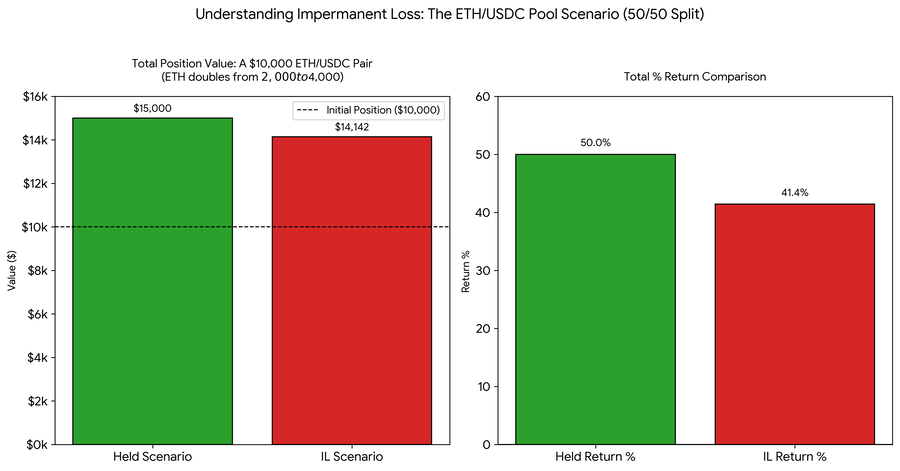
Impermanent loss is the one everyone warns you about, and for good reason. It happens when the price of the two assets in your liquidity pool diverge. Here is the classic example: you deposit $10,000 into an ETH/USDC pool, split 50/50. ETH is at $2,000, so you put in 2.5 ETH and 5,000 USDC. ETH doubles to $4,000. Arbitrageurs rebalance the pool, and you end up with roughly 1.77 ETH and 7,071 USDC, worth about $14,142. If you had just held the tokens, you would have $15,000. That $858 difference is impermanent loss. You still made money, but you made less than if you had done nothing.
The lesson: impermanent loss matters most in trending markets. Stablecoin pairs have minimal IL. Volatile pairs can eat your yield and then some.
There is a silver lining, though. Impermanent loss is only realized when you withdraw. If the prices revert to their original ratio, the loss disappears. This is why stablecoin pairs and correlated assets are the darlings of conservative farmers. Farming ETH/USDC during a bull run is a great way to underperform simply holding ETH.
Smart contract risk is the one you cannot calculate. A bug in the protocol's code can drain the entire pool. Even audited protocols get exploited. The Resolv incident is the cautionary tale: a yield-bearing stablecoin protocol that got hit through a key management flaw, not a code bug, and the fallout spread to lending markets that had hardcoded oracles pricing the depegged asset at $1.
The lesson here is not "avoid all smart contracts." It is "stick to protocols with long track records, multiple audits, and large bug bounties," and understand that "audited" is a starting point, not a guarantee. The best audit in the world does not protect you from a compromised private key.
Stablecoin depeg risk is the one people forget. You deposit USDC, you assume it is worth a dollar. But USDC has briefly traded below $0.90 during banking crises, and smaller stablecoins depeg far more often. If you are farming with a stablecoin, you are exposed to that stablecoin's issuer risk. It is usually small. It is never zero. Diversifying across USDC, USDT, and DAI does not eliminate depeg risk, but it spreads it around.
Liquidity risk is the quiet one. You see a pool with a beautiful APY, you deposit, you earn for a few weeks, and then you want to withdraw. But the pool has thinned out, or the incentives have dried up, and suddenly your exit is expensive. High APY often attracts capital that leaves the moment the APY drops, which means the pool you entered is not the pool you will exit. Always check the liquidity depth before you deposit, not after. And if a pool's TVL has been falling for a week straight, that is a signal worth paying attention to.
There is one more risk that deserves its own paragraph: oracle risk. Lending protocols depend on price feeds to know when to liquidate borrowers. If an oracle malfunctions or is manipulated, liquidations can happen at the wrong time or not at all. This is not something you can personally audit, but you can favor protocols that use multiple independent oracles and have a track record of handling volatility without blowing up.
Yield Farming Glossary: Every Term You Need Before You Deposit a Single Dollar
You do not need a finance degree to farm, but you do need to know what the words mean. Here is the short version, in plain language, with the kind of context that most glossaries skip:
- APY (Annual Percentage Yield): The return you would earn over a year if rewards are compounded. It is a projection, not a promise, and it assumes the reward token holds its value.
- APR (Annual Percentage Rate): Similar to APY, but without compounding. A 10% APR compounded monthly is roughly 10.47% APY. The difference sounds small until you are comparing a 50% APR to a 50% APY.
- TVL (Total Value Locked): The total amount of money deposited in a protocol or pool. Higher TVL generally means deeper liquidity, but it is not a safety guarantee. A protocol can have billions in TVL and still get hacked.
- Liquidity Pool: A shared pot of two or more tokens that traders swap against. Liquidity providers deposit into the pool and earn fees. The pool is the product, and you are the inventory.
- LP Token: A receipt token you receive when you deposit into a liquidity pool. It represents your share of the pool and can often be staked elsewhere for extra rewards. Think of it as a claim ticket that also happens to be farmable.
- Impermanent Loss (IL): The difference between what your pooled assets are worth and what they would be worth if you had just held them. It is "impermanent" because it can reverse if prices return to their original ratio, but it becomes permanent when you withdraw.
- Real Yield: Yield paid from actual protocol revenue, not from token emissions. Real yield is the difference between a business and a printing press.Emissions: New tokens created by a protocol and distributed as farming rewards. High emissions can dilute the token's value. They are the sugar rush of DeFi.
- Liquid Staking: Staking tokens and receiving a tradeable receipt token (like sPOL or slisBNB) that can be used in DeFi while the underlying tokens continue earning staking rewards. It is yield stacking without the lockup.
- Depeg: When a stablecoin loses its intended $1 value. It can be brief and minor or catastrophic. The word "stable" in stablecoin is aspirational, not guaranteed.
- Slippage: The difference between the price you expect and the price you actually get when trading or withdrawing. High slippage means low liquidity, and low liquidity means your exit will cost you.
- Harvesting: Claiming your accumulated farming rewards. Doing this too often can cost more in gas than the rewards are worth. On cheap chains, harvesting weekly is fine. On expensive ones, monthly is more sensible.
- Compounding: Reinvesting your rewards to earn more rewards. Auto-compounding vaults do this for you, and they are usually worth the small fee they charge.
- Utilization Rate: In lending markets, the percentage of deposited assets that have been borrowed. Higher utilization often means higher yields for lenders, but also higher withdrawal risk.
- Impermanent Loss Protection: A feature some protocols offer that partially reimburses LPs for IL. It sounds great until you read the fine print, which usually involves lockups, caps, or a token that may not hold its value.
- Rug Pull: When a protocol's developers abandon the project and take the funds. Usually preceded by a token launch, a marketing blitz, and a sudden silence on social media.
- MEV (Maximal Extractable Value): The profit that block builders and validators can extract by reordering, inserting, or censoring transactions. On busy chains, MEV can quietly eat into your farming returns through worse execution prices. Using private transaction relays can help, but the landscape changes fast.
- Yield Aggregator: A protocol that automatically moves your funds between farms to chase the best risk-adjusted yield. Convenient, but you are trusting the aggregator's strategy and smart contract with your money.
- Points Program: A pre-token incentive scheme where protocols reward users with points that may convert to tokens later. It is a bet on future value, not current income.
Now that we have the vocabulary and the mechanics down, we can actually compare what Polygon and BNB Chain offer. And that is where things get interesting. Because the theory is one thing, but the pools, the protocols, and the real-world yield numbers are something else entirely.
📊 Understanding Impermanent Loss: The ETH/USDC Pool Scenario (50/50 Split)
How to Interpret This Visual
This chart illustrates how Impermanent Loss (IL) works in a volatile liquidity pool using a concrete, common example: a 50/50 ETH/USDC pair. We assume an initial investment of $10,000, with ETH priced at $2,000, meaning the user deposits 2.5 ETH and 5,000 USDC. The main scenario tested is a doubling of ETH's price to $4,000.
-
Left Chart: Total Position Value. This panel compares the absolute dollar value of the user's position at the end of the scenario. The 'Held Scenario' (green bar) shows that if the user had simply HELD their 2.5 ETH and 5,000 USDC, their portfolio would be worth $15,000 (2.5 * 4,000 + 5,000). The 'IL Scenario' (red bar) shows that by providing liquidity, the automated market maker rebalanced their position to include more USDC and less ETH as ETH appreciated. As a result, when they withdraw, their position is worth only $14,142. The difference, $858, is the impermanent loss.
-
Right Chart: Total % Return Comparison. This panel visualizes the opportunity cost in terms of percentage yield. The 'Held Return %' shows a significant 50.0% profit from simply holding the tokens. The 'IL Return %' shows that the user still generated a profit of 41.4%, but they underperformed the buy-and-hold strategy because the IL ate into their gains.
How to Utilize This Data in Your Strategy
The core lesson from this visual is that you must weigh the potential Realized Return (the IL scenario profit) against the potential Held Return. When a volatile asset like ETH is trending sharply upwards (as it does in this scenario by doubling), holding the asset is often more profitable than providing liquidity to a 50/50 pool, even after accounting for earned trading fees. This chart quantifies the maximum acceptable deviation from the starting price ratio (in this case, ETH doubling) before the opportunity cost becomes substantial. For conservative farmers, this is why stablecoin pools are popular: because the price ratio remains constant, eliminating IL risk.
Yield Farming on Polygon: Opportunities, Protocols, and Hidden Risks
Polygon has a reputation problem, and it is not entirely fair. For years, it was the chain you used when you wanted to escape Ethereum gas fees, farm some obscure token, and pretend you were early to something. That era is mostly over. What replaced it is quieter, more institutional, and honestly, more confusing if you are just looking for a decent yield.
I have been farming on Polygon since the days when a transaction cost less than a piece of gum, and I have watched the chain evolve from a degen playground into something that actually takes itself seriously. The yields are lower now, but so is the chance of losing your shirt overnight. That is a trade I will take every time.
Polygon DeFi Ecosystem Overview: TVL, DEX Volume, and Liquidity Trends
Let us start with the numbers, because the numbers tell a story that the marketing does not.
Polygon's DeFi TVL sits somewhere between $677 million and $688 million, depending on the day you check. That is not a typo. For a chain with billions in bridged assets and a stablecoin market cap north of $2.9 billion, the amount actually deployed in DeFi protocols is surprisingly modest. The bridged TVL is around $7.5 billion to $7.7 billion, which means a lot of money is sitting on Polygon without doing anything. People are using the chain to hold and transact, not necessarily to farm. That is a subtle but important distinction, because it tells you where the real activity is. If you are looking for a chain where the entire ecosystem revolves around farming, Polygon is not it. If you are looking for a chain where farming is one part of a broader financial ecosystem, Polygon fits the bill.
DEX volume tells a more encouraging story. Polygon processes roughly $116 million in daily DEX volume, which is respectable but a far cry from the billions that BSC moves on a busy day. The activity is concentrated in a few venues: QuickSwap as the native leader, and Uniswap, Balancer, and Curve bringing blue-chip liquidity and routing. If you are farming on Polygon, these are the venues that matter, and the long tail of obscure DEXs is mostly a graveyard of abandoned pools. I have made the mistake of farming on a DEX I had never heard of, and I can tell you from experience that the exit is always worse than the entrance.
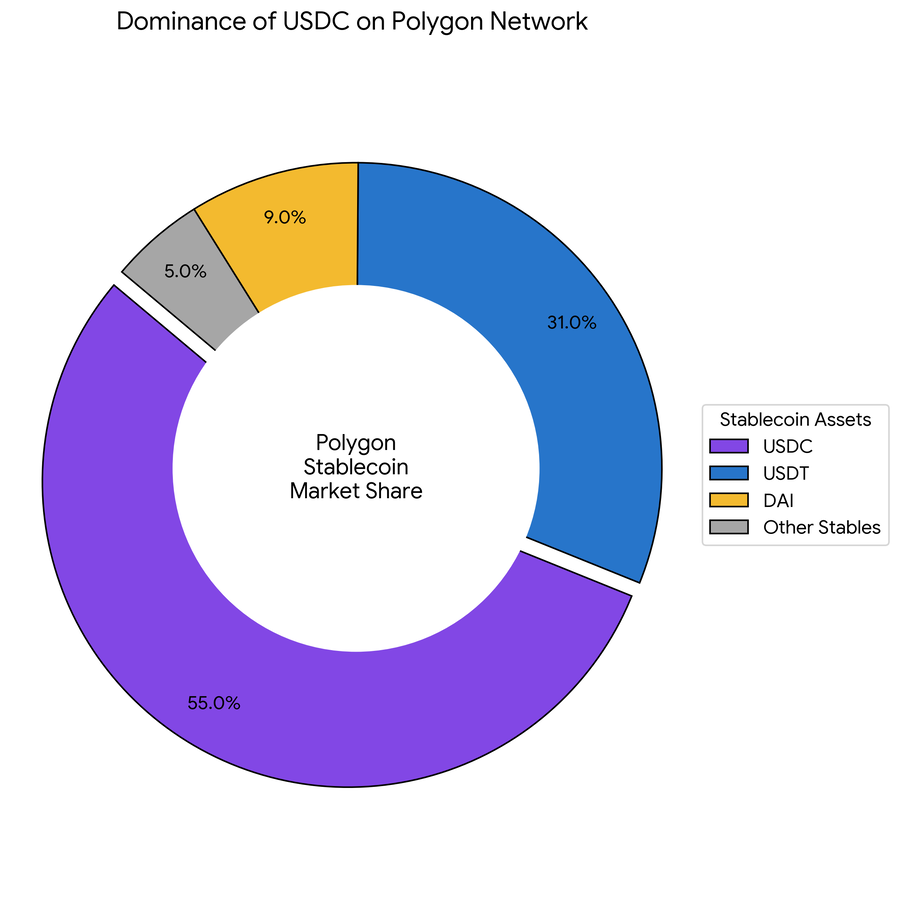
Stablecoins are the real product on Polygon. The chain carries around $2.9 billion to $3.8 billion in stablecoin market cap, with USDC holding the majority share at roughly 55%. That concentration matters for yield farmers because it means the deepest liquidity, the tightest spreads, and the most reliable exit routes are all in stablecoin pairs. If you are farming anything else, you are swimming in a smaller pool with fewer lifeguards. And if you are farming a volatile asset pair, you are swimming alone at night. Not impossible, but you need to know what you are doing.
The trend worth watching is Polygon's pivot toward payments and real-world assets. Polymarket settles its prediction markets on Polygon and has ranked among the chain's top fee generators. Spiko, Securitize, and Tangible are building tokenized asset infrastructure on the chain. This does not directly boost farming yields, but it does signal where the chain's gravity is heading. Polygon is becoming a place to settle transactions and hold stablecoins, not necessarily a place to farm exotic tokens. If that is the future, the most durable yield farming strategies on Polygon will be the boring ones: lending stablecoins and providing liquidity in tight, correlated pairs. Boring is underrated in DeFi. Boring is what pays the bills while everyone else is chasing the next shiny thing.
The Best Yield Farming Strategies on Polygon
Polygon is not a chain where you go to maximize APY. It is a chain where you go to minimize friction. The strategies that work here are the ones that take advantage of low fees, deep stablecoin liquidity, and the growing liquid staking ecosystem. Here is what actually makes sense, ranked roughly from least to most effort required.
Stablecoin Yield Farming on Polygon: Low-Fee Liquidity Provision and High-Frequency Harvesting
This is the bread and butter of Polygon farming, and it is where the chain's low fees genuinely shine:
Aave on Polygon is the anchor. You supply USDC or USDT, earn lending interest that typically ranges from 2% to 6%, and you can withdraw whenever you want. The rates are not exciting, but the liquidity is deep and the protocol has been battle-tested since 2020. For anyone who wants stablecoin yield without the complexity of liquidity provision, this is the starting point. I have parked more stablecoins in Aave on Polygon than I care to admit, and it has never let me down. It is not going to make you rich, but it is going to let you sleep.
Curve and Balancer offer the next step up. Stablecoin pools on these DEXs generate trading fees with minimal impermanent loss, and on Polygon, the gas costs to enter and exit are negligible. The yields are usually in the 3% to 6% range, and they fluctuate with trading volume. The advantage here is that you are not dependent on token emissions. The fees come from actual traders swapping stablecoins, which is a more durable source of yield than a protocol printing tokens to attract liquidity. I have watched too many farmers chase 50% APY on a new pool, only to watch it collapse to 2% in a month when the emissions dried up. Curve and Balancer do not offer those kinds of numbers, but they also do not disappear overnight.
The high-frequency harvesting angle is where Polygon's low fees become a genuine edge. On Ethereum, claiming rewards weekly can cost more than the rewards themselves. On Polygon, a transaction costs less than a cent, so you can harvest and compound as often as you like without worrying about the gas bill. For a $1,000 position, that difference is meaningful. It turns a 4% APY into something closer to 4.5% after compounding, which sounds small until you compare it to the same strategy on a chain where harvesting eats 1% of your principal every month. I have run the numbers both ways, and the low-fee advantage is not theoretical. It is real, and it compounds over time.
POL Staking and Liquid Staking: sPOL, MaticX, and Restaking Yield
POL staking is the foundation of Polygon's yield ecosystem, and it is also the source of its most talked-about risk.
Base staking yields are modest, roughly 2% to 4%, depending on how much of the supply is staked and which validator you choose. You delegate POL to a validator, the validator runs the infrastructure, and you earn a share of the rewards. It is simple, and it is the least glamorous way to earn yield on Polygon. But it is also the base layer for everything else. If you are going to farm POL, start here.
Liquid staking is where things get interesting. sPOL is Polygon's canonical liquid staking token, seeded with 10 million POL from treasury on day one and scaling toward 100 million to ensure liquidity depth. The pitch is straightforward: stake POL, receive sPOL, and then deploy that sPOL into lending markets or liquidity pools to earn a second layer of yield. MaticX from Stader Labs and ankrPOL from Ankr serve similar purposes, giving you options if you do not want to rely on a single provider. I have used MaticX and sPOL side by side, and the difference in yield is usually small. The bigger difference is in liquidity and secondary market depth, so check both before you commit.
The restaking narrative is still developing on Polygon, but it is worth watching. The idea is that you take your liquid staking tokens and use them to secure additional protocols, earning extra yield on top of the base staking rewards. It is a layered strategy that amplifies both returns and risk. If you are going to try it, start small and understand that every layer adds a new way for things to go wrong. I tried a restaking strategy once and spent three days trying to figure out where my rewards had gone. They were there, but the complexity was not worth the extra 1.5%. Your mileage may vary, but complexity has a cost, and that cost is usually your time.
Yield Aggregators and Auto-Compounding Vaults on Polygon: Beefy, Yearn, and ICHI
If you have a life outside of DeFi, auto-compounding vaults are probably the best thing to happen to Polygon farming.
Beefy Finance is the most straightforward option. Each vault targets a single farm, claims the rewards, swaps them back into the underlying assets, and re-deposits. The fee is 4.5% performance fee, which sounds like a lot until you realize that manual farming would cost you more in gas and missed compounding opportunities. Beefy is available on Polygon and covers a wide range of pools, from stablecoin pairs to more exotic combinations. I have used Beefy for years, and the set-and-forget model is hard to beat when you have a day job.
Yearn V3 takes a different approach. Instead of single-strategy vaults, Yearn allocates your deposit across three to five strategies to diversify yield sources. The fee is higher at 10% performance fee, but the multi-strategy design means you are not dependent on a single farm staying profitable. For stablecoin holders who want a set-and-forget solution, Yearn's USDC vault on Polygon is a reasonable choice, though the net APY after fees is usually in the 3% to 6% range. The extra fee buys you diversification, and if you are the kind of person who checks their portfolio once a week, that diversification is worth the cost.ICHI is worth mentioning for a different reason. It focuses on single-sided liquidity provision, which means you can deposit one token instead of a pair. This eliminates impermanent loss in the traditional sense, though it introduces its own set of risks around how the protocol manages the paired asset. It is a niche tool, but for farmers who want exposure to a single asset without the headache of balancing a pool, it is an option worth exploring. I have not used it extensively, but the farmers I know who do swear by it for specific use cases.
The key insight here is that vault fees are usually worth paying on Polygon. The chain's low gas costs mean the vault can compound frequently without bleeding value, and the shared gas model means you are not paying for every harvest out of your own pocket. A 4.5% fee on a 10% APY still leaves you with 9.55%, which is better than a manual strategy where you forget to harvest for three weeks. And let us be honest, we all forget to harvest for three weeks.
Concentrated Liquidity and DEX Yield Farming on Polygon: Uniswap, QuickSwap, and Balancer
Concentrated liquidity is the double-edged sword of modern DEX farming. It lets you focus your capital within a specific price range, which dramatically improves capital efficiency and fee income. It also means you need to actively manage your position, because if the price moves outside your range, you stop earning fees entirely.
Uniswap on Polygon brings the concentrated liquidity model to the chain with deep liquidity and tight routing. For ETH/USDC or MATIC/USDC pairs, Uniswap is often the best venue for fee income, but you need to be comfortable adjusting your range as prices move. If you are the kind of person who checks charts once a week, concentrated liquidity will punish you. I learned this the hard way when I set a range on an ETH/USDC position and then went on vacation for two weeks. When I came back, ETH had moved 15%, my position was out of range, and I had earned nothing for ten days. Lesson learned.
QuickSwap is the native alternative and has integrated concentrated liquidity functionality to compete with Uniswap. It is the default venue for long-tail Polygon pairs and often has the deepest liquidity for tokens that are native to the ecosystem. If you are farming a Polygon-native asset, QuickSwap is usually the place to look first. The interface is simpler than Uniswap's, and the fees are comparable. For beginners, it is a gentler introduction to concentrated liquidity.
Balancer offers something different: weighted pools that can hold multiple assets in custom proportions. Instead of a strict 50/50 split, you can have a pool that is 80% stablecoin and 20% volatile asset, which changes the impermanent loss profile and the yield characteristics. For farmers who want exposure to a volatile asset but want to limit the downside, weighted pools are a useful tool. Balancer is also a major venue for stablecoin routing, which means the fees are consistent and the impermanent loss is minimal. I have used Balancer for stablecoin-heavy portfolios, and the flexibility is genuinely useful. It is not as flashy as a concentrated liquidity position on Uniswap, but it is more forgiving.
Points, Airdrops, and Incentive Farming on Polygon
I have a complicated relationship with points programs. On one hand, they can add a meaningful bonus to an otherwise modest APY. On the other hand, they have a tendency to attract mercenary capital that disappears the moment the program ends, leaving the pool dry and the remaining farmers holding the bag.
Polygon protocols regularly run points campaigns and airdrop incentives to attract liquidity. The yields can look impressive on paper, but the actual value depends entirely on what the points convert into. If the token launches at a disappointing valuation, your "bonus" is worth less than the gas you spent to claim it. I have farmed points that converted into a token worth less than the transaction fee to claim it. It was not a proud moment.
My advice: treat points programs as a lottery ticket, not a salary. Farm them if the underlying yield is already acceptable without the points, and never deposit into a pool you would not be comfortable holding if the airdrop never materialized. The best points farms are the ones where the base APY is decent on its own, and the points are just a nice extra. If the base APY is 2% and the points are the only reason you are there, you are not farming. You are gambling with extra steps.
POL Staking Concentration: The Hidden Risk Every Polygon Yield Farmer Should Understand
Here is where the conversation gets uncomfortable. POL staking concentration is not a hypothetical risk. It is a structural problem that affects every yield farmer on Polygon, whether you stake directly or not.
Over a third of all staked POL is controlled by centralized exchanges. Upbit holds roughly 400 million POL, Coinbase controls 340 million, and Binance manages 255 million. Most of these users simply tapped "stake" inside an exchange app, never chose a validator, never compared commission rates, and never questioned where the rewards actually go. The exchange decides everything on their behalf. It is the DeFi equivalent of letting your friend order for you at a restaurant and hoping they remember you are allergic to shellfish.
The numbers get worse when you look at self-stake ratios. Upbit self-stakes just 1 POL against a 400 million POL delegation, and earned 1,975,024 POL in its last reward distribution, worth roughly $193,000. That is an extraordinary return built almost entirely on customer tokens. The exchange takes the rewards, and there is nothing on-chain that forces it to pass them back to users. If that sounds like a raw deal, it is because it is.
PIP-85, a recent Polygon proposal, aimed directly at this imbalance. Under the new parameters, Upbit's validator income would fall 86%, from 1,975,024 POL to roughly 283,298 POL per cycle. The Polygon team deserves credit for that effort. But as analyst Just Hopmans pointed out, the deeper problem remains untouched. The protocol only sees wallet addresses. It cannot distinguish an exchange wallet from a personal hardware wallet, and any rule based on identity breaks decentralization.
What does this mean for you as a yield farmer? Two things:
Gas Fees, Bridging Costs, and Capital Efficiency for Yield Farming on Polygon
One of the reasons Polygon farming is accessible is that the fees are genuinely low. A transaction on Polygon costs less than a cent, which means you can enter and exit positions, harvest rewards, and compound without watching your yield disappear into gas. For small farmers, this is a game-changer. A $500 position that would be uneconomical to manage on Ethereum is perfectly viable on Polygon. I have managed positions as small as $200 on Polygon without feeling like I was donating my yield to validators.
Bridging is where the costs add up. If you are coming from Ethereum, the gas fees on the Ethereum side of the bridge can range from $0.80 to $5.20 on a $1,000 transfer, depending on the bridge and network conditions. That is not terrible, but it is not nothing. If you are bridging $200, the fee can represent 1% to 2.5% of your capital before you have earned a single cent of yield. I have bridged small amounts before and immediately regretted it. The math just does not work.
The capital efficiency math is simple: if you are farming with under $1,000, bridging to Polygon is rarely worth it unless you already have funds there or you plan to stay for a long time. The bridge fee plus the time cost of managing a new chain will eat a meaningful chunk of your first month's yield. If you are farming with $5,000 or more, the bridge cost becomes negligible, and Polygon's low fees become a genuine advantage over time. The bigger your position, the more the low fees matter. The smaller your position, the more the bridge costs matter. Find your break-even point before you move a single dollar.
There is another efficiency angle that most people miss: Polygon's low fees make smaller, more frequent compounding viable. On a chain where harvesting costs $0.01, you can compound daily instead of weekly. That might not sound like much, but over a year, the difference between daily and weekly compounding on a 6% APY is roughly 0.2%. It is not life-changing, but it is free money if you automate it through a vault. And free money is the best kind of money.
One more thing worth mentioning: Polygon's native gas token is POL, which means you need to keep a small amount in your wallet to pay for transactions. Do not swap all your POL into a farm and then realize you cannot harvest because you have no gas. I have done this. It is embarrassing, and it costs you more to fix than it would have to prevent.
Is Yield Farming on Polygon Still Worth It? Pros and Cons
Let us be honest about what Polygon offers and what it does not:
The pros are real:
- Gas fees are negligible, which makes experimentation cheap and small positions viable.
- Stablecoin liquidity is deep, especially in USDC, which means you can exit without destroying the price.
- Liquid staking is maturing, with sPOL and MaticX giving you options for stacking yield without lockups.
- And the institutional narrative around payments and real-world assets gives Polygon a long-term story that is more compelling than most chains can offer.
If you believe that DeFi's future is more about settlement than speculation, Polygon is positioned well.
The cons are equally real:
- TVL is modest, which means the pools are shallower than what you will find on BSC, and the yields are generally lower.
- POL staking concentration is a structural problem that affects governance and reward fairness.
- The farming scene is less active, with fewer incentive programs and less mercenary capital sloshing around.
- And the best yields are often in stablecoins, which means you are not going to get rich quick.
If you are looking for 20%+ APY on a volatile pair, Polygon is not the chain for you. It is not even the chain for people looking for 10% on a volatile pair, unless you are willing to take on risks that are not obvious.
My honest take: Polygon is a good chain for patient, stablecoin-focused farmers who value low fees and reliable exits over headline APY. It is a poor chain for degen farmers who want to chase emissions and flip tokens.
If you have $1,000 to $10,000 in stablecoins and you want a place to earn 4% to 6% without paying half of it back in gas, Polygon works.
If you have $500 and you want to turn it into $5,000 by farming a new token, you are better off on BSC, where the liquidity and incentives are deeper.
Neither chain is "better" in absolute terms. They just serve different farmers with different goals. Know which farmer you are, and the choice becomes a lot easier.
📊 Dominance of USDC on Polygon Network
How to Interpret This Visual
This donut chart visualizes the distribution of the approximately $2.9 billion to $3.8 billion stablecoin market capitalization deployed on the Polygon network. The chart breaks this down by major assets (USDC, USDT, DAI, and a combined category for 'Other Stables') representing their respective approximate market shares.
The most critical takeaway is the sheer dominance of USDC, which commands roughly 55.0% of the entire stablecoin market on the chain. Its dominant 'slice' is exploded for emphasis. USDT follows with a significant but smaller 31.0% share, while DAI captures 9.0%. The remaining smaller stablecoins combine to form just 5.0% of the total.
How to Utilize This Data in Your Strategy
For a yield farmer on Polygon, this data dictates where you should focus your liquidity. When an ecosystem is this heavily skewed toward a single asset (USDC), it means that:
-
USDC liquidity pools will almost always be the deepest, offering the lowest slippage on entry and exit.
-
The best routing on decentralized exchanges will typically run through USDC pairs, leading to more consistent fee generation.
-
Lending protocols (like Aave) will have the most robust utilization and supply depth for USDC.
If you are farming stablecoins on Polygon, concentrating your capital in USDC-based strategies is the most conservative and efficient path. Chasing yields in the 'Other Stables' category (representing only 5% of the market) often introduces substantial liquidity risk: the ease of entry may not match the ease of exit when you are ready to harvest your gains. The data clearly shows that USDC is the backbone of Polygon's DeFi utility.
Yield Farming on BNB Chain (BSC): Opportunities, Protocols, and Hidden Risks
If Polygon is the quiet library where you go to study, BNB Chain is the crowded trading floor where the action is. Both are useful. Only one of them will give you a heart attack if you are not paying attention.
I have been farming on BSC since the days when PancakeSwap was basically the only game in town and every other farm was a fork of a fork of a fork. The chain has matured a lot since then, but it has never lost that "go big or go home" energy. That is exactly why it attracts so much capital, and exactly why it punishes people who treat it like a savings account.
BNB Chain DeFi Ecosystem Overview: TVL, Throughput, and the Binance Effect
The scale of BNB Chain is genuinely difficult to overstate, and the numbers back it up:
BNB Chain's DeFi total value locked sits around $4.8 billion to $5.6 billion, depending on the snapshot and the day you check. One recent reading put DeFi TVL at roughly $4.83 billion, while another reported a 15.6% rise to $5.66 billion as the ecosystem continued to pull capital in. For context, that is roughly seven to eight times the size of Polygon's DeFi TVL. The chain is not just bigger in raw deposits. It is bigger by an order of magnitude, and that scale changes the math for everyone farming on it.
DEX volume is where the scale really shows. BNB Chain processed $1.57 billion in 24-hour DEX volume, with seven-day volume hitting $6.58 billion, up 27.1% week over week. Those are numbers that most chains can only dream about. The liquidity is not spread thin across a hundred abandoned pools. It is concentrated in a handful of venues that actually work, and that concentration is both a feature and a risk. On one hand, you can enter and exit large positions without moving the price. On the other hand, if one of those venues has a bad day, the whole ecosystem feels it.
The Binance effect is the elephant in every room on BSC. Binance is not just the largest exchange in the world. It is the gravitational center of the entire BNB Chain ecosystem. Lista DAO, one of the chain's most important protocols, launched its LISTA token through Binance Launchpool and has backing from Binance's YZi Labs. PancakeSwap dominates DEX activity in a way that mirrors Binance's dominance in centralized trading. This proximity gives BSC liquidity, attention, and a distribution pipeline that other chains would kill for. It also means that a meaningful chunk of BSC's health is tied to one company's fortunes. If Binance sneezes, BSC catches a cold. That is not a reason to avoid the chain, but it is a reason to understand what you are implicitly betting on when you farm there.
There is one more trend worth noting, and it is the one that surprised me the most: real-world assets are growing fast on BNB Chain. The chain captured $3.62 billion in new RWA value, topping blockchain growth charts, and its active RWA market cap reached roughly $4.91 billion, which is close to the size of the chain's entire DeFi TVL. That is a remarkable shift. It means BSC is no longer just a place for degen farming. It is becoming a venue for tokenized treasuries, institutional credit, and structured products.
For yield farmers, that translates into new kinds of opportunities: fixed-rate vaults, RWA-backed lending, and strategies that do not depend entirely on token emissions. It also means the chain is attracting a different kind of capital, the kind that cares about predictable returns and regulatory clarity, which could make the ecosystem more stable over time. Or it could mean the degen era is slowly ending. Either way, it is worth watching.
The Best Yield Farming Strategies on BNB Chain (BSC)
BNB Chain rewards activity. The farmers who do well here are the ones who are willing to pay attention, rotate capital when incentives shift, and understand that the highest APY is rarely the best APY. Here is what the landscape actually looks like, ranked roughly from "set and forget" to "you better have a spreadsheet."
Stablecoin Yield Farming on BSC: Venus, Lista DAO, and Wombat Exchange
Stablecoin farming on BSC starts with Venus Protocol, and for good reason. Venus is the chain's dominant lending market, and its stablecoin yields are the benchmark against which everything else is measured.
USDT in Venus's Liquidity Hub currently offers around 3.65% APY, and that yield is connected to tokenized assets backed by US Treasury securities and AAA credit ratings through Centrifuge. That is not a token-printing yield. It is yield backed by real-world cash flows, which makes it more durable than the emissions-driven farms that dominate the rest of the chain. Venus also offers higher rates on other stablecoin markets depending on utilization, with ranges that can stretch into the 4% to 6.5% territory when borrowing demand is strong. It is not going to make you rich, but it is one of the few places on BSC where you can park stablecoins and feel reasonably confident that the yield is not going to evaporate next week.
Lista DAO is the other pillar of the stablecoin farming ecosystem, but it operates differently. Lista's lisUSD is a CDP stablecoin minted against slisBNB and other collateral. You can farm with lisUSD in various pools, but the more interesting strategy is using Lista as a layered yield engine: stake BNB for slisBNB, deposit slisBNB as collateral, borrow lisUSD, and then deploy that lisUSD into another yield opportunity. The appeal is obvious. The risk is also obvious. Lista controls nearly 50% of all staked BNB and runs a $1.35 billion lending market, which means a failure in one part of the system cascades into the other. The recursive dependency (BNB into slisBNB into lisUSD) amplifies volatility in ways that are not always visible until things go wrong. I have used this strategy myself, and it works beautifully, right up until the moment it does not. If you are going to layer, keep a close eye on your collateral ratio and do not max out your borrow. The extra yield is not worth a liquidation.
Wombat Exchange is the underrated option. It uses a stableswap model that minimizes slippage, and its single-sided staking makes it easier to enter and exit without worrying about impermanent loss. The yields are modest, often under 1% on many pools, but the liquidity depth in stablecoin pairs like BUSD and USDT is real, and for farmers who prioritize safety over APY, it is a viable parking spot. It is not exciting. It is not supposed to be. Think of it as the DeFi equivalent of a high-yield savings account, except the bank is a smart contract and the interest rate is set by supply and demand instead of a committee.
PancakeSwap Yield Farming: CAKE Emissions, Liquidity Pools, and Real Yield
PancakeSwap is the liquidity engine of BSC, and its farms are where most of the action happens. But the mechanics are shifting in a way that every farmer should understand.
The headline change is "The Flip," a governance proposal from PancakeSwap's core team that would fundamentally alter how the DEX rewards liquidity providers. Under the proposal, LPs on v3 and Infinity pools would earn 88% of swap fees, up from roughly 66% to 68% today. At the same time, CAKE emissions would fall by 69%, from 22,500 to 7,000 CAKE per day, removing roughly 5.7 million CAKE from annual supply. Based on 2025 volume, LPs would have earned about $62 million more in fees under the new split.
This is a big deal, and it tells you where PancakeSwap is heading. The protocol is trying to shift from inflationary farming to real yield. Instead of printing CAKE to attract liquidity, it wants to pay LPs from actual trading fees. If the proposal passes, the farms that survive will be the ones with genuine volume, not the ones with the highest emission multipliers. For farmers, that means the APY on a CAKE farm will increasingly reflect real demand for liquidity, not token printing. It is a healthier model, but it also means the days of 50%+ APY on a random PancakeSwap pool are probably numbered. I have mixed feelings about this. On one hand, it is the right long-term move for the protocol. On the other hand, I will miss the days when you could earn a ridiculous APY just by showing up. Progress is like that.
The caveat is that "The Flip" was still a proposal at the time of writing, subject to a Snapshot vote and implementation. Do not assume it is live until you see it on-chain. Governance proposals have a way of changing between the announcement and the execution.
Liquid Staking and CDP Strategies: slisBNB and Layered Yield Farming on BSC
The mechanics are straightforward. You stake BNB through Lista DAO and receive slisBNB, which accrues staking rewards while remaining tradeable and usable in DeFi. You can deposit slisBNB into lending markets, provide it as liquidity on DEXs, or use it as collateral to borrow lisUSD. The appeal is that you are earning staking rewards on the underlying BNB while also earning yield on the slisBNB itself. That is the definition of layered yield.
There is even a Binance Launchpool angle. By depositing slisBNB into Lista Lending or providing BNB/slisBNB liquidity on certain venues, you can mint slisBNBx, a non-transferable token that gives you access to Binance Launchpool airdrops. For farmers who are already using Binance, this is a meaningful bonus that does not require additional capital. It is one of the few genuine "free lunch" opportunities in DeFi, though the lunch is only free if you already have BNB and an account on Binance.
The risk is concentration. Lista DAO controls nearly 50% of BNB Chain staking, which means a single protocol has outsized influence over the chain's validator set and governance. That is not a reason to avoid slisBNB entirely, but it is a reason to understand that you are not just farming yield. You are participating in a system with a single point of failure. If Lista has a serious problem, the ripple effects will be felt across every strategy that touches slisBNB. Diversify your liquid staking exposure if you can, and keep an eye on governance proposals that affect the protocol's risk parameters.
Fixed-Rate and Structured Yield Farming on BNB Chain
One of the more interesting developments on BSC is the growth of fixed-rate and structured yield products. These are still early, but they represent a shift toward the kind of financial products that institutional capital actually wants.
Pendle has expanded its yield trading to BNB Chain, and one of its offerings includes apxUSD with a 13% fixed APY. The asset itself does not generate yield; it is a synthetic dollar backed by digital asset treasury preferred shares. The yield comes from the strategies that Pendle unlocks around it. Users can lock in fixed rates using PT (principal tokens), take leveraged exposure to points using YT (yield tokens), or provide liquidity to earn both yield and points. It is complex, and it is not for beginners, but it is a genuine alternative to the floating-rate emissions farming that dominates the rest of the chain. If you have ever wished you could just lock in a rate and stop checking the dashboard, this is the closest thing DeFi has to a certificate of deposit.
Venus and Asseto Finance have also launched fixed-term vaults for United Stables' $U, offering a 2.16% annualized yield over a one-month term with a capacity of 500,000 $U. The vault uses CASH+, an institutional-grade RWA asset, as collateral. The yield is modest, but the structure is important. It shows that BSC is building the infrastructure for predictable, term-based yield, not just the floating-rate chaos of degen farming. These products are not going to replace PancakeSwap farms for the average farmer. But they are worth watching, especially if you are managing larger capital and want to lock in a rate without checking the dashboard every day.
There is also a growing market for structured products that combine lending, options, and liquidity provision into a single vault. These are not for everyone, and the fees can be significant, but they offer a way to access strategies that would otherwise require a team of traders to execute. Just make sure you understand what is happening inside the vault before you deposit. If the strategy description sounds like a physics equation, it is probably not for you.
Points, Airdrops, and Incentive Farming on BSC
BNB Chain runs more incentive programs than almost any other ecosystem, and the Airdrop Alliance Program is the most structured example. The third phase of the program distributed over 2.3 billion points and more than 8 million tokens across ecosystem projects including Xterio, REVOK, Burve Protocol, and others. These programs are designed to reward on-chain activity and bring new users into the ecosystem. They are also designed to make the chain look busy, which is not the same thing as making you money.
For farmers, the calculus is familiar. Points and airdrops can add meaningful value to a farming position, but they are not guaranteed income. The tokens you receive might be worth less than the gas you spent claiming them. The projects might never launch. The points might convert at a disappointing ratio. I have farmed points that turned into a token worth less than the transaction fee, and I have farmed points that turned into a decent bonus. The difference was usually whether the underlying protocol had real traction independent of the points program. If the protocol is only alive because of the points, the points are probably not going to be worth much.
Treat incentive farming on BSC the same way you would treat it on Polygon: farm the yield, not the rumor. If the base APY is acceptable without the points, the points are a bonus. If the points are the only reason you are there, you are gambling with extra steps. And remember that every points program has a claim date, a vesting schedule, and a token launch price that you cannot control. Plan accordingly.
Inflationary Emissions vs Sustainable Yield: Reading BNB Chain APYs Correctly
BNB Chain has a high-APY culture, and that culture can be expensive if you do not know how to read it.
The classic BSC farm advertises 30%, 50%, even 100% APY, and a meaningful chunk of that yield is paid in a native token that the protocol is printing specifically to attract your liquidity. That is not necessarily a scam. It is a customer acquisition strategy. The protocol is paying you in its own equity to bootstrap liquidity, and if the token appreciates, everyone wins. The problem is that most farming tokens do not appreciate. They dilute, they decline, and the farmer who chased the headline APY ends up holding a token that is worth less than the stablecoin they deposited. I have been that farmer. It is not a fun club to be in.
Here is the simple test I use. Find the token's annual emissions, divide by its circulating supply, and compare that inflation rate to the advertised APY. If a protocol is advertising 80% APY but inflating its supply by 60% per year, the real yield is much thinner than it looks. If the inflation is 120%, you are not earning. You are being paid in a currency that is designed to lose value. It is the DeFi equivalent of being paid in a currency that is being printed faster than you can spend it.
The good news is that BSC is moving in the right direction. PancakeSwap's emissions cut is the clearest example. By reducing CAKE emissions by 69% and shifting LPs to fee-based rewards, the protocol is acknowledging that inflationary farming is not sustainable at scale. Venus's RWA-backed yields are another sign. A 3.65% APY backed by Treasury securities is boring, but it is real. It does not depend on a token printing press.
The lesson for farmers is simple. Chase real yield, not headline yield. A 6% Venus lending position that pays you in USDT is worth more than a 40% farm that pays you in a token that halves in value over the next three months. The math is not complicated. The discipline is. And discipline is the one thing that no APY dashboard can give you.
Gas Fees, MEV, and Execution Risk for Yield Farming on BSC
Gas on BNB Chain is cheap. Not Polygon-cheap, but cheap enough that a transaction costs a few cents rather than a few dollars. That makes active farming viable, and it is one of the reasons BSC is the preferred chain for farmers who like to rotate positions and chase incentives.
MEV is the bigger execution risk, and it is more structural than most farmers realize. A recent empirical study of BNB Smart Chain found that two latency-advantaged builders, 48Club and BlockRazor, capture roughly 90% of MEV because they see order flow ahead of the public mempool. The study also found that the independent searcher's edge is "vanishingly small" under the current regime. In plain language: the game is rigged in favor of a small number of players who are faster and better connected than you will ever be. It is not personal. It is structural.
What does this mean for a yield farmer? It means that your swaps and withdrawals are exposed to sandwich attacks, especially on pools with thin liquidity. The builders who control order flow can see your transaction before it executes and place trades around it to extract value. You cannot eliminate this risk entirely, but you can reduce it. Use private transaction relays when available. Avoid large swaps in low-liquidity pools. Break large withdrawals into smaller chunks if the pool cannot handle the slippage. And accept that a small amount of your yield will always be lost to MEV. It is the cost of doing business on a chain that prioritizes speed and volume.
There is also protocol-level execution risk. The Lista DAO concentration is not just a governance concern. It is an execution concern. If Lista's systems face stress during a market crash, liquidations can cascade in ways that affect every farmer who has touched slisBNB or lisUSD. The protocol's rapid growth from zero to $4.5 billion in TVL means its mechanisms have not been tested at scale during a severe downturn. That is not a prediction of doom. It is a reminder that size does not equal safety. The biggest protocols are often the ones that get the most complacent, and complacency is expensive.
One more execution risk worth mentioning: bridge risk. If you are moving funds from Ethereum or another chain to BSC, you are trusting a bridge. Bridges have been hacked for billions of dollars over the years, and the risk is not hypothetical. Use canonical bridges when possible, avoid newer or unaudited bridges, and never bridge more than you are prepared to lose in a worst-case scenario.
Is Yield Farming on BNB Chain Still Worth It? Pros and Cons
Let us be honest about what BSC offers and what it costs.
The pros are substantial:
- Liquidity is deep, which means you can enter and exit meaningful positions without destroying the price.
- Incentive programs are generous, with airdrops, points campaigns, and emissions that can meaningfully boost your yield.
- The protocol ecosystem is mature, with Venus, PancakeSwap, and Lista DAO offering battle-tested (if not stress-tested) infrastructure.
- And the shift toward real yield is real, with PancakeSwap cutting emissions and Venus offering RWA-backed stablecoin yields.
If you are an active farmer who wants options and is willing to pay attention, BSC is one of the best venues in DeFi.
The cons are equally real:
- Emissions dependence is still high on many farms, and the headline APY often overstates what you actually keep.
- Centralization risk is baked into the ecosystem, from Lista's dominance of staking to the Binance effect that shapes everything from token listings to liquidity flows.
- MEV extraction is concentrated among a small number of builders, which means your execution is worse than the dashboard suggests.
- And the best yields often require active management, which is fine if you have the time but miserable if you do not.
If you are the kind of person who checks their portfolio once a month, BSC will either bore you or burn you.
My honest take: BNB Chain is the best chain for active, yield-focused farmers who are willing to rotate capital, read emissions schedules, and accept a certain degree of centralization in exchange for deep liquidity and generous incentives. It is a poor chain for set-and-forget investors who want to deposit stablecoins and check back in six months.
If you have $1,000 to $50,000 and you are willing to spend a few hours a week managing positions, BSC can deliver yields that Polygon simply cannot match.
If you have $500 and you want to park it somewhere safe, Polygon's boring stability might serve you better.
Neither chain is universally better. They reward different kinds of behavior. Know which kind of farmer you are, and the choice becomes obvious.
And if you are the kind of farmer who wants to do both, that is fine too. Just remember that every hour you spend managing a second chain is an hour you are not spending on something else. Time is the one yield that no protocol can print.
📊 BSC Ecosystem Scale: Core DeFi vs. Emerging RWAs
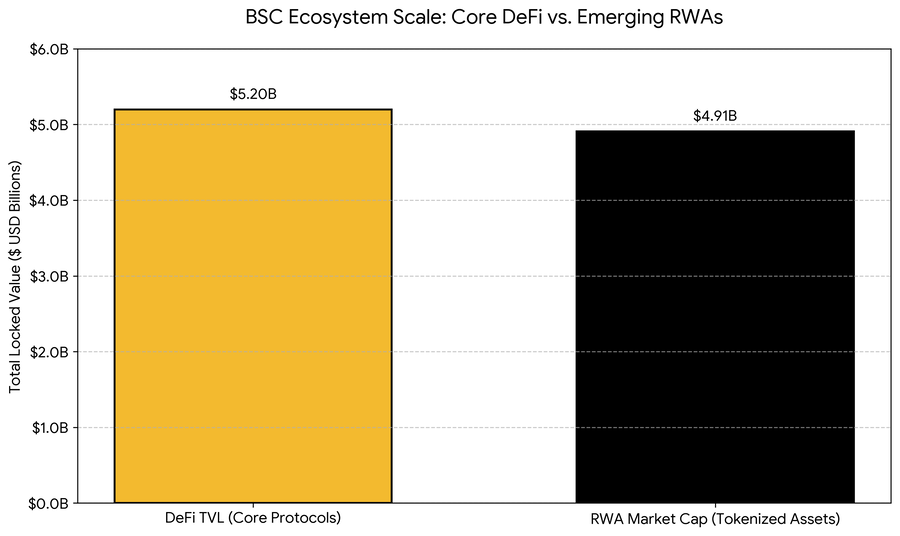
How to Interpret This Visual
This bar chart provides a direct scale comparison between two major capital sectors on the BNB Chain (BSC): Core DeFi Total Value Locked (TVL) and the Emerging Real-World Asset (RWA) market capitalization.
-
DeFi TVL (Core Protocols): The left bar, using the midpoint of the range provided ($4.8B to $5.6B), is estimated at roughly $5.20 billion. This represents the total value actively locked within decentralized exchanges, lending markets, and yield aggregators (like PancakeSwap, Venus, and Lista DAO).
-
RWA Market Cap (Tokenized Assets): The right bar shows the rapidly growing RWA sector, valued at approximately $4.91 billion. This represents the value of tokenized treasuries, institutional credit, and other real-world financial products deployed on BSC.
The central takeaway is how closely the RWA market value matches the scale of the entire established DeFi ecosystem on BSC. RWAs are not a minor experiment; they are now a multi-billion dollar pillar of the BNB Chain's gravity.
How to Utilize This Data in Your Strategy
For a yield farmer on BNB Chain, this visual confirms that a significant structural shift is underway. The historical approach (chasing the highest APY via inflationary emissions on new DeFi tokens) now competes with strategies backed by the cash flows of physical assets.
If you are a conservative farmer looking for predictable yield, the growth in RWAs validates strategies like providing liquidity to Venus's Liquidity Hub or structured products (like Pendle) that utilize RWA-backed collateral. The close comparison in scale suggests that while the degen era isn't over, the "real yield" and institutional narrative on BSC is durable, backed by a massive influx of professional capital that prioritizes predictable returns over speculation. This chart tells you that stable, RWA-backed options are now as relevant on BSC as the traditional DEX farms.
Yield Farming on Polygon vs BNB Chain: Side-by-Side Comparison
Here is the part where we stop talking about each chain in isolation and actually put them next to each other. No marketing spin, no cherry-picked numbers from a single good week. Just the categories that matter when you are deciding where to send your stablecoins: yield, cost, liquidity, security, and the sustainability of the rewards you are chasing.
A quick heads-up before we dive in. The numbers in DeFi move fast, and any comparison is a snapshot, not a permanent truth. What does not move as fast is the structure of each chain: the protocols that dominate, the risks that are baked in, and the way incentives are designed. That is what this section focuses on, because structural advantages and structural risks are the things that actually determine whether you make money over a full cycle. I have watched farmers make and lose fortunes on both chains, and the pattern is always the same. The ones who understood the structure survived. The ones who chased numbers did not.
APY Comparison: Stablecoin Yield, Blue-Chip Yield, and Ecosystem Token Yield
Let us start with the number everyone looks at first, and then talk about why it is only half the story.
Stablecoin yield is the most direct comparison because you are not taking on price exposure. On BNB Chain, Venus Protocol offers stablecoin lending in the 2.7% to 6.5% range depending on the asset and utilization, with USDT and FDUSD usually sitting at the higher end and USDC and DAI at the lower end. Adding XVS rewards can push effective yields to 4% to 7% for mainstream stablecoins. PancakeSwap stablecoin liquidity provision can reach up to 8.72% when incentives are running hot, but a meaningful chunk of that is paid in CAKE, not stablecoins. On Polygon, stablecoin vaults tracked across the ecosystem show a 30-day average yield of around 2%, with the best blue-chip options like Aave and Curve landing in the 3% to 6% range depending on market conditions.
The headline takeaway: BNB Chain generally offers higher stablecoin APY at the top end, but the gap is narrower than the marketing suggests once you account for the token exposure in the reward mix. Polygon's stablecoin yields are lower, but they are more likely to be paid in actual stablecoins or blue-chip assets rather than a farm token that might halve in value. I have earned 8% on a BSC stablecoin farm and watched the reward token drop 30% in a month, turning my real return into something closer to 4%. I have also earned 4% on Aave Polygon and kept every cent of it. The second experience was less exciting and more profitable.
Blue-chip yield, meaning ETH, BNB, and other major assets, tells a similar story. BNB Chain's deep liquidity and active lending markets mean you can usually find better rates on BNB and ETH pairs than on Polygon. But blue-chip pairs come with impermanent loss risk on both chains, and the higher APY on BSC often reflects higher trading volume and more active incentive programs, not a structural advantage in safety.
If you are providing liquidity to an ETH/BNB pair on PancakeSwap, you are earning fees from traders, but you are also exposed to the price divergence between two volatile assets. That is a very different risk profile from lending stablecoins, and the APY number alone does not tell you which one you are getting.
Ecosystem token yield is where the comparison gets messy. BSC has more farms, more emissions, and more triple-digit APY opportunities that look incredible until you do the math. A 200% APY paid in a token that loses 80% of its value is a negative return, and that pattern has played out repeatedly across DeFi cycles. Polygon has fewer of these opportunities, which is both a limitation and a blessing.
If you are the kind of farmer who cannot resist a shiny APY, Polygon's relative scarcity of degen farms might actually protect you from yourself. I mean that sincerely. Some of my worst farming decisions were made on chains with the most abundant high-APY farms. The temptation is the trap.
Staking yield deserves its own line. POL staking on Polygon has shown APYs in the 5% range on some validators, while BNB staking has been reported as low as 1.14% on some comparison platforms, though liquid staking through Lista and other providers can offer better rates. The wide variation reflects different validator commissions, reward schedules, and the specific platform doing the measurement.
The lesson: shop around before you stake, because the difference between a lazy delegation and a deliberate one can be several percentage points. I have seen validators charge 10% commission while others charge 3% for the same service. Over a year, that difference adds up to real money.
A note on risk-adjusted yield: if you are comparing a 6% Venus lending position to a 20% PancakeSwap farm, you are not comparing apples to apples. The Venus position is backed by borrower demand and collateral. The PancakeSwap farm is backed by token emissions and the hope that CAKE holds its value. Both can be valid strategies, but they are not the same trade. Adjust the APY for the risk you are taking, and the "better" yield often turns out to be the lower one.
Gas Fees and Cost Efficiency: Yield Farming on Polygon vs BNB Chain
Gas is where Polygon has a clear, structural advantage, and it is not close.
Polygon transactions cost less than a cent, which means you can enter and exit positions, harvest rewards, and compound without watching your yield bleed away. For small farmers, this is transformative. A $500 position that would be uneconomical to manage on Ethereum is perfectly viable on Polygon.
On BNB Chain, gas is also cheap by absolute standards, typically a few cents per transaction, but it is not quite Polygon-cheap. The difference matters most for high-frequency strategies like daily harvesting or active concentrated liquidity management.
On Polygon, you can compound daily without thinking about it. On BSC, you can too, but the cost is slightly more noticeable over time. If you are harvesting daily on a $1,000 position, the difference between $0.01 and $0.05 per transaction is $14.60 per year. Not life-changing, but not nothing either.
Bridging costs are the equalizer. If you are moving funds from Ethereum or another chain, the bridge fee on the source chain can range from under a dollar to several dollars depending on network conditions. For a $200 transfer, that fee can represent 1% to 2.5% of your capital before you have earned a single cent. For a $5,000 transfer, it is negligible.
The implication is simple: Polygon's gas advantage matters most for small positions and high-frequency strategies, while BSC's deeper liquidity matters most for larger positions. If you are farming with under $1,000, the bridge cost alone can make cross-chain farming uneconomical, regardless of which chain you choose. I have bridged $300 to a new chain, paid $4 in fees, and then realized the farm I wanted was already closed. That was a 1.3% loss for nothing.
There is one more cost that does not show up on a gas tracker: MEV. On BSC, a small number of latency-advantaged builders capture the vast majority of MEV, which means your swaps and withdrawals are exposed to sandwich attacks and worse execution. Polygon has its own MEV dynamics, but the concentration is less pronounced. Neither chain is MEV-free, but if you are making large trades in thin pools, BSC's concentrated MEV extraction is a cost worth factoring in. It is the invisible tax on every transaction, and most farmers never see it until they wonder why their execution price was worse than expected.
The hidden cost of time deserves a mention too. Managing positions on two chains takes twice the time. Checking emissions schedules, comparing pool depths, and rotating capital are all activities that do not show up in a gas fee but absolutely affect your net return. If you value your time at even $20 per hour, spending three hours a week managing farms costs you $3,120 per year. That is more than most farmers earn on a $10,000 position. Cost efficiency is not just about gas. It is about the total cost of your attention.
Liquidity Depth and Exit Risk: Why APY Means Nothing If the Pool Is Dry
This is the section that separates serious farmers from tourists. APY is a promise. Liquidity is a fact.BNB Chain's DeFi TVL sits around $4.8 billion to $5.6 billion, with daily DEX volume in the $1.5 billion range and weekly volume hitting $6.58 billion. That scale translates into deep pools and wide exit doors. If you are farming a major pair like BNB/USDT or CAKE/BNB on PancakeSwap, you can enter and exit meaningful positions without moving the price. That matters more than any APY number, because a yield you cannot withdraw is not a yield. It is a hostage situation.
Polygon's DeFi TVL is around $677 million, with daily DEX volume near $92 million and weekly volume at $699 million. The pools are shallower. The exits are narrower. For stablecoin pairs like USDC/USDT, liquidity is still deep enough for most retail positions, but for anything more exotic, you need to check the pool depth before you deposit. A pool with $50,000 in liquidity and a 20% APY is a trap. Your deposit alone might move the price, and your withdrawal will definitely hurt.
The practical rule: on BSC, you can be a little more relaxed about pool depth for major pairs. On Polygon, you need to be deliberate about position sizing relative to the pool. If your deposit would represent more than 5% of the pool's liquidity, find a deeper pool or reduce your size. This is not about being overly cautious. It is about recognizing that exit risk is a real cost, even if it does not show up on a dashboard.
I learned this lesson when I tried to exit a $2,000 position from a Polygon pool with $18,000 in liquidity. The slippage cost me 3%, which erased two months of yield. The APY looked great on the way in. The exit told a different story.
Liquidity depth also affects your ability to compound. If you are harvesting rewards and swapping them back into the pool, thin liquidity means every swap costs you more in slippage. On deep pools, this is negligible. On shallow pools, it can quietly eat 0.5% to 1% per harvest. Over a year of weekly harvesting, that is 26% to 52% of your yield gone to slippage. The number on the dashboard never shows this. Your wallet does.
One more thing about exit risk: it is not just about price impact. It is about whether you can exit at all. During market stress, liquidity can evaporate. Traders pull orders, LPs withdraw, and the pool that looked deep last week is suddenly a puddle. This happens on both chains, but it happens faster on smaller ecosystems. Polygon's pools are more vulnerable to sudden liquidity droughts than BSC's. If you are farming on Polygon, keep an eye on TVL trends. If a pool's liquidity has been falling for a week straight, that is a signal worth paying attention to.
Security and Smart Contract Risk: Audits, Exploits, and Protocol Maturity
Both chains have their share of security horror stories, and the lessons are worth internalizing.
BNB Chain's major protocols are mature and heavily audited:
- Venus has undergone audits by CertiK, which has supported institutional confidence in its money market infrastructure.
- PancakeSwap has been running for years and has survived multiple market cycles.
That does not make them risk-free, but it does mean the code has been tested by time and adversarial conditions.
The bigger security concern on BSC is concentration risk: Lista DAO's dominance of staking and the Binance effect mean that a failure in one part of the ecosystem could cascade across many strategies. If Lista has a serious problem, the ripple effects will be felt by every farmer who has touched slisBNB or lisUSD.
Polygon's security picture is more mixed: The chain hosts blue-chip protocols like Aave, Curve, and Balancer that have strong track records. But it has also seen exploits on smaller or older protocols. The INK Finance exploit drained roughly $140,000 from a treasury contract on Polygon through a whitelist bypass. A separate exploit hit Huma Finance's deprecated V1 contracts on Polygon on the same day, suggesting that aged infrastructure is a recurring vulnerability.
The lesson is not that Polygon is unsafe. It is that protocol maturity matters, and older or smaller protocols on any chain deserve extra scrutiny. If a protocol has been running for three months and has not been audited, it does not matter how good the APY looks. You are the audit.
Cross-chain bridge risk affects both chains equally. Bridges have been hacked for billions of dollars, and the Poly Network incident, where an attacker exploited compromised private keys to mint tokens across multiple chains including BNB Chain and Polygon, is a reminder that bridge security is a systemic risk, not a chain-specific one. If you are moving funds between chains to farm, use canonical bridges when possible and never bridge more than you are prepared to lose in a worst-case scenario. I have used bridges that seemed fine and later turned out to have serious vulnerabilities. The bridge does not care about your APY. It only cares about whether the code works.
The stablecoin risk deserves a mention here too. The Resolv USR incident, where an attacker gained access to a privileged signing key and minted $80 million in unbacked tokens, caused the stablecoin to depeg to $0.14 before partially recovering. This was not a Polygon or BSC-specific event, but it affected lending markets on both chains that had exposure to the asset. If you are farming with stablecoins, you are exposed to issuer risk, and no amount of chain-level security can protect you from a stablecoin that loses its peg. Diversifying across USDC, USDT, and DAI does not eliminate this risk, but it spreads it around. And spreading risk around is one of the few free lunches in DeFi.
A practical security checklist that applies to both chains: stick to protocols with multiple audits and large bug bounties, avoid farms that launched last week, check whether the protocol has a timelock on admin functions, and never approve unlimited token spending unless you trust the contract. These are not glamorous steps, but they are the difference between farming and gambling. I have lost money to a protocol that passed every check on this list. I have never lost money to a protocol that failed them.
Ecosystem Incentives and Reward Sustainability Compared
This is where the philosophical difference between the two chains becomes clearest:
The good news is that BSC is moving toward real yield. PancakeSwap's proposed "The Flip" would cut CAKE emissions by 69% and shift LPs to 88% of swap fees, which is a genuine structural shift toward fee-based rewards. Venus's RWA-backed stablecoin yields at around 3.65% are another example of yield that does not depend on token printing. But the transition is not complete, and many farms still rely heavily on emissions. The 45% to 180% average APY reported across some BSC protocols is a red flag, not a selling point, because those numbers almost always come from inflationary rewards that cannot last. I have watched farms advertise 100% APY for a month and then drop to 3% overnight when the emissions schedule ended. The farmers who entered late were left holding a token that nobody wanted anymore.
The sustainability verdict:
- BSC offers higher headline yields but requires you to actively evaluate emissions schedules and token inflation rates.
- Polygon offers lower yields but with less dilution risk and more predictable returns.
Neither approach is universally better. It depends on whether you are farming for income or farming for speculation. If you want income, Polygon's boring stability is an advantage. If you want upside, BSC's incentive machine is where the action is. If you want both, you can farm on both chains, but you will spend twice the time and probably earn less than you expect.
I have tried the two-chain strategy. It works, but only if you are disciplined about rotating capital and honest about how much time you are actually spending.
One more consideration: incentive programs attract mercenary capital that leaves the moment the rewards drop. This is true on both chains, but it is more pronounced on BSC because the incentives are larger. A pool that looks deep today can be a puddle next week if the emissions schedule changes. If you are farming a pool that is heavily dependent on incentives, you need to be ready to exit before the crowd does. The crowd is not your friend. The crowd is your competition.
Yield Farming on Polygon vs BNB Chain: Full Comparison Table
Here is the snapshot, with the caveat that all numbers are approximate and change frequently. Use this as a starting point for your own research, not as a substitute for it:
| Category | Polygon | BNB Chain (BSC) |
|---|---|---|
| DeFi TVL | ~$677 million | ~$4.8B to $5.6B |
| Daily DEX Volume | ~$92 million | ~$1.5 billion |
| Stablecoin Lending APY | ~2% to 6% (Aave, Curve) | ~2.7% to 6.5% (Venus) |
| Stablecoin LP APY | ~3% to 6% (Curve, Balancer) | Up to ~8.72% (PancakeSwap, with CAKE exposure) |
| Native Staking APY | ~2% to 5% (POL) | ~1% to 5%+ (BNB, varies by provider) |
| Liquid Staking | sPOL, MaticX, ankrPOL | slisBNB (Lista DAO) |
| Gas Cost | Less than $0.01 | A few cents |
| Bridge Cost (from Ethereum) | $0.80 to $5.20 on $1,000 | Similar range |
| Major DEXs | QuickSwap, Uniswap, Balancer, Curve | PancakeSwap, Wombat, Thena |
| Major Lending | Aave, Compound | Venus, Radiant |
| Incentive Culture | Moderate, points programs | Aggressive, emissions-heavy, airdrops |
| Real Yield Proportion | Higher | Lower, but improving |
| Security Concerns | Older/smaller protocol exploits | Centralization, MEV concentration |
| Best For | Stablecoin yield, small positions, low-fee compounding | Active farming, deep liquidity, higher headline APY |
| Worst For | Degen farming, high APY chasers | Set-and-forget investors, emission-averse farmers |
And if you are still unsure, start small. Deposit $200 on each chain, farm for a month, and see which one feels better. The experience will teach you more than any comparison table ever could. Trust me on that one.
📊 Yield Farming APY Ranges: Polygon vs BNB Chain (Snapshot)
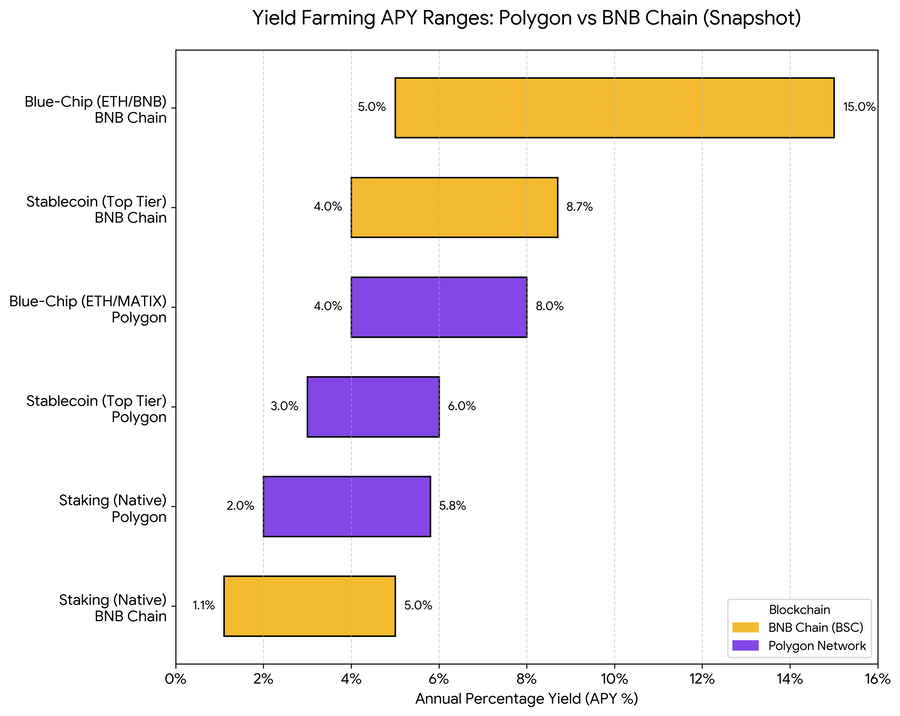
How to Interpret This Visual
This horizontal bar chart provides a side-by-side snapshot of the approximate annual percentage yield (APY) ranges across three major farming categories (Stablecoins, Blue-Chip pairs, and Native Staking) for both the Polygon Network (purple bars) and BNB Chain (gold/yellow bars).
The chart is designed to emphasize that APY is not a single number, but a range that changes frequently.
-
Sorted by High APY: The categories are arranged from lowest-potential yield at the bottom to highest-potential yield at the top, based on the upper end of each range. This allows you to immediately see that while BNB Chain offers the absolute highest potential headline numbers (e.g., up to 15.0% on Blue-Chips), the ranges for both chains overlap significantly, especially in the core Stablecoin category.
-
Reading the Range: Each bar shows the lowest reported APY (labeled on the left) and the highest, often incentivized, APY (labeled on the right). For example, Top-Tier Stablecoin pools on Polygon typically offer between 3.0% and 6.0% APY, while on BNB Chain, the comparable range is 4.0% to 8.7%.
How to Utilize This Data in Your Strategy
As a yield farmer, you can use this visual data to set realistic expectations and manage risk:
-
Differentiate "Real" vs. "Emissions" Yield: The text highlights that higher APYs often reflect higher risk. A 6% Aave Polygon stablecoin position (the top of the Polygon range) is paid in USDC. An 8.7% PancakeSwap farm (the top of the BNB Chain range) is paid in CAKE, which introduces asset volatility. The chart visualizes the "risk premium" you must accept when chasing higher yields.
-
Evaluate Risk-Adjusted Returns: If you are choosing between a 6.0% yield on Polygon and an 8.7% yield on BNB Chain for the same stablecoin, you are not comparing apples to apples. The visual reminds you that the 2.7% difference is your compensation for accepting additional contract risk, MEV, and reward-token exposure on BSC. Adjust the headline APY for the specific chain risks discussed in the article, and the "lower" yield on Polygon often provides a better risk-adjusted return.
Key Trends Shaping Yield Farming on Polygon and BNB Chain
Yield farming does not exist in a vacuum. The yields you see on a dashboard are the product of decisions made by protocol developers, chain foundations, regulators, and a few very large market makers who you will never meet. If you want to stay ahead of the curve, you need to understand the forces shaping those decisions, not just the numbers they produce.
Here is what is actually moving the needle on Polygon and BNB Chain right now, from the shift toward real yield to the regulatory storm clouds gathering over stablecoin farming in Europe. Some of these trends are already changing where smart money is going. Others are still early, and the smart money is just watching. Either way, knowing about them puts you ahead of the farmer who only checks the APY dashboard and nothing else.
Real Yield vs Inflationary Farming: How Investor Priorities Are Shifting
The most important trend in DeFi right now is also the most boring one: farmers are starting to care where the yield comes from.
For years, the game was simple. A protocol printed a new token, handed it out to anyone who deposited liquidity, and the APY number went up. Nobody asked questions. The token price held long enough for early farmers to exit, and the late arrivals ate the losses. I have been the late arrival more than once, and I can tell you that the view from that side of the trade is not pretty. You watch a token you farmed for three weeks slide 40% while the dashboard still shows a double-digit APY, and you realize the number was never real. It was a projection based on a price that no longer exists.
That model is breaking down. As the market matures, capital is rotating toward protocols that generate actual revenue from trading fees, borrowing interest, and liquidation penalties, rather than protocols that simply mint tokens and hope for the best. The math behind this shift is brutal and worth understanding. If a protocol advertises 300% APY but its token supply is inflating at 400% per year, your real return is negative even though the dashboard looks incredible. You are being paid in a currency that is losing value faster than you can accumulate it. Farmers who have been through a few cycles have learned this lesson the hard way, and they are now applying a simple test: does the protocol's fee revenue actually cover the rewards it is paying out?
On BNB Chain, the shift is visible in PancakeSwap's proposed emissions cut and Venus's move toward RWA-backed stablecoin yields. The chain is still emissions-heavy, but the direction of travel is clear. PancakeSwap is essentially admitting that printing CAKE to attract liquidity was a phase, not a permanent strategy. That is a big deal for a protocol that built its entire identity on farming incentives.
On Polygon, the real yield proportion was already higher because the incentive programs were smaller to begin with. A 4% USDC lending position on Aave was never exciting, but it was always paid in USDC. As the market matures, that boring reliability is becoming a competitive advantage. Boring pays the bills. Exciting pays the therapists.
The practical takeaway for farmers is simple. Check the fee-to-emissions ratio before you deposit.
If a protocol is paying out more in rewards than it earns in fees, you are not farming. You are participating in a subsidy program that will eventually end. The only question is whether you exit before it does.
And if you cannot answer the question "where does this yield actually come from?" in one sentence, you probably should not deposit. That rule has saved me more money than any analytics tool ever has.
There is a nuance worth mentioning, though: inflationary yield is not automatically bad. Early in a protocol's life, high emissions can be a legitimate customer acquisition strategy, and if the token appreciates faster than it dilutes, you can still come out ahead. The problem is that this is a bet on token price, not a bet on yield. Know which bet you are making. If you are farming a new protocol with high emissions, you are not earning income. You are speculating on a token launch with extra steps. That can be a valid trade, but do not confuse it with yield.
Liquid Staking, Restaking, and Layered Yield Farming Strategies
Liquid staking has moved from a niche product to the foundation of modern yield farming on both chains, and the way farmers use it is getting more sophisticated by the month.
On BNB Chain, slisBNB from Lista DAO has become the dominant liquid staking token. The mechanics are straightforward: stake BNB, receive slisBNB, and use that slisBNB as collateral or liquidity while the underlying BNB continues earning staking rewards. The innovation that changed the game was the integration with Binance Launchpool. By depositing slisBNB into Lista Lending or providing BNB/slisBNB liquidity, users can mint slisBNBx, a non-transferable token that grants access to Binance Launchpool airdrops. This "double yield" structure, staking rewards plus Launchpool access, has made slisBNB sticky in a way that simple farming tokens never were. Once you are in the Lista ecosystem, leaving means giving up not just the staking yield but also the airdrop pipeline. That is a powerful retention mechanism, and it is worth understanding before you commit capital.
On Polygon, the liquid staking story is evolving more slowly but with a clear direction. sPOL is the canonical liquid staking token, and Polygon has been actively pushing its DeFi integration. A recent governance proposal outlined plans to introduce gas fee discounts for POL stakers and to accelerate sPOL's adoption across lending markets and DEXs. The goal is to make staking less of a lockup and more of a base layer that farmers can build on. It is a sensible strategy, but it is playing catch-up to what Lista has already built on BSC. Polygon is not trying to be first. It is trying to be right.
Restaking is the next frontier, though it is still early on both chains. The concept is simple: take your liquid staking tokens and use them to secure additional protocols, earning extra yield on top of the base staking rewards. It is a layered strategy that amplifies both returns and risk. If you are going to try it, start small and understand that every layer adds a new way for things to go wrong. The extra 1% to 2% is not worth the complexity if you cannot explain the strategy to a friend in plain language. I tried a restaking strategy once and spent three days trying to figure out where my rewards had gone. They were there, but the complexity was not worth the extra 1.5%. Your mileage may vary, but complexity has a cost, and that cost is usually your time and your sanity.
The trend worth watching is automation. Protocols like Yield.xyz AgentKit are building infrastructure that lets AI agents discover, evaluate, and execute yield strategies across 80+ blockchain networks and 2,900+ opportunities. For now, these tools are mostly used by developers and sophisticated allocators. But the direction is clear: the future of layered yield farming is less about manually clicking through dashboards and more about delegating to systems that can rotate capital faster than you can. Whether that is a good thing depends on how much you trust the systems and how well you understand what they are doing. I am cautiously optimistic, which is the most honest thing I can say about anything involving AI and money in the same sentence.
Stablecoin Yield and the Payments Narrative on Polygon and BSC
Stablecoins are the product that both chains are quietly fighting over, and the way they are being used is changing in ways that affect every farmer who holds USDC or USDT.
On Polygon, the pitch is payments and real-world utility. The chain processes billions in monthly stablecoin volume, but a significant portion of that sits idle between transfers. Money that is waiting to be sent is money that is not earning anything, and that is a missed opportunity for both the holder and the ecosystem. Surf Liquid, an AI-driven savings protocol launched on Polygon, is trying to solve that problem by automatically deploying idle USDC into lending markets through Morpho. Users can deposit as little as $10 and earn yield on their stablecoins without manually managing positions. The protocol uses a non-custodial framework where each user has their own smart contract vault, and all automated actions are governed by pre-set rules. It is a small experiment, but it points toward a future where stablecoin yield is embedded into the payment experience rather than being a separate activity. You get paid, the money earns yield automatically, and you never have to think about it. That is the dream, anyway.
On BNB Chain, the stablecoin innovation is coming from a different angle. United Stables (U) is a stablecoin that generates yield from its collateral, which includes tokenized Treasury bills and liquid staking derivatives, and passes a portion of that yield directly to holders. The pitch is that you do not need to stake or lock your stablecoins in a separate contract to earn a return. The yield is native to the token. Binance listed U in early 2026 with a zero-fee promotion for U/USDT and U/USDC pairs, which gave it immediate liquidity and attention. Whether that liquidity persists after the promotion ends is the question every farmer should be asking. Promotional liquidity has a way of evaporating when the incentives stop.
The common thread is that stablecoins are becoming yield-bearing by default. The old model, where you held USDC and separately deposited it into Aave or Venus, is giving way to a model where the stablecoin itself is the yield instrument. For farmers, this means the line between "holding stablecoins" and "farming stablecoins" is blurring. The upside is convenience. The downside is that you need to understand the collateral backing the yield, because a stablecoin that generates return by taking on credit risk is not the same as a stablecoin that sits in a bank account. A 5% yield on a stablecoin backed by tokenized Treasuries is very different from a 5% yield on a stablecoin backed by a lending strategy you cannot inspect. Read the collateral documentation. If there is no documentation, walk away.
Real-World Assets (RWAs) and Institutional Yield Farming
Real-world assets are the trend that has the most potential to change yield farming on both chains, and the numbers are starting to get serious.
BNB Chain's tokenized asset market reached a record $16.6 billion, more than double its value from the previous year. The growth is being driven by yield-bearing products rather than simple cash proxies. Tokenized funds reached $31.9 billion, with products like sUSDS at $6.1 billion and sUSDe at $3.5 billion leading the way. Platforms like Ondo Finance, Maple Finance, and Centrifuge are growing at 25% to 36% per month, which is a pace that traditional finance simply cannot match. For context, a traditional asset manager would be thrilled with 10% annual growth. These platforms are doing that in a month.
At the RWA Summit in Brooklyn, BNB Chain's Head of Commercial made the pitch explicit: assets should work, not sit idle in contracts. The chain currently hosts $5.67 billion in distributed RWA value, with roughly $1.5 billion locked in lending protocols. The vision is a world where tokenized Treasuries, money market funds, and credit instruments serve as collateral that continues earning yield while it is being used. That is a meaningful improvement over the old model, where posting collateral meant sacrificing the yield on those assets. If you can post a tokenized Treasury bill as collateral, borrow stablecoins against it, and keep earning the Treasury yield while you deploy the stablecoins elsewhere, you have effectively doubled your yield without doubling your risk. That is the promise, anyway. The reality depends on the quality of the collateral and the reliability of the oracle pricing it.
Polygon's RWA footprint is smaller, with roughly $3.5 billion in tokenized asset value. But the chain is positioning itself for the institutional use case, with Polymarket and tokenized asset infrastructure from Spiko and Securitize building on its rails. The bet is that Polygon becomes the settlement layer for real-world activity, and that yield farming on Polygon eventually benefits from the liquidity and credibility that institutional capital brings. It is a long game, and it may take years to play out. But if it works, the farmers who positioned themselves early will be the ones who benefit.
For farmers, the RWA trend means something concrete: new sources of yield that are not dependent on token emissions. A lending market backed by tokenized Treasuries is not going to offer 50% APY, but it is also not going to collapse when the emissions schedule ends. The yields are lower, but the risk profile is different in a way that matters for anyone farming with serious capital. If you are managing $50,000 or more, a 4% yield backed by Treasuries is worth more than an 8% yield backed by a token that might not exist in six months. The math is not just about the rate. It is about the probability that the rate persists.
Fixed-Rate Lending and Structured Yield Products
Floating rates are the default in DeFi, and that is a problem for anyone who wants to plan more than a week ahead. Fixed-rate products are starting to change that, and both chains are experimenting with the model.
Pendle has expanded its yield trading to BNB Chain, offering products like apxUSD with a 13% fixed APY. The mechanics are worth understanding because they represent a genuinely different way of thinking about yield. Pendle splits a yield-bearing asset into two components: Principal Tokens (PT), which redeem 1:1 at maturity and are purchased at a discount that represents the fixed yield, and Yield Tokens (YT), which capture the floating yield and any points or airdrops. If you want predictability, you buy PT. If you want leveraged exposure to yield, you buy YT. It is the closest thing DeFi has to a bond market, and it is a useful tool for anyone who wants to lock in a rate without giving up the ability to trade.
Venus and Asseto Finance have also launched fixed-term vaults for United Stables' $U, offering a 2.16% annualized yield over a one-month term. The yield is modest, but the structure is important. It shows that BSC is building the infrastructure for predictable, term-based yield, not just the floating-rate chaos of degen farming. For institutional capital, that predictability is not a nice-to-have. It is a requirement. A treasurer managing a corporate balance sheet cannot deploy funds into a farm that might yield 2% or 20% depending on the week. They need to know what the return will be, and they need to know when they can get their money back. Fixed-rate products solve that problem.
On Polygon, fixed-rate products are less developed, but the trend is the same. As more capital enters DeFi from institutional and conservative retail sources, the demand for yield certainty will grow. The protocols that can offer a locked-in rate for three, six, or twelve months will attract capital that would never touch a floating-rate farm. That is not a threat to degen farming. It is a parallel market that is growing alongside it. The degen farmers will keep chasing APY. The institutions will keep buying PT. Both can coexist, and both will shape the future of yield on these chains.
Cross-Chain Yield Farming and Capital Rotation Between Polygon and BNB Chain
The idea of farming on multiple chains sounds sophisticated, but the reality is usually messier than the spreadsheet suggests. Still, the infrastructure for cross-chain farming is improving, and the way capital moves between Polygon and BSC is worth understanding.
Beluga.fi is a small but illustrative example. It is a cross-chain yield optimizer that runs on both BNB Chain and Polygon, automatically compounding yields and keeping exposure limited to the principal. The pitch is that you do not have to choose a chain. You let the optimizer allocate across both. In practice, these tools are only as good as the strategies they select, and the added complexity introduces smart contract risk on top of the underlying farm risk. But the existence of these tools tells you something about where the market is heading: farmers want optionality without the manual overhead. Whether they are willing to pay for it is another question.
The more common pattern is manual capital rotation: farmers move stablecoins from Polygon to BSC when Venus rates spike, and back to Polygon when the gas costs on BSC start to eat into their yield. The problem is that bridge costs and time make this expensive for anyone with less than a few thousand dollars. A $500 position that moves between chains three times a year will lose 2% to 5% of its value to bridges and gas, which is more than the yield difference between the two chains in most months. I have done the rotation dance myself, and I can tell you that it is rarely worth it for small positions. The fees add up faster than the yields do.
The practical rule is the one from earlier in this article: if you are farming with under $1,000, pick one chain and stay there. If you are farming with more, the rotation can make sense, but only if you are disciplined about it. The farmers who make cross-chain farming work are the ones who treat it like a business, not a hobby. They track bridge costs, they wait for meaningful rate differentials, and they do not move capital for a 1% APY difference that disappears after fees. They also keep a spreadsheet, which sounds boring until you realize that spreadsheets are how you avoid making emotional decisions with your money.
AI Agents and Automated Yield Farming: Hype vs Reality
AI agents are the most hyped trend in DeFi right now, and the gap between the marketing and the reality is wider than most people admit. I have sat through enough AI pitch decks to know that "agentic yield optimization" usually means a chatbot with a wallet and a dream.
The reality is that AI is genuinely useful for certain tasks. Yield.xyz AgentKit gives agents access to 80+ networks and 2,900+ yield opportunities, with tools for discovery, diligence, execution, and tracking. These agents can search for yield by asset, compare rates across chains, plan strategies, and generate unsigned transactions that the user signs with their own wallet. The key detail is that transactions are always returned unsigned, which means the agent cannot move your funds without your approval. That is a sensible design choice, and it addresses the biggest fear people have about AI in DeFi. If an agent goes rogue, the worst it can do is give you bad advice. It cannot drain your wallet without your signature.
The hype is the idea that AI agents will replace human farmers entirely. They will not, at least not yet. The best agents are still dependent on the quality of the data they receive, and DeFi data is noisy. A yield that looks good on an aggregator might be a trap when you look at the pool depth. An APY that is accurate today might be gone tomorrow. AI can help you process more information faster, but it cannot make the judgment calls that separate a good farm from a bad one. Those calls still require context, experience, and a healthy dose of skepticism. An AI can tell you that a pool is offering 40% APY. It cannot tell you whether the pool will still exist next week.
The more interesting question is what happens when AI agents start competing with each other. If thousands of agents are all chasing the same yield opportunities, the opportunities will disappear faster. The edge will go to the agents with the best data, the fastest execution, and the most sophisticated risk models. That sounds a lot like the current state of MEV, where a small number of players capture most of the value. If that pattern repeats in AI farming, the retail farmer who buys a "set and forget" AI vault might end up with worse returns than the farmer who does the work manually. It is too early to know for sure, but it is worth keeping in mind before you hand your keys to a bot. The bot does not care about your retirement. It cares about its next transaction.
Regulatory Developments Affecting Yield Farming and DeFi Yields
The regulatory picture is the least predictable trend on this list, and it has the potential to reshape stablecoin farming in ways that are not yet fully clear.
The most significant development is coming from Europe. The European Central Bank and EU national central banks have called for MiCA's stablecoin remuneration ban to be extended to lending, borrowing, staking, and other arrangements that generate indirect returns. The argument is that platforms could structure products outside MiCA that effectively turn stablecoin holdings into yield-bearing arrangements, undermining the distinction between electronic money and bank deposits. The ESCB wants lawmakers to make it explicit that the ban covers both direct and indirect forms of remuneration. In plain language: they are worried that stablecoin yield is starting to look too much like a bank account, and they want to close that loophole before it becomes a problem.
If this position becomes law, the implications for yield farming in the EU are significant. A German farmer who deposits USDC into Aave to earn 4% could be affected if regulators decide that lending constitutes an indirect return on a stablecoin. The same applies to liquidity provision on stablecoin pairs, which is the bread and butter of Polygon farming. The rules are not finalized, and the scope of the ban is still being debated, but the direction of travel is toward tighter restrictions on stablecoin yield in one of the world's largest markets. For EU-based farmers, that could mean fewer options, lower yields, or more complex workarounds. None of those outcomes are appealing.
In the United States, the debate is similar but less advanced. Banking groups have pushed for tighter restrictions on stablecoin incentives in the CLARITY Act, arguing that reward programs could function like interest on bank deposits. The legislation failed a procedural vote in late 2025, but the underlying concerns have not gone away. The US is not going to ban stablecoin yield tomorrow, but the regulatory pressure is building, and it is worth paying attention to.
For farmers outside the EU and US, these developments may seem distant. But DeFi is global, and regulatory changes in major markets have a way of rippling outward. If EU-based platforms are forced to restrict stablecoin yield products, the liquidity they provide to global pools will shrink. If US-based institutions face similar constraints, the institutional capital that has been flowing into RWAs and fixed-rate products will slow down. The regulatory trend is not a reason to panic, but it is a reason to diversify your yield sources and avoid concentrating all your capital in products that depend on regulatory ambiguity. The farmers who get caught out by regulation are the ones who assumed the rules would never change. The rules always change.
The bottom line on trends: the DeFi yield landscape is maturing in ways that reward patience, due diligence, and a willingness to read beyond the APY number. The farmers who thrive in the next cycle will be the ones who understand that sustainable yield comes from real economic activity, whether that is trading fees, lending interest, or tokenized Treasury bills. The ones who chase emissions will keep learning the same lesson they have always learned: the yield was never real, and the exit was always going to be crowded. The trends on this list are not predictions. They are signals. What you do with them is up to you.
📊 Key Trends Impact and Maturity Index on Polygon vs BNB Chain
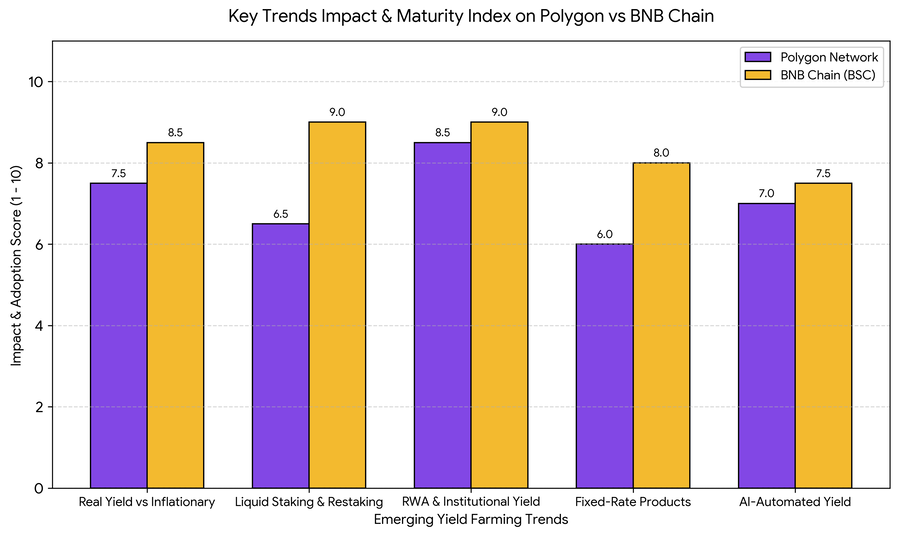
How to Interpret This Visual
This grouped bar chart ranks five macro trends currently transforming yield farming across both Polygon (purple) and BNB Chain (gold) on an adoption and market impact scale from 1 to 10:
-
Real Yield vs Inflationary: Score of 7.5 on Polygon versus 8.5 on BNB Chain. It highlights how both networks are shifting away from pure token printing toward revenue generated by actual swap fees and lending interest, with PancakeSwap's emissions reductions leading the charge on BNB Chain.
-
Liquid Staking & Restaking: Score of 6.5 on Polygon versus 9.0 on BNB Chain. The massive adoption of slisBNB and its direct integration with Binance Launchpool gives BNB Chain a significant lead over Polygon's developing sPOL and restaking infrastructure.
-
RWA & Institutional Yield: Score of 8.5 on Polygon versus 9.0 on BNB Chain. Both chains show massive institutional traction, with multi-billion dollar markets in tokenized Treasuries, credit, and settlement layers driving sustainable, real-world backed yields.
-
Fixed-Rate Products: Score of 6.0 on Polygon versus 8.0 on BNB Chain. Protocols like Pendle and fixed-term Venus vaults give BNB Chain an advantage in providing term-based certainty for institutional allocators.
-
AI-Automated Yield: Scores of 7.0 on Polygon and 7.5 on BNB Chain. Both ecosystems are actively adopting cross-chain automated tools (such as AgentKit and automated yield vaults), making hands-off yield optimization increasingly viable on both networks.
How to Utilize This Data in Your Strategy
As a yield farmer navigating the evolving DeFi landscape, this comparison serves as a strategic roadmap for positioning your capital:
-
Align Strategy with Network Strengths: If your primary objective is stacking liquid staking yield combined with launchpad opportunities or locked fixed-rate certainty, BNB Chain currently offers a higher degree of product maturity.
-
Identify Sustainable Returns: High scores across Real Yield and RWA integration on both chains indicate that long-term farming success relies far less on chasing short-lived, high-emission farms and far more on anchoring your capital in fee-generating protocols and Treasury-backed stablecoins.
-
Future-Proof Your Portfolio: Keep an eye on automation and regulatory developments. Transitioning toward yield instruments backed by real economic activity protects your bankroll against sudden emissions collapses and tightening global regulatory standards on synthetic returns.
Challenges and Risks in Yield Farming on Polygon vs BNB Chain
Every farmer I know has a scar story. Mine involves a pool on BSC that advertised 47% APY, looked perfectly fine on the dashboard, and quietly bled 18% of my deposit over six weeks because I never checked the token's emissions schedule. The APY was real. The token was not. That is the thing about yield farming risks: they rarely announce themselves. They sit behind a nice interface, a convincing audit badge, and a number that makes you feel like you are finally doing it right.
This section is about the things that can go wrong on Polygon and BNB Chain, and how they differ between the two. Not to scare you out of farming, but to make sure you go in with your eyes open. The risks are manageable if you understand them. They are devastating if you do not. I have been on both sides of that equation, and the view from the devastated side is not worth the extra APY.
Impermanent Loss and Divergence Risk in Volatile Liquidity Pools
On Polygon, the impermanent loss problem is smaller in absolute terms because the pools are shallower and the yields are lower. But that cuts both ways. If you are farming a volatile pair on Polygon, the fee income is often not enough to compensate for the divergence. A MATIC/USDC position during a sharp MATIC move can lose more to impermanent loss than it earns in fees over an entire month. The shallow liquidity makes it worse, because every trade moves the price more, which accelerates the rebalancing that causes IL. A pool with $80,000 in liquidity is not deep enough to absorb a $5,000 trade without moving the price, and that movement is exactly what triggers the divergence.
On BNB Chain, the deeper liquidity means fees are more substantial, which gives you a better chance of covering impermanent loss. But the volatility is also higher on many BSC pairs, especially the long-tail tokens that dominate the farming scene. A CAKE/BNB farm during a CAKE pump can look great on paper until you realize your position has quietly converted most of your BNB into CAKE at exactly the wrong moment. I have watched friends farm CAKE/BNB through a full cycle and end up with a bag of CAKE worth less than the BNB they started with. The fees were real. The loss was realer. And the worst part is that the dashboard never showed the loss. It only showed the yield.
There is a specific scenario that catches people on both chains: farming a pair where one asset is your long-term hold and the other is a farm token. You deposit BNB and a new token, thinking you are earning yield on your BNB. What you are actually doing is slowly selling your BNB for the new token as the pool rebalances. If the new token goes to zero, you end up with a bag of worthless tokens and less BNB than you started with. That is not a yield. That is a slow-motion liquidation with extra steps.
The practical rule is the same on both chains: if you cannot explain why the pair you are farming will stay correlated, do not farm it. Stablecoin pairs are boring and safe. Volatile pairs are exciting and dangerous. There is no middle ground where you get high yield and no divergence risk. If someone tells you there is, they are selling something. And if the yield is high enough to be tempting, ask yourself who is on the other side of the trade. Someone is buying the asset you are selling. If you do not know why, you are probably the exit liquidity.
Stablecoin Depeg Risk: Why "Safe" Yield Farming Pools Aren’t Risk-Free
Stablecoin farming is the closest thing DeFi has to a savings account, which is exactly why the depeg risk catches people off guard.
The Financial Stability Board issued a stark warning recently: the $300 billion stablecoin market has never been tested by a genuine, large-scale insolvency event, and the legal mechanisms for cross-border stablecoin failures remain unclear. In a multi-issuer model, it is not even clear which jurisdiction's bankruptcy laws would apply if one issuer failed, or how claims would be distributed across holders in different countries. That is not a theoretical concern. It is a structural vulnerability that sits underneath every stablecoin farm on Polygon and BSC. And it is the kind of thing that nobody thinks about until the weekend it happens.
The mechanics of a depeg are worth understanding because they affect how you should size your positions. When a stablecoin loses its peg, it usually happens in one of four ways: the reserves are worse than advertised, the bank holding the reserves fails, liquidity dries up in thin order books, or confidence collapses and triggers a run. The USDC depeg during the Silicon Valley Bank collapse is the textbook example. The backing had not disappeared. It was temporarily unreachable, and that was enough to push the price below $0.90 for a weekend. If you had been farming USDC on Polygon or BSC during that weekend, your 4% yield would not have mattered. Your principal was down 10%.
On Polygon, stablecoin farming is the dominant strategy, which means depeg risk is the dominant risk. A 4% USDC lending position on Aave is only as safe as USDC itself. If USDC depegs to $0.85, you lose 15% of your principal regardless of how good the lending protocol is. The yield becomes irrelevant. The math is not complicated, but it is easy to ignore when the dashboard shows a nice, steady green line.
On BNB Chain, the stablecoin landscape is more diverse, with USDT, USDC, FDUSD, DAI, and lisUSD all competing for liquidity. That diversity is a strength, but it also means you need to understand the specific risks of each asset. lisUSD is a CDP stablecoin backed by slisBNB, which means it is exposed to BNB price volatility in a way that USDC is not. Farming lisUSD for a higher yield is not the same trade as farming USDC. It is a different risk profile wearing a similar name. FDUSD has its own issuer risk and regulatory exposure. DAI is backed by a mix of collateral that includes other stablecoins and real-world assets, which introduces a layer of complexity that most farmers never bother to inspect.
The practical takeaway: diversify your stablecoin exposure across at least two or three major assets, and avoid concentrating in any single stablecoin that offers a meaningfully higher yield than the others. The extra yield is usually compensation for extra risk. Sometimes it is worth it. Often it is not. And if a stablecoin is offering 8% while USDC is offering 4%, ask yourself what the extra 4% is paying for. If you cannot answer that question, you are the extra risk.
Smart Contract Exploits, Rug Pulls, and Bridge Risk
The exploits do not stop, and both chains have the scars to prove it.
On Polygon, the Fun.xyz CheckoutPool exploit drained roughly $85,720 from a bridge operator contract in March 2026, with only a small fraction rescued. The vulnerability was in an older version of the contract that lacked proper access controls. This is the pattern that repeats across DeFi: the code that was audited and deployed years ago becomes the weak point when the team moves on and stops maintaining it. Audits are a snapshot, not a warranty. A contract that was safe in 2022 might be a liability in 2026 if nobody has looked at it since.
On BNB Chain, the SAND bridge exploit was a different beast. The attacker used a configuration function on the SAND token contract to register themselves as the sole verifier of incoming bridge messages, which allowed them to mint unbacked SAND on BSC and Base. The damage was 14.7 million SAND drained from the Ethereum vault backing the bridge. The contract had been audited. The audit missed the vulnerability. That is not an indictment of audits. It is a reminder that audits are performed by humans, and humans miss things, especially when the code is complex and the attack vector is creative.
Cross-chain infrastructure is the newest attack surface, and it affects both chains equally. The NEAR Intents exploit in October 2026 paused cross-chain swap services on BNB Chain, Polygon, and several other networks after a bug in the Omni deposit and withdrawal system led to a $3.8 million loss.
The lesson is not that cross-chain farming is doomed. It is that every bridge, every solver, and every intent-based routing layer is a new smart contract with its own bugs, and you are trusting all of them when you move funds between chains to chase yield. The more chains you farm on, the more contracts you are trusting. There is a reason the simplest strategies are often the safest.
Rug pulls deserve their own mention because they are the oldest scam in DeFi and they still work. A new protocol launches with a flashy website, a fake audit badge, and an APY that makes your eyes water. The developers hold most of the token supply through a vesting contract that they can unlock whenever they want. The moment enough liquidity enters the pool, they drain it and disappear. This happens on both chains, but it happens more on BSC because the emissions-heavy culture creates more opportunities for it. Polygon is not immune, but the smaller incentive programs mean there is less of a feeding frenzy to exploit.
The practical defense is boring but effective:
- Stick to protocols that have been running for at least a year, with multiple audits and active bug bounties.
- Avoid farms that launched last month, regardless of how good the APY looks.
- Never approve unlimited token spending on a contract you do not trust.
- And if you are bridging, use canonical bridges when possible and never bridge more than you are prepared to lose in a worst-case scenario.
I have lost money to a protocol that passed every check on this list. I have never lost money to a protocol that failed them. That is not a perfect track record, but it is a survivable one.
The Liquidity Drought Problem: How High APY Traps Your Capital
High APY is a magnet, and magnets attract more than just farmers. They attract mercenary capital that enters the pool for the yield, stays for exactly as long as the incentives last, and leaves the moment the APY drops. The pool you entered is not the pool you will exit, and that difference can cost you real money.
On BNB Chain, the liquidity drought problem is more pronounced because the incentive programs are larger. A PancakeSwap farm advertising 30% APY can see its TVL double in a week as farmers pile in. When the emissions schedule changes or the pool gets diluted, that capital leaves just as fast. The result is a pool that looks deep on the way in and feels like a puddle on the way out. Your withdrawal moves the price. Your slippage eats the yield you thought you earned. I have watched a $5,000 position in a BSC farm lose 4% to slippage on exit because the pool had thinned out over a single weekend. The APY was 22%. The exit cost was 4%. The math was not in my favor.
On Polygon, the liquidity drought is more structural. The pools are shallower to begin with, which means they are more sensitive to large deposits and withdrawals. A $2,000 position in a Polygon stablecoin pool that represents 10% of the liquidity is not a farming position. It is a market-making obligation. When you withdraw, you are the market. The slippage is your problem, not the protocol's. This is why position sizing matters more on Polygon than on BSC. A position that is perfectly reasonable on PancakeSwap can be disruptive on QuickSwap simply because the pool is smaller.
There is a second-order effect that most farmers never think about: high APY attracts capital that dilutes your share of the pool. When you enter a farm at $10,000 TVL with a $1,000 deposit, you own 10% of the pool and earn 10% of the fees. When the pool grows to $100,000 because the APY attracted more farmers, your share drops to 1%, and your fee income drops with it. The APY on the dashboard might not change, but your actual income does. The yield is diluted by the very capital it attracted. That is the trap. High APY draws in the crowd that makes the APY irrelevant.
The defense is simple: check the pool depth before you deposit, and check it again before you withdraw. If your position is more than 5% of the pool, find a deeper pool or reduce your size. If the TVL has been falling for a week straight, that is a signal to leave before the crowd does. The crowd is not your friend. The crowd is your competition. And in a liquidity drought, the crowd is the reason you cannot get out.
Centralization Risks: Exchange-Custodied Staking and Validator Concentration
This is the risk that does not show up on a yield dashboard, and it is arguably the most important one for the long-term health of both chains.
PIP-85, a recent Polygon governance proposal, aimed to address this by cutting Upbit's validator income by 86%, from 1,975,024 POL to roughly 283,298 POL per cycle. The Polygon team deserves credit for the effort. But as analyst Just Hopmans pointed out, the deeper problem remains untouched. The protocol only sees wallet addresses. It cannot distinguish an exchange wallet from a personal hardware wallet, and any rule based on identity breaks decentralization. The fix addresses the symptom, not the disease. The disease is that exchanges control too much staked supply, and there is no clean way to fix that without compromising the permissionless nature of the network.
For farmers, the practical implication is twofold. Stake on-chain, not through an exchange, because the yield difference can be several percentage points and the exchange is not obligated to pass rewards back to you. And diversify your liquid staking exposure where possible, because concentration risk is real risk, even if it does not show up in the APY number. If you are using slisBNB on BSC, understand that you are trusting Lista DAO with more than just your yield. You are trusting it with the chain's governance. That is a lot of trust to place in a single protocol.
Token Emissions, Dilution, and Unsustainable APY
This is the risk that has cost me the most money over the years, and it is the one that is easiest to ignore because the dashboard never shows it.
The math is brutal once you actually do it. If a protocol advertises 300% APY but its token supply is inflating at 400% per year, your real return is negative. You are being paid in a currency that is losing value faster than you can accumulate it. The APY is not a yield. It is a dilution schedule disguised as a yield. I have farmed tokens that looked like 80% APY on the day I entered and were worth 20% APY two weeks later, not because the protocol changed, but because the token price collapsed under the weight of its own emissions. The dashboard did not change. My actual return did.
On BNB Chain, the emissions-heavy culture is the primary source of this risk. Many farms advertise triple-digit APY that is almost entirely paid in a native token that the protocol is printing specifically to attract liquidity. The 45% to 180% average APY reported across some BSC protocols is a red flag, not a selling point. It means the protocol is paying you in something that is designed to lose value. Some of these farms are legitimate customer acquisition strategies. Most are not. The difference is whether the token has any utility beyond farming, and whether the protocol's fee revenue can eventually cover the rewards. If the only thing the token does is pay farmers, the only thing it will do is lose value.
On Polygon, the emissions risk is lower because the incentive programs are smaller. But it is not zero. Points programs and airdrop campaigns can create the same dynamic on a smaller scale, attracting mercenary capital that disappears when the rewards stop. A pool that looks stable today can be a ghost town next month if the points program ends. The mechanism is different, but the outcome is the same: you enter for the yield, and the yield evaporates before you can exit.
The defense is simple but requires discipline:
- Check the emissions schedule before you deposit.
- Divide the annual new tokens by the circulating supply.
- Compare that inflation rate to the advertised APY.
If inflation is higher, you are not earning. You are being diluted. And if you cannot find the emissions schedule, that is a signal to walk away. A protocol that does not disclose its token inflation is a protocol that does not want you to know. There is no legitimate reason to hide that number.
There is one more nuance worth mentioning. Token emissions are not always bad. Early in a protocol's life, high emissions can be a legitimate way to bootstrap liquidity, and if the token appreciates faster than it dilutes, you can come out ahead. But that is a bet on token price, not a bet on yield. Know which bet you are making. If you are farming a new protocol with high emissions, you are speculating on a token launch with extra steps. That can be a valid trade, but do not confuse it with income. The farmers who confuse speculation with income are the ones who get hurt the most.
Tax, Reporting, and Compliance Considerations for Yield Farmers
The tax bill is the risk nobody talks about until April, and it is getting more complicated every year.
In the United States, the IRS now treats most DeFi interactions as taxable events. Providing liquidity to an automated market maker creates a taxable swap when you deposit tokens into a pool. Claiming yield farming rewards counts as ordinary income at fair market value on the claim date. Even wrapping tokens like converting ETH to WETH technically triggers reporting requirements. That means every harvest, every compound, and every pool entry is a potential taxable event. If you are farming actively on two chains, you could be generating hundreds of reportable transactions per year. The penalties for getting it wrong can reach 75% of unpaid taxes plus interest. That is not a rounding error. That is a second tax bill on top of the first one.
In Europe, MiCA is fully in force, and the regulatory direction is toward tighter restrictions on stablecoin yield. The European Central Bank has called for the stablecoin remuneration ban to be extended to lending, borrowing, staking, and other arrangements that generate indirect returns. If that position becomes law, EU-based farmers could face restrictions on the very strategies that make stablecoin farming profitable. The rules are not finalized, but the direction of travel is clear. Farming stablecoins in the EU is going to get more complicated before it gets simpler. If you are based in Europe, this is not a distant concern. It is a direct threat to the strategies that work best on Polygon and BSC.
There is also the reporting burden that nobody warns you about. Every harvest on BSC is a separate transaction. Every compound on Polygon is a separate transaction. Every bridge between chains is a separate transaction. If you are farming actively, you might have 500 to 1,000 transactions per year that need to be categorized, valued, and reported. That is not a weekend project. That is a part-time job. And if you get audited, you need to be able to prove the cost basis and fair market value of every single one of those transactions.
The practical implication for farmers on both chains is the same: keep records from day one. Every harvest, every deposit, every withdrawal, every bridge transaction. Use tax software that supports DeFi, or hire an accountant who understands crypto. The cost of doing this properly is a fraction of the cost of doing it wrong. I learned that lesson the hard way, and my accountant still brings it up at dinner parties. The farmers who plan for taxes are the ones who keep their gains. The ones who ignore them are the ones who give them back.
The regulatory trend is not a reason to stop farming. It is a reason to diversify your yield sources and avoid concentrating all your capital in products that depend on regulatory ambiguity. The farmers who get caught out by regulation are the ones who assumed the rules would never change. The rules always change. The farmers who survive are the ones who plan for it. And if you are farming on two chains, you need to plan twice as carefully, because the rules might not be the same on both.
📊 The Dilution Trap: Constant APY vs. Eroding Token Price (BSC Example Scenario)
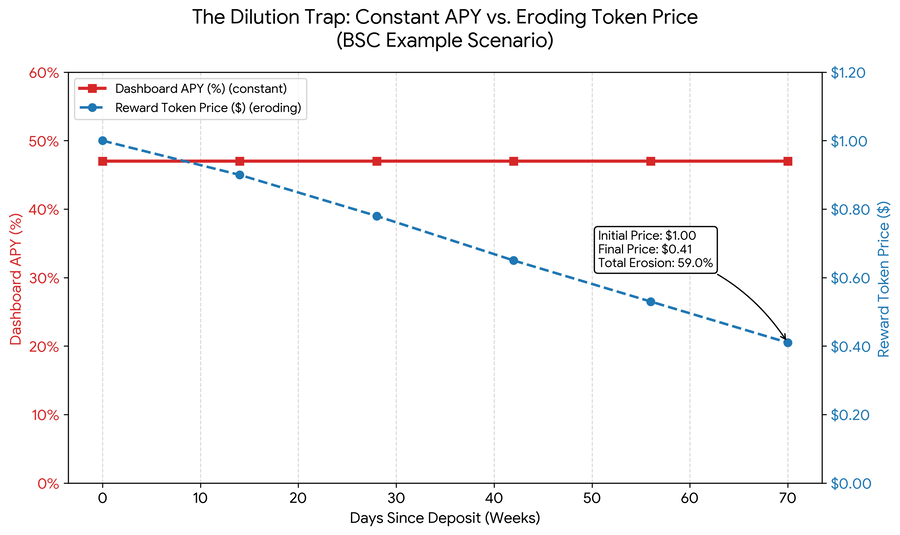
How to Interpret This Visual
This dual-axis line chart visualizes the dangerous scenario referenced in the text: "The Dilution Trap." It illustrates what happens when you farm a high-emissions token, focusing on the mismatch between the "Dashboard APY" you see (the magnet) and the actual value erosion you suffer.
The scenario is an illustrative example of a 10-week (70-day) farming position, specifically typical on BSC where high emissions are common.
-
Left Axis & Red Line (The Magnet): This axis shows the Dashboard APY (%). The solid red line (with square markers) represents the constant APY advertised on the dashboard, held at a tempting 47.0%. This is the yield farmers think they are receiving.
-
Right Axis & Blue Line (The Erosion): This axis shows the Reward Token Price ($). The dashed blue line (with circle markers) represents the price of the token you are receiving as rewards. It shows a severe, steady decline from $1.00 at the time of deposit to just $0.41 at the end of the 10-week period.
The annotation highlights the total price erosion of 59.0% over the period.
How to Utilize This Data in Your Strategy
The core lesson from this visual is that APY is meaningless without understanding token inflation (emissions).
When you look at a dashboard and see a high, steady 47.0% APY on a volatile pair or a new farm token, you are being drawn in by the red line. However, if the protocol's inflation is higher than its APY (meaning more new tokens are being printed and sold than the APY can compensate for) your blue line (token value) will collapse.
In this scenario, your principal erosion (the 59.0% loss in the reward token's price) has completely wiped out your nominal 10-week profit. The dashboard never changes; it continues to advertise 47.0% APY, lure in new capital (the magnet), and dilute existing holders. The visual provides a stark warning: If the reward token price is collapsing, the high APY is not your income; it is your dilution schedule. Always check the emissions schedule, not just the dashboard number.
How to Choose: Yield Farming Strategy by Investor Profile
Here is the part where we stop pretending there is one "best" chain and start talking about what actually fits your life. Because the honest answer to "Polygon or BNB Chain?" is almost always "it depends on who you are, how much you have, and how much time you want to spend staring at a screen."
I have farmed on both chains with $300 and with $30,000. The strategies that worked for one bankroll would have been disastrous for the other. The chain did not change. My profile did. So let us break this down by investor type, because the farmer with $500 and the farmer with $50,000 should not be making the same decisions, even if they are chasing the same yield. And if you are somewhere in between, do not worry. There is a profile for you too. Most of us are somewhere in between.
Yield Farming on Polygon: Who It Suits Best
Polygon is not for everyone, and it knows it. The chain has quietly repositioned itself as the patient farmer's venue, and that suits a specific kind of person.
You are a good fit for Polygon if you value low fees over high headline APY. Transactions cost less than a cent, which means you can compound daily, harvest weekly, and adjust positions without watching your yield disappear into gas. For a $1,000 position, that difference is meaningful. For a $500 position, it is the difference between farming being viable and farming being a donation to the bridge operator. If you have ever looked at an Ethereum gas estimate and decided not to harvest for another month, Polygon is the antidote. I have literally harvested a position on Polygon while waiting for coffee to brew. That is not an exaggeration. The whole transaction took less time than the espresso machine.
You are also a good fit if you are stablecoin-heavy. Polygon's stablecoin liquidity is deep, especially in USDC, and the lending markets on Aave and Curve offer 3% to 6% without the emissions-driven volatility of BSC farms. You are not going to get rich, but you are going to get paid in the asset you deposited, which is more than most farms on either chain can promise. The farmers who do well on Polygon are the ones who treat it like a savings account with a DeFi wrapper, not a casino. If your goal is to turn $5,000 into $5,250 over a year without losing sleep, Polygon can do that. If your goal is to turn $5,000 into $50,000, Polygon will disappoint you, and honestly, so will almost everything else.
You are also a good fit if you are building a position in POL or the Polygon ecosystem. Staking POL directly or through a liquid staking token like sPOL or MaticX gives you yield on your tokens while keeping exposure to the chain's long-term narrative around payments and real-world assets. That is a different kind of bet than stablecoin farming, but it is a valid one for investors who believe the chain has a future beyond the current cycle. I have held POL through two drawdowns and kept staking the whole time. The yield did not make me rich, but it made the waiting easier.
You are a poor fit if you need action. Polygon's farming scene is quiet. The incentive programs are smaller, the points campaigns are less aggressive, and the triple-digit APY farms are rare. If you check your portfolio three times a day and need to see movement, Polygon will bore you into making bad decisions on other chains. That is not a knock on Polygon. It is a recognition that different farmers need different levels of stimulation, and Polygon is not in the entertainment business. Boredom is a feature here, not a bug. The farmers who are bored are the ones who are not making impulsive mistakes.
One more profile worth mentioning: the retiree. Not literally a retiree, though that works too. I mean the farmer who has a day job, a family, and about 30 minutes a week to spend on DeFi. Polygon is perfect for that person. Set up a vault on Beefy, let it auto-compound, check it on Sunday, and go live your life. The yield will not be spectacular, but it will be there when you check, and you will not have missed anything important. That is a legitimate way to farm, and honestly, it is probably the healthiest one.
Yield Farming on BNB Chain (BSC): Who It Suits Best
BNB Chain rewards activity, and it punishes passivity. The farmers who do well here are the ones who are willing to pay attention.
You are a good fit for BSC if you are an active farmer. The incentive programs are larger, the farms are more numerous, and the opportunities to rotate capital are constant. If you enjoy the process of finding a new farm, checking the emissions schedule, and deciding whether the risk is worth the reward, BSC gives you more to work with. The Venus lending market offers 2.7% to 6.5% on stablecoins, and PancakeSwap farms can push stablecoin yields into the 8% range with CAKE incentives. Those numbers are not available on Polygon, at least not consistently. If you have the time and temperament to chase them, BSC rewards you. If you do not, BSC punishes you with diluted rewards and bad entries.
You are also a good fit if you have enough capital to make the effort worthwhile. A $10,000 position on BSC can earn meaningfully more than the same position on Polygon, even after accounting for the extra time you spend managing it. The deeper liquidity means you can enter and exit without slippage eating your yield, and the larger incentive pools mean your share of the rewards is more substantial. The math changes at scale. A $500 position on BSC is a hobby. A $10,000 position is a strategy. A $50,000 position is a part-time job that pays better than some full-time jobs. I know farmers who treat BSC as their primary income source. They are not casual about it. They check emissions schedules the way day traders check charts.
You are a good fit if you are BNB-native. If your portfolio is already denominated in BNB, farming on BSC keeps you in the same ecosystem, avoids bridge costs, and gives you access to the slisBNB layering strategy that is one of the most efficient yield structures in DeFi. Stake BNB, receive slisBNB, use it as collateral to borrow lisUSD, and deploy the borrowed funds into another farm. The extra yield is real, but so is the liquidation risk. This strategy suits farmers who understand collateral ratios and are disciplined about not maxing out their borrow. If you are not comfortable with that level of complexity, stick to simpler lending on Venus.
You are a poor fit if you want to set it and forget it. BSC's farms change fast. Emissions schedules shift, pools get diluted, and the best yields disappear within weeks. If you are the kind of person who checks their portfolio once a month, you will enter farms after the yield has peaked and exit after it has collapsed. That is not a recipe for good returns. It is a recipe for learning the same lesson repeatedly. The farmers who succeed on BSC are the ones who treat it like a part-time job, not a savings account. If you cannot commit the time, the yields will not commit to you.
One more profile: the points hunter. If you enjoy chasing airdrops, points programs, and launchpool incentives, BSC has more of them than any other chain. The Airdrop Alliance Program distributed over 2.3 billion points and 8 million tokens across ecosystem projects, and there is always another campaign around the corner. The farmers who do well here are the ones who treat points as a bonus, not a salary, and who never deposit into a pool they would not be comfortable holding if the airdrop never materialized. If you can maintain that discipline, BSC is a playground. If you cannot, it is a slot machine.
Small-Capital Yield Farming: When Cross-Chain Farming Stops Making Sense
This is the section that could save you more money than any APY comparison. Cross-chain farming is almost never worth it for small positions, and the math is not subtle.
Here is the brutal arithmetic. If you have $500 and you want to farm on both Polygon and BSC, you need to bridge funds to both chains. The bridge fees alone can eat 1% to 2.5% of your capital before you earn a single cent. Then you need to manage two positions, which means two sets of harvests, two sets of gas costs, and twice the time. If you spend three hours a week managing both chains and you value your time at even $15 per hour, you are spending $2,340 per year on labor. On a $500 position, that is a 468% cost relative to your principal. The yield is irrelevant at that point. You are paying to farm.
The practical threshold is somewhere around $1,000 to $1,500. Below that, pick one chain and stay there. Above that, the math starts to work, but only if you are disciplined. The farmers who make cross-chain farming work are the ones who batch their operations, harvest when gas is cheap, and do not move capital for a 1% APY difference that disappears after fees. They also keep a spreadsheet, which sounds boring until you realize that spreadsheets are how you avoid making emotional decisions with your money.
There is also a psychological cost that nobody talks about. Managing two chains means twice as many dashboards, twice as many token approvals, and twice as many opportunities to make a mistake. I have fat-fingered a withdrawal on the wrong chain before. It cost me more than the yield difference between Polygon and BSC for an entire year. Small positions are supposed to be simple. Cross-chain farming makes them complicated, and complication is expensive.
The verdict for small capital: pick the chain that matches your primary asset. If you are stablecoin-heavy and want low fees, Polygon. If you are BNB-native and want access to deeper farms, BSC. Do not try to do both until your bankroll justifies the overhead. The extra 1% APY is not worth the extra 10% of your time and attention. And if you are farming with under $500, consider whether farming is the right activity at all. A high-yield savings account at a traditional bank might offer a comparable return with none of the smart contract risk. That is not a fun thing to say, but it is an honest one.
Stablecoin Yield Seekers vs High-Risk Yield Farmers: Two Different Playbooks
These are two different sports, played on the same field. Confusing them is how people get hurt.
The stablecoin playbook also means diversifying across issuers. Do not put all your USDC in one farm. Do not assume USDT is risk-free. The FSB warning about the $300 billion stablecoin market never being tested by a large-scale insolvency is not a theoretical concern. It is a reminder that stablecoins are not the same as bank deposits, and the yield you earn is compensation for taking on that risk. A 4% yield on a stablecoin that depegs to $0.90 is not a 4% yield. It is a 6% loss with extra steps. Diversify across USDC, USDT, and DAI, and avoid any single stablecoin that offers a meaningfully higher yield than the others. The extra yield is usually compensation for extra risk.
The high-risk playbook also means checking emissions schedules before you deposit. If a protocol is printing tokens faster than it is generating fees, you are not farming. You are participating in a dilution event. The math from earlier applies: 300% APY with 400% inflation is a negative return. The farmers who survive are the ones who do that calculation before they deposit, not after. I have made that mistake, and I can tell you from experience that the dashboard does not send you a warning when the token starts collapsing. It just keeps showing you the APY, right up until the moment you try to sell.
The mistake people make is mixing the two playbooks. They deposit stablecoins into a high-APY farm because the number looks good, and then they are surprised when the reward token collapses. That is not a stablecoin strategy. It is a speculative trade with a stablecoin entry point. Know which game you are playing, and size your position accordingly. A $1,000 stablecoin position should be in Venus or Aave. A $1,000 speculation can go into a high-APY farm, but only if you are prepared to lose the $1,000. The farmers who confuse these two games are the ones who end up wondering why their "safe" strategy lost money.
A third playbook worth mentioning: the hybrid farmer. This is someone who keeps 70% to 80% of their capital in stablecoin lending and 20% to 30% in higher-risk farms. The stablecoin portion provides a baseline return that covers gas costs and provides psychological comfort. The high-risk portion provides upside if things go well. The hybrid approach is not exciting, but it is resilient. It survives bad decisions because the bad decisions are sized appropriately. If you are new to farming, start hybrid. You can always increase the risk later, once you have a better sense of what you are doing.
The 10-Point Yield Farming Due Diligence Checklist
Before you deposit a single dollar, run through this list. It will not catch everything, but it will catch the mistakes that cost the most money.
- Where does the yield come from? If you cannot answer this in one sentence, do not deposit. Trading fees, lending interest, and token emissions are three different things with three different risk profiles. Emissions-based yield is the most fragile.
- What is the emissions schedule? Find the annual new tokens, divide by circulating supply, and compare that inflation rate to the APY. If inflation is higher, you are being diluted. If you cannot find the emissions schedule, that is a signal to walk away.
- How deep is the pool? If your position is more than 5% of the pool's TVL, find a deeper pool or reduce your size. A pool you cannot exit is not a pool. It is a trap.
- Has the protocol been audited, and by whom? An audit is not a guarantee, but no audit is a red flag. Check whether the audit is recent and whether the findings were addressed. An audit from three years ago on code that has since been modified is not worth much.
- What is the protocol's TVL trend? A protocol losing TVL rapidly is often a signal that yield has dropped or insiders are exiting. Stable or growing TVL is a better sign than a spike followed by a decline.
- Who controls the admin keys? If a single wallet can drain the contract or change the rules without a timelock, you are trusting that wallet. Multisig with a timelock is better. Anonymous team with a single key is a gamble. You are not just farming yield. You are farming trust.
- What is the reward token's liquidity? If the token you are farming has thin liquidity, your rewards are worth less than the dashboard suggests. You cannot sell what nobody is buying. Check the token's DEX liquidity before you assume the APY is real.
- Is there a lockup or withdrawal delay? Some protocols lock your funds for days or weeks. If you need access to your capital, that lockup is a cost. Factor it in before you deposit. A 20% APY with a 30-day lockup is not the same as a 20% APY you can withdraw tomorrow.
- What happens if the underlying protocol is exploited? If you are farming through an aggregator like Beefy, your funds are exposed to both Beefy's contracts and the underlying protocol. A vulnerability in either can affect you. Read the documentation to understand where your funds actually sit.
- Can you explain this strategy to a friend in plain language? If not, you do not understand it well enough to deposit. Complexity is not a feature. It is a risk multiplier. The farmers who get hurt the most are the ones who understood the least about what they were doing.
One bonus point: does the protocol have a bug bounty? A large bug bounty is a signal that the team takes security seriously and is willing to pay for white-hat disclosures. A protocol with no bug bounty is a protocol that is hoping nobody looks too closely.
Position Sizing, Harvesting, and Profit-Taking Discipline
The last piece of the puzzle is the one that separates farmers who keep their gains from farmers who give them back. Discipline is the yield that no dashboard shows.
Position sizing is the simplest rule that nobody follows. Never put more than 10% of your farming capital into a single farm. Never put more than 25% into a single chain. The rest should be in stablecoin lending or sitting in a wallet, waiting for a better opportunity. The farmers who blow up are the ones who go all-in on a 40% APY farm and then watch the token collapse. The farmers who survive are the ones who treat every farm as expendable and every chain as one part of a larger strategy.
Harvesting is where small decisions compound into large differences. On Polygon, you can harvest daily because gas is negligible. On BSC, weekly or bi-weekly is usually sufficient. But the bigger question is what you do with the rewards. If you are harvesting a token you would not hold, sell it immediately. Do not let it sit in your wallet hoping it recovers. The token was printed to pay you. Treat it like a paycheck, not an investment. Convert it to stablecoins or a blue-chip asset, and move on. I have watched farmers hold their CAKE rewards through a 50% drawdown because they believed in the project. The project is still fine. Their portfolio was not.
Profit-taking is the hardest discipline because it requires admitting that the yield might not last. Set a rule before you deposit. Maybe it is "I take out my initial capital after three months." Maybe it is "I sell half my rewards every week." Maybe it is "I exit the farm if the APY drops below 5%." The specific rule matters less than having one. The farmers who get hurt are the ones who keep rolling rewards back into the farm because the APY looks good, and then wake up one day to find that the APY has collapsed and the token is worth half of what it was. The rule is not about predicting the future. It is about protecting yourself from your own optimism.
One more piece of advice: keep a spreadsheet. Not because spreadsheets are fun, but because they force you to see the actual numbers. Your APY, your fees, your gas costs, your harvests, your exits. The dashboard shows you the yield. The spreadsheet shows you the profit. Those are not always the same thing. I have farmed positions that looked great on the dashboard and lost money in the spreadsheet. The spreadsheet was right.
And a final word on patience: the farmers who thrive on Polygon and BNB Chain are not the ones with the best APY. They are the ones with the clearest understanding of their own profile, their own limits, and their own exit plan. Know yourself, know your chain, and the yield will follow. Or at least, the losses will be smaller. And in DeFi, smaller losses are often the best returns you can get.
📊 Yield Farming Decision Matrix: Suitability Score by Investor Profile
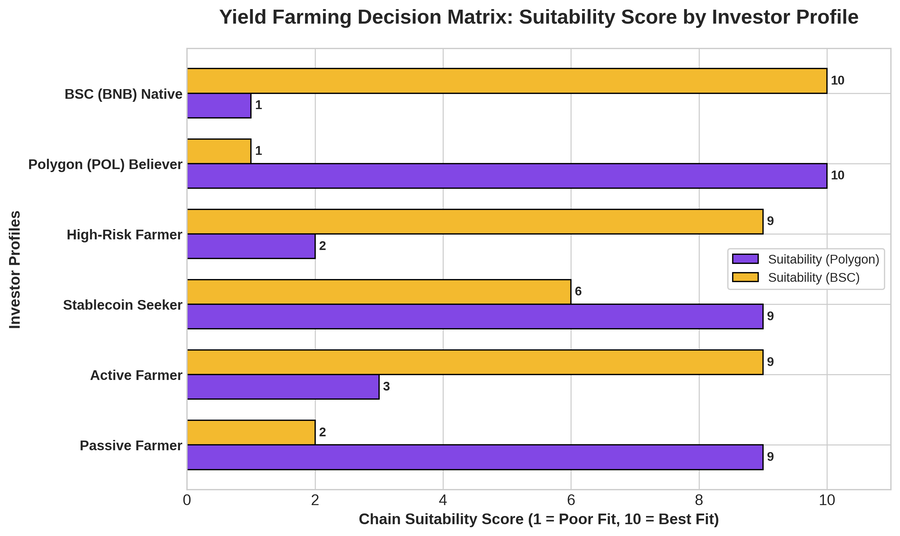
How to Interpret This Visual
This grouped horizontal bar chart visualizes how different investor profiles (the vertical y-axis) align with the dominant yield farming environments of both the Polygon Network (purple bars) and the BNB Chain (gold/yellow bars).
Each bar represents a suitability score from 1 (a poor structural fit) to 10 (the best structural fit). A score of 10 doesn’t guarantee profit; rather, it indicates the chain’s infrastructure, costs, and typical yield opportunities naturally match the behavior, capital size, and risk appetite of that profile. For instance, a "Passive Farmer" has a strong 9/10 fit on Polygon because its low fees allow automatic compounding to work efficiently with minimal attention. Conversely, an "Active Farmer" has a strong 9/10 fit on BNB Chain because its deep liquidity and aggressive incentive programs reward frequent capital rotation.
How to Utilize This Data in Your Strategy
To make an effective choice between farming on Polygon or BNB Chain, you should:
-
Identify Your Dominant Profile: Which definition on the y-axis best describes your DeFi behavior? Are you an "Active Farmer" seeking high returns or a "Stablecoin Seeker" prioritizing low risk?
-
Consult the Suitability Scores: Find your profile and compare the scores. If you are a "Passive Farmer," Polygon’s purple bar at 9/10 suggests it should be your default environment. If you are a "High-Risk Farmer," BNB Chain’s gold bar at 9/10 indicates it holds the aggressive opportunities you seek.
-
Cross-Reference with the Article’s Analysis: Use this chart as a visual guide to the deeper analysis in the text. While a score of 6/10 for "Stablecoin Seekers" on BSC is still good, the text explains that the purple 9/10 on Polygon may be preferable because the low fees are better optimized for conservative, steady returns. If your capital is small (e.g., under $1,000), pick the chain that matches your primary asset and profile, as the high scores represent your best path to viability.
How to Start Yield Farming on Polygon and BNB Chain: Step-by-Step
Theory is great. At some point, you have to actually connect a wallet and deposit funds. And that is where most beginners freeze, because the gap between "I understand the concept" and "I just signed a transaction I did not fully read" is where money gets lost.
I still remember my first deposit. My hands were literally sweating as I clicked confirm. The transaction was for $150, and I was convinced I had just sent it to a stranger's wallet. It arrived fine. The protocol worked. The yield was real. But the fear was real too, and that fear is actually a good thing. It means you understand that this is not a game. The farmers who get hurt are usually the ones who stopped being afraid too early.
This section is the practical part. The setup, the safety checks, the tools, and the habits that separate a farmer who survives from a farmer who becomes a cautionary tale. I have made almost every mistake in this section at least once, so consider this the guide I wish I had when I started.
Setting Up Wallets and Bridges for Yield Farming on Both Chains
Before you farm a single dollar, you need a wallet that you control and a way to get funds onto the chain you want to farm. Both of those steps have hidden traps, and neither is as simple as the tutorials make it look.
The wallet. Use a hardware wallet for the bulk of your funds, and a separate hot wallet for active farming. This is not paranoia. It is basic hygiene. A hardware wallet keeps your private keys offline, which means malware on your computer cannot extract them, and every transaction requires physical confirmation on the device. But here is the catch that most people learn too late: a hardware wallet does not protect you from a bad approval. If you have granted a malicious contract permission to spend your USDC, the hardware wallet will faithfully confirm the drain. The protection is in the key, not the permissions. That distinction has cost people more money than any exchange hack ever has.
I keep two wallets. My hardware wallet holds the bulk of my holdings and never touches a browser. My hot wallet holds only the funds I am actively farming, and if it gets drained tomorrow, I will be annoyed but not ruined. That separation is the single most important security habit I have built. It does not cost anything, and it has saved me from my own mistakes more than once.
For Polygon, you need the POL token for gas, and you need to add the Polygon network to your wallet if it is not there by default. For BNB Chain, you need BNB for gas. If you are using a Ledger device, you can stake POL and BNB directly through Yield.xyz integrated into Ledger Wallet, which is a convenient option if you want to keep your staking inside the hardware wallet ecosystem. The process involves selecting the asset, clicking Earn, entering the amount, and confirming on the device. It is not complicated, but it is worth doing a small test transaction first. I have seen people deposit their entire balance on the first try and then realize they had no gas left to harvest. Do not be that person.
Do not forget to leave gas in the wallet. This sounds obvious, but it is the most common beginner mistake I see. You swap all your POL or BNB into a farm, and then you cannot harvest because you have no gas to pay for the transaction. The fix is simple: always keep a small buffer of $2 to $5 worth of the native gas token in your wallet. It is annoying to hold an asset that is just sitting there doing nothing, but it is less annoying than being unable to withdraw your funds.
The bridge. This is where costs and risks concentrate. There is no canonical bridge between BNB Chain and Polygon. Every route is a third-party protocol, and the all-in cost typically falls in the $0.80 to $3.50 range depending on the bridge and network conditions. If you are moving USDC from Ethereum to BNB Chain, BNB Chain has been running a zero-fee bridging campaign through Celer cBridge and Meson.fi for eligible stablecoins, which can save you a few dollars if the timing works.
Balanced offers fee-free USDC transfers between supported chains including BNB Chain and Polygon, using an intent-based model that avoids traditional bridge risk, though you still pay gas.
My practical advice: bridge USDC or USDT, not volatile assets. Stablecoins are less likely to move against you during the transfer, and they are the most useful asset for farming anyway. And always test with a small amount first. Bridge $20, confirm it arrives, and then bridge the rest. I have seen bridges take hours and I have seen them fail silently. A test transaction tells you which kind of day you are having. And if the test fails, you have lost $20 instead of $2,000. That is a very cheap lesson.
One more thing about bridges: check the bridge's security history before you use it. Bridges have been hacked for billions of dollars over the years, and the risk is not hypothetical. Use canonical bridges when possible, avoid newer or unaudited bridges, and never bridge more than you are prepared to lose in a worst-case scenario. If a bridge has been running for years without an incident, that is a data point in its favor. If it launched last month and is promising zero fees, ask yourself who is paying for the security audits. The answer is usually nobody.
How to Evaluate a Yield Farming Pool in 10 Minutes
You do not need to read a 40-page audit to know whether a pool is worth your time. You need a repeatable checklist that catches the obvious traps. Here is the one I actually use, and it has saved me from more bad deposits than any analytics tool ever has.
- Minute 1-2: Where does the yield come from? Look at the pool breakdown. Is the APY coming from trading fees, lending interest, or token emissions? Fee-based and lending-based yields are more durable because they come from real economic activity. If the yield is almost entirely emissions, you are farming a token that is designed to dilute. That can still be profitable if you exit before the crowd, but it is a trade, not an investment. Know which one you are making.
- Minute 3-4: What is the emissions schedule? If you cannot find the annual token emissions and circulating supply, that is a red flag. Divide annual new tokens by circulating supply and compare that inflation rate to the APY. If inflation is higher than the yield, you are being diluted, not paid. A protocol that does not disclose its emissions schedule is a protocol that does not want you to know how fast it is printing. There is no legitimate reason to hide that number.
- Minute 5-6: How deep is the pool? Check the TVL. If your intended position is more than 5% of the pool, find a deeper pool or reduce your size. A pool you cannot exit without moving the price is not a farming opportunity. It is a liquidity trap. I learned this lesson when I tried to exit a $2,000 position from a pool with $18,000 in liquidity. The slippage cost me 3%, which erased two months of yield. The APY looked great on the way in. The exit told a different story.
- Minute 7-8: Has it been audited, and by whom? Audit quality matters more than audit quantity. Firms like Trail of Bits, OpenZeppelin, Spearbit, Cantina, and Code4rena provide rigorous reviews. Lower-quality audits can create false confidence. Check whether the audit is recent and whether the findings were addressed. An audit from three years ago on code that has since been modified is not worth much. And remember that an audit is a snapshot, not a warranty. The code that was safe in 2022 might be a liability in 2026 if nobody has looked at it since.
- Minute 9: Who controls the admin keys? If a single wallet can drain the contract or change the rules without a timelock, you are trusting that wallet. Multisig with a timelock is better. Anonymous team with a single key is a gamble you should only take with money you can afford to lose. You are not just farming yield. You are farming trust, and trust is easier to lose than it is to earn.
- Minute 10: Can you explain this strategy to a friend? If not, you do not understand it well enough to deposit. Complexity is a risk multiplier, not a feature. The farmers who get hurt the most are the ones who understood the least about what they were doing. If you cannot explain the strategy in plain language, you are not investing. You are hoping.
This checklist will not catch everything. But it will catch the mistakes that cost the most money, and it takes less time than scrolling through Twitter looking for the next farm. Ten minutes of due diligence is worth more than ten hours of yield chasing.
Tracking Yield Farming Performance: The Best Analytics Tools
Your wallet shows you balances. It does not show you whether you are actually making money after gas, slippage, and impermanent loss. For that, you need tools. And you need to use them regularly, not just when something goes wrong.
- DefiLlama is the starting point for protocol-level data. It tracks TVL, yields, and pool depths across chains, and it is one of the most reliable sources for the kind of high-level metrics that help you compare opportunities. Use it to check whether a protocol's TVL is stable or collapsing, and to compare APYs across chains. It is not perfect, but it is the closest thing DeFi has to a Bloomberg terminal, and it is free. That combination is rare.
- 1inch Portfolio is useful for tracking positions across multiple wallets and chains, including DeFi positions on Aave, Uniswap, and Curve. It supports CSV export for tax reporting, which is a feature you will appreciate more than you expect. The interface is cleaner than most, and the ability to see all your positions in one place is worth the setup time. I use it every week, and it has caught positions I forgot I had.
- For BSC specifically, the Beefy and Yearn dashboards show vault-level performance, including the fees that have already been deducted. If you are using auto-compounding vaults, these dashboards show you the real return, not the advertised APY. PancakeSwap and Venus both have their own analytics pages that show pool-level data. The Venus dashboard is particularly useful because it shows the utilization rate for each lending market, which tells you how much of the deposited assets have been borrowed. High utilization means high yield, but it also means thin liquidity if everyone tries to withdraw at once.
- A spreadsheet is still the most underrated tool in DeFi. Track your deposits, withdrawals, harvests, gas costs, and bridge fees. The dashboard shows you the yield. The spreadsheet shows you the profit. I have farmed positions that looked great on the dashboard and lost money after fees. The spreadsheet was right every time. It is not glamorous, but neither is losing money. I keep a simple sheet with one row per position and columns for entry date, amount, current value, rewards harvested, gas costs, and net return. It takes five minutes a week, and it has saved me from repeating the same mistakes more than once.
- One more tool worth mentioning:
Revoke.cash. It shows you every token approval you have granted across chains, and it lets you revoke them with a single click. Check it once a month. You will be surprised how many approvals you have accumulated, and how many of them are for protocols you no longer use. An unused approval is a latent risk. Revoking it costs a few cents and removes that risk entirely.
Yield Farming Security Best Practices: Approvals, Hardware Wallets, and MEV Protection
This is the section that will save you from the most common and most expensive mistakes. It is also the section that most guides skip, because security is boring and nobody clicks on it. But the farmers who survive are the ones who take it seriously.
Approvals are the number one drain vector. When you interact with a DeFi protocol, you grant it permission to spend your tokens. Many protocols request unlimited approvals, which means the contract can access your tokens with no cap, indefinitely. If the protocol is later exploited, or if you approved a malicious contract by mistake, the attacker can drain everything.
The rule is simple: default to exact approvals, not unlimited. Grant only the amount you need for the transaction, and revoke approvals after you are done using tools like Revoke.cash or Etherscan's approval checker. Do this on every chain you use, because a compromised approval on one chain is a drain risk for that chain. I have seen wallets drained because of an approval granted two years earlier on a protocol the user had forgotten about. The approval does not expire. It just waits.
Use a separate hot wallet for farming. Your long-term holdings should never be connected to a DeFi protocol. Keep them in a hardware wallet that never touches a browser. Use a separate wallet with only the funds you are actively farming for protocol interactions. If that wallet gets compromised, your main holdings are safe. This is the single most effective security habit you can build. It does not cost anything, and it does not slow you down. It just requires you to be deliberate about which wallet you connect to which site.
Hardware wallets protect keys, not permissions. A hardware wallet keeps your private keys offline and requires physical confirmation for every transaction. But if you have already granted a malicious contract permission to spend your tokens, the hardware wallet will confirm the drain just as happily as it would confirm a legitimate transaction. The protection is in the key, not the approval. This is the distinction that catches people. They buy a hardware wallet, feel safe, and then approve everything because the device is protecting them. The device is protecting the key. It is not protecting your judgment.
MEV protection matters more on BSC than Polygon. On BNB Chain, a small number of latency-advantaged builders capture the vast majority of MEV, which means your swaps and withdrawals can be sandwiched or executed at worse prices. Use private transaction relays when available, avoid large swaps in thin pools, and break large withdrawals into smaller chunks. On Polygon, MEV is less concentrated, but it is not zero. The same habits apply, just with less urgency. The invisible tax on every transaction is real, even if you never see it on the receipt.
Phishing is the other big risk. AI-assisted phishing has become more sophisticated, with sites that replicate DEX interfaces pixel-perfect and inject fraudulent transaction requests into legitimate-looking flows. Bookmark official protocol URLs instead of clicking links from social media or Discord. Verify domain names before signing anything. Treat every link in a Telegram or Discord channel as untrusted until you have verified it independently. The extra 10 seconds is worth more than the entire yield of your position. I have almost fallen for a fake Uniswap site that looked identical to the real one. The only reason I did not is that I had bookmarked the real one and noticed the URL was different. That bookmark saved me from a very bad day.
One final habit: before you deposit into any new farm, do a full round trip with a small amount. Deposit $20, harvest once, and withdraw. This reveals hidden fees, withdrawal delays, and broken claims. A position is not real until you have exited it successfully. Scale up only after the test works. I have skipped this step before and paid for it. The test transaction is the cheapest insurance you will ever buy. And if the test fails, you have learned something valuable for $20 instead of learning it for $2,000. That is the best trade in DeFi.
A note on patience: none of this is exciting. Setting up wallets, checking approvals, testing bridges, keeping spreadsheets. It is the least glamorous part of yield farming, and it is the part that determines whether you are still farming in a year. The farmers who make it are not the ones with the highest APY. They are the ones who did the boring work before they deposited. Do the boring work. Your future self will thank you.
📊 The 10-Minute Yield Farming Pool Evaluation Workflow
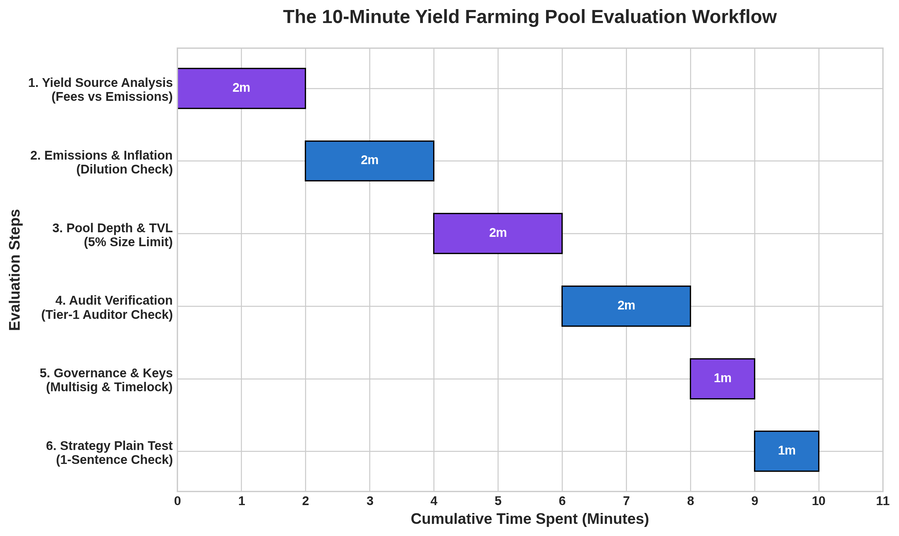
How to Interpret This Visual
This horizontal waterfall timeline chart breaks down the 10-minute due diligence protocol described in the section into a clear, chronological workflow:
-
Step 1: Yield Source Analysis (Minutes 0–2): Verify whether yield originates from real protocol fees/interest or inflationary emissions.
-
Step 2: Emissions & Inflation (Minutes 2–4): Calculate token supply inflation to detect hidden dilution traps before committing funds.
-
Step 3: Pool Depth & TVL (Minutes 4–6): Check total value locked to enforce the 5% maximum position size threshold and prevent exit slippage.
-
Step 4: Audit Verification (Minutes 6–8): Inspect auditor reputation (e.g., OpenZeppelin, Trail of Bits) and confirm code freshness.
-
Step 5: Governance & Keys (Minutes 8–9): Ensure multisig signers and timelock mechanisms protect admin controls against rug pulls.
-
Step 6: Strategy Plain Test (Minutes 9–10): Perform the sanity check by explaining the yield mechanism in one simple sentence.
How to Utilize This Data in Your Strategy
Before depositing funds into any pool on Polygon or BNB Chain, use this visual as a strict 10-minute operational timer. Allocate exactly two minutes to evaluating yield sustainability, emissions schedules, liquidity depth, and audit quality, followed by one minute each for admin key security and plain-language validation. If a pool fails any single step in this sequence, abort the transaction immediately; saving you from costly exploits, severe slippage, or rapid token dilution.
Conclusion: The Future of Yield Farming on Polygon and BNB Chain
We have covered a lot of ground. The numbers, the protocols, the risks that nobody puts on a dashboard, and the habits that separate farmers who survive from farmers who become cautionary tales. Now comes the part where we zoom out and ask the only question that really matters: where does this go from here?
The honest answer is that nobody knows for certain. DeFi moves too fast for certainty, and anyone who tells you they have it figured out is either selling something or has not been paying attention. I have been wrong about this market more times than I care to admit, and the only thing that has kept me profitable is staying curious and staying humble. But we can look at the signals, and the signals tell a clear story about two chains heading in two very different directions.
Yield Farming on Polygon vs BNB Chain: The Bottom Line
If you have read this far, you already know there is no universal winner. But there is a right answer for your specific situation, and it comes down to what you are actually trying to accomplish.
BNB Chain is the farmer's chain. It has the liquidity, the incentive programs, and the active ecosystem that makes farming feel like a living, breathing thing. With roughly $5.9 billion in DeFi TVL and PancakeSwap alone contributing around $2.2 billion of that, the depth is real and the exits are wide.
The PancakeSwap "The Flip" proposal is the most important development to watch, because it represents a fundamental shift from emissions-driven farming to fee-driven farming. If it passes, the high-APY era will not disappear overnight, but the farms that survive will be the ones with genuine trading volume. That is healthier for the ecosystem, but it also means farmers who relied on token printing will need to adapt.
The fixed-rate products emerging on BSC, like those from TermMaxFi and Pendle, signal that the chain is maturing toward the kind of infrastructure that institutional capital requires. BNB Chain is not just for degens anymore, but it still rewards the degens who pay attention.
Polygon is the patient investor's chain. It has the low fees, the stablecoin liquidity, and the institutional narrative that makes farming feel less like a casino and more like a savings account with a DeFi wrapper. The $3.8 billion in stablecoin market cap and the $1 billion in DeFi TVL tell you that Polygon is a place where money sits and settles, not necessarily where it chases the highest yield.
The POL staking concentration problem is the elephant in the room, and it is not going away. More than a third of staked POL is controlled by Upbit, Coinbase, and Binance, and PIP-85 only addresses the symptom, not the disease.
The deeper issue is that the protocol cannot distinguish an exchange wallet from a personal wallet, and any rule based on identity breaks the permissionless nature of the network. If you are farming on Polygon, stake on-chain, use liquid staking tokens like sPOL or MaticX, and do not let the exchanges capture rewards that should be yours.
The bottom line for your bottom line:
If you are an active farmer with $5,000 or more, BSC offers more opportunities and deeper liquidity. The time you spend managing positions will be rewarded.
If you are a patient farmer with $1,000 to $10,000 and a preference for stablecoin yields, Polygon offers a smoother, cheaper, and more predictable experience.
If you are somewhere in between, the hybrid approach works: keep the bulk of your capital in stablecoin lending on Polygon and allocate a smaller portion to active farming on BSC. That way you get the stability and the upside, and you are not betting everything on one chain's trajectory. I have run this hybrid approach myself for over a year, and it is the closest thing to a good night's sleep that DeFi has ever given me.
One more thing worth saying: do not let anyone shame you for choosing the "boring" option. There is a corner of crypto culture that treats conservative farming as a lack of ambition, as if the only valid strategy is the one that could either 10x or zero by next Tuesday. That culture has cost more people more money than any bear market. A 5% stablecoin yield on Polygon that you actually keep is worth more than a 50% farm that you panic-sell at a loss. Slow and boring wins. It always has. It just does not make for good screenshots.
Final Risk Checklist Before You Deploy Capital
Before you close this article and open your wallet, run through this list one more time. It will not take long, and it will save you from the mistakes that cost the most money.
- Have you checked the emissions schedule? If you cannot find the annual token inflation and compare it to the APY, you are not farming. You are hoping. A protocol that does not disclose its emissions is a protocol that does not want you to know.
- Is your position less than 5% of the pool? If not, reduce your size or find a deeper pool. A yield you cannot withdraw is not a yield. It is a hostage situation.
- Have you verified the protocol's audit and admin keys? Recent and reputable audits matter, but so does who controls the contract. A single wallet with no timelock is a gamble, no matter how good the APY looks. An audit from three years ago is not protection. It is nostalgia.
- Are you using a separate hot wallet for farming? Your long-term holdings should never touch a DeFi protocol. If your farming wallet gets drained, you want to be annoyed, not ruined. This one habit is worth more than every analytics tool combined.
- Have you revoked old approvals? Check Revoke.cash on every chain you use. Unused approvals are latent risks that cost nothing to remove and everything to ignore. Set a monthly reminder on your phone if you have to. Future you will be grateful.
- Do you have an exit plan? Set a rule before you deposit. Take out your initial capital after a certain period. Sell half your rewards every week. Exit if the APY drops below a threshold. The specific rule matters less than having one. Write it down somewhere you will actually see it. A rule that lives only in your head is not a rule. It is a suggestion you will ignore when the APY looks too good to leave.
- Can you explain this strategy to a friend? If not, you do not understand it well enough to deposit. Complexity is a risk multiplier, and the farmers who get hurt the most are the ones who understood the least. If your explanation involves more than two sentences and a chart, the strategy is probably not worth the risk.
- Have you accounted for taxes? Every harvest, every compound, every bridge is potentially a taxable event. If you are farming actively on two chains, you might have hundreds of reportable transactions this year. Keep records from day one, or hire someone who will. The tax bill is the risk nobody talks about until it arrives.
- Have you sized your position appropriately? No more than 10% of your farming capital in a single farm, no more than 25% on a single chain. The rest should be in stablecoin lending or sitting in a wallet, waiting for a better opportunity. The farmers who survive are the ones who treat every farm as expendable.
- Are you prepared to lose the money? This is the hardest question on the list, and the one most people skip. If losing your entire farming position would change your life in a way you cannot afford, you are farming with too much. Size down until the answer is yes. That is not pessimism. That is risk management.
What to Watch Next in Polygon and BNB Chain Yield Farming
The landscape is not static, and the farmers who thrive are the ones who keep watching. Here are the developments that will shape the next chapter of yield farming on both chains.
PancakeSwap's "The Flip" vote. This is the single most important event on the BSC calendar. If the proposal passes, CAKE emissions drop by 69% and LPs shift to 88% of swap fees. The high-APY farms that defined BSC's farming culture will become less common, and the farms that survive will be the ones with real trading volume. The farmers who adapt early will be the ones who keep their gains. The ones who keep chasing the old model will be left holding a token that is no longer being printed to pay them. Watch the vote closely, and adjust your strategy before the change takes effect, not after. The crowd always reacts late, and the crowd is your competition.
Polygon's staking concentration and the PIP-85 fallout. The proposal cut Upbit's validator income by 86%, which is a meaningful step. But the deeper problem remains: exchanges control more than a third of staked POL, and there is no clean way to fix that without compromising decentralization. Watch for whether more users migrate to non-custodial staking and liquid staking tokens, and whether Polygon introduces any of the other levers analysts have suggested, like a yield gap between custodial and non-custodial staking or a minimum self-stake ratio. If the concentration problem gets worse, it affects governance, reward fairness, and the long-term health of the network. If it gets better, Polygon becomes a more credible venue for the institutional capital it is trying to attract. Either way, the outcome matters for anyone farming POL.
The growth of fixed-rate and structured products on both chains. BSC is already moving in this direction with Pendle and TermMaxFi, and the demand is real. Polygon will likely follow, because institutional and conservative retail capital wants predictability, not floating rates that swing wildly week to week. If you are managing larger capital, these products are worth understanding. They will not replace degen farming, but they will become a meaningful part of the yield landscape. The farmers who learn how PT and YT work today will have an edge when these products become mainstream tomorrow.
Real-world assets and the institutional narrative. BNB Chain added over $3.6 billion in RWA value in 2026, and the growth is accelerating. Polygon is positioning itself as the settlement layer for payments and tokenized assets, with Polymarket and infrastructure from Spiko and Securitize building on its rails. If this trend continues, it will bring new sources of yield that are not dependent on token emissions. The yields will be lower, but the risk profiles will be different in a way that matters for anyone farming with serious capital. Watch for the first RWA-backed lending markets on Polygon. They will not make headlines, but they will quietly become some of the safest yield opportunities on the chain.
Regulatory developments in Europe and the United States. The European Central Bank has called for the stablecoin remuneration ban to be extended to lending, borrowing, and staking. If that becomes law, EU-based farmers could face restrictions on the very strategies that make stablecoin farming profitable. The rules are not finalized, but the direction of travel is clear. Keep an eye on how this affects the liquidity that EU-based platforms provide to global pools. If EU-based capital starts pulling back from stablecoin farming, the yields on Polygon and BSC could compress in ways that have nothing to do with on-chain activity. Regulation is the one variable that can change the game overnight, and it is the one variable that no protocol can control.
The maturation of AI-driven farming tools. AgentKit and similar infrastructure are making it easier for bots to discover and execute yield strategies across dozens of networks. The technology is not ready to replace human judgment, but it is getting closer. Watch for the first wave of AI-managed vaults that are genuinely competitive with manual strategies. If they work, they could change the economics of active farming in the same way that auto-compounding vaults did a few years ago. If they fail, they will be a cautionary tale about trusting machines with your money before the machines have earned that trust.
The bottom line on the future: yield farming on Polygon and BNB Chain is maturing. The era of 500% APY on a token that nobody understands is fading, and what is replacing it is a landscape where real yield, real liquidity, and real security matter more than the number on the dashboard. That is good news for farmers who are willing to do the work. It is bad news for farmers who are looking for a lottery ticket. The chains will keep evolving, the protocols will keep changing, and the risks will keep shifting. The farmers who survive are the ones who keep learning, keep checking, and keep their exit plans ready.
And if you take nothing else from this article, take this: the best yield is the one you actually understand, on a chain you actually trust, with a risk you can actually afford. Everything else is noise. The APY that looks too good to be true usually is. The farm that everyone is talking about is usually already past its peak. The strategy that sounds boring is usually the one that pays. I have learned these lessons the expensive way so that you do not have to, and if this article saves even one person from a bad deposit, it was worth writing.
Now go farm, and do it carefully. The yields will still be there tomorrow. Your capital might not be, if you rush.
📊 Yield Farming Decision Matrix: Polygon vs. BNB Chain (Post-Flip Era Summary)
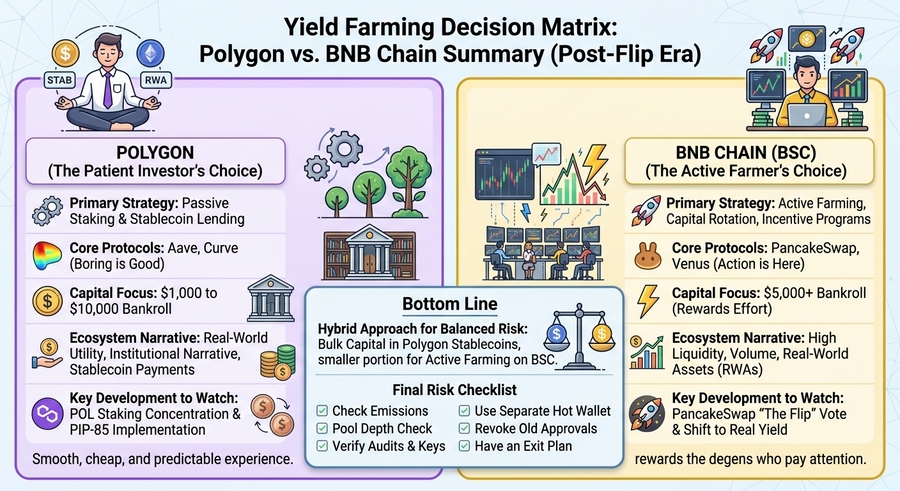
How to Interpret This Visual
This infographic serves as a comprehensive visual summary, comparing the yield farming landscapes of Polygon and BNB Chain (BSC) following major ecosystem updates like PancakeSwap's "The Flip" vote and Polygon’s PIP-85 proposal.
The visual is structured as a decision matrix:
-
Left (Polygon - Purple accents): This side represents the "Patient Investor" pathway. It summarizes key protocols (like Aave and Curve), notes the smaller TVL scale (around $1 billion), and lists the upcoming focus on POL staking centralization fixes. This path prioritizes low fees and predictable stablecoin yields.
-
Right (BNB Chain - Gold/Yellow accents): This side represents the "Active Farmer" pathway. It highlights key protocols (like PancakeSwap and Venus), the massive TVL scale ($5.9 billion), and the crucial shift toward "Real Yield" following the PancakeSwap vote. This path rewards active capital rotation and offers deeper liquidity for larger bankrolls.
-
Center ("The Bottom Line" and Checklist): The core recommendation is clearly stated here: BNB Chain is the preferred choice for active farmers with larger capital ($5,000+) who are willing to manage positions. Polygon is best suited for patient farmers with moderate capital ($1,000+) prioritizing stablecoins. The matrix also advocates for a hybrid approach (stablecoins on Polygon, active farming on BSC) for the best balance.
Finally, the "Final Risk Checklist" serves as a universal, mandatory pre-deployment review that applies to farming on any chain.
How to Utilize This Data in Your Strategy
You should use this visual as a final, quick-reference tool before deploying capital to either ecosystem. Do not treat the ecosystems as interchangeable venues. Instead, utilize this matrix to:
-
Identify Your Profile: Honestly assess if you are an active farmer (willing to put in daily/weekly effort for higher returns) or a patient investor (seeking a low-maintenance strategy).
-
Match with Capital: Use the recommended bankroll figures ($5,000+ for BSC, $1,000-$10,000 for Polygon) to ensure the fees and effort required make the strategy viable for your stack.
-
Execute the Checklist: Never skip the "Final Risk Checklist" items in the center card. Physically check the box mentally for every deposit you make.
-
Confirm the Outcome: Use this decision matrix to confirm that your chosen strategy on your chosen chain truly aligns with your financial goals, risk tolerance, and time commitment.
Yield Farming on Polygon vs BNB Chain: Frequently Asked Questions
I get asked these questions constantly, in DMs, in Telegram groups, and at the kind of dinners where someone leans over and whispers "so, what are you actually farming right now?" The answers below are the ones I find myself repeating most often, written the way I would explain them to a friend rather than the way a whitepaper would. Each one starts with the direct answer so you can grab it and run, then goes deeper into the reasoning, the numbers, and the mistakes I have seen people make. If you only read one section of this article, read this one. It is the distilled version of everything that matters, without the theory.
Q1. Which chain pays higher stablecoin yields right now: Polygon or BNB Chain?
BNB Chain generally pays higher stablecoin yields, with Venus lending at roughly 2.7% to 6.5% APY and incentivized PancakeSwap pools reaching up to about 8.7%. Polygon's stablecoin yields typically land in the 3% to 6% range through Aave and Curve, with less token exposure in the reward mix.
The headline number is only half the story, and this is where I see most new farmers get tripped up. A big chunk of BSC's top-end stablecoin yield arrives in CAKE or XVS, not in the asset you deposited. If CAKE drops 20% while you are holding it, your 8% yield can quietly turn into something much closer to 4% or even less.
In my own experience running both strategies side by side, the Venus USDT position paid less on paper but every dollar of it was a dollar. The PancakeSwap farm paid more but required me to sell rewards constantly to preserve the return, which is work, not passive income.
If you want maximum stablecoin APY and you are willing to manage the token leg, BSC wins. If you want predictable, deposit-denominated income with fewer moving parts, Polygon's Aave and Curve markets are the calmer choice.
Q2. Is Polygon's DeFi ecosystem too small to farm safely compared to BSC?
Polygon's DeFi TVL sits near $1 billion versus roughly $5.9 billion on BNB Chain, so its pools are shallower and exit slippage is higher for anything outside major stablecoin pairs. But Polygon processes an enormous share of global stablecoin transfer volume, which means the liquidity that does exist is stress-tested by real usage.
I think of it this way. BSC is a big, busy supermarket with aisles for everything. Polygon is a smaller shop with a deep, well stocked cooler section. If you need something niche, BSC has it. If you need USDC, Polygon has plenty.
The practical rule I follow: on Polygon, stay in USDC and USDT pairs on Aave, Curve, or Uniswap, and size positions at 5% of pool liquidity or less. On BSC, you have more latitude to explore mid-cap pools without worrying about being the entire market on your way out.
Size is not the same as safety, though. A $5.9 billion chain with concentrated admin keys can hurt you faster than a $1 billion chain with battle-tested blue chips. Match your position size to the pool depth you are entering, not to the chain's total TVL.
Q3. What is the biggest hidden risk specific to Polygon yield farming right now?
Exchange-custodied staking is the real hidden risk on Polygon. More than a third of all staked POL sits with Upbit, Coinbase, and Binance, and those exchanges take the rewards without a clear obligation to pass them back to users.
The numbers are genuinely startling. Upbit self-stakes about 1 POL against a delegation of roughly 400 million, and earned nearly 2 million POL in a single reward distribution. That is a return built on customer tokens, and it is not visible on any dashboard you will see.
Polygon's PIP-85 proposal cut that validator income by roughly 86%, which is a real step. But the protocol can only see wallet addresses. It cannot tell an exchange wallet from your hardware wallet, and any rule based on identity would break the permissionless model.
My advice is simple and I say it to every POL holder I know: stake on-chain or through sPOL and MaticX, never through an exchange app. You will earn more, and you will stop feeding the centralization problem that PIP-85 is trying to fix.
Q4. How does impermanent loss differ between Polygon and BSC liquidity pools?
Impermanent loss is structurally worse on BSC for volatile pairs because PancakeSwap V3's concentrated liquidity amplifies divergence losses when prices trend. On Polygon, the absolute IL is smaller because pools are shallower, but exit slippage becomes the larger hidden cost.
Concentrated liquidity is a great tool that quietly punishes anyone who treats it as a passive set-and-forget position. If the price moves outside your range, you stop earning fees entirely while your inventory has already been converted toward the losing asset.
I learned this the hard way with an ETH/USDC range on Polygon. I went on vacation for two weeks, ETH moved roughly 15%, my position sat out of range the entire time, and I earned nothing for ten days. The fees I missed would have covered a nice dinner.
Polygon's shallow pools add a second layer: if you represent a meaningful share of the liquidity, your own withdrawal moves the price. The safest position on either chain is the same. Stablecoin or tightly correlated pairs, where IL is minimal and the yield comes from trading fees rather than price divergence.
Q5. Are the high APYs on BSC farms actually sustainable, or am I being diluted?
Most high APYs on BSC are emissions-driven and therefore inflationary, so you are often being diluted rather than paid. The simple test is to divide annual new token supply by circulating supply: if that inflation rate exceeds the advertised APY, your real return is negative.
I have farmed tokens that showed 80% APY on the day I entered and were worth 20% APY two weeks later, not because the protocol changed but because the token price collapsed under its own emissions. The dashboard never warned me. It just kept showing a nice green number.
PancakeSwap's proposed emissions cut, which would reduce CAKE issuance by roughly 69% and shift LPs toward swap fee revenue, is the clearest admission that the old model was not sustainable at scale. I take that as a bullish signal for the protocol and a warning for anyone still farming purely on token printing.
Venus's RWA-backed stablecoin yields are the more durable alternative on BSC. Lower numbers, but the yield is backed by Treasury-linked cash flows rather than a printing press.
Q6. What is sPOL, and does it make Polygon staking more attractive?
sPOL is Polygon's canonical liquid staking token. You stake POL, receive sPOL one to one, and can deploy it in DeFi while the underlying POL keeps earning staking rewards. Polygon seeded it with 10 million POL from treasury, scaling toward 100 million, to ensure market depth.
It is a genuine improvement for POL holders because it lets you stack yield instead of choosing between staking and DeFi. Staking rewards on one side, lending or LP income on the sPOL on the other.
There is a second benefit that gets overlooked: priority fees. Under sPOL, validators return a portion of priority fee revenue to delegators, which adds a network fee component on top of the base staking yield.
What sPOL does not do is turn Polygon into a high-yield chain. The enhancement is modest compared to BSC's emission farms. I think of sPOL as the right tool for people who already want to hold POL and would like a little more from it, not as a reason to buy POL in the first place.
Q7. Is PancakeSwap V3 safe to farm, or is the concentrated liquidity risk too high?
PancakeSwap V3's core contracts are battle-tested and its operational history is reasonably clean, with no direct compromise of the V3 core. The real risk is operational: concentrated liquidity requires active management, and passive LPs get systematically exploited by MEV bots.
Two pool-level incidents did occur, roughly $183,000 in February 2025 and around $679,000 in March 2026, though the latter exploited a third-party token's burn mechanics rather than PancakeSwap's own contracts. That distinction matters if you are judging the protocol itself.
The bigger practical issue is that narrow ranges create predictable liquidation points, and sophisticated bots know exactly where they are. If you are not checking ranges regularly, you are the exit liquidity for someone who is.
My rule: if you want passive exposure to PancakeSwap, use V2-style pools or stablecoin pairs where range management is not a concern. Save V3 concentrated positions for capital you can actively monitor.
Q8. Can I farm on both Polygon and BSC without losing money to bridges?
There is no canonical bridge between Polygon and BNB Chain, so every route is a third-party protocol with all-in costs typically between $0.80 and $3.50. Cross-chain farming generally stops making economic sense below roughly $1,000 to $1,500 in position size.
Do the arithmetic once and it becomes obvious. On a $500 position, a $3 bridge fee is 0.6% of your capital before you have earned a cent, and you still have to pay to get out. If you value your time at even $15 an hour and spend three hours a week managing two chains, the labor cost dwarfs the yield.
If you do have the capital to justify it, a few habits help. Bridge stablecoins only, never volatile assets. Test with $20 first and confirm arrival before moving the rest. Batch your operations so you are not paying fees repeatedly for small adjustments.
For most retail farmers, the honest answer is to pick one chain based on your primary asset and stay there. The extra 1% APY is not worth the extra 10% of your attention.
Q9. How much can I realistically earn farming stablecoins on each chain?
Realistic passive stablecoin farming returns land between 2% and 6% on both chains. BSC offers a higher ceiling of roughly 6.5% to 8.7% if you actively manage token rewards, while Polygon is more consistently in the 3% to 6% band with less dilution risk.
I want to be blunt here because this is where most content misleads people. The 8.72% PancakeSwap figure you see quoted is an incentivized rate, and the base fee APY on many of those pools is closer to 0.04%. The gap is entirely token emissions.
Venus lending is the more honest benchmark on BSC at 2.7% to 6.5%, and Aave or Curve on Polygon sits comfortably in the middle of that range. These are the numbers you should plan around.
If someone promises you 15% or more on stablecoins with no active management and no token exposure, ask what the catch is. There is always a catch. Sometimes it is emissions, sometimes it is a thin pool, and sometimes it is a stablecoin that is not as stable as the name suggests.
Q10. What is the tax situation for yield farming, and does it differ between chains?
The tax treatment is broadly the same on both chains. In the US, depositing into an AMM pool creates a taxable swap, and claiming farming rewards counts as ordinary income at fair market value on the claim date. The difference is volume: active BSC farming generates far more reportable transactions than passive Polygon lending.
This is the risk that nobody talks about until April arrives. If you are harvesting weekly on two chains, you could be looking at hundreds of transactions that each need a cost basis and a fair market value. Penalties for getting it wrong can reach 75% of unpaid taxes plus interest, which is a second tax bill on top of the first one.
In Europe, MiCA is fully in force, and the ECB has called for the stablecoin remuneration ban to be extended to lending, borrowing, and staking. If that becomes law, some of the strategies that work best on both chains could be restricted for EU-based farmers.
My advice, learned the expensive way: keep records from day one, use DeFi-aware tax software, and if you farm actively on multiple chains, budget for an accountant. The cost of doing it properly is a fraction of the cost of doing it wrong.
Q11. What are the most important metrics to check before depositing into any farm?
The single most important metric is where the yield comes from. If you cannot answer that in one sentence, do not deposit. After that, check emissions inflation against the advertised APY, verify your position is under 5% of pool liquidity, and confirm the protocol has a recent, reputable audit plus sane admin key controls.
The yield source question sorts everything. Trading fees and lending interest come from real economic activity and tend to persist. Token emissions come from a printing press and tend to collapse. I have watched too many farmers enter a pool because the APY was high, without ever asking who was paying them or why.
The pool depth check is the second most important, and it is the one people skip because it requires arithmetic. A 20% APY in a pool where your deposit represents 10% of the liquidity is not a 20% APY. It is a slippage trap with a nice banner.
For everything else, DefiLlama for TVL trends, the protocol's own documentation for emissions, and Revoke.cash for cleaning up approvals. Ten minutes of this checklist has saved me more money than any analytics subscription.
Q12. Should I choose Polygon or BSC for my first yield farming position?
Choose Polygon if you are starting with under $1,000 and holding stablecoins, because sub-cent gas makes small positions viable and compounding cheap. Choose BSC if you have $1,000 to $5,000 and want deeper liquidity and higher upside, but start with Venus lending rather than the high-APY farms.
I have started farmers on both, and the pattern is consistent. The people who begin on Polygon with a small stablecoin position learn the mechanics without bleeding fees. The people who jump straight into a 40% APY BSC farm usually learn about emissions and impermanent loss by losing money to them.
Whichever chain you pick, resist the urge to farm both immediately. Cross-chain farming below $1,000 to $1,500 is a donation to bridge operators. Pick one chain, learn it properly, and expand once your bankroll justifies the overhead.
And whatever you do, run a small round trip first. Deposit $20, harvest once, withdraw. A position is not real until you have exited it successfully. That test is the cheapest insurance in DeFi, and I wish someone had told me about it before I learned the lesson with a much larger number.