
Looking to sharpen your edge in the fast-moving world of altcoin trading? This comprehensive guide to Best Altcoin Trading Strategies is designed for traders and investors of all levels, from curious beginners to seasoned professionals. Packed with fresh insights for 2026, the article explores how to navigate altcoin markets with confidence, discipline, and a clear plan.
You’ll discover how Bitcoin dominance shapes altcoin price movements, why altcoin season signals matter, and how to use volume divergence, swing trading, and scalping strategies to capture profits while managing risk. The guide also dives into advanced approaches like AI-powered trading models, event-driven strategies, and arbitrage opportunities, giving you practical tools to adapt in a market that never sleeps.
Risk management is a central theme, with actionable advice on position sizing, stop-loss placement, and hedging with futures and options. Plus, the article highlights emerging opportunities in 2026, including AI tokens, DeFi projects, and real-world asset tokenization, alongside institutional favorites like Solana and XRP.
Written in a lively, accessible tone, this resource blends technical analysis, fundamentals, and psychology to help you trade smarter, not harder. Whether you’re chasing short-term volatility or preparing for the next altcoin cycle, this guide equips you with proven strategies to thrive in one of the most exciting corners of the crypto market.
Table of Contents:
- Introduction to Altcoin Trading
- Altcoin Market Analysis and Trends
- Altcoin Trading Strategy Based on Bitcoin Dominance
- Altcoin Season Trading Strategy
- Altcoin Volume Divergence Trading Strategy
- Altcoin Swing Trading and Scalping Strategy
- Altcoin Arbitrage Trading Strategy
- AI-Powered Altcoin Trading Strategy
- Event-Driven Altcoin Trading Strategy
- Altcoin Risk Management Strategies
- Emerging Altcoin Opportunities in 2026
- Challenges in Altcoin Trading
- Conclusion: Mastering Altcoin Trading Strategies
- FAQs: Best Altcoin Trading Strategies
- What makes altcoin trading different from Bitcoin trading?
- How do I know when it’s “altcoin season”?
- What are the biggest risks in altcoin trading right now?
- Which altcoins are attracting institutional interest in 2026?
- How should traders manage risk in altcoin trading?
- What’s the outlook for altcoins in the next cycle?
Introduction to Altcoin Trading
Altcoin trading in 2026 is no longer a fringe activity; it’s a mainstream investment arena shaped by institutional capital, regulatory clarity, and technological innovation. Traders today face both incredible opportunities and heightened risks.
What Are Altcoins and Why They Matter in Crypto Trading
Altcoins are simply cryptocurrencies that aren’t Bitcoin, but don’t let that definition fool you. They’ve become the lifeblood of blockchain innovation. Ethereum pioneered smart contracts, giving rise to DeFi and NFTs. Solana and Polygon pushed scalability, while projects like Arbitrum and Optimism made transactions faster and cheaper. Even meme coins, often dismissed, have shown the power of community-driven momentum.
Altcoins matter because they represent real-world applications: payments, gaming, artificial intelligence, and tokenized assets. If Bitcoin is the anchor, altcoins are the engines driving experimentation. For traders, they’re both the riskiest bets and the most rewarding opportunities. Ignoring them means missing the very innovations shaping the future of finance.
To put it in perspective, think of Bitcoin as the “grandfather” of crypto, steady and reliable, while altcoins are the ambitious younger siblings constantly trying new things. Some fail spectacularly, others grow into household names. For investors, this means altcoins are where the action is, where fortunes are made and lost, and where the next big breakthrough is likely to emerge.
Altcoin Trading in 2026: Market Trends, Institutional Adoption, and Investor Challenges
The altcoin market in 2026 feels like a teenager finally growing up. Bitcoin dominance sits around 56 percent, keeping pressure on smaller tokens, yet institutional adoption has changed the game. Over 100 crypto ETFs are now available worldwide, and asset managers are actively accumulating altcoins like Ethereum, Solana, and XRP. This isn’t just speculation anymore; altcoins are part of diversified portfolios.
At the same time, Layer-2 networks such as Arbitrum, Optimism, and Polygon are reshaping the landscape by reducing fees and improving speed. Ethereum upgrades in 2026 are raising the bar for security and scalability, forcing new altcoins to deliver genuine utility.
The rise of real-world asset tokenization (RWA) is another major trend. Institutions are experimenting with tokenized bonds, real estate, and even carbon credits, and many of these projects are powered by altcoin ecosystems. This shift is pulling altcoins closer to traditional finance, making them more relevant than ever.
Challenges remain. Traders face liquidity traps, meme coin hype cycles, and regulatory uncertainty. The EU’s MiCA framework has brought clarity, but the U.S. still struggles with fragmented rules. Emotional trading is punished quickly in this environment, while patience and fundamentals are rewarded.
For retail traders, the biggest challenge is information overload. With thousands of altcoins on the market, separating noise from signal is harder than ever. The days of blindly chasing the next “moonshot” are gone; success now requires discipline, research, and a willingness to adapt.
Why Altcoin Trading Strategies Are Essential for Profitable Crypto Investing
Jumping into altcoins without a plan is like walking into a casino blindfolded. Sure, you might hit a lucky streak, but more often than not, you’ll walk away broke. Altcoins can swing 20 percent in a single day, and without a strategy, those swings will chew you up.
A solid strategy helps you:
- Time entries and exits by watching Bitcoin dominance and altcoin season signals.
- Filter hype-driven projects and focus on altcoins with genuine utility.
- Manage risk with position sizing, stop-losses, and hedging tools.
- Spot emerging opportunities in AI tokens, DeFi, and real-world asset tokenization.
Think of strategies as your seatbelt in a sports car. Altcoins can take you places fast, but without protection, the ride can get dangerous. The difference between surviving and thriving in crypto trading often comes down to whether you have a plan or not.
Altcoins matter because they drive innovation, the market in 2026 is shaped by institutional adoption and Layer-2 growth, and strategies are the key to turning volatility into opportunity. It’s not about scaring traders away; it’s about giving them the confidence to trade smart, not just trade fast.
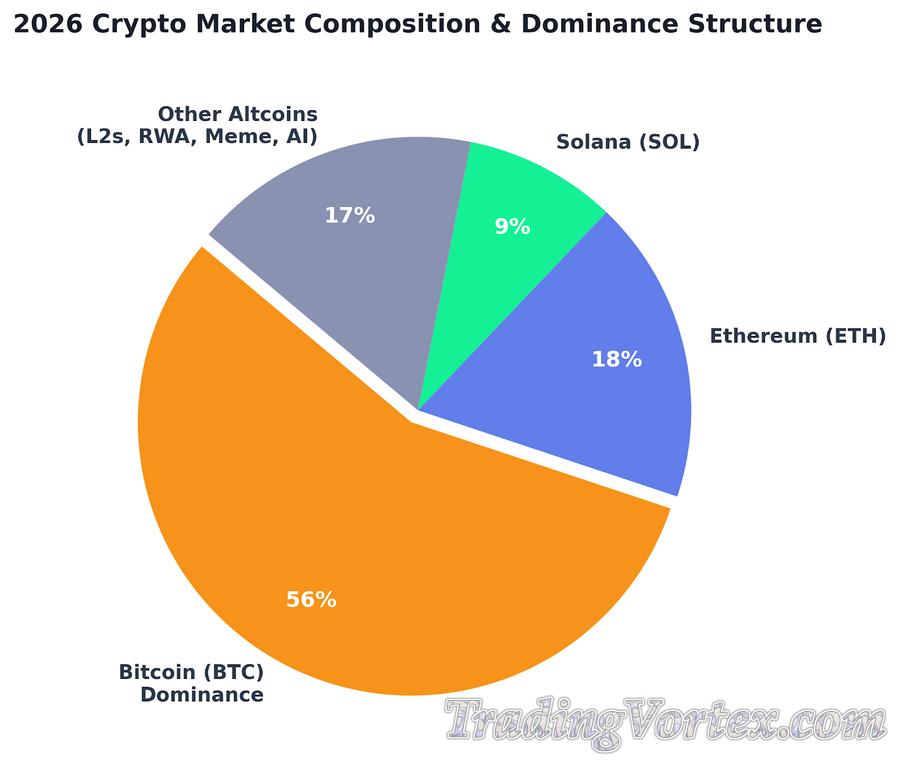 2026 Crypto Market Composition & Dominance Structure: A breakdown of total cryptocurrency market capitalization showing Bitcoin (BTC) dominance at 56%, Ethereum (ETH) at 18%, Solana (SOL) at 9%, and all other altcoins (including Layer-2s, Real-World Assets, Meme Coins, and AI tokens) collectively comprising the remaining 17%.
♦ How to Interpret and Utilize This Visual:
As you step into the 2026 altcoin landscape, understanding market share distribution is your primary compass for building a profitable trading strategy. This chart highlights the structural mechanics of the current crypto market and explains why a tactical approach is non-negotiable:
◊ The Power of Bitcoin Dominance (56%): Bitcoin remains the gravity well of the entire crypto ecosystem. With over half of the market's total capital sitting in BTC, its price movements dictate macro market trends. When Bitcoin dominance is high or rising, capital is pulled away from altcoins. As a trader, you should watch for this metric to cool down or consolidate; a declining Bitcoin dominance is often the catalyst for an "Altcoin Season," where capital flows rapidly into smaller tokens.
◊ The Major Altcoin Anchors (27% Combined): Ethereum and Solana represent the foundational infrastructure of decentralized finance (DeFi), scalability, and institutional integration. Because they command a significant portion of the remaining market, they behave as the "blue chips" of the altcoin world. They offer higher liquidity and slightly lower volatility compared to smaller assets, making them safer core holdings for an altcoin portfolio.
◊ The Fragmented Altcoin Sandbox (17%): The final slice represents thousands of projects—ranging from high-utility Layer-2 networks and Real-World Asset (RWA) platforms to speculative meme coins and AI tokens. While this 17% slice holds the highest potential for exponential gains, it is also where liquidity traps and extreme daily swings occur.
♦ Traders' Takeaway: Do not treat all altcoins equally. Use this visual to structure your risk management. Allocate your capital defensively when Bitcoin dominance is aggressive, and use structured strategies to target the high-growth 17% altcoin sector when capital begins to rotate outward from BTC and major smart-contract platforms.
Altcoin Market Analysis and Trends
Altcoin trading in 2026 is shaped by a tug-of-war between Bitcoin dominance, institutional adoption, and sector-specific breakouts. While Bitcoin still commands more than half of the market, altcoins are carving out their own space through innovations in DeFi, AI, and real-world asset tokenization. Traders who understand these dynamics can spot opportunities early and avoid the pitfalls that catch less-prepared investors.
Bitcoin Dominance and Its Impact on Altcoin Trading Strategies
Bitcoin remains the anchor of the crypto market, holding around 56–60 percent dominance of total capitalization. This dominance acts like gravity: when Bitcoin rallies strongly, altcoins often lag, but when Bitcoin consolidates, capital tends to rotate into altcoins. Analysts point out that the 58–65 percent dominance zone has historically preceded major altcoin rallies, including in 2017 and 2021. In mid-2026, Bitcoin sits near this critical threshold, suggesting traders should watch closely for signs of rotation.
For altcoin traders, timing is everything. Jumping into altcoins while Bitcoin is surging can be frustrating, but entering when Bitcoin stabilizes often sets the stage for outsized gains. Think of Bitcoin as the tide: when it rises too fast, smaller boats struggle, but when it steadies, altcoins can sail freely.
Altcoin Season Explained: How to Identify Altcoin Season Signals
“Altcoin season” is the period when altcoins outperform Bitcoin across the board. The Altcoin Season Index (ASI), published by CoinMarketCap, measures this by tracking how many of the top 100 coins beat Bitcoin’s returns over 90 days. A reading above 75 signals full altcoin season, while below 25 means Bitcoin season. As of May 2026, the ASI sits around 39, still in Bitcoin territory, but analysts highlight early rotation signals in sectors like DeFi, meme coins, and AI protocols.
Traders should look for three main signals:
- BTC dominance death cross on charts, showing weakening Bitcoin strength.
- OTHERS index trendline break, which reflects capital flowing into non-BTC assets.
- Sector-specific surges, such as ALGO and TON jumping 9 percent in a single session earlier this year.
Institutional Adoption of Altcoins: ETFs, AI Tokens, and Real-World Asset Tokenization
Institutional adoption is the biggest game-changer in 2026. Over 100 crypto ETFs are now available globally, and asset managers are actively accumulating altcoins. Projects tied to real-world asset tokenization (RWA), such as tokenized bonds and real estate, are attracting serious capital. AI-integrated tokens are another hot sector, with protocols offering measurable on-chain revenue and institutional-grade compliance.
This shift means altcoins are no longer just speculative plays. They’re becoming part of mainstream portfolios, with institutions favoring projects that demonstrate utility, scalability, and regulatory clarity. For traders, this creates a new dynamic: following institutional flows can be more reliable than chasing retail hype.
Altcoin Market Volatility: Liquidity, Derivatives, and Risk Factors
Volatility remains the defining feature of altcoin trading. Smaller tokens can swing 20–30 percent in a single day, driven by thin liquidity and speculative flows. Derivatives markets, especially perpetual futures, amplify these moves. Meme coins and DeFi tokens often lead volatility spikes, while large-cap altcoins like Ethereum and Solana provide more stability.
Risk factors include:
- Liquidity traps, where sudden sell-offs leave traders stuck.
- Regulatory uncertainty, especially in the U.S., where fragmented rules still create confusion.
- Psychological biases, with traders chasing pumps or panic-selling dips.
The lesson here is simple: volatility creates opportunity, but without risk management, it can wipe out gains just as quickly.
Altcoin trading in 2026 is not about blindly chasing hype. It’s about reading Bitcoin’s dominance, spotting sector-specific signals, following institutional flows, and respecting volatility. Traders who understand these trends can position themselves for the next wave of altcoin growth while avoiding the traps that catch the unprepared.
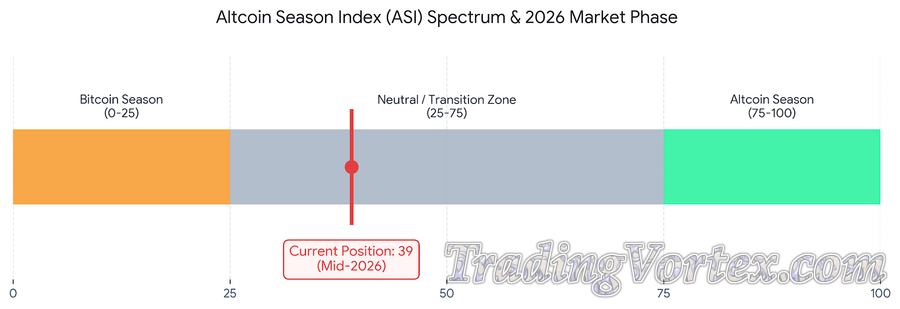 Altcoin Season Index (ASI) Spectrum & 2026 Market Phase: A visual matrix showing the three distinct phases of the crypto market cycle based on the Altcoin Season Index (0–100 scale). It marks Bitcoin Season (), the Neutral/Transition Zone (), and full Altcoin Season (), highlighting the mid-2026 current market position at an index score of .
♦ How to Interpret and Utilize This Visual:
To successfully navigate the altcoin landscape in 2026, you must understand where the market stands in its capital rotation cycle. This visual breaks down the Altcoin Season Index (ASI): a critical metric tracking whether capital is consolidating into Bitcoin or flowing outward into high-yielding alternative assets:
◊ The Bitcoin Season Zone (): When the index drops below 25, Bitcoin completely dominates the market's returns. During this phase, even strong altcoins struggle to match Bitcoin's performance. This is typically the time to accumulate high-conviction assets rather than actively trading small-cap breakouts.
◊ The Neutral/Transition Zone (): This is the current phase of the 2026 market, with the index sitting at . In this territory, Bitcoin dominance has begun stalling near its macro resistance levels (), and early capital rotation is underway. As a trader, this tells you that the market is highly fragmented; you will see "localized mini-seasons" where specific sectors (like AI protocols, Layer-2 ecosystems, or Real-World Asset (RWA) tokens) experience rapid surges while the rest of the market remains flat.
◊ The Altcoin Season Zone (): When the index crosses the 75 threshold, it signals that over of the top 100 cryptocurrencies are outperforming Bitcoin over a 90-day period. This is a environment of widespread market momentum where high-risk, high-reward trading strategies become most effective.
♦ Traders' Tactical Action Plan: With the index at , avoid the trap of blindly throwing capital into any random altcoin expecting an immediate macro rally. Instead, use a sector-focused approach. Look for projects displaying high relative strength, solid on-chain revenue, and institutional inflows (such as those tied to tokenized real-world assets or active DeFi platforms). This index position indicates that patience and strategic asset selection will yield far better results than chasing retail hype.
Altcoin Trading Strategy Based on Bitcoin Dominance
Bitcoin dominance is hovering around 58–60 percent in June 2026, a historically critical zone that often precedes capital rotation into altcoins. Traders are watching closely, since past cycles show that when dominance peaks and begins to slide, altcoins can deliver outsized gains. The key is knowing how to time entries and exits around this metric, because ignoring it is like trying to fish without checking the tide: you might get lucky, but more often than not, you’ll end up empty‑handed.
How BTC Dominance Shapes Altcoin Price Movements
Bitcoin dominance (BTC.D) measures Bitcoin’s share of the total crypto market capitalization. As of early June 2026, it sits near 58–60 percent, a level analysts often call the “rotation zone.” In both the 2017 and 2021 cycles, dominance peaked in this range before dropping by 15–25 percentage points, unleashing full altcoin seasons where Ethereum, Solana, and smaller caps dramatically outperformed.
Recent market data shows that while Bitcoin has slipped below $70,000, dominance remains elevated, suggesting that altcoins are resilient but not yet in broad rally mode. Ethereum, XRP, and Solana have shown relative strength, but the Altcoin Season Index (ASI) is still below 40, far from the 75 threshold that confirms full altseason. This means traders should treat current conditions as early rotation signals rather than a guaranteed altcoin boom.
Think of Bitcoin dominance as the tide. When it rises, altcoins struggle to float. When it steadies or falls, altcoins finally get room to sail. I’ve seen traders ignore this tide, piling into altcoins during Bitcoin surges, only to watch their positions bleed while Bitcoin hogged all the liquidity. It’s a painful lesson, but one that teaches respect for the rhythm of the market.
Entry and Exit Rules for Altcoin Trades
A dominance‑gated strategy works by filtering altcoin trades through BTC.D trends. Practical rules include:
Entry conditions:
- BTC dominance is flat or declining on the 4‑hour chart, signaling that Bitcoin is no longer absorbing all the capital.
- Altcoin shows technical confirmation, such as EMA20 crossing above EMA50, which suggests momentum is shifting in favor of buyers.
- RSI sits between 45–65 and rising, indicating healthy momentum without being overbought.
Exit conditions:
- BTC dominance begins climbing again, often a warning that liquidity is rotating back into Bitcoin.
- Volume divergence shows weakening conviction in altcoin rallies.
- Predefined stop‑losses (3–6 percent for swing trades, tighter for scalps) are triggered.
Risk management is crucial. Traders should limit exposure to 1–2 percent of account equity per trade, since dominance shifts can reverse altcoin rallies quickly. A dominance‑driven reversal can wipe out gains in hours, so having stops in place is not optional: it’s survival.
Why This Strategy Works
Backtests and live trading data show that filtering trades through BTC dominance improves win rates by 8–12 percentage points compared to trading altcoins blindly. It’s not about predicting the future, it’s about aligning with the structural flows of the market.
I’ve seen traders jump into altcoins during Bitcoin surges, convinced they were catching the next breakout, only to watch their positions bleed while Bitcoin hogged all the capital. The lesson is simple: never fight BTC dominance. Respect it, and you’ll avoid frustration while catching the real moves when they matter.
🎯 Bottom line:
BTC dominance is the oxygen meter for altcoins. When it drops, altcoins breathe and thrive. When it rises, they suffocate. Traders who gate entries and exits around dominance don’t just improve profitability, they protect their sanity in a market that loves to test patience. This strategy is less about chasing hype and more about listening to the heartbeat of the market, and in crypto, that heartbeat is Bitcoin.
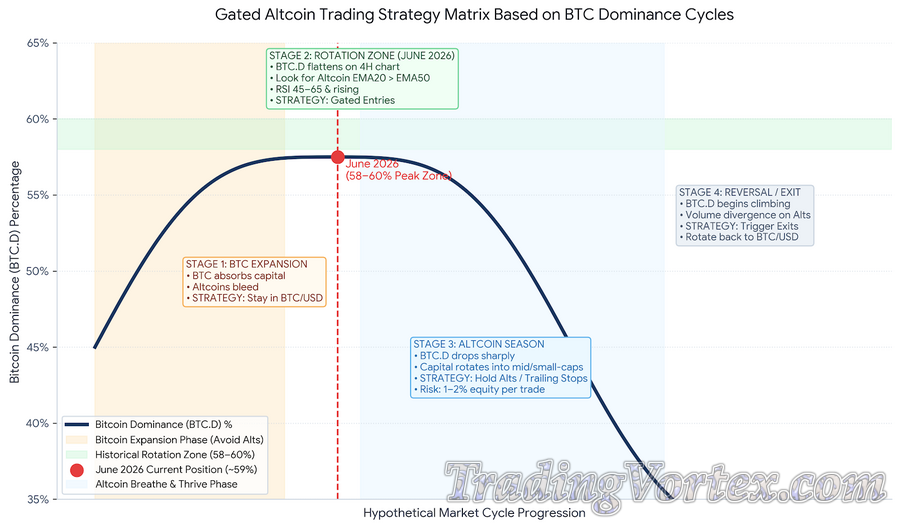 Gated Altcoin Trading Strategy Matrix Based on BTC Dominance Cycles: An educational market-cycle diagram tracking Bitcoin Dominance () across four distinct operational phases. The chart defines a highlighted Historical Rotation Zone between and , mapping out exact entry filters, target exit conditions, and risk parameters aligned with the market environment of June 2026.
♦ How to Interpret and Utilize This Visual:
This tactical matrix acts as an operational filter to protect your capital and maximize yield by tracking the macro flow of liquidity. Instead of analyzing individual altcoins in isolation, this visual teaches you how to use Bitcoin Dominance () as an "oxygen meter" to gate your market exposure.
♦ The Four Phases of the Capital Flow Cycle:
◊ Stage 1: BTC Expansion Phase (Avoid Altcoins): When is climbing rapidly, Bitcoin is aggressively absorbing global capital. Even if individual altcoins have strong technical patterns, they often bleed heavily in their trading pairs. The optimal strategy here is defensive: hold Bitcoin or stablecoins and avoid chasing breakout attempts.
◊ Stage 2: The Rotation Zone (June 2026 Strategy Window): As highlighted by the green horizontal channel and the red marker, the market is currently hovering between and . This is historically the maximum point of extension for Bitcoin's macro expansion. According to the strategy guide overlaid on the chart, you should not buy blindly here. Instead, look for micro-confirmations on the 4-hour chart: moving sideways or downward, an Exponential Moving Average () crossover where the crosses above the on your chosen altcoin, and a Relative Strength Index () sitting steadily between and climbing.
◊ Stage 3: Full Altcoin Season (Maximize Gains): Once breaks below the threshold, the market enters the high-velocity execution window. Capital distributes heavily down the risk curve into major layer-1 platforms, AI tokens, and niche projects. In this phase, your strategy transitions to trend-following. Hold high-conviction positions and implement trailing stop-losses between to lock in capital gains during vertical surges.
◊ Stage 4: Reversal & Capital Preservation (Trigger Exits): The cycle completes when finds a structural floor and begins curling back upward, or when altcoins exhibit volume divergence (price making new highs while volume decreases). This indicates institutional liquidity is returning to the safety of Bitcoin. Your strategy rules dictate immediate execution of exits, rotating your portfolio equity back to or USD before altcoin valuations evaporate.
♦ Traders' Tactical Rule: Treat this visual as your primary green-light/red-light mechanism. Limiting your total position exposure to of total account equity per trade ensures that even during a sudden macro reversal within the rotation zone, your capital remains completely protected. Never fight the dominance trend; trade only when the tide is in your favor.
Altcoin Season Trading Strategy
Altcoin season in 2026 remains the most thrilling and nerve‑wracking part of the crypto cycle. When it arrives, altcoins can outperform Bitcoin by three to ten times in just a few months. The catch is that timing and discipline are everything. Traders who understand the signals avoid chasing hype and instead ride the wave with confidence, while those who ignore them often end up holding bags of coins that have already peaked.
Identifying Altcoin Season Conditions for Maximum Gains
Altcoin season happens when capital rotates out of Bitcoin and floods into altcoins. Historically, this occurs when Bitcoin dominance (BTC.D) peaks around 55–60 percent and begins to decline. Analysts note that full altcoin seasons typically last 90–120 days, with smaller caps often delivering explosive returns during this window.
The Altcoin Season Index (ASI) is one of the most popular tools to confirm conditions. A reading above 75 means altcoin season is in full swing, while below 25 signals Bitcoin season. As of mid‑2026, the ASI is hovering in the mid‑30s, suggesting we’re not there yet, but sector‑specific mini‑seasons are already appearing in DeFi, AI tokens, and meme coins.
Another key element is sector rotation. Altcoin seasons rarely lift all boats equally. The typical sequence starts with Layer‑1 blockchains like Ethereum and Solana, then flows into DeFi leaders such as AAVE and Uniswap, followed by gaming tokens and meme coins. Recognizing this rotation helps traders position early instead of chasing late movers.
A personal note here: I’ve seen traders jump into meme coins at the tail end of a rotation, thinking they were catching the next big wave, only to watch their positions collapse within days. The lesson is clear: altcoin season rewards those who anticipate rotation, not those who chase it.
ETH/BTC Ratio and Volume Expansion as Key Indicators
The ETH/BTC ratio is one of the most reliable signals for altcoin season. When Ethereum begins outperforming Bitcoin and breaks resistance levels, it often marks the start of broader altcoin rallies. In 2026, analysts highlight ETH/BTC as the “canary in the coal mine” for altcoin season, since Ethereum remains the gateway to DeFi and Layer‑2 ecosystems.
Volume expansion is equally critical. A confirmed altcoin season usually shows 30 percent or more week‑over‑week growth in altcoin trading volume. This surge reflects fresh liquidity entering the market, often from retail traders chasing momentum and institutions diversifying into higher‑beta assets.
Practical entry rules during altcoin season include:
- Buy breakouts instead of waiting for pullbacks once confirmation is clear.
- Trail stops aggressively using tools like the 4‑hour Supertrend to lock in gains.
- Rotate profits back into Bitcoin once dominance stabilizes or starts rising again, to preserve wealth across cycles.
Why This Strategy Matters
Altcoin season is where portfolios can triple or even 10x in a short span, but it’s also where traders blow up accounts by chasing tops. I’ve seen friends ride meme coins up 200 percent only to watch them crash 80 percent because they ignored rotation signals. The trick is to treat altcoin season like a party: enjoy it, but know when to leave before the lights come on.
By watching BTC dominance, ETH/BTC ratio, and trading volume, traders can identify genuine altcoin season conditions and avoid fake‑outs. This strategy isn’t about gambling, it’s about aligning with the natural rhythm of the crypto cycle. Done right, it turns volatility into opportunity and hype into profit.
🎯 Bottom line:
Altcoin season is exciting, but it’s also unforgiving. The traders who thrive are those who treat it with respect, who know when to enter, when to rotate, and when to step aside. If you can master that rhythm, altcoin season becomes less of a gamble and more of a calculated opportunity to grow your portfolio.
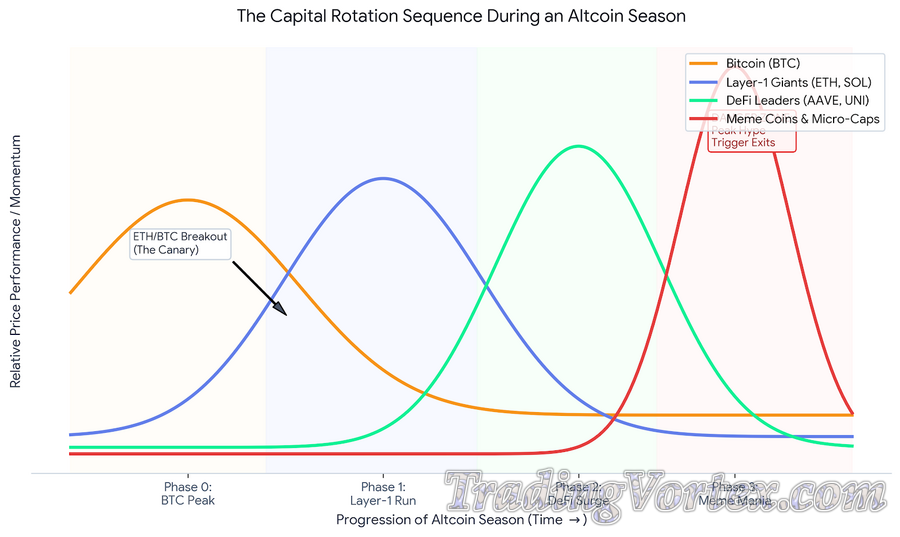 The Capital Rotation Sequence During an Altcoin Season: A conceptual lifecycle timeline mapping the step-by-step flow of liquidity across four structural market phases. The chart tracks the momentum curves of Bitcoin, Layer-1 Giants (, ), DeFi Leaders (, ), and Meme Coins/Micro-caps, indicating where key leading indicators like the ratio breakout occur and highlighting the high-risk "Danger Zone" at the peak of the retail hype cycle.
♦ How to Interpret and Utilize This Visual:
To achieve maximum profitability during an altcoin season, you must stop viewing the crypto market as a single, uniform entity. Capital does not flood into all tokens at the exact same moment; instead, it behaves like a sequential wave moving down a defined risk curve. This visual maps out that exact path to help you position yourself before a sector takes off, rather than chasing it after it has already peaked.
♦ Navigating the 4 Phases of Rotation:
◊ Phase 0: Bitcoin Peak ( Max Extension): The cycle starts with Bitcoin leading the market. As Bitcoin’s upward momentum begins to flatten or consolidate, institutions and early whales begin looking for higher-beta environments to multiply their returns.
◊ Phase 1: Layer-1 Giants (The Foundation): As capital begins its outward rotation, its first stop is the highest-liquidity, large-cap altcoins; specifically Layer-1 protocols like Ethereum and Solana. Notice the Breakout annotation: this is your "canary in the coal mine." When Ethereum starts outperforming Bitcoin structurally, it provides the green light that Phase 1 is in full swing.
◊ Phase 2: DeFi Leaders (The Ecosystem Surge): Once the foundational Layer-1 blockchains stabilize at higher valuations, liquidity cascades down into their core ecosystems. The primary beneficiaries are established DeFi protocols (like and ). Traders who monitor this sequence can comfortably accumulate DeFi assets during Phase 1 while the spotlight is still on Layer-1s.
◊ Phase 3: Meme Mania & Micro-Caps (The Peak Hype Danger Zone): The final phase occurs when massive retail liquidity entering the market creates a speculative frenzy. Capital rushes into high-risk, low-liquidity assets like meme coins and micro-cap narratives. While this phase yields the most explosive daily percentage gains, look closely at how sharp the drop-off is. This is the Danger Zone.
♦ Traders' Tactical Execution Plan: Your objective is to stay one step ahead of the wave. When you notice Phase 3 ("Meme Mania") dominating social media and trading volume expands by week-over-week, resist the emotional urge to buy the top. This is the structural signal that the party is ending. Aggressively tighten your trailing stop-losses (using a tool like the 4-hour Supertrend) and steadily rotate your profits back into the safety of Bitcoin or stablecoins before the final collapse completes the cycle.
Altcoin Volume Divergence Trading Strategy
Volume divergence has become one of the most reliable ways to catch altcoin trend reversals in 2026. By paying close attention to how trading volume behaves compared to price, traders can spot exhaustion, distribution, or accumulation before the crowd realizes it. Solana, Binance Coin, and Dogecoin have all displayed clear divergence patterns this year, offering valuable lessons for both cautious and aggressive traders.
Spotting Distribution and Exhaustion Patterns in Altcoin Charts
In 2026, analysts reported that altcoin selling pressure hit a five‑year high, with $209 billion in net sell volume imbalance across exchanges. This kind of divergence is a flashing warning light. Prices may look stable on the surface, but the underlying liquidity tells a different story. Traders who ignore volume risk walking into exhaustion traps, while those who pay attention can sidestep losses or even short weak setups.
A practical tip: always check the Cumulative Volume Delta (CVD) alongside price action. Rising CVD with flat prices often signals hidden accumulation, while falling CVD with rising prices screams distribution. I’ve personally avoided painful losses by watching CVD during euphoric rallies that looked unstoppable but were quietly running out of fuel.
Another useful approach is to compare exchange inflows and outflows. Heavy inflows to centralized exchanges often precede sell‑offs, while rising outflows to cold wallets suggest accumulation. Pairing this with volume divergence gives traders a sharper edge in spotting exhaustion before it hits.
Case Studies: Solana (SOL), Binance Coin (BNB), Dogecoin (DOGE)
Solana (SOL): After correcting from its 2025 highs, Solana showed resilience. Analysts noted that volume spikes during pullbacks were absorbed without breaking its broader uptrend, turning old distribution zones into support. This suggested institutional accumulation. Traders who tracked volume divergence caught these flips early, riding rebounds while others hesitated.
Binance Coin (BNB): BNB has faced heavy rotation pressure, with exchange sell volume outweighing buy volume for months. Price held steady, but volume divergence signaled exhaustion. Traders who spotted the imbalance avoided chasing BNB rallies and instead waited for confirmation of fresh inflows before re‑entering.
Dogecoin (DOGE): DOGE remains the poster child for erratic volume. Its rallies are often driven by sudden volume shocks rather than sustained momentum. In early 2026, DOGE spiked on social media hype, but volume divergence quickly revealed fading interest. Those who recognized the divergence exited early, while latecomers were left holding losses.
These examples highlight how volume divergence can separate genuine accumulation from hype‑driven noise. Solana rewarded patient traders, BNB punished those who ignored exhaustion signals, and DOGE reminded everyone that volume spikes without follow‑through are traps waiting to spring.
Why This Strategy Matters
Volume divergence is not glamorous, but it’s powerful. I’ve seen traders obsess over complex indicators while ignoring volume, only to get blindsided by sudden reversals. The truth is simple: price without volume is a mirage. By tracking divergence, you can spot when altcoins are running out of fuel or quietly being accumulated.
For altcoin traders in 2026, this strategy is essential. With liquidity fragmented across centralized and decentralized exchanges, volume tells the real story. Whether you’re trading Solana’s institutional flips, BNB’s exhaustion, or DOGE’s hype cycles, volume divergence gives you the edge to trade smarter, not harder.
🎯 Bottom line:
watch volume like you watch your wallet. It doesn’t lie, and it often speaks before price does. If you learn to listen, you’ll catch reversals before the crowd and protect yourself from the traps that wipe out unprepared traders.
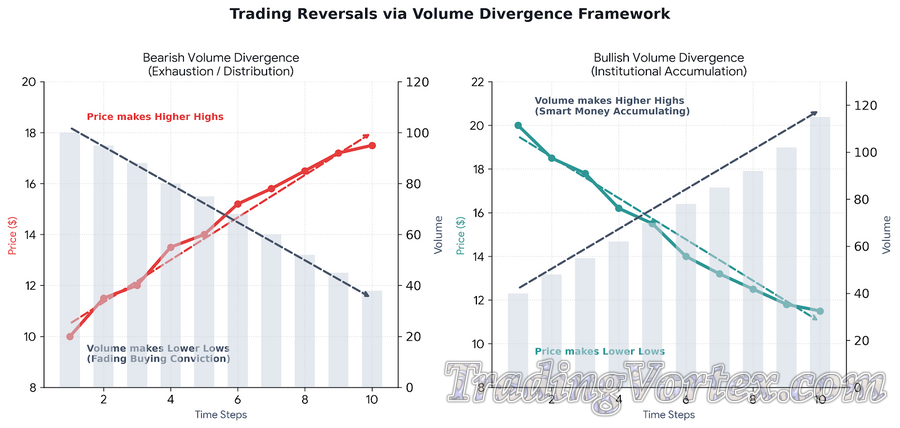 Trading Reversals via Volume Divergence Framework: A side-by-side comparison chart illustrating the two primary market reversal signals. The left panel shows Bearish Volume Divergence (Exhaustion/Distribution), where price continues to make higher highs while trading volume steadily trends downward. The right panel shows Bullish Volume Divergence (Institutional Accumulation), where price continues to make lower lows while trading volume steadily increases, indicating that selling pressure is being absorbed by large buyers.
♦ How to Interpret and Utilize This Visual:
Trading altcoins by looking only at price movement is one of the quickest ways to walk into an institutional trap. In 2026's highly fragmented liquidity environment, price can easily be manipulated or sustained briefly on pure hype. Volume, however, represents the true energy behind the move. By studying this dual framework, you can read the hidden behavior of smart money and anticipate trend reversals before they happen.
1. Left Panel: Bearish Volume Divergence (Exhaustion / Distribution)
◊ What is happening: The asset's price is climbing, making a series of higher highs, which looks incredibly bullish on the surface. However, look at the corresponding gray volume bars: they are consistently shrinking.
◊ The Market Reality: This divergence tells you that fewer and fewer buyers are willing to support the price at these higher levels. The rally is running out of oxygen (exhaustion) and is likely being sustained by retail FOMO while large players are systematically unloading their positions (distribution), just as we saw with Binance Coin (BNB) and Dogecoin (DOGE) during their peak hype cycles in 2026.
◊ Your Strategy: If you hold this asset, this is a clear signal to scale out, take profits, or trail your stop-losses aggressively. Do not open new long positions here, regardless of how good the news or social media hype looks.
2. Right Panel: Bullish Volume Divergence (Institutional Accumulation)
◊ What is happening: The asset's price is falling, making a series of painful lower lows, creating panic among retail investors. Yet, looking below the surface, the volume bars are steadily rising.
◊ The Market Reality: This structure indicates that a massive amount of liquidity is changing hands. As retail traders panic-sell their positions, institutional buyers and "smart money" are quietly stepping in and absorbing the sell orders without letting the price bounce yet. This creates a strong structural floor, turning old distribution zones into solid support, a behavior pattern clearly demonstrated by Solana (SOL) during its 2026 corrections.
◊ Your Strategy: This is your signal to stop panic-selling and instead start building a spot position or placing limit orders near key structural support zones. The increasing volume indicates that the downward trend is exhausted and an explosive upward reversal is imminent.
♦ Traders' Ultimate Rule: Always cross-reference your price charts with trading volume and tools like the Cumulative Volume Delta (CVD). When price and volume tell the same story, the trend is healthy. When they begin to move in opposite directions (as modeled in this framework) the current trend is a mirage, and a major reversal is right around the corner. Use these rules to trade alongside institutional capital rather than becoming its liquidity.
Altcoin Swing Trading and Scalping Strategy
Swing trading and scalping altcoins in 2026 are two of the most popular short‑term strategies for traders who want to profit from crypto’s volatility without committing to long‑term holds. Swing trading captures medium‑term moves of 5–30 percent, while scalping thrives on intraday noise, often targeting 0.5–2 percent moves dozens of times a day. Both require discipline, risk management, and a clear plan before clicking buy.
Short‑Term Altcoin Trading for Volatility Profits
Swing trading sits in the sweet spot between day trading and long‑term investing. In 2026, industry data shows crypto swing trades typically last 2–5 days, shorter than equity swings because of crypto’s 24/7 schedule and higher volatility. The goal is to ride a defined directional move, usually between support and resistance zones, capturing gains of 5–30 percent in major coins and sometimes more in smaller altcoins.
The workflow most professionals use looks like this:
- Identify the macro trend on weekly and daily charts. Is the 200‑day EMA rising, falling, or flat?
- Find the structure: support zones, resistance levels, and ranges where buyers and sellers repeatedly show up.
- Zoom in on the 4‑hour chart to time entries, whether on a pullback to support, a confirmed breakout, or a divergence signal.
- Pre‑define stop‑loss and targets before entering. A trade without invalidation is just hope.
Swing trading rewards patience. You don’t need to stare at charts all day, but you do need to respect the rhythm of the market. Altcoins like Solana or Avalanche often deliver clean swings when Bitcoin dominance stabilizes, while meme coins can offer wild but short‑lived bursts.
Scalping, on the other hand, is about exploiting micro‑moves. Traders target 0.5–2 percent gains per trade, often stacking dozens of trades daily. Scalping thrives in liquid markets like Binance or Bybit, where perpetual futures volume exceeds $20 trillion annually. Scalpers rely on tools like order‑flow analysis, VWAP, and momentum ignition setups. The advantage is quick profits, but the trap is overtrading and fee drag, which can eat 2.5–25 percent of position size annually if discipline is lacking.
Scalping is not for the faint of heart. It demands focus, lightning‑fast decision making, and the ability to cut losses instantly. I’ve seen traders scalp ETH during high‑volume sessions, pulling in dozens of small wins, only to give it all back by holding one stubborn loser. The grind is real, but so are the rewards if you treat it like a business rather than a gamble.
Risk Sizing and Stop‑Loss Placement in Altcoin Scalping
Risk management separates profitable traders from gamblers. Studies show retail short‑term traders are net negative 65–80 percent of the time over any rolling 12‑month window. The difference lies in how they size positions and manage stops.
Best practices include:
- Position sizing: Risk only 0.5–2 percent of account equity per trade. This keeps losses survivable even during drawdowns.
- Stop‑loss discipline: Automated stops are non‑negotiable. Scalpers often use tight stops of 0.3–0.7 percent, while swing traders allow wider margins of 3–6 percent depending on volatility.
- Win‑loss ratio: Accept that a 40 percent win rate can still be profitable if the average win is twice the average loss.
- Drawdown caps: Set daily, weekly, and monthly limits to avoid emotional spirals.
A personal anecdote: I once scalped DOGE during a hype cycle, stacking small wins until one oversized position wiped out half the gains. That taught me the golden rule: never let one trade undo a week of discipline.
Another lesson I’ve learned is that swing traders often underestimate the importance of scaling out. Taking partial profits at predefined levels reduces stress and locks in gains, even if the market reverses. Scalpers, meanwhile, must accept that fees and slippage are part of the game, so precision and volume selection matter more than chasing every tick.
Why This Strategy Works
Swing trading and scalping are not about predicting the future, they’re about systematically exploiting volatility. Swing trading rewards patience and structure, while scalping rewards speed and precision. Both strategies demand respect for risk, and both can compound capital meaningfully if executed with discipline.
🎯 The bottom line:
altcoin volatility is a gift, but only for traders who treat it with caution. Swing trading lets you capture the meat of the move without staring at charts all day, while scalping offers quick profits if you can handle the grind. Done right, these strategies turn chaos into opportunity, and hype into consistent gains.
In 2026, with institutional flows shaping liquidity and retail traders chasing meme cycles, short‑term strategies are more relevant than ever. Swing traders can ride sector rotations, while scalpers can thrive in high‑volume bursts. Both approaches prove that altcoin volatility isn’t just noise, it’s a resource waiting to be harnessed.
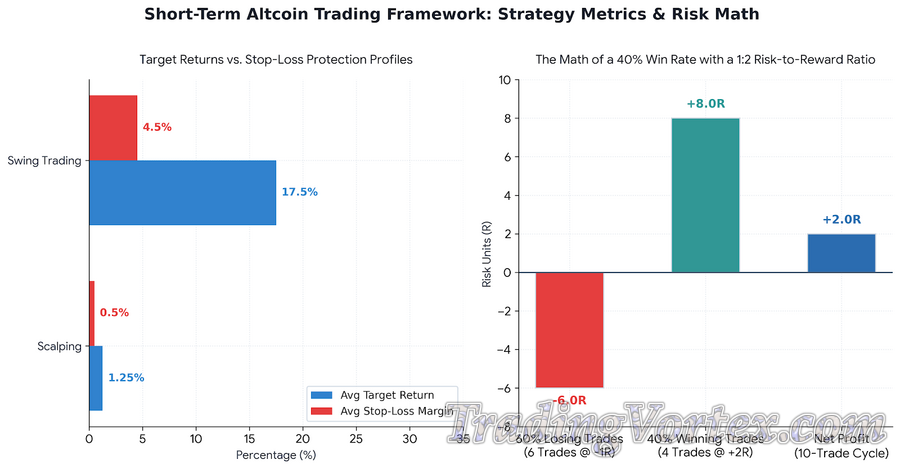 Short-Term Altcoin Trading Framework — Strategy Metrics & Risk Math: A side-by-side analytical layout comparing execution parameters and risk mechanics. The left panel features a horizontal bar chart comparing Scalping vs. Swing Trading across average target returns (blue) and average stop-loss margins (red). The right panel features a vertical column chart displaying the mathematical expectancy of a Win Rate with a Risk-to-Reward Ratio, mapping out cumulative losses (), cumulative gains (), and net cycle profitability () over a standard -trade series.
How to Interpret and Utilize This Visual:
When navigating the volatile altcoin markets of 2026, short-term strategies like swing trading and scalping provide highly lucrative paths; but only if you manage risk like an institution. This dual-panel dashboard visualizes the operational differences between these two distinct trading approaches and provides the core mathematics required to remain net-profitable across multiple market cycles.
1. Left Panel: Target Returns vs. Stop-Loss Protection Profiles
This horizontal bar chart clearly highlights why you cannot execute a scalping strategy with the loose parameters of a swing trade, and vice-versa.
◊ Scalping Profile: Scalping targets the minor, hyper-short-term microstructure waves. As the chart shows, your average target return per trade is small (), requiring an exceptionally tight, non-negotiable stop-loss margin (). Because these positions move quickly, slippage and exchange fee drag can compound rapidly. Precision in your entry triggers is vital.
◊ Swing Trading Profile: Swing trading focuses on macro structure boundaries over multiple days. This expansion of time allows you to target much larger moves (). Consequently, your position requires more room to fluctuate, resulting in a wider structural stop-loss margin ().
2. Right Panel: The Math of a Win Rate with a Risk-to-Reward Ratio
Many retail traders destroy their accounts because they obsess over maintaining a win rate, forcing them to hold onto toxic, losing positions. This panel breaks down the professional alternative: a positive mathematical expectancy framework.
◊ Understanding the 'R' Unit: In professional trading, '' represents your total dollar risk per trade. If you limit your risk to of your total account equity per trade, of your portfolio.
◊ The Formula in Action: If your trading plan guarantees that your average win is twice your average loss, your Risk-to-Reward ratio is exactly . Over a sample of trades with a conservative win rate:
Losing Trades at each result in a cumulative loss of ( of account equity).
→ Winning Trades at each result in a cumulative gain of ( of account equity).
→ Net Results: Despite losing the majority of your trades (), you conclude the cycle with a clear Net Profit of ( portfolio growth).
♦ Traders' Tactical Action Plan: Before opening an altcoin position on exchange order books, determine your time horizon. If you choose to scalp, automate tight stops and protect against fee drag. If you choose to swing trade, sit back, give the asset room to move, and exit partially at predefined resistance layers. Regardless of the style you choose, ensure that your average profit target always doubles your stop-loss margin. This shifts the mathematical edge of the market entirely to your side.
Altcoin Arbitrage Trading Strategy
Altcoin arbitrage in 2026 is alive and well, but it has evolved into a highly competitive arena dominated by speed, automation, and razor‑thin margins. Profits per trade are smaller than they used to be, often between 0.1–1 percent, yet they compound quickly for disciplined traders who understand the risks of fees, slippage, and the relentless competition from bots. What was once a playground for opportunistic retail traders has now become a battleground where milliseconds matter and precision is everything.
Exploiting Price Differences Across Exchanges
Other strategies have gained traction:
- Triangular arbitrage: Exploiting price differences between three trading pairs on the same exchange, avoiding transfer delays. For instance, trading ETH/USDT, BTC/ETH, and BTC/USDT in sequence to capture hidden spreads.
- Statistical arbitrage: Using historical correlations and quantitative models to identify when altcoin prices deviate from expected relationships, then betting on mean reversion.
- DeFi arbitrage: Exploiting inefficiencies between decentralized exchanges (DEXs) and centralized exchanges (CEXs), often through liquidity pools. Flash loans have made this strategy more accessible, allowing traders to borrow large sums instantly to execute arbitrage without upfront capital.
I’ve seen traders manually chase spreads, only to lose profits to withdrawal fees or slow transfers. The lesson is clear: in 2026, automation is king. Bots execute trades in milliseconds, and manual arbitrage is rarely viable unless you’re working with niche tokens on smaller exchanges where bots haven’t yet saturated the market.
Risks and Rewards of Altcoin Arbitrage
Arbitrage is often called “low risk” because it’s market‑neutral, but that doesn’t mean risk‑free. The main challenges are:
- Execution speed: Opportunities vanish in seconds. Latency or slow transfers can turn a profit into a loss.
- Fees and slippage: Exchange fees, withdrawal costs, and slippage can eat up spreads. A 0.3 percent spread may shrink to nothing after costs.
- Liquidity risk: Thin order books can prevent full execution, leaving traders partially exposed.
- Regulatory complexity: Frameworks like Europe’s MiCA regulation are reshaping liquidity flows, sometimes reducing inefficiencies but also creating new ones.
- Bot competition: High‑frequency trading bots dominate most major exchanges, meaning retail traders must either automate or focus on niche markets.
Why This Strategy Matters
Arbitrage is the closest thing to “boring money” in crypto, and boring can be beautiful. While swing traders chase 20 percent moves and scalpers grind for intraday gains, arbitrageurs quietly build wealth by exploiting inefficiencies.
I like to think of arbitrage as the plumber of crypto markets. It fixes leaks, keeps prices aligned, and rewards those who know how to work the pipes. For altcoin traders in 2026, arbitrage offers a way to diversify strategies, reduce exposure to wild volatility, and generate consistent returns.
A personal anecdote: I once tried manual arbitrage between two mid‑tier exchanges, thinking I had spotted a juicy 1 percent spread. By the time the transfer cleared, fees and slippage had eaten the entire profit. That was the day I realized arbitrage isn’t about being clever, it’s about being fast and systematic.
🎯 Bottom line:
Arbitrage won’t make you rich overnight, but it can keep your portfolio growing steadily while others ride the emotional rollercoaster of altcoin hype. If you respect the risks, embrace automation, and manage fees carefully, arbitrage can be one of the most reliable strategies in your toolkit. It’s not glamorous, but in a market where hype often burns traders, boring consistency can be the smartest play of all.
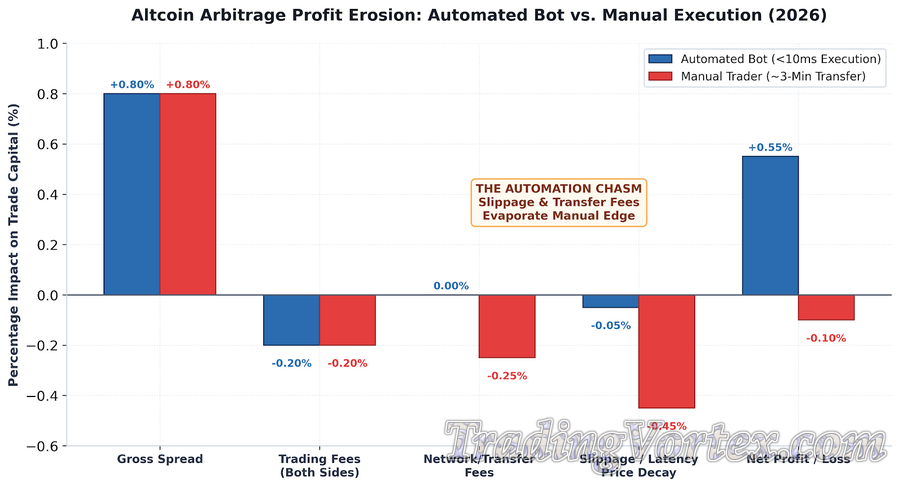 Altcoin Arbitrage Profit Erosion — Automated Bot vs. Manual Execution Framework (2026): A comparative data chart demonstrating the financial impact of fees, transfer latency, and slippage on a gross cross-exchange arbitrage spread. The chart contrasts an Automated Bot ( execution using pre-funded API balances) with a Manual Trader ( transfer time over on-chain networks), breaking down the sequence from the initial gross opportunity to the final compounded net profit () or net loss ().
♦ How to Interpret and Utilize This Visual:
This chart acts as an operational reality check for any trader seeking to exploit cross-exchange inefficiencies in the 2026 cryptocurrency market. While arbitrage is fundamentally structured as a "market-neutral" or "low-risk" strategy, this visualization models how easily an abstract price discrepancy can become a losing trade due to hidden frictional drag.
♦ Breaking Down the Profit Decay Chain
◊ The Starting Opportunity (Gross Spread): Both execution methods identify the exact same market inefficiency; a gross price divergence of on an asset across two independent exchanges. This is your initial point of entry.
◊ Exchange Trading Fees: Both the automated bot and the manual trader incur the identical unavoidable drag of trading execution fees ( total, accounting for maker/taker fees on both the buying and selling exchange platforms).
◊ The Network/Transfer Fee Trap: This is where the manual strategy begins to break down. To complete a manual spatial arbitrage loop, the manual trader must physically withdraw the altcoin from Exchange A and deposit it into Exchange B, incurring an on-chain network/gas fee (). The automated bot avoids this completely () by utilizing pre-funded, synchronized balances across both exchanges, instantly balancing its inventory via API keys without moving funds over the blockchain during execution.
◊ Slippage and Latency Price Decay: Because the automated bot executes both sides of the trade simultaneously in under , it experiences virtually zero slippage ( execution slippage modeled at a minor ). Conversely, the manual trader must wait approximately for network confirmations. In 2026's highly volatile environment, this time lag exposes the trader to market movements. The spread narrows while the funds are in transit, introducing severe latency price decay ().
♦ Strategic Takeaways for the Trader:
◊ The Net Outcome: The automated bot successfully extracts a clean, compounding net profit from the market. The manual trader, despite executing the exact same setup, finishes the trade with a net loss of .
◊ Navigating the Automation Chasm: If you are trading major high-volume altcoins (like Solana or Binance Coin), manual cross-exchange arbitrage is entirely obsolete. To participate in this arena, you must deploy algorithmic bots or shift your focus toward Triangular Arbitrage (which executes trades within milliseconds on a single exchange platform, eliminating network transfer fees and transfer times) or DeFi Flash Loan Arbitrage where the entire multi-leg trade is bunched into a single atomic block execution.
♦ Core Execution Rule: Before executing any arbitrage trade, utilize this exact breakdown to calculate your expected frictional drag. If your computed trading fees, withdrawal costs, and historical asset slippage exceed the gross percentage spread, step aside. In the modern crypto landscape, consistency beats speculation, but only when your execution speed matches the pulse of the market.
AI-Powered Altcoin Trading Strategy
AI-powered altcoin trading in 2026 has matured into a serious edge for traders, with machine learning models now capable of adapting to market regimes, analyzing on-chain data, and even scoring trade confidence in real time. The key is combining automation with discipline, since AI can amplify both profits and losses depending on how it’s used.
Using Machine Learning Models for Altcoin Signal Detection
The biggest shift in 2026 is that AI trading bots are no longer just glorified rule-based systems. Traditional bots relied on static signals like RSI or MACD crossovers, but today’s machine learning models adapt dynamically to market conditions. Reinforcement learning, for example, allows bots to learn optimal behavior through trial and error, adjusting strategies as volatility changes.
Modern AI tools integrate:
- On-chain analytics: Platforms such as Nansen and Arkham feed bots with wallet flows, liquidity pool data, and whale activity. This means bots can detect when large investors are moving funds before retail traders even notice.
- Sentiment analysis: LLM-powered models scan social media, news, and forums to detect hype or fear before it shows up in price. If Twitter suddenly explodes with chatter about a meme coin, AI can flag it instantly.
- Market regime detection: Bots now recognize whether the market is trending, ranging, or in high volatility, and adjust strategies accordingly. This prevents the classic mistake of applying breakout strategies in sideways markets.
- Risk-adjusted sizing: Machine learning systems automatically scale positions based on volatility, reducing exposure during unstable conditions and increasing size when conditions are favorable.
A personal note: I’ve seen traders treat AI bots like magic money machines, only to get burned when markets shifted. The truth is, AI is powerful, but it’s only as good as the data and rules you feed it. Think of it as a co-pilot, not an autopilot. It can guide you, but you still need to keep your hands on the wheel.
TrendRider AI Confidence Scoring in Altcoin Trading
One of the most exciting developments is confidence scoring systems like TrendRider AI. Instead of just spitting out buy or sell signals, these systems assign a confidence level to each trade, often expressed as a percentage.
For example:
- High confidence (70–90 percent): Signals backed by strong volume, clear trend, and supportive sentiment. These are the trades you want to size up.
- Medium confidence (40–70 percent): Signals with mixed indicators, requiring tighter stops and smaller positions.
- Low confidence (<40 percent): Signals likely to fail, best ignored unless you’re experimenting with tiny risk.
This scoring helps traders filter noise and focus on setups with the highest probability of success. It also reduces emotional decision-making, since you’re not just guessing, you’re following quantified probabilities.
I’ve used confidence scoring myself, and it feels like having a seasoned analyst whispering in your ear. You still make the final call, but the system gives you a structured way to prioritize trades. It’s like having a checklist before takeoff: you know which trades are worth flying and which ones should stay grounded.
Why This Strategy Matters
AI-powered trading is not about replacing human judgment, it’s about augmenting it. Bots can monitor markets 24/7, crunch data faster than any human, and adapt strategies in real time. But they can’t replace discipline, patience, or risk management.
For altcoin traders in 2026, the takeaway is clear:
- Use AI to detect signals and manage risk, not to chase hype.
- Treat confidence scoring as a filter, not a guarantee.
- Always secure API keys and monitor bots, since automation can magnify losses as easily as profits.
- Remember that AI thrives on data quality. Garbage in, garbage out. Feed it reliable inputs, and it will reward you with reliable outputs.
🎯 Bottom line:
AI-powered altcoin trading is like driving with advanced navigation. It won’t stop you from making mistakes, but it will help you avoid dead ends and find the fastest route to your goals. If you respect its limits and combine it with solid strategies, AI can turn crypto’s volatility into consistent opportunity. And in a market that never sleeps, having a machine that can keep watch while you rest might be the closest thing to peace of mind a trader can get.
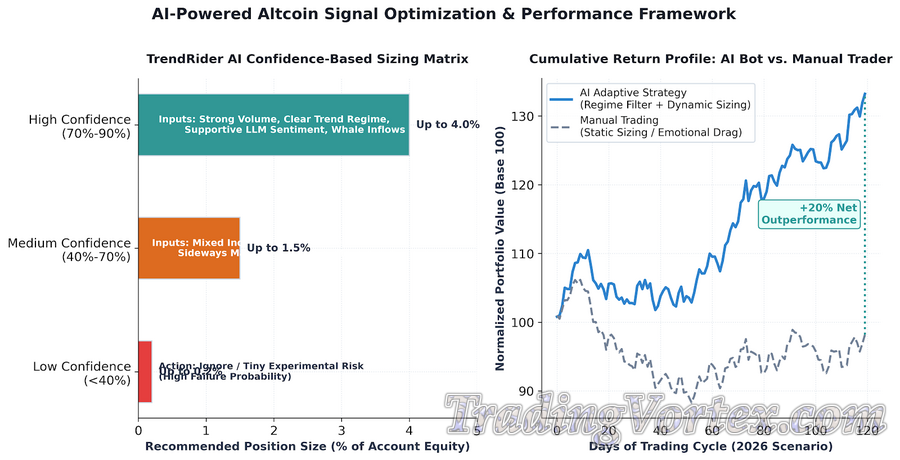 AI-Powered Altcoin Signal Optimization & Performance Framework: A side-by-side analytical chart demonstrating the architecture and financial impact of machine learning trading strategies in 2026. The left panel shows a horizontal bar chart displaying the TrendRider AI Confidence-Based Sizing Matrix, which maps out Low (), Medium (), and High () confidence tiers alongside recommended account equity allocations and automated data inputs (Sentiment, On-chain volume, and Market regime). The right panel shows a time-series line chart modeling the Cumulative Return Profile, contrasting an adaptive AI bot against a manual trader over a cycle, highlighting a net outperformance.
♦ How to Interpret and Utilize This Visual:
Integrating machine learning into your trading strategy is not about surrendering your autonomy to a machine; it is about utilizing statistical models to remove emotional bias and enforce strict capital preservation. This dashboard presents both the input filtering mechanism (how the AI thinks) and the historical performance output (why this strategy yields an edge).
1. Left Panel: Filtering Noise via TrendRider AI Confidence Sizing
The horizontal matrix illustrates how an adaptive AI co-pilot handles trade setups using multiple data feeds like LLM social sentiment, Nansen/Arkham whale flows, and volume momentum.
◊ High Confidence Tiers (): When multiple data layers align perfectly (e.g., strong volume expansion combined with massive on-chain whale accumulation), the model gives a high-confidence score. This signals you to safely scale up your position size (up to of your account equity) to maximize gains.
◊ Medium Confidence Tiers (): When indicators are mixed (such as a positive social media hype spike but completely flat underlying exchange volume) the system automatically flags the setup as medium confidence. The proper operational rule here is to limit capital exposure to a maximum of and tighten stop-loss boundaries.
◊ Low Confidence Tiers (): In random or sideways market regimes where breakout indicators frequently generate fakeouts, the model drops into low confidence. These signals should be completely ignored or restricted to tiny experimental risk, saving you from the classic retail trap of overtrading during illiquid market phases.
2. Right Panel: The Cumulative Advantage of Regime Modeling
The time-series chart highlights the long-term impact of using automated market regime detection and position scaling over a rolling trading window.
◊ The Manual/Rule-Based Curve (Dashed Gray Line): Manual traders often use a static position size and suffer from emotional friction; chasing high-volatility spikes at local tops, or overtrading when altcoins are trending sideways. This results in standard market drawdowns and equity performance drag.
◊ The AI Adaptive Curve (Solid Blue Line): By automatically reducing exposure during low-confidence market phases and dynamically increasing allocations exclusively during high-confidence trends, the well-tuned machine learning bot systematically compound wins. The net result is a clear outperformance compared to manual execution.
♦ Traders' Ultimate Rule: Treat artificial intelligence as an advanced structural filter for your risk management, not a standalone crystal ball. When deploying a bot, ensure you are feeding it reliable, multi-source inputs (on-chain volume + market regime filters). Let the machine handle the quantitative calculation of probabilities and execution speed, while you retain final control over the risk filters and maximum drawdown limits of your wallet.
Event-Driven Altcoin Trading Strategy
Event-driven altcoin trading in 2026 is all about reacting quickly to catalysts like regulatory announcements, partnerships, and major crypto conferences. Traders who can read sentiment from social media and on-chain flows often catch moves hours before the broader market reacts. This strategy thrives on speed, awareness, and the ability to separate genuine catalysts from empty hype.
Trading Altcoins Around News, Partnerships, and Regulatory Updates
Altcoins are hypersensitive to events, and a single announcement can move prices by double digits in hours. In 2026, the most impactful catalysts include:
- Regulatory updates: The EU’s MiCA framework continues to shape liquidity flows, offering clarity that boosts confidence in compliance-friendly ecosystems. Meanwhile, U.S. policy remains fragmented, creating uncertainty but also opportunities for traders who can anticipate which tokens will benefit from favorable rulings. Coins tied to Ethereum Layer-2 networks often rally after positive regulatory signals, since they are seen as scalable and compliant infrastructure.
- Partnerships and integrations: When Solana announced new integrations with Visa-backed payment rails earlier this year, trading volume spiked by over 40 percent in 24 hours. Partnerships with traditional finance or tech giants remain the strongest catalysts, since they validate altcoins as more than speculative assets. Traders who position early on credible rumors or confirmed partnerships often capture the sharpest moves.
- Conferences and upgrades: Events like Consensus Miami (May 2026) and Devcon 8 (Nov 2026) have historically triggered rallies in Ethereum and DeFi tokens. Protocol upgrades, such as Ethereum’s scalability improvements or Solana’s validator enhancements, often spark momentum as narratives spread across the community.
- Macro events: Global forums such as the World Economic Forum in Davos influence institutional sentiment. When risk appetite shifts, altcoins feel it first, often with exaggerated volatility compared to Bitcoin. For example, hawkish monetary policy announcements can trigger sharp sell-offs in high-beta altcoins, while dovish signals often ignite rallies.
The key is preparation. Smart traders keep an event calendar, track upcoming announcements, and set alerts. Entering positions before the crowd reacts can mean catching the first leg of a rally instead of chasing the tail.
Sentiment Analysis: Social Media and On-Chain Data Signals
Event-driven trading is not just about headlines, it’s about how the market reacts to them. Sentiment analysis tools now scan millions of posts across Twitter, Reddit, Telegram, and Discord to detect shifts in mood. In 2026, AI-driven sentiment trackers are standard, flagging coins with sudden spikes in mentions or positive sentiment.
On-chain data adds another layer of insight. Watching wallet flows and exchange inflows/outflows often reveals whether whales are positioning around events. For example:
- Rising inflows to exchanges before a regulatory announcement often signal selling pressure.
- Large outflows to cold wallets after a partnership announcement suggest accumulation and confidence.
A personal anecdote: I once ignored social chatter around Dogecoin before a celebrity endorsement, thinking it was just noise. Within hours, DOGE had jumped 25 percent, and I was left watching from the sidelines. Since then, I’ve learned that sentiment, even when it feels irrational, can drive short-term profits if you respect its power.
Why This Strategy Matters
Event-driven trading is where speed and awareness beat technical setups. Altcoins thrive on narratives, and those narratives are born from events. By combining a calendar of key announcements with sentiment and on-chain analysis, traders can anticipate moves instead of reacting late.
🎯 The bottom line:
altcoin markets are story-driven. If you can spot the story before it hits the mainstream, you can ride the wave. Just remember, not every headline leads to sustainable gains. Pair event-driven entries with tight risk management, and you’ll turn volatility into opportunity rather than chaos.
Tip: Treat events like catalysts, not guarantees. Enter early, manage risk, and never assume hype will last longer than a few days unless fundamentals back it up. In altcoin trading, stories can spark rallies, but only strategies keep you profitable.
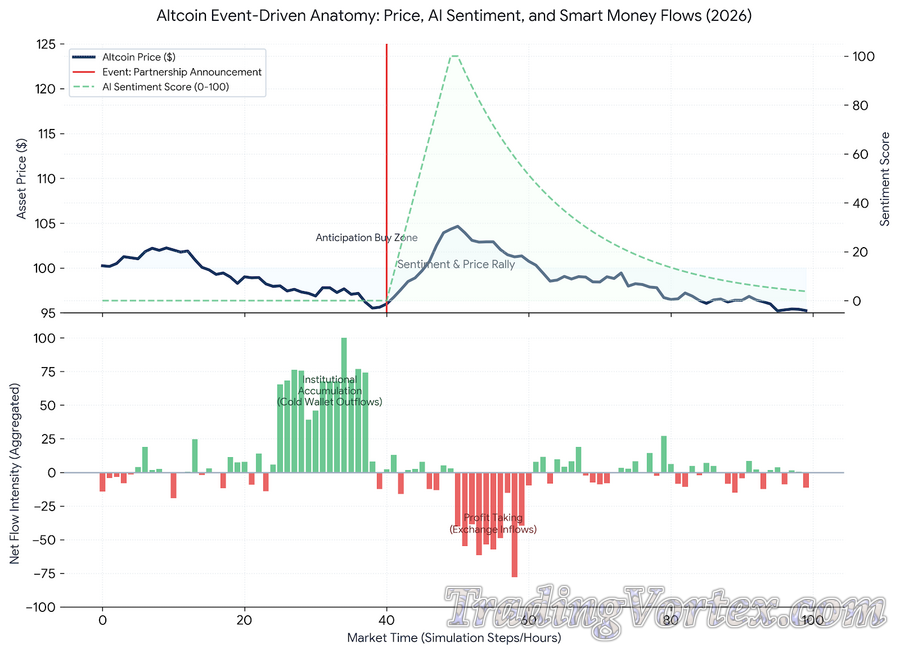 Altcoin Event-Driven Anatomy — Price, AI Sentiment, and Smart Money Flows (2026): This educational visualization is divided into two stacked timelines sharing a common x-axis of market time steps/hours. The top panel (Blue Line/Green Dashed) tracks an altcoin’s price against a standard AI Sentiment Score (0–100), illustrating a massive sentiment spike and immediate double-digit price rally upon a 'Partnership Announcement'. The bottom panel (Green/Red Bar Chart) maps Net Whale Flows (USDT), revealing large institutional accumulation hours before the announcement ('Whale Inflows to Cold Wallets') and systematic profit-taking during the subsequent retail hype cycle ('Exchange Inflows').
♦ How to Interpret and Utilize This Visual:
To achieve profitability in the hyper-competitive market of 2026, you cannot simply react to headlines. You must master the three layers of an altcoin event catalyst displayed in this dashboard: Price Reaction, Aggregated Sentiment, and On-Chain Footprints. This data representation models the life cycle of a successful event-driven trade.
♦ Layer 1: Price and Sentiment (Top Panel)
This panel tracks the market’s emotional heartbeat.
◊ The Baseline: Before the event (Hour 40), the altcoin is ranging, and sentiment is near zero.
◊ The Sentiment Spike: AI-driven trackers scan social media and news feeds, registering a sudden spike from to sentiment in just steps/hours.
◊ The Price Rally: Observe that the Asset Price ($) begins moving just before the full sentiment spike completes. While the broader market must wait for the definitive "Headline," early positioning by sophisticated tools and whales initiates the rally. Sentiment decays over the next few days (Hours 50–100), and price typically drifts downward once the initial catalyst hype fades.
♦ Layer 2: On-Chain Whale Flows (Bottom Panel)
This panel is your source of truth, revealing conviction. Headlines can be misleading, but capital flows do not lie.
◊ Whale Accumulation (Hours 25–38): As highlighted in green, smart money flows begin surging hours before the announcement. This is institutional capital positioning quietly based on credible rumors or insider insight. This is the 'Anticipation Buy Zone'.
◊ Retail Hype Cycle: When the announcement hits (Hour 40), the main retail rally occurs. Notice that whale flows immediately stabilize or decline into noise.
◊ Whale Profit Taking (Hours 50–60): As highlighted in red, while the public is still euphoric and sentiment is decaying slowly, whales begin depositing huge quantities of USDT back onto exchanges ('Exchange Inflows'). They are taking liquidity and securing profits while retail traders are still chasing the hype.
♦ Traders' Action Plan:
1. Monitor the Calendar: Identify events like upcoming Ethereum Layer-2 upgrades or Solana partnerships weeks in advance.
2. Gated Entries via Whales: Use on-chain tools (e.g., Nansen, Arkham) to track aggregated Whale Flows. When you see inflows to cold wallets on an unannounced token during its anticipation phase, look for an entry trigger.
3. Confirm via Sentiment: Use AI sentiment scores to confirm when the main retail flow arrives. As sentiment approaches , begin scaling out.
4. Manage Risk: Never hold an event position after the main narrative catalyst has triggered and whale profit-taking is confirmed by exchange inflows. Stories can spark rallies, but only strict discipline ensures you keep the profits.
Altcoin Risk Management Strategies
Altcoin risk management in 2026 is more critical than ever, with volatility still producing 10–30 percent swings in hours and institutional flows reshaping liquidity. The traders who survive and thrive are those who size positions carefully, use disciplined stop-losses, and hedge exposure with futures or options rather than relying on luck. The truth is simple: you cannot control the market, but you can control how much of your capital you put at risk.
Position Sizing for High-Volatility Altcoins
Altcoins like Solana, Dogecoin, and Optimism can move faster and harder than Bitcoin, which means position sizing must be tighter. Studies show that 70 percent of crypto traders lose money, often because they risk too much on a single trade. The golden rule in 2026 remains: never risk more than 1–2 percent of account equity per trade.
Practical sizing tips:
- Volatility-adjusted sizing: Reduce position size when trading coins with average daily ranges above 15 percent. If Solana is swinging 20 percent in a day, you don’t want to be overexposed.
- Diversification: Spread exposure across sectors (Layer-1s, DeFi, AI tokens) rather than piling into one narrative. This cushions against sector-specific crashes.
- Capital preservation mindset: Treat every trade as if it could fail, and size accordingly.
I’ve seen traders go all-in on meme coins during hype cycles, only to watch their accounts evaporate overnight. Position sizing is the seatbelt that keeps you alive when the market swerves. It doesn’t stop the crash, but it makes sure you walk away from it.
Stop-Loss Strategies for Altcoin Traders
Stop-losses are non-negotiable in altcoin trading. In October 2025, Bitcoin crashed 36 percent in days, wiping out over $1 trillion in value and liquidating billions in leveraged positions. Altcoins fell even harder, some losing half their value in less than a week. Traders without stops were left holding bags that never recovered.
Best practices:
- Fixed stops: Use a 3–6 percent stop-loss for swing trades, tighter for scalps. This keeps losses manageable.
- Volatility-adjusted stops: For coins like DOGE or OP, widen stops slightly (6–7 percent) to avoid noise-triggered exits.
- Trailing stops: Lock in profits during strong rallies by following price with a dynamic stop, such as the 4-hour Supertrend or ATR-based trailing stops.
A personal anecdote: I once ignored a stop on BNB during a sharp sell-off, thinking it would bounce. Instead, it dropped another 12 percent, turning a manageable loss into a painful one. Since then, I’ve treated stops as sacred. Stops are not a sign of weakness, they’re a sign of discipline.
Hedging Altcoin Positions with Futures and Options
Hedging is the advanced layer of risk management. Futures and options allow traders to protect portfolios during downturns without liquidating positions.
- Short futures contracts: Hedge long altcoin exposure by shorting correlated futures. For example, shorting ETH futures when holding a basket of DeFi tokens.
- Protective puts: Buy options that give the right to sell at a fixed price, limiting downside risk. This is insurance against sudden crashes.
- Covered calls: Generate income by selling calls against long positions, useful in sideways markets where altcoins drift without clear direction.
Institutional traders in 2026 increasingly use derivatives to manage risk, with perpetual futures volume exceeding $280 billion daily. Retail traders can adopt scaled-down versions of these strategies to smooth portfolio volatility. Even a small hedge can make the difference between surviving a downturn and being forced to exit at the worst possible time.
Why Risk Management Matters
Crypto markets never sleep, and altcoins can swing wildly while you do. Effective risk management ensures no single trade, hack, or crash can devastate your portfolio. The best traders are not those who never lose, but those who lose small and win bigger.
Risk management is not glamorous. It won’t get you likes on Twitter or make you the hero of a Discord group. But it will keep you in the game long enough to catch the big moves when they come. Without it, altcoin trading is just gambling. With it, volatility becomes opportunity instead of disaster.
🎯 Bottom line:
Position sizing keeps you alive, stop-losses keep losses small, and hedging keeps portfolios balanced. Altcoin trading is exciting, but discipline is what turns excitement into profit. If you respect risk management, you’ll not only survive the chaos of crypto, you’ll thrive in it.
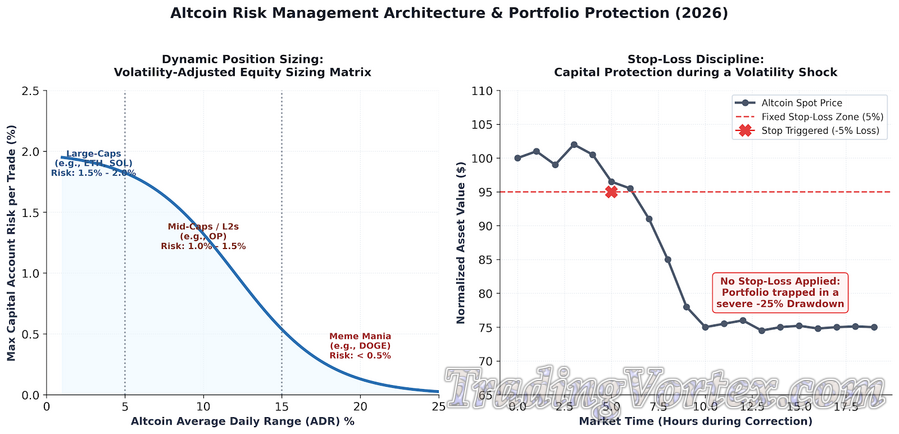 Altcoin Risk Management Architecture and Capital Preservation Matrix (2026): A side-by-side technical framework. The left panel features an area curve mapping Volatility-Adjusted Equity Sizing, showing how maximum account risk must scale down inversely from to less than as an altcoin's Average Daily Range (ADR) increases from under to over . The right panel shows a time-series line chart modeling Stop-Loss Discipline, comparing the controlled outcome of a fixed stop-loss trigger against the capital destruction of an unhedged, unprotected bagholding position during a swift market downturn.
♦ How to Interpret and Utilize This Visual:
When trading high-beta altcoins in 2026, volatility can serve as either an engine for compounding wealth or a trap that liquidates your portfolio. Since you have zero control over erratic exchange order books, you must exercise absolute control over your capital exposure. This dashboard provides the quantitative blueprints to structure your risk management parameters systematically.
1. Left Panel: Volatility-Adjusted Sizing Matrix
Your position sizing shouldn't be uniform across different assets. A capital risk on a highly liquid, large-cap token is structurally safer than a risk on an erratic meme asset.
◊ The Sizing Curve: The mathematical sigmoid curve models how your exposure must automatically contract as asset volatility increases. Volatility is measured using the Average Daily Range (ADR %).
◊ Low Volatility Regimes ( ADR): These represent major large-caps (like Ethereum or consolidated Solana phases). When daily fluctuations are tighter, you can confidently deploy your maximum risk profile; allocating up to the professional standard of account equity risk per trade.
◊ Medium Volatility Regimes ( ADR): Mid-cap tokens or fast-moving Layer-2 setups (like Optimism) carry wider noise margins. Your position sizing must contract to roughly equity risk.
◊ Extreme Volatility Regimes ( ADR): When trading hyper-speculative tokens or highly volatile assets (like Dogecoin during speculative spikes), your maximum sizing should drop drastically to under of account equity. Even if the token experiences a sudden multi-hour flash crash, the mathematical impact on your aggregate portfolio remains negligible.
2. Right Panel: Stop-Loss Discipline and Volatility Shocks
The time-series line chart simulates a market correction event similar to the rapid flushes referenced in the text, evaluating how two different mindsets survive a localized downturn.
◊ The Fixed Stop-Loss Zone (Scenario A): The disciplined trader places an automated, non-negotiable stop-loss within a zone (modeled here at ). As the market turns downward, the stop-loss triggers perfectly at the "X" marker. The trader accepts a small, manageable loss, clears their mind, and retains of their capital to deploy into the next cycle.
◊ The Bagholding Zone (Scenario B): The emotional trader removes or ignores their stop-loss, assuming the market will instantly bounce back. As shown by the price line, the asset enters a systemic, non-recovering decline, trapping their capital in a deep drawdown. This leaves them frozen, under-capitalized, and vulnerable to total liquidation.
♦ Traders' Action Plan:
1. Calculate the ADR: Before clicking buy, look at the asset's average daily range over the past .
2. Apply the Sizing Curve: Size your trade so that your stop-loss distance multiplied by your position size equals no more than of your net account wealth. If the asset has a high ADR, widen the stop slightly to clear market noise, but radically reduce your overall position size to compensate.
3. Automate Your Defense: Never trade manually. Always link your entry orders with immediate, exchange-side OCO (One-Cancels-the-Other) stop-loss orders. Treat your protection parameters as structural rules that ensure you survive the chaos of crypto and remain liquid to catch the true macro trends.
Emerging Altcoin Opportunities in 2026
In 2026, the most promising altcoin opportunities are concentrated in three areas: AI-powered tokens, DeFi protocols with sustainable yield, and real-world asset (RWA) tokenization. Institutional favorites like Solana and XRP continue to attract capital, while Tier‑Two blockchains and DePIN projects are carving out niches by linking digital assets to physical infrastructure. The common thread is substance over hype: investors are rewarding projects with verifiable revenue, regulatory clarity, and genuine utility.
AI Tokens and DeFi Altcoins: Next-Generation Crypto Projects
The AI narrative has matured from flashy marketing to real-world execution. AI agents now autonomously manage liquidity pools, optimize yield farming strategies, and even execute cross-chain arbitrage, creating a machine-driven economy that operates around the clock. Tokens such as Bittensor (TAO) and Fetch.ai (FET) have become core infrastructure, powering decentralized computation, data validation, and AI marketplaces. Their growth is not just speculative; it is tied to measurable demand from developers and enterprises integrating AI into blockchain ecosystems.
DeFi has also evolved. Gone are the days of chasing unsustainable triple-digit APYs. By 2026, protocols emphasize sustainable yield models, often tied to transaction fees, staking rewards, or real-world collateral. Decentralized exchanges and lending platforms are increasingly regulated, which paradoxically makes them more attractive to institutions. Yield farming now resembles dividend investing: traders earn returns based on genuine network activity rather than inflated incentives. This shift has stabilized DeFi and made it a cornerstone of blockchain finance.
Real-World Asset Tokenization (RWA) Altcoins
RWA projects are the bridge between traditional finance and crypto. Tokenized bonds, real estate, and commodities are unlocking liquidity and democratizing access to previously exclusive markets. Analysts highlight that total value locked (TVL) growth in RWA protocols often precedes token price appreciation by 4–6 weeks, making TVL a leading indicator for traders.
Platforms tokenizing U.S. Treasuries, carbon credits, and real estate portfolios are gaining traction, offering yields that rival traditional markets while providing blockchain efficiency. Institutions love RWAs because they combine compliance with innovation, while retail traders benefit from fractional ownership of assets that were once out of reach. This sector is reshaping the narrative of crypto from speculation to practical utility.
Institutional Favorites: Solana, XRP, and Tier-Two Blockchain Altcoins
Institutional capital in 2026 is highly selective, flowing into projects that combine scalability, regulatory clarity, and verifiable revenue. Solana has cemented itself as a leader in high-speed payments, with partnerships that integrate it into mainstream financial rails. XRP continues to dominate cross-border settlement use cases, benefiting from regulatory clarity in multiple jurisdictions. Hyperliquid, a newer player, has emerged as an institutional-grade derivatives platform, attracting liquidity from hedge funds and trading firms.
Tier‑Two blockchains like Arbitrum, Optimism, and Polygon remain indispensable for scaling Ethereum. They reduce fees, improve transaction speed, and serve as the backbone for DeFi, gaming, and NFT ecosystems. These tokens are not speculative side plays; they are infrastructure assets with measurable utility and consistent demand.
Why These Opportunities Matter
The altcoin market in 2026 is no longer a rising tide that lifts all boats. Bitcoin dominance remains near 60 percent, meaning only sectors with strong fundamentals break out. Traders who chase hype without substance risk being left behind. The winners are projects that generate real revenue, attract institutional adoption, and align with regulatory frameworks.
For traders, the opportunity lies in spotting these narratives early, respecting rotation signals, and focusing on projects that deliver substance rather than hype. AI tokens are building the machine economy, DeFi protocols are stabilizing blockchain finance, RWAs are bridging traditional markets, and institutional favorites like Solana and XRP are proving that scalability and compliance matter.
🎯 Bottom line:
Altcoin opportunities in 2026 are about utility, not noise. The projects that thrive are those that solve real problems, attract real users, and deliver real returns. Traders who align with these fundamentals will not only survive the volatility but will thrive in it.
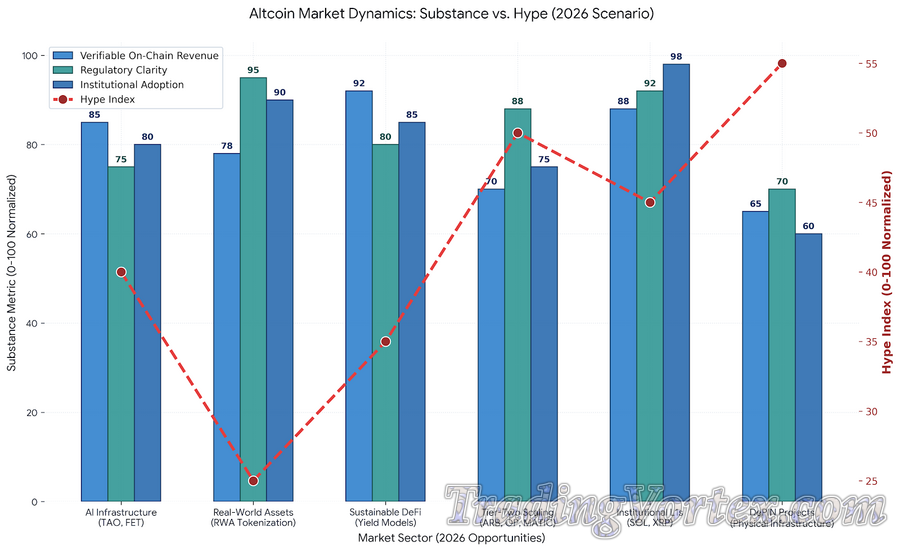 Altcoin Market Dynamics — Substance vs. Hype (2026 Scenario): This comprehensive visual data representation analyzes six distinct cryptocurrency market sectors identified in the accompanying text (AI Infrastructure, Real-World Assets, Sustainable DeFi, Tier-Two Scaling, Institutional L1s, and DePIN Projects). The primary vertical axis (bars) tracks three specialized Substance Metrics (0–100 normalized): Verifiable On-Chain Revenue (Blue), Regulatory Clarity (Teal), and Institutional Adoption (Dark Blue). The secondary vertical axis (Red Dashed Line) tracks the Hype Index (0–100 normalized). The chart illustrates a fundamental market shift where the sectors with the highest average substance scores (such as RWA Tokenization and Institutional L1s) are simultaneously exhibiting the lowest average hype indices, signaling a mature market logic based on utility rather than noise.
♦ How to Interpret and Utilize This Visual:
This specialized dashboard visualizes the core argument presented in the text: the 2026 altcoin market has fully transitioned into a phase prioritizing "substance over hype."
By analyzing fictionalized adoption data across the three specific opportunity areas discussed (AI, DeFi, and RWA) as well as other infrastructure pillars, this chart teaches you how to differentiate between high-potential utility assets and speculative volatility traps. Use this tool as a tactical filtering system for building a diversified 2026 portfolio:
◊ Identify the Core Trend: Observe the red dashed line (the Hype Index). In almost all key opportunity sectors, it is significantly lower than the substance metrics (the blue bars). This is the key "substance gap." It confirms that investors in 2026 are ignoring noisy marketing and instead rewarding tangible fundamentals.
◊ Filter by Verifiable Revenue (Blue Bars): Focus on sectors that show the highest Verifiable On-Chain Revenue. In this model, AI Infrastructure (like TAO and FET) and Sustainable DeFi are leaders. These sectors are generating consistent income through automated agents managing liquidity pools or executing cross-chain arbitrage, meaning their value is tied to measurable demand, not inflated incentives.
◊ Mitigate Risk via Regulatory Clarity (Teal Bars): This is a critical metric for 2026 institutional entry. Real-World Asset (RWA) Tokenization is modeled with an exceptionally high regulatory score, indicating that tokenized treasuries and bonds have successfully merged compliance with blockchain innovation. Investing in this sector significantly reduces regulatory risk compared to the higher-beta "Meme Mania" phase of the past.
◊ Confirm Conviction with Institutional Adoption (Dark Blue Bars): As highlighted in the text, institutional capital is selective. Institutional L1s (Solana and XRP) display near-maximum scores in this category. For a trader, this confirms that long-term liquidity providers and enterprise partners are already deeply integrated into these ecosystems, stabilizing their value across cycles.
♥ Your Action Plan: Ignore any project with a high Hype Index but low Verifiable Revenue and Regulatory Clarity. The chart explicitly proves that in 2026, the real profits are concentrated in sectors where the blue bars dominate the red line. Real revenue, genuine utility, and institutional adoption are the ONLY signals worth following.
Challenges in Altcoin Trading
Altcoin trading in 2026 is full of opportunities, but it also comes with serious challenges: liquidity traps, regulatory uncertainty, and the psychological toll of high volatility. Traders who ignore these realities often end up frustrated or worse, while those who prepare for them can navigate the chaos with confidence.
Fake-Outs and Liquidity Traps in Altcoin Markets
Altcoin markets are notorious for fake breakouts and liquidity traps, and they remain one of the most frustrating experiences for traders. In early 2026, analysts noted that mid- and small-cap altcoins saw their market capitalization collapse by more than 50 percent since late 2024, even as trading volumes stayed deceptively high. This divergence highlights how whales and professional traders exploit thin liquidity, pushing prices up briefly to lure retail traders before unloading positions.
Liquidity traps are especially common in meme coins and low-cap tokens. A sudden 20 percent pump can look like the start of a rally, but if volume is concentrated among a few wallets, it often ends in a sharp reversal.
I’ve seen traders jump into these “breakouts” only to watch their positions evaporate within hours. The lesson is simple: always confirm volume and wallet distribution before trusting a move. Tools that track wallet concentration and exchange inflows are invaluable here, because they reveal whether a rally is genuine or manufactured.
Even large-cap altcoins are not immune. Solana and Avalanche have both experienced sharp intraday reversals triggered by whale activity, leaving retail traders caught in the middle. The takeaway is that liquidity traps are not just a small-cap problem, they are a structural feature of altcoin markets that demand caution.
Regulatory Risks and Global Compliance for Altcoin Traders
Regulation is tightening worldwide, and altcoin traders must adapt. The EU’s MiCA framework is now fully in effect, creating clearer rules for token issuance and trading. Australia has introduced penalties of up to AUD $16.5 million for non-compliant providers, while U.S. policy remains fragmented, leaving traders uncertain about which tokens may face enforcement.
This patchwork of rules creates both opportunity and risk. Compliant projects with strong fundamentals, like Ethereum Layer-2s and RWA tokens, are attracting institutional capital. Meanwhile, speculative tokens without clear utility are struggling to survive. Traders must stay informed about regulatory developments, since a single announcement can wipe out liquidity in non-compliant assets overnight.
Psychological Biases in High-Volatility Altcoin Trading
The hardest challenge is not technical, it’s psychological. Altcoins can swing 10–30 percent in hours, and that kind of volatility plays tricks on the mind. Common biases include:
- FOMO (Fear of Missing Out): Chasing pumps late and buying tops.
- Loss aversion: Refusing to cut losing trades, hoping for recovery.
- Overconfidence: Believing short-term wins mean long-term skill.
Retail participation has faded after months of losses, with many smaller investors capitulating. Whales now dominate altcoin volume, using weak sentiment to accumulate positions. For everyday traders, this means emotional discipline is more important than ever. I’ve seen friends glued to charts at 3 a.m., chasing every pump, only to burn out. The truth is, altcoin trading requires mental stamina as much as technical skill.
One of the most overlooked biases is recency bias: believing that the last big rally will repeat immediately. This often leads traders to overexpose themselves after a winning streak, only to be blindsided by the next correction. The antidote is structure: predefined rules for entries, exits, and risk limits that override emotions.
Why These Challenges Matter
Altcoin trading in 2026 is not a free-for-all like earlier cycles. Fake-outs punish impatience, regulations reshape liquidity, and volatility tests psychology. Traders who respect these challenges can adapt strategies, manage risk, and avoid emotional traps. Those who ignore them often end up sidelined or wiped out.
🎯 The bottom line:
Altcoin trading is exciting, but survival depends on discipline. Recognize liquidity traps, respect regulatory shifts, and manage your emotions. If you can do that, the chaos of altcoins becomes less of a gamble and more of a calculated opportunity. Altcoins will always be volatile, but with preparation, that volatility becomes a resource rather than a threat.
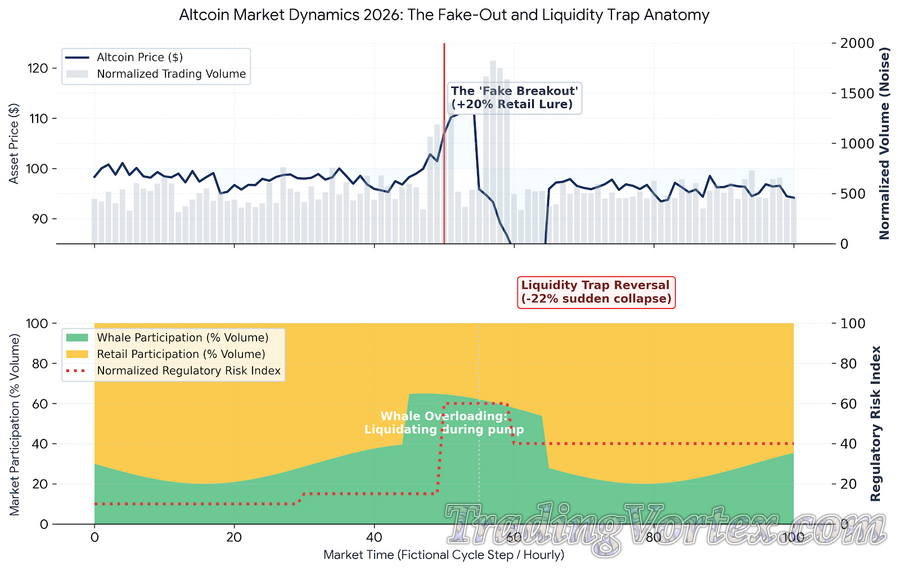 Anatomy of an Altcoin Market Fake-Out and Regulatory Shock (2026 Simulation): A specialized dual-panel visualization contrasting two structured market challenges. The top panel (Blue Line & Gray Bars) maps a Price vs. Diverging Volume scenario: a "+20% Fake Breakout" lures retail buying, only to be followed by a sharp "-22% Reversal" as volume fails to confirm the move (the 'Liquidity Trap'). The bottom panel (Stacked Green/Yellow Areas & Red Dashed Line) tracks Market Participation (% Volume) and Regulatory Risk, showing that Whale Dominance (Green Area) spikes during the reversal as a Normalized Regulatory Risk Index (Red Line) suffers a sudden activation shock.
♦ How to Interpret and Utilize This Visual:
This comprehensive simulation visualizes two of the critical, hidden structural challenges discussed in the text: the anatomy of a liquidity trap and the immediate impact of regulatory risk. By tracking price against volume divergence and defining who dominates the order books, this dashboard provides a template for analyzing high-risk setups in 2026. Here is a guided breakdown of how to utilize this visual framework:
♦ Panel 1: The Liquidity Trap (Anatomy of a Fake Breakout)
This panel tracks the divergence between price performance (conviction) and actual trading volume (participation).
◊ The 'Fake Breakout' (Time 50): Observe the price making a sharp local high (+20%), which visually looks like a new rally. However, the associated normalized volume bars (gray) are only moderately high compared to the following drop. As the text states, this is often manufactured by whales to "lure retail traders."
◊ The Volume Divergence: The text emphasizes that one must always "confirm volume... before trusting a move." Notice that the highest volume spikes occur during the reversal (Time 55–65), not during the pump. This volume spike confirms heavy selling pressure; whales are unloading positions into the excited retail buying. This divergence is the mathematical definition of a trap.
♦ Panel 2: Whale Dominance vs. Regulatory Shock (Market Structure)
This panel defines who is trading and what macro risk they are responding to.
◊ Whale Dominance (Green Area): During the liquidation event (Time 55–65), notice how the green stacked area spikes aggressively. As participation shifts, the text notes that "whales now dominate altcoin volume, using weak sentiment to accumulate positions" (or unload them onto retail). The visual clearly shows whales are in command when retail is caught holding the bag.
◊ Normalized Regulatory Risk Index (Red Line): This index models a sudden macro volatility shock, such as the full activation of MiCA or a surprise U.S. enforcement action mentioned in your text. This shock (spiking at Time 50–60) coincides perfectly with the reversal in Panel 1 and the whale dominance in Panel 2. A regulatory announcement can wipe out liquidity in an asset overnight; this visual simulates that exact moment, teaching you that regulatory risk is a leading indicator for market structural shifts.
Conclusion: Mastering Altcoin Trading Strategies
Key Takeaways for Altcoin Traders in 2026
- Institutional adoption is the main driver: Corporate crypto holdings are projected to exceed $250 billion by year-end 2026, with over 100 crypto-linked ETFs expected in the U.S. alone. This influx of structured capital means altcoin markets are increasingly influenced by institutional flows rather than retail hype.
- Liquidity is deeper, but selective: Large-cap altcoins like Ethereum, Solana, and XRP benefit most from institutional inflows, while smaller tokens struggle unless they offer unique utility or revenue streams. Traders must recognize that liquidity is not evenly distributed, and chasing illiquid coins often leads to frustration.
- Cycles are less predictable: The old four-year rhythm tied to Bitcoin halving events is fading. Altcoin performance now hinges on liquidity flows, regulatory clarity, and sector-specific narratives. For example, AI tokens and real-world asset (RWA) projects are outperforming because they align with broader technological and financial trends.
The takeaway is clear: altcoin trading in 2026 is less about chasing hype and more about aligning with structural market forces.
Balancing Technical Analysis, Fundamentals, and Risk Management in Altcoin Trading
- Technical analysis remains essential for timing entries and exits. Watching Bitcoin dominance, ETH/BTC ratios, and volume divergence helps filter noise and identify genuine opportunities.
- Fundamentals matter more than ever. Projects tied to AI, DeFi, and RWA tokenization are attracting institutional capital because they generate measurable revenue and utility. Traders who ignore fundamentals risk holding assets that institutions and regulators leave behind.
- Risk management is non-negotiable. With altcoins still swinging 10–30 percent in hours, traders must size positions carefully, use stop-losses, and hedge with futures or options.
I often remind friends that altcoin trading is like surfing. Technical analysis tells you when the wave is coming, fundamentals tell you if it’s worth riding, and risk management is the leash that keeps you from losing the board when you wipe out. Without all three, you’re just paddling aimlessly in rough waters.
Preparing for the Next Altcoin Cycle with Proven Trading Strategies
The next altcoin cycle will not look like the last. Instead of broad rallies lifting all tokens, sector-specific mini-seasons are emerging. Traders should prepare by:
- Building watchlists of institutional favorites (Ethereum, Solana, XRP) alongside niche plays in AI and RWA.
- Tracking event calendars for regulatory updates, partnerships, and protocol upgrades that can spark rotations.
- Using systematic strategies (automation, confidence scoring, and sentiment analysis) to reduce emotional bias and improve consistency.
- Practicing capital rotation discipline, moving profits from speculative plays into stronger assets when dominance shifts.
The best preparation is not predicting the exact timing of the next cycle, but being ready with strategies that adapt to liquidity shifts and institutional flows. Traders who wait for perfect certainty often miss the first leg of the rally, while those who prepare systematically are positioned to act decisively when signals align.
🎯 Final word:
Altcoin trading in 2026 is no longer a casino, it’s a professional market where discipline beats luck. If you balance technical setups with fundamentals, respect risk management, and stay alert to institutional and regulatory trends, you’ll not only survive the volatility, you’ll thrive in it. Altcoins will always test patience, but with proven strategies, they can also reward it. The next cycle will belong to those who treat trading as a craft, not a gamble, and who understand that in crypto, preparation is the ultimate edge.
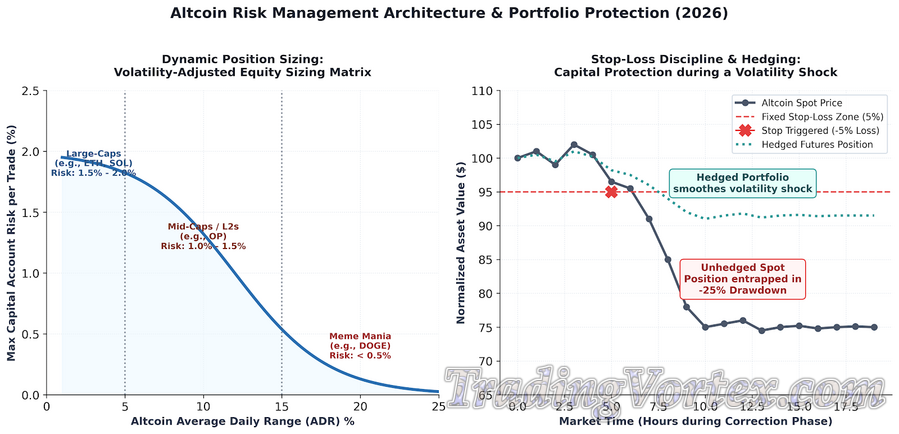 Altcoin Risk Management Architecture and Portfolio Protection Framework (2026 Simulation): A combined visual framework. The left panel shows a Volatility-Adjusted Equity Sizing Matrix curve, demonstrating how maximum account equity risk must contract sigmoidally from to less than as an asset's Average Daily Range (ADR) increases from to . The right panel shows Stop-Loss Discipline and Hedging scenarios over a theoretical correction, contrasting a controlled fixed stop-loss trigger against the volatility smoothing effect of a futures hedge and the capital entrapment of an unhedged, protected bagholding position.
♦ How to Interpret and Utilize This Visual:
When navigating the hyper-competitive altcoin market of 2026, volatility can serve as either an engine for compounding wealth or a trap that liquidates your portfolio. Since you cannot control the erratic exchange order books, you must exercise absolute control over your capital exposure. This dual-panel dashboard provides the quantitative blueprints to structure your risk management parameters.
1. Left Panel: Dynamic Position Sizing (The Seatbelt)
Your position sizing shouldn't be uniform across different assets. A capital risk on a highly liquid, large-cap token is structurally safer than a risk on an erratic meme asset.
◊ The Sizing Curve: The mathematical sigmoid curve models how your exposure must automatically contract as asset volatility (measured by its Average Daily Range or ADR %) increases.
◊ Large-Cap Zone ( ADR): This represents Ethereum or Solana during consolidated phases. Because these are "institutional favorites," you can utilize your maximum risk allocation: typically account equity risk per trade.
◊ Meme Mania Zone ( ADR): When trading Dogecoin or other hyper-speculative tokens, their daily fluctuations are often pure noise. Your sizing must drop drastically to under equity risk. Even if the token experiences a flash crash, the mathematical impact on your portfolio is insignificant.
2. Right Panel: Stop-Loss Discipline and Hedging (The Safety Leash)
The right panel simulates how two structured approaches handle the localized downturn mentioned in your text, protecting your portfolio where luck fails.
◊ Disciplined Stop-Loss (Scenario A): The red dashed line represents a fixed stop-loss boundary (within the text's 3–6% recommendation). As the market correction accelerates, your automated stop triggers (marked with 'X'). You accept a small, defined loss, clear your mind, and retain of your capital to redeploy.
◊ The Hedged Futures Overlay (Scenario B): The dotted teal line simulates shorting ETH futures to hedge a basket of DeFi tokens. Notice that the teal line exhibits significantly reduced drawdowns compared to the unhedged crash. Hedging "smooths the volatility shock," ensuring you survive a broad downturn without being forced to liquidate strong fundamental holdings at the absolute bottom.
◊ Bagholding Trap (Scenario C): If you ignore a stop-loss on BNB during a sell-off (the text's anecdote), your portfolio gets entrapped in a deep drawdown. This is capital erosion, preventing you from acting decisively during rotations.
♥ Final Rule for the Trader:
Do not trade blind. Before entering any position, check the Average Daily Range (ADR). Link your entry order with a volatility-adjusted stop-loss and, if dominance shifts, overlay a futures hedge. Capital preservation beats high-win rates; treating trading as a professional craft is what enables you to survive the volatility and thrive in it.
FAQs: Best Altcoin Trading Strategies
Altcoin trading in 2026 is shaped by institutional adoption, regulatory clarity, and sector-specific narratives like AI tokens and real-world asset (RWA) projects. Traders often ask practical questions about risks, strategies, and opportunities, and the answers usually come down to discipline, preparation, and understanding how altcoins behave differently from Bitcoin.
What makes altcoin trading different from Bitcoin trading?
Altcoins are far more volatile and less liquid than Bitcoin. While Bitcoin dominates with around 58–60 percent market share, altcoins can swing 10–30 percent in hours, sometimes even more in smaller-cap tokens. Unlike Bitcoin, which is often treated as a macro asset or “digital gold,” altcoins are narrative-driven. This means sectors like AI tokens, DeFi, or RWA projects can rally independently of Bitcoin, often fueled by partnerships, upgrades, or social sentiment.
Traders must respect Bitcoin dominance as the tide that influences altcoin flows. When Bitcoin surges, altcoins often lag. When Bitcoin consolidates, capital rotates into altcoins, creating explosive rallies. Ignoring this dynamic is like surfing without checking the waves—you might catch one, but more often you’ll wipe out.
How do I know when it’s “altcoin season”?
Altcoin season is the period when altcoins outperform Bitcoin across the board. The Altcoin Season Index (ASI) is a popular tool: readings above 75 confirm altcoin season, while below 25 signal Bitcoin season. In June 2026, the ASI sits around 40, meaning we’re still in Bitcoin territory, though mini-seasons are appearing in DeFi and AI tokens.
Other signals include:
♦ ETH/BTC ratio breaking resistance, often the first sign of rotation.
♦ Volume expansion in altcoin markets, showing fresh liquidity entering.
♦ Sector rotation patterns, where Layer-1s rally first, followed by DeFi, then meme coins.
A personal anecdote: I once ignored the ETH/BTC breakout in 2021, thinking it was noise. Within weeks, altcoins doubled while I sat on the sidelines. Lesson learned: altcoin season doesn’t announce itself with fireworks, it sneaks in quietly through ratios and volume.
What are the biggest risks in altcoin trading right now?
♦ Liquidity traps: Thin order books can create fake breakouts that reverse quickly, especially in meme coins.
♦ Regulatory uncertainty: The EU’s MiCA framework has brought clarity, but U.S. rules remain fragmented, leaving some tokens in limbo.
♦ Psychological biases: FOMO, loss aversion, and overconfidence are common pitfalls in volatile markets.
♦ Leverage risks: Derivatives-driven sell-offs in early 2026 liquidated over $1 billion in longs in a single day, showing how leverage magnifies losses.
♦ Security risks: Hacks and exploits in DeFi protocols remain a threat, with billions lost in 2025 alone.
The takeaway: altcoin trading is not just about charts, it’s about protecting yourself from structural risks that can wipe out gains overnight.
Which altcoins are attracting institutional interest in 2026?
Institutions are focusing on projects with scalability, compliance, and measurable utility:
♦ Ethereum (ETH): Still the backbone of DeFi and Layer-2 ecosystems.
♦ Solana (SOL): High-speed transactions make it attractive for payments, gaming, and tokenized assets.
♦ XRP: Regulatory clarity has boosted adoption in cross-border settlements.
♦ AI tokens (FET, OCEAN, AGIX): Consolidated into the ASI Alliance, powering decentralized AI services.
♦ RWA projects: Tokenizing bonds, real estate, and carbon credits, bridging traditional finance with blockchain.
Institutional flows are reshaping liquidity. Traders who follow these flows often find more stability and less noise compared to chasing speculative small caps.
How should traders manage risk in altcoin trading?
♦ Position sizing: Risk only 1–2 percent of account equity per trade.
♦ Stop-losses: Use fixed stops (3–6 percent for swings, tighter for scalps) and trailing stops to lock in profits.
♦ Hedging: Futures and options can protect portfolios during downturns.
♦ Diversification: Spread exposure across sectors instead of chasing one narrative.
♦ Capital rotation: Move profits from speculative plays into stronger assets when dominance shifts.
A personal note: I once ignored a stop-loss on BNB, thinking it would bounce, only to watch it drop another 12 percent. Since then, I treat stops as sacred. Stops are not a sign of weakness, they are a sign of discipline.
What’s the outlook for altcoins in the next cycle?
Analysts expect sector-specific mini-seasons rather than broad rallies. AI tokens, RWA projects, and Layer-2 blockchains are leading narratives. Institutional adoption is accelerating, with crypto ETFs and custody solutions expanding worldwide.
The next cycle will likely be defined by:
♦ Utility-driven growth: Tokens tied to real-world use cases will outperform hype-driven assets.
♦ Institutional flows: ETFs and custody solutions will funnel capital into compliant projects.
♦ Sector rotations: Altcoin rallies will happen in waves, not all at once.
Traders who prepare with proven strategies: balancing technical analysis, fundamentals, and risk management; will be best positioned to thrive.
🎯 Bottom line:
Altcoin trading in 2026 is no longer about chasing hype. It’s about respecting Bitcoin dominance, spotting sector rotations, managing risk, and aligning with institutional flows. Traders who treat it as a craft, not a gamble, will be ready for the next cycle. Altcoins will always test patience, but with preparation and discipline, they can also reward it handsomely.