

High APY Yield Farming Strategies is your ultimate guide to navigating the fast-evolving world of decentralized finance in 2026. This comprehensive article explores the latest yield farming trends, from leveraged strategies and yield tokenization platforms like Pendle, to multi-chain farming across Ethereum L2s, Solana, and Sui, and the rise of real-world asset (RWA) pools offering stable returns.
Packed with insights on risk management, tools and analytics for farming success, and the future of sustainable high APY opportunities, this guide balances technical depth with accessible explanations. Whether you’re a beginner curious about stablecoin pools or an experienced investor chasing advanced strategies like liquid staking and AI-powered bots, you’ll find practical advice, relatable anecdotes, and clear takeaways.
By the end, you’ll understand how to maximize APYs while managing risks, diversify across ecosystems, and build strategies that last beyond hype cycles.
Table of Contents:
- Introduction to High APY Yield Farming
- Yield Farming Basics Explained
- Latest Trends in High APY Yield Farming (2026)
- Leveraged Yield Farming for Maximum APY
- Yield Tokenization Platforms (Pendle and Beyond)
- Multi-Chain Yield Farming Across Ethereum L2s, Solana, and Sui
- Real-World Asset (RWA) Yield Farming for Stable Returns
- Risks in High APY Yield Farming
- Risk Management in Yield Farming
- Top Yield Farming Platforms Offering High APY in 2026
- Tools and Analytics for Yield Farming Success
- Future of High APY Yield Farming
- Conclusion: Navigating High APY Yield Farming in 2026
- FAQs: High APY Yield Farming Strategies in 2026
- What is yield farming and why does APY matter?
- What are the biggest risks in high APY yield farming?
- How can I reduce risk while farming?
- Which platforms are offering the best APYs in 2026?
- Are real-world assets (RWAs) really part of yield farming now?
- What is the safest way to start yield farming in 2026?
Introduction to High APY Yield Farming
What Is Yield Farming in Crypto?
Yield farming is essentially the crypto world’s version of putting your money to work while you sleep. Instead of leaving your coins idle in a wallet, you deposit them into liquidity pools, lending platforms, or staking protocols. In return, you earn rewards, usually paid out in tokens. Think of it like renting out your digital assets: the more demand there is for liquidity, the higher the Annual Percentage Yield (APY) you can collect.
Why High APY Yield Farming Strategies Matter for Investors
For traders and investors, yield farming is more than just passive income. It’s a way to compound gains, diversify risk, and stay engaged with the evolving DeFi ecosystem. High APY strategies can be tempting, but they also come with trade-offs. Chasing the biggest numbers often means venturing into riskier pools, newer protocols, or leveraged positions. The trick is learning how to spot opportunities that balance reward with resilience. If you’ve ever felt the sting of impermanent loss or watched your “guaranteed” yield evaporate after a token crash, you know why strategy matters.
Here’s the good news: the DeFi space in 2026 is far more sophisticated than it was just a few years ago. Platforms now offer single-sided staking, IL-neutral pools, and auto-compounding vaults that reduce the need for constant micromanagement. Yield tokenization, pioneered by protocols like Pendle, lets you lock in fixed yields or trade variable ones, giving you more control over your exposure. And if you’re not the type to babysit your positions, AI-powered bots can now handle rebalancing and compounding for you.
Current Market Outlook for DeFi and APY Opportunities
The DeFi market has matured, but it’s still buzzing with innovation. Total Value Locked (TVL) is projected to surpass $500 billion across major chains in 2026, with Ethereum’s upgrades and Solana’s concentrated liquidity models leading the charge. Stablecoins dominate many pools, offering yields in the 5–15 percent range, while more adventurous strategies on platforms like Pendle or Curve can push APYs into the 20–50 percent bracket. Real-world assets (RWAs) are also entering the mix, creating steadier yield opportunities tied to things like tokenized treasury bills.
Of course, risks haven’t disappeared. Smart contract vulnerabilities, liquidation cascades, and regulatory uncertainty remain part of the game. But compared to the wild west days of 2020, today’s yield farming landscape feels more like a professional marketplace than a speculative playground. If you’re willing to learn the ropes, high APY yield farming can still be one of the most rewarding corners of crypto investing.
Yield farming is no longer about chasing hype, but about strategic participation in a maturing DeFi ecosystem. It’s accessible, it’s evolving, and with the right mindset, it can be both profitable and sustainable.
 DeFi Yield Farming Expected APY Ranges by Strategy Category in 2026.
To help you navigate the mature DeFi landscape of 2026, this bar chart visualizes the expected Annual Percentage Yield (APY) ranges across the four primary yield farming strategy categories discussed in this section. The height of each colored bar represents the historical/projected average yield for that strategy, while the extended error bars display the full spectrum from minimum to maximum potential APY you are likely to encounter.
♦ Real-World Assets (RWAs): Positioned on the left as the most conservative strategy, offering a steady and predictable range of 4% to 8%.
♦ Stablecoin Pools: Providing a highly sustainable baseline for risk-averse portfolios, typically yielding between 5% and 15%.
♦ Concentrated Liquidity: Showcasing a more dynamic configuration on advanced platforms like Solana or Curve, pushing yields into the 15% to 30% territory.
♦ Yield Tokenization & Restaking: Representing frontier innovations (such as Pendle or advanced restaking protocols) on the far right, capturing the highest risk-reward spectrum with volatile yields ranging between 20% and 50%.
◊ You can use this visual benchmark to quickly cross-reference and align your personal risk tolerance with realistic yield expectations, helping you avoid unsustainable hype while optimizing your capital allocation across modern DeFi protocols.
Yield Farming Basics Explained
Understanding APY (Annual Percentage Yield) in DeFi
APY is the magic number everyone looks at when deciding where to park their crypto. It represents the annualized return you can expect if rewards are compounded over time. In DeFi, APY is not fixed like a traditional savings account; it fluctuates based on trading volume, token incentives, and market demand for liquidity.
Think of APY as the “headline number” that gets your attention, but always remember: it’s a moving target. If you’ve ever chased a pool promising 80 percent APY only to see it drop to 12 percent within weeks, you know the importance of reading the fine print.
How Liquidity Pools and Yield Farming Work
At the heart of yield farming are liquidity pools. These are smart contracts where users deposit pairs of tokens, like ETH and USDC, to enable trading on decentralized exchanges. In return, liquidity providers earn a share of the trading fees plus any additional token rewards offered by the protocol.
Of course, there’s a risk. If one token in your pair loses value compared to the other, you face impermanent loss, which can eat into your returns. It’s like bringing expensive wine to the bar and watching everyone else drink cheap beer; you don’t always get back what you put in.
Yield Farming vs. Staking vs. Crypto Lending
It’s easy to confuse yield farming with other passive income strategies, so let’s break it down:
- Staking: You lock up tokens to help secure a blockchain that runs on Proof of Stake. Rewards are steady, usually in the 3–8 percent APY range, and risk is relatively low. It’s like earning interest for being a loyal supporter of the network.
- Crypto Lending: You deposit assets into a lending pool, and borrowers pay you interest. Stablecoin lending is popular because it avoids price volatility, with APYs around 5–10 percent. The main risk is borrower liquidation if collateral drops in value.
- Yield Farming: This is the most dynamic option. You provide liquidity, earn trading fees, and often collect bonus tokens. APYs can range from 10 percent to well over 100 percent, but the complexity and risks are higher.
The choice depends on your personality as an investor. If you like predictability, staking or lending might suit you. If you enjoy chasing opportunities and tinkering with strategies, yield farming is where the action is. Many seasoned investors actually combine all three, creating a diversified portfolio that balances stability with high-yield potential.
APY is the headline, liquidity pools are the engine, and understanding the differences between staking, lending, and farming helps you decide where to play. Yield farming can be thrilling, but like any good adventure, it pays to know the rules before you jump in.
 Comparison of Crypto Passive Income Strategies: APY Ranges and Risk Profiles.
To help you choose the strategy that best matches your personal risk tolerance and financial goals, this horizontal floating bar chart maps out the typical Annual Percentage Yield (APY) ranges for the three main passive income streams in the crypto ecosystem. Each strategy is color-coded to reflect its general risk and complexity profile:
♦ Staking (3% - 8% APY, Green): Indicated by the leftmost bar, staking offers a narrow, predictable yield with low risk and low complexity. It is ideal if you prefer stable, long-term returns while supporting network security.
♦ Crypto Lending (5% - 10% APY, Yellow): Represented by the middle bar, lending stablecoins or blue-chip assets provides a moderate yield with a balanced medium risk and complexity profile, shielding you from extreme market volatility.
♦ Yield Farming (10% - 100%+ APY, Red): Extending all the way to the right edge of the chart, yield farming offers the widest and highest yield potential, but it is accompanied by high risk (such as impermanent loss) and higher operational complexity.
◊ You can use this visual benchmark to instantly compare how much yield you stand to gain versus the complexity and risk you must assume, allowing you to build a diversified portfolio that effectively balances stability with high-reward opportunities.
Latest Trends in High APY Yield Farming (2026)
Concentrated Liquidity Pools for Higher Returns
Protocols like Uniswap V4 and Curve’s crvUSD pools are leading the charge with concentrated liquidity models. Instead of spreading liquidity across a wide price range, farmers can focus their capital in narrower bands, which boosts capital efficiency and increases fee rewards. This is like moving from a shotgun approach to a sniper rifle: precision pays.
Stablecoin Yield Farming and Safer APY Options
Stablecoins remain the backbone of yield farming, and in 2026 they are more dominant than ever. Platforms like Aave, Curve, and Spark are offering 5–15 percent APY on stablecoin pools, which is attractive for investors who want predictable returns without riding the rollercoaster of volatile tokens.
Liquid Staking and Restaking for Compounded Rewards
Liquid staking tokens (LSTs) such as stETH, rETH, and wstETH allow investors to earn staking rewards while still using their assets in DeFi. Restaking, pioneered by protocols like EigenLayer, compounds those rewards by letting staked assets secure multiple networks.
In practice, this means ETH stakers can earn 15–30 percent APY when combining staking yields with DeFi liquidity incentives. It’s a powerful way to maximize returns without constantly moving funds, and it has quickly become one of the most talked-about strategies in the yield farming community.
Cross-Chain Yield Farming with Bridges and LayerZero
Cross-chain farming is no longer the headache it once was. Thanks to LayerZero and other bridge protocols, farmers can now move liquidity seamlessly between ecosystems like Ethereum L2s, Solana, and Sui. This flexibility opens the door to chasing the best APYs across chains without paying punishing gas fees or worrying about clunky bridge mechanics.
With total value locked projected to surpass $500 billion across major chains in 2026, cross-chain strategies are becoming mainstream. For yield farmers, this means the ability to diversify across ecosystems and capture opportunities wherever they appear.
AI-Powered Yield Farming Bots for Automated APY Optimization
Managing yield farms used to mean constant monitoring, spreadsheets, and sleepless nights, but now AI-driven bots handle rebalancing, compounding, and risk management automatically. Platforms like Yearn and Beefy already offer auto-compounding vaults, and newer AI tools are taking it further by analyzing real-time data to optimize positions. These bots can detect shifts in liquidity, adjust ranges, and even hedge against volatility.
For busy investors, this means you can still capture 20–50 percent APY opportunities without babysitting your portfolio every day. It’s like having a personal assistant who never sleeps, constantly working to squeeze the most out of your assets.
In short:
yield farming in 2026 is smarter, safer, and more efficient. Concentrated liquidity boosts returns, stablecoins provide stability, liquid staking compounds rewards, cross-chain farming expands opportunities, and AI bots make it all easier to manage. The days of chasing unsustainable triple-digit APYs are gone, but with the right strategies, high-yield farming remains one of the most rewarding corners of crypto investing.
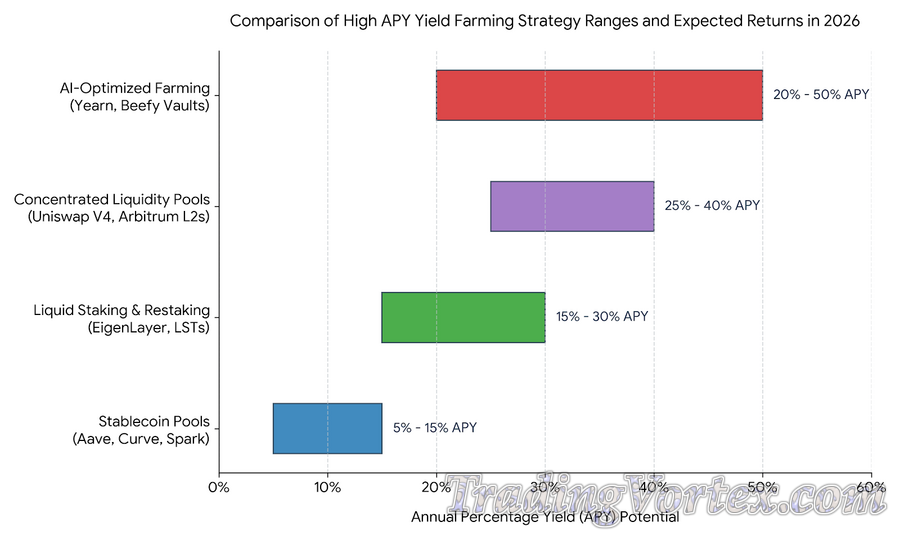 Comparison of High APY Yield Farming Strategy Ranges and Expected Returns in 2026.
To help you seamlessly digest the modern landscape of DeFi yields, this horizontal range chart illustrates the expected performance spectrum of the top farming trends shaping 2026. Rather than relying on rigid, single-point calculations, each strategy is represented by a floating bar that highlights the realistic minimum and maximum APY boundaries you can capture.
♦ Stablecoin Pools (5% - 15% APY): Positioned at the base as the ultimate conservative baseline, these pools offer stable, predictable yields on assets like crvUSD, USDC, or DAI without exposure to underlying asset volatility.
♦ Liquid Staking & Restaking (15% - 30$ APY): Representing a major structural pivot in DeFi efficiency, this category combines core consensus rewards with extra validation layers (like EigenLayer) to build a robust, compounded yield range.
♦ Concentrated Liquidity Pools (25% - 40% APY): Leveraging advanced architectures like Uniswap V4 on active Layer 2s, this range maximizes your fee collection potential by letting you compress capital into custom, hyper-efficient price bands.
♦ AI-Optimized Farming (20% - 50% APY): Occupying the highest performance bracket, these automated setups utilize predictive vault systems to constantly rotate assets, auto-compound, and mitigate risk variables on your behalf.
◊ By using this visual benchmark, you can easily evaluate where to balance your liquidity across low, moderate, and aggressive infrastructure tools: giving you the perfect blueprint to build a highly sustainable, automated yield ecosystem.
Leveraged Yield Farming for Maximum APY
How leverage amplifies yield farming returns
At its core, leveraged yield farming means borrowing funds against your collateral to expand your farming position. Instead of farming with just the assets you already own, you borrow more and put them into liquidity pools or lending protocols.
The appeal is obvious: higher exposure, higher rewards. In 2026, leveraged pools on Ethereum L2s and Solana are delivering 30–60 percent APY on popular pairs like ETH-USDC and stETH-ETH. For aggressive investors, this feels like strapping a rocket to your portfolio. And when markets are trending upward, that rocket can take you to places plain staking or stablecoin farming simply cannot.
What makes this even more exciting today is the rise of automated leverage management tools. Some platforms now allow dynamic adjustments to collateral ratios, meaning your position can automatically rebalance to avoid liquidation. This innovation has made leveraged farming more accessible, but it doesn’t erase the risks.
Risks of liquidation and volatility in leveraged pools
Of course, rockets can crash. The biggest risk in leveraged yield farming is liquidation. If the value of your collateral drops below a certain threshold, the protocol automatically sells your position to cover the debt. Even a small downturn in token prices can wipe out most of your gains.
Other risks include:
- Borrowing costs: Interest rates on borrowed funds eat into your APY, and in volatile markets those costs can spike.
- Impermanent loss: Price swings between paired tokens can erode profits, especially when leverage magnifies the exposure.
- Volatility exposure: Leverage magnifies both gains and losses, so a 10 percent dip in the market can feel like a 30 percent hit.
- Protocol risk: Bugs or exploits in smart contracts can lead to sudden losses, and leveraged positions are especially vulnerable.
I’ve seen traders get burned by chasing 100 percent APY without realizing that borrowing costs and liquidation thresholds were quietly eating away at their position. It’s a painful lesson, but one that underscores why leverage is not for beginners.
Best practices for managing leveraged yield farming positions
If you’re going to play in this arena, you need discipline. Here are some best practices seasoned farmers swear by:
- Maintain healthy collateral ratios: Aim for at least 200 percent collateralization to reduce liquidation risk.
- Monitor positions daily: Leverage requires active management; don’t set and forget.
- Diversify across protocols: Spread risk by using multiple platforms like Alpha Homora, Gearbox, and Tulip.
- Use risk dashboards: Tools like RugDoc and DeFiSafety help track protocol health and smart contract risks.
- Hedge with derivatives: Platforms like dYdX allow you to hedge against downside moves, giving you a safety net.
- Start small: Test strategies with modest amounts before scaling up, so mistakes don’t cost you your entire portfolio.
Think of leveraged yield farming as driving a sports car: thrilling, but you need to know how to handle the speed. If you’re cautious, disciplined, and willing to put in the work, it can be one of the most rewarding strategies in DeFi. If not, it’s better to stick with stablecoin pools or liquid staking, where the ride is smoother and the risks are easier to manage.
Bottom line:
leveraged yield farming in 2026 offers amplified APYs of 30–60 percent on major pools, but it comes with amplified risks. It’s a strategy for those who enjoy high stakes and have the patience to manage positions closely. For everyone else, safer yield farming options may be the smarter play.
 The Leverage Trade-Off in Yield Farming: Net APY Acceleration vs. Shrinking Liquidation Buffer.
To help you visually map out the exact trade-offs of using leverage within your DeFi strategies, this dual-axis chart compares your potential net returns against your margin of safety as leverage increases from 1x (no leverage) up to 3x.
♦ Net Annual Percentage Yield (Green Bars): Read against the left axis, this shows how your net returns compound. Starting from a base pool yield of 15% at 1x leverage, ramping your position up to 3x leverage turbocharges your net yield to 35% APY, even after subtracting typical protocol borrowing costs.
♦ Asset Price Drop Buffer to Liquidation (Red Line): Read against the right axis, this outlines your downside vulnerability. While a clean 1x position carries no protocol liquidation threshold, a 2x position will liquidate if your asset value drops by 41%. At 3x leverage, your safety cushion shrinks dramatically down to just a 21% market drop before automated liquidation protocols sell off your collateral.
◊ You can use this chart to choose an optimal risk-reward entry point. For instance, notice how the 2x position significantly boosts your yield to 25% while still maintaining a reasonable 41% market safety cushion, making it a common strategic sweet spot for farmers transitioning out of unleveraged positions.
Yield Tokenization Platforms (Pendle and Beyond)
What yield tokenization means for DeFi investors
Yield tokenization is the process of splitting yield-bearing assets into two tradable components:
- Principal Tokens (PT): These represent the underlying asset value, similar to a zero-coupon bond. Holders receive the full asset at maturity but forgo yield during the holding period.
- Yield Tokens (YT): These represent the rights to future yield generated by the asset until maturity. Holders collect continuous yield distributions but do not own the principal.
This innovation gives investors a choice that traditional yield farming never offered. You can lock in predictable returns with PTs, or you can speculate on yield volatility with YTs. It’s like choosing between a steady paycheck or betting on commission-based earnings. Pendle pioneered this model, and by 2026, it has processed over $8 billion in total value locked across multiple chains, cementing itself as a critical piece of DeFi infrastructure.
For everyday investors, yield tokenization feels like finally being able to decide how much risk you want to take on your yield, rather than being stuck with whatever the market throws at you.
For institutions, it’s a way to hedge exposure and build structured products that resemble traditional finance instruments, but with the transparency and flexibility of DeFi.
Fixed vs. variable yield opportunities
The beauty of yield tokenization lies in the choice it offers:
- Fixed yield (PTs): Ideal for risk-averse investors who want certainty. For example, a PT-stETH maturing in six months might trade at a discount, implying a 6–12 percent annualized yield. You know exactly what you’ll get at maturity, regardless of market swings. This is particularly appealing for treasuries, DAOs, and funds that need predictable cash flows.
- Variable yield (YTs): Perfect for those who thrive on speculation. YT holders can achieve 15–25 percent returns if yields rise, but they face the risk of yield rate fluctuations. As maturity approaches, YT prices decay toward zero, reflecting the diminishing time value of future earnings.
This dual structure makes yield tokenization a powerful tool for both hedging and speculation. Institutional players use PTs to secure predictable returns, while retail traders often chase YTs for higher upside. It’s not uncommon to see traders treat YTs like options, timing their entries and exits to maximize short-term gains.
Top platforms offering yield tokenization strategies
- Pendle Finance: The pioneer, now evolving into a DeFi interest rate infrastructure layer. Its 2026 roadmap includes expanding into the trillion-dollar perpetual funding rate market, aiming to become the backbone of on-chain interest rate trading. Pendle is no longer just a yield-splitting tool; it’s positioning itself as the “CME of DeFi,” where interest rates are traded openly and transparently.
- Boros (Pendle’s expansion): Extends Pendle’s reach into perpetual funding rates, opening new opportunities for traders to hedge or speculate on interest rates. This is particularly relevant for those active in perpetual futures markets, where funding rates can make or break profitability.
- Other emerging platforms: While Pendle dominates, competitors are experimenting with similar models, integrating yield tokenization into liquid staking tokens (LSTs) and real-world asset pools. Imagine tokenizing the yield from tokenized treasury bills or corporate bonds; this is already happening, and it’s pulling traditional finance closer to DeFi.
In short:
yield tokenization platforms like Pendle are reshaping DeFi by giving investors the ability to choose between fixed and variable yield strategies. Whether you want stability or speculation, these tools provide flexibility that traditional yield farming never offered.
For traders, it’s like finally having a seat at the interest rate desk of Wall Street, but fully decentralized and accessible from your crypto wallet. And for those of us who remember the chaotic days of chasing unsustainable APYs, yield tokenization feels like a breath of fresh air: structured, transparent, and built for long-term sustainability.
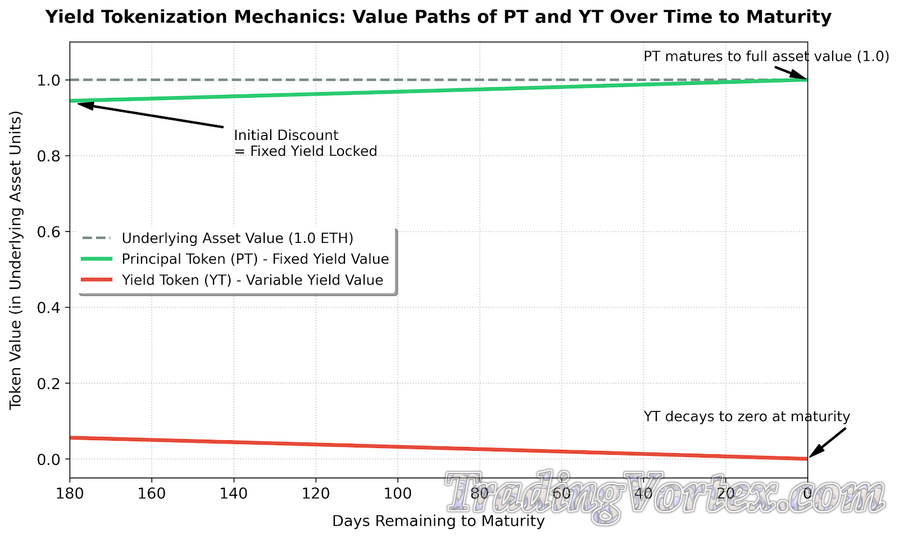 Visualizing Yield Tokenization Mechanics: Value Paths of Principal Tokens (PT) and Yield Tokens (YT) Over Time to Maturity.
Line chart tracking the divergence and lifecycle of a 1.0 unit yield-bearing asset split into a Principal Token (PT) and a Yield Token (YT) over a 180-day countdown to maturity, illustrating how the PT appreciates to full asset value while the YT value decays to zero.
How to read and use this visual to optimize your strategy:
To help you visualize exactly how your capital behaves inside platforms like Pendle, the chart above tracks the price paths of Principal Tokens (PT) and Yield Tokens (YT) from the exact moment an asset is split until it reaches maturity 180 days later.
♦ The Underlying Asset Benchmark (Dashed Gray Line): This represents the baseline value of your underlying asset (normalized to 1.0 unit). This is the target value that the system anchors around.
♦ Locking in Fixed Yield with PT (Green Line): Notice that on Day 180, the Principal Token trades at a significant discount (around 0.94 units). This discount represents the market's implied interest rate. If you purchase the PT at this discounted price, its value will predictably climb along the green curve until it reaches exactly 1.0 unit at maturity. By buying PT, you are choosing a predictable, guaranteed return; essentially locking in a fixed annualized yield regardless of how volatile the market becomes.
♦ Speculating on Variable Yield with YT (Red Line): On Day 180, the Yield Token captures the remaining value of the split asset (around 0.06 units). Because the YT only retains the rights to future yield distributions and has no claim on the underlying principal, its intrinsic value naturally decays toward zero as the maturity date approaches. If you buy YT, you are trading away your principal to gain leveraged exposure to the yield; you will profit if the actual variable yield distributed over the 180 days exceeds the initial price you paid for the token.
◊ By using this visual, you can easily time your entries based on your risk tolerance: risk-averse investors should look for deep PT discounts to secure high fixed rates, while active traders can use the YT decay curve to time short-term speculative plays on yield volatility.
Multi-Chain Yield Farming Across Ethereum L2s, Solana, and Sui
Benefits of diversifying yield farming across multiple chains
The biggest advantage of multi-chain yield farming is risk diversification. Instead of locking all your assets into one ecosystem, you spread them across Ethereum L2s, Solana, and Sui. This reduces exposure to chain-specific risks like congestion, downtime, or regulatory pressure. It also allows you to chase the best APYs wherever they appear.
For example:
- Ethereum L2s (Arbitrum, Optimism, Base, ZKsync): Known for stability and deep liquidity, with 5–20 percent APY on stablecoin pools and yield tokenization markets. These chains are favored by institutional investors who want predictable returns with lower gas fees than Ethereum mainnet.
- Solana: Famous for speed and low fees, with MEV-optimized pools like JitoSOL averaging 5.9 percent APY, and concentrated liquidity pools hitting 30–40 percent APY. Solana’s thriving developer ecosystem keeps rolling out new farming opportunities, making it a magnet for active yield hunters.
- Sui: A rising star in 2026, offering 9–30 percent APY on innovative DeFi protocols thanks to its unique parallel execution model. Sui’s design allows transactions to be processed simultaneously, which means faster settlement and more efficient yield farming strategies.
By farming across chains, you’re not just chasing yield, you’re building resilience. If one chain slows down or suffers a liquidity crunch, your other positions keep working for you. It’s the DeFi equivalent of not putting all your eggs in one basket, except the baskets are high-tech ecosystems competing to offer you the best returns.
Cross-chain bridges and liquidity migration tools
Moving liquidity between chains used to be a nightmare, but in 2026 it’s almost seamless. LayerZero, Axelar, and Wormhole have matured into reliable cross-chain bridges, allowing assets to flow smoothly between ecosystems. These tools reduce friction and make it possible to rebalance positions quickly when APYs shift.
AI-driven platforms like Yearn Finance, maxAPY, and Beefy now aggregate strategies across multiple chains, automatically deploying capital where it earns the best returns. This automation helps mitigate impermanent loss and ensures consistent performance without requiring farmers to babysit their positions.
Think of it like having a smart portfolio manager who constantly scans Ethereum, Solana, and Sui, then reallocates your funds to wherever the grass is greenest. For busy investors, this means you can still capture high APYs without spending every waking hour monitoring liquidity pools.
Current APY opportunities on Ethereum L2s, Solana, and Sui
Here’s a snapshot of what farmers are seeing in 2026:
| Chain | Popular Pools | Typical APY Range | Highlights |
|---|---|---|---|
| Ethereum L2s | Stablecoin pools (USDC/DAI), Pendle yield markets | 5–20% | Deep liquidity, strong institutional adoption, lower fees than mainnet |
| Solana | JitoSOL MEV pools, concentrated liquidity AMMs | 5.9–40% | Fast transactions, low fees, strong builder activity |
| Sui | Native DeFi protocols, RWA-backed pools | 9–30% | Parallel execution, innovative yield structures, growing ecosystem |
- Ethereum still dominates in terms of secure assets and stablecoin liquidity, with over $163 billion in stablecoins circulating.
- Solana, however, has caught up in DeFi TVL, surpassing $9.2 billion, slightly ahead of Ethereum L2s at $9.05 billion.
- Sui is smaller but growing fast, carving out a niche with high-yield pools and unique execution models.
Bottom line:
multi-chain yield farming in 2026 is no longer a luxury, it’s a necessity. By spreading capital across Ethereum L2s, Solana, and Sui, investors can capture diverse APY opportunities, reduce risk, and stay ahead of the curve. If you’ve ever felt stuck chasing yields on a single chain, now is the time to embrace the multi-chain mindset. It’s where the smartest farmers are playing, and it’s quickly becoming the standard for anyone serious about maximizing returns in DeFi.
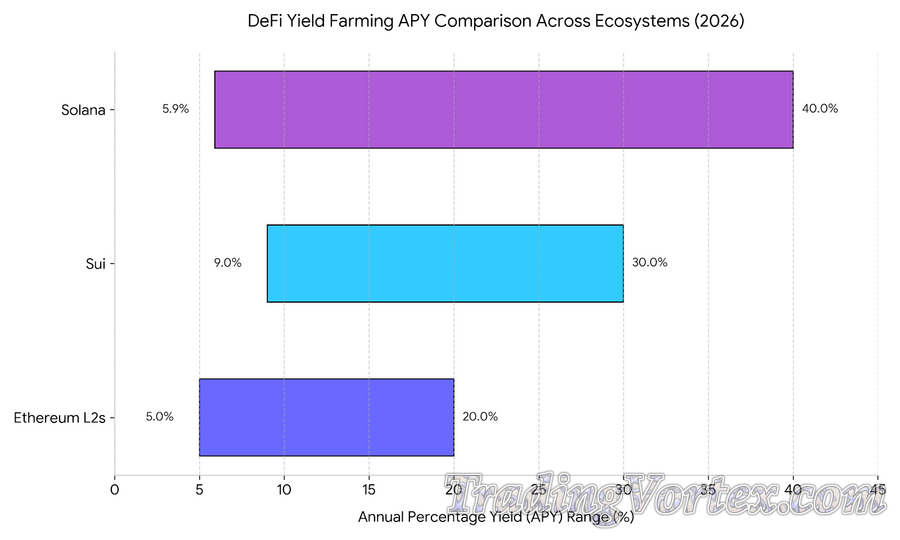 Comparison of Typical Annual Percentage Yield (APY) Ranges for Multi-Chain Yield Farming Across Ethereum L2s, Sui, and Solana Ecosystems in 2026.
To help you navigate these opportunities and optimize your deployment strategy, the visual representation below illustrates the typical minimum and maximum APY expectations across the three primary blockchain ecosystems in 2026.
Each horizontal bar captures the complete spread of returns you can expect to target:
♦ Ethereum L2s provide a highly stable and institutional-grade range from 5% to 20%, making them ideal for lower-risk, predictable yield baselines.
♦ Sui features an elevated entry yield starting at 9% and scaling up to 30%, driven by its high-throughput parallel architecture and novel protocol incentives.
♦ Solana offers the widest spread and the highest upside potential, ranging from 5.9% in MEV-optimized pools up to 40% within active, concentrated liquidity AMMs.
◊ When rebalancing your multi-chain portfolio, use this chart to quickly assess where to allocate capital based on your risk tolerance: utilizing Ethereum L2s for deep liquidity preservation while routing opportunistic capital into Sui and Solana to capture maximum yield velocity.
Real-World Asset (RWA) Yield Farming for Stable Returns
How tokenized RWAs are reshaping yield farming
RWAs are traditional financial assets: like U.S. Treasury bills, real estate, commodities, and private credit; that have been digitized into blockchain tokens. This process allows investors to buy fractions of high-value assets, trade them around the clock, and even use them as collateral in DeFi protocols. The appeal is straightforward: RWAs bring stability and predictability to yield farming, bridging the gap between traditional finance and crypto.
Instead of relying solely on volatile token incentives, farmers can now earn yield backed by real-world cash flows. Tokenized treasuries generate returns tied directly to government debt, while tokenized invoices or private credit pools pay yields based on borrower repayments. This makes RWA farming feel less like speculative gambling and more like a high-yield savings account, but with the flexibility, transparency, and composability of DeFi.
For many investors, RWAs are the missing piece that makes DeFi approachable. They provide a familiar anchor: assets tied to real-world obligations; while still offering the efficiency and accessibility of blockchain technology.
Examples of RWA-backed pools offering stable APY
- Tokenized Treasuries: Platforms like Ondo Finance and Maple are offering 4.5–6 percent APY on tokenized U.S. T-bills. These pools are especially popular among DAOs and funds that need predictable income streams to cover operating costs.
- Private Credit Pools: Active loans in tokenized private credit have surpassed $4.8 billion, with yields ranging from 8–12 percent APY depending on borrower risk. These pools often attract investors looking for higher returns than treasuries without venturing into volatile crypto assets.
- Tokenized Real Estate: Residential and commercial properties are being fractionalized into tokens, generating 5–10 percent APY from rental income or mortgage-backed structures. This allows smaller investors to access real estate yields that were once reserved for large institutions.
- Commodities and Gold-backed Tokens: Some protocols offer yield opportunities tied to tokenized gold or commodity reserves, providing a hedge against inflation while still earning modest returns.
Long-term sustainability of RWA yield farming strategies
The sustainability of RWA yield farming lies in its real-world backing. Unlike purely crypto-native pools that depend on token emissions, RWA yields are tied to tangible assets and cash flows. This makes them less vulnerable to hype cycles and more resilient during downturns.
That said, risks remain:
- Oracle accuracy: RWAs depend on reliable data feeds to reflect off-chain asset values. A faulty oracle can cause mispricing or de-pegging.
- Regulatory compliance: Shifts in KYC/AML rules can impact liquidity and accessibility.
- Liquidity constraints: While RWAs are growing, they still lack the deep liquidity of stablecoins or ETH-based pools.
Bottom line:
RWA yield farming in 2026 offers predictable APYs of 4–12 percent backed by treasuries, private credit, and real estate. It’s not the adrenaline rush of chasing 100 percent APYs in volatile pools, but it’s the kind of strategy that lets you sleep at night knowing your yield is tied to real-world cash flows.
For many investors, RWAs are becoming the backbone of a balanced DeFi portfolio, offering peace of mind alongside steady growth.
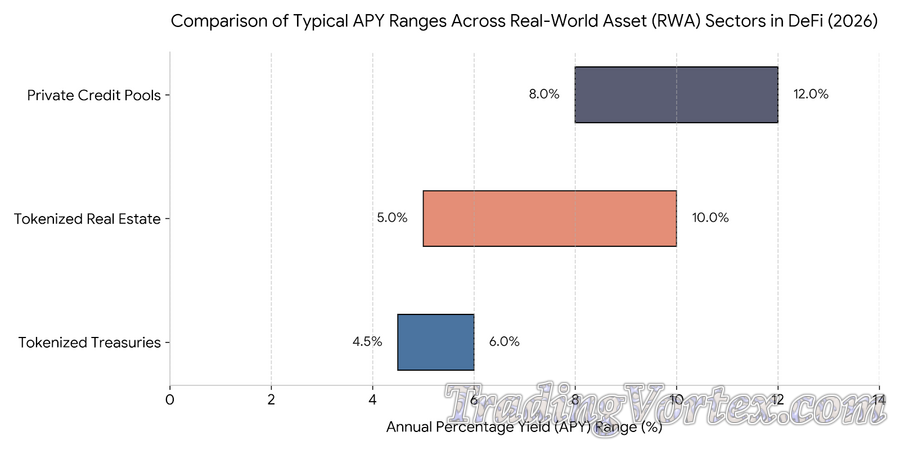 Comparison of Typical Annual Percentage Yield (APY) Ranges Across Real-World Asset (RWA) Yield Farming Sectors including Tokenized Treasuries, Tokenized Real Estate, and Private Credit Pools in 2026.
To help you strategically allocate your capital into sustainable, real-world backed cash flows, the visual chart above illustrates the performance spreads across the three dominant RWA yield farming sectors in 2026.
Each horizontal bar represents the full range of expected annualized returns you can earn by participating in these specific liquidity pools:
♦ Tokenized Treasuries: Offering the most conservative and secure baseline, these yield streams provide a predictable return ranging from 4.5% to 6.0%, anchored directly by short-term government debt obligations.
♦ Tokenized Real Estate: Positioned as a mid-tier yield generator, fractionalized property pools deliver between 5.0% and 10.0% APY, driven by real-world rental income distributions and mortgage-backed assets.
♦ Private Credit Pools: Representing the highest yield potential within the RWA spectrum, these credit markets offer returns from 8.0% to 12.0% APY, reflecting the underlying corporate borrower risk profiles and debt repayments.
◊ When constructing your defensive DeFi portfolio, you can use this data representation to easily balance your risk-to-reward ratio. If your priority is capital preservation with institutional stability, allocating a larger portion to Tokenized Treasuries ensures a predictable floor. Conversely, if you want to optimize for higher yield velocity without taking on the wild price action of crypto-native tokens, you can route capital into Private Credit and Real Estate pools to capture the upper limits of the RWA yield spectrum.
Risks in High APY Yield Farming
Impermanent Loss and How It Impacts APY
Impermanent loss (IL) remains the most common silent killer of yield farming returns. It occurs when you provide liquidity to a pool with two tokens and their prices diverge. The pool automatically rebalances, leaving you with more of the asset that is falling in value and less of the one that is rising.
In 2026, IL is still eroding returns across volatile pairs, especially in leveraged pools where exposure is magnified. Even concentrated liquidity pools, which promise higher efficiency, can intensify IL if ranges are mismanaged. Many farmers now use IL-neutral pools or single-sided staking to reduce exposure, but the risk never fully disappears.
Smart Contract Risks and Security Vulnerabilities
Smart contracts are the backbone of DeFi, but they are also a major attack surface. Even audited protocols can contain bugs, and exploits remain a constant threat. According to industry reports, crypto theft reached $3.4 billion in 2025, with bridge and smart contract vulnerabilities accounting for a significant share. Rug pulls and protocol exploits can wipe out entire positions in seconds, and diversification cannot fully hedge against these risks.
Farmers today rely heavily on audit reports, bug bounty programs, and risk dashboards to evaluate protocol safety. Still, no strategy is risk-free. If you’ve ever woken up to find your farming pool drained overnight, you know how devastating smart contract risk can be. The rise of cross-chain farming has also expanded the attack surface, since bridges remain one of the most exploited components in DeFi.
Market Volatility and Liquidation Risks in Leveraged Farming
Leveraged yield farming amplifies both gains and losses. Borrowing funds to expand your farming position can push APYs into the 30–60 percent range, but it also increases the risk of liquidation. A small dip in token prices can trigger automatic sell-offs, wiping out your collateral.
Volatility also impacts borrowing costs. Interest rates on borrowed funds can spike during market stress, eating into your APY. Combined with impermanent loss, this creates a dangerous cocktail for farmers who chase high yields without proper risk management.
Seasoned investors recommend maintaining healthy collateral ratios above 200 percent, monitoring positions daily, and using hedging tools like perpetual futures to soften the blow of sudden downturns.
Regulatory Challenges Facing DeFi Yield Farming
Regulation is the wild card in yield farming. Governments worldwide are tightening rules around KYC, AML, and stablecoin issuance, and DeFi protocols are increasingly under scrutiny. In 2026, Europe has introduced stricter compliance frameworks for RWA-backed pools, while the U.S. continues to debate how decentralized protocols should be regulated. Asia, meanwhile, is pushing forward with pilot programs that integrate RWAs into regulated DeFi platforms, signaling both opportunity and caution.
For farmers, this means potential restrictions on access, reduced liquidity in certain pools, and even forced unwinds of positions if protocols fail to comply. While regulation may bring more institutional capital into DeFi, it also adds uncertainty for retail investors who value anonymity and open access.
Bottom line:
high APY yield farming in 2026 is not just about chasing numbers. Impermanent loss, smart contract exploits, liquidation risks, and regulatory uncertainty are the four pillars of risk every farmer must understand. The opportunities are real, but so are the dangers. If you treat yield farming like a high-stakes game without a risk plan, you’re more likely to end up funding someone else’s gains than securing your own.
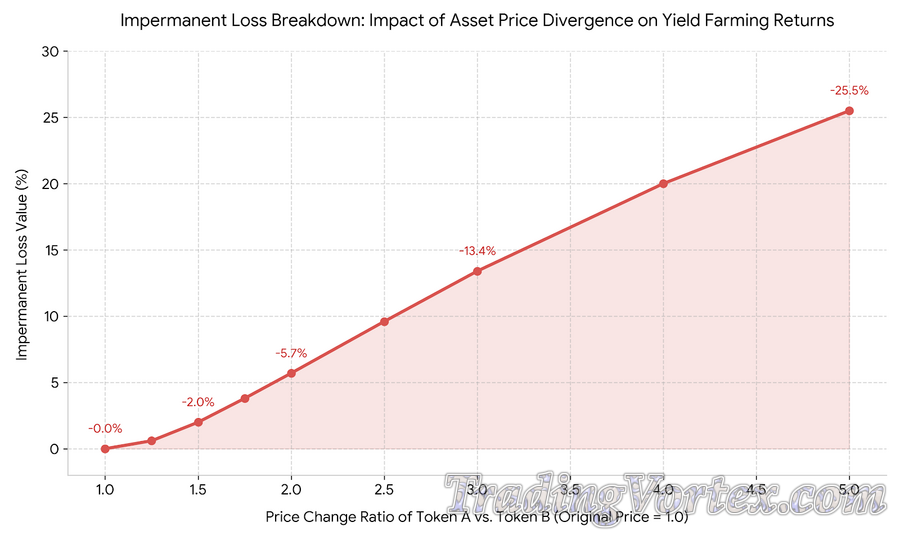 Impermanent Loss Breakdown: Impact of Asset Price Divergence on Yield Farming Returns.
To help you anticipate how asset volatility can directly eat into your high APY earnings, the visual chart above models the exact progression of Impermanent Loss (IL) as the relative price between your two pooled tokens diverges.
By analyzing the risk curve from left to right, you can calculate the threshold where token price movements could outpace your farm's accumulated yield:
♦ Stable Range (1.0 to 1.25x Price Shift): When the price of one token changes by up to 25% relative to the other, impermanent loss is kept to a minimal 0.6%. This is the ideal zone where your trading fee and farming rewards will easily override IL.
♦ Moderate Divergence (1.5x to 2.0x Price Shift): If one asset gains or loses significant traction, resulting in a 1.5x to 2.0x divergence, your capital faces a structural loss between 2.0% and 5.7%. At this point, your farming strategy needs to yield at least an equivalent net percentage just to break even compared to simply holding the raw assets.
♦ Severe Divergence (3.0x to 5.0x Price Shift): When a token experiences massive upward hype or a severe collapse, a 3x to 5x price divergence inflicts a painful 13.4% to 25.5% reduction in total portfolio value.
◊ When configuring liquidity positions in high-yield or concentrated liquidity pools, use this data representation as a guide for your exit parameters. If the price divergence begins to push past the 2.0x mark, it is often a signal to manually rebalance, hedge your positions using options or perpetual futures, or migrate liquidity to single-sided pools before the structural impermanent loss permanently wipes out your generated APY.
Risk Management in Yield Farming
Single-Sided Staking and IL-Neutral Pools
One of the most straightforward ways to reduce risk is single-sided staking, where you deposit only one token instead of a pair. This eliminates impermanent loss entirely, since you’re not exposed to price divergence between assets. Platforms like Curve, Balancer, and Bancor V3 have refined IL-neutral pools, using mechanisms such as dynamic rebalancing, stable pairs, or protocol-owned liquidity to minimize losses.
For conservative investors, these pools provide 5–12 percent APY with far less stress than volatile pairs. They are especially popular among DAOs and treasuries that need predictable returns to cover operating costs. Think of single-sided staking as the “comfort food” of yield farming: it may not be flashy, but it’s reliable and keeps you satisfied without the heartburn of impermanent loss.
Diversification Across Multiple Yield Farming Protocols
Diversification remains the golden rule. In 2026, community consensus suggests limiting exposure to 15–20 percent of your portfolio in DeFi, with no more than 5 percent in a single protocol. This way, even if one farm suffers an exploit, liquidity crunch, or regulatory freeze, your overall portfolio remains intact.
Using Risk Dashboards (RugDoc, DeFiSafety)
Smart contract exploits remain a major threat, with reports showing that over half of high-APY farms launched in 2026 experienced vulnerabilities or rug pulls within 90 days. Tools like RugDoc, DeFiSafety, and Certik dashboards have become essential for monitoring protocol health. They provide real-time alerts on contract vulnerabilities, governance risks, and liquidity shifts.
Hedging Yield Farming Positions with Perpetuals and Derivatives
Hedging is no longer just for professionals. Farmers now use perpetual contracts, options, and synthetic assets to offset risks like impermanent loss or sudden price drops. For example, if you’re farming ETH-USDC, you can short ETH futures to protect against downside moves. This strategy reduces volatility exposure while keeping your farming rewards intact.
Bottom line:
risk management in yield farming is about discipline, not luck. Single-sided staking, diversification, monitoring tools, and hedging strategies are the pillars of sustainable farming in 2026. Chasing triple-digit APYs without a plan is like driving a sports car without brakes: you might enjoy the speed for a while, but eventually you’ll crash.
The farmers who thrive today are the ones who treat risk management as seriously as yield optimization, building portfolios that can weather storms while still capturing meaningful returns.
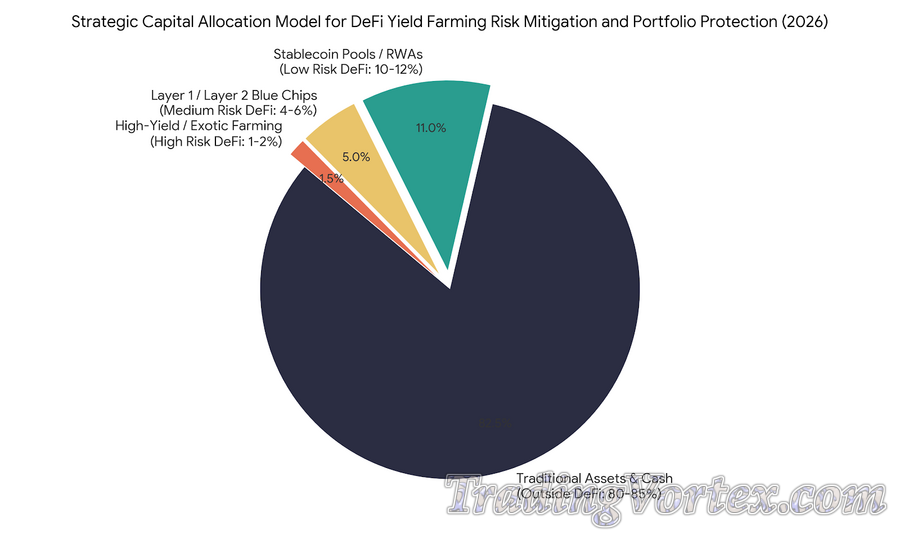 Strategic Capital Allocation Model for DeFi Yield Farming Risk Mitigation and Portfolio Protection (2026).
To help you put professional risk management framework principles into action, the visual breakdown above illustrates how to structure your complete portfolio capital according to 2026 institutional and community safety standards.
By looking at the allocation tiers, you can manage structural systemic risks while maintaining exposure to high-performing yield strategies:
♦ Traditional Assets and Cash (80% to 85% Baseline Allocation): The foundation of your capital remains completely isolated outside of decentralized protocols, shielding your main wealth from smart contract failures, protocol hacks, or regulatory shifts.
♦ Stablecoin Pools and Real-World Assets (10% to 12% Low Risk Allocation): This forms your primary operational DeFi layer. Capital here is allocated to highly secure, single-sided staking or yield-bearing tokenized treasuries, generating predictable returns of 4% to 12% completely protected from impermanent loss.
♦ Layer 1 and Layer 2 Ecosystem Blue Chips (4% to 6% Medium Risk Allocation): This bucket is distributed across deep liquidity pools like Ethereum L2s or Solana MEV strategies. Exposure is tightly capped at 5% per single protocol to minimize the fallout of unexpected network downtime or localized exploits.
♦ High-Yield and Exotic Farming (1% to 2% High Risk Allocation): This represents your speculative capital tier, dedicated to chasing leveraged pools or newer parallel-execution protocols. By restricting your exposure to a tiny fraction of your overall net worth, an unmitigated rug pull or severe impermanent loss event inside this layer will never compromise your broader financial health.
◊ When deploying capital across ecosystems, treat this asset distribution model as your baseline defensive map. Before chasing an attractive triple-digit yield opportunity, ensure you are not over-concentrating your positions: allowing you to confidently harvest optimal returns while building a portfolio robust enough to weather volatile protocol cycles.
Top Yield Farming Platforms Offering High APY in 2026
Ethereum Layer-2 Yield Farming (Arbitrum, Optimism)
Ethereum L2s have become the backbone of yield farming thanks to low fees, deep liquidity, and strong institutional adoption. Arbitrum and Optimism host stablecoin pools and yield tokenization markets with 5–20 percent APY, while Base and ZKsync are attracting smaller accounts with low-fee farming ecosystems. These chains are ideal for investors who want predictable yields without paying Ethereum mainnet gas costs.
Ethereum L2s also benefit from robust developer activity and integrations with major DeFi protocols, making them a safe entry point for those who want to farm without worrying about congestion or sky-high gas fees.
For many institutional players, L2s are the preferred playground because they combine Ethereum’s security with scalability.
Solana Concentrated Liquidity Pools
Solana continues to shine with fast transactions and low fees, making it a favorite for active yield hunters. Concentrated liquidity pools on Solana are delivering 30–40 percent APY, while MEV-optimized pools like JitoSOL average around 5.9 percent APY. Solana’s developer ecosystem is thriving, constantly rolling out new strategies that appeal to both retail and professional farmers.
Solana’s unique architecture allows for high throughput and minimal latency, which is why it has become the chain of choice for traders who want to move quickly and capture short-term yield opportunities. The ecosystem’s resilience after past outages has also boosted confidence, with liquidity steadily climbing past $9 billion in TVL.
Curve crvUSD and Stablecoin Yield Pools
Curve remains the king of stablecoin farming. Its crvUSD pools and integrations with Convex offer 5–15 percent APY with relatively low risk. Curve’s design makes it especially attractive for conservative investors who want steady yields backed by deep liquidity. In 2026, Curve is also expanding into RWA-backed pools, further strengthening its position as the stablecoin hub of DeFi.
Curve’s dominance lies in its ability to aggregate stablecoin liquidity efficiently, ensuring minimal slippage and consistent rewards. For DAOs and treasuries, Curve pools are often the first stop when allocating capital for predictable returns.
Sui Protocols Offering 9–30% APY
Sui is the rising star of 2026. Thanks to its parallel execution model, Sui protocols can process transactions simultaneously, boosting efficiency and yield opportunities. Farmers are reporting 9–30 percent APY across native DeFi pools and RWA-backed strategies. While Sui’s ecosystem is smaller than Ethereum or Solana, its innovative design is attracting liquidity and carving out a niche for high-yield farming.
Sui’s growth is driven by developer-friendly tooling and unique yield structures, which appeal to experimental farmers looking for fresh opportunities. Its ability to handle complex transactions without bottlenecks makes it a promising chain for scaling yield farming strategies.
Aave, Lido, Bancor V3 Yield Farming Opportunities
- Aave: Still the most trusted lending protocol, offering up to 15 percent APY on stablecoin lending. Its conservative risk profile makes it a safe starting point for new farmers.
- Lido: Dominates liquid staking, with stETH and rETH integrated into yield markets. Combining staking rewards with DeFi liquidity can push returns into the 10–20 percent APY range.
- Bancor V3: Known for IL-neutral pools, Bancor offers yields of 5–12 percent APY with built-in protection against impermanent loss. This makes it a favorite among risk-conscious farmers.
Quick Comparison Table
| Platform | Focus | Typical APY Range | Highlights |
|---|---|---|---|
| Arbitrum / Optimism | Stablecoin pools, yield tokenization | 5–20% | Low fees, institutional adoption |
| Solana | Concentrated liquidity, MEV pools | 5.9–40% | Fast, low-cost, active ecosystem |
| Curve (crvUSD) | Stablecoin yield pools | 5–15% | Deep liquidity, RWA expansion |
| Sui | Native DeFi, RWA pools | 9–30% | Parallel execution, growing ecosystem |
| Aave | Lending markets | 5–15% | Trusted, conservative yields |
| Lido | Liquid staking + DeFi | 10–20% | ETH staking plus liquidity farming |
| Bancor V3 | IL-neutral pools | 5–12% | Built-in impermanent loss protection |
Bottom line:
In 2026, yield farming is no longer about chasing unsustainable triple-digit APYs. Platforms like Ethereum L2s, Solana, Curve, Sui, Aave, Lido, and Bancor V3 are delivering strong, realistic yields while offering better risk management tools. Whether you prefer stablecoin safety, liquid staking flexibility, or concentrated liquidity excitement, these platforms represent the best opportunities for high APY farming today.
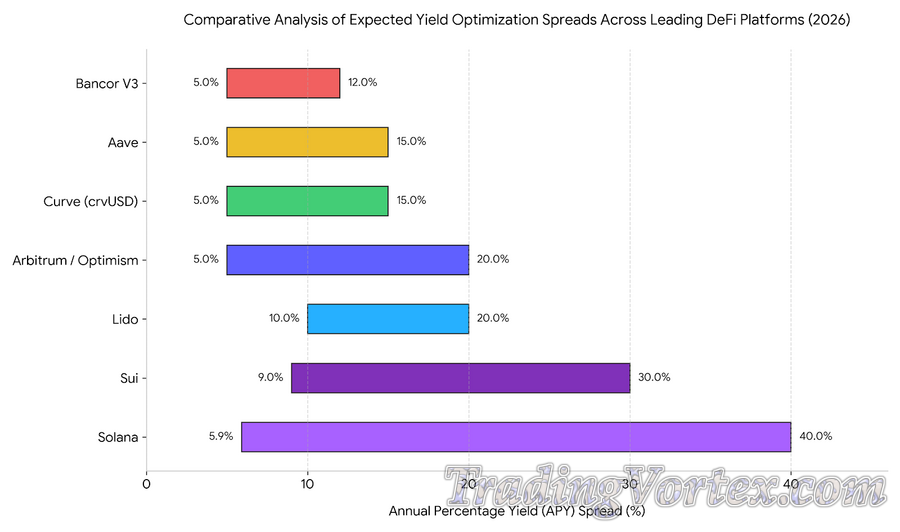 Comparative Analysis of Expected Yield Optimization Spreads Across Leading DeFi Platforms (2026).
To help you identify the best deployment channels for your capital, the visual chart above illustrates the typical minimum and maximum annualized returns across the premier yield farming hubs in 2026.
By observing the position and width of each horizontal bar, you can quickly assess the baseline security and return boundaries of each platform:
♦ High-Volatility Alpha Channels (Solana and Sui): Solana offers the widest performance spread, ranging from 5.9% in secure MEV staking pools to an explosive 40% inside highly active concentrated liquidity pools. Sui scales smoothly alongside it, delivering a elevated 9% baseline up to 30% via its parallel execution ecosystem.
♦ Balanced Growth Infrastructure (Lido and Arbitrum / Optimism): Lido maps out a predictable 10% to 20% tier by compounding Ethereum liquid staking rewards with secondary liquidity layer multipliers. Similarly, the primary Layer-2 networks (Arbitrum and Optimism) leverage deep institutional stablecoin adoption to generate stable yields between 5% and 20%.
♦ Defensive and Capital-Preservation Blue Chips (Curve, Aave, and Bancor V3): Curve (crvUSD) and Aave offer tightly bounded, market-tested yield structures between 5% and 15%, specialized in handling massive volume with minimized slippage. Meanwhile, Bancor V3 functions as a dedicated safety engine, delivering a dependable 5% to 12% yield featuring built-in, protocol-enforced impermanent loss protection.
◊ When building out your multi-chain yield strategies, utilize this data representation to balance your risk-to-reward ratio. You can securely stake your portfolio floor within conservative blue chips like Aave, Curve, and Bancor V3, while routeing speculative or highly active capital into Solana, Sui, and Layer-2 pools to capture the maximum yield spreads.
Tools and Analytics for Yield Farming Success
On-Chain Analytics Platforms for APY Tracking
On-chain analytics platforms are the farmer’s radar, giving visibility into real-time APYs, liquidity flows, and protocol health across multiple chains. In 2026, tools like Nansen, Dune Analytics, and Token Terminal are indispensable for spotting opportunities before they go mainstream.
- Nansen tracks wallet movements, showing where “smart money” is farming. If large funds are piling into a Solana pool, you’ll see it.
- Dune Analytics offers community-built dashboards covering everything from Pendle yield markets to EigenLayer restaking.
- Token Terminal focuses on fundamentals, letting you compare protocol revenues and sustainability.
These platforms help farmers distinguish between pools offering sustainable yields and those relying on short-lived token emissions. If you’ve ever felt blind when choosing a farm, these dashboards are the night-vision goggles that reveal what’s really happening under the hood.
APY Aggregators (DeFiLlama, CoinBrain)
APY aggregators are like comparison websites for yield farming. DeFiLlama and CoinBrain pull data from hundreds of protocols, showing the highest APYs across chains in one place.
- DeFiLlama has become the go-to aggregator, offering breakdowns of stablecoin yields, liquid staking returns, and RWA-backed pools.
- CoinBrain adds risk-adjusted APY scores, helping farmers avoid traps where headline yields look great but risks are hidden.
Instead of manually checking Curve, Aave, or Solana pools, you can scan aggregated dashboards to find the best opportunities. These tools save time, reduce FOMO, and help you avoid chasing unsustainable yields.
Automated Yield Optimizers and Compounding Tools
Managing farms manually can be exhausting. That’s where auto-compounding vaults come in. Platforms like Yearn Finance, Beefy Finance, and Harvest automatically harvest rewards, swap them, and redeposit them to maximize compounding.
- A 20 percent APY can become closer to 25–30 percent over time when rewards are compounded efficiently.
- Beefy Finance now supports vaults across Ethereum L2s, Solana, and Sui, while Yearn has added risk-adjusted vaults that reduce exposure when volatility spikes.
- Some optimizers even integrate AI-driven rebalancing, shifting capital between pools to capture the best yields.
For busy investors, these tools are like having a personal assistant who never sleeps, constantly squeezing extra yield out of your assets.
Smart Contract Audit Tools for Safer Farming
Security remains the biggest concern in yield farming. RugDoc, DeFiSafety, and Certik provide audit scores, risk ratings, and exploit monitoring for DeFi protocols.
- RugDoc specializes in flagging potential rug pulls, giving farmers early warnings.
- DeFiSafety offers transparency scores based on governance, documentation, and code audits.
- Certik continues to lead in professional audits, with real-time monitoring of vulnerabilities.
Farmers increasingly rely on these tools before depositing funds. A pool offering 50 percent APY might look tempting, but if RugDoc flags it as high risk, seasoned investors will think twice. Using audit tools is like checking restaurant reviews before eating: you might miss out on a flashy new spot, but you’ll avoid food poisoning.
Bottom line:
yield farming success in 2026 depends on using the right tools. On-chain analytics platforms give visibility, APY aggregators save time, auto-compounders boost returns, and audit dashboards protect against scams. Together, they form the toolkit every serious farmer needs to thrive in a market where opportunities are plentiful but risks are ever-present.
The farmers who win are not just chasing APYs, they are managing risk with precision and farming with confidence.
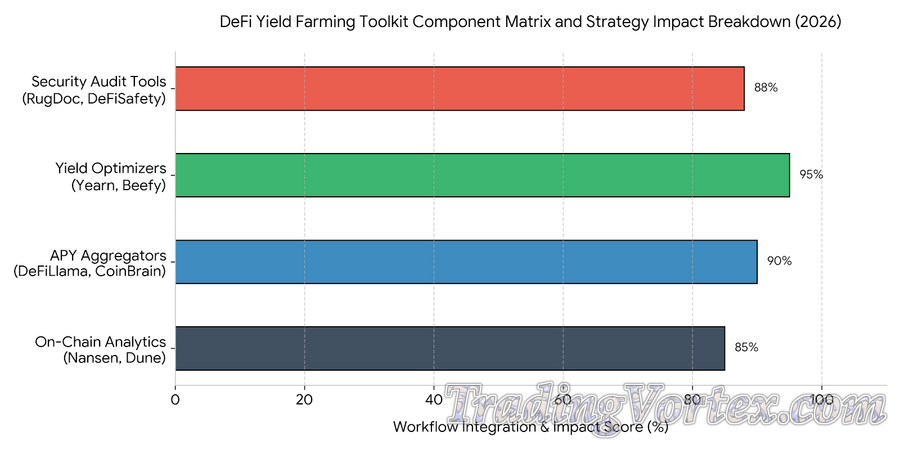 DeFi Yield Farming Toolkit Component Matrix and Strategy Impact Breakdown (2026)
To help you establish a systematic, data-driven farming workflow, the horizontal matrix above visualizes the strategic integration and operational impact of the four essential tool categories in 2026.
By following this breakdown from the bottom up, you can build a secure, efficient execution cycle before deploying capital:
♦ On-Chain Analytics (85% Workflow Impact Score): Platforms like Nansen and Dune Analytics serve as your primary reconnaissance layer. Use them to trace smart money movements, monitor wallet inflows across ecosystems, and determine whether a pool's underlying liquidity is backed by sustainable fundamentals or short-lived token emissions.
♦ APY Aggregators (90% Workflow Impact Score): Services like DeFiLlama and CoinBrain remove market fragmentation. Instead of bouncing between individual protocols on separate chains, leverage these aggregators as an all-in-one dashboard to discover, compare, and filter the highest risk-adjusted yield spreads across the entire DeFi space.
♦ Yield Optimizers (95% Workflow Impact Score): Vault networks like Yearn and Beefy Finance function as your hands-free compounding engines. By using automated execution code to collect rewards, sell them, and compound them back into the core pool, these utilities mechanically push standard returns from a 20% baseline up into the 25% to 30% territory while saving on transaction fees.
♦ Security Audit Tools (88% Workflow Impact Score): Dashboards like RugDoc and DeFiSafety represent your ultimate defensive shield. Before signing any contract permission or depositing collateral into a new pool, always cross-reference its security score to bypass malicious backdoors, flash-loan vulnerabilities, and high-risk rug pulls.
◊ When optimizing your daily or weekly yield farming routines, use this matrix as an active checklist. A professional strategy relies on all four components working in tandem; allowing you to track positions transparently with analytics, locate top rates with aggregators, maximize compound velocity with optimizers, and run final safety sweeps with audit platforms.
Future of High APY Yield Farming
Growth of Total Value Locked (TVL) in DeFi
DeFi’s growth trajectory remains strong. Total Value Locked (TVL reached $68.4 billion in Q1 2026) and analysts project it could exceed $500 billion across major chains by the end of the year. Ethereum Layer-2 scaling solutions like Arbitrum, Optimism, and Base are fueling this expansion, while Solana’s high throughput and Sui’s parallel execution model are attracting new liquidity. Stablecoins continue to dominate liquidity pools, accounting for more than 60 percent of DeFi TVL, but RWAs (real-world assets) are quickly becoming the new frontier. Tokenized treasuries, private credit, and real estate are reshaping yield farming by offering predictable returns that appeal to both retail and institutional investors.
This growth is not just about numbers, it’s about maturity. The DeFi ecosystem is evolving from speculative hype cycles into a more balanced financial system, where yields are tied to real economic activity rather than short-lived token incentives.
Mainstream Adoption of Yield Farming Strategies
Yield farming has moved beyond crypto-native communities. Institutional players, DAOs, and even traditional hedge funds are entering the space, attracted by consistent 15–35 percent APYs from real-yield protocols like GMX, Gains Network, and dYdX. These platforms distribute trading fees rather than relying on inflationary token emissions, making yields more sustainable and appealing to professional investors.
Retail adoption is also accelerating. User-friendly dashboards, mobile apps, and auto-compounding vaults have lowered the barrier to entry, making yield farming accessible to everyday investors who may not have the technical expertise to manage complex strategies. In some regions, yield farming is even being integrated into neobank offerings, allowing customers to allocate savings into tokenized yield pools directly from their banking apps.
Evolution of User-Friendly Yield Farming Protocols
The future of yield farming is about simplicity, automation, and accessibility. Protocols are evolving to offer:
- Concentrated liquidity pools (Uniswap V4, Curve crvUSD) that maximize capital efficiency and boost returns.
- AI-driven bots that rebalance positions, hedge risks, and auto-compound yields without constant user intervention.
- Cross-chain bridges like LayerZero, Axelar, and Wormhole, enabling seamless liquidity migration across Ethereum L2s, Solana, and emerging ecosystems like Sui.
- Risk dashboards integrated directly into farming platforms, providing real-time alerts on collateral ratios, APY shifts, and smart contract vulnerabilities.
These innovations mean farmers no longer need to babysit positions daily. Instead, automation and analytics handle much of the heavy lifting, making yield farming more approachable for casual investors while still offering advanced tools for professionals.
Long-Term Sustainability of High APY Yield Farming
The era of unsustainable 300 percent APYs is fading fast. In 2026, yield farming is moving toward long-term sustainability through:
- Real-yield protocols that generate income from trading fees, RWAs, and lending markets.
- Stablecoin pools offering predictable 5–15 percent APYs, serving as the backbone of conservative farming strategies.
- Liquid staking and restaking strategies that compound rewards while securing multiple networks, often delivering 10–20 percent APYs.
- Regulatory clarity in regions like the EU and Asia, which is encouraging institutional adoption while reducing risks of rug pulls and exploits.
Bottom line:
the future of high APY yield farming is about scaling responsibly, integrating RWAs, leveraging automation, and attracting mainstream capital.
Farmers who adapt to this new era: focusing on sustainable yields rather than hype; will be the ones who thrive in DeFi’s next chapter.
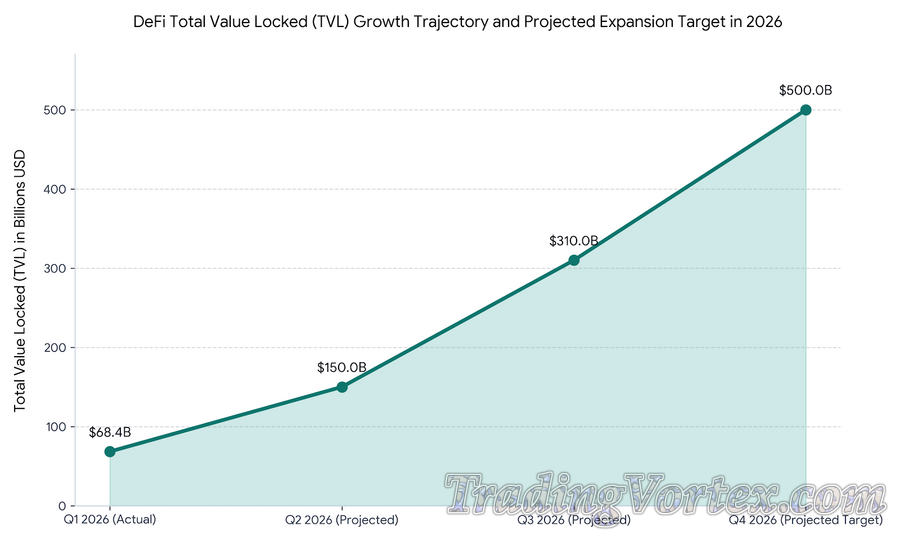 DeFi Total Value Locked (TVL) Growth Trajectory and Projected Expansion Target in 2026.
To help you visualize the macroeconomic scaling of the decentralized financial system, the area chart above tracks the capital migration curve into DeFi platforms over the course of 2026.
By interpreting this growth trajectory, you can gauge the pace of liquidity maturation and the institutionalization of farming strategies:
♦ The Current Baseline (Q1 2026 Actual): The ecosystem sits at an authenticated $68.4 billion in total value locked. This base layer is primarily sustained by native DeFi participants utilizing Ethereum Layer-2s, Solana, and Sui protocol frameworks.
♦ The Intermediary Scaling Phase (Q2 to Q3 2026 Projected): As real-world assets (RWAs) integrate cleanly into regulated platforms and neobanks roll out straightforward, user-facing yield pool channels, TVL is anticipated to ramp exponentially from $150 billion to $310 billion.
♦ The Institutional Target (Q4 2026 Projected Target): By the close of the year, deep institutional capital routing and automated, fee-revenue-sharing "real-yield" models are modeled to propel the collective TVL past the milestone $500 billion mark.
◊ As you plan your long-term yield strategies, use this data model as an economic indicator. The steady expansion of the shaded area highlights that liquidity is moving away from speculative, high-inflation token traps and moving permanently toward deep, sustainable, and highly liquid multi-chain environments. Aligning your capital with this structural migration ensures your yields remain firmly backed by real economic volume.
Conclusion: Navigating High APY Yield Farming in 2026
Balancing Risk vs. Reward in Yield Farming
The golden rule of yield farming has always been simple: higher APY usually means higher risk. In 2026, this truth is clearer than ever. Real-yield protocols like GMX, Gains Network, and dYdX consistently deliver 15–35 percent APY by distributing trading fees rather than relying on token emissions.
These platforms have proven that sustainable yield can exist when rewards are tied to actual economic activity. On the other hand, speculative farms promising 300 percent APY still pop up, but data shows 68 percent of them suffer exploits or rug pulls within 90 days.
The lesson is obvious: treat those high-risk pools as short-term plays, not long-term strategies. Balancing risk and reward means diversifying across stablecoin pools, liquid staking, and RWAs, while keeping speculative positions small. It’s like building a balanced diet: you can enjoy the occasional dessert, but the foundation should be healthy and sustainable.
Key Takeaways for Crypto Investors
- TVL Growth: DeFi TVL reached $68.4 billion in Q1 2026 and is projected to surpass $500 billion across chains by year-end. This growth signals maturity, deeper liquidity, and mainstream adoption.
- Stablecoin Dominance: Stablecoins remain the backbone of yield farming, offering 5–15 percent APY with predictable returns. They are the “safe harbor” for investors who want steady income without wild volatility.
- RWAs Integration: Tokenized treasuries, private credit, and real estate pools are reshaping farming, delivering 4–12 percent APY backed by real-world cash flows. This is where DeFi meets traditional finance, and it’s attracting institutional capital.
- Smarter Tools: AI-driven bots, risk dashboards, and cross-chain bridges are making farming more efficient and less stressful. Farmers now have access to automation that rebalances positions, hedges risks, and compounds rewards without constant monitoring.
- Risk Awareness: Impermanent loss, smart contract exploits, and regulatory shifts remain the biggest threats. Farmers who ignore them often learn the hard way, while those who respect risk management build portfolios that survive downturns.
Final Thoughts on Building Sustainable High APY Strategies
Yield farming in 2026 is not about reckless chasing, it’s about strategic positioning. The farmers who thrive are those who:
- Anchor portfolios in real-yield and RWA-backed pools for stability.
- Use Ethereum L2s, Solana, and Sui to diversify across ecosystems and capture unique opportunities.
- Rely on analytics and audit tools to avoid scams and manage risk effectively.
- Treat speculative farms as tactical plays, not core holdings, approaching them with caution and clear exit strategies.
The future of yield farming is bright, but it belongs to those who farm with discipline. If you’re chasing APYs without a plan, you’re gambling. If you’re balancing risk, diversifying smartly, and using the right tools, you’re investing. And that’s the difference between being wiped out in 30 days and building wealth that lasts for years.
Bottom line:
navigating high APY yield farming in 2026 means embracing sustainability, leveraging technology, and respecting risk. The opportunities are real, but only for those who farm with both eyes open. Yield farming has matured into a cornerstone of decentralized finance, and those who adapt to its new rhythm will be the ones reaping rewards long after the hype fades.
 DeFi Yield Farming Strategy Matrix (2026): Sustainable Yield Ranges vs. Speculative Risk Profiles.
To help you seamlessly visualize the risk-to-reward landscape of the modern DeFi ecosystem, the visual data representation below maps the actual operational boundaries of major farming strategies against their corresponding APY performance bands.
By evaluating this matrix from the bottom up, you can easily design a balanced, highly protected deployment strategy:
♦ Stablecoin Pools & RWAs (4% – 15% APY): This serves as your fundamental defensive foundation. By utilizing tokenized real-world assets (like treasuries or private credit) alongside major stablecoins, you lock in steady institutional-grade cash flows without subjecting your portfolio to underlying token price swings.
♦ Liquid Staking & Restaking (10% – 20% APY): Representing a balanced mid-tier strategy, this path allows you to compound base network rewards across major Layer-1 and Layer-2 blockchains, keeping your assets productive while maintaining structural ecosystem security.
♦ Real-Yield Protocols (15% – 35% APY): This remains the gold standard for sustainable high yield in 2026. Because platforms like GMX or dYdX back these returns with direct organic revenue streams (such as actual trading platform fees), your performance is tied directly to network utility rather than hyper-inflationary reward tokens.
♦ Speculative Farms (Up to 300%+ APY): Positioned at the top of the spectrum, these pools present extreme danger. While the nominal yields appear flashy, they come accompanied by a severe 68% exploit or rug-pull failure rate within their first 90 days of launch.
◊ When managing your portfolio, use this chart as an actionable allocation guardrail. Rather than exposing your net worth to the volatile red tier, aim to capture maximum sustainable wealth by anchoring the vast majority of your capital inside the green, blue, and amber zones.
FAQs: High APY Yield Farming Strategies in 2026
What is yield farming and why does APY matter?
Yield farming is the practice of providing liquidity or staking assets in DeFi protocols to earn rewards. APY (Annual Percentage Yield) measures the total return you can expect in a year, including compounding. In 2026, realistic APYs range from 5–15 percent for stablecoin pools to 30–50 percent for leveraged or tokenized yield strategies. Anything promising above 100 percent is usually subsidized by token emissions and rarely sustainable.
Think of APY as the “speedometer” of your farming strategy. It tells you how fast your money is growing, but just like driving, going too fast without brakes can be dangerous.
What are the biggest risks in high APY yield farming?
The main risks are:
♦ Impermanent loss: When token prices diverge in a liquidity pool, reducing your effective returns.
♦ Smart contract exploits: Hacks and rug pulls remain common, with billions lost in 2025 alone.
♦ Liquidation risk: Leveraged farming can wipe out positions if collateral ratios drop.
♦ Regulatory uncertainty: New rules in the EU and Asia are reshaping access to RWA-backed pools.
These risks are not theoretical. Many farmers in 2025 saw their positions vanish overnight due to bridge exploits or poorly audited contracts. The lesson is simple: high APY comes with high responsibility.
How can I reduce risk while farming?
♦ Use single-sided staking or IL-neutral pools like Bancor V3.
♦ Diversify across multiple protocols and chains, limiting exposure to 5 percent per protocol.
♦ Stick to audited platforms with high TVL such as Curve, Aave, and Uniswap.
♦ Monitor positions regularly with dashboards like DeFiSafety or RugDoc.
♦ Hedge exposure using perpetuals or options on platforms like dYdX.
Risk management in yield farming is like wearing a seatbelt. You may not need it every day, but when things go wrong, you’ll be glad you had it.
Which platforms are offering the best APYs in 2026?
♦ Ethereum L2s (Arbitrum, Optimism): Stablecoin pools with 5–20 percent APY.
♦ Solana: Concentrated liquidity pools delivering 30–40 percent APY.
♦ Curve crvUSD: Stablecoin pools with 5–15 percent APY, favored by institutions.
♦ Sui: Innovative DeFi protocols offering 9–30 percent APY.
♦ Pendle: Yield tokenization markets with up to 50 percent APY on BTC and ETH pairs.
These platforms represent the “blue chips” of yield farming. They may not always deliver the wildest returns, but they combine strong yields with proven track records.
Are real-world assets (RWAs) really part of yield farming now?
Yes. RWAs like tokenized treasuries, private credit, and real estate are integrated into DeFi pools, offering 4–12 percent APY backed by real-world cash flows. This trend is attracting institutional investors who want predictable yields with blockchain efficiency.
RWAs are the bridge between DeFi and traditional finance. They give farmers exposure to stable returns while still enjoying the flexibility and transparency of blockchain.
What is the safest way to start yield farming in 2026?
For beginners, the safest entry points are:
♦ Stablecoin pools on Curve or Aave for predictable yields.
♦ Liquid staking tokens (stETH, rETH) combined with DeFi pools for compounded rewards.
♦ RWA-backed pools for stable returns tied to treasuries or credit markets.
Start small, monitor positions weekly, and treat yield farming as a long-term strategy rather than a quick win. Think of it like planting a garden: you don’t harvest overnight, but with patience and care, the rewards grow steadily.
Bottom line:
Yield farming in 2026 is about balancing risk and reward. The tools are better, the yields are more sustainable, and RWAs are bridging DeFi with traditional finance. But the golden rule remains: if an APY looks too good to be true, it probably is.