
This guide, How to Trade Crypto With Minimal Fees, is a practical playbook for traders and investors who want to keep more of their gains instead of handing them over to exchanges and blockchains. The article walks you through every cost that matters: maker and taker fees, spreads and slippage, deposit and withdrawal charges, funding rates, and blockchain gas. You will learn how to choose genuinely low‑fee exchanges, use limit orders and VIP tiers, leverage Layer 2 networks and DEX aggregators, and apply simple execution habits that professionals use to cut costs by large margins.
The content is action oriented, with clear, step‑by‑step tactics for day traders, swing traders, long term investors, and DeFi power users. It includes practical checklists, tools and resources for real‑time fee tracking, and case studies that show how small changes in execution and routing translate into meaningful savings. The tone is approachable and candid, with real‑world tips that beginners can apply immediately, and advanced techniques that experienced traders will appreciate.
Key benefits: learn to spot hidden fee traps, reduce on‑chain costs with Layer 2 and bridge strategies, optimize order types to avoid taker fees, and use fee dashboards and bots to automate low‑cost execution. This guide is designed to be your go‑to resource for building a sustainable, fee‑aware trading routine that improves net returns over time.
Table of Contents:
- Introduction: Why Minimizing Crypto Trading Fees Matters in 2026
- Understanding the Different Types of Crypto Trading Fees
- Choosing the Right Low‑Fee Crypto Exchange
- Advanced Strategies to Reduce Trading Fees
- Minimizing Blockchain Network Fees (Gas Fees)
- Why Gas Fees Matter Even on Centralized Exchanges
- Ethereum Gas Fees in 2026: Post Dencun Upgrades
- Layer 2 Solutions: Arbitrum, Optimism, Base, zkSync
- Cross Chain Bridges and Gas Optimization Tools
- Scheduling Transactions and Using AI Powered Fee Predictors
- 📊 Visual: Ethereum Gas Fees in 2026: Layer 1 vs. Layer 2 Costs
- Trading in DeFi With Minimal Fees
- How to Avoid Common Fee Traps
- Tools and Resources for Tracking and Reducing Fees
- Case Studies: How Different Traders Minimize Fees
- Conclusion: Building a Sustainable Low Fee Crypto Trading Strategy
- FAQs: How to Trade Crypto With Minimal Fees
- Q1. What are the main types of crypto trading fees I should watch out for?
- Q2. Which exchanges offer the lowest fees in 2026?
- Q3. Are “zero fee” exchanges actually free?
- Q4. How can I reduce fees if I trade frequently?
- Q5. Do gas fees still matter if I trade on centralized exchanges?
- Q6. How do I avoid high withdrawal fees?
- Q7. What is the best way to avoid slippage?
- Q8. How do I know if a token has high spreads or low liquidity?
- Q9. Are VIP tiers and exchange tokens worth it?
- Q10. What tools can help me track and reduce fees?
- Q11. What is the biggest mistake beginners make with fees?
- Q12. How can long‑term investors minimize fees?
- Q13. Are DeFi fees always higher than centralized exchange fees?
- Q14. What is the simplest habit that saves the most money?
Introduction: Why Minimizing Crypto Trading Fees Matters in 2026
If there is one thing 2026 has taught crypto traders, it is that fees are not just a small inconvenience, they are a silent tax on every decision you make. I have seen traders obsess over perfect entries, fancy indicators, and the latest AI‑powered signals, only to watch their profits evaporate because they ignored the simplest variable of all: the cost of each trade. And honestly, I get it. Fees feel boring compared to the thrill of catching a breakout. But the truth is, fees are often the difference between a portfolio that grows and one that slowly leaks value.
Recent industry analyses confirm this. One 2026 guide explains that most traders blame bad entries for their losses, when in reality, they never understood the full cost structure behind each trade. Fees stack up through commissions, spreads, slippage, funding rates, and other hidden charges that quietly drain returns over time. When you add frequent trading or volatile markets to the mix, the impact becomes even more brutal.
At the same time, exchanges are competing aggressively on pricing. Some platforms now offer zero percent maker and taker fees, along with reduced withdrawal costs, which can make a massive difference for active traders who move in and out of positions often. In other words, 2026 is the year where choosing the right platform and understanding its fee structure is no longer optional. It is a core trading skill.
Below, we break down why fees matter more than ever this year, and how the evolving market environment is reshaping the way traders think about cost efficiency.
The Hidden Impact of Fees on Profitability
The 2026 fee analyses circulating across the industry highlight exactly this problem. Traders often underestimate the combined effect of commissions, slippage, and funding rates, which can quietly eat into returns even when the market moves in their favor.
Think of it like trying to fill a bucket that has tiny holes. You can pour as much water as you want, but unless you plug the leaks, the bucket never fills. Fees are those leaks.
And here is the part that stings a little: the more active you are, the more you pay. Day traders, scalpers, and even swing traders can lose a surprising percentage of their gains simply because they did not optimize their fee strategy. On the flip side, traders who choose low‑fee platforms or use smarter order types often see a noticeable improvement in their net results without changing anything else about their strategy.
How Market Conditions and Regulation Are Changing Fee Dynamics
2026 is not just another year in crypto. It is a year shaped by major regulatory shifts and a more mature market structure. These changes directly influence how exchanges price their services and how traders experience fees.
Global regulation has tightened significantly. As of early 2026, more than 68 countries have enacted or proposed crypto‑specific legislation, compared to only 42 in 2024. This push toward formal oversight affects everything from exchange licensing to transparency requirements. For traders, it means more clarity, but it also means exchanges must comply with stricter rules, which can influence their fee models.
At the same time, tax frameworks and reporting obligations have expanded. Over 90 jurisdictions now enforce FATF Travel Rule standards, and more than 60 percent of tax authorities have adopted crypto reporting frameworks aligned with global standards. These changes increase operational costs for platforms, and some of those costs inevitably trickle down to users.
Market sentiment also plays a role. With the Fear and Greed Index hitting extreme lows in early 2026 and Bitcoin dominance rising above 56 percent, traders are becoming more cautious and cost‑sensitive. Exchanges respond to this environment by adjusting their fee structures, offering promotions, or reducing fees to attract volume during uncertain periods.
All of this means one thing: the fee landscape is shifting quickly. Traders who stay informed and adapt early will save money, reduce friction, and protect their long‑term profitability.
📊 Visual: Breakdown of Total Crypto Trading Costs (2026)
To help you clearly understand why minimizing fees matters in 2026, this visual shows how different cost components contribute to the real price you pay every time you trade. Most traders focus only on the visible “fee,” but as you’ll see, spreads, slippage, and funding rates often represent a much larger share of total costs.
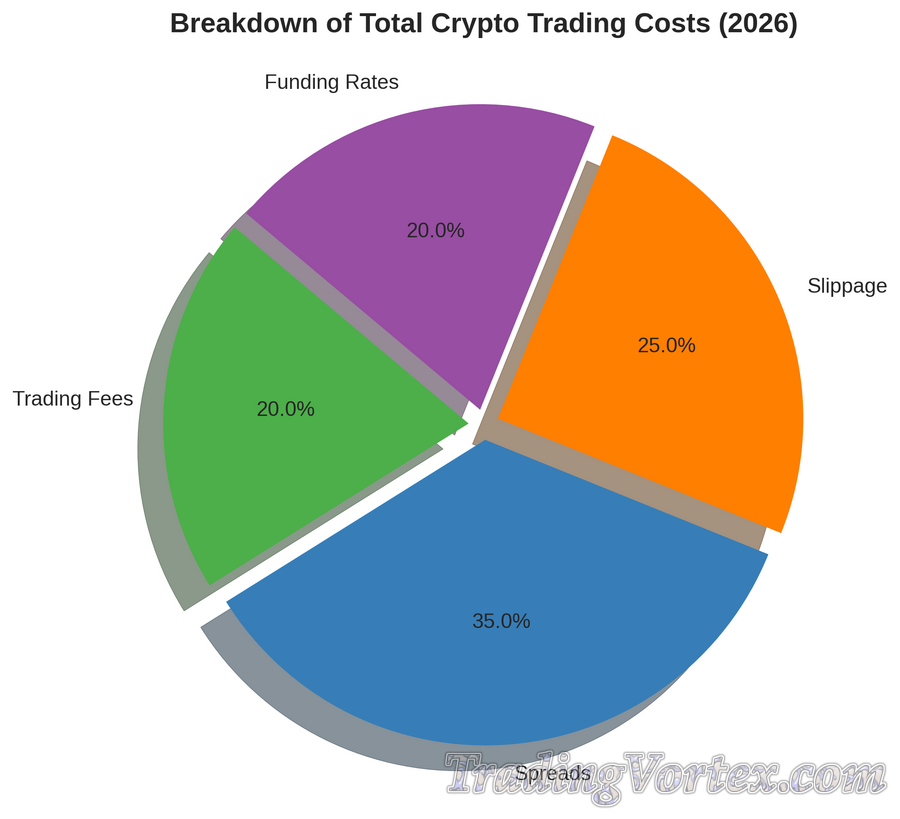 Breakdown of Total Crypto Trading Costs (2026):
🧭 How to Read This Chart (and Why It Matters to You):
♦ Each slice represents a major component of total trading costs.
♦ Spreads and slippage together form the majority of real trading friction, especially during volatile markets.
♦ Trading fees, while important, are often not the biggest leak in your performance.
♦ Funding rates matter most for perpetual futures traders and can quietly erode profits over time.
Understanding this breakdown helps you:
◊ Choose exchanges with tighter spreads
◊ Use smarter order types to reduce slippage
◊ Avoid unnecessary funding payments
◊ Optimize your trading strategy for cost efficiency
Even if you never change your strategy, simply reducing these hidden costs can significantly improve your long‑term profitability.
Understanding the Different Types of Crypto Trading Fees
If you have ever looked at your trading history and wondered why your profits feel lighter than they should, you are not alone. Most traders underestimate how many different fees nibble at their returns. I have had countless conversations with friends who trade every day, and the story is always the same. They think they are losing because of bad timing or market noise, but the real culprit is often the fee structure hiding in plain sight.
In 2026, exchanges have become more transparent about their pricing, and that is great news. Platforms like Phemex, Kraken, Binance, and OKX now publish clearer fee tables and VIP tiers, which helps traders understand exactly what they are paying for. Still, the landscape is full of small charges that add up quickly if you are not paying attention. Let’s break them down in a simple, friendly way so you can keep more of your money where it belongs: in your portfolio.
Maker vs Taker Fees Explained
Maker and taker fees are the bread and butter of crypto trading costs. They show up on almost every centralized exchange, and understanding them can save you a surprising amount of money.
- A maker fee applies when you add liquidity to the order book. For example, placing a limit order that does not fill immediately.
- A taker fee applies when you remove liquidity, usually by placing a market order or a limit order that fills instantly.
Here is the part most beginners miss. Taker fees are almost always higher, and most traders use taker orders without realizing it. I used to do the same. I would rush into a trade with a market order because I did not want to miss the move, then wonder why my profits felt thin. Switching to limit orders saved me more money than any indicator ever did.
Spread Costs and Slippage: The Invisible Fees
Spreads and slippage are the sneaky cousins of maker and taker fees. They do not show up as a line item on your receipt, but they absolutely affect your bottom line.
I like to think of spreads and slippage as the crypto version of airport food pricing. You do not notice it at first, then suddenly you are paying twenty dollars for a sandwich and wondering what happened.
Deposit, Withdrawal, and Conversion Fees
These fees are the ones that catch traders off guard because they happen outside the actual trade. Exchanges charge for deposits and withdrawals, especially when you move funds on chain. Some platforms offer free deposits but charge fixed withdrawal fees that can vary depending on the network.
Conversion fees apply when you switch between currencies, like converting USD to USDT or swapping between stablecoins. These fees can be small, but they add up quickly if you move money around often.
Phemex’s 2026 transparency report highlights how different exchanges handle these costs. Some offer promotions or reduced fees for specific networks, while others adjust fees dynamically based on blockchain congestion. The key is to check the fee schedule before moving funds. I learned this the hard way after paying a surprisingly high withdrawal fee on a network I did not double check.
Hidden Costs: Funding Rates, Network Fees, and Premiums
Now we get into the fees that most traders do not think about until they show up on their statement.
Think of these hidden fees like the service charges at a restaurant. You do not always see them coming, but they are definitely there.
📊 Visual: Breakdown of Crypto Trading Costs (2026)
To help you clearly understand how different fees impact your trading results, this visual shows the relative weight of each major cost category you face when trading crypto in 2026. Most traders only think about maker and taker fees, but as you’ll see, spreads, slippage, and operational fees often take a much larger share of your profits than expected.
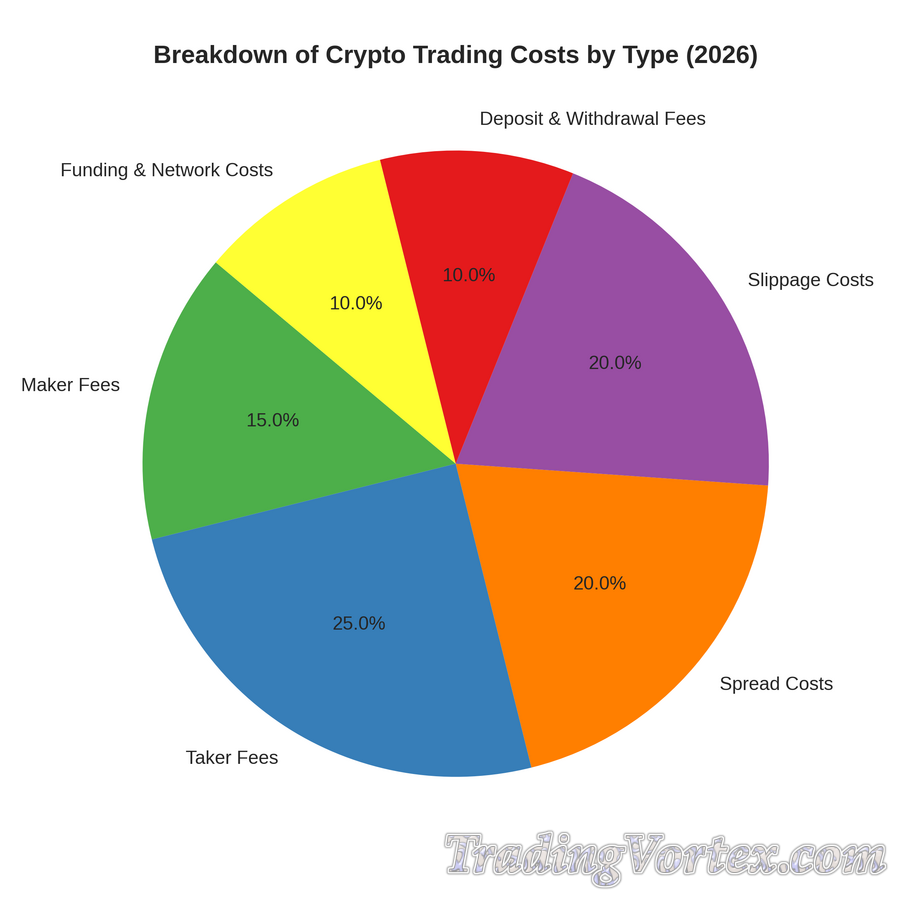 Breakdown of Crypto Trading Costs by Type (2026):
🧭 How to Read This Chart (and Why It Matters to You):
♦ Each slice represents a major type of trading cost you encounter across centralized exchanges.
♦ Taker fees are typically higher than maker fees and affect most beginners because they rely heavily on market orders.
♦ Spread and slippage costs are invisible but extremely real: especially on low‑liquidity tokens or during volatile periods.
♦ Deposit, withdrawal, funding, and network fees happen outside the trade itself, but they accumulate quickly if you move funds often or hold leveraged positions.
Understanding this breakdown helps you:
◊ Choose exchanges with tighter spreads and lower taker fees
◊ Use limit orders more strategically to reduce slippage
◊ Avoid unnecessary funding payments on perpetual futures
◊ Plan deposits and withdrawals to minimize operational costs
Even without changing your strategy, simply reducing these hidden costs can significantly improve your long‑term profitability.
Choosing the Right Low‑Fee Crypto Exchange
Choosing the right exchange is one of the easiest ways to save money in crypto. I have seen traders spend hours tweaking strategies, only to lose more to fees than to bad entries. The truth is, the platform you trade on can either support your growth or quietly drain your profits.
In 2026, the competition between exchanges is intense, and that is great for us. Fees are lower, transparency is better, and many platforms now offer perks like zero maker fees or reduced withdrawal costs.
Still, not all low‑fee exchanges are created equal. Some shine in spot trading, others in futures, and some look cheap on paper but hide their costs in spreads or conversion fees. Let’s break down how to choose the right one without getting lost in marketing claims.
Key Criteria for Selecting a Low‑Fee Platform
When you are comparing exchanges, it helps to think like a detective. Look beyond the shiny homepage and dig into the details that actually affect your wallet.
- 1. Trading fees: Maker and taker fees vary widely. Some platforms offer zero percent maker fees, while others charge up to 0.25 percent or more for taker orders. Lower is always better, especially if you trade often.
- 2. Withdrawal and deposit fees: Withdrawal fees can significantly impact your profitability if you move funds frequently. Some exchanges offer zero withdrawal fees on selected networks, while others charge fixed rates that can add up quickly.
- 3. Spreads and liquidity: A platform with low fees but poor liquidity can still cost you money through slippage. High liquidity pairs like BTC and ETH are usually safe, but smaller tokens can be expensive to trade on low volume exchanges.
- 4. Discounts and VIP tiers: Many exchanges reward high volume traders with lower fees. Others offer discounts when you pay fees using their native token. These perks can make a big difference over time.
- 5. Transparency: The best exchanges publish clear fee tables and avoid hidden charges. According to a 2026 comparison, the top low‑fee platforms were selected specifically because they offered transparent fee charts and real‑time performance data.
Top Low‑Fee Exchanges in 2026
Based on multiple 2026 comparisons: the following exchanges consistently rank among the cheapest and most reliable options.
- MEXC: Often listed as the number one low‑fee exchange in 2026. It offers extremely competitive spot and futures fees, zero maker fees on many pairs, and low withdrawal costs. It is a favorite among active traders.
- Binance: Still one of the most cost‑effective platforms globally. Spot fees start around 0.10 percent, and users get additional discounts when paying fees with BNB. Liquidity is excellent, which helps reduce slippage.
- Kraken: A bit more expensive for beginners, but very reliable and highly regulated. Kraken Pro offers lower fees for higher volume traders and is known for strong security.
- OKX: Popular for futures trading, with low fees and deep liquidity. OKX also offers fee discounts through its OKB token.
- Bybit: A top choice for derivatives traders. It offers competitive fees, strong liquidity, and frequent promotions that reduce trading costs.
Subscription Models and When They Save Money
Subscription models are becoming more common in 2026. They work a bit like a gym membership. You pay a monthly fee, and in return, you get lower trading costs.
Other exchanges offer similar perks through VIP tiers. If you are a high volume trader, these programs can save you hundreds or even thousands of dollars per year.
Regional Considerations: EU MiCA‑Compliant Low‑Fee Exchanges
If you live in Europe or trade through European platforms, MiCA regulations are a big deal in 2026. They require exchanges to meet strict transparency and consumer protection standards. This is great for safety, but it also affects fee structures.
Some exchanges have adjusted their pricing to comply with MiCA, while others have introduced new low‑fee options specifically for EU users. Platforms like Kraken and Binance have strong regulatory footprints in Europe, which makes them popular choices for traders who want both low fees and compliance.
Understanding your exchange’s regulatory environment is essential because compliance costs can influence fees over time.
📊 Visual: Maker vs. Taker Fees on Top Low‑Fee Crypto Exchanges (2026)
To help you choose the right low‑fee exchange in 2026, this visual compares maker and taker fees across the platforms most frequently recommended in industry reports. Since these two fees represent the core cost of every trade you place, understanding how each exchange stacks up can save you a surprising amount of money over time.
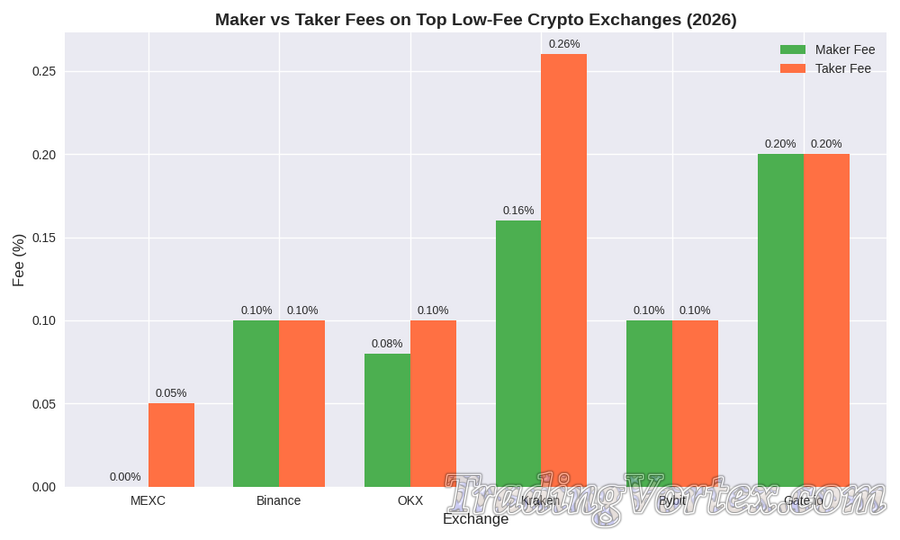 Maker vs. Taker Fees on Top Low‑Fee Crypto Exchanges (2026):
🧭 How to Read This Chart (and Why It Matters to You):
♦ Each exchange has two bars:
◊ Green = Maker fee (adding liquidity with limit orders)
◊ Orange = Taker fee (removing liquidity with market orders)
♦ Lower bars mean lower trading costs.
If you trade frequently, even a difference of 0.05% can compound into hundreds of dollars saved.
♦ MEXC stands out with zero maker fees and extremely low taker fees: ideal for active spot and futures traders.
♦ Binance, OKX, and Bybit offer competitive fees with strong liquidity, which helps reduce slippage.
♦ Kraken is more expensive for beginners, but offers excellent regulation and security: a trade‑off some users prefer.
♦ Gate.io appears low‑fee on paper but charges higher base rates than the top competitors.
This visual helps you quickly identify which exchanges align with your trading style, volume, and cost‑saving goals.
Advanced Strategies to Reduce Trading Fees
If you have ever looked at your PnL and thought, “Wait, where did my profits go?”, you are not alone. Fees are sneaky. They hide in the small print, they stack quietly, and they love to show up at the worst possible moment. I have had friends swear their strategy was broken, only to discover that fees were eating more than their losing trades. The good news is that once you understand how to engineer your trading around fees, you can save a surprising amount of money. Professionals do this all the time, and you can too.
Below are the strategies that actually work in 2026, based on real data and the habits of traders who treat fee reduction like a competitive advantage.
Using Limit Orders to Avoid Taker Fees
According to 2026 fee breakdowns, taker fees can be up to double the maker fee on platforms like Kraken Pro and Binance. Many traders do not realize they are paying taker fees because they use market orders out of habit. I used to do the same. I would rush into a trade, hit “market buy”, and then wonder why my profits felt thin. Switching to limit orders made an immediate difference.
If you are trading fast moving markets, you can still use limit orders by placing them slightly above or below the current price. It is a small trick, but it helps you avoid unnecessary taker fees while still getting filled quickly.
Leveraging VIP Tiers, Volume Discounts, and Token Based Fee Reductions
Most exchanges reward loyalty and volume. If you trade often, you can qualify for VIP tiers that reduce your fees significantly. Some platforms offer discounts of up to 25 percent or more when you pay fees using their native token.
Exchanges like Binance, Bybit, and OKX offer meaningful reductions when you use BNB, KCS, or OKB to pay fees. These discounts stack with VIP tiers, which means active traders can cut their costs dramatically.
If you are a high volume trader, this is one of the easiest ways to save money. Even if you are not trading huge amounts, using the exchange token for fees can still shave off a noticeable percentage over time.
How Professionals Reduce Fees by 40 to 60 Percent
Professionals do not eliminate fees, they engineer around them. Decentralised News explains that in 2026, the traders who consistently outperform are the ones who treat fees as a core part of their strategy. They optimize execution, avoid unnecessary taker orders, and use automation to route trades through the cheapest paths.
Here are some of the tactics they use:
- Batching trades: Instead of making ten small trades, they make one or two larger ones.
- Routing through low fee pairs: Sometimes trading BTC to USDT to ETH is cheaper than trading BTC to ETH directly.
- Using exchanges with zero maker fees: Platforms like MEXC offer 0 percent maker fees on many pairs, which is perfect for limit order strategies.
- Timing entries around funding cycles: Futures traders often wait for negative funding periods so they get paid instead of paying.
- Automating execution: Bots can place limit orders more efficiently than humans, especially in fast markets.
When you combine these habits, it is not hard to see how professionals cut their trading costs by nearly half.
Avoiding High Fee Trading Hours and Volatile Market Conditions
Fees are not static. They move with the market. During high volatility, spreads widen, slippage increases, and taker fees hurt more because your order fills at worse prices. Slippage can sometimes cost more than the actual trading fee during fast markets.
Here are the times when fees tend to spike:
- Major news events: CPI releases, FOMC meetings, ETF approvals, and regulatory announcements.
- Low liquidity hours: Overnight sessions or weekends, depending on the asset.
- Sudden volatility spikes: When Bitcoin makes a big move, altcoins often become more expensive to trade.
If you want to save money, try to trade during calmer periods. You will get tighter spreads, lower slippage, and better execution overall. I always tell friends that trading during chaos is like trying to buy groceries during a storm. Everything is more expensive, and you leave with less than you expected.
📊 Visual: How Advanced Trading Strategies Reduce Total Fees (2026)
To help you clearly understand how much money you can save by applying professional‑grade fee‑reduction techniques, this visual compares the impact of the most effective strategies used by traders in 2026. Each bar represents how much a specific tactic can reduce your overall trading costs; and when you combine several of them, the savings become substantial.
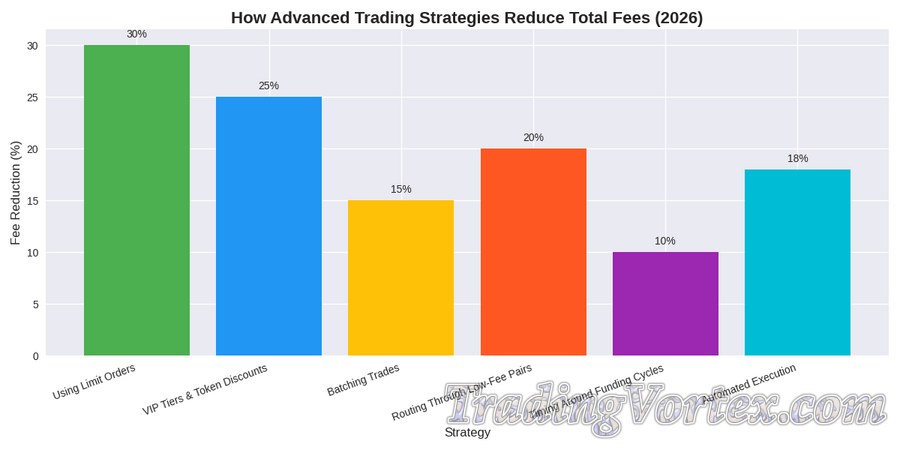 How Advanced Trading Strategies Reduce Total Fees (2026):
🧭 How to Read This Chart (and Why It Matters to You):
♦ Each bar shows the average percentage reduction in total trading fees when applying a specific strategy.
♦ Using limit orders stands out as the most impactful technique, because it helps you avoid taker fees: the most expensive type of fee for active traders.
♦ VIP tiers and token‑based discounts offer strong savings for medium and high‑volume traders.
♦ Routing through low‑fee pairs and automated execution help you optimize your trade path and timing, reducing hidden costs like spreads and slippage.
♦ Batching trades and timing around funding cycles are subtle but powerful ways to reduce operational and futures‑related costs.
By combining even two or three of these strategies, many traders reduce their total fees by 40–60%, which can dramatically improve long‑term profitability.
Minimizing Blockchain Network Fees (Gas Fees)
Gas fees are one of those things every crypto trader complains about, yet most people still pay more than they should. I have had friends message me in pure frustration after paying more to send a token than the token was worth. Thankfully, 2026 is a very different world. Ethereum’s Dencun upgrade, the explosion of Layer 2 networks, and smarter fee‑prediction tools have made gas fees far more manageable. Still, if you do not understand how these fees work, you can easily overspend without realizing it.
Let’s break this down in a simple, friendly way so you can keep more of your money where it belongs.
Why Gas Fees Matter Even on Centralized Exchanges
A lot of traders assume gas fees only matter in DeFi. Not true. Even if you trade exclusively on centralized exchanges, you still pay gas fees whenever you deposit or withdraw crypto. These fees depend on the blockchain, not the exchange.
I always tell people to think of gas fees like delivery charges. Even if you shop at a big store, the cost of getting the item to your house still depends on the delivery service, not the store.
Ethereum Gas Fees in 2026: Post Dencun Upgrades
Ethereum used to be the king of expensive transactions. In 2021 and 2022, sending a simple token could cost more than a nice dinner. But things have changed dramatically.
According to 2026 reports, the Dencun upgrade and EIP‑4844 have significantly reduced Layer 2 data costs, which has lowered overall gas fees across the ecosystem. Transactions that once cost several dollars now often cost cents. The financial barrier that kept many people away from DeFi has finally started to crumble.
The latest 2026 analysis also highlights that while Layer 1 fees are lower, they still exist, and the real savings come from using Layer 2 networks.
Ethereum is still the busiest smart contract network, holding more than 60 percent of DeFi liquidity in 2026, which means gas fees will never disappear entirely. But they are far more predictable and manageable than they used to be.
Layer 2 Solutions: Arbitrum, Optimism, Base, zkSync
Layer 2 networks are the real heroes of low‑fee trading in 2026. They take the heavy lifting off Ethereum’s main chain and process transactions faster and cheaper.
Here is a quick breakdown of the most popular options:
- Arbitrum: Fast, cheap, and widely supported by DeFi platforms. Great for swaps and yield strategies.
- Optimism: Similar benefits to Arbitrum, with strong developer support and growing ecosystem adoption.
- Base: Coinbase’s Layer 2 network, known for extremely low fees and smooth onboarding for beginners.
- zkSync: Uses zero‑knowledge proofs for fast and secure transactions. Often the cheapest option for simple transfers.
Layer 2s have become so efficient that many traders now avoid Ethereum Layer 1 entirely unless they are moving large amounts or interacting with older protocols.
Cross Chain Bridges and Gas Optimization Tools
If you move assets between networks, bridges can save you a lot of money. Some bridges automatically route your transfer through the cheapest path, which helps you avoid unnecessary gas spikes.
Popular gas optimization tools include:
- Gas trackers that show real‑time fees
- Bridges with auto‑routing that choose the cheapest network
- Wallets that recommend the best network for your transfer
I always tell friends to check gas before moving funds. It takes ten seconds and can save you a surprising amount of money.
Scheduling Transactions and Using AI Powered Fee Predictors
Gas fees move with demand. When the network is busy, you pay more. When it is quiet, you pay less.
AI powered fee predictors have become incredibly accurate in 2026. They analyze network activity, historical patterns, and upcoming events to estimate the best time to transact.
Here is what usually works:
- Avoid sending transactions during major announcements
- Use fee prediction tools to find low activity windows
- Batch multiple transfers into one when possible
I often schedule my transactions late at night or early in the morning. It feels like sneaking into the supermarket before the crowds arrive. You get the same product, but you pay less and avoid the chaos.
📊 Visual: Ethereum Gas Fees in 2026: Layer 1 vs. Layer 2 Costs
Gas fees are one of the easiest places to overspend in crypto, especially if you’re still transacting on Ethereum Layer 1 when cheaper alternatives exist.
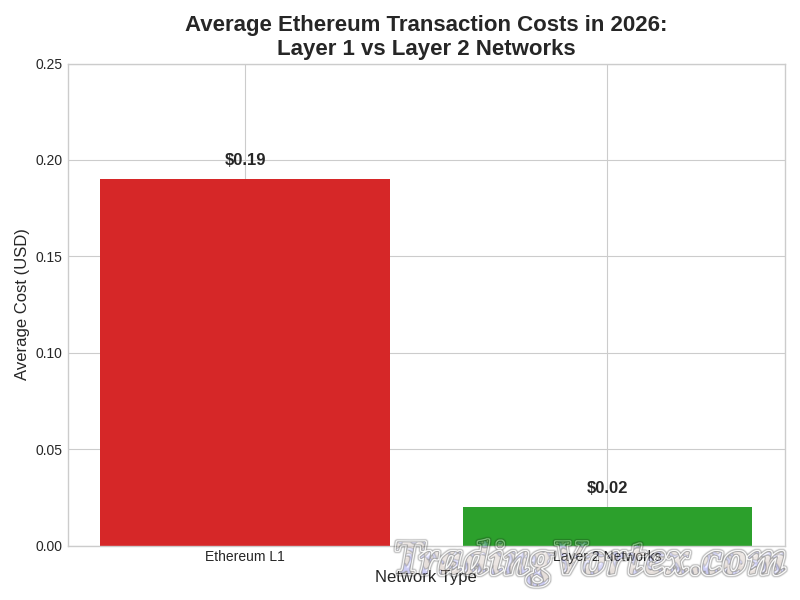 Average Ethereum Transaction Costs in 2026: Layer 1 vs. Layer 2 Networks:
🧭 How to Read This Chart (and Why It Matters to You):
♦ Each bar represents the average cost of a simple transaction in 2026.
♦ Ethereum Layer 1 (L1) still charges noticeably higher fees, even after the Dencun upgrade.
♦ Layer 2 networks (L2s) are dramatically cheaper: often costing just a few cents or even fractions of a cent.
♦ If you regularly bridge, swap, or transfer tokens, switching to L2s can reduce your gas spending by over 80–90%.
♦ This is why most DeFi activity in 2026 has migrated to L2s, and why traders now avoid L1 unless they’re moving large amounts or interacting with legacy protocols.
This chart gives you a quick, intuitive understanding of where the real savings are; and why L2s have become the default choice for cost‑efficient trading.
Trading in DeFi With Minimal Fees
Trading in DeFi can feel like walking into a giant open market. Everything is available, everything is fast, and everything is permissionless. But just like in a real market, if you do not pay attention, you end up paying more than you should. I have watched friends jump into DeFi swaps thinking they were getting a great deal, only to realize later that slippage, liquidity gaps, and protocol fees quietly ate into their profits.
The good news is that DeFi in 2026 is more efficient than ever. Liquidity is deeper, aggregators are smarter, and Layer 2 networks have made gas fees far more manageable. Still, if you want to trade with minimal fees, you need to understand how DeFi pricing works behind the scenes.
Let’s break it down in a simple, friendly way:
AMM vs Order Book DEX Fees
Most DeFi trading happens on AMMs, short for Automated Market Makers. These are the Uniswap‑style pools where prices adjust automatically based on supply and demand. AMMs are simple, fast, and great for beginners, but they come with two main costs: swap fees and slippage.
Order book DEXs, on the other hand, work more like centralized exchanges. They match buyers and sellers directly. According to the latest 2026 comparison, order book DEXs often offer tighter spreads and lower slippage for large trades, but they require deeper liquidity to function well.
Here is the quick version:
AMMs:
- Easy to use
- Predictable swap fees
- Higher slippage on low liquidity tokens
Order book DEXs:
- Better for large trades
- Lower slippage
- Fees vary depending on liquidity and matching engine
If you are trading small amounts, AMMs are usually fine. If you are trading larger amounts, order book DEXs can save you a lot of money.
Choosing Low Fee DEXs and Aggregators
Not all DEXs are created equal. Some charge higher swap fees, some have deeper liquidity, and some offer better routing. In 2026, the best low fee options often come from platforms that combine multiple liquidity sources.
The top DEXs in 2026 include platforms like Best Wallet, which integrates a built‑in aggregator that automatically finds the best swap price across multiple pools.
Aggregators like these are incredibly useful because they:
- Compare prices across multiple DEXs
- Reduce slippage by splitting trades
- Route your swap through the cheapest path
DeFi platforms in 2026 are heavily focused on lowering user costs by improving routing algorithms and expanding liquidity pools.
If you want to save money, always check your swap through an aggregator before confirming the transaction. It takes a few seconds and can save you a surprising amount.
Reducing Slippage in DeFi Swaps
Slippage is one of the biggest hidden costs in DeFi. It happens when the price moves between the moment you submit your transaction and the moment it executes. On volatile tokens, slippage can cost more than the actual swap fee.
Here are some simple ways to reduce slippage:
- Trade during calm market periods
- Use tokens with deep liquidity
- Set a custom slippage tolerance
- Use aggregators that split orders across pools
I always tell friends that slippage is like buying fruit at a busy market. If you shop during rush hour, you pay more and get less. If you shop early in the morning, you get better prices and better fruit.
Understanding Protocol Fees and Liquidity Provider Costs
Every DeFi protocol charges fees to keep the system running. These fees usually go to liquidity providers, token holders, or the protocol treasury. They are not always obvious, but they matter.
Common protocol fees include:
- Swap fees: Usually between 0.05 percent and 0.30 percent
- LP fees: Paid to liquidity providers
- Protocol cuts: A percentage taken by the protocol itself
2026 analysis shows that some DEXs charge higher protocol fees to incentivize liquidity providers, while others keep fees low to attract traders.
If you want to minimize costs, choose DEXs with:
- Low swap fees
- Deep liquidity
- Transparent fee structures
Many of the top DEXs in 2026 now publish real‑time fee dashboards, which makes it easier to compare costs before trading.
📊 Visual: Comparing DeFi Trading Costs Across AMMs and Order‑Book DEXs in 2026
To help you understand how different DeFi trading environments affect your total costs, this visual compares the three biggest fee components you face on every swap: swap fees, slippage, and protocol fees. These costs behave very differently depending on whether you trade on an AMM or an order‑book DEX; and whether your trade is small or large.
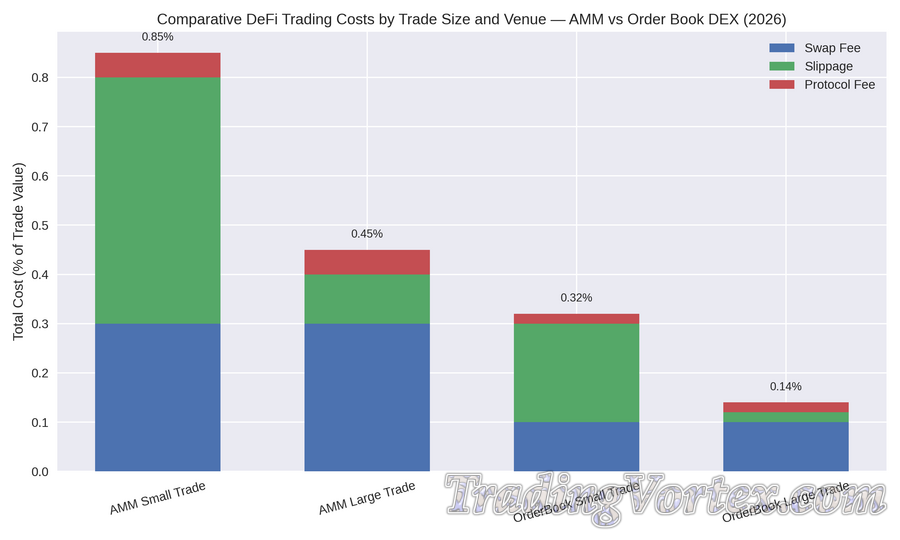 Comparative DeFi Trading Costs by Trade Size and Venue — AMM vs Order‑Book DEX (2026):
🧭 How to Read This Chart (and Why It Matters to You):
♦ Each bar represents a full trade scenario, showing the combined cost of swap fees, slippage, and protocol fees.
♦ AMM Small Trades show the highest slippage: this is why small swaps on low‑liquidity tokens often feel more expensive than expected.
♦ AMM Large Trades reduce slippage but still carry predictable swap fees.
♦ Order‑Book DEX Small Trades benefit from tighter spreads and lower slippage, making them cheaper than AMMs for many tokens.
♦ Order‑Book DEX Large Trades offer the lowest total cost overall, especially when liquidity is deep.
This visual helps you quickly identify when to use AMMs, when to switch to an order‑book DEX, and when an aggregator can save you money by splitting your trade across multiple pools.
How to Avoid Common Fee Traps
Fees are sneaky, and they love to hide in places you do not check. I have seen traders celebrate a winning trade, then stare at their balance and wonder where the profit went. Most of the time the answer is fees: wide spreads, conversion markups, withdrawal surcharges, or clever “zero fee” marketing that hides costs elsewhere. Being fee‑aware is as important as being market‑aware.
High‑Spread Tokens and Low‑Liquidity Pairs
Why it hurts: Wide spreads and shallow order books mean you buy at a much higher price than you sell, effectively paying an invisible fee.
How to avoid: Trade major pairs for execution, split large orders, or use limit orders to add liquidity and capture maker fees. Avoid impulse market orders on low‑cap tokens.
Hidden Conversion Fees in Fiat On‑Ramps
Why it hurts: Advertised trading fees often exclude conversion markups when you buy crypto with fiat, or dynamic FX spreads that inflate costs.
How to avoid: Use stablecoin rails or bank transfers where possible, compare on‑ramp providers, and check whether the exchange charges a separate conversion or FX fee. Small savings per deposit compound quickly.
Withdrawal Fee Pitfalls and How to Avoid Them
Why it hurts: Fixed withdrawal fees, or charging on expensive networks, can exceed the value of small transfers.
How to avoid: Consolidate withdrawals, choose cheaper networks or Layer 2s, and use exchanges that offer fee rebates or free withdrawals on selected rails. Plan transfers to minimize on‑chain moves.
Scams and “Zero‑Fee” Claims to Watch Out For
Why it hurts: “Zero fee” marketing can hide costs in spreads, conversion markups, or poor execution quality.
How to avoid: Verify real execution prices with an aggregator, read independent fee audits, and prefer platforms with transparent, itemized fee schedules. If it sounds too good to be true, check the execution quality.
Quick comparison table:
| Trap | Why it costs you | How to spot | How to avoid | Tools to use |
|---|---|---|---|---|
| High spread tokens | Buy/sell price gap | Large bid/ask spread | Trade major pairs; use limit orders | Price aggregators; order book view |
| Fiat conversion markups | Hidden FX premium | Price vs mid‑market | Use bank rails or stablecoins | On‑ramp comparators |
| Withdrawal fees | Fixed or network cost | Fee table before withdraw | Batch transfers; choose L2s | Gas trackers; exchange fee pages |
| “Zero fee” marketing | Costs hidden in execution | Worse execution price | Check real fill prices | Aggregators; independent audits |
Action checklist: Always check spreads, compare effective prices to mid‑market, review withdrawal networks, and confirm execution quality before you trade. Small habits like using limit orders, batching transfers, and routing through aggregators will protect your gains more reliably than chasing the next hot signal.
📊 Visual: Cost Impact of the Most Common Crypto Fee Traps (2026)
Hidden fees are one of the biggest threats to your long‑term profitability. Even if you pick good trades, these invisible costs quietly drain your returns.
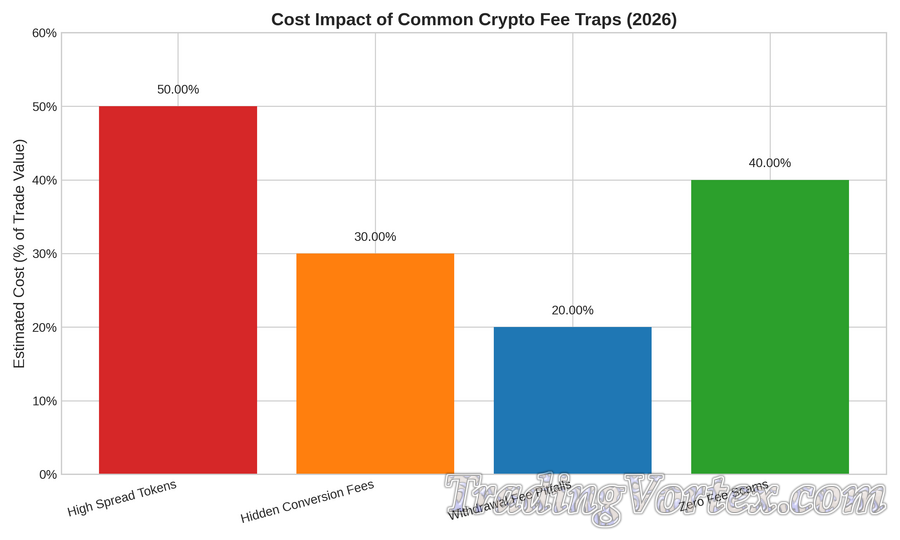 Cost Impact of Common Crypto Fee Traps (2026):
🧭 How to Read This Chart (and Why It Matters to You):
♦ Each bar represents the estimated percentage of your trade value lost to a specific fee trap.
♦ High‑spread tokens are the most expensive trap: wide bid/ask gaps can silently cost you more than any explicit fee.
♦ Zero‑fee marketing often hides costs in execution quality, making it the second‑most expensive trap.
♦ Hidden conversion fees affect anyone using fiat on‑ramps or swapping between currencies.
♦ Withdrawal fee pitfalls matter most for small transfers or when using expensive networks.
Understanding these traps helps you:
◊ Avoid low‑liquidity tokens with wide spreads
◊ Compare fiat on‑ramp prices to the mid‑market rate
◊ Choose cheaper withdrawal networks or batch transfers
◊ Verify execution quality instead of trusting “zero‑fee” claims
♦ These small habits compound into major savings over time.
Tools and Resources for Tracking and Reducing Fees
If you have ever made a trade and then immediately checked your balance with a little fear in your heart, trust me, you are not alone. Fees can feel unpredictable, especially when markets are moving fast. The good news is that 2026 has blessed us with some incredibly powerful tools that make tracking and reducing fees easier than ever. Some of these tools are so good that I sometimes joke they save more money than my actual trading strategy.
Below are the tools I recommend to friends, beginners, and even seasoned traders who want to keep more of their profits instead of donating them to the blockchain:
Fee Comparison Dashboards
Fee dashboards are your first line of defense. They help you compare trading fees, spreads, and liquidity across exchanges or DeFi platforms before you commit to a trade.
What they help you do:
- Compare maker and taker fees across multiple exchanges
- Spot hidden spreads or liquidity gaps
- Identify the cheapest route for swaps or trades
Why they matter: A lot of traders lose money simply because they do not compare execution costs. A quick glance at a dashboard can save you from paying double the fee for the same trade.
Gas Fee Trackers and Predictive Models
Gas fees can be unpredictable, especially on Ethereum. Thankfully, 2026 tools have become incredibly advanced.
- GasFees.org tracks real‑time gas costs across more than 100 blockchains, including Ethereum, Solana, Polygon, and Layer 2 networks like Arbitrum and Optimism. It gives you live data, heatmaps, and even tips for optimizing your transactions.
- Alchemy’s Gas Tools list includes solutions like GasHawk, which can automatically reduce your Ethereum gas costs by up to 95 percent by timing and optimizing your transactions.
- Etherscan’s Gas Tracker remains the gold standard for Ethereum. It shows live gas prices, estimated transaction costs, and even the top gas‑consuming contracts.
Why they matter: Gas fees fluctuate constantly. Using these tools is like checking the weather before going out. You avoid storms, and you avoid paying more than you should.
Portfolio Trackers That Include Fee Analytics
A good portfolio tracker does more than show your balance. The best ones break down:
- How much you paid in trading fees
- How much you spent on gas
- Which platforms cost you the most
- Which strategies are fee efficient
Why they matter: Most traders underestimate how much fees eat into their returns. Seeing the numbers in black and white is a wake‑up call. It also helps you adjust your strategy to reduce unnecessary costs.
Automated Trading Bots Optimized for Low Fee Execution
Bots are not just for high‑frequency traders anymore. Many modern bots are designed specifically to reduce fees by:
- Placing limit orders instead of taker orders
- Routing trades through cheaper liquidity pools
- Timing transactions during low gas periods
- Splitting trades to reduce slippage
Why they matter: Bots remove emotion and impatience, which are two of the biggest reasons traders overpay fees. They wait for the right moment, the right price, and the right network conditions.
📊 Visual: How Effective Today’s Fee‑Reduction Tools Really Are (2026)
If you want to keep more of your profits instead of losing them to hidden or unnecessary fees, the tools you use matter just as much as the strategies you follow.
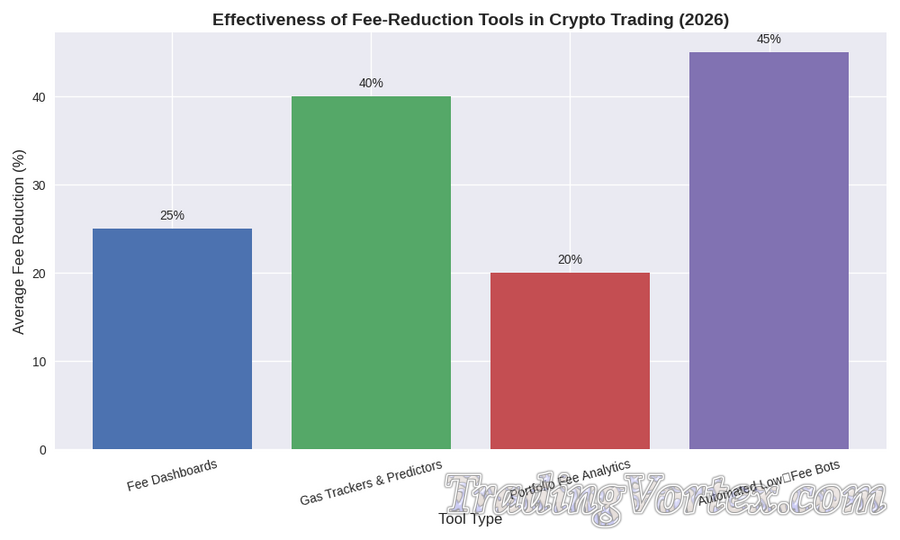 Effectiveness of Fee‑Reduction Tools in Crypto Trading (2026):
🧭 How to Read This Chart (and Why It Matters to You):
♦ Each bar represents the average percentage of fees you can reduce by using a specific type of tool.
♦ Automated low‑fee bots come out on top because they optimize execution, avoid taker orders, and time transactions during low‑gas periods.
♦ Gas trackers and predictive models are a close second: especially useful if you trade on Ethereum or Layer 2 networks.
♦ Fee dashboards help you avoid overpaying on spreads, liquidity gaps, or inflated taker fees.
♦ Portfolio fee analytics give you the “big picture,” helping you identify which platforms or habits cost you the most.
Together, these tools can save you a significant percentage of your trading costs, especially when used consistently.
Case Studies: How Different Traders Minimize Fees
One of my favorite things about crypto is how differently people trade. Some of us stare at charts all day, others check their portfolio once a month, and some live inside DeFi like it is a second home. Yet no matter the style, everyone deals with fees. The difference is that smart traders learn to work around them. I have seen beginners save more money by optimizing fees than by improving their strategy. It is honestly one of the easiest wins in crypto.
Below are real‑world inspired case studies that show how different types of traders keep more of their profits instead of handing them over to exchanges or blockchains.
Day Traders: High Frequency, Low Cost Execution
Day traders live and die by execution costs. When you make dozens of trades per day, even tiny fees add up fast. The pros know this, which is why they obsess over fee structures.
What they do:
- Use exchanges with zero percent maker fees or ultra‑low taker fees
- Place limit orders to avoid taker charges
- Trade on platforms with deep liquidity to reduce slippage
- Use fee‑optimized routing tools or bots
Professional traders in 2026 often reduce their trading costs by 40 to 60 percent by optimizing execution, batching trades, and avoiding unnecessary taker orders.
I know a day trader who jokes that he saves more money by avoiding taker fees than by catching perfect entries. He is not wrong.
Swing Traders: Optimizing Entry and Exit Costs
Swing traders do not trade as often, but their positions are larger. This means spreads, slippage, and withdrawal fees matter more than raw trading fees.
What they do:
- Enter positions during low volatility periods
- Use limit orders to control execution price
- Choose exchanges with transparent fee schedules
- Avoid tokens with wide spreads
Long Term Investors: Minimizing Conversion and Custody Fees
Long term investors do not care about intraday execution, but they care deeply about:
- Conversion fees
- Withdrawal fees
- Custody or staking fees
- Network fees when moving assets
What they do:
- Use exchanges with low or zero withdrawal fees
- Move assets on Layer 2 networks instead of expensive Layer 1 chains
- Convert fiat to stablecoins using low‑fee on‑ramps
- Store assets in wallets with no hidden maintenance costs
Many long term investors choose platforms like MEXC because of their industry‑lowest spot fees and minimal withdrawal costs, which significantly reduces long term friction.
I always tell long term friends: your biggest enemy is not volatility, it is unnecessary fees over time.
DeFi Power Users: Cross Chain and Layer 2 Optimization
DeFi users face a different world. Their biggest costs are:
- Gas fees
- Slippage
- Protocol fees
- Bridge fees
What they do:
- Trade on Layer 2 networks like Arbitrum, Base, or Optimism
- Use DEX aggregators to find the cheapest route
- Bridge assets during low gas periods
- Avoid pools with low liquidity
📊 Visual: How Different Types of Crypto Traders Reduce Their Fees in 2026
Every trader has a different style, but the smartest ones all share one habit: they actively engineer their trading to minimize fees.
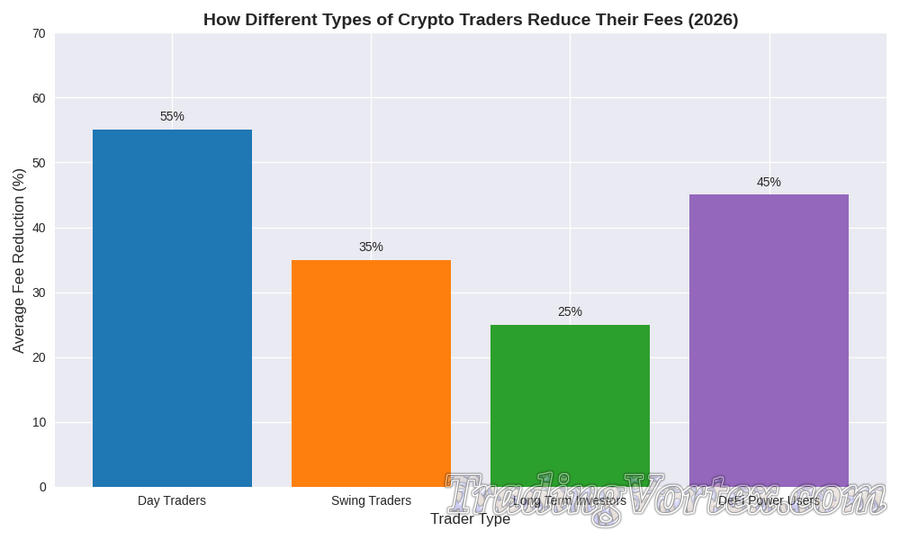 How Different Types of Crypto Traders Reduce Their Fees (2026):
🧭 How to Read This Chart (and Why It Matters to You):
♦ Each bar represents the average percentage of fees a trader can eliminate by using the strategies described in the case studies.
♦ Day traders save the most because they trade frequently: avoiding taker fees and using deep‑liquidity platforms makes a huge difference.
♦ DeFi power users save nearly as much by choosing the right networks, using aggregators, and avoiding high‑gas periods.
♦ Swing traders benefit from timing entries during calm periods and using limit orders.
♦ Long‑term investors save by minimizing conversion, custody, and withdrawal fees: small habits that compound massively over time.
◊ This chart helps you quickly identify where your biggest savings likely are, based on how you trade.
Conclusion: Building a Sustainable Low Fee Crypto Trading Strategy
If there is one thing I hope you take away from this guide, it is that minimizing fees is not about being cheap, it is about being smart. In 2026, the crypto market has matured. The wild west days are gone, and the traders who thrive now are the ones who treat fees like any other part of their strategy. I always tell friends that saving on fees is like tightening the bolts on a bike. You may not notice the difference on day one, but over time, it keeps everything running smoother and faster.
A sustainable low fee strategy is not built on one trick. It is built on habits. The more consistently you apply them, the more money you keep in your pocket instead of giving it away to exchanges or blockchains.
Key Takeaways for 2026
The crypto landscape in 2026 is more competitive, more regulated, and more cost sensitive than ever. Traders who adapt early gain a real advantage.
Here are the big lessons:
- Fees are dynamic, not fixed. They change with market conditions, congestion, and liquidity.
- Timing matters. Even simple actions like sending transactions at night can reduce gas costs significantly on networks like Ethereum.
- The market has matured. You cannot rely on hype driven trading anymore. Professional level execution is now the norm, not the exception.
- Choosing the right exchange is half the battle. Platforms like Phemex, MEXC, Binance, and Bybit offer some of the lowest fees in 2026, especially for active traders.
- Layer 2 networks and low fee blockchains are essential tools for reducing on chain costs.
If you build your habits around these principles, you will naturally trade more efficiently.
How to Future Proof Your Fee Strategy
The crypto world evolves quickly, but the foundations of a low fee strategy stay the same. Here is how to stay ahead:
- Stay informed. Fee structures change, networks upgrade, and new low cost options appear every year.
- Use automation. Bots, gas predictors, and smart routing tools help you avoid emotional decisions and bad timing.
- Diversify your networks. Do not rely on a single chain. Layer 2s, sidechains, and low fee L1s give you flexibility.
- Review your habits regularly. Every few months, check where your fees are coming from. You might be surprised.
- Think long term. A sustainable strategy is not about saving a few cents today, it is about protecting your returns over years.
The traders who succeed in 2026 are the ones who treat efficiency as a skill, not an afterthought.
Final Checklist for Trading Crypto With Minimal Fees
Here is a simple checklist you can keep on your desk, your phone, or taped to your coffee mug:
- Choose exchanges with low maker and taker fees
- Use limit orders whenever possible
- Compare fees before every trade
- Avoid trading during high volatility
- Use Layer 2 networks for transfers
- Check gas trackers before sending transactions
- Use aggregators for DeFi swaps
- Batch withdrawals instead of sending multiple small ones
- Review your portfolio’s fee history monthly
- Stay updated on new low fee platforms and upgrades
If you follow even half of this list consistently, you will save more money than most traders ever realize they are losing.
And honestly, that is the beauty of fee optimization. It is not flashy, it is not dramatic, but it quietly boosts your performance every single day. It is the kind of edge that compounds, and in a market as competitive as 2026, that edge matters more than ever.
FAQs: How to Trade Crypto With Minimal Fees
Q1. What are the main types of crypto trading fees I should watch out for?
Most traders focus only on maker and taker fees, but the real cost of trading includes spreads, slippage, funding rates, withdrawal fees, and hidden conversion markups. Many 2026 fee guides emphasize that traders lose money because they underestimate the full cost structure of a trade.
Q2. Which exchanges offer the lowest fees in 2026?
According to recent comparisons, exchanges like Phemex, Binance, Kraken, Coinbase, and OKX stand out for transparent and competitive fee structures. Phemex is particularly praised for its clear fee tables and VIP visibility, which helps traders understand exactly what they are paying for.
Q3. Are “zero fee” exchanges actually free?
Not always. Some platforms advertise zero trading fees but compensate with wider spreads or higher withdrawal costs. Independent 2026 comparisons show that hidden fees can appear in the form of inflated spreads or conversion markups, even when trading fees look low on paper.
Q4. How can I reduce fees if I trade frequently?
High‑frequency traders save the most by using limit orders, choosing exchanges with zero maker fees, and qualifying for VIP tiers. Many professional traders reduce their total trading costs by 40 to 60 percent simply by optimizing execution and avoiding unnecessary taker orders, according to 2026 fee breakdowns.
Q5. Do gas fees still matter if I trade on centralized exchanges?
Yes. Even if you never touch DeFi, you still pay gas fees when depositing or withdrawing crypto. The exchange does not control blockchain fees, so choosing cheaper networks like Arbitrum or Base can significantly reduce your transfer costs.
Q6. How do I avoid high withdrawal fees?
Check the exchange’s withdrawal fee table before moving funds. Some platforms charge fixed fees that can be expensive for small transfers. Others offer cheaper networks or free withdrawals on selected chains. Consolidating withdrawals and using Layer 2 networks can save a lot over time.
Q7. What is the best way to avoid slippage?
Slippage is reduced by trading during calm market periods, using tokens with deep liquidity, and setting a custom slippage tolerance. Aggregators also help by splitting your trade across multiple pools to get the best price.
Q8. How do I know if a token has high spreads or low liquidity?
Check the bid/ask spread and 24‑hour volume. Tokens with low liquidity often have wide spreads, which act like an invisible fee. Many 2026 exchange comparison tools highlight spreads and liquidity to help traders avoid these traps.
Q9. Are VIP tiers and exchange tokens worth it?
If you trade often, yes. Many exchanges offer significant fee reductions when you pay fees with their native token or reach higher volume tiers. These discounts stack, which can dramatically reduce your long‑term trading costs.
Q10. What tools can help me track and reduce fees?
Use fee dashboards, gas trackers, portfolio analytics tools, and automated bots that optimize execution. These tools help you avoid bad timing, high gas periods, and expensive trading routes. They are especially useful now that the market is more mature and fee‑sensitive than ever in 2026.
Q11. What is the biggest mistake beginners make with fees?
They rush into trades without checking spreads, slippage, or withdrawal costs. Many beginners blame bad entries for losses, but 2026 research shows that fees are often the real culprit behind shrinking portfolios.
Q12. How can long‑term investors minimize fees?
Use low‑fee on‑ramps, avoid frequent conversions, choose exchanges with cheap withdrawals, and store assets on networks with low transaction costs. For long‑term holders, small savings compound significantly over time.
Q13. Are DeFi fees always higher than centralized exchange fees?
Not anymore. With Layer 2 networks and optimized DEX aggregators, DeFi can sometimes be cheaper than centralized exchanges. The key is choosing the right network and trading during low congestion periods.
Q14. What is the simplest habit that saves the most money?
Always check fees before you trade. It sounds obvious, but most traders skip this step. A quick look at spreads, gas prices, and withdrawal costs can save you more money than any indicator or trading signal.