
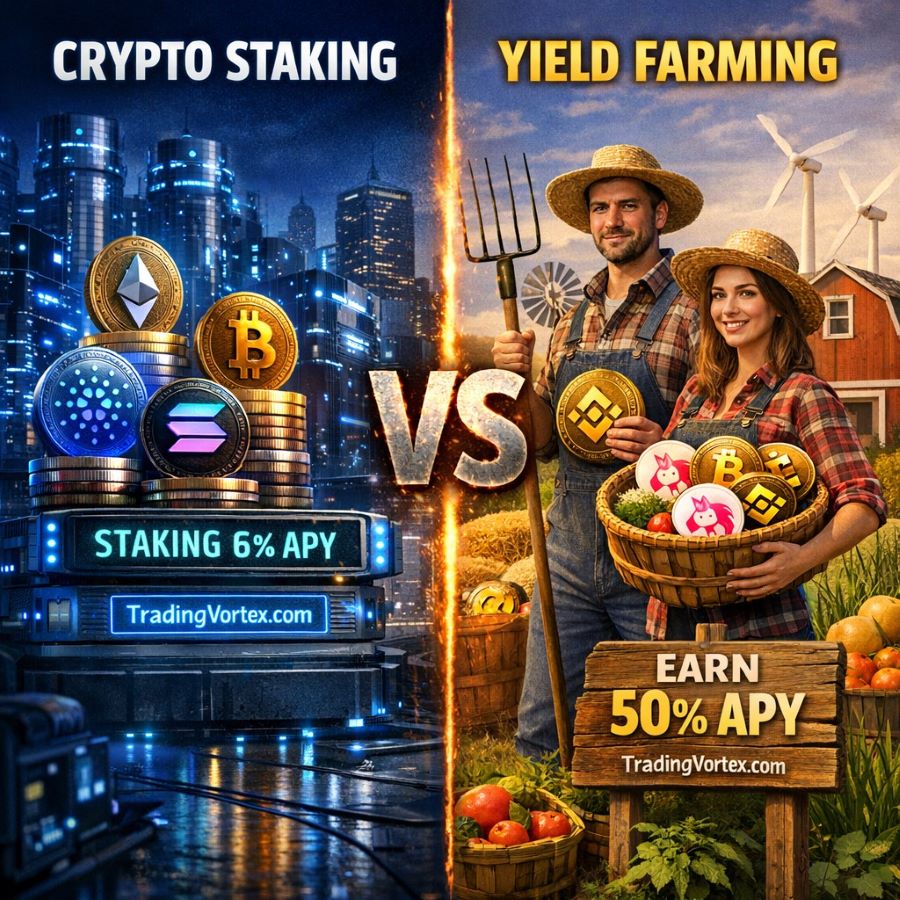
This comprehensive guide explores the ongoing debate of crypto staking vs yield farming, helping investors and traders understand which strategy fits their goals. The article explains how staking works as a low‑maintenance, beginner‑friendly way to earn predictable rewards, while yield farming offers higher APYs through liquidity pools, lending, and DeFi incentives but requires more active management and risk awareness.
Readers will find detailed comparisons of APY benchmarks, risk profiles, and capital requirements, alongside practical insights into liquid staking tokens (LSTs), restaking opportunities, and hybrid strategies that combine staking and farming for maximum efficiency. The piece also highlights market forces shaping DeFi yields, including regulation under MiCA, institutional adoption, Layer‑2 scaling, and tokenized real‑world assets.
Written in a lively, accessible tone, the article balances technical depth with empathy and humor, making complex DeFi concepts easy to grasp. Whether you are a beginner looking for stability, an active DeFi user chasing higher returns, or a long‑term investor seeking sustainable yield, this guide provides actionable insights, case studies, and FAQs to help you make smarter decisions in today’s evolving crypto landscape.
Table of Contents:
- Introduction to Crypto Staking vs Yield Farming
- What Is Crypto Staking? (Definition, APY, Risks)
- What Is Yield Farming in Crypto? (Definition, APY, Risks)
- Crypto Staking vs Yield Farming APY Comparison
- Risk Comparison: Staking vs Yield Farming
- Capital, Time & Knowledge Requirements
- The Rise of Liquid Staking, Restaking & LST DeFi
- Yield Farming Strategies That Work
- Crypto Staking vs Yield Farming: Which Is Better for You?
- Hybrid Strategy: Combining Staking and Yield Farming
- Regulation & Market Forces Shaping DeFi Yields
- Final Verdict: Crypto Staking vs Yield Farming
- FAQs: Crypto Staking vs Yield Farming
- What is the main difference between staking and yield farming?
- Which one is safer?
- Which one pays more?
- Is staking really just a type of yield farming?
- Can beginners start with yield farming?
- What is impermanent loss, and why does it matter?
- Can I lose money while staking?
- Is yield farming still profitable in 2026?
- Can I combine staking and yield farming?
- Which strategy is better for long‑term investors?
- Do I need a lot of money to start yield farming?
- Are staking rewards guaranteed?
Introduction to Crypto Staking vs Yield Farming
If you have been in crypto long enough to survive at least one bull run and one bear market, you already know that the search for passive income is almost a sport in this space. Some people chase it like it is the Olympics of APY, others treat it like a quiet side hustle, and many beginners just want a simple way to earn without staring at charts all day. That is exactly where crypto staking and yield farming come in. They are two of the most popular ways to make your assets work for you, and although they often get mentioned in the same breath, they are very different experiences once you actually try them.
Why Staking and Yield Farming Matter in DeFi
Staking and yield farming became the heartbeat of DeFi because they solved a simple problem: people wanted their crypto to do more than sit in a wallet.
Both methods matter because they give everyday users access to financial opportunities that used to be reserved for institutions. You do not need a bank, a broker, or a suit. You just need a wallet, an internet connection, and a bit of curiosity.
The Evolution of Crypto Passive Income Strategies
Back in the early days of DeFi, people were chasing APYs that looked like lottery numbers. It was fun, chaotic, and honestly a little ridiculous. Many protocols printed tokens like confetti, and everyone pretended it was sustainable.
Spoiler alert: it was not. As the dust settled, the industry matured. Today, staking and yield farming are shifting toward more realistic, sustainable models that focus on real value, better risk management, and smarter capital allocation.
Staking has become more accessible thanks to liquid staking tokens, which let you earn rewards without locking your assets. Yield farming has become safer and more automated thanks to better smart contract audits, improved liquidity models, and user‑friendly platforms that guide beginners instead of throwing them into the deep end.
If you are new, this evolution is great news. If you are experienced, you probably appreciate how far we have come. Either way, staking and yield farming are no longer just hype. They are real tools for building passive income in crypto, each with its own personality, benefits, and risks.
And now that you have the big picture, we can dive deeper into how each one works and which strategy might fit your style as an investor.
📊 APY Comparison: Staking vs Yield Farming (Illustrative Data)
To help you understand the difference between staking and yield farming at a glance, the chart below compares their average APYs across five illustrative time periods. This visual is designed to show you the core dynamic that defines both strategies:
- Staking tends to offer steady, predictable returns with minimal volatility.
- Yield farming often delivers higher potential returns, but with noticeably more fluctuation.
Why This Matters for You: If you prefer consistency and lower risk, staking aligns with that mindset. If you are comfortable with volatility and chasing higher yields, yield farming may fit your style better.
This chart gives you a quick, intuitive way to compare both approaches before diving deeper into the mechanics of each one.
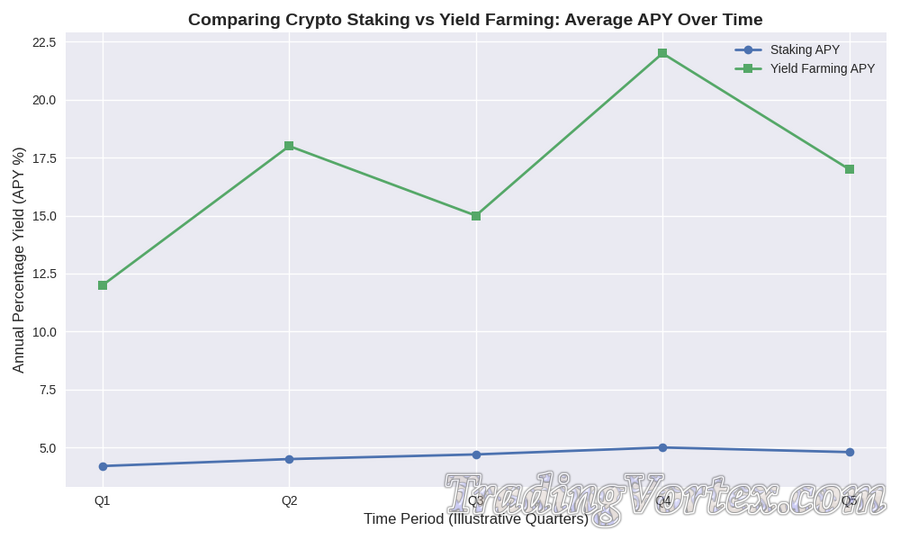 APY Comparison: Staking vs Yield Farming.
How to Read This Chart:
♦ The blue line represents staking APY. Notice how it moves gently, reflecting the stability of staking rewards.
♦ The orange line represents yield farming APY. Its sharper ups and downs highlight the variability and risk that come with liquidity provision and incentive‑driven rewards.
♦ The five periods (Q1–Q5) are illustrative, not historical. They are here to help you visualize the typical behavior of each strategy.
What Is Crypto Staking? (Definition, APY, Risks)
I like to explain staking the same way I explain it to friends who are just getting into crypto. Imagine the blockchain is a big community project. Everyone who stakes is pitching in to keep things running. The network thanks you with rewards, and you get to feel like you are part of something bigger than just holding tokens on an exchange.
How Crypto Staking Works in DeFi
Now, you do not need to run a validator yourself. Most people simply delegate their tokens to a validator. You keep ownership of your crypto, the validator does the heavy lifting, and you earn a share of the rewards. It is like investing in a business without having to manage the day‑to‑day operations.
Types of Crypto Staking
There are several ways to stake, and each one fits a different type of investor. Here is the quick breakdown.
Native Blockchain Staking
This is the purest form of staking. You lock your tokens directly on the blockchain, usually through a wallet like Keplr, Phantom, or MetaMask. You choose a validator, delegate your tokens, and start earning. It is transparent and secure, although sometimes you have to deal with lock‑up periods or unbonding times.
Exchange Staking (CEX Staking)
If you prefer convenience, centralized exchanges like Binance or Coinbase offer staking with a few clicks. It is beginner‑friendly, but you give up some control since the exchange holds your tokens. For many newcomers, though, it is a comfortable starting point.
Liquid Staking Tokens (LSTs) and Restaking
Liquid staking has become the superstar of the staking world. When you stake through platforms like Lido or Rocket Pool, you receive a liquid staking token such as stETH. This token represents your staked position and continues to earn rewards, but you can also trade it, lend it, or use it in DeFi. It is staking without the usual restrictions.
Restaking takes this even further. You use your LSTs to secure additional networks or services, earning extra rewards. It is like stacking yield on top of yield, although it comes with more complexity and more risk.
Crypto Staking APY Benchmarks
Staking rewards vary depending on the blockchain, the number of validators, and the overall network activity. Here are some typical ranges based on current industry data:
- Ethereum (ETH): around 3 to 5 percent APY
- Solana (SOL): around 6 to 8 percent APY
- Cardano (ADA): around 3 to 5 percent APY
- Polkadot (DOT): around 10 to 14 percent APY
- BNB Chain (BNB): around 2 to 4 percent APY
These numbers shift over time, but they give you a realistic idea of what staking usually pays. Staking is not about crazy returns. It is about steady, predictable rewards that compound over time.
Risks of Crypto Staking
Staking is one of the safer passive income strategies in crypto, but it is not risk‑free. Here are the main things to keep in mind.
- Slashing: If a validator behaves badly or goes offline for too long, part of their stake can be destroyed. This is called slashing. When you delegate to a validator, you share a small portion of that risk. Good validators rarely get slashed, but it is something to be aware of.
- Lock‑Ups and Unbonding Periods: Some networks require you to lock your tokens for days or weeks. During that time, you cannot sell or move them. If the market suddenly drops, you are stuck watching from the sidelines. Liquid staking helps solve this, but native staking often comes with these limitations.
- Inflation Dilution: Many Proof of Stake networks issue new tokens as staking rewards. If the inflation rate is high and the token price does not grow, your real return might be lower than it looks. This is why understanding tokenomics is just as important as chasing APY.
- Centralization Risks: If too many people stake through the same validator or platform, the network becomes more centralized. This is a long‑term risk for the ecosystem, and it is something many communities actively try to prevent.
Crypto staking is one of the easiest ways to earn passive income in the digital asset world. It is simple, accessible, and increasingly flexible thanks to liquid staking and restaking. Whether you are a beginner looking for a safe starting point or an experienced investor building a diversified yield strategy, staking gives your crypto a job instead of letting it sit around doing nothing.
📊 Staking APY Benchmarks Across Major Blockchains
To help you quickly understand how staking rewards differ from one blockchain to another, the chart below visualizes the typical APY ranges for some of the most popular Proof of Stake networks. These numbers are based on widely referenced industry averages and give you a realistic sense of what staking usually pays.
Why This Matters for You: This visual helps you compare staking opportunities at a glance so you can choose the network that fits your goals. If you want higher APY, you might lean toward DOT or SOL. If you prefer stability and long‑term reliability, ETH or ADA may feel more comfortable.
Use this chart as a quick reference before diving deeper into the mechanics, risks, and strategies of staking.
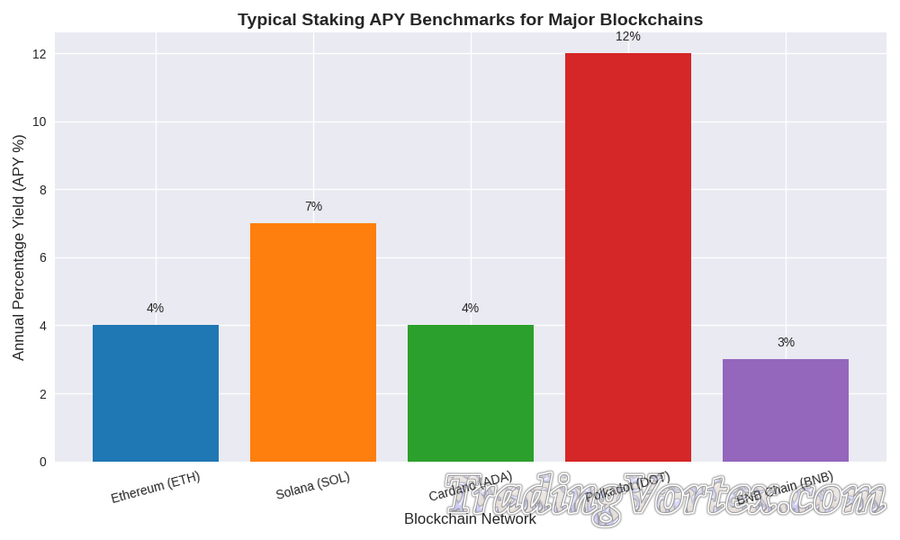 Staking APY Benchmarks Across Major Blockchains.
How to Read This Chart:
♦ Each bar represents the average APY you can expect when staking that specific token.
♦ Networks like Polkadot (DOT) tend to offer higher rewards because they rely heavily on validator participation.
♦ Others like Ethereum (ETH) and Cardano (ADA) offer more modest but stable returns, reflecting their maturity and lower inflation models.
♦ BNB Chain (BNB) sits on the lower end, which is normal for networks with strong token demand and lower issuance.
What Is Yield Farming in Crypto? (Definition, APY, Risks)
When I explain yield farming to friends, I tell them it is like being a liquidity landlord. You lend your assets to the DeFi economy, and in return, you get paid. The catch is that the best opportunities move fast, and the risks can be sneaky. But once you understand how it works, it becomes one of the most flexible and rewarding ways to earn in crypto.
How Yield Farming Works in DeFi
Here is the simple version:
- You deposit tokens into a pool.
- Traders use that pool to swap assets.
- Every trade generates fees.
- You earn a portion of those fees, plus any bonus rewards the protocol offers.
Some platforms even offer auto‑compounding, which reinvests your rewards automatically so your yield grows faster.
Types of Yield Farming Strategies
Yield farming is not a single strategy. It is a whole toolbox of ways to earn yield, each with its own personality.
Liquidity Pool (LP) Farming
This is the classic form of yield farming. You deposit a pair of tokens, such as ETH and USDC, into a liquidity pool. You earn trading fees and sometimes governance tokens. LP farming is the backbone of decentralized exchanges.
Lending Pools
Instead of providing liquidity for trading, you lend your tokens to borrowers. Platforms like Aave or Spark pay you interest for supplying assets like USDC or ETH. It is simpler than LP farming and often comes with lower risk.
Yield Aggregators and Vaults
These platforms, such as Yearn Finance or Beefy Finance, automatically move your funds between different farms to chase the best yields. They save time and gas fees, although they add another layer of smart contract risk.
Yield Farming APY Benchmarks
APYs in yield farming vary wildly depending on the pool, the protocol, and the market environment.
Here are some realistic examples based on current data:
- Stablecoin pools (USDC, USDT, DAI): typically 2 to 10 percent APY, depending on the platform. Aave V3 and Spark often fall in this range.
- ETH/USDC or BTC/ETH pairs: usually 3 to 15 percent APY, depending on trading volume and incentives.
- High‑risk pools: can show triple‑digit APYs, but these are often driven by inflationary reward tokens and come with significant risk.
Some niche pools on Curve or Pendle can spike above 10 to 15 percent, but these require deeper knowledge and careful monitoring.
Yield farming can look incredibly attractive on paper, but the real returns depend on how well you manage the risks.
Risks of Yield Farming
Yield farming is exciting, but it is not for the faint of heart. Here are the major risks you need to understand before diving in.
- Impermanent Loss (IL): This is the big one. Impermanent loss happens when the price of the tokens in your liquidity pool changes relative to each other. If one token pumps while the other stays flat, you may end up with fewer valuable tokens than if you had simply held them. The more volatile the pair, the higher the potential loss.
- Smart Contract Exploits: DeFi runs on smart contracts, and if there is a bug, hackers can drain the pool. Even audited protocols are not immune. Flash loan attacks, coding errors, and admin key misuse are all real risks.
- Rug Pulls: Some projects lure investors with high APYs, then the developers disappear with the liquidity. This is more common in new or unaudited protocols. Always check the team, audits, and community reputation.
- Gas Fees: On networks like Ethereum, gas fees can eat into your profits, especially if you are farming with a small amount of capital. Many farmers move to cheaper chains like BNB Chain or Polygon to avoid this.
- Token Price Volatility: Many farms pay rewards in their native tokens. If the token price drops, your APY can collapse overnight. High APY farms often rely on inflationary tokenomics, which are rarely sustainable.
Yield farming can be incredibly rewarding, but it requires attention, research, and a willingness to adapt. It is perfect for investors who enjoy being hands‑on and want to squeeze every bit of yield out of their assets. If staking is the calm, steady path, yield farming is the adventurous route, full of opportunities and surprises. With the right strategy and risk management, it can become a powerful part of your crypto income toolkit.
📊 Yield Farming APY Benchmarks: Understanding the Real Range of Returns
To help you clearly see how different yield farming strategies compare, the chart below visualizes typical APY benchmarks across four major categories: stablecoin pools, blue‑chip LP pairs, and high‑risk farms. These values are based on realistic industry ranges and are meant to give you a practical sense of what yield farming actually pays.
Why This Matters for You: Yield farming can look incredibly attractive, especially when you see triple‑digit APYs. But this chart helps you understand the risk‑reward balance behind each type of strategy.
- If you want safer, more predictable returns, stablecoin or blue‑chip pairs are usually the better fit.
- If you are comfortable with volatility and higher risk, high‑APY farms might appeal to you; but they require careful monitoring and strong risk management.
Use this visual as a quick reference before choosing which type of yield farming strategy aligns with your goals and risk tolerance.
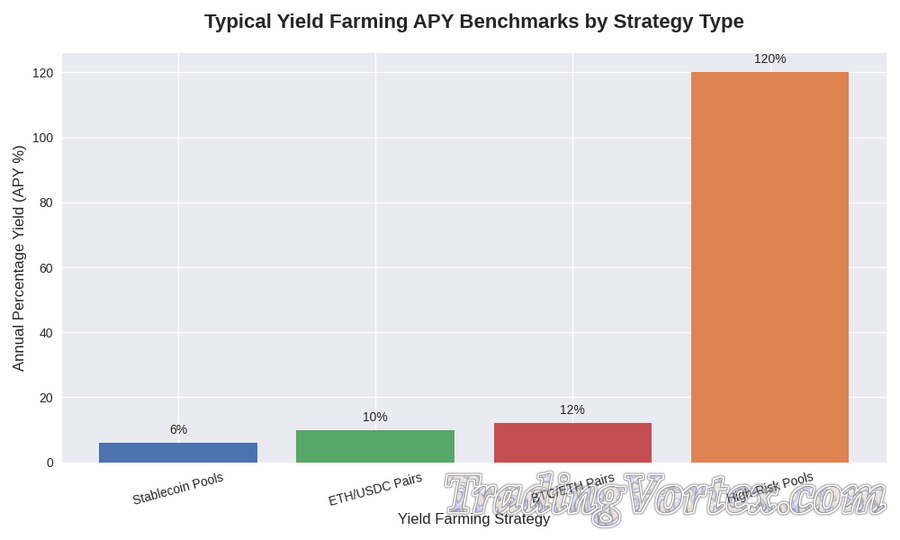 Yield Farming APY Benchmarks: Comparing Stablecoin, Blue‑Chip, and High‑Risk Pools.
How to Read This Chart:
♦ Each bar represents the average APY you might encounter in that category.
♦ Stablecoin pools sit on the lower end because they involve low volatility and lower risk.
♦ ETH/USDC and BTC/ETH pairs offer moderate yields driven by trading volume and incentives.
♦ High‑risk pools show extremely high APYs, but these are often powered by inflationary reward tokens and come with serious risks.
Crypto Staking vs Yield Farming APY Comparison
This section will help you understand how these returns actually work, why they vary so much, and what you should realistically expect when choosing between staking and farming.
Staking APY vs Yield Farming APY
Here is a simple comparison based on the latest data:
Staking APY: usually 3 to 14 percent, depending on the network.
- Ethereum sits around 3 to 4 percent.
- Cardano averages 5 percent.
- Polkadot can reach 10 to 14 percent.
Yield Farming APY: usually 5 to 30 percent, sometimes higher in new or incentivized pools.
- Stablecoin pools can reach 20 to 30 percent on some platforms.
- Blue‑chip pairs like ETH/USDC often fall between 5 and 15 percent.
Yield farming can outperform staking, but it requires more attention, more knowledge, and more tolerance for volatility. Staking is the slow and steady path. Yield farming is the “I want more, but I know the risks” path.
Why Advertised APYs Can Be Misleading
If you have ever seen a farm offering 300 percent APY, you probably felt the same mix of excitement and suspicion that every DeFi user feels. The truth is that advertised APYs often look better than the real returns you end up with. Here is why.
Token Emissions and Inflation
Many yield farms pay rewards in their own tokens. When these tokens flood the market, the price drops, and your real yield shrinks. A farm offering 100 percent APY might only deliver a fraction of that once the reward token loses value.
Staking rewards, on the other hand, are usually tied to network issuance, which tends to be more stable.
IL‑Adjusted Returns
Impermanent loss is the silent killer of yield farming profits. Even if a pool pays 20 percent APY, a strong price move in one of the assets can wipe out your gains. Many beginners do not realize this until they withdraw their liquidity and see fewer tokens than they expected.
Yield farming APYs rarely account for IL, so the number you see is not the number you keep.
Volatility and Volume Fluctuations
Yield farming rewards depend on trading volume. When volume drops, fees drop. When incentives end, APYs collapse. Staking rewards do not fluctuate nearly as much.
Case Study: ETH Staking vs ETH/USDC Yield Farming
Let me share a simple example that I often use when explaining this to friends.
Imagine you have 1 ETH and you want to earn yield.
Option 1: ETH Staking
- You stake your ETH and earn around 3 to 4 percent APY.
- Your rewards are steady, predictable, and unaffected by market volatility.
Option 2: ETH/USDC Yield Farming
- You deposit ETH and USDC into a liquidity pool.
You earn trading fees and possibly incentive tokens.
Your APY might start at 10 to 20 percent, which looks amazing.
But here is what often happens:
- ETH pumps, USDC stays flat.
- The pool rebalances your position.
- You end up with less ETH than you started with.
- The IL wipes out a big chunk of your rewards.
Even if the APY looked higher, the final return can be lower than simple staking. This is why experienced farmers always say: “High APY does not mean high profit.”
Yield farming can absolutely outperform staking, but only when you understand the mechanics and manage the risks. Staking is the safer, more predictable option, perfect for long‑term holders. Yield farming is for investors who enjoy being hands‑on and are comfortable navigating volatility, IL, and shifting incentives.
📊 Crypto Staking vs Yield Farming APY Comparison: Understanding Stability vs Volatility
To help you clearly see how staking returns differ from yield farming returns, the chart below compares illustrative APYs across five periods. This visual highlights the core dynamic between the two strategies: staking is steady and predictable, while yield farming is higher‑yield but more volatile.
Why This Matters for You: This chart gives you a quick, intuitive way to compare the earning potential of staking versus yield farming:
- Choose staking if you want predictable, low‑maintenance returns with minimal volatility.
- Choose yield farming if you want higher potential returns and are comfortable managing risks like IL, token emissions, and shifting incentives.
Understanding this difference helps you decide which strategy fits your risk tolerance and investment style.
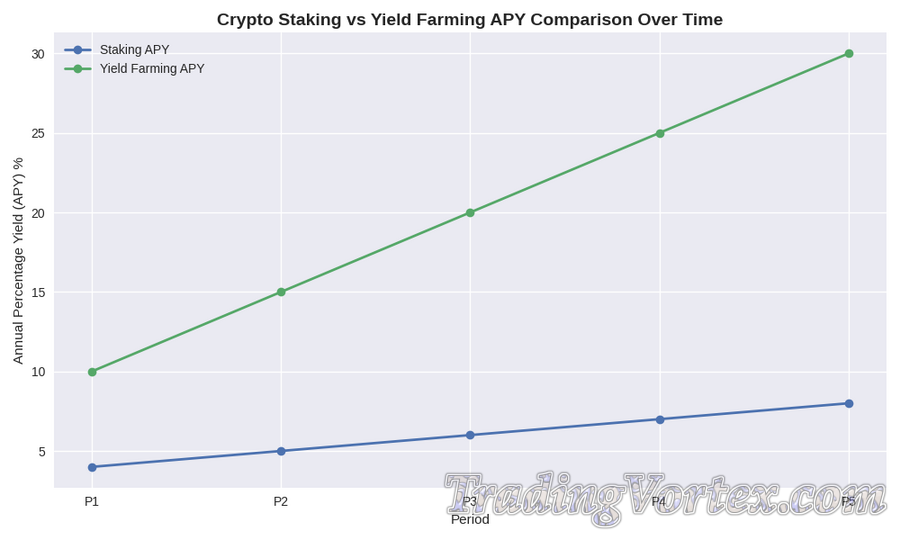 Crypto Staking vs Yield Farming APY Comparison Over Time.
How to Read This Chart:
♦ The blue line represents staking APY. Notice how it rises gradually and consistently, reflecting the stability of staking rewards across major Proof of Stake networks.
♦ The green line represents yield farming APY. Its sharper upward movement shows how incentive‑driven rewards can spike quickly, but also fluctuate more dramatically.
♦ The five periods (P1–P5) are illustrative, designed to help you visualize the typical behavior of each strategy rather than track historical data.
Risk Comparison: Staking vs Yield Farming
If you have ever talked to seasoned crypto investors, you will notice something funny. Everyone loves talking about APYs, but the real veterans always end up talking about risk. That is because in crypto, returns are only half the story. The other half is understanding what could go wrong and how to protect yourself.
Staking and yield farming both offer attractive ways to earn passive income, but they come with very different risk profiles. Some risks are mild and manageable, others can hit you like a surprise plot twist in a bad movie.
This section breaks down the real risks behind each strategy so you can make smarter decisions with your capital.
Risks of Crypto Staking
Staking is often seen as the safer, calmer option, and for the most part, that is true. But it still comes with its own set of risks that every investor should understand.
- Slashing: Slashing happens when a validator misbehaves or goes offline for too long. A portion of the staked tokens can be destroyed as a penalty. If you delegate to a validator, you share a small part of that risk. The good news is that slashing is rare on reputable networks, but it is not impossible.
- Lock‑Ups and Unbonding Periods: Some networks require you to lock your tokens for days or weeks. During that time, you cannot sell or move them. If the market suddenly drops, you are stuck watching from the sidelines. This is one of the biggest frustrations for new stakers who are used to instant liquidity.
- Inflation Dilution: Many Proof of Stake networks issue new tokens as staking rewards. If the inflation rate is high and the token price does not grow, your real return might be lower than it looks. Staking APYs can feel stable, but inflation quietly eats into your gains over time.
- Centralization Risks: If too many users stake through the same validator or platform, the network becomes more centralized. This is a long‑term ecosystem risk, but it is something worth keeping in mind, especially when staking through large exchanges.
Risks of Yield Farming in DeFi
Yield farming is the more exciting, more flexible, and more profitable strategy, but it also comes with significantly higher risk. If staking is a calm river, yield farming is a fast‑moving stream with rocks under the surface.
- Impermanent Loss (IL): Impermanent loss is the most misunderstood risk in DeFi. It happens when the price of the tokens in your liquidity pool changes relative to each other. The more volatile the pair, the bigger the potential loss. Even if a pool pays 20 percent APY, IL can quietly erase your gains. Many beginners do not realize this until they withdraw their liquidity and see fewer valuable tokens than expected.
- Smart Contract Exploits: DeFi runs on smart contracts, and if there is a bug, hackers can drain the pool. Even audited protocols are not immune. Flash loan attacks, coding errors, and admin key misuse are all real risks. Yield farming exposes you to multiple layers of smart contract risk, especially when using aggregators or restaking strategies.
- Rug Pulls: Some projects lure investors with high APYs, then the developers disappear with the liquidity. This is more common in new or unaudited protocols. Always check the team, audits, and community reputation before depositing funds.
- Gas Fees: On networks like Ethereum, gas fees can eat into your profits, especially if you are farming with a small amount of capital. Many farmers move to cheaper chains like BNB Chain or Polygon to avoid this.
- Volatility and Token Price Risk: Many farms pay rewards in their native tokens. If the token price drops, your APY can collapse overnight. High APY farms often rely on inflationary tokenomics, which are rarely sustainable.
Market Conditions That Increase Risk
Some market environments make both staking and yield farming riskier. Here are the main conditions to watch out for.
- Volatility Cycles: High volatility increases the risk of impermanent loss in yield farming and can reduce the value of staking rewards. During sharp market swings, even stablecoin pools can behave unpredictably.
- Liquidity Depth: Shallow liquidity pools are more vulnerable to price manipulation and slippage. Low liquidity also increases IL and reduces fee revenue for farmers. Deep liquidity is usually safer, but it also means lower APYs.
- Gas Congestion: When the network is congested, gas fees spike. This can make yield farming unprofitable, especially for smaller portfolios. High gas fees also discourage rebalancing, which increases risk.
Staking and yield farming both offer powerful ways to earn passive income, but they require different mindsets.
Staking is ideal for investors who want stability, simplicity, and long‑term growth.
Yield farming is perfect for those who enjoy being hands‑on and are comfortable navigating volatility, smart contract risk, and shifting incentives.
Understanding these risks is the first step toward choosing the strategy that fits your goals and your personality as an investor.
📊 Risk Comparison: Staking vs Yield Farming Across Key Risk Factors
To help you clearly understand how the risks of staking differ from the risks of yield farming, the chart below compares both strategies across nine major risk categories. This visual gives you a quick, intuitive way to see where each method is safer, where it is riskier, and why experienced investors treat them very differently.
Why This Matters for You: This chart helps you quickly identify which strategy aligns with your risk tolerance:
- Choose staking if you want stability, simplicity, and predictable returns.
- Choose yield farming if you are comfortable with higher risk, more volatility, and the need for active management.
Understanding these differences is essential before deciding where to allocate your capital.
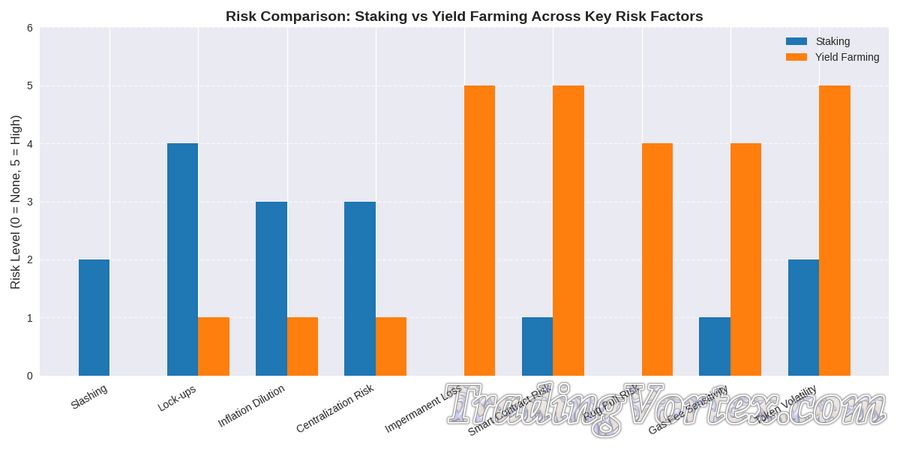 Risk Comparison — Staking vs Yield Farming Across Key Risk Factors.
How to Read This Chart:
♦ Each pair of bars represents a specific risk factor, such as slashing, impermanent loss, or smart contract exploits.
♦ Blue bars show the relative risk level for staking.
♦ Orange bars show the relative risk level for yield farming.
♦ The scale runs from 0 (no risk) to 5 (high risk), making it easy to compare both strategies side by side.
What This Visual Tells You:
♦ Staking carries low to moderate risk, mainly around lock‑ups, inflation dilution, and validator behavior.
♦ Yield farming carries significantly higher risk, especially in areas like impermanent loss, smart contract exploits, rug pulls, and token volatility.
♦ Some risks: like gas fees and liquidity depth; affect both strategies but tend to hit yield farmers harder.
Capital, Time & Knowledge Requirements
One thing I always tell friends who ask me whether they should stake or farm is this: both strategies can make you money, but they do not ask the same things from you. Some people want a quiet, low‑maintenance way to earn. Others enjoy the thrill of chasing yields and tweaking strategies like they are tuning a race car. Your choice depends on how much capital, time, and knowledge you are willing to commit.
Let’s break it down in a way that feels real and practical, not theoretical.
Staking: Low Maintenance, Beginner‑Friendly
Staking is the crypto equivalent of planting a fruit tree. You put something in the ground, you water it occasionally, and it quietly grows in the background. It does not demand much from you, and it rewards patience.
Here is what staking typically requires:
- Low time commitment: Once you stake, you mostly leave it alone. You check in occasionally, but it is not a daily task.
- Minimal knowledge: You need to understand how delegation works, how to choose a validator, and what lock‑ups mean. After that, it is smooth sailing.
- Small to moderate capital: You can stake with almost any amount. Some networks require minimums for running a validator, but delegation is accessible to everyone.
- Low emotional stress: Your APY is steady, your risks are predictable, and you do not need to chase opportunities.
Staking is perfect for people who want passive income without turning crypto into a part‑time job. It is also ideal for long‑term holders who believe in a project and want their tokens to do something useful instead of sitting idle.
Yield Farming: Active Management, Advanced Knowledge
Yield farming is a different beast. It is exciting, flexible, and potentially more profitable, but it demands more from you. If staking is a fruit tree, yield farming is a garden that needs regular attention. You can grow amazing things, but you cannot ignore it.
Here is what yield farming usually requires:
- More capital: Many pools work best when you have enough liquidity to justify gas fees and rebalancing costs.
- More time: You need to monitor your positions, track APYs, and react to market changes. Some farmers check their pools daily.
- More knowledge: You must understand concepts like impermanent loss, liquidity depth, token emissions, and smart contract risk.
- More decision‑making: You choose pools, evaluate incentives, and sometimes move funds between protocols to chase better yields.
Let’s look at the three big responsibilities farmers deal with:
- Monitoring Impermanent Loss: Impermanent loss is the silent tax of yield farming. You need to keep an eye on price movements, especially in volatile pairs. Even experienced farmers get caught off guard sometimes.
- Rebalancing LP Ranges: Some platforms let you set custom price ranges for your liquidity. This can boost your returns, but it also means you must adjust your ranges when the market moves. It is like adjusting the sails on a boat.
- Tracking Incentives and Fees: APYs change constantly. Incentives end, new ones start, and trading volume fluctuates. Successful farmers stay alert and adapt quickly.
Yield farming is perfect for people who enjoy being hands‑on, who like experimenting with strategies, and who are comfortable with a bit of risk in exchange for higher potential rewards.
Staking and yield farming both offer powerful ways to earn passive income, but they fit different personalities.
Staking is calm, predictable, and beginner‑friendly.
Yield farming is dynamic, rewarding, and best suited for people who enjoy learning, optimizing, and staying active in the DeFi world.
Understanding what each strategy demands from you is the key to choosing the one that matches your goals, your lifestyle, and your appetite for risk.
📊 Capital, Time, and Knowledge Requirements: Staking vs Yield Farming Comparison
To help you understand what each strategy truly demands from you, the chart below compares staking and yield farming across three essential dimensions: capital, time, and knowledge. These are the practical, real‑world requirements that determine whether a strategy fits your lifestyle and your level of experience.
Why This Matters: This comparison helps you choose the strategy that fits your personality and your available resources:
- Choose staking if you want a calm, predictable, low‑effort way to earn.
- Choose yield farming if you enjoy optimizing strategies, staying active in DeFi, and managing more complex risks.
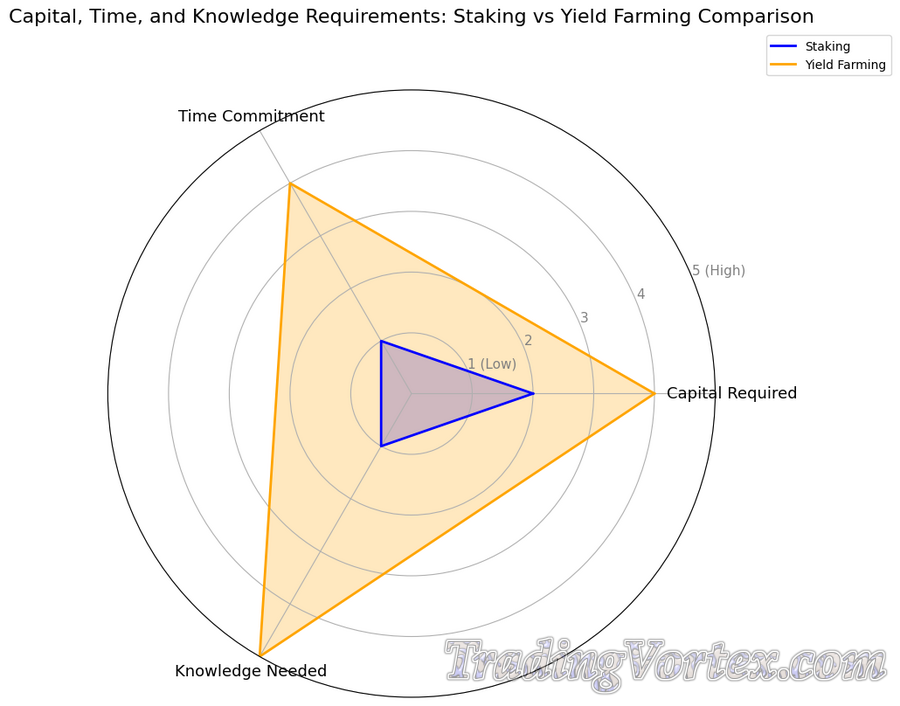 Capital, Time, and Knowledge Requirements — Staking vs Yield Farming.
How to Read This Chart:
♦ The radar chart has three axes:
Capital Required, Time Commitment, and Knowledge Needed.
♦ Blue shading represents staking, which scores low across all categories.
♦ Orange shading represents yield farming, which requires significantly more involvement.
♦ Values range from 1 (low requirement) to 5 (high requirement).
What This Visual Shows You:
♦ Staking is low‑maintenance and beginner‑friendly. It requires minimal knowledge, very little time, and only modest capital.
♦ Yield farming demands more: deeper DeFi knowledge, active monitoring, and enough capital to justify gas fees and rebalancing.
♦ The difference in shape between the two areas visually explains why staking feels passive while yield farming feels hands‑on.
The Rise of Liquid Staking, Restaking & LST DeFi
If you have been in crypto long enough, you probably remember when staking meant locking your tokens away and hoping the market did not moon while you were stuck in an unbonding period. It felt a bit like putting your money in a safe, then realizing you lost the key for two weeks.
Liquid staking changed that completely. Suddenly, you could stake your assets, earn rewards, and still use your tokens across DeFi. It was the moment staking finally became flexible, efficient, and honestly, a lot more fun.
Today, liquid staking and restaking are not just trends. They are shaping the future of how capital moves in DeFi, how networks secure themselves, and how investors earn yield with far more freedom than before.
Why Liquid Staking Dominates DeFi TVL
According to recent research, LSTs have become the leading staking method because they offer:
- Continuous staking rewards
- Full liquidity through derivative tokens
- Integration across DeFi protocols
- Lower opportunity cost for long‑term holders
This is why liquid staking consistently ranks among the top categories in DeFi total value locked. It is efficient, flexible, and accessible to beginners and professionals alike.
Restaking & EigenLayer: New Yield Opportunities
If liquid staking unlocked liquidity, restaking unlocked a whole new layer of yield. Restaking allows users to take their staked assets or LSTs and use them to secure additional networks, services, or middleware. In return, they earn extra rewards.
Recent research highlights that restaking:
- Builds on liquid staking, not replaces it
- Allows LSTs or even native tokens to secure multiple systems
- Creates Liquid Restaking Tokens (LRTs) that unlock even more liquidity
- Introduces new economic and security models across DeFi
EigenLayer is the most well‑known restaking ecosystem. It lets users reuse their staked ETH to secure new protocols, which creates a second layer of yield on top of traditional staking rewards. It is like staking your ETH, then staking your staked ETH again, without giving up control.
This innovation has opened the door to:
- Higher yield stacking opportunities
- New markets for decentralized security
- More efficient capital allocation across DeFi
Restaking is still evolving, and it comes with new risks, but it is one of the most exciting developments in the staking world.
Institutional Adoption of Crypto Staking
Institutions used to avoid staking because of operational complexity and liquidity constraints. Liquid staking changed that. Now, institutions can:
- Earn predictable staking rewards
- Maintain liquidity through LSTs
- Use LSTs as collateral or portfolio tools
- Participate in DeFi without sacrificing compliance
As a result, institutional staking has grown significantly. Many firms now run validators, stake large amounts of ETH, and use LSTs to optimize their portfolios. The combination of yield, liquidity, and risk management makes staking far more attractive than it was a few years ago.
Restaking is also catching institutional attention because it offers modular security, a concept that allows new networks to borrow security from Ethereum. This reduces bootstrapping costs and creates new revenue streams for stakers.
Liquid staking and restaking are not just upgrades to staking. They are transforming how capital flows through DeFi, how networks secure themselves, and how investors earn yield. LSTs and LRTs give users the freedom to earn, trade, and build strategies that were impossible in the early days of staking.
Whether you are a beginner or a seasoned investor, these innovations open the door to smarter, more flexible, and more efficient ways to grow your crypto.
📊 The Rise of Liquid Staking and Restaking: TVL Comparison in Modern DeFi
To help you clearly understand why liquid staking and restaking have become dominant forces in DeFi, the chart below compares the Total Value Locked (TVL) across three major categories: traditional staking, liquid staking (LSTs), and restaking (LRTs). This visual gives you a quick, intuitive snapshot of how capital is shifting toward more flexible and composable staking models.
Why This Matters for You: This chart helps you understand where the market is moving and why:
- If you want liquidity + staking rewards, LSTs are the new standard.
- If you want stacked yields + advanced strategies, restaking is the frontier.
- If you prefer simplicity and stability, traditional staking still works; but it is no longer the most flexible choice.
Understanding these shifts helps you position yourself for the future of staking and DeFi yield generation.
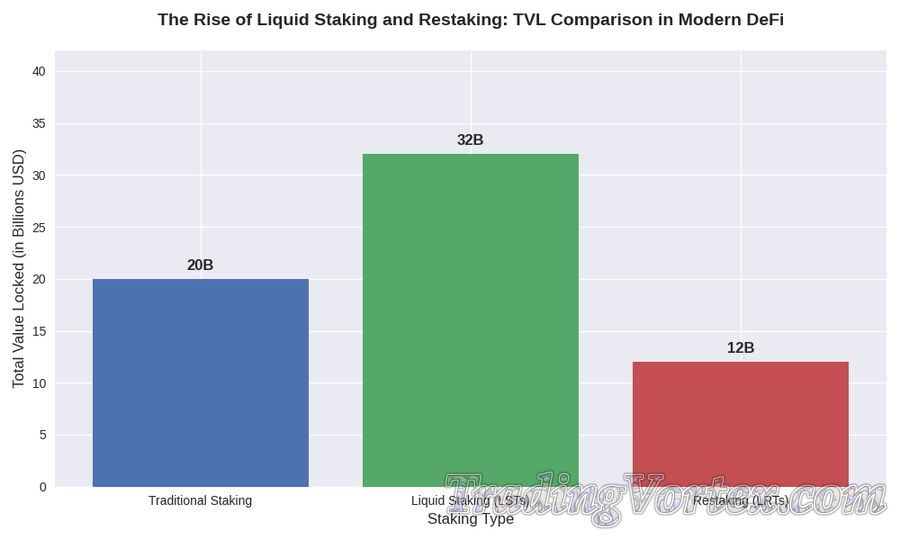 The Rise of Liquid Staking and Restaking — TVL Comparison in Modern DeFi.
How to Read This Chart:
♦ Each bar represents the estimated TVL (in billions of USD) for a specific staking category.
♦ Traditional staking shows strong adoption but is limited by lock‑ups and illiquidity.
♦ Liquid staking (LSTs) leads the chart, reflecting its massive growth and deep integration across DeFi.
♦ Restaking (LRTs) is smaller today but rapidly expanding as new protocols adopt modular security and yield stacking.
What This Visual Shows You:
♦ Liquid staking has become the largest staking category in DeFi, thanks to its flexibility and ability to unlock liquidity.
♦ Restaking is emerging as the next major wave, enabling users to reuse staked assets to secure additional networks and earn layered rewards.
♦ Traditional staking remains important but is no longer the most capital‑efficient option for many investors.
Yield Farming Strategies That Work
Yield farming can feel like a treasure hunt. Some days you find gold, other days you find a trap disguised as a shiny APY. The truth is that yield farming is not about chasing the highest number on the screen. It is about choosing strategies that actually work, that fit your risk tolerance, and that do not require you to check your wallet every ten minutes.
Below are the strategies that consistently deliver results for real farmers, whether you are a beginner or a seasoned DeFi explorer.
Stablecoin Yield Farming Pools
According to recent research, stablecoin farming typically earns 3 to 25 percent APY, depending on the platform and the type of pool you choose.
Here is why stablecoin farming works so well:
- Low volatility: You avoid the price risk that comes with crypto pairs.
- Lower impermanent loss: Since both assets stay near one dollar, IL is minimal.
- Consistent demand: Stablecoins are used everywhere in DeFi, so liquidity is always needed.
Platforms like Aave, Compound, and cross‑chain aggregators offer some of the most reliable stablecoin yields.
Many farmers use stablecoin pools as the foundation of their portfolio, then add riskier strategies on top.
Blue‑Chip LPs (ETH/USDC, BTC/ETH)
Blue‑chip LPs often earn 5 to 15 percent APY, depending on trading volume and incentives.
They work well because:
- High liquidity: These pools attract a lot of traders, which means more fees for you.
- Lower IL than volatile pairs: ETH and BTC tend to move more predictably than small‑cap tokens.
- Strong long‑term fundamentals: Even if prices move, you are holding assets with real market strength.
This strategy is ideal for investors who want solid returns without diving into high‑risk territory.
Yield Aggregators & Automated Vaults
Yield aggregation is one of the most popular strategies because it saves time, reduces gas fees, and optimizes returns across multiple protocols.
Here is why aggregators work:
- Auto‑compounding: Your rewards are reinvested automatically.
- Diversification: Vaults often spread your assets across multiple farms.
- Hands‑off farming: You earn without micromanaging your positions.
This strategy is perfect for people who want higher yields without spending hours researching pools.
High‑Risk Yield Farming: Pros and Cons
Here is the honest breakdown:
Pros:
- Huge APY potential: You can earn massive returns if you enter early and exit smartly.
- New opportunities: Early farmers often get bonus tokens or airdrops.
Cons:
- High impermanent loss: Volatile pairs can wipe out your gains.
- Smart contract risk: New protocols are more likely to have bugs or vulnerabilities.
- Rug pulls: Some projects disappear with the liquidity.
High‑risk farming is not for beginners. It is for investors who understand the risks, move quickly, and never deposit more than they can afford to lose.
Yield farming is not about chasing the highest APY. It is about choosing strategies that match your goals, your risk tolerance, and your lifestyle. Stablecoin pools offer steady returns, blue‑chip LPs provide balance, aggregators simplify the process, and high‑risk farms offer big rewards for those who know what they are doing.
With the right mix, you can build a yield farming strategy that works for you, not against you.
📊 APY Comparison by Yield Farming Strategy
To help you quickly compare the earning potential of different yield farming strategies, the chart below visualizes the typical APY midpoints for four major categories. This gives you a realistic, easy‑to‑understand snapshot of how each strategy performs without relying on hype or misleading extremes.
Why This Matters for You: This chart helps you choose the strategy that fits your goals and your comfort level:
- Choose stablecoin pools for predictable, low‑stress returns.
- Choose blue‑chip LPs for balanced yield with manageable risk.
- Choose yield aggregators if you want higher returns without micromanaging.
- Choose high‑risk farms only if you fully understand IL, token emissions, and smart contract vulnerabilities.
With this visual, you can instantly see how each strategy compares and decide which ones belong in your portfolio.
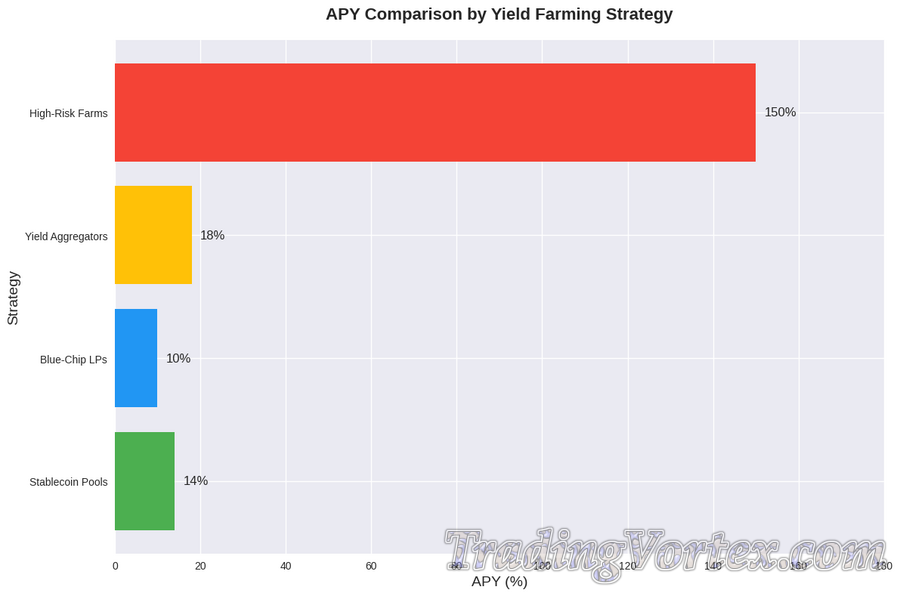 Yield Farming Strategies That Work — APY Comparison.
How to Read This Chart:
♦ Each horizontal bar represents the average APY midpoint for a specific strategy.
♦ Stablecoin pools offer steady, low‑volatility returns.
♦ Blue‑chip LPs provide balanced yields with moderate risk.
♦ Yield aggregators optimize returns through automation and compounding.
♦ High‑risk farms show extremely high APYs, but these come with significant volatility and smart contract risk.
What This Visual Shows You:
♦ Stablecoin pools and blue‑chip LPs sit in the low to mid‑yield range, making them ideal for beginners or conservative farmers.
♦ Yield aggregators deliver higher optimized returns without requiring constant manual management.
♦ High‑risk farms dominate the chart with triple‑digit APYs, but these opportunities require deep knowledge, fast decision‑making, and strong risk management.
Crypto Staking vs Yield Farming: Which Is Better for You?
If you have ever asked yourself whether staking or yield farming is the better choice, you are not alone. Every crypto investor eventually reaches this crossroads. Some people want something simple and predictable, others want something dynamic and rewarding, and a few enjoy the thrill of squeezing every drop of yield out of their assets. The truth is that there is no universal winner. The best strategy depends entirely on your personality, your goals, and how much time you want to spend managing your portfolio.
Let’s break it down in a way that feels real, practical, and easy to relate to.
Best Strategy for Beginners
If you are new to DeFi, staking is usually the best place to start. It is simple, stable, and does not require constant monitoring. According to Binance, staking is ideal for beginners because it offers consistency, time efficiency, and low complexity, which makes it perfect for passive investors who do not want to check charts every hour.
Staking lets you earn rewards without worrying about impermanent loss, token emissions, or sudden APY drops. You stake your tokens, you earn yield, and you sleep peacefully at night. It is the crypto equivalent of dipping your toes into the water before diving in.
Best Strategy for Active DeFi Users
If you enjoy exploring new protocols, comparing APYs, and optimizing your positions, yield farming is your playground. Gate Learn highlights that yield farming offers higher profit potential, but it requires more active management and a deeper understanding of DeFi mechanics.
Active users often love yield farming because:
- APYs can be significantly higher
- There are always new opportunities
- You can combine strategies for better returns
It is perfect for people who enjoy being hands‑on and do not mind spending time researching pools, tracking incentives, and adjusting their positions.
Best Strategy for Long‑Term Investors
If your goal is long‑term growth with minimal stress, staking is usually the better fit. Gate Learn notes that staking is more stable and suitable for long‑term investment, especially for investors who prefer predictable returns and lower risk.
Long‑term investors often choose staking because:
- Rewards are steady and predictable
- There is no need for constant rebalancing
- It aligns well with holding strong assets like ETH, ADA, or DOT
Staking is the “slow and steady wins the race” strategy.
Best Strategy for High‑Risk Traders
If you are comfortable with volatility and enjoy chasing high returns, yield farming is where you will find the most excitement. Binance emphasizes that yield farming can offer higher rewards, but it comes with higher complexity and higher risk, which makes it more suitable for experienced or risk‑tolerant traders.
High‑risk traders often choose yield farming because:
- Some pools offer extremely high APYs
- Incentive programs can boost returns
- Early participation in new protocols can be very profitable
Of course, this comes with risks like impermanent loss, smart contract vulnerabilities, and token price crashes. But for traders who understand these risks, yield farming can be incredibly rewarding.
Choosing between staking and yield farming is not about finding the “best” strategy. It is about finding the strategy that fits you. Staking is calm, predictable, and beginner‑friendly. Yield farming is dynamic, flexible, and potentially more profitable. The right choice depends on your goals, your experience, and how much time you want to spend managing your crypto.
📊 Staking vs Yield Farming: Best Fit by Investor Type
Choosing between staking and yield farming is not about which strategy is “better” in general: it’s about which one is better for you.
The chart below compares how well each strategy fits four common investor profiles using a simple 1–5 scoring system. This helps you instantly see which approach aligns with your experience level, risk tolerance, and preferred level of involvement.
Why This Matters for You: This visual helps you quickly identify which strategy matches your personality and goals:
- Choose staking if you want calm, predictable, passive income.
- Choose yield farming if you enjoy being hands‑on and are comfortable with higher risk.
- Many investors use both, adjusting the mix based on their time, experience, and appetite for volatility.
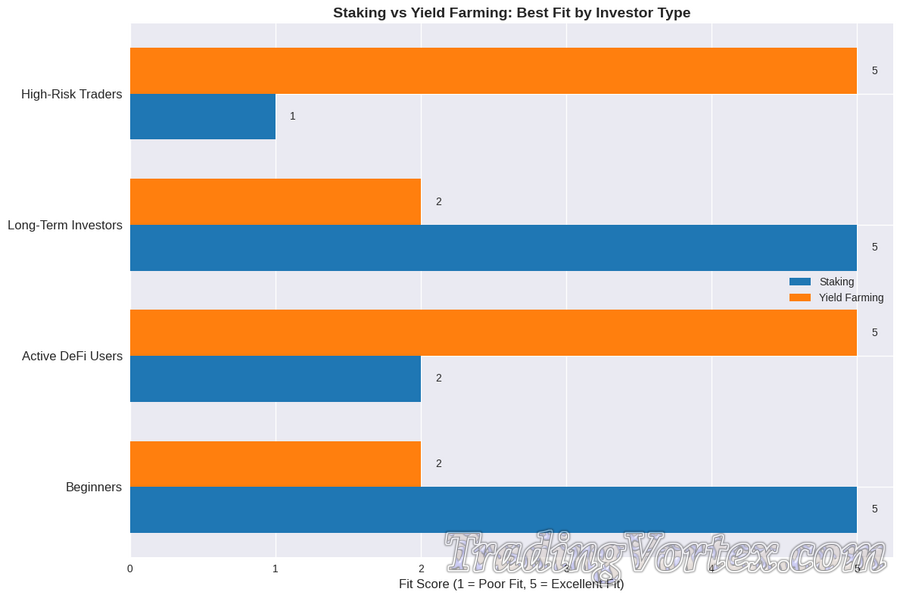 Staking vs Yield Farming — Best Fit by Investor Type.
How to Read This Chart:
♦ Each horizontal pair of bars represents an investor type.
♦ Blue bars show how well staking fits that profile.
♦ Orange bars show how well yield farming fits that profile.
♦ Scores range from 1 (poor fit) to 5 (excellent fit).
What This Visual Shows You:
♦ Beginners score highest with staking: it’s simple, stable, and low‑stress.
♦ Active DeFi users score highest with yield farming: they enjoy optimizing, exploring, and managing positions.
♦ Long‑term investors strongly favor staking: predictable rewards and minimal maintenance.
♦ High‑risk traders align best with yield farming: higher potential returns and more dynamic opportunities.
Hybrid Strategy: Combining Staking and Yield Farming
If you have ever wished you could enjoy the stability of staking and the high returns of yield farming at the same time, you are going to love hybrid strategies. These approaches let you stack multiple layers of yield on the same assets, which feels a bit like discovering cheat codes in DeFi. Instead of choosing between staking or farming, you use both, and your capital works harder without you taking on unnecessary risk.
Hybrid strategies have become incredibly popular because they offer the best of both worlds: the predictability of staking rewards and the flexibility of DeFi composability. With the rise of liquid staking tokens and restaking ecosystems, combining strategies is easier than ever.
Let’s break down how these hybrid approaches work and why they are so effective.
LST + Lending + LP Stacking
This is the strategy that has taken DeFi by storm. It starts with liquid staking tokens (LSTs), which give you staking rewards while keeping your assets liquid. From there, you can layer additional yield sources on top.
Here is how the stacking process usually works:
Stake your assets through a liquid staking protocol:
You deposit ETH into platforms like Lido or Rocket Pool and receive LSTs such as stETH or rETH. These tokens earn staking rewards while staying fully liquid.
LSTs are powerful because they unlock staking yield without locking your capital.
Supply your LSTs to lending platforms:
You can lend your LSTs on Aave, Compound, Spark, or Morpho to earn additional interest or use them as collateral to borrow other assets.
By 2026, LSTs like wstETH and weETH are accepted across nearly every major lending protocol.
Use borrowed assets to farm or provide liquidity
You can borrow stablecoins or ETH and deploy them into LP pools or yield farms.
This creates a multi‑layered yield engine:
- staking rewards
- lending interest
- LP fees or farming incentives
This approach is popular because it maximizes capital efficiency. Instead of earning one type of yield, you earn two or three at the same time.
Of course, it requires careful monitoring, especially if you borrow against your LSTs. But when done responsibly, it is one of the most effective strategies in DeFi today.
Diversification to Reduce Risk
Hybrid strategies are not just about boosting returns. They are also about reducing risk through diversification.
Here is how combining staking and farming helps protect your portfolio:
- Staking provides stability: Staking rewards are predictable and unaffected by market volatility. They act as the “anchor” of your yield strategy.
- Yield farming provides growth: Farming rewards fluctuate, but they can significantly outperform staking during active market periods.
- LSTs reduce opportunity cost: Since LSTs remain liquid, you avoid the classic staking problem of being locked during market swings.
- Multiple yield sources smooth out volatility: If LP fees drop, staking rewards continue. If staking APY dips, farming incentives may rise.
Combining strategies across staking, lending, and LP farming creates a more balanced and sustainable DeFi income portfolio.
Diversification is not just a safety measure. It is a way to make your capital more resilient and more productive at the same time.
Case Studies of Hybrid Crypto Strategies
To make this more concrete, here are real examples of hybrid strategies used by DeFi investors today.
Case Study 1: LP → LST Conversion Strategy
This approach is gaining traction because LSTs offer staking rewards plus composability across lending and liquidity markets.
Case Study 2: LST Lending + Borrowing Loop
This recursive strategy can amplify yields to 8 to 15 percent APR, depending on market conditions.
It requires active monitoring, but it is one of the most efficient ways to boost returns without abandoning staking rewards.
Case Study 3: LST Liquidity Provision on Curve
This strategy is ideal for conservative farmers who want extra yield without taking on excessive risk.
Hybrid strategies are the future of DeFi yield generation. They let you earn staking rewards, lending interest, and LP fees all at once, while keeping your capital flexible and diversified.
Whether you are a beginner looking for a balanced approach or an advanced user aiming to maximize capital efficiency, combining staking and yield farming opens the door to smarter, more resilient, and more profitable strategies.
📊 Hybrid Yield Layers Breakdown: How Staking, Lending, and LP Farming Stack Together
Hybrid strategies work because they combine multiple yield sources into a single, efficient system. The chart below shows a simple breakdown of how different layers contribute to your total return when you use LSTs, lending markets, and LP farming together. This helps you visualize why hybrid strategies are so powerful and why they have become a core part of modern DeFi.
Why This Matters for You: This chart helps you understand why hybrid strategies are so effective:
- You earn multiple types of yield at once.
- You keep your capital liquid and flexible thanks to LSTs.
- You reduce risk through diversification across yield sources.
- You increase capital efficiency without taking unnecessary exposure.
Hybrid strategies are ideal for investors who want the stability of staking, the growth of farming, and the flexibility of DeFi composability.
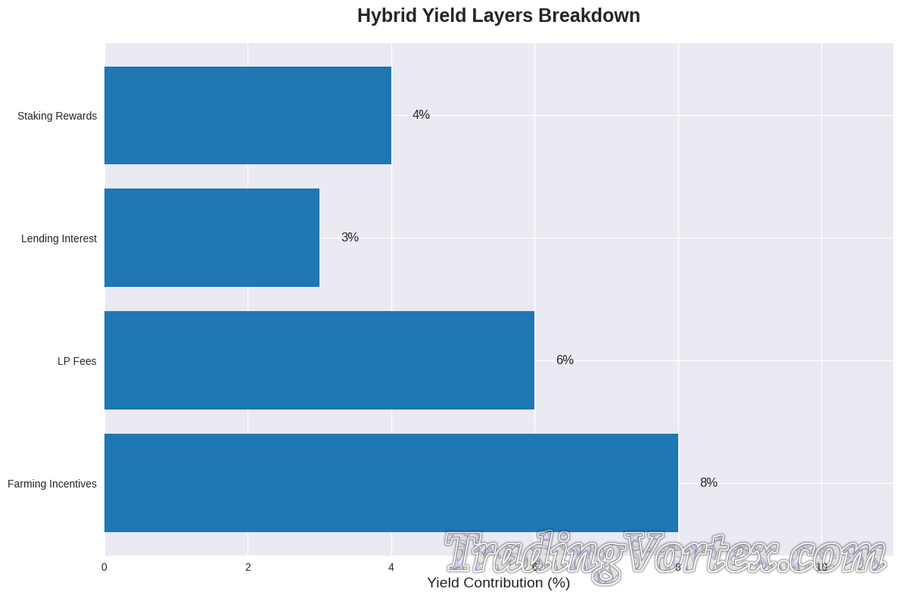 Hybrid Yield Layers Breakdown: How Staking, Lending, and LP Farming Stack Together.
How to Read This Chart:
♦ Each horizontal bar represents one layer of yield in a hybrid strategy.
♦ The values are illustrative percentages showing how much each layer can contribute to your total return.
♦ Staking rewards form the base layer.
♦ Lending interest adds a second layer of passive yield.
♦ LP fees and farming incentives stack on top to boost returns even further.
What This Visual Shows You:
♦ Staking rewards (4%) provide the stable, predictable foundation.
♦ Lending interest (3%) adds a second passive income stream without giving up your LST.
♦ LP fees (6%) come from providing liquidity, especially in efficient pools like stETH‑ETH.
♦ Farming incentives (8%) represent the bonus rewards offered by protocols to attract liquidity.
◊ Together, these layers create a multi‑yield engine that can outperform traditional staking or farming alone.
Regulation & Market Forces Shaping DeFi Yields
If you have been in crypto long enough, you know that yields do not exist in a vacuum. They rise, fall, and sometimes disappear entirely depending on what regulators, institutions, and the broader market decide to do. DeFi may feel like the Wild West at times, but it is becoming more structured every year.
Regulation is tightening, institutions are entering, and new technologies are reshaping how capital flows through the ecosystem.
Understanding these forces is essential if you want to make sense of where staking and yield farming yields are heading. Let’s break down the biggest drivers shaping the future of DeFi income.
MiCA, ETFs & Institutional Liquidity
The European Union’s Markets in Crypto‑Assets Regulation (MiCA) is one of the most influential regulatory frameworks shaping the future of DeFi. MiCA introduces clear rules for crypto‑asset issuers, service providers, and trading platforms. It aims to improve transparency, protect consumers, and bring more stability to the market.
MiCA applies to partially decentralized services, while fully decentralized protocols remain outside its scope, which creates a complex but important distinction for DeFi builders and investors.
Regulators across Europe are actively preparing for full MiCA enforcement. The French AMF, for example, is already issuing licenses and guiding firms through the transition period that ends in June 2026. This transition is described as a major challenge for both regulators and the industry, especially as firms must align with new authorization and cybersecurity requirements.
At the same time, institutional liquidity is increasing thanks to the rise of crypto ETFs and regulated staking services. Institutions prefer predictable frameworks, and MiCA provides exactly that. More institutional capital usually means:
- More liquidity in staking and farming markets
- Lower volatility in blue‑chip assets
- More sustainable yields over time
Institutions tend to favor staking over high‑risk farming, which may gradually push yields toward more stable, long‑term models.
Layer‑2 Scaling & Fee Compression
Layer‑2 networks are transforming DeFi by reducing transaction costs and increasing throughput. When fees drop, more users participate, more trades occur, and more liquidity flows into DeFi. This has a direct impact on yields.
Here is how scaling affects returns:
- Lower gas fees make yield farming more accessible, especially for smaller portfolios.
- Higher transaction volume increases LP fees, which boosts farming yields.
- More efficient networks attract new protocols, which often launch with incentive programs.
Tokenized RWAs and Yield Opportunities
One of the most exciting trends in DeFi is the rise of tokenized real‑world assets (RWAs). These include tokenized treasury bills, bonds, real estate, and other yield‑bearing instruments. RWAs bring traditional finance yields into DeFi, which has several important effects:
- More stable yield options for conservative investors
- New collateral types for lending and borrowing
- Lower reliance on inflationary token emissions
- More predictable APYs compared to volatile crypto‑native farms
This shift is already visible in the growing number of RWA‑backed stablecoins, treasury‑backed vaults, and institutional DeFi platforms.
Regulation and market forces are reshaping DeFi yields in real time. MiCA is bringing clarity and structure, institutions are adding liquidity and stability, Layer‑2 networks are reducing costs, and RWAs are introducing real‑world yield dynamics into the ecosystem.
For investors, this means the future of DeFi yields will be more mature, more sustainable, and more connected to global financial markets.
📊 Forces Shaping DeFi Yields: Regulation, Institutions, Scaling, and RWAs
DeFi yields don’t rise or fall randomly. They are shaped by powerful external forces: regulation, institutional capital, network scaling, and the rise of real‑world assets. The chart below gives you a clear, visual snapshot of how strongly each of these forces influences the future of staking and yield farming.
Why This Matters for You: This chart helps you understand where DeFi yields are heading:
- Expect more stable, sustainable yields as institutions enter and RWAs expand.
- Expect lower volatility as regulation brings structure and transparency.
- Expect more opportunities as Layer‑2 networks reduce costs and unlock new strategies.
If you want to stay ahead in DeFi, understanding these forces is just as important as understanding APYs or risk.
 Forces Shaping DeFi Yields: Regulation, Institutions, Scaling, and RWAs.
How to Read This Chart:
♦ Each horizontal bar represents the impact level of a major market or regulatory force on DeFi yields.
♦ Scores range from 1 (low impact) to 5 (very high impact).
♦ The four categories reflect the biggest drivers of yield evolution today:
◊ MiCA & regulatory clarity
◊ Institutional liquidity
◊ Layer‑2 scaling
◊ Tokenized RWAs
What This Visual Shows You:
♦ Institutional liquidity and tokenized RWAs score the highest, meaning they are the most influential forces shaping future yields.
♦ MiCA and regulatory clarity also play a major role by attracting compliant capital and stabilizing markets.
♦ Layer‑2 scaling significantly boosts yield opportunities by lowering gas fees and increasing transaction volume.
Final Verdict: Crypto Staking vs Yield Farming
After exploring staking, yield farming, risks, APYs, hybrid strategies, and the market forces shaping DeFi, we finally arrive at the big question: which one is better?
Think of it like choosing between a calm, steady river and a fast‑moving stream. Both can take you where you want to go, but the experience is completely different. What matters most is choosing the path that fits your personality, your goals, and your appetite for risk.
Pros and Cons of Staking vs Yield Farming
The latest research makes the differences clear. Staking is simple, stable, and beginner‑friendly, while yield farming is dynamic, flexible, and potentially more profitable. Yield farming offers higher rewards but comes with more complexity and more exposure to market volatility. Staking is ideal for predictable returns and lower risk, while yield farming is better suited for active users who understand liquidity pools and smart contract mechanics.
Here is the simple breakdown:
Staking Pros:
- Steady and predictable rewards
- Low maintenance and beginner‑friendly
- Lower risk and minimal complexity
Staking Cons:
- Lower returns compared to farming
- Possible lock‑ups and unbonding periods
Yield Farming Pros:
- Higher potential APYs
- Flexible strategies and multiple reward sources
- Opportunities to earn from trading fees, incentives, and LP positions
Yield Farming Cons:
- Impermanent loss and smart contract risk
- Requires active monitoring and deeper knowledge
- Rewards can fluctuate quickly
Best Strategy by Risk Profile
Choosing the right strategy depends on who you are as an investor.
- If you are a beginner: Staking is your safest and simplest entry point. It lets you earn without worrying about impermanent loss or complex DeFi mechanics.
- If you are an active DeFi user: Yield farming is your playground. You enjoy exploring new protocols, optimizing returns, and taking advantage of incentives.
- If you are a long‑term investor: Staking aligns perfectly with your goals. It offers predictable returns and supports the networks you believe in.
- If you are a high‑risk trader: Yield farming gives you the highest upside. You understand volatility, you move quickly, and you know how to manage risk.
There is no wrong choice here. There is only the choice that fits you.
Future Outlook: Sustainable Yields vs Speculative APYs
The future of DeFi yields is being shaped by regulation, institutional liquidity, Layer‑2 scaling, and tokenized real‑world assets. These forces are pushing the ecosystem toward more sustainable, utility‑driven yield models.
Here is what the future likely holds:
- Staking yields will remain stable, driven by network issuance and validator performance.
- Yield farming APYs will become more realistic, as protocols move away from inflationary token emissions.
- Hybrid strategies will dominate, especially those built around liquid staking tokens and restaking.
- RWAs will introduce real‑world yield dynamics, making DeFi less dependent on speculative incentives.
Staking and yield farming are not rivals. They are complementary tools that serve different purposes.
Staking gives you stability, simplicity, and long‑term confidence.
Yield farming gives you flexibility, creativity, and higher potential returns.
The best strategy is the one that matches your goals, your risk tolerance, and the amount of time you want to spend managing your crypto.
FAQs: Crypto Staking vs Yield Farming
What is the main difference between staking and yield farming?
Staking is simple: you lock your tokens to help secure a Proof of Stake blockchain and earn predictable rewards. Yield farming is more dynamic: you provide liquidity to DeFi protocols and earn fees or incentive tokens. Staking is stable and beginner‑friendly, while yield farming offers higher potential returns but requires more active management and deeper knowledge. Both rely on smart contracts, but yield farming involves liquidity pools and fluctuating APYs.
Which one is safer?
Staking is generally safer because the risks are limited to validator performance, lock‑ups, and network inflation. Yield farming carries additional risks such as impermanent loss, smart contract vulnerabilities, and volatile reward tokens. Staking is low risk with stable returns, while yield farming is high risk with higher potential rewards.
Which one pays more?
Yield farming usually pays more, especially when incentives are active. Staking typically earns 3 to 14 percent, while yield farming can reach 5 to 30 percent or more, depending on the pool and market conditions.
Is staking really just a type of yield farming?
Technically, yes. Staking is considered one form of yield farming because you lock assets to earn rewards. The difference is that staking focuses on network security, while yield farming focuses on liquidity and incentives.
Can beginners start with yield farming?
They can, but it is not recommended. Yield farming requires understanding liquidity pools, impermanent loss, and smart contract risk. Staking is far easier and safer for beginners. Staking is ideal for newcomers because it is simple and predictable.
What is impermanent loss, and why does it matter?
Impermanent loss happens when the price of tokens in a liquidity pool changes relative to each other. You may end up with fewer valuable tokens than if you had simply held them. IL is one of the biggest risks in yield farming and can erase profits even when APYs look high.
Can I lose money while staking?
Yes, but the risks are lower. You can lose money if your validator gets slashed, if the token price drops, or if inflation outpaces your rewards. However, compared to yield farming, the risk is much smaller. Staking is low risk with stable returns, making it ideal for conservative investors.
Is yield farming still profitable in 2026?
Yes, but it depends on the pool, incentives, and market conditions. Yield farming remains profitable when liquidity demand is high and incentives are strong. Yield farming continues to attract investors because of its higher reward potential, although risks remain significant.
Can I combine staking and yield farming?
Absolutely. Many investors use hybrid strategies such as staking ETH to receive LSTs, then using those LSTs in lending or LP pools. This approach boosts returns while keeping staking rewards active. It is one of the most popular strategies in modern DeFi.
Which strategy is better for long‑term investors?
Staking is usually the better long‑term choice. It offers predictable returns, lower risk, and minimal maintenance. Yield farming is better for active users who enjoy optimizing strategies and managing risk. Staking suits long‑term holders, while yield farming suits active traders seeking higher returns.
Do I need a lot of money to start yield farming?
Not necessarily, but it helps. Some pools require enough capital to offset gas fees and make rebalancing worthwhile. Staking, on the other hand, works well even with small amounts.
Are staking rewards guaranteed?
No, but they are more predictable than farming rewards. Staking rewards depend on network issuance, validator performance, and token price. Yield farming rewards depend on trading volume, incentives, and token emissions, which can change quickly.