
Step into the fast‑growing world of Decentralized Finance (DeFi) with this in‑depth guide tailored for crypto investors and traders at every stage of their journey. The article explains how DeFi works, why it matters, and how it is reshaping global finance by removing middlemen and empowering users with direct control over their assets.
Readers will explore the most influential DeFi protocols and decentralized exchanges, learn how to set up secure wallets, and discover the best analytics platforms to track performance. Practical sections cover yield farming, liquidity provision, staking, and diversification strategies, while safety checklists highlight essential precautions around gas fees, slippage, approvals, and backups.
The guide also dives into the evolving regulatory landscape, showing how compliance, KYC/AML, and institutional adoption are shaping DeFi’s future. With insights into tokenization, interoperability, and the next wave of innovation, this article paints a clear picture of where DeFi is headed in 2025 and beyond.
Packed with actionable advice, relatable anecdotes, and expert commentary, this resource empowers readers to confidently navigate DeFi, avoid common pitfalls, and seize opportunities in a market that is maturing rapidly.
Table of Contents:
- Introduction to DeFi and Decentralized Finance for Crypto Investors
- DeFi Basics: Core Concepts of Decentralized Finance
- DeFi Use Cases: Real-World Applications in Crypto Finance
- Top DeFi Trends 2026: What Crypto Investors and Traders Should Watch
- RWA Tokenization Trend in DeFi: Crypto Access to Real Assets
- Cross-Chain Interoperability in DeFi: Bridges, Rollups, and Multi-Chain Crypto
- Layer 2 Scaling and Gas Optimization for DeFi Crypto Users
- Institutional DeFi Adoption: What Traders Should Expect
- AI and Automation in DeFi: Crypto Risk Management and Trading Signals
- Stablecoins, CBDCs, and DeFi: Impacts on Crypto Liquidity
- DeFi Security and Risk: Protecting Crypto Investors and Traders
- DeFi Regulation and Compliance: What Crypto Investors Must Know
- DeFi Investment Strategies for Crypto Traders
- DeFi Tools and Platforms: Best Crypto Protocols, Wallets, and Analytics
- How to Get Started with DeFi: Step‑by‑Step Guide for Crypto Investors
- Future of DeFi: Long‑Term Outlook for Decentralized Finance and Crypto
- Conclusion: Key takeaways for crypto investors and traders on DeFi
- FAQs: Decentralized finance, explained
- What is DeFi in simple terms?
- How big is DeFi today?
- Why are people excited about DeFi in 2025?
- Is DeFi safe?
- What are the main DeFi use cases for investors?
- How do regulations impact DeFi access and strategy?
- What should I look for before using a protocol?
- How do I pick a wallet for DeFi?
- What fees should I expect?
- How do I manage risk in DeFi?
- What trends should traders watch next?
- Do I need to complete KYC to use DeFi?
Introduction to DeFi and Decentralized Finance for Crypto Investors
What is DeFi: A Simple Definition of Decentralized Finance for Traders
DeFi, short for decentralized finance, is essentially finance stripped of its middlemen. Instead of banks, brokers, or clearinghouses, you have smart contracts running on blockchains that handle lending, borrowing, trading, and yield generation automatically. If you’ve ever swapped tokens on a decentralized exchange or staked coins to earn yield, you’ve already dipped your toes into DeFi.
The magic of DeFi lies in its accessibility. Anyone with a crypto wallet and an internet connection can participate. There are no gatekeepers, no office hours, and no minimum balances. It’s finance designed for a digital-first world, where rules are enforced by code rather than paperwork. For traders, this means faster transactions, fewer restrictions, and a level playing field where innovation thrives.
Why DeFi Matters to Crypto Investors and Traders Today
For crypto investors, DeFi is more than a buzzword. It’s a toolkit that expands what you can do with your assets. You can earn passive income through staking and yield farming, tap into decentralized lending markets for liquidity, or trade assets across multiple blockchains without relying on centralized exchanges.
In 2025, one of the hottest trends is real-world asset (RWA) tokenization. Bonds, real estate, and even invoices are being represented on-chain, giving crypto investors access to yield streams that used to be locked away in traditional finance. At the same time, institutional adoption is accelerating, with hedge funds and banks experimenting with DeFi protocols to diversify their strategies.
Of course, it’s not all sunshine. DeFi still carries risks: smart contract bugs, liquidity crunches, and regulatory uncertainty. Governments are tightening rules, pushing for KYC and AML compliance, which could reshape how DeFi protocols operate. For traders, this means balancing opportunity with caution.
Quick DeFi Stats and Market Snapshot for Crypto Investors
Here’s where things stand in 2025:
- Total Value Locked (TVL): DeFi protocols collectively hold $123.6 billion, up 41 percent year-over-year.
- Market Capitalization: The top 100 DeFi tokens are worth $98.4 billion, showing strong investor confidence.
- Global Market Size: Analysts project the DeFi market to grow from $20.48 billion in 2024 to $231.19 billion by 2030, with a CAGR of 53.7 percent.
- Adoption Trends: Millions of users now rely on DeFi for lending, trading, and saving, with Asia-Pacific leading in adoption.
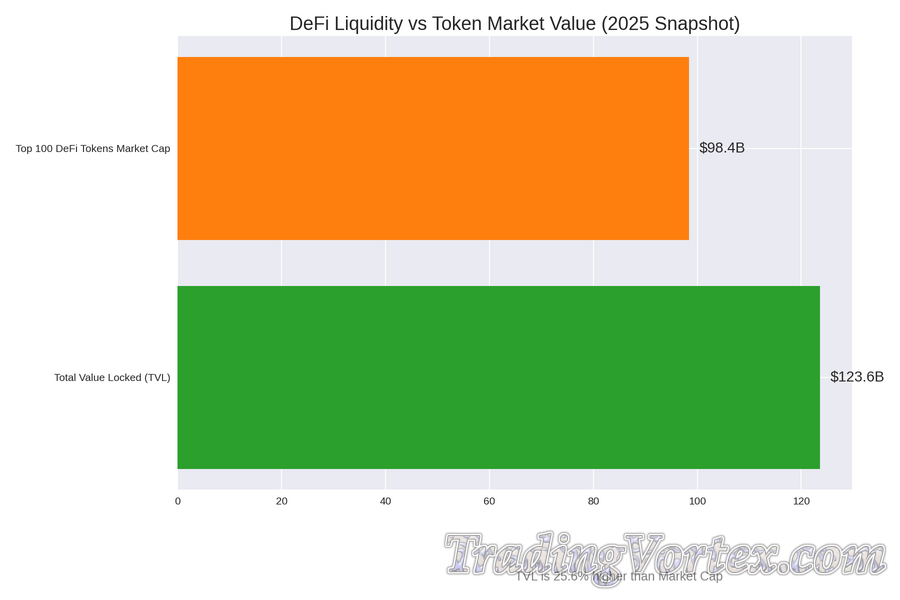 DeFi Liquidity vs Token Market Value (2025 Snapshot): A horizontal bar chart comparing Total Value Locked (TVL = $123.6B) and Top 100 DeFi Tokens Market Cap ($98.4B) with annotated values and a calculated percent difference displayed on the chart.
♦ How to use it: This visual helps traders assess liquidity depth vs token valuation, a quick check for potential over/under‑valuation and for spotting liquidity risks when TVL and market cap diverge.
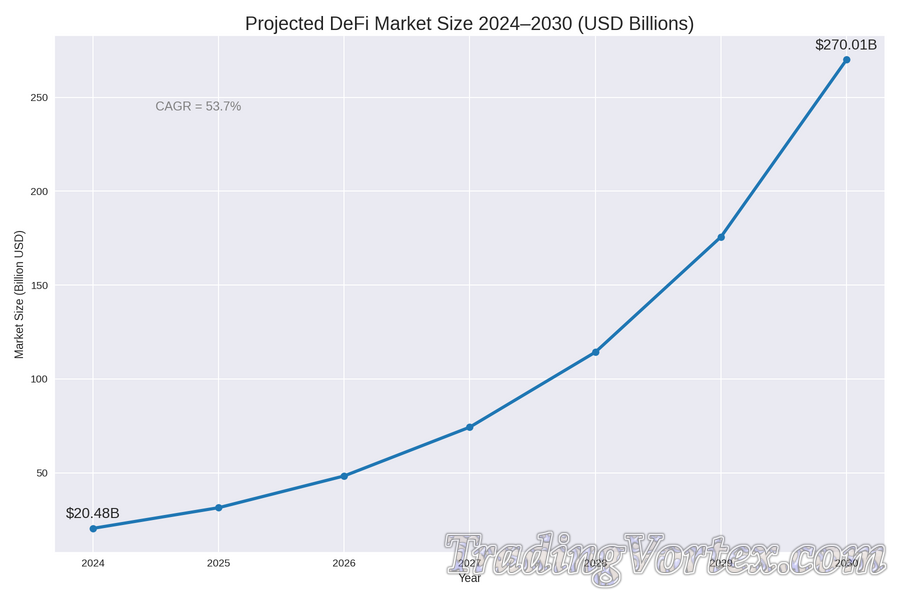 Projected DeFi Market Size 2024–2030 (USD Billions): A smooth line with markers plotting annual market size from 2024 ($20.48B) through 2030 ($231.19B) using the stated CAGR = 53.7%.
♦ The chart highlights the start and end points and includes a subtitle noting the CAGR.
♦ How to use it: Use this visual to illustrate the scale and pace of projected growth, helping readers quickly grasp the exponential trajectory and why long‑term strategic allocation to DeFi might be considered by growth‑oriented investors.
 DeFi Market Snapshot (2025): This bar chart visualizes key metrics that define the current and projected scale of the DeFi ecosystem:
♦ Chart Highlights:
◊ Total Value Locked (TVL): $123.6B, reflecting a 41% YoY growth.
◊ Top 100 DeFi Tokens Market Cap: $98.4B, signaling strong investor confidence.
◊ Projected Global Market Size (2030): $231.19B, indicating a massive growth trajectory.
◊ 2024 Market Size: $20.48B, providing a baseline for the projected CAGR of 53.7%.
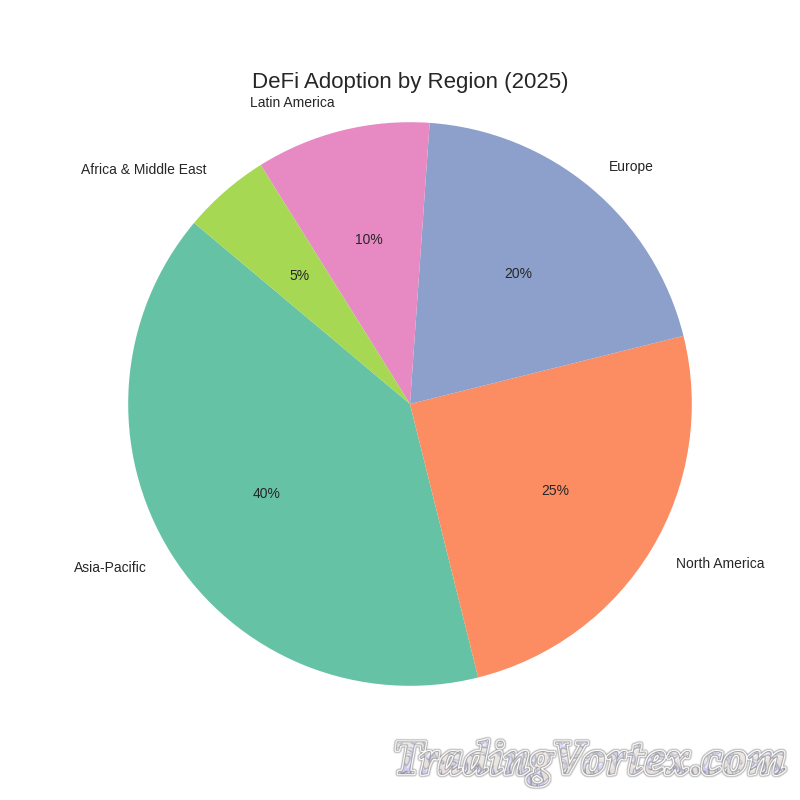 DeFi Adoption by Region (2025): This pie chart breaks down global DeFi usage by region, emphasizing where adoption is strongest:
♦ Chart Highlights:
◊ Asia-Pacific leads with 40% of global DeFi users, driven by mobile-first economies and regulatory innovation.
◊ North America (25%) and Europe (20%) follow, reflecting growing institutional interest.
◊ Latin America (10%) and Africa & Middle East (5%) show emerging adoption, often tied to inflation hedging and remittance use cases.
A Friendly Note for Traders
I’ll admit, I’ve seen traders chase 200 percent yields only to lose it all in a protocol exploit. On the flip side, I’ve also seen cautious investors steadily compound returns through staking and tokenized assets. The lesson is simple: DeFi rewards curiosity and discipline, but punishes recklessness.
DeFi Basics: Core Concepts of Decentralized Finance
How DeFi Works: Smart Contracts, Blockchain, and Crypto Protocols
At the heart of DeFi are smart contracts, self-executing pieces of code deployed on blockchains like Ethereum, Solana, and Avalanche. These contracts handle everything from loan repayments to token swaps without needing a banker or broker. Think of them as vending machines for finance: you put in collateral, press a button, and out comes a loan or a yield stream.
DeFi protocols are built on public blockchains, which means transactions are transparent and verifiable. In 2025, newer chains like Sei and Layer 2 solutions are pushing DeFi toward faster speeds and lower fees. For investors, this translates into more efficient trading and lending opportunities, with fewer barriers to entry.
Key DeFi Components: DApps, AMMs, Oracles, and Token Standards
- Decentralized Applications (DApps): These are the user-facing platforms where you interact with DeFi services. Whether you’re swapping tokens on Uniswap or lending stablecoins on Aave, you’re using a DApp.
- Automated Market Makers (AMMs): Instead of traditional order books, AMMs use liquidity pools to set prices. In 2025, oracle-integrated AMMs are becoming popular because they reduce manipulation and improve pricing accuracy.
- Oracles: Smart contracts can’t access real-world data directly, so oracles act as bridges. They feed in price data, weather info, or even sports scores, allowing contracts to execute based on real-world events. Without oracles, DeFi would be blind.
- Token Standards: Standards like ERC-20 and ERC-721 ensure tokens are interoperable across platforms. They make it possible for your assets to move seamlessly between lending markets, exchanges, and wallets.
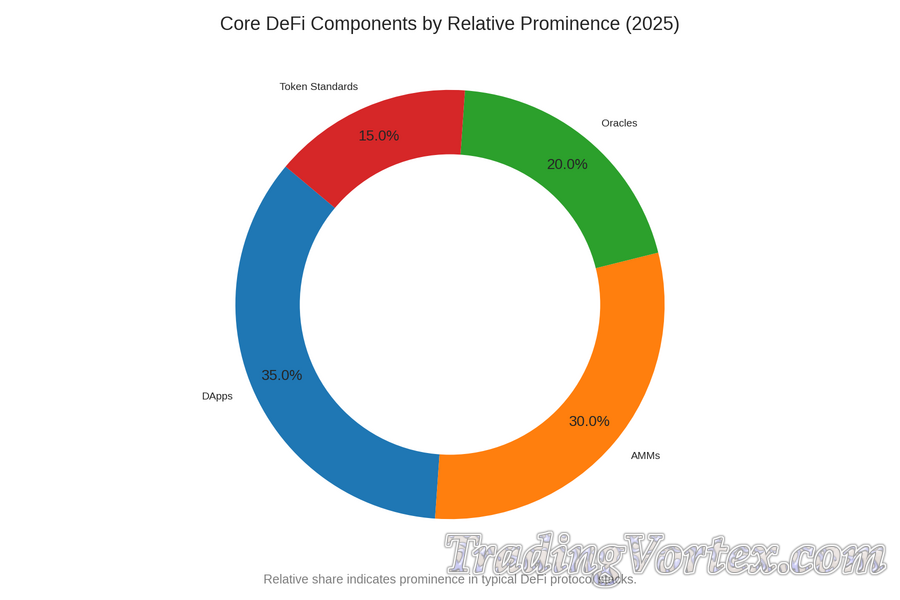 Core DeFi Components by Relative Prominence (2025): A donut chart with relative shares: DApps 35%, AMMs 30%, Oracles 20%, Token Standards 15%, Note: “Relative share indicates prominence in typical DeFi protocol stacks.”
♦ How to use it: this explains which building blocks dominate protocol design and guides on where to focus due diligence (e.g., AMM mechanics or oracle security).
DeFi vs Traditional Finance: What Crypto Investors Need to Know
Here’s the big picture: traditional finance relies on centralized institutions, while DeFi relies on decentralized protocols. Banks decide who gets a loan, set interest rates, and control access. DeFi lets anyone with collateral borrow instantly, with rates determined by supply and demand.
The advantages of DeFi include:
- 24/7 global access: No closing hours, no borders.
- Transparency: Every transaction is on-chain and auditable.
- Higher yields: Investors can earn through staking, liquidity provision, and yield farming.
The trade-offs are clear too: DeFi carries smart contract risks, liquidity challenges, and regulatory uncertainty, while traditional finance offers stability and consumer protections. Most savvy investors use both systems, balancing the innovation of DeFi with the reliability of traditional finance.
A Personal Note for Investors:
When I first tried DeFi, I remember nervously approving a token swap on a DApp, worried I’d lose my funds. The transaction went through, and I realized how empowering it felt to control my own financial activity directly. That sense of autonomy is what draws many traders to DeFi. Still, I learned quickly that caution is key: always double-check contracts, start small, and diversify.
DeFi vs Traditional Finance: Opportunities and Risks
| Aspect | DeFi (Decentralized Finance) | Traditional Finance |
|---|---|---|
| Accessibility | Open to anyone with a crypto wallet and internet connection, no gatekeepers | Requires bank accounts, credit checks, and regulatory approval |
| Transparency | Transactions are on-chain, auditable, and visible in real time | Opaque processes, limited visibility into internal operations |
| Innovation | Rapid experimentation with yield farming, tokenization, and cross-chain trading | Slow adoption of new technologies, heavily regulated |
| Opportunities | High yields from staking, liquidity provision, and tokenized real-world assets | Stable returns from bonds, savings accounts, and regulated investment products |
| Speed | 24/7 markets, instant settlement via smart contracts | Limited to business hours, settlement can take days |
| Risks | Smart contract bugs, hacks, liquidity crunches, regulatory uncertainty | Lower innovation risk, but subject to inflation, interest rate changes, and systemic crises |
| Security | Relies on audits, oracles, and user vigilance; vulnerable to exploits | Backed by government protections, deposit insurance, and legal recourse |
| Regulation | Evolving, fragmented, and inconsistent across jurisdictions | Established frameworks with clear consumer protections |
| User Responsibility | Investors manage private keys, approvals, and risk directly | Institutions handle custody, compliance, and risk management |
Key Takeaway:
DeFi offers investors unmatched access, transparency, and innovative yield opportunities, but it comes with higher risks like smart contract vulnerabilities and regulatory uncertainty. Traditional finance provides stability and protections, yet lacks the flexibility and global reach of DeFi. The smartest investors balance both worlds to capture upside while managing risk.
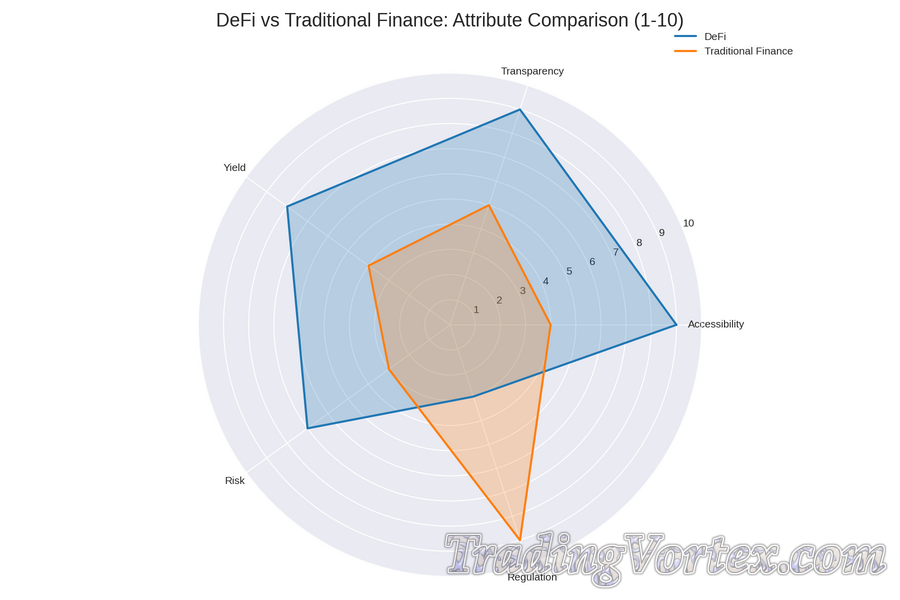 DeFi vs Traditional Finance: Attribute Comparison (1–10): A radar chart overlaying scores for Accessibility, Transparency, Yield, Risk, Regulation (DeFi: 9/9/8/7/3; TradFi: 4/5/4/3/9).
♦ How to use it: This side‑by‑side view helps investors weigh trade‑offs visually: where DeFi excels (accessibility, transparency) and where TradFi remains stronger (regulatory protections).
Quick comparison table (decision aid):
| Attribute | DeFi (score) | TradFi (score) | Why it matters |
|---|---|---|---|
| Accessibility | 9 | 4 | 24/7 global access; lowers entry barriers |
| Transparency | 9 | 5 | On‑chain auditability vs opaque ledgers |
| Yield | 8 | 4 | Higher potential returns; higher volatility |
| Risk | 7 | 3 | Smart‑contract and liquidity risks |
| Regulation | 3 | 9 | Consumer protections and compliance certainty |
Key takeaways: Start small, prioritize audited protocols, and treat DeFi as high‑risk, high‑reward. Use the market growth chart to justify strategic exposure, the TVL chart to assess liquidity, the components donut to focus due diligence, and the radar/table to balance DeFi vs TradFi in portfolio decisions.
DeFi Use Cases: Real-World Applications in Crypto Finance
DeFi Lending and Borrowing: Crypto Loans, Collateral, and Interest
One of the most practical DeFi applications is lending and borrowing. Platforms like Aave and Compound allow users to deposit crypto as collateral and borrow stablecoins or other assets instantly. In 2025, lending markets are stronger than ever, with flash loans becoming popular among arbitrage traders who borrow millions without collateral, provided they repay within the same transaction.
For investors, this means you can put idle assets to work by lending them out and earning interest. Borrowers, on the other hand, can unlock liquidity without selling their holdings. It’s like pawning your crypto, but with smart contracts ensuring the rules are fair and transparent.
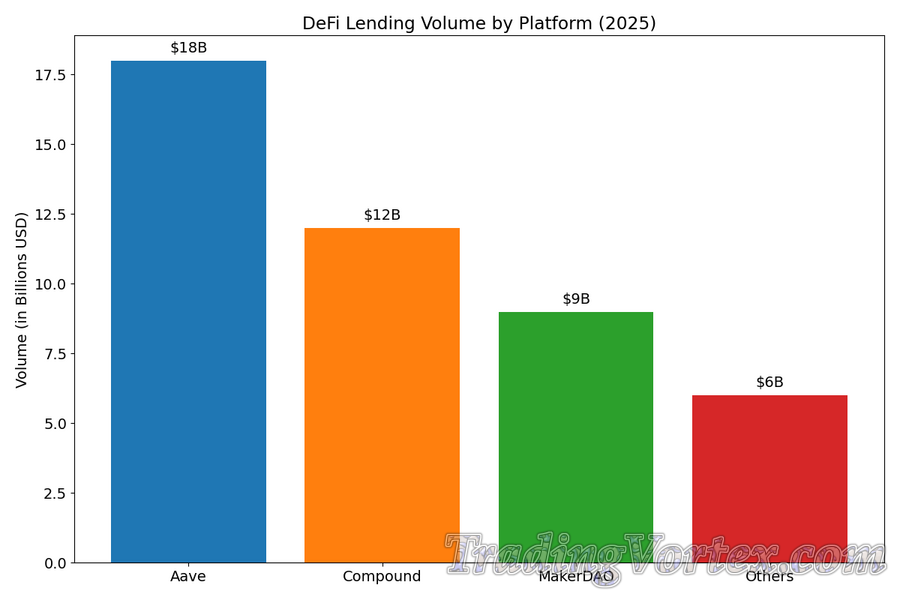 DeFi Lending Volume by Platform (2025): A bar chart comparing lending volumes across major platforms: Aave ($18B), Compound ($12B), MakerDAO ($9B), Others ($6B).
♦ How to use it: This visual highlights the dominance of Aave and Compound in the lending space, reinforcing the narrative that DeFi lending is now a mature, competitive market.
DeFi Yield Farming and Staking: How Crypto Investors Earn Passive Income
Yield farming and staking remain the bread and butter of DeFi. By contributing liquidity to pools or staking tokens, investors earn rewards in the form of interest or governance tokens. In 2025, liquid staking has taken center stage, with nearly 30 percent of all ETH staked and platforms like Lido losing dominance to new competitors.
Yield farming strategies have matured too. Instead of chasing unsustainable triple-digit returns, investors are focusing on risk-adjusted yields across multiple protocols. Think of it as moving from wild speculation to a more professionalized income strategy.
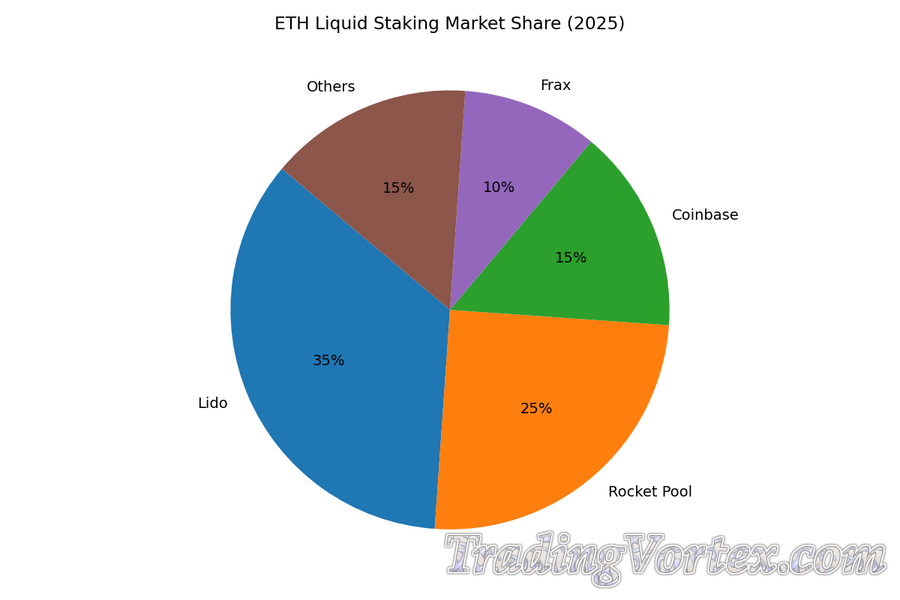 ETH Liquid Staking Market Share (2025): A pie chart showing the distribution of ETH liquid staking: Lido (35%), Rocket Pool (25%), Coinbase (15%), Frax (10%), Others (15%).
♦ How to use it: This visual illustrates the fragmentation of the staking market and the decline of Lido’s dominance, supporting the point about new competitors gaining ground.
Decentralized Exchanges (DEXs) and AMMs: Trading Crypto on DeFi
DEXs like Uniswap, Curve, and SushiSwap have become the backbone of DeFi trading. They use automated market makers (AMMs) instead of traditional order books, allowing anyone to provide liquidity and earn fees. In 2025, DEX trading volumes rival centralized exchanges, thanks to cross-chain interoperability and Layer 2 scaling.
For traders, DEXs mean 24/7 access, no KYC barriers, and often better liquidity for niche tokens. The flip side is impermanent loss, slippage, and the occasional rug pull. I still remember my first liquidity provision experiment: I earned fees, but the token pair I chose tanked, leaving me with more of the weaker asset. Lesson learned: always research the pool before diving in.
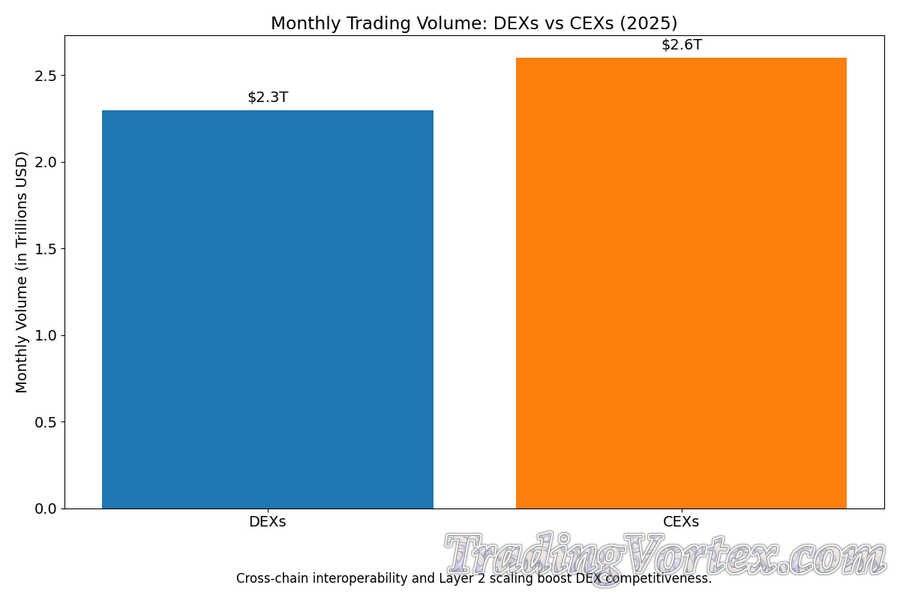 Monthly Trading Volume: DEXs vs CEXs (2025): A side-by-side bar chart comparing monthly trading volumes: DEXs ($2.3T) vs CEXs ($2.6T).
♦ How to use it: This chart emphasizes how DEXs are closing the gap with centralized exchanges, thanks to cross-chain and Layer 2 innovations.
Tokenization of Real-World Assets (RWA) in DeFi for Investors
Perhaps the most exciting frontier is RWA tokenization. In 2025, tokenized U.S. Treasuries on-chain hit an all-time high of $7.5 billion AUM. Real estate, commodities, and even invoices are being represented as blockchain tokens, opening up yield streams that were once locked in traditional finance.
For investors, this means you can diversify into assets like bonds or property without leaving the crypto ecosystem. RWAs also attract institutional players, since they bridge the gap between DeFi innovation and traditional financial stability. It’s like DeFi finally got a seat at the grown-ups’ table.
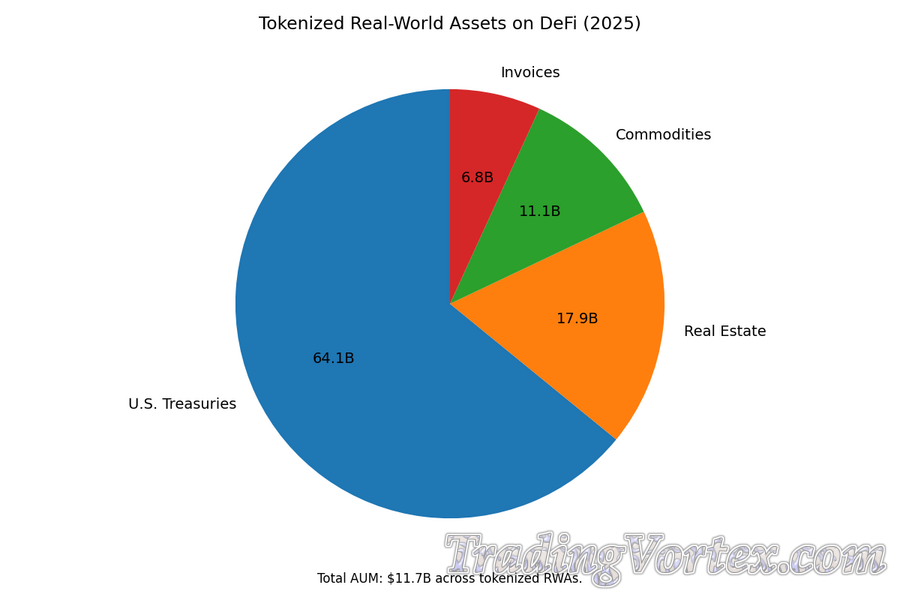 Tokenized Real-World Assets on DeFi (2025): A donut chart showing the AUM distribution of tokenized RWAs: U.S. Treasuries ($7.5B), Real Estate ($2.1B), Commodities ($1.3B), Invoices ($0.8B).
♦ How to use it: This visual supports the claim that RWAs are gaining traction, especially among institutions, and that U.S. Treasuries dominate the space.
Key Takeaway:
DeFi use cases in 2025 are no longer theoretical. Lending, staking, trading, and tokenization are reshaping how investors interact with money. The opportunities are vast, but so are the risks. Smart investors treat DeFi as both a playground and a battlefield: exciting, profitable, but demanding caution and discipline.
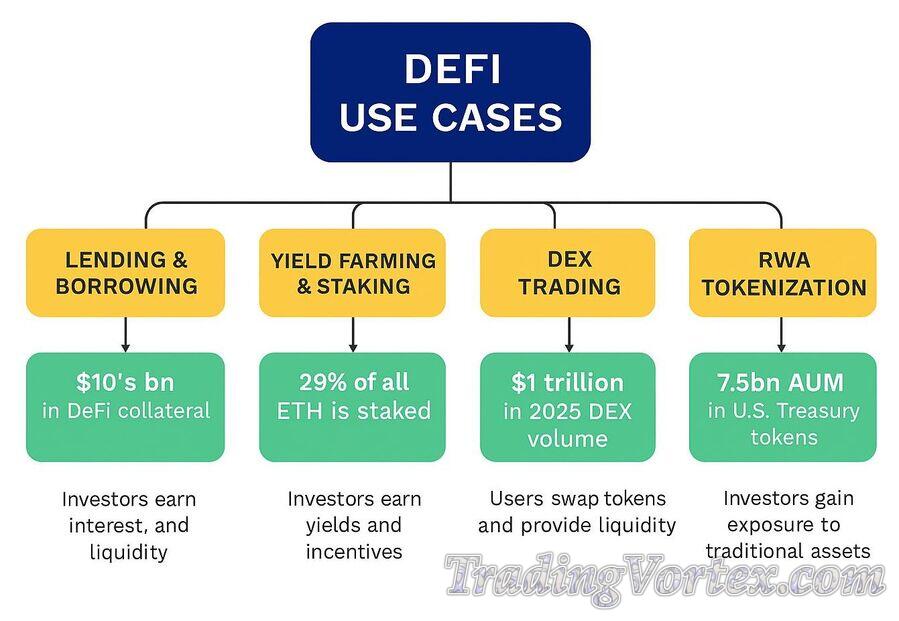 Flowchart of DeFi Use Cases in Crypto Finance (2025): This flowchart breaks down the four most popular DeFi use cases: lending, staking, trading, and tokenization; showing how each one helps crypto investors earn yield, access liquidity, or diversify into real-world assets. It’s a quick map of where DeFi is creating real value in 2025.
Top DeFi Trends 2026: What Crypto Investors and Traders Should Watch
RWA Tokenization Trend in DeFi: Crypto Access to Real Assets
Tokenization of real-world assets (RWAs) is no longer a buzzword. By mid-2025, RWAs had already grown 380 percent in three years, reaching $24 billion in value. In 2026, analysts expect tokenized U.S. Treasuries, real estate, and commodities to dominate DeFi yields.
For investors, this means access to traditionally stable assets without leaving the blockchain. I like to think of it as DeFi finally getting a “grown-up” portfolio option, where you can balance high-risk yield farming with tokenized bonds.
RWAs also bring credibility to DeFi. Institutions are more comfortable with tokenized government bonds than with meme tokens, and that credibility trickles down to retail investors. It’s a bridge between the wild west of crypto and the structured world of traditional finance.
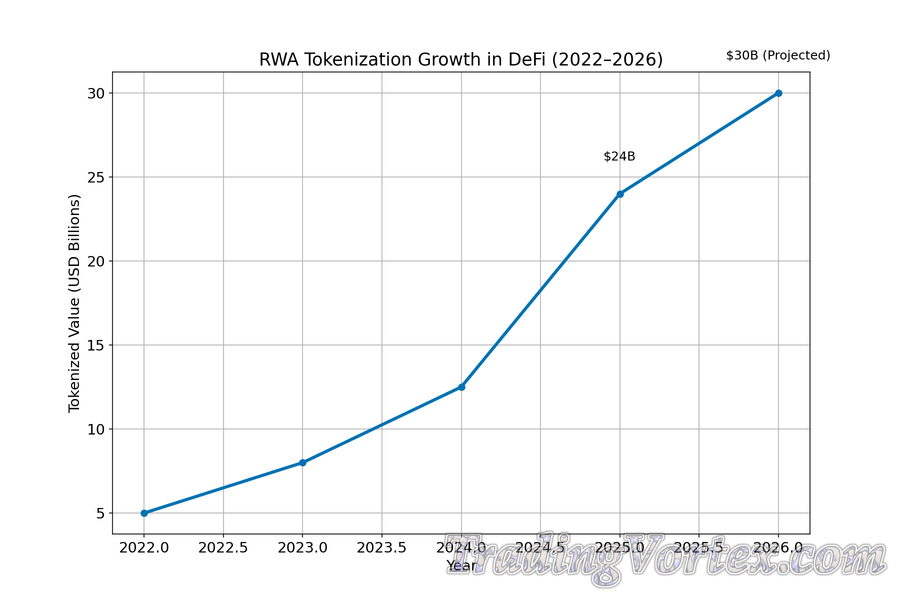 RWA Tokenization Growth in DeFi (2022–2026): A line chart tracking the rise of tokenized real-world assets from $5B in 2022 to a projected $30B in 2026.
♦ How to use it: This visual reinforces the explosive growth of RWAs and their increasing role in DeFi yields and institutional credibility.
Cross-Chain Interoperability in DeFi: Bridges, Rollups, and Multi-Chain Crypto
DeFi is no longer confined to Ethereum. Cross-chain bridges and rollups are making it possible to move assets seamlessly across ecosystems. This trend reduces fragmentation and opens up arbitrage opportunities for traders. I remember the early days when moving tokens between chains felt like sending a postcard across the ocean. In 2026, it’s more like instant messaging: fast, cheap, and reliable.
For investors, interoperability means more options. You can chase yields across chains, diversify into different ecosystems, and hedge risks more effectively. It also means fewer headaches with liquidity silos, which used to trap capital in isolated pools.
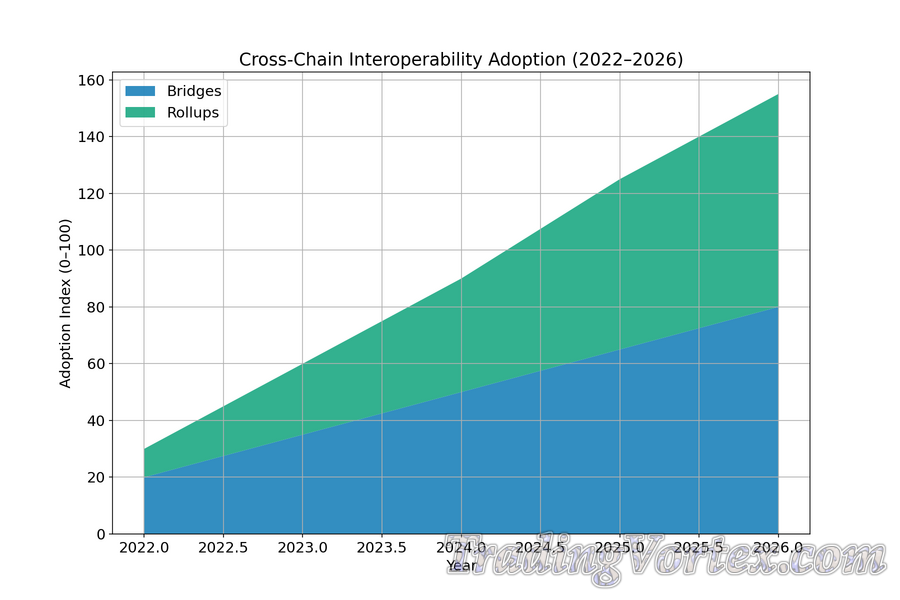 Cross-Chain Interoperability Adoption (2022–2026): A stacked area chart comparing adoption of bridges and rollups, showing both technologies rising steadily toward mainstream use.
♦ How to use it: DeFi is evolving into a multi-chain ecosystem, reducing fragmentation and unlocking new trading strategies.
Layer 2 Scaling and Gas Optimization for DeFi Crypto Users
High gas fees used to be the bane of DeFi traders. In 2026, Layer 2 scaling solutions like Optimism, Arbitrum, and zk-rollups are cutting costs dramatically.
For retail investors, this means smaller trades are finally viable again. No more paying $50 to swap $100 worth of tokens. This democratizes DeFi, making it accessible to everyday users instead of just whales.
Layer 2 also improves speed. Transactions confirm in seconds, not minutes, which makes DeFi trading feel more like using a modern app than waiting for a blockchain to catch up. For traders, this is a game-changer.
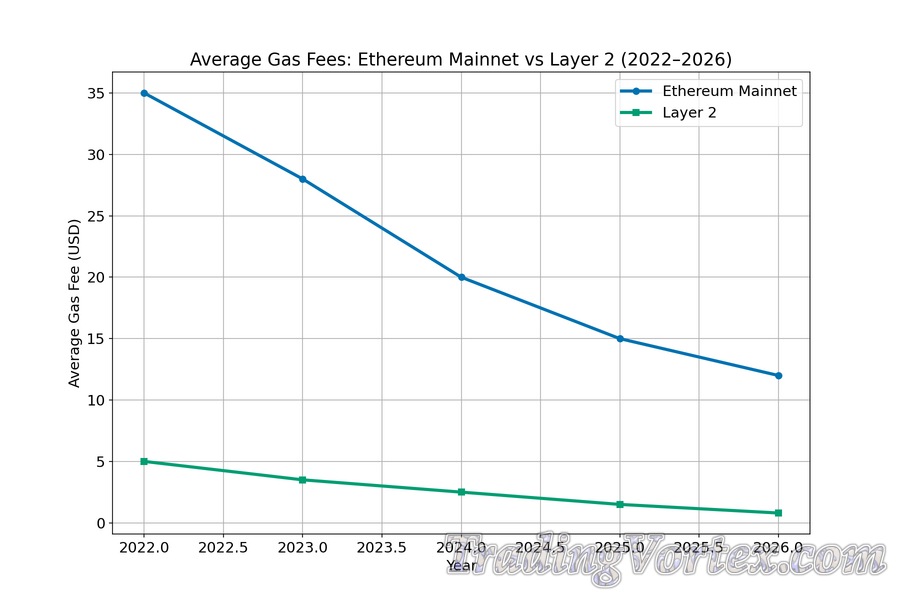 Average Gas Fees: Ethereum Mainnet vs Layer 2 (2022–2026): A dual-line chart comparing gas fees on Ethereum mainnet and Layer 2 solutions, highlighting a dramatic drop in costs for L2 users.
♦ How to use it: This chart demonstrates how Layer 2 scaling is democratizing DeFi access by making small transactions viable again.
Institutional DeFi Adoption: What Traders Should Expect
According to Grayscale’s 2026 outlook, institutional capital is flowing into DeFi thanks to regulatory clarity and demand for alternative stores of value. Wealth managers and hedge funds are experimenting with tokenized assets and DeFi ETFs.
For traders, this means deeper liquidity and more stable yields. It also means competition: institutions play with bigger pockets, so retail investors need sharper strategies to stay ahead.
Institutional adoption also signals maturity. When pension funds start allocating to tokenized treasuries, you know DeFi is no longer a fringe experiment. For retail investors, this can be both reassuring and intimidating.
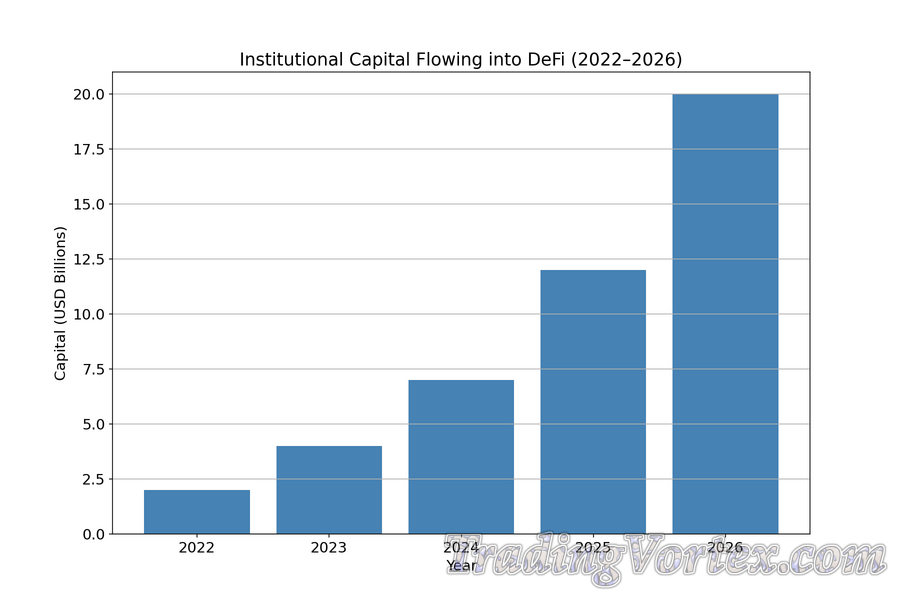 Institutional Capital Flowing into DeFi (2022–2026): A bar chart showing institutional capital rising from $2B in 2022 to $20B in 2026.
♦ How to use it: This visual supports the narrative of DeFi’s maturation and the growing presence of institutional players.
AI and Automation in DeFi: Crypto Risk Management and Trading Signals
Artificial intelligence is creeping into DeFi protocols, offering predictive analytics, automated risk management, and smarter trading signals. Imagine a bot that not only executes trades but also learns from market patterns to optimize yield strategies. It’s like having a co-pilot who never sleeps. Of course, AI can’t eliminate risk entirely, but it can help investors avoid obvious pitfalls and manage positions more efficiently.
For traders, AI tools are becoming as common as charting software. They help identify liquidity risks, flag suspicious contracts, and even suggest portfolio adjustments. It’s a layer of intelligence that makes navigating DeFi less overwhelming.
Stablecoins, CBDCs, and DeFi: Impacts on Crypto Liquidity
Stablecoins remain the backbone of DeFi liquidity, but central bank digital currencies (CBDCs) are entering the conversation. In 2026, expect hybrid liquidity pools where CBDCs interact with stablecoins, creating new dynamics in lending and trading.
For investors, this could mean more predictable yields and less volatility. Still, regulatory oversight will be heavy, so flexibility may come at the cost of privacy.
Stablecoins themselves are evolving too. Algorithmic models are being replaced by overcollateralized designs, reducing the risk of depegging. For traders, this means more confidence in using stablecoins as collateral or yield instruments.
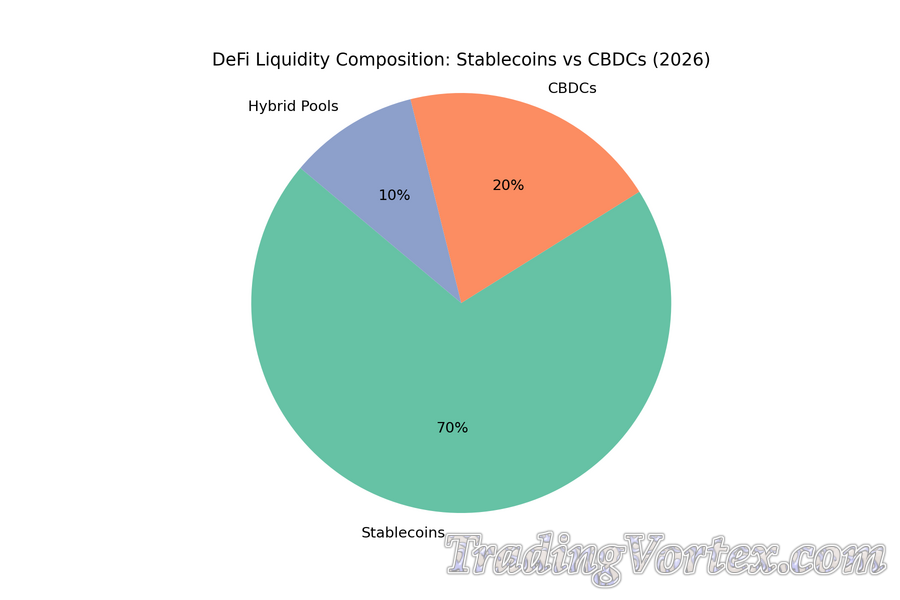 DeFi Liquidity Composition: Stablecoins vs CBDCs (2026): A pie chart showing stablecoins dominate liquidity (70%), with CBDCs (20%) and hybrid pools (10%) emerging.
♦ How to use it: This visual illustrates the evolving liquidity landscape and the growing role of regulated digital currencies in DeFi.
Key Takeaway:
DeFi in 2026 is about maturity and integration. Tokenized assets, institutional adoption, and AI-driven automation are pushing the space closer to mainstream finance, while Layer 2 scaling and interoperability make it more user-friendly. For investors, the opportunities are bigger than ever, but so are the risks. The smartest move is to stay curious, diversify, and never forget that in DeFi, caution is just as valuable as capital.
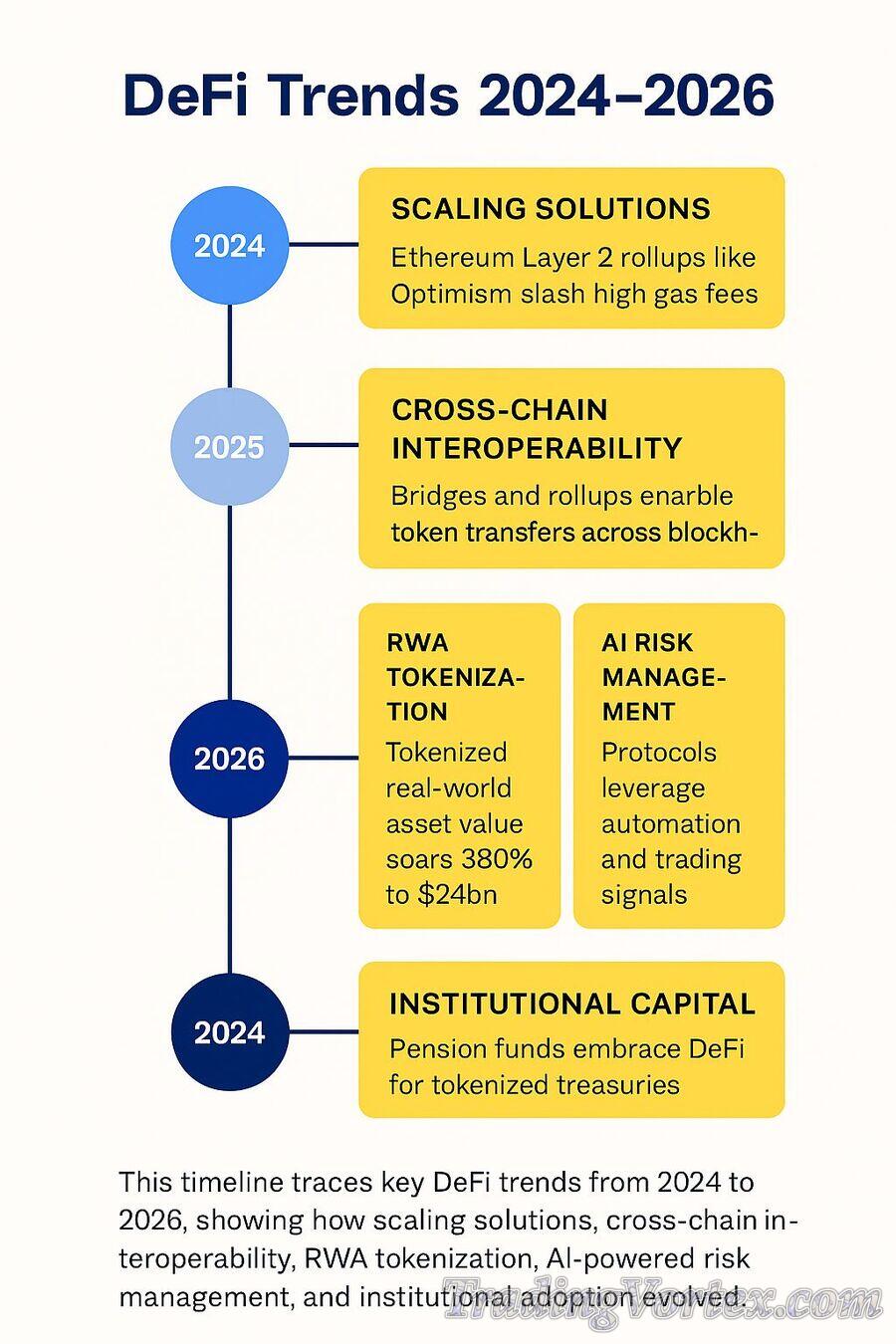 DeFi Trends Timeline 2024–2026: This timeline traces key DeFi trends from 2024 to 2026, showing how scaling solutions, cross-chain interoperability, RWA tokenization, AI-powered risk management, and institutional adoption evolved into today’s ecosystem.
DeFi Security and Risk: Protecting Crypto Investors and Traders
Smart Contract Risk in DeFi: Audits, Formal Verification, and Best Practices
Let’s start with the elephant in the room: smart contracts are powerful but fragile. They automate everything from lending to trading, but one tiny bug can lead to massive losses. In 2025, smart contract exploits caused over $953 million in damages, with access control flaws being the top culprit.
Audits are essential, but they’re not foolproof. Many protocols proudly display audit badges, yet still get hacked. Why? Because audits are snapshots, not guarantees. Threats evolve, and even well-reviewed code can be exploited under new conditions.
If you’re investing in a DeFi protocol, check for:
- Multiple audits from reputable firms
- Formal verification, which mathematically proves contract behavior
- Bug bounty programs, showing the team is proactive
- Transparent GitHub activity, so you know the code is alive and maintained
I always tell friends: treat audits like seatbelts. They reduce risk, but don’t make you invincible. And if a protocol hasn’t been updated in months, that’s like driving with a seatbelt in a car with no brakes.
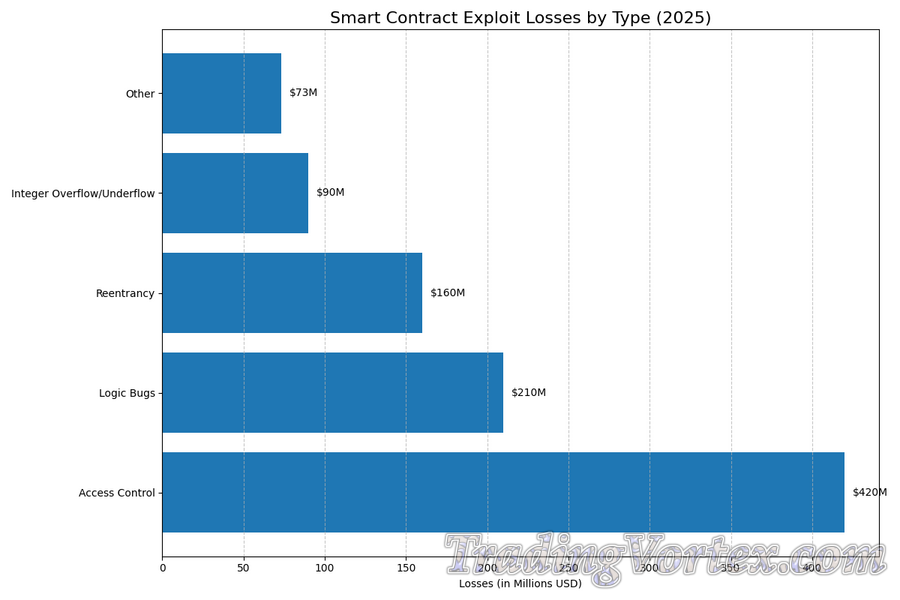 Smart Contract Exploit Losses by Type (2025): A horizontal bar chart breaking down $953M in losses by vulnerability type. Access control flaws top the list at $420M, followed by logic bugs and reentrancy issues.
♦ How to use it: This visual emphasizes that even audited contracts can fail, especially when access controls are misconfigured.
Common DeFi Hacks and Exploits: Lessons for Crypto Investors
DeFi hacks are not rare. In 2025, the most common attacks included:
- Reentrancy attacks, where a contract is tricked into repeating a transaction
- Flash loan exploits, which manipulate prices or drain liquidity in seconds
- Rug pulls, where developers vanish with user funds
These attacks often target newer or unaudited protocols. I once got burned by a flashy yield farm that promised 300 percent APY. It lasted three days before the devs disappeared. Lesson learned: if it smells like a scam, it probably is.
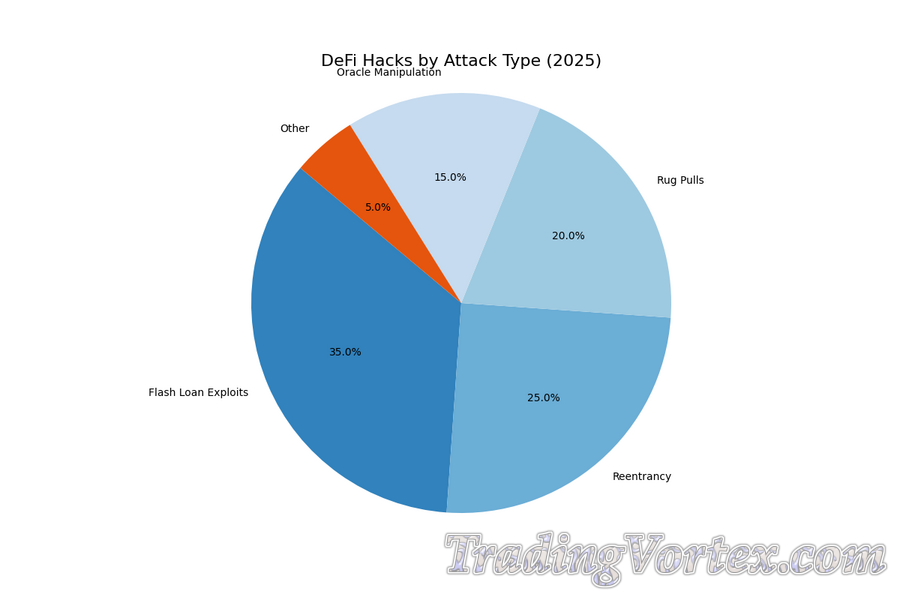 DeFi Hacks by Attack Type (2025): A pie chart showing flash loan exploits (35%) and reentrancy (25%) as the most common attack vectors, followed by rug pulls and oracle manipulation.
♦ How to use it: This helps to quickly identify the most prevalent threats and understand why newer protocols are often riskier.
Liquidity Risk and Impermanent Loss for DeFi Liquidity Providers
Providing liquidity sounds great until you realize your token pair moved in opposite directions. That’s impermanent loss, and it’s the silent killer of DeFi yields. In volatile markets, you might end up with less value than if you just held your tokens.
Liquidity risk also includes pool drainage, where a sudden exit leaves you stuck with worthless assets. To manage this:
- Choose stablecoin pairs or low-volatility assets
- Monitor pool depth and trading volume
- Use impermanent loss calculators before entering a position
I once provided liquidity to a meme token pair. The token crashed, and I was left holding a bag of digital regret. Now I stick to blue-chip pairs and stablecoins.
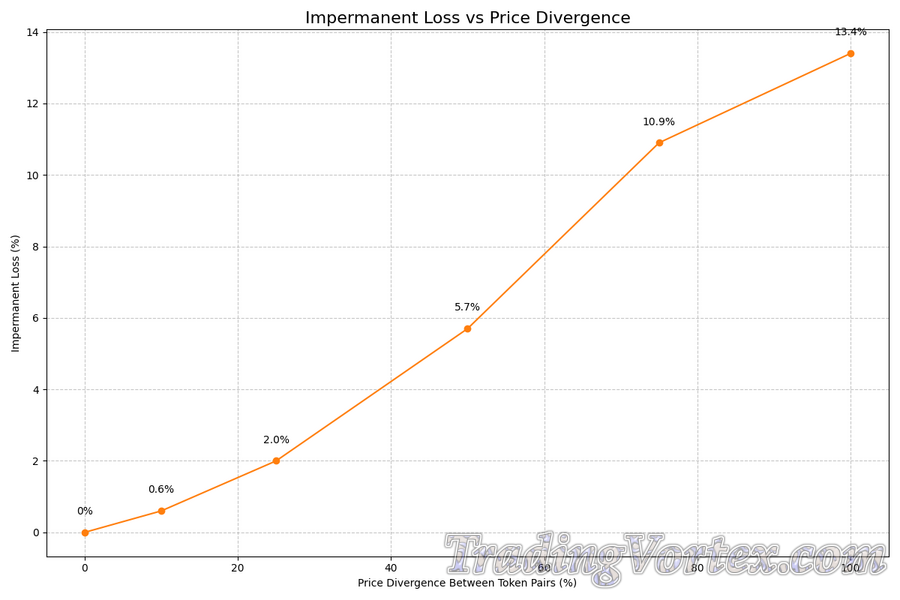 Impermanent Loss vs Price Divergence: A line chart showing how impermanent loss increases with price divergence between token pairs; reaching 13.4% at 100% divergence.
♦ How to use it: This visual makes the concept of impermanent loss tangible and helps liquidity providers assess risk before entering volatile pools.
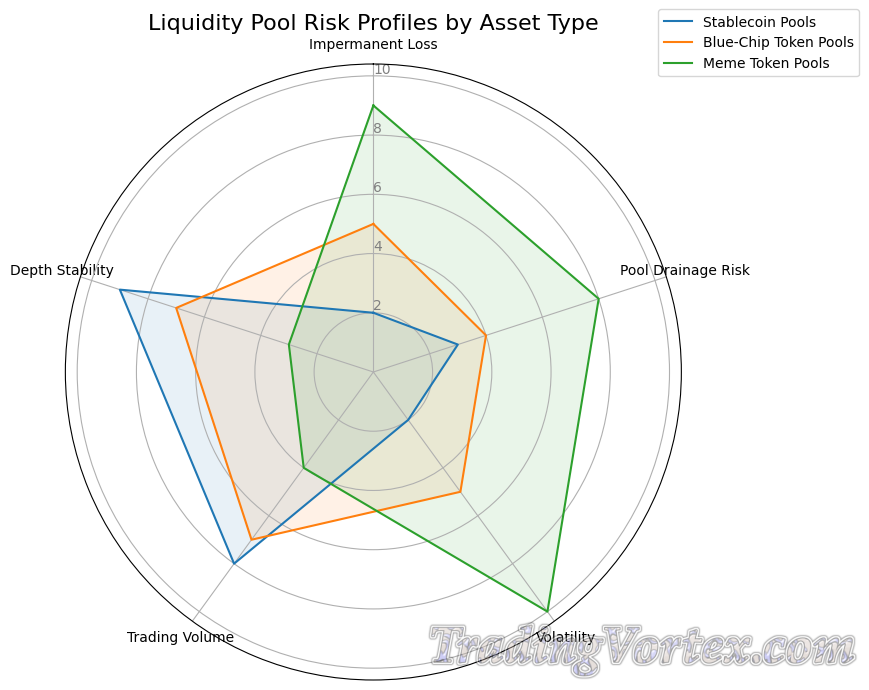 Liquidity Pool Risk Profiles by Asset Type: A radar chart comparing risk factors across stablecoin pools, blue-chip token pools, and meme token pools.
♦ How to use it: This helps investors choose pools based on their risk tolerance: highlighting that meme tokens carry high impermanent loss and volatility.
Counterparty, Oracle, and Bridge Risks in DeFi Crypto Systems
DeFi is supposed to be trustless, but counterparty risk still exists. If a protocol relies on a centralized admin key or multisig wallet, that’s a single point of failure.
Oracles are another weak spot. They feed price data to smart contracts, but if manipulated, they can trigger false liquidations or arbitrage exploits. In 2025, oracle attacks remain a top threat, especially in low-liquidity markets.
Bridges, which connect different blockchains, are notoriously vulnerable. They’ve been responsible for some of the largest DeFi hacks in history. If you’re using a bridge, make sure it’s battle-tested and has insurance options.
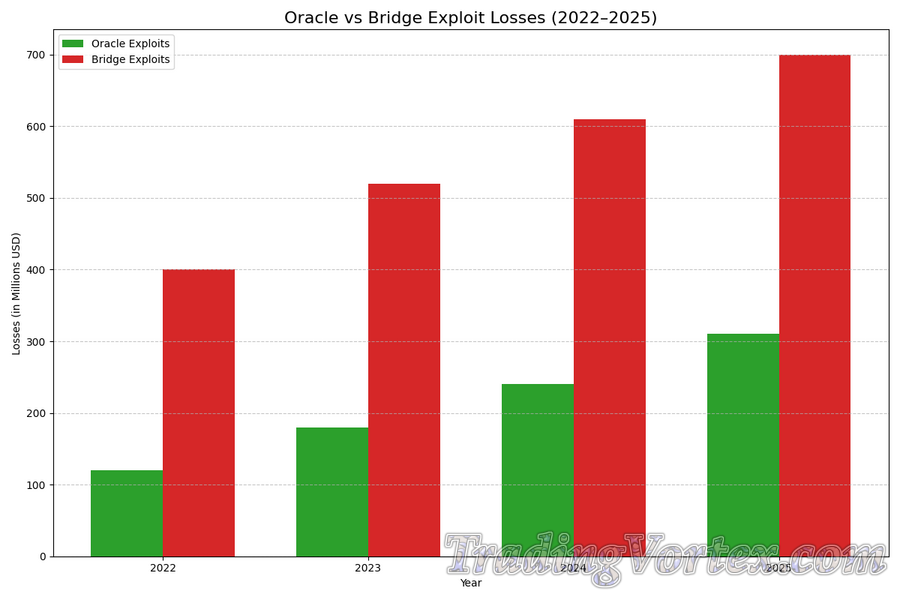 Oracle vs Bridge Exploit Losses (2022–2025): A grouped bar chart showing bridge exploits consistently causing more damage than oracle attacks, with both trending upward.
♦ How to use it: This reinforces the need for caution when using cross-chain bridges and low-liquidity oracle-fed protocols.
Key Takeaway:
DeFi offers freedom and opportunity, but it demands vigilance. Smart contracts, liquidity pools, oracles, and bridges all carry risks. The best protection is a mix of technical awareness and cautious behavior. Diversify, verify, and never invest more than you’re willing to lose.
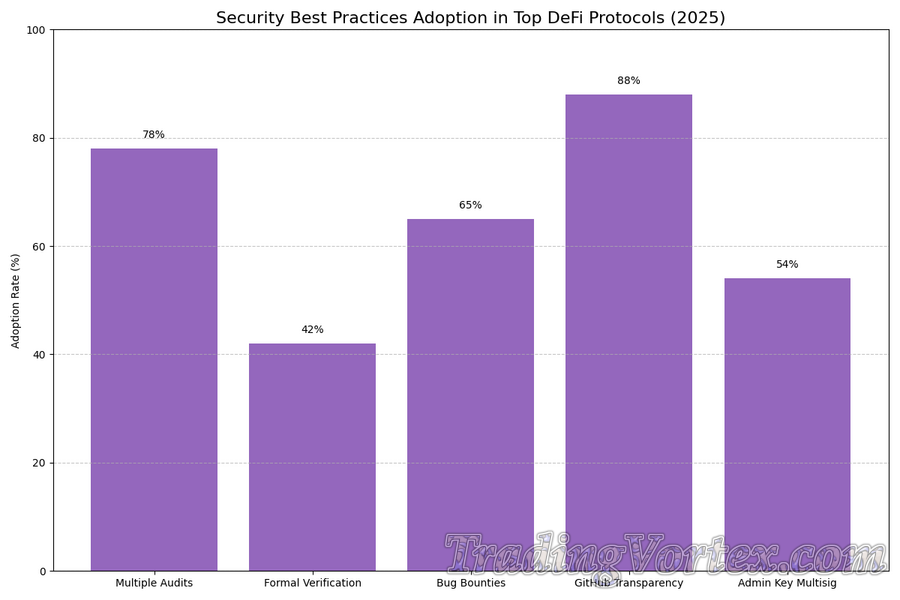 Security Best Practices Adoption in Top DeFi Protocols (2025): A vertical bar chart showing adoption rates of key security practices: GitHub transparency (88%) and multiple audits (78%) lead, while formal verification lags at 42%.
♦ How to use it: This visual helps investors vet protocols by showing which practices are most commonly adopted among top players.
DeFi Regulation and Compliance: What Crypto Investors Must Know
Global Regulatory Landscape for DeFi and Crypto Investors
Let’s be honest: navigating DeFi regulation in 2025 feels like trying to read a map that keeps changing. According to PwC’s Global Crypto Regulation Report, 45 of 75 major economies fully permit crypto, while 20 impose partial bans and 10 enforce near-total bans. Even within the G20, only 8 of 25 major markets have full rules covering AML, consumer protection, and market integrity.
The U.S. remains a regulatory heavyweight. The SEC and CFTC are jointly tightening oversight, especially around governance tokens and smart contract transparency. Europe is rolling out MiCA (Markets in Crypto-Assets), which sets clearer standards for stablecoins and DeFi platforms. Meanwhile, countries like Singapore and the UAE are positioning themselves as DeFi-friendly hubs with sandbox frameworks.
For investors, this means your location matters. A protocol that’s legal in one country might be restricted in another. Always check local laws before diving into a new platform, especially if you’re staking large amounts or using leverage.
 Global Regulatory Landscape for DeFi (2025): It shows the breakdown of 75 major economies:
60% fully permit crypto, 27% impose partial bans, and 13% enforce near-total bans. This helps investors quickly grasp the uneven global stance on DeFi regulation.
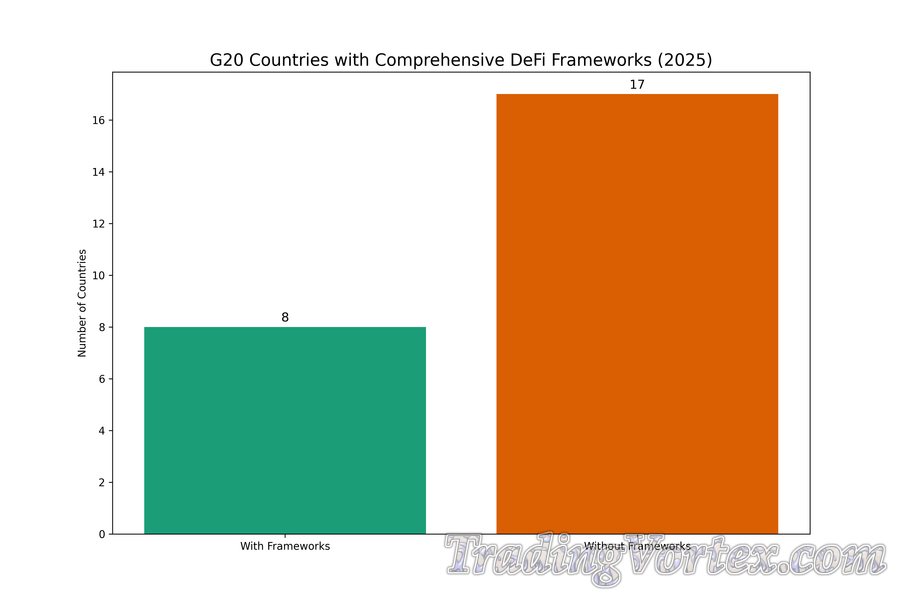 G20 Countries with Comprehensive DeFi Frameworks (2025): A bar chart comparing 8 countries with frameworks vs 17 without.
♦ How to use it: This highlights the regulatory gap even among the world’s largest economies, reinforcing the need for investors to check local rules.
KYC/AML and On‑Chain Privacy: Compliance vs Decentralization in DeFi
Here’s where things get spicy. Regulators want Know Your Customer (KYC) and Anti-Money Laundering (AML) compliance, but DeFi thrives on anonymity and permissionless access. The result? A tug-of-war between privacy and oversight.
In 2025, many protocols are experimenting with zero-knowledge KYC (zk-KYC), decentralized identity (DID), and soulbound tokens to prove compliance without revealing personal data. It’s like showing you’re old enough to enter a bar without handing over your ID.
Some platforms now offer tiered access: full DeFi functionality for verified users, and limited features for anonymous wallets. While this may feel like a compromise, it’s a step toward keeping regulators happy without killing the spirit of decentralization.
As an investor, expect more pop-ups asking for wallet verification or identity proofs. If you’re privacy-conscious, look for platforms using zk-KYC or DID frameworks. They’re not perfect, but they’re better than handing over your passport to a smart contract.
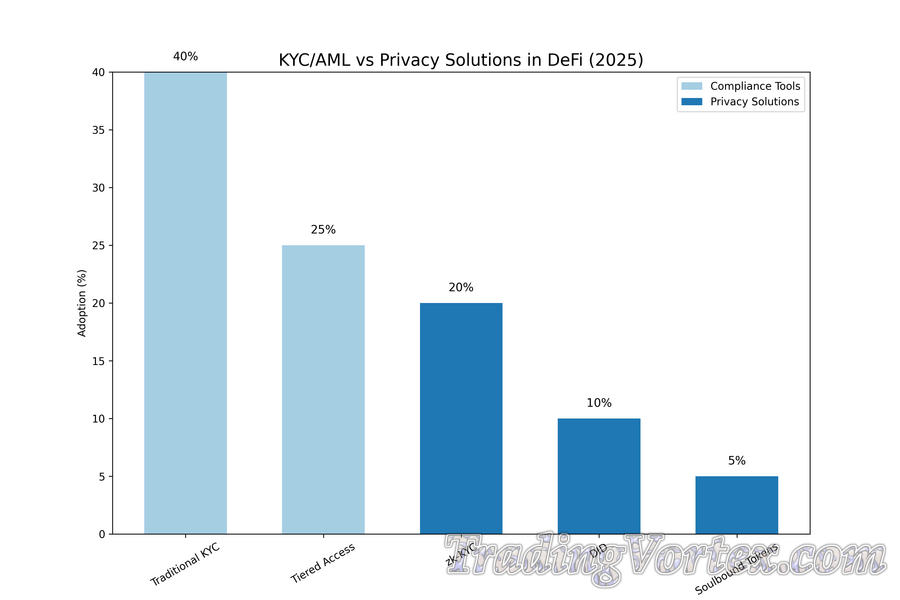 KYC/AML vs Privacy Solutions in DeFi (2025): A stacked bar chart comparing adoption of compliance tools (Traditional KYC 40%, Tiered Access 25%) vs privacy-preserving solutions (zk-KYC 20%, DID 10%, Soulbound Tokens 5%).
♦ How to use it: This visual illustrates the tug-of-war between regulatory compliance and privacy innovation, showing that compliance tools dominate but privacy solutions are gaining traction.
How Regulation Affects DeFi Trading, Yield, and Token Listings
Regulation isn’t just about paperwork: it affects your bottom line. In 2025, token listings are under tighter scrutiny, especially those offering yield or governance rights. Platforms must now register or seek exemptions for certain tokens, which means fewer “ape now” opportunities and more due diligence.
Yield strategies are also evolving. Some protocols are capping returns or restructuring incentives to comply with securities laws. If you’ve noticed your favorite farm suddenly offering lower APY, it might be because they’re trying to stay on the right side of the SEC.
Trading access is shifting too. Some DEXs now geo-block users from restricted jurisdictions, and centralized exchanges are delisting tokens that fail compliance checks.
For traders, this means keeping an eye on regulatory news is just as important as watching price charts.
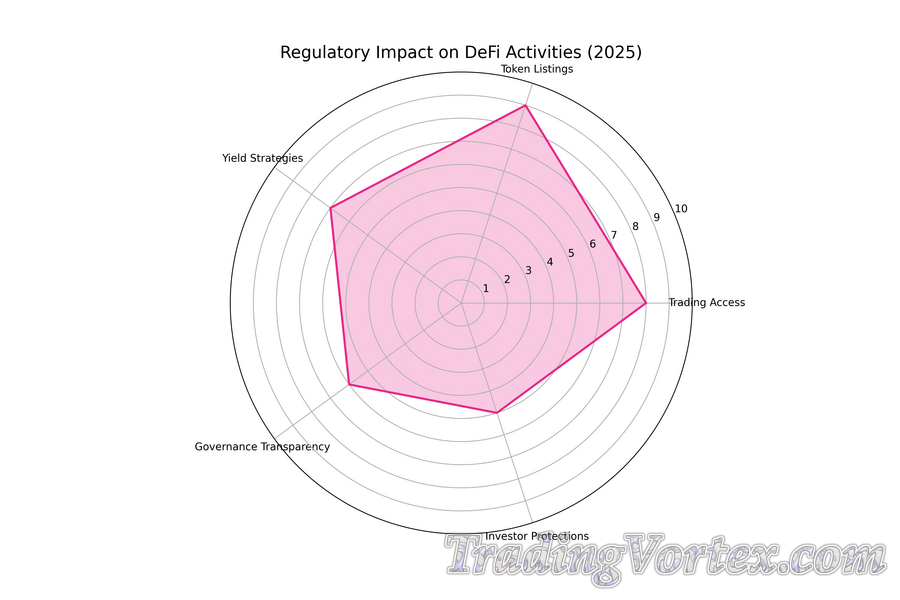 Regulatory Impact on DeFi Activities (2025): A radar chart scoring regulation’s impact (1–10 scale) on Trading Access (8), Token Listings (9), Yield Strategies (7), Governance Transparency (6), and Investor Protections (5).
♦ How to use it: This helps investors visualize which aspects of DeFi are most constrained by regulation, guiding them to adjust strategies accordingly.
Key Takeaway:
DeFi regulation in 2025 is a balancing act between innovation and accountability. Investors must stay informed, adapt to evolving compliance tools, and understand how laws impact their trading, yield, and token access. The future of DeFi isn’t lawless: it’s layered, and the smartest traders learn to navigate both the code and the rules.
Global DeFi Regulation Table (2025):
Here’s a high-impact country-by-country table of DeFi regulation as of late 2025, based on the latest reports from PwC, TRM Labs, and CoinRank. It highlights each country’s stance, key regulatory bodies, and notable DeFi-related policies or actions.
| Country/Region | Stance | Regulatory Body/Bodies | Notable DeFi Policies or Actions |
|---|---|---|---|
| United States | Restrictive | SEC, CFTC, FinCEN | SEC treats many DeFi tokens as securities; CFTC targets derivatives; KYC enforcement rising |
| European Union | Permissive | ESMA, EBA, ECB | MiCA framework includes DeFi under crypto asset service providers; stablecoin rules enforced |
| United Kingdom | Neutral | FCA | Exploring DeFi sandbox; cautious approach to yield protocols and governance tokens |
| Singapore | Permissive | MAS | Supports DeFi innovation via Project Guardian; encourages tokenized RWAs |
| United Arab Emirates | Permissive | VARA, ADGM | Dubai and Abu Dhabi offer DeFi-friendly licensing; focus on institutional DeFi |
| China | Restrictive | PBoC, CAC | Blanket ban on public DeFi platforms; promotes state-controlled blockchain infrastructure |
| India | Restrictive | RBI, SEBI | Heavy taxation on crypto; unclear DeFi stance; centralized exchanges under scrutiny |
| Japan | Permissive | FSA | Recognizes DeFi protocols under crypto asset service laws; promotes transparency |
| South Korea | Neutral | FSC, KISA | Tight controls on token listings; DeFi not yet fully regulated |
| Brazil | Permissive | CVM, Central Bank | Supports tokenization and DeFi pilots; regulatory sandbox active |
| Australia | Permissive | ASIC, AUSTRAC | Drafting DeFi-specific guidance; supports innovation with consumer protection |
| Canada | Neutral | CSA, OSC | DeFi protocols treated as securities; enforcement varies by province |
| Russia | Neutral | Central Bank of Russia | Mixed signals; DeFi not banned but lacks clear framework |
| South Africa | Permissive | FSCA, SARB | Active DeFi engagement; exploring tokenized bonds and lending |
| Turkey | Neutral | CBRT, Capital Markets Board | Crypto legal but DeFi unregulated; monitoring stablecoin use |
| Nigeria | Neutral | SEC Nigeria, CBN | Crypto legalized for investment; DeFi not yet addressed directly |
DeFi Investment Strategies for Crypto Traders
Short-Term Trading vs Long-Term Holding in DeFi Crypto Markets
DeFi markets move at lightning speed, and traders constantly wrestle with the choice between short-term trading and long-term holding.
- Short-term trading thrives on volatility. Opportunities include arbitrage between decentralized exchanges, flash loan strategies, and exploiting temporary liquidity imbalances. It’s thrilling, but it demands constant monitoring, quick reflexes, and a stomach for risk. Think of it as surfing: exhilarating when you catch the wave, but brutal if you wipe out.
- Long-term holding, on the other hand, often means staking assets or participating in governance. ETH stakers, for example, earn steady yields while securing the network. Long-term strategies are less about adrenaline and more about patience. It’s like planting a tree: you don’t get shade immediately, but years later you’ll be glad you did.
Smart traders often blend both approaches: keeping a portion of their portfolio for quick plays while locking the rest into long-term positions that generate passive income.
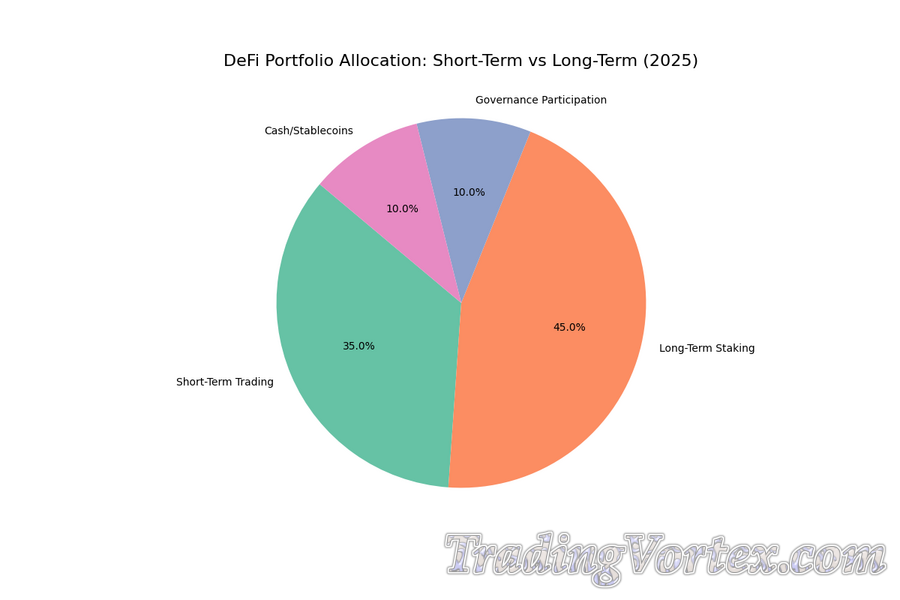 DeFi Portfolio Allocation: Short-Term vs Long-Term (2025): A pie chart illustrating a sample portfolio split: 35% short-term trading, 45% long-term staking, 10% governance participation, and 10% stablecoin reserves.
♦ How to use it: This helps readers visualize how seasoned traders balance agility with passive income strategies.
Risk-Adjusted Yield Farming Strategies for Crypto Investors
Yield farming has matured. Gone are the days of chasing unsustainable triple-digit APYs. According to recent industry reports, stablecoin yield farming on regulated platforms now offers 5–8 percent annual returns, backed by institutional liquidity. Blue-chip pools like ETH/USDC or BTC/ETH are favored for their stability and depth.
Risk-adjusted strategies are the new norm:
- Allocate a portion to stablecoin farms for predictable returns
- Use impermanent loss calculators before entering volatile pools
- Diversify across multiple protocols to reduce exposure to single-point failures
- Monitor smart contract audits and insurance options for added protection
I learned this lesson the hard way. I once jumped into a flashy farm promising 200 percent APY. Three weeks later, the token collapsed, and my “yield” evaporated. Since then, I stick to strategies that balance risk and reward, even if the returns look less glamorous.
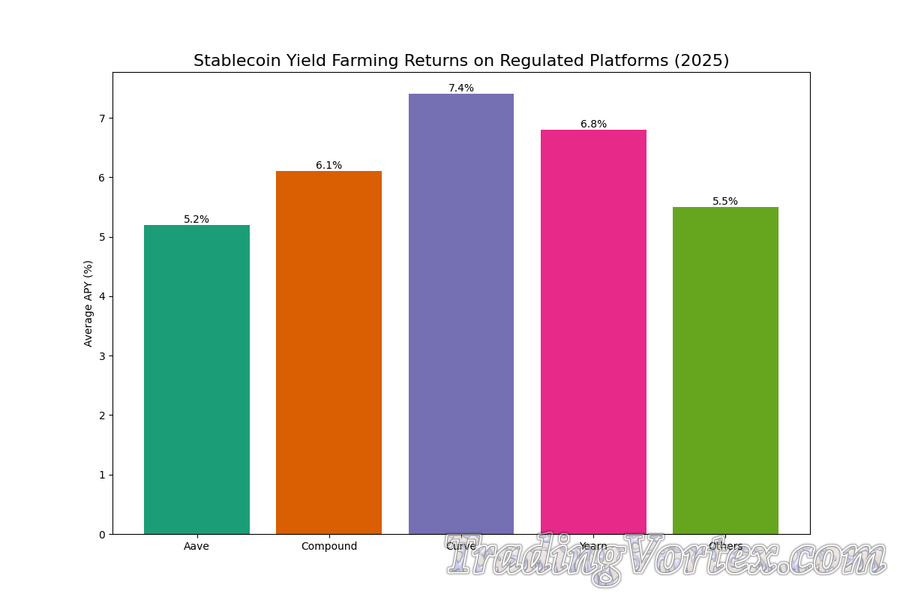 Stablecoin Yield Farming Returns on Regulated Platforms (2025): A bar chart comparing average APYs across Aave (5.2%), Compound (6.1%), Curve (7.4%), Yearn (6.8%), and others (5.5%).
♦ How to use it: This visual reinforces the shift toward sustainable, risk-adjusted returns in stablecoin farming.
Diversification: DeFi Tokens, Indexes, and Tokenized RWAs
Diversification is the golden rule in DeFi. Beyond holding governance tokens like UNI or AAVE, investors are turning to DeFi indexes that bundle multiple assets, reducing exposure to individual token volatility.
The hottest trend is tokenized real-world assets (RWAs). By late 2025, RWAs had grown to over $24 billion in value, with tokenized U.S. Treasuries leading the charge.
For traders, this means you can hedge crypto volatility with blockchain-based exposure to bonds, real estate, or commodities. It’s like mixing a spicy dish with a side of bread: you balance the heat with something stable.
Diversification also extends across chains. With cross-chain interoperability improving, traders can spread exposure across Ethereum, Solana, and Layer 2 ecosystems, reducing reliance on a single network.
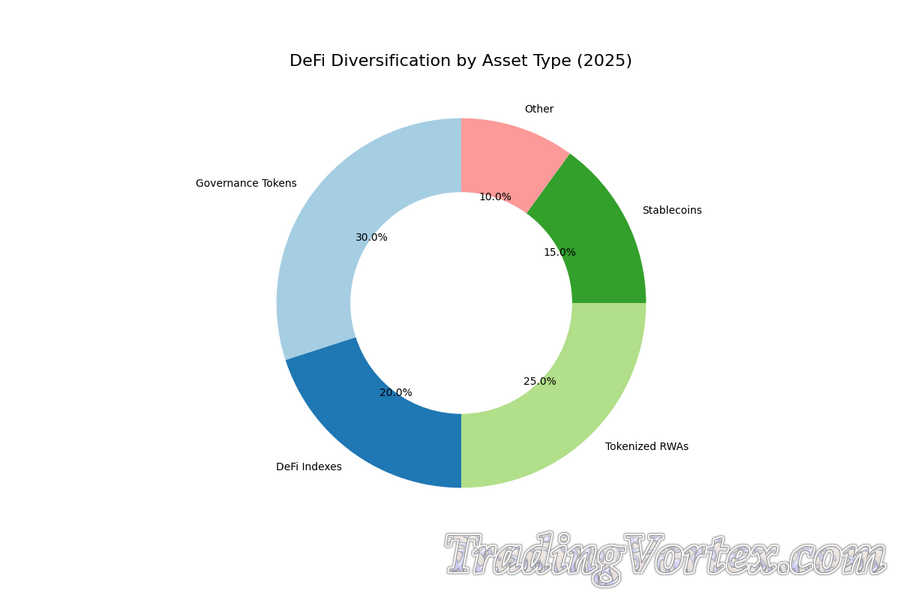 DeFi Diversification by Asset Type (2025): A donut chart showing portfolio diversification: Governance Tokens (30%), DeFi Indexes (20%), Tokenized RWAs (25%), Stablecoins (15%), Other (10%).
♦ How to use it: This helps readers understand how to spread exposure across DeFi verticals to reduce volatility.
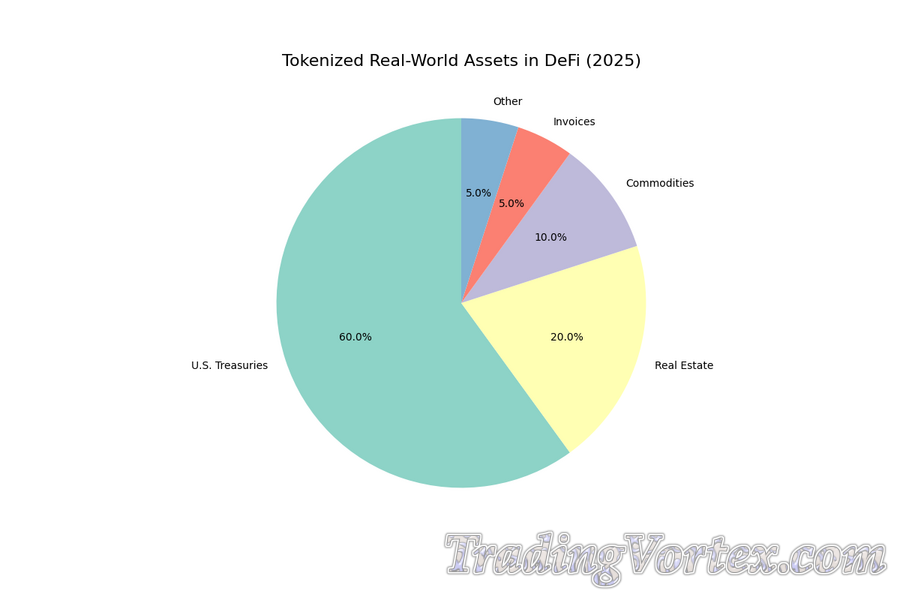 Tokenized Real-World Assets in DeFi (2025): A pie chart showing RWA composition: U.S. Treasuries (60%), Real Estate (20%), Commodities (10%), Invoices (5%), Other (5%).
♦ How to use it: This visual supports the claim that RWAs are maturing and becoming a core part of DeFi portfolios.
Due Diligence Checklist for DeFi Crypto Investments
Before committing funds, every trader should run through a DeFi due diligence checklist:
- Audit history: Has the protocol been reviewed by reputable firms?
- Team transparency: Are developers known and active, or hiding behind pseudonyms?
- Liquidity depth: Is the pool large enough to handle exits without slippage?
- Governance model: Who controls upgrades and admin keys?
- Community trust: Check platforms like DeFiSafety or RugDoc for red flags
- Insurance options: Does the protocol offer coverage against hacks or exploits?
Skipping due diligence in DeFi is like buying a used car without checking the brakes, mileage, or ownership history. You might get lucky, but more often than not, you’ll end up stranded on the side of the road.
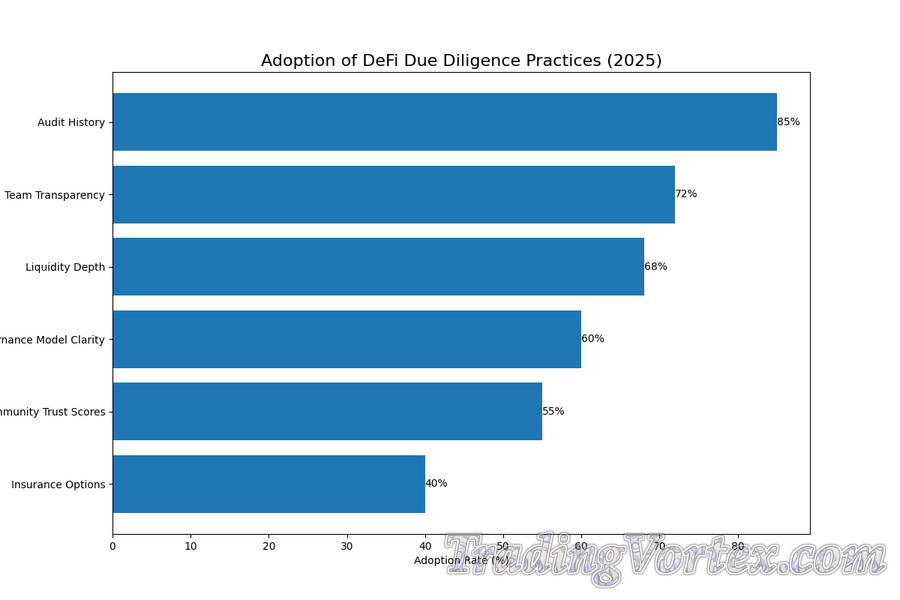 Adoption of DeFi Due Diligence Practices (2025): A horizontal bar chart showing adoption rates among top DeFi protocols: Audit History (85%), Team Transparency (72%), Liquidity Depth (68%), Governance Clarity (60%), Community Trust (55%), Insurance Options (40%).
♦ How to use it: This chart helps investors prioritize what to look for when evaluating new protocols.
Key Takeaway:
DeFi investment strategies in 2025 are about balance and discipline. Traders who combine short-term agility with long-term patience, adopt risk-adjusted yield farming, diversify into RWAs, and follow strict due diligence are best positioned to thrive. The opportunities are real, but so are the risks, and the smartest investors treat DeFi as both a playground and a battlefield.
DeFi Tools and Platforms: Best Crypto Protocols, Wallets, and Analytics
Leading DeFi Protocols and DEXs Crypto Investors Should Know
DeFi protocols are the beating heart of decentralized finance. In 2025, Uniswap, Curve, and Aave remain household names, but newer players like Ethena are making waves by offering synthetic dollars with native yield from assets like ETH and BTC. According to Lampros Tech, DeFi now secures hundreds of billions in total value locked (TVL), proving it is no longer a niche experiment but the financial base layer of Web3.
I still remember my first Uniswap swap: it felt like magic, trading directly from my wallet without waiting for an exchange to approve me.
Beyond the classics, newer DEXs are experimenting with cross-chain liquidity pools and gasless transactions, making trading smoother and cheaper. The competition is fierce, but that’s good news for investors: more innovation, lower costs, and better user experiences.
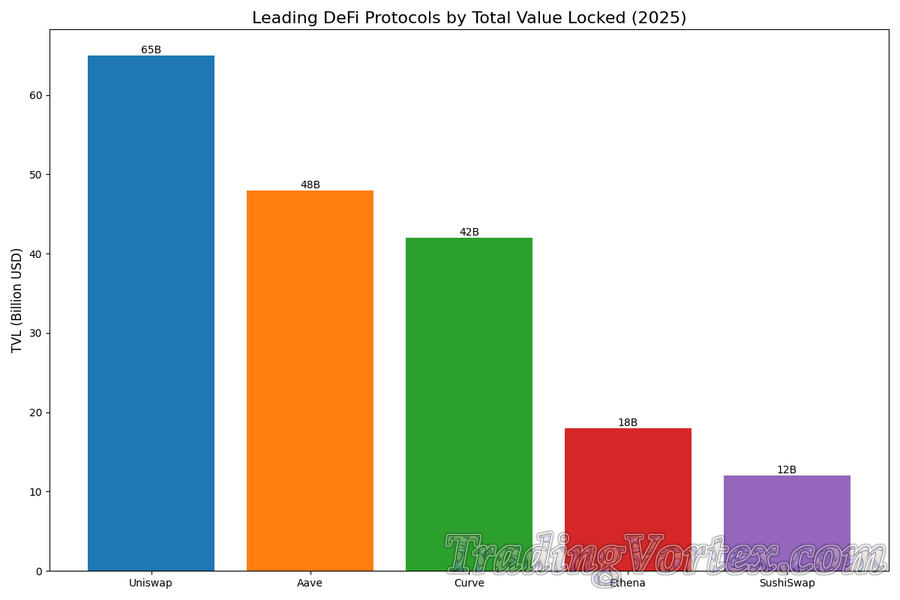 Leading DeFi Protocols by Total Value Locked (2025): A vertical bar chart comparing TVL across major DeFi protocols: Uniswap leads with $65B, followed by Aave ($48B), Curve ($42B), Ethena ($18B), and SushiSwap ($12B).
♦ How to use it: This visual reinforces the dominance of established protocols while highlighting the rise of newer players like Ethena.
Wallets, Custody, and Security Tools for DeFi Crypto Traders
If protocols are the heart, wallets are the hands. MetaMask remains the go-to wallet for most DeFi users, offering easy integration with dApps. For those who want extra safety, hardware wallets like Ledger and Trezor provide cold storage that keeps private keys offline.
Security tools are equally important. Platforms like Revoke.cash let you cancel risky smart contract approvals, while Fireblocks and Gnosis Safe offer institutional-grade custody solutions. Think of wallets as your house keys and custody tools as the locks and alarms that keep intruders out.
I once skipped revoking a token approval after testing a new farm, only to find my wallet drained weeks later. Since then, I treat revoke tools as mandatory, not optional. And if you’re managing larger sums, multi-signature wallets like Gnosis Safe are a lifesaver, ensuring no single person can move funds without consensus.
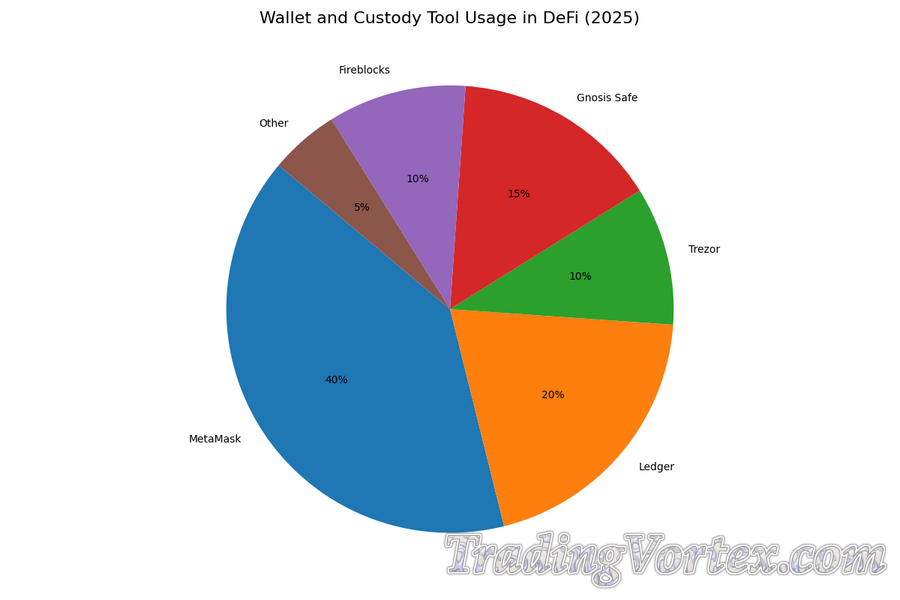 Wallet and Custody Tool Usage in DeFi (2025): A pie chart showing user adoption: MetaMask (40%) dominates, with Ledger (20%), Gnosis Safe (15%), and others following.
♦ How to use it: This helps readers understand the wallet landscape and prioritize security tools based on popularity and trust.
Analytics, On‑Chain Data, and Portfolio Trackers for DeFi Investors
DeFi is data-heavy, and analytics platforms help make sense of the chaos. Nansen, Dune Analytics, Glassnode, DeFiLlama, and TradingView are among the top tools in 2025. They track wallet activity, token flows, liquidity pools, and even “smart money” movements.
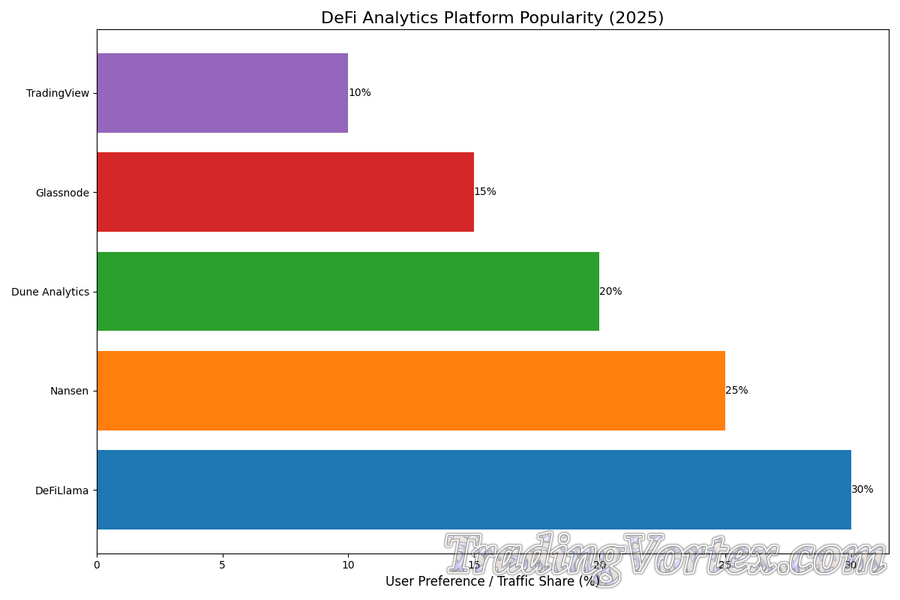 DeFi Analytics Platform Popularity (2025): A horizontal bar chart ranking analytics platforms by user preference: DeFiLlama (30%) and Nansen (25%) lead, followed by Dune, Glassnode, and TradingView.
♦ How to use it: This visual helps investors choose the right tools for tracking on-chain data and market trends.
For portfolio management, trackers like Zapper, Zerion, and DeBank consolidate your holdings across multiple chains, giving you a clear picture of your net worth and yield. These tools are lifesavers when you’re juggling assets across Ethereum, Solana, and Layer 2 networks.
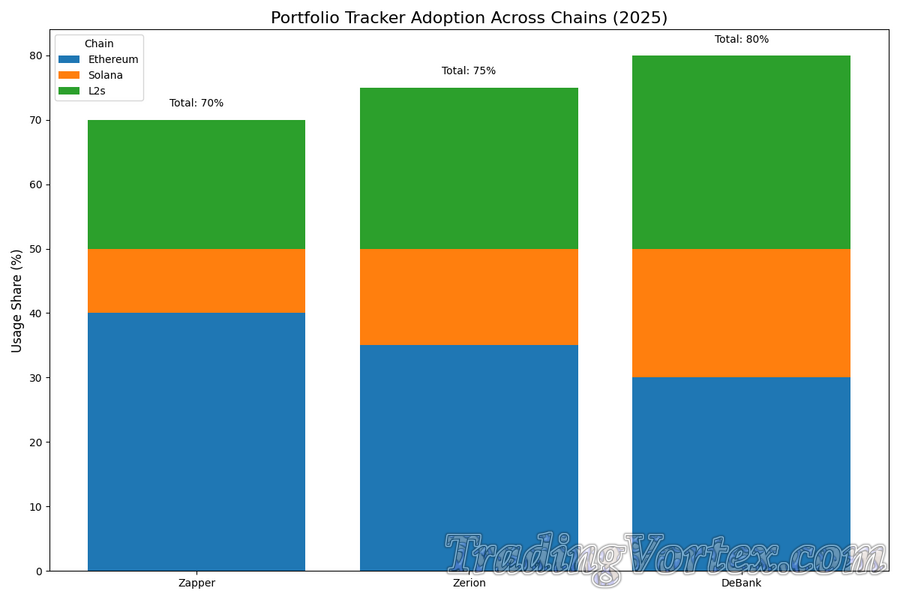 Portfolio Tracker Adoption Across Chains (2025): A stacked bar chart showing how each tracker is used across Ethereum, Solana, and Layer 2s. DeBank shows the most balanced multi-chain adoption.
♦ How to use it: This chart helps users pick a portfolio tracker based on their preferred chains and asset distribution.
I often joke that without DeFiLlama, I’d feel like I was flying blind. It’s the dashboard that keeps me sane when liquidity shifts overnight. And with Nansen’s wallet labeling, you can even follow the moves of whales and funds, turning data into actionable insights.
Key Takeaway:
The best DeFi strategies rely on a toolkit: protocols for trading and lending, wallets for security, and analytics for clarity. In 2025, these tools are more powerful and user-friendly than ever, but they still demand vigilance. The smartest traders treat their DeFi stack like a survival kit: always ready, always secure, and always informed.
How to Get Started with DeFi: Step‑by‑Step Guide for Crypto Investors
Setting Up a Crypto Wallet and Connecting to DeFi Protocols
Your first step into DeFi is setting up a wallet. According to CryptoProcessing’s 2025 guide, MetaMask, Trust Wallet, and Ledger remain the most popular options. MetaMask is perfect for beginners thanks to its browser extension and mobile app, while Ledger offers hardware-level security for those who want peace of mind.
Once your wallet is ready, you’ll need to fund it with crypto. Most DeFi platforms run on Ethereum or compatible chains, so ETH and stablecoins like USDC or DAI are the go-to starting assets. Buy them from a reputable exchange, transfer them to your wallet, and you’re ready to connect.
Connecting to a DeFi protocol is as simple as visiting its website and clicking “Connect Wallet.” Suddenly, you’re plugged into a global financial system without banks or brokers. I still remember the first time I connected MetaMask to Uniswap: it felt like opening a secret door to a parallel financial universe.
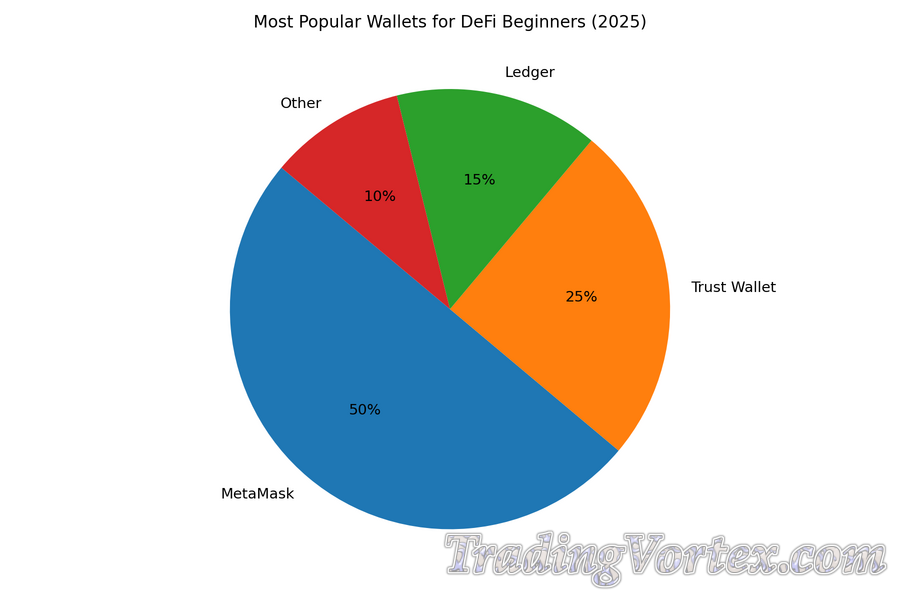 Most Popular Wallets for DeFi Beginners (2025): A pie chart illustrating wallet usage among new DeFi users: MetaMask leads with 50%, followed by Trust Wallet (25%) and Ledger (15%).
♦ How to use it: This visual helps beginners choose a wallet based on popularity and ease of use, reinforcing MetaMask’s dominance as a starting point.
First DeFi Trades: Swapping, Providing Liquidity, and Staking Crypto
Your first DeFi trade will likely be a token swap. Platforms like Uniswap or Curve let you exchange ETH for stablecoins or governance tokens in seconds. It’s straightforward, but always double-check the slippage settings so you don’t lose more than expected.
Once you’re comfortable, try providing liquidity. This means depositing two tokens into a pool so others can trade against them. In return, you earn fees. It’s a great way to put idle assets to work, though you’ll need to understand impermanent loss before diving in.
Finally, explore staking. Whether it’s staking ETH to secure the network or locking governance tokens in a protocol, staking offers steady yields. It’s less flashy than yield farming, but it’s a reliable way to grow your holdings over time.
Think of these first trades as training wheels. You’re not trying to win the Tour de France on day one, you’re just learning how to balance. Start small, experiment, and build confidence before scaling up.
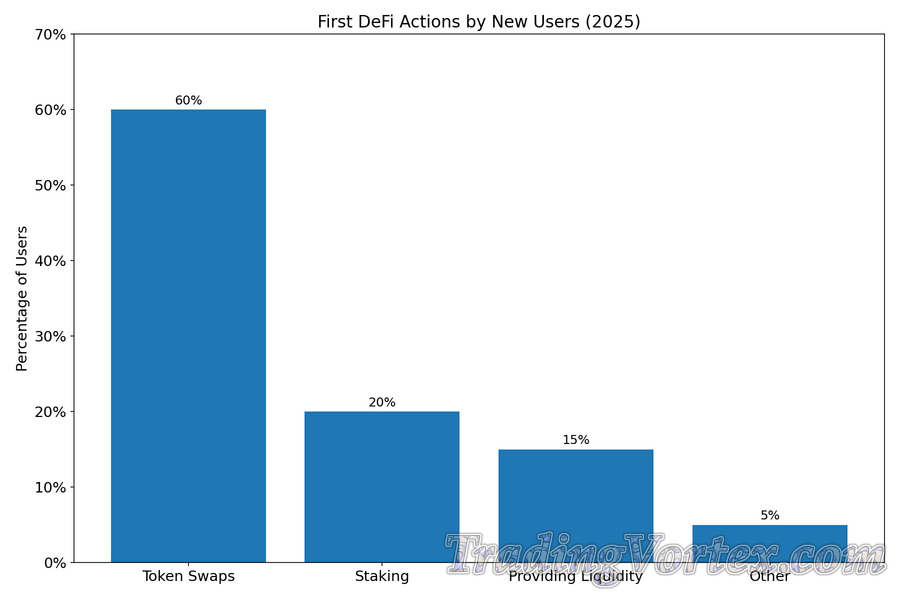 First DeFi Actions by New Users (2025): A bar chart showing that 60% of new users start with token swaps, followed by staking (20%) and liquidity provision (15%).
♦ How to use it: This helps readers prioritize their first steps and understand the most common entry points into DeFi.
Safety Checklist: Gas Fees, Slippage, Approvals, and Backups
DeFi is exciting, but it’s also unforgiving if you skip safety steps. Here’s a checklist every investor should follow:
- Gas fees: Always check transaction costs. On Ethereum, fees can spike during busy hours. Consider using Layer 2 networks like Arbitrum or Optimism for cheaper transactions.
- Slippage settings: Adjust slippage tolerance carefully. Too high, and you risk losing value; too low, and your trade may fail.
- Approvals: Use tools like Revoke.cash to cancel old token approvals. Leaving approvals open is like giving strangers a spare key to your wallet.
- Backups: Store your seed phrase offline, ideally in multiple secure locations. Losing it means losing access to your funds forever.
I once ignored gas fees and paid $70 to swap $100 worth of tokens. That was my tuition fee for learning patience. Since then, I always check fees before hitting confirm.
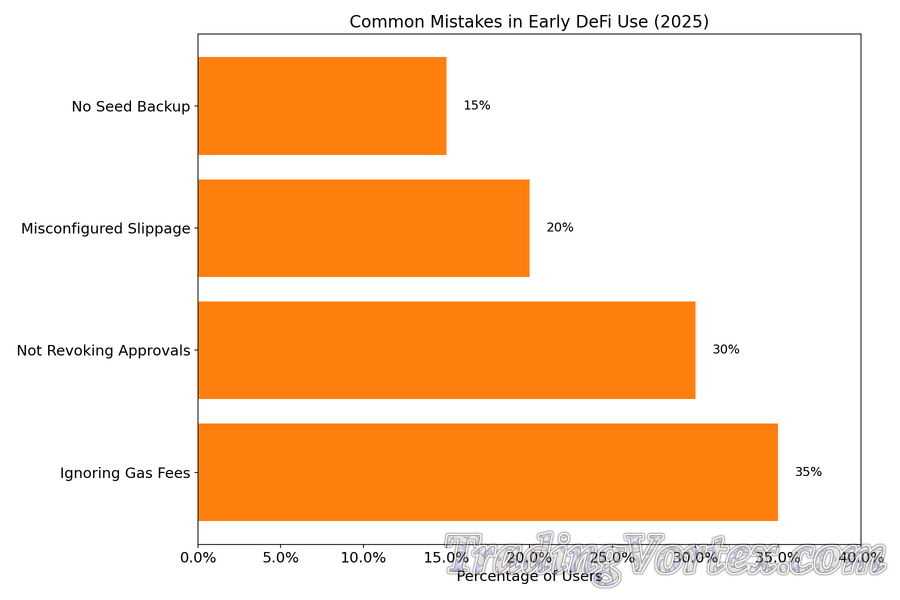 Common Mistakes in Early DeFi Use (2025): A horizontal bar chart showing top beginner mistakes: ignoring gas fees (35%) and not revoking approvals (30%) are the most frequent.
♦ How to use it: This visual reinforces the importance of safety habits and encourages users to avoid costly missteps.
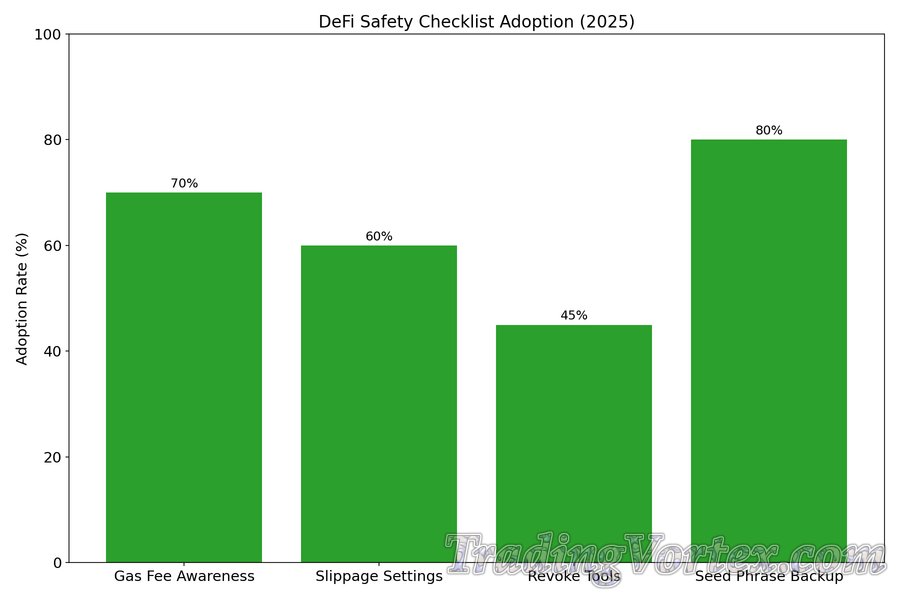 DeFi Safety Checklist Adoption (2025): A vertical bar chart showing adoption rates of key safety practices: seed phrase backup (80%) and gas fee awareness (70%) are widely followed, while revoke tools lag at 45%.
♦ How to use it: This chart helps users benchmark their own habits and identify areas for improvement in their DeFi routine.
Key Takeaway:
Starting with DeFi in 2025 is about building confidence step by step. Set up a secure wallet, make small trades, experiment with liquidity and staking, and follow a strict safety checklist. The learning curve is real, but the payoff is worth it: financial freedom, global access, and the thrill of being part of a system that never sleeps.
Future of DeFi: Long‑Term Outlook for Decentralized Finance and Crypto
How Tokenization and Interoperability Will Scale DeFi for Investors
Tokenization is the buzzword that keeps proving itself. By late 2025, tokenized real-world assets (RWAs) had already surpassed $24 billion in value, and 2026 is projected to be the year tokenization fully converges with regulated DeFi.
Imagine owning fractions of U.S. Treasuries, real estate, or even fine art, all tradable on-chain with instant liquidity. This isn’t science fiction: it’s already happening in Europe, where regulatory clarity is paving the way for large-scale adoption.
The beauty of tokenization is that it democratizes access. Instead of needing millions to invest in prime real estate or institutional bonds, everyday investors can buy fractionalized tokens and diversify their portfolios. It’s like turning the financial world into a buffet where you can sample a little bit of everything, rather than being forced to order the whole dish.
Interoperability is the other piece of the puzzle. Bridges, rollups, and cross-chain liquidity pools are making it possible to move assets seamlessly across ecosystems.
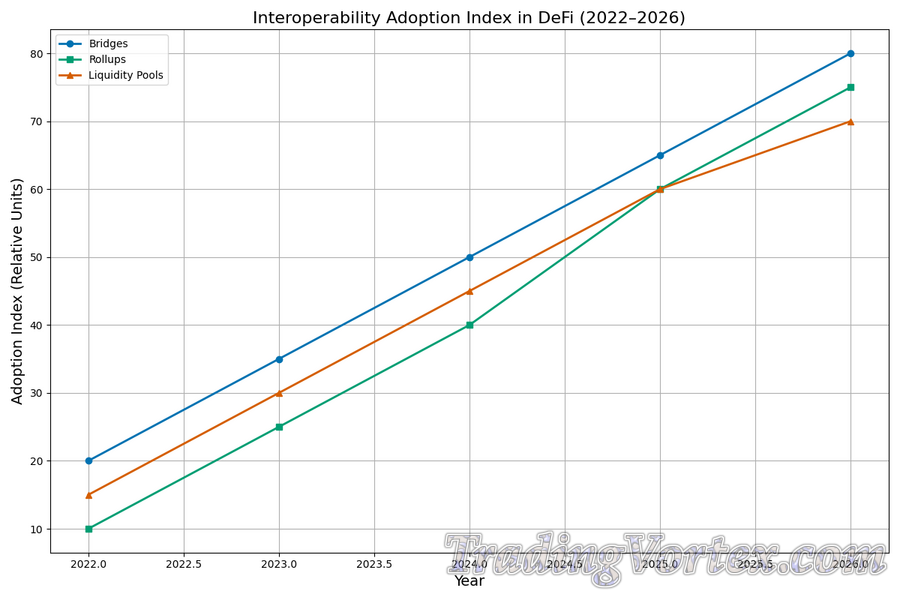 Interoperability Adoption Index (2022–2026): A multi-line chart comparing adoption of bridges, rollups, and liquidity pools, each showing steady growth toward 2026.
♦ How to use it: This helps readers visualize how cross-chain infrastructure is maturing, enabling seamless DeFi experiences.
For traders, this means fewer silos and more opportunities. I still remember the frustration of juggling assets across Ethereum and Binance Smart Chain in 2021: it felt like trying to send a fax to someone using email. By 2026, interoperability is finally catching up to investor expectations, making DeFi smoother and more connected.
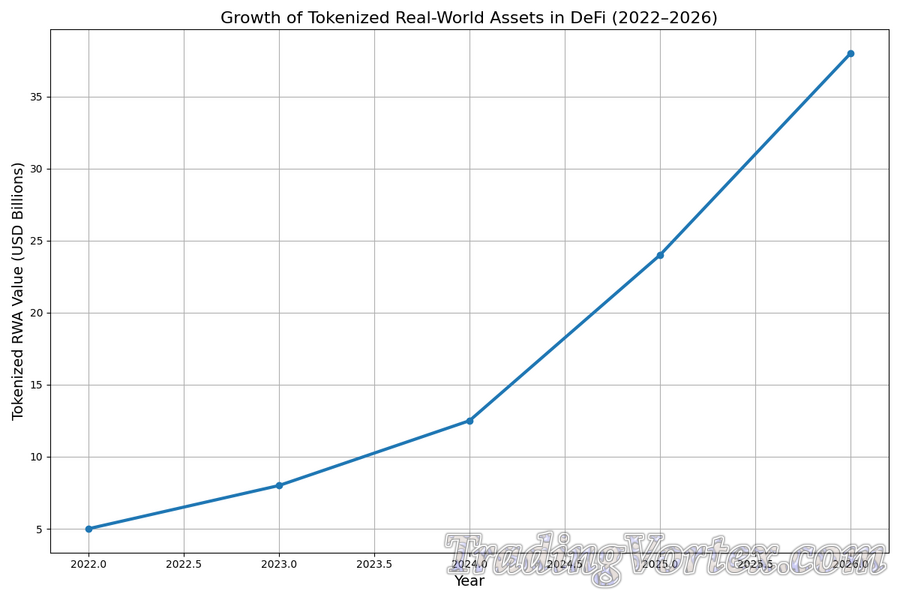 Growth of Tokenized Real-World Assets in DeFi (2022–2026): A line chart tracking the explosive rise of tokenized RWAs from $5B in 2022 to a projected $38B in 2026.
♦ How to use it: This visual underscores the scale and momentum of tokenization, reinforcing its role as a pillar of DeFi’s future.
Institutional Capital, DeFi Infrastructure, and Crypto Market Maturation
Grayscale’s 2026 outlook calls this the “dawn of the institutional era”. Wealth managers, pension funds, and hedge funds are entering DeFi thanks to clearer regulations and demand for alternative stores of value. This influx of capital is expected to stabilize yields, deepen liquidity, and accelerate infrastructure development.
DeFi infrastructure itself is maturing. Expect more regulated custodians, insurance protocols, and compliance-friendly platforms. The days of anonymous yield farms promising 300 percent APY are fading. Instead, institutional-grade DeFi will look more like traditional finance, but with blockchain efficiency. For retail investors, this means safer platforms, but also more competition from big players.
Think of it this way: DeFi is moving from a garage startup vibe to a Wall Street boardroom. The energy and innovation are still there, but the suits are arriving with bigger wallets and stricter rules. For traders, this means adapting strategies to compete in a more professionalized environment.
 Institutional Capital Flowing into DeFi (2022–2026): A bar chart showing institutional inflows growing from $2B in 2022 to $20B in 2026.
♦ How to use it: This visual supports the “dawn of the institutional era” narrative and signals deeper liquidity and market stability.
Predictions: Next Wave of DeFi Innovation for Crypto Traders
Looking ahead, several trends stand out:
- AI-driven DeFi: Smart contracts enhanced with AI for risk management, predictive analytics, and automated trading signals. Imagine a bot that not only executes trades but also learns from market patterns to optimize yield strategies.
- Hybrid liquidity pools: Combining stablecoins with CBDCs, creating new dynamics in lending and trading. This could reshape liquidity flows and make DeFi more resilient to volatility.
- Decentralized identity (DID): Privacy-preserving compliance tools like zk-KYC will balance regulation with user anonymity. Think of it as showing you’re trustworthy without handing over your passport.
- End of the four-year cycle: Analysts predict crypto markets will break free from the old halving-driven boom-bust rhythm, moving toward more stable growth. This could mean fewer rollercoaster crashes and more predictable opportunities.
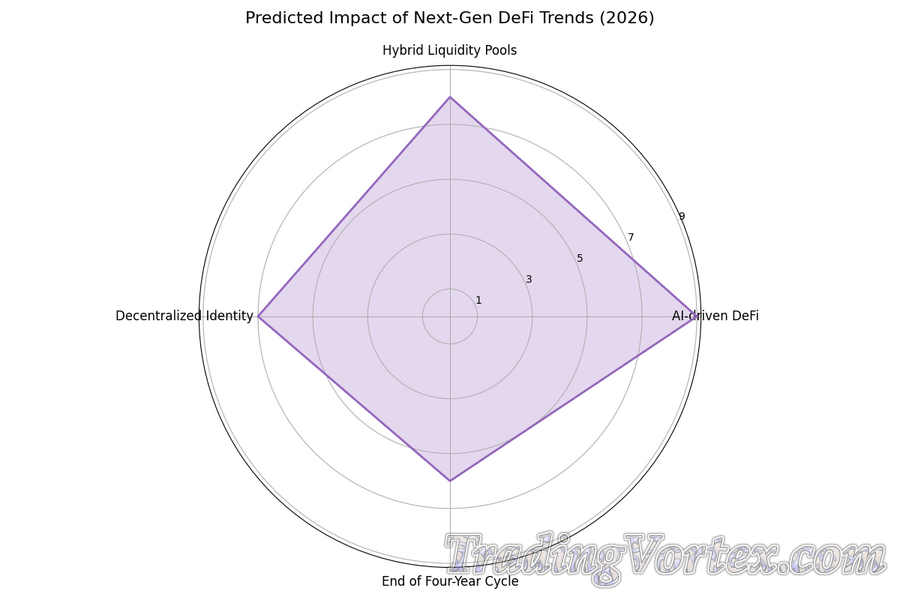 Predicted Impact of Next-Gen DeFi Trends (2026): A radar chart ranking the projected impact of AI, hybrid liquidity pools, decentralized identity, and the end of the four-year cycle.
♦ How to use it: This helps traders prioritize which innovations to watch and prepare for in their strategies.
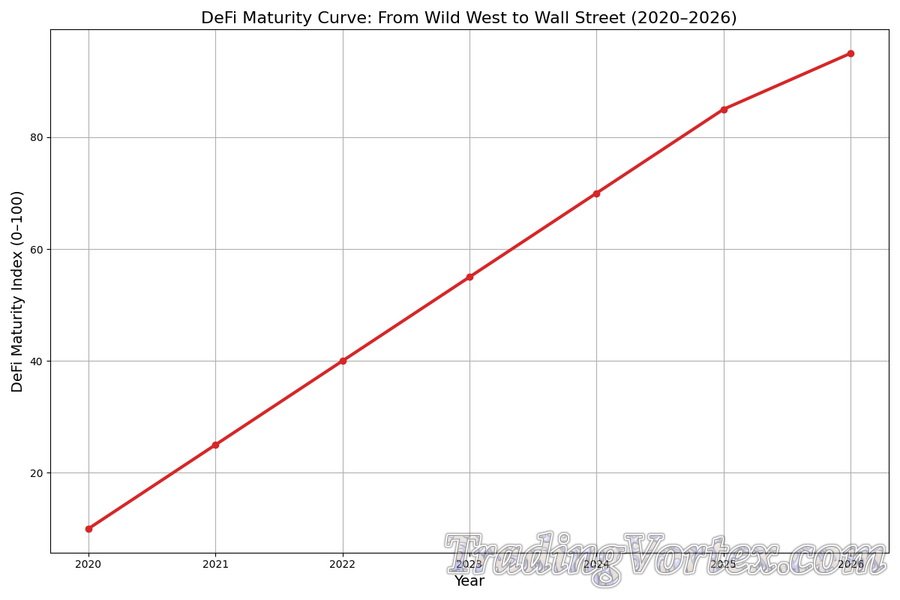 DeFi Maturity Curve: From Wild West to Wall Street (2020–2026): A line chart showing DeFi’s maturity index rising from 10 in 2020 to 95 in 2026.
♦ How to use it: This visual captures the overarching theme: DeFi’s transformation into a credible, institutional-grade financial layer.
Key Takeaway:
The future of DeFi is about scale, maturity, and integration. Tokenization will unlock trillions in real-world assets, interoperability will make DeFi borderless, and institutional adoption will bring credibility and depth. For crypto traders, the challenge is to adapt: blending old-school caution with new-school innovation. DeFi is no longer just a playground: it’s becoming the foundation of a global financial system.
Conclusion: Key takeaways for crypto investors and traders on DeFi
If you’ve made it this far, you already know DeFi can be exciting and intimidating at the same time. Markets reward curiosity and discipline, not FOMO. In plain terms: use the tools, respect the risks, and build routines that make good decisions almost automatic.
DeFi’s foundation is stronger than it used to be. 2025 saw the ecosystem’s TVL measured in the hundreds of billions, with institutional interest rising and tokenization getting real traction. That tells us the infrastructure is maturing, even if the headlines stay noisy.
Macro swings still matter though. Late‑2025 brought a harsh leverage reset and a Bitcoin whipsaw, reminding everyone that risk management beats bravado when the tide goes out. Zooming out, the broader crypto market grew sharply through 2024, then entered 2025 with hopes for regulatory clarity and more professional participation, which is exactly the kind of backdrop that rewards patient, process‑driven investors.
- Balance your timeframes: Blend quick trades with slow compounding. Keep a small slice for tactical moves, and let your core positions work through staking or conservative yield. You sleep better, your PnL thanks you.
- Chase risk‑adjusted yield, not shiny APYs: Favor deep, liquid pools and credible protocols. If returns look too good, ask why. If you can’t explain it in one sentence, skip it.
- Diversify with intent: Mix DeFi blue chips, selective alt exposure, and tokenized RWAs for stability. Don’t park everything on one chain or one strategy.
- Make security a habit: Use hardware wallets, revoke old approvals, limit permissions, and guard your seed phrase like your life savings depend on it. Because they do.
- Use data, not vibes: Rely on on‑chain analytics, audit histories, and transparent governance. Track wallet labels, liquidity depth, and volume. Let dashboards be your co‑pilot, not your crutches.
- Respect liquidity and costs: Plan entries and exits around gas, slippage, and pool depth. Small wins add up when you stop paying the blockchain more than you pay yourself.
- Stay regulation‑aware: Rules shape listings, yields, and access. When compliance tightens, quality tends to rise. Keep one eye on policy updates so you’re never surprised by a delist or geo‑block.
- Write your playbook: Document your theses, triggers, and risk limits. When markets get loud, follow the plan. Future‑you will be grateful.
DeFi is moving toward scale and professionalism, with more institutional liquidity, more compliant infrastructure, and more accessible tools. The edge now comes from preparation and patience: diversify, automate good habits, and treat risk like a cost you can manage, not a mystery you hope goes away.
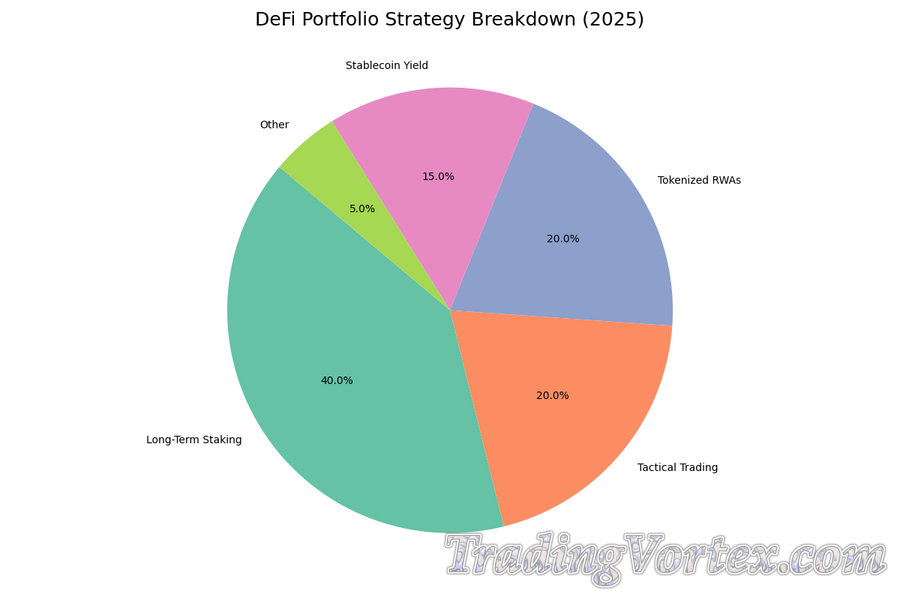 DeFi Portfolio Strategy Breakdown (2025): A pie chart illustrating a balanced DeFi portfolio: 40% long-term staking, 20% tactical trading, 20% tokenized RWAs, 15% stablecoin yield, and 5% other.
♦ How to use it: This visual helps readers visualize how to structure their portfolio for both growth and resilience.
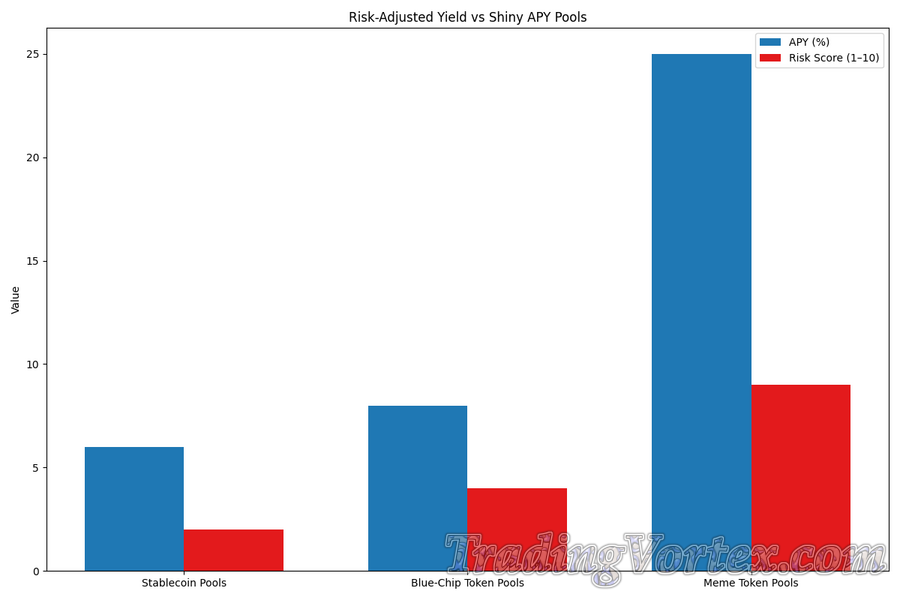 Risk-Adjusted Yield vs Shiny APY Pools: A bar chart comparing APY and risk scores across pool types, highlighting that meme token pools offer high returns but come with high risk.
♦ How to use it: Reinforces the principle that sustainable yield matters more than flashy numbers.
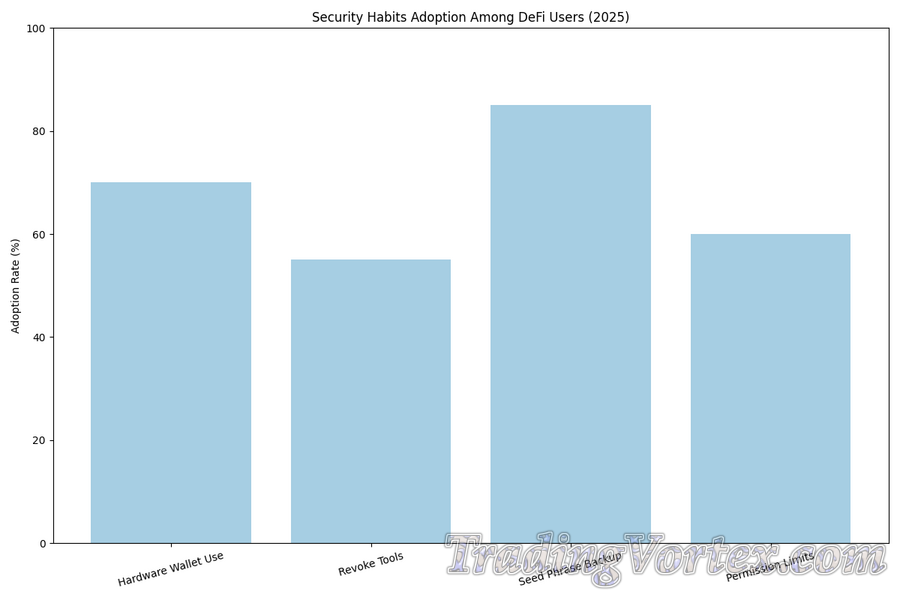 Security Habits Adoption Among DeFi Users: A vertical bar chart showing adoption rates of key practices: 85% back up seed phrases, but only 55% use revoke tools.
♦ How to use it: Encourages readers to adopt underused but critical safety habits.
 DeFi Cost Awareness: Gas, Slippage, and Pool Depth: A radar chart showing user awareness of cost-related risks, with gas fees and slippage scoring highest.
♦ How to use it: Helps readers identify blind spots in their cost management strategy.
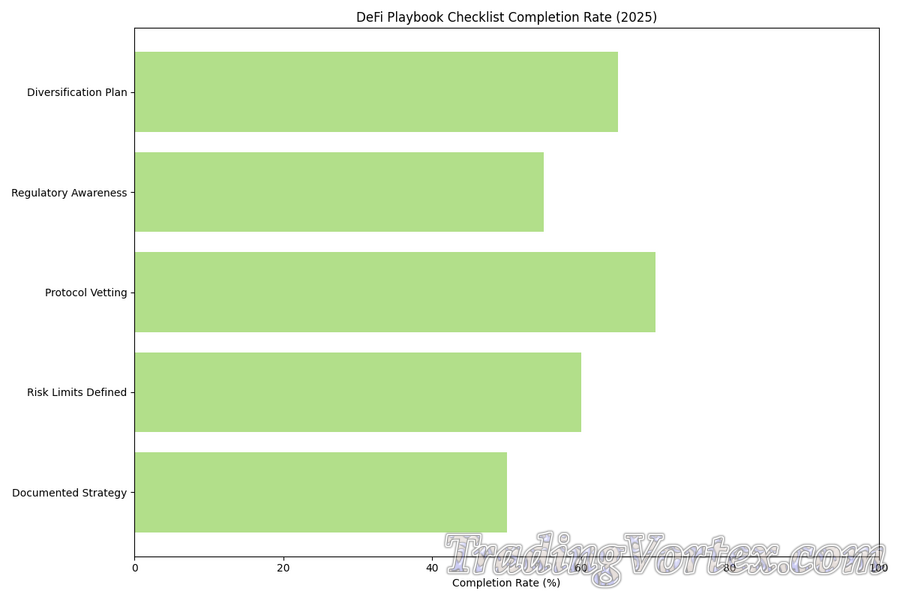 DeFi Playbook Checklist Completion Rate: A horizontal bar chart showing how many users document strategies, define risk limits, and track regulatory awareness.
♦ How to use it: Encourages readers to formalize their approach and treat DeFi like a business, not a bet.
FAQs: Decentralized finance, explained
What is DeFi in simple terms?
DeFi is a set of apps that let you borrow, lend, trade, and earn yield using smart contracts instead of banks. You connect a crypto wallet, pick a protocol, and your transactions are handled on-chain, transparently and without gatekeepers. Think of it as “bring your own bank,” with the benefits and responsibilities that come with that.
How big is DeFi today?
DeFi isn’t niche anymore. In 2025, industry guides reported total value locked in the hundreds of billions, signaling broad participation and deeper liquidity across major protocols.
Why are people excited about DeFi in 2025?
Two big reasons: better scalability and more adoption. Layer 2 solutions reduce fees and speed up transactions, while institutional interest and new protocols keep expanding the toolbox for investors.
Is DeFi safe?
It can be safe if you treat it like a high‑performance sport. Protocols improve, audits help, and risk tooling is better than ever, but smart contract bugs and liquidity shocks still happen. Your best defense is cautious position sizing, verified protocols, and good wallet hygiene. When in doubt, start small and test before you commit.
What are the main DeFi use cases for investors?
♦ Swapping tokens: Trade directly from your wallet on decentralized exchanges.
♦ Lending and borrowing: Supply assets to earn yield or borrow against collateral.
♦ Staking: Lock tokens to secure networks and earn rewards.
♦ Liquidity provision: Deposit pairs into pools for trading fees.
♦ Tokenized assets: Get exposure to real‑world assets on-chain for diversification.
How do regulations impact DeFi access and strategy?
Regulators are tightening KYC and AML expectations, which affects token listings, on‑ramps, and sometimes protocol features. You may see more identity prompts, geo‑blocks, or compliance notices, especially on platforms serving retail at scale.
What should I look for before using a protocol?
♦ Security signals: Recent audits, formal verification, and bug bounties.
♦ Governance and keys: Clear upgrade process and minimized admin control.
♦ Liquidity depth: Enough volume to enter and exit positions without heavy slippage.
♦ Transparency: Active documentation, open‑source code, and an engaged community.
If any of these are missing, pause and reassess. I’ve ignored red flags before and paid tuition in lost tokens. Never again.
How do I pick a wallet for DeFi?
Use a software wallet for day‑to‑day, and a hardware wallet for storage and higher security. Pair them with a multi‑sig for team funds. Back up your seed phrase offline, never share it, and consider a second secure location for redundancy. Wallets are your house keys, so treat them that way.
What fees should I expect?
You’ll pay gas for transactions, plus trading fees on DEXs. Gas varies by network activity, so timing helps. Many investors use Layer 2s to cut costs and speed up execution. Small improvements here compound over time, especially if you rebalance or harvest often.
How do I manage risk in DeFi?
♦ Position sizing: Keep risky strategies small.
♦ Diversification: Spread across protocols, chains, and asset types.
♦ Approvals management: Regularly revoke old token permissions.
♦ Monitoring: Track liquidity, oracle health, and protocol updates.
♦ Exit plans: Set rules for cutting losses or taking profits.
I write my rules down and stick to them. Future‑me thanks past‑me when markets get loud.
What trends should traders watch next?
Layer 2 growth, cross‑chain interoperability, and institutional‑ready platforms are the big three. Expect more compliant features and smoother user experiences, plus continued momentum in tokenized assets as infrastructure and regulation mature.
Do I need to complete KYC to use DeFi?
Purely decentralized protocols usually let you connect a wallet without KYC. However, on‑ramps, off‑ramps, and certain regulated platforms often require identity checks. This mix is increasingly common as jurisdictions refine rules for consumer protection and financial crime prevention.