

How to Invest in Cryptocurrency for Beginners: A Complete 2025 Guide to Starting Smart. Ready to explore the world of crypto but feeling overwhelmed by jargon, volatility, and endless options? This comprehensive beginner’s guide is your trusted roadmap to investing in cryptocurrency with clarity and confidence. Whether you're curious about Bitcoin, Ethereum, or promising altcoins, we walk you through every essential step: from choosing your first coins and securing your assets to understanding tax rules, avoiding costly mistakes, and crafting a long-term investment strategy that fits your goals.
Written in plain language and packed with practical checklists, real-world examples, and up-to-date insights from trusted sources, this guide helps you build a strong foundation without falling for hype or shortcuts. You’ll learn how to track your portfolio, protect your funds, rebalance wisely, and stay informed in a fast-moving market.
Whether you're starting with $50 or planning a diversified portfolio, this article empowers you to take action, stay safe, and grow your crypto knowledge over time. It’s not just about buying coins: it’s about building a system that works for you.
Table of Contents:
- Quick Start: What New Crypto Investors Need to Know
- Why Invest in Crypto Today (Benefits and Use Cases)
- Current Market Trends Beginners Should Watch
- Assessing Your Risk Profile and Setting Goals
- Choosing Where to Buy Crypto: Exchanges and Platforms
- Step-by-Step: Buying Your First Cryptocurrency
- Storing Crypto Safely: Wallets and Security Practices
- Beginner Investment Strategies That Work
- Taxes, Compliance, and Legal Considerations
- Common Beginner Mistakes and How to Avoid Them
- Building Your Crypto Knowledge Toolkit
- Building a Long-Term Crypto Plan (Checklist & Next Steps)
- Conclusion: Your First Steps Toward Confident Crypto Investing
- FAQs: Crypto Investing for Beginners in 2025
- Q1. What’s the safest way to start investing in crypto?
- Q2. How much should I invest as a beginner?
- Q3. What’s the difference between Bitcoin, Ethereum, and altcoins?
- Q4. Do I need a crypto wallet?
- Q5. How do I avoid scams and pump-and-dump schemes?
- Q6. What are the tax implications of crypto investing?
- Q7. Should I try staking or yield farming?
- Q8. How often should I check my portfolio?
- Q9. What’s the best way to learn more about crypto?
- Q10. What’s the biggest mistake beginners make?
Quick Start: What New Crypto Investors Need to Know
Stepping into the world of cryptocurrency can feel like walking into a crowded marketplace where everyone speaks a language you barely understand. The good news is that every seasoned investor once stood exactly where you are now, wondering what on earth a “blockchain” was and why people kept shouting “HODL.” This section is your quick start guide: a friendly crash course that will help you feel less like a tourist and more like someone who belongs here.
What “cryptocurrency” means for beginners
At its core, cryptocurrency is digital money that exists on the internet. Unlike the dollars in your bank account, crypto is not issued or controlled by a government or central bank. Instead, it runs on blockchain technology, which is essentially a public ledger that records every transaction in a way that is secure, transparent, and nearly impossible to tamper with.
Bitcoin, launched in 2009, was the pioneer. Today, in 2025, the crypto universe has expanded into thousands of coins and tokens, each serving different purposes. Some are designed for payments, others power decentralized applications, and some even represent real-world assets like property or art.
The important thing to remember: crypto is not just “magic internet money.” It is a new financial system that is steadily becoming part of mainstream investing, payments, and global commerce.
Key crypto terms every investor should learn
Before you buy your first coin, it helps to learn the vocabulary. Here are the essentials:
- Blockchain: The underlying technology that keeps crypto secure. Picture a chain of blocks, each block containing transaction data, locked together forever.
- Coin vs. Token: Coins, like Bitcoin or Ethereum, run on their own blockchains. Tokens are built on top of existing blockchains and often serve specific functions within apps or projects.
- Wallet: Your digital vault. Hot wallets are apps connected to the internet, convenient but less secure. Cold wallets are hardware devices you keep offline, offering stronger protection.
- Private Key: Your secret password to access your crypto. Lose it, and your funds are gone. Treat it like the crown jewels.
- Gas Fees: Small transaction costs paid to use a blockchain network. They can fluctuate depending on demand.
Learning these terms is like learning the rules of a card game before you sit down at the table. You don’t need to memorize everything, but knowing the basics will save you from rookie mistakes and embarrassing questions later.
How crypto investing differs from stocks and ETFs
If you’ve invested in stocks or ETFs before, crypto will feel familiar in some ways and wildly different in others.
- Volatility: Crypto prices can swing dramatically in minutes. A 20 percent move in a single day is not unusual. This can be thrilling or terrifying, depending on your perspective.
- Accessibility: Unlike stock markets, crypto trades 24/7. There are no opening bells or closing times, which means opportunities and risks are always present.
- Ownership: With stocks, a broker holds your shares. With crypto, you can hold your assets directly in a wallet, giving you more control but also more responsibility.
- Innovation: Crypto is not just about speculation. It powers decentralized finance (DeFi), non-fungible tokens (NFTs), and tokenized real-world assets. These innovations are reshaping how we think about money, ownership, and even identity.
Think of crypto investing as joining a frontier town. There is opportunity everywhere, but you need to know the terrain before you set up shop. The rewards can be significant, but so can the risks if you wander in without a plan.
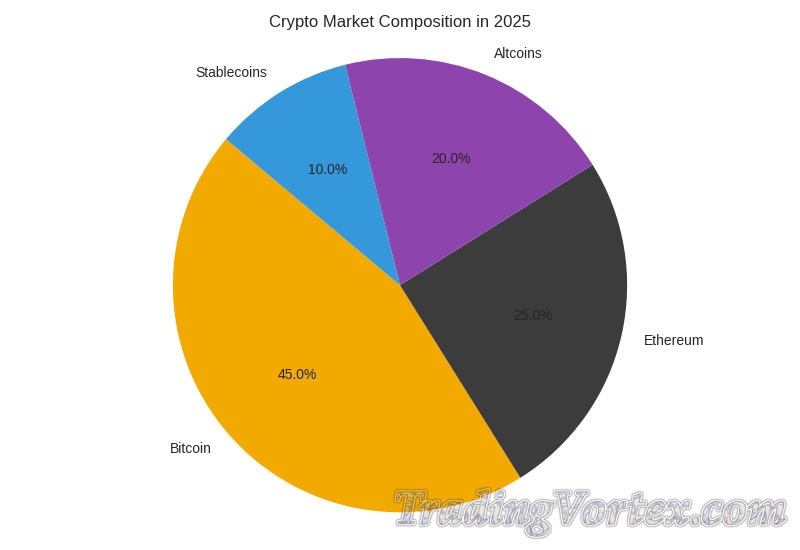 Crypto Market Composition in 2025: This pie chart shows the approximate distribution of major crypto categories: Bitcoin (45%), Ethereum (25%), Altcoins (20%), and Stablecoins (10%).
It helps beginners see that Bitcoin and Ethereum still dominate the market, while altcoins and stablecoins play supporting roles.
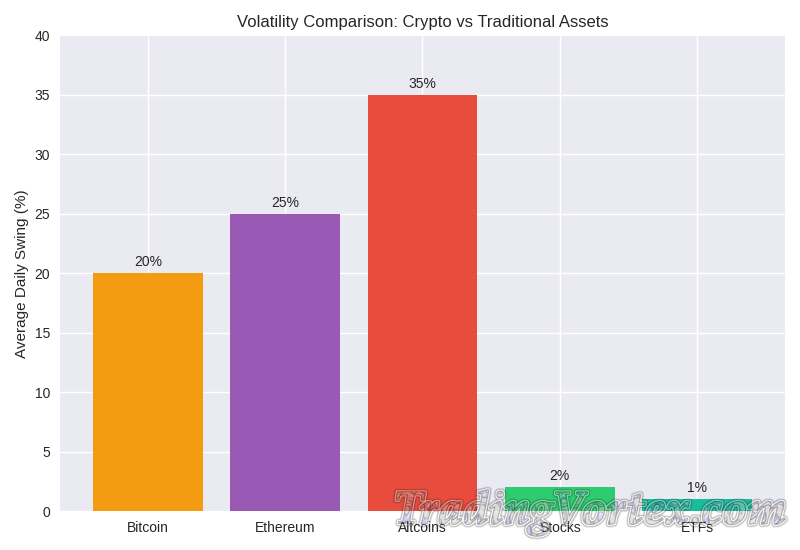 Volatility Comparison: Crypto vs Traditional Assets: This bar chart compares average daily price swings. Bitcoin averages around 20%, Ethereum 25%, altcoins 35%, while stocks and ETFs are far more stable at 2% and 1%.
This makes the concept of volatility tangible and shows why beginners should start small.
Final Thought: If you are new, start small, learn the language, and resist the urge to chase hype. Crypto rewards patience, curiosity, and discipline more than quick bets. Remember, every expert investor once asked, “Wait, what’s a blockchain again?” The difference is they stuck around long enough to find out.
Why Invest in Crypto Today (Benefits and Use Cases)
If you are still wondering whether crypto is worth your attention in 2025, the answer is yes. What started as a niche experiment with Bitcoin has grown into a global financial ecosystem that is reshaping how money moves, how assets are owned, and how investors diversify their portfolios. Crypto is no longer just about speculation, it is about opportunity, innovation, and inclusion. Let’s explore why it deserves a place in your investment strategy today.
Diversification and Portfolio Allocation with Crypto
One of the most practical reasons to invest in crypto is diversification. Traditional portfolios often mix stocks, bonds, and maybe real estate. Adding crypto introduces an asset class that behaves differently from traditional markets, which can help balance risk and reward.
- High growth potential: Cryptocurrencies have shown the ability to deliver outsized returns in relatively short periods. While volatility is part of the package, the upside has attracted both retail and institutional investors.
- Hedge against inflation and currency risk: In regions where local currencies are unstable, crypto has become a lifeline for preserving value. Even large institutions now use Bitcoin and stablecoins as hedges against inflation and currency devaluation.
- Accessibility for all investors: Unlike real estate or private equity, crypto is easy to buy in small amounts. Fractional ownership means even $50 can give you exposure to assets that were once out of reach.
Think of crypto as the spice rack in your financial kitchen. You don’t need to pour the whole jar into your dish, but a pinch can change the flavor of your portfolio. For beginners, even a small allocation can make a difference without overwhelming your risk profile.
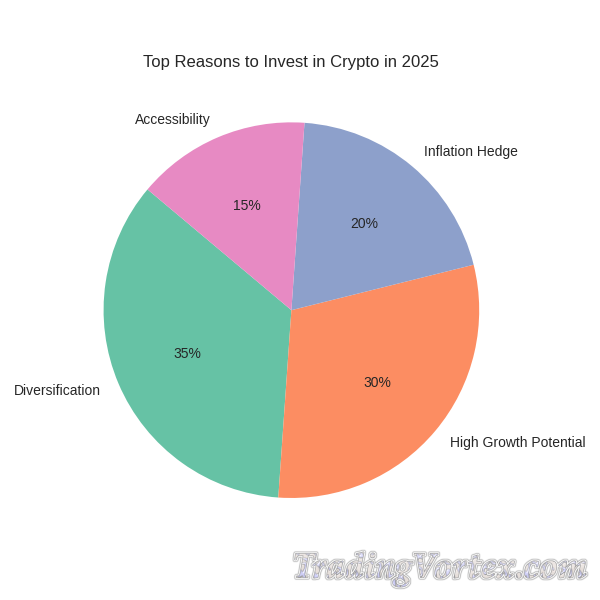 Top Reasons to Invest in Crypto in 2025: A pie chart illustrating primary investor motivations, split by estimated share of emphasis:
◊ Diversification: 35%
◊ High growth potential: 30%
◊ Inflation hedge: 20%
◊ Accessibility: 15%
♦ How to use it: This visual helps readers connect the narrative to concrete drivers. It encourages balanced allocations, framing crypto as a complement to, not a replacement for, traditional assets.
♦ Explanation: Diversification remains the top motivator since crypto’s correlation to traditional assets can vary by cycle. Growth potential ranks high due to historical outperformance during bull markets. Inflation hedging is common in countries with currency instability, while accessibility reflects the appeal of fractional investing and 24/7 markets.
Real-World Use Cases: Payments, DeFi, NFTs, and Tokenized Assets
Crypto is not just about trading coins, it is about solving real problems and creating new opportunities.
- Payments: Sending money across borders has traditionally been slow and expensive. Crypto enables lightning-fast transfers with lower fees, making it easier for businesses and individuals to transact globally. Imagine paying a freelancer in another country instantly, without waiting days for a wire transfer.
- Decentralized Finance (DeFi): DeFi platforms let you lend, borrow, and earn interest without a bank. Staking and yield farming provide passive income opportunities, though they come with risks. DeFi is essentially a parallel financial system, open to anyone with an internet connection.
- NFTs: Once dismissed as hype, NFTs are now powering gaming, digital identity, and even real estate tokenization. They are evolving into tools for digital ownership and proof of authenticity.
- Tokenized Assets: Real-world assets like property, commodities, and even music royalties are being represented on blockchains. This opens up fractional ownership and liquidity, meaning you can invest in slices of assets that were previously inaccessible.
Picture buying a fraction of a luxury apartment in Paris or earning royalties from a song you love, all through blockchain tokens. That is the kind of innovation crypto is unlocking, and it is happening faster than most people realize.
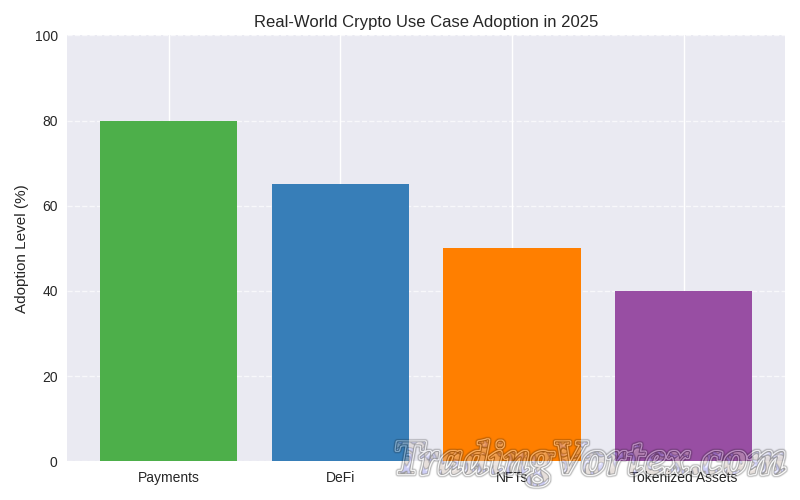 Real-World Crypto Use Case Adoption in 2025:
♦ What it shows: A bar chart highlighting adoption levels of key use cases:
◊ Payments: 80%
◊ DeFi: 65%
◊ NFTs: 50%
◊ Tokenized assets: 40%
♦ Explanation: Payments lead because instant settlement and lower fees offer clear value across borders. DeFi follows due to accessible yield and credit markets. NFTs have matured beyond art into gaming and credentialing. Tokenized assets are growing as institutions pilot real-world asset tokenization and improved custody.
Institutional Adoption and Market Maturity
Perhaps the strongest signal that crypto is here to stay is institutional adoption.
- Major firms like BlackRock, Fidelity, and JPMorgan have poured billions into crypto markets in 2025.
- Hedge funds are increasingly holding digital assets, with more than half reporting crypto exposure.
- Regulatory clarity is improving, giving institutions confidence to integrate crypto into long-term strategies.
This shift marks crypto’s evolution from a niche experiment into a mainstream financial instrument. Market maturity also means better infrastructure: exchanges are more secure, custody solutions are more reliable, and compliance standards are clearer than ever. When the same firms managing pension funds and sovereign wealth are buying Bitcoin and tokenized assets, it is hard to argue that crypto is just a fad.
Final Thought: Investing in crypto today is about more than chasing quick profits. It is about participating in a financial revolution that blends innovation with opportunity. Whether you are diversifying your portfolio, exploring new payment systems, or riding the wave of institutional adoption, crypto offers a seat at the table of the future economy.
If you are new, start small, stay curious, and remember that crypto is not just about speculation. It is about being part of a movement that is reshaping how money, ownership, and trust work in the digital age.
Current Market Trends Beginners Should Watch
Crypto is evolving faster than most people can keep up with. What was once a niche playground for tech enthusiasts has become a global financial ecosystem, with new trends shaping how investors, businesses, and even governments interact with digital assets. If you are just starting out, it helps to know which waves are worth watching. Here are five of the most important trends in 2025 that beginners should keep on their radar.
AI‑Driven Trading Tools and Algorithmic Strategies
Artificial intelligence is no longer just a buzzword in crypto, it is becoming a practical tool for traders. AI platforms now offer automated strategies, backtesting, and 24/7 market monitoring. Some providers report measurable performance gains for users, although results vary depending on the strategy and market conditions.
The appeal is obvious: AI can remove emotion from trading decisions, something that has tripped up even experienced investors. Instead of panic‑selling during a dip or chasing hype, algorithms stick to the plan.
Actionable tip: start small. Test AI tools in demo mode or with a tiny allocation, monitor performance closely, and avoid handing full control to any single algorithm. Think of AI as a co‑pilot, not the pilot. It can help you navigate turbulence, but you should still keep your hands on the wheel.
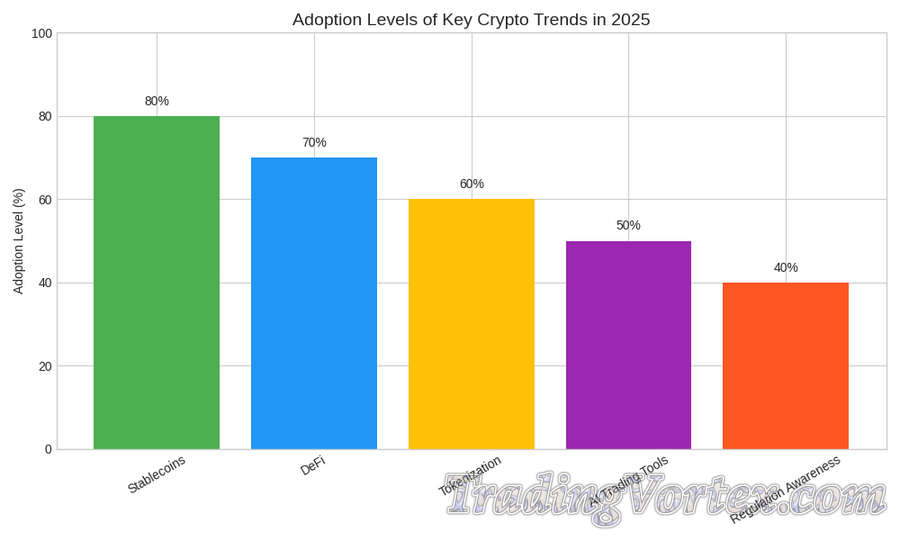 Adoption Levels of Key Crypto Trends in 2025:
♦ What it shows: A bar chart with estimated adoption levels across five major trends: Stablecoins 80%, DeFi 70%, Tokenization 60%, AI Trading Tools 50%, Regulation Awareness 40%.
♦ How to use it:
◊ Context: Highlight where beginners are most likely to encounter practical value. Stablecoins and DeFi are widely used today, so they offer clearer entry points.
◊ Takeaway: Higher adoption usually means better tooling and clearer education paths, which reduces friction for beginners.
♦ Reader explanation:
◊ Stablecoins: Dominant because they simplify payments, savings, and on‑ramping.
◊ DeFi: Gaining because lending, staking, and on‑chain trading are more accessible.
◊ Tokenization: Growing steadily as institutions pilot real‑world asset programs.
◊ AI tools: Expanding as retail users test automation for discipline and speed.
◊ Regulation awareness: Improving as platforms publish compliance and insurance details, and users learn tax basics.
Tokenization of Real‑World Assets and NFTs
Tokenization is one of the most exciting shifts in crypto. It allows property, treasuries, commodities, and even royalties to be represented as blockchain tokens, unlocking fractional ownership and liquidity. The tokenized real‑world asset market crossed $25 billion in mid‑2025, driven by institutional demand for yield and transparency.
NFTs are also evolving. They are no longer just about digital art collectibles, they are being used for identity verification, gaming, and fractional ownership of real assets. Imagine owning a slice of a luxury apartment in Paris or a share of music royalties, all tradable 24/7.
Why it matters: tokenization opens access to assets that were previously illiquid or reserved for wealthy investors. However, legal frameworks and custody practices differ by jurisdiction, so beginners should research carefully before investing. Tokenization is democratizing ownership, but it is still early days.
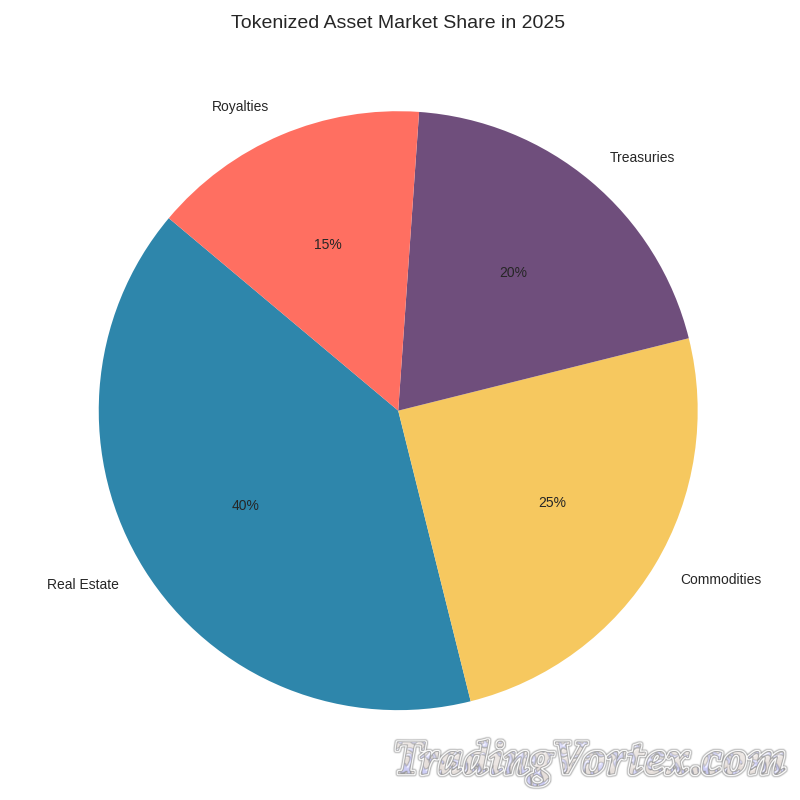 Tokenized Asset Market Share in 2025:
♦ What it shows: A pie chart that estimates how tokenized real‑world assets are distributed: Real Estate 40%, Commodities 25%, Treasuries 20%, Royalties 15%.
♦ How to use it:
◊ Context: Visualizes the practical composition of tokenized markets beginners might explore.
◊ Takeaway: Real estate leads due to strong demand for fractional ownership, while commodities and treasuries attract investors seeking liquidity and yield.
♦ Reader explanation:
◊ Real estate: Popular for fractional ownership and global access.
◊ Commodities: Useful for diversification and on‑chain settlement.
◊ Treasuries: Favored for yield, transparency, and custody improvements.
◊ Royalties: Emerging for music and IP revenue streams with programmable payouts.
DeFi, Staking, and Passive Yield Opportunities
Decentralized finance (DeFi) has regained momentum in 2025, with Total Value Locked rising into the hundreds of billions. This reflects renewed confidence and improved infrastructure.
Practical guidance: treat staking as a long‑term play. Understand lockup periods, slashing risks, and prefer well‑audited protocols with strong liquidity. Yield farming can be tempting, but beginners should start with small amounts and focus on learning how the systems work before chasing high returns.
Regulatory Shifts and Global Compliance Signals
Regulation is no longer background noise, it is a market mover. Global frameworks like the EU’s Markets in Crypto‑Assets (MiCAR) and updated U.S. rules are clarifying how assets are classified and how intermediaries must operate.
For investors, this means better custody options, safer exchanges, and more institutional confidence. It also means stricter reporting and tax obligations. Regulators are watching closely, and compliance is becoming a competitive advantage for platforms.
Important: keep records of every trade, learn your local tax rules, and favor platforms that publish compliance and insurance details. Regulation may feel restrictive, but it builds trust and stability, which is exactly what crypto needs to grow.
Rise of Stablecoins and Payment Rails
Stablecoins are becoming the plumbing of crypto payments. They enable faster cross‑border transfers and lower fees compared with traditional rails. By 2025, stablecoins represented nearly 7 percent of the total crypto market cap, worth about $278 billion, and are increasingly used for global trade and fintech solutions.
New infrastructure, such as omnichain liquidity systems and enterprise blockchain platforms, is making stablecoin transfers faster and safer. For beginners, stablecoins are a practical entry point: they provide exposure to crypto without the extreme volatility of assets like Bitcoin or Ethereum.
Beginner strategy: use reputable stablecoins for on‑ramp and off‑ramp liquidity, but be aware of issuer risk and regulatory scrutiny. Stablecoins are convenient, but they are only as strong as the institutions backing them.
Practical Next Steps for Beginners
- Pick one trend to study: spend a week learning about stablecoins, DeFi, or tokenization.
- Allocate small amounts: start with a conservative crypto allocation, then scale as you gain confidence.
- Test tools safely: demo AI trading bots, stake small amounts, and explore tokenized assets on regulated platforms.
- Prioritize security: use hardware wallets for long‑term holdings, enable two‑factor authentication, and keep tax logs.
- Stay curious: trends evolve quickly, so treat learning as an ongoing process rather than a one‑time effort.
Final Thought: These trends are not passing fads, they are structural shifts that are reshaping the crypto landscape. Stablecoins are powering payments, DeFi is opening passive income opportunities, tokenization is bridging digital and physical assets, AI is transforming trading, and regulation is bringing clarity.
For beginners, the key is not to chase every shiny new development, but to understand how these shifts fit into your long‑term investment journey. Learn deliberately, experiment cautiously, and treat each new tool as a skill to master rather than a shortcut to profit.
Assessing Your Risk Profile and Setting Goals
Crypto investing can feel thrilling, but it is not a game of luck. The difference between a beginner who panics during a dip and one who calmly rides it out often comes down to preparation. Assessing your risk profile and setting clear goals is like drawing a map before you start a journey. Without it, you are wandering in the dark. With it, you know where you are headed, how much risk you can handle, and when to stop for a breather.
Defining Investment Goals: Short‑Term vs Long‑Term
Every investor needs to ask the simple question: “What am I trying to achieve?”
- Short‑term goals: These usually involve trading or taking advantage of market volatility. Maybe you want to flip altcoins, experiment with DeFi yields, or ride momentum trades. This approach can deliver fast gains, but it requires constant monitoring and a strong stomach for sudden losses.
- Long‑term goals: Many investors prefer to treat crypto as a store of value. Buying and holding assets like Bitcoin or Ethereum for years is less stressful and historically has rewarded patient investors. Long‑term goals align with building wealth steadily rather than chasing quick wins.
A personal story: I once watched a friend sell his holdings during a sharp dip, only to see the price double a month later. His short‑term mindset cost him dearly. If he had set a long‑term goal, he might have avoided the stress and enjoyed the gains. Goals matter because they shape your behavior when the market gets noisy.
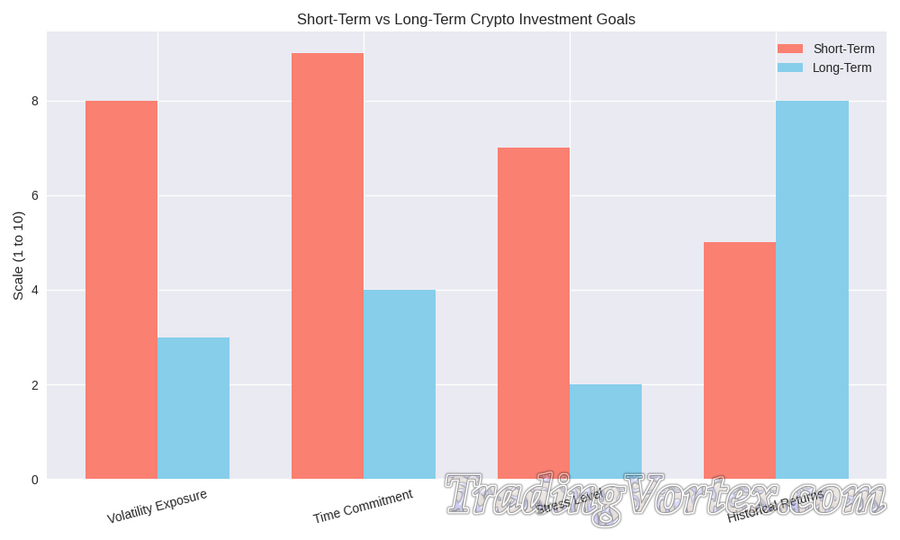 Short‑Term vs Long‑Term Crypto Investment Goals: Short‑term trading requires more time and emotional energy, long‑term investing favors patience and steady habits.
♦ What it shows: A grouped bar chart compares four practical factors on a scale of 1 to 10:
◊ Volatility Exposure: Short‑term 8, Long‑term 3
◊ Time Commitment: Short‑term 9, Long‑term 4
◊ Stress Level: Short‑term 7, Long‑term 2
◊ Historical Returns: Short‑term 5, Long‑term 8
♦ How to use it:
◊ Interpretation: Short‑term strategies demand more time and emotional bandwidth, while long‑term investing aims for lower stress and historically stronger outcomes through compounding.
◊ Decision aid: If you prefer calm and consistency, lean long‑term. If you enjoy active management and rapid decision‑making, accept the higher volatility and stress of short‑term approaches.
♦ Reader explanation:
◊ Volatility exposure: Quick trades amplify swings, long holds smooth them out.
◊ Time commitment: Active trading is a daily habit, long‑term is periodic check‑ins.
◊ Stress level: Fast moves can be intense, long‑term reduces panic reactions.
◊ Historical returns: Long‑term positions in assets like Bitcoin and Ethereum have historically rewarded patience.
Risk Tolerance Checklist for Crypto Investors
Crypto is not for everyone, and that is perfectly fine. To figure out how much risk you can handle, run through this checklist:
- Volatility comfort: Can you stomach seeing your investment drop 30 percent in a week without panicking?
- Liquidity needs: Do you need quick access to your funds, or can you lock them up in staking for months?
- Knowledge level: Are you willing to spend time learning about wallets, exchanges, and security practices?
- Regulatory awareness: Do you understand the tax implications in your country? In 2025, regulators are watching crypto more closely than ever.
- Emotional discipline: Can you resist FOMO when a meme coin is trending, or fear when headlines scream “crypto crash”?
How Much of Your Portfolio Should Be Crypto
This is the million‑dollar question, and the answer depends on your risk profile. Financial experts in 2025 generally suggest allocating between 1 percent and 5 percent of your portfolio to crypto if you are a beginner. More experienced investors sometimes go higher, but even institutions rarely exceed 10 percent.
Here is a simple framework:
- Conservative investors: 1‑2 percent, mostly in Bitcoin or stablecoins.
- Balanced investors: 3‑5 percent, spread across Bitcoin, Ethereum, and a few promising altcoins.
- Aggressive investors: 6‑10 percent, including exposure to DeFi, NFTs, or tokenized assets.
Think of crypto as seasoning in a dish. Too little, and you barely notice it. Too much, and it can overwhelm the flavor. The right amount depends on your taste, but moderation keeps the meal enjoyable.
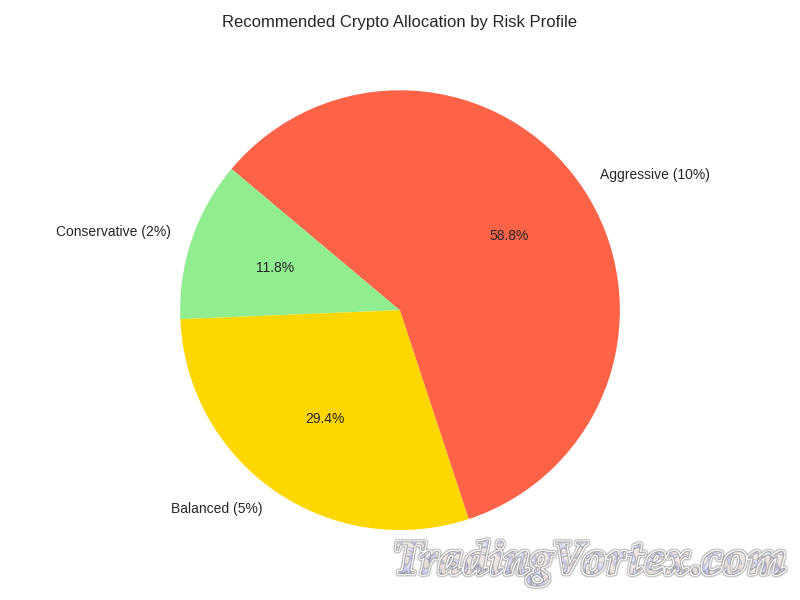 Recommended Crypto Allocation by Risk Profile: Choose an allocation that matches your risk tolerance, time horizon, and security readiness.
♦ What it shows: A pie chart with three common allocation ranges for beginners and intermediates:
◊ Conservative: 2 percent
◊ Balanced: 5 percent
◊ Aggressive: 10 percent
♦ How to use it:
◊ Interpretation: Most new investors start small. As knowledge and discipline grow, allocations can scale modestly. Even aggressive profiles keep crypto as a slice of the broader portfolio.
◊ Decision aid: Pick the slice that matches your checklist answers: lower allocation if you need liquidity and low stress, higher allocation if you have time, discipline, and strong security practices.
♦ Reader explanation:
◊ Conservative: Minimal exposure, focus on Bitcoin or stablecoins.
◊ Balanced: Core positions in Bitcoin and Ethereum, plus a few vetted altcoins.
◊ Aggressive: Larger slice that may include DeFi, staking, and select tokenized assets.
Final Thought: Assessing your risk profile and setting goals is not about limiting your ambition, it is about protecting your peace of mind. Crypto rewards patience, discipline, and self‑awareness more than reckless bets. Define your goals, know your tolerance, and allocate wisely. That way, when the market swings, you will not be the one screaming on the rollercoaster, you will be the one enjoying the ride.
Choosing Where to Buy Crypto: Exchanges and Platforms
Buying crypto is not like grabbing a coffee at your local café. You need to pick the right place, understand how it works, and know what you are signing up for. In 2025, exchanges and platforms have matured, but the choice between centralized and decentralized options still shapes how you invest. Let’s break it down so you can make smart, confident decisions.
Centralized Exchanges (CEX) vs Decentralized Exchanges (DEX): Pros and Cons
- Pros of CEX: Easy to use, high liquidity, strong customer support, fiat integration.
- Cons of CEX: Custodial control (they hold your funds), regulatory scrutiny, potential vulnerability to hacks.
- Pros of DEX: Self‑custody, transparency, privacy, no intermediaries.
- Cons of DEX: Steeper learning curve, lower liquidity for some tokens, higher risk of user error.
Think of it this way: CEXs are like supermarkets, convenient and full of options, while DEXs are like farmers’ markets, direct and authentic but requiring more effort to navigate.
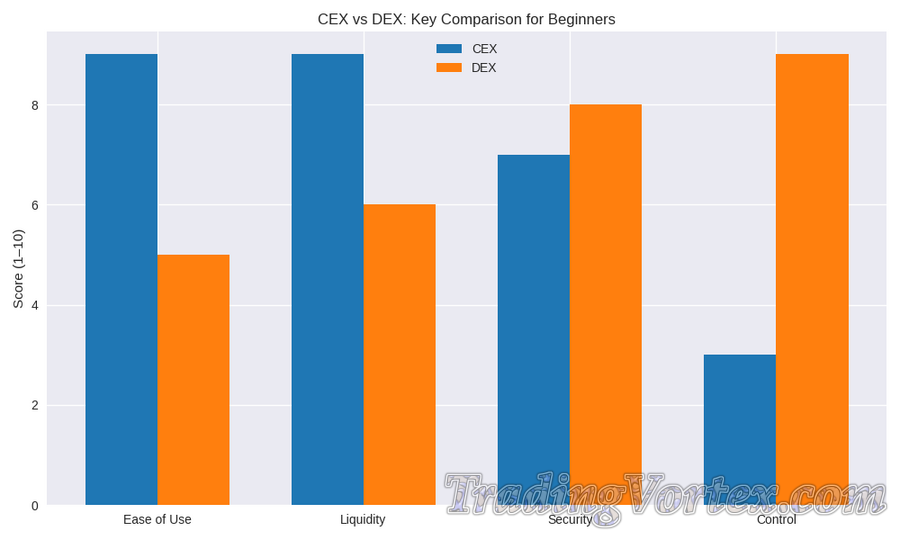 CEX vs DEX: Key Comparison for Beginners: CEXs excel at usability and liquidity, DEXs lead in control and non‑custodial security.
♦ What it shows: A grouped bar chart comparing four factors on a scale of 1 to 10:
◊ Ease of use: CEX 9, DEX 5
◊ Liquidity: CEX 9, DEX 6
◊ Security: CEX 7, DEX 8
◊ Control: CEX 3, DEX 9
♦ How to use it:
◊ Choose by priority: If you value convenience and deep order books, start with a CEX. If you want self‑custody and transparency, a DEX fits better.
◊ Beginner takeaway: Many beginners start on a CEX to learn the basics, then add DEX trading as their wallet and security skills improve.
♦ Reader explanation:
◊ Ease of use: CEX apps feel familiar and guide you through buying.
◊ Liquidity: Large CEXs handle bigger orders with less slippage.
◊ Security: DEXs remove custodial risk, but user errors can be costly.
◊ Control: DEXs keep keys in your hands, which is empowering and demanding.
How to Evaluate an Exchange: Fees, Liquidity, Security, Reputation
Not all exchanges are created equal. Here are the key factors to consider:
- Fees: Trading fees vary widely. Some exchanges charge 0.1 percent per trade, while others take more. Beginners should watch out for hidden withdrawal or conversion fees.
- Liquidity: High liquidity means you can buy or sell quickly without big price swings. Top CEXs like Binance and Coinbase dominate here.
- Security: Look for exchanges with strong track records, insurance policies, and multi‑factor authentication. Remember FTX’s collapse in 2022? Security and transparency matter more than flashy marketing.
- Reputation: Read reviews, check regulatory compliance, and see how exchanges handle customer disputes. A platform’s reputation is often built on how it treats users when things go wrong.
A personal tip: I once chose an exchange just because it had a slick app design. Big mistake. The fees were high, and customer support was nonexistent. Lesson learned: always check the fundamentals before signing up.
Using Broker Apps, Custodial Services, and Crypto Cards
Beyond exchanges, beginners can explore broker apps like Robinhood or Revolut, which make buying crypto as easy as buying stocks. These are user‑friendly but often limit withdrawals, meaning you don’t fully own your coins.
Custodial services, offered by platforms like Fidelity Digital Assets, provide institutional‑grade storage. They are safer for large holdings but remove some of the independence that crypto enthusiasts value.
Crypto cards, such as those from Crypto.com or Binance, let you spend your digital assets like cash. They convert crypto to fiat instantly, making everyday use practical. For beginners, this bridges the gap between investing and real‑world utility.
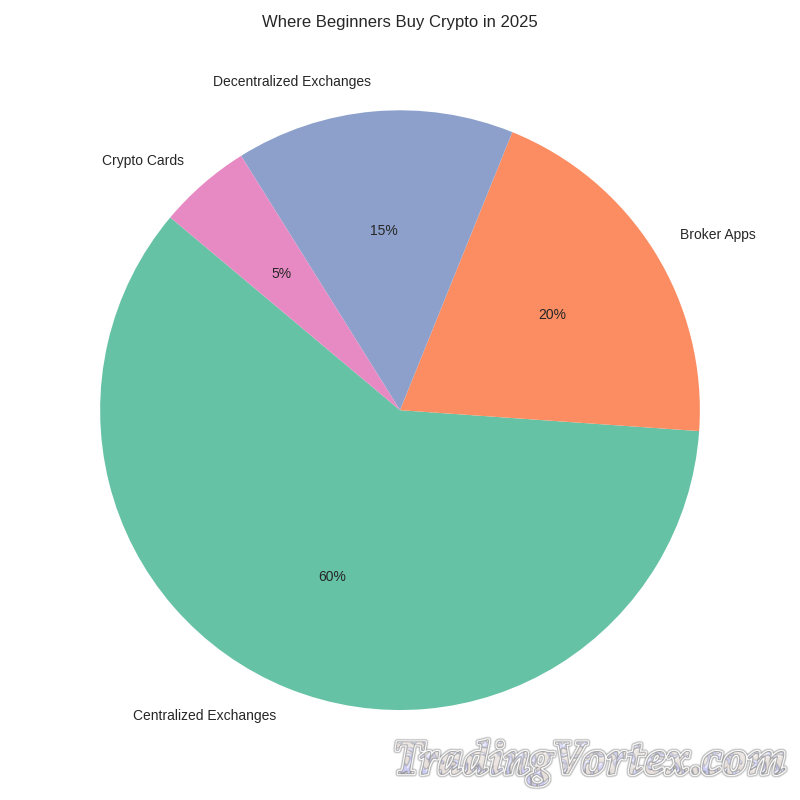 Where Beginners Buy Crypto in 2025: Beginners favor CEXs for a smooth start, then diversify tools as skills and needs evolve.
♦ What it shows: A pie chart of typical beginner platform preferences:
◊ Centralized exchanges: 60 percent
◊ Broker apps: 20 percent
◊ Decentralized exchanges: 15 percent
◊ Crypto cards: 5 percent
♦ How to use it:
◊ Context: Shows real‑world entry patterns.
◊ Beginner takeaway: Most newcomers start on CEXs for simplicity, then expand to DEXs and spending cards as confidence grows.
♦ Reader explanation:
◊ Centralized exchanges: On‑ramps, fiat deposits, customer support.
◊ Broker apps: Simple interface, often limited withdrawals.
◊ Decentralized exchanges: Self‑custody, wider token access, steeper learning curve.
◊ Crypto cards: Everyday spending, instant conversion to fiat.
Final Thought: Choosing where to buy crypto is about balancing convenience, control, and trust. Centralized exchanges are beginner‑friendly, decentralized exchanges empower self‑custody, and broker apps or crypto cards add flexibility. The best choice depends on your goals and comfort level. Start with a platform that feels safe and intuitive, then expand as you gain confidence.
Top Crypto Exchanges in 2025: Comparison Table
This table gives readers a quick snapshot of the trade‑offs between centralized and decentralized platforms, helping them choose based on their comfort level, goals, and risk tolerance.
| Exchange | Type | Beginner Friendliness | Fees (Approx.) | Liquidity | Security Features | Unique Strengths |
|---|---|---|---|---|---|---|
| Binance | Centralized | High (intuitive app, tutorials) | ~0.1% per trade | Very high | SAFU insurance fund, 2FA, proof‑of‑reserves | Largest selection of coins, advanced trading tools |
| Coinbase | Centralized | Very high (simple UI, fiat on‑ramps) | ~0.5% per trade + spreads | High | FDIC‑insured USD balances, biometric login | Best for beginners in US/EU, strong regulatory compliance |
| Kraken | Centralized | Moderate (more advanced interface) | ~0.16% maker, 0.26% taker | High | Cold storage, proof‑of‑reserves audits | Reputation for transparency and security |
| OKX | Centralized | High (mobile app, tutorials) | ~0.08% maker, 0.1% taker | Very high | Multi‑sig wallets, risk reserves | Strong in derivatives and global reach |
| Uniswap | Decentralized | Moderate (requires wallet setup) | Variable gas fees | Medium to high | Smart contract audits, non‑custodial | Pioneer in DEXs, huge DeFi ecosystem |
| dYdX | Decentralized | Moderate (trading‑focused) | Low trading fees, gas‑free on L2 | Medium | Non‑custodial, audited smart contracts | Specializes in perpetual futures trading |
Key Takeaways for Beginners
- Coinbase is often the easiest starting point if you want simplicity and regulatory clarity.
- Binance offers the widest range of coins and tools, but may feel overwhelming at first.
- Kraken is trusted for its transparency and security, making it a solid choice for cautious investors.
- OKX is strong for global users who want advanced features and derivatives.
- Uniswap and dYdX are great introductions to decentralized trading, but they require more technical know‑how.
Step-by-Step: Buying Your First Cryptocurrency
Buying your first crypto can feel like standing at the edge of a pool, wondering if the water is freezing. The truth is, once you take the plunge, it is not nearly as scary as it looks. Let’s walk through the process together, step by step, so you can make your first purchase with confidence and maybe even a smile.
Account Setup and KYC Best Practices
The first step is choosing a reputable exchange. Platforms like Coinbase, Binance, Kraken, and OKX are beginner-friendly and widely trusted. Once you sign up, you will need to complete KYC (Know Your Customer) verification. This usually means uploading an ID and sometimes proof of address.
Pro tip: use a secure email address, enable two-factor authentication, and never reuse passwords. I once skipped 2FA on an old account, and let’s just say I learned the hard way that convenience is not worth the risk.
Funding Your Account: Fiat On-Ramps and Bank Transfers
Once verified, you need to add funds. Exchanges offer several options:
- Bank transfers: Usually the cheapest, but can take a few days.
- Credit or debit cards: Instant, but often come with higher fees.
- Third-party payment apps: Services like PayPal or Revolut are increasingly integrated, making funding faster.
In 2025, fiat on-ramps have improved significantly, with lower fees and faster settlement times. Beginners often prefer card payments for speed, but if you are patient, bank transfers save money.
Placing Your First Buy Order: Market vs Limit Orders
Now comes the fun part: buying your first coin. Exchanges typically offer two main order types:
- Market order: You buy instantly at the current price. Simple and fast, perfect for beginners.
- Limit order: You set the price you are willing to pay, and the order executes only if the market reaches that level. This gives you more control but requires patience.
Buying Bitcoin vs Altcoins: Practical Tips for Beginners
The big question: should you start with Bitcoin or dive into altcoins?
- Bitcoin: The safest starting point. It is the most established, widely recognized, and less risky compared to smaller coins.
- Ethereum: A strong second choice, powering decentralized apps and smart contracts.
- Altcoins: Thousands exist, but many are speculative. Some have real utility, others are hype-driven.
For beginners, experts recommend starting with Bitcoin or Ethereum. Once you are comfortable, you can explore altcoins, but always research before buying. Remember, not every shiny new coin is worth your money.
A personal note: my first purchase was Bitcoin. I later experimented with altcoins, and while some paid off, others vanished faster than a summer ice cream cone. Start with the basics, then branch out cautiously.
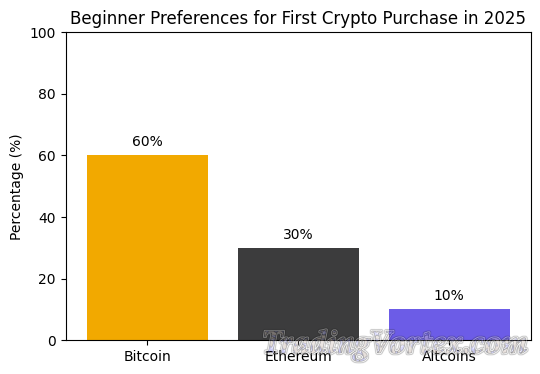 Beginner Preferences for First Crypto Purchase in 2025: Start with Bitcoin or Ethereum, then expand as your skills and confidence grow.
♦ What it shows: A bar chart of common first purchases:
◊ Bitcoin: 60 percent
◊ Ethereum: 30 percent
◊ Altcoins: 10 percent
♦ How to use it:
◊ Interpretation: Most beginners start with Bitcoin for simplicity and lower perceived risk, then add Ethereum as they learn.
◊ Beginner takeaway: If you are unsure, start with Bitcoin or Ethereum, then explore altcoins once you feel comfortable and can evaluate fundamentals.
♦ Reader explanation:
◊ Bitcoin: Strong brand recognition and institutional adoption.
◊ Ethereum: Core to smart contracts and DeFi, widely supported.
◊ Altcoins: High variance in quality and risk, research is essential.
Final Thought: Buying your first cryptocurrency is less about chasing quick profits and more about learning the ropes. Set up your account securely, fund it wisely, place your first order with confidence, and start with established coins. The journey is exciting, but it is also unpredictable, so pace yourself. Crypto rewards curiosity and patience more than reckless bets.
Storing Crypto Safely: Wallets and Security Practices
If buying crypto is the fun part, storing it safely is the part that separates the cautious investor from the one who learns lessons the hard way. In 2025, wallet security has become more important than ever, with billions in digital assets lost to hacks and scams over the years. The good news is that protecting your crypto is not complicated once you understand the basics. Let’s walk through the essentials together.
Hot Wallets vs Cold Wallets: When to Use Each
Hot wallets are apps or browser extensions connected to the internet. They are convenient for quick trades, DeFi, or NFT purchases. Think of them like your everyday wallet: easy to access, but not where you keep your life savings.
Cold wallets, on the other hand, are offline devices such as hardware wallets. They are considered the gold standard for security because hackers cannot reach them without physical access. Cold wallets are best for long‑term storage of larger amounts.
Rule of thumb: use hot wallets for small, everyday transactions, and cold wallets for serious holdings. I once kept too much in a hot wallet for convenience, only to lose sleep after reading about a major hack. Lesson learned: convenience is great, but safety is priceless.
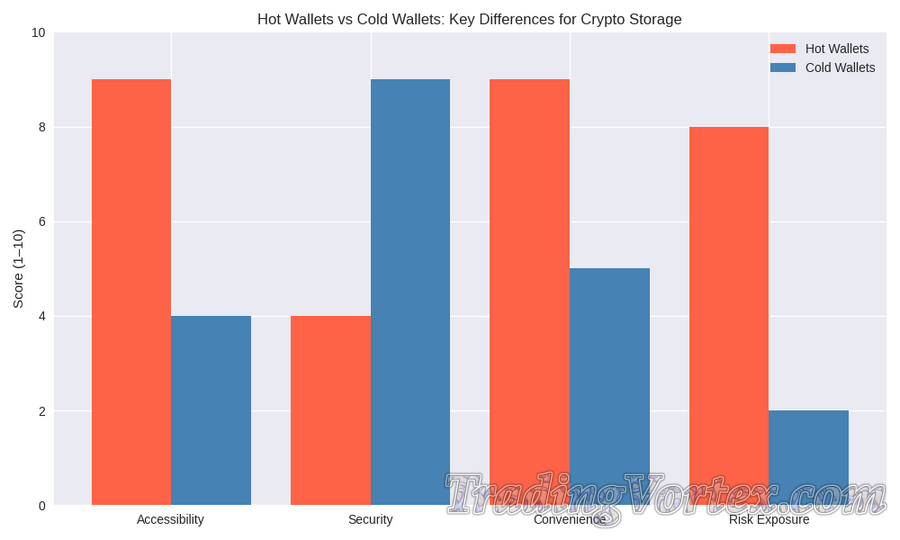 Hot Wallets vs Cold Wallets: Key Differences for Crypto Storage: Use hot wallets for daily transactions, use cold wallets for long‑term storage and peace of mind.
♦ What it shows: A grouped bar chart comparing four practical factors on a 1 to 10 scale:
◊ Accessibility: Hot 9, Cold 4
◊ Security: Hot 4, Cold 9
◊ Convenience: Hot 9, Cold 5
◊ Risk Exposure: Hot 8, Cold 2
♦ How to use it:
◊ Interpretation: Hot wallets are excellent for quick access and everyday use, cold wallets specialize in long‑term safety.
◊ Beginner takeaway: Keep small, active balances in hot wallets for speed, store larger holdings in a hardware wallet for security.
♦ Reader explanation:
◊ Accessibility and convenience: Hot wallets are always connected, which boosts speed and ease.
◊ Security and risk exposure: Cold wallets isolate keys from the internet, reducing remote attack risk.
Setting Up a Hardware Wallet and Secure Seed Phrase Storage
Hardware wallets like Ledger, Trezor, or SafePal are designed to keep your private keys offline. Setting one up usually involves creating a seed phrase, a list of 12 to 24 words that acts as the master key to your funds. Best practices in 2025:
- Write your seed phrase on paper or metal plates, never store it digitally.
- Keep backups in separate, secure locations.
- Never share your seed phrase with anyone, no matter how convincing they sound.
A friend once joked that losing a seed phrase is like losing the keys to a vault filled with gold. Except in crypto, there is no locksmith to call. Treat your seed phrase like treasure.
Two-Factor Authentication, Phishing Protection, and Device Hygiene
Even with wallets, your devices matter. Always enable two‑factor authentication (2FA) on exchanges and apps. Use authenticator apps rather than SMS, since SIM‑swapping attacks are still common.
Phishing remains one of the biggest threats. Scammers create fake websites or send emails that look legitimate. Always double‑check URLs, and bookmark official sites.
Device hygiene is equally important: keep your operating system updated, use antivirus software, and avoid downloading shady apps. Think of your laptop or phone as the front door to your crypto vault. If the door is weak, the vault is vulnerable.
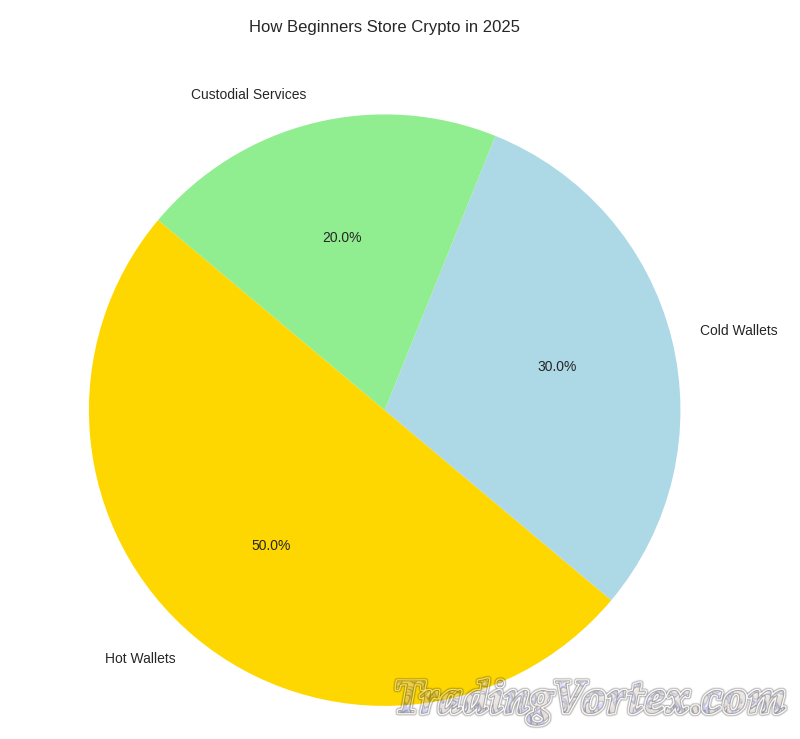 How Beginners Store Crypto in 2025: Balance convenience and safety by combining custodial access, hot wallets, and hardware wallets as your holdings grow.
♦ What it shows: A pie chart of typical beginner storage choices:
◊ Hot Wallets: 50 percent
◊ Cold Wallets: 30 percent
◊ Custodial Services: 20 percent
♦ How to use it:
◊ Interpretation: Most newcomers start with hot wallets for convenience, then add cold storage as balances grow and security practices improve.
◊ Beginner takeaway: A blended approach works well: custodial platforms for on‑ramping, hot wallets for small active use, cold wallets for core holdings.
♦ Reader explanation:
◊ Hot wallets: Ideal for DeFi, NFTs, and frequent transactions.
◊ Cold wallets: Best for safeguarding long‑term assets.
◊ Custodial services: Helpful for simplicity, but remember the “not your keys, not your coins” principle.
Insurance, Custodial Risk, and Third‑Party Custody Considerations
Some exchanges and custodial services now offer insurance against hacks, which is reassuring but not foolproof. Custodial platforms hold your crypto for you, which means you trust them with your private keys.
Risks to consider:
- If the custodian is hacked or goes bankrupt, your funds may be at risk.
- Insurance often covers only specific scenarios, not every possible loss.
- Regulations in 2025 are improving, but custody rules vary by country.
Final Thought: Storing crypto safely is about balance. Hot wallets give you speed, cold wallets give you security, and good habits give you peace of mind. Whether you are holding $100 or $100,000, the principles are the same: protect your keys, stay alert, and treat your digital assets with the same care you would give to a vault of gold.
Beginner Investment Strategies That Work
Crypto investing can feel overwhelming at first. Prices move fast, headlines scream about crashes or moonshots, and everyone seems to have a “secret strategy.” The truth is, beginners do not need complicated algorithms or insider tips. What works best are simple, proven approaches that balance risk and reward. Let’s walk through the strategies that actually help beginners build confidence and avoid sleepless nights.
Dollar-Cost Averaging (DCA) Explained and Examples
Dollar-cost averaging (DCA) is one of the most beginner-friendly strategies. Instead of trying to time the market, you invest a fixed amount at regular intervals, regardless of price.
In 2025, experts highlight DCA as a reliable way to manage volatility. It is especially useful for beginners who want exposure without obsessing over charts. Think of it like filling a jar with coins: you may not notice each deposit, but eventually the jar is full.
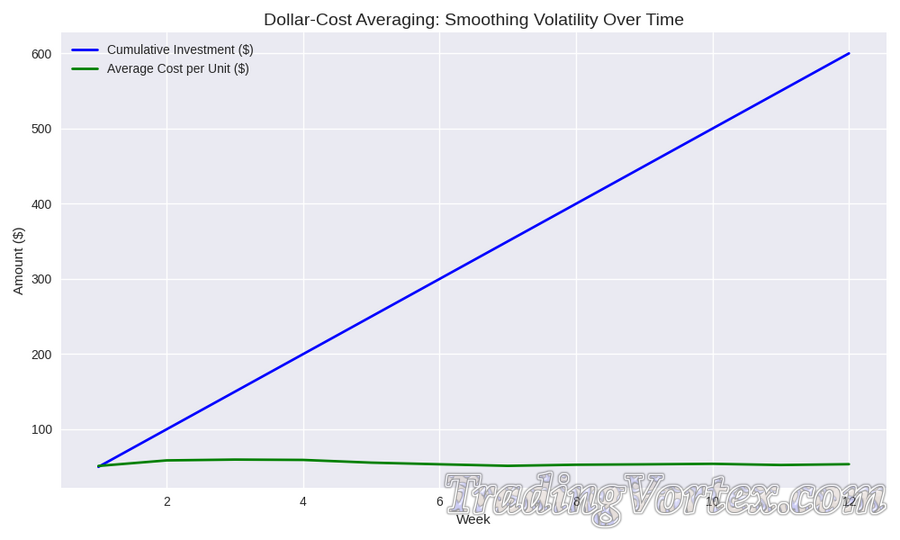 Dollar-Cost Averaging: Smoothing Volatility Over Time: Regular weekly buys help smooth your average cost, so you do not need perfect timing to get started.
♦ What it shows: A line chart with two lines across 12 weeks:
◊ Cumulative Investment: The total dollar amount added each week.
◊ Average Cost per Unit: The effective average price paid per unit as weekly purchases accumulate.
♦ How to use it:
◊ Interpretation: Even with bumpy prices, consistent weekly buys keep your average cost steady and reduce “bad timing” stress.
◊ Beginner takeaway: Focus on habit rather than perfect entries. Over time, DCA helps smooth the ride.
♦ Reader explanation:
◊ Cumulative investment: Rises in a straight line, since you add the same amount weekly.
◊ Average cost per unit: Moves toward the middle of the price range, demonstrating how regular purchases reduce the impact of short-term spikes or dips.
Long-Term Holding (HODL) vs Active Trading Basics
The famous “HODL” strategy: holding onto crypto for years, remains one of the most effective approaches. Bitcoin and Ethereum have historically rewarded patient investors, and many institutions now treat them as long-term assets.
Active trading, on the other hand, involves buying and selling frequently to capture short-term gains. While it can be profitable, it requires skill, discipline, and constant monitoring. Beginners often underestimate the emotional toll of trading. I once watched a friend panic-sell during a dip, only to see the coin double a month later. His nerves cost him more than the market did.
Takeaway: if you are new, lean toward HODLing. Active trading can come later, once you understand market cycles and risk management.
Diversification Across Chains, Sectors, and Stablecoins
Putting all your money into one coin is risky. Diversification spreads your exposure across different assets:
- Chains: Bitcoin for stability, Ethereum for smart contracts, Solana or Avalanche for speed.
- Sectors: DeFi projects, gaming tokens, or infrastructure coins.
- Stablecoins: USDC or USDT for liquidity and hedging against volatility.
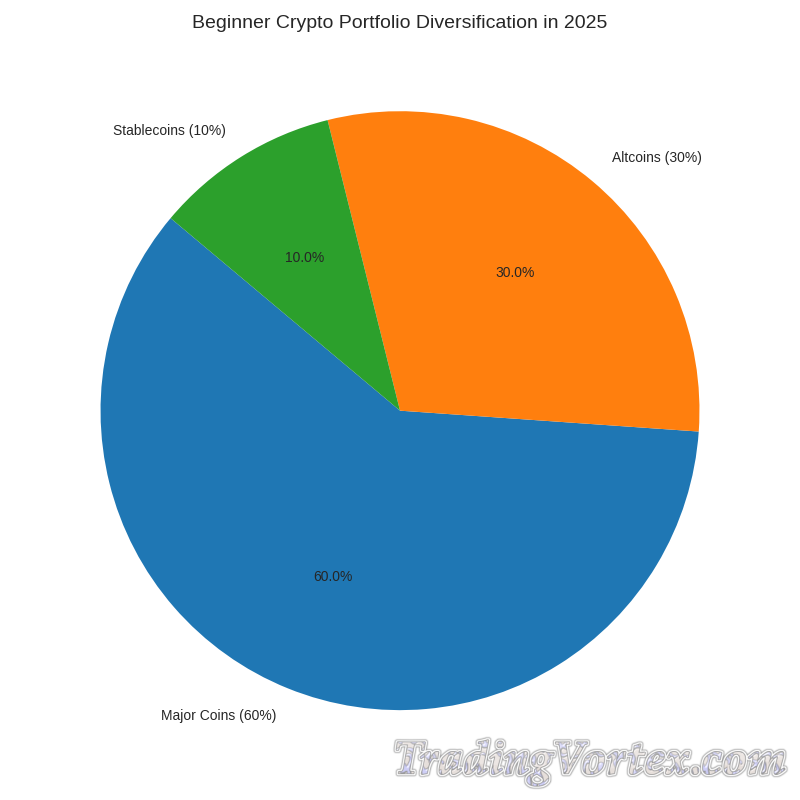 Beginner Crypto Portfolio Diversification in 2025: A simple 60-30-10 split keeps your portfolio focused, liquid, and easier to rebalance.
♦ What it shows: A pie chart with a simple, beginner-friendly allocation:
◊ Major Coins: 60 percent
◊ Altcoins: 30 percent
◊ Stablecoins: 10 percent
♦ How to use it:
◊ Interpretation: Start with a strong core in major coins, add selective altcoin exposure for growth, and keep a stablecoin buffer for liquidity and risk control.
◊ Beginner takeaway: You do not need dozens of assets. A clean three-part structure is easier to manage and rebalance.
♦ Reader explanation:
◊ Major coins: Bitcoin and Ethereum form the foundation.
◊ Altcoins: Choose a few with clear utility, strong teams, and liquidity.
◊ Stablecoins: Provide a ready stash for buying dips or taking profits.
Intro to Staking, Liquidity Provision, and Yield Farming (Risks Included)
Beyond buying and holding, crypto offers ways to earn passive income:
- Staking: Locking coins like Ethereum or Cardano to secure the network and earn rewards.
- Liquidity provision: Supplying tokens to decentralized exchanges to earn fees.
- Yield farming: Moving assets between protocols to maximize returns.
Think of staking like putting money in a savings account, while yield farming is more like chasing high-yield investments. Both can work, but one is steadier than the other.
Final Thought: Beginner strategies that work are not flashy, they are practical. Dollar-cost averaging builds discipline, HODLing rewards patience, diversification reduces risk, and staking introduces passive income. The key is to start small, stay consistent, and avoid chasing hype. Crypto is exciting, but it rewards curiosity and calm decision-making more than quick bets.
Sample Beginner Portfolio Allocation (2025)
| Investor Type | Allocation to Bitcoin & Ethereum | Allocation to Altcoins | Allocation to Stablecoins | Notes |
|---|---|---|---|---|
| Conservative | 70% (mostly Bitcoin, some ETH) | 10% (large-cap altcoins only) | 20% (USDC, USDT for liquidity) | Focus on safety and stability, use stablecoins as a hedge. |
| Balanced | 50% (BTC + ETH split evenly) | 30% (mix of DeFi, gaming, infrastructure tokens) | 20% (stablecoins for flexibility) | Diversified exposure, moderate risk, steady growth potential. |
| Aggressive | 40% (BTC + ETH) | 50% (higher-risk altcoins, emerging projects, NFTs) | 10% (stablecoins for quick trades) | High risk, high reward, requires active monitoring and discipline. |
Why This Works for Beginners
- Bitcoin and Ethereum: They remain the backbone of most portfolios. Bitcoin is seen as digital gold, Ethereum powers decentralized applications.
- Altcoins: Add growth potential, but limit exposure to avoid being wiped out by volatility. Stick to projects with strong fundamentals.
- Stablecoins: Provide liquidity and a safety net. They let you move quickly between trades or cash out without leaving the crypto ecosystem.
Practical Example
Imagine you have $1,000 to invest:
- Conservative: $700 in BTC/ETH, $100 in altcoins, $200 in stablecoins.
- Balanced: $500 in BTC/ETH, $300 in altcoins, $200 in stablecoins.
- Aggressive: $400 in BTC/ETH, $500 in altcoins, $100 in stablecoins.
This way, you can tailor your portfolio to your comfort level. Beginners often start conservative, then shift toward balanced once they gain confidence.
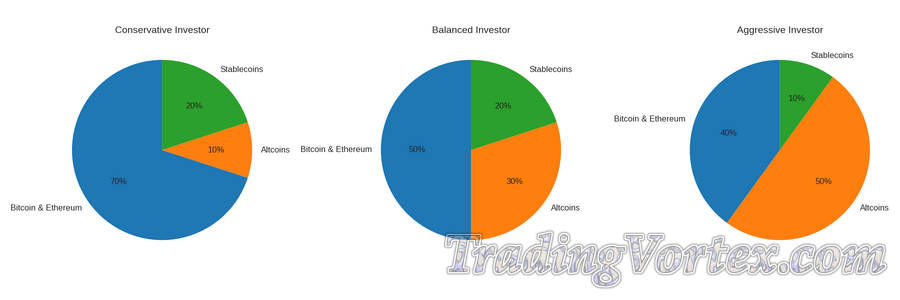 Beginner Portfolio Allocation for 2025: These pie charts make it easy to see how conservative, balanced, and aggressive investors might distribute their holdings across Bitcoin/Ethereum, altcoins, and stablecoins.
How to Read These Charts:
♦ Conservative investors lean heavily on Bitcoin and Ethereum, with stablecoins as a safety net.
♦ Balanced investors spread their exposure more evenly, adding altcoins for growth while keeping stablecoins for liquidity.
♦ Aggressive investors prioritize altcoins, chasing higher returns, while still keeping some Bitcoin/Ethereum for stability.
♥ This visual helps beginners quickly grasp how different strategies look in practice. You can use it as a starting point and adjust based on your own comfort level and goals.
Final Thought: A beginner portfolio should be simple, diversified, and easy to manage. Start with Bitcoin and Ethereum, sprinkle in a few altcoins, and keep stablecoins handy for flexibility. Over time, you can adjust your mix as you learn more and grow comfortable with the ups and downs of the market.
Taxes, Compliance, and Legal Considerations
Crypto investing is exciting, but the tax office does not care how thrilling your trades were. Whether you made a quick flip on a meme coin or held Bitcoin for years, governments want their share. In 2025, tax and compliance rules have matured significantly, and beginners need to understand the basics to avoid unpleasant surprises. Think of this section as your safety net: it will not make taxes fun, but it will make them manageable.
How Crypto Is Taxed: Capital Gains, Income, and Reporting Basics
Most countries treat crypto as property or a taxable asset, not as currency. This means:
- Capital gains tax: If you buy Bitcoin at $30,000 and sell at $40,000, the $10,000 profit is taxable. Short‑term gains (under a year) are usually taxed at higher rates than long‑term gains.
- Income tax: If you earn crypto through mining, staking, or getting paid in tokens, it is considered income at the fair market value when received.
- Reporting rules in 2025:
- In the United States, exchanges now issue IRS Form 1099‑DA, making it harder to hide transactions.
- In Europe, the DAC8 directive requires cross‑border reporting of crypto holdings.
- Globally, regulators are aligning to close loopholes, so “forgetting” to report is no longer an option.
A personal anecdote: I once had a friend who thought small trades “didn’t count.” The tax letter he received months later proved otherwise. Even small amounts matter, and regulators are paying attention.
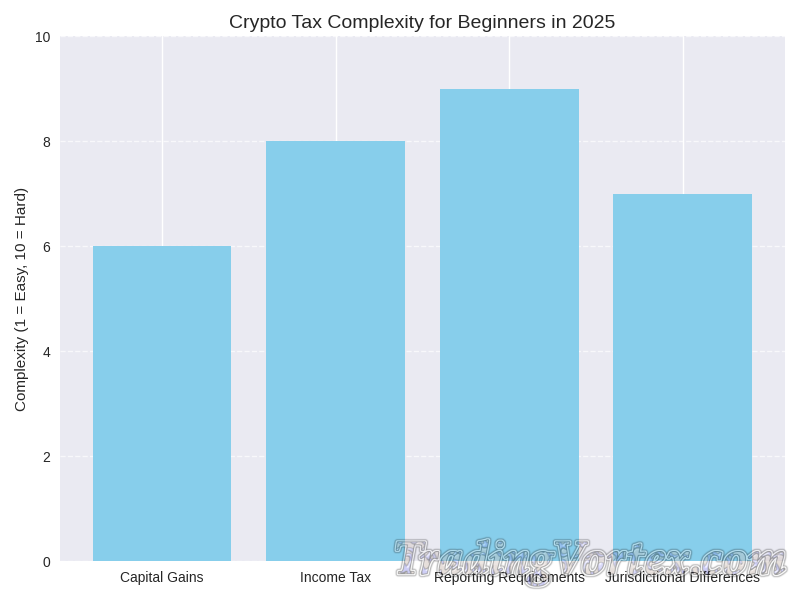 Crypto Tax Complexity for Beginners in 2025: Complex topics like reporting and jurisdiction differences deserve extra attention and early recordkeeping.
♦ What it shows: A bar chart rating the relative complexity of core tax topics on a 1–10 scale:
◊ Capital Gains: 6
◊ Income Tax: 8
◊ Reporting Requirements: 9
◊ Jurisdictional Differences: 7
♦ Takeaway: Reporting rules and forms tend to be the toughest; planning ahead reduces stress at tax time.
♦ Reader explanation:
◊ Capital gains: Straightforward once you track cost basis and sale price.
◊ Income tax: Trickier due to staking, mining, and fair market value at receipt.
◊ Reporting requirements: Highest complexity because forms, thresholds, and cross-border rules vary.
◊ Jurisdictional differences: Rules shift by country, which adds comparison overhead.
Recordkeeping Tools and Transaction Tracking Best Practices
Crypto transactions can pile up quickly, especially if you dabble in DeFi or NFTs. Good recordkeeping saves headaches later.
- Tracking tools: Platforms like CoinTracking, Koinly, and Accointing automatically sync with exchanges and wallets, generating tax reports.
- Best practices:
- Keep records of every trade, transfer, and staking reward.
- Note the date, amount, and value in fiat currency.
- Save receipts or screenshots for major transactions.
Think of it like keeping receipts for a business. You may not need them every day, but when tax season comes, you will be glad you did. Beginners often underestimate how messy crypto records can get until they try to sort them out months later.
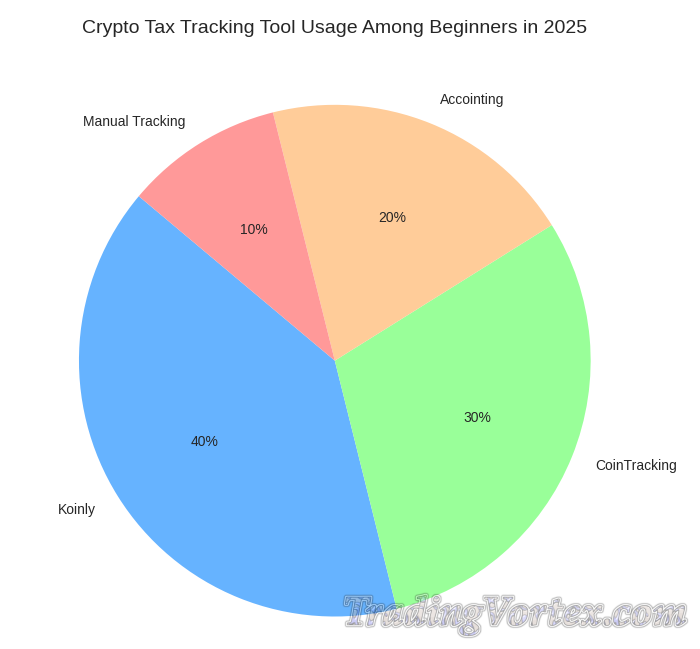 Crypto Tax Tracking Tool Usage Among Beginners in 2025: Use automated tools to sync wallets and exchanges, then review and export reports at tax time.
♦ What it shows: A pie chart of typical beginner choices:
◊ Koinly: 40%
◊ CoinTracking: 30%
◊ Accointing: 20%
◊ Manual Tracking: 10%
♦ Takeaway: Most new investors rely on software to consolidate transactions, which reduces errors and saves time.
♦ Reader explanation:
◊ Koinly: Popular for exchange integrations and tax report exports.
◊ CoinTracking: Robust analytics with long-time user base.
◊ Accointing: Simple workflows and guided filing support.
◊ Manual tracking: Feasible for very small activity, but error-prone at scale.
Regulatory Red Flags and Jurisdictional Differences
Crypto rules vary widely depending on where you live.
- United States: The IRS treats crypto as property, and reporting requirements are strict. Failure to disclose can lead to penalties.
- European Union: DAC8 expands reporting obligations, and MiCAR (Markets in Crypto‑Assets Regulation) sets standards for exchanges and stablecoins.
- Other regions: Some countries, like El Salvador, embrace crypto as legal tender, while others, like China, maintain strict bans.
Red flags for beginners:
- Promises of “tax‑free” crypto investments are usually scams.
- Platforms that avoid compliance may expose you to legal risk.
- Jurisdictional differences mean you must check local laws, not just global headlines.
A simple rule: if something sounds too good to be true, it probably is. Stick to platforms that publish compliance details and avoid shortcuts that could cost you later.
Final Thought: Taxes and compliance may not be the most glamorous part of crypto investing, but they are essential. Treat crypto like any other investment: report gains, track transactions, and respect local laws. Doing so protects you from penalties and builds peace of mind. Remember, the goal is not just to make money, but to keep it.
Common Beginner Mistakes and How to Avoid Them
Crypto investing can feel like stepping into a carnival: flashing lights, loud voices, and promises of instant riches. The problem is that not every ride is safe. Beginners often make the same mistakes, and while some are harmless learning experiences, others can drain your wallet faster than you can say “blockchain”. The good news is that most of these pitfalls are avoidable once you know what to look out for.
Chasing Hype, FOMO, and Pump-and-Dump Schemes
One of the most common traps is buying into hype without research. Influencers, flashy ads, or trending coins can lure beginners into buying at the top, only for the price to crash days later.
- Mistake: Buying high due to fear of missing out (FOMO).
- Solution: Slow down. Use strategies like dollar-cost averaging (DCA) and always “DYOR” (do your own research). Read whitepapers, check tokenomics, and follow trusted news sources.
A personal anecdote: I once bought into a coin because everyone on Twitter said it was “going to the moon.” It went to the basement instead. Lesson learned: hype is not a strategy, discipline is.
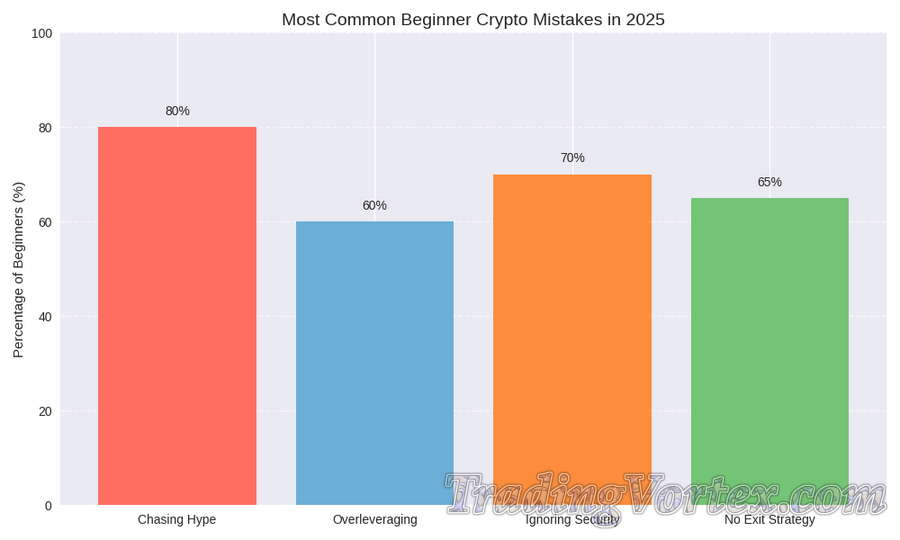 Most Common Beginner Crypto Mistakes in 2025: Most beginner losses come from hype, poor security, and lack of a selling plan.
♦ What it shows: A bar chart with the relative frequency of four major mistakes:
◊ Chasing Hype: 80%
◊ Overleveraging: 60%
◊ Ignoring Security: 70%
◊ No Exit Strategy: 65%
♦ How to use it:
◊ Interpretation: Hype and weak security habits dominate early missteps. Use DCA, research basics, and a written plan to counter emotional decisions.
◊ Beginner takeaway: Prioritize a simple checklist: research before buying, avoid leverage, secure wallets, and define exits in advance.
♦ Reader explanation:
◊ Chasing hype: Emotional buys at peaks.
◊ Overleveraging: Losses compound fast.
◊ Ignoring security: Keys and 2FA neglected.
◊ No exit strategy: Profits unprotected and losses unmanaged.
Overleveraging and Margin Trading Pitfalls
Leverage can amplify gains, but it also magnifies losses. Many beginners borrow money or use margin trading without fully understanding the risks.
- Mistake: Betting more than you can afford to lose.
- Solution: Stick to spot trading until you are experienced. If you do use leverage, keep it minimal and treat it as advanced territory.
Think of leverage like hot sauce: a little adds flavor, too much ruins the meal. Beginners should focus on learning market basics before experimenting with borrowed funds.
Ignoring Security, Backups, and Recovery Plans
Security mistakes are still rampant in 2025. Beginners often leave coins on exchanges, store seed phrases in screenshots, or fall for phishing scams.
- Mistake: Neglecting wallet security and backups.
- Solution: Use hardware wallets for long-term storage, enable two-factor authentication, and never share your seed phrase. Keep backups offline and in secure locations.
Scams are everywhere: fake airdrops, phishing links, and “free giveaways” still claim victims. If a deal looks too good to be true, it probably is. Treat your crypto like cash in a vault, not pocket change.
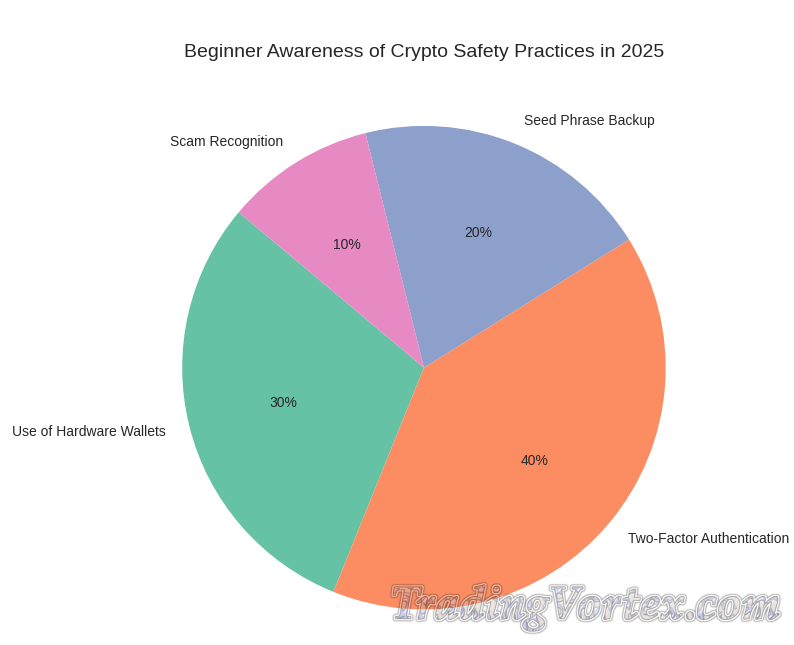 Beginner Awareness of Crypto Safety Practices in 2025: Boost safety fast: 2FA, hardware wallet, offline seed backups, and scam awareness.
♦ What it shows: A pie chart illustrating the share of beginners familiar with key safety steps:
◊ Use of Hardware Wallets: 30%
◊ Two-Factor Authentication: 40%
◊ Seed Phrase Backup: 20%
◊ Scam Recognition: 10%
♦ How to use it:
◊ Interpretation: Awareness is lowest in seed backups and scam recognition. Emphasize offline seed storage, phishing avoidance, and verified URLs.
◊ Beginner takeaway: Improve safety quickly with three moves: enable an authenticator app for 2FA, buy a hardware wallet for long-term holdings, and create two offline seed backups.
♦ Reader explanation:
◊ Hardware wallets: Non-custodial, offline protection.
◊ 2FA: Reduces account takeover risk.
◊ Seed backup: The only recovery path if devices fail.
◊ Scam recognition: Shields against phishing, fake airdrops, and imposters.
Failing to Plan Exit Strategies and Profit-Taking Rules
Many beginners enter the market with no plan for when to sell. They ride coins up, then watch them crash back down.
- Mistake: Holding blindly without profit-taking rules.
- Solution: Set clear exit strategies. Decide in advance whether you will sell at a certain percentage gain, rebalance your portfolio, or take profits gradually.
A simple rule: always know why you are buying, and always know under what conditions you will sell. Without a plan, emotions take over, and emotions rarely make good investors.
Final Thought: Crypto mistakes are easy to make, but they are also easy to avoid with awareness and discipline. Do your research, avoid chasing hype, respect leverage, secure your assets, and plan your exits. Remember, the goal is not just to survive the carnival, but to walk out with your wallet intact and your confidence stronger.
Building Your Crypto Knowledge Toolkit
Crypto investing is not just about buying coins, it is about building a system that helps you learn, track, and grow over time. Think of it like assembling a toolbox: each tool has a purpose, and together they make the job easier.
Portfolio and Market Tracking Tools
Managing crypto across multiple exchanges and wallets can feel like juggling flaming balls. That is where portfolio trackers come in. Tools like CoinStats, CoinMarketCap, and Koinly centralize your holdings, offering real‑time insights, performance analytics, and even tax reporting.
- Why it matters: You see your entire portfolio in one place, instead of bouncing between apps.
- Best practice: Start with a free tracker, then upgrade if you need advanced features like automated tax reports.
A personal note: I once tried tracking everything in a spreadsheet. It worked for a week, then collapsed under the weight of DeFi transactions. A good tracker saved me hours and a few headaches.
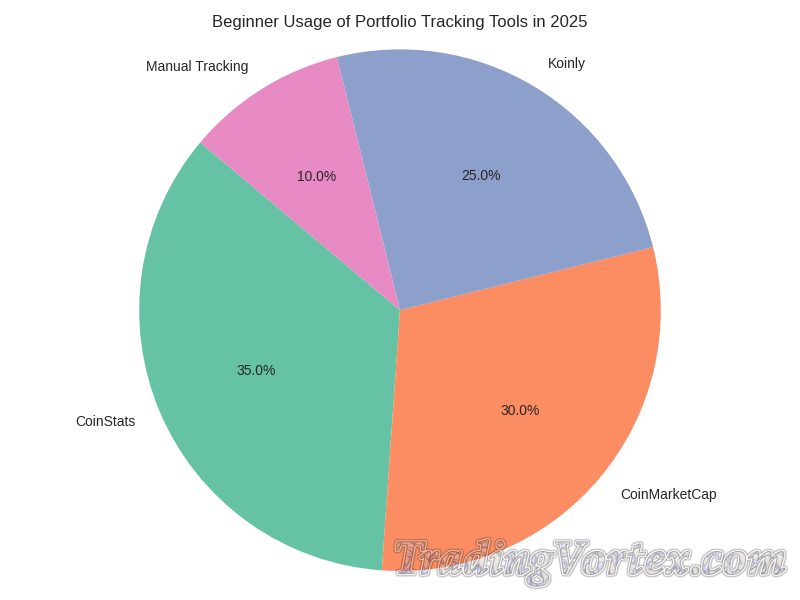 Beginner Usage of Portfolio Tracking Tools in 2025: Centralize your holdings with a tracker to reduce errors, save time, and see performance at a glance.
♦ What it shows: A pie chart of common choices among beginners: CoinStats 35%, CoinMarketCap 30%, Koinly 25%, Manual Tracking 10%.
♦ How to use it:
◊ Takeaway: Most beginners prefer app‑based tracking for a single portfolio view, while manual spreadsheets are rare and hard to maintain.
◊ Action: Start with a free tracker, then upgrade only when you need automated tax reports or multi‑chain analytics.
♦ Reader explanation:
◊ CoinStats: Portfolio aggregation, alerts, multi‑wallet support.
◊ CoinMarketCap: Price discovery, watchlists, basic tracking.
◊ Koinly: Tax automation plus portfolio insights.
◊ Manual tracking: Works for very light activity, quickly becomes error‑prone.
Building Your Personal Learning Routine
Crypto changes daily, so your toolkit should include habits, not just apps.
- Set aside time weekly to review market updates.
- Follow official exchange blogs or regulatory announcements.
- Experiment with demo accounts or paper trading before risking real money.
Learning in small, consistent doses beats binge‑reading whitepapers once a year. Treat it like going to the gym: regular reps build strength.
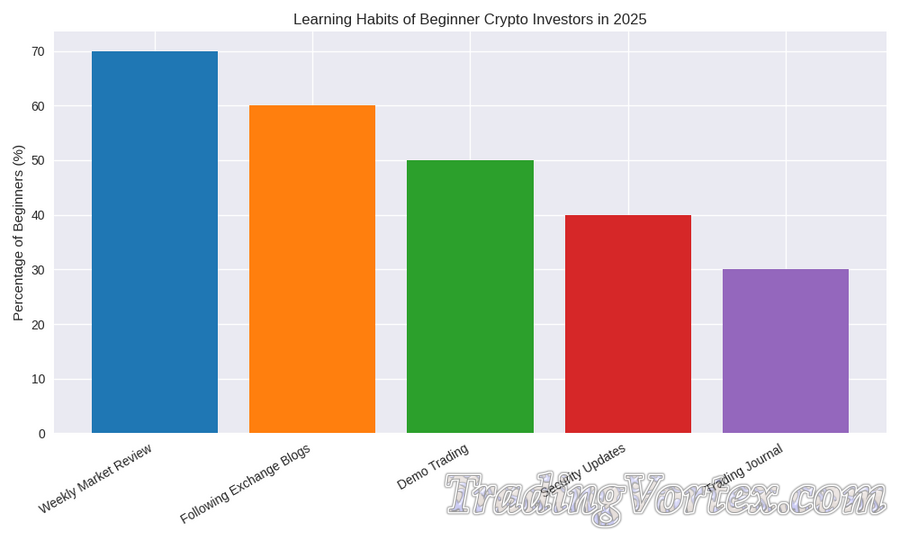 Learning Habits of Beginner Crypto Investors in 2025: Short, regular habits compound knowledge and confidence faster than occasional deep dives.
♦ What it shows: A bar chart comparing habit frequency: Weekly Market Review 70%, Following Exchange Blogs 60%, Demo Trading 50%, Security Updates 40%, Trading Journal 30%.
♦ How to use it:
◊ Takeaway: Consistency beats intensity; weekly reviews and official sources anchor learning, while demo trading and security checks build practical skill.
◊ Action: Block a weekly 30‑minute slot, follow official blogs, and pair demo trading with a simple journal for measurable progress.
♦ Reader explanation:
◊ Weekly review: Keeps you current without doom‑scrolling.
◊ Exchange blogs: Reliable product and compliance updates.
◊ Demo trading: Practice order types and risk‑free experimentation.
◊ Security updates: Patch devices, refresh phishing awareness.
◊ Trading journal: Capture lessons, refine rules, reduce repeat mistakes.
Continuous Skill Development Through Practice
The best way to learn crypto is by doing:
- Place small trades to understand order types.
- Try staking with minimal amounts to see how rewards work.
- Keep a trading journal to reflect on decisions and outcomes.
Practice builds confidence. Even mistakes become valuable lessons when you record them and adjust your strategy.
Staying Updated on Regulations and Security Practices
Your toolkit is incomplete without awareness of compliance and safety. In 2025, regulators are tightening rules worldwide, from the U.S. IRS Form 1099‑DA to Europe’s DAC8 directive. Beginners should:
- Bookmark official government or exchange announcements.
- Stay alert for phishing scams and fake platforms.
- Treat security as part of education, not an afterthought.
Think of it like learning to drive: you do not just learn how to accelerate, you learn the rules of the road.
Final Thought: Building your crypto knowledge toolkit is about more than apps, it is about creating a system that supports your growth. Track your portfolio, build learning habits, practice with small amounts, and stay updated on rules and security. Over time, this toolkit becomes your safety net, helping you navigate the ups and downs of the market with confidence.
Building a Long-Term Crypto Plan (Checklist & Next Steps)
Crypto rewards patience. The investors who thrive are not the ones chasing every shiny coin, but those who build a plan and stick to it. A long-term strategy helps beginners avoid emotional decisions, manage risk, and grow steadily.
Think of this as your roadmap: clear steps, realistic goals, and practical habits that keep you grounded when the market gets noisy.
30/60/90-Day Action Plan for New Investors
First 30 days:
- Open accounts on reputable exchanges and complete KYC verification.
- Fund your account with a small test amount to learn the process.
- Make your first purchase of Bitcoin or Ethereum to get comfortable with buying.
- Begin tracking your portfolio with a free app or spreadsheet.
Next 60 days:
- Explore diversification by adding one or two altcoins with strong fundamentals.
- Experiment with staking small amounts to understand how passive rewards work.
- Start a trading journal to record decisions, emotions, and lessons learned.
- Read weekly market updates to build your knowledge habit.
By 90 days:
- Review your portfolio performance and note what worked and what did not.
- Set clear long-term goals: wealth building, passive income, or diversification.
- Draft an exit strategy for profit-taking and risk management.
- Begin planning for tax reporting and compliance.
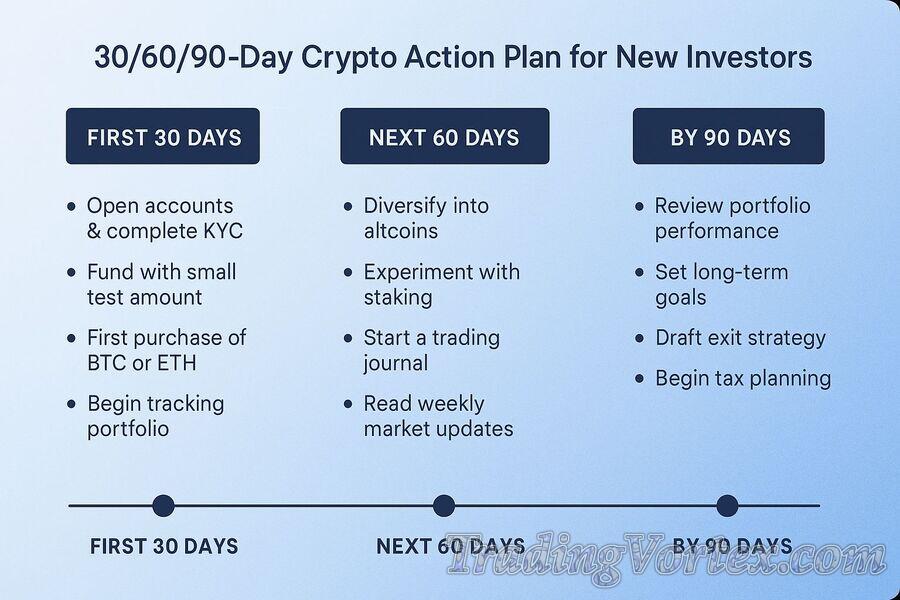 30/60/90‑Day Crypto Action Plan for Beginners: Phase your learning: setup, expand, optimize.
♦ First 30 Days — Setup and first purchase
◊ Choose reputable exchange: Pick a well‑known CEX for fiat on‑ramps and KYC.
◊ Complete KYC & enable 2FA: Verify identity and secure accounts immediately.
◊ Fund account with a small test amount: Learn the deposit flow without risking much.
◊ Buy Bitcoin or Ethereum (market order): Make a simple first purchase to learn the mechanics.
♦ Next 60 Days — Expand and practice
◊ Add 1–2 vetted altcoins: Diversify slowly; research tokenomics first.
◊ Start a portfolio tracker: Centralize holdings to monitor performance.
◊ Stake small amounts: Learn staking mechanics and reward timing.
◊ Keep a trading journal: Record decisions, outcomes, and emotions.
♦ By 90 Days — Review, formalize, and plan
◊ Review performance & rebalance: Compare allocations to targets and rebalance if needed.
◊ Set long‑term goals & exit rules: Define why you hold and when you’ll take profits.
◊ Plan for taxes & compliance: Start organizing records and consider professional advice.
◊ Join a learning community: Share lessons and stay updated with peers.
This phased approach keeps you from rushing in too fast. I once jumped into five altcoins in my first month, only to regret three of them. A slower pace would have saved me money and stress.
Sample Beginner Portfolio Allocations and Rebalancing Rules
Experts in 2025 recommend beginners keep 1–5 percent of their total portfolio in crypto. Within that slice, here’s a simple allocation framework:
- Conservative: 70 percent Bitcoin/Ethereum, 20 percent stablecoins, 10 percent large-cap altcoins.
- Balanced: 50 percent Bitcoin/Ethereum, 30 percent altcoins, 20 percent stablecoins.
- Aggressive: 40 percent Bitcoin/Ethereum, 50 percent altcoins, 10 percent stablecoins.
Rebalancing rules:
- Review allocations every 3–6 months.
- If one asset grows too large (say altcoins jump from 30 percent to 50 percent), rebalance back to your target.
- Use stablecoins as a buffer to buy dips or lock in profits.
Think of rebalancing like trimming a garden. Left unchecked, one plant can take over, but regular care keeps everything healthy.
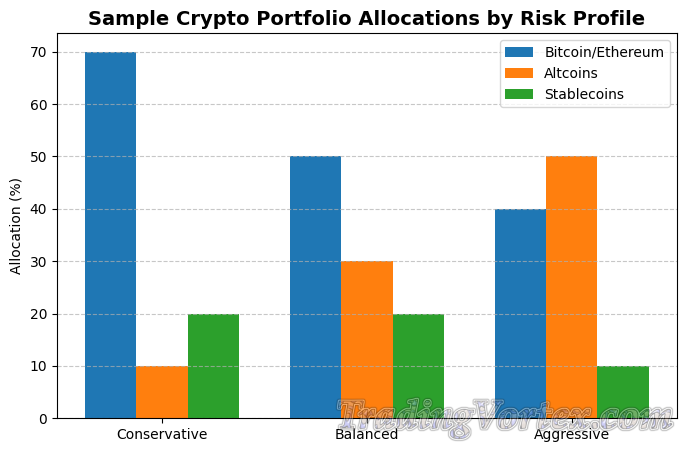 Sample Crypto Portfolio Allocations by Risk Profile: Choose a profile that fits your risk, then rebalance every 3–6 months to stay aligned with your targets.
♦ What it shows: A grouped bar chart comparing three investor types across core categories:
◊ Conservative: 70% Bitcoin/Ethereum, 10% Altcoins, 20% Stablecoins.
◊ Balanced: 50% Bitcoin/Ethereum, 30% Altcoins, 20% Stablecoins.
◊ Aggressive: 40% Bitcoin/Ethereum, 50% Altcoins, 10% Stablecoins.
♦ How to use it:
◊ Interpretation: Pick the profile that matches your risk tolerance and time commitment. Use stablecoins as your buffer for buying dips and rebalancing.
◊ Beginner takeaway: Keep crypto a slice of your total portfolio; emphasize majors first, then layer altcoins selectively.
♦ Reader explanation:
◊ Majors: Foundation for resilience.
◊ Altcoins: Growth potential with higher volatility.
◊ Stablecoins: Liquidity for tactical moves and profit-locking.
When to Seek Professional Financial or Tax Advice
Crypto taxation in 2025 is stricter than ever. The U.S. IRS now requires Form 1099-DA, while Europe enforces DAC8 cross-border reporting. If you are unsure about reporting, or if you earn income from staking, NFTs, or DeFi, it is wise to consult a professional.
Seek advice when:
- You have more than a few thousand dollars in crypto.
- You are earning income (not just capital gains).
- You are trading across multiple jurisdictions.
- You want to optimize taxes legally.
A tax advisor or financial planner can save you from costly mistakes. I once thought I could “wing it” with spreadsheets, only to spend weeks untangling transactions. A professional would have solved it in hours.
Final Thought: A long-term crypto plan is not about predicting the next big coin, it is about building habits and systems that protect your money and peace of mind. Start small, diversify wisely, rebalance regularly, and know when to call in experts. Crypto is a marathon, not a sprint, and the best investors are those who pace themselves.
Conclusion: Your First Steps Toward Confident Crypto Investing
Investing in cryptocurrency as a beginner can feel overwhelming, but with the right mindset and tools, it becomes a journey of steady growth rather than a gamble. Throughout this guide, we have covered the essentials: setting up accounts securely, funding wisely, choosing between Bitcoin and altcoins, protecting your assets with wallets, understanding taxes, and building a long‑term plan.
The most important lesson is that crypto rewards patience and discipline. Start small, diversify carefully, and never invest more than you can afford to lose. Mistakes will happen, but each one is a chance to learn and refine your strategy. Security, compliance, and clear exit rules are not optional, they are the foundation of lasting success.
Think of this guide as your launchpad. You now have a toolkit of strategies, checklists, and best practices that can help you navigate the ups and downs of the market with confidence. Crypto is not just about chasing profits, it is about building knowledge, resilience, and a plan that works for you.
So take that first step: open your account, make your first small purchase, and begin building your long‑term crypto journey. The market will always be unpredictable, but with preparation and patience, you can turn uncertainty into opportunity.
FAQs: Crypto Investing for Beginners in 2025
Q1. What’s the safest way to start investing in crypto?
Start small and stick to the basics. Open an account on a reputable exchange like Coinbase, Kraken, or Binance, complete your KYC verification, and buy a small amount of Bitcoin or Ethereum. These are the most established assets and a great way to learn the ropes without diving into risky territory.
Q2. How much should I invest as a beginner?
Experts recommend starting with 1 to 5 percent of your total investment portfolio. Crypto is volatile, so it’s smart to treat it as a high-risk, high-reward asset. I once started with just $100 in Bitcoin, and that small amount taught me more than any blog post ever could.
Q3. What’s the difference between Bitcoin, Ethereum, and altcoins?
♦ Bitcoin is the OG: digital gold, slow but secure.
♦ Ethereum is the tech powerhouse: it powers smart contracts and DeFi.
♦ Altcoins are everything else: some are innovative, others are speculative.
In 2025, Ethereum is booming thanks to Layer-2 scaling, while altcoins like Solana, Avalanche, and Kaanch Network are gaining traction.
Q4. Do I need a crypto wallet?
Yes, especially if you plan to hold long-term. Exchanges are convenient, but wallets give you control.
♦ Hot wallets (like MetaMask) are great for daily use.
♦ Cold wallets (like Ledger or Trezor) are best for security.
Never store your seed phrase in your email or screenshots. I learned that the hard way when I almost lost access during a phone reset.
Q5. How do I avoid scams and pump-and-dump schemes?
If someone promises guaranteed returns or pushes a “secret coin,” run. Stick to projects with transparent teams, clear use cases, and solid tokenomics. Always DYOR: read whitepapers, check community sentiment, and avoid hype-driven decisions.
Q6. What are the tax implications of crypto investing?
In 2025, crypto is taxed more strictly than ever.
♦ Capital gains apply when you sell for profit.
♦ Income tax applies to staking, mining, or earning crypto.
♦ The U.S. now uses Form 1099-DA, and Europe enforces DAC8 for cross-border reporting.
If you’re unsure, consult a tax advisor. It’s worth it.
Q7. Should I try staking or yield farming?
Staking is beginner-friendly and relatively safe if done on major platforms. Yield farming is more complex and can be risky. Start with staking small amounts of Ethereum or Solana to learn how rewards work.
Q8. How often should I check my portfolio?
Daily checking leads to emotional decisions. Weekly reviews are healthier. Use portfolio trackers like CoinStats or Koinly to stay informed without obsessing.
Q9. What’s the best way to learn more about crypto?
Build a learning habit. Read weekly updates, follow trusted blogs, and experiment with small trades. Avoid relying solely on influencers. The best lessons come from doing, not just watching.
Q10. What’s the biggest mistake beginners make?
Chasing hype and investing too much, too fast. Crypto is exciting, but it’s not a shortcut to wealth. Start slow, stay curious, and treat every mistake as a lesson.