

Discover a practical, no-nonsense guide to earning passive income with DeFi, written for traders and investors at every level. This article walks you through the core ways to earn on-chain yield: staking, lending, yield farming, liquidity mining, yield aggregators, and tokenized real-world assets. You’ll get clear explanations of how each method works, realistic APY ranges, and the trade offs between stability and upside. The tone is friendly and conversational, with actionable steps, security checklists, and tax and legal pointers so you can earn confidently, not carelessly.
Read this if you want: a step-by-step setup for wallets and safe platform connections, hands-on strategies for beginners and advanced users, and a risk-first approach to avoid common traps like impermanent loss, smart contract exploits, and token inflation. The article also covers advanced tactics: cross-chain yield, leveraged farming, and options-based income, plus a forward-looking view on AI-driven strategies and institutional-grade RWA products. Each section is designed to be practical: what to do, what to watch, and how to protect your capital while maximizing long-term returns.
Table of Contents:
- Introduction to Passive Income with DeFi
- What is DeFi? The Basics of Decentralized Finance
- Why Choose DeFi for Passive Income?
- Best Ways to Earn Passive Income with DeFi
- Best DeFi Platforms for Passive Income
- Risks of Earning Passive Income with DeFi
- Taxation and Legal Considerations for DeFi Passive Income
- Step-by-Step Guide to Start Earning Passive Income with DeFi
- Advanced DeFi Passive Income Strategies
- Future of Passive Income in DeFi
- Conclusion: Building Long-Term Passive Income with DeFi
- FAQs: How to Earn Passive Income with DeFi
- Q1. What’s the safest way to start earning passive income in DeFi?
- Q2. How much can I realistically earn from DeFi passive income?
- Q3. Is DeFi passive income really passive?
- Q4. What are the biggest risks I should watch out for?
- Q5. How is DeFi passive income taxed?
- Q6. Can I earn passive income with small amounts?
- Q7. What’s the difference between staking and yield farming?
- Q8. How do I know if a DeFi platform is trustworthy?
Introduction to Passive Income with DeFi
If you’ve ever wished your crypto could pull double duty while you sleep, DeFi is where that dream becomes reality. Decentralized finance, or DeFi, is a blockchain-based ecosystem that replaces banks and brokers with smart contracts, allowing anyone with a digital wallet to earn rewards by staking tokens, lending assets, providing liquidity, or depositing into automated yield vaults. Imagine programmable interest: the code enforces the rules, not a middleman in a suit.
What is DeFi and why it matters for passive income
Traditional savings accounts barely keep up with inflation, and institutional-grade yields have historically been reserved for hedge funds or insiders with deep pockets. DeFi flips that script. With nothing more than a wallet and an internet connection, a retail investor can stake ETH, lend stablecoins, or join a liquidity pool and start earning rewards in minutes. Recent industry reports show staking yields ranging from 2–7% APY on major platforms, while yield farming and liquidity mining can offer higher returns but with added risk.
This accessibility is what makes DeFi so powerful. It democratizes opportunities that were once locked behind closed doors, giving everyday investors a chance to participate in strategies that used to require millions in capital.
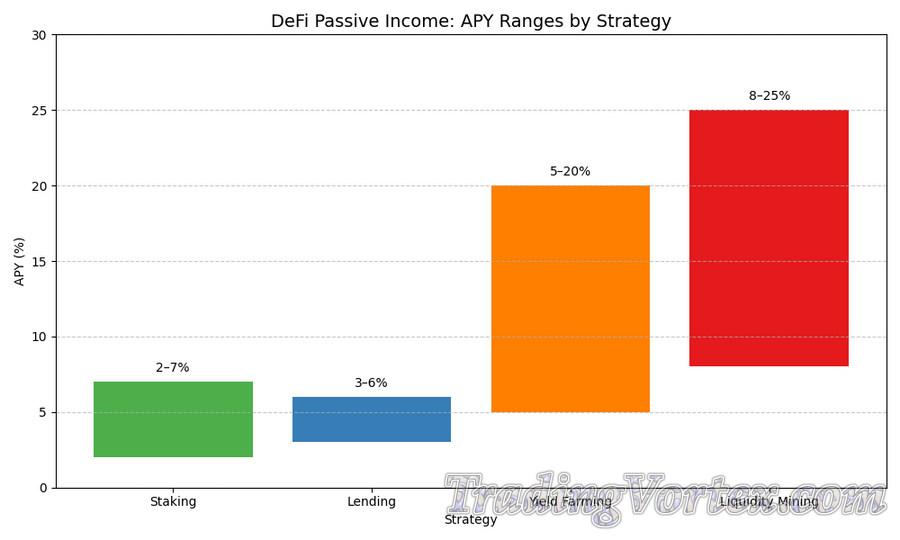 DeFi Passive Income: APY Ranges by Strategy: This bar chart compares the average annual percentage yield (APY) ranges for four major DeFi passive income strategies:
♦ Staking: 2–7% APY — typically lower risk, ideal for beginners.
♦ Lending: 3–6% APY — moderate returns with relatively stable assets like stablecoins.
♦ Yield Farming: 5–20% APY — higher returns but more volatile.
♦ Liquidity Mining: 8–25% APY — potentially lucrative but carries higher risk.
The color-coded bars help readers quickly grasp the risk-reward spectrum across strategies.
How DeFi creates new opportunities for crypto investors
DeFi is built on composability, often described as “money Legos”. You can stack strategies together: stake a token, receive a liquid staking derivative, use that derivative as collateral to borrow stablecoins, then farm yields with those stablecoins. Each layer adds potential returns, and yes, complexity too. Diversified portfolios today often combine 50–70% staking for stability with 20–30% yield farming or liquidity mining for higher risk-reward exposure.
This modular design means investors can tailor strategies to their risk appetite. Beginners might stick to staking or lending stablecoins, while advanced users experiment with cross-chain yield strategies or delta-neutral positions.
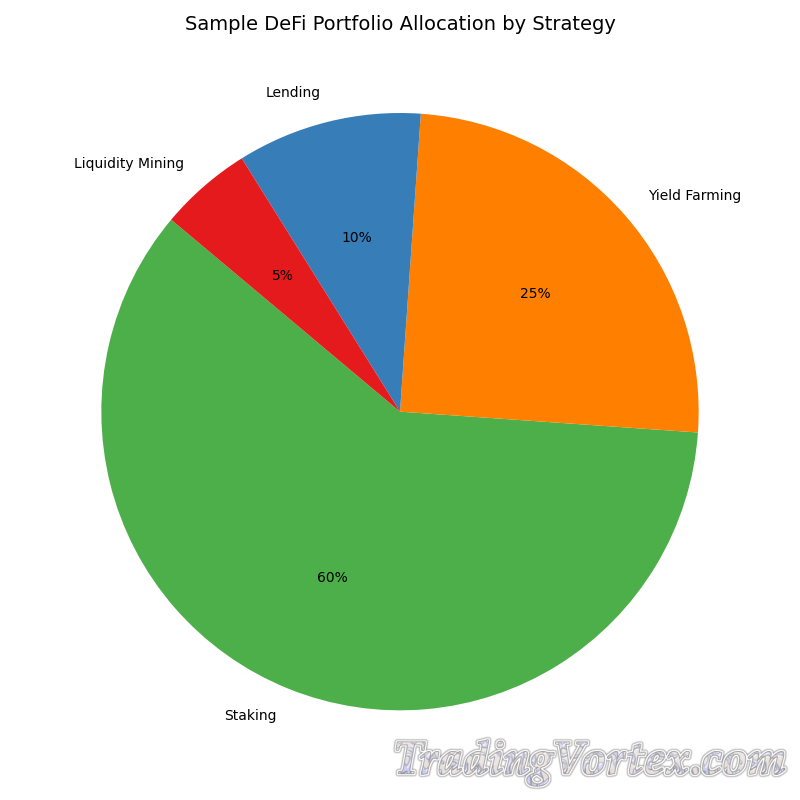 Sample DeFi Portfolio Allocation by Strategy: This pie chart shows a sample allocation based on common portfolio strategies:
♦ 60% Staking: Core stability and predictable returns.
♦ 25% Yield Farming: Higher yield exposure with moderate risk.
♦ 10% Lending: Low-risk, steady income.
♦ 5% Liquidity Mining: Small allocation to high-risk, high-reward strategies.
This visual helps readers understand how to balance risk and reward using composable DeFi tools.
Benefits of earning passive income through decentralized finance
The headline benefit is obvious: higher APYs than traditional finance. But there are subtler wins that matter just as much:
- Permissionless access: no bank account required, just a wallet.
- Global availability: anyone, anywhere, can participate.
- Automation: smart contracts handle compounding and payouts, saving you time.
- Flexibility: you can move funds between protocols quickly, chasing better yields or diversifying risk.
Of course, no introduction would be complete without a reality check. DeFi yields are not risk-free. Smart contract bugs, impermanent loss, token inflation, and regulatory uncertainty can all erode returns. The best approach is to treat DeFi passive income as one slice of your portfolio, not the whole pie. Start small, stick to audited platforms, and keep a portion of capital in safer assets while you learn the ropes.
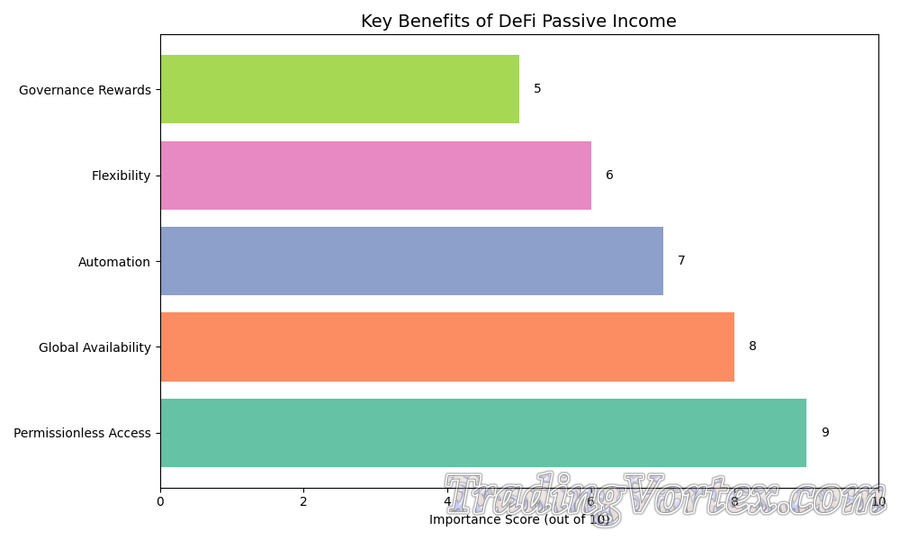 Key Benefits of DeFi Passive Income: Each benefit is scored on a 10-point scale based on its impact for users:
♦ Permissionless Access (9): No gatekeepers, just a wallet.
♦ Global Availability (8): Anyone with internet can participate.
♦ Automation (7): Smart contracts handle the heavy lifting.
♦ Flexibility (6): Move funds freely across protocols.
♦ Governance Rewards (5): Earn influence and incentives.
This chart highlights that DeFi’s appeal goes beyond yield: it’s about empowerment, efficiency, and global inclusion.
What is DeFi? The Basics of Decentralized Finance
How does DeFi actually work?
At its core, DeFi runs on public blockchains, most famously Ethereum, though newer networks like Solana, Avalanche, and Binance Smart Chain have also carved out their niches. These blockchains host smart contracts, which are programs that automatically carry out transactions when certain conditions are met. Think of them as digital vending machines: you put in your tokens, press the right button, and the machine delivers a service, whether that’s a loan, a token swap, or staking rewards.
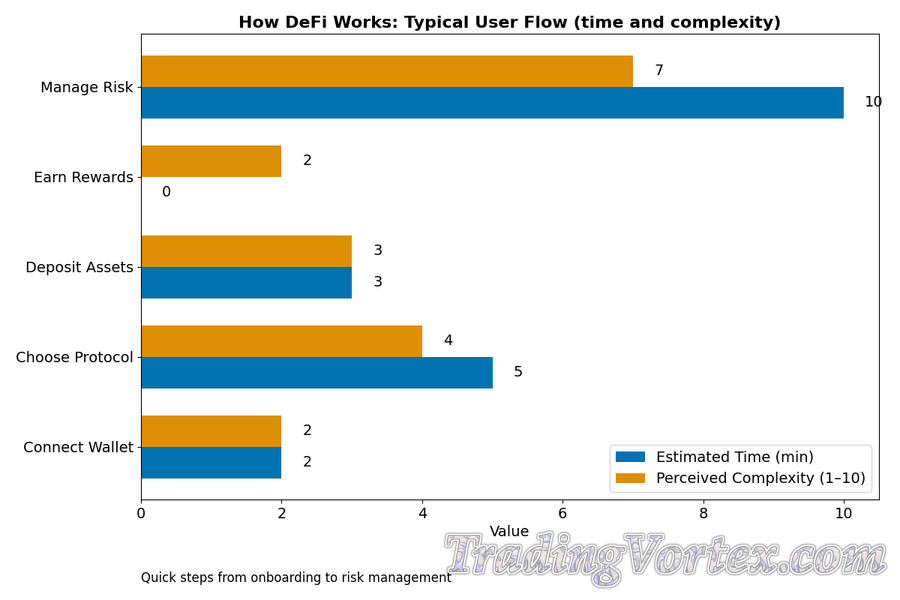 How DeFi Works: Typical User Flow (time and complexity): Two side-by-side horizontal bars per step: Estimated Time (minutes) and Perceived Complexity (1–10) for five steps: Connect Wallet, Choose Protocol, Deposit Assets, Earn Rewards, Manage Risk. Each bar is annotated with its numeric value.
♦ This chart clarifies that onboarding is fast (few minutes) while risk management takes longer and is more complex, helping readers set realistic expectations.
The building blocks of DeFi: smart contracts, DEXs, and liquidity pools
To really understand DeFi, it helps to break down its main components:
- Smart Contracts: These are the brains of DeFi. Once deployed, they’re transparent and immutable, meaning no one can secretly change the rules. They execute financial transactions automatically, removing the need for human intermediaries.
- Decentralized Exchanges (DEXs): Platforms like Uniswap, Curve, and SushiSwap allow users to trade tokens directly with one another. Instead of relying on a central authority to set prices or hold funds, trades are executed through liquidity pools and automated market makers (AMMs). Prices are determined algorithmically based on supply and demand.
- Liquidity Pools: These are collections of tokens locked into smart contracts that fuel trading and lending. Users who deposit their tokens into a pool become liquidity providers, earning a share of transaction fees or rewards. It’s a bit like being the house in a casino: you supply the chips, and you get a cut of the action.
Together, these components create a financial system that is open, programmable, and global.
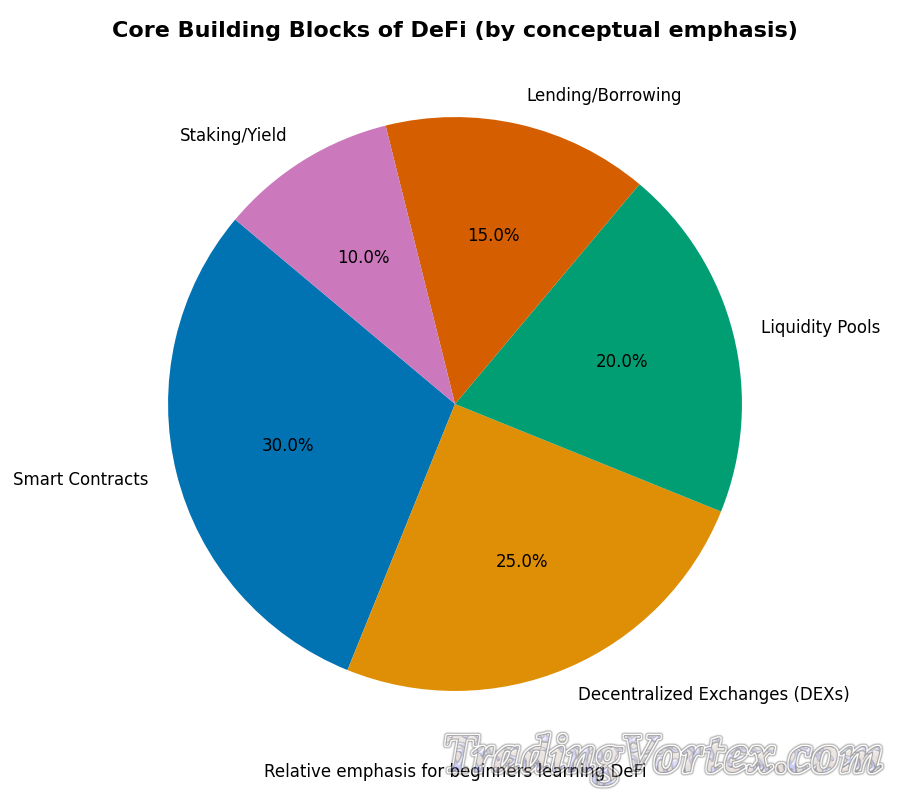 Core Building Blocks of DeFi (by conceptual emphasis): Relative emphasis for beginners across five components: Smart Contracts, DEXs, Liquidity Pools, Lending/Borrowing, Staking/Yield. Percentages are displayed on each slice so readers can quickly see which concepts deserve more study.
♦ This visual gives a compact, intuitive view of where to focus learning time: smart contracts and DEXs are the largest slices, signaling foundational concepts.
DeFi vs. TradFi: What’s the real difference?
- In TradFi, you need a bank account, a credit score, and often a mountain of paperwork. You’re trusting institutions to hold your money, approve your loans, and process your transactions.
- In DeFi, all you need is a crypto wallet and an internet connection. You’re in control of your assets, and you can interact with protocols 24/7 from anywhere in the world.
Of course, that freedom comes with responsibility. There’s no customer support hotline if you send funds to the wrong address or interact with a malicious contract. But for many investors, the trade-off is worth it. DeFi offers transparency, accessibility, and innovation that simply doesn’t exist in the legacy system.
And here’s the kicker: DeFi isn’t just about replicating traditional financial services. It’s about reimagining them. By removing gatekeepers and replacing them with code, DeFi opens the door to new forms of passive income, creative yield strategies, and financial products that evolve at the speed of software.
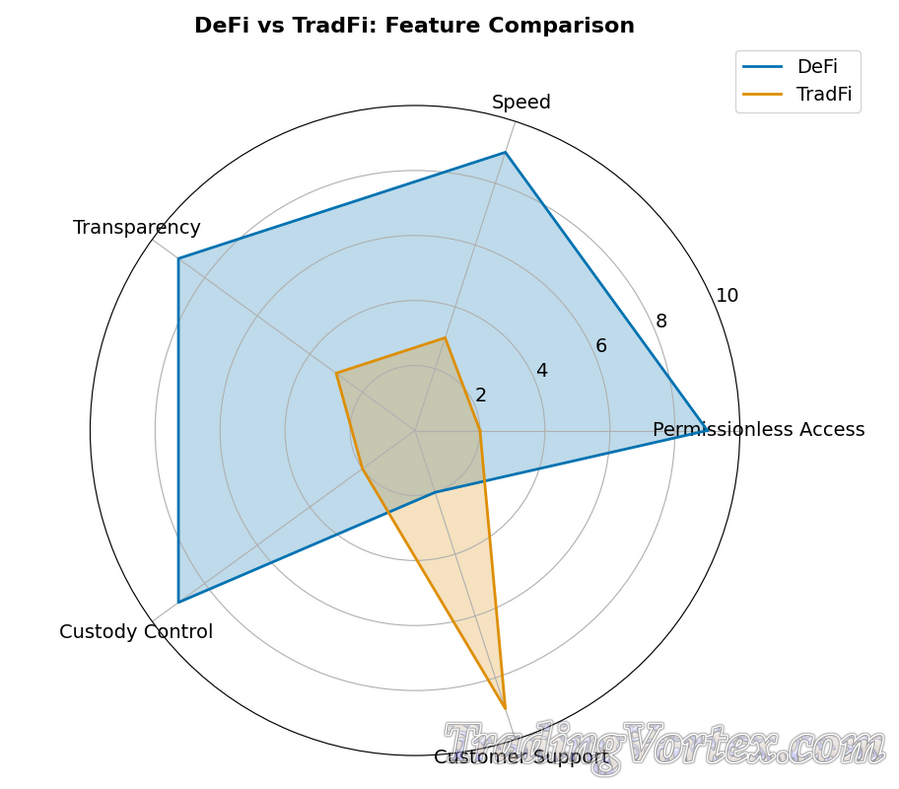 DeFi vs TradFi: Feature Comparison: Five features scored out of 10 for each system: Permissionless Access, Speed, Transparency, Custody Control, Customer Support.
♦ The radar overlay makes trade-offs immediately visible: DeFi scores high on access and transparency; TradFi scores high on customer support.
♦ The radar format highlights complementary strengths and weaknesses, helping readers decide which system suits a given goal.
Why Choose DeFi for Passive Income?
Let’s be real: banks are safe, but they’re stingy. Parking your money in a savings account often feels like leaving it in a dusty drawer. In many countries, interest rates hover around 0.01% to 1.5%, which barely covers the rising cost of a cup of coffee. Inflation eats away at your balance while the bank thanks you for your loyalty. DeFi flips that script, offering a decentralized system where your money can actually work for you, often at yields that make traditional finance look outdated.
High-Yield Opportunities That Leave Banks Behind
DeFi protocols regularly offer 5% to 20% APR through staking, lending, and liquidity provision, with some experimental strategies pushing even higher. For example, liquid staking platforms like Lido or Rocket Pool allow you to earn staking rewards while keeping your assets liquid, a feature banks could only dream of offering. Yield farming and liquidity mining can deliver double-digit returns, although they come with higher risk. Compared to the pennies you earn from a savings account, DeFi yields can feel like stepping into a different financial universe.
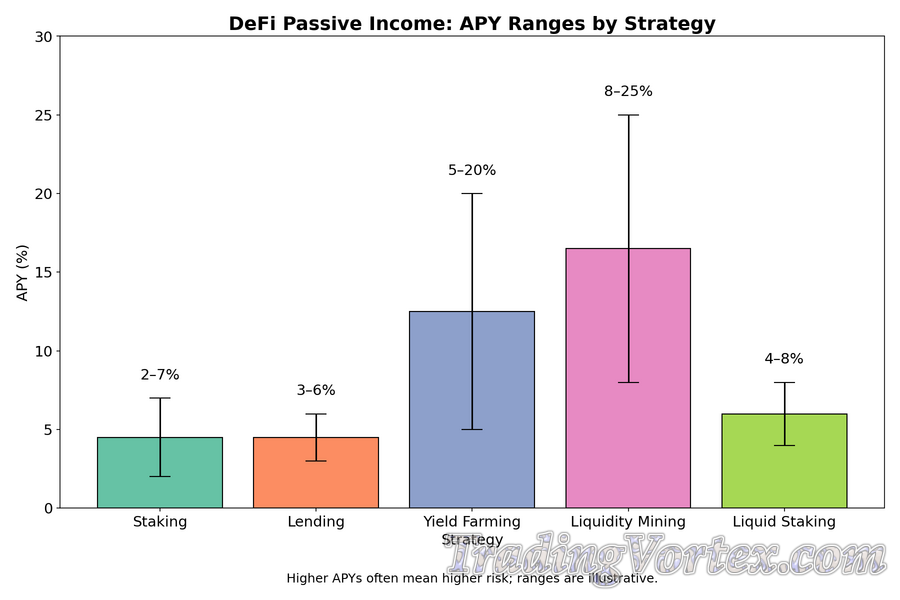 DeFi Passive Income: APY Ranges by Strategy: Visual ranges for Staking, Lending, Yield Farming, Liquidity Mining, and Liquid Staking (0–30% scale).
♦ Readers immediately see higher APYs usually imply higher risk and can compare strategies at a glance.
I remember a friend joking that his bank paid him less in interest last year than he spent on ATM fees. After moving part of his portfolio into DeFi staking, he was suddenly earning enough to cover his monthly internet bill. That’s the kind of difference we’re talking about.
Accessibility: Passive Income Without Gatekeepers
DeFi is permissionless, meaning anyone with a crypto wallet and internet connection can participate. No credit checks, no minimum deposits, no paperwork. Whether you’re in London, Lagos, or Lima, you can access the same opportunities. This is especially powerful in regions where traditional banking is limited or exclusionary. DeFi doesn’t care about your background, only that you can sign a transaction.
For many, this accessibility is more than financial: it’s empowering. It levels the playing field, giving everyday investors access to strategies once reserved for institutions.
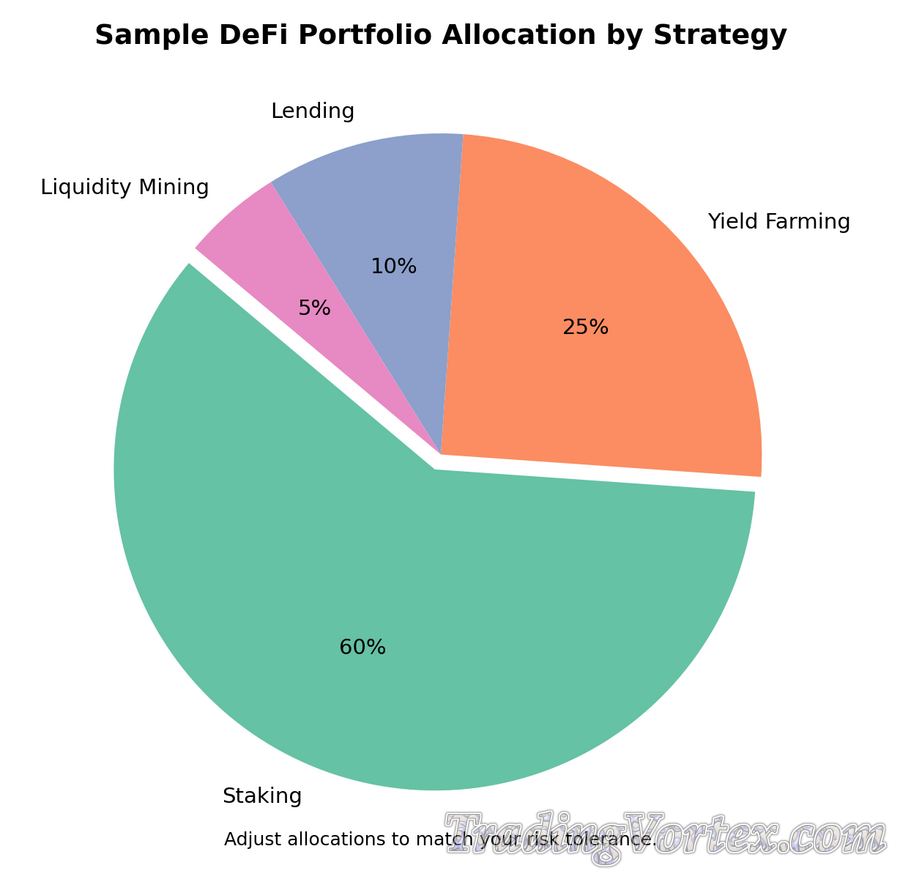 Sample DeFi Portfolio Allocation by Strategy: A balanced example allocation (majority staking, smaller yield-farming and lending slices).
♦ Demonstrates a practical starting point for passive-income seekers and reinforces the text about mixing stability and yield.
Automation and Compounding Through Smart Contracts
DeFi takes the magic of compound interest and supercharges it. Smart contracts automatically reinvest your rewards, optimize yields, and compound earnings without you lifting a finger. Platforms like Yearn Finance and Beefy Finance offer auto-compounding vaults that act like tireless robo-advisors, constantly working to maximize your returns.
Think of it as setting up a machine that quietly grows your wealth while you focus on other things. No management fees, no waiting for quarterly statements, just continuous optimization.
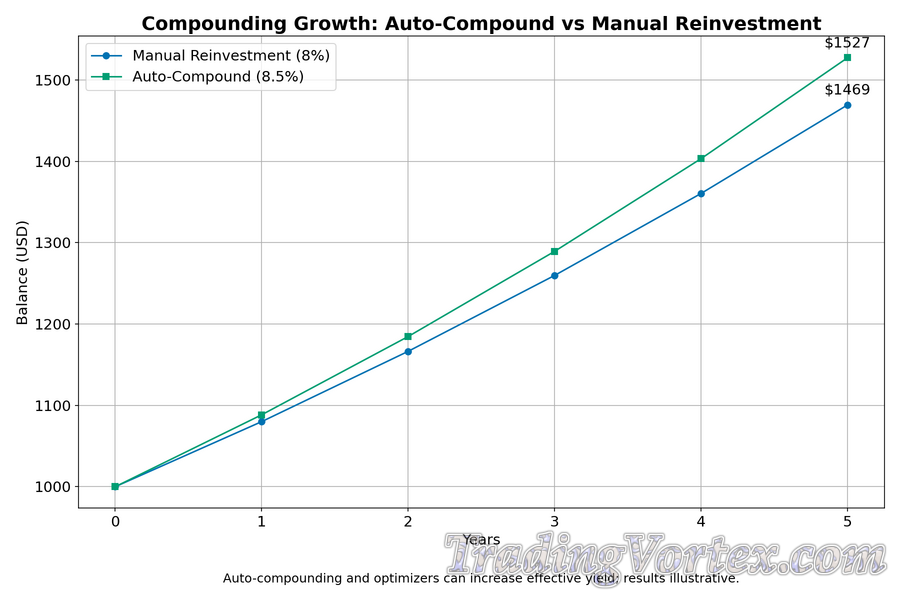 Compounding Growth: Auto-Compound vs Manual Reinvestment: Simulated balances over 0–5 years comparing annual manual reinvestment vs monthly auto-compounding with an optimizer boost.
♦ Quantifies the automation benefit: auto-compounding can materially increase final balance.
Flexibility and Interoperability Across Platforms
DeFi is not a rigid system; it’s a financial buffet. You can stake ETH on Lido, lend USDC on Aave, farm LP tokens on Curve, and still explore tokenized real-world assets like treasury bills or real estate. The interoperability between protocols means you can mix and match strategies to suit your risk appetite.
- Want stability? Stick with staking and stablecoin lending.
- Want adventure? Try cross-chain yield farming or liquidity mining.
DeFi lets you design your own passive income strategy, tailoring it to your goals and comfort level.
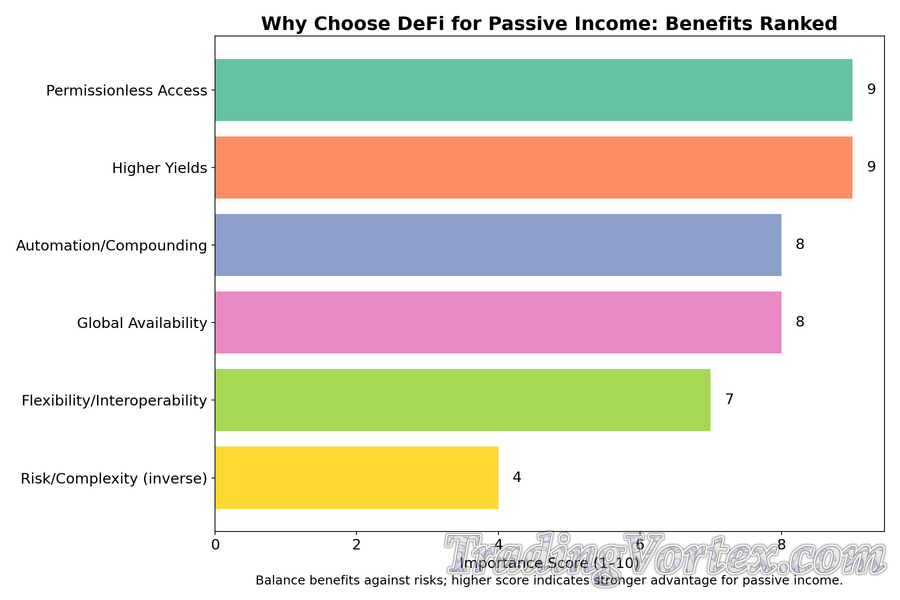 Why Choose DeFi for Passive Income: Benefits Ranked: Ranked scores (1–10) for Higher Yields, Permissionless Access, Automation, Flexibility, Global Availability, and Risk/Complexity (inverse).
♦ Summarizes trade-offs so readers can weigh yield vs. risk and support when deciding whether to allocate capital.
Bottom line: DeFi offers higher yields, global accessibility, automated compounding, and unmatched flexibility. It’s not without risks, but for those willing to learn and stay cautious, it provides opportunities that traditional finance simply cannot match.
DeFi vs Traditional Passive Income Options
| Feature / Factor | DeFi Passive Income | Traditional Passive Income |
|---|---|---|
| Typical Yields | 5%–20% APR (staking, lending, yield farming, liquidity mining); some experimental strategies higher | 0.01%–2% APR (savings accounts, CDs); 3%–6% dividends (stocks, REITs) |
| Accessibility | Global, permissionless, requires only a crypto wallet and internet connection | Often limited by geography, credit score, minimum deposits, or broker access |
| Intermediaries | None; smart contracts handle transactions automatically | Banks, brokers, and financial institutions act as gatekeepers |
| Automation | Smart contracts auto-compound rewards; yield aggregators optimize returns | Manual reinvestment or broker-managed compounding; slower processes |
| Flexibility | Funds can be moved quickly across platforms; strategies are customizable | Less flexible; tied to fixed terms (CDs) or market cycles (stocks, bonds) |
| Transparency | Open-source code, blockchain records visible to all | Opaque processes; fees and terms often hidden in fine print |
| Risks | Smart contract bugs, impermanent loss, token volatility, regulatory uncertainty | Market downturns, inflation erosion, institutional mismanagement, but generally lower technical risk |
| Entry Barriers | Low; no paperwork, no minimum deposits, just a wallet | Higher; requires bank accounts, brokerage accounts, or significant capital |
| Liquidity | High; assets can often be unstaked or moved quickly (depending on protocol) | Variable; CDs lock funds, real estate is illiquid, stocks are liquid but market-dependent |
This table makes the contrast crystal clear: DeFi offers higher yields, greater accessibility, and automation, but comes with unique risks, while traditional finance offers stability and lower risk, but with limited returns and accessibility.
Best Ways to Earn Passive Income with DeFi
If DeFi feels like a crowded buffet, this is your map to the best dishes. In the subsections that follow we will break down the core ways people earn passive income in decentralized finance, explain why each method exists, and highlight the trade offs you should weigh before committing capital. Think of this as the orientation talk before you start sampling: practical, honest, and a little bit encouraging.
DeFi strategies fall into a few clear categories: staking, yield farming and liquidity provision, crypto lending and borrowing, liquidity mining and token incentives, automated yield aggregators, and real world asset tokenization. Each method targets a different balance of stability, yield, and complexity, so your choice should match your goals and temperament. For example, staking tends to be lower effort and lower volatility, while yield farming can offer higher returns at the cost of more active management and technical risk.
 DeFi Strategy Comparison Radar Chart: Visually compares six major DeFi strategies: staking, lending, yield farming, liquidity mining, aggregators, and RWA tokenization; across three axes: stability, yield, and complexity.
♦ Helps readers match strategies to their risk tolerance and effort level. For example, staking scores high on stability and low on complexity, while liquidity mining is high-yield but complex and volatile.
 Layered DeFi Portfolio Pyramid: Illustrates the base-mid-top structure of a diversified DeFi portfolio.
♦ Base Layer (60%): Staking, stablecoin lending
♦ Mid Layer (25%): Blue-chip liquidity pools
♦ Top Layer (15%): Experimental farms, RWA tokens
◊ Reinforces the idea of building from stable to speculative, helping readers visualize allocation tiers.
Security and due diligence are non negotiable. Look for audits, active bug bounties, reputable teams, and on-chain transparency before you deposit funds. Also consider operational details: lockup periods, withdrawal delays, and how rewards are paid. Some strategies pay in volatile governance tokens, which can inflate nominal APY while eroding real returns if tokenomics are weak.
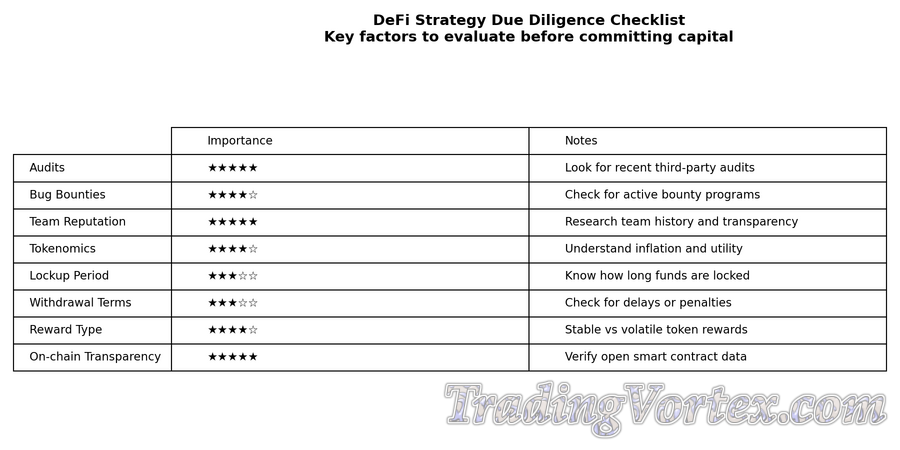 DeFi Strategy Due Diligence Checklist Table: Offers a visual checklist of key factors to evaluate before committing funds. Includes audits, bug bounties, team reputation, tokenomics, lockup terms, and more.
♦ Use as a pre-deposit checklist or onboarding tool for new users.
Trackable data shows many users prefer a mix of staking and stablecoin lending as a foundation, then allocate a smaller percentage to higher risk yield farming and liquidity mining.
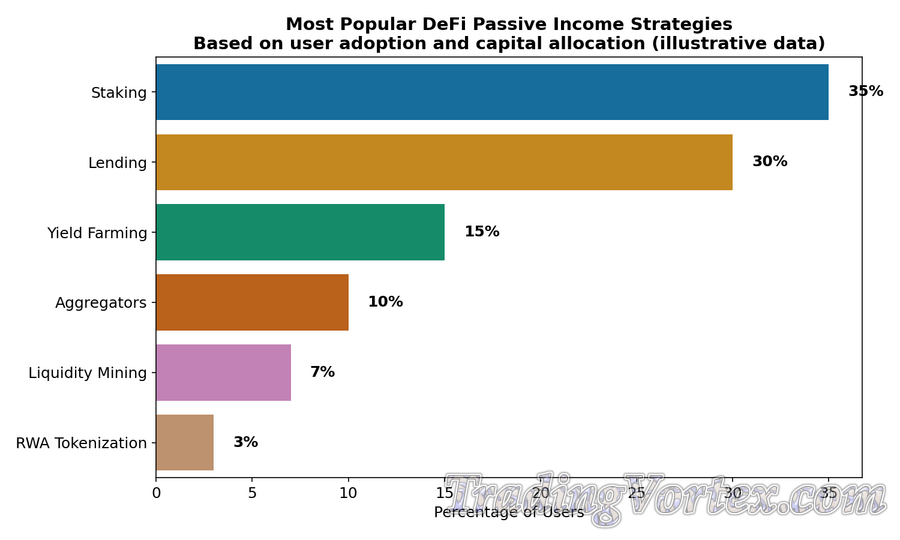 DeFi Strategy Popularity Bar Chart: Shows estimated user adoption across strategies. Staking (35%) and Lending (30%) dominate, while Yield Farming (15%) and Aggregators (10%) follow.
♦ Helps readers understand where most capital and users are concentrated, which can signal maturity and perceived safety.
Finally, remember that passive does not mean passive forever. Even set-and-forget vaults need periodic checks for protocol updates, governance votes, and changing market conditions. Start small, document your positions, and treat DeFi income as a dynamic part of your overall portfolio.
Staking Crypto in DeFi Platforms
How crypto staking works for passive income
Most staking happens on proof-of-stake (PoS) blockchains like Ethereum, Solana, Avalanche, and Cosmos. These networks rely on validators to confirm transactions and maintain the chain’s integrity. When you stake your tokens, you’re essentially delegating them to a validator, who uses them to participate in the consensus process. In return, you earn a share of the validator’s rewards: usually paid out in the same token you staked.
The beauty of staking is its simplicity. You don’t need to be a tech wizard or run your own node. Most DeFi platforms let you stake with just a few clicks. And once your tokens are staked, they start earning rewards automatically. Typical staking yields range from 4% to 12% annually, depending on the token and platform.
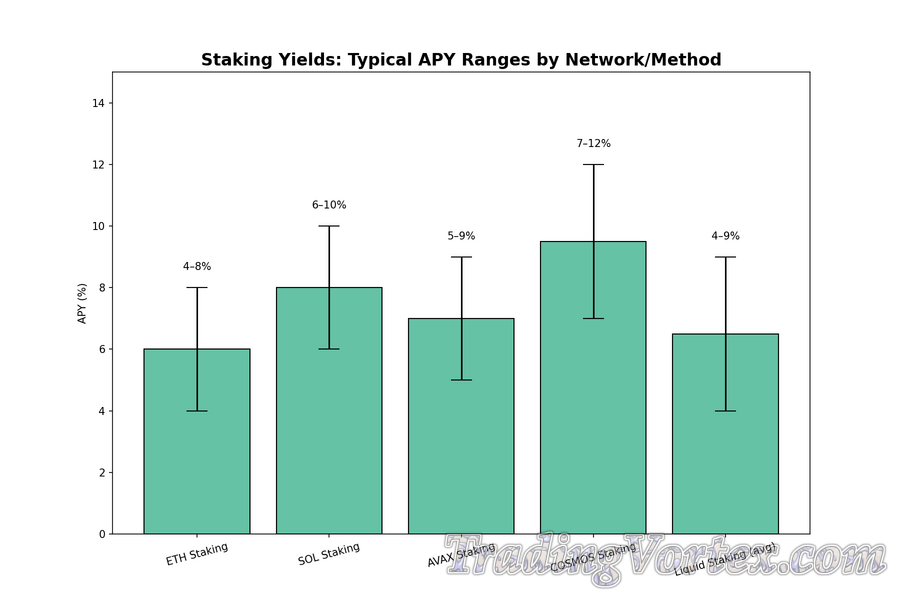 Staking APY Ranges: A vertical chart comparing typical APY ranges for ETH, SOL, AVAX, Cosmos, and liquid staking (illustrative).
♦ Readers get a quick sense that typical staking yields fall roughly between 4% and 12%, with liquid staking often overlapping those ranges.
♦ Each bar shows a min–max range and is annotated with the range (e.g., 4–8%).
♦ Use this to set realistic yield expectations before exploring platforms.
Liquid staking vs. traditional staking explained
Now here’s where things get interesting. Traditional staking often comes with a catch: your tokens are locked up for a set period, sometimes weeks or even months. That’s fine if you’re in it for the long haul, but it can be frustrating if you want to move your funds quickly.
Liquid staking solves this problem. Platforms like Lido, Rocket Pool, and Marinade Finance let you stake your tokens and receive a liquid derivative in return: like stETH for staked ETH or mSOL for staked SOL. These derivatives can be traded, used as collateral, or even deployed in other DeFi protocols to earn additional yield. It’s like staking with benefits.
Of course, liquid staking isn’t risk-free. You’re trusting a protocol to manage your assets and issue derivatives correctly. But for many users, the added flexibility is worth it.
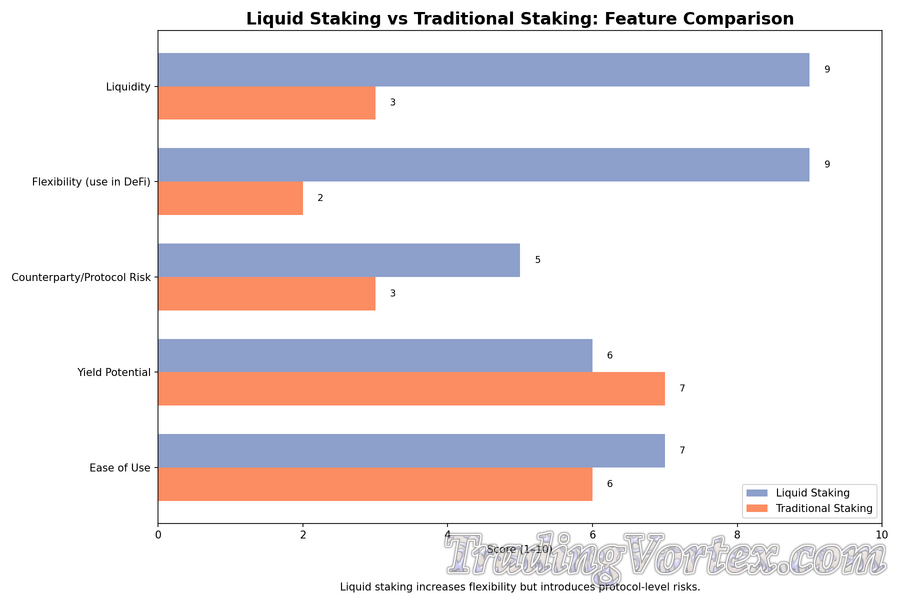 Liquid Staking versus Traditional Staking: Side‑by‑side scores (1–10) for Liquidity, Flexibility, Counterparty Risk, Yield Potential, Ease of Use comparing liquid staking and traditional staking.
♦ Makes the trade-offs explicit: liquid staking scores high on liquidity and composability but introduces protocol-level risk; traditional staking is simpler but less flexible. Help readers decide which model fits their goals.
Top staking platforms for earning rewards
Here are some of the most trusted and high-performing DeFi staking platforms right now:
| Platform | Key Features | Supported Assets | Typical APY |
|---|---|---|---|
| Lido Finance | Leading liquid staking for ETH, SOL, MATIC | ETH, SOL, MATIC, DOT | 3.5%–6% |
| Rocket Pool | Decentralized ETH staking with rETH derivative | ETH | ~4.5%–6% |
| Marinade Finance | Liquid staking on Solana with mSOL | SOL | ~7% |
| Ankr | Multi-chain staking and liquid staking options | ETH, BNB, AVAX, FTM | 4%–10% |
| HashStaking | High-yield staking with daily payouts and strong security | Multiple PoS tokens | Up to 20% |
These platforms vary in terms of user experience, supported chains, and reward structures. Some, like Lido, are deeply integrated into the DeFi ecosystem, making it easy to use your staked tokens elsewhere. Others, like HashStaking, focus on maximizing yield and security for long-term holders.
Pro tip: If you’re new to staking, start with a small amount on a well-audited platform like Lido or Rocket Pool. Watch how rewards accumulate, learn how to unstake, and get comfortable with the process before scaling up. And always double-check that you’re interacting with the official site or dApp: phishing scams are still a thing.
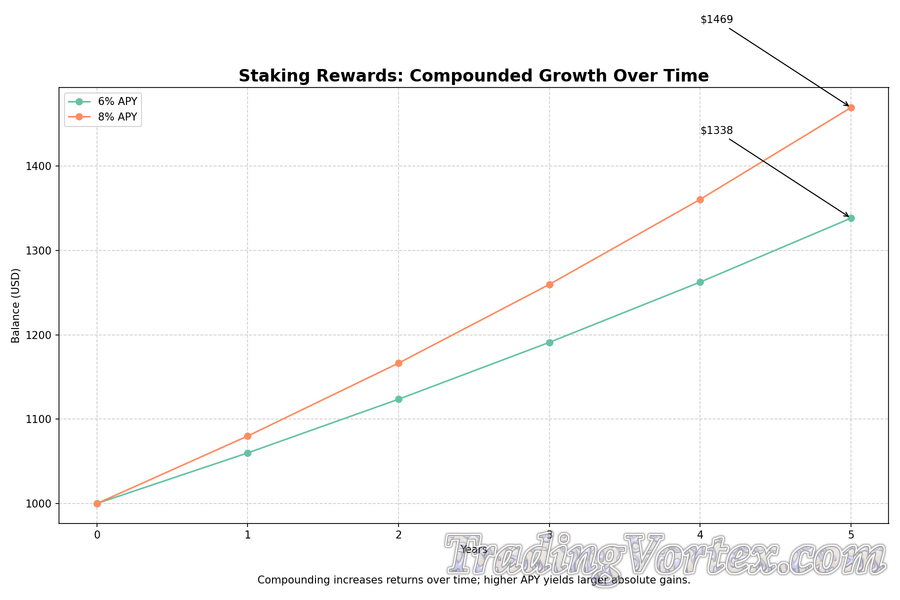 Staking Rewards Compounding: A line chart simulating $1,000 compounded annually at 6% vs 8% APY over 5 years, annotated with final balances and percent growth.
♦ Demonstrates the tangible benefit of higher APY and compounding: small APY differences compound into meaningful dollar gains.
Yield Farming in DeFi
What is yield farming and how it generates passive income
At its core, yield farming is the practice of providing liquidity to decentralized finance protocols in exchange for rewards, often in the form of interest, trading fees, or bonus tokens. You deposit your crypto into a liquidity pool: usually a pair of tokens like ETH/USDC or SOL/USDT, and the protocol uses your funds to facilitate trades or loans. In return, you earn a share of the fees and sometimes additional incentives.
Think of it like renting out your crypto to a decentralized exchange. You’re not selling your assets, just putting them to work. And unlike staking, where you typically earn a fixed APY, yield farming returns can fluctuate wildly depending on market activity, token prices, and the protocol’s reward structure.
In 2025, platforms like Curve, Balancer, and Uniswap V3 remain popular for stablecoin and blue-chip token pairs, while newer protocols like Velodrome (on Optimism) and Radiant Capital (on Arbitrum) are attracting attention with high incentives and cross-chain support.
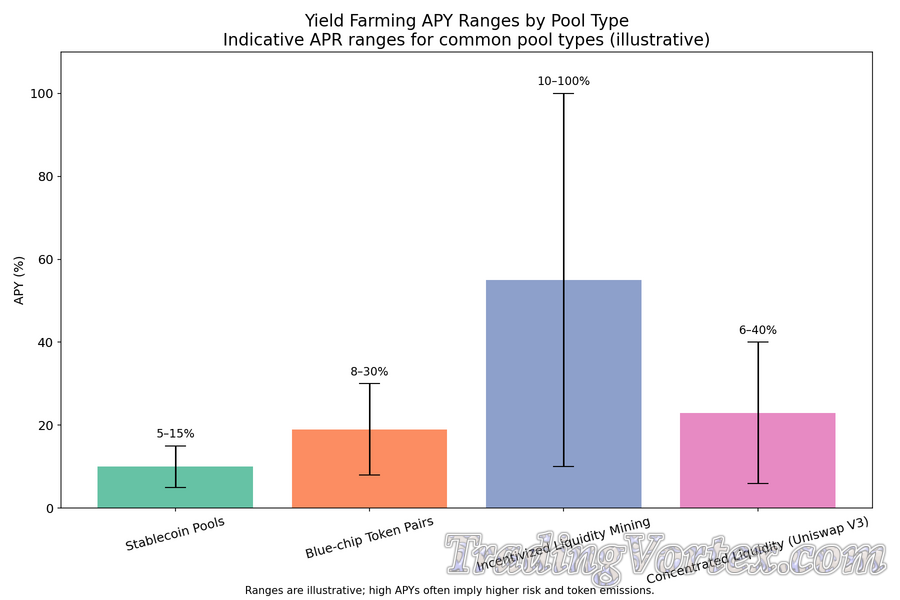 Yield Farming APY Ranges by Pool Type: Vertical bars with min–max APR ranges for Stablecoin Pools, Blue‑chip Token Pairs, Incentivized Liquidity Mining, and Concentrated Liquidity (Uniswap V3).
♦ Readers can quickly compare expected reward ranges and see that higher APYs often imply higher risk and token emissions.
♦ Each bar is annotated with its range (e.g., 5–15%). Use this to set realistic expectations before exploring specific farms.
Impermanent loss explained for DeFi investors
Let’s talk about the elephant in the yield farm: impermanent loss. It’s a confusing name for a very real risk. When you provide two tokens to a liquidity pool, their values can shift relative to each other. If one token pumps or dumps while the other stays stable, the pool automatically rebalances your holdings. This can leave you with more of the underperforming token and less of the one that gained value.
The “loss” is called impermanent because it only becomes permanent if you withdraw your funds while the price difference still exists. If the tokens return to their original ratio, the loss disappears. But let’s be honest: crypto markets are rarely that cooperative.
To manage this, many farmers stick to stablecoin pairs (like USDC/DAI) or use concentrated liquidity features on platforms like Uniswap V3 to reduce exposure. Others hedge with options or use impermanent loss protection tools offered by protocols like Bancor or Thorchain.
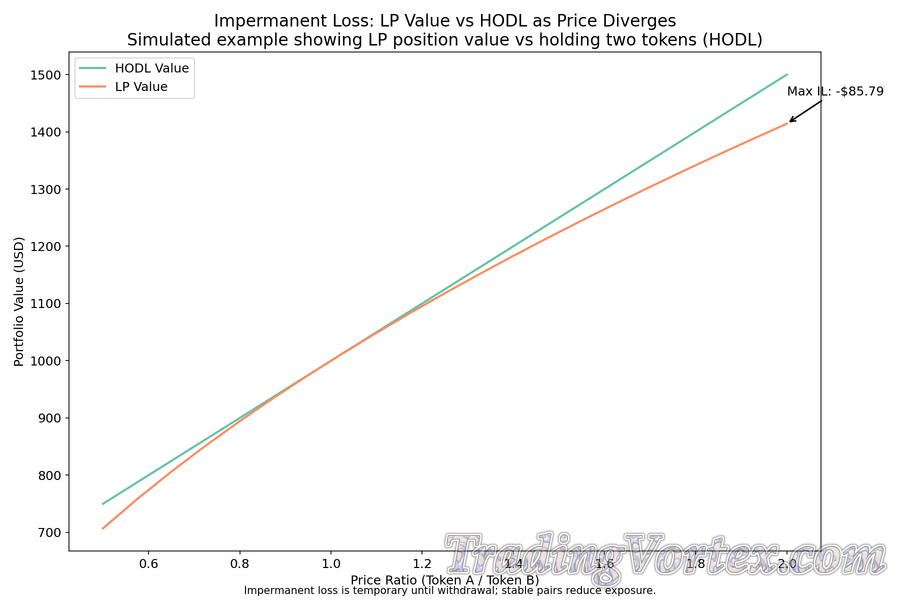 Impermanent Loss: LP Value vs HODL as Price Diverges: A simulated line chart comparing the USD value of an LP position vs simply HODL‑ing both tokens as one token’s price moves from 0.5× to 2×.
♦ Makes the concept of impermanent loss tangible: you can see where LP value falls below HODL value and where the maximum loss occurs.
♦ Use the chart to justify choosing stablecoin pairs or IL protection tools when you want lower exposure.
Best yield farming strategies for beginners and advanced users
For beginners, the best approach is to start with stablecoin pools. These are less volatile and offer predictable yields, often between 5% and 15% APR. Platforms like Curve Finance, Beefy Finance, and Yearn offer vaults that auto-compound your rewards, making it easier to earn without micromanaging.
Intermediate users might explore blue-chip token pairs like ETH/USDC or MATIC/USDT on Uniswap or SushiSwap. These pools offer higher yields but come with more price risk. Using liquidity mining programs: where protocols reward you with governance tokens; can boost returns, but be cautious of inflation and token dumping.
Advanced users often dive into leveraged yield farming, cross-chain strategies, or delta-neutral farming. These involve borrowing assets to farm with more capital or using derivatives to hedge price exposure. Platforms like Alpaca Finance, Gearbox, and Beethoven X cater to this crowd.
 Yield Farming Strategy Suitability by Experience Level: A radar chart overlaying Beginner (stablecoin pools), Intermediate (blue‑chip pairs), and Advanced (leveraged/cross‑chain) profiles across Stability, Yield, Complexity, Monitoring Effort, and Capital Requirement.
♦ Helps readers match strategy to skill and capital: beginners should favor high stability/low complexity options.
♦ Larger area toward “Yield” indicates higher upside but also more monitoring and complexity.
Final tip: Yield farming can be incredibly rewarding, but it’s not a set-and-forget strategy. Monitor your positions, understand the tokenomics of the rewards you’re earning, and don’t chase high APYs without understanding the risks. Start small, learn the ropes, and always read the fine print, especially when it comes to lockups, fees, and token emissions.
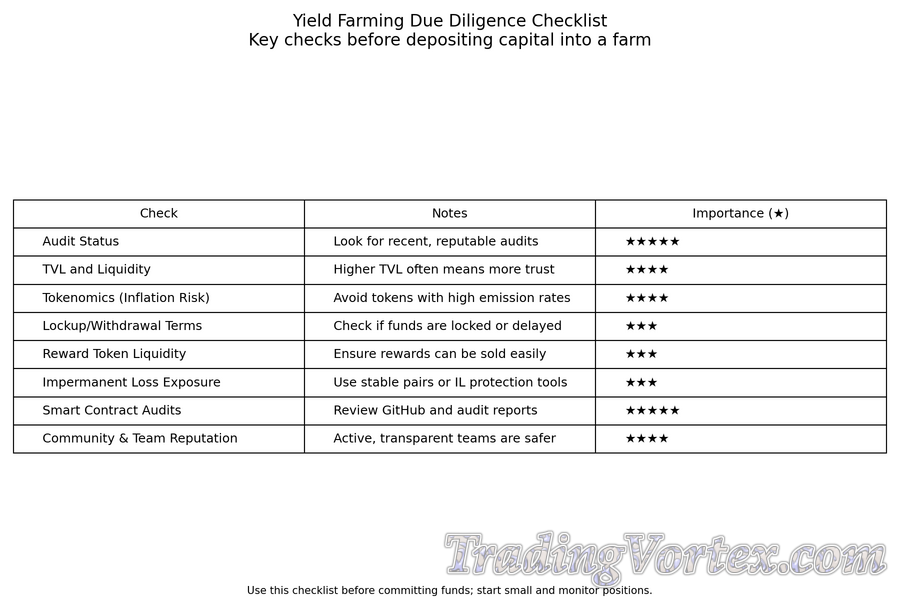 Yield Farming Due Diligence Checklist: A compact checklist table with items like Audit Status, TVL & Liquidity, Tokenomics, Lockup Terms, Reward Token Liquidity, Impermanent Loss Exposure, and Team Reputation, each with a short note and importance indicator.
♦ Provides a practical pre-deposit checklist to reduce avoidable mistakes.
♦ Print or copy the checklist before opening a position; tick items off as you verify them.
Crypto Lending and Borrowing in DeFi
If you’ve ever wished you could be the bank instead of dealing with one, DeFi lending is your chance. It’s one of the most straightforward ways to earn passive income in crypto: you lend out your tokens, and in return, you earn interest. No paperwork, no credit checks, and no middlemen, just smart contracts doing the heavy lifting.
How DeFi lending platforms generate passive income
DeFi lending platforms are essentially decentralized money markets. You deposit your crypto into a liquidity pool, and borrowers tap into that pool by putting up collateral. The protocol automatically matches lenders and borrowers, sets interest rates based on supply and demand, and handles repayments. You earn interest as long as your funds are in the pool.
The best part? Your assets never leave the protocol, and you can usually withdraw them at any time (unless you’re in a fixed-term vault). Interest is often paid in the same token you deposited, though some platforms offer bonus rewards in governance tokens.
Collateralization and interest rates in DeFi lending
Borrowing in DeFi is overcollateralized, meaning borrowers must deposit more value than they borrow. This protects lenders from defaults. For example, to borrow $1,000 in USDC, a user might need to lock up $1,500 in ETH. If the collateral value drops too much, the protocol automatically liquidates it to repay the loan.
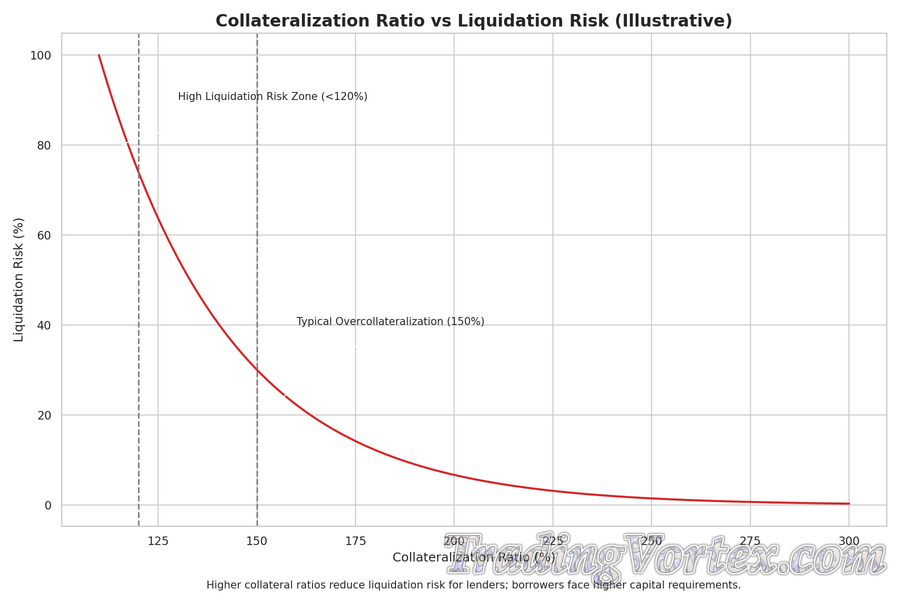 Collateralization vs Liquidation Risk: A smooth curve mapping collateralization ratio (110%–300%) to an illustrative liquidation risk score (0–100%), with markers at common thresholds (e.g., 120% liquidation zone, 150% typical collateral).
♦ Lower collateral ratios sharply increase liquidation risk; the chart highlights why lenders prefer overcollateralization.
♦ Makes the mechanics of liquidation and borrower protection tangible for readers.
Interest rates vary depending on the asset and platform. Stablecoins like USDC, USDT, and DAI typically yield 3% to 8% APR, while riskier assets like AVAX or MATIC can offer higher returns. Rates are dynamic and adjust in real time based on market demand.
Some platforms also offer isolation modes or risk tranching, allowing you to choose between safer pools with lower yields or riskier ones with higher returns.
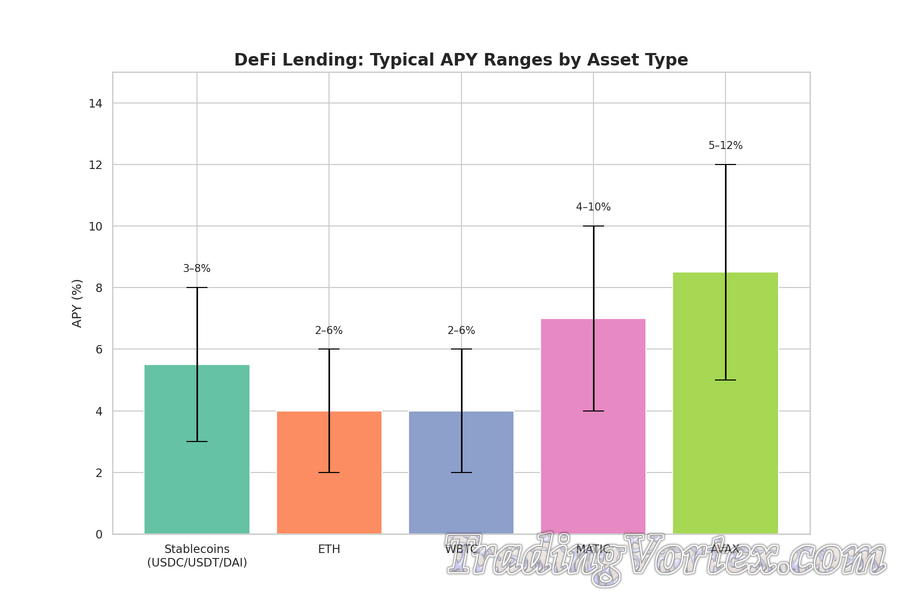 DeFi Lending APY Ranges: Indicative APR ranges for Stablecoins, ETH, WBTC, MATIC, AVAX so readers can compare steady stablecoin yields vs higher-risk token yields.
♦ Each bar shows a min–max range with the annotated range (e.g., 3–8%).
♦ Sets realistic expectations for passive income from lending and supports the fact that stablecoins typically yield in the low single digits while risk assets can offer higher APRs.
Best DeFi lending platforms for passive income
Here’s a quick look at some of the top-performing DeFi lending platforms in 2025:
| Platform | Key Features | Supported Assets | Typical APY |
|---|---|---|---|
| Aave | Multi-chain lending, stable/variable rates, isolation mode | ETH, USDC, DAI, MATIC, more | 3%–8% |
| Compound | Ethereum-native, simple UI, governance token rewards | ETH, USDC, DAI, WBTC | 2%–6% |
| Radiant Capital | Cross-chain lending on Arbitrum and BNB Chain | ETH, USDT, USDC, ARB, BNB | 5%–12% |
| Morpho | Peer-to-peer optimized lending on top of Aave/Compound | ETH, USDC, DAI | 4%–10% |
| Venus Protocol | Lending on BNB Chain with high APYs and flexible terms | BNB, BUSD, USDT, BTCB | 6%–14% |
| JustLend | Tron-based lending with high stablecoin yields | TRX, USDT, JST | 8%–15% |
Each of these platforms has its own strengths. Aave is known for its security and flexibility, Radiant is gaining traction for its cross-chain capabilities, and Morpho is innovating with peer-to-peer matching that improves rates for both lenders and borrowers.
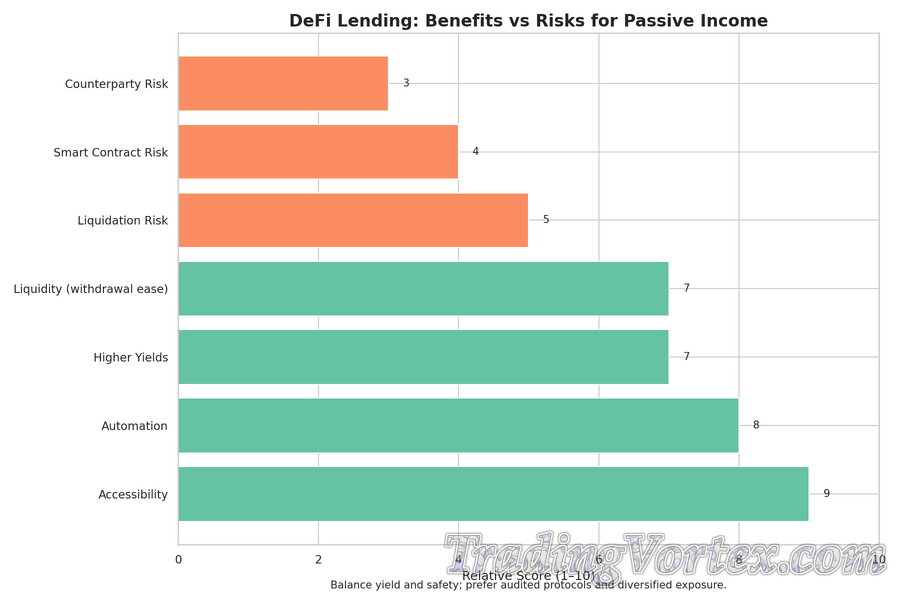 DeFi Lending: Benefits vs Risks for Passive Income: Relative scores (1–10) for Accessibility, Automation, Liquidity, Higher Yields, Liquidation Risk, Smart Contract Risk, Counterparty Risk with color coding for benefits vs risks.
♦ Use the chart to weigh yield potential against operational and protocol risks before allocating capital.
Final thoughts: DeFi lending is a great way to earn passive income with relatively low effort. It’s less volatile than yield farming and doesn’t require you to manage token pairs or worry about impermanent loss. That said, always check for audits, understand the risks of smart contract bugs, and avoid depositing into unaudited or obscure protocols just for the sake of chasing high APYs.
Liquidity Mining in DeFi
What is liquidity mining and how it works
Think of it like this: you’re helping the protocol run smoothly by providing the fuel (liquidity), and they thank you with rewards. Unlike traditional mining, which requires expensive hardware and electricity, liquidity mining only requires capital and a bit of know-how.
In 2025, liquidity mining has matured. Platforms like Uniswap V3, Balancer, Velodrome, and PancakeSwap offer structured programs with tiered incentives, dynamic fee models, and auto-compounding vaults. Some even let you customize your liquidity range, so you can concentrate your capital where it earns the most.
Governance token rewards and passive income potential
One of the biggest draws of liquidity mining is the governance token rewards. These are native tokens like UNI, BAL, or VELO, distributed to liquidity providers as an incentive to stick around. These tokens often come with voting rights, but let’s be honest: most people are in it for the potential upside.
In a bull market, these rewards can be incredibly lucrative. For example, a pool offering 10% APR in trading fees might boost that to 30% or more when governance token incentives are included. Some protocols even offer boosted rewards if you lock up your tokens or stake their governance token, creating a flywheel effect for long-term participants.
That said, it’s important to understand the tokenomics behind these rewards. If the protocol is printing tokens faster than it’s creating value, your rewards might lose value quickly. Always check the emission schedule and circulating supply before diving in.
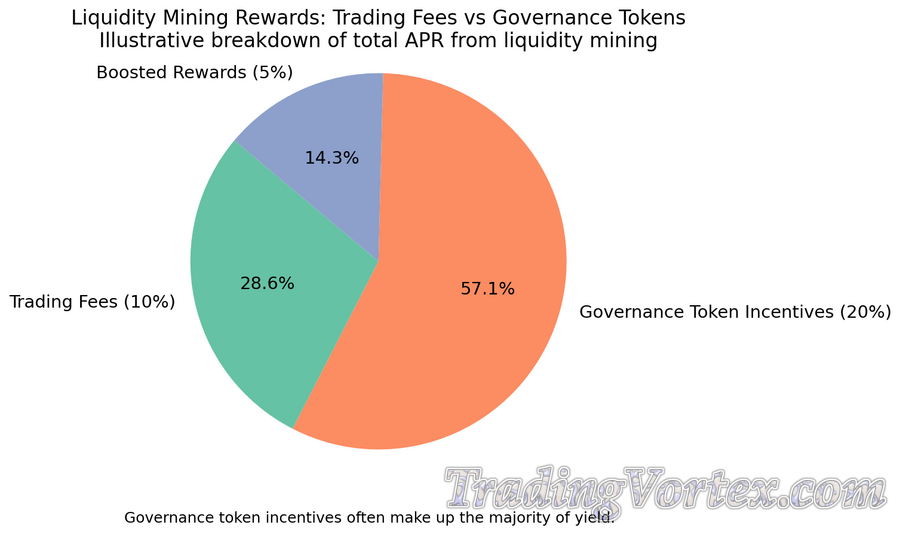 Liquidity Mining Rewards: Trading Fees vs Governance Tokens: A pie chart breaking down a typical 35% APR into:
♦ Trading Fees (10%)
♦ Governance Token Incentives (20%)
♦ Boosted Rewards (5%)
This visual reinforces that most of the yield often comes from token incentives, not just trading activity.
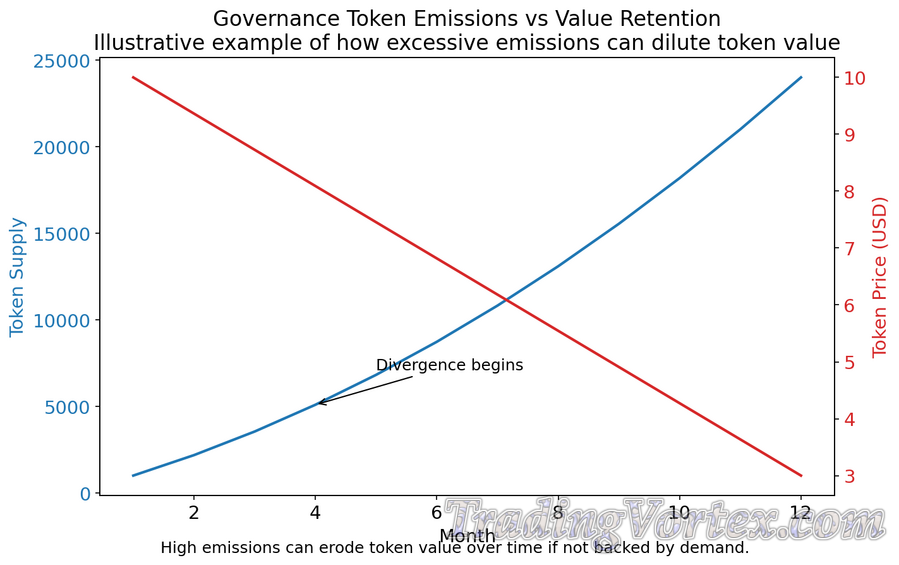 Governance Token Emissions vs Value Retention: A dual-axis line chart showing:
♦ Token Supply rising rapidly
♦ Token Price declining over 12 months
◊ This illustrates how excessive emissions can dilute token value, even if APR looks attractive.
Risks of liquidity mining in DeFi
Liquidity mining isn’t all sunshine and yield. There are a few key risks to keep in mind:
- Impermanent loss: If the two tokens in your pool change in value relative to each other, you could end up with fewer assets than if you had just held them. This is especially painful in volatile markets.
- Smart contract risk: Bugs or exploits in the protocol’s code can lead to loss of funds. Stick to audited platforms with strong reputations.
- Token dilution: If the protocol is handing out rewards too aggressively, the value of those tokens can plummet, reducing your real returns.
- Rug pulls and exit scams: While less common on major platforms, newer or unaudited projects can disappear overnight, taking your funds with them.
To manage these risks, start with blue-chip protocols, use stablecoin pools to reduce volatility, and avoid chasing unsustainable APYs. If something looks too good to be true, it probably is.
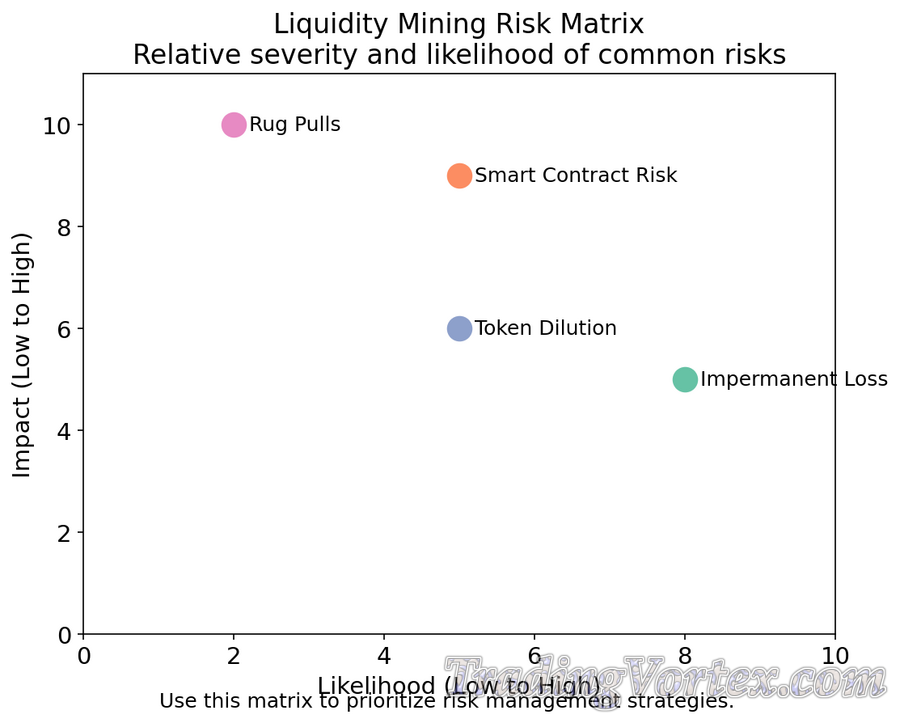 Liquidity Mining Risk Matrix: A 2D scatterplot mapping four major risks by likelihood vs impact:
♦ Impermanent Loss: High likelihood, medium impact
♦ Smart Contract Risk: Medium likelihood, high impact
♦ Token Dilution: Medium likelihood, medium impact
♦ Rug Pulls: Low likelihood, very high impact
◊ Use this to prioritize risk management: start with stablecoin pools and audited protocols.
Final thought: Liquidity mining can be a powerful tool for earning passive income, especially when paired with a solid understanding of the risks. It rewards those who do their homework, stay nimble, and don’t get greedy. If you’re just starting out, dip your toes in with a stablecoin pair on a reputable DEX, and build from there.
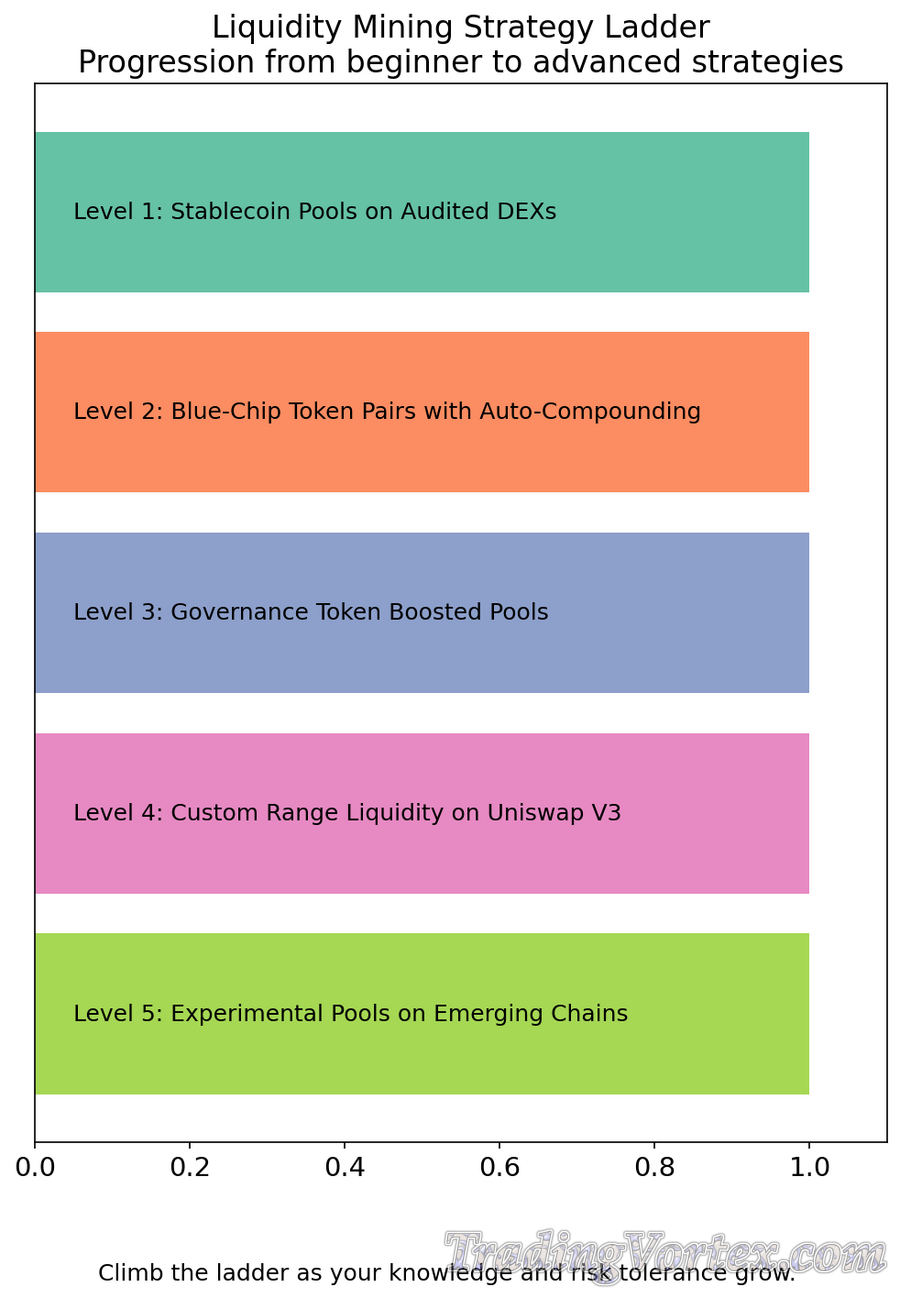 Liquidity Mining Strategy Ladder: A step-style infographic with five levels:
1. Stablecoin Pools on Audited DEXs
2. Blue-Chip Token Pairs with Auto-Compounding
3. Governance Token Boosted Pools
4. Custom Range Liquidity on Uniswap V3
5. Experimental Pools on Emerging Chains
◊ This helps readers progress from beginner to advanced strategies based on comfort and risk tolerance.
Using DeFi Yield Aggregators
Automated yield farming with DeFi aggregators
If you’ve ever felt overwhelmed by the constant juggling of staking, farming, and chasing APYs, you’re not alone. That’s where DeFi yield aggregators come in. These platforms act like robo-advisors for your crypto: they automatically move your funds between the highest-yielding opportunities, reinvest your rewards, and adjust strategies based on market conditions.
Instead of manually hopping between protocols, you deposit your assets into a vault or strategy, and the aggregator does the rest. It’s a set-it-and-check-it approach that saves time, reduces gas fees, and often outperforms DIY farming.
Most aggregators use smart contracts to bundle user funds, then deploy them into liquidity pools, lending markets, or staking platforms. They harvest rewards regularly and reinvest them, compounding your returns over time. Some even offer risk-adjusted strategies, letting you choose between conservative, balanced, or aggressive yield profiles.
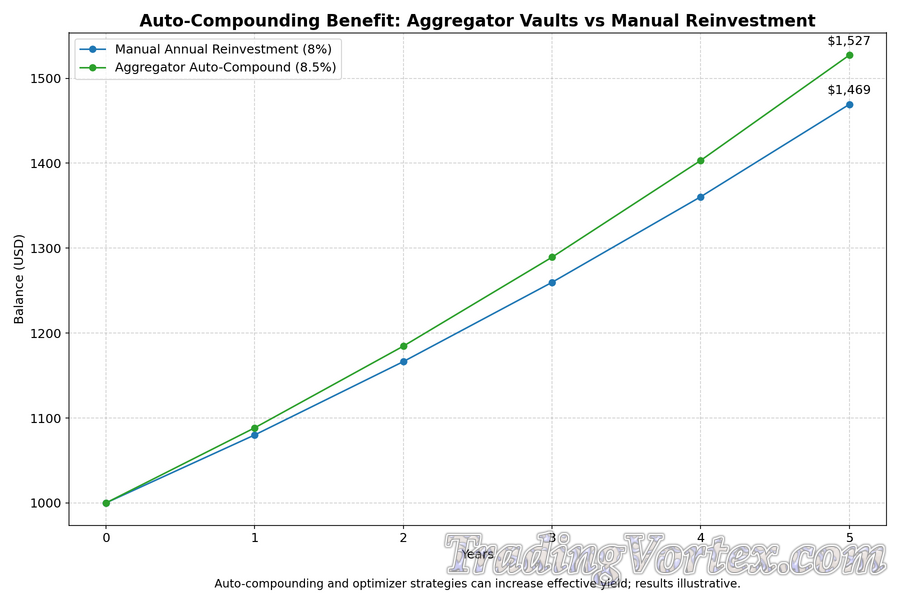 Auto‑Compounding Benefit: aggregator Vaults vs Manual Reinvestment: Simulated growth of $1,000 over 5 years comparing manual annual reinvestment vs aggregator auto‑compounding with optimizer boost.
♦ Quantifies the real dollar impact of auto‑compounding and small optimizer gains.
♦ Use this to justify choosing auto‑compound vaults for long‑term passive income.
◊ Key takeaway: Small APR differences compound into meaningful gains over time.
Pros and cons of passive income through vaults
Like any tool, yield aggregators come with trade-offs. Here’s a quick breakdown:
| Pros | Cons |
|---|---|
| Hands-free yield optimization | Smart contract risk (always check audits) |
| Auto-compounding boosts returns | Fees can eat into profits if yields are low |
| Diversified strategies reduce exposure | Less control over where funds are deployed |
| Great for beginners and busy investors | Some platforms lack transparency or flexibility |
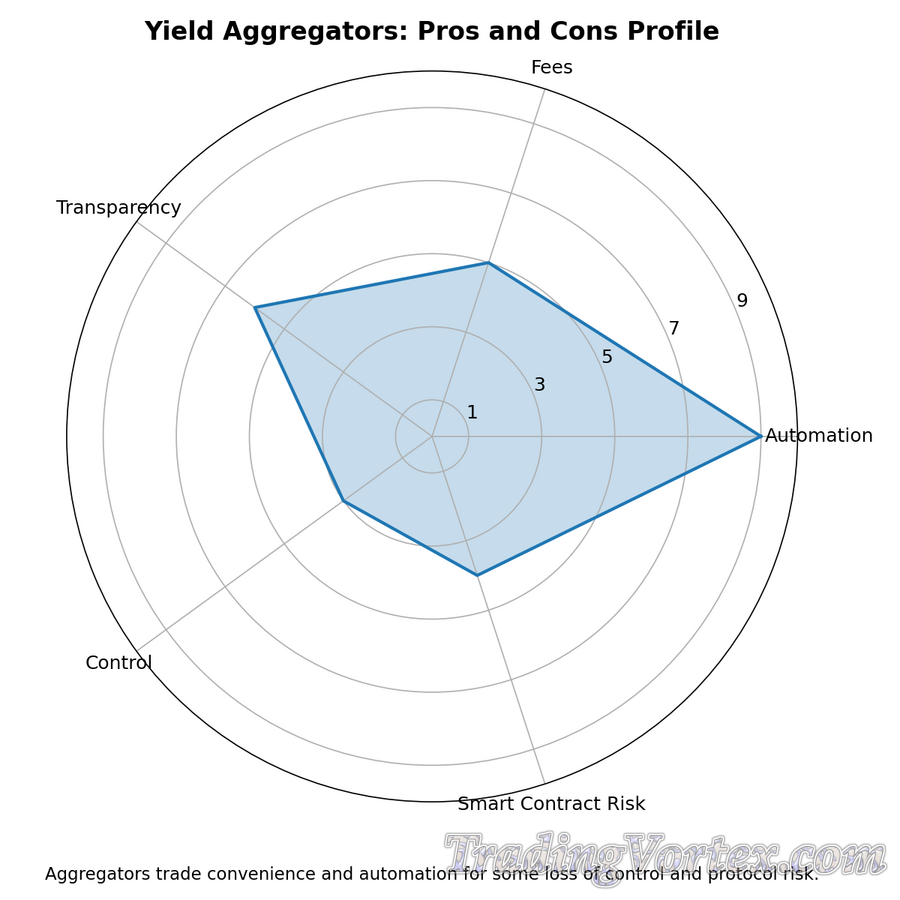 Yield Aggregator: Pros vs Cons Profile: A radar chart mapping Automation, Fees, Transparency, Control, Smart‑contract risk to highlight trade-offs.
♦ Makes the trade-offs tangible: aggregators score high on automation but lower on direct control.
♦ This visual guides readers choosing between “set‑and‑check” vaults and DIY strategies.
◊ Key takeaway: Automation reduces effort but requires trust in smart contracts and strategy authors.
Best DeFi yield aggregator platforms
Here are some of the top yield aggregators making waves in 2025:
| Platform | Key Features | Best For | Typical APY |
|---|---|---|---|
| Yearn Finance | OG aggregator, deep Ethereum integration, community-built strategies | ETH-based users | 4%–15% |
| Beefy Finance | Multi-chain, beginner-friendly UI, wide vault selection | Cross-chain users | 5%–20% |
| Convex Finance | Boosts Curve yields, great for CRV holders | Stablecoin farmers | 8%–25% |
| Harvest Finance | Auto-harvesting, strategy transparency, active governance | Long-term DeFi users | 6%–18% |
| Idle Finance | Risk-adjusted strategies, institutional-grade vaults | Conservative investors | 3%–10% |
| Vesper Finance | Clean UX, diversified vaults, focus on sustainability | Passive earners | 4%–12% |
Each platform has its own flavor. Yearn is great if you’re deep in the Ethereum ecosystem. Beefy is ideal for hopping between chains like Arbitrum, BNB Chain, and Polygon. Convex is a must if you’re already using Curve. And Idle or Vesper are perfect if you want a more conservative, plug-and-play experience.
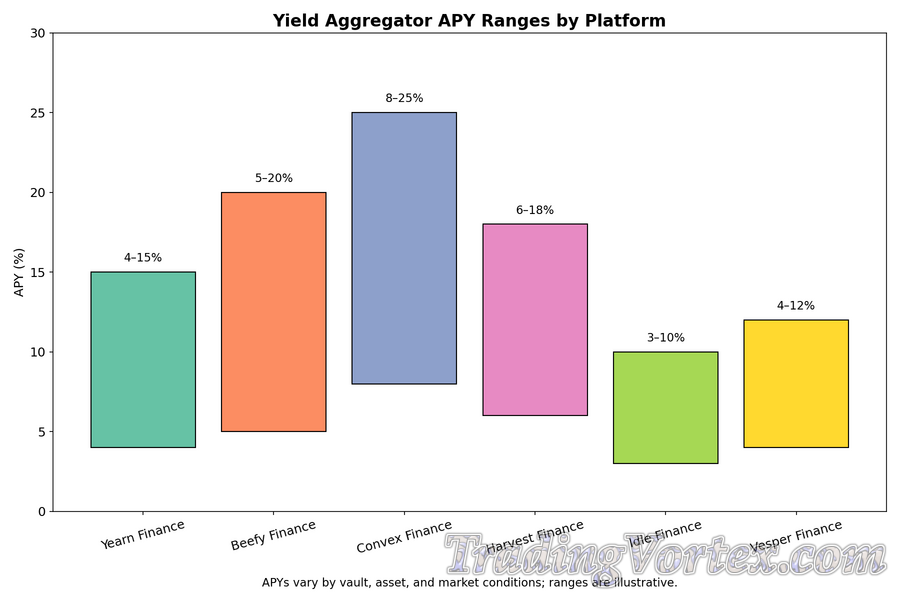 Yield Aggregator APY Ranges by Platform: A vertical bar chart comparing typical APY ranges across major aggregators (Yearn, Beefy, Convex, Harvest, Idle, Vesper).
♦ Readers can quickly compare expected returns and see that APYs vary widely by vault and asset.
♦ Using this chart readers can match platform features to realistic yield bands.
◊ Key takeaway: APYs are illustrative and market-dependent; higher APYs often mean higher strategy complexity.
Final tip: Yield aggregators are powerful, but not magic. They’re only as good as the strategies they deploy. Stick with platforms that are audited, transparent, and community-driven, and always monitor your vaults periodically. Passive income is great, but passive awareness? Not so much.
Passive Income with Real-World Asset (RWA) Tokenization
How tokenized assets generate passive income in DeFi
Here’s the kicker: RWAs offer yield that’s often more stable and predictable than native DeFi tokens, because they’re backed by real-world cash flows. For example, tokenized U.S. Treasury bills can yield 4% to 5% annually, and they’re far less volatile than farming with altcoins. That makes them especially attractive for conservative DeFi users or institutions looking for on-chain exposure to traditional yield.
RWAs are also programmable. Smart contracts can automate interest payouts, manage collateral, and enforce compliance, making the entire process more efficient than legacy systems.
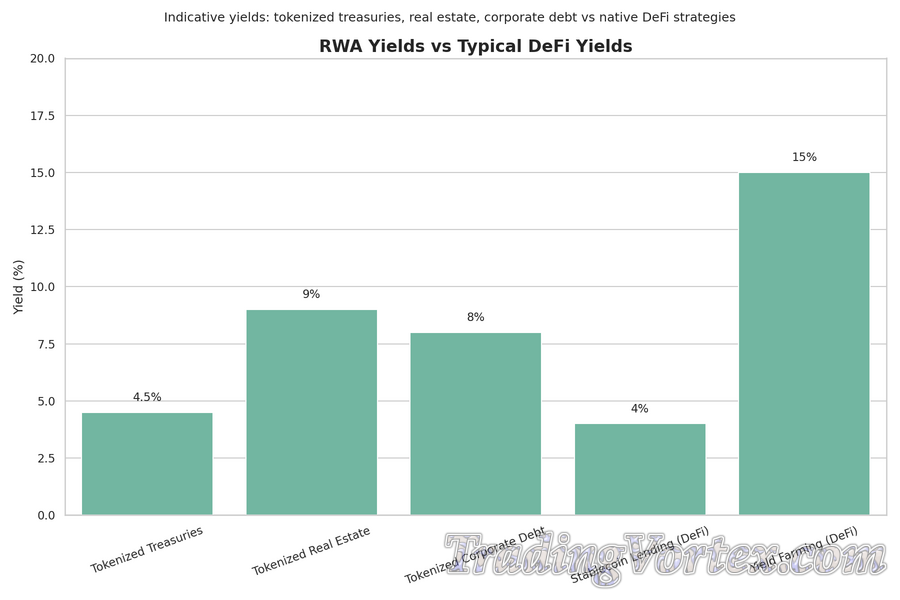 RWA Yields vs Typical DeFi Yields: Indicative yields for Tokenized Treasuries (≈4.5%), Real Estate (≈9%), Corporate Debt (≈8%), compared with Stablecoin Lending (≈4%) and Yield Farming (≈15%).
♦ Makes the core point explicit: RWAs often deliver more stable, predictable yields than high‑variance DeFi farming.
♦ Can be used to set realistic expectations and to justify allocating a portion of capital to RWAs for stability.
Examples: tokenized bonds, real estate, and treasury bills
Let’s break down a few of the most common RWA categories:
- Tokenized Treasury Bills: Platforms like Ondo Finance and Matrixdock offer tokenized short-term U.S. Treasuries. You deposit stablecoins, and in return, you receive a token that represents a claim on a yield-bearing government bond. These are often used as a safer alternative to stablecoin lending.
- Tokenized Real Estate: Projects like RealT and Tangibly tokenize rental properties. Investors can buy fractional ownership in homes and receive rental income directly to their wallets. It’s like being a landlord without fixing leaky faucets.
- Tokenized Corporate Bonds and Invoices: Platforms such as Centrifuge and Maple Finance allow businesses to tokenize invoices or debt instruments. Lenders earn yield by financing real-world operations, with returns often ranging from 6% to 12% depending on risk.
These assets are increasingly being integrated into DeFi protocols, allowing users to farm, stake, or borrow against them, just like they would with native crypto assets.
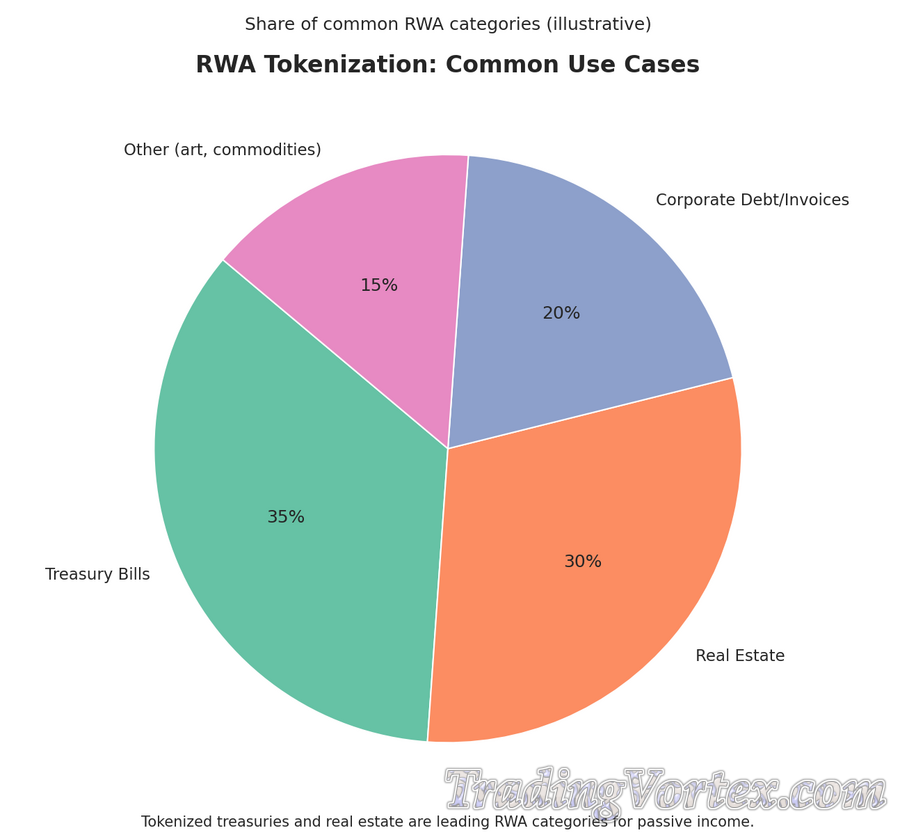 RWA Tokenization: Common Use Cases: Illustrative market share split: Treasury Bills 35%, Real Estate 30%, Corporate Debt/Invoices 20%, Other 15%.
♦ Visualizes where most RWA activity and passive‑income opportunities currently concentrate.
♦ Using this Pie chart readers can match platform types to use cases.
Top RWA DeFi platforms for passive income
Here are some of the leading platforms making RWA income accessible:
| Platform | Focus Area | Typical Yield | Key Features |
|---|---|---|---|
| Ondo Finance | Tokenized U.S. Treasuries, bonds | 4%–6% | Institutional-grade compliance, USDC onboarding |
| Matrixdock | Treasury-backed tokens (STBT) | 4.5%–5.2% | Real-time redemptions, audited reserves |
| Centrifuge | SME loans, invoice financing | 8%–12% | Real-world borrower vetting, DeFi-native pools |
| RealT | Tokenized real estate | 8%–10% | Weekly rental income, U.S. properties |
| Maple Finance | Institutional lending | 6%–10% | Underwritten loans, transparent borrower data |
These platforms are leading the charge in bringing real-world yield to DeFi, and they’re attracting both retail and institutional capital. Many are also working closely with regulators to ensure compliance, which could be key to long-term sustainability.
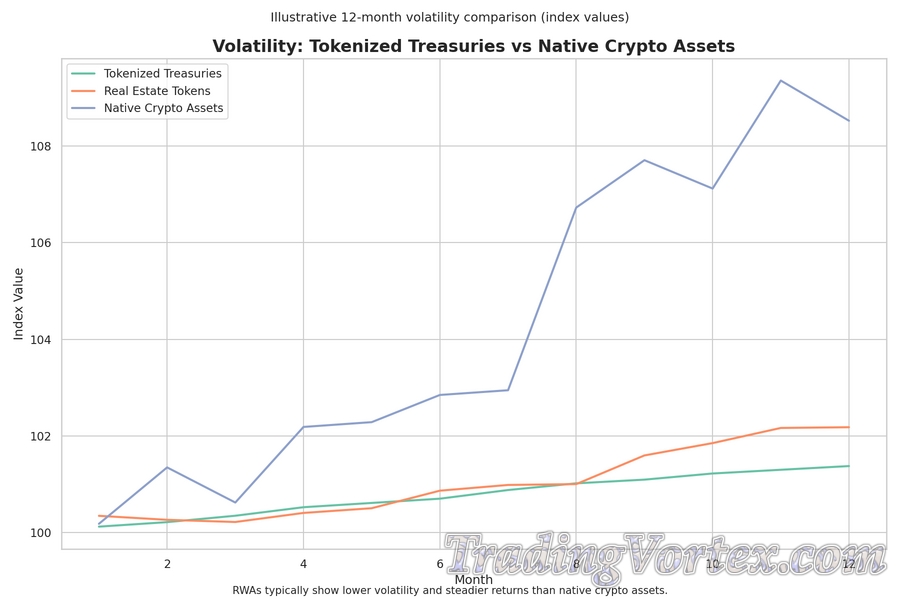 Volatility: Tokenized Treasuries vs Native Crypto Assets: Simulated 12‑month index lines showing low volatility for tokenized treasuries, moderate for real‑estate tokens, and high for native crypto.
♦ Reinforces the diversification argument: RWAs reduce portfolio volatility while preserving on‑chain composability.
♦ Encourage readers to blend RWAs with crypto strategies.
Final thought: RWA tokenization is more than a trend: it’s a structural shift. It gives DeFi users access to stable, real-world income streams while preserving the flexibility and composability of crypto. If you’re looking to diversify your passive income beyond volatile tokens, RWAs might be your next smart move.
Best DeFi Platforms for Passive Income
The DeFi space has matured a lot since the early days of food-themed farms and wild APYs. In 2025, we’re seeing a new generation of platforms that are more secure, more transparent, and more tailored to different investor profiles: from cautious stakers to adventurous yield chasers. Whether you’re looking to stake ETH, lend stablecoins, or farm governance tokens, there’s a platform that fits your style.
Let’s break down the top contenders:
Comparison of Top DeFi Platforms for Staking, Farming, and Lending
| Platform | Best For | Typical APY | Key Features | Supported Chains |
|---|---|---|---|---|
| Aave | Lending & borrowing | 4%–12% | Trusted, multi-chain, isolation mode, stable/variable rates | Ethereum, Polygon, Arbitrum |
| Lido | ETH staking | 4%–6% | Liquid staking, stETH token, deep DeFi integration | Ethereum, Solana, Polygon |
| Yearn Finance | Automated yield farming | 6%–20% | Vault strategies, auto-compounding, community-driven | Ethereum, Fantom |
| Beefy Finance | Cross-chain yield farming | 5%–20% | Multi-chain vaults, beginner-friendly UI | 25+ chains (BNB, Arbitrum, etc.) |
| Radiant Capital | Cross-chain lending | 5%–12% | LayerZero-powered, supports multiple assets | Arbitrum, BNB Chain |
| Ondo Finance | Tokenized Treasuries | 4%–6% | Real-world yield, institutional-grade compliance | Ethereum, Solana |
| Convex Finance | Boosted Curve yields | 8%–25% | CRV token optimization, stablecoin-focused | Ethereum |
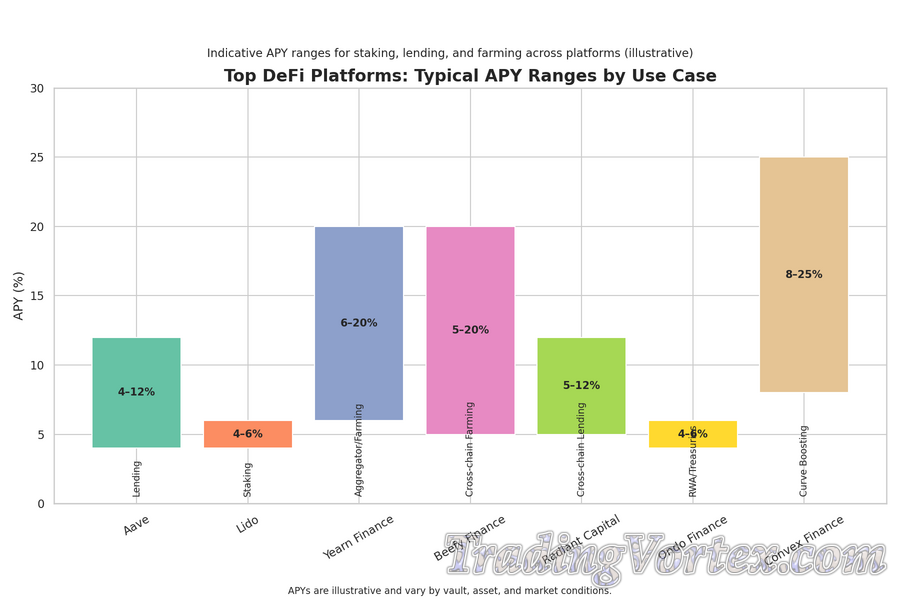 Top DeFi Platforms: Typical APY Ranges by Use Case: Indicative min–max APY ranges for each platform so readers can compare expected returns at a glance. Each bar is annotated with its range and the platform’s primary use case.
♦ APYs vary widely by strategy and asset; this visual makes that variation explicit and discourages chasing a single number without context.
♦ Use with the platform table to match the features to realistic yield bands.
Key Factors: APY, Fees, Security Audits, Supported Blockchains
When choosing a DeFi platform, don’t just chase the highest APY. Here’s what to look for:
- APY Stability: Is the yield sustainable or inflated by short-term token incentives?
- Fees: Some platforms charge performance or withdrawal fees. Read the fine print.
- Security: Look for audited smart contracts, bug bounty programs, and transparent governance.
- Chain Support: If you’re already active on a chain like Arbitrum or BNB, choose platforms that support it natively to save on bridging costs.
- Liquidity and TVL: Higher total value locked (TVL) often signals trust and deeper liquidity, which can reduce slippage and improve rewards.
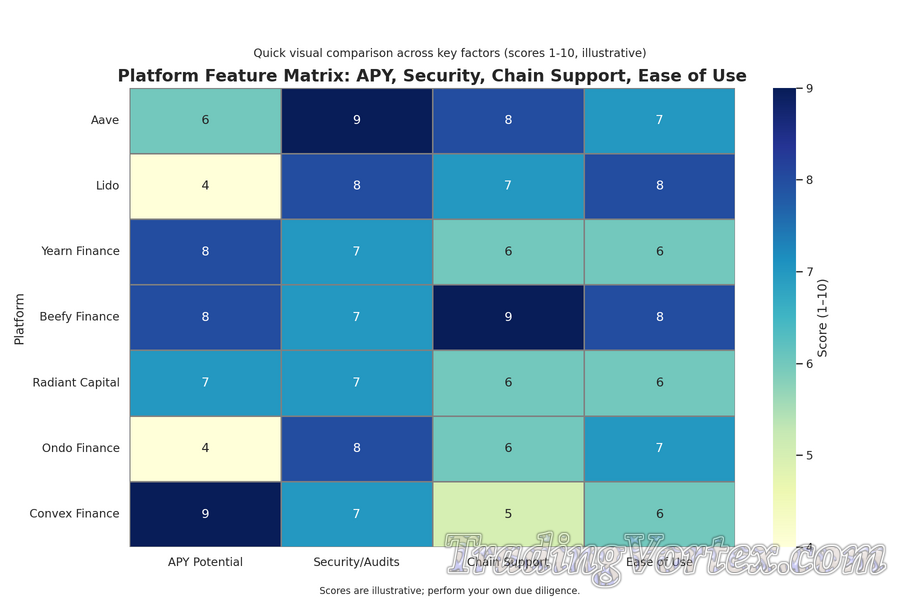 Platform Feature Matrix: APY, Security, Chain Support, Ease of Use: A compact heatmap scoring each platform on APY potential, security/audits, chain support, and ease of use (illustrative scores).
♦ Converts qualitative factors into a quick visual comparison so readers can prioritize security and chain fit as well as yield.
♦ Use the heatmap to shortlist platforms for deeper due diligence.
How to Choose the Right DeFi Platform for Passive Income
Start by asking yourself a few questions:
- Are you looking for low-risk, stable returns (e.g., staking or lending)?
- Do you want higher yields and are comfortable with more volatility (e.g., yield farming)?
- Do you prefer hands-off automation or manual control over your strategies?
- Are you staking blue-chip assets like ETH or exploring real-world assets like tokenized T-bills?
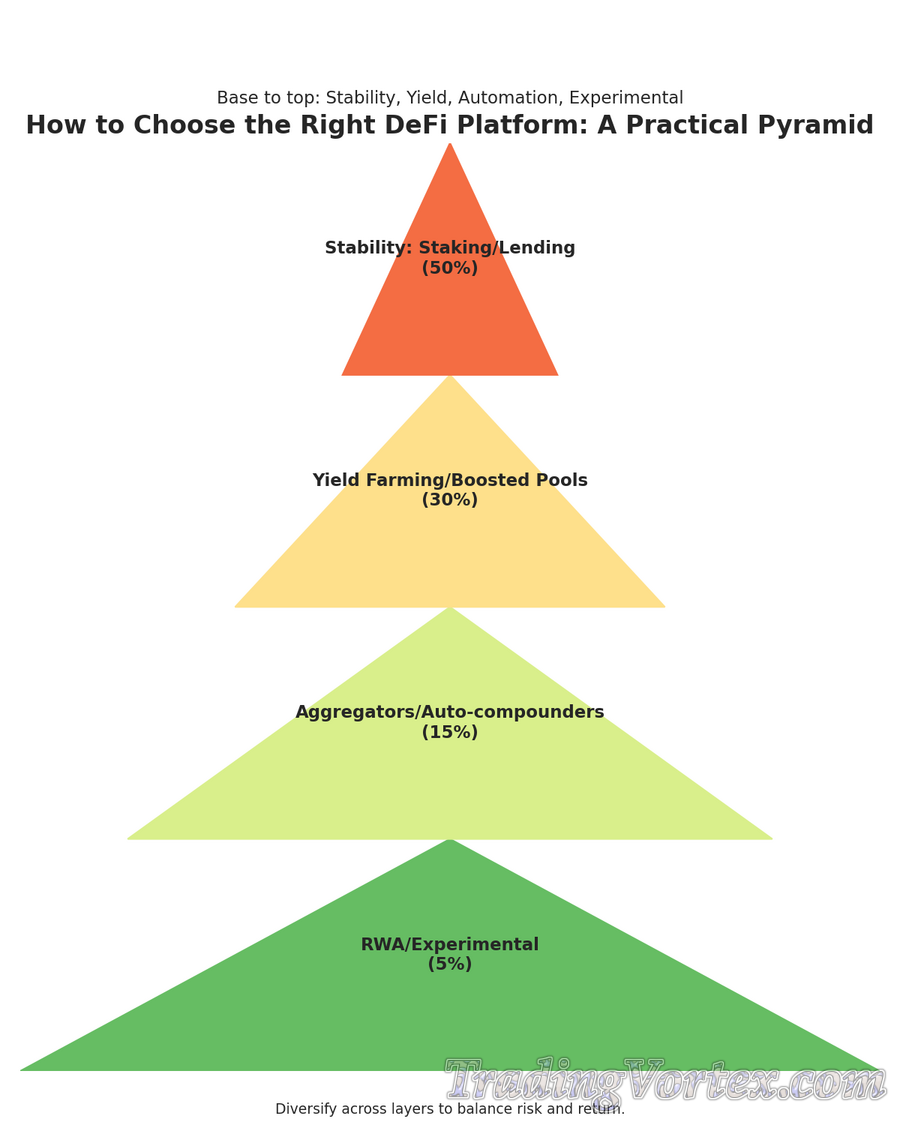 How to Choose the Right DeFi Platform: A Practical Pyramid: A four-layer pyramid from Base (Stability) to Top (Experimental) with suggested allocation percentages (50% base → 5% top).
♦ Visualizes a practical allocation framework: start with stability, add yield, then experiment. Helps readers to design a balanced approach.
♦ Use as a template for portfolio allocation and to justify diversifying across 2–3 platforms.
Pro tip: Diversify across 2–3 platforms to spread risk. Use one for stability (like staking or lending), one for yield farming, and one for RWAs or experimental strategies. And always, always bookmark the official URLs; phishing is still a thing.
Risks of Earning Passive Income with DeFi
DeFi can feel like a digital gold rush: high yields, 24/7 access, and no gatekeepers. But just like any frontier, it comes with its own set of hazards. If you’re going to stake, lend, or farm your way to passive income, you need to know what could go wrong, and how to avoid it. Let’s break down the biggest risks you should be aware of before diving in.
Smart Contract Risks in DeFi
Smart contracts are the backbone of DeFi, but they’re not bulletproof. Bugs, exploits, and vulnerabilities can lead to massive losses, even on well-known platforms. In 2025 alone, we’ve seen a rise in sophisticated attacks like reentrancy exploits, oracle manipulation, and flash loan attacks, which have drained millions from protocols.
Even audited contracts aren’t immune. Audits reduce risk, but they don’t eliminate it. Some bugs only surface under specific conditions or after new features are added. I’ve seen friends chase high APYs on unaudited forks, only to watch their funds vanish overnight. It’s a painful reminder that in DeFi, code is law, and if the code has holes, your money can slip right through.
How to protect yourself:
- Stick to platforms with multiple independent audits
- Look for bug bounty programs and transparent codebases
- Avoid unaudited or copy-paste forks, no matter how tempting the APY
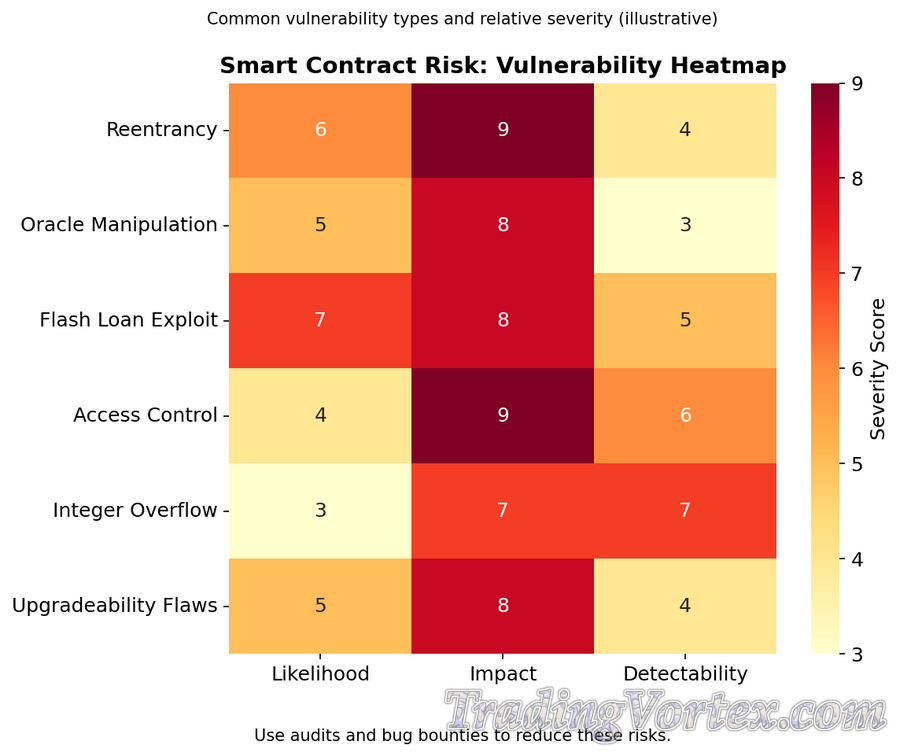 Smart Contract Risk: Vulnerability Heatmap: A heatmap comparing common vulnerability types (reentrancy, oracle manipulation, flash‑loan exploits, access control, integer overflow, upgradeability flaws) across Likelihood, Impact, and Detectability.
♦ The heatmap makes it easy to see which vulnerabilities are both likely and severe so you can prioritize protections (e.g., audits, bug bounties).
♦ Key action: prefer protocols with multiple independent audits and active bounties.
Market Volatility and Token Risks
Crypto is volatile. That’s part of the thrill, but it also means your passive income can fluctuate; or vanish. Token prices can swing wildly, and if your rewards are paid in a volatile governance token, your real returns might be much lower than advertised.
Another hidden danger is token inflation. Some protocols mint new tokens aggressively to attract users, but this can dilute the value of your rewards. It’s like getting paid in Monopoly money while the board keeps printing more.
How to manage this:
- Diversify across stablecoins and blue-chip assets
- Monitor tokenomics and emission schedules
- Take profits regularly instead of hoarding high-APY tokens
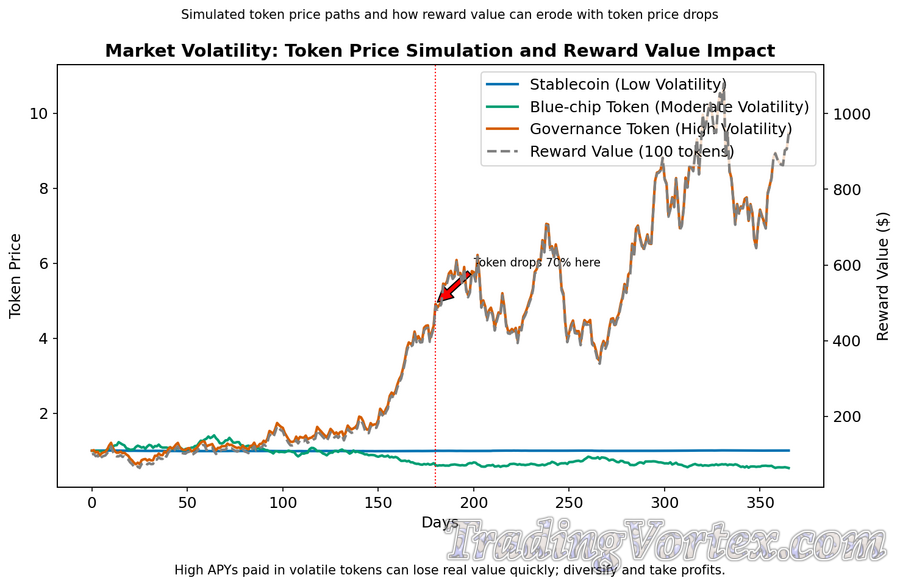 Market Volatility: Token Price Simulation and Reward Value Impact: Simulated price paths for a low‑volatility stablecoin, a blue‑chip token, and a high‑volatility governance token, plus a secondary line showing the USD value of a fixed reward allocation in the governance token.
♦ This visual quantifies how high APYs paid in volatile tokens can lose real value; it shows where nominal APY diverges from realized USD returns.
♦ Key action: diversify rewards, monitor emission schedules, and take profits periodically.
Regulatory Risks in DeFi
DeFi operates in a legal gray zone. While some jurisdictions are embracing it, others are cracking down. In 2025, we’ve seen increased scrutiny from regulators in the U.S., EU, and parts of Asia, especially around KYC/AML compliance, stablecoin backing, and unregistered securities.
This matters because:
- Protocols may geo-block users or shut down features
- Tokens could be delisted or lose value due to legal pressure
- Your funds might be frozen if platforms are targeted by regulators
How to stay safe:
- Use compliant platforms with clear legal frameworks
- Avoid protocols that openly flout regulations
- Keep an eye on policy developments in your region
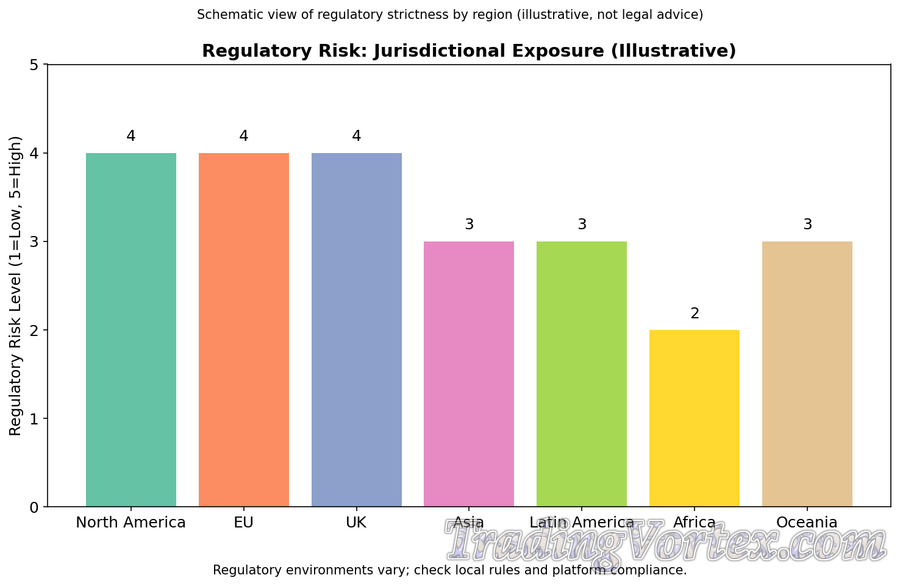 Regulatory Risk: Jurisdictional Exposure: A schematic regional view of regulatory strictness (illustrative), highlighting regions with higher enforcement risk and common regulatory actions (geo‑blocking, KYC enforcement, stablecoin scrutiny).
♦ Use this to assess jurisdictional exposure: if a platform is likely to restrict access in your region, plan an exit or diversify to compliant alternatives.
♦ Key action: prefer platforms with clear legal frameworks if you need uninterrupted access.
Scams and Rug Pulls in DeFi
Sadly, not all DeFi projects are built with good intentions. Rug pulls, where developers drain liquidity and disappear, are still happening in 2025, often disguised as “community-driven” projects or hyped-up meme farms.
Other scams include:
- Fake dApps that mimic real platforms
- Phishing links in Discord or Telegram
- Malicious smart contracts that drain your wallet after approval
I’ll never forget the story of a trader who clicked a fake Uniswap link shared in a Telegram group. Within seconds of approving the contract, his wallet was emptied. It’s a harsh reminder that in DeFi, vigilance is your best defense.
How to protect yourself:
- Always double-check URLs and contract addresses
- Use hardware wallets and revoke unused approvals
- Avoid projects with anonymous teams, unclear roadmaps, or unrealistic promises
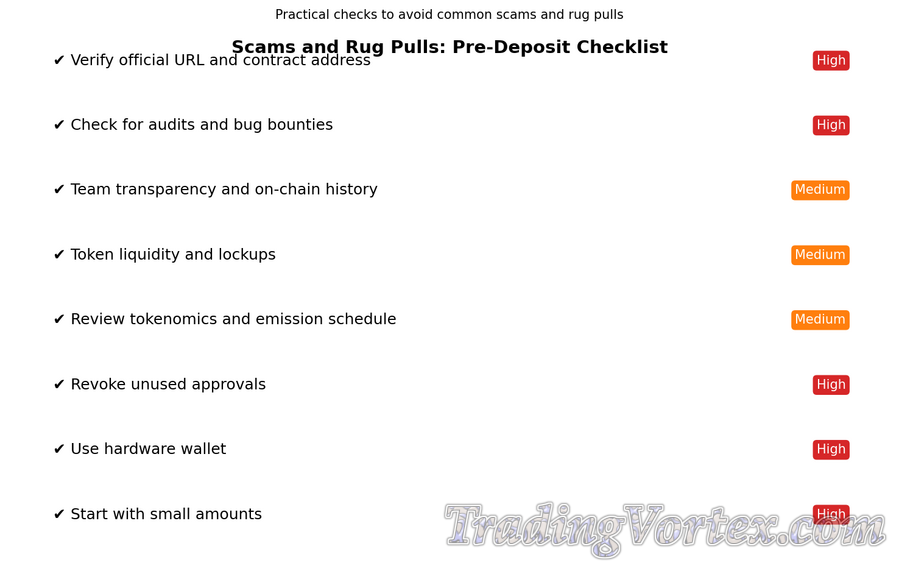 Scams and Rug Pulls: Pre‑Deposit Checklist: A compact, actionable checklist with high‑priority items: verify official URLs and contract addresses, confirm audits and bug bounties, check team transparency and token lockups, revoke unused approvals, use hardware wallets, and start small.
♦ Converts advice into a step‑by‑step pre‑deposit workflow you can follow every time.
♦ Key action: never approve contracts or deposit funds without ticking these boxes.
Bottom line: DeFi can be a powerful tool for building passive income, but it’s not a free lunch. Treat it like any investment: do your research, manage your risk, and never invest more than you can afford to lose. The yields are real, but so are the risks.
Taxation and Legal Considerations for DeFi Passive Income
Let’s be honest: taxes are the least exciting part of DeFi. But if you’re earning passive income from staking, lending, or yield farming, you’re likely triggering taxable events, and ignoring them can lead to some very real headaches. The good news? With a bit of planning and the right tools, you can stay compliant without losing your mind (or your gains).
How passive income from DeFi is taxed
In most countries, DeFi income is taxed either as capital gains or ordinary income, depending on the activity and local laws. Here’s a quick breakdown:
- Staking rewards: Often treated as income at the time of receipt, based on the fair market value of the tokens.
- Lending interest: Typically taxed as interest income, similar to bank interest.
- Yield farming and liquidity mining: Rewards are usually taxed as income when received, and any subsequent sale of those tokens may trigger capital gains or losses.
- Token swaps or withdrawals: Even swapping one token for another (e.g., ETH to USDC) can be a taxable event in many jurisdictions.
In 2025, several countries have updated their crypto tax policies:
- South Korea: Introduced a 20% capital gains tax on crypto profits over ₩2.5 million.
- Portugal: Ended its zero-tax treatment on casual crypto gains.
- UK: Expanded its Digital Securities Sandbox, requiring more detailed reporting.
- EU: Fully implemented MiCA, increasing compliance requirements for DeFi platforms.
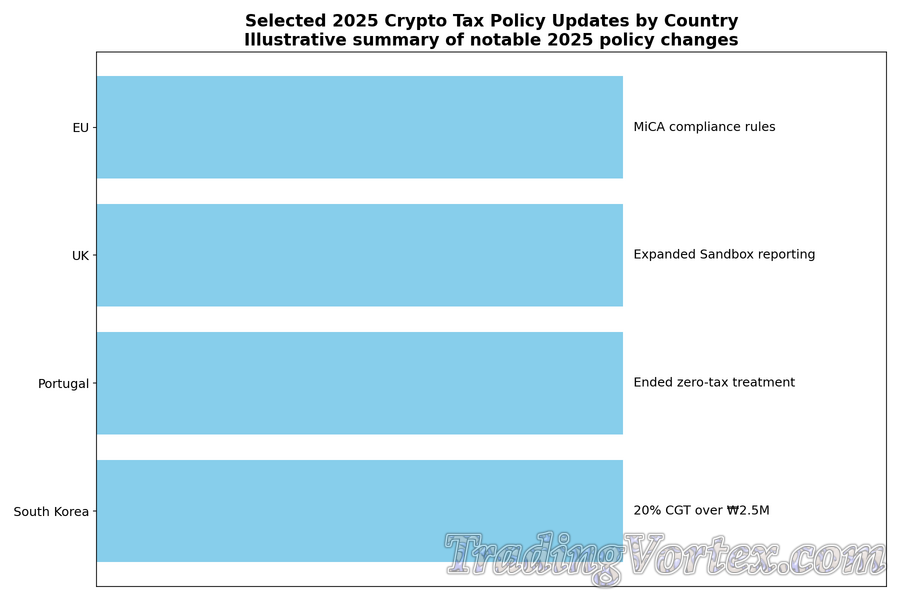 Selected 2025 Crypto Tax Policy Updates by Country: A concise horizontal summary of notable 2025 policy changes (e.g., South Korea: 20% CGT threshold; Portugal: end of zero‑tax treatment; UK: expanded reporting; EU: MiCA compliance).
♦ This helps readers prioritize jurisdictional checks.
♦ Regulatory context matters: platform access and reporting obligations can change quickly.
Bottom line: if you’re earning yield, you’re likely accruing tax obligations, even if you haven’t sold anything yet.
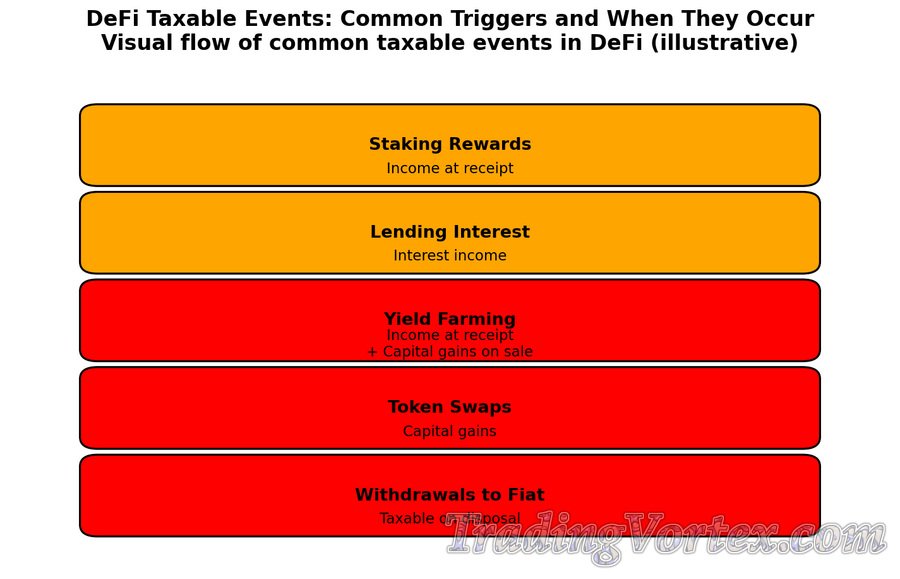 Taxable Events Flowchart: A flowchart mapping common DeFi actions to typical tax treatment (e.g., staking rewards → income at receipt; lending interest → interest income; yield farming rewards → income at receipt + capital gains on sale; token swaps → capital gains).
♦ Makes taxable triggers explicit so readers know when to record fair‑market values and timestamps.
♦ Use it as a quick reference when logging transactions.
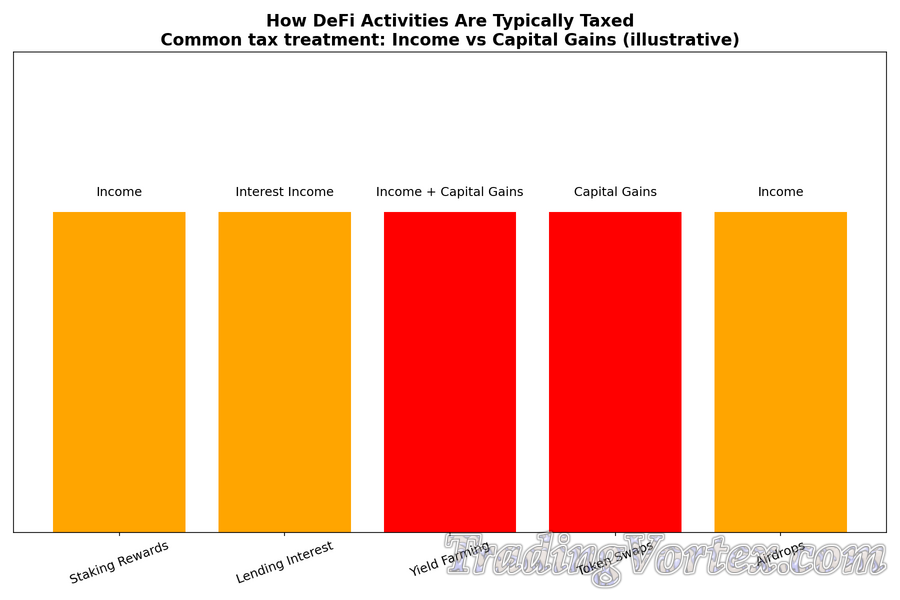 Common DeFi Tax Treatment: Income vs Capital gains: Categorical chart mapping activities to tax types (Income vs. Interest vs. Capital Gains) with short guidance lines (e.g., “Record FMV at receipt; track basis for later disposals”).
♦ Clarifies common confusions: for example, that receiving rewards can be taxable even before any sale.
Tools for tracking and reporting DeFi earnings
Manually tracking every transaction across chains and protocols? That’s a full-time job. Thankfully, there are tools that do the heavy lifting:
| Tool | Key Features | Best For |
|---|---|---|
| Koinly | Multi-chain support, DeFi integrations, tax reports | Global users, DeFi farmers |
| CoinTracker | Real-time portfolio tracking, tax optimization | U.S., Canada, UK, Australia |
| Accointing | NFT and DeFi support, tax-loss harvesting tools | Advanced DeFi users |
| ZenLedger | IRS-compliant reports, staking/yield tracking | U.S. taxpayers |
| Coinpanda | Supports 65+ countries, DeFi and NFT integrations | International investors |
These platforms connect to your wallets, track your transactions, and generate tax reports tailored to your country’s requirements. Some even offer tax-loss harvesting suggestions, which can help offset gains with losses.
Legal compliance tips for crypto investors
Here’s how to stay on the right side of the law while earning passive income in DeFi:
- Know your jurisdiction: Tax rules vary widely. Some countries tax crypto as property, others as currency. Check with a local crypto-savvy tax advisor.
- Keep detailed records: Save wallet addresses, transaction hashes, and timestamps. Many tax authorities require this level of detail.
- Report everything: Even if you think a reward is “just airdropped,” it may still be taxable.
- Watch for KYC/AML shifts: As regulations tighten, some DeFi platforms may require identity verification. Be prepared to adapt.
- Stay updated: Crypto tax laws are changing fast. Bookmark your country’s tax authority page or follow reliable crypto tax blogs.
Final thought: Taxes may not be fun, but they’re part of the game. Treat your DeFi income like any other investment: track it, report it, and plan ahead. A little effort now can save you a lot of stress later.
Step-by-Step Guide to Start Earning Passive Income with DeFi
Getting started with DeFi doesn’t require a finance degree or a six-figure portfolio. All you need is a bit of curiosity, a secure wallet, and a willingness to learn by doing. Whether you’re staking ETH, lending stablecoins, or exploring tokenized T-bills, this guide will walk you through the essentials: no jargon, no fluff.
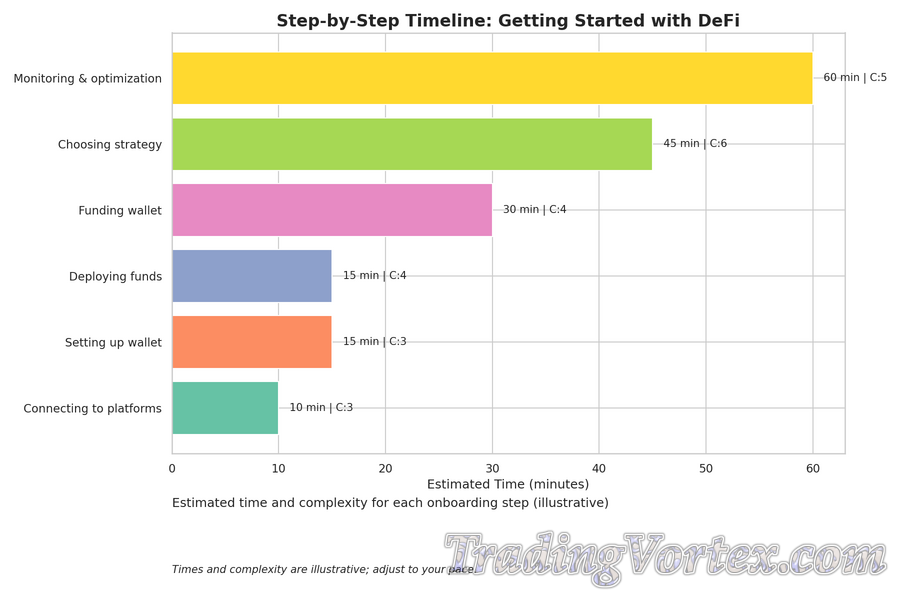 Step-by-Step Timeline: Getting Started with DeFi: Horizontal bars with estimated time (minutes) and a complexity score for each onboarding step (wallet setup, funding, connecting, choosing strategy, deploying funds, monitoring).
♦ Gives readers a realistic time and effort roadmap so they can plan a single session to get started.
♦ Each bar is annotated with minutes and a complexity rating (1–10); longer bars + higher complexity = plan for more time.
Step 1: Setting up a crypto wallet for DeFi
Your wallet is your passport to the DeFi universe. It stores your assets, signs transactions, and connects you to protocols.
- Choose a wallet: For most users, MetaMask, Rabby, or Trust Wallet are great starting points. If you want extra security, consider a hardware wallet like Ledger or Trezor.
- Install and back it up: Download the wallet from the official site, create a new account, and write down your seed phrase on paper (never store it digitally).
- Enable browser extension or mobile app: This lets you connect to DeFi platforms directly from your device.
🛡️ Pro tip: Use a fresh wallet for DeFi interactions and keep your long-term holdings in a separate, cold wallet.
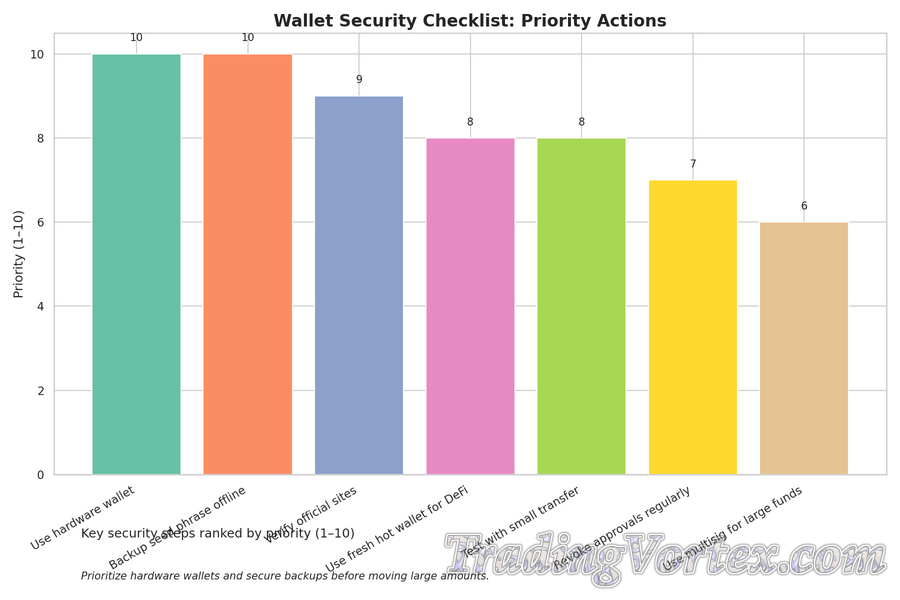 Wallet Security Checklist: Priority Actions: Ranked security actions (hardware wallet, offline seed backup, verify official sites, fresh hot wallet, test transfer, revoke approvals, multisig) with priority scores (1–10).
♦ Converts best practices into a prioritized to‑do list so investors secure funds before moving large amounts.
♦ How to act: Start at the top of the list (hardware wallet, offline backup) and work downward.
Step 2: Funding your wallet with stablecoins or ETH
Once your wallet is ready, it’s time to fund it.
- Buy crypto: Use a centralized exchange like Coinbase, Binance, or Kraken to buy ETH, USDC, or other tokens.
- Transfer to your wallet: Withdraw your assets to your DeFi wallet. Double-check the address and network (e.g., Ethereum, Arbitrum, Polygon).
- Consider gas fees: Ethereum gas can be pricey. For lower fees, explore Layer 2s like Arbitrum, Optimism, or Base.
💡 Tip: Start with a small test transaction to ensure everything works before moving larger amounts.
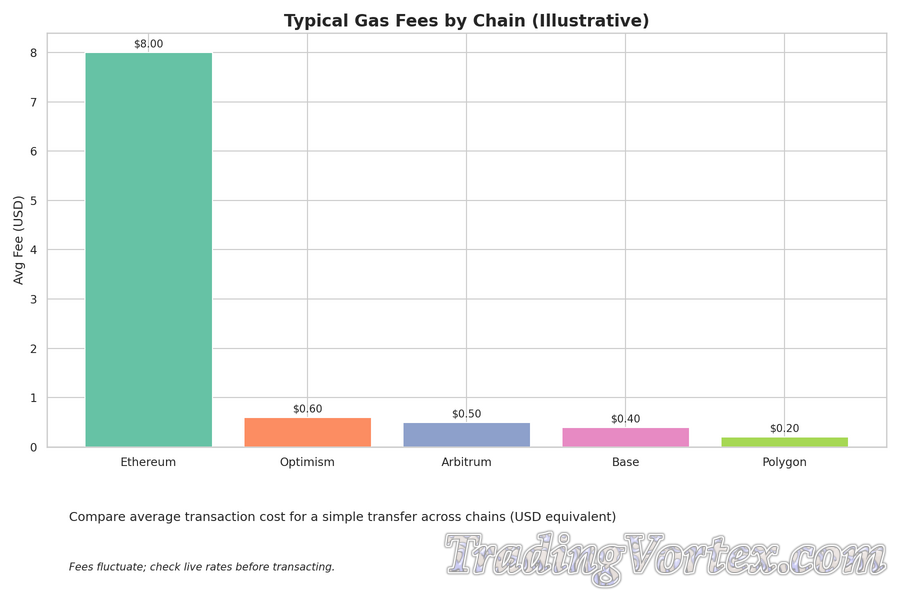 Typical Gas Fees by Chain: Comparative USD cost for a simple transfer across chains (Ethereum, Arbitrum, Optimism, Polygon, Base).
♦ Helps readers choose the most cost‑effective network for funding and transfers.
◊ How to use it: Check live fees before transacting; Layer 2s often reduce costs significantly.
Step 3: Connecting safely to DeFi platforms
Now the fun begins. You’ll use your wallet to interact with DeFi protocols.
- Visit the official site: Always verify URLs. Bookmark trusted platforms like Aave, Lido, Yearn, or Ondo.
- Connect your wallet: Click “Connect Wallet” and approve the connection in your wallet interface.
- Choose a strategy: Stake ETH, lend USDC, or deposit into a yield aggregator vault. Follow on-screen instructions and confirm the transaction.
🔐 Security tip: Use tools like Revoke.cash to remove old token approvals and avoid malicious contracts.
Step 4: Monitoring and optimizing passive income returns
Once your funds are deployed, it’s time to track and optimize.
- Use dashboards: Tools like Zapper, DeBank, or DefiLlama show your portfolio, yields, and protocol exposure.
- Track rewards: Some platforms auto-compound, others require manual claiming. Set reminders or use aggregators to simplify.
- Rebalance regularly: As markets shift, consider moving funds to better-performing or safer strategies.
- Stay informed: Follow protocol updates on Twitter, Discord, or newsletters. Changes in APY, tokenomics, or security can affect your returns.
📈 Optimization tip: Diversify across 2–3 strategies to balance risk and reward. For example, stake ETH on Lido, lend USDC on Aave, and farm with a small portion on Beefy.
Advanced DeFi Passive Income Strategies
Once you’ve nailed the basics of staking, lending, and yield farming, the natural question becomes: how do I push this further? Advanced strategies are where DeFi veterans play, combining creativity with risk management to squeeze more out of their capital. These techniques can deliver higher returns and more efficient use of assets, but they’re not plug-and-play. They require patience, practice, and a clear understanding of the risks involved.
Let’s dive into three of the most popular advanced approaches in 2025.
Cross-Chain Yield Strategies for Higher Returns
DeFi is no longer a single-chain game. Ethereum may still be the hub, but Layer 2s like Arbitrum, Optimism, and Base, plus alternative chains like Avalanche and Solana, are offering unique yield opportunities. Cross-chain yield strategies involve moving assets across these ecosystems to chase the best returns.
Tips for success:
- Stick to audited bridges like Stargate or Synapse to reduce risk.
- Always factor in bridge fees, slippage, and gas costs when calculating net yield.
- Watch for chain-specific incentives—some ecosystems subsidize yields to attract liquidity.
Cross-chain strategies are like playing DeFi chess: you’re moving pieces across multiple boards, and the winners are those who calculate three moves ahead.
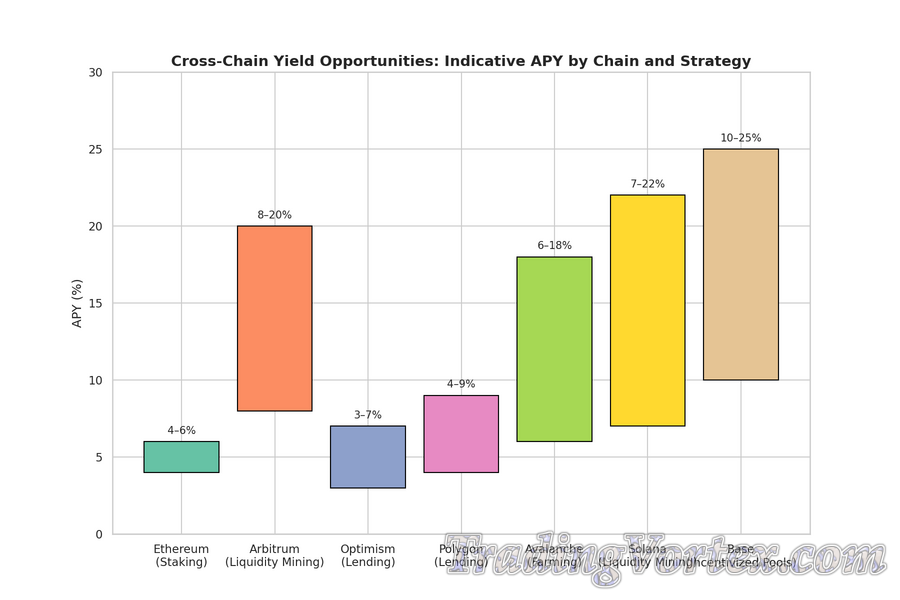 Cross‑Chain Yield Opportunities: Indicative APY by Chain and Strategy: Grouped bars for Ethereum, Arbitrum, Optimism, Polygon, Avalanche, Solana, and Base showing min–max APY ranges for common strategies (staking, lending, liquidity mining).
♦ Each bar is annotated with its range (e.g., 8–20%).
♦ Use this to compare where yields concentrate and to remind readers to factor in fees and bridge costs.
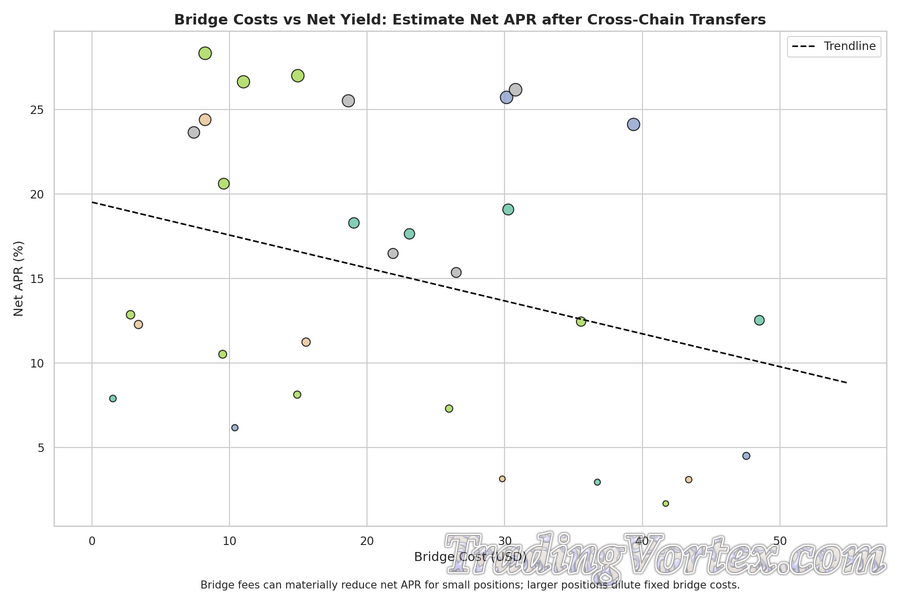 Bridge Costs vs Net Yield: Estimate Net APR after Cross‑Chain Transfers: Scatter of simulated bridge fees (USD) vs net APR for a $1,000 position; point size = gross APR; includes a regression line and annotated examples (low‑cost L2 vs high‑cost bridge).
♦ How to use it: Shows that fixed bridge fees disproportionately hurt small positions.
♦ Use the chart to decide when bridging is worth it or when to keep funds on a single chain.
Leveraged Yield Farming and Risk Management
Leveraged yield farming is essentially yield farming on steroids. You borrow assets to amplify your farming position, which magnifies both gains and losses. Platforms like Gearbox, Alpaca Finance, and Morpho Blue have made this more accessible, offering structured leverage with built-in liquidation safeguards.
Risk management essentials:
- Stick to low-volatility pairs like stablecoin-stablecoin pools.
- Monitor your health factor and set alerts for liquidation thresholds.
- Start small: 2x leverage or less, until you’re comfortable with the mechanics.
Think of leveraged farming like driving a sports car: exhilarating, but you need to know when to hit the brakes.
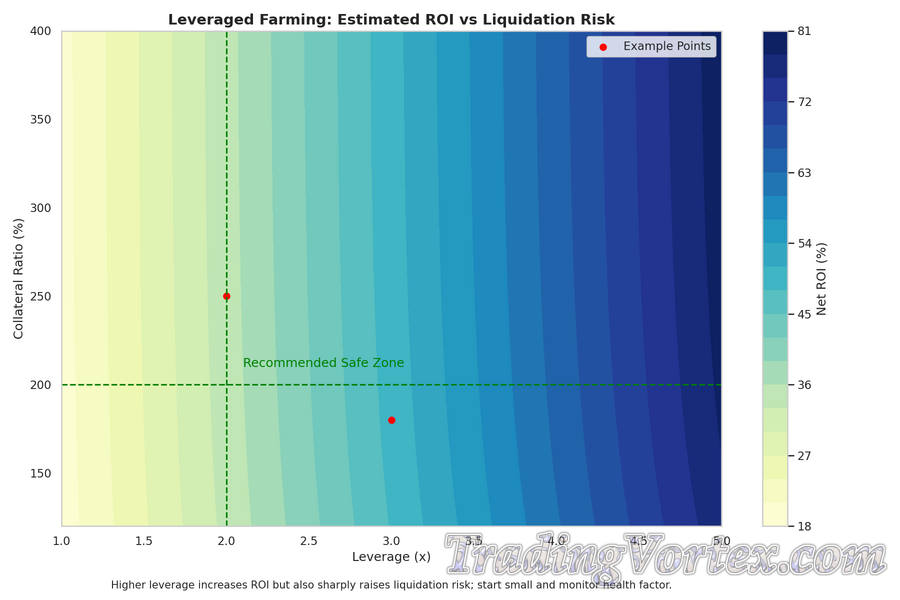 Leveraged Farming: Estimated ROI vs Liquidation Risk: Filled contour map of net ROI across leverage (1×–5×) and collateral ratios (120%–400%), with example points and a highlighted “recommended safe zone” (e.g., collateral >200% and leverage ≤2×).
♦ How to read it: Colors show net ROI; contours near the left/top show where liquidation risk overwhelms returns.
♦ Key takeaway: small increases in leverage can sharply raise liquidation probability.
Using DeFi Options and Structured Products for Passive Income
Options and structured products are the final frontier for many DeFi earners. Platforms like Ribbon Finance, Lyra, and Friktion offer automated strategies such as covered call vaults or put-selling programs, allowing you to earn premiums on your crypto holdings.
Structured products go even further:
- Principal-protected vaults: earn yield while limiting downside.
- Dual-currency investments: higher returns if assets stay within a price band.
- Volatility harvesting: strategies like straddles or strangles that profit from choppy markets.
Best practices:
- Understand the payoff diagrams before committing funds.
- Choose vaults with transparent backtesting and clear risk disclosures.
- Diversify across multiple strategies to smooth out returns.
Options strategies can feel intimidating at first, but once you grasp the basics, they become powerful tools for generating consistent income.
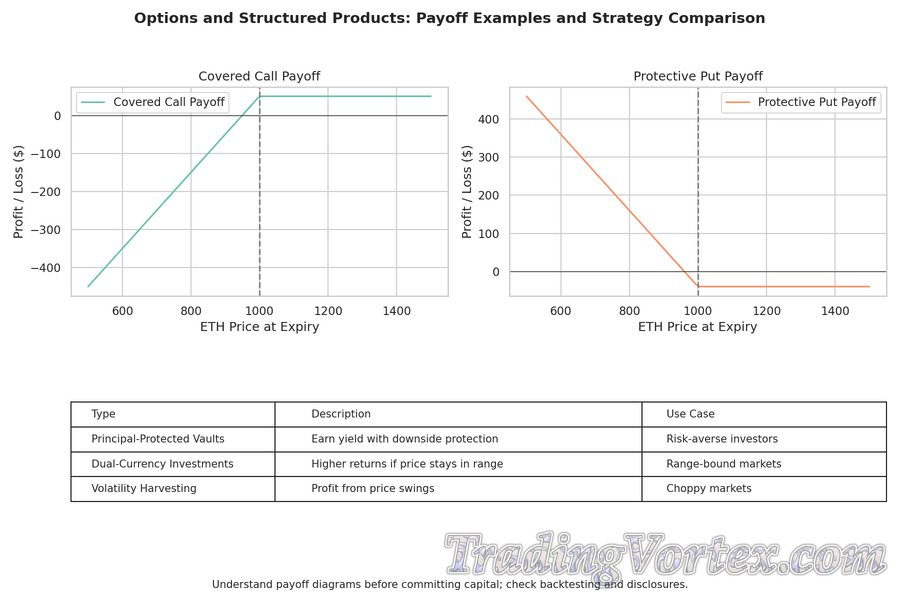 Options and Structured Products: Payoff Examples and Strategy Comparison:
◊ Left: covered‑call payoff diagram;
◊ Right: protective‑put payoff;
◊ Bottom: compact table comparing principal‑protected vaults, dual‑currency investments, and volatility harvesting.
♦ How to use it: Use payoff lines to visualize capped upside vs downside protection and consult the table to match product types to market views and risk tolerance.
Final thought: Advanced DeFi strategies are not for everyone, but they can be incredibly rewarding for those willing to learn. Start small, experiment with simulation tools or test capital, and always prioritize risk management over chasing headline APYs. The goal isn’t just to earn more: it’s to earn smarter.
Future of Passive Income in DeFi
DeFi has come a long way from its Wild West days of food-themed farms and unpredictable APYs. As we look ahead, the next wave of passive income in DeFi is being built on smarter algorithms, real-world connections, and a growing appetite from institutions. If you’re wondering where to place your bets, or just want to stay ahead of the curve, here’s what’s coming next.
AI-Powered DeFi Strategies for Automated Income
Artificial intelligence is no longer just a buzzword in DeFi. In 2025, AI agents are actively managing yield strategies, optimizing for risk-adjusted returns across multiple chains and protocols. Platforms like Aave v4, Curve, and GMX are integrating AI to automate everything from liquidity rebalancing to derivatives-based income generation, offering yields between 8% and 25% APY depending on the strategy.
These AI systems analyze real-time market data, protocol incentives, and user behavior to dynamically allocate capital, often outperforming manual strategies. For passive income seekers, this means less time glued to dashboards and more time enjoying the fruits of your crypto labor.
Expect to see more AI-native DeFi vaults, predictive yield models, and automated risk mitigation tools that adjust your exposure based on volatility, gas fees, and macro trends.
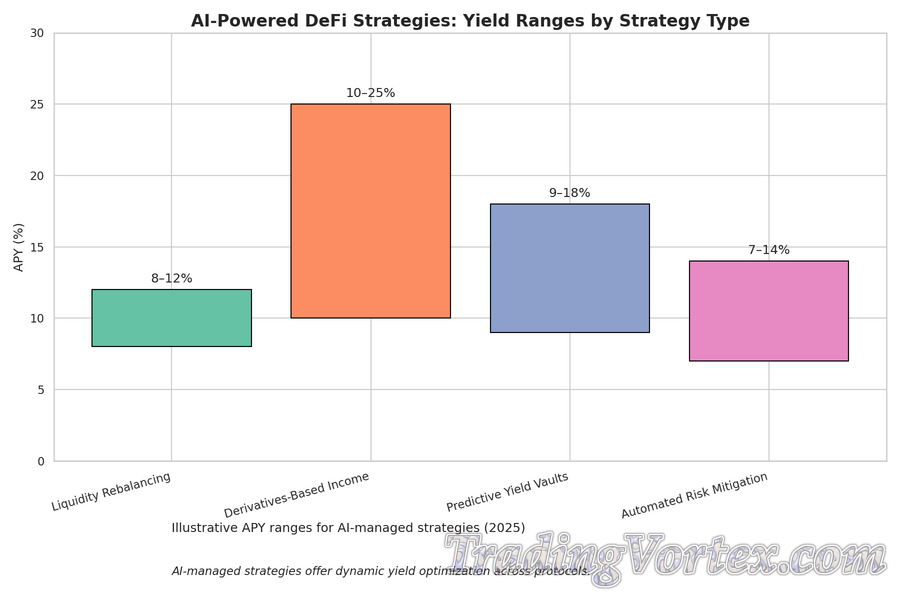 AI-Powered DeFi Strategy Yield Ranges: Yield ranges for four AI-managed strategies:
◊ Liquidity Rebalancing: 8–12%
◊ Derivatives-Based Income: 10–25%
◊ Predictive Yield Vaults: 9–18%
◊ Automated Risk Mitigation: 7–14%
♦ Why it helps: Makes AI yield expectations concrete and shows how strategy type affects risk-adjusted returns.
Institutional Adoption of DeFi Passive Income Products
The line between TradFi and DeFi is blurring fast. In 2025, institutional players are entering DeFi not just for speculation, but for yield. Tokenized treasury bills, overcollateralized lending, and compliant staking products are being wrapped into regulated DeFi ETFs, on-chain money market funds, and tokenized bond portfolios.
This shift is bringing more liquidity, better risk management, and a push for compliance-first DeFi protocols. Platforms like Ondo Finance, Maple, and Centrifuge are leading the charge, offering real-world yield with blockchain efficiency.
For retail investors, this means more stable, transparent, and diversified passive income options, often with lower volatility and clearer legal frameworks.
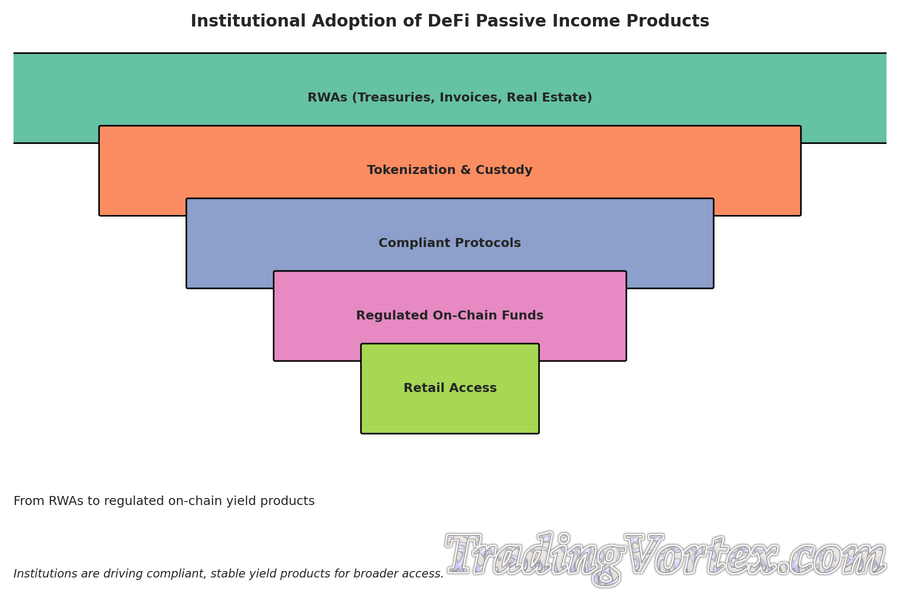 Institutional Adoption of DeFi Funnel: A layered funnel from RWAs → Tokenization → Compliant Protocols → Regulated Funds → Retail Access.
♦ Shows how institutional capital flows into DeFi and creates stable, compliant yield products.
Sustainable Yield Models and Real-World Integration
Gone are the days of unsustainable APYs fueled by token emissions. The future of DeFi yield is about protocol revenue, real-world cash flows, and long-term sustainability. According to recent reports, DeFi yields remain resilient even amid global rate cuts, thanks to genuine demand for lending, trading, and staking services.
We’re seeing a rise in fee-sharing models, where protocols distribute real revenue (not just inflationary tokens) to liquidity providers and stakers. Combine that with real-world asset tokenization: like tokenized invoices, real estate, and carbon credits; and you get yield that’s grounded in actual economic activity.
This evolution is making DeFi passive income more predictable, diversified, and accessible, especially for users who want exposure to traditional assets without leaving the blockchain.
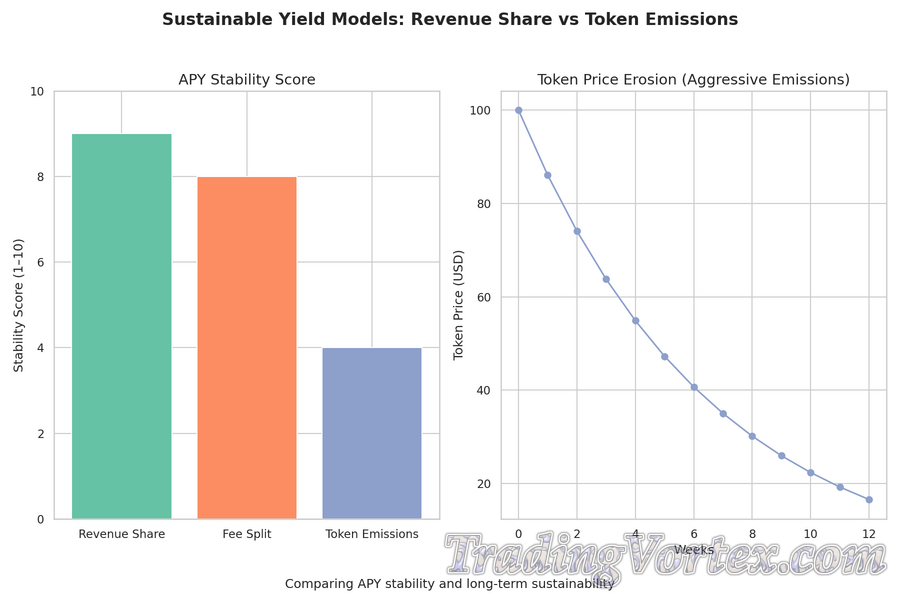 Sustainable Yield Model Comparison:
♦ Left: APY stability scores (Revenue Share: 9, Fee Split: 8, Token Emissions: 4)
♦ Right: Simulated token price erosion under aggressive emissions
◊ Highlights why revenue-based models are more sustainable than inflationary token incentives.
Final thought: The future of DeFi passive income is smarter, safer, and more connected to the real world. Whether you’re a casual staker or a strategy nerd, the next wave of tools will help you earn more with less stress. Just remember: the best yield isn’t always the highest: it’s the one that lasts.
Conclusion: Building Long-Term Passive Income with DeFi
Balancing risks and rewards in DeFi
If you want a durable income stream, think like a gardener not a gambler: plant stable roots, then experiment with a few high-yield branches. A practical split many experienced users favor is a core allocation to staking and lending for stability, plus a smaller allocation to yield farming and structured products for upside.
This reduces the chance that a single exploit or token crash wipes out your gains, while still letting you capture attractive returns. Always check audits, TVL, and tokenomics before committing funds, and avoid chasing headline APYs without understanding how they are paid.
Staying informed and adapting to DeFi innovations
DeFi moves fast, and what was best last quarter may be obsolete today. Make information hygiene a habit: follow protocol governance updates, read audit reports, and use on-chain dashboards to monitor exposure and rewards.
Community channels and reputable publications are useful, but prioritize primary sources like protocol docs and multisig governance proposals. When new tools arrive, test them with small amounts first, and factor in gas and bridge costs when moving across chains. Small, regular adjustments beat dramatic, last-minute reactions.
Final thoughts on earning passive income with DeFi
Long-term success comes from consistency, diversification, and humility. Keep a clear record of positions and taxable events, take profits periodically, and rebalance when your risk profile changes. Remember that passive does not mean forgetful: vaults, staking contracts, and lending markets all require periodic checks for upgrades, governance votes, or security notices.
If you prefer less hands-on management, consider audited yield aggregators or tokenized real-world assets that offer steadier cash flows.
Key takeaways to act on today:
- Start with a stable core: staking and lending on audited platforms.
- Allocate a small portion to higher yield: yield farms, structured products, or RWAs.
- Monitor and rebalance: set alerts for protocol changes and liquidation thresholds.
- Prioritize security and compliance: audits, bug bounties, and tax tracking.
Building passive income in DeFi is a marathon not a sprint. Treat your portfolio like a project: document decisions, learn from mistakes, and scale what works.
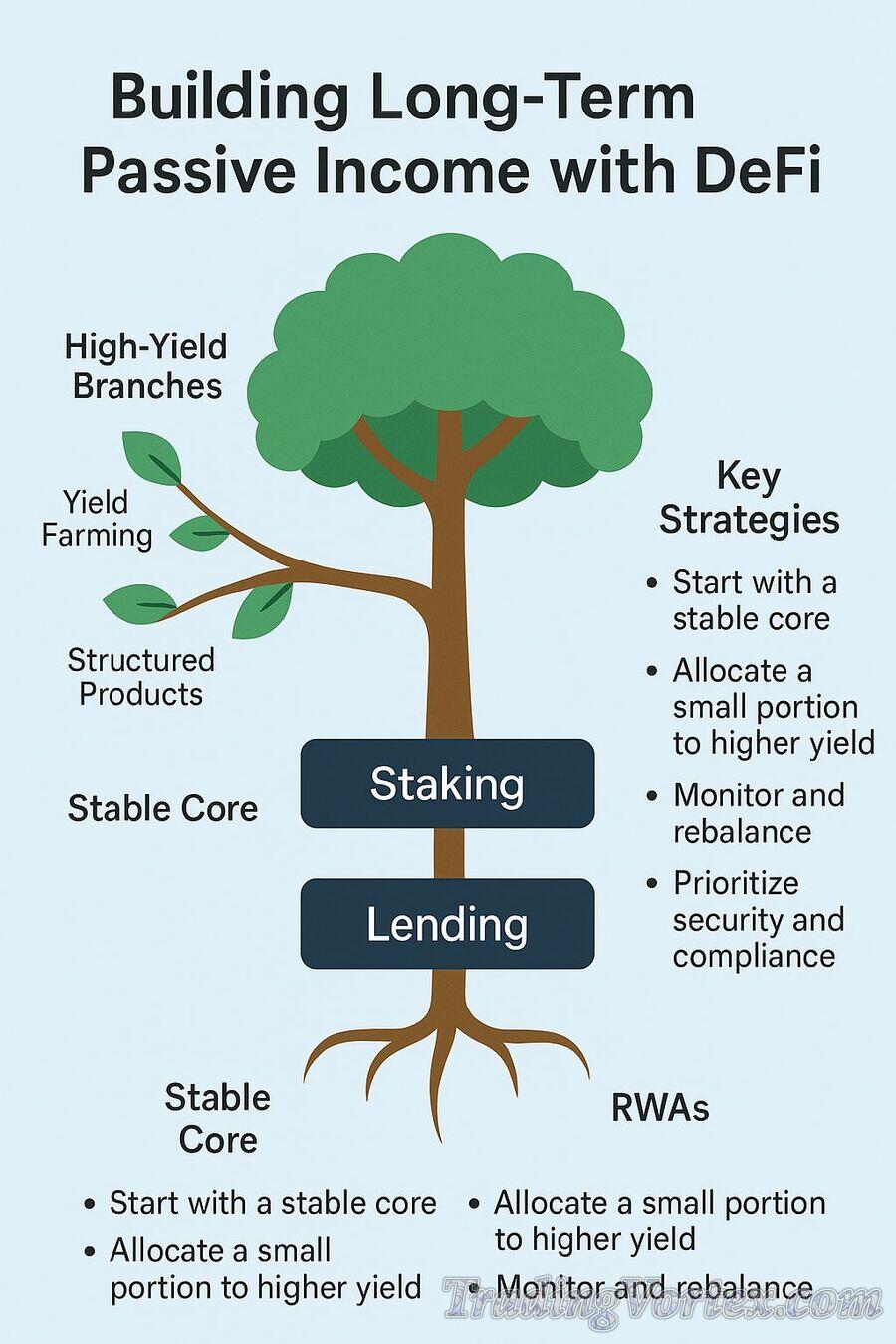
FAQs: How to Earn Passive Income with DeFi
Q1. What’s the safest way to start earning passive income in DeFi?
Start with staking or lending on audited, blue-chip platforms like Lido, Aave, or Ondo. These protocols have strong security records, large user bases, and transparent governance. Stick to stablecoins or major assets like ETH or USDC to reduce volatility. Think of it like dipping your toes in before diving into deeper waters.
Q2. How much can I realistically earn from DeFi passive income?
It depends on your strategy and risk tolerance. As of late 2025:
♦ Staking ETH or SOL: 4%–6% APY
♦ Lending stablecoins: 5%–10% APY
♦ Yield farming or liquidity mining: 10%–30% APY (with higher risk)
♦ Tokenized T-bills or RWAs: 4%–7% APY
These are ballpark figures. Always check current rates and remember: high APY often comes with higher risk.
Q3. Is DeFi passive income really passive?
Not entirely. While some strategies like staking or using auto-compounding vaults are low-maintenance, you still need to monitor your positions, track rewards, and stay updated on protocol changes. Think of it as “semi-passive”: less work than active trading, but not a total set-and-forget.
Q4. What are the biggest risks I should watch out for?
♦ Smart contract bugs: Even audited protocols can be exploited.
♦ Impermanent loss: Especially in volatile token pairs.
♦ Token inflation: Rewards paid in tokens that rapidly lose value.
♦ Regulatory changes: Some platforms may restrict access or require KYC.
♦ Rug pulls: Avoid unaudited or anonymous projects promising sky-high returns.
Q5. How is DeFi passive income taxed?
In most countries, staking rewards, lending interest, and farming yields are taxed as income when received. Selling those rewards later may also trigger capital gains tax. Use tools like Koinly, CoinTracker, or Accointing to track and report your earnings accurately.
Q6. Can I earn passive income with small amounts?
Absolutely. Many DeFi platforms support micro-deposits, especially on Layer 2 networks like Arbitrum or Optimism, where gas fees are low. Start with $50 or $100 in stablecoins and try staking or lending. It’s a great way to learn without risking too much.
Q7. What’s the difference between staking and yield farming?
♦ Staking: Locking up tokens to help secure a blockchain (like ETH or SOL) and earn rewards.
♦ Yield farming: Providing liquidity to a DeFi protocol and earning rewards, often in multiple tokens. It’s more complex and riskier, but can offer higher returns.
Q8. How do I know if a DeFi platform is trustworthy?
Look for:
♦ Audits by reputable firms (like CertiK, Trail of Bits)
♦ Bug bounty programs
♦ Transparent teams and governance
♦ High Total Value Locked (TVL)
♦ Active community and documentation
If something feels shady or too good to be true, it probably is.