

Discover how to navigate the fast-growing world of cross-chain crypto investing with confidence. This comprehensive guide explores the most effective strategies for 2026, from diversifying across tokens and protocols to earning passive income through staking and yield farming. You’ll learn how to evaluate cross-chain projects, spot risks like bridge vulnerabilities and fragmented liquidity, and leverage the best tools and platforms for seamless asset management. Real-world case studies highlight both successful investments and lessons from past failures, while expert predictions outline the future of blockchain interoperability, AI-driven liquidity, and modular networks.
Written in a clear, engaging style, this article is designed for traders and investors of all levels. Whether you’re a beginner curious about cross-chain wallets or an experienced investor looking to optimize your portfolio, you’ll find actionable insights, practical checklists, and forward-looking strategies. By the end, you’ll understand not only the best ways to invest in cross-chain technology today but also how to position yourself for the opportunities of tomorrow.
Table of Contents:
- What Is Cross-Chain Technology and Why It Matters in 2026
- Top Cross-Chain Technology Trends Shaping Crypto Investing in 2026
- Best Investment Opportunities in Cross-Chain Crypto Projects
- How to Evaluate Cross-Chain Crypto Projects Before Investing
- Cross-Chain Crypto Investing Risks and Challenges in 2026
- Proven Strategies to Invest in Cross-Chain Technology Successfully
- Sample Portfolio Allocation for Cross-Chain Investing in 2026
- Best Tools and Platforms for Cross-Chain Crypto Investors
- Real-World Case Studies: Successful Cross-Chain Crypto Investments
- The Future of Cross-Chain Technology and Crypto Investing
- Conclusion: Key takeaways for investing in cross-chain technology
- FAQs: Best Ways to Invest in Cross-Chain Technology
- Q1. What is cross-chain technology, and why should I care as an investor?
- Q2. Is cross-chain investing safe in 2026?
- Q3. What are the best cross-chain tokens to watch right now?
- Q4. How do I earn passive income from cross-chain platforms?
- Q5. What tools should I use to manage cross-chain investments?
- Q6. Are there any regulations I should be aware of?
- Q7. What’s the biggest mistake new cross-chain investors make?
- Q8. Is cross-chain investing only for advanced users?
What Is Cross-Chain Technology and Why It Matters in 2026
Understanding Cross-Chain Technology and Blockchain Interoperability
Think back to the early days of crypto: every blockchain felt like its own walled garden. Bitcoin was the pioneer, Ethereum introduced smart contracts, Solana promised speed, and Avalanche focused on scalability. Each chain had its own rules, tokens, and communities, but they didn’t really talk to each other. Moving assets between them was like trying to send money to a friend who banks with a completely different system: you needed clunky workarounds, paid high fees, and often worried about losing funds in the process.
Cross-chain technology changes that story. At its core, it’s about making blockchains interoperable, allowing them to exchange assets, data, and value securely. Imagine building bridges between islands so people, goods, and ideas can flow freely. These bridges take different forms: wrapped tokens, relayers, messaging protocols, and liquidity hubs, but the mission is the same: connectivity.
By 2026, interoperability isn’t just a technical upgrade, it’s the backbone of the crypto economy. Multi-chain DeFi platforms rely on it to pool liquidity across ecosystems. NFT marketplaces use it to let collectors trade assets across Ethereum, Solana, and Polygon. Real-world assets like tokenized bonds or property need it to move seamlessly between jurisdictions. Without cross-chain infrastructure, crypto remains fragmented. With it, we get a unified, fluid, and scalable financial system.
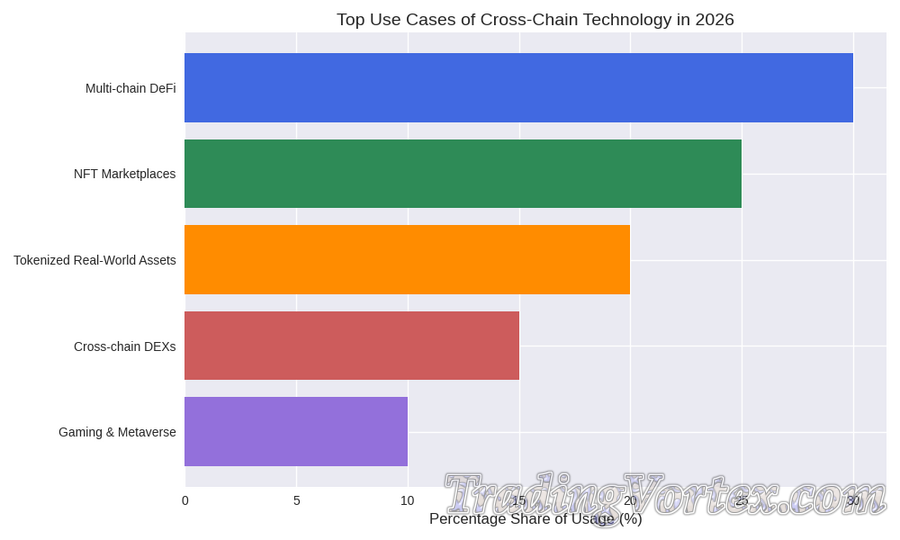 Top Use Cases of Cross-Chain Technology in 2026: This bar chart breaks down the primary applications of cross-chain technology by usage share, showing how it powers the most dynamic sectors of crypto.
Key Insight: Multi-chain DeFi (30%) and NFT marketplaces (25%) lead the pack, followed by tokenized real-world assets (20%), cross-chain DEXs (15%), and gaming/metaverse (10%). This reflects how interoperability is enabling both financial and cultural innovation.
Why Cross-Chain Solutions Are Critical for the Future of Crypto Investing
Crypto investing today is no longer about holding Bitcoin and waiting for the price to rise. Investors are chasing yield across multiple ecosystems: staking ATOM in Cosmos, farming stablecoins on Arbitrum, or trading synthetic assets on Avalanche. The catch is that without cross-chain access, you’re stuck in silos, missing out on the best opportunities.
Cross-chain technology solves this by giving investors access to broader liquidity, diversified assets, and more efficient capital deployment. It’s like upgrading from a single-lane road to a global highway system. You can move capital where it’s needed, hedge risks across ecosystems, and tap into innovations wherever they emerge.
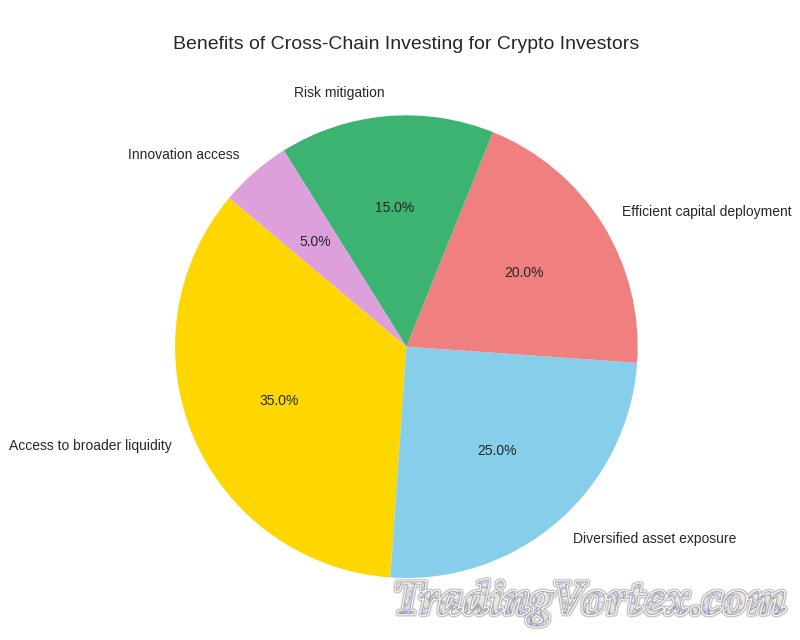 Benefits of Cross-Chain Investing for Crypto Investors: This pie chart visualizes the key advantages of cross-chain investing, helping readers quickly grasp why it’s a game-changer.
Key Insight: The biggest benefits are access to broader liquidity (35%) and diversified asset exposure (25%), followed by efficient capital deployment (20%), risk mitigation (15%), and innovation access (5%).
The numbers tell the story. By late 2025, over $10 billion in total value locked (TVL) was flowing through cross-chain bridges and interoperability protocols. That figure is climbing in 2026 as institutional players demand seamless infrastructure. Hedge funds, asset managers, and even banks are exploring cross-chain rails to tokenize and move assets across networks.
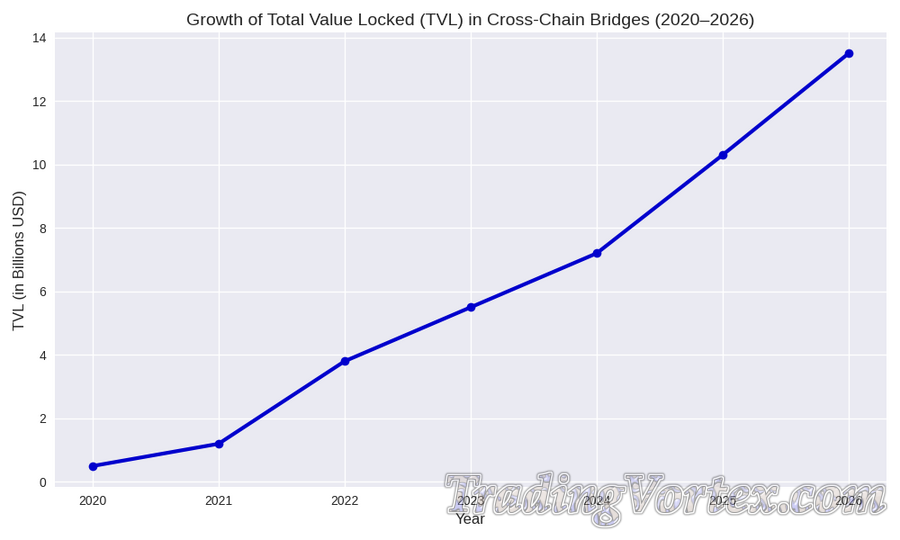 Growth of Total Value Locked (TVL) in Cross-Chain Bridges (2020–2026): This chart illustrates the exponential rise in capital flowing through cross-chain bridges, highlighting the growing investor confidence and institutional adoption of interoperability protocols.
Key Insight: From just $0.5B in 2020 to a projected $13.5B in 2026, the TVL in cross-chain infrastructure has surged, reflecting its central role in the evolving crypto economy.
There’s also a resilience factor. When one chain gets congested or suffers an exploit, cross-chain systems allow investors to reroute, rebalance, and adapt. Developers can build apps that pull liquidity from multiple chains or let users interact with smart contracts across networks; all from a single interface. For investors, this means more opportunities, better risk management, and a front-row seat to the next wave of crypto evolution.
To put it simply: cross-chain technology is the difference between dial-up and fiber internet. Once you experience the speed and flexibility of cross-chain investing, there’s no going back. Whether you’re a seasoned trader or just dipping your toes into crypto, understanding cross-chain technology isn’t optional anymore. It’s the lens through which the smartest investors are spotting alpha, managing risk, and staying ahead of the curve.
Top Cross-Chain Technology Trends Shaping Crypto Investing in 2026
The Rise of Interoperable Blockchain Networks and Modular Architectures
The old model of blockchains trying to be everything at once: handling execution, consensus, and data storage in a single stack; is fading fast. In its place, we’re seeing modular architectures take center stage. These designs separate responsibilities into specialized layers, which makes networks more efficient, scalable, and easier to connect with others.
Projects like Celestia, Polygon CDK, and the Cosmos SDK are leading the charge. They allow developers to build application-specific chains that can still communicate seamlessly with other networks.
For investors, this means ecosystems that are tailored to specific use cases but not isolated, creating opportunities to deploy capital across multiple niches without worrying about being locked into one silo. Think of it as investing in neighborhoods within a city, each with its own vibe, but all connected by highways.
Cross-Chain Bridges, Hubs, and Protocols Gaining Market Share
Bridges used to be the weak link in crypto, notorious for hacks and exploits. In 2026, the landscape looks very different. LayerZero, Axelar, Wormhole, and Synapse have emerged as dominant players, offering not just token transfers but secure messaging, liquidity routing, and even cross-chain governance. These platforms are becoming the backbone of multi-chain DeFi.
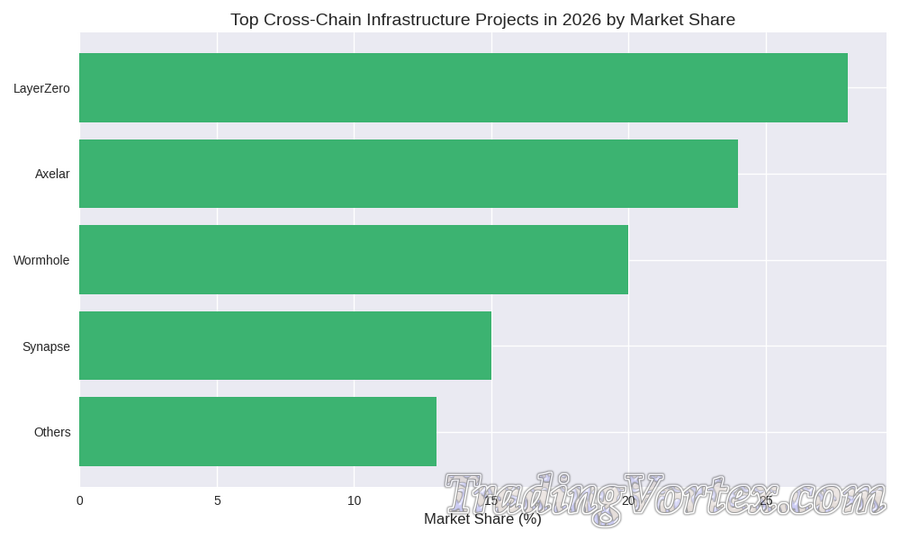 Top Cross-Chain Infrastructure Projects in 2026 by Market Share: This chart compares the leading cross-chain protocols by market share. LayerZero (28%) and Axelar (24%) lead the pack, followed by Wormhole (20%) and Synapse (15%). It visually reinforces the competitive landscape and investor confidence in these platforms.
Recent reports show that cross-chain bridges now process more than $3 billion in monthly volume, and the top protocols are doubling down on security audits, insurance coverage, and user-friendly interfaces.
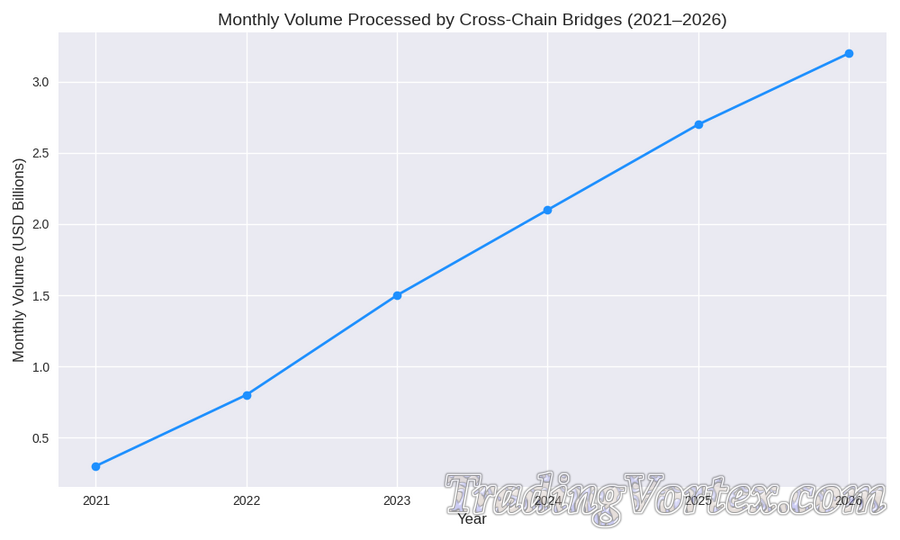 Monthly Volume Processed by Cross-Chain Bridges (2021–2026): This chart shows the steady growth in monthly volume handled by cross-chain bridges, from $0.3B in 2021 to $3.2B in 2026. It highlights the increasing trust and adoption of these protocols as core infrastructure for multi-chain DeFi.
For investors, the takeaway is clear: the winners in this space are those that combine technical resilience with real-world usability. If you’ve ever lost sleep over bridge exploits, you’ll appreciate how far the industry has come.
Cross-Chain Integration with DeFi, NFTs, and Real-World Assets (RWAs)
Cross-chain technology is no longer just about moving tokens from point A to point B. It’s about unlocking new asset classes and financial opportunities. In DeFi, platforms like THORChain and Osmosis are enabling native swaps across chains without the need for wrapped assets. This is a huge win for yield farmers and liquidity providers who want to maximize returns without juggling multiple wallets and bridges.
On the NFT side, projects such as Stargaze and OmniFlix are experimenting with cross-chain minting and trading, allowing creators to reach audiences across Ethereum, Solana, and other ecosystems. And when it comes to RWAs, cross-chain infrastructure is powering the tokenization of treasuries, real estate, and even carbon credits, making them tradable across multiple chains with compliance features built in.
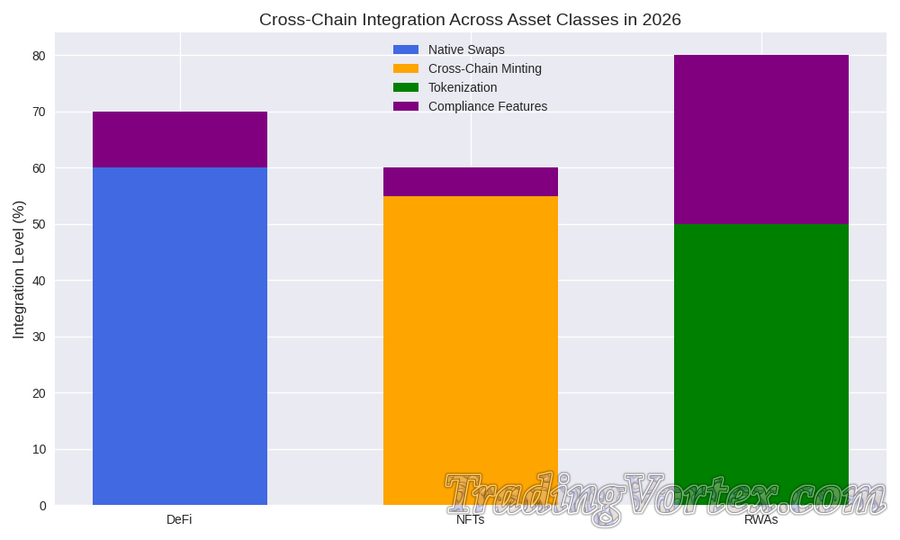 Cross-Chain Integration Across Asset Classes in 2026: This chart illustrates how DeFi, NFTs, and RWAs are integrating cross-chain features. DeFi leads in native swaps (60%), NFTs in cross-chain minting (55%), and RWAs in tokenization (50%) and compliance (30%). It shows how interoperability is unlocking new financial and creative opportunities.
For investors, this means access to a broader set of opportunities that blend traditional finance with crypto-native innovation.
Institutional Adoption of Cross-Chain Crypto Infrastructure
Perhaps the most telling trend is the growing interest from institutions. Banks, hedge funds, and asset managers are no longer sitting on the sidelines. They’re exploring permissioned bridges, KYC-enabled liquidity pools, and enterprise-grade interoperability layers that meet regulatory standards. According to RZLT’s 2026 Interoperability Guide, institutional capital is flowing into regulated cross-chain venues, even if they’re smaller in scale compared to retail-focused platforms.
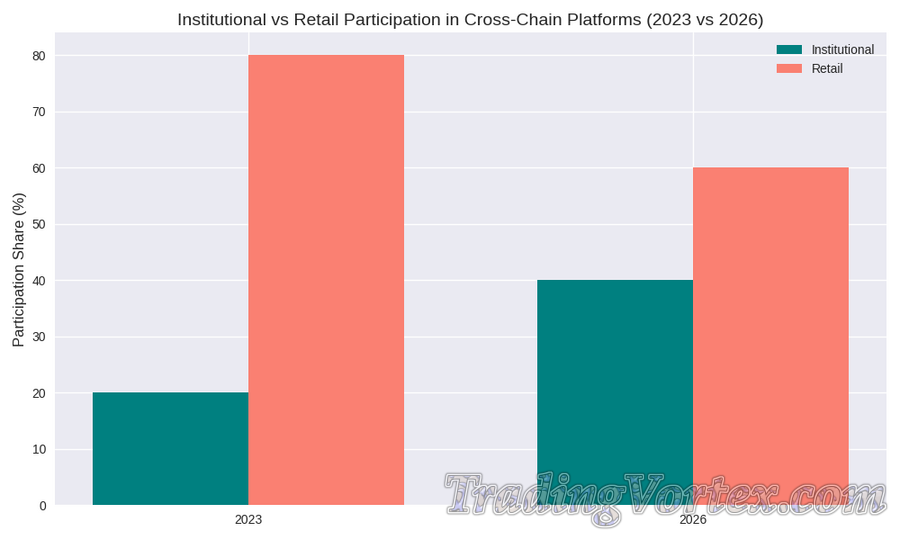 Institutional vs Retail Participation in Cross-Chain Platforms (2023 vs 2026): This chart compares institutional and retail participation in 2023 and 2026. Institutional share doubled from 20% to 40%, while retail dropped from 80% to 60%. It signals a maturing market and growing institutional confidence in cross-chain infrastructure.
The focus for institutions is on risk-adjusted returns and compliance, not just chasing the highest yield. For retail investors, this signals a maturing market. Institutional adoption often brings stability, deeper liquidity, and legitimacy, which can benefit everyone involved. It’s like watching the big players finally join the poker table, you know the stakes are about to get higher.
Cross-chain technology in 2026 is no longer a niche experiment. It’s the connective tissue of crypto’s next chapter, shaping how assets move, how ecosystems grow, and how investors: from casual traders to institutional giants; deploy their capital. Whether you’re chasing yield in DeFi, collecting NFTs, or looking for exposure to tokenized real-world assets, these trends are the compass pointing toward where the smart money is headed.
Best Investment Opportunities in Cross-Chain Crypto Projects
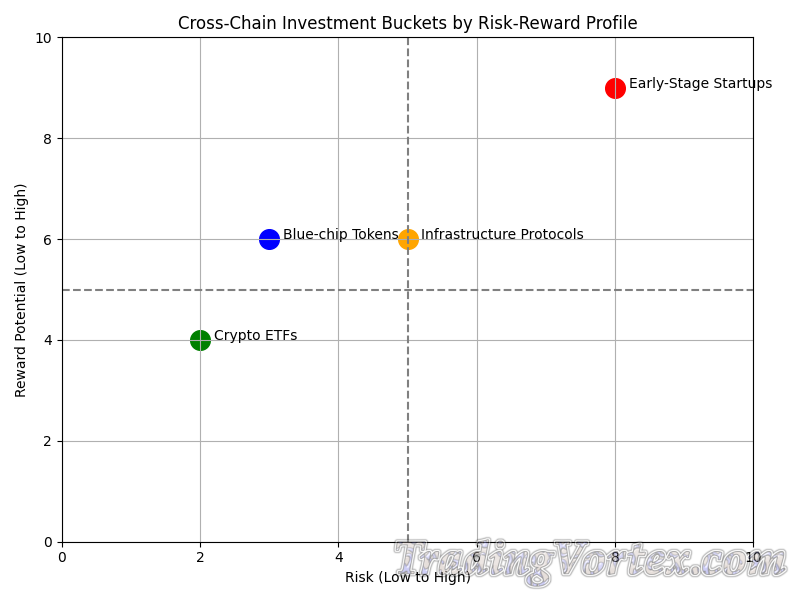 Cross-Chain Investment Buckets by Risk-Reward Profile: This chart maps the four investment categories: Blue-chip Tokens, Infrastructure Protocols, Early-Stage Startups, and Crypto ETFs; by their relative risk and reward. It helps readers visualize how to balance their portfolio based on their risk appetite and return expectations.
Investing in Leading Cross-Chain Tokens and Protocols
Let’s start with the household names. If you’ve been in crypto for more than five minutes, you’ve probably heard of Cosmos (ATOM) and Polkadot (DOT). These two OGs of interoperability are still relevant in 2026, but they’ve evolved. Cosmos has doubled down on its Interchain Security model, letting smaller chains borrow security from the Cosmos Hub, which has boosted confidence among institutional players. Meanwhile, Polkadot’s parachain auctions have matured, with more enterprise-grade projects joining the ecosystem, including supply chain platforms and tokenized asset networks.
Then there’s LayerZero, which has become a favorite among developers for its lightweight messaging protocol. It’s powering everything from cross-chain lending to NFT transfers. Axelar and Wormhole are also worth watching. Both have expanded their reach across dozens of chains and are now offering cross-chain developer toolkits, not just bridges. Wormhole, for example, has integrated with Solana, Ethereum, and Avalanche to enable seamless liquidity movement, while Axelar is positioning itself as the “AWS of interoperability,” offering APIs for developers to build multi-chain apps without reinventing the wheel.
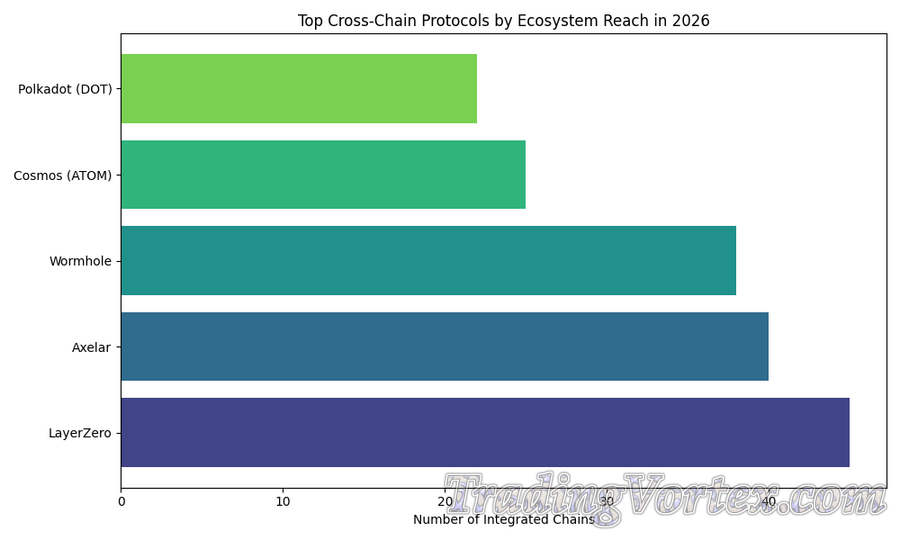 Top Cross-Chain Protocols by Ecosystem Reach in 2026: This chart compares LayerZero, Axelar, Wormhole, Cosmos, and Polkadot by the number of chains they integrate with. It highlights which protocols have the broadest reach and strongest network effects, signaling developer and investor confidence.
If you’re looking for exposure to the core infrastructure of the multi-chain future, these tokens are your front-row ticket. Just remember: while they’re more established, they’re still volatile. Don’t bet the farm, but don’t ignore them either. Think of them as the “blue chips” of cross-chain investing: solid, but still capable of wild swings.
Infrastructure Investments: Oracles, Bridges, and Interoperability Layers
Cross-chain infrastructure is where things get spicy. Think of it as investing in the plumbing of the crypto world. Bridges like Stargate, Circle’s CCTP V2, and Synapse are leading the charge in stablecoin transfers and liquidity routing. They’re not just moving assets, they’re enabling composability between apps on different chains, which is critical for DeFi protocols that rely on liquidity across ecosystems.
Then you’ve got oracles like Chainlink, which now supports cross-chain data feeds and automation. In 2026, Chainlink’s CCIP (Cross-Chain Interoperability Protocol) is being used by major DeFi protocols to sync price data and execute smart contracts across networks. This is a big deal because reliable data is the lifeblood of DeFi, and CCIP ensures that contracts on Ethereum can trust inputs from Solana or Avalanche without manual intervention.
These infrastructure plays are less flashy than meme coins or L2s, but they’re essential. If you believe in the long-term thesis of a multi-chain world, this is where the real value accrues. It’s like investing in the companies that build roads and bridges in a growing city: you may not see fireworks, but you’ll see steady demand.
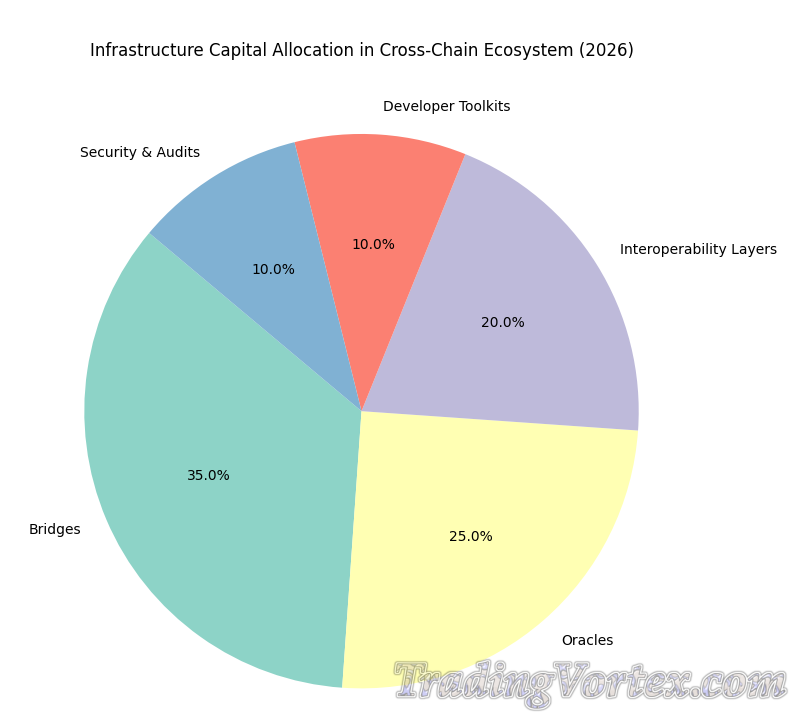 Infrastructure Capital Allocation in Cross-Chain Ecosystem (2026): This pie chart breaks down how capital is allocated across infrastructure components: Bridges, Oracles, Interoperability Layers, Developer Toolkits, and Security & Audits. It shows where investors are placing their bets in the foundational layers of cross-chain tech.
Early-Stage Cross-Chain Startups and Venture Capital Opportunities
If you’ve got a higher risk appetite and a nose for innovation, early-stage investing in cross-chain startups can be incredibly rewarding. We’re seeing a wave of new projects building intent-based bridges, cross-chain MEV protection, and modular execution layers that plug into multiple chains. These are bleeding-edge ideas that could solve some of the biggest headaches in crypto today.
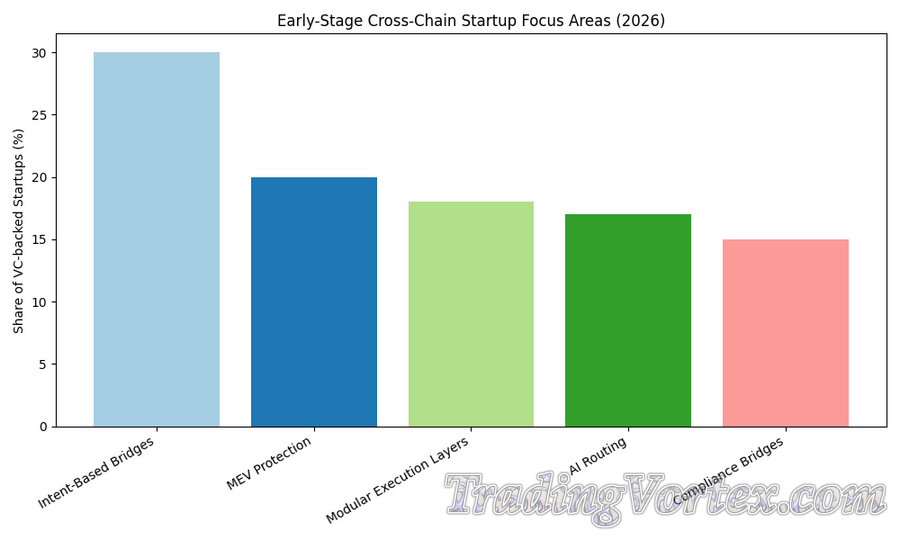 Early-Stage Cross-Chain Startup Focus Areas (2026): This chart visualizes the distribution of venture-backed startups across key innovation areas like intent-based bridges, MEV protection, modular execution, AI routing, and compliance bridges. It helps readers identify where the bleeding edge of cross-chain innovation is happening.
Platforms like Alliance DAO, Outlier Ventures, and Borderless Capital are incubating the next generation of cross-chain infrastructure. Some of these startups are experimenting with AI-driven routing, where liquidity automatically flows to the most efficient chain, or compliance-ready bridges that meet regulatory standards for tokenized securities.
Getting in early, whether through token sales, private rounds, or angel syndicates, can offer asymmetric upside. Just be sure to do your homework. Look for teams with strong technical chops, audited code, and a clear path to adoption. I’ve seen too many investors chase shiny whitepapers only to end up holding bags of illiquid tokens.
Crypto ETFs and Index Funds with Cross-Chain Exposure
For those who prefer a more hands-off approach, crypto ETFs and index funds are finally catching up. Products like the Bitwise Multi-Chain Index or Galaxy’s Interoperability Basket offer exposure to a curated mix of cross-chain tokens, infrastructure plays, and emerging protocols. These funds are especially useful for investors who want diversification without managing a dozen wallets and bridge transactions.
They also come with the added bonus of institutional-grade custody and compliance, which is increasingly important as regulators circle the space.
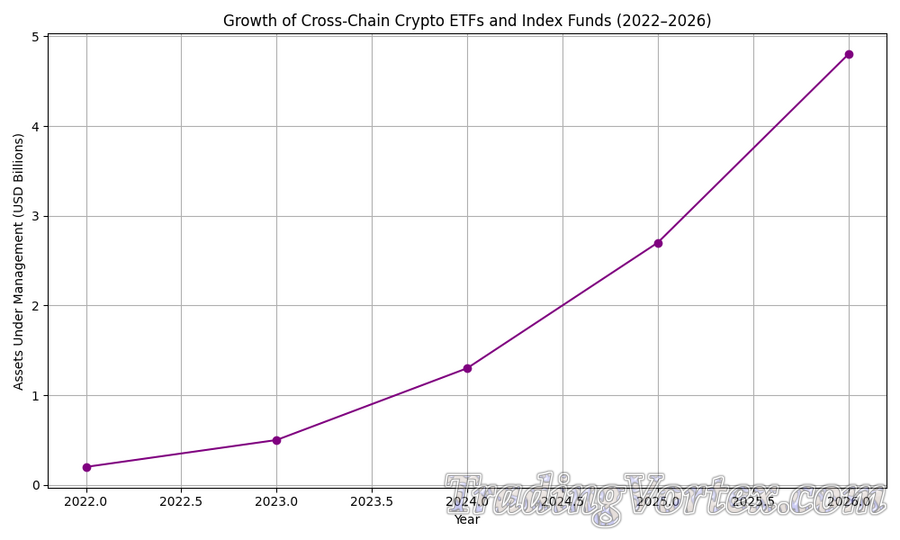 Growth of Cross-Chain Crypto ETFs and Index Funds (2022–2026): This line chart shows the rapid growth in assets under management (AUM) for cross-chain ETFs and index funds, signaling increasing adoption by both retail and institutional investors.
For retail investors, ETFs provide a way to ride the cross-chain wave without the stress of managing multiple assets. For institutions, they offer a compliant entry point into one of the fastest-growing segments of crypto.
Cross-chain investing in 2026 is no longer a fringe strategy. It’s a core part of any serious crypto portfolio. Whether you’re stacking ATOM, farming yield on Stargate, or backing the next LayerZero, the key is to stay curious, diversify smartly, and never stop learning. The bridges are built, the highways are open, and the traffic is flowing. Now it’s time to cross them with confidence.
How to Evaluate Cross-Chain Crypto Projects Before Investing
Security, Audits, and Bridge Risk Management
Let’s be honest: if you’ve been in crypto long enough, you’ve either lost money to a bridge exploit or know someone who has. In 2026, security is still the number one dealbreaker when evaluating cross-chain projects. Bridges are the connective tissue of the multi-chain world, but they’re also prime targets for attackers.
According to Encrypthos, the complexity of cross-chain messaging and asset transfers introduces new attack surfaces that require specialized audits and modular security models.
So what should you look for?
- First, check if the project has undergone multiple independent audits, not just one from a no-name firm. Look for names like Trail of Bits, Halborn, or Quantstamp, which are trusted in the industry.
- Second, see if the protocol uses modular security models, which separate execution, consensus, and messaging layers to reduce systemic risk.
- Bonus points if the project offers bug bounties or has insurance coverage for bridge failures, since these show they’re serious about protecting users.
- Transparency is another big one. If a project is vague about how its bridge works or doesn’t publish audit reports, that’s a red flag.
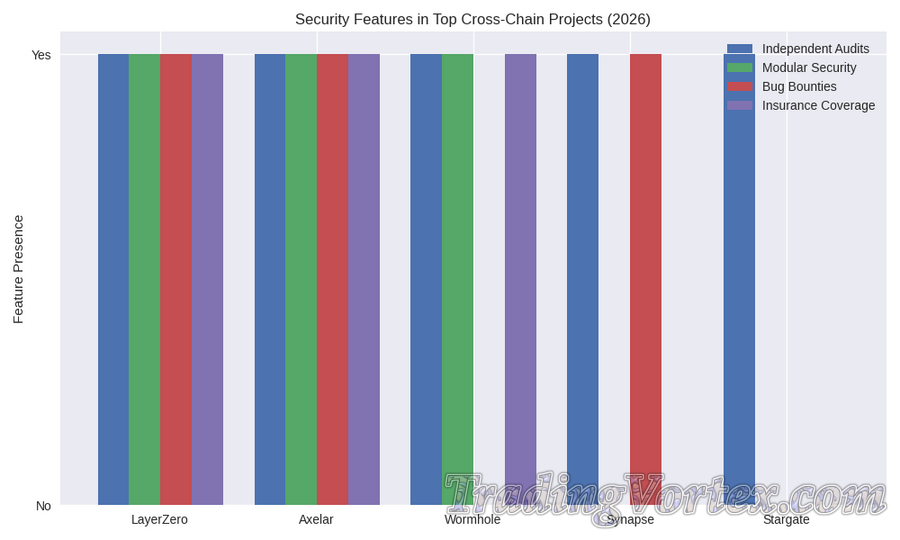 Security Features in Top Cross-Chain Projects (2026): This chart compares five leading cross-chain protocols: LayerZero, Axelar, Wormhole, Synapse, and Stargate; across four critical security features: independent audits, modular security, bug bounties, and insurance coverage. It helps readers quickly assess which projects prioritize robust security practices.
You’re not just investing in tech, you’re trusting it with your capital. Make sure it earns that trust.
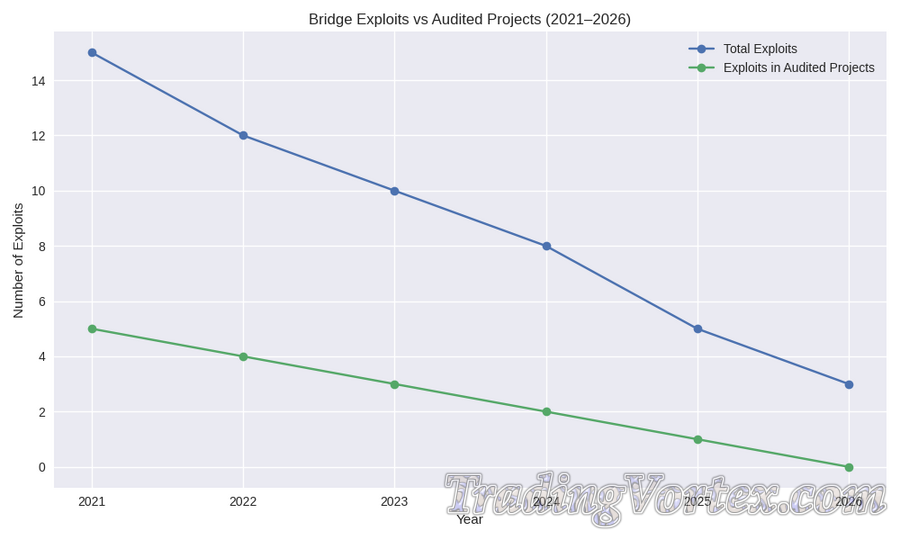 Bridge Exploits vs Audited Projects (2021–2026): This chart shows the decline in total bridge exploits over time, with a sharper drop among audited projects. It visually reinforces the importance of third-party audits in reducing security vulnerabilities.
TVL, Developer Activity, and Ecosystem Growth
Now let’s talk traction. One of the best ways to gauge a project’s health is by looking at Total Value Locked (TVL). High TVL means users are actually putting money into the ecosystem, which signals confidence. Tools like DeFiLlama and Token Terminal let you track TVL across chains and compare growth over time.
But TVL alone isn’t enough. You also want to see active developer contributions. Check GitHub for commit frequency, open issues, and pull requests. A vibrant developer community means the project is evolving, fixing bugs, and shipping new features. If the last update was six months ago, that’s a problem.
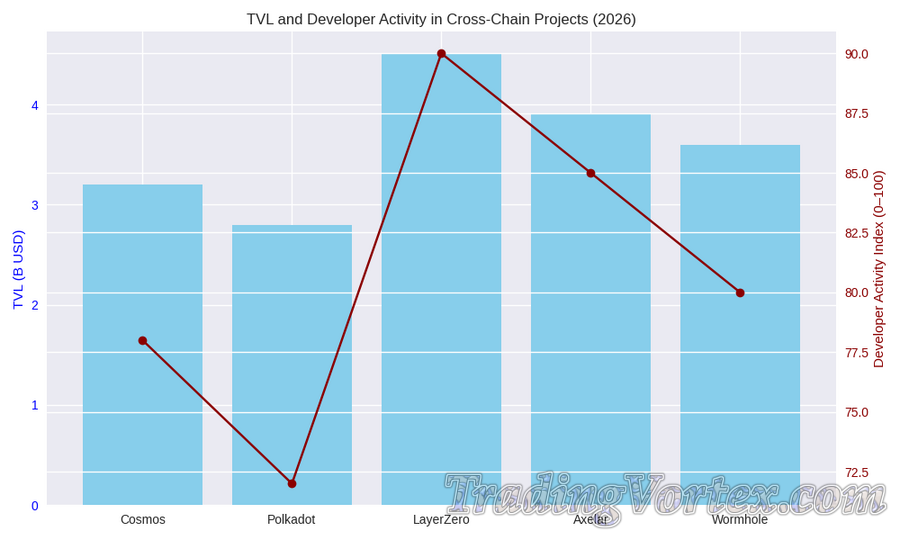 TVL and Developer Activity in Cross-Chain Projects (2026): This chart compares Total Value Locked (TVL) and developer activity index for Cosmos, Polkadot, LayerZero, Axelar, and Wormhole. It helps readers evaluate both capital inflow and technical momentum: two key indicators of ecosystem health.
Finally, look at ecosystem growth. Are new dApps launching on the protocol? Are other projects integrating with it? A healthy cross-chain project should feel like a growing city, not a ghost town. The more builders and users it attracts, the more likely it is to survive and thrive.
Real-World Use Cases and Institutional Partnerships
This is where things get exciting. In 2026, the best cross-chain projects aren’t just theoretical: they’re solving real problems. Look for protocols that enable cross-chain lending, NFT interoperability, or tokenized real-world assets like treasuries or carbon credits. These aren’t just buzzwords anymore. They’re live use cases with measurable impact.
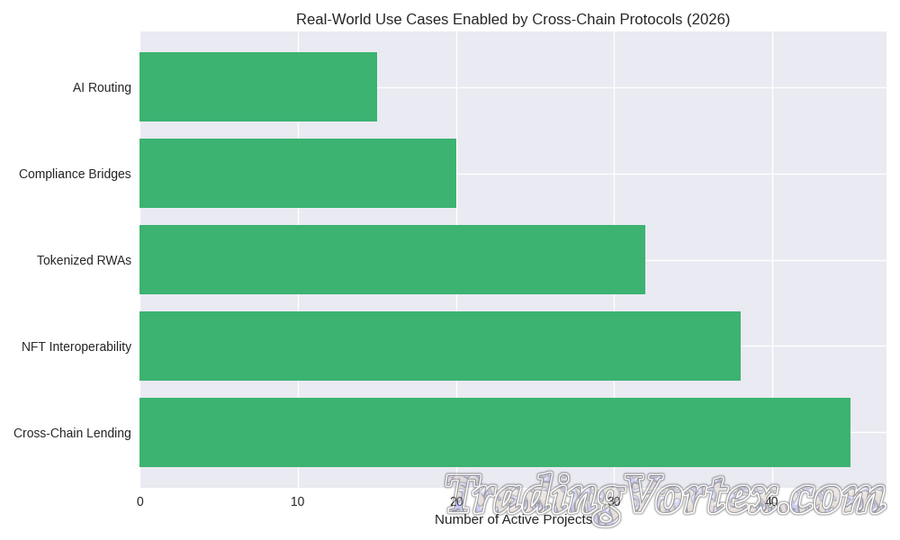 Real-World Use Cases Enabled by Cross-Chain Protocols (2026): This chart highlights the most common real-world applications of cross-chain technology, including lending, NFT interoperability, tokenized RWAs, compliance bridges, and AI routing. It shows where innovation is translating into real utility.
Also, keep an eye on institutional partnerships. If a project is working with banks, fintech firms, or enterprise platforms, that’s a strong signal. Institutions bring not just capital, but also compliance standards and long-term vision.
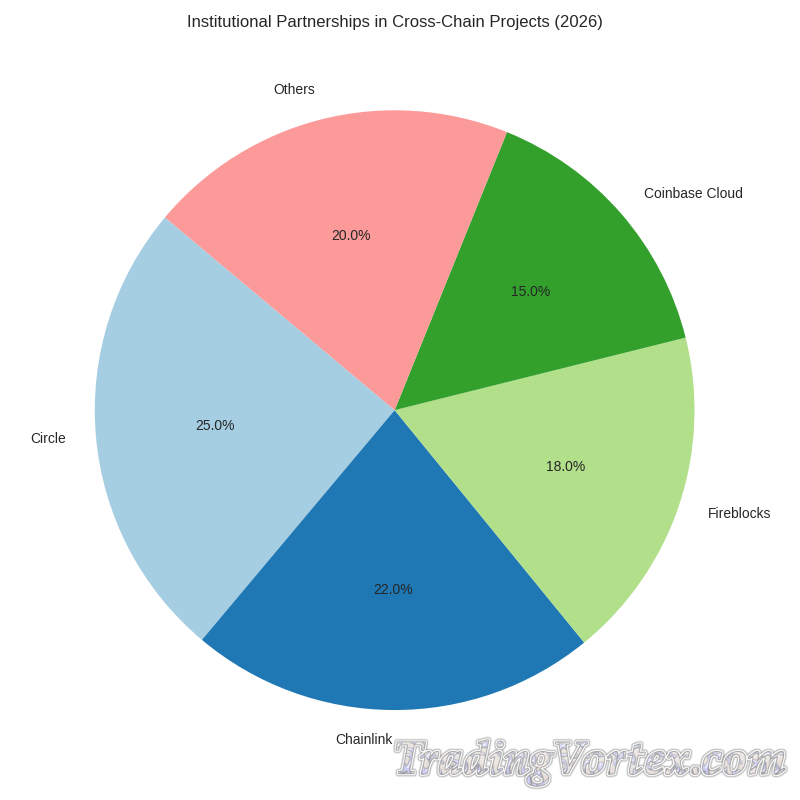 Institutional Partnerships in Cross-Chain Projects (2026): This pie chart breaks down the institutional partnerships driving adoption of cross-chain infrastructure, with Circle, Chainlink, Fireblocks, and Coinbase Cloud leading the way. It signals which projects are gaining traction with enterprise players.
Ask yourself: is this project solving a real problem? Is it being used by real people or businesses? If the answer is yes, you’re looking at more than just a speculative token: you’re looking at infrastructure.
Evaluating cross-chain projects isn’t about chasing hype. It’s about doing your homework, asking tough questions, and trusting your instincts. Look under the hood, follow the builders, and invest in projects that are built to last.
10-Step Due Diligence Checklist for Cross-Chain Investments
Below is a practical, investor-ready 10-step due diligence checklist for cross-chain crypto projects, plus a compact comparison table to help you prioritize checks before committing capital. Use it as a fast reference on-chain, in calls with teams, or before participating in token sales.
- Confirm independent security audits and public reports: Check for multiple audits from reputable firms, and read the executive summaries and remediation logs. Projects that publish full audit reports and follow-up fixes show higher operational maturity.
- Verify bridge design and attack surface: Check whether the bridge uses threshold signatures, relayer decentralization, or light-client verification, and whether the architecture minimizes trust assumptions. Avoid bridges that rely on a single custodian or opaque multisig.
- Look for active bug bounty programs and insurance coverage: Check for live bounties and insurance partners; these indicate the team expects and prepares for incidents. Projects with insurance pools or third-party coverage provide an extra safety layer.
- Analyze TVL, liquidity depth, and composition: Check TVL trends, stablecoin share, and concentration of large deposits. Rapid TVL growth without organic user metrics can be a red flag; steady, diversified TVL is healthier.
- Measure developer activity and release cadence: Check GitHub commits, open issues, and recent releases. A vibrant developer community and frequent updates mean bugs get fixed and features ship; stagnant repos suggest abandonment.
- Assess integrations and ecosystem partnerships: Check which wallets, DEXs, or oracles integrate with the protocol. Real integrations with major players signal product-market fit and easier adoption.
- Review tokenomics, vesting, and governance structure: Check token distribution, lockups, and DAO governance power. Large early unlocks or centralized governance can lead to sudden dilution or control risk.
- Evaluate on-chain metrics and user behavior: Check active addresses, transaction counts, and retention. High user churn or low unique users despite high TVL suggests speculative inflows rather than real utility.
- Confirm legal, compliance, and KYC posture: Check whether the project has legal counsel, compliance docs, or KYC-enabled rails for institutional flows. Regulatory readiness reduces future operational risk.
- Run a red-flag checklist and scenario stress test: Check for single points of failure, dependency on one oracle, or concentrated validator sets. Model worst-case scenarios and decide your exit triggers before investing.
Key decision criteria at a glance
| Criterion | Why it matters | What to check | Red flags | Tools to use |
|---|---|---|---|---|
| Security | Protects capital from exploits | Audit reports; bug bounties; insurance | No audits; opaque design | Trail of Bits, Veridise |
| Liquidity / TVL | Shows real user trust | TVL trends and composition | Rapid outflows; illiquid pools | DeFiLlama |
| Developer activity | Indicates ongoing maintenance | GitHub commits; releases | Stagnant repos; few contributors | GitHub, Token Terminal |
| Adoption / Integrations | Drives long-term value | Partnerships; dApp integrations | No integrations; vaporware claims | Project docs, press releases |
| Governance & Tokenomics | Affects dilution and control | Vesting schedules; DAO power | Large unlocked allocations | Token unlock trackers |
Risks to remember:bridges remain high-risk, audits are not guarantees, and TVL can be misleading. Always size positions to your risk tolerance and use multisig custody or insured custody for large allocations.
Cross-Chain Crypto Investing Risks and Challenges in 2026
Smart Contract Exploits and Bridge Vulnerabilities in Cross-Chain Platforms
Let’s not sugarcoat it: bridges are still the soft underbelly of crypto. Even though 2025 brought big improvements like modular security models, multi-layer verification, and zero-knowledge proof integrations, bridges remain a favorite target for hackers. Industry reports show that cross-chain bridges have accounted for more than half of DeFi exploits in recent years, with billions lost to vulnerabilities in smart contracts and validator systems.
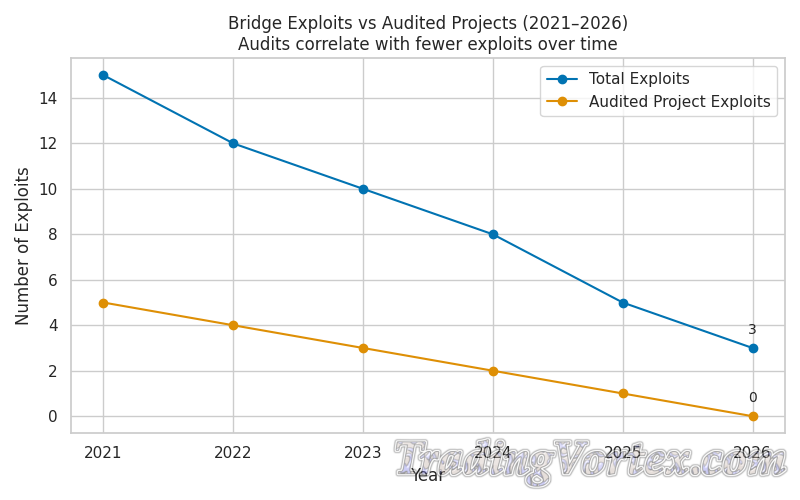 Bridge Exploits vs Audited Projects (2021–2026): Audits correlate with fewer exploits over time.
A dual-line time series contrasts total bridge exploits with exploits affecting projects that had independent audits. This shows that audited projects experience far fewer incidents and justifies prioritizing audit history when evaluating a protocol. “If audit reports are missing, treat the project as higher risk.”
The reason is simple: bridges are complicated. They rely on multiple moving parts: smart contracts, relayers, off-chain validators, and sometimes centralized custodians. If one piece breaks, the whole system can collapse. And when it collapses, it’s not a minor hiccup. We’re talking frozen assets, cascading liquidations, and shattered investor confidence.
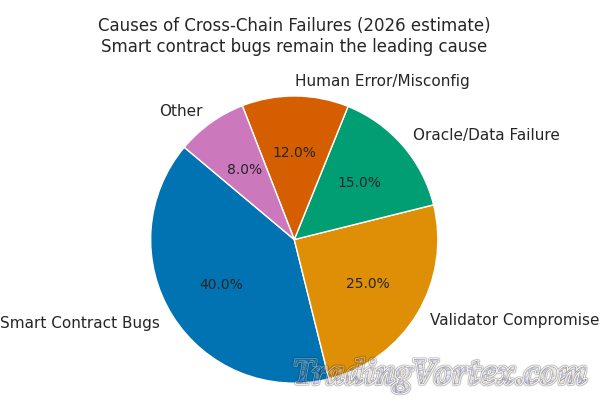 Causes of Cross‑Chain Failures (2026 estimate): Smart contract bugs remain the leading cause.
A pie chart breaks down root causes (smart contract bugs, validator compromise, oracle failures, human error, other). This helps investors focus due diligence on code quality, validator decentralization, and oracle resilience.
Add a checklist: verify recent audits and bug bounty activity.
As an investor, you need to scrutinize how a project secures its bridge. Does it use light clients or zero-knowledge proofs to verify transactions? Has it undergone multiple audits from reputable firms? Is there a bug bounty program or insurance coverage in case of failure? If the answers are vague or hidden behind marketing fluff, that’s your cue to step back.
Regulatory Uncertainty for Cross-Chain Crypto Assets
Cross-chain investing often means moving assets across different jurisdictions, and that’s where things get messy. In 2026, regulators are catching up, but clarity is still uneven. Some countries classify wrapped assets or synthetic tokens as securities, while others treat them as commodities. Some jurisdictions require KYC for bridge usage, while others remain silent.
This matters because regulatory risk can directly impact liquidity, listings, and even the legality of holding certain tokens. If a cross-chain protocol gets flagged by regulators, exchanges may delist its token, or users may be forced to unwind positions. We’ve already seen this happen with privacy-focused bridges and tokenized assets that lacked proper registration.
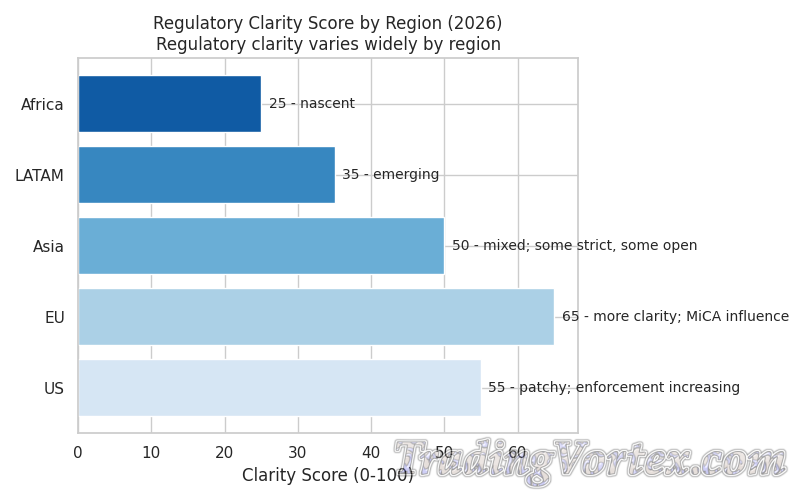 Regulatory Clarity Score by Region (2026): Regulatory clarity varies widely by region.
A horizontal bar chart with color intensity maps clarity scores for US, EU, Asia, LATAM, Africa and includes short region notes. Use this to prioritize monitoring in the US and EU while treating other regions as higher regulatory risk.
Smart investors stay ahead by tracking regulatory developments in key markets like the US, EU, and Asia. Look for projects that are proactive about compliance, transparent about their legal structure, and willing to adapt to evolving rules. A project that ignores regulation may deliver short-term gains, but it risks long-term survival.
Fragmented Liquidity and User Experience Across Chains
One of the promises of cross-chain technology is seamless access to liquidity. The reality in 2026? Liquidity is still fragmented, and user experience can be frustrating. You might find a juicy yield opportunity on one chain, only to realize bridge fees eat half your profit. Or you bridge assets successfully, only to discover the dApp you want doesn’t support your wallet.
This fragmentation creates friction for traders and investors, especially those managing positions across multiple chains. It also increases slippage, delays, and the risk of user error. Until we have truly unified interfaces and liquidity layers, investing across chains will require more diligence, patience, and sometimes a bit of trial and error.
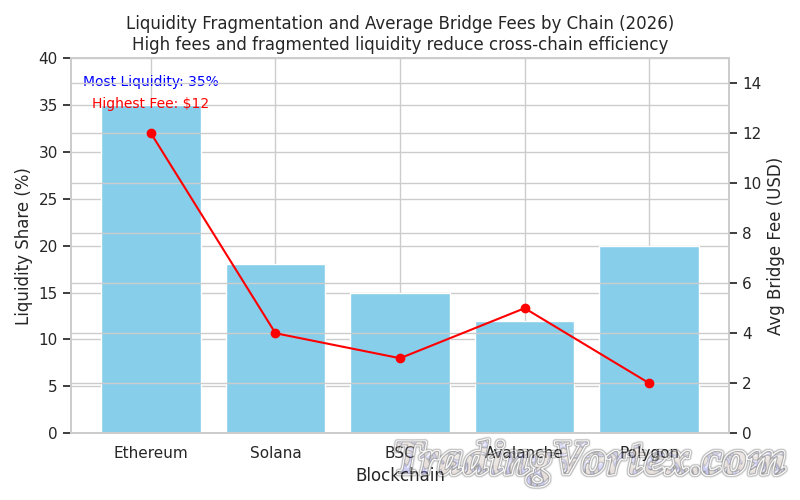 Liquidity Fragmentation and Average Bridge Fees by Chain (2026): High fees and fragmented liquidity reduce cross‑chain efficiency.
Bars show liquidity share per chain; a line shows average bridge fee. This visual helps investors estimate slippage and fee drag before moving capital across chains.
Think of it like traveling between countries with different currencies and customs. You can do it, but it takes planning, and you’ll probably pay a few extra fees along the way.
Lack of Standardization in Cross-Chain Protocols
Here’s the kicker: there’s still no universal standard for cross-chain communication. Every protocol has its own way of handling messaging, consensus, and asset transfers. This lack of standardization makes it harder for developers to build interoperable apps and for investors to compare projects on equal footing.
It also increases systemic risk. If one protocol fails, it can create ripple effects across others that depend on it. Imagine building a city where every bridge uses a different material and blueprint. Some are rock solid, others are duct-taped together. Without shared standards, it’s hard to know which ones will hold under pressure.
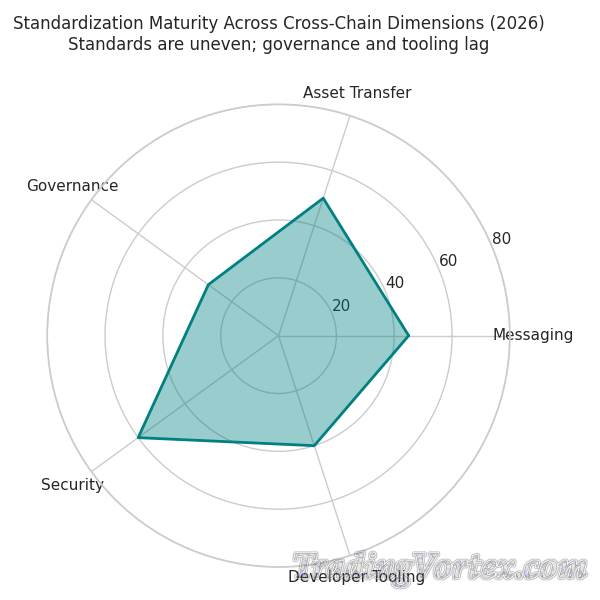 Standardization Maturity Across Cross‑Chain Dimensions (2026): Standards are uneven; governance and tooling lag.
A radar chart shows maturity across messaging, asset transfer, governance, security, and developer tooling. Use it to compare projects’ readiness for safe, composable cross‑chain operations.
The industry is working toward interoperability standards, but until they’re widely adopted, investors need to be cautious. Diversification across multiple protocols and chains is one way to hedge against these risks.
Bottom line: Cross-chain investing is powerful, but it’s not plug-and-play. You’re navigating a fast-moving, high-stakes environment where security, regulation, and usability are still catching up to innovation. If you stay informed, ask the right questions, and diversify wisely, you can ride the cross-chain wave without wiping out.
Proven Strategies to Invest in Cross-Chain Technology Successfully
Diversify Across Cross-Chain Tokens, Protocols, and Infrastructure
The first rule of smart investing still applies here: never put all your tokens in one basket. Cross-chain investing is about spreading risk and capturing opportunities across different layers of the interoperability stack. That means holding exposure to layer-0 protocols like Cosmos and Polkadot, which provide the backbone for multi-chain ecosystems, alongside messaging layers like LayerZero and Axelar, which handle secure communication between chains, and bridge infrastructure like Wormhole or Synapse, which move liquidity across networks.
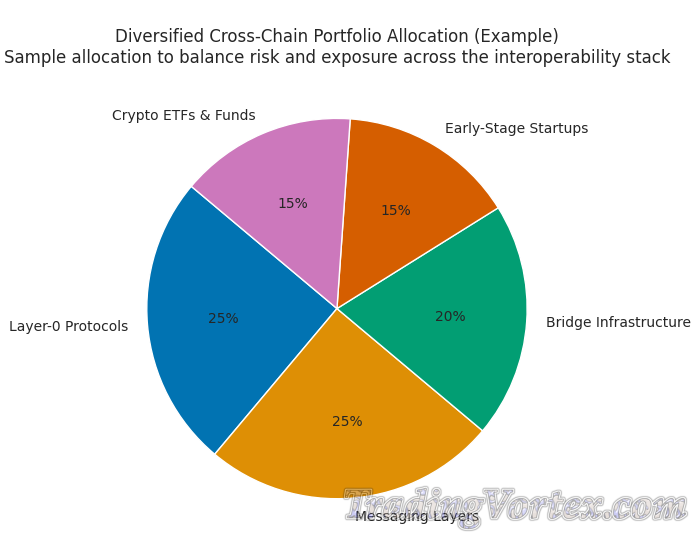 Diversified Cross‑Chain Portfolio Allocation: A sample allocation pie that balances exposure across Layer‑0 protocols, messaging layers, bridge infrastructure, early‑stage startups, and ETFs.
How to use it: Treat this as a starting template, adjust percentages to your risk tolerance, rebalance quarterly, and never exceed recommended caps for illiquid startup allocations. The visual helps readers copy a balanced allocation quickly.
Think of it like building a balanced sports team. You wouldn’t draft only strikers in football or only pitchers in baseball. Each position plays a role, and together they create resilience. In crypto, a diversified cross-chain portfolio ensures that if one protocol faces technical issues or regulatory pressure, others can still deliver growth. This strategy cushions volatility while keeping you exposed to the upside of innovation.
Earning Passive Income via Staking and Yield Farming on Cross-Chain Platforms
Passive income is one of the most attractive features of crypto, and cross-chain platforms take it to another level. Staking tokens like ATOM, DOT, or AXL not only earns you rewards but also strengthens the security of the networks you believe in. It’s like earning dividends while helping keep the lights on.
For those who enjoy more active strategies, cross-chain yield farming offers higher returns. Platforms such as Yearn Finance, Pendle, and Beefy Finance now aggregate liquidity across multiple chains, automatically shifting assets to optimize yield and reduce impermanent loss. Reports from DeFi analytics platforms show that APR ranges between 15 and 40 percent on stablecoin pairs across Ethereum, Polygon, and Solana, with higher yields available on riskier pools.
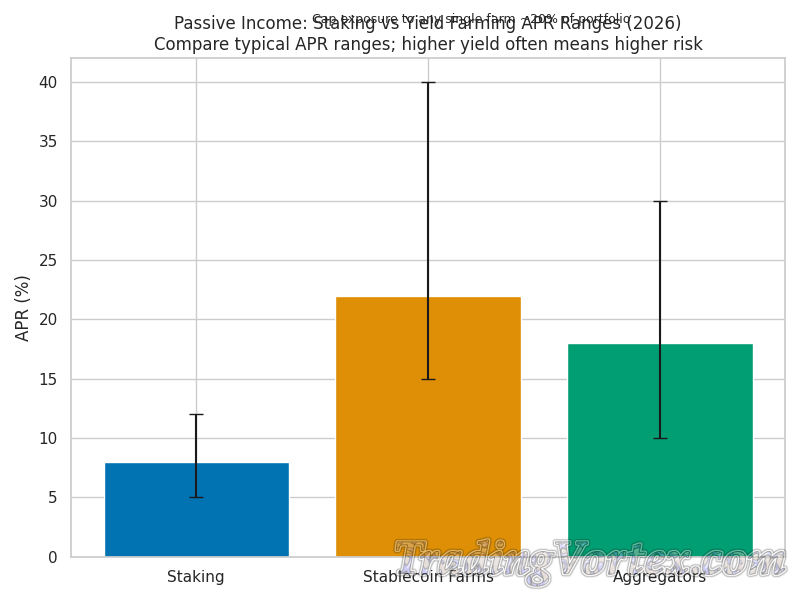 Passive Income: APR Ranges and Risk Tradeoffs: A bar chart with error bars comparing median APRs and realistic ranges for staking, stablecoin farms, and aggregator strategies.
How to use it: Use the chart to compare expected returns vs. risk. The image includes an annotation recommending to cap exposure to any single farm at ~20% of your portfolio and to prefer farms routed through audited bridges.
The key is discipline. Cap exposure to any single farm at around 20 percent of your portfolio, avoid chasing unsustainable yields, and stick to pools backed by secure bridges. Farming can feel like free money, but it’s really about managing risk while letting your assets work for you.
Participating in DAOs and Governance of Cross-Chain Projects
Cross-chain investing isn’t just about buying tokens and waiting. Many of the leading protocols are governed by DAOs (Decentralized Autonomous Organizations), which means token holders have a say in how the ecosystem evolves. By participating in governance, you can vote on upgrades, funding proposals, and strategic partnerships. This not only gives you influence but often comes with governance rewards or early access to new features.
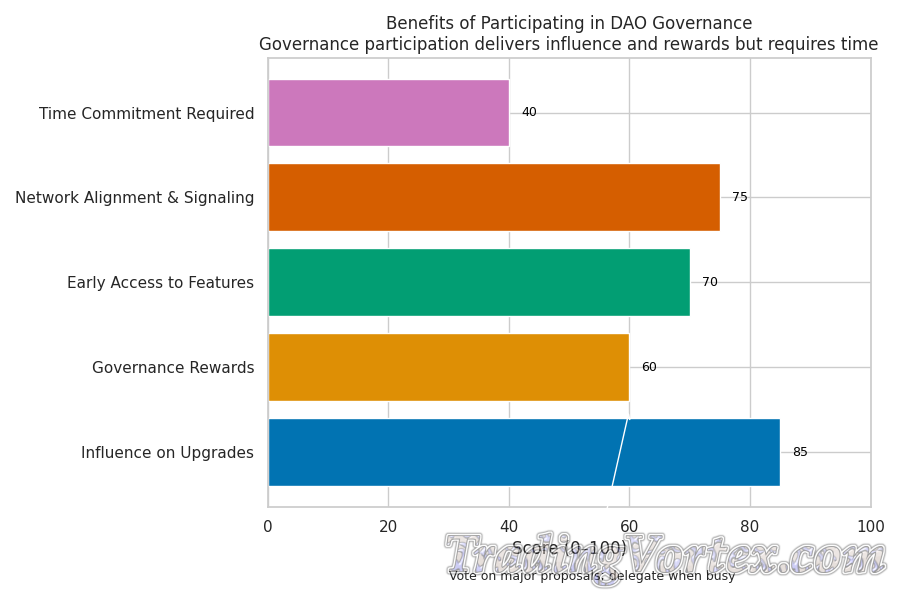 Benefits of Participating in DAO Governance: A horizontal bar chart scoring governance benefits (influence, rewards, early access, signaling) and the time commitment required.
How to use it: Decide whether to vote directly or delegate. The chart clarifies the trade‑off between influence and time, and highlights which governance activities deliver the most strategic value.
Long-Term vs. Short-Term Investment Approaches in Cross-Chain Crypto
Your time horizon matters:
Short-term strategies like arbitrage between chains, rotating into trending narratives, or farming high-yield pools can deliver quick profits, but they demand constant monitoring and a strong stomach for volatility. If you enjoy the thrill of trading and have time to watch markets daily, these tactics can be rewarding.
Long-term strategies, on the other hand, are about conviction. By holding tokens in established cross-chain protocols, staking them, and participating in governance, you’re betting on the future of interoperability. This approach requires patience but benefits from compounding rewards and the gradual adoption of cross-chain infrastructure by institutions and developers. It’s less about chasing the next pump and more about building wealth steadily.
 Strategy Matrix: Time Horizon vs Risk Appetite: A quadrant scatter mapping four archetypal strategies (Conservative Long‑Term, Balanced Medium‑Term, Active Short‑Term, High‑Risk Long‑Term) with recommended actions annotated.
How to use it: Place yourself on the matrix to pick the right mix of ETFs, staking, farming, or startup exposure and follow the annotated action steps.
Bottom line: successful cross-chain investing in 2026 is about balance. Diversify across the stack, earn yield without chasing reckless risk, engage in governance to stay ahead of the curve, and match your strategy to your lifestyle and risk tolerance. The multi-chain highways are open, liquidity is flowing, and the opportunities are real; you just need a plan that fits your style and keeps you grounded.
Sample Portfolio Allocation for Cross-Chain Investing in 2026
Conservative Portfolio (Capital Preservation First)
- 40% Blue-Chip Cross-Chain Tokens: Exposure to established projects like Cosmos (ATOM), Polkadot (DOT), and Chainlink (LINK with CCIP). These are relatively stable compared to newer protocols.
- 30% Infrastructure Protocols: Bridges and messaging layers such as LayerZero, Axelar, and Circle’s CCTP. Focus on audited, widely integrated platforms.
- 20% Staking and Yield Farming (Low-Risk Pools): Stablecoin-based pools across Ethereum, Polygon, or Solana with moderate yields (5–12%).
- 10% Diversified Crypto ETF or Index Fund: Provides passive exposure and institutional-grade custody.
Goal: Steady growth with limited downside. This portfolio prioritizes security and liquidity over chasing high yields.
Balanced Portfolio (Growth with Risk Management)
- 35% Blue-Chip Cross-Chain Tokens: Cosmos, Polkadot, LayerZero, plus exposure to Wormhole or Axelar.
- 25% Infrastructure and Oracles: Chainlink CCIP, Synapse, Stargate, and other bridge protocols.
- 20% Staking and Yield Farming (Mixed Pools): Combination of stablecoin pools and riskier yield farms offering 10–20% APR.
- 10% DAO Governance Participation: Active voting in Cosmos Hub, Polkadot parachains, or Stargate DAO.
- 10% Early-Stage Startups / Venture Exposure: Small allocations to incubated projects experimenting with modular chains or AI-driven liquidity routing.
Goal: Balanced exposure to established tokens and growth opportunities, with moderate yield farming to boost returns.
Aggressive Portfolio (High Risk, High Reward)
- 25% Blue-Chip Cross-Chain Tokens: Still keep a base in ATOM, DOT, and LayerZero for stability.
- 20% Infrastructure Protocols: Bridges and interoperability layers, but with higher exposure to newer entrants.
- 25% Yield Farming and Liquidity Mining: Focus on high-yield pools (20–40% APR) across multiple chains. Accept higher risk of impermanent loss and bridge fees.
- 15% DAO Governance and Active Participation: Heavy involvement in governance to capture rewards and influence protocol direction.
- 15% Early-Stage Startups / Venture Bets: Angel-style allocations into bleeding-edge projects. High risk of failure, but potential for outsized returns.
Goal: Maximize upside by leaning into yield farming and early-stage projects, while keeping a smaller safety net in blue-chip tokens.
- Conservative investors should focus on capital preservation and steady staking rewards.
- Balanced investors can mix blue-chip exposure with moderate yield farming and governance.
- Aggressive investors chase high yields and early-stage bets, but must accept volatility and potential losses.
Best Tools and Platforms for Cross-Chain Crypto Investors
Cross-chain investing is like managing a portfolio across multiple countries with different banks, currencies, and rules. Without the right tools, it’s a logistical nightmare. But with the right setup, it becomes a smooth, even enjoyable experience.
Here’s a curated list of the best wallets, analytics platforms, and trading protocols that make cross-chain investing in 2026 smarter, safer, and more efficient.
Multi-Chain Wallets and Aggregators for Cross-Chain Asset Management
Managing assets across Ethereum, Solana, Cosmos, and newer modular chains used to mean juggling five wallets and praying you didn’t send tokens to the wrong address. Thankfully, 2026 has brought us some serious upgrades.
- Best Wallet: Topping the charts this year, Best Wallet combines a non-custodial wallet with an integrated DEX and aggregator. It supports dozens of chains, offers real-time token analytics, and routes trades through the best liquidity pools automatically. It’s like having a DeFi butler in your pocket, always ready to optimize your swaps.
- Rabby Wallet: Built by the DeBank team, Rabby is a browser extension wallet that auto-detects the chain you’re interacting with and switches networks for you. It’s a favorite among DeFi power users for its security-first design and seamless UX, especially when you’re hopping between Ethereum L2s and non-EVM chains.
- Keplr and Leap Wallet: For Cosmos ecosystem fans, these wallets offer native staking, IBC transfers, and governance participation across the Interchain. They’re essential if you’re active in ATOM, Osmosis, or Neutron, and they make participating in governance proposals as easy as clicking a button.
- Zapper and Zerion (Aggregators): These platforms act as portfolio dashboards, pulling in balances across wallets and chains. They’re perfect for investors who want a bird’s-eye view of their holdings without manually checking each chain.
Analytics Tools for Cross-Chain Crypto Research
Before you invest, you need to know where the money’s flowing, which protocols are gaining traction, and what the devs are building. These tools help you cut through the noise.
- DeFiLlama: The gold standard for tracking TVL across chains and protocols. It now includes bridge analytics, yield dashboards, and even a “narratives” tracker to spot emerging trends. If you want to see whether liquidity is leaving Ethereum for Solana or flowing into Cosmos, this is your go-to.
- Token Terminal: Think of it as the Bloomberg Terminal for crypto. It offers deep dives into protocol revenues, user growth, and developer activity. Great for comparing fundamentals across cross-chain projects and spotting which ones are actually generating income.
- Artemis: A rising analytics platform that focuses on developer activity and ecosystem health. It’s especially useful for tracking how active teams are across GitHub and whether projects are shipping updates.
- Dune Analytics: For custom dashboards and SQL-based queries, Dune lets you build or explore community-driven analytics across Ethereum, Solana, and beyond. If you’re the type who likes to dig into raw data, Dune is your playground.
Cross-Chain DEXs and Liquidity Protocols for Seamless Trading
Trading across chains used to feel like solving a Rubik’s cube blindfolded. Now, with the rise of cross-chain DEXs and aggregators, it’s more like using Google Flights: fast, optimized, and surprisingly smooth.
- Rango Exchange: A top-tier cross-chain DEX and aggregator, Rango supports swaps across EVM and non-EVM chains, including Cosmos and Solana. It’s ideal for routing complex trades with minimal slippage, and it has become a favorite among arbitrage traders.
- 1inch and OpenOcean: These multi-chain DEX aggregators scan dozens of liquidity sources to find the best price. 1inch dominates Ethereum and L2s, while OpenOcean shines across BNB Chain, Avalanche, and Fantom. Both are lifesavers when you want the best execution without manually checking every DEX.
- Velora: A rising star in 2026, Velora combines DEX aggregation with bridge routing, making it a one-stop shop for cross-chain swaps. It’s especially popular among mobile-first users who want a simple, app-like experience without sacrificing functionality.
- THORChain: Still relevant in 2026, THORChain enables native asset swaps across chains without wrapped tokens. It’s a powerful option for those who want true cross-chain exposure without relying on synthetic assets.
Final tip: Don’t just pick tools based on hype. Choose based on your strategy. If you’re yield farming across chains, prioritize wallets and DEXs with low fees and fast routing. If you’re a long-term holder, focus on security, staking support, and governance access. The right toolkit makes cross-chain investing not only profitable but also far less stressful.
Comparison Table: Best Tools for Cross-Chain Crypto Investors (2026)
Here’s a clear comparison table that lines up the wallets, analytics platforms, and DEXs we discussed, with features like chain support, fees, and user experience. This way readers can quickly spot which tools fit their investing style.
| Tool / Platform | Category | Chain Support | Fees | User Experience |
|---|---|---|---|---|
| Best Wallet | Multi-chain wallet + aggregator | Supports major EVM chains, Cosmos, Solana | Trading fees routed through integrated DEX, competitive | Mobile-first, intuitive dashboard, auto-routing for swaps |
| Rabby Wallet | Browser extension wallet | Ethereum, L2s, non-EVM chains | No wallet fees, only network gas | Seamless chain auto-detection, strong security focus |
| Keplr / Leap Wallet | Cosmos ecosystem wallets | Cosmos Hub, Osmosis, Neutron, IBC chains | Staking fees vary by validator | Native staking and governance, easy IBC transfers |
| Zapper / Zerion | Portfolio aggregators | Multi-chain portfolio tracking | Free dashboards, trading fees if swapping | Clean UI, great for portfolio overview across wallets |
| DeFiLlama | Analytics | Tracks TVL across 200+ chains | Free | Data-rich dashboards, bridge analytics, yield tracking |
| Token Terminal | Analytics | Multi-chain fundamentals | Subscription for advanced features | Professional-grade insights, revenue and dev activity metrics |
| Artemis | Analytics | Ethereum, Solana, Cosmos, others | Free basic, premium tiers | Focus on developer activity and ecosystem health |
| Dune Analytics | Analytics (custom dashboards) | Ethereum, Solana, Polygon, more | Free community dashboards | Customizable, SQL-based queries, community-driven insights |
| Rango Exchange | Cross-chain DEX aggregator | EVM + non-EVM (Cosmos, Solana) | Swap fees vary, optimized routing | Advanced routing, minimal slippage, great for arbitrage |
| 1inch / OpenOcean | DEX aggregators | Ethereum, L2s, BNB Chain, Avalanche, Fantom | Aggregator fees, network gas | Fast execution, best-price scanning across liquidity pools |
| Velora | Mobile-first cross-chain DEX | EVM chains, expanding to Cosmos | Bridge + swap fees combined | Simple app-like UX, ideal for mobile traders |
| THORChain | Native cross-chain DEX | Bitcoin, Ethereum, Cosmos, others | Liquidity pool fees | True native swaps, no wrapped assets, community-driven |
- If you want simplicity: Best Wallet or Velora are great all-in-one solutions.
- If you’re a DeFi power user: Rabby + Rango give you flexibility and control.
- If you’re a data nerd: Token Terminal and Dune are perfect for deep dives.
- If you’re a Cosmos fan: Keplr or Leap are must-haves for staking and governance.
Real-World Case Studies: Successful Cross-Chain Crypto Investments
How Early Investors Profited from Cosmos, Polkadot, and LayerZero
Back in the early 2020s, betting on interoperability was a bold move. Ethereum was still the king, and most people hadn’t even heard of IBC or parachains. But a few investors saw the writing on the wall: crypto was going multi-chain, and the infrastructure to connect it all would be priceless.
Take Cosmos (ATOM). Investors who staked early and held through the brutal 2022–2023 bear market were rewarded when Interchain Security launched in 2024, allowing smaller chains to lease security from the Cosmos Hub. This innovation transformed Cosmos into the go-to ecosystem for app-specific chains. By 2025, ATOM had become a cornerstone for long-term investors, offering staking yields, governance power, and exposure to a rapidly expanding network of interoperable chains. Those who had the patience to stick with Cosmos through its quieter years saw their conviction pay off handsomely.
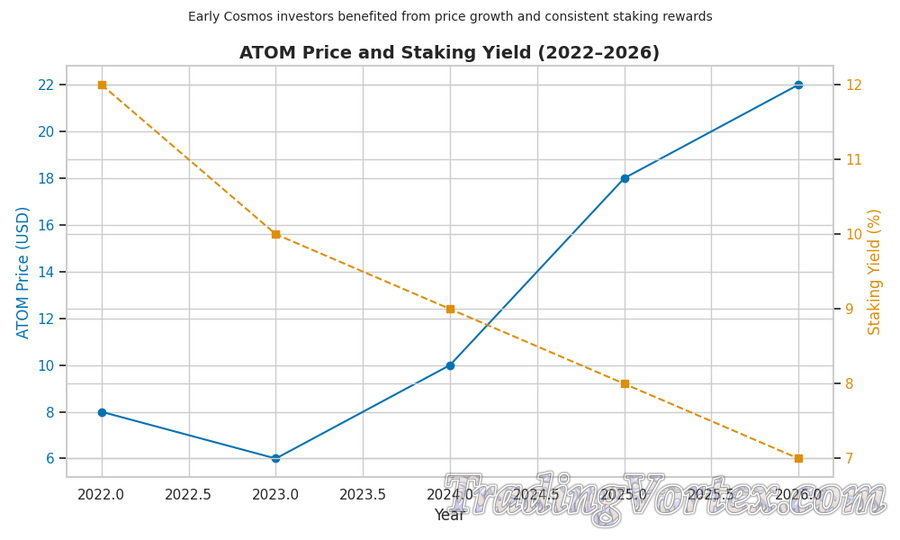 ATOM Price and Staking Yield (2022–2026): This chart shows how Cosmos (ATOM) price rose from $8 to $22 while staking yields gradually declined from 12% to 7%. It highlights the long-term reward of holding and staking ATOM through the bear market and into the Interchain Security boom.
Polkadot (DOT) took a different route. Its price action was more volatile, but early backers who participated in parachain auctions gained exposure to projects like Moonbeam, Astar, and Acala. These parachains delivered strong returns during the 2024–2025 DeFi resurgence, especially as developers flocked to Polkadot’s ecosystem for its scalability and shared security. The key for investors was understanding Polkadot’s slot auction model and backing teams with real traction, rather than chasing hype. Those who did their homework often found themselves holding tokens that appreciated significantly as adoption grew.
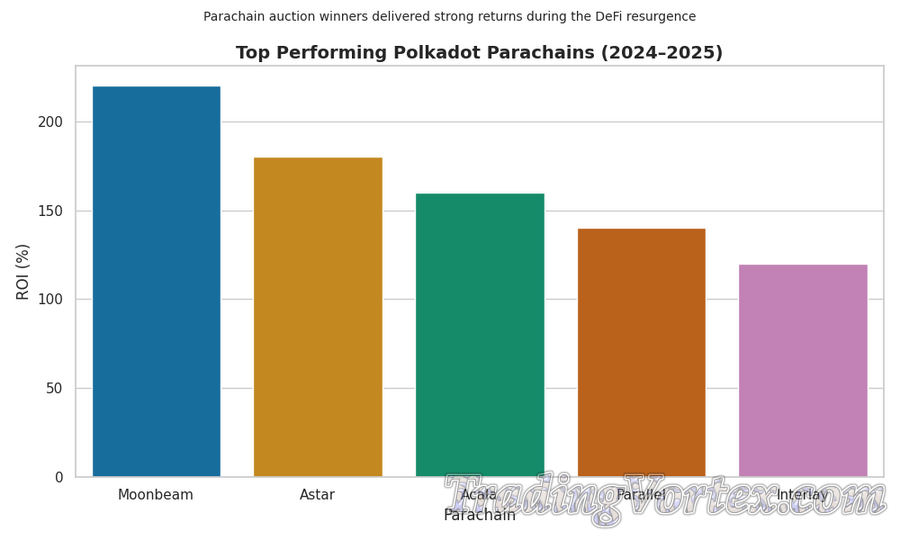 Top Performing Polkadot Parachains (2024–2025): This chart compares ROI across five top-performing parachains: Moonbeam, Astar, Acala, Parallel, and Interlay. It shows how early participation in Polkadot’s slot auctions translated into strong returns during the DeFi resurgence.
Then there’s LayerZero, the rising star of cross-chain messaging. Early investors who participated in its private rounds or supported projects like Stargate Finance (its liquidity layer) saw outsized returns as LayerZero became the backbone for dozens of DeFi protocols. By 2026, it had integrated with over 40 chains, powering everything from NFT transfers to cross-chain lending. For investors, LayerZero represented the classic case of backing infrastructure that quietly became indispensable to the entire ecosystem.
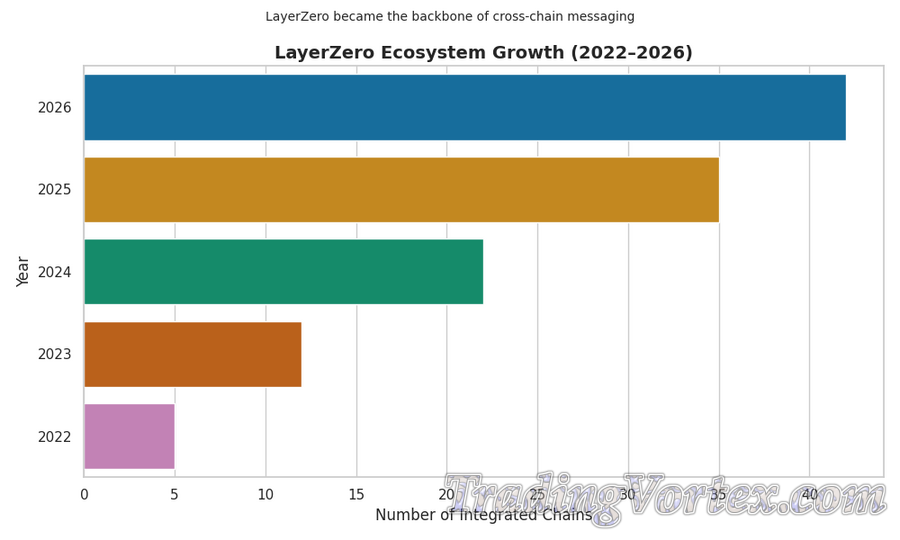 LayerZero Ecosystem Growth (2022–2026): This chart tracks the number of chains integrated with LayerZero from 2022 to 2026, growing from 5 to 42. It visualizes LayerZero’s rapid rise as the backbone of cross-chain messaging and liquidity.
Lessons from Cross-Chain Bridge Failures and Security Breaches
Of course, not every cross-chain story ends in champagne and Lambos. Some end in lawsuits, frozen funds, and hard lessons.
The Wormhole exploit in 2022, where $325 million was drained due to a smart contract vulnerability, was a wake-up call. It highlighted how centralized validator sets and unaudited code could become catastrophic liabilities. Fast forward to 2025, and while Wormhole has rebuilt trust through audits, insurance pools, and partnerships, the scars remain. Investors who ignored early warnings about bridge complexity learned the hard way.
Another cautionary tale: the Ronin Bridge hack, which cost over $600 million, exposed the dangers of relying on minimal validator thresholds and poor key management. These incidents pushed the industry toward modular security models, real-time monitoring tools, and insurance-backed protocols, which are now standard for serious cross-chain platforms.
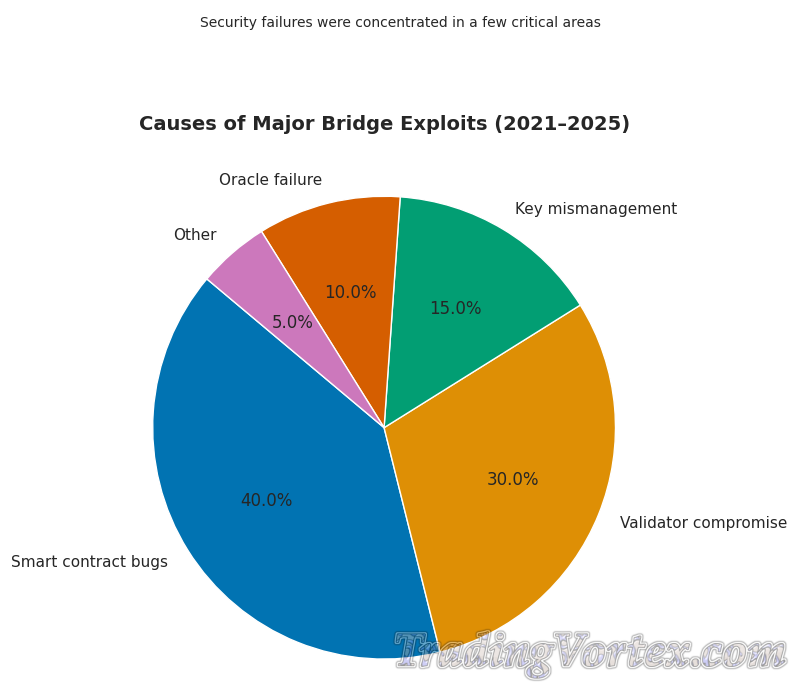 Causes of Major Bridge Exploits (2021–2025): This pie chart breaks down the root causes of major bridge exploits: smart contract bugs (40%), validator compromise (30%), key mismanagement (15%), oracle failure (10%), and other (5%). It reinforces the importance of security diligence.
The takeaway is simple: security is not optional. Investors who brushed off audit reports or assumed “it won’t happen to me” often paid the price. Those who asked tough questions, demanded transparency, and prioritized projects with strong security practices fared far better.
Institutional Investment Strategies in Cross-Chain Crypto Infrastructure
In 2026, institutions are no longer just curious: they’re committed. According to reports from Grayscale and Coinbase Institutional, the shift toward regulated, cross-chain infrastructure is accelerating. Firms like Nomura’s Laser Digital and Hercle have poured millions into platforms offering compliance-ready bridges, tokenized real-world assets (RWAs), and stablecoin interoperability.
These investors aren’t chasing meme coins. They’re backing infrastructure with real-world utility, such as Circle’s Cross-Chain Transfer Protocol (CCTP) and Chainlink’s Cross-Chain Interoperability Protocol (CCIP). Both enable secure, compliant asset movement across chains, which is critical for institutional adoption. Their strategies focus on liquidity depth, regulatory clarity, and enterprise integrations, often favoring projects with strong governance and institutional-grade custody.
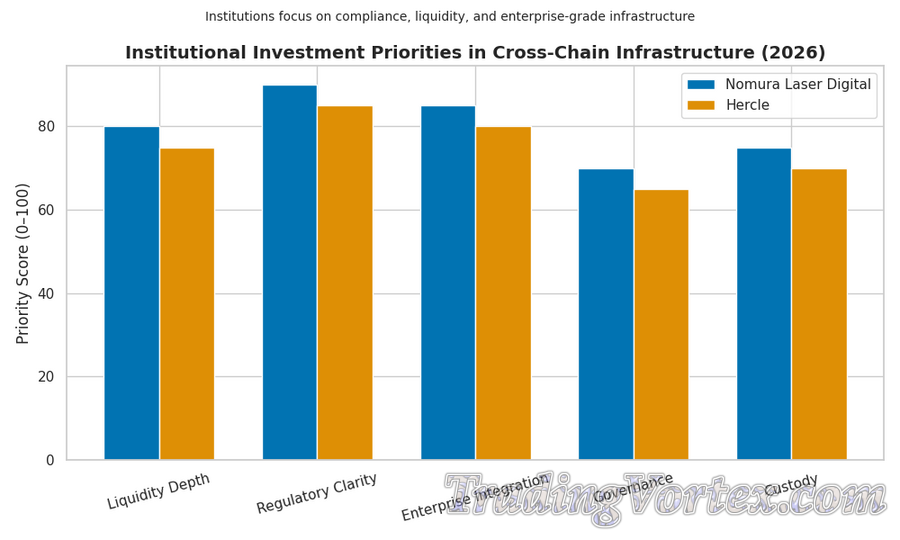 Institutional Investment Priorities in Cross-Chain Infrastructure (2026): This chart compares investment priorities of Nomura’s Laser Digital and Hercle across five categories: liquidity depth, regulatory clarity, enterprise integration, governance, and custody. It shows that institutions are focused on compliance, infrastructure, and long-term viability.
For retail investors, this is a signal worth noting. When the big players start building on a protocol, it’s not just hype: it’s validation. Institutional capital brings stability, deeper liquidity, and long-term vision. In many ways, it’s the missing piece that cross-chain technology needed to go mainstream.
Bottom line: The real-world case studies of cross-chain investing show both sides of the coin. Early conviction in Cosmos, Polkadot, and LayerZero paid off, but ignoring bridge risks led to painful losses. Institutions are now shaping the next phase, focusing on compliance and infrastructure. For investors in 2026, the lesson is clear: combine patience with diligence, and you’ll be better positioned to ride the cross-chain wave without getting swept away.
The Future of Cross-Chain Technology and Crypto Investing
The Road to Seamless Blockchain Interoperability by 2030
Right now, in 2026, cross-chain investing can still feel clunky. You might have to juggle multiple wallets, pay bridge fees, and double-check that your assets actually arrived on the other side. It’s like managing a dozen bank accounts in different countries, each with its own rules. But the industry is racing toward a future where all of that complexity disappears in the background.
By 2030, chain abstraction is expected to become the norm. This means users won’t need to know which chain they’re interacting with. You’ll sign one transaction, and the system will automatically route it across multiple chains, tapping into the best liquidity and lowest fees. Imagine sending money or trading assets without even thinking about whether it’s on Ethereum, Solana, or Cosmos: the infrastructure will handle it invisibly.
Projects like LayerZero, Axelar, and Cosmos Interchain Accounts are already laying the groundwork. Circle’s Cross-Chain Transfer Protocol (CCTP) is making stablecoin transfers chain-agnostic, while Chainlink’s Cross-Chain Interoperability Protocol (CCIP) is enabling secure communication between smart contracts across networks. Together, these innovations are building the foundation for a frictionless, multi-chain financial system that feels as natural as using the internet today.
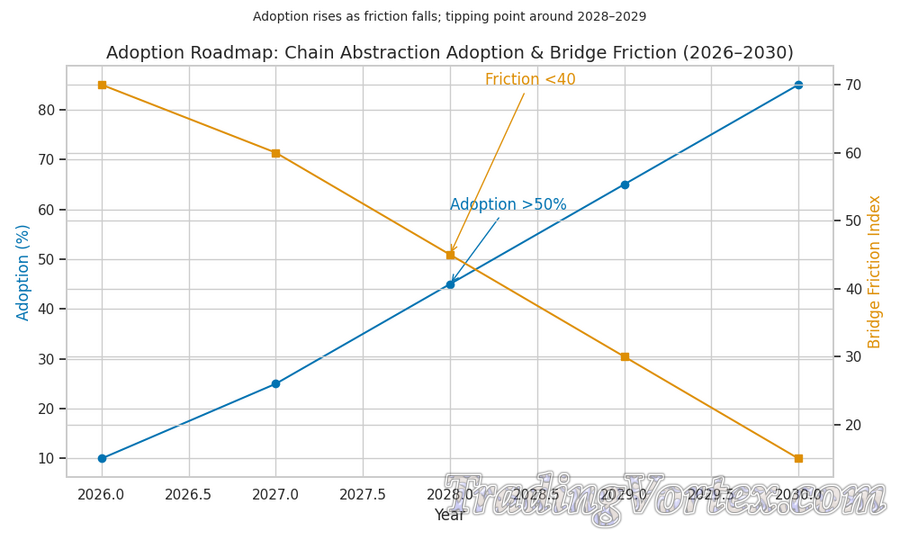 Adoption Roadmap: Chain Abstraction Adoption & Bridge Friction (2026–2030): Two lines — chain abstraction adoption (%) rising from low to high and bridge friction index falling — highlighting the tipping point around 2028–2029.
How to use it: Call out the year adoption crosses 50% and use that as a planning horizon for shifting allocations from tactical yield to infrastructure exposure.
Emerging Innovations: AI, ZK-Proofs, and Modular Cross-Chain Networks
The next wave of cross-chain technology isn’t just about better bridges: it’s about smarter, faster, and more secure infrastructure. Three innovations stand out:
- AI Agents: Automated trading bots are already scanning dozens of chains in real time, optimizing liquidity and executing complex strategies faster than any human could. By 2026, AI-driven agents are orchestrating cross-chain trades, managing MEV (miner extractable value) risks, and even reallocating liquidity across modular networks. For investors, this means access to automated alpha, but it also requires understanding how these bots operate and where they’re deployed.
- Zero-Knowledge Proofs (ZKPs): Advances in ZK technology have reduced computational overhead dramatically, making real-time verification possible even on consumer-grade hardware. ZKPs allow transactions to be verified across chains without revealing sensitive data, which is a game-changer for bridge security. This could finally close the door on many of the exploits that plagued cross-chain platforms in earlier years.
- Modular Blockchain Architectures: Instead of building monolithic chains that try to do everything, developers are now creating modular systems where execution, consensus, and data availability are handled by specialized layers. This makes it easier to plug into cross-chain networks and scale horizontally. Projects like Celestia, Polygon CDK, and Dymension are leading this charge, offering flexible building blocks for the next generation of interoperable applications.
 Innovation Maturity: AI, ZKPs, and Modular Architectures (2026 vs 2030): Side‑by‑side maturity polygons for 2026 and 2030 across AI orchestration, ZK verification, modular architecture, messaging, and compliance tooling.
How to use it: Prioritize investments in areas with large projected maturity gains (AI, ZKPs, compliance) while monitoring near‑term leaders (messaging).
Expert Predictions for Cross-Chain Crypto Growth in the Next 5 Years
Analysts and builders are remarkably aligned on where things are headed:
- Interoperability will become a baseline expectation, not a selling point. Just as Wi-Fi replaced dial-up, seamless connectivity will replace siloed chains.
- Cross-chain liquidity will rival centralized exchanges, as decentralized platforms become smarter, more capital-efficient, and easier to use.
- Institutions will demand compliance-ready cross-chain rails, especially for tokenized real-world assets and stablecoins. Expect more partnerships between DeFi protocols and traditional finance giants.
- User experience will be radically simplified, with wallets and apps abstracting away chain selection, gas fees, and bridging steps. Investors will interact with crypto as easily as they use mobile banking today.
 Market Opportunity Shift (2026 - 2030): Estimated opportunity share for Infrastructure, AI liquidity, Compliance rails, and UX in 2026 vs 2030 — AI and compliance show the largest growth.
How to use it: Use the bars to justify overweighting AI liquidity layers and compliance‑ready platforms in a 2026–2030 allocation.
For investors, this means the most promising opportunities lie in infrastructure protocols, AI-powered liquidity layers, and compliant cross-chain platforms that can scale with institutional demand. The projects building the rails of this new financial internet are likely to be the ones that deliver the biggest returns.
The future of cross-chain technology isn’t just about connecting blockchains. It’s about building a new kind of internet: one where value, data, and identity move freely, securely, and instantly.
For investors, the lesson is clear: think long-term, focus on infrastructure, and look for projects solving real problems rather than chasing hype. Those who position themselves now will be the ones leading the charge when seamless interoperability becomes the default by 2030.
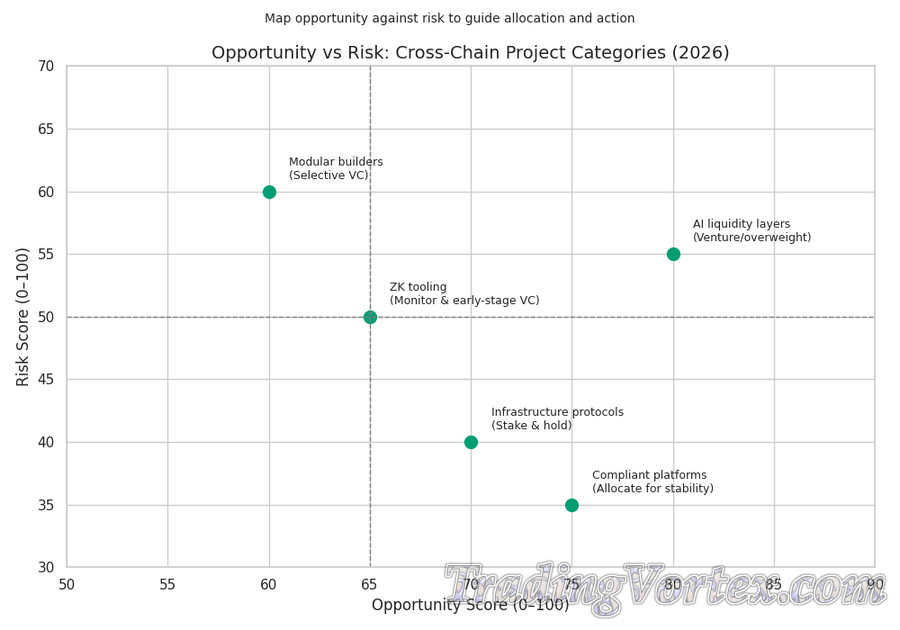 Opportunity vs Risk: Cross‑Chain Project Categories (2026): Project categories plotted by Opportunity and Risk with recommended actions (e.g., Stake & hold; Venture/overweight; Monitor & VC).
How to use it: Map your personal risk tolerance to the matrix and follow the annotated action for each category.
Cross-Chain Technology Timeline (2026–2030)
Here’s a sketched timeline of milestones from 2026 to 2030 that shows how cross-chain innovations are expected to unfold. Think of it as a roadmap for where interoperability, AI, and modular blockchain design are heading, and how investors can anticipate the shifts.
2026: Consolidation and Security First
- Major bridges like LayerZero, Axelar, and Wormhole expand integrations across 40+ chains.
- Zero-knowledge proof (ZKP) verification begins rolling out in production bridges, reducing exploit risks.
- Institutions start using Circle’s Cross-Chain Transfer Protocol (CCTP) and Chainlink’s CCIP for stablecoin and data transfers.
- Retail investors gain access to multi-chain wallets with auto-routing, making cross-chain swaps less intimidating.
2027: Chain Abstraction Becomes Real
- Wallets and apps begin abstracting away chain selection. Users interact with crypto without worrying about which chain they’re on.
- AI-driven liquidity routing tools gain traction, automatically moving assets to the most efficient pools.
- Modular blockchain frameworks like Celestia and Polygon CDK see widespread adoption, powering app-specific chains that plug seamlessly into cross-chain networks.
- Institutional pilots for tokenized real-world assets (RWAs) expand, with cross-chain rails enabling compliance-ready transfers.
2028: Institutional Scale and RWAs Go Mainstream
- Tokenized treasuries, real estate, and carbon credits trade across multiple chains with regulatory approval.
- Cross-chain liquidity rivals centralized exchanges, with decentralized platforms offering near-instant settlement.
- Insurance-backed bridges become standard, reducing investor fear of catastrophic exploits.
- DAOs evolve into cross-chain governance bodies, coordinating upgrades across ecosystems.
2029: AI and ZK Infrastructure Mature
- AI agents manage portfolios across chains, executing trades, hedging risks, and reallocating liquidity in real time.
- ZK-proofs enable privacy-preserving cross-chain transactions, unlocking institutional adoption for sensitive financial flows.
- Cross-chain DeFi protocols integrate RWAs with crypto-native assets, creating hybrid portfolios accessible to both retail and institutional investors.
- Regulatory frameworks in the US, EU, and Asia converge on interoperability standards, reducing compliance uncertainty.
2030: Seamless Interoperability Becomes the Default
- Chain abstraction reaches full maturity: users no longer know or care which chain they’re on.
- Cross-chain rails power global financial infrastructure, connecting banks, fintechs, and DeFi seamlessly.
- Liquidity fragmentation disappears as unified liquidity layers span multiple ecosystems.
- Crypto investing feels as simple as mobile banking, with cross-chain technology invisible in the background.
Bottom line: Between 2026 and 2030, cross-chain technology evolves from patchwork bridges into invisible infrastructure. Security and compliance dominate the early years, chain abstraction and modular networks reshape the middle, and by 2030, interoperability is simply assumed.
Conclusion: Key takeaways for investing in cross-chain technology
Cross-chain investing in 2026 is no longer niche, it’s a core play for anyone who wants both growth and resilience. Institutional interest is rising, compliance rails are maturing, and AI-powered tooling is making multi-chain strategies more practical. That combination is expanding adoption and bringing public blockchains closer to mainstream financial infrastructure, which matters for liquidity, stability, and long-term return potential.
At the same time, broader tech trends emphasize AI-native systems, privacy-preserving computation, and preemptive security, all of which directly benefit cross-chain performance and risk management.
Summary of the best ways to invest in cross-chain crypto in 2026
- Diversify across the stack: Hold exposure to backbone networks and messaging layers, then add select bridges and oracles. This spreads risk across the parts that actually move assets and data, while positioning you for institutional-scale adoption.
- Pursue disciplined yield: Earn staking rewards on established networks, and add carefully selected cross-chain yield strategies. Favor audited protocols and transparent routing, especially as bridges evolve toward stronger security and standardized transfers.
- Lean into compliance-ready infrastructure: When institutions adopt regulated cross-chain rails, capital and credibility follow. Prioritize projects building reliable interop, data integrity, and standardized movement of assets across chains, since these align directly with the needs of advised wealth and enterprise users.
- Use AI and analytics to stay ahead: The broader technology landscape is tilting toward AI-native development and multiagent orchestration. Pair that with high-quality crypto analytics to track TVL, fundamentals, and developer traction, so you’re not flying blind as liquidity shifts across chains.
Final thoughts: navigating the future of cross-chain blockchain investing
My honest advice: stay curious and pragmatic. Build a portfolio that mixes blue-chip interoperability tokens with proven infrastructure, add measured yield, and engage in governance where it counts. Keep one eye on institutional signals, the other on developer momentum. If you invest with a plan, size your positions wisely, and adapt as standards and tooling improve, you’ll be ready for a multi-chain world where seamless interoperability feels as normal as mobile banking.
FAQs: Best Ways to Invest in Cross-Chain Technology
Here’s a lively, up-to-date FAQ section that answers the most common questions investors have about cross-chain crypto investing in 2026. It’s designed to be clear, honest, and helpful; whether you’re just getting started or already knee-deep in DeFi.
Q1. What is cross-chain technology, and why should I care as an investor?
Cross-chain technology allows different blockchains to talk to each other. Think of it like building bridges between islands that used to be isolated. For investors, this means access to more liquidity, better yield opportunities, and diversified exposure across ecosystems like Ethereum, Solana, Cosmos, and beyond. In 2026, cross-chain infrastructure is becoming the backbone of crypto’s next growth phase.
Q2. Is cross-chain investing safe in 2026?
It’s safer than it was a few years ago, but not risk-free. Bridge exploits were a major issue in 2022–2023, but since then, protocols like LayerZero, Axelar, and Wormhole have beefed up security with modular architectures, zero-knowledge proofs, and insurance coverage. Still, always check for audit reports, bug bounties, and transparent validator models before committing capital.
Q3. What are the best cross-chain tokens to watch right now?
Some of the most widely held and actively used tokens in the cross-chain space include:
♦ ATOM (Cosmos): Powers the Interchain and secures app-specific chains.
♦ DOT (Polkadot): Supports parachain auctions and shared security.
♦ ZRO (LayerZero): A rising star in cross-chain messaging and liquidity routing.
♦ AXL (Axelar): Focused on secure cross-chain communication and developer tooling.
♦ LINK (Chainlink): With CCIP, it’s becoming a key player in cross-chain data and automation.
Q4. How do I earn passive income from cross-chain platforms?
You can stake tokens like ATOM, DOT, or AXL to earn rewards while supporting network security. For more active strategies, cross-chain yield farming on platforms like Stargate, Pendle, or Beefy Finance can offer double-digit APRs, especially on stablecoin pairs. Just be mindful of impermanent loss, bridge fees, and smart contract risk.
Q5. What tools should I use to manage cross-chain investments?
Here’s a quick toolkit:
♦ Wallets: Best Wallet, Rabby, Keplr (for Cosmos), and Leap.
♦ Analytics: DeFiLlama (TVL), Token Terminal (protocol revenue), and Dune (custom dashboards).
♦ DEXs: Rango, 1inch, and THORChain for seamless cross-chain swaps.
These tools help you track assets, analyze trends, and execute trades across multiple chains without losing your mind.
Q6. Are there any regulations I should be aware of?
Yes, and they’re evolving fast. In 2026, regulatory clarity is improving, especially in the US, EU, and Asia. Projects that support KYC, compliance-ready bridges, and tokenized real-world assets are gaining favor with institutions. As a retail investor, it’s smart to stay informed about local laws and favor projects that are transparent about their legal posture.
Q7. What’s the biggest mistake new cross-chain investors make?
Chasing high yields without understanding the risks. Just because a pool offers 40% APR doesn’t mean it’s safe. Always ask: Is the bridge secure? Is the protocol audited? Is the liquidity real? And never invest more than you’re willing to lose. Cross-chain investing is powerful, but it rewards patience, not recklessness.
Q8. Is cross-chain investing only for advanced users?
Not anymore. Thanks to chain abstraction and better UX, many platforms now handle the complexity behind the scenes. Wallets auto-switch networks, DEXs route trades across chains, and dashboards aggregate your portfolio. If you can use a smartphone and read a yield chart, you’re already halfway there.