

Learn how to build a balanced and resilient crypto portfolio in 2025 with this comprehensive guide to diversification. The article explains the role of core asset classes such as large-cap coins like Bitcoin, Ethereum, and Solana, mid-cap altcoins including Cardano, Polkadot, and Avalanche, stablecoins for liquidity and hedging, DeFi tokens for passive income, NFTs and metaverse assets for cultural exposure, and tokenized real-world assets for stability and yield.
You will discover practical strategies for allocating across market caps, geographic regions, and income-generating opportunities such as staking, lending, and liquidity pools. The guide also highlights future trends: institutional ETFs, global regulation, and AI-driven portfolio automation.
Packed with expert insights, case studies, and actionable checklists, this article is written in clear and engaging language, making complex financial concepts accessible to beginners and valuable to experienced traders. Whether you are starting your crypto journey or refining an advanced strategy, this resource provides the tools to diversify effectively, reduce risk, and capture growth in the evolving digital asset market.
Table of Contents:
- Introduction: Why Crypto Portfolio Diversification Is Essential
- What Is Crypto Portfolio Diversification?
- Latest Crypto Diversification Trends in 2025
- Beyond Bitcoin & Ethereum: growth of altcoins in diversified crypto portfolios
- Layer-2 scaling solutions (Polygon, Arbitrum, Optimism) for portfolio diversification
- DeFi tokens and yield farming as diversification strategies
- Tokenized real-world assets (RWA) in crypto investing
- Stablecoins as safe-haven assets for portfolio risk management
- Crypto ETFs and index funds for easy diversification
- Additional Trend: AI-powered portfolio automation
- Core Asset Classes for a Diversified Crypto Portfolio
- Large-cap cryptocurrencies (Bitcoin, Ethereum, Solana)
- Mid-cap and emerging altcoins (Avalanche, Cardano, Polkadot)
- Stablecoins (USDT, USDC, DAI) for liquidity and hedging
- DeFi tokens (Uniswap, Aave, Curve) for passive income
- NFTs and metaverse assets in crypto investing
- RWAs and AI-powered tokens as diversification opportunities
- Smart Strategies for Crypto Portfolio Diversification
- Balancing blue-chip cryptocurrencies vs. high-growth altcoins
- Allocating across market caps (large-cap, mid-cap, small-cap crypto assets)
- Geographic and regulatory diversification in crypto investing
- Using staking, lending, and liquidity pools for diversified income streams
- Leveraging crypto ETFs and managed funds for simplified diversification
- Risks and Challenges in Crypto Portfolio Diversification
- Step-by-Step Guide to Building a Diversified Crypto Portfolio
- Expert Insights and Case Studies on Crypto Diversification
- Future Outlook for Crypto Portfolio Diversification
- Conclusion: Crypto Diversification Checklist for Investors
- FAQs: How to Diversify Your Crypto Portfolio
- Q1. Why is diversification so important in crypto?
- Q2. How many coins should I hold to be “diversified”?
- Q3. Are stablecoins really safe to hold?
- Q4. Should I include NFTs or metaverse assets in my portfolio?
- Q5. How often should I rebalance my portfolio?
- Q6. What role do tokenized real-world assets (RWAs) play?
- Q7. Can beginners use ETFs or managed funds instead of picking coins?
- Q8. What is the biggest mistake people make when diversifying?
Introduction: Why Crypto Portfolio Diversification Is Essential
Crypto investing can feel like riding a wave that never stops moving. One moment your holdings are soaring, the next they are dipping so fast you wonder if the floor has disappeared. Diversification is the strategy that helps you stay balanced through those swings. It is not about eliminating risk completely, but about spreading it across different assets so that one downturn does not wipe out your entire portfolio.
The importance of diversification in crypto investing
In 2025, diversification has become the number one reason investors enter the crypto market. Surveys show that more than half of participants now prioritize spreading their investments across multiple assets instead of betting everything on a single coin. This marks a shift in mindset.
For years, the dominant play was to go all-in on Bitcoin or Ethereum, hoping to catch the next bull run. Today, investors are more pragmatic: they want portfolios that can survive downturns, not just thrive in rallies.
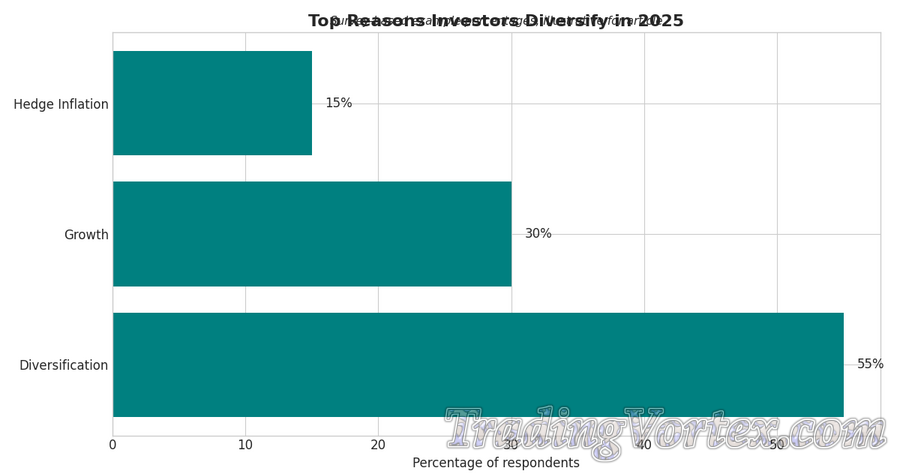 Top Reasons Investors Diversify in 2025: This horizontal bar chart shows illustrative survey-style data: 55 percent of investors prioritize diversification, 30 percent chase growth, and 15 percent hedge inflation. It highlights the mindset shift toward risk management in 2025.
Think of diversification like building a balanced diet. If you only eat one food, you miss out on essential nutrients. In the same way, if you only hold one coin, you miss out on opportunities and expose yourself to unnecessary risk. A mix of large-cap cryptocurrencies, stablecoins, DeFi tokens, and even tokenized real-world assets creates a healthier portfolio that can adapt to changing market conditions.
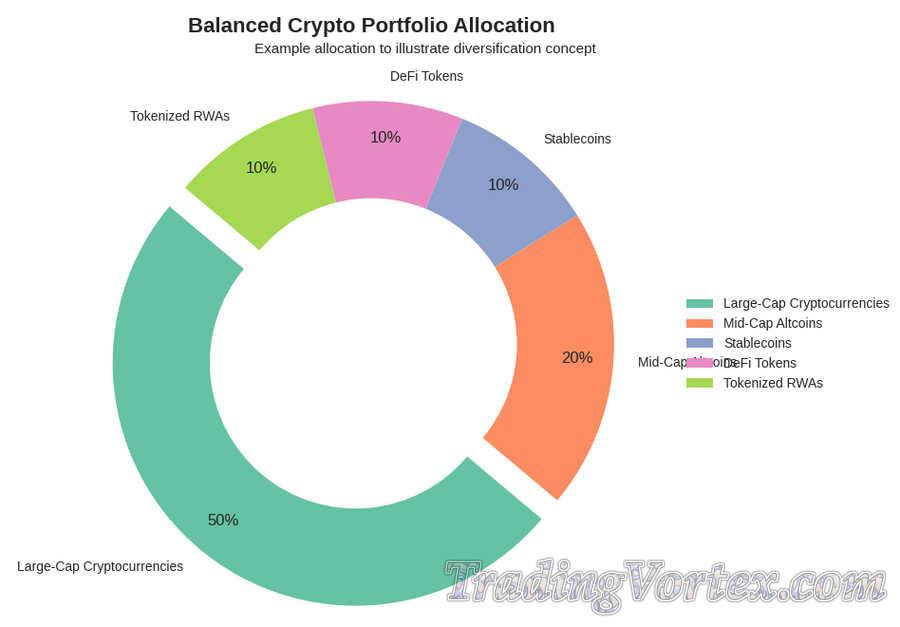 Balanced Crypto Portfolio Allocation: This donut-style pie chart illustrates a sample allocation: 50 percent large-cap cryptocurrencies, 20 percent mid-cap altcoins, 10 percent stablecoins, 10 percent DeFi tokens, and 10 percent tokenized RWAs. It turns the “balanced diet” analogy into a concrete model.
How diversification reduces risk and improves long-term portfolio performance
Diversification works because crypto assets do not all move in the same direction at the same time.
- Bitcoin is increasingly seen as a hedge against inflation and global uncertainty.
- Altcoins such as Solana or Cardano tend to shine when innovation and adoption are accelerating.
- Stablecoins provide liquidity and act as a buffer during volatile periods.
- DeFi tokens can generate passive income through staking or lending.
- Tokenized real-world assets are emerging as a way to tie crypto portfolios to tangible value, offering another layer of stability.
By combining these different categories, you reduce the chance that one bad bet will sink your entire portfolio. Instead, gains in one area can offset losses in another, creating smoother performance over time. This is the difference between gambling on one horse and owning a stable of contenders.
Here is a quick story: back in 2021, a friend of mine went all-in on a meme coin. For a few weeks, he was the life of the party, bragging about his gains. Then the market corrected, and his portfolio collapsed. If he had spread his investments across different sectors, he would have lost less money and, more importantly, less confidence. Diversification is not just about protecting your wallet, it is about protecting your peace of mind.
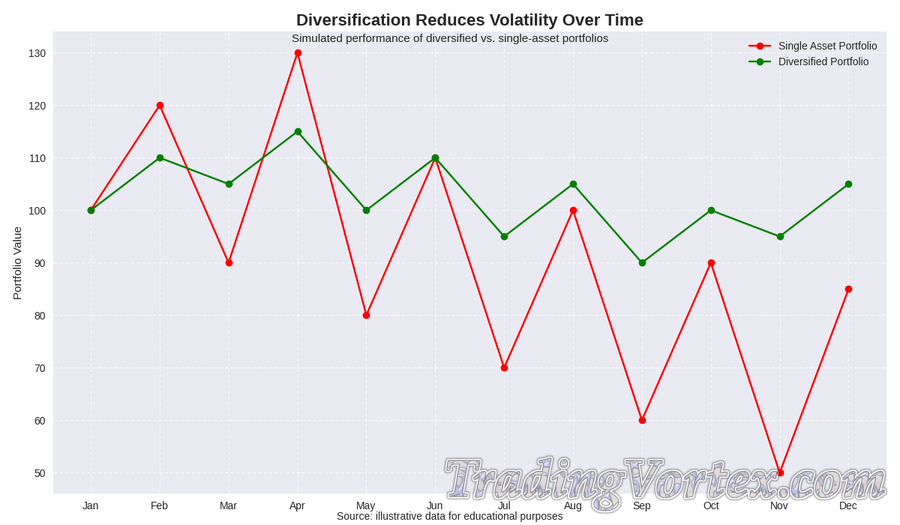 Diversification Reduces Volatility Over Time: This line chart compares a single-asset portfolio with a diversified portfolio over 12 months. The diversified portfolio shows smoother performance with smaller drawdowns, reinforcing the idea that diversification cushions volatility.
Quick Checklist: How to Start Diversifying Your Crypto Portfolio
- Define your goals: Decide if you are investing for short-term gains, long-term growth, or passive income.
- Know your risk tolerance: Be honest about how much volatility you can handle without losing sleep.
- Mix asset types: Hold a blend of large-cap coins (Bitcoin, Ethereum), mid-cap altcoins, stablecoins, and emerging sectors like DeFi or tokenized assets.
- Add stability with stablecoins: Keep a portion in USDT, USDC, or DAI to protect against sudden drops.
- Explore income-generating options: Use staking, lending, or liquidity pools to earn yield while holding.
- Stay updated on trends: Watch for new opportunities in Layer-2 solutions, RWAs, and ETFs.
- Use tracking tools: Monitor your portfolio with apps that show performance, allocations, and risk exposure.
- Rebalance regularly: Adjust your holdings during bull and bear markets to keep your strategy aligned with your goals.
- Avoid over-diversification: More coins are not always better. Focus on quality projects instead of chasing every new token.
This checklist acts like a starter roadmap for investors, giving them immediate, actionable steps to apply the principles of diversification without feeling overwhelmed.
What Is Crypto Portfolio Diversification?
A simple definition of crypto diversification for beginners
In the same way, diversification adds balance and flavor to your portfolio. You might hold Bitcoin and Ethereum as your foundation, then add mid-cap altcoins, stablecoins for safety, DeFi tokens for yield, and even tokenized real-world assets for exposure to things like real estate or commodities. The idea is simple: do not let one coin decide your financial future.
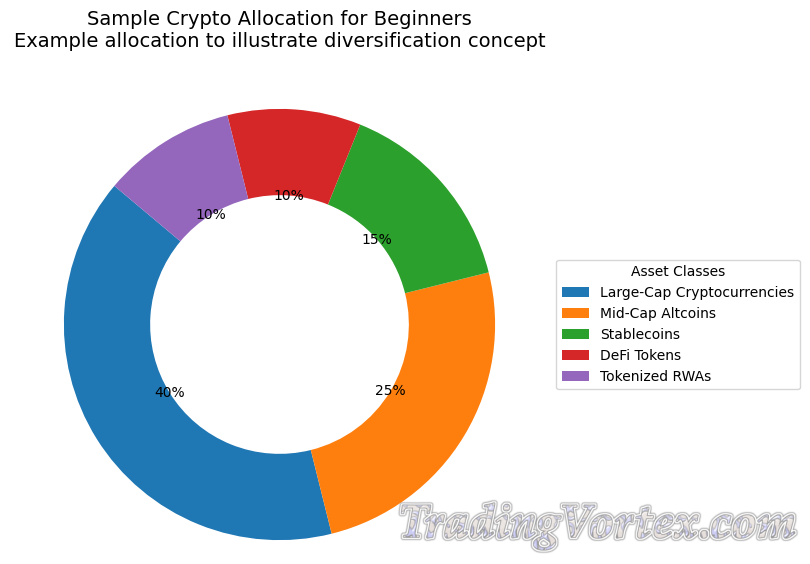 Sample Crypto Allocation for Beginners: This donut-style pie chart shows a beginner-friendly allocation: 40% large-cap cryptocurrencies, 25% mid-cap altcoins, 15% stablecoins, 10% DeFi tokens, and 10% tokenized RWAs. It visually reinforces the cooking analogy by showing how different “ingredients” combine to create balance.
Benefits of diversification: risk management, stability, and wealth building
Diversification is not just a buzzword, it is a survival strategy in crypto investing. Here are the core benefits:
- Risk management: By spreading your investments, you reduce the chance that one project failure or market crash wipes out your portfolio.
- Stability: A diversified portfolio experiences fewer extreme swings, which helps you stay calm and avoid panic selling.
- Wealth building: Over time, diversification allows you to capture growth from multiple sectors, whether it is Bitcoin acting as a hedge, DeFi tokens generating yield, or emerging altcoins riding adoption waves.
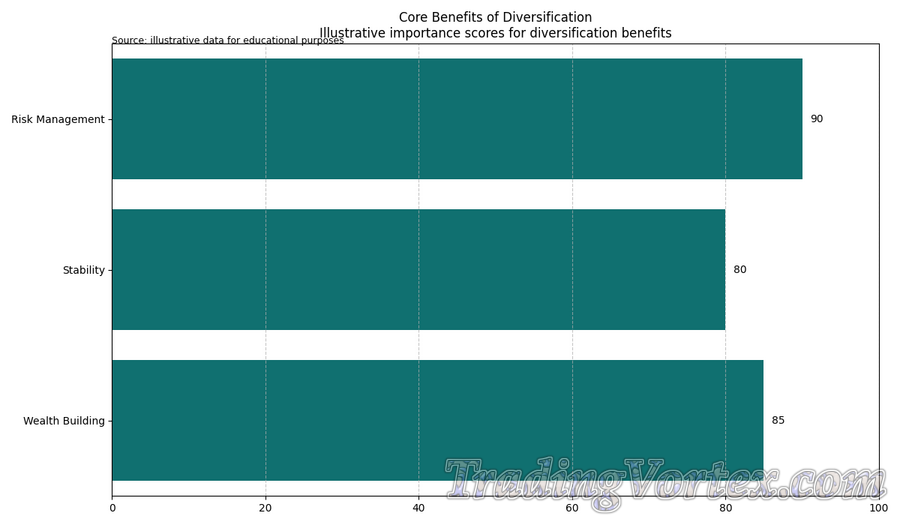 Core Benefits of Diversification: This horizontal bar chart illustrates the importance of risk management, stability, and wealth building, with illustrative scores (90, 80, 85). It makes the benefits visually memorable and easy to compare.
To put it simply, diversification is like shock absorbers on a car. You still feel the bumps, but the ride becomes smoother and more manageable.
Difference between traditional investing diversification and crypto portfolio diversification
The principle of diversification is the same in both worlds: do not put all your eggs in one basket. However, the baskets look very different.
Traditional diversification: Investors typically balance stocks, bonds, real estate, and commodities. These asset classes have decades of data showing how they interact, and correlations are relatively stable.
Crypto diversification: Here, the landscape is younger and more unpredictable. Assets can be highly correlated during market crashes, liquidity varies dramatically, and regulatory changes can shift risk overnight. Instead of mixing stocks and bonds, crypto investors diversify across categories like large-cap coins, altcoins, stablecoins, DeFi tokens, NFTs, and tokenized assets. They also consider factors like protocol type, market cap, yield opportunities, and even geographic regulation.
Crypto diversification also introduces unique risks that traditional markets do not face, such as smart contract vulnerabilities, governance failures, or sudden exchange collapses. This means investors need to be more proactive and adaptive when building their portfolios.
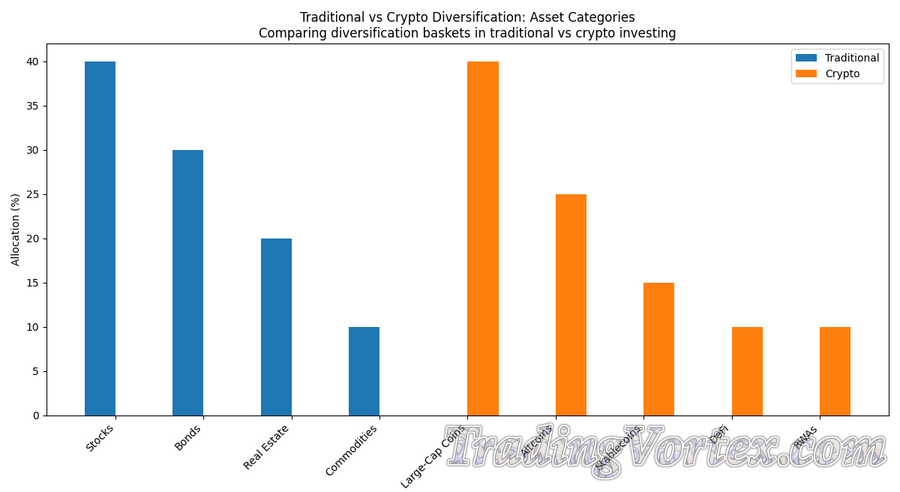 Traditional vs Crypto Diversification: Asset Categories: This grouped bar chart compares traditional baskets (stocks, bonds, real estate, commodities) with crypto baskets (large-cap coins, altcoins, stablecoins, DeFi, RWAs). It highlights how diversification principles are similar but the categories differ dramatically.
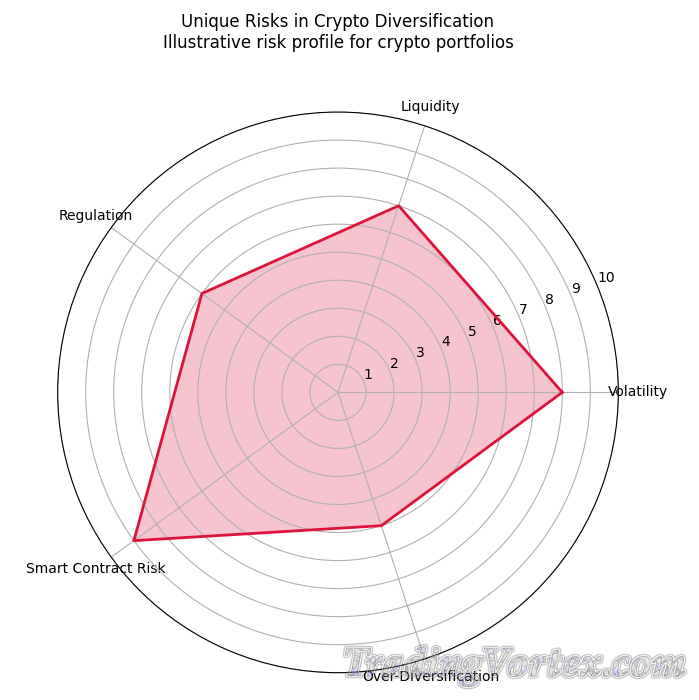 Unique Risks in Crypto Diversification: This radar chart maps out volatility, liquidity, regulation, smart contract risk, and over-diversification on a 1–10 scale. It shows readers that crypto diversification introduces unique risks beyond traditional investing.
A quick reality check
Diversification is powerful, but it is not magic. It will not guarantee profits, and over-diversifying into dozens of low-quality projects can dilute returns. The goal is intentional diversification: choose assets with clear roles in your portfolio, set allocation limits, and avoid chasing every new token that trends on social media.
I once knew someone who thought owning ten meme coins was “diversified.” When the hype cycle ended, nine went to zero, and the tenth barely survived. Diversification is not about quantity, it is about quality and balance.
Why this matters for every investor:
Whether you are a beginner buying your first Bitcoin or an experienced trader managing a complex portfolio, diversification is the bridge between speculation and strategy. It gives you peace of mind, helps you stay invested longer, and increases your chances of building sustainable wealth in a market that never sleeps.
Latest Crypto Diversification Trends in 2025
Crypto investing in 2025 is no longer about chasing one coin to the moon. Investors are building portfolios that balance growth, stability, and yield across multiple sectors. Diversification has become the strategy that separates short-term speculators from long-term wealth builders.
Beyond Bitcoin & Ethereum: growth of altcoins in diversified crypto portfolios
- Altcoins gaining traction: Solana, Cardano, and Polkadot are attracting institutional interest and retail adoption. Their ecosystems are maturing, with stronger developer activity and real-world use cases.
- Innovation drivers: Smart contracts, cross-border payments, and decentralized applications are fueling altcoin growth. These projects are often more agile than Bitcoin or Ethereum, experimenting with faster consensus mechanisms and unique governance models.
- Investor takeaway: Altcoins are no longer “side bets,” they are essential for exposure to innovation. Holding a mix of established and emerging altcoins gives investors access to new narratives without abandoning stability.
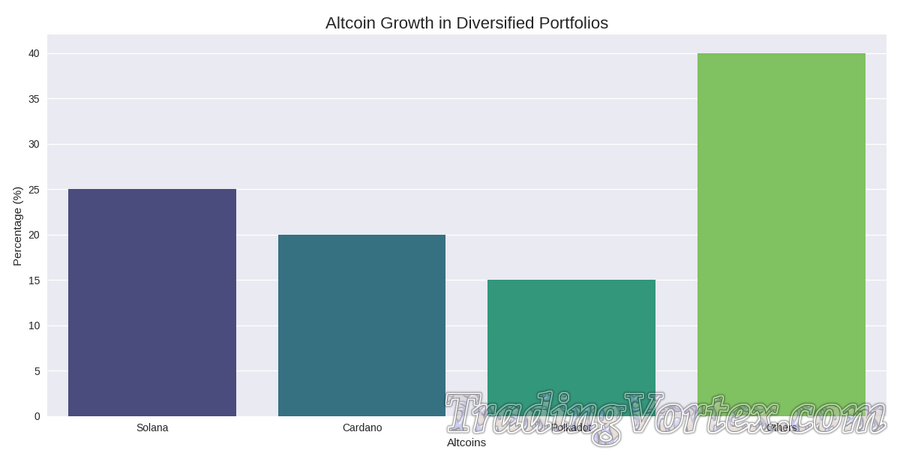 Altcoin Growth in Diversified Portfolios: This bar chart shows illustrative allocation percentages for Solana, Cardano, Polkadot, and other altcoins in 2025 portfolios. It highlights how altcoins are no longer “side bets” but essential components.
Layer-2 scaling solutions (Polygon, Arbitrum, Optimism) for portfolio diversification
- Why Layer-2 matters: Ethereum’s congestion and high fees created demand for faster, cheaper alternatives. Layer-2 solutions now handle millions of transactions daily, often at costs below a few cents.
- Key players: Polygon, Arbitrum, and Optimism are leading the charge, with thriving ecosystems supporting DeFi, gaming, and NFT platforms.
- Portfolio role: Layer-2 tokens give investors exposure to infrastructure that is critical for scaling blockchain adoption. They are like owning shares in the highways that keep crypto traffic moving smoothly.
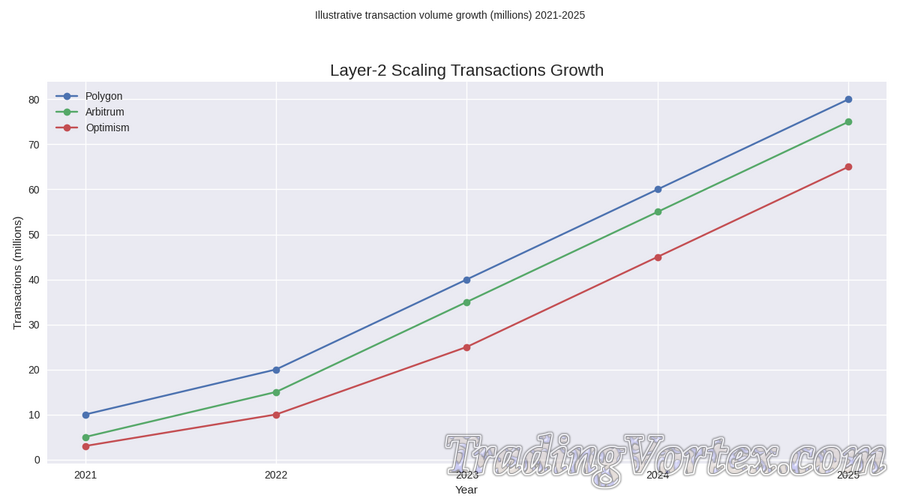 Layer-2 Scaling Transactions Growth: A line chart comparing transaction volume growth for Polygon, Arbitrum, and Optimism from 2021–2025. It demonstrates why Layer-2 solutions are critical for scaling adoption.
DeFi tokens and yield farming as diversification strategies
- DeFi growth: Billions remain locked in protocols across lending, staking, and liquidity pools. DeFi continues to evolve, offering more sophisticated products like decentralized derivatives and insurance.
- Income streams: Platforms like Aave, Curve, and Uniswap offer governance rights and yield opportunities. Staking and liquidity provision allow investors to earn passive income while supporting network security and liquidity.
- Cautionary note: Yield farming can be profitable, but it requires careful platform selection. Rug pulls and smart contract exploits remain risks, so investors must prioritize established platforms with strong audits and reputations.
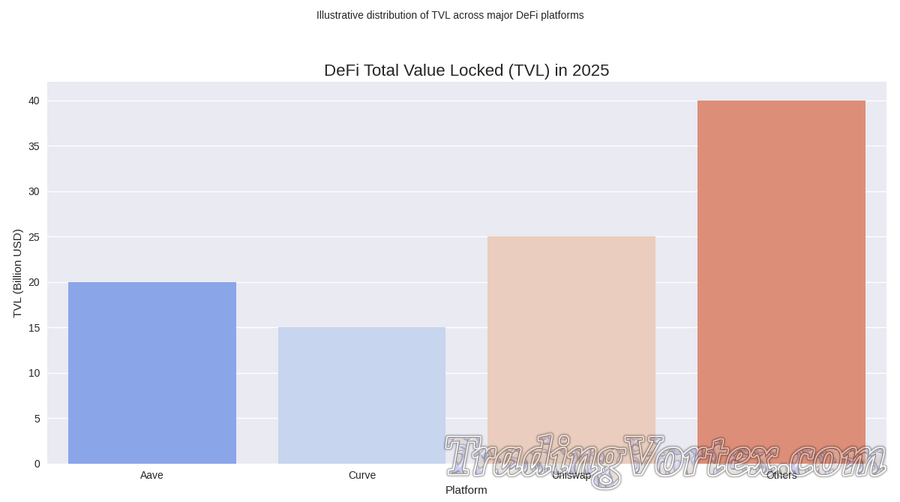 DeFi Total Value Locked (TVL) in 2025: This bar chart shows illustrative billions locked in Aave, Curve, Uniswap, and other platforms. It emphasizes the scale of DeFi and its role in generating passive income.
Tokenized real-world assets (RWA) in crypto investing
- Emerging narrative: RWAs are one of the hottest trends in 2025, with billions flowing into tokenized Treasuries, real estate, and commodities. They provide exposure to assets that behave differently than purely digital tokens.
- Institutional adoption: BlackRock, Franklin Templeton, and other major players have launched tokenized funds, signaling mainstream acceptance. This institutional involvement adds credibility and liquidity to the RWA sector.
- Portfolio role: RWAs add tangible exposure, bridging crypto with the traditional economy. They help investors hedge against crypto-specific risks while still benefiting from blockchain efficiency.
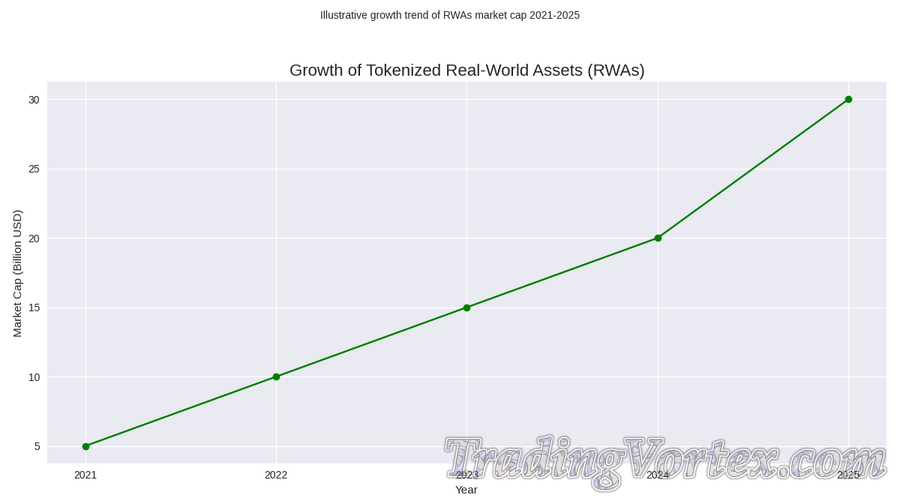 Growth of Tokenized Real-World Assets (RWAs): A line chart showing the rise of RWAs market cap from 2021–2025. It illustrates why RWAs are one of the hottest diversification trends.
Stablecoins as safe-haven assets for portfolio risk management
- Safe-haven function: USDT, USDC, and DAI provide liquidity and hedge against volatility. They are the “cash equivalents” of crypto, offering stability when markets swing wildly.
- Integration: Stablecoins are increasingly used in payments, remittances, and on-chain banking. They are becoming the backbone of decentralized finance and everyday crypto transactions.
- Investor takeaway: Stablecoins act as the “cash in your wallet,” ready to deploy when opportunities arise. They also allow investors to park funds safely without leaving the crypto ecosystem.
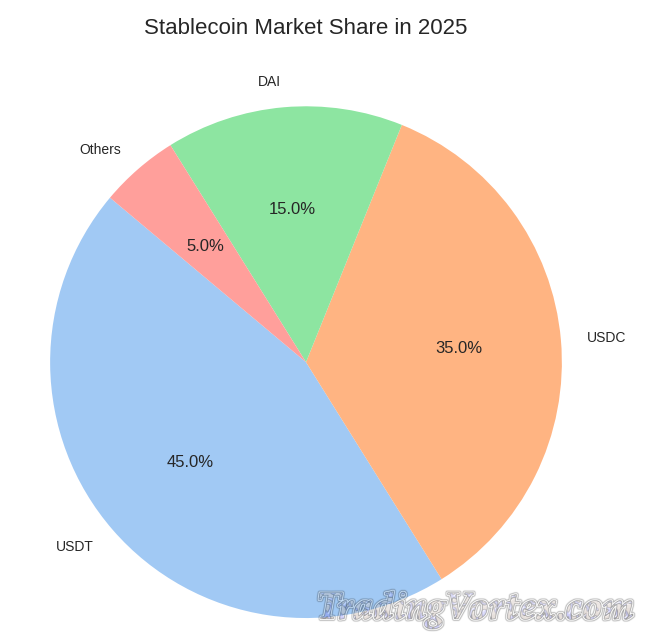 Stablecoin Market Share in 2025: A pie chart showing dominance of USDT, USDC, DAI, and others. It reinforces stablecoins’ role as safe-haven assets.
Crypto ETFs and index funds for easy diversification
- Explosive growth: ETFs and index funds have surged after regulatory approvals in major markets. They provide simple, regulated access to diversified crypto exposure.
- Key products: Bitwise, iShares Bitcoin Trust, and Vanguard crypto-linked ETFs are popular choices, attracting both retail and institutional investors.
- Portfolio role: ETFs simplify diversification, offering broad exposure without the need to manage dozens of tokens individually. They are especially useful for beginners or time-constrained investors.
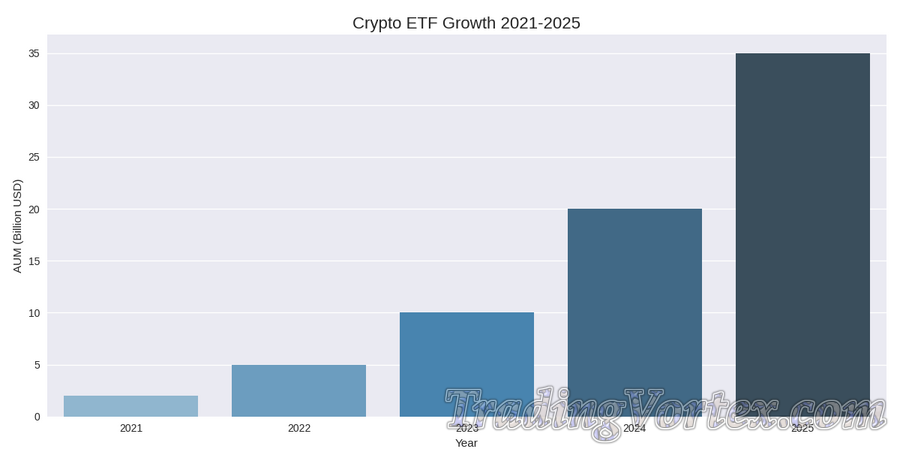 Crypto ETF Growth 2021–2025: A bar chart showing illustrative growth in assets under management for crypto ETFs. It highlights their role in simplifying diversification.
Additional Trend: AI-powered portfolio automation
- AI in investing: Automated tools now help rebalance portfolios, track risk, and identify opportunities. They analyze market sentiment, liquidity, and volatility in real time.
- Investor benefit: AI reduces emotional decision-making and ensures portfolios stay aligned with goals. It acts like a personal assistant that never sleeps, constantly optimizing allocations.
- Future outlook: Expect AI-driven diversification strategies to become standard practice, especially as portfolios grow more complex.
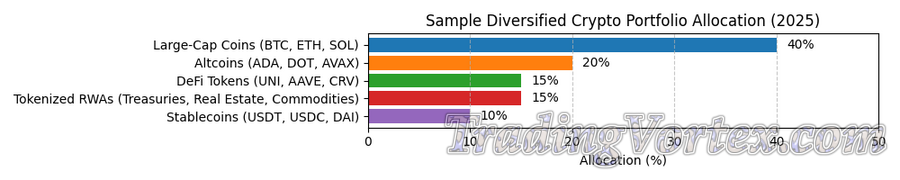 Sample Diversified Crypto Portfolio in 2025: It illustrates how different categories can be balanced to reduce risk while capturing growth opportunities.
♦ Breakdown of the sample allocation:
◊ Large-Cap Coins (BTC, ETH, SOL): 40% The foundation of most portfolios, offering stability and long-term growth.
◊ Altcoins (ADA, DOT, AVAX): 20% Exposure to innovation and emerging ecosystems beyond the big players.
◊ DeFi Tokens (UNI, AAVE, CRV): 15% Income-generating assets through staking, lending, and liquidity pools.
◊ Tokenized Real-World Assets (Treasuries, Real Estate, Commodities): 15% Tangible diversification that bridges crypto with traditional markets.
◊ Stablecoins (USDT, USDC, DAI): 10% Safe-haven assets for liquidity and risk management during volatile periods.
This allocation is just one example, but it shows how investors can combine growth, yield, and stability into a single portfolio.
♦ How to Use This Chart:
◊ Beginners: Treat this as a starter roadmap. Focus on large-cap coins and stablecoins first, then gradually add altcoins and DeFi exposure.
◊ Intermediate investors: Use the full allocation mix, rebalancing quarterly to keep percentages aligned with your goals.
◊ Advanced investors: Adjust allocations dynamically based on market cycles, adding RWAs or Layer-2 tokens when adoption surges.
This chart is not a one-size-fits-all solution, but it shows how diversification can balance growth, yield, and stability in a single portfolio.
In 2025, diversification is no longer optional, it is the foundation of smart crypto investing. Altcoins, Layer-2s, DeFi, RWAs, stablecoins, ETFs, and even AI-driven tools each play a role in building portfolios that can withstand volatility and capture growth. The smartest investors are not chasing one coin, they are building ecosystems of assets that work together.
Core Asset Classes for a Diversified Crypto Portfolio
Diversification in crypto is not just about holding “a bit of Bitcoin and a sprinkle of Ethereum.” In 2025, the market has matured into a complex ecosystem where different asset classes play unique roles. Think of it like building a balanced meal: you need proteins, carbs, and veggies, not just a plate of fries.
Let’s break down the core categories that can help you build a portfolio designed for both resilience and growth.
Large-cap cryptocurrencies (Bitcoin, Ethereum, Solana)
Large-cap coins are the anchors of any crypto portfolio. Bitcoin remains the world’s largest cryptocurrency, nearing a $2 trillion market cap in 2025, and is increasingly treated as a hedge against inflation and global uncertainty.
Ethereum continues to dominate smart contracts and decentralized applications, with institutional adoption driving demand. Solana has emerged as a treasury favorite thanks to its scalability, processing thousands of transactions per second at costs under one cent.
Holding these assets is like owning blue-chip stocks: they may not deliver the wildest gains, but they provide stability and credibility.
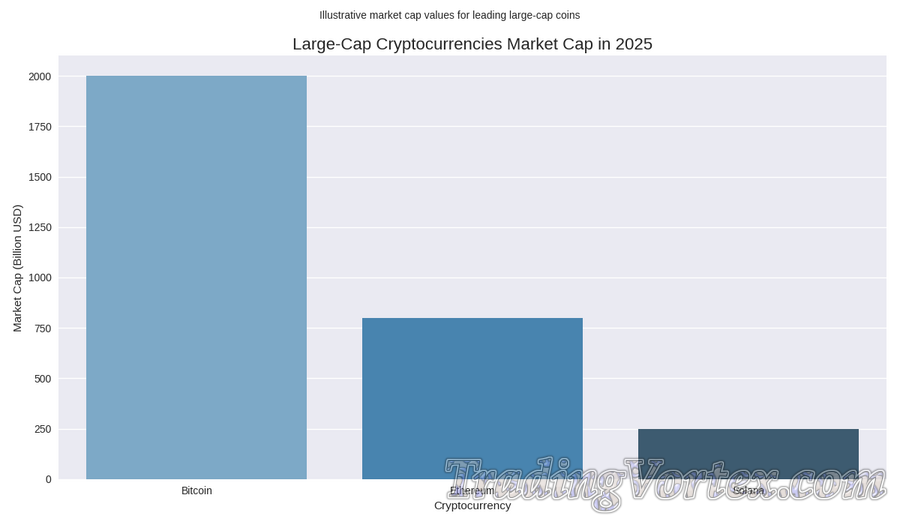 Large-Cap Cryptocurrencies Market Cap in 2025: This bar chart compares the market cap of Bitcoin (~$2T), Ethereum (~$800B), and Solana (~$250B). It shows why these coins act as portfolio anchors, providing stability and credibility.
Mid-cap and emerging altcoins (Avalanche, Cardano, Polkadot)
Mid-cap altcoins are the adventurous part of your portfolio. Avalanche, Cardano, and Polkadot are gaining momentum in 2025 thanks to strong technical innovation and growing communities. They sit between the giants and the small-cap experiments, offering a blend of maturity and untapped potential.
Investing in these is like backing promising startups: higher risk, but also higher upside if adoption takes off.
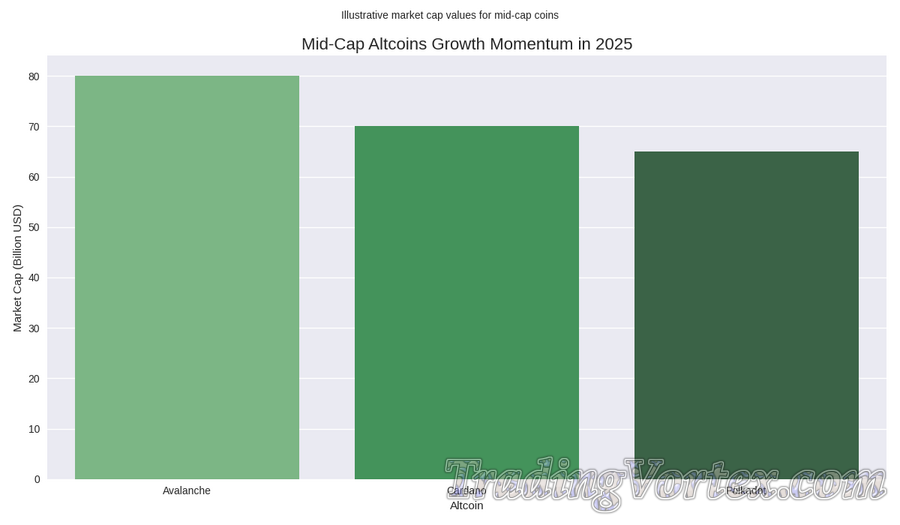 Mid-Cap Altcoins Growth Momentum in 2025: This bar chart illustrates the growth of Avalanche, Cardano, and Polkadot, each valued between $65–80B. It highlights their role as promising innovators with higher risk and upside potential.
Stablecoins (USDT, USDC, DAI) for liquidity and hedging
Stablecoins are the “cash equivalents” of crypto. USDT, USDC, and DAI dominate the market in 2025, providing liquidity and predictability in a volatile environment.
- USDC leads in transparency and regulatory compliance,
- USDT in adoption and liquidity,
- and DAI in decentralization and DeFi integration.
They are essential for hedging against downturns, parking funds safely, and keeping dry powder ready for new opportunities.
Stablecoin Market Share in 2025: A pie chart showing USDT (45%), USDC (35%), DAI (15%), and others (5%). It reinforces stablecoins’ role as liquidity providers and safe-haven assets.
DeFi tokens (Uniswap, Aave, Curve) for passive income
DeFi tokens are the yield engines of crypto. Uniswap, Aave, and Curve remain top choices in 2025, offering decentralized trading, lending, and liquidity provision.
- Aave continues to lead in lending protocols,
- Uniswap dominates decentralized exchanges,
- and Curve specializes in stablecoin liquidity.
Owning these tokens is like renting out property: instead of letting your assets sit idle, you put them to work and earn passive income.
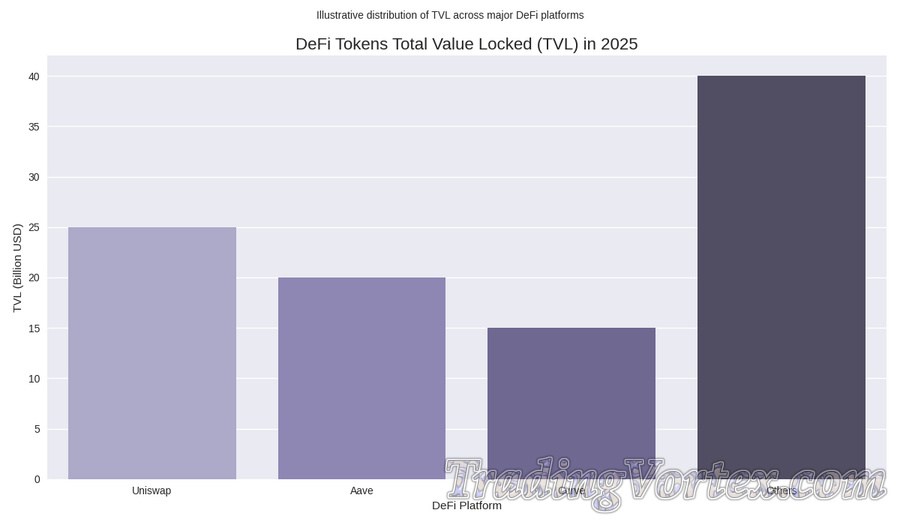 DeFi Tokens Total Value Locked (TVL) in 2025: This bar chart shows Uniswap ($25B), Aave ($20B), Curve ($15B), and others ($40B). It demonstrates how DeFi tokens generate passive income and strengthen portfolio yield.
NFTs and metaverse assets in crypto investing
The metaverse may have lost some of its hype, but NFTs and metaverse tokens are still valued in the tens of billions of dollars in 2025. Projects like Decentraland, Sandbox, and newer entrants are merging gaming, digital collectibles, and virtual real estate. Global brands and institutions are increasingly involved, making NFTs more than just speculative art: they are gateways to digital ownership and immersive experiences.
Think of them as the “lifestyle investments” of crypto: not essential for every portfolio, but they add flavor and exposure to cultural trends.
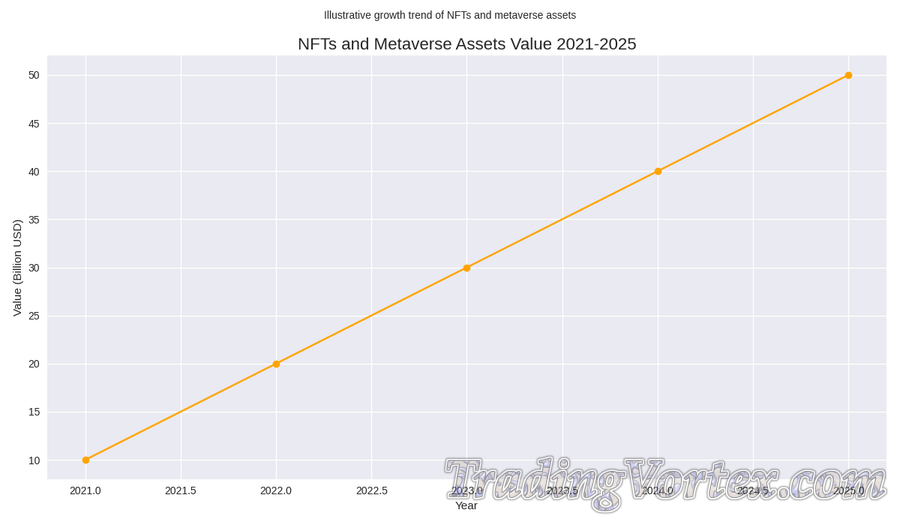 NFTs and Metaverse Assets Value 2021–2025: A line chart showing growth from $10B in 2021 to $50B in 2025. It highlights NFTs and metaverse tokens as cultural plays with significant value.
RWAs and AI-powered tokens as diversification opportunities
One of the fastest-growing sectors in 2025 is tokenized real-world assets (RWAs), with over $35 billion worth of Treasuries, private credit, and real estate now on-chain. Institutions like BlackRock and Franklin Templeton are leading the charge, making RWAs a credible hedge against crypto-specific volatility.
Meanwhile, AI-powered tokens such as Bittensor, Render, and Ocean Protocol are outperforming other sectors. These tokens combine blockchain with artificial intelligence, powering decentralized compute, predictive analytics, and data marketplaces. They represent the cutting edge of diversification, offering exposure to two transformative technologies at once.
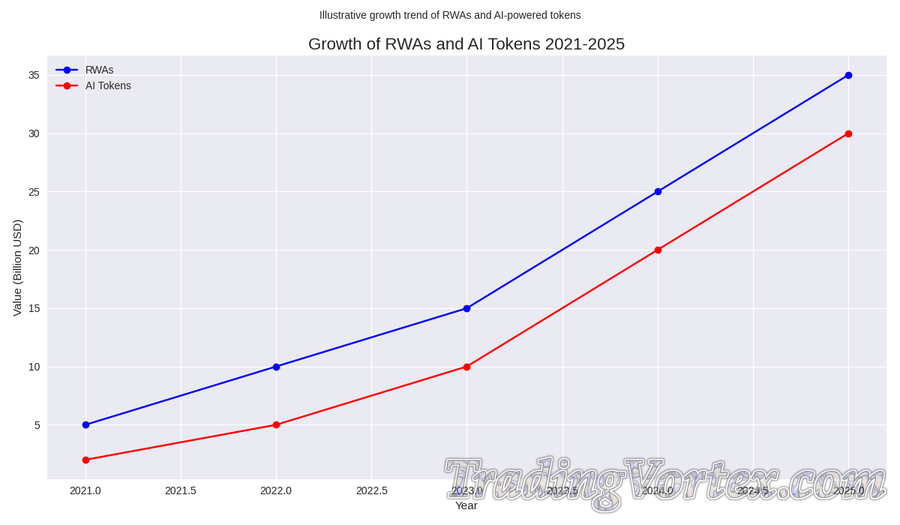 Growth of RWAs and AI Tokens 2021–2025: A line chart comparing RWAs (rising to $35B) and AI tokens (rising to $30B). It shows how these sectors are emerging as diversification opportunities.
Bottom line: A diversified crypto portfolio in 2025 is not just Bitcoin plus a few altcoins. It is a carefully balanced mix of large-cap anchors, mid-cap innovators, stablecoin safety nets, DeFi yield engines, cultural plays like NFTs, and forward-looking bets on RWAs and AI tokens. Each category plays a role, and together they create a portfolio that can weather storms while capturing growth.
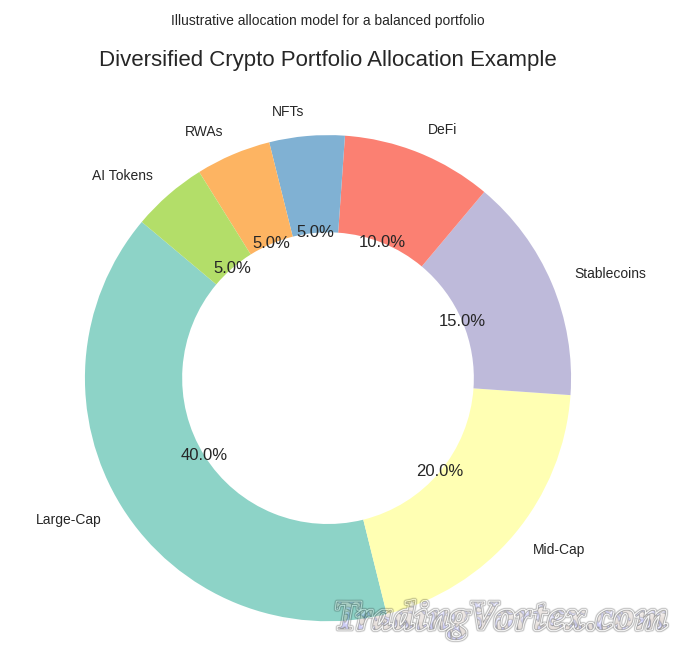 Diversified Crypto Portfolio Allocation Example: A donut-style pie chart showing a balanced allocation: Large-Cap 40%, Mid-Cap 20%, Stablecoins 15%, DeFi 10%, NFTs 5%, RWAs 5%, AI Tokens 5%. It provides a practical model for investors to follow.
Smart Strategies for Crypto Portfolio Diversification
In 2025, investors are smarter than ever, using structured approaches to spread exposure across sectors, regions, and income streams. Let’s walk through the strategies that matter most.
Balancing blue-chip cryptocurrencies vs. high-growth altcoins
Blue-chip coins like Bitcoin and Ethereum are the anchors of most portfolios. They provide stability, liquidity, and long-term credibility. But if you only hold these, you miss out on the explosive potential of altcoins. Projects such as Solana, Cardano, and Avalanche are attracting institutional interest and retail enthusiasm, offering exposure to innovation in smart contracts, payments, and decentralized applications.
Think of it like cooking: Bitcoin and Ethereum are the rice and bread, while altcoins are the spices that make the meal memorable. A healthy balance means you enjoy both stability and flavor.
Allocating across market caps (large-cap, mid-cap, small-cap crypto assets)
Market cap allocation is a simple but powerful framework.
- Large-cap assets (BTC, ETH, SOL) provide resilience.
- Mid-cap coins (DOT, ADA, AVAX) offer growth potential with moderate risk.
- Small-cap tokens can deliver outsized returns, but they are also the riskiest.
It is like building a sports team. You need star players who deliver consistently, promising rookies who bring energy, and a few wild cards who might surprise everyone.
Geographic and regulatory diversification in crypto investing
Crypto is global, but regulations vary dramatically. In 2025, U.S. ETFs and European MiCA regulations are shaping institutional adoption, while Asia continues to lead in retail innovation. Geographic diversification means holding assets and using platforms across different jurisdictions.
This protects you from region-specific risks. If one country tightens rules, your exposure elsewhere keeps you balanced. It is like owning property in multiple cities: if one market slows, another may thrive.
Using staking, lending, and liquidity pools for diversified income streams
Passive income is no longer a side hustle, it is a core strategy. Staking Ethereum, lending on Aave, or providing liquidity on Uniswap allows you to earn yield while holding assets. In 2025, yields are more stable, with institutional capital flowing into DeFi protocols.
It is like renting out your spare room. Instead of letting your crypto sit idle, you put it to work and collect rent. Just remember, not every tenant is trustworthy, so choose platforms with strong audits and reputations.
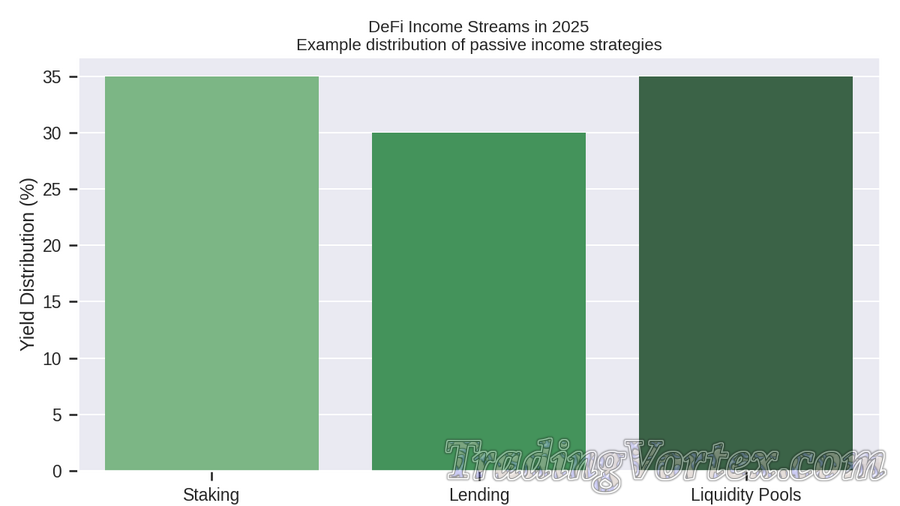 DeFi Income Streams in 2025: A bar chart showing staking 35%, lending 30%, and liquidity pools 35%. It highlights how investors can earn passive income while holding assets.
Leveraging crypto ETFs and managed funds for simplified diversification
For investors who want exposure without the headache of managing dozens of tokens, crypto ETFs and index funds are game changers. Products from Bitwise, iShares, and Vanguard now provide diversified baskets of assets in a regulated format.
ETFs are like ordering a combo meal. Instead of picking every item separately, you get a balanced mix in one package. They are especially useful for beginners or busy professionals who want diversification without constant portfolio tinkering.
Putting it all together:
Smart diversification in 2025 is about balance. Blue-chip coins give you stability, altcoins add growth, market cap allocation manages risk, geographic spread hedges against regulation, DeFi generates income, and ETFs simplify the process. Together, these strategies create a portfolio that can weather storms and capture opportunities in a market that never sleeps.
The truth is, diversification is not just about protecting your money, it is about protecting your peace of mind. When your portfolio is balanced, you can stop checking prices every five minutes and start thinking long term. That is the real win.
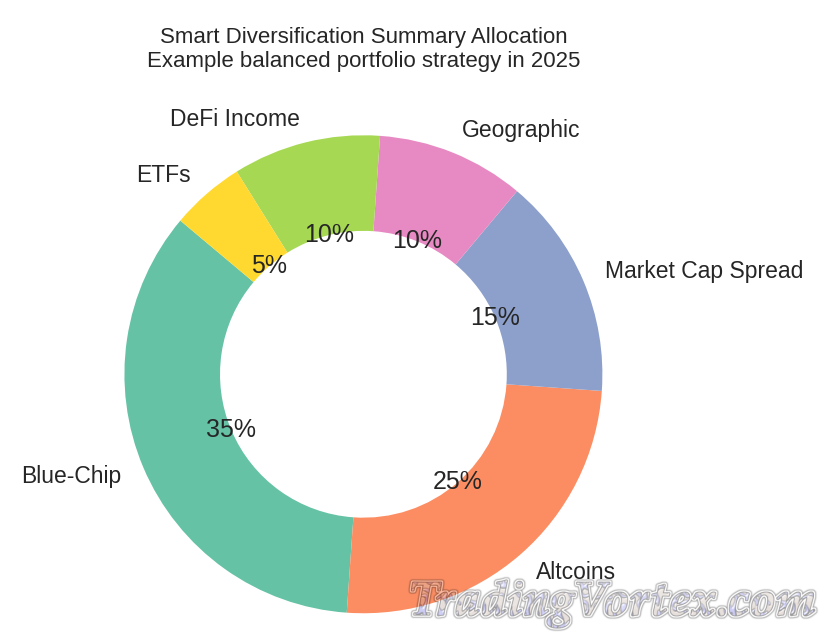 Smart Diversification Summary Allocation: A donut-style pie chart summarizing a balanced portfolio: Blue-Chip 35%, Altcoins 25%, Market Cap Spread 15%, Geographic 10%, DeFi Income 10%, ETFs 5%. It provides a holistic model for smart diversification.
Risks and Challenges in Crypto Portfolio Diversification
Think of it like cooking with too many spices. A pinch of variety makes the dish delicious, but dump the whole rack into the pot and you end up with chaos.
Market volatility and liquidity risks in crypto investing
Crypto markets remain the most unpredictable corner of finance. Prices can swing 20 percent in a single day, and liquidity can vanish in minutes. Even large-cap coins like Bitcoin and Ethereum, despite their institutional adoption, are still far more volatile than traditional assets like stocks or bonds. Smaller altcoins are even riskier, with thin liquidity that can make it difficult to exit positions without taking a painful loss.
I once watched a friend try to sell a mid-cap token during a market dip. The order book was so thin that his sell order triggered a cascade, dropping the price further and leaving him with far less than expected.
Liquidity risk is real, and diversification does not eliminate it. It simply spreads the exposure across different assets, which means you still need to be mindful of how quickly you can enter or exit positions.
Regulatory uncertainty across global crypto markets
Regulation is the elephant in the room. In 2025, the U.S. has approved spot Bitcoin and Ethereum ETFs, Europe has rolled out MiCA, and Asia continues to experiment with retail-friendly frameworks. Yet rules vary dramatically across jurisdictions, and sudden policy changes can impact entire sectors overnight.
For example, a DeFi token thriving in one region may face restrictions in another. Geographic diversification helps, but it also means keeping track of multiple regulatory environments. It is like owning property in different countries: exciting, but you need to know the local laws before you build. Investors must stay informed, because regulatory shifts can affect liquidity, access, and even the legality of certain assets.
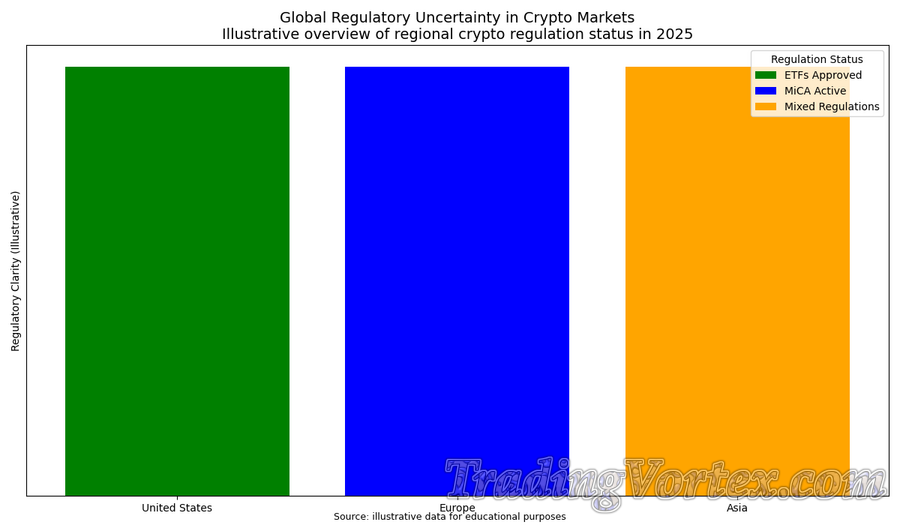 Global Regulatory Uncertainty in Crypto Markets: Simplified visualization of regulatory differences across the US, Europe, and Asia.
Smart contract vulnerabilities and technology risks
Diversification often means exposure to DeFi platforms, NFTs, and Layer-2 solutions. While these sectors offer growth, they also carry unique risks. Smart contract bugs, hacks, and exploits remain common, with billions lost in DeFi breaches over the past few years. Even audited protocols are not immune.
Think of smart contracts as digital vending machines. Most of the time they work fine, but if the code has a flaw, someone can shake the machine and grab all the snacks. Investors must balance innovation with caution, choosing platforms with strong reputations, transparent audits, and active developer communities. Technology risk is not just about losing money, it is about losing trust, and trust is the lifeblood of crypto adoption.
Over-diversification: when too many crypto assets dilute returns
Diversification is about balance, not excess. Owning dozens of coins may feel safe, but it can dilute returns and make portfolio management overwhelming. Reports emphasize that intentional diversification, choosing assets with clear roles, is more effective than chasing every new token.
I once knew someone who held twenty different coins, most of them obscure. When the market rallied, his portfolio barely moved because the winners were drowned out by the losers. Over-diversification is like watering down juice until it tastes like plain water. Quality matters more than quantity. A handful of well-chosen assets can outperform a basket of random picks.
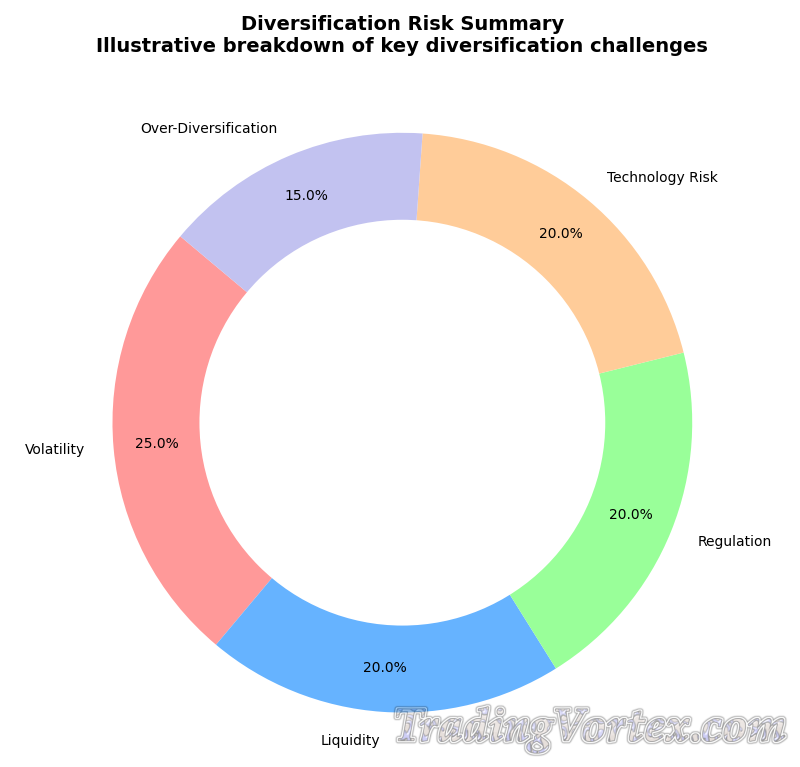 Diversification Risk Summary: Donut pie chart summarizing the main challenge categories: volatility, liquidity, regulation, technology risk, and over‑diversification. It serves as a quick recap and checklist.
Final thoughts:
Diversification is essential, but it is not risk-free. Volatility, liquidity traps, regulatory uncertainty, technology flaws, and over-diversification can all undermine your strategy. The key is awareness. By recognizing these challenges, you can build a portfolio that is not only diversified but also resilient.
The truth is, diversification is not about chasing every shiny new token. It is about creating a portfolio that can survive downturns, capture growth, and give you peace of mind. When you understand the risks, you stop playing defense and start playing smart offense.
Step-by-Step Guide to Building a Diversified Crypto Portfolio
Building a diversified crypto portfolio in 2025 is less about chasing hype and more about creating a strategy that keeps you sane during market swings. Think of it like planning a road trip: you need a map, a budget, and a plan for pit stops. Without those, you end up lost, broke, or stuck on the side of the road.
Let’s walk through the steps that can help you build a portfolio designed for both resilience and growth.
Define your risk tolerance and crypto investment goals
Before buying anything, ask yourself: What am I really trying to achieve? Are you looking for long-term wealth building, short-term trading gains, or passive income through staking? Your goals will shape your portfolio.
Risk tolerance is equally important. If you panic every time Bitcoin drops 10 percent, you probably need a heavier allocation in large-cap coins and stablecoins. If you can stomach volatility, you might allocate more to altcoins or DeFi tokens. Be honest with yourself.
I once had a friend who claimed he was “risk tolerant” until his meme coin tanked 70 percent overnight. He sold at the bottom and swore off crypto for a year. Knowing your limits saves you from emotional decisions.
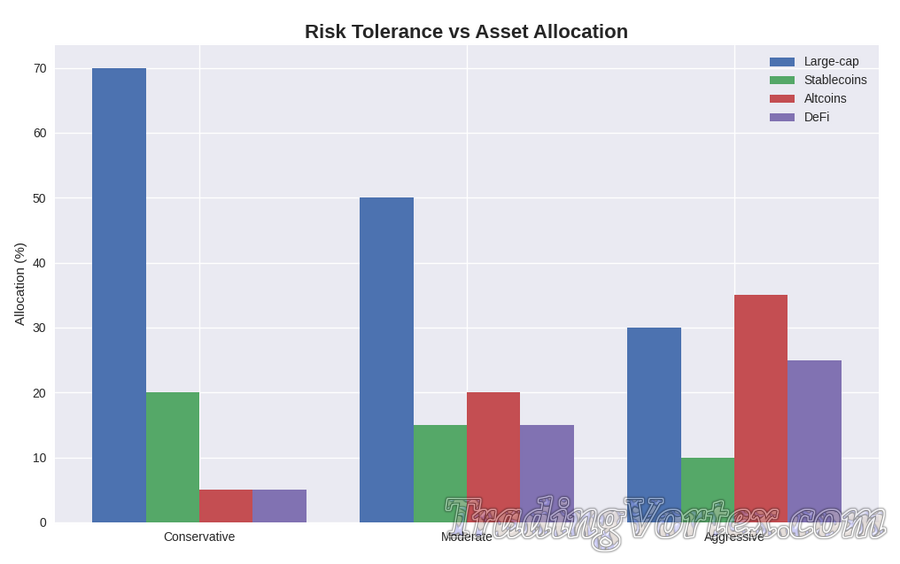 Risk Tolerance vs Asset Allocation: Bar chart showing how allocation shifts depending on investor profile (Conservative, Moderate, Aggressive).
Set allocation percentages for core vs. satellite crypto assets
Think of your portfolio as a solar system. The core assets: Bitcoin, Ethereum, and Solana; are the sun, providing stability and long-term growth. The satellite assets: altcoins, DeFi tokens, NFTs, and RWAs; are the planets, adding diversity and potential upside.
A practical framework in 2025 looks like this:
- 50–60 percent in large-cap coins for stability.
- 20–25 percent in mid-cap and emerging altcoins for growth.
- 10–15 percent in DeFi tokens and RWAs for yield and diversification.
- 5–10 percent in stablecoins for liquidity and hedging.
This mix ensures you capture upside while keeping a safety net.
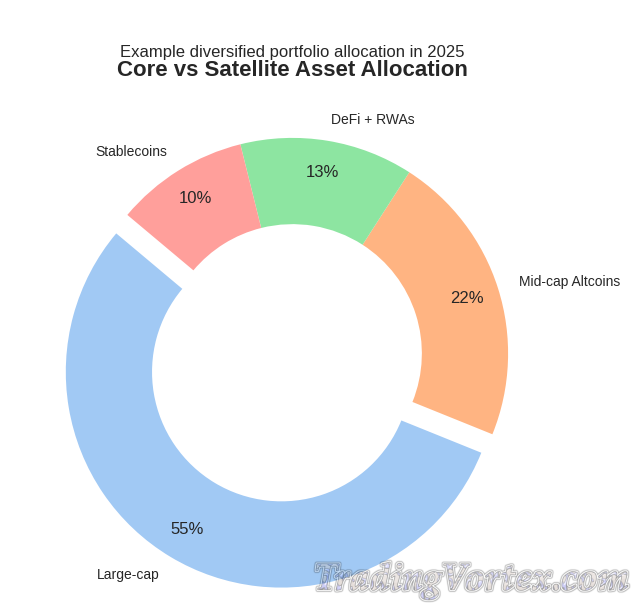 Core vs Satellite Asset Allocation: Donut pie chart illustrating a balanced mix of large-cap, mid-cap altcoins, DeFi/RWAs, and stablecoins.
Use crypto portfolio tracking tools and apps
Pick a tracker that fits your style:
- If you are a beginner, go for something simple and mobile-friendly.
- If you are advanced, choose one that supports multichain assets and DeFi analytics.
The point is to stay organized, because a messy portfolio is a recipe for missed opportunities.
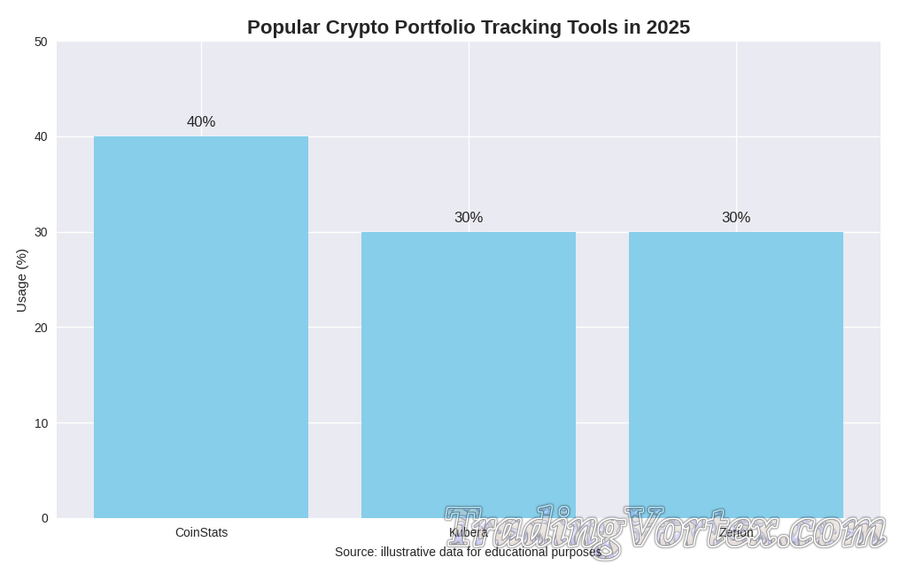 Popular Crypto Portfolio Tracking Tools in 2025: Bar chart comparing adoption of CoinStats, Kubera, and Zerion.
Rebalance your diversified crypto portfolio in bull vs. bear markets
Rebalancing is the secret sauce of long-term success.
- In bull markets, altcoins and small-cap tokens often outperform, which can skew your allocations.
- In bear markets, large-cap coins and stablecoins become more valuable.
I like to think of rebalancing as cleaning out your closet. You keep the essentials, donate what no longer fits, and make room for new items. It keeps your portfolio fresh and aligned with your goals.
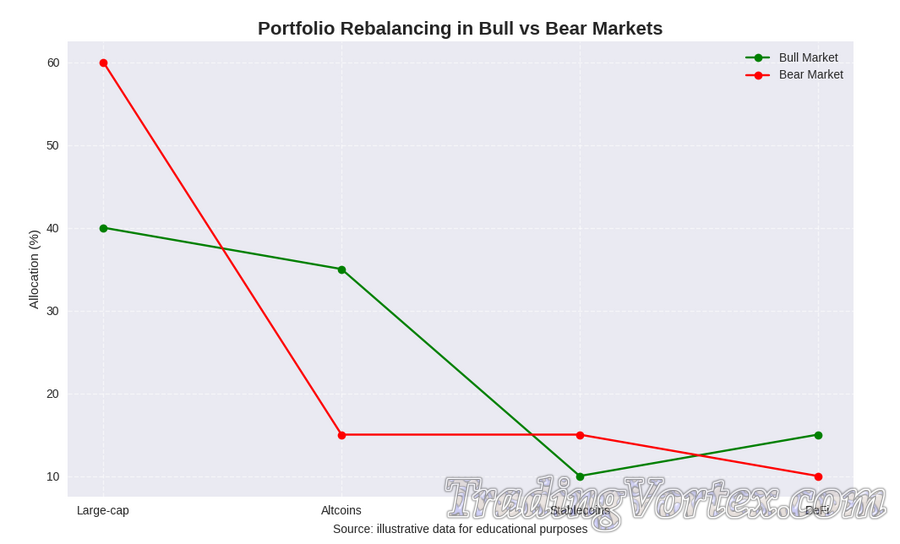 Portfolio Rebalancing in Bull vs Bear Markets: Line chart showing allocation shifts between bull and bear cycles.
Final thoughts:
Diversification is not about owning every coin under the sun. It is about building a portfolio that reflects your goals, respects your risk tolerance, and adapts to market cycles. Define your strategy, set allocations, track your progress, and rebalance with discipline. Do this, and you will not just survive the rollercoaster of crypto: you will enjoy the ride.
Expert Insights and Case Studies on Crypto Diversification
Institutional crypto portfolio diversification strategies in 2025
Institutions have moved far beyond the “Bitcoin-only” mindset. According to recent reports, over half of institutional investors plan to increase their digital asset allocations in 2025, with diversification cited as the primary driver.
Large players like BlackRock and Vanguard are not just offering Bitcoin ETFs, they are experimenting with tokenized real-world assets (RWAs) such as Treasuries and real estate. This shift reflects a broader recognition that crypto is not just a speculative play, but a legitimate asset class that can hedge against inflation and enhance portfolio resilience.
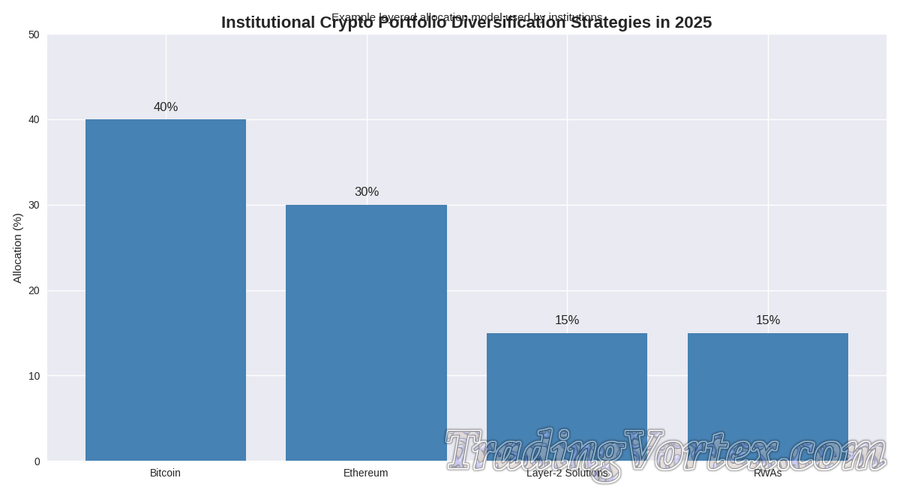 Institutional Crypto Portfolio Diversification Strategies in 2025: Bar chart showing a layered allocation model: Bitcoin 40%, Ethereum 30%, Layer‑2 solutions 15%, RWAs 15%.
Retail investor approaches to diversified crypto portfolios
Anecdotally, I know a trader who used to bet everything on Ethereum. After the 2022 downturn, he rebuilt his portfolio with 50 percent in large-cap coins, 20 percent in mid-cap altcoins, 20 percent in DeFi, and 10 percent in stablecoins. He told me the biggest benefit was not just financial stability, but peace of mind. Diversification gave him the confidence to stay invested without constantly worrying about one coin crashing.
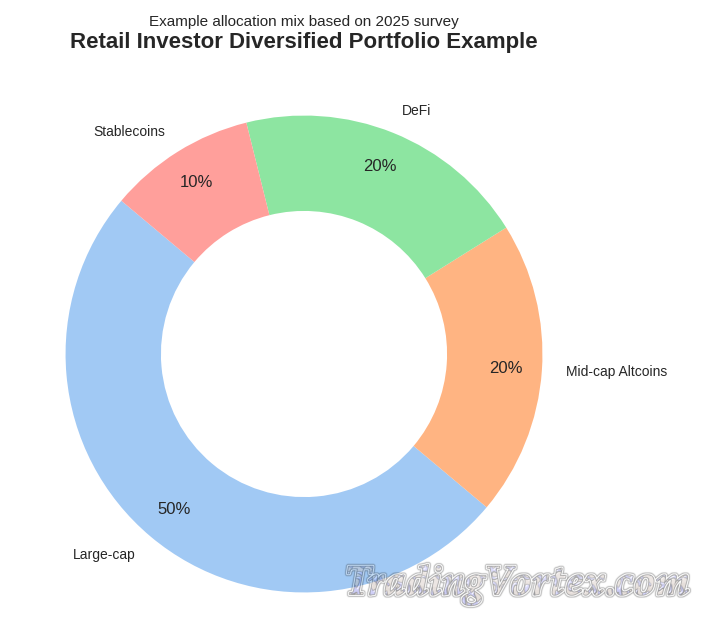 Retail Investor Diversified Portfolio Example: Donut pie chart illustrating a retail investor mix: 50% large‑cap, 20% mid‑cap altcoins, 20% DeFi, 10% stablecoins.
Lessons from past crypto market cycles
In 2025, investors are applying these lessons with more discipline. Risk parity models and balanced allocation frameworks have reduced portfolio drawdowns by up to 30 percent compared to traditional mean-variance strategies. The takeaway is clear: diversification is not about chasing every shiny new token, it is about intentional allocation across categories that play different roles.
One case study from AInvest showed that portfolios diversified across Layer-1s, DeFi, NFTs, and stablecoins outperformed single-asset portfolios during volatile periods. The key was balance: enough exposure to growth sectors to capture upside, but enough stability to survive downturns.
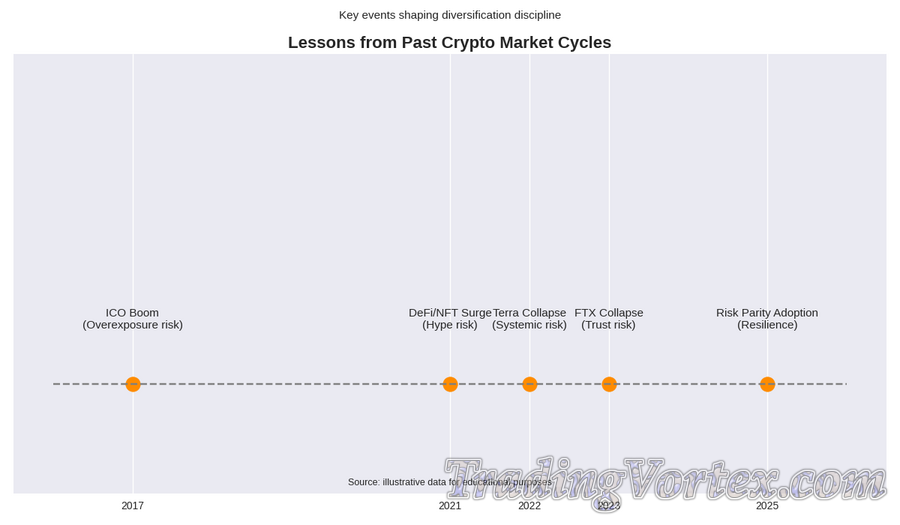 Lessons from Past Crypto Market Cycles: Timeline chart highlighting key events: 2017 ICO boom, 2021 DeFi/NFT surge, 2022 Terra collapse, 2023 FTX collapse, 2025 risk parity adoption.
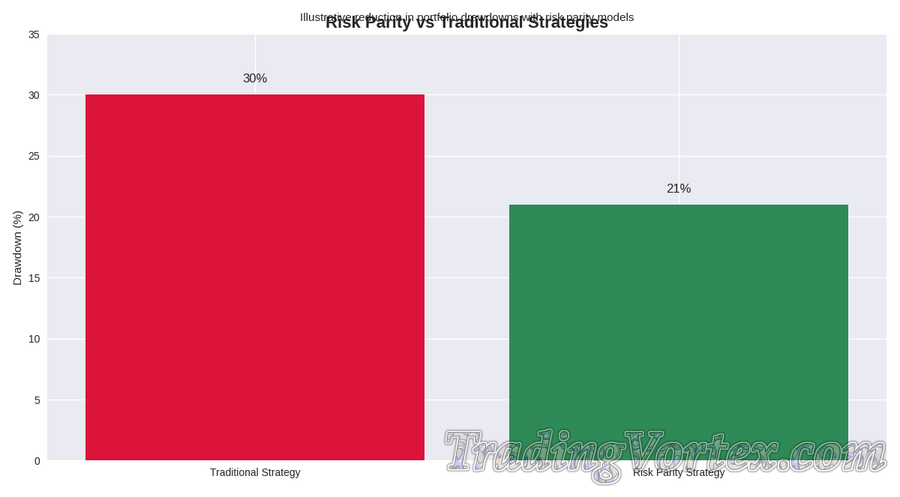 Risk Parity vs Traditional Strategies: Bar chart comparing drawdowns: Traditional 30% vs Risk Parity 21%. It shows how disciplined diversification reduces losses.
Final thoughts:
Whether you are an institution managing billions or a retail investor with a few hundred dollars, diversification is the common thread that ties successful strategies together. Institutions are using RWAs and ETFs to build credibility, retail investors are focusing on balance and peace of mind, and everyone is learning from past cycles to avoid repeating the same mistakes.
Diversification is not about owning everything, it is about owning wisely. When done right, it turns crypto investing from a gamble into a strategy.
Institutional vs. Retail Crypto Diversification Strategies in 2025
| Aspect | Institutional Investors | Retail Investors |
|---|---|---|
| Primary Goal | Capital preservation, risk-adjusted returns, and regulatory compliance | Growth potential, passive income, and financial independence |
| Core Holdings | Heavy allocation to Bitcoin, Ethereum, and tokenized real-world assets (RWAs) | Mix of Bitcoin, Ethereum, and mid-cap altcoins |
| Diversification Approach | Structured frameworks with risk parity models, balanced allocations across sectors | Flexible, often trend-driven, balancing large-cap stability with altcoin upside |
| Use of Stablecoins | Stablecoins used for liquidity management, hedging, and institutional-grade settlement | Stablecoins used as a safety net and quick access to trading opportunities |
| Exposure to DeFi | Selective participation in audited, institutional-grade DeFi platforms | Broader participation in yield farming, staking, and liquidity pools for passive income |
| NFTs & Metaverse Assets | Limited exposure, often through funds or partnerships with brands | Direct ownership of NFTs, gaming tokens, and metaverse land for speculative growth |
| Geographic & Regulatory Strategy | Diversification across jurisdictions to mitigate regulatory risk | Focus on accessible exchanges and platforms, sometimes less attention to regulatory differences |
| Portfolio Tools | Advanced risk management systems, AI-driven analytics, and custodial solutions | Mobile-friendly portfolio trackers, apps like CoinStats or Zerion |
| Rebalancing Discipline | Regular, rules-based rebalancing aligned with institutional mandates | Opportunistic rebalancing, often triggered by market sentiment or major price swings |
| Mindset | Long-term, cautious, compliance-focused | Adaptive, experimental, and more willing to chase emerging narratives |
Key Takeaway:
Institutions in 2025 treat diversification as a formal risk management strategy, integrating RWAs, ETFs, and regulated products. Retail investors, on the other hand, use diversification as a way to balance stability with growth, often experimenting with altcoins, DeFi, and NFTs.
Both approaches share the same principle: do not put all your eggs in one basket, but the execution reflects their different goals, resources, and risk appetites.
Future Outlook for Crypto Portfolio Diversification
Growth of tokenized assets and RWAs in crypto investing
This trend is more than hype. RWAs bridge traditional finance with blockchain, offering liquidity, accessibility, and compliance-friendly smart contracts. For investors, it means diversification is no longer limited to digital-native assets. You can now balance your portfolio with tokenized bonds or real estate alongside Bitcoin and Ethereum.
It is like adding bricks and mortar to your digital foundation, grounding your portfolio in tangible value.
Growth of Tokenized Real-World Assets (RWAs): Line chart showing illustrative growth of RWAs from 2021 to 2025. It highlights how tokenized Treasuries, private credit, and real estate have expanded, providing lower correlation to native crypto and steadier cash flows.
Institutional ETFs and global regulation shaping diversification
Global regulation is also playing a key role. Europe’s MiCA framework has standardized rules across the EU, while the U.S. has provided clearer guidance for ETFs and custody solutions. Asia continues to lead in retail innovation, but institutions worldwide are now treating crypto as a legitimate asset class.
For investors, this means diversification strategies will increasingly include regulated products like ETFs, offering safer and simpler exposure to multiple assets.
It reminds me of when mutual funds first became mainstream decades ago. Suddenly, diversification was accessible to everyone, not just professionals. ETFs are doing the same for crypto today.
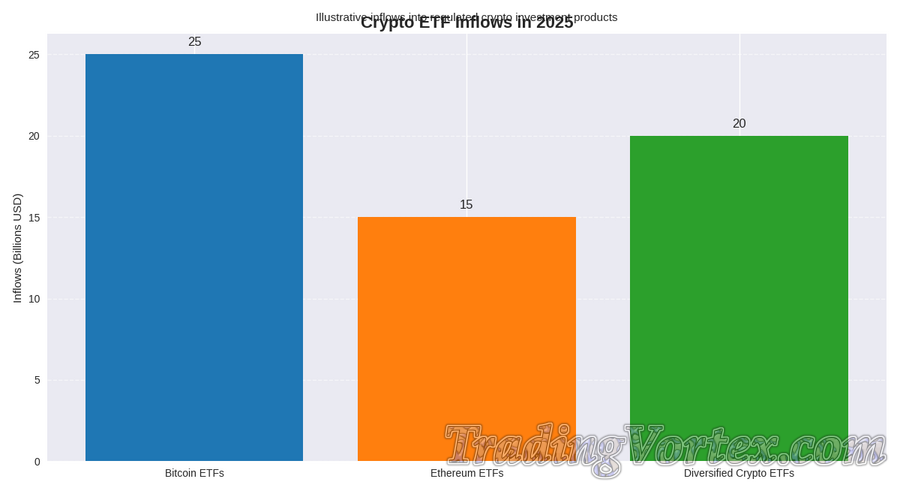 Crypto ETF Inflows in 2025: Bar chart displaying illustrative inflows into Bitcoin ETFs, Ethereum ETFs, and diversified crypto ETFs. It demonstrates how regulated vehicles simplify diversification and why ETFs are becoming the core exposure tool.
AI-driven portfolio automation for crypto investors
Artificial intelligence is quietly becoming the secret weapon of diversification. AI-driven portfolio tools now dominate 2025 investing, using adaptive models to rebalance portfolios, detect liquidity shifts, and respond to regulatory shocks. Virtual AI agents can execute complex DeFi strategies across multiple blockchains, manage staking positions, and even negotiate on-chain.
- For retail investors, this means less stress and fewer emotional decisions. Instead of panic-selling during a dip, AI systems rebalance automatically, keeping portfolios aligned with long-term goals.
- For institutions, AI provides millisecond-precision trading and risk management across fragmented markets.
I like to think of AI as the co-pilot you wish you had during past bull and bear cycles. It does not get tired, it does not panic, and it does not chase meme coins at 3 a.m. It simply follows the strategy you set, making diversification smarter and more disciplined.
Final thoughts:
The future of crypto diversification is about integration: RWAs connecting blockchain with traditional finance, ETFs making diversification accessible and regulated, and AI turning complex strategies into automated routines. Together, these trends are transforming diversification from a defensive tactic into a proactive growth strategy.
For investors, the message is clear: the portfolios of tomorrow will not just hold coins, they will hold ecosystems. And those who embrace RWAs, ETFs, and AI today will be better prepared for the next wave of crypto evolution.
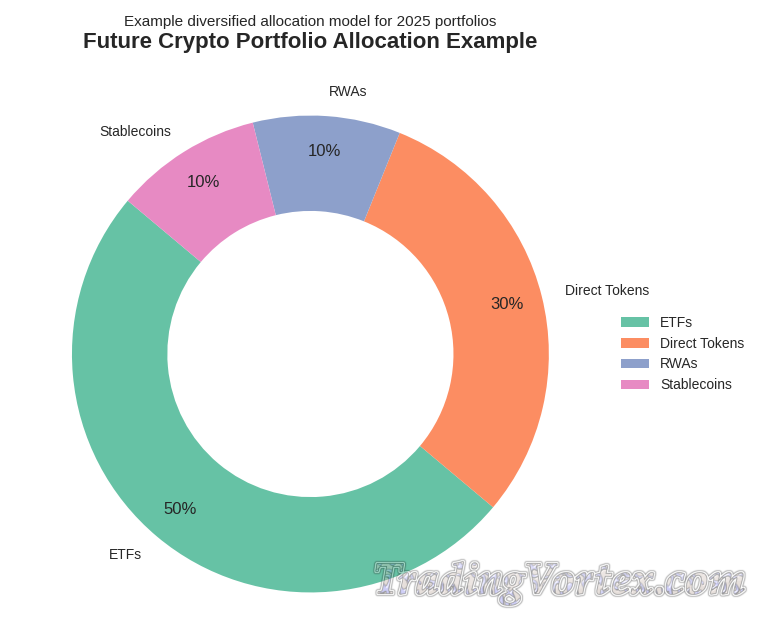 Future Crypto Portfolio Allocation Example: Donut pie chart with an illustrative mix: 50% ETFs, 30% direct tokens, 10% RWAs, 10% stablecoins. It offers a practical model investors can adapt to their own goals and risk tolerance.
Conclusion: Crypto Diversification Checklist for Investors
Diversification is a practical habit, not a one-time checklist. Below is a compact, actionable conclusion you can paste into your article, with clear takeaways and steps to start today.
Key takeaways for building a diversified crypto portfolio
- Balance growth and stability: Keep large-cap coins like Bitcoin and Ethereum as the foundation, they provide liquidity and lower relative volatility. Add mid-cap and selective small-cap positions for upside, but size them to match your risk tolerance.
- Add non-correlated sleeves: Tokenized real-world assets are scaling quickly, offering exposure to bonds, real estate, and private credit that do not move in perfect lockstep with native tokens, making them useful for dampening portfolio volatility.
- Use regulated vehicles for core exposure: Spot ETFs and regulated funds have drawn major inflows in 2025, they simplify custody and reporting, and they are a sensible way to hold core crypto exposure for many investors.
- Make yield work for you, carefully: Staking, lending, and liquidity provision can generate income, but prioritize audited protocols and understand counterparty and smart contract risk.
- Automate discipline: Scheduled rebalancing and portfolio monitoring tools reduce emotional trading and help maintain target allocations over time.
- Track everything: Use modern portfolio trackers that aggregate wallets, exchanges, and DeFi positions so you can see true exposure across chains and products.
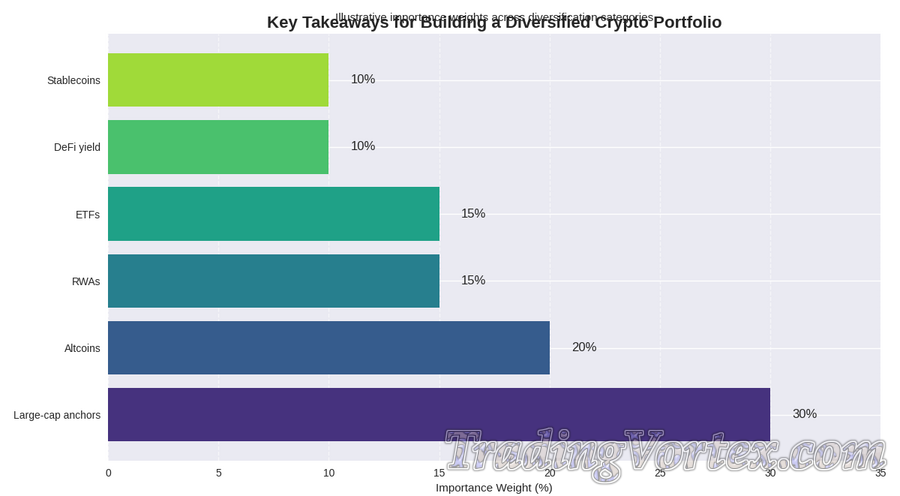 Key Takeaways for Building a Diversified Crypto Portfolio: Horizontal bar chart showing the relative importance of large-cap anchors, altcoins, RWAs, ETFs, DeFi yield, and stablecoins. It helps readers quickly grasp which categories matter most.
Actionable steps to start diversifying your crypto investments today
- Define goals and risk limits: Write down whether you want growth, income, or capital preservation, and set a maximum drawdown you can tolerate. This will guide allocations.
- Set a simple allocation framework: Start with a core-satellite split, for example 50 percent large-cap, 25 percent mid-cap, 10 percent DeFi/yield, 10 percent RWAs or ETFs, 5 percent stablecoins; adjust to your profile and local regulations.
- Choose regulated core exposure: If available in your jurisdiction, buy a spot ETF or regulated fund for the core sleeve to reduce custody complexity and tax friction.
- Onboard RWAs slowly: Allocate a small initial percentage to tokenized assets, verify legal wrappers and custody, and prefer issuers with institutional partners and transparent reporting.
- Use trusted tools: Pick a portfolio tracker and set automated rebalancing rules, alerts for allocation drift, and yield dashboards to monitor income streams.
- Practice risk hygiene: Keep a stablecoin buffer for opportunities, diversify across custodians, and limit exposure to any single smart contract or small-cap token.
- Review and rebalance: Reassess quarterly, rebalance when allocations drift beyond set thresholds, and update your plan after major regulatory or market events.
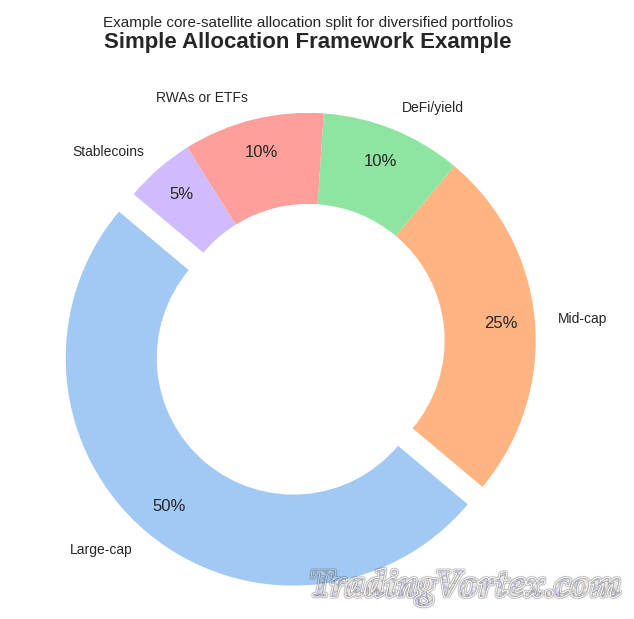 Simple Allocation Framework Example: Donut pie chart illustrating a core-satellite split: 50% large-cap, 25% mid-cap, 10% DeFi/yield, 10% RWAs/ETFs, 5% stablecoins. It provides a practical model for readers to adapt.
Final Note: Diversification is as much about peace of mind as it is about returns. Start modestly, learn each product before scaling up, and treat automation as your assistant, not your autopilot. Over time you will refine allocations that fit your goals and temperament.
FAQs: How to Diversify Your Crypto Portfolio
Q1. Why is diversification so important in crypto?
Because crypto is still the wild west of finance. Prices can swing 20 percent in a day, regulations shift quickly, and new sectors like AI tokens or tokenized real-world assets (RWAs) pop up overnight. Diversification is your seatbelt on this roller coaster. It spreads risk across different assets, so one bad bet does not sink your entire portfolio.
Q2. How many coins should I hold to be “diversified”?
There is no magic number, but most experts suggest 5 to 10 well-chosen assets. Think of it like cooking: too few ingredients and the dish is bland, too many and it tastes like chaos. A balanced mix usually includes large-cap anchors (Bitcoin, Ethereum), mid-cap innovators (Cardano, Polkadot, Avalanche), stablecoins for liquidity, and a small allocation to DeFi or RWAs.
Q3. Are stablecoins really safe to hold?
Stablecoins like USDT, USDC, and DAI are widely used for hedging and liquidity. They are safer than volatile tokens, but not risk-free. Regulatory scrutiny and reserve transparency remain hot topics. The takeaway: stablecoins are essential for managing risk, but spread your holdings across more than one issuer to avoid single-point failure.
Q4. Should I include NFTs or metaverse assets in my portfolio?
NFTs and metaverse tokens are more speculative, but they can add cultural and growth exposure. In 2025, global brands and institutions are still experimenting in this space. If you are curious, allocate a small percentage: think of it as your “fun money.” Just do not let NFTs dominate your portfolio unless you are comfortable with high risk.
Q5. How often should I rebalance my portfolio?
Quarterly rebalancing is a good rule of thumb. In bull markets, altcoins may balloon beyond your target allocation, while in bear markets stablecoins and large-caps become more valuable. Rebalancing keeps your portfolio aligned with your goals and prevents emotional decision-making.
Q6. What role do tokenized real-world assets (RWAs) play?
RWAs are one of the fastest-growing sectors in 2025, with billions in Treasuries, real estate, and commodities now on-chain. They add tangible diversification, bridging crypto with traditional finance. For investors, RWAs provide stability and yield that behave differently than native crypto assets.
Q7. Can beginners use ETFs or managed funds instead of picking coins?
Absolutely. ETFs and index funds are exploding in popularity after regulatory approvals. They let you buy a basket of assets in one go, simplifying diversification. For beginners, ETFs are like ordering a combo meal: you get a balanced mix without needing to choose every item separately.
Q8. What is the biggest mistake people make when diversifying?
Over-diversification. Holding dozens of random coins dilutes returns and makes tracking a nightmare. Intentional diversification, choosing assets with clear roles, is far more effective. Quality beats quantity every time.
Diversification is not about chasing every shiny new token, it is about building a portfolio that reflects your goals, respects your risk tolerance, and adapts to market cycles. Start simple, stay disciplined, and remember: the goal is not just to survive crypto volatility, but to thrive in it.