
How to Invest in Crypto Safely is a practical, beginner-friendly guide that walks readers through every step of building a secure, resilient crypto portfolio. The article balances big-picture context with hands-on tactics: it explains market risks and regulatory trends, shows how to choose reputable exchanges and custody solutions, and breaks down research techniques for evaluating projects and tokenomics. Readers will find clear, actionable advice on security best practices, including cold versus hot wallets, multi-factor authentication, and how to spot phishing and social engineering attempts.
The guide also covers modern, lower-risk entry strategies: regulated ETFs, stablecoins, and liquid staking tokens, plus risk mitigation tools like insurance, hedging, and automated portfolio managers. Practical sections on goal setting, dollar-cost averaging, rebalancing, and emotional discipline help investors turn knowledge into consistent habits. Real-world examples, relatable anecdotes, and a friendly tone make complex topics easy to understand, while recap boxes and a final checklist let readers skim for the essentials.
Whether you are a complete beginner or an experienced trader looking to tighten security and reduce downside, this article gives you a clear roadmap to participate in crypto with confidence, protect your assets, and plan for long-term success.
Table of Contents:
- Introduction: Why Safe Crypto Investing Matters
- Understanding the Crypto Market Landscape
- Core Principles of Safe Crypto Investing
- Key Challenges in Safe Crypto Investing
- Safe Ways to Start Investing in Crypto
- How to Research Crypto Projects Safely
- Crypto Security Best Practices for Investors
- Emerging Safe Crypto Investment Strategies
- Risk Mitigation Tools for Safe Crypto Investing
- Building a Sustainable and Safe Crypto Portfolio
- Global Perspectives on Safe Crypto Investing
- Practical Tips for Everyday Safe Crypto Investing
- Conclusion: The Future of Safe Crypto Investing
- ✅ Safe Crypto Investing Checklist
- FAQs: How to Invest in Crypto Safely
- Q1. Is crypto investing still safe in 2025?
- Q2. What is the safest way to store my crypto?
- Q3. Should beginners start with Bitcoin or altcoins?
- Q4. Are crypto ETFs and regulated products worth it?
- Q5. How can I avoid scams and rug pulls?
- Q6. What role do stablecoins play in safe investing?
- Q7. How do I manage emotions like FOMO and panic selling?
- Q8. What’s the future of safe crypto investing?
Introduction: Why Safe Crypto Investing Matters
How to Invest in Crypto Safely in a Volatile Market
Crypto has always been unpredictable. One day Bitcoin is climbing like it’s unstoppable, the next day it’s dropping faster than your phone when you forget you don’t have a case. This volatility is part of the appeal, but it’s also the biggest risk. Safe investing means preparing for those swings instead of being blindsided by them. Think of it like surfing: the waves will come whether you’re ready or not, so the trick is learning how to ride them without wiping out.
Safe investing in crypto isn’t about avoiding risk altogether, it’s about managing it. That means setting clear limits on how much you’re willing to invest, diversifying across different assets, and resisting the urge to chase every hot new token that pops up on social media. When you approach crypto with a plan, you’re less likely to panic sell during a dip or overextend yourself during a rally.
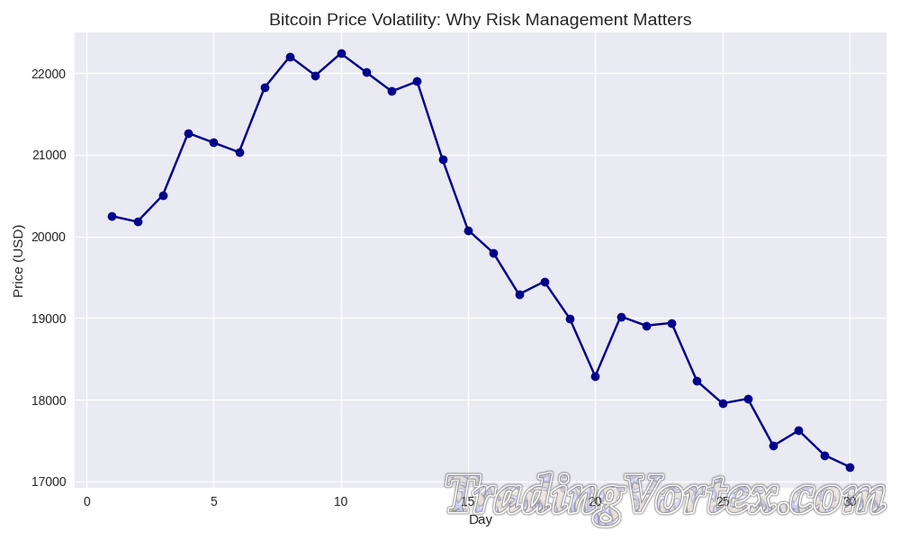 Bitcoin Price Volatility: Why Risk Management Matters.
♦ What it shows: A simulated 30-day line chart of Bitcoin’s price swings, highlighting sharp rises and sudden drops.
♦ Why it matters: This visual demonstrates the unpredictable nature of crypto markets. It reinforces the importance of setting limits, diversifying assets, and sticking to a plan rather than reacting emotionally to short-term changes.
Balancing Crypto Opportunities with Risk Management
Crypto offers opportunities that traditional markets simply don’t. From staking rewards to decentralized finance platforms, there are ways to grow your portfolio that go beyond buying and holding. But every opportunity comes with a catch. High yields often mean higher risks, and new projects can be exciting but untested.
Risk management is your safety net. Using secure wallets, enabling multi-factor authentication, and keeping your private keys offline are basic steps that protect your assets. Beyond that, it’s about mindset. The most successful investors I’ve met treat crypto like any other investment: they set goals, stick to their strategy, and never invest more than they can afford to lose.
Safe investing matters because it keeps you in the game long enough to enjoy the rewards. Crypto isn’t a sprint, it’s a marathon. By protecting yourself from unnecessary risks, you give yourself the chance to benefit from the innovation and growth this market continues to deliver.
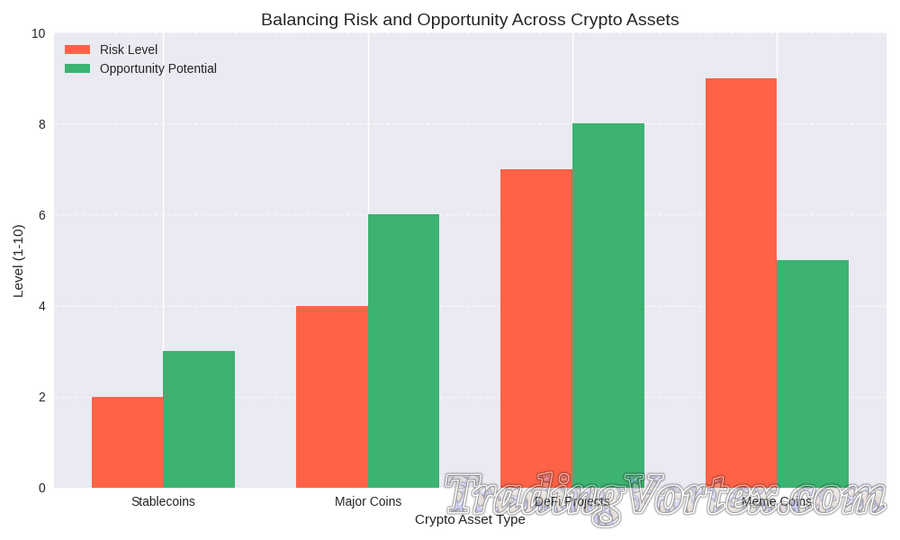 Balancing Risk and Opportunity Across Crypto Assets:
♦ What it shows: A grouped bar chart comparing four asset categories: Stablecoins, Major Coins (BTC/ETH), DeFi Projects, and Meme Coins, by risk level and opportunity potential (rated 1–10).
♦ Why it matters: This chart helps readers quickly grasp which assets are safer entry points (e.g., stablecoins) and which carry higher risks (e.g., meme coins). It supports the idea that balancing opportunity with safety is essential for long-term success.
Crypto Safety Essentials Checklist
- Start Small and Diversify: Never put all your money into one coin. Spread your investments across Bitcoin, Ethereum, stablecoins, and a few carefully chosen altcoins.
- Use Reputable Exchanges and Wallets: Stick to platforms with strong security records. For storage, consider hardware wallets for long-term holdings and hot wallets only for active trading.
- Enable Strong Security Features: Turn on multi-factor authentication, use unique passwords, and keep your private keys offline whenever possible.
- Do Your Homework Before Investing: Read whitepapers, check tokenomics, and look for red flags like anonymous teams or unrealistic promises.
- Beware of Scams and Hype: If it sounds too good to be true, it probably is. Avoid chasing meme coins or “guaranteed” high-yield projects.
- Manage Risk Like a Pro: Set clear investment limits, use stop-loss strategies, and never invest more than you can afford to lose.
- Keep Emotions in Check: Don’t let FOMO push you into bad decisions. Stick to your plan and avoid panic selling during dips.
- Stay Updated on Regulations: Crypto rules vary by country. Knowing the legal landscape helps you avoid compliance issues and protects your investments.
Understanding the Crypto Market Landscape
Latest Crypto Investing Trends and Safe Opportunities
The crypto market has matured a lot in recent years. Gone are the days when it was all about chasing meme coins or hoping for overnight riches. In 2025, the big story is utility: investors are focusing on projects that solve real problems, whether that’s powering decentralized finance, enabling cross-border payments, or supporting AI-driven applications.
At the same time, presales of new projects are attracting attention again, but with a twist. Investors are no longer throwing money at hype alone. They’re looking for teams with transparent roadmaps, audits, and actual use cases. This shift is good news for anyone who wants to invest safely, because it means the market is rewarding diligence and punishing empty promises.
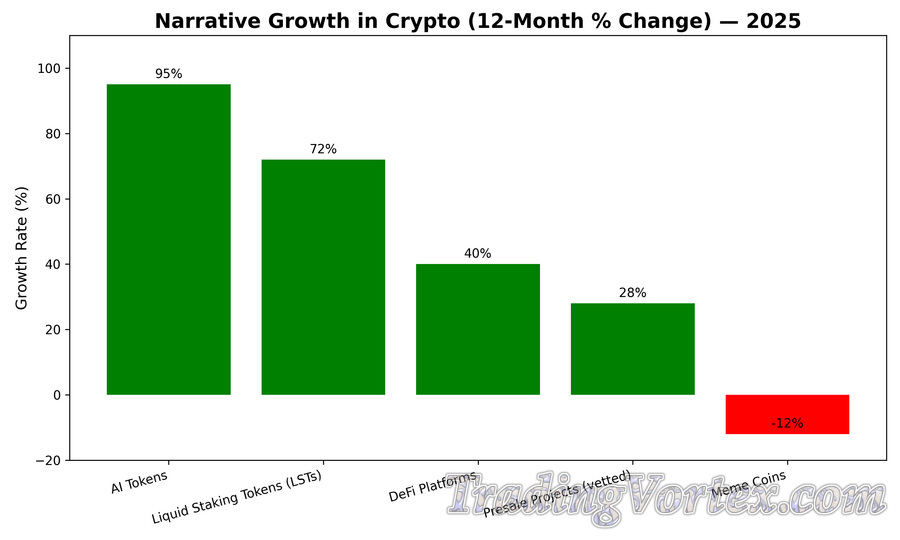 Narrative Growth in Crypto (12‑Month % Change) — 2025:
♦ What the chart shows:
◊ AI tokens +95% and Liquid Staking Tokens (LSTs) +72% lead growth; DeFi +40%, vetted presales +28%, meme coins −12%.
◊ Bars are sorted descending and annotated with percent values; positive growth is green, negative is red.
♦ Why it helps readers:
This bar chart makes it easy to see which narratives are driving real adoption and which are lagging or harmful to a safety‑first strategy. Focus on utility narratives (AI, LSTs) and avoid chasing negative/volatile meme coins.
Institutional Adoption, ETFs, and Stablecoins for Safer Crypto Investing
One of the clearest signs that crypto is becoming mainstream is the surge in institutional adoption. In 2025, crypto ETFs saw inflows of more than $28 billion, absorbing hundreds of thousands of Bitcoin into regulated products.
For everyday investors, this means safer access to crypto through familiar financial vehicles, without the hassle of managing private keys or worrying about shady exchanges.
Stablecoins have also become a backbone of the market. Their supply reached nearly $278 billion, and they now account for a huge share of liquidity on major exchanges. Institutions and retail investors alike use them for yield generation, foreign exchange settlement, and everyday transactions. If you’re looking for a safer entry point into crypto, stablecoins are often the first step, offering exposure without the roller-coaster price swings of Bitcoin or Ethereum.
I like to think of ETFs and stablecoins as the “training wheels” of crypto. They let you participate in the market with less risk, while you build confidence and learn the ropes.
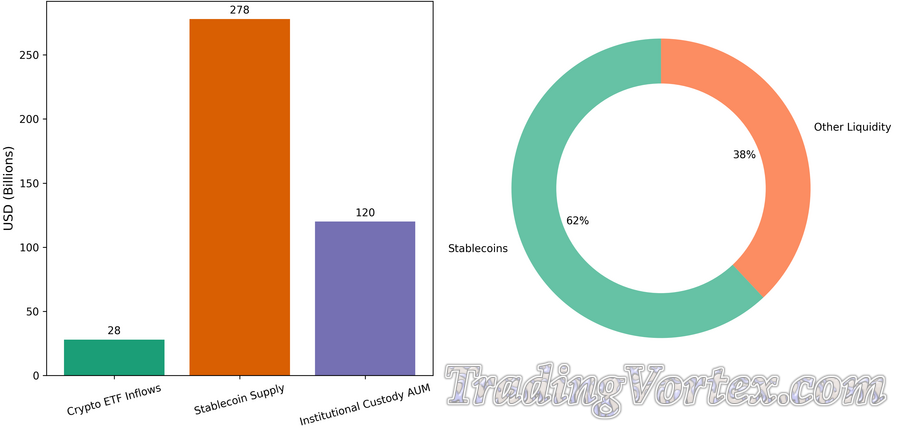 Scale of Institutional Adoption and Stablecoin Liquidity (USD billions) — 2025:
♦ What the figure shows:
◊ Left panel: grouped bars for ETF inflows $28B, Stablecoin supply $278B, Institutional custody AUM $120B with numeric labels.
◊ Right panel: donut chart showing Stablecoins 62% of exchange liquidity vs Other 38%.
♦ Why it helps readers:
These visuals quantify how ETFs and stablecoins provide lower‑friction, regulated access and large liquidity pools that reduce execution risk for everyday investors. $28B ETF inflows and $278B stablecoin supply are highlighted to show scale.
Global Regulations Shaping How to Invest in Crypto Safely
Regulation is the elephant in the room, and in 2025 it’s finally starting to take shape. The PwC Global Crypto Regulation Report highlights how frameworks like Europe’s MiCA are being implemented, while the US is experimenting with more supportive policies, including a Bitcoin reserve plan. Meanwhile, countries like Argentina are easing restrictions to allow banks to offer crypto services.
This patchwork of rules can feel confusing, but it’s ultimately a positive sign. Clearer regulations mean safer participation, fewer scams, and more accountability for exchanges and projects.
For investors, the takeaway is simple: always check the regulatory environment in your region before diving in. What’s allowed in one country might be restricted in another, and compliance is part of investing safely.
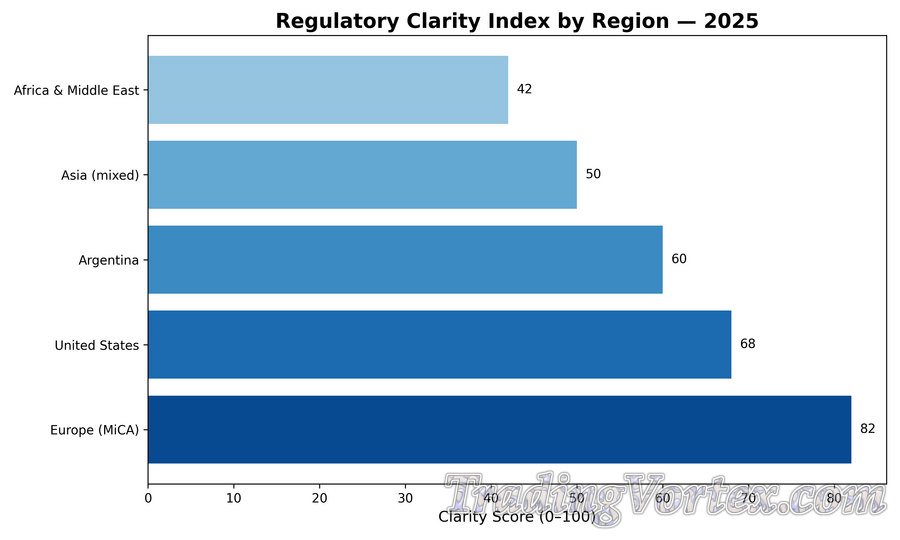 Regulatory Clarity Index by Region — 2025:
♦ What the chart shows:
◊ Horizontal bars on a 0–100 scale: Europe 82, United States 68, Argentina 60, Asia (mixed) 50, Africa & Middle East 42.
◊ Color gradient from dark blue (high clarity) to light blue (low clarity) with numeric labels.
♦ Why it helps readers:
This chart visualizes where regulatory frameworks are most developed and where investors should exercise extra caution. Higher scores imply clearer rules, fewer scams, and easier compliance.
Core Principles of Safe Crypto Investing
Diversification Strategies for Safe Crypto Investments
If there’s one golden rule in crypto, it’s this: don’t put all your eggs in one basket, especially when that basket can swing 20 percent in a single day. A recent Sygnum Bank report found that 57 percent of investors now see diversification as their primary motivation for entering crypto, overtaking the old “get rich quick” mindset. That’s a big shift, and it shows how the market is maturing.
Diversification in crypto doesn’t just mean splitting between Bitcoin and Ethereum. It’s about spreading across different categories: blue-chip assets like BTC and ETH, stablecoins for liquidity, and carefully chosen altcoins with strong fundamentals.
Some investors even add exposure to newer narratives like AI tokens or liquid staking tokens, but only as a smaller slice of the pie. Think of it like building a balanced meal: you want protein, carbs, and veggies, not just a plate full of fries.
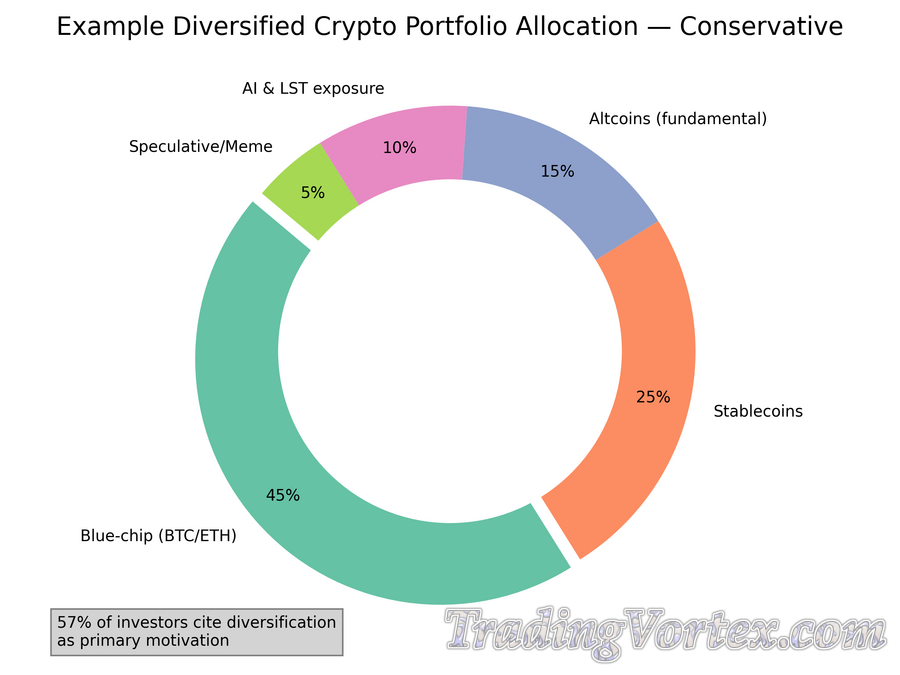 Example Diversified Crypto Portfolio Allocation — Conservative: Example conservative allocation emphasizing blue‑chip holdings and stablecoins for liquidity; small tactical exposure to AI/LSTs and minimal speculative allocation.
♦ What it shows:
◊ A donut chart illustrating a sample conservative allocation: Blue‑chip (BTC/ETH) 45%, Stablecoins 25%, Altcoins (fundamental) 15%, AI & LST exposure 10%, Speculative/Meme 5%.
◊ A callout highlights 57% as the share of investors who cite diversification as their primary motivation.
♦ How to read it:
◊ The largest slices represent the core of a safe crypto portfolio: blue‑chip assets and stablecoins provide stability and liquidity. Smaller slices show tactical exposure to growth narratives while keeping speculative risk minimal.
◊ Use the donut as a template: adjust percentages to match your risk tolerance, but keep the speculative slice small if safety is the priority.
Risk Management Tools for Safe Crypto Trading
Crypto trading can feel like playing a video game where the rules change every level. Without risk management, you’re basically running around without armor. In 2025, traders rely on tools like CoinTracking, Chainalysis, and advanced on-chain analytics platforms to monitor portfolios and spot risks before they explode.
Practical risk management starts with basics: setting stop-loss orders, using position sizing, and never over-leveraging. But it also means protecting yourself from external threats. Two-factor authentication, hardware wallets, and transaction monitoring are your shields against hacks and scams.
I’ve seen friends lose money not because they picked the wrong coin, but because they ignored security hygiene. Safe trading is about discipline, not just luck.
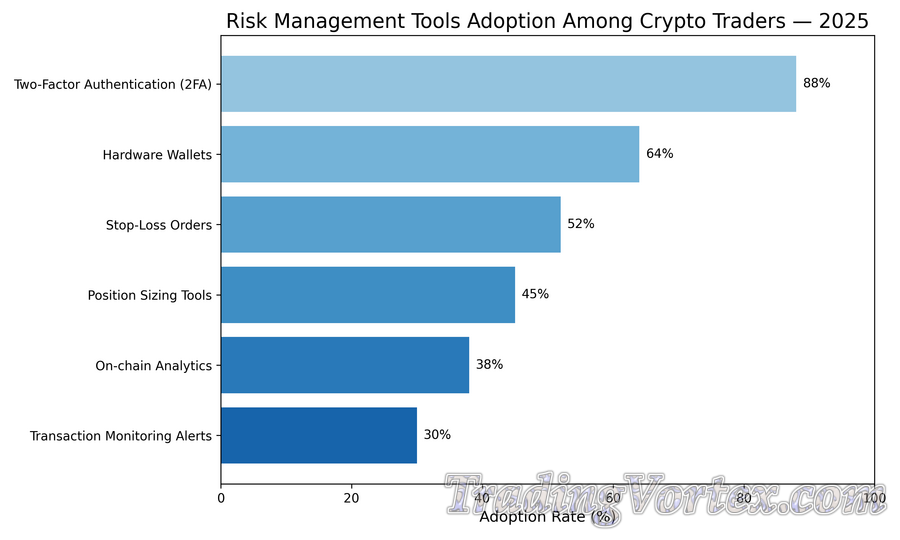 Risk Management Tools Adoption Among Crypto Traders — 2025: Higher adoption tools represent essential security hygiene; lower adoption tools are advanced but valuable for active traders.
♦ What it shows:
A horizontal bar chart ranking tools by adoption: 2FA 88%, Hardware Wallets 64%, Stop‑Loss Orders 52%, Position Sizing Tools 45%, On‑chain Analytics 38%, Transaction Monitoring Alerts 30%.
♦ How to read it:
Higher bars indicate basic security hygiene that most traders use; lower bars show advanced tools that still deliver strong protection and risk insight. Prioritize the high‑adoption items first (2FA, hardware wallets), then layer in analytics and monitoring as you scale.
Long-Term vs. Short-Term Crypto Investing Safely
Here’s the eternal debate: do you HODL or do you trade? Both strategies can work, but they come with very different risks.
Long-term investing is about conviction. You buy assets like Bitcoin or Ethereum, stash them away, and treat them like that gym membership you keep “for the future”. The upside is that you ride out volatility and benefit from long-term growth. The downside is that you need patience and nerves of steel.
Short-term trading, on the other hand, is like playing chess at lightning speed. You’re chasing swings, looking for quick wins, and constantly glued to charts. It can be profitable, but it’s also stressful and risky. Many traders burn out because they underestimate how emotional the game can get.
The safest approach? Decide which camp you belong to, then stick to a plan. Some investors even blend both: they keep a long-term core portfolio while trading a small portion for fun and potential extra gains.
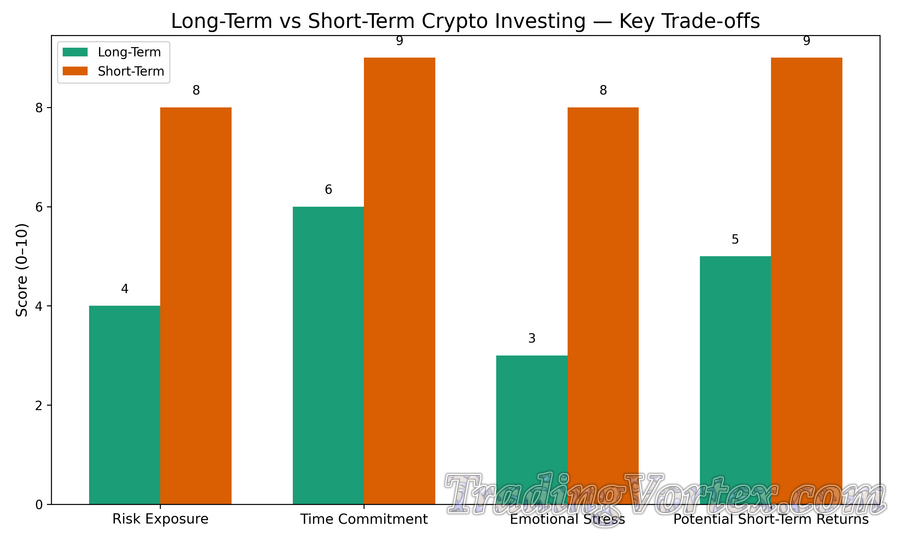 Long‑Term vs Short‑Term Crypto Investing — Key Trade‑offs: Compare the practical trade‑offs between HODL and active trading; choose a primary strategy and allocate a small portion to the other if desired.
♦ What it shows:
A grouped bar chart comparing Long‑Term and Short‑Term across four metrics on a 0–10 scale: Risk Exposure 4 vs 8, Time Commitment 6 vs 9, Emotional Stress 3 vs 8, Potential Short‑Term Returns 5 vs 9.
♦ How to read it:
The chart makes trade‑offs explicit: short‑term trading scores higher on stress and potential short‑term returns, while long‑term investing scores lower on stress and risk exposure. Use it to decide which approach fits your temperament and schedule.
Safe Crypto Investing Principles Recap
- Diversify Smartly: Spread your investments across Bitcoin, Ethereum, stablecoins, and carefully chosen altcoins to reduce risk.
- Use Risk Management Tools: Set stop-loss orders, size positions wisely, and protect your accounts with strong security practices.
- Choose Your Strategy: Decide whether you’re a long-term holder, a short-term trader, or a mix of both, and stick to your plan.
Key Challenges in Safe Crypto Investing
Market Volatility and How to Invest in Crypto Safely
Crypto volatility is legendary. In 2025, analysts noted that while overall volatility dropped about 15 percent compared to 2024, sudden shocks still rattled markets. Liquidity crunches and macroeconomic events, like tariff announcements or interest rate changes, can send Bitcoin and Ethereum swinging in opposite directions.
For investors, this means you can’t just rely on past patterns. The safe way to handle volatility is to plan for it. Diversify your holdings, set stop-loss orders, and avoid over-leveraging.
I once watched a friend turn a winning trade into a nightmare because they didn’t set a stop-loss. The market dipped overnight, and by morning their position was wiped out. Volatility isn’t going away, so the trick is learning to live with it without losing sleep.
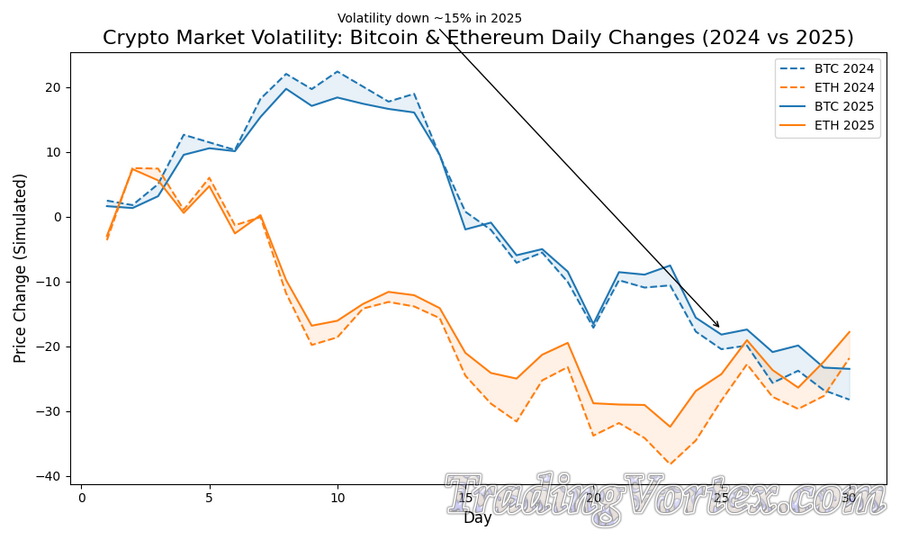 Crypto Market Volatility: Bitcoin & Ethereum Daily Changes (2024 vs 2025):
♦ What it shows: A line chart comparing simulated daily price changes of BTC and ETH in 2024 vs 2025, with shaded areas highlighting reduced volatility.
♦ Why it matters: Even though volatility dropped ~15% in 2025, sudden spikes remain. This reinforces the need for diversification, stop-loss orders, and avoiding over-leverage.
Regulatory Uncertainty and Safe Crypto Compliance
Regulation is a moving target. In 2025, bank CEOs met with US senators to discuss crypto market structure, while Europe pushed firms to comply with MiCA rules before year-end. Meanwhile, countries like Argentina and Italy adjusted their stances, showing how fragmented global policy remains.
For investors, this uncertainty creates headaches. A token that’s fine to trade in one country might be restricted in another.
Safe investing means staying informed about local rules and choosing platforms that comply with global standards. Think of regulation like traffic laws: they may differ from country to country, but ignoring them can get you into serious trouble.
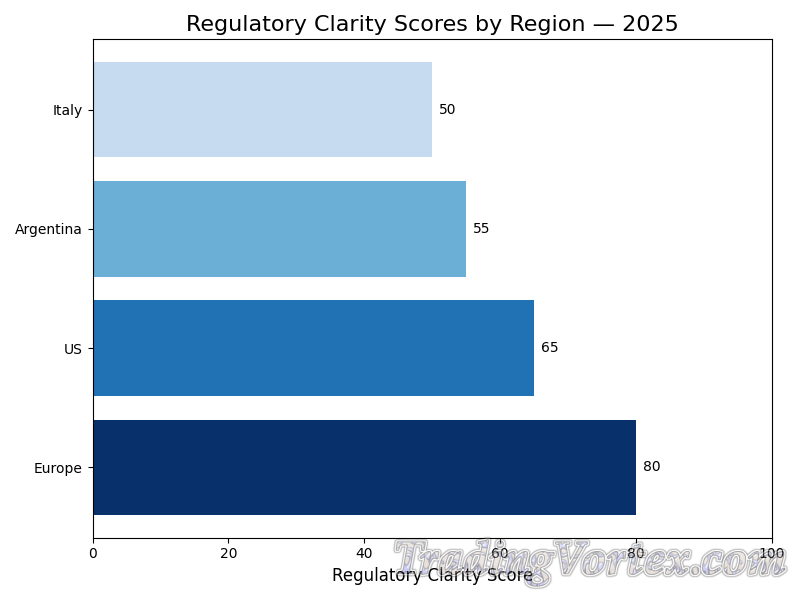 Regulatory Clarity Scores by Region — 2025:
♦ What it shows: A horizontal bar chart ranking Europe (80), US (65), Argentina (55), and Italy (50) on regulatory clarity.
♦ Why it matters: The fragmented scores highlight uneven global policy. Investors must check local compliance before trading.
Security Threats: Hacks, Scams, and Rug Pulls in Crypto Investing
Security risks are the dark side of crypto. In 2025, rug pull losses soared by 6,500 percent compared to 2024, totaling nearly $6 billion. Scams have become more sophisticated, with fake platforms using AI-powered chatbots and manipulated statistics to lure investors. Even experienced traders can fall victim.
I remember a colleague who invested in what looked like a promising DeFi project. Overnight, the developers vanished, and so did the funds. It was a classic rug pull.
The lesson is clear: always research projects, use reputable exchanges, and store assets in secure wallets. In crypto, trust is earned, not assumed.
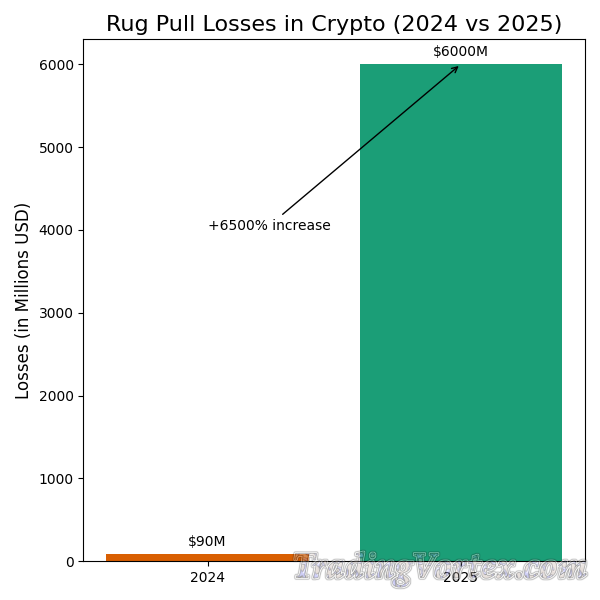 Rug Pull Losses in Crypto (2024 vs 2025):
♦ What it shows: A vertical bar chart comparing rug pull losses: $90M in 2024 vs $6B in 2025 (+6500%).
♦ Why it matters: The dramatic increase underscores the importance of due diligence, secure wallets, and trusted exchanges.
Avoiding Emotional Traps: FOMO and Panic Selling in Crypto
The hardest challenge isn’t the market or regulation, it’s ourselves. Fear of Missing Out (FOMO) and panic selling are the twin emotions that drain portfolios. Buying at the top because everyone else is hyped, or selling at the bottom because you’re scared, locks in losses.
I’ve seen friends brag about buying into a coin after a celebrity tweet, only to panic sell when the hype faded.
Safe investing means controlling emotions. Stick to your plan, remind yourself why you invested, and avoid chasing every shiny opportunity. Crypto rewards patience and discipline more than impulsive moves.
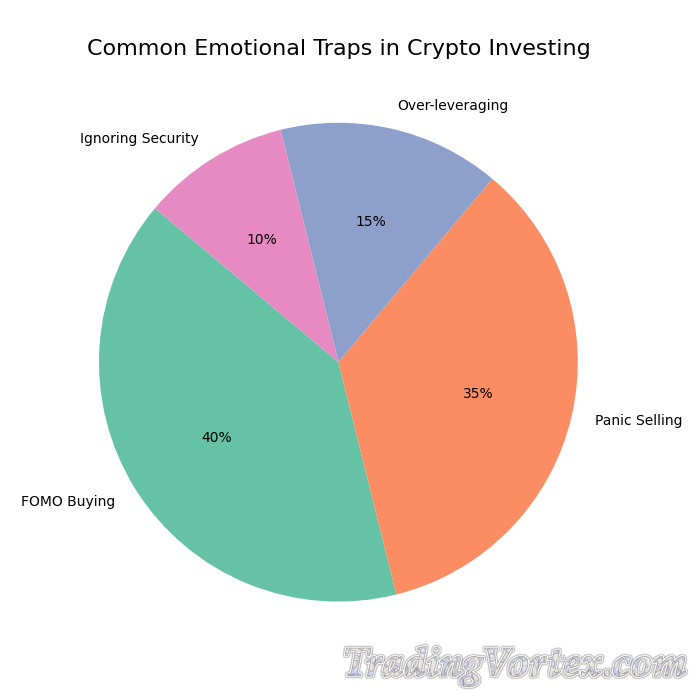 Common Emotional Traps in Crypto Investing:
♦ What it shows: A pie chart showing investor mistakes: FOMO buying (40%), Panic selling (35%), Over-leveraging (15%), Ignoring security (10%).
♦ Why it matters: Emotional decisions dominate mistakes. Discipline and sticking to a plan are key to safe investing.
Safe Crypto Challenges Recap:
- ⚡ Market Volatility: Crypto prices can swing wildly, so plan for ups and downs with diversification and stop-loss strategies.
- ⚖️ Regulatory Uncertainty: Rules differ across regions, making compliance essential for safe crypto investing.
- 🔒 Security Threats: Hacks, scams, and rug pulls remain common, so use reputable platforms and secure wallets.
- 🧠 Emotional Traps: FOMO and panic selling can sabotage your strategy, so stick to your plan and stay disciplined.
Safe Ways to Start Investing in Crypto
Choosing Safe Crypto Exchanges and Wallets
The first step in crypto investing is picking the right platform. In 2025, reviews highlight exchanges like Binance, KuCoin, Bitget, and Bybit as among the safest, thanks to strong solvency guarantees, regulatory compliance, and independent security audits. These platforms are trusted by millions of users and have invested heavily in fraud detection and insurance protections.
Once you’ve bought your crypto, storage matters just as much. Software wallets like Best Wallet, which uses Fireblocks technology for end-to-end encryption, are considered among the safest non-custodial options. For long-term holdings, hardware wallets remain the gold standard.
I often tell friends to think of wallets like safes: hot wallets are convenient but vulnerable, while cold wallets are slower but far more secure.
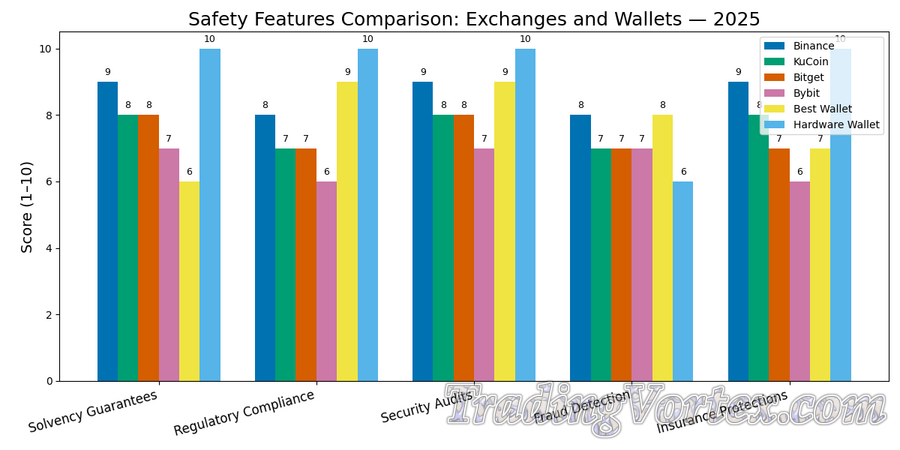 Safety Features Comparison: Exchanges and Wallets — 2025:
♦ What it shows: A grouped bar chart comparing Binance, KuCoin, Bitget, Bybit, Best Wallet, and Hardware Wallets across five safety features: solvency guarantees, regulatory compliance, security audits, fraud detection, and insurance protections.
♦ Why it matters: This chart highlights that while exchanges score well on solvency and fraud detection, hardware wallets remain the gold standard for long-term storage. Best Wallet also stands out for strong compliance and encryption.
Investing in Crypto ETFs and Regulated Products Safely
If managing private keys feels intimidating, crypto ETFs are a safer way to get exposure. In 2025, crypto ETFs attracted nearly $29.4 billion in inflows, with products like the iShares Bitcoin Trust delivering returns above 28 percent. ETFs now cover not just Bitcoin and Ethereum, but also altcoins like Solana and XRP.
The advantage of ETFs is that they’re regulated, transparent, and often backed by traditional custodians. You don’t have to worry about hacks or rug pulls, and you can buy them through the same brokerage account you use for stocks.
For beginners, ETFs are like training wheels: they let you participate in crypto’s upside without the stress of managing wallets or navigating shady platforms.
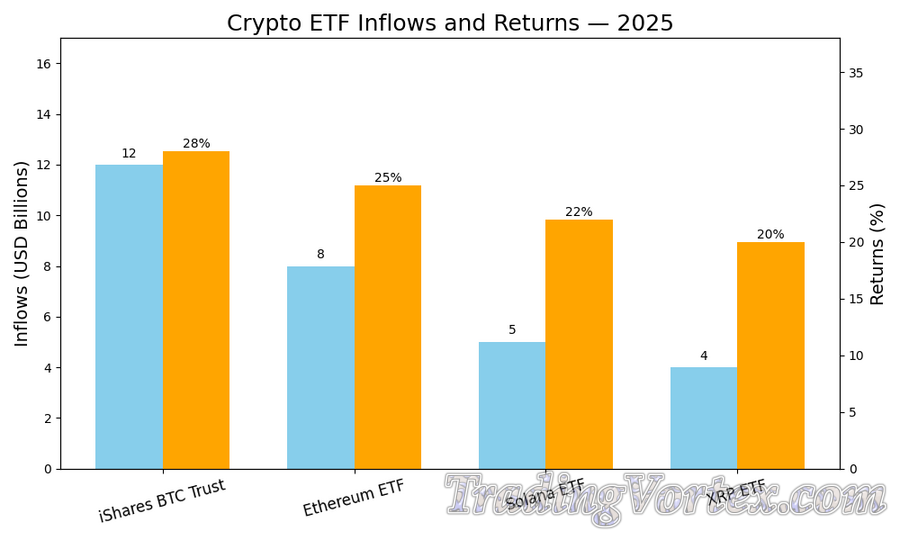 Crypto ETF Inflows and Returns — 2025:
♦ What it shows: A dual-axis bar chart showing inflows (USD billions) and returns (%) for iShares Bitcoin Trust, Ethereum ETF, Solana ETF, and XRP ETF.
♦ Why it matters: The chart demonstrates that ETFs attracted $29.4B in inflows and delivered strong returns (28%+ for BTC Trust). It reinforces ETFs as regulated, transparent, and safer entry points for beginners.
Stablecoins as a Safe Entry Point into Crypto Investing
Stablecoins are the bridge between traditional finance and crypto. Pegged to assets like the US dollar or euro, they provide stability in a market known for wild swings. In 2025, USD Coin (USDC) is widely regarded as one of the safest options, thanks to verified reserves and transparency. Other innovative stablecoins, like USDA from Angle, even offer yield opportunities through redistribution models.
Stablecoins are useful for beginners because they let you test the waters without the roller-coaster ride of Bitcoin or Ethereum. They’re also practical: you can use them for payments, lending, or simply holding value while you learn the ropes.
I often compare stablecoins to the “practice mode” in a video game. You get to explore the mechanics without risking everything on your first playthrough.
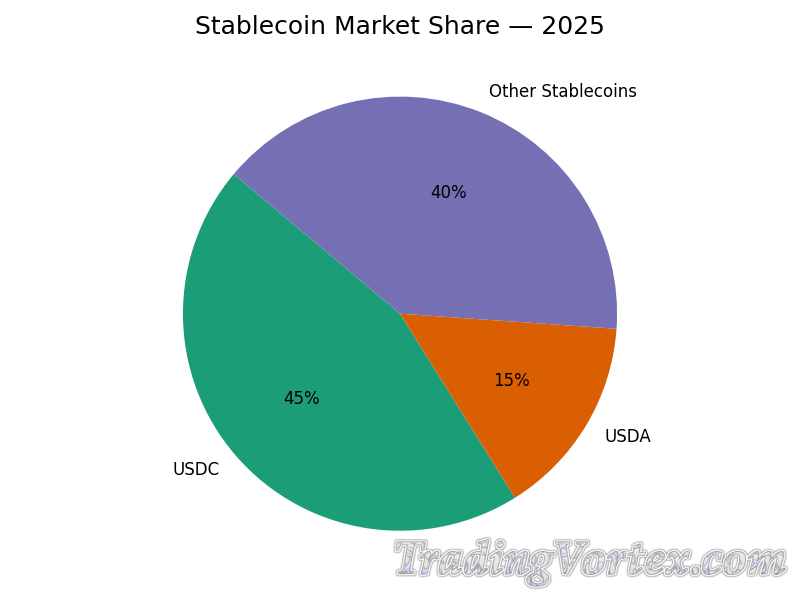 Stablecoin Market Share — 2025:
♦ What it shows: A pie chart showing USDC (45%), USDA (15%), and Other Stablecoins (40%).
♦ Why it matters: This visual emphasizes USDC’s dominance as a safe, transparent option, while USDA represents innovation with yield opportunities. Other stablecoins provide liquidity but vary in safety.
Safe Crypto Investing Recap:
- 🔑 Choose Secure Platforms: Stick to exchanges with strong compliance and wallets with proven encryption.
- 📈 Use Regulated Products: ETFs provide safe exposure to crypto without the stress of custody.
- 💵 Start with Stability: Stablecoins offer a low-risk entry point and practical use cases.
How to Research Crypto Projects Safely
Analyzing Whitepapers and Tokenomics for Safe Crypto Investments
A whitepaper is the project’s pitch deck, its story, and its promise all rolled into one. In 2025, experts emphasize that a strong whitepaper should clearly explain the project’s utility, roadmap, and governance model. If it reads like a jumble of buzzwords or avoids specifics, that’s a red flag.
Tokenomics is equally important. Look at how tokens are distributed: is most of the supply locked with the team or early investors, or is it fairly spread out? Transparent tokenomics with clear use cases and sustainable supply schedules are signs of a healthier project.
I often tell friends to treat tokenomics like nutrition labels. If the ingredients look suspicious, you probably don’t want to consume it.
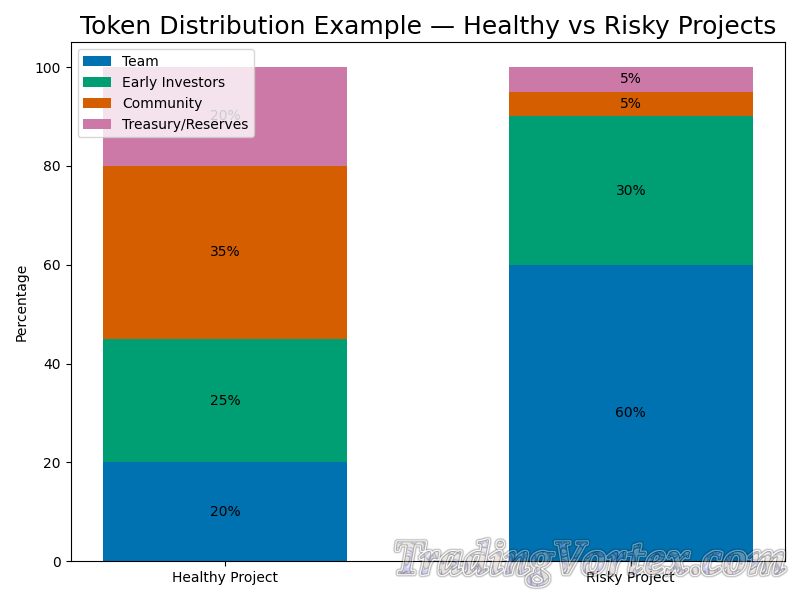 Token Distribution Example — Healthy vs Risky Projects:
♦ What it shows: A stacked bar chart comparing two hypothetical projects. The healthy project has balanced distribution (Team 20%, Investors 25%, Community 35%, Treasury 20), while the risky project is heavily skewed toward insiders (Team 60%, Investors 30%, Community 5%, Treasury 5).
♦ Why it matters: Balanced tokenomics signal transparency and sustainability, while insider-heavy allocations are red flags.
Identifying Red Flags Before Investing in Crypto Safely
Scams in 2025 have become more sophisticated, with AI-generated websites, fake audits, and celebrity endorsements luring investors. Losses from rug pulls and presale scams have already crossed billions this year. Common red flags include:
- Promises of “guaranteed” returns.
- Anonymous teams with no verifiable track record.
- No audits or vague technical documentation.
- Heavy reliance on hype through Telegram or X promotions.
The collapse of “Enron Crypto” earlier this year is a perfect example. It rose quickly on hype and endorsements, but the lack of transparency and compliance led to a dramatic crash. Safe investing means slowing down, verifying sources, and never rushing into projects just because they’re trending.
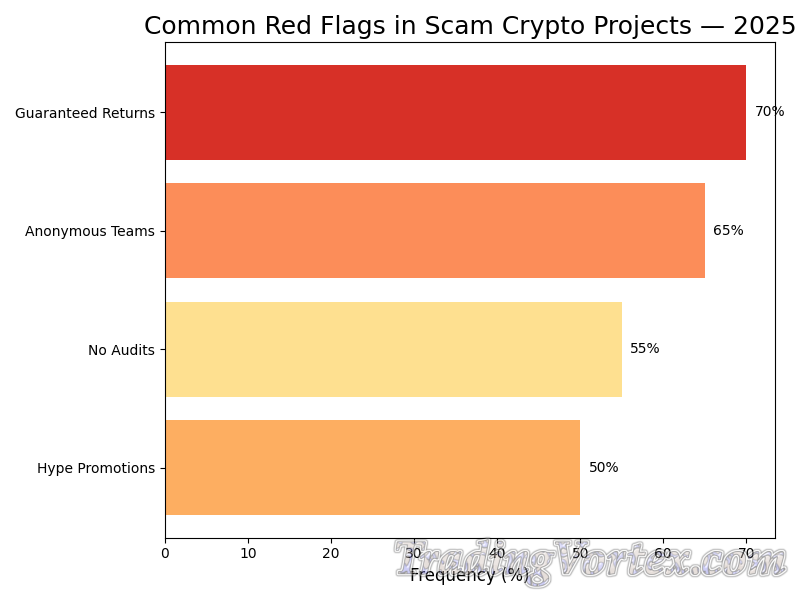 Common Red Flags in Scam Crypto Projects — 2025:
♦ What it shows: A horizontal bar chart ranking the frequency of red flags: Guaranteed Returns (70%), Anonymous Teams (65%), No Audits (55%), Hype Promotions (50).
♦ Why it matters: This visual highlights the most common warning signs investors should watch for before committing funds.
Using On-Chain Data and Analytics Tools for Safer Crypto Decisions
One of the best parts of crypto is that the data is public. On-chain analytics tools like Glassnode, Nansen, Dune, and DeFiLlama have become essential in 2025. They let you track wallet activity, token flows, and even “smart money” behavior.
I like to think of on-chain tools as the X-ray machine of crypto. They show you what’s happening beneath the surface, beyond the glossy marketing.
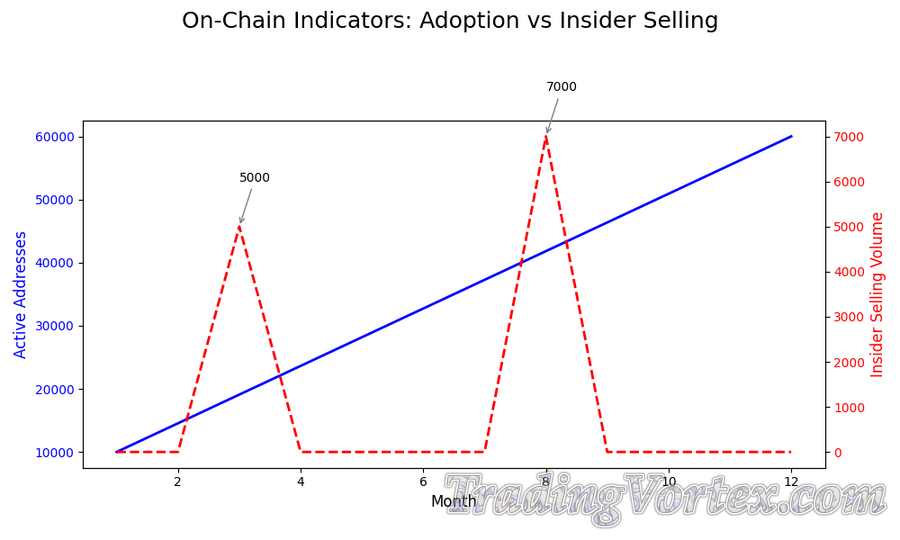 On-Chain Indicators: Adoption vs Insider Selling:
♦What it shows: A line chart tracking active addresses (rising steadily from 10k to 60k) against insider selling spikes at months 3 and 8.
♦ Why it matters: On-chain data reveals both positive adoption trends and negative insider behaviors, helping investors make informed decisions.
Safe Crypto Research Recap:
- 📄 Read the Whitepaper Carefully: Look for clear utility, transparent roadmaps, and realistic goals.
- 📊 Check Tokenomics: Fair distribution and sustainable supply are signs of safer projects.
- 🚨 Spot Red Flags: Avoid projects with anonymous teams, guaranteed returns, or no audits.
- 🔍 Use On-Chain Tools: Track wallet activity and token flows to verify real adoption.
Crypto Security Best Practices for Investors
Cold Wallets vs. Hot Wallets: Safe Crypto Storage
In 2025, the debate between cold and hot wallets is still alive and well.
- Hot wallets, like mobile or web-based apps, are convenient for quick trades and DeFi activities. They’re like your everyday wallet: easy to access, but risky if someone snatches it.
- Cold wallets, on the other hand, are offline devices that store your crypto away from hackers. Think of them as a vault in your basement.
I often tell friends that hot wallets are like carrying cash in your pocket, while cold wallets are like locking gold bars in a safe. Both have their place, but you wouldn’t carry gold bars to the grocery store.
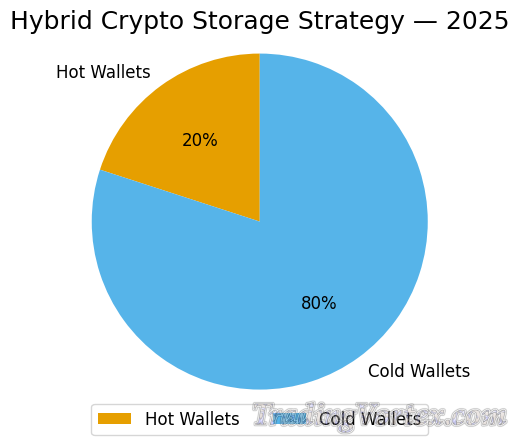 Hybrid Crypto Storage Strategy — 2025:
♦ What it shows: A pie chart illustrating a recommended hybrid allocation: Hot Wallets 20% (for daily use) vs Cold Wallets 80% (for long-term safety).
♦ Why it matters: This visual makes the hybrid approach easy to understand: hot wallets provide convenience, while cold wallets protect against hacks.
Multi-Factor Authentication for Safe Crypto Accounts
Passwords alone are no longer enough. In 2025, multi-factor authentication (MFA) is considered a must-have for every crypto account. MFA adds extra layers of protection, like SMS codes, authenticator apps, or hardware keys. Even if someone steals your password, they can’t get in without the second factor.
I once had a friend who thought MFA was “too much hassle.” They learned the hard way when their exchange account was compromised. A few seconds of extra effort could have saved them thousands.
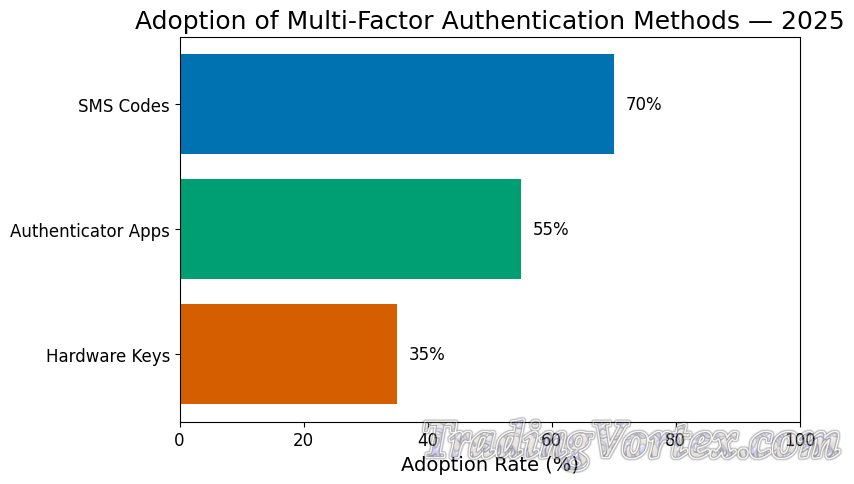 Adoption of Multi-Factor Authentication Methods — 2025:
♦ What it shows: A horizontal bar chart comparing adoption rates: SMS Codes 70%, Authenticator Apps 55%, Hardware Keys 35%.
♦ Why it matters: The chart highlights that while SMS codes are most common, authenticator apps and hardware keys offer stronger protection.
Avoiding Phishing and Social Engineering in Crypto Investing
Phishing scams have become more sophisticated in 2025, often powered by AI. Attackers now send hyper-realistic emails, fake landing pages, and even impersonate support staff with convincing chatbots. The FBI reported over $262 million lost to account takeover scams in 2025, many tied to crypto wallets.
The best defense is skepticism. Always double-check URLs, avoid clicking on links in unsolicited messages, and verify wallet addresses before sending funds. Social engineering scams are also on the rise, with attackers using deepfakes and fake communities to lure investors.
If something feels off, trust your gut. I like to remind people: if a stranger online is offering you “guaranteed returns”, it’s not an opportunity, it’s a trap.
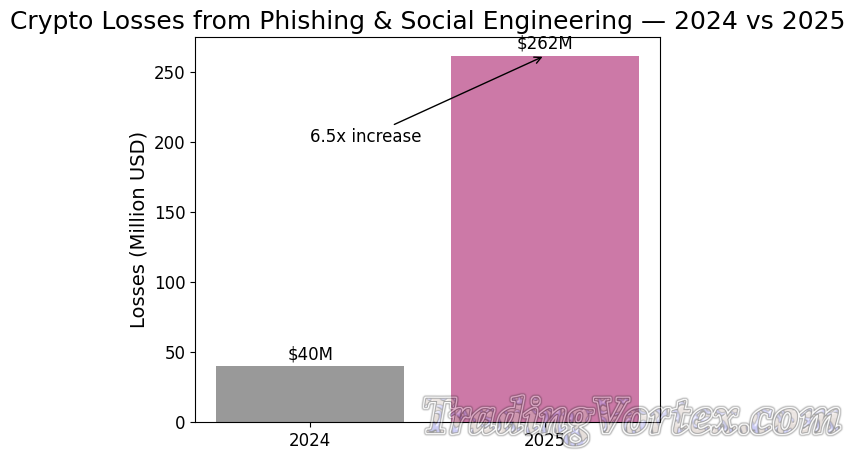 Crypto Losses from Phishing & Social Engineering — 2024 vs 2025:
♦ What it shows: A vertical bar chart comparing losses: $40M in 2024 vs $262M in 2025, annotated with a “6.5x increase.”
♦ Why it matters: This sharp rise underscores the growing sophistication of scams and the need for vigilance.
Safe Crypto Security Recap:
- 🔐 Cold vs. Hot Wallets: Use hot wallets for convenience, cold wallets for long-term safety.
- 🛡️ Multi-Factor Authentication: Always enable MFA to protect accounts from unauthorized access.
- 🚫 Phishing and Social Engineering: Stay skeptical, verify sources, and avoid clicking suspicious links.
Emerging Safe Crypto Investment Strategies
Liquid Staking Tokens (LSTs) for Safer Yield Opportunities
Staking has always been a way to earn passive income in crypto, but in 2025 liquid staking tokens (LSTs) have taken center stage. Platforms like Lido and Rocket Pool allow investors to stake assets such as Ethereum while still keeping them liquid. This means you earn staking rewards and can use your staked tokens in other DeFi protocols at the same time.
Recent reports highlight that Ethereum remains the anchor for staking, while networks like Solana, Polkadot, and Cosmos offer some of the highest yields. The key advantage of LSTs is flexibility: you don’t have to lock your funds for months, and you can compound returns across multiple platforms.
I often compare LSTs to renting out your apartment while still living in it. You get the benefits of ownership and the extra income, without giving up control.
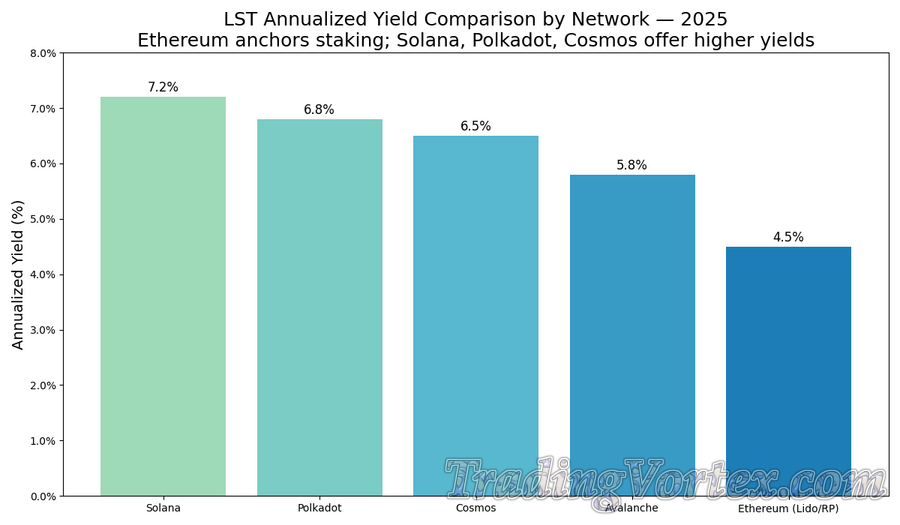 LST Annualized Yield Comparison by Network — 2025:
♦ What it shows: A vertical bar chart comparing annualized yields for LSTs across networks: Solana 7.2%, Polkadot 6.8%, Cosmos 6.5%, Avalanche 5.8%, Ethereum (Lido/Rocket Pool) 4.5%.
♦ Why it matters: The chart makes it easy to see that Ethereum anchors staking with lower but steadier yields while other networks offer higher returns but typically higher protocol risk. Use this to weigh yield vs. safety when choosing LST exposure.
♦ How to use it: Treat higher yields as signals to investigate protocol risk (audits, decentralization, slashing history) rather than as automatic buys.
AI-Driven Crypto Assets and Safe Innovation Investing
Artificial intelligence is reshaping crypto just as much as finance. In 2025, projects like Ozak AI and CryptoEasily are leading the charge with predictive models, autonomous agents, and intelligent asset management systems. These platforms use AI to analyze on-chain data in real time, optimize asset performance, and even execute trades automatically.
For investors, AI-driven assets represent a safer way to explore innovation. Instead of chasing hype, you’re tapping into infrastructure that combines two transformative technologies: blockchain and AI. Analysts note that AI tokens are outperforming meme coins because they offer real utility, from decentralized compute networks to predictive trading signals.
I like to think of AI assets as the “smart assistants” of your portfolio. They help you make better decisions, but you still need to supervise them.
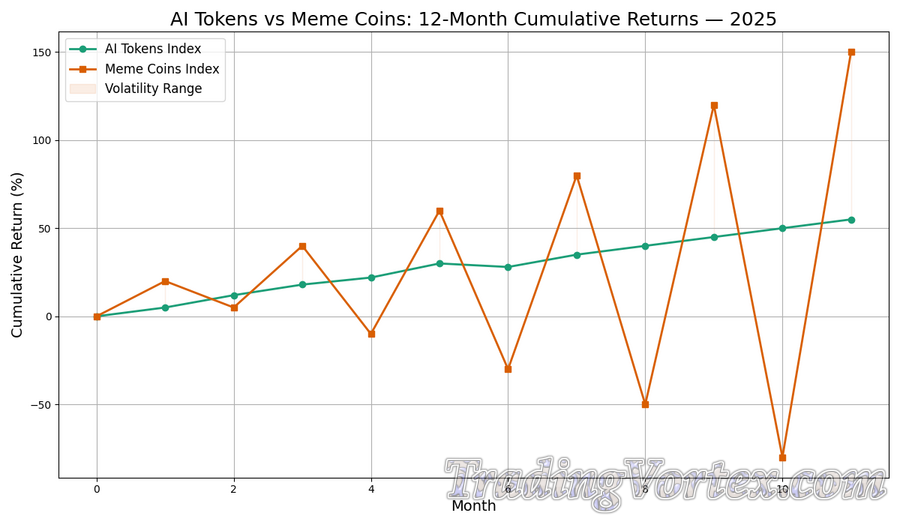 AI Tokens vs Meme Coins: 12‑Month Cumulative Returns — 2025:
♦ What it shows: A 12‑month line chart comparing cumulative returns for an AI Tokens Index (steady growth to +55%) and a Meme Coins Index (extreme swings, large drawdowns and spikes). A shaded band highlights meme‑coin volatility.
♦ Why it matters: The visual demonstrates that AI tokens deliver steadier, utility-driven returns while meme coins show extreme tail risk. This supports the text’s recommendation to favor innovation with real utility over hype.
♦ How to use it: Use the chart to justify allocating a measured portion to AI tokens while keeping speculative meme exposure minimal and tightly sized.
Building Balanced Portfolios with Bitcoin, Ethereum, and Altcoins Safely
No matter how exciting new strategies are, balance remains the cornerstone of safe investing. In 2025, experts recommend portfolios anchored by Bitcoin and Ethereum, with measured exposure to altcoins like Solana, XRP, and AI tokens. Stablecoins also play a role, offering liquidity and a buffer against volatility.
I often tell beginners to treat their portfolio like a balanced diet. You need staples like Bitcoin and Ethereum, some variety with altcoins, and stablecoins as the water that keeps everything flowing.
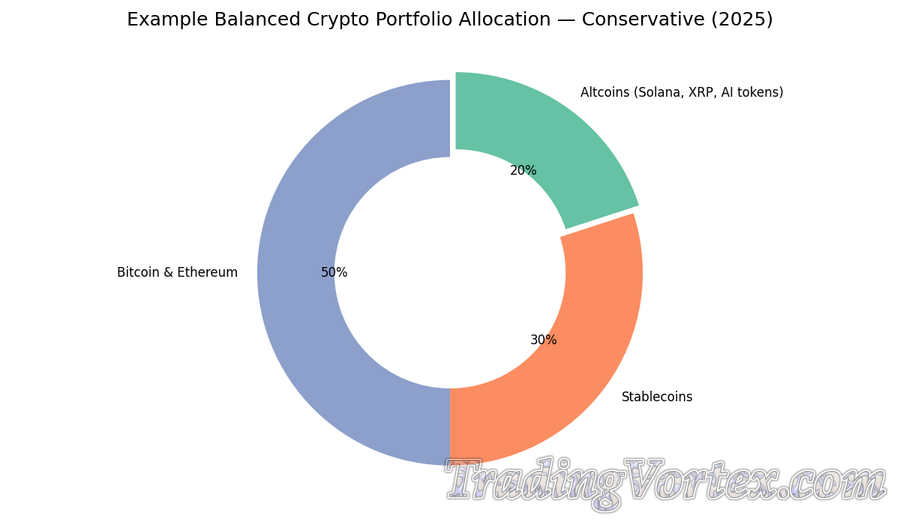 Example Balanced Crypto Portfolio Allocation — Conservative (2025):
♦ What it shows: A donut chart illustrating a conservative allocation: Bitcoin & Ethereum 50%, Stablecoins 30%, Altcoins (Solana, XRP, AI tokens) 20%.
♦ Why it matters: The chart gives a simple, copy‑ready template for a safety‑first portfolio that still captures growth opportunities. It reinforces the advice to anchor with BTC/ETH, keep liquidity in stablecoins, and limit altcoin exposure.
♦ How to use it: Apply DCA and periodic rebalancing to maintain target weights and reduce timing risk.
Safe Crypto Strategies Recap:
- 💡 Liquid Staking Tokens: Earn yield while keeping assets liquid and flexible.
- 🤖 AI-Driven Assets: Tap into blockchain plus AI for smarter, safer innovation.
- ⚖️ Balanced Portfolios: Anchor with Bitcoin and Ethereum, add altcoins and stablecoins for diversification.
Risk Mitigation Tools for Safe Crypto Investing
Insurance Products Protecting Safe Crypto Investments
Insurance is no longer just for cars and houses. In 2025, crypto insurance has matured into a serious industry. Traditional providers like Allianz and Lloyd’s are experimenting with Bitcoin coverage, while decentralized platforms such as Nexus Mutual, InsurAce, and HeLa Labs offer protection against smart contract bugs, exchange hacks, and rug pulls.
I often tell friends to think of insurance as the seatbelt of crypto. You hope you never need it, but when things go wrong, you’ll be glad it’s there.
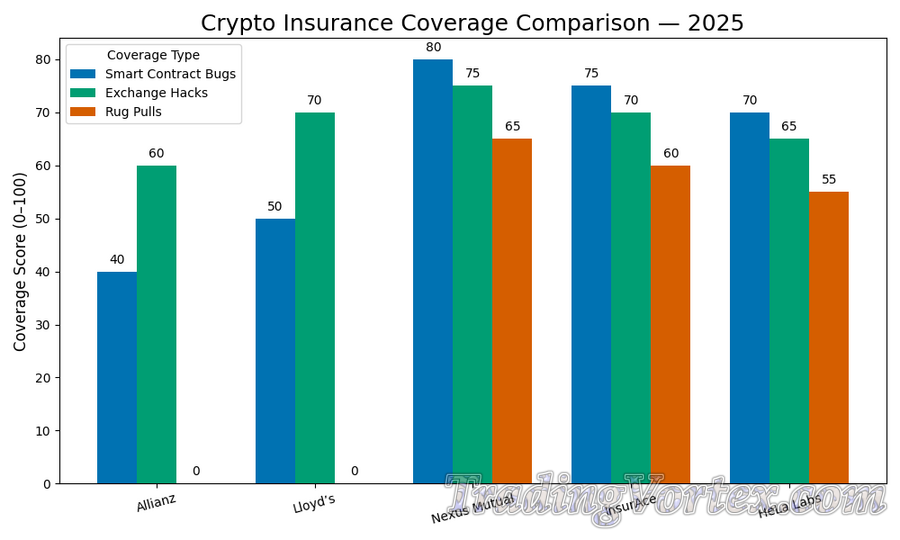 Crypto Insurance Coverage Comparison — 2025:
♦ What it shows: A grouped bar chart comparing traditional insurers (Allianz, Lloyd’s) with decentralized platforms (Nexus Mutual, InsurAce, HeLa Labs) across coverage types: smart contract bugs, exchange hacks, and rug pulls.
♦ Why it matters: The chart highlights that decentralized providers offer broader coverage, while traditional insurers are still limited.
Hedging with Stablecoins and Derivatives Safely
Stablecoins are the backbone of risk management in crypto. They act as a safe harbor when markets get stormy. In 2025, investors are using stablecoins not just to park funds, but also to hedge volatility. Platforms like Phemex and DepegWatch highlight strategies for protecting against stablecoin depegs using on-chain derivatives.
Derivatives such as futures and options are also gaining traction. They allow investors to lock in prices or protect against downside risk. WalletInvestor recently noted that derivatives are now indispensable tools for sophisticated traders.
I like to compare hedging to carrying an umbrella. You might not need it every day, but when the storm hits, you’ll be glad you packed it.
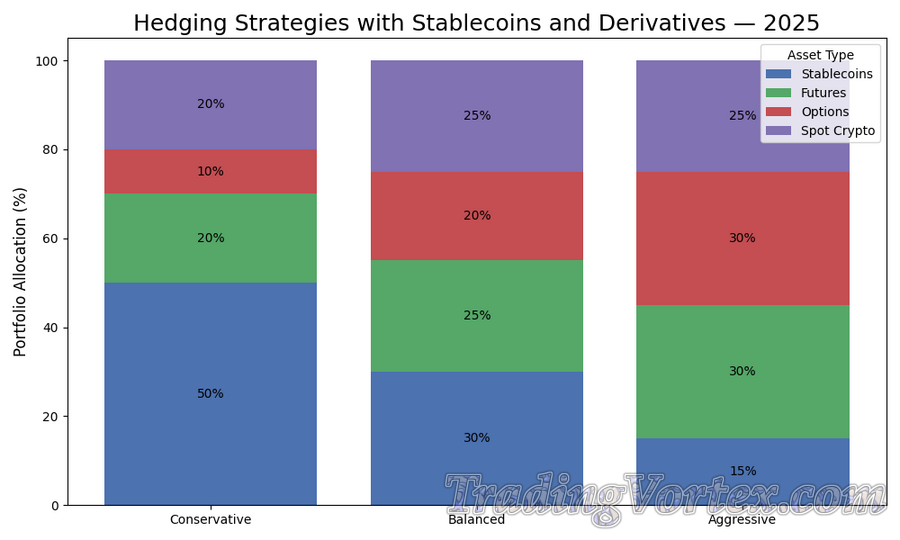 Hedging Strategies with Stablecoins and Derivatives — 2025:
What it shows: A stacked bar chart illustrating portfolio allocations for three investor profiles: Conservative, Balanced, and Aggressive. Categories include stablecoins, futures, options, and spot crypto.
Why it matters: This visual demonstrates how different strategies balance safety and risk, showing that stablecoins dominate conservative hedging, while aggressive investors lean more on derivatives.
Automated Risk Management Platforms for Safe Crypto Trading
Managing risk manually can be exhausting. That’s why automated platforms are booming in 2025. Tools like Dash 2 Trade, Margex, Snorter Bot, and CryptoDaily’s portfolio managers help investors set strategies and let software handle the mechanics.
These platforms can rebalance portfolios, monitor market conditions, and even execute trades based on pre-set rules. The advantage is that they remove emotion from the equation. No more panic selling at midnight or chasing hype after a tweet.
I’ve seen traders burn out because they tried to micromanage every move. Automation gives you back your time and peace of mind.
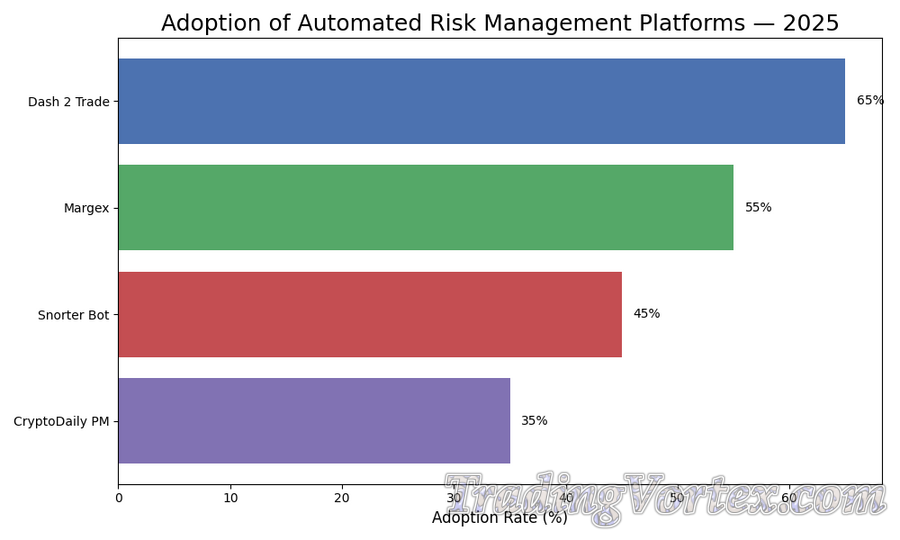 Adoption of Automated Risk Management Platforms — 2025:
♦ What it shows: A horizontal bar chart ranking adoption rates of Dash 2 Trade, Margex, Snorter Bot, and CryptoDaily Portfolio Manager.
♦ Why it matters: The chart emphasizes the growing popularity of automation tools, showing that Dash 2 Trade leads adoption while others are steadily gaining traction.
Safe Crypto Risk Tools Recap:
- 🛡️ Insurance Products: Protect against hacks, rug pulls, and exchange failures.
- 💵 Stablecoins and Derivatives: Hedge volatility and safeguard against depegs or sudden drops.
- 🤖 Automated Platforms: Use AI-driven tools to manage portfolios and reduce emotional trading.
Building a Sustainable and Safe Crypto Portfolio
Setting Clear Goals for Safe Crypto Investing
In 2025, with Bitcoin crossing $100,000 and the global crypto market cap surpassing $3 trillion, setting clear goals has become more important than ever. Without defined objectives, it’s easy to get swept up in hype or panic. Goals can range from building long-term wealth, generating passive income through staking, or simply learning the ropes with small investments.
Think of goals as your GPS. If you don’t know where you’re headed, every detour feels like the main road. I’ve seen friends jump into crypto without a plan, only to sell at the worst possible time. By writing down your goals: whether it’s saving for retirement or experimenting with DeFi, you create a roadmap that keeps you grounded when the market gets noisy.
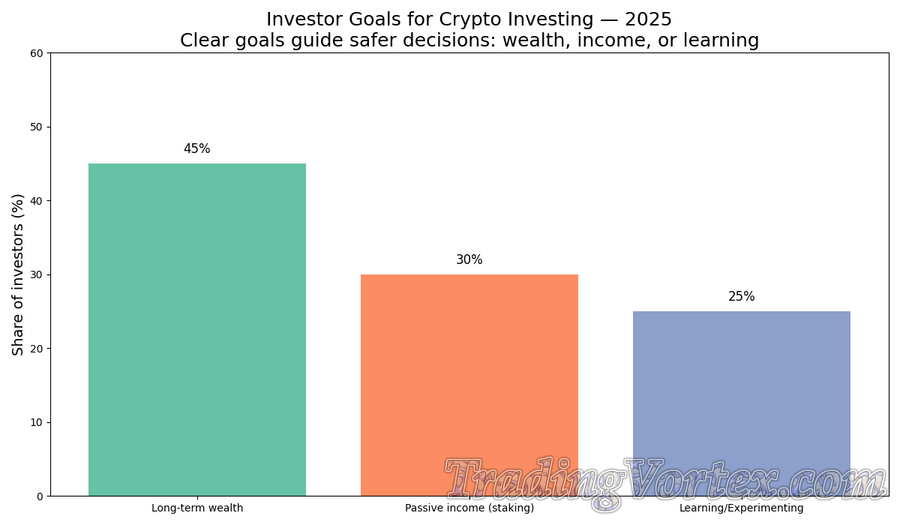 Investor Goals for Crypto Investing — 2025: Defining your investment goal (whether it’s building long‑term wealth, earning passive income, or learning) reduces emotional trading and keeps decisions disciplined.
♦ What it shows: A vertical bar chart showing the distribution of investor objectives: Long‑term wealth 45%, Passive income (staking) 30%, Learning/Experimenting 25%.
♦ How to read it: The tallest bar highlights that long‑term wealth is the dominant goal, while staking and learning are meaningful secondary objectives. Use this to align your strategy with a clear purpose before allocating capital.
Dollar-Cost Averaging (DCA) for Safer Crypto Investments
Dollar-cost averaging (DCA) is the unsung hero of safe investing. Instead of trying to time the market, you invest a fixed amount at regular intervals. In 2025, even countries like El Salvador continue to DCA Bitcoin daily, showing how powerful this strategy can be.
DCA smooths out volatility by averaging your entry price over time. It’s perfect for beginners who don’t want to stress over charts. I often compare DCA to filling up your car with gas every week. You don’t wait for the cheapest day of the year, you just keep your tank full consistently. Over time, this discipline pays off by reducing the emotional rollercoaster of crypto investing.
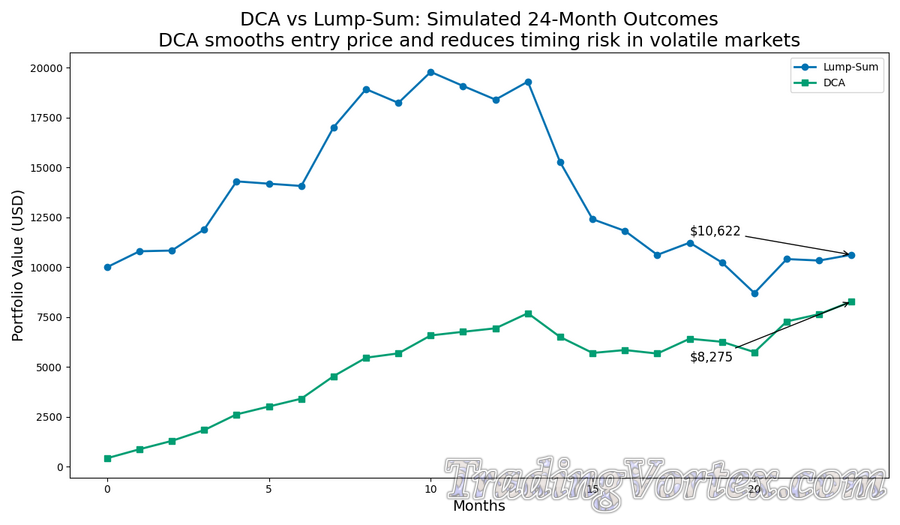 DCA vs Lump‑Sum: Simulated 24‑Month Outcomes: Dollar‑cost averaging spreads risk across time and typically lowers the chance of a poorly timed entry. For many investors, DCA reduces stress and improves long‑term outcomes in volatile markets.
♦ What it shows: A simulated line chart comparing a $10,000 lump‑sum invested at month 0 versus the same amount invested via DCA ($416.67/month) over 24 months in a volatile price series. Final portfolio values are annotated and percent differences shown.
♦ How to read it: The DCA line demonstrates smoother growth and reduced timing risk, while the lump‑sum line shows larger sensitivity to the initial entry price. Use this visual to justify steady contributions instead of attempting to time the market.
♦ Key takeaway: DCA smooths entry price and reduces timing risk, making it especially suitable for beginners and volatile markets.
Rebalancing Portfolios to Invest in Crypto Safely
Rebalancing is the art of keeping your portfolio aligned with your goals. In 2025, experts recommend mixing large-cap assets like Bitcoin and Ethereum with mid-cap projects and stablecoins to balance growth and safety. As markets shift, rebalancing ensures you don’t end up overexposed to risky assets or miss opportunities in safer ones.
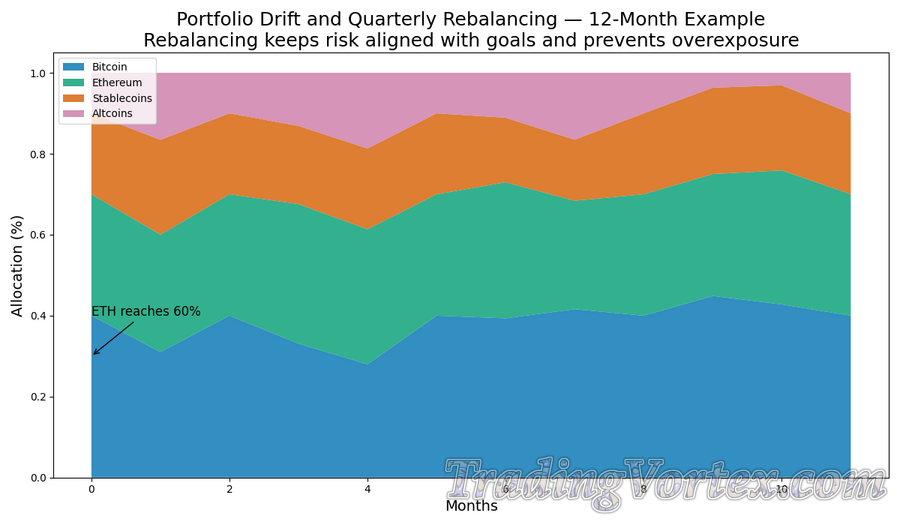 Portfolio Drift and Quarterly Rebalancing — 12‑Month Example: Quarterly rebalancing helps preserve your intended risk profile and prevents accidental overexposure after big rallies. Combine rebalancing with your goals and DCA for a disciplined, safety‑first approach.
♦ What it shows: A stacked area chart illustrating how a target allocation (BTC 40% / ETH 30% / Stablecoins 20% / Altcoins 10%) can drift over 12 months and how quarterly rebalancing restores target weights. An annotation highlights an ETH spike that would push ETH to ~60% before rebalancing.
♦ How to read it: The chart makes the mechanics of drift and rebalancing explicit: without rebalancing you can become overexposed to a single asset; with scheduled rebalancing you maintain risk alignment.
Safe Crypto Portfolio Recap:
- 🎯 Set Clear Goals: Define your purpose before investing to avoid emotional decisions.
- 📅 Use DCA: Invest steadily over time to reduce volatility and stress.
- ⚖️ Rebalance Regularly: Adjust holdings to maintain balance between growth and safety.
Global Perspectives on Safe Crypto Investing
Regional Regulations and Safe Crypto Adoption
Regulation is the backbone of safe adoption, and in 2025 the landscape is shifting quickly. The PwC Global Crypto Regulation Report 2025 highlights how Europe’s MiCA framework is being rolled out, while the United States introduced the GENIUS Act to regulate payment stablecoins. Argentina is easing restrictions to let banks offer crypto services, signaling a major shift in Latin America. Meanwhile, Pakistan ranks third globally in crypto adoption despite lacking a formal regulatory framework, showing how grassroots demand can outpace government action.
I often tell friends that investing in crypto without regulation is like driving without traffic lights. You might get to your destination faster, but the chances of a crash are much higher.
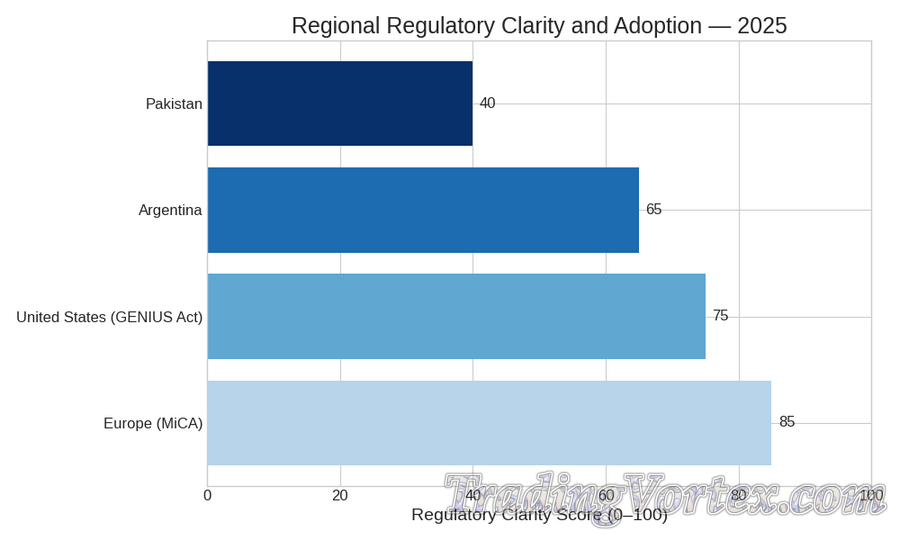 Regional Regulatory Clarity and Adoption — 2025:
♦ What it shows: A horizontal bar chart comparing regulatory clarity scores: Europe 85, United States 75, Argentina 65, Pakistan 40.
♦ Why it matters: Regions with clear frameworks (Europe, US) provide safer environments, while countries with limited oversight (Pakistan) show higher adoption but greater risk.
Institutional vs. Retail Investors in Safe Crypto Markets
Institutions and retail investors are playing very different games in 2025. Reports show that institutional capital is stabilizing markets through ETFs and infrastructure investments, while retail traders continue to fuel volatility with meme coins and leveraged products. Institutions prefer Bitcoin and Ethereum for long-term exposure, while retail investors chase altcoins and speculative tokens.
This divide matters for safety. Institutional involvement brings credibility, liquidity, and risk management practices. Retail enthusiasm brings innovation but also instability.
I’ve seen retail traders jump into coins after a viral TikTok, only to panic sell days later. Institutions, on the other hand, are more like marathon runners: slow, steady, and focused on the finish line. Safe investing means learning from both sides: embracing innovation without losing discipline.
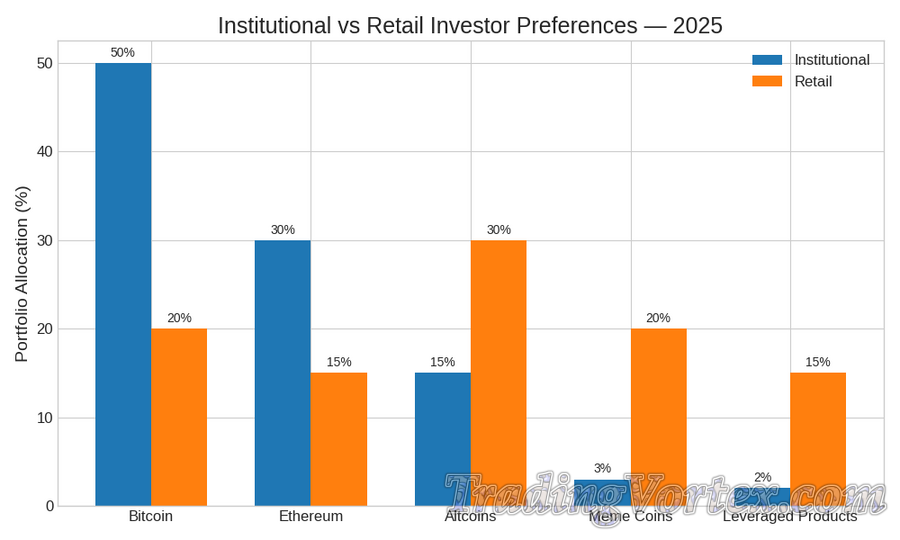 Institutional vs Retail Investor Preferences — 2025:
♦ What it shows: A grouped bar chart comparing allocations. Institutions: BTC 50%, ETH 30%, Altcoins 15%, Meme 3%, Leveraged 2%. Retail: BTC 20%, ETH 15%, Altcoins 30%, Meme 20%, Leveraged 15%.
♦ Why it matters: Institutions favor stability with BTC/ETH, while retail investors chase speculative assets, fueling volatility.
Cross-Border Opportunities and Risks in Safe Crypto Investing
Crypto is global by nature, but cross-border investing comes with unique challenges. A TRM Labs review of 2025 policy developments found that over 70 percent of jurisdictions advanced stablecoin regulation, boosting institutional adoption across borders. At the same time, fragmented rules create compliance headaches. Tokens may be classified differently in Europe, the US, or Asia, forcing firms to adopt stricter standards.
Cross-border risks also include fraud and illicit finance. In 2025, stablecoins dominated 63 percent of illicit transactions tied to remittances, while AI-driven scams and privacy coin laundering added new layers of complexity.
For investors, this means due diligence is critical when moving funds across jurisdictions. I like to compare cross-border investing to traveling internationally. It’s exciting and full of opportunity, but you need to know the local laws, carry the right documents, and watch out for pickpockets.
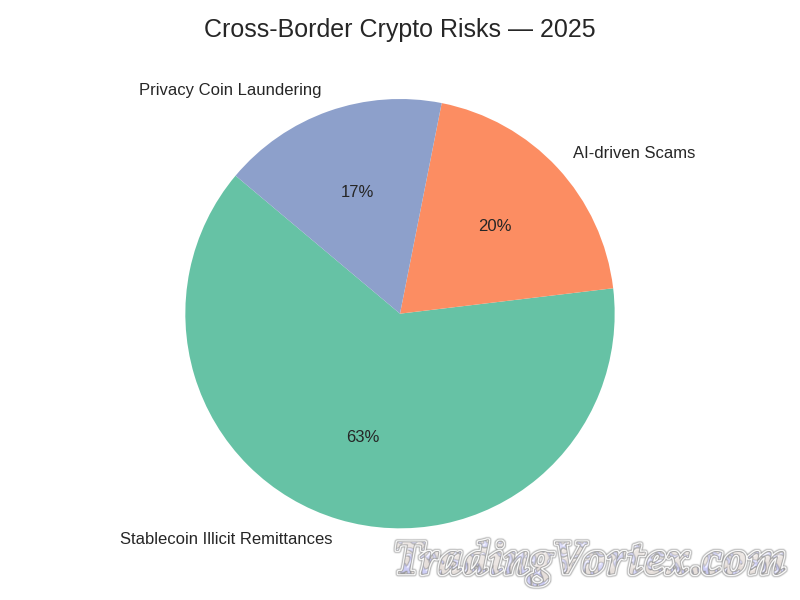 Cross-Border Crypto Risks — 2025:
♦ What it shows: A pie chart showing risk distribution: Stablecoin illicit remittances 63%, AI-driven scams 20%, Privacy coin laundering 17%.
♦ Why it matters: Stablecoins dominate cross-border risks, while AI scams and privacy coins add complexity. This highlights the importance of due diligence when investing internationally.
Safe Crypto Global Recap:
- 🌍 Regional Regulations: Clear rules in Europe and the US boost safety, while gaps in places like Pakistan raise risks.
- 🏦 Institutional vs. Retail: Institutions stabilize with ETFs and infrastructure, retail drives volatility with altcoins.
- ✈️ Cross-Border Risks: Opportunities grow with global adoption, but fragmented rules and fraud demand extra caution.
Practical Tips for Everyday Safe Crypto Investing
Start Small and Stay Consistent
In 2025, experts emphasize that beginners should avoid going all-in on their first trade. Reports show that Bitcoin faced its biggest outflow since 2021, reminding investors that even the strongest assets can swing unexpectedly. The safest way to begin is with small amounts and a consistent schedule.
Dollar-cost averaging (DCA) remains one of the most reliable strategies, helping investors smooth out volatility without stressing over timing. Think of it like topping up your savings account every month: steady contributions add up over time.
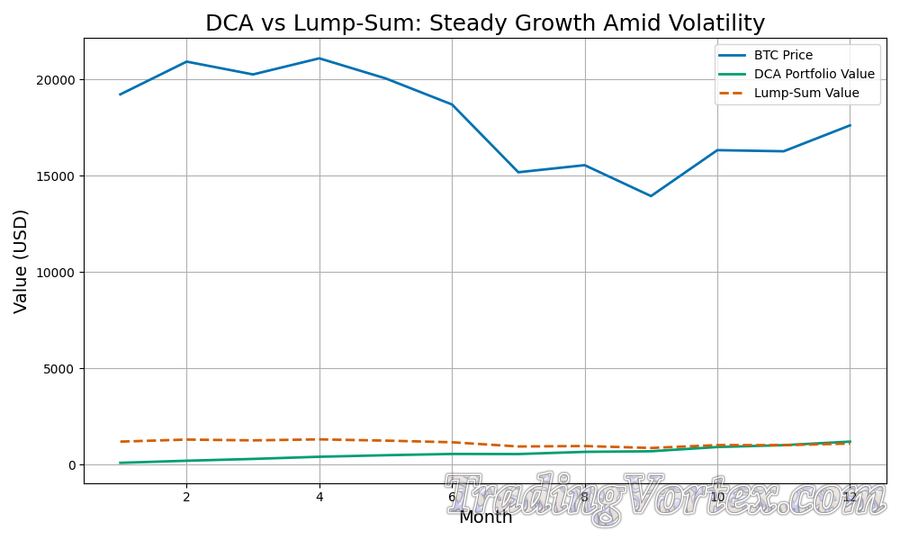 DCA vs Lump-Sum: Steady Growth Amid Volatility:
♦ What it shows: A line chart comparing Bitcoin’s volatile price with portfolio values from DCA and lump-sum investing.
♦ Why it matters: The chart demonstrates how DCA smooths entry points and reduces timing risk, making it ideal for beginners.
Keep Security Habits Simple but Strong
Security is where most investors slip. According to recent guides, phishing scams and account takeovers remain among the top threats.
Everyday habits make a huge difference:
- Always enable multi-factor authentication.
- Use unique passwords stored in a password manager.
- Double-check URLs before logging in.
I once had a friend who clicked on a fake exchange link because it looked “almost identical”. They lost their funds in minutes. A quick habit of verifying links could have saved them. Safe investing is less about complicated tech and more about consistent, cautious routines.
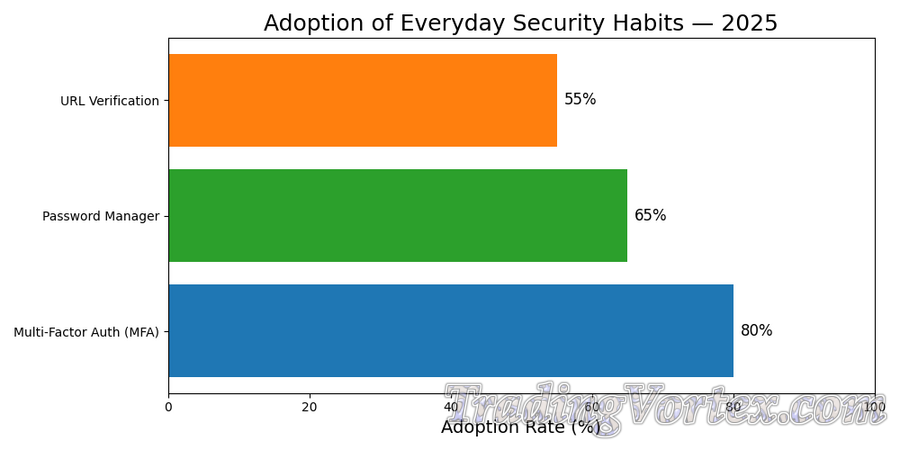 Adoption of Everyday Security Habits — 2025:
♦ What it shows: A horizontal bar chart showing adoption rates of MFA (80%), password managers (65%), and URL verification (55%).
♦ Why it matters: It highlights that simple, consistent habits significantly reduce risks like phishing and account takeovers.
Avoid Chasing Hype and Stick to Your Plan
The crypto market in 2025 is full of noise. Meme coins, celebrity endorsements, and viral TikToks can tempt even seasoned traders. Analysts note that retail investors still drive volatility by chasing speculative tokens, while institutions stick to safer assets.
I like to compare hype-chasing to eating fast food every day. It feels exciting in the moment, but it rarely ends well for your health; or your portfolio.
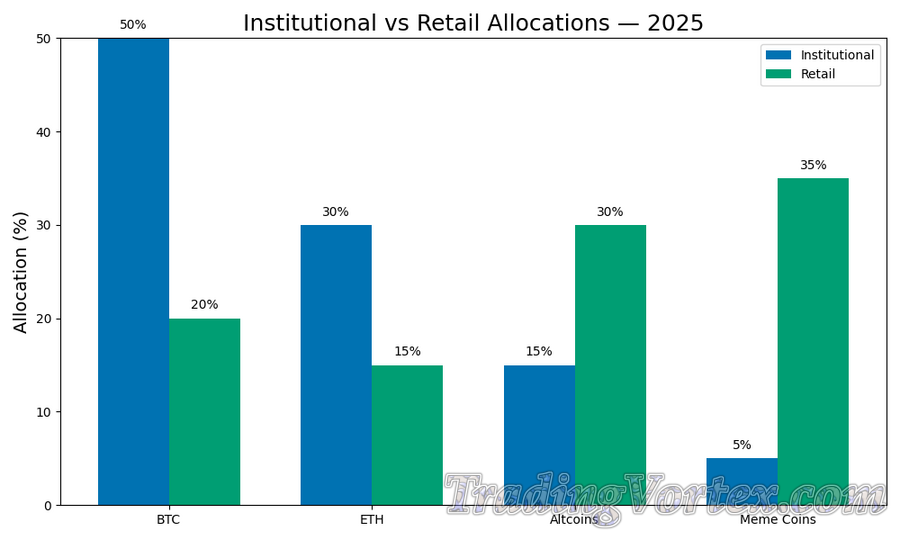 Institutional vs Retail Allocations — 2025:
♦ What it shows: A grouped bar chart comparing institutional allocations (BTC/ETH heavy) with retail allocations (altcoins/meme coins heavy).
♦ Why it matters: It illustrates how institutions favor safer assets while retail investors chase hype, fueling volatility.
Stay Informed Without Getting Overwhelmed
The crypto space evolves daily, with new regulations, tokens, and scams appearing constantly. Reliable sources like Cointelegraph, Binance Academy, and PwC’s regulation reports provide trustworthy updates. The trick is to stay informed without drowning in information. Pick two or three reliable platforms and stick with them.
I often tell beginners: treat crypto news like coffee. One cup keeps you alert, but ten cups will leave you jittery and confused.
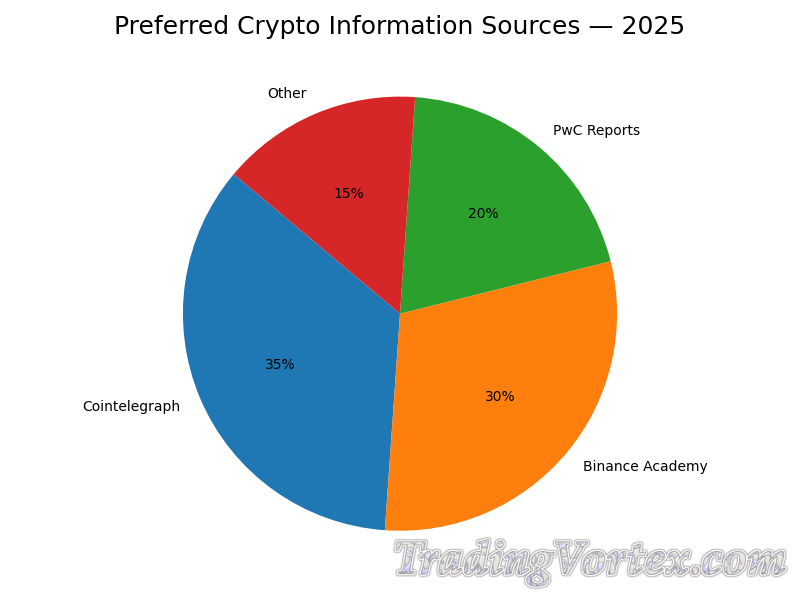 Preferred Crypto Information Sources — 2025:
♦ What it shows: A pie chart showing preferred sources: Cointelegraph (35%), Binance Academy (30%), PwC Reports (20%), Other (15%).
♦ Why it matters: It emphasizes the importance of choosing a few reliable sources to stay informed without overload.
Everyday Safe Crypto Recap:
- 💵 Start Small: Use DCA to build positions gradually.
- 🔐 Stay Secure: MFA, password managers, and URL checks protect against scams.
- 🚫 Ignore Hype: Stick to your plan instead of chasing trends.
- 📰 Stay Informed: Follow reliable sources without overloading yourself.
Conclusion: The Future of Safe Crypto Investing
How to Invest in Crypto Safely for Long-Term Success
The crypto market in 2025 has already proven that it is no longer just about speculation. Bitcoin’s rise past $100,000 and the growth of tokenized real-world assets (RWAs) show that crypto is becoming a legitimate part of global finance. Analysts forecast Bitcoin trading between $80,000 and $150,000, with stretched targets as high as $185,000, underscoring both opportunity and volatility.
For long-term success, safe investing means anchoring portfolios with established assets like Bitcoin and Ethereum, while cautiously exploring innovations such as AI-driven tokens and liquid staking. It also means embracing regulated products like ETFs, which have attracted billions in inflows and provide safer access to crypto markets.
The future favors investors who treat crypto like any other asset class: with patience, diversification, and a focus on fundamentals rather than hype.
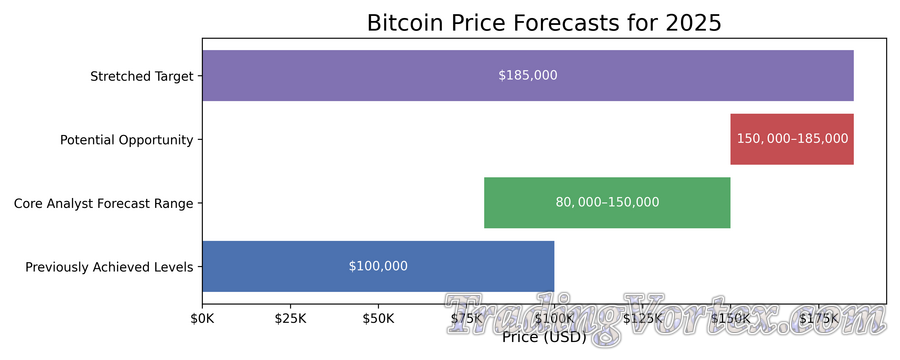 Bitcoin Price Forecasts for 2025:
♦ What it shows: Forecast ranges from $80K to $185K, with annotations for previously achieved levels ($100K), core analyst range ($80K–$150K), and stretched target ($185K).
♦ Why it matters: This visual highlights both opportunity and volatility, reinforcing the need to anchor portfolios with BTC/ETH and balance innovation exposure.
Empowering Investors with Knowledge and Discipline in Crypto
Knowledge and discipline are the real superpowers in crypto. The 2025 Crypto Market Report highlights how speculation is giving way to utility, with institutional adoption and consumer-first products leading the charge. This shift empowers investors to make safer decisions, but only if they stay informed and disciplined.
Discipline means sticking to strategies like dollar-cost averaging, rebalancing portfolios, and setting clear goals. Knowledge means understanding tokenomics, regulatory frameworks, and emerging narratives like AI and RWAs.
I often tell friends that crypto investing is like learning to drive: the car is powerful, but without discipline and awareness, you risk crashing.
The future of safe crypto investing is not about avoiding risk entirely, but about managing it intelligently. Investors who combine education, patience, and security practices will be positioned to thrive as the market continues to evolve.
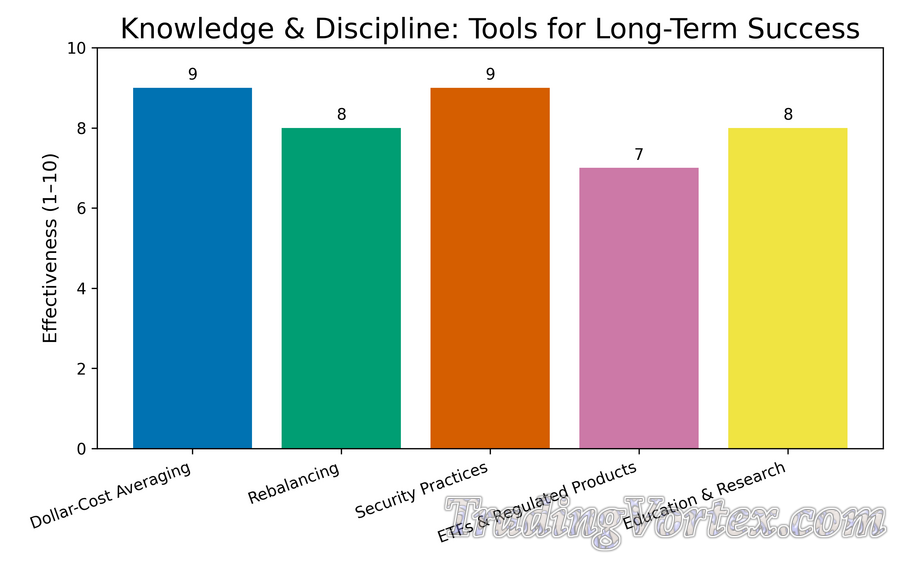 Knowledge & Discipline: Tools for Long-Term Success.
♦ What it shows: Effectiveness scores (1–10) for key investor tools: DCA (9), Rebalancing (8), Security Practices (9), ETFs (7), Education (8).
♦ Why it matters: It emphasizes that discipline and education are the foundation of safe investing, especially as speculation gives way to utility.
Safe Crypto Future Recap:
- 📈 Long-Term Success: Anchor with Bitcoin and Ethereum, cautiously explore innovations, and use regulated products.
- 📚 Knowledge is Power: Stay informed about tokenomics, regulations, and emerging narratives.
- 🧘 Discipline Wins: Stick to strategies like DCA, rebalancing, and goal-setting to avoid emotional mistakes.
✅ Safe Crypto Investing Checklist
🔑 Core Principles:
- Diversify across Bitcoin, Ethereum, stablecoins, and carefully chosen altcoins.
- Use risk management tools like stop-loss orders and secure wallets.
- Decide on long-term holding vs. short-term trading, and stick to your plan.
⚡ Key Challenges:
- Prepare for volatility with discipline and strategy.
- Stay updated on regulations in your region.
- Protect against hacks, scams, and rug pulls with strong security practices.
- Avoid emotional traps like FOMO and panic selling.
💵 Safe Entry Strategies:
- Choose reputable exchanges and wallets with strong compliance.
- Explore regulated products like crypto ETFs for safer exposure.
- Use stablecoins as a low-risk entry point.
🔍 Research Practices:
- Read whitepapers carefully and analyze tokenomics.
- Spot red flags: anonymous teams, guaranteed returns, no audits.
- Use on-chain analytics tools to verify adoption and insider activity.
🔐 Security Best Practices:
- Store long-term holdings in cold wallets, keep hot wallets for daily use.
- Always enable multi-factor authentication.
- Stay alert to phishing and social engineering scams.
💡 Emerging Strategies:
- Explore liquid staking tokens for flexible yield.
- Consider AI-driven assets with real utility.
- Build balanced portfolios anchored by Bitcoin and Ethereum.
🛡️ Risk Mitigation Tools:
- Use insurance products to protect against hacks and failures.
- Hedge with stablecoins and derivatives.
- Automate portfolio management to reduce emotional trading.
🌍 Global Perspectives:
- Understand regional regulations and compliance requirements.
- Learn from institutional discipline and retail innovation.
- Be cautious with cross-border investments and fragmented rules.
📅 Everyday Habits:
- Start small and use dollar-cost averaging.
- Keep security routines simple but consistent.
- Ignore hype, stick to your plan, and follow reliable news sources.
🚀 Future Outlook:
- Anchor portfolios with established assets, cautiously explore innovations.
- Empower yourself with knowledge and discipline.
- Treat crypto as a long-term journey, not a quick win.
FAQs: How to Invest in Crypto Safely
Q1. Is crypto investing still safe in 2025?
Yes, but safety depends on your approach. The market has matured with stronger regulations, institutional adoption, and better security tools. However, risks like volatility, scams, and regulatory uncertainty remain. Safe investing means combining discipline with protective measures like secure wallets, insurance, and diversification.
Q2. What is the safest way to store my crypto?
Cold wallets are still the gold standard for long-term storage. Hot wallets are fine for daily use, but they’re more vulnerable to hacks. Many investors now use a hybrid approach: small amounts in hot wallets for convenience, and the bulk in cold wallets for safety. Think of it like keeping pocket money in your wallet and savings in a vault.
Q3. Should beginners start with Bitcoin or altcoins?
Most experts recommend starting with Bitcoin or Ethereum because they’re the most established and widely adopted. Altcoins can offer higher returns, but they also carry higher risks. Beginners should anchor their portfolio with blue-chip assets before experimenting with smaller projects.
Q4. Are crypto ETFs and regulated products worth it?
Absolutely. In 2025, crypto ETFs attracted billions in inflows, offering exposure to assets like Bitcoin, Ethereum, and even Solana. ETFs are regulated, transparent, and easier to manage than holding tokens directly. They’re a safe entry point for investors who want exposure without the stress of custody.
Q5. How can I avoid scams and rug pulls?
Do your homework. Red flags include anonymous teams, promises of guaranteed returns, and projects with no audits. In 2025, rug pull losses surged into the billions, showing how dangerous hype-driven investing can be. Always verify sources, use reputable exchanges, and never rush into a project just because it’s trending.
Q6. What role do stablecoins play in safe investing?
Stablecoins like USDC are a safe entry point and a hedge against volatility. They’re pegged to fiat currencies, making them useful for parking funds, managing liquidity, and testing the waters without the rollercoaster ride of Bitcoin or altcoins.
Q7. How do I manage emotions like FOMO and panic selling?
This is the toughest part. The safest investors stick to their plan, use dollar-cost averaging, and avoid chasing hype. I’ve seen friends buy into coins after a celebrity tweet, only to panic sell days later. Discipline beats emotion every time. Write down your goals, remind yourself why you invested, and resist the urge to follow the crowd.
Q8. What’s the future of safe crypto investing?
The future is about balance: regulated products, institutional adoption, and innovative strategies like liquid staking and AI-driven assets. Investors who combine knowledge, discipline, and security practices will be best positioned to thrive.