

Discover how to grow your crypto portfolio safely with our comprehensive guide to low-risk token farming. This article breaks down everything from yield farming, staking, and liquidity mining to practical strategies that minimize risk while maximizing potential returns.
Learn the difference between sustainable yields and high-risk APY traps, explore the latest DeFi trends, and uncover the best tools, platforms, and risk management techniques for investors of all experience levels. Whether you are a beginner seeking steady passive income or an experienced trader looking to optimize your returns, this guide provides actionable insights, step-by-step strategies, and expert advice to help you navigate the decentralized finance landscape with confidence.
Table of Contents:
- What Is Token Farming in Crypto?
- Why “Minimal Risk” Matters in Yield Farming
- Current DeFi Trends Shaping Low-Risk Token Farming (2025–2026)
- Core Risks in Token Farming You Must Understand
- Safest Token Farming Strategies for Beginners
- Advanced Low-Risk Farming Strategies for Experienced Users
- How to Choose Safe Yield Farming Platforms
- Step-by-Step Guide: How to Farm Tokens Safely
- Best Tools to Minimize Risk in Yield Farming
- Risk Management Techniques for Sustainable Returns
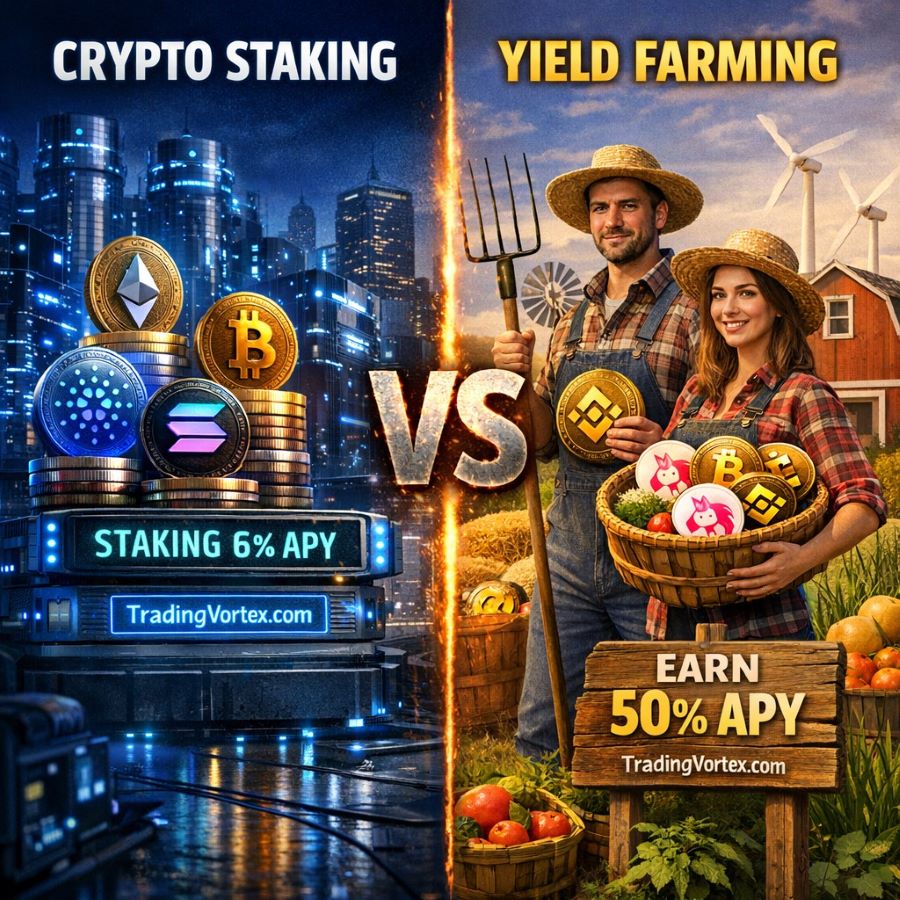
- Yield Farming vs Staking: Which Is Safer?
- Common Mistakes to Avoid in Token Farming
- Regulatory, Tax, and Security Considerations
- Future Outlook: The Evolution of Low-Risk Yield Farming
- Conclusion: Building a Low-Risk Token Farming Strategy for Long-Term Success
- Frequently Asked Questions: Navigating Low-Risk Token Farming
- What exactly is token farming?
- How is yield farming different from staking?
- Are yield farming rewards taxable?
- Is yield farming safe?
- Can beginners start yield farming without experience?
- How do I avoid impermanent loss?
- Do I need special tools to farm tokens safely?
- What is a realistic return from low‑risk farming?
- Should I use leverage when farming?
- What is the biggest mistake beginners make?
What Is Token Farming in Crypto?
Let’s keep this simple and real for a moment:
Think of it like renting out your money.
You provide liquidity, lend assets, or stake tokens, and in return, the protocol pays you through fees, interest, or newly issued tokens. At its core, token farming is about turning passive holdings into income-generating assets inside decentralized finance.
Now, here’s the part many beginners miss: not all farming is created equal. Some strategies are surprisingly stable, others are basically adrenaline sports for your portfolio.
Let’s break it down properly.
Yield Farming vs Staking vs Liquidity Mining
These terms get thrown around interchangeably, but they are not the same thing.
- Yield farming is the umbrella term. It includes any strategy where you move your crypto across DeFi protocols to maximize returns. This can involve lending, providing liquidity, or even stacking multiple strategies together.
- Staking is the simplest version. You lock your tokens to support a blockchain network and earn rewards. It is usually more predictable and less complex, which is why many people start here.
- Liquidity mining is where things get more “DeFi-native.” You provide tokens to liquidity pools that power decentralized exchanges. In return, you earn trading fees plus extra token rewards as incentives.
Here’s a quick way to think about it:
- Staking: earn rewards for securing a network
- Liquidity mining: earn rewards for enabling trading
- Yield farming: optimize everything to squeeze the highest return
How Token Farming Generates Passive Income
This is where things start to click.
Your yield does not come from nowhere. There is always someone on the other side paying for it.
In DeFi, income typically comes from three main sources:
- 1. Trading fees: When you provide liquidity to a pool, every trade generates fees. You get a share proportional to your contribution.
- 2. Lending interest: If you deposit assets into lending protocols, borrowers pay interest to use your funds. That interest becomes your yield.
- 3. Token incentives: Protocols often distribute their own tokens to attract users. This is where those crazy APYs come from.
You deposit stablecoins into a lending platform. Borrowers take loans and pay interest. On top of that, the platform gives you bonus tokens. That combination becomes your total yield.
Sounds great, right? It is. But here’s the catch.
If you don’t understand where the yield comes from, you’re not investing, you’re guessing.
Key Metrics: APY, TVL, and Real Yield vs Inflationary Rewards
This is the part that separates smart farmers from exit liquidity.
APY (Annual Percentage Yield): This is the number everyone looks at first. It represents your estimated yearly return with compounding.
But here’s a reality check: APY is dynamic, not guaranteed. High APY often means higher risk or temporary incentives.
TVL (Total Value Locked): This shows how much capital is deposited in a protocol. A higher TVL usually signals trust, liquidity, and lower risk, although it is not a guarantee of safety.
Now the most important concept, and honestly one that changed how many experienced traders approach DeFi:
Real Yield vs Inflationary Rewards:
- Real yield comes from actual revenue like trading fees or lending interest. It is sustainable and backed by real economic activity.
- Inflationary rewards come from newly minted tokens. They look attractive but often lose value over time due to dilution.
Here’s a quick analogy I like to use:
- Real yield is like earning rent from a property
- Inflationary yield is like being paid in freshly printed coupons that may lose value tomorrow
If you remember just one thing from this section, make it this:
Token farming is not about chasing the highest number on a screen. It is about understanding where the yield comes from and whether it can last.
That mindset alone will already put you ahead of most participants in DeFi.
📊 Visual: APY Comparison Across DeFi Strategies
To reinforce the concepts explained in this section, this chart illustrates how Staking, Liquidity Mining, and Yield Farming typically compare in terms of average APY. While real-world returns vary widely across protocols and market conditions, this visual helps readers quickly grasp why many users progress from simple staking to more advanced farming strategies.
🧠 Why This Matters:
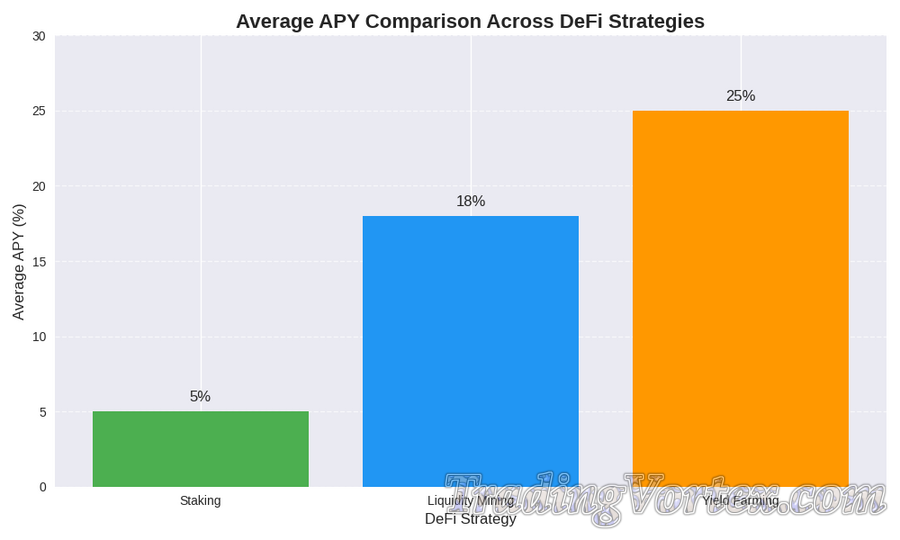 Average APY Comparison Across DeFi Strategies:
🔍 What This Chart Shows:
♦ Staking (≈5% APY)
A stable, predictable entry point. Rewards come from securing the network.
♦ Liquidity Mining (≈18% APY)
Higher returns due to trading fees and token incentives, but also higher exposure to impermanent loss and market volatility.
♦ Yield Farming (≈25% APY)
The most aggressive strategy. Returns can be significantly higher because farmers optimize across multiple protocols; but risks scale accordingly.
Why “Minimal Risk” Matters in Yield Farming
Let me be honest with you for a second.
If you’ve ever looked at a DeFi dashboard and seen 50%, 100%, or even 300% APY, your first reaction was probably the same as mine the first time: this looks like free money.
It’s not.
Yield farming is one of those areas in crypto where the difference between smart investing and expensive lessons comes down to one thing: how well you manage risk.
The Risk-Reward Tradeoff in DeFi
In traditional finance, higher returns usually mean higher risk. In DeFi, that relationship is not just true, it’s amplified.
On paper, a pool offering 25% APY looks attractive. But when you factor in things like impermanent loss, fees, and volatility, the actual return can shrink dramatically. In some cases, average users end up with returns closer to single digits, or even negative, despite high advertised yields.
And here’s the kicker: some risks are invisible until it’s too late.
- Impermanent loss can quietly eat into your profits when asset prices move
- Smart contract bugs can wipe out funds instantly
- Market volatility can turn a “profitable” farm into a losing position overnight
I’ve seen people chase high yields, ignore these risks, and then wonder why their portfolio didn’t grow even in a bull market.
The truth is simple: in DeFi, you are not just earning yield, you are taking on multiple layers of risk at the same time.
Common Misconceptions About “Safe” Crypto Yields
One of the biggest traps in yield farming is the idea that some opportunities are “safe” just because they look stable.
Let’s clear up a few common misconceptions:
“High APY means high profit”
Not necessarily. High APY often comes from aggressive token incentives or volatile pools. If the underlying token drops in value, your real return can disappear quickly.
“Blue-chip protocols are risk-free”
Even well-known platforms can have vulnerabilities. Smart contracts are code, and code can fail or be exploited.
“If I don’t sell, I haven’t lost”
This mindset is dangerous in DeFi. Losses like impermanent loss are real, even if they are not immediately visible in your wallet.
“Stablecoins = zero risk”
They reduce volatility, yes. But you still face platform risk, smart contract risk, and potential depegging events.
The space has matured a lot, but it is still closer to a high-speed financial experiment than a traditional savings account.
Understanding Sustainable vs Unsustainable Yields
This is where things really start to separate experienced investors from beginners.
Not all yield is created equal.
Some returns are built on real economic activity, like trading fees or lending demand. These are generally more stable and tend to hold up over time.
Others are driven by token emissions, meaning the protocol is literally printing new tokens to reward users. That can create impressive APYs, but it often leads to dilution and price drops. In other words, you might earn more tokens, but they are worth less.
Here’s a practical way to think about it:
- Sustainable yield: comes from real usage, fees, and demand
- Unsustainable yield: depends on hype, new users, and token inflation
If a protocol needs constant new money to maintain its returns, that’s a red flag.
Over time, the market has been shifting toward what many call “real yield,” where returns are backed by actual revenue instead of incentives. This shift is not just a trend, it’s a survival mechanism for DeFi itself.
At the end of the day, focusing on minimal risk does not mean playing it safe or settling for low returns.
- It means being intentional.
- It means understanding what you are exposed to before you deposit a single dollar.
- And most importantly, it means remembering that in crypto, protecting your capital is what allows you to stay in the game long enough to actually win.
📊 Visual: Sustainable vs Unsustainable Yield in DeFi
This chart illustrates the core message of the section: Not all yield is created equal; and the safest, most durable returns come from real economic activity, not token emissions.
By comparing the composition of sustainable vs unsustainable yield, readers can instantly see why “minimal risk” matters and why high APY alone is a misleading metric.
🧩 Why This Matters for Risk Management:
This visual reinforces the key idea from the section:
- High APY ≠ high profit
- High APY often = high inflation, high risk, and high volatility
- Sustainable yield is what survives bear markets
- Unsustainable yield depends on hype and constant new liquidity
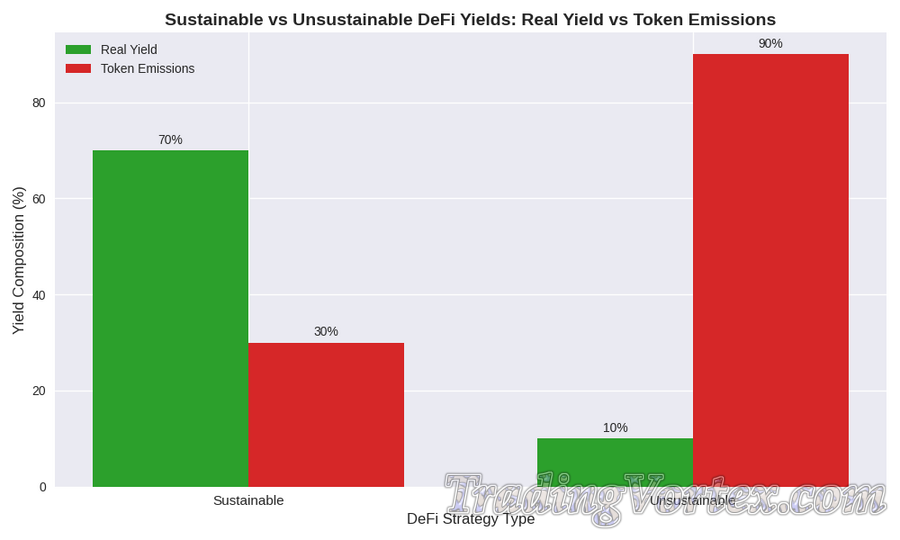 Sustainable vs Unsustainable DeFi Yields: Real Yield vs Token Emissions:
🧠 What This Visual Shows:
1. Sustainable Yield (Real Yield Dominant)
♦ 70% Real Yield: generated from trading fees, lending interest, or actual protocol revenue.
♦ 30% Token Emissions: still present, but not the main driver.
♦ These yields tend to be more stable, less volatile, and longer‑lasting.
2. Unsustainable Yield (Inflationary Rewards Dominant)
♦ 10% Real Yield: very little comes from real usage.
♦ 90% Token Emissions: the protocol is printing tokens to attract users.
♦ These yields often collapse when incentives dry up or token prices fall.
Current DeFi Trends Shaping Low-Risk Token Farming (2025–2026)
If you’ve been in crypto for a few cycles, you’ve probably noticed something: the game is changing.
A few years ago, yield farming felt like a gold rush. Today, it feels more like a professional financial system slowly taking shape. And honestly, that’s good news if your goal is to farm tokens with minimal risk.
Let me walk you through the trends that actually matter right now, the ones that are quietly reshaping how smart money approaches DeFi.
Rise of Stablecoin-Based Yield Strategies
This is probably the biggest shift I’ve seen.
More and more investors are moving away from volatile token pairs and focusing on stablecoins. Why? Because stability is the foundation of risk control.
In 2026, stablecoins are no longer just a parking spot for capital. They’ve evolved into full yield instruments, with some even offering built-in returns backed by real-world assets like Treasury bills or lending markets.
Even more interesting, the stablecoin market is expected to explode toward the trillion-dollar range, driven by institutional adoption and yield-bearing designs.
Sometimes boring really is better.
Growth of Institutional-Grade DeFi Platforms
DeFi is growing up.
Regulation is playing a big role here. Frameworks in regions like Europe and Asia are making it easier for institutions to enter crypto with confidence.
At the same time, infrastructure has improved massively, with things like:
- Qualified custody solutions
- On-chain settlement systems
- Tokenized real-world assets like government bonds
All of this creates a more stable environment. And here’s the key takeaway: when institutions enter, volatility tends to decrease and risk management becomes more sophisticated.
In simple terms, DeFi is slowly becoming less like the Wild West and more like a structured financial system.
Expansion of Cross-Chain and Multi-Chain Farming
Back in the day, you were stuck on one chain. Now, capital moves everywhere.
Cross-chain infrastructure has matured a lot, allowing liquidity to flow between ecosystems more efficiently. This opens up new opportunities, but also reduces risk through diversification.
Instead of relying on a single protocol or network, you can spread your exposure across multiple chains and strategies.
That said, bridges and cross-chain tools still carry risk, so the smart move is not to go all-in, but to use them selectively.
Automation via Yield Aggregators and Vaults
If you’ve ever tried manually farming across multiple protocols, you know how exhausting it can be.
That’s where automation comes in.
Yield aggregators and vaults have become much more advanced. Instead of manually chasing the best opportunities, you can deposit your funds into a vault that automatically reallocates capital, compounds rewards, and optimizes returns.
In 2026, this goes even further with AI-driven strategies that manage liquidity and risk in real time.
I’ll be honest, this is one of my favorite developments. Not because it guarantees higher returns, but because it reduces human error. And in DeFi, mistakes are often more expensive than fees.
Real Yield Narrative (Fees vs Token Emissions)
This trend is the one that really separates beginners from experienced players.
The market is moving away from inflation-driven rewards and toward what’s called “real yield.” That means returns generated from actual economic activity like trading fees, lending interest, or real-world assets.
Why does this matter?
Because the old model, where protocols printed tokens to attract users, was not sustainable. It worked in bull markets, then collapsed when demand slowed.
Now, protocols are focusing on revenue-sharing models. Instead of paying you in freshly minted tokens, they pay you in stablecoins or major assets derived from real usage.
This shift is huge. It means yields are becoming:
- More predictable
- Less dependent on hype
- More aligned with long-term sustainability
And if your goal is minimal risk, this is exactly where you want to be.
If I had to sum it up in one sentence, it would be this:
And for investors who adapt to these trends, especially by focusing on stability, real yield, and smart automation, the opportunity is not just to earn more, but to do it with far less stress.
📊 Visual: Growth of Key Low‑Risk DeFi Trends (2025–2026)
This chart gives you a quick, intuitive snapshot of how the safest and most sustainable areas of DeFi are expanding right now. If your goal is to farm tokens with minimal risk, this visual helps you understand where the smart money is actually flowing; and why these trends matter for your strategy.
🎯 Why This Visual Matters for You:
This chart highlights the four strongest, lowest‑risk growth areas in DeFi today. If you want to farm with minimal stress (and without chasing unstable APYs) these are the trends you should be paying attention to.
They represent:
- More stability
- More predictability
- More institutional confidence
- Less dependence on hype or token emissions
In other words: This is where DeFi is maturing; and where safer, long‑term yield is emerging.
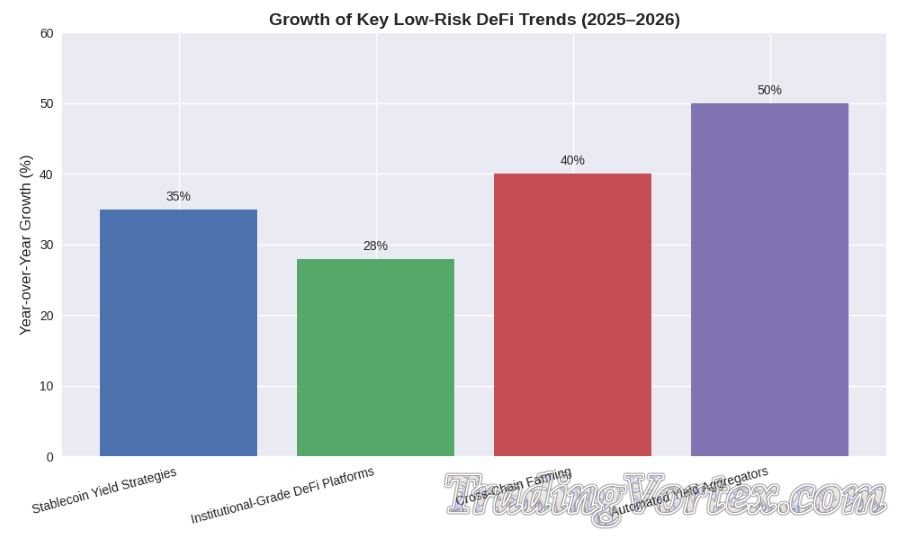 Growth of Key Low‑Risk DeFi Trends (2025–2026):
🧠 What This Visual Shows:
1. Stablecoin Yield Strategies: +35% Growth
You’re seeing more capital move into stablecoins because they reduce volatility while still offering solid returns. This trend reflects a shift toward predictable, low‑risk yield.
2. Institutional‑Grade DeFi Platforms: +28% Growth
Institutions are entering DeFi with compliant, secure platforms. For you, this means lower volatility, better security, and more reliable yield opportunities.
3. Cross‑Chain Farming: +40% Growth
Capital is no longer stuck on one chain. As cross‑chain tools mature, you gain access to diversified, less fragmented yield opportunities, reducing your exposure to any single ecosystem.
4. Automated Yield Aggregators: +50% Growth
Automation is exploding because it removes human error. Vaults and AI‑driven strategies help you optimize returns automatically, without constantly monitoring the market.
Core Risks in Token Farming You Must Understand
Token farming can look beautifully simple from the outside: deposit assets, earn yield, move on. In reality, the return is only one side of the equation. The other side is a stack of risks that can hit your capital from several directions at once, including price swings, code failures, liquidity problems, borrowing stress, governance mistakes, and system-wide contagion. Regulators and researchers have been increasingly explicit about that in 2025, with the FSB flagging DeFi growth as an area that needs close monitoring and warning that smart contract risks, market manipulation, and operational failures can become systemic as the sector scales.
Impermanent Loss and How It Occurs
Impermanent loss is the classic “looks fine until the market moves” problem. When you provide liquidity to a pool, the token mix inside that pool changes as prices change, and the value of your LP position can end up lower than simply holding the tokens outright. Uniswap’s own documentation defines it that way, and it specifically notes that the effect appears when pool prices move after liquidity is added.
In plain English, the pool keeps rebalancing your exposure for you, and sometimes that rebalancing is exactly what hurts.
This matters most in volatile pairs, where one asset rips higher or gets crushed while you are still supplying liquidity. The risk is not always obvious on the dashboard, because you may still be earning fees at the same time, which makes the position feel healthy right up until the final comparison shows that the LP route underperformed holding.
Smart Contract Vulnerabilities and Exploits
This is the big one, and it is the part that keeps DeFi from ever feeling like a normal savings account. Token farming depends on smart contracts, and smart contracts can be exploited, misconfigured, or broken.
In 2025, the ESRB noted that crypto platforms had suffered about $2.2 billion in stolen funds in 2024, with hacking incidents rising to 303, and it also emphasized that the size and complexity of crypto multi-function groups create broad attack surfaces tied to governance weaknesses, conflicts of interest, and weak cybersecurity controls.
Immunefi’s February 2025 report also showed how severe losses can remain, with $1.53 billion lost to hacks in that month alone, across just nine incidents.
For token farmers, the practical lesson is brutally simple: the protocol may look elegant, audited, and popular, but a single flaw can turn your “yield strategy” into a fund recovery thread. That is also why security frameworks such as the OWASP Smart Contract Top 10 exist, because the main risks are not theoretical, they are recurring patterns observed across real incidents.
Liquidity and Slippage Risks
Liquidity risk is what happens when there is not enough depth in the market to absorb your trades cleanly. Slippage is the price you pay for that friction. Uniswap explains slippage as the difference between the price you expect and the price you actually receive while a transaction is pending, and it notes that longer pending times and changing market conditions can push execution outside your acceptable range.
Chainlink adds that DEX trades can suffer slippage because of liquidity migrations and trade size, while the OECD found that liquidity in some DEX markets is highly concentrated, with a small number of pools and liquidity providers accounting for a disproportionate share of activity.
Liquidation Risk in Lending Protocols
If your farming strategy involves borrowing, looping, or collateralized positions, liquidation risk becomes the monster under the bed.
Aave’s documentation makes this very clear: when a borrower’s health factor falls below 1, the position becomes eligible for liquidation, usually because the collateral value drops or the debt rises too far relative to it. Aave also notes that it uses loan-to-value ratios, liquidation thresholds, and active risk monitoring to manage that risk, which is another way of saying the protocol has to build guardrails because the market can move faster than your comfort level.
For farmers, the mistake is usually overconfidence. People see a borrow APY that looks manageable, or they assume their collateral is “strong enough,” then one sharp move in price turns a profitable loop into a forced unwind. If you want minimal risk, borrowing should always be treated as an active position, not a passive one.
Governance and Protocol Failure Risks
DeFi protocols are governed by code, but also by people, token holders, delegates, and sometimes very messy incentives. The ESRB has warned that governance structures in crypto can be opaque, with disclosure requirements often minimal or nonexistent, and it specifically highlights governance challenges and conflicts of interest as a real concern.
The FSB similarly points to the importance of governance, risk management, and operational resilience as the crypto market matures. In practical terms, a protocol can be technically functional and still be a bad place to park capital if the decision-making process is unclear or captured.
This is the risk people forget when they focus only on APY. A farm is not just math, it is also politics, incentives, and execution. A bad vote, a rushed parameter change, a hidden dependency, or a weak upgrade process can all turn a decent yield product into a headache very quickly.
Systemic and Composability Risks in DeFi
DeFi’s biggest strength is also one of its biggest dangers: composability.
BIS explains that composable smart contracts can automate multiple steps in a transaction, while the FSB and OECD both warn that interconnected DeFi markets can amplify shocks. That means one protocol can rely on another, which relies on another, until a small failure somewhere upstream becomes everyone’s problem downstream.
The safest token farming setups are usually the ones with fewer moving parts, clearer revenue sources, and lower dependence on fragile cross-protocol chains.
That sounds less exciting than chasing the highest APY, but excitement is expensive when the stack starts to crack.
📊 Visual: Relative Severity of Core Token Farming Risks (2025–2026)
This chart is designed specifically to help you understand which risks matter most when evaluating any token farming strategy. Instead of treating risk as a vague concept, this visual ranks the six major categories on a simple 1–10 scale so you can instantly see where the real danger lies.
Use this chart as a mental checklist every time you consider a new farm: it will help you avoid the traps that quietly drain capital from even experienced DeFi users.
🎯 Why This Visual Matters for You:
This chart helps you:
- Identify the risks that deserve your attention first
- Understand why “minimal risk” farming is not just about APY
- Avoid strategies that look profitable but hide structural dangers
- Build safer, more resilient yield strategies
If your goal is to farm with confidence (and without unnecessary stress) this visual is your roadmap.
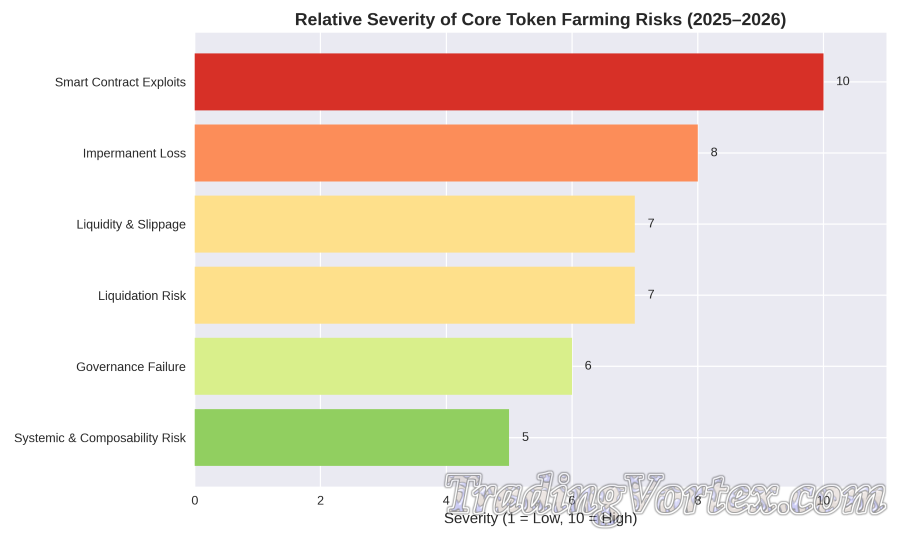 Relative Severity of Core Token Farming Risks (2025–2026):
🧠 How to Read This Visual:
1. Smart Contract Exploits — Severity 10/10
This is the highest‑impact risk. One vulnerability can wipe out funds instantly.
If you remember only one thing from this chart, remember this: security is the foundation of low‑risk farming.
2. Impermanent Loss — Severity 8/10
If you farm volatile pairs, this risk can silently erase your gains.
Always compare LP returns to simply holding the tokens; the difference can surprise you.
3. Liquidity & Slippage — Severity 7/10
Thin liquidity means bad fills, failed swaps, and distorted pool pricing.
Even a “high APY” farm can underperform because of hidden execution losses.
4. Liquidation Risk — Severity 7/10
If your strategy involves borrowing or looping, a single price swing can liquidate your position.
Borrowing is never passive — treat it like an active trade.
5. Governance Failure — Severity 6/10
A protocol can be technically sound but fail because of bad votes, poor incentives, or governance capture.
This is the risk most farmers underestimate.
6. Systemic & Composability Risk — Severity 5/10
DeFi is interconnected. One protocol failing can cascade into others.
The more complex your strategy, the more exposed you are.
Safest Token Farming Strategies for Beginners
If you are new to token farming and you do not want your portfolio to feel like a roller coaster with bad brakes, the safest place to begin is usually with strategies that trade a bit of upside for a lot less drama.
That is also why the most beginner-friendly setups tend to live inside long-running protocols such as Aave, Compound, Morpho, Spark, and Lido, where the mechanics are clear and the user flow is much simpler than multi-step degen farming.
Stablecoin Lending (USDC, USDT, DAI)
For most beginners, stablecoin lending is the calmest starting point. You deposit a dollar-linked asset, the protocol lends it out, and you earn interest without taking on the wild price swings that come with volatile token pairs.
Circle describes USDC as fully backed by highly liquid cash and cash-equivalent assets with 1:1 redeemability, while Tether says USDt is pegged 1:1 and backed by reserves, which is exactly why these assets are so popular as the base layer for lower-risk yield strategies.
On the DAI side, the modern Sky ecosystem has shifted the conversation toward USDS and the savings products built around it, including sUSDS and sDAI as wrappers that let users earn while still keeping the token usable elsewhere.
The nice thing about this route is that it feels more like earning interest than “farming” in the traditional crypto sense.
Aave and Compound both document that suppliers earn interest when they supply the base asset, and Compound adds that interest accrues continuously over time rather than in some mysterious burst at the end of the week.
Morpho takes a similar approach, with lenders supplying assets to markets or vaults where borrower interest is what ultimately drives depositor yield.
If you are just getting started, that is the kind of yield you want first: understandable, liquid, and easy to exit without needing a three-page strategy memo.
Single-Sided Staking Strategies
If you want to keep things simple and avoid the headache of pairing assets in a liquidity pool, single-sided staking is a much friendlier path.
That does not make liquid staking risk-free, because staking rewards are still variable and the protocol itself warns that smart contract bugs, validator penalties, and broader Ethereum-network issues can all affect outcomes. But compared with paired LP farming, it is usually a gentler on-ramp for beginners because you are not juggling two assets, impermanent loss, or constant rebalancing. In other words, it is the “start with training wheels” version of earning on your ETH, and that is not a bad thing at all.
Blue-Chip DeFi Protocol Farming
When people say “blue-chip DeFi,” they usually mean the well-established protocols that have survived multiple market cycles, invested heavily in security, and built enough liquidity that users are not forced to gamble on tiny pools just to earn a yield.
Aave says its protocol is open source, publicly auditable, and backed by multiple smart contract audits, plus an ongoing bug bounty and governance process. Compound similarly documents its interest model and shows that supply-side yield is driven by the base asset market, not by opaque off-chain promises.
Morpho fits nicely into this “blue-chip but still efficient” bucket as well. Its docs describe simple, immutable lending markets with one loan asset and one collateral asset, which is attractive for beginners because simplicity tends to reduce surprises.
Spark is another strong example, since its savings products are marketed as risk-adjusted and built around transparent asset selection and reporting, with vault-based deposits rather than complicated hopscotch across random pools.
If you are choosing between a shiny new farm and a well-known lending venue with clear mechanics, the boring choice is usually the smarter one.
Liquid Staking and LSDfi Opportunities
Liquid staking is often the best bridge between “I want yield” and “I do not want to do anything reckless.” The basic version is straightforward: stake ETH, receive a liquid token, and keep that token available for transfers, DeFi usage, or redemption, all while the staking rewards continue to accrue.
Lido’s token integration guide explains that stETH is liquid and usable in DeFi, and the docs also show that wstETH exists as a wrapped, value-accruing version for easier integrations. That matters because it gives you flexibility without forcing you into the more fragile parts of DeFi right away.
LSDfi, which builds extra yield strategies around liquid staking tokens, can be interesting later, but for beginners the safest play is to treat liquid staking itself as the main event and the more complex layers as optional seasoning.
Lido’s public risk disclosure is very clear that rewards are variable, losses are possible, and secondary-market trading can introduce price and liquidity risk. That is exactly the kind of honesty you want from a protocol before you trust it with capital.
Passive Yield via DeFi Savings Protocols
For investors who want something closer to a “park it and monitor it occasionally” approach, DeFi savings protocols are becoming a very sensible beginner option.
Spark says its savings products let users deposit assets into savings vaults to earn a risk-adjusted rate, and its current front end presents savings on USDS as a variable rate governed by the protocol rather than a fixed promise. The same family of products also includes USDC, USDT, PYUSD, and ETH in Spark’s app, which gives users a more flexible starting point than the old days of having to hunt across half the chain just to find a decent yield.
Sky’s savings design is built around the idea that yield should come from protocol economics, especially borrowing fees, not from random token inflation. That is a much healthier structure for beginners because the source of yield is easier to understand and easier to evaluate.
Morpho Vaults follow a similar logic: borrowers generate interest, that interest accrues to suppliers, and the vault share price grows over time. For a newcomer, that is a very nice combination, because it gives you passive yield without forcing you to become a part-time risk engineer on day one.
If I had to give one practical rule for beginners, it would be this: start where the yield source is obvious. Stablecoin lending, liquid staking, and reputable savings vaults are easy to understand, easy to monitor, and much easier to exit than aggressive farm-hopping. That does not mean they are free of risk, but it does mean you are choosing a lane where surviving matters more than showing off. And in crypto, surviving is the real edge.
📊 Visual: Safest Token Farming Strategies for Beginners (2025–2026)
This visual gives you a quick, practical way to understand which beginner‑friendly farming strategies carry the lowest overall risk. Instead of guessing or relying on hype, you can use this chart to see, at a glance, which approaches offer the most stability, the clearest mechanics, and the least exposure to hidden dangers.
🎯 Why This Visual Matters for You:
This chart helps you:
- Start with the safest strategies first
- Avoid high‑risk farms disguised by high APYs
- Choose yield sources that are transparent and sustainable
- Build confidence before exploring more advanced strategies
If your goal is to earn yield without stress, these are the strategies that let you learn safely while protecting your capital.
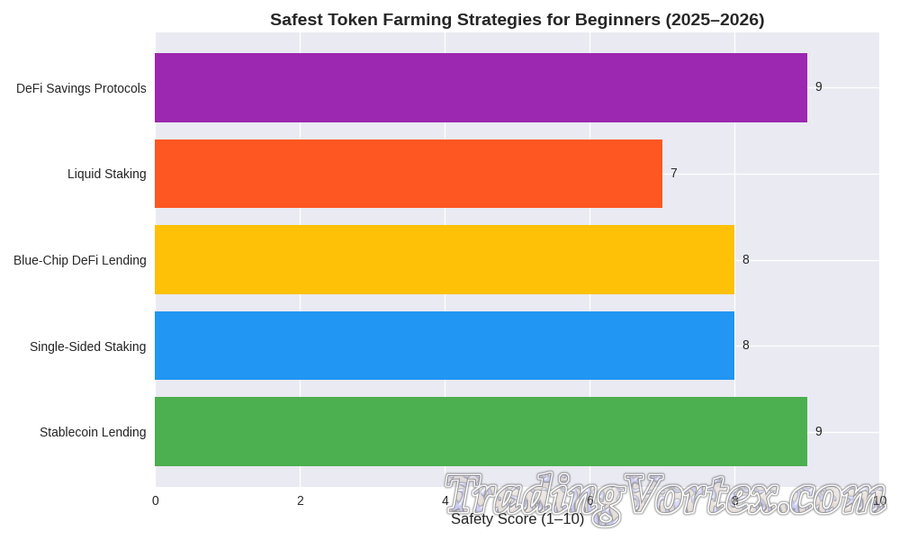 Safest Token Farming Strategies for Beginners (2025–2026):
🧠 How to Use This Visual:
1. Stablecoin Lending — Safety Score: 9/10
If you want the calmest possible start, this is it.
You deposit USDC, USDT, or DAI, and you earn interest from real borrowing demand; not token emissions.
This is the closest thing to “crypto savings” without the complexity of LPs or leverage.
2. Single‑Sided Staking — Safety Score: 8/10
Perfect if you already hold ETH and want yield without juggling two assets.
You stake once, receive a liquid token like stETH, and continue earning while keeping flexibility.
3. Blue‑Chip DeFi Lending (Aave, Compound, Morpho, Spark) — Safety Score: 8/10
These protocols have survived multiple cycles and have deep liquidity, audits, and transparent mechanics.
If you want reliability and predictable behavior, this is where you go.
4. Liquid Staking — Safety Score: 7/10
A bit more complex than single‑sided staking because of token liquidity and price dynamics, but still one of the safest ways to earn yield on ETH.
Great once you’re comfortable with the basics.
5. DeFi Savings Protocols (Spark, Sky, Morpho Vaults) — Safety Score: 9/10
If you prefer a “deposit and check occasionally” approach, these vaults are ideal.
They generate yield from protocol revenue, not inflationary rewards, making them beginner‑friendly and easy to monitor.
Advanced Low-Risk Farming Strategies for Experienced Users
Once you already know the basics, low-risk farming stops being about chasing the biggest APY and starts being about engineering around the ways capital can leak. The more mature parts of DeFi now give you several tools for that job, including near-parity liquidity pools, delta-neutral structures, automated vaults with explicit risk scoring, curated multi-protocol vaults, and structured products that split risk into layers. That is a far cry from the old “deposit and pray” era, and it is exactly where experienced users should be looking.
Stablecoin Liquidity Pools, Low Impermanent Loss by Design
If you want to earn fees without taking the full punch of volatile pair exposure, stable pools are the cleanest advanced place to live.
Balancer’s docs say stable pools are designed for assets expected to swap at near parity, or at a known exchange rate, and use Stable Math to support large trades with much lower price impact. They are built for pegged assets such as DAI, USDC, and USDT, as well as correlated assets like wstETH and wETH. That matters because impermanent loss is fundamentally a divergence problem, and stable or tightly correlated pairs reduce the odds of getting dragged by price separation.
The practical upside is obvious: you can still collect trading fees, but you are not volunteering your portfolio for the full chaos of a random volatile pair. The catch is just as important, though, because the strategy only stays “low risk” while the assets continue behaving like near-pegs or close correlations. Once that relationship breaks, the pool stops feeling boring very quickly.
Delta-Neutral Farming Strategies
Delta-neutral farming is where experienced users try to earn yield without taking much directional price exposure. Ethena’s documentation defines a delta-neutral portfolio as one whose value is not exposed to changes in the underlying asset price, and its example shows how offsetting positions can keep synthetic USD value unchanged even when ETH moves sharply up or down. Ethena also notes that this balance may fail under certain market conditions, which is the part worth taking seriously instead of admiring the spreadsheet too much.
In practice, these setups usually combine collateral, staking yield, and hedges such as short perpetual positions, so the profit stream comes from carry or funding dynamics rather than simple price direction. That makes the strategy attractive when you want steadier behavior through market swings, but it also makes it much more operationally sensitive than plain staking or lending. If the derivatives market gets stressed, liquidity dries up, or the hedge stops behaving as expected, the whole construction can wobble.
Yield Aggregators and Auto-Compounding Vaults
For experienced users who hate babysitting positions, yield aggregators are still one of the best quality-of-life upgrades in DeFi. Yearn’s yVaults are auto-compounding contracts that harvest and compound yield for depositors, while Beefy describes its vaults as automated systems that manage deposited funds, compound gains, and reduce the need for constant manual transactions and gas costs.
That automation matters because the yield problem is not just about finding returns, it is also about making sure those returns are not eaten alive by friction.
The part that separates good vaults from dangerous ones is transparency around strategy risk. Yearn’s current risk framework scores strategies objectively, and its V3 vaults can be single-strategy or multi-strategy, with multi-strategy vault risk defined by the highest risk level among the included strategies.
Yearn’s vault-risk docs also warn that adding strategies improves diversification but increases the probability that one of them could lead to capital losses. That is the kind of honesty you want before you let a vault do the hard work for you.
Diversified Multi-Protocol Farming
Diversification sounds simple until you realize that “spread it around” can become “spread it around badly” if you do not cap the moving parts. The smarter version is to use multi-protocol vaults and cross-chain transfer rails that are designed to reduce unnecessary trust assumptions.
Morpho Vault V2, for example, uses adapters to route capital into different protocols and lets curators set both absolute and relative caps on risk identifiers, so exposure can be controlled rather than left to vibes.
That same logic applies across chains. Circle’s Cross-Chain Transfer Protocol burns USDC on the source chain and mints it on the destination chain, which means native 1:1 transfers without traditional bridge liquidity pools or wrapped tokens. For a farmer, that is useful because it makes rebalancing capital between venues less dependent on the kind of wrapped-asset plumbing that can add extra risk just when you were trying to reduce it.
Yearn’s multi-strategy vault design fits this theme too. It can spread capital across several strategies, but its own docs make the warning clear: each additional strategy adds diversification, yet also adds another possible failure point. In other words, diversification helps only when the extra exposure is actually disciplined. Otherwise, it is just a bigger basket of ways to get hurt.
Risk-Tranched DeFi Products
Structured products are still a niche corner of DeFi, but they are one of the more interesting tools for experienced users who want to control how much risk they are actually taking. Struct Finance says it decentralizes structured finance in DeFi and explicitly describes tranching yield-bearing positions as part of its model. BarnBridge’s archived docs describe it as a risk-tokenizing protocol that redistributes risk through liquid tranches, aiming to reduce exposure to interest-rate sensitivity and market volatility.
The core idea is borrowed from traditional securitization, where senior tranches get paid first and junior tranches absorb losses first. A 2025 PwC guide on securitization summarizes that exact hierarchy, and that framing maps neatly onto DeFi structured products. For an experienced farmer, the appeal is pretty obvious: you can target a more protected, lower-yield layer instead of sitting in the first-loss seat. The tradeoff is that these products are more complex, more technical, and much less forgiving if you do not understand what sits under the tranche.
The practical takeaway is simple. Advanced low-risk farming is not about eliminating risk, because that would be fantasy. It is about choosing structures that cap the dumb risks first, then letting automation and market design do the rest. Stable pools, delta-neutral structures, curated vaults, cross-chain native transfers, and tranching can all help, but only when you read the docs, respect the moving parts, and refuse to confuse complexity with safety.
📊 Visual: Advanced Low‑Risk Farming Strategies: Complexity vs. Risk (2025–2026)
This visual is designed to help you, as an experienced DeFi user, quickly understand how different advanced low‑risk farming strategies compare in terms of operational complexity and risk exposure. Instead of treating all “advanced” strategies as equal, this chart shows you which ones require more engineering, which ones offer the most stability, and where the trade‑offs actually sit.
Use this chart as a strategic map: it helps you choose the structures that match your skill level, your risk tolerance, and the amount of time you want to spend managing positions.
🎯 Why This Visual Matters for You:
This chart helps you:
- See which advanced strategies are truly “low risk”
- Avoid complexity traps disguised as safe yield
- Choose structures that match your expertise
- Engineer yield with fewer blind spots and fewer surprises
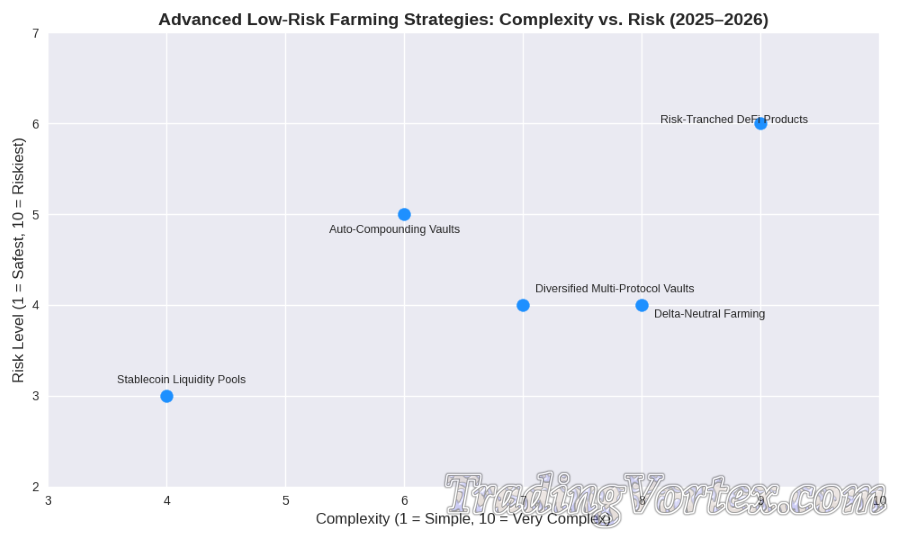 Advanced Low‑Risk Farming Strategies: Complexity vs. Risk (2025–2026):
🧠 How to Read This Visual:
Each point on the chart represents one advanced low‑risk farming strategy, plotted by:
Complexity (1–10):
How many moving parts, hedges, or protocol interactions the strategy requires.
Risk Level (1–10):
Lower = safer. Higher = more exposure to market stress, smart‑contract surfaces, or operational fragility.
♦ Here’s what each strategy means for you:
1. Stablecoin Liquidity Pools — Low Complexity, Very Low Risk
These pools (DAI/USDC/USDT, wstETH/wETH) are engineered to minimize impermanent loss.
If you want predictable fee income without volatility exposure, this is your safest advanced option.
2. Delta‑Neutral Farming — High Complexity, Low–Moderate Risk
You hedge price exposure using derivatives or offsetting positions.
When executed correctly, this gives you extremely stable returns; but it requires precision and constant monitoring of funding rates and liquidity.
3. Auto‑Compounding Vaults — Medium Complexity, Moderate Risk
Yearn, Beefy, and similar vaults automate harvesting and compounding.
You save time and gas, but you inherit the strategy’s internal risks and smart‑contract surface.
4. Diversified Multi‑Protocol Vaults — High Complexity, Low–Moderate Risk
These vaults spread capital across multiple protocols with curated caps and risk controls.
Diversification helps; but every added strategy is another potential failure point.
5. Risk‑Tranched DeFi Products — Very High Complexity, Moderate Risk
Structured products let you choose senior (safer) or junior (riskier) tranches.
They offer powerful risk‑control tools, but only if you fully understand the underlying mechanics.
How to Choose Safe Yield Farming Platforms
Let’s be honest, this is where most people either protect their capital… or quietly lose it. Yield farming is not just about finding the highest APY, it is about knowing where your money is actually sitting. If you treat platform selection like you would pick a bank, your odds of surviving long term improve dramatically.
Importance of Smart Contract Audits
Think of smart contracts as the engine of a DeFi platform. If the engine is flawed, everything built on top of it is at risk. A proper audit means independent security researchers have reviewed the code, looking for bugs, vulnerabilities, and ways attackers could exploit the system.
If you want a simple rule, look for:
- Multiple audits, not just one
- Recent audits, not something from 2021
- Active bug bounty programs
No audit guarantees safety, but skipping this check is like driving a car that has never been inspected. It might work… until it really doesn’t.
Evaluating Platform Reputation and TVL
But here is the catch: TVL alone is not enough. A project can attract liquidity with aggressive incentives, then collapse when rewards disappear.
So instead of blindly trusting TVL, combine it with reputation:
- Has the protocol survived multiple market cycles?
- Is it widely used by experienced DeFi users?
- Do major wallets, funds, or aggregators interact with it?
A good analogy is restaurants. A busy place is usually a good sign, but you still check reviews before ordering. TVL is the crowd, reputation is the reviews.
Transparency: APY, Fees, and Risk Metrics
If a platform makes it hard to understand how yield is generated, that is already a red flag.
Safe protocols tend to be very clear about:
- Where the yield comes from (trading fees, lending interest, incentives)
- How APY is calculated
- What fees you are paying (deposit, withdrawal, performance)
- What risks are involved (impermanent loss, liquidation, smart contract exposure)
On the other hand, if you see flashy APYs with vague explanations like “optimized strategies” and no breakdown, you are not investing, you are guessing.
A quick personal tip: if you cannot explain the yield strategy to a friend in two minutes, you probably should not be in it.
Security Features and Insurance Options
Security in DeFi is layered, not binary. The safest platforms usually combine several protections:
- Time-locks on critical changes, so governance updates cannot happen instantly
- Multi-signature wallets, meaning no single person can control funds
- Real-time monitoring tools and risk dashboards
- Emergency pause mechanisms in case something goes wrong
Some protocols also integrate insurance or allow you to insure your position through third-party providers. It is not free, but for larger capital, it can be worth considering.
Here is how I think about it: if a platform assumes nothing will ever go wrong, that is a problem. The best platforms are designed for when things go wrong.
Established vs New Protocols: Risk Comparison
This is where many yield farmers struggle, because the highest yields are often in newer protocols.
Established protocols:
- Lower yields
- Higher trust
- Battle-tested through multiple market conditions
New protocols:
- Higher yields
- Less testing
- Greater risk of bugs, exploits, or outright failure
There is no right or wrong choice here, only position sizing.
A strategy I often share with friends is simple:
- Keep the majority of your capital in established, proven platforms
- Allocate a smaller portion to newer opportunities if you want higher returns
This way, you are not gambling your entire portfolio on unproven code.
At the end of the day, choosing a safe yield farming platform is less about chasing the best number on a dashboard and more about understanding where your risk actually lives. The platforms that survive in this space are not the ones offering the highest yield today, but the ones that are still standing tomorrow.
📊 Visual: Key Safety Factors When Choosing Yield Farming Platforms (2025–2026)
This visual gives you a simple, practical framework for evaluating whether a yield‑farming platform is actually safe. Instead of chasing the highest APY, this chart helps you focus on the five safety pillars that determine whether your capital is protected or exposed to unnecessary risk.
Use this as your personal checklist before depositing funds anywhere.
🎯 Why This Visual Matters for You:
This chart helps you:
- Quickly evaluate any platform’s safety profile
- Avoid high‑risk platforms disguised by high APYs
- Understand which factors matter most for long‑term survival
- Build a safer, more resilient yield‑farming strategy
If you want to farm without losing sleep, this is the framework you should rely on.
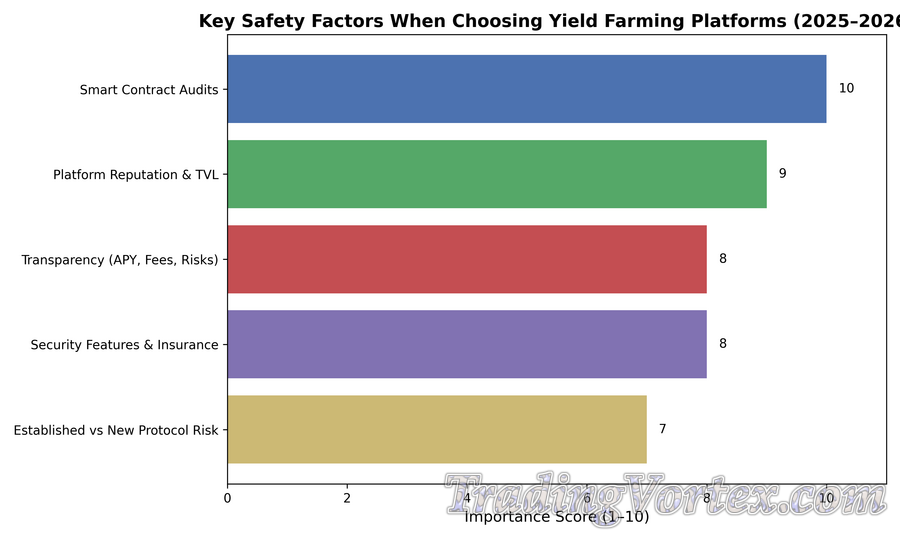 Key Safety Factors When Choosing Yield Farming Platforms (2025–2026):
🧠 How to Read This Visual:
Each bar represents an Importance Score (1–10): the higher the score, the more essential the factor is for platform safety.
1. Smart Contract Audits — 10/10
This is the single most important factor.
Multiple recent audits + active bug bounties dramatically reduce the chance of catastrophic exploits.
If a platform hides or downplays audits, walk away.
2. Platform Reputation & TVL — 9/10
High TVL and long‑term survival indicate real‑world stress testing.
But TVL alone isn’t enough: combine it with reputation, history, and who actually uses the protocol.
3. Transparency (APY, Fees, Risks) — 8/10
If you can’t clearly see where the yield comes from, you’re not investing; you’re guessing.
Safe platforms explain APY sources, fee structures, and risk exposure in plain language.
4. Security Features & Insurance — 8/10
Time‑locks, multisigs, emergency pause functions, and optional insurance all reduce the blast radius of unexpected events.
If a platform assumes “nothing will ever go wrong,” that’s a red flag.
5. Established vs New Protocol Risk — 7/10
Newer platforms often offer higher APYs but carry higher failure risk.
A balanced approach, majority in established protocols, minority in new ones, protects you from blowups.
Step-by-Step Guide: How to Farm Tokens Safely
Let’s turn theory into action.
A lot of people jump into yield farming after watching a YouTube video or seeing a big APY number on a dashboard. A week later, they are confused, stressed, or down bad. Farming safely is not about being lucky. It is about following a clear process every single time.
Here is the framework I personally recommend to friends who want exposure to DeFi without unnecessary damage to their portfolio.
Step 1: Select Low-Volatility Assets
Before you even look at platforms, start with the asset itself.
Volatility is the silent killer in farming. If the token you deposit drops 30 percent, no yield is going to save you. That is why safer strategies usually begin with:
- Major stablecoins such as USDC, USDT, or decentralized alternatives like DAI
- Blue-chip assets like ETH when used in simple staking setups
- Correlated pairs, for example stablecoin to stablecoin pools
If you are unsure, ask yourself a simple question: would I be comfortable holding this asset through a market crash? If the answer is no, do not farm it.
Step 2: Choose Trusted DeFi Platforms
Once you know what you want to deposit, the next decision is where.
Trusted platforms typically share several characteristics:
- Public smart contract audits from reputable security firms
- Transparent documentation explaining how yield is generated
- Active governance and community oversight
- Clear risk disclosures
Also, check how long the protocol has been live. Surviving multiple market cycles is one of the best stress tests in crypto.
Step 3: Allocate Capital Strategically
This is where discipline separates professionals from gamblers.
Even if a strategy looks safe, never allocate 100 percent of your capital to one protocol or one farm. Spread exposure across:
- Different protocols
- Different strategies, such as lending plus staking
- Different asset types when appropriate
Many experienced users follow a core and satellite model:
- Core capital in conservative lending or staking
- Smaller satellite positions in higher-yield but higher-risk farms
Position sizing matters more than APY. If a new opportunity looks attractive, test it with a small amount first. Observe how it behaves during volatile days before increasing exposure.
Step 4: Monitor Performance and Risks
Yield farming is not a “set it and forget it” savings account.
Interest rates in DeFi are dynamic. Lending rates change based on utilization. Liquidity pool returns shift with trading volume. Governance proposals can adjust parameters. Even stablecoin pegs can wobble under stress.
At minimum, monitor:
- APY changes
- Utilization ratios in lending markets
- Health factors if you are borrowing
- News about audits, upgrades, or incidents
You do not need to stare at dashboards all day. But checking your positions weekly, or after major market moves, is smart risk management.
The biggest losses often happen to people who stop paying attention.
Step 5: Rebalance and Compound Safely
Compounding is powerful, but it should be done intentionally.
Some platforms offer auto-compounding vaults that reinvest rewards automatically. These can reduce gas costs and human error. Others require manual claiming and redepositing.
When compounding:
- Reassess whether the strategy still fits your risk profile
- Consider converting incentive tokens into more stable assets
- Avoid blindly stacking exposure to a single protocol token
Safety in farming is not about avoiding all risk. It is about constantly aligning your exposure with your tolerance and your long-term goals.
If I had to summarize this entire guide in one sentence, it would be this:
Start conservative, size intelligently, monitor consistently, and never assume yield is guaranteed.
In crypto, the people who last the longest are rarely the ones who farm the highest APY. They are the ones who respect risk every single step of the way.
📊 Visual: Safe Token Farming: Importance of Each Step (2025–2026)
This visual gives you a simple, structured way to understand which steps matter most when farming tokens safely. Instead of treating yield farming as guesswork, this chart shows you the five essential steps you must follow, and how important each one is for protecting your capital.
Think of it as your personal safety roadmap: follow these steps consistently, and you dramatically reduce the chances of unexpected losses.
🎯 Why This Visual Matters for You:
This chart helps you:
- Understand the true priorities of safe farming
- Avoid the mistakes that cause most losses
- Build a disciplined, repeatable process
- Stay aligned with your long‑term goals
If you want to farm without stress, and without blowing up your portfolio, this is the framework to follow.
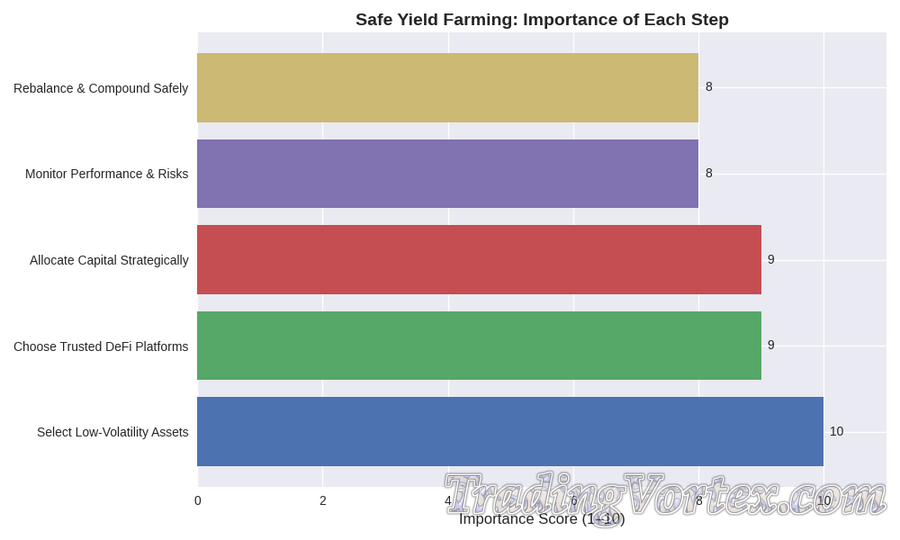 Safe Token Farming: Importance of Each Step (2025–2026):
🧠 How to Read This Visual:
Each bar represents an Importance Score (1–10): the higher the score, the more critical the step is for safe farming.
1. Select Low‑Volatility Assets — 10/10
This is the foundation of safe farming.
If the asset collapses in price, no APY can save you.
Start with stablecoins or blue‑chip assets; not speculative tokens.
2. Choose Trusted DeFi Platforms — 9/10
Even the best asset can be lost on a bad platform.
Look for audits, transparency, long‑term survival, and active governance.
3. Allocate Capital Strategically — 9/10
Never go all‑in on a single protocol.
Use a core‑and‑satellite approach:
◊ Core = safe, stable strategies
◊ Satellite = small, higher‑risk experiments
4. Monitor Performance & Risks — 8/10
DeFi is dynamic.
APYs change, utilization shifts, governance updates happen, and pegs can wobble.
Checking your positions weekly protects you from slow‑building risks.
5. Rebalance & Compound Safely — 8/10
Compounding boosts returns; but only if the strategy still fits your risk profile.
Rebalance when positions grow too large or when market conditions change.
Best Tools to Minimize Risk in Yield Farming
Let me be honest with you for a second: in yield farming, your strategy matters, but your tools matter just as much. I have seen people lose money not because they picked the wrong pool, but because they were flying blind. No tracking, no data, no alerts, just vibes. That works in a bull run… until it doesn’t.
If your goal is to farm tokens with minimal risk, you need a proper toolkit. Think of it like trading, you would not enter a position without charts, right? Same idea here. Let’s walk through the tools that actually help you stay in control instead of reacting after things go wrong.
Yield Tracking Platforms and Analytics Tools
First things first, you need visibility. If you cannot clearly see what your positions are doing, you are already behind.
Platforms like Zapper, Zerion, and DeBank are basically your command center. They show all your DeFi positions in one place, across multiple chains and protocols. Instead of opening ten tabs and checking each farm manually, you get a clean dashboard with your balances, yields, and exposure.
What makes these tools powerful is not just convenience. It is awareness. You can quickly spot things like:
- A pool that suddenly stopped generating yield
- A token that is losing value faster than your rewards can compensate
- Overexposure to a single protocol or asset
If you are farming without one of these tools, you are basically guessing.
Risk Dashboards and DeFi Data Aggregators
Now let’s talk about the tools that help you judge risk, not just track performance.
DeFiLlama is one of the most important platforms here. It gives you a clear picture of Total Value Locked, protocol growth, and yield opportunities across the ecosystem. High TVL does not guarantee safety, but it often signals that a protocol has survived some real market pressure.
Then you have tools like Dune Analytics, Nansen, and Token Terminal, which take things to another level. These platforms let you dig into:
- Real user activity
- Revenue sources behind yields
- Smart money movements
This is where things get interesting. You can actually see whether yield is coming from real usage or just token emissions. That distinction is everything.
There are also specialized platforms like DeFi Safety, which score protocols based on factors like audits, documentation, and governance quality. It is not perfect, but it gives you a structured way to compare risk instead of relying on hype.
If you ever feel like a yield looks too good to be true, this is where you go to confirm your suspicions.
Portfolio Diversification Tools
Here is a hard truth that many people learn the expensive way: concentration kills.
Putting everything into one farm, even a "safe" one, is still risky. Smart farmers spread their exposure, and the right tools make that much easier.
Again, platforms like Zapper, Zerion, and DeBank help here, but you can take it further with tools that analyze your overall allocation. They show you how much of your portfolio is tied to:
- A single stablecoin
- A specific protocol
- A single blockchain
This matters more than you think. For example, you might believe you are diversified, but if half your positions depend on one protocol like Aave or Curve, you are still exposed to a single point of failure.
Some advanced users also use data platforms like Nansen to track where large wallets are allocating capital. It is not about copying them blindly, but it can give you ideas on how to distribute risk more intelligently.
Automated Farming Bots and Vaults
This is where things start to feel like passive income, but do not let that fool you into thinking it is risk-free.
Platforms like Yearn Finance, Beefy Finance, and similar vault protocols automate the entire farming process. They:
- Move funds between strategies
- Harvest and compound rewards
- Optimize for better yields
On paper, this sounds like the perfect low-risk solution. And in many cases, it actually is safer than manually chasing farms, because you avoid emotional decisions and constant repositioning.
The key advantage here is discipline. These systems do not get greedy, do not panic, and do not forget to compound.
However, there is a trade-off. You are trusting a smart contract and a strategy managed by someone else. That is why it is important to choose vaults with:
- Strong audit history
- Transparent strategy descriptions
- Proven track record
Personally, I like using vaults for stablecoin strategies. They remove a lot of the friction while still keeping returns reasonable and consistent.
Think of them as the autopilot mode of yield farming, but always keep your hands near the controls.
Final Thoughts:
If I had to summarize this in one sentence, it would be this: tools do not eliminate risk, but they dramatically reduce surprises.
And in DeFi, surprises are usually expensive.
The difference between a stressed farmer and a confident one is not just experience. It is visibility, data, and control. When you know where your yield is coming from, how your portfolio is structured, and what risks you are taking, everything becomes a lot calmer.
You do not need to use every tool out there, but you do need a system. Start with a tracker, add a data dashboard, and gradually build your setup as your capital grows.
Because at the end of the day, farming is not about chasing the highest yield. It is about keeping what you earn.
📊 Visual: Best Tools to Minimize Risk in Yield Farming (2025–2026)
This visual gives you a clear, structured overview of the five essential tool categories every safe yield farmer should rely on. Instead of farming blindly or reacting after losses happen, this chart shows you which tools provide the biggest safety boost, and why they matter.
Think of it as your personal “DeFi safety toolkit.” If you use these tools consistently, you dramatically reduce surprises, stress, and unnecessary risk.
🎯 Why This Visual Matters for You:
This chart helps you:
- Build a complete, professional‑grade DeFi toolkit
- Avoid the “farming blind” mistakes that cause most losses
- Understand which tools give the biggest safety boost
- Make smarter, calmer decisions with real data
If your goal is to farm with confidence, not stress, these are the tools you should rely on.
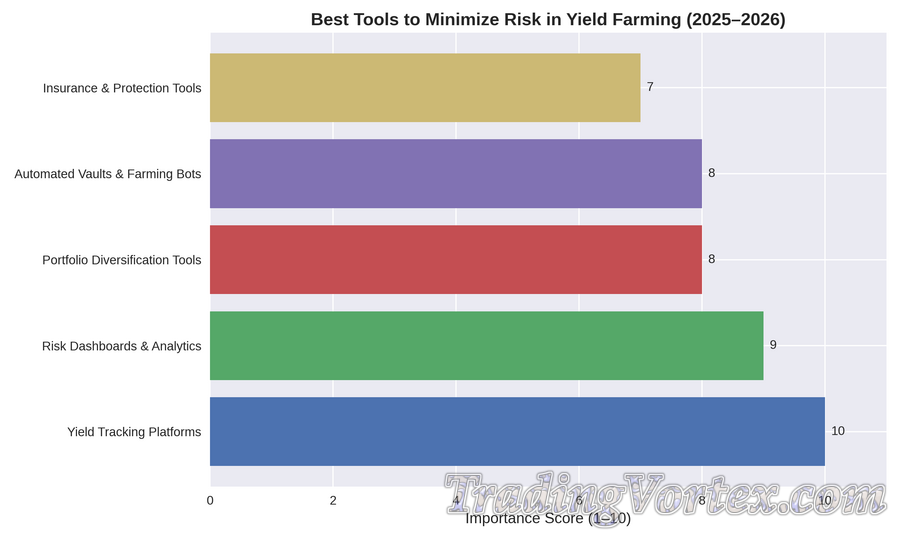 Best Tools to Minimize Risk in Yield Farming (2025–2026):
🧠 How to Read This Visual:
Each bar represents an Importance Score (1–10): the higher the score, the more critical the tool category is for protecting your capital.
1. Yield Tracking Platforms — 10/10
This is your command center.
Tools like Zapper, Zerion, and DeBank show all your positions across chains, helping you spot:
♦ Pools that stopped yielding
♦ Tokens losing value
♦ Overexposure to a single protocol
If you farm without a tracker, you’re flying blind.
2. Risk Dashboards & Analytics — 9/10
Platforms like DeFiLlama, Dune, Nansen, and Token Terminal help you understand:
♦ Where yield actually comes from
♦ Whether TVL is real or inflated
♦ How stable a protocol’s revenue is
This is where you verify whether a yield is sustainable; or a trap.
3. Portfolio Diversification Tools — 8/10
These tools show you how much of your portfolio depends on:
♦ One stablecoin
♦ One protocol
♦ One blockchain
Diversification is not about owning more assets: it’s about avoiding single points of failure.
4. Automated Vaults & Farming Bots — 8/10
Platforms like Yearn and Beefy automate:
♦ Harvesting
♦ Compounding
♦ Strategy rotation
They reduce human error and emotional decisions; but require trust in smart contracts and audits.
5. Insurance & Protection Tools — 7/10
Optional, but extremely valuable for larger portfolios.
Insurance providers and protocol‑level protections help reduce the impact of:
♦ Smart contract exploits
♦ Peg failures
♦ Protocol shutdowns
They don’t eliminate risk; but they soften the blow.
Risk Management Techniques for Sustainable Returns
Yield farming is not really about chasing the highest return, it is about staying in the game long enough for those returns to actually matter. Most people blow up not because they made one terrible decision, but because they ignored a few simple guardrails. The good news is that sustainable returns in DeFi are absolutely possible if you treat risk management as your first priority, not an afterthought.
Diversification Across Assets and Protocols
If you only remember one thing from this section, make it this: never put your entire stack into a single protocol, pool, or strategy.
DeFi is incredibly interconnected, which is great for composability but dangerous for concentration risk. If one protocol gets hacked, one oracle fails, or one token depegs, the damage can ripple through multiple platforms. Spreading your capital across different protocols, chains, and asset types reduces the chance that a single failure wipes you out.
A simple approach works well here:
- Mix lending, staking, and liquidity provision instead of relying on just one strategy
- Use different protocols rather than stacking everything into one ecosystem
- Combine stablecoins with blue-chip assets like ETH to balance yield and volatility
Think of it like building a portfolio, not chasing a single farm. You are not trying to hit a jackpot, you are trying to build something that survives bad weeks.
Limiting Exposure Per Platform
Even if a protocol looks safe, audited, and battle-tested, you should still limit how much capital you allocate to it.
This is one of those rules that feels overly cautious until the day it saves you. Every protocol carries some level of smart contract risk, governance risk, or liquidity risk. There is no such thing as zero risk in DeFi, only different shades of it.
A practical mindset:
- Treat each protocol as if it could fail, even if the probability is low
- Cap your exposure to a percentage you are comfortable losing
- Rebalance periodically instead of letting one position grow too large
Maintaining Safe Loan-to-Value (LTV) Ratios
Leverage is one of the fastest ways to amplify returns, and also one of the fastest ways to get liquidated.
If you are using lending protocols, keeping a conservative loan-to-value ratio is critical. Most platforms allow you to borrow up to a certain percentage of your collateral, but just because you can borrow that much does not mean you should.
A safer approach:
- Stay well below the maximum LTV, ideally with a large buffer
- Monitor your health factor regularly, especially in volatile markets
- Avoid stacking leverage on top of already complex strategies
Markets can move quickly, and liquidations do not wait for you to react. If your position only survives when everything goes right, it is not a strong position.
Avoiding High APY “Trap” Farms
We have all seen them: a farm offering 200 percent APY with a token you have never heard of. It looks exciting, it feels like an opportunity, and it is often a trap.
High APY usually comes from one of two things: heavy token emissions or extremely high risk. In many cases, the yield is paid in a token that is losing value faster than you are earning it. On paper, you are making money, but in reality, your position is slowly bleeding.
A few quick reality checks:
- If the APY looks too good to be true, it probably is
- Check where the yield actually comes from, not just the number
- Look at token inflation and selling pressure before committing
There is nothing wrong with experimenting with higher-risk farms, but treat them as a small, controlled part of your portfolio, not your core strategy.
Using Stablecoins to Reduce Volatility
Stablecoins are often seen as boring, but they are one of the most powerful tools for managing risk in DeFi.
By allocating a portion of your capital to stablecoin strategies, you reduce exposure to market swings while still earning yield. This can be especially useful during uncertain or bearish conditions, when protecting capital becomes just as important as growing it.
Common approaches include:
- Lending stablecoins on established protocols for steady interest
- Providing liquidity in stablecoin pools where price movement is minimal
- Parking funds in stablecoin savings vaults while waiting for better opportunities
Think of stablecoins as your defensive layer. They give you flexibility, stability, and the ability to move quickly when the market shifts.
At the end of the day, sustainable returns in DeFi come from consistency, not from chasing every new opportunity. The traders who last are not the ones who took the biggest risks, they are the ones who managed risk well enough to keep compounding over time.
📊 Visual: Risk Management Techniques for Sustainable DeFi Returns (2025–2026)
This visual gives you a clear, structured overview of the five core risk‑management techniques that matter most for long‑term success in yield farming. Instead of chasing APYs blindly, this chart helps you understand which habits actually protect your capital and keep your returns sustainable over time.
Think of it as your personal “DeFi survival checklist.” If you follow these techniques consistently, you dramatically reduce the odds of catastrophic losses.
🎯 Why This Visual Matters for You:
This chart helps you:
- Build a safer, more resilient farming strategy
- Avoid the mistakes that cause most DeFi losses
- Focus on the techniques that actually protect your capital
- Stay in the game long enough for compounding to matter
If your goal is sustainable returns, not short‑term gambling, these are the techniques you should rely on.
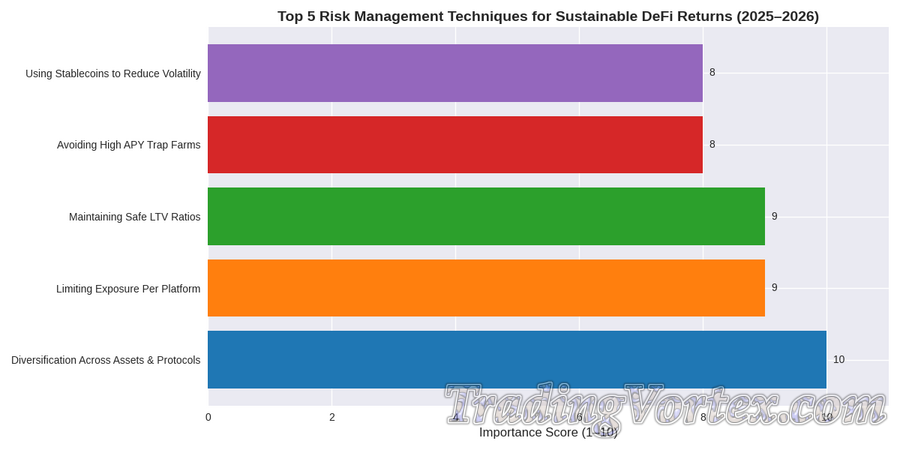 Risk Management Techniques for Sustainable DeFi Returns (2025–2026):
🧠 How to Read This Visual:
Each bar represents an Importance Score (1–10): the higher the score, the more essential the technique is for staying safe while farming.
1. Diversification Across Assets & Protocols — 10/10
This is the single most important rule.
If one protocol fails, one token depegs, or one chain freezes, diversification prevents a total wipeout.
You’re not trying to hit a jackpot; you’re trying to survive bad weeks.
2. Limiting Exposure Per Platform — 9/10
Even “safe” protocols can fail.
Capping your exposure ensures that no single exploit or governance failure can destroy your portfolio.
Discipline beats confidence every time.
3. Maintaining Safe LTV Ratios — 9/10
Leverage amplifies gains, and liquidations.
Staying well below maximum LTV and monitoring your health factor protects you from sudden market swings.
4. Avoiding High‑APY Trap Farms — 8/10
If the APY looks too good to be true, it usually is.
High yields often come from inflationary tokens or unsustainable incentives.
Treat these farms as experiments, not core positions.
5. Using Stablecoins to Reduce Volatility — 8/10
Stablecoins are your defensive layer.
They reduce exposure to price swings while still generating yield; especially useful during uncertain markets.
Yield Farming vs Staking: Which Is Safer?
If you have ever talked to ten different crypto investors, you’ll get eleven different opinions on whether staking or yield farming is safer. Part of that is personality, part is experience, and part is survivorship bias (we remember the wins, not the times we got rugged). But if you boil down the real differences, the safer choice almost always comes down to simplicity and exposure, not just APY numbers or buzzwords.
Key Differences in Risk and Complexity
At the most basic level, both strategies involve putting your crypto to work for you, but the way they do it differs significantly.
Staking is usually straightforward: you lock up your tokens to support a Proof-of-Stake blockchain, or in some DeFi platforms you simply deposit into a single-side pool. In return you receive rewards, usually paid regularly, based on the network’s reward rate or protocol’s rules.
Because staking doesn’t require you to provide two assets or deal with price ratios, you do not face impermanent loss. The biggest risks in staking come from validator issues, slashing penalties when networks punish bad behavior, and the usual price volatility of the underlying token.
Yield farming, on the other hand, is a bit more like financial engineering. It often involves providing liquidity to decentralized exchanges, lending markets, or protocol vaults that use your assets to enable borrowing and trading. That means the yield you earn can come from fees, interest, and often token incentives.
It can be very profitable, but it also introduces a wider set of risks: smart contract vulnerabilities, impermanent loss if the assets you supply diverge in price, and more complex interactions between multiple protocols.
It helps to think of it this way: staking is like earning interest on a savings account, while yield farming is like running a small business with hired help. The business can make more money, but it has more moving parts to break.
When to Prefer Staking Over Farming
If you are someone who values simplicity, consistency, and predictability, staking is usually a better starting point. There are a few clear reasons for that:
- Lower complexity: You stake one asset and collect rewards. There’s no need to pair tokens or chase short-term yields across protocols.
- Less exposure to volatility mechanics: Since you are not providing liquidity in a market pair, you do not lose value due to impermanent loss, even if prices move.
- Predictable rewards: While yields can change over time, staking rewards tend to be more stable and tied to network economics rather than shifting incentive programs.
Combining Both Strategies for Stability
Here is where seasoned investors get clever: you do not have to choose one or the other. Many people build balanced portfolios that include both staking and farming components, depending on their risk tolerance and goals.
A simple example of a balanced approach might look like this:
- A core allocation in staking, especially on high-quality networks. This provides consistent baseline yield with lower exposure to complex risks.
- A smaller allocation in conservative yield farming strategies, such as stablecoin pools or auto-compounding vaults on reputable platforms. These can boost returns without taking on too much volatility or protocol exposure.
By blending the two, you hedge against the weaknesses of each. Staking gives you reliability and simplicity, farming gives you opportunity and yield. Just make sure you size your farming exposure carefully, and always know why you are entering a position rather than just chasing APY.
In short, staking is generally the safer, simpler strategy for most people, especially if you are early in your DeFi journey. Yield farming can offer richer returns, but it carries more moving parts and a broader set of risks that require active management and a deeper understanding of the protocols involved.
Treat risk like an expense you cannot avoid: budget for it intentionally, and your portfolio will thank you.
📊 Visual: Yield Farming vs Staking: Risk & Complexity Comparison (2025–2026)
This visual gives you a clear, side‑by‑side comparison of how staking and yield farming differ across the five factors that matter most for safety: risk level, complexity, volatility exposure, smart‑contract risk, and reward predictability. Instead of relying on opinions or hype, this chart shows you the structural differences that actually affect your capital.
Use this visual as a quick decision guide whenever you're choosing between staking and farming.
🎯 Why This Visual Matters for You:
This chart helps you:
- Quickly understand which strategy is safer for your goals
- Avoid overestimating yield farming returns without accounting for risk
- Choose the right balance between simplicity and opportunity
- Build a more stable, long‑term DeFi strategy
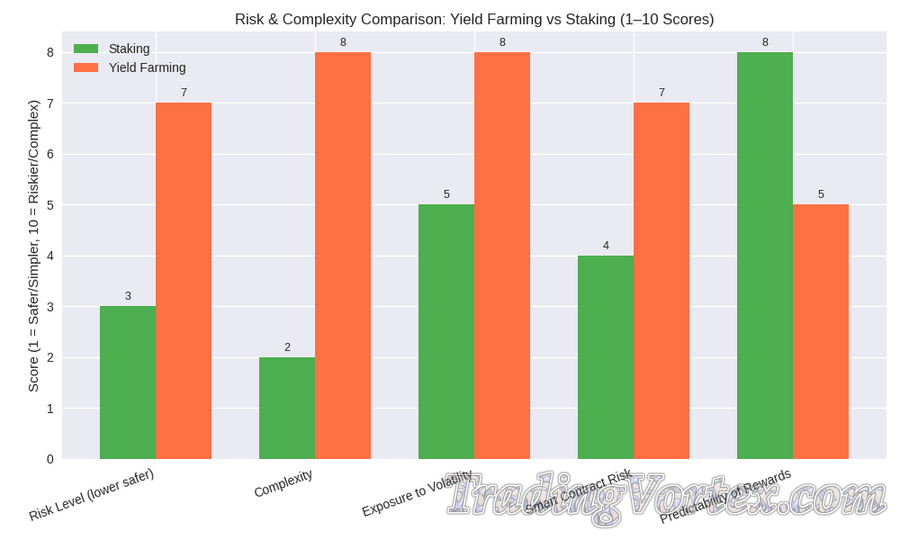 Yield Farming vs Staking Risk & Complexity Comparison (2025–2026):
🧠 How to Read This Visual:
Each pair of bars compares staking (green) and yield farming (orange) on a scale of 1–10, where higher values indicate more risk, more complexity, or less predictability.
1. Risk Level — Staking: 3 vs Farming: 7
Staking is structurally safer because it has fewer moving parts.
Yield farming exposes you to impermanent loss, smart‑contract layers, and multi‑protocol interactions.
2. Complexity — Staking: 2 vs Farming: 8
Staking is simple: deposit one asset, earn rewards.
Yield farming often requires managing pairs, incentives, and dynamic strategies.
3. Exposure to Volatility — Staking: 5 vs Farming: 8
Staking still carries token price risk, but farming adds volatility from paired assets and liquidity dynamics.
4. Smart Contract Risk — Staking: 4 vs Farming: 7
Staking usually interacts with one contract or validator.
Yield farming often touches multiple protocols, increasing attack surface.
5. Predictability of Rewards — Staking: 8 vs Farming: 5
Staking rewards are tied to network economics and tend to be stable.
Farming rewards fluctuate with incentives, trading volume, and market conditions.
Common Mistakes to Avoid in Token Farming
Most people don’t lose money in token farming because they picked the wrong protocol. They lose money because they rushed in, ignored basic risks, or got seduced by flashy numbers.
If you can avoid the mistakes below, you are already ahead of a big percentage of the market.
Chasing High APYs Without Understanding the Risk
This is the classic trap. You open a dashboard, see 150% APY, and suddenly your brain goes quiet.
Here is the reality: high APY almost always means high risk. There is no exception.
Most inflated yields come from token emissions, not real revenue. In simple terms, the protocol is printing rewards to attract liquidity, and those rewards often lose value quickly. You might be earning 150% on paper while the token you receive is quietly dropping 80%.
A good habit is to ask yourself one question before farming: Where is the yield actually coming from? If the answer is unclear, or worse, sounds like marketing jargon, step back.
Think of APY like a shiny car. It looks great from a distance, but you still need to check what is under the hood.
Ignoring Impermanent Loss
Impermanent loss sounds like something temporary and harmless. In practice, it can quietly eat a big chunk of your returns.
It happens when you provide liquidity to a pool with two tokens and their prices move apart. The protocol automatically rebalances your position, which often leaves you with more of the weaker asset and less of the stronger one.
Here is where many people slip: They focus on the rewards and completely ignore what is happening to their underlying assets.
A simple mental rule: If you would not be comfortable holding both tokens individually, you probably should not provide liquidity for them.
Stablecoin pools or correlated assets tend to reduce this risk. Volatile pairs increase it significantly.
Using Unverified or Brand-New Protocols
New protocols are exciting, no doubt. They also tend to be where most disasters happen.
Many users underestimate how common exploits, bugs, and outright scams still are in DeFi. Even in 2025 and 2026, millions are still lost due to smart contract vulnerabilities or malicious designs.
Before depositing funds anywhere, take a moment to check:
- Has the protocol been audited?
- Is the team known or anonymous?
- Is there a meaningful amount of capital already locked, or is it empty?
- Has it survived at least one market downturn?
If a project just launched yesterday and promises insane returns, you are not early, you are the test subject.
There is nothing wrong with experimenting, just size your position accordingly. Treat it like a lottery ticket, not a core investment.
Overleveraging in DeFi
- Leverage is where smart investors can become reckless very quickly.
- DeFi makes it incredibly easy to borrow against your assets and reinvest, sometimes in just a few clicks. The problem is that markets do not care how confident you feel.
- A sudden price drop can trigger liquidations, and those happen fast. No phone call, no warning, just a transaction that wipes out your position.
- Many users fall into this trap during bull markets, when everything seems to go up and leverage feels safe.
- If you use leverage at all, keep it conservative. Maintain a healthy buffer and assume that the market can move against you at the worst possible moment.
- If you are new, it is perfectly fine to avoid leverage altogether.
Poor Portfolio Diversification
Putting everything into a single farm is another common mistake. Even if the protocol looks solid, concentration risk is real. One bug, one governance issue, or one unexpected market event can impact everything you have.
A more resilient approach is to spread your capital across:
- Different protocols
- Different types of strategies, like lending, staking, and liquidity providing
- Different asset classes, such as stablecoins and blue-chip tokens
This does not eliminate risk, but it reduces the chance of a single failure taking you out.
Think of your farming portfolio like a small ecosystem. If one part struggles, the rest can keep things stable.
Final Thought:
Token farming is not about finding the highest yield. It is about keeping your capital alive long enough to let compounding do its job.
If you stay patient, question every opportunity, and avoid these common mistakes, you are already playing the game at a much higher level than most.
And trust me, in DeFi, survival is half the victory.
📊 Visual: Most Common Token Farming Mistakes and Their Severity (2025–2026)
This visual gives you a clear, structured overview of the five most damaging mistakes that cause farmers to lose money. Instead of learning these lessons the hard way, this chart helps you instantly see which behaviors carry the highest risk: so you can avoid them before they drain your portfolio.
Think of it as your personal “danger map” for DeFi farming.
🎯 Why This Visual Matters for You:
This chart helps you:
- Avoid the most common and most expensive mistakes
- Build safer, more resilient farming strategies
- Recognize red flags before committing capital
- Stay in the game long enough for compounding to work
If you avoid these five mistakes, you’re already ahead of most farmers in the market.
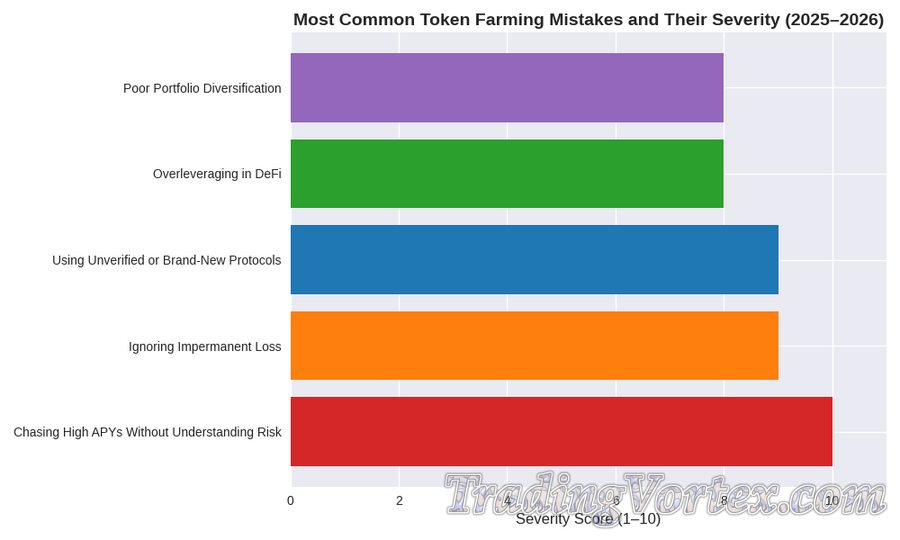 Most Common Token Farming Mistakes and Their Severity (2025–2026):
🧠 How to Read This Visual (Addressed Directly to You)
Each bar represents a Severity Score (1–10): the higher the score, the more dangerous the mistake and the more urgently you should avoid it.
1. Chasing High APYs Without Understanding Risk — 10/10
This is the #1 way people get wrecked.
If you don’t know where the yield comes from, you’re not farming; you’re gambling.
2. Ignoring Impermanent Loss — 9/10
Impermanent loss quietly destroys returns.
If you wouldn’t hold both tokens individually, you shouldn’t LP them together.
3. Using Unverified or Brand‑New Protocols — 9/10
New protocols are exciting… and where most exploits happen.
If you’re early, you’re also the test subject.
4. Overleveraging in DeFi — 8/10
Leverage amplifies gains; and liquidations.
One sharp market move can erase your entire position instantly.
5. Poor Portfolio Diversification — 8/10
Putting everything into one farm is concentration risk.
One bug, one exploit, one depeg; and everything collapses.
Regulatory, Tax, and Security Considerations
Most people jump into yield farming thinking about returns, not taxes, regulation, or security. I’ve seen it countless times, and I get it, those APYs look exciting. But if you ignore these three areas, you are basically farming with one eye closed. And in DeFi, that can get expensive very fast.
Tax Implications of Yield Farming Rewards
This is the part nobody wants to deal with, but it is one of the most important.
In most jurisdictions, yield farming rewards are not “free money.” They are usually treated as taxable income the moment you receive them. That means every token you earn from farming, whether it comes from liquidity rewards, staking incentives, or protocol emissions, can trigger a tax event right away. Then, if you later sell those tokens, you may also owe capital gains tax on any price increase.
So yes, you can end up being taxed twice, once when you receive the rewards and again when you sell them. It sounds annoying because it is.
Here is the practical takeaway:
Track everything. Every deposit, every withdrawal, every reward claim. If you have ever tried to reconstruct months of DeFi activity from memory, you know it is a nightmare. Use portfolio trackers or export transaction histories regularly. Your future self, and your accountant, will thank you.
Also, remember that tax rules differ a lot depending on where you live. Some countries are getting stricter, others are still figuring things out. If you are serious about farming, it is worth spending a few hours understanding your local rules or talking to a professional.
Regulatory Trends in DeFi (2026 Outlook)
Regulation in crypto is no longer a distant threat or a vague idea. It is happening right now, and it is evolving quickly.
By 2026, we are seeing a clear shift toward more structured frameworks. Governments are not trying to shut down DeFi entirely, but they are definitely trying to bring it into a more controlled environment. Stablecoins are a big focus, especially those tied to real-world assets or used for payments. In many regions, new laws require issuers to hold reserves, report transparently, and comply with financial oversight.
What does this mean for you as a yield farmer?
- First, expect more compliance layers. Some platforms may require identity verification, especially if they want to stay accessible to institutional capital. Others might restrict access based on location.
- Second, “safe” protocols will increasingly align with regulation. This is not necessarily a bad thing. It often means better transparency, stronger risk controls, and more predictable behavior during market stress.
- Third, the wild west phase of DeFi is slowly fading. That does not mean opportunities are gone, but it does mean the game is maturing. Think less about chasing anonymous 1000% APY farms, and more about participating in sustainable, regulated ecosystems.
If you are farming with minimal risk as your goal, this shift actually works in your favor.
Wallet Security and Private Key Protection
Now we get to the part that keeps people up at night, or at least it should.
In DeFi, there is no customer support. There is no “forgot password” button. If you lose your private keys or someone steals them, your funds are gone. That is not a theory, it happens every single day.
The basics are simple, but they matter more than any advanced strategy:
- Use a hardware wallet if you are serious. It keeps your private keys offline, which dramatically reduces the risk of remote attacks.
- Never store your seed phrase digitally. Not in your notes app, not in a screenshot, not in your email. Write it down and keep it somewhere safe.
- Be extremely careful with links and approvals. Phishing sites are getting better and better. If something feels off, it probably is.
- Review your token approvals regularly. Many users forget that once you approve a contract, it can access your tokens until you revoke that permission.
One personal tip:
Treat your wallet like your bank account, not like a casual app. If you would not click a random link with your online banking, do not do it in DeFi either.
Also, consider separating wallets by purpose. For example, one wallet for long-term holdings, another for active farming. That way, even if something goes wrong, you are not risking everything at once.
At the end of the day, yield farming is not just about earning tokens. It is about managing risk in an environment where you are fully responsible for your own decisions. Taxes can eat into your profits, regulations can change how platforms operate, and security mistakes can wipe you out in seconds.
The good news is that all of these risks are manageable if you stay informed, stay disciplined, and treat DeFi like a real financial system, not a game.
📊 Visual: Regulatory, Tax, and Security Risks in DeFi: Severity Overview (2026)
This visual gives you a clear, structured breakdown of the five most important non‑APY risks every yield farmer must understand: taxes, regulation, wallet security, oversight changes, and record‑keeping. These factors don’t show up on dashboards, but they can impact your profits more than any APY ever will.
Use this chart as your “hidden risk map”: the part of DeFi most beginners overlook, and the part that protects you the most.
🎯 Why This Visual Matters for You:
This chart helps you:
- Understand the non‑market risks that impact your returns
- Avoid costly mistakes related to taxes, regulation, and wallet security
- Build a safer, more compliant, more resilient DeFi strategy
- Treat DeFi like a real financial system — not a game
If you ignore these risks, even the best farming strategy can fail. If you manage them well, you protect your capital and your peace of mind.
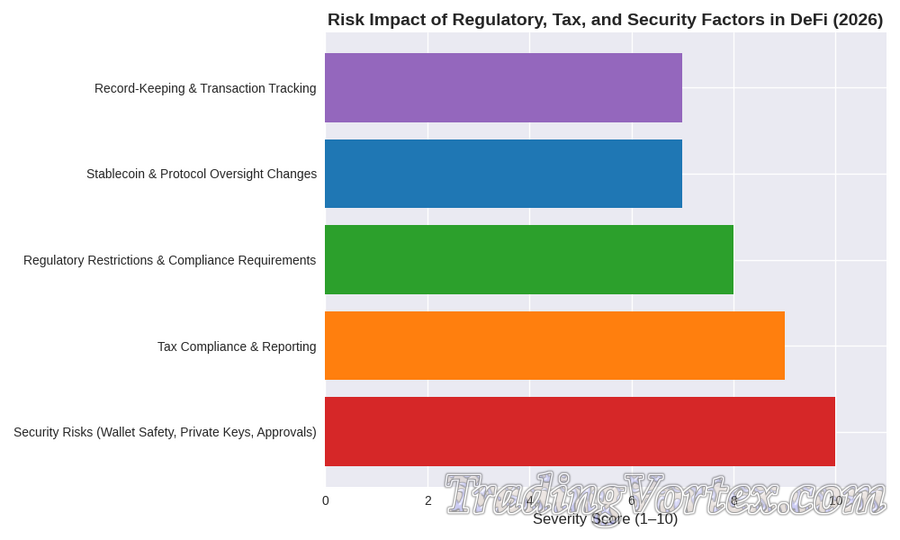 Regulatory, Tax, and Security Risks in DeFi Severity Overview (2026):
🧠 How to Read This Visual:
Each bar represents a Severity Score (1–10): the higher the score, the more dangerous the risk if ignored.
1. Security Risks (Wallet Safety, Private Keys, Approvals) — 10/10
This is the biggest threat in DeFi.
Losing your private keys or signing a malicious approval means instant, irreversible loss.
There is no customer support, no recovery, no undo button.
2. Tax Compliance & Reporting — 9/10
Most jurisdictions treat yield farming rewards as taxable income the moment you receive them, and capital gains when you sell.
If you don’t track everything, you risk penalties, audits, or paying more tax than necessary.
3. Regulatory Restrictions & Compliance Requirements — 8/10
By 2026, DeFi is moving toward more structured oversight.
Some platforms may require identity verification or restrict access by region.
Protocols aligned with regulation tend to be safer; but also more controlled.
4. Stablecoin & Protocol Oversight Changes — 7/10
Stablecoins are under increasing scrutiny.
New rules may affect liquidity, yields, or access to certain pools.
If you rely heavily on stablecoin strategies, stay informed.
5. Record‑Keeping & Transaction Tracking — 7/10
If you don’t track deposits, withdrawals, and rewards, tax season becomes a nightmare.
Good records also help you understand your real profit after fees, slippage, and volatility.
Future Outlook: The Evolution of Low-Risk Yield Farming
Thinking about yield farming five or ten years down the line might feel like trying to predict the weather months ahead: there are variables, surprises, winners, and losers. But if you strip away the hype and look at the real trajectory of the space in 2025 and 2026, you can see a clear pattern: yield farming is evolving from wild speculation into a more structured, sustainable, and institution-friendly financial layer.
That is good for anyone who wants to earn returns without turning their portfolio into a roller coaster.
Real-World Assets (RWA) Integration
For much of DeFi’s early history, yield was generated inside the crypto sandbox: trading fees, borrower interest, token emissions, and liquidity incentives. Now the sandbox walls are opening up.
Real-world assets like tokenized treasuries, real estate debt, and other on-chain representations of off-chain economic value are being brought into DeFi. This trend is no longer fringe. Institutional investors and asset managers are showing interest because these tokenized assets can provide recurring yield backed by real cash flows rather than purely by crypto market dynamics.
The appeal here for low-risk farmers is obvious: predictable interest from real assets can act as a stable yield floor. It will not be triple-digit returns, but that is not the goal of minimal-risk farming. Predictability is.
It also means DeFi might start to feel more like traditional finance without losing its decentralized core: a place where you can earn yield because a company pays interest on a real loan, not just because liquidity was dumped into a pool for rewards.
Safer DeFi Infrastructure and Compliance
If you look at DeFi today, it is nothing like its chaotic early days. Back then farms popped up overnight with no audits and flimsy contracts. In 2026, that narrative is fading.
Protocols are now built with formal security frameworks, multi-party governance, and risk monitoring tools baked in. AI-driven risk systems can detect most exploit patterns before they cause losses, and institutional interest in DeFi infrastructure is pushing projects to meet compliance standards that traditional finance expects.
This maturing of infrastructure is a big deal for anyone focused on minimizing risk. When a protocol moves beyond “code is law” towards transparent governance, audit rigor, and operational maturity, it means fewer surprises and a safer environment to farm yield.
Expect more cross-chain protocols and standardized risk scoring, making it easier to compare opportunity versus risk before you put your capital to work.
AI and Automation in Yield Optimization
A lot of people joke that “manual yield farming is dead” because AI bots now get into new opportunities before most humans can blink. That isn’t entirely true, but it is a metaphor for what is happening: automation is taking over the grunt work.
Instead of manually managing positions, timing injections, and claiming rewards, more users will rely on AI-powered agents that automatically rebalance, mitigate impermanent loss, and optimize position ranges across liquidity pools. These tools will not make yield farming risk-free, but they can manage risk factors you could easily overlook in self-managed setups.
Tools will likely evolve to not just chase yield, but to predict risk events, dynamically allocate capital to lower-risk pools at market inflection points, and reduce the manual overhead that often leads to costly mistakes.
For experienced users, this means less babysitting and more efficient farming. For beginners, it could lower the barrier to entry without forcing everyone to become a DeFi engineer.
The Shift Toward Sustainable Yield Models
If you were farming in 2020 or 2021, you probably remember the era of absurd yields paid in freshly minted tokens. Today those models are being abandoned as users and institutions realize they are not only unsustainable but often destructive to capital value.
The modern narrative is “real yield”: returns backed by actual economic activity like lending interest, trading fees, or cash flows tied to real assets. There are fewer 1,000 percent APYs, and more protocols are distributing revenue in long-term sustainable ways rather than through inflationary token emissions.
That shift is hugely important. Sustainable yield means you are not left holding tokens that tank as soon as incentives end. It means your farming strategy can survive periods of low market activity without completely evaporating.
It also changes how you think about risk. Instead of chasing the highest number on a dashboard, you start thinking about yield quality: is it backed by real protocol revenue, does it have underlying economic drivers, and will it still pay out in bear markets?
Final Thought:
The future of low-risk yield farming is less about flashy returns and more about resilient structures. Real-world assets are bringing stability, infrastructure is becoming more robust, AI is automating risk management, and sustainable yield models are replacing temporary incentives.
It may not feel as exciting as crypto’s early Wild West, but for anyone who wants returns without constant stress, this evolution is a blessing. You will earn yield not because you were lucky, but because you were in the right system at the right time. And that is how long-term financial success is built.
📊 Visual: Key Drivers Shaping the Future of Low‑Risk Yield Farming (2026–2030)
This visual highlights the five major forces that will shape the next generation of low‑risk yield farming. Instead of guessing where DeFi is heading, this chart gives you a clear, structured view of which trends will have the biggest long‑term impact on safety, stability, and predictable returns.
Use this as your “future map”: a quick way to understand where the ecosystem is evolving and how to position yourself intelligently.
🎯 Why This Visual Matters for You:
This chart helps you:
- Understand where DeFi is heading over the next decade
- Position yourself early in safer, more predictable yield opportunities
- Avoid outdated, high‑risk farming models
- Build a long‑term strategy aligned with institutional‑grade trends
If your goal is low‑risk, sustainable returns, these are the trends that will define your success.
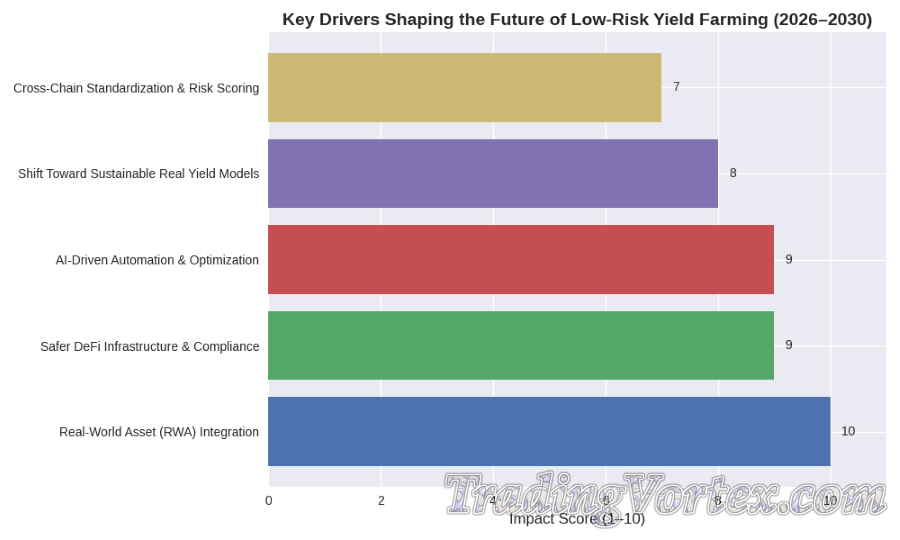 Key Drivers Shaping the Future of Low‑Risk Yield Farming (2026–2030):
🧠 How to Read This Visual:
Each bar represents an Impact Score (1–10): the higher the score, the more influential the trend will be in shaping safe, sustainable yield farming.
1. Real‑World Asset (RWA) Integration — 10/10
This is the biggest shift in DeFi.
Tokenized treasuries, real‑estate debt, and other real‑world cash‑flow assets create predictable, stable yield floors: a massive win for low‑risk farmers.
2. Safer DeFi Infrastructure & Compliance — 9/10
DeFi is maturing.
Protocols now use formal audits, multi‑party governance, and institutional‑grade security frameworks.
This dramatically reduces catastrophic failures.
3. AI‑Driven Automation & Optimization — 9/10
AI agents will rebalance, hedge, and optimize positions automatically.
This reduces human error and helps beginners farm safely without deep technical knowledge.
4. Shift Toward Sustainable “Real Yield” Models — 8/10
The era of inflationary token emissions is fading.
Protocols are moving toward revenue‑backed, economically grounded yield, which is far more stable long‑term.
5. Cross‑Chain Standardization & Risk Scoring — 7/10
As chains become more interconnected, standardized risk scoring will make it easier to compare opportunities and avoid hidden dangers.
Conclusion: Building a Low-Risk Token Farming Strategy for Long-Term Success
If there is one thing this whole topic makes clear, it is that low-risk token farming is not about finding a magical APY and riding off into the sunset. It is about building a setup that can survive bad markets, shifting incentives, and the occasional protocol surprise. That is exactly where DeFi seems to be heading anyway.
In 2025, the FSB and ESRB both pointed to rising financial-stability concerns, stronger links between crypto and the broader financial system, and growing attention on stablecoins, governance, and investor protection. BIS also describes DeFi as increasingly overlapping with traditional finance in the functions it tries to replicate, which is another way of saying the space is maturing, whether the degen crowd likes it or not.
That is actually good news for careful farmers. The direction of travel favors strategies that are easier to understand and easier to defend: stablecoin lending, conservative staking, well-audited protocols, and yield sources tied to real activity instead of endless token emissions.
At the same time, the old risks are still here, just wearing better clothes. Impermanent loss can still quietly erode LP returns, slippage can still punish thin liquidity, and borrowing positions still need a close eye on health factors and liquidation thresholds. If you are using DeFi like a responsible adult, those are the numbers you watch before you get excited about the headline yield.
So the long-term play is refreshingly simple: keep your capital spread out, favor protocols with strong security practices and transparent risk disclosures, use stablecoins when you want to reduce volatility, and let compounding work over time instead of forcing it with reckless leverage.
Aave’s docs make it clear that positions can be liquidated when health factors fall below 1, Uniswap explains how impermanent loss happens when pool prices move, and Chainlink’s recent research on liquidity and slippage shows why pool depth still matters so much for execution quality. The pattern is consistent across all of it: the best farmers are not the ones chasing the loudest number, they are the ones protecting capital well enough to stay in the game.
If you treat yield farming like a capital-preservation exercise first and a return-chasing exercise second, you give yourself the best shot at lasting success. That mindset sounds less glamorous, sure, but in DeFi, boring is often profitable, and alive is always better than clever.
Frequently Asked Questions: Navigating Low-Risk Token Farming
Whether you are brand new to decentralized finance or a seasoned yield farmer, there are a handful of questions that almost everyone eventually asks. Here, I’m answering the ones traders and investors ask most often, with clear explanations you can actually use instead of jargon and hand‑waving.
What exactly is token farming?
Token farming, often called yield farming, is a strategy in decentralized finance where you put your crypto to work in return for rewards. Instead of letting your assets sit idle in a wallet, you deposit them into DeFi protocols where they can be used for things like liquidity provision or lending. In exchange, you earn fees, interest, or reward tokens. It can involve simple staking or more involved liquidity mining. The goal is to generate returns on your crypto without selling it.
How is yield farming different from staking?
While the terms are related, they are not the same. Staking usually means locking up your tokens to support a network or protocol and earning rewards simply for doing so. Yield farming can involve staking, but it also includes strategies like lending or providing liquidity to markets to capture additional yields. Staking is often simpler and predictable, while yield farming tends to be more active and can involve higher risk and complexity.
Are yield farming rewards taxable?
Yes, in most countries yield farming rewards are treated as taxable income. Each reward you receive might create a tax obligation when it is credited to your wallet, and you may also owe taxes when you sell or trade those rewards. This is a big area that many beginners overlook, so keeping detailed records of all your transactions is important. Requirements vary by jurisdiction, so it is wise to check local tax rules or consult a professional.
Is yield farming safe?
It can be, but not all opportunities are equally safe. The space has matured significantly since the early days, with reputable platforms and strong audit practices available, but risks remain. Smart contract bugs, impermanent loss, rug pulls, and volatility can affect returns and capital. A safer approach is to prioritize audited protocols, asset stability (like stablecoins), and risk‑management practices rather than chasing the highest APYs.
Can beginners start yield farming without experience?
Yes, but with caution. If you are new, start with simpler, low‑risk strategies like basic staking or lending stablecoins. Those options give you exposure to yield without lots of moving parts. Once you are comfortable with how things work and how to use wallets, monitor positions, and manage risk, you can explore more advanced yield farming strategies.
How do I avoid impermanent loss?
Impermanent loss happens when the value of tokens you provide to a pool changes relative to just holding them. To reduce it, many beginners choose stablecoin pools or pools with tightly correlated assets because price divergence is smaller in those cases. Monitoring pools, understanding price exposure, and limiting time in highly volatile pairs are practical steps to limit impermanent loss.
Do I need special tools to farm tokens safely?
Yes. Dashboard tools that track your positions, risk dashboards that show protocol metrics, and aggregators that calculate real yields versus token emissions are incredibly helpful. Tools like Zapper, DeBank, or analytics platforms like DeFiLlama give you visibility, so you are not flying blind. Many experienced farmers use these tools to monitor performance and risk in real time.
What is a realistic return from low‑risk farming?
Low‑risk strategies, such as stablecoin lending or blue‑chip staking, typically offer more modest yields compared to aggressive liquidity mining. That’s OK because the point of “low‑risk” is steady and predictable growth rather than hitting a home run. Real yields backed by fees and interest rather than token emissions are generally seen as more sustainable and safer over the long run.
Should I use leverage when farming?
Only after you fully understand the mechanics and risks. Leverage amplifies both gains and losses, and in volatile markets it can quickly lead to liquidation. For risk‑averse farming, most experts recommend avoiding leverage or using very conservative levels that preserve your capital even in downturns.
What is the biggest mistake beginners make?
Chasing the highest APYs without understanding the underlying risks. High yields often come from token emissions rather than real revenue, and incentives can evaporate quickly. It is better to understand where the yield comes from and whether it is sustainable before committing significant capital.