

How to Invest in Bitcoin for Beginners is a step-by-step guide for anyone curious about entering the world of cryptocurrency. This comprehensive resource explains everything from choosing a regulated exchange or ETF, setting up secure wallets, and understanding Bitcoin investment strategies, to managing risks, taxes, and navigating current market trends. Written in a clear and approachable style, the article blends expert insights with practical checklists, making complex topics easy to grasp for beginners while still offering depth for experienced investors.
Readers will learn how to buy Bitcoin safely, protect private keys, diversify portfolios with altcoins and stablecoins, and prepare for volatility with smart risk management. The guide also covers the latest developments in Bitcoin ETFs, regulatory frameworks, and technology upgrades like the Lightning Network, ensuring investors stay informed about the evolving landscape.
Whether you are starting with just $50 or planning a long-term strategy, this article provides the tools, resources, and confidence to invest in Bitcoin responsibly. It is designed to be both educational and engaging, helping beginners avoid common mistakes while building a strong foundation for future growth.
Table of Contents:
- Introduction to Bitcoin Investing
- Bitcoin Basics Every Beginner Must Understand
- Before You Invest in Bitcoin
- How to Buy Bitcoin Step by Step
- Best Bitcoin Wallets and Security Practices
- Bitcoin Investment Strategies for Beginners
- Risk Management and Position Sizing
- Taxes, Legal, and Regulatory Considerations
- Current Market Trends That Matter to Bitcoin Investors
- How Bitcoin ETFs and Institutional Flows Affect Price Discovery
- How Regulatory Clarity Is Changing Market Structure
- How Technology Trends Matter: Lightning Network, Taproot, and Scalability
- How Macro Drivers Shape Bitcoin Demand: Inflation, Monetary Policy, and Store of Value Appeal
- Key Takeaways for Beginners
- Practical Checklist: How to Start Investing in Bitcoin Today
- Resources, Tools, and Further Reading
- Conclusion: Building Confidence as a Bitcoin Investor
- Frequently Asked Questions: How to Invest in Bitcoin for Beginners
- How much money do I need to start investing in Bitcoin?
- Is investing in Bitcoin safe?
- Can I lose all my money in Bitcoin?
- How do I cash out my Bitcoin?
- What happens if I lose my wallet password or recovery phrase?
- Should I invest in Bitcoin or other cryptocurrencies like Ethereum?
- How do taxes work with Bitcoin investments?
- What’s the best time to buy Bitcoin?
- Can I mine Bitcoin instead of buying it?
- How do I know which Bitcoin exchange is trustworthy?
- What is the Lightning Network and do I need to use it?
Introduction to Bitcoin Investing
Bitcoin investing in 2026 feels very different from the “wild west” days of crypto. Institutional money is flowing in through spot ETFs, regulations are clearer, and over 420 million people worldwide now own Bitcoin. For beginners, this means the entry point is safer and more structured, but the need for caution and smart strategy is as important as ever.
What Is Bitcoin and Why Invest in Bitcoin Today
Bitcoin is often called digital gold because of its fixed supply of 21 million coins and its role as a hedge against inflation. Unlike traditional currencies, it isn’t controlled by any government or central bank. Instead, it runs on a decentralized network called the blockchain, where every transaction is recorded transparently.
In 2026, Bitcoin has matured into a recognized asset class. Institutional investors, sovereign wealth funds, and even pension funds are allocating to Bitcoin, which has helped stabilize its reputation as more than just a speculative gamble.
How to Invest in Bitcoin Safely Overview
Investing in Bitcoin safely starts with choosing the right platform. Reputable exchanges and regulated ETFs are now widely available, making it easier to buy Bitcoin without worrying about shady operators. Beginners should focus on security first:
- Use strong passwords,
- Enable two-factor authentication,
- And store coins in a hardware wallet if possible.
Another safe approach is dollar-cost averaging (DCA), where you invest small amounts regularly instead of trying to time the market. This strategy smooths out volatility and reduces the risk of buying at the wrong moment. Remember, Bitcoin can swing wildly in price, so patience and discipline are your best friends.
Who This Bitcoin Investment Guide Is For Global Beginners
This guide is written for anyone curious about Bitcoin, whether you’re a student in Europe, a trader in Asia, or a retiree in North America. If you’ve heard about Bitcoin but felt overwhelmed by the jargon, this is for you. If you’ve dabbled in crypto but want a more structured approach, this is for you too.
Think of it as sitting down with a friend who has been through the ups and downs of crypto markets. I’ll share the lessons learned from past bull runs and crashes, the mistakes to avoid, and the strategies that actually work. Whether your goal is to diversify your portfolio, protect against inflation, or simply explore new financial technology, this guide will help you take the first confident step into Bitcoin investing.
 Bitcoin Investment Strategy Performance: DCA vs. Lump Sum (12-Month Simulation).
How to Read This Chart:
This chart is designed to help you visualize the "Safe Investment Overview" mentioned in the Introduction. It compares two different ways of investing a total of $1,200 over the course of a year:
♦ The Orange Line (Dollar-Cost Averaging): This shows what happens when you invest a steady $100 every month. Notice how the growth is smoother. By buying every month, you automatically buy more Bitcoin when the price is low and less when it is high, which helps protect you from the "wild swings" mentioned in the guide.
♦ The Dashed Grey Line (Lump Sum): This shows the path of investing the full $1,200 all at once on Day 1. While this can lead to higher gains if the timing is perfect, it also exposes you to much higher emotional stress and potential losses if the market drops immediately after you buy.
Key Takeaway: As a "Global Beginner," using the DCA strategy (orange line) allows you to build your position gradually. It reduces the pressure of "timing the market" and aligns with a disciplined, long-term approach to owning digital gold.
Bitcoin Basics Every Beginner Must Understand
What Is Bitcoin Explained Simply
Bitcoin is a digital currency created in 2009 by Satoshi Nakamoto. It allows people to send value directly to one another without banks or intermediaries. Think of it as money that lives entirely online, secured by cryptography, and verified by thousands of computers worldwide. Unlike dollars or euros, Bitcoin isn’t printed or controlled by governments. Instead, it’s governed by code and consensus.
For beginners, the appeal is straightforward: Bitcoin is borderless, transparent, and resistant to censorship. Whether you’re in New York, Tokyo, or Paris, you can send Bitcoin in minutes with minimal fees compared to traditional wire transfers.
How Bitcoin Works: Blockchain and Decentralization
At the heart of Bitcoin is the blockchain, a public ledger that records every transaction ever made. Imagine a giant notebook that everyone can see but no one can erase. Each new page in this notebook is a “block,” and once it’s added, it becomes part of the permanent record.
The magic lies in decentralization. Instead of one bank or authority keeping the ledger, thousands of computers (called nodes) around the world maintain it. This makes Bitcoin incredibly secure. To hack the system, someone would need to control more than half of all computing power on the network, which is practically impossible today.
Why Bitcoin Scarcity Matters: Fixed Supply and Halving
Bitcoin has a hard cap of 21 million coins, which means there will never be more than that. This scarcity is built into its design and is reinforced by the halving cycle. Roughly every four years, the reward miners earn for validating transactions is cut in half.
The most recent halving in April 2024 reduced the block reward to 3.125 BTC, and the next one will drop it to 1.5625 BTC. This slowing supply is similar to mining gold: the more you dig, the harder it gets to find. For investors, scarcity is a key driver of value. Historically, halvings have preceded major bull runs, although past performance never guarantees future results.
Bitcoin vs Traditional Assets: Stocks, Gold, Cash
To understand Bitcoin’s role in a portfolio, compare it with familiar assets:
| Asset | Supply | Control | Use Case | Risk Profile |
|---|---|---|---|---|
| Bitcoin | Fixed at 21M | Decentralized | Store of value, payments | High volatility |
| Gold | Limited but expandable | Mining companies | Store of value | Moderate volatility |
| Stocks | Unlimited issuance | Companies & regulators | Ownership & growth | Market cycles |
| Cash (Fiat) | Unlimited printing | Central banks | Everyday transactions | Inflation risk |
Takeaway:
Bitcoin is not just another speculative asset. It’s a decentralized, scarce, and globally accessible currency that challenges traditional financial systems. Beginners who understand its basics: definition, blockchain, scarcity, and comparisons; will be better prepared to navigate the ups and downs of investing.
 Bitcoin Scarcity Mechanism: The Halving Schedule and Decreasing Supply Issuance (2009–2032).
Understanding the Scarcity Visual:
To help you grasp why Bitcoin is often compared to "digital gold," look at the "staircase" effect in the chart above. This visualization shows the Halving Cycle in action:
♦ The "Steps" Down: Each time the line drops, a "Halving" event has occurred. This means the amount of new Bitcoin being created every 10 minutes is cut exactly in half.
Controlled Supply: Notice how we started with 50 BTC created per block in 2009. Following the most recent drop in 2024, that number is now only 3.125 BTC.
♦ Predictability: Unlike traditional currencies where a central bank can print more money at any time, Bitcoin’s "inflation rate" is hard-coded. You can see exactly how the supply will continue to tighten all the way into 2032 and beyond.
◊ For you as an investor, this chart illustrates the decreasing supply meeting potentially increasing demand, which is the fundamental economic theory behind Bitcoin's long-term value proposition.
Before You Invest in Bitcoin
How Much to Invest in Bitcoin: Portfolio Allocation Rules
Financial planners today often recommend 1–5 percent of a portfolio for conservative investors and 10–40 percent for aggressive investors who can stomach higher swings. Why such a wide range? Because Bitcoin’s correlation with traditional assets like stocks and bonds remains low, making it a powerful diversifier. Even a small slice can improve risk-adjusted returns.
Think of it this way: if you’re new to crypto, start small. Put in an amount that, if lost, won’t ruin your sleep. I’ve seen friends jump in with half their savings during a bull run, only to panic sell during a dip. A smarter approach is to treat Bitcoin as a satellite position in your portfolio, not the core.
How to Set Bitcoin Investment Goals: Short Term and Long Term
Ask yourself: Why am I buying Bitcoin? If it’s for quick profits, you’ll need to be comfortable with active trading and constant monitoring. If it’s for long-term wealth preservation, then a buy-and-hold strategy makes more sense.
- Short-term goals might include riding a bull cycle or testing trading strategies.
- Long-term goals often focus on hedging against inflation or building exposure to digital assets as part of a retirement plan.
Write down your goals, because when the market swings 20 percent in a week, you’ll need that reminder to stay grounded.
How to Assess Bitcoin Risk Tolerance
Bitcoin is volatile, and that’s not going away. In 2023, it dropped nearly 30 percent in a single month, then doubled within the next year. If that kind of rollercoaster makes you queasy, keep your allocation small.
Risk tolerance isn’t just about numbers, it’s about emotions. Be honest with yourself: will you panic if your investment drops by half? If yes, then stick to a conservative allocation. If you can ride out the storm, you can afford to be more aggressive.
How Bitcoin Volatility Works: What Beginners Must Expect
Bitcoin’s price is influenced by macro trends, regulation, institutional flows, and halving cycles. Volatility is part of its DNA. Unlike stocks, which are tied to company earnings, Bitcoin reacts to global liquidity, investor sentiment, and sometimes even tweets.
The good news is that volatility has been declining as adoption grows. In 2026, Bitcoin still swings, but it’s less chaotic than in its early years. The bad news is that sharp moves still happen, and beginners must expect them. The trick is to prepare mentally and financially: use strategies like dollar-cost averaging and avoid investing money you’ll need in the next year.
Takeaway:
Before investing in Bitcoin, decide how much you can afford to allocate, set clear goals, know your emotional limits, and accept volatility as part of the package. Do this groundwork, and you’ll be far better prepared to handle the ups and downs of crypto markets without losing your cool.
 Bitcoin Portfolio Allocation Rules: Visualizing Strategy Based on Risk Tolerance.
How to Use These Portfolio Models:
When deciding how much to invest, look at these three profiles to find which one matches your comfort level:
♦ Conservative Profile: If you are new to crypto or prioritize wealth preservation, notice how Bitcoin is just a "sliver" of the pie (around 3%). This allows you to benefit from Bitcoin's growth without risking your entire financial stability if the market swings downward.
♦ Moderate Profile: For those who understand the technology and want a meaningful stake, a 10% allocation provides significant exposure. This is often the "sweet spot" for balanced diversification.
♦ Aggressive Profile: If you have a high risk tolerance and a long-term horizon, an allocation of 25% or more reflects a high-conviction bet on digital assets. Remember, as the orange slice grows, your total portfolio will fluctuate much more sharply in response to Bitcoin’s price moves.
◊ Your Goal: Start with an allocation that keeps you in the "Conservative" zone until you have experienced your first market cycle and truly understand your emotional reaction to volatility.
How to Buy Bitcoin Step by Step
Buy Bitcoin on a Regulated Crypto Exchange
The most common way to buy Bitcoin is through a regulated centralized exchange. Platforms such as Coinbase, Kraken, Gemini, and Bitstamp have built reputations for strong compliance, transparent fee structures, and deep liquidity pools. Signing up usually involves creating an account, completing identity verification (KYC), and enabling two-factor authentication. Once verified, you can deposit funds and place your first order.
Exchanges are beginner-friendly, offering simple interfaces and mobile apps, but remember: if you leave coins there, you’re trusting the exchange with custody.
History has shown that even reputable platforms can face outages or security breaches, so long-term investors should consider moving coins to a personal wallet once purchased.
Buy Bitcoin with Bank Transfer, Credit Card, or App
Funding your account is straightforward:
- Bank transfers are the cheapest option, though they can take 1–3 business days. They are ideal for larger purchases since fees are minimal.
- Credit or debit cards are instant but carry higher fees, often 2–4 percent. They are convenient for small, quick buys but can add up if used frequently.
- Payment apps and neobanks now integrate Bitcoin purchases directly, making small buys as easy as sending money to a friend. Apps like PayPal and Cash App have normalized crypto purchases for everyday users.
Pro tip: start with a small test deposit to confirm the process and fees before committing larger amounts. This way, you avoid surprises and build confidence in the platform’s reliability.
Buy Bitcoin via Bitcoin ETF or Brokerage Account
For those who prefer traditional finance, spot Bitcoin ETFs have become mainstream. In 2026, U.S. ETFs like BlackRock’s IBIT and Fidelity’s FBTC collectively manage over $130 billion in assets, reflecting massive institutional adoption. Buying an ETF through your brokerage account gives you exposure to Bitcoin’s price without handling wallets or private keys.
Compare Exchange Fees, Liquidity, and Reputation
Not all platforms are equal. Here’s what to check before choosing:
| Factor | Why It Matters | What to Look For |
|---|---|---|
| Fees | High fees eat into returns | Transparent fee schedule, low trading spreads |
| Liquidity | Ensures smooth buying and selling | Exchanges with high daily volume |
| Reputation | Protects against hacks or fraud | Platforms with regulatory licenses and insurance |
| Security | Keeps your coins safe | 2FA, cold storage, proof-of-reserves audits |
A common beginner mistake is focusing only on the trading fee while ignoring deposit and withdrawal costs. Always calculate the total cost of ownership. For example, a platform with low trading fees but high withdrawal charges can end up being more expensive than competitors.
Practical Tips Before You Buy
- Start small: even 1–5 percent of savings is enough to learn the ropes.
- Test withdrawals: make sure you can move Bitcoin off the exchange smoothly.
- Secure storage: use a hardware wallet for long-term holdings.
- Keep records: save transaction IDs and receipts for tax reporting.
- Stay patient: avoid chasing price spikes; disciplined buying strategies like dollar-cost averaging reduce stress.
Takeaway:
Buying Bitcoin today is simple, but the smartest investors treat the first purchase as a learning experience. Choose a regulated platform, understand the fees, and secure your coins. Once you’ve mastered the basics, scaling up becomes much less intimidating, and you’ll feel more confident navigating the crypto world.
 Bitcoin Purchase Method Comparison: Balancing Transaction Costs, Speed, and Convenience.
How to Use This Chart:
When preparing for your first purchase, use this chart to find the "sweet spot" that matches your priorities:
♦ Minimizing Costs (Bank Transfers): If you are looking to save every penny for the investment itself, the orange bar for Bank Transfers shows the lowest fee. However, the dark grey line indicates lower convenience because it isn't instant.
♦ Prioritizing Speed (Credit Cards/Apps): If you want to own Bitcoin right now, cards and apps offer the highest convenience. The trade-off is a significantly taller orange bar, meaning you pay a premium in fees for that speed.
♦ The Middle Ground (Brokerage/ETFs): If you already have a stock portfolio, the ETF route offers a very low fee structure and high convenience, though as the text mentions, you won't own the "physical" coins directly.
◊ Direct Advice: If you are planning to invest a large amount, follow the chart's logic and stick to Bank Transfers. For small, experimental "test" buys, the convenience of a Payment App or Credit Card often outweighs the small fee difference.
Best Bitcoin Wallets and Security Practices
Bitcoin Wallet Types: Hot Wallets, Cold Wallets, and Hardware
- Hot wallets: Software wallets connected to the internet, such as Trust Wallet, MetaMask, and Coinbase Wallet. They are free, easy to use, and perfect for beginners who want quick access. The trade-off is vulnerability to hacks if your device is compromised.
- Cold wallets: Offline wallets that store private keys away from the internet. Examples include Ledger Stax, Trezor Safe 7, and SafePal S1 Pro. These are ideal for long-term storage and large balances.
- Hardware wallets: Specialized devices like ELLIPAL Titan 2.0, NGRAVE ZERO, and Ledger Flex. They provide maximum isolation from online risks, often with air-gapped technology and secure chips. Hardware wallets are the gold standard for serious investors.
How to Secure Bitcoin: Private Keys, Seed Phrases, and Backups
Owning Bitcoin means controlling your private keys. If you lose them, you lose your coins. Most wallets provide a seed phrase (12–24 words) that acts as a master backup.
- Write your seed phrase on paper or metal, never store it in plain text on your phone or computer.
- Keep multiple backups in separate secure locations.
- Consider advanced recovery methods like multi-signature wallets or wallets that avoid seed phrases altogether (e.g., Zengo).
How to Store Bitcoin Long Term: Best Cold Storage Practices
For long-term investors, cold storage is essential.
- Air-gapped devices like ELLIPAL Titan or NGRAVE ZERO ensure private keys never touch the internet.
- Hardware wallets with secure chips (Ledger Flex, Trezor Safe) add extra protection against tampering.
- Store your device in a safe place, ideally with fireproof and waterproof protection.
- Test recovery procedures before you need them, so you know how to restore funds if your device is lost or damaged.
How to Avoid Bitcoin Scams: Phishing, Rug Pulls, and Social Engineering
Scams remain one of the biggest risks for beginners.
- Phishing attacks: Fake websites or emails tricking you into entering your wallet credentials. Always double-check URLs and never click suspicious links.
- Rug pulls: Fraudulent projects promising high returns, then disappearing with investor funds. Stick to established platforms and avoid “too good to be true” offers.
- Social engineering: Scammers posing as support staff or influencers. Remember, no legitimate company will ask for your private keys or seed phrase.
Quick Comparison of Wallet Options
| Wallet Type | Examples | Best For | Risks |
|---|---|---|---|
| Hot Wallets | Trust Wallet, Coinbase Wallet, MetaMask | Beginners, daily use | Device hacks, phishing |
| Cold Wallets | Ledger Stax, Trezor Safe, SafePal S1 | Long-term storage | Cost, setup complexity |
| Hardware Wallets | ELLIPAL Titan, NGRAVE ZERO, Ledger Flex | Large balances, maximum security | Higher price, learning curve |
Takeaway:
If you’re just starting out, a hot wallet is fine for small amounts, but once you’re serious about Bitcoin, invest in a hardware wallet and learn how to protect your seed phrase. Security is not optional in crypto, it’s the foundation of your investment.
 Bitcoin Wallet Trade-offs: Comparing Security, Accessibility, and Cost by Wallet Type (1–5 Scale).
How to Use This Chart to Choose Your Wallet:
This visualization provides a quick snapshot of the data discussed in the text, allowing you to easily see the trade-offs based on a simple score (1 is low, 5 is high).
♦Hot Wallets (Beginner/Convenience): Notice how the dark grey dashed line (Accessibility) peaks here. Hot wallets are instant and easy to use. The trade-off is the orange solid line (Security), which is at its lowest because these wallets remain connected to the internet.
♦Cold & Hardware Wallets (Advanced/Storage): As you move toward these options, the chart lines switch positions. The orange line (Security) climbs to a maximum score, indicating that these devices provide the highest isolation from hackers. However, the dark grey line (Accessibility) drops, meaning you sacrifice daily convenience for that protection. You must also consider the light grey dotted line (Cost), which shows the premium price required for these secure physical devices.
◊ Your Action: When your Bitcoin holdings grow beyond an amount you would feel comfortable losing, use this visual data to guide your decision. You must move away from convenience (Hot Wallets) and toward maximum security (Hardware Wallets) to protect your investment for the long term.
Bitcoin Investment Strategies for Beginners
The most effective Bitcoin strategies for beginners in 2026 are simple, disciplined, and designed to keep emotions in check:
- Dollar-cost averaging to smooth out volatility,
- HODLing for long-term growth,
- Cautious spot trading for those who want to experiment,
- and Diversification into Ethereum and stablecoins to balance risk.
These approaches are supported by institutional adoption, clearer regulation, and historical performance data, making them the safest entry points for new investors who want to build confidence without being overwhelmed.
Dollar-Cost Averaging (DCA) Strategy Explained
DCA is the most beginner-friendly strategy because it turns investing into a routine rather than a gamble. It means committing to buy a fixed amount of Bitcoin at regular intervals, regardless of whether the price is soaring or crashing.
The beauty of DCA is that it removes the pressure of timing the market. Beginners often struggle with the fear of buying at the wrong moment, but DCA eliminates that stress. Over the past decade, consistent DCA has outperformed lump-sum investments for most retail investors, because it avoids emotional mistakes like panic selling or chasing rallies. Think of it as building a savings habit, except your savings are in Bitcoin.
HODL Strategy: How to Hold Bitcoin for the Long Term
“HODL” started as a typo in a forum post but became a rallying cry for crypto believers. It means buying Bitcoin and holding it through thick and thin. Long-term holders have historically been rewarded, especially around halving cycles when supply tightens and demand often surges.
In 2026, Bitcoin’s reputation as digital gold is stronger than ever, thanks to ETFs, institutional adoption, and regulatory clarity. The HODL strategy is straightforward: buy Bitcoin, secure it in a hardware wallet, and resist the urge to check prices every hour. The challenge is emotional discipline, because Bitcoin can drop 30–50 percent in a year before recovering.
If you believe in Bitcoin’s long-term potential, HODLing is the simplest way to benefit from its growth.
How to Trade Bitcoin: Basics of Spot, Margin, and Derivatives
Trading Bitcoin is more advanced and comes with higher risk, but it can be educational if approached carefully.
- Spot trading: Buying and selling Bitcoin directly at market prices. This is the safest way to learn how orders work and how markets move.
- Margin trading: Borrowing funds to amplify gains, but also losses. This is risky and not recommended for beginners, since liquidation can wipe out accounts quickly.
- Derivatives (futures and options): Contracts that speculate on Bitcoin’s future price. These are complex instruments best left to experienced traders who understand leverage and risk management.
If you’re new, stick to spot trading with small amounts. Treat it as practice, not a shortcut to riches. The goal is to learn market behavior without risking your savings.
Diversify Your Crypto Portfolio: Bitcoin, Altcoins, and Stablecoins
Bitcoin should always be the foundation of a beginner’s portfolio, but diversification helps balance risk.
- Bitcoin: The anchor asset, scarce and decentralized, with the longest track record.
- Ethereum: The leading smart contract platform, powering decentralized finance and applications.
- Stablecoins: Pegged to fiat currencies, useful for hedging volatility and earning yield in lending platforms.
- Altcoins: Higher risk, higher reward. Only add them once you understand the fundamentals and accept the possibility of losing your investment.
Quick Comparison of Strategies
| Strategy | Best For | Risks | Ease of Use |
|---|---|---|---|
| Dollar-Cost Averaging | Beginners, long-term investors | Misses short-term rallies | Very easy |
| HODL | Believers in Bitcoin’s future | Large drawdowns | Very easy |
| Spot Trading | Curious beginners | Emotional trading mistakes | Moderate |
| Margin/Derivatives | Experienced traders | High risk of liquidation | Difficult |
| Diversification | Balanced portfolios | Exposure to weaker altcoins | Moderate |
Takeaway:
Beginners should start with DCA and HODLing, experiment cautiously with spot trading, and diversify into Ethereum and stablecoins once comfortable. The goal is not to chase quick profits, but to build steady exposure to Bitcoin’s long-term growth while avoiding emotional mistakes.
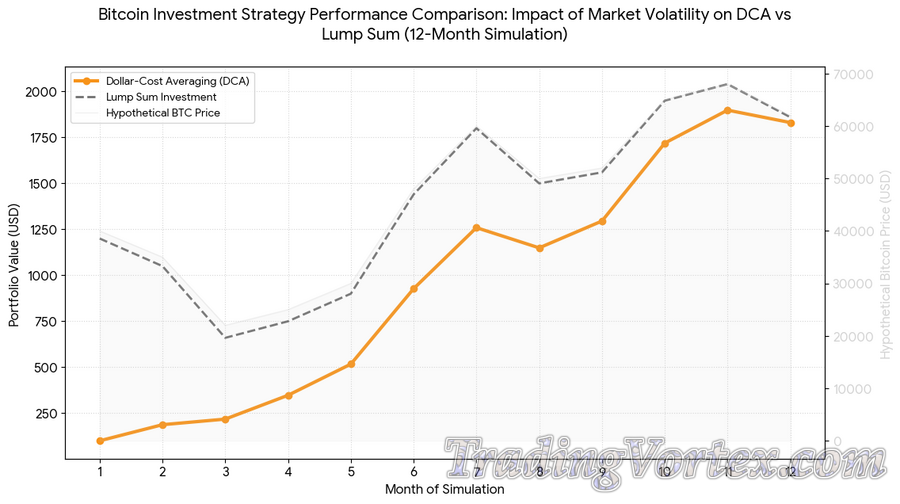 Bitcoin Investment Strategy Performance Comparison: Impact of Market Volatility on DCA vs. Lump Sum (12-Month Simulation).
How to Read and Use This Chart:
This visualization supports the investment strategy section by simulating how two different approaches handle extreme market conditions.
♦ The Grey Background Line (Volatility Context): This represents a hypothetical Bitcoin price path, showing a significant crash in the first few months, followed by a dramatic recovery. This context is vital for understanding risk.
♦ The Solid Orange Line (Dollar-Cost Averaging - DCA): This path shows a steady, stress-free accumulation, investing an equal amount every month. While the portfolio value is lower than the initial lump sum at peak recovery (Month 11), it successfully avoids the deep, emotional drawdown that occurred during the crash.
♦ The Dashed Line (Lump Sum Investment): This shows the path of investing everything at once on Month 1. It offers potentially higher returns if you hold, but exposes you to severe potential losses (over 50%) during the market drop, which is where most beginners panic-sell.
◊ Direct Advice addressed to the Investor: Use this visual data to decide which risk profile you can tolerate. The DCA strategy (orange line) provides a clear defensive mechanism against the timing risk that can devastate a Lump Sum portfolio during a volatile year.
Risk Management and Position Sizing
How to Manage Bitcoin Risk: Stop Losses and Position Sizing
- Position sizing is the backbone of risk management. Professionals rarely allocate more than 2–5 percent of their portfolio to a single crypto position. For example, with a $10,000 portfolio, risking 2 percent with a 20 percent stop loss means a position size of $1,000. This keeps losses manageable even if Bitcoin drops sharply.
- Stop losses are non-negotiable in volatile markets. A 15–20 percent trailing stop is often recommended for Bitcoin, giving room for natural price swings while protecting against deeper drawdowns.
- Always check the risk/reward ratio before entering a trade. Aim for at least 2:1 reward to risk, meaning if you risk $1,000, you should expect a potential $2,000 gain. This way, even if half your trades fail, you can still come out ahead.
How to Protect Gains: Rebalancing and Take-Profit Rules
- Rebalancing keeps your portfolio aligned with your goals. If Bitcoin rallies and grows from 30 percent to 50 percent of your portfolio, trimming back to your target allocation locks in profits and reduces exposure.
- Take-profit rules prevent greed from erasing gains. Many investors set staggered profit targets, selling portions at 20 percent, 50 percent, and 100 percent gains. This way, you secure profits while still leaving room for upside.
- Avoid overconfidence. Even seasoned traders fall into the trap of “letting winners run” without a plan. Regularly review your portfolio and stick to your exit strategy.
How to Prepare for Market Crashes: Liquidity and Stress Tests
- Bitcoin has a history of 50–90 percent drawdowns, so preparing for crashes is essential. Keep a portion of your portfolio in stablecoins or cash to provide liquidity during downturns. This allows you to buy dips without selling assets at a loss.
- Run stress tests on your portfolio. Ask yourself: if Bitcoin drops 50 percent tomorrow, how much would I lose, and would I still be comfortable? If the answer is no, reduce your exposure.
- Psychological preparation matters too. Avoid checking prices every hour, zoom out to monthly charts, and remind yourself of your long-term thesis. Emotional discipline is as important as technical strategy.
Quick Risk Management Checklist
| Principle | Action |
|---|---|
| Position sizing | Limit each crypto position to 2–5% of portfolio |
| Stop losses | Use 15–20% trailing stops |
| Risk/reward | Enter trades only with 2:1 ratio or better |
| Rebalancing | Trim positions when allocations exceed targets |
| Take profits | Sell in stages to lock gains |
| Crash prep | Hold stablecoins or cash for liquidity |
| Stress test | Model 50% drawdowns before committing |
Takeaway:
Bitcoin rewards patience and discipline, but it punishes recklessness. By sizing positions carefully, setting stop losses, rebalancing regularly, and preparing for crashes, beginners can survive volatility and grow their portfolios without losing sleep.
 Bitcoin Position Sizing Visualized: Comparing Expected Outcomes for 2:1 vs. 1:1 Risk/Reward Ratios.
How to Use This Chart to Manage Your Risk:
This chart simplifies the critical rule mentioned in the text: "Aim for at least 2:1 reward to risk." Here is how you can use this visual data directly:
♦ The Professional Setup (The Bar on the Left): Look at the Example Trade (2:1 Ratio). When you enter this trade, you must set a strict maximum potential loss of -$1,000 (the red bar), enforced by your stop loss. However, you are only taking this trade because your strategy shows a potential profit target of +$2,000 (the green bar).
♦ The Mathematical Edge (Half Win Rate Rule): This setup means that even if you only win 50% of your trades over time, you can still be highly profitable:
◊ Win 1 Trade: +$2,000 profit.
◊ Lose 1 Trade: -$1,000 loss.
◊ Result: +$1,000 Net Profit after just two trades.
♦ The Beginner Trap (The Bar on the Right): The 1:1 Ratio bar on the right shows the reckless approach. Here, you are risking -$1,000 just to try and make +$1,000. If you have a 50% win rate, your portfolio value just oscillates around zero, and you are eventually eaten alive by trading fees. This ratio leaves you no room for error during a market crash, forcing emotional mistakes.
◊ Your Action: Only execute trades where the green bar (potential profit) is visibly at least twice as tall as the red bar (maximum risk). If you cannot find that structure, the section’s advice is clear: avoid the trade and preserve your capital.
Taxes, Legal, and Regulatory Considerations
Bitcoin Tax Basics: What Beginners Must Report
- Capital gains tax applies when you sell Bitcoin for profit. Many countries distinguish between short-term gains (held less than a year, taxed higher) and long-term gains (held longer, taxed lower).
- Income tax applies if you earn Bitcoin through mining, staking, airdrops, or as payment for services. These are treated as regular income in most jurisdictions.
- Losses can often be deducted to offset gains, but rules vary. For example, the U.S. treats Bitcoin as property, so every sale or trade triggers a taxable event. Germany, by contrast, exempts Bitcoin held for more than one year from capital gains tax.
How Bitcoin Regulation Affects Investors: Global Overview
- United States, Canada, Australia: Crypto is treated as property or commodity, triggering capital gains reporting.
- European Union: The Markets in Crypto-Assets (MiCA) framework is rolling out, requiring exchanges to meet strict compliance standards and investors to report holdings more transparently.
- Asia: Japan and South Korea enforce strict reporting, while Singapore remains relatively tax-friendly.
- Emerging markets: Some countries, like El Salvador, classify Bitcoin as legal tender, while others impose minimal or zero taxes to attract crypto businesses.
- Global trend: Tax transparency is expanding, with cross-border information sharing making it harder to hide crypto activity. Investors should expect retroactive assessments in some jurisdictions as frameworks evolve.
How to Keep Records for Crypto Taxes and Reporting
- Track every transaction: date, amount, price, fees, and counterparty. Even small trades or transfers can be taxable events.
- Use crypto tax software: Tools like CoinTracking, Koinly, or TokenTax help consolidate exchange and wallet data into tax-ready reports.
- Save receipts and screenshots: Keep evidence of purchases, transfers, and wallet addresses. This protects you if authorities audit your records.
- Reconcile annually: Compare your records with exchange statements to ensure accuracy.
- Stay updated: Regulations change quickly. Subscribe to reliable tax advisories or consult a professional accountant familiar with crypto.
Quick Compliance Checklist
| Requirement | Action for Beginners |
|---|---|
| Capital gains | Report profits from selling or trading Bitcoin |
| Income tax | Report mining, staking, or payments received in Bitcoin |
| Recordkeeping | Track all transactions with dates, amounts, and fees |
| Reporting tools | Use crypto tax software for automation |
| Regulatory updates | Follow local laws and global frameworks like MiCA |
Takeaway:
Treat Bitcoin like any other taxable investment. Report gains, track income, and keep meticulous records. Regulations are tightening worldwide, so beginners who build good habits now will avoid headaches later.
 Global Bitcoin Tax Comparison 2026: Tax Intensity and Compliance Complexity Across Key Jurisdictions.
How to Use This Visual:
This chart compares how different global regions handle Bitcoin taxes to help you understand your potential obligations:
♦ Orange Bars (Tax Intensity): This shows how much you might actually pay. High bars (like Japan or the U.S.) indicate higher tax rates or more taxable events. Lower bars (like El Salvador or Singapore) represent tax-friendly or exempt environments.
♦ Grey Bars (Compliance Complexity): This indicates how much paperwork is involved. Even if taxes are low, some regions require meticulous reporting for every single transaction.
◊ Actionable Insight: If you live in a "High Complexity" region (like the U.S. or Japan), the advice to use crypto tax software is critical to avoid errors. If you are in a region like Germany, pay close attention to the holding period, as crossing the one-year mark significantly reduces the orange "Tax Intensity" bar for your specific situation.
Current Market Trends That Matter to Bitcoin Investors
How Bitcoin ETFs and Institutional Flows Affect Price Discovery
Spot Bitcoin ETFs have become the single biggest structural change in Bitcoin’s history. By early 2026, ETFs manage over $100 billion in assets and hold more than 1 million BTC. Daily net inflows average $200–500 million, with pension funds, endowments, and registered investment advisors now participating.
Corporate treasuries collectively hold over 500,000 BTC, and sovereign interest is rising as nations add Bitcoin to reserves. This institutional demand regularly absorbs 10 times more Bitcoin per week than miners produce, creating a persistent supply deficit that drives price appreciation.
How Regulatory Clarity Is Changing Market Structure
Regulation is no longer the wild card it once was. The EU’s MiCA framework is rolling out, setting strict compliance standards for exchanges. In the U.S., the CLARITY Act is shaping market structure, while the SEC has closed several long-running investigations without enforcement, signaling a more predictable environment.
This clarity has reduced uncertainty, encouraged institutional participation, and stabilized liquidity conditions. Investors now face fewer existential risks from sudden bans, though compliance costs and reporting obligations are higher.
How Technology Trends Matter: Lightning Network, Taproot, and Scalability
Bitcoin’s technology stack continues to evolve. The Lightning Network is expanding, enabling faster and cheaper transactions, which supports Bitcoin’s use in everyday payments. Taproot, activated in 2021, is now widely adopted, improving privacy and efficiency for complex transactions.
Scalability solutions are critical as institutional flows grow, ensuring Bitcoin can handle higher transaction volumes without bottlenecks. These upgrades make Bitcoin more practical beyond just being a store of value, reinforcing its long-term utility.
How Macro Drivers Shape Bitcoin Demand: Inflation, Monetary Policy, and Store of Value Appeal
Macro conditions remain a powerful driver. The U.S. yield curve has steepened, the dollar is structurally weaker, and inflation pressures persist globally. Bitcoin benefits from this environment as investors seek hedges against currency debasement. In January 2026, Bitcoin briefly touched $97,000 during a rally sparked by lower U.S. core CPI, showing how sensitive it remains to macroeconomic signals. As central banks balance easing with inflation control, Bitcoin’s narrative as “digital gold” continues to attract both retail and institutional investors.
Key Takeaways for Beginners
- ETFs are absorbing supply faster than miners can produce, driving structural price support.
- Regulatory clarity reduces existential risks, but increases compliance obligations.
- Technology upgrades like Lightning and Taproot improve usability and scalability.
- Macro trends such as inflation and currency weakness reinforce Bitcoin’s role as a hedge.
Bottom line:
Bitcoin in 2026 is no longer a fringe asset. It is shaped by institutional flows, regulatory frameworks, and macroeconomic forces. Beginners should understand these trends, because they explain why Bitcoin behaves differently today than in its early cycles.
 Bitcoin Market Supply Deficit 2026: Institutional Weekly Absorption vs. Weekly Miner Production.
How to Use This Visual:
This chart illustrates the "supply deficit" mentioned in the text to help you understand why institutional demand is such a powerful force in 2026:
♦ The Grey Bar (Miner Production): This represents the new Bitcoin entering the market each week through mining. It is the "baseline" of new supply.
♦ The Orange Bar (Institutional Absorption): This shows the volume of Bitcoin being purchased by ETFs, corporate treasuries, and sovereign funds.
♦ The 10x Gap: As you can see, the institutional demand is ten times larger than the new supply created by miners.
◊ Direct Insight for You: When demand (the orange bar) significantly outweighs supply (the grey bar), it creates upward pressure on the price. As a beginner, understanding this "persistent supply deficit" explains why Bitcoin is behaving as a structurally supported asset class rather than just a speculative one.
Practical Checklist: How to Start Investing in Bitcoin Today
Core Three Steps to Begin
Step 1: Choose Exchange or ETF
- Crypto exchange: Platforms like Coinbase, Kraken, Gemini, or Bitstamp let you buy actual Bitcoin and withdraw it to your own wallet. Best if you want direct ownership and self-custody.
- Bitcoin ETF: Spot ETFs such as IBIT (BlackRock), FBTC (Fidelity), or MSBT (Morgan Stanley) give you exposure inside a brokerage account. Best if you want simplicity and tax efficiency without managing private keys.
- Payment apps: Cash App and PayPal offer one-tap convenience for small purchases, though fees can be higher.
Tip: Decide whether you want direct ownership (exchange) or price exposure only (ETF). That choice shapes everything else.
Step 2: Secure Your Wallet
- Hot wallets: Mobile apps like Trust Wallet or Coinbase Wallet are fine for small amounts and daily use.
- Hardware wallets: Ledger, Trezor, or ELLIPAL Titan are the gold standard for long-term storage. They keep private keys offline and safe from hacks.
- Seed phrase backup: Write down your 12–24 word recovery phrase on paper or metal, never store it digitally. Keep multiple copies in secure locations.
Step 3: Make Your First Purchase
- Fund your account via bank transfer (low fees, slower), credit/debit card (instant, higher fees), or payment app (convenient, limited).
- Place a market order for instant purchase or a limit order to buy at your chosen price.
- Start small, even $50 or $100, to test the process before scaling up.
Checklist for Security, KYC, Fees, and Withdrawal Limits
- KYC verification: Complete identity checks to unlock full account features.
- Two-factor authentication: Always enable it for logins and withdrawals.
- Fee awareness: Compare trading fees, deposit fees, and withdrawal fees. Small spreads can add up.
- Withdrawal limits: New accounts often have daily or monthly limits. Know them before making large purchases.
- Test withdrawals: Move a small amount to your wallet to confirm the process works smoothly.
Checklist for Taxes, Recordkeeping, and Reporting
- Track every transaction: Date, amount, price, and fees.
- Use crypto tax software: Tools like Koinly or CoinTracking simplify reporting.
- Save receipts and screenshots: Keep proof of purchases and transfers.
- Know your jurisdiction: In the U.S., Bitcoin is taxed as property; in Germany, holding for over a year exempts gains. Rules vary widely.
- Annual reconciliation: Compare your records with exchange statements to avoid surprises.
Takeaway:
Starting with Bitcoin today is about building good habits. Choose your buying method, secure your wallet, make a small test purchase, and set up systems for security and taxes. Beginners who treat Bitcoin like a serious investment from day one will avoid costly mistakes and sleep better at night.
Resources, Tools, and Further Reading
Top Exchanges, Wallets, and Tools for Bitcoin Beginners
- Exchanges: Coinbase, Kraken, and Bitstamp remain beginner-friendly with strong regulation and clear fee structures. Binance is widely used but beginners should be mindful of ongoing regulatory scrutiny.
- Wallets: For small amounts, hot wallets like Trust Wallet or Coinbase Wallet are convenient. For long-term storage, hardware wallets such as Ledger Stax, Trezor Safe 7, and ELLIPAL Titan 2.0 are considered the gold standard.
- Portfolio trackers: Tools like CoinStats or Delta help monitor holdings across multiple exchanges and wallets, giving real-time performance and alerts.
- Tax tools: Platforms like Koinly and CoinTracking simplify crypto tax reporting, consolidating transactions into compliant reports.
Trusted Research Reports, Market Data, and News Sources
- Market data aggregators: CoinGecko and CoinMarketCap provide real-time prices, volumes, and rankings across thousands of assets. CoinGecko is often preferred for independence and transparency.
- On-chain analytics: Glassnode and CryptoQuant track Bitcoin network activity, investor behavior, and liquidity flows.
- Research platforms: Messari and Dune Analytics offer structured reports, dashboards, and protocol fundamentals. Messari is especially useful for beginners who want curated insights.
- Technical analysis: TradingView remains the go-to charting platform, offering indicators, alerts, and community-shared strategies.
- Sentiment and social data: LunarCrush and Santiment help track market sentiment, social media trends, and investor psychology.
- News: CoinDesk, The Block, and Bitcoin Magazine are trusted outlets for regulatory updates, institutional moves, and technology developments.
Glossary: Key Bitcoin Terms for Beginners
- Private Key: A secret code that proves ownership of your Bitcoin. Losing it means losing your coins.
- Seed Phrase: A backup of your wallet in 12–24 words. Essential for recovery.
- Cold Wallet: Offline storage for Bitcoin, safer against hacks.
- Hot Wallet: Online wallet connected to the internet, convenient but less secure.
- Halving: An event every four years that cuts Bitcoin’s mining reward in half, often influencing price cycles.
- Liquidity: How easily Bitcoin can be bought or sold without affecting its price.
- Stablecoin: A cryptocurrency pegged to fiat currency, used to hedge volatility.
- ETF (Exchange-Traded Fund): A regulated investment product that tracks Bitcoin’s price without requiring direct custody.
Takeaway:
Beginners should combine secure wallets, reliable exchanges, and trusted research platforms to build confidence. Use portfolio trackers and tax tools to stay organized, follow reputable news outlets for updates, and keep a glossary handy to decode crypto jargon. This toolkit ensures you stay informed, safe, and ready to grow as an investor.
Conclusion: Building Confidence as a Bitcoin Investor
The Big Picture in 2026
Bitcoin has matured into a global financial asset. Spot ETFs now manage over $100 billion in assets, corporate treasuries hold more than 500,000 BTC, and sovereign interest is rising. The April 2024 halving cut supply in half, while ETF demand regularly absorbs ten times more Bitcoin per week than miners produce.
This structural imbalance continues to support long-term price appreciation. At the same time, forecasts for 2026 range widely, from $60,000 on the bearish side to $250,000 on the bullish side, reflecting both opportunity and uncertainty.
What This Means for Beginners
- Volatility is still real: Bitcoin dropped from $126,000 in October 2025 to $88,000 by year-end, a 30 percent drawdown. Beginners must expect swings and avoid panic.
- Institutional adoption stabilizes markets: Pension funds, hedge funds, and governments are now buyers, dampening extreme volatility compared to earlier cycles.
- Regulation is clearer: Frameworks like the EU’s MiCA and U.S. commodity classification reduce existential risks, though compliance obligations are higher.
- Technology is advancing: Lightning Network and Taproot improve scalability and privacy, making Bitcoin more usable beyond just being “digital gold.”
Practical Lessons to Carry Forward
- Start small and scale gradually: Even $50 or $100 is enough to learn the ropes.
- Secure your holdings: Hardware wallets and seed phrase backups are non-negotiable.
- Use simple strategies: Dollar-cost averaging and HODLing remain the most effective beginner approaches.
- Prepare for taxes and regulation: Track every transaction, use crypto tax software, and stay updated on local rules.
- Expect cycles, not straight lines: Bitcoin’s history shows sharp rallies followed by corrections. Emotional discipline is your best asset.
Final Word:
Investing in Bitcoin today is about confidence, patience, and preparation. The market is bigger, more regulated, and more institutional than ever, but the core principles remain the same: protect your capital, manage risk, and think long term. Beginners who build good habits now will not only survive volatility, they will thrive in it.
 Bitcoin 2026 Price Forecast Scenarios: Visualizing Bearish vs. Bullish Expert Predictions.
How to Use This Visual:
This bar chart helps you visualize the range of expert expectations for Bitcoin's price at the end of 2026, putting the "Bearish" and "Bullish" outlooks into perspective:
♦ The Red Bar (Bearish Forecast): Represents the lower end of expert predictions at $60,000. This serves as a reminder of the "downside risk" if the market faces significant headwinds.
♦ The Orange Bar (Recent High/Context): Shows the $126,000 level mentioned in the text to provide a middle-ground reference point for where the market has recently traveled.
♦ The Green Bar (Bullish Forecast): Represents the high-end potential of $250,000, driven by the structural supply deficit and institutional demand described in the section.
◊ Direct Insight for You: As a beginner, do not focus on any single number. Instead, look at the gap between these bars. This gap represents the uncertainty and volatility you must be prepared for.
◊ Use this visual to reinforce the lesson of starting small: ensure that even if the market moves toward the red bar, your financial stability remains intact while you wait for potential moves toward the green.
Frequently Asked Questions: How to Invest in Bitcoin for Beginners
How much money do I need to start investing in Bitcoin?
You can start with as little as $10 or $20, since Bitcoin is divisible into satoshis (the smallest unit). Many beginners test the process with small amounts before scaling up. The key is not the size of your first buy, but building habits like secure storage and recordkeeping.
Is investing in Bitcoin safe?
Bitcoin itself is secure thanks to its blockchain, but your investment depends on how you store it. Hot wallets are convenient but vulnerable to hacks, while hardware wallets provide offline protection. Safety comes down to managing your private keys and avoiding scams.
Can I lose all my money in Bitcoin?
Yes, if you invest recklessly or fail to secure your wallet. Bitcoin has seen 30–50 percent drawdowns even in recent years. Beginners should only invest what they can afford to lose and use strategies like dollar-cost averaging to reduce risk.
How do I cash out my Bitcoin?
You can sell Bitcoin on exchanges like Coinbase or Kraken, or convert it into stablecoins and withdraw to your bank account. ETFs make cashing out even easier, since you sell them like stocks inside your brokerage account.
What happens if I lose my wallet password or recovery phrase?
If you lose your seed phrase, you lose access to your coins permanently. There is no customer support line for Bitcoin. Always back up your seed phrase on paper or metal, and keep copies in secure locations.
Should I invest in Bitcoin or other cryptocurrencies like Ethereum?
Bitcoin is the foundation of most portfolios, often making up 50–70 percent of crypto allocations. Ethereum is the second most popular choice, powering decentralized apps. Beginners should start with Bitcoin, then add Ethereum once comfortable. Altcoins are higher risk and should be approached cautiously.
How do taxes work with Bitcoin investments?
In most countries, Bitcoin is taxed as property or capital gains. Selling, trading, or even using Bitcoin for payments can trigger taxable events. Mining, staking, or earning Bitcoin counts as income. Beginners should track every transaction and use crypto tax software to simplify reporting.
What’s the best time to buy Bitcoin?
There is no perfect time. Prices are volatile, and even experts cannot predict short-term moves. The most reliable beginner strategy is dollar-cost averaging, buying small amounts regularly to smooth out volatility.
Can I mine Bitcoin instead of buying it?
Mining is no longer practical for beginners. It requires specialized hardware, cheap electricity, and technical expertise. Buying Bitcoin directly or through ETFs is far easier and cost-effective.
How do I know which Bitcoin exchange is trustworthy?
Stick to regulated exchanges with strong reputations, transparent fees, and proof-of-reserves audits. Coinbase, Kraken, and Bitstamp are widely trusted. Always enable two-factor authentication and test withdrawals before committing large sums.
What is the Lightning Network and do I need to use it?
The Lightning Network is a scaling solution that allows fast, low-cost Bitcoin transactions. Beginners don’t need to use it immediately, but it’s useful if you plan to spend Bitcoin for everyday payments.
Takeaway:
Bitcoin beginners should focus on small, secure, and consistent steps. Start with modest buys, secure your wallet, keep tax records, and avoid chasing quick profits. The most common questions all boil down to one principle: treat Bitcoin like a serious investment, not a lottery ticket.