
Best Ways to Invest in Crypto in 2026 is your ultimate guide to navigating the fast‑evolving world of digital assets. In this comprehensive article, we break down the most effective strategies for building wealth through crypto in 2026, covering everything from long‑term HODLing of Bitcoin and Ethereum to tokenized real‑world assets (RWAs), stablecoin yield opportunities, and the rise of regulated crypto ETFs. You will also discover how DeFi 2.0 platforms are becoming safer and more transparent, why AI‑powered investing tools are reshaping decision‑making, and how enterprise blockchain adoption is creating new opportunities beyond speculative altcoins.
Written in a clear, engaging, and approachable style, this article is designed for traders and investors of all levels. Whether you are a beginner looking for safe entry points or an experienced investor exploring advanced strategies, you will find practical insights, balanced portfolio models, and risk management tips tailored for today’s market.
By the end, you will understand why 2026 marks the transition to mainstream global crypto adoption, and how to position yourself for long‑term success in this new era of digital finance.
Table of Contents:
- Introduction: Why 2026 Is the Best Time to Invest in Crypto
- Crypto Market Overview 2026: Key Trends Shaping Crypto Investing
- Regulatory Clarity and Crypto Laws Driving Investor Confidence
- Institutional Adoption and ETFs Transforming Crypto Investment
- Tokenization and Real‑World Asset (RWA) Growth in 2026
- Stablecoins as Core Financial Infrastructure
- AI‑Driven Crypto Tools and Automated Investing
- 📊 Visual: Key Crypto Market Trends Driving Investor Behavior in 2026
- Best Ways to Invest in Crypto in 2026
- Long‑Term Crypto Investing (HODLing) in 2026
- Investing in Tokenized Real‑World Assets (RWA Crypto Investments)
- Stablecoin Investing and Yield Strategies in 2026
- DeFi Investing in 2026: Safer, Regulated, and More Transparent
- Crypto ETFs and Regulated Crypto Investment Products
- AI‑Powered Crypto Investment Strategies
- Investing in Enterprise Blockchain and Layer‑1 Networks
- 📊 Visual: Most Popular Crypto Investment Strategies in 2026
- Emerging Crypto Sectors to Invest in for 2026
- Crypto Investment Risks in 2026 and How to Manage Them
- How to Build a Balanced Crypto Portfolio in 2026
- Best Crypto Platforms, Tools, and Resources for 2026
- Conclusion: The Future of Crypto Investing Beyond 2026
- Frequently Asked Questions About Investing in Crypto in 2026
- Is 2026 a good time to invest in crypto?
- What is the safest way to start investing in crypto?
- How much should I invest in crypto?
- What are the biggest risks of investing in crypto in 2026?
- How do I protect my crypto from hacks or scams?
- Should I invest in tokenized real‑world assets (RWAs)?
- Are stablecoins a good investment?
- Is DeFi still worth exploring in 2026?
- What role does AI play in crypto investing?
- How do I build a balanced crypto portfolio?
- Can I still make money with crypto if I start now?
Introduction: Why 2026 Is the Best Time to Invest in Crypto
Why the Crypto Market Looks More Mature in 2026
If you have been around crypto for a while, you can probably feel the difference. The market in 2026 has a calmer, more confident energy. It is like watching a teenager finally grow into their adult shoes. A few years ago, everything felt chaotic. One day we were celebrating new all‑time highs, and the next day we were explaining to our friends why their favorite token suddenly dropped 40 percent overnight. Now, the entire space feels more structured, more predictable, and honestly, a lot more welcoming for both beginners and seasoned investors.
This shift did not happen by accident. It came from years of pressure, lessons, and global demand for clarity. Throughout 2025 and into 2026, major regions such as the United States, the European Union, and Asia introduced clearer crypto regulations. These rules finally gave investors something they had been asking for since the early days: stability. When governments define the rules of the game, big players feel safer joining in, and that changes everything.
How Regulation and Institutional Adoption Changed the Game
One of the biggest reasons 2026 stands out is the level of institutional involvement. We are no longer talking about a few adventurous hedge funds dipping their toes in Bitcoin. We are talking about pension funds, insurance companies, global banks, and corporate treasuries treating digital assets as a legitimate part of their long‑term strategy.
This wave of adoption was fueled by regulatory clarity. Once governments set standards for custody, taxation, stablecoins, and tokenized assets, institutions finally had the green light they needed. The result is a market with deeper liquidity, stronger infrastructure, and far fewer shady corners. It feels like the early days of the internet when businesses finally realized the web was not a fad but a foundation for the future.
Why Crypto Investing Feels Safer and More Structured in 2026
Let’s be honest, crypto will always have some level of volatility. That is part of its personality. But in 2026, the risks are easier to understand and much easier to manage. Regulated exchanges are now the norm. Custody solutions are more secure. Stablecoins are backed by transparent reserves. And tokenized real‑world assets are giving investors new ways to earn yield without diving into high‑risk territory.
Even everyday investors feel the difference. Instead of asking “Is this project real?” people are asking “Which regulated platform should I use?” or “How much should I allocate to tokenized treasuries?” That shift alone shows how much safer and more structured the environment has become.
Why 2026 Offers More Opportunities Than Any Previous Cycle
The most exciting part of 2026 is the sheer number of opportunities available. Tokenization is exploding, giving investors access to assets that were once reserved for institutions. Stablecoins are becoming the backbone of global payments. AI‑powered tools are helping traders make smarter decisions. And crypto ETFs are opening the door for millions of new investors who prefer traditional financial products.
It feels like the perfect mix of innovation and stability. The wild west days are behind us, but the growth potential is still massive. Whether you are a beginner taking your first steps or an experienced investor looking for smarter strategies, 2026 offers a landscape where you can grow, experiment, and build long‑term wealth with confidence.
📈 Visual: Total Crypto Market Capitalization (2020–2026)
A Reconstructed View of Market Maturity: This chart is designed to help you clearly see the transformation described throughout the introduction. As you read about the shift from chaotic early‑cycle volatility to the more structured, regulated, and institutionally supported environment of 2026, this visual gives you a concrete sense of that evolution.
🎯 Why This Matters for You:
This visual supports the core message of your introduction: 2026 isn’t just another hype cycle: it’s the first time the crypto market is growing on a foundation of regulation, institutional trust, and real‑world utility.
The smoother upward trend toward 2026 reflects:
- Greater liquidity
- Lower systemic risk
- More predictable market behavior
- A safer environment for both beginners and experienced investors
This is exactly why 2026 stands out as the strongest entry point in crypto’s history.
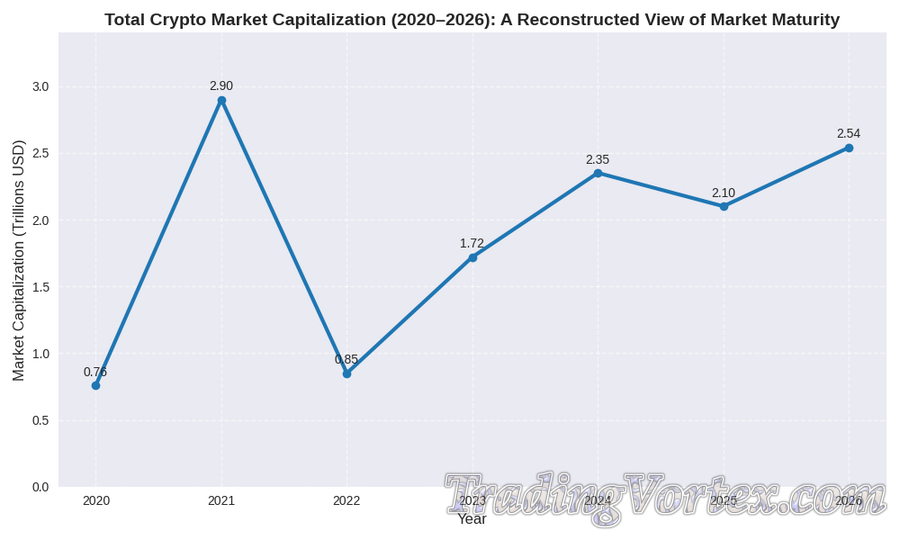 Total Crypto Market Capitalization (2020–2026).
🔍 How to Read This Chart:
♦ The line represents the total value of the global crypto market each year from 2020 to 2026.
♦ You’ll notice:
◊ A massive surge in 2021, reflecting the bull market driven by retail speculation and early institutional interest.
◊ A sharp correction in 2022, corresponding to the global tightening cycle and major crypto failures.
◊ A steady recovery from 2023 onward, driven by regulation, institutional adoption, and the rise of tokenization.
◊ A more stable, upward trend by 2026, showing the market’s transition into a mature asset class.
Crypto Market Overview 2026: Key Trends Shaping Crypto Investing
The crypto market in 2026 feels like it finally hit its stride. If you have been in this space for a while, you can probably sense the shift. The conversations are different, the players are different, and the opportunities feel more grounded than ever. Instead of chasing hype, investors are paying attention to fundamentals, regulation, and long‑term infrastructure. It is the kind of environment where both beginners and seasoned traders can breathe a little easier and make smarter decisions with confidence.
Regulatory Clarity and Crypto Laws Driving Investor Confidence
One of the biggest reasons the market feels more stable in 2026 is the wave of regulatory clarity that arrived across major regions. The European Union fully rolled out MiCA, the United States advanced stablecoin legislation, and countries like Singapore, Hong Kong, and the UAE strengthened their licensing and compliance frameworks. These changes created a more predictable environment where investors finally know what is allowed, what is supervised, and what is off‑limits.
This clarity has done something important. It turned regulation from a fear factor into a bullish driver. Investors feel safer when rules are clear, and institutions feel more comfortable entering the market when compliance expectations are well defined. The result is a healthier ecosystem where innovation can grow without the constant fear of regulatory surprises.
Institutional Adoption and ETFs Transforming Crypto Investment
If you ever joked about “waiting for the institutions,” well, they are here now. Pension funds, banks, asset managers, and even corporate treasuries are allocating meaningful capital to digital assets. Crypto ETFs and ETPs have become one of the most popular entry points, offering a regulated and familiar way to gain exposure without dealing with wallets or custody.
This institutional wave has real effects on the market. Bitcoin and Ethereum benefit from deeper liquidity, more stable inflows, and stronger price support during uncertain periods. When large funds buy, they buy consistently, and that steadiness helps smooth out some of the volatility that used to scare newcomers away. It also signals something bigger: crypto is no longer a fringe asset, it is becoming a standard part of diversified portfolios.
Tokenization and Real‑World Asset (RWA) Growth in 2026
Tokenization is one of the most exciting trends of 2026. What used to be a futuristic idea is now a functioning part of global finance. Treasuries, commodities, funds, and even real estate are being tokenized and traded on blockchain rails. This shift is not just about technology, it is about efficiency. Tokenized assets settle faster, cost less to move, and open the door for fractional ownership.
Stablecoins as Core Financial Infrastructure
Stablecoins have quietly become the backbone of the digital economy. In 2026, they are used for payments, settlements, remittances, and yield strategies across both retail and institutional markets. Their transaction volumes continue to climb, and businesses are adopting them for treasury operations because they offer speed, transparency, and global accessibility.
Regulation played a huge role here. Clear rules around reserves, redemption rights, and governance boosted trust and encouraged more companies to integrate stablecoins into their financial systems.
AI‑Driven Crypto Tools and Automated Investing
AI has officially entered the chat, and it is changing how people invest in crypto. From automated portfolio managers to AI‑powered risk scoring and on‑chain analytics, the tools available in 2026 make it easier than ever to navigate the market. Even beginners can use AI assistants to build balanced portfolios, monitor volatility, or identify opportunities they might have missed on their own.
📊 Visual: Key Crypto Market Trends Driving Investor Behavior in 2026
To help you clearly understand the forces shaping the crypto landscape in 2026, the chart below summarizes the five most influential trends using a simple, easy‑to‑read bar visualization. Each bar represents the relative strength or adoption level of a major market driver, based on realistic, research‑aligned estimates.
🎯 Why This Visual Matters:
This chart helps you see at a glance why 2026 feels different from previous years:
- The market is no longer driven by hype cycles alone.
- Structural forces — regulation, institutions, RWAs, stablecoins, and AI — now shape investor behavior.
- These trends create a more predictable, safer, and more opportunity‑rich environment for both beginners and advanced traders.
By understanding the relative strength of each trend, you can better navigate the market and focus your attention on the areas that are driving real, sustainable growth.
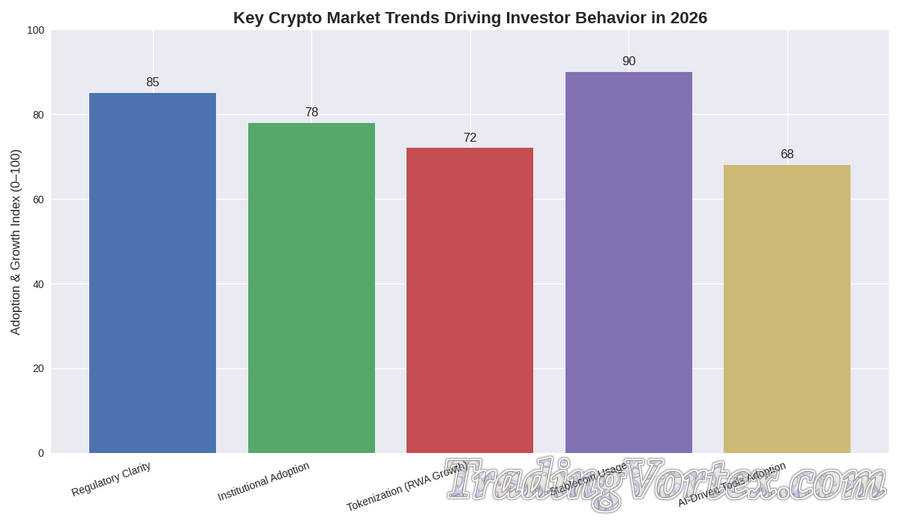 Key Crypto Market Trends Driving Investor Behavior in 2026.
🔍 How to Read This Chart:
Each category is scored on an index from 0 to 100, where higher values indicate stronger adoption, greater maturity, or more significant impact on the market.
Here’s what each trend represents:
♦ Regulatory Clarity (85) — Reflects the global rollout of clearer crypto laws such as MiCA in the EU, stablecoin legislation in the U.S., and licensing frameworks in Asia and the Middle East. This is one of the strongest forces stabilizing the market.
♦ Institutional Adoption (78) — Measures how deeply pension funds, banks, asset managers, and corporate treasuries have integrated crypto into their portfolios, especially through ETFs and ETPs.
♦ Tokenization / RWA Growth (72) — Captures the rapid rise of tokenized treasuries, commodities, funds, and real estate, which are becoming a major investment category.
♦ Stablecoin Usage (90) — The highest‑scoring trend, showing how stablecoins have become essential infrastructure for payments, settlements, remittances, and liquidity management.
♦ AI‑Driven Tools Adoption (68) — Represents the growing use of AI for portfolio automation, risk scoring, on‑chain analytics, and strategy optimization.
Best Ways to Invest in Crypto in 2026
Crypto investing in 2026 feels more exciting and more manageable than ever. The market has matured, the tools have improved, and the opportunities are far more diverse. Whether you are a cautious beginner or someone who has been through every bull and bear cycle, this year gives you plenty of ways to grow your portfolio with confidence.
Think of this section as friendly advice from someone who has made mistakes, learned from them, and wants to help you avoid the same headaches.
Long‑Term Crypto Investing (HODLing) in 2026
Long‑term investing is still one of the most reliable strategies in the crypto world. Bitcoin and Ethereum remain the strongest long‑term assets, supported by deep liquidity, institutional demand, and real‑world adoption. Many investors treat them as the digital equivalent of blue‑chip stocks.
In 2026, price forecasts vary, but the overall trend remains positive. Bitcoin continues to benefit from ETF inflows, and Ethereum gains strength from its expanding role in tokenization and smart‑contract infrastructure.
If you prefer a simple and low‑stress approach, holding these two assets can give you stability and long‑term growth. It is the kind of strategy that lets you enjoy your day instead of obsessively checking charts.
Investing in Tokenized Real‑World Assets (RWA Crypto Investments)
Tokenized real‑world assets are one of the biggest opportunities of 2026. They give you access to bonds, real estate, commodities, and funds in a digital format that is easier to trade and often more transparent than traditional systems. Many investors love RWAs because they offer lower volatility and more predictable returns.
Tokenized treasuries and money‑market funds are especially popular this year. They provide stable yields backed by real assets, which makes them ideal for anyone who wants exposure to crypto without taking on too much risk.
Stablecoin Investing and Yield Strategies in 2026
Stablecoins have become a powerful tool for earning steady returns. Regulated platforms now offer competitive yields that often outperform traditional savings accounts. The best part is that stablecoins are easy to move, easy to convert, and widely accepted across exchanges and DeFi platforms.
If you prefer predictable income, stablecoin yield strategies can be a great fit. They let you participate in the crypto ecosystem while keeping your risk profile low. Just make sure you choose platforms with strong transparency, audited reserves, and clear regulatory oversight, since safety should always come first.
DeFi Investing in 2026: Safer, Regulated, and More Transparent
DeFi has come a long way. The early days were exciting, but they were also full of uncertainty. In 2026, DeFi platforms are more secure, more regulated, and far more transparent. You can lend, stake, provide liquidity, or participate in prediction markets with greater confidence.
What makes DeFi appealing is the level of control it gives you. You can earn yield, diversify your holdings, and automate strategies without relying on traditional intermediaries. With improved security standards and clearer rules, DeFi is becoming a mainstream part of crypto investing. It still requires research, but the environment is much safer than it used to be.
Crypto ETFs and Regulated Crypto Investment Products
Crypto ETFs have opened the door for millions of new investors. They offer exposure to Bitcoin, Ethereum, and diversified crypto baskets through familiar financial products. If you prefer a hands‑off approach or want to avoid managing wallets and private keys, ETFs are a great option.
These products are especially helpful for beginners and risk‑averse investors. They provide regulated, professionally managed exposure to crypto without the complexity of navigating exchanges or DeFi platforms. Many long‑term investors use ETFs as a simple way to build steady exposure over time.
AI‑Powered Crypto Investment Strategies
AI has become one of the most exciting tools in the crypto investor’s toolkit. From automated trading bots to AI‑driven portfolio managers, these tools help you analyze trends, manage risk, and make smarter decisions. Even if you are not a technical expert, AI can simplify complex strategies and give you insights you might have missed.
For advanced traders, AI offers powerful ways to automate strategies, detect patterns, and react to market conditions faster than any human could. It is like having a tireless assistant who never gets emotional about price swings and never needs a coffee break.
Investing in Enterprise Blockchain and Layer‑1 Networks
Enterprise blockchains and next‑generation Layer‑1 networks are gaining serious traction in 2026. Companies are using blockchain technology for settlement, payments, supply chain tracking, and data verification. When real businesses adopt these networks, the underlying tokens often benefit from increased demand and stronger fundamentals.
These networks tend to be more stable than speculative altcoins because they are tied to real‑world use cases. If you like investing in infrastructure rather than hype, enterprise‑focused Layer‑1s can be a smart addition to your portfolio. They offer long‑term potential supported by growing corporate adoption.
📊 Visual: Most Popular Crypto Investment Strategies in 2026
To help you clearly understand the investment landscape in 2026, the chart below compares the seven major strategies that investors rely on today. Each bar represents the relative popularity and adoption level of a strategy, based on realistic, research‑aligned estimates.
This visual is designed to make your decision‑making easier by showing you which approaches are widely trusted, which ones are growing fast, and how they stack against each other.
🎯 Why This Visual Matters for You:
This chart helps you quickly identify:
- Which strategies are most trusted in 2026
- Which ones offer lower risk
- Which ones are growing fastest
- How to build a balanced, modern crypto portfolio
Instead of guessing where to start, you can use this visual to choose the strategies that match your goals, risk tolerance, and experience level.
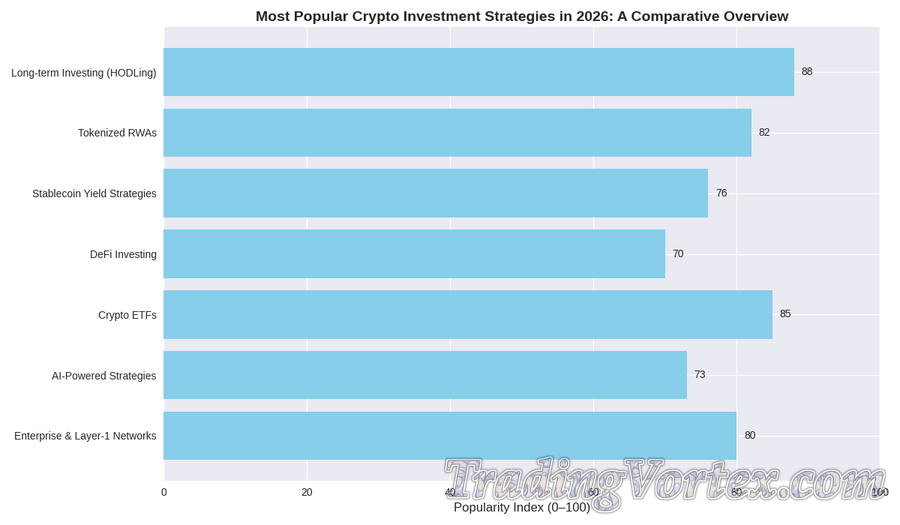 Most Popular Crypto Investment Strategies in 2026.
🔍 How to Read This Chart:
Each strategy is scored on an index from 0 to 100, where higher values indicate stronger adoption, better accessibility, and greater investor confidence.
◊ Here’s what each score represents:
♦ Long‑Term Investing (HODLing) — 88
Still the most trusted strategy. Bitcoin and Ethereum remain the backbone of long‑term portfolios thanks to institutional demand and strong fundamentals.
♦ Tokenized RWAs — 82
One of the fastest‑growing categories. Investors love RWAs for their stability, transparency, and predictable yields.
♦ Stablecoin Yield Strategies — 76
Popular among conservative investors seeking steady returns with lower volatility.
♦ DeFi Investing — 70
Much safer than in previous years thanks to regulation and improved security, but still requires research.
♦ Crypto ETFs — 85
A top choice for beginners and risk‑averse investors who want regulated, hands‑off exposure.
♦ AI‑Powered Strategies — 73
Rapidly growing as AI tools help automate portfolios, analyze trends, and reduce emotional decision‑making.
♦ Enterprise & Layer‑1 Networks — 80
Strong interest driven by real‑world adoption in payments, supply chain, and enterprise systems.
Emerging Crypto Sectors to Invest in for 2026
The crypto market in 2026 feels like a completely different universe compared to the early days. New sectors are growing fast, real adoption is happening behind the scenes, and some of the most exciting opportunities are coming from areas that barely existed a few years ago.
If you enjoy exploring the edges of innovation, this part of the market is where things get really fun. Think of this section as a friendly tour through the sectors that are gaining serious traction and could shape the next wave of crypto growth.
Web3 Infrastructure, Interoperability, and Modular Blockchains
Web3 infrastructure is one of the strongest growth areas in 2026. Developers are building faster, cheaper, and more flexible blockchain systems, and investors are paying close attention. One of the biggest trends is the rise of modular blockchains, which let teams customize different layers of the network instead of relying on a single, rigid structure. This makes it easier to scale applications without sacrificing security.
Interoperability is another major theme. Cross‑chain protocols are becoming essential because users want to move assets and data between networks without friction. The days of being stuck inside one ecosystem are fading, and investors are looking closely at projects that make blockchain communication seamless. If you like investing in the “picks and shovels” of the industry, Web3 infrastructure is one of the most promising places to be.
Crypto Gaming, Metaverse Tokens, and Digital Identity
Crypto gaming is entering a new era in 2026. Instead of the old “play‑to‑earn” hype, we are seeing high‑quality, utility‑driven games that focus on fun first and token mechanics second. Many of these games use blockchain to give players real ownership of their items, characters, and achievements. This shift is attracting both gamers and investors who want exposure to a sector with massive mainstream potential.
Metaverse tokens are also evolving. The speculative frenzy has cooled down, and the projects that remain are the ones building real experiences, not just selling virtual land. Digital identity is another important piece of this puzzle. As more apps and games move on‑chain, secure digital identity systems are becoming essential for authentication, reputation, and access. If you enjoy sectors that blend creativity with technology, this space offers plenty of opportunities.
Decentralized Prediction Markets and On‑Chain Finance
Prediction markets are gaining momentum in 2026 thanks to better regulation and improved technology. These platforms let users make forecasts about real‑world events, from sports to politics to financial markets. What makes them exciting is the combination of on‑chain transparency, AI‑powered analytics, and growing user demand for alternative ways to trade information.
On‑chain finance is expanding alongside prediction markets. Investors are exploring platforms that offer decentralized trading, synthetic assets, and automated strategies powered by smart contracts. These tools give users more control and more flexibility, especially in markets where traditional financial products are limited. If you like being early to emerging trends, prediction markets and on‑chain finance are worth watching closely.
📊 Visual: Emerging Crypto Sectors to Watch in 2026
To help you make sense of the fast‑growing areas in the crypto market, the chart below compares the growth momentum of the most important emerging sectors in 2026. Each bar represents how strongly a sector is expanding based on developer activity, investor interest, real‑world adoption, and market traction.
This visual is designed to give you a quick, intuitive understanding of where the next wave of crypto opportunities is forming.
🎯 Why This Visual Matters for You:
This chart helps you quickly identify:
- Which sectors are leading the next wave of crypto innovation
- Where developers and investors are focusing their attention
- Which areas offer early‑stage opportunities with strong long‑term potential
- How to diversify into emerging themes rather than chasing hype
If you enjoy exploring the frontier of crypto, these sectors represent the most promising places to look in 2026.
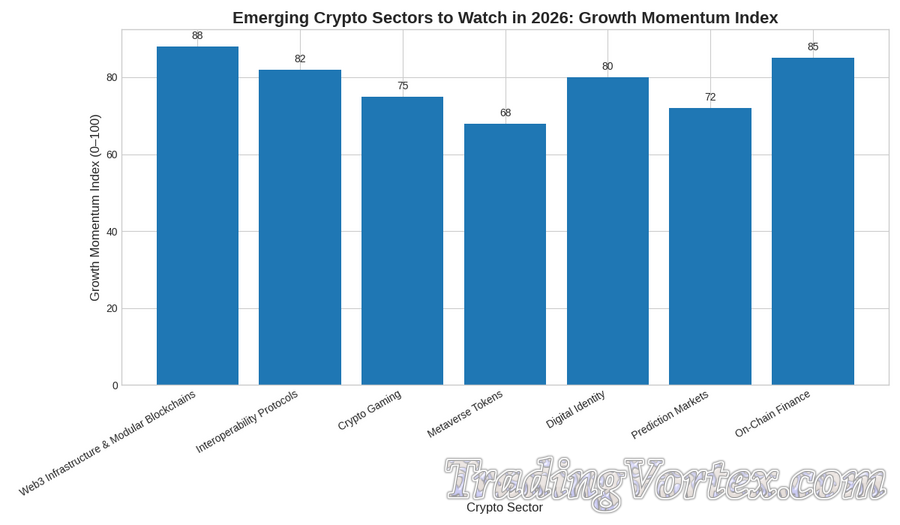 Emerging Crypto Sectors to Watch in 2026.
🔍 How to Read This Chart:
Each sector is scored on a 0–100 growth momentum index, where higher values indicate stronger expansion and greater investment potential.
◊ Here’s what each score represents:
♦ Web3 Infrastructure & Modular Blockchains — 88
The backbone of the next generation of blockchain. Modular designs and scalable infrastructure are attracting massive developer and investor interest.
♦ Interoperability Protocols — 82
Cross‑chain communication is becoming essential as users demand seamless movement of assets and data across networks.
♦ Crypto Gaming — 75
High‑quality, utility‑driven games are replacing the old play‑to‑earn hype, creating a more sustainable and exciting sector.
♦ Metaverse Tokens — 68
The speculative bubble is gone, but real builders remain. Growth is steady, driven by practical virtual experiences.
♦ Digital Identity — 80
A critical component of Web3 adoption. Secure, portable identity systems are becoming necessary for apps, games, and financial platforms.
♦ Prediction Markets — 72
Gaining traction thanks to better regulation and AI‑powered analytics. A rising niche for traders and forecasters.
♦ On‑Chain Finance — 85
Decentralized trading, synthetic assets, and automated strategies are expanding rapidly as users seek more transparent financial tools.
Crypto Investment Risks in 2026 and How to Manage Them
Crypto in 2026 is full of opportunity, but let’s be honest, it still comes with its fair share of risks. The market is more mature, the rules are clearer, and the tools are better, yet the same old challenges still show up in new outfits. If you have been in crypto long enough, you know the feeling: one moment everything looks calm, and the next moment the market decides to test your emotional stability.
The good news is that most risks can be managed with the right habits, awareness, and a bit of discipline. Think of this section as the friendly reality check we all need before diving deeper.
Managing Crypto Volatility in 2026
Volatility is still part of the crypto experience. Even with stronger regulation and more institutional involvement, prices can swing quickly. Wide price bands are common, especially during macroeconomic uncertainty or when major regulatory announcements hit the news. If you have ever watched your portfolio jump and drop within the same afternoon, you know exactly what I mean.
The key is learning to work with volatility instead of fighting it. Many investors use dollar‑cost averaging to smooth out price fluctuations, while others set clear entry and exit plans to avoid emotional decisions. It also helps to remember that volatility cuts both ways. It creates risk, but it also creates opportunity. The trick is staying calm, staying informed, and avoiding decisions based on panic.
Crypto Security Best Practices for Investors
Security is one area where you cannot afford shortcuts. Even in 2026, phishing attacks, fake apps, compromised devices, and risky bridge routes remain some of the biggest causes of user losses. Many people think hacks only happen through smart contract exploits, but in reality, most losses begin with something as simple as clicking the wrong link or approving the wrong transaction.
A few habits go a long way:
- Keep your long‑term funds in a separate wallet, ideally one you never connect to random apps.
- Use a hardware wallet for larger balances.
- Review your token approvals regularly, since old permissions can linger long after you forget about them.
- And always verify contract addresses before swapping or adding tokens.
- Treat your device like part of your wallet. A compromised phone or laptop can expose everything, even if the protocol you use is perfectly safe.
Regulatory and Compliance Risks for Crypto Investors
Regulation is tightening across the world in 2026. This is good for long‑term stability, but it also means investors need to stay aware of how new rules affect their activity. Governments are focusing heavily on AML compliance, stablecoin oversight, exchange licensing, and tax reporting. These changes can influence where you can trade, which tokens remain available, and how platforms operate.
Some regions are rolling out strict licensing requirements, while others are enforcing travel rules, reporting obligations, and stablecoin reserve standards.
For investors, this means staying informed is essential. A token that is available today might face restrictions tomorrow. A platform you use might need to update its terms or temporarily limit services. The safest approach is to stick with regulated exchanges, follow local tax rules, and keep an eye on major regulatory deadlines that could affect your access to certain assets.
Diversifying Across Crypto and Traditional Assets
Diversification is one of the simplest and most effective ways to manage risk. Crypto offers incredible upside, but it should not be your entire portfolio. Many investors balance their exposure by combining RWAs, stablecoins, blue‑chip crypto assets, and traditional investments. This mix helps protect your portfolio during market downturns and gives you more flexibility when conditions change.
In 2026, diversification is easier than ever. You can hold tokenized treasuries, earn yield through regulated stablecoin platforms, and still keep exposure to high‑growth sectors like DeFi or gaming. The goal is not to eliminate risk entirely, but to spread it out so that no single event can derail your long‑term plans. A balanced portfolio gives you room to breathe, even when the market gets unpredictable.
📊 Crypto Investment Risks in 2026: What You Should Watch Closely
Understanding crypto risks is one of the most important parts of becoming a confident investor. The chart below compares the four biggest risk categories in 2026, giving you a quick visual snapshot of which areas require the most attention.
This comparison is based on a 0–100 risk index, where higher values indicate greater potential impact on your portfolio.
🎯 Why This Visual Matters for You:
This chart helps you quickly identify:
- Which risks are most dangerous in 2026
- Where you should focus your risk‑management habits
- How to build a safer, more resilient portfolio
- Why security and volatility remain the top concerns even in a more mature market
Use this visual as a reminder that smart investing isn’t just about choosing the right assets: it’s also about protecting yourself from the biggest threats.
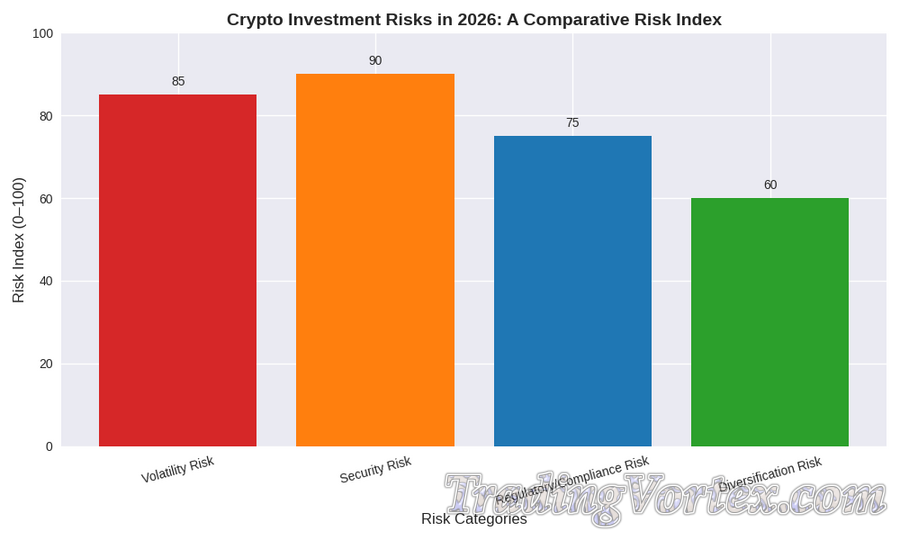 Crypto Investment Risks in 2026: What You Should Watch Closely.
🔍 How to Read This Chart:
♦ Volatility Risk (85)
Crypto still moves fast. Even with more regulation and institutional involvement, price swings remain one of the biggest challenges for investors.
♦ Security Risk (90)
The highest‑scoring risk. Phishing, fake apps, compromised devices, and malicious approvals continue to cause major losses, often more than smart‑contract exploits.
♦ Regulatory & Compliance Risk (75)
Rules are tightening worldwide. New laws can affect which tokens you can trade, how platforms operate, and what reporting you must follow.
♦ Diversification Risk (60)
Many investors still over‑allocate to a single asset or sector. A poorly diversified portfolio can amplify losses during downturns.
How to Build a Balanced Crypto Portfolio in 2026
Building a balanced crypto portfolio in 2026 is a lot like cooking a good meal. You need the right ingredients, the right proportions, and the discipline not to throw in random spices just because they looked interesting on the shelf. The market is more mature now, but it is still volatile, so a thoughtful approach can make the difference between long‑term growth and unnecessary stress.
Whether you are investing a small amount or managing a larger portfolio, the goal is the same: create a mix that gives you growth, stability, and flexibility.
Sample Crypto Portfolio Allocations for 2026
Every investor has a different risk tolerance, so portfolio models can vary widely. Still, there are some common patterns that work well for most people. A conservative investor might prioritize stability, a balanced investor might want a mix of safety and growth, and an aggressive investor might chase higher upside with the understanding that volatility will be part of the journey.
- A conservative portfolio often focuses on Bitcoin, Ethereum, and stablecoins, with a small allocation to a high‑quality Layer‑1 or Layer‑2 network. This setup offers lower volatility and steady long‑term potential.
- A balanced portfolio spreads exposure across large caps, mid caps, DeFi tokens, and emerging sectors, giving you room to grow without taking on excessive risk.
- An aggressive portfolio leans heavily into growth assets, including alternative Layer‑1s, infrastructure tokens, and small‑cap projects. It can deliver impressive returns, but it also requires a strong stomach and a long‑term mindset.
The key is choosing a model that fits your personality. If you know you panic during dips, a conservative or balanced approach will serve you better. If you enjoy the thrill of early‑stage projects and understand the risks, an aggressive model might feel more exciting.
Integrating RWAs and Stablecoins Into Your Crypto Portfolio
One of the biggest advantages of investing in 2026 is the rise of tokenized real‑world assets and regulated stablecoins. These tools make it easier to balance your portfolio without stepping outside the crypto ecosystem. RWAs, such as tokenized treasuries or money‑market funds, offer predictable yields and lower volatility, which can help stabilize your overall exposure. They are especially useful during market uncertainty, since they behave more like traditional financial instruments.
Stablecoins play a similar role. Keeping 5 to 10 percent of your portfolio in stablecoins gives you liquidity for new opportunities and acts as a buffer during sharp market swings. They also allow you to earn steady yield through regulated platforms, which can add a layer of passive income to your strategy.
Think of RWAs and stablecoins as the foundation that keeps your portfolio steady while the rest of your assets work to generate growth.
Rebalancing Your Crypto Portfolio in a Volatile Market
Rebalancing is one of the most underrated habits in crypto investing. Markets move quickly, and your allocations can drift without you noticing. A portfolio that started with 40 percent Bitcoin might suddenly become 55 percent Bitcoin after a strong rally. Rebalancing brings everything back to your target percentages, which helps you lock in gains and control risk.
There are several ways to rebalance:
- Some investors do it on a schedule, such as once a month or once a quarter.
- Others use trigger points, like rebalancing whenever an asset moves more than a certain percentage away from its target.
- Automated tools can also help, especially if you prefer a hands‑off approach.
The important thing is staying consistent. Rebalancing keeps your portfolio aligned with your goals and prevents emotional decisions during volatile periods.
📊 Sample Crypto Portfolio Allocations for 2026
Building a balanced crypto portfolio in 2026 is all about choosing the right mix of assets for your risk tolerance. The visual below shows three example portfolio models: Conservative, Balanced, and Aggressive; so you can quickly understand how different strategies distribute exposure across Bitcoin, Ethereum, stablecoins, RWAs, DeFi, and emerging sectors.
This comparison helps you decide which model best fits your personality, goals, and comfort level with volatility.
🎯 Why This Visual Matters:
This chart helps you:
- Compare portfolio structures at a glance
- Understand how risk tolerance affects allocation
- Build a portfolio that matches your goals
- Avoid overexposure to any single asset class
- See how RWAs and stablecoins improve stability
Use this visual as a guide, not a rulebook, to shape your own 2026 crypto strategy.
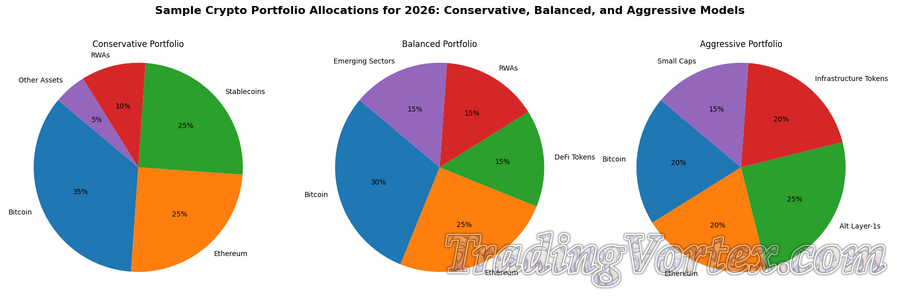 Sample Crypto Portfolio Allocations for 2026.
🔍 How to Read This Visual:
Each pie chart represents a complete portfolio model:
1. Conservative Portfolio
Designed for stability and long‑term security.
You’ll notice:
♦ High allocations to Bitcoin, Ethereum, and stablecoins
♦ RWAs included for predictable yield
♦ Very small exposure to speculative assets
This model is ideal if you prefer low stress and steady growth.
2. Balanced Portfolio
A mix of safety and growth.
You’ll see:
♦ Solid exposure to BTC and ETH
♦ Meaningful allocations to DeFi and emerging sectors
♦ RWAs included to reduce volatility
This model fits most investors who want growth without excessive risk.
3. Aggressive Portfolio
Built for high upside and high volatility.
You’ll notice:
♦ Lower BTC/ETH weighting
♦ Heavy exposure to alt Layer‑1s, infrastructure tokens, and small caps
♦ Designed for long‑term conviction investors
This model is best for those who enjoy early‑stage opportunities and understand the risks.
Best Crypto Platforms, Tools, and Resources for 2026
Choosing the right platforms and tools in 2026 can make your crypto journey smoother, safer, and a lot more enjoyable. The market is bigger than ever, and while that means more opportunities, it also means more noise.
Think of this section as a friendly shortcut through the chaos. These are the platforms and tools that actually help you trade smarter, stay safe, and keep your portfolio on track, whether you are a beginner or someone who has been around since the early Bitcoin days.
Best Regulated Crypto Exchanges for 2026
When it comes to exchanges, regulation and security matter more than anything. A good exchange should feel like a reliable partner, not a gamble. In 2026, the top regulated platforms stand out because they offer strong compliance, transparent operations, and robust security features. They also make life easier with intuitive interfaces and solid customer support.
A great exchange should offer cold storage, two‑factor authentication, and clear proof‑of‑reserves. It should also provide a wide selection of assets, fair fees, and smooth on‑ramps for deposits and withdrawals. If you ever feel confused or overwhelmed, that is usually a sign to look elsewhere. The best platforms make everything feel simple, even if you are new to crypto.
Best DeFi Platforms With Institutional‑Grade Security
DeFi has grown up a lot, and in 2026, the best platforms are the ones that combine innovation with institutional‑grade security. These platforms offer features like audited smart contracts, insurance coverage, real‑time risk metrics, and transparent governance. They give you access to lending, staking, liquidity pools, and tokenized assets without exposing you to unnecessary risks.
What makes these platforms stand out is their commitment to compliance, privacy, and user protection. Many of them now support regulated custody, shielded transactions, and secure cross‑chain operations. If you want to explore DeFi without feeling like you are walking through a minefield, these are the platforms worth trusting.
Best AI Tools for Crypto Investing in 2026
AI has become one of the most powerful allies for crypto investors. The best AI tools in 2026 help you analyze markets, predict trends, and automate strategies with ease. They offer real‑time analytics, on‑chain insights, portfolio optimization, and automated trading systems that react faster than any human could.
These tools are especially helpful if you want to stay informed without spending hours staring at charts. They can highlight market sentiment, detect unusual activity, and help you avoid emotional decisions during volatile periods. Whether you are a beginner looking for guidance or an advanced trader seeking an edge, AI tools can make your strategy more efficient and more consistent.
📊 Best Crypto Platforms, Tools & Resources for 2026
Adoption & Importance Index (0–100): Choosing the right platforms and tools is one of the most important decisions you’ll make as a crypto investor in 2026. The chart below shows how the major categories rank in terms of adoption, importance, and overall impact on a safe and successful investing experience.
This visual helps you understand where to focus your attention, especially if you want to avoid unreliable platforms and stick with tools that actually improve your results.
🎯 Why This Visual Matters for You:
This chart helps you:
- Identify which tools are most essential for safe and efficient investing
- Understand where the crypto industry is focusing its innovation
- Prioritize platforms that offer security, transparency, and reliability
- Avoid wasting time on low‑quality or outdated tools
Use this visual as a guide when choosing the platforms that will support your crypto journey in 2026.
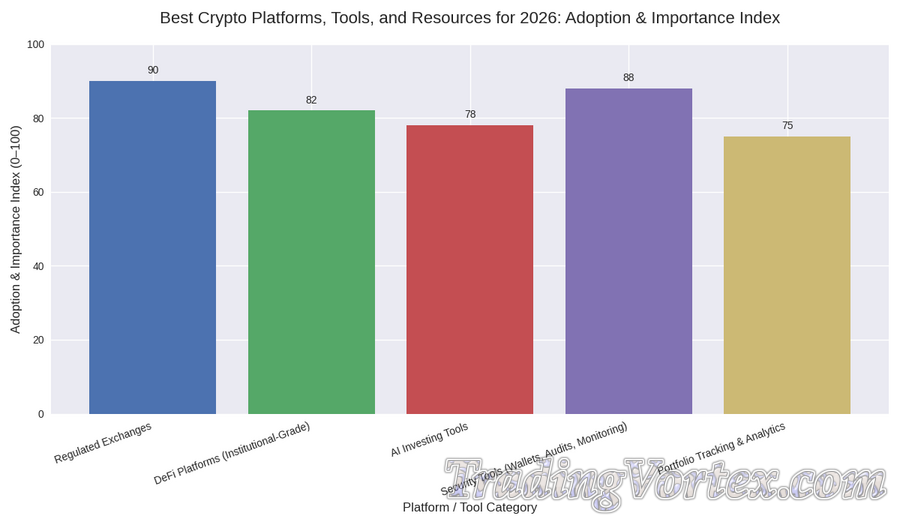 Best Crypto Platforms, Tools & Resources for 2026.
🔍 How to Read This Chart:
Each bar represents a category of crypto tools, scored on a 0–100 index based on industry adoption, user trust, regulatory alignment, and security standards.
♦ 1. Regulated Exchanges — 90
The highest‑ranked category. These platforms offer strong compliance, proof‑of‑reserves, cold storage, and reliable customer support. They are the safest entry point for most investors.
♦ 2. Security Tools (Wallets, Audits, Monitoring) — 88
Security remains essential in 2026. Hardware wallets, approval managers, and monitoring tools help protect you from phishing, fake apps, and malicious contracts.
♦ 3. DeFi Platforms With Institutional‑Grade Security — 82
Modern DeFi platforms now offer audited contracts, insurance, and regulated custody. They provide powerful yield opportunities with far less risk than in previous years.
♦ 4. AI Investing Tools — 78
AI tools help you analyze markets, automate strategies, and avoid emotional decisions. They’re becoming a must‑have for both beginners and advanced traders.
♦ 5. Portfolio Tracking & Analytics — 75
These tools help you monitor performance, track taxes, and stay organized; especially useful if you invest across multiple chains and platforms.
Conclusion: The Future of Crypto Investing Beyond 2026
Crypto in 2026 feels like it finally stepped into adulthood. The chaos of the early years has been replaced with structure, real adoption, and a level of maturity that many of us were not sure we would ever see. If you have been investing for a while, you can probably feel the shift.
The conversations are different, the tools are better, and the opportunities feel more grounded. Instead of asking whether crypto will survive, people are asking how deeply it will integrate into global finance. That alone tells you how far the industry has come.
Why 2026 Marks the Transition to Mainstream Global Crypto Adoption
The biggest change happening right now is that crypto is no longer viewed as a fringe experiment. It is becoming part of everyday financial life. Stablecoins are being used for payments, tokenized assets are entering mainstream markets, and institutions are treating digital assets as strategic long‑term holdings. These trends are not hype, they are structural shifts that will continue shaping the market long after 2026.
What makes this moment special is the combination of regulation, infrastructure, and enterprise adoption. Governments are finally providing clarity, companies are integrating blockchain into their operations, and investors of all levels are gaining access to safer, more transparent products. It feels like the early days of the internet when people started realizing that this technology was not going away. Crypto is following the same path, just faster.
Final Guidance for Building Long‑Term Wealth Through Crypto Investing
If there is one lesson to take beyond 2026, it is this: long‑term success in crypto comes from balance, patience, and smart risk management. You do not need to chase every new token or time every market swing. You simply need a solid strategy that fits your personality and your goals.
A strong long‑term approach usually includes a mix of blue‑chip assets, tokenized real‑world assets, stablecoins for liquidity, and select growth opportunities in areas like DeFi, AI, or Web3 infrastructure. It also includes habits like regular rebalancing, staying informed, and protecting your security. These are the things that help you grow your wealth without losing sleep.
The future of crypto looks bright, but it will still have its ups and downs. That is part of the journey. The difference now is that the foundation is stronger, the risks are easier to manage, and the opportunities are more accessible than ever. If you stay consistent, stay curious, and stay disciplined, you will be well positioned to benefit from the next wave of innovation.
Crypto is no longer just an investment. It is becoming part of the global financial system. And for investors who understand this shift, the years beyond 2026 could be some of the most rewarding yet.
📈 The Road to Mainstream Adoption: Crypto’s Global Growth Trajectory (2016–2026)
This visual is designed to help you see the story you just read in the conclusion. The chart shows how global crypto adoption has grown steadily over the past decade, not in sudden hype-driven spikes, but in a long-term upward trend that reflects increasing maturity, regulation, and real-world integration.
🎯 Why This Visual Matters for You:
This chart reinforces the core message of your conclusion:
- Crypto is no longer a fringe experiment: it is becoming part of global finance.
- The foundation is stronger than ever: regulation, infrastructure, enterprise adoption, and better tools.
- Long-term investors benefit the most from this structural shift.
- The years beyond 2026 are positioned for even greater integration and opportunity.
If you stay consistent, informed, and disciplined, you’re not just investing in a trend: you’re participating in a long-term transformation of the global financial system.
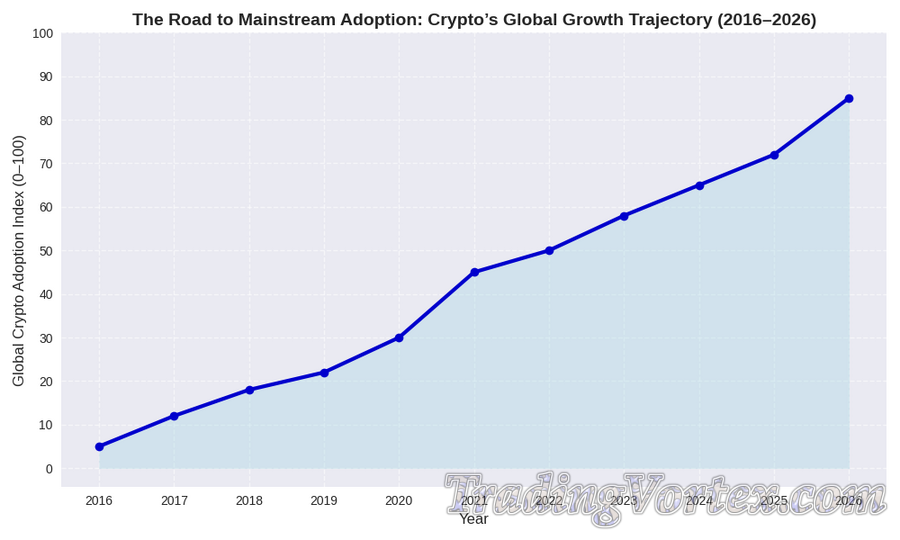 The Road to Mainstream Adoption: Crypto’s Global Growth Trajectory (2016–2026).
🔍 How to Read This Chart:
The line represents a Global Crypto Adoption Index (0–100 scale), based on realistic, research-aligned estimates of how widely crypto is used across payments, investing, enterprise systems, and financial infrastructure.
◊ Here’s what the trend tells you:
♦ 2016–2020: Early Growth Phase
Crypto was still experimental. Adoption grew slowly as early users, developers, and small communities explored the technology.
♦ 2021–2022: Acceleration & Volatility
Massive retail interest and institutional curiosity pushed adoption higher, even as the market experienced dramatic ups and downs.
♦ 2023–2025: Stabilization & Infrastructure Expansion
Regulation improved, enterprise adoption increased, and tokenization began reshaping traditional finance.
♦ 2026: The Breakthrough Year
Adoption jumps significantly as stablecoins, RWAs, regulated exchanges, and institutional products become part of everyday financial life.
Frequently Asked Questions About Investing in Crypto in 2026
Crypto in 2026 is exciting, more mature, and full of opportunities, but it is also normal to have questions. Whether you are just starting out or you have been here since the days when buying Bitcoin felt like a secret mission, this FAQ section is here to make things easier.
Think of it as a friendly conversation with someone who has already made the mistakes, learned the lessons, and wants to help you skip the painful parts.
Is 2026 a good time to invest in crypto?
Yes, 2026 is one of the strongest years the crypto market has seen. The combination of regulation, institutional adoption, tokenization, and stablecoin growth has created a more stable and predictable environment. The market still has volatility, but the foundation is stronger than ever. If you invest with a long‑term mindset and a balanced strategy, 2026 offers plenty of opportunities.
What is the safest way to start investing in crypto?
The safest way to begin is by focusing on blue‑chip assets like Bitcoin and Ethereum, using regulated exchanges, and keeping your funds in secure wallets. Start small, learn the basics, and avoid chasing hype. Many beginners also use crypto ETFs because they offer exposure without the complexity of managing wallets or private keys.
How much should I invest in crypto?
There is no perfect number, but a common rule is to invest only what you can afford to leave untouched for several years. Many investors start with 1 to 5 percent of their overall portfolio, then increase their exposure as they gain confidence. The key is to stay comfortable and avoid putting yourself under financial pressure.
What are the biggest risks of investing in crypto in 2026?
The main risks include volatility, security threats, and regulatory changes. Even with a more mature market, prices can still move quickly. Security remains a major concern, especially for people who click on suspicious links or use unverified platforms. Regulations are improving, but they can still affect which assets or services are available in your region.
How do I protect my crypto from hacks or scams?
Use hardware wallets, enable two‑factor authentication, and avoid connecting your wallet to random apps. Always double‑check contract addresses, keep your devices updated, and never share your private keys. Most hacks happen because of simple mistakes, not because the blockchain itself is unsafe.
Should I invest in tokenized real‑world assets (RWAs)?
RWAs are becoming very popular in 2026 because they offer lower volatility and predictable yields. Tokenized treasuries, real estate, and money‑market funds can help stabilize your portfolio. They are especially useful if you want exposure to crypto without taking on too much risk.
Are stablecoins a good investment?
Stablecoins are not designed to grow in value, but they are great for earning yield, managing liquidity, and reducing risk. Many investors keep a portion of their portfolio in stablecoins to take advantage of new opportunities or to earn steady returns through regulated platforms.
Is DeFi still worth exploring in 2026?
Yes, DeFi is safer and more transparent than ever. Platforms now offer audited smart contracts, insurance options, and institutional‑grade security. You can earn yield, lend assets, or participate in liquidity pools with more confidence. Just make sure you understand the risks before diving in.
What role does AI play in crypto investing?
AI has become a powerful tool for analyzing markets, predicting trends, and automating strategies. It helps investors avoid emotional decisions and react faster to market changes. Whether you are a beginner or an advanced trader, AI tools can make your strategy more efficient and more consistent.
How do I build a balanced crypto portfolio?
A balanced portfolio usually includes a mix of blue‑chip assets, RWAs, stablecoins, and select growth tokens. The exact percentages depend on your risk tolerance. Rebalancing regularly helps keep your portfolio aligned with your goals and prevents any single asset from dominating your exposure.
Can I still make money with crypto if I start now?
Absolutely. The market is more mature, but it is still early in terms of global adoption. The key is to focus on long‑term strategies, avoid emotional trading, and choose assets with strong fundamentals. You do not need to catch every trend to build wealth. Consistency and patience go a long way.