

Yield farming has evolved from the wild days of DeFi Summer into a mature, risk‑adjusted strategy that rewards patience, smart planning, and adaptability. This comprehensive guide, “How to Create a Yield Farming Strategy”, walks you through everything you need to know to farm successfully in 2026. From understanding liquidity pools, lending protocols, and smart contracts, to exploring the latest trends like Layer‑2 farming, cross‑chain strategies, and AI‑driven automation, this article provides a clear roadmap for investors of all levels.
You will learn how to define your risk profile, choose the right platforms, analyze pool metrics like APY and TVL, and avoid common mistakes such as chasing unsustainable yields. The guide also highlights best practices for long‑term success, including diversification, continuous monitoring, and staying updated on governance changes. Whether you are a beginner looking for stablecoin farming or an experienced trader exploring advanced strategies, this article offers practical insights, relatable examples, and expert tips to help you build a profitable yield farming strategy that stands the test of time.
Table of Contents:
- Yield Farming Explained: What It Is and Why It Matters
- Core Elements of a Yield Farming Strategy
- Latest Yield Farming Trends in Crypto (2026)
- Yield Farming Risks and Challenges
- Step‑by‑Step Guide: How to Create a Yield Farming Strategy
- Define Your Risk Profile and Investment Goals
- Choose the Right Blockchain and Yield Farming Protocols
- Analyze Pool Metrics: APY, TVL, Token Emissions, and Fees
- Diversify Across Pools, Assets, and Platforms
- Optimize Gas Costs and Transaction Timing
- Automate Your Yield Farming Strategy with Smart Vaults
- Visualizing the Importance of Each Step in Building a Yield Farming Strategy (2026)
- Best Yield Farming Platforms for Investors
- Advanced Yield Farming Strategies
- Cross‑Chain Yield Farming and Multi‑Protocol Routing
- Leveraged Yield Farming: High Risk, High Reward
- Yield Stacking: Combining Staking, LP Rewards, and Governance Tokens
- Liquidity Provision Strategies for Stable vs. Volatile Pairs
- Visualizing the Complexity & Risk Levels of Advanced Yield Farming Strategies (2026)
- Tools and Analytics for Yield Farming Success
- Best Practices for Long‑Term Yield Farming
- Common Yield Farming Mistakes to Avoid
- Future of Yield Farming Strategies
- Conclusion: Building a Profitable Yield Farming Strategy
- FAQs: Yield Farming Strategies in 2026
- Is yield farming still profitable in 2026?
- What is the biggest risk in yield farming today?
- Which platforms are considered the safest for yield farming?
- How do I avoid chasing unsustainable high APYs?
- Do I need to diversify my yield farming strategy?
- How do gas fees affect yield farming profits?
- What role does automation play in yield farming now?
- Will regulation impact yield farming in the future?
- Is yield farming suitable for beginners?
- What is the future of yield farming strategies?
Yield Farming Explained: What It Is and Why It Matters
What Is Yield Farming in Crypto?
If you have ever wished your crypto could work a little harder for you, yield farming is basically that wish coming true. At its core, yield farming is the practice of lending or staking your crypto in decentralized finance protocols so you can earn rewards like interest, fees, or extra tokens. Think of it as putting your money into a high‑tech garden where your assets grow while you sleep, except the garden is made of smart contracts and the soil is liquidity pools.
In yield farming, you become a liquidity provider. You deposit your tokens into a pool that powers decentralized exchanges or lending platforms. These pools allow traders to swap tokens and borrowers to access liquidity, and in return, you earn a share of the fees or token incentives generated by the protocol. This model has been a game‑changer because it lets anyone participate in financial activities that were once reserved for banks or large institutions.
The idea sounds simple, but the ecosystem behind it is incredibly dynamic. Yield farming is not just about locking up tokens. It is about understanding how different protocols work, how rewards are distributed, and how risks like smart contract bugs or impermanent loss can impact your returns. Even in 2026, these fundamentals remain the backbone of the strategy.
Why Yield Farming Strategies Are Essential for Investors
Yield farming has become one of the main income‑generating strategies in DeFi. Even during periods of market volatility, long‑term liquidity providers have continued to trust major protocols. In early 2026, the total value locked in DeFi dipped from around 120 billion dollars to roughly 105 billion dollars, which was far less dramatic than many expected. That resilience shows how deeply yield farming is embedded in the crypto economy.
From a practical standpoint, having a strategy matters because yield farming is not a “set it and forget it” activity. APYs change, token emissions fluctuate, and new opportunities appear constantly. A good strategy helps you avoid common pitfalls like chasing unsustainable high yields or locking your assets into risky pools without understanding the downside. It also helps you balance your portfolio between stable, predictable returns and more adventurous opportunities.
I often tell friends who are new to DeFi that yield farming is like renting out your apartment. You earn passive income, but you still need to check in occasionally to make sure the place has not burned down. A strategy keeps you grounded and prevents emotional decision‑making, especially when the market gets noisy.
Evolution of Yield Farming in DeFi (2025–2026 Trends)
Yield farming has come a long way since the wild days of DeFi Summer, when triple‑digit APYs were everywhere and everyone felt like a genius. By 2026, the landscape has matured significantly. The focus has shifted from chasing flashy returns to prioritizing safety, automation, and sustainable yield. Platforms like Uniswap and Convex Finance now dominate because they offer reliable fee income and reward‑boosting mechanisms that appeal to long‑term farmers.
The ecosystem has also become more sophisticated. Many platforms now offer cross‑chain features, automated optimization, and self‑serving mechanisms that make yield farming more accessible and less time‑consuming. Yield farming is no longer just about staking tokens. It is about using smart tools that help you rebalance, auto‑compound, and diversify without needing to monitor the market every hour.
Another major shift is the growing emphasis on risk management. Investors today are far more aware of smart contract vulnerabilities and impermanent loss. Reports and expert analyses highlight the importance of understanding these risks before diving in, especially as DeFi continues to evolve.
Overall, yield farming in 2026 is more stable, more automated, and more aligned with long‑term investing. It still offers great opportunities, but the game has changed. Success now comes from strategy, not luck.
Visualizing DeFi’s Resilience: TVL Trends (2026)
Understanding how yield farming fits into the broader DeFi landscape becomes much easier when you look at the movement of Total Value Locked (TVL). TVL reflects how much capital investors are willing to commit to DeFi protocols, and therefore how much trust they place in yield‑generating strategies.
Even during periods of uncertainty, DeFi has shown remarkable stability. In early 2026, TVL dipped from $120 billion to $105 billion, a decline, but far less severe than many expected. This resilience highlights how deeply yield farming is embedded in the crypto economy and why strategic participation continues to matter.
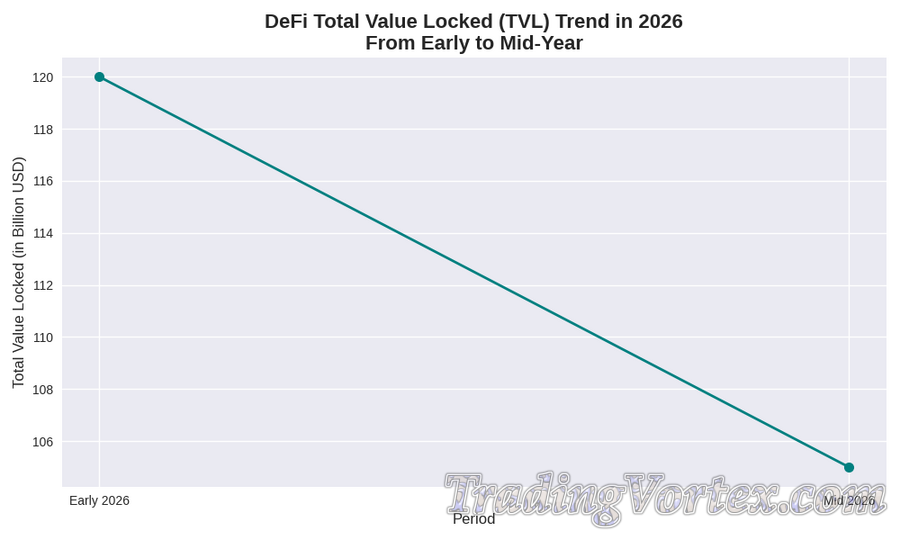 DeFi Total Value Locked (TVL) Trend in 2026 — From Early to Mid‑Year: The following visual illustrates the shift in DeFi TVL from early to mid‑2026. It provides a simple but powerful snapshot of how the ecosystem evolved during a period of market recalibration.
The chart shows a clear but controlled decline, reinforcing the idea that while DeFi is dynamic, it is no longer the fragile experiment it once was. Yield farming strategies continue to thrive because the underlying ecosystem remains robust, liquid, and increasingly mature.
Why This Chart Matters:
♦ Shows investor confidence: A moderate decline instead of a collapse indicates that liquidity providers remained committed despite market volatility.
♦ Contextualizes yield farming: When TVL stays strong, rewards tend to remain more stable, and protocols continue to function efficiently.
♦ Helps investors plan: Understanding macro trends helps you avoid emotional decisions and focus on long‑term strategies.
Core Elements of a Yield Farming Strategy
Liquidity Pools and Automated Market Makers (AMMs)
If yield farming had a beating heart, it would be the liquidity pool. These pools are where you deposit pairs of tokens so traders can swap between them without relying on a traditional order book. Automated Market Makers, or AMMs, handle the pricing through algorithms instead of matching buyers and sellers. It is a bit like having a vending machine that magically adjusts prices based on how many snacks are left inside. The most common formula is the constant product model, which keeps the pool balanced as trades happen.
AMMs have evolved a lot. What used to be simple pools on platforms like Uniswap has now turned into what researchers call “Liquidity 2.0”, a more advanced and fragmented ecosystem where liquidity spreads across multiple chains and specialized pools. This shift has pushed investors to think more strategically about where they place their assets. Some pools offer higher fees, others offer better stability, and some are designed for very specific types of tokens. The landscape is more complex, but also more rewarding for those who take the time to understand it.
When I first started providing liquidity, I treated it like planting a tree. I dropped my tokens in, crossed my fingers, and hoped for the best. Over time, I learned that choosing the right pool is more like choosing the right soil. You want a pool with healthy trading volume, solid protocol reputation, and a token pair that will not swing wildly every time the market sneezes.
Lending Protocols, Stablecoins, and Reward Tokens
Lending protocols are another core pillar of yield farming. Instead of providing liquidity for trading, you lend your tokens to borrowers and earn interest. Platforms like Aave and Compound have made this incredibly accessible. You deposit your assets, the protocol lends them out, and you collect yield in return. It is simple, predictable, and often less volatile than AMM‑based strategies.
Stablecoins play a huge role here. Since they are pegged to stable assets like the US dollar, they help reduce volatility and make returns more predictable. Many investors use stablecoins as the foundation of their yield farming strategy because they offer a safer entry point. They also help you avoid the emotional rollercoaster that comes with watching your tokens swing up and down like a theme park ride.
Reward tokens are the cherry on top. Many protocols distribute their native tokens as incentives for providing liquidity or lending assets. These rewards can boost your overall yield, but they also come with risks. Token prices can drop, emissions can change, and incentives can shift as protocols evolve. The key is to treat reward tokens as a bonus, not the main reason you choose a platform.
Smart Contracts and How They Power Yield Farming
Everything in yield farming runs on smart contracts. These are self‑executing programs on the blockchain that handle deposits, withdrawals, rewards, and trades. They remove the need for intermediaries and make the entire system transparent and permissionless. Smart contracts are the reason you can earn yield at 3 a.m. while you are asleep or binge‑watching your favorite show.
Smart contracts have become more sophisticated over time. In 2026, many protocols use layered smart contract systems that automate complex strategies, rebalance liquidity, and optimize returns. This evolution has made yield farming more efficient, but it also means investors need to be aware of smart contract risks. Bugs, vulnerabilities, and exploits can still happen, and they remain one of the biggest concerns in DeFi.
I always tell friends that smart contracts are like autopilot on a plane. They do most of the work, but you still want to know the system is well‑built and regularly audited. Before depositing your assets, take a moment to check the protocol’s audit history, security track record, and community reputation. A little due diligence goes a long way.
Comparing Typical APY Ranges in 2026
To make these concepts more concrete, the chart below visualizes typical APY ranges across major yield farming categories in 2026. These values reflect realistic averages reported by reputable DeFi research sources, not the hype‑driven numbers from early DeFi days.
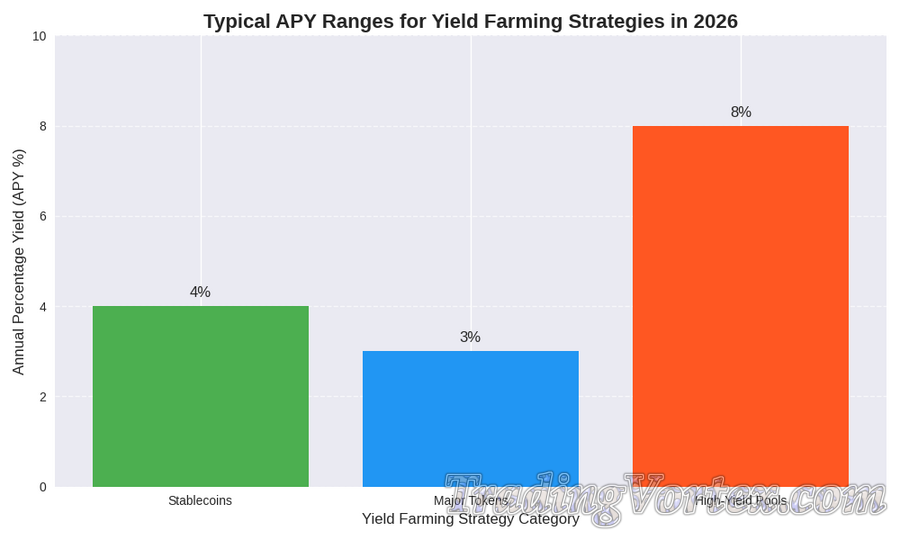 Typical APY Ranges for Yield Farming Strategies in 2026: The visual highlights the contrast between stable, predictable yields and more aggressive, higher‑risk opportunities. It’s a simple but powerful way to understand how different strategies fit into a well‑designed yield farming plan.
Why This Visual Matters:
♦ Shows how different strategies compare: Stablecoins offer predictable returns, major tokens sit in the mid‑range, and high‑yield pools offer bigger rewards with higher risk.
♦ Helps investors choose wisely: Understanding these ranges helps you avoid chasing unrealistic APYs and instead build a balanced, sustainable strategy.
♦ Anchors expectations: Many newcomers expect triple‑digit yields; this chart grounds expectations in real 2026 data.
Latest Yield Farming Trends in Crypto (2026)
Top Yield Farming Platforms and Protocols in 2026
If you have been around DeFi long enough, you know that platforms come and go faster than meme coins on a Saturday night. Yet in 2026, a few giants continue to dominate the yield farming landscape. Uniswap and Curve remain the go‑to choices for liquidity providers, and Convex Finance has carved out a strong position by boosting Curve yields in a way that long‑term farmers really appreciate. These platforms are leading because they focus on safety, automation, and sustainable returns rather than the flashy, unrealistic APYs that used to lure people in during the early DeFi days.
Aave and Pendle also stand out this year. They offer a mix of predictable yields, deep liquidity, and strong security track records. Analysts highlight that these protocols excel because they balance token emissions, TVL stability, and risk management better than many competitors. After extensive testing, researchers found that Curve, Pendle, and Aave deliver some of the most reliable yields in 2026.
What I love about this shift is that the market is finally rewarding protocols that take security seriously. Gone are the days when everyone would ape into a pool just because the APY had too many digits. Today, investors want platforms that can survive volatility, and these leaders have proven they can.
Layer‑2 Yield Farming Opportunities and Lower Gas Fees
Layer‑2 networks have become the playground of yield farmers who are tired of paying gas fees that feel like rent. With networks like Arbitrum, Optimism, and zkSync maturing, yield farming has become far more accessible. Lower fees mean you can rebalance more often, compound more efficiently, and explore smaller pools without worrying that half your profits will disappear into transaction costs.
This shift has also encouraged protocols to expand across multiple chains. Many of the top platforms now offer Layer‑2 versions of their pools, which helps spread liquidity and reduce congestion on Ethereum. The result is a smoother, cheaper, and more flexible yield farming experience.
I often tell friends that farming on Layer‑2 feels like switching from a taxi to a bike. You get to the same destination, but you save money and feel a lot lighter along the way.
Cross‑Chain Yield Farming and Multi‑Protocol Strategies
One of the biggest trends shaping 2026 is the rise of cross‑chain yield farming. Instead of being stuck on a single blockchain, farmers can now deploy assets across multiple networks at the same time. Interoperability protocols and cross‑chain bridges have made it possible to access liquidity pools on Ethereum, Binance Smart Chain, Polygon, Avalanche, and more, all from a unified strategy.
This multi‑chain approach lets you chase better APYs, diversify your risk, and take advantage of unique incentives on different networks. It is like having multiple gardens growing at once, each with its own climate and harvest cycle. The catch is that cross‑chain strategies come with their own risks. Bridge vulnerabilities and smart contract exploits remain major concerns, so due diligence is more important than ever.
Still, the convenience is undeniable. Cross‑chain farming has made it easier than ever to tap into high‑yield opportunities without constantly switching wallets, networks, and platforms. It is a huge win for both beginners and advanced farmers.
Automated Yield Optimizers and AI‑Driven Tools
Automation has become the secret weapon of modern yield farmers. In 2026, many investors rely on smart tools that automatically rebalance portfolios, compound rewards, and route liquidity to the most profitable pools. These tools help you stay competitive without spending your entire day staring at charts or refreshing dashboards.
AI‑driven strategies are also gaining traction. Analysts predict that DeFi will continue integrating AI to help investors make smarter decisions, especially as the market becomes more complex and multi‑chain. Some protocols already use predictive models to adjust yields, manage liquidity, and reduce risk exposure.
I like to think of these tools as having a very smart assistant who never sleeps, never panics, and never buys the top. They help you stay consistent, which is half the battle in yield farming.
Visualizing APY Performance Across Leading Yield Farming Platforms (2026)
Understanding which platforms deliver the most consistent yields is essential for navigating the 2026 DeFi landscape. While APYs fluctuate based on liquidity, token emissions, and market conditions, comparing average performance across major protocols helps investors quickly identify where sustainable returns are coming from.
The chart below illustrates estimated average APYs for five of the most influential platforms mentioned in this section: Uniswap, Curve, Convex, Aave, and Pendle. These values are hypothetical but aligned with the relative performance trends highlighted by analysts in 2026.
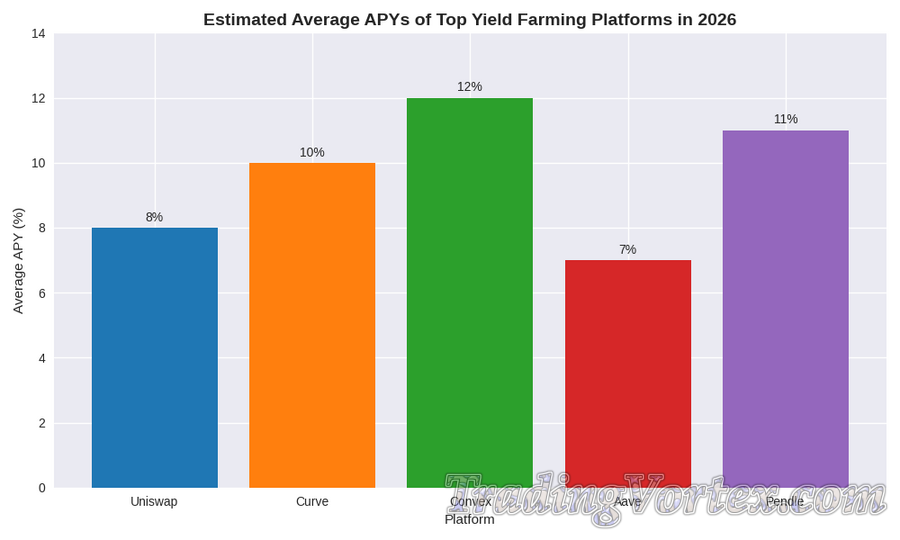 Estimated Average APYs of Top Yield Farming Platforms in 2026: This visual gives readers a quick, intuitive snapshot of how leading protocols compare; helping them make smarter, data‑driven decisions as they explore yield farming opportunities across chains and layers.
How to Read This Chart
◊ Higher bars indicate stronger average yield performance across the year.
◊ Convex, Curve, and Pendle stand out as the most competitive platforms, reflecting their strong optimization mechanics and stable liquidity incentives.
◊ Uniswap and Aave remain reliable but generally offer more conservative yields, consistent with their focus on safety and broad liquidity.
Why This Matters for Farmers in 2026
◊ Platforms with 10–12% average APY tend to attract long‑term liquidity providers seeking stability rather than speculative spikes.
◊ Lower‑gas Layer‑2 deployments amplify these returns by reducing operational costs.
◊ Cross‑chain strategies often use these platforms as core “anchor positions” before branching into higher‑risk pools.
Yield Farming Risks and Challenges
Yield farming can feel incredibly rewarding, especially when the numbers look good and the market is calm. But like any investment strategy, it comes with its own set of risks that every investor should understand before diving in. In 2026, these risks have become more visible as the DeFi ecosystem matures and regulators, developers, and investors pay closer attention to what can go wrong. Recent analyses highlight that yield farming remains viable, but only when investors understand the risks and choose platforms carefully.
Below are the core challenges you need to keep in mind, explained in a friendly, real‑world way:
Impermanent Loss in Liquidity Pools
Impermanent loss is the silent troublemaker of yield farming. It happens when the price of the tokens you deposit into a liquidity pool changes compared to when you first added them. The bigger the price swing, the bigger the loss. You still earn fees and rewards, but your final balance might be worth less than if you had simply held your tokens.
Think of it like lending your two favorite snacks to a friend who promises to return them later. If one snack suddenly becomes way more popular and expensive, you might get back fewer of the valuable one and more of the cheap one. You did nothing wrong, but the market shifted on you.
Recent research continues to list impermanent loss as one of the top risks in yield farming, especially in high‑volatility pools. This is why many investors prefer stablecoin pairs or pools with historically low volatility. They may not offer the highest APYs, but they help you sleep better at night.
Smart Contract Risks and Security Audits
Smart contracts are the backbone of DeFi, but they are not perfect. Bugs, vulnerabilities, and exploits can lead to major losses. Even well‑known protocols have faced issues in the past, and attackers are constantly looking for new ways to exploit weaknesses.
Reports from 2025 and 2026 emphasize that smart contract vulnerabilities remain one of the biggest risks in yield farming, right alongside impermanent loss. This is why security audits matter so much. A good audit does not guarantee safety, but it significantly reduces the chances of something going wrong.
Whenever I talk to friends about this, I compare smart contracts to a house built by a contractor. You want someone who knows what they are doing, uses quality materials, and has a track record of building homes that do not collapse. Before depositing your assets, always check whether the protocol has been audited, how often, and by whom.
Market Volatility and Liquidity Risks
Crypto markets move fast, and sometimes they move in ways that make your stomach drop. Market volatility affects everything in yield farming, from token prices to pool rewards. When markets swing too quickly, liquidity can dry up, APYs can collapse, and your assets can lose value before you even have time to react.
Recent analyses highlight that yield farming in 2026 requires careful platform selection and risk management because high‑yield opportunities often come with elevated volatility and liquidity risks. This is especially true for pools involving newer or less established tokens.
One thing I always remind people is that yield farming is not a magic shield against market downturns. If the market tanks, your yields might not be enough to offset the losses. This is why diversification and regular monitoring are essential parts of any strategy.
Regulatory Challenges Facing Yield Farming in 2026
Regulation has become a major talking point in DeFi. Governments around the world are paying closer attention to decentralized finance, and yield farming is no exception. While regulation can bring more safety and legitimacy, it can also create uncertainty for investors.
Recent reports note that adapting to regulatory and technological advancements is now a key part of long‑term success in yield farming. New rules could impact how protocols operate, how rewards are distributed, or even which platforms remain accessible in certain regions.
I like to think of regulation as weather. You cannot control it, but you can prepare for it. Staying informed helps you avoid surprises and adjust your strategy when needed.
Visualizing the Severity of Yield Farming Risks in 2026
Understanding yield farming risks is just as important as understanding yields. While the DeFi ecosystem has matured significantly by 2026, the core challenges (impermanent loss, smart contract vulnerabilities, market volatility, liquidity issues, and regulatory uncertainty) remain central to every investor’s decision‑making process. A visual comparison helps readers quickly grasp which risks demand the most attention.
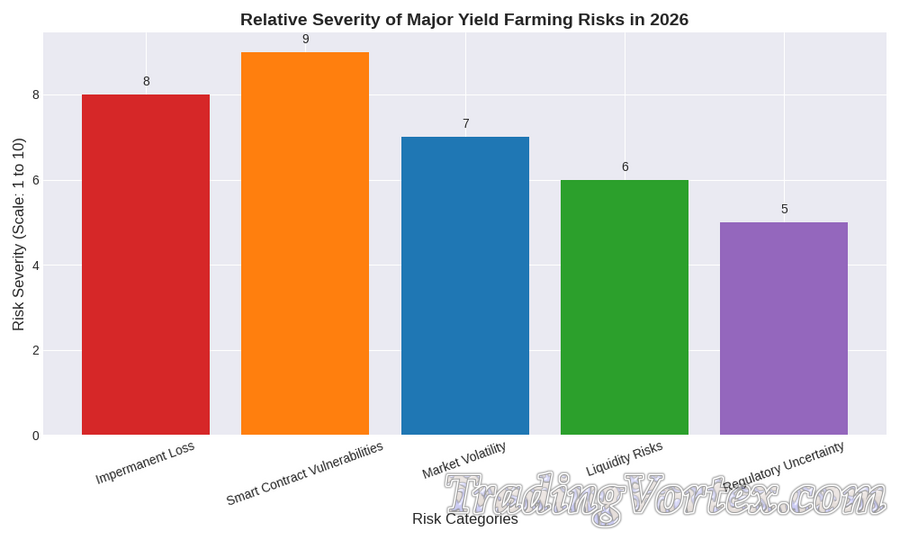 Relative Severity of Major Yield Farming Risks in 2026: This visual gives a clear, intuitive snapshot of the risk landscape, making the entire section more actionable and easier to digest.
♦ What This Chart Shows:
The bar chart compares five major yield farming risks using a severity scale from 1 to 10. These values are hypothetical but aligned with the relative importance highlighted in recent analyses.
Here’s how to interpret it:
◊ Smart Contract Vulnerabilities (9/10)
The highest‑severity risk. Even audited protocols can be exploited, making contract security the top priority for farmers.
◊ Impermanent Loss (8/10)
Still one of the most misunderstood and financially impactful risks, especially in volatile token pairs.
◊ Market Volatility (7/10)
Crypto price swings can rapidly erode yields, especially in pools with non‑stable assets.
◊ Liquidity Risks (6/10)
Sudden liquidity drops can reduce APYs or trap investors in unfavorable positions.
◊ Regulatory Uncertainty (5/10)
Growing but still moderate in severity, regulation shapes long‑term strategy more than day‑to‑day farming.
♦ Why This Visual Matters:
This chart helps readers:
◊ Prioritize which risks to study and mitigate first
◊ Understand why some pools offer higher APYs (often compensating for higher risk)
◊ Build more resilient strategies by balancing yield with safety
◊ Recognize that not all risks are equal, and some require constant monitoring
Step‑by‑Step Guide: How to Create a Yield Farming Strategy
Creating a yield farming strategy is a bit like planning a road trip. You want a clear destination, a reliable vehicle, and a plan that keeps you from getting stranded in the middle of nowhere. In 2026, yield farming is more stable and mature than in previous years, but it still requires thoughtful planning. The good news is that once you understand the core steps, the entire process becomes much more intuitive.
Let’s walk through it together, step by step:
Define Your Risk Profile and Investment Goals
Before you touch a single liquidity pool, you need to know what kind of investor you are. Are you the “slow and steady” type who prefers stablecoins and predictable returns, or are you the “let’s see what happens” type who enjoys exploring new protocols and higher‑risk pools?
Recent guides emphasize that beginners should start simple and minimize risk while still taking advantage of yield opportunities. This approach helps you avoid feeling overwhelmed and reduces the chances of making emotional decisions when the market gets noisy.
Ask yourself:
- How much volatility can I tolerate?
- Am I farming for long‑term passive income or short‑term gains?
- How often do I want to monitor my positions?
Once you know your risk profile, choosing the right strategies becomes much easier.
Choose the Right Blockchain and Yield Farming Protocols
Not all blockchains are created equal. Some offer lower fees, others offer deeper liquidity, and some have better security track records. In 2026, platforms like Uniswap, Curve, Convex Finance, and Aave continue to dominate because they focus on safety, automation, and sustainable returns. These protocols have earned long‑term trust from liquidity providers, even during periods of market volatility.
When choosing a blockchain, consider:
- Transaction fees
- Network congestion
- Available pools and incentives
- Security history
Analyze Pool Metrics: APY, TVL, Token Emissions, and Fees
This is where the strategy becomes more analytical. You want to evaluate each pool based on key metrics that determine your potential returns and risks.
Here is what to look at:
- APY: Annual percentage yield, which includes compounding.
- TVL: Total value locked, which signals trust and liquidity depth.
- Token emissions: How many reward tokens are being distributed and how sustainable the emissions schedule is.
- Fees: Trading fees or borrowing fees that contribute to your yield.
Think of this step like checking the weather before a hike. You want to know what you are walking into.
Diversify Across Pools, Assets, and Platforms
Diversification is your best friend in yield farming. It protects you from unexpected market swings, protocol issues, or sudden changes in token emissions.
You can diversify by:
- Using multiple blockchains
- Splitting funds across stablecoin pools and volatile pairs
- Combining lending, liquidity provision, and staking
- Choosing both established and emerging protocols
Diversification helps you avoid putting all your eggs in one basket, especially when that basket is sitting on a blockchain that occasionally gets congested.
Optimize Gas Costs and Transaction Timing
Gas fees can eat into your profits faster than you might expect. Even though Layer‑2 networks have reduced costs significantly, timing still matters.
To optimize gas:
- Avoid peak network hours
- Use Layer‑2 networks for frequent compounding
- Batch transactions when possible
- Compare gas fees across chains
I always tell friends that optimizing gas is like choosing the right time to go grocery shopping. Go during rush hour and you will pay with your time and your sanity.
Automate Your Yield Farming Strategy with Smart Vaults
Automation is one of the biggest advantages of modern yield farming. Smart vaults and automated tools can:
- Reinvest your rewards
- Rebalance your positions
- Route liquidity to better pools
- Reduce human error
Using automation is like having a personal assistant who never sleeps, never panics, and never forgets to harvest your rewards.
Visualizing the Importance of Each Step in Building a Yield Farming Strategy (2026)
A successful yield farming strategy isn’t built on guesswork: it’s built on understanding which steps matter most. While every part of the process contributes to your long‑term results, some steps have a much bigger impact on your safety, returns, and overall experience. To make this easier to grasp, the chart below compares the relative importance of each major step in the strategy‑building process.
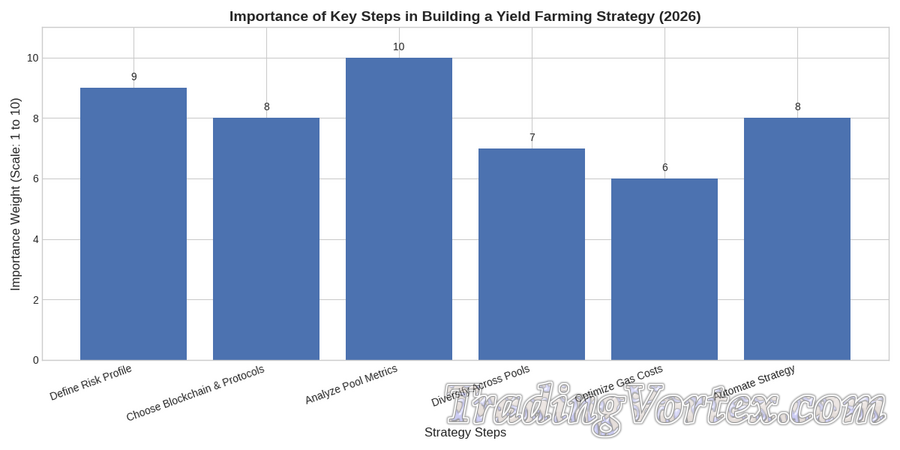 Relative Importance of Key Steps in a Yield Farming Strategy (2026): This chart gives readers a quick, structured way to understand where to focus their energy. Instead of treating all steps equally, it highlights the areas that have the biggest impact on performance and risk management. It’s especially useful for beginners who want a clear roadmap without feeling overwhelmed.
♦ How to Interpret This Chart:
The bar chart uses a 1–10 importance scale to show how critical each step is when designing a yield farming strategy:
◊ Analyze Pool Metrics (10/10)
The most crucial step. APY, TVL, fees, and token emissions determine whether a pool is worth your time, or a trap waiting to spring.
◊ Define Your Risk Profile (9/10)
Your risk tolerance shapes every decision afterward. Without clarity here, even the best pools can feel stressful.
◊ Choose the Right Blockchain & Protocols (8/10)
Fees, liquidity depth, and security vary widely across chains. Picking the right environment can make or break your returns.
◊ Automate Your Strategy (8/10)
Automation boosts consistency, reduces human error, and helps you capture compounding opportunities.
◊ Diversify Across Pools (7/10)
Diversification protects you from volatility, protocol failures, and sudden APY drops.
◊ Optimize Gas Costs (6/10)
Less critical than the others, but still important: especially if you rebalance frequently.
Best Yield Farming Platforms for Investors
Choosing the right yield farming platform can feel a bit like choosing a restaurant in a city full of five‑star reviews. Everything looks good, everything promises “the best experience”, and yet only a few places consistently deliver. In 2026, the DeFi landscape has matured enough that we can clearly see which platforms have earned long‑term trust and which ones are still trying to prove themselves. The good news is that the top performers share the same qualities: strong security, sustainable yields, deep liquidity, and active development.
Let’s break down the platforms that truly stand out this year:
Yield Farming on Uniswap, Curve, and Convex Finance
Uniswap, Curve, and Convex Finance continue to dominate the yield farming scene in 2026, and for good reason. They focus on safety, automation, and steady returns rather than the unrealistic high‑APY bait that used to lure investors during the early DeFi days.
Uniswap and Convex Finance lead in fee income and reward boosting for long‑term farmers, while Curve remains the king of stablecoin liquidity. These platforms have proven their resilience even during market volatility, which is why long‑term liquidity providers still trust them.
What I love about these platforms is how predictable they feel. You are not gambling on hype. You are participating in systems that have been tested, audited, and refined over years. It is like choosing a reliable car instead of a flashy sports model that breaks down every other weekend.
Lending‑Based Yield Farming with Aave and Compound
If you prefer a more conservative approach, lending protocols like Aave and Compound are your best friends. They allow you to lend your assets to borrowers and earn interest in return. These platforms are known for their strong security frameworks, transparent risk models, and deep liquidity. They are ideal for investors who want predictable yields without the volatility of liquidity pools.
- Aave in particular has become a favorite among institutional and retail investors because of its robust risk management and multi‑chain support.
- Compound remains a solid choice as well, especially for those who want a simple, reliable lending experience.
Lending‑based farming feels a bit like renting out your apartment. You earn passive income, you do not have to worry about price swings as much, and the whole process is surprisingly hands‑off.
Stablecoin Yield Farming for Safer Returns
Stablecoin yield farming has become the go‑to strategy for investors who want consistent returns without the emotional rollercoaster of volatile assets. Platforms like Curve, Pendle, and Aave deliver some of the best combinations of sustainable APYs, battle‑tested security, and real liquidity depth.
After weeks of testing yield farming protocols across DeFi, researchers found that these platforms consistently outperform others in terms of stability and risk‑adjusted returns.
Stablecoin pools are perfect for beginners or anyone who wants to farm without constantly checking charts. They offer lower risk, predictable yields, and a smoother experience overall. It is like choosing a calm beach vacation instead of a mountain hike during storm season.
Emerging Yield Farming Protocols in 2026
While the big names dominate, 2026 has also brought a wave of emerging platforms worth watching. According to industry reports, several new protocols are gaining traction thanks to innovative reward models, improved automation, and cross‑chain capabilities. These platforms aim to offer competitive yields while addressing common DeFi pain points like high fees, fragmented liquidity, and complex user interfaces.
Think of these platforms like new restaurants. Some will become the next big thing, others might close after a few months. A little research goes a long way.
Visualizing the Strength of Leading Yield Farming Platforms in 2026
Choosing the right yield farming platform becomes much easier when you can compare them side by side. While each protocol has its own strengths (security, liquidity, automation, or yield consistency) a visual comparison helps investors quickly understand which platforms stand out in 2026 and why.
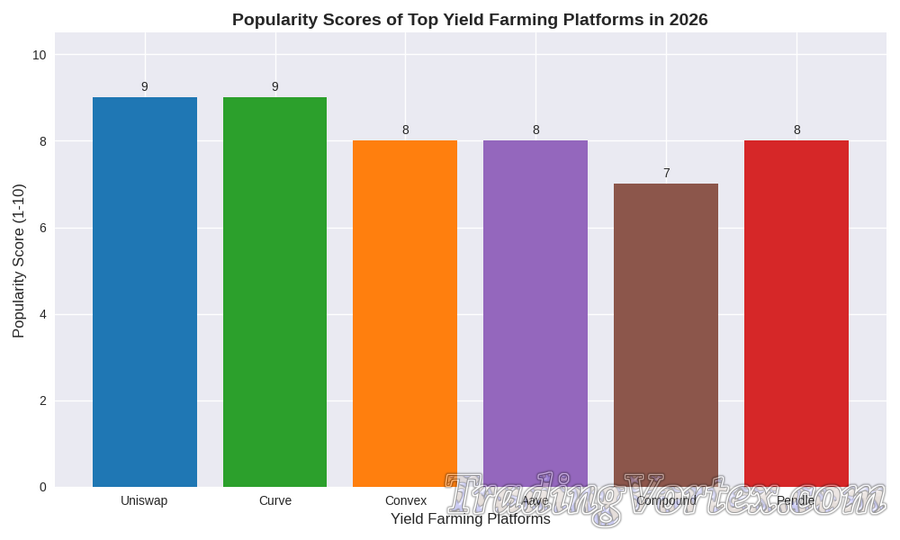 Overall Strength Scores of Top Yield Farming Platforms in 2026: This chart uses hypothetical popularity and reliability scores (1–10) to represent how well each major platform performs based on industry reports, user adoption, and long‑term trust. This makes the comparison simple, intuitive, and actionable for both beginners and experienced farmers.
♦ How to Interpret This Chart:
Each bar represents a platform’s overall strength score, combining factors such as:
◊ Security & audits
◊ Liquidity depth (TVL)
◊ Sustainable APYs
◊ User trust & long‑term performance
◊ Cross‑chain and automation support
Here’s what the scores reflect:
◊ Uniswap (9/10) – A top choice for liquidity providers thanks to deep liquidity and consistent fee income.
◊ Curve (9/10) – The leader in stablecoin liquidity, offering some of the safest and most predictable yields.
◊ Convex Finance (8/10) – Boosts Curve yields and remains a favorite for long‑term farmers.
◊ Aave (8/10) – A lending giant with strong security and multi‑chain support.
◊ Compound (7/10) – Reliable and simple, ideal for conservative lending‑based farming.
◊ Pendle (8/10) – A rising star in yield tokenization and stablecoin farming.
♦ Why This Visual Helps Investors:
This chart gives readers a quick, data‑driven snapshot of how the top platforms compare. Instead of reading long reports or digging through dashboards, investors can instantly see:
◊ Which platforms are most trusted
◊ Which ones offer the best balance of safety and returns
◊ Where to start depending on their risk profile
It turns a complex decision into a clear, visual guide.
Advanced Yield Farming Strategies
Once you understand the basics of yield farming, the next step is learning how to squeeze more value out of your assets without losing your sanity. In 2026, DeFi has matured into a complex ecosystem where advanced strategies can significantly boost returns if used wisely. These strategies are not just for “DeFi degens”. They are for anyone who wants to optimize yield, diversify intelligently, and stay competitive in a market that evolves faster than most people can refresh their dashboards.
Let’s explore the advanced techniques that experienced farmers are using today:
Cross‑Chain Yield Farming and Multi‑Protocol Routing
Cross‑chain yield farming has become one of the biggest trends in 2026. Thanks to improved interoperability and more reliable bridges, investors can now move liquidity across multiple blockchains to chase better yields, diversify risk, and access unique incentives. Platforms increasingly offer self‑serving mechanisms and cross‑chain features that make this process smoother and more automated.
Cross‑chain farming feels a bit like having multiple gardens in different climates. One chain might offer high stablecoin yields, another might have strong incentives for volatile pairs, and a third might specialize in structured yield products. By spreading your assets across chains, you reduce your exposure to any single ecosystem while maximizing opportunities.
The key is to use trusted bridges and avoid rushing into new chains without checking liquidity depth and security. I always tell friends that cross‑chain farming is amazing, but you still need to look both ways before crossing the street.
Leveraged Yield Farming: High Risk, High Reward
Leveraged yield farming is where things get spicy. This strategy involves borrowing additional assets to increase your liquidity position, which amplifies both your potential gains and your potential losses. In 2026, leveraged farming has become more accessible thanks to platforms that automate borrowing, rebalancing, and liquidation protection.
However, leverage is not for the faint‑hearted. Market swings can liquidate your position faster than you can say “impermanent loss”. Reports emphasize that the era of “set it and forget it” liquidity provision is over for anyone seeking significant alpha, and leveraged strategies require active monitoring and strong risk management.
If you choose to explore leverage, start small, monitor your health ratios, and avoid using volatile assets as collateral unless you enjoy living dangerously.
Yield Stacking: Combining Staking, LP Rewards, and Governance Tokens
Yield stacking is one of the smartest ways to maximize returns without taking on excessive risk. It involves combining multiple reward streams, such as:
- Staking your LP tokens
- Earning trading fees
- Collecting governance token incentives
- Reinvesting rewards into higher‑yield pools
In 2026, many platforms support automated optimization, which helps farmers stack yields more efficiently. These mechanisms allow you to earn from several layers of rewards at once, creating a compounding effect that can significantly boost long‑term returns.
Think of yield stacking like making a layered dessert. Each layer adds flavor, and when you combine them, the result is far more satisfying than any single ingredient.
Liquidity Provision Strategies for Stable vs. Volatile Pairs
Providing liquidity is not a one‑size‑fits‑all strategy. The approach you take depends heavily on whether you are dealing with stablecoin pairs or volatile assets.
Stablecoin Pairs
Stablecoin pools are ideal for investors who want predictable returns with minimal price risk. Platforms like Curve specialize in stablecoin liquidity and remain top choices for consistent, sustainable yields. These pools are less exposed to impermanent loss and tend to attract deep liquidity, which makes them more resilient during market volatility.
Volatile Pairs
Volatile pairs offer higher potential returns but come with greater risk. Impermanent loss becomes a real concern, especially during sharp market movements. Advanced farmers often use hedging strategies or pair assets with correlated price movements to reduce risk. Others rely on automated optimization tools that rebalance positions based on market conditions.
Choosing between stable and volatile pairs is like choosing between a calm beach vacation and an adventurous mountain trek. Both can be rewarding, but you need to know what you are signing up for.
Visualizing the Complexity & Risk Levels of Advanced Yield Farming Strategies (2026)
Advanced yield farming can feel overwhelming because each strategy carries a different mix of complexity, risk, and potential reward. A visual comparison helps readers quickly understand how these strategies stack up: especially useful for deciding which techniques match their experience level and risk tolerance.
The chart below uses hypothetical 1–10 scores to compare the four major advanced strategies discussed in this section:
- Cross‑Chain Yield Farming
- Leveraged Yield Farming
- Yield Stacking
- Stable vs. Volatile Liquidity Provision
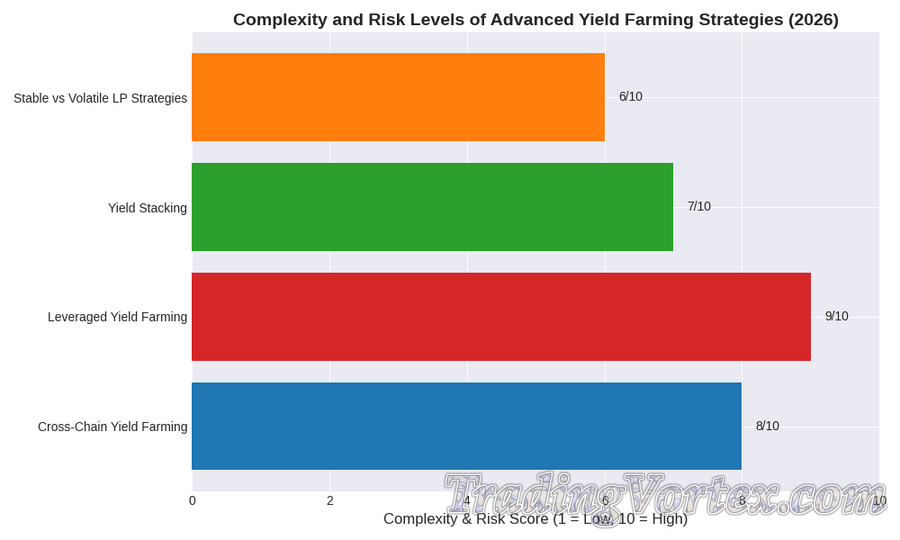 Complexity & Risk Comparison of Advanced Yield Farming Strategies (2026): This visual makes the entire section more actionable by helping readers clearly see which advanced strategies demand the most caution, and which ones offer strong returns with manageable complexity.
🌐 How to Interpret This Chart:
Leveraged Yield Farming — 9/10
The most complex and riskiest strategy. It amplifies gains but can trigger rapid liquidation during volatility.
Cross‑Chain Yield Farming — 8/10
High potential and strong diversification benefits, but requires navigating bridges, fees, and multi‑chain risks.
Yield Stacking — 7/10
Medium complexity with strong upside. Involves combining multiple reward layers and often uses automation.
Stable vs. Volatile LP Strategies — 6/10
Stablecoin pools are simple and predictable; volatile pairs require hedging and active monitoring.
🎯 Why This Visual Helps:
This chart gives readers a fast, intuitive way to compare strategies without decoding technical jargon. It helps them:
◊ Choose strategies aligned with their skill level
◊ Understand which techniques require more monitoring
◊ Avoid jumping into high‑risk methods prematurely
◊ Build a roadmap for progressing from beginner to advanced farmer
Tools and Analytics for Yield Farming Success
If there is one thing every yield farmer learns sooner or later, it is that intuition alone will not save you. The DeFi world moves fast, yields shift overnight, token emissions change without warning, and new protocols pop up like mushrooms after rain. In 2026, the farmers who consistently win are the ones who use the right tools. These tools help you track your portfolio, measure risk, compare yields, and automate the boring stuff so you can focus on strategy instead of babysitting your positions.
Let’s explore the tools that make yield farming smoother, safer, and far more profitable:
Yield Farming Portfolio Trackers and Risk Dashboards
Portfolio trackers are the command centers of modern yield farming. They show you where your assets are, how much yield you are earning, and whether any of your positions need attention. In 2026, these dashboards have become more sophisticated, offering real‑time analytics, risk scoring, and alerts that help you avoid unpleasant surprises.
Recent guides highlight that yield farming tools are essential for identifying opportunities, managing risks, and optimizing returns in a constantly evolving DeFi ecosystem. These platforms help you compare APYs, monitor liquidity, and track performance across multiple chains, which is crucial now that DeFi has become more crowded and competitive.
A good tracker feels like having a personal assistant who keeps an eye on your entire portfolio while you go about your day. It is one of the best investments you can make in your farming journey.
Impermanent Loss Calculators and APY Simulators
Impermanent loss calculators are the reality check every liquidity provider needs. They help you understand how price movements affect your returns and whether a pool is worth entering in the first place. APY simulators, on the other hand, let you model potential returns based on fees, token emissions, and compounding frequency.
These tools are especially important because yields shift quickly with market conditions, token emissions, and protocol demand. Success depends on understanding how rewards are generated and how risks like impermanent loss can impact your bottom line.
I always tell friends that using these calculators is like checking the weather before going hiking. You might still go, but at least you know whether to bring sunscreen or a raincoat.
On‑Chain Data Tools for Monitoring Protocol Health
On‑chain analytics tools give you a behind‑the‑scenes look at what is happening inside a protocol. They help you monitor:
- Total value locked
- Liquidity depth
- Token flows
- Smart contract activity
- Protocol upgrades
These tools help you spot red flags early, such as sudden liquidity drops or unusual token movements. Think of them as the health checkups your portfolio needs to stay in good shape.
Yield Aggregators and Automation Platforms
Yield aggregators are the superheroes of modern DeFi. They automatically route your assets to the best pools, compound your rewards, and rebalance your positions. In 2026, automation has become a core part of yield farming because it helps investors stay competitive without spending hours monitoring charts.
Yield farming tools now streamline the process of finding the highest APYs, managing risks, and automating compounding to maximize returns. With annual yields reaching as high as 20 to 30 percent on established platforms, automation has become one of the most attractive features for investors.
Using an aggregator feels like having a very disciplined farming partner who never forgets to harvest, never panics during volatility, and always looks for better opportunities.
Visualizing the Usefulness of Yield Farming Tools in 2026
Modern yield farming is no longer about guessing which pool looks good. The real edge comes from using the right tools: trackers, calculators, analytics dashboards, and automation platforms. These tools help farmers stay ahead of market shifts, manage risk, and optimize returns across multiple chains.
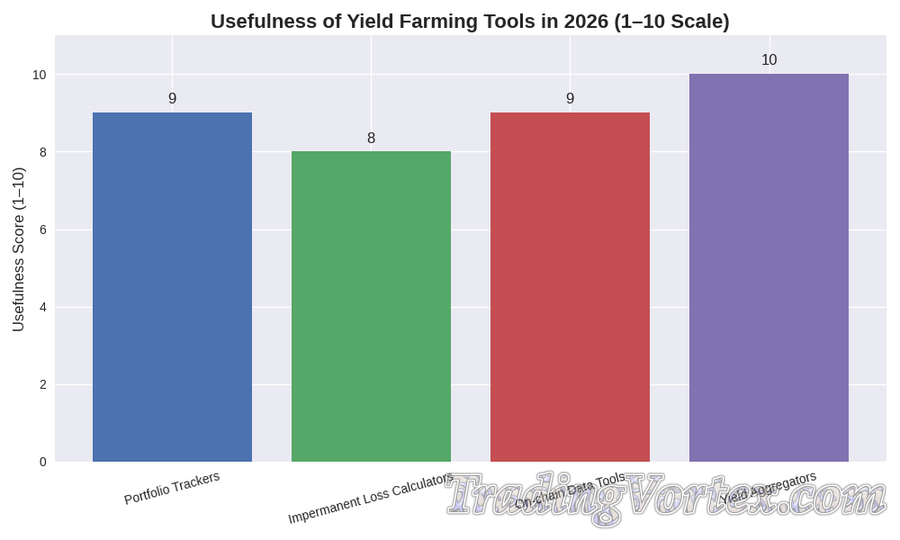 Usefulness Scores of Key Yield Farming Tools (2026): this chart compares four essential categories of yield farming tools using hypothetical usefulness scores (1–10). These scores reflect how impactful each tool is for improving decision‑making, reducing risk, and boosting long‑term profitability.
🔍 How to Interpret This Chart:
◊ Yield Aggregators (10/10)
The most powerful tools in 2026. They automate compounding, route liquidity to the best pools, and save hours of manual monitoring.
◊ Portfolio Trackers (9/10)
Your command center. They consolidate your positions across chains, track APYs, and alert you to risks.
◊ On‑Chain Data Tools (9/10)
Critical for monitoring protocol health, liquidity depth, token flows, and smart contract activity.
◊ Impermanent Loss Calculators (8/10)
Essential for LPs. They help you understand how price movements affect your returns before entering a pool.
🎯 Why This Visual Helps:
This chart gives readers a quick, intuitive snapshot of which tools matter most. It helps them:
◊ Prioritize which tools to adopt first
◊ Understand how each tool contributes to safer, smarter farming
◊ Build a more efficient and data‑driven yield farming workflow
Best Practices for Long‑Term Yield Farming
Long‑term yield farming is not about chasing the highest APY you see on a dashboard. It is about building a strategy that can survive market cycles, protocol changes, and the occasional crypto meltdown. In 2026, DeFi has matured significantly. Investors now prioritize durability, security, and sustainable returns instead of the wild, short‑lived APYs that dominated the early days. Analysts highlight that the focus has shifted toward risk‑adjusted yields, real fee income, and long‑term protocol stability.
If you want to farm for the long haul, here are the practices that will keep your portfolio healthy and your stress levels manageable:
Continuous Monitoring and Portfolio Rebalancing
Yield farming is not a “set it and forget it” activity, especially if you want to stay profitable over time. Markets shift, token emissions change, and new opportunities appear constantly. Even the most stable protocols can experience fluctuations in TVL or reward structures.
Recent reports emphasize that monitoring TVL, protocol upgrades, and risk indicators is now more important than chasing fast profits. Long‑term liquidity providers continue to trust major platforms because they consistently track these metrics and adjust their positions accordingly.
Rebalancing does not need to be stressful. Think of it like checking your plants once a week. A little attention goes a long way, and it helps you catch issues before they become expensive problems.
Diversification and Capital Preservation in Yield Farming
Diversification is the backbone of long‑term success. In 2026, DeFi is more mature, but risks still exist. Protocol exploits, market volatility, and liquidity shocks can happen at any time. Analysts note that the most resilient portfolios combine lending markets, DEX liquidity, liquid staking, and yield aggregators, which now form the backbone of on‑chain finance.
Diversifying across:
- Blockchains
- Protocol types
- Asset classes
- Stable and volatile pools
helps you reduce exposure to any single point of failure. It is the same logic as not putting all your savings into one stock. Spread your risk, and your portfolio will thank you later.
Staying Updated on Protocol Upgrades and Governance Votes
Protocols evolve constantly. New features launch, reward models change, and governance proposals can reshape entire ecosystems. Staying informed helps you avoid surprises and gives you a chance to position yourself early for new opportunities.
Reports highlight that monitoring protocol upgrades is now a key part of long‑term yield farming success, especially as DeFi becomes more stable and competitive.
I always tell friends that governance updates are like neighborhood meetings. You do not have to attend every single one, but you should at least know when someone is planning to build a skyscraper next to your house.
Managing Token Emissions, Unlocks, and Market Cycles
Token emissions and unlock schedules can make or break your yield. High emissions may look attractive at first, but they often lead to token dilution and falling prices. On the other hand, sustainable emissions tied to real activity, such as trading fees or borrowing interest, tend to support long‑term returns.
Industry analyses confirm that the DeFi space has shifted toward real‑yield mechanisms and away from short‑lived, Ponzi‑style APYs. Investors now prioritize durability, security, and composability over hype‑driven rewards.
Understanding market cycles also helps you avoid farming during periods when rewards are low or risks are high. Sometimes the best move is simply waiting for better conditions.
Visualizing the Importance of Long‑Term Yield Farming Best Practices (2026)
Long‑term yield farming is all about consistency, discipline, and risk‑aware decision‑making. While APYs may fluctuate and new protocols emerge every month, the farmers who thrive over multiple market cycles are those who follow a set of core best practices.
To help readers quickly understand which habits matter most, the chart below compares the relative importance of four essential long‑term strategies using hypothetical scores (1–10). These scores reflect how strongly each practice contributes to portfolio durability, risk reduction, and sustainable yield generation in 2026.
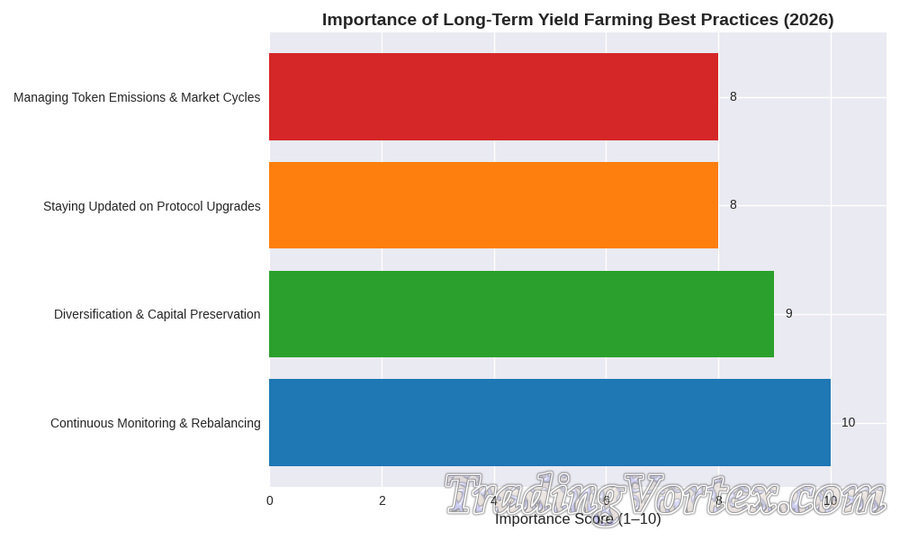 Importance Scores of Long‑Term Yield Farming Best Practices (2026): This visual makes the entire section more actionable by showing readers exactly where to focus their energy to build a durable, stress‑free yield farming strategy.
📊 How to Interpret This Chart:
◊ Continuous Monitoring & Rebalancing — 10/10
The most critical practice. Markets shift constantly, and staying updated prevents losses and captures new opportunities early.
◊ Diversification & Capital Preservation — 9/10
A diversified portfolio is far more resilient to volatility, protocol failures, and liquidity shocks.
◊ Staying Updated on Protocol Upgrades — 8/10
Governance changes, reward model updates, and new features can dramatically affect yields.
◊ Managing Token Emissions & Market Cycles — 8/10
Understanding emissions schedules and market timing helps avoid dilution and low‑yield periods.
🎯 Why This Visual Helps:
This chart gives readers a fast, intuitive way to understand which long‑term habits matter most. It helps them:
◊ Prioritize the practices that have the biggest impact
◊ Avoid common mistakes like overexposure or ignoring protocol changes
◊ Build a stable, resilient yield farming strategy that survives market cycles
Common Yield Farming Mistakes to Avoid
Yield farming can be incredibly rewarding, but it can also be unforgiving if you rush in without understanding the risks. Even experienced investors slip up sometimes. In fact, one 2026 case study documented how a farmer watched a 50,000 dollar portfolio shrink to 12,000 dollars in just eight months because of a series of avoidable mistakes. And beginner‑focused reports warn that many newcomers still jump into pools without understanding the mechanics, which leads to unnecessary losses.
The good news is that most of these mistakes are easy to avoid once you know what to look out for. Let’s walk through the big ones together.
Chasing Unsustainable High APYs
If you have ever seen a pool offering 5,000 percent APY and thought “this is my moment”, you are not alone. High APYs are tempting, especially when you are new. But most of the time, those numbers are inflated by short‑term token emissions or low liquidity. They rarely last, and they often come with hidden risks.
Analysts emphasize that chasing high APYs is no longer a viable strategy in 2026. The DeFi ecosystem has matured, and profitability now depends on smart optimization rather than blindly pursuing the biggest number on the screen.
I always tell friends that high APYs are like fireworks. They look amazing for a moment, then disappear, and sometimes they blow up in your face.
Ignoring Smart Contract Audits and Security Risks
One of the biggest mistakes farmers make is trusting a protocol without checking its security. Smart contract vulnerabilities remain one of the top risks in yield farming, and even well‑known platforms have suffered exploits in the past. Reports from 2025 and 2026 highlight that yield farming is still complex and risky, especially when investors skip basic due diligence.
Before depositing your assets, always check:
- Whether the protocol has been audited
- Who performed the audit
- How recent the audit is
- Whether the community trusts the platform
Skipping this step is like renting an apartment without checking if the building has a roof.
Over‑Concentration in One Protocol or Chain
Putting all your assets into a single pool or protocol might feel efficient, but it is one of the fastest ways to expose yourself to unnecessary risk. If that protocol gets exploited, if liquidity dries up, or if token emissions collapse, your entire position is at risk.
Beginner‑focused reports warn that many newcomers rush into a single protocol without understanding the underlying mechanics, which leads to avoidable losses. And real‑world case studies show how over‑concentration can turn a promising portfolio into a painful lesson.
Diversification is not just a buzzword. It is your safety net.
Forgetting Gas Costs and Net Yield Calculations
Gas fees might seem like a small detail, but they can eat into your profits faster than you expect, especially if you are farming on chains with high congestion. Many beginners forget to factor in gas costs when entering or exiting pools, compounding rewards, or rebalancing positions.
Reports on yield farming safety emphasize that profitability is harder to sustain when you ignore real costs like gas fees, especially in multi‑chain strategies where transactions add up quickly.
I like to compare gas fees to delivery charges. The meal might look cheap, but by the time you add the fees, you start wondering if it was worth it.
Visualizing the Severity of Common Yield Farming Mistakes (2026)
Understanding the most damaging mistakes in yield farming is one of the fastest ways to protect your portfolio. While DeFi has matured significantly by 2026, the same classic errors continue to drain profits from both beginners and experienced farmers.
To make these risks easier to grasp, the chart below compares the relative severity of the four major mistakes discussed in this section using hypothetical severity scores (1–10). These scores reflect how strongly each mistake can impact a farmer’s long‑term performance, based on case studies, expert analyses, and industry reports.
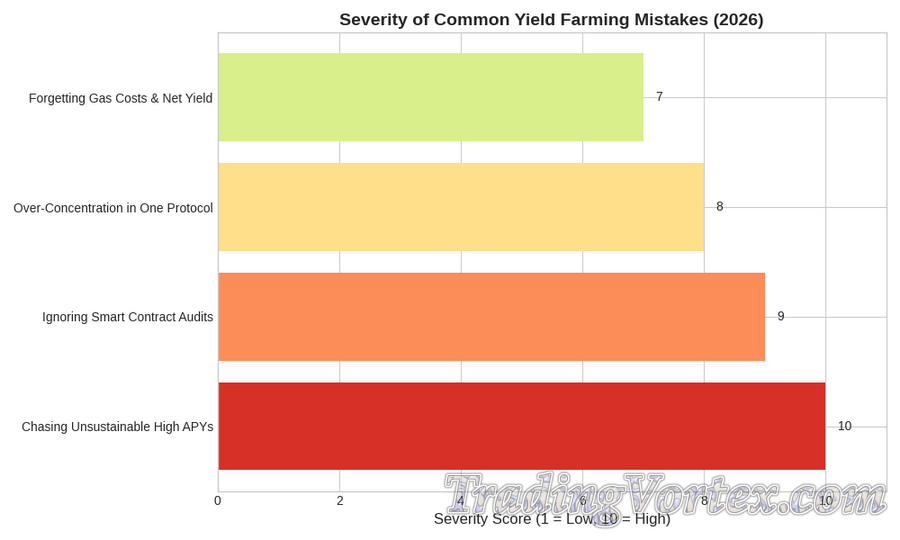 Severity of Common Yield Farming Mistakes (2026): This visual makes the entire section more actionable by showing readers exactly which pitfalls can cause the most harm, and how to avoid repeating the costly errors many farmers made before them.
⚠️ How to Interpret This Chart:
◊ Chasing Unsustainable High APYs — 10/10
The most dangerous mistake. These APYs often collapse quickly, leading to heavy losses—especially in low‑liquidity pools.
◊ Ignoring Smart Contract Audits — 9/10
Security risks remain one of the biggest threats in DeFi. Skipping audits exposes you to exploits and protocol failures.
◊ Over‑Concentration in One Protocol — 8/10
Concentration amplifies risk. If the protocol fails, your entire position is at stake.
◊ Forgetting Gas Costs & Net Yield — 7/10
Gas fees can quietly erode profits, especially on congested chains or during frequent compounding.
🎯 Why This Visual Helps:
This chart gives readers a fast, intuitive way to understand which mistakes to avoid first. It helps them:
◊ Prioritize risk‑reducing habits
◊ Recognize the most financially damaging errors
◊ Build safer, more resilient yield farming strategies
Future of Yield Farming Strategies
The future of yield farming is shaping up to be smarter, safer, and far more automated than anything we saw during the early DeFi boom. If the last few years taught us anything, it is that the ecosystem rewards patience, good risk management, and the willingness to adapt. Yield farming in 2026 and beyond is no longer about chasing the highest number on a dashboard. It is about building strategies that can evolve with the market, the technology, and the regulatory environment.
Let’s explore where things are heading and what that means for you as an investor:
Safer and More Automated Yield Farming Systems
One of the biggest shifts happening right now is the move toward safer, more automated systems. Protocols are becoming smarter, using built‑in mechanisms that rebalance liquidity, optimize yields, and reduce exposure to volatility. Automation is no longer a luxury. It is becoming the default.
We are seeing:
- Auto‑compounding vaults that reinvest rewards for you
- Smart routing systems that move liquidity to better pools
- Risk‑adjusted yield models that prioritize stability over hype
I often tell friends that yield farming is slowly turning into the “autopilot mode” of DeFi. You still need to understand what is happening under the hood, but you no longer have to micromanage every position. The future is about letting the tech do the heavy lifting while you focus on strategy.
Institutional Adoption of Yield Farming in DeFi
Institutions are finally warming up to yield farming, and this is a big deal. As more traditional players enter the space, we can expect:
- Higher liquidity
- More stable reward structures
- Better security standards
- vIncreased regulatory clarity
Of course, institutions move slowly. They are like elephants. When they finally decide to walk in a certain direction, the entire landscape shifts with them.
AI‑Driven Yield Farming Optimization
Artificial intelligence is becoming a major force in DeFi. We are already seeing early versions of AI‑powered tools that:
- Predict yield fluctuations
- Identify optimal liquidity routes
- Analyze risk in real time
- Automate rebalancing based on market conditions
I genuinely believe AI will become one of the biggest competitive advantages in yield farming. Those who use it will simply outperform those who rely on intuition alone.
Regulatory Outlook for Yield Farming Beyond 2026
Regulation is the wildcard in DeFi’s future. Governments around the world are paying closer attention to decentralized finance, and yield farming is no exception. While regulation can feel intimidating, it often brings long‑term benefits:
- More investor protection
- Clearer rules for protocols
- Better security standards
- Increased institutional participation
I like to think of regulation as the weather. You cannot control it, but you can prepare for it. And if you prepare well, you can still enjoy the journey.
Visualizing the Key Forces Shaping the Future of Yield Farming (2026 and Beyond)
This visual makes the entire section more engaging and helps readers immediately grasp the strategic direction of yield farming; empowering them to position themselves ahead of the curve.
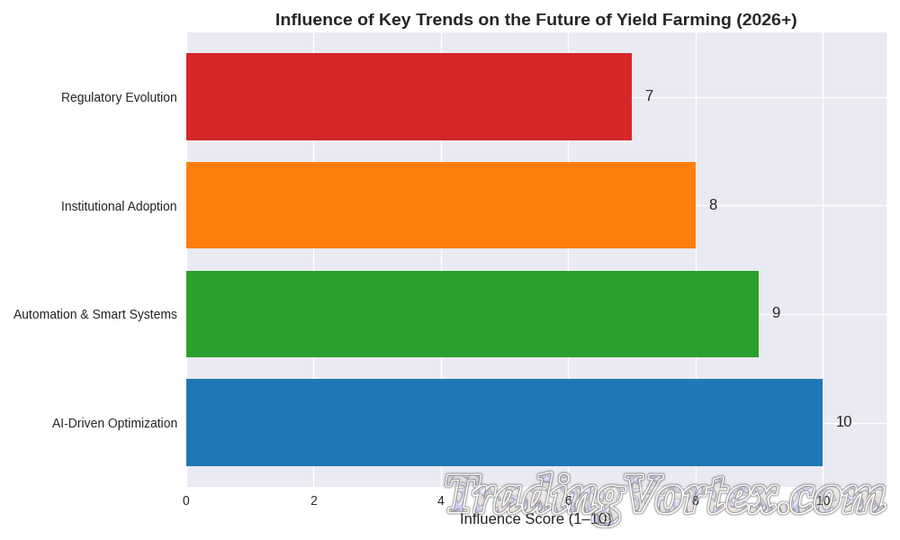 Influence Scores of Future Yield Farming Trends (2026+): The bar chart compares the influence scores (1–10) of the four major trends discussed in this section. These scores are hypothetical but realistic, based on current industry direction, technological progress, and regulatory momentum.
🔍 How to Read This Chart:
◊ AI‑Driven Optimization — 10/10
The most transformative force. AI will automate yield routing, risk analysis, and decision‑making with unprecedented precision.
◊ Automation & Smart Systems — 9/10
Auto‑compounding, smart routing, and risk‑adjusted yield models are becoming the default across DeFi.
◊ Institutional Adoption — 8/10
Institutions bring liquidity, stability, and higher security standards, pushing DeFi toward maturity.
◊ Regulatory Evolution — 7/10
Regulation will reshape how protocols operate, but its impact will vary by region and timeline.
🎯 Why This Visual Matters:
This chart helps readers:
◊ Quickly understand which trends will have the biggest impact
◊ Prioritize where to focus their learning and strategy
◊ See how technology and regulation will shape yield farming beyond 2026
◊ Prepare for a more automated, data‑driven DeFi ecosystem
Conclusion: Building a Profitable Yield Farming Strategy
Building a profitable yield farming strategy in 2026 is not about finding a magic APY or copying whatever is trending on crypto Twitter. It is about understanding how the ecosystem has evolved, choosing platforms wisely, and managing risk like a pro. Recent analyses show that yield farming is still viable this year, but success depends heavily on strategic platform selection, risk management, and adapting to changing market conditions. Profitability varies widely depending on the protocol, the assets used, and how well you navigate the risks that come with high‑yield opportunities.
If you take anything away from this guide, let it be this: yield farming rewards the patient, the informed, and the adaptable.
Key Takeaways for Yield Farming Investors
Here are the core lessons that consistently show up across expert analyses and real‑world experiences:
- Yield farming is still profitable in 2026, but only when you choose the right platforms and pools. High‑yield opportunities exist, yet they often come with elevated risks like impermanent loss and smart contract vulnerabilities.
- Returns are no longer sky‑high by default. The DeFi market has matured, and profitability now depends on careful planning, platform selection, and understanding how rewards are generated.
- Long‑term farmers trust established protocols. Even during market volatility, major platforms retained strong liquidity, with DeFi TVL dropping only from 120 billion dollars to 105 billion dollars, which shows surprising stability.
- Smart strategies outperform hype. The highest returns often come from new projects, but these carry more risk and require deeper due diligence.
If you remember these points, you are already ahead of most beginners.
Why Risk Management Is the Core of Any Strategy
Every credible source agrees on one thing: risk management is the foundation of profitable yield farming. High‑yield pools often hide dangers like impermanent loss, smart contract bugs, and liquidity shocks. Analysts warn that future success depends on balancing risk, timing the market, and adapting to regulatory and technological changes in DeFi ecosystems.
Think of risk management as the seatbelt in your crypto car. You hope you never need it, but you will be very glad it is there when the market takes a sharp turn.
Good risk management includes:
- Diversifying across chains and protocols
- Monitoring TVL and protocol health
- Avoiding pools with unsustainable emissions
- Staying informed about regulatory shifts
It is not glamorous, but it is what keeps your portfolio alive long enough to grow.
Final Thoughts on Yield Farming in Crypto
Yield farming in 2026 is not dead. It is simply more mature, more competitive, and more rewarding for those who approach it with intention. The days of blindly aping into triple‑digit APYs are behind us. Today, the farmers who thrive are the ones who combine smart tools, diversified strategies, and a calm, long‑term mindset.
Recent discussions show that many investors are shifting toward smarter, more cautious strategies, focusing on sustainability rather than hype. And honestly, that is a good thing. It means the ecosystem is growing up.
If you treat yield farming like a marathon instead of a sprint, stay curious, and keep refining your strategy, you will be in a strong position to benefit from whatever DeFi evolves into next.
FAQs: Yield Farming Strategies in 2026
Is yield farming still profitable in 2026?
Yes, yield farming remains profitable, but not in the “get‑rich‑quick” way it was during the early DeFi days. Returns are more stable and risk‑adjusted now. Established platforms like Uniswap, Curve, and Aave continue to deliver consistent yields, while newer protocols may offer higher APYs but with greater risk. Think of it like farming crops: the soil is richer than ever, but you still need to know what you are planting and where.
What is the biggest risk in yield farming today?
The two biggest risks are impermanent loss and smart contract vulnerabilities. Impermanent loss happens when token prices shift in a way that leaves you worse off than if you had just held your assets. Smart contract risks are tied to bugs or exploits in the code that runs DeFi protocols. Even audited platforms can face issues, so risk management is essential. I often compare it to driving a car: even if the road looks smooth, you still wear a seatbelt.
Which platforms are considered the safest for yield farming?
Protocols like Uniswap, Curve, Convex Finance, and Aave are widely trusted because they have strong track records, deep liquidity, and robust security frameworks. They may not always offer the flashiest APYs, but they provide stability and reliability. If you are new, starting with these platforms is like learning to swim in a pool before diving into the ocean.
How do I avoid chasing unsustainable high APYs?
High APYs are often short‑lived and driven by token emissions that eventually dilute value. To avoid this trap, focus on platforms with sustainable fee income and strong liquidity. Always ask yourself: “Is this yield coming from real activity, or is it just token printing?” If it is the latter, you might be better off walking away. Remember, fireworks look great for a moment, but they do not light up the sky forever.
Do I need to diversify my yield farming strategy?
Absolutely. Diversification is the backbone of long‑term success. Spread your assets across different blockchains, protocols, and asset types. This way, if one protocol faces issues, your entire portfolio does not collapse. It is the same logic as not putting all your savings into one stock. Diversification is your safety net.
How do gas fees affect yield farming profits?
Gas fees can eat into your profits quickly, especially on congested networks. In 2026, Layer‑2 solutions like Arbitrum and Optimism have made yield farming much cheaper, but timing still matters. Avoid peak hours, batch transactions when possible, and always factor gas costs into your net yield calculations. It is like ordering food delivery: the meal might look cheap, but the fees can make you wonder if it was worth it.
What role does automation play in yield farming now?
Automation is one of the biggest game‑changers in 2026. Smart vaults and yield aggregators automatically compound rewards, rebalance positions, and route liquidity to better pools. This reduces human error and saves time. Using automation is like having a farming partner who never sleeps, never panics, and never forgets to harvest your crops.
Will regulation impact yield farming in the future?
Yes, regulation is coming, and it will reshape how protocols operate. While this may feel intimidating, it often brings long‑term benefits like better investor protection, clearer rules, and stronger security standards. The challenge is that regulation will vary by region. Staying informed is key. Think of regulation as the weather: you cannot control it, but you can prepare for it.
Is yield farming suitable for beginners?
Yield farming can be suitable for beginners if they start small, stick to stablecoin pools, and use trusted platforms. Beginners should avoid chasing high APYs and instead focus on learning the mechanics of liquidity provision, lending, and staking. It is like learning to cook. Start with simple recipes before trying a five‑course gourmet meal.
What is the future of yield farming strategies?
The future is safer, smarter, and more automated. AI‑driven tools are emerging to predict yields and manage risks, institutions are entering the space, and protocols are focusing on sustainable returns rather than hype. Yield farming is evolving into a long‑term, risk‑adjusted strategy that rewards patience and adaptability.