

Cryptocurrency Arbitrage Trading for Beginners is your complete guide to understanding and practicing one of the most intriguing strategies in the crypto world. This article breaks down arbitrage in simple terms, showing how traders can profit from price differences across exchanges while learning the essential skills of discipline, fee management, and risk control.
Inside, you’ll discover beginner-friendly strategies like altcoin arbitrage, triangular trading loops, and DEX-CEX opportunities, all explained with real-world examples and step-by-step walkthroughs. We cover the risks, the role of AI and automation, and how global regulations are shaping the future of arbitrage. You’ll also find practical checklists, FAQs, and comparison tables that make complex concepts easy to digest.
Whether you’re a curious newcomer or an investor looking to sharpen your trading skills, this guide offers authentic insights, relatable anecdotes, and actionable tips. It emphasizes that arbitrage is less about chasing quick profits and more about building a strong foundation for long-term success in crypto trading.
Table of Contents:
- Introduction to Cryptocurrency Arbitrage Trading
- Understanding Cryptocurrency Arbitrage Basics
- Types of Cryptocurrency Arbitrage Strategies
- Latest Cryptocurrency Arbitrage Trends in 2026
- Shrinking Arbitrage Spreads in Bitcoin and Ethereum
- Rise of Institutional Arbitrage Bots and High-Frequency Trading
- Emerging Arbitrage Opportunities in Altcoins and Regional Exchanges
- Impact of Stablecoins and Layer 2 Networks on Arbitrage Trading
- Real-World Arbitrage Case Study: BANANA Token Spread (2026)
- Cryptocurrency Arbitrage Tools and Technology
- Challenges and Risks in Cryptocurrency Arbitrage Trading
- Beginner-Friendly Cryptocurrency Arbitrage Strategies
- Real-World Cryptocurrency Arbitrage Examples
- Future of Cryptocurrency Arbitrage Trading
- Conclusion: Is Cryptocurrency Arbitrage Worth It for Beginners?
- FAQs: Cryptocurrency Arbitrage Trading for Beginners
- What exactly is crypto arbitrage?
- Is crypto arbitrage risk-free?
- How much can beginners realistically earn?
- Do I need a lot of money to start?
- Which coins are best for arbitrage?
- How fast do I need to be?
- Can I use arbitrage bots safely?
- What’s the biggest beginner mistake?
- Is arbitrage legal everywhere?
- Can arbitrage be a full-time income?
- What tools do beginners need?
- What types of arbitrage are beginner-friendly?
- How do I avoid losing money?
- How do I practice without losing money?
Introduction to Cryptocurrency Arbitrage Trading
What Is Cryptocurrency Arbitrage Trading?
At its core, cryptocurrency arbitrage trading is about buying a coin where it’s cheaper and selling it where it’s more expensive. Imagine walking into one market where apples cost 1 dollar, then crossing the street to another where they’re selling for 1.10 dollars. You pocket the difference, minus the cost of carrying those apples across. In crypto, the “carrying” part is digital transfers, and the apples are Bitcoin, Ethereum, or even niche altcoins.
The reason this works is that crypto markets are fragmented. Prices don’t update at the same speed everywhere. A coin might be trading at $90,100 on one exchange and $90,180 on another at the same moment. Arbitrage traders jump in, buy low, sell high, and capture the spread before it disappears. It sounds simple, but in practice, it’s a race against time, fees, and competition.
Why Arbitrage Trading Matters in the Crypto Market Today
Arbitrage trading matters because it highlights the inefficiencies in crypto markets. Unlike traditional stock exchanges that are tightly regulated and synchronized, crypto trades across dozens of centralized exchanges, decentralized platforms, and liquidity pools worldwide. This creates short-lived price gaps that traders can exploit.
For beginners, arbitrage is appealing because it reduces directional risk. You’re not betting on whether Bitcoin will rise or fall tomorrow, you’re betting on a temporary mismatch in pricing. That said, it’s not risk-free. Delays in transferring coins, sudden volatility, or high fees can turn a “sure thing” into a losing trade.
Arbitrage also plays a role in keeping markets efficient. Every time traders exploit a price gap, they help close it, making crypto markets more stable over time. In 2026, institutional players and high-frequency bots dominate the big spreads, but retail traders still find opportunities in altcoins, regional exchanges, and slower-to-update platforms.
Think of arbitrage as the plumbing of the crypto ecosystem. It’s not glamorous, but it keeps the system flowing smoothly. Without arbitrage traders, price gaps would linger longer, and markets would feel less trustworthy.
Benefits and Risks for Beginner Crypto Traders
💡 Benefits:
- Lower exposure to market direction: You don’t need to predict long-term price trends.
- Frequent opportunities: Crypto trades 24/7, so gaps appear at odd hours.
- Beginner-friendly entry point: With small amounts, you can test strategies without huge risk.
⚠️ Risks:
- Fees eat profits: Trading fees, withdrawal fees, and gas costs can wipe out gains.
- Speed matters: Opportunities vanish in seconds, and bots are faster than humans.
- Execution risks: Transfers between exchanges can be delayed, leaving you stuck.
- Regulatory uncertainty: Rules differ across countries, and compliance can be tricky.
Think of arbitrage as a game of musical chairs. The music is the price gap, and you need to sit down before it stops. Beginners can still play, but they need to be realistic: the days of easy profits are gone, and success now depends on careful planning, fee awareness, and choosing the right niche opportunities.
Arbitrage is not a magic money machine, but rather a discipline that rewards speed, precision, and awareness of costs. It’s a strategy that can be friendly to beginners if approached with caution, but it demands respect for the risks involved.
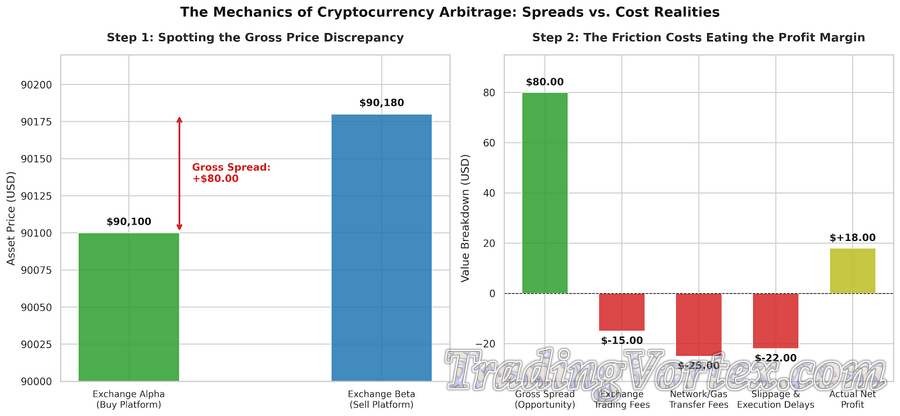 The Mechanics of Cryptocurrency Arbitrage: Visualizing Market Spreads versus Friction Cost Realities.
This dual-panel visualization breaks down the lifecycle of a cryptocurrency arbitrage trade to bridge the gap between initial theory and actual market conditions. It uses the contextual numbers provided in the text (such as an asset priced at versus per unit) to visually map out why arbitrage requires a deep understanding of friction costs.
1. Left Chart: Spotting the Gross Price Discrepancy
The left panel represents the fragmented market reality. It shows a simultaneous price listing of the exact same asset across two isolated trading environments:
◊ Exchange Alpha (Buy Platform): The asset is valued lower at .
◊ Exchange Beta (Sell Platform): The asset is valued higher at .
◊ The Gross Spread: This creates an immediate, visible price asymmetry of . This window of mismatch represents the raw opportunity before any execution mechanics take place.
2. Right Chart: The Reality of Profit Erosion (Friction Costs)
The right panel models how the gross spread is systematically reduced by market frictions as soon as a trader moves to capture it. It acts as an educational breakdown of the specific risks and barriers discussed in the text:
◊ Exchange Trading Fees (): Executing both the market buy order on Exchange Alpha and the market sell order on Exchange Beta triggers trade execution costs that immediately chip away at the raw spread.
◊ Network/Gas Transfer Fees (): Moving the asset physically across the blockchain network from the buying exchange to the selling exchange incurs unavoidable blockchain layer fees (gas).
◊ Slippage & Execution Delays (): As highlighted by the author's anecdotal warning, order books change fast. A delay in transfer network confirmations or unexpected price movements while your funds are in transit results in "slippage": meaning you sell at a less favorable price than originally anticipated.
◊ Actual Net Profit (): The final bar represents what is left for the trader. While a gross opportunity of seemed substantial, the realistic net return is only after accounting for the "game of musical chairs" dynamics.
♦ Key Takeaway for Retail Traders:
Use this chart as a blueprint for risk management. Successful arbitrage in modern markets is not just about discovering the price gaps shown on the left; it is about keeping your friction costs (on the right) low enough so that the net profit bar remains positive. If network fees rise or execution speeds lag, that final net profit bar will quickly drop below zero, resulting in a net loss.
Understanding Cryptocurrency Arbitrage Basics
How Cryptocurrency Arbitrage Works Across Exchanges
There are two main ways to execute this:
- Classic cross-exchange arbitrage: You transfer coins between exchanges. The risk is that prices can change during the transfer window, and sometimes even a few minutes can turn a winning trade into a loss.
- Pre-positioned arbitrage (balance arbitrage): You hold funds on multiple exchanges simultaneously. When a spread appears, you buy on one and sell on the other instantly, avoiding transfer delays. This requires more capital but is how most serious traders operate today.
I once tried the classic method with Solana, thinking I had spotted a neat spread. By the time my coins landed on the second exchange, the price had shifted, and my “profit” turned into a small loss. That’s when I realized: arbitrage is less about spotting the gap and more about executing faster than everyone else. It’s like sprinting for a bus that’s already pulling away: you either catch it in time or you’re left standing at the curb.
Why Crypto Prices Differ Between Platforms
Unlike traditional stock markets, crypto exchanges are independent ecosystems. Each has its own order book, liquidity, and user base. This means:
- Liquidity differences: Larger exchanges like Binance or Coinbase have tighter spreads, while smaller ones may show wider gaps.
- Regional demand: Local exchanges sometimes price coins differently due to demand in specific countries. For example, in markets where access to global liquidity is limited, Bitcoin can trade at a premium.
- Trading volumes: High-volume exchanges update prices faster, while low-volume platforms lag, creating temporary mismatches.
- Regulatory and fiat currency factors: Local restrictions or currency conversion rates can create unique spreads, especially in countries with strict capital controls.
Think of it like shopping in two different supermarkets. One has a bustling crowd and constant restocking, so prices stay consistent. The other has fewer shoppers and slower updates, so prices fluctuate more. Arbitrage traders thrive on those inconsistencies, swooping in when the shelves don’t quite match.
Key Factors Driving Arbitrage Opportunities in 2026
The landscape has shifted since the early days:
- Compressed spreads: Bitcoin and Ethereum spreads are smaller now, often less than 0.5 percent, making altcoins more attractive for retail traders.
- Institutional competition: High-frequency trading firms and bots dominate major exchanges, leaving retail traders to hunt niche opportunities in smaller markets.
- Technology improvements: Arbitrage bots, APIs, and real-time spread trackers make execution faster, but they also raise the bar for beginners.
- Network fees: Gas costs on Ethereum or withdrawal fees on exchanges can erase profits if not carefully calculated. Traders who ignore fees often find their “profits” vanish into thin air.
- Regulatory differences: Some regions still experience “spatial arbitrage” where local demand pushes prices higher, especially in markets with limited access to global liquidity.
Arbitrage is not about predicting the future, it’s about exploiting inefficiencies in the present. It’s a strategy that rewards speed, precision, and awareness of costs, and while the big players dominate the obvious spreads, there’s still room for sharp-eyed beginners willing to play smart.
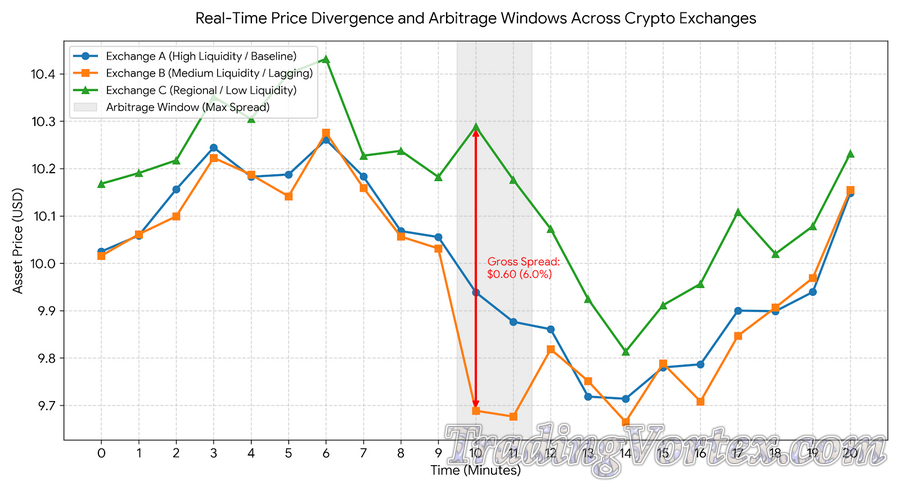 Real-Time Price Divergence and Arbitrage Windows Across Crypto Exchanges.
This visual representation illustrates how price discrepancies manifest across independent cryptocurrency trading platforms and how you can identify execution windows. The line chart tracks the price of a hypothetical altcoin over a period across three distinct types of exchanges:
◊ Exchange A (Blue Line): A high-liquidity, high-volume platform that updates rapidly and serves as the market baseline.
◊ Exchange B (Orange Line): A medium-liquidity exchange that exhibits a slight operational lag and frequent minor deviations from the baseline.
◊ Exchange C (Green Line): A low-liquidity or regional platform that consistently carries a premium due to localized demand and capital fragmentation.
♦ How to Interpret This Visual:
1. The Formation of the Spread: Observe the shaded area designated as the Arbitrage Window around Minute . While Exchange A stays steady, a sudden selling pressure on Exchange B drives its price down, while simultaneous buying pressure on Exchange C pushes its price upward. This creates a temporary Gross Spread of (a price difference).
2. The Convergence Effect: Notice how quickly the gap closes after Minute . As arbitrage traders exploit the inefficiency by buying on Exchange B and selling on Exchange C, their collective trading volume forces the prices back toward equilibrium. This demonstrates why execution speed is paramount.
♦ How to Utilize This Concept in Your Trading:
◊ Spotting Low-Liquidity Delays: When monitoring markets, look for platforms that mimic Exchange C or Exchange B. Smaller or regional exchanges often lag behind major market moves by several seconds or minutes, offering predictable entry points.
◊ Calculating Net vs. Gross Profits: While a gross spread is highly attractive, always subtract the platform-specific maker/taker fees, withdrawal fees, and blockchain network gas costs. If your total fees across both platforms equal , your actual net profit on this trade would be .
◊ Choosing the Right Strategy: If you attempt a classic cross-exchange arbitrage (transferring the asset from Exchange B to Exchange C during Minute ), the prices will likely have converged by the time your transaction clears at Minute , resulting in a net loss. To exploit this successfully, you must use pre-positioned balance arbitrage: holding stablecoins on Exchange B and the target altcoin on Exchange C simultaneously; allowing you to execute both trades instantly the moment the window opens.
Types of Cryptocurrency Arbitrage Strategies
Centralized Exchange Arbitrage (CEX Arbitrage)
There are two main approaches:
- Transfer arbitrage: Buy on Exchange A, transfer to Exchange B, then sell. The risk is that prices may shift during the transfer window, leaving you stuck with coins that are no longer profitable.
- Balance arbitrage: Hold funds on multiple exchanges at once, then execute buy and sell orders instantly. This avoids transfer delays but requires more upfront capital.
Beginners often start here because the logic is straightforward. The reality, though, is that fees, withdrawal limits, and transfer times can turn a “sure win” into a frustrating loss. I’ve had trades where the spread looked juicy, only to realize that after fees, I had made less than the cost of a coffee.
Triangular Arbitrage in Crypto Trading
The beauty of triangular arbitrage is that you don’t need to move coins between exchanges, so it’s faster. The downside is that it requires sharp math skills and constant fee awareness. I once thought I had cracked a triangular loop with ETH, BTC, and USDT, only to discover that after fees, my “profit” was literally a few cents. It was a humbling reminder that in arbitrage, gross spreads mean nothing if net returns don’t add up.
Decentralized Exchange vs Centralized Exchange Arbitrage (DEX-CEX Arbitrage)
DEX-CEX arbitrage is exciting because liquidity pools update differently than order books, creating unique spreads. However, it comes with challenges:
- Gas fees: On Ethereum, high gas costs can erase profits instantly.
- Slippage: Large trades can move prices in DEX pools, reducing gains.
- Execution speed: Reliable bots or automation are essential to compete.
Retail traders often find opportunities in newly listed tokens or smaller liquidity pools, while institutions dominate the big pairs. It’s a strategy that rewards creativity and quick reflexes, but it punishes anyone who ignores transaction costs.
Statistical and Algorithmic Arbitrage in Cryptocurrency Markets
Statistical arbitrage uses quantitative models and algorithms to identify mispricings across multiple exchanges or pairs. Instead of manually spotting gaps, traders rely on bots that crunch data and execute trades in milliseconds.
This is the most advanced form of arbitrage, requiring coding skills, API access, and sometimes machine learning models. Institutions dominate here, but retail traders can experiment with simpler bots on niche pairs.
The catch is that profits are razor-thin. In 2026, spreads on major coins often last only seconds and measure in basis points.
For beginners, statistical arbitrage is more of a learning playground than a reliable income stream. It teaches discipline, coding, and market mechanics, but it’s not the place to expect quick riches.
Comparison Table of Arbitrage Strategies
| Strategy | Speed of Execution | Main Risks | Suitability for Beginners |
|---|---|---|---|
| CEX Arbitrage | Slow if transferring coins; faster with balance arbitrage | Transfer delays, fees, price shifts | Good entry point, but fees often reduce profits |
| Triangular Arbitrage | Fast, within one exchange | Complex calculations, fees, small spreads | Moderate, requires math skills and fee awareness |
| DEX-CEX Arbitrage | Moderate, depends on blockchain speed | Gas fees, slippage, execution delays | Risky for beginners, better for advanced traders |
| Statistical Arbitrage | Extremely fast, algorithm-driven | Razor-thin margins, tech complexity | Low suitability, more for learning than profit |
📌 Takeaway:
Each arbitrage strategy has its own flavor: CEX-to-CEX is simple but slow, triangular is clever but fee-sensitive, DEX-CEX is innovative but gas-heavy, and statistical arbitrage is fast but complex.
Beginners should start small, focus on altcoins or regional exchanges, and treat arbitrage as a way to learn the mechanics of crypto markets rather than a guaranteed money machine.
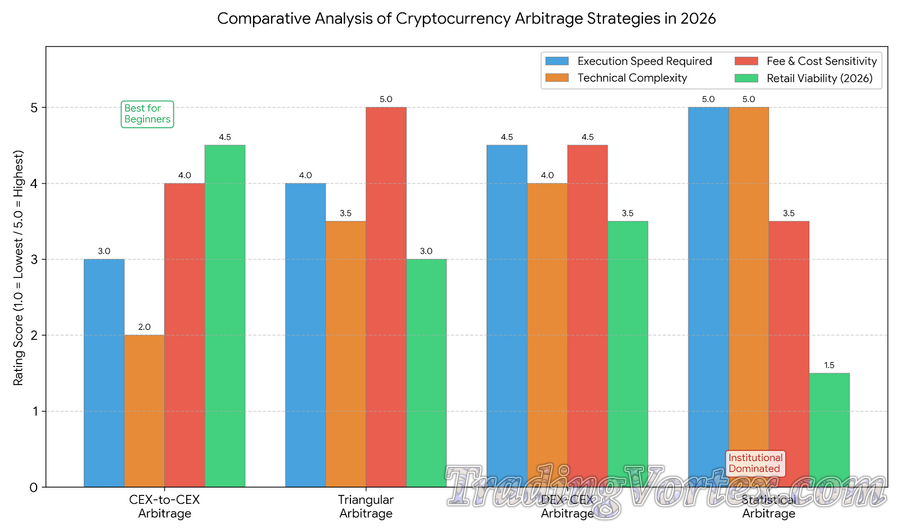 Comparative Analysis of Cryptocurrency Arbitrage Strategies in 2026.
This multi-variable grouped bar chart provides a comparative framework of the four primary cryptocurrency arbitrage strategies, scoring each on a scale from (Lowest) to (Highest) across four critical operational metrics: Execution Speed Required, Technical Complexity, Fee & Cost Sensitivity, and Retail Viability (2026).
♦ How to Interpret This Visual:
Each strategy is evaluated across the same set of performance criteria to help you choose the path that best matches your resources:
1. CEX-to-CEX Arbitrage (Best for Beginners): This remains the most accessible option for individual traders, sporting the highest Retail Viability score () and lowest Technical Complexity (). However, its moderate speed score reflects the reality that transfer times or capital lockups can act as structural bottlenecks.
2. Triangular Arbitrage (High Friction): Operating entirely within a single exchange, this strategy eliminates cross-platform transfer lag, raising its Execution Speed Required to . However, because it requires executing three consecutive trades in a single loop, it has a maximum Fee & Cost Sensitivity score (), meaning exchange trading fees can rapidly wipe out gross margins.
3. DEX-CEX Arbitrage (Balanced Complexity): Bridging automated liquidity pools with centralized order books demands higher technical proficiency (). It features significant Fee & Cost Sensitivity () due to unpredictable network gas fees on layers like Ethereum and asset price slippage within smaller decentralized pools.
4. Statistical Arbitrage (Institutional Dominated): Representing the most advanced tier, this strategy demands near-flawless execution speed () and high technical complexity () to operate quantitative algorithmic bots. Consequently, its Retail Viability in 2026 sits at a minimal , functioning primarily as an institutional arena or a purely educational playground for retail coders.
♦ How to Utilize This Comparative Matrix:
◊ Audit Your Infrastructure Before Trading: Before deploying capital into any strategy, use this chart to cross-reference your personal limitations. If you do not possess advanced programming skills, avoid Statistical Arbitrage and focus on CEX-to-CEX or niche DEX-CEX loops where your manual or basic API inputs can still find inefficiencies.
◊ Factor in the Cost Multipliers: If you are drawn to Triangular Arbitrage, remember its maximum score for fee sensitivity. You must ensure your exchange tier provides a low enough maker/taker fee structure (e.g., via volume discounts or native token utility discounts) to keep the triple-trade loop net-profitable.
◊ Target Niche Liquidity: Since institutions dominate the high-speed, high-complexity spectrum, retail success in 2026 relies on navigating sectors where large-scale bots struggle to operate efficiently: such as newly launched altcoins on DEX platforms or regional centralized exchanges with restricted local fiat gateways.
Latest Cryptocurrency Arbitrage Trends in 2026
Shrinking Arbitrage Spreads in Bitcoin and Ethereum
Back in the early 2020s, it wasn’t unusual to see spreads of 1–3 percent on Bitcoin and Ethereum across major exchanges. Those days are gone. Today, spreads on top pairs average 0.1–0.4 percent, a reflection of deeper liquidity, faster price discovery, and armies of arbitrageurs closing gaps almost instantly.
For retail traders, this means the “easy money” era has ended. Profits are still possible, but they’re razor-thin and often erased by trading fees, withdrawal costs, and slippage if not carefully managed.
I remember chasing a juicy 2 percent spread on ETH years ago, only to realize that by the time I factored in fees, I had made less than the cost of lunch. That lesson still holds true today: in arbitrage, net profit matters more than the headline spread.
Rise of Institutional Arbitrage Bots and High-Frequency Trading
Arbitrage opportunities on major exchanges now last seconds or even milliseconds. Sophisticated bots, often run by institutional players, dominate these trades. They rely on AI-driven algorithms, flash loans, and high-frequency execution systems that can react faster than any human.
For beginners, competing directly with these bots is unrealistic. However, there’s still room in slower markets, niche tokens, and regional exchanges where institutional players aren’t as aggressive. Think of it like fishing: the big boats scoop up the obvious catches in deep waters, but smaller ponds still have fish for those willing to look.
Emerging Arbitrage Opportunities in Altcoins and Regional Exchanges
While BTC and ETH spreads have compressed, altcoins and regional exchanges remain fertile ground. Coins like XLM, UNI, SHIB, and ATOM regularly show spreads between 0.1–0.2 percent across exchanges such as Gate.io, KuCoin, and MEXC.
Regional demand imbalances also create short-lived premiums. For example, tokens can trade at higher prices in Asian markets compared to European ones due to local demand spikes. Beginners often find success here by focusing on smaller exchanges and less liquid coins, where institutional bots are less aggressive and spreads last longer.
Impact of Stablecoins and Layer 2 Networks on Arbitrage Trading
Stablecoins and Layer 2 networks have reshaped arbitrage in 2026:
- Stablecoins like USDT, USDC, and DAI reduce volatility, making arbitrage calculations more predictable and less risky.
- Layer 2 networks such as Arbitrum, Optimism, and zkSync lower gas fees dramatically, allowing traders to execute DEX-CEX arbitrage without losing profits to Ethereum’s high transaction costs.
- Cross-chain arbitrage has grown in popularity, with traders exploiting differences between liquidity pools across blockchains like Solana, Avalanche, and Polygon.
These innovations make arbitrage more accessible, but they also require technical know-how, automation, and careful fee management to be effective.
Real-World Arbitrage Case Study: BANANA Token Spread (2026)
Step 1: Spotting the Spread
- Token: BANANA
- Exchanges involved: Gate (long position) and KuCoin (short position)
- Initial spread: ~2 percent difference between Gate and KuCoin prices
Step 2: Entry Strategy
- The trader entered positions in batches of 760 tokens to avoid slippage.
- By splitting entries, they maintained liquidity and captured the spread more effectively.
- Timing was critical: they waited exactly 50 seconds for KuCoin’s funding recalculation to avoid a 0.7 percent fee.
Step 3: Managing Risks
- Delta-neutral approach: The trader hedged by going long on Gate and short on KuCoin simultaneously.
- Stop-loss and take-profit orders: Set symmetrically at 88 percent to protect balance against sudden reversals.
- Reverse spread phenomenon: At one point, prices didn’t just converge, they swapped places, maximizing profit potential.
Step 4: Exit Strategy
- The trader closed positions in smaller increments of 385 tokens to minimize slippage.
- Exiting in 10 parts allowed them to lock in gains without disrupting liquidity.
Step 5: Final Profit Calculation
- Gross profit: $1,114 on KuCoin covered hedge costs.
- Net profit: $282 in one hour after accounting for fees and execution costs.
🎓 Key Lessons for Beginners:
- Spreads look attractive, but fees can eat them alive. Always calculate net profit after trading fees, withdrawal costs, and funding rates.
- Timing matters. Even a 50-second delay can mean the difference between profit and loss.
- Risk management is non-negotiable. Symmetrical stop-loss and take-profit orders protect against sudden reversals.
- Small exits reduce slippage. Breaking trades into smaller increments helps secure gains.
📌 Takeaway:
Arbitrage in 2026 is no longer about spotting obvious gaps, it’s about executing faster, smarter, and cheaper than everyone else. Beginners should avoid chasing BTC and ETH spreads, instead focusing on altcoins, regional exchanges, and Layer 2 opportunities where competition is lighter. The game has changed, but for sharp-eyed traders willing to adapt, arbitrage remains a valuable way to learn, experiment, and profit in crypto markets.
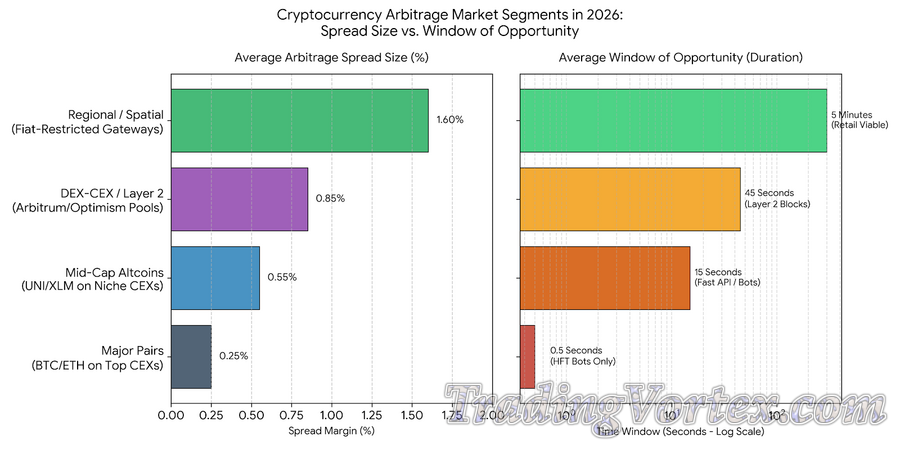 Cryptocurrency Arbitrage Market Segments in 2026: Spread Size vs. Window of Opportunity.
This dual-panel horizontal bar chart analyzes the landscape of cryptocurrency arbitrage in 2026 across four distinct market segments. The left panel measures the Average Spread Size (%), representing the gross profit margin available before fees. The right panel displays the Average Window of Opportunity (Duration) on a logarithmic scale, illustrating how much time a trader has to detect and execute the trade before the market inefficiency self-corrects.
♦ How to Interpret This Visual:
1. Major Pairs (Top Row - Dark Blue / Red): Bitcoin and Ethereum trades on major centralized exchanges (CEXs) feature the thinnest average spreads () and a hyper-compressed time window of just . This visualizes why individual manual trading in this segment is mathematically non-viable; these gaps are instantly consumed by high-frequency institutional trading (HFT) bots.
2. Mid-Cap Altcoins (Second Row - Blue / Orange): Assets like UNI, XLM, or ATOM on niche exchanges offer wider average spreads () and longer-lasting opportunities (). This segment represents a transition zone where retail traders utilizing basic API connection scripts or automated tracking webhooks can realistically compete.
3. DEX-CEX / Layer 2 (Third Row - Purple / Yellow): Arbitrage loops connecting decentralized pools (on networks like Arbitrum or Optimism) to centralized books show healthy gross spreads () with a window extending to roughly . This timeline is tightly bound to network block-minting intervals and smart contract execution latency.
4. Regional / Spatial (Bottom Row - Green / Light Green): Markets isolated by local fiat-restricted gateways or capital controls present the largest pricing inefficiencies () and the longest decay windows (). This remains the most lucrative and highly viable playground for retail investors, as regulatory hurdles prevent institutional automated liquidity from instantly flooding the gap.
♦ How to Utilize This Trends Dashboard:
◊ Align Your Tools with Your Target Market: Do not attempt to clear Major Pairs unless you have co-located servers and sub-millisecond execution speeds. If your infrastructure has a latency of a few seconds, intentionally filter your scanners to focus on Mid-Cap Altcoins or Layer 2 Pools.
◊ Account for Capital Lockups in Regional Trades: While the spread on Regional Exchanges looks highly attractive and offers a comfortable window, remember that these wider gaps exist precisely because moving fiat currency or local assets out of those regions is slow or heavily restricted. Ensure your expected net gain justifies the time your capital will spend locked in transit.
◊ Optimize for Layer 2 Block Times: When executing DEX-CEX trades, time your transaction submittals to align with the specific Layer 2 block schedules. A window gives you breathing room, but executing at the start of a block batch can minimize slippage and help you beat competing retail bots.
Cryptocurrency Arbitrage Tools and Technology
Best Crypto Arbitrage Trading Bots for Beginners
Crypto trading bots are now the backbone of arbitrage. They scan exchanges in real time, detect spreads, and execute trades automatically. Popular beginner-friendly options include:
- Pionex: Offers built-in bots, low fees, and no coding required, making it perfect for newcomers.
- 3Commas: Supports multiple exchanges, customizable strategies, and balances simplicity with advanced features.
- Bitsgap: Known for automated arbitrage across global exchanges, with strong risk management tools.
I’ve tested Pionex myself, and it felt almost like autopilot trading. The bot handled trades without stress, though profits were modest.
For beginners, the key is to start small, observe how bots behave, and gradually scale up once you understand the rhythm of the markets.
Cross-Exchange Transfer Solutions and Wallets
One of the biggest headaches in arbitrage is moving funds quickly between exchanges. In 2026, traders rely on:
- Multi-exchange wallets that allow instant transfers without waiting for blockchain confirmations.
- Arbitrage scanners like ArbitrageScanner, which track spreads while factoring in withdrawal fees and transfer times.
- API integrations that let bots manage balances across multiple platforms simultaneously.
Gas Fee Optimization and Blockchain Network Efficiency
Gas fees can make or break a trade. On Ethereum, fees can spike to $50–100, wiping out profits instantly. In 2026, traders use:
- Layer 2 networks like Arbitrum, Optimism, and zkSync to cut costs dramatically.
- Cross-chain routing tools that automatically choose the cheapest path for transfers.
- Dynamic fee adjustment bots that prioritize execution speed while minimizing costs.
Beginners should always calculate net profit after fees. A spread that looks profitable on paper can quickly turn into a loss once gas and withdrawal costs are added. I’ve seen traders celebrate a “win” only to realize later that they had actually paid more in fees than they earned.
AI and Machine Learning in Crypto Arbitrage Strategies
AI has become a game-changer. Modern bots use machine learning models to predict spread duration, detect liquidity shifts, and optimize trade execution. Advanced platforms now include:
- On-chain wallet analysis to anticipate large moves.
- Sentiment tracking from social media and news feeds.
- Predictive modeling for spread sustainability.
Institutions dominate this space, but retail traders can still experiment with simpler AI-driven bots. Think of AI as your co-pilot: it won’t guarantee profits, but it can help you avoid bad trades and spot opportunities faster. For beginners, even basic AI features like automated risk alerts can make a huge difference.
Cryptocurrency Arbitrage Tools Comparison table
| Platform / Tool | Best For | Key Features | Suitability |
|---|---|---|---|
| Pionex | Beginners | Built-in bots, low fees, no coding required | Excellent entry point for newcomers |
| 3Commas | Beginners to Intermediate | Multi-exchange support, customizable strategies, user-friendly dashboards | Great balance of simplicity and flexibility |
| Bitsgap | Intermediate | Automated arbitrage across exchanges, strong risk management tools | Suitable for traders ready to scale |
| ArbitrageScanner | Advanced | Real-time spread detection, fee calculation, multi-exchange monitoring | Best for serious traders with technical know-how |
| Custom AI Bots | Advanced | Machine learning models, predictive analytics, flash loan integration | High barrier to entry, but powerful for institutions |
📌 Takeaway:
Arbitrage tools in 2026 are faster, smarter, and more automated than ever. Beginners should start with user-friendly bots like Pionex or 3Commas, learn to manage fees with Layer 2 networks, and gradually explore advanced scanners and AI-driven platforms. The technology is powerful, but the golden rule remains the same: always calculate net profit after fees and risks before hitting “execute.”
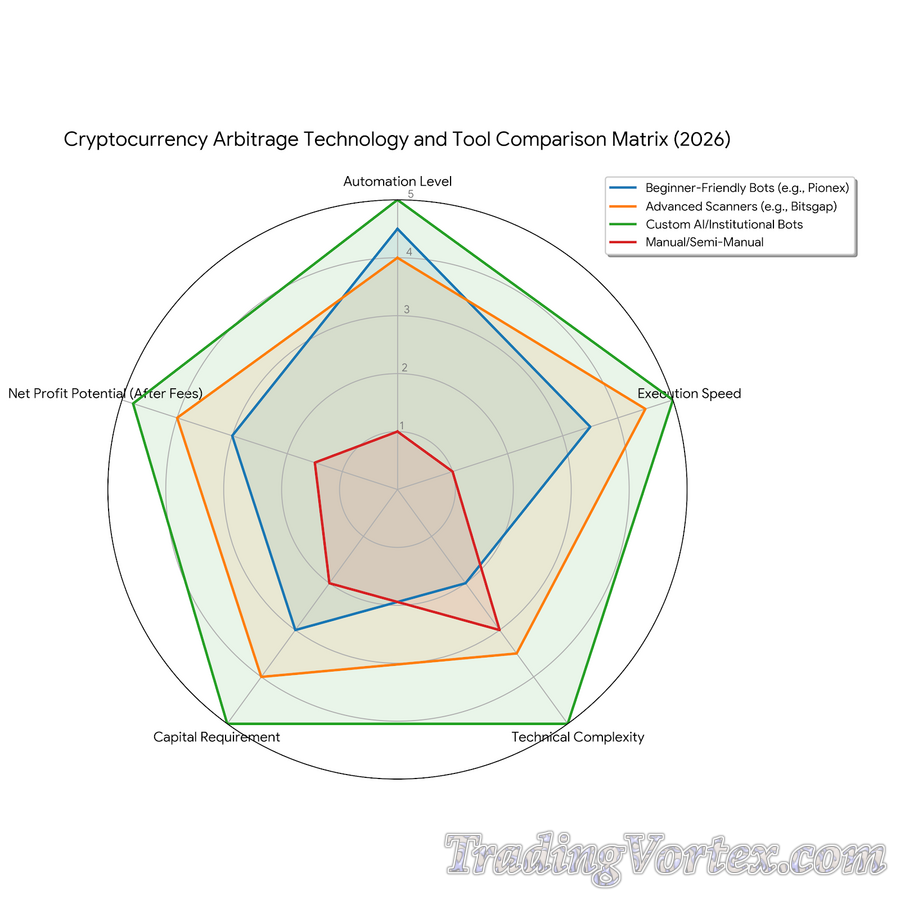 Cryptocurrency Arbitrage Technology and Tool Comparison Matrix (2026).
This spider chart provides a comparative visual guide to the landscape of cryptocurrency arbitrage tools in 2026, mapping four main categories of platforms/strategies against five key operational dimensions. It scores each approach on a normalized scale from 1 (Very Low) to 5 (Very High) to help you assess which path aligns best with your technical expertise, available capital, and risk appetite.
♦ How to Interpret This Visual:
A spider chart (or radar chart) allows you to see how each category performs across multiple attributes simultaneously. A "perfect" tool would fill the entire circle, but every arbitrage strategy involves trade-offs.
◊ Automation Level: Indicates how much of the "scan-detect-execute" cycle is handled without human input.
◊ Execution Speed: Measures how fast a trade is completed. Speed is critical for capturing profitable spreads before they evaporate.
◊ Technical Complexity: Evaluates the technical skill required to set up, manage, and troubleshoot the tool.
◊ Capital Requirement: Estimates the upfront investment needed to operate the tool effectively and satisfy exchange requirements.
◊ Net Profit Potential (After Fees): Estimates potential earnings once trading fees, withdrawal fees, and gas costs are subtracted.
♦ Utilizing the Matrix for Your Strategy:
1. Beginner-Friendly Bots (Blue Poly): These tools, like Pionex and 3Commas, are highlighted by high scores in Automation Level (4.5) and very low scores in Technical Complexity (2.0) and Capital Requirement (3.0). They are excellent entry points, offering autopilot functionality without technical headaches, though their focus on simplicity often limits their Net Profit Potential (3.0) and access to the fastest market execution.
2. Advanced Scanners (Orange Poly): Tools like Bitsgap are more specialized, excelling in Execution Speed (4.5) and Capital Requirement (4.0) to access advanced cross-exchange tracking. They require more technical skill (Complexity: 3.5) but offer a higher Profit Potential (4.0) for traders willing to manage the increased configuration.
3. Custom AI/Institutional Bots (Green Poly): This is the high-tech frontier. These bots dominate the landscape with maximum scores in Automation (5.0), Execution Speed (5.0), and Profit Potential (4.8). They achieve this, however, at the cost of being highly inaccessible to beginners, demanding prohibitive Technical Complexity (5.0) and massive Capital (5.0) to operate in 2026.
4. Manual/Semi-Manual (Red Poly): As emphasized in the text, this approach is essentially obsolete. While it scores lowest in Complexity (3.0) and Capital Requirement (2.0), it is fundamentally non-competitive, with a 1.0 score for both Automation and Speed, ensuring a very low Net Profit Potential (1.5).
♦ The takeaway is that technology is now the differentiating factor in arbitrage. While beginners should start with simple automation, moving up the profitability ladder in 2026 demands a structured investment in advanced technology and fee management, not faster manual fingers.
Challenges and Risks in Cryptocurrency Arbitrage Trading
Low Profit Margins and Compressed Spreads
- Bitcoin and Ethereum spreads have shrunk to 0.1–0.4 percent on major exchanges, compared to 1–3 percent just a few years ago. This compression is the result of deeper liquidity and faster price discovery.
- Altcoins sometimes show wider spreads, but liquidity is thinner, meaning even small trades can move the market against you.
- Lesson: What looks like a juicy spread often disappears once you factor in fees and slippage. Many traders celebrate “profits” only to realize they’ve paid more in costs than they earned. I’ve seen beginners brag about a 1 percent spread, only to discover their net return was negative after fees.
High Competition from Institutional Traders
- Sophisticated AI-driven bots and high-frequency trading firms dominate arbitrage opportunities, executing trades in milliseconds.
- Retail traders rarely win in BTC and ETH markets, where spreads vanish almost instantly.
- Lesson: Beginners should focus on niche opportunities like altcoins or regional exchanges, where institutional players are less aggressive. Think of it like racing against Formula 1 cars: you won’t win on the main track, but you might find success on smaller circuits.
Transaction Costs: Exchange Fees, Slippage, and Gas Fees
- Exchange fees: Trading fees average 0.1–0.2 percent per side, plus withdrawal costs that vary by exchange.
- Slippage: Large orders can move prices, especially in thin altcoin markets. A quoted 0.35 percent spread can shrink to 0.20 percent after slippage.
- Gas fees: On Ethereum, fees can spike to $50–100, wiping out profits instantly. Layer 2 networks like Arbitrum and Optimism help reduce costs, but beginners often forget to factor them in.
- Lesson: Always calculate net profit after fees. A spread that looks profitable on paper can quickly turn into a loss. I once thought I had locked in a $200 gain, only to realize $180 had gone to fees.
Execution Risks: Transfer Delays and Exchange Downtime
- Transfer delays: Spreads can close in under 60 seconds during normal conditions, and in under 10 seconds during volatility. If your coins take minutes to transfer, the opportunity is gone.
- Exchange downtime: Withdrawals are often paused for maintenance, upgrades, or congestion. Traders stuck mid-transfer face price exposure and potential losses.
- Lesson: Pre-fund multiple exchanges to execute instantly, and always check withdrawal status before trading. I learned this the hard way when an exchange froze withdrawals mid-trade, leaving me exposed to a 5 percent swing.
Regulatory Challenges in Global Crypto Arbitrage
- Withdrawal limits and KYC requirements: Many exchanges cap daily withdrawals at ~2 BTC or $10,000 for unverified accounts. Larger trades may require extra verification, delaying execution by 24–72 hours.
- Regional restrictions: Some countries impose capital controls or ban certain tokens, creating “spatial arbitrage” but also regulatory risk.
- Lesson: Compliance matters. Ignoring KYC or local rules can freeze funds or even lead to penalties. Arbitrage is exciting, but no profit is worth losing access to your funds.
Risk Checklist for Beginners in Crypto Arbitrage
Before you hit “execute” on any arbitrage trade, run through this quick checklist:
- Confirm the spread size: Is the spread large enough to cover fees and still leave profit? Aim for net gains, not just headline numbers.
- Calculate all fees: Trading fees, withdrawal fees, and gas costs must be factored in. If you don’t, your “profit” may vanish.
- Check transfer speed: How long will it take to move funds between exchanges? If spreads close in seconds, transfers lasting minutes are a deal-breaker.
- Verify exchange status: Are withdrawals open? Is the exchange experiencing downtime? Never assume everything is running smoothly.
- Assess liquidity: Can your trade size be executed without causing slippage? Small spreads disappear fast if liquidity is thin.
- Know your competition: Are bots dominating this pair? If yes, consider focusing on altcoins or regional exchanges instead.
- Review regulations: Are there withdrawal limits, KYC requirements, or regional restrictions that could block your trade?
- Set stop-loss and take-profit: Even in arbitrage, sudden volatility can leave you exposed. Protect yourself with automated risk controls.
This checklist is your pre-flight safety check before every arbitrage trade. It may feel tedious, but skipping even one step can turn a profitable spread into a painful loss. Think of it as buckling your seatbelt before driving: most of the time you won’t need it, but when things go wrong, you’ll be glad you did.
📌 Takeaway:
Arbitrage trading in 2026 is less about spotting gaps and more about executing faster, smarter, and with full awareness of costs and risks. Beginners should treat arbitrage as a learning tool rather than a guaranteed income stream. Start small, focus on altcoins or regional exchanges, and always remember: fees, delays, and competition are the real enemies of profit.
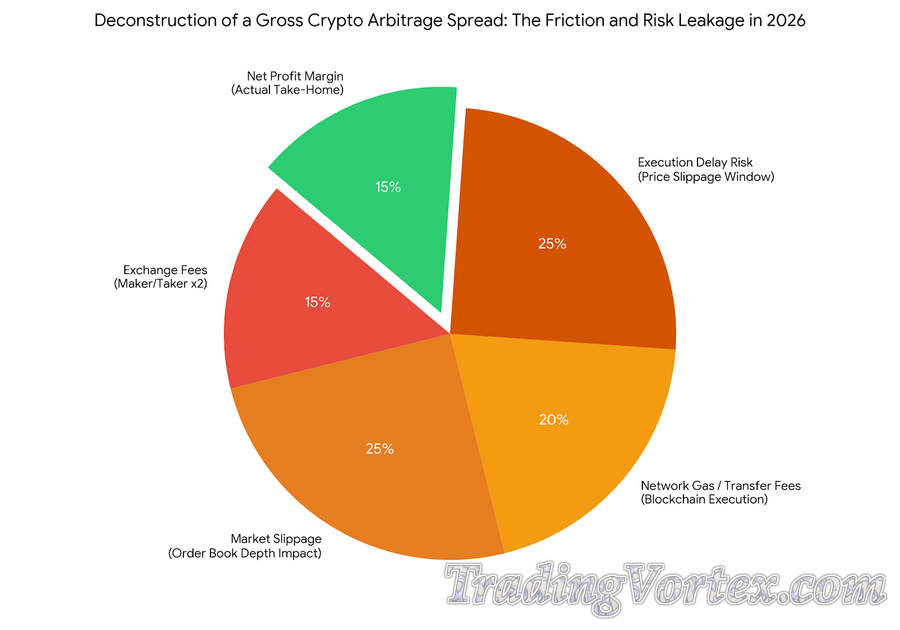 Deconstruction of a Gross Crypto Arbitrage Spread: The Friction and Risk Leakage in 2026.
This pie chart breaks down a typical gross arbitrage spread observed on a scanner, illustrating how quickly hidden transaction costs and execution risks consume nominal market inefficiencies. The chart highlights the difference between a trade's theoretical gross profit margin and the actual net take-home return.
♦ How to Interpret This Visual:
The entire pie represents of a visible price gap between two exchanges (for example, a price mismatch on an altcoin). As you execute the trade, the spread experiences "leakage" into several cost segments:
◊ Exchange Fees ( - Red): The direct baseline cost of trading. Because an arbitrage loop requires both a purchase on Exchange A and a sale on Exchange B, you pay maker or taker fees twice, alongside any fixed base withdrawal fees charged by the platform.
◊ Market Slippage ( - Light Orange): The cost of thin liquidity. When your order hits the order book, a lack of deep volume forces your trade to fill at progressively worse prices. This structural degradation can easily shrink a clean advertised spread down to a tighter actual execution.
◊ Network Gas / Transfer Fees ( - Dark Yellow): The toll paid to the underlying blockchain to move assets or interact with smart contracts. While Layer 2 protocols mitigate this, unexpected on-chain congestion or localized base Ethereum layer fee spikes can swallow a substantial slice of your capital buffer.
◊ Execution Delay Risk ( - Dark Orange): The cost of time. In volatile market conditions, price spreads vanish in under . If your transaction is delayed in a blockchain block queue or bottlenecked by an exchange's processing speed, the price gap will actively compress or invert while your funds are in transit, chipping away at your expected returns.
◊ Net Profit Margin ( - Green): The isolated, exploded slice. This is your true, risk-adjusted reward after accounting for every operational hurdle. It demonstrates visually why a large "headline" spread rarely translates directly into cash in your pocket.
♦ How to Utilize This Matrix to Minimize Slippage:
◊ Audit the Order Book Depth Before Clicking Buy: Never assume you can trade large volumes at the top-of-book price. Use an API or scanner tool that evaluates order book depth to calculate your execution math based on effective price after slippage rather than the nominal ticker price.
◊ Implement Pre-Positioned Balance Models: To eliminate the combined slice consumed by Transfer Fees and Execution Delay Risks, do not pass assets directly between exchanges mid-trade. Maintain parallel balances of stablecoins and target altcoins across your monitored exchanges. When an inefficiency appears, trigger simultaneous buy and sell executions to bypass on-chain travel times entirely.
◊ Enforce Strict Fee Thresholds in Scanners: Program your automated routing scripts or trade bots to auto-reject any detected opportunity where the estimated cumulative friction (Exchange Fees + Network Gas) represents more than of the gross discrepancy. If the network cannot guarantee a healthy net buffer, let the institutional high-frequency bots absorb the risk instead.
Beginner-Friendly Cryptocurrency Arbitrage Strategies
Starting Small with Altcoin Arbitrage Opportunities
- Altcoins like ATOM, UNI, and XLM often show spreads of 0.1–0.3 percent across exchanges such as Binance, KuCoin, and MEXC. These spreads may look tiny, but they are far more accessible than the razor-thin margins on Bitcoin and Ethereum.
- Beginners should avoid BTC and ETH arbitrage at first, since those markets are dominated by institutional bots that execute trades in milliseconds.
- Think of altcoin arbitrage as training wheels: the profits may be small, but the lessons are invaluable. I once tested a $200 spread on ATOM and ended up with less than $1 profit, but the experience taught me how fees, timing, and liquidity can make or break a trade. That “cheap lesson” saved me from bigger mistakes later.
Using Demo Accounts and Paper Trading for Practice
- Many platforms now offer demo accounts or paper trading modes where you can simulate arbitrage trades without risking real money.
- This is perfect for beginners to practice spotting spreads, calculating fees, and executing trades in a safe environment.
- It’s like practicing chess against a computer before playing in a real tournament: you build confidence without losing capital. I often tell beginners to spend at least a week in demo mode before risking even a dollar, because the habits you build here will carry over when real money is on the line.
Tracking Fees and Calculating Net Profitability
- Trading fees average 0.1–0.2 percent per side, plus withdrawal and gas fees. These costs add up quickly.
- Beginners often forget to calculate net profit, leading to “phantom gains” that vanish after costs.
- Always use a simple formula:
“Net Profit = Spread – Trading Fees – Withdrawal Fees – Gas Fees.” - A spread that looks profitable on paper can quickly turn into a loss once fees are added. I’ve seen traders celebrate a $50 “win” only to realize $45 went to fees. The spreadsheet doesn’t lie, so make it your best friend.
Diversifying Across Different Arbitrage Methods
- Beginners should experiment with multiple strategies to understand how different markets behave:
- Cross-exchange arbitrage: Buy on one exchange, sell on another.
- Intra-exchange arbitrage: Exploit price gaps within one platform.
- Spatial arbitrage: Leverage regional price differences, such as premiums in Asian markets.
- Triangular arbitrage: Trade three pairs within one exchange to capture hidden spreads.
- Diversification helps beginners reduce reliance on a single method and builds a broader skill set. It’s like learning different openings in chess: you may not master them all, but knowing the options makes you harder to beat.
Risk Management Tips for Beginner Crypto Traders
- Start small: Use $100–$200 trades until you’re confident.
- Pre-fund multiple exchanges: Avoid transfer delays by keeping balances ready.
- Set stop-loss and take-profit orders: Even arbitrage can go wrong during volatility.
- Avoid chasing spreads blindly: If bots dominate a pair, move to altcoins or regional exchanges.
- Stay compliant: Respect KYC and withdrawal limits to avoid frozen funds.
Risk management is not glamorous, but it’s what keeps you in the game. I’ve seen traders blow up accounts chasing “guaranteed” spreads without realizing how quickly markets can turn. Protecting your capital is the real win.
Step-by-Step Beginner Crypto Arbitrage Walkthrough
Here’s a simple, beginner-friendly walkthrough of how a crypto arbitrage trade plays out in 2026. It shows the exact steps, fees, and net profit calculation so you can see the reality behind the spreads.
Step 1: Spot the Opportunity
- Coin: ATOM/USDT
- Exchanges: Binance and MEXC
- Prices (Feb 2026):
- Binance: $7.312
- MEXC: $7.324
- Raw spread: 0.164 percent
This looks tiny, but it’s enough to demonstrate how arbitrage works.
Step 2: Execute the Trade
- Buy 136.7 ATOM on Binance at $7.312 = $1,000 invested.
- Transfer ATOM to MEXC.
- Sell 136.7 ATOM on MEXC at $7.324 = $1,001.64 received.
Step 3: Factor in Fees
- Binance trading fee (0.10%): −$1.00
- MEXC trading fee (0.10%): −$1.00
- ATOM withdrawal fee (on-chain): −$0.05
Step 4: Calculate Net Profit
- Gross profit: $1.64
- Total fees: $2.05
- Net profit: +$0.59 on $1,000 invested
Step 5: Scale the Trade
- At $50,000 capital, the same trade nets ~$29.50.
- At $100,000 capital, it nets ~$59 per trade.
- If executed 5 times per day, that’s ~$1,078 per year per $1,000 capital.
🎓 Key Lessons for Beginners:
- Spreads look bigger than they are. Always calculate net profit after fees.
- Small trades teach discipline. Even a $0.59 gain is valuable experience.
- Scaling matters. Arbitrage profits grow with larger capital, but so do risks.
- Speed is critical. Transfers and execution delays can erase spreads instantly.
This walkthrough shows the reality of beginner arbitrage: tiny profits, heavy fees, and the need for patience. It’s not glamorous, but it’s the safest way to learn. Start small, treat early trades as practice, and only scale once you’re confident in your calculations and execution.
📌 Takeaway:
Beginner-friendly arbitrage in 2026 is about learning, practicing, and managing risks. Start with altcoins, use demo accounts, track every fee, diversify across methods, and always protect your capital. Arbitrage won’t make you rich overnight, but it will teach you discipline, patience, and the mechanics of crypto markets; skills that pay off in the long run.
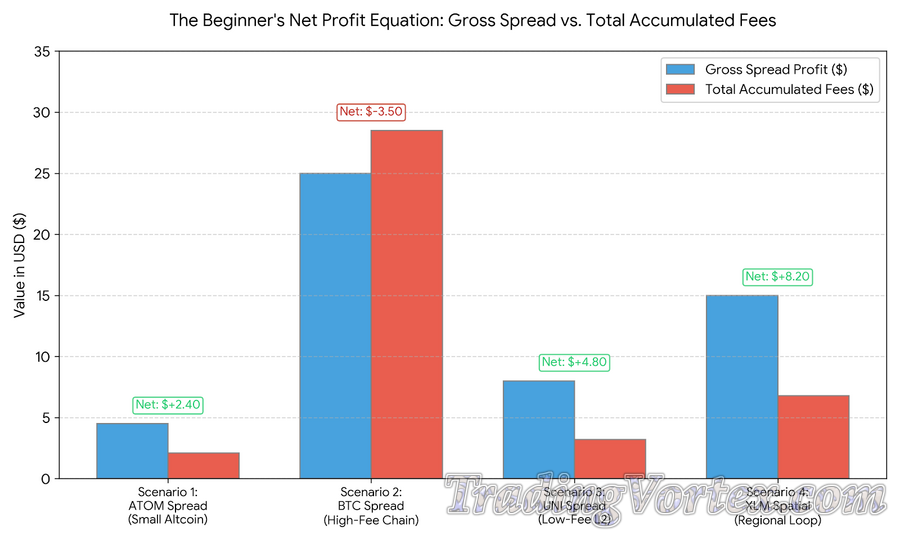 The Beginner's Net Profit Equation: Gross Spread vs. Total Accumulated Fees.
This side-by-side bar chart visualizes how transaction costs affect different cryptocurrency arbitrage opportunities for a beginner trading with smaller capital amounts (e.g., to per trade). The blue bars represent the theoretical Gross Spread Profit visible on an exchange scanner, while the red bars show the Total Accumulated Fees (the combination of taker fees, cross-exchange withdrawal costs, or on-chain network gas). The net calculation is clearly displayed above each pair of bars.
♦ How to Interpret This Visual:
◊ Scenario 1 (ATOM Spread - Small Altcoin): A small headline spread yields a modest gross profit. However, because the trading and network fees are highly optimized for this altcoin, total costs are held to . This leaves a safe, positive Net Profit of , validating the approach of targeting smaller tokens.
◊ Scenario 2 (BTC Spread - High-Fee Chain): This represents a classic beginner trap. A massive gross spread appears to offer a tempting gain. However, because this transaction runs through highly congested baseline layers or platforms with fixed high withdrawal fees, the costs balloon to . The result is a hidden Net Loss of , turning a seemingly large win into a negative payout.
◊ Scenario 3 (UNI Spread - Low-Fee Layer 2): In this environment, a modest gross opportunity on a decentralized exchange loop encounters minimal network friction due to Layer 2 execution systems (e.g., Arbitrum or Optimism), holding fees down to . This secures a healthy Net Profit of .
◊ Scenario 4 (XLM Spatial - Regional Loop): Capitalizing on a geographical inefficiency across regional boundaries gives you a large gross margin of . Even with a heightened friction cost of due to regional withdrawal fees, it preserves a very strong Net Profit of .
♦ How to Utilize This Information in Practice:
1. Stop Chasing the Largest Blue Bars: As a beginner, do not select trades based entirely on the tallest blue bar (the headline gross spread). As shown in Scenario 2, institutional competition and underlying chain congestion scale up the red bars aggressively on major networks, rendering big trades toxic for small balances.
2. Enforce the Spreadsheet Formula Before Every Trade: Always calculate your net profitability beforehand using the rule provided in the text:Net Profit = 'Spread' − 'Trading Fees' − 'Withdrawal Fees' − 'Gas Fees'
If your simulated math looks like Scenario 2, skip the trade entirely.
3. Use Paper Trading to Practice the Calculations: Utilize demo modes to log your entry and exit positions alongside actual real-time platform fee charts. This allows you to verify if your targeted niches match the profitable profiles seen in Scenarios 1, 3, and 4 without exposing your real capital to fee drainage.
Real-World Cryptocurrency Arbitrage Examples
In 2026, real-world crypto arbitrage examples prove that opportunities are still out there, but they’re razor-thin, fiercely competitive, and only profitable when traders master fees, timing, and execution speed. For beginners, these case studies in Bitcoin, triangular loops, and DEX-CEX cross-chain transfers are invaluable lessons in how arbitrage really works in practice.
Case Study: Bitcoin Arbitrage Between Binance and Bybit
- Scenario (2026): Bitcoin trades at $90,000 on Binance and $90,300 on Bybit, creating a $300 spread (0.33%).
- Execution: Buy 1 BTC on Binance, transfer to Bybit, and sell.
- Costs:
- Binance trading fee: $90
- Bybit trading fee: $90.30
- Withdrawal fee: ~$20
- Net Profit: $100 on a $90,000 trade, or 0.11 percent return.
- Lesson: Profits exist, but they’re slim. Beginners should avoid chasing BTC spreads unless they can scale capital and minimize fees. It’s a bit like running a marathon for a medal that barely covers your taxi fare home: possible, but not worth it unless you’re prepared for the grind.
Case Study: Triangular Arbitrage Using ETH/USDT/BTC
- Scenario (SpreadScan 2026): ETH trades at $2,480 on Binance and $2,497 on KuCoin, a $17 spread (0.69%).
- Execution: Cycle through ETH/USDT, BTC/ETH, and BTC/USDT pairs within one exchange.
- Costs: Trading fees of 0.1 percent per leg reduce the spread significantly.
- Net Profit: On $10,000 capital, the loop nets ~$40 after fees.
- Lesson: Triangular arbitrage avoids transfer delays, but fees and math precision are critical. Beginners should practice with small amounts or demo accounts before scaling. I once thought I had cracked a triangular loop, only to realize my “profit” was eaten alive by fees. It was humbling, but it taught me to respect the math.
Case Study: DEX-CEX Arbitrage with Cross-Chain Transfers
- Scenario (Gate Learn 2026): A token trades at $1.05 on Uniswap (Ethereum) and $1.10 on Binance.
- Execution: Buy on Uniswap, transfer via a cross-chain bridge, and sell on Binance.
- Costs:
- Gas fees on Ethereum: $50–100
- Bridge fees: ~$10–20
- Binance trading fee: 0.1 percent
- Net Profit: On $5,000 capital, the spread nets ~$150, but only if gas fees are low.
- Lesson: DEX-CEX arbitrage is exciting but risky. Beginners should experiment on Layer 2 networks like Arbitrum or Optimism, where gas fees are much lower. I’ve seen traders celebrate a $200 spread, only to watch it vanish into Ethereum gas costs. The moral: always check fees before celebrating.
Real-World Cryptocurrency Arbitrage Examples Table
This table shows the reality of arbitrage in 2026: Bitcoin spreads are slim, triangular loops demand precision, and DEX-CEX trades hinge on fee management. Beginners should start small, focus on altcoins or Layer 2 opportunities, and always calculate net profit after fees before celebrating a “win.”
| Case Study | Spread Observed | Execution Method | Fees Incurred | Net Profit | Beginner Takeaway |
|---|---|---|---|---|---|
| Bitcoin Arbitrage: Binance vs Bybit | $300 (0.33%) on 1 BTC | Buy on Binance, transfer, sell on Bybit | ~$200 (trading + withdrawal) | ~$100 | Profits are slim, BTC spreads are dominated by bots |
| Triangular Arbitrage: ETH/USDT/BTC | $17 (0.69%) spread loop | Cycle ETH/USDT → BTC/ETH → BTC/USDT | ~0.3% fees across 3 legs | ~$40 on $10,000 | Good practice, but fees eat most of the spread |
| DEX-CEX Arbitrage: Uniswap vs Binance | $0.05 difference per token | Buy on Uniswap, bridge to Binance, sell | $50–100 gas + $10–20 bridge + trading | ~$150 on $5,000 (if gas is low) | Exciting but risky, better on Layer 2 networks |
📌 Takeaway:
These examples highlight the reality of arbitrage in 2026: Bitcoin spreads are slim, triangular loops demand precision, and DEX-CEX trades hinge on fee management. Beginners should treat these case studies as training exercises, start small, and always calculate net profit after fees. Arbitrage is less about “easy money” and more about discipline, patience, and execution.
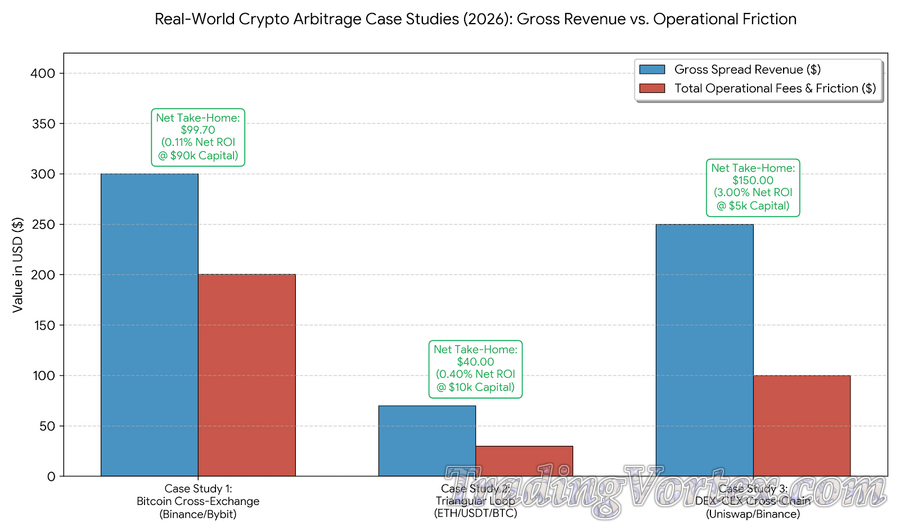 Real-World Crypto Arbitrage Case Studies (2026): Gross Revenue vs. Operational Friction.
This side-by-side bar chart compares the theoretical gross revenue against the combined operational costs for three real-world cryptocurrency arbitrage case studies in 2026. The blue bars represent the gross price spread visible on scanners, while the red bars show the cumulative toll of exchange trading fees, cross-exchange withdrawal fees, blockchain gas, and cross-chain bridge costs. The green text boxes highlight the true net profit pocketed by the trader alongside the corresponding net Return on Investment (ROI) relative to the capital deployed.
♦ How to Interpret This Visual:
◊ Case Study 1 (Bitcoin Cross-Exchange - Binance/Bybit): This case shows a substantial gross spread of on a Bitcoin trade. However, because executing this trade requires mobilizing a full bitcoin priced at , the standard trading fees on both sides combined with withdrawal overhead leak a massive directly back to the exchanges. The true net take-home is a modest , resulting in an exceptionally thin net ROI of just on your capital.
◊ Case Study 2 (Triangular Loop - ETH/USDT/BTC): By keeping operations entirely within a single exchange, this strategy eliminates network transfer fees and cross-platform delays entirely. A gross discrepancy across three pairs scales down to a clean net profit after accounting for the successive three-leg taker trading fees. Executed with of capital, this yields a predictable net return.
◊ Case Study 3 (DEX-CEX Cross-Chain - Uniswap/Binance): This scenario captures a wider mispricing on an altcoin, offering a healthy gross profit on a smaller capital base of . Because the trade encounters friction via on-chain smart contract interactions and bridging fees, operational friction totals roughly . Despite the heavy costs, the inefficiency leaves a strong net ROI (), making it highly lucrative if blockchain gas fees remain stable.
♦ How to Utilize These Case Studies in Your Trading:
◊ Evaluate Capital Efficiency, Not Just Absolute Dollar Gains: Compare Case 1 and Case 3. While the Bitcoin trade nets roughly and the DEX-CEX loop nets , Case 1 requires a massive capital lockup to achieve that return. Case 3 secures a higher cash return using only of capital. As a trader, prioritizing capital efficiency (higher net ROI) allows you to split your bankroll across multiple opportunities simultaneously.
◊ Mitigate the Multi-Leg Fee Trap in Triangular Trading: If you intend to run intra-exchange triangular loops as shown in Case 2, your biggest enemy is the three-leg fee deduction. Before activating an automated script, ensure you are utilizing native platform tokens (such as BNB or KCS) to qualify for exchange fee discounts, which drastically shrinks the red bar and boosts your net margin.
◊ Audit Gas Infrastructure Prior to Block Execution: Case 3 proves that DEX-CEX arbitrage yields the highest percentage returns for smaller balances, but it is highly dependent on variable network gas costs. To utilize this effectively, avoid interacting directly with the congested Ethereum mainnet. Pivot your scanners to seek identical cross-chain loops on layer-2 ecosystems like Arbitrum or Optimism, keeping the red friction bar minimal.
Future of Cryptocurrency Arbitrage Trading
Institutional Dominance vs Retail Trader Opportunities
- Institutions and hedge funds now control most arbitrage on BTC and ETH, deploying high-frequency bots that execute trades in milliseconds. These players have the infrastructure, capital, and speed to capture spreads before retail traders even notice them.
- Retail traders still find opportunities in altcoins, regional exchanges, and Layer 2 networks, where spreads last longer and competition is lighter. For example, tokens like XLM or UNI often show spreads of 0.2 percent across mid-tier exchanges, which can be captured by attentive beginners.
- Beginners should think of arbitrage less as a “money machine” and more as a training ground to understand fees, liquidity, and execution speed. It’s like learning to drive in a quiet neighborhood before hitting the highway: you won’t win races, but you’ll build the skills that matter.
Role of AI and Predictive Analytics in Arbitrage
- AI-driven bots now predict spread duration, detect liquidity shifts, and optimize trade routing across multiple exchanges and blockchains. They don’t just react to spreads, they anticipate them.
- Machine learning models analyze social sentiment, on-chain flows, and regional demand to forecast where spreads might appear. For instance, sudden spikes in Korean trading volume can signal premiums before they show up globally.
- For retail traders, simplified AI features like risk alerts, fee calculators, and automated stop-loss triggers are becoming accessible. These tools make arbitrage safer and more educational, allowing beginners to learn without being crushed by institutional speed.
Global Regulation and Its Impact on Arbitrage Trading
- KYC and AML rules are stricter than ever, with exchanges enforcing tighter withdrawal limits and compliance checks. This reduces the risk of fraud but also slows down execution for traders who aren’t fully verified.
- Regional restrictions create “spatial arbitrage” opportunities, such as premiums in Korean, Turkish, or Nigerian markets, but they also add risk if funds get stuck due to local rules.
- The future of arbitrage will depend heavily on regulatory harmonization. If global standards align, spreads may shrink further, but trading will become safer and more predictable for beginners.
Long-Term Viability of Arbitrage for Beginner Crypto Traders
- Spreads on top pairs have compressed to 0.1–0.4 percent, meaning profits are slim unless capital is large.
- Altcoins and niche exchanges will remain fertile ground for beginners, offering spreads of 0.1–0.3 percent that last longer than BTC or ETH spreads.
- Arbitrage will continue to exist as long as crypto markets remain fragmented across multiple exchanges and blockchains. As long as liquidity pools and order books operate differently, gaps will appear.
- For beginners, arbitrage is best seen as a learning strategy. It teaches discipline, fee awareness, and execution mechanics, even if profits are modest. Many traders who start with arbitrage eventually move into more advanced strategies like algorithmic trading or DeFi yield optimization.
Future Crypto Arbitrage Trends Table
This table shows how the future of arbitrage is being shaped from four angles: institutions will dominate the big spreads, AI will make trading smarter, regulation will tighten the rules, and beginners will still find value in altcoins and niche markets. Arbitrage is evolving into a skill-building exercise rather than a quick-profit strategy, but it remains a powerful way to learn the mechanics of crypto trading.
| Trend Area | Institutional Perspective | AI & Tech Perspective | Regulatory Perspective | Beginner Perspective |
|---|---|---|---|---|
| Institutional Dominance | Hedge funds and HFT firms dominate BTC/ETH spreads with millisecond bots | Institutions deploy predictive AI to anticipate spreads before they appear | Regulators monitor large-scale arbitrage for compliance and systemic risk | Beginners should avoid BTC/ETH markets and focus on altcoins or regional exchanges |
| AI & Predictive Analytics | Advanced models forecast liquidity shifts and regional demand | Machine learning predicts spread sustainability and optimizes routing | AI-driven compliance tools help exchanges meet KYC/AML standards | Beginners can use simplified AI bots with risk alerts and fee calculators |
| Global Regulation | Institutions adapt quickly to new rules with compliance teams | Tech integrates automated KYC and withdrawal limit checks | Stricter KYC, AML, and regional restrictions reshape arbitrage flows | Beginners must respect withdrawal limits and avoid unverified accounts |
| Long-Term Viability | Institutions continue profiting from scale despite compressed spreads | AI ensures arbitrage remains efficient across fragmented markets | Regulation may shrink spreads but improve safety and predictability | Arbitrage remains a learning tool, best for small altcoin trades and practice |
📌 Takeaway:
The future of crypto arbitrage is about automation, AI, and institutional speed, but beginners can still carve out opportunities in smaller markets. Arbitrage is shifting from “easy money” to a skill-building exercise, preparing traders for more advanced strategies in crypto. It’s less about chasing big profits and more about building the habits that make you a smarter, more resilient trader.
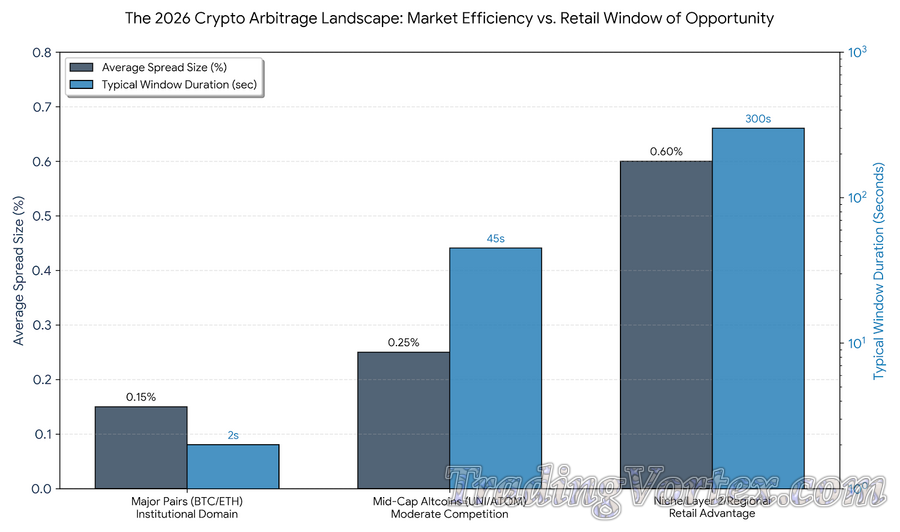 The 2026 Crypto Arbitrage Landscape: Market Efficiency vs. Retail Window of Opportunity.
This dual-axis bar chart maps out market efficiency across different asset classifications in 2026. The dark grey bars (measured on the left axis) illustrate the Average Spread Size (%), while the light blue bars (measured on the right logarithmic axis) show the Typical Window Duration (Seconds) before institutional bots or market corrections flatten the arbitrage gap.
♦ How to Interpret This Visual:
The chart groups the market into three clear sectors based on competitiveness and accessibility:
◊ Major Pairs (BTC/ETH) - Institutional Domain: Price spreads on highly liquid blue-chip crypto assets are compressed to a razor-thin average of 0.15%. Because algorithmic high-frequency trading (HFT) infrastructure dominates these books, the window of opportunity stays open for a fleeting 2 seconds or less. For a retail manual trader, capturing this is practically impossible.
◊ Mid-Cap Altcoins (UNI/ATOM) - Moderate Competition: In medium-liquidity environments, spreads widen slightly to an average of 0.25%. The absence of hyper-aggressive institutional algorithms allows these price anomalies to linger for roughly 45 seconds, providing a plausible window for alert traders using localized automated tracking tools.
◊ Niche / Layer 2 / Regional - Retail Advantage: This is where market fragmentation works in favor of the retail participant. Due to geographical constraints, strict compliance checks, localized capital controls, or deployment on separate blockchain layers, spreads can reach a substantial 0.60%. Furthermore, these anomalies survive for up to 300 seconds (5 minutes), giving beginners ample time to compute friction variables and execute loops safely.
♦ How to Utilize This Strategic Matrix:
◊ Concede High-Frequency Terrains to the Bots: Use this data to protect your capital. Trying to trade manual arbitrage loops on Bitcoin or Ethereum is a losing battle against institutional hardware. If your scanner highlights an institutional spread, let it go; your execution speed cannot match millisecond reaction times.
◊ Target the Operational Inefficiencies of Sector 3: Focus your strategy where the blue bars are tallest. Look for regional exchange premiums or cross-chain gaps on Layer 2 networks. A 5-minute execution window means you do not have to panic; you have sufficient time to check order books, confirm KYC limitations, and run your net profitability formulas before committing funds.
◊ Use the Mid-Cap Sector for Sandbox Training: Treat the middle tier as your ultimate testing ground. A 45-second window is an excellent pressure test to practice rapid data entry, use semi-automated helper bots (like risk alerts and fee calculators), and understand slippage mechanics without the risk exposure found in high-frequency environments.
Conclusion: Is Cryptocurrency Arbitrage Worth It for Beginners?
Key Takeaways for Beginner Arbitrage Traders in 2026
- Spreads are compressed: On Bitcoin and Ethereum, average spreads hover around 0.1–0.4 percent, compared to 1–3 percent five years ago. That means the days of quick, fat profits are gone. Unless you’re trading with significant capital, the returns will feel modest.
- Fees matter more than ever: Trading fees, withdrawal costs, and gas fees often erase most of the spread. A $300 BTC spread can shrink to under $100 net profit once fees are deducted, and sometimes even less if gas spikes. Beginners quickly learn that the spreadsheet is their best friend.
- Institutions dominate major pairs: Hedge funds and high-frequency bots scoop up opportunities in milliseconds. Competing against them in BTC or ETH markets is like trying to out-sprint a race car. Beginners are better off focusing on altcoins or regional exchanges, where spreads last longer and competition is lighter.
- Arbitrage is low-risk but not risk-free: While you’re not betting on price direction, risks like transfer delays, exchange downtime, and regulatory restrictions can still cause losses. I’ve personally seen trades evaporate because an exchange froze withdrawals mid-transfer.
- Best value for beginners: Arbitrage is a training ground. It teaches how to calculate net profit, manage liquidity, and understand exchange mechanics. Even small trades that net $1–2 are valuable practice, because they build habits that protect you when the stakes get higher.
Practical Next Steps to Start Crypto Arbitrage Trading
- Start small with altcoins: Tokens like ATOM, UNI, or XLM often show spreads across exchanges such as Binance, KuCoin, and MEXC. These markets are less competitive and more forgiving, making them ideal for practice.
- Use demo accounts or paper trading: Practice spotting spreads and calculating fees without risking real money. This builds confidence and helps you avoid rookie mistakes.
- Pre-fund multiple exchanges: Keep balances ready on at least two platforms to avoid transfer delays. Professionals do this to eliminate the biggest beginner risk: missing the spread while waiting for funds to move.
- Track every fee: Use a spreadsheet or fee calculator to ensure you’re calculating net profit correctly. Remember: spreads are meaningless without accounting for costs.
- Diversify strategies: Experiment with cross-exchange arbitrage, triangular loops, and Layer 2 DEX-CEX trades. Each method teaches different lessons about liquidity, execution, and risk.
- Stay compliant: Complete KYC verification and respect withdrawal limits. Nothing kills a trade faster than frozen funds due to regulatory issues.
Beginner Crypto Arbitrage Action Checklist
Before you place your first real arbitrage trade, run through this checklist to avoid rookie mistakes:
- Spot the spread: Confirm the price difference is big enough to cover fees and still leave profit.
- Calculate all fees: Trading fees, withdrawal costs, and gas fees must be factored in. Write them down before executing.
- Check liquidity: Make sure your trade size won’t move the market against you. Thin altcoin markets can punish large orders.
- Verify exchange status: Ensure withdrawals are open and the exchange isn’t experiencing downtime. Nothing hurts more than being stuck mid-transfer.
- Pre-fund multiple exchanges: Keep balances ready on at least two platforms to avoid delays. Transfers often take longer than spreads last.
- Test with small trades: Start with $100–$200 to learn the mechanics. Treat early trades as practice, not profit.
- Use demo accounts: Practice spotting spreads and calculating net profit without risking real money.
- Set stop-loss and take-profit: Even arbitrage can go wrong during volatility. Protect yourself with automated risk controls.
- Stay compliant: Complete KYC verification and respect withdrawal limits to avoid frozen funds.
This checklist is your pre-flight safety check before every arbitrage trade. It may feel tedious, but skipping even one step can turn a profitable spread into a painful loss. Think of it as buckling your seatbelt before driving: most of the time you won’t need it, but when things go wrong, you’ll be glad you did.
🎯 Final Word:
For beginners, cryptocurrency arbitrage in 2026 is worth it as an educational journey, not as a shortcut to riches. You’ll learn discipline, risk management, and the mechanics of crypto markets. The profits may be modest, but the skills you gain will prepare you for more advanced strategies in trading and DeFi.
Think of arbitrage as your “crypto boot camp”: it won’t make you rich overnight, but it will make you smarter, sharper, and ready for the next level.
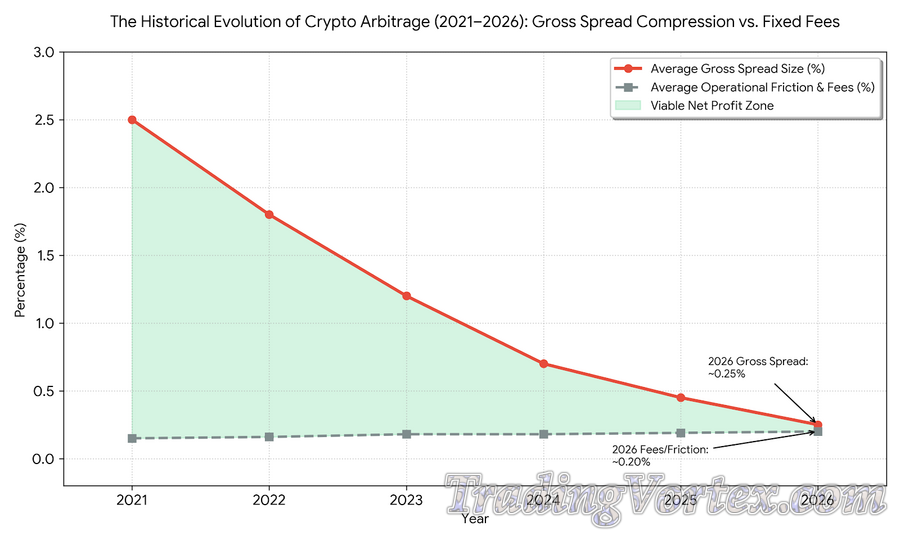 The Historical Evolution of Crypto Arbitrage (2021–2026): Gross Spread Compression vs. Fixed Fees.
This dual-line chart illustrates how the structural profitability of cryptocurrency arbitrage has drastically changed between 2021 and 2026. The solid red line tracks the Average Gross Spread Size (%) available on major markets, which has compressed downward over time. The dashed grey line tracks Average Operational Friction & Fees (%), which remain relatively fixed due to baseline exchange trading fees, gas, and transfer costs. The shaded green region represents the Viable Net Profit Zone: the actual take-home margin left for a trader after costs are deducted.
♦ How to Interpret This Visual:
◊ The 2021 Era (The "Easy Money" Market): Five years ago, inefficient market matching allowed gross spreads to average a wide . With operational friction and trading fees taking up only a tiny fraction (around ), the green net profit zone was massive. During this period, deep technical optimization wasn't necessary to clear a safe profit.
◊ The Compression Trend (2022–2025): As sophisticated algorithmic institutional players entered the space and cross-exchange liquidity depth matured, structural price gaps were squeezed shut with increasing velocity. The red line slopes steeply downward year after year.
◊ The 2026 Reality (The Precision Market): By 2026, the average gross spread on high-liquidity pairs has flattened into a narrow channel of , averaging roughly . Because baseline trading and execution fees have stayed sticky at roughly , the green Viable Net Profit Zone has become razor-thin.
♦ How to Utilize This Historical Insight in Your Strategy:
1. Stop Trading on Historical Assumptions: If you approach the 2026 market expecting the wide profit margins of 2021, your capital will be rapidly drained by trading costs. As the visual demonstrates, a modern trade is an exercise in microscopic mathematical precision. If a spread is near the grey dashed line, it must be skipped.
2. Focus on Shifting the Lines in Your Favor: Since you cannot widen the red line on main pairs like Bitcoin or Ethereum due to institutional bot dominance, your main objective is to look for fields where the lines diverge. You can achieve this by:
◊ Moving to Less Efficient Channels: Target altcoins (like ATOM, UNI, or XLM) or niche regional exchanges where the red line naturally sits higher because institutional algorithms aren't suppressing the spreads as aggressively.
◊ Driving Down the Grey Line: Optimize your operational costs. Use exchange utility tokens to unlock maximum maker/taker trading fee discounts, and execute loops on low-cost Layer 2 protocols to keep your network gas fees as close to zero as possible.
3. Embrace the Value of "Crypto Boot Camp": Use this chart to contextualize your expectations. Because the green zone is thin, treat your early live trades with as an interactive spreadsheet audit. Your goal shouldn't be overnight wealth; it should be learning how to successfully navigate your execution setup so that your actual net returns land safely inside the green zone rather than slipping below the grey cost line.
FAQs: Cryptocurrency Arbitrage Trading for Beginners
What exactly is crypto arbitrage?
Crypto arbitrage is the practice of buying a coin on one exchange where it’s cheaper and selling it on another where it’s more expensive. The profit is the spread minus fees. For example, if Bitcoin trades at $90,000 on Binance and $90,300 on Bybit, the $300 difference is the arbitrage opportunity. The trick is executing fast enough before the gap closes.
Is crypto arbitrage risk-free?
No. While arbitrage avoids betting on price direction, risks include:
♦ Transfer delays that erase spreads.
♦ Exchange downtime or frozen withdrawals.
♦ High fees that eat profits.
♦ Regulatory restrictions that block transfers.
I once lost a spread because my coins took 15 minutes to move, and by then the opportunity was gone.
How much can beginners realistically earn?
On major coins like BTC or ETH, spreads are often 0.1–0.4 percent. After fees, beginners might net $1–5 per $1,000 trade. Altcoins or regional exchanges can offer slightly higher spreads, but liquidity is thinner. Arbitrage is better seen as a learning tool than a quick-profit strategy.
Do I need a lot of money to start?
Not at all. You can start with as little as $100–200. The profits will be small, but the lessons are priceless. Think of it like paying for a workshop: you’re investing in experience rather than chasing big returns right away.
Which coins are best for arbitrage?
Bitcoin and Ethereum have the most liquidity, but spreads are razor-thin and dominated by bots. Beginners often find better opportunities in altcoins like ATOM, UNI, or XLM, where spreads last longer and competition is lighter.
How fast do I need to be?
Very fast. Spreads can close in seconds, especially during volatility. Pre-funding multiple exchanges is the best way to avoid transfer delays. I once lost a spread because my coins took 10 minutes to move, and by then the gap had vanished.
Can I use arbitrage bots safely?
Yes, but choose reputable platforms like Pionex, 3Commas, or Bitsgap. Bots help automate trades, but beginners should start small and monitor performance closely. Don’t treat bots as magic money machines: they’re tools, not guarantees.
What’s the biggest beginner mistake?
Ignoring fees. Many beginners celebrate a “profit” only to realize they lost money after trading, withdrawal, and gas costs. Always calculate net profit after fees before executing.
Is arbitrage legal everywhere?
Arbitrage itself is legal, but local regulations matter. Some countries impose capital controls, restrict crypto withdrawals, or ban certain tokens. Always check the rules in your region to avoid frozen funds or compliance issues.
Can arbitrage be a full-time income?
For most beginners, no. Spreads are too small and competition too fierce. Arbitrage is best treated as a side strategy or learning tool. Professionals with large capital and advanced bots can make steady profits, but beginners should see it as training for bigger opportunities in crypto trading.
What tools do beginners need?
♦ Arbitrage bots like Pionex or 3Commas for automation.
♦ Price scanners such as SpreadScan to detect spreads.
♦ Multi-exchange wallets to move funds quickly.
♦ Fee calculators to ensure net profit.
Think of these tools as your “starter kit.” Without them, you’re basically racing against bots with a bicycle.
What types of arbitrage are beginner-friendly?
♦ Cross-exchange arbitrage: Buy on one exchange, sell on another.
♦ Triangular arbitrage: Trade three pairs within one exchange to capture hidden spreads.
♦ Spatial arbitrage: Exploit regional price differences, like premiums in Korean or Turkish markets.
♦ DEX-CEX arbitrage: Buy on a decentralized exchange, sell on a centralized one.
Beginners usually start with cross-exchange arbitrage since it’s the simplest to understand.
How do I avoid losing money?
♦ Always calculate net profit after fees.
♦ Pre-fund multiple exchanges to avoid transfer delays.
♦ Start with small trades ($100–200) to learn mechanics.
♦ Use demo accounts before risking real money.
♦ Stay compliant with KYC and withdrawal limits.
These habits may feel boring, but they’re what keep beginners from turning “free money” into expensive lessons.
How do I practice without losing money?
Use demo accounts or paper trading modes offered by platforms like 3Commas. You can simulate trades, track spreads, and calculate fees without risking real capital. It’s like practicing chess against a computer before entering a tournament.
🎯 Takeaway:
Crypto arbitrage is worth exploring for beginners, but not as a shortcut to riches. It’s best treated as a hands-on classroom where you learn discipline, fee awareness, and execution speed. The profits may be modest, but the skills you gain will prepare you for more advanced trading strategies.