

How to Farm Yield on Polygon in 2026 is your complete guide to navigating one of the fastest-growing ecosystems in decentralized finance. Polygon has become a leading Ethereum Layer-2 network thanks to its low fees, fast transactions, and deep liquidity, making it a favorite for yield farmers worldwide.
This article explores practical strategies like stablecoin farming, staking MATIC, auto-compounding vaults, and cross-chain yield opportunities. It also dives into risk management, covering smart contract vulnerabilities, impermanent loss, bridge exploits, and evolving regulations that every investor should understand.
Readers will gain insights into the latest trends, including real-world asset tokenization, institutional adoption, and AI-driven yield optimizers that are reshaping DeFi. The guide also highlights how emerging markets such as Nigeria, Kenya, Argentina, Vietnam, and Morocco are embracing Polygon yield farming as a hedge against inflation and unreliable banking systems, proving that DeFi is becoming a truly global financial movement.
Whether you are a beginner starting with $20–50 stablecoin pools or an experienced trader chasing 7–15 percent APYs across multiple chains, this article provides clear explanations, relatable examples, and actionable advice. It balances opportunity with caution, helping you build smarter, more resilient portfolios in Polygon’s evolving DeFi landscape.
Table of Contents:
- Introduction to Polygon Yield Farming
- How to Start Yield Farming on Polygon
- Best Yield Farming Platforms on Polygon
- Yield Farming Strategies on Polygon
- Latest Polygon Yield Farming Trends (2026)
- Risks and Challenges in Polygon Yield Farming
- Best Practices for Yield Farmers on Polygon
- Future of Yield Farming on Polygon
- Emerging Market Adoption: A Truly International Movement
- Conclusion: Key Takeaways for Yield Farming on Polygon
- Frequently Asked Questions: Yield Farming on Polygon (2026)
- What are the typical yields on Polygon?
- Is yield farming on Polygon safe?
- Which platforms are best for yield farming on Polygon?
- What risks should I watch out for?
- How do I track my yields effectively?
- Can beginners start yield farming on Polygon with small amounts?
- What is the outlook for yield farming on Polygon?
Introduction to Polygon Yield Farming
What is Yield Farming on Polygon
Yield farming is essentially putting your crypto to work instead of letting it sit idle. On Polygon, you can deposit tokens into liquidity pools, stake MATIC, or use yield aggregators that automatically compound your rewards. The idea is simple: you provide liquidity, the protocol uses it to facilitate trading or lending, and you earn a share of the rewards.
In 2026, yields on Polygon are more balanced than the wild west days of early DeFi. Instead of chasing unrealistic triple-digit APYs, most strategies now offer 5 to 30 percent returns, depending on the risk level and the platform.
For everyday investors, this feels less like gambling and more like a structured way to grow your portfolio. It’s a bit like moving from a casino table to a well-managed investment fund: the thrill is still there, but the odds are far more reasonable.
Yield farming on Polygon has also become more user-friendly. Many platforms now offer simplified dashboards, automated compounding, and risk-adjusted strategies that make it easier for beginners to participate without needing to master complex DeFi mechanics.
For veterans, advanced tools like leveraged yield farming and cross-chain strategies provide opportunities to maximize returns while managing exposure.
Why Polygon (MATIC) is the Best Layer-2 for DeFi in 2026
Polygon has evolved from being “Ethereum’s sidekick” into a powerhouse Layer-2 ecosystem. It combines Ethereum’s security with its own high-speed, low-cost infrastructure. Transaction fees average $0.01 to $0.10, compared to Ethereum’s $10–50, which means you can rebalance, compound, or harvest rewards daily without worrying about costs.
Polygon also boasts billions in total value locked (TVL) and continues to attract institutional players, making it one of the most reliable platforms for yield farming. The network has become a hub for both retail investors and professional traders, offering deep liquidity and a wide range of DeFi applications. Whether you’re a beginner staking MATIC or an advanced trader experimenting with leveraged strategies, Polygon offers a playground that balances opportunity with accessibility.
Another reason Polygon stands out is its commitment to sustainability and innovation. The team behind Polygon has invested heavily in scaling solutions, zk-rollups, and partnerships with major financial institutions. This has positioned Polygon not just as a cheaper alternative to Ethereum, but as a leader in the next generation of decentralized finance.
Benefits: Low Fees, Scalability, and Growing DeFi Ecosystem
The biggest advantage of yield farming on Polygon is low transaction fees. This makes experimenting with different strategies less intimidating, especially for smaller investors who don’t want to see their profits eaten up by gas costs. Scalability is another win: Polygon can process thousands of transactions per second, so you don’t get stuck waiting during volatile market swings.
The ecosystem itself is thriving. From established names like Aave and Curve to innovative platforms like Beefy Finance, Pendle, and Arrakis, Polygon hosts a wide range of DeFi protocols. This diversity allows investors to tailor their yield farming approach to their risk appetite, whether they prefer stablecoin pools with minimal impermanent loss or higher-risk strategies chasing double-digit returns.
Polygon also benefits from strong community support and developer activity. New projects are constantly launching, and existing platforms are expanding their offerings to include more sophisticated yield strategies. This creates a dynamic environment where investors can always find fresh opportunities to explore.
Yield farming on Polygon today feels like a more mature, calculated investment strategy. Risks remain: smart contract bugs, impermanent loss, and regulatory uncertainty; but the infrastructure has matured, and the opportunities are more sustainable. For anyone frustrated by Ethereum’s gas fees or overwhelmed by DeFi’s complexity, Polygon offers a smoother, friendlier entry point into yield farming.
It’s the difference between driving a sports car on a crowded city street and cruising on a wide-open highway: the experience is faster, cheaper, and far less stressful. For traders and investors of all levels, Polygon has become the place where DeFi feels both exciting and manageable.
 Polygon Yield Farming APY Ranges by Strategy Risk Profile in 2026: A horizontal range bar chart demonstrating the sustainable annual percentage yields (APY) across different liquidity pool strategies on the Polygon network, highlighting a mature DeFi ecosystem ranging from 5% up to 35%.
♦ Educational Explanation:
This visual data representation outlines the realistic yield expectations for investors engaging in Polygon yield farming in 2026. Rather than the volatile and unsustainable triple-digit yields seen in the early days of decentralized finance (DeFi), the contemporary Polygon ecosystem has transitioned into a structured, sustainable environment with yields cleanly categorized by asset risk exposure:
◊ Stablecoin Pools (Low Risk): Offering yields between 5% and 8%, these pools utilize dollar-pegged assets (such as USDC or USDT) to virtually eliminate impermanent loss, acting as a reliable, high-yield alternative to traditional fiat savings accounts.
◊ Blue-Chip Pairs (Medium Risk): Pairs combining highly liquid, established layer-1 and layer-2 assets like MATIC and ETH deliver yields between 8% and 15%. While exposed to general market price movements, the risk of protocol or asset collapse is significantly mitigated.
◊ Yield Aggregators (Medium-High Risk): Automation platforms like Beefy Finance automatically compound rewards or execute cross-protocol strategies (such as concentrated liquidity management) to generate optimized yields ranging from 12% to 25%.
◊ Exotic/Altcoin Pools (High Risk): Higher-volatility pools featuring newer or lower-market-cap utility tokens offer yields from 18% up to 35%. These assets require vigilant active management due to the heightened risk of impermanent loss and rapid asset price swings.
♦ By leveraging Polygon's ultra-low transaction fees; which consistently average between 0.01 and 0.10 per transaction compared to Ethereum's historical 10 to 50 range; investors of all sizes can efficiently rebalance assets across these risk tiers, compound their earnings daily, and maximize their net passive income without having their profits consumed by network gas costs.
How to Start Yield Farming on Polygon
Setting Up a Polygon Wallet (MetaMask, WalletConnect)
The first step is choosing a wallet that supports Polygon. MetaMask remains the go-to option for most traders, and setting it up is quick. You simply add the Polygon network by entering the RPC details from Polygon’s official site, then you can switch between Ethereum and Polygon networks with a single click. This flexibility is crucial because many DeFi platforms still operate across multiple chains, and you’ll want to move seamlessly between them.
If you’re more of a mobile-first investor, WalletConnect is a fantastic alternative. It acts like a universal remote for DeFi, letting you connect apps such as QuickSwap, Aave, or Curve directly to your wallet without needing a browser extension. It’s intuitive, secure, and perfect for those who prefer managing their assets on the go.
Here’s a personal anecdote: I once rushed into a transaction without checking the network and ended up sending tokens to the wrong chain. Recovering them was possible, but stressful. So, always double-check your network before hitting confirm. It’s a small habit that saves big headaches.
Bridging Crypto Assets to Polygon Securely
Once your wallet is ready, the next step is moving assets from Ethereum or another chain to Polygon. The Polygon PoS Bridge is the most widely used option, allowing secure transfers of ETH, USDC, DAI, and other tokens. Transfers usually take a few minutes, and fees are minimal compared to Ethereum’s mainnet.
For those who want speed or cross-chain flexibility, platforms like Hop Protocol, Stargate, and LayerZero have become popular in 2026. They let you move assets between multiple Layer-2s, not just Ethereum and Polygon, which is perfect if you’re chasing yield opportunities across different ecosystems.
A golden rule I stick to: never bridge your entire portfolio in one go. Always test with a small amount first. It’s like dipping your toe in the pool before diving in: you’ll avoid unnecessary panic if something doesn’t go as planned.
Funding Your Wallet with MATIC and Stablecoins
To interact with DeFi apps on Polygon, you’ll need MATIC (now POL after the token migration) for transaction fees. Even a few dollars’ worth is enough to cover hundreds of transactions, so don’t underestimate its importance. Without it, your assets will just sit there, unable to move.
Stablecoins such as USDC, USDT, and DAI are the backbone of most yield farming strategies. They’re widely accepted across Polygon’s DeFi platforms and provide a safer entry point for those who want steady yields without the rollercoaster of token price swings. Many investors start with stablecoin pools because they offer consistent returns and lower risk compared to volatile token pairs.
Here’s a practical tip: always keep a small reserve of MATIC in your wallet. I’ve had moments where I was ready to harvest rewards, only to realize I had no gas tokens left. It’s the crypto equivalent of trying to drive with an empty fuel tank; you’re stuck until you refill.
Yield farming on Polygon doesn’t require advanced technical skills, but it does reward careful preparation. By setting up your wallet correctly, bridging assets securely, and keeping MATIC handy for fees, you’ll avoid common pitfalls and be ready to explore the wide range of yield opportunities Polygon has to offer.
Think of it like preparing for a road trip: check your car, fuel up, and plan your route. Once you’re set, the journey is smooth, affordable, and full of exciting stops along the way.
 A step-by-step workflow for starting yield farming on Polygon in 2026, showing key stages and required assets.
♦ Educational Explanation:
This procedural flowchart visualizes the logical sequence for initiating yield farming on the Polygon network as of 2026. By breaking down the process into four distinct stages, it helps you navigate from setup to participation efficiently, highlighting critical actions and asset types along the way.
1. SET UP WALLET: Your first action is establishing a digital wallet. The visual shows the most common options, MetaMask and WalletConnect, with key actions like adding the Polygon network via its RPC details and, crucially, securing your seed phrase. This is the foundation for all subsequent steps.
2. BRIDGE ASSETS SECURELY: Once your wallet is configured, you must move your investment capital from another chain (like Ethereum mainnet) to Polygon. The flowchart lists popular secure bridging solutions for 2026, such as the native PoS Bridge, Hop, Stargate, and LayerZero. It also visually reinforces the critical advice to test with a small amount first to avoid costly mistakes.
3. FUND WALLET: The workflow separates this step into two essential components, emphasizing their different roles:
◊ A. GAS (POL/MATIC) FOR FEES: This shows that a small reserve of the native token (now POL after the migration) is required to pay for transaction costs. While fees are low, missing this will prevent you from executing any actions.
◊ B. STABLECOINS (PRINCIPAL): This displays the stablecoins like USDC, USDT, and DAI, which act as the capital you will actually deploy to generate yield. These are shown as the primary asset for most strategies.
4. DEPOSIT & FARM: The final step is where you activate your strategy. The visual points to DeFi platforms like Aave, QuickSwap, and Beefy as destinations. Your action here is to connect your funded wallet, choose a liquidity pool or staking option, and execute the deposit, which starts the yield generation process to maximize your returns.
♦ By visualizing these steps, this infographic provides a clear roadmap to help you enter the Polygon DeFi ecosystem safely, with full knowledge of the necessary steps and resources.
Best Yield Farming Platforms on Polygon
Top Polygon Yield Aggregators
If you want a hands-off approach, yield aggregators are your best friends. Beefy Finance and Yearn Finance remain the go-to platforms for auto-compounding vaults. They automatically harvest rewards, swap them, and redeposit, saving you the hassle of daily maintenance. For investors who don’t want to babysit their positions, these platforms are like having a personal assistant who never sleeps.
For those who enjoy experimenting with advanced strategies, Pendle has become a standout in 2026. It specializes in yield tokenization, letting you split your assets into fixed-yield and variable-yield tokens. This is perfect if you want predictable returns or if you enjoy trading yield rates like a pro. Pendle has essentially turned yield farming into a marketplace of its own, where savvy traders can speculate on future yields much like traditional finance professionals trade interest rates.
Platforms like Metavisor and Toros Finance also deserve mention. They focus on optimizing liquidity positions and managing risk exposure, which is especially useful for investors juggling multiple pools. Think of them as portfolio managers for your DeFi assets, helping you squeeze out extra returns without constantly micromanaging. For anyone who has ever felt overwhelmed by the sheer number of pools and vaults available, these platforms provide a welcome layer of structure and guidance.
Polygon Liquidity Pools on QuickSwap and SushiSwap
Liquidity pools are still the bread and butter of yield farming. QuickSwap, Polygon’s flagship decentralized exchange, offers deep liquidity and a wide range of token pairs. It’s fast, cheap, and ideal for traders who want to earn swap fees while farming rewards. SushiSwap, another heavyweight, continues to attract users with its multi-chain presence and community-driven incentives.
The key here is understanding impermanent loss. Providing liquidity in volatile token pairs can be risky, but stablecoin pools like USDC/DAI or USDT/USDC are safer bets. Many investors start with these pools to get a feel for yield farming before venturing into riskier pairs. It’s a bit like learning to swim in the shallow end before diving into the deep end. You still earn rewards, but you avoid the stomach-churning volatility that comes with exotic token pairs.
Polygon Yield Vaults and Automated Strategies
Vaults are where yield farming gets sophisticated. Aave remains a cornerstone, offering lending and borrowing markets that integrate seamlessly with Polygon. You can supply stablecoins, earn interest, and even borrow against your assets to farm yields elsewhere. Curve Finance, known for its stablecoin pools, is another favorite for conservative strategies. Pairing Curve with Convex Finance boosts rewards further, making it a popular combo among seasoned farmers.
Automated strategies are also evolving. Platforms now offer delta-neutral vaults, which hedge against price swings while still generating yield. This appeals to investors who want steady returns without constantly worrying about market volatility. For those who have ever lost sleep over sudden price drops, these vaults provide peace of mind by balancing exposure while keeping the yield flowing.
New DeFi Platforms in 2026: Arrakis Finance, MarsNext, TokensFarm
The Polygon ecosystem keeps expanding with fresh players. Arrakis Finance focuses on concentrated liquidity management, helping users maximize fee income with less capital. This is particularly appealing for investors who want efficiency and precision rather than spreading assets across multiple pools.
MarsNext is gaining traction for its gamified yield farming, blending DeFi with interactive incentives that keep users engaged. It’s not just about farming yields anymore; it’s about enjoying the process, competing with others, and unlocking rewards in a way that feels more like a game than a financial strategy.
TokensFarm offers structured farming campaigns, making it easier for projects to attract liquidity while giving farmers clear timelines and rewards. This approach is perfect for investors who like predictability and want to know exactly what they’re signing up for.
These newcomers highlight how Polygon continues to innovate. They bring fresh ideas to yield farming, whether it’s through better liquidity management, gamification, or structured campaigns. For investors, this means more options and more ways to tailor strategies to personal goals.
Comparison of Best Yield Farming Platforms on Polygon (2026)
Here’s a clear comparison table of the top yield farming platforms on Polygon in 2026, showing their typical yields, risk levels, and best use cases. This snapshot helps investors quickly identify which platform fits their strategy, whether they want stable returns, auto-compounding convenience, or advanced yield tokenization.
| Platform | Typical Yields | Risk Level | Best Use Case |
|---|---|---|---|
| Aave | 4–8% on stablecoins | Low | Lending and borrowing markets; ideal for conservative investors seeking steady returns |
| Curve + Convex | 6–12% on stablecoin pools | Low to Medium | Stablecoin liquidity provision with boosted rewards; great for minimizing impermanent loss |
| Beefy Finance | 8–20% depending on vault | Medium | Auto-compounding vaults; hands-off strategy for users who want automation |
| Yearn Finance | 7–18% depending on strategy | Medium | Automated yield aggregation; best for investors who prefer diversified vault strategies |
| Pendle | Fixed yields 5–10%, variable yields up to 25% | Medium to High | Yield tokenization; splitting assets into fixed and variable yield tokens for advanced traders |
| QuickSwap | 10–30% on volatile pairs, 5–10% on stablecoin pools | Medium to High | Liquidity provision; best for active traders who want swap fees plus farming rewards |
| SushiSwap | 8–25% depending on pool | Medium | Multi-chain liquidity farming; suitable for users who want exposure across ecosystems |
| Arrakis Finance | 6–15% | Medium | Concentrated liquidity management; efficient farming for users with smaller capital |
| MarsNext | 10–20% | Medium | Gamified yield farming; engaging strategies for community-driven investors |
| TokensFarm | 5–12% | Low to Medium | Structured farming campaigns; predictable rewards for investors who prefer clarity and timelines |
📌 Key Takeaways:
- Low-risk platforms like Aave and Curve are best for stablecoin yields and conservative investors.
- Medium-risk platforms such as Beefy and Yearn offer automation and convenience, perfect for those who want passive income without daily management.
- High-risk platforms like Pendle and QuickSwap provide higher yields but require more active management and understanding of risks like impermanent loss.
- Newcomers like Arrakis, MarsNext, and TokensFarm bring innovation, offering concentrated liquidity, gamification, and structured campaigns that appeal to different investor personalities.
Yield farming on Polygon today feels like a mix of trusted giants and exciting newcomers. Whether you prefer stablecoin lending on Aave, auto-compounding vaults on Beefy, or experimental yield tokenization on Pendle, Polygon offers something for every type of investor. The trick is to match your risk appetite with the right platform.
It’s a bit like choosing restaurants: some people stick to the classics they know and trust, while others chase the newest spots in town. On Polygon, you can do both, and the menu of yield farming opportunities keeps getting richer every year. For investors, this balance of reliability and innovation makes Polygon one of the most compelling places to farm yield in 2026.
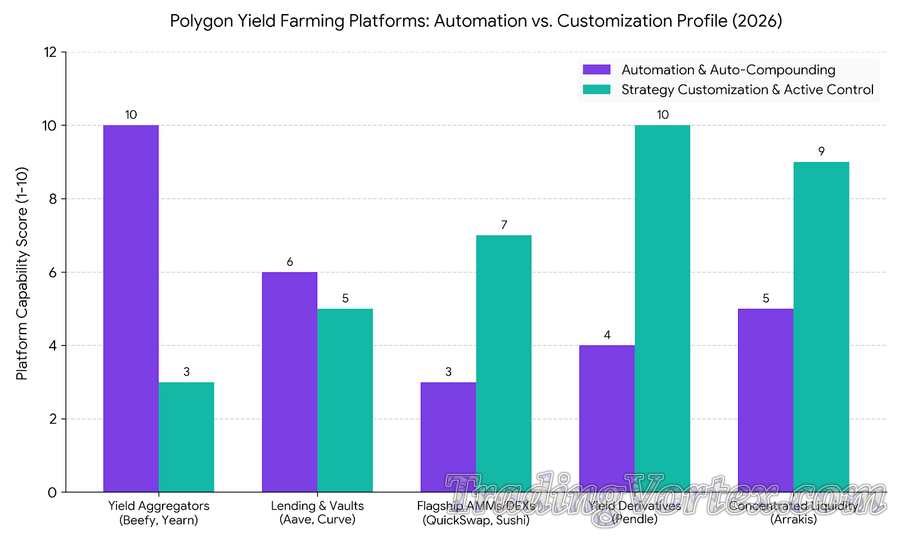 Polygon Yield Farming Platforms: Automation vs. Customization Profile in 2026.
A grouped bar chart evaluating the major platform categories on the Polygon network across two vital user metrics: Automation & Auto-Compounding Level versus Strategy Customization & Active Control.
♦ Educational Explanation:
This visual representation serves as a decision matrix to help you choose the right yield farming platforms on Polygon based on your personal management style, technical interest, and time availability. In 2026, the ecosystem has moved beyond uniform liquidity pools into specialized platform categories scored from 1 to 10 on their core functionalities:
◊ Yield Aggregators (Beefy, Yearn): Scoring a perfect 10 in Automation, these platforms require virtually zero manual intervention. They utilize smart contracts to automatically harvest rewards, swap them for underlying capital, and reinvest them back into your pool. This hands-off approach makes them highly efficient for passive investors, though they offer limited customization (scoring 3).
◊ Lending & Stablecoin Vaults (Aave, Curve): Serving as the core building blocks of Polygon DeFi, these offer a balanced, moderate profile (Automation 6, Customization 5). They give you the flexibility to lend, borrow, and leverage positions, while safety mechanics help keep your baseline yield relatively steady and low-maintenance.
◊ Flagship AMMs/DEXs (QuickSwap, Sushi): Standard decentralized exchanges put more control in your hands (Customization 7, Automation 3). You choose specific asset pairs to provide liquidity for, directly earning transaction fees. However, they require active oversight to monitor market price shifts and avoid excessive impermanent loss.
◊ Yield Derivatives (Pendle): Representing advanced DeFi engineering, Pendle allows total strategy flexibility (Customization 10) by letting you separate assets into principal and variable yield components. This acts as a sophisticated tool for interest rate trading, which trades away automated ease (Automation 4) for professional-grade control.
◊ Concentrated Liquidity (Arrakis): Platforms focusing on next-generation efficiency help you specify precise price boundaries to maximize earned trading fees (Customization 9). While algorithmic modules assist in capital management (Automation 5), they still require a solid understanding of market range volatility.
♦ By matching your investment goals to this chart, you can deploy a diversified strategy: for instance, placing your foundational portfolio into automated aggregators like Beefy while reserving a tactical portion for active yield trading on Pendle.
Yield Farming Strategies on Polygon
Liquidity Provision on Polygon for Stablecoins and Tokens
Providing liquidity is still the backbone of yield farming. On platforms like QuickSwap and Curve, you can deposit pairs such as USDC/DAI or USDT/USDC to earn trading fees plus farming rewards. These pools are relatively safe because stablecoins minimize impermanent loss, making them ideal for beginners or cautious investors who want predictable returns.
For those willing to take on more risk, volatile token pairs like MATIC/ETH or MATIC/USDC offer higher yields, often in the 15–30 percent range, but they come with price fluctuation risks.
I always tell friends new to DeFi: start with stablecoins, learn the ropes, then experiment with volatile pairs once you’re comfortable. It’s like learning to ride a bike with training wheels before hitting the mountain trails.
Liquidity provision also teaches you the fundamentals of DeFi mechanics. You’ll understand how pools balance supply and demand, how fees accumulate, and how rewards are distributed. Once you grasp these basics, you’ll be better equipped to explore more complex strategies.
Staking MATIC for Yield Rewards
Staking MATIC (now POL after the token migration) is one of the simplest ways to earn yield. By delegating your tokens to validators, you help secure the network and earn 4–8 percent annually. It’s straightforward, low-maintenance, and a great entry point for those who want exposure to Polygon without diving into complex strategies.
I like to compare staking to planting a tree: you put your MATIC in the ground, let it grow, and collect fruit over time. It won’t make you rich overnight, but it’s reliable and keeps your portfolio rooted in the ecosystem. Plus, staking rewards are often paid in MATIC itself, which means you’re compounding your exposure to the network’s growth.
For long-term believers in Polygon, staking is a way to align your portfolio with the success of the chain. It’s not flashy, but it’s steady, and sometimes steady is exactly what you need in crypto.
Auto-Compounding Yield Aggregators
Platforms like Beefy Finance and Yearn Finance automate the process of harvesting rewards, swapping them, and redepositing. This means your yields compound without you lifting a finger. Typical returns range from 8–20 percent, depending on the vault and assets involved.
For busy investors, auto-compounding is a lifesaver. I once tried manually harvesting rewards daily, and it felt like a second job. With aggregators, you can set it and forget it, letting the protocol handle the heavy lifting while you focus on strategy.
Auto-compounding also reduces human error. Forgetting to harvest or missing optimal times can eat into your returns. Aggregators ensure consistency, which is crucial in a market that never sleeps. For investors juggling multiple pools, these platforms are like having a personal assistant who never takes a day off.
Leveraged Yield Farming Opportunities
For advanced traders, leveraged yield farming offers a way to amplify returns by borrowing assets to increase liquidity positions. Platforms like Toros Finance and NillaConnect provide structured leverage strategies. Yields can soar above 30 percent, but risks include liquidation if markets move against you.
This strategy is not for the faint of heart. It’s like driving a sports car at full speed: thrilling, but one wrong move can be costly. If you’re considering leverage, always test with small amounts first and monitor positions closely. Tools like on-chain analytics dashboards help track exposure and reduce surprises.
Leveraged farming also requires discipline. It’s tempting to chase high APYs, but without proper risk management, you can lose more than you gain. Experienced traders often pair leverage with hedging strategies, using stablecoin positions or derivatives to offset risk. It’s complex, but for those who enjoy the adrenaline of active trading, it can be rewarding.
📌 Key Takeaways:
- Stablecoin pools are best for beginners and risk-averse investors.
- Staking MATIC offers steady, low-risk returns and supports the network.
- Auto-compounding vaults save time and maximize efficiency for passive investors.
- Leveraged strategies deliver high yields but demand active management and strong risk tolerance.
Yield farming on Polygon today is about choice. Whether you want safety, convenience, or adrenaline-pumping strategies, the ecosystem has matured to offer something for everyone. The trick is knowing yourself: your risk appetite, your time commitment, and your investment goals.
It’s a bit like choosing your workout routine. Some people prefer yoga for balance and calm, others go for weightlifting to push limits, and some thrive on high-intensity training. Yield farming strategies on Polygon offer the same variety, and the best results come when you pick the one that matches your style.
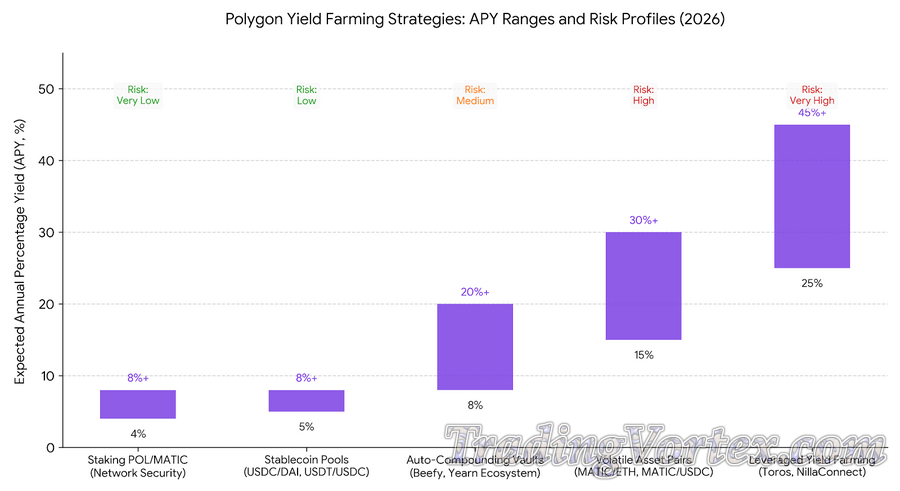 Polygon Yield Farming Strategies: APY Ranges and Risk Profiles in 2026.
A vertical range bar chart depicting the spectrum of available decentralized finance yield opportunities on Polygon, displaying the minimum and maximum expected returns across five distinct core strategies paired with their associated risk levels.
♦ Educational Explanation:
This visual asset serves as a direct roadmap to help you map your risk tolerance to matching yield outcomes across the mature Polygon DeFi ecosystem. The chart layout follows a logical progression from left to right, climbing from the most passive, network-secured options to highly active, advanced financial instruments:
◊ Staking POL/MATIC (Very Low Risk): Positioned at the entry baseline, delegating your native tokens directly to network validators yields a dependable 4% to 8% annually. This acts as a reliable foundational layer with minimal protocol risk, where your primary exposure is simply the market price of the native token itself.
◊ Stablecoin Pools (Low Risk): Depositing highly stable, dollar-pegged pairs like USDC/DAI or USDT/USDC onto platforms such as Curve or QuickSwap secures a tight, predictable return band of 5% to 8%. Because both underlying tokens target an identical value, impermanent loss is practically non-existent, making this the optimal playground for conservative portfolios.
◊ Auto-Compounding Vaults (Medium Risk): Utilizing yield aggregators like Beefy or Yearn upgrades your efficiency, boosting expected net returns to a broader 8% to 20% range. These vaults automate the continuous process of harvesting platform rewards, selling them, and expanding your core position to leverage compounding interest without incurring constant manual network fees.
◊ Volatile Asset Pairs (High Risk): Providing liquidity for non-pegged, major pairs like MATIC/ETH or MATIC/USDC opens up a higher reward bracket of 15% to 30%. While trading volumes and protocol incentives feed these larger returns, sudden independent price swings between the two assets introduce the tangible threat of impermanent loss, requiring a firmer hand and constant observation.
◊ Leveraged Yield Farming (Very High Risk): Sitting at the peak of the risk-reward curve, advanced lending architectures like Toros or NillaConnect allow you to borrow capital to multiply your pool exposure. This structures an aggressive APY profile stretching from 25% to 45% or higher. However, because your principal position is debt-backed, an adverse drop in asset prices can trigger forced liquidations, making active risk tracking and hedging completely mandatory.
Latest Polygon Yield Farming Trends (2026)
Cross-Chain Yield Farming with Ethereum, Arbitrum, and Optimism
Yield farming is no longer confined to a single chain. Cross-chain strategies have become the norm, allowing investors to deploy liquidity across Ethereum, Polygon, Arbitrum, Optimism, Solana, and even BNB Chain. Reports show that cross-chain platforms like Yearn Finance and maxAPY consistently outperform single-chain alternatives, offering diversified APYs from 5 percent on stablecoin pools to 50 percent on high-yield AMMs.
The advantage is clear: by spreading assets across multiple chains, investors reduce exposure to chain-specific risks such as congestion or impermanent loss. It’s like diversifying your stock portfolio across sectors instead of betting everything on one company. Personally, I’ve found cross-chain farming to be less stressful, since a downturn on one chain doesn’t wipe out all my returns.
Another benefit is flexibility. Farmers can chase yields where liquidity is deepest or where incentives are strongest, without being locked into one ecosystem. This has created a new generation of cross-chain dashboards and portfolio trackers that make managing multi-chain strategies far easier than it was just a few years ago.
Real-World Assets (RWAs) on Polygon Tokenization
One of the hottest topics in 2026 is RWA tokenization. Platforms like Centrifuge, Falcon Finance, and xStocks are bringing treasuries, equities, and commodities on-chain. Experts argue that RWAs are finally behaving like real financial primitives: priced, tradable, composable, and usable as collateral.
Tokenized equities are driving retail demand, letting crypto traders rotate between stocks and tokens without leaving DeFi. Institutional allocators are also diversifying into treasuries and CLO-like exposures, creating a bridge between traditional finance and DeFi. For yield farmers, this means new pools backed by real-world value, not just speculative tokens. It feels like DeFi is finally growing up, offering yields tied to tangible assets rather than hype alone.
The appeal here is stability. RWAs provide yields that are less correlated with crypto market volatility, giving farmers a way to hedge their portfolios. It’s like mixing bonds into a stock-heavy portfolio: the returns may be steadier, but they add resilience when markets get choppy.
Institutional Adoption and Regulated DeFi Platforms
2026 is the year institutions fully embraced Polygon. With clearer regulations, regulated DeFi platforms are emerging, offering compliance-friendly yield opportunities. These platforms provide KYC-enabled pools, audited smart contracts, and structured yield products that appeal to pension funds, asset managers, and banks.
For retail investors, this means safer environments and more predictable yields. It’s a bit like moving from a street market to a regulated supermarket: the variety is still there, but the quality control is stronger. Institutional adoption also deepens liquidity, making yield farming more stable and less prone to sudden collapses.
This trend is also reshaping incentives. Instead of chasing unsustainable APYs, platforms are focusing on long-term yield stability. Institutions prefer predictable returns, and their presence is nudging DeFi toward more professional standards. For everyday farmers, this translates into fewer rug pulls and more confidence in the platforms they use.
AI-Driven Yield Optimization Tools
Artificial intelligence is now part of the DeFi toolkit. AI-driven yield optimizers analyze hundreds of strategies across chains, automatically reallocating assets to maximize APY while minimizing risk. These tools can detect impermanent loss patterns, predict market swings, and rebalance portfolios in real time.
For busy investors, this is a game-changer. Instead of manually chasing yields, you can let AI handle the heavy lifting. I’ve tested one of these optimizers, and it felt like having a financial advisor who never sleeps. The returns weren’t always sky-high, but they were consistent, and the reduced stress was worth it.
AI tools are also democratizing advanced strategies. What used to require hours of research and constant monitoring is now accessible to anyone with a wallet. This levels the playing field, allowing smaller investors to compete with whales who traditionally had the resources to dominate yield farming.
📌 Key Takeaways:
- Cross-chain farming spreads risk and boosts returns.
- RWA tokenization brings treasuries and equities into DeFi, adding real-world value.
- Institutional adoption is making Polygon safer and more liquid.
- AI optimizers automate strategies, offering consistent yields with less effort.
Yield farming on Polygon in 2026 feels more professional, more sustainable, and more exciting than ever. Whether you’re a cautious investor or a thrill-seeker, these trends open doors to strategies that fit your style and goals. It’s no longer just about chasing the highest APY; it’s about building smarter, more resilient portfolios that can thrive in the evolving world of decentralized finance.
Impact of Latest Polygon Yield Farming Trends (2026)
Here’s a trend impact table that breaks down how each of the four major Polygon yield farming trends in 2026 affects yields, risks, and accessibility for different types of investors. This format makes it easy to see at a glance how each development changes the game for beginners, cautious investors, and advanced traders.
| Trend | Impact on Yields | Impact on Risks | Impact on Accessibility |
|---|---|---|---|
| Cross-Chain Yield Farming | Yields increase through diversification, with APYs ranging from 5% on stablecoin pools to 50% on high-yield AMMs. | Risk is spread across chains, reducing exposure to single-chain failures, but adds complexity and potential bridge vulnerabilities. | More accessible thanks to dashboards and cross-chain tools, though beginners may find multi-chain strategies overwhelming. |
| Real-World Assets (RWAs) Tokenization | Provides steady yields tied to treasuries, equities, and commodities, often 4–10%, less volatile than crypto-native pools. | Lower risk compared to volatile token pairs, but introduces regulatory and custodial risks tied to off-chain assets. | Highly accessible to both retail and institutions; RWAs make DeFi feel familiar to traditional investors. |
| Institutional Adoption & Regulated DeFi | Yields stabilize, often in the 5–12% range, prioritizing sustainability over hype-driven APYs. | Risks decrease due to KYC pools, audits, and compliance, but innovation may slow under stricter rules. | Accessibility improves for cautious investors and institutions, while some retail users may dislike KYC requirements. |
| AI-Driven Yield Optimization Tools | Yields become more consistent, with optimizers reallocating assets to maximize APY while avoiding impermanent loss. | Risks are reduced through automated rebalancing, but reliance on algorithms introduces new trust concerns. | Accessibility improves dramatically, as even beginners can use AI tools to manage complex strategies with ease. |
📌 Key Insights:
- Cross-chain farming boosts yields but requires more technical know-how.
- RWAs bring stability and legitimacy, appealing to cautious investors and institutions.
- Institutional adoption makes DeFi safer, though it may feel less “wild west” for adventurous farmers.
- AI optimizers democratize advanced strategies, letting small investors compete with whales.
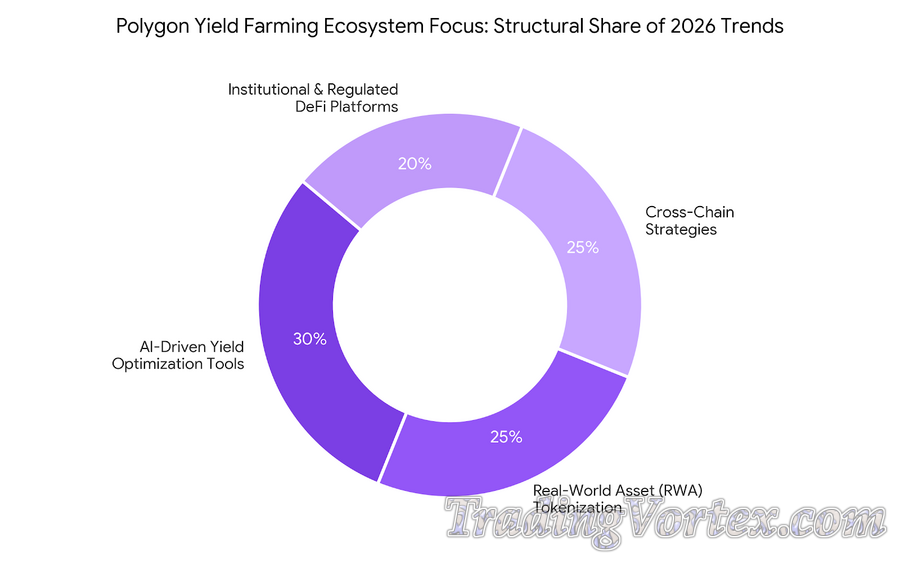 Polygon Yield Farming Ecosystem Focus: Structural Share of 2026 Trends.
A professional donut chart visualizing the impact and distribution of the four defining macroeconomic shifts driving Polygon's decentralized finance space, mapping out the presence of AI tools, asset tokenization, cross-chain liquidity, and institutional frameworks.
♦ Educational Explanation:
This visual breakdown highlights the structural pillars modernizing the Polygon yield farming landscape in 2026. Rather than relying on singular speculative mechanics, the market has diversified into four complementary advancements that collectively build a safer, automated, and lower-volatility investment environment:
◊ AI-Driven Yield Optimization Tools (30% Share): Taking up the largest share of ecosystem movement, automated machine learning protocols lead the pack. These intelligent managers continuously scan multiple protocols to execute real-time portfolio rebalancing, calculate impermanent loss trajectories, and level the playing field so retail users can capture optimized yields automatically without round-the-clock monitoring.
◊ Real-World Asset (RWA) Tokenization (25% Share): Representing a quarter of the network's momentum, the integration of traditional financial instruments: such as tokenized US treasuries, equities, and physical commodities; introduces asset-backed stability. This allows you to hedge your web3 capital by routing funds into yields tethered to mature, tangible economies rather than speculative utility tokens.
◊ Cross-Chain Strategies (25% Share): Tied for a quarter of the market focus, cross-chain designs allow liquidity to migrate dynamically between Polygon, Ethereum mainnet, and prominent Layer-2 ecosystems like Arbitrum and Optimism. Utilizing unified dashboards keeps your asset deployment highly flexible, allowing you to seamlessly spread risks and pursue deeper liquidity across networks without locking yourself into a single chain.
◊ Institutional & Regulated DeFi Platforms (20% Share): Fueling one-fifth of the ecosystem structure, compliance-focused frameworks are formalizing the network. Through audited smart contracts, structured financial products, and KYC-enabled pools, this pillar brings massive institutional liquidity from asset managers and corporate pools, cementing long-term yield stability and heavily suppressing the risk of protocol exploits.
♦ Understanding how these trends intersect allows you to craft a balanced 2026 investment approach: combining the automated ease of AI systems with the physical financial security of on-chain real-world assets.
Risks and Challenges in Polygon Yield Farming
Smart Contract Risks on Polygon
Smart contracts are the backbone of DeFi, but they are not immune to bugs or exploits. In 2025 alone, crypto theft reached $3.4 billion, with a significant portion tied to vulnerabilities in DeFi protocols. Even contracts that have been audited multiple times can still be exploited, and smaller projects with unaudited code pose significantly higher risks.
The community has learned to emphasize sticking to audited platforms with high total value locked (TVL), since larger pools tend to attract more scrutiny and have stronger incentives to maintain security. Many seasoned investors now limit exposure to any single protocol to 5 percent of their portfolio, treating diversification as a shield against catastrophic losses.
I’ve personally learned to treat unaudited protocols like experimental restaurants: sometimes you discover a hidden gem, but more often you regret the meal. In yield farming, that regret can mean losing your entire stake overnight. The lesson is simple: curiosity is fine, but don’t risk your entire portfolio on untested code.
Impermanent Loss in Liquidity Pools
Impermanent loss remains one of the most misunderstood risks in yield farming. It occurs when you provide liquidity to a pool and the prices of the paired tokens diverge. Even if you earn fees and rewards, the value of your assets can end up lower than if you had simply held them.
Experienced farmers now use hedging strategies, such as perpetual contracts or options, to offset impermanent loss. Others stick to stablecoin pools like USDC/DAI, which minimize volatility and provide more predictable returns. The rule of thumb is simple: if you don’t fully understand impermanent loss, start with stablecoins before venturing into volatile pairs.
I remember a friend who jumped into a volatile pool chasing a 40 percent APY, only to realize months later that his net position was worth less than if he had just held the tokens. The rewards looked great on paper, but impermanent loss quietly ate away at his gains. It’s a reminder that yield farming isn’t just about chasing numbers, it’s about understanding the mechanics behind them.
Crypto Regulation in 2026 and Compliance Concerns
Regulation has become a defining factor in DeFi. Governments are tightening rules around KYC, AML, and audited protocols, pushing platforms toward compliance. While this reduces risks of rug pulls and outright fraud, it also introduces friction for retail investors who prefer anonymity and speed.
Institutional adoption is driving this trend, with regulated DeFi platforms offering predictable yields in the 5–12 percent range. For cautious investors, this is a welcome change, since it provides safer environments and more reliable returns.
For those who enjoyed the “wild west” of DeFi, it feels restrictive, like moving from a bustling street market to a regulated supermarket. Either way, regulation is here to stay, and ignoring it could mean losing access to platforms or facing compliance issues.
The upside is that regulation is helping DeFi mature. Platforms are becoming more professional, fraud is harder to pull off, and investors can feel more confident that their funds are not at risk of disappearing overnight.
Bridge Vulnerabilities and Cross-Chain Exploits
Cross-chain bridges have become one of the biggest attack surfaces in DeFi. Since 2020, over $2.8 billion has been stolen through bridge exploits, making them a persistent risk for yield farmers. Bridges are essential for moving assets between Ethereum, Polygon, Arbitrum, and other chains, but they remain complex and vulnerable to sophisticated attacks.
The best practice is to use established bridges with strong security records and to avoid moving your entire portfolio in one transaction. I always test with a small amount first, just like dipping a toe in the pool before diving in. It’s a simple precaution that can save you from catastrophic losses.
Some investors now prefer native cross-chain solutions or platforms that integrate multiple chains directly, reducing reliance on external bridges. While these innovations are promising, they are still evolving, and caution remains the best defense.
📌 Key Takeaways:
- Smart contracts: Stick to audited, high-TVL platforms and limit exposure per protocol.
- Impermanent loss: Understand the mechanics, hedge with derivatives, or start with stablecoin pools.
- Regulation: Expect more compliance requirements, but also safer, more predictable yields.
- Bridges: Use trusted options, test with small transfers, and never move all assets at once.
Yield farming on Polygon in 2026 is no longer about chasing the highest APY. It’s about balancing opportunity with risk, using smarter strategies, and staying aware of the evolving landscape. The farmers who thrive are those who treat DeFi like a marathon, not a sprint, pacing themselves with caution while still enjoying the ride.
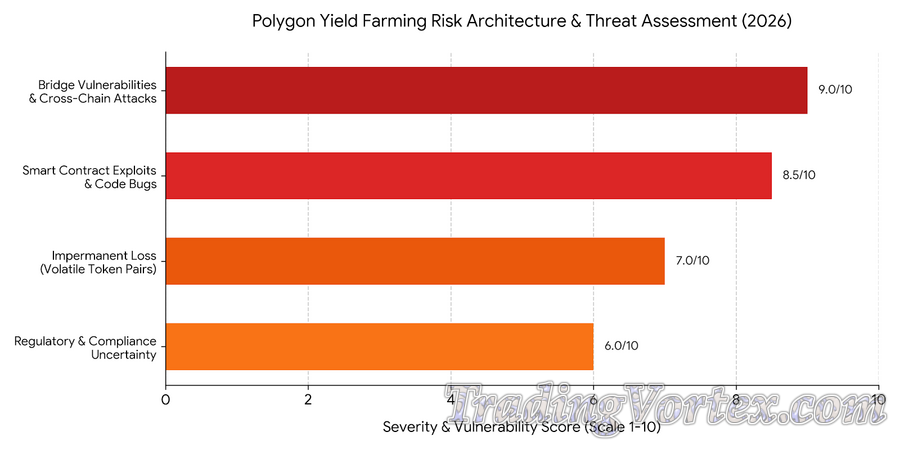 Polygon Yield Farming Risk Architecture & Threat Assessment (2026): A horizontal bar chart assigning threat severity scores out of 10 to the four major technological and structural risks encountered in the Polygon DeFi ecosystem, illustrating that cross-chain bridges and smart contract bugs present the most critical security vulnerabilities.
♦ Educational Explanation:
This visual asset organizes and stacks the core financial and operational threats impacting modern Polygon yield farmers. As the market has matured, the severity profile of these challenges has shifted from simple protocol volatility to complex systemic risks:
◊ Bridge Vulnerabilities & Cross-Chain Attacks (Score: 9.0/10): Ranking as the highest structural threat vector, bridges present a massive attack surface due to their architectural complexity. With over 2.8 billion stolen in bridge exploits over recent years, migrating capital across chains demands maximum vigilance. To manage this threat, avoid moving your entire portfolio in single transactions, execute small test transfers first, and favor native cross-chain routing systems over third-party bridges where possible.
◊ Smart Contract Exploits & Code Bugs (Score: 8.5/10): Standing close behind as a major operational danger, vulnerability within underlying code remains highly critical. Given that sector-wide crypto thefts reached 3.4 billion in a single year, even multiple security audits cannot guarantee total immunity. Cautious investors navigate this by strictly confining capital to protocols backed by multi-million Total Value Locked (TVL) metrics and hard-capping their exposure to any single application at 5% of their total portfolio.
◊ Impermanent Loss - Volatile Token Pairs (Score: 7.0/10): This classic liquidity pool risk represents an omnipresent mathematically driven hazard. When the values of two paired tokens diverge significantly, your net returns can drop below the baseline value of simply holding the tokens raw. You can largely bypass this 7.0/10 risk entirely by prioritizing dollar-pegged stablecoin pools (like USDC/USDT) or deploying advanced hedging tools via derivatives markets to balance out underlying price swings.
◊ Regulatory & Compliance Uncertainty (Score: 6.0/10): While representing the lowest immediate threat score on the chart, changing policy conditions are dramatically reshaping the decentralized web. Shifting rules covering KYC, anti-money laundering frameworks, and required smart contract verifications add institutional friction for anonymous users. However, compliance is a double-edged sword: it shrinks your playground for hyper-speculative, triple-digit APY pools, but it establishes a much safer, predictable, and manipulation-free lending climate for long-term investments.
Best Practices for Yield Farmers on Polygon
Portfolio Diversification in DeFi Across Multiple Farms
One of the golden rules in 2026 is never put all your liquidity in one farm. Even audited platforms can face exploits, and yields can drop overnight when incentives change. Diversifying across stablecoin pools, lending protocols like Aave, and yield tokenization platforms like Pendle helps balance risk and reward.
Think of it like building a balanced diet: too much sugar (high-risk pools) might feel exciting, but you need protein and fiber (stable yields) to stay healthy.
Many professional farmers now use Markowitz-style portfolio optimization to mathematically balance risk and return, but even a simple split between stablecoins, blue-chip tokens, and experimental farms can make a huge difference.
Another smart move is to diversify across chains. With cross-chain farming tools becoming mainstream, many investors now spread assets between Polygon, Arbitrum, and Optimism. This way, if one ecosystem faces congestion or a sudden drop in incentives, the others can keep your portfolio steady. It’s the same principle as not keeping all your savings in one bank account.
DeFi Dashboards for Yield Tracking (Portals.fi, Vaults.fyi, Polygonscan)
Tracking yields manually is a nightmare. Between gas fees, impermanent loss, and token price swings, it’s easy to think you’re winning when you’re actually losing. Tools like Portals.fi, Vaults.fyi, Zapper, and Polygonscan analytics give a clear picture of your positions across chains.
These dashboards show real APYs after fees, track LP token balances, and even export data for tax reporting. I once tried keeping track with spreadsheets, and it felt like juggling flaming swords. Dashboards simplify everything, letting you focus on strategy instead of bookkeeping.
Risk Management Strategies: Insurance Protocols and Hedging
Yield farming without risk management is like driving without brakes. Insurance protocols such as Nexus Mutual and InsurAce now cover smart contract exploits, giving farmers peace of mind. Hedging strategies, like using perpetual contracts or options, help offset impermanent loss in volatile pools.
A growing number of farmers also use delta-neutral vaults, which balance long and short positions to generate yield while minimizing exposure to price swings. These strategies may sound complex, but they’re becoming more user-friendly, with platforms offering automated hedging options.
The key is to treat risk management as part of your yield farming plan, not an afterthought. Even allocating 5–10 percent of your portfolio to insurance can save you from catastrophic losses. I’ve seen cautious farmers outperform aggressive ones simply because they protected their downside. In DeFi, survival is often more important than chasing the highest possible yield.
Staying Updated with Governance and Protocol Changes
DeFi moves fast, and governance decisions can reshape yields overnight. Platforms like Curve and Aave use vote-escrow systems where token holders decide reward allocations. Missing these updates can mean farming in pools that suddenly lose incentives.
Joining governance forums, following protocol announcements, and subscribing to community newsletters keeps you ahead of the curve. I’ve seen farmers ignore governance changes and watch their yields drop from 15 percent to 3 percent in a week. Staying informed is not optional, it’s survival.
Governance also offers opportunities. By participating in votes, you can influence reward distribution and sometimes earn bonus incentives for active involvement. It’s like being a shareholder who not only collects dividends but also helps steer the company. For those who enjoy being part of a community, governance adds a sense of ownership and connection that goes beyond just farming yields.
📌 Key Takeaways:
- Diversify across stablecoins, lending, and yield tokenization to balance risk.
- Use dashboards like Portals.fi and Vaults.fyi to track real yields and avoid spreadsheet chaos.
- Incorporate insurance and hedging into your strategy to protect against exploits and impermanent loss.
- Stay active in governance to anticipate changes and maximize rewards.
Yield farming on Polygon in 2026 is no longer about chasing the highest APY. It’s about building a disciplined, resilient strategy that combines smart tools, risk management, and community engagement. The farmers who thrive are those who treat DeFi like a business, not a lottery ticket. And just like any good business, success comes from consistency, preparation, and knowing when to take calculated risks.
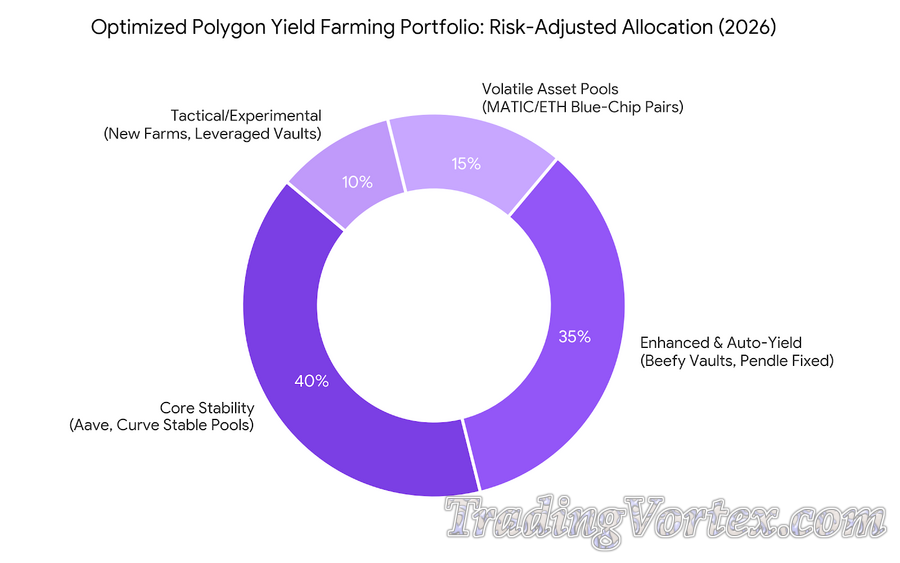 Optimized Polygon Yield Farming Portfolio: Risk-Adjusted Allocation in 2026.
A professional donut chart visualizing a disciplined strategy for capital allocation within the Polygon DeFi ecosystem, dividing capital across baseline stability protocols, automated aggregators, blue-chip volatile pairs, and highly tactical deployments to safely maximize returns.
♦ Educational Explanation:
This visual chart maps out a highly resilient, defensive blueprint designed directly around the discipline-first principles required for Polygon yield farming. Instead of over-allocating capital toward unstable triple-digit APY pools, a top-performing 2026 portfolio distributes liquidity into distinct operational tranches to maintain growth while heavily mitigating downside risks:
◊ Core Stability (40% Weight): Forming the bedrock of your capital architecture, nearly half of your deployment sits inside low-risk, highly reliable protocols. Spreading assets across established multi-million dollar platforms like Aave lending pools and Curve stablecoin pairings (e.g., USDC/DAI) guarantees predictable yields while ensuring your portfolio remains immune to heavy impermanent loss and systemic market downturns.
◊ Enhanced & Auto-Yield (35% Weight): Positioned to aggressively capture compounding interest without increasing your manual work, over one-third of the allocation is handled by auto-compounding systems and yield tokenization primitives. Utilizing automated vaults like Beefy Finance eliminates manual gas fee inefficiencies, while platforms like Pendle let you isolate and trade yield rates, safely boosting your overarching returns.
◊ Volatile Asset Pools (15% Weight): To prevent performance stagnation, a controlled 15% tranche is exposed to major, highly liquid blue-chip token pairings like MATIC/ETH. While exposed to broader asset price swings, tracking your net positions closely via advanced dashboards (such as Portals.fi or Vaults.fyi) allows you to confidently harvest higher trading fees.
◊ Tactical/Experimental (10% Weight): Sitting at the final, tightest band of the chart, a small 10% ceiling is allocated for experimental yield farms or automated leveraged positions. Isolating this capital ensures that if an unaudited protocol encounters an exploit or rewards dry up unexpectedly following a fast governance vote, your core financial runway remains completely untouched and secured.
♦ By implementing this structured, risk-adjusted approach (monitored via integrated tracking dashboards and backed by on-chain insurance coverage) you treat your yield farming journey as a highly sustainable business rather than a high-risk lottery ticket.
Future of Yield Farming on Polygon
Polygon’s Role in the Ethereum Layer-2 DeFi Ecosystem
Polygon has cemented itself as one of the most important Ethereum Layer-2 scaling solutions, standing shoulder to shoulder with Arbitrum and Optimism. Its defining advantage remains cost efficiency: gas fees are up to 99 percent lower than Ethereum mainnet, which means farmers can compound rewards daily instead of monthly. This simple difference dramatically boosts net APYs, with reports in 2026 showing that Polygon yields are 20–50 percent higher than Ethereum mainnet after fees.
But Polygon’s role goes far beyond cheap transactions. It has become a launchpad for innovative DeFi protocols, hosting yield tokenization platforms like Pendle, concentrated liquidity managers like Arrakis, and AI-driven optimizers that automate complex strategies. By combining Ethereum’s battle-tested security with its own scalability, Polygon is positioning itself as the backbone of a multi-chain DeFi future. For yield farmers, this translates into deeper liquidity, more reliable infrastructure, and a steady stream of new strategies that keep the ecosystem vibrant.
Polygon is also playing a critical role in interoperability. With bridges and cross-chain dashboards becoming more sophisticated, Polygon is increasingly seen as a hub where assets flow in and out seamlessly. This makes it not just a Layer-2 solution, but a gateway to the broader DeFi universe.
Growth of Yield Farming in Emerging Markets
Emerging markets are driving the next wave of adoption, and Polygon is at the center of this movement. In regions like Africa, Southeast Asia, and Latin America, stablecoin-based yield farming is becoming a lifeline for people facing unreliable local banking systems and high inflation. With traditional savings accounts offering negligible returns, Polygon’s low fees and stablecoin pools provide a practical way to preserve value and earn yields in the 5–12 percent range.
For example, farmers in Morocco or Nigeria can access USDC or DAI pools on Polygon with just a smartphone and a wallet app. The accessibility of mobile-first wallets and cross-chain bridges makes DeFi farming viable even for small investors who might only start with $50 or $100. This grassroots adoption is turning Polygon into a global financial tool, not just a playground for crypto enthusiasts.
It reminds me of the rise of mobile banking in emerging markets: once people realized they could bypass traditional banks, adoption skyrocketed. Yield farming on Polygon is following a similar path, offering financial empowerment where traditional systems fall short. The difference now is that DeFi offers not just access, but also growth opportunities, allowing individuals to build wealth in ways previously unimaginable.
Long-Term Sustainability of Yield Farming Models
The era of unsustainable triple-digit APYs fueled by token emissions is fading fast. Analysts project that future yields will stabilize in the 3–15 percent range, backed by real utility such as transaction fees, lending interest, and tokenized real-world assets. This shift reflects a maturing ecosystem where protocols prioritize economic sustainability over hype-driven incentives.
Institutional adoption is reinforcing this trend. Regulated DeFi platforms are offering predictable yields with compliance safeguards, attracting pension funds, asset managers, and even banks. For retail investors, this means fewer rug pulls, more confidence in long-term strategies, and a healthier balance between risk and reward.
The sustainability question boils down to whether DeFi can generate “real yield” rather than relying on inflationary rewards. Polygon is leading this transition by hosting protocols that integrate RWAs, delta-neutral vaults, and AI-driven optimizers. These innovations are designed to keep yields attractive while reducing systemic risk.
I often tell fellow farmers that yield farming is becoming less like a casino and more like a structured investment strategy. The thrill of chasing high APYs is giving way to the satisfaction of building a portfolio that can stand the test of time. Polygon is at the heart of this transformation, offering a balance of innovation and reliability that makes it one of the most promising ecosystems for the future.
📌 Key Takeaways:
- Polygon’s Layer-2 efficiency ensures higher net APYs and positions it as a core DeFi hub.
- Emerging markets are adopting Polygon yield farming as a practical alternative to unstable local finance.
- Sustainable yield models are replacing speculative emissions, with stable returns in the 3–15 percent range.
- Institutional adoption and RWA integration are making Polygon yield farming more professional and resilient.
The future of yield farming on Polygon looks less like a casino and more like a global financial system in the making. For investors, this means fewer wild swings, more reliable returns, and a chance to be part of a DeFi ecosystem that is finally growing up. It’s an exciting time to be involved, whether you’re a cautious saver in an emerging market or a seasoned trader looking for the next frontier in decentralized finance.
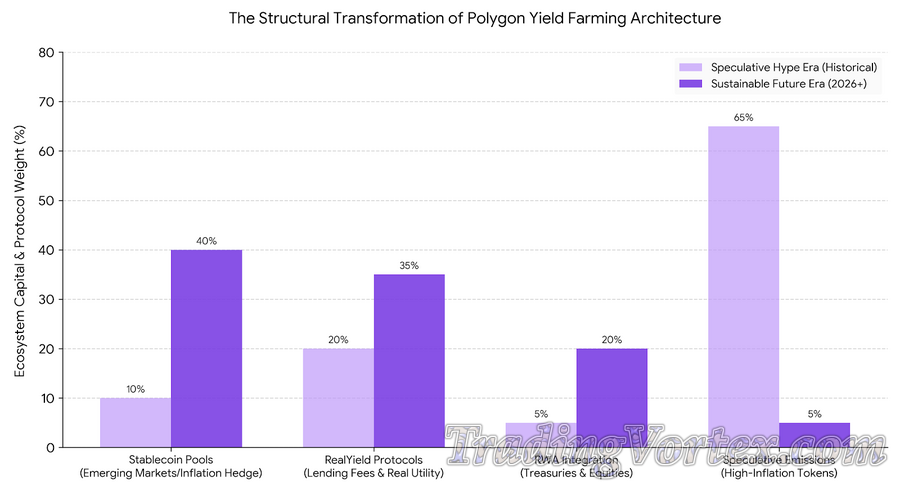 The Structural Transformation of Polygon Yield Farming Architecture: A side-by-side grouped bar chart illustrating the macroeconomic evolution of the Polygon DeFi network, comparing the capital and protocol distribution of the historical speculative hype era against the emerging, utility-driven sustainable future framework of 2026 and beyond.
♦ Educational Explanation:
This visual asset serves as an educational guide to help you understand the structural transition occurring across the Polygon network. It directly demonstrates how the mechanics of wealth generation are shifting away from high-inflation token mechanics toward long-term, tangible utility:
◊ Stablecoin Pools for Emerging Markets (From 10% to 40% Share): The single largest growth sector highlights grassroots, global inclusion. In the early speculative phases, stablecoins were merely a brief parking spot for volatile capital. Today, driven by smartphone accessibility in emerging markets (such as Africa, Southeast Asia, and Latin America), these pools act as a foundational banking alternative. They offer a practical inflation hedge and wealth preservation tool with reliable yields in the 5 to 12 percent range.
◊ RealYield Protocols (From 20% to 35% Share): Capital is actively migrating into "Real Yield" architectures. Instead of relying on artificial rewards, these models sustain themselves using organic revenue primitives like swap transaction fees, loan interest, and concentrated liquidity management. This ensures that your annual percentage returns are backed by genuine market demand rather than hyper-inflationary protocol emissions.
◊ Real-World Asset (RWA) Integration (From 5% to 20% Share): The integration of tokenized equities, treasury bonds, and traditional commodities onto the Polygon blockchain has grown fourfold. This structural shift bridges institutional finance with web3, introducing highly resilient, compliance-friendly collateral and predictable returns that decouple your farming portfolio from pure crypto market volatility.
◊ Speculative Emissions (From 65% down to 5% Share): The defining characteristic of early DeFi (unsustainable triple-digit yields fueled by printing high-inflation governance tokens) has shrunk to a negligible fraction of the ecosystem. This reduction in speculative noise indicates that the market is maturing into a legitimate, institutional-grade financial system where capital is retained through security, low transaction fees, and predictability rather than short-lived hype.
♦ By analyzing this structural pivot, you can better position your strategies to align with the protocols receiving long-term capital inflows; favoring sustainable, multi-chain utility over decaying inflationary models.
Emerging Market Adoption: A Truly International Movement
Africa: Nigeria and Kenya Leading the Charge
Nigeria remains one of the most active crypto markets worldwide, consistently ranking in the top three for peer-to-peer trading volumes. In late 2025, Flutterwave partnered with Polygon to launch a stablecoin-powered cross-border payment network across 34 African nations, cutting remittance fees from an average of 8 percent to fractions of a cent and reducing settlement times from days to seconds. This partnership is projected to multiply transaction volumes tenfold by 2026, making stablecoins like USDC and USDT indispensable for millions of households and small businesses.
For Nigerian yield farmers, this means more than just speculation. Stablecoin pools on Polygon provide a way to earn 5–12 percent annual returns, which is transformative in a country where inflation regularly erodes savings. Families are using DeFi not only to preserve wealth but also to fund education, healthcare, and small business growth.
Kenya, already famous for mobile money innovation through M-Pesa, is seeing similar momentum. The country’s strong mobile-first culture makes Polygon’s low-fee DeFi ecosystem a natural fit. Farmers in Kenya are increasingly turning to stablecoin yield farming as a reliable alternative to traditional savings accounts, which often offer negligible returns. With Polygon’s sub-$0.01 transaction fees, even micro-investments of $20 or $50 can grow meaningfully, democratizing access to yield farming for everyday citizens.
Latin America: Argentina’s Inflation Hedge
Argentina continues to struggle with chronic inflation, with annual rates exceeding 200 percent in 2025. In this environment, Polygon yield farming has become a practical hedge. Stablecoin pools on Polygon allow Argentinians to preserve value and earn yields in the 5–10 percent range, offering stability compared to the peso’s volatility.
For many families, yield farming is less about chasing high APYs and more about survival. By converting pesos into USDC or DAI and farming yields on Polygon, households can protect their purchasing power and avoid the devastating effects of inflation. This grassroots adoption is turning Polygon into a lifeline for Argentinians, providing financial stability in an otherwise unstable economy.
Asia: Vietnam’s Grassroots Adoption
Vietnam has emerged as one of Southeast Asia’s most active crypto markets, driven by a young, tech-savvy population eager to explore new financial opportunities. Farmers there are embracing cross-chain yield farming strategies, moving assets between Ethereum, Arbitrum, and Polygon to chase the best APYs.
With mobile wallets and dashboards like Portals.fi and Vaults.fyi, even small investors can manage complex strategies. This accessibility is fueling grassroots adoption, where yield farming is seen not only as an investment tool but also as a way to democratize finance. Vietnam’s growing developer community is also contributing to Polygon’s ecosystem, building localized DeFi apps that cater to the unique needs of Southeast Asian users.
Morocco: Growing Interest in Stablecoin Farming
In Morocco, crypto adoption is rising as citizens seek alternatives to traditional banking systems and hedge against currency volatility. Polygon’s low fees and expanding partnerships across Africa are making stablecoin pools increasingly attractive. Younger investors, in particular, are exploring DeFi as a way to earn predictable yields and gain exposure to global financial markets.
Regional fintech platforms are beginning to integrate Polygon, which is expected to accelerate adoption further. For Moroccan users, yield farming represents both an investment opportunity and a way to connect with the broader international financial system, bypassing limitations of local banking infrastructure.
Why This Matters Globally
The spread of Polygon yield farming across Africa, Latin America, and Asia highlights its real-world utility. It is not just about chasing high APYs, but about providing financial empowerment in places where traditional systems fail. As adoption grows internationally, Polygon’s ecosystem benefits from deeper liquidity, more stable yields, and stronger resilience.
Key Insight: Yield farming on Polygon is now a truly international movement. From Nigeria and Kenya to Argentina, Vietnam, and Morocco, it is empowering everyday people to protect and grow their wealth, proving that DeFi is becoming a global financial system rather than a speculative niche.
 Polygon Emerging Market Hotspots: Economic Catalysts vs. DeFi Adoption (2026): A grouped side-by-side bar chart showing five international adoption hubs (Nigeria, Kenya, Argentina, Vietnam, and Morocco), comparing their localized economic hedging demand alongside Polygon's decentralized finance adoption metrics to illustrate how real-world financial friction drives global web3 utility.
♦ Educational Explanation:
This visual chart details how macroeconomic realities directly correlate with grassroots web3 utility across emerging markets. Rather than focusing on speculation, the dual-index layout maps the relationship between regional financial vulnerabilities and the surging demand for Polygon’s sub-penny transaction rails:
◊ Nigeria (Economic Demand: 28 | Adoption Growth: 90): As a global leader in peer-to-peer crypto volume, Nigeria’s adoption index sits near the top. This explosive activity is heavily amplified by structural payment innovations, notably the Flutterwave cross-border network integration across 34 African nations, which collapses remittance costs by up to 60% and slashes transaction times down to seconds. This creates a streamlined path for local users to use stablecoins to outpace aggressive domestic currency inflation.
◊ Kenya (Economic Demand: 15 | Adoption Growth: 75): Leveraging a mature mobile money foundation built on networks like M-Pesa, Kenyan users adapt effortlessly to Polygon's ecosystem. Sub-$0.01 network fees allow citizens to complete micro-deposits as small as $20 or $50 into stablecoin pools without gas fees eating their capital, building a more rewarding yield environment than traditional retail bank accounts.
◊ Argentina (Economic Demand: 95 | Adoption Growth: 85): Driven by severe economic pressure where inflation rates spiked past 200%, Argentina charts the highest localized hedging demand index. For these users, stablecoin farming in the 5% to 10% range on protocols using USDC or DAI is fundamentally a tool for economic preservation, allowing households to protect their baseline purchasing power from rapid local currency devaluation.
◊ Vietnam (Economic Demand: 8 | Adoption Growth: 70): Powered by a young, highly tech-savvy population and a growing developer community, Vietnam’s adoption is driven by strategic financial optimization. Local users comfortably leverage tracking dashboards like Portals.fi and Vaults.fyi to rotate capital through multi-chain or cross-chain yield pools, maximizing their returns via structured DeFi portfolios.
◊ Morocco (Economic Demand: 12 | Adoption Growth: 45): Reflecting an accelerating upward trend, Moroccan investors are turning toward stablecoin pools as a reliable alternative to local banking infrastructure and currency fluctuations. As fintech entities increasingly bridge local frameworks with Polygon's Layer-2 architecture, regional adoption expands, opening accessible gates to international financial markets for everyday savers.
♦ Analyzing this data underscores a vital shift: when local financial systems struggle with high friction, inflation, or heavy remittance costs, Polygon's low-fee infrastructure transitions from an experimental ecosystem into an essential global utility.
Conclusion: Key Takeaways for Yield Farming on Polygon
Recap of Polygon’s Advantages for Yield Farming
Polygon has firmly established itself as one of the most reliable Ethereum Layer-2 ecosystems, no longer seen as a sidechain experiment but as a critical pillar of decentralized finance. Its near-zero transaction fees and fast settlement speeds allow farmers to compound rewards frequently, turning even small investments into meaningful gains. This accessibility has opened the door for investors worldwide, from seasoned traders managing complex strategies to newcomers testing their first stablecoin pool.
The network hosts major DeFi protocols like Aave, Curve, QuickSwap, Beefy Finance, and Pendle, each offering unique strategies. Farmers can choose conservative stablecoin lending, auto-compounding vaults, or advanced yield tokenization. With billions in total value locked and growing institutional interest, Polygon has become a cornerstone of DeFi, bridging the gap between traditional finance and blockchain innovation. Its role as a hub for cross-chain liquidity also ensures that assets flow seamlessly between ecosystems, reinforcing its position as a gateway to the broader DeFi universe.
Balanced View: Opportunities vs. Risks
The opportunities are compelling. Stable yields in the 4–8 percent range provide predictable income, while auto-compounding vaults can boost returns by 20–30 percent. Innovative strategies like cross-chain yield farming and real-world asset tokenization are expanding the scope of what yield farming can achieve, offering exposure to treasuries, equities, and commodities alongside crypto-native assets. For investors in emerging markets, Polygon’s accessibility is transformative, providing a hedge against inflation and unreliable banking systems.
Yet risks remain. Smart contract vulnerabilities continue to be a major concern, with billions lost annually to exploits despite improved auditing practices. Liquidity concentration is another challenge, with Aave V3 controlling over 90 percent of Polygon’s TVL, creating systemic risk if one protocol falters. Impermanent loss in volatile pools can quietly erode gains, while bridge exploits remain one of the largest attack surfaces in DeFi. On top of this, evolving regulatory frameworks are reshaping the landscape, introducing compliance requirements that may limit anonymity but also reduce fraud and instability. Yield farming has matured beyond the chaotic “DeFi Summer,” but it is still a frontier where caution and discipline are essential.
Final Thoughts for Crypto Investors in 2026
Yield farming on Polygon today feels less like gambling and more like structured investing. The ecosystem has matured, offering realistic yields backed by trading fees, lending interest, and tokenized real-world assets. For cautious investors, stablecoin pools and staking MATIC provide predictable returns with minimal risk. For adventurous traders, leveraged strategies and cross-chain farming offer higher rewards, but demand discipline, hedging, and constant monitoring.
The best approach is to treat yield farming like a marathon, not a sprint. Diversify across platforms, use dashboards to track real APYs after fees, and avoid chasing unsustainable numbers that often signal elevated risk. Polygon has become a global hub for DeFi, empowering investors from Nigeria to Argentina to Vietnam, proving that yield farming is not just speculation but a tool for financial inclusion and resilience.
Key takeaway: Polygon yield farming in 2026 is a blend of accessibility, innovation, and sustainability. The opportunities are real, the risks are manageable with discipline, and the ecosystem is steadily becoming a pillar of decentralized finance worldwide. For investors of all levels, the future lies in building smarter, more resilient portfolios that thrive in this evolving financial landscape.
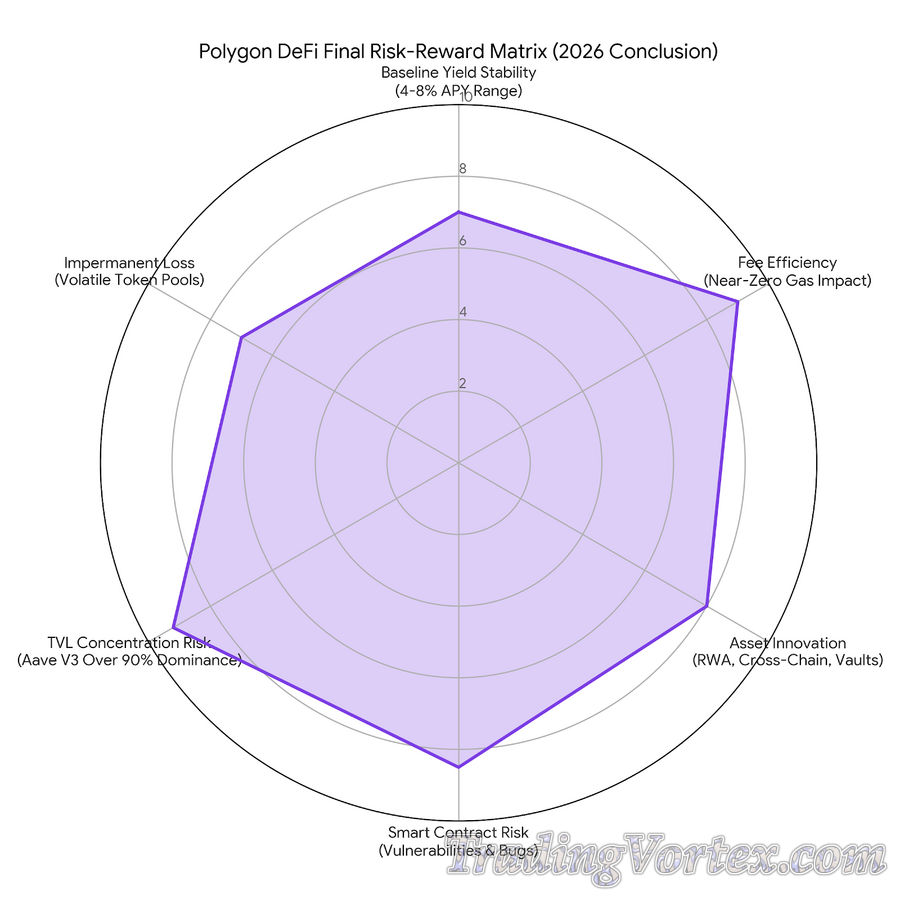 Polygon DeFi Final Risk-Reward Matrix (2026 Conclusion): A comprehensive radar chart mapping out the multi-dimensional ecosystem dynamics of Polygon yield farming, tracking three major operational drivers (yield stability, fee efficiency, and asset innovation) directly alongside three core systemic hazards (smart contract flaws, centralized protocol reliance, and impermanent loss).
♦ Educational Explanation:
This closing radar chart serves as a direct, bird’s-eye "balanced scorecard" of the Polygon Layer-2 landscape in 2026. It is designed to help you instantly gauge where the ecosystem offers maximum utility and where you must establish disciplined defense mechanisms to safeguard your capital. The chart expands symmetrically across six core attributes, using a severity and presence index scaled from 1 to 10:
◊ Fee Efficiency (Score: 9/10): Standing as one of Polygon's most significant competitive pillars, near-zero transaction fees allow you to compound your returns continuously. This removes the gas fee roadblocks that traditionally impact smaller wallets on the Ethereum mainnet.
◊ TVL Concentration Risk (Score: 9.2/10): Representing the largest systemic challenge on the radar, a single application (Aave V3) commands over 90 percent of the total value locked across Polygon's lending markets. While Aave is highly secure and battle-tested, this high level of concentration requires careful protocol diversification to protect against black swan events.
◊ Smart Contract Risk (Score: 8.5/10): Code-level vulnerabilities remain a persistent hurdle across the decentralized frontier. Even with mature auditing standards, the constant presence of exploits requires managing risk by allocating capital only to proven, audited systems.
◊ Asset Innovation (Score: 8/10): Highlighting the network's maturity, Polygon has transitioned into a highly functional hub for yield tokenization (via Pendle), cross-chain farming portals, and institutional real-world assets (RWAs) like tokenized treasuries and equities.
◊ Baseline Yield Stability (Score: 7/10): Moving away from the inflationary, hype-driven models of early DeFi, Polygon offers sustainable, predictable income anchored in a healthy 4 to 8 percent baseline yield range for conservative staking and stablecoin pools.
◊ Impermanent Loss (Score: 7/10): Representing an ongoing financial challenge for automated market makers (AMMs), price divergence in non-pegged, volatile asset pairs can quietly erode your fee rewards. This underlines the importance of incorporating delta-neutral vaults or stablecoin pairings if your goal is strict capital preservation.
♦ By examining this balanced geometry, you can approach Polygon yield farming not as a short-term gamble, but as a structured, professional marathon that yields steady returns when navigated with strategic discipline.
Frequently Asked Questions: Yield Farming on Polygon (2026)
Here’s a fresh FAQ section built on the most recent 2026 data:
What are the typical yields on Polygon?
Average yields on Polygon currently sit at 4.28 percent, with top APYs reaching 7.43 percent on Compound V3 pools. Stablecoin lending on Aave V3 offers around 3–5 percent, while more volatile pools can push higher returns. Remember, higher yields usually mean higher risk, and chasing double-digit APYs often comes with exposure to impermanent loss or experimental protocols.
Is yield farming on Polygon safe?
Polygon is considered an emerging but higher-risk network, with a safety score of 35/100 according to recent DeFi risk assessments. The biggest concern is concentration: Aave V3 controls 91.7 percent of Polygon’s TVL, meaning systemic risk is high if that protocol faces issues. Smart contract exploits remain a global problem, with billions lost in 2025 alone. The best practice is to stick to audited platforms, spread your assets across multiple farms, and avoid putting all your liquidity in one place.
Which platforms are best for yield farming on Polygon?
Top platforms include:
♦ Aave V3: Dominates Polygon liquidity, excellent for stablecoin lending and borrowing.
♦ Curve + Convex: Conservative stablecoin pools with minimized impermanent loss.
♦ Beefy Finance: Auto-compounding vaults, perfect for passive investors who want “set and forget” strategies.
♦ Pendle: Yield tokenization, splitting assets into fixed and variable yield tokens for advanced traders.
♦ Arrakis Finance and TokensFarm: New entrants offering structured campaigns and concentrated liquidity strategies.
Each platform has its niche, so the best choice depends on whether you want stability, automation, or advanced yield mechanics.
What risks should I watch out for?
Key risks include:
♦ Smart contract vulnerabilities: billions lost globally in DeFi exploits.
♦ Impermanent loss: especially in volatile token pairs like MATIC/ETH.
♦ Bridge exploits: cross-chain transfers remain one of the largest attack surfaces.
♦ Liquidity concentration: heavy reliance on Aave V3 increases systemic risk.
Think of yield farming as driving a car: the road is exciting, but you need seatbelts, brakes, and a map. Risk management is your seatbelt.
How do I track my yields effectively?
Use dashboards like Portals.fi, Vaults.fyi, and Zapper to monitor APYs, TVL, and real-time positions across multiple chains. These tools simplify tracking, highlight hidden costs like gas fees, and help avoid the spreadsheet nightmare many farmers face. Some dashboards now integrate AI-driven insights, suggesting rebalancing moves or flagging pools where rewards are drying up.
Can beginners start yield farming on Polygon with small amounts?
Yes. Thanks to Polygon’s near-zero fees, even small investments of $20–50 can be meaningful. Beginners often start with stablecoin pools (USDC/DAI) to avoid impermanent loss, then branch into more complex strategies once comfortable. It’s like learning to swim in the shallow end before diving into the deep pool.
What is the outlook for yield farming on Polygon?
Yields are expected to stabilize in the 3–15 percent range, supported by real-world asset tokenization, institutional adoption, and AI-driven optimizers. The ecosystem is shifting toward sustainability, with fewer hype-driven APYs and more predictable, long-term returns. Polygon is also expanding globally, with adoption in emerging markets like Nigeria, Argentina, and Vietnam, where stablecoin farming is becoming a hedge against inflation and unreliable banking systems.
📌 Key Takeaway:
Yield farming on Polygon in 2026 is about balancing opportunity with caution. The network offers accessible yields, innovative strategies, and global adoption, but risks like smart contract exploits and liquidity concentration mean farmers should diversify, track positions carefully, and avoid chasing unsustainable APYs. The farmers who thrive are those who treat DeFi like a marathon, pacing themselves with discipline while still enjoying the ride.