


Crypto banking tokens, historically led by XRP and XLM, have defined the cross-border payments narrative for years, attracting institutional experimentation and retail liquidity. Recent price action, technical divergences, and the sudden rise of challenger projects such as Digitap, symbol TAP, are combining to create a potential regime shift for payment-focused tokens. This article breaks down the technical evidence, fundamental drivers, presale traction behind TAP, and the macroeconomic backdrop that is pressuring FX and cross-border payment use cases, offering actionable insights for traders and investors.
Table of Contents:
- Technical picture: momentum is weakening
- Fundamental signals: utility, adoption, and competition
- Macro headwinds: FX pressure and cross-border payment narratives
- Competition and market structure: how challengers rise
- Trading and investing strategies: what the data suggests
- How to screen and monitor these themes
- Case study: interpreting TAP presale versus XRP/XLM market share
- Risks and red flags
- Conclusion: RSI Divergence Signals XRP and XLM Weakness, Watch Digitap TAP Presale
Technical picture: momentum is weakening
RSI divergence and trend structure for XRP and XLM
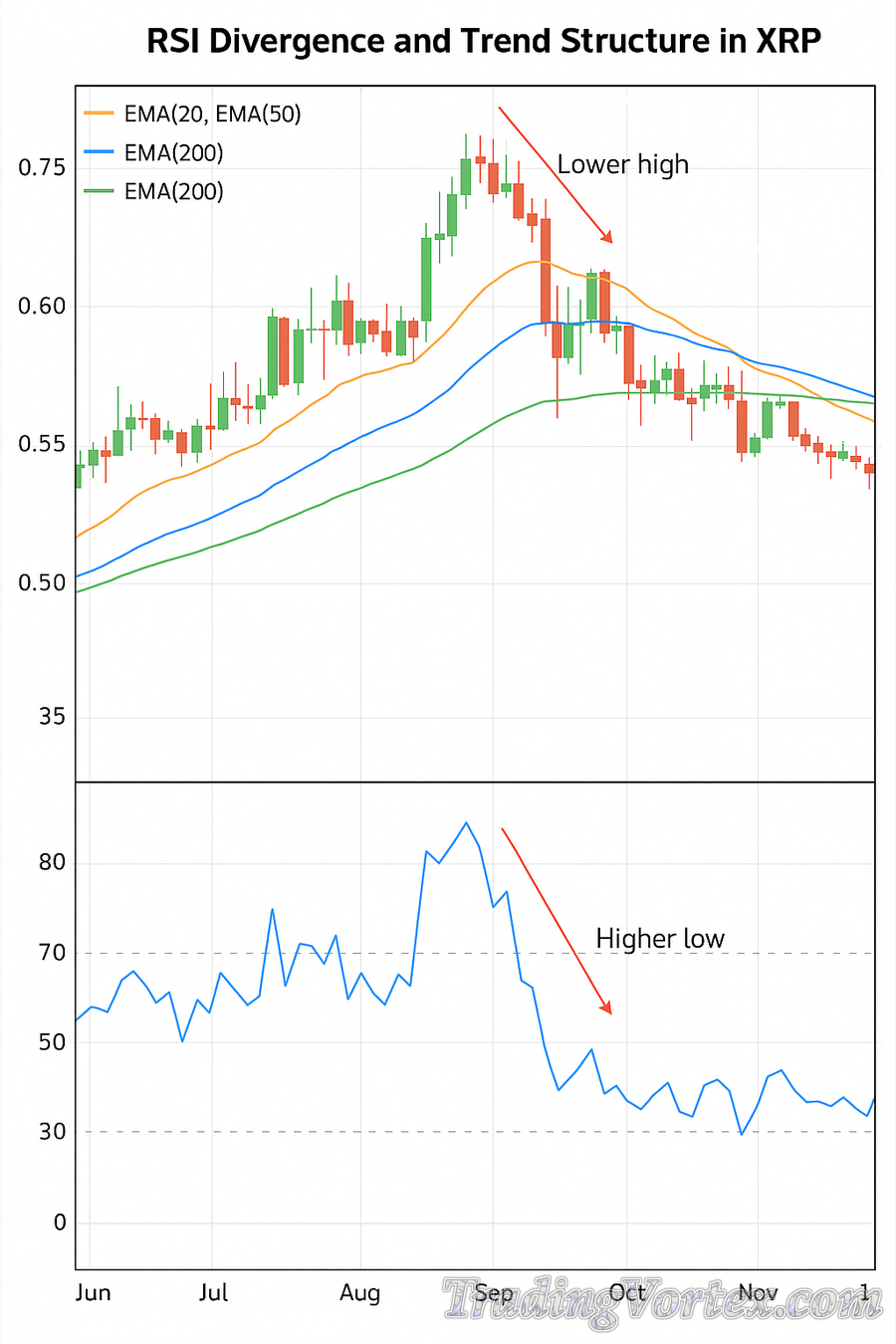 RSI Divergence and Trend Structure in XRP, June–November 2025: XRP daily candlesticks with EMA 20 orange, EMA 50 blue, EMA 200 green, RSI below with divergence callouts.
♦ What it shows: Daily candlesticks for XRP with EMA 20, EMA 50, EMA 200 overlays, RSI plotted beneath the price panel.
♦ Key annotations: price lower high versus RSI higher low, EMA crossovers, and recent support and resistance zones.
♦ How to read it: divergence between price and RSI signals weakening momentum, EMA alignment confirms trend bias, use the RSI and EMA confirmation together to avoid false breakouts.
♦ Trading use: look for RSI reclaim above 50 and price closing above EMA 50 on daily timeframe before adding long exposure; consider short or neutral bias while EMA 20 sits below EMA 50 with RSI below 50.
Chart breakdowns and risk levels
- XRP: daily close points and pivot levels indicate immediate resistance near the 20 and 50 day EMA band, with support clustered near recent swing lows; ATR readings suggest elevated short-term risk and the potential for larger intraday moves.
- XLM: technical breakdowns are most convincing when price closes below medium-term support and fails to rapidly reclaim the 20-day EMA, confirming a seller-controlled structure.
Traders should treat RSI divergence as an early warning, combining it with EMA alignment, volume profiles, and ATR-based position sizing to manage risk on short and medium-term trades.
Fundamental signals: utility, adoption, and competition
Token utility comparison: XRP, XLM, and TAP
XRP and XLM were built to enable fast settlement, low fees, and liquidity efficiency on proprietary ledgers, and both have been integrated in various remittance and on-ramp experiments. Their strengths are real time settlement, established networks, and known enterprise conversations. However, real-world adoption depends on more than technical throughput: regulatory clarity, custodial solutions, and direct fiat integrations matter for market share in payment corridors.
Digitap claims to bridge traditional banking rails and digital assets with a working product, Visa partnership announcements, and multi-function wallets that let users send, spend, save, and exchange fiat and crypto on-ramps in seconds, positioning TAP as a utility-first banking token rather than a pure settlement rail token. This difference in product focus may help TAP capture incumbent retail and merchant flows if the partnerships and compliance story hold up under scrutiny.
Presale funding and traction for Digitap TAP
Public reporting shows Digitap’s presale has attracted meaningful capital, topping figures cited at approximately $1.3 million raised, placing TAP high on presale leaderboards relative to other newcomers. Coverage attributes this traction to a combination of an already launched live application and mainstream payments partnerships, which many presale projects lack at this stage.
For investors, presale funding is an adoption signal but not a substitute for on-chain metrics, active liquidity, and long-term product delivery.
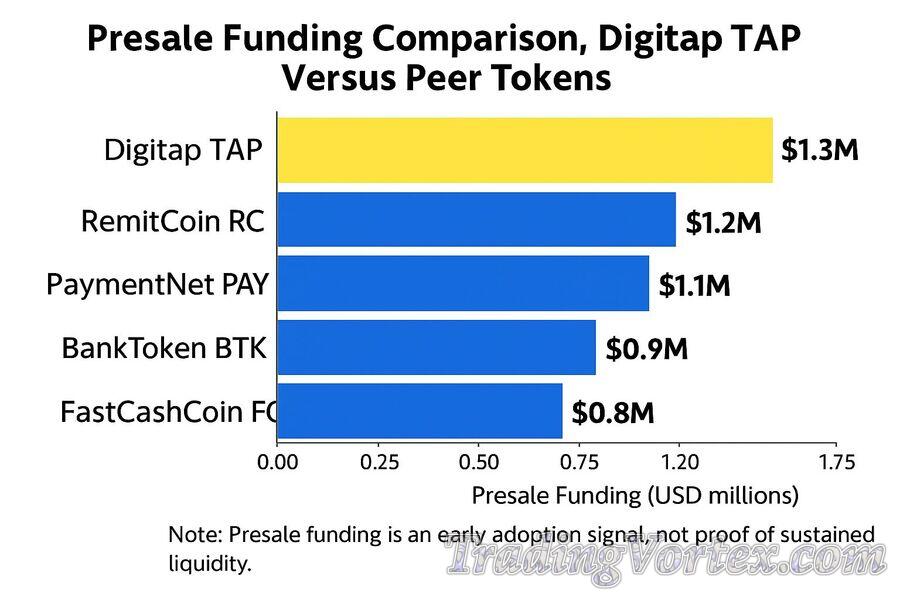 Presale Funding Comparison, Digitap TAP Versus Peer Tokens: Presale funding in USD for Digitap TAP and peer payment tokens; Digitap TAP highlighted; presale size signals early interest, not guaranteed adoption.
♦ What the chart shows:
◊ Bars compare presale funding in USD millions for five tokens: Digitap TAP $1.3M, RemitCoin RC $1.2M, PaymentNet PAY $1.1M, BankToken BTK $0.9M, FastCashCoin FCC $0.8M.
◊ Bars are sorted descending by funding, Digitap TAP highlighted in golden yellow, peers in blue.
♦ Key annotations: Digitap TAP bar highlighted, absolute funding figures shown on each bar, relative ranking emphasized.
♦ How to read it: higher presale figures signal stronger early interest and marketing reach, they are not proof of sustained liquidity or product delivery. Use this chart as a first-pass filter within broader due diligence.
♦ Investing use: Treat presale funding as one input in due diligence, confirm live product, partnership documents, on-chain activity, and exchange listing plans before increasing allocation.
Macro headwinds: FX pressure and cross-border payment narratives
Why macro FX dynamics matter for banking tokens
Cross-border payment demand is heavily sensitive to FX volatility, capital flows, and payment frictions. Recent IMF research highlights how payment frictions interact with capital flows and exchange rates, and how large-scale changes in global payments architecture create uneven demand for alternative rails.
As currencies experience episodic pressure, corporates and remittance corridors may prefer predictable, regulated rails backed by deep FX liquidity; this weakens narratives that position native crypto tokens as immediate, cost-efficient replacements.
The market in early November 2025 reacted to macro pressure and a major DeFi security event, triggering a broad sell-off and increasing correlation between macro risk-on metrics and crypto prices, which exacerbates stress on tokens pitched as cross-border solutions.
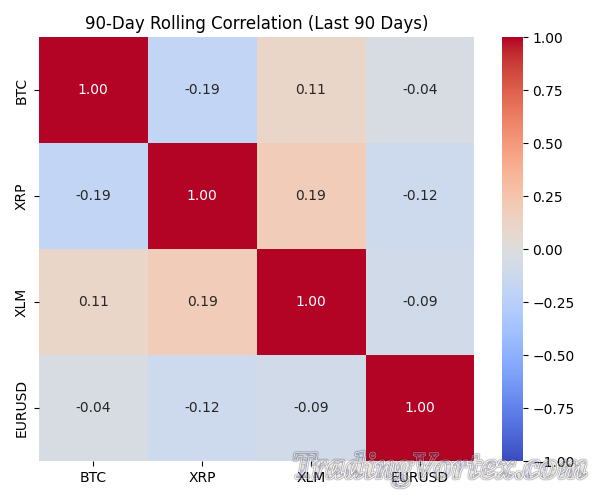 90-Day Rolling Correlation Matrix: BTC, XRP, XLM, EURUSD: The heatmap quantifies how closely crypto tokens are moving with FX proxies. Strong correlations suggest macro stress is influencing token behavior more than native utility, undermining the narrative of crypto as an independent cross-border solution.
Practical effect on XRP and XLM narratives
When FX liquidity tightens or risk aversion spikes, institutions prefer known settlement chains and regulated custodians rather than experimental token rails. That dynamic reduces the marginal utility of XRP and XLM for short-term corridor deployment, and increases the bar for adoption: tokens must demonstrate both regulatory compliance and seamless fiat liquidity provisioning to win enterprise wallet deals.
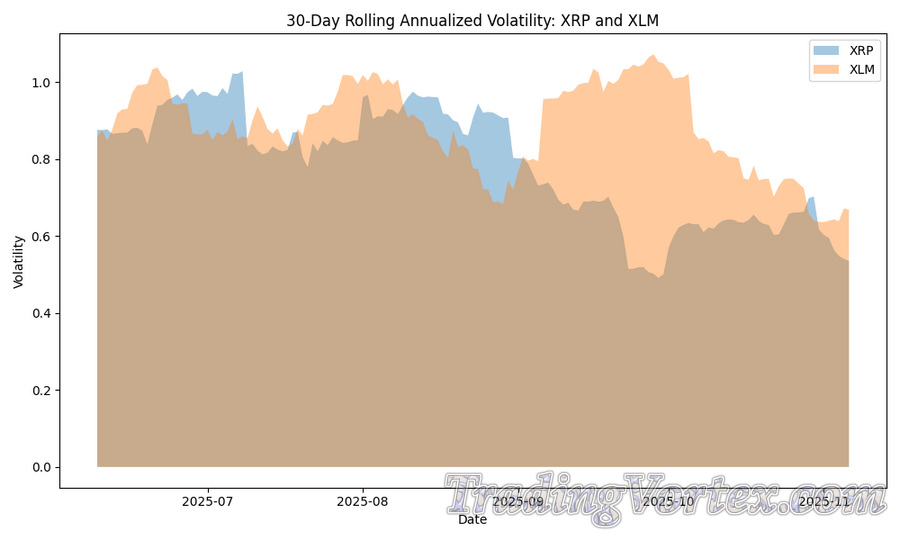 30-Day Rolling Annualized Volatility: XRP and XLM: This chart shows how volatility evolved for XRP and XLM. Elevated volatility increases hedging costs and reduces the appeal of these tokens for institutional corridor deployment, especially when FX liquidity tightens.
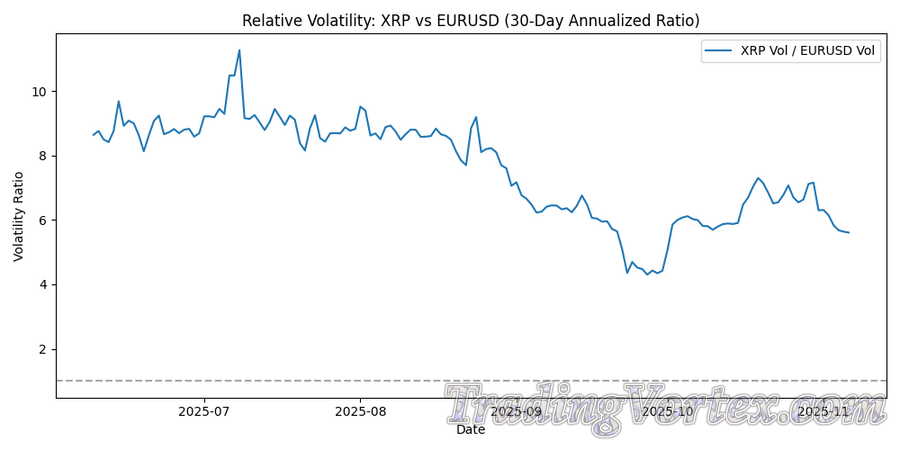 Relative Volatility: XRP vs EURUSD (30-Day Annualized Ratio): This chart compares XRP’s volatility to that of EURUSD. When token volatility far exceeds FX volatility, the cost-efficiency narrative weakens. Institutions face higher risk and complexity when considering token-based settlement rails.
Competition and market structure: how challengers rise
From rails to banking stacks
XRP and XLM historically sold the rail: fast settlement and low fees. Newer challengers, including Digitap, pitch broader stacks that combine wallet rails, fiat on/off ramps, card partnerships, and merchant acceptance, turning the value proposition toward consumer banking and payments rather than wholesale interbank settlement alone.
That shift changes investor expectations: market participants increasingly value visible product deployments and payment partnerships above ledger-level throughput benchmarks.
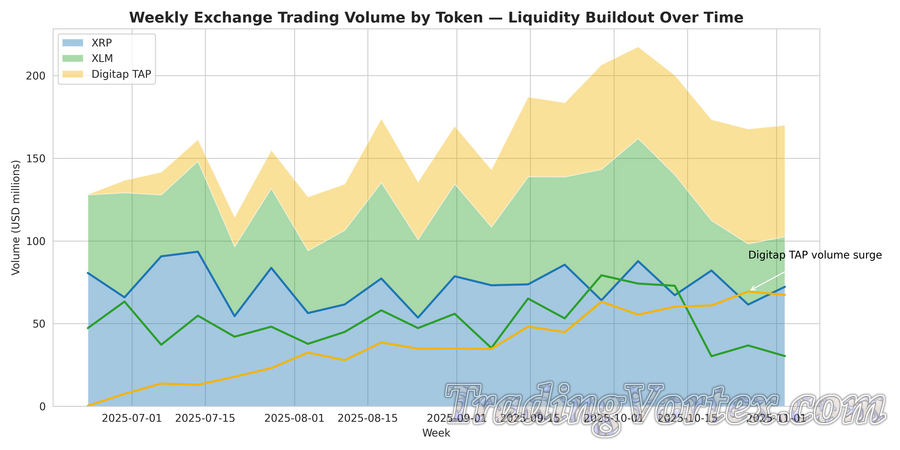 Weekly Exchange Trading Volume by Token — Liquidity Buildout Over Time:
♦ What it shows:
◊ Weekly trading volume (USD) for XRP, XLM, and Digitap TAP over the past 20 weeks
◊ Stacked area chart shows relative share; solid lines show absolute volume
◊ Annotated surge in Digitap TAP volume to highlight recent momentum
♦ How to read it:
◊ Rising lines = improving secondary-market liquidity
◊ Area share = relative dominance; TAP’s growth signals traction
◊ Use this to assess whether presale interest is translating into real trading activity
Liquidity and token economics
Presale success gives TAP early treasury resources and marketing momentum, but converting presale interest into sustained orderbook depth requires exchange listings, market making, and demonstrable transaction volumes. XRP and XLM still retain deeper orderbook liquidity on major exchanges, but market share is mutable if challengers secure payment flows and fiat corridor volume.
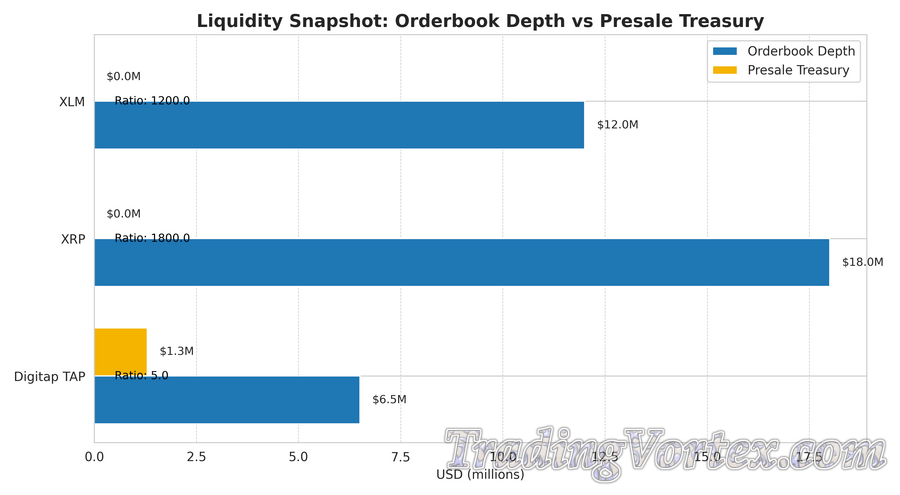 Liquidity Snapshot — Orderbook Depth vs Presale Treasury:
♦ What it shows:
◊ Horizontal bar chart comparing orderbook depth and presale treasury for Digitap TAP, XRP, and XLM
◊ Annotated with funding figures and depth-to-treasury ratio for each token
♦ How to read it:
◊ High presale treasury but low orderbook depth = marketing traction without liquidity conversion
◊ Depth/presale ratio > 1 means treasury is being matched by market-making and listings
◊ Use this to evaluate whether TAP’s treasury is translating into real exchange liquidity
Trading and investing strategies: what the data suggests
For traders: short to medium-term setups
- Use RSI divergence as a warning to step back from long entries in XRP and XLM until RSI reverts above 50 and price reclaims key EMAs; consider short setups on confirmed EMA failures with ATR-based stop sizing.
- For momentum traders, watch Digitap TAP liquidity events: spikes in volume following exchange listings or merchant rollouts are often the most tradable windows for early-stage tokens.
- Keep position sizes small for presale tokens, treat initial allotments as high volatility speculative stakes, and only scale after verifiable on-chain and off-chain adoption signals emerge.
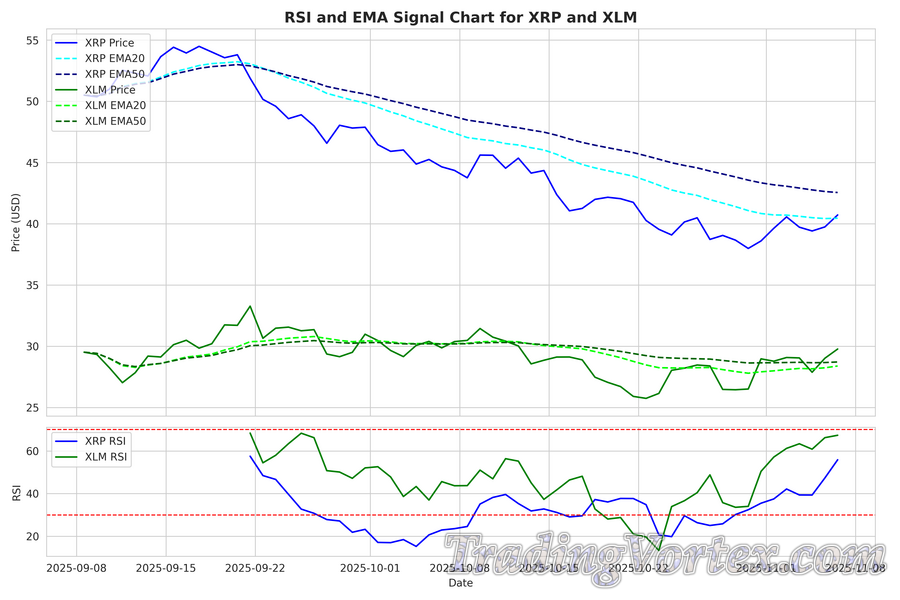 RSI and EMA Signal Chart for XRP and XLM — Daily Price with 20‑day and 50‑day EMAs, RSI (14), and Highlighted EMA Failures / Divergence Zones:
♦ What it shows
◊ Daily close prices for XRP and XLM with 20‑day and 50‑day EMAs over a 60‑day window.
◊ RSI (14) below the price panel with 70/30 thresholds.
◊ Highlighted zones for RSI divergence and EMA failures; callouts placed with arrowprops and offset to avoid overlap.
♦ How to read: Confirm RSI returns above 50 before re-entering longs; use EMA cross/failure as entry/stop signal; annotate ATR‑based stop sizing alongside (ATR code not shown).
♦ Trading use: Use zones highlighted for conservative traders; wait for RSI confirmation and price reclaim of EMA20/50.
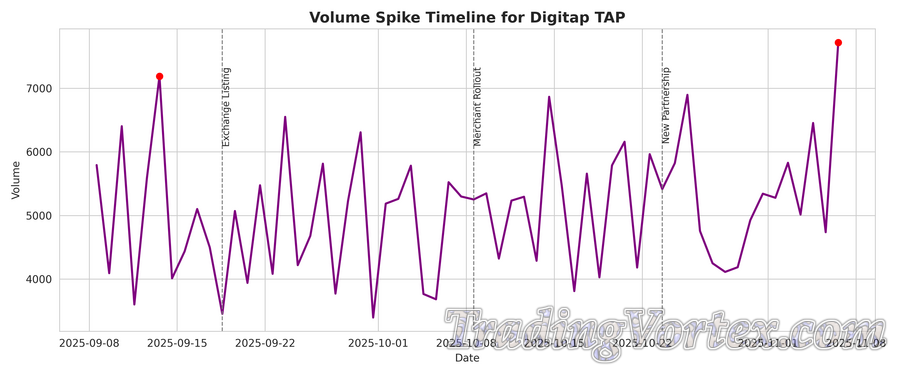 Digitap TAP Volume Spike Timeline — Daily Volume with Annotated Liquidity Events (Exchange Listings, Merchant Rollouts):
♦ What it shows:
◊ Daily trading volume (USD) for Digitap TAP over 60 days.
◊ Vertical event lines (listing, rollout, partnerships) labeled with rotated annotations placed outside the plotting area to avoid overlap.
◊ Red markers for volume spikes; dynamic spike detection (mean + 2σ) included.
♦ How to read: Look for tight clusters of spikes following event anotations; those windows often provide high‑probability momentum entries for short windows.
♦ Trading use: For momentum traders, use volume spikes to time entries; size positions smaller and use ATR stops (compute ATR from price series).
For investors: medium to long-term considerations
- Evaluate tokens on utility and integration: prioritize projects that demonstrate working products, regulatory partnerships, and fiat corridors, not just marketing claims.
- Monitor macro indicators: currency volatility and capital flow risk materially affect cross-border payment adoption; use IMF macro reports and SWIFT flow data to gauge structural demand shifts for crypto rails.
- Diversify exposure across rails and banking stacks: holding a mix of established ledger tokens and promising utility-first projects reduces single-point-of-failure risk while capturing potential structural winners.
How to screen and monitor these themes
Technical checklist
- Confirm RSI trends across multiple timeframes: look for positive confirmation before initiating long positions.
- Check EMA alignment: price above 20, 50, and 200 day EMAs suggests a healthier trend; the inverse signals caution.
- Use volume and ATR to size entries: rising volume on breakout increases confidence; high ATR demands tighter risk control.
Fundamental checklist
- Product readiness: is there a live app, card program, or merchant integration? products with real transactions materially reduce execution risk for adoption narratives.
- Regulatory posture: has the token or issuer published compliance documentation or secured regulatory approvals in target corridors? regulatory clarity is essential for enterprise contracts.
- Treasury and liquidity plan: how will presale funds be used to support listings, market making, and merchant incentives? strong capital allocation plans reduce token volatility by seeding liquidity.
Case study: interpreting TAP presale versus XRP/XLM market share
Digitap’s presale momentum reportedly raised roughly $1.3 million, with coverage highlighting a working product and a Visa partnership as differentiators that are attracting presale investors.
XRP and XLM face a headwind because macro FX stress and litany of DeFi incidents increased scrutiny on security and real-world liquidity, encouraging some traders to rotate into tokens they perceive as closer to payments adoption and regulatory alignment.
For investors, the key question is conversion: can Digitap turn presale interest into repeatable transaction volume and liquidity that displaces corridor flows formerly routed via XRPL or Stellar? The answer depends on measurable fiat onramps, merchant acceptance rates, and stablecoin or FX liquidity integration.
Risks and red flags
- Presale reporting is promotional in many cases, exercise due diligence on claims including partnerships and live product status; independent verification matters more than press claims.
- Macro shocks and regulatory actions can quickly invert narrative-driven flows; maintain stop loss rules and avoid concentration in presale allocations without liquidity backstops.
- Security incidents, including hacks in adjacent DeFi protocols, increase risk aversion and can depress token prices irrespective of underlying utility; monitor industry security news continuously.
Conclusion: RSI Divergence Signals XRP and XLM Weakness, Watch Digitap TAP Presale
Technical signals including RSI divergence and EMA alignments indicate weakening momentum for established crypto banking tokens such as XRP and XLM, creating vulnerability to challengers that emphasize banking utility and visible product traction.
Digitap’s presale fundraising and reported partnerships position TAP as a notable competitor in the payments and banking stack niche, but presale traction is an early stage metric that must convert into sustained liquidity and fiat corridor volume to upend incumbents. Macro headwinds, notably FX pressure and payment frictions documented in IMF research, add another constraint to the cross-border token narrative, raising the bar for any project aiming to capture meaningful market share.
Actionable takeaways: for traders, respect momentum signals and manage risk with ATR-based sizing and RSI confirmation; for investors, prioritize projects with working products, verified payment partnerships, regulatory clarity, and a credible liquidity plan. Monitor macro FX indicators and security events closely, because these variables can rapidly reshape demand for crypto banking tokens and accelerate rotations to projects that deliver real world payments utility.