

Crypto markets are navigating one of the most complex macro backdrops in years. In November 2025, liquidity cycles flipped sharply as bond yields surged, inflation data surprised, and equity breadth weakened. These shifts drained capital from risk assets, with crypto taking the first hit. For traders and investors, the lesson is clear: crypto is no longer insulated from global macro dynamics. Understanding liquidity-driven catalysts, sentiment extremes, and cross-asset signals is essential for timing inflows and defending exposure.
Table of Contents:
- Why Macro Liquidity and Rates Drive Crypto
- Evidence of Positioning Shifts and Sentiment Reversals
- Macro Indicator Triggers to Watch
- Sentiment Extremes and Timing Reversals
- Practical Trade Rules
- Cross-Asset Signals to Track in Real Time
- Example Playbooks
- Final Insights: Navigating Liquidity-Driven Crypto Trades in November 2025
Why Macro Liquidity and Rates Drive Crypto
Crypto is a liquidity-sensitive asset class. When central banks ease, capital flows into risk assets, lifting Bitcoin and altcoins. When yields rise, liquidity tightens, and crypto often suffers first.
- Japan’s bond shock: Japan’s 10-year yield surged past 1.7 percent in November 2025, its highest since 2008. This reversed decades of ultra-low rates, pulling capital back into Japan and draining global liquidity. Crypto reacted immediately with heightened volatility.
- U.S. macro resilience: Inflation and housing data in November showed strength, delaying aggressive Fed cuts. The S&P 500 remains the key transmission channel: when equities rally, Bitcoin follows, but when equities weaken, crypto declines.
- Macro trifecta: Analysts highlight that inflation, liquidity, and business cycle indicators all flipped in November, reshaping flows into December.
Evidence of Positioning Shifts and Sentiment Reversals
- Bitcoin retests support: BTC tested the 90,000 USD support zone, a critical level aligning with high-timeframe value areas.
- Altcoin lag: Altcoins underperformed Bitcoin during liquidity stress, with sector rotations favoring large-cap assets.
- Stablecoin supply: On-chain data show fluctuations in stablecoin issuance, signaling liquidity injections or withdrawals that directly impact trading volumes.
- ETF flows: Crypto ETFs recorded volatile daily flows, with single-day outflows exceeding 0.5 percent of AUM, amplifying intraday liquidity shocks.
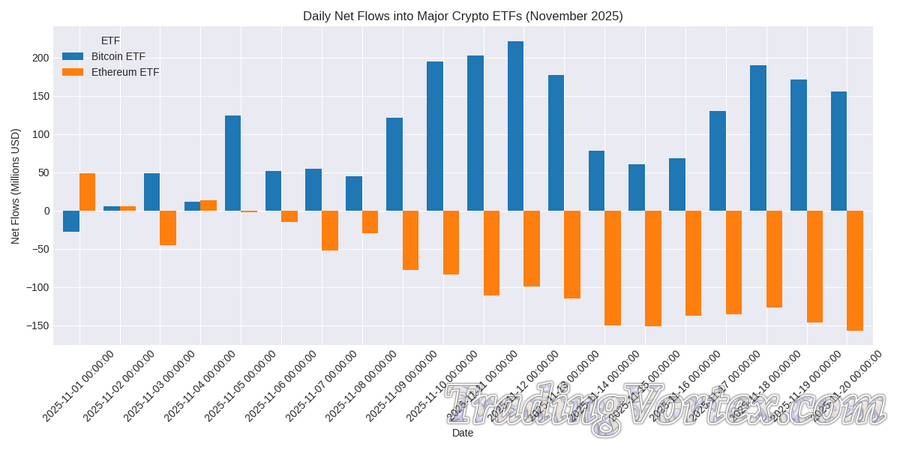 Daily Net Flows into Major Crypto ETFs, November 2025: Bar chart of daily net flows for major Bitcoin and Ethereum ETFs across November 2025, indicating inflow and outflow dynamics.
♦ What it shows: A bar chart of daily net flows for large Bitcoin and Ethereum ETFs. Positive flow bars suggest supportive liquidity, negative flows signal stress.
♦ How to use:
◊ Scaling rule: Add 25 percent of target size after three consecutive positive inflow days.
◊ Risk control: If cumulative outflows exceed 0.5 percent of AUM over three days, raise cash buffers and trim beta exposure.
♦ Reader tip: Cross-check with stablecoin supply changes for confirmation.
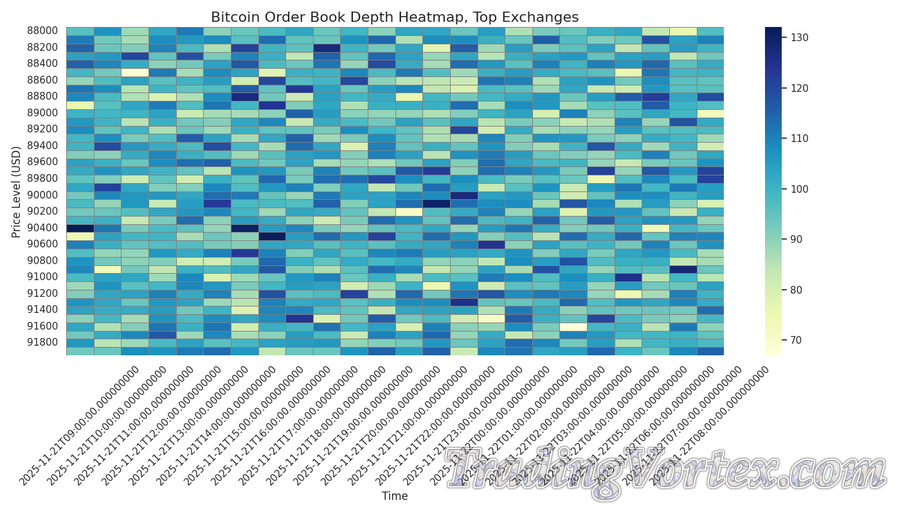 Bitcoin Order Book Depth Heatmap, Top Exchanges: Heatmap of aggregated BTC order book liquidity showing depth across price levels and time.
♦ Explanation: Visualize aggregated buy and sell depth across price levels to show liquidity pockets and thin zones that amplify moves. Use snapshots of order book depth or a time-lapse to show how depth changes during flow events.
♦ How to use: Identify zones where small flow volumes can trigger outsized price moves; avoid entering large market orders inside thin zones.
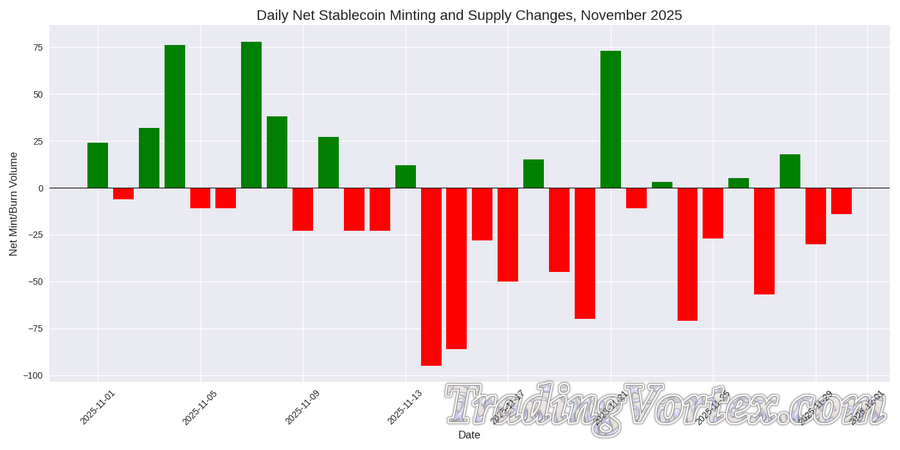 Daily Net Stablecoin Minting and Supply Changes, USD Equivalent: Daily net stablecoin mint and burn volumes in USD, a proxy for available crypto liquidity.
♦ Explanation: Bars show net mint or burn volumes per day. Rising net mints often precede buying pressure; large net burns can signal liquidity withdrawal.
♦ How to use: Combine with ETF flows to validate whether inflows are cash-driven or mere rebalancing.
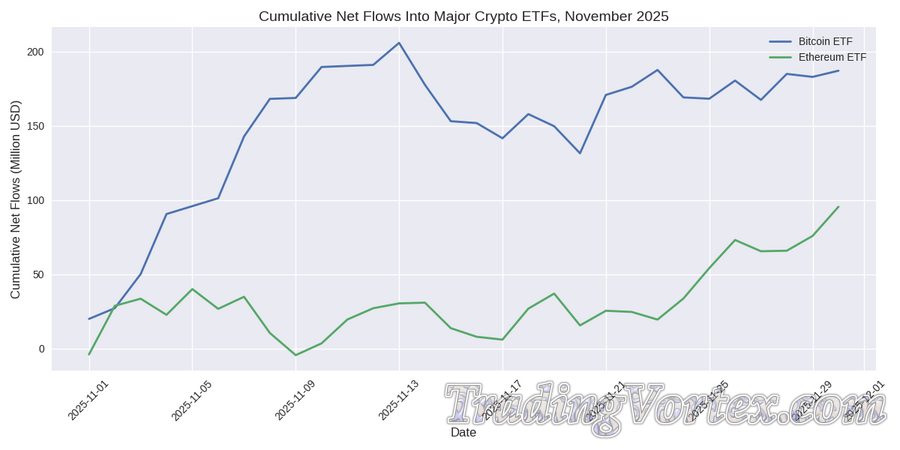 Cumulative Net Flows Into Major Crypto ETFs, Month-to-Date: Month-to-date cumulative net flows into major crypto ETFs, smoothing daily noise and revealing structural trends.
Explanation: A cumulative curve smooths noisy daily flows and reveals whether flows are structurally net positive or negative across the period.
How to use: Use inflection points on the cumulative curve to time entries and exits; a sustained downward slope warns of systemic outflows.
Macro Indicator Triggers to Watch
Central Bank Pricing and Real Yields
- Trigger: Monitor the one-year forward Fed funds futures curve and real yields on U.S. TIPS.
- Action: Enter risk positions when forward rates fall by at least 25 basis points in a week, signaling easing expectations.
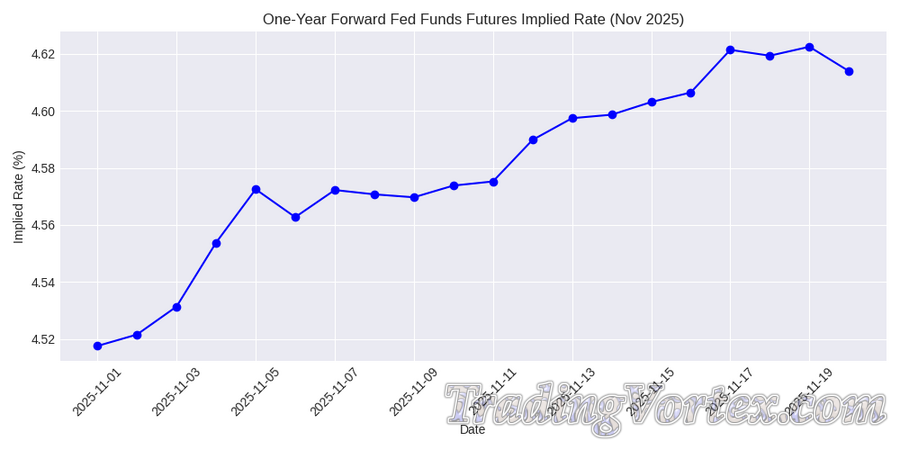 One-Year Forward Fed Funds Futures Implied Rate, November 2025: Line chart of one-year forward Fed funds rate showing daily shifts in November 2025, used to gauge liquidity expectations.
♦ What it shows: A daily line chart of the one-year forward Fed funds implied rate over November. It helps readers see how rate expectations shifted, indicating easing or tightening liquidity and the likely direction of risk appetite.
♦ How to use:
◊ Entry bias: If the rate trends lower by 25 basis points within a week, it supports adding risk in tranches.
◊ Defense bias: If it rises quickly, reduce leverage and increase hedges.
♦ Reader tip: Pair this chart with real yield changes to validate the macro signal.
System Liquidity and Funding Markets
- Trigger: Repo rates and commercial paper spreads.
- Action: Reduce leverage if overnight repo rates spike more than 50 basis points versus the prior week.
Cross-Asset Risk Signals
- Trigger: Equity breadth and high-yield credit spreads.
- Action: Trim crypto exposure if high-yield spreads widen 40 basis points in a week.
On-Chain and ETF Flow Metrics
- Trigger: Stablecoin supply growth and ETF net flows.
- Action: Increase defensive cash allocation if ETF outflows exceed 0.5 percent of AUM over three days.
Sentiment Extremes and Timing Reversals
Sentiment extremes often mark turning points, but only when validated by macro shifts.
- Composite sentiment index: Funding rates, perpetual basis, and fear-and-greed scores help identify extremes.
- Exchange flows: Rising exchange inflows signal selling pressure, while accumulation on non-custodial wallets signals demand.
- Volatility term structure: Short-dated implied volatility spikes often precede downside squeezes.
 Short-Dated Implied Volatility for Bitcoin Options, November 2025: Line chart of short-dated BTC options implied volatility through November 2025, highlighting sentiment and risk pricing.
♦ What it shows: A line chart of short-dated BTC option implied volatility. Spikes reflect fear, stable or falling IV reflects calmer conditions and potentially better entry windows.
♦ How to use:
◊ Hedging: Buy protective puts or collars when IV is relatively low versus realized volatility.
◊ Entry timing: If IV normalizes while macro liquidity improves, consider laddered entries in spot.
♦ Reader tip: Combine with funding rate and perpetual basis to refine timing.
Practical Trade Rules
Entry and Scaling
- Start with 25 percent of target size when macro and sentiment signals align.
- Add in 25 percent increments on confirming signals such as three-day ETF inflows.
- Ladder entries over 7 to 21 days to avoid front-running.
Defensive Sizing
- Set hard stops at 6 to 12 percent drawdowns.
- Cut exposure by 50 percent if funding costs rise sharply or credit spreads widen.
- Use protective puts or collars when implied volatility is low.
Cross-Asset Signals to Track in Real Time
- Treasury yields: Especially 2-year yields as policy expectations shift.
- Credit spreads: Widening signals systemic risk.
- Equity ETF flows: Sudden outflows correlate with crypto stress.
- Stablecoin supply: Minting or burning reflects liquidity injections or withdrawals.
 Correlation Between Crypto Returns and Macro Indicators, November 2025: Heatmap showing correlation coefficients between crypto returns and macro variables for November 2025, used to align cross-asset signals.
What it shows: A heatmap of correlations between BTC and ETH returns versus key macro variables such as 2-year Treasury yields, high-yield credit spreads, and equity ETF flows.
How to use:
Signal alignment: Strong positive correlation with equity flows increases confidence in risk-on moves.
Warning flags: Rising correlation with high-yield spreads or front-end yields indicates macro tightening and higher drawdown risk.
Reader tip: Update this weekly to capture regime changes.
Example Playbooks
Scenario A: Liquidity Expansion
- Signals: Forward rates fall 30 basis points, ETF inflows turn positive, stablecoin supply rises.
- Playbook: Deploy 25 percent of position, scale up on confirming inflows, hedge with options.
Scenario B: Liquidity Withdrawal
- Signals: Repo rates spike, equity breadth collapses, ETF outflows exceed 0.5 percent AUM.
- Playbook: Trim spot positions by 50 percent, close leveraged longs, open short-dated hedges.
Final Insights: Navigating Liquidity-Driven Crypto Trades in November 2025
Macro catalysts reversing liquidity flows are defining crypto’s November 2025 narrative. Japan’s bond spike, resilient U.S. inflation, and volatile ETF flows have created a fragile environment where liquidity-driven trades dominate.
Key Takeaways:
- Monitor rate expectations and repo funding as primary liquidity triggers.
- Validate conviction with ETF and stablecoin flows.
- Apply laddered entries and protective hedges to manage risk.
- React quickly to credit spread widening and equity breadth collapses.
Crypto remains a liquidity-sensitive asset class. Traders who integrate macro signals into their strategy can better time inflows, defend exposure, and capture opportunities in volatile markets.