
Crypto decentralized finance continues to promise composability and yield, yet recent November incidents have shown how quickly that promise can turn to systemic risk. High-profile smart contract exploits and rapid liquidity outflows have triggered cascading liquidations and stressed lending markets. This Market Pulse piece breaks down exploiter flow patterns, rapid withdrawal signals, and liquidation cascade indicators, then presents a practical checklist and hedge rules using options and stablecoin positioning for traders and investors seeking to limit downside when DeFi breakdowns begin to unwind.
Table of Contents:
- What happened: recent DeFi exploit landscape and immediate market fallout
- How exploiters and attackers move funds, and why that matters for traders
- Recognizing liquidation cascade signs
- Practical checklist to spot unwind signals, in order of priority
- Hedge rules: how to protect positions during DeFi breakdowns
- Position-sizing tactics and risk budgeting
- Example scenario and step-by-step hedge execution
- Operational checklist: tools and data feeds to implement in your workflow
- Limitations, costs, and tradeoffs
- Conclusion: Hedging Crypto DeFi Risk After Major Exploits and Breakdown Signals
What happened: recent DeFi exploit landscape and immediate market fallout
High-value exploits and aggregate losses
A string of November attacks combined to remove well over a hundred million dollars from DeFi pools. Reporting tied a single Balancer exploit to roughly $128 million in stolen funds across multiple chains, while other writeups place total concurrent losses across protocols near $220 million for the month, underscoring how multiple exploits can compound market stress within days.
Systemic liquidity effects
Those losses coincided with a broader liquidity contraction in DeFi, with analysts reporting falling Total Value Locked below $200 billion as lending protocols saw withdrawals, borrow rates spiking, and protocol pauses that magnified risk-off behavior. DeFi liquidity drains amplify price sensitivity in leveraged positions and stablecoin pools, creating fertile ground for rapid unwinds.
Precedent for cascading liquidations
The market has previously experienced ultra-fast forced selling events. A major liquidation wave recorded over $1.7 billion in leveraged crypto liquidations in a single 24-hour period during a prior stress window, showing how quickly margin systems and on-chain liquidators can accelerate down moves once initial triggers appear.
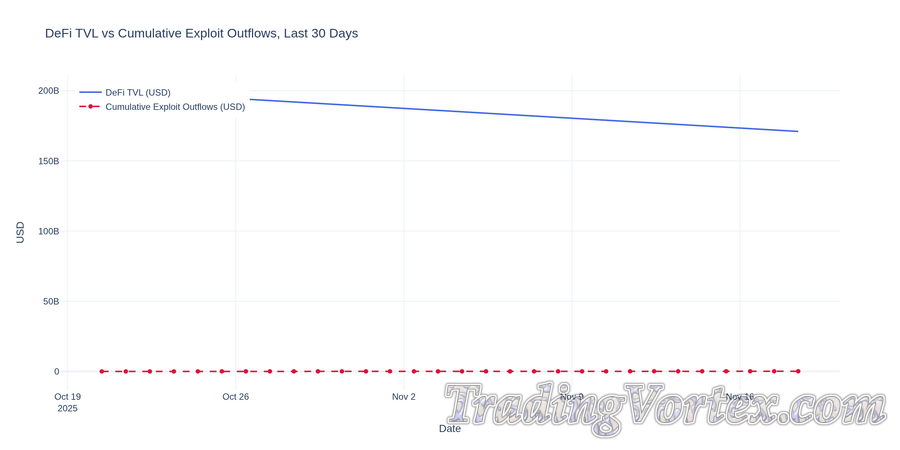 DeFi Total Value Locked vs Major Exploit Outflows, 30-Day Line Chart: DeFi TVL vs Cumulative Exploit Outflows, last 30 days, showing timing of major hacks relative to liquidity contraction.
This chart tracks DeFi Total Value Locked (TVL) alongside cumulative exploit outflows over the past 30 days:
♦ Blue solid line (TVL in USD): Shows the overall value locked in DeFi protocols. A steady decline indicates liquidity leaving the ecosystem, often triggered by market stress or exploit events.
♦ Red dashed line with markers (Cumulative Exploit Outflows in USD): Represents the total funds drained from DeFi exploits during the same period. Each upward step corresponds to a new exploit or hack.
◊ By comparing the two lines, readers can see how exploit events correlate with liquidity contractions. For example, sharp jumps in exploit outflows often precede or coincide with drops in TVL, signaling systemic stress.
♥ Takeaway: Traders should monitor TVL trends and exploit outflow spikes together. When exploit outflows rise sharply, expect liquidity to drain and prepare hedges (options, stablecoins, or reduced exposure).
How exploiters and attackers move funds, and why that matters for traders
Common exploiter flow patterns
- Rapid drain to centralized exchanges, often in batches to avoid large single transfers. Move patterns typically show several medium-sized transfers instead of one giant transfer, intended to evade simple size-based alerts.
- Cross-chain bridging and mixing, to obscure on-chain provenance and complicate recovery.
- Converting to stablecoins and privacy-focused tokens before exiting to fiat or other chains.
Liquidity withdrawal signatures to watch for
- Unusually large withdrawals from concentrated liquidity pools over minutes to hours.
- Large, repeated removals of collateral from lending markets, matched with minimal new deposit flows.
- Spike in on-chain swap gas usage and a cluster of transactions from a small set of addresses, indicating automated tool usage.
Detecting these signals early gives traders time to hedge, reduce size, or migrate to less correlated assets.
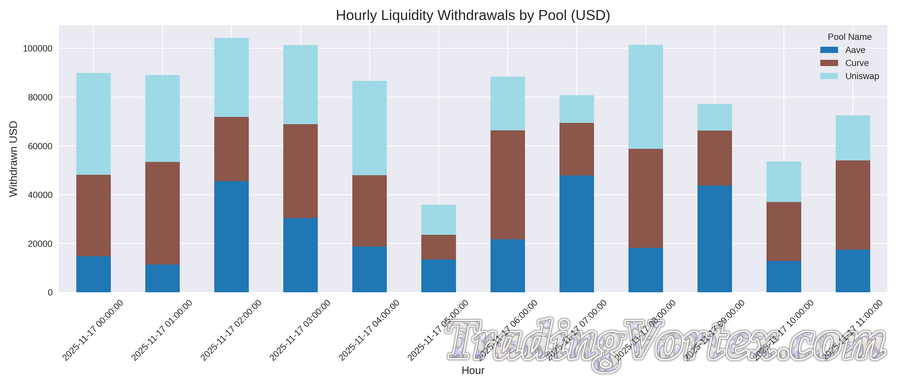 Protocol Liquidity Withdrawals by Pool, Hourly Bar Chart: Hourly liquidity withdrawals by pool, highlighting concentrated rapid outflows that precede cascades.
This chart visualizes hourly liquidity withdrawals across major DeFi pools (example: Curve, Uniswap, Aave):
♦ Stacked bars: Each bar represents one hour. The segments show how much liquidity was withdrawn from each pool during that hour.
♦ Color coding: Different colors correspond to different pools, making it easy to see which protocol contributed most to total withdrawals.
♦ Height of bars: The taller the bar, the larger the total liquidity withdrawn in that hour.
◊ By examining this chart, traders can identify concentrated outflows and the timing of liquidity stress. For example, if one pool dominates withdrawals in a short time window, it may signal targeted stress or exploit-driven exits. If multiple pools show simultaneous spikes, it suggests systemic risk spreading across protocols.
♥ Takeaway: Monitoring hourly withdrawal patterns helps traders spot early unwind signals. When withdrawals cluster in specific pools or spike across multiple pools, it is a strong indicator to reduce exposure or deploy hedges.
Recognizing liquidation cascade signs
Early-stage indicators
- Sharp, fast rises in borrow rates on lending platforms, indicating lenders demand more to supply capital.
- Price oracles lagging spot markets, producing stale marks that trigger outsized margin events.
- Sudden increases in liquidation transactions and slippage on DEX pools.
Mid-stage indicators
- Avalanche of liquidator transactions and block-level sell pressure that push collateral below maintenance thresholds.
- Large numbers of borrowed positions closing within minutes on multiple protocols simultaneously.
- Governance token sales and protocol treasury movements, indicating stress on protocol finances.
Terminal-stage indicators
- Protocol emergency pauses, admin interventions, or mass delisting of pools.
- TVL and on-chain depth collapsing across several interdependent platforms.
- Forced conversion of collateral into stablecoins by automated systems, further pressuring risky tokens.
Seeing multiple indicators in combination raises the probability of a true cascade. Earlier signs can be noisy, so use cumulative thresholds rather than single triggers.
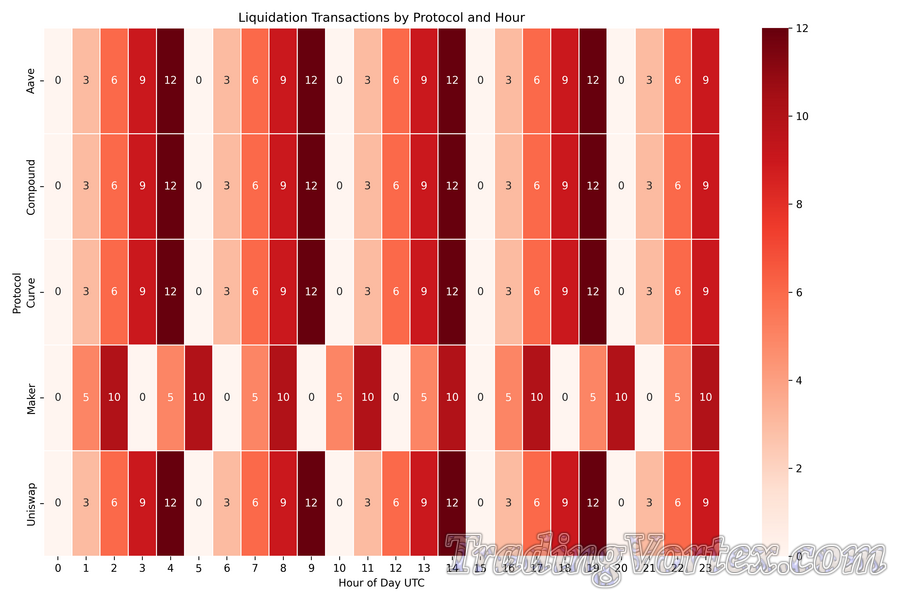 Liquidation Transaction Count Heatmap by Protocol and Hour: Heatmap of liquidation transaction counts by protocol and hour, identifying cascade hotspots.
This heatmap illustrates liquidation transaction activity across major DeFi protocols over a 24-hour period:
♦ Rows (Protocols): Each row represents a specific DeFi protocol (e.g., Aave, Compound, Maker, Curve, Uniswap).
♦ Columns (Hours): Each column corresponds to an hour of the day (UTC).
♦ Color intensity: Darker red cells indicate higher liquidation counts, meaning more forced sales occurred during that hour.
♦ Annotations: Each cell is labeled with the exact number of liquidation transactions, making it easy to quantify activity.
◊ By scanning the heatmap, readers can quickly identify cascade hotspots: periods when multiple protocols experienced elevated liquidation activity simultaneously. These hotspots often signal systemic stress, where margin calls and forced sales ripple across interconnected platforms.
♥ Takeaway: Traders should watch for clusters of high liquidation counts across several protocols in the same time window. This pattern suggests a developing cascade and is a strong signal to tighten hedges, reduce leverage, or exit risky pools.
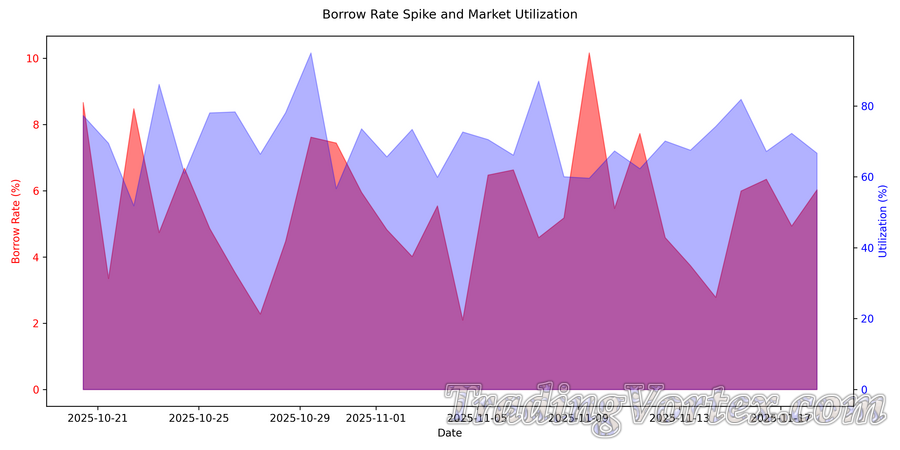 Borrow Rate Spike and Utilization, Dual-Axis Area Chart: Borrow rate spikes and utilization, key indicators of lending market stress.
This chart shows borrow rate spikes and market utilization levels over the past 30 days, using a dual-axis format:
♦ Red shaded area (Borrow Rate %): Indicates the average interest rate borrowers must pay to access liquidity. A sharp rise signals lenders pulling back or demanding higher compensation, often preceding stress events.
♦ Blue shaded area (Utilization %): Represents how much of the available liquidity is being used. High utilization means most funds are borrowed, leaving little buffer for new demand or shocks.
◊ By combining these two indicators, readers can see how lending stress builds. For example, when utilization climbs above 80 percent while borrow rates spike simultaneously, it suggests that liquidity is scarce and borrowers are under pressure. This environment often precedes liquidation cascades because collateral requirements tighten and margin calls accelerate.
♥ Takeaway: Traders should monitor both metrics together. Rising borrow rates with high utilization are strong signals to reduce leverage, increase stablecoin buffers, or deploy protective hedges.
Practical checklist to spot unwind signals, in order of priority
- Monitor large outflows from major pools: examine TVL and per-pool liquidity for sudden declines over 1 to 6 hours.
- Watch borrow rate spikes and utilization on top lending markets, flagging moves above historical percentiles.
- Track oracle divergence: when DEX mid-prices and oracles diverge by a material margin, assume higher liquidation risk.
- Flag clusters of coordinated transfers from a small set of addresses, especially those interacting with bridges or mixers.
- Observe increases in liquidation tx counts and on-chain gas for liquidation bots.
- Confirm any protocol admin actions or pause announcements before assuming stabilization.
- Cross-check centralized exchange inflows for tokens experiencing on-chain outflows, as exploiter exits often route through CEX rails.
Use automated alerts for items 1, 2, 3, and 5, and keep manual situational awareness for items 4, 6, and 7.
Hedge rules: how to protect positions during DeFi breakdowns
Core principles for hedging DeFi tail risk
- Size hedges proportionally: smaller portfolios require less complex hedges; allocate capital to hedges such that potential hedge payoff covers estimated maximum plausible loss during cascade scenarios.
- Prefer liquidity in hedge instruments: options and stablecoin positions should be in venues with deep liquidity and reliable settlement processes.
- Avoid concentration of counterparty risk: prefer decentralized hedges where possible, or spread counterparty exposure across trusted counterparties and venues.
Tactical hedges using options
- Protective put buying on correlated on-chain assets: buy near-term puts with strikes slightly out of the money for high-conviction DeFi tokens or the broader ETH/BTC exposures. Options provide asymmetric payoff, capping downside while retaining upside participation. Use expirations matching anticipated unwind windows, commonly 1 to 4 weeks in fast-moving events.
- Put spreads for cost control: where premium is high, use vertical put spreads to reduce cost while retaining downside protection within a target range.
- Straddle/strangle for volatility spikes: if you expect extreme volatility but uncertain direction, deploy straddles or strangles on liquid underlyings; be mindful of theta decay and funding cost.
Practical sizing rule: hedge not more than the portion of the portfolio exposed to on-chain leverage risk; for a diversified holder with 30 percent exposure to DeFi tokens, aim to hedge roughly 50 to 75 percent of that exposure depending on risk tolerance and premium levels.
Stablecoin positioning as a hedge
- Pre-position a portion of capital in high-quality stablecoins, prioritizing overcollateralized or well-proven reserves when possible. Stablecoins act as dry powder, letting traders exit risky pools without being squeezed into illiquid markets.
- Use short-term stablecoin pools with good redemption liquidity rather than yield-chasing lower-quality protocols during stress windows.
- Convert a graduated share of DeFi LP rewards and yield harvests into stablecoins on volatility upticks to lock gains and reduce reinvestment risk.
Rule of thumb: maintain at least 5 to 15 percent portfolio liquidity in stablecoins in normal times, increase to 20 to 40 percent when multiple unwind signals align.
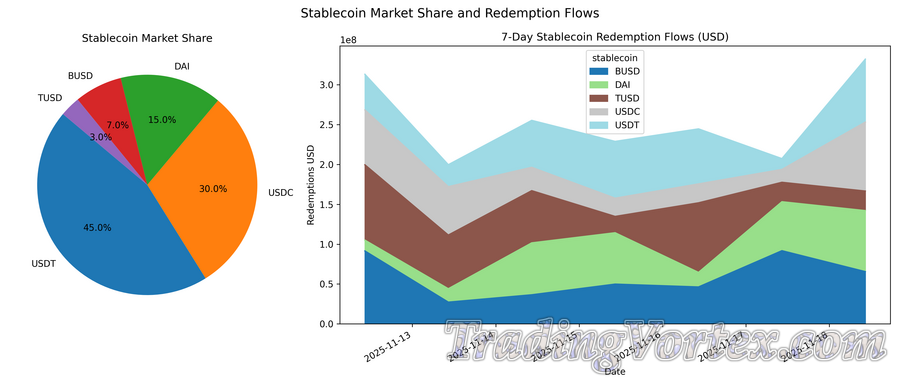 Stablecoin Supply Share and Redemption Flows, Pie Chart plus Area Chart: Stablecoin market share and 7-day redemption flows, used to assess peg and counterparty risk.
This figure combines two complementary visuals to help traders evaluate stablecoin positioning during DeFi breakdowns:
♦ Pie Chart (Stablecoin Market Share):
◊ Shows the percentage share of major stablecoins (e.g., USDT, USDC, DAI, BUSD, TUSD).
◊ Larger slices indicate dominant stablecoins in circulation.
◊ This helps traders identify which stablecoins are most widely used and therefore more liquid for hedging or exits.
♦ Area Chart (7-Day Redemption Flows):
◊ Displays daily redemption volumes for each stablecoin over the past week.
◊ Rising redemption flows suggest stress on a stablecoin’s peg or increased demand for exits.
◊ Comparing flows across stablecoins highlights which assets are under pressure and which remain relatively stable.
♥ Takeaway: Traders should favor stablecoins with strong market share and lower redemption stress. A spike in redemptions signals potential peg risk, making diversification across multiple stablecoins prudent during breakdowns.
Tactical market hedges beyond options
- Use futures shorts sized to cover likely liquidation-driven downside for the targeted token or ETH, particularly when option liquidity is thin. Keep margin and monitoring tight, because perpetual funding can be costly during prolonged stress.
- Pair trades: short the correlated base asset while keeping the DeFi project exposure reduced, lowering cross-asset contagion risk.
- Laddered exit orders: if exiting on-chain liquidity, use staggered limit orders to reduce slippage; avoid full market sweeps in shallow pools which can accelerate price impact.
 Options Implied Volatility and Put Volume, Volatility Chart with Bar Overlay: Options implied volatility and put volume, showing rising demand and cost for downside protection.
This chart combines options implied volatility (IV) and put option trading volume to show how hedging demand and cost evolve during stress periods:
♦ Purple line (Implied Volatility %): Tracks the market’s expectation of future price swings. Rising IV means options premiums are becoming more expensive, reflecting heightened uncertainty or fear.
♦ Gray bars (Put Volume): Represent the number of put contracts traded. A surge in put volume indicates traders are actively seeking downside protection.
◊ By overlaying these two metrics, readers can see how hedging demand (put volume) interacts with hedging cost (IV). For example, when IV spikes alongside heavy put buying, it signals strong market demand for protection, often coinciding with exploit-driven breakdowns or liquidation cascades in DeFi markets.
♥ Takeaway: Traders should monitor both IV and put volume together. High IV with surging put volume means hedging is costly but essential. If IV rises without corresponding put demand, it may reflect speculative positioning rather than genuine risk management.
Position-sizing tactics and risk budgeting
Calibrate position size to tail exposure
- Estimate maximum plausible loss from a cascade using historical liquidation multipliers and current leverage metrics on the protocol. Use that to cap position size so a single event does not consume more than your pre-set risk budget, commonly 1 to 3 percent of total capital for conservative traders.
- Increase margin buffers for loans and perpetuals during elevated signals, reducing the chance of forced liquidation.
Dynamic rebalancing rules
- If two or more high-priority unwind signals occur, immediately reduce concentrated DeFi position sizes by 25 to 50 percent depending on liquidity conditions.
- Reallocate proceeds into stablecoins and deep-liquid hedges until a multi-day stability window is observed.
Example scenario and step-by-step hedge execution
- Step 1: Immediately compute on-chain exposure and mark-to-market worst-case loss using current pool depth and expected slippage.
- Step 2: Buy short-dated protective puts on the most exposed token for at least 50 percent of marked exposure, or enter a futures short for quicker execution if option liquidity is inadequate.
- Step 3: Move 30 to 50 percent of harvested yield and excess allocation into top-tier stablecoins, ensuring withdrawal from risky pools is done in staggered transactions to reduce slippage.
- Step 4: Reduce margin utilization on lending protocols and withdraw nonessential collateral to avoid cross-protocol liquidations.
- Step 5: Monitor for oracle corrections and subsequent forced liquidations, ready to tighten hedges or close positions as normalcy returns.
This sequence emphasizes speed, liquidity, and lowering leverage to minimize cascade amplification.
Operational checklist: tools and data feeds to implement in your workflow
- Per-pool TVL and depth dashboards, refreshed minute by minute.
- Borrow rate and utilization trackers for major lending markets.
- Oracle divergence monitor comparing DEX mid-prices and protocol oracles.
- Address-clustering alerts for large transfer patterns and bridge movements.
- Liquidation transaction flash alerts to detect fast-moving forced sales.
- Options and futures liquidity screens to verify hedge availability before committing capital.
Automating these signals reduces reaction time, crucial when cascades develop in blocks.
Limitations, costs, and tradeoffs
- Hedging is costly when volatility spikes, premiums rise, and liquidity thins. Option premiums and futures funding can erode returns if positions are held too long.
- Stablecoin counterparty and peg risk must be evaluated, particularly for algorithmic or less liquid stablecoins.
- Decentralized protocols can impose withdrawal limitations or admin freezes that hinder rapid deleveraging. Relying solely on on-chain exits without off-chain hedge execution can be dangerous.
Balancing hedge cost against potential catastrophic loss is a subjective decision, use scenario stress tests to guide allocation.
Conclusion: Hedging Crypto DeFi Risk After Major Exploits and Breakdown Signals
Recent large exploits with multi-hundred-million-dollar impacts highlight how composability and leverage can accelerate DeFi breakdowns, producing fast-moving liquidation cascades that ripple through both on-chain and off-chain markets.
Traders and investors should watch exploiter flow patterns, borrow rate spikes, oracle divergence, and liquidation transaction clusters as primary unwind signals. Practical hedge rules include targeted put buys or futures shorts, scaled stablecoin positioning, and strict position-sizing tied to tail-risk estimates.
Equipping your desk with minute-level liquidity, oracle, and liquidation feeds, combined with pre-defined execution rules, improves survivability when DeFi stress turns systemic.
Key takeaways for Market Pulse readers:
- Spot multi-signal alignment before treating any single metric as decisive.
- Size hedges to the portion of your portfolio exposed to on-chain leverage risk.
- Prioritize liquidity and execution speed when choosing hedge instruments.
- Keep a ready stablecoin buffer to exit stressful on-chain positions without forcing market sweeps.
Stay vigilant, size conservatively, and treat DeFi exposure as dynamic rather than static.