


This Market Pulse article explores the shift in crypto sentiment following Bitcoin’s rare October breakdown. It explains how sharp liquidations and macro uncertainty cooled investor psychology, and how November’s rebound is reshaping trader behavior. October’s weakness disrupted seasonal expectations, November’s recovery restored structural demand, and December now presents a tactical window where seasonal crypto trends and macro risks intersect.
Readers gain a clear recap of the Bitcoin breakdown, the ETF inflows and whale accumulation driving November’s reversal, and the sentiment indicators that matter most. The piece emphasizes trader psychology, highlighting Fear & Greed readings, funding rates, and positioning strategies, while offering actionable guidance for risk management and opportunity zones in December.
Table of Contents:
- Crypto Sentiment Reverses: Bitcoin Breakdown in October Sets Stage for November Rebound
- Bitcoin’s Rare October Breakdown
- November’s Sentiment Reversal
- Seasonal Crypto Trends
- Trader Psychology and Positioning
- Strategic Insights for Investors
- Conclusion: Crypto Sentiment Reset and December Outlook for Investors
Crypto Sentiment Reverses: Bitcoin Breakdown in October Sets Stage for November Rebound
Crypto Sentiment in Focus: Why October’s Breakdown Matters
October 2025 marked a rare setback for Bitcoin, breaking its celebrated “Uptober” streak for the first time since 2018. The world’s largest cryptocurrency closed the month down 3.6 percent, slipping from highs near $114,000 to around $110,000, with its market capitalization retreating to $2.17 trillion. This decline was not just symbolic; it triggered a sharp cooling in sentiment across the broader crypto market. More than $19 billion in liquidations swept through leveraged positions, while external pressures such as new U.S. tariffs on China and the Federal Reserve’s hesitation on rate cuts amplified volatility.
The broader market reflected this turbulence. By mid-November, total crypto capitalization had fallen to $3.38 trillion, down 5.6 percent in a single day, with 96 of the top 100 coins posting losses. Bitcoin itself slipped below $93,000 on November 17, and briefly under $90,000 on November 19, as ETF outflows neared $3 billion, signaling deep investor caution. Analysts noted that long-term holders began trimming positions, while macro headwinds such as stronger U.S. Treasury yields and dollar strength weighed heavily on risk assets.
Setting the Stage for November’s Rebound
Despite October’s breakdown, November has historically been Bitcoin’s strongest month, averaging 42 percent gains over the past decade. Early signs suggest that this seasonal trend may be reasserting itself. Bitcoin rebounded toward $115,000 in the first half of November, supported by renewed ETF inflows and whale accumulation. On-chain data shows that large holders are once again positioning for upside, while technical indicators such as the SuperTrend have flipped bullish, hinting at a potential breakout.
For traders and investors, the reversal in sentiment underscores the importance of monitoring seasonal crypto trends, ETF flows, and macroeconomic signals. October’s losses revealed how quickly sentiment can sour when liquidity thins, but November’s rebound demonstrates the resilience of crypto markets when structural demand returns. As December approaches, positioning strategies will hinge on balancing macro risks with historical tailwinds, making sentiment indicators and tactical risk management essential tools for navigating volatility.
In summary: October’s rare breakdown cooled crypto sentiment, but November’s rebound is reshaping trader psychology. With Bitcoin regaining momentum and seasonal trends favoring upside, investors must stay alert to ETF flows, whale positioning, and macroeconomic shifts to prepare for December’s opportunities.
Bitcoin’s Rare October Breakdown
Breaking the “Uptober” Streak: First Loss Since 2018
October 2025 delivered a rare setback for Bitcoin, ending its long-standing tradition of positive “Uptober” performance. Historically, October has been one of Bitcoin’s strongest months, often setting the stage for year-end rallies.
This time, however, Bitcoin closed the month down 3.6 percent, slipping from highs near $114,000 to around $110,000, marking its first October loss since 2018. The decline was particularly notable because early October had seen Bitcoin surge past $120,000, briefly approaching its August all-time high of $124,480, before momentum reversed.
Key Drivers of the October Decline: Liquidations, Tariffs, and Fed Policy
Several factors converged to trigger the breakdown.
- First, leveraged liquidations exceeded $19 billion, wiping out aggressive long positions and amplifying downside pressure.
- Second, macroeconomic headwinds intensified as the United States announced new tariffs on Chinese imports, raising concerns about global growth and risk appetite.
- Third, the Federal Reserve’s cautious stance on rate cuts kept Treasury yields elevated, strengthening the U.S. dollar and reducing demand for risk assets like Bitcoin.
Market Impact: $1 Trillion Wipeout and Cooling Sentiment
The October breakdown reverberated across the entire crypto ecosystem. Total market capitalization fell sharply, dropping below $3.4 trillion in mid-November, with 96 of the top 100 coins posting losses. Bitcoin itself briefly slipped under $93,000 on November 17 and under $90,000 on November 19, erasing nearly $1 trillion in market value from its peak earlier in the month.
Sentiment indicators reflected this cooling: the Crypto Fear & Greed Index retreated from “Extreme Greed” levels in early October to “Neutral” by month’s end, while funding rates across major exchanges turned negative, signaling caution among traders.
For investors, October’s rare breakdown served as a reminder of how quickly sentiment can shift in crypto markets. The combination of macroeconomic uncertainty, aggressive liquidations, and ETF outflows created a perfect storm that disrupted seasonal expectations.
Traders who relied solely on historical “Uptober” trends were caught off guard, highlighting the importance of integrating macro analysis, flow data, and sentiment indicators into positioning strategies.
Key Takeaway: Bitcoin’s October 2025 breakdown was not just a statistical anomaly but a sentiment reset. The loss broke a seven-year streak of positive Octobers, erased nearly $1 trillion in market value, and cooled investor psychology. For traders, the lesson is clear: seasonal trends matter, but they must be balanced with macroeconomic signals and positioning data to avoid being blindsided by sudden reversals.
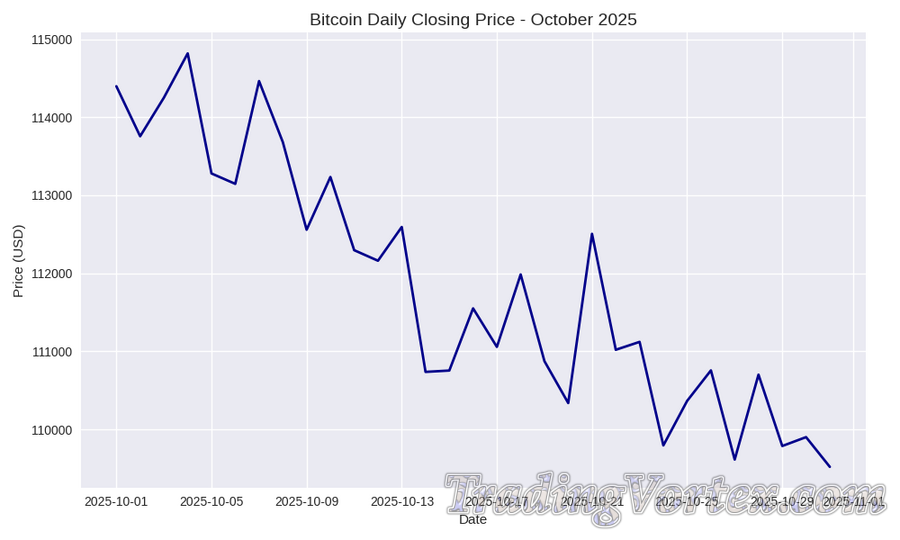 Bitcoin Daily Closing Price, October 2025: A line chart of Bitcoin’s daily closing price across October 2025, highlighting the persistent downtrend and the rare monthly loss.
♦ How to use it:
◊ Identify trend: Spot the shift from early-month strength to mid and late-month weakness.
◊ Contextualize moves: Align notable drawdowns with news or liquidation spikes for narrative clarity.
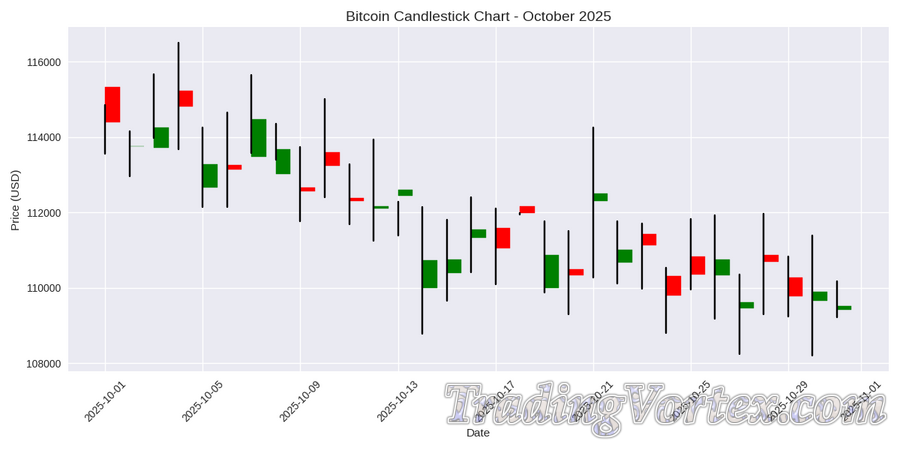 Bitcoin Candlestick Chart, October 2025: A candlestick chart of daily open, high, low, and close prices, visualizing intraday swings and clustering of red candles during the breakdown.
♦ How to use it:
◊ Assess volatility: Identify sessions with long wicks that signal failed rallies or aggressive selloffs.
◊ Find levels: Observe areas where buyers stepped in or where resistance capped intraday moves.
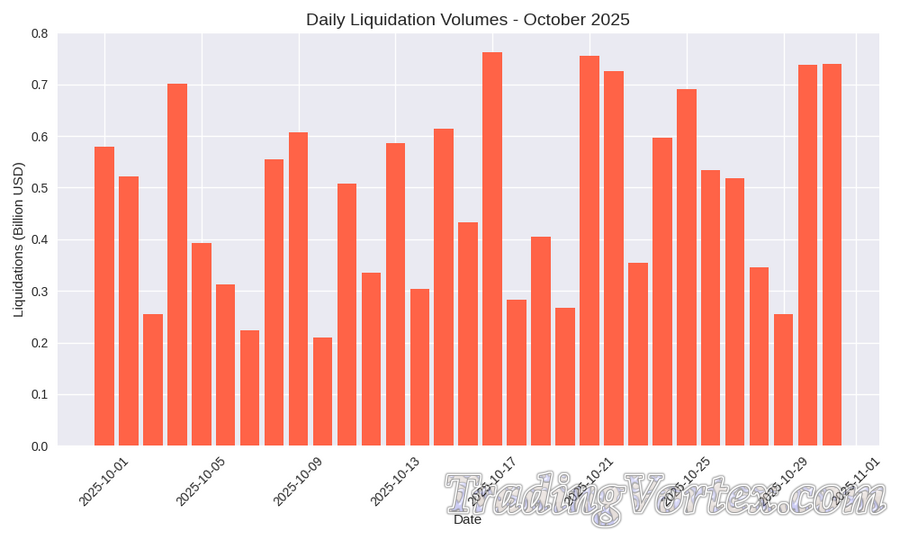 Daily Liquidation Volumes, October 2025: A bar chart of daily leveraged liquidation volumes in USD, illustrating pressure points where forced selling accelerated the decline.
♦ How to use it:
◊ Link to price action: Cross-reference liquidation spikes with down days to understand causality.
◊ Risk management: Use elevated liquidation days to signal deleveraging, tightening stops, or reducing exposure.
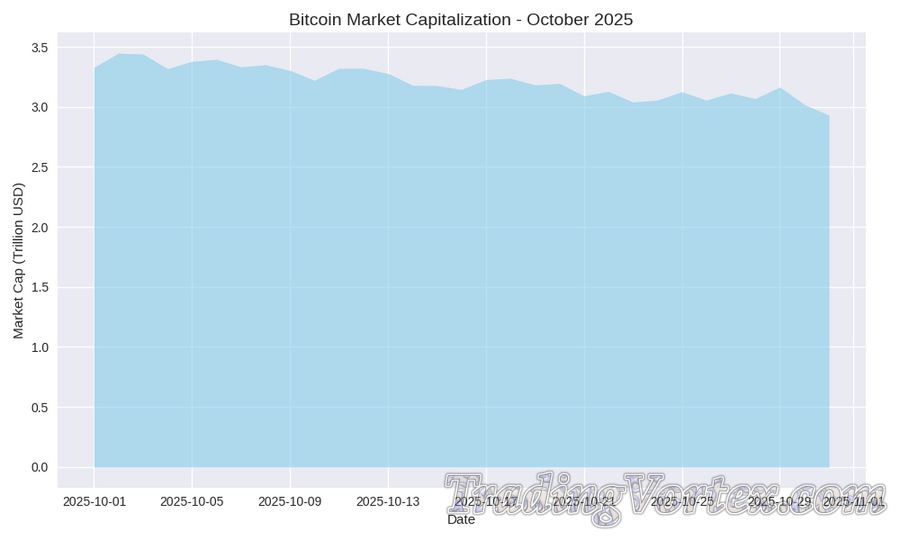 Bitcoin Market Capitalization, October 2025: An area chart tracking Bitcoin’s market cap trajectory through October, visualizing the cumulative value drawdown during the selloff.
♦ How to use it:
◊ Gauge magnitude: Communicate the scale of the wipeout clearly for readers and editors.
◊ Compare phases: Pair with price and liquidation charts to show where the largest value losses occurred.
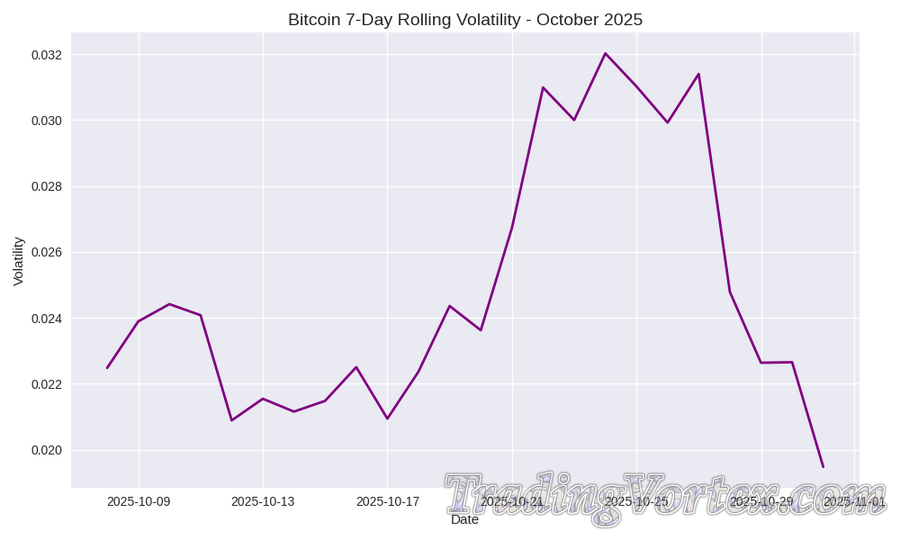 Bitcoin 7-Day Rolling Volatility, October 2025: A volatility chart using a 7-day rolling standard deviation of daily returns, showing how risk escalated through the month.
♦ How to use it:
◊ Signal regime shifts: Rising volatility often coincides with deleveraging and wider ranges.
◊ Plan entries: In higher volatility regimes, prefer scaled entries, tighter risk controls, and liquidity-aware execution.
November’s Sentiment Reversal
Bitcoin’s Recovery Toward $115K: ETF Inflows and Whale Accumulation
After October’s rare breakdown, November has brought a notable reversal in sentiment. Bitcoin rebounded from lows near $90,000 in mid-November to trade back above $102,000 following the resolution of the U.S.
government shutdown, which eased macroeconomic uncertainty and supported risk assets. Institutional flows have played a critical role in this recovery. Bitcoin ETFs logged $240 million in net inflows on November 6, led by BlackRock and Fidelity, signaling renewed confidence from large-scale investors.
Whale activity has further reinforced the rebound. Blockchain analytics revealed that whales accumulated more than 45,000 BTC in November, marking the second-largest wave of accumulation this year. This buying spree occurred even as retail investors continued to sell, suggesting that deep-pocketed players are positioning for a year-end rally.
Market Capitalization Back Above $3 Trillion
The broader crypto market has also staged a recovery. After dipping below $3.4 trillion in mid-November, total market capitalization climbed back above $3 trillion, supported by renewed optimism in Bitcoin and altcoins.
Institutional sentiment remains strong, with surveys showing 61 percent of professional investors planning to increase crypto exposure in the coming months. This resilience highlights the structural demand underpinning digital assets, even in the face of macroeconomic volatility.
Altcoins have contributed to the rebound as well. Solana gained traction due to ETF filings, while PancakeSwap rallied 16 percent after a deflationary burn of 1.28 million tokens, reflecting improved supply dynamics. These developments have helped restore confidence in the broader ecosystem, reinforcing the idea that crypto sentiment is not solely dependent on Bitcoin’s trajectory.
Technical Indicators Signaling a Shift (SuperTrend, On-Chain Flows)
Technical indicators are beginning to confirm the sentiment reversal. Bitcoin’s MVRV ratio at 1.8 suggests the asset remains undervalued relative to historical norms, providing room for further upside.
The SuperTrend indicator has flipped bullish, while support at $100,000 has held firm, creating a foundation for potential breakout attempts. On-chain data shows increased movement of BTC into cold storage, a sign of long-term conviction among institutional investors.
Funding rates, which turned negative during October’s decline, have normalized, reflecting a healthier balance between longs and shorts. Meanwhile, social sentiment data indicates that Bitcoin, Solana, and XRP dominate market discussions, with analysts suggesting that the bottom may already be in.
Key Takeaway: November’s rebound has reshaped trader psychology. ETF inflows, whale accumulation, and technical signals point to renewed confidence, while total market capitalization above $3 trillion underscores structural demand.
For traders, the lesson is clear: sentiment can shift rapidly, and monitoring institutional flows, whale activity, and technical indicators is essential for positioning ahead of December’s volatility.
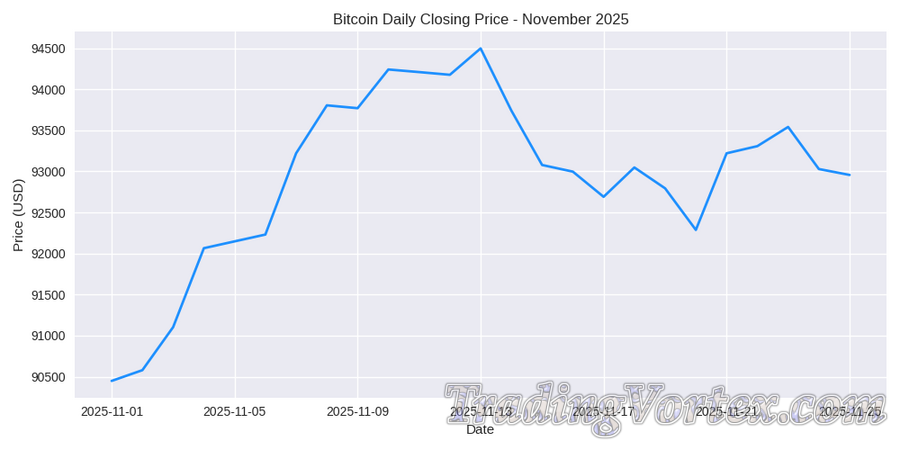 Bitcoin Daily Closing Price, November 2025: A line chart of Bitcoin’s daily closing price across November 2025, highlighting the rebound from early month lows toward the mid-month recovery.
♦ How to use it:
◊ Identify trend: Track the transition from capitulation to stabilization and renewed momentum.
◊ Contextualize flows: Align price inflections with ETF inflow days and notable on-chain accumulation signals.
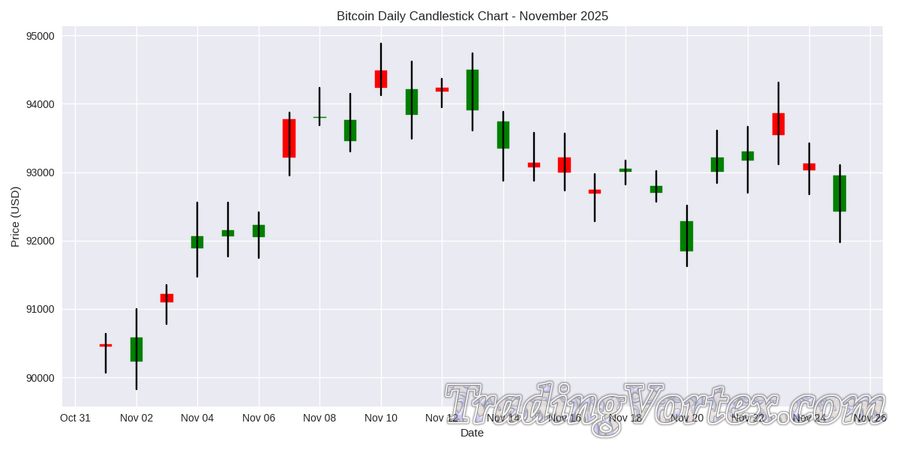 Bitcoin Daily Candlestick Chart, November 2025: A candlestick chart displaying daily open, high, low, and close to visualize intraday swings and volatility during the recovery phase.
♦ How to use it:
◊ Assess volatility: Identify sessions with long wicks indicating failed selloffs or momentum stalls.
◊ Find levels: Note recurring support near round numbers and resistance where profit-taking clusters.
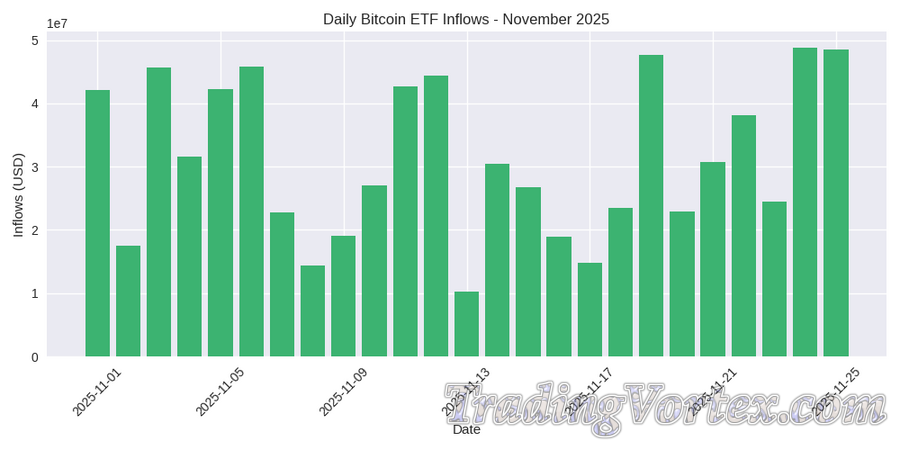 Daily Bitcoin ETF Inflows, November 2025: A bar chart of daily spot Bitcoin ETF net inflows in USD, illustrating institutional confidence and its timing relative to price recovery.
♦ How to use it:
◊ Link to price action: Compare inflow spikes with strong up days to gauge conviction.
◊ Risk signal: Watch for sustained positive flows to confirm durable sentiment shifts.
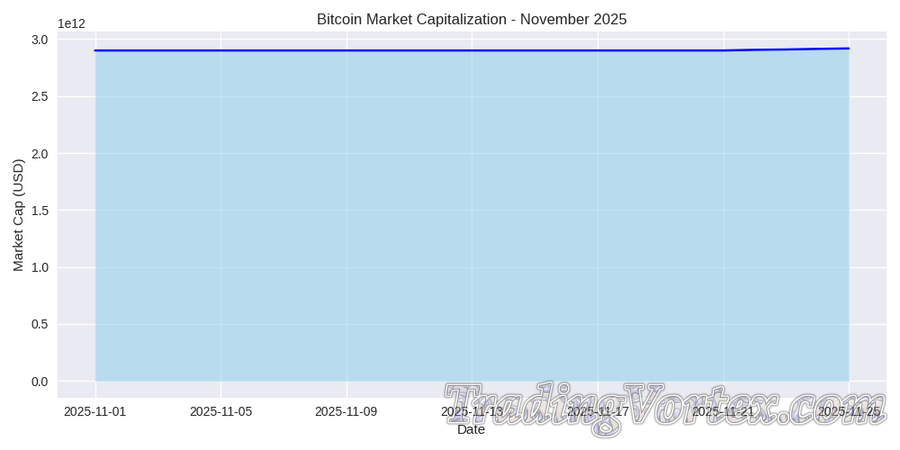 Bitcoin Market Capitalization, November 2025: An area chart tracking Bitcoin’s aggregate market cap through November to visualize the value recovery as sentiment turned.
♦ How to use it:
◊ Gauge magnitude: Show the cumulative value regained as the market stabilized.
◊ Compare phases: Pair with price and ETF flow charts to connect capital rotation and risk appetite.
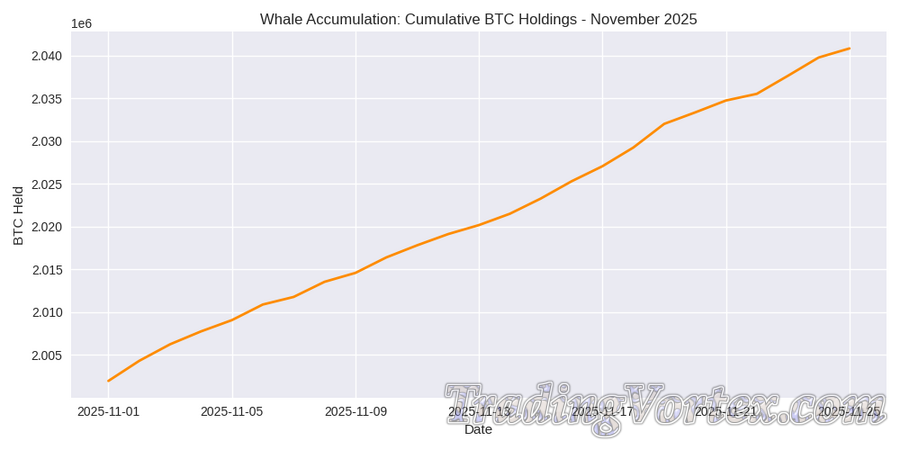 Whale Accumulation: Cumulative BTC Holdings, November 2025: A line chart of cumulative BTC held by large wallets, signaling strategic accumulation during periods of elevated fear.
♦ How to use it:
◊ Positioning cue: Rising holdings often precede sustained price recoveries.
◊ Divergence check: Contrast whale buying with retail sentiment to detect asymmetric positioning opportunities.
Seasonal Crypto Trends
Historical November Performance: Bitcoin’s Strongest Month
Seasonality has long been a defining feature of crypto markets, and November stands out as Bitcoin’s most historically profitable month. Data from CoinGlass shows that Bitcoin has delivered an average November return of 42 percent since inception, although this figure is skewed by extreme outliers such as the 2013 rally of more than 450 percent. When adjusted for median performance, November still posts a healthy 8.8 percent gain, making it one of the most consistent months for positive returns.
This recurring strength is often attributed to a combination of factors: year-end portfolio positioning, increased retail participation ahead of the holiday season, and macroeconomic cycles that favor risk assets during late Q4.
December Seasonality: What Traders Should Expect
While November has historically been Bitcoin’s strongest month, December presents a more mixed picture. CoinGlass data shows that Bitcoin’s December returns average 11 percent, but the distribution is highly uneven.
In 2025, traders are watching December closely because the macro backdrop remains uncertain. The Federal Reserve’s policy stance, ETF flows, and whale accumulation will likely determine whether December follows the bullish seasonal pattern or diverges.
Historically, December tends to bring heightened volatility, with sharp rallies often followed by profit-taking. For tactical traders, this means December is best approached with tight risk management, clear stop levels, and a focus on liquidity zones.
Comparing Past Cycles: Uptober vs. Red October vs. Holiday Rallies
The contrast between October and November highlights the cyclical nature of crypto sentiment. October 2025 broke the “Uptober” streak with a 3.6 percent monthly loss, the first negative October since 2018. This “Red October” cooled sentiment, erased nearly $1 trillion in market value, and reminded traders that seasonality is not destiny.
By contrast, November’s rebound has reinforced the historical pattern of strength, with Bitcoin recovering toward $115,000 and total crypto market capitalization climbing back above $3 trillion. Analysts suggest that this reversal reflects both structural demand and seasonal psychology, as traders anticipate holiday rallies and position for year-end flows.
Holiday rallies, often observed in late December, are typically driven by retail enthusiasm and thin liquidity, which can exaggerate price moves. Comparing past cycles shows that while “Uptober” and “Golden November” are statistically strong, December is more unpredictable, oscillating between euphoric rallies and sharp corrections.
Key Takeaway: Seasonal crypto trends remain a powerful guide for traders, but they must be balanced with macroeconomic signals and flow data. November’s historical strength has once again emerged in 2025, while December’s mixed record calls for caution.
Traders should prepare for volatility, monitor ETF inflows and whale positioning, and avoid relying solely on seasonal averages when making tactical decisions.
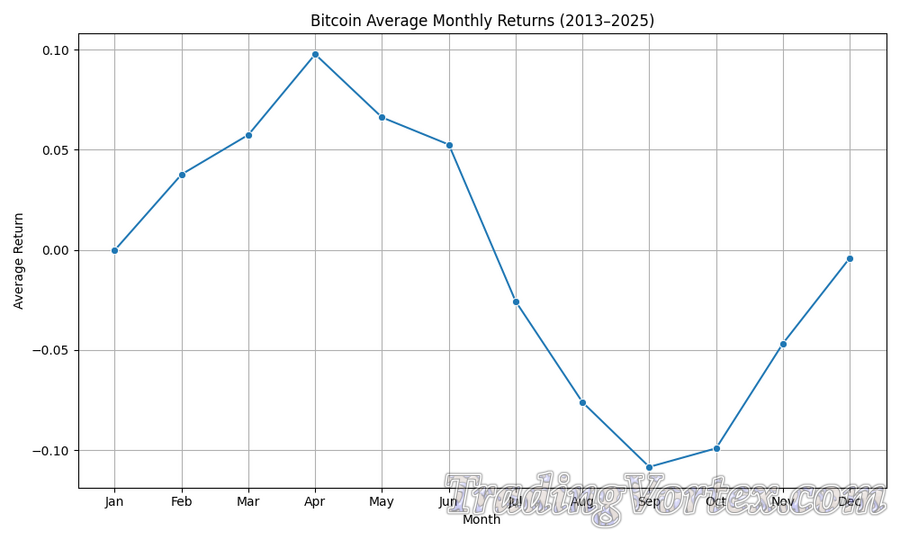 Bitcoin Average Monthly Returns (2013–2025): A line chart of Bitcoin’s average return for each calendar month from 2013 to 2025, highlighting seasonality, notably strong average performance in November.
♦ How to use it:
◊ Identify seasonal edges: Spot months with historically favorable risk-reward.
◊ Contextualize positioning: Use seasonal tendencies to inform scaling and profit-taking windows.
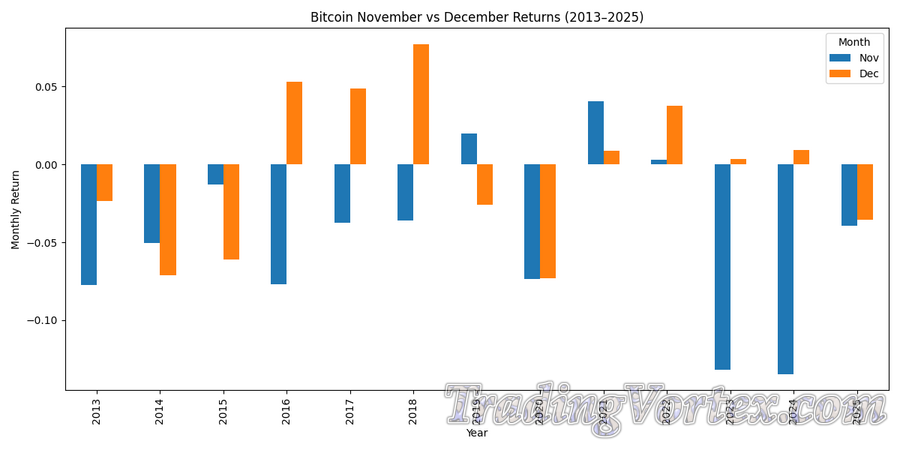 Bitcoin November vs December Returns (2013–2025): A two-series bar chart comparing Bitcoin’s November and December returns for each year, visualizing consistency and variability of late-year performance.
♦ How to use it:
◊ Compare patterns: Evaluate whether strength tends to concentrate in November or extend into December.
◊ Risk calibration: Note years with December reversals to set conservative targets and stops.
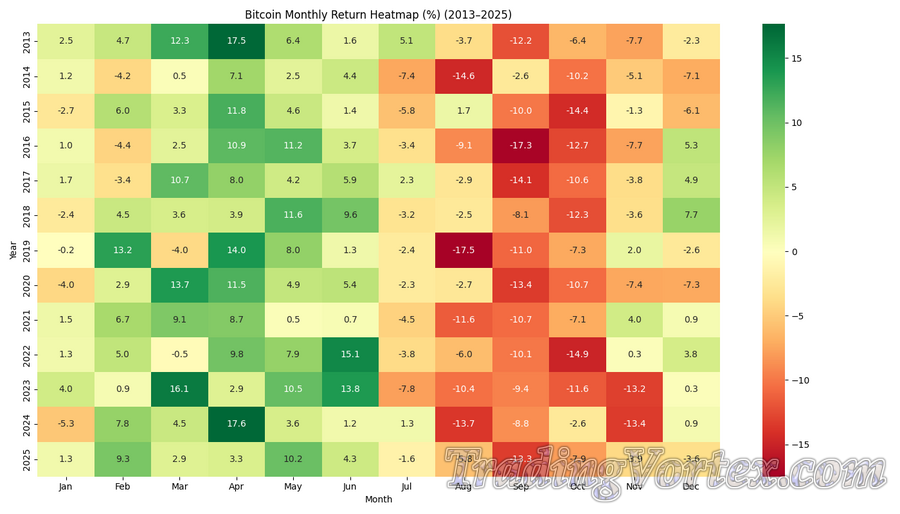 Bitcoin Monthly Return Heatmap (%) (2013–2025): A heatmap of monthly percentage returns by year, using color intensity to highlight strong, weak, and neutral months across cycles.
♦ How to use it:
◊ Spot seasonality clusters: Quickly identify recurring strong months and weak patches.
◊ Cycle comparison: Contrast bull and bear phases to anticipate regime-dependent outcomes.
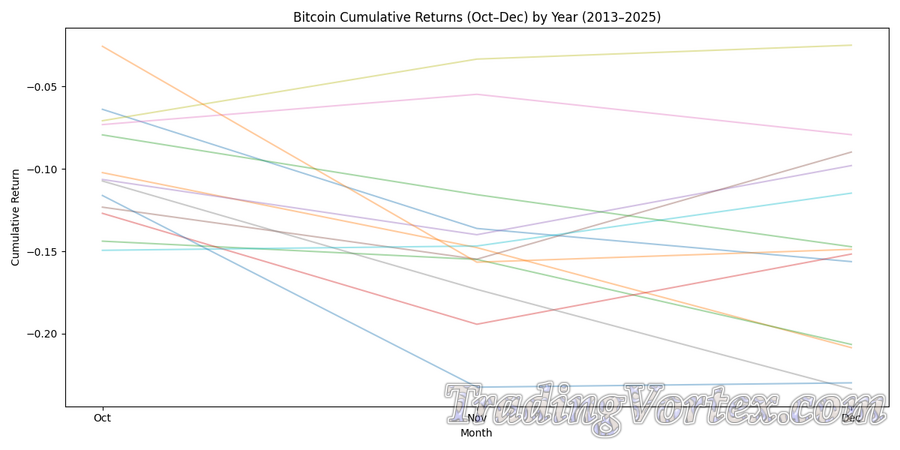 Bitcoin Cumulative Returns (Oct–Dec) by Year (2013–2025): An area chart showing cumulative returns across October, November, and December for each year, illustrating holiday rally dynamics and timing.
♦ How to use it:
◊ Trajectory insight: See whether gains typically start in October or accelerate in November and December.
◊ Execution planning: Align entries with historical inflection points and typical acceleration windows.
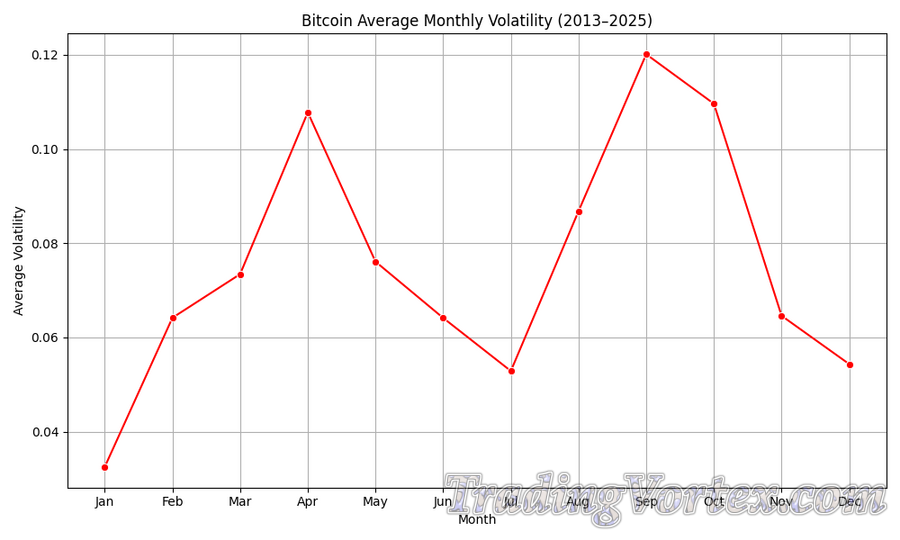 Bitcoin Average Monthly Volatility (2013–2025): A line chart of average monthly volatility, measured by the standard deviation of monthly returns, to assess risk across the calendar year.
♦ How to use it:
◊ Size positions: Increase caution when volatility is historically elevated.
◊ Optimize stops: Adjust stop distances to volatility regimes to reduce whipsaws.
Trader Psychology and Positioning
Sentiment Indicators: Fear & Greed, Funding Rates, and Social Buzz
Investor psychology in November 2025 has been shaped by extreme volatility. The Crypto Fear & Greed Index plunged to 10 on November 16, its lowest reading since the Terra Luna collapse in 2022, signaling intense anxiety across the market. Real-time sentiment trackers later showed a modest recovery to 19 (Extreme Fear), but the prevailing mood remains cautious. This shift reflects a broad deleveraging trend, with traders reducing risk exposure as macroeconomic uncertainty persists.
Funding rates across major exchanges also highlight the cooling of speculative appetite. During October’s breakdown, perpetual futures funding rates turned negative, indicating that short positions dominated. By late November, rates normalized, suggesting a healthier balance between longs and shorts.
Social sentiment data shows that Bitcoin, Solana, and XRP dominate discussions, but the tone remains defensive, with traders debating whether the current rebound marks a sustainable recovery or a temporary relief rally.
How Traders Are Adjusting After October’s Shock
October’s rare breakdown forced traders to reassess strategies. Many retail investors reduced leverage or exited positions entirely, while institutional players shifted toward defensive allocations.
At the same time, whales have taken advantage of depressed sentiment to accumulate positions. Blockchain data shows that large holders added tens of thousands of BTC in November, reinforcing the idea that deep-pocketed investors often buy during periods of extreme fear. This divergence between retail caution and institutional accumulation underscores the importance of understanding positioning dynamics when sentiment indicators flash red.
Tactical Positioning for December: Risk Management and Opportunity Zones
December presents both opportunity and risk. Historically, Bitcoin’s December returns average 11 percent, but outcomes vary widely, ranging from euphoric rallies to sharp corrections. With sentiment still fragile, traders should prioritize risk management strategies:
- Set clear stop-loss levels to protect against sudden reversals.
- Monitor ETF flows closely, as renewed inflows could signal institutional conviction.
- Track whale accumulation and on-chain storage trends, which often precede sustained rallies.
- Watch macroeconomic signals, particularly Federal Reserve policy updates and Treasury yield movements, which directly influence risk appetite.
Opportunity zones for December may emerge around key psychological levels such as $100,000 support and $115,000 resistance. A breakout above resistance could trigger momentum buying, while a failure to hold support may invite renewed selling pressure. Traders should remain flexible, balancing seasonal optimism with the reality of macro-driven volatility.
Key Takeaway: Trader psychology has shifted from October’s shock toward cautious optimism in November, but sentiment remains fragile. Extreme fear readings, normalized funding rates, and whale accumulation all point to a market in transition. For December, tactical positioning requires balancing seasonal tailwinds with disciplined risk management, ensuring traders are prepared for both volatility and opportunity.
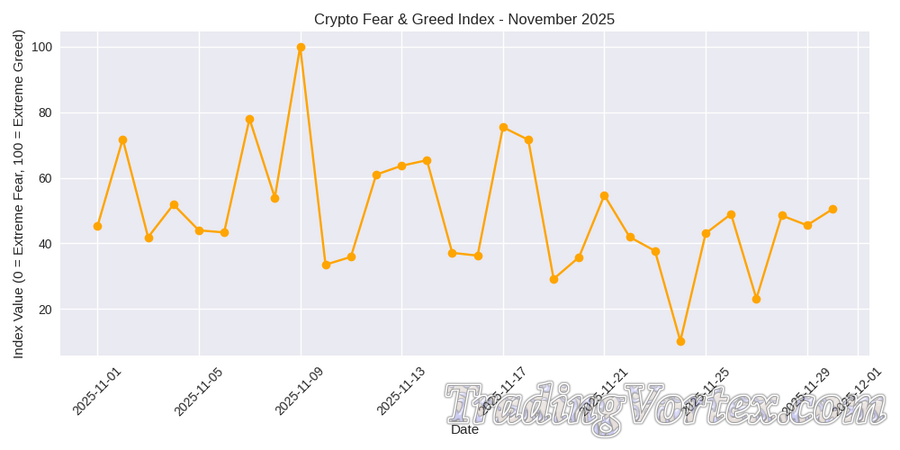 Crypto Fear & Greed Index – Daily Readings, November 2025: A line chart of daily Fear & Greed readings through November, capturing the swing from extreme fear to gradual stabilization.
♦ How to use it:
◊ Sentiment timing: Buy risk when readings lift from extreme fear, scale out as greed rises.
◊ Confirm signals: Pair with ETF flows and funding rates to validate sentiment turns.
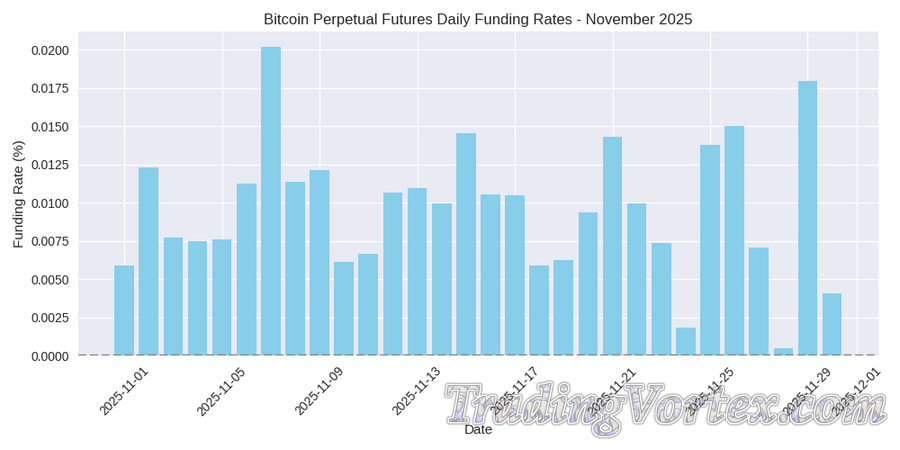 Bitcoin Perpetual Futures Funding Rates — Daily, November 2025: A bar chart of daily funding rates for BTC perpetual futures across major exchanges, indicating where longs or shorts are paying to hold exposure.
♦ How to use it:
◊ Positioning bias: Sustained positive funding implies long crowding; negative funding suggests short dominance.
◊ Risk control: Tighten stops and reduce leverage when funding diverges sharply from neutral.
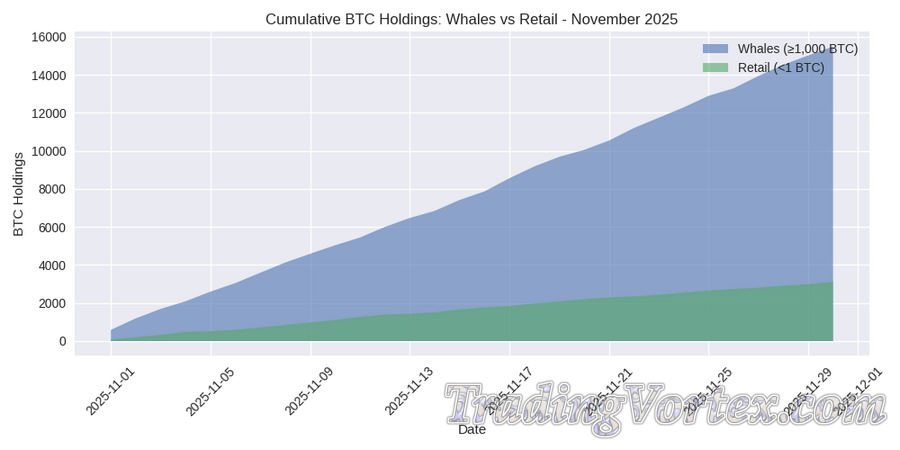 Cumulative BTC Holdings — Whales vs Retail, November 2025: An area chart comparing cumulative BTC held by whale wallets versus retail-sized wallets, highlighting accumulation patterns during fear phases.
♦ How to use it:
◊ Divergence insight: Rising whale holdings during retail net-selling often precede recoveries.
◊ Execution cue: Accumulation inflections can guide scaling entries and risk-on rotation.
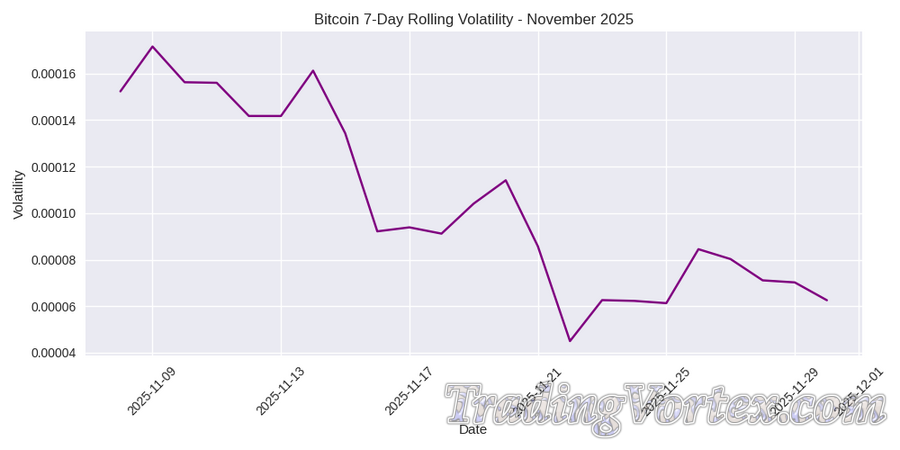 Bitcoin 7-Day Rolling Volatility — November 2025: A volatility chart measuring the 7-day rolling standard deviation of daily returns, mapping regime shifts in risk.
♦ How to use it:
◊ Sizing and stops: Increase caution, widen stops, and prefer staggered entries when volatility rises.
◊ Strategy selection: Shift from breakout strategies to mean reversion when volatility compresses.
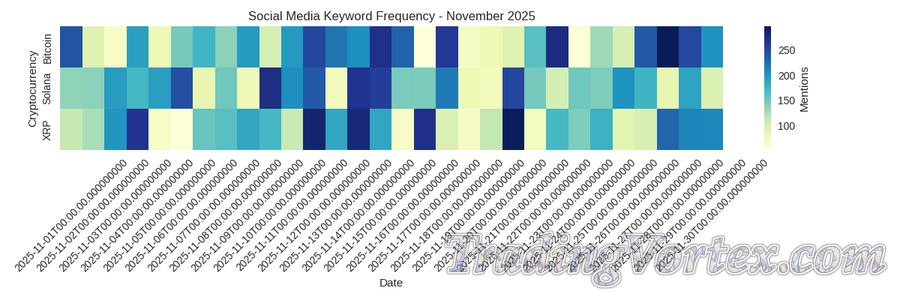 Social Media Keyword Frequency — Bitcoin, Solana, XRP, November 2025: A heatmap of keyword frequency for Bitcoin, Solana, and XRP across November, capturing shifts in attention and narrative intensity.
♦ How to use it:
◊ Narrative momentum: Rising mentions often support short-term momentum trades.
◊ Rotation cues: Surging attention in an altcoin can presage rotation from BTC dominance.
Strategic Insights for Investors
Short-Term vs. Long-Term Sentiment Drivers
Investor sentiment in late 2025 reflects a sharp divide between short-term caution and long-term conviction. In November, Bitcoin fell below $90,000 amid regulatory crackdowns and renewed rate hike fears. Short-term sentiment was further pressured by $1.26 billion in ETF outflows from BlackRock’s IBIT, highlighting institutional hesitation. At the same time, the Crypto Fear & Greed Index hit record lows, signaling extreme fear among retail traders.
Yet long-term drivers remain supportive. El Salvador announced a $100 million Bitcoin purchase, while Harvard’s endowment allocated $442.8 million to Bitcoin as part of its diversification strategy. These moves underscore the growing role of Bitcoin as a strategic asset, even as short-term volatility persists. Institutional adoption, fiscal stimulus in Japan, and divergent central bank policies in Europe have reinforced Bitcoin’s legitimacy as a hedge and diversification tool.
Balancing Macro Risks with Seasonal Tailwinds
Macro risks continue to weigh heavily on crypto markets. U.S. states have imposed transaction limits, while China’s Ministry of State Security linked digital assets to espionage concerns. These developments, combined with elevated Treasury yields and a strong dollar, have created headwinds for risk assets.
However, seasonal tailwinds remain a counterbalance. Historically, November has delivered average Bitcoin gains of 42 percent, while December has shown mixed but often positive performance. In 2025, ETF inflows totaling $28.1 billion across multiple products suggest that institutional demand is returning, even as retail sentiment remains fragile.
Traders must weigh these opposing forces carefully: macro risks can trigger sharp drawdowns, but seasonal optimism and structural demand can fuel rallies.
Key Levels to Watch: Support, Resistance, and Psychological Barriers
Technical levels provide critical guidance for positioning. Analysts highlight $90,000 as a key support zone, tested during November’s decline. Holding above this level is essential for sustaining bullish momentum. On the upside, $115,000 represents a major resistance level, where profit-taking has historically emerged. A breakout above this threshold could open the path toward retesting the August all-time high of $124,480.
Psychological barriers also play a role. The $100,000 round number remains a magnet for trader psychology, acting as both support and resistance depending on sentiment. On-chain data shows increased movement of BTC into cold storage, suggesting long-term conviction among whales and institutions.
For tactical traders, monitoring ETF flows, whale accumulation, and macro policy updates will be crucial in navigating December’s volatility.
Key Takeaway: Investors face a dual landscape in late 2025. Short-term sentiment is fragile, pressured by regulatory uncertainty and ETF outflows, while long-term conviction is reinforced by institutional adoption and fiscal stimulus. Balancing macro risks with seasonal tailwinds requires disciplined risk management, with $90,000 support and $115,000 resistance serving as critical levels to watch.
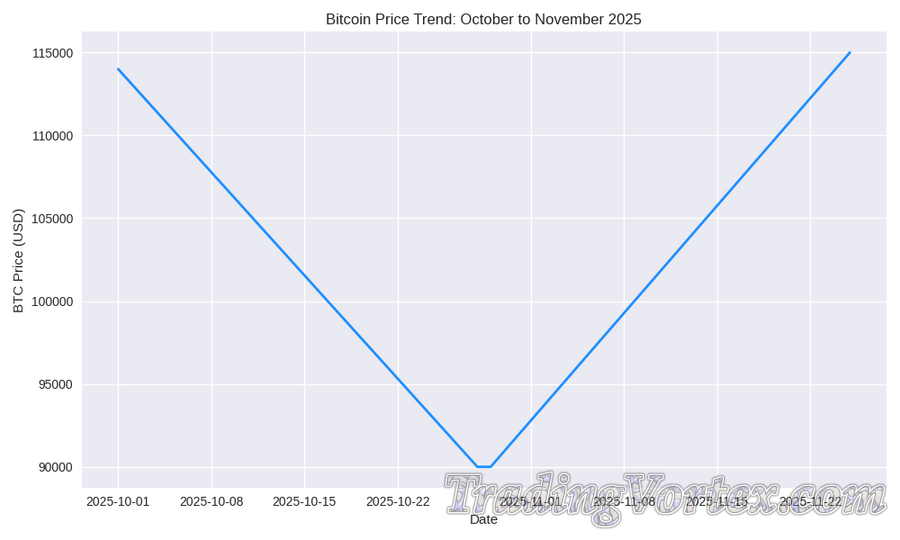 Bitcoin Price Trend: October to November 2025: A line chart of Bitcoin’s daily closing price from early October through late November 2025, illustrating the October decline, the early November trough, and the subsequent recovery.
♦ How to use it:
◊ Identify momentum shifts: Pinpoint inflection points where price transitions from distribution to accumulation.
◊ Contextualize sentiment: Align key moves with major headlines, ETF flow days, and whale accumulation signals.
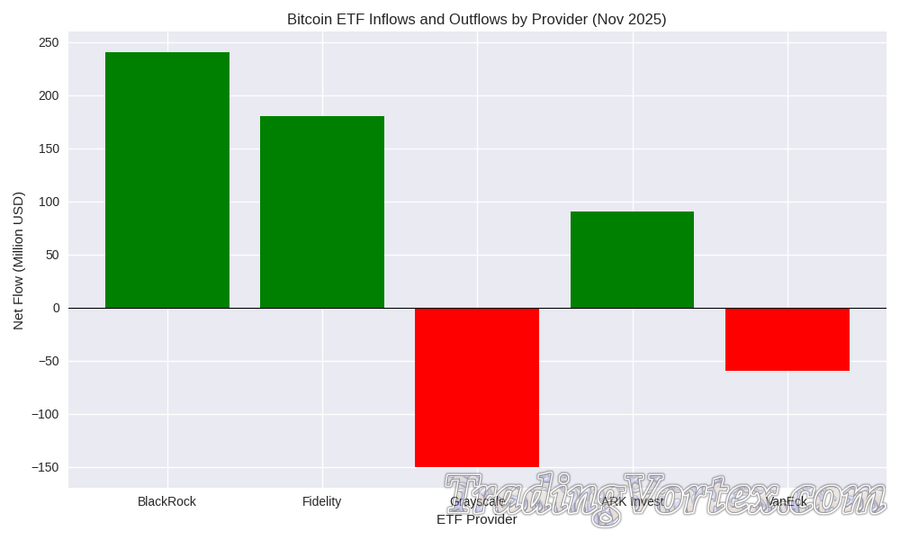 Bitcoin ETF Inflows and Outflows by Provider (November 2025): A bar chart of net spot Bitcoin ETF flows by major providers, differentiating inflows versus outflows to reveal institutional conviction.
♦ How to use it:
◊ Institutional pulse: Track sustained positive net flows as confirmation of improving sentiment.
◊ Divergence watch: Compare providers to spot rotation or lagging products.
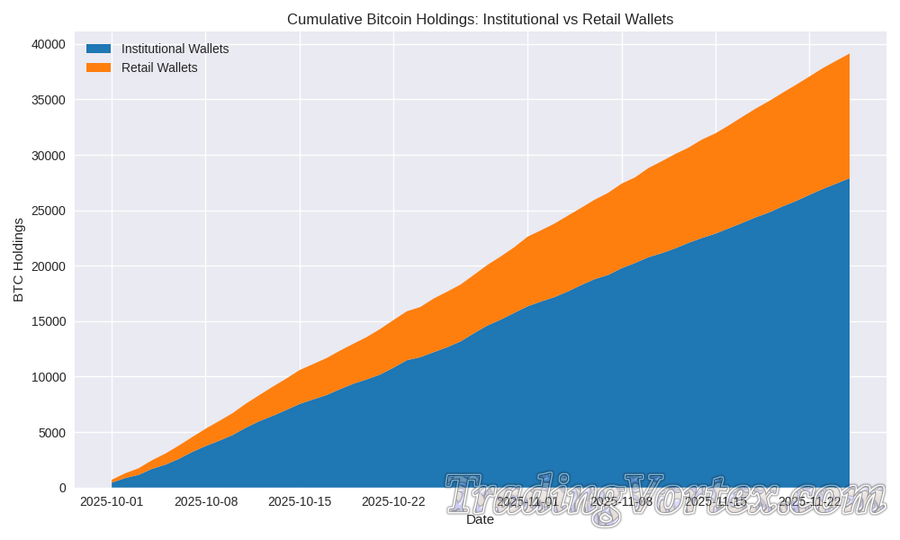 Cumulative Bitcoin Holdings: Institutional vs Retail Wallets: An area chart comparing cumulative BTC holdings of institutional wallets versus retail-sized wallets through October and November.
♦ How to use it:
◊ Positioning divergence: Rising institutional holdings during retail selling often precede durable recoveries.
◊ Execution cues: Use accumulation inflections to plan scaling entries and risk-on rotation.
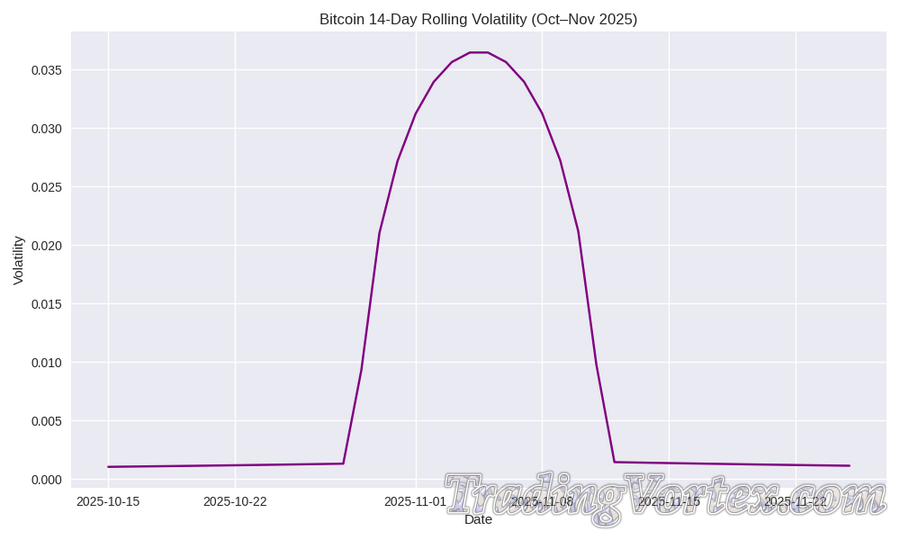 Bitcoin 14-Day Rolling Volatility (Oct–Nov 2025): A volatility chart tracking the 14-day rolling standard deviation of daily returns, highlighting regime shifts in risk.
♦ How to use it:
◊ Sizing and stops: Increase caution, widen stops, and prefer staggered entries when volatility rises.
◊ Strategy selection: Shift from breakout to mean reversion in lower volatility phases.
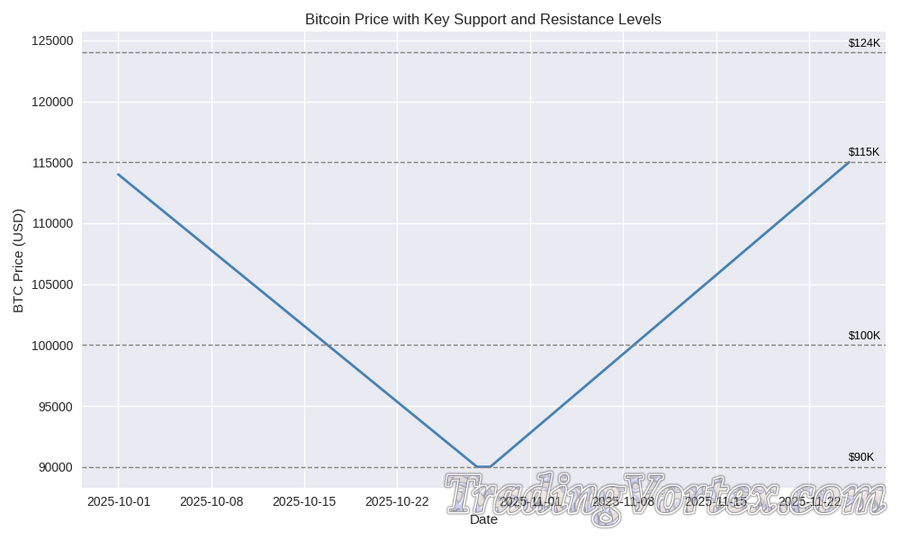 Bitcoin Price with Key Support and Resistance Levels: An annotated price chart with horizontal lines at $90K, $100K, $115K, and $124K to emphasize critical support and resistance.
♦ How to use it:
◊ Trade planning: Set entries, take profits, and stops around these levels, adapting as conditions change.
◊ Risk controls: Watch behavior near round numbers where liquidity and reactions intensify.
Conclusion: Crypto Sentiment Reset and December Outlook for Investors
Crypto Sentiment Reset: From Breakdown to Rebound
October’s rare breakdown marked a turning point for crypto markets, with Bitcoin closing the month down 3.6 percent and erasing nearly $1 trillion in market value. This decline broke the “Uptober” streak and triggered widespread risk aversion. November initially deepened the downturn, with Bitcoin falling more than 21 percent, its sharpest monthly drop since June 2022. Forced liquidations and ETF outflows amplified the sell-off, driving prices as low as $88,000.
Yet sentiment began to reset as institutional flows returned. Spot Bitcoin ETFs recorded $523 million in inflows by mid-November, signaling renewed confidence from large investors. Bitcoin rebounded above $104,000 as U.S. political pressures eased and regulatory clarity improved.
Altcoins also joined the recovery, with XRP spiking 8.5 percent and Solana climbing 5 percent on November 25. The total crypto market cap regained the $3 trillion level, underscoring structural demand despite volatility.
December Outlook: Positioning for Volatility and Opportunity
Looking ahead, December presents both risk and opportunity. Analysts forecast Bitcoin could rebound toward $95,000–$100,000 within weeks, supported by oversold technicals such as an RSI near 22.5 and Bollinger Band support.
Key levels to watch include $90,000 support and $115,000 resistance. A break above resistance could open the path toward retesting August’s all-time high of $124,480, while failure to hold support risks a slide toward $80,600.
Macro conditions will remain decisive. Expectations for a Federal Reserve rate cut in December have risen to 85 percent, lifting risk assets and fueling optimism. Institutional adoption continues to grow, with major funds and sovereign entities adding exposure, reinforcing Bitcoin’s role as a strategic asset.
However, traders must remain cautious: volatility is likely to persist, and profit-taking around psychological levels such as $100,000 could trigger sharp swings.
Actionable Insight for Investors: December should be approached with disciplined risk management. Monitor ETF flows and whale accumulation for early signals of sustained momentum. Use clear stop-loss levels to guard against reversals, and consider scaling into positions gradually rather than chasing rallies. Balancing seasonal tailwinds with macro risks will be key to capturing opportunity while avoiding downside traps.
Key Takeaway: Crypto sentiment has reset after October’s breakdown, with November’s rebound restoring confidence. December offers potential upside toward $100,000–$115,000, but volatility will remain high. Investors who combine technical awareness, macro monitoring, and disciplined positioning will be best prepared to navigate the month’s opportunities.
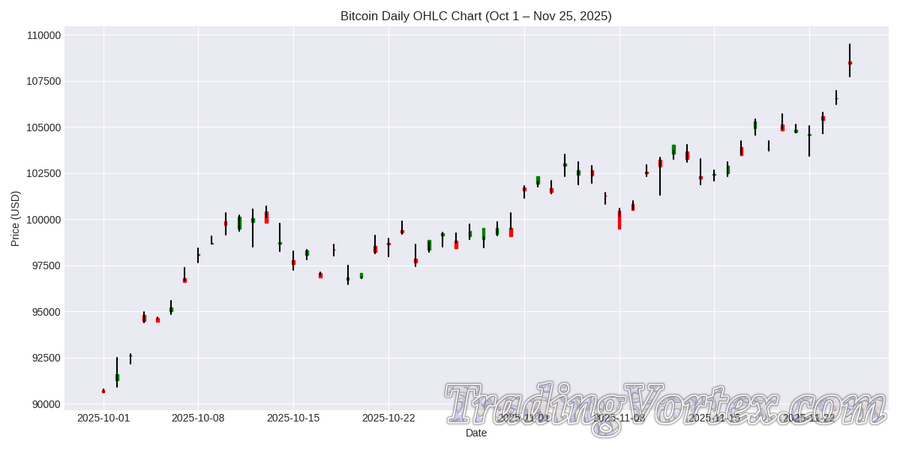 Bitcoin Daily OHLC, Oct 1 to Nov 25, 2025: A daily OHLC chart visualizing open, high, low, and close to highlight volatility during the breakdown and rebound periods.
♦ How to use it:
◊ Assess volatility: Long wicks indicate failed rallies or aggressive selloffs.
◊ Find levels: Observe clusters of support and resistance around round numbers.
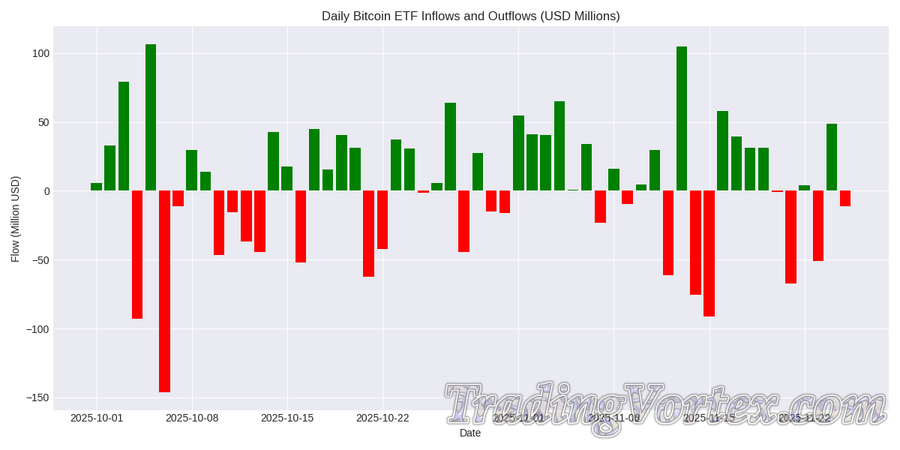 Daily Spot Bitcoin ETF Inflows and Outflows (USD Millions): A bar chart of daily net inflows and outflows in USD, reflecting institutional sentiment shifts through the period.
♦ How to use it:
◊ Confirm conviction: Sustained positive flows validate improving sentiment.
◊ Risk signal: Persistent outflows warn of fragility in the rebound.
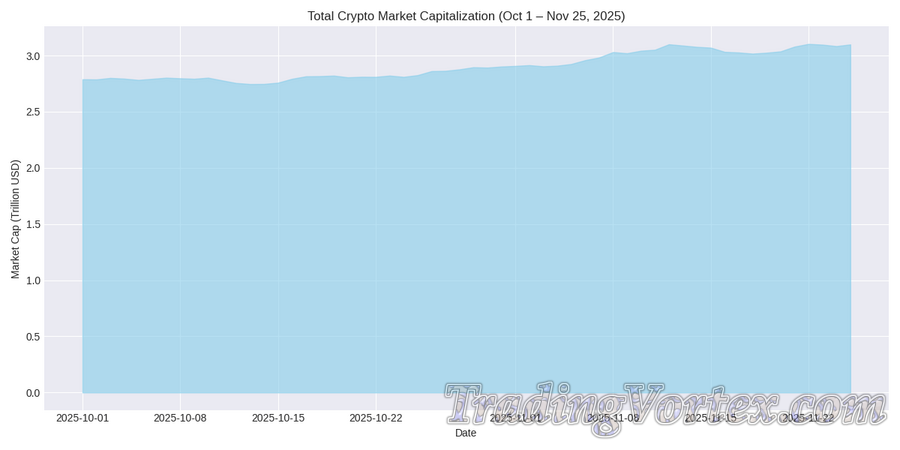 Total Crypto Market Capitalization, Oct 1 to Nov 25, 2025: An area chart tracking aggregate crypto market cap to visualize structural demand recovery as sentiment improves.
♦ How to use it:
◊ Gauge magnitude: Show value regained alongside price stabilization.
◊ Cross-compare: Pair with ETF flows to connect capital rotation with risk appetite.
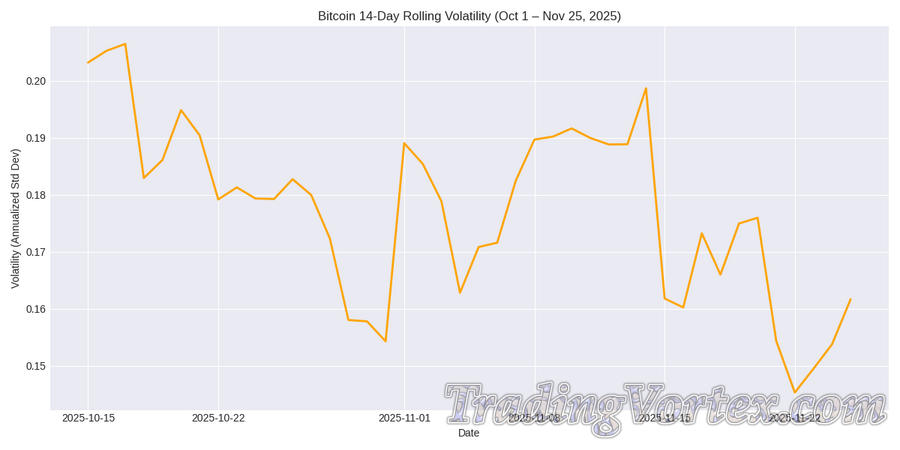 Bitcoin 14-Day Rolling Volatility, Oct 1 to Nov 25, 2025: A line chart of annualized 14-day rolling volatility, mapping risk regime shifts across the breakdown and rebound.
♦ How to use it:
◊ Size positions: Widen stops and stagger entries when volatility rises.
◊ Strategy choice: Favor mean reversion as volatility compresses and ranges narrow.