

Ethereum is showing signs of renewed upward momentum as large stablecoin and ETH withdrawals from exchanges compress sell-side liquidity, creating a backdrop for rapid price moves. Traders and investors should watch on-chain exchange reserves, funding-rate dynamics, and short interest to gauge whether the market is setting up for a breakout or a liquidity-driven squeeze. This Market Pulse deep dive compiles the latest on-chain flow statistics, exchange reserve data, derivatives signals, and tactical trade plans for swing traders and scalpers.
Table of Contents:
- Why exchange outflows matter for ETH price action
- On-chain flows and recent statistics
- Derivatives landscape: funding rates, open interest, and short interest
- How liquidity compression sets up momentum
- Tactical entry levels and trade plans
- Breakout and failure scenario checklists
- Risk management and execution considerations
- What to monitor in real time
- Example trade scenarios with numbers
- Conclusion: ETH Liquidity Compression, Exchange Outflows, and Tactical Trade Checklist
Why exchange outflows matter for ETH price action
Multiple data sources show exchange reserves near multi-month lows as long-term holders accumulate and institutional flows ebb and flow. That dynamic points to reduced immediate sell pressure as a structural bullish input for price action.
On-chain flows and recent statistics
Exchange reserve trends
CryptoQuant’s exchange reserve metric shows a notable decline in ETH held on exchanges across 2025, consistent with less available on-exchange supply and heightened potential for price moves when demand resumes.
A weekly on-chain summary found exchange reserves fell by about 179,826 ETH during the referenced week, a decline of roughly 1.14 percent, and highlighted increased accumulation by large holders while staking inflows moderated.
Sources showing multi-week ETF and staking outflows add context to the exchange reserve picture, with several reports noting consecutive ETF outflow days and staking withdrawals that coincide with lower on-exchange supply levels.
(See the derivatives and funding section for how these reserve moves interact with futures and funding markets.)
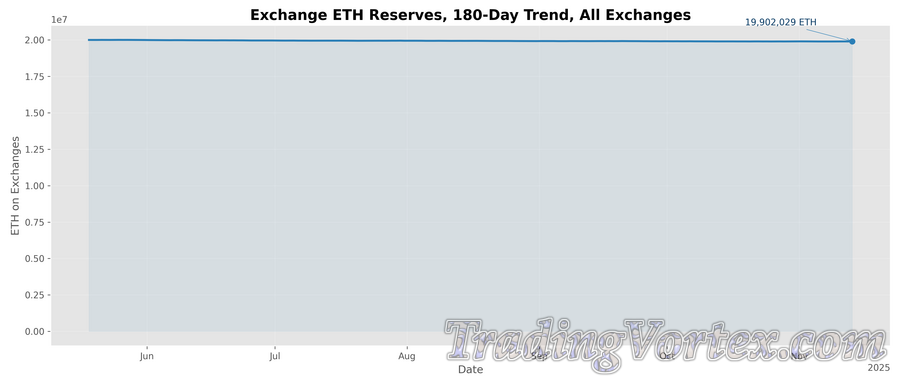 Exchange ETH Reserves, 180-Day Trend, All Exchanges: Exchange ETH reserves have declined steadily over the past 180 days, highlighting liquidity compression.
This chart tracks the total ETH held on centralized exchanges over the past 180 days. A steady decline signals that fewer coins are available for immediate sale, compressing liquidity and increasing the potential for sharp price moves. Traders can use this to identify periods when reduced reserves may amplify upward momentum.
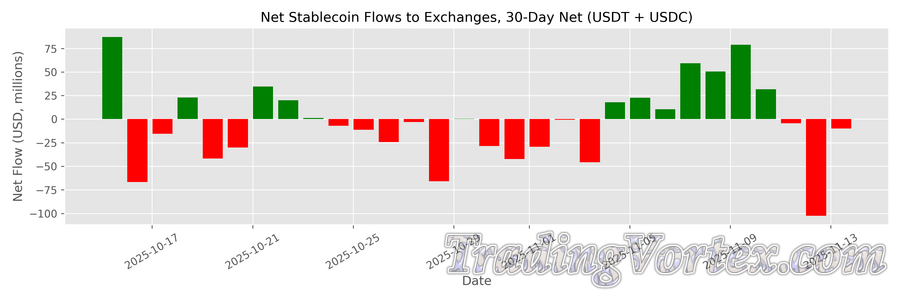 Net Stablecoin Flows to Exchanges, 30-Day Net (USDT + USDC): Net stablecoin flows to exchanges over 30 days, showing inflows (green) and outflows (red).
This bar chart illustrates the daily net inflows and outflows of stablecoins (USDT and USDC) to centralized exchanges over the past 30 days.
♦ Green bars represent net inflows, meaning more stablecoins were deposited than withdrawn. This increases buying power on exchanges and can support ETH demand.
♦ Red bars represent net outflows, meaning more stablecoins were withdrawn than deposited. This reduces immediate liquidity and often signals that traders are moving capital off exchanges, compressing available buy-side liquidity.
♦ By monitoring these flows, traders can anticipate whether fresh capital is entering exchanges to support ETH buying or leaving, which can weaken momentum. When combined with ETH exchange reserve data, this chart provides a fuller picture of liquidity compression and potential breakout conditions.
Large-holder accumulation and whale flows
Blockchain analytics identify material accumulation by large addresses. One reported analysis cited wallets in the 10,000 to 100,000 ETH band accumulating several million ETH over recent months, a pattern that reduces circulating free float and concentrates supply with fewer counterparties.
Large-holder aggregation typically tightens liquidity, since whales are more likely to move assets to cold storage or staking, reducing the instant sellability of those tokens on exchanges.
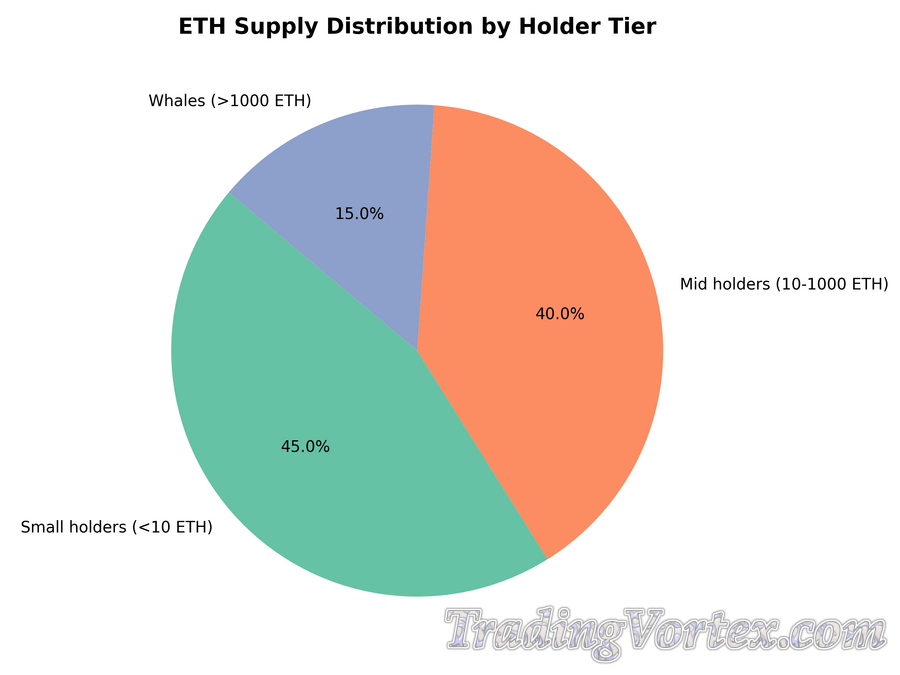 ETH Supply Distribution by Holder Tier: ETH supply distribution by holder tier, showing shares held by small holders, mid-tier addresses, and whales.
This pie chart shows how Ethereum supply is distributed among three wallet balance tiers:
♦ Small holders (<10 ETH): Represent retail investors and grassroots adoption.
♦ Mid holders (10–1000 ETH): Include active traders, staking participants, and small funds.
♦ Whales (>1000 ETH): Large holders and institutions who control a significant share of ETH supply.
◊ By visualizing this distribution, traders can understand how whale accumulation reduces circulating supply, tightening liquidity and magnifying price swings. A higher concentration among whales often signals stronger liquidity compression, which can accelerate both rallies and squeezes.
Derivatives landscape: funding rates, open interest, and short interest
Funding rate shifts and what they mean
Funding rates across ETH perpetual futures have recently moved negative, signaling that shorts are being paid to hold positions while longs pay funding. Deeply negative funding indicates an overcrowded short market; under the right liquidity conditions, that creates the possibility of a short squeeze if on-chain flows remove available ETH from exchange liquidity pools.
Negative funding, paired with shrinking exchange reserves, raises the odds of sharp, rapid upward moves if longs re-enter or forced short-covering occurs. Traders should monitor real-time funding rate aggregates across major venues for early squeeze signals.
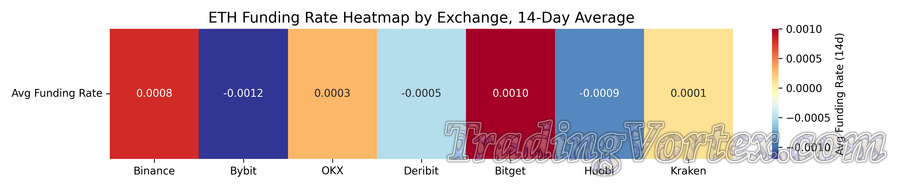 ETH Funding Rate Heatmap by Exchange, 14-Day Average: ETH funding rate heatmap across major exchanges, showing average values over the past 14 days.
This heatmap shows the average funding rates for ETH perpetual futures across major exchanges over the past 14 days. Funding rates are a mechanism that keeps perpetual futures prices aligned with spot prices:
♦ Positive funding rates mean longs are paying shorts, indicating that long positions dominate.
♦ Negative funding rates mean shorts are paying longs, signaling that short positions are overcrowded.
◊ By comparing exchanges side by side, traders can quickly identify where short or long bias is strongest. For example, if multiple exchanges show negative funding rates while exchange reserves are falling, it suggests a setup for a potential short squeeze. Conversely, persistently positive funding rates may indicate overheated long positioning, raising the risk of a pullback.
Open interest and liquidation risk
Open interest on futures has been choppy and, in some snapshots, under pressure. Falling open interest while reserves fall can mean less immediate leverage on the buy side, but it also increases volatility if a sudden directional impulse triggers stop runs and cascade liquidations. Watch sudden spikes in open interest together with outflows for increased failure/breakout risk.
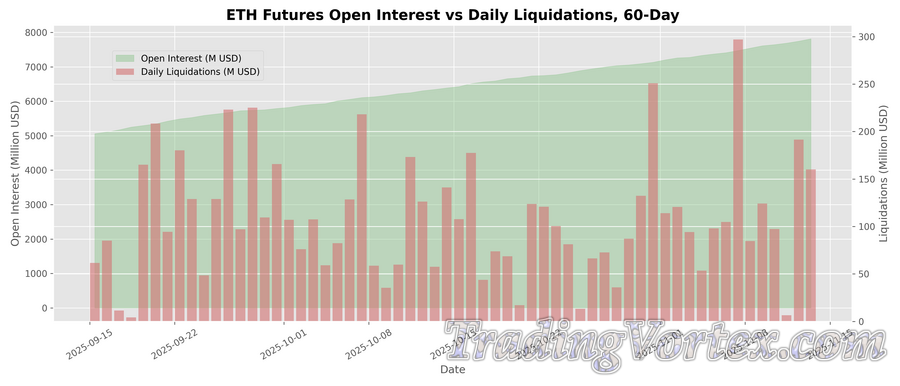 ETH Futures Open Interest vs Daily Liquidations, 60-Day: ETH futures open interest (green area) compared with daily liquidations (red bars) over the past 60 days.
This chart compares Ethereum futures open interest (green shaded area) with daily liquidation volumes (red bars) over the past 60 days.
♦ Open Interest (OI): Represents the total value of outstanding ETH futures contracts. Rising OI indicates growing leverage in the market, which can amplify both gains and losses.
♦ Liquidations: Show the forced closure of leveraged positions when margin requirements are breached. Spikes in liquidation volume often signal periods of extreme volatility and can trigger cascading price moves.
◊ By viewing these two metrics together, traders can assess whether leverage is building toward a breakout or if liquidation cascades are increasing risk. For example, rising OI combined with frequent liquidation spikes suggests unstable leverage conditions, while steady OI with low liquidations indicates a more balanced market.
How liquidity compression sets up momentum
When exchanges lose significant ETH and stablecoins, the order books thin. Traders buying against thinner books move price with fewer contracts. If funding is negative and shorts are large in size, a price uptick can force shorts to cover, accelerating the move. That sequence – outflows, thinning books, funding-driven short covering – produces classic momentum scenarios for ETH.
Practical implication: liquidity compression increases both the upside potential and the speed of moves; it also raises execution risk, especially for scalpers who rely on narrow spreads and deep books.
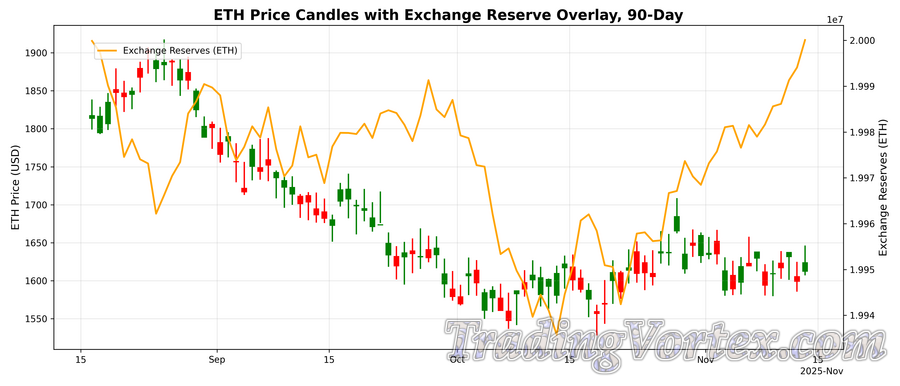 ETH Price Candles with Exchange Reserve Overlay, 90-Day: ETH price candles with exchange reserve overlay, showing correlation between liquidity compression and price action.
♦ This chart combines two critical signals: ETH price action and exchange reserves. The candlestick plot shows Ethereum’s daily price movements over the past 90 days, while the orange line tracks the amount of ETH held on centralized exchanges. When reserves decline at the same time prices rise, it indicates liquidity compression, meaning fewer coins are available for sale and upward moves can accelerate quickly. Conversely, if reserves increase while prices stall, it suggests renewed sell-side pressure.
♦ For traders, this visual highlights the direct relationship between on-chain supply dynamics and market price behavior. Swing traders can use it to confirm breakout scenarios when falling reserves align with bullish candles, while scalpers can watch for short-term squeezes when reserves drop sharply and price volatility spikes.
Tactical entry levels and trade plans
Framework for all traders
- Define timeframe: scalpers operate in 1–60 minute windows, swing traders use 4-hour to daily charts.
- Position sizing: reduce size in low-liquidity conditions to limit slippage and avoid cascading liquidations.
- Manage risk: place stops beyond logical structural levels, prefer limit entries to reduce slippage, and consider lower leverage or no leverage when exchange liquidity is compressed.
Scalper playbook: capture quick momentum
Entry approach:
- Enter on tight confirmations: 1-minute or 5-minute candle close above a locally defined resistance with volume spike, or market-buy on order book imbalance when best bid depth drops markedly.
- Preferred entry range: use the most recent micro-resistance and the mid-point between bid-ask to limit slippage; consider limit buy 0.5 to 1.0 percent above local support to be price-aggressive when momentum appears.
Stops and targets:
- Stop: 0.6 to 1.5 percent below entry for scalps, adjusted for current volatility.
- Target: 0.8 to 2.5 percent per scalp, trail with a tight moving-average or order-book signal to protect gains.
Execution notes:
- Avoid executing large market buys on thin books, break orders into smaller TWAP slices, and prefer exchanges with the best depth for ETH pairs.
Swing trader playbook: position off structural levels
Breakout scenario trade plan:
- Confirmation: daily close above a key resistance zone with rising on-chain demand and lowering exchange reserves.
- Entry: buy on a retest after breakout, around the breakout zone or on 4-hour bullish confirmation to reduce false-break risk.
- Stop: place below the breakout retest low, size to cap drawdown at strategy tolerance.
- Target: measure the height of the breakout consolidation and project upward; scale out in thirds on successive resistance clusters.
Failure scenario trade plan:
- If breakout fails and price returns below the breakout zone on high volume, short or sell into weakness on 4-hour confirmation.
- Use stop above local resistance and scale sizing down since liquidity compression can cause rapid whipsaws.
Concrete level references:
- Use on-chain-informed resistance and support levels supplied by leading technical analysts, for example identified liquidity hunt zones and ETH/BTC structural ranges. Noted analysts have cited specific liquidity zones in historical contexts; adapt those ranges to current price and on-chain flow inputs before executing.
Breakout and failure scenario checklists
Breakout checklist
- Exchange reserves continue downward trend, indicating less sell-side supply.
- Funding rate moves from negative toward neutral or slightly positive, indicating shorts are covering or longs returning.
- Volume spike coincides with breakout on 4-hour or daily, with sustained follow-through on the retest.
- Large-holder on-chain flows show accumulation or movement off exchanges to cold wallets and staking.
If all are true, favor momentum entries with defined stops.
Failure checklist
- Breakout lacks follow-through; volume does not increase and price returns below breakout level.
- Funding rate remains deeply negative or goes further negative, indicating persistent short pressure.
- Exchange reserves stabilize or reverse upward as sell liquidity returns to exchanges.
- Open interest spikes while price fails, increasing liquidation vulnerability.
If several signs appear, prepare for a false-break trade or defensive exit.
Risk management and execution considerations
- Slippage: expect higher slippage in compressed liquidity, so reduce order size or use limit orders.
- Leverage: use reduced leverage or none when exchange reserves are thin; negative funding shows crowded short risk, which can produce violent moves against leveraged positions.
- Fees and impact: scalpers must factor in fees and spread erosion; choose exchanges with the best execution and lowest taker fees for small-margin trades.
- Order types: use stop-limit or OCO orders to control fills and avoid being carried out by flash liquidity events.
What to monitor in real time
- Exchange reserve charts for ETH and stablecoins to spot accelerating outflows or reversals.
- Aggregate funding rate across major perpetuals to detect crowding and short-squeeze potential.
- Open interest changes on major derivatives platforms for sudden leverage build-ups.
- Whale and large-holder wallet movements, especially transfers from exchanges to cold storage or staking contracts.
- ETF flows and staking outflows; consecutive ETF outflows can create transient selling pressure even while exchange reserves decline as investors rebalance across products.
Example trade scenarios with numbers
Note: Figures below are illustrative and should be adapted to live price, fees, and the trader’s risk tolerance.
Scenario A: Momentum breakout swing trade
- Price level: breakout confirmed at $3,600 daily close.
- Entry: $3,620 on retest.
- Stop: $3,360 (7 percent below entry).
- Targets: partial exit at $3,850 (6 percent), further scale at $4,100 (13 percent).
- Rationale: exchange reserves falling, funding moving toward neutral, large-holder accumulation noted, volume confirming breakout.
Scenario B: Short squeeze scalp
- Price level: rapid 2 percent pop on thin books.
- Entry: instant limit buy to capture momentum at market with small size.
- Stop: 1.2 percent below entry.
- Target: 2.5 to 4 percent move with tight trailing stop.
- Rationale: negative funding indicates heavy short presence; with exchange outflows, short covering can accelerate the move.
Scenario C: Failed breakout short
- Price briefly clears resistance to $3,650 then returns below it on heavy volume.
- Entry: open short at $3,600 after 4-hour confirmation of rejection.
- Stop: $3,760 above rejection.
- Target: $3,300, with scaling and OCO to preserve capital.
- Rationale: failure checklist met, funding remains negative, exchange reserves stabilize or tick up.
Conclusion: ETH Liquidity Compression, Exchange Outflows, and Tactical Trade Checklist
Ethereum’s recent exchange outflows are compressing on-exchange sell-side liquidity, a condition that magnifies the market impact of both buyers and forced short covering.
Traders must combine exchange reserve monitoring, funding-rate observation, and open interest analysis with disciplined entries, reduced size in thin markets, and clearly defined stops.
- For scalpers, the opportunity is short-duration volatility with strict execution controls.
- For swing traders, the correct approach is confirmation on retest and adherence to breakout/failure checklists.
Keep real-time on-chain metrics and derivatives data front and center; when outflows and negative funding align, momentum trades can accelerate rapidly, offering high-reward but also higher execution risk.