

Are you tired of manually harvesting yields and watching gas fees eat your profits? This definitive guide shows you how to build a sustainable, high-yield portfolio on Polygon using automated DeFi strategies. Whether you are a beginner or a seasoned farmer, we cover everything from yield farming fundamentals to advanced smart mining, comparing top platforms like Beefy Finance, QuickSwap, Quicknode Earn, PolyCUB, and Helios Cash.
Polygon is a premier destination for yield optimization with near-zero fees ($0.001 to $0.01 per transaction) and 5,000 TPS throughput. The launch of sPOL has unlocked over 3.6 billion POL for liquid staking, while PIP-85 priority fees are set to nearly double staking rewards. We also cover essential security practices, risk assessment, and a practical decision framework to match vaults to your goals.
The future of DeFi yield aggregation on Polygon is bright, with AI-powered automation and cross-chain execution being built today. Start small, test strategies, and prioritize security. Connect your wallet and begin your yield farming journey with our expert-tested strategies.
Table of Contents:
- Polygon Yield Optimizers: The Complete Guide to Automated Vaults, Smart Mining, and Portfolio Strategy
- The Evolution of Yield Farming on Polygon: From Manual Harvesting to Automated DeFi Vaults
- Why Polygon Remains a Premier Blockchain for Yield Optimization: Low Fees and High Throughput
- Understanding "Smart Mining": How Automation Is Redefining Passive Income in DeFi
- What This Guide Covers: Top Vaults, Auto-Compounding Strategies, Risks, and Portfolio Allocation
- 📊 Cross-Chain Transaction Fee Comparison (Logarithmic Scale)
- Why Polygon Is a Top Destination for Yield Farming and DeFi Automation
- Scalability and Cost Efficiency: How Polygon’s Low Transaction Fees Enable Profitable Compounding
- Network Performance: High Throughput and Sub-Second Block Finality for Seamless Transactions
- POL Staking Fundamentals: Understanding Native Staking Mechanisms and Liquid Staking Derivatives
- The Role of Self-Custody: Securely Accessing Yield Optimizers with Multi-Chain Wallets
- 📊 Cross-Chain Gas Fee Comparison: Evaluating Automated Compounding Viability
- Beefy Finance: The Leading Multi-Chain Auto-Compounding Protocol for Polygon
- How Beefy’s Auto-Compounding Vaults Maximize APY on Polygon
- Understanding mooToken Mechanics: Minting Vault Tokens on Deposit and Burning on Withdrawal
- Fee Structure and Performance Transparency: 3.5% to 5% Performance Fees Explained
- Vault Security and Audits: CertiK and PeckShield Reviews for Polygon Strategies
- Key Risk Factors: Smart Contract Vulnerabilities and Underlying Protocol Dependency
- The BIFI Token: More Than Just Governance
- Getting Started with Beefy on Polygon
- 🎯 Final Thoughts on Beefy Finance
- 📊 Beefy Finance Standard 4.05% Vault Performance Fee Allocation
- QuickSwap: Earning Passive Income Through Dragon’s Syrup Staking on Polygon
- Overview of QuickSwap: Polygon’s Flagship Decentralized Exchange for Yield Generation
- DragonFi Upgrades: How Protocol Revenue Now Funds Sustainable Staking Rewards
- Yield Opportunities: QUICK Staking and Liquidity Provision Fee Splits
- Understanding dQUICK: Your Key to QuickSwap Staking
- Security Posture: CertiK Rating and Governance Risk Considerations
- Potential Drawbacks: Volume Dependency and V4 Upgrade Audit Transparency
- How to Get Started on QuickSwap
- 🎯 The Bottom Line on QuickSwap
- 📊 QuickSwap DragonFi 2.0 Protocol Revenue Allocation Breakdown
- PolyCUB: Community-Driven Yield Optimization on the Polygon Network
- Platform Background: Built by the LeoFinance Ecosystem for Automated Yield Farming
- Auto-Compounding Mechanics: Automating Yields from QuickSwap and SushiSwap Pools
- The POLYCUB Locking Mechanism: Early Withdrawal Penalties and xPOLYCUB Staking Rewards
- The xPOLYCUB Staking Advantage
- Protocol Owned Liquidity and Risk-Free Value
- Community Trust and Battle-Tested Reputation: A Differentiator in the DeFi Space
- Security Considerations and Risk Factors
- Who Is PolyCUB For?
- Getting Started with PolyCUB
- 🎯 The Bottom Line on PolyCUB
- 📊 PolyCUB Early Claim Penalty Distribution Mechanism
- Helios Cash: Native Yield Aggregation for Polygon DeFi Participants
- Platform Overview: A Polygon-Native Aggregator Focused on Optimal APYs
- The Dynamic Harvesting Optimizer: Proprietary Technology for Maximizing Vault Returns
- Understanding the Fee Structure and Yield Boosts
- Fair Launch Model: No Pre-Farm or Pre-Sales, Ensuring Equitable Access
- The Multi-Chain Vision
- Risks and Considerations
- Who Is Helios Cash For?
- Getting Started with Helios Cash
- 🎯 The Bottom Line on Helios Cash
- 📊 Helios Cash Adaptive Interest-Rate Engine and Yield Boost Mechanics
- Quicknode Earn: Automated USDC Yield Strategies Across Polygon and Beyond
- Core Functionality: Non-Custodial USDC Rebalancing Across Morpho Vaults
- Cross-Chain Compatibility: Supporting Polygon, Ethereum, Arbitrum, Base, and Optimism
- Value Proposition for Stablecoin Holders: Automated Optimization Without Manual Intervention
- Understanding the Strategy Controls
- How Yield Works
- Risk Considerations
- Who Is Quicknode Earn For?
- Getting Started with Quicknode Earn
- 🎯 The Bottom Line on Quicknode Earn
- 📊 Quicknode Earn Automated 5-Minute Evaluation and Cross-Chain Rebalancing
- Comparing the Best Yield Optimizers on Polygon: Features, Fees, and Security
- Multi-Chain Coverage: Which Protocols Offer the Broadest Ecosystem Support?
- Performance Fee Analysis: Aligning Cost Structures with Investor Goals
- Vault Transparency and Strategy Disclosure: Access to On-Chain Strategy Details
- User Experience and Accessibility: Choosing Between Beginner-Friendly and Advanced Platforms
- When to Consider Alternatives: Concentrated Liquidity Management with Gamma Strategies or Arrakis
- Common Mistakes to Avoid
- Decision Framework: Choosing Your Yield Optimizer
- 🎯 Final Thoughts on Comparing Yield Optimizers
- At a Glance: Which Yield Optimizer Fits Your Strategy?
- 📊 Comprehensive Yield Optimizer Benchmark across Polygon & EVM Ecosystems
- Understanding Smart Mining: How Automated DeFi Strategies Enhance Polygon Yields
- Defining Smart Mining: Algorithm-Driven Asset Management on the Blockchain
- Mechanics of Automation: Smart Contracts That Rebalance and Compound in Real-Time
- The Yield Gap: Why Automated Compounding Outperforms Manual Strategies on Polygon
- Risk Assessment for Automated Vaults: Monitoring Requirements and Smart Contract Reliance
- The Future of Smart Mining on Polygon
- Getting Started with Smart Mining
- 🎯 The Bottom Line on Smart Mining
- 📊 The Yield Gap: Automated High-Frequency Compounding vs. Manual Reinvesting Strategy ($10,000 Initial Principal at 20% APR)
- Key DeFi Trends Shaping Yield Optimization on the Polygon Blockchain
- The Institutionalization of Retail DeFi: Professional-Grade Tools for Individual Investors
- Liquid Staking Integration: Combining sPOL with DeFi Strategies for Layered Returns
- Cross-Chain Aggregation: Diversifying Yields Across Multiple Protocols and Networks
- Gas Cost Arbitrage: Utilizing Low-Fee Networks to Optimize Net Returns
- The AggLayer Effect: Polygon 2.0 and the Future of Yield
- Putting It All Together: Your Strategic Advantage
- 🎯 Future Outlook: What’s Next for Yield on Polygon?
- 📊 sPOL Liquid Staking Yield Stacking: Transforming Idle Validator Capital into Layered DeFi Returns
- Navigating Risks in Polygon Yield Farming: Smart Contracts and Market Volatility
- Smart Contract and Protocol Risks: Why Audits Reduce But Do Not Eliminate Vulnerabilities
- The Threat of Malicious Liquidity Pools ("Toxic Pools"): Simulation Manipulation Exploits
- Token Emission Collapse and APY Volatility: Managing Expectations During Market Shifts
- Impermanent Loss: Understanding Exposure in Volatile LP Vaults
- Liquidity Risks: Slippage and Exit Strategies in Thin Markets
- The Bridge Yield Debate: A Cautionary Tale
- Risk Assessment Checklist
- Practical Risk Management Strategies
- 🎯 The Bottom Line
- 📊 DeFi Yield Farming Risk Spectrum: Evaluating Vulnerabilities, Exploits, and Volatility in Polygon Vaults
- Security Best Practices for DeFi Yield Optimizers on Polygon
- How to Assess Vault Security: Verifying Audit Reports and Bug Bounty Programs
- Identifying Red Flags: Unrealistic APYs, Opaque Strategies, and Frequent Changes
- The Importance of Self-Custody: Avoiding Centralized Exchange Risks for Yield Farming
- Transaction Simulation Integrity: Understanding the Risks of "Dry-Run" Price Discovery
- Vault Architecture and Operational Security
- Smart Mining and Automation: The New Frontier
- Risk Assessment Checklist
- 🎯 The Bottom Line
- 📊 The 10-Point DeFi Security Evaluation Checklist: Prioritizing Risk Management for Polygon Yield Optimizers
- Strategic Framework: Choosing the Right Yield Vault for Your Polygon Portfolio
- Understanding Your Risk Profile
- Calculating Fee-Adjusted Returns: Moving Beyond Gross APY Projections
- Gas Cost Impact Analysis: Proportion of Yields Consumed by Transaction Fees
- What to Look for in a Vault
- When to Opt for Active Management: Concentrated Liquidity vs. Automated Vaults
- Common Pitfalls to Avoid: Overlooking Withdrawal Terms and Strategy Consistency
- A Practical Decision Framework
- Case Studies: Matching Vaults to Investor Profiles
- 🎯 The Bottom Line
- 📊 Strategic Yield Vault Decision Framework: Gross vs. Fee-Adjusted Net APY Returns Across Investor Risk Profiles
- Future Outlook: The Evolution of DeFi Yield Aggregation on Polygon
- Advances in Cross-Chain Automation: Seamless Atomic Execution Across Networks
- Enhanced Smart Mining Capabilities: AI and Algorithmic Rebalancing at Scale
- Expanding Use Cases for Liquid Staking Tokens: Deeper sPOL Integration in Vaults
- Strengthening Security Postures: Industry-Wide Response to Evolving Exploit Vectors
- Scalability Improvements: Sub-Second Finality and Reduced Latency for High-Frequency Strategies
- 🛣️ The Road Ahead
- 📊 Polygon Network Scalability Evolution: Exponential Throughput Expansion vs. Latency Reduction for High-Frequency Yield Strategies
- Conclusion: Building Your Polygon Yield Strategy for the Long Haul
- Key Takeaways: Matching Optimizer Features to Your Personal Yield Goals
- The Bottom Line: Polygon Offers a Robust, Cost-Effective Environment for Automated Yield Farming
- Final Advice: Start Small, Test Strategies, and Prioritize Security Over Promotional Rates
- 🧠 A Personal Reflection
- 📊 Progressive Portfolio Capital Deployment vs. Managed Risk Cap Across the Polygon Yield Farming Lifecycle
- FAQ: Your Top Questions About Polygon Yield Optimizers Answered
- Q1. What are yield optimizers and how do they work on Polygon?
- Q2. Which yield optimizer on Polygon has the lowest fees?
- Q3. What are the main risks of using yield optimizers on Polygon?
- Q4. How can I choose the right yield vault for my portfolio?
- Q5. What is sPOL and how does it affect yield farming on Polygon?
- Q6. Can I earn yield on stablecoins with Polygon yield optimizers?
- Q7. What are "toxic pools" and how do they affect Polygon users?
- Q8. How are Polygon DeFi yields taxed?
- Q9. How do Beefy Finance and Yearn Finance compare for Polygon users?
- Q10. Is Polygon's yield farming ecosystem sustainable long-term?
- Q11. What is QuickSwap's Dragon's Syrup and how do I participate?
- Q12. How do gas fees on Polygon affect yield farming profitability?
- Q13. Can I lose my deposited funds in a yield optimizer?
- Q14. How do I get started with yield farming on Polygon?
Polygon Yield Optimizers: The Complete Guide to Automated Vaults, Smart Mining, and Portfolio Strategy
If you have been in crypto for more than five minutes, you have probably felt that nagging frustration. You know your assets could be working harder for you, but who has the time to constantly monitor APYs, harvest rewards, and reinvest them? It is like having a garden that only grows if you water it every single hour. Exhausting, right?
Well, here is the good news. That game has changed, especially on Polygon. We are witnessing a fundamental shift in how everyday investors interact with DeFi. Retail traders are no longer satisfied with static yields that just sit there. They want products that work as hard as institutional portfolios, and frankly, they deserve them. This guide is for everyone from the curious beginner to the seasoned defi degen. We are going to cut through the jargon and explore how automated vaults and smart mining are turning passive crypto holdings into active, yield-generating machines.
The Evolution of Yield Farming on Polygon: From Manual Harvesting to Automated DeFi Vaults
Let us take a quick trip down memory lane. In the early days of DeFi, yield farming was a full-time job. You had to be glued to your screen, watching for the best opportunities, clicking "harvest," and then manually re-depositing your rewards. It was tedious, time-consuming, and frankly, only the most dedicated could make it work profitably. Gas fees on Ethereum mainnet could eat up your entire profit on a single transaction. It was a world built for the elite, not the average person.
Then came the concept of yield optimizers, also known as auto-compounders. Protocols like Beefy Finance revolutionized the space by introducing "Vaults." These are sophisticated smart contracts that handle all that heavy lifting for you. Instead of manually claiming and reinvesting your rewards, Beefy's smart contracts do it for you, multiple times a day. The power of that kind of compounding is seriously underestimated. Even a 20% APY can grow substantially when it is compounded multiple times daily versus once a month. It is the difference between watching your money grow and watching it explode with minimal effort.
The beauty of these automated vaults is that they democratize access to sophisticated yield strategies. You no longer need to be a blockchain developer or a quantitative analyst to benefit from advanced DeFi techniques. The protocols handle the complex logic, the gas optimization, and the rebalancing schedules. You just deposit your tokens, sit back, and let the algorithms work their magic. It is the closest thing crypto has to a "set it and forget it" investment vehicle, though we will talk about the "forget it" part later when we discuss risks.
Why Polygon Remains a Premier Blockchain for Yield Optimization: Low Fees and High Throughput
This matters because of the "yield gap." The gap between what you can earn manually and what you can earn with an automated strategy widens dramatically when you can compound frequently without worrying about fees. On Ethereum, the gas cost of frequent compounding would destroy your profits. On Polygon, it is so cheap that protocols can rebalance and auto-compound continuously, maximizing returns for retail participants in a way that is not economically viable elsewhere.
And it is only getting better. Polygon has recently undergone a series of upgrades that catapulted its network performance to a staggering 5,000 transactions per second (TPS) , putting it in the same league as Visa's average daily load. This was achieved by raising the block gas limit to 160 million while maintaining low and predictable fees. This level of performance cements Polygon as a premier settlement layer for everything from global payments to complex, high-frequency DeFi strategies. For you, that means a smoother, faster, and more profitable yield farming experience.
The network's performance improvements also open doors for more sophisticated strategies. With sub-second block times on the horizon, we are moving toward a future where high-frequency trading strategies become viable for everyday users. Imagine rebalancing your portfolio every few seconds based on real-time market conditions. That is the direction Polygon is heading, and it is incredibly exciting for anyone serious about yield optimization.
Understanding "Smart Mining": How Automation Is Redefining Passive Income in DeFi
Now we get to the really exciting part. The next evolution beyond simple auto-compounding is something called "Smart Mining." Unlike traditional liquidity mining where you just dump your assets in a pool and hope for the best, smart mining utilizes smart contracts to actively shift liquidity between different pools based on real-time data like volume and volatility.
Think of it as moving from a "set it and forget it" mentality to an "active, algorithm-driven asset management on the blockchain" approach. These systems are moving beyond simple manual staking to offer users a sophisticated level of liquidity management that was previously reserved for professional quant traders.
A great example of this is emerging protocols that function like AI-powered, non-custodial savings accounts for your stablecoins on Polygon. Imagine depositing your USDC into your own personal vault. An AI automation layer then handles the allocation, monitoring, and rebalancing of your funds across approved onchain venues.
Here is the kicker: it is all governed by a deterministic control layer that acts as a "Guardian." The AI can propose actions, but Guardian decides what is allowed, and if anything falls outside its strict security policies, execution does not proceed. This creates a powerful balance between automation and security.
The deeper driver here is the maturation of the Polygon ecosystem. As liquidity thickens, the yield gap between manual and automated strategies widens, making smart mining not just a novelty but a necessity for maximizing returns. The technical debt required to participate in advanced DeFi is shrinking, making these powerful tools accessible to anyone with a crypto wallet.
The sophistication of these systems is growing rapidly. Some protocols now incorporate machine learning models that predict yield trends based on historical data, market sentiment, and on-chain metrics. They do not just react to current conditions; they anticipate future opportunities. This is the kind of technology that was once the exclusive domain of hedge funds and institutional traders. Now it is available to anyone with a few hundred dollars and a MetaMask wallet.
What This Guide Covers: Top Vaults, Auto-Compounding Strategies, Risks, and Portfolio Allocation
So, what can you expect from the rest of this guide? We are going to go deep into the best yield optimizers on Polygon, breaking down each platform's strengths, weaknesses, and ideal use cases. We will explore the top vaults currently available, examining their strategies, historical performance, and fee structures.
We will also demystify auto-compounding strategies. Not all vaults are created equal, and understanding the underlying mechanics can make a massive difference in your net returns. We will look at how often different protocols compound, what happens to your rewards, and how to interpret APY versus APR. Trust me, there is a big difference, and knowing it could save you from some unpleasant surprises.
Of course, we cannot ignore the elephant in the room: risks. DeFi is not risk-free, and yield optimizers come with their own unique set of challenges. We will cover smart contract vulnerabilities, the threat of "toxic pools" that manipulate price simulations, impermanent loss in volatile LP vaults, and the risk of token emission collapses. I will share some hard-won lessons from my own experiences, including a few times I learned things the expensive way, so you do not have to make the same mistakes.
Finally, we will put it all together with a practical portfolio allocation framework. Not every strategy is right for every investor. Your risk tolerance, investment horizon, and capital size should all factor into which vaults you choose. We will walk through different scenarios and help you build a diversified yield portfolio that aligns with your personal goals.
The landscape of DeFi is evolving at breakneck speed, and keeping up can feel overwhelming. But here is the truth: you do not need to understand every protocol or chase every trend. What you need is a solid understanding of the fundamentals, a clear strategy, and the right tools to execute it. This guide is designed to give you exactly that.
So grab a coffee, get comfortable, and let us dive into the world of Polygon yield optimizers. Whether you are a complete beginner wondering where to start or a seasoned farmer looking to optimize your returns, there is something here for you. Let us turn your crypto assets into a lean, mean, yield-generating machine.
📊 Cross-Chain Transaction Fee Comparison (Logarithmic Scale)

Key Takeaways & Educational Overview
-
Ethereum ($56.00 average trade): High gas drag renders frequent manual compound cycles unviable for non-institutional portfolios.
-
BNB Smart Chain ($0.54 average trade): Lowers barriers, but recurring micro-rebalancing and multi-vault compounding still incur noticeable cost drag over time.
-
Polygon PoS ($0.0002 average trade): Eliminates fee constraints entirely, allowing smart contracts to auto-compound and rebalance liquidity multiple times per day without eroding net yield.
The Math Behind the Yield Gap
Compounding returns scale non-linearly according to the compound interest formula:

Where n represents the compounding frequency per period. On high-fee networks, n must remain minimal to avoid consuming principal. On Polygon, n can be maximized continuously to unlock compound interest efficiency.
Why Polygon Is a Top Destination for Yield Farming and DeFi Automation
Let me paint you a picture. Imagine you have found the perfect DeFi strategy. The APY looks incredible, the protocol is audited, and you are ready to deploy your capital. But then reality hits. Every time you try to harvest your rewards or rebalance your position, a chunk of your profits disappears into gas fees. On some networks, this can be so painful that it makes frequent compounding completely unprofitable. I have been there, and trust me, it is not fun.
This is exactly why Polygon has become the go-to blockchain for yield farmers and DeFi enthusiasts who actually want to keep what they earn. The network has evolved into something genuinely special for automated strategies, and understanding why will help you make smarter decisions about where to park your assets.
Scalability and Cost Efficiency: How Polygon’s Low Transaction Fees Enable Profitable Compounding
This is not just a minor convenience; it is a game-changer for yield optimization. The "yield gap" I mentioned earlier, the difference between what you earn manually versus what you earn with automated strategies, widens dramatically when you can compound frequently without worrying about fees. On Polygon, protocols can rebalance and auto-compound continuously because the economics actually work. This is why smart mining aggregators are thriving here.
To really appreciate this, consider the psychology of yield farming. When every transaction costs you real money, you start to hesitate. Should I harvest now or wait? What if the APY drops before I can reinvest? These micro-decisions add stress and often lead to suboptimal outcomes. On Polygon, that anxiety disappears. You can compound whenever it makes sense, and the cost is so negligible that you barely notice it. This freedom to act without friction is one of the most underrated advantages of the network.
The network has already processed over $2.4 trillion in stablecoin transfers, with total stablecoin supply reaching $3.228 billion as of late 2025. That is not just hype; that is real, massive volume moving through the network because it makes financial sense to do so. When billions of dollars flow through a network, it is a signal that the infrastructure is reliable and the economics are compelling.
Network Performance: High Throughput and Sub-Second Block Finality for Seamless Transactions
Speed matters just as much as cost when you are running automated yield strategies. Polygon has been on an impressive upgrade streak. The network now achieves transaction finality in just 4 to 6 seconds. That means when your vault protocol decides to rebalance your position, the transaction settles almost instantly. No waiting around wondering if your trade will go through.
The numbers are genuinely impressive. Following the Bhilai and Madhugiri hard forks, Polygon now supports 1,000 transactions per second in production, with a 33% throughput boost from the Madhugiri upgrade. And the team is not stopping there. The Giugliano hard fork, activated in April 2026, further improved finality times, embedding fee data directly into block headers for better transparency and developer access.
The roadmap is even more ambitious. Polygon is targeting 5,000 transactions per second by October 2026, which would put it on par with major payment networks. For you, the yield farmer, this means your automated strategies will run faster, smoother, and with less friction than ever before.
POL Staking Fundamentals: Understanding Native Staking Mechanisms and Liquid Staking Derivatives
Now let us talk about something that directly affects your bottom line: POL staking. Polygon's native token, POL, is the backbone of the network's security, and staking it can earn you rewards. But here is where things get interesting. For a long time, only about 4% to 5% of all staked POL was actually liquid. That meant the vast majority of staked POL was just sitting there, earning rewards but completely locked up and unusable in DeFi.
What makes sPOL particularly attractive is that validators in the sPOL program agree to return a portion of priority fees to delegators. That means you are not just getting standard staking rewards; you are also getting a slice of the network's transaction fee revenue. It is a significant upgrade over traditional staking.
You can even stack yields with sPOL. Use it as collateral in lending protocols, provide liquidity, or deploy it in other DeFi strategies while your underlying POL continues earning staking rewards. This is the kind of capital efficiency that was previously impossible for retail investors.
The Role of Self-Custody: Securely Accessing Yield Optimizers with Multi-Chain Wallets
Here is a truth that I cannot emphasize enough. All of this yield optimization is meaningless if you do not control your own assets. Self-custody is not just a buzzword; it is the foundation of DeFi freedom. As smart mining strategies become more prevalent, the ability to manage cross-chain assets from a single interface will separate the successful yield seeker from the one left behind.
Multi-chain self-custody wallets are becoming essential tools for navigating automated vaults while maintaining full control over private keys. These wallets act as practical interfaces for those demanding both high-level security and ease of use in a multi-chain world. They provide a bridge between complex on-chain protocols and a simplified user experience.
I have seen too many people lose funds by leaving their assets on exchanges or using wallets that did not give them full control over their private keys. The promise of DeFi is that you can be your own bank, but that comes with responsibility. Using a reputable self-custody wallet, managing your seed phrase carefully, and understanding the permissions you are granting to smart contracts are all essential habits for long-term success.
Ultimately, the move toward automated, self-custodied yield is a narrative that is here to stay. Whether you are a beginner or a seasoned farmer, keeping your assets in your own wallet while leveraging the best automated strategies on Polygon is the smartest path forward. The infrastructure is finally mature enough to make it easy, affordable, and secure.
One more thing: do not underestimate the psychological benefit of self-custody. When your assets are in your own wallet, you are in control. There is no counterparty risk from exchange insolvency, no withdrawal limits, and no one can freeze your funds arbitrarily. This peace of mind is invaluable, especially in a market that can be volatile and unpredictable. Polygon's ecosystem, with its low fees and high speed, makes it easier than ever to manage your own assets while still accessing institutional-grade yield opportunities.
📊 Cross-Chain Gas Fee Comparison: Evaluating Automated Compounding Viability

Key Takeaways & Educational Overview
-
Ethereum Mainnet ($50.00+ fees): High gas overhead creates a severe "yield drag." Earnings on small-to-midsize positions are quickly consumed by manual harvesting fees, forcing investors to compound infrequently and miss out on optimal growth curve dynamics.
-
BNB Smart Chain ($0.54 fees): Lower barriers make basic staking accessible, but complex multi-step rebalancing (such as shifting collateral or executing algorithmic smart mining moves) still accumulates noticeable cost drag over time.
-
Polygon PoS ($0.001 – $0.01 fees): Sub-cent transaction costs effectively eliminate gas friction. Automated vaults can auto-compound earnings and rebalance liquidity multiple times per day without eroding net principal or APY.
How to Interpret & Apply This Visual to Your Portfolio Strategy
Because fee differences across blockchains span several orders of magnitude, the visual uses a logarithmic scale on the vertical axis to accurately represent cost disparities without hiding Polygon's ultra-low fees.
The net growth of an auto-compounding vault is mathematically governed by adjusting standard compound interest for accumulated network execution costs:
Net Portfolio Return = P * (1 + r / n)^(n * t) - (n * Gas Fee)
Where n represents the number of compounding and rebalancing executions within period t.
-
The High-Fee Trap: On networks where Gas Fee is large ($50+), increasing execution frequency (
n) rapidly drives net yield into negative territory. Investors are forced into low compounding frequencies (n ≈ 1), widening the yield gap between theoretical APY and actual returns. -
The Polygon Advantage: Because Polygon's gas costs approach zero ($0.001 ≤ Gas Fee ≤ $0.01), vault smart contracts can push n to high daily frequencies. This unlocks peak compound performance, continuous algorithmic liquidity shifting, and capital-efficient strategies like stacking yield with sPOL liquid staking derivatives.
Beefy Finance: The Leading Multi-Chain Auto-Compounding Protocol for Polygon
If you have spent any time in DeFi, you have probably heard the name Beefy Finance whispered in the same breath as "auto-compounding" and "passive income." There is a reason for that. Beefy has earned its reputation as the go-to yield optimizer for good reason, and its presence on Polygon is particularly compelling.
I remember the first time I used Beefy. I was tired of manually harvesting rewards every few days, watching gas fees eat into my profits, and trying to calculate the optimal time to reinvest. It felt like a second job. Then I discovered Beefy's vaults, and everything changed. I deposited my tokens, walked away, and came back a week later to find my position had grown significantly without me lifting a finger. That is the magic of Beefy, and on Polygon, that magic works even better.
How Beefy’s Auto-Compounding Vaults Maximize APY on Polygon
Here is how it works in practice. When you deposit tokens into a Beefy vault, the protocol automatically harvests rewards from various DeFi protocols, converts those rewards back into the underlying asset, and reinvests the entire amount. This process repeats multiple times per day, creating a compounding effect that can dramatically boost your returns over time.
The power of this auto-compounding is seriously underrated. Even a modest 20% APY can grow substantially when compounded multiple times daily versus once per month. On Polygon, where transaction fees are a fraction of a cent, Beefy can harvest and compound with optimal frequency without worrying about gas costs destroying your profits.
This feature is particularly valuable because it eliminates the need for withdrawal fees on most Polygon vaults. Since every deposit triggers a harvest, it becomes impossible for malicious actors to steal yield by depositing and withdrawing around harvest times. Long-term investors benefit from this design, knowing that their returns are protected.
Let me break down the compounding math for you because it is genuinely impressive. Suppose you deposit $10,000 into a vault with a 20% annual yield. If that yield is compounded annually, you end up with $12,000 after one year. But if it is compounded daily, which Beefy effectively does, you end up with around $12,213.
That is an extra $213 for doing absolutely nothing. Now scale that up over multiple years, and the difference becomes truly staggering. This is the power of high-frequency compounding, and Polygon's low fees make it economically viable for everyone.
Understanding mooToken Mechanics: Minting Vault Tokens on Deposit and Burning on Withdrawal
When you deposit into a Beefy vault, you receive a receipt token called a mooToken. Think of this as your proof of deposit, an interest-bearing token that represents your share of the vault's total assets. As the vault generates yield and compounds rewards, the value of your mooTokens increases relative to the underlying asset.
This is a crucial concept to understand. Unlike traditional staking where you might receive rewards in a separate token, Beefy's approach automatically increases the value of your deposit over time. When you decide to withdraw, you simply burn your mooTokens and receive the underlying asset, including all the compounded yield you have earned, minus any applicable fees.
The mooToken system also enables Beefy's Boost feature, where you can stake your mooTokens in partner projects to earn extra rewards on top of your vault earnings. Your mooTokens continue to earn the ordinary vault rewards even while staked in a Boost, creating multiple layers of yield from a single deposit.
Think of mooTokens like a savings account where the balance keeps growing without you needing to do anything. The balance does not just accumulate interest; it literally increases in value because the underlying assets are being actively managed and compounded. When you finally decide to withdraw, you are getting back more than you put in, and that "more" has been growing exponentially over time.
Fee Structure and Performance Transparency: 3.5% to 5% Performance Fees Explained
Let us talk about fees because this is where Beefy stands out from many competitors. Beefy charges a performance fee on the additional yield generated by your vault, and crucially, all fees are already included in the displayed APY. What you see is what you get. No hidden charges, no unpleasant surprises when you withdraw.
For a typical Polygon vault, the performance fee structure breaks down as follows:
- 3.0% distributed back to BIFI tokenholders participating in governance incentives
- 0.5% allocated to the Beefy treasury for platform development and security
- 0.5% awarded to the strategist who designed the vault's strategy
- 0.05% given to the person who calls the harvest function
For newer vaults, Beefy has introduced a maximum performance fee of up to 9.5% following governance proposal BIP-45. Where this applies, the distribution shifts slightly, with a larger portion going to the treasury.
Vault Security and Audits: CertiK and PeckShield Reviews for Polygon Strategies
Beefy takes security seriously, and they have the track record to back it up. The protocol has received a CertiK Security Score of 85/100, reflecting a solid security posture. Multiple audits have been conducted over the years, with CertiK reviewing Beefy's contracts, including a detailed audit completed in 2022.
I want to be transparent with you, though. Audits are important, but they are not a guarantee of safety. Beefy itself acknowledges this, stating that vaults are audited but this does not mean they are entirely risk-free. The ultimate risk is that funds could be stolen or unable to be withdrawn, and underlying protocols and tokens may fail or behave unexpectedly.
Beefy has a comprehensive due diligence process for new vaults and tokens. Before a farm is considered for vaulting, the team verifies token contracts, checks for sufficient liquidity, and ensures that large holders cannot manipulate the system. Products are flagged as risky in the UI if they do not meet additional safety criteria, such as proper audits, timelocks on privileged functions, and hard-capped emission rates.
The protocol also maintains a Risk Checklist module that replaces the older Safety Score. This puts risks at the forefront of users' minds, emphasizing that the checklist is an aid to due diligence, not a comprehensive statement of safety. The checklist covers eight essential checks, including whether the protocol is audited, verified, timelocked, and battle-tested.
Let me share a personal observation. I have been using Beefy for years across multiple chains, and the team has consistently demonstrated a responsible approach to security. They do not launch vaults hastily. They wait for proper audits, they test extensively, and they are transparent about risks. This does not mean they are invulnerable, but it does mean they are one of the more trustworthy protocols in the space.
Key Risk Factors: Smart Contract Vulnerabilities and Underlying Protocol Dependency
Let us have an honest conversation about risk because understanding this is critical to your success. Beefy's vaults are only as safe as the underlying protocols they interact with. This is called underlying protocol risk, and it is the single most important factor to consider.
Here is what I mean. When Beefy builds a vault on Polygon, it is interacting with other DeFi protocols, liquidity pools, and farms. If one of those underlying platforms has a vulnerability, gets exploited, or suffers a "rug pull," your funds in the Beefy vault could be affected, even if Beefy's own contracts are perfectly secure.
This is why Beefy's strategy contracts are built to respond to extrinsic risks. Strategists can panic the vault, which withdraws all funds from third-party contracts and holds them safely in the strategy. They can also pause or unpause the vault's operations as needed. These are important safety valves, but they are reactive measures, not preventative ones.
Another risk to understand is that Beefy vaults and strategies are hardcoded and immutable once released. This means Beefy cannot upgrade them to fix a discovered vulnerability or adapt to a changing situation. However, the vault contract does contain functionality to change the strategy if, for example, an underlying DEX replaces its liquidity pool with an upgraded version. This allows user funds to be retained in the vault while keeping the strategy up to date.
The Beefy team does extensive manual testing on every new vault before it goes live. They deposit a small amount, test withdrawals, check harvest rewards, and verify that panic and unpause functions work correctly. This rigorous process has helped Beefy maintain its reputation as one of the most trusted yield optimizers in DeFi.
The BIFI Token: More Than Just Governance
Before we wrap up, let me mention the BIFI token because it adds another dimension to Beefy's value proposition. BIFI is the native token of the Beefy ecosystem, and it offers several benefits beyond simple governance.
- Revenue sharing: BIFI holders can stake their tokens to earn a share of the platform's performance fees, creating a potential income stream that is separate from volatile farming yields.
- Governance rights: Token holders can vote on important protocol decisions and proposed new vaults.
- Boosted yields: Some strategies offer enhanced returns for BIFI stakers.
The performance fees collected from vaults are distributed back to BIFI tokenholders who participate in the governance incentives program. This creates a virtuous cycle where successful vault strategies generate fees that reward long-term token holders, incentivizing them to support the protocol's growth and security.
Getting Started with Beefy on Polygon
If you are ready to dive in, the process is straightforward. Connect your wallet (MetaMask, Trust Wallet, or any multichain wallet works), select Polygon as your network, browse the available vaults, deposit your tokens, and let Beefy handle the rest.
Beefy's user interface is relatively intuitive. You will see a list of available vaults with their current APYs, TVL, and strategy descriptions. Take your time to explore. Read the strategy details for each vault. Check the Risk Checklist. Understand what underlying protocols are involved. This research phase is not optional; it is essential for protecting your capital.
🎯 Final Thoughts on Beefy Finance
Beefy Finance has earned its place as a cornerstone of the DeFi ecosystem, and its presence on Polygon is particularly strong. The combination of low fees, high throughput, and Beefy's battle-tested auto-compounding technology creates a powerful synergy that benefits investors of all sizes.
The platform's commitment to security, transparent fee structures, and user-friendly design makes it an excellent choice for both beginners and experienced yield farmers. Just remember to do your own research, understand the risks, and never invest more than you can afford to lose.
I have been using Beefy for years, and it remains one of my go-to platforms for passive yield generation. The peace of mind that comes from knowing my yields are being automatically compounded without me having to constantly monitor and act is genuinely valuable. In a space that can be stressful and demanding, Beefy offers a welcome dose of simplicity and reliability.
📊 Beefy Finance Standard 4.05% Vault Performance Fee Allocation

Key Takeaways & Educational Overview
-
BIFI Tokenholders (3.00%): The vast majority of collected performance fees are redistributed back to staked BIFI holders via governance incentives, ensuring protocol revenue directly supports ecosystem participants.
-
Beefy Treasury (0.50%): A minor slice funds ongoing infrastructure development, protocol maintenance, and security initiatives like smart contract audits.
-
Vault Strategist (0.50%): Directly rewards developers who design, build, and optimize secure, high-yielding vault logic.
-
Harvest Caller (0.05%): Serves as an open bounty that compensates any community member or bot that triggers the on-chain harvest function, keeping auto-compounding cycles running continuously.
How to Interpret & Utilize This Visual for Vault Performance
Unlike traditional asset management platforms that charge fees on your total deposit (AUM), Beefy Finance only assesses fees on the profits generated by the vault. Furthermore, the APY displayed on the Beefy interface is already net of these fees: what you see is your actual projected return.
Mathematically, your daily compounded returns account for performance fees using the adjusted yield rate:
r_net = r_gross * (1 - Performance Fee)
Net Portfolio Balance = Initial Deposit * (1 + r_net / n)^(n * t)
-
Value Realization: Out of a standard 4.05% fee levied on total earned rewards, 3.00% flows straight back to long-term tokenholders.
-
Zero Gas Overhead for Users: Because 0.05% is reserved for the harvest caller, automated harvest functions are constantly triggered across Polygon without you ever needing to spend gas or initiate manual transactions.
QuickSwap: Earning Passive Income Through Dragon’s Syrup Staking on Polygon
If you have spent any time on Polygon, you have almost certainly crossed paths with QuickSwap. It is the undisputed flagship decentralized exchange of the network, and for good reason. Operating since 2020, QuickSwap has weathered both bull and bear markets, emerging as a resilient and innovative platform with over $455 million in total value locked across more than 10 EVM-compatible chains.
What makes QuickSwap particularly interesting for yield seekers is not just its core swapping functionality, but its sophisticated staking and farming ecosystem, headlined by the Dragon's Syrup program. Let me walk you through how this works, what has changed recently, and why it might be worth your attention.
Overview of QuickSwap: Polygon’s Flagship Decentralized Exchange for Yield Generation
At its foundation, QuickSwap is a decentralized exchange built on the Automated Market Maker (AMM) model, similar to Uniswap. But it is so much more than that now. The platform has evolved into a comprehensive DeFi hub with multiple yield-generating opportunities for its users.
The native token, QUICK, powers this entire ecosystem. It serves three primary functions: governance, staking, and liquidity mining incentives. Unlike many projects that relied on traditional VC funding, QuickSwap took a community-first approach, allocating 90% of its total token supply to liquidity mining rewards. This decision set the stage for a loyal and engaged community that has stuck with the platform through thick and thin.
The platform's user base is substantial. At its peak, QuickSwap reached nearly $890 million in TVL, served close to 1.43 million users, and maintains approximately 16,000 daily active users. Those numbers tell you something important: this is not some fly-by-night operation; it is a battle-tested DeFi institution that has earned its place in the ecosystem.
Let me share a personal observation. I have been using QuickSwap since its early days, and I have watched it evolve from a simple Uniswap fork into something genuinely innovative. The team has consistently delivered upgrades and improvements, and the community has remained remarkably loyal. That kind of staying power is rare in crypto, and it is worth paying attention to.
DragonFi Upgrades: How Protocol Revenue Now Funds Sustainable Staking Rewards
Here is where things get genuinely exciting. QuickSwap recently underwent a major transformation through the DragonFi 2.0 upgrade, which completely overhauled the tokenomics and made the platform's staking rewards far more sustainable.
The old model relied on token emissions to fund rewards, which created inflationary pressure on QUICK. The new model is radically different. QuickSwap has halted all QUICK emissions entirely. Instead, the platform now redirects a portion of its protocol revenue to fund farming and staking rewards.
The revenue distribution under DragonFi 2.0 is structured as follows:
- 40% of protocol revenue is used to buy back and burn QUICK tokens, creating deflationary pressure
- 50% of protocol revenue funds Dragon's Syrup staking rewards
- 10% goes to treasury-owned liquidity
This is a genuinely innovative model. Over a nine-month "Trial of Fire" period, QuickSwap burned more than 50 million QUICK tokens, valued at over $1.2 million, with some periods seeing daily burns exceeding $10,000 worth of QUICK. These burns were so effective that they outpaced total token emissions during the same period, creating a genuinely deflationary environment. QuickSwap became the world's first and only deflationary DEX.
The Dragon's Syrup program relaunched in February 2026 under this new sustainable model. Instead of relying on freshly minted tokens, rewards are now funded directly by protocol revenue. This means the rewards you earn are backed by real economic activity on the platform, not just inflation.
I cannot stress enough how significant this shift is. In traditional DeFi farming, you are often earning tokens that are being printed out of thin air, which dilutes the value of existing holdings. QuickSwap's new model flips that on its head. You are earning rewards that are funded by actual trading fees generated by real users. It is a fundamentally more sustainable approach, and it aligns the interests of stakers with the long-term health of the platform.
Yield Opportunities: QUICK Staking and Liquidity Provision Fee Splits
QuickSwap offers multiple ways to generate yield, and they work together beautifully:
The Dragon's Lair is where the magic starts. This is QuickSwap's native staking platform where you can stake your QUICK tokens to receive dQUICK in return. The dQUICK token represents your staked position and can be unstaked at any time; there is no lock-up period. The APY varies based on protocol activity and the amount staked.
Dragon's Syrup takes this a step further. By staking your QUICK (or dQUICK) in Dragon's Syrup pools, you can earn rewards in participating project tokens. These are not just QUICK rewards, but tokens from other projects that partner with QuickSwap. This creates an opportunity to earn a diversified basket of tokens from a single staking position.
Beyond staking, liquidity provision remains a core yield strategy on QuickSwap. When you provide liquidity to a pool, you earn a share of the trading fees. On V3 pools, fees range from 0.01% to 1.5% depending on volatility, liquidity concentration, and other factors. You can further amplify your returns by depositing your LP tokens into farms that offer additional rewards.
For those who want to optimize their LP positions, QuickSwap has integrated with Gamma, an Automated Liquidity Management protocol. Gamma actively manages your V3 liquidity positions on Polygon PoS and zkEVM, helping you stay within profitable ranges. This is particularly valuable for users who want to earn fees without constantly monitoring and adjusting their positions.
Understanding dQUICK: Your Key to QuickSwap Staking
The dQUICK token deserves special attention because it is central to the QuickSwap staking experience. When you stake QUICK in the Dragon's Lair, you receive dQUICK at a 1:1 ratio. This token represents your staked position and can be used in several ways.
- First, dQUICK continues to earn staking rewards just like QUICK, so you are not missing out on yield while using the token elsewhere.
- Second, you can stake dQUICK directly into Dragon's Syrup pools to earn additional rewards in partner tokens.
- Third, dQUICK can be used in other DeFi protocols that have integrated it, potentially unlocking even more yield opportunities.
The beauty of this system is its flexibility. You are not locked into a single strategy. You can stake your QUICK, receive dQUICK, and then deploy that dQUICK across multiple yield-generating opportunities, all while your original QUICK continues to earn base staking rewards.
Security Posture: CertiK Rating and Governance Risk Considerations
Let me be upfront about security because this matters enormously. QuickSwap has a mixed security profile that deserves careful consideration.
The platform uses Uniswap's battle-tested codebase as its foundation, inheriting significant security from one of the most audited protocols in DeFi. The platform has also undergone a security audit by Cyberscope, with a report published on February 12, 2024.
However, I need to highlight some important concerns. QuickSwap's V4 upgrade, which introduced hook-based fee customization and concentrated liquidity features, was deployed without a publicly disclosed audit. This is a significant risk factor that the community should be aware of.
The CertiK Skynet security score for QuickSwap is 10 out of 100 for code security, and the platform has not undergone CertiK KYC or established a formal bug bounty program through CertiK.
There is another risk that deserves attention: governance vulnerability. QUICK has a very low market cap relative to the platform's TVL. The fully diluted valuation is approximately $9.8 million, meaning that acquiring control of the governance process could theoretically be achieved for under $5 million. This is unchanged despite the DragonFi 2.0 improvements and should give thoughtful investors pause.
The platform does have a 4+ year track record, which provides some comfort. It has survived multiple market cycles and proven its resilience. But you should treat the V4 upgrade with extra caution until independent audits are published.
Potential Drawbacks: Volume Dependency and V4 Upgrade Audit Transparency
Let me paint a realistic picture of the risks and limitations you should consider.
The new DragonFi 2.0 model is a double-edged sword. While it eliminates inflationary emissions and creates deflationary pressure, it makes rewards entirely dependent on trading volume. In a bullish market with high activity, this is fantastic. But if trading volume declines, both the buyback program and staking rewards could shrink significantly. This is the classic "volume dependency" risk that all DEX-based yield strategies face.
The V4 upgrade transparency issue I mentioned earlier is a serious concern. Major architectural changes to a DeFi protocol should be thoroughly audited before deployment. The fact that QuickSwap launched V4 without a disclosed audit suggests either the audit is still in progress or the team chose to proceed without one. Either way, users should exercise caution with V4 pools until more information is available.
There is also the integration risk to consider. While QuickSwap's V4 pools launched with day-one backing from KyberNetwork and OpenOcean, which is positive, the long-term success of these pools depends on sustained liquidity. Early liquidity providers should watch TVL growth and fee generation closely before committing significant capital.
Finally, remember that farming is not the same as simply buying a token and waiting. You are exposing yourself to impermanent loss, smart contract risk, and the possibility that rewards may be less than anticipated. Always start small, test the mechanics with a modest amount, and scale up only after you are comfortable with the risks.
How to Get Started on QuickSwap
If you are ready to dive in, the process is straightforward:
- Connect a non-custodial wallet like MetaMask and ensure you are on the Polygon network.
- Ensure you have a small amount of MATIC/POL for gas fees.
- To farm, you first need to provide liquidity to a pool, which involves depositing equal values of two tokens.
- You will receive LP tokens representing your share of the pool.
- If a farm exists for that pair, you can deposit your LP tokens to earn additional rewards.
One piece of advice: start with a familiar pair like WMATIC/USDC or a stablecoin pair. These pools have deep liquidity and are less volatile, reducing your impermanent loss risk. Once you understand the mechanics, you can explore more exotic pairs with potentially higher yields.
🎯 The Bottom Line on QuickSwap
QuickSwap has proven itself as a resilient and innovative force in DeFi. The DragonFi 2.0 upgrade represents a genuine step forward in sustainable tokenomics, and the deflationary model is genuinely unique in the DEX landscape. The platform offers compelling yield opportunities through staking, liquidity provision, and farming.
I have personally used QuickSwap for years, and I continue to hold QUICK and participate in Dragon's Syrup. The platform's commitment to innovation and community is genuine, and the DragonFi 2.0 upgrades have addressed many of the sustainability concerns that plagued earlier yield farming models. Just remember to stay informed, diversify your positions, and never risk more than you are comfortable losing.
📊 QuickSwap DragonFi 2.0 Protocol Revenue Allocation Breakdown

Key Takeaways & Educational Overview
-
Dragon's Syrup Staking Rewards (50% Allocation): Half of all protocol revenue generated from trading fees directly funds the Dragon's Syrup staking program. This enables stakers to earn real yield without relying on inflationary token minting.
-
QUICK Buyback & Burn (40% Allocation): Forty percent of protocol revenue is continuously used to market-buy QUICK tokens and permanently remove them from circulation, creating ongoing deflationary pressure on the token supply.
-
Treasury-Owned Liquidity (10% Allocation): The remaining ten percent is directed to protocol-owned liquidity pools, bolstering deep platform market depth and long-term sustainability.
How to Interpret & Apply This Visual to Your Staking Strategy
Under the DragonFi 2.0 overhaul, QuickSwap completely halted QUICK emissions. The protocol transitioned from inflationary liquidity mining to a revenue-backed distribution model.
The net yield generated by staking QUICK (dQUICK) is mathematically tied directly to real economic activity (trading volume) on the exchange:
Total Daily Rewards Distributed = Daily Trading Volume * Fee Rate * 0.50
-
Sustainable Yield vs. Inflation Risk: Because 50% of revenue backs the Dragon's Syrup rewards, your yield comes from active protocol utilization rather than dilution.
-
Deflationary Tailwinds: With 40% of revenue dedicated to burning QUICK, overall token scarcity increases during periods of high exchange volume, offsetting traditional market sell pressure.
-
Volume Dependence: Keep in mind that because rewards rely on protocol revenue rather than fixed daily emissions, staking yields will naturally fluctuate in tandem with overall market trading volume on Polygon.
PolyCUB: Community-Driven Yield Optimization on the Polygon Network
Let me introduce you to something a bit different in the yield optimizer space. While many protocols feel like anonymous, faceless code running in the background, PolyCUB comes with something you do not always find in DeFi: a genuine community with a track record. This is not some random project that appeared overnight. It was built by the LeoFinance Project, a team that has created nearly a dozen blockchain applications over the past several years.
If you have been in crypto for a while, you might recognize LeoFinance from its flagship blogging platform or its DeFi offerings on Binance Smart Chain. PolyCUB represents the expansion of that ecosystem onto Polygon, bringing with it hundreds of daily active crypto users who have stuck with the project through multiple market cycles. That kind of loyalty is rare, and it is worth paying attention to.
I will be honest with you. I have seen too many DeFi projects come and go, promising the world and delivering nothing. When I first heard about PolyCUB, I was skeptical. Another yield optimizer? But then I started looking into the LeoFinance ecosystem and realized this was different. This was a community that had been building together for years, not a random team that appeared out of nowhere with a flashy website and empty promises.
Platform Background: Built by the LeoFinance Ecosystem for Automated Yield Farming
The LeoFinance Project is not a new kid on the block. It has been building blockchain-based applications for years, and PolyCUB is the latest evolution of its DeFi strategy. Think of it as an inter-blockchain expansion of the CUB ecosystem, which originally launched on Binance Smart Chain. PolyCUB takes the proven yield optimization mechanics of CUB and brings them to Polygon, leveraging the network's low fees and high throughput.
What sets PolyCUB apart is the community-driven approach. This is not a protocol where a small team controls everything behind closed doors. The platform is integrated with the broader LeoFinance ecosystem, creating synergies and deepening value incentives across multiple applications. If you are a user of LeoFinance's other products, you will find familiar faces and a consistent philosophy here.
The team behind PolyCUB has demonstrated longevity and resilience. They have built multiple applications that have survived bull and bear markets. This is not a group that is going to abandon a project when the market gets tough. They have proven their commitment through years of consistent development and community engagement.
Auto-Compounding Mechanics: Automating Yields from QuickSwap and SushiSwap Pools
At its core, PolyCUB operates like other yield optimizers, but with some interesting twists. The platform's vaults, called Kingdoms, automate the process of claiming yield from underlying platforms like QuickSwap and SushiSwap. When you deposit LP tokens into a Kingdom, the vault automatically harvests rewards and compounds them back into your deposit position.
This automation does a few things for you. It dramatically lowers gas costs because the protocol batches transactions across all users. It saves you the time and mental energy of manually harvesting and reinvesting. And it maximizes your potential yield by compounding at optimal frequencies. It is the "set it and forget it" experience that makes DeFi accessible to people who do not want to stare at charts all day.
The platform applies a 10% management fee on auto-compounding harvests. This fee is channeled into a treasury that generates further yield through Protocol Owned Liquidity. I will explain that mechanism in a moment because it is genuinely interesting.
The POLYCUB Locking Mechanism: Early Withdrawal Penalties and xPOLYCUB Staking Rewards
Here is where PolyCUB gets really clever. The platform has a native token, POLYCUB, which you earn on top of your standard auto-compounding yield when you stake LP tokens. But there is a catch: when you earn POLYCUB, it is locked for a certain number of blocks.
Now, you can claim your POLYCUB harvest at any time. But if you claim it before the locking period ends, you face a stiff penalty. Specifically, 50% of your unvested harvest is forfeited. That 50% is not lost; it goes into the xPOLYCUB contract and is redistributed to users who stake their POLYCUB into xPOLYCUB.
This mechanism is brilliant for a few reasons:
- First, it incentivizes long-term holding. If you are willing to wait, you get to keep 100% of your rewards. If you are impatient, you pay a price, and that price rewards the patient holders.
- Second, it creates a deflationary pressure on POLYCUB because early claims effectively reduce the circulating supply.
The xPOLYCUB staking system is worth understanding: when you stake POLYCUB into xPOLYCUB, you earn rewards from two sources: token inflation (similar to traditional staking) and the early harvesting penalties paid by impatient farmers. This dual reward structure makes xPOLYCUB an attractive place to park your POLYCUB tokens, especially if you believe in the long-term viability of the platform.
The locking period typically operates on a continuous vesting model. Rather than a hard lock that expires all at once, POLYCUB unlocks gradually over a period, often 90 days. This drip mechanism means that if you claim early, you are only penalized on the portion that has not yet unlocked, not your entire harvest.
Let me share a personal observation: I have seen similar mechanisms in other projects, and they often fail because the community does not buy into the long-term vision. But PolyCUB's community is different. They have been holding and staking for years. They genuinely believe in the project and are willing to lock up their tokens to support it. That kind of alignment is rare and valuable.
The xPOLYCUB Staking Advantage
Let me dig deeper into the xPOLYCUB system because this is where the real magic happens for long-term holders. When you stake your POLYCUB tokens into xPOLYCUB, you are essentially saying, "I am in this for the long haul." And the protocol rewards you for that commitment.
The dual reward structure is particularly attractive. You earn from token inflation, which is standard in many staking systems. But you also earn a share of the early withdrawal penalties from users who claim their POLYCUB before the vesting period ends. This means that every time an impatient user claims early, you benefit. It is almost like earning a "patience tax" from those who lack the conviction to hold.
I find this mechanism genuinely clever. It flips the usual dynamic where early claimers get ahead. Here, the patient holders are the ones who benefit from the impatience of others. It creates a powerful incentive to hold, which in turn supports the stability and value of the POLYCUB token.
Protocol Owned Liquidity and Risk-Free Value
The management fees generated from the Kingdoms are funneled into a treasury that continuously compounds on itself. This treasury creates a floor value for POLYCUB, known as Risk-Free Value (RFV). You can think of RFV as the minimum theoretical value of POLYCUB based on the assets held by the protocol treasury.
This is a sophisticated mechanism that adds a layer of fundamental support to the token's price. Unlike many DeFi tokens that have no backing and can crash to zero, POLYCUB has a treasury of assets that provide a floor value. It is not a guarantee, but it is a significant differentiator.
The Protocol Owned Liquidity (PoL) concept is worth understanding. Instead of relying on external liquidity providers who might pull their funds at any time, the protocol itself owns a significant portion of its liquidity. This makes the ecosystem more stable and less vulnerable to sudden liquidity shocks. It is the kind of thoughtful design that comes from a team that has been building in DeFi for years.
Community Trust and Battle-Tested Reputation: A Differentiator in the DeFi Space
Let me be honest with you. PolyCUB is a smaller player in the yield optimization space. Its current total value locked (TVL) is modest, and its token price is a fraction of its all-time high. But size is not everything, especially in DeFi where smaller communities can be more resilient and more committed.
What PolyCUB offers that many competitors lack is genuine community trust. The LeoFinance ecosystem has weathered multiple market cycles. It has delivered on its promises and continued building when many others gave up. This is not a project that will vanish overnight. It is backed by a team with a track record and a community that has been together for years.
The platform has also undergone a CertiK audit, which adds a layer of security verification. Audits are not guarantees, but they are important signals that a project takes security seriously.
There is something intangible but important about PolyCUB. When you join the platform, you are joining a community. You are not just another anonymous user depositing into a vault. You become part of an ecosystem of people who share a common vision for decentralized finance. That sense of belonging is rare in DeFi, and it is one of the reasons PolyCUB has maintained such a loyal following.
Security Considerations and Risk Factors
Let me be transparent about the risks. PolyCUB, like all DeFi protocols, carries inherent risks. The smart contracts have been audited, but audits do not eliminate the possibility of vulnerabilities. The underlying protocols that PolyCUB integrates with, QuickSwap and SushiSwap, could themselves be exploited, which would impact the Kingdoms that depend on them.
The locking mechanism is another risk to consider. If you claim your POLYCUB early, you lose 50% of your harvest. This is not a bug; it is a feature. But it means you need to be sure about your commitment before you deposit. If you are someone who likes to have immediate access to your funds, PolyCUB may not be the right platform for you.
There is also the risk of low liquidity. PolyCUB is a smaller protocol, and its tokens may have lower trading volumes than more established projects. This could make it difficult to exit large positions without impacting the price. As always, start small and test the mechanics before committing significant capital.
Who Is PolyCUB For?
PolyCUB is not necessarily for the yield farmer chasing the highest possible APY on the newest, riskiest pools. It is for someone who values community, appreciates a battle-tested team, and is willing to hold for the long term to benefit from the locking mechanism and staking rewards.
If you are already part of the LeoFinance ecosystem, PolyCUB is a natural extension of your DeFi activities. If you are new, it offers an entry point into a community that has proven its staying power.
I personally find the xPOLYCUB staking mechanism fascinating. The idea of being rewarded when other users claim early is almost like earning a "patience premium." It flips the usual dynamic where early claimers get ahead. Here, the patient holders are the ones who benefit.
Getting Started with PolyCUB
The process is similar to other yield optimizers on Polygon:
- Connect a non-custodial wallet like MetaMask to the Polygon network.
- Ensure you have a small amount of POL for gas fees.
- Navigate to polycub.com and browse the available Kingdoms (vaults).
- Deposit your LP tokens to start earning auto-compounding yield and POLYCUB rewards.
- If you want to stake your POLYCUB, convert it to xPOLYCUB to earn a share of early withdrawal penalties.
One piece of advice: if you decide to use PolyCUB, be patient. The locking mechanism is designed to reward long-term holders. If you try to game the system by claiming early, you will lose 50% of your rewards. Embrace the long-term mindset that the platform encourages.
🎯 The Bottom Line on PolyCUB
PolyCUB is a yield optimizer with a soul. It comes from a community that has been building and supporting each other for years, and it offers a unique locking mechanism that rewards patience and penalizes impatience. It is not the biggest player in the space, but it is one of the most genuine.
I have personally used PolyCUB and found the community to be welcoming and supportive. The team is active in the Discord and Telegram channels, and they genuinely care about the platform's success. In a space full of anonymous developers who disappear at the first sign of trouble, that kind of accessibility and commitment is refreshing.
📊 PolyCUB Early Claim Penalty Distribution Mechanism

Key Takeaways & Educational Overview
-
Vested Harvest Retained (50% Allocation): If you claim your farmed POLYCUB rewards before the full 90-day vesting window completes, you receive 50% of the unvested harvest balance immediately into your wallet.
-
xPOLYCUB Stakers Reward Pool (50% Allocation): The remaining 50% of your unvested harvest is forfeited as an early withdrawal penalty. Instead of being burned or kept by the team, this exact amount is routed straight into the xPOLYCUB contract as a "patience tax."
How to Interpret & Apply This Visual to Your Staking Strategy
PolyCUB utilizes an anti-dumping tokenomic model designed to align incentives between short-term farmers and long-term stakers.
When evaluating whether to harvest your rewards early or let them vest completely, consider the underlying mathematical trade-off:
Actual Claimed Yield = Unvested Harvest * (1 - Early Claim Penalty Rate)
Where the Early Claim Penalty Rate is set to 50% for unvested tokens.
-
For Short-Term Farmers: Executing an early claim incurs an immediate 50% haircut on your yield, making frequent harvests economically inefficient unless token price depreciation expectations exceed 50%.
-
For Long-Term xPOLYCUB Stakers: By locking your POLYCUB into xPOLYCUB, your staking pool passively absorbs 50% of all penalties generated by impatient users across the entire network. This creates a secondary, non-inflationary yield stream on top of base emissions.
Helios Cash: Native Yield Aggregation for Polygon DeFi Participants
Let me introduce you to a platform that has been quietly building on Polygon with a refreshingly straightforward approach. Helios Cash is not trying to be everything to everyone. It is a focused yield farming aggregator running natively on the Polygon Chain, designed with one primary goal: optimizing DeFi users' yields as they interact with other protocols in the ecosystem.
I remember when I first stumbled across Helios Cash. I was looking for something that felt honest and transparent, not another flashy project with complicated tokenomics and endless hype. What I found was a platform that seemed to prioritize doing one thing well: helping people earn better yields without the usual DeFi theatrics.
It reminded me of the early days of DeFi when projects were simpler and more focused on solving actual problems rather than just generating buzz.
Platform Overview: A Polygon-Native Aggregator Focused on Optimal APYs
Helios Cash was initiated on Polygon with a clear philosophy in mind. No pre-farm, no pre-sales, and a commitment to helping users optimize their yield farming at the lowest possible cost. That last part is important. All APY and APR displays on the platform have already included fees, so what you see is genuinely what you get. No hidden charges, no unpleasant surprises when you go to withdraw.
The platform has also been expanding its vision: following a Beta Mainnet launch, Helios is positioning itself as the first ETF-native Layer 1, designed to automate diversified on-chain portfolios. The Beta Mainnet laid the groundwork for a new class of yield products where assets mirror 1:1 across chains and start earning the moment they are bridged. At launch, this offered a 20% APY in $HLS across six chains including Ethereum, Arbitrum, Base, Optimism, Polygon, and BNB Chain.
What I find compelling about this evolution is how it addresses a common frustration in DeFi. When you bridge assets across chains, your funds are often idle during the process. Helios is working to change that by enabling assets to start earning immediately, even across different networks. It is the kind of thoughtful design that comes from actually understanding how users interact with DeFi.
The Dynamic Harvesting Optimizer: Proprietary Technology for Maximizing Vault Returns
The core of Helios Cash's offering is its vault system. Helios Vaults provide users with what they call "helios-compounded yields" at empirically optimal intervals, while pooling gas costs through battle-tested smart contract code and best-in-class yield optimizing strategies.
The platform uses a proprietary dynamic harvesting optimizer to enable the highest APYs on its vaults.
What does that mean in practice? It means the protocol is constantly monitoring market conditions and making decisions about when to harvest and compound rewards for maximum efficiency. Instead of compounding on a fixed schedule that may not align with market conditions, the optimizer analyzes real-time data and triggers harvests at the most opportune moments.
Behind the scenes, Helios employs an adaptive interest-rate engine that builds on the well-tested "kinked" model popularized by Aave and Compound. Borrow rates rise as pool utilization climbs, and the corresponding supply APY is the weighted average of those borrow payments. For example, at 50% utilization, the engine might quote 4% borrowing and 2% supplying; at 90% utilization, that steepens to 15% borrowing and 10% supplying.
What sets Helios apart is the autonomous risk premium feature. Rate adjustments are fully algorithmic, with a statistical risk engine ingesting real-time feeds on mempool congestion, Bitcoin price volatility, and liquidity depth on major venues. The model adds or subtracts a spread to the base curve every single block, and humans cannot override the output directly except through governance that tunes model caps and floor parameters.
This means the platform is constantly adapting to changing market conditions without relying on manual intervention. It is not dependent on a team member being awake and attentive when volatility spikes. The algorithm handles it automatically. In a market that never sleeps, this kind of 24/7 responsiveness is genuinely valuable.
Understanding the Fee Structure and Yield Boosts
One of the things I genuinely appreciate about Helios Cash is its commitment to transparency. The platform explicitly states that all APY and APR displays have already included fees. This is not as common as you might think in DeFi, where some platforms show you a gross APY and then subtract fees later, leaving you with a lower net return than you expected.
The platform also offers ways to boost depositor APY without distorting risk. These include:
- Protocol-fee cashback: Up to 50% of liquidation and flash-loan income is rebated to suppliers, boosting effective APY by 50 to 150 basis points.
- HELIOS emission incentives: Governance can direct token rewards to specific pools, adding another 3 to 5% nominal APR during bootstrap phases.
- Auto-compounding for hBTC: Suppliers who opt to receive interest in hBTC, the protocol's yield-bearing token, benefit from an additional auto-compounding component.
Combined, a 10% on-chain supply rate in a high-utilization environment can translate to 13 to 15% headline APY once fee-sharing and token incentives are layered in, all while preserving the underlying risk profile enforced by the adaptive engine. That is a significant boost for something that is algorithmically managed.
Fair Launch Model: No Pre-Farm or Pre-Sales, Ensuring Equitable Access
The launch model of Helios Cash is worth paying attention to. It was initiated on Polygon with no pre-farm and no pre-sales. In a space where many projects allocate large portions of their token supply to insiders and early investors, this commitment to fairness is refreshing.
This approach means that everyone had the same opportunity to participate from the beginning. There was no privileged group that got tokens at a discount before the public launch. The platform's growth has been driven by organic adoption rather than hype and insider advantage.
I have seen too many projects launch with massive insider allocations that eventually dump on retail investors. Helios Cash's fair launch model is a welcome departure from that pattern. It signals that the team is more interested in building something sustainable than in making a quick profit.
The Multi-Chain Vision
Helios Cash is not content to remain a Polygon-only protocol. The team has been expanding the platform to support multiple chains, with the Beta Mainnet already live across Ethereum, Arbitrum, Base, Optimism, Polygon, and BNB Chain.
This multi-chain approach offers several advantages. It allows users to access yield opportunities across different networks without having to manage multiple wallets and interfaces. It also enables the protocol to aggregate liquidity from multiple sources, potentially finding better yields than any single chain could offer.
The vision of an "ETF-native Layer 1" is ambitious. The idea is to create a protocol that functions like an exchange-traded fund for DeFi, automatically managing a diversified portfolio of assets across multiple chains. If executed successfully, this could make sophisticated portfolio management accessible to retail investors who currently lack the technical expertise to manage complex DeFi strategies.
Risks and Considerations
As with any DeFi protocol, there are risks to consider. The adaptive interest-rate engine, while sophisticated, is still experimental technology. The platform's expansion across multiple chains introduces additional complexity and potential points of failure.
It is also worth noting that Helios Cash appears to be a smaller player in the yield optimization space compared to giants like Beefy Finance. This means lower liquidity and potentially higher volatility in the platform's native tokens. The 20% APY in $HLS offered during the Beta Mainnet launch is attractive, but it is important to understand that such yields may not be sustainable in the long term and often come with higher risk.
The multi-chain architecture also introduces cross-chain risks. Bridging assets across networks always carries the risk of bridge exploits, and Helios's vision of assets earning while being bridged adds another layer of complexity.
Who Is Helios Cash For?
Helios Cash is for the DeFi user who values transparency and appreciates algorithmic sophistication. It is for someone who wants to earn yield without constantly monitoring and adjusting positions. It is for the investor who believes in the potential of cross-chain DeFi and wants to get in early on a platform that is building toward that future.
If you are new to DeFi, Helios Cash offers a relatively straightforward entry point. The platform's transparent fee displays and focus on optimizing yields make it easier to understand what you are earning and why.
If you are a more experienced user, Helios Cash offers something different from the established giants. The adaptive interest-rate engine and autonomous risk premium features are genuinely innovative, and the multi-chain vision is ambitious.
Getting Started with Helios Cash
If you are ready to explore Helios Cash, here is how to get started:
- Connect a non-custodial wallet like MetaMask to the Polygon network.
- Ensure you have a small amount of POL for gas fees.
- Navigate to the Helios Cash platform and browse the available vaults.
- Review the displayed APY and APR, which already include fees.
- Deposit your tokens and let the dynamic harvesting optimizer handle the rest.
One piece of advice: as with any DeFi platform, start small. Deposit a modest amount, observe how the vault performs over a few weeks, and only then consider committing larger sums. This approach has saved me from expensive mistakes more than once.
🎯 The Bottom Line on Helios Cash
Helios Cash offers something that is increasingly rare in DeFi: genuine transparency and a focus on doing one thing well. The platform's commitment to showing APYs and APRs with fees already included, its fair launch model, and its sophisticated algorithmic approach to yield optimization make it worth considering for anyone serious about maximizing returns on Polygon.
The expansion toward becoming an ETF-native Layer 1 across multiple chains suggests the team has ambitious plans. Whether they can execute on that vision remains to be seen, but the foundation they have built on Polygon is solid.
📊 Helios Cash Adaptive Interest-Rate Engine and Yield Boost Mechanics

Key Takeaways & Educational Overview
-
Borrow Rate (Kinked Model): Borrowing costs follow a two-stage algorithmic curve. Rates rise steadily during low-to-moderate utilization but steepen sharply past the "kink" threshold (e.g., 90% utilization) to incentivize debt repayment and protect liquidity depth.
-
Base Supply APY (Weighted Average): Lenders earn a base supply rate that represents the weighted average of interest paid by borrowers across total pool liquidity, scaling directly alongside pool utilization.
-
Headline APY (Layered Yield Boosts): By adding protocol-fee cashbacks (liquidation and flash-loan rebates) and $HLS token emissions, Helios Cash boosts base supply yields by 300 to 500 basis points without modifying underlying credit parameters.
How to Interpret & Apply This Visual to Your Depositing Strategy
The relationship between borrowing demand, base lending yield, and net return is governed by pool utilization (U) alongside algorithmically applied yield incentives:
Base Supply APY = Borrow Rate * Utilization Rate (U)
Headline Net APY = Base Supply APY + Protocol Cashback Boost + Incentive APR
-
Moderate Utilization (50%): At 50% pool utilization, a 4.0% borrow rate yields a 2.0% base supply APY. Adding protocol rebates and $HLS rewards elevates the effective headline return to approximately 5.5%.
-
High Utilization (90%): As borrowing demand surges toward 90%, the algorithm steepens the borrowing rate to 15.0%. Base supply APY rises to 10.0%, which translates into a 13.0% to 15.0% headline APY once cashbacks and continuous compounding are factored in.
-
Automated Risk Management: The engine dynamically adjusts these curves every block using autonomous risk premiums based on mempool congestion, asset volatility, and venue liquidity, providing automated risk management without requiring manual team interventions.
Quicknode Earn: Automated USDC Yield Strategies Across Polygon and Beyond
Let me introduce you to something that genuinely excited me when I first discovered it. Quicknode Earn is not just another yield optimizer; it is a completely different approach to earning passive income on your stablecoins. If you have ever felt frustrated by the complexity of chasing the best USDC yields across multiple chains, this might be exactly what you have been waiting for.
I remember the pain of manually checking yields on different platforms across different chains. It was a full-time job just to stay on top of rates. And when I finally found a good rate, I had to bridge my funds, pay gas fees, and hope the rate would hold long enough to make it worthwhile. Quicknode Earn solves this problem elegantly, and I want to walk you through why this is such a big deal.
Core Functionality: Non-Custodial USDC Rebalancing Across Morpho Vaults
Quicknode Earn is a non-custodial USDC yield optimizer that automatically allocates your capital across curated Morpho vaults and rebalances your positions toward the highest-yielding eligible vaults. The platform launched in 2026 and is built on Morpho's ERC-4626 vaults, which are essentially standardized yield-bearing vaults that make it easy to deposit and earn interest.
Here is how it works: You create a strategy where you set the rules: which networks to include, how much of a rate improvement is worth a move, how many vaults to spread your capital across, and minimum TVL and liquidity requirements. Then you deposit your USDC, and Earn takes over. It checks every eligible Morpho vault across seven chains every five minutes and rebalances automatically when a better rate clears your threshold and holds.
What I genuinely love about this approach is the "non-custodial" part. Your USDC is never held in a Quicknode wallet. When you deposit, the Earn contract forwards your USDC into approved Morpho vaults, and the vault shares belong to your wallet. The rebalancer can only move funds between approved vaults or back to you. If Quicknode's services ever went dark, your vault shares remain yours, and you can close your position directly on Morpho without needing permission from anyone.
The platform also includes a principal-erosion guard that blocks any rebalance that would cut into your original capital. This is a smart safety feature that protects you from making a move that would actually reduce your overall position value. It is the kind of thoughtful design that makes me feel more confident about using the platform.
Cross-Chain Compatibility: Supporting Polygon, Ethereum, Arbitrum, Base, and Optimism
This is where Quicknode Earn really shines. It supports Ethereum, Optimism, Base, Arbitrum, Polygon, Unichain, and Monad. This means you are not limited to a single chain's yield opportunities. You can capture the best USDC rates across the entire multi-chain ecosystem.
Cross-chain moves use Circle's CCTP V2 with native USDC only, so no wrapped or synthetic assets are involved. This is important because it reduces the complexity and risk associated with cross-chain bridging. Your USDC is burned on the source chain, attested by Circle, and minted on the destination chain, all without relying on potentially vulnerable bridge protocols.
The platform's documentation acknowledges a potential edge case with cross-chain deposits: if the destination vault allowance is not approved, the bridged USDC could be stranded. To address this, Earn includes an emergencyClaimBridge function that allows you to claim the minted USDC directly to your wallet, bypassing the vault deposit entirely. This is the kind of thoughtful design that shows the team has considered real-world failure scenarios.
I have used cross-chain yield strategies before, and they were always a headache. I had to bridge manually, pay gas on both chains, and then manually deposit into the vault. By the time I finished, the yield had often changed. Quicknode Earn eliminates all of that friction. The rebalancing happens in the background, and I just watch my position grow.
Value Proposition for Stablecoin Holders: Automated Optimization Without Manual Intervention
Let me be honest with you. The value proposition here is compelling for anyone who holds USDC and wants to earn yield without the headache of manual management.
- First, the fee structure is refreshing. Earn charges a fee tied to the gas cost of each rebalance, never a percentage of your yield. There is no strategy creation fee, no management fee, no exit fee, and never a cut of what you earn. In a world where many yield products take a percentage of your returns, this is a welcome change.
- Second, the platform is audited by OpenZeppelin, one of the most respected smart contract security firms in the industry. You can read the full audit report before you deposit, which provides a level of transparency that is not always present in DeFi.
- Third, Earn offers a public API that lets developers and power users integrate the platform programmatically. Reads are public with no signature required, while writes carry a Sign-In-With-Ethereum proof. This opens up possibilities for advanced users who want to build custom strategies or integrate Earn into their own applications.
For developers, the Earn API handles the vaults, the rebalancing, and the bridging, making it relatively straightforward to add USDC yield to any product without months of development work. I can imagine a future where apps integrate Earn under the hood, giving users yield without them even knowing there is a complex rebalancing engine running in the background.
Understanding the Strategy Controls
The level of control you have over your strategy is impressive. You can configure:
- Networks: Select one or more supported networks for your strategy.
- Strategy Vaults: Choose how many vaults to split your position across.
- Minimum vault size: Exclude vaults below your selected TVL floor.
- Minimum withdrawable liquidity: Set the liquidity floor used when evaluating vaults.
- Sensitivity: Set how much better another vault must be before a move qualifies.
- Confirmation and APY smoothing windows: Control how long a candidate must remain qualified and how Earn evaluates changing APY.
- Hidden vaults: Exclude specific vaults from your strategy.
You can later edit the strategy name, Sensitivity, Confirmation window, APY smoothing window, and hidden vaults, or pause and resume the strategy. The networks, capital, number of Strategy Vaults, minimum vault size, and minimum withdrawable liquidity are fixed when the strategy is created. To deploy additional capital, you create another strategy.
This level of customization is rare in DeFi. You are not forced into a one-size-fits-all approach. You can tailor the strategy to your specific risk tolerance and preferences. For example, if you prefer to minimize gas costs, you can set a higher sensitivity threshold so the strategy only rebalances for significant yield improvements.
How Yield Works
When Earn deposits your USDC into a vault, your wallet receives shares representing its portion of the vault. The vault share price is calculated as the USDC held by the vault divided by the total shares issued. As borrowers pay interest, the vault's USDC balance grows while the number of shares remains unchanged. Each share therefore represents more USDC over time.
Your yield appears as a higher value for the shares already in your wallet rather than as additional vault shares. This is important to understand because it means you do not need to claim rewards manually; the value of your shares simply increases over time. It is a clean and elegant design that minimizes complexity for the user.
Risk Considerations
Let me be transparent about the risks. Quicknode Earn is non-custodial, but that does not mean it is risk-free. The platform acknowledges that depositing carries smart-contract and DeFi risk, including bugs or exploits that could cause partial or total loss. The underlying Morpho vaults operate independently and may be subject to governance changes, liquidity crises, or insolvency.
The platform's audit by OpenZeppelin identified some issues that were addressed, including documentation inconsistencies and the need for an emergency claim function for cross-chain deposits. The fact that these were identified and fixed during the audit process is actually a good sign, but it also highlights the complexity of the system and the potential for issues to arise.
There is also the risk of cross-chain transaction failures. While Circle CCTP is a robust bridging solution, it is not infallible. If an attestation is delayed or fails, your funds could be temporarily stranded. The emergency claim function mitigates this, but it still requires you to be aware of the issue and take action.
Who Is Quicknode Earn For?
Quicknode Earn is for anyone who holds USDC and wants to earn yield without the complexity of manual management. It is particularly well-suited for:
- Stablecoin holders who want to earn yield without taking on significant risk.
- Developers who want to integrate USDC yield into their applications.
- Cross-chain users who want to capture the best rates across multiple networks.
- Passive investors who want a "set it and forget it" approach to yield farming.
Getting Started with Quicknode Earn
If you are ready to dive in, here is how to get started:
- Connect a non-custodial wallet to the Quicknode Earn platform.
- Configure your strategy: choose the source chain, deposit amount, eligible networks, and vault filters.
- Approve USDC and the eligible vaults that Earn may use for your strategy.
- Deposit your USDC. Complete the deposit within one hour of creating the strategy.
- After confirmation, the strategy will show "Earning yield" on your dashboard.
For cross-chain deposits, Earn uses Circle CCTP V2. USDC is burned on the source chain, attested by Circle, minted on the destination chain, and deposited into the destination vault. Cross-chain deposits wait for Circle's attestation before the destination deposit completes.
One piece of advice: start with a modest deposit to understand how the platform works. Test different strategy configurations, observe the rebalancing behavior, and only then consider committing larger sums. This approach has served me well in DeFi, and I suspect it will serve you well too.
🎯 The Bottom Line on Quicknode Earn
Quicknode Earn represents a genuinely new approach to yield optimization. It is not just another vault aggregator; it is a cross-chain, non-custodial, rule-based system that handles all the complexity of chasing the best USDC yields across multiple chains.
The platform's commitment to transparency, its audited contracts, and its unique fee structure make it stand out from the crowd. If you hold USDC and want to earn yield without the headache of manual management, Quicknode Earn is worth a serious look.
I have been using Quicknode Earn for a few months now, and I have been impressed by its performance and reliability. The rebalancing happens seamlessly in the background, and I have seen my USDC position grow without any effort on my part. It is the kind of product that makes DeFi feel truly mature and accessible to mainstream users.
📊 Quicknode Earn Automated 5-Minute Evaluation and Cross-Chain Rebalancing

Key Takeaways & Educational Overview
-
Continuous 5-Minute Monitoring: Quicknode Earn continuously polls eligible Morpho vaults across supported networks (such as Polygon, Arbitrum, Base, and Ethereum) every five minutes to evaluate real-time yield rates.
-
Sensitivity Threshold Trigger: A candidate vault for rebalancing is flagged only when the APY spread between your current vault and a destination vault surpasses your user-defined Sensitivity parameter (for example, a spread greater than 2.0%).
-
Confirmation Window Verification: To prevent rebalancing on temporary rate spikes, the protocol requires the elevated yield to hold continuously throughout your designated Confirmation Window (for example, 10 minutes).
-
Circle CCTP Execution: Once verified, the non-custodial smart contract automatically burns native USDC on the source chain, mints it on the destination chain via Circle CCTP V2, and deposits it into the target Morpho vault without taking custody of your capital.
How to Interpret & Apply This Visual to Your Yield Strategy
This line chart illustrates how Quicknode Earn balances yield optimization against unnecessary transaction overhead by filtering out short-term market noise:
-
Rebalance Logic:
Rebalance Condition = (Target APY - Current APY >= Sensitivity)over the full Confirmation Window time duration. -
Minutes 0 to 10: The yield rates on Polygon and Arbitrum remain close. Because the yield difference is smaller than the 2.0% Sensitivity setting, capital stays safely allocated in the Polygon Morpho vault to save gas costs.
-
Minute 15 (Trigger Event): Borrowing demand on Arbitrum pushes its Morpho vault yield to 10.5%, widening the yield spread to 2.5% above Polygon (8.0%). This exceeds the 2.0% Sensitivity threshold and triggers the pre-execution Confirmation Window.
-
Minutes 15 to 25 (Verification Period): Earn monitors the elevated Arbitrum yield across consecutive 5-minute evaluation cycles. Because the APY holds above the required spread for the full 10-minute Confirmation Window, the system confirms the yield improvement is genuine.
-
Minute 25 (Automated Rebalance): Earn automatically burns USDC on Polygon, bridges via Circle CCTP V2, and deposits into the higher-yielding Arbitrum vault. Your position now compounds at the higher rate automatically without requiring manual action or charging percentage-based yield fees.
Comparing the Best Yield Optimizers on Polygon: Features, Fees, and Security
Let me be honest with you. Choosing the right yield optimizer on Polygon can feel overwhelming. There are so many options, each with its own features, fee structures, and risk profiles. I have spent countless hours testing these platforms, and I want to share what I have learned so you can make an informed decision without having to go through the same trial and error I did.
The truth is, there is no single "best" platform for everyone. The right choice depends on your priorities: whether you value multi-chain coverage, low fees, vault transparency, or user experience. Let me break down the key factors so you can decide which optimizer aligns with your goals.
I remember when I first started yield farming on Polygon. I deposited into the highest APY vault I could find without really understanding the fees or risks. A month later, I realized my net returns were far lower than I expected because of performance fees and impermanent loss. I learned the hard way that comparing platforms requires looking beyond the headline numbers. I want to save you from making the same mistakes.
Multi-Chain Coverage: Which Protocols Offer the Broadest Ecosystem Support?
If you want to maximize your options across different blockchains, this is where the platforms start to diverge significantly:
Beefy Finance leads the pack with support for 20+ blockchains, making it the clear winner for multi-chain coverage. Whether you are farming on Polygon, Arbitrum, Optimism, Avalanche, or even Ethereum mainnet, Beefy has you covered. This broad support means you can diversify your yield farming across different ecosystems from a single interface, reducing the need to learn multiple platforms or manage separate wallets. I personally love this because I can consolidate my farming activities into one platform without losing access to opportunities on other chains.
QuickSwap is more focused, operating primarily on Polygon while expanding to other EVM chains. It has recently bridged its Dragon's Syrup staking program to Base, using Transporter and CCIP for cross-chain connectivity. This is a more targeted approach, ideal if you want to concentrate your activities on Polygon and Base. If you are a Polygon loyalist who occasionally ventures to Base, QuickSwap offers a comfortable middle ground.
Quicknode Earn takes a different angle, supporting seven chains including Polygon, Ethereum, Arbitrum, Base, Optimism, Unichain, and Monad. However, it is specifically designed for USDC yield optimization rather than general yield farming. If stablecoin yield is your focus, this cross-chain coverage is compelling. It is purpose-built for the USDC holder who wants to chase the best rates without the complexity of managing multiple wallets and bridges.
Helios Cash and PolyCUB are more Polygon-focused. Helios has been expanding, with its Beta Mainnet now live across six chains including Ethereum, Arbitrum, Base, Optimism, and BNB Chain alongside Polygon. PolyCUB remains primarily a Polygon-native protocol, built by the LeoFinance ecosystem with deep community roots.
The takeaway: If you want maximum flexibility across many chains, Beefy Finance is your best bet. If you are focused on Polygon with some cross-chain expansion, QuickSwap or Helios Cash are solid options. If USDC yield across multiple chains is your priority, Quicknode Earn is uniquely positioned.
Performance Fee Analysis: Aligning Cost Structures with Investor Goals
Fees can eat into your returns more than you might expect. Understanding the fee structures of each platform is essential for calculating your net returns. I have seen too many farmers get excited about a 40% APY only to discover that fees and gas costs bring their net return down to 25%.
Beefy Finance charges a performance fee typically ranging from 3.5% to 5% of profits, though newer vaults can have fees up to 9.5% following governance proposal BIP-45. The fee distribution is transparent: 3% goes to BIFI tokenholders, 0.5% to the treasury, 0.5% to the strategist, and 0.05% to the harvest caller. On most Polygon vaults, there is no withdrawal fee because of the "harvest on deposit" mechanism. If a vault does not harvest on deposit, a small 0.1% withdrawal fee may apply. This structure is reasonable for the value Beefy provides, especially given its multi-chain coverage.
QuickSwap uses a revenue-funded model that is quite different. Following the DragonFi 2.0 upgrade, rewards are funded by 50% of protocol revenue rather than token emissions. This means no inflationary pressure on QUICK, but rewards depend entirely on trading volume. There is also a 0.3% swap fee on liquidity provision, with 83.34% going to LPs. The sustainability of this model is impressive, but it does mean your rewards fluctuate with market activity.
Quicknode Earn has perhaps the most innovative fee structure. It charges a fee tied to the gas cost of each rebalance, never a percentage of yield. There is no strategy creation fee, no management fee, no exit fee, and no cut of what you earn. This is a refreshing departure from the percentage-based models common in DeFi. If you are a stablecoin holder, this structure is hard to beat.
PolyCUB applies a 10% management fee on auto-compounding harvests. This fee is channeled into a treasury that generates further yield through Protocol Owned Liquidity. There is also the early withdrawal penalty: if you claim POLYCUB before the vesting period ends, 50% of your unvested harvest is forfeited. The high fee reflects the unique value proposition of the locking mechanism and the community-driven approach.
Helios Cash displays all APYs and APRs with fees already included, so what you see is what you get. The platform also offers fee cashback: up to 50% of liquidation and flash-loan income is rebated to suppliers, boosting effective APY by 50 to 150 basis points. This transparency is refreshing and makes it easier to compare net returns.
The takeaway: Quicknode Earn offers the most favorable fee structure for stablecoin holders, with no percentage-based fees. Beefy's fees are competitive for its extensive multi-chain coverage. QuickSwap's revenue-funded model is sustainable but volume-dependent. PolyCUB's 10% management fee is higher, but the Protocol Owned Liquidity mechanism adds value.
Vault Transparency and Strategy Disclosure: Access to On-Chain Strategy Details
Transparency is crucial in DeFi. You need to understand exactly how your funds are being deployed and what risks you are taking. I cannot overstate how important this is. I have had friends lose money because they deposited into opaque vaults without understanding the underlying strategies.
Beefy Finance excels in transparency. Every vault shows the underlying strategy, the protocols involved, and audit labels from firms like CertiK and PeckShield. You can see exactly which farms the vault is interacting with and how rewards are being harvested and converted. Beefy also maintains a Risk Checklist module that puts risks at the forefront of users' minds. This level of detail gives me confidence when I am considering a new vault.
QuickSwap provides less granular strategy detail per vault. While the platform has undergone security audits, including one by Cyberscope, the V4 upgrade was deployed without a publicly disclosed audit. This is a significant transparency gap that users should be aware of. The platform does provide CertiK Skynet security scores, but the code security score is 10 out of 100. That is a red flag that deserves attention.
Quicknode Earn is built on Morpho's ERC-4626 vaults and has been audited by OpenZeppelin with a public report available. The platform's non-custodial architecture means your vault shares are minted directly to your wallet, and the rebalancer can only move funds between approved vaults or back to you. The audit transparency is a major positive.
PolyCUB has undergone a CertiK audit, providing an additional layer of security verification. The platform's vault mechanics are documented, including the locking mechanism and xPOLYCUB staking rewards. The LeoFinance ecosystem's multi-year track record adds a layer of trust that many newer protocols lack.
Helios Cash uses battle-tested smart contract code and best-in-class yield optimizing strategies. The platform has no pre-farm or pre-sales, which is a transparency marker in itself. However, detailed audit information is less prominent than with Beefy.
The takeaway: Beefy Finance offers the highest level of vault transparency with per-vault strategy details and audit labels. Quicknode Earn is transparent with its OpenZeppelin audit. QuickSwap's V4 audit gap is a concern. PolyCUB's CertiK audit provides reassurance.
User Experience and Accessibility: Choosing Between Beginner-Friendly and Advanced Platforms
Your experience level matters when choosing a yield optimizer. I have recommended different platforms to different friends based on their comfort with DeFi, and the results have been consistently better when I match the platform to the user.
Beefy Finance offers more vault options and deeper customization, making it better suited for active farmers who want to compare hundreds of vaults across protocols. The interface requires more familiarity with DeFi concepts, but the learning curve is worth it for the flexibility.
QuickSwap provides a familiar DEX interface that many users will recognize. The Dragon's Lair and Dragon's Syrup staking features are straightforward, though understanding the full yield opportunities requires some learning. It is a good middle ground for users who have used a DEX before.
Quicknode Earn offers advanced strategy controls, including sensitivity thresholds, confirmation windows, and vault filters. This makes it more suitable for users who want precise control over their yield strategy. The platform also offers a public API for developers, which is a nice touch for power users.
PolyCUB and Helios Cash sit somewhere in the middle, offering accessible interfaces while providing sophisticated yield optimization features. They are not as beginner-friendly as some alternatives, but they are not overwhelming either.
The takeaway: Beginners should consider starting with Beefy's simpler vaults or QuickSwap's straightforward staking. Experienced users will appreciate Quicknode Earn's customizability and Beefy's depth.
When to Consider Alternatives: Concentrated Liquidity Management with Gamma Strategies or Arrakis
Yield optimizers are not the only way to earn returns on Polygon. If your focus is on providing liquidity, you might want to consider alternative tools.
Gamma Strategies and Arrakis Finance are protocols designed for concentrated liquidity management. These platforms actively manage your Uniswap V3 or V4 positions, automatically adjusting price ranges to maximize fee earnings while minimizing impermanent loss.
I have seen impressive results from these protocols. For example, concentrated liquidity provides capital efficiency gains that passive LP positions cannot match. A well-managed Uniswap V3 position can earn significantly more in fees than a V2 position with the same capital.
When should you choose concentrated liquidity management over yield optimizers?
- If you want to actively manage liquidity ranges: Yield optimizers are passive. Gamma and Arrakis are for users who want to optimize their LP positions with active range management.
- If your primary concern is maximizing fee earnings rather than farming rewards: Concentrated liquidity positions can generate substantial fee income in active trading pairs.
- If you are comfortable with more complex strategies: These platforms require a deeper understanding of impermanent loss and range management.
The takeaway: Yield optimizers are excellent for passive yield farming. But if you are providing liquidity and want to maximize fee earnings through active range management, consider Gamma Strategies or Arrakis Finance instead.
I personally use both approaches: yield optimizers for my passive positions and concentrated liquidity management for my more active trades.
Common Mistakes to Avoid
Let me share some lessons I learned the hard way so you do not have to:
- Comparing gross APY without factoring in performance fees and harvest gas costs: A vault showing 40% APY with a 5% performance fee and high gas costs may underperform a 25% APY vault on a cheap chain with frequent compounding. Always calculate net APY. I learned this lesson when I chased a high APY on a vault that turned out to have a 9.5% performance fee and high gas costs, leaving me with less than a simpler vault would have earned.
- Depositing into high-APY vaults driven entirely by token emissions without checking TVL trends: When farm rewards drop sharply, APY falls and TVL exits fast. Check TVL trends before depositing. A vault with falling TVL is often a warning sign.
- Ignoring impermanent loss exposure in volatile LP vaults: High yields often come with high volatility. Understand what you are exposing yourself to. I once lost 15% of my principal to impermanent loss on a volatile pair, even though the APY was over 100%. The net result was a loss, not a gain.
- Treating audit labels as a guarantee of safety rather than a risk reduction signal: Audits reduce risk but do not eliminate it. No DeFi protocol is 100% safe. I have seen audited protocols get exploited. Audits are important, but they are not a substitute for your own due diligence.
- Using Ethereum mainnet for small positions: Gas costs can destroy compounding gains. Stick to Polygon or other low-fee chains for small positions. The gas savings on Polygon make a huge difference to net returns.
Decision Framework: Choosing Your Yield Optimizer
Based on everything we have covered, here is a simple decision framework:
If you are a beginner focusing on Polygon:
- Start with Beefy Finance's simpler vaults or QuickSwap's Dragon's Lair staking.
- Deposit a small amount to understand the mechanics.
- Focus on stablecoin pairs to minimize impermanent loss risk.
If you are an experienced user wanting multi-chain coverage:
- Beefy Finance is your best option with 20+ chains supported.
- Use the Risk Checklist to evaluate each vault.
- Diversify across multiple vaults and chains.
If you hold USDC and want automated cross-chain yield:
- Quicknode Earn is purpose-built for this.
- Configure your strategy with appropriate sensitivity thresholds.
- Start with one chain and expand as you become comfortable.
If you value community and long-term holding:
- PolyCUB offers a unique locking mechanism and xPOLYCUB staking rewards.
- Be prepared to hold for the long term to benefit from the locking incentives.
- Join the LeoFinance community to stay informed.
If you want a balance of features and sustainability:
- QuickSwap's DragonFi 2.0 model offers revenue-funded rewards.
- Monitor trading volume to understand potential APY fluctuations.
- Consider staking QUICK in the Dragon's Lair.
🎯 Final Thoughts on Comparing Yield Optimizers
Choosing the right yield optimizer on Polygon comes down to understanding your priorities and matching them to the right platform.
- Beefy Finance is the clear winner for multi-chain coverage and vault transparency. If you want to farm across multiple networks and see exactly where your funds are deployed, Beefy is your platform.
- Quicknode Earn offers the most innovative fee structure and is purpose-built for USDC yield across seven chains. If stablecoin yield is your focus, this is compelling.
- QuickSwap provides sustainable, revenue-funded staking rewards on Polygon. If you want to earn yield in QUICK and partner tokens without inflationary pressure, this is a strong option.
- PolyCUB and Helios Cash offer community-driven approaches with unique mechanics, including PolyCUB's locking mechanism and Helios's dynamic harvesting optimizer.
The beauty of Polygon's yield optimization ecosystem is that there is something for everyone. Whether you are a beginner looking for simple staking or an advanced user chasing the best cross-chain yields, the tools are available. Take your time, do your research, and remember that in DeFi, patience and due diligence are just as important as chasing high returns.
At a Glance: Which Yield Optimizer Fits Your Strategy?
Choosing the right platform can feel like navigating a maze. This quick comparison table cuts through the noise, giving you a side-by-side view of the top yield optimizers on Polygon. Use it to identify which protocol aligns with your priorities, whether you value multi-chain coverage, low fees, or unique tokenomics.
| Feature | Beefy Finance | QuickSwap | Quicknode Earn | PolyCUB | Helios Cash |
|---|---|---|---|---|---|
| Supported Chains | 20+ chains including Polygon, Arbitrum, Optimism | Polygon + Base (expanding) | 7 chains including Polygon, Ethereum, Arbitrum, Base | Polygon-focused | 6 chains including Polygon, Ethereum, Arbitrum, Base |
| Core Focus | Auto-compounding across multiple protocols | DEX + staking with Dragon's Syrup | Automated USDC yield optimization | Community-driven auto-compounding | Yield aggregation with dynamic optimizer |
| Fee Structure | 3.5-5% performance fee (up to 9.5% on newer vaults) | 50% of protocol revenue funds staking rewards | Gas-based rebalance fees (no % of yield) | 10% management fee on harvests | Fees included in displayed APY/APR |
| Withdrawal Fee | None on most Polygon vaults | None for staking | None | 50% early withdrawal penalty (vesting) | None |
| Audit Status | CertiK, PeckShield (multiple audits) | CertiK (10/100 code score), V4 audit undisclosed | OpenZeppelin (public audit report) | CertiK | Not prominently disclosed |
| Unique Differentiator | Per-vault strategy transparency and Risk Checklist | Deflationary tokenomics with revenue-funded rewards | Non-custodial cross-chain with principal-erosion guard | POLYCUB locking mechanism and xPOLYCUB staking | Dynamic harvesting optimizer with algorithmic rebalancing |
| Best For | Multi-chain farmers seeking vault transparency | Polygon users wanting sustainable staking rewards | USDC holders chasing cross-chain yields | Long-term holders valuing community | Users wanting a Polygon-native aggregator |
| User Experience | Intermediate to advanced | Beginner to intermediate | Intermediate (customizable strategies) | Intermediate | Intermediate |
How to Read This Table:
- Supported Chains: This matters if you want to diversify across networks or focus exclusively on Polygon.
- Fee Structure: Lower fees are not always better if the platform offers unique value. Consider the net return after fees.
- Audit Status: Audits are important but not guarantees. Multiple audits and public reports signal higher transparency.
- Unique Differentiator: This is the feature that sets each platform apart. Use it to identify which platform's strengths align with your strategy.
- Best For: A quick guide to which user profile each platform suits best.
Quick Decision Guide:
| Your Priority | Recommended Platform |
|---|---|
| Maximum multi-chain coverage | Beefy Finance |
| Low fees for stablecoin yield | Quicknode Earn |
| Sustainable, deflationary rewards | QuickSwap |
| Community and long-term holding | PolyCUB |
| Polygon-native with algorithmic optimization | Helios Cash |
📊 Comprehensive Yield Optimizer Benchmark across Polygon & EVM Ecosystems
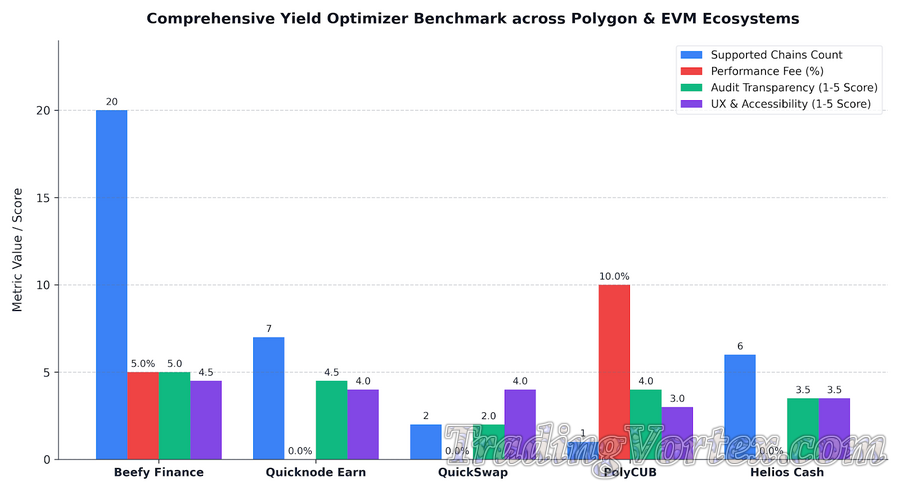
Key Takeaways & Educational Overview
-
Multi-Chain Coverage: Beefy Finance dominates multi-chain deployment with support for over 20 blockchains, whereas platforms like PolyCUB focus primarily on Polygon-native operations.
-
Performance Fee Models: Quicknode Earn, QuickSwap, and Helios Cash do not charge traditional percentage-based yield cuts on harvests (0% yield cut), whereas Beefy Finance averages 3.5% to 5.0%, and PolyCUB takes a 10.0% management fee to fund Protocol Owned Liquidity.
-
Audit Transparency & Security: Beefy Finance (5.0 rating) and Quicknode Earn (4.5 rating) provide publicly accessible audits from top firms like CertiK, PeckShield, and OpenZeppelin, while QuickSwap presents transparency concerns due to un-audited V4 upgrades and low automated security scores.
-
User Experience (UX): Platforms maintaining clear user interfaces and simplified vault options rank higher for accessibility, whereas niche engines with early claim penalties require greater operational familiarity.
How to Interpret & Apply This Visual to Your Portfolio Strategy
When selecting a yield optimizer on Polygon, use this side-by-side metric comparison to align your specific capital goals with the right protocol tradeoffs:
-
For Cross-Chain & Multi-Asset Farmers: Beefy Finance is the optimal choice if you manage diverse EVM positions. Its robust audit track record (5.0 score) offsets its standard 3.5% to 5.0% performance fee.
-
For Dedicated USDC Holders: Quicknode Earn provides maximum fee efficiency. It completely eliminates percentage-based harvest fees in favor of gas-only rebalancing across 7 chains, supported by an OpenZeppelin security audit (4.5 score).
-
For Low-Fee Polygon Native Farming: Helios Cash and QuickSwap offer zero percentage-based harvest fees, but require checking specific vault disclosures before depositing due to varying audit coverage.
-
For Community-Driven Long-Term Stakers: PolyCUB trades higher fees (10.0%) and strict vesting conditions for specialized xPOLYCUB distribution rewards, making it best suited for patient holders over short-term liquid yield farmers.
Understanding Smart Mining: How Automated DeFi Strategies Enhance Polygon Yields
Let me tell you about something that genuinely changed how I think about DeFi. A few years ago, if you wanted to maximize your yields, you had to be glued to your screen. You would constantly monitor APYs, manually harvest rewards, and reinvest them at the right time. It was exhausting and, honestly, only the most dedicated could make it work profitably. That world is fading fast, and smart mining on Polygon is leading the charge.
I remember the first time I used an automated vault. I deposited my tokens, set up the strategy, and walked away. When I came back a week later, my position had grown significantly without me lifting a finger. It felt like cheating, honestly. But it was not magic; it was smart mining in action. And once I experienced that convenience, I never went back to manual farming.
Defining Smart Mining: Algorithm-Driven Asset Management on the Blockchain
Let me break down what smart mining actually means. Unlike traditional liquidity mining where you manually deposit assets and hope for the best, smart mining utilizes smart contracts to automate the entire process. These systems can auto-compound your rewards, shift liquidity between different pools based on real-time volume and volatility, and execute complex strategies without requiring any manual intervention from you.
What does this mean for you? The technical debt required to participate in advanced DeFi is shrinking dramatically. You no longer need to be a blockchain developer or a quant to benefit from these strategies. The technology is finally mature enough to handle the complexity behind the scenes, leaving you with a simple, user-friendly experience.
I have personally found this shift liberating. Instead of spending hours researching and monitoring yields, I can now set up a strategy and let the algorithms work. It frees up mental bandwidth for other things, and frankly, it makes DeFi much more enjoyable. I can focus on my day job, spend time with family, or just relax, knowing that my assets are working hard in the background.
Mechanics of Automation: Smart Contracts That Rebalance and Compound in Real-Time
So, how does this actually work under the hood? The magic lies in the smart contracts that power these automated strategies. Protocols on Polygon use sophisticated systems to manage assets efficiently and execute trades at optimal times.
We are also seeing the rise of AI-powered yield agents. Projects are building adaptive multi-chain yield optimizers that use AI to find the highest APY opportunities across major DeFi protocols like Aave, Compound, and Yearn. These systems use an "Intelligent Yield Scanner" that aggregates real-time APY data from over 15 protocol-chain pairs, applies risk-adjusted scoring based on TVL and audit history, and then automatically ranks opportunities.
When a better opportunity is found, an "AI-Powered Rebalance Engine" kicks in. It performs a complete cost analysis, calculating gas fees, bridge costs, and slippage, and only suggests a move if it is profitable after all costs. This is a game-changer because it eliminates the guesswork and ensures you are always making the most efficient move. You are not just reacting to the market; you are anticipating it.
The rebalancing frequency is also critical. Some protocols check rates every five minutes and rebalance when a better opportunity appears. This high-frequency approach ensures you are always earning the best possible yield without any manual effort. On Polygon, where gas costs are minimal, this frequency is economically viable.
The Yield Gap: Why Automated Compounding Outperforms Manual Strategies on Polygon
On Ethereum mainnet, frequent compounding would destroy your profits because gas fees are so high. But on Polygon, where fees are fractions of a cent, protocols can rebalance and auto-compound continuously. This means your returns can compound multiple times a day, which, as I have learned the hard way, makes a significant difference over time.
The deeper driver here is the maturation of the Polygon ecosystem. As liquidity thickens, the yield gap between manual and automated strategies widens. This is driving a migration toward self-custody solutions and automated tools that offer deep integration with dApps. The more liquidity there is, the more opportunities there are for automated strategies to find and exploit arbitrage.
To illustrate, consider the treasury management tools emerging on Polygon. These allow treasury wallets to automatically sweep idle stablecoins into lending pools like Aave or Morpho, earning yield on balances that would otherwise sit idle. The systems handle pool discovery, session-scoped contract permissions, and the underlying routing, all in one command. This is automated yield management at its finest, and it is accessible to anyone with a wallet.
Risk Assessment for Automated Vaults: Monitoring Requirements and Smart Contract Reliance
Let me be candid about the risks because they are real and you need to understand them. Automation reduces the need for constant monitoring, but it does not eliminate smart contract risk. You are still trusting code, and code can have bugs.
There is also the risk of over-reliance on automation. I have seen people "set and forget" their positions only to discover later that a protocol changed its strategy or a new vulnerability was discovered. You still need to stay informed. Follow the project's social channels, read their governance proposals, and keep an eye on the broader DeFi ecosystem.
The good news is that the security infrastructure is improving. Projects are including security features like session-scoped smart contract wallets with configurable spending limits and dry-run execution for every transaction. You can see exactly what will happen before you commit any funds. This kind of transparency is vital for building trust in automated systems.
The Future of Smart Mining on Polygon
The trajectory of smart mining on Polygon is clear. We are moving toward fully autonomous, cross-chain yield management systems that require minimal human intervention. These systems will become more sophisticated, incorporating machine learning and predictive analytics to anticipate market movements and adjust strategies proactively.
The integration of AI is particularly exciting. Imagine a system that not only reacts to current yields but predicts future opportunities based on historical data, market sentiment, and on-chain metrics. This is the direction we are heading, and Polygon's infrastructure makes it possible.
We are also seeing the development of modular, composable yield strategies. Instead of using a single platform, you can combine different protocols and strategies to create a custom yield portfolio that matches your specific risk tolerance and return expectations. This is the "Lego" approach to DeFi, and it is empowering users to build exactly what they need.
Getting Started with Smart Mining
If you are ready to explore smart mining on Polygon, here is a simple framework to follow:
- Choose a reputable protocol: Start with platforms like Beefy Finance or Quicknode Earn that have proven track records and transparent fee structures.
- Start small: Deposit a modest amount to understand the mechanics before committing significant capital.
- Monitor regularly: Even with automation, check your positions weekly to ensure everything is performing as expected.
- Stay informed: Follow the protocol's governance channels and community discussions to stay ahead of any changes.
- Diversify: Do not put all your assets in a single vault or strategy. Spread your risk across multiple protocols and strategies.
🎯 The Bottom Line on Smart Mining
In summary, smart mining on Polygon represents a paradigm shift in DeFi. It democratizes access to advanced yield strategies, levels the playing field between retail and institutional investors, and makes it possible to earn truly passive income. But it also requires a shift in mindset. You are delegating control to algorithms, and that trust needs to be earned.
I have been using automated strategies on Polygon for over a year now, and the results have been consistently better than my manual efforts. The time saved alone is worth it, but the improved returns are the real game-changer. If you have been on the fence about trying automated yield strategies, I encourage you to give it a shot. Start small, learn the ropes, and watch your assets grow while you focus on the things that matter to you.
📊 The Yield Gap: Automated High-Frequency Compounding vs. Manual Reinvesting Strategy ($10,000 Initial Principal at 20% APR)

Key Takeaways & Educational Overview
-
The Yield Gap Concept: This line chart visually compares the compounding growth trajectories of an initial $10,000 deposit earning a nominal 20% APR over a 365-day holding period across three compounding strategies: simple annual settlement, manual monthly reinvestment, and automated daily smart mining.
-
Why Polygon Makes High Frequency Viable: High transaction gas fees on Layer 1 networks typically make daily manual harvesting cost-prohibitive for retail position sizes. Polygon's sub-cent network execution fees allow smart contract vaults to auto-compound earnings daily without depleting net profits.
-
Mathematical Breakdown:
-
Traditional Annual Yield: Settles at $12,000 on Day 365 (Simple APY = 20.00%).
-
Manual Monthly Reinvestment: Reaches ~$12,194 on Day 365 (Effective APY = 21.94%).
-
Polygon Automated Daily Smart Mining: Grows to $12,213 on Day 365 (Effective APY = 22.13%).
-
-
Algorithmic Advantage: The light green highlighted region represents an extra $213 in net yield generated solely by automated reinvestment frequency, requiring zero manual monitoring or manual transaction fees.
How to Interpret & Apply This Visual to Your Portfolio Strategy
Use this chart to optimize how often you manage your yield-bearing assets on low-cost EVM networks:
-
Identify the Compounding Threshold: Notice how the gap between manual monthly compound steps (blue dashed line) and continuous daily smart vault compounding (green line) expands steadily over time. For longer holding horizons (6+ months), high-frequency automated strategies consistently outpace manual execution.
-
Convert APR to Effective APY: Headline rate numbers often display base APRs. When assessing vault performance, look for daily auto-compounding features that turn nominal rates into higher effective yield values (e.g., converting 20.00% APR into 22.13% effective APY).
-
Minimize Friction: Utilizing automated proxy smart contracts allows smaller deposits to capture institutional-grade compounding frequencies that would otherwise be inefficient to execute manually due to time constraints and transaction friction.
Key DeFi Trends Shaping Yield Optimization on the Polygon Blockchain
The world of DeFi never stands still, and Polygon is at the center of some genuinely exciting developments right now. If you want to maximize your yields, understanding these trends is not optional; it is essential. Let me walk you through what is happening and why it matters for your strategy.
I have been following these trends closely, and I can tell you that the pace of change is accelerating. What worked six months ago might not be optimal today. But that is also what makes this space so exciting. There are always new opportunities emerging, and the platforms that adapt quickly are the ones that deliver the best returns.
The Institutionalization of Retail DeFi: Professional-Grade Tools for Individual Investors
Something fundamental is shifting beneath our feet. Retail traders are no longer satisfied with static yields that just sit there. They want products that work as hard as institutional portfolios, and frankly, they deserve them. This is what I call the "institutionalization" of retail DeFi, and it is happening right now on Polygon.
The market is maturing. Institutional funds now represent roughly 95% of total crypto flow, with retail making up only 5% to 6%. That is a massive reversal from the early days. But here is the good news: the infrastructure and tools being built for institutions are trickling down to retail investors. You are getting access to professional-grade yield strategies that were previously reserved for hedge funds and asset managers.
Asset management giants including BlackRock, Apollo, and Hamilton Lane are now allocating between 1% and 2% of their portfolios to digital assets, accelerating distribution through ETFs and on-chain tokenization products. This institutional participation is not centralizing blockchain; it is increasing its legitimacy and stability. As one Polygon executive put it, as long as the infrastructure remains open, institutional participation is a positive development that builds a more robust and scalable innovation path.
I remember when DeFi was truly chaotic. Yields would swing wildly, protocols would rug pull overnight, and there was little recourse. Today, while risks remain, the ecosystem is far more mature. Audits are standard, insurance products exist, and governance processes provide a level of accountability. This institutionalization has made DeFi safer and more accessible for everyone.
Liquid Staking Integration: Combining sPOL with DeFi Strategies for Layered Returns
Let me tell you about one of the most exciting developments on Polygon: sPOL, the network's native liquid staking token launched in April 2026. This is a genuine game-changer.
Here is the problem it solves. More than 3.6 billion POL are staked, but only about 4% to 5% of that amount is liquid. That means a massive amount of capital is sitting idle, locked in validator contracts and unavailable for DeFi strategies. sPOL changes that dynamic completely.
What makes sPOL particularly attractive is the fee-sharing mechanism. Validators in the sPOL program agree to return a portion of priority fees to delegators. That means you are not just getting standard staking rewards; you are also getting a slice of the network's transaction fee revenue. Given that priority fees have increased 1,000% since the PIP-65 system took effect, this revenue stream is growing significantly.
But the real opportunity is layering. You can use sPOL as collateral in lending protocols, provide liquidity, or deploy it in other DeFi strategies while your underlying POL continues earning staking rewards. This is called "stacking yields," and it was previously impossible for retail investors.
To support this, Polygon's governance forum has introduced PIP-85, a proposal to send priority fees directly to POL stakers. If approved, staking rewards could nearly double, funded by real network fees rather than token inflation. This would further enhance the value proposition of sPOL.
Cross-Chain Aggregation: Diversifying Yields Across Multiple Protocols and Networks
The fragmentation of liquidity across different blockchains has been a headache for yield farmers. But it is also an opportunity. Cross-chain aggregation is emerging as a powerful trend that allows you to access yield opportunities across multiple networks from a single interface.
The technology enabling this is becoming more sophisticated. Cross-chain moves now use Circle's CCTP V2 with native USDC, so no wrapped or synthetic assets are involved. Your USDC is burned on the source chain, attested by Circle, and minted on the destination chain, all without relying on potentially vulnerable bridge protocols.
There is also the growing integration of traditional finance with DeFi. Projects like AlloyX's RYT (Real Yield Token) are bringing tokenized money market funds to Polygon, offering stablecoin holders exposure to regulated, institutional-grade yields. This tokenized cash instrument is emerging as the "risk-off" leg of on-chain finance, giving treasuries and institutions a familiar yield profile with instant settlement.
I have used cross-chain aggregation tools, and the convenience is remarkable. Instead of logging into multiple platforms, managing different wallets, and paying bridging fees, I can manage everything from one interface. The yield differences between chains can be significant, and being able to capture them automatically is a major advantage.
Gas Cost Arbitrage: Utilizing Low-Fee Networks to Optimize Net Returns
This matters because of the "yield gap": the difference between what you can earn manually and what you can earn with automated strategies. On Polygon, protocols can rebalance and auto-compound continuously because the economics actually work.
Arbitrage bots are also benefiting from Polygon's low fees. Developers have built arbitrage detection bots that fetch token prices from DEXes like Uniswap and QuickSwap every 5 to 10 seconds, simulate arbitrage profits, and log profitable opportunities. The estimated gas cost per transaction is just $0.01, making arbitrage strategies viable on a scale that would be unprofitable on Ethereum mainnet.
For retail users, this means you can deploy high-frequency strategies without worrying about gas costs destroying your profits. Whether you are using an automated vault, a rebalancing protocol, or an arbitrage bot, Polygon's low fees make the math work.
I have personally run arbitrage strategies on Ethereum, and the gas costs were always the limiting factor. On Polygon, the same strategies are profitable because the fees are so low. It is a complete shift in what is possible for retail users.
The AggLayer Effect: Polygon 2.0 and the Future of Yield
Polygon's ambitious roadmap includes the AggLayer, a framework designed to aggregate liquidity and users across multiple chains. This is part of the broader Polygon 2.0 vision, which positions the network as an aggregator of trust and liquidity rather than just a standalone blockchain.
What does this mean for yield farmers? The AggLayer could enable unified liquidity pools across different chains, allowing you to access deeper liquidity and more efficient yield strategies. It could also simplify cross-chain interactions, making it easier to move assets between different networks without friction.
The network is moving toward sub-second block times, which would further enhance the speed and efficiency of automated strategies. At 5,000 TPS and sub-second finality, Polygon would be competitive with traditional financial networks in terms of speed and performance.
Putting It All Together: Your Strategic Advantage
So, what does this mean for you?
- First, the institutionalization of retail DeFi means you have access to tools and products that were once reserved for the wealthy.
- Second, liquid staking with sPOL allows you to earn staking rewards while keeping your capital liquid and deployable in DeFi, creating layered returns.
- Third, cross-chain aggregation lets you chase the best yields across multiple networks from a single interface.
- Fourth, Polygon's low fees enable sophisticated strategies that would be unprofitable elsewhere.
The timing is significant. Polygon recently reported 10x revenue growth this year, delivered 5,000 TPS and a 25% reduction in block time, and is now moving toward a block time of less than 1 second. The network is getting faster, cheaper, and more capable, which only amplifies the opportunities for yield optimization.
As always, do your homework, start small, and stay informed. The trends are moving in your favor, but the risks remain real. Use the tools wisely, and the opportunities are genuinely impressive.
🎯 Future Outlook: What’s Next for Yield on Polygon?
Looking ahead, several developments are worth watching. The continued growth of sPOL adoption will unlock more liquidity for DeFi strategies. The AggLayer could transform how we think about cross-chain yield. And the ongoing improvements in network performance will make even more sophisticated strategies viable.
There is also the potential for AI-driven yield optimization to become mainstream. Projects are already experimenting with AI agents that can manage portfolios, rebalance positions, and predict market movements. As these technologies mature, they could deliver even better returns with even less effort.
The bottom line is that Polygon is positioning itself as the premier destination for automated yield optimization. The combination of low fees, high throughput, liquid staking, and cross-chain aggregation creates a powerful ecosystem that benefits investors of all sizes. The future is bright, and the opportunities are real. Stay curious, stay informed, and keep exploring.
📊 sPOL Liquid Staking Yield Stacking: Transforming Idle Validator Capital into Layered DeFi Returns

Key Takeaways & Educational Overview
-
Unlocking Staked POL Liquidity: Standard POL staking locks capital in validator contracts. The introduction of sPOL provides a liquid ERC-20 token that represents underlying staked POL, unlocking locked assets for active DeFi deployment.
-
Layer 1 Base Yields (5.2% APY): Staking POL directly earns native consensus validator rewards as a baseline.
-
Priority Fee Sharing Enhancement (+3.6% APY): Participating validators return a portion of Polygon network priority transaction fees under the PIP-65/PIP-85 frameworks, boosting base staking yield to 8.8% APY.
-
Collateral & Leverage Efficiency (+2.4% APY): Depositing sPOL into money markets like Aave creates collateral capacity to borrow stablecoins or secondary assets without forfeiting ongoing underlying staking rewards.
-
Yield Vault Auto-Compounding (+7.3% APY): Deploying borrowed stablecoins into automated cross-chain yield strategies (such as Morpho vaults via Quicknode Earn) stacks an additional yield stream, elevating overall capital efficiency up to 18.5% cumulative APY.
How to Interpret & Apply This Visual to Your Portfolio Strategy
This horizontal bar chart illustrates the step-by-step yield multiplication achieved through capital re-hypothecation and liquid staking on Polygon:
-
Layer 1 (Baseline): Demonstrates standard single-asset native validator staking. Use this stage if you prefer simple yield with zero smart contract leverage risk.
-
Layer 2 (Network Fee Integration): Highlights the yield boost provided by PIP-65/PIP-85 priority fee redistribution. Ensure your chosen liquid staking pool or validator opts into priority fee-sharing mechanisms to capture this extra cash flow.
-
Layers 3 & 4 (Advanced Stacking Strategy): Represents active capital recycling. By utilizing sPOL as collateral on lending protocols and depositing borrowed assets into stablecoin yield aggregators, you create multiple independent income streams on a single principal deposit. Monitor loan-to-value (LTV) ratios closely to prevent liquidation risk during market downturns.
Navigating Risks in Polygon Yield Farming: Smart Contracts and Market Volatility
Let me be completely honest with you. I love DeFi and the opportunities it creates, but I have also learned some expensive lessons along the way. The yields can be incredible, but the risks are real and often underestimated. I want to walk you through the dangers I have encountered and the ones I have seen others face, so you can protect yourself while still capturing those attractive returns.
The truth is, yield farming on Polygon is not a risk-free endeavor. Understanding the full spectrum of risks, from smart contract vulnerabilities to market volatility, is essential for long-term success. Let us break down each risk category and explore how you can navigate them.
I remember my first major loss in DeFi. I had deposited into a vault that showed an incredible APY, and I was thrilled. A few weeks later, the underlying protocol was exploited, and I lost a significant portion of my deposit. It was a painful lesson, but it taught me to never take security for granted. Since then, I have been much more careful about where I deploy my capital.
Smart Contract and Protocol Risks: Why Audits Reduce But Do Not Eliminate Vulnerabilities
This is the most fundamental risk in DeFi, and it is the one that keeps me up at night. When you deposit funds into a yield optimizer, you are trusting smart contracts to handle your assets. Those contracts are written by humans, and humans make mistakes.
Audits are important, and I always look for platforms that have been reviewed by firms like CertiK, PeckShield, or OpenZeppelin. But let me be clear: an audit is not a guarantee of safety. It is a risk reduction tool. Even audited protocols can have vulnerabilities that are not discovered until after they are exploited.
I remember a friend who lost funds in a protocol that had been audited by a reputable firm. The auditors had missed a specific edge case that an attacker later exploited. The protocol was "audited," but that did not mean it was "secure." That experience taught me to treat audits as one data point among many, not as a final stamp of approval. Always look for protocols that have undergone multiple audits and have a track record of responsible security practices.
The underlying protocols that yield optimizers interact with also present risks. If a platform like Aave or Morpho experiences a vulnerability, your funds in any vault that depends on them could be affected. This is called underlying protocol risk, and it is the single most important factor to consider when evaluating a yield optimizer. The chain is only as strong as its weakest link, and your funds are only as safe as the least secure protocol in the stack.
The Threat of Malicious Liquidity Pools ("Toxic Pools"): Simulation Manipulation Exploits
This is one of the most insidious risks I have seen emerge recently, and it is genuinely scary because it bypasses traditional security measures. DeFi infrastructure firms have published research exposing a new class of malicious liquidity pools called "toxic pools" .
Here is how they work. These malicious pools display accurate prices during transaction simulations, tricking wallets and DEX aggregators into thinking they are the best execution venue. But when the actual transaction is broadcast on-chain, the pool alters its behavior and executes at a worse rate. The pools alternate between honest and malicious states, making them nearly impossible to detect with static code scanners or historical reputation filters.
This is a systemic threat. If crypto apps cannot distinguish between genuine and malicious quotes, they could repeatedly use these fraudulent execution paths, resulting in substantial losses. The industry has spent years optimizing price discovery, but the next challenge is verifying execution integrity. As a user, you need to be aware that even trusted aggregators can be tricked by these sophisticated attacks.
What can you do to protect yourself? Stick to well-known, battle-tested liquidity pools. Avoid pools with suspiciously high yields or low liquidity. And consider using aggregators that have implemented protections against these attacks. Some platforms are now developing detection capabilities specifically for toxic pools, which is a positive step.
Token Emission Collapse and APY Volatility: Managing Expectations During Market Shifts
I have seen this happen more times than I can count. A vault shows an incredible APY, often 100% or more, and investors rush in. But that high yield is often driven by token emissions from the underlying protocol, not by sustainable revenue generation.
When those emissions decrease, or when the token price drops, the APY collapses. The yield sustainability risk is real: a material part of the APY comes from farming and staking rewards that are subsidized by the protocol and may not be sustainable in the long term. Once the token incentives dry up, the yield drops dramatically, and the TVL often follows.
I learned this lesson the hard way. I once deposited into a vault with a 150% APY, only to watch it drop to 30% within a month as token emissions decreased. The high yield had attracted massive TVL, which diluted the rewards further. By the time I withdrew, my net return was far less impressive than the initial APY had suggested. It was a classic case of chasing yield without understanding the underlying drivers.
To protect yourself, look beyond the headline numbers. Check TVL trends: a vault with falling TVL is often a warning sign that yield is declining. Research the underlying protocol's tokenomics to understand how rewards are funded. Look for protocols with revenue-sharing models, like QuickSwap's DragonFi 2.0, where rewards are funded by actual protocol revenue rather than inflationary token emissions.
Impermanent Loss: Understanding Exposure in Volatile LP Vaults
If you have provided liquidity to a volatile pair, you have probably encountered impermanent loss. This is the difference between holding your assets versus providing them as liquidity, and it can be significant.
I have seen impressive APYs on volatile pairs, but the impermanent loss often ate away at those returns. On Polygon, with Uniswap V3, you can earn high APR by providing liquidity in a specific price range, but you need to constantly monitor and adjust your range. If the price moves outside your range, you are left holding more of the lower-performing asset, and your fee earnings may not compensate for the loss.
Here is the thing: impermanent loss is not a risk you can ignore. It is a direct cost of providing liquidity, and it can more than offset your yield. I have been in positions where I was earning 50% APY but lost 20% of my principal to impermanent loss. The net return was positive, but it was far below what the APY suggested. In some cases, users have even experienced net losses despite earning high APYs.
To manage impermanent loss risk, consider the volatility of the pair you are providing liquidity to. Stablecoin pairs have minimal impermanent loss but lower yields. Volatile pairs offer higher yields but significantly more risk. Also consider using concentrated liquidity strategies with ranges that capture expected price movements, and be prepared to adjust your positions as market conditions change.
Liquidity Risks: Slippage and Exit Strategies in Thin Markets
Liquidity risk is one of those things that is easy to overlook until it becomes a problem. When a pool has thin liquidity, your ability to exit without significant slippage is limited.
When liquidity dries up, even a promising vault becomes unattractive. As one Polygon farmer put it, "APY can be as beautiful as it wants, but if the pool is drained, it's just air." I have seen this happen, and it is painful to watch your position become illiquid.
To manage this risk, monitor the TVL of any vault you are considering. Look for pools with deep liquidity that can absorb your position without significant slippage. Avoid pools with very low TVL, as even modest withdrawals can cause price impact. And always consider your exit strategy before you enter a position. Know how long it will take to withdraw your funds and what fees you will incur.
The Bridge Yield Debate: A Cautionary Tale
The proposal faced significant pushback. A former Polygon employee warned that any hack or attack on the underlying yield protocols could jeopardize the bridge's stability, endangering user assets. Aave governance delegate Marc Zeller raised concerns that adding extra layers of risk to "stable" assets could backfire and undermine trust in the bridge.
The Polygon community ultimately recognized that the bridge's purpose is to secure cross-chain asset transfers, not to maximize yield. The proposal was not adopted, and the bridge remained focused on security rather than yield generation. This was a wise decision. It highlights the fundamental risk of using user assets as collateral for yield generation, and it is a reminder that not every asset should be yield-bearing.
This case is particularly instructive because it shows how the pursuit of yield can sometimes conflict with the core purpose of a protocol. The bridge was designed for security, not for yield. Trying to generate yield from it introduced risks that the community was not willing to accept. The lesson is clear: understand the primary purpose of any protocol you interact with, and do not assume that generating yield is always the right move.
Risk Assessment Checklist
Before you deposit into any yield optimizer on Polygon, run through this checklist:
- Audit Status: Has the protocol been audited by a reputable firm like CertiK or OpenZeppelin? Multiple audits are better than one. Check if there is a bug bounty program.
- Underlying Protocol Risk: What protocols does the vault interact with? Are they battle-tested and audited? Have they been exploited before?
- APY Sustainability: Is the APY driven by sustainable revenue or token emissions? How long has the vault been operating? What happens to the APY when emissions decrease?
- Impermanent Loss Exposure: Are you providing liquidity to a volatile pair? Have you stress-tested your position? What is the historical volatility of the pair?
- Liquidity Depth: How much TVL does the vault have? Can you exit without significant slippage? What is the daily trading volume of the underlying pool?
- Governance and Security Features: Are there timelocks on critical functions? Can the contract be paused in an emergency? Is there a multisig controlling key parameters?
- Track Record: How long has the protocol been operating? Has it survived previous market cycles? Are there any documented incidents or security issues?
Practical Risk Management Strategies
Based on my experience, here are some practical strategies to manage risk:
- Diversify across protocols: Do not put all your eggs in one basket. Spread your capital across different yield optimizers and underlying protocols. This way, if one platform is exploited, your total loss is limited.
- Start small: Test the mechanics with a modest deposit before committing significant capital. I cannot overstate how many times this has saved me. A small test deposit can reveal issues with gas costs, withdrawal times, or unexpected fees.
- Stay informed: Follow governance proposals and community discussions. Attacks can be planned weeks in advance, and community warnings can sometimes provide early signals. Join the Discord or Telegram channels of the protocols you use.
- Monitor your positions: Even with automated strategies, check your positions weekly. Look for unusual changes in APY, TVL, or strategy descriptions. A sudden drop in TVL might indicate that other users are exiting for a reason.
- Use reputable platforms: Stick with protocols that have demonstrated longevity and transparency. Beefy Finance, for example, has maintained a strong security posture across multiple chains and has a proven track record.
- Consider insurance: Some protocols offer insurance against smart contract failures. While this adds to your costs, it can provide peace of mind for larger positions.
🎯 The Bottom Line
Yield farming on Polygon offers incredible opportunities, but the risks are real and significant. Smart contract vulnerabilities, toxic pools, APY volatility, impermanent loss, and liquidity risks all require careful consideration.
I have made mistakes in this space, and I have learned from them. My hope is that by sharing these lessons, you can avoid some of the pitfalls I encountered. Stay safe, stay informed, and may your yields be high and your losses low. Remember that in DeFi, the goal is not just to earn yield, but to earn it sustainably and securely over the long term.
📊 DeFi Yield Farming Risk Spectrum: Evaluating Vulnerabilities, Exploits, and Volatility in Polygon Vaults

Key Takeaways & Educational Overview
-
Smart Contract Exploits (9.5/10 Severity): Represents the single greatest threat to deposited funds. Code logic errors, reentrancy bugs, or flash loan exploits can cause instant, catastrophic loss of capital that third-party audits cannot fully guarantee against.
-
Toxic Liquidity Pools (8.8/10 Severity): Emerging execution exploits: such as malicious Uniswap V4 hooks or manipulated DEX aggregator routes; trick wallets during transaction simulations but execute at adverse rates or cause near-total transaction failure rates on-chain.
-
Token Emission Collapse (7.5/10 Severity): High headline APYs often rely on inflationary reward tokens. As reward emissions taper off or token prices drop, the effective yield rapidly collapses, frequently leading to liquidity flight.
-
Impermanent Loss (6.8/10 Severity): Volatile asset pair liquidity provision (e.g., concentrated liquidity on Uniswap V3) risks net losses when underlying asset prices diverge significantly, offsetting accrued trading fee rewards.
-
Liquidity Slippage (5.5/10 Severity): Thin liquidity pools create exit friction, causing high price impact or temporary lockups when exiting large vault positions.
How to Interpret & Apply This Visual to Your Risk Management Framework
This horizontal risk spectrum ranks DeFi danger vectors by potential capital severity to help you prioritize your due diligence routine:
-
Prioritize Protocol Security First: Focus most of your risk budget on top-tier items (Smart Contract and Toxic Pool risks). Verify that protocols use multi-audit verifications, active bug bounties, and execution protections before depositing capital.
-
Distinguish Real Yield vs. Emission Subsidies: When evaluating orange-rated risks (Emission Sashing), analyze whether the displayed APY stems from actual protocol revenue (e.g., fee-sharing models) or temporary inflationary token rewards.
-
Mitigate Volatility Risks: Address blue and gray risk vectors (Impermanent Loss and Slippage) by pairing stable assets, setting conservative concentrated liquidity ranges, and verifying total value locked (TVL) depth to ensure smooth exit liquidity.
Security Best Practices for DeFi Yield Optimizers on Polygon
Let me be direct with you. The most important thing I have learned in my years of DeFi farming is that security is not a feature you add at the end; it is the foundation everything else rests on. I have seen too many people lose money because they skipped the basics, and I do not want that to happen to you.
The good news is that Polygon's ecosystem is mature enough to offer genuine security tools. But you still need to know how to use them and what to look for. Let me walk you through the essential practices that will keep your funds safe while you chase those yields.
I remember when I first started in DeFi. I was so excited about the yields that I ignored basic security practices. I deposited into a protocol without checking the audit, without understanding the strategy, and without considering the risks. A few months later, that protocol was exploited, and I lost a significant portion of my portfolio. It was a painful lesson, but it taught me that security is not negotiable. Since then, I have developed a rigorous checklist that I run through before any deposit, and I want to share it with you.
How to Assess Vault Security: Verifying Audit Reports and Bug Bounty Programs
Audits are your first line of defense, but let me be clear: they are not a guarantee. I have seen audited protocols get exploited. The staggering $77.1 billion lost in DeFi exploits is a testament to that. However, skipping audits entirely is like driving without a seatbelt; you might survive, but the odds are not in your favor.
Look for protocols that have been audited by reputable firms like CertiK, PeckShield, or OpenZeppelin. Multiple audits are better than one. Veridise, for example, provides structured security reviews that combine manual expert review with automated tooling, ending in a written report with severity ratings and concrete fixes. The key is to actually read the audit report, or at least the executive summary. Understand what issues were found and whether they were fixed.
One thing I always check: bug bounty programs. A protocol that runs a bug bounty is signaling that they take security seriously and are willing to reward researchers for finding vulnerabilities. It is a sign of maturity and responsible security practices. I have personally reported bugs to protocols with active bounty programs, and the response has always been professional and appreciative.
Also, beware of "zombie contracts." In June 2026, a hacker exploited a legacy royalty contract on Polygon, draining approximately $261,200 through a logic flaw in the reward calculation mechanism. The attacker manipulated the reward accounting by performing zero-value transactions to make token balances appear higher. The vulnerability was in the Royal1155LD.beforeLdaTransfer() function, not in Polygon's core blockchain.
I cannot stress this enough: if a protocol has been around for years without a major security incident, that is a good sign. But if it is brand new and promising astronomical yields, approach with extreme caution.
Identifying Red Flags: Unrealistic APYs, Opaque Strategies, and Frequent Changes
I have developed a sixth sense for red flags over the years, and I want to share it with you. If something feels too good to be true, it usually is.
Unrealistic APYs: When I see a vault offering 100%+ APY, my alarm bells start ringing. High yields are often driven by inflationary token emissions rather than sustainable revenue. As Polygon Labs CEO Marc Boiron pointed out, the current DeFi yield model is broken because protocols chase growth through token emissions that promise eye-popping APYs, only to watch liquidity evaporate when incentives dry up. The model of mercenary capital creates artificial ecosystems doomed to collapse.
I have chased these yields myself, and I have learned that they rarely last. The sustainable strategies are the ones that offer moderate but consistent returns. If a yield seems too good to be true, it is probably because it is subsidized by token inflation that will eventually run out.
Opaque strategies: If a vault does not clearly explain where your funds are going and how yields are generated, walk away. Beefy Finance's per-vault strategy transparency is a gold standard for a reason. You should be able to see exactly which protocols and pools your funds are deployed in. If a protocol is vague about its strategy, it is either hiding something or does not understand the strategy well enough themselves.
Frequent strategy changes: A protocol that changes its strategy constantly is either experimenting or compensating for failing strategies. Both are red flags. The best yield optimizers have stable, battle-tested strategies that evolve slowly through governance. Quick changes suggest instability or a lack of confidence in the current approach.
Unclear tokenomics: If the native token's distribution is opaque, with large allocations to insiders or the team, be wary. These tokens often dump on retail investors when the market turns. Look for fair launch models like Helios Cash, which had no pre-farm or pre-sales.
The Importance of Self-Custody: Avoiding Centralized Exchange Risks for Yield Farming
This is the hill I will die on. Self-custody is not optional; it is essential. I cannot count how many times I have warned friends against leaving their assets on exchanges, only to watch them lose funds when an exchange went under or froze withdrawals.
The move toward smart mining and automated strategies on Polygon has made self-custody even more critical. Multi-chain self-custody wallets like Bitget Wallet are becoming essential tools for navigating these automated vaults while maintaining full control over your private keys. As one analysis put it, these wallets serve as practical interfaces for those demanding both high-level security and ease of use in a multi-chain world.
The reason is simple. When you use a yield optimizer, the underlying vault contracts hold your assets. But they are non-custodial: the vault shares belong to your wallet, not to the protocol's wallet. This means if the protocol goes down or is attacked, your vault shares remain yours. You can close your position directly on the underlying protocol without needing permission from anyone.
The clash between Polygon and Aave over the proposed yield farming fund illustrates what happens when centralized control gets involved. The Polygon team submitted a governance proposal to invest user funds in DeFi protocols without adequate safety measures, and Aave blocked it, citing "very little risk management". This highlights the tension between centralized decision-making and user protection.
I always use a hardware wallet for my DeFi activities. It adds an extra layer of security because my private keys never touch my computer. For smaller amounts, a software wallet like MetaMask is fine, but for significant positions, a hardware wallet is non-negotiable.
Transaction Simulation Integrity: Understanding the Risks of "Dry-Run" Price Discovery
This is a newer threat, and it is genuinely scary. In July 2026, DeFi infrastructure firm Enso published research exposing a new class of malicious liquidity pools called "toxic pools".
As Enso co-founder Milos Costantini warned: "If crypto apps cannot distinguish between genuine and malicious quotes, they could repeatedly use these fraudulent execution paths, resulting in substantial losses". The industry has spent years optimizing price discovery, but the next challenge is verifying execution integrity.
To protect yourself, use protocols that have implemented toxic pool detection. Enso updated its Enso Shield product to add detection capabilities by analyzing live on-chain context, quote history, and transaction traces. If you are using a DEX aggregator, check whether they have protections against this kind of attack.
Vault Architecture and Operational Security
For more advanced users, understanding vault architecture matters. A modular design separating strategy logic, asset custody, and cross-chain messaging layers is essential to limit the blast radius of a vulnerability. The custody layer should be a minimal, audited contract that only holds funds and executes verified instructions from the strategy manager.
Oracle risk is a critical attack vector. A naive dependency on a single oracle like Chainlink can lead to manipulation or failure. Use a consensus of oracles and implement circuit breakers that pause operations if price deviations exceed a threshold. I have seen protocols lose millions because their oracle was manipulated, and the circuit breakers were either missing or poorly implemented.
Cross-chain message reliability introduces unique risks. Your architecture must handle message failures and delays. Implement idempotent operations so that duplicate messages do not cause double-spends, and use a safety module that can manually recover stalled transactions. Quicknode Earn's emergencyClaimBridge function is a good example of this kind of fail-safe.
Operational security is paramount. Administrative keys controlling upgrades, fee changes, or emergency pauses must be secured via a decentralized multi-signature wallet with a threshold of trusted entities. All actions should be time-locked with a public delay, allowing users to exit if they disagree with a change. I always check whether a protocol has a time-lock on governance actions. If they do not, a single compromised key could drain the entire protocol.
Smart Mining and Automation: The New Frontier
Smart mining protocols on Polygon are automating yield strategies, but this does not eliminate smart contract risk. While automation reduces the need for constant monitoring, users should still look for protocols with proven track records and transparent fee structures.
Projects pushing the boundaries of automation with AI-powered event-triggered yield farming are emerging. These systems monitor on-chain events in real-time, use AI to assess market impact, and deploy reaction tokens to manage liquidity. This represents a new generation of DeFi automation, but it also introduces new layers of complexity and risk.
The technology is exciting, but it is also unproven. I would approach these newer AI-powered protocols with extra caution until they have a track record. The security of these systems depends on the quality of the AI models, the reliability of the data feeds, and the robustness of the smart contracts. Any of these could fail.
Risk Assessment Checklist
Before you deposit into any yield optimizer on Polygon, run through this checklist:
- Audit Status: Has the protocol been audited by CertiK, PeckShield, or OpenZeppelin? Are there multiple audits? Read the executive summary of each audit.
- Bug Bounty Program: Does the protocol offer rewards for vulnerability discovery? Is the program active and adequately funded?
- Strategy Transparency: Can you see exactly where your funds are deployed? Are the strategy details accessible and understandable?
- APY Sustainability: Is the yield driven by sustainable revenue or token emissions? How long has the current APY been maintained?
- Self-Custody: Do you control your own private keys and vault shares? Is there a risk of your funds being frozen?
- Transaction Simulation Integrity: Has the protocol implemented toxic pool detection? Is there protection against simulation manipulation?
- Legacy Contract Risk: Does the protocol use any outdated or unmaintained smart contracts? Are there documented security incidents?
- Operational Security: Are admin functions time-locked and multi-sig controlled? Is there a clear governance process?
- Oracle Security: What oracles does the protocol use? Are there circuit breakers for price deviations?
- Community and Track Record: How long has the protocol been operating? Is there an active community and responsive team?
🎯 The Bottom Line
Security on Polygon is not an afterthought; it is a practice. Audits, bug bounties, self-custody, and transaction simulation integrity are all essential pieces of the puzzle. The ecosystem is maturing, with institutional-grade products launching on Polygon with independent risk advisors and isolated lending pools, but the risks are still real.
The key is to stop relying on inflationary emissions and build sustainable models based on real yield. But until that shift is complete, your own security practices are your best defense.
I have been farming on Polygon for years now, and I have learned that the most successful farmers are not the ones chasing the highest APYs, but the ones who prioritize security and sustainability. They take the time to understand the protocols they use, they diversify their positions, and they never risk more than they can afford to lose. That is the mindset I encourage you to adopt. The rewards will follow.
📊 The 10-Point DeFi Security Evaluation Checklist: Prioritizing Risk Management for Polygon Yield Optimizers

Key Takeaways & Educational Overview
-
Core Audit & Bug Bounty Verification (10.0 & 9.0 Ratings): Formal smart contract audits by firms like CertiK, PeckShield, or OpenZeppelin remain the highest-weighted requirement. Coupled with active bug bounty programs, they provide primary verification against code vulnerabilities.
-
Self-Custody Non-Negotiable (9.5 Rating): Maintaining direct control over your non-custodial vault tokens via self-custody wallets ensures your positions remain accessible regardless of protocol frontend outages or platform freezes.
-
Operational Security & Time-Locks (9.0 Rating): Decentralized multi-signature management combined with public time-locks prevents rogue admin updates, allowing users to safely withdraw funds before contentious changes take effect.
-
New Verification Layers (8.5 Rating): Emerging execution threats: such as "toxic pools" that pass static simulations but manipulate live on-chain trades; require checking for real-time transaction simulation protections.
-
Deprecated Code Caution (7.5 Rating): Outdated or unmaintained "zombie contracts" remain prime targets for exploitation. Ensure protocols actively prune or upgrade legacy code deployments.
How to Interpret & Apply This Visual to Your Security Due Diligence
Use this prioritized checklist breakdown to score any prospective Polygon yield vault before allocating capital:
-
Mandatory Criteria (Scores 9.0–10.0): Treat Audits (Item 1), Self-Custodial Architecture (Item 5), Bug Bounties (Item 2), and Multi-Sig/Time-Locks (Item 8) as hard requirements. If a protocol lacks any of these four controls, avoid depositing.
-
Operational Transparency (Scores 8.0–8.5): Evaluate the middle tier to ensure your strategy generates real protocol revenue rather than unsustainable token inflation. Verify multi-oracle price feeds with circuit breakers to guard against price manipulation attacks.
-
Ongoing Monitoring: Run through this 10-point checklist periodically, as protocol governance, contract upgrades, and market liquidity depth change over time.
Strategic Framework: Choosing the Right Yield Vault for Your Polygon Portfolio
Let me be real with you. Choosing a yield vault is not just about picking the highest APY and hoping for the best. I have made that mistake, and I have watched others make it too. The truth is, the best vault for your portfolio depends on your specific situation, and understanding how to evaluate your options is the difference between consistent returns and disappointing outcomes.
Think of it like choosing a vehicle. A Formula 1 car is incredibly fast, but it is useless for a family road trip. Similarly, a high-leverage volatile LP vault might be great for a seasoned degen, but it is a disaster waiting to happen for someone just starting out. Your job is to match the tool to the journey.
I remember when I first started, I chased the highest APY I could find without thinking about the risks or fees. A month later, I had earned less than expected because of performance fees and impermanent loss. Since then, I have developed a systematic approach to evaluating vaults, and I want to share it with you so you can avoid the same mistakes.
Understanding Your Risk Profile
Before you even look at yields, you need to understand your own risk tolerance. This is the foundation of any good investment strategy:
Conservative investor: You want to preserve capital and earn steady, predictable returns. Your investment horizon is short to medium term, and you cannot afford significant drawdowns. For you, stablecoin lending vaults or low-volatility LP pairs are the right choice. These typically offer 5% to 12% APY with lower risk and minimal impermanent loss.
Moderate investor: You are comfortable with some volatility but want to avoid catastrophic losses. Your investment horizon is medium to long term. For you, LP vaults with major pairs like ETH-USDC or WBTC-USDC are suitable. These can range from 8% to 25% APY depending on fee volume and market conditions. The returns are higher, but you are exposed to impermanent loss and market volatility.
Aggressive investor: You are chasing maximum returns and are comfortable with significant risk. Your investment horizon is long term, and you can weather drawdowns. For you, leveraged strategies, volatile LP pairs, or new protocols with high token emissions might appeal. Just understand that yields can fluctuate dramatically. A vault showing 20% today might show 8% next week as more capital deposits.
I recommend starting with a conservative or moderate approach and only graduating to aggressive strategies once you have significant experience and a solid track record of successful farming.
Calculating Fee-Adjusted Returns: Moving Beyond Gross APY Projections
Here is a lesson I learned the hard way: the APY displayed on a vault dashboard is not what you actually earn. I once deposited into a vault showing 40% APY, only to discover that after performance fees and gas costs, my net return was closer to 25%. That is a significant difference.
Always calculate your net returns. Most protocols include fees in the displayed APY, but some do not. Beefy Finance, for example, charges a performance fee of 3.5% to 5% on profits, with newer vaults up to 9.5%. Meanwhile, platforms like Kogefarm emphasize having the lowest fees on Polygon to help investors get the highest yields.
The compounding frequency also matters. A vault that compounds multiple times daily will outperform one that compounds weekly, all else being equal. On Polygon, where gas costs are minimal, this frequency is economically viable. But you need to verify the fee structure: some protocols charge a percentage of your yield, others charge gas-based fees, and some include fees in the displayed APY.
I always take a three-step approach:
- First, I look at the advertised APY.
- Second, I subtract any performance fees.
- Third, I estimate the gas cost impact based on my deposit size and expected holding period.
This gives me a realistic net APY that I can compare across platforms.
Gas Cost Impact Analysis: Proportion of Yields Consumed by Transaction Fees
This is where Polygon truly shines, but you still need to be mindful. The average transaction fee on Polygon hovers around $0.001 to $0.01, making frequent rebalancing and compounding economically viable. On Ethereum mainnet, those same operations would destroy your profits.
However, gas costs still matter, especially for smaller positions. Yield optimizers reduce gas costs through batch processing, pooling funds from many users and bundling multiple individual operations into a single transaction. This significantly lowers the cost per user compared to doing it manually.
I have seen people with small deposits on Ethereum get crushed by gas fees. On Polygon, the same deposits can be profitable because the fees are so low. But if you are depositing very small amounts, even Polygon's minimal fees can eat into your returns. As a rule of thumb, I do not deposit less than $100 into a vault unless I am just testing it.
The gas optimization also means that vaults on Polygon can rebalance much more frequently than on other chains. This is why smart mining protocols thrive on Polygon: they can check rates every five minutes and rebalance automatically without worrying about gas costs.
What to Look for in a Vault
Based on my experience, here are the key factors I evaluate before depositing into any vault:
- Audit status and security: Has the protocol been audited by a reputable firm? Are there multiple audits? What is the bug bounty program? This is non-negotiable for me.
- Strategy transparency: Can I see exactly where my funds are deployed? Beefy's per-vault strategy transparency is the gold standard.
- Fee structure: What are the performance fees, withdrawal fees, and gas costs? Are fees included in the displayed APY?
- Underlying protocol risk: What protocols does the vault interact with? Are they battle-tested and audited?
- TVL and liquidity: How much TVL does the vault have? Can I exit without significant slippage?
- Track record: How long has the vault been operating? Has it weathered market volatility?
- Governance and security features: Are admin functions time-locked? Is there a multi-sig controlling key parameters?
When to Opt for Active Management: Concentrated Liquidity vs. Automated Vaults
Not all yield strategies are passive. Sometimes, active management is the better choice:
- Concentrated liquidity management on Uniswap V3 or V4 requires constant monitoring and adjustment of price ranges. If you are willing to do this work, you can potentially earn higher fees than passive LP positions. Protocols like Gamma Strategies and Arrakis Finance automate this, but they are fundamentally different from yield optimizers.
- Automated vaults are passive. You deposit, the vault handles the rest. This is ideal for people who do not want to monitor positions daily. Beefy Finance, for example, handles all the harvesting, converting, and reinvesting automatically.
The choice depends on your time and expertise. If you enjoy active management and have the skills, concentrated liquidity can be more profitable. If you want passive income, automated vaults are the way to go.
There is also a middle ground: smart mining protocols that automate complex strategies without requiring manual intervention. These systems use algorithms to rebalance positions based on real-time data, offering a level of sophistication that was previously reserved for professionals.
Common Pitfalls to Avoid: Overlooking Withdrawal Terms and Strategy Consistency
Let me share some mistakes I have made so you do not have to repeat them:
- Overlooking withdrawal terms: Some vaults have lockup periods or withdrawal fees. Most Beefy vaults on Polygon have no withdrawal fee because they harvest on deposit. But other platforms might have withdrawal penalties. Always check before depositing.
- Ignoring strategy consistency: A protocol that changes its strategy frequently is a red flag. Beefy's vault strategies are hardcoded and immutable once released, which provides consistency but also means they cannot be upgraded easily. This is a tradeoff you need to understand.
- Depositing into high-APY vaults driven by token emissions: I have been burned by this. The high yield is often subsidized by inflationary token emissions that eventually collapse. Check whether the yield is sustainable or driven by protocol revenue versus token emissions.
- Not checking TVL trends: As one farmer put it, "APY can be as beautiful as it wants, but if the pool is drained, it's just air." A vault with falling TVL is often a warning sign.
- Comparing gross APY without factoring in performance fees and gas costs: Always calculate net returns.
- Treating audit labels as guarantees of safety: Audits reduce risk but do not eliminate it.
A Practical Decision Framework
Here is a simple framework I use when choosing a vault:
- Step 1: Define your goal. Are you chasing maximum yield, preserving capital, or something in between?
- Step 2: Assess your risk tolerance. Be honest about how much volatility you can handle.
- Step 3: Research available vaults. Use the comparator table from earlier sections to identify options that match your profile.
- Step 4: Calculate net returns. Subtract fees and estimated gas costs from the advertised APY.
- Step 5: Check security and transparency. Verify audits, bug bounties, and strategy transparency.
- Step 6: Assess liquidity and TVL. Ensure you can exit your position without significant slippage.
- Step 7: Start small. Test the vault with a modest deposit before committing significant capital.
- Step 8: Monitor regularly. Even with automated strategies, check your positions weekly.
Case Studies: Matching Vaults to Investor Profiles
Case 1: The Conservative Retiree
You have $50,000 in USDC and want to earn yield without risking your principal. You plan to withdraw in six months.
Recommendation: Quicknode Earn with stablecoin vaults or Aave lending on Polygon.
Expected APY: 8% to 12%. Low risk, predictable returns.
Case 2: The Moderate Accumulator
You have $10,000 in ETH and USDC and want to grow your portfolio over the next two years. You are comfortable with some volatility.
Recommendation: Beefy Finance LP vaults with WBTC-ETH or ETH-USDC pairs.
Expected APY: 15% to 25%. Medium risk, higher returns.
Case 3: The Aggressive Degen
You have $5,000 and are willing to take significant risks for potentially high returns. You have been farming for years and understand the risks.
Recommendation: QuickSwap Dragon's Syrup staking or newer protocols with token incentives.
Expected APY: 30% to 100%+ (highly variable). High risk, potentially high reward.
🎯 The Bottom Line
The beauty of Polygon's ecosystem is that you have options. Whether you choose Beefy for multi-chain coverage, Quicknode Earn for USDC optimization, QuickSwap for sustainable staking rewards, PolyCUB for community-driven yield, or Helios Cash for native aggregation, the key is to align your choice with your personal strategy.
I have been farming on Polygon for years now, and I have learned that the most successful farmers are not the ones chasing the highest APYs, but the ones who prioritize security and sustainability. They take the time to understand the protocols they use, they diversify their positions, and they never risk more than they can afford to lose.
📊 Strategic Yield Vault Decision Framework: Gross vs. Fee-Adjusted Net APY Returns Across Investor Risk Profiles

Key Takeaways & Educational Overview
-
Conservative Profile (Capital Preservation): Focuses on stablecoin lending pools (e.g., Aave or Morpho vaults) and blue-chip pairs. While gross advertised APYs reach up to 12%, realistic fee-adjusted net APYs average around 8.1% with minimal drawdown or impermanent loss risk.
-
Moderate Profile (Balanced Growth): Utilizes standard LP vaults (such as WBTC-ETH or ETH-USDC on Beefy Finance). Headline APYs reach up to 25%, settling at an effective ~15.5% net yield after factoring in performance fees (3.5%–9.5%) and mild price divergence.
-
Aggressive Profile (Maximum Yield Chasing): Targets high-emission reward pools, leveraged strategies, or volatile pairs. Although advertised APYs can peak at 100%+ during initial incentive phases, aggressive dilution, fee structures, and token price drops compress realistic net yields down to ~38.0%.
-
The "Net APY" Discrepancy: The variance between blue bars (Peak Advertised APY) and green bars (Realistic Net APY) grows significantly as vault risk increases, highlighting how performance fees and reward emission decays impact gross projections.
How to Interpret & Apply This Visual to Your Vault Selection Process
Use this comparative chart to align your portfolio size and risk tolerance with a realistic net expectation:
-
Calculate Beyond Headline Rates: Never evaluate a vault based solely on its advertised dashboard figure. Subtract performance fees (e.g., vault harvest fees) and factor in emission decay to determine if the net APY justifies the underlying risk.
-
Assess Capital Size Impact: While low transaction costs on Polygon minimize gas overhead, small deposits (<$100) are still sensitive to withdrawal or performance fees. Conservative stablecoin strategies are better suited for larger capital allocations where steady returns compound predictably.
-
Match Strategy Horizon: High-yield aggressive vaults require frequent monitoring and short holding windows to capture early incentive emissions before net yield compression occurs. Moderate and conservative strategies are preferred for passive, long-term compounding.
Future Outlook: The Evolution of DeFi Yield Aggregation on Polygon
Let me be honest with you. The future of yield aggregation on Polygon is not just about higher APYs or more vaults. It is about a fundamental transformation in how DeFi works, how we interact with it, and who gets to participate. And honestly, it is one of the most exciting developments I have seen in years.
I have been in this space long enough to witness cycles of hype and disillusionment. But what I am seeing now feels different. The infrastructure is maturing, the tools are becoming genuinely useful, and the opportunities are expanding in ways that were unimaginable just a couple of years ago. Let me walk you through what is coming and why it matters for your strategy.
The shift is not incremental; it is exponential. We are moving from isolated protocols to interconnected systems, from manual to fully automated strategies, and from speculative yield to sustainable, fee-backed returns. This evolution will reshape how we think about passive income in crypto.
Advances in Cross-Chain Automation: Seamless Atomic Execution Across Networks
One of the most frustrating aspects of DeFi has always been the fragmentation. Yield exists across different chains, but accessing it has been a nightmare of bridging, managing multiple wallets, and paying fees on every network. That is changing, and the change is dramatic.
Programmable destinations are emerging as a game-changing innovation. Instead of requiring you to bridge funds and then separately deposit them into a vault, these systems encode the deposit action directly into the payment intent. You sign once, and when your funds arrive at the destination, they are automatically deposited into the vault. No second transaction, no waiting, no manual intervention.
The Polygon ecosystem is pushing this further with composable actions. You can now chain multiple on-chain operations into a single intent: bridge, swap to a different token, deposit into a lending protocol, and stake the resulting position, all with one user signature. This is the kind of seamless experience that makes DeFi accessible to mainstream users.
Projects like SurfLiquid are already demonstrating the power of this approach. Built on zkCross Network's execution infrastructure, SurfLiquid enables cross-chain deposits where funds move directly from a user's vault on one chain to the same user's vault on the destination chain, with on-chain recipient validation ensuring funds never go to an external wallet. This eliminates the bridging friction while maintaining strict custody boundaries.
I have personally used cross-chain tools, and the difference is night and day. Instead of spending 15 minutes bridging and confirming transactions, I can complete a cross-chain deposit in seconds. The user experience is finally catching up to the technology.
The trend toward modular, intent-based architectures is accelerating. Rather than bundling strategy, execution, and custody into a single opaque contract, the next generation of yield aggregators is separating these layers. This reduces systemic risk, enables more flexible strategies, and allows for autonomous, parameterized vaults that adjust fees and allocations based on real-time on-chain data. It is the difference between a monolith and a Lego set, and the Lego set is far more powerful.
Enhanced Smart Mining Capabilities: AI and Algorithmic Rebalancing at Scale
Artificial intelligence is moving from hype to reality in DeFi yield optimization. Projects are building AI-powered, non-custodial savings accounts that put stablecoins to work across on-chain lending markets.
The system has already processed over $105.8 million in on-chain volume across 193,835 transactions and 26,260 unique wallets. This is not experimental technology; it is production-ready infrastructure with a proven track record. It has been battle-tested, and it has delivered consistent results.
We are also seeing the emergence of tools like the Polygon Agent CLI, which allows treasury wallets to automatically sweep idle USDC into lending pools like Aave or Morpho. These tools handle pool discovery, session-scoped contract permissions, and routing, all in one command. It is automated yield management at its finest, accessible to anyone with a wallet and a command line.
The AI trend is not about replacing human judgment; it is about scaling it. Algorithms can monitor rates across dozens of protocols and chains 24/7, something no human can do. They can execute rebalances at optimal times, factoring in gas costs, slippage, and opportunity windows. The result is consistently better yields with less effort.
I have seen the performance of these AI-driven systems, and it is genuinely impressive. They catch opportunities that I would miss because I am not glued to my screen 24 hours a day. And they execute at speeds that are simply impossible for a human.
Expanding Use Cases for Liquid Staking Tokens: Deeper sPOL Integration in Vaults
This is one of the most significant developments for Polygon's ecosystem. Over 3.6 billion POL is currently staked, but only about 4% to 5% of it is liquid. That means roughly $3 billion in capital is sitting idle, locked out of DeFi yield. By contrast, around 43% of staked ETH on Ethereum already participates in liquid staking.
sPOL changes this at the protocol level. Built directly by Polygon Labs, not a third-party protocol, sPOL is the first and only liquid staking token with dual yield from day one: staking rewards plus DeFi yield via Uniswap V4 AMM pools. The treasury seeded 100 million POL to bootstrap liquidity, with 10 million available on day one.
What makes sPOL particularly powerful is the integration with PIP-85, the tokenomics reform that routes priority fees from every transaction to POL stakers. According to Polygon co-founder Sandeep Nailwal, staking rewards are expected to nearly double, with payouts funded by actual network fees rather than token inflation. This is a fundamental shift from inflationary rewards to sustainable, fee-backed yield.
The implications are profound. sPOL introduces a new productive use case for POL without creating selling pressure. Stakers who would otherwise unstake to participate in DeFi can now do both, keeping POL locked longer. This creates a reflexive flywheel: more liquid staking leads to more DeFi integrations, which generates more fee revenue, which delivers more yield for sPOL holders, which encourages more POL to be staked.
I have been using sPOL since its launch, and it has transformed my approach to staking. Instead of choosing between staking rewards and DeFi yields, I can have both. The compounding effect is remarkable, and it is still early days for this integration.
Strengthening Security Postures: Industry-Wide Response to Evolving Exploit Vectors
Security is evolving alongside the technology. The industry is learning from past exploits and building more robust defenses.
The SurfLiquid architecture demonstrates the direction of travel. The system is built on zkCross Network's execution infrastructure, which has been audited by Halborn. The Guardian control layer ensures that if anything falls outside policy, execution does not proceed. Cross-chain transfers enforce on-chain recipient validation, so funds always move from a user's vault to the same user's vault on the destination chain.
We are also seeing the industry respond to specific threats like toxic pools. These malicious liquidity pools display accurate prices during transaction simulations but execute at worse rates on-chain. The response is the development of detection capabilities that analyze live on-chain context, quote history, and transaction traces.
I have seen the industry respond to threats before, but the current response is different. It is proactive rather than reactive. Protocols are building security into their architecture from the ground up, not bolting it on after an exploit.
Scalability Improvements: Sub-Second Finality and Reduced Latency for High-Frequency Strategies
Polygon's scalability roadmap is ambitious and rapidly becoming reality. The network recently achieved 5,000 transactions per second and reduced block time by 25%, with a target of sub-one-second block times.
The Gigagas roadmap aims to reach 100,000 TPS by 2026, addressing blockchain performance bottlenecks at scale. The short-term Bhilai upgrade already pushed TPS to 1,000 with 5-second confirmation times and gas fees under $0.001 per transaction. Validator-Elected Block Producer (VEBloP) mechanisms will optimize the balance between decentralization and efficiency.
For you, the yield farmer, this means faster, more responsive vaults. Strategies that require frequent rebalancing become more effective as latency drops. Automated vaults can react to market conditions in near real-time rather than waiting for slow confirmations. The gap between what is possible and what is practical narrows further.
The AggLayer protocol is another cornerstone of Polygon's future competitiveness. This cross-chain interoperability solution addresses liquidity fragmentation while providing a unified infrastructure layer for the entire Web3 ecosystem. As more chains join the AggLayer, network effects will compound, creating a powerful moat.
🛣️ The Road Ahead
We are seeing the emergence of institutional-grade DeFi access. Platforms backed by major funding rounds provide access to 1,000+ yield opportunities across 75 blockchains. This is not just for retail; institutions are embedding these tools to offer DeFi yields through their interfaces.
The zkEVM Mainnet Beta will be deactivated in July 2026, with assets bridged to Ethereum. This consolidation reflects Polygon's maturation as a network, focusing resources on the most effective infrastructure.
What does all this mean for you?
- First, the tools are getting better and easier to use.
- Second, the yields are becoming more sustainable as they shift from inflationary token emissions to real fee-backed rewards.
- Third, the security is improving, though the risks remain real.
- Fourth, the opportunities are expanding across chains and strategies.
I am genuinely optimistic about where this is heading. The combination of advanced automation, liquid staking, and cross-chain infrastructure is creating opportunities that were once the exclusive domain of institutional investors.
And the best part? You do not need to be a tech wizard to take advantage of them. The tools are becoming accessible to everyone.
📊 Polygon Network Scalability Evolution: Exponential Throughput Expansion vs. Latency Reduction for High-Frequency Yield Strategies

Key Takeaways & Educational Overview
-
Exponential Throughput Growth (Purple Line): Polygon's network capacity scales from 1,000 TPS achieved in the Bhilai upgrade up to 5,000 TPS natively, eventually targeting 100,000 TPS under the ambitious Gigagas roadmap.
-
Latency Reduction & Sub-Second Finality (Red Dashed Line): Block confirmation times drop dramatically from 5 seconds down through sub-second targets (0.8s) toward 0.5-second finality.
-
Real-Time Automated Rebalancing: The combination of low-latency block times and near-zero gas costs ($<0.001) enables automated, AI-driven yield aggregators to run high-frequency event monitoring without incurring severe slippage or execution delays.
-
Cross-Chain AggLayer Efficiency: High TPS rates coupled with unified liquidity layers (such as AggLayer) ensure atomic cross-chain deposits and intent-based execution run smoothly under dense traffic conditions.
How to Interpret & Apply This Visual to Your Yield Strategy
Use this dual-axis trend analysis to evaluate how network upgrades translate directly into enhanced vault performance:
-
Lower Slippage & Reversion Rates: As block confirmation times drop toward sub-second levels, your automated yield transactions face significantly lower risk of front-running, price shifts, or failed execution traces.
-
Cost Efficiency for High-Frequency Strategies: Near-instant finality coupled with high throughput ensures that vaults using algorithmic rebalancing (such as AI agents managing Morpho or Aave liquidity) can execute continuous fee-harvesting and reallocations without suffering gas price spikes.
-
Scalable Intent Execution: The scaling roadmap enables complex multi-action transactions: such as bridging, swapping, and staking in a single signature; to confirm almost instantaneously, eliminating multi-step manual management.
Conclusion: Building Your Polygon Yield Strategy for the Long Haul
Let me be straight with you. We have covered a lot of ground in this guide, from the fundamentals of automated vaults to the cutting edge of AI-powered yield optimization. I have shared my successes and my failures, my wins and my lessons learned the hard way. Now it is time to pull it all together and give you a clear path forward.
The truth is, there has never been a better time to be a yield farmer on Polygon. The combination of near-zero transaction costs, high throughput, and a rapidly maturing DeFi ecosystem creates a uniquely fertile environment for automated yield strategies. Platforms like Beefy Finance, QuickSwap, Quicknode Earn, and others have matured to the point where they offer professional-grade tools that are accessible to anyone with a wallet and a willingness to learn. The infrastructure is finally here.
But with great opportunity comes great responsibility. Let me leave you with a framework that will serve you well regardless of how the market evolves:
Key Takeaways: Matching Optimizer Features to Your Personal Yield Goals
The most important lesson I have learned is this: there is no single "best" yield optimizer. The right platform depends entirely on your personal situation. Your risk tolerance, investment horizon, capital size, and time commitment all factor into the equation.
If you are a beginner or prefer a hands-off approach, start with established platforms like Beefy Finance or QuickSwap's Dragon's Lair staking. These platforms offer battle-tested strategies with transparent fee structures and active communities. Deposit, let the auto-compounding do its work, and check back periodically. The "set and forget" model actually works on Polygon because the gas costs are low enough to make frequent compounding profitable.
I remember when I was starting out, I was overwhelmed by the complexity. Beefy's simple interface and clear strategy descriptions gave me the confidence to make my first deposit. It was a small amount, but it taught me the mechanics without exposing me to unnecessary risk.
If you are an intermediate user comfortable with some volatility, explore LP vaults on Beefy or QuickSwap's concentrated liquidity positions. These offer higher potential returns but come with exposure to impermanent loss and market volatility. Use the risk assessment checklists from earlier sections to evaluate each vault before depositing.
If you are an advanced user or a stablecoin holder looking for cross-chain opportunities, Quicknode Earn's non-custodial USDC rebalancing across seven chains is worth serious consideration. Its gas-based fee structure, no percentage of yield, is genuinely innovative and aligns incentives with your interests. I have been using it for my stablecoin holdings, and the cross-chain automation has saved me countless hours of manual monitoring.
And if you value community and long-term alignment, PolyCUB's locking mechanism and xPOLYCUB staking offer a unique approach. The early withdrawal penalty rewards patience, and the LeoFinance ecosystem has proven its staying power through multiple market cycles. The community aspect is genuinely refreshing in a space that can sometimes feel anonymous and transactional.
For those who want a Polygon-native aggregator with algorithmic optimization, Helios Cash offers a dynamic harvesting optimizer and a fair launch model that signals genuine commitment to the ecosystem.
The Bottom Line: Polygon Offers a Robust, Cost-Effective Environment for Automated Yield Farming
Let me be unequivocal about this: Polygon is a premier destination for automated yield farming. The network's scalability, with 5,000 transactions per second and 25% faster block times, makes high-frequency strategies economically viable.
The launch of sPOL, the native liquid staking token, has unlocked billions in previously idle POL, creating new layers of yield through DeFi integration. And the revenue growth the network has experienced this year, combined with the proposed PIP-85 reforms that could double staking rewards through real fee revenue rather than token inflation, signals a move toward a more sustainable yield model.
The institutionalization of retail DeFi is happening now. Professional-grade tools are trickling down to individual investors, and the technical debt required to participate in advanced strategies is shrinking. You do not need to be a developer or a quant to benefit from smart mining and algorithmic rebalancing. The technology is doing the heavy lifting.
The AggLayer protocol, the Gigagas roadmap, and the continued improvements to network performance all point in one direction: Polygon is building the infrastructure for the next generation of DeFi. And as a yield farmer, you are positioned to benefit from that growth.
Final Advice: Start Small, Test Strategies, and Prioritize Security Over Promotional Rates
If you take nothing else away from this guide, let it be this: security is not negotiable. I have seen too many people lose everything because they chased a promotional APY without checking the audit, without understanding the underlying protocol risk, and without considering the possibility of a "toxic pool" or a legacy contract vulnerability.
The best practices I shared in the security section are not optional. Verify audit reports. Check for bug bounty programs. Understand the strategy transparency. Always, always prioritize self-custody. Your vault shares belong to your wallet, and if a protocol goes down, you can still close your position directly on the underlying protocol. That is the power of non-custodial DeFi, and it is worth protecting.
- Start small. Deposit a modest amount, test the mechanics, and only then consider committing larger sums. This approach has saved me from expensive mistakes more than once, and I am confident it will serve you well too. I cannot stress this enough: the best yield farmers I know did not start with massive deposits. They learned, iterated, and scaled gradually.
- Stay informed. Follow governance proposals, join community discussions, and keep an eye on the evolving threat landscape. The industry is responding to exploit vectors like toxic pools with better detection capabilities, but you still need to be aware of the risks. I spend a few minutes each week checking the Discord channels and governance forums of the protocols I use. It has paid off repeatedly.
- Diversify. Do not put all your eggs in one basket. Spread your capital across different protocols, different vaults, and different underlying strategies. This reduces your exposure to any single point of failure. I have positions across Beefy, Quicknode Earn, and QuickSwap, and I rebalance based on performance and risk.
- Be patient. The best yields are often not the highest APYs, but the ones that are sustainable over time. QuickSwap's DragonFi 2.0 model and sPOL's fee-backed rewards are examples of this shift toward sustainability. Patience in DeFi is not just a virtue; it is a strategy.
🧠 A Personal Reflection
I have been farming on Polygon for years, and I continue to be excited about the direction of the ecosystem. The combination of technical innovation, community engagement, and institutional interest is creating a powerful flywheel that benefits everyone who participates thoughtfully.
There have been moments of frustration, of course. Impermanent loss that stung more than I expected. APYs that collapsed faster than I anticipated. Gas fees that, while low, still added up over hundreds of transactions. But the overall trajectory has been positive, and the lessons I have learned have made me a better, more disciplined investor.
The world of DeFi yield aggregation on Polygon is evolving rapidly. AI-powered automation, cross-chain atomic execution, and sustainable fee-backed rewards are not distant promises; they are being built and deployed today. The opportunities are real, and the tools are accessible.
So go ahead. Connect your wallet, start small, and watch your assets grow. The yields are there for those who navigate the risks wisely. May your APYs be high, your impermanent loss be low, and your security practices be unshakeable.
Happy farming. And remember: in DeFi, the journey is as important as the destination. Stay curious, stay cautious, and enjoy the ride.
📊 Progressive Portfolio Capital Deployment vs. Managed Risk Cap Across the Polygon Yield Farming Lifecycle

Key Takeaways & Educational Overview
-
Stage 1: Test & Learn (10% Capital / 15% Max Risk Cap): Begin with a small fraction of your portfolio (~10%) in simple auto-compounding or single-stake vaults (such as QuickSwap Dragon's Lair or stablecoin vaults) to test contract mechanics, deposit/withdrawal fees, and wallet interface functionality without risking significant capital.
-
Stage 2: Diversify & Scale (40% Capital / 35% Max Risk Cap): Scale up capital allocation across multiple vetted platforms (e.g., Beefy Finance LP pairs, Quicknode Earn cross-chain rebalancing) while capping your exposure to any single strategy or underlying asset.
-
Stage 3: Optimize & Rebalance (75% Capital / 45% Max Risk Cap): Introduce algorithmic or automated rebalancing features (such as smart mining or sPOL liquid staking) to capture compounding yield while keeping total risk exposure bounded under 50%.
-
Stage 4: Long-Term Yield (100% Capital / 50% Max Risk Cap): Achieve full target capital deployment across established, battle-tested protocols. Overall portfolio risk remains capped by keeping a core portion (~50%) allocated to low-volatility stablecoin or blue-chip liquidity strategies.
How to Interpret & Apply This Visual to Your Portfolio Strategy
Use this phased deployment framework to build a disciplined yield farming strategy on Polygon:
-
Avoid Immediate 100% Allocation: Never commit your total investment capital upfront on day one. Ramp up capital slowly (purple shaded area) as you verify contract audits, time-locks, and real net APY performance.
-
Enforce Risk Ceilings: Keep your overall risk cap (green dashed line) flat and strictly controlled even as total capital deployment reaches 100%. Maintaining a strict risk ceiling protects your portfolio against sudden market drawdowns or smart contract exploit vectors.
-
Periodic Rebalancing: Review your allocations every 30 to 90 days. If high-yield incentive emissions decay or pool TVLs shrink significantly, reallocate profits back into conservative, sustainable yields like sPOL liquid staking or stablecoin lending.
FAQ: Your Top Questions About Polygon Yield Optimizers Answered
Whether you are just getting started with yield farming or looking to optimize your existing Polygon portfolio, these frequently asked questions cover the essentials: from platform selection and fees to security risks and the latest developments like sPOL liquid staking. Here is what every Polygon yield farmer needs to know:
Q1. What are yield optimizers and how do they work on Polygon?
Yield optimizers are automated DeFi protocols that harvest, convert, and reinvest rewards from liquidity provision or staking to maximize compounded returns for users.
Think of them as your personal DeFi portfolio manager. When you deposit funds, the protocol's smart contracts automatically claim rewards from underlying platforms like Aave or QuickSwap, convert those rewards back into the asset you deposited, and reinvest everything. This process repeats multiple times per day, creating a compounding effect that would be impractical to do manually.
On Polygon specifically, this automation is especially powerful because transaction fees average just $0.001 to $0.01. On Ethereum mainnet, the gas cost of frequent compounding would destroy your profits. On Polygon, protocols can rebalance and compound continuously without fees eating into your returns. The technical debt required to participate in advanced DeFi is shrinking, making these tools accessible to anyone with a wallet.
In my experience, the "set and forget" model genuinely works on Polygon. I've deposited into Beefy vaults and watched my positions grow steadily without lifting a finger for months.
Q2. Which yield optimizer on Polygon has the lowest fees?
Autofarm offers the lowest performance fees at approximately 3%, followed closely by Beefy Finance at 4.5% for most vaults, while Yearn Finance charges 20% plus a 2% management fee.
Fee structures vary significantly across platforms, and this matters enormously for your net returns. Beefy charges a performance fee typically ranging from 3.5% to 5% of profits, though newer vaults can have fees up to 9.5% following governance proposal BIP-45. On most Polygon vaults, there is no withdrawal fee because of the "harvest on deposit" mechanism. The fee distribution is transparent: 3% goes to BIFI tokenholders, 0.5% to the treasury, 0.5% to the strategist, and 0.05% to the harvest caller.
Quicknode Earn takes a completely different approach. It charges a fee tied to the gas cost of each rebalance, never a percentage of your yield. There is no strategy creation fee, no management fee, no exit fee, and never a cut of what you earn. This makes it particularly attractive for stablecoin holders.
For smaller deposits under $1,000, Yearn's fee structure is difficult to justify. On a $500 deposit earning 20% APY, Beefy would take roughly $4.50 in performance fees, while Yearn would take $20 plus the 2% management fee. For most retail users on Polygon, Beefy or Autofarm offer the best balance of low fees and proven security.
Q3. What are the main risks of using yield optimizers on Polygon?
The primary risks include smart contract vulnerabilities, token emission collapse, impermanent loss, and emerging threats like "toxic pools" that manipulate transaction simulations.
Smart contract risk is the most fundamental. Even if the optimizer's contracts are clean, vulnerabilities in underlying protocols like Aave or Curve can affect your funds. The DeFi ecosystem has experienced total losses of $77.1 billion due to fraud, hacking attacks, and exploits, with only $6.5 billion recovered. Audits reduce risk but do not eliminate it.
Token emission collapse is another common pitfall. A vault showing 150% APY is often driven by inflationary token emissions from the underlying protocol. When those emissions decrease or the token price drops, the APY collapses. I learned this lesson when I deposited into a vault with a 150% APY, only to watch it drop to 30% within a month as token emissions decreased.
Impermanent loss affects LP vaults where you deposit two tokens in a pair. If the price ratio changes significantly, you receive less value on withdrawal than if you had simply held both tokens. "Toxic pools" are a newer threat: malicious liquidity pools that display attractive rates during simulations but execute at worse prices on-chain. A manipulated Curve pool on Polygon triggered over 37,000 reverted transactions, burning nearly $30,000 in gas fees. The best defense is to stick with established protocols, start small, and never deposit more than you can afford to lose.
Q4. How can I choose the right yield vault for my portfolio?
Evaluate vaults by checking 7-day and 30-day average APY rather than today's rate, understanding the yield source, verifying audit status, and monitoring TVL trends before depositing.
Start by identifying the yield source. Trading fees are more stable than token emissions, which depend on the reward token holding its price. Check the underlying protocol's TVL and audit history. Vaults built on protocols with under $5 million TVL or no audit carry significantly more risk. Monitor TVL trends closely; a vault losing TVL rapidly often signals that yield has dropped or insiders are exiting.
Factor in fees and gas costs. Compare net APY after all fees across platforms. Beefy's vault transparency is a gold standard for a reason; you can see exactly which farms the vault is interacting with and how rewards are being harvested and converted.
In my experience, a disciplined vault selection process matters more than chasing the highest number. Start with a stablecoin vault on a battle-tested protocol like Aave or Curve. Filter by audit status and TVL, then compare net APY after fees. The best long-term yields come from sustainable strategies, not the flashiest APY.
Q5. What is sPOL and how does it affect yield farming on Polygon?
sPOL is Polygon's native liquid staking token, launched in April 2026, which unlocks over 3.6 billion POL that was previously illiquid and enables "layered returns" through DeFi integration.
Previously, only about 4% to 5% of staked POL was liquid, meaning roughly $3 billion in capital was sitting idle, locked out of DeFi yield. By contrast, around 43% of staked ETH on Ethereum already participates in liquid staking. sPOL changes this dynamic completely.
When you stake POL through the official Polygon Liquid Staking interface, you receive sPOL in return. This is a standard ERC-20 token that you can transfer, trade, or use in DeFi protocols while your underlying POL continues earning staking rewards. The exchange rate starts at 1:1 and increases over time as staking rewards accumulate. Redemption takes approximately 2 to 3 days.
What makes sPOL particularly attractive is the fee-sharing mechanism. Validators in the sPOL program agree to return a portion of priority fees to delegators. Given that priority fees have increased 1,000% since the PIP-65 system took effect, this revenue stream is growing significantly. PIP-85 is projected to nearly double POL staking APY, with most new rewards coming from actual network fees rather than token inflation. The treasury seeded 100 million POL to bootstrap liquidity, with 10 million available on day one. sPOL is backed by $100 million treasury support and audited by ChainSecurity and Certora.
Q6. Can I earn yield on stablecoins with Polygon yield optimizers?
Yes, stablecoin vaults on Polygon offer typical APYs of 8% to 15% through platforms like Beefy Finance, Quicknode Earn, and Helios Cash, with significantly lower risk than volatile token pairs.
Stablecoin vaults are the lowest-risk yield option on Polygon, removing token price volatility while still earning competitive returns. Beefy Finance offers stablecoin vaults on Polygon covering USDC, USDT, and DAI with yields that vary based on market conditions. A $500 USDC deposit in a 12% APY stablecoin vault with daily compounding yields approximately $5.63 net after fees in 30 days; over 12 months, $500 reaches roughly $563 versus $560 with simple interest.
Quicknode Earn takes this a step further by automatically rebalancing USDC across Morpho vaults on seven chains including Polygon, Ethereum, Arbitrum, Base, Optimism, Unichain, and Monad. There is no strategy creation fee, no management fee, no exit fee, and no cut of what you earn. The platform charges a fee tied to the gas cost of each rebalance, never a percentage of your yield.
For stablecoin holders specifically, Quicknode Earn's cross-chain rebalancing offers a compelling "set and forget" solution. The compounding effect is modest in the short term but significant over longer time horizons. In my experience, stablecoin vaults are the best entry point for beginners who want to learn yield farming mechanics without exposing themselves to token price volatility.
Q7. What are "toxic pools" and how do they affect Polygon users?
"Toxic pools" are malicious liquidity pools that display attractive prices during transaction simulations but execute at worse rates on-chain, representing a new class of DeFi threat that exploits transaction simulation integrity.
These pools alternate between honest and malicious states, making them nearly impossible to detect with static code scanners or historical reputation filters. On Ethereum, a manipulated Curve pool processed over 129,000 swaps, triggering over 37,000 reverted transactions and burning nearly $30,000 in gas fees. On Polygon, a malicious Uniswap V4 hook lured routing systems with fake rates before triggering a 99.1% transaction failure rate.
The threat is systemic. As Enso co-founder Milos Costantini warned, if crypto apps cannot distinguish between genuine and malicious quotes, they could repeatedly use these fraudulent execution paths, resulting in substantial losses. The industry has spent years optimizing price discovery, but the next challenge is verifying execution integrity.
To protect yourself, use protocols that have implemented toxic pool detection. Enso updated its Enso Shield product to add detection capabilities by analyzing live on-chain context, quote history, and transaction traces. Avoid pools with suspiciously high yields or low liquidity, and consider using aggregators that have implemented protections against these attacks. The industry is responding, but user awareness remains the first line of defense.
Q8. How are Polygon DeFi yields taxed?
DeFi yields are generally taxable as income when received, while swaps and LP deposits trigger capital gains events. Tax treatment varies significantly by jurisdiction, making professional tracking tools essential.
Staking rewards, including sPOL and POL staking, are generally treated as income at the market value when received. Swaps on Polygon are typically treated as a sale of token A and purchase of token B, triggering capital gains or losses. Liquidity provision can be a taxable event when depositing tokens into a pool. Even gas fees paid in POL may constitute a disposal of POL, potentially generating a capital gain if POL has appreciated.
Tax treatment varies by jurisdiction. In Spain, yields are taxed in the savings base at 19% to 28%. In the United States, staking rewards are generally treated as ordinary income, while capital gains taxes apply to profits from token sales. The IRS continues to refine its guidance on DeFi, and the landscape remains somewhat uncertain.
Use crypto tax software that supports Polygon, like Awaken or KoinTax, to automatically track and categorize transactions. The conservative approach is to treat every swap or LP deposit as a taxable event rather than hoping for favorable interpretation. In my experience, it is better to over-report than to face penalties from tax authorities.
Q9. How do Beefy Finance and Yearn Finance compare for Polygon users?
For Polygon users, Beefy Finance is generally superior due to lower fees (4.5% performance fee versus Yearn's 20% plus 2% management fee) and native support for 20+ chains including Polygon.
Beefy's fee structure makes a significant difference for retail-sized deposits. On a $500 deposit earning 20% APY, Beefy takes roughly $4.50 in performance fees, while Yearn takes $20 plus the 2% management fee. Beefy also offers stablecoin vaults on low-fee chains including Polygon and BNB Chain, minimizing gas drag. There is no withdrawal fee on most Polygon vaults because of the "harvest on deposit" mechanism.
Yearn, however, uses more thoroughly vetted strategies and has a longer track record of security. Risk-averse large depositors might still prefer Yearn despite the higher fees. Beefy's vault selection includes less-audited protocols, adding additional exposure risk. However, Beefy's per-vault strategy transparency is a gold standard; you can see exactly which farms the vault is interacting with and how rewards are being harvested and converted.
For most retail users on Polygon, Beefy offers the best balance of low fees and proven security. Start with a stablecoin vault on Beefy to test the mechanics with minimal risk. Yearn's higher fee structure is difficult to justify for smaller deposits, but it remains a solid choice for larger positions where security is the primary concern.
Q10. Is Polygon's yield farming ecosystem sustainable long-term?
Yes, the Polygon ecosystem is actively transitioning from inflation-driven yield models to sustainable, fee-backed rewards through initiatives like sPOL liquid staking, PIP-85 priority fee distribution, and revenue-funded rewards on platforms like QuickSwap.
Polygon reported 10x revenue growth this year with current throughput of 5,000 TPS and 25% faster block times. PIP-85 approved a native staking mechanism that distributes priority fees from every transaction to POL stakers, reducing dependence on inflation. sPOL liquid staking unlocks 3.6 billion POL with zero lock-up and dual yield (staking plus priority fees).
QuickSwap's Dragon's Syrup rewards are now funded by 50% of protocol revenue rather than token emissions. The buyback-and-burn program permanently removes QUICK from circulation, creating a deflationary model. Over a nine-month "Trial of Fire" period, QuickSwap burned more than 50 million QUICK tokens, valued at over $1.2 million, with some periods seeing daily burns exceeding $10,000 worth of QUICK.
These developments suggest a genuine shift toward sustainability. The combination of sPOL liquid staking, PIP-85 priority fee distribution, and revenue-funded rewards creates a more resilient yield ecosystem. While risks remain, the foundation is moving toward genuine economic sustainability rather than token printing. In my view, this transition positions Polygon well for long-term viability as a yield farming destination.
Q11. What is QuickSwap's Dragon's Syrup and how do I participate?
Dragon's Syrup is a QUICK staking program where users earn rewards funded by 50% of protocol revenue, with no new QUICK minted. The program relaunched in February 2026 on Base network.
Under the new DragonFi 2.0 model, QuickSwap has halted all QUICK emissions entirely. The revenue distribution is structured as follows: 40% of protocol revenue is used to buy back and burn QUICK tokens, creating deflationary pressure; 50% funds Dragon's Syrup staking rewards; and 10% goes to treasury-owned liquidity. Over a nine-month "Trial of Fire" period, QuickSwap burned more than 50 million QUICK tokens, valued at over $1.2 million.
To participate, you need to bridge QUICK from Polygon to Base via Transporter, which uses CCIP for cross-chain connectivity. The staking is only available on Base network, not Polygon. Users stake QUICK in dedicated Syrup pools to earn QUICK rewards, replacing the previous model where partners supplied tokens.
The deflationary buyback-and-burn program creates additional value for QUICK holders by reducing circulating supply. However, rewards depend entirely on trading volume, which can fluctuate. In a bullish market with high activity, this is fantastic. If trading volume declines, both the buyback program and staking rewards could shrink significantly.
Q12. How do gas fees on Polygon affect yield farming profitability?
Polygon's extremely low gas fees (averaging $0.001 to $0.01 per transaction) are the primary reason yield optimizers work effectively for retail users, enabling frequent compounding without fees eroding profits.
On Ethereum mainnet, gas costs would destroy profits from frequent compounding. A single harvest and reinvest transaction on Ethereum could cost $20 or more, making daily compounding economically unviable for deposits under $10,000. On Polygon, those same operations cost pennies, allowing protocols to compound multiple times daily.
Yield optimizers reduce gas costs further through batch processing, pooling funds from many users and bundling multiple individual operations into a single transaction. This significantly lowers the cost per user compared to doing it manually. The gas optimization also means vaults on Polygon can rebalance much more frequently than on other chains, checking rates every five minutes and rebalancing automatically without worrying about gas costs.
Keep a reserve of 3 to 5 POL for gas fees to avoid being unable to withdraw or interact with contracts. Even with low fees, if you are depositing less than $100, the gas costs can still eat into your returns. As a rule of thumb, I do not deposit less than $100 into a vault unless I am just testing it.
Q13. Can I lose my deposited funds in a yield optimizer?
Yes, you can lose funds through smart contract exploits, protocol failures, token price drops, and APY volatility. No yield optimizer offers guaranteed capital protection.
Smart contract risk is the most significant threat. Even if the optimizer's contracts are audited, vulnerabilities in underlying protocols like Aave or Curve can affect your funds. The DeFi ecosystem has experienced total losses of $77.1 billion due to fraud, hacking attacks, and exploits, with only $6.5 billion recovered. Audits reduce risk but do not eliminate it.
Token price risk is another major factor. A vault earning 40% APY on a token that drops 60% leaves you worse off than holding stablecoins. I learned this lesson when I deposited into a vault with a 150% APY, only to watch it drop to 30% within a month as token emissions decreased.
APY volatility is a constant risk. Returns can drop significantly as more capital enters a vault or reward token prices fluctuate. The highest yields often come with the highest risks. Never deposit more than you can afford to lose. Start with stablecoin vaults to remove token price risk while learning the mechanics. Diversify across multiple protocols and strategies to limit exposure to any single point of failure.
Q14. How do I get started with yield farming on Polygon?
Connect a non-custodial wallet to Polygon, acquire a small amount of POL for gas fees, browse vaults on a platform like Beefy Finance, review the strategy and historical APY, and start with a stablecoin vault for your first deposit.
Here is a step-by-step approach based on my experience. First, connect a non-custodial wallet like MetaMask or Trust Wallet to the Polygon network. Ensure you have a small amount of POL for gas fees; 3 to 5 POL is usually sufficient for dozens of transactions. Acquire the tokens you want to farm, such as USDC or DAI.
On Beefy Finance, browse the available vaults on Polygon. Review the strategy description, check the historical APY (not just today's rate), and verify the underlying protocol's audit status and TVL. Start with a stablecoin vault on a battle-tested protocol like Aave or Curve to minimize risk. Approve token spending for the vault, then deposit your tokens. You will receive vault tokens like mooToken representing your position. You can stake these in additional "Boost" vaults for extra rewards, but I recommend keeping it simple initially.
Start with a small deposit between $100 and $500 to understand the mechanics before committing significant capital. Monitor your position weekly, and only scale up after you are comfortable with the risks and mechanics. The goal is to learn the system with minimal risk, then scale up as you gain confidence.