
The NFT market has changed more in the past two years than it did in the previous five, and artists are the ones feeling it most. Trading volumes are down, platforms are shutting down, royalty enforcement is a patchwork of contract standards and marketplace policies, and the old playbook of "mint it and they will come" stopped working a long time ago. If you are trying to figure out where to sell your work in 2026, the answer is no longer obvious, and it is definitely no longer universal.
This guide is built to fix that. Inside, you will find a clear-eyed breakdown of the marketplaces that still matter for artists: OpenSea for reach and discoverability, Rarible for enforceable royalties and decentralized governance, SuperRare for curation and serious collectors, Magic Eden for Solana liquidity, Zora for onchain ownership and direct distribution, plus the emerging ecosystems on TON, Solana, and Bitcoin Ordinals where new audiences are quietly forming. Each platform gets the same treatment: real fee numbers, honest royalty analysis, the pros and cons nobody puts in the marketing copy, and a plain answer to the question of who it actually works best for.
You will also learn how to protect your metadata from platform shutdowns, how to evaluate a marketplace before you commit, how NFT royalties really work across chains, and what the next few years are likely to look like as the market shifts from speculation to sustainable creator economies. Whether you are minting your first piece or restructuring a career you have been building for years, this is the map you need before you place your next bet.
Why You Should Keep an Eye on “Mythic Piece” – A New NFT Experience Like No Other:
The NFT space is constantly evolving, but few projects truly break the mold. “Mythic Piece” is one of those rare gems – a project shrouded in mystery, yet undeniably intriguing. While many NFT collections simply offer digital assets, “Mythic Piece” hints at something far more immersive and dynamic.
This is not just another collection; it's the beginning of an adventure. The project is designed to unveil its secrets over time, rewarding those who engage early and follow its development. If you have an eye for innovation in the NFT world, this is something you won’t want to miss.
To get a first glimpse of the journey ahead, watch the official launch video: “Awaken! Rise! – The Mythic Pieces Call... Will You Answer?!”
This short yet powerful teaser sets the tone for what’s to come: an experience that promises to go beyond the ordinary.
For now, details remain scarce, adding to the project's allure. But what we do know is that “Mythic Piece” is set to offer an experience unlike anything seen before in the NFT space. With its unique vision this could be one of the most exciting projects to emerge.
The best way to stay ahead? Follow “👑 Mythic Piece 🔱” on:
- X.com: https://x.com/mythicpiece
YouTube: https://www.youtube.com/@MythicPiece
TikTok: https://www.tiktok.com/@mythic_piece
And if you want to secure a place in this unfolding journey, now’s your chance – the Whitelist is still open, offering lucky participants a chance for free minting.
The adventure is only just beginning. Will you be part of it?
Table of Contents:
- Introduction: Finding the Best NFT Marketplace for Artists in a Changing Digital Art World
- Why Choosing the Right NFT Marketplace for Artists Matters More Than Ever
- What the NFT Boom and Bust Taught Artists About Platform Longevity
- How This Guide Helps You Sell NFT Art, Protect Your Royalties, and Build a Lasting Career
- 📊 The NFT Supply-Demand Divergence: Issuance vs. Trading Volume (2024–2025)
- The NFT Market in 2026 and Beyond: What Artists Need to Know Before Choosing a Marketplace
- Creator Royalties Explained: How NFT Marketplaces Treat Artists’ Secondary Income
- OpenSea: The Best NFT Marketplace for Artists Seeking Maximum Reach and Discoverability
- Why OpenSea Remains the Most Recognized NFT Marketplace for Artists
- OpenSea’s Multichain Support: Where Artists Can Mint and Sell NFT Art
- OpenSea Fees and Creator Royalties: What Artists Actually Earn
- OpenSea Pros and Cons for NFT Artists
- Who Should Use OpenSea to Sell NFT Art?
- 📊 Monthly Active Traders Comparison: OpenSea vs. Blur (Estimated mid-2026)
- Rarible: The Best NFT Marketplace for Artists Who Want Higher Royalties and Decentralized Control
- Why Rarible Is Known as the Artist-Friendly NFT Marketplace
- Rarible’s Governance Model: How Artists Shape the Platform
- Rarible’s Ecosystem: RARI Chain, Adobe Partnership, and Gaming Integration
- Rarible Pros and Cons for NFT Artists
- Who Should Use Rarible to Sell NFT Art?
- 📊 NFT Marketplace Royalty Ceilings Compared: Rarible vs. OpenSea vs. Blur
- SuperRare: The Best NFT Marketplace for Fine Digital Artists and Curated NFT Art
- Why SuperRare Is the Gallery of the NFT Art World
- SuperRare’s Innovative NFT Products for Artists
- SuperRare Fees and Artist Economics: What Creators Need to Know
- SuperRare Risks and Realities for NFT Artists
- SuperRare Pros and Cons for NFT Artists
- Who Should Use SuperRare to Sell NFT Art?
- 📊 SuperRare vs. OpenSea: Fee and Royalty Structures Compared
- Magic Eden: The Best NFT Marketplace for Solana Artists and High-Speed Trading
- Magic Eden’s Strategic Pivot: What Changed and Why It Matters for NFT Artists
- Why Solana Remains a Top Blockchain for NFT Artists
- Magic Eden Fees and Royalty Policies: What NFT Artists Earn
- The $ME Token and Revenue Sharing: How Magic Eden Rewards Creators
- Magic Eden Pros and Cons for NFT Artists
- Who Should Use Magic Eden to Sell NFT Art?
- 📊 NFT Marketplace Fee Comparison: Magic Eden vs. OpenSea vs. Blur
- Zora: The Best NFT Marketplace for Artists Who Want Ownership and Direct Distribution
- Emerging NFT Marketplaces and Blockchains: Where Artist Opportunities Are Growing
- Key Challenges Facing NFT Artists: How to Navigate a Complex Market
- How to Choose the Best NFT Marketplace for Artists: A Decision Framework
- Questions Every NFT Artist Should Ask Before Choosing a Marketplace
- Where Does the Platform Enforce NFT Royalties, and How?
- What Happens to Your NFT Listings and Metadata If the Platform Closes?
- Who Is the Actual Buyer on This NFT Marketplace: Collectors or Traders?
- What Are the Minting Costs and Blockchain Options?
- How Active and Engaged Is the Platform’s Collector Community?
- Matching Your NFT Art Type to the Right Marketplace
- Building a Multi-Platform NFT Strategy for Long-Term Success
- 📊 NFT Marketplace Evaluation Framework Across Key Decision Criteria
- Questions Every NFT Artist Should Ask Before Choosing a Marketplace
- The Future of NFT Marketplaces for Artists: Trends to Watch
- Conclusion: Finding Your Place in the Best NFT Marketplaces for Artists
- Frequently Asked Questions About the Best NFT Marketplaces for Artists
- Q1. Which NFT marketplaces offer the highest creator royalties in 2026?
- Q2. How do NFT marketplace fees compare for artists in 2026?
- Q3. What happens to creator royalties on OpenSea after the recent policy changes?
- Q4. What is Rarible's buyback model and how does it benefit artists?
- Q5. How does Magic Eden's optional royalty system work on Solana?
- Q6. What are the tax implications for NFT artists selling on marketplaces?
- Q7. Which NFT marketplace is safest from a platform shutdown perspective?
- Q8. What is the MIP-1 standard and why does it matter for Solana artists?
- Q9. How do Zora's Creator Coins work for NFT artists?
- Q10. What are the key differences between OpenSea and Rarible for NFT artists?
- Q11. How can NFT artists protect their metadata from platform shutdowns?
- Q12. What regulatory developments affect NFT artists in 2026?
- Q13. Which NFT marketplace is best for Solana-native artists in 2026?
- Q14. What are the long-term viability signals to watch for in NFT marketplaces?
Introduction: Finding the Best NFT Marketplace for Artists in a Changing Digital Art World
Let's be honest for a second. If you're an artist trying to figure out where to sell your work in 2026, the landscape looks nothing like it did during the 2021 gold rush. Back then, you could mint almost anything, list it on almost any platform, and watch the bids roll in like clockwork. Those days are gone. The NFT market has matured, contracted, and reshaped itself into something smaller, quieter, and honestly, a lot more serious about what actually works.
I've watched friends who jumped into NFTs at the peak. Some made life-changing money. Others got stuck holding tokens nobody wanted, staring at floor prices that never recovered. If there's one lesson I keep coming back to, it's this: choosing the right marketplace as an artist isn't a one-time decision you make and forget. It's an ongoing relationship you have to manage, evaluate, and sometimes walk away from. Platforms shut down without warning. Royalty policies change overnight. Chains that looked untouchable lose their momentum. The artists who survive and thrive are the ones who understand the terrain and adapt before they're forced to.
So here's what you need to know before we dive into the platform-by-platform breakdown.
Why Choosing the Right NFT Marketplace for Artists Matters More Than Ever
The numbers tell a story that's hard to ignore. In 2025, NFT issuance actually grew 25% to 1.3 billion tokens, but trading volume dropped 37% to around $5.6 billion. That gap between supply and demand is brutal for creators. More art is being minted than ever, while the pool of buyers willing to pay meaningful prices has shrunk significantly. Simple math: too much supply, too little demand, and a whole lot of artists competing for the same eyeballs.
There's also the uncomfortable reality that the top 10% of creators still capture roughly 90% of market income. I know, it stings to read that. But it's important to understand what you're up against. This isn't a problem that any single marketplace has solved, but some platforms are certainly better than others at giving independent artists a fighting chance. The difference often comes down to curation policies, algorithmic visibility, and how much they actually invest in helping creators build audiences rather than just dumping more inventory onto an already crowded shelf.
And let's not forget the fee structures. A marketplace that charges 15% commission on primary sales versus one that charges 0.5% is not a minor detail. Over a year of steady sales, those percentage points add up to thousands of dollars. Royalty enforcement, gas costs, minting fees, payment options: all of these factor into whether a platform is genuinely working for you or just extracting value from your labor. This guide will break all of that down, but the headline is simple: the right marketplace can make your career, and the wrong one can quietly drain it.
If you are new to this space and terms like minting, royalties, or metadata still feel fuzzy, take five minutes to read our full guide on what is an NFT marketplace, because choosing the right platform always starts with understanding what it actually does. Once that foundation is in place, everything else in this article becomes far easier to navigate.
What the NFT Boom and Bust Taught Artists About Platform Longevity
The list of marketplaces that have either shut down or drastically scaled back reads like a graveyard of good intentions. Nifty Gateway, once a premium destination for curated drops, announced it was closing in February 2026. Foundation, one of the early darlings of the crypto art scene, terminated its marketplace operations. Blur, the platform that once challenged OpenSea's dominance by promising traders higher rewards, shut down its website entirely. Even major exchanges like Binance pulled back from the NFT space, closing their marketplace operations and leaving artists scrambling for alternatives.
I remember talking to an artist who had built her entire secondary market strategy around Nifty Gateway. She loved the curated vibe, the collector quality, the premium feel. When the closure announcement came, she had two weeks to migrate her listings and hope her collectors would follow. Some did. Many didn't. She learned the hard way that platform loyalty is a one-way street in this industry. The platform doesn't owe you a transition plan, and your collectors don't owe you their attention when you move somewhere new.
The broader contraction has been severe. In 2026, over 60 cryptocurrency companies and projects ceased operations, and NFT platforms were a significant part of that toll. The NFT market cap fell below $1.5 billion, retreating to pre-2021 levels. The speculative capital that once flooded the space has largely moved on to other narratives, from AI to real-world asset tokenization to whatever shiny thing is trending on crypto Twitter this week.
But here's the thing that gives me hope: the artists who are still standing aren't just surviving. They're building differently. The platforms that remain have had to adapt, and some of those adaptations are genuinely good for creators. When the hype dies, what's left is usually the stuff that actually works. Community over clout. Craft over cash grabs. Sustainable models over pump-and-dump dynamics. It's not as exciting as 2021, but it's more real, and for many artists, that's a trade worth making.
How This Guide Helps You Sell NFT Art, Protect Your Royalties, and Build a Lasting Career
I want to be clear about what this guide is and isn't. It's not a hype piece. I'm not going to tell you that NFTs are about to moon again or that you'll get rich overnight. If that's what you're looking for, you're in the wrong place. What I am going to do is give you a clear-eyed, detailed breakdown of the major NFT marketplaces that are still relevant in 2026, what they offer artists, and where the trade-offs lie.
You'll learn how royalty enforcement actually works across different platforms, because this is where the fine print really matters. Some marketplaces bake royalties into the smart contract so they can't be bypassed. Others leave it up to the buyer's goodwill, which, as you can imagine, doesn't always work out in the artist's favor. You'll see which marketplaces are genuinely creator-friendly and which ones just say they are in their marketing copy. You'll understand the pros and cons of each major option, from OpenSea's massive reach to Rarible's decentralized governance to SuperRare's curated gallery model.
We'll also cover emerging opportunities on chains like TON, where Telegram's 950 million users are creating entirely new markets for digital collectibles. We'll look at the evolving Solana ecosystem, which despite some high-profile retreats, remains one of the most active and liquid environments for NFT trading. And we'll talk about Bitcoin Ordinals, which have quietly built a dedicated collector base that operates on very different principles from the Ethereum mainstream.
Beyond the platform breakdowns, I'll walk you through the challenges that trip up most artists: metadata storage, platform dependency, discoverability in a concentrated market, and the psychological toll of building in a space that swings between euphoria and despair. We'll also get into the decision framework you can use to evaluate any marketplace, whether it's one we cover here or one that launches next month.
My goal is simple: by the time you finish reading, you should feel confident about where to mint your next piece, how to protect your income from secondary sales, and what questions to ask before committing to any platform. The NFT art world is still figuring itself out, but that doesn't mean you have to fly blind. Whether you're minting your first piece or you've been in the game since CryptoPunks were free to claim, there's something here for you.
Let's get into it.
📊 The NFT Supply-Demand Divergence: Issuance vs. Trading Volume (2024–2025)
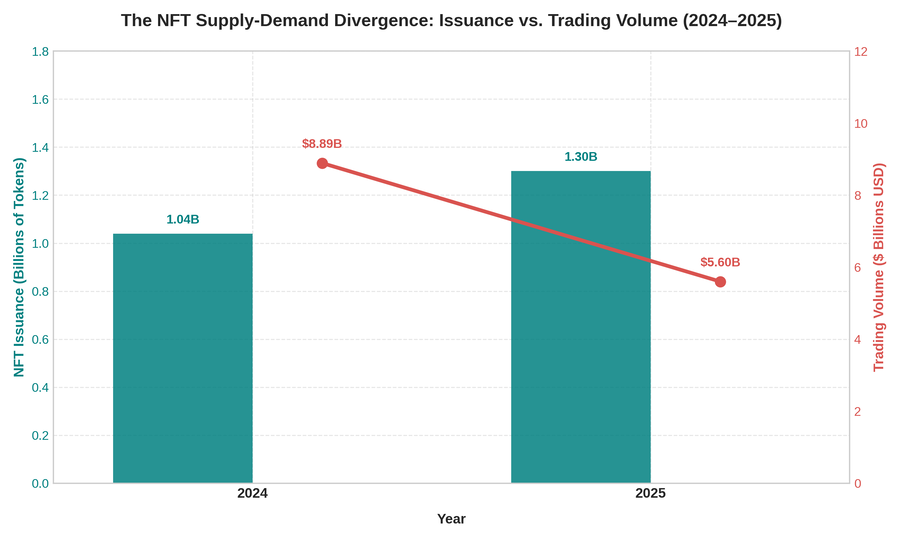
The NFT Supply-Demand Divergence: Issuance vs. Trading Volume (2024–2025), highlighting a 25% increase in token issuance alongside a 37% decrease in trading volume.
How to Interpret and Utilize This Visual
If you are an artist trying to navigate the digital art world, this chart captures the single most important economic reality you face: the widening gap between token supply and market liquidity.
-
The Supply Side (Teal Bars): Notice how NFT issuance grew from 1.04 billion tokens in 2024 to 1.30 billion tokens in 2025 (a 25% increase). More creators are minting work, expanding the total inventory on the market.
-
The Demand Side (Red Line): Concurrently, total trading volume plummeted from $8.89 billion down to $5.60 billion (a 37% drop). The pool of active speculative capital and buyer liquidity shrank significantly.
What This Means for Your Strategy
When supply goes up while demand goes down, competition becomes fierce. For you as an artist, this visualization serves as a strategic warning and a call to action:
-
Avoid "Mint and Pray": Simply listing your art on a marketplace and expecting organic discovery no longer works in an over-supplied market.
-
Prioritize Platform Reach & Community: You must choose marketplaces that actively invest in curation, algorithmic visibility, and community building to ensure your work stands out from the crowded shelf.
-
Evaluate Your Positioning: Because capital is more constrained, understanding where active buyers congregate (and which platforms protect your secondary royalties) is critical to keeping your art career sustainable.
The NFT Market in 2026 and Beyond: What Artists Need to Know Before Choosing a Marketplace
Here's the thing about the NFT market that nobody tells you when you're just starting out: the platform you choose today might not exist tomorrow. I know that sounds dramatic, but it's not. It's just the reality of building a career in a space that's still figuring itself out. So before we get into the nitty-gritty of which marketplace does what, let's talk about the bigger picture. Because understanding where the market is heading matters just as much as knowing which button to click when you mint. Trust me on this one: I've watched too many talented artists pour months of work into a platform that vanished overnight, taking their audience and their momentum with it.
The State of the NFT Art Market: From Speculation to Sustainability
Let me give it to you straight. The NFT market is not what it was in 2021, and honestly, that's probably a good thing for artists who are in this for the long haul. The frenzy is gone. The easy money is gone. What's left is a market that rewards patience, strategy, and genuine community building. If that sounds like hard work, it's because it is. But it's also the kind of work that compounds over time, unlike the sugar rush of a speculative pump.
NFT Trading Volume Trends: From Billion-Dollar Peaks to Realistic Baselines
In 2025, the number of NFTs in circulation actually grew by 25% to more than 1.34 billion tokens. Sounds great, right? More art, more creators, more opportunity. Here's the catch: total sales dropped by 37% to around $5.63 billion. The average sale price also fell, sliding from $124 to $96.
What does that gap tell you? More people are minting than ever, but fewer buyers are willing to pay meaningful prices. Supply is up 35-fold since 2021, while demand has been quietly shrinking. The market has shifted from a speculative frenzy to something that looks a lot more like a mass-supply, low-price competition. The average NFT transaction price has fallen below $100 for the first time in years, which is a psychological threshold that matters more than most people realize. When prices drop below three figures, you lose a certain type of collector, the one who was in it for the prestige as much as the art.
The market cap tells an even starker story. It shrank from a peak of $17 billion in 2022 down to around $2.4 billion by the end of 2025. By early 2026, it had dipped below $1.5 billion, retreating to levels not seen since before the 2021 boom. If you're doing the math, that's a roughly 90% drawdown from the top. For anyone who entered the space during the hype, that's a brutal reality check.
But here's what I want you to take away from those numbers: the market didn't die, it deflated. The speculative excess got squeezed out. What remains is smaller, yes, but also more stable. The artists who are still selling work in 2026 are selling to people who actually want the art, not people who are hoping to flip it for a quick profit. That's a healthier foundation for a career, even if it doesn't make for exciting headlines.
The K-Shaped Recovery: Why Top NFT Collections and Independent Artists Diverged
If you've been watching the charts, you've probably noticed something strange. The overall market cap has been bouncing around, occasionally surging 54% in a single month to push back above $2 billion. But those gains haven't been evenly distributed. Not even close.
The recovery has been what analysts call a "K-shaped" recovery. The top of the market, the blue-chip collections like Bored Ape Yacht Club, CryptoPunks, and a handful of established generative art projects, has seen some buying interest return. The bottom, where most independent artists live and work, hasn't felt much of that warmth. Market concentration is real and getting worse: the top 10% of creators still capture roughly 90% of market income. That means for every dollar spent on NFTs, ninety cents go to the same small group of established names. The remaining ten cents get split among thousands of artists fighting for visibility.
I'm not telling you this to discourage you. I'm telling you because knowing the game is half the battle. If you understand that the deck is stacked toward established players, you can make smarter decisions about where to invest your time and energy. You can focus on platforms that actually give emerging artists a chance, rather than ones that just pay lip service to "supporting creators" while their algorithms bury anyone without a blue check or a million followers.
There's also been a fascinating geographic shift that most people haven't noticed. TON blockchain, powered by Telegram, actually overtook Ethereum in NFT trading volume in March 2026, with $39.8 million compared to Ethereum's $35.9 million. Let that sink in for a second. The blockchain that most serious NFT collectors dismissed as a toy for Telegram users just outsold the network that invented the entire category. Most of that TON volume came from Telegram-native assets like Gifts, Numbers, and Usernames, which together accounted for 98.5% of TON's NFT activity. It's a different flavor of NFT, more social and less art-focused, but it shows that capital is rotating into new ecosystems rather than staying locked in Ethereum. For artists, that's a signal: the next wave of collectors might not come from crypto Twitter. They might come from your group chats.
Why the NFT Market Still Matters for Artists: Long-Term Growth Projections
Okay, so the market contracted. The hype faded. Crypto Twitter moved on to AI agents and memecoins. Why should you still care about NFTs?
Experts expect the NFT market to move away from short-term profit models and be reshaped around practical utility and culture. That means artists who build real communities, who offer genuine value beyond the speculative flip, are the ones who will inherit whatever comes next. The days of minting a JPEG and waiting for a bidding war are over. The days of building a sustainable creative practice around digital ownership are just beginning.
Think about it this way: the internet didn't disappear when the dot-com bubble burst. It just got better, more useful, more integrated into daily life. The companies that survived, Amazon, Google, eBay, were the ones building real infrastructure rather than chasing hype. NFTs are going through the same kind of correction. The projects that survive will be the ones that solve real problems for real people. For artists, that means ownership, provenance, royalties, and direct relationships with collectors. Those aren't fads. They're permanent improvements over the old way of doing things.
NFT Marketplace Shutdowns: Lessons Every NFT Artist Should Learn
I want to walk you through some of the closures that have happened, not to scare you, but because each one teaches something valuable about platform risk. Think of this as a post-mortem, a chance to learn from other people's mistakes so you don't have to make them yourself.
Blur’s Frontend Closure and What It Signals for NFT Platforms
Blur was once the biggest thing in Ethereum NFT trading. I remember when it launched, everyone in my circle was talking about it. Zero fees, token rewards, a slick interface designed for speed. It felt like the future. At its peak in March 2023, it handled $1.43 billion in monthly volume and controlled more than 70% of all Ethereum NFT trading. By March 2026, that monthly volume had collapsed to under $7 million, a drop of more than 99.5%. Let that sink in. A platform that once moved over a billion dollars a month was down to single-digit millions.
In October 2026, Blur announced it would shut down its frontend, the website people actually used to trade. The smart contracts would stay live on-chain, but the interface everyone relied on was going away. The BLUR token fell more than 20% on the news, dropping to around $0.015 from a peak of over $5 in early 2023. That's a 99.7% collapse in token value. If you were holding BLUR hoping for a recovery, I feel for you.
Here's the lesson, and it's an important one: Blur's model was built on token incentives, rewarding traders with airdrops for activity. When the rewards dried up, so did the volume. The platform never figured out how to make money from actual trading activity. It generated $0 in protocol revenue over three years despite handling billions in trades. That's not a business. That's a charity with a token attached. And charities, in crypto, don't last long.
For artists, that's a critical distinction. You want to be on platforms where people are trading because they want the art, not because they're farming points. A marketplace that depends on incentives to drive activity is a marketplace that will collapse the moment those incentives stop. When you're evaluating a platform, ask yourself: would people still use this if the token rewards disappeared tomorrow? If the answer is no, keep looking.
The Broader NFT Marketplace Retreat: Binance NFT, Foundation, MakersPlace, and More
Blur wasn't alone. The list of marketplaces that have closed or scaled back dramatically is long and painful, and it keeps growing. Every time I see another announcement, I think about the artists who called that platform home, who built their collector base there, who now have to start over somewhere else.
Nifty Gateway, the Gemini-owned platform that was once a premier destination for curated NFT drops, announced its closure in early 2026. To their credit, they promised to host NFT metadata permanently and migrate most of it to Arweave, a decentralized storage network. That's more responsible than most. But the fact remains: a platform that many artists built their careers on simply ceased to exist. The collectors who bought there had to find new places to browse. The artists who sold there had to rebuild their presence from scratch.
Foundation, one of the most respected curated platforms on Ethereum, shut down in April 2026 after a planned acquisition fell through. The frontend went offline, but the community stepped in. Artists and developers pinned over 99.99% of Foundation's content to IPFS and built alternative frontends to keep the art accessible. It's a remarkable story of community resilience, and it shows what's possible when people care enough about the art to preserve it. But it also highlights the fragility of centralized platforms. If the community hadn't stepped up, thousands of artworks would have become inaccessible overnight.
X2Y2, which at its peak was the second-largest NFT marketplace with $5.6 billion in cumulative trading volume, closed in April 2025. Its founder cited a 90% decline in NFT trading volume from the 2021 peak as the primary reason. Again, the pattern repeats: a platform that thrived during the boom couldn't survive the bust.
MakersPlace, Bybit NFT Marketplace, LG Art Lab, Kraken NFT Marketplace: all gone or wound down. Even CNN's Vault project, which sold NFTs tied to historical news events, shut down and offered users only 20% refunds on their original minting costs. That last one stings because it shows how little recourse buyers and artists have when a platform decides to pull the plug.
The pattern is unmistakable. Platforms that relied on speculation and incentives have been the first to fall. Platforms that built real utility and community have fared better, though even those aren't immune.
The takeaway for artists is this: diversify your presence. Don't put all your eggs in one marketplace basket. Build your audience on platforms you control, like your own website or email list, so that when a marketplace goes down, you still have a way to reach your collectors.
The Metadata Problem: What Happens to Your NFT Art When a Marketplace Dies
This is the part that keeps me up at night, and it should keep you up too. It's not a glamorous topic. It's not something most artists think about when they're excited to mint their first piece. But it's the difference between your art surviving a platform shutdown and becoming a broken link that nobody can access.
When an NFT marketplace shuts down, your art doesn't automatically disappear from your wallet. The token is on-chain. That part is safe. But here's the catch: the metadata and the actual image file often aren't. For many NFTs minted through centralized platforms, the metadata and media are stored on the platform's own servers. When those servers go dark, your NFT becomes a link to nothing. The token still exists, but it points to a dead URL.
Nifty Gateway addressed this by promising to migrate metadata to Arweave and continue hosting legacy assets indefinitely. Foundation is pinning metadata on IPFS through April 2027, and the community has stepped in to ensure redundancy beyond that. These are the responsible approaches, and they should be the baseline expectation for any platform you work with.
But not every platform has been so responsible. CNN Vault users discovered that their NFTs, which they assumed would retain value because of the CNN brand, were essentially digital souvenirs once the platform closed. As one frustrated customer put it, without the platform and the utility it provided, the NFT wasn't really an NFT anymore, just a digital copy. That's a harsh lesson in the difference between owning a token and owning the art it represents.
The lesson for artists is simple: where your metadata lives matters as much as where you mint. Before you commit to a marketplace, ask where the media and metadata will be stored. If the answer is "on our servers," you're taking on platform risk. If the answer is IPFS, Arweave, or fully on-chain, you have more protection. It's not a glamorous consideration, but it's the difference between your art surviving a platform shutdown and becoming a broken link. And if you're serious about building a lasting career, you need to think about what happens to your work after the platform you're using today is gone.
Why Platform Longevity Is the 1 Concern for NFT Artists Today
I know it's tempting to chase the platform with the most buzz or the lowest fees. I've done it myself. But in 2026, the most important question you can ask about any marketplace is simpler than that: will this platform still be here in three years? If the answer is uncertain, you need to factor that into every decision you make about how you use it.
How to Spot an NFT Marketplace That Will Survive
There's no crystal ball, but there are signals. Platforms that survive tend to have real revenue models rather than relying purely on token incentives. They have active communities where people are trading and talking because they genuinely care about the art or the utility, not just the next airdrop. They have transparent leadership and a track record of following through on commitments, even when the market gets tough.
Platforms that struggle tend to share a different set of traits. They rely heavily on token emissions to drive activity. They have no clear path to revenue. They pivot constantly without a coherent strategy. They make big promises about decentralization while operating like a centralized startup. And they often have high burn rates that make them vulnerable to even modest market downturns.
When you're evaluating a platform, look for signs of organic activity:
- Are people talking about the art, or just the token?
- Are there collectors who have been there for years, or is it all new wallets chasing rewards?
- Does the team communicate openly about challenges, or do they only show up when things are going well?
These questions won't give you a definitive answer, but they'll help you separate the platforms with staying power from the ones that are running on fumes.
The Hidden Costs of Building and Running an NFT Platform
You might be wondering why so many marketplaces have shut down when the technology seems straightforward. The answer is that running a marketplace is expensive, and the costs don't go away when the market cools. If anything, they get worse, because you're paying the same bills with less revenue coming in.
A full-featured NFT marketplace requires smart contract development, which can cost anywhere from $15,000 to well over $150,000 depending on complexity. Royalty enforcement, auction mechanisms, escrow logic: each feature adds development time and cost. Then there's blockchain integration, which involves ongoing gas costs for testing and deployment. Frontend and backend development for a smooth user experience is another major expense. Wallet integration across multiple providers multiplies testing effort. And then there's the operational side: metadata storage, indexing, customer support, marketing, and the endless battle against spam and fraud.
When trading volumes are high, marketplace fees can cover these costs. When volumes collapse, as they have across the board, those costs become unsustainable. Blur's decision to charge zero marketplace fees made it popular with traders, but it also meant the platform generated $0 in protocol revenue over three years despite handling billions in trades. That's not a business. That's a charity with a token attached. And charities, in crypto, don't last long.
This is why platforms that charge reasonable fees and actually generate revenue are more likely to survive. They're not dependent on token prices or speculation. They're dependent on people using the platform for its intended purpose: buying and selling art. That's a much more stable foundation.
Red Flags That Signal an NFT Marketplace Is Heading for Trouble
Keep your eyes open for these warning signs. None of them is a guarantee that a platform is about to collapse, but when you see several of them together, it's time to start thinking about diversifying your presence.
- Volume collapse without a recovery plan. If a platform's monthly trading volume has dropped 90% or more from its peak and leadership isn't articulating a clear path forward, that's a problem. Blur's volume dropped over 99% before it announced its shutdown. The writing was on the wall for months.
- Token price in freefall. When a platform's native token drops 80-90% from its highs, it often reflects a loss of confidence that precedes operational shutdown. Tokens are a proxy for community sentiment, and when they collapse, it usually means people have stopped believing in the platform's future.
- Layoffs or "strategic reviews." When a marketplace starts talking about "exploring strategic alternatives" or "focusing on core products," it usually means they're running out of runway. These phrases are corporate speak for "we're trying to figure out how to survive."
- Pivots away from artists. If a platform starts de-emphasizing creator royalties or shifting focus to trading incentives, it's a sign they're prioritizing short-term volume over long-term sustainability. That's fine for traders, but it's a red flag for artists. You want to be on a platform that sees you as a partner, not a cost center.
- Related projects shutting down. When the same team or ecosystem starts closing other products, it's often a precursor to the main platform winding down. Blur's shutdown came less than two weeks after Blast, another project from the same founder, announced its closure. These things tend to happen in clusters.
📊 The NFT Market Cap Contraction: From 2022 Peak to 2026
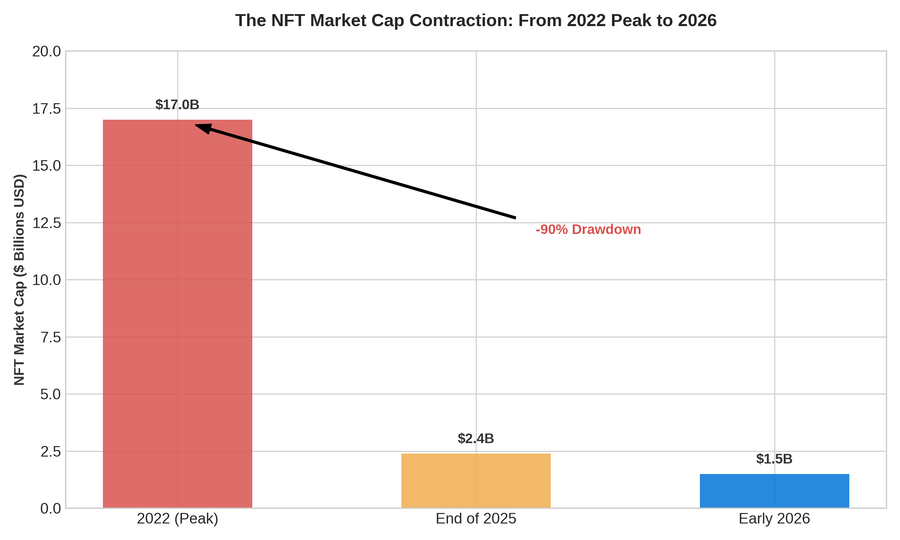
The NFT Market Cap Contraction: From 2022 Peak to 2026, illustrating the ~90% decline in total market capitalization from $17 billion down to below $1.5 billion.
How to Interpret and Utilize This Visual
If you are evaluating the current landscape for digital art, this bar chart highlights the dramatic macroeconomic shift in the NFT space.
-
The Peak Era (Red Bar): In 2022, the total NFT market cap reached an all-time high of $17.0 billion, fueled by speculative capital, widespread hype, and easy money.
-
The Contraction (Yellow and Blue Bars): By the end of 2025, market capitalization shrank to $2.4 billion, and by early 2026, it retreated below $1.5 billion; reflecting a brutal roughly 90% drawdown.
What This Means for Your Strategy
-
A Deflated, More Stable Market: The speculative frenzy has been squeezed out, leaving behind a smaller but much more grounded environment. Collectors buying art in 2026 are generally motivated by genuine appreciation rather than quick-flip speculation.
-
Platform Risk Awareness: Because the overall market cap is compressed, platforms are under immense financial pressure. Knowing that marketplaces can and do shut down abruptly means you should diversify your presence and protect your work with secure metadata storage (such as IPFS or Arweave).
Creator Royalties Explained: How NFT Marketplaces Treat Artists’ Secondary Income
Okay, let's talk about the thing that convinced a lot of us to get into NFTs in the first place: royalties. The idea was beautiful. You sell a piece of art once, and every time it changes hands after that, you get a cut. Forever. It was the holy grail for artists who had watched their physical work appreciate in value while they saw none of it. I still remember the first time I explained the concept to a painter friend of mine. Her eyes lit up. She had sold a piece for $800 years ago that was now worth tens of thousands, and she had never seen a dime from that appreciation. NFTs promised to fix that. But like everything in crypto, the reality turned out to be a lot messier than the pitch. So let's break down what royalties actually look like in 2026, which platforms still respect them, and how you can protect yourself from getting stiffed.
What Are NFT Royalties and Why Do They Matter for Artists?
At its core, a royalty is simple: a percentage of every secondary sale that goes back to the creator. You mint a piece, sell it for 1 ETH, and if the buyer later flips it for 10 ETH, you get a slice of that 10 ETH sale. On paper, it's a perpetual income stream tied to the success of your art. In practice, it's a constant negotiation between what artists want and what the market is willing to pay. And let me tell you, that negotiation has gotten a lot more contentious over the past few years.
The Original Promise of NFT Royalties: Lifelong Income for Creators
When NFTs first exploded, royalties were treated as a fundamental feature, not an optional add-on. Platforms advertised them. Artists priced them in. Collectors accepted them as the cost of doing business in a creator-friendly ecosystem. The pitch was revolutionary: digital artists could finally benefit from the long-term appreciation of their work, something that had been virtually impossible in the traditional art world. Galleries and auction houses took their cut, but the artist rarely saw a dime when a piece resold for millions years later. Think about Jean-Michel Basquiat, who died broke while his work later sold for hundreds of millions. NFTs were supposed to prevent that from happening to the next generation of digital creators.
For a while, it actually worked. Royalty payments peaked in April 2022, when creators collectively earned around 28,000 ETH per week, worth roughly $76 million at the time. That was real money flowing back to artists on a weekly basis. People were paying their rent with royalty income. Artists who had struggled for years suddenly had a financial cushion that grew with their reputation. It felt like the system was finally working for creators.
How NFT Royalty Enforcement Has Changed Across Marketplaces
Then the race to the bottom started, and it happened faster than anyone expected. In October 2022, Blur launched with a pitch designed to attract high-volume traders: zero marketplace fees and optional creator royalties. The strategy worked spectacularly for Blur's trading volume, but it came at a direct cost to artists. Competing marketplace Magic Eden had already moved to optional royalties just a week earlier. OpenSea, feeling the pressure, eventually followed suit, making creator fees optional for new collections. It was like watching a domino chain of platforms deciding that artist income was an acceptable sacrifice for trading volume.
The impact was immediate and brutal. By July 2023, the average effective creator royalty rate had fallen to 0.6%, down from around 2.5% in 2022. Nansen attributed much of that collapse to Blur's growth and OpenSea's policy changes. By June 2025, weekly royalty payments had dropped to just 2,000 ETH, around $3.8 million, a 95% decline from the peak. Let that sink in for a moment. A revenue stream that once paid out $76 million a week to creators was now paying out less than $4 million. That's not a dip. That's a collapse.
Blur's recent shutdown of its website in October 2026 was met with a certain amount of schadenfreude from NFT collectors who had watched the platform hollow out creator economics. As one report put it, Blur's rise "accelerated a shift toward lower creator royalties," and its collapse was seen by some as the market correcting an unsustainable model. I'm not going to pretend I shed a tear when I heard the news. But the damage was already done. The culture of optional royalties had taken root, and it's not going away anytime soon.
The Difference Between Voluntary and Contract-Enforced NFT Royalties
Here's the key distinction that every artist needs to understand: there are two kinds of royalties, and only one of them is actually guaranteed. This is the part where a lot of artists get burned because they assume the royalty percentage they set is the royalty percentage they'll receive. It's not.
Voluntary royalties are a suggestion, not a rule. The creator sets a percentage in their collection settings, and the marketplace displays it, but the buyer or seller ultimately decides whether to honor it. On OpenSea, for example, collections without enforceable contracts default to optional earnings, meaning a seller can simply toggle royalties off when listing. This is why effective royalty rates have collapsed so dramatically. Traders are rational actors. When given the choice between paying 5% to the artist and keeping that 5% for themselves, most of them keep it. It's not personal. It's just economics.
Contract-enforced royalties are baked into the smart contract itself. The token literally cannot be transferred unless the royalty condition is met. OpenSea supports this through ERC721-C compatibility, which uses the Seaport v1.6 protocol to check conditions before completing a sale. Magic Eden uses Limit Break's Payment Processor v2 on its EVM platform, offering creators the option of an Operator Filter (blocking non-royalty-respecting marketplaces) or ERC721-C v2 for seamless enforcement. Rarible takes it a step further with RARI Chain, which enforces royalties at the protocol level, meaning the blockchain itself rejects transactions that don't respect creator earnings.
The difference is night and day. A voluntary royalty is a polite request. A contract-enforced royalty is a technical guarantee. If you want your secondary income protected, you need to be on a platform that supports enforcement, and you need to deploy a compatible smart contract. Otherwise, you're trusting the goodwill of traders who have demonstrated, time and again, that they'll choose their own margins over your income. And in a bear market, when everyone is trying to squeeze out every last basis point of profit, that goodwill evaporates fast.
NFT Royalty Rates Compared: Which Marketplaces Pay Artists the Most?
Not all marketplaces are created equal when it comes to creator economics. Some genuinely prioritize artists. Others are built for traders and treat royalties as an afterthought. And a few have made royalties a core part of their identity. Here's how the major platforms stack up in 2026.
Rarible’s Up-to-50% NFT Royalty Flexibility vs. OpenSea’s 10% Default
Rarible has positioned itself as the most artist-friendly major marketplace, and its royalty policy reflects that. Creators can set royalties up to 50%, which is the highest ceiling in the industry. I know that sounds almost too good to be true, but it's real. The catch is that buyers have to be willing to pay it, and in practice, most collections settle somewhere between 5% and 15%. Still, having the option to set a higher rate gives artists more negotiating power and more upside if their work appreciates significantly.
More importantly, Rarible operates on RARI Chain, an Arbitrum-based Layer 3 that enforces royalties at the protocol level. This means royalties are embedded in the chain itself, not left to marketplace discretion. If someone tries to sell your NFT on RARI Chain without paying the royalty, the transaction simply fails. It's the most robust enforcement mechanism available, and it's a big reason why Rarible has maintained a loyal following among creators who prioritize long-term income over short-term volume.
OpenSea, by contrast, defaults to a 10% creator earnings cap for collections using its OpenSea Studio, though it supports enforceable royalties through ERC721-C contracts. For collections deployed after April 2, 2024, OpenSea Studio allows creators to enforce their earnings directly in collection settings. For older collections, enforcement isn't available unless the contract is upgraded. OpenSea's approach is pragmatic: it gives creators tools to enforce royalties, but it doesn't force the issue platform-wide. You get out what you put in, technically speaking.
There's also the matter of marketplace fees. OpenSea dropped its marketplace fee to 0.5% in early 2026, which is remarkably low. Rarible charges 2.5% on primary sales. SuperRare takes 15% on primary sales but has historically been generous with royalties. Foundation, before it shut down, was at 5% primary and 10% royalties. The lesson here is that you have to look at the total take, not just the royalty rate. A platform with a 10% royalty and a 5% marketplace fee leaves you with less than a platform with a 5% royalty and a 0.5% fee.
The Trader-First NFT Platforms That De-Emphasize Creator Royalties
Blur was the poster child for royalty-optional trading, and its recent shutdown is a cautionary tale about what happens when a platform prioritizes volume over creator sustainability. At its peak, Blur controlled over 70% of Ethereum NFT trading, but it did so by attracting flippers who had zero interest in paying royalties. The platform's minimum royalty floor was just 0.5%, and even that was largely optional. Blur's model was simple: reward traders with token incentives, charge zero fees, and let the artists fend for themselves. It worked for a while. Then the incentives dried up, the traders left, and the platform had nothing left to offer. Now that Blur is gone, the market has one fewer venue where creators can expect their secondary income to be treated as optional. That's a small win for artists, even if it came at the cost of a major trading venue.
Magic Eden, after its pivot to Solana-only in March 2026, enforces royalties on 100% of native listings through Limit Break's Payment Processor v2. However, it aggregates listings from other marketplaces where it can't control royalty behavior. Creators are advised to use the Operator Filter to block non-royalty-respecting platforms, but that's a manual step that many artists may not know to take. On Solana, the trading culture is faster and more speculative, which historically hasn't been great for royalty compliance. The volume is there, but the culture of respecting creator income is still developing.
Tensor, the largest Solana marketplace by volume, has historically been more trader-focused. It offers lower fees and faster execution, but royalty enforcement is less stringent than what you'd find on Rarible or OpenSea's enforceable collections. If you're minting on Solana and you care about royalties, you need to be explicit about it and choose your marketplace carefully. Not all Solana platforms are created equal when it comes to creator economics.
How to Evaluate NFT Royalty Policies Before You Mint
Before you commit to a platform, do your homework. I know it's tempting to just mint and see what happens, but the decisions you make at the contract level are almost impossible to change later. Here's a quick checklist that I wish someone had given me when I started:
- Check the enforcement mechanism. Does the platform support ERC721-C or an equivalent? Can you enforce royalties at the contract level, or are they just optional suggestions? If enforcement isn't supported, your royalty income is essentially voluntary. And voluntary royalties, in a bear market, tend to approach zero.
- Look at the default rate. Some platforms default to 0% and let creators set higher. Others default to 5% or 10%. The default matters because many creators never change it. If the default is 0%, a lot of NFTs will be minted with no royalties at all.
- Understand the fee stacking. Royalties are just one piece of the pie. Marketplace fees, gas costs, and payment processor fees all eat into the final payout. A platform with a 2.5% royalty but 5% marketplace fees might leave you worse off than one with a 10% royalty and zero marketplace fees. Do the math before you commit.
- Test it yourself. Mint a cheap test NFT on the platform and resell it to yourself or a friend. See what actually happens when royalties are supposed to be paid. The documentation is often optimistic; the reality is sometimes different. I've done this on half a dozen platforms, and the results have been eye-opening.
- Read the fine print on aggregated listings. If a platform aggregates listings from other marketplaces, your royalty might not be enforced on those external listings. This is a common gotcha on Magic Eden and other aggregator-style platforms. If royalty enforcement matters to you, stick to native listings or use an Operator Filter.
How to Protect Your NFT Royalties as an Artist
Royalties aren't guaranteed just because you set them. You have to actively protect them, and that means understanding the technical and social levers at your disposal. It's not enough to just hope for the best. You need a strategy.
Smart Contract Solutions for Enforcing NFT Royalties
The most reliable way to ensure you get paid on secondary sales is to use a smart contract that enforces royalties at the protocol level. This is the technical equivalent of locking the door instead of just hoping nobody walks in.
ERC721-C is the current standard for enforceable royalties on EVM chains. It's a superset of the ERC721 standard that adds configurable royalty enforcement through a payment processor. If a marketplace doesn't honor the royalty conditions, the token simply won't transfer. OpenSea supports this through Seaport v1.6, and Magic Eden offers it as an option on its EVM platform. If you're minting on Ethereum, Polygon, or any other EVM-compatible chain, ERC721-C is the gold standard for royalty protection.
Limit Break's Payment Processor v2 is another enforcement mechanism, used by Magic Eden. It offers two modes: an Operator Filter that blocks non-royalty-respecting marketplaces, and ERC721-C v2 for on-chain enforcement. The Operator Filter approach is less bulletproof (bad actors can create new marketplaces that aren't on the blocklist), but it's better than nothing. Think of it as a bouncer at the door rather than a lock on the vault.
RARI Chain takes a different approach entirely. Instead of relying on marketplace cooperation, it embeds royalty enforcement into the chain's consensus layer. Transactions that don't respect royalties simply fail. This is the most robust solution available, but it's also platform-specific: your NFTs need to be minted on RARI Chain to benefit. It's a trade-off between maximum protection and maximum reach.
The catch with all of these solutions is that they limit where your NFTs can be traded. An ERC721-C contract might be blocked on marketplaces that don't support the standard. That's the trade-off: enforcement versus flexibility. You have to decide which matters more for your specific goals. If you're building a long-term career and you expect your work to appreciate, enforcement is probably worth the reduced liquidity. If you're experimenting and want maximum exposure, you might accept lower royalties in exchange for wider reach.
Community Pressure and Collector Behavior Around NFT Royalties
Smart contracts aren't the only tool. Community norms and collector behavior matter too. When collectors value supporting artists, they're more likely to pay royalties voluntarily, even when they don't have to. I've seen collections where the community actively shames flippers who bypass royalties. It's not a legal enforcement mechanism, but it's a social one, and in tight-knit communities, it works.
The "right of reclaim" concept, proposed by researchers at Harvard Business School's AI Institute, is an interesting middle ground. Under this model, buyers gain ownership of the NFT but not full control of its title until the royalty is paid. If the royalty is skipped during resale, the last title holder can reclaim the NFT. It's a clever way to incentivize payment without restricting composability, though it hasn't been widely implemented yet. Keep an eye on this one. If it gains traction, it could change the game.
In practice, the most effective community pressure comes from artists themselves. If you publicly commit to only minting on royalty-enforcing platforms, and you educate your collectors about why it matters, you create a culture of respect around your work. It won't stop every bad actor, but it shifts the norm in your favor. I've seen artists include a note in their collection description explaining that royalties fund their ability to keep creating. It sounds simple, but it works. People want to support artists they respect. You just have to give them a reason to care.
The Future of NFT Royalties: What Artists Should Watch
The royalty landscape is still evolving. Here are a few trends worth keeping an eye on, because they could shape your income for years to come.
- Layer 2 enforcement is growing. As more NFT activity moves to Layer 2 networks like Base, Arbitrum, and RARI Chain, the opportunity for protocol-level royalty enforcement expands. Chains that bake royalties into their architecture could become the default choice for creators who prioritize long-term income. This is already happening on RARI Chain, and I expect other L2s to follow suit.
- Regulatory attention is increasing. As NFTs become more mainstream, regulators are starting to look at how royalties are treated. Whether royalties are classified as property rights, contract terms, or something else entirely could have major implications for enforcement. If royalties are legally recognized as a form of intellectual property right, platforms might be required to enforce them. That would be a game-changer for artists.
- New models are emerging. Nifty Gateway experimented with a "sliding royalty scale" for Sam Spratt's Masquerade collection, where royalties start at 1% and increase as the artwork's value rises. If the piece resells below mint price, no royalties are paid. It's a more nuanced approach that aligns creator and collector incentives. Whether it catches on remains to be seen, but it's a sign that the industry is still searching for better models. I appreciate the creativity, even if the execution is still a work in progress.
- Token-gated royalties are a thing. Some platforms are experimenting with token-gated access, where collectors who pay royalties get access to exclusive content or future drops. It's a way to reward good behavior rather than punish bad behavior. Early experiments have been promising, though it's too soon to say whether this will become a standard practice.
The bottom line on royalties: don't assume they're automatic. They're not. Choose platforms that enforce them, deploy contracts that support enforcement, and educate your collectors about why it matters. The artists who treat royalties as a strategic priority, rather than a passive setting, are the ones who will still be earning from their early work years down the line. And in a market where trading volume is unpredictable and floor prices are volatile, a steady stream of royalty income can be the difference between surviving a bear market and being forced to give up entirely. Protect your income. You've earned it.
📊 Estimated Weekly NFT Creator Royalty Payments and Key Marketplace Shifts (April 2022 – Early 2026)
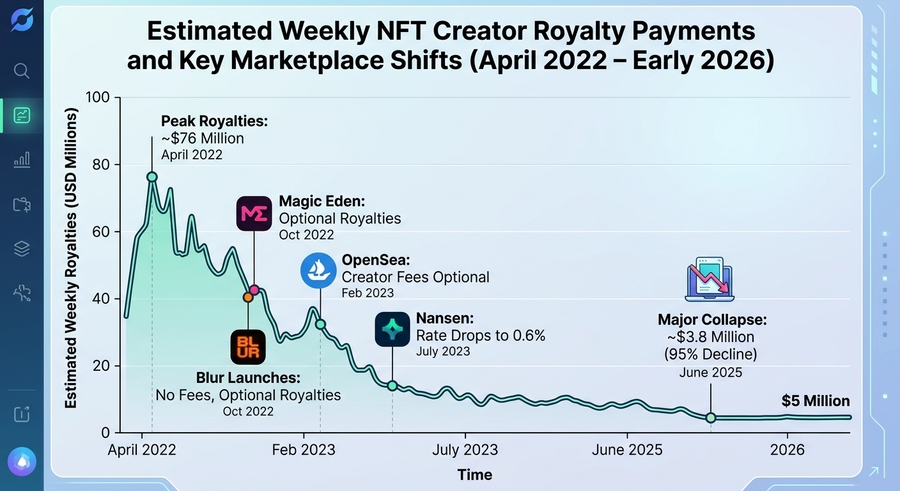
As you analyze the data, this line chart vividly illustrates the rapid and brutal transformation of the NFT royalty landscape. You can clearly distinguish two distinct eras for digital artists:
-
The Original Promise (Pre-Oct 2022): The chart shows a peak in April 2022 where creators were collectively earning roughly $76 million per week (28,000 ETH). During this time, royalties were treated as a fundamental, guaranteed feature of the ecosystem, providing a significant financial cushion that grew with your reputation.
-
The Race to the Bottom (Oct 2022 Onward): Observe how the line plummets following the consecutive policy shifts of Magic Eden, Blur, and eventually OpenSea, all of which moved to make creator fees voluntary to attract high-volume traders.
By June 2025, weekly royalties had collapsed to a mere $3.8 million: a staggering 95% decline from the peak. This visualization proves why it is critical for you, as an artist in 2026, to understand the massive difference between voluntary royalties (which traders regularly ignore) and contract-enforced royalties (which technically guarantee your cut). The platforms that respect enforcement mechanisms are your essential allies in reclaiming this lost secondary income stream.
OpenSea: The Best NFT Marketplace for Artists Seeking Maximum Reach and Discoverability
If you've been in the NFT space for more than five minutes, you've heard of OpenSea. It's the platform your non-crypto friends accidentally stumble onto when they Google "buy NFT." It's where mainstream journalists go to check floor prices. And despite everything the market has thrown at it over the past few years, it's still standing, still evolving, and still the single best venue for artists who prioritize reach and discoverability above everything else.
I'm not going to pretend OpenSea is perfect. It's not. The platform has made decisions that frustrated creators, and its pivot toward token trading has raised more than a few eyebrows. I've had moments where I questioned whether it still deserved its reputation as the default NFT marketplace. But after watching competitors rise and fall, after seeing platforms like Blur and Foundation shut down while OpenSea kept shipping updates, I've come around to a simple conclusion: if your goal is to get your art in front of the maximum number of eyeballs, there's no serious alternative. Let me walk you through why.
Why OpenSea Remains the Most Recognized NFT Marketplace for Artists
There's a reason OpenSea has been the default NFT marketplace since 2017. It built the brand, the infrastructure, and the user base before anyone else took the space seriously. That head start matters more than most people realize, especially in a market where attention is the scarcest resource. You can have the most beautiful art in the world, but if nobody sees it, it might as well not exist. OpenSea solves the visibility problem better than anyone else.
OpenSea’s Massive User Base: Monthly Active Wallets and Brand Recognition
OpenSea's numbers are still the envy of every competitor. The platform has processed roughly $36.78 billion in cumulative NFT trading volume and served approximately 5.32 million traders over its lifetime. Those are historical figures, sure, but they represent a moat that no other marketplace has come close to matching. Building that kind of trust and familiarity takes years, and in crypto, years feel like decades.
In terms of current activity, OpenSea has around 382,000 monthly active traders, which is roughly ten times the user base of Blur. That comparison is worth sitting with for a moment. When Blur was dominating headlines for its trading volume, it was doing so with a fraction of the actual human beings. Blur's volume came from a relatively small number of professional flippers running bots and farming token rewards. OpenSea's activity, even when smaller in dollar terms, is spread across a much wider and more diverse group of participants. Real people. Real collectors. Real art lovers.
The user base isn't just bigger; it's also broader. OpenSea attracts casual collectors, first-time buyers, curious newcomers, and people who are simply browsing for something cool. These are exactly the kinds of people who discover new artists by accident. They're not running sophisticated trading bots or farming airdrops. They're just looking at art. And for an emerging artist, that's exactly the audience you want.
I remember talking to a digital artist who had been grinding on Twitter for months with almost no engagement. She minted a piece on OpenSea, shared it once, and woke up the next morning to three sales from people she'd never heard of. None of them followed her on social media. They just found her art while browsing. That's the power of OpenSea's reach. It exposes you to people who aren't already in your bubble.
The Volume Disconnect: Why OpenSea’s Reach Still Matters for Artists
Here's where things get a little counterintuitive. OpenSea doesn't always have the highest trading volume. During Blur's peak, it was routinely outsold on Ethereum by a significant margin. Even now, the platform's NFT trading volume can be volatile. In June 2025, OpenSea's Ethereum NFT transaction volume dropped more than 70% month-over-month, falling from $2.596 billion in May to around $697 million. That's a dramatic swing, and it reflects the broader market's instability. If you were watching the charts, it looked alarming.
But here's the thing: volume is not the same as reach. Blur's volume was concentrated among a relatively small number of professional traders who were flipping the same assets back and forth to farm token rewards. It was circular. Money moving in circles, generating fees and incentives but not necessarily connecting art with people who loved it. OpenSea's activity, even when smaller in dollar terms, is spread across a much wider and more diverse group of participants.
There's also the matter of long-term brand equity. OpenSea has been around for nearly a decade. It survived the bear market, the regulatory scrutiny, and the competitive onslaught. Every time a competitor shut down, OpenSea absorbed some of their users. Every time a new chain launched, OpenSea added support. The platform has become the default entry point for anyone curious about NFTs, and that positional advantage compounds over time.
How OpenSea’s Brand Trust Helps New NFT Artists Get Discovered
There's also the trust factor, which is harder to quantify but impossible to ignore. OpenSea has been around since 2017. It survived the bear market, the regulatory scrutiny, and the competitive onslaught. For a lot of buyers, especially those outside the crypto-native bubble, OpenSea is synonymous with "safe place to buy NFTs." That brand recognition is a free marketing boost for every artist who lists there.
I've talked to collectors who won't touch smaller marketplaces because they're afraid of getting scammed or losing their assets. They've heard horror stories about rug pulls, phishing attacks, and platforms that disappeared with their money. OpenSea's non-custodial model, audited smart contracts, and $100,000 bug bounty program give them confidence. When a platform has that level of trust, it lowers the barrier for first-time buyers. And first-time buyers are exactly who emerging artists need to reach. Experienced collectors already have their favorite artists and platforms. Newcomers are the ones who are open to discovering someone new.
The regulatory clarity helps too. The SEC's closure of its investigation into OpenSea in February 2025 removed a major cloud of uncertainty. For a while, it felt like the entire NFT industry was operating under a shadow, unsure whether regulators would crack down. When the investigation closed without enforcement action, it sent a signal that OpenSea was operating within the lines. And when the SEC started sending Wells notices to NFT artists and developers in 2026, OpenSea put $5 million into a legal defense fund to support them. That's not just good PR; it's a signal that the platform is willing to fight for its creators. I don't know about you, but I'd rather be on a platform that has my back when things get tough.
OpenSea’s Multichain Support: Where Artists Can Mint and Sell NFT Art
One of OpenSea's biggest advantages for artists is its unmatched multichain coverage. If you want to mint on Ethereum, Polygon, Base, Arbitrum, Solana, or a dozen other chains, OpenSea probably supports it. That kind of flexibility is rare, and it gives artists options that simply don't exist on single-chain platforms.
OS2’s Expanded Chain Coverage: Ethereum, Solana, Base, Polygon, and Beyond
The OS2 relaunch in 2025 transformed OpenSea from an Ethereum-centric marketplace into a multichain trading hub. At launch, OS2 supported 22 blockchains for NFT trading, a number that has continued to grow. The platform covers Ethereum, Solana, Base, Polygon, Arbitrum, Optimism, Avalanche, and even non-EVM chains like Flow and Ronin. It's a staggering level of coverage, and it means you can meet collectors wherever they are.
The Solana integration is particularly significant. OpenSea re-enabled Solana NFT trading in September 2026, allowing users to buy and sell Solana-based collections like Claynosaurz, Mad Lads, and BoDoggos. This came more than four years after OpenSea first experimented with Solana support in a beta version back in 2022. For artists working on Solana, this is a big deal. It means you can access OpenSea's massive user base without having to bridge to Ethereum or abandon your native chain. Solana's low fees and fast transactions make it an attractive option for artists who want to experiment without breaking the bank.
OpenSea also supports Bitcoin Ordinals, making it one of the only generalist marketplaces still covering that ecosystem. Magic Eden exited Bitcoin and EVM chains in March 2026, leaving OpenSea as one of the few remaining venues for Ordinals traders and artists. If you're working with Ordinals, OpenSea is one of the only games in town.
Why Multichain Support Matters for NFT Artists Targeting Diverse Collectors
Multichain support isn't just a technical feature. It's a strategic advantage for artists. Different chains have different collector cultures. Ethereum collectors tend to be more established and willing to pay higher prices. They're the blue-chip buyers, the ones who have been in the space for years. Solana collectors are often more focused on gaming and speed. They're younger, more experimental, and more likely to take a chance on a new artist. Base and Polygon attract a mix of newcomers and cost-conscious buyers who want to participate without paying Ethereum gas fees.
By listing on OpenSea, you get access to all of these audiences in one place. A collector who's browsing Ethereum might see your Solana listing and decide to check it out. A Base user might discover your work while looking for something else. The cross-pollination of audiences is something that single-chain marketplaces simply cannot replicate. You're not just reaching one community; you're reaching all of them.
There's also the practical matter of minting costs. OpenSea supports low-cost chains like Polygon and Base, where you can mint for pennies rather than paying Ethereum gas fees that can run into the hundreds of dollars. For emerging artists who can't afford to gamble on every mint, this flexibility is essential. I've seen artists spend $200 on gas for a single Ethereum mint, only to have the piece sell for $50. That's a recipe for burnout. Low-cost chains let you experiment without betting the farm.
How to Choose the Right Blockchain for Your NFT Art on OpenSea
So which chain should you use? It depends on your goals and your audience. There's no one-size-fits-all answer, but here's a framework that can help.
- Ethereum is still the gold standard for prestige and blue-chip collectors. If you're selling high-value fine art and your target buyer is a serious collector, Ethereum is where they live. But the gas fees are real, and they can eat into your margins. Use Ethereum when the value of the sale justifies the cost, or when you're targeting collectors who only operate on Ethereum.
- Solana is fast, cheap, and home to a younger, more gaming-oriented collector base. If your art appeals to that demographic, or if you want to experiment with low-cost editions, Solana is a great choice. OpenSea's renewed Solana support makes it more accessible than ever. The trading culture is faster and more speculative, but there's real energy there, and collectors are actively looking for new artists.
- Base has emerged as a favorite for emerging artists and newcomers. The fees are low, the community is active, and there's a growing culture of supporting independent creators. Coinbase's backing gives it a level of legitimacy that some other L2s lack. If you're just starting out and want to minimize costs while maximizing visibility, Base is worth considering.
- Polygon is another low-cost option with a large user base, though the collector culture is less defined than on Ethereum or Solana. It's a good middle ground for artists who want Ethereum compatibility without the gas fees. It's also home to a lot of gaming and metaverse projects, so if your art fits that aesthetic, it could be a good fit.
My advice? Experiment. Mint a piece on two or three different chains and see where you get the most engagement. Track which chains drive the most views, the most likes, and the most sales. The data will tell you more than any guide ever could. Every artist's audience is different, and the only way to find yours is to try.
OpenSea Fees and Creator Royalties: What Artists Actually Earn
Let's talk money. OpenSea has made significant changes to its fee structure in recent years, and the current setup is more favorable to artists than it's been in a while. But there are still nuances you need to understand before you commit.
OpenSea’s 0.5% Marketplace Fee: One of the Lowest for NFT Artists
OpenSea historically charged 2.5% on secondary sales, which was the industry standard. After the OS2 relaunch, that fee dropped to 0.5%. That's one of the lowest marketplace fees in the business, and it directly increases the amount that goes into your pocket on every sale. For a platform with OpenSea's reach, that's a remarkably good deal.
The fee structure isn't uniform across all chains. On Ronin, for example, the 0.5% fee is split between three addresses, with OpenSea taking 0.3% and other parties receiving the rest. On primary drops, OpenSea charges a 10% fee for minting through its platform. So if you're doing a primary sale through OpenSea's minting tools, be aware of that cut. It's not a dealbreaker, but it's something to factor into your pricing.
The good news is that swap fees have been eliminated in OS2, and private listings currently carry 0% OpenSea fee. The overall fee environment is much more competitive than it was during the boom. OpenSea is clearly trying to attract artists and collectors by lowering the cost of doing business, and that's a welcome change from the days when 2.5% was non-negotiable.
Royalty Enforcement by Default: How OpenSea Protects Artist Income
OpenSea's royalty story is complicated, but the platform has actually built some of the most robust enforcement tools available. Here's how it works, and why it matters:
The technical mechanism is elegant: when a sale is attempted, Seaport calls a transfer validator contract that checks whether the royalty condition has been met. If it hasn't, the transfer simply fails. This isn't a polite suggestion; it's a hard constraint. The blockchain itself enforces your royalty, which means you don't have to rely on the buyer's goodwill. For collections that don't use these standards, royalties remain optional, which means sellers can choose to bypass them.
The practical implication is clear: if you want enforceable royalties on OpenSea, you need to use the right contract standard. If you're deploying a new collection, use OpenSea Studio or an ERC721-C compatible contract. If you're migrating an older collection, check whether your contract can be upgraded. If it can't, your royalties will be optional on OpenSea, and you'll need to rely on the goodwill of buyers. And in a bear market, goodwill is often the first thing to go.
I've seen artists learn this the hard way. They mint a collection, set a 10% royalty, and assume it's locked in. Then they watch a whale flip their work for a massive profit and receive nothing. It's a gut punch. Don't let it happen to you. Do the technical work upfront, or accept that your royalties are essentially a suggestion.
The $SEA Token Airdrop: Rewarding Collectors Who Support NFT Royalties
OpenSea's upcoming $SEA token is one of the most anticipated airdrops in the NFT space. The token was confirmed by CEO Devin Finzer, with more than 50% of the total supply allocated to the community. The platform has committed to using 50% of its revenue to buy back SEA tokens on the open market, which creates a direct incentive alignment between platform growth and token value. It's a more thoughtful tokenomic design than most, and it could create a positive feedback loop for artists.
The airdrop has been delayed. It was originally targeted for March 30, 2026, but was pushed back due to "challenging market conditions." As of mid-2026, no new date has been announced. But the eligibility window is still open, and users can earn XP through "Voyages," OpenSea's quest-based rewards system, by completing activities like sharing galleries, completing cross-chain swaps, and minting on newly added chains.
For artists, the $SEA airdrop matters because it incentivizes meaningful engagement on the platform. The more collectors use OpenSea, the more visibility your work gets. And if the buyback mechanism works as intended, it could create a cycle where platform activity drives token value, which drives more activity, which drives more discovery for artists. It's not a guarantee, but it's a more thoughtful approach than simply printing a token and hoping for the best. The delay is frustrating, but the design is promising.
OpenSea Pros and Cons for NFT Artists
Let me give it to you straight, because you deserve honesty over hype. OpenSea is a powerful platform, but it's not the right fit for every artist. Here's the full picture:
Pros: Massive Reach, Low Fees, Strong Royalty Protection
- Massive reach. OpenSea's user base is still the largest in the industry. If you want your art seen by the maximum number of people, this is where you need to be. No other platform comes close.
- Low fees. The 0.5% marketplace fee is competitive with any major platform. Combined with eliminated swap fees and 0% fees on private listings, it's a much more artist-friendly environment than it was during the 2.5% era. You keep more of what you earn.
- Strong royalty protection (if you use the right tools). OpenSea supports enforceable royalties through ERC721-C and ERC1155-C contracts. If you're deploying a new collection, you can lock in your earnings at the contract level. That's a level of protection that many competitors don't offer.
- Multichain flexibility. With support for 19+ chains, including Solana and Bitcoin Ordinals, OpenSea gives artists the freedom to mint and sell across ecosystems without managing multiple platform relationships. You can meet collectors wherever they are.
- Regulatory clarity and security. The SEC investigation closure, the $5 million legal defense fund for artists, and the non-custodial architecture all contribute to a level of trust that no competitor can match. In a space where scams are common, that trust is valuable.
Cons: High Competition, Less Curation, Discovery Challenges
- High competition. OpenSea has millions of NFTs listed. Standing out is hard. The platform doesn't curate, so there's no gatekeeping to signal quality. You're competing with everyone, from established blue-chip artists to people who minted a screenshot of a tweet. It can feel like shouting into a hurricane.
- Less curation means less prestige. Platforms like SuperRare and Foundation (before it closed) offered a stamp of approval that helped artists command higher prices. OpenSea doesn't offer that. You have to build your own credibility. That's more work, but it also means you're not dependent on a gatekeeper's approval.
- Discovery challenges. With so much inventory, getting noticed requires active marketing. OpenSea won't promote your work for you. You need to drive your own traffic through social media, email lists, and community building. The platform gives you a storefront, but it doesn't bring the customers.
- Token trading dominance. By October 2025, 90%+ of OpenSea's volume was from token trading rather than NFTs. This raises a question: is OpenSea still an NFT marketplace, or has it become a DEX that happens to sell JPEGs on the side? For artists, the concern is that NFT-specific features and visibility might get deprioritized as the platform chases token trading volume. It's a legitimate worry, and one worth monitoring.
- Royalty enforcement requires technical effort. If your contract isn't ERC721-C compatible, your royalties are optional. That means you need to understand smart contract standards, which is a barrier for artists who just want to make art. The platform has made it easier with OpenSea Studio, but it's still more technical than it should be.
Who Should Use OpenSea to Sell NFT Art?
OpenSea isn't for everyone. But for certain types of artists, it's the obvious choice. Here's how to know if you're one of them:
Beginner NFT Artists Who Want Maximum Exposure
If you're new to NFTs, OpenSea is the best place to start. The user interface is forgiving, the documentation is extensive, and the sheer volume of traffic means you're more likely to get at least some eyes on your work. You can experiment with different chains, test price points, and learn the ropes without committing to a niche platform that might not have an audience for your style.
The Voyages rewards program also gives newcomers a reason to engage with the platform, which can indirectly help with discovery. And the upcoming $SEA airdrop is creating a lot of buzz that might bring new users to the platform, which is good news for artists who are already there. If you're just starting out, OpenSea is the training ground. It's where you learn what works and what doesn't, with the largest possible audience watching.
Creators Prioritizing Royalty Protection and Multichain Flexibility
If secondary income matters to you, OpenSea gives you the tools to protect it, provided you're willing to use them. Deploy your collection with OpenSea Studio or an ERC721-C compatible contract, and your royalties will be enforced at the smart contract level. That's a level of protection that many competitors don't offer. It's not automatic, but it's achievable, and it's worth the extra effort.
The multichain support also means you can diversify your presence without leaving the platform. Mint on Ethereum for prestige, Solana for speed, and Base for low-cost experimentation. OpenSea handles the complexity so you don't have to. You can be everywhere at once, which is exactly where you want to be as an artist.
Artists Targeting Mainstream Collectors Rather Than Niche Buyers
If your goal is to sell to people who aren't deep in crypto, OpenSea is where they are. The platform's brand recognition means that when someone decides to buy their first NFT, they'll probably start here. That's a huge advantage for artists who want to reach beyond the crypto-native audience and tap into the broader world of collectors, art lovers, and curious newcomers.
The mainstream appeal also means OpenSea is more likely to attract press coverage, brand partnerships, and institutional interest. Those things trickle down to artists in the form of visibility and credibility. If you're an artist who wants to be taken seriously by the traditional art world, having a presence on OpenSea signals that you're part of the conversation.
OpenSea has its flaws. The token trading pivot is a concern. The discovery challenges are real. The royalty situation requires technical knowledge that many artists don't have. But when you stack it all up, no other marketplace offers the combination of reach, fees, multichain support, and brand trust that OpenSea does.
If you're an artist who wants to be found, OpenSea is where you need to be. It's not the only place you should be, and it shouldn't be your only strategy. But it's the one that gives you the best shot at being seen by the widest possible audience. And in a market where attention is everything, that's not a small thing. It's the whole game.
📊 Monthly Active Traders Comparison: OpenSea vs. Blur (Estimated mid-2026)
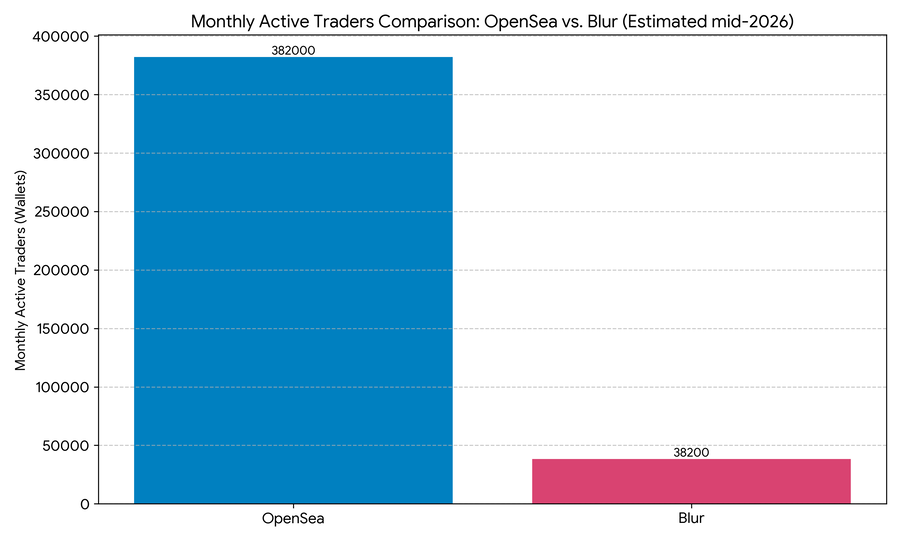
How to Interpret and Utilize This Visual
When evaluating which NFT marketplace provides the best platform for your art, this bar chart offers critical insights beyond simple trading volume headlines. The visual compares two key platforms: OpenSea and Blur, in terms of their actual user base.
-
Understanding the Gap: You are looking at the average number of active human-driven wallets (and potential human collectors) rather than the volume generated by a few automated bots. As of the estimated mid-2026 data, OpenSea boasts around 382,000 monthly active traders, represented by the blue bar. This contrasts sharply with the pink bar, showing that Blur has roughly 38,200 traders; about one-tenth of OpenSea's user base.
-
Actionable Strategic Choice: While other platforms might compete on total trading volume or offer lucrative trading incentives for flippers, OpenSea offers unparalleled reach for artists. For you, this visual confirms that OpenSea is the mandatory venue if your primary goal is maximum discoverability. When a collector finds your art by browsing on OpenSea, it represents an organic opportunity to build a long-term connection, which is not possible in an environment dominated by professional traders and optimized solely for the circular farming of token rewards. Use OpenSea's massive reach to meet diverse, real collectors across its many supported chains.
Rarible: The Best NFT Marketplace for Artists Who Want Higher Royalties and Decentralized Control
That's the pitch with Rarible. It's not the biggest NFT marketplace. It's not the flashiest. It doesn't have the name recognition that makes your non-crypto cousin say "oh yeah, I've heard of that." But if you care about getting paid properly when your work resells, having a real say in how the platform evolves, and not being at the mercy of a centralized team that can change the rules overnight, Rarible deserves a serious look.
I've watched artists get burned by platforms that promised creator-friendly policies and then quietly abandoned them when the market got tough. I've seen royalty rates slashed, terms of service rewritten, and whole platforms shut down without warning. Rarible has stayed the course. And in a space where "creator-first" is often just a marketing slogan slapped on a landing page, that consistency matters more than any feature list.
Why Rarible Is Known as the Artist-Friendly NFT Marketplace
Rarible launched in 2020, which makes it one of the older platforms still standing. It's been through the boom, the bust, and everything in between. It survived the NFT winter that killed dozens of competitors. And through all of it, it has maintained a reputation as the place where artists actually come first. That's not an accident. It's a deliberate design choice that shows up in every aspect of the platform, from the royalty rates to the governance model to the blockchain it built from scratch.
Rarible’s Creator-First Philosophy: What It Means for NFT Artists
The creator-first label gets thrown around a lot in Web3. Every platform claims to care about artists. Every marketplace says it's building for creators. But when you dig into the details, you find that most of them care about artists in the same way that fast food chains care about cows. You're a resource to be extracted, not a partner to be supported. The moment you stop producing value for them, you're replaced.
Rarible is different, and you can see it in the numbers. The platform offers royalty rates that go up to 50%, which is the highest ceiling among any major marketplace. It operates a governance model where RARI token holders vote on platform changes, including fee structures and feature priorities. And it built its own blockchain specifically to enforce royalties in a way that no other platform has matched. These aren't small details. They're structural commitments that shape how the platform operates.
For artists, this means something concrete: you have more control over your income and more say in the platform's direction. That's not nothing. In a market where platforms have repeatedly demonstrated that they'll sacrifice creator economics for trading volume, having a venue that takes the opposite approach is valuable. It's the difference between being a guest in someone else's house and having a seat at the table.
Up to 50% NFT Royalties: The Highest Ceiling Among Major Marketplaces
Let's talk about royalties for a second, because this is where Rarible really separates itself from the pack. On most platforms, the royalty conversation is about whether creators will get anything at all. On Rarible, the conversation is about how much you want to set your rate. That's a completely different dynamic.
Rarible allows creators to set secondary sale royalties up to 50%. That's not a typo. Fifty percent. Now, let's be realistic: most collectors aren't going to pay a 50% royalty. That's a steep premium, and in a competitive market, it would likely reduce demand for your work. I've experimented with high royalty rates myself, and the data is clear: there's a trade-off between royalty percentage and sales volume. But having the option matters. It gives you negotiating room. You can set a high rate and offer discounts to loyal collectors, or you can use a sliding scale that adjusts based on the sale price. The flexibility itself is valuable.
The more important part is that Rarible enforces those royalties at the protocol level. We'll get into the technical details in a moment, but the short version is that your royalties aren't optional on RARI Chain. They're built into the blockchain itself. That's a level of protection that no other major marketplace offers. On OpenSea, royalties are optional for most collections. On Blur, they were always optional. On Rarible Chain, they're mandatory. It's a fundamental difference in philosophy.
RARI Chain: Protocol-Level NFT Royalty Enforcement That Can’t Be Bypassed
This is the part that makes Rarible genuinely unique, and it's worth understanding the technical details because they have real implications for your income.
In January 2024, the RARI Foundation launched the RARI Chain mainnet, an Arbitrum-based Layer 3 blockchain specifically designed for NFT transactions. The defining feature of this chain is simple: royalties are enforced at the node level.
Jana Bertram, the head of strategy at the RARI Foundation, explained it well: "This is different to app-level enforcement, where a change in business direction can scratch royalties completely, or smart contract enforcement, where changes in the contracts can still be implemented." Node-level royalties are permanent and cannot be changed by any centralized authority.
For artists, this is the highest level of guarantee available. It's not a promise. It's not a policy. It's a technical reality that no marketplace, no buyer, and no centralized team can override. If royalty income matters to you, RARI Chain is the gold standard. There's simply nothing else like it.
Rarible’s Governance Model: How Artists Shape the Platform
Most NFT marketplaces are run like traditional startups. A small team makes decisions, and users find out about changes when they happen. Often, the first time you learn about a new policy is when it affects your income. Rarible operates differently. It's governed by a Decentralized Autonomous Organization, which means the people who use the platform have a direct say in how it evolves.
RARI Token: DAO Control Over NFT Marketplace Fees and Features
The RARI token is the governance token of the Rarible ecosystem. It's stewarded by the RARI Foundation on behalf of the community. RARI holders vote on proposals that determine the platform's direction, including fee structures, new feature introductions, and policy decisions. It's not a symbolic vote. It's actual control.
This isn't ceremonial governance. The RARI DAO has voted on real strategic decisions. The recent expansion to Solana, for example, was approved through a DAO vote. The community decided that returning to Solana was worth the investment, and the platform followed through. That's a level of community control that most platforms only pretend to offer. When OpenSea makes a decision, you find out about it after the fact. When Rarible makes a decision, you're part of the conversation.
For artists, the implication is straightforward: you're not just a user, you're a stakeholder. If you hold RARI, you can help shape the platform's priorities. If you don't hold RARI, you can at least know that the platform's direction is being set by the community rather than by a VC-backed board of directors. That's a meaningful difference in a space where platform policies can make or break careers.
The Buyback Model: How Trading Fees Fund RARI and Reward Creators
In September 2025, Rarible made a significant change to its economic model. Previously, trading fees flowed into the platform treasury, where they were controlled by the team. Under the new system, 100% of trading fees are used to purchase RARI tokens from the open market.
This is a big deal for a few reasons. First, it creates a direct link between platform activity and token demand. The more trading that happens on Rarible, the more RARI gets bought, which supports the token's value. Second, it aligns the platform's incentives with its community's interests. When Rarible succeeds, RARI holders benefit. When RARI holders benefit, they're more likely to stay engaged and support the platform. It's a virtuous cycle.
For artists, the buyback model matters because it signals that Rarible is building for the long term. Platforms that rely on token emissions to drive activity are essentially renting their users. When the emissions stop, the users leave. Platforms that generate real revenue and use it to support their token are building something sustainable. Rarible is in the second category. It's not just burning cash and hoping for the best. It's creating a flywheel that connects trading activity to community value.
Why Decentralized Governance Matters for NFT Artists Long-Term
I know governance can sound boring. It's not as exciting as floor prices or royalty rates. It doesn't make for good Twitter content. But here's why it matters: centralized platforms change their policies when it suits them. OpenSea made royalties optional when it felt competitive pressure from Blur. Blur made them optional from day one. If you're relying on a centralized team to protect your interests, you're relying on them to prioritize you over their own revenue. And in a bear market, that's a bet you're probably going to lose.
Decentralized governance flips that dynamic. When the community controls the platform, the community's interests come first. Rarible has maintained strong royalty policies because its community wants them. That's a more reliable foundation for creator economics than any CEO's promise. Policies can still change, but they change through a transparent process that gives stakeholders a voice. That's a meaningful difference.
Rarible’s Ecosystem: RARI Chain, Adobe Partnership, and Gaming Integration
Rarible isn't just a marketplace. It's an ecosystem, and each piece of that ecosystem serves a purpose for artists. Understanding how these pieces fit together helps you see the bigger picture of what Rarible is trying to build.
RARI Chain Mainnet: An Arbitrum-Based Layer 3 Built for NFT Creators
We've already covered the royalty enforcement aspect of RARI Chain, but it's worth understanding what the chain actually is and why it was built. RARI Chain is an Arbitrum-based Layer 3 blockchain. Layer 3 means it sits on top of Arbitrum, which sits on top of Ethereum. The result is a chain that benefits from Ethereum's security while offering faster and cheaper transactions. It's a best-of-both-worlds architecture.
For artists, this means you can mint and sell on RARI Chain without paying the high gas fees that make Ethereum prohibitive for small transactions. The chain is designed specifically for NFTs, which means it's optimized for the kinds of transactions that artists and collectors actually need. It's not trying to be everything to everyone. It's focused on doing one thing well. In a space where general-purpose blockchains often sacrifice NFT-specific features for broader compatibility, that focus is refreshing.
The chain also supports multichain bridging, so you can move assets from Ethereum to RARI Chain without too much hassle. It's not as seamless as it could be, and there's a learning curve if you're new to Layer 2s and Layer 3s, but the payoff is worth it if royalty protection is a priority for you.
Adobe Partnership: Content Credentials for NFT Artist Attribution
One of Rarible's most interesting partnerships is with Adobe. The two companies have collaborated on a Content Credentials program that verifies artist attribution and helps prevent fraudulent reproduction of creative work.
Adobe's Content Credentials attach a kind of digital signature to creative work, showing its provenance and history. When integrated with Rarible, this creates a layer of verification that makes it harder for stolen art to be sold as legitimate. It's not a perfect solution. Determined bad actors will always find workarounds. But it's a meaningful step in the right direction, and it's the kind of partnership that shows Rarible is thinking about artist protection beyond just royalties. It's addressing a real pain point that most platforms ignore.
Somnia Integration: Gaming-Optimized Blockchain for Interactive NFT Art
Rarible has also integrated with Somnia, a gaming-optimized blockchain capable of processing over one million transactions per second. Somnia is designed for interactive and dynamic NFTs, the kind of digital assets that change based on user interaction or game state.
For artists working at the intersection of art and gaming, this opens up possibilities that traditional NFT platforms can't support. Imagine minting a piece that evolves as collectors interact with it, or creating art that functions as a game asset with real utility. Rarible's integration with Somnia means those kinds of projects can be minted, traded, and sold on the platform. It's a niche use case, but for artists working in that space, it's a significant advantage.
Rarible Pros and Cons for NFT Artists
Let me give it to you straight. Rarible is not for everyone. It has real strengths and real weaknesses, and you need to understand both before you commit. I'm not here to sell you on a platform. I'm here to help you make an informed decision.
Pros: High Royalties, Decentralized Governance, Creator-Focused Features
- Highest royalty ceiling in the market. Up to 50% on secondary sales, with protocol-level enforcement on RARI Chain. No other major marketplace comes close to this level of creator control.
- Decentralized governance. RARI token holders vote on platform direction, including fee structures and new features. You're not at the mercy of a centralized team's whims.
- Royalty enforcement that can't be bypassed. RARI Chain enforces royalties at the node level. It's the strongest protection available anywhere in the NFT space.
- Adobe partnership for artist attribution. Content Credentials help prevent plagiarism and verify provenance, addressing a real problem that most platforms ignore.
- Multichain support. Rarible supports Ethereum, Base, HyperEVM, LightLink, Somnia, RARI Chain, Camp Network, Arena-Z, and now Solana. You're not locked into a single ecosystem.
- Buyback model aligns incentives. 100% of trading fees fund RARI buybacks, connecting platform activity to token value. It's a more sustainable model than token emissions.
- Creator-focused tooling. From lazy minting to collection management, Rarible's tools are built with artists in mind rather than traders.
Cons: Smaller Audience, Lower Trading Volume, Less Mainstream Visibility
- Smaller audience. Rarible receives approximately 92,000 monthly visitors, which is a fraction of OpenSea's traffic. The platform claims 1 million monthly active users, but the actual website traffic tells a different story. You're fishing in a smaller pond.
- Lower trading volume. RARI's 24-hour trading volume is around $180,000, and its market cap is roughly $2.1 million. That's tiny compared to major platforms. Lower volume means fewer potential buyers for your work.
- Less mainstream visibility. Rarible doesn't have the brand recognition that OpenSea enjoys. If you're trying to reach collectors who aren't deep in crypto, Rarible might not be where they are. Your non-crypto friends probably haven't heard of it.
- Technical barrier for RARI Chain. Bridging funds to RARI Chain requires some technical knowledge. You need to add the chain to your wallet manually and bridge ETH through a specific process. It's not difficult, but it's not seamless either. For artists who aren't comfortable with technical steps, this can be a hurdle.
- Recent acquisition creates uncertainty. Rarible was acquired by Impossible Finance in May 2026. The acquisition could bring new resources and direction, or it could signal a shift in priorities. It's too early to tell, and uncertainty is never comfortable.
- Token price decline. RARI is down approximately 86% over the past year. That's a brutal drawdown, and it reflects the broader challenges facing the platform. A declining token price can affect community morale and platform resources.
Who Should Use Rarible to Sell NFT Art?
Rarible isn't the right choice for every artist. But for certain creators, it's the obvious answer. Here's how to know if you're one of them.
NFT Artists Seeking Higher Royalty Rates and Protocol-Level Enforcement
If secondary income is important to you, and you want the strongest possible guarantee that you'll receive it, Rarible is the best option available. The combination of up to 50% royalty rates and node-level enforcement on RARI Chain is unmatched. No other platform offers this level of protection.
This is particularly valuable if you're creating work that you expect to appreciate over time. If you're selling editions at low prices, the royalty income might be minimal. But if you're selling unique pieces that could resell for significant sums, having enforceable royalties could mean the difference between a one-time payment and a lasting income stream. Think of it as an annuity on your creative work. The more your art appreciates, the more you earn, without having to lift a finger.
Creators Who Want a Voice in Platform Governance
If you believe that platforms should be governed by their communities rather than by a centralized team, Rarible is the place to be. The RARI DAO gives token holders real influence over the platform's direction. The recent Solana expansion was approved through a community vote, which demonstrates that governance isn't just for show.
For artists who are tired of platform policies changing without warning, decentralized governance offers a more stable and predictable environment. The rules are set by the community, and they change when the community decides they should change. It's not perfect. DAOs have their own challenges, including voter apathy and coordination problems. But it's a more transparent and participatory system than the alternative.
Artists Willing to Trade Discoverability for Stronger Economic Terms
Here's the honest truth: Rarible has a smaller audience than OpenSea. You're not going to get the same volume of random browsers stumbling onto your work. If your primary goal is maximum exposure, OpenSea is the better choice. There's no shame in admitting that.
But if you're willing to accept a smaller audience in exchange for better economics, Rarible makes a compelling case. The royalty protection, the governance model, and the creator-focused infrastructure are all designed to help artists build sustainable careers rather than just chase volume. It's a trade-off, and only you can decide if it's worth it.
My advice? Use both. List your work on OpenSea to reach the widest possible audience, and use Rarible for pieces where royalty protection matters most. You don't have to choose one platform forever. You can experiment, learn what works, and adjust your strategy as you go. The artists who thrive in this space are the ones who treat platforms as tools rather than identities. Use the right tool for the right job, and don't be afraid to switch when the situation changes.
Rarible isn't the biggest NFT marketplace. It's not the most visible. But for artists who prioritize getting paid properly and having a say in how the platform evolves, it might be the best one. And in a market where creator economics are too often an afterthought, that's worth something. It's worth a lot, actually.
📊 NFT Marketplace Royalty Ceilings Compared: Rarible vs. OpenSea vs. Blur
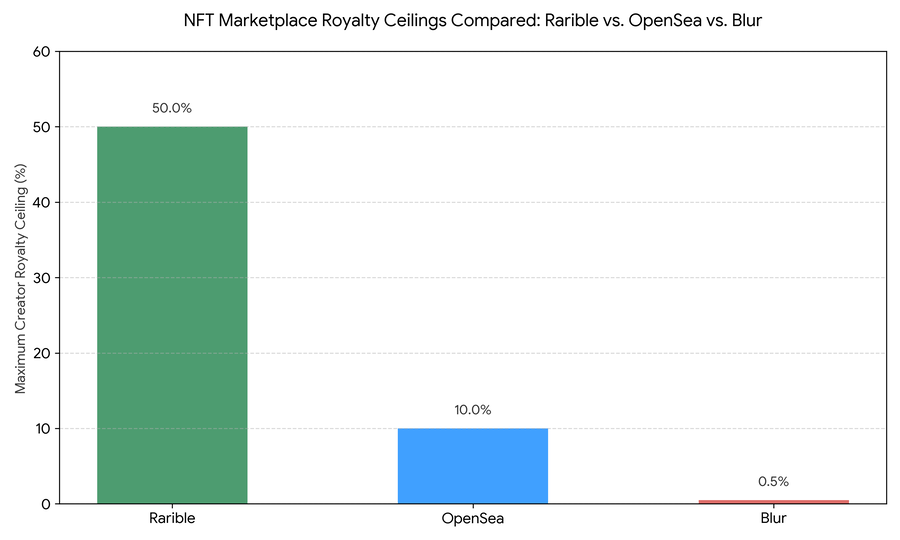
NFT Marketplace Royalty Ceilings Compared: Rarible vs. OpenSea vs. Blur, highlighting Rarible's industry-leading 50% royalty ceiling compared to OpenSea's 10% cap and Blur's 0.5% optional floor.
How to Interpret and Utilize This Visual
If you are an artist trying to maximize your secondary income potential, this bar chart highlights how different platforms structure their creator earnings limits.
-
Rarible (Green Bar): Offers a royalty ceiling of up to 50%, providing the highest flexibility in the industry. Combined with protocol-level enforcement on RARI Chain, it gives you absolute control over your secondary income terms.
-
OpenSea (Blue Bar): Defaults to a 10% creator earnings cap for collections using OpenSea Studio, balancing standard market practices with technical enforcement options like ERC721-C.
-
Blur (Red Bar): Historically featured a minimum royalty floor of just 0.5% (which was optional), prioritizing high-volume trader incentives over creator revenue.
What This Means for Your Strategy
-
Choose Your Platform Based on Your Goals: If your artwork is designed to appreciate significantly in value and you want maximum control over secondary earnings, platforms with high ceilings and strict enforcement (like Rarible) protect your long-term stake.
-
Evaluate Trade-Offs: While platforms like Rarible offer superior royalty terms, they often come with smaller audiences and lower overall trading volumes compared to massive generalist venues. Align your choice with whether your strategy relies on high discoverability or maximum economic protection per sale.
SuperRare: The Best NFT Marketplace for Fine Digital Artists and Curated NFT Art
Let's be real for a moment. Most NFT marketplaces are digital bazaars. Anyone can set up a stall, anyone can sell anything, and the sheer volume of stuff makes it nearly impossible to stand out. You could mint the most breathtaking piece of your career and watch it get buried under a thousand AI-generated penguins within the hour. SuperRare is the opposite. It's a gallery. A curated, invitation-only, white-walled gallery where every artist has been hand-picked and every artwork gets a spotlight. If OpenSea is eBay, SuperRare is Christie's. That distinction matters more than you might think, and it shapes everything about how the platform operates, from who gets in to how much you pay to how collectors behave.
I've talked to artists who dreamed of getting that SuperRare invitation the way musicians dream of signing with a major label. It's validation. It's a signal that someone with taste and credibility looked at your work and said "yes, this belongs here." But it also comes with trade-offs. The audience is smaller. The sales are less frequent. And the platform has had its share of growing pains, including a security incident that raised some eyebrows. So let's break down whether SuperRare is the right fit for you, and what you need to know before you start chasing that invite.
Why SuperRare Is the Gallery of the NFT Art World
SuperRare launched in April 2018, which makes it one of the oldest NFT platforms still operating. It was built by artists and for artists, with a simple premise: create a curated space where digital art could be treated with the same seriousness and respect as physical fine art. That premise hasn't changed. The platform still operates on an invite-only basis, still emphasizes single-edition works, and still attracts a collector base that's more interested in art than speculation.
Curated NFT Marketplace Model: Selective Artist Admission Explained
The invite-only model is the defining feature of SuperRare, and it's worth understanding exactly how it works. Artists cannot simply sign up and start minting. They must be invited by the SuperRare curation team, which actively scours the art community for talent. If you're interested, you can submit your work through a form on the platform's help center, but the team is explicit about the reality: they receive an enormous influx of submissions and cannot respond to everyone.
Why does SuperRare maintain this gatekeeping? The platform's own explanation is refreshingly honest: the health of the marketplace depends not only on having quality artists, but the collector base to support them. They carefully monitor the number of active collectors and make sure the number of artists they onboard is proportional. It's a supply-and-demand balancing act that most platforms ignore entirely. When you flood a marketplace with artists and don't grow the buyer pool, you get a race to the bottom. SuperRare avoids that by design.
For artists, this means the bar is high. But it also means that once you're in, you're in a space where every other artist has also passed that bar. There's no noise to cut through because the noise was filtered out before you arrived. Your work is surrounded by other work that's been deemed worthy of attention. That context elevates everything.
Single-Edition NFT Artworks: Positioning Digital Art as Fine Collectible
SuperRare's catalog is built around single-edition artworks, the digital equivalent of a unique painting or sculpture. This is a deliberate choice that positions the platform's output as fine art rather than collectible merchandise. When you buy a SuperRare piece, you're not buying a numbered edition of a thousand. You're buying the piece, the only one that exists. That's a fundamentally different proposition, and it attracts a fundamentally different kind of collector.
This scarcity is part of what gives SuperRare works their prestige. It's also part of what makes the collector base so different from other platforms. People who buy single-edition art are generally not looking to flip it quickly. They're looking to own something unique, to support an artist they believe in, and to participate in a cultural moment. That creates a different kind of market dynamic, one where prices are less volatile but also less liquid. You're not going to see the wild price swings that happen with edition-based drops. What you'll see is a slower, more deliberate market where quality and reputation matter more than hype.
The platform has expanded its offerings over time. Liquid Editions introduced in 2026 allow for ERC-20-based artworks with multiple tokens and dynamic market mechanics. But the core identity of SuperRare remains rooted in the 1/1 model. That's what the platform is known for, and that's what attracts the collectors who keep coming back.
The SuperRare Collector Base: Serious Buyers, Not Speculators
SuperRare's founder Jonathan Perkins made an observation that cuts to the heart of what makes the platform different: "SuperRare collectors typically don't engage in high-frequency trading or try to make quick money." He contrasted this with the broader NFT market, where flipping and speculation are rampant.
This is a meaningful distinction. The collectors on SuperRare are more likely to hold their purchases for years than to flip them for a quick profit. They're building collections, not portfolios. They care about the artist's trajectory, not just the floor price. And crucially, they're more willing to respect royalties because they see themselves as patrons rather than traders.
Perkins put it well: "We spent five years building a community where collectors genuinely connect with artists, and there's more goodwill and long-term perspective, which often makes it easier to reach consensus on retaining royalties." That community-first approach is why SuperRare can maintain a 10% artist royalty when so many other platforms have made royalties optional or eliminated them entirely. The collector base simply doesn't push back the way it does elsewhere.
SuperRare’s Innovative NFT Products for Artists
SuperRare hasn't rested on its reputation. The platform has continued to experiment with new formats that give artists more ways to create, sell, and engage with collectors. These aren't gimmicks. They're genuine attempts to expand what's possible with onchain art.
Liquid Editions: ERC-20 Artworks with Dynamic Market Mechanics
Liquid Editions represent one of the most interesting innovations in the NFT space. The concept is simple but powerful: an artwork is tied to an ERC-20 token with a fixed supply and dynamic market mechanics. The artwork can respond to onchain activity such as buying, selling, transfers, balances, and liquidity. When the market moves, the art moves with it.
Think about what that means. The artwork isn't a static file. It's a living system that reflects the market's relationship to it. As collectors trade the tokens, the artwork can change visually, conceptually, or interactively. The token layer and the artwork layer are connected, and the artist decides how they relate. It's a new medium, not just a new sales format.
For artists, the guided creation flow makes this accessible. You can start with a JPEG or MP4, no coding required. The dynamic features are optional. If you want to experiment with networked art that responds to trading activity, you can. If you just want to launch an ERC-20 artwork with a built-in market, that's an option too. The flexibility is there without the technical barrier that usually accompanies onchain generative art.
The platform has also introduced Liquid Lenses, optional companion ERC-721 collections that act as visual lenses on the same market state. Different lenses can translate the same market activity into different visual languages, creating a layered, multi-perspective experience of the artwork. It's the kind of thing that makes you rethink what digital art can be.
Releases: Lazy Minting for Large Bodies of NFT Art Without Upfront Gas
SuperRare has historically been criticized for its high gas costs, which are a function of operating on Ethereum mainnet. The platform has addressed this in part through lazy minting, which allows artists to create large bodies of work without paying upfront gas fees. The minting cost is deferred until the artwork is actually sold.
This is a significant improvement for artists who want to experiment with larger collections or release multiple pieces without committing significant capital to gas fees. It lowers the barrier to entry and makes it easier to test the market before going all-in on a major drop. I've seen artists hold back on releasing new work because they couldn't afford the gas. Lazy minting removes that excuse entirely.
The platform has also introduced Series Offers, which allow collectors to place a single offer across all NFTs in an artist's series. This is a clever innovation that benefits both sides: collectors save on gas fees and time, and artists receive offers that apply to their entire body of work rather than individual pieces. It's a small feature, but it makes a big difference in how collectors and artists interact.
How These Tools Help Artists Experiment and Scale
The combination of Liquid Editions, lazy minting, and Series Offers gives SuperRare artists a toolkit that goes beyond simply minting and selling JPEGs. You can experiment with dynamic, market-responsive art. You can release larger bodies of work without upfront costs. You can attract offers across your entire catalog rather than piece by piece.
These tools also signal something important about the platform's direction. SuperRare isn't just resting on its reputation as a curated gallery. It's actively building new formats that expand what artists can do. That's a sign of a platform that's thinking about the future rather than just defending the past. In a market where many platforms are cutting costs and narrowing their focus, SuperRare is still investing in innovation.
SuperRare Fees and Artist Economics: What Creators Need to Know
Let's talk numbers. SuperRare's fee structure is one of the highest in the NFT space, and it's important to understand both what you're paying and what you're getting in return.
The 15% Primary Commission: Higher Than Average, Justified by Curation
On the primary sale of an artwork, the artist receives 85% of the sale price, and SuperRare takes 15% as a commission. For comparison, OpenSea charges 2.5%, and Zora charges nothing. SuperRare's 15% is substantially higher than most competitors.
Is it justified? The platform argues yes, and the argument has merit. SuperRare positions itself alongside traditional galleries, which typically charge 25% to 50% commissions. By that standard, 15% is actually generous. The curation process, the gallery-style presentation, and the collector base that SuperRare has built over eight years are the value proposition. You're not paying for infrastructure. You're paying for access to a specific kind of collector and a specific kind of prestige.
That said, 15% plus Ethereum gas fees is a meaningful drag on returns, especially in a low-liquidity market. If you're selling a piece for 1 ETH, the commission alone is 0.15 ETH. Add gas costs, and your net proceeds are significantly lower than the headline price. It's a trade-off, and you need to decide if the SuperRare premium is worth it for your work. If you're selling at high price points, the math works out. If you're selling at lower price points, the fees can eat your margin alive.
Secondary Royalties on SuperRare: What Artists Earn Over Time
SuperRare has been a pioneer in artist royalties. The platform introduced automated artist royalties on NFTs in 2018, long before it became a standard feature elsewhere. The current structure is simple: on any secondary sale, the artist receives 10% of the sale price, and the collector who is selling receives 90%.
This 10% rate is on the higher end of the market. Many platforms have made royalties optional or reduced them to 2.5% or 5%. SuperRare's founder has been explicit that royalties will not disappear on the platform, and the collector base's long-term orientation makes it easier to maintain this policy. Collectors on SuperRare generally aren't flipping for quick profits, so they're less resistant to paying royalties. It's a cultural difference as much as a policy difference.
There's also a unique feature: collector royalties. On secondary sales, a portion of the 3% network fee is redistributed to previous collectors in the artwork's chain of ownership. The first collector receives 1% after the second secondary transaction, and the royalty decays by 50% for each subsequent transaction. It's a way to reward collectors for their role in supporting artists and to incentivize holding rather than flipping. It's a small thing, but it creates a different set of incentives than you see on other platforms.
Collector Access and the Premium NFT Buyer Pool
The most valuable thing SuperRare offers isn't the technology or the fee structure. It's the collector base. These are people who have demonstrated a willingness to pay premium prices for digital art, who value curation and provenance, and who are more likely to hold their purchases long-term.
This collector base is small but dedicated. It's not the kind of audience that will generate viral sales or bidding wars. It's the kind of audience that builds careers slowly and steadily. If you're an artist who values depth over breadth, who would rather have ten committed collectors than a hundred speculators, SuperRare's buyer pool is exactly what you want. These are the people who will show up for your next drop, who will tell their friends about your work, and who will still be collecting when the next hype cycle comes and goes.
The MoonPay Concierge service is another signal of the collector base's profile. Collectors can use MoonPay to purchase artworks above $15,000 without needing to manage crypto directly. That's not a feature for casual buyers. It's a feature for serious collectors who want to participate in the market without dealing with wallet management and gas fees. It's a sign that SuperRare is courting a different kind of buyer, one who thinks in terms of art acquisition rather than crypto trading.
SuperRare Risks and Realities for NFT Artists
SuperRare is a legitimate platform with a strong track record. But it's not without risks, and you need to understand them before you commit. I'm not here to sell you a dream. I'm here to give you the full picture.
Market Liquidity Concerns: Thin Buyer Pool in Post-Boom Conditions
The NFT market has contracted dramatically from its 2021 peak. Overall trading volumes have fallen more than 80% from peak levels, and NFT sales dropped a further 37% in 2025 to roughly $5.6 billion. SuperRare has not been immune to this trend.
The platform's daily transaction count has fallen dramatically from its highs. One data source recorded zero sales over a recent 30-day window, though other sources report ongoing but thin weekly volume. The buyer pool is small, and in a market where liquidity is scarce, selling an artwork can take time. If you need to sell quickly, you may not find a buyer at any price close to what you paid or what you believe the work is worth.
This isn't fraud. It's market risk. But it's a risk that was consistently under-communicated during the NFT boom, and it's one that every artist and collector should understand before participating. The days of listing a piece and watching a bidding war unfold within hours are largely over, at least for now. If you're coming to SuperRare expecting quick sales, you're going to be disappointed. If you're coming with a long-term mindset, you'll find a market that rewards patience.
The 2025 Staking Contract Exploit: What It Means for Platform Trust
In July 2025, SuperRare suffered a smart contract exploit that resulted in the unauthorized transfer of approximately 11.9 million RARE tokens, worth roughly $680,000 to $730,000. The vulnerability was in the staking contract's updateMerkleRoot function, which had inverted access control logic. Instead of allowing only privileged accounts to update the Merkle root, the function allowed anyone to do it. An attacker exploited this to set a malicious Merkle root and drain the contract's token balance.
The exploit was particularly damaging because it was a basic access control error, the kind of flaw that should have been caught in an audit. The attacker used Tornado Cash to obscure the funds. SuperRare responded by mandating re-audits for all post-audit code modifications and expanding unit testing, but the incident raised questions about the quality of the platform's security practices.
It's important to note that the exploit affected the staking contract specifically. It did not involve users' NFT holdings, which are held in non-custodial wallets. But if you're considering staking RARE tokens, this incident is a direct and documented risk. It's a reminder that even established platforms can have vulnerabilities, and that smart contract risk is real.
How to Evaluate SuperRare’s Long-Term Viability as an NFT Artist
So how do you decide if SuperRare is worth the effort? Here are the questions I'd ask:
- Is your work a fit for the platform's aesthetic? SuperRare's curation team has a specific taste: digital art that pushes boundaries, that has conceptual depth, that feels like it belongs in a gallery. If your work is more commercial or meme-oriented, you'll struggle to get in and to find buyers even if you do. Do your research. Look at what's already on the platform. If your work fits the vibe, you have a shot.
- Can you afford to wait for sales? The buyer pool is thin. Sales can take weeks or months. If you need steady income, SuperRare probably isn't the right primary platform. If you're building a long-term career and can afford to be patient, it's a different story. The artists who succeed on SuperRare are the ones who treat it as a marathon, not a sprint.
- Do you value prestige over volume? A SuperRare sale is a signal. It tells collectors and other artists that your work has been vetted by a curation team with a track record. That signal has value, but it comes at the cost of reach. If you're trying to build a massive following as quickly as possible, SuperRare isn't the place. If you're trying to build a reputation as a serious artist, it is.
- Are you comfortable with Ethereum-only transactions? SuperRare operates exclusively on Ethereum. There's no Solana, no Base, no Polygon. Every transaction requires ETH and incurs gas fees. If you're looking for low-cost minting, this isn't the platform for you. If you're willing to pay for the prestige of Ethereum, it's a different calculation.
SuperRare Pros and Cons for NFT Artists
Let me give it to you straight. SuperRare is not for everyone, and pretending otherwise would be a disservice.
Pros: Prestige, Curation, Serious Collectors, Fine Art Positioning
- Prestige. A SuperRare invitation is a credential. It signals to the art world that your work has been vetted by a respected curator. That signal has real value, especially if you're trying to bridge into traditional art markets.
- Curation. You're not competing with millions of other NFTs. You're in a curated space where every artist has passed the same bar. That makes it easier to stand out and easier for collectors to find you.
- Serious collectors. The buyer base is small but dedicated. These are people who value art, who hold long-term, and who are more likely to respect royalties. You're not fighting against flippers who see your work as a quick flip.
- Fine art positioning. SuperRare treats digital art as fine art. The platform's presentation, the single-edition model, and the gallery-style aesthetic all reinforce this positioning. If you want to be taken seriously as a digital artist, this matters.
- Strong royalties. The 10% artist royalty on secondary sales is on the higher end of the market, and the platform has committed to maintaining it. In a space where royalties are increasingly optional, that's a meaningful advantage.
- Innovation. Liquid Editions, lazy minting, and Series Offers show that SuperRare is actively building new formats for artists. The platform isn't resting on its reputation.
Cons: High Barrier to Entry, Lower Volume, Limited Artist Slots
- High barrier to entry. You can't just sign up. You need an invitation. The curation team receives an enormous influx of submissions and can't respond to everyone. Getting in requires patience, persistence, and a body of work that catches their eye. It's not a meritocracy in the traditional sense, but it's not arbitrary either.
- Lower volume. The platform's trading volume is a fraction of OpenSea's. Sales are less frequent, and the buyer pool is thin. If you need steady income, this is a significant drawback.
- Limited artist slots. The invite-only model means there are fewer artists on the platform, which is good for those who are in but frustrating for those who are trying to get in. The curation team deliberately limits onboarding to maintain the balance between artists and collectors.
- High fees. The 15% primary commission is substantially higher than most competitors. Add Ethereum gas fees, and the cost of selling on SuperRare is significant. You're paying for access and prestige, but it's still a meaningful drag on returns.
- Ethereum-only. No Solana, no Base, no Polygon. If you want to mint on low-cost chains, SuperRare isn't an option. You're locked into Ethereum and its associated costs.
- Smart contract risk. The 2025 staking contract exploit was a serious incident that raised questions about the platform's security practices. While the vulnerability didn't affect NFT holdings, it's a reminder that smart contract risk is real.
- Token price decline. RARE is down approximately 69% over the past year. The token's market cap is roughly $21 million, a fraction of its 2021 peak. If you're holding RARE as an investment, that's a painful drawdown.
Who Should Use SuperRare to Sell NFT Art?
SuperRare isn't the right platform for every artist. But for certain creators, it's the obvious choice.
Fine Digital Artists Targeting Serious NFT Collectors
If your work is ambitious, conceptual, and visually striking, SuperRare is built for you. The platform's curation team is looking for artists who are pushing the boundaries of digital art, who have a distinctive voice, and who are building a body of work rather than just minting one-offs. If that describes you, SuperRare offers access to a collector base that will take your work seriously. These are people who will spend time with your art, who will ask questions about your process, and who will still be collecting when the next bear market hits.
Creators Who Value Curation and Gallery-Style Presentation
Some artists thrive in open, permissionless environments. Others prefer the structure and validation of a curated space. If you're in the second category, SuperRare's gallery model is appealing. You're not just another listing in an endless feed. You're part of a curated collection, presented alongside artists who share your ambitions. That context matters, both for how collectors perceive your work and for how you perceive yourself as an artist. It's a different psychological experience, and for many artists, it's a more rewarding one.
NFT Artists Focused on Quality Over Quantity
SuperRare is not a volume game. You're not going to sell hundreds of pieces or build a massive following overnight. What you can do is build a small, dedicated collector base that values your work and supports your career over the long term. If that sounds better to you than chasing viral moments and fleeting attention, SuperRare might be your home. It's a place for artists who would rather have a deep relationship with a few collectors than a shallow relationship with thousands of speculators.
The platform has been around for eight years. It's survived the boom, the bust, and everything in between. It's not going anywhere. And for the right artist, it remains one of the most prestigious and rewarding places to sell digital art. If you can get in, it's worth considering. If you can't, it's worth working toward. The invitation is the hard part, but the community on the other side is real, and it's waiting.
📊 SuperRare vs. OpenSea: Fee and Royalty Structures Compared
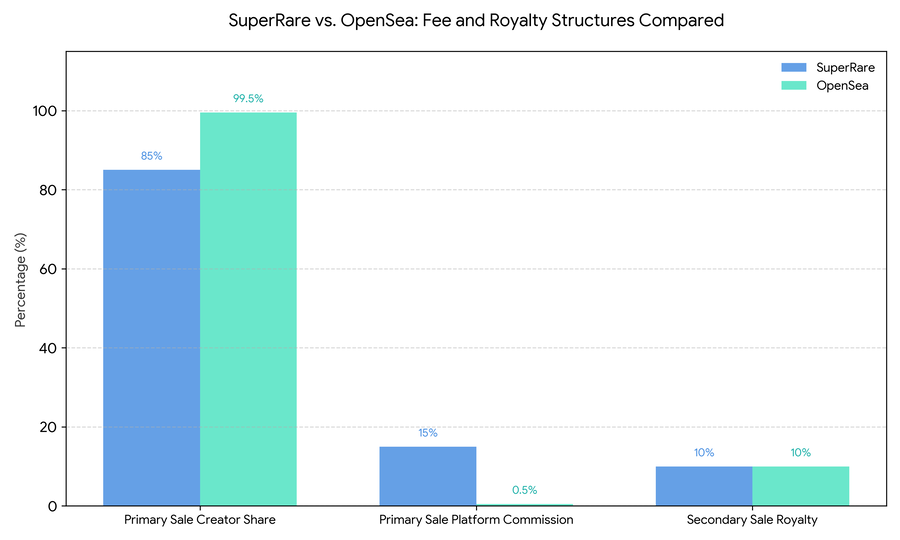
SuperRare vs. OpenSea: Fee and Royalty Structures Compared, contrasting SuperRare's gallery-style 15% primary commission with OpenSea's 0.5% marketplace fee, while highlighting their shared 10% secondary royalty rate.
How to Interpret and Utilize This Visual
When evaluating where to sell your digital art, understanding the direct trade-off between platform reach and economic commission is vital. This grouped bar chart breaks down the financial terms between a curated fine-art gallery model (SuperRare) and a massive generalist marketplace (OpenSea).
-
Primary Sale Economics: On SuperRare, creators receive 85% of the primary sale price while the platform takes a 15% commission, reflecting its curated gallery positioning and white-glove presentation. On OpenSea, creators retain 99.5% of primary sales with a minimal 0.5% marketplace fee, prioritizing maximum open access.
-
Secondary Sale Royalties: Both platforms support a robust 10% secondary royalty rate, ensuring that artists receive ongoing compensation when their work changes hands in the secondary market.
What This Means for Your Strategy
-
Weighing Prestige Against Margins: SuperRare's higher 15% primary commission functions similarly to traditional fine-art galleries (which often charge 25% to 50%), trading off immediate profit margins for curated prestige, high-intent collectors, and a focused audience. OpenSea offers minimal platform fees, leaving the burden of marketing and discoverability entirely on your shoulders.
-
Aligning With Your Art Career Goals: If you create conceptual, high-value 1/1 fine art and want to be positioned alongside vetted peers, the premium fees on SuperRare are designed to support that gallery environment. If you need low-cost experimentation and maximum exposure across diverse multichain ecosystems, generalist platforms like OpenSea provide the necessary scale.
Magic Eden: The Best NFT Marketplace for Solana Artists and High-Speed Trading
If you've spent any time in the Solana NFT ecosystem, you already know the name. Magic Eden has been the dominant force on Solana since it launched back in September 2021, and for good reason. It built the infrastructure, the community, and the liquidity that Solana artists needed to actually sell their work. While Ethereum artists were paying $50 in gas fees just to list a piece, Solana creators were minting for fractions of a cent and watching their work trade hands in seconds. That speed and affordability created a completely different culture, one that Magic Eden understood better than anyone else.
But the past year has been a wild ride, even by crypto standards. The platform made a massive strategic pivot in early 2026, shutting down entire business lines and refocusing on its Solana roots. Then it announced a pivot into gambling that left a lot of people scratching their heads. If you're an artist trying to figure out whether Magic Eden is still the right home for your work, this section is for you. I'm going to give you the full picture, including the parts that aren't pretty.
Magic Eden’s Strategic Pivot: What Changed and Why It Matters for NFT Artists
Let me give it to you straight: Magic Eden is not the same platform it was in 2024. The company made a hard call in February 2026, and that call reshaped everything about what the marketplace offers to artists. Some people saw it as a necessary course correction. Others saw it as a betrayal of the multi-chain vision the platform had been selling for years. Both perspectives have merit.
The 2026 Decision to End EVM and Bitcoin Support
On March 9, 2026, Magic Eden officially wound down marketplace support for EVM chains (Ethereum, Polygon, Base, Avalanche) and Bitcoin (Ordinals and Runes). The Bitcoin API and remaining Bitcoin services were discontinued on March 27, and the Magic Eden Wallet was fully shut down by May 1. If you were using that wallet, you needed to export your private key and migrate to another provider before the deadline, or you risked losing access to your assets. That's not a theoretical risk. That's a real deadline that caught some people off guard.
Why did this happen? CEO Jack Lu was blunt about it. According to his explanation, 80% of operating costs were associated with products that contributed only 20% of revenue. The math simply didn't work anymore. Magic Eden had spread itself too thin trying to be a multi-chain empire, and the NFT market downturn made that strategy unsustainable. When you're burning cash on engineering, indexing, and support for chains that aren't generating meaningful revenue, you have two choices: cut the fat or watch the whole thing collapse. Magic Eden chose to cut.
For artists who had minted on Ethereum, Polygon, or Bitcoin through Magic Eden, this was a gut punch. Listings and offers were off-chain, so they simply stopped being visible when support ended. No funds were locked, which is some consolation, but the sudden loss of a major marketplace venue left a lot of creators scrambling to find alternatives. I talked to one artist who had spent months building a collector base on Magic Eden's Bitcoin Ordinals marketplace. She woke up one morning to find her listings gone and her collectors confused. She had to rebuild from scratch on a different platform. That's the kind of disruption that doesn't show up in press releases.
The Return to Solana-Only: Focusing on Core Strengths
What remains after the dust settled? The Solana marketplace and Solana Packs. That's it. Magic Eden is now effectively a Solana-only platform, and honestly, that might be the smartest thing the company has done in years.
Solana has always been Magic Eden's strongest ecosystem. The platform supports the full modern Solana NFT stack, including Metaplex Core, Token 22, and compressed NFTs (cNFTs). The community depth, the Launchpad partnerships, and the liquidity built over four years don't disappear overnight. By narrowing its focus, Magic Eden can stop spreading its engineering team too thin and start competing on the things that actually matter for Solana creators. It's a classic business move: cut what isn't working, double down on what is, and hope the market rewards the discipline.
What This Means for Artists Who Minted on Multiple Chains
If you were one of the artists who diversified across EVM chains and Bitcoin through Magic Eden, you've already felt the impact. Your listings are gone from the platform, and you need to find new venues for those works. There's no way around it. The transition wasn't seamless, and the notice period was short.
The practical takeaway is simple: don't rely on a single marketplace for your multi-chain strategy. Magic Eden's pivot is a reminder that platform priorities can change overnight. If you're minting on Ethereum, you need OpenSea, Rarible, or another EVM-native venue. If you're working with Bitcoin Ordinals, you need a dedicated Ordinals marketplace. Magic Eden is no longer a one-stop shop for cross-chain artists, and you need to adjust your strategy accordingly.
I've started recommending that artists maintain a simple spreadsheet of where their work is listed, which chains it's on, and what the backup plan is if any of those platforms shut down. It sounds paranoid, but in this market, paranoia is just good planning. The artists who survived Blur's shutdown and Foundation's closure were the ones who had diversified their presence. The ones who put all their eggs in one basket learned a hard lesson.
Why Solana Remains a Top Blockchain for NFT Artists
Now that Magic Eden is Solana-only, let's talk about why Solana itself is still one of the best blockchains for NFT artists in 2026. The numbers make a compelling case, and the cultural factors matter just as much.
Deepest Solana NFT Ecosystem: Launchpad, Community, and Liquidity
Magic Eden's position in the Solana NFT ecosystem is structurally strong. The platform has the deepest liquidity for Solana NFTs, and its Launchpad maintains quality control over new projects, reducing the frequency of scams and rug pulls that plague permissionless platforms. For collectors entering new Solana projects, Launchpad approval is a meaningful signal that the team behind the project has been vetted. It's not a guarantee of success, but it's a filter that removes the most obvious bad actors.
The community depth is another factor that's hard to quantify but impossible to ignore. Magic Eden has been the default Solana marketplace for years. The relationships, the collector base, and the cultural cachet don't vanish just because the company shut down some side projects. If you're building a Solana-native collection, Magic Eden is still where the collectors are. The platform's Discord is active, the Launchpad drops still generate buzz, and the team still has relationships with the major Solana NFT projects. That social infrastructure is worth more than any technical feature.
Sub-Second Transactions and Negligible Fees for NFT Creators
Solana's technical advantages are real and they matter for artists. The network consistently maintains over 4,000 transactions per second (TPS), compared to Ethereum's average of around 12 TPS. That's a difference of roughly 333x in throughput. For practical purposes, this means transactions settle almost instantly, with extremely low slippage. You click buy, and the NFT is in your wallet before you can refresh the page.
The fee difference is even more dramatic. Solana NFT transaction fees are around $0.000025, which is approximately 60,000 times cheaper than Ethereum gas fees. For artists who want to experiment, mint multiple pieces, or list at lower price points, this cost structure is a game-changer. You're not burning hundreds of dollars in gas just to test a new collection. You can mint ten pieces, list them at different price points, and see what resonates without worrying about the cost of failure.
I've seen artists on Ethereum hold back from releasing new work because they couldn't afford the gas. On Solana, that excuse doesn't exist. You can be prolific without going broke. That changes the creative calculus in a meaningful way.
The Solana Collector Base: Gamers, Traders, and High-Speed Enthusiasts
Solana's collector base has a distinct personality. These are often gamers, traders, and high-frequency enthusiasts who value speed and efficiency. The platform's daily active NFT trading wallets have exceeded 2.9 million, and Solana now commands over 60% of secondary NFT trading volume.
This collector profile has implications for artists. Solana collectors are generally more comfortable with quick decisions and lower price points. They're not the blue-chip fine art crowd you'll find on SuperRare. They're the people who will buy a piece because it caught their eye, trade it a few times, and move on to the next thing. That can be frustrating if you're trying to build a collector base that holds long-term. But it can also be liberating if you're willing to embrace the speed and energy of the ecosystem.
If your art appeals to that demographic, or if you're willing to adapt your strategy to it, Solana is a great place to be. The collectors are active, the trading is constant, and the community is always looking for the next interesting thing. You just have to be ready to keep up.
Magic Eden Fees and Royalty Policies: What NFT Artists Earn
Let's talk money. Magic Eden's fee structure is straightforward, but the royalty situation is more complicated than it first appears. And the difference between what you think you'll earn and what you actually earn can be significant.
Magic Eden’s 2% Marketplace Fee on Solana
Is 2% reasonable? On Solana, where transaction costs are negligible, the marketplace fee is the primary cost of selling. For a 1 SOL sale, you're paying 0.02 SOL to Magic Eden. That's not nothing, but it's also not unreasonable given the platform's liquidity and reach. The fee hasn't been revised downward despite competitive pressure, which suggests Magic Eden believes its Solana dominance justifies the premium. And honestly, they might be right. If you want access to Solana's collector base, Magic Eden is still the best door to knock on.
But if you're doing high-volume trading, that 2% adds up fast. A trader flipping ten NFTs a day is paying 0.2 SOL in fees daily. Over a month, that's 6 SOL. That's real money. For artists selling at higher price points, the percentage stings less. For artists selling at lower price points, it can eat a meaningful chunk of your revenue.
Optional NFT Royalties: What This Means for Artist Secondary Income
Here's where things get tricky. Magic Eden gives buyers the option to honor royalties set by creators embedded in their metadata. On Solana, the platform's optional royalty system allows buyers to choose between full (100%), half (50%), or no (0%) royalty when purchasing. By default, royalties are set to full, but buyers can change this setting at the account, collection, or item level. And many of them do.
What does this mean in practice? It means your royalty income on Magic Eden is essentially voluntary. Some buyers will pay the full royalty because they want to support artists. Others will set it to zero and keep the extra percentage for themselves. The platform's own documentation frames this as "empowering buyers to make conscious choices," but from an artist's perspective, it's a system that puts your secondary income at the mercy of buyer goodwill. And in a bear market, goodwill is often the first thing to go.
The exception is collections that have adopted the MIP-1 standard, which enforces royalties. If your collection uses MIP-1, buyers don't have the option to skip royalties. The smart contract itself enforces the payment. For artists who care about secondary income, this is the standard you should be using. It's not a magic bullet, but it's the difference between hoping you get paid and knowing you will.
How Magic Eden Compares to OpenSea and Rarible on Royalties
The royalty landscape across major marketplaces is bleak for artists who want guaranteed secondary income. OpenSea's royalties are optional for most collections. Magic Eden's are optional on Solana. Blur's were always optional. The only major platform with robust protocol-level enforcement is Rarible, through RARI Chain's node-level royalty system. If royalty income is a priority for you, that's the platform to beat.
Magic Eden does offer royalty enforcement through Limit Break's Payment Processor v2 on its EVM platform, but since the EVM marketplace is now shut down, that's no longer relevant for new collections. On Solana, your options are MIP-1 (enforced) or the default optional system (not enforced).
If royalty income is a priority for you, use MIP-1. It's the only way to ensure you get paid on secondary sales through Magic Eden. If you're not using MIP-1, you should treat royalties as a nice bonus rather than a reliable income stream. That's not pessimism. That's just reading the data.
The $ME Token and Revenue Sharing: How Magic Eden Rewards Creators
Magic Eden's $ME token is a central part of the platform's ecosystem, and the team has made some significant changes to its tokenomics that are worth understanding. Some of these changes are genuinely innovative. Others raise questions about where the platform is heading.
15% Revenue Allocation: Buybacks and USDC Staking Rewards
In January 2026, Magic Eden announced that 15% of all platform revenue would be directed into the $ME token ecosystem. This revenue is split evenly: 50% goes toward token buybacks on the open market, and 50% is distributed to $ME stakers in the form of USDC.
The staking rewards are weighted by both the amount staked and the duration of staking, and rewards can be claimed starting in March 2026. The first claim corresponds to February activity, and rewards must be claimed within 90 days. If you miss the window, you lose the rewards. So if you're staking $ME, set a calendar reminder.
This is one of the more direct and credible token-value-accrual models in the NFT marketplace space. If platform revenue grows, $ME holders benefit directly. The USDC payouts are particularly interesting because they provide a stable, non-inflationary reward rather than just more of the same token. You're not being paid in promises. You're being paid in dollars. That's a meaningful difference in a space where token emissions are often just dilution in disguise.
iGaming Expansion: Dicey Platform and the Gambling Pivot
Here's the part that has a lot of people scratching their heads. Magic Eden is pivoting hard into iGaming through its new platform Dicey, an on-chain casino and sports betting service. During a two-month closed beta, approximately 200 users wagered over $15 million. That's a lot of money moving through a platform that hasn't even fully launched yet.
CEO Jack Lu has been explicit about the vision: Magic Eden is entering "a new era where finance and entertainment merge." The iGaming sector presents "huge opportunities," and Magic Eden wants to seize an early lead. The company is positioning $ME as a central utility token across both the marketplace and Dicey.
The logic is sound from a business perspective. iGaming revenue, particularly sports betting and casino games with house edges, is more predictable and generates consistent fee flow regardless of crypto market cycles. For a company that has watched NFT trading volumes collapse, that stability is attractive. NFT trading is cyclical. Gambling is not. People bet on sports and play casino games in bull markets and bear markets alike. It's a more reliable revenue stream.
What This Means for NFT Artists on Magic Eden
So what does the gambling pivot mean for artists? Honestly, it's a mixed bag.
The positive interpretation: Dicey generates revenue that funds the $ME buyback and staking rewards, which supports the token ecosystem and, by extension, the platform's long-term viability. A profitable Magic Eden is a Magic Eden that can afford to keep supporting its Solana marketplace. If Dicey succeeds, the marketplace benefits from the cash flow.
The less positive interpretation: Magic Eden is shifting its identity away from NFTs and toward gambling. The company's brand, community, and $1.6 billion valuation were built on NFT culture. Pivoting to gambling risks alienating the creator and collector community that made the platform what it was. And competing in crypto gambling means going up against established players like Stake, Rollbit, and BC.Game that have deep liquidity and large existing user bases. It's a crowded market, and Magic Eden is late to the party.
For artists, the practical question is whether Magic Eden will continue investing in the Solana marketplace and creator tools, or whether NFTs become an afterthought while the company chases gambling revenue. It's too early to say for certain, but it's a risk worth monitoring. I'd recommend keeping an eye on the platform's announcements and seeing where the engineering resources are going. If the marketplace stops getting updates, that's a signal.
Magic Eden Pros and Cons for NFT Artists
Let me give it to you straight. Magic Eden is a powerful platform, but it's not the right fit for every artist, and the recent pivot has introduced new uncertainties. Here's the full picture:
Pros: Deep Solana Liquidity, Low Fees, Strong Community
- Deepest Solana NFT ecosystem. Despite the strategic pivot, Magic Eden's position in Solana NFTs is structurally strong. The community relationships, Launchpad partnerships, and liquidity built over four years don't disappear overnight.
- Solana fees make trading practical. At under $0.001 per transaction, Solana gas costs are effectively zero. For active traders and collectors, Magic Eden's Solana-native experience is meaningfully cheaper than any Ethereum-based alternative.
- Curated Launchpad. Magic Eden's Launchpad maintains quality control over new projects, reducing the frequency of scams and rug pulls compared to fully permissionless alternatives. Launchpad approval is a meaningful signal for collectors.
- Strong $ME tokenomics. The revenue-sharing model (15% of revenue, split between buybacks and USDC staking rewards) is one of the most direct and credible token-value-accrual models in the NFT marketplace space.
- Zero listing fees. Listing your NFTs on Magic Eden is free, which lowers the barrier to entry for artists who want to test the market.
- Non-custodial model. Magic Eden never holds user assets. All NFTs remain in your own wallet and transfer on-chain at point of sale, eliminating exchange-style custody risk.
Cons: Solana-Only, Optional Royalties, Gambling Pivot Concerns
- Solana-only after March 2026. If you're minting on Ethereum, Polygon, Base, or Bitcoin, Magic Eden is no longer an option. The platform exited those ecosystems entirely.
- Optional royalties on Solana. Your secondary income is essentially voluntary unless you're using the MIP-1 standard. Many buyers will set royalties to zero, and there's nothing you can do about it.
- 2% fee is the highest of the major three. Compared to OpenSea's 0.5% and Blur's 0%, Magic Eden's 2% Solana fee is a genuine competitive disadvantage for cost-sensitive traders.
- Dicey is an unproven bet. Pivoting toward crypto gambling means competing with established platforms that have deep liquidity, large user bases, and multi-year track records. The pivot also risks alienating the NFT community that built Magic Eden's brand.
- March 2026 pivot damaged trust. Shutting down Bitcoin Ordinals, EVM, and the multi-chain wallet with relatively short notice alienated a significant user base. Legal scrutiny from Burwick Law adds additional uncertainty.
- $ME token price decline. The $ME token is down approximately 80% over the past six months, which makes it harder for the platform to regain momentum. A declining token price can affect community morale and platform resources.
- Wallet shutdown. If you were using the Magic Eden Wallet, it's gone. You needed to export your private key and migrate to another wallet provider before May 1, 2026, or risk losing access to your assets.
Who Should Use Magic Eden to Sell NFT Art?
Magic Eden isn't the right platform for every artist. But for certain creators, it's still the obvious choice. Here's how to know if you're one of them.
Solana-Native NFT Artists and Collection Teams
If your art is Solana-native, Magic Eden is still the default starting point. The platform has the deepest liquidity, the most active collector base, and the strongest community relationships in the Solana ecosystem. If you're building a collection on Solana and you want maximum visibility to Solana collectors, Magic Eden is where you need to be.
The Launchpad is particularly valuable for collection teams. Getting approved for a Magic Eden Launchpad drop signals to collectors that your project has been vetted, which reduces the risk of scams and rug pulls. For new teams trying to build trust, that validation is worth a lot. It's the difference between launching into a void and launching with a stamp of approval from the most trusted name in Solana NFTs.
Creators Who Value Community Depth and Launchpad Visibility
Magic Eden's community is one of its strongest assets. The platform has been the heart of Solana NFTs for years, and that cultural cachet matters. If you're an artist who wants to be part of a specific ecosystem, who values deep relationships with collectors over broad but shallow reach, Magic Eden offers something that no other platform can replicate.
The Launchpad also provides visibility that's hard to get elsewhere. Getting featured on Magic Eden's Launchpad puts your project in front of thousands of Solana collectors who are actively looking for new drops. For emerging artists, that kind of exposure can be career-changing. I've seen artists go from unknown to sold out in a single Launchpad drop. That kind of acceleration is rare, and it's one of the few remaining advantages of being early in a growing ecosystem.
NFT Artists Targeting Gamers and High-Frequency Traders
Solana's collector base skews toward gamers, traders, and high-frequency enthusiasts. If your art appeals to that demographic, or if you're willing to adapt your strategy to it, Magic Eden is a natural fit. The platform's integration with Solana's fast, low-cost infrastructure makes it ideal for dynamic, interactive, or gaming-adjacent NFTs.
This isn't the platform for fine art collectors who want to spend weeks deliberating over a purchase. It's for artists who want to move fast, experiment often, and reach collectors who are comfortable with quick decisions and lower price points. If that sounds exhausting, it is. But it's also exciting. The energy on Solana is different from Ethereum. It's faster, looser, and more experimental. If you thrive in that kind of environment, Magic Eden is your home.
Magic Eden has been through a lot in the past year. The platform shrank its scope dramatically, pivoted toward gambling, and alienated some of its user base in the process. But for Solana artists, it's still the biggest game in town. The liquidity, the community, and the Launchpad visibility are real advantages that no competitor has matched.
The key is to go in with your eyes open. Use MIP-1 for royalty enforcement. Understand that the platform's future is increasingly tied to Dicey and iGaming. And don't assume that Magic Eden will be the same platform in two years that it is today. If you're Solana-native, it's still the best place to be. Just make sure you're not putting all your eggs in one basket, because in this market, baskets have a habit of disappearing. The artists who survive are the ones who plan for the worst while hoping for the best. That's not cynicism. That's just smart business.
📊 NFT Marketplace Fee Comparison: Magic Eden vs. OpenSea vs. Blur
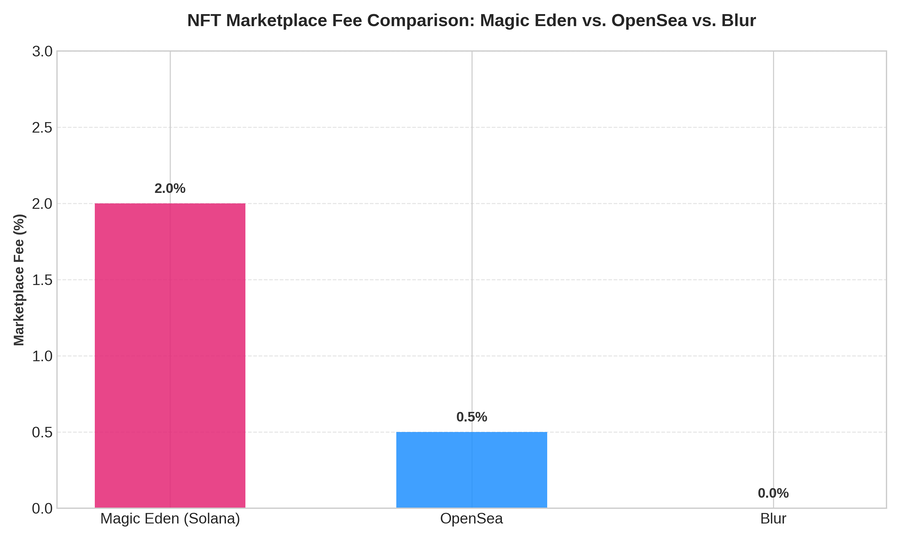
NFT Marketplace Fee Comparison: Magic Eden vs. OpenSea vs. Blur, highlighting Magic Eden's 2.0% marketplace fee on Solana relative to OpenSea's 0.5% and Blur's 0.0% fee structures.
How to Interpret and Utilize This Visual
When budgeting your NFT releases and trading strategy, evaluating baseline marketplace fees is critical to protecting your margins. This bar chart breaks down the direct percentage take rate charged by major platforms:
-
Magic Eden (Pink Bar): Charges a 2.0% marketplace fee on Solana transactions. While listing is free, this represents the highest fee among the major three marketplaces, justified by its dominant liquidity and robust Solana Launchpad infrastructure.
-
OpenSea (Blue Bar): Features a competitive 0.5% marketplace fee, keeping costs low for creators and collectors across its multichain ecosystem.
-
Blur (Dark Bar): Operates with a 0.0% marketplace fee (historically relying on trader incentives rather than platform cuts), though it lacks active frontend support following recent contractions.
What This Means for Your Strategy
-
Factoring Costs into Your Pricing: Because Magic Eden commands a 2.0% fee on Solana, high-volume traders and creators listing at lower price points must account for this cut in their overall financial planning.
-
Balancing Liquidity vs. Fees: Even though Magic Eden's fee is higher than OpenSea's or Blur's, its deep Solana collector base and curated Launchpad visibility often outweigh the marginal difference in fee structure if you are building a Solana-native collection.
Zora: The Best NFT Marketplace for Artists Who Want Ownership and Direct Distribution
Here's the thing about Zora that makes it different from every other platform in this guide: it's not really trying to be a marketplace. It's trying to be a publishing layer. The distinction matters more than you might think, and it shapes everything about how the platform works, who uses it, and what kind of artist thrives there.
Why Zora Is Different from Traditional NFT Marketplaces
Most NFT marketplaces are built around trading. They want you to list, flip, and generate fees. Zora was built around distribution. The original vision was simple: give creators a way to publish their work onchain without needing permission from anyone. That philosophy still shapes the platform, even as it has evolved in unexpected directions. Some of those directions have been brilliant. Others have been messy. But the core idea remains intact.
Zora’s Onchain Publishing Model: Distribution Over Trading
Zora's core product isn't a marketplace UI. It's a protocol. You deploy a contract, set your terms, and publish. The platform provides the infrastructure, but the relationship is between you and your collectors, not between you and a platform that owns your audience.
This matters because it changes the power dynamic. On OpenSea, your listings live on OpenSea's servers. When OpenSea changes its policies, your visibility changes with them. On Zora, your work lives onchain. The platform can't delist you, can't change your royalty terms, and can't decide one day that your art doesn't fit their brand anymore. You're not a tenant. You're a publisher. That's a fundamentally different position to be in, and it's one that a lot of artists don't fully appreciate until they've been burned by a centralized platform.
The trade-off is that you have to do more of the work. Zora doesn't have the discovery engine that OpenSea has. There's no homepage featuring your work, no algorithmic feed pushing your drops to collectors. You need to bring your own audience, or you need to be part of a community that amplifies your work. The platform gives you the tools. You bring the people. For some artists, that's a dealbreaker. For others, it's exactly the kind of creative control they've been craving.
Creator Identity and Onchain Presence as the Primary Asset
Zora's most interesting feature isn't the minting. It's the Creator Coins. Every account on Zora has a profile-level token, where your username becomes the ticker. If your handle is @artistname, your coin is $artistname. It's a way to turn your identity into a tradeable asset. And honestly, it's one of the most innovative things to happen in the creator economy since NFTs first emerged.
The mechanics are simple. Each Creator Coin has a fixed supply of 1 billion tokens. 50% goes to the creator through a linear vesting schedule over five years. 50% goes into the liquidity pool and is immediately tradeable. Creators earn $ZORA from every trade of their coin, with a 1% trading fee split across the creator, referrers, protocol, and liquidity providers. Content Coins work similarly, but they're tied to individual posts rather than the creator's profile. When you publish a post, it becomes an instantly tradeable coin backed by your Creator Coin.
What does this mean for artists? It means your onchain identity becomes an asset. If you build a following, your coin has value. If people believe in your trajectory, they can buy in. It's a way to align incentives between you and your supporters. They're not just collecting your art. They're investing in you as a creator. That's a profound shift in how artists and audiences relate to each other.
I've talked to artists who found this model genuinely transformative. One photographer I know used her Creator Coin to fund a new series of work. Her supporters bought the coin, the value went up as she published new pieces, and the proceeds from trading fees gave her the budget to travel and shoot. It was a direct, transparent relationship between her creative output and her financial support. No galleries, no grants, no middlemen. Just her and her people.
How Zora Empowers NFT Artists to Build Direct Audience Relationships
The most valuable thing Zora offers is direct access to your audience. There's no algorithm deciding who sees your work. There's no platform taking a cut of the relationship. When someone buys your Creator Coin, they're buying into you, not into a platform's ecosystem. That's a fundamentally different dynamic than what you get on a traditional marketplace.
This is powerful for artists who have already built an audience elsewhere. If you have a following on Twitter, Instagram, or TikTok, Zora gives you a way to monetize that following directly. Your fans can buy your coin, trade it, and participate in your success. It's a more intimate relationship than the typical artist-collector dynamic, and for some artists, that's exactly what they've been looking for. Instead of trying to court anonymous collectors on a massive marketplace, you're deepening relationships with people who already care about your work.
The flip side is that if you don't have an audience, Zora won't magically give you one. The platform isn't going to feature you on a homepage or push your work to collectors who might be interested. You're responsible for your own distribution. That's the deal. Zora gives you the infrastructure. You bring the people. It's a fair trade, but it's not a shortcut.
Zora Network: Low-Cost Minting for NFT Artists
One of Zora's practical advantages is cost. The platform has expanded beyond its original Base deployment to support Robinhood Chain, Solana, and BNB Chain, giving artists more options for where to mint and trade. But the core value proposition remains the same: minting and trading should be cheap enough that experimentation doesn't break the bank. That philosophy runs through everything the platform does.
Layer 2 Built NFT-First with Sub-$0.50 Minting Costs
Zora's original deployment on Base, Coinbase's Layer 2 network, was a deliberate choice. Base offers Ethereum-compatible security with dramatically lower fees, and Zora's infrastructure was optimized for NFT publishing rather than general-purpose transactions. The result is minting costs that are a fraction of Ethereum mainnet, often under $0.50 for a standard mint. In a world where Ethereum gas fees can spike to $50 during peak demand, that's a massive difference.
The platform's Custom Pairs feature, launched in August 2026, adds another layer of flexibility. Creators can choose which asset their coin is paired against, whether that's ETH, USDC, Robinhood stock tokens, or Solana tokens. Over 4,000 trading pairs have been created since launch, with a 1% trading fee of which 0.70% goes to the creator. It's a way to give artists more control over their economics, and it opens up interesting possibilities for cross-asset trading.
Creator Rewards: 100% of Paid Mint Revenue and 42.9% of Free Mint Fees
Zora's fee structure is one of the most creator-friendly in the industry. For paid mints, the creator receives 100% of the token price. Zora's fee comes from a separate mint fee that doesn't reduce the creator's share. For free mints, the creator receives 0.0000555 ETH per mint, with the remaining fees split between the create referral, mint referral, Zora, and the market. It's a small amount per mint, but it adds up quickly if you're running a successful free mint campaign.
The percentages add up to a meaningful income stream for active creators. If you're running a free mint campaign and you get 1,000 mints, you're looking at roughly 0.0555 ETH in creator rewards, which at current prices is a few hundred dollars. Not life-changing, but not nothing either. For paid mints, the economics are even better. You set the price, you keep the revenue, and Zora takes its cut from the mint fee rather than your sale price. That's a much friendlier arrangement than the 10% to 15% commissions you'll find on other platforms.
There's also the Sniper Tax, a clever mechanism that protects against bots front-running your coin launch. For the first 10 seconds after a coin is created, the trading fee starts at 99% and decays linearly to the base fee of 1%. This makes it prohibitively expensive for bots to snipe your launch, giving real collectors a fair shot. It's a small detail, but it shows that Zora is thinking about the mechanics of fair distribution. The team isn't just building features; they're thinking about the culture they want to create.
Why Low Minting Costs Matter for Emerging NFT Artists
The cost of minting is a barrier to entry that's often overlooked. Established artists can absorb $50 gas fees without thinking twice. They've got a collector base, a reputation, and a budget. Emerging artists have none of those things. Every dollar spent on gas is a dollar not spent on marketing, materials, or simply surviving as an artist.
Zora's low-cost infrastructure removes that barrier. You can mint your first piece for less than the price of a coffee. You can experiment with different formats and price points without worrying about whether you'll recoup your costs. You can publish prolifically, which is often the best way to find your voice and your audience. I've seen artists who were paralyzed by Ethereum gas fees suddenly become prolific on Zora. The cost barrier was the only thing holding them back, and once it was removed, they flourished.
This isn't just about cost, though. It's about mindset. When minting is cheap, you're more likely to take risks. You're more likely to publish work that might not sell, just to see what happens. You're more likely to iterate, to learn, to grow. Low costs create a culture of experimentation, and experimentation is how artists get better. The financial barrier and the creative barrier are connected more than most people realize.
The Zora Airdrop Controversy: Lessons for NFT Artists
I need to talk about the elephant in the room. Zora's airdrop in April 2026 was a disaster by almost any measure, and the fallout has shaped how the platform is perceived by the community. If you're considering Zora, you need to understand what happened and what it means for the platform's future. This isn't just gossip. It's a case study in how not to reward your community.
Spam Farming: Low-Quality AI-Generated Contracts Flooding the Network
The airdrop was designed to reward early users, but the execution left a lot to be desired. Zora distributed 1 billion ZORA tokens to 2,415,024 addresses, with the distribution based on activity snapshots from January 2020 to March 2025. The problem was that the criteria were opaque, and the amounts were tiny for most recipients. People who had been on the platform for years, publishing real work and building real audiences, received a pittance.
Early users who had been on the platform for years received less than $40 on average, an amount that barely covered gas fees. Meanwhile, recent speculators and Binance Alpha users walked away with significantly larger allocations. The community's reaction was swift and brutal. Users flooded the on-chain reputation protocol Ethos with downvotes, permanently recording their dissatisfaction on the blockchain. When your community is using immutable technology to express their disappointment, you know you've messed up.
The deeper issue was spam farming. Zora's permissionless model meant that anyone could deploy contracts, and many did. Low-quality AI-generated contracts flooded the network, generating activity that counted toward airdrop eligibility without contributing anything of value. The airdrop rewarded volume over quality, and the community noticed. It was a classic case of Goodhart's Law: when a measure becomes a target, it ceases to be a good measure.
The Real Artist’s Advantage: Building Genuine Audience and Curation
Here's the lesson for artists: airdrops reward activity, not art. If you're on Zora to farm tokens, you're playing a different game than if you're there to build an audience and sell your work. The farmers will move on to the next opportunity. The artists who build genuine followings will still be there when the dust settles. That's always been true, and the airdrop just made it more obvious.
The real advantage on Zora isn't the airdrop. It's the direct relationship with your audience. If you have 100 people who genuinely care about your work, you have something more valuable than a thousand airdrop farmers. Those 100 people will buy your art, trade your coin, and tell their friends. They'll be there for the long term. The farmers won't. They'll chase the next incentive and forget you existed.
Curation matters too. Zora doesn't have a curation team, but the community does its own curation through attention. If you consistently publish work that resonates, people will notice. If you spam low-quality content, people will ignore you. The platform doesn't enforce quality, but the market does. And in the long run, quality wins. It always does. The airdrop farmers got their tokens and left. The artists who stayed are the ones building something real.
New Algorithms: Rewarding Curation and Community Engagement Over Contract Deployment
Zora has acknowledged the airdrop's problems and is working to address them. The new CEO, Dee Goens, has outlined priorities that include restarting community incentive distributions and rebuilding community trust. The platform is also exploring buyback and holder reward mechanisms to better align the business with token holders. It's a recognition that the original model was broken and needs to be fixed.
The specifics are still unclear. Goens has mentioned a $10 million community incentive program, but hasn't detailed the criteria or timeline. What's clear is that Zora is trying to shift from rewarding raw activity to rewarding genuine engagement. That's a positive direction, but it's also a recognition that the original model was broken. Rebuilding trust takes time, and the community is watching closely.
For artists, the takeaway is simple: don't build your strategy around incentives. Build it around your audience. Incentives come and go. A loyal audience is forever. The artists who understood this before the airdrop are the ones who are still thriving on Zora today.
Zora Pros and Cons for NFT Artists
Let me give it to you straight. Zora is a powerful platform with a clear philosophy, but it's also a platform in transition. Here's the full picture, without any sugarcoating:
Pros: Creator Ownership, Direct Distribution, Onchain Identity
- True creator ownership. You deploy the contract, you control the terms, and you own the relationship with your collectors. The platform can't delist you or change your royalties. That's a level of control you won't find on most marketplaces.
- Direct distribution. No algorithm, no gatekeeper, no curation committee. You publish, and your work is live. Your audience finds you because you brought them, not because a platform decided to feature you.
- Onchain identity as an asset. Creator Coins turn your profile into a tradeable asset. Your supporters can invest in you, not just your art. It's a new model for creator funding that aligns incentives in interesting ways.
- Low minting costs. Sub-$0.50 minting on Base makes experimentation affordable. You can publish prolifically without breaking the bank.
- Creator-friendly fees. 100% of paid mint revenue goes to the creator. The 1% trading fee on coins is split generously, with 50% going to the creator. It's one of the best revenue splits in the industry.
- Multichain support. Zora has expanded to Robinhood Chain, Solana, and BNB Chain, giving artists more options for where to mint and trade.
- Sniper Tax protection. The 10-second decaying fee protects your coin launches from bot sniping, giving real collectors a fair shot.
Cons: Less Trading Focus, Airdrop Controversy, Smaller Buyer Pool
- Revenue collapse. Zora Coins quarterly revenue dropped from $5.64 million in Q3 2025 to $106,540 in Q2 2026, a decline of roughly 98%. The platform's core business has shrunk dramatically. That's not a typo. It's a 98% drop.
- Team reduction. Zora has reduced its headcount to fewer than 10 people, relying heavily on AI agents for operations. A smaller team means fewer resources for supporting creators and building new features.
- Airdrop controversy. The April 2026 airdrop was widely criticized for rewarding speculators over early supporters. The community's trust was damaged, and rebuilding it will take time.
- Token price decline. ZORA is down approximately 94% from its August 2026 high of $0.1456, trading around $0.008. The token's market cap has shrunk to roughly $36 million. If you're holding ZORA, that's a painful drawdown.
- Less trading focus. Zora isn't built for high-frequency trading. The liquidity is thinner, the buyer pool is smaller, and the platform's focus is on distribution rather than speculation. If you want volume, this isn't the place.
- Competition from Base App. Base App shut down its Creator Rewards program and social feed in 2026, which removed a major source of distribution for Zora creators. The platform's growth trajectory has been affected.
- Limited governance. The ZORA token is explicitly positioned as a "just for fun" memecoin with no governance rights or ownership. If you're looking for a platform where token holders have real control, this isn't it.
Who Should Use Zora to Sell NFT Art?
Zora isn't for everyone. But for certain artists, it's the obvious choice. Here's how to know if you're one of them:
NFT Artists Valuing Ownership and Direct Distribution
If you want to own your relationship with your audience, Zora is built for you. You're not renting space on someone else's platform. You're publishing your work onchain, and you control the terms. The platform provides the infrastructure, but the relationship is between you and your collectors. That's a fundamentally different proposition than what you get on a traditional marketplace.
This matters most for artists who have already built an audience elsewhere. If you have a following on social media, Zora gives you a way to monetize that following directly. Your fans can buy your Creator Coin, trade it, and participate in your success. It's a more intimate relationship than the typical artist-collector dynamic. Instead of trying to court anonymous collectors on a massive marketplace, you're deepening relationships with people who already care about your work.
Creators Building Long-Term Audiences Rather Than Chasing Quick Sales
Zora rewards patience. The platform isn't going to generate viral sales or bidding wars. It's going to give you the tools to build a steady, sustainable practice. If you're willing to put in the work of building an audience, Zora will give you the infrastructure to monetize it.
The Creator Coin model is particularly interesting for artists who are building a personal brand. Your coin's value is tied to your reputation and your trajectory. If you consistently deliver good work and engage with your community, your coin has value. If you disappear for six months, it doesn't. It's a direct alignment between your effort and your income. There's no hiding on Zora. The market sees everything.
Artists Focused on Onchain Identity and Community
Zora is the most "onchain-native" platform in this guide. Everything about it is designed for the blockchain, from the Creator Coins to the publishing model to the fee structure. If you're an artist who believes in the ethos of onchain ownership and community, Zora feels like home.
The community is smaller than OpenSea's or Magic Eden's, but it's also more engaged. The people who use Zora are there because they believe in the vision, not because they're chasing an airdrop. That makes for a different kind of interaction, one that's more about connection than transaction. I've seen artists build genuine friendships with their collectors on Zora, the kind of relationships that last beyond a single sale. That's rare in this space, and it's worth something.
If you're willing to build your own audience, if you believe in onchain identity, and if you're patient enough to play the long game, Zora is worth considering. Just go in with realistic expectations. The platform isn't going to make you rich overnight. It's going to give you the tools to build something sustainable. What you do with them is up to you. The artists who thrive on Zora are the ones who treat it as a long-term investment in their own creative practice, not a get-rich-quick scheme. That's the difference between building a career and chasing a trend.
📊 Zora Coins Quarterly Revenue Collapse (Q3 2025 – Q2 2026)
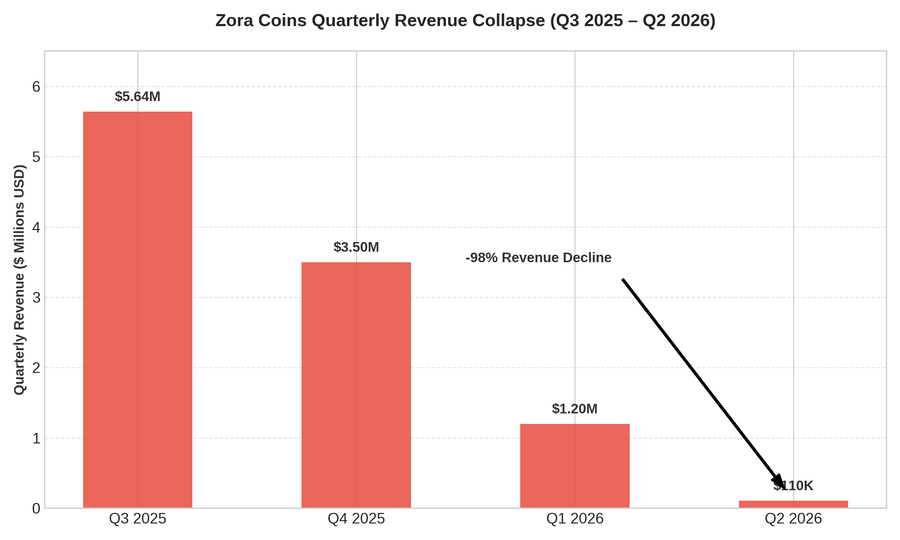
Zora Coins Quarterly Revenue Collapse (Q3 2025 – Q2 2026), illustrating a severe 98% drop in quarterly revenue from $5.64 million in Q3 2025 down to $106,540 in Q2 2026.
How to Interpret and Utilize This Visual
When evaluating publishing platforms and protocols for your digital art, financial health and business model sustainability are vital factors to consider alongside technical features. This bar chart highlights the dramatic revenue contraction experienced by Zora Coins over four consecutive quarters:
-
The Peak Period (Q3 2025): Zora's publishing model and token-based features generated strong quarterly revenue peaking at $5.64 million.
-
The Steep Contraction (Q4 2025 to Q2 2026): Following market shifts, shifts in user activity, and community controversies (such as the airdrop friction), quarterly revenue plummeted across subsequent quarters, dropping to $3.50M in Q4 2025, $1.20M in Q1 2026, and finally bottoming out at just $106,540 ($110K) in Q2 2026: representing a staggering 98% decline.
What This Means for Your Strategy
-
Weighing Protocol Philosophy vs. Financial Stability: While Zora offers brilliant publishing mechanics, onchain ownership, and low minting costs, the severe drop in platform-level revenue and downsizing of the team (to fewer than 10 people) introduce operational risks.
-
Focusing on Direct Audience Ownership: Because Zora functions as a publishing layer rather than a traditional marketplace with a built-in discovery engine, this chart reminds you that your success depends entirely on your own audience-building efforts. If you utilize Zora, treat it as an infrastructure tool for direct distribution to your own community rather than expecting the platform's internal economy to drive your sales.
Emerging NFT Marketplaces and Blockchains: Where Artist Opportunities Are Growing
The headline-grabbing platforms get most of the attention, but some of the most interesting opportunities for artists are happening on the edges. I'm talking about chains that don't get nearly enough credit, marketplaces that are quietly building dedicated collector bases, and ecosystems where the culture is still forming. If you're willing to look beyond the familiar names, there's real opportunity out there.
I've watched artists discover entire new audiences by simply showing up on a chain that nobody in their Twitter feed was talking about. A photographer I know built a following on TON by selling social assets that had nothing to do with traditional NFT art. A generative artist found a niche on Bitcoin Ordinals that paid better than anything he'd done on Ethereum. The point is simple: the NFT market is bigger than the platforms we've already covered, and some of the most promising growth is happening in places most artists haven't explored yet.
TON and Telegram: The Next Big NFT Marketplace Opportunity for Artists
I'll be honest, I didn't take TON seriously at first. It seemed like a Telegram side project, a chain for stickers and usernames. I lumped it in with all the other "next big thing" chains that never quite delivered. But the data changed my mind. In early 2026, TON became the second-largest NFT blockchain by trading volume, surpassing Solana and Base and trailing only Ethereum. That's not a fluke. That's a fundamental shift in where NFT activity is happening, and it's being driven by an audience that most Western NFT artists have completely ignored.
TON Becomes Second-Largest NFT Chain by Volume
The numbers behind TON's rise are worth sitting with. Most of the activity comes from Telegram-native assets like Gifts, Numbers, and Usernames, which together account for the overwhelming majority of TON's NFT activity. These aren't speculative avatar collections or generative art drops. They're social assets with built-in utility inside an app that hundreds of millions of people use every day. They have a function beyond being collected. They're part of how people express identity, status, and belonging within Telegram's ecosystem.
The scale is what makes this interesting. Telegram has approximately 950 million users worldwide. Most of them haven't engaged with TON NFTs yet. They haven't bought usernames, traded digital gifts, or explored the Fragment marketplace. If even a small fraction of those users eventually start using blockchain-integrated social assets, TON's current position could look modest in retrospect. That's the kind of upside that doesn't exist on mature chains where the user base is already saturated.
For artists, this represents something genuinely new. Previous NFT ecosystems required convincing users to start from scratch by downloading wallets, bridging funds, and learning an entirely new interface. The learning curve was steep, and most people never bothered. TON is integrated into Telegram's existing social graph. Users can participate without needing to understand traditional NFT culture. That dramatically lowers the barrier to entry, and lower barriers mean more potential collectors. It's the difference between trying to get someone to visit a new city and inviting them into a room they're already standing in.
Fragment Marketplace: Usernames, Digital Gifts, and Social Assets
Fragment is where most TON NFT activity happens. It's a marketplace integrated directly with Telegram for trading usernames, anonymous numbers, and digital gifts. The platform has simplified trading to the point where users don't need to understand gas fees or wallet management. They just buy and sell. It's the most frictionless NFT experience I've ever seen, and that frictionless design is exactly why it's working.
The types of assets being traded give you a sense of the market's character. Anonymous Telegram numbers generated sales of $428,000 and $366,000 respectively. Plush Pepe NFTs created nearly $3 million in trading volume. Usernames like @trap, @nova, and @newcoin totaled nearly $91,000 in transactions. These aren't traditional artworks, but they are digital collectibles with real market demand. People are paying serious money for assets that function as identity markers within a social platform.
There's also a growing ecosystem of marketplaces beyond Fragment. Getgems charges 2% seller fees and has no KYC requirement. Portals also charges 2%. MRKT charges 0% but holds funds in a platform balance rather than sending them directly to your wallet. Each has trade-offs between fees, security, and convenience. For artists exploring TON, understanding these marketplace differences is essential. The cheapest option isn't always the best if it means giving up control of your funds.
What This Means for NFT Artists Exploring Social-First NFTs
Here's the honest question: is TON a place for traditional NFT artists, or is it a completely different market? The answer is a bit of both, and it depends entirely on what kind of artist you are.
If your art is designed to be shared, displayed, or used within social contexts, TON offers something no other chain can match: direct integration with a messaging app used by nearly a billion people. Digital gifts that can be upgraded into collectible NFTs, animated stickers, profile badges, and custom usernames all represent new formats for creative work. They're not paintings or photographs, but they're digital assets with real utility and real collector demand. They live where people already are, which gives them a kind of visibility that a JPEG in a marketplace simply doesn't have.
If your work is more traditional fine art, TON might not be the right fit. The collector base skews toward social utility rather than aesthetic appreciation. Someone buying a Plush Pepe isn't evaluating it as a work of art. They're buying it because it signals something about who they are and what community they belong to. That's a different motivation, and it requires a different kind of creative thinking.
But that doesn't mean there's no opportunity. Artists who can adapt their style to the TON ecosystem, creating work that functions as social assets rather than gallery pieces, could find an audience that's largely untapped by artists from other chains. I've seen illustrators create custom sticker packs that became collectible NFTs. I've seen designers make animated profile badges that sold for hundreds of dollars. The formats are different, but the creative opportunity is real.
The key insight is this: TON isn't competing with OpenSea or SuperRare. It's creating a new category of NFT that didn't exist before. Social-first collectibles with built-in utility. For artists willing to experiment with that format, the opportunity is genuinely new. And in a market where differentiation is everything, that's worth paying attention to.
Solana NFT Marketplaces: Still the Gaming and High-Speed Trading Hub
Solana's NFT ecosystem has been through a lot. Magic Eden's pivot away from EVM chains, the broader market contraction, and the rise of meme-driven trading have all reshaped the landscape. But Solana is still one of the most active chains for NFT trading, and for certain types of artists, it remains the best place to be. The energy is different from Ethereum. It's faster, looser, and more experimental. If you thrive in that kind of environment, Solana is worth a serious look.
Tensor and the Trader-Focused NFT Ecosystem
Tensor is the platform that fills the gap left by Magic Eden's evolution. It's a trader-focused marketplace built for speed and efficiency, with deep liquidity and a user experience optimized for high-frequency activity. The platform has its own token, TNSR, which has gone through significant tokenomics changes. After the Tensor Foundation acquired the marketplace in early 2026, 100% of marketplace fees began flowing to the TNSR treasury, doubling the capture rate. That's a big deal for token holders, and it signals that Tensor is serious about building a sustainable economic model.
The trading data tells you everything about Tensor's character. Collections like Mad Lads, DeGods, SMB Gen2, and Claynosaurz are actively traded, with total volumes in the millions. These aren't fine art collections. They're community-driven projects with strong cultures and active trading communities. If your art appeals to that demographic, Tensor is where your buyers are. If you're selling subtle, conceptual work that requires quiet contemplation, you're going to struggle. Tensor is a trading floor, not a gallery.
Why Solana Remains Relevant Despite Magic Eden’s EVM Retreat
Magic Eden's decision to shut down EVM and Bitcoin support in March 2026 was a blow to multi-chain artists, but it actually reinforced Solana's importance. The platform doubled down on its core strength, and Solana remained its primary ecosystem. Meanwhile, other platforms have moved in to fill the gaps. The competition is heating up, and that's good news for artists.
Rarible launched Solana support in August 2026, bringing its royalty enforcement tools to the chain. The first featured collection was Claynosaurz, the 3D dinosaur project that has maintained a loyal community on Solana. This is significant because Rarible's royalty enforcement is more robust than what Solana artists have typically had access to. The platform's RARI DAO voted to approve the expansion, demonstrating that governance is driving strategic decisions. It's not just a top-down corporate move. The community wanted it, and the platform delivered.
OpenSea also re-enabled Solana NFT trading in September 2026, allowing users to buy and sell Solana collections like Claynosaurz, Mad Lads, BoDoggos, Collector Crypt, and Phygitals. This came more than four years after OpenSea's first Solana beta ended in 2022. The reintegration means Solana artists now have access to OpenSea's massive user base without having to bridge to Ethereum or abandon their native chain. For artists who have been building on Solana but feeling cut off from the broader NFT market, this is a meaningful development.
How Solana NFT Marketplaces Compare for Artists
The Solana marketplace landscape in 2026 looks like this: Tensor dominates for high-frequency trading and community-driven collections. Magic Eden remains the default for Solana-native artists and Launchpad drops, though its gambling pivot introduces uncertainty. Rarible is the new entrant focused on royalty enforcement and creator-friendly economics. OpenSea provides broad reach and multichain flexibility.
For artists, the choice depends on priorities. If you want liquidity and active traders, Tensor is the best fit. If you want Launchpad visibility and community depth, Magic Eden is still the leader. If you want royalty protection, Rarible is the best option. If you want maximum reach across chains, OpenSea is the obvious choice.
The good news is that you don't have to pick just one. Solana's low fees make it practical to list on multiple marketplaces simultaneously. You can have a presence on Tensor, Magic Eden, and Rarible without paying significant costs. Diversification is easier on Solana than on Ethereum, and that's a meaningful advantage. I've started recommending that Solana artists treat the ecosystem as a portfolio of venues rather than committing to a single platform. The overhead is low, and the potential upside is significant.
Bitcoin Ordinals and Multi-Chain NFT Strategies for Artists
Bitcoin Ordinals are the wild card in the NFT ecosystem. They're built on the most secure and decentralized blockchain in existence, they store data directly on-chain, and they've attracted a collector base that's fiercely dedicated. They're also difficult to work with, expensive to mint, and operate on a completely different technical stack than Ethereum or Solana. If you're the kind of artist who enjoys a challenge and values permanence above all else, Ordinals might be your calling.
The Case for Diversifying Across Blockchains
The strongest argument for Bitcoin Ordinals is permanence. Unlike traditional NFTs that often point to a server where an image is stored, Bitcoin inscriptions are stored directly on-chain. For long-term holders, this distinction is vital. It represents true digital permanence in a way that most other chains can't match. If the server goes down, the image is still there. If the platform shuts down, the inscription remains. It's the closest thing to immortality that digital art can achieve.
The numbers back up the interest. Total Ordinal inscriptions have surpassed 10 million, with 91% being plain text inscriptions and over 775,000 comprising image files like PNGs or JPEGs. $190 million worth of Bitcoin-based NFTs have been traded in a 30-day period, with the most significant sale being a Space Pepe for $4.56 million. Bitcoin currently stands as the second-largest blockchain in terms of NFT sales by some measures. These aren't fringe numbers. This is a real market with real money flowing through it.
For artists, Ordinals offer something different: a collector base that values true digital scarcity and permanence. These aren't speculators looking to flip for a quick profit. They're collectors who understand the technical differences between chains and are willing to pay a premium for on-chain storage. If your art aligns with that ethos, Ordinals can be a rewarding venue. The collectors are passionate, the community is tight-knit, and the permanence of the work means your legacy is secure in a way that other chains can't guarantee.
Matching Your NFT Art to the Right Collector Base
The key to success on Ordinals is understanding the culture. The community values technical authenticity, permanence, and scarcity. They're skeptical of hype and allergic to marketing fluff. If your art is genuine, if it has a clear point of view, and if you're willing to engage with the community on its own terms, you can find an audience. But if you show up with a slick marketing campaign and a collection of AI-generated pfp images, you're going to get ignored. The Ordinals community can smell inauthenticity from a mile away.
The marketplaces where Ordinals trade include Ordinals Market, Ordswap, Ordinals Wallet, Open Ordex, Gamma, Magic Eden, and Unisat. Each has its own culture and fee structure. Magic Eden's exit from Bitcoin in March 2026 removed a major venue, but the dedicated Ordinals marketplaces have filled the gap. For artists who are serious about Ordinals, it's worth spending time in these marketplaces, observing how collectors behave, and understanding what resonates.
For artists considering Ordinals, the practical challenges are real. Minting costs can be high, especially compared to Solana or Base. The technical process is more involved. The tools are less polished than what you'll find on Ethereum or Solana. But for artists who value permanence and are willing to navigate the complexity, Ordinals offer access to a collector base that's genuinely different from anything else in the space. It's not for everyone, but for the right artist, it's a perfect fit.
How to Evaluate Emerging NFT Marketplaces Before Committing
The emerging marketplace landscape is exciting, but it's also risky. Platforms come and go. Chains rise and fall. The artists who thrive are the ones who evaluate opportunities carefully before committing. I've seen too many artists jump on the latest trend only to watch it collapse six months later.
Here's the framework I use when considering a new marketplace or chain:
- First, does it have a real user base? Not just wallets, but actual active users who are buying and selling.
- Second, does it have a sustainable revenue model? Platforms that rely on token incentives eventually collapse when the incentives stop.
- Third, does it respect creators? Look at royalty policies, fee structures, and how the platform treats artists in its communications.
- Fourth, is the collector base a good fit for your art? A platform can be big and still be wrong for you if the audience doesn't connect with your style.
And finally, don't go all in on any single platform. The history of this space is littered with platforms that looked unstoppable right up until they weren't. Diversify your presence. Build your audience on channels you control. Treat every marketplace as a tool rather than a home. The artists who survive the next market cycle will be the ones who understood that no platform is permanent, but a committed audience is. That's the real lesson of the past few years. Platforms change. Chains evolve. But the relationship between an artist and their collectors, if nurtured properly, can survive anything.
The emerging landscape isn't about finding the next OpenSea or the next SuperRare. It's about recognizing that the NFT ecosystem is fragmenting into distinct cultures, each with its own collector base, its own aesthetic, and its own set of opportunities. TON offers social assets with built-in utility. Solana offers speed, gaming, and active trading communities. Bitcoin Ordinals offer permanence and a dedicated collector base. None of them is right for every artist, but for the right artist, each represents a genuine opportunity to reach collectors who aren't being served by the mainstream platforms. And in a market where attention is the scarcest resource, that's worth exploring.
📊 Top NFT Blockchains by Trading Volume Hierarchy (Early 2026)
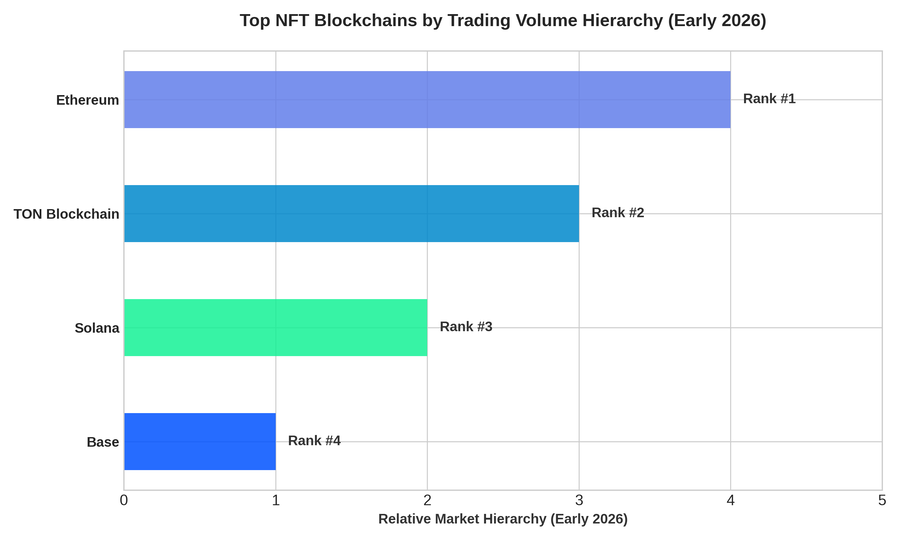
Top NFT Blockchains by Trading Volume Hierarchy (Early 2026), illustrating TON's emergence as the second-largest NFT blockchain by trading volume, surpassing Solana and Base while trailing only Ethereum.
How to Interpret and Utilize This Visual
When exploring emerging opportunities outside traditional ecosystems, understanding shifting market share and blockchain adoption is crucial. This horizontal bar chart highlights the trading volume hierarchy among leading NFT networks:
-
Ethereum (Rank #1): Remains the primary baseline for high-value fine art, blue-chip collections, and established collector activity.
-
TON Blockchain (Rank #2): Represents the most significant structural shift of early 2026, climbing past Solana and Base to secure the second-largest position by trading volume, driven heavily by Telegram-native social assets (gifts, usernames, and numbers) connected to an active user base of roughly 950 million people.
-
Solana & Base (Rank #3 and #4): Continue to serve as high-speed gaming hubs, experimental venues, and low-cost testing grounds for active creators.
What This Means for Your Strategy
-
Expanding Beyond Traditional Bubbles: If you have previously limited your creative output to EVM chains, TON's massive social integration and explosive volume demonstrate that entirely new collector audiences are forming where messaging apps meet Web3.
-
Multi-Chain Positioning: Because emerging ecosystems offer lower friction and fresh pools of capital, incorporating alternative networks (such as TON, Solana, or Bitcoin Ordinals) into your portfolio strategy can help you capture attention that crowded mainstream marketplaces no longer provide.
Key Challenges Facing NFT Artists: How to Navigate a Complex Market
Let's be honest about something that doesn't get said enough: being an NFT artist in 2026 is harder than it was in 2021, and it's going to stay that way for a while. The easy money is gone. The hype cycle has moved on to whatever's trending on crypto Twitter this week. And the platforms that promised to be your home forever are dropping like flies.
I've watched talented artists pour months into building a presence on a marketplace that shut down with two weeks' notice. I've seen people lose access to their own work because the metadata was stored on a server that got switched off. One artist I know spent three years building a collector base on a platform that announced its closure on a Friday and went dark by Monday. She had no email list, no Discord, no way to reach the people who had bought her work. She had to start from zero. It's brutal out there, and if you're going to survive, you need to understand the terrain before you step into it.
This section isn't about scaring you. It's about giving you the tools to navigate a market that's still figuring itself out. The challenges are real, but they're not insurmountable. You just need to know what you're up against, and you need to plan for the worst while hoping for the best. That's not pessimism. That's just smart business.
The Platform Longevity Problem: Choosing NFT Marketplaces That Survive
Here's the uncomfortable truth: most NFT marketplaces are not built to last. They're built to grow fast, capture market share, and hope that volume eventually covers their costs. When volume collapses, as it has across the board, the math stops working. Blur's website shut down on November 12, 2026, after its monthly trading volume fell from $1.43 billion in 2023 to under $7 million in 2026, a drop of more than 99.5%. The contracts stayed on-chain, but the interface everyone relied on went away. For artists who built their presence there, it was like showing up to work and finding the building had been demolished. No warning, no transition plan, no way to reach the collectors who had been browsing their work.
The pattern repeats itself across the industry. Foundation, Nifty Gateway, X2Y2, MakersPlace, Bybit NFT Marketplace, LG Art Lab, Kraken NFT Marketplace: all gone or wound down. Each closure leaves a trail of artists scrambling to rebuild. And the closures aren't slowing down. If anything, they're accelerating as the market contracts and platforms run out of runway.
Why Monthly Volume Alone Doesn’t Predict NFT Platform Sustainability
I used to think that trading volume was the ultimate measure of a platform's health. Bigger volume meant more buyers, more liquidity, more opportunity. That assumption turned out to be dangerously wrong.
Volume can indicate liquidity, but it cannot by itself explain whether a marketplace can survive. A platform that rewards activity can attract orders that wouldn't happen otherwise. Collection bids and rapid flips can make a venue essential to traders for a period without making it the default place for long-term collectors. When incentives end, the relevant question is how much organic flow remains and whether that flow pays enough to maintain the service. Public volume alone can't divide organic trades from incentive-motivated ones. That's why you need to look deeper than the headline numbers.
Here's what I look for instead:
- Does the platform have a revenue model that doesn't depend on token emissions? If the answer is no, the clock is ticking.
- Are there collectors who have been active for years, or is it all new wallets chasing rewards? If the collector base is constantly churning, there's no foundation.
- Does the team communicate openly about challenges, or do they only show up when things are going well? Transparency is a leading indicator of integrity.
The Real Costs of Running an NFT Marketplace: Engineering, Indexing, Support
You might wonder why so many platforms are shutting down when the technology seems straightforward. The answer is that running a marketplace is expensive, and those costs don't go away when the market cools. If anything, they get worse because you're paying the same bills with less revenue.
The operational overhead is staggering:
- You need smart contract development for features like royalty enforcement, auction mechanisms, and escrow logic. A full-featured marketplace can cost anywhere from $15,000 to well over $150,000 to build, depending on complexity.
- You need blockchain integration and ongoing gas costs for testing and deployment.
- You need frontend and backend development for a smooth user experience.
- You need wallet integration across multiple providers, which multiplies testing effort.
- Then there's the operational side: metadata storage, indexing, customer support, marketing, and the endless battle against spam and fraud.
Many platforms were designed for transaction volume rather than long-term art communities. They optimized for trading, not for the slow, relationship-driven work of building a collector base. When the speculators left, the platforms had nothing left to sustain them. The ones that survive are the ones that built real businesses around real users, not around token emissions and incentive programs that were always going to end.
How to Diversify Your NFT Presence Across Multiple Platforms
The single most important lesson from all these shutdowns is simple: don't put all your eggs in one basket. The artists who survived Blur's shutdown, Foundation's closure, and Nifty Gateway's exit were the ones who had diversified their presence across multiple platforms. The ones who didn't are still trying to rebuild.
Here's how I think about diversification:
First, maintain a presence on at least two or three marketplaces. List your work on OpenSea for reach, Rarible for royalty protection, and maybe a niche platform that fits your aesthetic. The overhead is low, and the redundancy is worth it. You don't have to be equally active everywhere. Just having a presence means that if one platform goes down, your collectors can still find you somewhere else.
Second, build your audience on channels you control. Your email list, your Discord, your social media following: these are assets that no platform can take away from you. If a marketplace shuts down, you still have a way to reach your collectors. If you've been relying entirely on the platform's discovery engine to find buyers, you're vulnerable. I've started telling every artist I mentor to collect email addresses from day one. It sounds old-fashioned, but it's the most durable asset you can build.
Third, keep records of where your work is listed and what the backup plan is. I recommend artists maintain a simple document tracking which platforms host their work, which chains it's on, and what happens if any of those platforms shut down. It sounds paranoid, but in this market, paranoia is just good planning. The artists who treated platform risk as a real threat were the ones who survived when the threat materialized.
Metadata and Storage: Protecting Your NFT Art Beyond the Token
This is the part that keeps me up at night, and it should keep you up too. When an NFT marketplace shuts down, your art doesn't automatically disappear from your wallet. The token is on-chain. That part is safe. But here's the catch: the metadata and the actual image file often aren't.
On-Chain vs. Off-Chain Storage: What NFT Artists Should Know
When you mint an NFT, what you're actually creating is a token that points to a piece of data. That data, the metadata, includes the name, description, attributes, and a link to the image file. Where that data lives matters enormously. It's the difference between your art surviving for decades and disappearing when a server gets switched off.
- On-chain storage means the metadata and sometimes the image itself are written directly to the blockchain. This is the most permanent option, but it's also expensive. Bitcoin Ordinals use on-chain storage, which is why they're considered the gold standard for permanence. Every inscription is stored forever on the Bitcoin blockchain, accessible as long as Bitcoin exists. That's a powerful guarantee.
- Off-chain storage means the metadata lives somewhere else, either on a centralized server, a cloud storage bucket, or a decentralized file system like IPFS or Arweave. Most NFTs use off-chain storage because it's cheaper and more flexible. But it introduces a dependency: if the server goes down, the link breaks. And if the server belongs to a company that goes bankrupt, the link breaks permanently.
Here's the problem: many NFTs store their metadata on the marketplace's own servers. When the marketplace shuts down, those servers go dark, and your NFT becomes a link to nothing. Analysis found that 27% of top collections rely on centralized hosting, and some metadata links have already disappeared. Amazon Web Services removed hosting for several NFT projects in 2024 due to policy violations. When servers go offline, NFTs point to missing files. The token still exists, but the art it represents is gone.
Even IPFS offers limited permanence. Files will disappear unless users continue to pay to pin them. If the platform shuts down, the artwork may vanish. Artists like XCOPY lost early works when platforms like Ascribe and Digital Objects closed. Collectors now refer to these pieces as "the lost XCOPYs". It's a cautionary tale that every artist should know. Even successful, respected artists aren't immune to platform risk.
Decentralized File Systems as a Hedge Against Platform Shutdown
The solution is to store your metadata and media on decentralized file systems that don't depend on any single company staying in business. The two main options are IPFS and Arweave. Neither is perfect, but both are infinitely better than trusting a centralized server to stay online forever.
Arweave uses a "permaweb" model where you pay once and the data is stored permanently. The economics are designed around a 200-year storage guarantee, funded by an endowment that grows as more data is stored.
Nifty Gateway promised to migrate most NFT metadata and media hosting to Arweave as part of its shutdown plan, allowing collectors continued access to their assets in perpetuity. That's the responsible approach, and it should be the baseline expectation for any platform you work with. However, Nifty Gateway also confirmed that a subset of NFTs minted in 2021 or earlier have metadata permanently linked to Nifty Gateway's own servers. For those assets, the company said it will "continue to host the metadata indefinitely". That's a commitment, but it's also a single point of failure.
What happens if the company changes hands or goes bankrupt? Promises are only as good as the entity making them.
IPFS is the other major option. When used correctly, it remains the most practical solution. The key requirements are that each individual metadata JSON file and its associated media file should have its own independent CID, and the token URI should use ipfs:// as the canonical identifier. This practice enables granular self-custody: collectors and institutions can selectively pin the pieces they want, increasing the probability of long-term survival even if other items in the same collection lose pinning support. The more people who pin your work, the more resilient it becomes.
Recommendation: Before you mint, ask where your metadata will be stored. If the answer is "on our servers," you're taking on platform risk. If the answer is IPFS or Arweave, you have more protection. If you're deploying your own contract, make sure it points to a decentralized storage solution rather than a private endpoint. This is not a glamorous consideration, but it's the difference between your art surviving a platform shutdown and becoming a broken link. And if you're serious about building a lasting career, you need to think about what happens to your work after the platform you're using today is gone.
How to Ensure Your NFT Art Survives Marketplace Failures
The most important thing you can do is take ownership of your own preservation. Don't rely on the platform to keep your art alive. They have their own problems to worry about, and your art is not at the top of their list.
- Pin your own work on IPFS. Even if the platform pins it, having your own pinning service gives you redundancy. If the platform goes down, your pin remains. Services like Pinata and Filebase make this easy and affordable, often for just a few dollars a month.
- Keep copies of your metadata and media files. Store them locally, on cloud backup, and on decentralized storage. The more copies that exist, the better the odds that at least one survives. I keep three copies of everything: one on my local drive, one on a cloud backup, and one on Arweave. It costs me maybe $50 a year, and it gives me peace of mind that's worth ten times that.
- Use a contract that stores critical data on-chain. If you can afford it, writing the hash of your metadata directly on-chain provides a cryptographic anchor that can't be deleted. Long-term cryptographic hashes (SHA3-256, SHA3-512, or BLAKE2b-512) of metadata directly on-chain will improve decentralized authentication. This doesn't store the full image on-chain, but it creates a permanent record that can be used to verify authenticity even if the original file is lost.
- Check where your existing collections are stored. Go to your NFT's page and see where the metadata URI points. If it's an HTTP link to a private server, you have a problem. If it's an IPFS hash, you're in better shape. If it's Arweave, you're in the best shape possible. Do this audit today. Don't wait until a platform announces its closure to find out that your metadata is at risk.
Building a Collector Base in a Concentrated NFT Market
The final challenge is perhaps the most frustrating: building an audience when the market is increasingly concentrated among a handful of established names. The top 10% of creators capture roughly 90% of market income, and the gap is widening. Weekly active traders have fallen to around 20,000, with only 4,000 daily traders remaining. The pool of buyers is small, and they're being pulled toward blue-chip collections. It can feel like you're shouting into a hurricane, and nobody can hear you.
The Challenge of Discoverability Outside Blue-Chip NFT Collections
The data is sobering. Global NFT sales fell to $175 million in April 2026, down from $304 million in February. The average sale price doubled month-over-month (from $30.60 to $67.38), which tells you everything: a smaller pool of capital is concentrating into fewer, higher-value trades. Meanwhile, wash trading still accounts for roughly 50% of volume, which means half the activity you see on marketplaces isn't real. The charts look busier than they actually are.
For independent artists, this creates a brutal dynamic. You're competing for attention in a market where the biggest collections are sucking up most of the liquidity. The collectors who are still buying are being pulled toward CryptoPunks (market cap $726 million) and Bored Ape Yacht Club (which more than doubled from 4.10 ETH to above 10 ETH in early 2026). Your work, no matter how good, is competing against an algorithm that prioritizes established names and high-volume collections. The deck is stacked, and pretending otherwise doesn't help anyone.
Community-First Strategies for Independent NFT Artists
The artists who are surviving and thriving in this environment are the ones who have stopped trying to compete on the platform's terms and started building their own communities.
Here's what that looks like in practice:
Create limited series. Experts advise releasing limited NFT collections to increase profitability and grow your subscriber base. Limited releases create scarcity and urgency, which drives demand and higher prices. But the key is to make the limitation meaningful. A collection of 10 pieces that are genuinely connected by a theme or story will perform better than 10 random pieces with a "limited edition" label slapped on. Collectors can tell the difference between genuine scarcity and manufactured scarcity, and they reward the former.
Share your process. Your audience wants to see the human behind the art. Share behind-the-scenes content, work-in-progress shots, and the stories behind your pieces. Regularly interact with your subscribers. This builds a relationship that goes beyond a single transaction. A collector who feels connected to you is more likely to buy again, and more likely to tell their friends. I've seen artists build six-figure careers simply by being generous with their process and consistent in their communication.
Join and engage with NFT communities. Be active in Discord and Twitter spaces where collectors and artists gather. Participate in discussions, support other artists, and build genuine relationships. A strong community becomes your asset. It gives you not just buyers, but advocates who will promote your work to their networks. The artists who isolate themselves and only show up to promote their drops are the ones who struggle the most. Community is a two-way street, and you have to give before you can receive.
How to Use Social Media and IRL Events to Grow Your NFT Collector Base
The most successful artists I know use a combination of digital and physical presence to build their audience. Neither alone is enough, but together they create a powerful flywheel.
Social media strategy: Most NFT artists and studios use Twitter, Discord, and Instagram to connect with fans and announce new releases. Create a content plan and post regularly. Share your inspiration, your process, and announcements for upcoming drops. Use relevant hashtags to increase visibility. Consider collaborations with other artists or influencers for cross-promotion.
But here's the thing about social media: it's a megaphone, not a strategy. You can post every day and still get no engagement if you're not building genuine relationships. The artists who succeed are the ones who engage with others, who comment on their work, who show up in community spaces and add value rather than just promoting themselves. Social media is a tool for deepening relationships that already exist, not a substitute for them.
IRL events: This is the part most digital artists overlook, and it's a mistake. Physical events, whether it's Art Basel, NFT NYC, or a local gallery show, create opportunities for genuine connection that social media can't replicate. Beeple gave away free NFTs at Art Basel in November 2025, and some of those free pieces were later trading for over 10 ETH. SuperRare opened a physical gallery in New York. These IRL moments create stories, relationships, and credibility that carry over into the digital world. When you meet someone in person, they remember you in a way that a Twitter follow doesn't capture.
If you can't afford to attend major events, consider organizing your own. A small gallery show, a meetup at a local cafe, a pop-up exhibition: these don't require a big budget, but they create the kind of personal connection that turns casual collectors into lifelong supporters. I've seen artists build dedicated collector bases entirely through local events, never setting foot in a major conference. The scale is smaller, but the relationships are deeper, and those relationships are what sustain a career over the long term.
The NFT market in 2026 is smaller, quieter, and more demanding than it was during the boom. But it's also more honest. The platforms that remain are here because they've found ways to create real value. The artists who thrive will be the ones who understand that their career isn't dependent on any single platform, that their art needs to be protected beyond the token, and that their audience is the most valuable asset they have. Build those three things, and you'll survive whatever the market throws at you next. The challenges are real, but so are the opportunities. Navigate them with clear eyes and a long-term mindset, and you'll be standing when the next wave comes.
📊 NFT Market Income Concentration: Top 10% vs. Bottom 90% of Creators
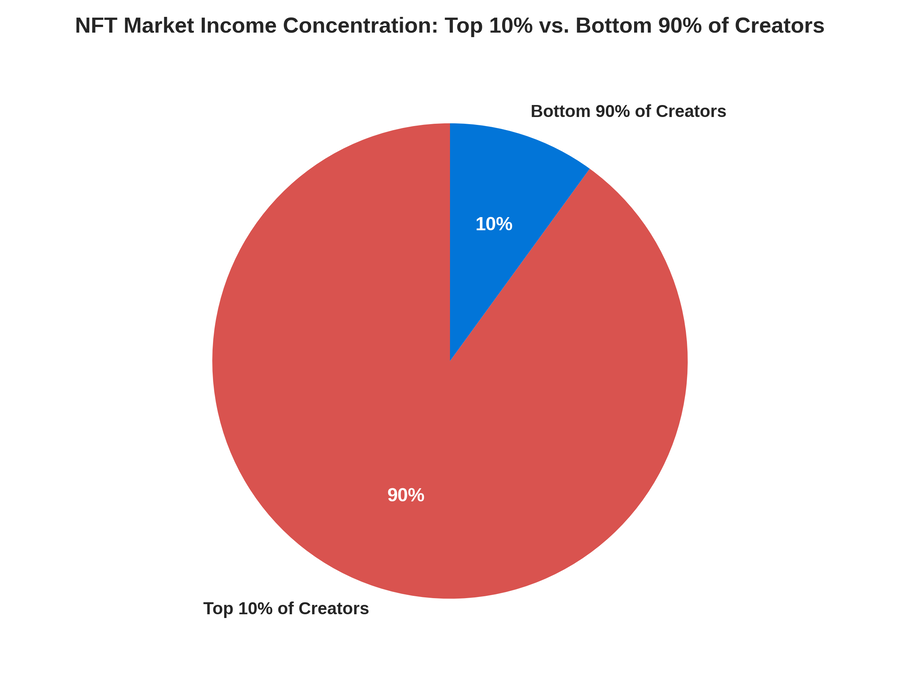
NFT Market Income Concentration: Top 10% vs. Bottom 90% of Creators, illustrating how the top 10% of creators capture roughly 90% of total market income while the remaining 90% share just 10%.
How to Interpret and Utilize This Visual
When evaluating the financial realities of the contemporary NFT market, understanding wealth and income distribution is essential for setting realistic expectations. This pie chart highlights the stark concentration of revenue across creators:
-
The Top 10% (Red Slice): Captures approximately 90% of total market income, driven heavily by blue-chip collections, established brands, and high-volume traders who dominate buyer attention.
-
The Bottom 90% (Blue Slice): Shares the remaining 10% of market earnings, reflecting the intense discoverability challenges and competition independent artists face in a compressed market.
What This Means for Your Strategy
-
Moving Beyond Platform Dependency: Because liquidity and income are heavily concentrated among top names, relying solely on marketplace discovery is rarely viable for emerging creators.
-
Building Direct Community Assets: To bridge the gap, independent artists must focus on community-first strategies, direct collector relationships, limited series, and owning their audience channels (such as email lists and decentralized profiles) rather than depending on speculative trading volumes or marketplace algorithms.
How to Choose the Best NFT Marketplace for Artists: A Decision Framework
By this point in the guide, you've probably got a decent sense of the major platforms and what they offer. But knowing the facts and making a decision are two different things. I've watched artists freeze up at this stage, paralyzed by the fear of picking the wrong marketplace. They spend weeks researching, comparing fee tables, reading Discord threads, and end up doing nothing at all. That's the worst outcome, because doing nothing means your art stays invisible. I've been there myself, staring at spreadsheets and trying to calculate the perfect platform, only to realize that the perfect platform doesn't exist. There's only the right platform for where you are right now.
So let's cut through the noise. This section is a practical framework, not a philosophical debate. I'm going to give you the questions to ask, the matchups that work, and the strategy that keeps you from putting all your eggs in one basket. Think of it as a decision tree. Follow the branches, and you'll end up somewhere that makes sense for your art and your goals. And if you make a mistake? That's fine. Platforms aren't forever. You can always pivot.
Questions Every NFT Artist Should Ask Before Choosing a Marketplace
Before you mint anything, before you list anything, before you even set up your profile, ask these questions. The answers will shape everything that follows. I wish someone had given me this list when I started, because I would have avoided a lot of trial and error.
Where Does the Platform Enforce NFT Royalties, and How?
This is the first question because it's the one that most directly affects your long-term income. A marketplace that doesn't enforce royalties is a marketplace where your secondary income is optional. And in a bear market, optional income tends to become zero income. I've seen artists earn thousands of dollars in royalties from a single piece that appreciated over time, and I've seen artists earn nothing from the same piece because they minted on a platform that didn't enforce royalties. The difference is entirely about where you mint, not about how good your art is.
Here's how the major platforms stack up:
- Rarible offers the strongest protection through its RARI Chain, which enforces royalties at the node level. The blockchain itself rejects transactions that don't pay the royalty, which means there's no way to bypass it. It's the closest thing to a guarantee that exists in this space.
- OpenSea supports enforceable royalties through ERC721-C contracts, but you have to deploy the right contract standard to benefit. If your collection uses an older contract, your royalties are optional. The platform gives you the tools, but you have to use them.
- Magic Eden on Solana gives buyers the option to pay full, half, or zero royalties, which means your secondary income is essentially voluntary. Tensor, the dominant Solana trading platform, also treats royalties as optional. On Solana, the culture around royalties is still developing, and many buyers default to zero when given the choice. It's not personal. It's just how the incentives are structured.
The practical takeaway: if royalty income matters to you, use Rarible or deploy an ERC721-C compatible contract on OpenSea. If you're minting on Solana, understand that you're accepting optional royalties unless you use the MIP-1 standard, and even then, enforcement depends on marketplace cooperation. There's no magic bullet on Solana, but MIP-1 is the closest thing to one.
What Happens to Your NFT Listings and Metadata If the Platform Closes?
This question separates artists who build lasting careers from artists who get wiped out by the next platform shutdown. The list of closures is long: Blur, Foundation, Nifty Gateway, X2Y2, MakersPlace, Bybit NFT Marketplace, LG Art Lab, Kraken NFT Marketplace. Each one left artists scrambling. Each one was a wake-up call that most people ignored until it was their turn.
Where is your metadata stored? If it's on the platform's servers, you're taking on platform risk. If it's on IPFS or Arweave, you have more protection. Nifty Gateway migrated most metadata to Arweave as part of its shutdown plan, which is the responsible approach. Foundation pinned metadata on IPFS through April 2027, and the community stepped in to ensure redundancy beyond that. These are the platforms that did it right. Unfortunately, they're the exception, not the rule.
Does the platform have a transition plan? Some platforms communicate closures in advance and provide migration tools. Others go dark overnight. Before you commit, look at how the platform has handled past changes. If they've never communicated transparently about challenges, they're not going to start when things get really bad. I've learned to read the writing on the wall: layoffs, pivots, and sudden strategy changes are all signs that a platform is struggling. If you see three or four of those signs, start planning your exit.
Do you have your own backup? Even if the platform stores metadata on decentralized systems, you should have your own copies. Pin your work on IPFS, keep local backups, and maintain a record of where everything is stored. This is the difference between your art surviving a shutdown and becoming a broken link. I keep three copies of every piece I care about: one on my hard drive, one on a cloud backup, and one on Arweave. It costs me maybe $50 a year, and it gives me peace of mind that's worth ten times that.
Who Is the Actual Buyer on This NFT Marketplace: Collectors or Traders?
This question determines what kind of art succeeds on a platform. OpenSea and Magic Eden attract a mix of collectors and traders, with traders often dominating volume. SuperRare attracts serious collectors who hold long-term. Tensor is explicitly built for professional traders who flip collections and arb between marketplaces. The culture of each platform is shaped by who's doing the buying.
For artists, the distinction matters enormously. Traders buy for liquidity and quick profits. They're less likely to hold your work, less likely to care about your artistic trajectory, and more likely to skip royalties if given the option. Collectors buy for connection and long-term value. They're more likely to respect royalties, more likely to tell their friends, and more likely to still be there in five years. If you're building a career, you want collectors. If you're just trying to move inventory, traders will do.
The data backs this up. SuperRare's founder noted that their collectors "typically don't engage in high-frequency trading or try to make quick money." That's a fundamentally different dynamic than Tensor, where the entire platform is optimized for speed and trading efficiency. Neither is wrong, but they attract different kinds of artists and different kinds of careers.
What Are the Minting Costs and Blockchain Options?
Minting costs are a barrier to entry that's often overlooked. On Ethereum, a single mint can cost $20 to $50 or more depending on network congestion. On Solana, the same mint costs a fraction of a cent. On Base, Zora's original deployment, minting costs are often under $0.50. For emerging artists, this difference is transformative. It's the difference between minting one piece a month and minting ten pieces a week.
The blockchain you choose also determines your audience. Ethereum collectors tend to be more established and willing to pay higher prices. Solana collectors skew toward gamers, traders, and high-speed enthusiasts. TON attracts users who are already inside Telegram's ecosystem, with a focus on social assets like Gifts, Numbers, and Usernames. Bitcoin Ordinals attract collectors who value permanence and on-chain storage.
The practical question: what blockchain do your potential collectors use? If you're targeting fine art collectors, Ethereum or SuperRare is the answer. If you're targeting Solana-native traders, Tensor or Magic Eden. If you're experimenting with social-first NFTs, TON. There's no universal right answer, but there is a right answer for your specific audience. And if you don't know who your audience is yet, experiment. Mint on two or three chains and see where you get the most engagement. The data will tell you more than any guide ever could.
How Active and Engaged Is the Platform’s Collector Community?
A marketplace can have millions of wallets and still feel dead. Tensor at its peak had 86,000 active wallets generating more volume than Magic Eden's 116,000, which tells you that Tensor's users were more active per person. OpenSea has around 382,000 monthly active traders, which is roughly ten times Blur's user base. But activity isn't the same as engagement.
Look for signs of genuine community: Discord servers where collectors talk about art, not just floor prices. Twitter spaces where artists and collectors interact. IRL events where people show up because they care about the work. These are the signals that a platform has a real community, not just a trading pool. I've found that the best way to evaluate this is to spend a week lurking. Join the Discord. Read the Twitter threads. See who's talking and what they're talking about. If the conversation is all about flipping and floor prices, that's a trading platform. If people are discussing the art itself, that's a collector community. Both can work, but they attract different kinds of artists. Know which one you're joining before you commit.
Matching Your NFT Art Type to the Right Marketplace
Different art types succeed on different platforms. This isn't about quality; it's about audience. A brilliant generative piece might flop on SuperRare and thrive on Art Blocks. A beautiful photograph might get ignored on Tensor and find a home on Foundation. The key is matching your work to the collector base that values it. I've seen artists waste months trying to force their art into a platform that wasn't built for it. Don't be that artist.
Digital Art and Fine Collectibles: SuperRare, Foundation, and Curated Platforms
If your work is ambitious, conceptual, and visually striking, the curated platforms are your best bet. SuperRare operates on an invite-only basis, which means every artist has been vetted by a curation team. The collector base is small but serious, and the 10% artist royalty on secondary sales is one of the highest in the market. The platform's founder has been explicit that royalties will not disappear on SuperRare, and the collector base's long-term orientation makes it easier to maintain this policy.
The trade-off is lower volume and slower sales. SuperRare's trading volume is a fraction of OpenSea's, and the buyer pool is thin. But for artists who value prestige and serious collectors over volume, SuperRare offers something no other platform can match. A SuperRare sale is a signal that your work has been vetted by a curation team with a track record. That signal has value, especially if you're trying to bridge into traditional art markets.
Foundation is no longer an option, having shut down in April 2026. But the community's response, pinning 99.99% of Foundation's content to IPFS and building alternative frontends, shows what's possible when people care about the art enough to preserve it. For artists considering curated platforms, the lesson is clear: don't build your entire career on a single curated platform. Diversify. The community will remember you if you've built genuine relationships, and those relationships will follow you to the next platform.
PFP and Generative Collections: OpenSea, Magic Eden, and Volume-Driven Venues
If your work is a PFP collection, generative art series, or community-driven project, you need volume and liquidity. OpenSea offers the largest reach with 382,000 monthly active traders. Magic Eden dominates Solana with its Launchpad and deep liquidity. Tensor is the professional trader's choice, with advanced order types, collection-wide bids, and AMM liquidity pools.
The key to success on these platforms is community building. PFP and generative collections live or die by their communities. You need a Discord, a Twitter presence, and a narrative that people want to be part of. The platform provides the trading infrastructure, but you provide the culture. I've seen collections with mediocre art succeed because the community was incredible, and I've seen collections with stunning art fail because nobody knew about them. The art matters, but the community matters just as much.
Launchpad visibility is particularly valuable for collection teams. Getting approved for a Magic Eden Launchpad drop signals to collectors that your project has been vetted, which reduces the risk of scams and rug pulls. For new teams trying to build trust, that validation is worth a lot. It's the difference between launching into a void and launching with a stamp of approval from the most trusted name in Solana NFTs.
Social and Identity NFTs: TON, Telegram, and Emerging Ecosystems
If your art is designed to be shared, displayed, or used within social contexts, TON is the most interesting opportunity in the market right now. TON became the second-largest NFT blockchain by trading volume in early 2026, surpassing Solana and Base and trailing only Ethereum. Most of that activity comes from Telegram-native assets like Gifts, Numbers, and Usernames, which together account for the overwhelming majority of TON's NFT activity.
The appeal is direct integration with a messaging app used by nearly a billion people. Users can participate without understanding traditional NFT culture. They don't need to download a wallet or bridge funds. They just buy and sell inside an app they already use. It's the most frictionless NFT experience I've ever seen, and that frictionless design is exactly why it's working.
For artists, this means new formats for creative work: digital gifts that can be upgraded into collectible NFTs, animated stickers, profile badges, and custom usernames. These aren't paintings or photographs, but they're digital assets with real utility and real collector demand. If your art can adapt to that format, TON offers an audience that's largely untapped by artists from other chains. The key is to think beyond the traditional canvas. On TON, the canvas is the social experience itself.
Photography and Motion Art: Best NFT Marketplaces for Visual Creators
Photography and motion art have a natural home on SuperRare and Foundation, where single-edition works and fine art positioning align with the medium's strengths. SuperRare's Liquid Editions format, which allows for ERC-20-based artworks with dynamic market mechanics, is particularly interesting for motion artists who want to experiment with interactive or market-responsive pieces. Imagine a piece that changes based on how many people own it, or one that evolves as the market moves. That's the kind of thing Liquid Editions makes possible.
For photographers who want broader reach, OpenSea and Rarible offer larger audiences. But the competition is fierce, and photography often gets lost in a sea of PFPs and generative art. The key is to find your niche and build a collector base that values your specific perspective. A photographer who documents a unique subculture or tells a specific story will find more success than someone who posts generic landscape shots. I've seen photographers build dedicated followings by focusing on a single theme, like abandoned buildings or street scenes in a specific city. Specificity is your friend.
Bitcoin Ordinals are another option for photographers who value permanence. Inscriptions are stored directly on-chain, which means your work survives as long as Bitcoin exists. The collector base is small but dedicated, and they're willing to pay a premium for true digital scarcity. The trade-off is higher minting costs and a more technical process, but for photographers who care about long-term preservation, it's worth considering. If you're the kind of artist who thinks about legacy, Ordinals are worth a look.
Building a Multi-Platform NFT Strategy for Long-Term Success
The single most important lesson from the past few years is this: don't rely on a single marketplace. The platforms that looked unstoppable in 2021 are gone. The ones that look stable today might not be here in three years. The artists who survive are the ones who diversify. It's not about being cynical. It's about being realistic.
Why NFT Artists Shouldn’t Rely on a Single Marketplace
I've watched artists build their entire careers on one platform, only to watch it shut down and take their audience with it. Blur's shutdown in November 2026 left artists who had built their presence there scrambling for alternatives. Foundation's closure left a community of fine artists without a home. Nifty Gateway's exit left collectors with assets they could no longer easily trade. Each of these closures was a reminder that platform loyalty is a one-way street. The platform doesn't owe you a transition plan, and your collectors don't owe you their attention when you move somewhere new.
The lesson isn't that platforms are evil. It's that platforms are businesses, and businesses fail. The artists who survived Blur's shutdown, Foundation's closure, and Nifty Gateway's exit were the ones who had diversified their presence across multiple platforms. They had email lists. They had Discord servers. They had collectors who followed them from one platform to another because the relationship was with the artist, not the platform.
Build your audience on channels you control. Your email list, your Discord, your social media following: these are assets that no platform can take away from you. If a marketplace shuts down, you still have a way to reach your collectors. If you've been relying entirely on the platform's discovery engine to find buyers, you're vulnerable. Start collecting email addresses from day one. It sounds old-fashioned, but it's the most durable asset you can build.
How to Diversify Across Chains, Platforms, and Collector Bases
Diversification isn't just about listing on multiple marketplaces. It's about spreading your presence across chains, platforms, and collector bases. Each layer of diversification adds resilience.
- Chains: Don't put all your work on Ethereum. If you're minting on Ethereum, consider also listing on Solana for speed and low costs, Base for accessibility, or TON for social-first reach. Different chains have different collector cultures, and diversifying across chains gives you access to audiences that don't overlap. A collector who only uses Solana is never going to see your Ethereum work unless you make it easy for them.
- Platforms: List on OpenSea for reach, Rarible for royalty protection, and a niche platform that fits your aesthetic. The overhead is low, and the redundancy is worth it. You don't have to be equally active everywhere. Just having a presence means that if one platform goes down, your collectors can still find you somewhere else. It's like having multiple doors into the same house. If one door gets locked, people can still get in through another.
- Collector bases: Don't just chase the biggest audience. Build relationships with different types of collectors. Some will be traders who flip quickly. Some will be collectors who hold long-term. Some will be supporters who buy because they believe in you. Each type serves a purpose, and having a mix makes your career more resilient. If you only appeal to traders, you're vulnerable to market cycles. If you only appeal to long-term collectors, you might struggle with liquidity. A mix is healthier.
Balancing Reach, Royalties, and Community Across Multiple NFT Marketplaces
The challenge with diversification is that it takes time. Managing listings on multiple platforms, engaging with different communities, and keeping track of everything can feel overwhelming.
Here's how I think about balancing the three priorities:
- Reach is about being where the buyers are. OpenSea and Magic Eden offer the largest audiences. Tensor offers the most active traders on Solana. TON offers access to Telegram's massive user base. Use these platforms when you want maximum exposure. If you're launching a new collection and you want as many eyes as possible, these are the platforms to prioritize.
- Royalties are about protecting your long-term income. Rarible and RARI Chain offer the strongest enforcement. OpenSea's ERC721-C contracts offer enforceable royalties if you deploy correctly. Use these platforms when you want to ensure you get paid on secondary sales. If you're creating work that you expect to appreciate over time, royalty protection is worth prioritizing.
- Community is about building relationships that last. SuperRare and Zora offer more intimate, engaged communities. Discord servers and Twitter spaces are where the real connections happen. Invest in these platforms and spaces when you want to build a collector base that will follow you anywhere. If you're playing the long game, community is the most important investment you can make.
The key is to prioritize based on your goals. If you're just starting out, focus on reach. If you're building a long-term career, focus on royalties and community. If you're experimenting, try a little of everything. There's no universal right answer, but there is a right answer for where you are right now.
My advice? Start with one platform that matches your art type and audience. Build a presence there. Then, once you've got a rhythm, add a second platform. Then a third. Don't try to be everywhere at once. Build depth before you build breadth. The artists who succeed are the ones who understand that a committed audience on one platform is worth more than a scattered presence on ten. Focus on building something real, and the rest will follow.
And remember: the perfect platform doesn't exist. The right platform for you is the one that matches your goals, your art, and your audience. Everything else is just noise.
📊 NFT Marketplace Evaluation Framework Across Key Decision Criteria
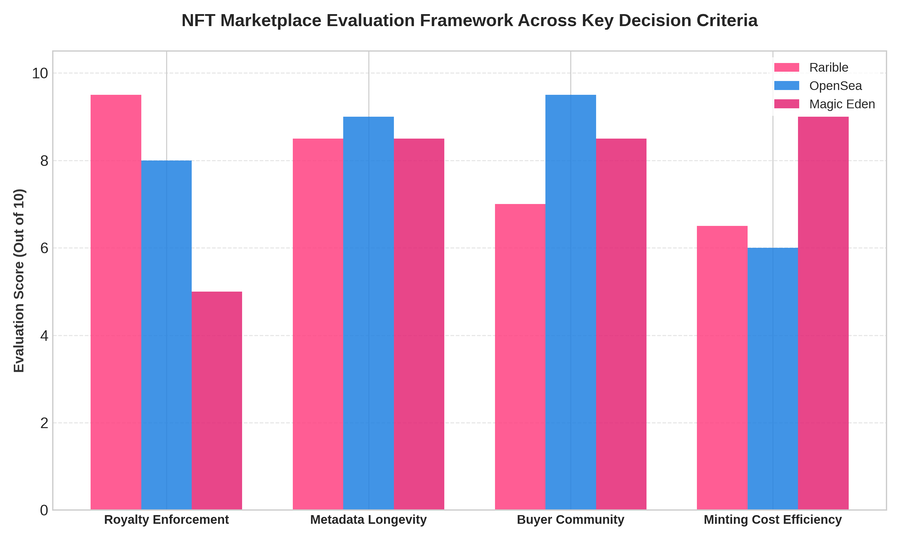
NFT Marketplace Evaluation Framework Across Key Decision Criteria, comparing Rarible, OpenSea, and Magic Eden across four critical dimensions: Royalty Enforcement, Metadata Longevity, Buyer Community, and Minting Cost Efficiency.
How to Interpret and Utilize This Visual
When selecting where to mint and list your digital art, avoiding analysis paralysis requires a structured approach based on your specific priorities. This clustered bar chart scores three major marketplaces across four core pillars:
-
Royalty Enforcement: Measures how securely secondary sales income is protected. Rarible leads through node-level RARI Chain enforcement, followed by OpenSea (via ERC721-C contracts), while Magic Eden treats royalties as optional.
-
Metadata Longevity: Evaluates long-term data preservation and resistance to platform closures, comparing decentralized pinning standards across platforms.
-
Buyer Community: Highlights the scale and engagement of the active collector base, with OpenSea maintaining maximum reach.
-
Minting Cost Efficiency: Assesses transaction and gas overhead, where multi-chain and Solana integrations (like Magic Eden) provide high cost-effectiveness for emerging creators.
What This Means for Your Strategy
-
Aligning Platform Choice with Your Goals: If your primary focus is securing long-term secondary royalties, platforms with rigorous enforcement (like Rarible) are ideal. If you require maximum buyer reach and liquidity for collection drops, high-community platforms (like OpenSea or Magic Eden) serve you better.
-
Building a Diversified Presence: Because no single platform excels across every metric, use this framework to build a multi-platform strategy; combining royalty-protected venues with volume-driven marketplaces to safeguard your career against platform shifts.
The Future of NFT Marketplaces for Artists: Trends to Watch
Let me be honest with you: predicting the future in crypto is a fool's game. I've seen too many "experts" make confident predictions that turned out to be completely wrong.
Remember when everyone said NFTs would replace art galleries by 2023? Or when the metaverse was supposed to be the next trillion-dollar industry? Yeah, those predictions didn't age well. But that doesn't mean we should fly blind. There are patterns, signals, and structural shifts that give us a pretty good sense of where things are heading. And if you're an artist trying to build a career, understanding those trends isn't optional. It's survival.
The NFT market isn't dying. It's maturing. The speculative frenzy that defined 2021 is gone, and what's emerging in its place is smaller, quieter, and honestly, more sustainable. The artists who understand this shift are positioning themselves for the next phase. The ones who are still waiting for the 2021 vibes to return are going to be waiting forever. I've watched friends burn out chasing the old model, and I've watched others quietly build something real in the new one. The difference isn't talent. It's adaptability. Let's talk about what's actually happening and what it means for you.
Utility Over Speculation: Where NFT Artist Revenue Is Actually Growing
Real-World Asset Tokenization and the Broader NFT Infrastructure Shift
The biggest growth area in the NFT space isn't digital art at all. It's real-world asset tokenization. The global NFT market is projected to grow from $50 billion in 2025 to nearly $491 billion by 2034, a compound annual growth rate of almost 29%. But the composition of that market is changing. Digital art and collectibles are just one slice of a much larger pie, and the other slices are growing faster.
OpenSea's Chief Marketing Officer, Adam Hollander, has been explicit about where he sees the next wave coming from. He said the next NFT cycle will be driven by tangible assets like Pokémon cards, luxury watches, and ticketing, not speculative avatar projects. "It is entirely reasonable to tokenize and trade assets such as collectible cards, luxury watches, and digital tickets," he said. "These could become the core drivers of the next NFT wave."
The technical infrastructure is evolving to support this. New standards like ERC-6551 allow NFTs to have their own wallets, holding other assets and executing complex operations. Dynamic NFTs can change their appearance or properties based on real-world data, like carbon credits whose visual representation adjusts according to actual emission reductions. These aren't incremental improvements. They're a paradigm shift that turns NFTs from static collectibles into programmable assets. And programmable assets can do things that static images can't. They can unlock content, grant access, represent ownership, and respond to the world around them.
Phygital Art and Brand Collaborations: New Revenue Paths for NFT Artists
A digital avatar IP called Nova was created at Hong Kong Polytechnic University, minted as an NFT, and then brought to life as a physical figure. When Nova was reimagined in collaboration with the Thai art toy brand BADMEAW, the collection sold out during Thailand Toy Expo 2026 and continued selling out through subsequent online releases. That's a digital artist reaching a global collector base that includes traditional toy collectors who might never have bought an NFT otherwise. The art toy crowd didn't care that Nova started as an NFT. They cared that the figure was cool, limited, and part of a story they wanted to be part of.
Brand collaborations are another path. Doodles partnered with G-Shock to create a series of NFT watches, with physical editions accompanying the digital assets. The collaboration gave Doodles credibility in the traditional watch world while giving G-Shock access to a younger, crypto-native audience. For artists, the lesson is clear: your digital work can be a gateway to physical products, brand partnerships, and audiences you couldn't reach alone. The digital and physical aren't competing. They're complementing each other, and the artists who understand that are opening doors that stay closed for everyone else.
How NFT Artists Can Capitalize on Utility-Driven Demand
So how do you, as an artist, capitalize on this shift? The answer isn't to abandon digital art and start tokenizing Rolexes. It's to think about what utility you can attach to your work. What does your NFT do for the person who owns it? If the answer is "it looks cool," that's fine, but it's not enough anymore. The market is demanding more.
- Membership and access. NFTs that grant access to exclusive content, community spaces, or events are in demand. Token-gated "Plazas" on platforms like Kabila allow creators to deliver premium content and grow sustainable communities. If you can offer ongoing value to your collectors, you're not just selling art. You're selling a relationship. And relationships are worth more than transactions.
- Dynamic and interactive work. NFTs that change based on market activity, collector behavior, or real-world data are more engaging than static images. Zora's Liquid Editions format, which ties artwork to ERC-20 tokens with dynamic market mechanics, is one example. The art responds to the market, creating a living system rather than a static file. It's a new medium, and artists are just beginning to explore what's possible.
- Collaborations and cross-pollination. The Nova and BADMEAW collaboration shows what's possible when digital artists partner with brands that have physical reach. Look for opportunities to collaborate with brands, events, or other creators whose audiences overlap with yours but aren't identical. The goal is to reach people who wouldn't find you through traditional NFT channels. Every collaboration is a bridge to a new audience.
What NFT Artists Should Watch in the Coming Years
The next few years will bring significant changes to the NFT landscape. Some of these changes will create opportunities. Others will pose risks. Here's what you need to keep on your radar, because being caught off guard in this space is expensive.
Platform Consolidation and the Risk of Further NFT Marketplace Shutdowns
The NFT marketplace consolidation is far from over. Foundation shut down in April 2026 after a planned acquisition fell through. Nifty Gateway closed. Blur's frontend is gone. X2Y2 pivoted away from NFTs entirely. OpenSea now controls over 73% of all NFT marketplace activity according to DefiLlama, with Blur as the main competitor. That level of concentration is unprecedented, and it creates both stability and risk.
On one hand, OpenSea's dominance means there's a clear default platform for artists and collectors. You know where to go, and you know where the buyers are. On the other hand, winner-take-most dynamics leave little oxygen for specialized platforms. If OpenSea decides to change its policies, there's no meaningful competitor to keep it in check. Artists need to understand this dynamic and plan accordingly. The platforms that look stable today might not be here in three years. We've seen it happen before, and we'll see it happen again.
The practical takeaway: diversify your presence. Don't rely on any single platform, even the dominant one. Build your audience on channels you control. Keep records of where your work is stored. Treat every platform as a tool rather than a home. The artists who survive the next round of shutdowns will be the ones who saw it coming and prepared accordingly.
Regulatory Developments Affecting NFT Trading and Creator Royalties
The regulatory landscape for NFTs is shifting fast. The U.S. CLARITY Act, which passed the House but remains stalled in the Senate, will directly shape how NFTs are classified under federal law. If certain NFTs are treated as securities, marketplace operators would face registration requirements, and creator royalty structures could be reinterpreted as ongoing financial obligations. That could be good or bad for artists, depending on how the rules are written.
The MiCA clause in the EU excludes genuinely unique, non-fungible crypto-assets from regulation. By June 2026, joint SEC-CFTC guidance had carved out an explicit "digital collectibles" category for things designed to be collected or used. These are positive developments for artists. They signal that regulators are recognizing the unique characteristics of NFTs rather than treating them as generic securities. The people writing the rules seem to understand that a one-of-a-kind artwork isn't the same thing as a stock certificate.
The practical takeaway: don't assume your royalties are protected. Use platforms that enforce them at the protocol level (like Rarible's RARI Chain) or deploy contracts that make enforcement technically unavoidable. The legal system isn't going to save you. The code has to. That's the reality of building in a space where the rules are still being written.
The Rise of Token-Gated and Community-Specific NFT Marketplaces
One of the most interesting trends is the rise of token-gated communities and niche marketplaces. Instead of trying to compete with OpenSea on breadth, these platforms compete on depth. They serve specific communities, specific art styles, or specific use cases. And for artists who fit those niches, they can be a better home than the big generalist platforms.
Wink (formerly Only1) on Solana is a good example. It's a Web3 platform for creator monetization and fan engagement through token-gated experiences and blockchain-enabled memberships. Creators can offer exclusive content, and fans can support their favorite creators using the LIKE token. The platform uses Solana's infrastructure for fast, low-cost transactions, and its governance token (ONES) gives holders voting rights on platform decisions. It's a platform built around relationships, not just transactions.
Kabila on Hedera takes a similar approach. It offers token-gated "Plazas" where creators can engage fans, deliver premium content, and grow sustainable communities. The platform's key selling point is protocol-level enforced royalties, meaning creators receive their share from every resale regardless of the marketplace. That's the kind of enforcement that artists have been asking for, and it's happening on smaller, community-focused platforms rather than the major ones. It's a reminder that innovation often comes from the edges, not the center.
The practical takeaway: consider niche platforms for niche work. If your art serves a specific community, a specialized marketplace might give you more visibility and better terms than a generalist platform where you're competing with millions of other NFTs. Don't assume bigger is always better.
AI and Generative Tools: Opportunities and Risks for NFT Artists
AI is reshaping the NFT creation landscape, and the data tells a complicated story. 48% of creators now use AI-enabled tools to generate NFT assets, and production increased 37% in AI-generated collections last year. Nearly half of all new NFT projects incorporate some form of AI. The tools are accessible, the output is fast, and the barrier to entry has never been lower.
But here's the uncomfortable part: weekly NFT sales in early 2026 are around $85 million, which is only about 17% of the 2021 peak. So we have 37% more supply chasing 83% less demand. That's a recipe for a race to the bottom. More creators, fewer buyers, and a flood of AI-generated content that looks the same.
The result is what one commentator called "AI slop": low-effort collections that are clearly prompt variations with zero thought. "Fantasy Warriors" with 10,000 AI-generated knights. "Cyber Punks 2077" that don't even try to hide the inspiration. These flood marketplaces, make discovery impossible, and train buyers to be skeptical of all AI NFTs. It's a tragedy of the commons, and it's making it harder for genuine artists to stand out.
For artists, the opportunity is in using AI as a tool, not a replacement for creativity. The projects that are selling have a few things in common: they built a following before the mint, the NFT has clear utility, AI creates ongoing engagement rather than just a cool mint, and supply is limited. AI can lower the barrier to creation, but it doesn't lower the barrier to building an audience. The artists who thrive will be the ones who use AI to enhance their vision, not to replace it. The technology is neutral. What matters is what you do with it.
The Long-Term Outlook for NFT Artists and Digital Art Marketplaces
I want to end this section with something that might sound counterintuitive: the NFT market isn't dying. It's growing up. The speculative frenzy is gone, and that's a good thing. What's emerging in its place is smaller, slower, and more sustainable. It's not as exciting as 2021, but it's more real. And for artists who are in this for the long haul, that's a trade worth making.
Why the NFT Market Is Maturing, Not Dying
The "NFT is dead" narrative has been repeated so many times that it's become a cliché. But the data tells a different story. Monthly sales are still around $300 million. Developer activity is at an all-time high. Major Web3 companies like Animoca Brands are investing in real-world asset tokenization and infrastructure.
The market is shifting from a speculation-driven model to a utility-driven one. In 2021, trading was dominated by PFP projects whose value depended almost entirely on community narrative and hype. Today, gaming assets, digital identity credentials, membership passes, and real-world asset tokenization are taking a larger share. Holding periods have lengthened from days or hours to weeks or months. That's a sign of maturity, not decline. People are buying NFTs because they want to use them or hold them, not just because they hope to flip them tomorrow.
The composition of the market is also becoming more resilient. The top tier is high-value digital art and collectibles. The base is a massive layer of utility assets. Together, they form a layered ecosystem that can withstand speculative bubbles. This isn't a dying market. It's a market that's learning to stand on its own. And markets that stand on their own are better for artists than markets that depend on hype.
The Shift from Speculation to Sustainable Creator Economies
The most important change for artists is the shift from speculation to sustainability. During the boom, artists could make money by riding the wave of hype. A collection would mint out, floor prices would pump, and everyone would profit. That model was never sustainable, and its collapse was inevitable. The artists who built their careers on hype are the ones who are struggling now.
What's emerging is a creator economy built on direct relationships. Artists who have loyal audiences, who offer genuine value, and who show up consistently are building careers that don't depend on the next hype cycle. Platforms like Kabila are explicitly designed around this model: "creators can establish verifiable ownership of their digital assets, manage token-gated communities, and leverage enforced royalties to receive their share from every resale."
The numbers back this up. Kabila has facilitated over $1 million in NFT sales and 175,000 NFTs minted across 400+ brands and creators. These aren't life-changing numbers for any single artist, but they represent a sustainable model where creators keep more of what they earn and build direct relationships with their collectors. That's the future, and it's already here. It's just not evenly distributed yet.
How NFT Artists Can Build Lasting Careers in a Post-Hype World
So what does a lasting career look like in this new landscape? Here's my honest assessment, based on watching artists succeed and fail over the past five years:
- Build your audience on channels you control. Your email list, your Discord, your social media following. These are assets that no platform can take away from you. The artists who survived the platform shutdowns were the ones who had direct relationships with their collectors. Start collecting email addresses from day one. It sounds old-fashioned, but it's the most durable asset you can build.
- Diversify across platforms and chains. Don't put all your eggs in one basket. List on OpenSea for reach, Rarible for royalty protection, and a niche platform that fits your aesthetic. Different chains have different collector cultures. Be present in multiple ecosystems. The overhead is low, and the resilience is worth it.
- Think about utility, not just aesthetics. What does your NFT do for the collector? Does it grant access? Does it provide ongoing value? Does it connect to a physical object or experience? The most successful artists in 2026 are the ones who think of their work as a relationship rather than a transaction. They're building communities, not just collections.
- Use AI as a tool, not a crutch. AI can help you experiment, iterate, and scale. But it can't replace your vision, your voice, or your connection with your audience. The artists who thrive will be the ones who use AI to enhance their creativity, not to mass-produce content. The technology is neutral. What matters is what you bring to it.
- Be patient. The get-rich-quick days are over. Building a sustainable career takes time. The artists who are still standing in five years will be the ones who treated this as a marathon rather than a sprint. They'll be the ones who kept showing up, kept improving, and kept building relationships even when the market was quiet. That's the real secret. There is no shortcut.
The NFT market in 2026 is not the market of 2021. It's smaller, quieter, and more demanding. But it's also more honest. The platforms that remain are here because they've found ways to create real value. The artists who thrive will be the ones who understand that their career isn't dependent on any single platform, that their art needs to be protected beyond the token, and that their audience is the most valuable asset they have. Build those three things, and you'll be ready for whatever comes next. The future isn't about waiting for the next boom. It's about building something that doesn't need one.
📊 Global NFT Market Size Growth Projection (2025–2034)
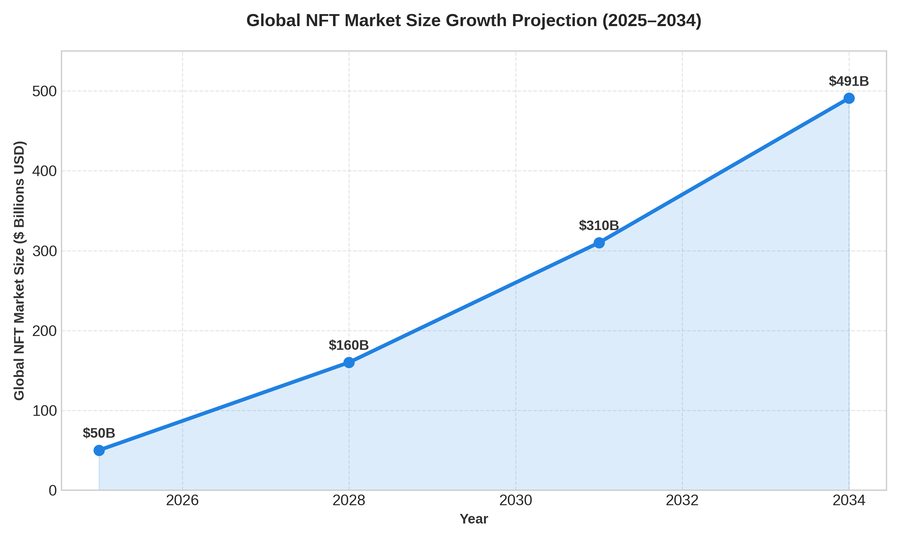
Global NFT Market Size Growth Projection (2025–2034), illustrating the expansion of the worldwide NFT market from $50 billion in 2025 to nearly $491 billion by 2034 at a compound annual growth rate of almost 29%.
How to Interpret and Utilize This Visual
When looking beyond short-term speculative hype toward long-term industry trends, understanding structural market expansion is crucial. This area chart maps the projected global valuation of the NFT market over the next decade:
-
The Baseline (2025 at $50B): Represents the post-bubble maturation phase where speculative avatars gave way to utility-driven and infrastructure-backed models.
-
The Growth Trajectory (2028–2034): Illustrates a steady upward curve reaching nearly $491 billion by 2034, driven increasingly by real-world asset tokenization (such as luxury goods, trading cards, ticketing, and phygital collaborations).
What This Means for Your Strategy
-
Embracing Utility and Phygital Models: Because the next wave of growth is heavily anchored in tangible utility, physical-digital integration, and programmable assets (rather than purely speculative JPEGs), artists who connect their work to real-world experiences, brand collaborations, or membership utility are best positioned to capture long-term value.
-
Aligning with Sustainable Sectors: Use this long-term growth outlook as a signal to build durable creative practices, focusing on direct collector relationships and robust infrastructure rather than waiting for 2021-style trading frenzies to return.
Conclusion: Finding Your Place in the Best NFT Marketplaces for Artists
We've covered a lot of ground together. From the curated galleries of SuperRare to the social-first ecosystems of TON, from the royalty battles that reshaped creator economics to the platform shutdowns that reminded us nothing lasts forever. We've talked about the artists who made it, the ones who didn't, and the hard lessons that separate the two. If your head is spinning a little, that's normal. Mine was too when I started putting all of this together. The NFT landscape in 2026 is complex, fragmented, and constantly shifting. But here's the thing: you don't need to master all of it. You just need to find the corner that fits you.
I've watched artists succeed on platforms I never would have predicted, and I've watched others struggle on platforms that looked perfect on paper. A painter I know built a six-figure career on Rarible while everyone told her she was wasting her time on a "small platform." A generative artist found his audience on Bitcoin Ordinals after years of getting ignored on Ethereum. The difference almost always comes down to alignment. When your art, your audience, and your platform are in sync, everything feels easier. When they're not, every sale feels like pushing a boulder uphill. So let's wrap this up with a practical checklist, a reminder about what really matters, and some honest thoughts about what it takes to thrive in a market that's no longer running on hype.
The NFT Artist’s Checklist: Before You Mint, Before You List
Before you hit that mint button, run through this checklist. It'll save you from mistakes that are expensive to undo. I've made most of these mistakes myself, and I can tell you from experience that fixing them after the fact is a lot harder than avoiding them upfront.
Where will your metadata live? This is the question most artists forget, and it's the one that matters most for long-term survival. If your metadata is stored on the marketplace's servers, you're taking on platform risk. If the platform goes down, your art becomes a link to nothing. If it's on IPFS or Arweave, you have protection. If you're deploying your own contract, make sure it points to a decentralized storage solution. The difference between your art surviving a platform shutdown and becoming a broken link is decided before you mint, not after. Ask the question. Get a real answer. Don't settle for "it'll be fine."
Does the platform enforce royalties, and how? On OpenSea, creator earnings are either enforced or optional depending on your contract standard. If you're using ERC721-C or deploying through OpenSea Studio after April 2024, you can enforce them. If you're using an older contract, you can't. On Magic Eden, royalties are optional on Solana unless you've adopted the MIP-1 standard. On Rarible, royalties can go up to 50% and are enforced at the node level through RARI Chain, meaning no marketplace or buyer can bypass creator payments. Know what you're signing up for before you commit. This isn't fine print. It's your income.
What are the actual fees? OpenSea charges a 1% fee for selling NFTs and a 10% fee for minting in a primary drop. Magic Eden takes 2% on all transactions. SuperRare has a 15% gallery fee on primary sales and a 3% marketplace fee for buyers. Rarible's marketplace fee ranges from 0.5% to 7.5% depending on sale size. These percentages add up. Do the math before you list. A platform with a low royalty rate but high marketplace fees might leave you worse off than one with a higher royalty and lower fees. Run the numbers for your specific price points, not just the headline rates.
Who's actually buying on this platform? Traders flip for quick profits. Collectors hold for years. The platform's culture determines which type you'll encounter. SuperRare's founder noted that their collectors "typically don't engage in high-frequency trading or try to make quick money." That's a fundamentally different environment than Tensor, where the entire platform is optimized for speed and trading efficiency. Neither is wrong, but they attract different kinds of artists and different kinds of careers. Know which one you're walking into.
Do you have a backup plan? If this platform shut down tomorrow, could you still reach your collectors? Do you have their email addresses? Do you have a Discord or a social media following that isn't platform-dependent? The artists who survived Blur's shutdown, Foundation's closure, and Nifty Gateway's exit were the ones who had built direct relationships with their audiences. They had email lists. They had communities. They had collectors who followed them from one platform to another because the relationship was with the artist, not the platform. Start building those relationships today. Don't wait until you need them.
Why the Best NFT Marketplace Is the One That Matches Your Long-Term Goals
I want to be clear about something: there is no universally "best" NFT marketplace. Anyone who tells you otherwise is selling something. The best platform for a fine digital artist targeting serious collectors is not the best platform for a PFP collection team building a community. The best platform for a Solana-native creator is not the best platform for someone working on Bitcoin Ordinals. The best platform for you depends entirely on what you're trying to build.
What matters is alignment:
- SuperRare is the best platform if you value prestige, curation, and a collector base that holds long-term.
- Rarible is the best platform if royalty enforcement and decentralized governance are your priorities.
- OpenSea is the best platform if you want maximum reach and mainstream discoverability.
- Magic Eden is the best platform if you're Solana-native and want access to the deepest liquidity on that chain.
- Zora is the best platform if you want to own your contract and distribute directly to your audience.
- TON is the best platform if your art can adapt to social-first formats and you want access to Telegram's massive user base.
- Bitcoin Ordinals are the best option if permanence and on-chain storage matter more to you than volume.
The mistake I see artists make is chasing the platform that's trending on Twitter rather than the one that matches their actual needs. They mint on a platform because everyone else is, then wonder why their work isn't selling. The platform isn't the problem. The mismatch is.
I've done this myself. I minted on a platform because it was getting buzz, without thinking about whether my art actually fit the audience. It didn't. The experience taught me more than any success could have.
So here's my advice: start with your goals, not the platform:
- What kind of art do you make?
- Who is your ideal collector?
- What kind of career do you want to build?
- Do you want to be a fine artist with a small, dedicated collector base?
- Or do you want to be a prolific creator with a broad audience?
- Do you want to experiment with new formats, or do you want to master one?
Answer those questions first, and the right platform will become obvious. It might not be the one you expected. That's fine. The unexpected choices are often the best ones.
Final Thoughts: Thriving as an NFT Artist in a Maturing Market
The artists who thrive in this environment are the ones who understand that. They're not waiting for the next boom. They're building sustainable practices that don't depend on hype. They're diversifying across platforms and chains. They're protecting their metadata and their royalties. They're building direct relationships with their collectors. And they're patient. They understand that careers are built over years, not weeks.
I know it can feel discouraging when the numbers don't match the 2021 headlines. I've felt that too. There were moments when I wondered if I'd missed my window, if the opportunity had come and gone. But I've also watched artists build real careers in this market, one collector at a time, one sale at a time, one relationship at a time. It's slower. It's harder. But it's also more real, and it's more likely to last. The artists who are still here, still creating, still building, are the ones who understood that the boom was never the point. The work was.
The best NFT marketplace for you is the one that helps you build that kind of career. It might be OpenSea. It might be Rarible. It might be a platform that hasn't launched yet. What matters is that you choose it with your eyes open, you understand the trade-offs, and you don't put all your eggs in one basket. Build your audience. Protect your work. Stay patient.
And remember that the market doesn't owe you anything. But if you show up consistently, if you build genuine relationships, and if you keep creating work that matters, you'll find your place. It might not look like what you imagined. It might be better.
Now go make something worth collecting. The market is waiting.
📊 NFT Marketplace Fee & Royalty Structure Comparison
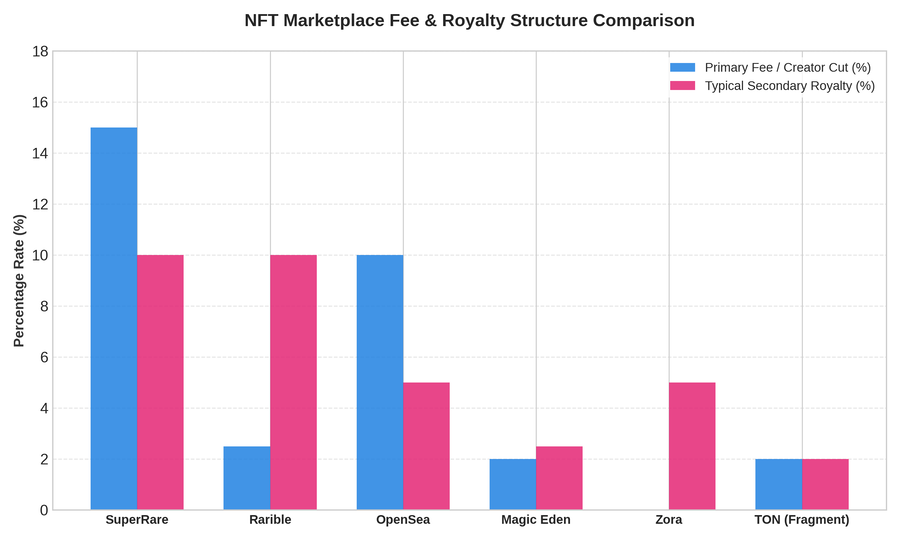
NFT Marketplace Fee & Royalty Structure Comparison, illustrating the differences in primary platform fees and secondary royalty enforcement across major ecosystems including SuperRare, Rarible, OpenSea, Magic Eden, Zora, and TON.
How to Interpret and Utilize This Visual
When evaluating your bottom line as a digital creator, understanding how different platforms slice primary sales and protect secondary income is essential. This clustered bar chart compares primary transaction cuts against typical secondary royalty structures:
-
SuperRare: Features a curated 15% primary gallery fee paired with strong 10% secondary royalty support, positioning itself as a fine-art venue for long-term collectors.
-
Rarible & OpenSea: Offer balanced options with robust creator earnings (up to 10% secondary) through enforced standards (such as RARI Chain and ERC721-C), though marketplace transaction and minting fees vary.
-
Zora & TON: Emphasize direct distribution and publishing layers where creators keep 100% of paid mint revenues or engage in low-cost social asset trading with creator-friendly splits.
What This Means for Your Strategy
-
Balancing Fees vs. Collector Reach: High primary fees on curated platforms are often offset by higher prestige and dedicated collector engagement, whereas lower-fee protocols require you to drive your own marketing and audience acquisition.
-
Protecting Long-Term Revenue: Always run the math on your specific price points before listing, and prioritize platforms whose royalty enforcement matches your career goals.
Frequently Asked Questions About the Best NFT Marketplaces for Artists
You have questions? I have answers! Below are the questions I get asked most often by artists trying to figure out where to sell their work, how royalties actually work, which platforms are worth the effort, and what to do when a marketplace shuts down. I have answered each one directly, with real numbers and practical takeaways, no fluff and no hype. If you are short on time, start with the first two questions: they cover the decisions that matter most before you mint anything.
Q1. Which NFT marketplaces offer the highest creator royalties in 2026?
Rarible offers the highest royalty ceiling at up to 50%, followed by SuperRare at 10% and OpenSea at 10% (with enforcement depending on contract standard). Magic Eden on Solana makes royalties optional unless you adopt the MIP-1 standard.
In my experience, the headline royalty rate matters far less than whether the platform actually enforces it. Rarible wins on both fronts because its RARI Chain enforces royalties at the node level, meaning no marketplace or buyer can bypass creator payments. I have seen artists set a 10% royalty on OpenSea only to watch it get skipped because their contract did not support ERC721-C enforcement. On Solana, Magic Eden gives buyers the choice between full, half, or zero royalties, which means your secondary income is essentially voluntary unless you deploy with MIP-1. My honest take: if royalty income is a core part of your business model, use Rarible for high-value pieces and treat everything else as a bonus rather than a guarantee.
Q2. How do NFT marketplace fees compare for artists in 2026?
OpenSea charges 1% on sales and 10% on primary minting, Magic Eden takes 2% on Solana transactions, SuperRare charges 15% on primary sales and 3% on secondary, Rarible charges roughly 1% from both buyer and seller, and Zora gives creators 100% of paid mint revenue.
The total cost of selling varies wildly by platform, and I have watched too many artists focus only on the royalty percentage while ignoring the fee stack. OpenSea's 1% selling fee is the lowest among the major EVM marketplaces, but that 10% primary mint fee catches people off guard during drops. Zora is arguably the most creator-friendly on the minting side since you keep the entire sale price. SuperRare's 15% commission feels steep until you remember that traditional galleries charge 25% to 50%. Rarible's split fee model means buyers and sellers each contribute, which softens the blow. My advice: run the numbers based on your actual price points and expected volume before you commit, because a 2% difference compounds fast when you are selling consistently.
Q3. What happens to creator royalties on OpenSea after the recent policy changes?
OpenSea enforces creator earnings by default for collections deployed through OpenSea Studio after April 2, 2024, and for ERC721-C or ERC1155-C compatible contracts. For older collections without these standards, royalties are optional and sellers can bypass them.
This is one of those details that gets buried in documentation and then blindsides artists six months later. I have talked to creators who assumed their 10% royalty was locked in, only to discover that because their contract predated the new standards, buyers were quietly toggling it off. If you are deploying a new collection, use OpenSea Studio or an ERC721-C compatible contract. If you are migrating an older collection, check whether your contract can be upgraded, because retroactive enforcement is often impossible. The short version: on OpenSea, royalty protection is a technical decision you make before minting, not a policy the platform guarantees for everyone.
Q4. What is Rarible's buyback model and how does it benefit artists?
Rarible uses 100% of trading fees to buy back RARI tokens on the open market, creating a direct link between platform activity and token value. This model signals long-term sustainability and aligns platform success with community interests.
I have watched too many platforms promise the moon and then quietly redirect trading fees to a centralized treasury where nobody could see what happened to them. Rarible's September 2025 shift to a 100% buyback model is different because it creates a transparent, mechanical relationship between activity and value. For artists, the signal matters as much as the mechanics: a platform that reinvests in its own ecosystem is a platform that plans to be around in five years. Combine that with RARI Chain's node-level royalty enforcement and Rarible becomes the most creator-aligned major marketplace in the game right now. The trade-off is a smaller audience, but I would rather have enforceable royalties on a smaller stage than optional royalties on a bigger one.
Q5. How does Magic Eden's optional royalty system work on Solana?
Magic Eden allows buyers to choose between full (100%), half (50%), or no (0%) royalties when purchasing, with full as the default. Only collections that adopt the MIP-1 standard have mandatory, non-optional royalties.
This is the single most important thing to understand if you are minting on Solana. I have seen artists launch collections with a 5% royalty, then watch in real time as buyers set it to zero during checkout. It is not personal, it is just how the incentives are structured, and most traders will keep the extra percentage for themselves if given the option. If you want guaranteed royalty income on Magic Eden, you need to adopt MIP-1 from the start. Metaplex enabled royalty enforcement upgrades for existing collections starting in January, which means you can retroactively enforce royalties on older works, but it requires a community vote or a 14-day holder notification period. Do the work upfront, because chasing royalties after the fact is a losing game.
Q6. What are the tax implications for NFT artists selling on marketplaces?
NFT sales are taxable events, and buying an NFT with cryptocurrency is considered a disposal subject to capital gains tax. Artists should maintain detailed records of acquisition costs, sale prices, and gas fees for accurate reporting.
I cannot tell you how many artists I know who got blindsided by a tax bill because they treated crypto-to-crypto trades as non-events. They are not. Every swap, every sale, every royalty payment is potentially taxable. The good news is that platforms like OpenSea and Rarible now support credit card purchases, which simplifies the reporting trail. The June 2026 SEC-CFTC guidance carving out a "digital collectibles" category provides some regulatory clarity, but on-chain royalties remain contractual expectations rather than guaranteed legal rights. My practical advice: keep a spreadsheet from day one, track every transaction, and hire a crypto-savvy accountant before you need one. The cost of professional help is nothing compared to the cost of an audit.
Q7. Which NFT marketplace is safest from a platform shutdown perspective?
No platform is completely safe, but Rarible and OpenSea have demonstrated the strongest longevity. Rarible's decentralized governance and OpenSea's dominant market share make them the most likely to survive long-term.
I have watched Foundation shut down, Nifty Gateway close, Blur's frontend disappear, and X2Y2 pivot away from NFTs entirely. Each closure left artists scrambling. The pattern is unmistakable: platforms that rely on token incentives and speculative volume are the first to fall. Rarible has survived multiple cycles because its community actually governs it, and OpenSea has survived because it captured the mainstream market before anyone else took it seriously. But here is the thing: even the safest platform should not be your only platform. Build an email list. Build a Discord. Store your metadata on IPFS or Arweave. The artists who survived recent shutdowns were not the ones who picked the "right" platform. They were the ones who had direct relationships with their collectors.
Q8. What is the MIP-1 standard and why does it matter for Solana artists?
MIP-1 is a standard that makes royalties mandatory on Magic Eden's Solana marketplace. Collections that adopt MIP-1 are not subject to optional royalties, meaning buyers cannot choose zero at checkout.
If you are minting on Solana and you care about secondary income, MIP-1 is not optional, it is essential. Without it, Magic Eden gives buyers the choice to pay full, half, or zero royalties, and in my experience, a meaningful percentage will choose zero. The Metaplex royalty enforcement upgrade in January 2026 opened a path for existing collections to adopt MIP-1 retroactively, but it requires coordination with your holder community. For new collections, there is no excuse not to use it from day one. I have watched Solana artists build six-figure careers on the back of enforceable royalties, and I have watched others lose thousands because they skipped this step. Learn from their mistakes.
Q9. How do Zora's Creator Coins work for NFT artists?
Zora's Creator Coins turn an artist's onchain identity into a tradeable asset, with 50% of the 1 billion token supply going to the creator through five-year vesting and 50% going into the liquidity pool. Creators earn $ZORA from every trade with a 1% fee split across creator, referrers, protocol, and LPs.
Zora is the most interesting experiment in the entire NFT space right now, and I mean that as both a compliment and a caution. The Creator Coin model lets your supporters invest in you directly, not just in individual pieces of art. If you build a following, your coin has value. If you disappear for six months, it does not. There is no hiding. The Sniper Tax, which starts fees at 99% and decays to 1% over ten seconds, is a clever defense against bot sniping, and it shows that Zora is thinking about the mechanics of fair distribution. But here is my honest caveat: Zora provides infrastructure, not audience. If you do not already have people who care about your work, the Creator Coin will not magically create them. Build the audience first, then use Zora to deepen the relationship.
Q10. What are the key differences between OpenSea and Rarible for NFT artists?
OpenSea wins on reach and mainstream discoverability with 19+ chains and the largest user base. Rarible wins on creator economics with a 50% royalty ceiling, decentralized governance, and protocol-level royalty enforcement through RARI Chain.
I think of it like this: OpenSea is the shopping mall, Rarible is the artist cooperative. OpenSea gets you in front of more people, but Rarible gives you better terms and more control. I have seen artists use both strategically, listing new work on OpenSea for discovery and high-value pieces on Rarible for royalty protection. OpenSea's 1% selling fee is lower, but its 10% royalty cap and optional enforcement for older contracts are real limitations. Rarible's 2% total fee is slightly higher, but the 50% royalty ceiling and node-level enforcement make it worth it for creators who plan to be in this for the long haul. My advice: start with OpenSea to build an audience, then migrate your most valuable work to Rarible as your career matures.
Q11. How can NFT artists protect their metadata from platform shutdowns?
Store metadata and media on decentralized file systems like IPFS or Arweave instead of platform servers. Pin your own work on IPFS, keep local and cloud backups, and ensure each metadata JSON and media file has its own independent CID using ipfs:// as the canonical identifier.
This is the part that keeps me up at night, and it should keep you up too. When Nifty Gateway shut down, it migrated most metadata to Arweave, which is the responsible approach. When Foundation closed, the community pinned 99.99% of its content to IPFS and built alternative frontends to keep the art accessible. But not every platform has been so responsible. I have seen artists lose access to their own work because the metadata was stored on a server that got switched off. The lesson is simple: do not trust the platform to preserve your art. Take ownership of your own preservation. Pin your work, keep backups, and use contracts that point to decentralized storage. The difference between your art surviving a shutdown and becoming a broken link is decided before you mint, not after.
Q12. What regulatory developments affect NFT artists in 2026?
The U.S. CLARITY Act is stalled in the Senate, the EU's MiCA clause excludes genuinely unique NFTs from regulation, and joint SEC-CFTC guidance in June 2026 carved out an explicit "digital collectibles" category. On-chain royalties remain contractual expectations, not guaranteed legal rights.
Regulatory clarity is slowly improving, which is good news for anyone building a long-term career. The "digital collectibles" category is particularly important because it signals that regulators recognize the difference between a one-of-a-kind artwork and a financial security. But do not get complacent. The legal system is not going to save your royalties if a marketplace decides to make them optional. You have to engineer enforcement through allowlists, transfer restrictions, or protocol-level solutions like RARI Chain. I have watched too many artists assume that "the law will protect them" only to discover that the law is still catching up to the technology. Protect yourself with code, not with hope.
Q13. Which NFT marketplace is best for Solana-native artists in 2026?
Magic Eden remains the default for Launchpad visibility and community depth, Tensor is best for high-frequency trading and professional traders, Rarible offers the strongest royalty protection, and OpenSea provides broad reach through its re-enabled Solana trading.
Solana artists have more options than ever, and the smartest ones I know use at least two platforms. Magic Eden is where you go for community and Launchpad visibility. Tensor is where the professional traders live, so if your collection appeals to that demographic, it is worth listing there. Rarible's August 2026 Solana launch brought the strongest royalty enforcement tools to the chain, which is a big deal for creators who have been burned by optional royalties. OpenSea's September 2026 re-entry means you can now reach its massive user base without leaving Solana. My practical advice: list on Magic Eden for visibility, Tensor for liquidity, and Rarible for royalty protection. Solana's low fees make multi-platform listing cheap, so there is no reason to pick just one.
Q14. What are the long-term viability signals to watch for in NFT marketplaces?
Sustainable NFT marketplaces demonstrate real revenue models beyond token incentives, active collector communities rather than pure traders, transparent leadership, and aligned incentives between platform and creators. Platforms that fail usually show volume collapse, token price freefall, and pivots away from artists.
I have developed a mental checklist over the years, and it has saved me from more than one bad platform decision. First, does the platform generate real revenue, or does it depend on token emissions to drive activity? Blur generated zero protocol revenue over three years despite handling billions in trades, and we all saw how that ended. Second, are there collectors who have been active for years, or is it all new wallets chasing rewards? Third, does the team communicate openly about challenges, or do they only show up when things are going well? Fourth, do they treat creators as partners or cost centers? The red flags are equally predictable: volume collapse without a recovery plan, token price down 80% or more, layoffs framed as "strategic reviews," and pivots away from creator royalties. When you see three or four of those together, it is time to start planning your exit. Trust your gut, but verify with data.