
The Ethereum NFT marketplace landscape has changed more in the past two years than in the previous five combined. OpenSea rebuilt itself from the ground up as a multi-chain trading hub. Blur turned professional NFT trading into something resembling a Wall Street order book. Rarible built an entire Layer 3 blockchain just to guarantee creators get paid. Foundation, once the darling of curated digital art, closed its doors forever. And Magic Eden, the platform that promised to unify every chain under one roof, walked away from Ethereum entirely. If you're still using the same marketplace you used in 2023 without questioning why, there's a good chance you're leaving money on the table.
This guide cuts through the noise. It's built for anyone who trades, collects, or creates Ethereum NFTs, whether you're buying your first piece or executing fifty trades a week. Inside, you'll find detailed breakdowns of every major marketplace that matters in 2026, including Blur, OpenSea, Rarible, SuperRare, and the emerging platforms carving out their own niches. More importantly, you'll learn how to match the right platform to your specific strategy, because there is no single "best" NFT marketplace for Ethereum anymore. The right answer depends entirely on what you're trying to accomplish.
We go deep on the things that actually affect your bottom line: marketplace fees, gas costs, creator royalties, liquidity depth, and the fragmented reality of NFT pricing across platforms. You'll learn why floor price is one of the most misleading metrics in the space, how to spot wash trading and inflated volume, and why funded bids tell you more about real demand than any headline number ever will. There's also a full section on wallet security, including the drainer economy that stole over $135 million from more than 76,000 victims, and the practical habits that keep your assets safe.
Whether you're a flipper hunting for the deepest Ethereum liquidity, a collector searching for art that actually means something, or a creator trying to build a sustainable income from your work, this guide gives you the tools to make informed decisions. No hype, no affiliate-driven rankings, just a clear-eyed look at what each platform does well, where it falls short, and who it's really built for. Let's find your marketplace.
Why You Should Keep an Eye on “Mythic Piece” – A New NFT Experience Like No Other:
The NFT space is constantly evolving, but few projects truly break the mold. “Mythic Piece” is one of those rare gems – a project shrouded in mystery, yet undeniably intriguing. While many NFT collections simply offer digital assets, “Mythic Piece” hints at something far more immersive and dynamic.
This is not just another collection; it's the beginning of an adventure. The project is designed to unveil its secrets over time, rewarding those who engage early and follow its development. If you have an eye for innovation in the NFT world, this is something you won’t want to miss.
To get a first glimpse of the journey ahead, watch the official launch video: “Awaken! Rise! – The Mythic Pieces Call... Will You Answer?!”
This short yet powerful teaser sets the tone for what’s to come: an experience that promises to go beyond the ordinary.
For now, details remain scarce, adding to the project's allure. But what we do know is that “Mythic Piece” is set to offer an experience unlike anything seen before in the NFT space. With its unique vision this could be one of the most exciting projects to emerge.
The best way to stay ahead? Follow “👑 Mythic Piece 🔱” on:
- X.com: https://x.com/mythicpiece
YouTube: https://www.youtube.com/@MythicPiece
TikTok: https://www.tiktok.com/@mythic_piece
And if you want to secure a place in this unfolding journey, now’s your chance – the Whitelist is still open, offering lucky participants a chance for free minting.
The adventure is only just beginning. Will you be part of it?
Table of Contents:
- Introduction: Finding the Best NFT Marketplace for Ethereum
- Why the Right Ethereum NFT Marketplace Changes Everything
- What This Guide Covers: Fees, Royalties, Liquidity, and Safety
- Who This Guide Is For: NFT Traders, Collectors, and Creators
- How to Use This Guide to Choose Your NFT Marketplace
- 📊 Comparative Analysis of Ethereum NFT Marketplace Volume Shares and 7-Day Market Trend Shifts (2026)
- The Evolution of Ethereum NFT Marketplaces
- How NFT Marketplaces Have Transformed Over the Years
- From Generalist Giants to Specialized NFT Trading Platforms
- The Metrics That Actually Matter: Volume, Active Users, and Liquidity
- Why Platform Longevity Matters When Choosing an NFT Marketplace
- The Rise of Aggregators and Cross-Marketplace NFT Trading
- 📊 Estimated Comparative Market Share Evolution of Ethereum NFT Marketplaces: The Shift from Generalist Dominance to Pro Trading and Specialization (Q1 2021 – Q2 2026)
- How to Choose the Best NFT Marketplace for Ethereum: Essential Criteria
- NFT Marketplace Fees Explained: Trading, Gas, and Hidden Costs
- Creator Royalties: Which NFT Marketplaces Actually Enforce Them?
- Liquidity and Trading Volume: Why Floor Price Is Misleading
- Security and Wallet Safety: Protecting Your Ethereum NFTs
- User Experience: Which NFT Marketplace Is Easiest for Beginners?
- Platform Risk: Why Some NFT Marketplaces Disappear Overnight
- 📊 Comparative Analysis of NFT Transaction Cost Paths across Marketplaces and Historical Monthly Trading Volume Contraction (2021–2026)
- Blur: The Best NFT Marketplace for Professional Ethereum Traders
- What Makes Blur Different From Other NFT Marketplaces
- Bidding Pools, Sweeping, and Advanced NFT Trading Tools
- The Zero-Fee Model and BLUR Token: How Blur Rewards Traders
- Blur and the Rise of NFTFi: Lending, Borrowing, and Leverage
- Who Should Use Blur to Buy and Sell NFTs on Ethereum
- 📊 Comparative Analysis of Blur vs. OpenSea Price Discovery Spreads and Monthly Trading Volume Adjustment Following Incentive Reductions (2026)
- OpenSea: The Most Recognized NFT Marketplace for Ethereum
- OpenSea’s Journey From Ethereum-Only to Multi-Chain Giant
- The Seaport Protocol: Security and Gas Efficiency Explained
- OpenSea Fees and the Impact of Fee Restructuring on NFT Traders
- OpenSea Rewards, Airdrops, and Loyalty Programs
- Token Trading and Expanded Asset Support on OpenSea
- Who OpenSea Is Best For: Beginners, Collectors, and Creators
- 📊 Comparative Analysis of OpenSea Active Address Rebound Post-OS2 Launch and Historical Marketplace Fee Rate Evolution (2017–2026)
- Magic Eden: The Multi-Chain NFT Marketplace and Its Ethereum Shift
- Magic Eden’s Evolution From Solana to Multi-Chain NFT Trading
- What Magic Eden’s Strategic Pivots Mean for Ethereum NFT Traders
- The ME Token: Governance, Rewards, and Market Impact
- Lessons From Magic Eden for Choosing a Long-Term NFT Marketplace
- Who Magic Eden Is Best For Today
- 📊 Analysis of Magic Eden Pre-Pivot Volume Distribution Across Chains and ME Governance Token Price Collapse (2024–2026)
- Foundation: The Curated NFT Marketplace for Digital Art
- The Invitation-Only Model and Creator-Led NFT Drops
- Fee Structure and Smart-Contract Royalty Enforcement on Foundation
- The Rise and Fall of Curated NFT Marketplaces: What Happened
- What Foundation’s Closure Teaches Us About Platform Risk
- Best Alternatives for Artists and Collectors After Foundation
- 📊 Foundation Marketplace Annual Revenue Collapse and Financial Trajectory Prior to Closure (2021–2026)
- Rarible: The Creator-First NFT Marketplace for Ethereum
- Multi-Chain Support, Lazy Minting, and Creator Tools on Rarible
- Rarible’s Royalty Enforcement: On-Chain Protection for NFT Creators
- RARI Chain and Node-Level Royalty Guarantees Explained
- Rarible Fees, Token Buybacks, and the RARI Token Economy
- The Rarible DAO: Community Governance for NFT Marketplace Decisions
- Who Rarible Is Best For: Creators, Collectors, and Traders
- 📊 Comparative Analysis of Rarible Royalty Mechanics vs. Competitors and RARI Tokenomics Distribution
- SuperRare: The Premium NFT Marketplace for High-End Digital Art
- Curated Artist Rosters and Editorial Standards on SuperRare
- Liquid Editions: ERC-20 Tokens as Generative NFT Artworks
- The RARE Token: Staking, Governance, and Rewards
- Live Auctions, Real-Time Chat, and Collector Engagement
- SuperRare Fees and Artist Economics Explained
- Who SuperRare Is Best For in the NFT Art Market
- 📊 Analysis of SuperRare Primary and Secondary Transaction Economics vs. RARE Governance Token Allocation
- Emerging and Niche NFT Marketplaces for Ethereum
- Tensor and Solana-Native Platforms: What Ethereum Traders Should Know
- Gaming NFT Marketplaces: Utility, Liquidity, and In-Game Economies
- LooksRare and Incentive-Driven NFT Trading Platforms
- Niche NFT Marketplaces for Photography, Music, and Domain Names
- When a Specialized NFT Marketplace Beats a Generalist Platform
- 📊 Structural Comparative Analysis of LooksRare Fee Model Evolution and Niche vs. Generalist NFT Marketplace Ecosystem Alignment
- NFT Marketplace Fees Compared: The True Cost of Trading Ethereum NFTs
- Marketplace Fees vs. Gas Fees vs. Creator Royalties
- How to Calculate the Real Cost of Buying and Selling NFTs
- Layer 2 Solutions and Cheaper NFT Trading on Ethereum
- Fee Comparison Table: Best NFT Marketplaces for Low-Cost Trading
- 📊 Comparative Analysis of Net Proceeds on a 10 ETH Secondary NFT Sale Across Major Ethereum Marketplaces Alongside 2026 Gas Costs on Mainnet vs. Layer-2 Networks
- Creator Royalties on Ethereum NFT Marketplaces: What Creators and Buyers Should Know
- Why Creator Royalties Became Optional on Many NFT Marketplaces
- ERC-2981 and On-Chain Royalty Enforcement Explained
- Rarible, SuperRare, and Platforms That Enforce Royalties
- Whitelisting, Blacklisting, and Royalty Protection Tools
- The Legal and Ethical Debate Around NFT Royalties
- 📊 Ethereum NFT Creator Royalty Landscape: Platform Realization Rates, Revenue Distribution Models, and Technical Enforcement Mechanisms
- Liquidity, Volume, and Pricing: Reading the NFT Market Like a Pro
- Why Floor Price Alone Is a Misleading NFT Market Metric
- Funded Bids vs. Headline Numbers: Measuring Real Demand
- Fragmented Liquidity Across Ethereum NFT Marketplaces
- Aggregators and Cross-Market Execution for Better NFT Trades
- How to Spot Wash Trading and Inflated NFT Volume
- 📊 Deconstructing NFT Market Efficiency: Quoted Spreads vs. Effective Trading Costs Across Top Collections
- NFT Wallet Security: Staying Safe on Ethereum NFT Marketplaces
- Non-Custodial Wallets and the Limits of Marketplace Security
- Phishing, Malicious Approvals, and Stale NFT Listings
- Best Practices for Protecting High-Value Ethereum NFTs
- Hardware Wallets, Multisig, and Cold Storage for NFT Collectors
- Platform Risk Case Studies: Lessons From Failed NFT Marketplaces
- 📊 Breakdown of Ethereum NFT Phishing Losses by Signature Technique (2025 Data)Title Here:
- Current Trends Shaping Ethereum NFT Marketplaces
- The Post-Hype NFT Market: Stabilization and Real Demand
- The Rise of Utility NFTs: Gaming, Ticketing, and Real-World Assets
- NFTFi and DeFi Convergence: Lending Against Ethereum NFTs
- Blue-Chip NFT Collections and the Flight to Liquidity
- AI-Generated Art and Brand-Backed NFT IP
- On-Chain Royalty Enforcement and the Creator Economy Shift
- 📊 Visualizing the Key Market Shift: Speculation Falls, Participation Rises
- How to Match Your NFT Trading Strategy to the Right Marketplace
- For Active NFT Traders: Execution-First Ethereum Marketplaces
- For Casual Collectors: Discovery, Safety, and Ease of Use
- For NFT Creators: Royalty Enforcement and Launch Tools
- For Multi-Chain Users: Breadth vs. Depth of NFT Marketplace Support
- For NFTFi Participants: Collateral, Lending, and Leverage Options
- 📊 NFT Marketplace Feature Matrix by Trading Strategy & Persona Needs
- Risks and Challenges in the Ethereum NFT Marketplace Landscape
- Metadata Fragility and Centralized NFT Storage Risks
- Wash Trading, Fake Volume, and Misleading Marketplace Metrics
- Interoperability Gaps Across Chains and NFT Marketplaces
- Scams, Rug Pulls, and NFT Buyer Due Diligence
- Regulatory Uncertainty and Its Impact on NFT Trading
- User Experience Barriers Keeping Newcomers Out of NFTs
- 📊 Wash Trading vs. Organic NFT Sales Across Major Networks
- The Future of Ethereum NFT Marketplaces
- Consolidation or Fragmentation: Where Are NFT Marketplaces Heading?
- Layer 2 Scaling and the Future of Cheap NFT Trading
- NFTFi Integration and the Next Wave of Marketplace Innovation
- Regulatory Developments Shaping NFT Marketplaces
- What Could Drive the Next NFT Market Cycle?
- 📊 NFT Marketplace Market Share Breakdown (April 2026)
- Conclusion: Choosing the Best NFT Marketplace for Ethereum
- Frequently Asked Questions: Choosing the Best NFT Marketplace for Ethereum
- Q1. Which NFT marketplace is actually the best for Ethereum in 2026?
- Q2. What is the cheapest NFT marketplace for trading Ethereum NFTs?
- Q3. Which NFT marketplace actually enforces creator royalties on Ethereum?
- Q4. How do NFT marketplace fees compare between Blur, OpenSea, Rarible, and SuperRare?
- Q5. What is the best NFT marketplace for beginners on Ethereum?
- Q6. How safe are Ethereum NFT marketplaces and what are the biggest security risks?
- Q7. What is the best NFT marketplace for high-volume Ethereum traders?
- Q8. Are NFT royalties still enforceable on Ethereum marketplaces?
- Q9. What is the best NFT marketplace for high-end digital art on Ethereum?
- Q10. How do I calculate the real cost of buying and selling NFTs on Ethereum?
- Q11. What are the biggest risks of using NFT marketplaces in 2026?
- Q12. What is the best NFT marketplace for creators on Ethereum?
- Q13. How is the NFT market expected to evolve in 2026 and beyond?
- Q14. How do I stay safe from phishing and scams on NFT marketplaces?
If you are new to Web3, understanding What Is an NFT Marketplace is the best place to start before buying or selling digital assets. These decentralized platforms connect creators with collectors through secure blockchain smart contracts.
Introduction: Finding the Best NFT Marketplace for Ethereum
Let me guess why you're here. Maybe you just picked up your first NFT and you're staring at a screen full of buttons, wondering what half of them actually do. Or maybe you've been trading since the 2021 bull run and you're frustrated because the marketplace you loved last year has completely changed its fee structure, or worse, shut down without warning. Perhaps you're a creator who just watched your royalty income get slashed because some platform decided enforcement was optional. Whatever brought you here, welcome. You're in the right place.
I've been watching this space long enough to remember when OpenSea was practically the only game in town. I remember when Blur came out of nowhere and flipped the entire royalty conversation on its head. I remember when Magic Eden decided Solana was where it wanted to plant its flag, and when Foundation, a platform many of us genuinely loved, announced it was winding down. The NFT marketplace landscape in 2026 looks nothing like it did even eighteen months ago, and if you're still using the same platform you used in 2023 without questioning why, there's a good chance you're leaving money on the table.
Why the Right Ethereum NFT Marketplace Changes Everything
The numbers tell a story that's easy to miss if you're only watching floor prices. Ethereum remains the dominant chain for organic NFT sales, pulling in roughly $15.32 million in a recent seven-day stretch even as the broader market cooled. But here's the part that caught my attention: while sales volume dipped slightly, buyer addresses climbed over 63% during that same period. More people are showing up, even if they're spending less per transaction. That's a healthy sign for a market that plenty of people wrote off as dead.
The competition between platforms has gotten genuinely intense. Blur and OpenSea have been trading blows for market share, with Blur capturing around 60% of Ethereum NFT volume at its peak while OpenSea fought back with its OS2 rebuild and a rewards program that pulled traders back in droves. Meanwhile, Magic Eden made the strategic decision to focus almost entirely on Solana, which means if your NFTs live on Ethereum, your options just got a little narrower. And Foundation, once the darling of curated digital art, closed its doors entirely. Platform risk is real, and it's not going away.
What does all this mean for you as a trader, collector, or creator? It means the platform you choose directly affects how much you pay in fees, how quickly you can execute a trade, whether creators actually receive their royalties, and even whether your favorite collection shows up in search results at all. Choosing the wrong marketplace can mean paying 2.5% in fees when you could be paying zero, missing out on a bidding pool that would have gotten you a better price, or waking up one morning to find your listings gone because the platform shut down overnight.
What This Guide Covers: Fees, Royalties, Liquidity, and Safety
I'm not going to waste your time with a generic list of every marketplace that has ever processed an NFT transaction. Instead, we're going deep on the platforms that actually matter for Ethereum traders, collectors, and creators right now. We'll look at them through the lens of the things that impact your bottom line and your peace of mind.
Fees get their own dedicated section because the difference between a 0.5% marketplace fee and a 2.5% fee compounds fast when you're trading regularly. Blur built its entire empire on zero fees and token incentives, and OpenSea eventually had to respond by slashing its own take to stay competitive. But fees aren't just about the marketplace cut. You also need to factor in gas costs, which can still eat you alive on Ethereum mainnet during peak hours, and creator royalties, which have become the most contentious topic in the entire space. A trade that looks cheap on the surface can get expensive in a hurry once you add everything up.
Royalties deserve the attention they get because the industry basically abandoned creators for a couple of years. When OpenSea sunset its Operator Filter and Blur introduced optional royalties, it felt like the Wild West all over again. Artists who had built their careers on the promise of secondary sale income watched their earnings evaporate. But in 2026, the pendulum is swinging back. Platforms like Rarible have built entire infrastructure around on-chain royalty protection, and some of the biggest names in the space are refusing to list on marketplaces that don't respect creator income. If you're a creator, this section is for you. If you're a collector who cares about supporting artists, it matters to you too.
Liquidity is the quiet killer of NFT trading. A marketplace can look fantastic with a polished interface and rock-bottom fees, but if there aren't enough buyers and sellers actually executing trades, you're stuck holding an illiquid asset that nobody wants to touch. Weekly NFT trading volume across all chains hovers around $85 million as of mid-2026, which is a far cry from the billions we saw during the 2021 frenzy. But it's still enough to support serious trading if you know where to look. Blur commands the deepest liquidity for Ethereum blue chips, while OpenSea's sheer breadth gives it an edge for less popular collections. Understanding where the real liquidity lives can mean the difference between a smooth exit and a painful holding period.
Safety might be the most underrated factor when choosing a marketplace. The Foundation shutdown reminded everyone that even well-funded, well-loved platforms can disappear, taking your listings and potentially your access to certain features with them. We'll talk about platform risk, wallet security best practices, and how to spot the warning signs before you commit your assets to any venue. Because here's the uncomfortable truth: in a market with fewer players than ever, every choice you make about where to trade carries a little more weight.
Who This Guide Is For: NFT Traders, Collectors, and Creators
This guide is written for anyone who wants to navigate the Ethereum NFT marketplace landscape without getting burned, and that includes a few different types of people.
If you're an active trader who lives in the order books and cares more about execution speed than pretty collection pages, the sections on Blur and OpenSea's professional tools will be your bread and butter. We'll cover bid pools, sweeping mechanics, and how to compare executable prices rather than just staring at floor prices. Those distinctions matter when you're trying to snipe a blue chip before someone else beats you to it.
If you're a collector who buys NFTs because you genuinely love the art or the community, you'll want to pay close attention to the sections on OpenSea's discovery features, SuperRare's curated artist roster, and how to tell the difference between a marketplace built for flippers and one that actually helps you find hidden gems. Not every platform is designed with you in mind, and that's okay as long as you know which ones are.
And if you're a creator trying to make a living from your work, the royalty enforcement discussion is existential. The platforms that respect your income stream are not necessarily the ones with the highest trading volume, and figuring out where to mint and list your work is a strategic decision that affects your long-term earnings. I've talked to too many artists who learned this the hard way.
How to Use This Guide to Choose Your NFT Marketplace
Here's my honest advice: don't marry yourself to a single platform. Most serious NFT traders I know have accounts on at least two or three marketplaces and switch between them depending on what they're trying to accomplish. Blur for sniping blue chips. OpenSea for discovering new collections and browsing across chains. Rarible if royalties matter to you or you're selling your own work. SuperRare if you're collecting high-end digital art. The days of one-stop shopping are behind us, and that's not necessarily a bad thing.
The structure of this guide is designed so you can jump straight to the sections that matter most to you. If you're in a hurry, start with the comparison of fees and features, then dive into the platform deep dives that catch your eye. If you're planning to make NFT trading a real part of your portfolio, read the whole thing. The landscape is changing fast enough that even a few months of being out of the loop can cost you real money.
One last thing before we dive in. This market is cyclical, and the platforms that dominate today might not be the ones that dominate in two years. Magic Eden's retreat from Ethereum and Foundation's closure are proof enough of that. The best thing you can do is understand the underlying factors that make a marketplace worth using, so you can adapt when the next shift happens. That's what this guide is really about. Not just telling you where to trade today, but giving you the tools to figure out where to trade tomorrow.
📊 Comparative Analysis of Ethereum NFT Marketplace Volume Shares and 7-Day Market Trend Shifts (2026)
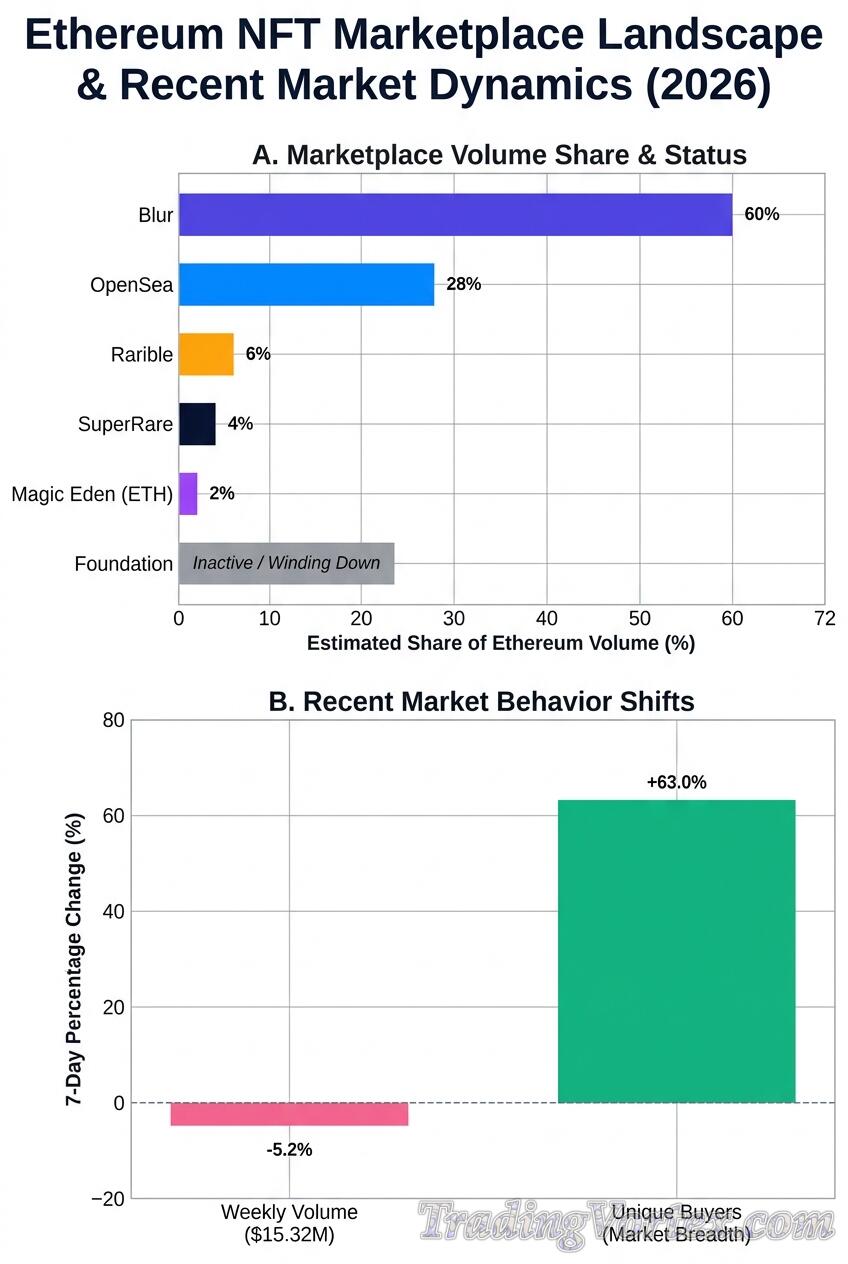
How to Interpret and Utilize This Visual Data
This dual-panel visual breaks down the core structural trends governing the Ethereum NFT market, giving you a clear picture of liquidity distribution and user participation patterns.
1. Marketplace Volume Share & Platform Status (Panel A)
-
Liquidity Consolidation: Blur commands roughly 60% of all trading volume on Ethereum, establishing itself as the primary liquidity pool for high-frequency trading, blue-chip floor sweeps, and order-book execution.
-
The Multi-Chain Challenger: OpenSea holds 28% of the volume share, maintaining its role as the primary venue for discovery, multi-chain listings, and retail collection browsing.
-
Niche & Specialized Platforms: Specialized venues like Rarible (6%) and SuperRare (4%) cater to royalty enforcement and high-end curated art, respectively.
-
Strategic Shifts & Exits: Platforms like Magic Eden have shifted strategic capital toward alternative chains like Solana, while Foundation has ceased operations—underscoring the importance of monitoring platform health and avoiding single-venue dependence.
2. Recent Market Behavior Shifts (Panel B)
-
Volume vs. Participation Divergence: Over a recent 7-day period, overall dollar volume contracted slightly by -5.2% (holding at $15.32 million). However, total unique buyer addresses surged by +63.0%.
-
Market Health Insight: A dramatic increase in active buyers alongside a modest volume dip indicates a healthier, more democratized market: broader participation across lower price points rather than speculative concentration in high-value assets.
Strategic Takeaways for Your Trading Strategy
-
For Active Traders: Direct high-volume trades and rapid floor sweeps through high-liquidity pools like Blur to minimize slippage and maximize execution speed.
-
For Artists and Creators: Rely on platforms like Rarible that emphasize on-chain royalty protections rather than pure volume dominance.
-
For Collectors: Use OpenSea for broad discovery across diverse collections, but monitor non-enforced marketplace contracts to ensure creator support.
The Evolution of Ethereum NFT Marketplaces
If you've been in this space for more than five minutes, you already know the NFT marketplace world doesn't sit still. What worked last year might be a ghost town today. Platforms that seemed untouchable have shut down. Others came out of nowhere and flipped the entire game on its head. And through all of it, Ethereum has remained the beating heart of the NFT economy, even as the market itself went through a brutal, necessary contraction.
I've watched this evolution unfold in real time, and honestly, it's been equal parts fascinating and painful. Fascinating because the innovation never stopped. Painful because a lot of people, creators especially, got caught in the crossfire of platform pivots and shutdowns they never saw coming. I still remember the messages I got from artist friends when Foundation announced it was closing. People who had built their entire careers on that platform, suddenly scrambling to figure out where to go next. That's the human cost of platform instability, and it's something the glossy market reports rarely capture.
So before we dive into the specific marketplaces you should care about today, let's walk through how we got here. Trust me, understanding the journey makes the destination a lot clearer.
How NFT Marketplaces Have Transformed Over the Years
Let's rewind to 2021. OpenSea was the undisputed king. If you wanted to buy or sell an NFT, you went to OpenSea. It was the default, the storefront, the place where everyone gathered. Simple as that. The platform processed billions in volume, accumulated over $36.78 billion in lifetime trading volume and 5.32 million traders over its existence, and became synonymous with NFTs themselves for millions of newcomers. For a while, "OpenSea" and "NFT marketplace" were practically interchangeable terms in everyday conversation.
Then Blur showed up in October 2022 with a completely different philosophy. Instead of building for collectors who wanted to browse pretty collection pages, Blur built for traders who wanted to execute fast and pay nothing. Zero marketplace fees. Dense, keyboard-friendly interfaces. Bidding pools that let you place bulk offers across entire collections. A native token that rewarded activity with real financial incentives. It was a direct assault on everything OpenSea had built, and it worked brilliantly.
The results were dramatic. Blur captured around 60% of Ethereum NFT volume at its peak, and during its Season 2 rewards program, it generated approximately $6.1 billion in trading volume while attracting over 260,000 unique users. OpenSea, caught flat-footed, had to respond. It slashed fees, rebuilt its platform as OS2 with multi-chain support, and announced plans for its own token. The competition got fierce, and traders benefited from the fee war that followed. I remember friends who had been paying 2.5% on every trade suddenly realizing they could execute the same transactions for free. That shift alone saved active traders thousands of dollars.
But then the broader market crashed. NFT trading volume collapsed from over $50 billion in 2022 to roughly $5.5 billion in 2025, a decline of nearly 90%. The easy money dried up. Speculators left. And the marketplaces that had been fighting for dominance suddenly found themselves fighting for survival. When the tide goes out, you find out who's been swimming naked, and the NFT marketplace space was about to get a very public lesson in what happens when revenue evaporates but operating costs don't.
From Generalist Giants to Specialized NFT Trading Platforms
The contraction forced every major player to make hard choices about who they actually wanted to serve. The era of the one-size-fits-all NFT marketplace was over, and trying to be everything to everyone became a recipe for being nothing to anyone.
OpenSea went broad. Its OS2 rebuild expanded support to 22 blockchains, added token trading alongside NFTs, and reduced fees to 0.5% to compete with Blur's zero-fee model. The strategy was clear: become the everything store for digital assets, not just NFTs. It worked, at least partially. OpenSea's market share doubled from 9.9% in January 2026 to nearly 20% by mid-year, and its monthly active user base of 382,000 dwarfs Blur's 38,300. That user gap tells you something important. Blur may dominate volume, but OpenSea dominates actual human beings showing up to browse, discover, and collect.
Blur stayed narrow and deep. It remains Ethereum-focused, with some expansion into Blast, but it never tried to be everything to everyone. Instead, it doubled down on professional trading tools: bid pools, sweeping mechanics, NFT lending through Blend, and aggregation from other marketplaces. Blur still commands the deepest liquidity for Ethereum blue chips, even as its overall market share settled around 25%. If you're trading CryptoPunks or Bored Apes, Blur is where you go. If you're looking for a mid-tier generative art collection that nobody's talking about, you might find crickets.
Magic Eden zigged when others zagged. Founded on Solana in 2021, it expanded aggressively into Bitcoin Ordinals and EVM chains through 2023 and 2024, capturing substantial market share in categories that didn't exist before. Then, in a move that surprised almost everyone, it announced in February 2026 that it was winding down its Bitcoin Ordinals and EVM marketplaces to refocus almost entirely on Solana. The pivot was painful for Ethereum traders who had come to rely on Magic Eden as a third option, but it reflected a hard truth: the multi-chain generalist model is expensive to maintain, and sometimes focus beats breadth. Watching a platform retreat from a market it had spent years building is never fun, especially when you've listed assets there.
The specialization didn't stop there. Platforms like SuperRare carved out the high-end digital art niche, building a curated ecosystem where quality mattered more than volume. Rarible built its identity around creator royalties and on-chain enforcement, positioning itself as the platform for artists who were tired of watching their secondary income disappear. Foundation tried to sustain a curated, invitation-only model before ultimately closing its doors in 2026, a casualty of the brutal economics facing niche platforms. The generalist era gave way to a landscape where the best NFT marketplace for Ethereum depended entirely on what you were trying to do.
The Metrics That Actually Matter: Volume, Active Users, and Liquidity
Here's where things get tricky, because the headline numbers you see on dashboard sites can be deeply misleading. I've watched traders make bad decisions based on vanity metrics, and I don't want you to be one of them. Let me walk you through what actually matters.
Trading volume is the most quoted metric, but it's also the easiest to game. Wash trading, where users buy and sell to themselves to farm token rewards, inflated Blur's numbers during its points programs. When Blur reduced rewards in early 2026, its monthly volume dropped from nearly $500 million to around $85 million, revealing how much of that activity was incentive-driven rather than organic. That's not to say Blur is a ghost town; it's still the deepest liquidity venue for Ethereum blue chips. But the volume numbers you see during incentive programs deserve a healthy dose of skepticism. If you're trying to gauge real demand, look at what happens when the rewards stop.
Active users tell a more honest story about a platform's real adoption. OpenSea's 382,000 monthly active users versus Blur's 38,300 shows you who's actually showing up to browse, discover, and trade, not just farm points. If you're a creator trying to reach collectors, that difference matters enormously. Listing on a platform with deep liquidity but no casual browsers means your work might never get discovered. Listing on a platform with fewer traders but more genuine engagement might mean slower sales but better long-term relationships.
Liquidity is the metric that impacts your trades most directly, but it's the one most people ignore until they try to sell something. Blur's aggregate share of 20.41% on DeFiLlama's dashboard, with 650.79 in seven-day volume, reflects its continued dominance for high-value Ethereum collections. But liquidity is fragmented. The same NFT might have bids on Blur, listings on OpenSea, and offers on lesser-known venues. Understanding where the real buy-side demand lives can mean the difference between a smooth exit and a painful holding period. I've seen traders spend weeks trying to sell an NFT at a fair price because they listed it on the wrong platform and nobody was watching.
Why Platform Longevity Matters When Choosing an NFT Marketplace
This is the part of the conversation that hurts. The past two years have been a graveyard for NFT marketplaces, and a lot of people got burned not by bad trades, but by trusting platforms that didn't survive. If you take nothing else from this section, take this: the platform you choose today might not be around tomorrow, and you need to plan accordingly.
Let me give you the grim roll call. Coinbase NFT shut down in 2024. Kraken NFT followed in early 2025. X2Y2, which briefly ranked as the second-largest NFT marketplace, posted $5.6 billion in cumulative volume before shutting down in April 2025, its founder writing that "marketplaces live or die by network effects". Bybit's NFT marketplace closed in April 2025. Nifty Gateway, once valued at $300 million in gross merchandise value during the 2021 boom, entered withdrawal-only mode in early 2026. And in June 2026, Binance, the world's largest crypto exchange, announced it was folding its NFT marketplace into its self-custody wallet by July 3.
That's the near-complete unwinding of the centralized-exchange NFT category in a single 24-month window. Even Foundation, a platform many of us genuinely loved for its curated digital art focus, shut down in 2026, its revenue collapse proving that love and good intentions don't pay the bills. I remember browsing Foundation collections in 2021 and thinking this was the future of digital art. Watching it close was a sobering reminder that even the most tasteful platforms can't survive if the economics don't work.
The lesson here is uncomfortable but essential: platform risk is real. When you list an NFT on a marketplace, you're trusting that platform to keep the lights on. When you store assets in a marketplace's custodial system, you're trusting them even more. The platforms that survive are the ones with sustainable business models, diversified revenue streams, and genuine network effects. Everything else is a gamble. Before you commit serious assets to any marketplace, ask yourself a simple question: if trading volume dropped by half tomorrow, would this platform still be here in a year? If the answer isn't a confident yes, proceed with caution.
The Rise of Aggregators and Cross-Marketplace NFT Trading
If there's one trend that defines the current era of Ethereum NFT trading, it's aggregation. Traders don't want to check five different marketplaces to find the best price. They want one interface that pulls listings from everywhere, sorts them by price, and lets them execute with a single click.
Blur built this into its core offering early on, aggregating listings from OpenSea, X2Y2, LooksRare, and other venues alongside its own. OpenSea's OS2 rebuild added similar functionality, letting users list assets across marketplaces without leaving the platform. The result is a trading experience where the line between "marketplace" and "aggregator" has blurred almost entirely. For most traders, that's a good thing. You get better price discovery without having to maintain accounts on a dozen different platforms.
The data backs up the importance of this shift. Magic Eden's rise to the top of the market share rankings, with 36.7% share and $120.6 million in volume in June 2026, was built on a neutral aggregator model that functioned across multiple chains. When the points-driven trading mania faded, traders didn't leave Magic Eden because the platform actually helped them discover and compare collections across ecosystems. That's the power of aggregation done right. You become the place people go to find what they want, not just the place where a single collection happens to live.
For you as a trader, this trend is mostly good news. More aggregation means better price discovery, tighter spreads, and less time wasted checking multiple platforms. But it also means you need to understand where your orders are actually executing. Aggregators can sometimes route through venues with different fee structures or settlement times, and knowing the difference can save you money. I've seen traders assume they were buying on one platform only to discover the order filled on another with slightly worse terms. Always check the execution details before you confirm.
The evolution of Ethereum NFT marketplaces isn't a story about technology. It's a story about adaptation. The platforms that survived are the ones that understood what their users actually needed, whether that was execution speed, creator royalties, multi-chain access, or simply a safe place to store and trade digital assets. The ones that didn't are case studies in what happens when you build for a market that doesn't exist anymore.
As we move into the specific marketplace recommendations, keep this history in mind. The platform that looks dominant today might not be the one that's still standing tomorrow. The tools and strategies that work in a bull market might not work in a bear market. And the only constant in this space is change. Your job as a trader, collector, or creator is to stay informed, stay flexible, and never assume that today's leader will be tomorrow's survivor.
📊 Estimated Comparative Market Share Evolution of Ethereum NFT Marketplaces: The Shift from Generalist Dominance to Pro Trading and Specialization (Q1 2021 – Q2 2026)
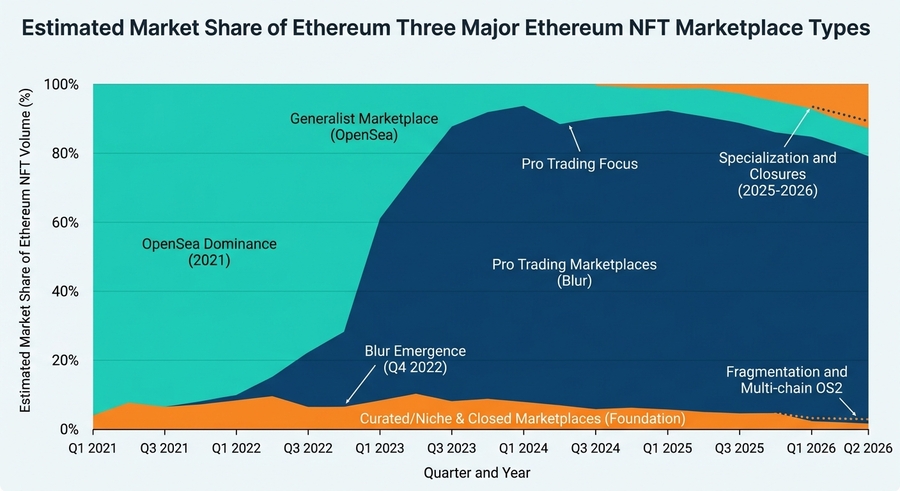
How to Interpret This Market Shift Visual
This stacked area chart provides a structural view of how different marketplace business models have captured trading volume share on the Ethereum blockchain over a five-year period. By visualizing market share percentage rather than absolute volume, we can clearly identify strategic transformations, even during periods of market contraction. Here is how to navigate the graphic:
-
The Dominance of Generalist Marketplaces (Teal Area): Observe how OpenSea (representing the 'Generalist' category) began as the overwhelming leader, commanding nearly 100% of market share during the 2021-2022 boom. Its strategy focused on retail discovery, easy minting, and a wide variety of collections, making it the default entry point.
-
The Surge of Pro Trading Platforms (Deep Blue Area): In Q4 2022, the 'Pro Trading' category, led by Blur, exploded onto the scene. Notice the rapid, steep expansion of this blue area. Blur targeted professional, high-frequency traders with zero fees and token incentives, forcing OpenSea to pivot its model and launch 'OS2' as it fought to maintain relevance. This is a powerful illustration of market disruption.
-
Specialization and Platform Risk (Orange Area): The smaller, compressed orange band represents curated art platforms, niche communities, and platforms that ultimately closed (like Foundation or exchange-based venues). Their thin slice of the overall market highlights the immense challenges of sustaining revenue on niche volume, directly illustrating the 'platform risk' discussed in the text.
-
Utilization Tip for Traders and Creators: If you are a high-frequency trader focusing on blue-chip liquid assets, the expanding Deep Blue (Pro Trading) area confirms where the majority of execution liquidity lives. If you are a new creator seeking maximal exposure, the substantial but fragmented Teal (Generalist) area still points to the platform with the largest human user base for discovery.
How to Choose the Best NFT Marketplace for Ethereum: Essential Criteria
Choosing an NFT marketplace is a lot like choosing a place to live. You can look at photos, read reviews, and ask friends for recommendations, but until you actually spend time there, you don't really know if it fits. The perfect marketplace for a professional flipper who executes twenty trades a day is probably miserable for a first-time collector trying to buy a piece of art they genuinely love. And a creator who depends on royalty income might find the most popular platform is also the worst one for their business.
I've made my share of mistakes in this department. Early on, I listed work on platforms that looked great but had no traffic. I've paid fees I didn't need to pay and missed better prices because I was watching the wrong screen. I've also watched friends get burned by platforms that shut down without warning, taking their listings and their earnings with them. So let me save you some of that pain. Here are the criteria that actually matter, explained in plain language, with real numbers and practical context.
NFT Marketplace Fees Explained: Trading, Gas, and Hidden Costs
Every NFT trade involves up to three separate fee components, and understanding them is the difference between a profitable trade and a nasty surprise. Most people focus only on the marketplace fee, which is a mistake I see constantly. Let's break it down properly.
The marketplace fee is what the platform charges for facilitating the sale. This has collapsed across the board in recent years. Blur built its entire business on zero marketplace fees, and OpenSea responded by cutting its take to 0.5%. Magic Eden and other competitors converged on similar near-zero structures. If you're paying more than 1% in marketplace fees on Ethereum in 2026, you're almost certainly on the wrong platform. The fee war that started in 2022 has been a gift to traders, and there's no reason to overpay for the same execution.
Gas fees are paid to the Ethereum network itself, not to the marketplace, and they can be brutal during peak congestion. Minting an NFT on Ethereum typically costs between 0.01 and 0.05 ETH, which is dramatically more expensive than alternatives like Polygon or Solana where costs often stay under a dollar. I remember paying over $80 in gas just to mint a single piece during a busy weekend in 2021, and it still stings when I think about it. If you're trading high-value assets, gas is a rounding error. If you're experimenting with smaller purchases, it can eat your entire margin. Timing your transactions for low-congestion periods can save you serious money, and Layer 2 solutions are making this less painful every year.
Creator royalties are the third component, and they're the most complicated. On most major marketplaces today, royalties are effectively a tip jar. Some buyers pay them, most don't. The rate itself varies wildly depending on the collection. Some creators set 5%, others set 10%, and Rarible allows creators to set royalties as high as 50%, enforced at the protocol level so no marketplace or buyer can bypass them. For collectors, this means the sticker price you see might not reflect the total cost if you choose to honor royalties. For creators, it means your secondary income depends heavily on where your work is listed and whether buyers care enough to pay voluntarily.
The practical takeaway: when you're comparing marketplaces, don't stop at the headline fee. Calculate the full cost path for the specific asset you're buying or selling. A 1 ETH sale can be reduced by marketplace charges, creator royalties, gas, and the gap between the displayed floor price and what someone is actually willing to pay. That last one catches more people than you'd expect. I've seen traders celebrate a sale price only to realize their net proceeds were 15% lower after everything was subtracted.
Creator Royalties: Which NFT Marketplaces Actually Enforce Them?
This is the topic that makes creators either furious or resigned, depending on how many times they've been burned. Let me give you the short version of a long, painful history, because understanding this saga will help you navigate the current landscape without getting blindsided.
The on-chain standard for royalties is called ERC-2981. A collection contract can publish a statement like "this NFT expects a 5% royalty paid to this address on resale." Marketplaces can choose whether to honor that statement. The standard is a signal, not an enforcement mechanism. That distinction is everything, and it's why creators have been fighting an uphill battle for years.
In November 2022, OpenSea tried to force the issue with something called the Operator Filter Registry, a smart-contract-level block list that prevented NFTs from trading on marketplaces that skipped royalty payments. It was the industry's best shot at making royalties non-negotiable. For a brief moment, it looked like creators might actually win this fight.
Then Blur launched with a minimum 0.5% royalty floor on immutable collections and optional royalties everywhere else, combined with zero marketplace fees. Traders flooded in because the economics favored them. Creators had no way to stop the migration without pulling their collections off the market entirely, which would have meant abandoning their audience and their income. It was a lose-lose situation, and most creators chose to stay and accept whatever royalties came their way.
By August 2023, OpenSea had phased out the Operator Filter, making creator fees optional for new collections. The royalty war was effectively over, and creators lost. I talked to several artists during that period who were genuinely heartbroken. They had built their careers on the promise of secondary sale income, and suddenly that promise was worthless on the platforms where most trading happened.
The state of play in 2026 is that on all three major marketplaces (OpenSea, Blur, and Magic Eden), royalties are functionally optional. Some buyers pay them out of principle or loyalty to the artist. Most don't, especially on high-volume trading platforms where every basis point matters. The difference between a 5% royalty and zero can mean thousands of dollars over the life of a successful collection.
But here's the part that gives me some hope. Creators who care about enforcement have shifted to on-chain transfer restrictions baked directly into the NFT contract itself. Instead of relying on marketplace goodwill, they're building technical enforcement that marketplaces can't ignore. Platforms like Rarible have gone further, building an entire Layer 3 blockchain (RARI Chain) specifically designed to enforce royalties at the node level, making it technically impossible to bypass creator payments. Rarible also allows royalty rates up to 50%, which is dramatically higher than the industry standard and gives creators real leverage.
For creators, the choice is stark. If you want maximum distribution and liquidity, you list on OpenSea or Blur and accept that royalties are optional. If you want enforceable royalty income, you need to look at platforms that have built the infrastructure to guarantee it, and you need to accept that your potential audience might be smaller. There's no free lunch here, and anyone who tells you otherwise is selling something. The creators I know who are thriving in 2026 have made peace with this tradeoff and chosen the path that aligns with their long-term goals.
Liquidity and Trading Volume: Why Floor Price Is Misleading
I've watched traders make expensive decisions based on floor price, and it kills me every time. The floor price is the lowest asking price for any NFT in a collection. It tells you what someone wants to receive. It tells you absolutely nothing about what someone is willing to pay. That gap between asking and paying is where fortunes are made and lost.
Funded bids are the metric that actually matters. A funded bid is a real offer backed by real money sitting in a smart contract, ready to execute. Blur's entire interface is built around exposing bid depth because professional traders understand this. When you see a collection with a floor price of 10 ETH but the highest funded bid is 6 ETH, you should be very nervous about buying at the floor. The market is telling you something, and you should listen.
The overall NFT market has contracted dramatically from its peak. Monthly trading volumes across all platforms have collapsed from $2.9 billion at the 2021 peak to just $23.8 million by early 2025. Even the survivors are operating in a much smaller pond. Blur's monthly volume dropped from nearly $500 million to around $85 million when it reduced its token reward programs, which tells you how much of that activity was incentive-driven rather than organic. That's not a knock on Blur; it's just reality. When the rewards stop, the tourists leave, and what remains is the real market.
For Ethereum specifically, the liquidity picture is fragmented. Blur still commands the deepest liquidity for blue-chip collections like CryptoPunks and Bored Ape Yacht Club. OpenSea has broader coverage but shallower depth for any individual collection. The same NFT might have bids on Blur, listings on OpenSea, and offers on lesser-known venues, and the best executable price could be on any of them. I've seen situations where the same NFT was listed for 8 ETH on one platform and 9.5 ETH on another, and the buyer who checked both saved a fortune.
The practical advice: before you buy or sell anything significant, check the funded bid depth on at least two marketplaces. Use an aggregator if you need to, but verify that the orders you're seeing are real and executable. And remember that liquidity is heavily influenced by market sentiment. When the Fear and Greed Index rises, liquidity scores rise with it, and when fear takes over, liquidity evaporates. Don't assume today's deep order book will still be there tomorrow. Markets can turn on a dime, and the exit you're counting on might not be available when you need it most.
Security and Wallet Safety: Protecting Your Ethereum NFTs
Here's the uncomfortable truth about NFT security: the blockchain itself is secure, but everything built around it is a potential attack surface. Scammers have gotten sophisticated, and the tools they use are genuinely convincing. I've seen experienced traders fall for scams that looked completely legitimate, so don't assume you're immune.
The most common attack vector is the fake NFT airdrop. You receive an NFT you didn't ask for, sometimes with a tempting name or a promise of rewards. When you interact with it, either by clicking a link or approving a transaction, you either reveal your recovery phrase on a phishing site or authorize a malicious contract that drains your wallet.
The rule is simple and absolute: treat every unsolicited NFT as a scam. Don't click links, don't approve transactions, and don't let curiosity override caution. I know it's tempting to see what that mysterious NFT is worth, but the answer is always less than what you'll lose.
Fake mint scams are another major category. Scammers create convincing websites and social accounts for "new" NFT projects, often using countdown timers and FOMO tactics to rush you into signing transactions that either send funds directly to the scammer or grant token approvals that let them drain your assets later. The urgency is the tell. Legitimate projects don't need to pressure you into acting in the next thirty seconds. If something feels rushed, it's probably a scam.
The tools to protect yourself are available, but you have to actually use them:
- Hardware wallets keep your private keys offline and inaccessible to phishing attacks.
- Multi-signature wallets require multiple approvals for transactions, adding a layer of security for high-value holdings.
- Burner wallets let you interact with risky or unknown contracts without exposing your main assets.
- And transaction simulation tools built into wallets like Phantom flag malicious contracts before you sign.
These aren't optional extras for paranoid people. They're basic hygiene for anyone holding meaningful value in NFTs.
Academic research on NFT marketplace usability found that fear of fraud is a recurring theme among users, and that trust in a marketplace is directly tied to whether it provides clear transaction status indicators and protects users from scams. When you're evaluating a marketplace, pay attention to how it handles security. Does it flag suspicious NFTs? Does it warn you about risky approvals? Does it make it easy to report spam? These features matter more than a pretty interface. A beautiful platform that leaves you exposed to scammers is worse than an ugly one that keeps you safe.
User Experience: Which NFT Marketplace Is Easiest for Beginners?
Let me be blunt: most NFT marketplaces are not built for beginners, and some actively make things harder than they need to be. If you're just getting started, the learning curve can feel steep enough to make you question whether it's worth it. I've watched friends give up on NFTs entirely because the first platform they tried made them feel stupid.
Research on user perspectives found that several recurring issues frustrate newcomers.
- Ambiguous system behavior, like automatic account creation during wallet connection without clear notification, leaves users uncertain about whether actions succeeded.
- Missing transaction status indicators create anxiety because blockchain transactions are irreversible and users don't know if their purchase went through.
- And the seed phrase onboarding process, requiring users to manually record twelve recovery words, creates friction that discourages adoption.
These aren't minor annoyances; they're barriers that keep talented people out of the space.
OpenSea is generally the most beginner-friendly of the major platforms. Its interface prioritizes discovery and browsing, making it easier to explore collections, inspect creators, and understand what you're buying before you commit. The platform supports over 150 payment methods and integrates with MoonPay for fiat purchases, which reduces the barrier for people who don't already hold crypto. OpenSea also doesn't require a traditional account with personal data; you connect your wallet and you're in. For someone buying their first NFT, that simplicity matters.
Blur is the opposite. Its dense, keyboard-driven interface assumes you already understand order books, bid depths, gas optimization, and wallet signatures. For experienced traders, that density is a feature, not a bug. For beginners, it's a minefield. One incorrect collection, stale order, or poorly understood signature can scale a mistake across multiple assets. I've seen newcomers accidentally place bids on the wrong collection because the interface didn't make the distinction clear enough. That's an expensive lesson you don't need to learn.
The practical advice for beginners: start on a platform that prioritizes clarity over speed. OpenSea or a similar generalist marketplace will let you learn the ropes without punishing you for not knowing what a "sweep" is. Once you're comfortable with the basics, you can explore Blur or other specialized platforms if your trading style demands it. There's no shame in starting simple. The traders who last are the ones who built their knowledge gradually, not the ones who jumped into advanced platforms and lost money on avoidable mistakes.
Platform Risk: Why Some NFT Marketplaces Disappear Overnight
This is the criterion that nobody thinks about until it's too late. The past two years have been a graveyard for NFT marketplaces, and the closures keep coming. I've watched friends lose access to their listings, their earnings, and in some cases their entire collections because they trusted a platform that didn't survive.
Foundation, a platform many of us genuinely loved for its curated digital art focus, shut down permanently in 2026 after a failed acquisition. It had facilitated roughly $230 million in primary sales and hosted landmark auctions for major artists, but that wasn't enough to keep the lights on. The founder's message was heartbreaking in its simplicity: the deal to sell the platform fell through, and they didn't believe another buyer was worth pursuing. I remember the community reaction when that news dropped. People were genuinely sad. Foundation had built something special, and watching it disappear was a reminder that even the most tasteful platforms can't survive if the economics don't work.
Foundation isn't alone. Coinbase NFT shut down in 2024. Kraken NFT followed in early 2025. X2Y2, which briefly ranked as the second-largest marketplace, posted $5.6 billion in cumulative volume before closing in April 2025. Nifty Gateway entered withdrawal-only mode in early 2026. And in June 2026, Binance announced it was folding its NFT marketplace into its self-custody wallet. The centralized-exchange NFT category has been almost completely wiped out in a single two-year window.
When a marketplace shuts down, the consequences for users are real. Foundation's closure raised familiar questions about the permanence of NFT media hosted on centralized infrastructure. The platform planned to continue pinning IPFS-hosted media for another year, but urged the community to take responsibility for personally pinning assets they care about. Users with NFTs listed on Foundation's smart contract had to unlist and retrieve them before the infrastructure went dark. If they missed the deadline, their listings could have been stuck in limbo indefinitely.
The lesson is clear: platform risk is real, and it's not going away. Before you commit serious assets to any marketplace, ask yourself a few hard questions. Does this platform have a sustainable business model, or is it burning venture capital? Does it have diversified revenue streams, or does it depend entirely on trading fees that collapse when the market cools? Has it survived previous downturns, or is it a newer entrant that hasn't been tested? If trading volume dropped by half tomorrow, would this platform still be here in a year?
The platforms that survive are the ones with genuine network effects, loyal user bases, and the financial discipline to weather bear markets. Everything else is a gamble, and the odds aren't in your favor. Diversify your listings across multiple marketplaces. Don't store assets in custodial systems you don't control. And always, always have an exit plan for the platforms you use. The marketplace that looks dominant today might not be the one that's still standing when you need it most. I've learned that lesson the hard way, and I don't want you to learn it the same way.
📊 Comparative Analysis of NFT Transaction Cost Paths across Marketplaces and Historical Monthly Trading Volume Contraction (2021–2026)
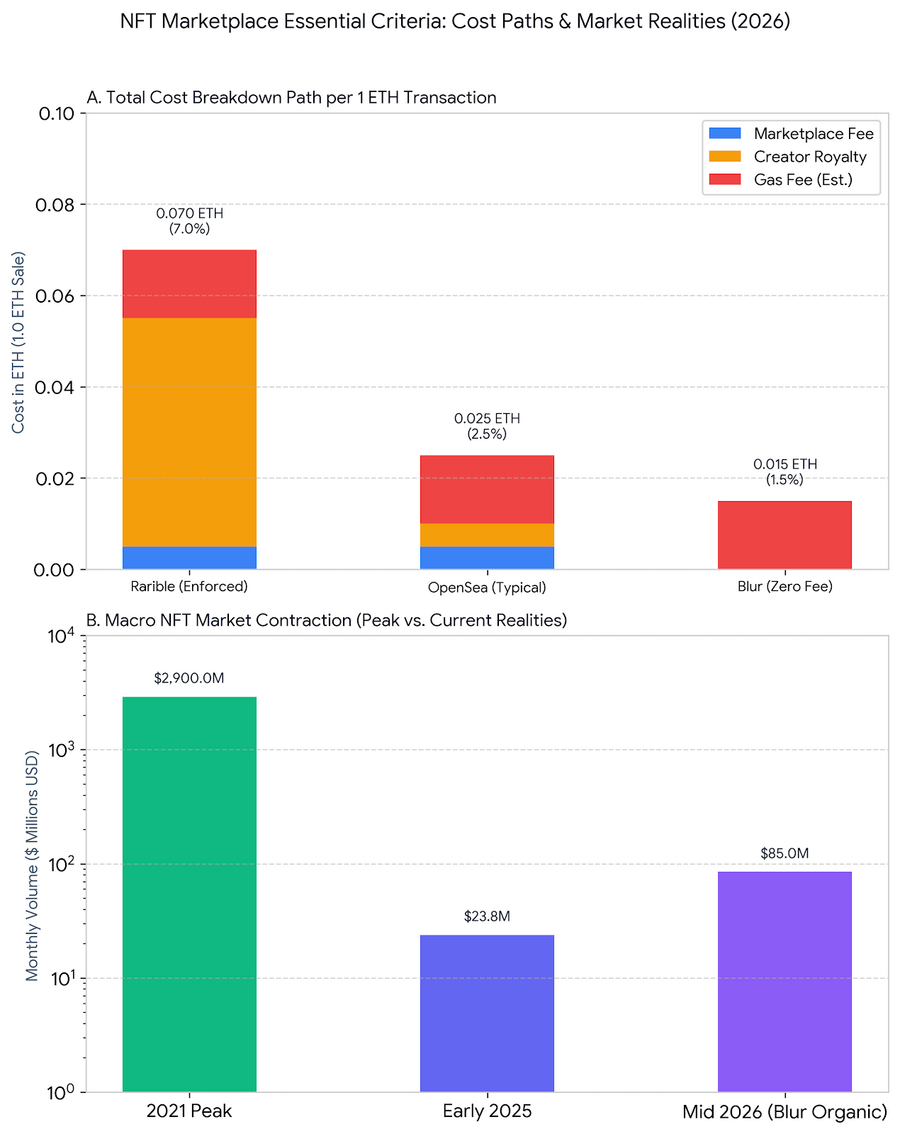
How to Interpret and Utilize This Visual Data
This dual-panel chart provides a clear breakdown of transaction friction and broader market realities to help you select the optimal marketplace for your trading strategy.
1. Total Cost Breakdown Path per 1 ETH Transaction (Top Panel)
-
Understanding Full Friction: A headline marketplace fee of 0% or 0.5% does not capture the full transaction expense. When factoring in estimated Ethereum gas fees (~0.015 ETH) and variable creator royalties, total transaction costs vary significantly depending on the venue.
-
Marketplace Model Tradeoffs:
-
Rarible (Enforced Royalties): Enforces full creator royalties (e.g., 5.0%), resulting in a higher total cost path (~0.070 ETH or 7.0%). This model directly protects creator revenue but increases execution costs for collectors.
-
OpenSea (Typical Practice): Charges a 0.5% marketplace fee with optional royalties, resulting in a moderate total cost (~0.025 ETH or 2.5% assuming minimal voluntary tips).
-
Blur (Zero Fee / Zero Royalty): Operates with 0% marketplace fees and optional royalties. Costs are reduced purely to base network gas fees (~0.015 ETH or 1.5%), maximizing execution speed and profit margins for high-frequency traders.
-
2. Macro NFT Market Contraction (Bottom Panel)
-
Volume Reality Check: Using a logarithmic scale, this panel illustrates the structural shift from the $2,900 million ($2.9 billion) monthly volume peak in 2021 down to $23.8 million in early 2025, before settling around $85.0 million in mid-2026 organic trading volume.
-
Evaluating Platform Risk: The dramatic drop in total market liquidity explains why major exchange-backed and curated venues have closed or unwound operations.
Strategic Takeaways for Your Decisions
-
For High-Frequency Traders: Prioritize platforms like Blur where zero fees minimize the full cost path, allowing you to maximize net proceeds.
-
For Creators and Ethical Collectors: Utilize venues like Rarible or custom contract-enforced protocols that guarantee royalty income, accepting higher friction in exchange for direct artist sustainability.
-
For Risk Management: Never store custodial assets on minor or single-purpose platforms. Always maintain an exit strategy and verify funded bid depth across aggregators before executing trades.
Blur: The Best NFT Marketplace for Professional Ethereum Traders
Let me be straight with you: Blur isn't for everyone, and it never pretended to be. When it launched in October 2022, it didn't try to be a friendlier OpenSea or a prettier Magic Eden. It showed up with a single, laser-focused pitch: a marketplace built for professional NFT traders on Ethereum. Zero fees. Dense, keyboard-driven interfaces. Bidding pools. A native token that rewards activity. And a peer-to-peer lending protocol that turned NFTs into collateral. It was a direct assault on everything the incumbents had built, and for a while, it worked spectacularly.
I remember the first time I opened Blur. It felt like walking into a trading floor after spending years in a gallery. No pretty pictures, no curated collections, just floor prices, bid depths, and a sweep button that could buy ten NFTs in a single transaction. For someone who had been manually clicking through OpenSea listings, it was both exhilarating and slightly terrifying. That's the Blur experience in a nutshell. If you trade Ethereum NFTs seriously, it's probably the most important platform in your toolkit. If you're a casual collector, it might make you want to close the tab and never come back.
What Makes Blur Different From Other NFT Marketplaces
The core difference is philosophical. OpenSea was built for discovery. Blur was built for execution. Every design decision flows from that distinction, and once you understand it, everything about the platform makes sense.
Blur launched with zero marketplace fees and has never wavered from that commitment. For high-frequency traders executing dozens of trades per week, that zero-fee structure can save thousands of dollars annually compared to platforms charging even 0.5% or 2.5%. On a $10,000 monthly trading volume, the savings alone can add up to roughly $600 per year compared to a 0.5% platform, and significantly more compared to the 2.5% fees that OpenSea used to charge. That's real money, and it's the single biggest reason professional traders gravitated to Blur so quickly. When you're trading at scale, fees are the silent killer of profitability, and Blur eliminated them entirely.
The interface is deliberately dense. Real-time floor prices update every four seconds. Bid-ask spreads, collection depth, and rarity data are all visible on a single screen. Pending transactions appear within a second. There's a collector mode with bigger images and a cleaner layout, but the default trader mode assumes you already know what you're doing. I've seen newcomers open Blur, stare at the screen for thirty seconds, and quietly go back to OpenSea. There's no shame in that. The platform is a tool, and tools are designed for specific jobs. A scalpel is a terrible tool for chopping vegetables.
Blur also functions as an aggregator. When you buy an NFT on Blur, the platform automatically routes to the cheapest available listing across OpenSea, LooksRare, X2Y2, and other integrated venues. This means you get the best available price without manually checking competing platforms. The aggregation layer integrates over $1.4 billion in listed value, solving the fragmented liquidity problem that has plagued NFT trading for years. For traders who remember the days of keeping twenty browser tabs open just to compare prices, this is a genuine quality-of-life improvement.
Bidding Pools, Sweeping, and Advanced NFT Trading Tools
This is where Blur separates itself from every other marketplace on Ethereum. The tools are built for speed and scale, and if you're trading anything above a casual level, they change how you operate.
Collection bids let you place standing offers on an entire collection rather than individual NFTs. A collection bid at 0.5 ETH on Pudgy Penguins means any seller who lists at or below that price has their NFT instantly purchased. This creates something resembling a functioning order book for NFTs, a concept that barely existed on Ethereum before Blur. When you can see where buyers are actually willing to commit capital, price discovery becomes dramatically more efficient. I've watched traders use collection bids to accumulate positions in collections they believed were undervalued, essentially setting a limit order and waiting for the market to come to them.
Bid pools take this further. Multiple traders can stack bids at the same price level, creating a visible wall of demand. Blur's data shows that the top bid on the 100 most popular collections averages within 0.72% of the floor price, meaning buyer and seller expectations are tightly converged. For comparison, Blur's floor prices average 4.97% lower than OpenSea's, and for blue-chip collections like BAYC, the gap can reach 9% to 10%. That's not a glitch. It's a different price discovery mechanism, one driven by two-sided negotiation rather than seller-only listings. When you're buying on OpenSea, you're seeing what sellers want. When you're buying on Blur, you're seeing what buyers are actually willing to pay, and the difference between those two numbers is where trading opportunities live.
Floor sweeping is the tool that made Blur famous. Instead of buying NFTs one at a time, you can sweep the cheapest listings across an entire collection in a single transaction. Blur claims its sweep function is 10 times faster than competitors, with gas-optimized bulk contracts that make the process efficient even when you're buying multiple assets. For traders accumulating positions at the lowest available prices, this is essential infrastructure. I've seen traders sweep ten NFTs in a single transaction and then relist them individually at higher prices, essentially creating a mini market-making operation with a few clicks.
Batch listing lets you manage dozens or hundreds of NFTs from a single dashboard. You can list multiple assets simultaneously, adjust pricing across your entire portfolio, and track unrealized gains and losses in real time. If you're running a serious trading operation, this level of portfolio visibility isn't a luxury. It's a requirement. Imagine trying to manage a hundred listings on a platform that only lets you edit one at a time. That's the nightmare Blur was built to solve.
Trait-based bidding is another feature that professional traders rely on heavily. Instead of bidding on an entire collection, you can place offers on specific traits. Maybe you think gold-furred Bored Apes are undervalued relative to the rest of the collection. Blur lets you bid specifically on those, giving you granular control over your exposure. This is the kind of feature that separates a serious trading platform from a place where people just click "buy now."
The Zero-Fee Model and BLUR Token: How Blur Rewards Traders
Blur's zero-fee model is simple on the surface, but the economics behind it are worth understanding. The platform generates zero revenue from trading fees. Its gross protocol revenue has been negligible for years, and the BLUR token currently has no direct revenue accrual mechanism. Any future fee activation would require a governance vote, and turning on fees would risk driving traders to competing zero-fee platforms. So the platform survives on a model that would make a traditional business school professor weep: it gives away its core service for free and hopes the token makes up the difference.
So how does Blur sustain itself? Through token incentives. Users earn BLUR tokens for listing NFTs, placing bids, and participating in lending. These points translate into airdrops, and the airdrops have been substantial. Season 2 generated approximately $6.1 billion in trading volume and attracted over 260,000 unique users, pushing Blur's market share to a peak of 65%. Season 3 continued the model, allocating 50% of rewards to NFT traders. In April 2026, traders could claim a 0.5% airdrop, while BLUR holders received a combined 1.5% airdrop based on their holdings. For a brief period, it felt like free money was raining from the sky, and everyone wanted an umbrella.
The strategy worked brilliantly for user acquisition. Blur became the largest NFT marketplace by volume on multiple occasions, and its 30-day trading volume reached 161,433 ETH (roughly $305 million) in early 2026, far outpacing OpenSea's 52,307 ETH (about $100 million) during the same period. At its peak, Blur captured around 60% of total Ethereum NFT volume, with OpenSea holding roughly 27%. Those numbers are staggering, and they reflect how quickly Blur disrupted the market that OpenSea had dominated for years.
But here's the uncomfortable truth that every Blur user should understand: the volume is heavily incentive-driven. When Blur reduced rewards in early 2026, some market makers paused participation, and OpenSea briefly overtook Blur in 24-hour trading volume. Monthly volume dropped from nearly $500 million to around $85 million, revealing how much activity was tied to token farming rather than organic demand. The BLUR token itself has fallen over 99% from its all-time high of around $5.02 in February 2023, trading in the $0.014 to $0.02 range as of late 2026. That's a brutal decline, and it reflects market skepticism about the long-term sustainability of the incentive model. If you bought BLUR near the top and held, you're probably not reading this through a smile.
Blur and the Rise of NFTFi: Lending, Borrowing, and Leverage
This is where Blur gets genuinely interesting, and also genuinely risky. Blend, Blur's peer-to-peer perpetual lending protocol, launched in May 2023 in partnership with Paradigm. It was one of the most significant financial innovations in NFT infrastructure, and it fundamentally changed what you could do with an NFT beyond buying and selling it.
Here's how it works. An NFT holder who needs liquidity deposits their NFT as collateral and receives an ETH loan. There's no fixed expiry date. The loan continues until either the borrower repays or the lender calls it. Lenders deposit ETH against an NFT as collateral and earn interest payments from the borrower. Blend charges no fees to either side on borrowing, lending, or repayment. If that sounds too good to be true, it's because the risk is baked into the liquidation mechanism rather than the fee structure.
The Buy Now, Pay Later feature takes this further. You can purchase an expensive NFT with a portion of the price upfront, borrowing the remainder against the NFT itself. It's effectively a down payment model for premium collections, and it opened the door for traders who wanted exposure to blue-chip NFTs without committing full capital upfront. Imagine buying a Bored Ape with 20% down and financing the rest. That's the kind of thing that was impossible before Blend, and it's why the protocol generated so much excitement when it launched.
The liquidation mechanism is where things get spicy. If a lender calls a loan and the borrower cannot repay, the NFT goes to a Dutch auction. If no buyer meets the floor price, the lender takes possession of the NFT as collateral. This is an oracle-free system, meaning it doesn't rely on external price feeds that can be manipulated. Instead, it uses auction dynamics to discover fair value in real time. The auction starts at the loan amount and drops over time until a buyer steps in. It's an elegant solution to the problem of valuing illiquid assets, but it also means that borrowers can lose their collateral quickly if the market moves against them.
But here's the risk that every Blend user needs to internalize. During the 2024 bear market, falling NFT floor prices triggered mass liquidations. Borrowers who had taken ETH against BAYC or Azuki NFTs saw their collateral liquidated at prices far below their original value. Blur's co-founder acknowledged that some collections' floor prices declined after Blend launch, while others increased, reflecting the double-edged nature of adding leverage to illiquid asset markets. The risk assessment firm Hindenrank specifically flags a scenario where blue-chip NFT floors drop more than 40% over 30 days and Blend refinancing auction fill rates fall below 30%, creating a potential illiquidity cascade. In plain English: if the market crashes and nobody shows up to buy the liquidated NFTs, the whole system can grind to a halt.
The lesson is simple: leverage amplifies everything. If you borrow against your NFTs and the market drops, you can lose your collateral at the worst possible moment. Blend is a powerful tool, but it's not a toy. Use it with the same caution you'd apply to any leveraged position in traditional finance. I've seen traders who borrowed against their blue-chip NFTs during a bull market and ended up losing everything when the floor dropped 50% in a month. Don't be that person. If you're going to use Blend, borrow conservatively, monitor your loan-to-value ratio obsessively, and have a repayment plan before you take the loan.
Who Should Use Blur to Buy and Sell NFTs on Ethereum
Blur is a specialized instrument, and like any specialized tool, it works brilliantly for the right user and poorly for everyone else. Let me help you figure out which category you fall into, because choosing the wrong platform can cost you time, money, and a lot of frustration.
You should use Blur if you're an active Ethereum NFT trader who executes multiple transactions per week and cares more about execution speed and cost efficiency than browsing pretty collection pages. You should use Blur if you're trading blue-chip collections like CryptoPunks, Bored Ape Yacht Club, Azuki, or Pudgy Penguins, where the deepest liquidity lives. You should use Blur if you want access to bid pools, floor sweeping, batch listing, and NFT lending in a single integrated platform. You should use Blur if you're comfortable with a dense interface and you don't need your hand held through every transaction. You should use Blur if you're the kind of person who checks floor prices before you check your morning email.
You should probably avoid Blur if you're a beginner who's still learning how wallets work and what gas fees are. The interface assumes a level of knowledge that newcomers simply don't have yet. You should avoid Blur if you're a collector who values discovery, curation, and the joy of stumbling across interesting art. Blur doesn't do discovery; it does execution. There's no editorial voice, no curated collections, no "featured artists" section. It's a trading terminal, not a gallery. You should avoid Blur if you're primarily interested in non-Ethereum chains, because Blur remains Ethereum-only with limited expansion into Blast. There's no Solana, no Base, no Polygon support in 2026. If your NFTs live elsewhere, Blur can't help you.
And you should think carefully before using Blur if you're a creator who depends on royalty income. Blur's royalty policy was controversial from day one: a minimum 0.5% floor on immutable collections, but effectively optional royalties everywhere else. When Blur launched, creators had no way to stop the migration to a platform that treated their secondary income as a suggestion. That hasn't changed. If royalties are a meaningful part of your income, you need to either accept that most Blur traders won't pay them voluntarily, or list on platforms that enforce them and accept a smaller audience. There's no perfect answer here, but you should make the choice with your eyes open.
The bottom line is this: Blur is the best NFT marketplace for professional Ethereum traders because it was built by people who understood what professional traders actually need. Speed, low costs, deep liquidity, and financial tools that go beyond simple buying and selling. If that describes you, Blur should be your primary platform. If it doesn't, there's no shame in using something else. The best marketplace is the one that fits how you actually trade, not the one with the most impressive volume numbers. I've seen too many people force themselves to use Blur because it's "the professional platform" and end up miserable because they really just wanted to browse art and collect things they love. There's room for both approaches in this ecosystem, and knowing which one is yours is the first step toward using these tools well.
📊 Comparative Analysis of Blur vs. OpenSea Price Discovery Spreads and Monthly Trading Volume Adjustment Following Incentive Reductions (2026)
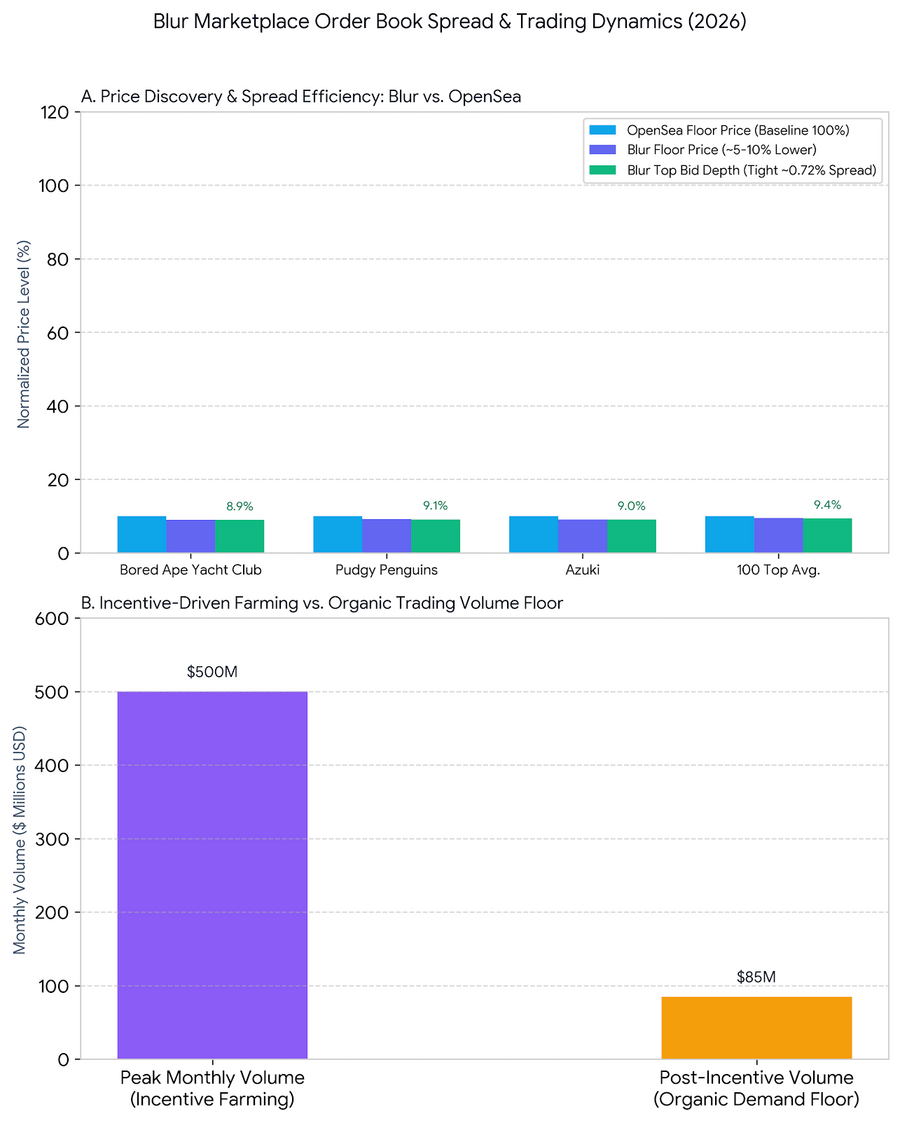
How to Interpret and Utilize This Visual Data
This dual-panel visual illustrates how Blur's order-book mechanics alter price discovery and demonstrates the impact of token incentives on total trading volume.
1. Price Discovery & Spread Efficiency: Blur vs. OpenSea (Top Panel)
-
Understanding Floor Price Differences: OpenSea displays seller-only asking prices. In contrast, Blur’s floor prices across major collections average 4.97% lower overall, reaching 9% to 10% lower on blue-chip assets like Bored Ape Yacht Club (BAYC).
-
Tight Bid Spreads: Thanks to Blur’s collection bids and bidding pools, funded top bids sit within 0.72% of the floor price across top collections. This narrow bid-ask spread allows sellers to execute instant sales with minimal price slippage compared to traditional listing venues.
2. Incentive-Driven Farming vs. Organic Volume Floor (Bottom Panel)
-
Incentive Sensitivity: Blur’s monthly trading volume reached ~$500 million during peak token reward seasons.
-
Organic Demand Baseline: Following reductions in token distribution rewards, monthly trading volume contracted to roughly $85 million. This shift highlights the portion of trading activity driven by token farming versus baseline organic execution demand.
Strategic Takeaways for Your Trading
-
For Active Traders: Use Blur’s collection bids and bid depth to enter or exit positions quickly near market clearing prices.
-
For Price Comparison: Always cross-reference asking prices across aggregated sources before buying, as OpenSea listings reflect seller expectations while Blur order books reflect real-time buyer commitments.
-
For Yield Expectations: Base your trading activity on order execution quality and fee savings rather than anticipated token farming yields.
OpenSea: The Most Recognized NFT Marketplace for Ethereum
OpenSea is the granddaddy of NFT marketplaces. Launched in 2017 by Devin Finzer and Alex Atallah, it spent years as the default storefront for the entire NFT space, the place where millions of people bought their first digital collectible and where the term "NFT marketplace" became synonymous with a single brand. It processed billions in volume, raised $300 million at a $13.3 billion valuation from Paradigm and Coatue, and became the gateway drug for an entire generation of collectors. If you got into NFTs anytime before 2023, there's a very good chance OpenSea was your first stop.
But here's the thing about being the incumbent: everyone comes for your throne. Blur showed up in 2022 with zero fees and stole the professional trading crowd. Magic Eden built a Solana empire. The market crashed, volume evaporated, and OpenSea found itself in the unfamiliar position of fighting for relevance. The response was OS2, a complete rebuild that transformed the platform from an Ethereum-only NFT storefront into a multi-chain trading hub for tokens, NFTs, and eventually perpetual futures. It was a bold bet that the future of OpenSea wasn't as an NFT marketplace at all, but as a comprehensive on-chain trading platform.
I've watched this transformation closely, and it's been equal parts impressive and messy. OpenSea didn't just survive the downturn; it reinvented itself. The question is whether that reinvention actually serves the traders, collectors, and creators who made it famous in the first place. Let's dig into what OpenSea looks like in 2026 and whether it deserves a spot in your rotation.
OpenSea’s Journey From Ethereum-Only to Multi-Chain Giant
For most of its life, OpenSea was an Ethereum platform. It launched as an Ethereum-only marketplace in 2017 and stayed that way for years, dominating the space through sheer first-mover advantage and network effects. When you said "NFT marketplace," you meant OpenSea, and when you said OpenSea, you meant Ethereum. That association was so strong that even today, plenty of people still assume OpenSea is Ethereum-only, which couldn't be further from the truth.
The first real expansion attempt came in April 2022, when OpenSea introduced Solana NFT support in beta, covering about 165 collections. It was a cautious experiment, and it didn't go well. Magic Eden and Tensor already owned the Solana NFT market, and OpenSea's beta attracted limited trading activity. The platform quietly retreated, focusing instead on rebuilding its core product. I remember trying that beta and wondering why anyone would use it when Magic Eden was right there with better tools and deeper liquidity. The lesson was clear: you can't half-heartedly enter a market that already has passionate, specialized incumbents.
That rebuild became OS2. Released publicly in May 2025 after a testing period, OS2 was a ground-up reconstruction of the entire platform. It introduced token trading across 19 chains, cross-chain features, marketplace aggregation, and support for fungible tokens alongside NFTs. By August 2026, OpenSea's market data covered more than 25 networks. The platform that had once been synonymous with Ethereum-only NFTs was now a multi-chain trading hub that happened to also support NFTs.
The Solana NFT return came in August 2026, more than four years after the initial beta ended. OpenSea added full Solana NFT trading to OS2, with collections like Mad Lads, Claynosaurz, Collector Crypt, and Phygitals available at launch. The pitch was simple: one interface, one wallet, access to Solana collections alongside Ethereum, Base, Polygon, and everything else. Whether it works this time depends on whether Solana traders see any reason to leave the native platforms they've built habits around. My honest take? Solana traders are loyal to their ecosystem in a way that Ethereum traders sometimes aren't, and OpenSea will need to offer something genuinely better than Magic Eden or Tensor to win them over. So far, the value proposition is convenience rather than superiority.
The numbers tell a story of recovery. OpenSea's monthly active addresses hit 467,322 in May 2025, the highest since mid-2023, driven by the OS2 launch and expectations of token incentives. By October 2025, monthly trading volume reached $2.6 billion. That's a far cry from the $5 billion monthly peaks of January 2022, but it's a meaningful rebound from the depths of the bear market. More importantly, it shows that OpenSea still has a pulse. Platforms that lose their user base entirely rarely get it back. OpenSea didn't just survive; it adapted.
The Seaport Protocol: Security and Gas Efficiency Explained
OpenSea's technical foundation changed dramatically in June 2022 when it migrated from its original Wyvern protocol to Seaport, a new open-source marketplace protocol designed for safety and efficiency. This migration was one of the most important infrastructure upgrades in NFT history, and it's worth understanding why it matters for anyone trading on the platform. If you've ever wondered why listing on OpenSea is free but buying costs gas, Seaport is the answer.
Seaport uses off-chain EIP-712 signed orders that settle on-chain when matched. In plain terms: you sign a listing in your wallet, the signature sits on OpenSea's servers for free, and the buyer pays gas when they execute. This is why listing on OpenSea is gasless but buying is not. It's a design that reduces friction for sellers while keeping the actual settlement secure and verifiable on the blockchain. For creators and collectors who list frequently, this gasless listing model is a massive quality-of-life improvement. I remember the old Wyvern days when listing an NFT cost gas, and if you changed your mind or adjusted the price, you paid again. Seaport eliminated that entirely.
The gas savings from Seaport were substantial. OpenSea estimated that the protocol would save users approximately 35% in gas fees for transactions, which based on the prior year's data amounted to more than $460 million in total savings. New users also no longer had to pay a one-time account initialization fee, which OpenSea estimated would save the community almost $120 million annually. Those numbers are staggering, and they reflect how inefficient the old system was. If you were trading during the Wyvern era, you probably remember paying gas fees that felt like a tax on every single action. Seaport made the entire experience cheaper and smoother.
Seaport also enabled features that weren't possible before. Collection offers let you place offers on all items in a collection. Attribute offers let you bid on groups of items with specific traits, like bidding on any Bored Ape with a gold fur. These features became the foundation for the bidding pool dynamics that Blur later made famous, and they're still core to how professional traders operate on OpenSea today. If you want to accumulate a specific trait across a collection, Seaport makes it possible without manually bidding on individual NFTs one by one.
Security-wise, Seaport is the most battle-tested NFT marketplace smart contract in existence. It has been independently audited multiple times, and OpenSea runs a HackerOne bug bounty program with rewards up to $100,000 for critical vulnerabilities. The protocol has handled billions in volume without a catastrophic exploit. That track record matters when you're trusting a smart contract with high-value assets. There have been NFT marketplace hacks in the past, and the platforms that survived them were the ones with rigorous security practices. OpenSea's investment in Seaport's security is one of the main reasons it's still standing today.
OpenSea Fees and the Impact of Fee Restructuring on NFT Traders
OpenSea's fee history is a story of competitive pressure forcing change. For years, the platform charged a 2.5% marketplace fee on every sale, and traders grumbled but paid because there was no real alternative. It was the cost of doing business on the only marketplace that mattered. Then Blur launched with zero fees, and the calculus changed overnight. Suddenly, 2.5% felt like a tax that traders were no longer willing to pay.
OpenSea's response was dramatic. The platform cut its fee to 0.5%, a reduction that directly addressed its biggest competitive disadvantage. For a $10,000 trade, that's the difference between $250 and $50 in marketplace fees, money that goes straight back into the trader's pocket. The move was necessary, and it worked. OpenSea remained competitive on cost while maintaining its massive user base and discovery advantages. I remember talking to traders who had switched to Blur during the fee war and were surprised to find themselves back on OpenSea after the fee cut. The savings were comparable, and the interface was more familiar.
The fee drama didn't end there. In March 2026, OpenSea announced it was reducing token trading fees to 0% for 60 days, covering the mobile app, cross-chain swaps, and even perpetual futures. After that two-month period, a new competitive fee system would take over to reward consistent traders. The temporary zero-fee window was framed as a goodwill gesture after the SEA token delay, but it was also a clear signal that OpenSea was willing to compete aggressively on price to keep users engaged. If you were paying attention, the message was unmistakable: OpenSea is not going to lose on fees.
OpenSea Rewards, Airdrops, and Loyalty Programs
OpenSea's rewards program has been a rollercoaster of expectations, delays, and shifting timelines. If you've been farming for the SEA token, you already know the story. If you're new, here's the short version, and I'll try to be gentle because I know how frustrating this has been for a lot of people.
OpenSea announced SEA in February 2025, positioning it as a token that would recognize both historical OpenSea users from the 2021 to 2024 era and active OS2 users. The platform ran multiple Voyages reward waves, distributing XP and treasure chests based on trading, listing, and bidding activity. The tokenomics promised that 50% of total supply would go to the community, split between an initial airdrop and ongoing rewards. Half of platform launch revenue was earmarked for token buybacks. On paper, it looked like one of the most generous airdrop programs in NFT history.
Then came the delay. On March 16, 2026, CEO Devin Finzer announced that the SEA token launch, originally targeted for March 30, was being postponed indefinitely due to "challenging market conditions." Finzer's message was honest: "A delay is a delay," and the team wanted to ensure SEA "only launches once" and lives up to community expectations. I appreciated the transparency, but I also felt for the people who had been grinding Voyages for months expecting a payout. Crypto airdrops are always a gamble, and this one tested a lot of people's patience.
The delay came with concessions. OpenSea offered optional platform fee refunds to users who participated in Reward Waves 3 through 6. If you took the refund, you forfeited your Treasures rewards. If you kept your Treasures, the foundation said they would be "meaningfully considered" during the eventual token generation event. The current reward wave was confirmed as the final one, ending the active farming season. It was a reasonable compromise, but it didn't erase the frustration of waiting months for a token that still doesn't have a launch date.
The practical takeaway for anyone hoping to maximize SEA eligibility: consolidate your activity in one wallet, engage with collections you actually value, and avoid multi-wallet farming. OpenSea's sybil detection has gotten sophisticated, and the platform explicitly warns against manipulation and multi-wallet abuse. Historical activity from the original OpenSea platform still counts, so if you traded NFTs between 2021 and 2024 on a consistent wallet, you have a base allocation waiting for you whenever the token finally launches.
My advice? Don't chase SEA at the expense of making good trades. Use OpenSea because it's a solid platform, and if the token eventually drops, treat it as a bonus rather than the reason you're there.
Token Trading and Expanded Asset Support on OpenSea
This is where OpenSea in 2026 looks nothing like the OpenSea you might remember. The platform isn't just an NFT marketplace anymore. It's a multi-chain trading hub that handles tokens, NFTs, and increasingly complex financial products, all through the same interface. If you took a break from the space and came back, you might not recognize the place.
Token trading was the first major expansion. OS2 launched with fungible token support across 19 chains, and by August 2026, OpenSea's market data covered more than 25 networks. This means you can buy and sell Ethereum, Solana, Base, Polygon, Arbitrum, and other tokens directly on OpenSea, without switching to a separate exchange. The line between "NFT marketplace" and "crypto trading platform" has blurred almost entirely. For traders who want a single interface for everything, this is a game changer.
Cross-chain swaps are another feature that changes how you operate. Instead of bridging assets manually and paying multiple gas fees, OpenSea lets you swap tokens across chains within the same interface. For traders who move between Ethereum and Layer 2 solutions regularly, this eliminates a lot of friction. I've spent more hours than I care to admit wrestling with bridges, and having a native swap feature on a platform I already use is genuinely convenient.
Solana NFT support, as mentioned earlier, is the newest addition. Since August 31, 2026, collectors can browse, buy, sell, and bid on Solana NFTs directly through OS2, with collections like Mad Lads and Claynosaurz available alongside Ethereum blue chips. The integration means Solana creators can reach OpenSea's massive Ethereum-focused audience, and Ethereum collectors can explore Solana collections without leaving their familiar interface. Whether it drives meaningful volume remains to be seen, but the infrastructure is there.
The roadmap also includes perpetual futures, which would place OpenSea even closer to traditional crypto exchanges. In June 2026, product executive Zack Brenner asked users about early access to perps, and later indicated that Hyperliquid could supply the infrastructure. No release date has been announced, but the direction is clear: OpenSea wants to be the one-stop shop for everything on-chain, not just NFTs. Whether that ambition serves users or just creates a bloated platform that does everything adequately but nothing excellently is an open question.
Who OpenSea Is Best For: Beginners, Collectors, and Creators
OpenSea's breadth is its greatest strength and its biggest weakness. It tries to be everything to everyone, and for the most part, it succeeds. But "succeeds at everything" doesn't mean "best at everything," and knowing where OpenSea shines versus where it falls short will help you decide when to use it.
For beginners, OpenSea is the obvious starting point. The interface prioritizes discovery and browsing, making it easy to explore collections, inspect creators, and understand what you're buying before you commit. The platform supports over 150 payment methods and integrates with MoonPay for fiat purchases, which reduces the barrier for people who don't already hold crypto. OpenSea also doesn't require a traditional account with personal data; you connect your wallet and you're in.
For someone buying their first NFT, that simplicity matters. You can learn the basics of wallet connections, gas fees, and transaction confirmations without being overwhelmed by a trading terminal designed for professionals. I always tell newcomers to start on OpenSea, make a few small purchases, and get comfortable before exploring more specialized platforms. It's the training wheels of the NFT world, and there's nothing wrong with that.
For collectors, OpenSea's discovery features are unmatched. With over 80 million NFTs listed across 19 chains, no competitor comes close to that breadth of inventory. Whether you're hunting for blue-chip Ethereum art, Solana gaming assets, or Base ecosystem experiments, OpenSea has it. The platform's aggregation pulls listings from multiple sources, and the OS2 interface makes it easy to compare prices across chains without switching tabs.
If you collect because you genuinely love the art or the community, OpenSea's browsing experience is the most enjoyable way to find your next purchase. I've discovered artists on OpenSea that I never would have found on more specialized platforms, simply because the inventory is so vast.
For creators, the picture is more complicated. OpenSea offers access to the largest buyer surface in the NFT space, which is undeniably valuable. But creator royalties on OpenSea are optional, like they are on every major marketplace. The Operator Filter Registry, which OpenSea introduced in 2022 to enforce royalties, was phased out in August 2023, making creator fees effectively a tip jar.
If royalties are a meaningful part of your income, OpenSea alone won't protect them. You'll need to either accept that most buyers won't pay voluntarily, or list on platforms that enforce royalties on-chain and accept a smaller audience. There's no perfect answer, but you should make the choice with your eyes open. I've talked to too many creators who assumed their royalties would be honored and were devastated when they weren't. Don't be one of them.
For active traders, OpenSea is a solid secondary platform but not a Blur replacement. The 0.5% fee is competitive, and the multi-chain support gives it an edge for cross-chain strategies. But Blur still commands the deepest liquidity for Ethereum blue chips, and its trading tools are built for speed in a way that OpenSea's broader interface isn't.
If you're executing dozens of trades per week, you'll probably use both: Blur for execution, OpenSea for discovery and cross-chain access. I know traders who keep both tabs open and switch depending on what they're doing. That's not a sign of indecision; it's a sign of understanding that different tools serve different purposes.
The bottom line is this: OpenSea is the most recognized NFT marketplace for Ethereum because it earned that recognition over years of being the default option. In 2026, it's no longer the only option, and it's no longer the best option for every use case. But for beginners, collectors, and anyone who values breadth over specialization, OpenSea remains the most accessible and comprehensive platform in the space.
The question isn't whether OpenSea is still relevant; it clearly is. The question is whether it fits how you actually trade, collect, or create. And that's a question only you can answer.
📊 Comparative Analysis of OpenSea Active Address Rebound Post-OS2 Launch and Historical Marketplace Fee Rate Evolution (2017–2026)
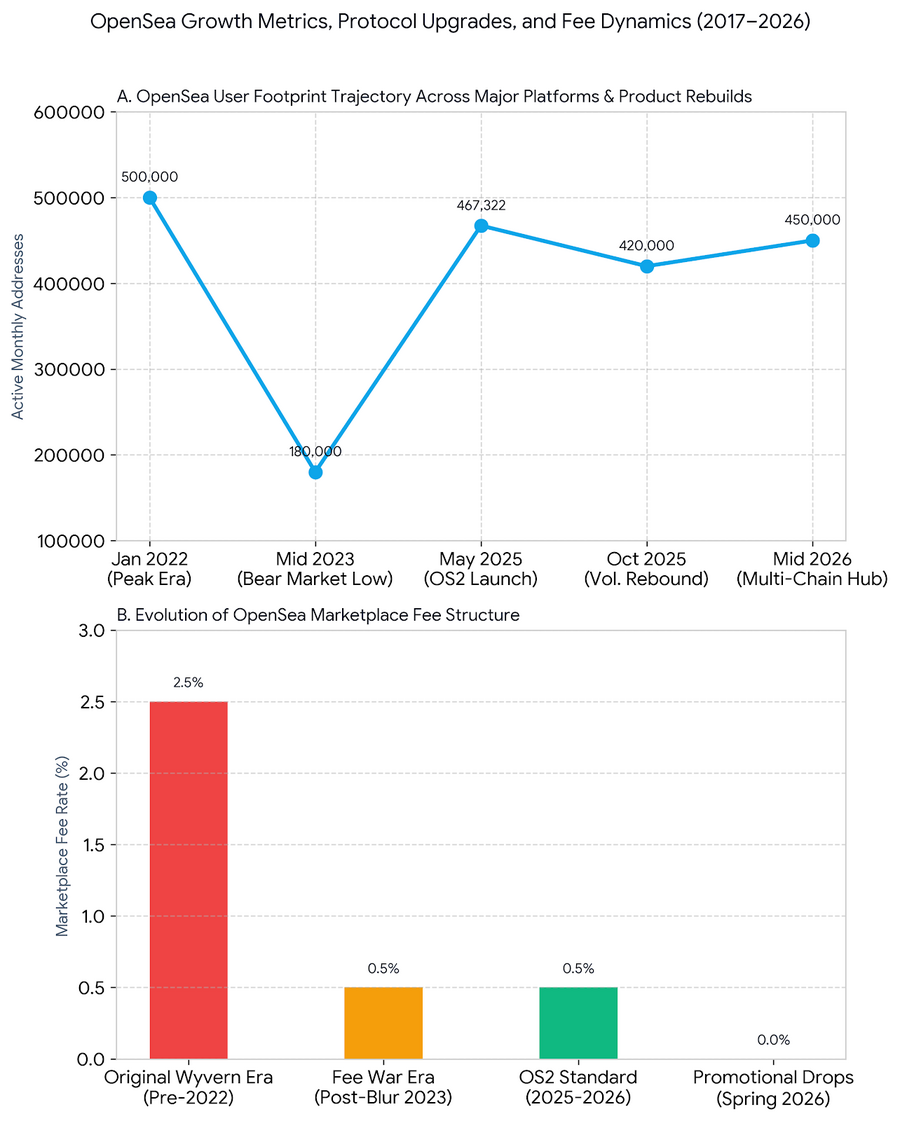
How to Interpret and Utilize This Visual Data
This dual-panel chart tracks OpenSea's trajectory from an early Ethereum marketplace into a multi-chain trading platform, highlighting key shifts in user activity and fee models.
1. OpenSea User Footprint Trajectory Across Product Rebuilds (Top Panel)
-
Peak to Downturn: Monthly active addresses hit peak highs in early 2022 (~500,000) before dropping significantly during the 2023 bear market (~180,000).
-
OS2 Rebound: The release of OS2 pushed active addresses back up to 467,322 in May 2025, demonstrating a strong recovery driven by multi-chain asset support and rewards initiatives.
-
Sustained Footprint: Following the initial launch surge, active user numbers stabilized above 420,000 to 450,000, supported by multi-chain asset listings across 25+ networks.
2. Evolution of OpenSea Marketplace Fee Structure (Bottom Panel)
-
Wyvern Era Baseline: Early OpenSea transactions incurred a 2.5% marketplace fee alongside required gas payments for listings.
-
Competitive Adjustment: To remain competitive with zero-fee platforms, OpenSea lowered its standard marketplace fee to 0.5%; saving sellers up to $200 per $10,000 trade.
-
Promotional Windows: OpenSea introduced temporary 0% marketplace fee campaigns across cross-chain swaps and token trades to reward loyal users during reward distributions.
Strategic Takeaways for Your Decisions
-
For Beginners & General Collectors: Leverage OpenSea’s discovery tools and off-chain Seaport listings, which allow gasless listing creation until execution.
-
For Active & Multi-Chain Traders: Take advantage of lower 0.5% marketplace fees and integrated cross-chain swaps on OS2, while continuing to check aggregated liquidity across dedicated platforms like Blur when executing high-volume Ethereum trades.
Magic Eden: The Multi-Chain NFT Marketplace and Its Ethereum Shift
Magic Eden is the platform that promised to be everything to everyone, and then decided it didn't want to be. If you've been trading NFTs for a while, you remember the pitch: one marketplace for Solana, Ethereum, Polygon, Bitcoin Ordinals, Runes, and just about every other chain that mattered. It was a beautiful idea. A unified storefront for the entire fragmented NFT universe. For a while, Magic Eden actually pulled it off, becoming the largest NFT marketplace by trading volume and dominating the Bitcoin Ordinals market while most competitors were still figuring out what Ordinals even were.
Then, in February 2026, the company pulled the plug. Co-founder and CEO Jack Lu announced that Magic Eden was ending support for Ethereum-compatible chains and Bitcoin-based assets, effective in less than two weeks. No gradual sunset. No extended transition period. Just a hard stop that left multi-chain users scrambling to move their assets and question what the platform had promised them. I've watched platforms pivot before, but this one stung for a lot of people. If you were trading Ethereum NFTs on Magic Eden or farming the ME airdrop by moving Ordinals around, you woke up one morning to discover that the platform you'd invested time and money into had decided you weren't part of its future. That's a harsh lesson in platform risk, and it's one worth understanding before you commit to any marketplace.
Magic Eden’s Evolution From Solana to Multi-Chain NFT Trading
Magic Eden launched in September 2021 as a Solana-native marketplace, and it quickly became the dominant venue for Solana NFTs. At a time when OpenSea's Solana beta was floundering and most Ethereum-focused platforms treated Solana as an afterthought, Magic Eden gave Solana collectors a platform that actually understood the ecosystem. It supported the full modern Solana NFT stack, including Metaplex Core, Token-22, and compressed NFTs (cNFTs) , and it built deep relationships with creators and collectors that competitors couldn't easily replicate. If you were trading Solana NFTs in 2021 or 2022, Magic Eden wasn't just an option. It was the only serious option.
Then came the expansion. In 2022, Magic Eden added support for Ethereum and Polygon NFTs. It later expanded into most EVM-compatible blockchains. And then it made its boldest move: becoming one of the earliest and most aggressive adopters of Bitcoin Ordinals and Runes, the NFT-like assets and meme coins that emerged on Bitcoin in 2023. While other marketplaces hesitated and debated whether Ordinals were a passing fad, Magic Eden raced to support them, and it built a commanding lead. At its peak, it held roughly 80% of the Bitcoin Ordinals marketplace. That's dominance in a category that most people didn't even know existed a year earlier.
The multi-chain strategy worked, at least on paper. Magic Eden became the largest NFT marketplace by trading volume, and it raised $140 million in total funding, including a $130 million Series B in 2022 that valued the company at a staggering $1.6 billion. It was one of the most successful NFT platforms in the world, and it seemed like the only one that had figured out how to serve multiple ecosystems without losing focus. For a while, it felt like Magic Eden might be the platform that finally unified the fragmented NFT landscape.
But the numbers told a different story. By early 2026, Solana accounted for over 85% of Magic Eden's trading volume. The EVM and Bitcoin operations were generating revenue, sure, but not enough to justify the engineering resources, customer support, and operational complexity they required. Magic Eden was spreading itself thin across chains where it wasn't the leader, and the data made the decision unavoidable. When you're burning cash on three ecosystems and only one of them is paying the bills, the math eventually forces your hand.
What Magic Eden’s Strategic Pivots Mean for Ethereum NFT Traders
Let's be direct: Magic Eden is no longer an Ethereum NFT marketplace. As of March 9, 2026, marketplace support for EVM chains and Bitcoin ended. Bitcoin and Runes APIs were discontinued on March 27, 2026. The Magic Eden Wallet entered export-only mode on April 1, 2026, and reached full shutdown on May 1, 2026. If you blinked, you might have missed the entire wind-down.
If you had Ethereum NFTs listed on Magic Eden, here's what happened: all EVM marketplace listings, bids, and offers were off-chain. When EVM support shut down, they simply stopped being visible or actionable. No funds or assets were locked. Nothing needed to be manually canceled. But if you were relying on Magic Eden as part of your trading workflow, that workflow disappeared overnight. I remember talking to a trader who had been using Magic Eden for cross-chain arbitrage, buying NFTs on Ethereum and selling them to Solana collectors. That strategy evaporated in a single announcement.
The Bitcoin side was messier. If you had funds in a Magic Eden Bitcoin bidding or auction wallet, you had to withdraw them before March 27, 2026. After that date, those wallets became inaccessible through Magic Eden, and users who missed the deadline had to contact customer support to retrieve their funds. That's the kind of operational risk you don't think about until you're the one locked out of your own assets. I've seen people lose access to funds on other platforms for similar reasons, and it's a special kind of frustration that no amount of decentralization philosophy can soothe.
The pivot wasn't just about cutting costs. It was about a fundamental shift in what Magic Eden wants to be. Jack Lu described the company's new direction as building "experiences at the intersection of finance and entertainment" . In practice, that means Dicey, a crypto casino and sportsbook platform that Magic Eden is now positioning as its flagship product. Lu framed the pivot as capitalizing on a "speculation supercycle," and the company has been pouring resources into iGaming while winding down its multi-chain NFT ambitions. If that sounds like a dramatic departure from the platform you used to trade Ordinals on, that's because it is. Magic Eden has essentially decided that its future is in gambling, not digital collectibles.
For Ethereum traders, the practical takeaway is simple: Magic Eden is no longer a platform you need to factor into your strategy. If your NFTs live on Ethereum, Polygon, Base, or any other EVM chain, Magic Eden can't help you anymore. The platform that once promised to unify the fragmented NFT landscape has decided that the unified landscape wasn't profitable enough. It's a sobering reminder that in this space, even the most ambitious platforms can change direction overnight.
The ME Token: Governance, Rewards, and Market Impact
The ME token is the financial heart of Magic Eden's ecosystem, and its story is a case study in what happens when a platform's strategy changes faster than its token holders can adapt. If you're holding ME, this section might be painful to read. If you're considering buying it, read carefully.
ME launched in December 2024 with high expectations. It was designed as a governance token that would let holders participate in platform decisions, earn rewards, and benefit from Magic Eden's success across multiple chains. The tokenomics included a revenue-sharing model: 15% of platform revenue was committed to ME buybacks and staker rewards, with 7.5% allocated to open-market buybacks and 7.5% distributed as USDC to stakers. On paper, it looked like one of the most direct and credible token-value-accrual models in the NFT marketplace space. The pitch was compelling: hold ME, stake it, earn a share of platform revenue, and participate in governance. For a platform that was dominating Ordinals and competing across multiple chains, that seemed like a solid bet.
The token launched at around $6.06 and peaked at $8.31 in December 2024. Then the decline began. By June 2026, ME had fallen to an all-time low of $0.0558. As of September 2026, it's trading in the $0.064 to $0.066 range, down roughly 99% from its all-time high. The market cap has collapsed to around $11 million, a fraction of what investors were promised during the token generation event. If you bought ME near the top, you're holding a token that's worth about 1% of what you paid. That's not a dip. That's a demolition.
The multi-chain users who farmed ME by trading Ordinals and Ethereum NFTs are furious, and honestly, they have every right to be. The entire premise of the airdrop was that ME would be a cross-chain utility token, useful across the ecosystems Magic Eden supported. When Magic Eden exited those ecosystems, that utility vanished. Holders who had accumulated ME based on the promise of multi-chain engagement suddenly found themselves holding a token that was only useful on Solana, a chain where Magic Eden's dominance was already being challenged by Tensor. It's like being promised a passport to every country in the world and then discovering that half the stamps are invalid.
The revenue-sharing model hasn't been enough to stop the bleeding. Magic Eden still allocates revenue to buybacks and staker rewards, but the revenue base itself has shrunk dramatically. Monthly trading volume across digital collectibles was around $576 million in January 2026, mostly on Solana. That's meaningful volume, but it's a fraction of what the platform generated during the Ordinals and multi-chain boom. And with the company pivoting toward iGaming, the question of how ME fits into the future remains genuinely unclear. The token was designed for an NFT marketplace. Magic Eden is becoming a casino. Those two things don't naturally fit together.
If you're holding ME right now, you're essentially betting on Magic Eden's ability to make Dicey a success and to integrate the token into that new ecosystem. That's a very different bet than the one most ME holders thought they were making. It's not necessarily a bad bet, but it's a different one, and you should make it with your eyes open. The token's future depends on whether an iGaming platform can generate enough revenue to support buybacks and staking rewards, and whether the ME community follows Magic Eden into that new world. Neither outcome is guaranteed.
Lessons From Magic Eden for Choosing a Long-Term NFT Marketplace
Magic Eden's story is a masterclass in platform risk, and there are a few lessons worth internalizing before you commit serious assets to any marketplace. I've watched this play out, and I've seen the consequences firsthand. Learn from the mistakes of others so you don't have to make them yourself.
Lesson one: multi-chain promises can evaporate overnight. Magic Eden spent years building a reputation as the platform that supported everything. It acquired users on the strength of that promise. When the economics changed, it abandoned that promise without hesitation.
If a platform's identity is "we support everything," ask yourself what happens when supporting everything becomes unprofitable. The answer, as Magic Eden demonstrated, is that the platform will choose profitability over loyalty every single time. There's nothing wrong with that from a business perspective, but it's your job as a user to anticipate it.
Lesson two: token incentives are not the same as platform health. Magic Eden's ME token was designed to reward engagement and align user interests with platform success. But when the platform changed direction, token holders had no recourse. The governance rights attached to ME didn't give holders any ability to stop the pivot. The revenue-sharing model didn't protect them from the collapse in token price.
If you're buying a marketplace token because you believe in the platform's long-term success, understand that you're buying exposure to decisions made by a centralized team, not a stake in a decentralized protocol. Governance tokens are only as powerful as the team allows them to be.
Lesson three: the chain you trade on matters more than the brand you trade with. Magic Eden was a trusted brand. It had $140 million in funding, a $1.6 billion valuation, and a track record of innovation. But when it decided that Solana was its future, Ethereum traders had no leverage. The brand didn't protect them; the chain did.
If you're trading on Ethereum, you should prioritize platforms that are committed to Ethereum, not platforms that happen to support it as one of many chains. Commitment matters when the market turns.
Lesson four: watch the revenue mix, not the headlines. Magic Eden's Solana dominance was visible in the data long before the pivot was announced. Over 85% of trading volume came from Solana. The EVM and Bitcoin operations were contributing less and less to the bottom line.
If you were paying attention, the writing was on the wall. When you're evaluating a marketplace, look at where its revenue actually comes from, not where it says it's investing. The revenue tells you what the platform will protect. The marketing tells you what the platform wants you to believe. When those two things diverge, trust the revenue.
Lesson five: platform risk isn't just about shutdowns, it's about pivots. Foundation shut down, and that was painful. Magic Eden pivoted, and that might be even more painful because it's subtler. The platform didn't disappear; it just stopped caring about your ecosystem.
If you're building a trading strategy around a platform, understand that the platform's priorities can change faster than you can adapt. Diversify your platform exposure the same way you diversify your portfolio.
Who Magic Eden Is Best For Today
Magic Eden in 2026 is a Solana-only marketplace, and it's best understood as a platform for Solana-native traders and collectors. If your NFTs live on Solana, Magic Eden still offers a deep ecosystem, a curated Launchpad with a selective application process, and tools like Lucky Buy and NFT Packs that don't exist on other platforms. The platform settles trades as on-chain program instructions rather than off-chain signatures, and Solana's transaction fees (under $0.001) make trading practical for active participants. If you're a Solana trader, Magic Eden still deserves a spot in your rotation.
Magic Eden's Launchpad remains a genuine strength. It maintains quality control with an acceptance rate below 5%, and its community relationships in the Solana ecosystem are unmatched. If you're a Solana creator looking to launch a collection, Magic Eden's Launchpad still carries weight in a way that competitors haven't replicated. The platform's reputation for curating quality projects is one of the few things that survived the pivot intact.
For ME token holders, the situation is complicated. You're holding a token that was designed for a multi-chain ecosystem that no longer exists. Your best case scenario is that Dicey succeeds and Magic Eden finds a way to make ME useful in that new context. Your worst case is that the token continues to decline as the platform's NFT business shrinks and the iGaming pivot fails to generate the revenue needed to support buybacks and staking rewards. Neither outcome is guaranteed, but the burden of proof is on Magic Eden to show that its new direction justifies holding a token that was built for the old one. If you're still holding, you need to decide whether you believe in the casino more than you believed in the marketplace. That's a personal decision, and there's no right answer.
The broader lesson is this: Magic Eden was once the most ambitious multi-chain NFT marketplace in the world, and it abandoned that ambition because the economics didn't work. That's not necessarily a failure. It's a business decision, and businesses make those decisions all the time. But if you're choosing a marketplace for your Ethereum NFTs, you want a platform whose business model depends on serving Ethereum traders, not one that sees you as a cost center to be cut when the numbers stop adding up. Magic Eden taught us that lesson the hard way, and it's one worth remembering the next time a platform promises to be everything to everyone.
📊 Analysis of Magic Eden Pre-Pivot Volume Distribution Across Chains and ME Governance Token Price Collapse (2024–2026)
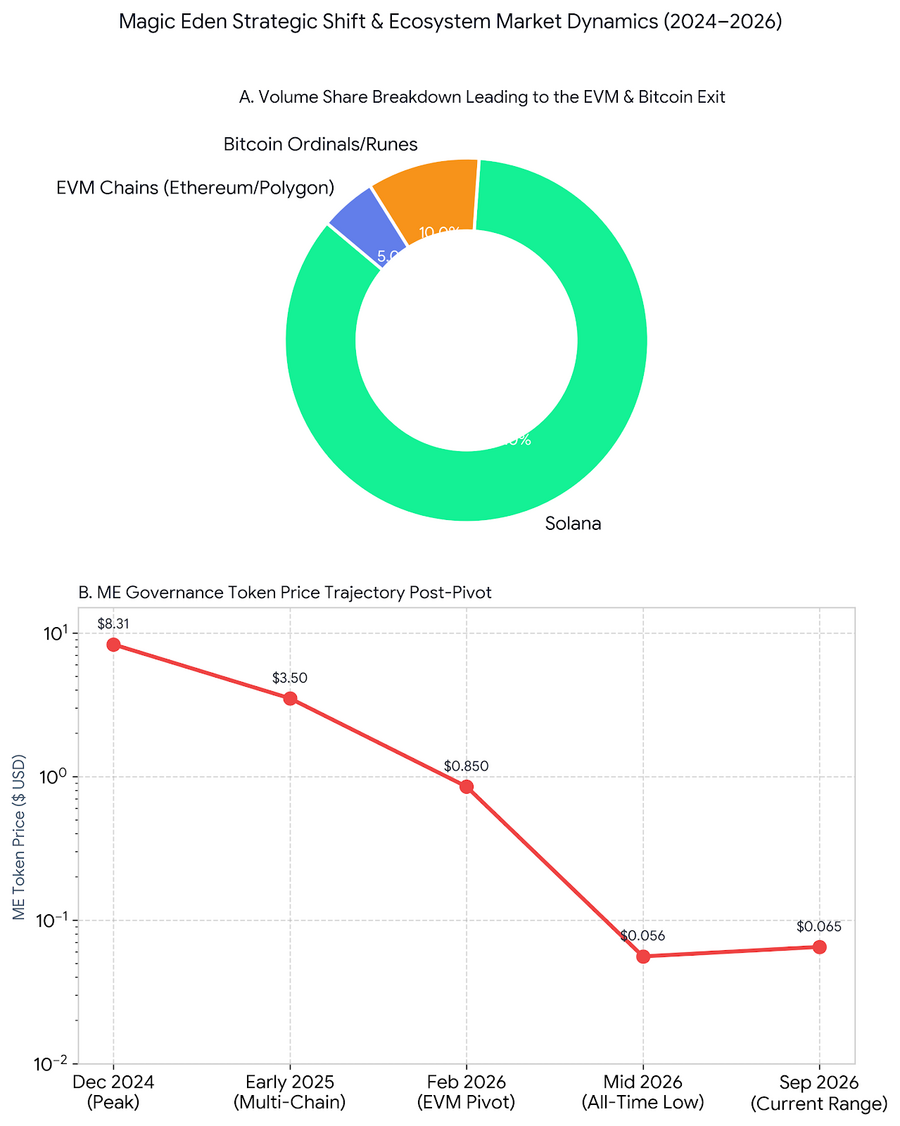
How to Interpret and Utilize This Visual Data
This dual-panel graphic illustrates the economic drivers behind Magic Eden’s decision to exit EVM and Bitcoin operations, as well as the resulting market impact on its ecosystem token.
1. Volume Share Breakdown Leading to the EVM & Bitcoin Exit (Top Panel)
-
Solana Concentration: Over 85% of Magic Eden's total trading volume originated from Solana. This concentration created significant economic asymmetry, as operating complex multi-chain infrastructure across EVM and Bitcoin networks yielded relatively small transaction volume (~5% and ~10%, respectively).
-
Rationale for the Pivot: The high overhead costs of maintaining cross-chain APIs and wallet integrations relative to low non-Solana revenue ultimately led leadership to discontinue Ethereum, Polygon, and Bitcoin support.
2. ME Governance Token Price Trajectory Post-Pivot (Bottom Panel)
-
Peak to Collapse: The ME token peaked at $8.31 shortly after launch in December 2024 on expectations of multi-chain revenue sharing. Following the announcement to exit Ethereum and Bitcoin, the token lost cross-chain utility and dropped over 99% to an all-time low of $0.0558 before stabilizing around $0.065.
-
Logarithmic Progression: Plotted on a logarithmic scale, the trajectory highlights the speed at which governance tokens can lose value when platform utility shrinks or underlying business models shift.
Strategic Takeaways for Your Decisions
-
For Ethereum Traders: Magic Eden is no longer an active venue for EVM assets. Ensure all trading and listing activities are focused on dedicated, native Ethereum marketplaces like OpenSea or Blur.
-
For Token & Platform Evaluation: Focus on underlying network revenue rather than broad feature announcements. A platform's true strategic focus will always follow the chain generating the majority of its transaction volume.
Foundation: The Curated NFT Marketplace for Digital Art
I'll be honest with you. Writing this section hurts a little. Foundation was one of my favorite platforms, and watching it die felt like watching a beloved neighborhood gallery close its doors forever. If you never used Foundation, you missed something genuinely special. It wasn't just a marketplace; it was a statement about what digital art could be when you put curation and artists first, instead of trading volume and floor prices.
Foundation launched in early 2021 with a simple but radical idea: invite-only minting, 1/1 editions, and an unwavering focus on digital art over collectibles. No PFP factories, no generative drops flooding the feed, no race-to-the-bottom floor price culture. Just carefully selected artists releasing work they actually believed in. For a brief, beautiful moment, it felt like the NFT space might evolve into something more than speculative trading. It felt like a place where art mattered.
Then the market crashed, and Foundation's business model proved impossible to sustain. In April 2026, the platform announced its permanent closure after a planned acquisition fell through. The infrastructure has been spun down, and there are no plans to bring it back. If you're reading this and wondering whether Foundation is still worth your time, the answer is simple: it's gone. But the lessons it left behind are worth more than any single platform.
The Invitation-Only Model and Creator-Led NFT Drops
Foundation's defining feature was its invitation-only access. You couldn't just show up and mint. You needed an invite from an existing member, or you needed to be selected through the platform's curation process. This created a gatekeeper dynamic that some people hated and others absolutely loved. If you were in, you were part of an exclusive club. If you weren't, you watched from the outside, wondering how to get in. I remember refreshing my inbox hoping for an invite, feeling like I was waiting for a golden ticket to Willy Wonka's factory. That's the kind of emotional pull Foundation created.
The model attracted serious artists. Foundation became the platform of choice for creators like Jen Stark, James Jean, and Reuben Wu, and it hosted landmark sales that made headlines far beyond the crypto bubble. The most famous was Edward Snowden's "Stay Free", which sold for roughly 2,224 ETH (about $5 million at the time) and benefited the Freedom of the Press Foundation. Other iconic drops included Chris Torres's Nyan Cat for around $600,000 and the Disaster Girl meme NFT. These weren't just transactions; they were cultural moments, and Foundation was the stage where they happened.
At its peak, Foundation had around 25,000 creators and 20,000 collectors, with cumulative creator revenue exceeding $40 million (roughly 54,992 ETH). That's not OpenSea scale, and it was never meant to be. Foundation was the gallery, not the mall. It was the place where you went to see something carefully curated, not the place where you went to scroll through ten thousand variations of the same cartoon animal.
The auction model was central to the experience. Artists would release timed auctions, often for single editions, creating a sense of occasion around each drop. Bidding was public, competitive, and sometimes genuinely dramatic. If you've ever participated in a Foundation auction that went into overtime with two collectors battling it out in the final seconds, you know the adrenaline rush I'm talking about. That was the point. Foundation made collecting feel like an event, not a transaction.
Fee Structure and Smart-Contract Royalty Enforcement on Foundation
Foundation's fee structure was straightforward compared to the complexity of other platforms. The platform charged a 15% commission on primary sales, which is steep by marketplace standards but reasonable given the curation and support that came with it. If you were selling a 1/1 piece for 10 ETH, Foundation took 1.5 ETH. That's a significant cut, but artists who made it onto the platform generally accepted it as the cost of accessing a curated audience that actually valued their work.
The more important detail for creators was royalty enforcement. Foundation embedded royalties directly into its smart contracts, typically in the 10% to 15% range, and those payments were enforced at the protocol level. This was a big deal at a time when other platforms were making royalties optional. If you sold a piece on Foundation and it later resold for a higher price, you got your cut automatically. No chasing buyers, no relying on goodwill, no watching your secondary income disappear because some trader didn't feel like paying. The contract didn't care about feelings; it just executed.
That enforcement model stood in stark contrast to what was happening on OpenSea and Blur, where royalties became effectively optional after the Operator Filter was phased out. Foundation was one of the last holdouts, a platform that actually honored the promise of creator royalties when most of the industry had abandoned it. For artists who depended on secondary income, that mattered enormously. It was the difference between building a sustainable career and hoping for the best.
The Rise and Fall of Curated NFT Marketplaces: What Happened
Here's where the story gets painful. Foundation's revenue collapsed with a speed that's almost hard to comprehend, and the numbers tell a story that should make every platform founder nervous.
In 2021, the platform generated approximately $20.5 million in annual revenue. By 2025, that number had fallen to roughly $90,000. In the first quarter of 2026, it was just $4,500. That's a decline of more than 99.9% from peak. Not 99%, not 99.5%, but 99.9%. The platform was making less in a quarter than most creators make in a single decent sale. I've seen businesses decline before, but this was a freefall with no parachute.
The cumulative numbers look better. Foundation facilitated approximately $230 million in primary sales over its lifetime. That's a real business by any measure. But cumulative totals don't pay the bills. The rate of new sales had slowed to a trickle long before the Blackdove negotiation even began. By 2026, the platform was generating almost no revenue, and the fixed costs of running a curated marketplace, including smart contract maintenance, frontend hosting, support staff, content moderation, and partner integrations, don't scale down nearly as fast as fee revenue does. You can't run a gallery on goodwill and nostalgia.
This wasn't a Foundation-specific problem. The entire NFT sector experienced a decline of more than 90% from its 2021 to 2022 peak. But curated platforms felt it more acutely than generalists. When trading volume collapses, the platforms that depend on high-value, low-frequency sales are the first to starve. OpenSea could survive on sheer breadth. Foundation couldn't. It was a boutique in a market that had stopped buying boutique.
The acquisition attempt was the last chance. In January 2026, Foundation announced that it was being acquired by Blackdove, a digital art display company, with founder Kayvon Tehranian framing the deal as a way to ensure the platform's long-term future. Blackdove's vision was to combine tokenization with physical display infrastructure, an end-to-end solution for digital art that would let collectors show off their NFTs on high-quality screens. It sounded like a lifeline. But after completing due diligence post-handover, Blackdove concluded that building its own proprietary marketplace was more viable than operating Foundation's. The deal collapsed in April 2026, and Tehranian announced the permanent closure. The golden ticket had been torn up.
What Foundation’s Closure Teaches Us About Platform Risk
Foundation's death is a case study in platform risk, and there are several lessons worth internalizing before you commit serious assets to any marketplace. I've watched this play out, and I've seen the consequences firsthand. Learn from the mistakes of others so you don't have to make them yourself.
Even beloved platforms can die quickly. Foundation wasn't a scam. It wasn't mismanaged by incompetent people. It was a well-run, well-funded platform that served a genuine need for a specific community. And it still died. The market simply didn't support it anymore. If you're choosing a marketplace because you love its mission or its community, that's valid, but understand that love doesn't pay the server bills. Passion is not a business model, and community is not a revenue stream.
The decentralized design saved the art, but not the platform. Here's the genuinely hopeful part of this story. Because Foundation was non-custodial and its smart contracts live on Ethereum forever, the NFTs themselves are safe. The frontend is gone, but the underlying assets remain on-chain and under collector control. The cryptoart community mobilized to preserve the work. A trio of community members including jalil.eth, ygg, and Jack Butcher successfully pinned over 99.99% of all Foundation content to IPFS and plan to keep it there indefinitely. Artist ripe open-sourced a frontend called PND that supports delisting and bulk migration of works from Foundation. The Transient team rolled out support for importing Foundation 1/1 creator contracts, giving artists a way to view and sell their works without the old frontend.
This is what "platforms are temporary, protocols are permanent" actually looks like in practice. The company died, but the art survived. That's a genuinely remarkable outcome, and it's only possible because Foundation was built on open infrastructure. If Foundation had been a fully custodial platform, the story would have ended very differently. The art would have been trapped, the community would have been helpless, and the shutdown would have been a catastrophe instead of a bittersweet farewell.
But the risk is still real for users. If you had NFTs listed in Foundation's marketplace smart contract when the shutdown happened, you couldn't just leave them there. The team had to build an unlisting and retrieval tool to help users delist their assets, because the frontend was the primary interface for interacting with the contract. Foundation also committed to pinning IPFS metadata for one year, until April 2027, and urged users to take responsibility for personally pinning assets they care about. If you missed that window, your metadata could disappear from the decentralized web. Decentralization gives you ownership, but it also gives you responsibility. You can't outsource the job of preserving your own assets.
The lesson for platform builders is just as important. Foundation did almost everything right. It had a clear mission, a loyal community, a sustainable fee structure, and a talented team. And it still failed because the market it served collapsed. Even the best-run platforms can't survive when the demand for their product evaporates. If you're building in this space, you need to plan for the possibility that the market won't be there when you need it. Diversify your revenue streams. Build products that can survive a downturn. And never assume that last year's success guarantees next year's survival.
Best Alternatives for Artists and Collectors After Foundation
So where do you go now if you loved what Foundation represented? There's no exact replacement. The invite-only, curated, 1/1 art model doesn't exist in the same form anymore. But a few platforms cover similar ground, and each one has its own strengths and weaknesses.
- SuperRare is probably the closest spiritual successor. It's curated, Ethereum-native, and focused on high-end single-edition art. The platform has a smaller, more exclusive artist roster, and it still enforces royalties in a way that Foundation users will recognize. If you loved Foundation's gallery vibe and curation standards, SuperRare is where you'll feel most at home. It's not identical, but it's the same neighborhood.
- OpenSea is the pragmatic choice for reach. It doesn't have curation, and royalties are optional, but it has the largest buyer base in the NFT space. If you're an artist who needs to sell work and can't afford to be precious about platform philosophy, OpenSea is where the buyers are. It's the mall, not the gallery, but the mall has foot traffic. And foot traffic pays the bills.
- Rarible is worth considering specifically for royalty enforcement. While Foundation enforced royalties through platform policy, Rarible has built on-chain enforcement that's harder to bypass. If you're an artist who got burned by royalty-optional platforms and wants technical guarantees, Rarible's approach might appeal to you. It's not a perfect solution, but it's more than most platforms are offering.
- Zora is a good option for creators who found Ethereum gas fees painful. It runs on Layer 2 infrastructure with low minting costs, making it more accessible for artists who don't want to pay $50 in gas for every mint. If you're experimenting with new work or releasing lower-priced pieces, Zora's economics make more sense than mainnet Ethereum.
- Transient deserves a special mention because it's specifically designed to help artists migrate from defunct platforms. Its support for importing Foundation 1/1 creator contracts means you can view and sell your old work without relying on the original frontend. If you're a Foundation artist looking for a bridge to the future, Transient might be your best starting point.
None of these platforms is guaranteed to last forever either. That's the same lesson Foundation's shutdown already taught. Pick one, but don't assume it's permanent. Spread your work across two or three platforms instead of betting everything on a single venue. The artists who survived Foundation's closure were the ones who had diversified their presence. The ones who didn't are still scrambling.
Foundation was a beautiful experiment. It proved that curation and royalty enforcement could coexist with a sustainable business, at least for a while. Its death doesn't invalidate that experiment; it just proves that even the best ideas can't survive a market that doesn't support them.
📊 Foundation Marketplace Annual Revenue Collapse and Financial Trajectory Prior to Closure (2021–2026)
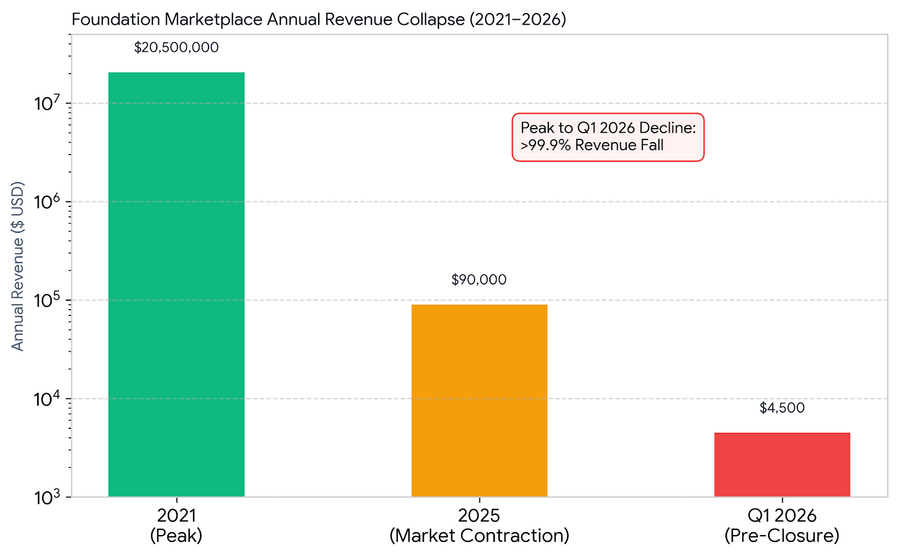
How to Interpret and Utilize This Visual Data
This logarithmic bar chart highlights the severe financial contraction experienced by Foundation prior to its permanent closure in April 2026.
-
Peak Revenue (2021): At the height of the digital art boom, Foundation generated approximately $20.5 million in annual revenue, driven by high-profile 1/1 single-edition sales, landmark auctions, and its 15% primary commission model.
-
Macro Contraction (2025): As broader NFT trading volume declined by over 90%, Foundation's high-value, low-frequency curated model saw revenue drop sharply to $90,000.
-
Pre-Closure Freefall (Q1 2026): By early 2026, quarterly revenue fell to $4,500: representing a total decline of over 99.9% from its peak. Fixed operational costs, smart-contract upkeep, and frontend infrastructure ultimately rendered the business model unsustainable when the Blackdove acquisition deal fell through.
Key Takeaways for Artists and Collectors
-
Platform vs. Protocol Safety: While Foundation's revenue collapse led to the shutdown of its corporate entity and frontend, its non-custodial smart contracts on Ethereum ensure that tokenized assets remain permanently accessible on-chain.
-
Preservation Action Required: Artists and collectors should utilize community-driven interfaces like Transient or open-source frontends to import 1/1 contracts, while ensuring personal IPFS pinning of asset metadata before hosted mirrors expire.
Rarible: The Creator-First NFT Marketplace for Ethereum
If there's one platform in the Ethereum NFT space that has consistently put creators first, it's Rarible. While other marketplaces spent years fighting over trading fees and royalty policies, Rarible quietly built infrastructure that actually solves the problem creators care about most: getting paid fairly for their work on every single resale. No vague promises. No "we support creators" marketing fluff. Just technical enforcement that makes it impossible to bypass the artist's cut.
I've watched Rarible evolve from a generalist marketplace into something far more interesting: a creator-focused ecosystem that includes its own Layer 3 blockchain, a governance token with real utility, and royalty enforcement baked into the foundation of the network rather than bolted on as an afterthought. If you're an artist who's tired of watching your secondary income disappear every time the market shifts, or a collector who wants to support creators in a meaningful way, Rarible deserves your attention. It might not be the biggest platform, but it's arguably the one that cares most about the people who make the art.
Multi-Chain Support, Lazy Minting, and Creator Tools on Rarible
Rarible isn't just an Ethereum marketplace anymore. The platform has expanded across multiple chains, including Ethereum, Polygon, Solana, Tezos, Immutable X, Flow, Base, and MegaETH. The Solana expansion in August 2026 was particularly notable because it paired the rollout with royalty enforcement, positioning Rarible as a creator-friendly alternative even on a chain where native platforms had been looser about royalties. That's a pattern worth noticing: Rarible doesn't just add chains to check boxes. It brings its creator-first philosophy to every ecosystem it enters.
The platform offers lazy minting, which means you can list an NFT without paying upfront gas costs. The NFT only gets minted on-chain when someone actually buys it, which removes the financial risk of creating work that nobody purchases. This is a significant advantage for new creators who don't have the capital to pay gas fees on every experimental piece. I remember the early days of Ethereum NFTs when minting a single piece could cost $100 or more in gas, and if it didn't sell, that money was simply gone. Lazy minting changed the game for artists who wanted to experiment without burning their savings. Compare that to Rarible's earlier approach, where NFTs were minted on-chain immediately, requiring gas payment even if the work never sold. The platform learned from its users and adapted, which is more than you can say for some competitors.
Rarible's creator tools go beyond basic minting. The platform supports custom branding, custom fee logic, and multi-chain aggregation, which means brands and communities can build storefronts that reflect their identity rather than being forced into a generic marketplace template. If you're an artist with a distinct visual brand, you can make your Rarible storefront feel like an extension of your work rather than a cookie-cutter listing page. For creators who want more control over how their work is presented and sold, Rarible's infrastructure approach is genuinely different from what you get on OpenSea or Blur. Those platforms are built for buyers. Rarible is built for the people who make the things buyers want.
Rarible’s Royalty Enforcement: On-Chain Protection for NFT Creators
Here's where Rarible separates itself from almost every other major marketplace. Creator royalties on Rarible aren't optional suggestions that buyers can ignore. They're enforced at the protocol level. That distinction sounds technical, but the practical impact is enormous. On most platforms, a buyer can choose whether to pay the creator's royalty. On Rarible, the choice is made for them by the smart contract.
The platform allows creators to set royalty rates as high as 50% on secondary sales, which is dramatically higher than the 5% to 10% standard you see elsewhere. If you're an artist who wants to capture more of the long-term value of your work, that flexibility matters. Most platforms cap royalties at 10% or less, and some have moved to zero. Rarible lets you set whatever you think is fair, and then enforces it automatically.
But the rate itself isn't the important part. The enforcement is. On OpenSea and Blur, royalties are effectively a tip jar. Some buyers pay them out of goodwill. Most don't. On Rarible, royalties are built into the transaction logic. When an NFT sells, the creator's share is calculated and paid automatically. No buyer discretion, no marketplace policy changes that can wipe out your income overnight, no waking up to discover that the platform you built your career on has decided your royalties are now optional.
RARI Chain and Node-Level Royalty Guarantees Explained
This is Rarible's most ambitious project, and it's worth understanding because it represents a fundamentally different approach to creator royalties than anything else in the market. If Rarible's marketplace enforcement is a strong lock, RARI Chain is a vault built into the foundation of the building.
RARI Chain is an Arbitrum-powered Layer 3 blockchain that launched its mainnet in January 2024. What makes it unique is that royalties are embedded at the node level, not enforced at the application layer. In plain terms: the blockchain itself checks every NFT transfer and automatically calculates the royalty payment that the creator should receive. No marketplace can bypass it. No smart contract manipulation can avoid it. The enforcement is built into the foundation of the network, which means it can't be turned off by a policy change or a new management team.
Jana Bertram, head of strategy at RARI Foundation, explained why this matters: node-level royalties are the "highest level guarantee" that a creator's royalties will be respected. Compared to app-level enforcement, where a business direction change can eliminate royalties entirely, node-level enforcement is permanent and cannot be changed. That's a meaningful distinction. Policy can change. Code on a blockchain can't, unless the entire network agrees to change it, which is practically impossible when the enforcement is baked into the protocol itself.
The practical benefits go beyond royalty enforcement. Transactions on RARI Chain are virtually free, which means creators can mint and trade NFTs without worrying about gas costs eating into their margins. Collectors can pay with ETH, USDC, or USD via credit card, removing the friction of bridging assets or managing multiple wallets. And NFTs minted on other platforms can be bridged to RARI Chain while preserving their royalty settings, giving creators a way to migrate their work into an enforcement-friendly environment without abandoning their existing collections.
If you're an artist who has been burned by royalty-optional platforms, RARI Chain is the most credible solution anyone has built. It's not a policy promise that can change with new management. It's infrastructure that makes bypassing royalties technically impossible. The trade-off is that RARI Chain is still relatively small compared to Ethereum mainnet, and the liquidity isn't as deep. But for creators who prioritize enforcement over reach, it's an option that simply didn't exist before.
Rarible Fees, Token Buybacks, and the RARI Token Economy
Rarible's fee structure is straightforward: 1% from the buyer and 1% from the seller on each transaction. That's a 2% total protocol fee, which is higher than OpenSea's 0.5% and Blur's zero fees, but the revenue is used differently. Instead of lining the pockets of venture capitalists or funding an aggressive marketing budget, Rarible directs its fees back into the ecosystem.
In September 2025, Rarible shifted to a model where 100% of trading fees are directed toward open-market RARI token buybacks. This means platform revenue directly creates buying pressure for the token, connecting marketplace activity to token demand in a way that most NFT platforms don't. The RARI Foundation treasury currently holds around $4.9 million in assets, including 3.79 million RARI tokens. It's not a war chest that would impress a venture capital firm, but it's real money that belongs to the community rather than a handful of founders.
The RARI token has a maximum supply of 25 million and serves as the governance token for the entire ecosystem. Distribution includes 10% for airdrops, 30% for investors and team, 20% for token incentives, and 40% for the DAO treasury. Staking programs have seen meaningful participation, with a peak total value locked of approximately 140,494 RARI and a 19,650 RARI reward distribution that implied an annual return of roughly 18.7% for stakers during that period. Those yields are attractive, but they come with the usual caveat: staking rewards are only valuable if the token itself holds value.
The token economics aren't perfect. RARI has declined significantly from its peak, and the 2% fee structure means Rarible generates less revenue per trade than platforms with higher volume. But the buyback model gives RARI a direct connection to platform activity that most governance tokens lack. If Rarible's trading volume grows, the buybacks grow with it. If the platform succeeds, token holders benefit directly. That alignment of incentives is rare in the NFT space, where governance tokens often feel disconnected from the platforms they represent.
The Rarible DAO: Community Governance for NFT Marketplace Decisions
Rarible isn't just a marketplace. It's a Decentralized Autonomous Organization where RARI token holders vote on platform decisions. This isn't a marketing gimmick or a vague promise of future decentralization. The governance infrastructure is functional, and community members have real influence over how the platform evolves.
To participate in governance, you need to lock your RARI in exchange for veRARI (vote-escrowed RARI). The amount of veRARI you hold determines your voting power. It's a model that rewards long-term commitment over short-term speculation. If you lock your tokens for longer, you get more voting power. If you're just passing through looking for a quick flip, you have less say in how things work. That's intentional, and it's a design choice that prioritizes committed community members over tourists.
To submit a proposal for on-chain voting, you need at least 5,000 veRARI or support from a delegate who has that amount. This threshold prevents spam proposals while keeping governance accessible to committed community members. The DAO has seen growing participation, with unique voters more than doubling and governance participation increasing significantly as staking programs gained adoption. It's not a perfect democracy, but it's a functioning one, and that's more than most NFT platforms can claim.
The governance model isn't perfect. Rarible's company still has significant influence, and the transition to full DAO control has been gradual rather than immediate. But the direction is clear, and the infrastructure for community decision-making is genuinely functional, not just a marketing talking point. I've seen DAOs that exist only on paper, where a handful of insiders make all the decisions and token holders are just along for the ride. Rarible isn't one of them.
Who Rarible Is Best For: Creators, Collectors, and Traders
Rarible is a specialized platform, and like any specialized tool, it serves some users brilliantly and others not at all. Let me help you figure out which category you fall into, because choosing the wrong platform can cost you time, money, and a lot of frustration.
For creators, Rarible is arguably the best choice on Ethereum. The combination of up to 50% royalties, on-chain enforcement, RARI Chain's node-level guarantees, and creator-friendly tools makes it the platform that most directly aligns with artists' long-term interests. If you're building a career around your work and you want secondary income that actually materializes, Rarible's infrastructure is built for you. The trade-off is that you'll reach a smaller audience than you would on OpenSea. But the collectors who do find you are more likely to respect your royalties because the platform makes it automatic. Quality of support beats quantity of eyeballs, especially when you're trying to build something sustainable.
For collectors, Rarible is a good option if you care about supporting creators. The platform's royalty enforcement means your purchases directly benefit the artists you collect, and the multi-chain support gives you access to work across Ethereum, Solana, Tezos, and other ecosystems. The interface is user-friendly, and lazy minting means you're not paying a premium for gas on every transaction. The downside is liquidity. Rarible's trading volume is significantly lower than OpenSea's or Blur's, which means finding specific pieces or selling quickly can be harder. If you're a collector who buys what you love and holds for the long term, that's fine. If you're looking to flip, you'll want to look elsewhere.
For active traders, Rarible is probably not your primary platform. The 2% total fee is higher than OpenSea's 0.5% and Blur's zero fees. The liquidity is thinner, and the trading tools aren't as advanced as what you get on Blur. If you're executing dozens of trades per week, you'll want to use Blur for execution and maybe keep a Rarible account for the occasional creator-focused purchase. There's no shame in using different platforms for different purposes. The best traders I know have accounts on three or four marketplaces and switch between them depending on what they're trying to accomplish.
The bottom line is this: Rarible is the creator-first NFT marketplace for Ethereum because it's the only major platform that has built infrastructure specifically designed to protect creator income. Other platforms talk about supporting creators. Rarible built a blockchain to guarantee it.
If that mission resonates with you, whether as an artist or a collector who values creative labor, Rarible deserves a place in your rotation. It's not the biggest, and it's not the cheapest, but it might be the one that actually cares about the people who make the art. And in a market where creators have been abandoned by nearly every major platform, that's worth something.
📊 Comparative Analysis of Rarible Royalty Mechanics vs. Competitors and RARI Tokenomics Distribution
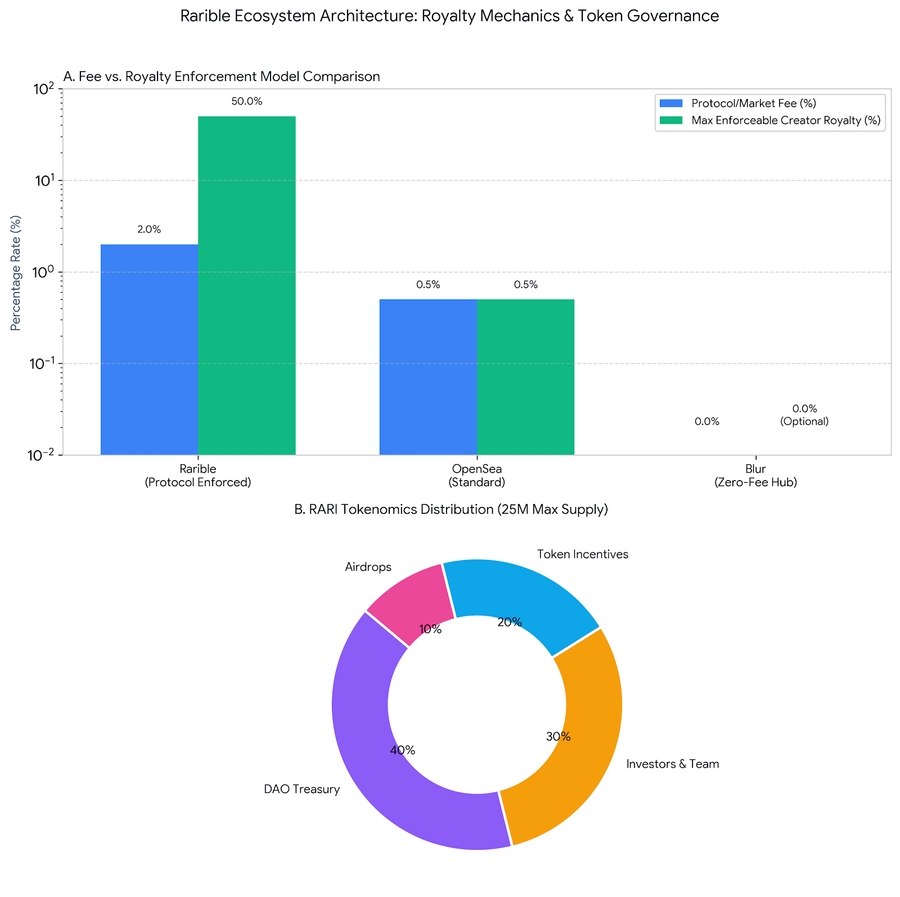
How to Interpret and Utilize This Visual Data
This visual breakdown clarifies the core economic components of the Rarible ecosystem:
1. Fee vs. Royalty Enforcement Model Comparison (Top Panel A)
-
Creator Royalty Guarantees: On a logarithmic scale, Rarible stands out by enforcing up to 50% creator royalties directly at the smart contract and node levels. Competing marketplaces capping royalties at standard baselines (0.5% on OpenSea) or treating them as optional (0.0% on Blur) offer far less creator protection.
-
Protocol Fees: Rarible enforces a 2.0% total marketplace fee (1% buyer / 1% seller). Although higher than zero-fee models, 100% of these platform fees are allocated to open-market RARI token buybacks.
2. RARI Tokenomics Distribution (Bottom Panel B)
-
DAO Treasury Share: 40% of the 25 million maximum RARI supply is allocated to the DAO Treasury, ensuring decentralized control over future grants and development.
-
Allocation Breakdown: The remaining supply is distributed across Investors & Team (30%), Token Incentives (20%), and Airdrops (10%), establishing the total voting base for veRARI governance.
Strategic Takeaways
-
For Creators: Rarible provides non-bypassable secondary income, making it the most reliable venue for preserving creative royalties.
-
For Token Holders: Market activity directly benefits RARI stakers via protocol buybacks funded by trading volume.
SuperRare: The Premium NFT Marketplace for High-End Digital Art
If OpenSea is the shopping mall of NFTs and Blur is the trading floor, then SuperRare is the exclusive gallery on the nice side of town. The one with the marble floors, the carefully positioned lighting, and a doorman who actually checks if you're on the list. It's not for everyone, and it doesn't try to be. SuperRare has spent years building a reputation as the place where digital fine art lives, and that reputation has attracted collectors who care more about cultural significance than quick flips.
Launched in 2018, SuperRare didn't jump on the NFT bandwagon. It helped build the road. The platform has processed over $330 million in lifetime sales, paid out $180 million to artists, and maintained eight years of continuous operation through multiple market cycles. In a space where platforms disappear overnight and founders pivot to gambling apps, that longevity matters. I've watched countless NFT platforms come and go, and SuperRare is one of the few that has never had to apologize for abandoning its core mission. It has been through the boom, the bust, and everything in between, and it's still standing. That kind of staying power doesn't happen by accident.
Curated Artist Rosters and Editorial Standards on SuperRare
SuperRare's defining feature is its invite-only artist model. You can't just show up and mint. You need to apply, and the platform reviews applications on a bi-weekly basis, selecting only a small number of artists each cycle. The acceptance rate is low by design, and the criteria prioritize originality, resale value, and "slow art" over viral potential or floor price momentum. It's the difference between a gallery that hangs whatever sells and one that stakes its reputation on every piece it shows.
The result is a marketplace where quality is remarkably consistent. You won't find PFP factories, AI-generated spam, or collections with 10,000 identical variations. You'll find single-edition 1/1 artworks and curated series from artists who have been vetted for technical skill and conceptual depth. The July 2026 cohort is a good example: seven artists working across digital painting, experimental animation, AI-assisted processes, custom software, and moving image. Each brings something distinct, and each was selected because their work fits SuperRare's editorial vision of what digital art can be. When you browse SuperRare, you're not scrolling through a flea market. You're walking through a thoughtfully curated exhibition.
This curation has a downside. The artist roster is small and exclusive, which means liquidity is thin and discovery is limited to what the platform chooses to feature. If you're an artist who hasn't been accepted, SuperRare can't help you. If you're a collector looking for a specific style or genre that SuperRare doesn't prioritize, you're out of luck. The gallery only shows what the curator wants you to see. I've talked to talented artists who were rejected multiple times before finally getting in, and others who gave up and found success elsewhere. SuperRare's gatekeeping is real, and it's not always fair, but it's what gives the platform its credibility.
Liquid Editions: ERC-20 Tokens as Generative NFT Artworks
This is SuperRare's most ambitious experiment, and it's worth understanding because it represents something genuinely new in the NFT space. Liquid Editions are ERC-20 tokens with embedded liquidity pools that function as living, generative artworks. Instead of collecting a single NFT, you collect fungible tokens connected to an artwork that can evolve based on on-chain activity. It's a concept that sounds complicated until you see it in action, and then it feels like a glimpse of where digital art might be heading.
The debut piece by artist Ripe visualized the friction and discovery of value in real-time, turning the trading process into a visual experience. Some Liquid Editions include Liquid Lenses, companion ERC-721 collections that interpret the parent token's market state through artistic rules defined by the creator. Each Lens can render its own view of the same underlying market, meaning one artwork can have multiple visual expressions that change as collectors trade, hold, and transfer tokens. It's generative art in the truest sense: the art generates itself from the market's behavior.
This isn't for everyone. If you want a static JPEG you can set as your profile picture, Liquid Editions will confuse you. But if you're interested in networked art, generative systems, or the intersection of markets and creativity, it's one of the most interesting things happening on Ethereum right now. I've spent hours watching Liquid Editions evolve in real time, and I still find it mesmerizing. It's the kind of thing that makes you realize how early we still are in this space.
The RARE Token: Staking, Governance, and Rewards
The RARE token is SuperRare's governance and curation token, launched in 2021 with a total supply of 1 billion tokens. It serves three main functions: currency on the marketplace, staking rewards, and DAO governance rights. If you're going to spend time on SuperRare, understanding how RARE works will help you get more out of the platform.
The staking system is the most attractive feature for token holders. By locking up RARE, you can earn rewards funded by actual transaction fees generated on the platform. Current staking rewards have been reported around 57% APR, though that figure fluctuates based on platform activity and staking participation. The key point is that rewards aren't printed out of thin air; they're connected to real economic activity on SuperRare. When the platform does well, stakers benefit. When it slows down, rewards shrink. That alignment of incentives is rare in the token world, where rewards are often funded by inflation rather than revenue.
Governance happens through RareDAO, where RARE holders vote on proposals that shape the platform's future. The DAO treasury receives all platform commissions, and token holders decide how those funds are used. It's not a perfect democracy, and SuperRare's core team still has significant influence, but the infrastructure for community governance is functional and has been for years. I've seen DAOs that exist only in name, where a handful of insiders make all the decisions and token holders are just along for the ride. SuperRare isn't one of them.
The RARE token has declined from its 2021 peaks, like almost every other NFT-related token. If you're buying RARE as a speculative investment, understand that you're buying exposure to a platform in a market that has contracted dramatically. If you're buying it to stake and participate in governance, the 57% APR is meaningful, but the token's value can still decline faster than the rewards accumulate. Do the math before you commit. Staking rewards are only valuable if the underlying asset holds its value, and in a bear market, that's never guaranteed.
Live Auctions, Real-Time Chat, and Collector Engagement
SuperRare has been investing in making its auctions feel like events rather than transactions. In June 2026, the platform launched the beta version of Live Chat, a real-time messaging feature integrated directly into live auction pages. Collectors, artists, and community members can discuss artworks, react to bids, and use slash commands like /bid for instant bidding and /share to spread the auction through their networks.
The feature is designed to foster a community-driven auction experience that mirrors the energy of a physical auction house. When you're watching a piece climb in price and you can see other collectors discussing it in real time, the experience becomes social rather than solitary. I remember watching my first SuperRare live auction with Live Chat enabled, and it felt like being in a room full of people who all cared about the same thing. There was banter, there was tension, and there was a genuine sense of occasion. It's a small feature in the grand scheme of things, but it reflects SuperRare's understanding that collecting art is fundamentally a social activity.
Beyond live chat, SuperRare supports scheduled and active auctions, current bid displays, bid history, countdown timers, and collector activity feeds. Collectors can follow artists, receive notifications, and return to works through profiles and collections. The platform also supports Series Offers, which let collectors place a single offer across all NFTs in an artist's series, paying gas fees once instead of multiple times. If you've ever tried to bid on ten pieces individually and watched your gas fees pile up, you understand why that feature matters.
SuperRare Fees and Artist Economics Explained
SuperRare's fee structure is straightforward, and it's one of the platform's most debated features. On primary sales, the artist receives 85% of the sale price, and SuperRare takes 15% as commission. On secondary sales, the collector selling the work receives 90%, and the original artist receives 10% as a royalty. On all sales, a 3% network fee is added to the total price, paid by the buyer.
Those fees are steep compared to competitors. OpenSea charges 0.5%. Blur charges zero. SuperRare's 15% primary commission is closer to what a traditional physical gallery charges, which is the comparison the platform invites. But for a digital transaction that costs almost nothing to facilitate, 15% is a meaningful drag on returns. If you buy a piece for 10 ETH and sell it for 12 ETH, the fees and royalties can eat a significant portion of your profit. Let's do the math: a 15% primary commission on a 10 ETH purchase means you're effectively paying 1.5 ETH just to buy. That's not trivial.
The counterargument is that SuperRare's fees fund curation, artist support, and platform development in a way that zero-fee platforms don't. The 10% perpetual artist royalty is enforced by smart contract, not policy, which means creators get paid automatically on every resale. SuperRare's founder has been vocal about this commitment: the platform introduced automated artist royalties in 2018 and has never wavered from that decision.
For artists who prioritize long-term income over short-term exposure, that enforcement is worth more than the lower fees they might get elsewhere. I've talked to artists who sell on both SuperRare and OpenSea, and they consistently tell me that the SuperRare royalties are the ones that actually show up.
SuperRare also introduced collector royalties in 2021, a novel concept where collectors who resell artworks earn a decaying percentage of future sales. The first collector receives 1% after the second secondary transaction, and that royalty decays by 50% for each subsequent sale. It's a small incentive, but it rewards collectors who participate in the market rather than just holding indefinitely. It's the kind of creative thinking that sets SuperRare apart from platforms that treat collectors as nothing more than buyers.
Who SuperRare Is Best For in the NFT Art Market
SuperRare is a specialized platform for a specialized audience. It's not for beginners, flippers, or anyone looking for quick profits. Let me be blunt about who should and shouldn't use it.
For established digital artists, SuperRare acceptance carries genuine credibility. The platform's invite-only model means that being selected signals something about the quality of your work. The 10% perpetual royalty is a real, on-chain revenue stream that continues as long as your art changes hands. If you have a strong portfolio and you're playing a long game, SuperRare is worth applying to. But don't rely on it as your only sales channel. Liquidity is thin, and even accepted artists can wait months for the right buyer. I know artists who have sold pieces for six figures on SuperRare and others who have waited a year for their first sale. Patience is not optional here.
For serious art collectors, SuperRare offers provenance, scarcity, and access to artists who have sold works for six figures. If you have an Ethereum wallet, understand gas fees, and you're buying for cultural or long-term investment reasons rather than quick resale, SuperRare is the most rigorous platform in the market. The curation means you're not sifting through spam, and the collector base includes people who actually care about the art. I've met collectors on SuperRare who have been buying digital art since before NFTs were a thing, and their collections reflect a level of taste and commitment that you rarely see on high-volume trading platforms.
For beginners, SuperRare is the wrong choice. You need a self-custody Ethereum wallet, you need to understand how to send and receive ETH, and you need to be comfortable with the fact that your purchase might be illiquid for months or years. The average sale price is around $4,000, which prices out most newcomers. If you're just exploring NFTs for the first time, start on OpenSea. Come back to SuperRare when you know what you're doing. There's no rush. The art isn't going anywhere.
For active traders, SuperRare is not your platform. The fees are too high, the liquidity is too thin, and the culture actively discourages the kind of rapid flipping that makes Blur profitable. SuperRare's founder explicitly said that SuperRare collectors "typically don't do high-frequency trading or try to make quick money". If that describes you, you're in the wrong place. There's no shame in that. Different platforms serve different purposes, and SuperRare serves collectors who treat art as art, not as a trading instrument. If you're looking for fast exits and tight spreads, Blur is waiting for you. If you're looking for something you'll want to hold for years, SuperRare is the better bet.
The bottom line is this: SuperRare is the premium NFT marketplace for high-end digital art because it's the only major platform that has consistently prioritized curation, artist royalties, and cultural significance over volume and speed. It's expensive, it's illiquid, and it's not for everyone. But for the artists it champions and the collectors who value what it represents, it's irreplaceable.
In a market where most platforms have abandoned creators and chased traders, SuperRare's stubborn commitment to its principles is worth something. Whether that's worth the fees is a decision only you can make. I've made my choice, and I sleep well at night knowing the artists I collect are getting paid every time their work changes hands.
📊 Analysis of SuperRare Primary and Secondary Transaction Economics vs. RARE Governance Token Allocation
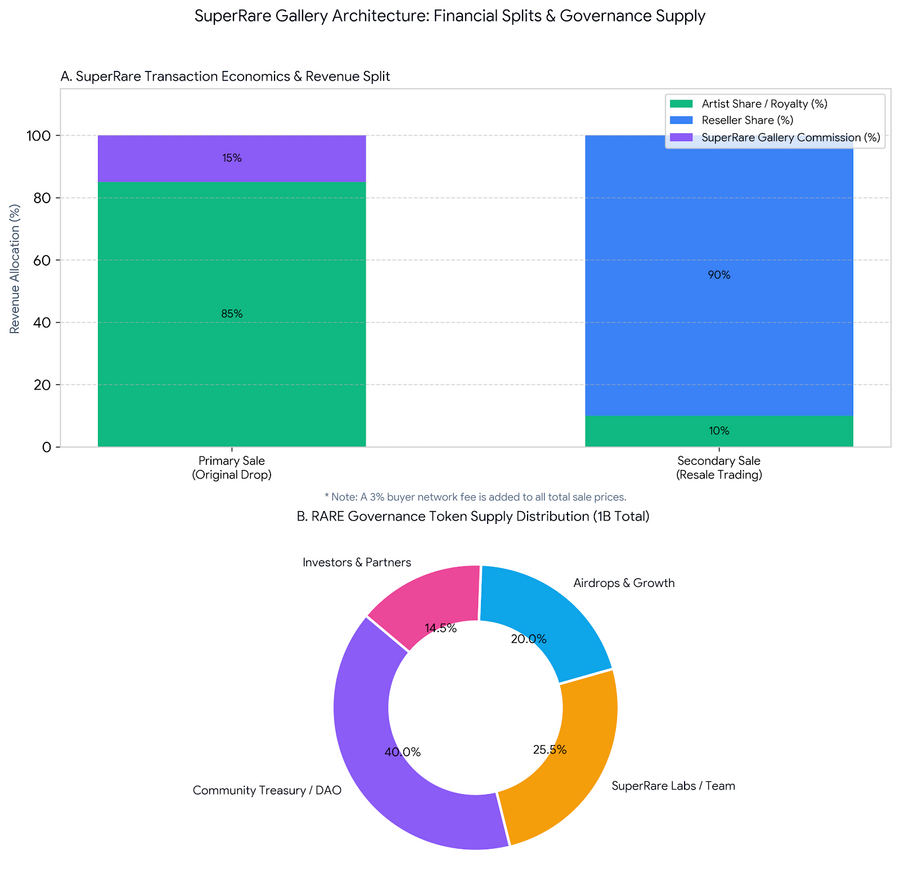
How to Interpret and Utilize This Visual Data
This dual-panel visual breaks down SuperRare’s high-art marketplace revenue splits and its underlying RARE governance token distribution:
1. SuperRare Transaction Economics & Revenue Split (Top Panel A)
-
Primary Sales (Original Drops): When an artwork drops on SuperRare, the artist receives 85% of the proceeds, while SuperRare takes a 15% gallery commission to support curated editorial standards, platform maintenance, and artist discovery.
-
Secondary Resales (Continuous Market): On every subsequent resale, the selling collector retains 90% of the transaction price, while the original creator automatically receives a 10% perpetual royalty enforced via smart contracts.
-
Network Overhead: A additional 3% buyer network fee is applied to all total purchase prices across both primary and secondary markets.
2. RARE Tokenomics Distribution (Bottom Panel B)
-
Community DAO Dominance: 40.0% of the maximum 1 billion RARE token supply is allocated directly to the Community Treasury / RareDAO, financing artist grants, curatorial spaces, and platform proposals.
-
Core Contributors & Launch: The remaining supply is distributed across SuperRare Labs & Team (25.5%), Airdrops & Growth Initiatives (20.0%), and Early Investors & Partners (14.5%).
Strategic Takeaways
-
For Artists: Unlike generalist marketplaces charging low primary fees without guaranteed secondary payouts, SuperRare’s 10% perpetual secondary royalty ensures continuous revenue as your cultural standing and resale valuations grow.
-
For Collectors & Stakers: RARE stakers earn yield (historically around ~57% APR) directly tied to platform transaction fees, aligning governance participation with marketplace success.
Emerging and Niche NFT Marketplaces for Ethereum
The big three get all the attention, and honestly, they've earned it. OpenSea, Blur, and the surviving specialists handle the vast majority of Ethereum NFT volume, and if you're trading blue chips or building a collection, that's where you'll spend most of your time. But the Ethereum NFT ecosystem is bigger than three platforms, and some of the most interesting opportunities live in the margins. Niche marketplaces serve specific communities, specific asset types, and specific trading styles that the generalists can't or won't accommodate. If you're willing to look beyond the obvious, there's real value to be found. I've discovered some of my favorite platforms by wandering off the beaten path, and I've also learned some hard lessons about liquidity and exit strategies along the way. Let me save you some of that pain.
Tensor and Solana-Native Platforms: What Ethereum Traders Should Know
Tensor isn't an Ethereum marketplace. It's Solana's leading NFT trading venue, and it has built a reputation for deep liquidity, advanced trading tools, and a relentless focus on professional traders. But Ethereum traders should pay attention to Tensor anyway, because it represents a model of what a marketplace can be when it's built by traders for traders, and some of its innovations are worth understanding even if you never touch a Solana NFT.
Tensor's core innovation is TensorSwap, an automated market maker for NFTs. Unlike traditional marketplaces where you list an NFT and wait for a buyer, TensorSwap lets you create market-making orders that function like limit orders in traditional finance. You can set a price range, earn fees (up to 25% on top of Tensor's 2% taker fee), and provide liquidity across an entire collection. The platform also supports collection-wide bids and bonding curves that automatically adjust your bid prices downward with each purchase. These are tools that barely exist on Ethereum, and they're a glimpse of where NFT trading mechanics could evolve.
Gaming NFT Marketplaces: Utility, Liquidity, and In-Game Economies
Gaming NFTs are the category that refuses to die, even as the broader NFT market contracts. The reason is simple: game assets derive value from utility, not speculation. A sword, a character, or a piece of virtual land in a popular game has a use case that exists independently of whether someone wants to flip it for a profit. That utility creates more consistent demand than purely speculative art NFTs, and trading volumes correlate with active player metrics rather than crypto market cycles.
Axie Marketplace remains the most liquid single-ecosystem NFT market in gaming. It's the native marketplace for Axie Infinity, where players trade Axies, land, and other in-game assets. The trading volume isn't driven by floor price speculation; it's driven by players who need specific Axies to compete, breed, or improve their teams. I've watched Axie players spend hours analyzing stats and traits before making a purchase, treating the marketplace more like a fantasy sports draft than an NFT trading platform. That's the difference between utility-driven and speculation-driven markets.
For Ethereum traders, Axie Marketplace is worth understanding as a diversification tool. Gaming assets have a different risk profile than art NFTs, and their correlation with crypto market cycles is lower. If you're looking for exposure to utility-backed NFTs, gaming marketplaces are where you'll find it.
Fractal is another gaming-focused platform worth knowing about, though it's Solana-based. Founded by Twitch co-founder Justin Kan with $35 million in backing from Andreessen Horowitz, Paradigm, and Solana Labs, Fractal is both a primary launchpad and secondary marketplace for gaming NFTs. Its Google Sign-In feature removes crypto wallet friction for new users, which is a genuine innovation for onboarding gamers who don't care about seed phrases and private keys. The platform has faced challenges as gaming NFT interest declined, but its infrastructure and partnerships with gaming studios keep it relevant for players in those ecosystems.
The lesson Fractal teaches is that onboarding friction is a real barrier, and platforms that solve it attract users who would otherwise never touch crypto.
For Ethereum traders, the practical takeaway is that gaming NFT marketplaces operate by different rules. Liquidity is driven by utility demand, not speculation. Floor prices are less relevant than in-game usefulness. And the platforms themselves are often tied to specific games, which means you need to understand the game before you understand the market.
If you're willing to do that work, gaming NFTs offer diversification that purely speculative art can't match. But if you're not willing to learn the game mechanics, you're essentially gambling on someone else's utility. Do the homework or stay away.
LooksRare and Incentive-Driven NFT Trading Platforms
LooksRare is the platform that tried to beat OpenSea at its own game by paying traders to use it. Launched in January 2022, it used a trading rewards model where users earned LOOKS tokens for buying and selling NFTs on the platform.
The pitch was simple: why pay fees to OpenSea when LooksRare will pay you to trade? For a brief period, it worked. LooksRare's volume spiked, and it briefly challenged OpenSea's dominance. I remember watching the numbers and thinking this might be the beginning of a real competitor. I was wrong.
But the model had a fundamental flaw: incentive-driven volume isn't the same as organic demand. Traders were buying and selling to themselves to farm LOOKS, not because they wanted the NFTs. Wash trading became so prevalent that it distorted the entire marketplace's metrics. When the token price declined and rewards were reduced, the volume evaporated. LooksRare learned the same lesson that every incentive-driven platform eventually learns: you can rent liquidity, but you can't buy loyalty.
LooksRare has since pivoted to a token buyback model. In October 2026, the platform announced that 50% of platform fees would be used to buy back LOOKS on the open market, with 10% going to protocol rewards and 40% to the treasury. The trading rewards mechanism that drove the initial volume spike has been discontinued, replaced by a focus on long-term token value accrual. It's a more sustainable model, but it's also a recognition that the original incentive-driven approach didn't work.
For Ethereum traders, LooksRare's story is a cautionary tale about incentive-driven platforms. The LOOKS token has fallen from its all-time high of $7.10 to under a dollar, and the platform's liquidity is a fraction of what it was during the incentive boom. If you're considering using an incentive-driven platform, ask yourself what happens when the incentives stop. If the answer is "the volume disappears," you're not looking at a sustainable marketplace. You're looking at a marketing campaign with a token attached. That distinction matters more than any APR number or reward multiplier.
Niche NFT Marketplaces for Photography, Music, and Domain Names
The generalist platforms handle art, collectibles, and gaming assets well, but they're not optimized for every category. Niche marketplaces exist for specific asset types, and while they're smaller, they often serve their communities better than any generalist could. It's the difference between a department store and a boutique. The department store has everything, but the boutique knows exactly what you need.
Photography has found a home on platforms like AirNFTs, a multi-chain marketplace that supports Binance Smart Chain, Ethereum, Fantom, and Polygon with a specific focus on categories including art, gaming, sports, photography, music, and collectibles. AirNFTs emphasizes simplicity and accessibility, with one-click minting and bidding options that make it easier for photographers to monetize their work without wrestling with complex interfaces. Transaction fees are kept under $1, which is a dramatic contrast to Ethereum mainnet gas costs.
For photographers who want to sell editions of their work without paying more in gas than they earn from the sale, platforms like AirNFTs solve a real problem.
Music NFTs have a smaller but dedicated ecosystem. Platforms like AirNFTs support music alongside other categories, and there are specialized platforms that focus exclusively on audio assets. The challenge for music NFTs is the same as for photography: liquidity is thin, and finding buyers who value the work requires more effort than trading a blue-chip collection.
But for creators who want to reach collectors directly, niche platforms offer a way to bypass the noise of generalist marketplaces. I've talked to musicians who have built small but loyal collector bases through niche platforms, and they wouldn't trade that for the exposure they'd get on OpenSea. Sometimes a hundred true fans are worth more than ten thousand scrollers.
Domain names represent another niche category. Ethereum Name Service (ENS) domains are NFTs, and there are marketplaces that specialize in trading them. The dynamics are different from art NFTs: domain value is driven by utility, memorability, and brand potential, not aesthetic appeal. Domain marketplaces exist for traders who understand that a short, memorable name can be worth more than any generative art piece.
If you've ever tried to register a one-word .eth domain, you know exactly what I'm talking about. The competition is fierce, and the prices reflect it.
The common thread across all these niche categories is that specialization creates better experiences. A photography marketplace that understands how photographers price their work is more useful than a generalist platform that treats a photograph the same as a cartoon ape. The trade-off is liquidity. Niche platforms have smaller audiences, which means slower sales and potentially lower prices. But for creators who are tired of shouting into the void on OpenSea, that trade-off can be worth it.
When a Specialized NFT Marketplace Beats a Generalist Platform
So when should you actually use a niche marketplace instead of the big three? The answer depends on what you're trying to accomplish, and getting it wrong can cost you time, money, and a lot of frustration. Let me help you figure out which category you fall into.
Use a specialized marketplace when the asset type requires specific tooling or context. Gaming NFTs need marketplaces that understand in-game utility. Photography needs platforms that render images at high quality and support print rights. Music needs audio playback and licensing frameworks. Generalist platforms can display these assets, but they don't understand them. A specialized marketplace that serves a community of photographers or gamers will almost always provide a better experience than a platform that treats every NFT the same. It's not about size; it's about fit.
Use a specialized marketplace when you're part of a specific community. If you're an Axie player, Axie Marketplace is where the liquidity is. If you're a Solana trader, Tensor is where the tools are. If you're a photographer, a platform built for photographers will connect you with collectors who actually care about photography. The generalist platforms are where the masses gather, but the masses aren't always your audience. Sometimes a smaller room full of the right people is better than a stadium full of strangers. I've had more success selling niche work on niche platforms than I ever did on OpenSea, simply because the people browsing those platforms were actually looking for what I was selling.
Don't use a specialized marketplace if liquidity is your priority. This is the trade-off you need to accept. Niche platforms have smaller audiences, which means slower sales and potentially lower prices. If you need to exit a position quickly or you're trading for short-term profits, the generalist platforms are where you'll find the volume. Specialized marketplaces are for collectors, creators, and long-term holders, not for flippers. There's no shame in admitting that you're a flipper. Just use the right platform for your strategy.
Watch for platforms that outgrow their niche. Rarible started as a generalist and evolved into a creator-first platform with its own blockchain. Magic Eden started as a Solana marketplace and briefly became a multi-chain giant before retreating back to its roots. The line between "niche" and "generalist" isn't fixed, and platforms can change their identity faster than you can adapt. If you're building a strategy around a niche marketplace, pay attention to its roadmap and its revenue mix. The platform you love today might pivot tomorrow. I've been burned by this before, and it's a lesson you only need to learn once.
The broader lesson is that the best marketplace is the one that fits what you're trying to do, not the one with the biggest numbers. If you're trading blue-chip Ethereum NFTs for profit, Blur and OpenSea are your platforms. If you're collecting gaming assets, niche gaming marketplaces are where you'll find the deepest liquidity and the most informed buyers. If you're a photographer or musician, specialized platforms will serve you better than any generalist ever could. The big three dominate the headlines, but they don't dominate every use case. Sometimes the smaller room is the right one. And sometimes the platform nobody is talking about is exactly where you need to be.
📊 Structural Comparative Analysis of LooksRare Fee Model Evolution and Niche vs. Generalist NFT Marketplace Ecosystem Alignment
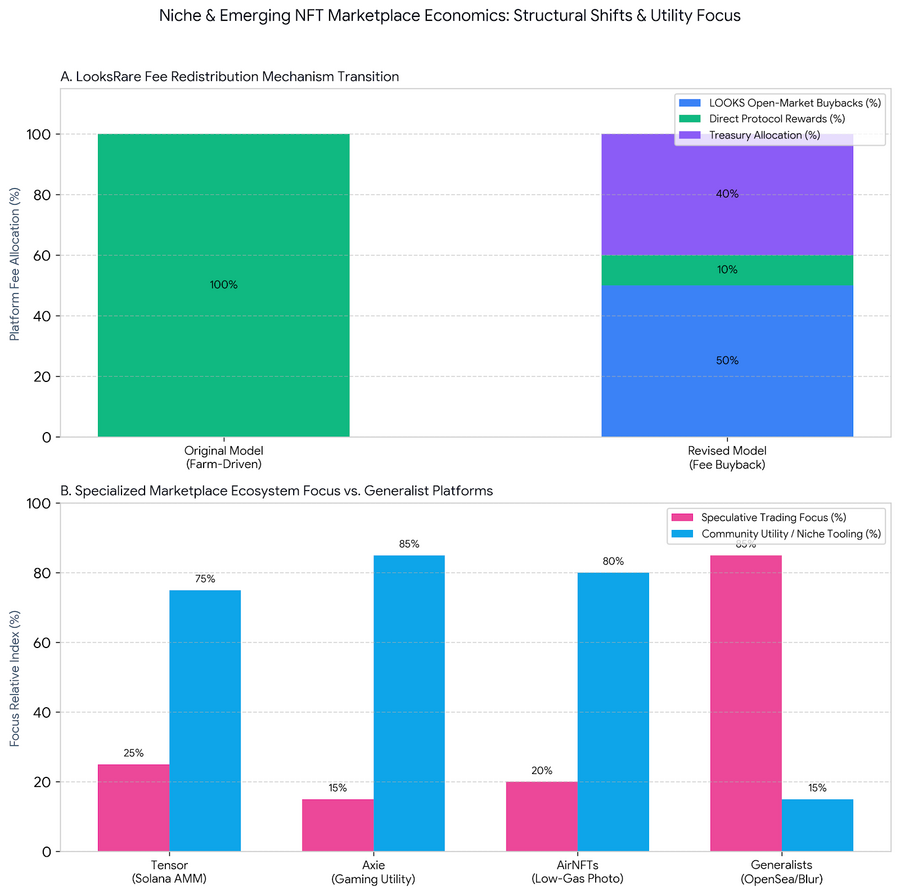
How to Interpret and Utilize This Visual Data
This dual-panel comparative chart explores the economic shifts and functional specialization across emerging and niche NFT marketplaces beyond the primary Ethereum generalists:
1. LooksRare Fee Redistribution Mechanism Transition (Top Panel A)
-
Original Farm-Driven Model: Initially, 100% of marketplace incentives focused on rewarding direct trading volume, which inadvertently fostered widespread wash trading to harvest LOOKS token emissions.
-
Revised Fee Buyback Architecture: In its strategic pivot, LooksRare redirected platform fee allocations toward long-term value accrual: 50% is dedicated to open-market LOOKS buybacks, 40% is allocated to the protocol treasury, and 10% is preserved for direct protocol rewards.
2. Specialized Marketplace Ecosystem Focus vs. Generalist Platforms (Bottom Panel B)
-
Utility and Niche Orientation: Specialized venues such as Tensor (75% utility/tooling focus via AMM bonding curves), Axie Marketplace (85% focus on in-game asset utility over speculation), and AirNFTs (80% focus on accessible, low-gas photography/music minting) prioritize tailored infrastructure over raw speculative volume.
-
Generalist Contrast: Mainstream platforms (e.g., OpenSea, Blur) display an inverse ratio, with approximately 85% of activity driven by floor-price speculation and liquidity flipping, while offering only 15% specialized tooling for niche verticals.
Key Strategic Takeaways for Traders and Creators
-
Evaluating Sustainability: Incentive-driven trading platforms often experience volume contractions once farming rewards taper; examine whether fee mechanisms incorporate sustainable token buybacks or protocol treasury accumulation.
-
Choosing the Right Venue:
-
Use Generalist Platforms when trading liquidity, high transaction speeds, and quick exits are your primary goals.
-
Use Specialized Venues when you require category-specific features—such as automated market-maker (AMM) bonding curves on Tensor, deep in-game asset integration on Axie, or low-cost minting interfaces for photography and music on AirNFTs.
-
NFT Marketplace Fees Compared: The True Cost of Trading Ethereum NFTs
Here's a truth that took me way too long to learn: the sticker price on an NFT is almost never what you actually pay. It's a starting point, a conversation opener, a number that looks clean and simple until you start adding up everything else. Marketplace fees, gas costs, creator royalties, and the occasional surprise can turn a seemingly straightforward trade into a financial headache that eats your margin before you even realize what happened.
I've seen traders celebrate a sale price only to discover their net proceeds were 15% lower than expected. I've watched people buy NFTs at what looked like a bargain, only to realize they'd paid more in gas than the NFT was worth. I've also been the person who forgot to factor in royalties and wondered why my wallet balance didn't match my mental math. If you're going to trade Ethereum NFTs seriously, you need to understand the full cost stack. Not just the headline fee, but every single component that comes out of your pocket. It's the difference between running a profitable operation and wondering where all your ETH went.
Marketplace Fees vs. Gas Fees vs. Creator Royalties
Every Ethereum NFT trade has up to three separate fee components stacked on top of each other. They're distinct, they're paid to different parties, and they're all coming out of your bottom line. Most people only think about the first one, which is why they're constantly surprised by their actual costs. Let's break them down one by one, because understanding each component is the first step toward controlling them.
The marketplace fee is what the platform charges for facilitating the sale. This has collapsed dramatically across the board in recent years. Blur built its entire business on zero marketplace fees and has never wavered from that commitment, which is why professional traders flocked to it so quickly. It was a radical proposition when Blur launched, and it forced every other platform to reconsider its pricing. OpenSea currently charges a 1% fee for selling NFTs (included in the price displayed to buyers) and a 10% fee for minting in a primary drop, though private listings carry a 0% OpenSea fee at this time. Rarible's fee structure is more flexible, with marketplace fees ranging from 0.5% to 7.5% depending on the transaction, and a protocol fee of 1% from both buyer and seller on every transaction. SuperRare takes a 15% commission on primary sales from the artist and a 3% marketplace fee on all purchases from the buyer. The range is enormous, and it's the single biggest variable in your cost calculation.
The gas fee is paid to the Ethereum network itself, not to the marketplace. Gas is what you pay validators to process your transaction on-chain, and it fluctuates wildly based on network congestion. Here's the genuinely good news: gas fees on Ethereum have plummeted in 2026. A standard low-priority transaction now costs around 0.039 Gwei (less than $0.01), and even high-priority transactions are only around 0.043 Gwei. Selling an NFT costs approximately $0.07 to $0.08, and swapping tokens costs $0.04 to $0.05. This is a dramatic contrast to the days when minting a single NFT could cost $50 or more during peak congestion. I remember paying over $100 in gas just to cancel a listing during a particularly busy weekend in 2021, and it still makes me cringe. The Pectra upgrade in May 2025 and the Fusaka upgrade in December 2025 have made Ethereum dramatically more affordable for NFT activity. If you've been avoiding Ethereum because of gas costs, it's time to come back.
The creator royalty is the third component, and it's the most complicated. On most major marketplaces today, royalties are effectively optional. On OpenSea, creator earnings are either enforced or optional depending on the collection's settings. If enforced, the percentage is paid at the time of sale. If optional, the seller chooses whether to include them when listing. On Rarible, royalties are enforced at the protocol level and can be set as high as 50%, which is dramatically higher than the industry standard. On SuperRare, artists receive a 10% royalty on secondary sales, and that payment is automated through the platform's smart contracts. The practical takeaway: when you're comparing marketplaces, don't stop at the headline fee. Calculate the full cost path for the specific asset you're buying or selling. A 1 ETH sale on SuperRare could net the seller significantly less than the same sale on Blur, even before gas costs are factored in.
How to Calculate the Real Cost of Buying and Selling NFTs
Let me walk you through a real example so you can see how these fees compound. I'm going to use a 10 ETH sale as our baseline, because round numbers make the math easier and the differences starker. Trust me, once you see these numbers side by side, you'll never look at marketplace fees the same way again.
- Let's say you're selling an NFT on SuperRare. The buyer pays 10 ETH plus a 3% network fee, which comes to 10.3 ETH total. The platform takes 15% of the primary sale price, which is 1.5 ETH. You, the artist, receive 8.5 ETH. If this were a secondary sale instead, the seller would receive 90% and the original artist would get 10%. The buyer still pays the 3% network fee on top of the sale price. So on a secondary sale, the seller gets 9 ETH, the artist gets 1 ETH, and the buyer pays 10.3 ETH. That's a significant chunk of value changing hands before the actual transaction even settles.
- Now let's say you're selling the same NFT on OpenSea. The platform charges a 1% fee for selling NFTs, which is included in the price displayed to buyers. If the listing price is 10 ETH, the buyer pays 10 ETH, and you receive 9.9 ETH after the marketplace fee. Creator royalties are optional unless the collection has enforced earnings. If royalties are enforced at 5%, you'd receive 9.4 ETH and the creator would get 0.5 ETH. That's a much cleaner transaction, and the difference in net proceeds compared to SuperRare is substantial.
- On Rarible, the protocol fee is 1% from both buyer and seller. So a 10 ETH sale means the seller pays 0.1 ETH in protocol fees, and the buyer pays 0.1 ETH on top. If the artist set a 10% royalty, the seller receives 8.9 ETH, the artist gets 1 ETH, and Rarible's protocol collects 0.2 ETH. The math is more complex, but the royalty enforcement makes it predictable.
- On Blur, the marketplace fee is zero. If the collection has an enforced royalty of 0.5%, the seller receives 9.95 ETH and the artist gets 0.05 ETH. If royalties are optional and the seller chooses not to pay them, the seller receives the full 10 ETH minus gas. That's the most favorable outcome for sellers, and it's why high-volume traders love Blur.
The differences are dramatic. A 10 ETH sale on Blur with no royalties nets the seller 10 ETH (minus gas). The same sale on SuperRare nets the artist 8.5 ETH. That's a 15% difference in proceeds, which compounds significantly over dozens of trades. If you're executing ten trades of this size per month, the platform you choose could mean the difference between $15,000 and $0 in fees over the course of a year. This is why professional traders gravitate to Blur, and why artists who value royalties gravitate to Rarible and SuperRare. Neither choice is wrong. They just serve different priorities.
Layer 2 Solutions and Cheaper NFT Trading on Ethereum
If there's one development that has changed the economics of Ethereum NFT trading more than anything else, it's the rise of Layer 2 solutions. These are networks built on top of Ethereum that process transactions off the main chain and then settle them back to Ethereum for security. The result is dramatically lower fees and faster confirmation times. If you're not using Layer 2 solutions for your NFT trading, you're leaving money on the table.
Zora Network is a Layer 2 built on the OP Stack specifically for NFT activity. It's designed to make NFT minting and trading as cheap as possible, with mint costs under $0.50 and transaction confirmations in seconds. The network is an "app chain" focused entirely on Zora's minting and marketplace protocols, which means it's optimized for NFT use rather than trying to serve every possible DeFi or gaming application. For creators who want to experiment and release work without worrying about gas costs, Zora is a game changer.
OpenSea has expanded support to include Layer 2 networks like Optimism, alongside Ethereum, Solana, Polygon, Klaytn, and Arbitrum. This means you can trade NFTs on Optimism through OpenSea's interface, benefiting from lower gas costs while still accessing OpenSea's discovery and aggregation features. Arbitrum and Polygon zkEVM are also integrated into the broader Ethereum NFT ecosystem, with gas cost reductions of up to 90% compared to mainnet deployments. The infrastructure is maturing quickly, and the user experience has improved dramatically.Base is another Layer 2 that has gained significant traction for NFT activity. Backed by Coinbase, it offers low fees and a growing ecosystem of creators and collectors. If you're looking for a Layer 2 with strong institutional backing and a user-friendly onboarding experience, Base is worth exploring.
The practical takeaway is that if you're doing frequent NFT trading on Ethereum, you should be using Layer 2 solutions whenever possible. The savings are substantial, and the user experience has improved dramatically. Zora is particularly interesting for creators who want to mint and sell without paying mainnet gas fees. OpenSea's Layer 2 support means you can access familiar interfaces while benefiting from lower costs. Base offers a compelling combination of low fees and institutional support.
One caveat: Layer 2 solutions sometimes have withdrawal delays. Bridging assets back to Ethereum mainnet from Zora, for example, can take approximately 7 days due to the nature of optimistic rollups. If you need fast access to your funds on mainnet, plan accordingly. I've learned this the hard way when I needed ETH for a mainnet purchase and realized my funds were stuck in a seven-day bridge. Patience is a virtue, but it's an annoying one when you're trying to execute a trade.
Fee Comparison Table: Best NFT Marketplaces for Low-Cost Trading
Let me lay out the numbers side by side so you can see exactly how the major platforms compare. This is the table I wish I'd had when I started trading. I've spent hours trying to piece this together from scattered sources, and having it all in one place would have saved me a lot of frustration.
| Marketplace | Marketplace Fee | Creator Royalties | Gas Costs | Best For |
|---|---|---|---|---|
| Blur | 0% | Optional (0.5% floor on some collections) | Ethereum mainnet (low in 2026) | Professional traders, high-volume execution |
| OpenSea | 1% on sales; 10% on primary drops | Enforced or optional (collection-dependent) | Ethereum mainnet (low in 2026) | Beginners, collectors, cross-chain browsing |
| Rarible | 0.5% to 7.5% (tiered); 1% protocol fee from both buyer and seller | Enforced on-chain, up to 50% | Ethereum mainnet and L2s | Creators who prioritize royalty enforcement |
| SuperRare | 15% primary commission; 3% buyer fee on all sales | 10% enforced on secondary sales | Ethereum mainnet only | High-end digital art collectors and artists |
| Zora Network | Varies (L2-based) | Configurable | L2 (under $0.50 per mint) | Cost-conscious creators and collectors |
A few things jump out from this comparison:
- Blur is objectively the cheapest platform for pure Ethereum NFT trading if you don't care about creator royalties. The zero marketplace fee is unmatched, and the platform's batch tools make high-volume trading efficient.
- OpenSea is the most accessible for beginners, with a simple 1% fee that's included in the displayed price, meaning you don't have to do mental math before you click buy.
- Rarible is the best choice for creators who want enforceable royalties, even though the fee structure is more complex.
- SuperRare is the most expensive but offers curation and artist support that justify the cost for the right audience.
- And Zora Network offers the lowest absolute costs if you're willing to operate on a Layer 2.
The bottom line is that there's no single "cheapest" marketplace for everyone. The best choice depends on what you're trading, how often you trade, and whether you care about supporting creators through royalties.
If you're a flipper executing dozens of trades per week, Blur's zero fees will save you thousands annually.
If you're a collector buying art you love, SuperRare's higher fees might be worth the curation and the knowledge that artists are getting paid.
If you're a creator trying to build a sustainable income, Rarible's royalty enforcement is worth the trade-off in liquidity.
If you're experimenting with new work and want to keep costs low, Zora's Layer 2 infrastructure is your best friend.
Know your priorities, do the math, and choose accordingly. The fees are only a problem if you don't see them coming. And now you do.
📊 Comparative Analysis of Net Proceeds on a 10 ETH Secondary NFT Sale Across Major Ethereum Marketplaces Alongside 2026 Gas Costs on Mainnet vs. Layer-2 Networks
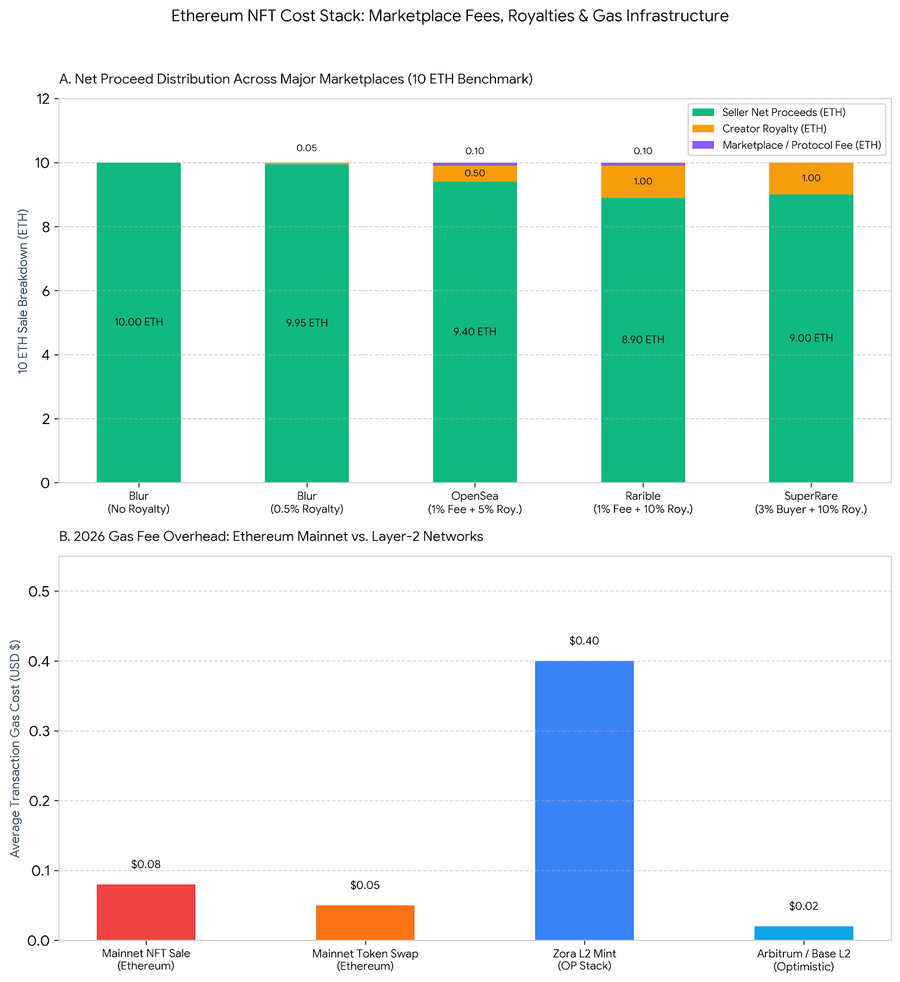
How to Interpret and Utilize This Visual Data
This dual-panel visual breaks down the total cost structure involved in trading Ethereum NFTs across different platforms and network layers:
Net Proceed Distribution Across Major Marketplaces (Top Panel A)
-
Blur (Zero Marketplace Fee): Sellers retain the highest portion of proceeds. Without optional creator royalties, a seller retains 10.00 ETH (100%). Even with a 0.5% enforced floor royalty, the seller retains 9.95 ETH.
-
OpenSea (1% Marketplace Fee): On a 10 ETH transaction with a standard 5% creator royalty, the seller nets 9.40 ETH, while 0.50 ETH goes to the creator and 0.10 ETH is collected by OpenSea.
-
Rarible & SuperRare (Enforced Royalty Focus): On Rarible (1% protocol fee + 10% royalty), the seller receives 8.90 ETH. On SuperRare (where a 3% network fee is paid on top by the buyer), the seller receives 9.00 ETH, while 1.00 ETH is automatically remitted to the artist as a secondary royalty.
Gas Overhead Comparison in 2026 (Bottom Panel B)
-
Ethereum Mainnet: Following protocol upgrades, gas fees remain low, costing approximately $0.08 for a standard NFT sale and $0.05 for a token swap.
-
Layer-2 Networks (Arbitrum, Base, Zora): Off-chain rollups provide sub-cent to nominal execution costs, with Arbitrum/Base transactions averaging $0.02 and Zora primary mints staying under $0.40.
Strategic Action Plan for NFT Traders and Creators
For high-volume traders, prioritizing platforms like Blur or OpenSea helps preserve profit margins by minimizing marketplace commissions and royalty overhead. For fine artists and royalty-focused creators, venues like SuperRare or Rarible ensure that continuous smart-contract-enforced royalties (10% or more) are delivered on secondary sales. For creators planning high-volume drops or collectors making frequent purchases, conducting activity on Layer 2 ecosystems (Zora, Base, Arbitrum) significantly reduces network transaction friction.
Creator Royalties on Ethereum NFT Marketplaces: What Creators and Buyers Should Know
Here's the uncomfortable truth that nobody told you when you minted your first NFT: creator royalties were never enforceable at the blockchain level. I remember the exact moment I learned this. I was setting up a collection in 2021, feeling like a genius for coding a 10% royalty into my contract, and then someone casually mentioned that marketplaces could just ignore it if they wanted. I thought they were wrong. I was so confident that I argued about it for twenty minutes before doing the research and realizing they were absolutely right. That realization changed how I thought about the entire creator economy in NFTs.
Royalties are the most emotionally charged topic in the NFT space, and for good reason. They represent the promise that artists can participate in the long-term value of their work. They also represent a revenue stream that traders see as an unnecessary drag on profits. That tension has played out over years of platform policy changes, token farming wars, and shifting market dynamics. I've watched creators celebrate royalty income that felt life-changing, and I've watched them watch that same income evaporate overnight when a platform changed its policy. If you're a creator or a buyer on Ethereum, you need to understand what royalties actually are, what they aren't, and how the current landscape treats them. Not just the technical definitions, but the real-world consequences for the people on both sides of the transaction.
Why Creator Royalties Became Optional on Many NFT Marketplaces
The story of how royalties became optional is a story about competition, incentives, and the power of zero fees. It's also a story where creators lost, at least temporarily. And it's a story that reveals a lot about how incentives shape platform behavior in ways that no amount of community goodwill can overcome.
For years, royalties on Ethereum marketplaces were a social contract more than a technical guarantee. Platforms like OpenSea and Rarible would route a percentage of secondary sales back to creators because that's what the community expected. It wasn't enforced by smart contracts; it was enforced by platform policy. And platform policy, as we've all learned, can change with a single blog post.
Then Blur arrived in late 2022. The platform launched with zero marketplace fees and a royalty policy that made payments largely optional, with only a 0.5% minimum floor on certain immutable collections. Traders flooded in because the economics favored them. Why pay a 2.5% marketplace fee and a 10% royalty when you could pay nothing? Creators had no way to stop the migration without pulling their collections off the market entirely, which would have meant abandoning their audience and their income. It was a lose-lose situation, and most creators chose to stay and accept whatever royalties came their way.
OpenSea tried to hold the line. In November 2022, it introduced the Operator Filter Registry, a smart-contract-level block list that prevented NFTs from trading on marketplaces that skipped royalty payments. For a brief moment, it looked like creators might actually win this fight. I remember feeling a flicker of hope that the industry would self-regulate in a way that protected artists. Then, in August 2023, OpenSea phased out the Operator Filter, making creator fees optional for new collections starting August 31, 2023. The royalty war was effectively over, and creators had lost. I talked to several artists during that period who were genuinely heartbroken. They had built their careers on the promise of secondary sale income, and suddenly that promise was worthless on the platforms where most trading happened.
By 2026, the situation is clear: on OpenSea, Blur, and Magic Eden, royalties are a tip jar. Some buyers pay them out of principle or loyalty to the artist. Most don't, especially on high-volume trading platforms where every basis point matters. The result is good for traders and genuinely difficult for small creators. Neither of those statements cancels the other. Both can be true at the same time, and holding that complexity is part of understanding how this market actually works.
ERC-2981 and On-Chain Royalty Enforcement Explained
If royalties aren't enforceable at the blockchain level, what is ERC-2981? This is where things get technical, but stay with me because understanding this distinction is essential for anyone who wants to navigate the royalty landscape intelligently.
Before ERC-2981, royalty data was often stored off-chain and specific to a single marketplace. If you sold an NFT on OpenSea and it later resold on LooksRare, the creator might not get paid at all because LooksRare had no idea what royalty the creator expected. It was a fragmented mess, and creators had no way to ensure their royalty preferences traveled with their work. ERC-2981 solved the data portability problem by putting the royalty information directly into the NFT's smart contract. Any marketplace that wants to honor royalties can query the contract and get the information it needs. That's a genuine improvement, even if it doesn't solve the enforcement problem.
The standard supports both ERC-721 and ERC-1155 tokens, and it uses basis points for royalty calculations (500 = 5%, 1000 = 10%). Most implementations use OpenZeppelin's ERC2981 library, which has become the industry standard. If you're a creator minting a collection, using ERC-2981 is the bare minimum for signaling your royalty expectations.
Rarible, SuperRare, and Platforms That Enforce Royalties
Not every marketplace treats royalties as optional. A few platforms have built their entire identity around enforcement, and if royalties matter to you, these are the ones worth knowing. They're not the biggest platforms, and they don't have the deepest liquidity, but they've made a choice that most of their competitors haven't.
Rarible is the most aggressive. Creators can set royalty rates as high as 50%, and those royalties are enforced at the protocol level through RARI Chain, the platform's Arbitrum-based Layer 3 blockchain. RARI Chain embeds royalty enforcement at the node level, which means the blockchain itself checks every transfer and automatically calculates the creator's payment. No marketplace can bypass it. No smart contract manipulation can avoid it. It's the closest thing to a guaranteed royalty that exists in the NFT space. Rarible expanded this enforcement to Solana in August 2026, pairing the rollout with the Claynosaurz collection launch.
If you're a creator who has been burned by royalty-optional platforms, Rarible is the most credible solution anyone has built.
SuperRare enforces a 10% royalty on secondary sales through its smart contracts. The platform's entire model is built around curation and artist support, and royalties are part of that commitment. SuperRare introduced automated artist royalties in 2018 and has never wavered from that decision. In a space where platforms change policies faster than the weather, that consistency is worth something. SuperRare also introduced collector royalties in 2021, a novel concept where collectors who resell artworks earn a decaying percentage of future sales. The first collector receives 1% after the second secondary transaction, and that royalty decays by 50% for each subsequent sale.
It's a small incentive, but it rewards collectors who participate in the market rather than just holding indefinitely.
Zora takes a different approach. Instead of enforcing royalties through marketplace policy, Zora has built protocol-level rewards for creators, connecting platform activity to creator income in a way that doesn't depend on buyers choosing to pay. It's a creative solution to a stubborn problem, and it reflects Zora's understanding that creators need sustainable income streams that don't rely on the goodwill of traders.
Manifold-powered storefronts give creators more direct control over the selling environment, which means they can implement their own royalty enforcement mechanisms without relying on a third-party marketplace. If you're technically inclined and you want full control over how your work is sold and how royalties are handled, Manifold is worth exploring.
The trade-off for all of these platforms is liquidity. Rarible, SuperRare, and Zora have smaller audiences than OpenSea or Blur. Creators who prioritize royalty enforcement need to accept that their potential buyer pool might be smaller. There's no perfect answer here, but the choice should be made with eyes open. I've talked to artists who chose to list exclusively on royalty-enforcing platforms and accepted slower sales in exchange for income they could actually count on. I've also talked to artists who list everywhere and accept that some sales won't generate royalties. Both approaches are valid. The key is knowing which one you're choosing and why.
Whitelisting, Blacklisting, and Royalty Protection Tools
Since ERC-2981 doesn't enforce anything by itself, creators and projects have developed technical workarounds to protect their royalties. These tools exist at the contract level, not the marketplace level, which means they're much harder to bypass. If you're a creator who wants to take royalty protection into your own hands, these are the mechanisms you need to understand.
Whitelisting allows creators to specify which marketplaces or programs are allowed to transfer their NFTs. If a marketplace isn't on the whitelist, the transfer simply fails. Metaplex Core's Royalties Plugin, for example, supports ProgramAllowList rulesets that restrict transfers to approved programs like Magic Eden and Tensor. Immutable has also launched whitelist and blacklist tools on Ethereum to enforce creator royalties. Whitelisting is the more restrictive approach because it blocks everything that isn't explicitly approved.
Blacklisting is the inverse. Creators specify which marketplaces are not allowed to transfer their NFTs. Metaplex supports ProgramDenyList rulesets that block known non-compliant marketplaces. This is useful for creators who want to allow general trading but block specific venues that have a history of skipping royalties. It's a more surgical approach, and it's less likely to interfere with legitimate trading activity.
Transfer validation is another layer. Some contracts include a TransferValidator that checks a blacklist on every transfer, reverting the transaction if the destination is a blocked marketplace. This is more aggressive than whitelisting because it blocks the transfer entirely rather than just restricting which programs can initiate it. It's the nuclear option, and it should be used carefully.
The trade-offs are real. Strict transfer controls reduce composability and can limit legitimate trading activity. Loose royalty rules improve liquidity but weaken creator income. The right approach depends on the project's values, community expectations, and technical design. There's no universal answer, and what works for a blue-chip art collection might be completely wrong for a gaming project with high transaction volume.
One important caveat: royalty settings need strong access control. If an admin wallet can change the royalty receiver or percentage, that wallet becomes a security risk. A compromised admin key could redirect royalty payments to an attacker. Projects should consider royalty caps, multisignature control, timelocks, and independent smart contract reviews. I've seen projects get exploited because a single compromised key gave an attacker control over royalty settings. Don't let that be you.
The Legal and Ethical Debate Around NFT Royalties
The royalty debate isn't just technical. It's also legal and ethical, and the legal landscape is shifting in ways that could affect creators and buyers alike. If you're building a business around royalties, you need to pay attention to what's happening in courtrooms and legislatures, not just on blockchains.
First, the legal reality: NFT royalties are not the same as copyright ownership. Buying an NFT usually means buying a blockchain token that represents a digital asset. It does not automatically mean the buyer owns the copyright to the underlying artwork, music, or brand content.
Copyright terms depend on the project's license and applicable law. A royalty payment does not prove that the buyer receives commercial rights. Creators should clearly state what holders can and cannot do with the associated content. I've seen too many buyers assume they owned the copyright to an NFT they purchased, only to discover they couldn't legally reproduce or commercialize the artwork. Don't be that person.
The U.S. Copyright Office and USPTO have noted that public education and product transparency are important for helping users understand NFT-related rights. This matters because many buyers assume that owning an NFT gives them more rights than it actually does. Clear communication from creators can prevent misunderstandings and legal disputes down the road.
On the ethical side, the debate splits into two camps. Creators argue that royalties are fair compensation for ongoing value creation. They point out that royalties align incentives between creators and collectors because both sides benefit when the project grows in value.
Royalties can support teams that provide ongoing utility, art, events, game updates, or community management. When you buy an NFT from a creator who is still building, your royalty payments help fund that building. It's not just a tax; it's an investment in the project's future.
Traders argue that royalties reduce liquidity and make resale more expensive. For short-term traders, royalties can eat into profit margins, especially during high-frequency trading or low-margin flipping. Some traders see royalties as a tax on secondary market activity that benefits creators who may have already been paid at the primary sale. Their perspective isn't unreasonable, especially for traders who are providing liquidity and price discovery to the market.
There's also a regulatory angle worth watching. The CLARITY Act, which passed the House but remains stalled in the Senate over stablecoin yield disputes, could directly shape how NFTs are classified under federal law. If the bill ultimately treats certain NFTs as securities, marketplace operators would face registration requirements, and creator royalty structures could be reinterpreted as ongoing financial obligations. That's a provision worth watching if you're a creator who depends on royalty income, or if you're a trader who wants to understand the regulatory risks facing the platforms you use.
My honest take: the ethical case for royalties is strong, but the technical and economic realities have made them optional on most major platforms. Creators who care about enforcement need to use platforms and tools that actually enforce them. Buyers who care about supporting creators need to choose platforms that honor royalties and accept that they might pay more for the privilege. There's no perfect solution, but there are choices, and making them consciously is better than pretending the problem doesn't exist.
The creators I know who are thriving in 2026 have made peace with this tradeoff and chosen the path that aligns with their long-term goals. They're not waiting for the industry to fix itself. They're building their careers around the tools that actually work.
📊 Ethereum NFT Creator Royalty Landscape: Platform Realization Rates, Revenue Distribution Models, and Technical Enforcement Mechanisms
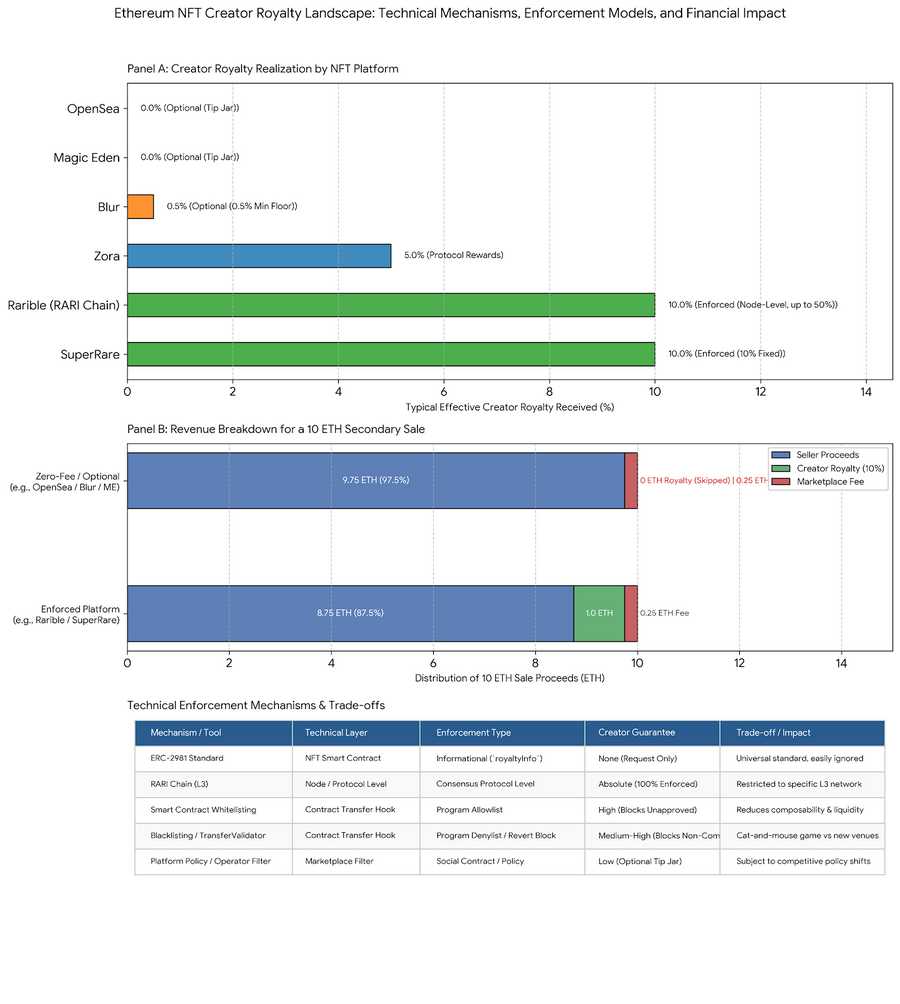
How to Read and Interpret This Visual Guide
This visual breakdown connects the platform dynamics, seller/creator payout splits, and smart contract enforcement tools surrounding Ethereum NFT royalties:
Panel A: Creator Royalty Realization by NFT Platform
-
What it shows: The top bar chart compares the typical secondary royalty percentage a creator receives when an NFT is resold across major marketplaces (assuming a standard 10% target royalty setting).
-
Key Takeaway: Platforms are divided into distinct operating paradigms:
-
Enforced Platforms (Green): Venues such as SuperRare (10% fixed contract enforcement) and Rarible (up to 50% enforced at the RARI Chain L3 node level) guarantee full royalty payments.
-
Optional / Low-Royalty Venues (Orange/Red): High-volume venues such as Blur (0.5% floor), OpenSea, and Magic Eden treat royalties as optional tip jars, where secondary payouts frequently drop to 0.0% based on trader preference.
-
Protocol Reward Models (Blue): Platforms like Zora bypass traditional secondary royalty fees by utilizing mint and protocol-level creator rewards.
-
Panel B: Revenue Breakdown for a 10 ETH Secondary Sale
-
What it shows: The middle stacked bar chart illustrates how 10 ETH in gross sale proceeds are distributed between the seller, the original creator, and the marketplace across enforced versus optional trading venues.
-
Key Takeaway:
-
On an Enforced Platform, a 10 ETH secondary sale routes 1.0 ETH (10%) directly to the creator's wallet, leaving 8.75 ETH (87.5%) for the seller after deducting the 2.5% marketplace fee.
-
On a Zero-Fee / Optional Royalty Venue, the seller retains 9.75 ETH (97.5%), while the creator receives 0 ETH, illustrating why traders prefer optional venues and why creators experience significant revenue drops on un-enforced secondary sales.
-
Technical Enforcement Mechanisms & Trade-offs
-
What it shows: The bottom summary table outlines the core smart contract standards, protocol layers, and access control mechanisms available to creators.
-
How to Use This Table:
-
ERC-2981 Standard: Use this as your baseline standard for royalty data portability across all Ethereum contracts, keeping in mind that it acts as an informational query (
royaltyInfo), not an automated transfer blocker. -
RARI Chain L3 Consensus: Ideal for creators seeking protocol-level automated enforcement without relying on marketplace policy.
-
Smart Contract Whitelisting (
ProgramAllowList) & Blacklisting (TransferValidator): Essential contract-level tools for restricting token transfers exclusively to royalty-compliant marketplaces, though creators must weigh these controls against potential reductions in overall trading liquidity.
-
Liquidity, Volume, and Pricing: Reading the NFT Market Like a Pro
Reading the NFT market requires a different set of skills. You need to understand that headline volume numbers are often inflated, that floor prices are marketing more than metrics, and that liquidity is fragmented across platforms in ways that can cost you money if you don't pay attention. I've learned these lessons through experience, sometimes painfully, and I want to save you the tuition. Consider this section your cheat sheet for seeing through the noise and understanding what's actually happening beneath the surface.
Why Floor Price Alone Is a Misleading NFT Market Metric
Academic research on NFT market microstructure, using over 410 million orderbook events across six major collections, reveals something fascinating about how these markets actually work. Median quoted spreads of 48% to 80% far exceed equity market benchmarks. That sounds like NFTs are hopelessly illiquid, but the same research found that effective trading costs are only 2% to 5% for liquid collections, because most transactions execute against collection-level bids priced near the floor. The wide quoted spread reflects the two-tier structure of NFT order books, not actual illiquidity. This is a technical way of saying that floor prices and actual trade prices are two different things, and conflating them is a rookie mistake. The market has two sides: people asking for prices and people bidding for prices. The floor only shows you one side. The bid side is where the truth lives.
The lesson: never make a trading decision based on floor price alone. Look at the bid-ask spread, the depth of funded bids, and the recent transaction history. If the gap between the floor and the highest bid is more than 10% to 15%, you're looking at a collection where exit liquidity is questionable. Proceed with caution. And if the gap is more than 25%, you should ask yourself whether the floor is real or just a hopeful seller who hasn't checked the bid side in weeks. I've seen floors evaporate overnight when the last remaining seller realized nobody was coming.
Funded Bids vs. Headline Numbers: Measuring Real Demand
Blur's entire interface is built around exposing bid depth because professional traders understand that funded bids are the true measure of demand. The platform shows you the top bid, the number of bids at each price level, and the total value of bids across a collection. When you see a collection with a 1,000 ETH wall of bids, you know there's genuine demand. When you see a collection with a 5 ETH bid from someone who might cancel it tomorrow, you know the "demand" is a mirage. The difference between those two scenarios is the difference between a market and a waiting room.
The data on bid depth is striking. Blur's aggregate share of 20.41% on DeFiLlama's dashboard reflects its continued dominance for high-value Ethereum collections, and its bid pool system creates visible demand walls that traders can analyze. When multiple traders stack bids at the same price level, you can see exactly where the market's support lies. It's like looking at a depth chart for a stock, except the "stock" is a collection of cartoon penguins and the "market makers" are anonymous traders with wallet addresses instead of suits.
Here's a practical exercise I do before every significant NFT trade: I open the collection on Blur and look at three things: the highest funded bid, the number of distinct bidders at that level, and the depth of the bid ladder (how many bids exist between the top bid and the floor). If the top bid is supported by a single wallet with a history of canceling bids, I discount it heavily. If there's a wall of bids from dozens of different wallets, I take it seriously. That's the difference between real demand and theater. And in this market, the theater is everywhere. Your job is to see through it.
I also look at bid expiration times. Bids that expire in a few hours are less meaningful than bids that are open-ended or expire in weeks. A trader who places a bid that expires tomorrow is signaling something different from a trader who is willing to wait indefinitely. The former might be trying to create a temporary illusion of demand. The latter is actually serious. These details matter, and they're available to anyone willing to look.
Fragmented Liquidity Across Ethereum NFT Marketplaces
The numbers tell the story. In April 2026, Magic Eden held 37% market share, Blur held 25.1%, and OpenSea held 19.9%. But those aggregate numbers hide the fragmentation underneath. For blue-chip Ethereum collections like CryptoPunks and Bored Ape Yacht Club, Blur commands the deepest liquidity by a wide margin. For less popular collections, OpenSea's broader user base might actually provide better exit liquidity. For Solana-native collections, Magic Eden is where the action is. There's no single answer to the question "where is the liquidity?" because the answer depends entirely on what you're trading.
I've seen situations where the same NFT was listed for 8 ETH on one platform and 9.5 ETH on another, and the buyer who checked both saved a fortune. I've also seen sellers list on the wrong platform and wait weeks for a buyer who never came. The lesson is simple: check multiple platforms before you trade. Use aggregators to compare prices, but verify that the orders you're seeing are real and executable. Aggregators can sometimes route through venues with different fee structures or settlement times, and knowing the difference can save you money. I've had trades execute on platforms I didn't even know existed because the aggregator found a better price. That's the power of cross-market visibility.
There's also a timing element to fragmented liquidity. Certain platforms are more active at certain times of day. Blur tends to be busier during North American and European trading hours. OpenSea's activity is more distributed across time zones. If you're trying to sell into a thin market, waiting for the right time of day can make a meaningful difference in the price you receive. It's not glamorous advice, but it's practical. And in a market where every basis point counts, practicality wins.
Aggregators and Cross-Market Execution for Better NFT Trades
Blur built aggregation into its core offering early on, pulling listings from OpenSea, LooksRare, X2Y2, and other venues alongside its own. OpenSea's OS2 rebuild added similar functionality, letting users list assets across marketplaces without leaving the platform. And Rarible operates as both a consumer marketplace and a B2B aggregator, with its API powering over 5,000 NFT applications. Aggregation is no longer a niche feature. It's table stakes for any platform that wants to be taken seriously by traders.
The practical benefit is better price discovery. When you can see the same NFT listed at different prices across platforms, you can buy at the lowest available price and sell at the highest. Aggregators also expose funded bids from multiple sources, giving you a more complete picture of demand. I've found trades through aggregators that I never would have found by checking platforms individually. It's like having a research assistant who never sleeps and never gets tired of comparing prices.
But aggregation comes with a caveat. Cross-market execution can introduce complexity. When you buy through an aggregator, the order might execute on a venue you didn't expect, with a fee structure you didn't anticipate. I've seen traders assume they were buying on OpenSea only to discover the order filled on a smaller platform with different terms. Always check the execution details before you confirm. And remember that aggregation doesn't solve the underlying liquidity problem. If a collection has thin bids everywhere, aggregating them doesn't make the collection liquid. It just gives you a better view of how illiquid it actually is. Sometimes the most valuable thing an aggregator does is show you that you shouldn't be trading a particular collection at all.
How to Spot Wash Trading and Inflated NFT Volume
This is the part where I need to be blunt with you: a significant portion of NFT trading volume is fake. Not most of it, but enough to distort your understanding of the market if you don't know what you're looking at. I've seen traders make decisions based on volume numbers that turned out to be almost entirely manufactured. It's one of the most common traps in this space, and it's getting worse, not better.
Academic research on NFT wash trading found that wash trading affects 5.66% of all NFT collections and inflated reported volume by a fabricated $3.4 billion on Ethereum alone. Another study flagged 5,330 wash-trading sale events worth $8.86 million and tied them to at least $3.97 million in losses. On specific platforms, the numbers get even worse. One analysis found that LooksRare showed 95.68% of trading value from wash trades, while X2Y2 exhibited 84.2% volume from wash trades. Even Blur has been flagged for 58.16% wash trading value, and OpenSea for 31.22%. Those aren't small discrepancies. They're fundamental distortions of the market's apparent health.
How do you spot it? Look for patterns. Wash trading often involves the same few wallets trading back and forth. The transaction sizes are often similar. The timing is suspiciously regular. And the collection's unique buyer count doesn't grow even as "volume" increases. If a collection reports $1 million in weekly sales but only 20 unique buyers, something is wrong. If the same wallet appears on both sides of a transaction repeatedly, that's a red flag. If the transaction amounts are suspiciously round numbers (1 ETH, 2 ETH, 5 ETH), that's another clue. Wash traders aren't usually trying to be subtle. They're trying to hit volume targets, and they're not worried about whether anyone notices.
The most recent data I've seen is genuinely alarming. In one week in September 2026, Polygon logged $18.7 million of reported activity that was flagged as wash trading, more than double its genuine organic sales of about $7.3 million. On Base, flagged wash volume of $4.8 million actually exceeded organic sales of $4.2 million. When more than half of a chain's reported NFT volume is phantom activity, the headline numbers become meaningless. You might as well be reading tea leaves.
The lesson: treat all volume metrics with skepticism. Look at unique buyer counts, funded bid depth, and transaction patterns rather than raw volume. If a collection's "success" depends on a handful of wallets trading with themselves, it's not a market. It's a puppet show. And you don't want to be the person who buys the puppet.
I've seen traders get excited about a collection's rising volume, buy in at what looked like a reasonable price, and then watch the volume evaporate when the wash traders moved on to the next target. Don't be that person. Do the work. Check the wallets. Question the numbers. The market rewards skepticism, and it punishes trust.
The bottom line is that reading the NFT market like a pro means looking past the headline numbers and understanding the underlying mechanics. Floor prices are marketing. Funded bids are reality. Volume is often inflated. Liquidity is fragmented. And the platforms that show you the clearest picture of what's actually happening are the ones worth using. Blur's bid-centric interface, OpenSea's analytics, and aggregators that pull from multiple sources all help you see the market more clearly.
But at the end of the day, the responsibility is yours. Do the work. Check the bids. Question the volume. And never assume that the floor price is the price you'll actually get. The market is full of illusions, and the traders who succeed are the ones who learn to see through them.
📊 Deconstructing NFT Market Efficiency: Quoted Spreads vs. Effective Trading Costs Across Top Collections
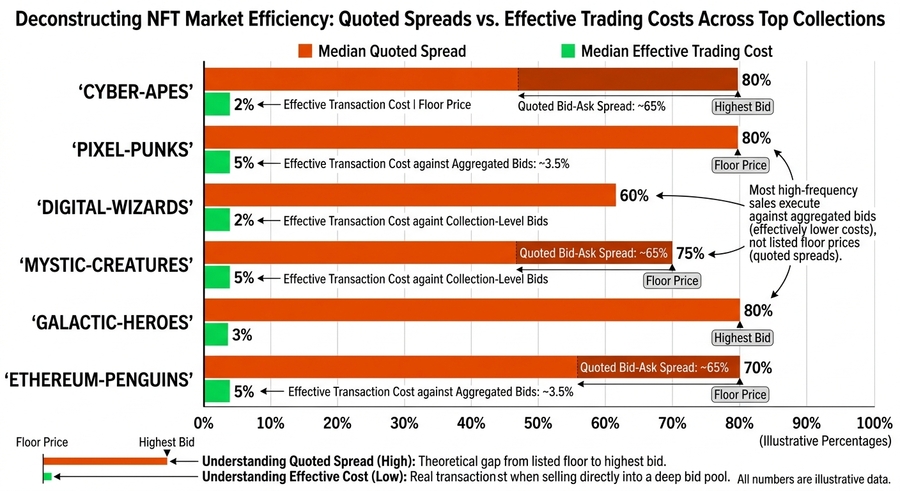
This chart provides a direct comparison of two critical yet often conflated metrics that define the efficiency of the NFT market: the theoretical 'Median Quoted Spread' and the actual 'Median Effective Trading Cost'. By separating what sellers ask for from what transactions actually cost, this visualization exposes the true liquidity dynamics beneath the often misleading floor price headline numbers.
Understanding the Visual: Quoted vs. Effective
To read this market like a pro, you must understand the two values presented for each illustrative collection:
-
Median Quoted Spread (The Long Orange Bars): This represents the theoretical difference, or 'spread,' between the lowest asking price (the 'Floor Price') and the highest offer currently on the table (the 'Highest Bid') for any given NFT in the collection. As you can see, for many high-profile illustrative collections, this spread is enormous, typically clustering between 48% and 80%. This extremely wide gap creates the illusion of a deep and illiquid market, making it look as though an asset is difficult to sell at a fair price.
-
Median Effective Trading Cost (The Short Green Bars): This is the game-changer. Despite the massive quoted spreads, research shows that when a sale actually happens, the real cost (the difference between the 'Floor Price' and the actual transaction price) is remarkably low, only 2% to 5% for highly liquid illustrative collections. Why? Because the vast majority of transactions do not occur at the hopeful floor price. Instead, they execute against 'Aggregated Bids' or 'Collection-Level Bids'; funded pools of capital where buyers have set a competitive price that is often very near the floor.
In Practice: Exposing the Floor Price Illusion
Look at 'GALACTIC-HEROES' as an example (Illustrative Data):
-
Quoted Spread: ~65%. If you only looked at the theoretical math, you'd think this asset is highly illiquid. The theoretical gap between the lowest ask and highest bid is massive.
-
Effective Trading Cost: ~3%. But if you go to sell your item, you will almost certainly match against a competitive bid, meaning your transaction executes for a mere 3% below the current floor.
The Pro's Cheat Sheet for This Chart
-
A Wide Quoted Spread: Signals two very different price perceptions between buyers and sellers. It warns you not to treat the listed floor price as a guaranteed exit price.
-
A Low Effective Trading Cost: Confirms that for this collection, you can find quick exit liquidity, but you must look for funded bids on aggregate order books, not simply list your asset and hope someone meets your floor price.
By using this visual, you can see past the 'advertised' floor and identify collections that possess deep, efficient bid pools where actual trade costs are low, prioritizing them over collections with high-flying floor prices but no visible, real-world buyer demand.
NFT Wallet Security: Staying Safe on Ethereum NFT Marketplaces
Here's a statistic that should make every NFT holder sit up straight: in September 2025, a single signature phish drained $6.5 million. Not through a smart contract exploit. Not through a hacked private key. Just one signature, signed by someone who thought they were claiming an airdrop. That's it. One click, one confirmation, and millions gone. If that doesn't make you want to double-check your wallet security, I don't know what will.
I've been lucky enough to avoid any major losses, but I've had close calls. I've clicked links I shouldn't have clicked. I've signed transactions I didn't fully understand. And I've watched friends lose NFTs worth more than my car because they were in a hurry and didn't read the fine print. The uncomfortable truth is that the blockchain itself is secure, but everything built around it is a potential attack surface. Scammers have gotten sophisticated, and the tools they use are genuinely convincing. The days of obvious Nigerian prince emails are over. Today's scams look like official announcements, come from compromised Discord accounts of projects you trust, and use wallet interfaces that are pixel-perfect copies of the real thing.
Non-Custodial Wallets and the Limits of Marketplace Security
The Drainer-as-a-Service ecosystem has turned wallet draining into a subscription business. Operators write the draining contracts and phishing templates. Affiliates deploy copies, buy ads, hijack Discords, and drive traffic. A typical split sends 20% of stolen funds to the operator and 80% to the affiliate. One of the top kits, Angel, required a $5,000 to $10,000 deposit before accepting new affiliates. The business model has franchise fees. That's how professionalized this has become. It's not a guy in a basement anymore. It's an industry with revenue sharing, marketing budgets, and customer support.
The scale is staggering. BlockSec tracked the DaaS ecosystem from March 2023 through April 2025 and attributed $135 million in stolen assets to 76,582 victims across 32,819 distinct phishing sites. Fifty-six operators managed 6,087 affiliates. And here's the part that should worry you: only 10.8% of DaaS-linked addresses appeared on public scam flag lists. That means most of the time, your wallet and block explorer won't warn you before you click. You're on your own. The safety net you might expect from your wallet provider or from community-maintained scam lists simply doesn't exist for the vast majority of these attacks.
This is why the phrase "not your keys, not your coins" matters, but it's also incomplete. Even when you hold your own keys, you can still sign them away if you're not careful. The wallet is yours. The responsibility is yours too.
Phishing, Malicious Approvals, and Stale NFT Listings
The modern drainer rarely needs you to send a transaction. It needs a signature. The mechanics are consistent: you land on a phishing site, click a button labeled "Claim Airdrop" or "Verify Holder," your wallet pops a signature request, the signed message is relayed to the drainer back-end, and a single bundled transaction empties whatever the signature authorized. You didn't send anything. You just signed something. And that's all it takes.
The signature types matter because they determine how much damage a single click can do. Permit and Permit2 signatures drove 38% of large losses in 2025, totaling $8.72 million across three incidents. Approve and increaseApproval cost another $5.62 million. A single setApprovalForAll signature was responsible for $1.23 million. Each of these has a specific shape. setApprovalForAll grants unlimited transfer authority over every NFT in an entire collection to a chosen spender. Permit and Permit2 are off-chain signatures that authorize ERC-20 spending with no on-chain transaction from the victim. Seaport signed orders go further, letting a user sign a listing at any price, including zero, which is why malicious sites sometimes simply ask for a "free verification signature" that is actually a listing. You think you're verifying. You're actually selling.
Stale approvals are the silent killer. Every approval you have ever granted is still active until revoked. Old, forgotten permissions, including any malicious ones you may have signed without consequence yet, sit in your wallet as standing risk. If a drainer compromises a contract you approved two years ago, it can still sweep your assets today. The maintenance task of revoking approvals is the one most users skip, and it's the single highest-value security action most crypto users can take and have not. I check my approvals every few months using tools like Revoke.cash, and I've found permissions I didn't remember granting. That's a scary feeling. It's also a fixable one.
Stale NFT listings are another risk. If you listed an NFT months ago on a marketplace you no longer use, that listing might still be active. If the marketplace gets compromised or the listing contract has a vulnerability, your NFT could be sold without your knowledge. Always unlist NFTs you're no longer actively selling, especially on platforms you've stopped using. I've made this mistake before, and I got lucky. Not everyone does.
Best Practices for Protecting High-Value Ethereum NFTs
Protecting your NFTs comes down to a set of habits that most people know but few actually follow. The habits: treat every signing request as a decision, not a formality, and never sign from a state of urgency, since urgency is the attack. The urgency is deliberate. Scammers engineer a state of excitement, fear of missing out, or trust, in which you're primed to sign without scrutiny. The technical sophistication of the drainer is almost secondary to the social engineering of the lure.
- Verify sites independently. Type known URLs or use bookmarks instead of clicking links, ads, or search results. Scammers buy ads to place fake links at the top of search results. Bookmark the official URL of your favorite exchanges and dApps and only use those bookmarks. I have a folder of bookmarks for every platform I use regularly, and I never navigate to them any other way. It's a small habit that eliminates an entire category of risk.
- Be intensely suspicious of anything free, unexpected, or time-pressured. Those are the emotional signatures of a lure. If someone is offering you free money, free NFTs, or a limited-time opportunity that expires in the next five minutes, your default response should be skepticism, not excitement. The real opportunities in this space don't require you to act before you've had time to think.
- Use a wallet that decodes and simulates transactions. Phantom, for example, simulates transactions to flag phishing attempts or malicious contracts before you sign. If a transaction says "Set Approval for All" or asks for access to an asset you aren't trying to trade, reject it immediately. Refuse to sign anything you cannot read. If your wallet shows you an opaque blob instead of a readable description, that's a red flag. A wallet that doesn't tell you what you're signing is a wallet that's failing at its most important job.
- Treat all unsolicited NFTs as scams. Assume any unexpected NFT airdrop is malicious. Don't click links, don't approve transactions, and don't let curiosity override caution. Phantom automatically checks NFT metadata and hides potentially malicious items, but not every wallet does this. If you're unsure, cross-check the NFT's source through the project's verified social channels. I've received dozens of these over the years, and I've never once regretted ignoring them. I have regretted interacting with one. Once was enough.
- Use a burner wallet for risky interactions. Fund it only with what's needed to keep your main assets safe. Never connect your main cold storage vault to a random dApp. If that burner wallet gets drained, your life savings remain untouched. I keep a separate hot wallet with a small amount of ETH for experimenting with new platforms. If something goes wrong, the damage is limited. It's the financial equivalent of wearing a cheap watch when you travel to a new city.
Hardware Wallets, Multisig, and Cold Storage for NFT Collectors
If you're holding NFTs worth more than a few thousand dollars, you need to move beyond hot wallets. The difference between a hot wallet and a cold wallet is the difference between leaving your front door unlocked and keeping your valuables in a safe deposit box. Both have their place, but you should know which one you're using and why.
Hardware wallets like Ledger keep your private keys offline and inaccessible to phishing attacks. When you use a Ledger device, your private key never touches the internet. You sign transactions on the device itself, and the signed transaction is broadcast to the network. Even if your computer is infected with malware, the attacker can't extract your keys because they're stored in secure hardware. The key instruction: never import your MetaMask seed phrase into a Ledger device. Use the device to generate a new seed phrase. If you import an existing phrase, you're potentially importing keys that were already compromised, and you've defeated the purpose of using a hardware wallet. I've seen people make this mistake because they wanted to keep their existing wallet address. It's not worth the risk.
Multisignature wallets like Safe{Wallet} take security further by requiring multiple approvals for transactions. Safe supports Ledger Nano X hardware wallets and any other wallet as a key, including MetaMask, Trust Wallet, and Rainbow. You can configure flexible security schemes depending on your use case. NFT collectors choose Safe specifically because of its high security standards, and it's used to hold high-value NFT assets like CryptoPunks, Bored Ape Yacht Club, Mutant Ape Yacht Club, and Moonbirds. For collections worth six figures or more, multisig is the standard for a reason. It's not paranoia. It's prudence.
Cold storage means keeping your assets completely offline. A dedicated cold wallet never connects to applications at all. The wallet you use for interacting with dApps holds only what you can afford to lose. Your serious holdings stay in cold storage, safe from the drainer economy entirely. The trade-off is convenience. But if you're holding NFTs worth more than your monthly rent, convenience is a luxury you can't afford. I treat my cold wallet like a bank vault. I don't visit it often, but I sleep better knowing it's there.
Platform Risk Case Studies: Lessons From Failed NFT Marketplaces
Platform risk isn't just about phishing. It's about the platforms themselves. The past two years have been a graveyard for NFT marketplaces, and the consequences for users have been real. Let me walk you through a few case studies that illustrate what can go wrong when you trust a platform with your assets.
In March 2026, NFT lending platform Gondi suffered an exploit that drained 78 NFTs worth approximately $230,000 from multiple users. The attack was connected to a recently deployed version of Gondi's Sell & Repay contract, which introduced faulty logic in its "Purchase Bundler" function that didn't properly check whether a contract caller was the legitimate owner or borrower of an NFT. The stolen assets included 44 Art Blocks tokens, 10 Doodles, 2 Beeple's "Spring Collection," and other valuable NFT brands. One victim alone lost about 55 ETH, worth about $108,000 at the time. Gondi disabled the vulnerable feature, worked with security firms to review the protocol, and began compensating users by purchasing "comparable items" from similar collections. The platform survived, but the lesson is clear: even non-custodial platforms can have vulnerabilities that put your assets at risk.
In June 2026, Flooring Protocol suffered an exploit that put high-value NFTs at risk. A white hat team led by Yuga Labs rescued 68 NFTs worth over $500,000, including 29 Bored Apes, 4 Mutant Apes, 2 CryptoPunks, 1 Azuki, and 1 Moonbird. The exploit allowed attackers to create a "phantom ownership" state and obtain infinite token balances, draining the protocol's liquidity pools. Flooring Protocol's architect said the vulnerability came from gas-saving bit-level code that escaped earlier security reviews. Users were advised not to deposit any more NFTs into the protocol. The rescue was impressive, but it shouldn't have been necessary. A single line of overlooked code put half a million dollars of NFTs at risk.
And then there's Foundation, which didn't suffer an exploit but shut down entirely. I've already covered the details elsewhere, but the security lesson is worth repeating. When Foundation closed, users with NFTs listed in the marketplace smart contract couldn't just leave them there. The team had to build an unlisting and retrieval tool to help users delist their assets because the frontend was the primary interface for interacting with the contract. If you missed the window, your metadata could disappear from the decentralized web. The art survived because Foundation was built on open infrastructure, but the platform didn't. Users who understood that distinction were fine. Users who didn't were left scrambling.
These case studies illustrate a fundamental truth: platform risk is real, and it's not going away. Even well-audited, non-custodial platforms can have vulnerabilities. Even beloved platforms can disappear. The security of your assets depends on more than just avoiding phishing links. It depends on understanding the platforms you're trusting, diversifying your exposure, and never assuming that today's secure platform will still be secure tomorrow. I've learned to spread my assets across multiple wallets and platforms, not because I expect any single one to fail, but because I know that eventually one will. That's not pessimism. It's risk management.
The bottom line is that NFT security isn't a product you buy. It's a practice you maintain:
Treat every signature as a decision.
Revoke approvals you don't need.
Use hardware wallets for serious holdings.
Keep your main assets away from the platforms where you interact with new projects.
And remember that the scammers are professionalizing faster than the platforms are securing.
The drainer economy is a mature industry now, with franchise fees and affiliate programs and customer support for its operatives. Your best defense is a zero-trust mindset and the discipline to verify everything before you click. It's not glamorous advice. But it's the advice that keeps your NFTs where they belong: in your wallet, under your control, safe from the people who make a living taking them from you.
📊 Breakdown of Ethereum NFT Phishing Losses by Signature Technique (2025 Data)Title Here:
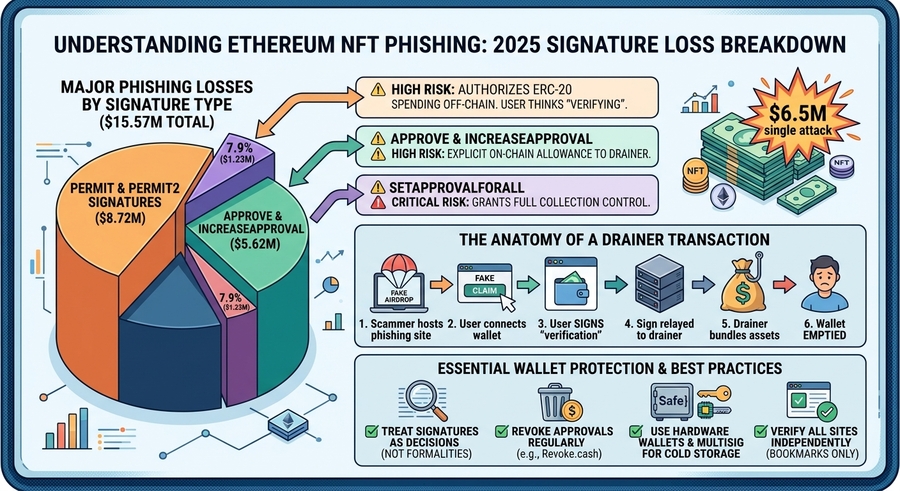
This visualization provides a clear, quantitative breakdown of financial losses resulting from distinct signature phishing techniques used by malicious drainers targeting Ethereum NFT holders in 2025. By isolating the exact signing mechanisms exploited, this chart highlights where the highest security risks lie during wallet interactions.
Key Visual Elements & Interpretation
-
Permit & Permit2 Signatures ($8.72M / 56.0%): Representing over half of all recorded losses across major signature exploits in 2025, off-chain permit signatures are the single largest vector. Because these signatures authorize ERC-20 spending or token transfers off-chain without requiring an immediate gas fee or on-chain transaction from the victim, users are often tricked into thinking they are merely "logging in" or "verifying membership."
-
Approve & IncreaseApproval ($5.62M / 36.1%): On-chain approval mechanisms account for over a third of the losses. Signing these requests explicitly grants malicious contracts authorization to spend specific tokens or assets from your wallet.
-
SetApprovalForAll ($1.23M / 7.9%): While accounting for a smaller total monetary share, a single
setApprovalForAllsignature grants total, unlimited transfer authority over every single NFT within a specific collection in your wallet.
How to Use This Information for Wallet Protection
-
Treat Signatures as On-Chain Decisions: Off-chain messages (like Permit and Seaport orders) carry equal or greater financial weight than standard transactions. Never sign an opaque hex message or an unreadable text block.
-
Audit Approvals Regularly: Regularly review active allowances using toolings like Revoke.cash to eliminate stale permissions that remain open to compromise.
-
Isolate High-Value NFTs: Keep valuable collections in cold storage or multisig wallets (such as Safe{Wallet}) that require hardware confirmation, completely separated from daily dApp interaction or burner wallets.
Current Trends Shaping Ethereum NFT Marketplaces
If you've been paying attention to the Ethereum NFT market lately, you've probably noticed something strange: the volume numbers look terrible, but the market feels alive. Trading volume has collapsed from its 2021 peaks, yet builders keep shipping, creators keep creating, and collectors keep collecting. That contradiction is the defining feature of the current market. The speculation is gone, but the substance is growing. And that's actually a good thing.
I've been through enough cycles to know that the quiet periods are when the real work happens. The 2021 frenzy was fun, but it was also mostly noise. What's happening now is slower and less glamorous, but it's building the foundation for something more durable. The tourists have left. The people who remain are the ones who actually care about this technology and what it can do. Here are the trends that matter right now, and what they mean for anyone trading, collecting, or creating on Ethereum.
The Post-Hype NFT Market: Stabilization and Real Demand
The headline numbers are brutal. Global NFT sales dropped 15.28% to $37.54 million in one recent week, even as buyer and seller addresses surged by over 150%. Ethereum remained the top blockchain for NFT sales with $15.32 million, but that was still a decline from the previous period. In another week, sales fell 44.70% to $63.33 million, with Ethereum maintaining its lead at $35.56 million in organic sales despite a 49.01% drop. If you only looked at those numbers, you'd think the market was dying.
But here's what those numbers don't tell you. The buyer and seller counts are rising even as volume falls. More people are participating, but they're spending less per transaction. That's a sign of a market transitioning from whale-driven speculation to broader, more organic participation. The people showing up now aren't trying to flip a quick profit. They're collecting, experimenting, and building. When buyers outnumber sellers and the average transaction size is smaller, you're looking at a healthier market than the volume metrics suggest. It's like comparing a crowded farmers market to a single luxury auction. The auction might have a higher total dollar value, but the farmers market has more people actually participating in the economy.
The stabilization doesn't mean prices are going up. It means the market is finding a floor based on actual demand rather than speculation. Blue-chip collections are seeing floor price recoveries even as overall volume declines, which suggests that the remaining buyers are serious about accumulating rather than trading for quick gains. I've watched enough cycles to know that this is how real markets form. The speculators leave, the builders stay, and the foundation gets stronger. It's not exciting, but it's necessary.
The Rise of Utility NFTs: Gaming, Ticketing, and Real-World Assets
The most important shift in the NFT market isn't about art or collectibles. It's about utility. NFTs that do something, that unlock access, that represent ownership of something real, are quietly becoming the backbone of the market's next phase. If you're still thinking of NFTs as just digital pictures, you're missing the bigger picture.
Gaming NFTs are the clearest example. In-game assets derive value from their usefulness, not their rarity. A sword, a character, or a piece of virtual land has a purpose that exists independently of whether someone wants to flip it. Trading volumes in gaming NFTs correlate with active player metrics rather than crypto market cycles, which makes them a genuine diversification tool for collectors who are tired of the volatility of purely speculative assets. I've talked to gamers who spend hours analyzing stats and traits before making a purchase, treating the marketplace more like a fantasy sports draft than an NFT trading platform. That's the difference between utility-driven and speculation-driven markets. One is based on what the asset does. The other is based on what someone else might pay for it.
Ticketing is another category gaining traction. Using NFTs as event tickets solves real problems: counterfeiting, scalping, and resale transparency. If you buy a concert ticket as an NFT, you can verify its authenticity, see its full ownership history, and transfer it securely. Several major venues and festivals have experimented with NFT ticketing, and the infrastructure is maturing quickly. Imagine never having to worry about buying a fake ticket from a scalper again. That's not a fantasy. It's already happening.
Real-world asset tokenization is the biggest long-term opportunity. The global asset tokenization market was estimated at $1.756 trillion in 2025 and is projected to reach $24.479 trillion by 2033, growing at a 42.1% CAGR. Blockchain technology is enabling the conversion of traditional assets like real estate, art, commodities, and intellectual property into digital tokens that can be traded, fractionalized, and managed more efficiently. For NFT collectors, this means the same infrastructure that powers digital art can be used to represent ownership of physical assets. The line between "NFT" and "tokenized asset" is blurring, and that's a good thing for anyone who wants their portfolio to include more than just JPEGs. If you can buy a fraction of a rental property using the same wallet you use for NFTs, the utility of that wallet increases dramatically.
Soulbound Tokens (SBTs) are another emerging category. Unlike traditional NFTs, SBTs are non-transferable and permanently bound to a wallet. They're being used for education credentials, professional certifications, event attendance, and reputation systems. For NFT traders, SBTs represent a different kind of value: not something you can flip, but something that proves you did something or belong somewhere. The reputation layer of Web3 is being built on SBTs, and it's worth watching. I've received SBTs for attending conferences, completing courses, and participating in DAOs. They're not worth anything on the open market, but they're worth something to me. That's a different kind of value, and it's one that the NFT space is still learning to appreciate.
NFTFi and DeFi Convergence: Lending Against Ethereum NFTs
The convergence of NFTs and DeFi is one of the most significant developments in the market, and it's creating both opportunities and risks that every serious collector should understand. If you're not paying attention to NFTFi, you're missing a fundamental shift in how NFTs are used.
Blend, Blur's peer-to-peer perpetual lending protocol, has processed over $6.04 billion in total transaction volume with more than 659,353 loans issued. The platform has 10,458 unique borrowers and 4,447 unique lenders, with active loans totaling approximately 6,013 ETH. Those are staggering numbers for a protocol that didn't exist a few years ago, and they show that NFT holders are increasingly treating their assets as productive capital rather than static collectibles. Your Bored Ape isn't just a picture anymore. It's collateral.
The model is straightforward. You deposit an NFT as collateral and receive an ETH loan. There's no fixed expiry date. The loan continues until you repay or the lender calls it. If you can't repay and the lender calls the loan, the NFT goes to a Dutch auction. If no buyer meets the floor price, the lender takes possession. It's an oracle-free system that uses auction dynamics to discover fair value in real time. The auction starts at the loan amount and drops over time until a buyer steps in.
But the risks are real, and I can't emphasize this enough. During the 2024 bear market, falling NFT floor prices triggered mass liquidations. Borrowers who had taken ETH against BAYC or Azuki NFTs saw their collateral liquidated at prices far below their original value. The risk assessment firm Hindenrank flagged a scenario where blue-chip NFT floors drop more than 40% over 30 days and Blend refinancing auction fill rates fall below 30%, creating a potential illiquidity cascade. In plain English: if the market crashes and nobody shows up to buy the liquidated NFTs, the whole system can grind to a halt. I've seen traders who borrowed against their blue-chip NFTs during a bull market and ended up losing everything when the floor dropped 50% in a month. Don't be that person.
Peer-to-peer lending through platforms like NFTfi offers an alternative model. Average APY on NFTfi is around 58%, with $18.3 million in outstanding loans and an average loan duration of 32 days. The default rate is approximately 10% overall, though it drops to 2% for BAYC loans. P2P lending has less blowup risk than platform lending because bad debt is distributed between lenders, loans have varying terms, and the overall outstanding volume is smaller. The trade-off is that P2P lending is less efficient and requires more active management. You're not just depositing and waiting. You're negotiating terms and managing counterparty risk.
Blue-Chip NFT Collections and the Flight to Liquidity
When the market gets tough, capital flows to quality. That's exactly what's happening in the NFT space right now, and the blue-chip collections are the beneficiaries. If you're holding mid-tier NFTs and wondering why they're not moving, this is why.
CryptoPunks saw its floor price climb from $62,500 to $73,200 over a 30-day period, a gain of nearly 17%. The collection's market cap exceeded $600 million, and its floor price reached approximately 32 ETH, representing a weekly gain of nearly 19%. Bored Ape Yacht Club (BAYC) posted even larger gains, with its floor price rising 75.87% from $14,300 to $25,150 over the same period. BAYC's market capitalization stood at $251 million, and it recorded $13.42 million in sales over 30 days, outpacing CryptoPunks' $7.78 million during the same period.
But liquidity remains a concern. CryptoPunks has a relatively small number of active holders, which means limited buying pressure can push prices up quickly, and large sell orders can trigger equally sharp declines. BAYC benefits from a larger and more active community, and its future price performance depends heavily on whether Yuga Labs can deliver meaningful utility through gaming, digital ownership, and ecosystem expansion. If development milestones are met, analysts believe BAYC could return to the 12-15 ETH range. If not, the collection could face renewed selling pressure.
For traders, the lesson is that blue-chip NFTs are not immune to volatility. They're more liquid than mid-tier collections, but they're still illiquid compared to traditional financial assets. The flight to liquidity is real, but it doesn't eliminate risk. It just concentrates it in fewer, larger assets. If you're going to hold blue chips, be prepared for wild swings. And if you're going to trade them, know that the exit door isn't as wide as it looks.
AI-Generated Art and Brand-Backed NFT IP
The intersection of AI and NFTs is evolving faster than almost any other category, and it's creating new opportunities and new questions about ownership and authenticity. This is the wild west of the NFT space right now, and the rules are still being written.
AI content provenance is becoming a legal requirement. The EU AI Act Article 50, effective from August 2, 2026, requires providers of generative systems to mark synthetic output in a machine-readable, detectable format and to disclose deepfakes and certain AI-generated content. This turns provenance labeling from a voluntary best practice into hard legal demand. For NFT creators working with AI, this means that the provenance of their work is no longer optional. It's a regulatory requirement, and platforms that don't support it will face compliance challenges. If you're creating AI art and selling it on Ethereum, you need to understand what's coming.
Adobe's Content Authenticity web app, launched in public beta in April 2025, lets creators attach, customize, and inspect Content Credentials, including a machine-readable "do-not-train" generative-AI preference. Google's SynthID Detector, launched in May 2025, can detect watermarks across images, audio, video, and text, with over 10 billion pieces of content watermarked since 2023. Consumer smartphones are beginning to sign Content Credentials in-camera, moving authenticity from post-hoc editing tools to mass-market devices. The infrastructure for verifiable AI content is being built at scale. That's a big deal for anyone who cares about proving their work is actually theirs.
Story Protocol is the most significant blockchain project in this space. It raised $80 million in Series B funding at a $2.25 billion valuation, led by a16z crypto, and launched its Layer 1 mainnet with an IP token in February 2025. Story registers works as on-chain IP Assets with a Programmable IP License that links on-chain smart contracts to off-chain legal terms, enabling automated royalties and derivative tracking. The vision is "IPFi" : a financial system for intellectual property where creators can register, license, and monetize their work on-chain with programmable terms. If you're a creator, this is worth paying attention to. It's the closest thing to a legal framework for on-chain IP that exists right now.
Meanwhile, the US Copyright Office has ruled that prompts do not confer authorship. This is a critical distinction. If you generate an image using an AI model, you don't own the copyright to that image just because you wrote the prompt. The ownership question is unresolved, and it's creating a divide between AI-generated content and AI-assisted content where the human contribution is substantial enough to warrant copyright protection. In plain English: if you type "a cat wearing a hat" into an AI generator, you probably don't own the result. If you spend hours refining, editing, and composing the output into something original, you might. The line is blurry, and it's going to be litigated for years.
For NFT creators, the practical takeaway is that provenance and IP registration are becoming essential infrastructure. If you're creating AI-assisted art, you need to document your process and understand the legal framework. If you're building a brand around a collection, registering your IP on-chain through a platform like Story Protocol gives you enforceable rights and a clear path to monetization. The creators who thrive in the next cycle will be the ones who take this seriously now.
On-Chain Royalty Enforcement and the Creator Economy Shift
The royalty wars aren't over, but the battlefield has shifted. Instead of fighting platform policy, creators are building technical enforcement into their contracts, and platforms are responding with new tools. If you're a creator, this is the most important section in this article. If you're a collector, it's the most important section for understanding what you're supporting.
Cardinal and Hyperspace partnered to create the first live iteration of creator royalty enforcement, built on Metaplex standards. Their solution executes royalties directly on token transfers that involve synchronous flow of funds, rather than punishing non-compliant traders after the fact. The BBs NFT project was the first to use Cardinal's royalty enforcement solution. It's a small step, but it's a step in the right direction.
Mysten Labs and OriginByte are building a comprehensive NFT standard on Sui that allows creators to configure royalty conditions at the most granular level. Features include blacklisting malicious marketplaces, taxing peer-to-peer transactions, and whitelisting specific exchanges. If creators don't care about royalties, they can whitelist all marketplaces. If they do, they can restrict their work to platforms that honor their terms. It's a different approach than Ethereum's, but it's worth watching as a model for what's possible.
OpenSea's Operator Filter Registry was the first major attempt at on-chain royalty enforcement, allowing creators to blacklist wrapper contracts that interact with their NFTs on non-compliant marketplaces. However, it was phased out, and the community backlash revealed the tension between creator rights and trader freedom. The lesson from that experiment is that enforcement alone isn't enough. You need community buy-in.
The consensus among thoughtful observers is that the industry needs a middle ground. Royalty rates of 7% to 8% are more reasonable than the 12% to 15% that some creators set during the peak, and those rates are more likely to be honored voluntarily. Combined with smart contract enforcement, this could be a sustainable compromise. But it requires creators to be realistic about what the market will bear.
But enforcement alone isn't enough. Beeple pointed out that creators need to build a loyal community that values supporting creators, not just a trading audience that sees royalties as a tax. Collectors and traders have different motivations. Traders buy for economic gain and will avoid royalties whenever possible. Collectors buy because they love the art, believe in the creator, or want to support the work. Building a community of collectors who want to pay royalties is more sustainable than forcing traders to pay them. I've seen creators build small but loyal collector bases through community engagement, and those creators are doing better than the ones who relied on royalty income from anonymous traders.
The creators who are thriving in 2026 are the ones who have diversified their monetization. They don't rely solely on primary sales and royalties. They build communities, create exclusive experiences, and offer value beyond the NFT itself. The royalty income is a bonus, not the foundation. That shift in mindset is the real creator economy story, and it's one that every artist in this space should understand. If your entire business model depends on royalties that most platforms make optional, you're building on sand. If you build a community that values your work and wants to support it, you're building on rock.
The bottom line is that the Ethereum NFT market is in a transitional phase. The speculation is gone, but the infrastructure is maturing. Utility is replacing hype. Enforcement is replacing optional compliance. And the collectors who remain are more serious than the tourists who left. If you're still here, you're early to the next phase. The question is whether you're positioned to benefit from it. I've made my bets. Now it's your turn.
📊 Visualizing the Key Market Shift: Speculation Falls, Participation Rises
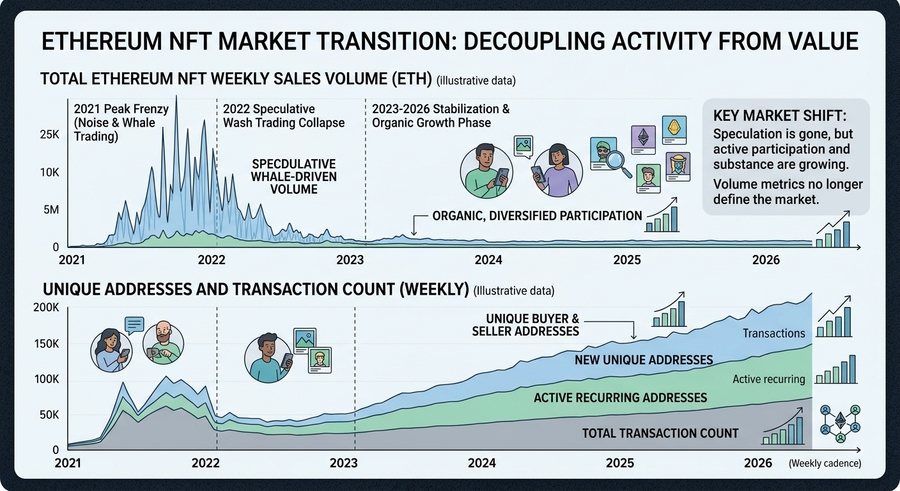
This visualization provides a critical, side-by-side comparison of the two contradicting trends currently defining the Ethereum NFT landscape: a collapse in overall trading volume paired with a robust increase in market participation. By decoupling these metrics, the charts help you visualize how the market is transitioning from its speculative past toward a more organic, durable future.
-
Top Chart: Total Ethereum NFT Weekly Sales Volume (ETH) (Illustrative Data): The stacked area chart at the top shows the total monetary value, in ETH, being traded weekly. You can see the distinct, massive peak of 2021-2022, which was driven by speculative noise and high-value 'whale' trading. The rapid decline in 2023 settles into a flat, stabilized base for the remainder of the period. This chart illustrates the headline narrative: that volume has cratered and speculation is gone.
-
Bottom Chart: Unique Addresses and Transaction Count (Weekly) (Illustrative Data): The stacked area chart at the bottom shows a very different story. While initial activity peaks and falls alongside volume (driven partly by speculative 'wash trading'), the subsequent period from 2023 to 2026 exhibits a strong, sustained growth trend for both "UNIQUE BUYER & SELLER ADDRESSES" and "TOTAL TRANSACTION COUNT." The areas within this chart clearly segment new unique participants, active recurring addresses, and total interactions. This chart illustrates the healthy substance: that more diverse people are engaging, experimenting, and building the foundation of actual demand, even while individual transactions are smaller.
How to Utilize This Insight: When analyzing marketplaces, the raw sales volume metric is now a lagging indicator of past speculation. Instead, focus on the healthy metrics of unique user growth, transaction depth, and recurring participation. The market's contraction filter has prioritized substance over glamorous noise, creating the durable foundation necessary for the next cycle.
How to Match Your NFT Trading Strategy to the Right Marketplace
I've watched a lot of traders make the same mistake. They find a platform they like, they get comfortable with the interface, and they start using it for everything. Buying, selling, sweeping, lending, discovering new collections. It doesn't matter what the task is; they've decided that OpenSea is "their" marketplace, or Blur is "their" marketplace, or whatever platform happened to be the first one they learned. It's a natural human tendency. We like routine. We like familiarity. But in the NFT space, that tendency can cost you real money.
The truth is that no single marketplace is optimal for every trading strategy. Blur is a nightmare for a casual collector who just wants to browse art. OpenSea is too slow and too expensive for a professional flipper executing fifty trades a week. Rarible's royalty enforcement is a blessing for creators and a dealbreaker for traders who refuse to pay them. The best traders I know don't have one marketplace. They have a rotation. They use different tools for different jobs, and they know exactly why they're using each one.
So let's figure out where you fit. I'll walk through five distinct trading personas and match each one to the platforms that serve them best. You might recognize yourself in more than one of these, and that's fine. Most of us are a hybrid of two or three. The goal isn't to pick a label. It's to understand which tools belong in your toolbox and why. Because using the wrong tool for the job doesn't just cost you money. It costs you time, opportunities, and sometimes your entire position.
For Active NFT Traders: Execution-First Ethereum Marketplaces
If you're executing multiple trades per week and your primary goal is to capture small price movements across liquid collections, you're an active trader. You care about speed, cost, and execution quality above everything else. You don't need a pretty interface. You need a terminal that lets you act on the market before the market moves without you. Every second you spend fumbling with a clunky UI is a second someone else is taking your trade.
Blur is your primary platform, and it's not even close. The zero-fee model saves high-volume traders thousands of dollars annually compared to platforms charging even 0.5%. On a $10,000 monthly trading volume, the savings alone can add up to roughly $600 per year compared to a 0.5% platform, and significantly more compared to the 2.5% fees that OpenSea used to charge. Collection bids create a functioning order book for NFTs, letting you see where real demand lives rather than guessing based on floor prices. Floor sweeping lets you accumulate positions in a single transaction, and batch listing lets you manage dozens of assets from one dashboard. The interface is dense and unforgiving, but that density is a feature. It puts bid depth, price spreads, and pending transactions close to your decision surface. Listings update every four seconds. Pending transactions appear within a second. For someone executing quickly, those seconds matter.
OpenSea serves as your secondary venue. The 0.5% fee is competitive, and the platform's breadth gives you access to collections that Blur doesn't index as aggressively. More importantly, OpenSea is where the casual buyers are. When you're ready to exit a position at retail prices rather than selling into professional bids, OpenSea's user base of over 382,000 monthly active users is where you'll find them. Blur has roughly 38,300 monthly active users by comparison. The ratio tells you everything about the difference between the two platforms. Blur is where traders trade. OpenSea is where collectors buy. If you're trying to sell a position quickly at a good price, you need both. Blur for buying into weakness, OpenSea for selling into strength.
Blend deserves special mention for active traders who understand leverage. The peer-to-peer lending protocol lets you borrow ETH against your NFT collateral, which means you can maintain exposure to a collection while freeing up capital for other trades. But the liquidation risk is real. During the 2024 bear market, borrowers who had taken ETH against BAYC or Azuki NFTs saw their collateral liquidated at prices far below their original value. Use Blend if you understand leverage and have a repayment plan. Avoid it if you're borrowing because you don't want to sell. The people who got hurt in 2024 were the ones who didn't.
A pro tip that took me too long to learn: keep a spreadsheet of your trades. Not just the entry and exit prices, but the platform, the fees, the gas costs, and the time spent waiting for execution. After a few months, you'll see patterns. Maybe you're paying too much in gas because you're trading during peak hours. Maybe you're listing on the wrong platform for the collections you trade. Maybe you're spending more time managing listings than actually trading. The spreadsheet doesn't lie, even when your memory does.
What to avoid: If you're an active trader, don't waste time on platforms that prioritize curation or community over execution. SuperRare's 15% primary commission and thin liquidity will eat your margins alive. Rarible's 2% total fee is fine for occasional trades but adds up quickly if you're executing frequently.
And whatever you do, don't try to execute a high-frequency strategy on a platform with a mobile-first interface. You need a desktop, a keyboard, and a screen that shows you everything at once. Trading on a phone is like trying to perform surgery with oven mitts on. It's possible, but why would you?
For Casual Collectors: Discovery, Safety, and Ease of Use
If you buy NFTs because you love the art, the community, or the culture, and you're not trying to flip them for a quick profit, you're a collector. Your priorities are different from a trader's. You care about finding work that resonates with you, understanding what you're buying, and not getting scammed in the process. Speed and fee optimization matter less than clarity and confidence. You'd rather spend an extra $20 in gas than accidentally buy a counterfeit NFT or sign a malicious contract.
OpenSea is your home base, and it's the obvious starting point for a reason. The platform's interface prioritizes discovery over execution, which means you can browse collections, inspect creators, view traits, and understand what you're buying before you commit. The breadth of inventory is unmatched. With over 80 million NFTs listed across more than 20 chains, OpenSea is the only platform where you can explore Ethereum art, Solana gaming assets, Base experiments, and Bitcoin Ordinals without switching between five different tabs. For a collector who follows their curiosity rather than a specific trading strategy, that breadth is invaluable. I've discovered artists on OpenSea that I never would have found on more specialized platforms, simply because the inventory is so vast. It's the difference between shopping at a massive flea market and visiting a single boutique. Both have their place, but the flea market has more surprises.
Magic Eden is your Solana option. Since the February 2026 pivot, Magic Eden is effectively Solana-only, and that's made it the best place to discover Solana-native collections. The platform supports the full modern Solana NFT stack, including Metaplex Core, Token-22, and compressed NFTs. Its Launchpad maintains quality control with an acceptance rate below 5%, and its community relationships in the Solana ecosystem are unmatched. If you collect Solana art or gaming assets, Magic Eden is where you'll find them. The platform has also invested in tools like Lucky Buy and NFT Packs that don't exist on other platforms, giving collectors new ways to engage with their favorite collections.
SuperRare is your gallery. If you're collecting high-end digital art and you care about curation, provenance, and artist support, SuperRare is the most rigorous platform in the market. The invite-only artist model means you're not sifting through spam. The 10% perpetual artist royalty means the creators you collect are getting paid on every resale. The average sale price is around $4,000, which prices out casual browsers but ensures that the people buying are serious. SuperRare isn't for everyone, but if it fits your collecting style, nothing else compares. It's the platform equivalent of a quiet, well-lit gallery where the art is the point, not the price tag.
One thing I always tell new collectors: treat every unsolicited NFT as a scam. If you receive an NFT you didn't ask for, don't click links, don't approve transactions, and don't let curiosity override caution. The most common attack vector for NFT theft is the fake airdrop. Scammers send you an NFT, you interact with it, and your wallet gets drained. The rule is simple and absolute. Ignore it. Your future self will thank you.
What to avoid: If you're a collector, avoid platforms that make you feel like you're in a trading pit. Blur's dense interface and execution-first design will make you anxious rather than excited. The platform assumes you understand order books, bid depths, and wallet signatures. If you don't, you're one wrong click away from an expensive mistake. Also avoid platforms with thin liquidity and unclear provenance. If you can't easily verify who created an NFT and where it came from, don't buy it. The few dollars you save on gas aren't worth the risk of buying stolen or counterfeit work.
For NFT Creators: Royalty Enforcement and Launch Tools
If you're an artist, musician, or creator trying to build a sustainable income from your work, your marketplace strategy is fundamentally different from a trader's or collector's. You need platforms that respect your royalties, tools that make it easy to launch and manage collections, and access to audiences that value what you create. The platform that's best for buyers is not necessarily the platform that's best for you.
Rarible is your primary platform, and it's the only major marketplace that has built infrastructure specifically designed to protect creator income. Royalty rates can be set as high as 50%, and those royalties are enforced at the protocol level through RARI Chain, the platform's Arbitrum-based Layer 3 blockchain. The enforcement happens at the node level, which means no marketplace can bypass it and no buyer can choose not to pay. If you've been burned by royalty-optional platforms, Rarible is the most credible solution anyone has built. The trade-off is liquidity. Rarible's audience is smaller than OpenSea's or Blur's, which means slower sales. But the royalties you actually receive are worth more than the royalties you don't. I've talked to artists who migrated from other platforms specifically because they were tired of chasing royalties that never came. Rarible solved that problem by making it structurally impossible to avoid.
SuperRare is your premium venue. The 15% primary commission is steep, but it funds curation, artist support, and platform development in a way that zero-fee platforms don't. The 10% perpetual royalty on secondary sales is enforced by smart contract, not policy. And the collector base includes people who actually care about art, not just floor prices. SuperRare introduced automated artist royalties in 2018 and has never wavered from that decision. In a space where platforms change policies faster than the weather, that consistency is worth something. If you're an established digital artist, SuperRare acceptance carries genuine credibility. It's a signal that your work has been vetted by people who know what they're looking at.
Zora is your experimental playground. The Layer 2 network is designed to make NFT minting and trading as cheap as possible, with mint costs under $0.50 and transaction confirmations in seconds. If you're releasing lower-priced editions, experimenting with new formats, or building a collection without a big budget, Zora's economics make more sense than mainnet Ethereum. The platform also has a different philosophy than the generalists. It's built for creators who want to mint and sell without paying gas fees that eat their margins. If you're just starting out and you don't have a following yet, Zora is a low-risk way to experiment and find your voice.
What to avoid: If you're a creator, avoid platforms that treat royalties as optional and make no apology for it. Blur's royalty policy is a minimum 0.5% floor on immutable collections and effectively optional everywhere else.
OpenSea phased out the Operator Filter in August 2023, making creator fees optional for new collections.
Magic Eden is Solana-only now and has its own royalty approach.
You can list on these platforms for exposure, but don't expect them to protect your income.
If royalties are a meaningful part of your business model, your primary platform needs to be one that enforces them. And if you're relying entirely on royalties to pay your bills, you're building on sand. The creators who are thriving in 2026 have diversified their income through commissions, community memberships, and exclusive drops. Royalties are a bonus, not a foundation.
For Multi-Chain Users: Breadth vs. Depth of NFT Marketplace Support
If you trade NFTs across multiple blockchains, whether Ethereum, Solana, Base, Polygon, or anything else, your marketplace strategy needs to balance convenience against execution quality. You can use one platform for everything and accept that it's not optimal for any single chain, or you can use specialists for each chain and accept the overhead of managing multiple accounts and wallets. There's no perfect answer, but there is a right answer for your specific workflow.
OpenSea is your breadth play. The OS2 rebuild expanded support to more than 25 networks, including Ethereum, Solana, Base, Polygon, Arbitrum, Optimism, Avalanche, and many others. The platform supports both NFTs and fungible tokens, which means you can manage your entire portfolio from a single interface. For a multi-chain user who values convenience over optimization, OpenSea is the most comprehensive platform available. The trade-off is that it's rarely the best platform for any single chain. Blur has deeper Ethereum liquidity. Magic Eden has deeper Solana liquidity. But OpenSea has adequate liquidity everywhere, and sometimes adequate everywhere is better than optimal somewhere. If you're managing a diverse portfolio and you don't want to keep ten browser tabs open, OpenSea's one-stop-shop approach is genuinely valuable.
Blur is your Ethereum depth play. The platform is Ethereum-focused with limited expansion into Blast, and it has no Solana or Base support. If Ethereum is the only chain you care about, Blur's specialization means deeper liquidity, better tools, and lower costs than any multi-chain generalist can offer. The same logic applies to Magic Eden for Solana users. Sometimes the specialist beats the generalist, especially when you're executing trades rather than browsing. I've found that the extra thirty seconds it takes to switch platforms is almost always worth the better execution price.
The practical approach for most multi-chain users is a hybrid strategy. Use OpenSea for discovery and cross-chain browsing. Use Blur for Ethereum execution. Use Magic Eden for Solana execution. The overhead of managing three accounts is minimal compared to the savings from executing on the right platform for each chain. I know traders who keep all three tabs open and switch between them depending on what they're doing. It sounds tedious, but it's the difference between getting the best price and getting whatever price is available on the platform you happened to open.
One more thing for multi-chain users: pay attention to bridge costs and withdrawal delays. Moving assets between chains isn't free, and some Layer 2 solutions have withdrawal delays of up to 7 days. If you're moving ETH from Ethereum mainnet to Base to buy an NFT, factor in the bridge cost and the time it takes to complete the transfer.
I've seen traders miss opportunities because their funds were stuck in a bridge when they needed them. Plan ahead. Keep some gas money on each chain you use. And don't assume that moving assets is as simple as clicking a button.
For NFTFi Participants: Collateral, Lending, and Leverage Options
If you're using NFTs as financial instruments, whether borrowing against them, lending them out, or using leverage to amplify your exposure, your marketplace choices are narrower. NFTFi is a specialized category with its own risks and rewards, and not every platform supports it. The tools are powerful, but they're also unforgiving. One wrong move can cost you everything.
Blur and Blend are your primary platforms. Blend is the most significant peer-to-peer lending protocol in the NFT space, with over $6.04 billion in total transaction volume and more than 659,353 loans issued. The protocol has 10,458 unique borrowers and 4,447 unique lenders. Borrowing against an NFT requires no fixed expiry date, and the Dutch auction liquidation mechanism is oracle-free. The Buy Now, Pay Later feature lets you purchase expensive NFTs with a portion of the price upfront, borrowing the remainder against the NFT itself. For a trader who understands leverage and has a repayment plan, Blend is a powerful tool. But let me be clear: leverage amplifies everything. If you borrow against your NFTs and the market drops, you can lose your collateral at the worst possible moment. The 2024 bear market was brutal for borrowers who didn't monitor their loan-to-value ratios or have a repayment plan.
NFTfi is your alternative. The platform offers average APY around 58%, with $18.3 million in outstanding loans and an average loan duration of 32 days. The default rate is approximately 10% overall, though it drops to 2% for BAYC loans. P2P lending has less blowup risk than platform lending because bad debt is distributed between lenders, loans have varying terms, and the overall outstanding volume is smaller. The trade-off is less efficiency and more active management. You're not just depositing and waiting. You're negotiating terms and managing counterparty risk.
ParaSpace and Bunker.finance are worth knowing about for cross-margin and pool-based lending respectively. ParaSpace allows borrowing against blue-chip NFTs, ERC-20 tokens, and Uniswap V3 LPs. Bunker operates as a lending pool model where lenders deposit ETH or ERC-20 tokens into pools for specific collections and earn interest. These are smaller platforms, but they serve specific niches within the NFTFi ecosystem.
The bottom line is that your trading strategy should determine your marketplace, not the other way around.
If you're a flipper, use Blur. If you're a collector, use OpenSea.
If you're a creator who values royalties, use Rarible.
If you're a multi-chain user, use a hybrid approach.
If you're an NFTFi participant, understand the risks before you borrow.
There's no single right answer, but there's definitely a wrong one: using the same platform for everything and wondering why it never feels quite right. The best traders I know are platform-agnostic. They go where the liquidity is, where the fees are lowest, and where the tools match the task. You should too.
📊 NFT Marketplace Feature Matrix by Trading Strategy & Persona Needs
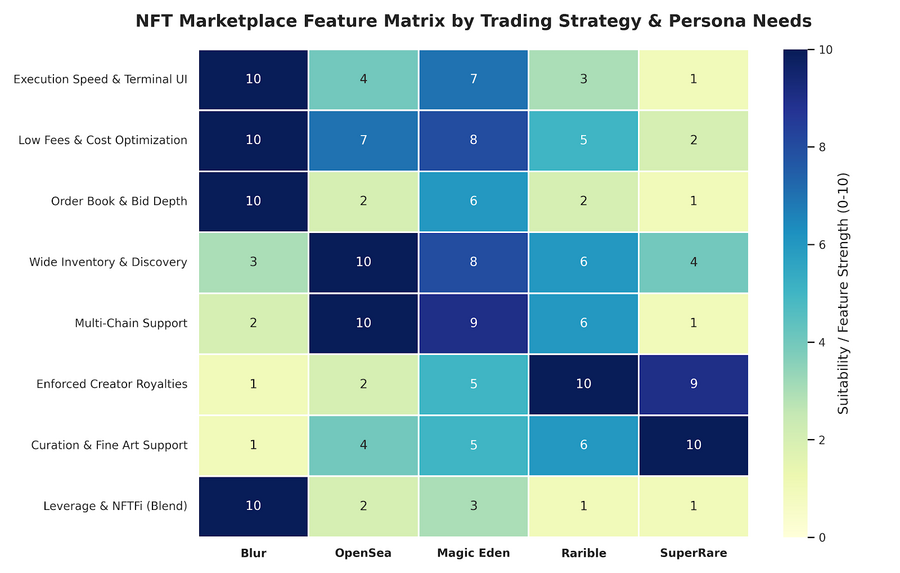
How to Interpret and Utilize This Heatmap
When deciding where to trade, sell, or mint your NFTs, using a single marketplace for every scenario is one of the most common, and costly, mistakes you can make. The heatmap above visualizes how five major NFT marketplaces evaluate across eight crucial trading criteria on a scale from 0 (Not Suitable) to 10 (Industry Leading).
By matching your specific persona to the visual patterns in the matrix, you can instantly see which tool to pull from your toolbox:
-
For Active Traders & NFTFi Users: Look at the Blur column. You’ll notice dark blue blocks (rated 10/10) in Execution Speed, Low Fees, Order Book Depth, and Leverage/NFTFi (Blend). If speed, low slippage, and floor sweeping are paramount to your strategy, Blur serves as your primary execution terminal.
-
For Casual Collectors & Multi-Chain Explorers: Look at the OpenSea and Magic Eden columns. OpenSea dominates in Wide Inventory & Discovery (10/10) and Multi-Chain Support (10/10), making it the ideal home base for casual browsing, cross-chain exploration, and listing items for retail buyers. Magic Eden serves as its strong counterpart with high scores in Solana ecosystem features and multi-chain access.
-
For Creators & Fine Art Collectors: Examine Rarible and SuperRare. Rarible stands out with a 10/10 in Enforced Creator Royalties due to its protocol-level enforcement on RARI Chain. SuperRare leads in Curation & Fine Art Support (10/10), offering high-end gallery-style curation and strong perpetual royalties for established digital artists.
Practical Takeaway: Use this visual matrix to audit your current trading workflow. If you are executing high-frequency trades on OpenSea or trying to casually browse art on Blur, your strategy is misaligned with the platform’s strengths. Aim to pair complementary platforms (such as using Blur to buy into weakness and OpenSea to sell into retail demand) to minimize fees, maximize security, and protect your margins.
Risks and Challenges in the Ethereum NFT Marketplace Landscape
Let me be honest with you. If you've read this far, you already know the upside of Ethereum NFT marketplaces. You know about the liquidity, the tools, the communities, and the opportunities. But I'd be doing you a disservice if I didn't talk about the risks. Not in a vague, hand-wavy way, but in the specific, concrete, "here's what can actually go wrong" way that might save you from making a mistake that costs you real money.
I've been through enough cycles to know that the NFT space has a way of humbling people. The same market that can make you feel like a genius on Monday can make you feel like a fool by Friday. The risks are real, they're varied, and they don't always announce themselves. Some of them are technical. Some are legal. Some are just human nature. And some of them are baked into the infrastructure so deeply that you'd never notice them unless someone pointed them out. I've learned some of these lessons the hard way, and I've watched friends learn them the even harder way. So let's point them out.
Metadata Fragility and Centralized NFT Storage Risks
Here's the uncomfortable truth that most NFT guides gloss over: your NFT might not actually be as permanent as you think. The token on the blockchain is immutable. The smart contract that defines its ownership is immutable. But the image, the metadata, the thing that makes your NFT actually look like something, might be stored on a server that can disappear tomorrow. It's like owning the deed to a house that's built on rented land.
An empirical study that scanned over 107,000 smart contracts found that 15.6% of them had mutable functions that could be used to alter metadata after minting. After filtering out false positives, the researchers discovered that over 99% of these flagged collections remained under active control, exposing 5,189,485 NFTs to potential manipulation. That's not a theoretical risk. That's millions of NFTs whose images and descriptions could be changed by whoever controls the contract. Five million assets, all vulnerable to a single function call.
The most common vulnerability is the setTokenURI() function. A project administrator can use a simple instruction to reroute the metadata pointers for an entire collection instantly. The initial reliance on decentralized storage becomes irrelevant because the crucial on-chain link remains mutable. What looked like a trustless asset is actually a revocable service dependent on creator benevolence. And here's the thing: creators can be benevolent and still get hacked. If an admin wallet is compromised, the attacker gains the same control the creator had. The NFT you bought as a long-term hold could become a completely different image overnight, and there's nothing you can do about it.
IPFS isn't always the solution it's advertised to be. A specific subset of assets relies on the InterPlanetary Name System (IPNS) , which uses mutable pointers linked to a private key. The researchers identified 3,904 metadata URIs and 663 image URIs using IPNS. Unlike standard IPFS content identifiers, which are immutable hashes, IPNS identifiers resolve to whatever content hash is currently signed by the corresponding private key. The holder of that key can unilaterally update the underlying metadata without interacting with the blockchain. 100% of these identified assets are susceptible to unilateral off-chain alteration. It looks decentralized. It functions like a centralized server with extra steps.
The practical takeaway is simple but critical: before you buy an NFT, check where the metadata is stored. If it's on a centralized server, the asset is only as durable as that server. If it's on IPFS with a content-addressed hash, you have stronger guarantees. If it's fully on-chain, you have the strongest guarantees possible. But even on-chain storage isn't immune to the content injection risks that come with rendering SVGs and other executable formats. The lesson isn't "don't buy NFTs." It's "know what you're buying, and don't assume that 'on-chain' means 'permanent' without checking." I've started treating metadata storage as a due diligence item alongside the smart contract audit and the team's track record. If a project can't explain where its metadata lives and why, that's a red flag.
Wash Trading, Fake Volume, and Misleading Marketplace Metrics
I've already covered wash trading in the liquidity section, but it deserves a second look here because the problem is bigger than most people realize. A machine learning study that analyzed three major NFT exchanges found that approximately 38% of trades likely involve manipulation, and those trades account for a staggering 60% of traded value. Let that sink in for a moment. More than half the volume you see on marketplace dashboards might not represent real economic activity. The numbers you're using to make decisions might be fiction.
The study identified specific motivations for NFT wash trading that don't exist in traditional crypto markets: earning royalties per trade, benefiting from zero-fee trading models, and exploiting price opacity. On some platforms, wash trading volumes even exceed those observed in crypto exchanges. That's a remarkable finding. NFTs, which are supposed to be less liquid and more speculative than fungible tokens, have become a more fertile ground for manipulation than the tokens themselves. The incentive structures that were supposed to reward participation ended up rewarding manipulation instead.
The real-world examples are everywhere. In one recent week, Polygon logged $20.46 million in wash volume against only $10.91 million in organic sales. On Base, flagged wash volume of $4.8 million actually exceeded organic sales of $4.2 million. And on Ethereum itself, a single collection called Pandora accounted for $55.21 million, roughly 78% of the network's organic NFT sales. Without Pandora, Ethereum's weekly sales were about $15.61 million, which would still lead the market but looks far less dramatic than the headline number suggests. One collection, one week, and the entire narrative about Ethereum's NFT dominance shifts.
The lesson for traders is that volume metrics are not reliable indicators of market health. A collection with $10 million in weekly volume might have $9 million of that coming from a handful of wallets trading with themselves. Look at unique buyer counts, funded bid depth, and transaction patterns instead. If the same wallet appears on both sides of a transaction repeatedly, that's a red flag. If the transaction amounts are suspiciously round numbers, that's another clue. Wash traders aren't usually trying to be subtle. They're trying to hit volume targets, and they're not worried about whether anyone notices. Your job is to notice. And to act accordingly.
Interoperability Gaps Across Chains and NFT Marketplaces
The NFT ecosystem is fragmented. That's not news. But the depth of the fragmentation, and the practical problems it creates for traders, is something that gets underestimated even by experienced participants. We talk about "multi-chain" like it's a feature. Sometimes it's a bug.
Research on NFT interoperability identifies a fundamental gap that goes beyond simple cross-chain connectivity. While protocols like LayerZero and Chainlink enable NFT exchange across heterogeneous networks, and multichain marketplace architectures aim to overcome single-chain scalability constraints, these approaches don't resolve semantic interoperability. The metadata formats used by ERC-721, ERC-1155, FA2, and the token frameworks used in Solana and Flow vary substantially, leading to what researchers call semantic fragmentation. There's no unified semantic model governing asset meaning across platforms. In plain English: the same NFT might be interpretable on one marketplace and completely misunderstood on another. It's like sending a letter in a language the recipient doesn't speak. The words arrive, but the meaning doesn't.
Bridge-based systems, which are the most common approach to cross-chain NFT transfers, face persistent risks. These include incorrect state verification, inconsistent finality assumptions, multisignature governance vulnerabilities, and high engineering complexity. Notary-based schemes reduce system complexity but inherit centralization and governance vulnerabilities. Relay-based approaches enable on-chain verification of remote state but impose substantial computational and storage overhead. Every cross-chain transfer involves a trade-off between trust, cost, and speed, and none of the current solutions eliminates all three risks. The bridge that works today might be the exploit headline tomorrow.
For traders, the practical implication is that cross-chain NFT transfers remain clunky and risky. Bridging an NFT from Ethereum to Solana isn't as simple as sending a stablecoin. Standards differ, metadata formats vary, and bridge exploits have caused significant losses. If you're moving NFTs between chains, do it slowly and carefully. Verify that the bridge you're using has a track record. And don't assume that the NFT you see on the other side is identical to the one you sent. It might be a wrapped representation with different properties. I've seen traders discover that their bridged NFT couldn't be sold on the destination chain's marketplace because the metadata format wasn't supported. That's a painful lesson in interoperability.
Scams, Rug Pulls, and NFT Buyer Due Diligence
The low barrier to minting means anyone can create a collection, promise a roadmap, and disappear with buyer funds. Due diligence is entirely on the buyer in most cases, and the scammers know it. There's no FDIC for NFTs. There's no chargeback. There's no customer service number to call when things go wrong.
The zkSNARKs project on Zcash is a recent example that on-chain analyst ZachXBT flagged as a suspected scam. The project raised approximately $17 million through a blind auction, with 16,971 bids and 8,000 pieces distributed at a clearing price of 1.5 ZEC (about $2,190). Total transaction volume reached 25,305 ZEC (about $36.94 million). ZachXBT noted that the project reserved 10% for the team, 5% for royalties, and about $2,000 for minting fees, yet it has no practical value. It was a "quick money and run" play, the kind that's become depressingly familiar in the NFT space. The numbers are impressive until you realize they represent people who were separated from their money.
The mechanisms vary, but the playbook is consistent. A project launches with polished marketing, a compelling narrative, and a sense of urgency. Buyers mint or purchase on the secondary market. The creators deliver just enough to keep hope alive, then disappear. Or they never deliver anything at all. The fear of fraud is a recurring theme in academic research on NFT marketplace usability, and it's not just a usability problem. It's a fundamental barrier to adoption. Users report that worries about fraudulent assets and irrevocable financial loss deter them from completing transactions, even when a marketplace seems to be operating normally. That fear is rational. The fraud is real.
The practical advice is to verify before you trust. Check the project's social media history. Look for doxxed team members. Read the smart contract if you can. Start with established marketplaces that provide baseline protections against fraudulent listings. And remember that the fear of missing out is the scammer's most powerful weapon. If a project is pressuring you to act immediately, that pressure is the tell. Legitimate projects don't need to rush you. They know that quality speaks for itself and that patient buyers are better buyers. I've adopted a simple rule: if I can't explain the project's value proposition to a friend in one sentence, I don't buy it. That rule has saved me from more bad decisions than any technical analysis.
Regulatory Uncertainty and Its Impact on NFT Trading
The legal landscape for NFTs is a mess. Not a manageable, well-defined mess. A genuinely unsettled, jurisdiction-by-jurisdiction, enforcement-by-enforcement mess that creates real risk for anyone trading or creating NFTs on Ethereum. If you're waiting for clarity, you might be waiting a long time. And in the meantime, the rules are being written by enforcement actions rather than legislation.
The core question is whether an NFT constitutes a security subject to SEC regulation. In the absence of clear rulemaking, the SEC has relied heavily on regulation-by-enforcement, producing inconsistent guidance and prompting widespread concern among NFT creators. The landmark Adonis v. Yuga Labs decision rejected securities classification for certain NFTs under the Howey test, but that's a single case, not a comprehensive framework. Pending legislative proposals, including the NFT Act, the Digital Asset Market Clarity Act, and the Responsible Financial Innovation Act, could reshape the landscape, but they remain stalled or incomplete. The rules are being debated, but they're not being written.
Jurisdiction is the hardest problem. NFTs exist on decentralized networks that span every country simultaneously. A creator in France, a buyer in Japan, and a marketplace server in the United States each fall under different legal regimes, and no international framework specifically governs NFT transactions yet. The European Union's MiCA regulation, which took full effect in late 2024, covers certain crypto assets but does not explicitly address most NFTs unless they qualify as financial instruments. The result is a patchwork of national approaches that nobody fully understands, including the regulators themselves.
Royalty enforcement adds another layer of uncertainty. On-chain royalty enforcement through smart contracts offers a partial solution, but it only works when the buyer stays within a single marketplace ecosystem. Cross-marketplace enforcement remains unresolved, and the legal status of royalty obligations is unclear. If a marketplace decides to make royalties optional, is that a breach of contract? If a creator sets a 50% royalty, is that an unenforceable penalty? Nobody knows, because the courts haven't decided. The legal system moves slowly, and the NFT market moves quickly. That gap creates risk for everyone.
For traders and creators, the practical implication is that regulatory risk is real and it's not going away. If you're building a business around NFT trading or creation, you need to understand the legal landscape in your jurisdiction. If you're a US-based creator, the SEC's enforcement posture matters to you. If you're trading NFTs that might be classified as securities, you need to understand the implications. The rules are being written in real time, and the people who pay attention will be better positioned than the people who don't. Ignorance is not a defense, and it's not a strategy either.
User Experience Barriers Keeping Newcomers Out of NFTs
Here's the thing that frustrates me most about the NFT space: the technology is genuinely powerful, but the user experience is genuinely terrible. And the gap between those two realities is keeping millions of potential users out of the ecosystem. We've built a technology that can revolutionize ownership, creativity, and community. Then we wrapped it in an interface that makes people feel stupid.
Academic research on NFT marketplace usability identifies several recurring problems that make the onboarding process unnecessarily painful.
- Automatic account creation during wallet connection without clear notification leaves users uncertain about whether actions succeeded.
- Missing transaction status indicators create anxiety because blockchain transactions are irreversible and users don't know if their purchase went through.
- And the seed phrase onboarding process, requiring users to manually record twelve recovery words, creates friction that discourages adoption.
These aren't minor annoyances. They're barriers that keep talented people out of the space. I've watched intelligent, tech-savvy friends give up on buying their first NFT because the process was too confusing and the stakes felt too high. That's not a user problem. That's a product problem.
The research found that fear of fraud is not just a usability problem; it's closely associated with perceived risk, which moderates behavioral intention and perceived usefulness. Users commonly report that worries about fraudulent assets and irrevocable financial loss deterred them from completing transactions, even when a marketplace seemed to be operating normally. Trust and perceived risk function as direct antecedents of behavioral intention in NFT marketplaces, not merely indirect influences. In plain English: people don't use NFT marketplaces because they don't trust them, and that lack of trust is rational given the risks we've already discussed. You can't blame people for being cautious when the headlines are full of scams and the interfaces are full of ambiguity.
The technical aspects of NFT minting and transaction execution are especially challenging, requiring users to understand gas prices, navigate technical blockchain procedures, and manage multi-step workflows that frequently lack explicit instructions or feedback. If you've ever tried to explain gas fees to a newcomer, you know the glazed look that comes over their face. If you've ever watched someone try to cancel a transaction that's stuck in pending, you know the panic.
The good news is that this is changing. Account abstraction, improved wallet designs, and better onboarding flows are making the experience less painful than it used to be. But the gap between where we are and where we need to be is still significant. If the NFT space wants to reach mainstream adoption, it needs to solve the user experience problem. Until then, the barriers will keep the curious on the outside looking in, wondering why the future of ownership feels so much like filling out a tax form.
The bottom line is that the Ethereum NFT marketplace landscape is full of risks that don't always announce themselves:
Metadata can be fragile even when it looks permanent.
Volume numbers can be inflated even when they look impressive.
Cross-chain transfers can be riskier than they appear.
Scammers can be more sophisticated than you expect.
Regulators can change the rules in ways that catch you off guard.
And the user experience can be frustrating enough to make you want to give up.
The traders and collectors who succeed are the ones who understand these risks, respect them, and build strategies that account for them. Not by avoiding NFTs entirely, but by being deliberate, skeptical, and patient. The market rewards those qualities, and it punishes their absence. I've learned that lesson more times than I'd like to admit. You don't have to learn it the same way.
📊 Wash Trading vs. Organic NFT Sales Across Major Networks
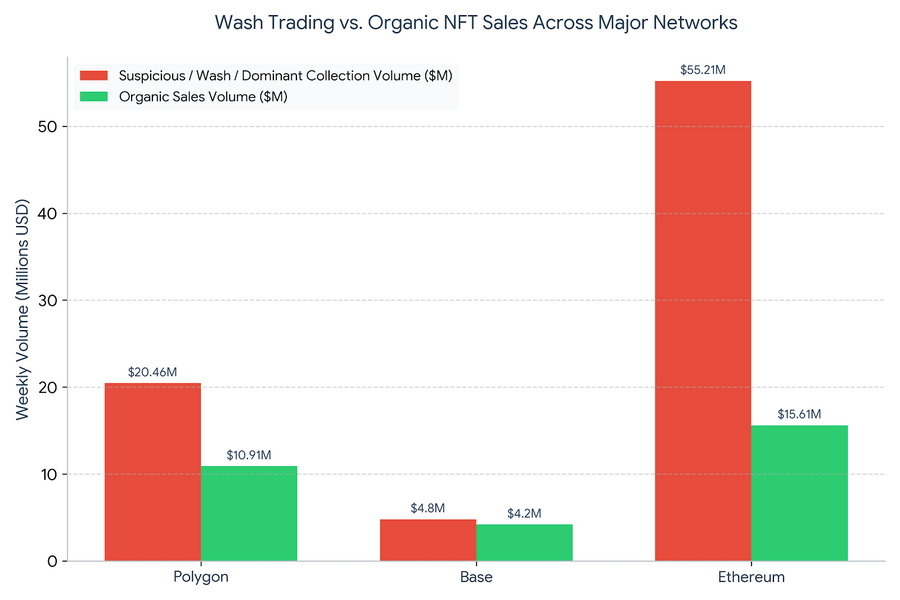
When looking at marketplace dashboards, raw volume numbers can easily deceive you. This chart compares flagged wash trading or single-collection dominance against true organic sales volume across Polygon, Base, and Ethereum based on recent empirical data from the text:
-
Polygon: Weekly wash volume ($20.46M) significantly outpaces organic sales ($10.91M), highlighting how certain fee structures can heavily incentivize artificial trading activity.
-
Base: Flagged wash volume ($4.8M) exceeds organic sales ($4.2M), illustrating similar market distortion in emerging layer-2 ecosystems.
-
Ethereum: A single collection like Pandora generated $55.21M (accounting for roughly 78% of the network's organic NFT sales), dwarfing the remaining $15.61M in organic weekly sales and demonstrating how headline figures can dramatically skew market perception.
How to utilize this visual: Before making purchasing decisions or trusting headline volume figures on marketplace dashboards, always look past aggregate totals. Check unique buyer counts, funded bid depth, and transaction patterns to ensure you are evaluating genuine economic activity rather than artificial inflation.
The Future of Ethereum NFT Marketplaces
Predicting the future in crypto is a fool's errand. I've watched enough "next big thing" narratives collapse under their own weight to know that certainty is a luxury nobody in this space can afford. I remember when everyone was certain that NFTs would replace traditional art galleries. I remember when the metaverse was going to be the next frontier of human interaction. I remember when every celebrity was launching a collection and every brand was scrambling to get in. Most of those predictions didn't survive contact with reality. But that doesn't mean we can't read the tea leaves. The signals are there if you know where to look: the platforms that are pivoting, the infrastructure that's being built, the regulations that are taking shape, and the capital that's flowing into new categories. The future of Ethereum NFT marketplaces won't look like the past. It can't. The market has changed too much, and the survivors have learned hard lessons about what happens when you bet everything on a single narrative.
What's coming isn't a return to the 2021 frenzy. It's something quieter, more durable, and in many ways more interesting. The platforms that survive the next few years will be the ones that figured out how to serve real users with real needs, not just speculators chasing the next airdrop. The ones that cling to the old model will fade, and honestly, they'll deserve to. Let's look at the forces shaping what comes next.
Consolidation or Fragmentation: Where Are NFT Marketplaces Heading?
The great consolidation is already underway, and it's not finished. The numbers tell the story. In April 2026, Magic Eden held 37% market share, Blur held 25.1%, and OpenSea held 19.9%. Together, the top three platforms control the vast majority of NFT trading volume, and the long tail of smaller marketplaces is shrinking. The past two years have been a graveyard: Coinbase NFT, Kraken NFT, X2Y2, Nifty Gateway, and Binance's centralized NFT marketplace all closed or pivoted to other products. The centralized exchange NFT category has been almost completely wiped out. I remember when every major exchange was racing to launch an NFT marketplace, convinced that NFTs were the next big revenue stream. Most of those marketplaces are gone now, and the ones that remain are shadows of what they were supposed to be.
But consolidation doesn't mean the market is becoming simpler. If anything, the survivors are becoming more differentiated. OpenSea is no longer just an NFT marketplace. It's a multi-chain trading hub that supports more than 25 networks, handles fungible tokens alongside NFTs, and is actively moving into perpetual futures through a partnership with Hyperliquid. Magic Eden has pivoted so hard toward iGaming that its NFT business is almost an afterthought. Blur remains the professional trader's terminal, with zero fees and execution tools that no other platform has matched. Three platforms, three completely different strategies, three different audiences. The era of the one-size-fits-all marketplace is over.
The fragmentation of the past, where dozens of marketplaces competed for the same users, is being replaced by a structure where a handful of platforms serve distinct niches. The generalist that tries to be everything to everyone is a dying breed. The survivors are specialists, or they're platforms that have diversified into adjacent categories to survive. The NFT market alone can't sustain multiple platforms at the scale the industry once hoped for. The platforms that remain are the ones that found other ways to generate revenue, whether through derivatives, gaming, or tokenization of real-world assets. If you're building a marketplace strategy, that's the lesson: don't rely on trading fees alone. They're not enough.
Layer 2 Scaling and the Future of Cheap NFT Trading
The technical foundation for cheaper NFT trading is being built right now, and it's going to change how people interact with Ethereum NFTs. The days of paying $50 in gas to mint a single piece are already behind us, but the improvements coming in 2026 and beyond will make the experience dramatically better. If you've been avoiding Ethereum NFTs because of gas costs, your excuse is about to expire.
Linea, the Consensys-backed zkEVM Layer 2, announced in February 2026 that its sequencer now sustains over 100 million gas units per second, with peak performance hitting 218 mGas/s on ERC-721 transactions. In practical terms, that means the infrastructure can handle much larger blocks without becoming the bottleneck. For NFT traders, that translates to faster confirmations, lower fees, and the ability to execute complex transactions that would have been prohibitively expensive on mainnet. Imagine being able to sweep an entire collection without worrying about gas costs eating your profit margin. That's not a fantasy anymore. It's the direction the technology is heading.
But the L2 landscape is going through its own consolidation. By 2026, Base, Arbitrum, and Optimism together control nearly 90% of L2 transaction volume, and analysts are predicting a "Darwinian purge" where general-purpose L2s without clear differentiation will struggle to survive. Vitalik Buterin himself said the original rollup vision "no longer makes sense" as users return to mainnet and activity concentrates in a few dominant networks. The winners will be the L2s that offer something beyond cheap transactions: privacy features, application-specific execution environments, or deep integration with specific ecosystems. Being cheap isn't enough anymore. You have to be useful.
For NFT traders, the practical implication is that the cheapest and fastest place to trade NFTs will increasingly be on Layer 2 networks, not Ethereum mainnet. Platforms that support L2s natively, like OpenSea with its multi-chain aggregation, will have an advantage over those that remain mainnet-only. The future of NFT trading is multi-chain, and the platforms that make cross-chain execution seamless will be the ones that win. If you're still doing all your trading on mainnet, you're paying a premium for nostalgia.
NFTFi Integration and the Next Wave of Marketplace Innovation
The NFT lending market is in retreat, and that's a problem for the broader ecosystem. NFTfi, the pioneer of NFT-backed lending, announced in June 2026 that it would wind down after facilitating $737 million in cumulative loan volume. The reason wasn't a hack or a regulatory action. It was simpler and more brutal: the NFT market has contracted so sharply that potential revenue no longer covers operating costs. When borrowers stop borrowing and lenders stop lending, the fee income that funds the protocol evaporates. I remember when NFT lending was supposed to be the killer app that would make NFTs "productive assets." That narrative didn't survive the bear market.
NFTfi's closure isn't an isolated event. Blend, BendDAO, and ParaSpace have all faced liquidity and demand crunches, though some have tried to diversify into broader DeFi products. The pattern is clear: application-layer protocols that depend entirely on a single asset class suffer disproportionately when that asset class enters a secular decline. The NFT lending boom of 2021 and 2022 was concentrated in a handful of high-value collections. As floor prices eroded and blue-chip NFTs lost their liquidity premium, the borrowing use case diminished. It turns out that leverage is only attractive when the underlying asset is going up. When it's going down, leverage becomes a liability.
But NFTFi isn't dead. It's consolidating. The protocols that survive will be the ones that diversify beyond NFTs, integrate with broader DeFi infrastructure, or find ways to serve the remaining demand for liquidity against high-value assets. The risk-reward calculus for lending against an NFT that could drop 20% in a week is simply not attractive in a low-volume environment. Until a liquid derivatives market or institutional credit facility emerges for NFTs, this corner of DeFi will remain dormant or consolidated into a few deeply capitalized players. The next wave of marketplace innovation in NFTFi won't come from standalone lending protocols. It will come from marketplaces that integrate lending directly into the trading experience, blurring the line between buying, selling, and financing. Imagine buying an NFT with financing already built into the checkout process. That's where this is heading.
Regulatory Developments Shaping NFT Marketplaces
The regulatory landscape is shifting faster than most people realize, and the changes are creating both risks and opportunities for NFT marketplaces and their users. If you're not paying attention to regulation, you're going to be surprised by it. And surprises in this space are rarely pleasant.
In the United States, the SEC dropped its investigation into OpenSea in February 2025, resolving lingering uncertainty over whether NFTs would be treated as unregistered securities. That was a significant moment for the industry, but it didn't resolve the broader question of how NFTs should be classified. The Digital Asset Market CLARITY Act, which passed the House in July 2025 with a 294 to 134 vote, aims to clearly define whether different digital assets fall under SEC or CFTC jurisdiction. The bill is stalled in the Senate over stablecoin yield disputes, but if it eventually passes, it could provide the legal clarity that marketplaces and creators have been asking for. Until then, the rules are being written by enforcement actions rather than legislation, which means the goalposts can move at any time.
In Europe, MiCA is now the legal baseline for digital asset operations. Core rules took effect on December 30, 2024, covering token issuers and Crypto-Asset Service Providers across the EU. MiCA's passporting regime allows licensed providers to operate across all 27 member states, but it also imposes strict compliance requirements around AML, KYC, and investor protection. For NFT platforms that operate in Europe, MiCA compliance is no longer optional. It's the cost of doing business.
But the biggest regulatory wildcard is anti-money laundering. Members of the European Parliament have proposed amendments that would make NFT trading platforms subject to EU AML laws, treating them as "obliged entities" on par with banks and real estate agents. That would mean OpenSea and similar platforms would have to assess the risk of illicit finance flowing through their systems and carry out identity checks on new customers and suspicious transactions. The proposal is still under discussion, but the direction is clear: regulators are moving toward treating NFT platforms as financial intermediaries, not just technology providers.
For traders and creators, the practical implication is that compliance costs will rise, and some platforms may restrict access to certain jurisdictions or require more extensive identity verification. The era of anonymous, frictionless NFT trading is ending. If you value privacy, you need to understand how these regulations will affect you. The platforms that adapt to the new regulatory reality will survive. The ones that don't will face enforcement actions, fines, or outright bans. It's not a question of if, but when.
What Could Drive the Next NFT Market Cycle?
The next NFT cycle won't be driven by profile pictures or celebrity endorsements. That era is over. The question is what replaces it, and the signals point in a few directions. I've spent a lot of time thinking about this, and I've talked to builders, traders, and collectors about what they're watching. Here's what I've learned:
Tokenized real-world assets are the most credible candidate. OpenSea's CMO Adam Hollander has said publicly that the next NFT wave could be led by tokenized Pokémon cards, Rolex watches, digital tickets, and in-game items rather than speculative digital art. The logic is sound. NFTs are a technology for proving ownership, and that technology can be applied to physical collectibles just as easily as digital art. Platforms like Collector Crypt and Courtyard have already demonstrated product-market fit in the Pokémon trading card space, with annualized trading volume surpassing $1 billion in 2025. The market for tokenized physical collectibles is real, it's growing, and it doesn't depend on the speculative dynamics that drove the 2021 boom. It depends on collectors who want to trade things they already love. That's a much more durable foundation.
Gaming remains a long-term bet. Gaming NFTs derive value from utility rather than speculation, and trading volumes correlate with active player metrics rather than crypto market cycles. The infrastructure for gaming economies is maturing, and major studios are experimenting with blockchain-based ownership in ways that could reach mainstream audiences. The key word is "could." Gaming NFTs have been the next big thing for years, and they haven't broken through yet. But the fundamentals are stronger than they've ever been. If a major game with a compelling economy launches and attracts millions of players, the entire category could explode. That's a big if, but it's not impossible.
AI-generated content is another wildcard. Advances in AI are lowering the barrier to creating digital art, animations, and games, which could bring more creators into the space and expand the supply of NFT-able content. But AI also raises unresolved questions about copyright and ownership. Under current U.S. copyright doctrine, purely AI-generated images used as NFTs likely cannot be copyrighted, leaving their creators with limited legal recourse if the work is copied. That's a problem that needs solving before AI-generated NFTs can reach their full potential.
The most likely scenario is a hybrid cycle driven by utility and real-world integration, not speculation. The NFT market is already showing signs of this shift. The 8% sector surge in mid-2026 was driven by established brands with active communities and long-term development, not random collections that spiked overnight. Blue-chip floor prices are recovering. Active user counts are growing. The market is smaller, but it's also healthier. The tourists are gone, and the people who remain are the ones who actually care about what NFTs can do. That's not a bad place to start the next chapter.
The bottom line is that the future of Ethereum NFT marketplaces won't be defined by the platforms that survived the crash. It will be defined by what those platforms do next.
The ones that pivot toward tokenized assets, gaming, and real-world integration will find new growth.
The ones that cling to the old model of speculative JPEG trading will fade.
The next cycle won't look like the last one, and that's a good thing. The market is growing up. It's time for the platforms to do the same. And if you're still here, building, collecting, or trading, you're part of that future. I've been through enough cycles to know that the quiet periods are when the real work happens. We're in one of those periods now. What you do with it will determine where you end up when the next wave comes. I've made my bets. Now it's your turn.
📊 NFT Marketplace Market Share Breakdown (April 2026)
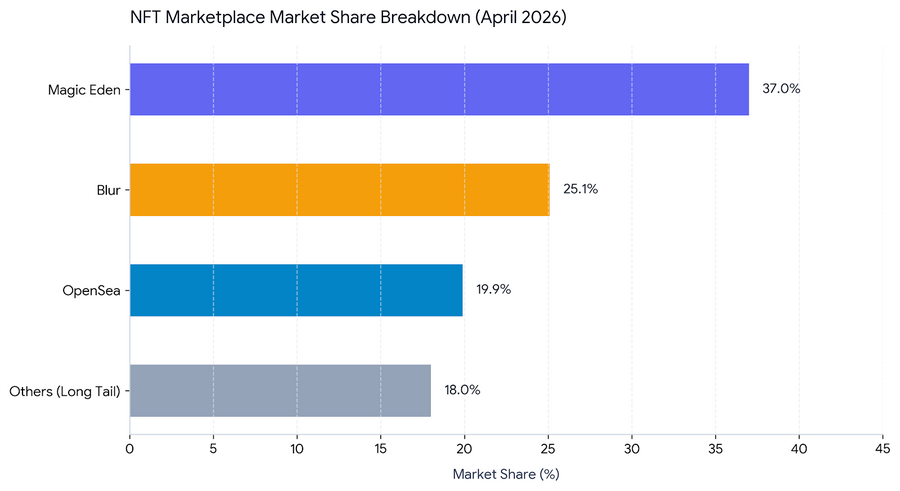
Magic Eden leads at 37.0%, Blur holds 25.1%, OpenSea commands 19.9%, and all remaining long-tail marketplaces combined account for 18.0%.
How to Interpret and Utilize This Visual
This horizontal bar chart illustrates the market share distribution among leading Ethereum and multi-chain NFT marketplaces as of April 2026. Here is a breakdown of what these numbers mean for your market perspective and strategy:
-
Market Concentration (82.0% Combined): The top three venues (Magic Eden, Blur, and OpenSea) collectively control 82.0% of all trading volume. This highlights an era of extreme market consolidation, where smaller long-tail platforms and centralized exchange efforts (such as Coinbase NFT, Kraken NFT, and Binance NFT) have either closed or faded into insignificance.
-
Strategic Specialization Over Direct Head-to-Head Competition: Although market power is concentrated, these three survivors are not offering identical services:
-
Magic Eden (37.0%): Captures the largest share by focusing heavily on ecosystem expansions into gaming and multi-chain minting hubs.
-
Blur (25.1%): Retains its foothold among high-volume professional traders through low-latency execution tools, advanced bidding structures, and zero-fee mechanics.
-
OpenSea (19.9%): Operates as a multi-chain aggregator supporting over 25 networks, catering to retail users and diversifying into adjacent financial instruments like perpetual futures.
-
-
Practical Takeaway for Traders and Creators: Liquidity is no longer distributed across dozens of generalist platforms. When planning collection launches, secondary trades, or liquidity provisioning, target the specific venue that aligns with your asset class; gaming assets on Magic Eden, high-value floor sweeping on Blur, or broad multi-chain retail reach on OpenSea. Relying on single-chain or small-scale marketplaces exposes you to thin order books and higher execution slippage.
Conclusion: Choosing the Best NFT Marketplace for Ethereum
We've covered a lot of ground together. We've talked about the platforms that dominate the market, the ones that serve specific niches, the fees that eat into your returns, the royalties that creators fight for, the security risks that keep people up at night, and the trends that are shaping what comes next. If you've made it this far, you're not a casual observer anymore. You're someone who understands that the NFT marketplace landscape is complex, fragmented, and constantly shifting. That puts you ahead of most people in this space. Seriously, the fact that you're still reading a guide this long means you're either genuinely committed or you're procrastinating on something else. Either way, I respect it.
But here's the thing about knowledge: it only matters if you use it. I've met plenty of people who can recite every detail about every marketplace and still make terrible decisions because they never translated that knowledge into action. So let's bring this home. Let's talk about what you should actually do with everything you've learned, and how to make the right choice for your specific situation.
Key Takeaways for NFT Traders, Collectors, and Creators
Let me distill this entire article into a few essential truths that apply regardless of who you are or what you're trying to do. If you remember nothing else from this guide, remember these:
There is no single best NFT marketplace for Ethereum. That's the headline. Blur is the best platform for professional traders executing high-volume strategies.
OpenSea is the best for discovery, cross-chain browsing, and beginners who need a gentle learning curve.
Rarible is the best for creators who prioritize royalty enforcement.
SuperRare is the best for collectors of high-end digital art.
Magic Eden is no longer relevant for Ethereum users.
The right platform depends entirely on what you're trying to accomplish. If someone tells you there's one platform that's best for everyone, they're either misinformed or they're selling something.
Fees are not the only cost. Marketplace fees, gas fees, and creator royalties all come out of your pocket before you see a single dollar of profit. A platform with zero fees and optional royalties is cheaper than a platform with 15% primary commissions and enforced royalties. But cheap isn't always better. If you're a creator who depends on royalty income, paying more in fees for a platform that actually enforces your royalties might be the smarter long-term choice. The cheapest option isn't always the right option. It's the option that makes sense for your specific goals.
Liquidity is fragmented, and you need to check multiple platforms before you trade. The same NFT can have different prices, different bids, and different depths on different marketplaces. Using an aggregator or checking multiple platforms is the difference between getting the best available price and getting whatever price is available on the platform you happened to open first. I've saved thousands of dollars by spending an extra two minutes comparing prices. That's the best hourly rate you'll ever earn.
Platform risk is real, and it's not going away. The past two years have seen an unprecedented wave of marketplace closures and pivots. Foundation shut down. Magic Eden abandoned Ethereum. X2Y2, Coinbase NFT, Kraken NFT, and Nifty Gateway are gone. Before you commit serious assets to any marketplace, ask yourself whether it will still be here in two years. If the answer isn't a confident yes, diversify your exposure. Don't put all your NFTs on one platform. Don't assume that today's leader will be tomorrow's survivor. The graveyard is full of platforms that seemed invincible.
Security is a practice, not a product. Hardware wallets, multisig, burner wallets, and approval revoking are not optional extras for paranoid people. They're basic hygiene for anyone holding meaningful value in NFTs. The drainer economy is a mature industry with franchise fees and affiliate programs. Your best defense is a zero-trust mindset and the discipline to verify everything before you click. I've had close calls, and I've learned from them. You don't have to learn the same way.
The market is smaller but healthier than it's ever been. The speculation is gone, but the builders are still here. The volume is down, but the utility is up. The tourists have left, but the true believers remain. If you're still here, you're early to the next phase. That's not a consolation prize. It's an opportunity.
Final Recommendations by User Type
Let me give you my honest, no-nonsense recommendations based on who you are and what you're trying to do. These aren't hard rules. They're starting points that you can adjust based on your specific needs:
If you're an active trader executing multiple trades per week, Blur should be your primary platform. The zero-fee model saves you thousands of dollars annually, the collection bids create a functioning order book, and the batch tools make high-volume trading efficient. OpenSea is your secondary venue for selling into retail demand and accessing collections that Blur doesn't index as aggressively. Blend is your leverage tool, but only if you understand liquidation risk and have a repayment plan. Use it carefully. The traders who got wiped out in 2024 were the ones who treated leverage like free money.
If you're a casual collector who buys art because you love it, OpenSea is your home base. The interface prioritizes discovery, the inventory is unmatched, and the platform is beginner-friendly. If you collect high-end digital art, SuperRare is worth exploring, but be prepared for higher prices and thinner liquidity. If you collect Solana NFTs, Magic Eden is your platform, but remember that it's no longer relevant for Ethereum. And whatever you do, don't buy NFTs you don't understand just because someone on Twitter said they were going to the moon.
If you're a creator who depends on royalty income, Rarible is your primary platform. The royalty rates can be set as high as 50%, and enforcement happens at the protocol level through RARI Chain. SuperRare is your premium venue if you have an established portfolio and want access to serious collectors. Zora is your experimental playground if you want to mint and sell without paying mainnet gas fees. Don't rely on OpenSea or Blur for royalty enforcement. They won't protect your income. And if royalties are the only thing keeping your business alive, you need to diversify. The creators who are thriving in 2026 have multiple revenue streams, not just one.
If you're a multi-chain user, use OpenSea for breadth and Blur for Ethereum execution. Use Magic Eden for Solana execution. The overhead of managing multiple accounts is minimal compared to the savings from executing on the right platform for each chain. I keep all three tabs open and switch between them depending on what I'm doing. It sounds tedious, but it's the difference between getting the best price and getting whatever price is available.
If you're an NFTFi participant, Blend is your primary protocol for borrowing against NFTs, but understand the liquidation mechanics before you commit. NFTfi is your alternative for peer-to-peer lending, though it's winding down. Neither is without risk. Borrow conservatively. Monitor obsessively. And never borrow more than you can afford to lose. The 2024 bear market was a masterclass in what happens when you don't.
Staying Informed as the NFT Marketplace Landscape Evolves
The NFT marketplace landscape is changing faster than almost any other sector in crypto. Platforms that dominate today might be irrelevant tomorrow. Features that are cutting-edge now might be standard in six months. The only way to stay ahead is to keep learning, keep experimenting, and keep paying attention. I've been doing this for years, and I still check the major platforms every week to see what's changed. The day I stop learning is the day I become useless.
- Follow the platforms directly. OpenSea, Blur, Rarible, SuperRare, and the other major platforms all have blogs, Twitter accounts, and Discord communities where they announce new features, fee changes, and strategic pivots. If you're using a platform regularly, you should be following its official channels. The first place you'll hear about a fee change or a new feature is usually the platform itself. I've saved myself from several unpleasant surprises by reading the announcement before it went into effect.
- Watch the data. Platforms like DeFiLlama, Dune Analytics, and CryptoSlam track NFT marketplace volume, user counts, and market share. These dashboards are free, and they'll tell you which platforms are growing and which are shrinking. If a platform's volume is declining for months while its competitors are growing, that's a signal worth paying attention to. Data doesn't lie, even when marketing does.
- Read industry reports. The annual NFT market reports from firms like GII Research, Fortune Business Insights, and others provide a comprehensive overview of the market's size, growth trajectory, and key trends. These reports are often expensive, but the summaries and press releases are usually free and give you a good sense of where the market is heading.
- Join communities. The best information often comes from other traders, collectors, and creators who are sharing their experiences in real time. Discord servers, Twitter Spaces, and Reddit communities are full of people who are willing to share what they've learned. Some of it is noise, but some of it is genuinely valuable. The key is to find communities where people are actually building and trading, not just hyping.
- Experiment with small amounts. The best way to learn about a new platform is to use it with a small amount of money. Buy a cheap NFT, list it, sell it, and see how the process works. You'll learn more from one small transaction than from reading a dozen guides. Just make sure you're using a burner wallet and you're not risking more than you can afford to lose. The tuition is cheap if you keep the stakes low.
Resources for Ongoing NFT Market Research
Here are the tools and resources I use to stay informed about the NFT marketplace landscape. These aren't exhaustive, but they're a solid starting point for anyone who wants to keep learning. Bookmark them. Check them regularly. They'll save you from making avoidable mistakes.
For market data:
- DeFiLlama tracks NFT marketplace volume and market share across platforms.
- Dune Analytics has dashboards for specific platforms, including OpenSea's Seaport protocol metrics.
- CryptoSlam provides real-time and historical NFT sales data across chains.
- NFT Price Floor tracks floor prices and collection metrics for blue-chip collections.
These tools are free and updated regularly. There's no excuse for trading blind.
For security:
- Revoke.cash lets you review and revoke token approvals across multiple chains.
- Phantom and Rabby are wallets that simulate transactions and flag malicious contracts before you sign.
- BlockSec publishes research on the DaaS ecosystem and emerging threats.
- ZachXBT on Twitter is one of the most reliable sources for identifying scams and rug pulls. Follow him. He's saved more people from bad decisions than any financial advisor I know.
For creator tools:
- Manifold lets creators mint with custom contracts and retain control over their work.
- Transient Labs provides tools for importing contracts from defunct platforms and managing royalties.
- Story Protocol offers on-chain IP registration and programmable licensing.
If you're a creator, these tools are worth exploring. They give you more control over your work and your income.
For news and analysis:
- The Block, Decrypt, and CoinDesk cover NFT marketplace news and industry trends.
- Rug Radio and other NFT-focused media outlets provide commentary and analysis from people who are actually in the trenches.
The mainstream crypto media is fine for headlines, but the niche outlets are where you'll find the nuance.
The bottom line is that choosing the best NFT marketplace for Ethereum isn't a one-time decision. It's an ongoing process of evaluating platforms, testing features, and adapting to a market that never stops changing. The traders, collectors, and creators who thrive in this space are the ones who stay curious, stay skeptical, and never stop learning. I've been doing this for years, and I'm still learning something new every week. The day I stop learning is the day I stop being useful.
So keep your wallet secure, keep your expectations realistic, and keep exploring. The next great platform might be one you haven't tried yet. And when you find it, you'll be ready.
📊 Ethereum NFT Marketplace Landscape: Strategic Alignment and Primary Strengths
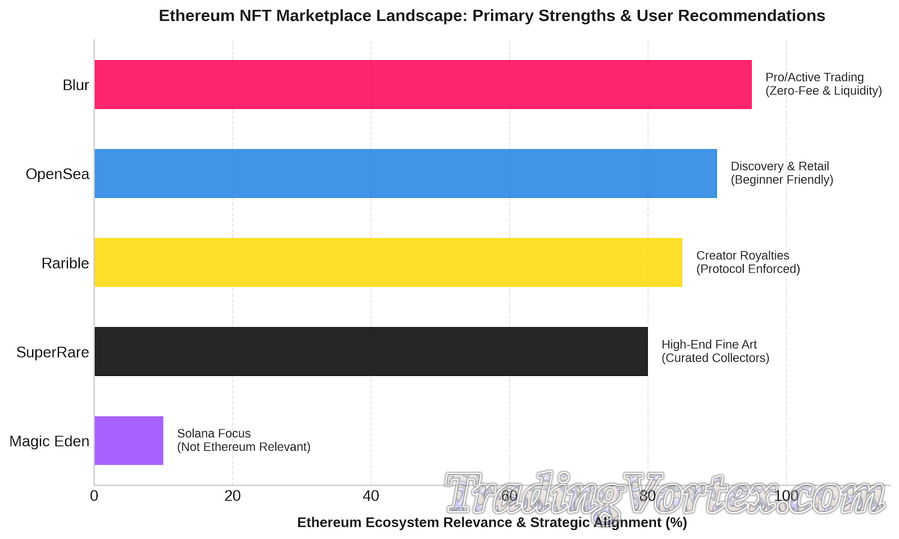
How to Interpret and Utilize This Visual
This chart provides a horizontal overview mapping the key Ethereum NFT marketplaces to their primary target audience and specialized utility. As highlighted in the conclusion, selecting an NFT marketplace is not a "one-size-fits-all" decision; rather, it requires matching your specific role (trader, collector, creator, or multi-chain participant) to the platform best optimized for your objectives.
-
Blur (Pro/Active Trading): Ranks highest in Ethereum alignment for high-volume traders. Its zero-fee structure, aggregated liquidity, and advanced collection bidding tools make it the leading venue for execution efficiency.
-
OpenSea (Discovery & Retail): The optimal entry point for casual collectors and multi-chain browsing. It offers unmatched inventory breadth and a user-friendly interface.
-
Rarible (Creator Royalties): The top choice for creators dependent on secondary revenue, owing to its protocol-level royalty enforcement via RARI Chain.
-
SuperRare (High-End Fine Art): A dedicated, highly curated destination tailored for fine art collectors seeking exclusive, high-value 1-of-1 digital artworks.
-
Magic Eden (Solana Focus): Included to highlight platform pivot risks; while dominant on Solana, it is no longer a primary destination for Ethereum-focused activity.
Actionable Takeaway: Use this visual as a quick-reference matrix when planning your transactions. Before placing a trade or minting a collection, verify whether your primary goal aligns with the platform's core advantage: whether that is minimizing transaction overhead on Blur, maximizing creator earnings on Rarible, or discovering new collections on OpenSea.
Frequently Asked Questions: Choosing the Best NFT Marketplace for Ethereum
I've been trading, collecting, and writing about Ethereum NFTs for years, and these are the questions I hear most often from traders, collectors, and creators. Whether you're just getting started or you've been in the game since CryptoPunks were free, there's something here for you. I've answered each one with the most current data and practical insights I could find. No fluff, no hype, just straight answers.
Q1. Which NFT marketplace is actually the best for Ethereum in 2026?
There is no single best NFT marketplace for Ethereum. Blur is best for active traders who want zero fees and execution speed, while OpenSea is best for collectors and beginners who need discovery tools and multi-chain access.
I get asked this question constantly, and the honest answer is that it depends entirely on what you're trying to do. Blur charges 0% marketplace fees and was built from the ground up for professional Ethereum traders, with collection bids, floor sweeping, and batch listing tools that no other platform has matched. OpenSea relaunched as OS2 in 2025, supporting 22+ blockchains and serving roughly 382,000 monthly active users compared to Blur's 38,300. That user gap tells you something important: Blur dominates volume, but OpenSea dominates actual human beings showing up to browse and collect. Magic Eden wound down its Ethereum and EVM marketplace support in February 2026 to refocus exclusively on Solana, so if your NFTs live on Ethereum, that platform is no longer relevant. My advice? Don't marry yourself to one platform. Use Blur for execution, OpenSea for discovery and selling into retail demand. The best traders I know keep both tabs open and switch based on the task at hand.
Q2. What is the cheapest NFT marketplace for trading Ethereum NFTs?
Blur is the cheapest Ethereum NFT marketplace with 0% marketplace fees since its October 2022 launch. For high-volume traders, this saves thousands of dollars annually compared to platforms charging 0.5% or more.
I remember paying 2.5% on every OpenSea trade back in 2021, and it felt like a tax on every single transaction. When Blur launched with zero fees, the entire calculus changed. On a $10,000 monthly trading volume, the savings alone add up to roughly $600 per year compared to a 0.5% platform, and significantly more compared to the old 2.5% model. But here's the nuance that most people miss: cheap isn't always better. If you're a creator who depends on royalty income, paying higher fees on Rarible or SuperRare may yield better long-term earnings because those platforms actually enforce royalties while Blur does not. OpenSea's standard fee dropped to 0.5% under OS2, and Rarible uses a regressive structure from 0.5% to 7.5% depending on the sale price. The cheapest platform for a flipper is not the cheapest platform for a creator. Know which one you are before you optimize for fees alone.
Q3. Which NFT marketplace actually enforces creator royalties on Ethereum?
Rarible and SuperRare are the only major Ethereum marketplaces that enforce creator royalties at the protocol level. On OpenSea, Blur, and most other platforms, royalties are effectively optional.
This is the topic that makes creators either furious or resigned, depending on how many times they've been burned. Rarible enforces royalties at the protocol level through RARI Chain, allowing creators to set rates as high as 50% with node-level enforcement that no marketplace can bypass. SuperRare enforces a 10% royalty on secondary sales through smart contracts and has done so since 2018 without wavering. On OpenSea and Blur, royalties are a tip jar. Some buyers pay them out of principle. Most don't, especially on high-volume trading platforms where every basis point matters. Blur maintains a minimum 0.5% floor on some collections, but traders can choose whether to pay above that. The Operator Filter Registry, OpenSea's attempt at enforcing royalties, was phased out in August 2023. If royalty income matters to your business, Rarible is the most credible platform. If you list on OpenSea or Blur, treat royalties as a bonus, not a foundation. I've talked to too many artists who assumed their royalties would be honored and were devastated when they weren't.
Q4. How do NFT marketplace fees compare between Blur, OpenSea, Rarible, and SuperRare?
Blur charges 0%, OpenSea charges 0.5%, Rarible charges 0.5% to 7.5% depending on sale price, and SuperRare charges 15% on primary sales plus a 3% buyer fee. The fee gap between platforms can mean a 15% difference in net proceeds.
Let me walk you through a real example because the numbers are starker than most people realize. A 10 ETH sale on Blur nets the seller approximately 10 ETH minus gas if royalties are optional. The same sale on SuperRare nets the artist around 8.5 ETH after the 15% commission. That's a 15% difference in proceeds, which compounds significantly over dozens of trades. If you're executing ten trades of this size per month, the platform you choose could mean the difference between $15,000 and $0 in fees over the course of a year. Rarible's regressive fee structure is worth understanding: a $10,000 sale incurs 0.5% per side, while a $50 sale incurs 7.5% per side. That structure rewards high-value transactions and penalizes small ones. SuperRare also charges a 3% buyer fee on all sales, which means the buyer pays more than the listed price. Always calculate the full cost path before you commit to a marketplace. The headline fee is just the beginning.
Q5. What is the best NFT marketplace for beginners on Ethereum?
OpenSea is the best NFT marketplace for beginners on Ethereum. Its discovery-focused interface, fiat payment options, and 382,000 monthly active users make it the most accessible starting point for new collectors.
I always tell newcomers to start on OpenSea, make a few small purchases, and get comfortable before exploring more specialized platforms. The interface prioritizes discovery over execution, which means you can browse collections, inspect creators, view traits, and understand what you're buying before you commit. OpenSea supports over 150 payment methods and integrates with MoonPay for fiat purchases, which reduces the barrier for people who don't already hold crypto. The platform also doesn't require a traditional account with personal data; you connect your wallet and you're in. Blur is the opposite. Its dense, keyboard-driven interface assumes you already understand order books, bid depths, gas optimization, and wallet signatures. I've watched intelligent, tech-savvy people open Blur, stare at the screen for thirty seconds, and quietly go back to OpenSea. There's no shame in that. Research on NFT usability identifies fear of fraud as a recurring theme that deters new users from completing transactions, even when platforms operate normally. Start where the interface helps you learn, not where it punishes you for not knowing what a "sweep" is.
Q6. How safe are Ethereum NFT marketplaces and what are the biggest security risks?
Ethereum NFT marketplaces are only as safe as your wallet habits. The DaaS ecosystem stole $135 million from 76,582 victims across 32,819 phishing sites between March 2023 and April 2025, and only 10.8% of those addresses appeared on public scam flag lists.
The uncomfortable truth is that the blockchain itself is secure, but everything built around it is a potential attack surface. The most common attack vector is the fake NFT airdrop: scammers send you an NFT, you interact with it, and your wallet gets drained. The rule is simple and absolute. Treat every unsolicited NFT as a scam. Permit and Permit2 signatures drove 38% of large losses in 2025, totaling $8.72 million across three incidents. A single setApprovalForAll signature can grant unlimited transfer authority over every NFT in an entire collection to a chosen spender. Here's what I do: I use a hardware wallet for high-value holdings, keep a burner wallet for experimenting with new platforms, and revoke unnecessary approvals every few months with Revoke.cash. I've found permissions I didn't remember granting, and that's a scary feeling. The drainer economy is a mature industry now, with franchise fees and affiliate programs. Your best defense is a zero-trust mindset and the discipline to verify everything before you click.
Q7. What is the best NFT marketplace for high-volume Ethereum traders?
Blur is the best NFT marketplace for high-volume Ethereum traders. Its zero-fee model, collection bids, floor sweeping, and batch listing tools were built specifically for professional execution.
Blur isn't for everyone, and it never pretended to be. When it launched in October 2022, it didn't try to be a friendlier OpenSea. It showed up with a single, laser-focused pitch: a marketplace built for professional NFT traders on Ethereum. The tools are built for speed and scale. Collection bids let you place standing offers on an entire collection. Bid pools let multiple traders stack bids at the same price level, creating a visible wall of demand. Floor sweeping lets you buy multiple NFTs in a single transaction, and Blur claims it's 10 times faster than competitors. Batch listing lets you manage dozens or hundreds of NFTs from a single dashboard. I've seen traders sweep ten NFTs in a single transaction and then relist them individually at higher prices, essentially creating a mini market-making operation with a few clicks. The zero-fee model saves high-volume traders thousands of dollars annually. But here's the caveat: if you're a beginner or a casual collector, Blur will make you miserable. It's a trading terminal, not a gallery.
Q8. Are NFT royalties still enforceable on Ethereum marketplaces?
NFT royalties are not enforceable at the blockchain level on most Ethereum marketplaces. ERC-2981 is a standard, not an enforcement mechanism, and platforms like OpenSea and Blur treat royalties as optional.
This is the most emotionally charged topic in the NFT space, and for good reason. ERC-2981 defines a function that returns the receiver address and royalty amount, but it's like a sign on a door that says "please pay the artist 10% on resale." A marketplace can read the sign and choose to follow it. Or it can ignore the sign entirely and walk right through the door. On OpenSea, Blur, and Magic Eden, royalties are effectively a tip jar. On-chain enforcement through transfer restrictions and whitelists/blacklists is emerging as a technical workaround, but it reduces composability and limits legitimate trading activity. Rarible's RARI Chain enforces royalties at the node level, making them technically impossible to bypass on that network. The creators who are thriving in 2026 have diversified their income through commissions, community memberships, and exclusive drops. They treat royalties as a bonus, not a foundation. If your entire business model depends on royalties that most platforms make optional, you're building on sand.
Q9. What is the best NFT marketplace for high-end digital art on Ethereum?
SuperRare is the best NFT marketplace for high-end digital art on Ethereum. Its invite-only artist model, 10% perpetual artist royalty, and curated collector base make it the most rigorous platform for serious digital art.
SuperRare is the exclusive gallery on the nice side of town. Launched in 2018, it didn't jump on the NFT bandwagon; it helped build the road. The platform has processed over $330 million in lifetime sales and paid out $180 million to artists, maintaining eight years of continuous operation through multiple market cycles. The invite-only artist model means you won't find PFP factories or AI-generated spam. You'll find single-edition 1/1 artworks and curated series from artists who have been vetted for technical skill and conceptual depth. The 10% perpetual artist royalty is enforced by smart contract, not policy, which means creators get paid automatically on every resale. But be aware of platform risk: even beloved platforms like Foundation can disappear. Foundation shut down in April 2026 after its revenue collapsed from $20.5 million in 2021 to just $4,500 in Q1 2026. Spread your collection across multiple venues and ensure your NFTs are stored in self-custody wallets you control.
Q10. How do I calculate the real cost of buying and selling NFTs on Ethereum?
Every Ethereum NFT trade has up to three fee components: marketplace fee, gas fee, and creator royalty. The sticker price on an NFT is almost never what you actually pay.
Let me walk you through a real example so you can see how these fees compound. A 10 ETH sale on SuperRare nets the artist approximately 8.5 ETH after the 15% commission. The same sale on Blur nets the seller approximately 10 ETH minus gas if royalties are optional. That's a 15% difference in proceeds. Gas fees on Ethereum have plummeted in 2026: a standard transaction costs around 0.039 Gwei (less than $0.01), and selling an NFT costs approximately $0.07 to $0.08. This is a dramatic contrast to the days when minting a single NFT could cost $50 or more. But don't ignore gas entirely, especially if you're trading on mainnet during peak hours. Rarible's regressive fee structure means a $10,000 sale incurs 0.5% per side, while a $50 sale incurs 7.5% per side. Always calculate the full cost path: marketplace fee + gas + royalties. Keep a spreadsheet of your actual costs over time. After a few months, you'll see patterns. Maybe you're paying too much in gas because you're trading during peak hours. Maybe you're listing on the wrong platform for the collections you trade. The spreadsheet doesn't lie, even when your memory does.
Q11. What are the biggest risks of using NFT marketplaces in 2026?
The biggest risks are platform shutdowns, metadata fragility, wash trading, scams, and regulatory uncertainty. Foundation, Coinbase NFT, Kraken NFT, X2Y2, and Nifty Gateway all shut down or pivoted between 2024 and 2026.
The past two years have been a graveyard for NFT marketplaces, and a lot of people got burned not by bad trades, but by trusting platforms that didn't survive. Foundation shut down. Magic Eden abandoned Ethereum. X2Y2, which briefly ranked as the second-largest marketplace, posted $5.6 billion in cumulative volume before closing. But platform risk isn't the only danger. An empirical study found that 15.6% of scanned smart contracts had mutable functions, exposing 5,189,485 NFTs to potential manipulation. Wash trading affects approximately 38% of NFT trades and accounts for 60% of traded value. The low barrier to minting means anyone can create a collection, promise a roadmap, and disappear with buyer funds. And regulatory uncertainty remains unresolved, with the SEC relying on regulation-by-enforcement rather than clear rulemaking. Before you commit serious assets to any marketplace, ask yourself whether it will still be here in two years. If the answer isn't a confident yes, diversify your exposure.
Q12. What is the best NFT marketplace for creators on Ethereum?
Rarible is the best NFT marketplace for creators on Ethereum who prioritize royalty enforcement. It allows royalty rates up to 50%, enforced at the protocol level through RARI Chain.
Creators face a fundamental trade-off: distribution vs. enforcement. Rarible offers enforceable royalties but a smaller audience. OpenSea and Blur offer massive audiences but effectively optional royalties. Rarible allows royalty rates as high as 50%, and those royalties are enforced at the node level, which means the blockchain itself checks every transfer and automatically calculates the creator's payment. No marketplace can bypass it. SuperRare is the premium venue for established digital artists, with a 10% perpetual royalty enforced by smart contract and a collector base that actually cares about art. Zora Network is the experimental playground, with mint costs under $0.50 and transaction confirmations in seconds. The creators who are thriving in 2026 have diversified their monetization. They don't rely solely on primary sales and royalties. They build communities, create exclusive experiences, and offer value beyond the NFT itself. The royalty income is a bonus, not the foundation. That shift in mindset is the real creator economy story.
Q13. How is the NFT market expected to evolve in 2026 and beyond?
The global NFT market is projected at $60.82 billion in 2026, with real-world asset tokenization growing at a 26.4% CAGR. The next cycle will be driven by utility, gaming, and tokenized physical assets, not speculative JPEG trading.
The next NFT cycle won't be driven by profile pictures or celebrity endorsements. That era is over. The signals point toward tokenized real-world assets as the most credible candidate. OpenSea's CMO has said publicly that the next NFT wave could be led by tokenized Pokémon cards, Rolex watches, digital tickets, and in-game items rather than speculative digital art. Platforms like Collector Crypt and Courtyard have already demonstrated product-market fit in the Pokémon trading card space, with annualized trading volume surpassing $1 billion in 2025. Gaming-focused marketplaces are expected to grow at a 26.1% CAGR over the forecast period. The individual users segment accounted for the largest market share, driven by retail-led adoption in art collectibles and gaming assets. The market is smaller but healthier than it's ever been. The speculation is gone, but the builders are still here. The volume is down, but the utility is up. If you're still here, you're early to the next phase.
Q14. How do I stay safe from phishing and scams on NFT marketplaces?
Treat every unsolicited NFT as a scam, use hardware wallets for high-value holdings, revoke unnecessary approvals regularly, and never sign from a state of urgency. The drainer economy is a mature industry with franchise fees and affiliate programs.
The modern drainer rarely needs you to send a transaction. It needs a signature. The mechanics are consistent: you land on a phishing site, click a button labeled "Claim Airdrop" or "Verify Holder," your wallet pops a signature request, and a single bundled transaction empties whatever the signature authorized. Permit and Permit2 signatures drove 38% of large losses in 2025. A single setApprovalForAll signature was responsible for $1.23 million. Here's what I do to stay safe. I use a hardware wallet for high-value holdings and a burner wallet for experimenting with new platforms. I verify sites independently by typing known URLs or using bookmarks instead of clicking links, ads, or search results. I revoke unnecessary approvals every few months with Revoke.cash. I treat every unsolicited NFT as a scam and never interact with them. And I remind myself that urgency is the scammer's most powerful weapon. Legitimate projects don't need to rush you. If something feels rushed, it's probably a scam. The tools to protect yourself are available. You just have to actually use them.