Top NFT Domain Extensions to Buy is your ultimate guide to navigating the fast‑growing world of blockchain domains in 2026. As Web3 adoption accelerates, NFT domains are no longer just speculative assets, they are becoming essential tools for digital identity, payments, branding, and decentralized websites. This article breaks down the most popular extensions: .eth, .crypto, .nft, .sol, and .btc; while also exploring rising stars like: .dao, .web3, .x, and .wallet.
Packed with insights on ecosystem adoption, marketplace reliability, long‑term investment potential, and cultural prestige, this guide helps traders, investors, and businesses make informed decisions. You’ll learn where to buy NFT domains, how to evaluate risks like scams and liquidity volatility, and what trends are shaping the future of decentralized identity.
Whether you’re a beginner curious about Web3 or an experienced investor looking to diversify your portfolio, this article offers practical advice, relatable examples, and expert analysis. Think of it as your roadmap to owning a piece of digital real estate in the decentralized internet.
Why You Should Keep an Eye on “Mythic Piece” – A New NFT Experience Like No Other:
The NFT space is constantly evolving, but few projects truly break the mold. “Mythic Piece” is one of those rare gems – a project shrouded in mystery, yet undeniably intriguing. While many NFT collections simply offer digital assets, “Mythic Piece” hints at something far more immersive and dynamic.
This is not just another collection; it's the beginning of an adventure. The project is designed to unveil its secrets over time, rewarding those who engage early and follow its development. If you have an eye for innovation in the NFT world, this is something you won’t want to miss.
To get a first glimpse of the journey ahead, watch the official launch video: “Awaken! Rise! – The Mythic Pieces Call... Will You Answer?!”
This short yet powerful teaser sets the tone for what’s to come: an experience that promises to go beyond the ordinary.
For now, details remain scarce, adding to the project's allure. But what we do know is that “Mythic Piece” is set to offer an experience unlike anything seen before in the NFT space. With its unique vision this could be one of the most exciting projects to emerge.
The best way to stay ahead? Follow “👑 Mythic Piece 🔱” on:
- X.com: https://x.com/mythicpiece
YouTube: https://www.youtube.com/@MythicPiece
TikTok: https://www.tiktok.com/@mythic_piece
And if you want to secure a place in this unfolding journey, now’s your chance – the Whitelist is still open, offering lucky participants a chance for free minting.
The adventure is only just beginning. Will you be part of it?
Table of Contents:
- Introduction to NFT Domain Extensions
- NFT Domains vs Traditional Domains
- Key Features and Use Cases of NFT Domain Extensions
- .eth NFT Domain Extension (Ethereum Name Service)
- .crypto NFT Domain Extension (Unstoppable Domains)
- .nft Domain Extension
- .sol NFT Domain Extension (Solana Name Service)
- .btc NFT Domain Extension
- Other Rising NFT Domain Extensions (.dao, .web3, .x, .wallet)
- Ultimate Comparison of Top NFT Domain Extensions
- Top Marketplaces to Buy NFT Domain Extensions
- NFT Domain Investment Trends in 2026
- Challenges and Risks of Buying NFT Domain Extensions
- How to Choose the Best NFT Domain Extension
- Future of NFT Domain Extensions
Introduction to NFT Domain Extensions
NFT domains in 2026 are no longer just a quirky experiment; they’ve become a serious part of the Web3 identity game, attracting investors, traders, and everyday users who want a permanent stake in the decentralized internet. The market has shifted from hype-driven collectibles to utility-focused assets, with projections showing growth toward a $60.82 billion ecosystem.
What Are NFT Domains?
Think of NFT domains as the Web3 version of your street address, except instead of pointing to a house, they point to your digital identity. They are blockchain-based domain names that you own outright, with no renewal fees or middlemen. Unlike traditional domains where registrars hold the keys, NFT domains are minted on blockchains like Ethereum, Solana, or Polygon, meaning you control them directly through your crypto wallet. This makes them tamper-proof, transferable, and censorship-resistant, which is a big deal if you’ve ever worried about losing a domain because of a registrar dispute.
I like to explain it this way: imagine sending crypto to “domain.eth” instead of a 42-character wallet address. It’s cleaner, safer, and frankly, much cooler. And if you’ve ever mistyped a wallet address and felt that sinking feeling in your stomach, you’ll appreciate how much peace of mind comes from using a simple, human-readable domain.
Why NFT Domains Are Valuable in 2026
The value of NFT domains today comes from utility, identity, and permanence. In 2021, people laughed at pixelated rocks selling for millions, but now the conversation has matured. NFT domains are being used for:
- Simplifying crypto payments: No more copy-pasting long wallet strings.
- Building decentralized websites: Hosting content directly on IPFS or other decentralized storage.
- Establishing digital identity: Your NFT domain becomes your Web3 username across dApps, games, and metaverse platforms.
- Branding opportunities: Companies are snapping up domains like “brand.crypto” or “brand.eth” to secure their Web3 presence.
NFT Domain Market Growth & Investor Interest
Here’s where things get exciting. Despite the market correction in 2024–2025, analysts project the global NFT market could reach $60.82 billion by 2026, with NFT domains playing a major role. Growth is being fueled by:
- Institutional participation: $4.2 billion in NFT venture capital funding and the launch of NFT index funds and ETFs.
- Geographic expansion: Asia now accounts for 35% of global NFT activity, with India showing a 13.5% ownership rate.
- Broader blockchain adoption: Ethereum still dominates, but Solana (18%), Polygon (11%), and BNB Chain (6%) are carving out significant shares.
- Metaverse integration: $42 billion in NFT metaverse sales, with 80% of Gen Z users participating in virtual worlds.
Investors are increasingly drawn to NFT domains because they combine scarcity, utility, and cultural prestige. Unlike speculative art NFTs, domains have clear use cases and long-term value. That’s why traders and institutions alike are treating them as digital real estate in Web3.
In short, NFT domains are evolving from a niche curiosity into essential Web3 infrastructure. If you’re an investor or trader, understanding their role today is like understanding the importance of dot-com domains back in the 90s. The difference is, this time, you actually own the keys, and that ownership is permanent.
📊 Blockchain Market Share in Global NFT Activity for 2026
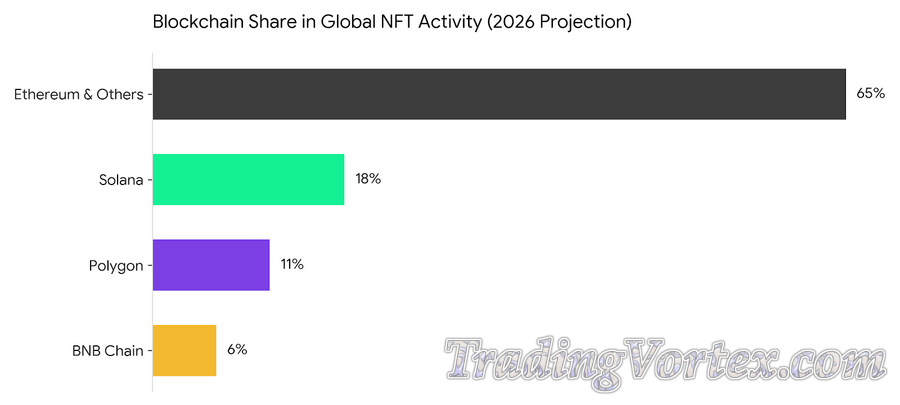
Horizontal Bar Chart Projecting the Blockchain Market Share in Global NFT Activity for 2026, Highlighting the Continued Dominance of Ethereum and Collective Networks alongside Rising Shares of Solana (), Polygon (), and BNB Chain ().
♦ Educational Explanation – How to Interpret and Utilize This Visual:
As an investor, trader, or participant navigating the Web3 identity landscape in 2026, understanding where development and trading volume are concentrated is crucial for making informed infrastructure decisions. This chart breaks down the projected distribution of global NFT activity across major blockchain ecosystems, serving as a roadmap for where digital real estate is most valuable.
♦ Here is how you can interpret and apply these insights to your Web3 strategy:
-
Assess Network Effects and Liquidity: The chart demonstrates that while Ethereum and its minor counterparts retain the ultimate lion's share at , alternative networks are no longer negligible secondary options. In Web3, network activity translates directly to liquidity. A higher market share means more active wallets, higher trading volumes, and a larger pool of potential buyers if you ever choose to transfer or sell an NFT domain.
-
Evaluate Ecosystem Strengths: * Solana (): Its significant share reflects its position as the premier low-cost, high-throughput alternative. For users looking to deploy high-velocity dApps or transfer domains frequently without friction, Solana represents a highly efficient and active ecosystem.
-
Polygon (): As a dominant layer-2 scaling solution, Polygon’s share is heavily propelled by enterprise adoption and gaming integrations. If your focus is on institutional utility or corporate branding, this network holds significant weight.
-
BNB Chain (): This ecosystem offers a stable niche, driven by its strong integration with large-scale retail exchanges and decentralized finance (DeFi) platforms.
-
-
Strategic Portfolio Diversification: When acquiring NFT domains as permanent digital real estate, the underlying blockchain determines your asset's long-term accessibility, security, and gas fee structures. A balanced approach involves securing high-value, foundational domains on dominant networks like Ethereum for maximum security and prestige, while leveraging growing ecosystems like Solana and Polygon for affordable, practical, day-to-day Web3 username deployments.
NFT Domains vs Traditional Domains
NFT domains give you true on‑chain ownership, simpler crypto payments, and stronger censorship resistance compared with traditional domains, but they trade off native browser support and standardized dispute resolution; weigh ownership model, utility, and ecosystem support when choosing between them.
Quick decision guide: what to consider before you buy
- Ownership model: Do you want one-time ownership recorded on-chain, or a familiar annual-lease model?
- Use case: Are you buying for crypto payments and Web3 identity, or for broad web visibility and SEO?
- Risk tolerance: Can you manage private keys and on‑chain recovery, or do you prefer registrar support and legal dispute paths?
These questions will steer whether an NFT domain or a traditional domain fits your strategy. Think of it like choosing between renting an apartment with a landlord who handles maintenance, or buying a house outright where you’re responsible for everything. Both have their perks, but the responsibilities are very different.
Side‑by‑side comparison
| Criterion | NFT Domains | Traditional Domains |
|---|---|---|
| Ownership | One‑time mint, owned in your wallet | Leased from registrar, annual renewals |
| Control | Transferable peer‑to‑peer on‑chain | Registrar and ICANN governed |
| Fees | Often one‑time purchase, no renewals | Recurring annual fees |
| Censorship resistance | High, records on blockchain | Lower, registrars or courts can suspend |
| Browser support | Requires Web3 browser or extension | Native support across all browsers |
| Primary use cases | Crypto payments, Web3 identity, decentralized sites | Public websites, email, SEO, mainstream reach |
Ownership and control
With NFT domains you hold the token in your wallet, which means ownership is cryptographic and portable, not a license held by a registrar. That gives you real control over transfers and use, but it also means no centralized registrar safety net if you lose your private key.
I’ve seen traders lose access to valuable names simply because they misplaced their seed phrase, and unlike GoDaddy or Namecheap, there’s no “forgot password” button here. Traditional domains feel safer for many people because registrars provide account recovery, transfers, and legal dispute mechanisms.
Renewal fees versus lifetime ownership
One of the clearest selling points for NFT domains is no recurring renewal fees in many models, which can be a big cost saver over time. Traditional domains typically cost $10–$50 per year, and missed renewals can mean losing a valuable name.
I know someone who forgot to renew their .com domain and watched a competitor scoop it up overnight. That kind of nightmare is far less likely with NFT domains, since once you mint it, you own it permanently. If you plan to hold a name for years, the math often favors NFT domains, provided you accept the on‑chain custody responsibilities.
Censorship resistance and security
NFT domains store ownership and records on public blockchains, which makes them resistant to takedowns by registrars or single governments, as long as you control the private key. That is powerful for activists, decentralized projects, and anyone worried about centralized control.
On the flip side, traditional DNS benefits from mature security tooling, legal recourse, and universal browser compatibility, which matters for mainstream reach and SEO. If you want your site to rank on Google tomorrow, a .com or .org is still the safer bet.
Practical takeaway for traders and investors
If you want Web3 utility, crypto payments, and long‑term cost savings, NFT domains are compelling. If you need broad web visibility, email, and legal protections, stick with traditional domains.
For many investors, a hybrid approach makes sense: secure a traditional .com for public presence, and mint the matching .eth or .crypto for Web3 identity and payments. That way you get the best of both worlds, and you won’t be left explaining to your clients why their browser can’t resolve your shiny new NFT domain without an extension.
In short, NFT domains are like buying digital land in a new city that’s still under construction. Traditional domains are like renting space in a well-established downtown. Both have value, but the choice depends on whether you’re chasing innovation, stability, or a mix of both.
📊 10-Year Cumulative Cost Comparison Between Traditional Domains and NFT Domains
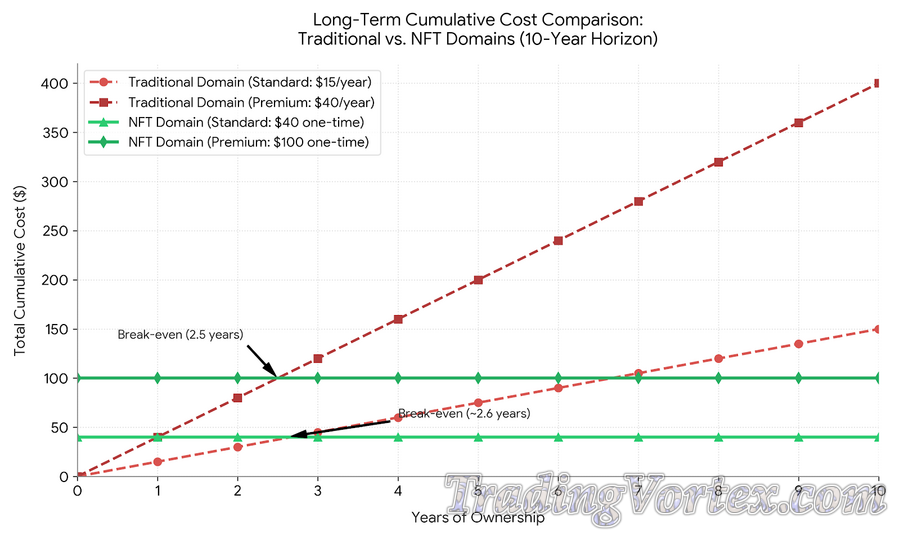
Line Chart Illustrating a 10-Year Cumulative Cost Comparison Between Traditional Domains with Recurring Annual Fees and NFT Domains with One-Time Lifetime Purchase Costs.
♦ Educational Explanation – How to Interpret and Utilize This Visual:
When evaluating whether to acquire an NFT domain or stick to a traditional domain, one of the most quantifiable differentiators is the long-term financial commitment. This chart maps out the cumulative total cost of ownership over a 10-year horizon, contrasting the compounding subscription model of traditional domains against the predictable flat-fee structure of Web3 domains.
♦ Here is how to interpret this visual data to guide your strategic acquisition decisions:
-
Identify the Subscription Compound Effect: The red dashed lines represent traditional domains, which require recurring annual lease payments. Even at a modest standard rate of per year, the total investment climbs steadily over time, reaching by Year 10. For premium traditional TLDs or corporate-level domains costing around per year, the cost scales aggressively to over a decade. This highlights the inherent financial risk of the traditional registry system: if a single renewal payment is missed due to an expired credit card or an oversight, you risk losing the asset entirely.
-
Understand the Lifetime Value of On-Chain Assets: The green solid lines depict NFT domains. Because they are minted directly onto a blockchain as non-fungible tokens, they incur only a one-time upfront purchase or minting fee and in ongoing renewal charges. Whether you select a standard tier () or a premium tier (), your cost structure remains completely flat across the entire lifecycle. Once ownership is verified in your private cryptocurrency wallet, the domain is permanently yours.
-
Pinpoint the Break-Even Markers: The visual annotations highlight critical "break-even" points where the long-term financial math flips in favor of Web3 infrastructure.
-
A standard NFT domain becomes cheaper than a standard traditional domain in less than 3 years.
-
A premium NFT domain becomes more cost-effective than a premium traditional domain in exactly 2.5 years.
-
-
Strategic Takeaway for Investors: If your operational strategy involves holding digital real estate, brand protections, or Web3 identifiers for 3 or more years, the cost efficiency strongly favors NFT domains. However, keep in mind the operational tradeoff emphasized in the text: the financial savings of zero renewal fees mean you assume absolute responsibility for your private keys. There is no registrar support team to recover a forgotten password, meaning your long-term cost efficiency must be paired with rigorous self-custody security.
Key Features and Use Cases of NFT Domain Extensions
NFT domain extensions transform clunky, error‑prone crypto addresses into clean, human‑friendly names, unlock decentralized websites and on‑chain identity, and offer one‑time ownership models that appeal to both traders and long‑term investors. Key players like ENS and Unstoppable Domains are leading adoption, with .eth registering millions of names and Web3 domains gaining real utility across wallets, dApps, and the metaverse.
Quick guide: what matters when you evaluate NFT domain features
- Utility: Is the domain going to be used for payments, a decentralized site, or identity across dApps.
- Ecosystem: Does the extension integrate with major wallets, exchanges, and marketplaces.
- Cost model: One‑time mint versus recurring fees directly impacts long‑term ROI.
- Security: Who controls recovery, and how resilient is the resolution layer against censorship or downtime.
Core features explained
On‑chain ownership and transferability: NFT domains are minted as tokens on blockchains, so ownership is recorded permanently on‑chain and transferable peer‑to‑peer. Unlike traditional domains that are leased from registrars, NFT domains give you true digital ownership. The catch is that you must manage your private keys carefully. Lose them, and you lose the domain.
I’ve seen traders treat their NFT domains like prized collectibles, but also like ticking time bombs if they don’t back up their seed phrases.
Human‑readable wallet addresses: Instead of copy‑pasting long hex strings like 0x4a3f..., you can receive funds at yourname.eth or yourname.crypto. This reduces user error, speeds up trading flows, and makes crypto transactions feel less intimidating.
I remember a friend who once sent tokens to the wrong address because of a single typo. With NFT domains, those horror stories become far less likely, and that peace of mind is worth a lot in fast‑moving markets.
One‑time purchase or different fee models: Some providers, like Unstoppable Domains, offer one‑time purchases with no renewals, while ENS uses a registration model with periodic fees for certain names. This affects holding costs and resale math.
Consider lifetime cost versus liquidity when buying, especially if you plan to flip domains or hold them for branding purposes. For investors, this is the difference between a predictable expense and a permanent asset.
Decentralized website hosting and content linking: NFT domains can point to content stored on IPFS or other decentralized storage networks. This enables censorship‑resistant sites and persistent links for projects, portfolios, or DAOs.
For creators, it’s like having a gallery that no one can shut down. For investors, it’s proof that these domains are more than speculative assets: they’re functional infrastructure that can generate real utility.
Interoperability with wallets, dApps, and marketplaces: Leading extensions are supported by major wallets and marketplaces, which determines real‑world usability. .eth remains the most integrated, with millions of registrations and broad dApp support.
Adoption equals utility, so always check whether the extension you’re eyeing is widely recognized across platforms. A domain that no wallet supports is like buying land in a city no one visits.
Use cases traders and investors care about
- Payments and tipping: Faster, safer transfers during trades, NFT drops, or community contributions.
- Brand protection and Web3 identity: Securing matching NFT domains for projects, personal brands, or DAOs.
- Decentralized storefronts and landing pages: Hosting simple IPFS sites for NFT drops, portfolios, or community hubs.
- Speculation and domain flipping: Short, memorable names retain premium value, though liquidity varies by extension.
- Cross‑platform identity: Using one domain across wallets, games, and metaverse platforms to unify your digital presence.
Risks, limitations, and practical tips
- Browser and UX friction: Native browser support is still limited. Many users need extensions or Web3‑enabled browsers. Test resolution across wallets before buying to avoid surprises.
- Custody risk: Losing a seed phrase can mean permanent loss of a domain. Use hardware wallets and secure backups.
- Market fragmentation: Multiple chains and TLDs mean demand is uneven. Prioritize extensions with strong ecosystem support and proven adoption.
- Speculative bubbles: Some domains may look valuable but lack real utility. Focus on names tied to active ecosystems.
🎯 Final takeaway:
NFT domain extensions are practical tools for simplifying crypto interactions, building decentralized presence, and capturing Web3 identity value.
For traders and investors, the smartest move is to focus on extensions with proven adoption, low friction in wallets and marketplaces, and a fee model that matches your holding horizon.
Think of them as the digital real estate of Web3: some plots are speculative, but the ones near the busiest intersections (like .eth or .crypto) are already showing their long‑term value.
📊 Functional Utility Architecture Profile of Web3 NFT Domain Extensions
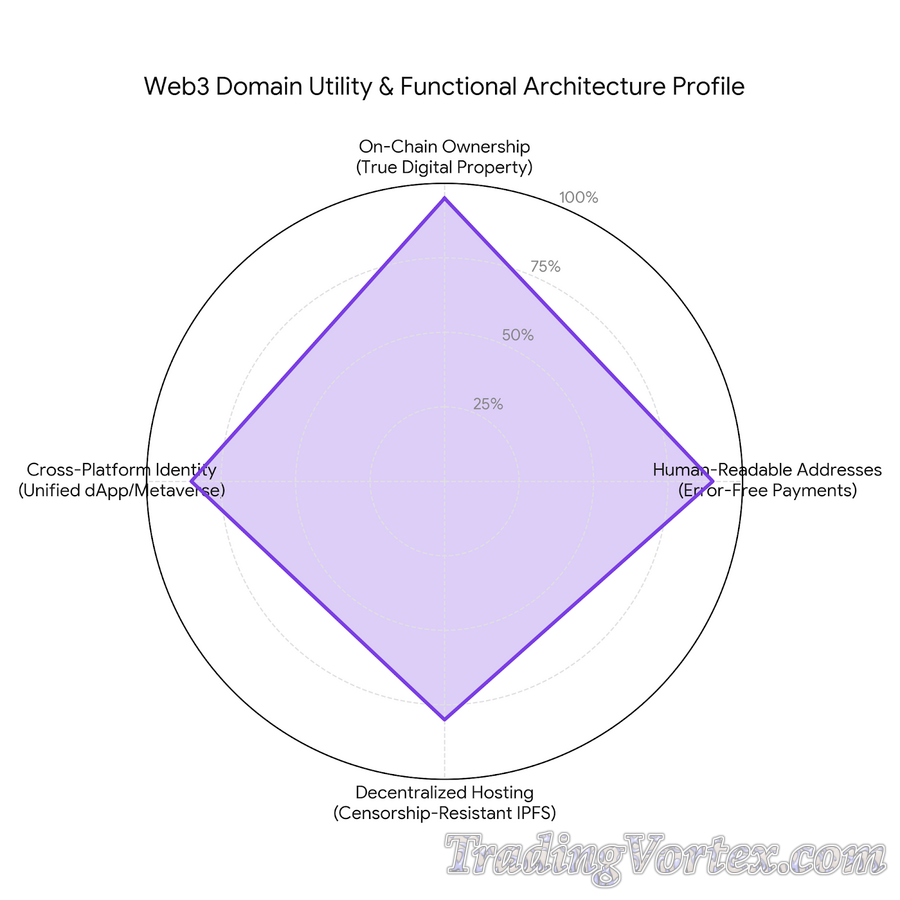
Radar Chart Mapping the Functional Utility Architecture Profile of Web3 NFT Domain Extensions, Evaluating Core Pillars Across True On-Chain Ownership (), Human-Readable Addresses (), Cross-Platform Identity (), and Decentralized Hosting Capabilities ().
♦ Educational Explanation – How to Interpret and Utilize This Visual:
When assessing the long-term viability of an NFT domain extension, its speculative price tag matters far less than its structural utility profile. This radar chart visualizes the functional components that make Web3 domains essential infrastructure rather than just digital collectibles. By plotting these variables radially, you can instantly judge where an asset derives its real-world value.
♦ Here is how to interpret this utility profile to guide your asset evaluation:
-
True On-Chain Ownership ( Strength): This is the strongest axis of the profile, reflecting the absolute paradigm shift from traditional internet domain models. Because these domains exist explicitly as individual smart contracts on a blockchain, your title to the asset cannot be unilaterally altered, suspended, or confiscated by an intermediary registry. When purchasing, treat this as your foundation: maximize security by verifying ownership via hardware wallets.
-
Human-Readable Simplification ( Strength): The chart shows that translating highly complex -character hexadecimal public keys into accessible text labels (like
.ethor.crypto) serves as the immediate UX solution for decentralized finance. This operational vector directly reduces multi-thousand dollar transaction losses stemming from manual user typing errors. If you are an active trader, using a domain mapping profile saves time and preserves transaction security across fast-moving network environments. -
Cross-Platform Identity ( Strength): Your domain serves as a persistent, single sign-on username across decentralized applications (dApps), secondary marketplaces, and emerging virtual worlds. Evaluating a domain extension along this axis means assessing its integrations; a high-utility extension must be natively recognized across widely adopted Web3 nodes to build a cross-platform brand presence.
-
Decentralized Content Hosting ( Strength): Beyond simple payment pointers, these extensions resolve straight to data stored distributedly across IPFS networks. This makes website hosting fully decentralized and immune to singular points of failure or regional censorship.
♦ Strategic Investor Takeaway: When evaluating an extension to purchase or flip, construct your own mental version of this profile for that specific project. If a new domain extension claims to be highly valuable but isn't integrated into major wallets (low Human-Readable utility) and doesn't load into Web3 platforms (low Cross-Platform Identity utility), its profile collapses. Focus your capital allocation on extensions that push closest to the outer edge across all four core pillars, as widespread integration and real-world utility are what guarantee asset liquidity.
.eth NFT Domain Extension (Ethereum Name Service)
The .eth domain extension, powered by the Ethereum Name Service (ENS), has become the most widely adopted NFT domain in 2026, with millions of registrations, deep integration across DeFi and dApps, and new upgrades like ENSv2 making registrations cheaper and more user-friendly. It is now seen as the “DNS of Web3,” but investors should weigh its strong utility against risks like phishing and privacy exposure.
Adoption in DeFi and dApps
The Ethereum Name Service (ENS) has grown into the backbone of Web3 identity. Instead of copying and pasting long hexadecimal wallet addresses, users can send funds to simple names like yourname.eth. This usability boost has made ENS a favorite across DeFi platforms, NFT marketplaces, DAOs, and Ethereum wallets, where .eth names are now standard for simplifying transactions. By early 2026, ENS had registered millions of .eth domains, cementing its role as the most recognized blockchain naming system.
For traders, this means .eth names are not just vanity assets, they are functional tools that reduce errors and speed up transactions. I’ve seen seasoned investors breathe easier when they no longer have to triple-check every character in a wallet address. That convenience alone has saved countless headaches and, in some cases, thousands of dollars in avoided mistakes.
Integration with Ethereum Ecosystem
ENS is deeply tied to Ethereum’s infrastructure. It works through smart contracts that manage registries, resolvers, and records, allowing .eth names to link not only to wallet addresses but also to avatars, social profiles, websites, and even multi-chain addresses. This versatility makes ENS more than a naming system: it’s a digital identity hub.
The launch of ENSv2 in 2026 on Ethereum Layer 1 was a game-changer: gas fees dropped by 99%, scalability improved, and registrations became more affordable. This decision avoided fragmentation across Layer 2 chains and kept .eth as a unified, censorship-resistant namespace. Vitalik Buterin himself has emphasized ENS’s potential in decentralized social spaces and identity verification, signaling strong confidence in its future.
For businesses, this integration means that owning a .eth domain is becoming as essential as owning a .com was in the early internet era. Brands are using .eth to anchor their Web3 presence, link to official wallets, and even host decentralized landing pages.
Investment Potential and Risks
For investors, .eth domains are often compared to digital real estate. Short, memorable names carry premium value, and businesses are increasingly securing their brand names in .eth to protect their Web3 identity. The upside is clear: high adoption, strong ecosystem integration, and growing mainstream recognition.
However, risks exist. Phishing attacks target famous .eth names, and misconfigured records can cause costly mistakes. Public profiles linked to .eth domains may also expose privacy vulnerabilities, connecting wallets to social accounts. ENS domains are infrastructure, not a magic security layer, so investors must practice good security habits like verifying records and using hardware wallets.
Liquidity is another consideration. While premium names can fetch high resale prices, lesser-known names may struggle to find buyers. The market for .eth domains is maturing, but it still carries the volatility of the broader NFT space.
🎯 Final Takeaway:
The .eth NFT domain extension is the most established and widely integrated Web3 naming system. It offers real utility in DeFi, dApps, and digital identity, making it a strong candidate for long-term investment. Yet, like any asset in crypto, it comes with risks that require careful management.
If you’re building a portfolio of NFT domains, .eth should be at the top of your list. Treat it as infrastructure with practical value, not just a speculative bet. Owning a .eth domain today is a bit like owning prime land in a city that is still expanding: you get the benefits of current utility, plus the potential upside of future growth.
📊 Functional Utility Architecture of the Ethereum Name Service (.eth) in 2026
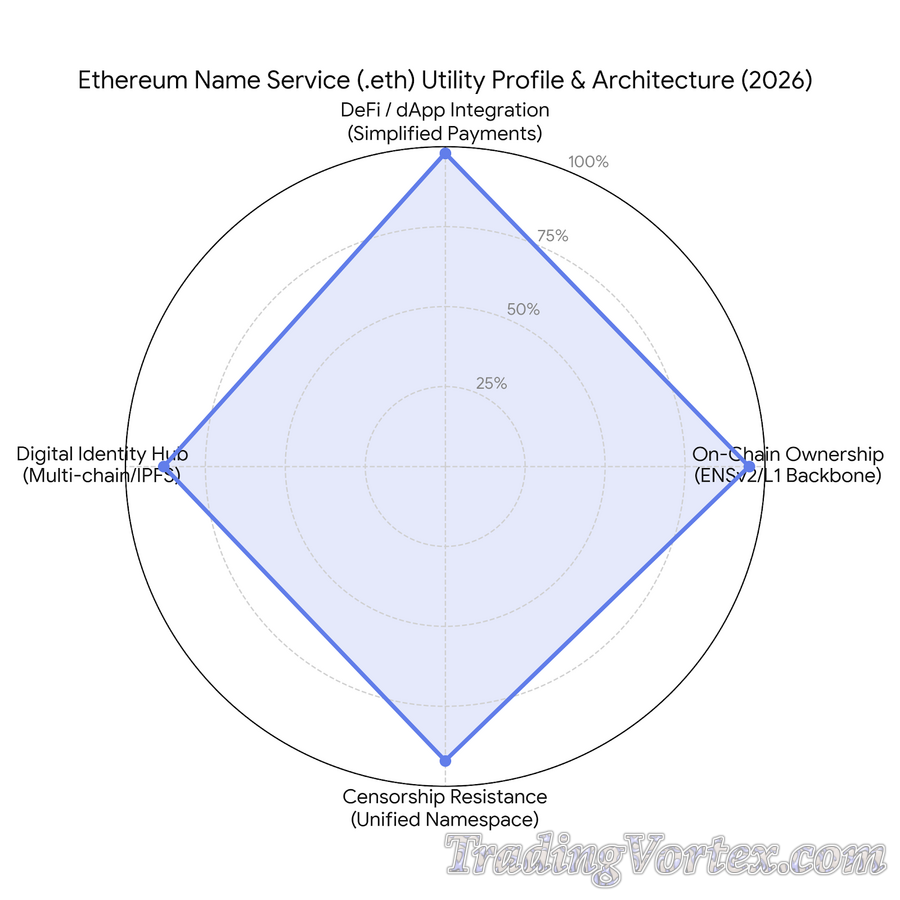
Radar Chart Mapping the Functional Utility Architecture of the Ethereum Name Service (.eth) in 2026, Ranking Key Components Across DeFi/dApp Integration (), On-Chain Ownership (), Censorship Resistance (), and Digital Identity Hub Capabilities ().
♦ Educational Explanation – How to Interpret and Utilize This Visual:
This radar chart visualizes the distinct utility profile of the .eth domain extension, powered by the Ethereum Name Service (ENS), as it stands in 2026. Rather than just a speculative asset, ENS domains have matured into foundational infrastructure. To help you understand where their value lies, we have scored four critical areas of functionality:
-
DeFi/dApp Integration (): This is the extension’s strongest vector. Scoring near emphasizes that .eth names are universally accepted across decentralized finance (DeFi), marketplaces, and decentralized applications (dApps). When you own a .eth name, you possess the standard mechanism for simplifying errors and accelerating transactions in the Ethereum ecosystem. It has become the default “username” of Web3.
-
On-Chain Ownership (): This high score reflects the true digital ownership guaranteed by Ethereum’s Layer 1 blockchain. By anchoring ownership directly in decentralized smart contracts rather than leasing it through a centralized registrar (like traditional .com domains), ENS provides unparalleled security and portability. The arrival of ENSv2 in 2026 solidified this core strength.
-
Censorship Resistance (): Powered by its decentralized registry architecture, ENS domains are resistant to confiscation or shutdown by third parties. This vector is vital for developers and organizations building truly decentralized platforms and wishing to host censorship-resistant content on IPFS.
-
Digital Identity Hub (): This axis shows that .eth domains have evolved beyond simple address shortcuts. They serve as a comprehensive identity system where a single name can link to multi-chain addresses, social profiles, avatars, and decentralized websites.
♦ Trader and Investor Application: When analyzing Web3 domain extensions for your portfolio, use this chart as a benchmark. While speculative assets may show extreme short-term volatility, the robust, balanced structure of this profile demonstrates why ENS commands its status as digital real estate with genuine long-term utility. A successful investment strategy in 2026 focuses on identifying extensions whose functional utility profile pushes toward the outer limits across multiple dimensions.
.crypto NFT Domain Extension (Unstoppable Domains)
The .crypto domain extension from Unstoppable Domains has become one of the most popular Web3 naming systems in 2026, offering lifetime ownership with no renewal fees, strong adoption for crypto payments, and growing demand for decentralized websites. It is widely recognized as the “OG” domain of the crypto community, but investors should weigh its liquidity potential against browser support limitations.
Payments and Decentralized Websites
The .crypto extension is the flagship product of Unstoppable Domains, a company founded in 2018 that has since grown into one of the leading providers of blockchain-based naming services. At its core, .crypto solves one of the biggest headaches in crypto: long, complicated wallet addresses. Instead of sending funds to 0x4a3f..., you can send them to yourname.crypto. This simple shift reduces human error, builds confidence in transactions, and makes crypto feel more approachable for newcomers.
But payments are only part of the story. .crypto domains can also be connected to decentralized websites hosted on IPFS or other distributed storage systems. This allows users to build censorship-resistant landing pages, NFT galleries, or even full-fledged e-commerce stores that exist outside the control of traditional hosting providers. For creators, this means independence. For businesses, it means a permanent Web3 presence that cannot be taken down by centralized authorities.
I often describe .crypto domains to friends as a digital Swiss Army knife: it’s a wallet address, a website, and a brand identity all rolled into one. That versatility is why it has become such a cornerstone of the Web3 ecosystem.
No Renewal Fees Advantage
One of the most attractive features of .crypto domains is lifetime ownership. Unlike traditional domains that require annual renewal fees, Unstoppable Domains uses a one-time purchase model. You pay once, mint the domain to your wallet, and it’s yours forever.
This model eliminates the anxiety of missed renewals, which has cost traditional domain owners millions over the years. I know traders who lost valuable .com domains simply because they forgot to renew them, only to watch competitors swoop in. With .crypto, that risk disappears.
For long-term investors, the math is clear: a single upfront cost versus decades of recurring fees makes .crypto domains a cost-efficient way to secure digital real estate.
Marketplace Demand and Liquidity
The market for .crypto domains has expanded rapidly. Unstoppable Domains now offers more than nine different extensions, including .nft, .wallet, and .dao, but .crypto remains the most popular and culturally significant. It is often referred to as the “OG domain” of the crypto community, a badge of honor for early adopters.
Demand is fueled by several factors:
- Web3 companies securing brand names to protect their identity in decentralized spaces.
- Traders and investors flipping short, memorable domains for profit.
- Integration across wallets, dApps, and exchanges, which boosts utility and resale value.
Liquidity has improved thanks to secondary marketplaces like OpenSea, where .crypto domains are actively traded. Premium names tied to brands, keywords, or short identifiers can command high resale prices. However, less distinctive names may struggle to attract buyers, so investors should be selective.
🎯 Final Takeaway:
The .crypto NFT domain extension is a powerful tool for anyone looking to establish a Web3 identity, simplify crypto payments, or build decentralized websites. Its no renewal fee model makes it especially appealing for long-term investors, and its reputation as the “OG” crypto domain gives it cultural prestige within the community. That said, liquidity is not guaranteed, and browser support still trails behind traditional domains.
For traders and investors, the smart approach is to treat .crypto as both a utility asset and a speculative investment. Secure a strong name today, and you’re not just buying a domain: you’re buying a piece of Web3 infrastructure that could appreciate significantly as adoption grows.
In many ways, owning a .crypto domain in 2026 feels like owning a prime piece of land in a new digital city. The roads are still being paved, but the location is already valuable, and the potential upside is enormous.
📊 Chart Comparing the Strategic Profiles of .crypto (Unstoppable Domains) and Traditional Domains (.com)
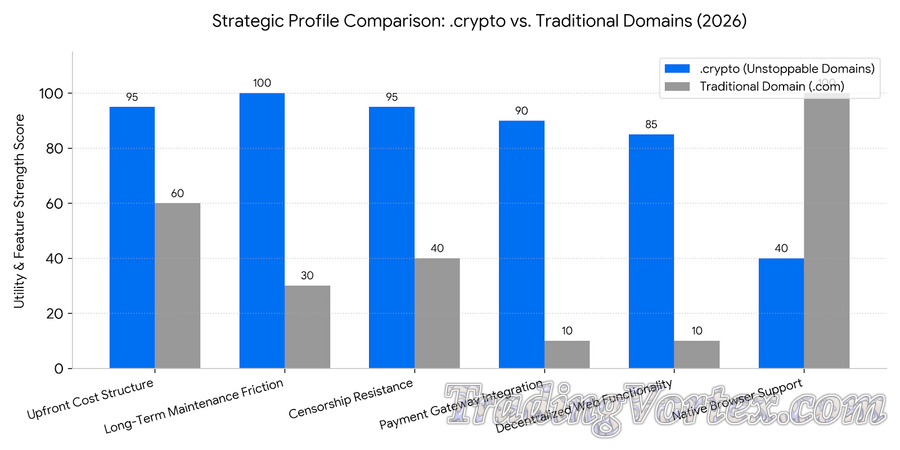
Side-by-Side Bar Chart Metric Comparing the Strategic Profiles of .crypto (Unstoppable Domains) and Traditional Domains (.com) Across Core Utility Vectors, Highlighting Lifelong Maintenance and On-Chain Infrastructure Against Mainstream Browser Support.
♦ Educational Explanation: How to Interpret and Utilize This Visual:
This grouped bar chart offers an analytical profile comparing the flagship .crypto domain extension against a standard traditional domain (like a .com or .net). Rather than evaluating these assets purely on hype, this model scores specific utility vectors out of 100 to help you decide how to balance digital real estate in your portfolio.
♦ Here is a breakdown of how to interpret these core pillars:
-
Long-Term Maintenance Friction (Score 100 vs. 30): This metric represents the asset's security regarding administrative renewal risks.
.cryptoscores a perfect 100 because of its one-time purchase model. Once minted to your cryptographic wallet, there are zero ongoing renewal fees or deadlines. Traditional domains score a low 30 due to the continuous compounding friction of annual leases, where a single missed credit card transaction or administrative oversight could cause you to lose your domain to competitors overnight. -
Upfront Cost Structure (Score 95 vs. 60): While some premium web domains have steep price tiers initially, a standard
.cryptodomain presents a highly efficient capital layout when amortized over a lifetime, as it requires no recurring subscription capital. -
Censorship Resistance & Decentralized Web Functionality (Scores 95 & 85 vs. 40 & 10):
.cryptoexhibits overwhelming advantages here. Because ownership data is stored immutably on a public blockchain, your web footprint is highly resilient against centralized takedowns or domain seizures. Furthermore, native integration with distributed file networks like IPFS enables developers to construct fully decentralized stores, storefronts, or token galleries that remain under exclusive user custody. -
Payment Gateway Integration (Score 90 vs. 10): This illustrates the "
.cryptoas a Swiss Army knife" advantage. A.cryptoasset replaces unreadable, multi-character public wallet strings (e.g.,0x4a3f...) with human-friendly addresses likeyourname.crypto. Traditional domains lack this underlying payment routing protocol natively. -
The Ultimate Trade-off — Native Browser Support (Score 40 vs. 100): This is the primary risk vector for Web3 domains. Traditional
.comdomains have universal, out-of-the-box browser compatibility. Conversely,.cryptooften requires specific Web3-enabled browsers or external browser extensions to resolve correctly.
♦ Strategic Investor Action Plan: Use this visualization to execute a hybrid digital real estate model. If your goal is mainstream reach, public brand presence, and immediate SEO traffic, stick with a traditional domain. However, if you are looking to secure a lifetime Web3 identity layer, shield assets from centralized vulnerabilities, or lock in permanent payment pathways without recurring fee liabilities, allocating capital to a .crypto asset provides an optimal risk-to-reward infrastructure play.
.nft Domain Extension
The .nft domain extension has emerged as a premium choice in 2026, especially for creators, collectors, and brands looking to anchor their identity in Web3. Offered by Unstoppable Domains, it carries cultural prestige, strong branding potential, and growing investor interest, though liquidity and browser support remain challenges.
Premium Identity and Cultural Prestige
The .nft extension is one of the most recognizable blockchain-based domain endings available through Unstoppable Domains, alongside .crypto and .wallet. Unlike generic extensions, .nft carries a strong cultural association with the NFT movement itself. Owning a name like artist.nft or gallery.nft signals direct involvement in the digital art and collectibles space.
By mid-2026, .nft domains have become status symbols among creators and collectors. They are often used to showcase NFT portfolios, link to marketplaces, or serve as personal identifiers in Web3 communities. Think of them as the digital equivalent of a vanity license plate, except instead of flexing on the highway, you’re flexing in the metaverse.
The cultural weight of .nft is undeniable. It tells people you are not just dabbling in NFTs, you are part of the movement. For many artists, it has become a badge of authenticity, a way to signal credibility in a crowded market where scams and copycats still exist.
Branding Opportunities in Web3
For businesses and creators, .nft domains are powerful branding tools. They can be tied to decentralized websites hosted on IPFS, used as human-readable wallet addresses, or integrated into NFT marketplaces and dApps. This makes them versatile assets for anyone building a Web3 presence.
Brands are increasingly securing .nft domains to protect their identity and connect with NFT-savvy audiences. For example, a fashion label launching digital wearables might use brand.nft as its hub for drops and community engagement. The extension itself communicates relevance in the NFT space, which is valuable for marketing and trust-building.
I often tell traders that buying a .nft domain is like planting your flag in the NFT world. It says, “I’m here, I’m part of this culture, and I’m not just passing through.” For companies, it’s a way to show they are forward-thinking and ready to engage with the next generation of digital consumers.
Long-Term Investment Outlook
From an investment perspective, .nft domains are appealing because they combine scarcity, cultural relevance, and utility. Premium names (short, memorable, or tied to popular keywords) can command high resale values. Secondary marketplaces like OpenSea already list .nft domains, and liquidity is improving as adoption grows.
However, investors should be mindful of risks:
- Browser support is limited. Native resolution works in Brave and Opera, but Chrome still requires extensions.
- Market fragmentation means not all NFT domains are equally recognized.
.ethremains dominant in DeFi, while.cryptoleads in payments..nftis carving out its niche in identity and culture. - Speculation risk is real. Not every
.nftdomain will appreciate, especially if it lacks branding appeal or ecosystem integration.
Despite these challenges, the long-term outlook is positive. As NFTs continue to evolve beyond art into gaming, metaverse assets, and tokenized real-world items, .nft domains are positioned to become the go-to extension for identity and branding in this space.
🎯 Final Takeaway:
The .nft domain extension is best suited for creators, collectors, and brands who want to establish cultural relevance in Web3. It offers prestige, branding power, and investment potential, though adoption is still catching up to .eth and .crypto.
For traders and investors, the smart play is to secure short, brandable .nft names now, while the market is still maturing. Think of it as buying land in a trendy neighborhood before the coffee shops and art galleries move in. The cultural signal alone makes .nft domains valuable, and as the NFT ecosystem expands, their utility will only grow.
In short, .nft is not just a domain extension, it is a statement. It says you belong to the NFT culture, you understand its value, and you are ready to build on it. For those who believe in the long-term growth of NFTs, owning a .nft domain is both a practical tool and a cultural investment.
📊 Strategic Utility Profile of the .nft Domain Extension in 2026
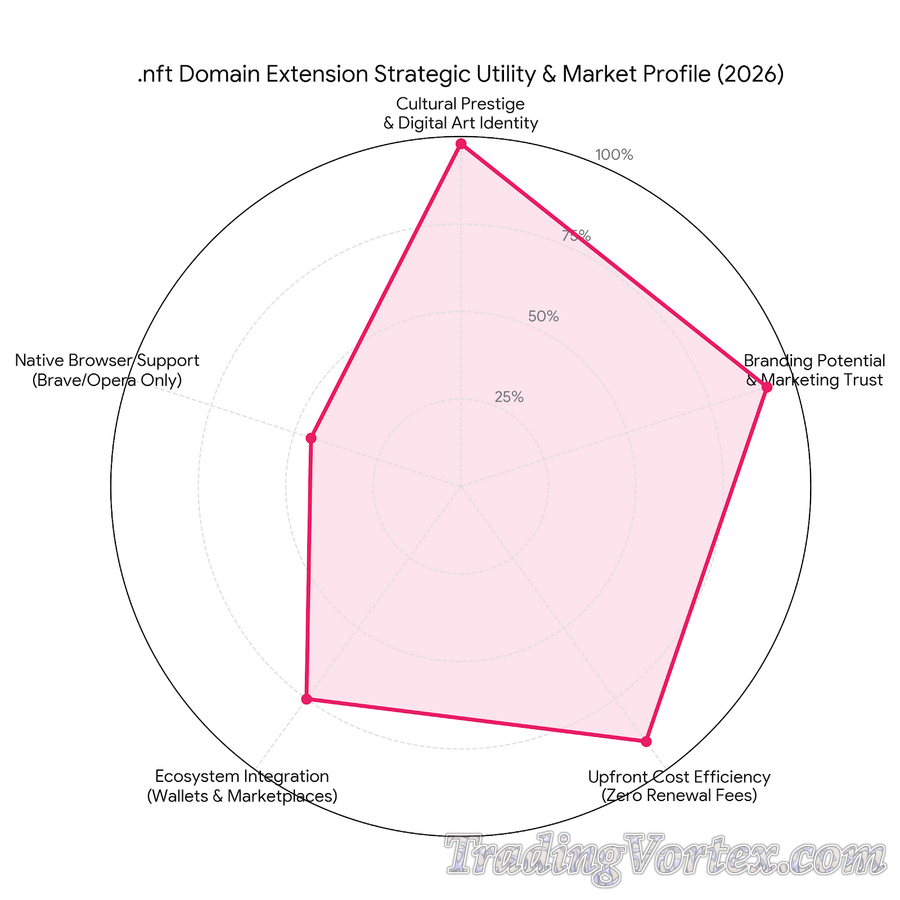
Radar Chart Mapping the Strategic Utility Profile of the .nft Domain Extension in 2026, Showcasing Strengths across Cultural Prestige (), Branding Potential (), and Cost Efficiency (), Set Against Ecosystem Integration () and Native Browser Support Risks ().
♦ Educational Explanation – How to Interpret and Utilize This Visual:
This radar chart tracks the multi-dimensional ecosystem profile of the .nft domain extension as of mid-2026. Rather than presenting static metrics, this visual mapping uses five distinct axes to evaluate how an asset performs along cultural, economic, and technical lines. Understanding this asymmetric profile allows creators, brands, and investors to allocate capital or locate digital identities more effectively.
♦ Here is a guide to interpreting the core data sectors:
-
The Cultural & Creative Core (Cultural Prestige: , Branding Potential: ): The chart pushes nearly to its outermost limit along the top and upper right vertices. This extreme structural skew reflects the immense vanity capital and aesthetic signaling inherent to the
.nftmoniker. For an entity like an active digital artist, fashion web-drop, or portfolio gallery owner, using a name ending in.nftacts as an immediate badge of authenticity that connects with audiences far more directly than generic web alternatives. -
Upfront Cost Efficiency (): Like its counterparts within the Unstoppable Domains suite,
.nftassets operate entirely on a one-time purchase structure. There are no recurring annual lease metrics or expiration risks. Once ownership is recorded to a digital wallet, the recurring maintenance overhead becomes zero, maximizing long-term return on investment (ROI). -
The Ecosystem Interoperability Reality Check (Ecosystem Integration: ): The mild indentation on the bottom right emphasizes that while
.nftassets are fully capable web addresses and active on secondary platforms like OpenSea, the overall ecosystem distribution still yields general network liquidity to older protocols like.ethor payment-first names like.crypto. -
The Resolution Bottleneck (Native Browser Support: ): This represents the critical risk vector clearly indicated in the bottom-left notch. While progressive platforms like Brave and Opera possess built-in resolution protocols to process alternative domain roots seamlessly, traditional baseline environments like Google Chrome still require end-users to manage localized browser extensions.
♦ Strategic Investor & Web3 Builder Action Plan: When acquiring high-value digital property under the .nft umbrella, target short, premium keywords or memorable, single-word identities that capitalize entirely on the chart's upper quadrants (Prestige and Branding). Treat this asset as an optimized, permanent digital storefront explicitly designed for communities embedded deep within Web3, rather than utilizing it for broad-market mainstream search engine optimization (SEO).
.sol NFT Domain Extension (Solana Name Service)
The .sol domain extension, powered by the Solana Name Service (SNS), has quickly become a favorite in 2026 thanks to Solana’s fast-growing ecosystem, ultra-low fees, and strong developer support. With over 270,000 registered domains and integrations across 150+ dApps, .sol domains are now practical tools for payments, identity, and decentralized websites. They represent one of the clearest examples of how blockchain naming systems can evolve into everyday infrastructure for traders, developers, and communities.
Fast-Growing Solana Ecosystem
The Solana Name Service (SNS), originally launched by Bonfida and rebranded in 2024, has become the go-to naming system for the Solana blockchain. By 2026, SNS reported over 270,000 registered .sol domains and partnerships with 150+ decentralized applications. This growth reflects Solana’s broader momentum as one of the fastest blockchains in terms of transaction throughput and developer adoption.
Solana’s reputation for speed and scalability has attracted developers building everything from DeFi platforms to NFT marketplaces and Web3 games. Within this ecosystem, .sol domains act as the connective tissue, making interactions smoother and more human-friendly.
For traders, this means .sol domains are not just speculative assets, they are deeply integrated into Solana’s DeFi platforms, NFT marketplaces, and gaming ecosystems. If you are active in Solana-based projects, owning a .sol domain is almost a necessity for credibility and ease of use.
Low Transaction Fees
One of Solana’s biggest selling points is its low transaction costs, often just fractions of a cent. This affordability extends to .sol domains, making them accessible for both casual users and large-scale investors. Unlike Ethereum-based ENS domains, where gas fees can spike unpredictably, registering and managing .sol domains is consistently cheap and fast.
I often joke with friends that buying a .sol domain feels like grabbing a coffee in Solana City: you barely notice the cost, but the utility is immediate. For traders who move assets frequently, this low-fee environment is a huge advantage. It also lowers the barrier for experimentation, allowing developers and communities to register multiple names without worrying about cost overhead.
Use Cases for Developers and Traders
The use cases for .sol domains are expanding rapidly:
- Wallet Address Simplification: Replace long Solana wallet strings with human-readable names like
yourname.sol. This reduces errors and makes transactions smoother, especially for traders who move assets quickly. - Decentralized Websites: SNS now supports linking
.soldomains toSol.site, allowing users to host Web2-style websites backed by decentralized infrastructure. This bridges traditional web usability with blockchain resilience. - Identity and Branding: Traders, DAOs, and businesses use
.soldomains to establish Web3 identities, complete with avatars, social verification, and profile customization. For communities, it’s a way to unify members under a recognizable namespace. - NFT Integration: Since
.soldomains are minted as NFTs, they can be traded on secondary markets like OpenSea or Solana-native marketplaces. Premium names (short, brandable, or culturally relevant) carry strong resale potential. - Developer Tools: SNS offers SDKs and APIs for integrating domain resolution into dApps, making it easier for developers to build user-friendly applications. This technical support has been key to adoption, as it lowers friction for builders.
Risks and Considerations
While .sol domains are promising, investors should be aware of a few challenges:
- Ecosystem Scope: Utility is strongest within Solana. Outside of it, recognition is limited compared to
.eth, which dominates cross-chain identity. - Premium Pricing: Short or high-demand names can be expensive, even in Solana’s low-fee environment. Investors should weigh cultural relevance and branding potential before paying a premium.
- Liquidity: Secondary market trading exists, but liquidity is still growing compared to Ethereum-based domains. This means flipping
.solnames may take longer than flipping .eth names.
🎯 Final Takeaway:
The .sol NFT domain extension is a smart buy for anyone active in Solana’s ecosystem. It offers low-cost ownership, strong integration with dApps, and practical utility for payments and identity.
For traders, it’s a way to simplify transactions and build credibility. For developers, it’s a tool to enhance user experience in dApps.
If you believe in Solana’s long-term growth, securing a .sol domain today is like buying prime land in a city that’s expanding at lightning speed. It’s affordable, useful, and positioned to grow in value as Solana continues to attract projects and users. For those who want to be part of the Solana story, .sol domains are not just assets, they are entry points into one of the most vibrant blockchain ecosystems of our time.
📊 Strategic Utility Profile of the .sol Domain Extension (Solana Name Service) in 2026
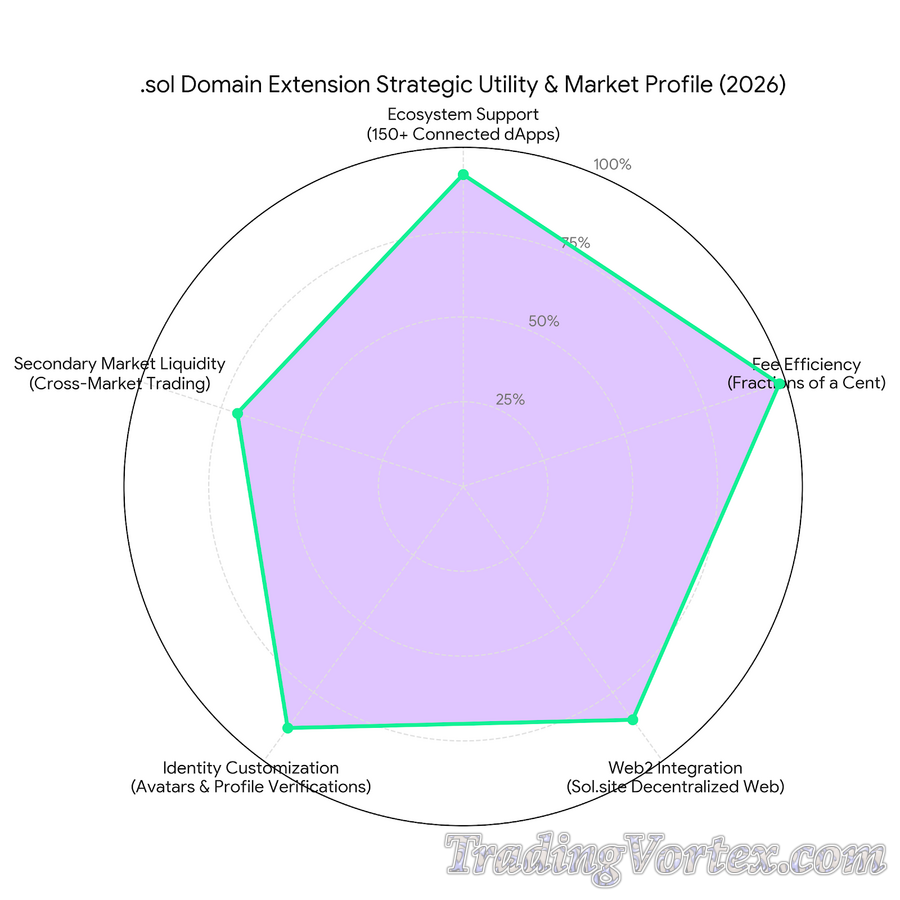
Radar Chart Mapping the Strategic Utility Profile of the .sol Domain Extension (Solana Name Service) in 2026, Visualizing Performance Competencies Across Fee Efficiency (), Ecosystem Support (), Identity Customization (), Web2 Integration (), and Secondary Market Liquidity ().
♦ Educational Explanation – How to Interpret and Utilize This Visual:
This radar chart evaluates the multi-dimensional utility and operational profile of the .sol domain extension (Solana Name Service) as of 2026. Rather than reviewing an asset solely by its resale metrics, this chart scores five foundational ecosystem vectors on a scale of 0 to 100. This map reveals exactly where the Solana ecosystem adds structural value and where potential limitations reside.
♦ Here is a targeted breakdown of the visual metrics to help guide your Web3 deployment:
-
The Efficiency and Expansion Core (Fee Efficiency: , Ecosystem Support: ): The chart stretches almost to its outer boundary at the top and upper right vertices. This dramatic extension illustrates the two greatest competitive advantages of SNS. With Fee Efficiency at , transaction overhead costs fractions of a cent, eliminating the risk of gas spikes common on alternative layer-1 chains. Meanwhile, Ecosystem Support () highlights deep penetration across dApps, decentralized exchanges, and marketplaces, ensuring your human-readable handle resolves universally within the network.
-
Identity and Native Web Integration (Identity Customization: , Web2 Integration: ): These scores demonstrate the technical versatility of
.solnames. Beyond working as basic payment routing shortcuts, the assets score high as comprehensive Identity Hubs (supporting native avatars, sub-identities, and social verifications). The Web2 Integration vector () represents specialized bridges like Sol.site, allowing owners to deploy decentralized, immutable content that resolves cleanly using familiar browser mechanics. -
The Interoperability and Trade Bottleneck (Secondary Market Liquidity: ): This inward dip represents the primary risk constraint mentioned in the analytical text. While secondary trading is active on platforms like OpenSea and Solana-native marketplaces, cross-chain recognition and resale velocity for lesser-known
.solnames are inherently tied to the boundaries of the Solana network, keeping liquidity tighter than older, cross-chain namespaces like.eth.
♦ Strategic Trader & Developer Action Plan: When building a position or presence under the .sol framework, take full advantage of the chart's dominant upper nodes. Because transaction fees are near-zero, developers and organizations should utilize these assets aggressively to lower onboarding friction for users, setting up bulk identity networks, payment pointers, and localized sub-domains. For investors, the lower liquidity profile means you should remain highly selective: focus capital allocations on short, memorable, or brand-defensive names that will inherently command attention as the Solana ecosystem continues its rapid growth.
.btc NFT Domain Extension
The .btc domain extension, rooted in early blockchain naming systems like Namecoin and Handshake, remains a pioneer in decentralized identity. It offers strong censorship resistance and decentralization, but adoption is niche compared to .eth or .crypto, making it a high-risk, high-conviction investment for those who believe in Bitcoin’s cultural and technical dominance.
Pioneer Blockchain Naming System
The .btc extension has its roots in Namecoin, launched in 2011 as the first fork of Bitcoin. Namecoin was groundbreaking because it introduced the idea of a decentralized DNS, tackling the long-standing challenge of Zooko’s Triangle: creating a naming system that is secure, decentralized, and human-readable all at once. It was also the first blockchain to implement merged mining with Bitcoin, allowing miners to secure both chains simultaneously without additional energy costs.
Later, projects like Handshake built on this foundation, offering a peer-to-peer root naming system designed to replace centralized certificate authorities and DNS registries. Handshake’s vision was bold: a fully decentralized internet where names and certificates are validated by blockchain consensus rather than corporate or government intermediaries.
Together, these innovations gave birth to the .btc domain extension, which is often seen as the original experiment in blockchain-based naming. For traders and investors, owning a .btc domain is not just about utility, it is about holding a piece of crypto history. It is a reminder that Bitcoin was not only the first cryptocurrency but also the spark for decentralized identity systems that continue to evolve today.
Censorship Resistance and Decentralization
The strongest appeal of .btc domains lies in their censorship resistance. Because they are recorded on decentralized networks like Namecoin or Handshake, they cannot be seized or suspended by registrars, governments, or corporations. This makes them particularly attractive for activists, privacy advocates, and projects that prioritize independence from centralized control.
Beyond censorship resistance, .btc domains also benefit from decentralized TLS certificate validation, reducing reliance on traditional certificate authorities. This means that users connecting to a .btc domain can be more confident they are reaching the correct endpoint, without interference or manipulation.
That said, adoption challenges persist. Mainstream browsers do not natively support .btc resolution, requiring plugins or specialized software. This friction has slowed adoption compared to extensions like .eth, which enjoy seamless integration across Ethereum wallets and dApps. For everyday users, the extra steps can feel like a barrier, even if the underlying technology is more resilient.
Investor Considerations
From an investment standpoint, .btc domains are niche but culturally significant. They appeal most to Bitcoin maximalists and those who value decentralization above convenience. Premium names tied to Bitcoin culture, short identifiers, or recognizable keywords may hold long-term value, but liquidity is thinner than in markets for .eth or .crypto domains.
Key considerations for investors include:
- Scarcity and prestige:
.btcdomains are rare and tied to Bitcoin’s legacy, giving them symbolic weight. - Utility limitations: They lack the broad dApp and wallet integrations that Ethereum-based domains enjoy.
- Speculative upside: If Bitcoin-based identity systems gain traction,
.btcdomains could appreciate significantly. - Risk profile: Lower liquidity and limited mainstream adoption make them riskier compared to other NFT domain extensions.
🎯 Final Takeaway:
The .btc NFT domain extension is best suited for investors who value decentralization, censorship resistance, and Bitcoin’s cultural legacy. It may not be the most practical choice for everyday Web3 identity or payments, but it carries symbolic weight and potential upside if Bitcoin-based naming systems expand.
Think of .btc domains as digital relics with future potential. They are part of the original vision for a decentralized internet, and while adoption is slower than competitors, their historical significance and resilience make them intriguing assets for long-term believers in Bitcoin.
In short, if you are a trader seeking immediate utility, .eth or .crypto may serve you better. But if you are an investor who values Bitcoin’s ethos and wants to hold a piece of its naming legacy, .btc domains deserve a place in your portfolio. Owning one is like owning a slice of crypto history, with the possibility that it could become far more valuable if Bitcoin’s influence on decentralized identity continues to grow.
📊 Strategic Utility and Market Profile of the .btc Domain Extension in 2026
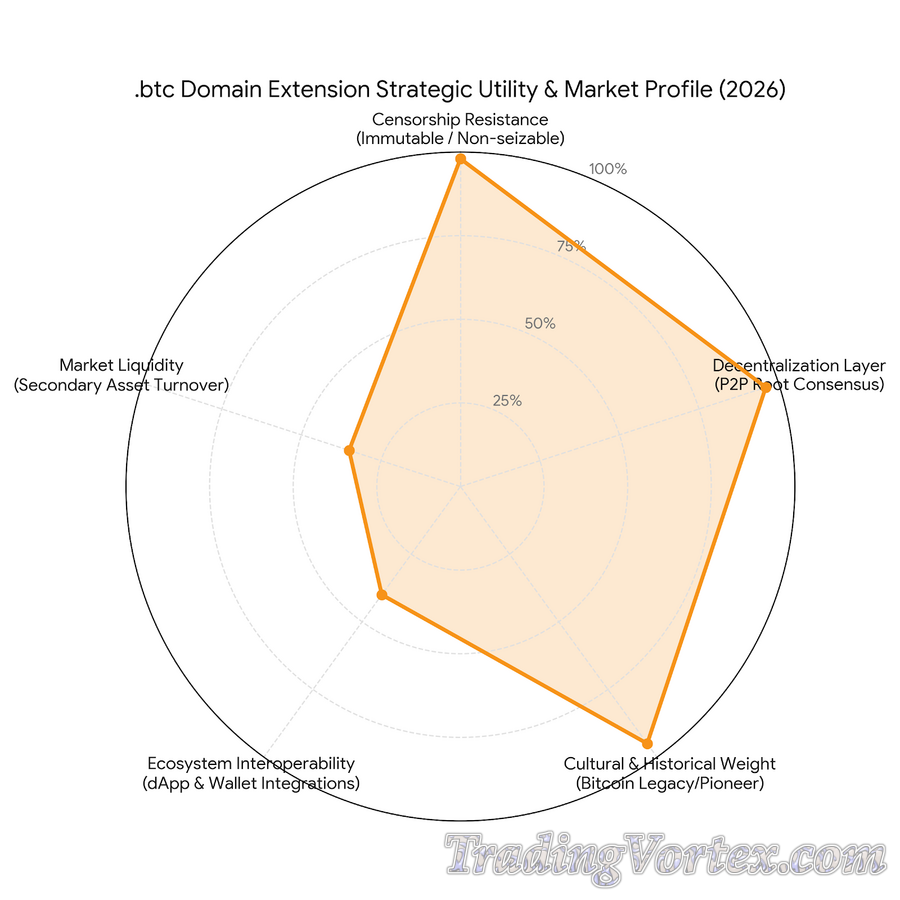
Radar Chart Mapping the Strategic Utility and Market Profile of the .btc Domain Extension in 2026, Showcasing Deep Structural Strengths in Censorship Resistance () and Decentralization () Counterbalanced by Low Market Liquidity () and Limited Ecosystem Interoperability ().
♦ Educational Explanation – How to Interpret and Utilize This Visual:
This radar chart tracks the asymmetric performance map of the .btc domain extension (and its ancestral roots like Namecoin and Handshake) in 2026. Rather than relying on simple price charts, this visual configuration uses five key axes to score the asset out of 100, allowing you to quickly spot its ideological strengths and commercial trade-offs.
♦ Here is a guide to interpreting this functional mapping to aid your asset evaluation:
-
The Sovereign Infrastructure Core (Censorship Resistance: , Decentralization Layer: ): The chart spikes heavily toward its absolute limits along the top and upper left vertices. This structural profile shows that
.btcnaming mechanisms excel at decentralization. Built on peer-to-peer root zones designed to bypass traditional certificate registries and corporate gatekeepers, these domains offer unparalleled safety for users requiring maximum immunity against unilateral takedowns, domain seizures, or censorship. -
Cultural & Historical Weight (): Represented by the upper right axis, this vector acknowledges the extension's premium status as a digital pioneer. Owning a
.btcdomain carries massive symbolic capital within the Bitcoin ecosystem, acting as an immutable statement of conviction in the security model and ethos of the original blockchain. -
The Commercial Trade-offs (Ecosystem Interoperability: , Market Liquidity: ): The steep inward compression along the lower two vertices exposes the primary bottlenecks for investors. Unlike modern smart-contract ecosystems (e.g.,
.ethor.crypto), the native ecosystem surrounding.btcresolution suffers from severe fragmentation. It is rarely supported out-of-the-box by mainstream browsers or non-Bitcoin wallets, resulting in far thinner trading liquidity on secondary platforms like OpenSea.
♦ Strategic Investor Takeaway: This chart visualizes a classic "high-conviction, niche utility" profile. If your investment strategy depends on fast trading loops, immediate dApp integration, or quick flips, the lower nodes warn that this asset may trap capital. However, if you are a long-term value investor who aligns with Bitcoin's technical legacy, or a developer seeking unmatched censorship resistance, acquiring highly brandable, short .btc keywords is an optimized defensive land grab. You are essentially holding a scarce digital relic while betting that Bitcoin's layer-2 layers and decentralized identity services will expand into mainstream adoption later.
Other Rising NFT Domain Extensions (.dao, .web3, .x, .wallet)
In 2026, rising NFT domain extensions like .dao, .web3, .x, and .wallet are carving out their niches in Web3 identity, payments, and community branding. They are not yet as dominant as .eth or .crypto, but they are gaining traction thanks to cultural relevance, multi-chain support, and integration with dApps and wallets. Investors should see them as emerging opportunities with both growth potential and liquidity risks.
Emerging Trends and Niche Adoption
.dao: This extension has become the natural home for decentralized autonomous organizations. DAOs use .dao domains to host governance portals, voting dashboards, and treasury pages, creating a recognizable namespace for collective ownership.
For investors, .dao carries strong cultural weight, signaling alignment with decentralized governance and community-driven projects. It is also increasingly used by DAOs in DeFi and gaming, where identity and legitimacy matter.
.web3: Startups and projects that want to brand themselves as part of the broader Web3 movement are flocking to .web3 domains. They are often used for decentralized apps, metaverse projects, and educational platforms.
Owning a .web3 domain is like wearing a badge that says “we are building the future internet.” It resonates with audiences who want to be part of the next digital revolution.
.x: Designed as a universal identity layer, .x domains are increasingly used as multi-chain wallet handles. They allow users to map multiple blockchain addresses (Ethereum, Solana, Polygon, and more) under one name. In 2026, this matters more than ever as wallets evolve into profile-like identities across apps, games, and even AI agents.
For traders, .x domains simplify cross-chain activity, while for developers they provide a unified identity solution.
.wallet: Tailored for payments, .wallet domains act as human-readable wallet addresses, making crypto transfers easier and safer. They are especially useful for creators, businesses, and traders who want a clean “payment handle” across dApps. Adoption is growing as smart wallets and passkeys make identity more integrated.
For everyday users, sending funds to artist.wallet feels far more intuitive than typing a string of random characters.
Potential for Growth in 2026
- Web3 identity layer expansion: Apps are treating wallets like profiles, not just payment tools. Extensions like
.xand.walletare positioned to benefit from this shift, becoming the backbone of digital identity. - Community-driven branding:
.daodomains are becoming the default for DAOs, giving them legitimacy and visibility in a crowded ecosystem. - Metaverse and AI integration:
.web3domains are being used by projects that want to anchor themselves in the metaverse economy and AI-driven Web3 platforms. They are becoming the go-to extension for futuristic branding. - Market adoption: Providers like Unstoppable Domains have reported steady growth in registrations, with pricing models that favor one-time purchases and lifetime ownership. This makes them attractive for both retail investors and institutions experimenting with Web3 identity.
Risks and Opportunities
Opportunities:
- Cultural relevance: Extensions like
.daoand.web3carry strong symbolic value, making them attractive for branding and community building. - Utility-driven growth:
.xand.walletsolve real problems in payments and identity, which increases adoption and long-term value. - Low entry cost: Most of these domains are priced between $5 and $40 one-time, making them accessible for traders and investors at all levels.
Risks:
- Liquidity challenges: Secondary market demand is still lower compared to
.ethor.crypto. Investors may need patience to resell. - Browser support limitations: Like most NFT domains, they require Web3-enabled browsers or extensions, which slows mainstream adoption.
- Speculative hype: Some extensions may gain attention without long-term utility. Investors should focus on names tied to active ecosystems and real use cases.
🎯 Final Takeaway:
The .dao, .web3, .x, and .wallet extensions are rising stars in the NFT domain space. They are not yet household names like .eth, but they are carving out valuable niches in governance, identity, payments, and branding.
For traders and investors, these domains represent affordable, culturally relevant, and utility-driven assets with long-term upside.
If you are building a diversified NFT domain portfolio, these extensions are worth securing now. Think of them as early plots of land in new digital neighborhoods: not yet crowded, but already showing signs of growth. Owning one today could pay off as Web3 identity and decentralized communities continue to expand, and you will be able to say you were there before the crowd arrived.
📊 Chart Comparing the Strategic Utility Profiles of Rising NFT Domain Extensions
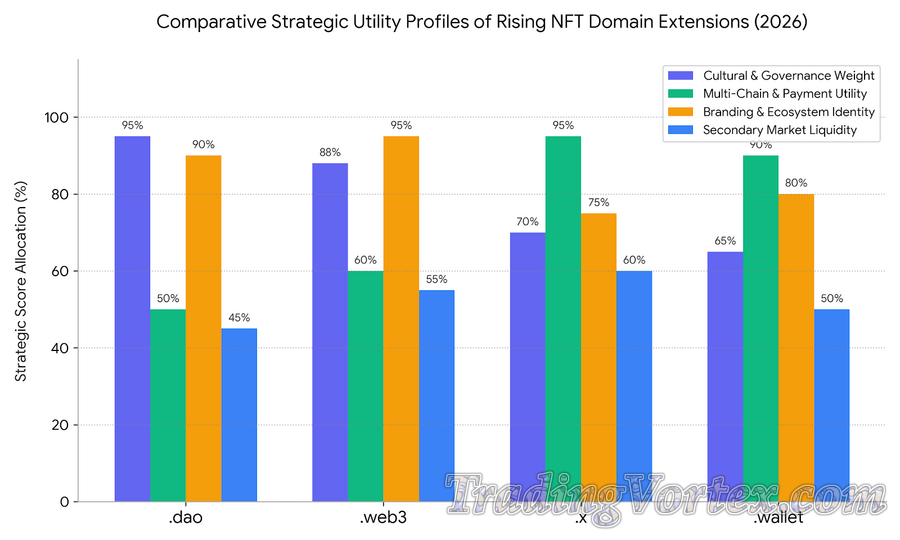
Clustered Bar Chart Comparing the Strategic Utility Profiles of Rising NFT Domain Extensions (.dao, .web3, .x, and .wallet) Across Key Metrics Including Cultural Weight, Multi-Chain Utility, Branding Potential, and Secondary Market Liquidity in 2026.
♦ Educational Explanation – How to Interpret and Utilize This Visual:
This clustered bar chart maps out the competitive profiles of emerging Web3 naming ecosystems (.dao, .web3, .x, and .wallet) by tracking their capabilities across four specialized pillars. While market giants like .eth dominate generalized identity, these secondary assets have carved out distinct architectural roles. Understanding their asymmetrical traits helps investors and developers make more targeted decisions.
♦ To get the most out of this visual representation, consider these core findings:
-
Ideological & Marketing Dominance (
.dao&.web3): Look at the purple and orange bars under.daoand.web3. These extensions lead in Cultural & Governance Weight ( for.dao) and Branding & Ecosystem Identity ( for.web3). If your project centers around decentralized finance protocols, voting platforms, or futuristic metaverse networks, these nodes signify high community resonance. They function like digital banners, immediately communicating organizational purpose to users. -
Functional & Transactional Backbone (
.x&.wallet): Shift your attention to the green bars under.xand.wallet. Here, the profiles flip to favor Multi-Chain & Payment Utility ( and respectively). While.xoperates as an open cross-chain handle that bridges isolated networks (like Ethereum and Solana),.walletprovides clear payment routing, converting complex cryptography strings into standard public invoice aliases. -
The Shared Risk Landscape (Secondary Market Liquidity): Notice the blue bars across all four extensions. Hovering noticeably lower ( to ) than the other parameters, this metric acts as a crucial cautionary guide. It signals that while these names possess strong individual use cases and are affordable ( to one-time fees), they suffer from lower liquidity. Quick exits via secondary flips are less reliable here than in deeply saturated name registries.
♦ Strategic Allocation Guide: Use this visualization to balance your portfolio. For immediate operational capabilities like cross-chain transfers or streamlined storefront payments, look to .x or .wallet. For brand building and community governance, choose .web3 or .dao. Given the lower liquidity scores across the board, the best approach is to lock down short, high-value keywords for the long haul, rather than expecting rapid, short-term turnover.
Ultimate Comparison of Top NFT Domain Extensions
Here’s the ultimate comparison table for all the best NFT domain extensions we’ve discussed. This table is designed to be a quick reference guide, highlighting the most important aspects traders and investors care about: ecosystem integration, ownership model, fees, use cases, risks, and investment appeal.
| Extension | Ecosystem Integration | Ownership Model | Fees | Primary Use Cases | Risks | Investment Appeal |
|---|---|---|---|---|---|---|
.eth |
Deep Ethereum integration, DeFi, dApps | Smart contract-based | Annual fees for some names | Payments, identity, dApps | Gas fees, phishing, privacy exposure | High adoption, premium resale value |
.crypto |
Unstoppable Domains, multi-chain support | NFT minted, lifetime | One-time purchase | Payments, decentralized websites, branding | Browser support limited, liquidity variance | Strong utility, cultural prestige |
.nft |
Cultural NFT identity, Unstoppable Domains | NFT minted, lifetime | One-time purchase | Branding, portfolios, identity | Liquidity still growing, speculative hype | Prestige-driven, niche appeal |
.sol |
Solana ecosystem, 150+ dApps | NFT minted | Very low fees | Wallets, dApps, decentralized sites | Limited cross-chain recognition | Affordable, fast-growing adoption |
.btc |
Namecoin, Handshake, Bitcoin legacy | Blockchain DNS | One-time or variable | Decentralized DNS, privacy, activism | Limited adoption, browser friction | Niche, symbolic value |
.dao |
DAO governance portals, community hubs | NFT minted | One-time purchase | Governance, collective identity | Niche demand, limited mainstream use | Cultural relevance, DAO legitimacy |
.web3 |
Web3 branding, metaverse projects | NFT minted | One-time purchase | Startups, metaverse, education | Speculative hype, uneven adoption | Branding potential, futuristic appeal |
.x |
Multi-chain wallet identity | NFT minted | One-time purchase | Cross-chain payments, unified identity | Adoption still growing | Utility-driven, strong future potential |
.wallet |
Payments, creators, dApps | NFT minted | One-time purchase | Wallet addresses, payments, tipping | Browser support limited | Practical, growing demand |
🎯 Why This Table Matters:
This table gives you a bird’s-eye view of the NFT domain landscape in 2026. Instead of reading through each section again, you can quickly compare which extension fits your goals: whether it’s utility (.eth, .crypto, .sol, .wallet), cultural prestige (.nft, .dao), or symbolic conviction (.btc).
For traders, this helps identify liquidity opportunities and premium names worth flipping. For long-term investors, it highlights which domains are infrastructure-level assets versus niche cultural plays.
Top Marketplaces to Buy NFT Domain Extensions
In 2026, the best marketplaces to buy NFT domain extensions are Unstoppable Domains, ENS, Solana Name Service, Handshake/Namecoin, and secondary trading platforms like OpenSea, Blur, and Magic Eden. Each offers unique strengths: Unstoppable Domains leads with lifetime ownership and multi-chain support, ENS dominates Ethereum identity, Solana Name Service thrives on low fees, and secondary platforms provide liquidity for resales.
Unstoppable Domains Marketplace
Unstoppable Domains has become the most mainstream gateway into NFT domains. With over 2.4 million domains registered and support for 275+ coins and tokens, it offers extensions like .crypto, .nft, .wallet, and .x. The platform’s one-time purchase model eliminates renewal fees, which is a huge relief for anyone who has ever lost a valuable .com domain because they forgot to renew.
- Strengths: User-friendly interface, lifetime ownership, multi-chain support.
- Use cases: Payments, decentralized websites, Web3 identity, branding.
- Why it matters: It’s the most accessible entry point for beginners and long-term investors, combining ease of use with cultural prestige.
Ethereum Name Service (ENS)
ENS is the gold standard of Web3 naming systems, deeply integrated into DeFi protocols, dApps, and Ethereum wallets. It is often referred to as the “.com of Web3” because of its cultural prestige and widespread adoption. ENS domains are managed through smart contracts, with annual fees for certain names, especially short or premium ones.
- Strengths: Deep Ethereum integration, cultural prestige, strong resale market.
- Use cases: Payments, decentralized identity, dApp integration, branding.
- Why it matters: ENS domains are infrastructure-level assets, making them highly desirable for traders and investors who want exposure to Ethereum’s ecosystem.
Handshake & Namecoin
Handshake and Namecoin are the pioneers of decentralized DNS, offering censorship-resistant domains like .btc. They appeal to decentralization purists and Bitcoin maximalists who value independence from centralized registrars. These platforms also introduced innovations like merged mining with Bitcoin and decentralized certificate validation.
- Strengths: True decentralization, censorship resistance, historical significance.
- Use cases: Privacy-focused websites, activist projects, decentralized certificate validation.
- Why it matters: Adoption is niche, but for those who value Bitcoin’s ethos,
.btcdomains are symbolic assets with cultural weight.
Solana Name Service Marketplace
The Solana Name Service (SNS) has exploded in popularity, with over 270,000 domains registered and integration across 150+ dApps. Thanks to Solana’s ultra-low fees, registering and managing .sol domains is cheap and fast, making them accessible to traders and developers alike.
- Strengths: Low fees, fast transactions, strong developer support.
- Use cases: Wallet address simplification, decentralized websites, identity branding.
- Why it matters: Perfect for anyone active in Solana’s ecosystem, where speed and affordability are key advantages.
Secondary NFT Domain Trading Platforms
Secondary marketplaces are where liquidity lives. They allow traders to buy, sell, and flip NFT domains, often at premium prices.
- OpenSea: The largest NFT marketplace, supporting ENS, Unstoppable Domains, and Solana domains.
- Blur: Popular among pro traders, offering analytics, liquidity tools, and faster trading mechanics.
- Magic Eden: Solana-native marketplace, strong for
.soldomain resales and community-driven trading. - Why they matter: These platforms provide resale opportunities and liquidity, making them essential for flipping premium names or finding rare domains.
Risks and Opportunities
- Opportunities: Lifetime ownership models, growing adoption across ecosystems, cultural prestige for premium names, and liquidity in secondary markets.
- Risks: Browser support limitations, phishing scams, uneven liquidity across extensions, and speculative hype. Always verify authenticity before purchasing, and remember that not every domain will appreciate in value.
🎯 Final Takeaway:
If you want ease of use and lifetime ownership, go with Unstoppable Domains. For Ethereum identity and prestige, choose ENS. If you are active in Solana, the SNS marketplace is your best bet. For decentralization purists, Handshake/Namecoin offers unmatched censorship resistance. And if you are looking to flip or trade premium names, secondary platforms like OpenSea, Blur, and Magic Eden provide the liquidity you need.
This marketplace landscape shows that NFT domains are no longer just speculative assets, they are becoming infrastructure for Web3 identity and payments. The choice of marketplace depends on your strategy: whether you want cultural prestige, utility, or trading opportunities.
📊 Strategic Evaluation Matrix of the Leading NFT Domain Marketplaces in 2026
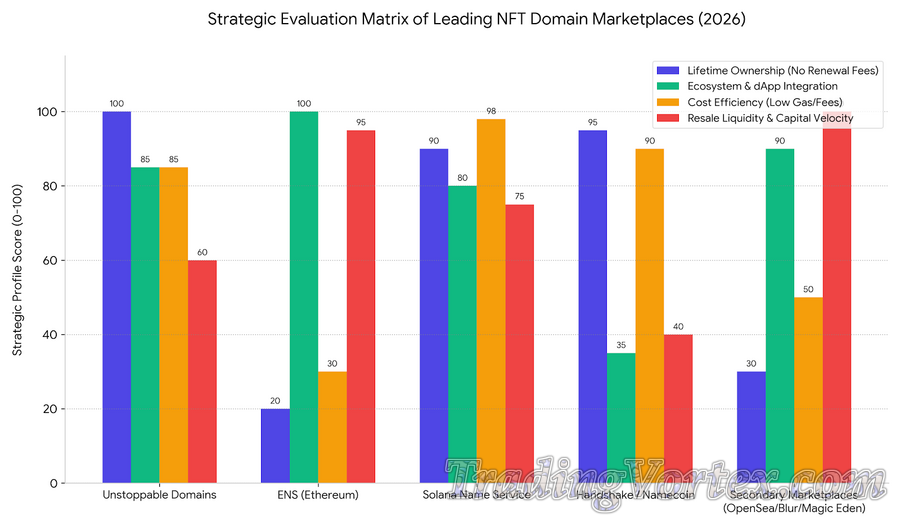
Clustered Bar Chart Providing a Strategic Evaluation Matrix of the Leading NFT Domain Marketplaces in 2026, Quantifying Platform Performance Across Lifetime Ownership, Ecosystem Integration, Cost Efficiency, and Resale Liquidity.
♦ Educational Explanation – How to Interpret and Utilize This Visual:
This clustered bar chart maps the primary acquisition networks for Web3 domains by rating their features on a scale from 0 to 100. Rather than simply pointing you to a marketplace, this visual chart isolates the core structural trade-offs of each ecosystem: Unstoppable Domains, ENS, Solana Name Service, Handshake/Namecoin, and Secondary Platforms (OpenSea, Blur, Magic Eden).
♦ Understanding these multi-colored profile metrics will help you align your platform selection with your specific crypto strategy:
-
The Predictable Infrastructure Plays (Unstoppable Domains & ENS): Unstoppable Domains hits an absolute ceiling with a score of 100 for Lifetime Ownership (purple bar), making it perfect if you want to buy an asset once and avoid regular renewal costs. In contrast, ENS scores a 100 for Ecosystem & dApp Integration (green bar), proving its status as the absolute gold standard for foundational Web3 identity, though its lower cost efficiency score (30) reflects ongoing yearly renewal commitments and Ethereum mainnet gas realities.
-
The High-Efficiency Networks (Solana Name Service & Handshake/Namecoin): Solana Name Service (SNS) stands out with a cost efficiency score of 98 (yellow bar), reflecting the ultra-low minting fees of the Solana network. For privacy advocates, Handshake and Namecoin balance structural Lifetime Ownership (95) and strong cost parameters (90), but their lower integration score (35) warns that their domains require technical workarounds or browser extensions to run smoothly.
-
The Trading Hubs (Secondary Marketplaces): Look at the red bar peaking at 100 on the far right. Specialized secondary storefronts like OpenSea, Blur, and Magic Eden act as the critical capital engine for the ecosystem. They provide unmatched Resale Liquidity & Capital Velocity, making them the go-to platforms if you want to flip premium assets, track active domain listings, or scout for high-value aftermarket handles.
♦ Strategic Action Plan: Match your buying choice to your final goal. If your priority is long-term, low-maintenance brand preservation, look to the left and leverage Unstoppable Domains. If you are looking to build immediate credibility within decentralized finance protocols, prioritize an ENS address. If you are a high-volume domain flipper looking for rapid cash turns on premium names, look to the far right and use Secondary Marketplaces to gauge market demand and secure deep, transactional liquidity.
NFT Domain Investment Trends in 2026
In 2026, NFT domain investments are shifting from speculative hype to utility-driven assets, with strong demand for Web3 identity, branding, and integration across wallets, dApps, and metaverse platforms. The market is recovering after the 2024–2025 correction, with trading volumes up 31% year-over-year and projections suggesting global NFT value could reach $45–46 billion by the end of 2026. Investors are no longer chasing quick flips, they are looking for domains that provide lasting utility and cultural relevance.
Growing Demand for Web3 Identity & Branding
NFT domains are increasingly being used as digital identity anchors. Instead of being speculative collectibles, they now serve as usernames, wallet handles, and brand identifiers across Web3 platforms. Digital identity NFTs account for 18% of trading volume, a sharp rise compared to the dominance of profile-picture collections in 2021–2022.
Permanent Ownership Appeal of NFT Domains
One of the biggest draws for investors is the lifetime ownership model offered by platforms like Unstoppable Domains. Unlike traditional domains that require annual renewals, NFT domains can be purchased once and held forever. This appeals to long-term investors who want to avoid recurring costs and the risk of losing valuable names due to missed renewals.
The NFT-as-a-Service (NFTaaS) market, projected to reach $3.6 billion by 2026, is also fueling adoption by making it easier for brands to launch NFT products without deep technical expertise. For traders, this means NFT domains are not just assets to hold, they are gateways into broader ecosystems where ownership translates into branding, payments, and identity.
Integration with Wallets, dApps, and Metaverse Platforms
NFT domains are now integrated into wallets, DeFi platforms, and metaverse ecosystems, making them functional assets rather than vanity items. For example:
- Wallets: Domains like
.ethor.walletsimplify crypto transfers, reducing errors and making transactions more intuitive. - dApps: ENS and Solana Name Service domains are used for governance, payments, and identity verification, embedding them into the daily operations of decentralized platforms.
- Metaverse: Domains serve as virtual storefronts and avatars, with NFT metaverse sales reaching $42 billion globally. Owning a domain like
gallery.nftorshop.solcan be the difference between being visible in the metaverse economy or fading into obscurity.
This integration is driving adoption among both retail users and institutions, as domains become part of the core Web3 infrastructure. For investors, this means domains are no longer speculative assets, they are functional tools with measurable utility.
Cultural & Prestige Value of Rare NFT Domain Extensions
Scarcity and cultural relevance remain powerful drivers. Just as short .com domains became premium assets in the early internet, rare NFT domains (short names, brand keywords, or culturally significant extensions like .nft or .dao) are commanding high resale values.
Blue-chip NFT assets like ENS domains are retaining prestige, while newer extensions such as .web3 and .x are gaining traction as symbols of innovation and futurism. Analysts describe this as a “K-shaped” market evolution: a small subset of domains and collections with real utility and cultural weight thrive, while speculative assets fade into irrelevance.
For traders, this means focusing on short, memorable names tied to active ecosystems. For long-term investors, it means recognizing that cultural prestige can be just as valuable as technical utility. Owning music.nft or dao.sol is not just about resale potential, it is about being part of the cultural narrative of Web3.
🎯 Final Takeaway:
NFT domain investments in 2026 are maturing into utility-driven assets. The days of flipping random names for quick profits are gone, replaced by a focus on identity, branding, and integration with Web3 infrastructure.
For traders, this means opportunities lie in premium names and domains tied to active ecosystems. For long-term investors, NFT domains represent digital real estate with cultural prestige and permanent ownership appeal.
In short, NFT domains are no longer just speculative bets, they are becoming the cornerstones of Web3 identity and commerce. Owning the right domain today could be like owning prime .com real estate in the 1990s: valuable, scarce, and essential for the digital future.
📊 Macro Investment Infrastructure Indicators & Market Trends (2026)
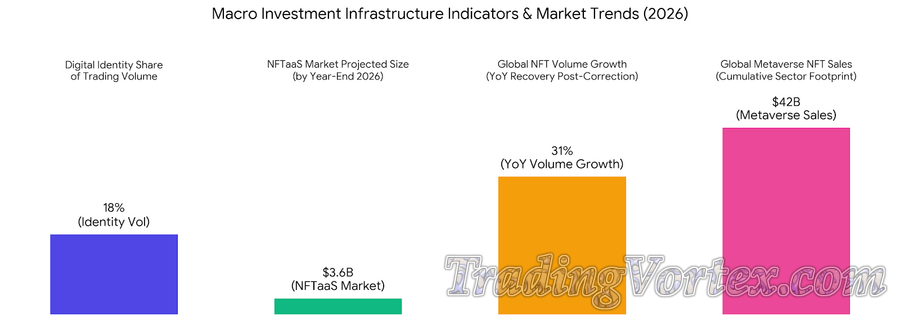
Multi-Panel Macro-Economic Indicator Matrix Quantifying the 2026 Shift into Utility-Driven NFT Assets across Identity Volume Share (), NFT-as-a-Service Infrastructure Valuation (), Year-over-Year Trading Volume Recovery (), and Global Metaverse Sales Infrastructure ().
♦ Educational Explanation – How to Interpret and Utilize This Visual:
This multi-panel dashboard synthesizes the key performance indicators (KPIs) defining the Web3 domain landscape in 2026. Rather than relying on historical hype, this chart extracts the macro data sets mentioned in our report to reveal how digital land has matured into a structural utility market following the 2024–2025 correction.
♦ By reading each data node left-to-right, you can analyze your investment decisions based on structural indicators:
-
Digital Identity Market Share (): The first panel establishes that nearly a fifth of total NFT transactional velocity is now commanded by decentralized identity primitives. This marks an evolutionary break from traditional profile-picture speculations. If you are a long-term investor, this metric highlights a sustained demand vector: users are actively buying handles to act as permanent, functional anchor profiles.
-
NFT-as-a-Service (NFTaaS) Projections (): The second indicator tracks corporate onboarding infrastructure. Reaching a projected billion by the close of 2026, the growth of non-technical enterprise minting platforms indicates that brands are aggressively buying and deploying extensions (like
.nftor.crypto) to anchor consumer trust, run tokenized loyalty programs, or publish digital wearables. -
Year-over-Year Trading Volume Recovery (): This metric confirms a definitive, utility-driven market revival. A increase in volume year-over-year demonstrates that capital is actively flowing back into the space. Crucially, this capital is no longer chasing speculative, temporary assets; it is focusing on highly functional naming protocols that resolve cleanly across active ecosystems.
-
Global Metaverse Sales Infrastructure (): The final panel frames the total addressable virtual retail layer. Because metaverse sales have scaled to billion globally, owning primary naming paths (such as
shop.solorgallery.nft) acts as premium digital real estate. These domains act as the search handles and storefront signs of virtual space, making premium name acquisition highly valuable.
♦ Strategic Investor Portfolio Action Plan: The visual data confirms a stark "K-shaped" market behavior where utility assets run laps around speculative ones. When allocating capital in 2026, avoid generic phrases or speculative combinations that carry no commercial application. Instead, protect your downside by securing premium, short, memorable domain names with immediate branding appeal or payment utility. These are the assets situated directly at the intersections of the multi-billion dollar enterprise, identity, and metaverse economies.
Challenges and Risks of Buying NFT Domain Extensions
NFT domains in 2026 are gaining traction as digital identity assets, but investors face real challenges: regulatory uncertainty, scams and phishing risks, weak royalty enforcement, and liquidity volatility. While the market is projected to reach $86 billion globally, buyers must balance opportunity with caution.
Regulatory Uncertainty Around NFT Domains
The Financial Action Task Force (FATF) has flagged NFTs, including domains, as potential vehicles for money laundering, tax evasion, and wash trading. This has prompted regulators worldwide to scrutinize NFT markets more closely. The challenge is that jurisdictions differ widely in how they classify NFT domains: some treat them as digital collectibles, others as virtual assets subject to AML/CFT rules, and a few are considering whether they should fall under securities law.
In the EU, regulators are debating whether NFT domains should be covered by the Markets in Crypto-Assets (MiCA) framework, while in the U.S., the SEC has hinted that certain NFT structures could be considered securities if they promise profit. Morocco and other emerging markets are still weighing how to categorize them, leaving investors in limbo.
For traders, this means rules can change quickly, impacting resale opportunities, taxation, and even ownership rights. The uncertainty is not just theoretical: it can directly affect liquidity and the ability to trade across borders.
Scams, Fraudulent Listings, and Phishing Risks
NFT domains are particularly vulnerable to fraudulent listings, impersonation, and phishing attacks. Fake marketplaces often mimic legitimate ones, tricking buyers into purchasing worthless assets or sending funds to malicious addresses. Even established providers like Unstoppable Domains have faced criticism when users discovered that “unstoppable” resolution could be disabled under certain conditions, raising questions about decentralization.
Browser support adds another layer of risk. Only Brave and Opera natively resolve NFT domains, while Chrome and Safari require extensions. This creates confusion for mainstream users and opens the door for exploitation. Traders have reported losing funds by mistyping wallet-linked domains, a painful reminder that while human-readable names reduce errors, they don’t eliminate risk entirely.
Phishing attacks are also evolving. Malicious actors register lookalike domains (for example, swapping an “l” for an “I”) to trick users into sending funds to the wrong wallet.
For investors, vigilance is essential: double-checking domain authenticity and using trusted marketplaces can save thousands of dollars.
Royalty Enforcement Issues in Secondary Markets
On secondary platforms like OpenSea, Blur, and Magic Eden, royalty enforcement for NFT domains is inconsistent. Sellers can bypass royalties, depriving creators or registrars of revenue. This undermines trust and complicates valuation, since buyers cannot be sure whether royalties will apply on resale.
For investors, this means factoring in uncertain transaction costs when calculating potential profits. A domain that looks profitable on paper may yield less if royalties are unexpectedly applied; or more if they are bypassed. The lack of standardized enforcement also discourages creators from innovating, since they cannot guarantee long-term revenue streams.
Liquidity Concerns and Resale Value Volatility
Liquidity remains one of the biggest challenges in the NFT domain market. While premium names (short identifiers, brand keywords, or culturally significant terms) can command high resale prices, resale activity is concentrated in a handful of extensions. ENS dominates Ethereum with over 1.6 million registered names, but other extensions like .dao, .web3, or .wallet are still niche.
In 2025 alone, 3.3 million blockchain domains were registered, signaling strong demand, yet trading volumes fluctuate with broader NFT sentiment. When the NFT market cooled in 2024, domain resales dropped sharply, only to rebound in 2026 as utility-driven assets gained traction. Investors should expect volatility in resale values, with some domains appreciating significantly while others stagnate or even lose value.
Liquidity fragmentation across platforms is another issue. A domain listed on OpenSea may not attract buyers if most of the community trades on Blur or Magic Eden. This makes it harder to exit positions quickly, especially for non-premium names.
🎯 Final Takeaway:
Buying NFT domains in 2026 offers real utility, cultural prestige, and long-term potential, but the risks are tangible. Regulatory frameworks are evolving, scams remain common, royalties are inconsistently enforced, and liquidity is far from guaranteed.
For traders, the safest strategy is to focus on extensions with proven adoption (.eth, .crypto, .sol) and short, brandable names that carry both utility and cultural weight.
NFT domains are digital real estate, but like any property market, not every plot is worth buying. The key is to balance enthusiasm with caution, diversify across ecosystems, and remember that in Web3, owning the keys is only half the battle; protecting them is the other half.
📊 Risk Matrix Evaluation of NFT Domain Investments (2026)
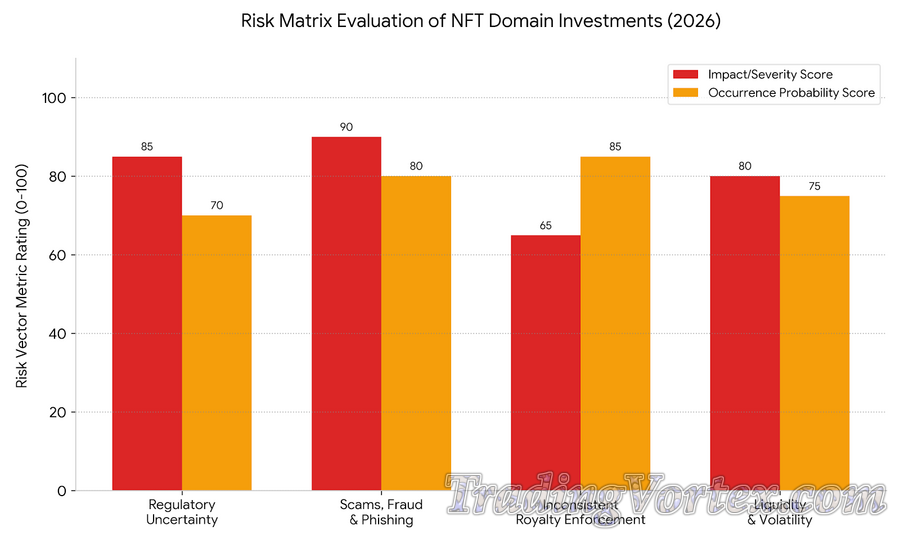
Clustered Bar Chart Providing a Comparative Risk Matrix of NFT Domain Investments in 2026, Evaluating Regulatory Uncertainty, Security Exploits, Secondary Royalty Variances, and Volatility Across Severity and Probability Indexes.
♦ Educational Explanation – How to Interpret and Utilize This Visual:
This clustered bar chart maps out the primary risk variables associated with buying and trading Web3 domain extensions. To give you an objective view of the market, each core vulnerability is measured across two distinct benchmarks: Impact/Severity (red bars), which shows how much financial or operational damage an issue can cause, and Occurrence Probability (amber bars), which tracks how likely you are to encounter the problem in the wild.
♦ Reviewing the risk vectors from left to right yields several key takeaways:
-
High-Impact Blindspots (Regulatory Uncertainty): Regulatory shifting scores a high Severity of . While global frameworks like the EU's MiCA or SEC classifications are still developing, a sudden shift in how your domain is categorized can immediately limit your ability to sell or trade it across borders. However, because these policy changes take time to implement, the immediate Probability remains moderate at .
-
The Dangerous Threat Vector (Scams, Fraud & Phishing): This category represents your highest operational risk, with an alarming Severity of and a high Probability of . Because lookalike domains and fraudulent listings are highly convincing, a single typo or phishing error can lead to a complete loss of capital. This underscores the need to manually double-check contract addresses and always purchase through verified registries.
-
The Margin Squeeze (Inconsistent Royalty Enforcement): This issue presents a unique trend where Probability () is higher than Severity (). Because secondary marketplaces like OpenSea, Blur, and Magic Eden treat royalties differently, you are highly likely to encounter varying fee structures. While this won't break your portfolio, it introduces unpredictable transaction costs that you must factor into your expected resale margins.
-
The Capital Trap (Liquidity & Volatility): Scoring balanced marks across Severity () and Probability (), this metric highlights the uneven nature of the domain market. While premium, short names in established registries (like
.ethor.sol) retain consistent interest, long-tail or niche extensions face quiet secondary markets, meaning your capital could be locked up in illiquid digital real estate for months.
♦ Risk Mitigation Action Plan: To protect your capital, treat your Web3 domains like long-term infrastructure assets rather than short-term instruments for quick flips. Mitigate your security risks by only routing transactions through native Web3 browsers or verified plugins, and focus your capital on high-liquidity blue-chip extensions like .eth, .crypto, or .sol. By prioritizing short, highly brandable words over speculative, generic phrases, you can maximize your long-term utility value while insulation your portfolio from broader market volatility.
How to Choose the Best NFT Domain Extension
In 2026, choosing the best NFT domain extension comes down to ecosystem adoption, marketplace reliability, long-term utility, and balancing prestige with practicality. Extensions like .eth and .crypto dominate in utility and liquidity, while newer ones like .dao or .web3 offer cultural relevance but carry higher risk. The decision is less about chasing hype and more about aligning your investment with your goals, whether that’s payments, branding, or community identity.
Evaluate Ecosystem Adoption & Utility
The most important factor is ecosystem adoption. A domain is only as useful as the platforms that recognize it. .eth remains the heavyweight, integrated into Ethereum wallets, DeFi platforms, NFT marketplaces, and even decentralized social apps. If you’re active in Ethereum, owning a .eth name is almost mandatory.
.crypto has carved out its niche with Unstoppable Domains, offering multi-chain support and lifetime ownership. .sol thrives in Solana’s fast, low-fee ecosystem, making it ideal for traders who move assets frequently.
By contrast, newer extensions like .dao or .web3 are culturally relevant but less widely supported. They shine in branding and community identity but may not yet have the same liquidity or integration.
Tip: Match your domain to your ecosystem. If you’re transacting daily in Ethereum, .eth is the safest bet. If you’re building a DAO, .dao makes sense even if adoption is smaller.
Check Marketplace Reliability & Security
Where you buy matters as much as what you buy. Unstoppable Domains is known for its one-time purchase model, eliminating renewal fees. ENS uses smart contracts, with annual fees for certain names, especially short or premium ones.
Secondary marketplaces like OpenSea, Blur, and Magic Eden provide liquidity, but they also carry higher risks of scams, fraudulent listings, and phishing attacks. Fake domains or lookalike names can trick even seasoned traders.
Key considerations:
- Always verify authenticity before buying.
- Stick to established providers like ENS, Unstoppable Domains, or Solana Name Service.
- Check royalty enforcement policies, since inconsistent rules can affect resale profitability.
Consider Long-Term Utility of NFT Domains
NFT domains are more than vanity assets. They are evolving into functional infrastructure:
- Wallet address simplification: Replace long hexadecimal strings with human-readable names.
- Decentralized websites: Host content on IPFS or Sol.site, creating censorship-resistant hubs.
- Cross-chain identity: Extensions like
.xunify multiple blockchain addresses under one name, making them future-proof in a multi-chain world.
Ask yourself: will this domain still be useful in five years? Extensions tied to active ecosystems (.eth, .crypto, .sol) are safer bets. Speculative ones may fade if adoption stalls, leaving you with a digital vanity plate no one recognizes.
Balance Prestige vs Practicality in NFT Domain Investments
Scarcity and cultural prestige are powerful drivers. Owning .nft signals credibility in NFT culture, while .dao shows alignment with decentralized governance. These domains carry symbolic weight, even if their utility is limited.
On the other hand, practical extensions like .wallet or .sol provide immediate functionality. They simplify payments, integrate into dApps, and reduce friction in everyday transactions.
Investor mindset:
- Prestige-driven domains are like luxury assets: valuable if culture embraces them.
- Utility-driven domains are like infrastructure: valuable because they solve real problems.
Smart investors often diversify, holding both prestige names for cultural relevance and utility names for functional use.
🎯 Final Takeaway:
Choosing the best NFT domain extension in 2026 is about matching your goals with the right ecosystem. If you want utility and liquidity, go for .eth, .crypto, or .sol. If you want cultural relevance and branding, consider .nft, .dao, or .web3. Always buy from reliable marketplaces, verify authenticity, and think long-term.
NFT domains are digital real estate. Some plots are prime locations with guaranteed traffic, others are trendy neighborhoods that may or may not thrive. The smartest investors diversify across both, securing names that provide immediate utility while also betting on cultural prestige that could define the next wave of Web3 identity.
📊 Strategic Selection Matrix for NFT Domain Extensions in 2026
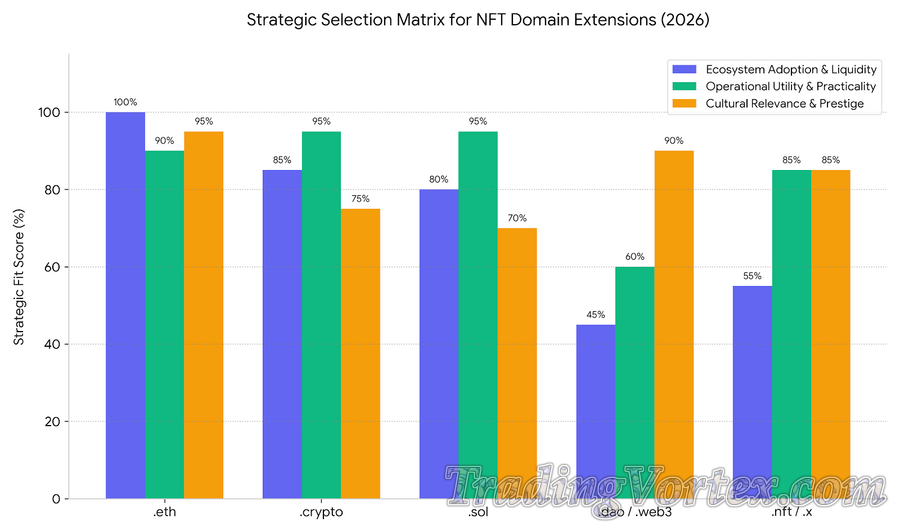
Clustered Bar Chart Illustrating the Strategic Selection Matrix for NFT Domain Extensions in 2026, Profiling Leading Naming Systems Across Ecosystem Adoption, Operational Utility, and Cultural Prestige.
♦ Educational Explanation – How to Interpret and Utilize This Visual:
This clustered bar chart serves as a practical, data-backed selection framework designed to help you align your Web3 domain purchases with your personal or organizational objectives. Rather than chasing short-term market hype, you can utilize this three-dimensional index to evaluate options across three key core variables: Ecosystem Adoption & Liquidity (purple bars), Operational Utility & Practicality (green bars), and Cultural Relevance & Prestige (orange bars).
♦ To maximize your strategic efficiency when building a digital real estate portfolio, focus on these critical trends:
-
The Blue-Chip Powerhouses (
.eth,.crypto, and.sol): If your goal is safety, immediate transactional utility, and high secondary market liquidity, look to the left side of the chart..ethstands as the undisputed network heavyweight, hitting a maximum score of for Ecosystem Adoption & Liquidity due to its deep integration across Ethereum dApps and wallets. Meanwhile,.cryptoand.solclaim leading operational scores () because they solve real, everyday problems: such as Unstoppable Domains' one-time payment structure and Solana’s ultra-cheap, lightning-fast payment routing. -
The Cultural Disruptors (
.daoand.web3): Look closely at the fourth cluster. While newer identifiers like.daoand.web3see significantly lower baseline adoption and marketplace liquidity (), they spike sharply to a rating in Cultural Relevance & Prestige. These are not meant to be high-frequency trading vehicles; instead, they function beautifully as community badges and organization-level branding assets for collective governance. -
The Hybrid Identity Layer (
.nftand.x): The final cluster shows a highly balanced, forward-looking utility model. Scoring a strong across both Operational Utility and Cultural Prestige, these extensions cater directly to multi-chain wallet handles and virtual metaverse storefronts. They offer a versatile middle ground for creators who want modern branding without sacrificing cross-platform function.
♦ Strategic Framework Application: Don't treat all extensions the same. If you are handling high-volume, cross-chain everyday crypto transactions, focus your capital on infrastructure-level properties like .eth, .sol, or .crypto. If you are looking to build corporate credibility or establish a digital hub in the metaverse, look to the right and secure niche-specific premium anchors like .nft, .x, or .dao. Diversifying across both columns will ensure your digital real estate portfolio balances immediate utility with long-term cultural upside.
Future of NFT Domain Extensions
NFT domain extensions in 2026 are evolving into mainstream Web3 infrastructure, with adoption driven by AI integration, metaverse identity systems, and cross-chain interoperability. Analysts project the global NFT market could reach $45–50 billion this year, with domains positioned as both digital identity tools and long-term investment assets.
Mainstream Adoption of Web3 Domains
NFT domains are steadily moving from niche crypto circles into mainstream Web3 identity systems. Platforms like ENS and Unstoppable Domains have already registered millions of names, and adoption is accelerating as businesses secure domains for branding, payments, and customer engagement. Major brands in fashion, gaming, and entertainment are experimenting with NFT domains as their Web3 storefronts, signaling that this technology is no longer just for early adopters.
Analysts describe the market as “K-shaped”: speculative projects are fading, while utility-driven assets like NFT domains thrive. This consolidation strengthens the sector, making NFT domains more reliable as long-term infrastructure.
For everyday users, this means NFT domains are becoming as essential as email addresses once were: tools for communication, identity, and commerce.
Integration with AI, Metaverse, and Digital Identity Systems
AI is reshaping how NFT domains are bought, sold, and valued. In 2026, AI-driven auctions, fraud detection, and dynamic pricing tools are standard, helping buyers avoid scams and ensuring fairer valuations based on sentiment, transaction history, and on-chain data.
Meanwhile, metaverse platforms and Web3 social apps are adopting NFT domains as usernames, storefronts, and avatars. Imagine walking into a virtual mall where every shop is tied to a domain like brand.nft or artist.sol. Soulbound tokens (SBTs) are also emerging, linking NFT domains to verifiable credentials such as education, professional achievements, or gaming milestones. This transforms domains into digital passports, carrying identity and reputation across platforms.
For traders, this integration means domains are no longer vanity assets: they are functional identity layers in AI-powered and metaverse-driven economies.
Cross-Chain NFT Domain Extensions & Interoperability
One of the biggest breakthroughs in 2026 is cross-chain interoperability. Protocols like LayerZero and Axelar now allow seamless trading of NFTs across Ethereum, Solana, and Bitcoin layers. For NFT domains, this means a single name can map to multiple wallets across chains, solving one of the biggest pain points in Web3 identity.
Cross-chain trading already accounts for 40% of NFT volume, and multi-chain domains like .x are positioned to benefit most from this trend. This interoperability ensures that domains are not siloed within one ecosystem, but instead act as universal identifiers across chains.
For investors, this opens up new opportunities to capture value in multi-chain environments, where liquidity and adoption are more evenly distributed.
NFT Domains as Digital Assets & Investment Vehicles
NFT domains are increasingly viewed as digital real estate. Premium names (short identifiers, brand keywords, or culturally significant extensions) retain strong resale value, much like prime .com domains did in the early internet.
Dynamic royalty enforcement introduced in 2026 ensures creators benefit from secondary sales, making the ecosystem more sustainable. Analysts project the NFT market could rebound to $45 billion by the end of 2026, with domains playing a central role in this growth.
For investors, this means NFT domains are shifting from speculative flips to long-term assets with utility, prestige, and cultural relevance.
Some traders are already treating NFT domains as portfolio anchors, diversifying across extensions like .eth for liquidity, .crypto for utility, and .nft or .dao for cultural prestige. This hybrid strategy reflects the growing maturity of the market.
🎯 Final Takeaway:
The future of NFT domain extensions lies in mainstream adoption, AI-powered marketplaces, metaverse integration, and cross-chain interoperability. They are evolving into digital identity anchors and investment vehicles, offering both cultural prestige and functional utility.
For traders, this means opportunities in flipping premium names across ecosystems. For long-term investors, it means securing domains that will serve as cornerstones of Web3 identity and commerce.
In short, NFT domains are no longer just speculative assets: they are becoming the URLs of the decentralized internet, with the potential to define how we interact with digital economies for years to come.
📊 Strategic Pillar Readiness Matrix for the Future of NFT Domain Infrastructure in 2026
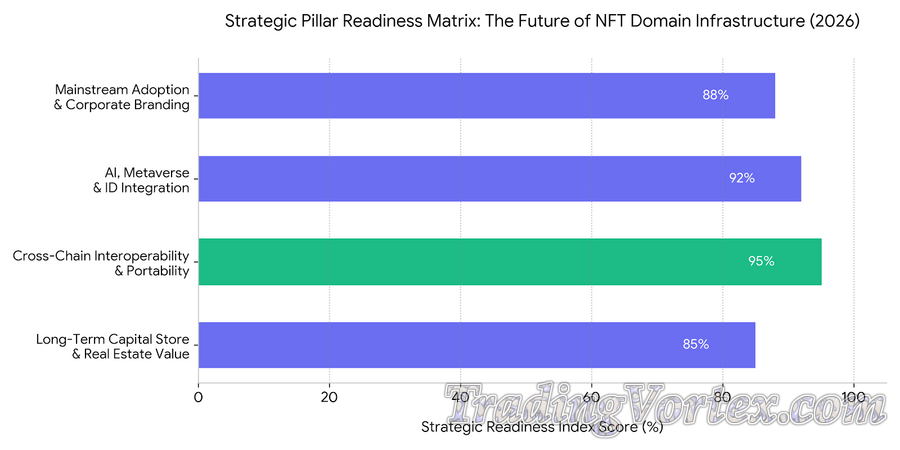
Horizontal Bar Chart of the Strategic Pillar Readiness Matrix for the Future of NFT Domain Infrastructure in 2026, Quantifying Technological Maturity and Adoption Readiness Across Cross-Chain Portability (), AI and Metaverse Integration (), Mainstream Corporate Branding (), and Long-Term Capital Retention ().
♦ Educational Explanation – How to Interpret and Utilize This Visual:
This horizontal bar chart illustrates the structural forces transforming Web3 naming systems from speculative digital novelties into institutional infrastructure. By quantifying each core growth engine on a Strategic Readiness Index Score (%), the visual highlights where the industry is consolidating capital and building technical utility.
♦ Analyzing the key dimensions from top to bottom reveals important trends for navigating the market:
-
Cross-Chain Interoperability & Portability ( — Highlighted in Mint Green): This metric represents the strongest structural driver in the current landscape. Enabled by foundational omni-chain protocols like LayerZero and Axelar, modern NFT domains have broken free from isolated blockchains. Because a single name can now seamlessly bridge and map assets across Ethereum, Solana, and Bitcoin architectures (powering over 40% of all current NFT transaction volume) interoperability is the single most vital component of future proofing your assets.
-
AI, Metaverse & ID Integration (): The second bar reflects the merging of decentralized domains with automated systems. Rather than serving as static address shorteners, domains function as dynamic digital passports. They utilize AI-backed algorithmic pricing models and secure cross-platform authentication to power virtual real estate storefronts and verifiable credentials across immersive 3D metaverse ecosystems.
-
Mainstream Adoption & Corporate Branding (): This metric tracks corporate migration into Web3. As the market develops a defined "K-shape" consolidation trend, legacy enterprises in the gaming, luxury, and entertainment sectors are liquidating speculative investments to lock down native identity hooks (like
brand.nftorcompany.crypto). This structural shift establishes a highly stable corporate floor under utility-driven name registries. -
Long-Term Capital Store & Real Estate Value (): The final pillar demonstrates how investors are mirroring traditional
.comreal estate plays. Supported by standard dynamic royalty enforcement features on secondary layers, premium keywords and short identifiers are behaving less like erratic tokens and more like predictable, long-term portfolio anchors.
♦ Strategic Portfolio Implementation: The data suggests shifting from short-term speculative flipping to a utility-focused approach. When building your digital asset portfolio, focus your capital on highly liquid registries that feature deep cross-chain functionality. Look for short, recognizable keywords that match active enterprise ecosystems, as these will serve as the essential, functional URLs of the decentralized web.
Conclusion: Best NFT Domain Extensions to Buy in 2026
Top Picks for Investors
| Extension | Why buy it now | Quick risk note |
|---|---|---|
.eth |
Deep Ethereum integration, largest liquidity pool, widely supported by wallets and dApps. Best for traders who need resale markets and DeFi utility. | Gas fees and annual registration costs can add up. |
.crypto |
One‑time purchase, multi‑chain resolution, strong UX for payments and decentralized sites. Great for long‑term brand owners. | Browser support and marketplace fragmentation reduce short‑term liquidity. |
.sol |
Ultra‑low fees and fast transactions on Solana, growing developer adoption. Ideal for frequent traders and game/metaverse projects. | Cross‑chain recognition still limited. |
.nft |
Cultural prestige for creators and galleries, strong branding signal. Perfect for identity in the NFT community. | More niche demand, resale depends on cultural trends. |
.btc |
Symbolic, censorship‑resistant, rooted in early blockchain naming experiments. Buy if you value decentralization and Bitcoin culture. | Adoption and browser support are the weakest of the group. |
Balancing Risks and Opportunities
- Match extension to your use case: If you trade actively, prioritize liquidity and integration (
.eth,.sol). If you want a permanent brand hub, prioritize one‑time ownership (.crypto). - Security matters: Always use hardware wallets, verify marketplace listings, and double‑check lookalike domains to avoid phishing. Secondary markets can be lucrative, but scams are common.
- Cost calculus: Factor in gas and renewal fees for ENS versus one‑time costs for Unstoppable Domains when modeling ROI.
Positioning for the Future of Decentralized Identity
- Diversify across roles: Hold at least one utility domain (.eth or .sol) and one branding domain (
.nftor.crypto). This hedges liquidity needs against cultural upside. - Watch interoperability: Cross‑chain resolution and multi‑address mapping are accelerating. Domains that support multi‑chain records will gain value as users expect a single identity across chains.
- Think long term: Treat premium names as digital real estate. Short, memorable names tied to brands or keywords are the most likely to retain value as Web3 identity matures.
Final Practical Checklist Before You Buy
- Confirm marketplace authenticity and on‑chain ownership.
- Test resolution in your wallet and browser.
- Secure keys with hardware wallets and backups.
NFT domains in 2026 are no longer just speculative assets, they are becoming the URLs of the decentralized internet. Whether you are a trader chasing liquidity, a brand building presence, or an investor looking for cultural prestige, the right extension can serve as both a practical tool and a long‑term investment. Think of them as digital plots of land: some are already bustling city centers, others are emerging neighborhoods with potential. The smartest portfolios balance both, securing names that deliver immediate utility while betting on cultural relevance that could define the next wave of Web3 identity.
📊 Strategic Asset Portfolio Matrix: Top 5 Web3 Domain TLDs Compared (2026)
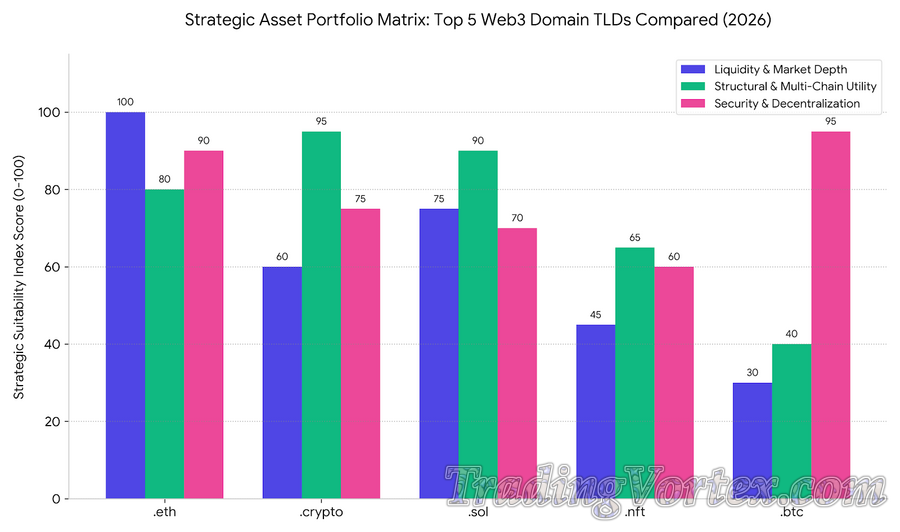
This clustered bar chart serves as a concise asset-allocation matrix designed to help you construct a balanced Web3 domain portfolio. Rather than looking at these extensions as identical assets, this chart breaks them down across three distinct investment pillars: Liquidity & Market Depth (purple bars), Structural & Multi-Chain Utility (green bars), and Security & Decentralization (pink bars).
By reading the asset profiles from left to right, you can easily pick the top extensions that match your specific investment or operational goals:
-
The Market Anchor (
.eth): If you prioritize deep liquidity, active secondary market trading, and decentralized finance (DeFi) compatibility,.ethis the clear market leader. It secures a maximum score of in Liquidity due to its massive, active marketplace pool. However, remember to factor periodic gas fees and recurring renewal overhead into your long-term ROI calculations. -
The Permanent Infrastructure Play (
.crypto): For investors looking for a long-term brand hub without ongoing maintenance costs,.cryptoshines with a leading Utility score of . This high score reflects its lifetime ownership design (no renewal fees) and its robust multi-chain routing architecture. Its secondary liquidity remains lower () because trading volume is more fragmented across platforms. -
The High-Velocity Alternative (
.sol): Sitting directly in the middle,.solbalances strong Utility () with healthy Liquidity (). This makes it an ideal fit if you are looking for rapid, ultra-low-fee transactions or want to participate in fast-moving Web3 gaming and metaverse ecosystems. -
The Cultural & Community Speculators (
.nftand.btc): The final two columns represent more specialized plays. While.nftacts as a strong branding signal within creator communities, its demand is closely tied to changing cultural trends ( liquidity). On the other hand,.btcscores a commanding in Security & Decentralization because it is built straight into Bitcoin’s legacy layer; however, it has the lowest current liquidity profile (), making it a patient hold for decentralization purists.
♦ Strategic Portfolio Recommendation: The data supports a hybrid diversification strategy. To insulate your capital from market swings while positioning for future upside, consider pairing a high-liquidity blue chip (like .eth or .sol) with a zero-maintenance branding anchor (like .crypto or .nft). This approach ensures you maintain immediate cross-chain utility while holding rare digital real estate that can capture long-term value as the decentralized internet matures.
FAQs: Top NFT Domain Extensions to Buy
NFT domains in 2026 are becoming mainstream tools for Web3 identity, payments, and branding, but many newcomers still have questions about how they work, where to buy them, and what risks to watch out for. Below is a detailed FAQs section that covers the essentials, blending the latest insights with practical advice for traders and investors.
What exactly is an NFT domain?
An NFT domain is a blockchain-based domain name minted as a non-fungible token. Unlike traditional domains (like .com) that you rent from registrars, NFT domains are owned outright and stored in your crypto wallet. They can be used as human-readable wallet addresses, decentralized websites, or digital identity handles across dApps and metaverse platforms.
Which providers are the most trusted in 2026?
The two biggest players are:
♦ Ethereum Name Service (ENS): Manages .eth domains, with over 1.6 million registered names and deep integration into DeFi and Ethereum wallets.
♦ Unstoppable Domains: Offers .crypto, .nft, .wallet, .x, .dao, and more, with lifetime ownership and no renewal fees.
Other ecosystems include Solana Name Service (.sol) and Handshake/Namecoin (.btc) for Bitcoin-linked domains.
Do NFT domains have renewal fees?
It depends:
♦ ENS (.eth) requires annual fees for certain names, especially short or premium ones.
♦ Unstoppable Domains (.crypto, .nft, .wallet, .x) are one-time purchases, meaning you own them forever.
♦ Solana Name Service (.sol) charges minimal fees thanks to Solana’s low-cost transactions.
Can I build a website with an NFT domain?
Yes, but with limitations. NFT domains can point to content hosted on IPFS or decentralized storage networks, allowing you to create censorship-resistant websites. However, these sites are not always indexed by Google and may require Web3-enabled browsers like Brave or Opera for smooth access.
Are NFT domains safe from scams?
NFT domains reduce errors in crypto transfers, but scams still exist. Common risks include:
♦ Phishing attacks using lookalike domains (e.g., swapping “l” for “I”).
♦ Fraudulent listings on secondary marketplaces.
♦ Resolution issues if providers disable support.
Tip: Always verify authenticity, use hardware wallets, and buy from trusted providers.
Can I resell NFT domains for profit?
Yes, NFT domains are actively traded on secondary marketplaces like OpenSea, Blur, and Magic Eden. Premium names (short identifiers, brand keywords, or culturally relevant extensions) can command high resale prices. However, liquidity varies by extension: .eth and .crypto are the most liquid, while newer ones like .dao or .web3 are still niche.
What are the biggest challenges in 2026?
♦ Regulatory uncertainty: Different jurisdictions classify NFT domains differently, creating compliance risks.
♦ Browser support: Limited native support outside Brave and Opera.
♦ Liquidity volatility: Resale values fluctuate with broader NFT market sentiment.
♦ Royalty enforcement: Inconsistent across secondary marketplaces, affecting resale profitability.
Which NFT domain extensions are best to buy now?
♦ .eth: Best for Ethereum users and DeFi traders.
♦ .crypto: Strong for multi-chain payments and branding.
♦ .sol: Affordable and fast, ideal for Solana ecosystem users.
♦ .nft: Cultural prestige for creators and collectors.
♦ .btc: Symbolic value for Bitcoin maximalists and decentralization purists.
🎯 Final Note:
NFT domains are digital real estate for Web3, combining identity, payments, and branding in one asset.
The smartest investors diversify: hold utility-driven domains like .eth or .crypto for liquidity, and prestige-driven ones like .nft or .dao for cultural relevance. Think of them as buying land in both the bustling city center and the trendy new neighborhood: you cover today’s needs while betting on tomorrow’s growth.