
How to Stake Your NFTs Safely is your complete guide to navigating the fast‑growing world of NFT staking in 2026. Whether you’re a beginner curious about turning your digital collectibles into passive income or an experienced trader looking to maximize rewards without falling into common traps, this article breaks down everything you need to know.
You’ll learn what NFT staking is, why safety matters more than ever, and how to identify the safest platforms with audited smart contracts and transparent governance. The guide explores the benefits of staking, from earning APY and exclusive perks to unlocking liquidity through DeFi, while also highlighting the risks and challenges such as phishing scams, cross‑chain vulnerabilities, and volatile reward tokens.
To help you stake with confidence, the article provides a step‑by‑step safety checklist, practical security best practices, and insights into emerging trends like real‑world asset staking, DAO governance, EigenLayer restaking, and AI‑powered security tools. A detailed FAQ section answers the most common questions about profitability, wallets, taxation, and risk management, making the content accessible for traders and investors at all levels.
Written in a clear, approachable tone, this guide blends expert knowledge with relatable examples, ensuring readers feel informed and empowered. By the end, you’ll know how to balance rewards with risk, protect your NFTs, and position yourself for long‑term success in Web3.
Why You Should Keep an Eye on “Mythic Piece” – A New NFT Experience Like No Other:
The NFT space is constantly evolving, but few projects truly break the mold. “Mythic Piece” is one of those rare gems – a project shrouded in mystery, yet undeniably intriguing. While many NFT collections simply offer digital assets, “Mythic Piece” hints at something far more immersive and dynamic.
This is not just another collection; it's the beginning of an adventure. The project is designed to unveil its secrets over time, rewarding those who engage early and follow its development. If you have an eye for innovation in the NFT world, this is something you won’t want to miss.
To get a first glimpse of the journey ahead, watch the official launch video: “Awaken! Rise! – The Mythic Pieces Call... Will You Answer?!”
This short yet powerful teaser sets the tone for what’s to come: an experience that promises to go beyond the ordinary.
For now, details remain scarce, adding to the project's allure. But what we do know is that “Mythic Piece” is set to offer an experience unlike anything seen before in the NFT space. With its unique vision this could be one of the most exciting projects to emerge.
The best way to stay ahead? Follow “👑 Mythic Piece 🔱” on:
- X.com: https://x.com/mythicpiece
YouTube: https://www.youtube.com/@MythicPiece
TikTok: https://www.tiktok.com/@mythic_piece
And if you want to secure a place in this unfolding journey, now’s your chance – the Whitelist is still open, offering lucky participants a chance for free minting.
The adventure is only just beginning. Will you be part of it?
Table of Contents:
- Introduction to NFT Staking Safety
- What is NFT Staking?
- Benefits of NFT Staking
- Risks and Challenges of NFT Staking
- How to Stake NFTs Safely: Step-by-Step Guide
- Step 1: Research NFT Staking Platforms Carefully
- Step 2: Use Hardware Wallets and Cold Storage for NFT Security
- Step 3: Verify Smart Contracts and Platform Audits
- Step 4: Understand NFT Staking Rewards and Lock-Up Terms
- Step 5: Diversify NFT Staking Across Platforms and Assets
- Step 6: Monitor NFT Staking Performance and Risks Regularly
- Safest NFT Staking Platforms in 2026
- Binance NFT: Security-First Marketplace with Audited Contracts
- NFTX: Safe Vaults for Blue-Chip NFTs
- Aavegotchi: Community-Driven Safety on Polygon
- LooksRare & Rarible: Multi-Chain Platforms with Verified Listings
- Illuvium & Splinterlands: GameFi Ecosystems with Strong Security Layers
- Zed Run & Music NFT Platforms: Niche Staking with Safety Controls
- Safest NFT Staking Platforms in 2026: Comparison Table
- Security Best Practices for NFT Staking
- Emerging Trends in NFT Staking
- Conclusion: Safe NFT Staking for Long-Term Success
- FAQs: How to Stake Your NFTs Safely
- Q1. Is NFT staking profitable in 2026?
- Q2. What rewards can I expect from staking NFTs?
- Q3. What are the biggest risks of NFT staking?
- Q4. Do I need special wallets or tools to stake NFTs?
- Q5. Should I buy NFTs just for staking?
- Q6. How are NFT staking rewards taxed?
- Q7. What’s the safest way to stake NFTs?
Introduction to NFT Staking Safety
What is NFT Staking and Why Safety Matters
NFT staking is the process of locking your non-fungible tokens into a platform or smart contract to earn rewards. These rewards can be tokens, governance rights, in-game assets, or even shares of platform revenue. It’s like putting your NFTs to work instead of letting them sit idle in your wallet.
The appeal is obvious: instead of selling your NFT, you can generate passive income while still holding onto it. But here’s the catch: staking requires trust in the platform’s smart contracts and reward system. If those contracts are flawed or the rewards are inflated, you could lose more than you gain. Unlike fungible tokens, NFTs are unique; losing one is like losing a one-of-a-kind collectible.
Think of it like lending out your prized guitar. If you trust the person, you might get it back in perfect condition with a new set of strings. If you don’t, you risk losing something irreplaceable. NFT staking works the same way: choose the wrong platform, and you could lose your asset forever.
NFT Staking in 2026: Opportunities and Risks for Investors
The NFT market has matured far beyond profile pictures. In 2026, staking opportunities now include metaverse real estate, music royalties, DAO memberships, and tokenized real-world assets. Platforms are experimenting with fractional ownership, seasonal reward campaigns, and NFT-backed loans. For investors, this means more ways to diversify and generate yield.
- The upside is clear: staking can turn NFTs into productive assets. You can earn steady rewards, gain exclusive perks, and even use staked NFTs as collateral in DeFi protocols. For traders, this opens up strategies that blend digital ownership with decentralized finance.
- The downside is just as clear: Smart contract vulnerabilities remain the biggest threat, followed closely by phishing attacks, fake marketplaces, and cross-chain bridge exploits. Add in market volatility, where floor prices swing wildly, and you’ve got a recipe for sleepless nights if you’re not careful. Even seasoned investors sometimes underestimate hidden costs like gas fees, lock-up periods, and liquidity risks.
So here’s the takeaway:
NFT staking in 2026 is full of promise, but it’s also full of pitfalls. The trick is to approach it with caution, protect your assets, and treat rewards as a bonus rather than a guarantee. Done right, staking can be a smart way to grow your portfolio. Done wrong, it can be an expensive lesson.
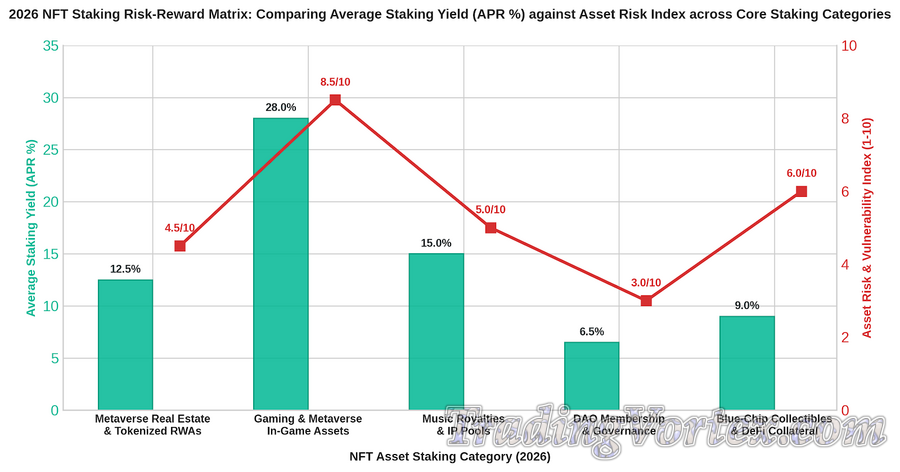 2026 NFT Staking Risk-Reward Matrix: Comparing Average Staking Yield (APR %) against Asset Risk Index across Core Staking Categories.
How to Use This Visual to Balance Your Staking Portfolio:
To optimize your passive income without exposing irreplaceable digital collectibles to unnecessary vulnerabilities, you must assess the structural trade-off between reward size and smart contract/market asset risk. This dual-axis chart breaks down how different asset classifications perform across the 2026 staking landscape:
♦ Left Axis & Green Bars (Staking Yield APR %): This tracks the average annualized yield generated by locking up your assets. Higher bars mean faster portfolio accumulation, but they frequently signal underlying inflationary risks or hyper-volatile ecosystems. Notice that Gaming & Metaverse assets lead the pack with a high 28.0% APR.
♦ Right Axis & Red Line (Risk & Vulnerability Index): This scores the asset group from 1 to 10 based on inherent smart contract exposure, floor-price volatility, and lock-up liquidity restrictions. The higher the plot point, the more rigorous your security due diligence must be before committing your assets.
◊ Your Actionable Takeaway: If your goal is maximizing safety and long-term portfolio sustainability, look for categories where the green bar sits comfortably above the red line, such as DAO Membership & Governance or Metaverse Real Estate & Tokenized RWAs. Conversely, while Gaming & Metaverse In-Game Assets offer enticing double-digit rewards (28.0%), their high-risk score of 8.5/10 warns you that these yielding smart contracts require premium isolation: such as staking only via clean hardware wallets and rigorously auditing lock-up windows to avoid getting trapped during sudden floor-price crashes.
What is NFT Staking?
NFT Staking Explained: How It Works
At its core, NFT staking means locking your NFT into a smart contract or platform to earn rewards. These rewards can take many forms: cryptocurrency payouts, governance rights, exclusive access to new collections, or even collateral for loans. Think of it like putting your NFT into a savings account; instead of sitting idle, it generates yield.
Current reward rates vary widely, often between 5% and 28% APY, depending on the platform and type of NFT. Some projects even offer dynamic rewards that change based on community participation or market conditions.
When you stake, you’re essentially contributing your NFT to a platform’s ecosystem. That platform might use your NFT to secure its network, fuel a game’s economy, or reward loyal community members. The more valuable or rare your NFT, the more attractive the staking rewards can be.
NFT Staking Across Blockchains
NFT staking is now supported across multiple chains, each offering unique ecosystems and opportunities:
- Ethereum: The most established, with blue-chip NFTs like BAYC and CryptoPunks integrated into staking vaults. Ethereum remains the go-to for high-value art and collectibles.
- Solana: Known for fast transactions and lower fees, Solana has become a favorite for gaming NFTs and projects that require high throughput.
- Polygon: A hub for GameFi projects like Aavegotchi, Polygon blends DeFi mechanics with NFT staking, making it popular among community-driven projects.
- BNB Chain: Offers staking tied to Binance’s marketplace, with rewards in tokens like ApeCoin and SAND. It’s a strong choice for investors who want exposure to Binance’s ecosystem.
- Arbitrum: Emerging as a leader in cross-chain staking, Arbitrum supports fractional ownership and liquidity pools, making it easier for investors to diversify across multiple assets.
Each chain has its own strengths, but the common thread is accessibility. Investors can now stake NFTs across ecosystems without being locked into a single blockchain, which reduces risk and increases flexibility.
Types of NFTs You Can Stake
In 2026, staking goes far beyond profile pictures. The most common categories include:
- Gaming NFTs: Characters, weapons, or cards that generate in-game rewards and tokens. These are especially popular in play-to-earn ecosystems.
- Virtual Real Estate: Metaverse land parcels that earn yield through staking or leasing. Owners can generate passive income by staking their plots in platforms like Decentraland or The Sandbox.
- DAO Tokens: Proof of membership NFTs that grant governance rights when staked. These tokens allow holders to participate in decision-making while earning rewards.
- Real-World Assets (RWAs): Tokenized homes, cars, or art pieces that can be staked for collateral or yield. This is one of the fastest-growing categories, bridging the gap between digital and physical assets.
- Validator Node NFTs: Wrapped staking positions from protocols like EigenLayer, allowing NFTs to represent validator rights. This innovation ties NFT ownership directly to blockchain infrastructure.
In short, NFT staking has matured into a diverse ecosystem where assets can generate real value. Whether you’re holding a rare gaming card, a piece of metaverse land, or even a tokenized house, staking offers ways to earn without selling. The key is understanding how it works across blockchains and choosing the right type of NFT to stake safely.
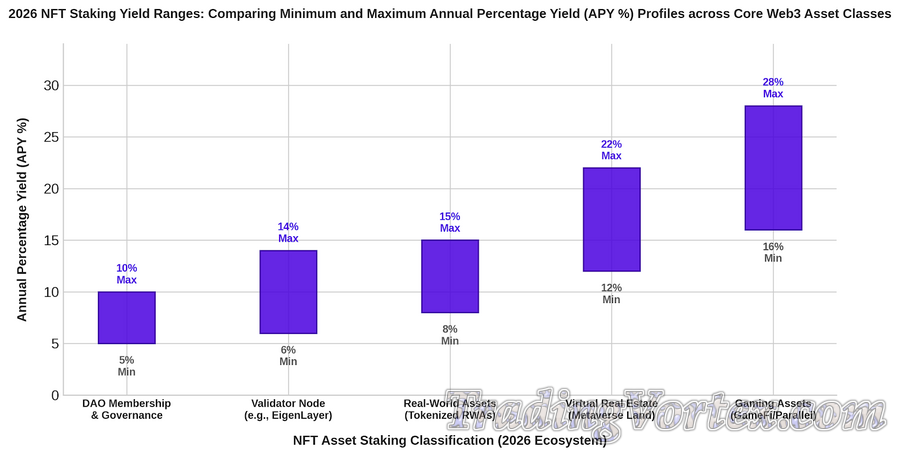 2026 NFT Staking Yield Ranges: Comparing Minimum and Maximum Annual Percentage Yield (APY %) Profiles across Core Web3 Asset Classes.
How to Evaluate and Navigate Staking Yield Volatility:
To turn your idle digital assets into productive investments without miscalculating returns, you can look at this floating range chart to see how passive income rates shift depending on what type of NFT you stake. Yield performance spans a distinct spectrum across five primary classifications:
♦ Floating Purple Blocks (The APY Spread): Each vertical bar maps out the minimum and maximum boundaries of expected Annual Percentage Yield (APY) described in the section. Rather than a flat reward rate, your actual yield floats within these windows based on factors like contract duration, asset rarity, and platform participation.
♦ Infrastructure & Utilities (Lower Volatility): On the left side of the chart, foundational assets like DAO Membership Tokens and Infrastructure Validator Node positions sit in a more conservative, secure bracket (ranging from 5% to 14% APY). These are built for steady, long-term capital preservation.
♦ Virtual Economies & GameFi (Higher Volatility): Moving to the right, virtual ecosystems like Metaverse land parcels and GameFi play-to-earn assets escalate rapidly, peaking at a maximum of 28% APY. These profiles offer highly competitive rewards but feature wider spreads due to fluctuating network economies and dynamic reward designs.
◊ Your Actionable Takeaway: If you want stable, predictable growth to round out a diversified portfolio, prioritize Tokenized Real-World Assets (RWAs) or Validator Node NFTs where the yield spread remains tight and tightly anchored to physical or structural utilities. However, if your strategy is geared toward maximizing aggressive short-term yield, deploying your assets into active Gaming and Metaverse platforms will give you exposure to the top-tier 22% to 28% APY brackets; just remember to account for the wider variable spreads by factoring dynamic reward changes directly into your baseline return calculations.
Benefits of NFT Staking
NFT Staking Rewards: Passive Income and APY
The most obvious benefit of NFT staking is passive income. By locking your NFTs into a platform, you can earn rewards in the form of cryptocurrency, governance tokens, or even additional NFTs. Current reward rates vary, but many platforms offer between 5% and 28% APY, depending on the rarity of the NFT, the platform’s tokenomics, and the length of time you stake.
For long-term holders, staking is a way to make NFTs “work” while waiting for floor prices to rise. It’s not a get-rich-quick scheme, but it can provide steady returns that compound over time. And let’s be honest, there’s something satisfying about seeing your digital art or metaverse land quietly earning yield while you sleep.
Exclusive Perks from Staked NFTs (Airdrops, Governance, Whitelist Access)
Beyond yield, staking often unlocks exclusive perks. Many projects reward stakers with airdrops of new tokens, whitelist spots for upcoming NFT collections, or governance rights in decentralized autonomous organizations (DAOs).
This means staking isn’t just about financial gain; it’s also about community participation and influence. By staking, you might gain voting power in a DAO, early access to limited NFT drops, or discounted entry into new projects. These perks can be just as valuable as token rewards, especially for investors who want to stay ahead of the curve in Web3.
NFT Liquidity and Collateralization in DeFi
One of the biggest challenges with NFTs has always been liquidity. Unlike fungible tokens, NFTs are unique and harder to trade quickly. Staking helps solve this problem by allowing NFTs to be used as collateral in DeFi protocols.
This trend is reshaping how investors view NFTs: they’re no longer just speculative collectibles, but productive assets that can generate yield, unlock perks, and provide liquidity. Imagine staking your metaverse land to borrow stablecoins, then using those coins to invest in another project, all while your land continues to appreciate in value. That’s the kind of financial flexibility staking brings to the table.
In short, NFT staking in 2026 is about more than passive income. It’s a way to earn rewards, gain exclusive access, and tap into liquidity, all while holding onto your digital assets.
For investors, it’s a chance to turn NFTs into tools that work for you, rather than just sitting in your wallet.
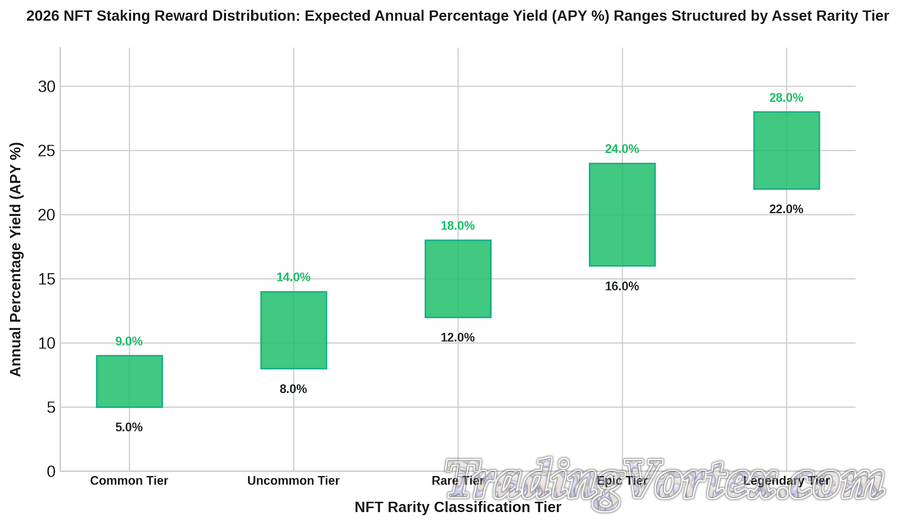 2026 NFT Staking Reward Distribution: Expected Annual Percentage Yield (APY %) Ranges Structured by Asset Rarity Tier.
How to Evaluate Passive Income Spreads Across Your Portfolio:
To accurately predict and optimize the compounding returns of your digital collectibles, you can utilize this floating range chart to analyze how reward payouts scale according to the underlying asset classification. Yield performance is distributed across clear tactical thresholds:
♦ Floating Green Blocks (The APY Spread): Each vertical bar maps the boundaries of the expected 5% to 28% APY return spectrum highlighted in this section. Rather than a flat standard rate, your yields move within these custom windows depending on the underlying platform's specific tokenomics and lock-up parameters.
♦ Base vs. Premium Scalability: As you move from left to right, note how the asset's tier structure directly alters your income floor. Baselines such as Common Tiers establish a dependable 5% to 9% APY bracket, while high-demand assets scaling into Epic and Legendary Tiers maximize passive returns, climbing up to the peak 28% APY cap.
◊ Your Actionable Takeaway: When planning your capital deployment strategies, treat staking rewards as a variable dynamic rather than a fixed guarantee. If you are holding higher-volume, lower-rarity tokens, your strategy should focus on the consistent compounding of the 5% to 14% APY lower-tier buckets. However, if your long-term goal is maximizing aggressive yields, consolidating capital into scarcer, premium tier positions unlocks access to the top-performing 22% to 28% APY distributions: giving you the financial leverage necessary to generate significant yield while your underlying assets remain safely locked away accumulating market value.
Risks and Challenges of NFT Staking
Smart Contract Risks in NFT Staking
Smart contracts are the backbone of NFT staking, but they’re not always perfect. Poorly coded or unaudited contracts can contain exploitable bugs that attackers use to drain funds or lock assets permanently.
In 2026, auditors still report recurring issues like unchecked permissions, faulty reward distribution logic, and vulnerabilities in cross-chain integrations. I’ve seen investors jump into projects offering sky-high APYs, only to discover later that the contract was vulnerable and their NFTs were gone.
The lesson here is simple: if a platform hasn’t been audited or doesn’t publish its code, treat it as a red flag. Even reputable projects can suffer from overlooked bugs, so transparency and third-party audits are non-negotiable. Think of it like buying a car: you wouldn’t drive off the lot without checking the brakes, so don’t stake your NFTs without checking the contract’s safety record.
Wallet Security and Private Key Protection
Your wallet’s private key is the master key to your NFT collection. If it’s compromised, attackers can transfer your assets instantly. Phishing emails, malicious browser extensions, and fake wallet apps are common tricks used to steal keys. Hardware wallets remain the gold standard for protection, but even then, careless approvals can expose you.
Cross-Chain NFT Staking Vulnerabilities
NFTs are increasingly moving across blockchains, thanks to bridges and interoperability protocols. While this opens up new opportunities, it also creates new attack vectors at bridge points. Security gaps in cross-chain bridges have already led to multimillion-dollar exploits, and attackers often target these weak links because they’re complex and harder to secure.
If you’re staking NFTs across chains, remember that every bridge adds complexity and risk. It’s like crossing a river on a rope bridge: the view might be great, but one weak plank can send you tumbling. Diversifying across chains can be smart, but only if you trust the infrastructure holding your assets together.
Phishing, Scams, and Social Engineering in NFT Staking
Scammers have gotten smarter. In 2026, AI-powered phishing attacks generate convincing fake marketplaces, Discord messages, and even deepfake videos of influencers promoting fraudulent projects. Rug pulls are still common, where developers hype up a staking platform, collect funds, and disappear overnight. Counterfeit NFTs also flood marketplaces, tricking buyers into staking worthless copies.
The best defense is skepticism: verify contract addresses, use official links, and never click on unsolicited messages. If something feels too good to be true, it probably is. I’ve learned to treat every “exclusive opportunity” with suspicion until proven otherwise, and that mindset has saved me more than once.
Economic Exploits: Flash Loans, MEV Attacks, and Token Manipulation
NFT staking isn’t just vulnerable to technical hacks; it’s also exposed to economic exploits. Flash loan attacks can manipulate liquidity pools, draining rewards before honest stakers even notice. Miner Extractable Value (MEV) attacks target high-value NFT transactions, front-running trades to siphon profits. Token manipulation is another risk, where reward tokens are inflated or dumped, leaving stakers with worthless payouts.
These exploits don’t always steal your NFT directly, but they can erode the value of your staking rewards overnight. Imagine waking up to find that the tokens you earned are now worth pennies because someone orchestrated a dump. It’s frustrating, but it’s also a reminder that staking rewards are only as strong as the ecosystem supporting them.
The bottom line:
NFT staking in 2026 is full of promise, but it’s also full of pitfalls. Smart contracts, wallets, bridges, and marketplaces all carry risks that can’t be ignored. By staying cautious, verifying platforms, and protecting your keys, you can enjoy the rewards of staking without falling victim to the traps that catch so many newcomers.
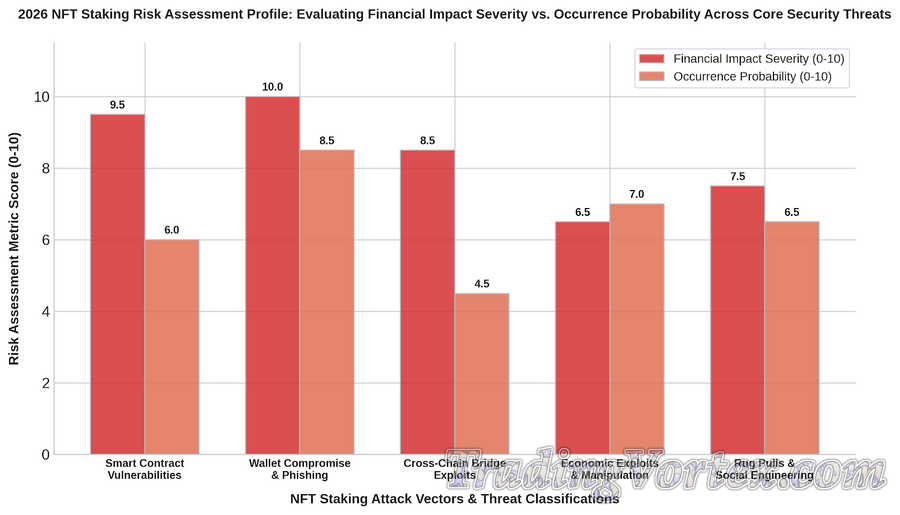 2026 NFT Staking Risk Assessment Profile: Evaluating Financial Impact Severity vs. Occurrence Probability Across Core Security Threats.
How to Analyze and Defend Against Staking Security Vulnerabilities:
To maximize your security while capitalizing on passive Web3 income, you can use this dual-variable threat matrix to map out exactly where your protective measures should be deployed. The side-by-side bar chart breaks down the 2026 security landscape using two vital operational metrics:
♦ Dark Red Bars (Financial Impact Severity): This tracks the immediate potential downside if a particular vulnerability is successfully exploited. A score of 10.0 signals absolute catastrophic loss: such as the total drain of your unrecoverable, sovereign digital assets.
♦ Light Orange Bars (Occurrence Probability): This measures how frequently attackers target and exploit each respective vector in daily market activity. High probability scores tell you which threats require your everyday vigilance and technical defensive setups.
◊ Your Actionable Takeaway: When safeguarding your staking portfolio, pay special attention to Wallet Compromise & Phishing, where a maximum severity score of 10.0 intersects with a high occurrence probability of 8.5. This indicates that your most critical daily defense is operational user behavior: such as strictly isolating assets via hardware wallets and refusing untrusted smart contract approvals.
♣ For technical defenses, notice that while Cross-Chain Bridge Exploits present lower day-to-day exposure (4.5 probability), their severe structural impact (8.5 severity) means you should avoid complex multi-chain protocols for your highest-value blue-chip NFTs, opting instead for audited, localized single-chain staking vaults to lower your structural risk profile.
How to Stake NFTs Safely: Step-by-Step Guide
Step 1: Research NFT Staking Platforms Carefully
Not all platforms are created equal. Some offer 5–28% APY, while others promise unrealistic triple‑digit returns that rarely last. Look for platforms with transparent documentation, active communities, and third‑party audits. If a project hides its smart contract code or lacks a track record, treat it as a red flag.
Think of it like picking a restaurant: if the kitchen is hidden and no one has reviewed it, you probably don’t want to eat there. The same goes for staking platforms. A good project will proudly display its audits, explain its reward system clearly, and have a community that isn’t afraid to ask tough questions. If you can’t find that transparency, walk away.
Step 2: Use Hardware Wallets and Cold Storage for NFT Security
Your wallet is the vault for your NFTs. Hardware wallets like Ledger or Trezor provide offline protection, making it much harder for hackers to steal your assets. Cold storage is especially important when staking high‑value NFTs such as blue‑chip collections or metaverse land.
A smart move is to separate your “staking wallet” from your “main wallet.” That way, even if your staking wallet is compromised, your core collection remains safe. Think of it like having a checking account and a savings account: you wouldn’t keep all your money in one place, so don’t keep all your NFTs in one wallet.
Step 3: Verify Smart Contracts and Platform Audits
Smart contracts are the engine behind staking. Audited contracts reduce the risk of bugs or exploits, but even audited platforms can have vulnerabilities. Before staking, check if the project has undergone security reviews by firms like CertiK, Trail of Bits, or Quantstamp.
If no audit exists, proceed with extreme caution. Remember, staking means handing over control of your NFT to a contract. If that contract fails, your NFT could be locked forever or stolen outright. It’s like lending your car to someone without checking if they have a license.
Step 4: Understand NFT Staking Rewards and Lock-Up Terms
Rewards sound great until you realize they’re locked behind long staking periods or volatile reward tokens. Some platforms pay daily in stablecoins, while others issue native tokens that can lose value quickly.
Always read the fine print: know how long your NFT will be locked, what form rewards take, and whether you can exit early without penalties. I’ve seen investors celebrate huge token rewards, only to discover later that the tokens had no liquidity and couldn’t be sold. Don’t let shiny numbers blind you to the details.
Step 5: Diversify NFT Staking Across Platforms and Assets
Don’t put all your eggs in one basket. Spread your NFTs across different platforms and chains to reduce risk. For example, stake gaming NFTs on Polygon, metaverse land on Ethereum, and DAO membership tokens on Arbitrum.
Diversification protects you from platform‑specific failures and keeps your portfolio flexible. If one project suffers a hack or liquidity crisis, your entire portfolio won’t collapse. It’s the same principle as traditional investing: balance your exposure so one bad bet doesn’t wipe you out.
Step 6: Monitor NFT Staking Performance and Risks Regularly
Staking isn’t a “set it and forget it” strategy. Check your rewards, monitor token prices, and stay updated on platform news. Hacks, regulatory changes, or sudden liquidity drops can happen overnight.
I’ve seen investors lose rewards because they didn’t notice a platform quietly changing its payout structure. A quick weekly check can save you from nasty surprises. Treat staking like tending a garden: if you don’t water it and check for weeds, it won’t thrive.
In short, safe NFT staking is about discipline: research carefully, protect your wallet, verify contracts, understand rewards, diversify, and monitor regularly. Follow these steps, and you’ll be staking with confidence rather than crossing your fingers.
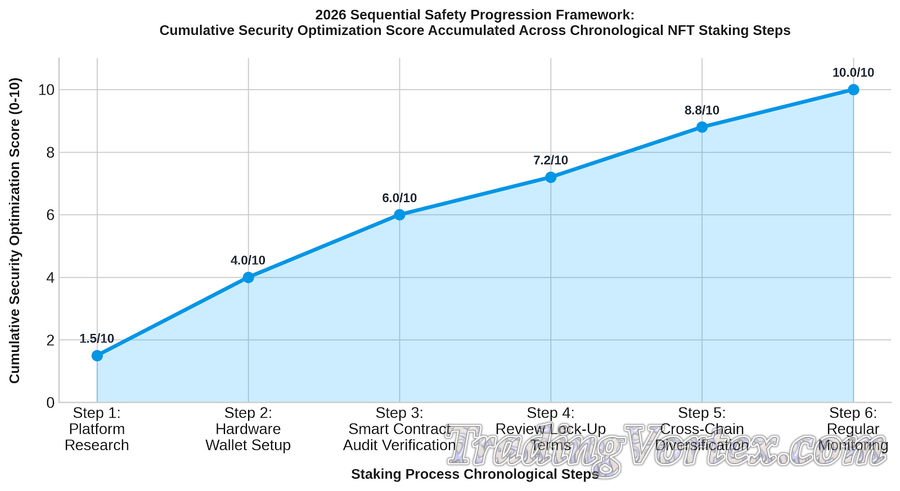 2026 Sequential Safety Progression Framework: Cumulative Security Optimization Score Accumulated Across Chronological NFT Staking Steps.
How to Follow the Staking Security Roadmap:
To ensure you do not leave your valuable Web3 identity or digital assets vulnerable to exploits, you can track your configuration journey along this sequential progression roadmap. This area chart visualizes exactly how each operational layer builds a cumulative shield around your collection:
♦ The Upward Safety Trend (Cumulative Risk Mitigation): Moving chronologically from left to right, the visual charts your path toward a fully optimized, risk-insulated staking operation. Skipping or rushing through early phases leaves structural flaws in your personal security baseline.
♦ The High-Impact Protection Spike: Notice that the sharpest incline on the graph occurs between Step 1 and Step 3. Isolating your assets into hardware wallets and cold storage while rigorously validating third-party smart contract audits represents the absolute heaviest defensive lifting: propelling your cumulative protection score from a vulnerable 1.5 up to a highly resilient 6.0 out of 10.
◊ Your Actionable Takeaway: Treat your staking safety as a mandatory technical sequence rather than an optional checklist. Before deploying high-value digital land, gaming cards, or membership assets into any live network vault, always confirm that you have completely locked down Steps 1 through 3 to guarantee your foundational defenses are live. Once your assets are actively yielding, complete the entire roadmap by implementing Step 6: dedicating a brief weekly routine to monitor fluctuating lock-up structures and changing token conditions so you are never caught off guard by overnight market shifts.
Safest NFT Staking Platforms in 2026
Binance NFT: Security-First Marketplace with Audited Contracts
Binance NFT continues to dominate the staking landscape by prioritizing security and compliance. The platform undergoes regular smart contract audits and enforces strict compliance standards, backed by Binance’s global infrastructure. Stakers can earn rewards in ApeCoin and SAND, but the real draw is Binance’s proven ability to safeguard assets against hacks and fraud.
For investors who want a platform that feels as solid as a traditional bank, Binance NFT offers both yield and peace of mind.
NFTX: Safe Vaults for Blue-Chip NFTs
NFTX has carved out a niche by offering fractionalized vaults for blue-chip NFTs such as Bored Ape Yacht Club and CryptoPunks. This allows holders to stake their high-value assets while unlocking liquidity without selling them outright. NFTX’s decentralized governance and transparent vault mechanics make it one of the safest places to park premium NFTs.
With community oversight and a history of audits, NFTX is trusted by collectors who want to protect their crown jewels while still earning returns.
Aavegotchi: Community-Driven Safety on Polygon
Aavegotchi is more than a game; it’s a community-driven DeFi ecosystem built on Polygon. Its contracts are audited, and its governance model ensures that users have a say in how the platform evolves. Stakers earn GLTR tokens while participating in a vibrant ecosystem that blends gaming with financial utility.
The low fees and scalability of Polygon add another layer of safety, making Aavegotchi a secure choice for those who enjoy staking in a playful yet serious environment.
LooksRare & Rarible: Multi-Chain Platforms with Verified Listings
LooksRare and Rarible have become go-to platforms for NFT staking thanks to their multi-chain support and verified collections. Both platforms actively combat counterfeit NFTs and rug pulls by implementing strict verification processes. Stakers earn LOOKS, wETH, or platform-native tokens, but the real value lies in their security-first approach.
By combining rewards with strong community-driven oversight, these platforms provide a safer environment for traders who want exposure across multiple chains.
Illuvium & Splinterlands: GameFi Ecosystems with Strong Security Layers
Illuvium and Splinterlands are leaders in the GameFi sector, offering staking opportunities that blend entertainment with financial rewards. Illuvium pays out in ILV tokens, while Splinterlands rewards stakers with SPS. Both platforms integrate layered security protocols, transparent reward systems, and active community governance, making them safer than many smaller gaming projects. For players who want to earn while they play, these ecosystems prove that fun and safety can coexist.
Zed Run & Music NFT Platforms: Niche Staking with Safety Controls
Niche platforms like Zed Run, which focuses on virtual horse racing, and BAND NFTs, which tokenize music royalties, have introduced audits, anti-fraud measures, and community governance to protect stakers. While smaller in scale compared to giants like Binance, their emphasis on safety makes them appealing to investors looking for diversification.
These platforms show that even niche ecosystems can prioritize security, offering unique staking opportunities without compromising trust.
📌 Key Takeaways:
- Audits and transparency are the foundation of safe NFT staking.
- Platforms like Binance NFT and NFTX lead in compliance and governance.
- Community-driven ecosystems such as Aavegotchi and Rarible add extra layers of trust.
- GameFi projects Illuvium and Splinterlands show that entertainment and safety can coexist.
- Niche platforms like Zed Run and BAND NFTs prove that even smaller ecosystems can prioritize security.
Bottom line:
In 2026, the safest NFT staking platforms are those that treat security as a core feature, not an afterthought. Investors should prioritize audited contracts, transparent governance, and community oversight before chasing yields.
Safest NFT Staking Platforms in 2026: Comparison Table
Here’s a clear comparison table that highlights the safest NFT staking platforms in 2026 by their security features, rewards, and asset types. This way, you can quickly scan and decide which platform best fits your needs:
| Platform | Security Features | Rewards | Asset Types |
|---|---|---|---|
| Binance NFT | Regular smart contract audits, strong compliance standards, robust infrastructure | ApeCoin, SAND, platform-native tokens | Marketplace NFTs, metaverse assets |
| NFTX | Transparent vault mechanics, decentralized governance, community oversight | Fractionalized vault tokens, liquidity rewards | Blue-chip NFTs (BAYC, CryptoPunks, etc.) |
| Aavegotchi | Audited contracts, Polygon scalability, community-driven governance | GLTR tokens, in-game perks | Gaming NFTs, DeFi-integrated collectibles |
| LooksRare | Verified collections, anti-counterfeit measures, multi-chain support | LOOKS tokens, wETH rewards | Marketplace NFTs across chains |
| Rarible | Strict verification processes, community oversight, multi-chain integration | RARI tokens, platform incentives | Art NFTs, collectibles, DAO-linked assets |
| Illuvium | Layered security protocols, transparent reward systems, active governance | ILV tokens, gameplay-linked rewards | GameFi NFTs, metaverse assets |
| Splinterlands | Audited staking contracts, strong community governance | SPS tokens, in-game rewards | Gaming NFTs, card-based assets |
| Zed Run | Audits, anti-fraud measures, niche ecosystem safety controls | Platform-native tokens, racing rewards | Virtual horse racing NFTs |
| Music NFT Platforms (e.g., BAND NFTs) | Community governance, anti-fraud checks, royalty tracking | Music royalties, platform-native tokens | Tokenized music rights, artist NFTs |
🔑 Key Insights for Investors:
- Binance NFT and NFTX are best for those prioritizing compliance and blue-chip asset safety.
- Aavegotchi, Illuvium, and Splinterlands are ideal for gamers who want staking integrated with play-to-earn ecosystems.
- LooksRare and Rarible provide multi-chain exposure with strong verification against scams.
- Zed Run and Music NFT platforms offer niche opportunities with safety controls, perfect for diversification.
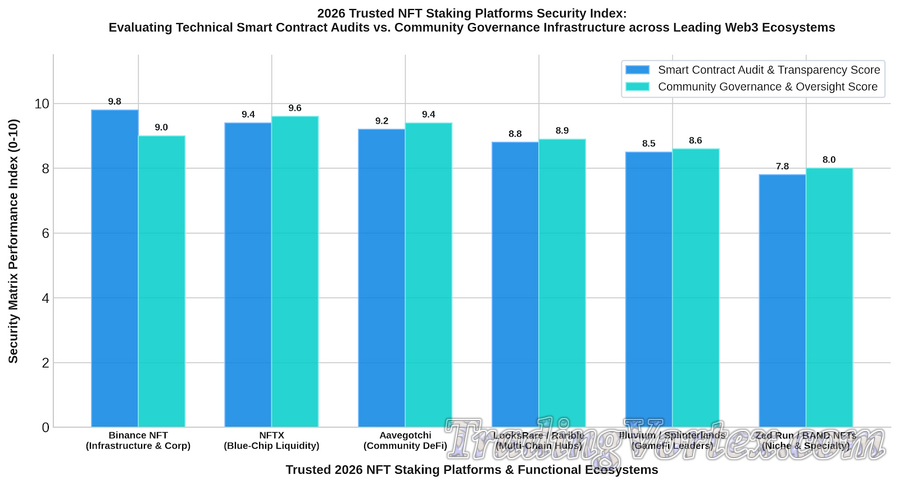 2026 Trusted NFT Staking Platforms Security Index: Evaluating Technical Smart Contract Audits vs. Community Governance Infrastructure across Leading Web3 Ecosystems.
How to Navigate the Safe Staking Platform Security Matrix:
To identify the optimal balance of technical safety and operational stability for your digital portfolio, you can review this comparative safety matrix to see how the market's leading secure ecosystems stack up across two vital security pillars:
♦ Blue Bars (Smart Contract Audit & Transparency Score): This measures the frequency, depth, and openness of third-party technical security audits. Higher bars signify platforms that rigorously minimize smart contract bugs and maintain transparent codebases.
♦ Teal Bars (Community Governance & Oversight Score): This measures the level of decentralized community control, fraud monitoring, and public transaction verification active on the network. Higher metrics mean the platform relies heavily on community oversight, making centralized rug pulls or unilateral structural manipulation virtually impossible.
◊ Your Actionable Takeaway: When locking up premium, high-value assets, use this chart to align your safety requirements with the platform's architectural strengths. If your absolute priority is institutional-grade technical infrastructure and centralized financial backing, Binance NFT leads the index with a near-perfect 9.8 Smart Contract Audit Score.
◊ Conversely, if you are looking to park crown-jewel assets in decentralized environments without sacrificing secondary liquidity, decentralized protocols like NFTX or Aavegotchi offer the most balanced resilience: combining strong technical audits with top-tier community oversight infrastructures (scoring 9.6 and 9.4 respectively) to ensure your sovereign assets remain protected by multiple operational security boundaries.
Security Best Practices for NFT Staking
Defense-in-Depth Strategy for NFT Security
Never rely on a single line of defense. Defense in depth means stacking multiple protections so that if one fails, others still guard your assets. Combine hardware wallets, multi‑signature approvals, and regular audits of the platforms you use. Think of it like locking your house with a front door key, an alarm system, and a watchdog. Each layer reduces the chance of a successful attack.
In practice, this means not just trusting a platform’s marketing but actively checking whether it has undergone independent audits, whether its community is transparent, and whether its governance model allows users to flag suspicious activity. The more layers you add, the harder it becomes for attackers to find a way in.
Cold Wallets and Multi-Signature Protection
Your private key is the master key to your NFT collection. Cold wallets (hardware wallets kept offline) are the safest way to store high‑value NFTs. For added protection, use multi‑signature wallets, which require multiple approvals before a transaction can go through. This prevents a single compromised device or account from draining your assets. It’s like needing two family members to sign off before selling the family car.
Cold storage also helps reduce exposure to malware and phishing attempts. Even if your computer is infected, your NFTs remain safe because the keys never touch the internet. Multi‑sig adds another layer, ensuring that even if one signer is compromised, attackers cannot move your NFTs without the other approvals.
Avoiding Fake NFT Marketplaces and Rug Pulls
Scammers are getting smarter, often creating convincing fake marketplaces and phishing sites. Always bookmark official URLs, verify contract addresses on‑chain, and avoid clicking unsolicited links. Rug pulls remain common, where developers hype a staking project, collect funds, then vanish. If a platform promises unrealistic rewards or hides its audit status, treat it as a red flag.
A good rule of thumb is to ask yourself: Would I trust this project with a one‑of‑a‑kind piece of art? If the answer is no, don’t stake. Communities that are transparent, have long‑term roadmaps, and publish audits are far less likely to rug pull.
Cross-Chain Bridge Monitoring for NFT Safety
NFTs increasingly move across blockchains, but bridges are prime targets for exploits. Security gaps in cross‑chain protocols have led to multimillion‑dollar losses. If you stake NFTs across chains, monitor bridge updates, and only use platforms with proven track records. Think of bridges as rope crossings: they open new paths, but one weak plank can send you tumbling.
When using bridges, check whether they have insurance funds or recovery mechanisms in place. Some platforms now offer coverage against bridge exploits, which can provide peace of mind. Still, the safest approach is to limit exposure and avoid staking across too many chains at once.
AI-Powered Security Tools for NFT Staking
Attackers now use AI‑driven phishing and social engineering, generating fake Discord messages, deepfake influencer videos, and fraudulent staking offers. Fortunately, AI is also being used defensively. Tools like BlockShield Analytics and other monitoring systems detect suspicious wallet activity, flag fake marketplaces, and help users revoke risky approvals. Leveraging these tools is like having a digital watchdog that never sleeps.
AI tools can also help track token reward manipulation, alerting you when reward tokens are being dumped or inflated artificially. By combining human vigilance with AI monitoring, you can stay one step ahead of attackers who are constantly innovating.
📌 Key Takeaways:
- Layer your defenses: hardware wallets, multi‑sig, audits, and monitoring.
- Stay skeptical: avoid fake marketplaces and too‑good‑to‑be‑true rewards.
- Watch bridges closely: cross‑chain staking adds flexibility but also risk.
- Use AI tools: they help detect phishing and fraudulent activity before it’s too late.
Bottom line:
Safe NFT staking in 2026 is about discipline and vigilance. Protect your keys, verify platforms, and treat every interaction as a potential risk. Do this, and your NFTs can generate yield without becoming easy prey for attackers.
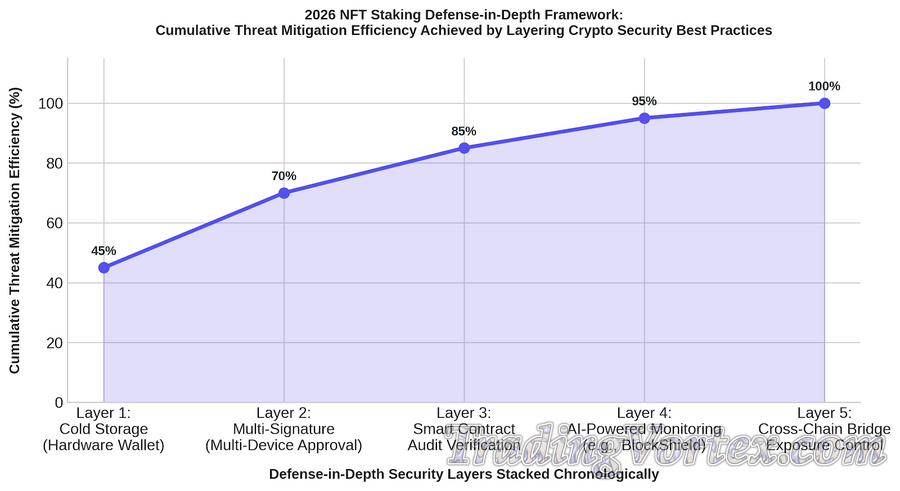 2026 NFT Staking Defense-in-Depth Framework: Cumulative Threat Mitigation Efficiency Achieved by Layering Crypto Security Best Practices.
How to Implement and Navigate Your Defense-in-Depth Security Strategy
To secure your high-value digital collections against complex exploits and fraudulent operations, you can use this progressive area chart to construct a resilient security stack. The visual demonstrates how stacking multiple counter-measures exponentially neutralizes vulnerabilities:
♦ The Rising Growth Trend (Stacked Protection): As you progress along the horizontal axis, the purple trendline tracks the cumulative threat mitigation score of your overall setup. Each operational best practice acts as a redundant firewall; ensuring that if one security protocol is bypassed, subsequent layers continue to block unauthorized withdrawals.
♦ The Foundational Spikes (Layers 1 through 3): Notice that the first three layers form the structural core of your defense. Storing assets in cold wallets (Layer 1) handles the heaviest initial mitigation lift at 45%. Adding multi-signature transaction requirements (Layer 2) and filtering assets through audited contracts (Layer 3) swiftly raises your overall threat protection level to a highly resilient 85%.
◊ Your Actionable Takeaway: Never settle for a single layer of security, regardless of a project's reputation. Begin by isolating your primary digital assets in offline cold storage, then mandate multi-device signature approvals for active staking transactions to take control of your private keys. Finally, fully optimize your ecosystem defense by stacking automated tools, like BlockShield Analytics and cross-chain bridge trackers, to achieve an advanced 95% to 100% mitigation rate: giving you active, around-the-clock protection while your assets safely generate yield.
Emerging Trends in NFT Staking
NFT Staking with Real-World Assets (RWAs)
One of the most exciting shifts is the integration of real-world assets into NFT staking. Homes, cars, fine art, and even music royalties are being tokenized as NFTs, then staked to generate yield. This bridges the gap between digital and physical ownership, allowing investors to earn returns on tangible assets without selling them. Platforms now use AI-powered appraisal engines and Chainlink oracles to assess collateral value, making staking RWAs safer and more transparent.
For investors, this means NFTs are no longer just speculative collectibles. They’re becoming financial instruments that can unlock liquidity, provide collateral for loans, and generate steady income streams tied to real-world value. Imagine staking a tokenized piece of real estate and earning yield while still holding ownership rights. That’s the kind of hybrid utility RWAs are bringing to the table.
DAO Governance Through Staked NFTs
Staking is increasingly tied to governance rights in DAOs. By staking NFTs, holders gain voting power, influence over treasury decisions, and access to exclusive community perks. This trend transforms NFTs into more than just assets; they become membership passes with real utility. Communities like Rarible DAO and niche governance projects are leading the way, showing that staked NFTs can shape the future of decentralized organizations.
For traders, this adds a new layer of value: staking isn’t just about yield, it’s about voice and influence. Holders can help decide how funds are allocated, which projects get supported, and even how reward structures evolve. It’s a shift from passive ownership to active participation.
EigenLayer and Validator Node NFT Staking
EigenLayer has exploded in popularity, introducing the concept of restaking. Investors can re-stake assets like stETH or rETH to secure additional protocols, known as Actively Validated Services (AVS). This creates extra yield streams on top of traditional staking rewards, with early adopters reporting an additional 5–15% APY depending on the AVS.
Validator node NFTs are also emerging, representing wrapped staking positions that tie NFT ownership directly to blockchain infrastructure. This innovation allows investors to participate in network security while holding a tradable NFT that represents their validator rights. It’s a fascinating blend of infrastructure and liquidity, turning validator participation into something portable and tradable.
AI-Enhanced Security in NFT Staking
Attackers are using AI to create sophisticated phishing campaigns, but defenders are fighting back with AI-powered security tools. These tools monitor wallet activity, flag suspicious approvals, and detect counterfeit NFTs before they spread. Platforms are also experimenting with AI-driven risk scoring models that analyze wallet behavior and NFT provenance to reduce default risk in lending and staking protocols.
For stakers, this means safer participation and fewer sleepless nights worrying about rug pulls or hidden exploits. AI is becoming the watchdog of NFT staking, constantly scanning for threats that humans might miss. It’s like having a digital bodyguard that never takes a break.
Cross-Chain NFT Staking Expansion in Web3
NFT staking is no longer confined to a single blockchain. Cross-chain bridges and interoperability protocols are enabling NFTs to be staked across Ethereum, Polygon, Solana, BNB Chain, and Arbitrum. This expansion increases flexibility and yield opportunities, but it also introduces new risks at bridge points. To counter this, platforms are adding insurance funds and monitoring tools to protect users from bridge exploits.
The trend is clear: staking will become a multi-chain activity, giving investors more options but requiring careful risk management. For those willing to diversify, cross-chain staking offers a way to maximize yield while spreading exposure across ecosystems.
📌 Key Takeaways:
- RWAs are turning NFTs into productive financial assets tied to real-world value.
- DAO governance through staked NFTs is giving holders real influence in decentralized communities.
- EigenLayer restaking is unlocking new yield streams and validator node NFTs are linking staking to infrastructure.
- AI-powered security is protecting stakers from scams and exploits.
- Cross-chain staking is expanding opportunities but requires vigilance at bridge points.
Bottom line:
NFT staking in 2026 is no longer just about rewards. It’s about utility, governance, infrastructure, and security. Investors who embrace these trends can position themselves at the forefront of Web3’s evolution.
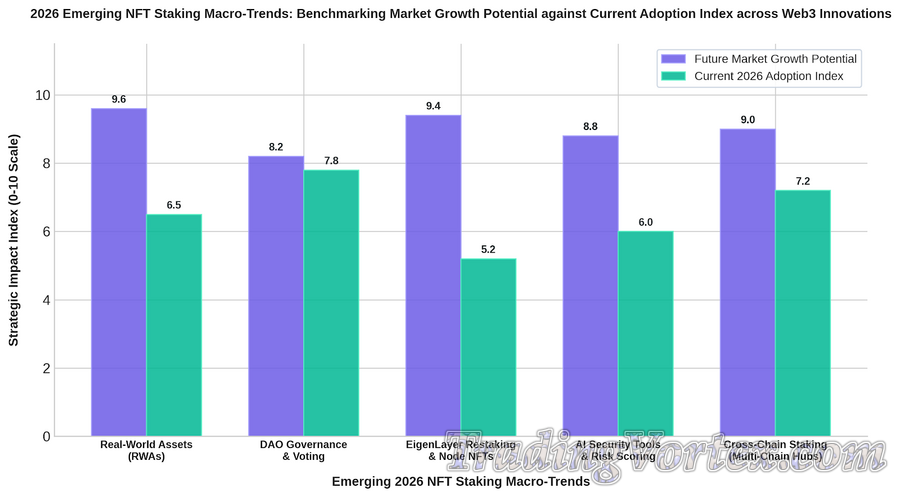 2026 Emerging NFT Staking Macro-Trends: Benchmarking Market Growth Potential against Current Adoption Index across Web3 Innovations.
How to Capitalize on Emerging NFT Staking Innovations
To spot the next highly productive sectors in decentralized finance and align your digital assets with structural market shifts, you can read this comparative benchmark chart to track the maturity vs. future upside of incoming macro-trends:
♦ Purple Bars (Future Market Growth Potential): This maps out the long-term industry disruption index for each trend. High scores emphasize innovations that are fundamentally rewriting the utility profile of digital collectibles: such as moving from static tokens to productive capital instruments.
♦ Green Bars (Current 2026 Adoption Index): This highlights how active and widespread a trend is across the market right now. Comparing this directly against the future potential helps you quickly identify sectors that are heavily undervalued or early-stage.
◊ Your Actionable Takeaway: When positioning your capital for maximum upside, look for fields featuring a large gap between high growth potential and lower current adoption. The chart identifies Real-World Assets (RWAs) and EigenLayer Restaking as prime early-mover opportunities. Both anchor their future growth metrics at 9.6 and 9.4, yet remain under-adopted by comparison.
◊ By prioritizing tokenized tangible goods, or by converting traditional validation mechanics into modular infrastructure layers via node NFTs, you can capture highly competitive alpha streams (such as the 5–15% APY boosts found in restaking) before these foundational security architectures cross over into retail saturation.
Conclusion: Safe NFT Staking for Long-Term Success
Balancing NFT Staking Rewards with Risk Management
NFT staking has matured into a powerful tool for generating passive income, governance rights, and liquidity. Yet, the risks remain real: smart contract flaws, phishing scams, and cross-chain vulnerabilities continue to challenge even seasoned investors. The key is to treat rewards as a bonus, not a guarantee.
Think of staking like farming: you plant seeds (your NFTs), nurture them with care (security practices), and harvest rewards. But if you ignore pests (scammers) or weather changes (market volatility), your crops can fail. The safest approach is to diversify across platforms, use hardware wallets, verify audits, and monitor performance regularly. This way, you enjoy the upside while minimizing exposure to pitfalls.
Long-term success depends on discipline. Investors who chase flashy APYs without considering risks often end up learning expensive lessons. Those who balance yield with caution, however, build portfolios that grow steadily and withstand shocks. It’s not about being the fastest to stake or the most aggressive in chasing rewards, but about being consistent, patient, and mindful of the risks that come with every opportunity.
Future Outlook for NFT Staking in Web3
By 2026, NFT staking is no longer just about collectibles. Real-world assets (RWAs) are entering the space, allowing tokenized homes, cars, and art to be staked for yield. This is transforming NFTs into productive financial instruments that bridge the digital and physical worlds. DAO governance through staked NFTs is giving holders real influence in decentralized communities, turning ownership into a voice that shapes the future of projects.
Meanwhile, EigenLayer restaking is unlocking new yield streams, and validator node NFTs are tying staking directly to blockchain infrastructure. This means investors can participate in securing networks while holding tradable NFTs that represent validator rights, blending liquidity with infrastructure-level utility.
Security is also evolving. AI-powered tools are now monitoring wallet activity, detecting counterfeit NFTs, and flagging suspicious approvals. This adds a new layer of protection against increasingly sophisticated scams. At the same time, cross-chain staking is expanding opportunities, enabling NFTs to move across Ethereum, Polygon, Solana, and Arbitrum. Insurance funds and monitoring systems are being introduced to counter bridge risks, making multi-chain staking safer than before.
The outlook is clear: NFT staking is becoming a cornerstone of Web3 finance, blending yield generation with governance, liquidity, and infrastructure participation. For investors, this means more opportunities but also more responsibility. Staying informed, cautious, and adaptive will be the difference between thriving and struggling in this fast-moving ecosystem.
🎯 Final Thought:
Safe NFT staking is not about avoiding risk entirely, but about managing it wisely. If you treat your NFTs like valuable assets, protect them with layered security, and stake them on platforms that prioritize safety, you can enjoy long-term success in Web3. The future belongs to those who balance ambition with caution, turning NFTs into productive tools rather than speculative gambles.
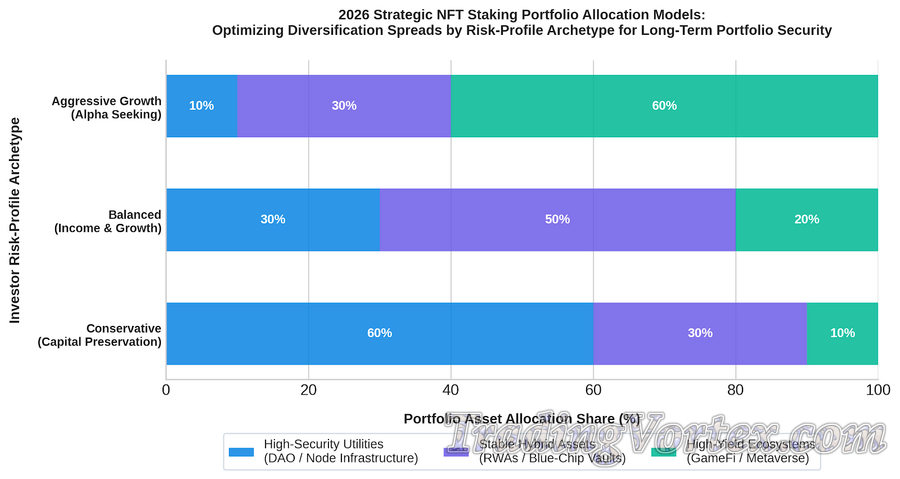 2026 Strategic NFT Staking Portfolio Allocation Models: Optimizing Diversification Spreads by Risk-Profile Archetype for Long-Term Portfolio Security.
How to Apply These Staking Allocation Models to Your Strategy
To turn safe staking concepts into actionable long-term success, you can use this stacked allocation framework to structure your digital asset distribution based on your personal risk tolerance. The chart visualizes three distinct defensive and growth strategies designed to keep your capital safe while earning yield in the 2026 Web3 ecosystem:
♦ Blue Segments (High-Security Utilities): This represents foundational infrastructure positions, such as audited DAO membership tokens and validator node NFTs (e.g., EigenLayer positions). These lock-ups act as your low-volatility anchor, trading hyper-inflated yields for technical robustness and system-level permanence.
♦ Purple Segments (Stable Hybrid Assets): This tracks allocations into asset-backed vaults, such as tokenized real-world assets (RWAs) or fractional blue-chip index vaults. These yield-bearing segments provide reliable, mid-tier income tied straight to tangible economic values.
♦ Green Segments (High-Yield Ecosystems): This marks your exposure to fast-moving digital economies like GameFi and metaverse real estate vaults. These positions carry the heaviest smart contract and tokenomic volatility risks, but offer aggressive short-term rewards.
◊ Your Actionable Takeaway: If your primary objective is defending your existing digital capital from market corrections or exploit cycles, map your holdings onto the Conservative Model, dedicating a dominant 60% baseline to infrastructure utilities and capping high-risk exposure at a strict 10%.
◊ If you are hunting for a sustainable middle ground, the Balanced Model shifts your structural core toward stable hybrid assets (50%), allowing you to steadily accumulate yielding rewards while ensuring that no single project exploit or sudden floor-price contraction can compromise the broader health of your Web3 portfolio.
FAQs: How to Stake Your NFTs Safely
Here’s a practical FAQ section on NFT staking in 2026: it covers profitability, risks, rewards, tax implications, and safety tips.
Q1. Is NFT staking profitable in 2026?
Yes, but it depends. Average yields range between 5% and 28% APY, depending on the platform, the rarity of your NFT, and how long you stake it. Gaming NFTs often generate in‑game tokens, while blue‑chip collections can unlock liquidity through vaults. Profitability also hinges on market conditions: if reward tokens lose value, your returns shrink. Think of it like farming: sometimes you get a bumper crop, sometimes the soil is less fertile.
It’s also worth noting that some platforms now offer dynamic rewards, where yields adjust based on community participation or token supply. This can stabilize returns but also means you need to keep an eye on how the platform evolves.
Q2. What rewards can I expect from staking NFTs?
Rewards vary widely:
♦ Cryptocurrency payouts (ETH, platform tokens, stablecoins)
♦ Exclusive perks like whitelist access, discounted NFT mints, or governance rights in DAOs
♦ Collateral benefits, where staked NFTs can be used to borrow funds in DeFi protocols
Some platforms even offer airdrops of new NFTs or bonus tokens for long‑term stakers. In gaming ecosystems, staking can unlock special abilities or rare items, which adds both financial and entertainment value.
Q3. What are the biggest risks of NFT staking?
The main risks include:
♦ Smart contract bugs that can lock or drain assets
♦ Phishing scams and fake marketplaces designed to steal NFTs
♦ Cross‑chain bridge exploits, especially when moving NFTs between Ethereum, Polygon, Solana, and Arbitrum
♦ Volatile reward tokens, which can lose value quickly
Another overlooked risk is liquidity lock‑ups. Some platforms require long staking periods, and if the market shifts, you may be stuck watching your NFT’s value drop while it’s locked. The golden rule: never stake on a platform that hasn’t been audited or lacks transparency.
Q4. Do I need special wallets or tools to stake NFTs?
Most platforms support MetaMask and other Web3 wallets, but for safety, use a hardware wallet like Ledger or Trezor. Cold storage keeps your private keys offline, reducing exposure to hacks. Some advanced platforms also support multi‑signature wallets, which require multiple approvals before transactions go through.
If you’re staking across multiple chains, consider using wallets that support cross‑chain functionality. This reduces friction and helps you manage assets more efficiently.
Q5. Should I buy NFTs just for staking?
Generally, no. Experts recommend staking NFTs you already plan to hold long‑term. Buying NFTs solely for staking can be risky, especially if the project’s tokenomics aren’t sustainable. It’s better to treat staking as a bonus yield on assets you already value, not as the primary reason to buy.
That said, if you’re already interested in a project’s ecosystem (say a GameFi platform you enjoy playing) staking can be a smart way to deepen your involvement while earning rewards.
Q6. How are NFT staking rewards taxed?
Tax rules vary by country, but in most jurisdictions, staking rewards are treated as taxable income at the time you receive them. If you later sell those rewards, you may also face capital gains tax. Platforms like CoinLedger emphasize keeping detailed records of staking transactions, reward payouts, and gas fees to simplify reporting.
Some regions are beginning to introduce specific tax guidance for NFTs, so it’s wise to consult a professional or use crypto tax software to avoid surprises.
Q7. What’s the safest way to stake NFTs?
Follow these best practices:
♦ Use hardware wallets and avoid signing suspicious approvals
♦ Stake only on audited platforms with transparent governance
♦ Diversify across chains and projects to reduce exposure
♦ Monitor rewards and platform updates regularly
♦ Treat staking as a long‑term strategy, not a quick flip
It also helps to stay plugged into the community. Many scams are spotted first by active Discord or Telegram members, so being part of the conversation can give you early warnings.
🎯 Bottom line:
NFT staking in 2026 can be profitable and rewarding, but safety comes first. Protect your wallet, verify platforms, and treat rewards as a bonus rather than a guarantee. Done wisely, staking can turn your NFTs into productive assets without putting them at unnecessary risk.