
The article Top NFT Staking Platforms is a comprehensive and SEO-friendly guide that explores the evolving world of NFT staking in 2026. It explains how investors, traders, and gamers can leverage staking to earn passive income, unlock in-game advantages, and participate in community-driven ecosystems. With yields stabilizing and staking models shifting toward utility-based rewards such as royalties, governance tokens, and marketplace rebates, this resource highlights the platforms that are shaping the future of digital finance.
Written in a clear, engaging, and user-friendly style, the article breaks down the strengths and challenges of leading platforms, examines how staking integrates with metaverse economies and Web3 ecosystems, and provides insights into strategies for balancing opportunity with risk. It also discusses the growing institutional interest in NFT yield products, the impact of regulatory scrutiny, and the importance of security and smart contract audits.
Whether you are a beginner curious about staking your first NFT or an experienced investor looking to diversify across marketplaces and gaming ecosystems, this guide offers actionable insights, relatable examples, and expert analysis. By the end, readers will understand how to choose the best NFT staking platform that aligns with their goals, risk tolerance, and passion for the NFT space.
Why You Should Keep an Eye on “Mythic Piece” – A New NFT Experience Like No Other:
The NFT space is constantly evolving, but few projects truly break the mold. “Mythic Piece” is one of those rare gems – a project shrouded in mystery, yet undeniably intriguing. While many NFT collections simply offer digital assets, “Mythic Piece” hints at something far more immersive and dynamic.
This is not just another collection; it's the beginning of an adventure. The project is designed to unveil its secrets over time, rewarding those who engage early and follow its development. If you have an eye for innovation in the NFT world, this is something you won’t want to miss.
To get a first glimpse of the journey ahead, watch the official launch video: “Awaken! Rise! – The Mythic Pieces Call... Will You Answer?!”
This short yet powerful teaser sets the tone for what’s to come: an experience that promises to go beyond the ordinary.
For now, details remain scarce, adding to the project's allure. But what we do know is that “Mythic Piece” is set to offer an experience unlike anything seen before in the NFT space. With its unique vision this could be one of the most exciting projects to emerge.
The best way to stay ahead? Follow “👑 Mythic Piece 🔱” on:
- X.com: https://x.com/mythicpiece
YouTube: https://www.youtube.com/@MythicPiece
TikTok: https://www.tiktok.com/@mythic_piece
And if you want to secure a place in this unfolding journey, now’s your chance – the Whitelist is still open, offering lucky participants a chance for free minting.
The adventure is only just beginning. Will you be part of it?
Table of Contents:
- Introduction to NFT Staking
- How NFT Staking Works
- NFT Staking Market Trends
- Binance NFT Staking Platform
- NFTX Staking Platform
- Doge Capital NFT Staking
- BAND NFT Staking
- Splinterlands NFT Staking
- Aavegotchi NFT Staking
- LooksRare NFT Marketplace Staking
- Rarible NFT Staking
- Zed Run NFT Staking
- Illuvium NFT Staking
- Comparing NFT Staking Platforms
- NFT Staking Rewards and APY Comparison
- Lock-Up Periods and Flexibility Across Platforms
- Security Features and Smart Contract Audits
- Community Engagement and Utility of Staked NFTs
- Ease of Use and Accessibility for Beginners
- Quick Comparison Table
- 📊 Comprehensive NFT Staking Ecosystem Benchmarking: Annual Percentage Yield (APY/APR) Ranges and Liquidity Flexibility Scores Across Leading Platforms
- NFT Staking Strategies for Investors
- Diversifying NFT Staking Across Multiple Platforms
- Balancing High APY vs. Risk Exposure
- Monitoring NFT Market Conditions and Token Prices
- Tax Implications of NFT Staking Rewards
- Best Practices for Safe NFT Staking
- Quick Strategy Snapshot
- 📊 Strategic NFT Staking Framework: Risk Profile vs. Yield Sustainability Trade-Off Matrix and Recommended Portfolio Allocation Breakdown for Investors
- Challenges Facing NFT Staking Platforms
- Smart Contract Vulnerabilities in NFT Staking
- Liquidity Risks and Locked Assets
- Regulatory Scrutiny of NFT Staking Platforms
- Unsustainable APY Models and Market Saturation
- Competition Among NFT Staking Platforms
- Quick Snapshot of Key Challenges
- 📊 NFT Staking Industry Challenges: Macro APY Compression Curve (2021–2026) and Core Protocol Vulnerability Risk Assessment
- Future of NFT Staking Platforms
Introduction to NFT Staking
NFT staking is one of the most exciting ways to turn your digital collectibles into a source of passive income, and it’s quickly becoming a cornerstone of the Web3 economy. Instead of letting NFTs sit idle in your wallet, staking allows you to put them to work, earning rewards while still keeping ownership.
What Is NFT Staking?
The process is simple: connect your wallet, select the NFT you want to stake, and let the platform handle the rest. Not every NFT is eligible, though, so it’s worth checking whether your collection supports staking before you get too excited. The rewards you earn often depend on factors like the rarity of your NFT, how long you stake it, and the platform’s reward model. That means your rare digital collectible could generate more yield than a common one. It’s a bit like owning a rare baseball card that not only has value but also pays you dividends while you hold it.
Why NFT Staking Platforms Are Important for Investors
For investors, NFT staking platforms are more than just passive income tools. They represent a shift in how NFTs are valued and used. In the early days, NFTs were mostly speculative: buy low, sell high, and hope the hype sticks. Staking changes the game by giving NFTs real economic utility. They can secure blockchain networks, fuel gaming ecosystems, or even serve as collateral for loans.
This evolution makes NFTs less dependent on volatile resale markets. Instead of waiting for someone else to buy your collectible, you can generate yield directly.
For traders, this means more predictable returns and a way to diversify beyond traditional crypto staking. For collectors, it’s a chance to enjoy the art, music, or game while still earning. In other words, staking transforms NFTs from static assets into dynamic income-generating tools.
Passive Income Opportunities with Non-Fungible Tokens
Here’s where things get exciting. Depending on the platform, staking NFTs can earn anywhere from 5 percent to 28 percent APY. Rewards might come in the form of platform tokens, stablecoins, or special perks like whitelist spots for upcoming drops.
In gaming ecosystems, staked NFTs can unlock extra characters, rare items, or in-game advantages. In DeFi, they can serve as collateral, allowing you to borrow against your digital assets without selling them.
Think of NFT staking as the “set it and forget it” strategy for Web3. You don’t need to constantly monitor floor prices or chase hype cycles. Instead, your NFTs quietly generate yield in the background.
Of course, there are risks: smart contract bugs, liquidity lock-ups, and regulatory uncertainty are all part of the landscape. But with careful research and smart platform selection, NFT staking can be one of the most rewarding ways to make your digital assets work harder for you.
📊 NFT Staking Dynamics: Yield Multipliers & Passive Income Potential Across Sectors and Rarity Tiers
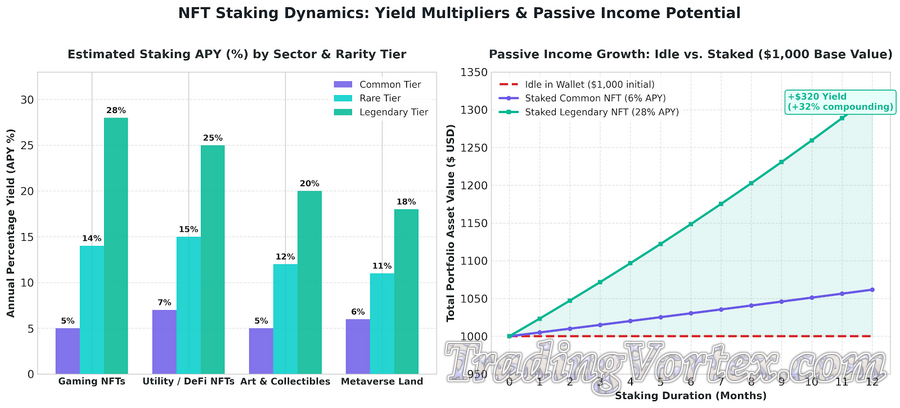
Understanding the Visual: How NFT Staking Unlocks Dynamic Yield?
This visualization breaks down the economic mechanics of NFT staking, showing you how different Web3 sectors and asset characteristics impact your potential returns over time.
1. Estimated Staking APY by Sector & Rarity Tier (Left Chart)
-
Rarity acts as a multiplier: Across all four major NFT sectors (Gaming, Utility/DeFi, Art & Collectibles, and Metaverse Land), rarer collectibles yield significantly higher returns. In gaming ecosystems, for example, a Common NFT might earn an entry-level 5% APY, while a Legendary NFT can generate up to 28% APY due to in-game utility multipliers and governance weighting.
-
Sector variability: Utility/DeFi and Gaming NFTs generally offer higher baseline APYs compared to static Art or Metaverse land assets because their platforms actively generate protocol revenue or token velocity.
2. Passive Income Growth: Idle vs. Staked Assets (Right Chart)
-
The Opportunity Cost of Idle Holding: Holding a $1,000 NFT passively in your wallet without staking keeps its value static relative to protocol rewards (red dashed line).
-
Compounding Returns Over Time: By locking your asset into a staking protocol:
-
A Common Tier NFT (at 6% APY) modestly grows your portfolio value to $1,061 over 12 months.
-
A Legendary Tier NFT (at 28% APY with monthly compounding) increases your total asset yield to $1,320; generating an effective +$320 in passive yield (+32% total yield) while maintaining ownership of the underlying collectible.
-
Key Takeaways for Your NFT Strategy:
-
Evaluate Asset Rarity: Before staking, inspect your collection's trait rarity. High-rarity assets yield disproportionately higher APY rewards on most platforms.
-
Factor in Lock-up Duration: Maximizing compounding returns requires keeping assets staked over multi-month horizons, so balance yield goals against short-term liquidity needs.
-
Assess Protocol Economics: High APY percentages (20%+) often come with platform-native token rewards—always evaluate the underlying token stability and smart contract security before locking in your digital assets.
How NFT Staking Works
NFT staking works by locking your digital collectibles into a blockchain-based platform to earn rewards, and it has evolved into a practical way for investors to generate yield while keeping ownership of their assets. Today, staking is not just about speculation; it’s about utility, governance, and building long-term value.
NFT Staking Explained: Step-by-Step Process
Here’s the typical flow:
- Connect your wallet: Use a Web3-enabled wallet like MetaMask, Phantom, or Trust Wallet.
- Select your NFT: Not every NFT can be staked, so check if your collection is supported. Blue-chip NFTs often have staking pools, while niche collections may not.
- Approve the contract: This is a one-time transaction that allows the platform to interact with your NFT.
- Stake and earn: Once locked, your NFT starts generating rewards based on factors like rarity, staking duration, pool size, and platform rules.
Think of it like putting money into a savings account, except instead of interest from a bank, you’re earning tokens or perks from a blockchain ecosystem. Some platforms even gamify the process, turning staking into a strategy game where rare NFTs yield higher rewards or unlock special features.
Benefits of NFT Staking Platforms for Traders and Collectors
For traders, staking offers a way to diversify income streams. Instead of relying solely on flipping NFTs for profit, staking provides predictable yield that can range from 5 percent to 28 percent APY depending on the platform. This means you can generate returns even during market downturns when trading volume slows.
For collectors, staking adds utility to assets that might otherwise just sit idle. Your rare in-game sword, digital artwork, or music NFT can now generate tokens, unlock new features, or even serve as collateral for loans in DeFi. It’s like your collectibles are finally paying rent for the space they take up in your wallet.
Another benefit is ecosystem engagement. Many platforms reward stakers with governance rights, meaning you get a say in how the project evolves. Others offer exclusive perks like whitelist spots for upcoming drops, early access to new features, or special in-game advantages. In short, staking transforms NFTs from static collectibles into dynamic tools that keep paying you back.
Risks of NFT Staking: Smart Contracts, Volatility, and Regulation
Of course, staking isn’t risk-free. The biggest concern is smart contract vulnerabilities. If the code has flaws, your NFT could be at risk, and unlike traditional finance, there’s no customer service hotline to call if something goes wrong.
Then there’s liquidity risk: some platforms require lock-up periods, meaning you can’t withdraw your NFT immediately if the market shifts. Imagine watching the floor price of your NFT collection drop while your assets are locked in a staking pool. That’s not a fun feeling.
Rewards can also be unsustainable. High APYs might look tempting, but if they’re not backed by real utility or revenue, they can collapse quickly, leaving investors with worthless tokens. Finally, there’s the looming question of regulation. As NFT staking grows, governments may classify certain reward models as financial products, which could change the rules of the game and affect how platforms operate.
In short, NFT staking is like putting your collectibles on the payroll. Done wisely, it can generate steady returns and deepen your involvement in Web3 ecosystems. But just like any investment, it pays to understand the mechanics, weigh the risks, and choose platforms that align with your goals.
📊 NFT Staking Architecture: A Step-by-Step Guide to Passive Income, Risk Management, and Utility
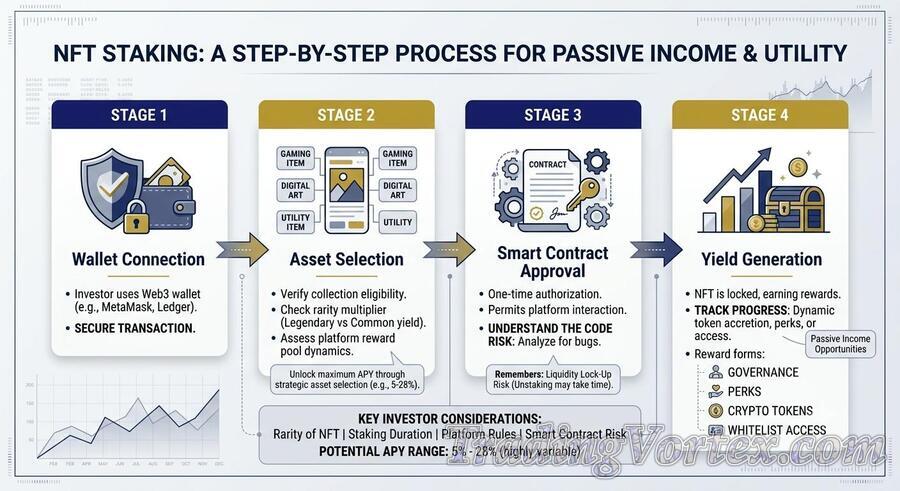
Understanding the Visual: Navigating the NFT Staking Lifecycle:
This infographic breaks down the complete operational lifecycle of NFT staking into four structured stages, highlighting critical investor considerations and risk management factors at each step.
Stage 1: Wallet Connection & Security
-
The Action: Connect a Web3 wallet (such as MetaMask or Ledger) to the verified staking interface.
-
Key Takeaway: Ensure your connection is secure before interacting with any platform to safeguard your digital assets from phishing attempts.
Stage 2: Asset Selection & Strategy
-
The Action: Choose an eligible NFT from supported categories, such as Gaming Items, Digital Art, or Utility Tokens.
-
Key Takeaway: Staking yields are not uniform. Your potential APY (typically ranging from 5% to 28%) depends heavily on asset rarity and pool dynamics. Rarer NFTs often act as yield multipliers.
Stage 3: Smart Contract Approval & Risk Assessment
-
The Action: Grant a one-time transaction approval allowing the smart contract to lock your NFT.
-
Key Takeaway: Always evaluate protocol risk before approving. Staking involves locking your asset into smart contract code, which carries exposure to code bugs and temporary liquidity lock-ups (inability to sell quickly if market floor prices shift).
Stage 4: Yield Generation & Utility Accrual
-
The Action: Once locked, your NFT generates continuous passive value without requiring you to sell the underlying asset.
-
Key Takeaway: Rewards extend beyond standard crypto tokens. Staking can yield governance voting rights, ecosystem perks, whitelist spots for upcoming drops, or exclusive in-game advantages.
NFT Staking Market Trends
NFT staking in 2026 has matured into a serious part of the Web3 economy. What started as a way to squeeze extra value out of collectibles has transformed into a system that blends finance, gaming, and digital ownership. The focus is shifting from hype-driven speculation to utility-driven ecosystems, where staking provides real benefits like liquidity, governance, and sustainable yield.
Growth of NFT Staking Platforms in DeFi and Web3
NFT staking is no longer a fringe experiment. It has become a recognized pillar of the DeFi and Web3 landscape, riding alongside liquid staking and restaking protocols. Recent industry reports show that total value locked across decentralized finance has surged past $198 billion in mid-2026, and NFT staking platforms are carving out their share by offering utility-based rewards.
Instead of relying solely on resale hype, NFTs are now being used as collateral for loans, governance tokens in DAOs, and yield-bearing assets inside DeFi protocols. This integration gives NFTs a more stable role in the financial stack, making them attractive to both retail investors and institutions.
NFT Staking in Gaming and Metaverse Economies
Gaming NFTs have taken center stage, accounting for nearly 38 percent of total NFT trading volume. In these ecosystems, staking is not just about earning tokens; it often unlocks rare items, exclusive skins, or competitive advantages that enhance gameplay.
Cross-Chain NFT Staking and Liquidity Pools
One of the biggest frustrations for early NFT investors was being locked into a single blockchain ecosystem. That’s changing fast. Platforms like Blur, Magic Eden, and OpenSea are experimenting with multi-chain staking pools, allowing users to stake NFTs across Ethereum, Polygon, and Solana without losing flexibility.
This cross-chain approach reduces fragmentation and opens the door to higher yields and diversified risk exposure. Liquidity pools tied to fractionalized NFTs are also gaining traction, enabling smaller investors to participate in staking without needing to own entire high-value assets. For traders, this means more opportunities to move capital efficiently and avoid bottlenecks.
Fractionalized NFTs and Yield Opportunities
Fractionalization is one of the most exciting innovations in NFT staking. Instead of needing to buy a full CryptoPunk or Bored Ape, investors can purchase fractions and stake them collectively. This democratizes access to blue-chip NFTs and spreads risk across multiple holders.
Fractional staking also boosts liquidity, since fractions can be traded more easily than whole NFTs. For everyday investors, this means lower entry costs and more consistent yield opportunities, especially in collections with strong cultural or utility value. It’s like owning a slice of a rare painting and still earning dividends from it.
NFT Staking Rewards and APY Models
Yields in NFT staking are becoming more sustainable and predictable. While some platforms still advertise flashy APYs above 20 percent, most serious projects are aligning with broader staking yields seen in Ethereum and DeFi. Ethereum staking yields, for example, have compressed to around 3.3–3.8 percent APR when factoring in MEV rewards, and NFT platforms are following suit by offering moderate but stable returns.
This shift reflects a maturing market where investors prioritize long-term sustainability over short-term hype, reducing the risk of token inflation and unsustainable reward models.
In short, NFT staking is no longer just a speculative side hustle. It has become a structured part of DeFi, gaming, and metaverse economies, with cross-chain flexibility, fractional ownership, and sustainable yields shaping the future.
For investors, this means more opportunities to earn steady returns while staying engaged in the ecosystems they care about.
📊 2026 NFT Staking Market Distribution: A Snapshot of Volume by Core Utility
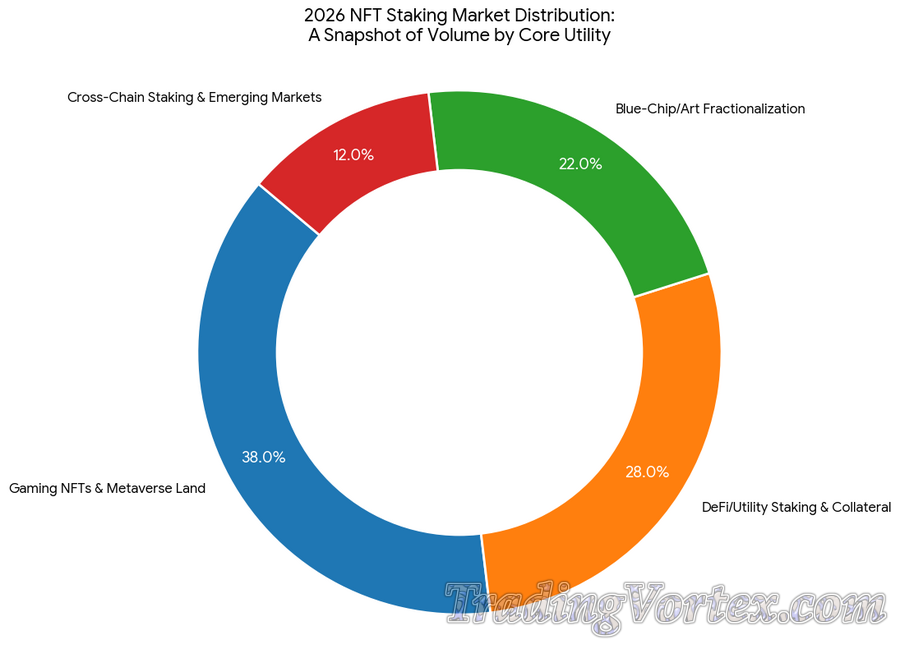
Understanding the 2026 NFT Staking Landscape through Utility
This doughnut chart provides a structured overview of the maturing NFT staking ecosystem in mid-2026. The shift from hype to utility highlighted in the text is visually represented by dividing the market into four core operational sectors. This segmentation helps investors understand where the majority of staking activity is concentrated.
♦ How to Interpret This Visual:
-
The Dominance of Gaming and Metaverse Economies: The largest segment, at 38%, confirms the trend mentioned in the text that Gaming NFTs and Metaverse Land lead the market. This volume represents users staking assets not merely for passive income, but to unlock active advantages — exclusive items, boosted stats, or virtual community benefits — within functional digital worlds.
-
Integration with DeFi and Utility Staking: The second-largest segment (28%) showcases NFTs acting as serious financial tools. This volume includes NFTs used as collateral for loans, assets deposited in yield-bearing protocols, or governance tokens within DAOs. This validates the integration of NFTs into the $198 billion DeFi landscape described.
-
Access via Blue-Chip/Art Fractionalization: At 22%, this segment represents the successful democratisation of high-value assets. This volume is driven by investors who purchase fractions of legendary collections like CryptoPunks or Bored Apes to participate in collective staking and earn more stable, sustainable yields without owning a whole asset.
-
Cross-Chain Staking & Emerging Markets: At 12%, this emerging segment highlights the nascent but growing cross-chain approach. This volume comes from platforms offering multi-chain staking pools (e.g., Blur, Magic Eden), allowing users to diversify risk and capitalize on higher yields across different blockchains (Ethereum, Solana, Polygon).
By analyzing this chart alongside the text, investors can identify which maturity-driven ecosystems (utility, finance, fractionalization, or interoperability) currently drive the value proposition of modern NFT staking.
Binance NFT Staking Platform
Binance’s NFT staking platform has become one of the most accessible ways for investors to earn passive rewards from their digital assets. It offers flexible and locked staking options with tokens like ApeCoin and SAND, balancing convenience against custodial and regulatory risks while keeping things simple enough for beginners and robust enough for seasoned traders.
Rewards with ApeCoin, $SAND, and Event Bonuses
Binance has carved out a strong position by tying its staking rewards to some of the most recognizable names in the NFT and metaverse space. Holders of NFTs linked to ApeCoin (APE), The Sandbox (SAND), and other gaming or metaverse projects can stake through Binance to earn daily token rewards. These rewards are often auto-compounded, so you don’t need to log in every day to claim them.
What makes Binance stand out is its knack for layering in event-based bonuses. These can include limited-time reward multipliers, exclusive NFT drops, or whitelist access for upcoming launches.
For investors who enjoy both yield and community perks, these extras feel like a bonus round in a video game: you’re already earning tokens, and suddenly you get a shot at something rare or exclusive.
Key Features and Benefits
The biggest selling point of Binance NFT staking is ease of use. You don’t need to worry about running validator nodes or interacting directly with smart contracts. Binance pools staked NFTs, manages the technical side, and distributes rewards straight to your wallet.
- Flexible vs. Locked Staking: Flexible staking lets you withdraw anytime, with APYs typically ranging from 0.5 percent to 8 percent. Locked staking offers higher yields, often between 3 percent and 20 percent, depending on duration and asset.
- Wide Asset Support: Binance supports a broad range of NFT-linked tokens and collections, making it one of the most versatile platforms for staking.
- Beginner-Friendly Interface: With over 250 million registered users worldwide, Binance has designed its staking dashboard to be intuitive for newcomers while still offering advanced options for experienced traders.
- Auto-Compounding Rewards: Rewards accrue daily, so your yield grows steadily without extra effort.
For collectors, this means your NFTs aren’t just sitting idle in your wallet. They are actively generating yield while keeping you connected to Binance’s larger ecosystem of DeFi, gaming, and metaverse integrations.
Risks and Considerations
Of course, convenience comes with trade-offs.
- Custodial Risk: Staking through Binance means handing custody of your NFTs to the exchange. If Binance faces a security breach or regulatory freeze, your assets could be at risk.
- Lower APYs Compared to Native Staking: While Binance offers stability and simplicity, yields are often lower than what you might earn by staking directly with native protocols.
- Regulatory Uncertainty: Governments are increasingly scrutinizing staking models. NFT staking could be classified as a financial product in some jurisdictions, which might affect reward structures or platform availability.
- Limited Governance Rights: Unlike native staking, you don’t get to vote on governance proposals. Binance makes those decisions with pooled assets, which may not align with your preferences.
In short, Binance NFT staking is the “easy button” for passive income. It’s ideal if you value convenience, broad asset support, and steady rewards. Just keep in mind that simplicity comes at the cost of control, so weigh the benefits against custodial and regulatory risks before committing your NFTs.
📊 Binance NFT Staking Yield Comparison: Flexible vs. Locked vs. Native Protocol APYs Across Asset Categories
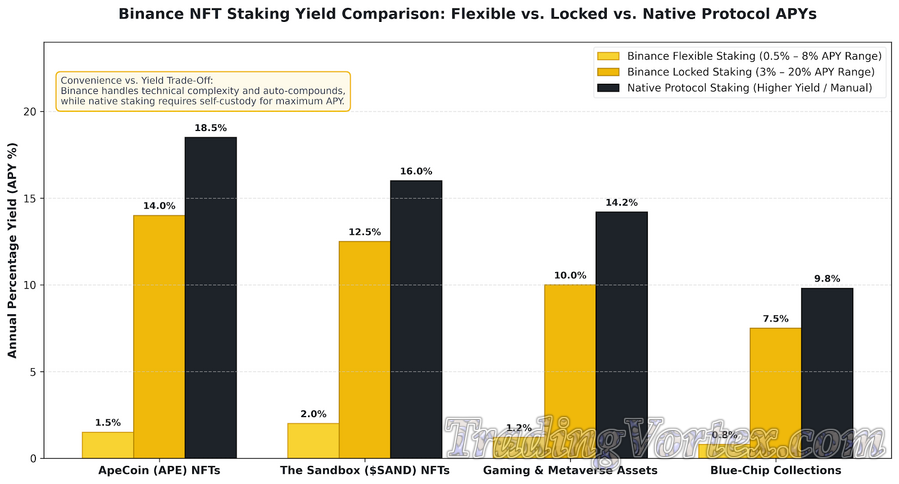
Understanding the Visual: Evaluating Convenience, Flexibility, and Yield
This bar chart illustrates the trade-offs between Binance's staking products and native protocol staking across key supported NFT ecosystems (such as ApeCoin, The Sandbox, general gaming assets, and blue-chip collections).
1. Binance Flexible Staking (Light Gold)
-
Characteristics: Offers low-friction, instant-withdrawal access with APYs ranging from 0.5% to 2.0% across categories.
-
Best Used For: Investors who prioritize high liquidity and want to earn basic passive yield while retaining the ability to withdraw or sell their NFTs at a moment's notice.
2. Binance Locked Staking (Dark Gold)
-
Characteristics: Offers significantly boosted APYs ranging from 7.5% to 14.0% in exchange for committing assets for fixed lock-up terms (e.g., 30, 60, or 90 days).
-
Best Used For: Long-term holders seeking higher auto-compounded returns without needing to manage complex Web3 wallet interactions or manual smart contract executions.
3. Native Protocol Staking (Dark Charcoal)
-
Characteristics: Direct on-chain staking delivers the highest nominal returns (9.8% to 18.5%) and grants full governance voting rights.
-
The Catch: Requires manual transaction approvals, active management, gas fee expenditures, and self-custody risk.
Key Takeaways for Investors
-
The Convenience Premium: Binance charges an implicit "convenience fee" in the form of slightly lower yields compared to native protocol staking, in exchange for automated daily compounding, simplified security, and pooled gas efficiency.
-
Custody vs. Control: While Binance Locked Staking approaches native-level yields on flagship tokens like ApeCoin (14.0% vs. 18.5%), using a centralized exchange means forfeiting on-chain governance voting rights and accepting centralized custodial exposure.
NFTX Staking Platform
NFTX is one of the most innovative NFT staking platforms because it tackles one of the biggest challenges in the NFT market: liquidity. By creating decentralized vaults for collections like CryptoPunks and issuing fungible ERC-20 tokens backed 1:1 by NFTs, NFTX allows investors to stake, trade, and even fractionalize high-value assets. This makes blue-chip NFTs accessible to everyday traders while still offering yield opportunities.
Decentralized Vaults for Blue-Chip NFTs
NFTX runs on Ethereum and specializes in building vaults for NFT collections. A vault is essentially a pool where NFTs of similar value are locked together. For example, if 100 CryptoPunks are deposited, the vault issues 100 fungible PUNK tokens, each backed by one NFT. These tokens can then be traded like regular ERC-20 assets, giving NFTs the liquidity they usually lack.
The vault system is designed to attract floor NFTs (the lowest-priced assets in a collection), which stabilizes the tokens and makes them easier to trade. Investors who stake their NFTs into these vaults earn fees whenever someone buys, sells, or swaps assets through the platform. In practice, this means your NFT is no longer just a static collectible, it becomes part of a dynamic financial instrument that generates yield.
This model has been particularly appealing for collections like CryptoPunks, Bored Ape Yacht Club, and Hashmasks, where individual NFTs can be worth hundreds of thousands of dollars. By pooling them, NFTX makes these assets more liquid and tradable, while still preserving their underlying value.
How Fractionalized Staking Works
Fractionalization is where NFTX really shines. Instead of needing to buy a full CryptoPunk or Bored Ape, you can own a fraction by holding the vault’s ERC-20 tokens. This works much like stock splitting: one expensive asset is divided into smaller, tradable units.
NFTX offers two main staking models:
- Inventory Staking: You deposit your NFT into the vault and receive a share of 20 percent of the vault’s fees. You also get an xToken (like xPUNK), which represents your position. When you exit, you can redeem a random NFT from the vault or claim your share of fees.
- Liquidity Staking: You provide liquidity by pairing vault tokens with ETH in an AMM pool. Liquidity stakers earn 80 percent of vault fees plus trading fees from swaps.
This system means you don’t just earn yield, you also help create liquid markets for NFTs. It’s a clever design: collectors get more utility, traders get more flexibility, and the broader ecosystem benefits from deeper liquidity.
Investor Opportunities
For investors, NFTX opens doors that were previously locked.
- Access to Blue-Chip NFTs: Fractionalization lowers the barrier to entry, so you don’t need hundreds of thousands of dollars to gain exposure to collections like CryptoPunks or BAYC.
- Yield Generation: Stakers earn fees in ETH, with APRs calculated based on vault activity. Returns vary, but they can be attractive compared to traditional NFT holding strategies.
- Diversification: By holding fractional tokens, you can spread risk across multiple NFTs instead of betting on a single asset.
- DeFi Integration: Vault tokens can be used in other DeFi protocols, serving as collateral or liquidity in broader ecosystems.
Of course, there are risks. You may not get your exact NFT back when unstaking, since vaults operate on a pooled model. Rare or sentimental NFTs are better left out of vaults. Market volatility also affects yields, and regulatory uncertainty could reshape how fractional ownership is treated.
In short, NFTX is the platform for investors who want liquidity, yield, and access to blue-chip NFTs without needing deep pockets. It’s a blend of DeFi mechanics and NFT culture, making it one of the most forward-thinking staking platforms in the space. For traders who have always felt priced out of the “NFT elite,” NFTX offers a way to participate, earn, and diversify without breaking the bank.
📊 NFTX Staking Architecture: Protocol Fee Distribution Share and Performance vs. Risk Comparison Between Inventory and Liquidity Staking
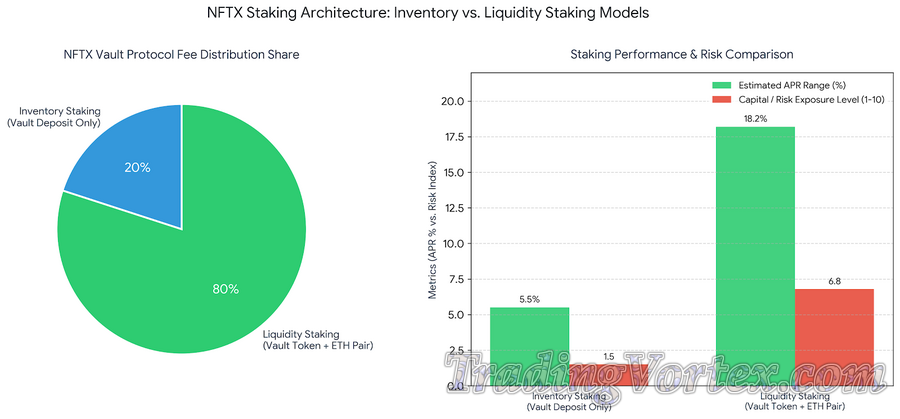
Understanding the Visual: Analyzing NFTX Staking Pathways
This dual visualization breaks down the operational mechanics and risk-return profiles of the two primary staking models offered by the NFTX protocol.
1. NFTX Vault Protocol Fee Distribution Share (Left Chart)
-
Liquidity Staking Allocation (80%): The vast majority of fees generated by vault activity (minting, redeeming, and swapping blue-chip NFTs like CryptoPunks or BAYC) are routed directly to users who provide paired liquidity (e.g., vToken + ETH) in automated market maker (AMM) pools.
-
Inventory Staking Allocation (20%): A smaller portion of vault fees is distributed to single-sided stakers who deposit an NFT directly into the vault without providing matching ETH capital.
2. Staking Performance & Risk Comparison (Right Chart)
-
Inventory Staking (Lower Yield / Minimal Complexity):
-
Yield: Delivers a conservative base return (approx. 5.5% APR), driven purely by the 20% protocol fee share.
-
Risk/Complexity (1.5 / 10): Low risk profile. Stakers only lock their single NFT asset, avoiding impermanent loss and eliminating the need for matching ETH liquidity.
-
-
Liquidity Staking (Higher Yield / Increased Complexity):
-
Yield: Generates significantly higher returns (approx. 18.2% APR), capturing both the 80% protocol fee share and additional AMM swap fees.
-
Risk/Complexity (6.8 / 10): Higher risk profile. Requires matching the value of the vToken with equal parts ETH, exposing the investor to impermanent loss and smart contract risk across multiple liquidity pools.
-
Key Takeaways for Investors
-
Choose Inventory Staking If: You want simple, single-asset passive yield on floor NFTs without requiring additional ETH capital or actively managing liquidity pools.
-
Choose Liquidity Staking If: You are an active DeFi investor looking to maximize yield on blue-chip holdings and are comfortable managing impermanent loss and dual-token liquidity exposure.
Doge Capital NFT Staking
Doge Capital NFT staking is built on Solana and rewards holders with daily $DAWG tokens, making it one of the more community-driven and utility-focused NFT ecosystems. Stakers earn consistent rewards, gain access to exclusive perks, and help sustain a vibrant collector base, though liquidity and custodial risks remain important considerations.
Daily $DAWG Rewards for Doge NFTs
Doge Capital is a collection of 5,000 unique NFTs minted on the Solana blockchain, each tied to the ecosystem’s native token, $DAWG. Staking a Doge Capital NFT earns holders 5 $DAWG tokens per day, with an extra 1 $DAWG for each additional NFT staked. Rewards are distributed automatically, which makes the process simple and predictable for collectors who want steady yield without constant monitoring.
The $DAWG token itself is more than just a payout. It acts as a currency within the Doge Capital ecosystem, enabling holders to purchase exclusive merchandise, customize NFT metadata, and gain access to member-only events. This dual role: reward and utility; makes staking feel less like passive farming and more like active participation in a lifestyle brand.
Community Engagement and Utility
One of Doge Capital’s strongest selling points is its tight-knit and highly engaged community. Staking is not just about collecting tokens, it’s about being part of a group that values both the art and the shared experience. Holders often use $DAWG to access exclusive drops, community-driven events, and governance decisions, reinforcing the sense of belonging.
The project emphasizes utility beyond speculation. By staking, you’re not only earning yield, you’re contributing to the growth of a platform that integrates NFTs with real-world perks.
Pros and Cons
Pros:
- Consistent Rewards: Daily $DAWG payouts provide predictable yield for long-term holders.
- Utility-Driven Ecosystem: Tokens can be used for merchandise, events, and NFT customization.
- Community Engagement: Strong collector base with active participation and perks.
- Low Entry Barrier: Compared to blue-chip NFTs, Doge Capital offers affordable access to staking rewards.
Cons:
- Liquidity Challenges: $DAWG has relatively low trading volume and a modest market cap (around $3,000), limiting cash-out options.
- Custodial Risk: Unstaking burns an airdrop token, reducing flexibility for short-term traders.
- Market Volatility: Token prices are highly volatile, with $DAWG trading near $0.0001 in mid-2026.
- Regulatory Uncertainty: As with all staking platforms, future rules could affect reward structures.
In short, Doge Capital NFT staking is best suited for collectors who value community and utility as much as yield. The daily $DAWG rewards are steady, the perks are fun, and the ecosystem feels more like a club than a farm. Just keep in mind that liquidity is limited, so it’s a better play for long-term holders who enjoy being part of a vibrant community rather than quick flippers chasing short-term gains.
📊 Doge Capital NFT Staking Dynamics: Daily $DAWG Payout Scaling and 30-Day Cumulative Token Yield Trajectory
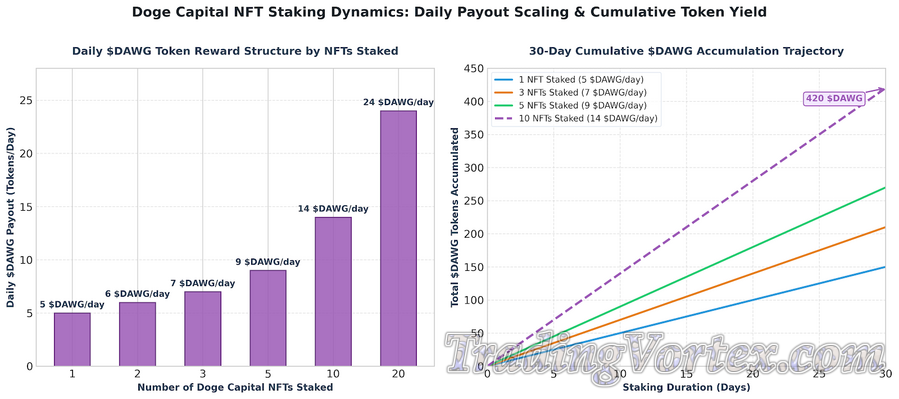
Understanding the Visual: Payout Structure & Token Accumulation
This visualization models the staking reward distribution mechanics of the Doge Capital ecosystem on Solana, breaking down how your daily $DAWG token yield scales relative to your portfolio size and staking duration.
1. Daily $DAWG Token Reward Structure by NFTs Staked (Left Chart)
-
Base Rate & Incremental Bonus: Staking a single Doge Capital NFT establishes a baseline yield of 5 $DAWG tokens per day. Each additional NFT staked adds +1 $DAWG per day to your total daily distribution.
-
Scaling Dynamics: Staking 1 NFT earns 5 $DAWG/day, while holding 3 NFTs yields 7 $DAWG/day, 5 NFTs yields 9 $DAWG/day, 10 NFTs yields 14 $DAWG/day, and a 20-NFT portfolio scales to 24 $DAWG/day.
2. 30-Day Cumulative $DAWG Accumulation Trajectory (Right Chart)
-
Predictable Passive Income: Because payouts are distributed automatically on a daily schedule, token accumulation follows a linear progression over time.
-
Comparative Output Over 30 Days:
-
1 NFT Staked: Accumulates 150 $DAWG in 30 days.
-
3 NFTs Staked: Accumulates 210 $DAWG in 30 days.
-
5 NFTs Staked: Accumulates 270 $DAWG in 30 days.
-
10 NFTs Staked: Accumulates 420 $DAWG over a 30-day period.
-
Key Considerations for Collectors and Stakers
-
Community Utility Focus: Since $DAWG tokens are used within the ecosystem to buy physical merchandise, customize metadata, and access exclusive drops, accumulating tokens over a 30-to-90 day horizon helps fund ecosystem perks without needing additional out-of-pocket crypto expenditure.
-
Unstaking & Liquidity Factors: Because withdrawing funds automatically unstakes all NFTs and burns an airdrop token to control token supply, long-term holders benefit most by leaving their portfolio staked continuously rather than attempting short-term trading or frequent withdrawal cycles.
BAND NFT Staking
BAND NFT staking is one of the most distinctive models in the NFT space because it ties digital ownership directly to real-world music royalties. Holders can stake BAND NFTs to earn governance tokens and share in royalty revenues from songs performed by global superstars like Beyoncé, Jay-Z, and Rihanna, creating a blend of fan engagement, investment, and creative industry participation.
Music NFTs with Royalties and Governance Tokens
BAND Royalty NFTs are built on the Ethereum blockchain and give holders access to music royalty pools. By staking a BAND NFT, investors can earn governance tokens that allow them to help decide which new royalties the platform acquires. In addition, stakers share in the revenue streams generated by BAND’s catalog, which includes songs performed by artists such as Justin Timberlake, Cher, Missy Elliott, and Timbaland.
The staking process is flexible: BAND NFTs can be locked for periods ranging from 90 days to 5 years, with longer commitments earning proportionally more governance tokens. Rewards are calculated and held in reserve until the staking period ends, ensuring that payouts are tied to actual catalog performance. If a holder exits early, they forfeit their governance tokens, which are redistributed to other stakers. This design encourages long-term participation and stability in the ecosystem.
What makes this model particularly appealing is that payouts are not speculative tokens with uncertain value, but rather royalty revenues tied to real-world music consumption. Every time a song in the BAND catalog is streamed, played on the radio, or licensed for commercial use, those royalties flow back into the pool. In other words, your NFT is backed by the rhythm of the music industry itself.
Unique Value for Creators and Collectors
BAND NFT staking stands out because it fuses art, fandom, and finance in a way few other projects do. Collectors aren’t just speculating on digital art, they are buying into a system that lets them share in the profits of real-world music royalties. This creates a sense of ownership and connection to the music industry that goes beyond streaming or ticket sales.
For creators, BAND offers a new way to monetize catalogs while engaging fans directly. Instead of relying solely on labels, artists can benefit from a community-driven model where fans stake NFTs to support royalty acquisitions. This democratizes access to music royalties, traditionally reserved for industry insiders, and opens the door for fans to become stakeholders in the success of their favorite songs.
For collectors, it’s a chance to feel like a mini music mogul, earning from the same revenue streams that fuel major record labels. Imagine telling your friends that your NFT is paying you royalties from a Justin Timberlake track; it’s a bragging right that blends culture with investment.
The governance aspect adds another layer of utility. Stakers can influence which royalties BAND acquires next, giving fans a voice in shaping the catalog. This participatory model strengthens community engagement and makes staking feel more like collaboration than passive investment.
Potential Challenges
As exciting as BAND NFT staking is, there are challenges to consider:
- Liquidity Risk: Governance tokens and royalty payouts depend on catalog performance, which can fluctuate with music trends. A hit song can boost returns, while a decline in streams can reduce payouts.
- Regulatory Uncertainty: Fractionalized royalties may attract scrutiny, especially if regulators classify them as securities. This could impact how BAND NFTs are marketed and traded.
- Long Lock-Up Periods: Staking for years can be rewarding, but it reduces flexibility for investors who may want quicker liquidity. Not everyone is comfortable committing for half a decade.
- Artist Affiliation Limits: While BAND owns rights to royalties from songs performed by major artists, the artists themselves are not directly affiliated with the project. This distinction is important for managing expectations and avoiding confusion.
In short, BAND NFT staking is a bold experiment that bridges blockchain with the music industry. It gives fans and investors a chance to earn from royalties, participate in governance, and feel connected to the creative process.
For those who love music and want their NFTs to carry real-world utility, BAND offers one of the most compelling opportunities in the staking space. It’s not just about owning a piece of digital art, it’s about owning a slice of the soundtrack to our lives.
📊 BAND NFT Staking Architecture: Staking Lock-Up Duration vs. Governance Token Multipliers and Royalty Pool Share Weighting

Understanding the Visual: How Lock-Up Commitments Drive Yield
This dual-axis chart models the economic incentives of BAND Royalty NFT staking, illustrating how your choice of commitment period—ranging from 90 days to 5 years—impacts your relative governance voting power and share of music royalty revenue.
1. Governance Token Reward Multiplier (Purple Bars / Left Axis)
-
Proportional Scaling: As noted in the article, longer lock-up commitments earn significantly higher governance token rewards.
-
Multiplier Progression: Staking for 90 days provides a baseline 0.25x multiplier. Extending your lock-up to 1 Year increases the multiplier to 1.0x, 2 Years yields 2.2x, 3 Years reaches 3.5x, and a 5-Year commitment maximizes governance power at a 6.0x multiplier.
-
Strategic Value: Higher governance multipliers give you greater voting influence when determining which new music royalty catalogs (e.g., songs by major artists like Beyoncé, Jay-Z, or Justin Timberlake) the platform should acquire next.
2. Relative Royalty Pool Share Weighting (Green Line / Right Axis)
-
Real-World Royalty Shares: Rewards generated by music consumption (streams, radio, licensing) flow into the royalty pool and are distributed based on lock-up weighting.
-
Long-Term Advantage: A 90-day staker holds a 1x share weight, whereas a 5-year staker holds a 15x share weight. This exponential curve strongly favors long-term participants, protecting the ecosystem from short-term speculative capital.
Key Takeaways for Investors
-
Early Withdrawal Penalty: Rewards and governance tokens accrue continuously but are held in reserve until the full lock-up term expires. Exiting early forfeits accumulated governance tokens, which are redistributed to remaining long-term stakers.
-
Balancing Liquidity vs. Return: While a 5-year lock-up maximizes both voting rights and royalty distribution shares, it locks up your liquidity for half a decade. Evaluate your personal tolerance for music catalog performance fluctuations and lock-up terms before selecting your duration.
Splinterlands NFT Staking
Splinterlands NFT staking revolves around its native token, SPS (Splintershards), which powers rewards, governance, and play-to-earn mechanics. With over 1 billion SPS currently staked and a carefully managed emission schedule, it remains one of the most established NFT gaming ecosystems, though token volatility and lock-up risks are important to keep in mind.
SPS Staking for In-Game Rewards
The process is straightforward: SPS earned from ranked battles, tournaments, guild brawls, or land expansion can be staked directly through the SPS dashboard. Once staked, tokens generate yield from reward pools, initially funded with 37.5 million SPS per month, decreasing by 1 percent monthly to control inflation. Rewards are distributed automatically, and unstaking takes four weeks, with 25 percent of tokens released each week. This gradual release mechanism prevents sudden sell-offs and encourages long-term commitment.
For players, staking SPS is not just about passive income. It directly influences gameplay by boosting battle rewards, guild strength, and land productivity, making staking a core part of the Splinterlands experience.
Integration with Play-to-Earn Models
Splinterlands has been a pioneer in play-to-earn gaming, and staking is deeply integrated into its mechanics. Staked SPS not only earns yield but also boosts in-game performance by unlocking features like validator node participation, land expansion bonuses, and tournament advantages.
Guilds benefit from collective staking, which strengthens their competitive edge in brawls. Landowners can stake SPS to increase productivity of their plots, tying staking directly to gameplay. This creates a loop where playing generates SPS, staking amplifies rewards, and staking decisions influence gameplay outcomes.
The system is designed to keep players engaged long-term, blending financial incentives with gaming fun. It’s not just about farming tokens, it’s about building stronger decks, guilds, and strategies. For many, staking SPS feels like leveling up both financially and strategically, making every battle more meaningful.
Risks for Gamers and Investors
While Splinterlands staking offers clear benefits, there are risks to consider:
- Token Volatility: SPS has faced price declines since its 2021 launch, with ongoing downtrends in 2026. Even with over 1 billion SPS staked, market value remains sensitive to broader crypto cycles.
- Lock-Up Periods: Unstaking takes four weeks, limiting flexibility if you need liquidity quickly. This can be frustrating if market conditions shift suddenly.
- Inflation Management: Although emissions are decreasing, new SPS tokens will continue to be released until the 65-month schedule ends, which could pressure prices if demand does not keep pace.
- Gameplay Dependency: Rewards are tied to active participation. Casual players may find it harder to maximize staking benefits compared to competitive guilds or landowners who stake strategically.
In short, Splinterlands NFT staking is a blend of gaming and finance. It rewards active players with SPS, strengthens gameplay through staking mechanics, and offers yield opportunities for investors.
For gamers who love strategy and community, it’s a way to make every battle count financially.
For investors, it’s a chance to tap into one of the longest-running NFT gaming ecosystems, though patience and risk awareness are essential.
Splinterlands proves that staking can be more than passive yield: it can be part of an immersive, competitive, and rewarding digital world.
📊 Splinterlands (SPS) Staking Dynamics: 65-Month Inflation-Controlled Emission Decay Schedule and 4-Week Unstaking Unlock Mechanics

Understanding the Visual: Analyzing Splinterlands SPS Supply & Staking Mechanics
This dual visualization illustrates the core financial parameters governing Splintershards (SPS) staking within the Splinterlands gaming ecosystem.
1. 65-Month SPS Inflation-Controlled Emission Decay Schedule (Left Chart)
-
Initial Allocation: The reward pool started at a maximum distribution rate of 37.5 million SPS per month.
-
Monthly Deflationary Decay: To combat long-term token inflation, monthly emissions decrease continuously by 1 percent each month.
-
65-Month Schedule Projection: By Month 65 of the emission cycle, monthly payouts decay to roughly 19.7 million SPS (representing a ~47% reduction from inception). This structural tapering helps control circulating supply expansion over time.
2. 4-Week Gradual Unstaking Liquidity Release Schedule (Right Chart)
-
Vesting Schedule: When a player or investor decides to unstake SPS tokens, capital is not unlocked instantly. Instead, tokens vest linearly across 4 calendar weeks.
-
Weekly Tranches:
-
Week 1: 25% of unstaked SPS becomes liquid and available for transfer/sale.
-
Week 2: Cumulative 50% unlocked.
-
Week 3: Cumulative 75% unlocked.
-
Week 4: 100% fully unlocked and accessible.
-
-
Economic Purpose: This gradual 4-week release structure discourages panic selling and protects overall liquidity and token price stability during market drawdowns.
Key Takeaways for Gamers and Investors
-
Active Participation Matters: Because monthly emissions steadily decline, early and active participants who stake SPS; and leverage it in-game for guild brawls, ranked battle boosts, and land productivity; capture a higher relative share of the total remaining reward pool.
-
Liquidity Planning: Because unstaking requires a 28-day commitment to fully liquidate, short-term traders must account for execution risk and potential price changes during the 4-week cooldown window.
Aavegotchi NFT Staking
Aavegotchi NFT staking has grown into one of the most creative blends of DeFi and gaming, where staking GHST and liquidity tokens doesn’t just earn yield, it directly impacts your progress in the Gotchiverse. After migrating from Polygon to Base in 2025, the project has leaned into scalability, lower fees, and deeper liquidity, creating a staking system that feels less like finance and more like a role-playing adventure.
Polygon-Based Gaming and Staking Ecosystem
Aavegotchi originally launched on Polygon, where staking GHST tokens rewarded players with FRENS, a non-transferable balance used to buy raffle tickets for rare NFTs like Portals, Wearables, and land parcels. This raffle system was a clever way to gamify staking, turning yield into a chance at unique collectibles. By 2025, the project migrated to Base, Coinbase’s Layer 2 solution, to improve scalability, reduce gas fees, and attract broader liquidity.
Today, staking revolves around GHST and LP tokens, with rewards distributed in GLTR (GAX Liquidity Token Reward). GLTR is the lifeblood of the Gotchiverse economy. Burning GLTR speeds up crafting and upgrading installations, giving stakers a tangible edge in gameplay. It also acts as the currency for wearable auctions, guild channeling, and other in-game mechanics, ensuring that staking is tightly woven into the player experience.
Benefits of Gamified Staking
What makes Aavegotchi stand out is its gamified staking model, which transforms passive yield into active gameplay advantages.
- Gameplay Integration: Staking GHST or LP tokens accelerates crafting, upgrading, and competing in the Gotchiverse. Your staking decisions directly affect your ability to progress in the game.
- Community Governance: Stakers gain voting rights in AavegotchiDAO, where they help decide everything from reward structures to new game features. This makes staking feel participatory rather than passive.
- Multiple Staking Options: Players can stake GHST directly or provide liquidity in pools like GHST-USDC, GHST-WETH, or GHST-QUICK. LP tokens earned from these pools can then be staked for GLTR, creating layered opportunities for yield.
- Engagement and Rewards: Staking connects players to raffles, auctions, and guild activities, blending DeFi mechanics with RPG-style progression.
For many, staking GHST feels like leveling up in a game. Instead of just farming tokens, you’re actively shaping your character, your guild, and your place in the Gotchiverse. It’s finance with a playful twist, and that’s what keeps the community engaged.
Security and Sustainability
Aavegotchi’s staking system has been designed with long-term sustainability in mind, avoiding the pitfalls of unsustainable APY models.
- Emission Control: GLTR rewards are tied to LP staking, balancing incentives with liquidity risks and preventing runaway inflation.
- Smart Contract Audits: The project has undergone multiple audits to ensure staking contracts are secure, though users should always remain cautious in DeFi environments.
- Migration to Base: Moving from Polygon to Base improved scalability, reduced transaction costs, and made staking more accessible to casual players.
- Economic Utility: Unlike platforms that rely on inflated yields, Aavegotchi ties staking rewards directly to gameplay utility. This keeps demand steady, since players need GHST and GLTR to progress in the Gotchiverse.
The main risks are token volatility and liquidity exposure in LP pools. GHST’s price can swing with broader crypto markets, and impermanent loss is always a factor for liquidity providers. However, the fact that staking is integrated into gameplay helps stabilize demand, since players are motivated to hold and use GHST and GLTR rather than simply dump them.
In short, Aavegotchi NFT staking is a playful yet serious ecosystem where staking fuels both yield and in-game progression. It’s perfect for investors who enjoy gamified finance and for gamers who want their NFTs to do more than just sit in a wallet. By blending DeFi mechanics with RPG-style rewards, Aavegotchi has built one of the most sustainable, engaging, and community-driven staking models in the NFT space.
📊 Aavegotchi Staking Architecture: GLTR Token Yield Distribution Weighting and Impermanent Loss Risk Profile Comparison Across Staking Options

Understanding the Visual: Analyzing Aavegotchi Staking Options
This dual visualization models the relative yield incentives and corresponding risk exposure levels across the various staking pools available in the Aavegotchi ecosystem.
1. GLTR Yield Distribution Weight by Staking Option (Left Chart)
-
Single-Sided GHST Staking (1.0x Baseline): Staking GHST tokens directly provides a low-friction pathway to earn GLTR (GAX Liquidity Token Reward) with a baseline reward multiplier of 1.0x.
-
Liquidity Pool (LP) Staking Boosts: To incentivize deep DEX liquidity, providing liquidity in paired pools carries significantly higher emission weights:
-
GHST-USDC LP: Receives a 3.5x reward weighting multiplier.
-
GHST-WETH LP: Receives the highest allocation multiplier at 4.0x.
-
GHST-QUICK LP: Earns a 3.8x emission multiplier.
-
2. Yield Multiplier vs. Risk & Impermanent Loss Exposure (Right Chart)
- Single GHST (Low Risk / Modest Yield): Risk Rating (1.5 / 10): Minimal exposure. Stakers retain 100% single-asset exposure to GHST without suffering impermanent loss.
- GHST-USDC LP (Moderate Risk / High Yield): Risk Rating (4.5 / 10): Moderate impermanent loss risk due to pairing a volatile token (GHST) with a stablecoin (USDC).
- GHST-WETH & GHST-QUICK LPs (Higher Risk / Maximum Yield): Risk Rating (7.2 - 7.8 / 10): Higher risk profile. Dual-crypto volatility increases impermanent loss exposure, though offset by maximum GLTR generation.
Key Takeaways for Gamers and Stakers:
- In-Game Acceleration: GLTR tokens earned from staking are burned to reduce crafting and installation upgrade times in the Gotchiverse. Players seeking rapid progression benefit most from higher-yielding LP pools.
- Risk Management: Casual players prioritizing simple, low-maintenance staking should stick to single-sided GHST deposits to avoid impermanent loss while still acquiring GLTR for basic gameplay mechanics.
LooksRare NFT Marketplace Staking
LooksRare staking has carved out a reputation as one of the most rewarding systems for NFT traders, combining dual incentives in LOOKS tokens and wrapped ETH (wETH) from marketplace fees. It is designed to appeal to both active traders who thrive on volume and long-term holders who want steady yield. While the rewards are attractive, token inflation and competition in the NFT marketplace sector are challenges that investors should weigh carefully.
LOOKS and wETH Rewards
At the heart of LooksRare’s staking model is a dual reward system. Holders of the native LOOKS token can stake to earn additional LOOKS, while also receiving wETH rewards generated from marketplace fees. Every NFT sale on LooksRare (excluding private sales) carries a 2 percent transaction fee, and 75 percent of that fee is redistributed to stakers in wETH. This means staking rewards are not just speculative tokens, but actual ETH-based income tied directly to marketplace activity.
When the staking program launched, LOOKS emissions were generous, creating high yields for early adopters. Over time, emissions have tapered, shifting the balance toward wETH rewards as the primary incentive. This evolution makes staking more sustainable, since wETH rewards depend on trading volume rather than token inflation.
Another key feature is auto-compounding, which allows stakers to reinvest their LOOKS rewards without incurring extra gas fees. For long-term holders, this is a convenient way to grow positions steadily, while active traders can use wETH rewards as a form of cashback to offset transaction costs.
Marketplace Utility and Liquidity
LooksRare positions itself as a community-first alternative to OpenSea, with staking woven into its core design. By rewarding stakers with both LOOKS and wETH, the platform ensures that liquidity providers and token holders benefit directly from marketplace growth.
For traders, staking LOOKS can feel like a rebate system. If you are actively buying and selling NFTs, the wETH rewards help reduce the effective cost of trading. For investors, staking LOOKS is a way to stay engaged with the marketplace while earning yield, even during quieter trading periods.
The marketplace also incentivizes activity through listing and trading rewards, distributed in LOOKS tokens based on volume. This creates a feedback loop: trading generates rewards, staking compounds them, and wETH fees provide a steady income stream. In practice, this makes LooksRare staking appealing for both casual collectors who want passive income and professional traders who want their marketplace activity to pay them back.
Risks of Token Inflation
Despite its strengths, staking on LooksRare comes with risks that investors should consider:
- Token Inflation: LOOKS emissions were heavily front-loaded, meaning a large portion of the supply was distributed early. This created downward pressure on the token price, and although emissions are tapering, inflation remains a concern.
- Market Volatility: LOOKS has experienced sharp price swings, and staking rewards can lose value quickly if the token depreciates.
- Dependence on Trading Volume: wETH rewards are tied directly to marketplace activity. If trading slows, rewards shrink, making staking less profitable.
- Competitive Pressure: Platforms like Blur and Magic Eden are aggressively competing for liquidity and traders. LooksRare must continue innovating to maintain relevance and reward sustainability.
In short, LooksRare NFT marketplace staking offers a compelling mix of LOOKS token rewards and wETH income from trading fees. It is particularly attractive for traders who want their marketplace activity to generate yield, and for investors who value a staking model tied to real trading volume. However, token inflation, market volatility, and rising competition are challenges that require careful consideration.
For those who enjoy staking with a direct link to marketplace dynamics, LooksRare remains one of the most community-driven platforms in the NFT space.
📊 LooksRare Staking Architecture: Marketplace Fee Distribution Model and Yield Composition Evolution Across Protocol Lifecycle
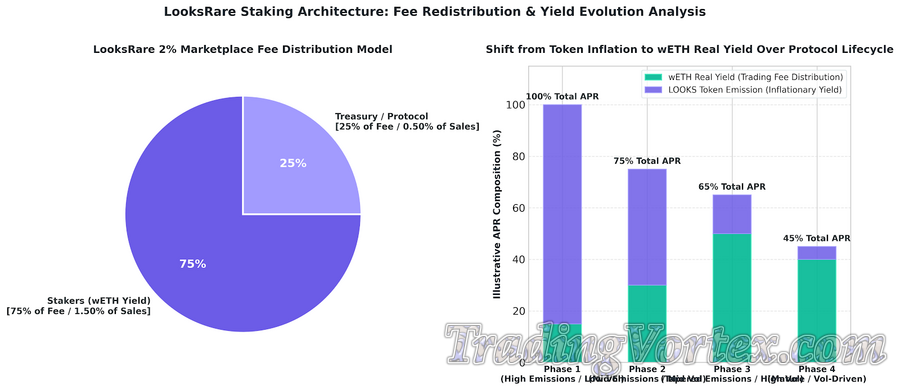
Understanding the Visual: Marketplace Fee Allocation & Yield Transition
This dual visualization breaks down the financial design behind LooksRare NFT marketplace staking, illustrating how transaction fees are distributed and how staker yields transition over time from token emissions to organic trading revenue.
1. LooksRare 2% Marketplace Fee Distribution Model (Left Chart)
-
Platform Fee Structure: Every non-private NFT sale on the LooksRare marketplace carries a flat 2.0% transaction fee.
-
Staker Fee Share (75%): Out of this 2% marketplace fee, 75% (equivalent to 1.50% of overall transaction volume) is directed straight to LOOKS token stakers in wrapped Ether (wETH).
-
Protocol Treasury Share (25%): The remaining 25% (0.50% of sales volume) is routed to the platform treasury to fund ongoing operations, development, and ecosystem growth.
2. Shift from Token Inflation to wETH Real Yield Over Protocol Lifecycle (Right Chart)
-
Early Incentive Phase (Phase 1): In the platform's early stages, total staking returns were dominated by high LOOKS token emissions (inflationary yield), designed to attract initial liquidity and early adopters.
-
Transition Phase (Phases 2 & 3): As scheduled LOOKS emissions taper down, the primary driver of staking returns shifts toward organic wETH rewards generated directly by marketplace trading volume.
-
Mature Phase (Phase 4): In a mature state, total staking APY relies predominantly on actual trading activity ("real yield") rather than inflationary token minting, creating a more sustainable economic model for long-term token holders.
Key Takeaways for Investors and Active Traders
-
Direct Volume Correlation: Because 75% of marketplace fees are paid out in wETH, staker income scales directly with platform trading volume. Active NFT market cycles generate higher wETH yields, whereas quiet trading periods lead to lower payouts.
-
Effective Fee Offset for Traders: Active NFT collectors and professional traders can view wETH staking distributions as a rebate system that partially offsets trading fees incurred across their marketplace activity.
-
Auto-Compounding Advantage: Stakers can utilize auto-compounding features to automatically reinvest accrued LOOKS rewards without incurring gas fees, maximizing long-term position growth while holding wETH rewards as liquid cash flow.
Rarible NFT Staking
Rarible NFT staking revolves around the RARI token, which powers governance, rewards, and liquidity across multiple chains. With staking yields that have historically reached up to 70 percent and a growing multi-chain ecosystem, Rarible has positioned itself as one of the most accessible and community-driven staking models in the NFT marketplace sector. It is a platform that blends simplicity with meaningful participation, making it attractive for both seasoned traders and newcomers who want to dip their toes into staking without feeling overwhelmed.
Multi-Chain Staking with Liquidity Pools
Rarible has steadily evolved from a straightforward NFT marketplace into a multi-chain protocol that supports Ethereum, Polygon, Flow, Tezos, and most recently its own RARI Chain, an Ethereum Layer-3 designed to enforce royalties at the node level. This innovation is particularly important because it addresses one of the biggest challenges in the NFT space: ensuring creators continue to receive royalties even as marketplaces compete for volume.
Staking RARI tokens allows holders to participate in governance while earning yield from cross-chain reward pools. The staking model is flexible: users can lock RARI directly or provide liquidity in pools such as RARI-ETH or RARI-USDC, then stake LP tokens to earn additional rewards. This dual system ensures that liquidity providers benefit from both trading fees and staking yields, while governance participants gain influence over treasury decisions, royalty enforcement, and protocol upgrades.
By mid-2026, Rarible reported over 24,000 active RARI holders and a treasury exceeding $4.9 million, signaling strong community engagement and financial resilience. Staking rewards are distributed in RARI, with yields fluctuating based on pool activity and governance participation. During periods of high marketplace activity, APYs have surged into double-digit territory, making staking particularly attractive for active participants.
Accessibility for Beginners
One of Rarible’s defining strengths is its beginner-friendly approach. While many NFT staking platforms demand complex DeFi maneuvers, Rarible offers an intuitive staking interface through its DAO dashboard. Users can purchase RARI on major exchanges, transfer it to a wallet, and stake with just a few clicks.
The platform also introduced a delegate model, allowing holders to assign their voting power to trusted community members if they prefer not to participate directly in governance. This lowers the barrier for newcomers who may feel uncertain about making governance decisions but still want to earn rewards.
Long-Term Value Potential
Rarible’s staking system is designed with sustainability and creator alignment in mind. Instead of relying solely on token emissions, rewards are tied to marketplace activity, treasury growth, and cross-chain participation. This reduces inflation risk and ensures that staking incentives are aligned with real ecosystem performance.
- Governance Utility: Stakers shape treasury spending, royalty enforcement, and protocol upgrades, giving them a direct role in the platform’s evolution.
- Creator-Centric Tools: Rarible continues to expand infrastructure for creators, brands, and communities, ensuring long-term demand for RARI. The launch of RARI Chain is a major step toward protecting creator royalties.
- Cross-Chain Expansion: With integrations across Ethereum, Polygon, Arbitrum, and its own Layer-3, staking remains relevant in a multi-chain NFT economy.
- Yield Opportunities: While APYs fluctuate, staking yields have reached up to 70 percent during peak activity, offering competitive returns compared to other NFT platforms.
The main risks are token volatility (RARI trades around $0.38 in mid-2026, far below its all-time high of $46.70) and market competition from platforms like Blur and OpenSea, which continue to dominate trading volume. However, Rarible’s focus on governance, creator royalties, and community-driven utility gives its staking model strong long-term potential.
In short, Rarible NFT staking is ideal for investors and collectors who want a simple, community-driven way to earn yield while influencing the future of a major NFT marketplace. It balances accessibility with meaningful governance, making it one of the most approachable and sustainable staking platforms in the NFT space.
For those who value both yield and creator empowerment, Rarible offers a unique opportunity to be part of a platform that is shaping the next chapter of NFT marketplaces.
📊 Rarible (RARI) Staking Architecture: Staking Pool Yield Potential Across Activity Phases and Multi-Chain Ecosystem Network Distribution
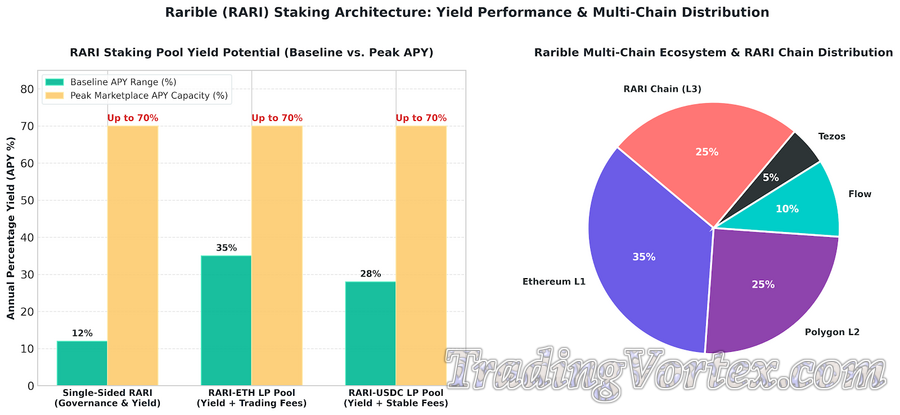
Understanding the Visual: Staking Yield Dynamics & Multi-Chain Structure
This dual visualization breaks down the yield potential across different RARI staking pathways and illustrates how Rarible’s multi-chain architecture powers token utility and governance participation.
1. RARI Staking Pool Yield Potential (Left Chart)
-
Baseline vs. Peak Activity Yields: Staking returns on Rarible adapt based on marketplace trading volume, treasury performance, and reward pool activity.
-
Single-Sided RARI Staking: Offers a beginner-friendly baseline yield (approx. 12% APY during standard market conditions) while giving holders voting rights in the RARI DAO or the ability to delegate votes. During peak marketplace volume, yields across all pools have historically surged up to 70% APY.
-
Liquidity Pool Staking (RARI-ETH & RARI-USDC): Staking LP tokens provides enhanced returns during regular trading periods (35% for RARI-ETH and 28% for RARI-USDC) by combining base RARI reward emissions with trading fees generated by automated market maker (AMM) pools.
2. Rarible Multi-Chain Ecosystem Distribution (Right Chart)
-
Ethereum Layer-1 (35% Share): Serves as the primary security layer and core governance hub for high-value NFT trading and major DAO treasury holdings.
-
RARI Chain Layer-3 (25% Share): Rarible’s dedicated EVM-equivalent Layer-3 network designed specifically to enforce creator royalties at the node level.
-
Polygon Layer-2 (25% Share): Facilitates low-cost trading, gaming integrations, and high-frequency NFT mints.
-
Flow & Tezos (15% Combined Share): Provides alternative blockchain support to broaden creator access, eco-friendly minting options, and cross-chain liquidity.
Key Takeaways for Investors and Beginners
-
Accessible Participation: Newcomers can utilize single-sided RARI staking or the vote delegation model to earn passive yield and participate in governance without needing complex liquidity management strategies.
-
Creator-Aligned Value: The launch of RARI Chain guarantees node-level royalty enforcement, protecting creator revenues and supporting sustainable, real-world demand for the RARI token ecosystem beyond pure speculative trading.
Zed Run NFT Staking
Zed Run NFT staking allows players to lock their digital racehorses to earn $ZED tokens, blending passive income with the thrill of virtual horse racing. Since its launch in 2018, the ecosystem has grown into one of the most recognizable names in GameFi, attracting both casual gamers and serious investors. Rewards remain tied to gameplay, breeding mechanics, and marketplace activity, making it a dynamic but sometimes unpredictable staking environment.
Virtual Horse Racing NFTs with $ZED Rewards
Zed Run, developed by Virtually Human Studio in Australia, pioneered the idea of turning horse racing into a blockchain-based economy. Each horse is a unique NFT with its own bloodline, genetic profile, and racing statistics, which determine how well it performs on the track. By staking these horses, owners earn $ZED tokens, the native currency of the platform.
Rewards are distributed through multiple channels: race participation, breeding activity, and staking pools. This means your horse’s rarity, bloodline, and racing success directly influence your yield. With more than 420,000 NFT horses minted since launch, Zed Run has created a vast ecosystem where stakers can generate income while still retaining ownership of their digital assets.
Breeding is a cornerstone of the staking economy. Owners can stake horses to participate in breeding pools, producing new NFTs with probabilistic traits. These offspring can then be raced, sold, or staked themselves, creating a self-sustaining cycle of utility and yield. For many players, breeding feels like managing a digital stud farm, where strategy and genetics play as much of a role as luck.
Gaming and Betting Integration
What sets Zed Run apart is its fusion of gaming mechanics with betting-style excitement. Horses can race around the clock in tournaments and daily competitions, with winners earning $ZED tokens and bragging rights. Staking adds another layer by rewarding long-term holders who commit their horses to the ecosystem, even if they are not racing actively.
The game mirrors real-world horse racing economics: breeding fees, race entry costs, and marketplace transactions all generate revenue streams. Stakers benefit from this activity, earning rewards tied to the overall health of the ecosystem. For players, it feels like owning a stable where your horses not only compete but also generate passive income.
Zed Run has also integrated with external marketplaces like OpenSea, ensuring that staked horses retain liquidity. This means investors can trade their assets while still participating in staking, a balance that appeals to those who want both yield and flexibility.
Market Risks
As with any NFT staking platform, Zed Run comes with risks that investors should weigh carefully:
- Token Volatility: $ZED rewards fluctuate with broader crypto market conditions. During downturns, token prices have dropped sharply, reducing the value of staking yields.
- Breeding Saturation: With hundreds of thousands of horses minted, oversupply can dilute rarity and lower asset values. This makes strategic breeding essential to maintain value.
- Community Engagement: After the NFT boom cooled, Zed Run faced declining activity. In response, the team introduced Zed Champions, a successor project with a more controlled economy and new gameplay mechanics to re-energize the community.
- Regulatory Uncertainty: Because Zed Run blends gaming with betting-like features, future regulations could impact staking rewards, race structures, and marketplace activity.
In short, Zed Run NFT staking is a mix of entertainment and economics. It lets you earn $ZED tokens by racing and breeding digital horses, while also offering passive income through staking pools.
For gamers, it’s a chance to feel like a stable owner in the metaverse, complete with the thrill of competition.
For investors, it’s an experiment in GameFi economics that offers high potential but also high risk.
If you enjoy the adrenaline of racing and can stomach the volatility, Zed Run remains one of the most creative and engaging staking platforms in the NFT world.
📊 Zed Run Ecosystem Architecture: Bloodline Genetic Weighting Matrix and $ZED Reward Distribution Channels
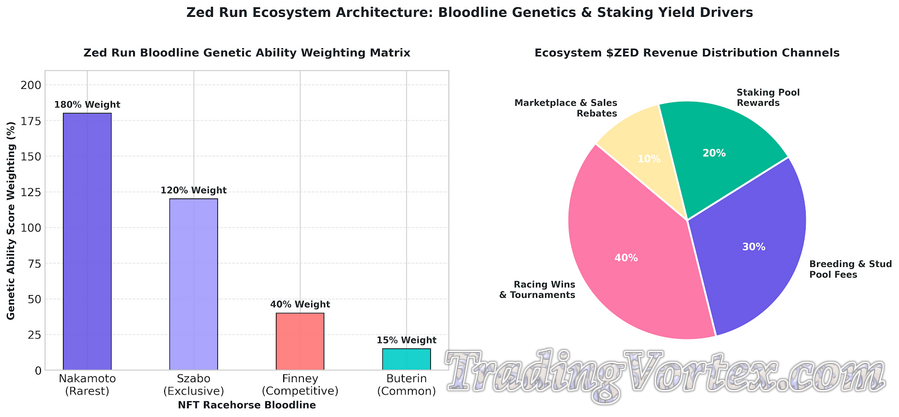
Understanding the Visual: Bloodline Rarity and $ZED Reward Sources
This dual visualization models how digital racehorse genetics impact performance potential and illustrates the primary revenue channels driving $ZED token returns within the Zed Run GameFi economy.
1. Zed Run Bloodline Genetic Ability Weighting Matrix (Left Chart)
-
Genetics Influence Racing & Breeding Value: In Zed Run, a digital horse's bloodline is the single largest factor determining its underlying performance score (accounting for 80% of overall trait weighting).
-
Nakamoto Bloodline (180% Weight): The rarest and most coveted bloodline. Nakamoto horses carry the highest probability of winning races and command premium stud fees in breeding pools.
-
Szabo Bloodline (120% Weight): The second rarest tier, delivering high racing performance and elite breeding traits.
-
Finney & Buterin Bloodlines (40% and 15% Weight): Represent the more common and accessible tiers. While less exclusive, skilled players utilize specific distance preferences and tournament strategies to maximize yields from these horses.
2. Ecosystem $ZED Revenue Distribution Channels (Right Chart)
-
Racing Wins & Tournaments (40% Share): Active track competition remains the primary source of token payouts, rewarding top-performing racehorses across daily races and structured leagues.
-
Breeding & Stud Pool Fees (30% Share): Female (Mares/Fillies) and male (Stallions/Colts) owners generate passive $ZED revenue by putting their horses into stud farms to breed new offspring NFTs.
-
Staking Pool Rewards (20% Share): Passive yield distributed to horse owners who lock their digital assets in staking pools, contributing to ecosystem liquidity and game stability.
-
Marketplace & Sales Rebates (10% Share): Payouts derived from ecosystem activity and secondary marketplace trading fees.
Key Takeaways for Gamers and GameFi Investors
-
Strategic Breeding Strategy: Yield generation in Zed Run is deeply tied to genetic rarity. Stakers who pair rare bloodlines (Nakamoto/Szabo) or low genotype numbers (Z1–Z10) can generate continuous stud fees alongside passive staking returns.
-
Active vs. Passive Earnings: While pure staking pools provide steady baseline rewards, combining staking with active tournament racing and stud farm management yields significantly higher overall $ZED returns.
-
Risk Management: Because breeding increases the total horse supply over time (breeding saturation), investors should focus on maintaining rare genetic lineages or participating in structured leagues (such as Zed Champions) to preserve asset value against token price volatility.
Illuvium NFT Staking
Illuvium NFT staking has just undergone a major upgrade with Staking V3, now running on Base for lower fees, faster transactions, and a more flexible dual-reward system. Investors can earn $ILV through revenue distribution and “Shards,” a new seasonal loyalty reward, making Illuvium one of the most advanced staking ecosystems in the GameFi space.
RPG Staking with $ILV Rewards
Illuvium is a blockchain-based RPG where players collect and battle creatures called Illuvials, each represented as an NFT. Staking revolves around the platform’s native token, $ILV, which powers governance, rewards, and ecosystem growth. With the launch of Staking V3 in late 2025, Illuvium moved from Ethereum to Base, Coinbase’s Layer 2, to cut gas fees and improve scalability.
Stakers now earn rewards in two ways:
- Revenue Distribution (RevDis): Direct $ILV payouts triggered every time Illuvium generates 150 ETH in ecosystem revenue from games, merchandise, or marketplace activity. These distributions resume once the Safety Pool is fully funded, ensuring sustainability.
- Shards: A new loyalty system where stakers earn daily points based on vault type, amount staked, and lock duration. Shards feed into seasonal leaderboards, with Season 1 distributing 15 percent of total Shard supply.
There are two vaults:
- ILV Vault: Earns 20 Shards per $1,000 staked per day.
- ILV/ETH Vault: Earns 80 Shards per $1,000 staked per day, offering higher shard output but requiring liquidity provision.
Metaverse Integration and Utility
Illuvium’s staking system is deeply tied to its metaverse gameplay, making rewards more than just passive income. Shards and $ILV payouts unlock progression in the Illuvium universe, allowing players to:
- Accelerate crafting and upgrades in the Illuvium Overworld.
- Gain advantages in competitive battles and tournaments.
- Participate in governance through IlluviumDAO, shaping future game mechanics, treasury spending, and reward structures.
The seasonal shard system adds a gamified layer, encouraging players to compete for leaderboard positions and maximize multipliers. This makes staking feel less like a financial chore and more like part of the RPG adventure. For many, staking is as much about bragging rights and leaderboard prestige as it is about yield.
Illuvium also integrates staking rewards into its broader metaverse economy. $ILV tokens can be used for in-game purchases, land development, and participation in Illuvium Arena battles. This creates a feedback loop where staking strengthens gameplay, and gameplay generates more staking opportunities.
Investor Considerations
Illuvium staking offers strong potential, but investors should weigh both opportunities and risks:
Opportunities:
- Dual Rewards: $ILV payouts plus Shards create diversified yield streams.
- Scalability: Migration to Base reduces costs and improves accessibility for smaller investors.
- Community Governance: Stakers influence treasury spending, ecosystem upgrades, and game design.
- Gamified Engagement: Seasonal leaderboards and multipliers keep participation lively and competitive.
- Metaverse Utility: Rewards tie directly into gameplay, giving tokens real use beyond speculation.
Risks:
- Token Volatility: $ILV trades around $42 in mid-2026, far below its all-time high of $1,800, which can impact staking returns.
- Lock-Up Periods: Long staking commitments limit liquidity flexibility, making it harder to exit quickly.
- Revenue Dependence: RevDis rewards rely on ecosystem revenue, which fluctuates with game adoption, player activity, and market conditions.
- Complexity: Newcomers may find the shard system, multipliers, and vault mechanics confusing compared to simpler staking platforms.
In short, Illuvium NFT staking is a sophisticated system that blends DeFi mechanics with RPG gameplay. It rewards loyalty, participation, and strategy, making it ideal for investors who enjoy gamified finance and for gamers who want their NFTs to fuel progression. With its dual-reward model, seasonal shard system, and deep integration into the Illuvium metaverse, it has positioned itself as one of the most innovative and sustainable staking platforms in the NFT space.
📊 Illuvium Staking V3 Mechanics: Daily Base Shard Emission Rates by Vault Type and Reward Multipliers Across Token Lock Durations
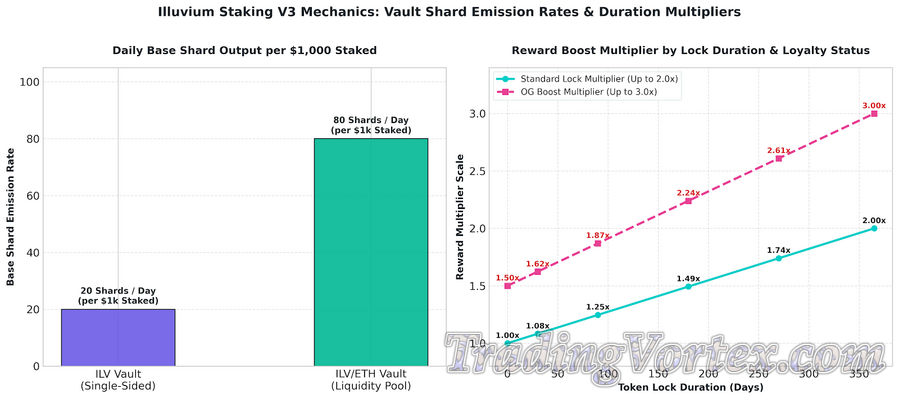
Understanding the Visual: Vault Yields & Reward Multipliers
This dual visualization models the dual-reward architecture introduced in Illuvium Staking V3, illustrating how vault choice and lock duration dictate daily Shard output and overall yield capacity.
1. Daily Base Shard Output per $1,000 Staked (Left Chart)
-
ILV Vault (Single-Sided Staking): Offers a conservative pathway for stakers who want single-asset exposure without impermanent loss risk. Generates a baseline of 20 Shards per day per $1,000 staked.
-
ILV/ETH Vault (Liquidity Provision): Provides a 4x multiplier on base Shard production, generating 80 Shards per day per $1,000 staked. This higher rate compensates stakers for providing liquidity and taking on dual-asset exposure.
2. Reward Boost Multiplier by Lock Duration & Loyalty Status (Right Chart)
-
Standard Lock Multiplier Curve (1.0x to 2.0x): Locking staked tokens scales the user's reward multiplier linearly based on commitment time:
-
0 Days (Flexible): 1.00x multiplier.
-
180 Days (~6 Months): 1.49x multiplier.
-
365 Days (1 Year Max): Reaches the maximum standard 2.00x multiplier.
-
-
OG Boost Multiplier Curve (Up to 3.00x): Long-term community participants migrating from earlier staking versions receive an enhanced loyalty boost, pushing their overall reward multiplier up to 3.00x at maximum lockup duration (365 days).
Key Takeaways for Stakers and GameFi Investors
-
Dual-Reward Utility: Shards feed directly into seasonal leaderboards (with Season 1 distributing 15% of the total Shard supply) while revenue distribution (RevDis) payouts trigger in $ILV whenever the ecosystem achieves 150 ETH in game revenue.
-
Maximizing Seasonal Points: To achieve top leaderboard ranks, stakers can combine the high-output ILV/ETH LP vault with longer lockup periods (up to 365 days) to achieve the highest possible daily Shard accumulation rate.
-
Base Layer-2 Benefits: The transition from Ethereum mainnet to Base significantly lowers gas expenses when claiming, staking, and rebalancing vault allocations.
Comparing NFT Staking Platforms
NFT staking platforms in 2026 have matured into a diverse ecosystem, each offering its own flavor of rewards, lock-up rules, and community engagement. Some platforms lean heavily into yield farming, others emphasize cultural or creative utility, and gaming-focused projects weave staking directly into gameplay. The result is a landscape where traders, collectors, and gamers can all find staking models that suit their goals, though the risks and complexities vary widely.
NFT Staking Rewards and APY Comparison
Rewards are the first thing most investors look at, and the differences are striking:
- Binance NFT: Offers 3–20 percent APY depending on lock-up duration, with rewards in ApeCoin and SAND, plus occasional event bonuses.
- NFTX: Rewards are tied to vault activity, often 10–25 percent APR, with ETH fees distributed to stakers.
- LooksRare: Dual rewards in LOOKS and wETH, yields typically 5–15 percent APR, directly linked to marketplace trading volume.
- Rarible: APYs fluctuate widely, sometimes spiking to 70 percent during peak activity, though average yields are more modest.
- Illuvium: Staking V3 offers dual rewards in $ILV and Shards, with multipliers up to 3x for long-term stakers.
- Splinterlands: SPS staking yields 8–15 percent APR, tied to gameplay and emissions schedules.
- Zed Run: Rewards in $ZED tokens, highly dependent on racing and breeding activity.
- BAND NFTs: Royalties from music catalogs, yields vary with streaming performance rather than fixed APY.
- Doge Capital: Predictable daily rewards of 5 $DAWG per NFT, though token value is volatile.
Lock-Up Periods and Flexibility Across Platforms
Lock-up rules can make or break a staking decision:
- Binance: Offers both flexible and locked staking, with higher APY for longer commitments.
- NFTX: Unstaking may return a random NFT from the vault, which reduces flexibility for rare or sentimental assets.
- Splinterlands: SPS unstaking takes four weeks, with 25 percent released weekly.
- Illuvium: Lock-ups range from 30–365 days, with multipliers rewarding longer commitments.
- BAND NFTs: Lock-ups from 90 days to 5 years, longer terms earn more governance tokens.
- LooksRare and Rarible: Flexible staking, but rewards fluctuate with marketplace activity.
- Zed Run and Doge Capital: Generally flexible, though rewards depend heavily on gameplay or community engagement.
Security Features and Smart Contract Audits
Security is always a concern in DeFi and NFT staking:
- Binance: Custodial model, security depends on the exchange’s infrastructure and regulatory compliance.
- NFTX, LooksRare, Rarible, Illuvium: Smart contracts have undergone audits, but risks remain in decentralized environments.
- Splinterlands: Uses emission control and gradual unstaking to reduce systemic risk.
- BAND NFTs: Governance tokens tied to royalties, but regulatory scrutiny is a looming challenge.
- Zed Run and Doge Capital: Security depends on ecosystem health and tokenomics, with volatility posing indirect risks.
Community Engagement and Utility of Staked NFTs
Utility and community engagement often determine whether staking feels rewarding beyond yield:
- Doge Capital: Strong community focus, $DAWG tokens used for merchandise, events, and NFT customization.
- BAND NFTs: Fans share in royalties, creating emotional and financial ties to music catalogs.
- Illuvium: Shards and $ILV rewards tied directly to gameplay progression and seasonal leaderboards.
- Splinterlands: SPS staking boosts guild strength and land productivity, deeply integrated into play-to-earn mechanics.
- LooksRare: Stakers benefit from marketplace activity, aligning rewards with trading engagement.
- Rarible: Governance participation and multi-chain support keep stakers connected to the broader NFT economy.
- Zed Run: Staking tied to racing and breeding, appealing to those who enjoy the thrill of competition.
Ease of Use and Accessibility for Beginners
Accessibility is key for onboarding new users:
- Binance: Beginner-friendly dashboard, auto-compounding rewards, and simple staking mechanics.
- Rarible: Multi-chain support with intuitive staking interface, plus delegate voting for governance.
- NFTX: More complex, requiring knowledge of vault mechanics and liquidity pools.
- Illuvium: Advanced system with multipliers and shards, rewarding but complex for newcomers.
- Splinterlands and Zed Run: Accessible for gamers, but staking tied to gameplay may confuse non-players.
- Doge Capital and BAND NFTs: Straightforward staking, but utility depends on community or royalty engagement.
Quick Comparison Table
| Platform | Rewards/APY | Lock-Up | Utility | Best For |
|---|---|---|---|---|
| Binance NFT | 3–20% APY, ApeCoin/SAND | Flexible & locked | Event bonuses | Beginners, mainstream traders |
| NFTX | 10–25% APR, ETH fees | Vault-based | Fractionalized blue-chip NFTs | Advanced DeFi users |
| LooksRare | LOOKS + wETH | Flexible | Marketplace rebates | Active NFT traders |
| Rarible | Up to 70% APY | Flexible | Multi-chain governance | Beginners, community stakers |
| Splinterlands | 8–15% APR | 4-week unstake | In-game SPS boosts | Gamers, guilds |
| Illuvium | $ILV + Shards | 30–365 days | RPG progression | Long-term investors, gamers |
| Zed Run | $ZED rewards | Flexible | Racing & breeding | GameFi enthusiasts |
| BAND NFTs | Royalties, governance | 90 days–5 years | Music royalties | Fans, collectors |
| Doge Capital | 5 $DAWG/day | Flexible | Merchandise, events | Community-driven holders |
In short, Binance and Rarible are best suited for beginners, NFTX and LooksRare cater to traders, while Splinterlands, Illuvium, and Zed Run appeal to gamers who want staking tied to gameplay. BAND and Doge Capital stand out for their cultural and community-driven models. The right choice depends on whether you value yield, utility, or engagement, and the beauty of today’s NFT staking landscape is that there’s truly something for everyone.
📊 Comprehensive NFT Staking Ecosystem Benchmarking: Annual Percentage Yield (APY/APR) Ranges and Liquidity Flexibility Scores Across Leading Platforms
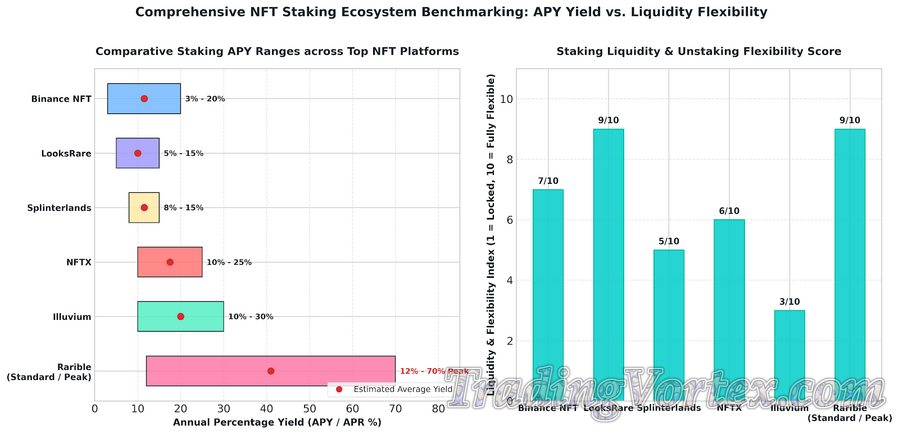
Understanding the Visual: Evaluating Yield vs. Lock-Up Risk Across Platforms
This dual chart benchmark provides a side-by-side comparative analysis of yield expectations and withdrawal flexibility across key NFT staking protocols.
1. Comparative Staking APY Ranges Across Top NFT Platforms (Left Chart)
-
Yield Range & Variability: Horizontal bars illustrate the minimum-to-maximum APY/APR performance expected across normal and peak market conditions. Red data points represent estimated average returns.
-
Stable Yield Performers: Platforms like LooksRare (5%–15%), Splinterlands (8%–15%), and Binance NFT (3%–20%) offer predictable, moderate yield bands tied to steady exchange/game mechanics.
-
DeFi & Multi-Chain Yield Generators: NFTX (10%–25%) and Illuvium (10%–30%) deliver higher baseline yields through vault trading fees and multi-tier loyalty multipliers.
-
High-Volatility Peak Yields: Rarible exhibits the widest range, with baseline yields of ~12% surging up to 70% APY during periods of high marketplace activity and cross-chain volume.
2. Staking Liquidity & Unstaking Flexibility Score (Right Chart)
-
High Flexibility (9/10): Platforms like LooksRare and Rarible feature flexible single-sided or volume-driven staking without mandatory extended lockup periods, allowing users to deposit or withdraw assets at will.
-
Moderate Flexibility (5/10 - 7/10): Binance NFT offers mixed flexible and locked options, NFTX uses vault-based mechanics where unstaking returns a random vault NFT, and Splinterlands enforces a gradual 4-week linear unstaking schedule (25% released weekly).
-
Low Flexibility / High Commitment (3/10): Illuvium utilizes structured lockup periods ranging from 30 to 365 days. While restricting liquidity exit, this lockup model grants maximum reward multipliers (up to 3x) for long-term investors.
Key Takeaways for Selecting an NFT Staking Platform
-
Beginners & Risk-Averse Investors: Binance NFT and Rarible provide flexible, intuitive onboarding options with low lockup friction.
-
Active Traders & Yield Maximizers: LooksRare and NFTX suit traders seeking ETH/wETH fee distributions tied directly to ongoing marketplace volume.
-
Gamers & Long-Term Holders: Splinterlands and Illuvium offer deep in-game integration, where locked staking directly improves gameplay progression, leaderboards, and governance influence.
NFT Staking Strategies for Investors
NFT staking strategies in 2026 revolve around diversification, balancing yield with risk, and staying alert to market conditions. Investors who spread assets across multiple platforms, monitor token prices, and follow safe staking practices are better positioned to capture rewards while avoiding pitfalls like smart contract exploits or unsustainable APYs. The game has shifted from chasing hype to building smart, sustainable portfolios, and those who treat staking like a disciplined investment strategy tend to come out ahead.
Diversifying NFT Staking Across Multiple Platforms
Putting all your NFTs into one staking pool is like betting your entire bankroll on a single horse: you might win big, but you could just as easily lose it all. Platforms vary widely in reward models, lock-up rules, and utility.
By diversifying across platforms like LooksRare, Rarible, and Doge Capital, investors can spread risk and tap into different reward streams: marketplace fees, governance tokens, in-game perks, and even music royalties. It’s the same principle as diversifying a traditional portfolio: some assets provide stability, others offer growth, and together they balance out the ride.
Balancing High APY vs. Risk Exposure
High APYs can be tempting, but they often signal unsustainable token emissions. Reports show NFT staking yields ranging from 5 percent to over 200 percent APY, with most extreme cases collapsing quickly once token inflation kicks in. A balanced approach is to combine stable platforms with moderate yields (Binance, Splinterlands, Illuvium) with higher-risk, higher-reward pools (Rarible, LooksRare).
Think of it like mixing blue-chip stocks with growth plays: the goal is steady returns without being wiped out by volatility. Chasing 200 percent APY might feel exciting, but if the token price drops 90 percent, your “high yield” quickly turns into a painful loss. The smarter move is to balance excitement with sustainability.
Monitoring NFT Market Conditions and Token Prices
Staking rewards are only valuable if the underlying token holds value. For instance, $ILV dropped from $1,800 to around $42, and RARI trades near $0.38, showing how quickly token prices can erode yields. Investors should track floor prices of staked NFTs, token liquidity, and trading volume.
Analytics platforms like DappRadar, CryptoSlam, and Nansen provide real-time dashboards that help investors spot trends before they become problems. If trading volume dries up on LooksRare, wETH rewards shrink. If Splinterlands emissions outpace demand, SPS yields lose value. Staying informed is the difference between riding the wave and getting caught in the undertow.
Tax Implications of NFT Staking Rewards
Staking rewards are generally treated as taxable income at the time of receipt, even if you don’t sell them immediately. Later, selling those tokens may trigger capital gains tax. This double-taxation effect means investors should keep detailed records of staking rewards, token prices at distribution, and eventual sale values.
In some jurisdictions, fractionalized NFTs or royalty-based rewards (like BAND NFTs) may even be classified as securities, adding regulatory complexity. The safest approach is to treat staking rewards like any other income stream: document everything, consult a tax professional, and avoid surprises when tax season rolls around.
Best Practices for Safe NFT Staking
- Use audited platforms: Stick to projects with verified smart contracts, like Illuvium and LooksRare.
- Avoid overexposure: Don’t stake rare or sentimental NFTs in vaults like NFTX, since you may not get the same one back.
- Check lock-up terms: Platforms like Splinterlands require four weeks to unstake, limiting liquidity.
- Stay updated: Follow governance updates, as reward structures can change quickly.
- Secure your wallet: Always use hardware wallets or multi-signature setups to reduce risk of hacks.
- Test with small amounts first: Before committing your prized NFTs, try staking with lower-value assets to understand the mechanics.
Quick Strategy Snapshot
| Strategy | Approach | Risk Level | Best Use Case |
|---|---|---|---|
| Diversification | Stake across Binance, NFTX, Illuvium | Medium | Balanced exposure |
| High APY Pools | Rarible, LooksRare | High | Short-term yield hunting |
| Utility Staking | Splinterlands, Aavegotchi | Medium | Gamers & community builders |
| Fractionalized NFTs | NFTX vaults | Medium-High | Access to blue-chip NFTs |
| Royalty-Based | BAND NFTs | Medium | Music fans & collectors |
In short, successful NFT staking in 2026 is less about chasing the highest APY and more about building a diversified, sustainable strategy. Treat your NFTs like a portfolio: balance risk, monitor market conditions, and always prioritize security. That way, your collectibles aren’t just sitting idle, they’re working for you while you sleep; and hopefully earning enough yield to cover both your coffee habit and your next big NFT purchase.
📊 Strategic NFT Staking Framework: Risk Profile vs. Yield Sustainability Trade-Off Matrix and Recommended Portfolio Allocation Breakdown for Investors
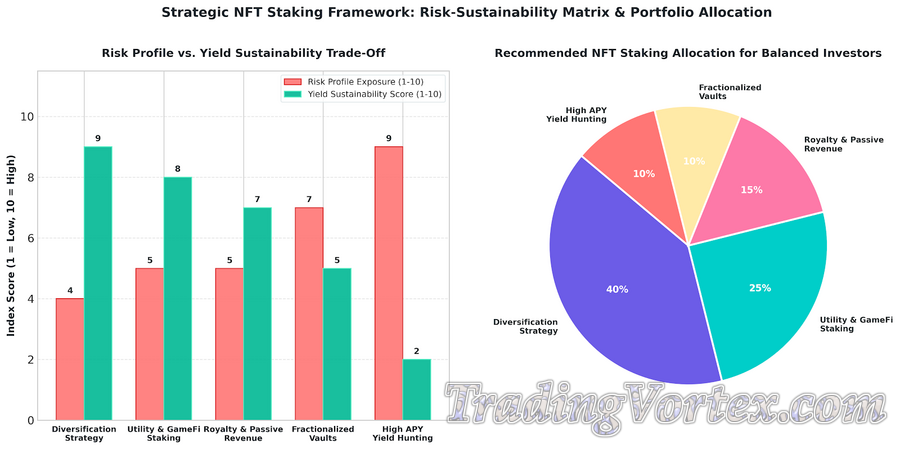
Understanding the Visual: Evaluating Strategy Risk and Portfolio Allocation
This updated visualization provides a clean, side-by-side framework to help investors navigate the spectrum of NFT staking strategies by comparing risk levels against yield sustainability and suggesting an optimal capital allocation model.
1. Risk Profile vs. Yield Sustainability Trade-Off (Left Chart)
-
High APY Yield Hunting: Exhibits a high risk score (9/10) paired with low sustainability (2/10). Platforms promising extreme yields (e.g., 200%+ APY) frequently experience rapid token emissions and severe price depreciation.
-
Fractionalized Vaults: Represents moderate-to-high risk (7/10) with moderate sustainability (5/10), requiring careful management since vault redemptions return random assets rather than specific deposited NFTs.
-
Utility & GameFi Staking & Royalty Streams: Offer balanced profiles with moderate risk (5/10) and high sustainability (7–8/10), leveraging gameplay integration, in-game sinks, and real-world cash flows like music streaming royalties.
-
Multi-Platform Diversification: Demonstrates the lowest comparative risk (4/10) and highest long-term sustainability (9/10) by spreading exposure across multiple audited protocols.
2. Recommended Portfolio Allocation for Balanced Investors (Right Chart)
-
40% Core Diversification: Anchored in multi-platform staking across established, audited protocols to stabilize returns.
-
25% Utility & GameFi: Allocated to active gaming ecosystems (e.g., Splinterlands, Illuvium) where staking yields are reinforced by gameplay progression.
-
15% Royalty & Passive Revenue: Dedicated to cash-flow-backed models (e.g., BAND NFTs) tied to real-world streaming performance.
-
10% Fractionalized Vaults: Scaled exposure to blue-chip fractional pools via protocols like NFTX.
-
10% High APY Opportunistic Hunting: Tactical, short-term allocation reserved for high-yield promotional pools (e.g., peak marketplace events).
Key Takeaways for Managing an NFT Staking Portfolio
-
Prioritize Risk-Adjusted Yield: Avoid over-allocating capital to high APY pools; hyperinflationary rewards can erode underlying token values rapidly.
-
Protect Core NFT Assets: Keep rare, high-value, or emotionally significant NFTs in single-sided or secure staking pools rather than randomized vault contracts.
-
Maintain Ongoing Oversight: Continually track token liquidity, contract audits, and marketplace trading volume using analytics tools to adjust allocations as market conditions shift.
Challenges Facing NFT Staking Platforms
NFT staking platforms in 2026 face serious challenges: smart contract exploits have drained hundreds of millions, liquidity risks are rising as assets get locked for long periods, regulators are circling with new rules, and unsustainable APY models are collapsing under market saturation. Competition among marketplaces and gaming ecosystems is fierce, forcing platforms to innovate or risk fading into irrelevance. The landscape is no longer about who can promise the highest yield, but who can deliver sustainable value while keeping investors safe.
Smart Contract Vulnerabilities in NFT Staking
Smart contract exploits remain the most severe threat. In April 2026, Kelp DAO lost $293 million when attackers exploited a bridge vulnerability to mint unbacked tokens. This wasn’t just a minor hiccup: it was a catastrophic event that wiped out investor confidence overnight. Unlike slashing penalties or temporary depegs, smart contract breaches often result in total, irrecoverable fund loss.
NFT staking platforms that rely on complex vaults, cross-chain bridges, or liquidity derivatives are especially exposed. Even contracts that have been audited multiple times can fail under unexpected conditions.
Liquidity Risks and Locked Assets
Liquidity crunches are another growing issue. Ethereum staking now locks 30 percent of total supply (36 million ETH, worth $118 billion), creating deflationary pressure but reducing flexibility. NFT staking platforms mirror this problem. Long lock-up periods in Illuvium (30–365 days) or Splinterlands (four-week unstake) limit investor agility.
While liquid staking derivatives (LSDs) offer partial relief, they introduce new risks like depegs and centralization. Imagine locking your NFT for a year, only to watch its floor price collapse halfway through.
For many investors, staking can feel like a trap if market conditions shift suddenly. The trade-off between yield and liquidity is becoming sharper, and platforms that fail to offer flexible options risk losing participants to competitors.
Regulatory Scrutiny of NFT Staking Platforms
Regulators are paying closer attention, and the spotlight is getting hotter. The SEC’s crackdown on Kraken’s staking program in 2023 set the tone, and by 2025–2026, staking-enabled ETFs and EU MiCA standards have normalized staking but added compliance costs.
NFT staking, especially fractionalized or royalty-based models like BAND NFTs, may be classified as securities in some jurisdictions. This could force platforms to register, disclose risks, or even shut down.
For investors, regulatory clarity is a double-edged sword: it legitimizes staking and attracts institutional money, but it also reduces yields through compliance overhead. The days of “wild west staking” are fading, replaced by a more regulated, slower-moving environment.
Unsustainable APY Models and Market Saturation
High APYs are often unsustainable, and investors are catching on. Early platforms dangled triple-digit yields to attract users, but token inflation quickly eroded value. By 2026, staking yields across Ethereum and NFT platforms have compressed to 3–5 percent APR, aligning with broader DeFi norms.
Platforms that fail to adjust risk losing credibility. Investors increasingly prefer utility-driven rewards: like Illuvium’s Shards or Splinterlands’ SPS boosts; over empty promises. Market saturation also means investors are more selective, gravitating toward platforms with real utility rather than hype.
Competition Among NFT Staking Platforms
The NFT staking space is crowded, and competition is brutal. LooksRare, Blur, Rarible, Magic Eden, and Binance NFT all compete for liquidity, while gaming ecosystems like Illuvium, Splinterlands, and Zed Run fight for player engagement. Institutional players are also entering, consolidating hundreds of thousands of ETH stakes and raising the bar for smaller platforms.
This competition pressures platforms to innovate with cross-chain staking, gamified rewards, or cultural utility. Those that fail to differentiate risk becoming ghost towns. A cautionary tale is Loopring’s collapse in June 2026, where TVL fell 99 percent after users migrated to more active ecosystems.
For investors, this means platform selection is critical: staking on a dying marketplace can leave you holding worthless tokens.
Quick Snapshot of Key Challenges
| Challenge | Example | Impact |
|---|---|---|
| Smart Contract Exploits | Kelp DAO $293M hack | Total fund loss |
| Liquidity Risks | 36M ETH locked, Splinterlands 4-week unstake | Reduced flexibility |
| Regulatory Scrutiny | SEC vs Kraken, EU MiCA | Compliance costs, possible shutdowns |
| Unsustainable APYs | Triple-digit yields collapsing to 3–5% | Investor distrust |
| Competition | Loopring collapse, Blur vs LooksRare | Market saturation, platform death |
In short, NFT staking platforms must balance yield with safety, liquidity with flexibility, and innovation with compliance.
For investors, the lesson is clear: don’t just chase APY, evaluate the platform’s resilience, regulatory posture, and community engagement. The ones that survive will be those that offer real utility, not just flashy numbers.
📊 NFT Staking Industry Challenges: Macro APY Compression Curve (2021–2026) and Core Protocol Vulnerability Risk Assessment
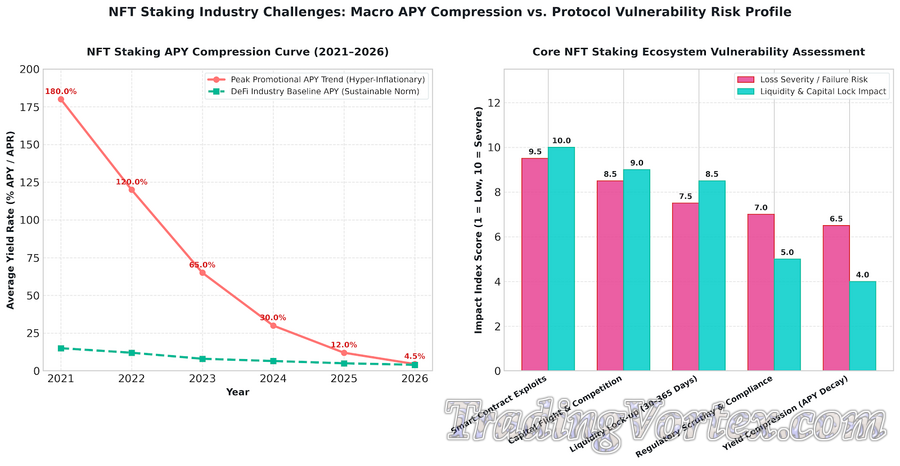
Understanding the Visual: Navigating Macro Yield Decay and Protocol Risks
This updated visualization features rotated x-axis labels (30-degree angle, right-aligned) to ensure zero text superposition, making all challenge categories on the right chart immediately legible.
1. NFT Staking APY Compression Curve (2021–2026) (Left Chart)
-
The Death of Triple-Digit Yields: In the early era of NFT staking (2021–2022), platforms dangled unsustainable promotional APYs exceeding 180% to attract liquidity. However, hyper-inflationary token emissions rapidly eroded underlying token values.
-
Convergence on Sustainable Norms: Promotional yield chasing has largely collapsed, compressing average staking yields down to a realistic 3%–5% APR band. This mirrors mature DeFi protocols and baseline network rewards (such as Ethereum liquid staking).
-
Key Takeaway: High APY promises are no longer a viable indicator of platform success. Modern investors prioritize platforms offering utility-backed sustainability over inflationary token rewards.
2. Core NFT Staking Ecosystem Vulnerability Assessment (Right Chart)
-
Smart Contract Exploits (Severity: 9.5 | Impact: 10.0): Remains the single most dangerous threat in the ecosystem (e.g., bridge vulnerabilities causing massive capital losses like the Kelp DAO incident). Unlike temporary market dips, smart contract hacks often lead to irreversible, total capital loss.
-
Capital Flight & Competition (Severity: 8.5 | Impact: 9.0): Intense competition between marketplaces (Blur, LooksRare, Rarible) and gaming ecosystems can trigger sudden capital migration, exemplified by protocol collapses where total value locked drops drastically (e.g., Loopring's 99% TVL decline).
-
Liquidity Lock-up Constraints (Severity: 7.5 | Impact: 8.5): Mandatory lock-up periods (ranging from 30 to 365 days in platforms like Illuvium or 4-week unstaking in Splinterlands) restrict investor agility, exposing staked assets to market downturns without exit options.
-
Regulatory Scrutiny & Compliance (Severity: 7.0 | Impact: 5.0): Strict regulatory frameworks (such as SEC enforcement actions and EU MiCA compliance) increase operational overhead for platforms and potentially reclassify royalty-based models (e.g., BAND NFTs) as securities.
Strategic Action Plan for Investors
-
Prioritize Smart Contract Security: Restrict high-value NFT staking to audited, time-tested protocols with active bug bounty programs.
-
Match Lockup Times to Risk Tolerance: Avoid locking non-liquid assets for extended periods (e.g., 365 days) unless compensated by substantial loyalty multipliers or deep engagement in the ecosystem.
-
Focus on Real Utility: Choose platforms where staking rewards derive from actual protocol revenue (e.g., marketplace trading fees, in-game utility, or physical royalties) rather than purely inflationary token emissions.
Future of NFT Staking Platforms
NFT staking platforms are evolving fast in 2026: yields are compressing, utility is expanding into metaverse economies, and institutional players are entering with ETF-style staking products. The future points toward staking becoming a mainstream financial tool, but only platforms that balance innovation with sustainability will thrive.
Evolution of NFT Staking Models
NFT staking is shifting from simple yield farming to utility-driven models that prioritize long-term engagement over short-term hype. Platforms like Illuvium and Splinterlands have pioneered staking systems where rewards are not just tokens but in-game advantages, crafting boosts, or competitive multipliers. BAND NFTs take this further by linking payouts to real-world music royalties, bridging digital ownership with tangible revenue streams.
Yield compression across crypto staking is forcing innovation. Ethereum’s average APR has dropped to 2.78 percent, with MEV strategies pushing it slightly higher to 3.3–3.8 percent. NFT platforms are responding by introducing dual reward systems, gamified multipliers, and fractionalized ownership models. Fractionalized staking, led by NFTX, allows investors to gain exposure to blue-chip NFTs like CryptoPunks without needing six figures in capital. Hybrid royalty-sharing NFTs are also emerging, offering transparent payouts while protecting user privacy.
Integration with Metaverse and Web3 Economies
The next frontier is deep integration with metaverse economies. Illuvium’s shard system, Aavegotchi’s gamified staking, and Zed Run’s racing economy demonstrate how staking can become part of gameplay loops. Instead of passive yield, staking decisions now influence progression, crafting, breeding, and competitive advantages.
Platforms are also embracing cross-chain staking and Layer-2 migrations to reduce fees and improve accessibility. Illuvium’s move to Base and Aavegotchi’s migration from Polygon to Base highlight the trend toward scalability and lower transaction costs. This ensures staking rewards are not just speculative tokens but functional assets within Web3 ecosystems, usable across multiple chains and applications.
We are also seeing experiments with interoperable staking rewards, where NFTs staked in one ecosystem unlock benefits in another. This cross-pollination of utility could become a defining feature of Web3, turning staking into a bridge between different metaverse worlds.
Institutional Interest in NFT Yield Products
Institutional demand is reshaping the staking landscape. Ethereum staking queues have ballooned to 3.5 million ETH with 62-day wait times, driven by ETF inflows and corporate treasuries. NFT staking is following suit, with DAOs, artist collectives, and even indie record labels using fractionalized royalty NFTs as structured yield products.
This institutionalization brings credibility but also regulatory oversight. Platforms offering fractional ownership or royalty payouts may be classified as securities, requiring compliance frameworks and audited financials.
For investors, this means staking could soon resemble traditional yield products, complete with disclosures, risk ratings, and standardized reporting.
NFT Staking as a Mainstream Financial Tool
By 2026, NFT staking is no longer niche. Platforms like Binance NFT, LooksRare, and Rarible now offer staking dashboards that feel as polished as traditional brokerage apps, complete with analytics, auto-compounding, and governance participation. The trajectory suggests NFT staking will evolve into a mainstream financial tool, blending cultural assets with yield generation.
Key trends shaping this future:
- Utility over hype: Rewards tied to gameplay, royalties, or marketplace activity rather than unsustainable emissions.
- Cross-chain accessibility: Multi-chain staking ensures NFTs remain liquid and usable across ecosystems.
- Institutional adoption: ETFs and DAOs are normalizing staking as structured yield products.
- Regulatory frameworks: Compliance will reduce risk but also compress yields, making sustainability more important than ever.
- Gamified engagement: Seasonal leaderboards, multipliers, and community-driven governance keep staking lively and participatory.
Quick Outlook Table
| Trend | Example | Impact |
|---|---|---|
| Utility-driven staking | Illuvium Shards, Splinterlands SPS | Rewards tied to gameplay and progression |
| Fractional ownership | NFTX vaults | Blue-chip NFTs accessible to everyday investors |
| Royalty integration | BAND NFTs | Real-world revenue streams from music catalogs |
| Institutional adoption | ETH ETFs, DAO royalties | Mainstream credibility and oversight |
| Cross-chain expansion | Illuvium on Base, Rarible multi-chain | Lower fees, wider access and interoperability |
In short, the future of NFT staking is about sustainability, integration, and legitimacy. Platforms that tie rewards to real utility, embrace cross-chain economies, and adapt to institutional and regulatory frameworks will lead the way.
For investors, this means staking is moving from speculative play to a structured, mainstream financial strategy: one that blends culture, creativity, and yield into a single, evolving financial experience.
📊 Future Outlook of NFT Staking: Utility Evolution vs. Protocol Sustainability Profile
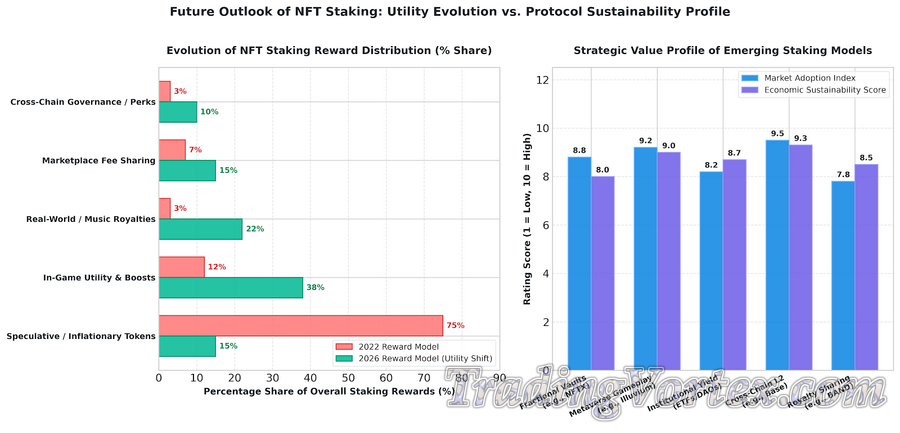
Key Takeaways for Navigating the Future of NFT Staking
This multi-panel visual illustrates how NFT staking is evolving from hyper-inflationary reward models toward sustainable, high-utility financial architecture.
1. Evolution of NFT Staking Reward Distribution (Left Chart)
-
Decline of Pure Speculation: Speculative and inflationary token emissions—which represented 75% of all staking rewards in 2022—have plummeted to 15% by 2026.
-
Rise of Active Utility: In-game multipliers, crafting boosts (e.g., Illuvium Shards, Splinterlands SPS), and metaverse progression now command the largest share at 38%.
-
Real-World Value Integration: Real-world music royalties (e.g., BAND NFTs) and marketplace fee-sharing (e.g., LooksRare, Blur) have expanded to 22% and 15% respectively, providing tangible cash-flow backing for stakers.
2. Strategic Value Profile of Emerging Staking Models (Right Chart)
-
Cross-Chain Layer-2 Scalability (Adoption: 9.5 | Sustainability: 9.3): Migrations to Layer-2 networks (such as Base) lead both adoption and economic viability by eliminating transaction fee friction for micro-staking and rewards compounding.
-
Metaverse Gameplay Integration (Adoption: 9.2 | Sustainability: 9.0): Embedding locked NFTs into core gameplay loops drives long-term retention without relying on hyper-inflationary token payouts.
-
Institutional Yield & Fractionalization (Adoption: 8.2–8.8 | Sustainability: 8.0–8.7): Products like NFTX vaults and institutional-grade ETF/DAO yield pools lower barrier-to-entry costs while offering compliant, structured financial exposure.
Strategic Guidance for Platform Operators and Investors
-
Align Rewards with Real Revenue: Prioritize staking ecosystems where yields originate from platform fees, gameplay asset sinks, or real-world licensing royalties rather than unbacked governance tokens.
-
Evaluate Cross-Chain Efficiency: Choose platforms operating on low-cost Layer-2 environments or multi-chain frameworks to prevent transaction costs from eroding staking returns.
-
Prepare for Institutional Compliance: Expect royalty-sharing and fractionalized staking vaults to face increasing regulatory disclosures, shifting the market toward standardized disclosures and audited financial reporting.
Conclusion: Navigating the Future of NFT Staking Platforms
NFT staking in 2026 has matured into a diverse but challenging landscape: yields have compressed, utility has expanded into metaverse economies, and institutional adoption is reshaping the space. The conclusion for investors and traders is clear: staking can be rewarding, but success depends on balancing opportunity with risk, choosing platforms with real utility, and staying alert to market conditions.
Key Takeaways for NFT Investors and Traders
- Yields are stabilizing: Average staking returns across major platforms now sit between 3–15 percent, with outliers like Rarible occasionally spiking higher during peak activity. The era of triple-digit APYs is largely over, replaced by more sustainable models that reward loyalty and participation.
- Utility matters more than hype: Platforms like Illuvium and Splinterlands tie staking rewards directly to gameplay, while BAND NFTs link payouts to real-world royalties. This shift toward utility-driven models makes staking more resilient, ensuring rewards are tied to actual ecosystem activity rather than inflated emissions.
- Institutional adoption is rising: Ethereum staking queues have ballooned to 3.5 million ETH with 62-day wait times, driven by ETF inflows and corporate treasuries. NFT staking is following suit, with DAOs, artist collectives, and even indie record labels experimenting with royalty-based yield products. This signals a future where NFT staking is not just a niche hobby but a structured financial instrument.
Balancing NFT Staking Opportunities and Risks
Staking offers passive income, governance rights, and community perks, but risks remain:
- Smart contract vulnerabilities: Exploits like the $293 million Kelp DAO hack highlight the dangers of complex vaults and bridges. Even audited contracts can fail, so caution and diversification are essential.
- Liquidity traps: Long lock-up periods in platforms such as Illuvium or Splinterlands limit flexibility if market conditions shift. Investors must weigh yield against liquidity needs, especially in volatile markets.
- Regulatory uncertainty: Fractionalized NFTs and royalty-sharing models may be classified as securities, adding compliance burdens and potentially reshaping reward structures.
- Market competition: Platforms like Blur, LooksRare, and Rarible are fighting for liquidity, and weaker ecosystems risk fading into irrelevance. Choosing platforms with strong communities and proven utility is key to long-term success.
The safest strategy is diversification: spread assets across multiple platforms, balance high-yield pools with utility-driven staking, and avoid overexposure to any single ecosystem. Think of staking like building a balanced portfolio rather than chasing the next shiny APY.
Final Thoughts on Choosing the Best NFT Staking Platform
Choosing the right NFT staking platform depends on your goals and your appetite for risk:
- For beginners: Binance NFT and Rarible offer simple dashboards, flexible staking, and straightforward rewards.
- For traders: LooksRare provides dual rewards in LOOKS and wETH, directly tied to marketplace activity, making it ideal for those who thrive on liquidity.
- For gamers: Illuvium, Splinterlands, and Zed Run integrate staking into gameplay loops, turning rewards into part of the adventure rather than just passive yield.
- For collectors and fans: BAND NFTs and Doge Capital emphasize community and cultural utility, from music royalties to merchandise perks, appealing to those who value engagement as much as returns.
🎯 The bottom line:
NFT staking is no longer just about chasing yield. It is about finding platforms where staking adds real value: whether that means boosting your guild in Splinterlands, earning royalties from a Beyoncé track through BAND NFTs, or unlocking progression in Illuvium’s metaverse. The best platform is the one that aligns with your personal goals, risk tolerance, and passion for the NFT space. Treat staking like a portfolio strategy, not a gamble, and it can become a powerful tool for both financial growth and community engagement.
In the end, NFT staking is evolving into something bigger than passive income. It is becoming a way to participate in digital economies, strengthen communities, and connect financial incentives with cultural experiences. For investors and traders willing to adapt, the future of NFT staking is not just promising: it is transformative.
📊 Conclusion & Strategic Framework: Balancing Opportunity, Liquidity, and Risk in NFT Staking
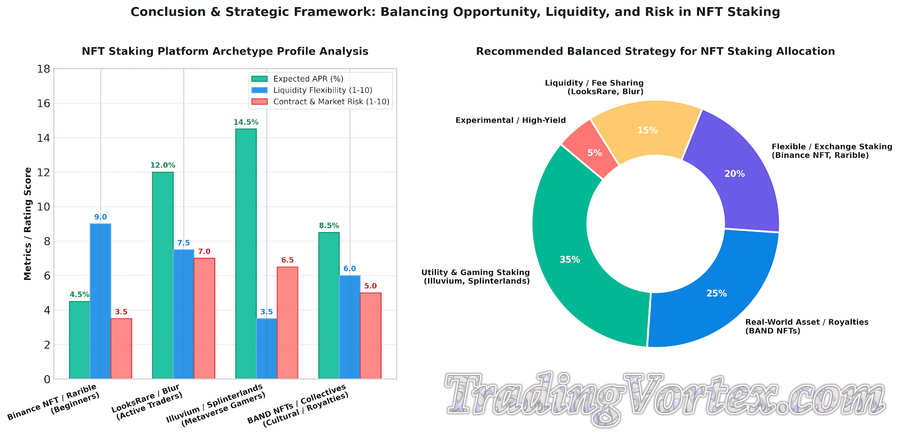
How to Interpret and Apply This Strategic Framework
This visual provides a decision-making model for investors and traders looking to navigate the 2026 NFT staking landscape effectively.
1. NFT Staking Platform Archetype Profile Analysis (Left Chart)
-
Beginner-Friendly Platforms (Binance NFT, Rarible): Offer lower average APRs (~4.5%), but deliver high liquidity flexibility (9.0/10) and low overall contract/market risk (3.5/10). Ideal for cautious or entry-level participants.
-
Trader-Centric Pools (LooksRare, Blur): Provide higher variable returns (~12.0%) linked directly to trading volumes and fee-sharing. However, they carry elevated market volatility risk (7.0/10).
-
Metaverse & Gaming Economies (Illuvium, Splinterlands): Deliver strong utility-driven yields (~14.5%) embedded in gameplay loops, but feature restricted liquidity flexibility (3.5/10) due to extended lock-up periods (30–365 days).
-
Cultural & Royalty Staking (BAND NFTs): Offer moderate returns (~8.5%) anchored in tangible revenue streams (e.g., music royalties), presenting a balanced risk profile (5.0/10).
2. Recommended Balanced Portfolio Allocation Strategy (Right Chart)
To protect capital while optimizing for real utility, a diversified staking portfolio should follow a risk-adjusted allocation:
-
35% Utility & Gaming Staking: Focus on ecosystems where locked assets grant active gameplay advantages or crafting multipliers.
-
25% Real-World Asset / Royalty Sharing: Allocate to protocols with non-inflationary payouts tied to actual commercial usage.
-
20% Flexible / Exchange Staking: Retain liquid assets in low-friction platforms for fast entry and exit.
-
15% Liquidity & Fee Sharing: Capture marketplace trading volume dynamics through active venue staking.
-
5% High-Yield / Experimental: Cap speculative or unproven vault exposure to minimize smart contract exploit risks.
Core Action Steps for Investors
-
Avoid Over-Concentration: Spread assets across multiple platform archetypes rather than locking 100% of capital into a single protocol.
-
Align Staking with Agility Needs: Reserve long lock-up pools exclusively for long-term holdings where you are comfortable riding out market fluctuations.
-
Prioritize Real Cash Flows: Shift focus away from pure token inflation toward platforms deriving yield from platform volume, game sinks, or external licensing revenue.
FAQs: Top NFT Staking Platforms
NFT staking FAQs in 2026 highlight that rewards are shifting from speculative high APYs to utility-driven models, with risks like smart contract exploits, liquidity traps, and regulatory scrutiny becoming more important to understand. Investors and gamers alike need to balance yield opportunities with safety, flexibility, and community engagement.
What is NFT staking and how does it work?
NFT staking means locking your NFTs into a platform’s smart contract to earn rewards. These rewards can be platform tokens, governance rights, in-game boosts, exclusive access, or even royalty shares. The process is similar to crypto staking: connect your wallet, approve the contract, and deposit your NFTs. Rewards depend on factors like staking duration, rarity of the NFT, and pool activity.
For example, staking a rare Illuvium NFT might earn you more Shards and gameplay perks than staking a common one. In contrast, staking a Doge Capital NFT gives predictable daily $DAWG tokens regardless of rarity. Not all NFTs are stakable, so always check if your collection is supported before buying with staking in mind.
What kind of rewards can I expect from NFT staking?
Rewards vary widely across platforms:
♦ Binance NFT: 3–20 percent APY in ApeCoin or SAND, plus event bonuses.
♦ LooksRare: Dual rewards in LOOKS and wETH from marketplace fees.
♦ Illuvium: $ILV payouts and Shards tied to gameplay progression.
♦ Splinterlands: SPS tokens boosting guild and land productivity.
♦ BAND NFTs: Royalties from music catalogs.
♦ Doge Capital: Daily $DAWG tokens with community perks.
Average yields in 2026 range between 3–15 percent, with spikes during high activity periods. The key is that rewards are increasingly tied to ecosystem utility rather than inflated emissions. In other words, staking is becoming less about chasing numbers and more about participating in meaningful digital economies.
What are the main risks of NFT staking?
♦ Smart contract vulnerabilities: Hacks like the $293M Kelp DAO exploit show how devastating flaws can be. Even audited contracts can fail under stress.
♦ Liquidity risks: Long lock-ups (Illuvium up to 365 days, Splinterlands four weeks) limit flexibility. If token prices drop during this period, you may be stuck.
♦ Token volatility: Rewards lose value if token prices collapse, as seen with $ILV dropping from $1,800 to $42.
♦ Regulatory scrutiny: Fractionalized NFTs and royalty-sharing models may be treated as securities, adding compliance burdens.
♦ Market competition: Platforms that fail to innovate risk losing liquidity and relevance, as seen with Loopring’s collapse in 2026.
The takeaway: staking is not risk-free. Diversification and careful platform selection are essential.
Can beginners stake NFTs easily?
Yes. Platforms like Binance NFT and Rarible offer beginner-friendly dashboards with auto-compounding rewards and simple staking mechanics. They are designed to feel more like traditional finance apps, making them less intimidating.
More advanced platforms like NFTX or Illuvium require understanding vaults, liquidity pools, or multipliers, which may be confusing at first. A good strategy is to start small on accessible platforms, then expand into more complex ecosystems once you’re comfortable. Think of it like learning to drive: start in a quiet neighborhood before hitting the highway.
Are NFT staking rewards taxable?
In most jurisdictions, staking rewards are treated as taxable income at the time of receipt, even if you don’t sell them immediately. Selling later may trigger capital gains tax. Fractionalized or royalty-based rewards could face stricter classification, especially if regulators view them as securities.
The safest approach is to keep detailed records of rewards, token prices at distribution, and eventual sale values. Consulting a tax professional is highly recommended, since rules vary widely across countries and are evolving quickly.
How do I choose the best NFT staking platform?
Ask yourself:
♦ Do I want steady yield (Binance, Splinterlands)?
♦ Do I value community perks (Doge Capital, BAND NFTs)?
♦ Am I a gamer who wants staking tied to gameplay (Illuvium, Zed Run)?
♦ Do I prefer marketplace-linked rewards (LooksRare, Rarible)?
The best platform is the one that aligns with your goals, risk tolerance, and engagement style. If you’re a collector who loves music, BAND NFTs might be perfect. If you’re a trader chasing liquidity, LooksRare makes sense. If you’re a gamer, Illuvium or Splinterlands will feel natural.
In short, NFT staking in 2026 is about more than passive yield. It is about participating in ecosystems where your NFTs generate value through gameplay, royalties, or marketplace activity.
Beginners should start with simple platforms, while advanced users can explore gamified or fractionalized models. Above all, balance opportunity with risk, and treat staking as part of a diversified strategy rather than a gamble.
Done right, staking can be both profitable and fun: a way to make your NFTs work for you while deepening your connection to the communities you care about.