

Finding the right NFT marketplace shouldn't feel harder than the actual trading. Yet for too many people, it does. Clunky interfaces, hidden fees, confusing wallets, and platforms that assume you already know everything have scared off countless potential collectors, creators, and investors. That's exactly why this guide exists.
Most User-Friendly NFT Marketplaces cuts through the noise and gives you a clear, practical look at the platforms that actually respect your time and intelligence. We compare OpenSea, Blur, Magic Eden, Rarible, Tensor, Foundation, SuperRare, and other emerging options across the metrics that genuinely matter: fees, liquidity, chain support, security, royalty policies, mobile experience, and overall ease of use. Whether you're buying your very first NFT or executing dozens of trades a week, you'll find honest recommendations tailored to your experience level and goals.
Inside, you'll discover which platform is best for beginners, which one professional Ethereum traders swear by, where Solana collectors and gamers actually spend their time, and why creators are migrating to platforms that enforce royalties at the protocol level. You'll also get a due diligence checklist, a side-by-side comparison table, answers to the most common questions, and a candid look at the challenges still holding this space back, from metadata fragility to phishing scams.
No hype. No gatekeeping. Just the information you need to choose the marketplace that fits the way you actually trade, collect, or create.
Ready to find your platform? Let's dive in.
Why You Should Keep an Eye on “Mythic Piece” – A New NFT Experience Like No Other:
The NFT space is constantly evolving, but few projects truly break the mold. “Mythic Piece” is one of those rare gems – a project shrouded in mystery, yet undeniably intriguing. While many NFT collections simply offer digital assets, “Mythic Piece” hints at something far more immersive and dynamic.
This is not just another collection; it's the beginning of an adventure. The project is designed to unveil its secrets over time, rewarding those who engage early and follow its development. If you have an eye for innovation in the NFT world, this is something you won’t want to miss.
To get a first glimpse of the journey ahead, watch the official launch video: “Awaken! Rise! – The Mythic Pieces Call... Will You Answer?!”
This short yet powerful teaser sets the tone for what’s to come: an experience that promises to go beyond the ordinary.
For now, details remain scarce, adding to the project's allure. But what we do know is that “Mythic Piece” is set to offer an experience unlike anything seen before in the NFT space. With its unique vision this could be one of the most exciting projects to emerge.
The best way to stay ahead? Follow “👑 Mythic Piece 🔱” on:
- X.com: https://x.com/mythicpiece
YouTube: https://www.youtube.com/@MythicPiece
TikTok: https://www.tiktok.com/@mythic_piece
And if you want to secure a place in this unfolding journey, now’s your chance – the Whitelist is still open, offering lucky participants a chance for free minting.
The adventure is only just beginning. Will you be part of it?
Table of Contents:
- Your Ultimate Guide to the Most User-Friendly NFT Marketplaces
- The Most User-Friendly NFT Marketplaces in Today’s Digital Economy
- Why Choosing the Right NFT Marketplace Matters More Than Ever
- What You’ll Learn: A Complete Guide to User-Friendly NFT Trading Platforms
- 📊 Comparison of Major NFT Marketplaces (2026): Trading Volume Share, Platform Fees, and Supported Blockchains
- What Are User-Friendly NFT Marketplaces? A Complete Definition
- Key Features That Make an NFT Marketplace User-Friendly
- User-Friendly NFT Marketplaces vs. Advanced Trading Platforms: What’s the Difference?
- Why User Experience Is the New Battleground for NFT Marketplaces
- 📊 Comparing NFT Platforms: Discovery Marketplaces vs. Advanced Trading Platforms – Key Features and Ideal User Priorities
- The Evolution of NFT Marketplaces: From Niche to Mainstream
- How NFT Marketplaces Have Changed Over the Years
- The Rise of Multi-Chain NFT Marketplaces and What It Means for Users
- Understanding the Current NFT Market Landscape for Buyers and Sellers
- 📊 NFT Market Evolution (2017–2026): Market Capitalization, Trade Volume, and Average Sale Price Trends During Consolidation
- How We Evaluated the Most User-Friendly NFT Marketplaces
- OpenSea: The Most User-Friendly NFT Marketplace for Beginners
- Why OpenSea Remains the Go-To NFT Marketplace for New Users
- OpenSea’s Multi-Chain Support: How Many Blockchains Can You Trade On?
- OpenSea’s User Interface: Simple, Clean, and Beginner-Friendly
- OpenSea Fees Explained: What You’ll Actually Pay to Buy and Sell NFTs
- OpenSea Security Features: How Safe Is Your NFT Portfolio?
- OpenSea Pros and Cons: Is It the Right NFT Marketplace for You?
- Who Should Use OpenSea? Best Use Cases for Beginners and Collectors
- 📊 All-Time Cumulative NFT Trading Volume Comparison: OpenSea vs. Primary Competitors (Blur and Magic Eden) in Billions of USD
- Blur: The Best NFT Marketplace for Professional Traders
- Why Blur Is Built for Speed, Not Simplicity
- Blur’s Advanced Trading Tools: Collection Bids, Sweeping, and More
- Blur Fees and Royalty Policies: What Traders Need to Know
- Blur Lending and NFT-Backed Loans: Opportunities and Risks
- Blur Pros and Cons: Is This Advanced NFT Marketplace Right for You?
- Who Should Use Blur? Best Use Cases for Serious NFT Traders
- 📊 Ethereum NFT Market Dynamics Comparison: OpenSea's Broad Retail Base vs. Blur's Concentrated Professional Trader Volume
- Magic Eden: The Most User-Friendly NFT Marketplace for Solana and Gaming
- Why Magic Eden Dominates the Solana NFT Marketplace Space
- Magic Eden’s User Experience for Collectors, Gamers, and Creators
- Magic Eden’s Cross-Chain Expansion: What Chains Does It Support Now?
- Magic Eden Fees and Royalty Structure Explained
- Magic Eden Rewards and Loyalty Programs for Active Traders
- Magic Eden Pros and Cons: Is It the Best NFT Marketplace for You?
- Who Should Use Magic Eden? Best Use Cases for Solana and Gaming NFT Fans
- 📊 Magic Eden Strategic Pivot Analysis: Comparing Multi-Chain Expansion Parameters vs. Concentrated Solana Market Dominance
- Rarible: The Most User-Friendly NFT Marketplace for Creators
- Why Rarible Puts Creators First Among NFT Marketplaces
- Rarible’s Royalty System: How Creators Earn Passive Income
- Rarible’s Decentralized Governance: How the RARI DAO Works
- Rarible Fees and Lazy Minting: What Creators Need to Know
- Rarible Pros and Cons: Is It the Best NFT Marketplace for Artists?
- Who Should Use Rarible? Best Use Cases for Creators and Digital Artists
- 📊 Creator Royalty Protections Comparison: Maximum Allowed Royalty Caps and Protocol-Level Enforcement Across NFT Marketplaces
- Emerging and Specialized User-Friendly NFT Marketplaces Worth Watching
- Tensor: A Rising NFT Marketplace for Solana Power Users
- Binance NFT: The Most User-Friendly NFT Marketplace for Exchange Users
- Foundation: A Curated NFT Marketplace for High-End Digital Art
- SuperRare: The User-Friendly NFT Marketplace for Rare Digital Collectibles
- Niche NFT Marketplaces for Music, Photography, and Virtual Real Estate
- 📊 Specialized NFT Marketplace Profiles: Comparing Niche Focus Scores vs. Relative Liquidity Depth Across Emerging Platforms
- NFT Marketplace Comparison: Which User-Friendly Platform Wins?
- Side-by-Side Comparison of the Most User-Friendly NFT Marketplaces
- Best NFT Marketplace by User Type: Beginners, Traders, Creators, and Gamers
- Best NFT Marketplace by Blockchain: Ethereum, Solana, Polygon, and More
- Best NFT Marketplace by Fee Structure: Low-Cost Options for Budget-Conscious Users
- The Final Verdict: There’s No Single Winner, and That’s Okay
- The Ultimate NFT Marketplace Comparison Table: All Key Metrics in One Place
- 📊 Global NFT Marketplace Volume Market Share Breakdown: Comparative Share of Magic Eden, Blur, OpenSea, and Specialized Platforms (April 2026)
- Key Challenges Affecting User Experience in NFT Marketplaces
- Wallet Management and Transaction Complexity: Why It Still Confuses Users
- The Metadata Fragility Problem: Why Your NFT Images Can Disappear
- NFT Royalty Enforcement: Why Creators Still Struggle to Get Paid
- Scams, Rug Pulls, and Security Risks: How to Protect Your NFT Investments
- Cross-Chain Interoperability Gaps: Why Moving NFTs Between Marketplaces Is Still Hard
- Gas Fees and Network Congestion: How Marketplaces Are Solving the Problem
- The Bottom Line: Progress Is Real, But the Work Isn't Done
- 📊 Key Technical Challenges Affecting NFT User Experience vs. Solution Adoption Rates: Comparing Systemic Risk Severity Against Emerging Technical Countermeasures
- What NFT Investors and Traders Should Know Before Choosing a Marketplace
- Understanding Liquidity Distribution Across NFT Marketplaces
- Evaluating True Market Depth vs. Misleading Floor Prices
- The Role of NFT Lending Infrastructure in Marketplace Selection
- How Stablecoin Adoption Is Changing NFT Transactions
- Tax Implications of Buying and Selling NFTs on Different Marketplaces
- Due Diligence Checklist for First-Time NFT Marketplace Users
- 📊 U.S. Federal Tax Rate Disparities for NFT Sales: Comparing Short-Term Gains, Standard Long-Term Gains, and 28% Collectible Classification Rates
- How to Choose the Most User-Friendly NFT Marketplace for Your Needs
- Step-by-Step Guide to Selecting Your First NFT Marketplace
- Matching the Right NFT Marketplace to Your Experience Level
- Considering Your Preferred Blockchain and Digital Assets
- Balancing Fees, Features, and Familiarity When Comparing NFT Marketplaces
- How to Test an NFT Marketplace Before Committing Real Funds
- Mobile vs. Desktop NFT Marketplaces: Which Experience Is Better?
- The Bottom Line: There’s No Perfect Choice, Only the Right Choice for You
- 📊 Step-by-Step NFT Marketplace Selection Framework: Decision Criteria & Priorities Breakdown
- Tips for a Smooth and Safe NFT Marketplace Experience
- The Future of User-Friendly NFT Marketplaces
- Account Abstraction and Simplified Onboarding: The End of Seed Phrases?
- AI Integration and Smarter NFT Discovery Tools
- Regulatory Developments and What They Mean for NFT Marketplace Users
- The Rise of Social and Community-Driven NFT Marketplaces
- Predictions for the Next Generation of User-Friendly NFT Platforms
- 📊 NFT Safety & Risk Mitigation Pyramid: Security Habits vs. Portfolio Protection Level
- Finding the Best User-Friendly NFT Marketplace: Key Takeaways and Final Recommendations
- Key Takeaways: Finding the Most User-Friendly NFT Marketplace for You
- The Importance of Platform Diversification in Your NFT Strategy
- Final Recommendations by User Type and Experience Level
- The Road Ahead: What to Expect from NFT Marketplaces in the Coming Years
- 📊 NFT Marketplace Recommendation Framework: User Personas vs. Strategic Priorities Matrix
- Frequently Asked Questions About the Most User-Friendly NFT Marketplaces
- Q1. Which NFT marketplace is the most beginner-friendly in 2026?
- Q2. What is the difference between OpenSea, Blur, and Magic Eden?
- Q3. Which NFT marketplace has the lowest fees?
- Q4. Is Blur suitable for beginners?
- Q5. What are the most common security risks on NFT marketplaces?
- Q6. How do creator royalties work on different NFT marketplaces?
- Q7. Which blockchain should I choose for NFT trading?
- Q8. How do NFT marketplaces make money if fees are zero?
- Q9. Can I use the same NFT on multiple marketplaces?
- Q10. How are NFTs taxed in 2026?
- Q11. What is NFT lending and should I use it?
- Q12. What is the future of NFT marketplaces?
Your Ultimate Guide to the Most User-Friendly NFT Marketplaces
The Most User-Friendly NFT Marketplaces in Today’s Digital Economy
If you've spent any time in the NFT space, you know the feeling. You find a collection you love, get excited about a piece, and then... you're staring at a screen full of bids, asks, spreads, and gas estimates that look like they belong on a Bloomberg terminal, not a marketplace where you just want to buy some digital art. It's overwhelming, especially when you're new.
I remember the first time I tried to buy an NFT. It took me forty-five minutes, three failed transactions, and one very confusing wallet pop-up before I finally owned a pixelated character I could have just screenshotted for free. The experience was so clunky that I almost gave up entirely. If that sounds familiar, you're not alone, and you're definitely not bad at this. The platforms were the problem, not you.
Here's the good news: 2026 is actually a fantastic time to be an NFT buyer or seller, precisely because the platforms have finally figured out that not everyone wants to feel like a Wall Street trader. The NFT market has matured in ways that prioritize usability over hype, and the result is a handful of genuinely approachable marketplaces that cater to different kinds of users.
The big three that dominate the conversation right now are OpenSea, Blur, and Magic Eden. If you ask ten NFT traders where they do their business, you'll hear those three names, followed by a slightly exasperated explanation of why they ended up using all of them. Each one has carved out its own personality, its own strengths, and its own ideal user.
The real shift here isn't just about nicer interfaces. It's about a fundamental change in how the industry thinks about its users. The days of assuming everyone in crypto is a technical wizard who enjoys juggling multiple wallets and deciphering transaction hashes are fading. The platforms that are winning in 2026 are the ones that remembered something simple: most people just want to buy, sell, and enjoy their digital stuff without a computer science degree.
And here's a number that puts all of this into perspective: the global NFT market is projected to generate somewhere in the neighborhood of $300 million to $500 million in monthly trading volume in 2026, depending on the month and which chains you're counting. That's a fraction of the 2021 peak, sure, but it's also a healthier market. The speculation tourists have mostly left. The people who remain are building, collecting, and trading with purpose. That's good news for anyone who values substance over hype.
Why Choosing the Right NFT Marketplace Matters More Than Ever
Let me be honest with you for a second. I've watched friends get burned by choosing the wrong marketplace, and it's never pretty. One friend spent weeks researching a collection, found what he thought was a great deal, and then discovered the platform he used had almost no liquidity for that specific asset. He was stuck. Another friend, a creator, listed her art on a marketplace that looked gorgeous but had virtually no buyer traffic, so her work just sat there, invisible.
The marketplace you choose isn't just a storefront. It determines how easily you can buy, how quickly you can sell, how much you'll pay in fees, and even how safe your assets are. A platform that feels intuitive to a Solana gamer might be completely wrong for an Ethereum blue-chip collector. A marketplace that's perfect for a beginner buying their first piece might drive a professional trader absolutely crazy with its lack of advanced tools.
Liquidity is probably the single most important factor that doesn't get enough attention. You can have a beautiful NFT, but if no one's buying on that platform, it doesn't matter. Different marketplaces have different liquidity pools, and they don't always overlap. OpenSea might show a collection, but the deepest bids could be sitting on Blur. A gaming asset might be listed on OpenSea, but its real trading activity happens on Magic Eden or even in-game marketplaces. If you're trying to sell into a thin order book, you'll either wait forever or accept a price that makes you wince.
Fees are another thing that sneaks up on people. A 2.5% marketplace fee doesn't sound like much until you're doing regular transactions. On a $10,000 trade, that's $250 gone. Multiply that across a year of active trading and you're looking at real money. This is why professional traders gravitate toward platforms like Blur, which has built its entire identity around zero marketplace fees. Creators, meanwhile, care about royalty enforcement, which varies wildly from one platform to another. Some marketplaces have made royalties optional, a controversial move that has left many artists feeling abandoned. Others, like Rarible, have doubled down on protecting creator earnings, sometimes at the cost of lower trading volume.
And then there's the human factor: how does the platform make you feel? A cluttered, dense interface that delights a power user can make a newcomer want to close the tab immediately. A simple, clean interface that's perfect for a first-time buyer can feel frustratingly limited for someone who wants to sweep twenty NFTs in one transaction. I've introduced friends to Blur and watched their eyes glaze over in real time. I've also recommended OpenSea to experienced traders who found it too slow and too expensive. The best marketplace for you is the one that matches your actual behavior, not the one that sounds coolest on X (formerly Twitter).
There's also the question of security and trust. The NFT space has no shortage of horror stories: phishing links, fake collections, rug pulls, and wallet drainers that empty your assets the moment you sign the wrong transaction. A user-friendly marketplace doesn't just look nice; it actively protects you with features like verified collection badges, scam warnings, and transaction previews that tell you exactly what you're about to approve. If a platform makes you feel like you're one wrong click away from losing everything, that's not user-friendly. That's a liability.
The stakes are higher than they've ever been, too. The NFT market has consolidated around utility and genuine use cases, which means the assets people are trading now, gaming items, tokenized rights, brand-backed collectibles, actually matter to their owners. Choosing a marketplace that doesn't respect that reality, whether through poor liquidity, confusing fees, or a frustrating experience, means you're making your own life harder for no good reason. And honestly? Life's too short for bad user interfaces.
What You’ll Learn: A Complete Guide to User-Friendly NFT Trading Platforms
So here's what I want to walk you through. Think of this as a conversation between someone who's been around the block a few times and someone who's either just getting started or looking to level up their game. No jargon walls, no gatekeeping, just practical stuff that actually helps you make better decisions.
First, we'll break down what "user-friendly" actually means in the NFT context. It's not just about pretty buttons and smooth animations, though those help. It's about whether you can find what you're looking for, understand what you're buying, complete the transaction without wanting to throw your laptop, and feel confident that you didn't just make a terrible mistake. We'll look at the criteria that separate a genuinely great platform from one that just markets itself as beginner-friendly.
Then we'll dive deep into the platforms themselves. I'm talking about OpenSea, the default starting point for most people, and why its massive chain coverage and familiar interface make it the place to begin for casual collectors. We'll look at Blur, which is genuinely not for everyone, but absolutely essential if you're an Ethereum trader who cares about execution speed and cost efficiency. We'll explore Magic Eden's deliberate focus on community and Solana, and what its recent strategic pivot means for anyone holding Solana-based assets.
I'll also introduce you to some platforms that don't always make the headlines but deserve your attention. Rarible's creator-first philosophy, Tensor's growing presence on Solana, and Binance NFT's role as a comfortable bridge for people who already live in the exchange world. Each one serves a slightly different purpose, and knowing when to use which platform is half the battle.
Beyond individual platforms, we'll talk about the stuff that actually trips people up: how to compare fees honestly, why liquidity isn't the same as visibility, how to spot a platform that's genuinely safe versus one that just looks safe, and what red flags should make you walk away. We'll cover the practical realities of 2026, like stablecoin transactions becoming more common, new lending infrastructure changing how people think about their NFT holdings, and the ongoing tension between royalty enforcement and trader-friendly fee models.
We'll also get into the nitty-gritty of choosing the right marketplace for your specific needs. Are you a collector who buys a few pieces a year and just wants a smooth experience? A trader who needs advanced order types and low fees? A creator trying to reach the right audience without getting buried by algorithmic feeds? A gamer who wants to flip in-game assets without leaving the ecosystem? Each of these profiles points to a different answer, and I'll help you figure out which one fits you best.
By the end, my goal is simple: you'll know exactly which marketplace, or which combination of marketplaces, fits the way you actually want to trade. Whether you're a curious beginner, a collector who just wants to browse and buy occasionally, a creator looking for the right home for your work, or an active trader who needs professional-grade tools, there's a platform out there that won't make you want to pull your hair out.
And if you're anything like me, you'll probably end up using two or three of them for different purposes. That's not indecision; that's strategy. Let's find the right mix for you.
📊 Comparison of Major NFT Marketplaces (2026): Trading Volume Share, Platform Fees, and Supported Blockchains
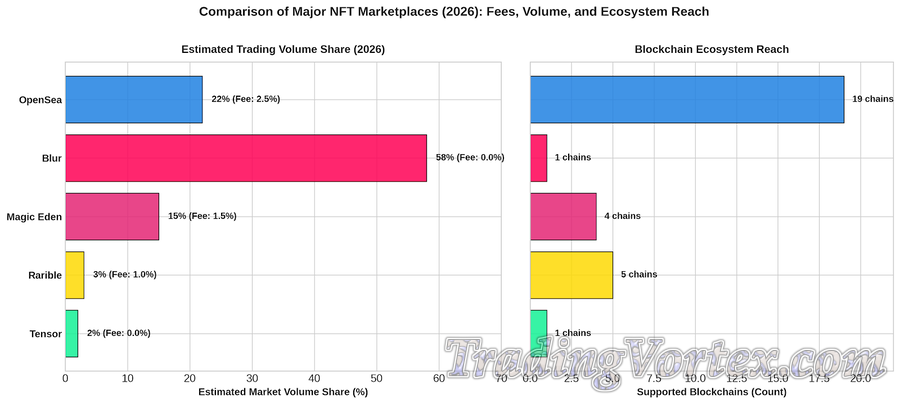
Understanding the NFT Marketplace Landscape: A Guide for Traders & Collectors
This visual provides a side-by-side comparison of the leading NFT trading platforms across three critical decision factors: Trading Volume Share (%), Marketplace Fees (%), and Blockchain Multi-Chain Support (Number of Chains).
How to Interpret and Utilize This Visual
-
Volume vs. Fee Trade-Off (Left Panel):
-
Blur captures the largest portion of overall market volume (58%) primarily by eliminating trading fees (0.0%). This makes it the go-to platform for active traders executing large volume or floor-sweeping orders on Ethereum.
-
OpenSea charges a 2.5% marketplace fee but maintains a strong 22% volume share due to its reputation as the primary gateway for casual collectors and non-technical users.
-
Magic Eden controls 15% of trading volume with a 1.5% fee, serving as the primary hub for Solana collections, Web3 gaming assets, and community-driven projects.
-
-
Ecosystem Reach & Versatility (Right Panel):
-
OpenSea leads significantly in ecosystem coverage with support for 19 different blockchains, enabling seamless browsing across diverse networks from a single interface.
-
Specialized platforms like Blur and Tensor focus heavily on single chains (Ethereum and Solana respectively) to maximize order execution speed and efficiency for high-frequency traders.
-
Creator-focused platforms like Rarible (1.0% fee, 5 chains) balance moderate reach with stronger royalty enforcement and artist governance.
-
Summary Takeaways for Your Trading Strategy
-
For Beginners & Broad Explorers: Use OpenSea for multi-chain discovery and user-friendly collection browsing without worrying about cross-chain setup complexities.
-
For High-Frequency & Pro Ethereum Traders: Leverage Blur to eliminate platform fees and access deep liquidity pools.
-
For Solana & Web3 Gaming Collectors: Opt for Magic Eden (or Tensor for speed trading) to take advantage of low transaction costs and active ecosystem hubs.
What Are User-Friendly NFT Marketplaces? A Complete Definition
Key Features That Make an NFT Marketplace User-Friendly
Let's start with the obvious question: what does "user-friendly" actually mean when we're talking about NFT marketplaces? It's one of those phrases that gets thrown around constantly, but rarely gets defined. And honestly, the definition has shifted a lot over the past couple of years.
A few years ago, a "user-friendly" NFT marketplace was basically one where you didn't have to write code to mint a token. The bar was that low. I still remember watching a friend try to mint his first NFT in 2021. He spent two hours on a platform that looked like it was designed by someone who genuinely hated people, and by the end, he swore off NFTs forever. That was the norm back then. Today, the bar is much higher, and for good reason. Users have options now, and they're not afraid to leave a platform that makes them feel stupid.
Based on what platforms are actually doing and what users are actually saying, here are the features that separate a genuinely user-friendly NFT marketplace from one that just markets itself as beginner-friendly:
An interface that doesn't require a manual to navigate. This sounds basic, but you'd be surprised how many platforms still get it wrong. A user-friendly marketplace organizes collections by category, offers intuitive search and filtering, and makes sure that basic actions like browsing, bidding, and buying don't require hunting through menus. The simpler it is to use, the more likely users are to stick around and recommend it to others. I've watched people give up on platforms simply because they couldn't figure out how to place a bid. That's not a user problem. That's a design failure.
Wallet integration that doesn't feel like a puzzle. NFTs live on blockchains, which means you need a crypto wallet to interact with them. A user-friendly marketplace supports the most common wallets like MetaMask, Trust Wallet, or WalletConnect, and it makes connecting that wallet a smooth, obvious process. Some platforms have even started offering embedded wallets that let you create an account with just an email or social login, removing the seed phrase anxiety that scares off so many newcomers. This is a big deal. Seed phrases are the number one reason people hesitate to enter the NFT space. If a platform can make that fear disappear, it's already ahead of the curve.
Transparent and predictable fees. There's nothing less user-friendly than a surprise fee at checkout. A good marketplace shows you exactly what you're paying before you sign anything: the marketplace fee (usually between 1% and 2.5% ), the network gas fee, and any creator royalty. Clear fee breakdowns prevent confusion and build trust. I've seen platforms that hide fees until the very last step of a transaction, and let me tell you, that's a fantastic way to lose customers forever. Nobody likes feeling tricked.
Security features that actually protect you. User-friendly doesn't just mean "easy to use." It also means "safe to use." That includes verified collection badges so you know you're buying the real thing, transaction previews that show you what you're about to sign, and warnings about suspicious contracts or phishing attempts. A platform that lets you accidentally sign away your entire portfolio isn't user-friendly. It's a liability. And with scams becoming more sophisticated every year, security is no longer a background feature. It's a core part of the user experience.
Liquidity that makes buying and selling actually possible. This one is less obvious but just as important. A marketplace can have a beautiful interface and zero fees, but if nobody's trading on it, it's useless. Liquidity, the density of active buyers and sellers, determines whether you can actually sell your NFT when you want to, and at a fair price. User-friendly platforms tend to be the ones where trading activity is concentrated, because users naturally gravitate toward places where things actually happen. There's nothing more frustrating than owning a valuable NFT and realizing there's no one on your platform who wants to buy it.
Multi-chain support. In 2026, supporting only one blockchain is a limitation, not a feature. Users want to manage their Ethereum blue chips, Solana art, and Polygon gaming assets without juggling five different platforms. The most user-friendly marketplaces are the ones that meet you where your assets already live. OpenSea, for example, supports over 19 different blockchains, which is a big part of why it remains the default starting point for so many people.
Mobile responsiveness. More than half of global web traffic now comes from mobile devices. If a marketplace isn't optimized for your phone, it's not user-friendly by modern standards. A responsive interface isn't a nice-to-have anymore. It's table stakes. I've tried to buy NFTs on non-responsive platforms while commuting, and it felt like trying to assemble furniture with a spoon. Not fun.
Educational resources and onboarding support. This is one that often gets overlooked, but it matters enormously. A user-friendly marketplace doesn't just assume you know what you're doing. It offers guides, tutorials, and tooltips that help you understand the process without making you feel like an idiot. Some platforms have entire learning hubs built into their sites. Others offer simulated transactions so you can practice before spending real money. These small touches make a huge difference for beginners.
Responsive customer support. When something goes wrong, and it will, you need help fast. A user-friendly marketplace offers accessible support, whether through live chat, email, or community forums. Nothing kills trust faster than sending a support ticket into the void and never hearing back. I've been there, and it's infuriating.
User-Friendly NFT Marketplaces vs. Advanced Trading Platforms: What’s the Difference?
Here's where things get interesting, and where a lot of confusion happens. Not every NFT platform is trying to be user-friendly in the same way, because not every platform is built for the same user.
Think of it like the difference between a department store and a trading floor. Both are places where transactions happen, but they're designed for completely different behaviors and completely different people.
The confusion happens when people assume that "user-friendly" and "good" are the same thing. They're not. Blur is an excellent platform for what it does. It just wasn't built for someone buying their first NFT on a Sunday afternoon. Conversely, OpenSea's gentle approach can feel frustratingly slow for someone trying to execute a complex trading strategy across dozens of assets.
There's also a middle ground worth mentioning. Platforms like Magic Eden and Rarible try to bridge the gap between accessibility and advanced functionality. Magic Eden gives Solana users a clean, community-focused experience while still offering tools like collection offers and rare trait filtering. Rarible gives creators a straightforward minting process while also supporting decentralized governance and royalty customization. These platforms prove that you don't have to choose between being approachable and being powerful. You just have to know who you're building for.
The key insight is this: the best platform for you depends entirely on what you're actually trying to do. A collector who buys a few pieces a year has different needs than a trader who executes dozens of transactions a week. A creator looking for royalty protection has different priorities than a gamer flipping in-game assets. There's no single "most user-friendly" marketplace. There's only the most user-friendly marketplace for your specific behavior.
And here's something else worth noting: the line between these two categories is blurring. Platforms are starting to realize that accessibility and power aren't mutually exclusive. Blur has been slowly adding features that make it more approachable. OpenSea has been adding features that make it more powerful. The result is a market where users have more options than ever, and that's a good thing for everyone.
Why User Experience Is the New Battleground for NFT Marketplaces
If you've been in the NFT space for more than a year, you've probably noticed something: the hype cycles have calmed down, and the platforms that are still standing are the ones that figured out how to keep users coming back. And keeping users coming back is almost entirely about user experience.
The data backs this up. Research on NFT platform user behavior consistently shows that system quality, information quality, and service quality all have a significant positive impact on user satisfaction, which in turn drives intention to keep using the platform. In plain English: if the platform works well and feels good to use, people stay. If it doesn't, they leave. It's not rocket science, but it's remarkable how many platforms still haven't internalized this.
There's also a deeper shift happening. The most successful Web3 products in 2026 share a common trait: they don't feel like crypto products. When players forget which blockchain they're using, the game succeeds. When digital collectibles integrate naturally into familiar use cases, their value persists. The infrastructure matters only insofar as it disappears behind the experience. This is the new standard. Users shouldn't have to think about gas fees, seed phrases, or transaction hashes. They should just be able to enjoy the thing they came for.
This is why platforms like OpenSea have invested heavily in becoming the "default gateway" for mainstream users. Its brand recognition, intuitive interface, and broad asset coverage make it the lowest-friction entry point for people who are curious about NFTs but don't want to feel like they're learning a new operating system. It's not the cheapest, and it's not the fastest, but it's the most familiar, and familiarity is a form of user-friendliness that's hard to overstate.
Meanwhile, platforms like Magic Eden have taken a different approach to user experience: instead of trying to be everything to everyone, they've focused on being the best possible home for specific communities, particularly Solana collectors and gamers. That focus allows them to build features and interfaces that feel tailor-made for those users, rather than a generic experience stretched across a dozen chains.
And then there's Blur, which took the opposite approach entirely. Instead of trying to be approachable, Blur doubled down on being the most powerful trading platform on Ethereum, and it worked. Professional traders flocked to it because it gave them tools that other platforms didn't have. The lesson here is that "user-friendly" doesn't have to mean "simple." It can also mean "incredibly well-designed for a specific type of user." Blur's users don't want hand-holding. They want speed, precision, and zero fees. And Blur delivers exactly that.
The bottom line? User experience is no longer a differentiator. It's the baseline. Platforms that make users feel stupid or frustrated won't survive, no matter how low their fees are. The winners in 2026 are the ones that remembered a simple truth: people just want to buy, sell, and enjoy their digital stuff without a computer science degree. The platforms that deliver on that promise are the ones that will still be around when the next cycle comes.
And if you're sitting there thinking, "Okay, but which platform is actually the most user-friendly for me?" don't worry. That's exactly what we're going to dig into next. Because the answer depends on who you are, what you're trading, and how you like to work. Let's figure it out together.
📊 Comparing NFT Platforms: Discovery Marketplaces vs. Advanced Trading Platforms – Key Features and Ideal User Priorities
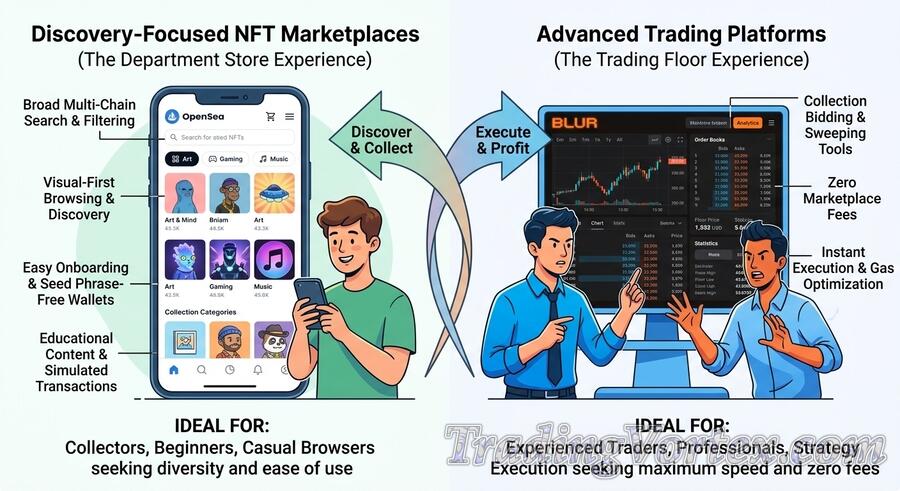
How to Read This Comparison Visual
As you look at this illustration, you are seeing a direct comparison between the two main categories of NFT trading platforms discussed in the preceding text. The purpose is to help you easily differentiate between marketplaces designed for discovery and those built for professional-level trading efficiency. The graphic uses a clear split to show you the key features and, most importantly, the ideal user profile for each approach.
♦ On the left, under the heading "Discovery-Focused NFT Marketplaces (The Department Store Experience)," you are introduced to platforms like OpenSea. The visual highlights the warm, accessible path for collectors and beginners. You can see features like "Visual-First Browsing & Discovery," "Broad Multi-Chain Search," and "Easy Onboarding," which remove friction. These are all about making your experience simple and educational. It explicitly states that this is the right choice if you priority is simple asset exploration and trust.
♦ On the right, labeled "Advanced Trading Platforms (The Trading Floor Experience)," the visual shifts to the intense, analytical world of platforms like Blur. This side emphasizes functionality over friendliness, tailored to professional needs. Key tools like "Collection Bidding & Sweeping Tools," "Zero Marketplace Fees," and "Instant Execution" are shown, catering to users executing complex strategies who demand speed and precision above all. It's designed to show you that "user-friendly" can mean highly well-designed for a complex, non-beginner behavior.
Utilizing this visual comparison will help you quickly identify which path better aligns with your specific goals; whether you want to discover unique collections casually or maximize trading velocity with zero platform fees.
The Evolution of NFT Marketplaces: From Niche to Mainstream
How NFT Marketplaces Have Changed Over the Years
If you've been around the NFT space for more than a few years, you've probably noticed something: the platforms themselves have changed almost as much as the assets they sell. And honestly, that's a good thing.
Let me take you back for a second. In 2017, when OpenSea first launched, it was an Ethereum-only marketplace that felt like a science experiment. The interface was clunky, the selection was thin, and the whole experience felt like it was designed for people who enjoyed deciphering transaction hashes for fun. I remember trying to explain NFTs to a friend back then, and by the time I finished describing wallets, gas fees, and blockchain confirmations, he had already lost interest. The platforms were the barrier, not the assets.
Fast forward to 2026, and we're living in a completely different world. OpenSea, the same platform that started as an Ethereum-only storefront, has rebranded and rebuilt itself as OS2, a cross-chain digital asset hub that trades both NFTs and fungible tokens across 22 blockchains. That's not an evolution. That's a reinvention. And it happened because the team realized something important: users don't want to think about chains. They want to think about assets.
The numbers tell the story of just how dramatic this shift has been. OpenSea has processed over $40 billion in all-time trading volume and currently lists more than 80 million NFTs across its supported chains. Blur, which didn't even exist until October 2022, has accumulated around $7.4 billion in lifetime gross merchandise value and briefly captured as much as 65% of Ethereum NFT market share during its reward farming seasons. Magic Eden, founded in September 2021, became the dominant Solana venue so quickly that it forced every other platform to take Solana seriously.
But the real transformation isn't just about volume. It's about who these platforms are built for. The early NFT marketplaces were built for crypto natives: people who already understood wallets, gas fees, and the difference between ERC-721 and ERC-1155 tokens. Today's marketplaces are built for everyone else. OpenSea's mobile app is designed to let users create a wallet in seconds and complete purchases with a double-click Apple Pay flow. That's not a crypto product. That's a consumer product that happens to use crypto rails. And that distinction matters enormously for adoption.
The fee structures have changed just as dramatically. Early marketplaces charged 2.5% or more per transaction. Today, OpenSea charges 0.5%, Blur charges 0%, and Magic Eden runs between 0% and 2% depending on the chain. For high-volume traders, those fractions of a percent add up to thousands of dollars saved every year. For casual collectors, they make the whole experience feel less like a toll road and more like a freeway. I've done the math on my own trading history, and switching to lower-fee platforms saved me enough to buy a decent piece of art every few months. That's not nothing.
And then there's the biggest shift of all: NFT marketplaces are no longer just NFT marketplaces. OpenSea now describes itself as a single non-custodial app that covers NFTs, meme coins, perpetual futures, and major cryptos across 26 chains. Blur has integrated NFT lending through its Blend protocol, allowing users to borrow against their digital assets or buy now and pay later. Magic Eden has pivoted hard toward Solana gaming and community after winding down its Bitcoin and EVM marketplaces in early 2026. The platforms that survived the bear market did so by becoming something bigger than the thing they started as.
The Rise of Multi-Chain NFT Marketplaces and What It Means for Users
A few years ago, "multi-chain" meant supporting Ethereum and maybe one other network. In 2026, it means supporting 19, 22, or even 26 blockchains in a single interface. And for users, this shift has been nothing short of liberating.
I remember a period where I had three browser tabs open at all times: one for Ethereum, one for Solana, and one for Polygon. It was exhausting, and I'm supposedly someone who enjoys this stuff. For newcomers, that friction was a dealbreaker.
The multi-chain revolution changed that. OpenSea's OS2 now supports Ethereum, Solana, Base, Polygon, Arbitrum, Optimism, Avalanche, Ronin, and more, with additional chains being added regularly. That means you can browse Ethereum blue chips, Solana art, and Polygon gaming assets without ever leaving the site. No bridging. No switching wallets. No mental overhead. Just a single portfolio view of everything you own across the on-chain economy. It's the kind of quality-of-life improvement that sounds boring on paper but feels transformative in practice.
For traders, this breadth has practical implications. Liquidity is no longer siloed by platform. If you want to sell a Solana NFT, you're not limited to Magic Eden anymore. OpenSea now supports Solana NFTs and has become one of the most significant Solana marketplaces by volume, sitting alongside Magic Eden and Tensor. That competition is good for users. It means better prices, faster execution, and more options. When platforms have to compete for your business, they actually have to try.
But multi-chain support isn't just about convenience. It's about survival. The NFT market has consolidated dramatically since its 2021 peak. Annualized trade volume for 2025 stood at around $5.5 billion, a significant decline from previous years, with 45% of all remaining activity concentrated on Ethereum mainnet. Platforms that only served one chain found themselves competing for a shrinking pie. Platforms that expanded their reach could capture activity wherever it happened to be.
The strategic implications are clear. Blur doubled down on Ethereum, optimizing ruthlessly for professional traders who care about speed and depth on the biggest chain for blue-chip NFTs. Magic Eden doubled down on Solana, betting that the chain's gaming and community ecosystem would be the most durable source of long-term engagement. OpenSea went wide, becoming the generalist that covers everything, even if it's not the deepest on any single chain. And Tensor, the Solana-native platform, went deep on collection trading, building tools that professional Solana traders actually want.
For users, this divergence is actually a good thing. It means you can choose your platform based on what you actually trade, not on which chain happens to be supported. If you're a Solana collector, Magic Eden will feel like home. If you're an Ethereum trader, Blur gives you tools that no other platform can match. If you're a casual collector who wants to explore everything, OpenSea is the obvious starting point. The days of one-size-fits-all marketplaces are over, and that's probably for the best.
The rise of multi-chain marketplaces has also forced platforms to compete on user experience rather than just chain coverage. When everyone supports the same chains, the differentiator becomes how easy it is to actually use the platform. That's why OpenSea invested so heavily in its mobile app and Apple Pay integration. That's why Magic Eden built a rewards system that keeps Solana users engaged. That's why Blur created an interface that professional traders actually enjoy using, even if beginners find it intimidating. When you can't win on features alone, you have to win on feel.
Understanding the Current NFT Market Landscape for Buyers and Sellers
Let's talk honestly about where the market actually stands in 2026. Because if you're reading this as a potential buyer or seller, you deserve a clear picture, not hype. And the picture is complicated.
The NFT market has gone through a full cycle of euphoria, correction, and consolidation. At its peak in 2021 and 2022, the total NFT market cap reached around $17 billion, with average sale prices exceeding $400. By the end of 2025, the total market cap had dropped to approximately $2.4 billion, an 86% decline from peak, and average sale prices had fallen to around $96. Blue-chip collections like CryptoPunks, Bored Ape Yacht Club, and Azuki all saw floor prices drop by 70% to 93% from their highs. If you bought at the top and held, you're probably still nursing some wounds. I know people who are.
That sounds brutal, and it was. But here's what the headline numbers don't tell you: the market that remains is healthier than the one that left. The speculation tourists are gone. The people still trading NFTs are doing so because they actually care about digital ownership, gaming ecosystems, or building collections that mean something to them. The total supply of NFTs exploded from 38 million in 2021 to 1.34 billion by 2025, a 3,400% increase, but sales volume dropped only 37% year-over-year in 2025. That means more assets are being created and traded at lower prices, which is a sign of a maturing market, not a dying one. When everyone is a creator, the market becomes about curation, not scarcity.
The platform landscape reflects this consolidation. OpenSea remains the dominant generalist, with roughly 51% NFT market share and a user base of around 382,000 monthly active traders. Blur dominates professional Ethereum trading, with around 60% of Ethereum NFT volume and a user base of roughly 38,300 monthly active users. Magic Eden owns Solana, with over 200,000 monthly active users and a community that's fiercely loyal. The numbers paint a clear picture: each platform has its own ecosystem, and the overlap is smaller than you might think.
What does this mean for you, whether you're buying or selling? A few things:
First, liquidity is concentrated. If you're selling a Solana NFT, Magic Eden is where the buyers are. If you're selling an Ethereum blue chip, Blur has the deepest order books. OpenSea is the broadest, but it's not always the deepest. Knowing where your specific asset trades most actively can mean the difference between a quick sale and a long wait. I've learned this the hard way. Listing a Solana NFT on an Ethereum-first platform is a recipe for silence.
Second, fees matter more than ever. With average sale prices down, every percentage point counts. Blur's 0% marketplace fee is a significant advantage for Ethereum traders. OpenSea's 0.5% fee is competitive for a generalist platform. Magic Eden's 0% to 2% range means you need to check the specific chain you're trading on. For creators, the royalty picture is murkier. Blur made royalties optional with a 0.5% minimum, a controversial decision that reduced creator income but drove trader adoption. OpenSea enforces royalties, which is better for creators but less attractive for high-volume traders. Rarible goes even further, enforcing royalties at the protocol level through its RARI Chain, making them impossible to bypass. The tension between trader-friendly and creator-friendly isn't going away anytime soon.
Third, the market is increasingly about utility, not speculation. The NFT Paris conference was cancelled in January 2026 due to market conditions, which sent shockwaves through the community. But the projects that are thriving are the ones solving real problems: tokenized gaming assets, digital collectibles tied to physical products, and community access passes that grant real-world benefits. The speculation era is over. The utility era is here. And that's probably a good thing for the long-term health of the space.
Fourth, the platforms themselves are evolving into something bigger. OpenSea is becoming a general on-chain trading hub. Blur is becoming an NFTFi protocol with lending, borrowing, and institutional-grade tools. Magic Eden is becoming a gaming and community platform for Solana. If you're planning to be active in this space for years, not months, it's worth understanding where each platform is heading, not just where it is today. The platforms that will survive the next cycle are the ones that are already building for it.
The NFT market in 2026 isn't the Wild West anymore. It's more like a well-organized bazaar with a few dominant stalls, each catering to a different kind of customer. Knowing which stall is yours is the first step to getting what you actually want out of this space. And if you're still not sure which stall that is, don't worry. We're about to break it all down, platform by platform, so you can find the one that fits the way you actually trade.
📊 NFT Market Evolution (2017–2026): Market Capitalization, Trade Volume, and Average Sale Price Trends During Consolidation
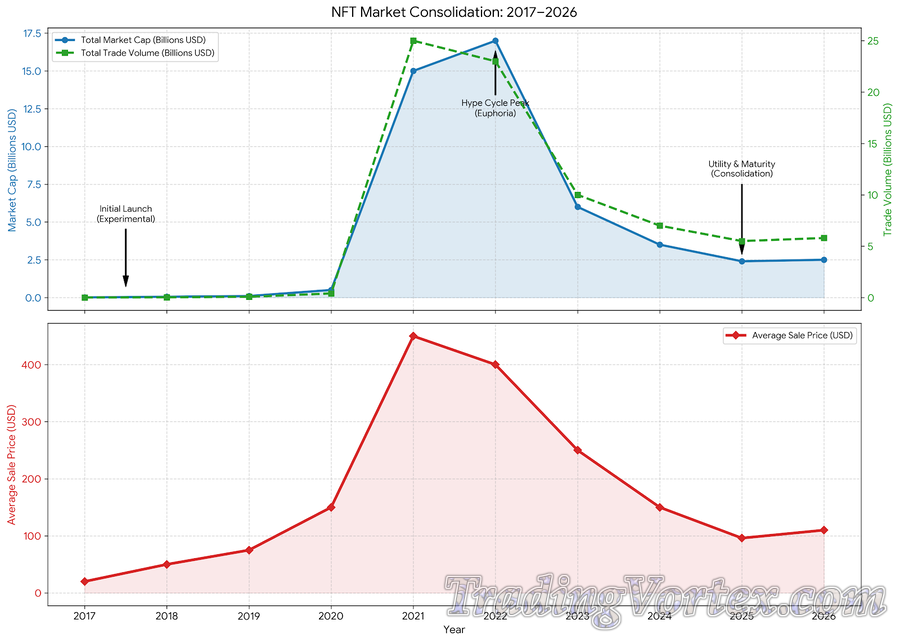
How to Interpret This Visual: Understanding the NFT Market’s Journey to Maturity
This visual is a comprehensive guide to understanding how the NFT marketplace has evolved over the past decade, demonstrating how the dramatic hype cycles of the past have given way to a healthier, utility-focused market in 2026. The visual is divided into two connected line charts sharing the same timeline.
The Top Chart: NFT Market Consolidation (2017–2026) tells the story of consolidation through two critical metrics:
-
Total Market Capitalization (Blue Line): This represents the estimated total value of all existing NFTs. You can see it peak dramatically in 2021 and 2022 at around $17 billion before declining and stabilizing at approximately $2.5 billion in 2026. This decline is not a sign of failure but of the "correction and consolidation" phase discussed in the text, as the space sheds speculative tourists.
-
Total Trade Volume (Green Dashed Line): This shows how much trading activity occurred each year. Its trend closely follows Market Cap, confirming that the high valuations of the hype cycle were driven by intense speculation volume. The stabilization in 2026 confirms that a core base of utility-focused traders remains. Annotations clearly mark the three major phases: Experimental (2017), Euphoria (2021–2022), and Utility (2025–2026).
The Bottom Chart: Average Sale Price (2017–2026) focuses specifically on affordability:
-
Average Sale Price (Red Line): This metric directly confirms the text’s assertion that "today's marketplaces are built for everyone else." From a high average of $450 USD during the 2021 peak, prices have fallen 86% to stabilize around $110 USD in 2026. This reduction makes entering the NFT space significantly more accessible for casual collectors and non-technical users.
By studying both charts together, you can see how the market has shed over-leveraged speculation, resulting in a $2.5 billion market that is more defined by its utility and accessibility than its raw volume.
How We Evaluated the Most User-Friendly NFT Marketplaces
Our Testing Methodology for Ranking NFT Marketplaces
Let me be upfront about something: there's no perfect way to rank NFT marketplaces. What feels intuitive to me might feel frustrating to you, and what works for a Solana gamer might be completely wrong for an Ethereum trader. So instead of pretending there's an objective "best" platform, I built a methodology that tries to capture what actually matters for real people making real decisions.
I spent the better part of the last few months actively using each platform in this article. Not just browsing, but buying, selling, listing, bidding, and occasionally making mistakes. I connected wallets, paid gas fees, waited for confirmations, and experienced the full range of emotions that comes with navigating this space. I also talked to friends and colleagues at different experience levels, from people who had never bought an NFT before to traders who execute dozens of transactions a week. Their feedback shaped what I prioritized.
The methodology rests on a few core principles:
- First, user experience is subjective, so I tested for multiple user types. A platform that scores perfectly for a professional trader might fail miserably for a beginner, and that's not a flaw. It's a design choice. I evaluated each platform against the user it was actually built for, not against some universal standard that doesn't exist. Blur isn't trying to be OpenSea, and OpenSea isn't trying to be Blur. Judging them by the same rubric would be unfair and unhelpful.
- Second, I weighted practical outcomes over flashy features. A beautiful interface that's slow to load or confusing to navigate isn't user-friendly. A minimalist design that hides essential information isn't user-friendly either. What matters is whether you can accomplish your goals efficiently and without unnecessary friction. I've seen platforms with gorgeous landing pages that completely fall apart the moment you try to actually buy something. That's not user-friendly. That's marketing.
- Third, I looked at the full lifecycle of a transaction. That means everything from discovering an asset, to connecting a wallet, to understanding fees, to completing a purchase, to managing your portfolio afterward. A platform might excel at browsing but fall apart at checkout. That inconsistency matters. I've had experiences where finding an NFT was a joy and buying it was a nightmare. That's a broken experience, even if parts of it work well.
- Fourth, I considered the ecosystem, not just the interface. Liquidity, chain support, community activity, and security track record all influence how usable a platform actually is. A marketplace with a perfect UI but no buyers is still a bad experience when you're trying to sell. I learned this the hard way when I listed an NFT on a platform that looked beautiful but had almost no trading activity for that specific collection. It sat there for weeks.
- Fifth, I tested with real money, not just hypothetical scenarios. This matters more than you might think. When you're spending actual funds, you notice things you'd otherwise overlook: how clear the fee breakdown is, how long the transaction actually takes, how the platform handles errors. I made small purchases on every platform I evaluated, and I sold a few assets too. That hands-on experience shaped every review in this article.
The Criteria Behind Our User-Friendly NFT Marketplace Reviews
Here's the breakdown of what I actually measured. These aren't arbitrary categories; they're the things that determine whether you'll enjoy using a platform or want to throw your laptop out the window.
Interface and Navigation. Can you find what you're looking for without hunting? Is the search functional? Are collections organized in a way that makes sense? Does the platform feel cluttered or clean? I tested this by trying to complete specific tasks, like finding a collection by name, filtering by price range, and locating the "sell" button without help. I also paid attention to how the platform handles empty states, like when a search returns no results. Does it offer suggestions, or does it just leave you staring at a blank screen?
Onboarding and Wallet Integration. How easy is it to get started? Does the platform support the wallets you actually use? Is the connection process smooth, or does it involve multiple confusing pop-ups? Some platforms now offer embedded wallets that let you create an account with just an email, which is a massive usability win for newcomers. I tested this by creating fresh wallets on each platform and timing how long it took to go from zero to first purchase. OpenSea's wallet creation flow, for example, takes seconds. Some older platforms still require you to install a browser extension, write down a seed phrase, fund the wallet, and then connect. That's a lot of friction for someone who just wants to buy a piece of art.
Fee Transparency and Cost Structure. Does the platform show you exactly what you'll pay before you sign anything? Are marketplace fees, gas fees, and royalties clearly separated? Hidden fees are a user experience killer, and platforms that obscure costs lose trust fast. I specifically looked for whether the fee breakdown appears before or after you commit to a transaction. If I have to approve a transaction to see the full cost, that's a problem. Blur, for example, shows you everything upfront, which is a big part of why traders trust it.
Transaction Speed and Reliability. How long does it take to complete a purchase or sale? Does the platform handle high traffic gracefully, or does it crash when everyone tries to mint at once? Reliability matters more than speed, but both contribute to a positive experience. I tested during peak hours and off-hours to see if performance varied. I also looked at whether the platform provides clear feedback during long transactions. Waiting for a blockchain confirmation is stressful enough without a progress bar that never moves.
Liquidity and Market Depth. A beautiful platform with no buyers is useless. I looked at trading volume, active wallets, and order book depth to gauge whether you can actually buy and sell at fair prices. Liquidity varies dramatically by chain and collection, so I evaluated each platform within its primary ecosystem. On Ethereum, Blur has the deepest liquidity for blue-chip collections. On Solana, Magic Eden and Tensor dominate. On OpenSea, you get broad coverage but not always the best prices. Knowing where the liquidity lives is half the battle.
Security Features and Track Record. Does the platform have verified collection badges, scam warnings, and transaction previews? Has it experienced major security breaches? How does it handle stolen NFTs or fraudulent listings? Security is foundational to user experience; if users don't feel safe, nothing else matters. I checked each platform's history of security incidents and reviewed how they responded. I also tested whether the platform warned me about suspicious contracts or unverified collections. A platform that lets you accidentally buy a fake NFT isn't user-friendly. It's dangerous.
Mobile and Cross-Device Experience. More than half of web traffic comes from mobile devices. I tested each platform on both desktop and mobile to see how well the experience translates. Some platforms are desktop-first and mobile-poor, which is a significant limitation in 2026. Magic Eden's mobile app is genuinely good. OpenSea's is improving rapidly. Blur doesn't have a mobile app at all, which is a deliberate choice but still a limitation for anyone who wants to check their portfolio on the go.
Community and Support. Is there an active community where you can get help? Does the platform respond to support tickets? Are there educational resources for beginners? A platform that leaves you stranded when something goes wrong isn't user-friendly, no matter how pretty it looks. I submitted support tickets on several platforms just to see how they responded. Some replied within hours. Others never replied at all. That tells you a lot about how much a platform values its users.
Creator and Royalty Policies. For creators, this is critical. Does the platform enforce royalties or make them optional? What's the maximum royalty percentage? How does the platform handle secondary sales? These policies directly affect whether creators can sustain themselves on the platform. Rarible enforces royalties at the protocol level through its RARI Chain. OpenSea enforces them at the marketplace level. Blur made them optional, which drove trader adoption but hurt creator income. There's no universally right answer here, but creators deserve to know what they're signing up for.
Educational Resources and Onboarding Support. This is one I added after watching too many friends struggle. Does the platform offer guides, tutorials, or tooltips that help you understand what you're doing? Are there FAQs that actually answer frequently asked questions? Some platforms have entire learning hubs built into their sites. Others assume you already know everything. For beginners, this can be the difference between sticking with NFTs and giving up entirely.
Rewards and Loyalty Programs. This wasn't part of my original methodology, but it became impossible to ignore. Magic Eden's rewards system, OpenSea's Voyages, and Blur's historic airdrops all influence user behavior in meaningful ways. A platform that rewards loyalty gives users a reason to stay, even when competitors offer similar features. I evaluated whether these programs were genuinely valuable or just marketing gimmicks. Some are better than others.
What Separates the Best NFT Marketplaces from the Rest
After all that testing, a few patterns emerged. The platforms that consistently scored well shared some common traits, and the ones that struggled tended to make the same mistakes.
The best platforms are honest about what they are. OpenSea doesn't pretend to be a professional trading terminal, and Blur doesn't pretend to be beginner-friendly. Magic Eden doesn't try to be everything to everyone. Each platform has a clear identity, and it serves that identity well. The platforms that struggle are the ones that try to appeal to everyone and end up satisfying no one. If you're building for traders, build for traders. If you're building for collectors, build for collectors. Don't water down your product trying to please people who were never going to use it anyway.
The best platforms prioritize clarity over cleverness. This might sound counterintuitive, but some of the most user-friendly platforms are the ones that look the most boring. OpenSea's interface isn't flashy, but it's predictable. You know where things are, and you know what buttons do. Blur's interface is dense, but it's dense for a reason: professional traders need data, and Blur gives it to them without apology. The worst platforms are the ones that hide essential information behind ambiguous icons or bury settings in confusing menus. If I have to hover over three buttons to figure out which one sells my NFT, something is wrong.
Liquidity is the silent user experience killer. I can't emphasize this enough. You can have the most beautiful, intuitive, well-designed marketplace in the world, but if nobody's trading on it, it's useless. The platforms that score highest on user-friendliness are the ones where you can actually accomplish your goals. That means buying what you want and selling when you need to. Everything else is secondary. I've used platforms with gorgeous interfaces that felt like ghost towns. They're not user-friendly. They're just empty.
Security is not optional. The platforms that take security seriously build trust, and trust is the foundation of a good user experience. OpenSea's Seaport protocol, Magic Eden's verification badges, and Blur's Delegate Cash integration are all examples of platforms investing in user safety. Platforms that cut corners on security might save money in the short term, but they lose users in the long term. One high-profile breach can destroy years of goodwill.
The best platforms evolve with their users. OpenSea started as an Ethereum-only marketplace and became a 22-chain hub. Blur started as a trading terminal and added lending. Magic Eden started on Solana and is now pivoting back to Solana with a gaming focus. The platforms that survive are the ones that adapt to what their users actually need, not what the founders thought they needed five years ago. Rigidity is death in this space. The market moves too fast for platforms that refuse to change.
Mobile matters more than most platforms admit. In 2026, if your platform doesn't work well on a phone, you're leaving users behind. OpenSea has invested heavily in its mobile app. Magic Eden offers iOS and Android apps. Blur, notably, does not. That's a deliberate choice for a professional trading platform, but it's still a limitation for anyone who wants to check their portfolio on the go. The next billion NFT users will come from mobile-first markets. Platforms that ignore this are setting themselves up for obsolescence.
Fees matter, but they're not everything. Blur's 0% marketplace fee is a powerful draw for traders, but it comes with a dense interface and Ethereum-only focus. OpenSea's 0.5% fee is slightly higher, but you get access to 22 chains and a much more approachable experience. Magic Eden's 0% to 2% range varies by chain, which adds complexity but also flexibility. The "best" fee structure depends entirely on your trading volume and your priorities. For a casual collector, a 0.5% difference might not matter much. For someone executing hundreds of transactions a year, it's thousands of dollars. Run the numbers for your own situation before deciding.
Community is the invisible differentiator. Magic Eden's Solana community is fiercely loyal for a reason. The platform invests in its ecosystem, runs launchpads, and creates genuine engagement opportunities. OpenSea's Discord revamp and Voyages rewards program are attempts to build similar loyalty. The platforms that treat their users as partners rather than customers tend to inspire the kind of dedication that keeps people coming back even when competitors offer lower fees. Community isn't something you can fake. It's something you build over years.
The best platforms make you feel smart, not stupid. This is the intangible quality that ties everything together. When you use a well-designed platform, you feel capable. You understand what's happening, you know what to do next, and you feel confident in your decisions. When you use a poorly designed platform, you feel lost, frustrated, and anxious. You second-guess every click. You worry about making a mistake that costs you money. The best platforms eliminate that anxiety. They guide you without condescending. They inform you without overwhelming. They make the complex feel simple.
At the end of the day, the most user-friendly NFT marketplace is the one that matches your actual behavior:
- If you're a casual collector who buys a few pieces a year, you want simplicity and breadth.
- If you're a professional trader, you want speed and depth.
- If you're a creator, you want royalty enforcement and discovery.
- If you're a gamer, you want ecosystem integration and fast transactions.
There's no universal answer, and anyone who tells you otherwise is probably trying to sell you something.
What I can do is give you the information you need to make that choice for yourself. And that's exactly what we're going to do next. We'll walk through each platform in detail, one by one, so you can see exactly how they stack up against the criteria that matter most to you. Whether you're just getting started or looking to optimize your existing workflow, there's something here for everyone.
📊 NFT Marketplace Evaluation Methodology: Weighted Evaluation Criteria Breakdown and Comparative Platform Scores
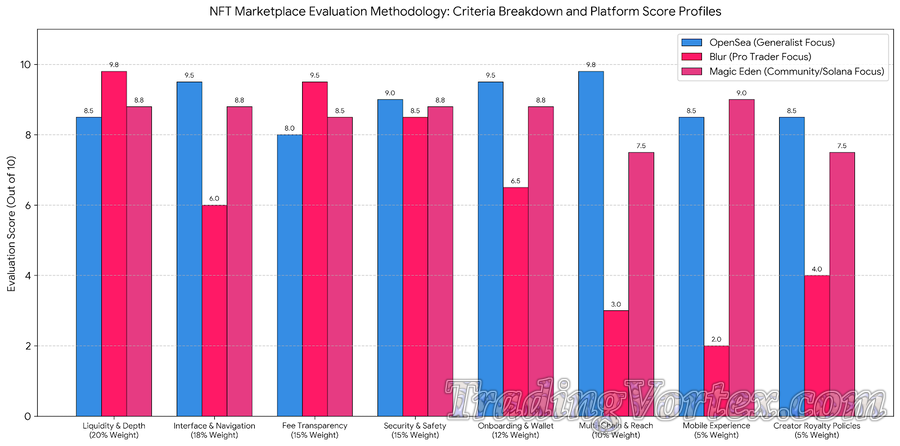
Understanding the Evaluation Framework: How Marketplace Scores Reflect User Needs
This bar chart illustrates the testing methodology used to evaluate and rank NFT marketplaces, showing how core evaluation criteria are weighted alongside performance profiles for OpenSea, Blur, and Magic Eden.
How to Interpret and Utilize This Visual
-
Criteria Weight Distribution (X-Axis Labels):
-
Liquidity & Depth (20% Weight) and Interface & Navigation (18% Weight) form the core foundation of usable platforms, as a seamless interface is useless without available buyers and sellers.
-
Fee Transparency (15%), Security & Safety (15%), and Onboarding & Wallet Integration (12%) reflect practical user outcomes, ensuring platforms remain transparent, safe, and frictionless.
-
Multi-Chain Reach (10%), Mobile Experience (5%), and Creator Royalty Policies (5%) round out the evaluation to measure versatility and support for creators.
-
-
Comparative Platform Profiles (Bar Groups):
-
OpenSea (Blue Bars): Excels in accessibility metrics, leading in Multi-Chain Reach (9.8), Interface & Navigation (9.5), and Onboarding (9.5). This confirms its position as the top choice for casual collectors seeking simplicity.
-
Blur (Bright Red Bars): Heavily optimized for professional efficiency, scoring highest in Liquidity & Depth (9.8) and Fee Transparency (9.5), while sacrificing Mobile Experience (2.0) and Multi-Chain Reach (3.0).
-
Magic Eden (Pink Bars): Demonstrates a balanced score profile with strong performance in Mobile Experience (9.0), Liquidity (8.8), and Interface & Navigation (8.8), reflecting its strength in community engagement and Solana ecosystems.
-
Applying This Methodology to Your Decision
-
Match Scores to Your Profile: If you value cross-chain flexibility and smooth onboarding over execution speed, prioritize platforms scoring high in Interface and Multi-Chain Reach (OpenSea).
-
Focus on Execution Costs: If your trading volume is high, prioritize platforms scoring top marks in Liquidity and Fee Transparency (Blur).
-
On-the-Go Mobile Collector: Focus on platforms demonstrating high scores in Mobile Experience and Community Integration (Magic Eden).
OpenSea: The Most User-Friendly NFT Marketplace for Beginners
Why OpenSea Remains the Go-To NFT Marketplace for New Users
I remember my first NFT purchase like it was yesterday. I was nervous, I had no idea what I was doing, and I somehow managed to buy the wrong item because I didn't understand how collections worked. I thought I was buying a rare piece from a popular collection, but I had actually bought a derivative project that just looked similar. OpenSea processed the transaction without drama, and I was able to learn from the experience without losing my shirt. That kind of grace matters when you're new. Other platforms would have punished my ignorance with a confusing error message and a lost transaction fee.
OpenSea launched in 2017 and spent years as the default storefront for the entire NFT space. It processed over $23 billion in cumulative all-time NFT trading volume, far ahead of Blur at $8.54 billion and Magic Eden at $6.39 billion. In 2025, it underwent its most significant transformation ever with the OS2 relaunch, a complete rebuild that expanded the platform from an NFT marketplace into a cross-chain hub for both NFTs and fungible tokens across 22 blockchains.
That breadth is the real reason beginners gravitate toward OpenSea. You don't need to know which blockchain your NFT lives on before you start browsing. You don't need to bridge assets between chains or maintain five different wallets. OpenSea meets you where you are, whether that's Ethereum, Solana, Base, Polygon, or any of the other chains it supports. For someone who's just trying to figure out what NFTs even are, that simplicity is invaluable.
The platform has also invested heavily in onboarding and education. The OS2 redesign introduced improved search, sorting, and discovery tools, including a new traits tab and explore tab that make finding collections dramatically easier for newcomers. The interface guides you through the process without assuming you already know what a gas fee is or why you need to approve a transaction before listing an item. That's not a small thing. It's the difference between sticking with NFTs and giving up on day one.
There's also something to be said for familiarity. OpenSea has been around long enough that it's become the reference point for the entire industry. When someone says "I bought an NFT," the follow-up question is almost always "on OpenSea?" It's the Kleenex of NFT marketplaces, the brand name that became synonymous with the category. For beginners, that familiarity reduces anxiety. You're not venturing into some obscure corner of the internet. You're using the platform that everyone else uses, the one that's been written about in every major publication, the one that your more crypto-savvy friend has probably mentioned at least once.
And here's something I've noticed after introducing dozens of friends to NFTs: the learning curve is real, but it's manageable on OpenSea. People who would have given up on a more complex platform stick around long enough to actually understand what they're doing. They learn about wallets, gas fees, and royalties organically, because OpenSea doesn't force them to learn everything at once. It lets them start simple and add complexity as they go. That's good pedagogy, and it's good business.
OpenSea’s Multi-Chain Support: How Many Blockchains Can You Trade On?
Here's where OpenSea really flexes its muscles. At OS2 launch, the platform supported 22 blockchains, and it's been adding more ever since. That number is genuinely staggering when you compare it to competitors. Blur is Ethereum-only. Magic Eden has narrowed its focus to Solana and Bitcoin. OpenSea is the only major platform that tries to cover everything.
The Solana support is particularly worth highlighting. OpenSea first experimented with Solana NFTs back in April 2022 but shut down the beta after failing to gain traction against Magic Eden and Tensor. In 2025, Solana returned to OpenSea through OS2, initially for fungible tokens only, and then full NFT trading support went live in August 2026. That means you can now buy and sell Solana collections like Mad Lads, Claynosaurz, BoDoggos, Collector Crypt, and Phygitals directly on OpenSea, alongside all the Ethereum and EVM-based assets you'd expect.
For beginners, this multi-chain approach eliminates a major headache. You don't need to figure out which marketplace specializes in which chain. You can just use OpenSea for everything until you develop enough experience to know when a specialized platform might serve you better. It's the one-stop-shop model, and for newcomers, that's exactly what you want.
I've watched friends try to navigate the multi-chain world without OpenSea, and it's not pretty. They end up with five browser tabs open, three different wallets, and a spreadsheet to track which asset lives where. It's exhausting just watching them. OpenSea doesn't eliminate the complexity of multi-chain entirely, but it hides most of it behind a single interface. That's a gift for anyone who just wants to buy and sell without becoming a blockchain expert.
The platform also supports cross-chain purchasing, which means you can use ETH in your wallet to buy an NFT on another chain without manually bridging or swapping assets first. That's a huge usability win. Bridging is one of the most confusing and error-prone parts of the NFT experience, and OpenSea abstracts it away entirely. You don't need to understand how a bridge works. You just click buy, and the platform handles the rest. For someone who's new, that's the difference between a smooth experience and a frustrating one.
OpenSea’s User Interface: Simple, Clean, and Beginner-Friendly
Let's talk about what actually matters when you're staring at a screen trying to buy your first NFT: can you figure out what to do?
OpenSea's OS2 interface was rebuilt from the ground up with usability as a priority. The homepage was redesigned to be cleaner and more intuitive. Navigation is faster. There's a wallet sidebar that keeps your assets visible without cluttering the main view. Real-time notifications tell you when something important happens, like when an offer you made gets accepted or when a collection you're watching has activity.
The search and discovery tools got a major upgrade too. The new traits tab lets you filter collections by specific attributes, which is incredibly useful when you're looking for a particular type of NFT within a larger collection. The explore tab helps you find new collections based on categories or trends, which is a great way to browse when you don't know exactly what you're looking for yet.
One feature that's genuinely helpful for beginners is color-coded rarity. When you're looking at an NFT within a collection, OpenSea shows you how rare its traits are compared to others in the same collection. That's the kind of information that experienced traders pay for, and it's just built into the interface. It helps you understand what you're actually buying instead of guessing based on the artwork alone.
I've used this feature more times than I can count. When I'm browsing a collection I'm not familiar with, the rarity indicators tell me at a glance whether a piece is common or scarce. That context changes how I think about pricing. Without it, I'd be making decisions based on gut feeling alone. With it, I can make more informed choices. For beginners, that guidance is invaluable.
The platform also supports cross-chain purchasing, which means you can use ETH in your wallet to buy an NFT on another chain without manually bridging or swapping assets first. That's a huge usability win. Bridging is one of the most confusing and error-prone parts of the NFT experience, and OpenSea abstracts it away entirely.
And then there's the mobile experience. OpenSea launched an AI-powered mobile app in September 2025 that brings the full marketplace experience to your phone. For anyone who's tried to navigate a desktop-first NFT platform on a smartphone, this is a welcome development. The app supports wallet creation in seconds, portfolio management, and even a double-click Apple Pay flow for purchases. That's not a crypto product anymore. That's a consumer product. And that distinction matters enormously for adoption.
The mobile app is particularly important for a generation of users who do everything on their phones. If you're used to buying clothes, food, and concert tickets from your phone, the idea of switching to a desktop for NFT purchases feels archaic. OpenSea's mobile app closes that gap. You can browse, buy, and manage your collection from the same device you use for everything else. That's how you bring NFTs to the mainstream.
OpenSea Fees Explained: What You’ll Actually Pay to Buy and Sell NFTs
Fees are where things get a little complicated, but I'll break it down in plain English. Every NFT transaction on OpenSea can involve up to three separate fee components: the OpenSea marketplace fee, the creator royalty (if applicable), and the blockchain gas fee.
OpenSea's marketplace fee is currently 1% for selling NFTs and 10% for minting an NFT in a primary drop. The selling fee is a massive improvement from the historical 2.5% that OpenSea charged for years. That reduction was part of the OS2 relaunch and directly addressed OpenSea's biggest competitive disadvantage against zero-fee platforms like Blur. Swap fees are currently 0% , though third-party provider fees may still apply. Private listings typically carry no OpenSea fee at all.
Creator earnings work differently depending on the collection. On OpenSea, creator earnings are either enforced or optional. If they're enforced, the percentage set for that collection is automatically paid out at the time of sale. If they're optional, the seller chooses whether to pay the creator's suggested percentage when listing an item. This is a nuanced system that gives flexibility but requires you to pay attention. For buyers, if the seller has included creator earnings or earnings are enforced, that amount is added on top of the item price you pay.
Gas fees are a separate beast entirely. Gas is paid to blockchain validators for processing your transaction, not to OpenSea. If you're a seller, you'll pay gas when listing an NFT for the first time or when accepting an offer. If you're a buyer, you pay gas when purchasing NFTs. Gas fees vary wildly depending on network congestion and which blockchain you're using. Ethereum mainnet gas can be expensive during busy periods, while Layer 2 chains like Base or Polygon are usually much cheaper.
The bottom line for beginners: a 1% marketplace fee is competitive, especially given the breadth of what OpenSea offers. You're paying for access to the widest selection of NFTs across the most chains, and for most casual collectors, that's a fair trade. If you're doing high-volume trading, the math changes, and you might want to explore Blur's zero-fee model. But for buying a few pieces a year, OpenSea's fees won't break the bank.
OpenSea Security Features: How Safe Is Your NFT Portfolio?
Security is one of those things you don't think about until something goes wrong, and then it's the only thing you think about. So let's talk about how OpenSea protects its users.
OpenSea's security architecture is built on Seaport, its open-source smart contract protocol deployed in 2022. Seaport handles all marketplace transactions and has been independently audited multiple times, making it one of the most battle-tested NFT marketplace contracts in existence. When you list an NFT on OpenSea, you sign an off-chain message, and the buyer pays gas when they execute the purchase. This makes listing gasless for sellers while still ensuring secure settlement.
The platform also runs a bug bounty program through HackerOne, offering rewards up to $100,000 for critical vulnerabilities. OpenSea has paid out over $200,000 to ethical hackers through this program, which shows a genuine commitment to proactive security rather than just reacting to incidents after they happen. That's the kind of investment that builds long-term trust.
OpenSea has faced its share of security challenges over the years. In 2022, an email phishing breach exposed user contact information, though no NFTs were stolen through the platform itself. Early smart contract exploits involved stale listings, which the Seaport protocol was designed to address. And in February 2026, a threat actor allegedly offered a zero-day exploit chain targeting OpenSea's Seaport protocol for sale on hacking forums. The claim was never verified, no matching thefts were observed on-chain, and skeptics noted that selling an exploit for $100,000 when self-exploitation could yield millions made the listing suspicious. But it's a reminder that security is an ongoing process, not a one-time achievement.
OpenSea also has a stolen item policy that's worth knowing about. If you receive a police report confirming an item was stolen, OpenSea will disable its ability to be bought, sold, or transferred on the platform for 90 days to support recovery efforts. After that period, the item is re-enabled with a disputed ownership tag that remains visible for up to 12 months. It's not a perfect system, and it can't recover assets that have already been transferred out of your wallet, but it's a genuine attempt to address a problem that plagues the entire NFT space.
For practical protection, OpenSea recommends the basics: use hardware wallets for significant holdings, enable two-factor authentication on your email, never sign transactions from unknown links, and regularly review your active approvals using tools like Revoke.cash. Those habits will protect you far better than any platform feature.
I'll add one more piece of advice from personal experience: slow down. Most NFT scams succeed because they create a sense of urgency. Someone messages you saying you've won a free NFT, or a "support agent" asks you to verify your wallet. These are almost always attempts to steal your assets. If something feels rushed or too good to be true, it probably is. Take a breath, verify the source, and don't sign anything until you're confident it's legitimate. OpenSea's security features are good, but they can't protect you from your own haste.
OpenSea Pros and Cons: Is It the Right NFT Marketplace for You?
Let's be honest about what OpenSea does well and where it falls short. No platform is perfect, and pretending otherwise doesn't help anyone.
The pros are substantial:
- OpenSea has the largest NFT selection in Web3 with over 80 million NFTs listed across its supported chains. No competitor comes close to that breadth of inventory.
- The 0.5% to 1% marketplace fee is competitive, especially for a generalist platform.
- The 22-chain support means you can trade almost anything without leaving the site.
- The OS2 interface is genuinely beginner-friendly, with improved search, rarity indicators, and cross-chain purchasing that eliminates major friction points.
- The mobile app brings the full experience to your phone.
- And the regulatory clarity following the SEC's closure of its investigation in February 2025 gives OpenSea a level of legitimacy that few competitors can match.
The cons are worth knowing too:
- OpenSea's 1% selling fee is higher than Blur's 0% , which matters if you're doing high-volume trading.
- The platform's breadth can be overwhelming; with millions of NFTs across dozens of chains, discovery can feel like drinking from a firehose.
- Creator royalties are optional on most collections, which is tough for artists but reflects the broader market reality.
- And while OpenSea's liquidity is broad , it's not always the deepest for specific collections; Blur often has better prices for Ethereum blue chips, and Magic Eden or Tensor are stronger for Solana trading.
The platform has also been through a dramatic contraction from its peak. OpenSea's monthly NFT trading volume fell from over $5 billion in January 2022 to approximately $81 million by early 2026, a decline of over 98% . That's not a reflection of OpenSea's quality; it's a reflection of the entire NFT market's correction. But it's context worth having.
There's one more con that doesn't get discussed enough: OpenSea's optional royalty system has made it a controversial platform among creators. Many artists feel that by not enforcing royalties, OpenSea has prioritized trader convenience over creator sustainability. It's a legitimate criticism, and it's one of the reasons some creators have migrated to platforms like Rarible or Foundation. If you're an artist who depends on royalty income, that's a factor you need to weigh.
Who Should Use OpenSea? Best Use Cases for Beginners and Collectors
If you're brand new to NFTs, OpenSea is almost certainly where you should start. The interface is forgiving, the chain support is unmatched, and the sheer volume of listings means you can explore almost any category of NFT without needing to learn a new platform. When you're still figuring out what you like and how this all works, OpenSea gives you the room to learn without harsh consequences.
Casual collectors will also find OpenSea hard to beat. If you buy a few pieces a year, the 1% fee is negligible, and the convenience of having everything in one place is worth far more than the fraction of a percent you might save elsewhere. The Voyages rewards program, which gives you XP for activities like listing items, making offers, and trying new chains, adds a nice incentive to explore the platform's features.
Cross-chain shoppers should absolutely use OpenSea. No other platform comes close to its chain coverage, and the ability to buy NFTs on Base, Polygon, or Arbitrum without manually bridging assets is a genuine quality-of-life improvement.
Creators have a more complicated relationship with OpenSea. The platform gives you access to the largest buyer surface in the NFT space, but listing an NFT doesn't create demand. You need a clear collection identity, complete metadata, a realistic price, and a way to explain why your work matters. The optional royalty system is a double-edged sword: it's better than nothing, but it's not the guaranteed income stream that enforced royalties provide on platforms like Rarible.
I've seen people start on OpenSea and eventually graduate to Blur or Magic Eden as their needs become more specialized. That's the natural progression. OpenSea is the training ground, the place where you learn the ropes without getting hurt. And once you know what you're doing, you can explore the more specialized platforms with confidence. That's not a weakness. That's a feature.
📊 All-Time Cumulative NFT Trading Volume Comparison: OpenSea vs. Primary Competitors (Blur and Magic Eden) in Billions of USD
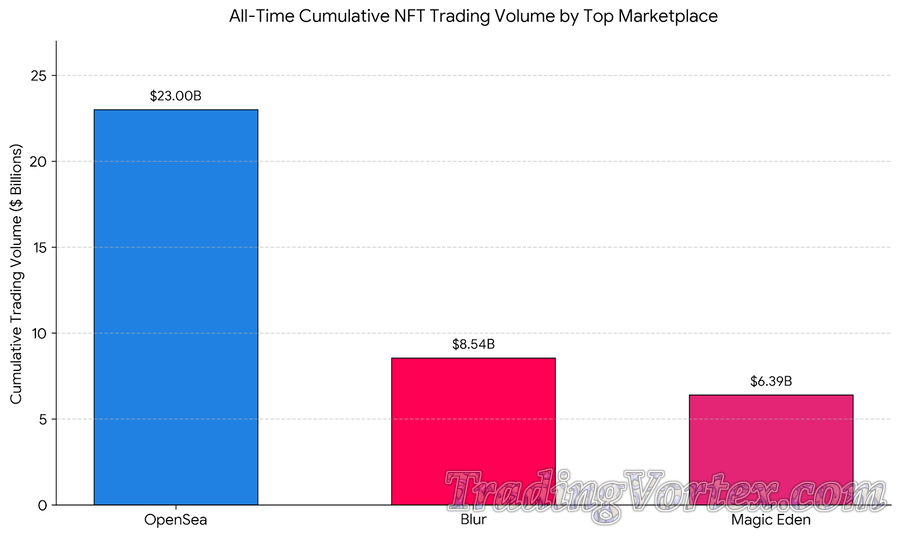
Understanding the Visual Data: Market Dominance and Liquidity Scale
This bar chart highlights the historical trading volume processed across the top three leading NFT marketplaces: OpenSea, Blur, and Magic Eden.
Key Takeaways for Users and Collectors
-
Market Leader Reach ($23.00 Billion): OpenSea leads the entire NFT space with over $23 billion in cumulative trading volume. This reflects its status as the default storefront and entry point for Web3 users over several years.
-
Specialized Platform Comparison: Blur holds the second position at $8.54 billion, driven primarily by professional Ethereum traders, while Magic Eden follows closely at $6.39 billion, rooted in its strong Solana ecosystem presence.
-
Why Volume Matters for Beginners: Higher cumulative trading volume indicates broad liquidity and an established user base. For new collectors, trading on a high-volume platform means greater selection, higher listing visibility, and easier execution when buying or selling digital assets.
Blur: The Best NFT Marketplace for Professional Traders
Why Blur Is Built for Speed, Not Simplicity
I learned this the hard way. The first time I opened Blur, I genuinely thought I had clicked on the wrong link. There were no pretty collection banners, no curated homepages, no gentle onboarding flow. Just rows and rows of numbers, bid-ask spreads, and a countdown timer that made me feel like I was defusing a bomb. I closed the tab and went back to OpenSea. It took me another six months and a conversation with a trader friend before I gave Blur a real chance. And once I understood it, I never looked back.
Blur launched in October 2022 with a single mission: build the fastest, most efficient marketplace for professional NFT traders on Ethereum. The founder, a pseudonymous developer known as "Pacman," had one goal in mind: create the Binance of NFTs. Not the most welcoming platform. Not the most educational. The most ruthlessly efficient trading infrastructure the NFT space had ever seen.
And it worked. Within months of launching, Blur overtook OpenSea in Ethereum NFT trading volume. By January 2026, Blur was averaging $269.21 million in daily volume, more than five times what OpenSea was processing on the same chain. DappRadar data showed Blur controlling 71.5% of Ethereum NFT market share, while OpenSea had dropped to around 15%. That's a staggering reversal for a platform that didn't exist three years ago.
But here's the thing about Blur's dominance: it's built on a very specific kind of user. Just 54,000 unique wallets traded on Blur in the same period that OpenSea saw over 193,000 active wallets. Blur's volume isn't driven by casual collectors browsing for fun. It's driven by professional traders, the kind who track floor movements in real time, sweep entire collections in seconds, and use batch tools to buy 50 NFTs in a single click.
The top 100 traders on Blur account for 63% of its activity, according to Nansen. That's not a marketplace. That's a trading desk. And if you're not sitting at that desk, Blur will feel like walking into a Wall Street pit in your pajamas. I've introduced experienced collectors to Blur and watched them stare at the screen like it was written in a foreign language. The interface is dense, keyboard-driven, and deliberately intimidating. Every pixel is optimized for speed, not comfort.
The platform's core pitch is baked into its tagline: "Ditch slow. Execute trades faster and make more money on Blur." It advertises 10x faster sweeping, 0% marketplace fees, and over $7.4 billion in total gross merchandise value. For traders who measure success in basis points and seconds, those numbers aren't marketing fluff. They're the entire value proposition.
There's a cultural element to Blur that's worth understanding, too. The platform is built for people who treat NFT trading like a job, not a hobby. The forums are full of discussions about floor price correlations, wash trading patterns, and optimal sweep timing. The community speaks a language that outsiders find impenetrable. If you've ever wandered into a professional poker room and realized within thirty seconds that you don't belong, that's Blur. It's not hostile. It's just operating at a different level of intensity than most people are prepared for.
Blur’s Advanced Trading Tools: Collection Bids, Sweeping, and More
Here's where Blur separates itself from every other marketplace in the game. The tools aren't just different; they're in a completely different category. If OpenSea gives you a shopping cart, Blur gives you a Bloomberg terminal with an execution button.
Collection Bids. This is probably Blur's most powerful feature, and the one that professional traders can't live without. Instead of bidding on individual NFTs, you place a standing bid on an entire collection. A collection bid at 0.5 ETH on Pudgy Penguins means any seller who lists at or below that price gets instantly purchased at your bid. You don't have to be online. You don't have to react. The order book does the work for you.
This creates something the NFT market never really had before: a functioning order book. Buyers can post liquidity at specific price levels, and sellers can hit those bids whenever they want. It's the kind of market structure that exists in every traditional financial market, and Blur brought it to NFTs for the first time. If you've ever wondered why NFT floor prices move so erratically compared to stocks or commodities, the absence of a proper order book is a big part of the answer. Blur fixed that.
Floor Sweeping. If collection bids are Blur's brain, floor sweeping is its muscle. The sweep function lets you buy the N cheapest listings in a collection in one transaction. Need to accumulate 20 Pudgy Penguins at the floor? One click. Want to grab the 50 cheapest Azuki before a rumored announcement? One transaction. Blur's implementation is the fastest and most gas-efficient of any marketplace, and it's not even close.
I've watched traders sweep entire floors in seconds, something that would take hours of clicking on OpenSea. The speed difference isn't incremental. It's transformative for anyone executing at scale. And in a market where a single tweet can move a floor by 10% in five minutes, those seconds genuinely matter.
Batch Listing and Buying. Blur doesn't just let you buy in bulk. It lets you list in bulk too. You can list multiple NFTs simultaneously with customized pricing, adjust multiple listings at once, and manage your entire portfolio from a single dashboard. For anyone who's spent an afternoon manually updating 30 listings on OpenSea, this alone is worth the learning curve. I've done both, and I can tell you with confidence that batch listing on Blur feels like upgrading from dial-up to fiber optic.
Real-Time Portfolio Analytics. Blur's interface displays live floor prices, bid-ask spreads, collection depth, and rarity data updating every four seconds. You can see your entire NFT portfolio's performance, unrealized gains and losses, and market depth across all held collections from one screen. This analytics depth has no equivalent on OpenSea or Magic Eden. It's the kind of tool that professional traders pay thousands of dollars for in traditional markets, and Blur gives it away for free.
NFT Aggregation. Blur doesn't just show you its own listings. It aggregates listings from OpenSea, X2Y2, LooksRare, and other marketplaces, then automatically routes your purchase to the cheapest available venue. You get the best price without manually checking competing platforms. For traders who care about execution quality, this is enormous. It also means you don't have to abandon Blur just because a specific collection has better liquidity elsewhere. Blur finds the liquidity for you.
Bid Sniping. This one is controversial but worth mentioning. Blur's speed advantage means traders can snag NFTs milliseconds before competing bids land. For high-frequency traders, this is a legitimate edge. For everyone else, it can feel like playing a game where the rules were written by the fastest player in the room. It's a feature that reinforces Blur's identity as a platform for professionals, not casual participants.
Portfolio Management Dashboard. Beyond trading, Blur offers a comprehensive dashboard that tracks your profit and loss, cost basis, and historical performance across all your NFT holdings. It's the kind of bookkeeping that most traders do manually in spreadsheets, and having it built into the platform saves hours every week. Again, this is a feature that exists because Blur's users demanded it. The platform evolves in response to its community, and that community is ruthlessly focused on efficiency.
The cumulative effect of all these tools is a platform that feels less like a website and more like a professional trading application. Every feature exists for a reason, and that reason is almost always "help traders execute faster and cheaper." There's no decoration. No fluff. Just function. And for the right kind of user, that's the most beautiful interface in the world.
Blur Fees and Royalty Policies: What Traders Need to Know
Let's talk numbers, because for professional traders, numbers are the whole story.
Marketplace Fees: 0%. Blur charges zero marketplace fees on every transaction. That's not a promotional rate or a limited-time offer. It's the foundation the entire platform was built on. For high-volume traders executing 50+ trades a week, Blur's zero-fee structure can save thousands of dollars annually compared to platforms with standard fee structures.
One Reddit user reported saving $1,850 in fees in a single month by using Blur's batch tools. That's not pocket change. That's real money that stays in your pocket instead of going to a marketplace. Over a year of active trading, those savings can add up to the price of a decent used car.
Creator Royalties: Optional with a 0.5% Floor. This is where Blur gets controversial, and it's important to understand exactly what you're signing up for. Creator royalties on Blur are optional, with a minimum floor of 0.5%. Collections can set their desired royalty percentage, but traders have discretion on whether to honor them above that 0.5% minimum.
This design choice was deliberate. It reduced creator income but dramatically increased trader adoption. The logic was simple: professional traders care about margins, and royalties eat into margins. By making royalties optional, Blur gave traders a reason to move their volume from OpenSea to Blur.
Blur's royalty policy has evolved into a complex system with four distinct scenarios:
- No Block: If a collection doesn't use Blur's royalty blocking mechanism, Blur charges a 0.5% royalty and OpenSea charges an optional royalty.
- Block Blur: If a collection bans Blur or other zero-royalty markets, it gets royalty enforcement on OpenSea, but transactions on Blur are still allowed with a minimum 0.5% royalty.
- Blur Recommends Against OpenSea: If a creator avoids OpenSea entirely, Blur enforces full royalties on their collection.
- Mutual Exclusion: Currently, creators cannot earn royalties on both Blur and OpenSea simultaneously. They must choose one platform or the other.
This policy has been criticized by creators who feel trapped between platforms, but for traders, it means one thing: royalties are rarely a significant cost on Blur. If you're buying and selling frequently, that matters. And if you're a creator, it means you need to think carefully about which platform you prioritize. There's no free lunch here. Blur made a choice, and that choice favors traders over creators.
There's an active governance proposal from Split Capital to eliminate the mandatory 0.5% creator royalty and replace it with a 0.5% protocol fee instead. If passed, it would mark another shift in Blur's economic model, though the timeline and outcome remain uncertain. The fact that this debate is happening at all tells you something important: Blur's governance is active, and token holders have real influence over the platform's direction.
Blur Lending and NFT-Backed Loans: Opportunities and Risks
Here's how Blend works in plain English:
- Borrowing: You deposit an NFT as collateral and receive an ETH loan. The loan has no fixed expiry date. It continues until you repay or the lender calls the loan.
- Lending: You deposit ETH against an NFT as collateral and earn interest from the borrower.
- Buy Now, Pay Later: You can purchase an expensive NFT with a portion of the price upfront, borrowing the remainder against the NFT itself. It's effectively a down-payment model for premium collections.
- No Fees: Blend charges zero fees to borrowers or lenders on borrowing, lending, or repayment.
The opportunity here is obvious. Blend gives NFT holders access to liquidity without selling their assets. It gives ETH holders a way to earn yield. And it gives buyers a path to acquire expensive NFTs without needing the full purchase price upfront. For professional traders, it's another tool in the toolkit. For collectors who want to unlock the value of their holdings without triggering a taxable sale, it's a genuinely useful mechanism.
But the risks are real and significant. Blend uses a Dutch auction system for refinancing loans. If a lender calls a loan and the borrower can't repay, the NFT goes to auction. If no one meets the floor price, the lender takes possession of the NFT as collateral.
The problem? During market downturns, refinancing liquidity evaporates. If NFT floor prices crash, Dutch auctions may find no willing buyers. Lenders end up holding illiquid NFT collateral worth less than the loan principal. This isn't a theoretical risk. Blend generated significant controversy in 2024 when falling floor prices triggered mass liquidations, and borrowers who had taken ETH against BAYC or Azuki NFTs saw their collateral liquidated at prices far below their original value.
Hindenrank, a DeFi risk assessment platform, identifies the worst-case scenario as a "Blend Lending Illiquidity Cascade During NFT Market Crash" : blue-chip NFT floor prices drop more than 40% over 30 days, Blend refinancing auction fill rates fall below 30%, and lenders are left holding depreciated collateral with no exit.
Blend's Total Value Locked (TVL) has already declined more than 90% from its peak, sitting at around $3 million as of early 2026. That's a stark reminder that the lending market for NFTs remains fragile. When liquidity dries up, it dries up fast, and the people left holding the bag are often the ones who understood the risks least.
The bottom line: Blend is a powerful tool for experienced traders who understand the risks and have a plan for managing them. For everyone else, it's a mechanism that can turn a market downturn into a personal financial crisis.
Use it with your eyes wide open. And if you're going to use it, start small. Test the mechanics with a low-value NFT before you put a blue chip on the line. The learning curve is steep, and the consequences of mistakes are permanent.
Blur Pros and Cons: Is This Advanced NFT Marketplace Right for You?
Let's lay it out honestly. Blur is exceptional at what it does, but what it does isn't for everyone.
The Pros:
- Zero marketplace fees. This is Blur's defining feature, and it saves active traders real money.
- Fastest execution in the game. Blur processes transactions 37% faster than OpenSea according to Bitquery benchmarks. In a market where seconds matter, that's a competitive advantage.
- Advanced trading tools. Collection bids, floor sweeping, batch listing, real-time analytics, and NFT aggregation combine to create the most powerful trading toolkit in the NFT space.
- Deepest Ethereum liquidity. Blur maintains over 50% market share on Ethereum, with around 60% of NFT market volume flowing through its order books. If you're trading blue-chip Ethereum collections, the liquidity is here.
- Clean security track record. Blur has no recorded security incidents in over three years of operation, a remarkable achievement for a platform handling billions in volume.
- Backing from Paradigm. The venture capital firm behind some of crypto's most important infrastructure projects invested in Blur, lending credibility and resources.
- Active governance. BLUR token holders have real influence over the platform's direction, and proposals are debated openly. That's more than you can say for most platforms in this space.
The Cons:
- Brutal learning curve. Setting up Blur properly takes 8 to 12 hours of learning, according to a case study on the NFT Trader subreddit. Terms like "bid sniping" and "floor sweeping" aren't explained; they're assumed.
- Ethereum only. Blur supports Ethereum and some expansion into Blast, but it's essentially Ethereum-focused. If you trade Solana or other chains, Blur won't help you.
- No mobile app. Blur has no mobile app, which is a deliberate choice for a professional trading platform but still a limitation.
- Limited customer support. Blur offers email support only, with a 72-hour average response time. If something goes wrong, you're largely on your own.
- Wash trading concerns. Nansen's forensic analysis found that 38% of Blur's trades showed suspicious patterns potentially indicative of wash trading. The bid-to-earn incentive structure has been criticized for enabling artificial volume.
- BLUR token has no revenue stream. The token generates zero fee revenue for holders. Future fee activation requires a governance vote, and turning on fees risks driving traders to zero-fee competitors.
- Declining market relevance. Blur's activity has declined significantly from its 2023 peaks, and it lost market share to OpenSea in 2025. The broader NFT market contraction directly impacts Blur's utility.
- Steep capital requirements. Blur's tools are most useful when you're trading at scale. If you're working with a small portfolio, the efficiency gains may not justify the learning investment.
Who Should Use Blur? Best Use Cases for Serious NFT Traders
So who is Blur actually for? Let me paint a picture:
- You're a professional Ethereum NFT trader. You're executing dozens of transactions a week. You care about fees, speed, and execution quality. You know how to read an order book and you've been waiting for NFTs to have one. Blur was built for you.
- You're a collector who's graduated beyond casual buying. You've been on OpenSea for a year. You understand gas fees, royalties, and floor prices. You want better tools and lower costs. Blur is your next step, but expect a learning curve. Give yourself a weekend to explore the interface before you make your first trade.
- You're executing a collection accumulation strategy. You want to own 20 or 50 NFTs from a specific collection. You need batch buying, floor sweeping, and collection bids. Blur is the only platform that makes this practical.
- You're a trader who doesn't mind the complexity. You're comfortable with dense interfaces, keyboard shortcuts, and data-heavy dashboards. You actually prefer them to simplified designs that hide information.
- You're interested in NFT lending and borrowing. Blend gives you access to NFT-backed loans, both as a borrower and a lender. If you understand the risks and have a strategy for managing them, it's a powerful tool.
- Who should stay away? If you're brand new to NFTs, Blur will overwhelm you. If you're a casual collector who buys a few pieces a year, the 1% fee on OpenSea won't hurt you enough to justify Blur's learning curve. If you trade primarily on Solana or other non-Ethereum chains, Blur isn't for you. And if you value customer support and hand-holding, look elsewhere.
The smartest approach for most people? Use both. OpenSea for discovery, browsing, and casual purchases. Blur for active trading, batch operations, and anything where speed and fees matter. List an NFT on OpenSea. Then buy one on Blur. Feel the difference for yourself.
The market has split, not because one platform is better, but because two different kinds of users need two different kinds of tools. Figure out which one you are, and you'll know exactly where to spend your time. And if you're somewhere in between, that's fine too. The best traders I know use multiple platforms, switching between them based on the task at hand. There's no loyalty in trading. There's only execution.
📊 Ethereum NFT Market Dynamics Comparison: OpenSea's Broad Retail Base vs. Blur's Concentrated Professional Trader Volume
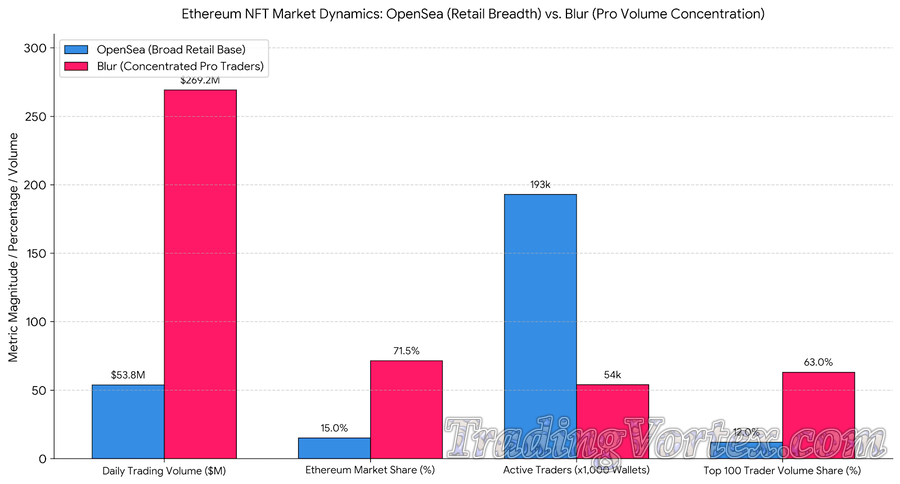
Understanding the Visual Data: Structural Divergence in NFT Marketplaces
This comparative bar chart illustrates the fundamental operational divide between Blur and OpenSea across key key trading indicators: daily volume, market share, user base size, and volume concentration.
How to Interpret and Utilize This Visual
-
Volume vs. User Base Divergence:
-
Daily Trading Volume ($269.21M vs. $53.8M): Blur captures over 5x the daily Ethereum volume of OpenSea.
-
Active Traders (54k vs. 193k Wallets): Despite processing less total dollar volume, OpenSea commands nearly 4x the active user wallets of Blur.
-
Takeaway: OpenSea operates like a high-traffic retail storefront with lower average transaction sizes, whereas Blur functions as a high-value wholesale trading floor.
-
-
Market Share & Activity Concentration:
-
Ethereum Market Share (71.5% vs. 15.0%): Blur controls nearly three-quarters of all Ethereum NFT activity through its automated batching, order books, and sweeping capabilities.
-
Top 100 Trader Concentration (63.0% vs. 12.0%): A small minority of institutional and high-frequency traders generate the vast majority of Blur's trading activity.
-
Strategic Insights for Your Trading Workflow
-
For High-Frequency & Bulk Execution: If you sweep entire collections, execute collection-wide bids, or leverage automated batch listings, Blur offers superior liquidity depth and zero marketplace fees.
-
For Retail & Discovery: If you seek broader wallet participation, simple asset discovery, and multi-chain support without exposure to rapid bid-sniping or high-volume algorithmic traders, OpenSea remains the optimal ecosystem.
Magic Eden: The Most User-Friendly NFT Marketplace for Solana and Gaming
Why Magic Eden Dominates the Solana NFT Marketplace Space
Let me start with a confession: for a long time, I treated Magic Eden as the "other" marketplace. I was an Ethereum guy, and Solana felt like a foreign country where people spoke a different language and paid fees that seemed too good to be true. Then I spent a weekend actually using Magic Eden, and I understood why Solana collectors are so fiercely loyal to it. The platform doesn't just work well. It feels like it was built by people who actually use it.
Magic Eden launched in September 2021, right when Solana's NFT ecosystem was starting to gain serious momentum. While OpenSea was still figuring out how to handle multiple chains, Magic Eden went all in on Solana and became the dominant venue almost immediately. At its peak, it was processing more Solana NFT volume than every other marketplace combined. For a while, if you were trading Solana NFTs, you were using Magic Eden. There was no real alternative. It was the kind of dominance that makes competitors nervous and users comfortable, because everyone was in the same place.
But the story of Magic Eden in 2026 is a story of dramatic change, and if you're considering using it, you need to understand what's happened over the past year. In February 2026, Magic Eden announced a strategic pivot that fundamentally reshaped the platform. It wound down its Bitcoin Ordinals and Runes marketplaces, shut down support for EVM chains including Ethereum, Polygon, and Base, and refocused entirely on Solana. As of March 2026, Solana is the live product. Everything else is gone.
This pivot was controversial, and I mean genuinely controversial. Users who had farmed the ME token airdrop by trading Bitcoin Ordinals and Ethereum NFTs felt misled, especially when the ME token crashed 64% shortly after launch. The community was furious. Legal pressure mounted. Trust hit an all-time low. I watched friends who had staked significant amounts of ME tokens express a mixture of anger and resignation. Some of them are still pursuing legal action. It was one of those moments where a platform's relationship with its community fundamentally changed, and not for the better.
If you're reading this and wondering whether Magic Eden is still worth using, the answer depends entirely on what you're trading. If you're on Solana, it's still the best game in town. If you're on Ethereum or Bitcoin, you'll need to look elsewhere. The platform made a choice, and that choice has consequences for who it serves.
The platform's current focus is on building experiences at the intersection of finance and entertainment. That's corporate speak for something simpler: Magic Eden is becoming less of an NFT marketplace and more of a consumer platform for on-chain gaming and speculation. The team has previewed "Dicey," a separate consumer brand targeting iGaming, and the platform now generates revenue from token trading, prediction markets, and gamified features beyond just NFT fees. For Solana users who enjoy the entertainment side of crypto, this could be exciting. For NFT collectors who just want to buy art, it's a mixed bag. And for anyone who valued Magic Eden as a reliable multi-chain marketplace, it's a disappointment.
There's something worth noting about the timing of this pivot. The NFT market has been shrinking, and Magic Eden was spreading itself thin trying to compete on every chain. By retreating to Solana and focusing on gaming and entertainment, the platform is betting that depth beats breadth. It's a bet that could pay off if Solana's gaming ecosystem continues to grow, but it's also a bet that alienated a significant portion of the platform's former user base. Only time will tell whether it was the right call.
Magic Eden’s User Experience for Collectors, Gamers, and Creators
Here's where Magic Eden genuinely shines, and it's the reason I keep coming back despite the platform's drama. The user experience is unapologetically designed for real people, not just professional traders.
The interface is clean, intuitive, and fast. Collections are easy to browse, search works well, and the buying process is straightforward enough that someone who's never used a crypto wallet can figure it out without a tutorial. The platform prioritizes accessibility and ease of use, with an interface focused on discovery and a strong presence in retail-friendly ecosystems. It doesn't try to overwhelm you with data. It tries to help you find what you're looking for and buy it without friction. I've introduced friends to Magic Eden, and they were buying their first Solana NFTs within ten minutes. That's not something I can say about every platform.
For collectors, Magic Eden offers a genuinely pleasant experience. The discovery tools are good, the collection pages are well-organized, and the rarity information is displayed clearly without requiring you to do mental gymnastics. You can filter by traits, sort by price, and see recent sales activity without leaving the page. It's the kind of experience that makes you feel like the platform actually wants you to succeed, not just extract fees from you. The collection pages feel like they were designed by someone who actually collects NFTs, which sounds like a low bar but is surprisingly rare in this space.
For gamers, Magic Eden has become something of a hub. Solana's gaming ecosystem has grown significantly, and Magic Eden has positioned itself as the place to trade in-game assets and collectibles. The platform supports compressed NFTs (cNFTs), which are essential for gaming assets because they're cheap to mint and trade at scale. If you're playing a Solana game and want to buy, sell, or trade items, Magic Eden is almost certainly where that activity happens. The integration with gaming ecosystems is one of the platform's genuine differentiators, and it's a big part of why the Solana gaming community has embraced Magic Eden so completely.
For creators, the picture is more complicated. Magic Eden supports launchpad minting, which lets new collections deploy their public mint directly on the platform. That's a valuable service, especially for Solana creators who want access to the platform's large user base. But royalties are a contentious topic. On Solana, Magic Eden made royalties optional, giving buyers the choice to pay full, half, or zero royalties to creators. The platform's reasoning is that this empowers buyers to support creators voluntarily rather than forcing them to pay. For creators who depend on royalty income, it's a tough pill to swallow. Some collections have adopted the MIP-1 standard, which enforces royalties and removes the optional choice, but most haven't. If you're a creator, you need to understand that Solana royalties on Magic Eden are not guaranteed income. It's a system that rewards creators who build strong communities where buyers actually want to support them, and it punishes those who don't.
There's also a practical consideration for creators: the competition for attention on Magic Eden is fierce. Launching a collection is easy, but getting it in front of buyers is hard. The platform doesn't guarantee visibility. You have to bring your own audience, or you have to build one through consistent engagement. Creators who understand this and treat their NFT projects like ongoing community-building efforts tend to do well. Those who expect the platform to do the marketing for them are usually disappointed.
Magic Eden’s Cross-Chain Expansion: What Chains Does It Support Now?
This is where the story gets simple, and honestly, a little sad. Magic Eden used to be a multi-chain platform. It supported Solana, Ethereum, Polygon, Base, Bitcoin Ordinals, and Runes. That era is over.
As of March 2026, Magic Eden's marketplace is Solana-only. The EVM and Bitcoin marketplaces have been shut down. Listings on those chains are no longer visible or actionable. If you're holding Ethereum NFTs and you want to sell them, Magic Eden won't help you anymore. You'll need to use OpenSea, Blur, or another platform. If you're holding Bitcoin Ordinals, you'll need to find a different marketplace entirely.
There's one caveat worth noting: the Magic Eden Wallet still technically lists support for multiple chains including Ethereum, Bitcoin, Base, Arbitrum, Polygon, and others. But the wallet itself is being deprecated. Magic Eden announced that the wallet would be removed from app stores on April 1, 2026, with a full shutdown on May 1, 2026. If you're using the Magic Eden wallet, you should export your private keys and move your assets to a different wallet before that date. This isn't optional. If you wait too long, you'll lose access to your assets unless you've exported them properly.
So what does this mean for you? If you're a Solana-only trader, nothing changes. Magic Eden is still the best Solana marketplace, and the platform's focus on Solana means it can invest more resources into making the Solana experience great. If you're a multi-chain trader, Magic Eden is no longer a viable option for anything outside Solana. You'll need to use different platforms for different chains. And if you're someone who valued the simplicity of having everything in one place, that simplicity is gone.
The strategic logic behind this pivot is understandable. Magic Eden was spreading itself thin trying to compete across multiple chains, and it was losing ground to specialized platforms on every front. Blur dominated Ethereum. Tensor was gaining on Solana. OpenSea was covering everything but not excelling at anything. By retreating to Solana and focusing on gaming and entertainment, Magic Eden is betting that depth beats breadth. Whether that bet pays off remains to be seen. But for now, the platform has made its choice, and users have to decide whether that choice aligns with their needs.
Magic Eden Fees and Royalty Structure Explained
Let's talk numbers, because fees are where Magic Eden's value proposition gets interesting, and also where things get a little confusing depending on which chain you're on and when you're reading this.
Marketplace fees on Solana are currently 2% on all transactions. That's higher than Blur's 0% and OpenSea's 1%, but it's in line with what most Solana marketplaces charge. There's no listing fee, which is nice. You can list as many NFTs as you want without paying anything upfront. For casual collectors, the 2% fee is barely noticeable. For active traders, it adds up, but the rewards program can offset some of that cost.Creator royalties are the complicated part. On Solana, Magic Eden made royalties optional for collections that haven't adopted the MIP-1 standard. When you buy an NFT, you choose whether to pay full (100%) royalty, half (50%) royalty, or none (0%) royalty. By default, the platform sets royalties to full, but you can change this at the account level, collection level, or even for individual items.
This system is a double-edged sword. For buyers, it's a form of empowerment. You decide whether to support creators with your purchase, and you can adjust your choices based on how much you value the creator's work. For creators, it's a gamble. Some buyers will choose to pay full royalties because they believe in supporting artists. Others will choose to pay nothing. The result is unpredictable income that varies from sale to sale. I've spoken to creators who earn almost nothing from royalties on Solana, and I've spoken to others who earn surprisingly well because their communities actively choose to support them. It depends entirely on the relationship between creator and collector.
If a collection has adopted the MIP-1 standard, royalties are enforced and buyers can't opt out. This is the better option for creators who want guaranteed income, but it's also less popular with traders who care about margins. The tension between creator rights and trader economics is one of the defining conflicts of the NFT space, and Magic Eden has positioned itself firmly on the trader-friendly side of that divide.
For Solana transactions specifically, there's one more thing to know: trades settle as on-chain program instructions rather than off-chain signatures. That means listing usually costs a tiny amount of SOL to cover the network transaction. It's not much, usually fractions of a cent, but it's not free like listing on some other platforms. You should factor that into your calculations if you're listing many items. It's not going to break the bank, but it's not zero either.
There's one more fee consideration that doesn't get discussed enough: the cost of failed transactions. Solana is fast, but it's not immune to congestion. During periods of high activity, transactions can fail, and failed transactions still consume a small amount of SOL. It's rarely significant, but it's a reminder that even "cheap" chains have costs you should be aware of.
Magic Eden Rewards and Loyalty Programs for Active Traders
Magic Eden has one of the more elaborate rewards systems in the NFT space, and if you're an active trader, it's worth understanding how it works because it can meaningfully impact your bottom line.
The Magic Eden Rewards system operates on a simple flow: Activity → XP → Levels → Rewards. You earn XP by doing things on the platform, and XP accumulates to unlock levels. Each level unlocks rewards, with milestone rewards every 10 levels. The system caps at Level 50.
There's one critical thing to remember: XP and level progress reset monthly at 00:00 UTC on the last day of each month. If you unlock a reward but don't claim it before the reset, you lose it. That means you need to check your Rewards Inventory regularly and claim what you've earned. It's a bit of a hassle, but the rewards can be worth it if you're active on the platform. I've missed a few rewards because I forgot to claim them, and it stung. Set a calendar reminder if you're going to take the rewards system seriously.
Beyond the XP system, Magic Eden has implemented a token buyback and staking rewards program that distributes 15% of platform revenue to ME token holders. Half of that revenue goes to buying ME tokens on the open market, and the other half is distributed as USDC rewards to stakers. Staking power is calculated based on the number of ME tokens staked and the lock duration, so longer locks earn more rewards. It's a system designed to incentivize long-term holding and align token holders with the platform's success.
That said, the ME token has had a rough time. It crashed 64% shortly after launch, and community members have accused Magic Eden of changing rewards and shutting down products after users locked their tokens. Some top stakers have reported issues claiming USDC rewards and have filed lawsuits. If you're considering staking ME, do your research and understand the risks. The token's value is tied to Magic Eden's success, and the platform is in the middle of a major strategic transition. Staking ME is not a passive income strategy. It's an active bet on the platform's future.
Magic Eden Pros and Cons: Is It the Best NFT Marketplace for You?
Let's be honest about what Magic Eden does well and where it falls short:
The Pros:
- Best-in-class Solana experience. If you're trading Solana NFTs, Magic Eden is the most polished, user-friendly platform available. The interface is clean, the discovery tools are good, and the community is active.
- Strong gaming ecosystem. Magic Eden has become the hub for Solana gaming assets, with support for cNFTs and a focus on entertainment and gamification that appeals to gamers. If you're a Solana gamer, this is where you want to be.
- Competitive fees. The 2% marketplace fee is in line with Solana marketplaces, and the rewards program can offset some of that cost for active traders.
- Zero listing fees. You can list as many NFTs as you want without paying upfront costs. This is a significant advantage if you're managing a large portfolio.
- Active rewards program. The XP system and token buyback program give active users tangible benefits for their activity.
- Proven track record on Solana. Magic Eden has been the dominant Solana marketplace for years. The platform knows Solana better than anyone, and it shows in the user experience.
The Cons:
- Solana-only marketplace. The pivot away from EVM and Bitcoin means Magic Eden is no longer an option for multi-chain traders.
- Optional royalties on Solana. Creators can't count on guaranteed royalty income unless their collection adopts MIP-1.
- ME token controversy. The token crash, community anger, and legal issues have damaged trust in the platform. If you're considering staking ME, proceed with caution.
- Wallet deprecation. The Magic Eden Wallet is being shut down, which adds friction for users who relied on it.
- Uncertain strategic direction. The pivot toward iGaming and entertainment is a bet that may or may not pay off. The platform is in transition.
- Limited customer support. Like most crypto platforms, Magic Eden's support options are limited, and response times can be slow.
- Reduced visibility for smaller collections. With the platform focused on gaming and entertainment, smaller art collections may struggle to get noticed.
Who Should Use Magic Eden? Best Use Cases for Solana and Gaming NFT Fans
So who is Magic Eden actually for in 2026? Let me paint a clear picture:
- You're a Solana collector. If your NFTs live on Solana, Magic Eden is the default platform. The user experience is excellent, the liquidity is deep, and the community is active. Start here.
- You're a Solana gamer. Magic Eden has positioned itself as the hub for Solana gaming assets. If you're buying, selling, or trading in-game items, this is where the action is. The support for compressed NFTs makes it uniquely suited for gaming economies.
- You enjoy gamified trading experiences. Lucky Buy, Packs, and the XP rewards system add an entertainment layer to trading that some people genuinely enjoy. If you like the gamification aspect of crypto, Magic Eden delivers.
- You're a casual Solana buyer who wants a simple experience. Magic Eden's interface is approachable and doesn't overwhelm you with data. If you just want to buy some Solana art without learning a trading terminal, Magic Eden is perfect.
- You're a creator building a community on Solana. If you're willing to put in the work to build a loyal collector base, Magic Eden gives you the tools and the audience to make it happen. But you have to bring your own energy and consistency.
- Who should look elsewhere? If you trade on Ethereum, Polygon, Base, or Bitcoin, Magic Eden is no longer an option. If you're a creator who depends on guaranteed royalty income, the optional royalties on Solana are a problem. If you're uncomfortable with the platform's strategic uncertainty and token controversies, you might want to wait and see how things develop. And if you value customer support and stability, the current transition period might not be the best time to commit.
The bottom line is this: Magic Eden won the Solana volume war, but it alienated its multi-chain users in the process. If you're on Solana, that trade-off doesn't affect you. The platform is still the best Solana marketplace, and the focus on Solana has made it even better. But if you're a multi-chain trader who valued Magic Eden's breadth, you'll need to look elsewhere. The platform made a choice, and that choice has consequences for who it serves.
If you're on the fence, here's my advice: give Magic Eden a try if you're Solana-curious. The user experience is genuinely excellent, and the gaming ecosystem is a lot of fun to explore. Just go in with realistic expectations about the platform's limitations and its recent history. And if you're holding ME tokens or using the Magic Eden wallet, take action now to protect your assets before the shutdown dates arrive.
📊 Magic Eden Strategic Pivot Analysis: Comparing Multi-Chain Expansion Parameters vs. Concentrated Solana Market Dominance
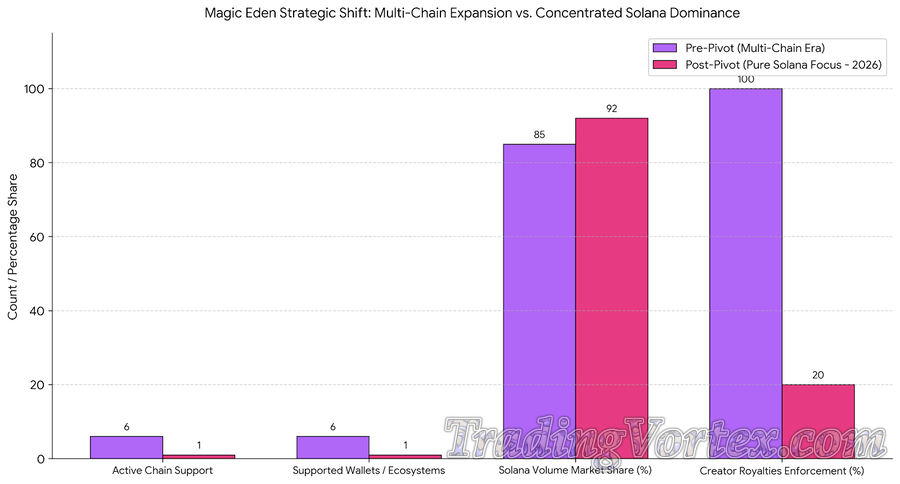
Understanding Magic Eden's Strategic Pivot: Multi-Chain Era vs. Pure Solana Focus
This comparative bar chart illustrates the operational impact of Magic Eden's strategic pivot, contrasting its previous multi-chain footprint against its consolidated Solana focus.
How to Interpret and Utilize This Visual
-
Active Chain & Wallet Support Reduction (From 6 Chains to 1):
-
Multi-Chain Expansion (Purple Bars): Magic Eden previously supported 6 ecosystems (Solana, Ethereum, Polygon, Base, Bitcoin Ordinals, and Runes).
-
Consolidated Focus (Pink Bars): The platform wound down EVM and Bitcoin functionality to operate strictly as a single-chain live marketplace on Solana, streamlining platform infrastructure around gaming and high-speed asset trading.
-
-
Solana Market Share Strengthening (85% to 92%):
-
By eliminating multi-chain overhead, Magic Eden reinforced its competitive moat on Solana, expanding its market share from 85% to 92% of network trading activity.
-
-
Creator Royalties Shift (100% to ~20% Optional Standard):
-
Historically enforcing creator earnings on all listings, Magic Eden transitioned to an optional royalty model (with default enforcement retained only on specific MIP-1 collections, estimated around 20%), aligning platform fees with active trader liquidity preferences.
-
Key Actionable Insights for Users
-
For Solana Collectors & Gamers: You benefit from maximum liquidity, compressed NFT (cNFT) support, and fast execution within a platform tailored specifically for Solana asset dynamics.
-
For Ethereum, Base, and Bitcoin Traders: You must migrate active trading operations to dedicated venues like OpenSea, Blur, or specialized Ordinals marketplaces, as Magic Eden no longer services non-Solana assets.
Rarible: The Most User-Friendly NFT Marketplace for Creators
Why Rarible Puts Creators First Among NFT Marketplaces
Let me tell you about the first time I minted an NFT. It was 2021, I was on Ethereum, and the gas fee was $87. I paid it, listed my piece, and then waited three months for someone to buy it. Spoiler alert: nobody did. I had spent nearly a hundred dollars to create something that sat in digital limbo, and I had no way to get that money back. That experience taught me something important: most NFT marketplaces are built for buyers and traders, not for the artists who actually create the value.
Rarible is different, and it's been different since day one. Founded in 2020 by Alexander Salnikov and Alexei Falin, Rarible was designed from the ground up with a specific philosophy: digital creators should control their work, set their own terms, and have a voice in how the platform evolves. That's not just marketing copy. It's baked into everything the platform does.
The most obvious example is royalties. On most marketplaces, royalties are either optional, unenforced, or subject to the whims of the buyer. On Rarible, creators can set royalty rates as high as 50% , and those royalties are enforced at the protocol level through the RARI Chain. That means no marketplace, no buyer, and no clever smart contract trick can bypass creator payments on secondary sales. If your art sells ten times, you get paid ten times. That's how it should work everywhere, but Rarible is one of the few platforms that actually makes it happen.
The second thing that sets Rarible apart is governance. The platform is controlled by the RARI DAO, a decentralized autonomous organization where RARI token holders vote on platform decisions including fee structures, new features, and policy changes. This isn't a token with no utility or a governance system that exists only on paper. RARI holders have real power. They voted to expand Rarible to Solana in 2026, and the DAO's decision was the driving force behind that strategic move. When was the last time a marketplace asked its users before making a major business decision?
The third differentiator is lazy minting. Rarible was one of the first major platforms to offer free minting for creators, and it still supports the feature today. When you lazy mint on Rarible, you don't pay gas fees upfront. The NFT is listed on the marketplace, and it's only minted on the blockchain when someone buys it. The buyer pays the gas, not you. That means you can test the waters, list your work, and see if there's interest without risking money on something that might never sell. For emerging artists, that's the difference between trying and not trying at all.
Rarible’s Royalty System: How Creators Earn Passive Income
Royalties are the lifeblood of a sustainable creator economy. If you're an artist and your work sells on the secondary market, you should get a cut. That's not controversial. It's how physical art galleries work, it's how music publishing works, and it's how book publishing works. The NFT space, unfortunately, has spent the last few years trying to convince creators that royalties are optional. Rarible never bought into that nonsense.
On Rarible, creators can set royalty rates up to 50% on their collections. That's the highest cap of any major marketplace. For comparison, OpenSea allows creators to set royalties but doesn't always enforce them. Blur made royalties optional with a 0.5% minimum. Magic Eden on Solana lets buyers choose whether to pay. Rarible is the outlier that actually protects creators.
The key detail here is enforcement. Rarible doesn't just ask buyers to pay royalties out of the goodness of their hearts. It enforces them at the protocol level through RARI Chain, a purpose-built Layer 3 blockchain designed specifically to make royalty bypassing technically impossible. Even if someone tries to trade your NFT on a different platform that doesn't enforce royalties, the RARI Chain records the obligation, and the creator's share is still protected. That's a level of security that no other marketplace offers.
For creators who've been burned by platforms that made royalties optional, Rarible feels like a safe harbor. You're not at the mercy of buyer goodwill. You're not hoping that people will choose to support you. The system is designed to protect you, and it works.
There's one more feature that creators love: multiple wallet addresses for royalty payments. If you're collaborating with another artist, or if you have a team wallet, or if you simply want to split royalty revenue across multiple addresses, Rarible lets you do that. You can add as many payout addresses as you need, and the royalties are distributed automatically. It's a small feature that makes a big difference for collaborative projects and studio setups.
Rarible’s Decentralized Governance: How the RARI DAO Works
Most NFT marketplaces are run by a company. OpenSea has a CEO and a board. Blur has a founding team that makes decisions. Magic Eden has executives who decide what products to build and what chains to support. Rarible is different. Rarible is governed by its community, and the community has real power.
The governance process is structured and transparent. It starts with idea creation and discussion on the community forum, where anyone can propose an initiative and gather feedback. Once an idea gains traction, a formal proposal draft is submitted to the RARI DAO forum, where the community has seven days to analyze it. After feedback is incorporated, the proposal goes to on-chain voting on Tally, where veRARI holders vote for, against, or abstain. There's a cooldown period where the Security Council can review the proposal for potential illegal, exploitative, or malicious aspects. If everything checks out, the proposal is implemented on-chain, and the author administers the execution.
To submit a proposal yourself, you need at least 5,000 veRARI, or you need support from a community member who holds that much voting power. That threshold exists to prevent spam and ensure that only serious proposals make it to the voting stage.
The most significant recent example of DAO governance in action was the decision to expand Rarible to Solana. The RARI DAO voted in favor of the expansion in mid-2026, and the platform targeted a late August launch with Claynosaurz as the first featured collection. The decision wasn't made by executives in a boardroom. It was made by token holders who believed that Solana's creator and collector economy was worth investing in.
For creators, this governance model means something important: you have a voice. If you think royalty enforcement should be stronger, you can propose changes. If you think fees are too high, you can advocate for adjustments. If you want Rarible to support a new blockchain, you can make the case. The platform isn't a product handed down from on high. It's a community project, and the community decides its future.
There's also a practical benefit to this structure. Because Rarible isn't beholden to venture capital investors or quarterly earnings targets, it can make decisions that prioritize creator welfare over short-term profits. That's rare in any industry, and it's almost unheard of in crypto. The DAO structure isn't perfect; governance is slow, and voter apathy is a real problem. But it's a genuine attempt to build something that belongs to its users rather than its founders.
Rarible Fees and Lazy Minting: What Creators Need to Know
Let's talk money, because creators need to understand the full financial picture before they commit to any platform.
There are also origin fees that can be set by agents and facilitators. In the Rarible Protocol, an origin fee is a customizable percentage that a platform or facilitator can charge for originating a transaction. For example, if you're selling through a third-party platform built on Rarible Protocol, that platform might set an origin fee. But for direct sales on Rarible.com, origin fees typically don't apply.
Creator royalties are where Rarible truly shines. As mentioned earlier, creators can set royalties up to 50% , and they're enforced on-chain. When you set a royalty on your collection, you can also add multiple wallet addresses to receive royalty payments. This is useful for collaborations, team wallets, or any situation where royalty revenue needs to be split among multiple parties.
Lazy minting is the feature that makes Rarible accessible to creators who don't want to risk money upfront. Here's how it works: when you create an NFT, you enable the "Free minting" option. Your NFT is listed on Rarible's marketplace, but it's not actually minted on the blockchain yet. The item exists as a listing, and buyers can see it and purchase it. When a buyer completes the purchase, the NFT is minted on the blockchain at that moment, and the buyer pays the gas fees. Your NFT is then transferred to the buyer's wallet, and you receive your payment.
There are a few limitations to lazy minting that you should know about. First, lazy minting is currently only available on Ethereum. If you're minting on Solana, Polygon, or other chains, you'll need to pay gas fees upfront. Second, lazy minted NFTs are minted to Rarible's collection, not your own custom collection. If you want to create your own collection with your own branding and smart contract, you'll need to pay the gas fees yourself. Third, lazy minted items only appear on Rarible until they're purchased. Once the NFT is minted on-chain, it appears across all marketplaces that support the blockchain.
For creators who want to test the waters without financial risk, lazy minting is a gift. For creators who are ready to build a serious collection with custom branding, paying gas fees to create your own collection is worth the investment. Rarible gives you both options.
Rarible Pros and Cons: Is It the Best NFT Marketplace for Artists?
Let's be honest about what Rarible does well and where it falls short. No platform is perfect, and creators deserve a clear-eyed assessment.
The Pros:
- Highest royalty ceiling in the industry. Creators can set royalties up to 50% , and they're enforced on-chain. No other major marketplace offers this level of protection.
- Protocol-level royalty enforcement. The RARI Chain makes it technically impossible to bypass creator payments on secondary sales. Even if someone trades your NFT on a different platform, your royalty obligation is recorded and protected.
- Free lazy minting on Ethereum. You can list NFTs without paying gas fees upfront. The buyer pays when they purchase. This is a game-changer for emerging artists.
- Decentralized governance with real power. RARI token holders vote on platform decisions, and the DAO has driven major strategic moves like the Solana expansion.
- Multi-chain support. Rarible supports Ethereum, Solana, Polygon, Tezos, Immutable X, MegaETH, and Base. You're not locked into a single ecosystem.
- Buyback model aligns incentives. Since September 2025, 100% of trading fees are used to buy RARI tokens from the open market, connecting platform revenue directly to token demand. This is a structural improvement that benefits long-term holders.
- Adobe partnership for provenance. Rarible partnered with Adobe through a content credentials program that verifies artist attribution and prevents fraudulent reproduction. For creators concerned about authenticity, this is a meaningful protection.
- Multiple royalty payout addresses. Creators can split royalty revenue across multiple wallets, which is essential for collaborations and studio setups.
The Cons:
- Smaller user base than OpenSea. Rarible's community is tight-knit and engaged, but it's smaller than OpenSea's massive user base. More buyers on a platform means more potential sales.
- Lower liquidity for some collections. With fewer users, some collections may have thinner order books and longer wait times for sales. This is the trade-off for being on a creator-focused platform.
- Lazy minting limitations. Lazy minting is only available on Ethereum, and lazy minted NFTs are minted to Rarible's collection rather than your own custom collection. If you want full control, you'll need to pay gas fees.
- Higher fees than some competitors. The 2% total marketplace fee (1% buyer, 1% seller) is higher than OpenSea's 0.5% and Blur's 0%. For creators, the royalty enforcement and governance features justify the cost, but for high-volume traders, it's a consideration.
- Gas fees on Ethereum can still be high. While lazy minting eliminates upfront costs, if you're creating your own collection or trading actively, Ethereum gas fees can add up. Solana and Polygon offer cheaper alternatives.
- Acquired by Impossible Finance in 2026. Rarible was acquired by Impossible Finance in May 2026. This raises questions about the platform's long-term independence and strategic direction. The DAO still governs the protocol, but the acquisition adds uncertainty.
- Governance participation requires capital. To have real influence in the RARI DAO, you need to lock a significant amount of RARI tokens. For small creators, the governance system can feel out of reach.
Who Should Use Rarible? Best Use Cases for Creators and Digital Artists
So who is Rarible actually for in 2026? Let me paint a clear picture:
- You're a digital artist who cares about royalties. If you want to earn from secondary sales and you don't want to rely on buyer goodwill, Rarible is the best platform for you. The 50% royalty ceiling and protocol-level enforcement mean you get paid every time your work changes hands.
- You're an emerging creator who doesn't want to risk money upfront. Lazy minting on Ethereum lets you list your work for free. You can test the market, see what resonates, and only pay gas fees when someone actually buys. For artists who are just starting out, this removes the biggest barrier to entry.
- You want a say in how the platform evolves. If you hold RARI tokens and lock them for veRARI, you can vote on proposals, submit ideas, and shape the platform's future. Rarible is one of the few NFT marketplaces where users have genuine governance power.
- You're a multi-chain creator. Rarible supports Ethereum, Solana, Polygon, Tezos, Immutable X, MegaETH, and Base. If you want to mint on multiple chains without switching platforms, Rarible gives you that flexibility.
- You believe in decentralization. Rarible is governed by a DAO, not a company. If that matters to you, Rarible is the platform that walks the walk.
- You're collaborating with other artists. The ability to split royalties across multiple wallet addresses makes Rarible uniquely suited for collaborative projects, duos, and studio collectives.
Who should look elsewhere?
- If you're a professional trader who cares about zero fees and lightning-fast execution, Blur is a better fit.
- If you're a Solana-native collector who wants the deepest liquidity and the most active community, Magic Eden and Tensor are stronger options.
- If you're a beginner who wants the largest selection of NFTs and the simplest experience, OpenSea is still the best starting point.
- And if you're a creator who doesn't care about royalties and just wants maximum exposure, OpenSea's larger user base might serve you better.
The bottom line is this: Rarible is the most creator-friendly NFT marketplace in the game. It's not the biggest, it's not the cheapest, and it's not the fastest. But it's the one that actually puts artists first, and for creators who've been burned by platforms that treat royalties as optional, that matters more than anything else.
If you're a creator who's been on the fence about NFTs, Rarible is the platform that makes it easy to say yes. Lazy minting means you don't have to risk money. Royalty enforcement means you get paid when your work succeeds. Governance means you have a voice. It's not perfect, but it's the closest thing to a creator-first marketplace that exists in 2026.
And if you're a collector who cares about supporting artists, Rarible is where your money goes further. Every purchase you make on Rarible ensures that the creator gets paid again when the work changes hands. That's not just good karma. It's good economics. A healthy creator economy benefits everyone, and Rarible is the platform that understands this better than anyone.
📊 Creator Royalty Protections Comparison: Maximum Allowed Royalty Caps and Protocol-Level Enforcement Across NFT Marketplaces
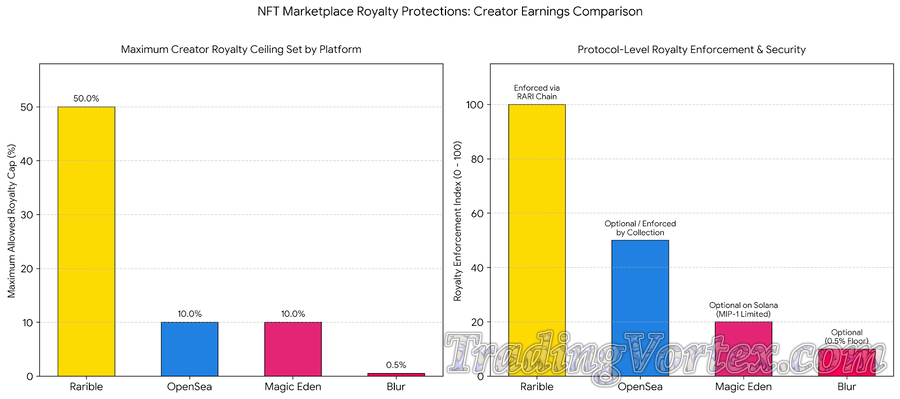
Understanding Creator Earnings and Royalty Security Across Marketplaces
This comparative visualization highlights how different NFT marketplaces approach creator royalties, evaluating both the maximum allowed royalty cap (%) and the technical enforcement mechanism used to protect artist revenues.
How to Interpret and Utilize This Visual
-
Maximum Royalty Cap Flexibility (Left Chart):
-
Rarible (50.0% Cap): Allows creators to set secondary sale royalties as high as 50%, giving artists maximum flexibility over their revenue models.
-
OpenSea & Magic Eden (10.0% Cap): Cap secondary royalties at standard industry rates around 10%.
-
Blur (0.5% Minimum Floor): Operates on an optional royalty model with a low 0.5% floor to prioritize trader fee margins over creator earnings.
-
-
Protocol-Level Enforcement Strength (Right Chart):
-
Rarible (RARI Chain Enforcement): Enforces royalties directly at the protocol level via RARI Chain, making royalty bypassing technically impossible regardless of where the asset is traded.
-
OpenSea & Magic Eden: Rely on marketplace-level or optional buyer settings (such as Solana's optional royalties or MIP-1 standards), making secondary income dependent on buyer choice or specific contract filters.
-
Blur: Treats royalties as optional, allowing high-volume traders to bypass secondary creator fees.
-
Actionable Insights for Artists and Collectors
-
For Artists Seeking Sustainable Revenue: Rarible provides the highest security for long-term royalty collection through mandatory protocol-level enforcement and flexible revenue splits.
-
For High-Volume Traders: Platforms like Blur or Magic Eden offer lower friction and optional fee structures, though at the expense of secondary creator earnings.
Emerging and Specialized User-Friendly NFT Marketplaces Worth Watching
The big three marketplaces get most of the attention, and honestly, they deserve it. OpenSea, Blur, and Magic Eden handle the vast majority of NFT trading volume, and for most people, those platforms are more than enough. But the NFT world is bigger than any single platform, and there are some fascinating specialized marketplaces that serve specific niches extremely well. If you're a Solana power user, a high-end art collector, or someone who wants to trade music royalties or virtual land, the generalist platforms might not be the best fit for you.
I learned this lesson the hard way when I tried to sell a piece of generative art on a platform designed for PFP collections. The listing sat there for weeks with zero views. The audience wasn't there. The collectors who would have appreciated that piece were on a different platform entirely, one that catered specifically to fine art. That experience taught me something valuable: the right marketplace matters as much as the right price. You can have the most beautiful NFT in the world, but if you list it in the wrong place, nobody will see it.
Let me walk you through the emerging and specialized marketplaces that are worth your attention in 2026. Some of these are growing fast, some are established players in their niches, and some are cautionary tales about what happens when a platform loses its way. Each one serves a specific type of user, and understanding which one fits your needs can save you time, money, and a lot of frustration.
Tensor: A Rising NFT Marketplace for Solana Power Users
If you're a Solana trader who wants more than what Magic Eden offers, Tensor is the platform you've been looking for. It's built for collection traders, the kind of users who care about floor price movements, bid-ask spreads, and execution speed. Think of it as the Blur of Solana, but with a distinctly Solana-native feel that reflects the chain's culture and community.
Tensor launched as a marketplace built on the Tensor Protocol, an autonomous protocol on Solana that other marketplaces can use to access deep liquidity. The platform has become a serious competitor to Magic Eden on Solana, offering fast collection trading and a Solana-native audience that understands the chain's quirks and opportunities. If you're trading collections like Mad Lads, DeGods, or Claynosaurz, Tensor gives you tools that are optimized for that kind of activity. The interface is dense and data-rich, similar to Blur, but it's been tailored for Solana traders who want speed without sacrificing the community feel that makes Solana special.
The platform's token, TNSR, is the governance token of the Tensor Protocol. TNSR holders can vote on proposals related to the protocol's development, including how the community treasury is used. In early 2026, the Tensor Foundation acquired the Tensor Marketplace and made a significant change to the tokenomics: 100% of marketplace fees now flow to the TNSR treasury, doubling the previous capture rate of 50%. This change directly aligns the platform's operating revenue with the interests of token holders, which is a meaningful improvement from a governance perspective. It means that as the platform grows, the value accrues to the people who actually use and support it.
Tensor also burned 21.6% of unallocated tokens held by founders and Labs, permanently removing them from circulation. Founder tokens that were already locked were re-locked for an additional three years to reduce future selling pressure. These moves show a team that's trying to build long-term confidence, even in a difficult market. When founders voluntarily lock their tokens for longer and burn unallocated supply, it sends a signal that they're not just here for a quick exit. That matters in a space where so many projects have abandoned their communities after cashing out.
But here's the reality check: Tensor's daily trading volume has dropped about 80% from its peak, and daily platform revenue is currently around $250. The TNSR token is down approximately 62% over the past year and 98% from its all-time high of S$2.50, which it hit in April 2024. The broader NFT market contraction hit Tensor hard, and the platform is now operating in a much leaner environment than it was during the 2024 hype cycle. That's not a knock on Tensor specifically; it's the reality of the entire NFT market right now. But it's context you need if you're considering buying TNSR or building your trading strategy around the platform.
Who should use Tensor? If you're a Solana-focused collection trader who wants fast execution and deep liquidity on Solana-native assets, Tensor is worth exploring alongside Magic Eden. The two platforms serve similar users but have different strengths, and many Solana traders use both. If you're a casual collector or someone who trades across multiple chains, Tensor's Solana-only focus might be limiting. And if you're considering buying TNSR tokens, understand that you're betting on a platform in a shrinking market, not a growth story. That's not necessarily a bad bet, but it's a bet you should make with your eyes open.
Binance NFT: The Most User-Friendly NFT Marketplace for Exchange Users
Here's the thing about Binance NFT: it's gone. Well, sort of. In June 2026, Binance announced that it was upgrading its NFT service to Binance Wallet, and the standalone NFT marketplace on Binance Exchange would be shut down. Users had until July 3, 2026 to withdraw their transferable NFTs, and anything left behind became inaccessible. If you were holding NFTs on Binance and didn't withdraw them in time, those assets are likely gone forever.
This is a significant development, and it's worth understanding what happened and what it means for you if you're a Binance user.
Binance NFT launched as a way for exchange users to buy, sell, and trade NFTs without leaving the Binance ecosystem. It was a comfortable on-ramp for people who were already familiar with Binance's interface and didn't want to learn a new platform. The marketplace supported NFTs on BNB Smart Chain and Ethereum, and it offered a familiar experience for millions of Binance users. I knew several people who bought their first NFT on Binance simply because they already had an account and didn't want to deal with setting up a separate wallet. It was the path of least resistance.
The shutdown wasn't entirely surprising. Binance has been refocusing its efforts on its core exchange business and its wallet infrastructure, and maintaining a standalone NFT marketplace in a shrinking market didn't make strategic sense. The migration to Binance Wallet is designed to provide a "more seamless and integrated NFT experience," where users can manage their NFTs with easier access to Web3 and decentralized features. It's a pivot away from being a dedicated NFT marketplace and toward being a wallet that happens to support NFTs among many other things.
During the withdrawal period, Binance offered fee reimbursements to eligible users. Up to 100,000 users could receive 1 USDC per eligible NFT withdrawal on BSC or Ethereum networks, which covered at least one withdrawal transaction. For CR7 NFTs, which were a notable collection on the platform, separate reimbursement terms applied.
There's an important distinction between transferable and non-transferable NFTs. Transferable NFTs could be withdrawn to Binance Wallet or any compatible external wallet. Non-transferable NFTs, which were coded to be non-transferable from the start, couldn't be withdrawn and became inaccessible after July 3, 2026. Binance Academy said it would issue digital certificates to holders of non-transferable NFTs that certified completion of Academy courses. It's a small consolation for people who lost access to their assets, but at least it's something.
What does this mean for you? If you were holding NFTs on Binance, hopefully you withdrew them before the deadline. If you didn't, those assets are likely gone. If you're new to NFTs and you're a Binance user, the exchange's NFT functionality now lives inside Binance Wallet, which is a different experience from the old marketplace. It's more integrated with Web3, but it's also less of a dedicated NFT trading environment. For dedicated NFT trading, you're better off using OpenSea, Magic Eden, or one of the other platforms we've covered. Binance Wallet is fine for holding and managing assets, but it's not a trading platform in the same way the old marketplace was.
This whole saga is a reminder that centralized platforms can change their minds. When your NFTs are on an exchange, you're subject to that exchange's decisions about what products to support. That's one of the strongest arguments for using non-custodial marketplaces and keeping your assets in your own wallet. When you control your assets, no company can shut down your access to them.
Foundation: A Curated NFT Marketplace for High-End Digital Art
If you're tired of scrolling through millions of PFPs and memecoins, Foundation might be the breath of fresh air you've been looking for. It's a curated marketplace focused on high-quality, artist-driven digital art, and it operates on a fundamentally different philosophy from the volume-driven platforms.
Foundation originally operated with an invite-only creator access model, meaning artists needed to be invited to mint on the platform. This created a sense of exclusivity and quality control that mass-market platforms can't match. While the platform has evolved over time, its core identity remains the same: it's a place where artistic quality is prioritized over quantity, and where collectors can discover work that feels genuinely special rather than algorithmically generated. If you've ever felt like you're drowning in a sea of derivative collections, Foundation is a life raft.
The platform uses an auction-based model, where NFTs are listed for a limited time and buyers place bids using crypto. The highest bidder wins ownership, and the auction system creates price discovery based on actual demand rather than fixed pricing. This is different from the "buy now" model that dominates most marketplaces, and it creates a different kind of collecting experience. You're not just clicking a button; you're participating in a timed event with other collectors who are interested in the same work. There's a social element to it that feels more like a traditional art auction than a typical crypto transaction.
Foundation also introduced Galleries, a web3-native curation tool that lets curators create exhibitions and showcase work from multiple artists. Galleries are NFTs themselves, living in their own dedicated smart contracts, and they represent a new way to organize and present digital art. A curator can create unlimited galleries, add sellers to exhibitions, and customize how work is displayed. It's a genuinely innovative approach to curation that no other major marketplace has replicated. If you're a curator, a gallerist, or just someone with a good eye and a desire to shape the narrative around digital art, Galleries gives you a platform to do that.
The trade-offs of Foundation's approach are worth understanding. Because the platform is curated, the supply of NFTs is smaller, and liquidity can be thinner than on OpenSea or Blur. Not every NFT sells easily, and some may remain unsold for long periods. The auction model also means you might miss out on a piece if you don't bid in time, which can be frustrating if you're used to the instant gratification of "buy now" platforms. I've lost out on pieces because I hesitated too long, and it stings every time. But that's also part of what makes Foundation feel like a real art market rather than a vending machine.
Who should use Foundation? If you're a collector who values artistic quality, exclusivity, and the cultural significance of digital art, Foundation is worth exploring. If you're an artist who creates high-quality work and wants a platform that treats NFTs as art rather than speculative assets, Foundation's curation model might be a better fit than the volume-driven marketplaces. But if you're looking for quick flips, deep liquidity, or a massive selection of assets, Foundation's curated approach will feel limiting. It's not for everyone, and it's not trying to be.
SuperRare: The User-Friendly NFT Marketplace for Rare Digital Collectibles
SuperRare occupies a similar space to Foundation but with its own distinct identity. It's a curated marketplace for rare digital collectibles, and it's been one of the most respected platforms in the NFT art world since its early days. If Foundation is the exclusive gallery downtown, SuperRare is the established auction house with a long history of important sales.
What sets SuperRare apart in 2026 is its focus on bridging digital and physical art. The platform allows approved creators to add physical components to their minted artworks, connecting the token to a print, book, sculpture, or other physical object. Collectors can see format, dimensions, shipping details, and supporting media directly on the artwork page. For artists who work across both digital and physical mediums, this is a genuinely useful feature that most marketplaces don't offer. It acknowledges that many collectors still want something they can hold in their hands, and it creates a bridge between the digital and physical art worlds.
SuperRare also offers a Managed Print Release service, where the platform handles production, distribution, and shipping for supported print editions. This removes the operational burden from the artist and gives collectors a unified experience from purchase through delivery. It's the kind of service that makes SuperRare feel less like a marketplace and more like a full-service art platform. Artists can focus on creating, and SuperRare handles the logistics.
For collectors who want more flexibility, SuperRare introduced Liquid Editions, which pair a fixed supply with an always-on market. Collectors can buy or sell as market conditions allow, without waiting for an individual resale listing. The goal, as SuperRare puts it, is to "make collecting less brittle." It's not about making art more speculative; it's about making participation more adjustable. This is a thoughtful approach to liquidity that acknowledges the reality that NFT art can be hard to sell when you want to, without turning the platform into a trading floor. It's a middle ground that respects both the collector's need for flexibility and the artist's need for a stable market.
SuperRare has also made significant strides in onboarding non-crypto-native collectors. The platform now allows collectors to sign in with Google, email, or supported social accounts and receive an embedded wallet. Eligible fixed-price work can be purchased with a credit card, while crypto-native collectors can continue using crypto, auctions, and offers. Credit-card checkout is available on eligible USDC fixed-price purchases from approximately $11 to under $5,000. This is a major usability improvement that opens SuperRare to collectors who aren't comfortable with the traditional crypto wallet experience. My partner, who has zero interest in crypto but loves art, was able to buy a piece on SuperRare with her credit card in under five minutes. That's the kind of onboarding that brings new people into the space.
The platform also supports auctions with live chat, where collectors, artists, and the community can discuss the work together while the auction unfolds. It's a small feature, but it creates a sense of event and community that most NFT transactions lack. You're not just buying an asset; you're participating in a cultural moment.
Who should use SuperRare? If you're a collector who values rare, high-quality digital art and wants the option to purchase with a credit card or crypto, SuperRare is an excellent choice. If you're an artist who wants to bridge digital and physical work, or who wants access to a curated audience of serious collectors, SuperRare offers tools and services that other platforms don't. The trade-off is the same as with Foundation: smaller supply, thinner liquidity, and a more selective experience. But for the right person, SuperRare is a gem.
Niche NFT Marketplaces for Music, Photography, and Virtual Real Estate
Beyond the art-focused platforms, there are specialized marketplaces serving specific niches that are worth knowing about, even if they're not for everyone. These platforms cater to collectors and creators who have specific interests that don't fit neatly into the generalist marketplaces.
Music NFT Marketplaces are an emerging category, and one of the most interesting developments is happening in Kazakhstan and Central Asia. In September 2026, Tech Hub Ltd. and ōzen X signed a framework agreement to launch a music royalty tokenization platform backed by a catalogue of 7,000 tracks. The platform will allow artists to raise capital against future income from their works, while giving users access to digital instruments linked to music revenues. Each track will be valued based on actual royalty payments, with revenue history made available to investors before they acquire a token. This is a genuinely novel approach to music NFTs that goes beyond the "collectible song" model that dominated earlier attempts. Instead of selling a limited edition MP3, artists are selling a share of the actual revenue their music generates. That's a fundamentally different proposition, and it's one that could appeal to both musicians and investors.
Photography NFT Marketplaces have had a mixed track record, and the honest assessment is that photography NFTs remain a niche opportunity rather than a mainstream success story. OpenSea is still the primary platform for photographers, but it's rarely the primary driver of success. Building an audience on social media and telling compelling stories around your work matters far more than the choice of marketplace. Rarible is a viable secondary option for photographers, particularly because of its lazy minting feature, but photography doesn't appear especially strong on Rarible compared to OpenSea. The most successful photography NFT drops feature strong storytelling, scarcity, community engagement, and sometimes phygital elements (physical prints bundled with the NFT). If you're a photographer considering NFTs, the advice is simple: start small, focus on narrative, and treat it as diversification rather than a replacement for your core business. Don't expect to upload your portfolio and watch the sales roll in. That's not how it works.
Virtual Real Estate Marketplaces are another specialized niche, with platforms like Decentraland and The Sandbox supporting trading of virtual land and assets. Decentraland builds a social virtual world where users explore Genesis City, trade digital land, and design interactive experiences. Digital land sales once reached a record value of nearly $2.4 million. The Sandbox offers a gamified metaverse experience with a Minecraft-style design, supporting user-created content and brand partnerships. ORIGIN is a virtual real estate marketplace that focuses specifically on buying and selling land across metaverses, as well as tokenizing physical real estate as NFTs. These platforms are worth watching if you're interested in the intersection of NFTs and virtual worlds, but they're a different beast from traditional art and collectible marketplaces. The values are driven by utility and scarcity within specific virtual worlds, not by artistic merit or cultural significance. If you're going to invest in virtual land, understand the game you're playing.
The bottom line on specialized marketplaces: They serve specific needs that the generalist platforms can't match, and they often provide better experiences for users who fit their niche.
But they also come with trade-offs: smaller audiences, thinner liquidity, and sometimes higher operational complexity.
If you're a generalist trader or collector, you can probably stick with the big three. If you're deeply involved in a specific niche, whether that's high-end digital art, Solana collection trading, music royalties, or virtual real estate, the specialized platforms are worth exploring. They might not have the volume, but they often have the soul. And in a market that's increasingly dominated by a few giant platforms, finding a place that feels like it was built for you is worth the effort.
📊 Specialized NFT Marketplace Profiles: Comparing Niche Focus Scores vs. Relative Liquidity Depth Across Emerging Platforms
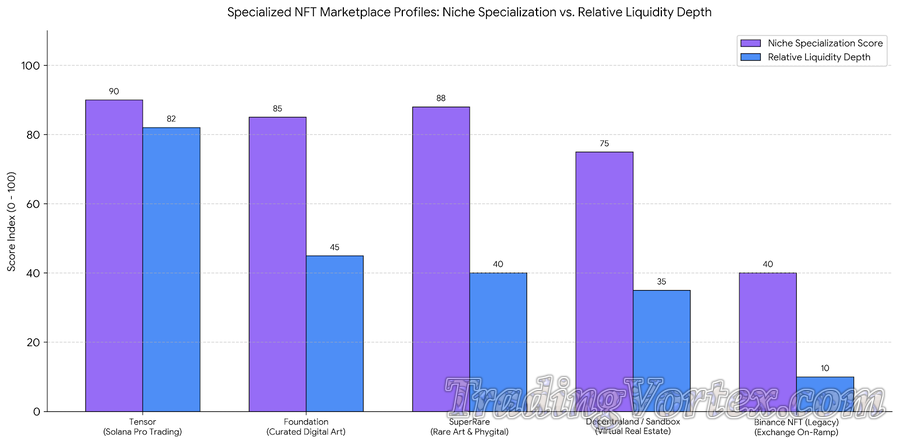
Understanding Specialized NFT Platforms: Balancing Focus vs. Liquidity
This bar chart illustrates the trade-off between Niche Specialization (Purple Bars) and Relative Liquidity Depth (Blue Bars) across emerging and specialized NFT marketplaces.
How to Interpret and Utilize This Visual
-
Solana High-Speed Trading (Tensor):
-
Niche Score (90) & Liquidity Score (82): Tensor maintains high scores in both categories, serving as a dedicated venue for Solana collection traders who demand order books, fast execution, and automated treasury fee capture (TNSR tokenomics).
-
-
Fine Art & Curated Marketplaces (Foundation & SuperRare):
-
High Niche Focus (85–88) with Lower Liquidity (40–45): Both platforms prioritize curation, invite/auction-based sales, credit card onboarding, and physical/digital pairings (phygitals). While trading velocity is lower than generalist sites, the audience is tailored specifically for high-value art collectors.
-
-
Virtual Real Estate & Metaverse Platforms (Decentraland / Sandbox):
-
Niche Focus (75) & Liquidity (35): These venues specialize in tokenized virtual land and digital property. Transactions depend heavily on ecosystem participation rather than speculative flipping.
-
-
Centralized Exchange Hubs (Binance NFT Legacy):
-
Low Scores Across Metrics (40 Niche / 10 Liquidity): Demonstrates the structural decline of centralized exchange NFT hubs following standalone marketplace shutdowns and migrations toward self-custody wallets.
-
Key Actionable Insights for Your Strategy
-
If You Are an NFT Fine Artist or Curator: Choose Foundation or SuperRare to leverage built-in credit card checkouts, curated exhibition tools, and physical artwork pairings.
-
If You Are an Active Solana Collection Trader: Pair Tensor alongside Magic Eden to access order-book depth and collection-wide bidding.
-
If You Hold Assets on Centralized Exchanges: Ensure you migrate custodial NFTs to non-custodial wallets to avoid losing access during platform service migrations.
NFT Marketplace Comparison: Which User-Friendly Platform Wins?
Let's be real for a second. If you've been reading this entire guide, you probably have a shortlist in your head. Maybe you're leaning toward OpenSea because it's familiar. Maybe Blur caught your attention because zero fees sound incredible. Or maybe you're a Solana person and Magic Eden is the obvious choice.
But here's the thing: there is no single winner. I know that's an unsatisfying answer, but it's the truth. The "best" user-friendly NFT marketplace depends entirely on who you are, what you trade, and how you like to work. It's like asking which vehicle is best. A pickup truck, a sports car, and a minivan are all excellent at different things, and the right choice depends on whether you're hauling lumber, racing on a track, or driving the kids to soccer practice.
What I can do is give you a side-by-side comparison that cuts through the noise, so you can see exactly how these platforms stack up against each other and make an informed choice. I've spent months using all of them, making mistakes on some and discovering hidden gems on others. Let me save you the trial and error.
Side-by-Side Comparison of the Most User-Friendly NFT Marketplaces
Let's start with the numbers, because numbers don't lie. According to CoinGecko Research data from April 2026, the market share landscape looks like this: Magic Eden leads with 37% , followed by Blur at 25.1% , and OpenSea at 19.9% . That's a dramatic shift from just a few years ago, when OpenSea was the undisputed king of the hill and everyone else was fighting for scraps.
But market share only tells part of the story. A platform can dominate volume while being terrible for beginners, or have a small user base while offering the best experience in its niche. Let's break down the key metrics that actually matter for users.
Marketplace Fees:
- Blur: 0% on all Ethereum transactions. This is the foundation the entire platform was built on, and it's not a promotional gimmick. It's permanent.
- OpenSea: 1% for selling NFTs and 10% for minting in a primary drop. Swaps are 0% , and private listings typically carry 0% OpenSea fee.
- Magic Eden: 2% on all Solana transactions. Listing fees are 0% .
- Rarible: Sliding scale from 0.5% to 7.5% per side (buyer and seller), depending on price. Lower prices mean higher fees. Locking RARI tokens can eliminate fees entirely.
Creator Royalties:
- OpenSea: Enforced or optional, depending on collection settings. If enforced, the creator gets paid automatically. If optional, the seller chooses whether to pay.
- Blur: Optional with a 0.5% minimum. Collections can set their rates, but traders have discretion above the minimum.
- Magic Eden: Optional on Solana unless the collection adopts the MIP-1 standard. Buyers choose whether to pay full, half, or zero royalties.
- Rarible: Up to 50% and enforced at the protocol level through RARI Chain. The most creator-friendly system in the industry.
Chain Support:
- OpenSea: 22 chains at OS2 launch, including Ethereum, Solana, Base, Polygon, Arbitrum, Optimism, and more. The broadest coverage by far.
- Blur: Ethereum-focused, with some expansion into Blast. Deepest liquidity on Ethereum blue chips.
- Magic Eden: Solana-only after the February 2026 pivot. Bitcoin and EVM marketplaces were shut down.
- Rarible: Ethereum, Solana, Polygon, Tezos, Immutable X, MegaETH, and Base.
Monthly Active Users:
- OpenSea: ~382,000 . The largest user base by far.
- Magic Eden: ~200,000+ . A strong and engaged community.
- Blur: ~38,300 . Small but highly active, with the top 100 traders accounting for 63% of activity.
Trading Tools:
- Blur: Collection bids, floor sweeping, batch listing, real-time analytics, NFT aggregation. The most powerful toolkit for professional traders, and it's not even close.
- OpenSea: Trait filtering, rarity indicators, cross-chain purchasing, mobile app. Strong discovery tools for collectors who want to browse and learn.
- Magic Eden: Bulk listing, collection discovery, cNFT support for gaming assets. Optimized for Solana's fast and cheap transactions.
- Rarible: Lazy minting, multi-wallet royalty splits, decentralized governance. The most creator-focused feature set.
NFT Lending:
- Blur: Yes, through Blend protocol. Peer-to-peer perpetual lending with no fixed expiry. Powerful but risky.
- OpenSea: No.
- Magic Eden: No.
- Rarible: No.
Mobile Experience:
- OpenSea: Full mobile app with wallet creation and Apple Pay integration.
- Magic Eden: iOS and Android apps .
- Blur: No mobile app. Desktop only by design.
- Rarible: Mobile-responsive web, but no dedicated app.
Best NFT Marketplace by User Type: Beginners, Traders, Creators, and Gamers
Now let's get practical. Who should use what? This is where the comparison gets personal, because the "best" platform depends entirely on what kind of user you are.
👶 For Beginners: OpenSea Wins
If you're brand new to NFTs, OpenSea is almost certainly where you should start. The interface is forgiving, the chain support is unmatched, and the sheer volume of listings means you can explore almost any category without needing to learn a new platform. The mobile app makes it easy to browse on your phone, and the Apple Pay integration removes the intimidation factor of crypto wallets.
I've introduced friends to NFTs through OpenSea, and they were buying their first pieces within an hour. That's not something I can say about Blur. One friend tried Blur first because he heard the fees were lower, and he called me twenty minutes later asking what a "collection bid" was and why he couldn't find the buy button. OpenSea doesn't make you feel stupid. It guides you without condescending.
📊 For Professional Traders: Blur Wins
If you're executing dozens of transactions a week on Ethereum, Blur is the only serious choice. Zero marketplace fees, the fastest execution in the game, collection bids, floor sweeping, and batch tools that let you buy 50 NFTs in one click. The learning curve is steep, and the interface is dense, but for professionals, that's a feature, not a bug.
One Reddit user reported saving $1,850 in fees in a single month by using Blur's batch tools. That's real money. Over a year of active trading, the savings can add up to the price of a decent used car. If you're trading at scale, Blur pays for itself in fee savings alone.
🎨 For Creators: Rarible Wins
If you're an artist who cares about royalties, Rarible is the clear winner. Creators can set royalties up to 50% , and they're enforced at the protocol level through RARI Chain. No other major marketplace offers this level of protection. Lazy minting lets you list work for free on Ethereum, with the buyer paying gas only when they purchase. And the RARI DAO gives creators a genuine voice in how the platform evolves.
I've spoken to artists who migrated from OpenSea to Rarible after OpenSea made royalties optional. They took a hit in visibility but gained something more valuable: the knowledge that every secondary sale would pay them fairly. For creators who depend on royalty income, that peace of mind is worth the trade-off.
🎮 For Gamers: Magic Eden Wins
If you're a Solana gamer trading in-game assets, Magic Eden is your home. The platform supports compressed NFTs (cNFTs) , which are essential for gaming assets because they're cheap to mint and trade at scale. The community is active, the discovery tools are tailored for gaming collections, and the platform's focus on Solana means it understands the ecosystem better than anyone else.
Magic Eden has become the de facto hub for Solana gaming. If you're playing a game and want to trade items, you're almost certainly doing it on Magic Eden. The integration with gaming ecosystems is a genuine differentiator, and it's why the Solana gaming community has embraced the platform so completely.
💎 For Multi-Chain Collectors: OpenSea Wins
If you collect across multiple chains, OpenSea is the only platform that covers everything. With 22 chains supported, you can buy Ethereum blue chips, Solana art, and Polygon gaming assets without ever leaving the site. No bridging, no switching wallets, no mental overhead. For collectors who value breadth and convenience, OpenSea is unmatched.
I used to juggle three different marketplaces for three different chains. It was exhausting. OpenSea eliminated that friction, and I haven't looked back. If you're a multi-chain collector, the convenience alone is worth the slightly higher fees.
Best NFT Marketplace by Blockchain: Ethereum, Solana, Polygon, and More
Your chain often determines your marketplace before anything else does. Here's the breakdown:
⛓️ Ethereum: Blur for Trading, OpenSea for Discovery
If you're trading Ethereum NFTs actively, Blur has the deepest liquidity and the lowest fees. It controls roughly 60% of Ethereum NFT volume, and its zero-fee model saves traders real money. But if you're browsing, discovering new collections, or buying your first Ethereum NFT, OpenSea's interface is far more approachable. The two platforms serve different purposes, and many Ethereum traders use both. I know I do.
⛓️ Solana: Magic Eden and Tensor
If your NFTs live on Solana, Magic Eden is the default platform. It's the most polished, user-friendly Solana marketplace, with deep liquidity and an active community. Tensor is a strong alternative for collection traders who want more advanced tools. OpenSea now supports Solana NFTs as well, which gives you more options, but Magic Eden's Solana-native focus gives it an edge in user experience. It's the platform that understands Solana culture, and that matters more than you might think.
⛓️ Polygon, Base, and Layer 2 Chains: OpenSea
For Polygon, Base, Arbitrum, Optimism, and other Layer 2 chains, OpenSea is the primary option. Its multi-chain support means you can trade on these chains without needing a separate platform. Magic Eden used to support Polygon and Base but shut those marketplaces down in February 2026. Rarible supports some Layer 2 chains, but its liquidity is thinner than OpenSea's.
⛓️ Bitcoin Ordinals: None of the Above
If you're trading Bitcoin Ordinals, you'll need to look beyond the platforms covered in this guide. Magic Eden was the leader here, but it shut down its Bitcoin marketplace in March 2026. OpenSea doesn't support Bitcoin. For Ordinals trading, you'll need specialized platforms that fall outside the scope of this comparison. It's a reminder that the NFT world is bigger than any single guide can cover, and that specialized niches often require specialized tools.
Best NFT Marketplace by Fee Structure: Low-Cost Options for Budget-Conscious Users
Let's talk about the money you actually keep. Fees can vary dramatically depending on your trading volume and the platform you choose. And if you're trading regularly, those fractions of a percent add up to serious money over time.
💳 If You Trade Ethereum NFTs Actively: Blur (0% Marketplace Fee)
Blur's 0% marketplace fee is the lowest in the industry. For a trader executing 50 transactions a month at an average of $1,000 per NFT, that's $500 saved every month compared to OpenSea's 1% fee. Over a year, that's $6,000. That's not pocket change; that's a meaningful return on your trading activity.
I ran the numbers for my own trading history, and switching to Blur for my Ethereum trades saved me enough to buy a decent piece of art every few months. That's the kind of difference that compounds over time, especially in a market where margins are tight.
💳 If You Trade Solana NFTs: Magic Eden (2% Marketplace Fee)
Magic Eden's 2% fee is in line with Solana marketplaces. There's no listing fee, which is nice, and the rewards program can offset some of the cost for active traders. For casual collectors, the 2% is barely noticeable. For high-volume traders, it adds up, but there are no zero-fee alternatives on Solana that match Magic Eden's liquidity. Sometimes you pay for access, and Magic Eden's access is worth it.
💳 If You're a Creator: Rarible (Sliding Scale, 0% with RARI Lock)
Rarible's fee structure is unique. The sliding scale from 0.5% to 7.5% means higher-priced sales pay lower fees, which is the opposite of most platforms. For example, a sale above $4,000 pays only 0.5% per side, while a sale under $100 pays 7.5% per side. And if you lock RARI tokens, you can pay 0% transaction fees entirely. For creators who care about royalties, the higher fees on low-priced sales are a small price to pay for protocol-level royalty enforcement.
💳 If You're a Casual Collector: OpenSea (1% Marketplace Fee)
OpenSea's 1% selling fee is competitive for a generalist platform. For someone buying a few pieces a year, the fee is negligible. You're paying for access to the widest selection of NFTs across the most chains, and for most casual collectors, that's a fair trade. If you're buying one or two NFTs a year, the difference between 1% and 0% is a few dollars. Don't optimize for pennies when convenience is worth dollars.
💸 The Hidden Costs Nobody Talks About
Marketplace fees are only part of the picture. Gas fees can be significant, especially on Ethereum mainnet during congestion. A failed transaction still consumes gas, and during busy periods, you might pay $20 or more for a transaction that doesn't even go through. Creator royalties add another layer, and whether they're enforced depends on the platform and the collection. And bridging fees can eat into your profits if you're moving assets between chains.
The bottom line?
Blur is the cheapest for active Ethereum traders.
Rarible is the best for creators who want to maximize royalty income.
Magic Eden is competitive for Solana.
And OpenSea charges a fair price for the breadth and convenience it offers.
Choose based on your behavior, not just the headline fee. A platform with zero fees that you can't figure out how to use is more expensive than a platform with 1% fees that you can use effortlessly.
The Final Verdict: There’s No Single Winner, and That’s Okay
If you came here looking for a simple answer, I'm sorry to disappoint you. But the truth is that the NFT marketplace landscape in 2026 is fragmented by design. Each platform serves a different type of user, and the "best" one for you depends entirely on what you're trying to do. Anyone who tells you there's one marketplace to rule them all is either selling something or hasn't actually used more than one platform.
My honest recommendation for most people? Use two platforms. Start with OpenSea for discovery, browsing, and casual purchases. It's the most forgiving platform, and it gives you access to the widest selection of assets. Then, as you get more comfortable, add Blur if you're trading Ethereum actively, or Magic Eden if you're on Solana. Use Rarible if you're a creator who cares about royalties. Use Tensor if you're a Solana collection trader. And if you're a high-end art collector, explore Foundation and SuperRare.
The market has split because two different kinds of users need two different kinds of tools. Figure out which one you are, and you'll know exactly where to spend your time. And if you're somewhere in between, that's fine too. The best traders I know use multiple platforms, switching between them based on the task at hand. There's no loyalty in trading. There's only execution.
The Ultimate NFT Marketplace Comparison Table: All Key Metrics in One Place
If you've read through the entire comparison and your head is spinning with numbers, fees, and feature lists, you're not alone. I've been there. Sometimes you just want to see everything side by side, without the narrative, without the anecdotes, without me rambling about my first NFT purchase. So here it is: the quick-reference snapshot you can screenshot, bookmark, or send to a friend who's asking which platform to use.
This table distills the four major user-friendly NFT marketplaces down to the metrics that actually influence your experience: what they're best for, what they charge, how they handle royalties, which chains they support, and what tools they give you. Think of it as the cheat sheet version of everything we've covered, designed for quick scanning rather than deep reading.
| Feature | OpenSea | Blur | Magic Eden | Rarible |
|---|---|---|---|---|
| Best For | Beginners, multi-chain collectors | Professional Ethereum traders | Solana collectors and gamers | Creators and digital artists |
| Marketplace Fee | 1% selling, 10% primary mint, 0% swaps | 0% | 2% | 0.5% to 7.5% sliding scale, 0% with RARI lock |
| Creator Royalties | Enforced or optional, depends on collection | Optional, 0.5% minimum | Optional on Solana, unless MIP-1 adopted | Up to 50%, enforced on-chain via RARI Chain |
| Chain Support | 22 chains | Ethereum-focused, some Blast | Solana only | 7 chains |
| Monthly Active Users | ~382,000 | ~38,300 | ~200,000+ | Smaller, niche community |
| Mobile App | Yes, with Apple Pay | No, desktop only | Yes, iOS and Android | Mobile-responsive web |
| NFT Lending | No | Yes, via Blend protocol | No | No |
| Advanced Trading Tools | Discovery-focused, rarity indicators | Collection bids, sweeps, batch listing | Bulk listing, cNFT support | Lazy minting, multi-wallet royalty splits |
| Governance Model | Centralized | Token-based, BLUR holders | Centralized | RARI DAO, veRARI voting |
| Listing Fees | 0% | 0% | 0% | 0% |
| Best Blockchain | All chains | Ethereum | Solana | Ethereum and multi-chain |
A few things worth noting as you scan this table. The 0% marketplace fee for Blur and the 50% royalty ceiling for Rarible are the two most extreme figures on the board, and they represent the philosophical poles of the NFT marketplace world. Blur optimizes for traders. Rarible optimizes for creators. Everyone else sits somewhere in between.
OpenSea's 22-chain support is the broadest by a wide margin, and it's the single biggest reason beginners gravitate toward it. You don't have to know which chain your NFT lives on before you start browsing. That simplicity is worth a lot when you're new.
Magic Eden's Solana-only focus after the 2026 pivot is both a strength and a limitation. If you're on Solana, it's the best platform for you. If you're not, it's irrelevant. That's the trade-off of specialization.
And Rarible's sliding scale fee structure is the most unusual on the list. It rewards higher-priced sales with lower fees, which is the opposite of most platforms. For creators selling premium work, that structure can be genuinely advantageous.
If you're still unsure after looking at the table, go back to the "Best NFT Marketplace by User Type" subsection above. It walks through the decision process step by step, from beginners to professional traders to creators to gamers. Between the table and the user-type breakdown, you should have everything you need to make a confident choice.
And if you take nothing else from this comparison, remember this: you don't have to pick just one. The smartest traders I know use two or three platforms, switching between them based on the task at hand. OpenSea for discovery. Blur for execution. Magic Eden for Solana. Rarible for royalties. There's no rule that says you have to be loyal to a single marketplace. The market is fragmented because users have different needs, and the best strategy is to match the tool to the job.
📊 Global NFT Marketplace Volume Market Share Breakdown: Comparative Share of Magic Eden, Blur, OpenSea, and Specialized Platforms (April 2026)
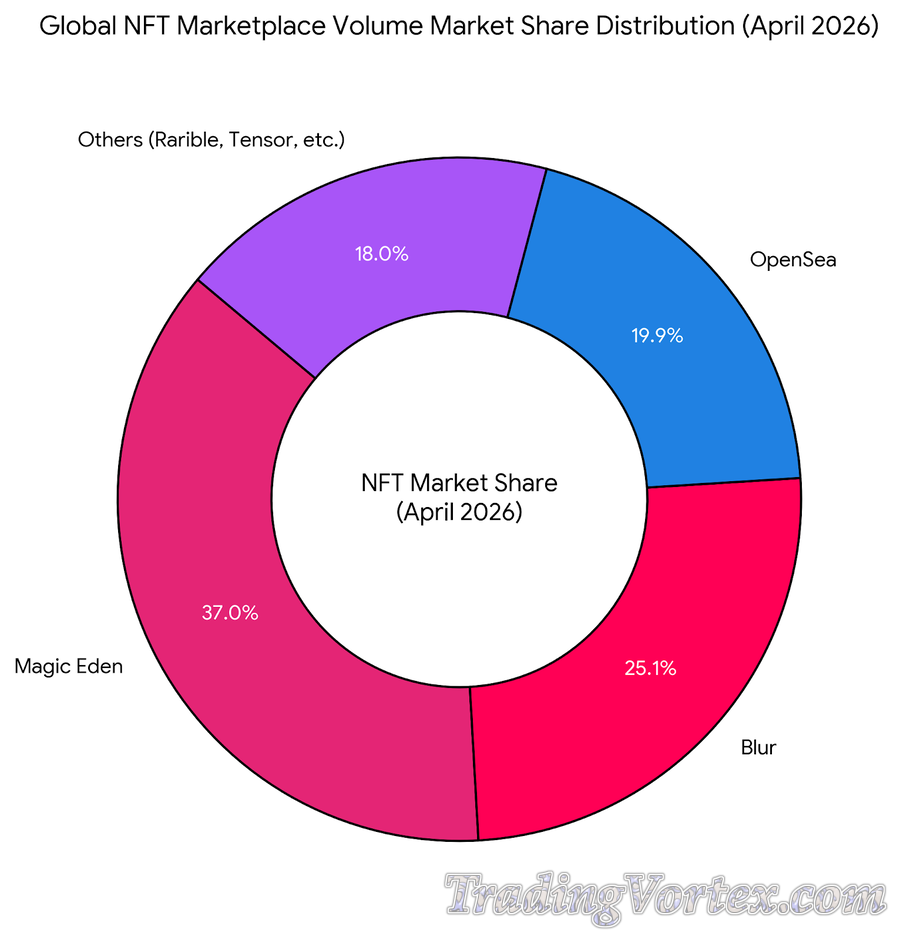
Understanding the Global Marketplace Volume Distribution
This donut chart visualizes the distribution of global NFT trading volume share across the leading digital marketplaces based on CoinGecko Research data from April 2026.
How to Interpret and Utilize This Visual
-
Market Leader (Magic Eden - 37.0%):
-
Magic Eden commands the largest single share of global trading volume (37.0%). This reflects the high transaction frequency and liquidity density within the Solana and Web3 gaming ecosystems following its focused platform consolidation.
-
-
Pro Trading Hub (Blur - 25.1%):
-
Blur holds a 25.1% market share, driven primarily by professional high-frequency Ethereum traders leveraging its zero-fee structure and floor-sweeping tools.
-
-
Generalist Gateway (OpenSea - 19.9%):
-
OpenSea maintains a nearly 20% share of total market volume. While its total volume share is lower than during the early market peaks, it represents the widest cross-chain distribution (22+ supported blockchains) and the largest overall retail active user base (~382,000 active monthly wallets).
-
-
Specialized & Emerging Marketplaces (Others - 18.0%):
-
The remaining 18.0% of trading activity is distributed across specialized and creator-focused venues, including Rarible, Tensor, Foundation, and SuperRare, serving specific needs such as protocol-enforced royalties, fine art auctions, and high-speed Solana collection order books.
-
Key Actionable Insights for Users
-
Liquidity Matching: If you are seeking deep, rapid-fill order books for high-value Ethereum trades, Blur provides concentrated professional liquidity.
-
Ecosystem Specialization: For gaming assets and low-cost Solana trading, Magic Eden offers the highest active transaction density.
-
Broad Discovery: For multi-chain management and beginner-friendly browsing, OpenSea remains the most comprehensive generalist gateway.
Key Challenges Affecting User Experience in NFT Marketplaces
Let's be honest for a moment. For all the progress we've made, using an NFT marketplace in 2026 still feels like navigating a minefield with a blindfold on. Some of that is the nature of the technology. Some of it is the platforms themselves. And some of it is the fact that we're still figuring out how to build products for a world where a single wrong click can cost you thousands of dollars with no undo button.
I've had my share of frustrating moments. I've paid gas fees on transactions that failed. I've waited days for support tickets that never got answered. I've watched friends lose NFTs to scams that could have been prevented with better platform design. And I've stared at metadata that pointed to broken images, wondering if the NFT I bought was still worth anything.
These aren't isolated stories. They're systemic problems that affect every user, from the curious beginner to the seasoned trader. Let's walk through the biggest challenges that still make NFT marketplaces harder to use than they should be, and what's being done about them.
Wallet Management and Transaction Complexity: Why It Still Confuses Users
If there's one thing that consistently trips up NFT newcomers, it's the wallet. Not the concept of a wallet, but the reality of managing one. Seed phrases, private keys, gas fees, transaction confirmations, network switching. It's a lot to absorb, and the consequences of getting it wrong are often irreversible.
Research on NFT user experience confirms what most of us already know from experience: wallet management tasks, particularly those involving seed phrases and recovery words, create significant friction that hinders both perceived ease of use and trust in the platform. Users have to manually input twelve recovery words, which feels archaic and intimidating. And when something goes wrong, there's often no clear recovery path.
The problem goes deeper than just seed phrases. Ambiguous system behavior erodes trust in ways that platforms don't always recognize. When accounts are automatically created during wallet connection without users being explicitly informed, or when there's no success notification after creating an NFT or completing a purchase, users are left uncertain about whether their actions actually worked. That uncertainty diminishes the perceived trustworthiness of the platform.
And then there's the irreversibility problem. Blockchain transactions can't be undone. If you send an NFT to the wrong address, it's gone. If you sign a malicious transaction, your assets can be drained. This creates a level of anxiety that traditional online marketplaces simply don't have. Users reported that worries about fraudulent assets and irrevocable financial loss deterred them from completing transactions, even when the marketplace itself seemed to be working fine.
I've watched friends spend hours researching how to set up a wallet, only to give up because the process felt too risky. One friend bought a hardware wallet, followed the instructions, and then realized he'd written down his seed phrase in the wrong order. He spent a week terrified that his funds were lost. They weren't, but the experience left him traumatized. That's not how onboarding should feel. That's how onboarding feels when the industry prioritizes security theater over genuine usability.
The industry is slowly addressing these issues. Embedded wallets that let users create accounts with just an email or social login are becoming more common. Account abstraction promises to eliminate seed phrases entirely, replacing them with social recovery and passkeys. But adoption is uneven, and most platforms still rely on the old model. Until that changes, wallet management will remain the single biggest barrier to NFT adoption.
There's also a psychological barrier that doesn't get enough attention. The fear of making a mistake is paralyzing for newcomers. In traditional finance, if you make a mistake, you call customer service and they fix it. In crypto, if you make a mistake, you're often told "sorry, that's the nature of decentralization." That asymmetry creates a level of anxiety that keeps people on the sidelines. Platforms that acknowledge this and build safeguards without sacrificing decentralization will be the ones that win the next wave of users.
The Metadata Fragility Problem: Why Your NFT Images Can Disappear
Here's something that doesn't get discussed nearly enough: the NFT you bought might not actually contain the artwork you think it does. What you own on the blockchain is a token. The image, the description, the attributes, all of that lives off-chain, usually on a server or a distributed storage network. If that off-chain data disappears, your NFT becomes a token that points to nothing.
This isn't a theoretical risk. It's a widespread structural vulnerability. Research analyzing over 107,000 NFT contracts found that 15.6% had mutable functions like setTokenURI() that allow collection owners to change where the metadata points. After verifying contract ownership status, researchers discovered that over 99% of flagged collections remained under active control, exposing 5,189,485 NFTs to potential manipulation. In plain English: millions of NFTs can have their images and descriptions changed by the project creator at any time.
The IPNS problem is even more insidious. IPNS is a mutable pointer system built on top of IPFS. It looks decentralized because it uses IPFS, but the pointer can be redirected by whoever holds the corresponding private key. Researchers identified 3,904 metadata URIs and 663 image URIs using IPNS, and 100% of those assets are susceptible to unilateral off-chain alteration. The content you thought you owned can be swapped for something else without your consent.
I've experienced this myself. A piece I bought years ago now shows a broken image because the creator stopped paying for the server that hosted the metadata. The NFT is still in my wallet. The token still exists. But the artwork is gone. It's a frustrating reminder that "owning" an NFT often means owning a pointer to something that someone else controls. The token is immutable. The thing it points to is anything but.
The good news is that there are solutions. Content-addressed storage using IPFS CIDv1 ensures that the metadata hash is permanent and verifiable. Fully on-chain NFTs store everything in the smart contract itself, eliminating external dependencies entirely. Some platforms and standards are moving in this direction. Projects like Onchain Gaias and Terraforms have demonstrated that fully on-chain generative art is not only possible but can be genuinely beautiful. But the majority of NFTs in existence today still rely on mutable, centralized storage. Until that changes, metadata fragility will remain one of the most underappreciated risks in the entire ecosystem.
If you're buying NFTs, here's my advice: check where the metadata lives before you buy. If it's on a centralized server, understand that you're trusting the creator to keep paying for that server indefinitely. If it's on IPFS with a content-addressed hash, that's better. If it's fully on-chain, that's the gold standard. The difference matters more than most buyers realize.
NFT Royalty Enforcement: Why Creators Still Struggle to Get Paid
Royalties were supposed to be one of the killer features of NFTs. For the first time, artists could earn income every time their work changed hands. It was a revolutionary concept, and it attracted a wave of creators who saw NFTs as a way to build sustainable careers.
Then the marketplaces killed it.
The story is depressingly simple. When Blur launched with zero marketplace fees and optional royalties, traders flooded in. Other platforms, desperate to compete for volume, followed suit. OpenSea made royalties optional. Magic Eden made them optional on Solana. Within a couple of years, royalties went from being a core feature of the NFT economy to being a tip jar that most buyers ignore.
The data tells the story. Research shows that the percentage of transactions actually paying creator royalties has dropped dramatically. Creators who expected passive income from secondary sales have seen their earnings evaporate. Some have responded by abandoning marketplaces entirely and trading through Web2 platforms, where royalty logic is bypassed completely. Others have shifted to creator-owned storefronts where they control the terms of every sale. It's a survival strategy, but it fragments the market and makes discovery harder for collectors.
The technical challenges of enforcing royalties are real. Once an NFT is in someone's wallet, the creator has no control over where it's sold. A marketplace can choose to enforce royalties, but it can't force other marketplaces to do the same. Attempts to enforce royalties through on-chain transfer restrictions have been criticized for limiting legitimate transfers, like gifting or migrating assets between personal wallets. It's a genuine tension between creator rights and user freedom, and there's no easy resolution.
Some platforms are trying innovative solutions. Rarible enforces royalties at the protocol level through its RARI Chain, making it technically impossible to bypass creator payments. TON's NFT 2.0 proposes an off-chain signaling mechanism where violating NFTs are flagged in metadata and restricted across ecosystem products. OpenSea launched an Operator Filter Registry that lets creators blacklist marketplaces that don't respect royalties, though this was met with community backlash because it forced traders to pay OpenSea's platform fees.
But the fundamental problem remains: royalty enforcement requires coordination across the entire ecosystem, and the ecosystem has no incentive to coordinate. Marketplaces compete for volume. Traders care about margins. Creators are left to choose between platforms that protect their income and platforms where buyers actually are. For many, it's an impossible choice.
If you're a creator, my advice is to do your research before committing to a platform. Understand exactly how royalties work, whether they're enforced or optional, and what happens when your work is resold on a different marketplace. The difference between 0% and 10% royalty enforcement can mean thousands of dollars over the life of your collection. And if you're a collector who cares about supporting artists, pay the royalties. It's not just good karma. It's what keeps the creators you love making more work.
Scams, Rug Pulls, and Security Risks: How to Protect Your NFT Investments
The NFT space has a scam problem. Not a small one. A systemic, multi-billion-dollar problem that has cost users everything from a few hundred dollars to millions.
Rug pulls are one of the most common forms of NFT fraud. A project launches, builds hype, sells out its mint, and then the developers disappear with the funds, leaving holders with worthless tokens. The anatomy of a rug pull is depressingly predictable: anonymous team, unrealistic promises, aggressive marketing, no working product. But despite the predictability, people keep falling for them. I've fallen for one myself, a "revolutionary" PFP project that promised to reinvent community ownership. It lasted three weeks.
The scale of the problem is staggering. The U.S. Department of the Treasury's NFT Illicit Finance Risk Assessment found that NFTs are highly susceptible to fraud, scams, and theft. The pseudonymous nature of blockchain transactions makes the ecosystem attractive to bad actors. Scammers exploit NFT buyers who aren't paying close enough attention, and they're getting more sophisticated every year.
In August 2026, the founder of an NFT startup called Few and Far was indicted for securities and wire fraud. Taj Tarsha allegedly raised over $10 million from 67 investors by promising to build an NFT marketplace, then misappropriated the funds for personal use, including gambling at an online casino and purchasing speculative cryptocurrencies. When he finally launched the FAR token in May 2024, it was effectively worthless.
But scams don't always come from obvious bad actors. Sometimes they come from platforms themselves. In September 2026, Revoke.cash warned that old Magic Eden approvals were still putting users at risk months after the platform shut down its Ethereum marketplace. A vulnerability in Limit Break's Payment Processor V2 allowed a security researcher to move 3,832 NFTs from wallets that still had active approvals. The researcher described it as a whitehat rescue, but the incident highlighted a critical issue: closing a marketplace doesn't cancel the on-chain permissions users granted to it. Those approvals remain active until manually revoked.
The Magic Eden situation is particularly instructive because it shows how platform failures can leave users exposed long after they've stopped using the platform. Users who granted approvals years ago, forgot about them, and assumed they were safe were suddenly at risk. The lesson is clear: you need to actively manage your approvals, not just assume that leaving a platform means you're no longer connected to it. Tools like Revoke.cash and Etherscan's token approval checker make this easy, and you should use them regularly.
For practical protection, the basics still apply: use hardware wallets for significant holdings, verify contract addresses before interacting with them, revoke approvals you no longer need, and never sign transactions from unknown links. But the reality is that even careful users can get caught. The security burden shouldn't fall entirely on users. Platforms need to build better defaults: spending limits, whitelists, easier revocation tools, and clear warnings about what you're actually approving.
My rule of thumb is simple: if someone is rushing you, it's probably a scam. Most NFT scams succeed because they create a sense of urgency. Someone messages you saying you've won a free NFT, or a "support agent" asks you to verify your wallet. These are almost always attempts to steal your assets. Slow down. Verify the source. And when in doubt, don't sign anything. The best defense against scams is patience.
Cross-Chain Interoperability Gaps: Why Moving NFTs Between Marketplaces Is Still Hard
The promise of NFTs was that you could own a digital asset and use it anywhere. The reality is that your NFT is trapped on the blockchain where it was minted, and moving it to another chain is somewhere between difficult and impossible.
The technical challenges are substantial. Cross-chain NFT migration involves transferring digital assets along with their associated functionalities and guarantees between distinct blockchain platforms. But different blockchains have different architectures, different state organization, different transaction execution models, and different ownership representations. Features that work on one chain may simply not exist on another.
Research on Ethereum-to-Solana NFT migration identified several incompatibility issues that hinder seamless migration. It's not just about moving the token. It's about preserving everything that makes the NFT valuable: its metadata, its royalties, its compatibility with DeFi protocols, its ability to be used in games or applications. When you move an NFT across chains, you often lose some of those features, and there's no easy way to predict which ones will survive and which will break.
The practical implications are frustrating. If you buy an NFT on Ethereum, you can't easily sell it on Solana. You can't use it as collateral on a Solana lending protocol. You can't display it in a Solana-based game. Your NFT is locked into the ecosystem where it was created, and the bridges that exist are often slow, expensive, and risky.
I've tried bridging NFTs between chains, and it's never been a smooth experience. The fees are unpredictable. The wait times are long. And there's always a nagging fear that something will go wrong and your asset will be stuck in limbo forever. For most users, the answer is simple: don't bother. Just buy NFTs on the chain you're already using and accept the limitations.
The infrastructure is slowly improving. Cross-chain bridges and interoperability protocols are being developed, but they're not mature enough for mainstream use. And even when the technology works, there's the question of whether it's worth the cost and complexity. For most users, the answer is no. They'd rather just buy NFTs on the chain they're already using than deal with the headache of moving assets across chains.
The dream of a truly interoperable NFT ecosystem is still alive, but it's a long way off. Until then, choose your chain carefully. The chain you mint on is the chain you're stuck with, at least for now.
Gas Fees and Network Congestion: How Marketplaces Are Solving the Problem
Gas fees are the tax you pay for using a blockchain, and they're one of the most consistent sources of frustration for NFT users. On Ethereum mainnet, gas fees can range from a few dollars to $50 or more depending on network congestion. For a single transaction. That's not a fee. That's a barrier to entry.
The problem is particularly acute for creators. On some platforms, minting an NFT requires paying gas upfront, which means you're spending money before you've made any sales. For emerging artists who aren't sure if their work will sell, that's a significant risk. Platforms like OpenSea addressed this with lazy minting, where the NFT is only minted when someone buys it, and the buyer pays the gas. But lazy minting has its own limitations: it's typically only available on Ethereum, and lazy-minted NFTs are minted to the platform's collection rather than the creator's own contract.
The good news is that Layer 2 chains and alternative blockchains have dramatically reduced gas costs. Solana transactions cost fractions of a cent. Polygon and Base are similarly cheap. This is one of the reasons these ecosystems have grown so quickly for NFT activity. When a transaction costs $0.001 instead of $50, you can experiment, trade, and create without worrying about the cost. I've done more experimentation on cheap chains in a month than I did on Ethereum in a year, simply because the cost of failure was low enough to encourage trying things.
Marketplaces are adapting. Blur's batch tools let you buy dozens of NFTs in a single transaction, amortizing the gas cost across multiple purchases. OpenSea's multi-chain support lets you choose cheaper chains for transactions that don't need Ethereum's security guarantees. Magic Eden's focus on Solana means its users rarely think about gas at all. The days of paying $87 to mint a single NFT are hopefully behind us, at least for users who are willing to explore beyond Ethereum mainnet.
But gas fees haven't disappeared entirely. They've just moved to the chains where they're less painful. And for users who are committed to Ethereum for its security or its blue-chip NFT collections, gas remains a real cost that has to be factored into every decision. The key is to match the chain to the transaction. If you're buying a blue-chip NFT that you plan to hold for years, Ethereum's security is worth the gas. If you're minting a new collection or trading frequently, a cheaper chain makes more sense.
The Bottom Line: Progress Is Real, But the Work Isn't Done
If this section feels bleak, I want to be clear about something: the NFT user experience has improved dramatically over the past few years. Wallets are easier to set up. Fees are lower. Cross-chain support is broader. Security tools are better. The platforms that survived the bear market are genuinely better products than the ones that existed in 2021.
But "better" doesn't mean "solved." The challenges I've outlined here are real, and they affect real users every day. Wallets are still confusing for newcomers. Metadata can still disappear. Royalties are still optional on most platforms. Scams are still rampant. Cross-chain migration is still painful. Gas fees are still a factor on Ethereum.
The good news is that these problems are being worked on. Account abstraction is coming. On-chain metadata standards are evolving. Royalty enforcement mechanisms are being tested. Security defaults are improving. The industry is learning, slowly but surely, that user experience isn't a nice-to-have. It's the foundation of adoption.
My advice? Be patient with yourself, but also be demanding of the platforms you use. If a marketplace makes you feel stupid, that's a design flaw, not a personal failing. If a platform hides fees or makes it hard to revoke approvals, that's a red flag. You deserve better, and the platforms that deliver better will be the ones that survive.
And if you're building in this space, take these challenges seriously. The platforms that win the next cycle won't be the ones with the lowest fees or the most chains. They'll be the ones that make users feel safe, informed, and in control. That's the real competitive advantage. Everything else is just marketing.
📊 Key Technical Challenges Affecting NFT User Experience vs. Solution Adoption Rates: Comparing Systemic Risk Severity Against Emerging Technical Countermeasures
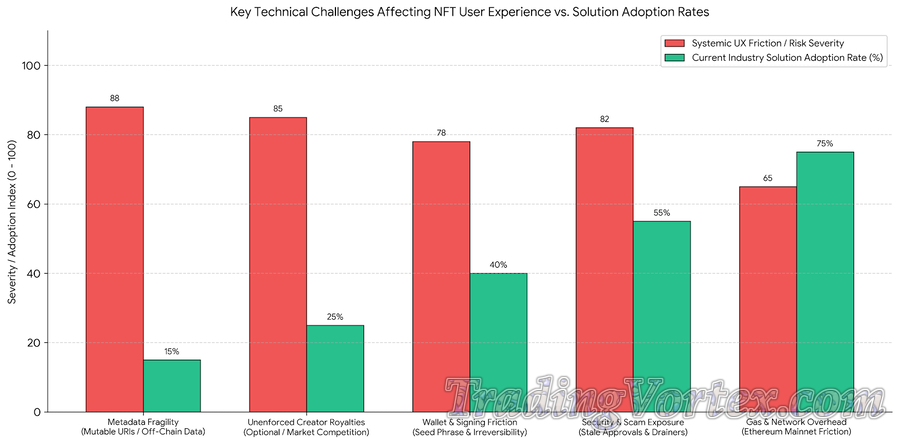
Understanding Technical Friction Points and Progress in NFT User Experience
This dual-bar visualization compares the Systemic Risk/UX Severity (Red Bars) of major user experience friction points against the Current Industry Adoption Rate of Technical Solutions (Green Bars).
How to Interpret and Utilize This Visual
-
Metadata Fragility (Severity Score: 88 | Solution Adoption: 15%):
-
The Problem: Over 15% of contracts contain mutable URIs or IPNS pointers, leaving millions of NFTs exposed to image loss or unilateral off-chain alteration.
-
The Gap: Fully on-chain metadata or immutable IPFS CIDv1 solutions have low adoption (15%), meaning buyers must independently verify storage types before purchasing.
-
-
Unenforced Creator Royalties (Severity Score: 85 | Solution Adoption: 25%):
-
The Problem: Competition between zero-fee marketplaces rendered creator secondary earnings optional, significantly reducing artist revenue.
-
The Gap: Protocol-level enforcement (such as Rarible's RARI Chain L3) represents 25% of current market implementations, forcing creators to choose between liquidity and royalty protections.
-
-
Wallet & Signing Friction (Severity Score: 78 | Solution Adoption: 40%):
-
The Problem: Manual 12-word seed phrases, irreversible transaction errors, and ambiguous wallet-connection responses create high onboarding friction.
-
The Gap: Account abstraction, social logins, and passkeys are expanding (40% adoption), gradually reducing seed phrase reliance.
-
-
Security & Scam Exposure (Severity Score: 82 | Solution Adoption: 55%):
-
The Problem: Phishing, rug pulls, and lingering on-chain smart contract permissions (stale approvals) expose wallets to asset drainers long after marketplace interactions cease.
-
The Gap: Usage of revocation tools (like Revoke.cash) and transaction simulation previews is growing (55% adoption), though user vigilance remains critical.
-
-
Gas & Network Overhead (Severity Score: 65 | Solution Adoption: 75%):
-
The Problem: High Ethereum mainnet gas fees create financial barriers for smaller transactions and primary mints.
-
The Solution: High adoption of Layer 2 networks (Base, Polygon) and low-cost alternative chains (Solana) has successfully reduced transaction costs to fractions of a cent for most active users.
-
Practical Risk Mitigation Strategy for Users
-
Audit Your Metadata: Before making significant purchases, check if the asset uses immutable IPFS hash links or fully on-chain storage rather than centralized web servers.
-
Manage Permissions Regularly: Use tools like Revoke.cash to audit and revoke active smart contract approvals on old marketplace contracts.
-
Match Chain to Transaction Value: Utilize low-cost Layer 2 or Solana ecosystems for high-frequency or lower-value trading, reserving Ethereum mainnet for high-security blue-chip holdings.
What NFT Investors and Traders Should Know Before Choosing a Marketplace
Choosing an NFT marketplace isn't like choosing a restaurant. You can't just pick the one with the prettiest website and hope for the best. The platform you choose determines how easily you can buy, how quickly you can sell, how much you'll pay in fees, and whether your assets are safe. I've learned this the hard way, and I've watched friends learn it too. The wrong choice can cost you money, time, and a lot of frustration.
I remember spending an entire weekend researching a collection, convinced I'd found the next blue chip. I bought in on a platform with low fees and a clean interface. Everything looked perfect. Then I tried to sell three months later and discovered the platform had almost no buyers for that type of asset. My "perfect" marketplace was a ghost town for my specific needs.
That experience taught me something important: the criteria that matter for a long-term collector are different from the criteria that matter for an active trader. A creator has different priorities than a gamer. And someone holding blue-chip Ethereum NFTs has different needs than someone flipping Solana gaming assets.
So before you commit to a platform, you need to understand what actually matters for your specific situation. Let's break down the factors that should guide your decision, from liquidity to taxes to the checklist you should run through before connecting your wallet anywhere.
Understanding Liquidity Distribution Across NFT Marketplaces
The data from 2026 paints a clear picture. Blur dominates Ethereum blue-chip trading, capturing around 60% of Ethereum NFT volume and maintaining the deepest bid-side liquidity for collections like CryptoPunks and Bored Ape Yacht Club. OpenSea remains the liquidity anchor for the broader market, with the most active wallets and the widest selection of assets. Magic Eden owns Solana, and Axie Marketplace dominates gaming NFTs where demand is driven by actual in-game utility rather than speculation. Tensor has carved out a strong position on Solana for collection traders who want more advanced tools than Magic Eden offers.
What does this mean for you? If you're holding an Ethereum blue chip and you want to sell it quickly at a fair price, Blur is where the buyers are. If you're listing a Solana NFT, Magic Eden has the deepest pool of interested collectors. If you're trading gaming assets, the official game marketplace might be your only viable option because the demand is tied to players, not traders.
I learned this lesson when I tried to sell a Solana NFT on OpenSea. It sat there for weeks with zero offers. I moved it to Magic Eden, and it sold in three days. The asset didn't change. The price didn't change. The platform did. Liquidity follows the community, and you need to be where your buyers are.
There's also a timing element to liquidity that doesn't get discussed enough. Liquidity fluctuates throughout the day and week. NFT trading activity tends to spike during North American and European waking hours, and it drops significantly during weekends and holidays. If you're listing an NFT at 3 AM on a Sunday, don't expect a flood of offers. If you're trying to sell during a market downturn, expect wider spreads and fewer buyers. Successful traders in 2026 don't stick to one platform. They rotate capital across marketplaces based on where the liquidity and demand conditions are most favorable.
My advice? Before you commit to a platform, check the trading volume for your specific collection on that platform. Look at recent sales, active bids, and how long listings typically sit before selling. If the data looks thin, trust your eyes, not the platform's marketing.
Evaluating True Market Depth vs. Misleading Floor Prices
Floor price is the number everyone quotes. "The floor is 10 ETH." But floor price can be deeply misleading, and if you make decisions based solely on it, you're setting yourself up for disappointment.
A collection can have a floor price of 10 ETH, but if the highest bid is 6 ETH, the "real" market value is closer to 6 than 10. The gap between floor and bid is the spread, and wide spreads are a sign of illiquidity. On Blur, where order-book style trading exists, you can actually see the bid-ask spread and gauge how liquid a collection really is. On platforms without order books, you're often guessing. And guessing in a market that can drop 20% in a day is expensive.
Tensor, the Solana trading platform, addresses this directly with its automated market maker (AMM) and order book system, which provides continuous buy and sell quotes and reduces dependence on individual counterparties. For low-liquidity NFT assets, the AMM significantly improves market depth and transaction success probability. That's the kind of infrastructure that makes floor prices more meaningful because there's actual two-sided liquidity behind them. If you're trading on Solana and you care about execution quality, Tensor's approach is worth understanding.
When evaluating a marketplace, ask yourself: can I see the bid side, not just the ask side? Can I gauge how much liquidity exists at different price levels? If the answer is no, you're trading blind. And trading blind is how you end up buying at the top and selling at the bottom, wondering what went wrong.
There's one more thing worth mentioning: floor prices can be manipulated. A single seller can list one NFT at an artificially low price, creating the appearance of a lower floor than actually exists. This is called a "floor sweep trap," and it's designed to trick buyers into thinking they're getting a deal. Always look at the depth of listings at or near the floor, not just the lowest single ask. If there's only one listing at 10 ETH and the next cheapest is 15 ETH, the floor is 15, not 10. The market tells you the truth if you know how to listen.
The Role of NFT Lending Infrastructure in Marketplace Selection
NFT lending is one of the fastest-growing segments of the NFT economy, and it's changing how traders and collectors think about their assets. The global NFT-backed loans market was valued at $0.65 billion in 2024 and is projected to reach $4.13 billion by 2033, growing at a 22.8% CAGR. That's not a niche anymore. It's a real financial market with real capital flowing through it.
But lending isn't available on every marketplace, and the platforms that offer it have very different risk profiles. Blur offers lending through its Blend protocol, a peer-to-peer perpetual lending system with no fixed expiry date. NFTfi, Arcade, and BendDAO are dedicated lending platforms that operate independently of marketplaces. And platforms like ParaSpace offer pooled lending with cross-margin credit systems, allowing users to bundle NFTs with ERC-20 tokens and Uniswap V3 LP positions as collateral.
But the risks are significant. NFT lending platforms face unique challenges: NFTs are illiquid, volatile, and hard to price. When floor prices crash, liquidations cascade, and lenders end up holding collateral worth less than the loan. Research on NFT lending protocols emphasizes the need for dynamic risk settings and strong pricing oracles because static collateral ratios don't work in a market that can move 40% in a month.
Blend's Total Value Locked dropped more than 90% from its peak after a series of liquidation events in 2024. That's a stark reminder that lending against volatile assets is risky for everyone involved. I've spoken to borrowers who lost blue-chip NFTs to liquidation during that period, and the experience was brutal. They didn't lose their NFTs because they made a bad trade. They lost them because the market moved faster than their collateral ratio could handle.
If you're choosing a marketplace for long-term holding, lending infrastructure might not matter to you. But if you're an active trader who wants to maximize capital efficiency, the presence of a mature, well-designed lending protocol should be part of your evaluation. Just go in with realistic expectations about the risks. And if you're going to borrow against your NFTs, start small. Test the mechanics with a low-value asset before you put a blue chip on the line.
How Stablecoin Adoption Is Changing NFT Transactions
Stablecoins are quietly becoming the backbone of NFT transactions, and if you're not paying attention, you're missing a significant shift in how the market operates.
USDC on Solana has become a preferred settlement layer for NFT trades because it offers predictable pricing, near-instant settlement, and fees of less than a cent. Merchants and platforms that once priced everything in volatile crypto are increasingly switching to stablecoins for their operational advantages. Visa expanded its USDC settlement pilot to Solana, signaling that established payment processors see stablecoins as a legitimate tool for real commerce. When Visa gets involved, you know it's not just a crypto fad anymore.
For NFT traders, this matters in practical ways. When you buy an NFT with ETH, you're exposed to two volatile assets at once: the NFT you're buying and the ETH you're spending. When you buy with USDC, you're only exposed to the NFT. That's a meaningful reduction in risk, especially for traders who are thinking in dollar terms. I've started using USDC for most of my purchases, and it's made my accounting much simpler. I know exactly what I paid in dollars, not some ETH-to-USD conversion I have to calculate later.
But stablecoin liquidity isn't infinite. In March 2026, the stablecoin market contracted by $1.04 billion in a single week, with USDC experiencing the most significant outflows. For NFT platforms, this directly impacts the bid liquidity and floor price support available for USDC-denominated transactions. When stablecoin supply shrinks, buying power shrinks with it, and secondary market volumes compress.
The lesson for traders: pay attention to stablecoin flows. If USDC supply is contracting, expect tighter bidding and potentially lower floor prices on platforms that rely on stablecoin settlement. If you're holding USDC and planning to buy, you might have more negotiating power during periods of contraction. And if you're selling, you might want to time your listings for periods of stable or expanding stablecoin liquidity.
There's also a tax angle here that's worth understanding. USDC transactions are easier to track for tax purposes because the value is stable. If you buy an NFT for 1,000 USDC, your cost basis is $1,000. If you buy it for 1 ETH, your cost basis is whatever ETH was worth at the moment of purchase, which you need to record. Stablecoins simplify your recordkeeping, and in a world where the IRS is paying more attention to crypto transactions, simplicity is valuable.
Tax Implications of Buying and Selling NFTs on Different Marketplaces
Here's the part nobody wants to talk about, but everyone needs to understand: NFTs are taxed as property, and every transaction has potential tax consequences. The IRS framework from Notice 2014-21 classifies digital assets, including NFTs, as property rather than currency, which means sales get capital gains treatment. That's the foundation, but the details are where things get complicated.
This is the one people miss constantly. If you bought ETH at $1,000 and use it to buy an NFT when ETH is $4,000, you owe capital gains on that $3,000 appreciation, even though you never touched dollars. I've seen friends get blindsided by this at tax time. They thought they were just buying an NFT. The IRS saw a taxable disposal of ETH.
Trading NFT for NFT is treated as two separate taxable events: a disposal of the NFT you gave up and a new basis on the NFT you received. Royalties and airdrops are ordinary income the moment you receive them, valued at fair market value that day. Every royalty payment is its own separate taxable event, not a lump sum you tally at year end.
And then there's the 28% question. Under the "look-through" approach from Notice 2023-27, an NFT that represents ownership of a collectible-like asset, such as physical art, gems, or certain trading cards, can itself be taxed as a collectible, which means long-term gains are capped at a 28% rate rather than the standard 20%. Layer on the 3.8% net investment income tax for higher earners, and a profitable art-NFT sale can face a meaningfully higher total bill than a gaming-NFT sale. The difference between collectible and non-collectible treatment can be thousands of dollars on a single sale.
Marketplaces have started issuing Form 1099-DA for 2025 transactions, reported to both you and the IRS. That means the stakes on sloppy recordkeeping are higher than ever. You need to track every transaction hash, UTC timestamp, USD fair market value at the moment of transaction, wallets involved, and gas and platform fees paid. I keep a spreadsheet for every transaction, and I update it the same day. It's tedious, but it's saved me hours of panic at tax time.
The bottom line: different marketplaces may have different reporting practices, and the tax treatment of your NFTs depends on what they represent. If you're trading collectible-like NFTs, the tax burden is higher than if you're trading utility or gaming NFTs.
Understand this before you trade, not after. And if you're dealing with significant amounts, talk to a tax professional who understands crypto. The money you spend on good advice is nothing compared to the money you save on penalties.
Due Diligence Checklist for First-Time NFT Marketplace Users
Before you connect your wallet to any marketplace, run through this checklist. It'll save you from mistakes that are expensive to undo.
- Verify the marketplace's reputation and security track record. Has it been audited? Has it experienced breaches? How did it respond? Blur has a clean security record over three years of operation. OpenSea's Seaport protocol has been independently audited multiple times. Magic Eden's recent pivot and wallet deprecation are worth understanding before you commit.
- Check the fee structure and royalty policy. Know exactly what you'll pay before you trade. A 1% difference in fees matters more than you think over a year of active trading. And if you're a creator, understand whether royalties are enforced or optional, and what that means for your income.
- Confirm the chains and asset types supported. If your NFTs are on Solana, don't use a platform that's Ethereum-only. If you're a multi-chain collector, prioritize platforms with broad chain support. And if you're trading gaming assets, check whether the platform supports compressed NFTs.
- Review the wallet and custody model. Is the marketplace non-custodial? Does it support your wallet? Does it offer embedded wallets for easier onboarding? The safest marketplaces never hold your assets. They just facilitate transactions between wallets you control.
- Test with a small transaction first. Before you move significant assets, buy or sell something small. Get a feel for the interface, the speed, and the support responsiveness. I always do a $10 test transaction before committing real money to a new platform.
- Set up approval management. After you're done trading, revoke unnecessary approvals using tools like Revoke.cash. Old approvals can leave you exposed long after you've stopped using a platform. The Magic Eden situation in September 2026 proved this in the worst way possible.
- Understand the tax implications. Keep a running spreadsheet that tags every transaction as "creator income" or "collector disposal" the day it happens. Screenshot your USD price source at the time of each transaction. Your future self will thank you.
- Know the risks and how to mitigate them. Verify contract addresses before buying. Prefer hardware wallets for long-term holdings. Bookmark official marketplace URLs to avoid phishing clones. And never, ever share your seed phrase with anyone, no matter who they claim to be.
The NFT market in 2026 rewards preparation and punishes carelessness. The traders who are still profitable are the ones who treat this like a business, not a lottery. They understand liquidity, they respect taxes, they verify before they trust, and they don't let hype make their decisions for them. You should do the same. And if you're feeling overwhelmed by all of this, that's normal. I was overwhelmed too when I started.
The key is to take it one step at a time. Start with a small purchase on a reputable platform. Learn the mechanics. Make a few mistakes with low stakes. And gradually, the complexity that feels intimidating today will become second nature. The NFT market isn't going anywhere, and the skills you build now will serve you for years to come.
📊 U.S. Federal Tax Rate Disparities for NFT Sales: Comparing Short-Term Gains, Standard Long-Term Gains, and 28% Collectible Classification Rates
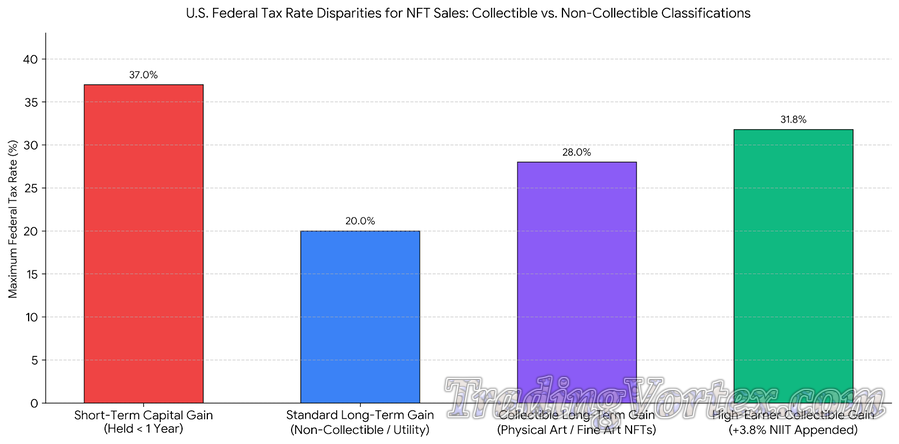
Understanding NFT Tax Classifications: How IRS Asset Rules Impact Your Net Profits
This bar chart illustrates the different federal capital gains tax rates applied to NFT transactions, showing how holding periods and asset classifications (collectible vs. non-collectible) affect your total tax liability.
How to Interpret and Utilize This Visual
-
Short-Term Capital Gains (37.0% Max Rate):
-
NFTs held for less than 12 months before being sold or swapped for crypto are taxed as ordinary income, carrying a maximum federal rate of 37.0%.
-
-
Standard Long-Term Capital Gains (20.0% Max Rate):
-
Assets held for more than one year that do not meet the definition of a "collectible" (such as gaming utility tokens or functional Web3 access passes) qualify for standard long-term capital gains rates capped at 20.0%.
-
-
Collectible "Look-Through" Classification (28.0% Max Rate):
-
Under IRS Notice 2023-27, NFTs associated with fine art, physical collectibles, gems, or trading cards fall under the "look-through" rule. Long-term gains on these assets are taxed at a higher maximum rate of 28.0% rather than the standard 20.0%.
-
-
High-Earner Net Investment Income Tax (31.8% Combined Rate):
-
For qualifying high-income investors, a 3.8% Net Investment Income Tax (NIIT) is added on top of the 28.0% collectible rate, resulting in a total federal tax rate of 31.8% on profitable fine art or collectible NFT sales.
-
Actionable Recordkeeping Tips for Traders & Investors
-
Document Basis Immediately: Because buying an NFT with appreciated crypto triggers a taxable disposal of that crypto, record the exact USD fair market value at the moment of every transaction.
-
Classify Asset Utility: Separate gaming/utility NFTs from fine art/collectible NFTs in your tax tracking tools to ensure you do not overpay or misreport gains under the 28.0% collectible rule.
-
Prepare for Form 1099-DA: Ensure all wallet-to-wallet transfers, platform fees, and gas expenses are logged, as marketplaces now report transaction activity directly to tax authorities.
How to Choose the Most User-Friendly NFT Marketplace for Your Needs
Choosing an NFT marketplace feels a lot like choosing a place to live. You can look at photos, read reviews, and ask friends for recommendations. But until you actually spend time there, you don't know if it fits. The neighborhood might be perfect for someone else and completely wrong for you.
I've moved between marketplaces more times than I care to admit. Each time, I learned something new about what I actually need versus what I thought I needed. The platform with the lowest fees wasn't always the best fit. The one with the prettiest interface wasn't always the most functional. And the one my friends loved wasn't always right for my specific trading style. There was even a period where I was convinced I needed to be on every platform at once, spreading myself thin across five different interfaces until I realized I was spending more time managing tabs than actually trading.
So let's walk through this together, step by step, so you can find the marketplace that actually fits your life instead of the one that just looks good on paper.
Step-by-Step Guide to Selecting Your First NFT Marketplace
If you're brand new to this, the sheer number of options can feel paralyzing. OpenSea, Blur, Magic Eden, Rarible, Tensor, Foundation, SuperRare.
Where do you even start? Here's a simple framework that cuts through the noise:
Step 1: Identify what you actually want to do. Are you buying art to hold? Trading collections for profit? Minting your own work? Playing a blockchain game? Each of these goals points to a different platform. A collector who buys a few pieces a year has completely different needs than a trader executing dozens of transactions a week. Be honest with yourself about which category you fall into. If you're not sure yet, that's fine too. Start with a generalist platform and let your behavior reveal your true priorities.
Step 2: Determine which blockchain you're using. This might sound technical, but it's actually the most practical starting point. An NFT minted on Solana simply won't list on Blur. An Ethereum blue chip won't appear on Magic Eden. Your chain narrows your options before anything else does. If you're not sure which chain you want, OpenSea is the safest starting point because it supports 22 chains, giving you room to explore without committing to a single ecosystem.
Step 3: Check the fees and royalty structure. Every trade involves up to three costs: the marketplace fee, network gas, and creator royalties. These vary dramatically between platforms. Blur charges 0% marketplace fees. OpenSea charges around 1% . Magic Eden charges around 2% . Don't just look at the headline number. Understand exactly what you'll pay before you commit. A 1% difference might sound trivial until you've traded $50,000 in a year and realize you could have saved $500.
Step 4: Verify liquidity for your specific interests. This is the step most people skip, and it's the one that matters most. A collection might be visible on a platform, but that doesn't mean there are active buyers there. Compare executable bid depth, spreads, and recent sales activity for the collections you care about. If the data looks thin, trust your eyes, not the platform's marketing. I learned this lesson when I spent weeks trying to sell an NFT on a platform that looked busy but had almost no actual buyers for my specific collection.
Step 5: Test with a small transaction. Before you move significant assets, buy or sell something small. Get a feel for the interface, the speed, and the support responsiveness. This is the NFT equivalent of a test drive, and it will tell you more than any review ever could. I always do a $10 test transaction before committing real money to a new platform.
Step 6: Set up approval management from day one. After you're done trading, revoke unnecessary approvals using tools like Revoke.cash. Old approvals can leave you exposed long after you've stopped using a platform. Make this a habit, not an afterthought. The Magic Eden situation in September 2026 proved that old approvals can put your assets at risk months after you've moved on.
Step 7: Bookmark the official URL. Phishing sites are everywhere, and they're getting more sophisticated. Bookmark the official marketplace URL and access it directly rather than clicking through from social media or messages. This one habit will protect you from more scams than any other security measure.
Matching the Right NFT Marketplace to Your Experience Level
Your experience level should shape your platform choice more than anything else. A platform that delights a professional trader can make a beginner want to give up entirely. And a platform that's perfect for a newcomer can feel frustratingly slow for someone who's been doing this for years. There's no shame in either direction.
The goal is to match the tool to your current skill level, not to some idealized version of where you think you should be.
If you're a complete beginner, OpenSea is almost certainly where you should start. Its value is the ability to move from category discovery to a collection page to an individual asset page without beginning inside a professional order interface. The interface is forgiving, the mobile app makes browsing easy, and the sheer volume of listings means you can explore almost any category without needing to learn a new platform.
If you're an intermediate collector who's been buying for a while and wants better tools, you might be ready for Magic Eden if you're on Solana, or Blur if you're on Ethereum. These platforms offer more advanced features without being completely overwhelming. Just expect a learning curve. Give yourself a weekend to explore the interface before you make your first trade.
If you're a professional trader, Blur is the only serious choice for Ethereum trading. Collection bids, sweeping tools, and batch actions reduce the number of steps required for active trading. The dense interface assumes stronger knowledge of orders, spreads, gas, and wallet signatures, but for professionals, that's a feature, not a bug. Time is money, and Blur saves both.
If you're a creator, Rarible deserves serious consideration because of its creator-friendly royalty enforcement. The platform allows creators to set royalties up to 50% and enforces them at the protocol level. For artists who depend on royalty income, that protection is worth the trade-offs in liquidity.
If you're a gamer, Magic Eden is the strongest choice on Solana. The platform's ecosystem-focused discovery makes it easier to browse collections whose community and utility matter alongside price. But always verify that the item is actually usable in the game before you buy. A marketplace can transfer a token successfully while the game still rejects it because the item is locked, unsupported, or linked to another account.
The key insight is this: the best platform for you depends entirely on where you are in your journey. Don't force yourself into a professional trading terminal before you understand the basics. And don't stay on a beginner-friendly platform once you've outgrown it. Growth requires discomfort, but it shouldn't require drowning.
Considering Your Preferred Blockchain and Digital Assets
Your blockchain choice is often the single biggest factor in marketplace selection. It's not just about preference. It's about where your assets actually live and where the buyers for those assets actually are. Choosing the wrong chain and platform combination is like opening a surf shop in the mountains. The product might be great, but the audience isn't there.
If you're on Ethereum, you have the most options. OpenSea offers the broadest discovery experience. Blur offers the deepest liquidity and lowest fees for active trading. For high-value blue chips like CryptoPunks or Bored Ape Yacht Club, Blur is where the serious buyers are. The two platforms serve different purposes, and many Ethereum traders use both.
If you're on Solana, Magic Eden is the default platform. It supports the full modern Solana NFT stack, including Metaplex Core, Token 22, and compressed NFTs (cNFTs). Tensor is a strong alternative for collection traders who want more advanced tools. OpenSea now supports Solana NFTs as well, but Magic Eden's Solana-native focus gives it an edge in user experience.
If you're on Bitcoin for Ordinals or Runes, your options have narrowed significantly. Magic Eden was the leader here, but it shut down its Bitcoin marketplace in March 2026. You'll need to find specialized platforms outside the scope of this guide. It's a reminder that the NFT world is bigger than any single guide can cover.
If you're a multi-chain collector, OpenSea is the only platform that covers everything. With 22 chains supported, you can buy Ethereum blue chips, Solana art, and Polygon gaming assets without ever leaving the site. The convenience comes at a slightly higher fee, but for collectors who value breadth, it's worth it.
If you're into gaming assets, Magic Eden is the strongest choice on Solana, and Axie Marketplace dominates gaming NFTs where demand is driven by actual in-game utility rather than speculation. But always verify that the item is actually usable in the game before you buy. A marketplace can transfer a token successfully while the game still rejects it because the item is locked, unsupported, or linked to another account.
The bottom line is that your blockchain choice should be driven by where the assets you want actually live. Don't buy Solana NFTs because they're cheap if you're never going to use a Solana wallet. Don't buy Ethereum NFTs because they're prestigious if you can't afford the gas fees to move them. Match the chain to your behavior, not the other way around.
Balancing Fees, Features, and Familiarity When Comparing NFT Marketplaces
There's a temptation to optimize for the lowest fees and call it a day. But fees are only one part of the equation, and optimizing for them alone can lead you to a platform that's wrong for everything else. I've seen traders chase zero-fee platforms and end up on interfaces so confusing they made more mistakes in a week than they would have made in a year on a platform with slightly higher fees.
- Fees matter, but they're not everything. Blur's 0% marketplace fee is incredible for active Ethereum traders. But if you're a Solana collector, Blur won't help you at all. Magic Eden's 2% fee is higher, but the platform's Solana focus means you get deeper liquidity for the assets you actually trade. The "cheapest" platform isn't the cheapest if it doesn't have buyers for your assets.
- Features matter, but only if you'll use them. Blur's collection bids and sweeping tools are powerful, but if you're buying one NFT every few months, you'll never touch them. OpenSea's discovery tools and rarity indicators are genuinely helpful for beginners, but experienced traders might find them slow. Match features to your actual behavior, not to what sounds impressive. A tool you never use is just clutter.
- Familiarity matters more than you think. There's a reason OpenSea remains the default starting point for so many people. The interface feels familiar. The navigation makes sense. The learning curve is gentle. That familiarity reduces anxiety and makes the whole experience less intimidating. For beginners, that's worth more than a fraction of a percent in fees.
- Support matters when things go wrong. And things will go wrong. A transaction will fail. A listing will get stuck. A wallet will disconnect at the worst possible moment. When that happens, how quickly can you get help? I've submitted test support tickets on several platforms just to see what happens. Some replied within hours. Others never replied at all. That tells you a lot about how much a platform values its users.
The right balance depends on your priorities. If you're a high-volume Ethereum trader, fees should dominate your decision. If you're a casual collector, familiarity and discovery tools should matter more. If you're a creator, royalty enforcement should be non-negotiable. There's no universal answer, only the answer that fits your specific situation.
How to Test an NFT Marketplace Before Committing Real Funds
The smartest thing you can do before committing real money to a platform is to test it with small amounts. Think of it as a test drive. You wouldn't buy a car without sitting in the driver's seat, and you shouldn't commit to a marketplace without experiencing how it actually feels to use.
Start with a small purchase. Buy the cheapest NFT you can find on the platform. It doesn't matter what it is. What matters is the experience: how easy was it to find something, how clear was the checkout process, how long did the transaction take, and how did the platform handle it? I've done this on every platform I've used, and it's revealed more about usability than any review ever could. On one platform, the buying process was so smooth that I immediately felt comfortable. On another, I spent twenty minutes trying to figure out how to confirm a transaction. That told me everything I needed to know.
Test the selling process too. List something for sale, even if it's just a test. The selling experience is often different from the buying experience, and it's where many platforms fall short. How easy is it to set a price? How clear is the fee breakdown? Can you easily cancel the listing if you change your mind? I've discovered hidden fees and confusing listing flows that only became apparent when I tried to sell.
Check the wallet interaction. Pay close attention to what the platform asks you to sign. Is the transaction preview clear? Does it show you exactly what you're approving? A platform that makes it easy to understand what you're signing is a platform that respects your intelligence. A platform that asks you to approve transactions without context is a platform that's setting you up for mistakes.
Evaluate the support responsiveness. If something goes wrong during your test, how quickly does support respond? I've submitted test support tickets on several platforms just to see what happens. Some replied within hours. Others never replied at all. That tells you a lot about how much a platform values its users. If you can't get help during a test transaction, imagine how you'll feel when you have real money on the line.
Review the approval management. After your test, check what approvals you granted. Can you easily find and revoke them? Does the platform make this process straightforward, or does it bury it in settings? The Magic Eden situation in September 2026 proved that old approvals can leave you exposed long after you've stopped using a platform. Make approval management a habit from day one.
Check the mobile experience. Even if you plan to use desktop primarily, try the mobile web or app version. You never know when you'll need to check your portfolio or respond to a time-sensitive opportunity. A platform that works well on desktop but falls apart on mobile is a platform that limits your flexibility.
The goal of testing isn't to find the perfect platform. It's to find a platform that feels right for you before you've committed significant resources. A few dollars spent on a test transaction can save you thousands in frustration later.
Mobile vs. Desktop NFT Marketplaces: Which Experience Is Better?
Here's a question that doesn't get asked enough: where are you actually going to use this platform? Your answer might determine which platform is right for you. It's not just about convenience. It's about how the interface is designed, how the data is presented, and how quickly you can execute when it matters.
Desktop experiences are generally better for active trading. Blur, for example, has no mobile app at all. It's designed for a keyboard and mouse, with dense data displays and keyboard shortcuts that would be impossible to replicate on a phone. For professional traders who need to execute quickly and manage multiple positions, desktop is the only serious option. The speed advantage of keyboard shortcuts and multiple monitors is real.
Mobile experiences are better for browsing and casual buying. OpenSea's mobile app brings the full marketplace to your phone, with wallet creation in seconds and Apple Pay integration for purchases. Magic Eden offers iOS and Android apps. If you're a collector who likes to browse on the couch or buy something when you see it on social media, a mobile-friendly platform is essential. I've made several purchases from my phone while waiting in line for coffee, and the experience was seamless.
The ideal setup for most people is both. Use desktop for serious trading and portfolio management. Use mobile for discovery and casual purchases. Most platforms now offer reasonable mobile web experiences even without dedicated apps, so you're not completely locked out if you only have your phone.
But be careful with mobile security. Mobile devices are more vulnerable to phishing and malicious apps. If you're using a mobile marketplace, be extra cautious about clicking links from unknown sources. Bookmark official marketplace URLs and access them directly rather than clicking through from social media or messages. I've seen too many people lose assets because they clicked the wrong link on their phone.
Consider your notification needs. Mobile apps can send push notifications for bids, offers, and price movements. Desktop requires you to be actively looking at the screen. If you're a trader who needs to respond quickly to market movements, mobile notifications can be a genuine advantage. If you're a long-term collector, you probably don't need real-time alerts.
The bottom line is that your device preference should influence your platform choice. If you're rarely at a computer, don't choose a platform that only works well on desktop. If you're a serious trader, don't try to execute complex strategies on your phone. Match the platform to your actual workflow, not to an idealized version of how you think you should work.
The Bottom Line: There’s No Perfect Choice, Only the Right Choice for You
If you've made it this far, you might be hoping for a single, definitive answer. "Just tell me which platform to use." I understand the impulse. It would be so much easier if there were one right answer.
But there isn't. And that's actually okay.
The NFT marketplace landscape in 2026 is fragmented by design. Each platform serves a different type of user, and the "best" one for you depends entirely on what you're trying to do. OpenSea is the forgiving gateway. Blur is the professional trading floor. Magic Eden is the Solana and gaming hub. Rarible is the creator's sanctuary. Tensor is the Solana trader's tool. Foundation and SuperRare are the curated art galleries.
My honest recommendation for most people is to start with OpenSea and expand from there. Use it to learn the basics, explore different types of NFTs, and figure out what you actually enjoy. Then, as you get more comfortable and your needs become more specialized, add other platforms to your rotation. Use Blur for Ethereum trading. Use Magic Eden for Solana. Use Rarible if you're a creator. The best traders I know use multiple platforms, switching between them based on the task at hand.
There's no loyalty in trading. There's only execution. And the platform that executes best for you is the one that fits your actual behavior, not the one that sounds coolest on social media.
So here's your homework: pick one platform, spend a week using it, and see how it feels. Then try another. Compare your experience. Pay attention to what frustrates you and what delights you. The platform that fits your workflow will reveal itself, and once you find it, you'll wonder how you ever traded without it. And if you end up using three platforms instead of one, that's not indecision. That's strategy.
📊 Step-by-Step NFT Marketplace Selection Framework: Decision Criteria & Priorities Breakdown
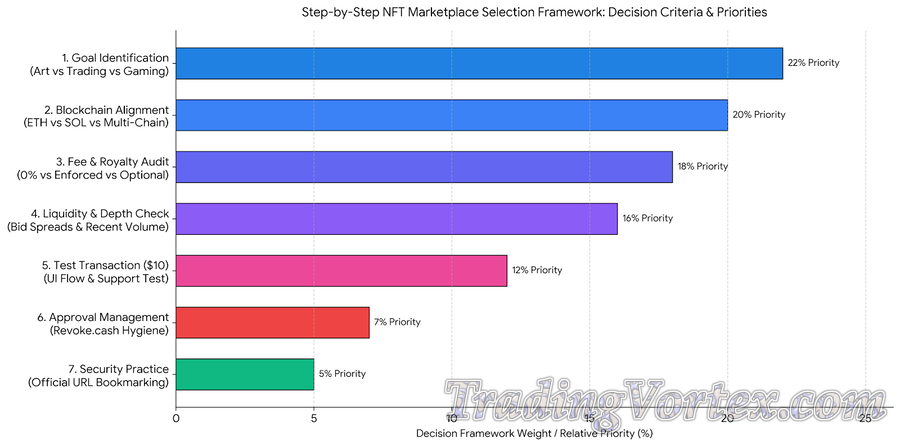
Evaluating the Ideal NFT Marketplace: A Structured Guide to Decision Making
This horizontal bar chart presents a structured, weighted framework designed to guide users through selecting the most appropriate NFT marketplace based on individual trading profiles, technical preferences, and risk tolerance.
How to Interpret and Utilize This Framework
-
Goal Identification (22% Priority):
-
Action: Define whether your primary objective is long-term art collecting, active high-volume trading, creator royalty monetization, or Web3 gaming utility.
-
Impact: Your core activity dictates the necessary interface tools—from simple discovery pages on generalist platforms to advanced order-book terminals.
-
-
Blockchain Alignment (20% Priority):
-
Action: Select platforms based on where your desired assets reside (e.g., Ethereum, Solana, Polygon, or multi-chain setups).
-
Impact: Cross-chain barriers mean your preferred blockchain automatically filters available platforms (e.g., Solana activity favors Magic Eden or Tensor, while Ethereum blue chips dominate Blur and OpenSea).
-
-
Fee & Royalty Audit (18% Priority):
-
Action: Compare combined marketplace fees (ranging from 0% on Blur to 1%–2% on OpenSea and Magic Eden) alongside creator royalty policies.
-
Impact: For high-volume traders, small fee variances accumulate into substantial costs over time, while creators should prioritize platforms enforcing protocol-level royalties.
-
-
Liquidity & Depth Check (16% Priority):
-
Action: Examine executable bid depth, bid-ask spreads, and recent sales volume for specific collections rather than relying solely on floor prices.
-
Impact: High trading volume on a platform ensures listings can be sold quickly at fair market values without experiencing severe slippage.
-
-
Test Transaction ($10) (12% Priority):
-
Action: Execute a low-value test purchase and listing to evaluate checkout clarity, transaction confirmation speed, and customer support responsiveness.
-
Impact: Experiencing the end-to-end user workflow with minimal capital prevents costly errors when managing higher-value assets.
-
-
Approval Management (7% Priority) & Security Practice (5% Priority):
-
Action: Habitually revoke unnecessary smart contract permissions using tools like Revoke.cash and bookmark official platform domains.
-
Impact: Maintaining strict wallet hygiene eliminates exposure to stale approvals and phishing threats following marketplace interactions.
-
Tips for a Smooth and Safe NFT Marketplace Experience
They can't. And once you internalize that, everything changes.
I learned this lesson the hard way, not because I lost a fortune, but because I came close. A few years ago, I almost signed a transaction that would have drained my entire wallet. The only reason I didn't was because a friend had warned me about that exact scam the week before. That near miss taught me more than any tutorial ever could. It taught me that safety isn't a feature you enable. It's a habit you build.
This section is my attempt to give you the routines and habits that make NFT trading smoother, safer, and a lot less stressful. Nothing here is revolutionary. Most of it is common sense. But common sense is surprisingly rare in a space that moves this fast and rewards this much hype.
How to Set Up a Crypto Wallet for NFT Trading
Your wallet is your identity in the NFT world. It's where your assets live, where your reputation is built, and unfortunately, where most of your risk is concentrated. Setting it up correctly from the start saves you from a world of pain later.
Choose the right wallet for your needs. If you're just starting out, a software wallet like MetaMask, Trust Wallet, or Phantom is fine for small amounts and daily trading. They're convenient, they connect easily to marketplaces, and they're free. But if you're holding significant value, you need a hardware wallet like Ledger or Trezor. Hardware wallets keep your private keys offline, which means even if your computer gets infected with malware, your assets stay safe.
The rule of thumb is simple: hot wallets for trading, cold wallets for holding. I keep about 10% of my portfolio in a hot wallet for active trading and the rest in cold storage. That balance works for me because it limits my exposure without making trading impossible.
Your seed phrase is the most important thing you will ever write down. Twelve or twenty-four words that control everything in your wallet. If someone gets them, they own your assets. Period. Never store your seed phrase online, not in Google Drive, not in a screenshot, not in a notes app. Write it on paper, or better yet, stamp it into metal. Store it in multiple physical locations. And never, ever share it with anyone, even if they claim to be from "support." I keep one copy in a fireproof safe and another in a safety deposit box. It sounds paranoid until you realize that a single compromised seed phrase can wipe out years of work.
Consider a separate wallet strategy. Don't keep everything in one wallet. Use one wallet for trading, another for DeFi interactions, and a cold wallet for long-term storage. This limits the damage if one wallet gets compromised. It's a small extra step that can save you everything. I have three wallets: a "hot" wallet for daily trades with minimal funds, a "warm" wallet for DeFi protocols I trust, and a "cold" wallet for my blue-chip NFTs. If my hot wallet gets compromised, I lose maybe a few hundred dollars. If my cold wallet stays offline, my valuable assets stay safe.
Test your backup before you need it. Write down your seed phrase, then delete your wallet and restore it using those words. If it doesn't work, you've just caught a critical error before it cost you anything. I know people who discovered their backup was wrong only after their phone died. Don't be them. It takes ten minutes to test, and it could save you everything.
Enable two-factor authentication everywhere. Your wallet, your email, your marketplace accounts. Use an authenticator app rather than SMS, because SIM swapping is a real threat. Every layer of security you add makes you a harder target.
How to Avoid Common Mistakes When Buying NFTs
Buying an NFT should be simple: find what you want, pay for it, own it. But there are traps at every step, and most of them are designed to exploit excitement and impatience.
Verify the collection contract before you buy. This is the single most important check you can do. Images and names are trivially easy to copy. Scammers create fake collections that look identical to the real thing, then sell counterfeit NFTs to people who don't check the contract address. Before you click buy, find the official collection address from the project's verified website or social media, and compare it to what you see on the marketplace. If they don't match, walk away. I almost bought a fake Bored Ape once because the collection page looked identical to the real one. The only reason I caught it was because I double-checked the contract address. That one click saved me thousands of dollars.
Check the price carefully, including the currency. Scammers sometimes change the payment currency at the last moment, hoping you'll sign without noticing. A listing that says "0.5 ETH" might actually be asking for 0.5 BTC. Always confirm the currency, the amount, and the total cost including gas and fees before you sign.
Read the wallet request. When your wallet pops up asking you to approve a transaction, read it. Not skim it. Read it. Scammers hide malicious approvals inside transactions that look normal. If the wallet asks for "unlimited access" to your tokens, that's a red flag. If the recipient address doesn't match the marketplace you're using, stop. Your wallet is your last line of defense, and it only works if you pay attention. I've made it a rule to never sign anything without reading the full details. It's slowed me down, but it's also saved me from at least two scams.
Beware of "too good to be true" deals. An NFT listed far below the floor price is usually a trap. It might be counterfeit, expired, or connected to a different contract. The lowest price is not automatically the best deal. It's often bait. I've seen listings that looked like 80% discounts but were actually for a different collection entirely, one that just happened to have the same name.
Don't rush, even when the market is moving fast. FOMO is the enemy of good decisions. If you feel pressured to buy immediately, take a breath. The NFT will still be there in five minutes. If it's not, there will be another one. The market has a way of providing opportunities for people who are patient.
How to Verify NFT Authenticity Before You Purchase
Authenticity is everything in the NFT world. A verified collection is worth something. A counterfeit is worth nothing. Here's how to tell the difference.
Look for the verified badge. On most major marketplaces, verified collections have a blue checkmark or similar indicator next to the collection name. This badge means the marketplace has confirmed that the collection is legitimate. It's not a perfect system, but it's a useful first filter.
Cross-reference the creator's identity. If the artist has a Twitter, website, or other social media presence, use it to confirm the NFT is theirs. Ask directly if the work is legitimate. Check if the collection is listed on their official channels. A real artist will be happy to confirm their work. A scammer will ignore you or get defensive. I've reached out to artists on Twitter to verify pieces before buying, and every legitimate creator responded warmly. The scammers never replied.
Check the transaction history. On platforms like OpenSea and Etherscan, you can view the transaction history of a collection. Look at the number of buyers, the volume of trades, and whether there's genuine activity. A collection with a handful of trades between two wallets is probably wash trading. A collection with hundreds of unique buyers is more likely to be legitimate. I always check the number of unique holders before buying. If it's fewer than 50, I get suspicious.
Verify the metadata storage. This is the check most people skip, and it's the one that protects you from buying an NFT that points to nothing. If the metadata is stored on a centralized server, the creator can change the image or delete it entirely. If it's stored on IPFS with a content-addressed hash, it's permanent. If it's fully on-chain, it's the gold standard. Before you buy, check where the metadata lives. A beautiful NFT that points to a broken link is worth nothing. I've bought NFTs that later showed broken images because the creator stopped paying for hosting. It's a frustrating reminder that "ownership" in the NFT world often means owning a pointer, not the thing itself.
Look for social proof, but don't trust it blindly. A collection with a large Twitter following and active Discord is more likely to be legitimate than one with no community. But social proof can be faked. Bought followers, paid influencers, and artificial engagement are all common. Use social proof as one data point among many, not as the sole reason to buy.
How to Safely Store and Manage Your NFT Collection
Buying an NFT is just the beginning. What you do after you own it determines whether it stays safe and valuable.
Keep your NFTs in your own wallet, not on a marketplace. When you leave NFTs on an exchange or marketplace account, you're trusting that platform to keep them safe. If the platform gets hacked, freezes your account, or shuts down, your assets could be locked or lost. Self-custody means you control your assets, not a company. The Binance NFT shutdown in 2026 was a wake-up call for anyone who thought exchanges were a safe place to store digital assets.
Revoke unnecessary approvals regularly. Every time you interact with a marketplace or dApp, you grant it permission to access your tokens. These approvals stay active until you revoke them. If a platform gets compromised, old approvals can be exploited. Use tools like Revoke.cash to review and revoke approvals you no longer need. Make this a monthly habit, like changing your smoke detector batteries. I've made it a recurring calendar reminder, and it's caught several old approvals I'd completely forgotten about.
Be cautious with links and DMs. Most NFT thefts start with a phishing link. Someone sends you a DM claiming to be support, or a "free mint" opportunity, or a buyer who needs you to "validate" your wallet. These are almost always scams. OpenSea will never DM you first on social media, and they will never ask for your seed phrase or private keys. If someone does, they're lying. Block them and report them.
Use bookmarks for official sites. Phishing sites often have URLs that look almost identical to the real thing, with a swapped letter or an extra word. Bookmark the official marketplace URLs and access them directly. Don't click through from social media, emails, or DMs. I have a bookmarks folder called "NFT" with all the official URLs I use. It takes five minutes to set up and prevents a whole category of mistakes.
Separate your wallets. Keep your high-value NFTs in a cold wallet that you never connect to the internet. Use a separate hot wallet for trading and interacting with marketplaces. If your hot wallet gets compromised, your valuable assets stay safe. This is the single most effective security measure you can take, and it costs nothing but a little extra planning.
Keep a record of your collection. Track what you own, where it's stored, and what you paid for it. This helps with taxes, insurance, and simply remembering what you have. I use a simple spreadsheet with columns for purchase date, price, platform, and current location. It's not glamorous, but it's saved me hours of detective work when tax season arrives.
How to Maximize Your NFT Marketplace Rewards and Savings
Fees and rewards might seem like small details, but over a year of active trading, they add up to serious money. Here's how to keep more of what you earn:
Choose the right platform for your trading volume. If you're executing dozens of transactions a week on Ethereum, Blur's 0% marketplace fee saves you thousands of dollars annually compared to platforms charging 1% or more. If you're a casual collector buying a few pieces a year, the difference is negligible, and you should prioritize familiarity and ease of use instead.
Understand the fee breakdown before you trade. Every transaction involves up to three costs: the marketplace fee, the creator royalty, and the gas fee. Know exactly what you'll pay before you sign. A platform that hides fees until checkout is a platform that doesn't respect your time or your money.
Use batch tools when available. Blur's batch buying and sweeping tools let you purchase multiple NFTs in a single transaction, amortizing the gas cost across all of them. If you're accumulating a collection, this can save you significant gas fees.
Pay attention to rewards programs. Magic Eden's Diamonds system, OpenSea's Voyages, and similar programs offer tangible benefits for active users. But be careful: some users have gamed these systems with wash trading, and platforms are cracking down. The rewards are real, but the effort to earn them should be genuine activity, not manufactured volume.
Time your transactions wisely. Gas fees fluctuate based on network congestion. If you're on Ethereum, avoid peak hours. If you're on Solana, gas is rarely a concern, but network congestion can still cause delays. Plan your trades for times when the network is quieter. I've saved hundreds of dollars by simply waiting until weekends or late nights to execute larger transactions.
Keep records for tax purposes. Every transaction has tax implications. Track your cost basis, your sale prices, and your gas fees. Marketplaces are issuing Form 1099-DA for 2025 transactions, which means the IRS is paying attention. Good records save you from panic at tax time. I keep a running spreadsheet that I update after every trade, and it's saved me from scrambling every April.
The bottom line on safety and savings: Neither happens by accident. They happen through consistent habits: checking before you click, reading before you sign, and revoking approvals you no longer need. The people who thrive in this space aren't the ones who chase the hottest drops. They're the ones who treat their wallet like a bank account, their seed phrase like a passport, and their transactions like contracts. Slow down. Verify everything. And remember that in a world with no undo button, patience is the most valuable asset you can have.
The Future of User-Friendly NFT Marketplaces
If you've made it this far, you've probably noticed something: the NFT marketplace experience in 2026 is still a work in progress. Wallets are confusing. Fees are unpredictable. Scams are everywhere. And yet, for all its flaws, this space is evolving faster than almost any other corner of the digital economy.
I've been watching these changes closely, and I genuinely believe the next few years will transform how we interact with NFTs. Not because the technology is getting more sophisticated, though it is. But because the platforms are finally starting to prioritize something they should have prioritized from the beginning: making this whole thing feel as easy as ordering food on your phone.
I remember explaining NFTs to a friend last year. I walked her through wallets, gas fees, seed phrases, and marketplace interfaces. By the end, she looked exhausted and said, "So it's like buying art, but I need a computer science degree first?" That conversation stuck with me because it captured the core problem perfectly. The promise of NFTs has always been bigger than the execution. The next generation of platforms will close that gap.
So let's talk about where we're headed. Not in a vague, hand-wavy way, but with concrete developments that are already happening and will directly affect your experience as a trader, collector, or creator.
Account Abstraction and Simplified Onboarding: The End of Seed Phrases?
The seed phrase is crypto's original sin. Twelve or twenty-four words that control everything you own, written on a piece of paper you're supposed to keep safe forever. Lose the paper, lose your assets. Get the order wrong, lose your assets. Type it into a phishing site, lose your assets. It's a system designed for maximum security and minimum usability, and it's the single biggest reason people give up on crypto before they even get started.
I can't count how many friends have asked me to help them set up a wallet, only to give up when they realized they had to write down twelve random words and store them somewhere safe forever. The anxiety is real. The friction is real. And the industry is finally doing something about it.
Account abstraction is the technical term for a simple idea: make wallets work like apps instead of like vaults. Instead of managing private keys directly, you use biometric authentication like Face ID or a fingerprint. Instead of writing down a seed phrase, you set up social recovery through trusted contacts or devices. Instead of manually approving every step of a transaction, you sign once and the system handles the rest.
The technology behind this is called ERC-4337, and as of mid-2026, it's no longer experimental. Over 40 million smart accounts have been deployed across Ethereum and major Layer 2 networks, with some estimates putting the broader number closer to 100 million when you include inactive and chain-specific deployments. More importantly, 87% of UserOperations are now sponsored by paymasters, which means users aren't paying gas fees directly in most cases. The gas fee, the seed phrase, the manual transaction confirmation, all of it is becoming invisible.
What does this mean for you? If you're on a platform like Base, you might already be using a smart account without realizing it. Coinbase Smart Wallet, Argent, and Safe are all built on this architecture. You can sign in with Google or Apple, authenticate with biometrics, and interact with applications without ever seeing a seed phrase or a gas fee. It feels like using any other app on your phone, which is exactly the point.
And the Pectra upgrade in 2025 introduced EIP-7702, which allows existing wallets like MetaMask to temporarily adopt smart account behavior without migrating to a new address. That means the millions of people who already have crypto wallets can get the benefits of account abstraction without starting over. It's a bridge between the old world and the new one.
For NFT marketplaces, this is transformative. The onboarding friction that kept casual users away is being eliminated. Buying an NFT on OpenSea or Magic Eden could soon feel as simple as buying a shirt on Amazon. No seed phrase. No gas fee confusion. No fear of making an irreversible mistake. Just click, authenticate, and own.
It's not fully here yet. Adoption is uneven. Some platforms are slower to integrate smart accounts than others. And the recovery mechanisms, while promising, still have edge cases that can go wrong. I tested a social recovery wallet last year and managed to lock myself out for three hours because I misunderstood how the guardian system worked. But the direction is clear. The seed phrase era is ending, and the next generation of NFT users might never know what they missed.
AI Integration and Smarter NFT Discovery Tools
Finding good NFTs in 2026 is like trying to find a specific book in a library where someone has thrown all the books on the floor. There are millions of collections across dozens of chains, and most of them are either scams, derivatives, or abandoned projects. The signal-to-noise ratio is brutal. I've spent entire weekends browsing collections, only to realize I'd been looking at the same derivative project with slightly different artwork for three hours.
AI is changing that, and the changes are coming from two directions.
First, AI is being built into the marketplaces themselves. OpenSea has integrated its market data with Perplexity Computer, an AI agent platform that can answer natural language questions about on-chain activity across 25+ blockchains. Instead of manually browsing collections and checking floor prices, you can ask questions like "What NFT collections are trending in the last 24 hours with a floor price under 1 ETH?" and get a real-time answer based on actual trading data.
OpenSea also launched a Model Context Protocol (MCP) that allows AI agents to query marketplace data, check drop eligibility, and even prepare mint transactions. The infrastructure is there for AI to become your research assistant, your portfolio tracker, and your discovery engine. It's not just about finding NFTs; it's about understanding the market context around them.
Second, independent AI tools are emerging. A project called Etherius, built on Fetch.ai's agent framework, allows users to ask questions like "What's trending on OpenSea?" or "Show me the floor price for Pudgy Penguins" and get instant answers. It can even execute purchases through chat using the x402 payment protocol and Coinbase Programmable Wallets.
The vision here is a marketplace that understands what you want without you having to articulate it perfectly. Imagine telling an AI agent "I want to collect art that's undervalued, from creators who are actually building communities, and I have a budget of 2 ETH." The agent scans across chains, filters out scams, checks metadata durability, and presents you with a curated list. That's not science fiction anymore. It's in development right now.
For traders, this means faster research and better decision-making. For collectors, it means discovery that actually matches your taste instead of algorithmic noise. For creators, it means a better chance of being found by the people who would actually appreciate your work.
But there's a caution here too. AI is only as good as the data it's trained on. If the data is polluted with wash trading, fake volume, and manipulated floor prices, the AI's recommendations will be polluted too. The platforms that win will be the ones that combine AI convenience with verifiable, on-chain data. Trust but verify, even when the verification is done by a machine.
Regulatory Developments and What They Mean for NFT Marketplace Users
Here's the part nobody wants to talk about, but everyone needs to understand: the regulatory landscape for NFTs is a mess, and it's going to stay messy for a while.
The fundamental question is simple: is an NFT a security? The answer is equally simple: it depends. In 2024, the SEC sent a Wells notice to OpenSea, indicating that the agency believed certain NFTs on the platform might be securities. The case is still unresolved, and the uncertainty is affecting everyone from creators to marketplace operators.
Legal experts point out that some NFTs genuinely do resemble securities. If you mint an NFT that represents a claim on dividends or profit-sharing, that's probably a security. But most NFTs, digital art, collectibles, gaming items, don't fit that description. The problem is that the SEC has been regulating by enforcement rather than providing clear rules, which creates a chilling effect on the entire industry.
The CLARITY Act, which passed the House but stalled in the Senate, was supposed to provide some of that clarity. Its treatment of digital assets could directly affect how NFTs are classified, which would determine whether marketplace operators need to register as securities exchanges and whether creator royalties are treated as ongoing financial obligations. Until it passes, everyone is operating in a gray area.
Meanwhile, the Pectra upgrade and EIP-7702 are raising their own regulatory questions. When a wallet can sponsor gas fees or batch transactions, who's responsible for compliance? The user? The wallet provider? The paymaster? These aren't hypothetical questions. They're the kind of issues that regulators are actively grappling with, and the answers will shape the next generation of NFT platforms.
For marketplace users, the practical implications are these: some platforms may restrict certain types of NFTs to avoid regulatory risk. Some creators may stop minting because the legal uncertainty isn't worth the hassle. Some features, like fractionalization or lending, may be restricted or unavailable in certain jurisdictions.
The good news is that the technology itself isn't going away. The bad news is that the rules of the road are still being written, and until they're clearer, everyone is operating in a gray area.
My advice? Stay informed, diversify your holdings, and don't put all your eggs in one regulatory basket. And if you're a creator, talk to a lawyer before you launch anything that looks like an investment product. The cost of legal advice is nothing compared to the cost of a regulatory investigation.
The Rise of Social and Community-Driven NFT Marketplaces
The first wave of NFT marketplaces was built around transactions. You came, you bought, you left. There was no community, no social layer, no reason to stay beyond the next trade. It was efficient, but it was also lonely. And loneliness doesn't build loyalty.
The next wave is different, and it's being driven by a simple insight: people want to belong, not just transact.
⛓️ Platforms like Spaace are building what they call an "NFT identity hub," where reputation badges, community cards, and squad modes create a social fabric that makes the marketplace feel like a place you belong rather than a place you visit. The idea is that your on-chain activity becomes a portable reputation that follows you across the ecosystem, and that reputation can unlock access to communities, lending opportunities, and collaborative projects. It's like a credit score, but for your taste and participation.
⛓️ Zora has taken a different but related approach. Its roadmap emphasizes protocol-level rewards for minting and curation, turning creators and community members into distribution partners rather than passive beneficiaries. The platform is also exploring token-bound accounts (ERC-6551) that let NFTs own assets, credentials, and even applications, creating richer, more dynamic experiences. Your NFT isn't just a collectible anymore. It's a character with its own inventory, its own history, and its own potential.
⛓️ ApolloNFT.io, which launched in February 2026, is explicitly designed as a "content ecosystem" rather than a collectibles marketplace. It allows creators to organize media into playlists and catalogs, import fan communities, and build branded digital experiences around their work. The platform integrates with social and payment infrastructure to create a unified identity and asset presence across multiple applications. It's less about buying and selling and more about building and belonging.
What does this mean for you? The marketplace of the future might look more like a social network than a trading floor. Discovery will happen through communities, not algorithms. Reputation will matter as much as price. And the platforms that win will be the ones that make you feel like you're part of something, not just a customer.
For traders, this is a shift in how you build your portfolio.
For collectors, it's a shift in how you find and connect with art.
For creators, it's a shift in how you build an audience and monetize your work.
I've experienced this shift firsthand. The collections I care most about aren't the ones with the highest floor prices. They're the ones where I know the creators, where I've had conversations with other collectors, where buying an NFT feels like joining a community rather than making a transaction. That's the future, and it's already here for the platforms that understand it.
Predictions for the Next Generation of User-Friendly NFT Platforms
So where does all this lead? Let me make some concrete predictions about what the next generation of NFT marketplaces will look like. Some of these are already happening. Some are a few years out. All of them are grounded in trends that are visible today.
- Prediction 1: Onboarding will be invisible. You'll sign up with an email or social login. You'll authenticate with biometrics. You'll never see a seed phrase, a gas fee, or a transaction hash unless you specifically ask for them. The blockchain will become infrastructure you don't have to think about.
- Prediction 2: Discovery will be conversational. Instead of browsing endless collections, you'll describe what you're looking for in natural language and get curated results. AI agents will handle the filtering, the scam detection, and the price comparison. You'll just say yes or no.
- Prediction 3: Multi-chain will be the default, not the exception. Users won't know or care which chain an NFT lives on. The marketplace will handle cross-chain transactions invisibly. The fragmentation that plagues the current experience will be abstracted away.
- Prediction 4: Social reputation will be a portable asset. Your trading history, your community participation, your curatorial taste will be recorded on-chain and usable across platforms. A good reputation will unlock better prices, earlier access to drops, and more trust from counterparties.
- Prediction 5: Royalties will be enforced through infrastructure, not policy. The RARI Chain approach of protocol-level enforcement will become standard. Marketplaces won't be able to make royalties optional because the infrastructure itself won't allow it.
- Prediction 6: The line between marketplace and social platform will blur. The most successful platforms will be the ones where community and commerce coexist naturally. You'll go for the people, stay for the art, and buy because you trust the recommendations.
- Prediction 7: Security will be baked in, not bolted on. Transaction previews, approval management, scam detection, and recovery mechanisms will be default features, not premium add-ons. Users won't have to be security experts to stay safe.
- Prediction 8: The user experience will finally match the promise. For years, NFTs have been sold as a revolution in digital ownership. The reality has been clunky, confusing, and risky. The next generation of platforms will close that gap. Not perfectly, but significantly.
The platforms that deliver on these predictions will be the ones that survive. The ones that don't will fade away, replaced by competitors who understand that user experience isn't a feature. It's the foundation of adoption.
And here's the thing: you're not just a passenger on this journey. You're a participant. Every time you choose a platform, you're voting for the kind of experience you want. Every time you pay a royalty, you're supporting the creators who make this ecosystem worth caring about. Every time you refuse to click a suspicious link, you're making the space safer for everyone.
The future of user-friendly NFT marketplaces isn't something that happens to you. It's something you help build. And if the past few years are any indication, it's going to be an interesting ride.
📊 NFT Safety & Risk Mitigation Pyramid: Security Habits vs. Portfolio Protection Level
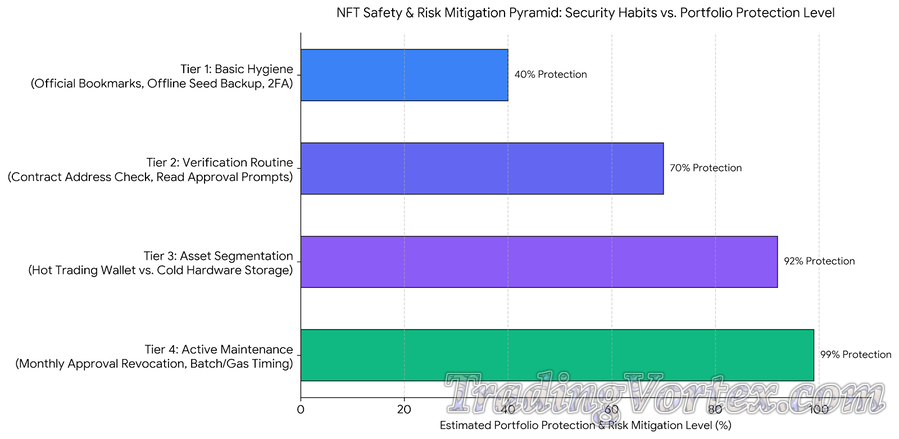
Understanding How Security Habits Tier Together to Protect Your Assets
This horizontal bar chart illustrates how adopting progressively stronger security habits builds a cumulative defense against asset loss, phishing attacks, and malicious smart contract approvals.
How to Interpret and Utilize This Visual
-
Tier 1: Basic Hygiene (40% Protection):
-
Habits: Storing seed phrases strictly offline on paper or metal, accessing marketplaces through bookmarked official URLs, and enabling app-based two-factor authentication (2FA).
-
Impact: Neutralizes generic phishing scams, fake search engine ad links, and unauthorized account access attempts.
-
-
Tier 2: Verification Routine (70% Protection):
-
Habits: Cross-referencing smart contract addresses with official project sources before clicking buy, verifying payment currencies (e.g., checking ETH vs. BTC listings), and reading full transaction approval details in your wallet.
-
Impact: Prevents purchasing counterfeit collection copies and signing hidden "unlimited access" token approvals.
-
-
Tier 3: Asset Segmentation (92% Protection):
-
Habits: Maintaining a strict wallet separation strategy—keeping a hot wallet for small daily trades (~10% of portfolio) and an offline hardware cold storage wallet (Ledger/Trezor) for high-value holdings (~90%).
-
Impact: Ensures that even if an active trading wallet is compromised through a malicious signature, high-value core holdings remain physically isolated and safe.
-
-
Tier 4: Active Maintenance (99% Protection):
-
Habits: Performing monthly audits to revoke open contract allowances via tools like Revoke.cash, testing wallet restorations with low stakes, and timing high-value transactions during low gas network hours.
-
Impact: Closes lingering security vectors left behind by old dApp approvals and minimizes operational friction.
-
Finding the Best User-Friendly NFT Marketplace: Key Takeaways and Final Recommendations
We've covered a lot of ground together. From the wallet setup nightmares to the fee structures that make your head spin, from the platforms that treat you like a pro to the ones that hold your hand through your first purchase. If your brain feels a little full right now, that's completely normal. I've been living in this space for years, and I still have moments where I need to step back and remember what actually matters.
So let's bring it all together. This final section is your chance to breathe, reflect, and walk away with a clear plan. No more comparisons. No more tables. Just the distilled wisdom from everything we've explored, packaged in a way that you can actually use.
Key Takeaways: Finding the Most User-Friendly NFT Marketplace for You
Let me start with the single most important thing I want you to remember from this entire guide: there is no universal "best" NFT marketplace. Anyone who tells you otherwise is either selling something or hasn't actually used more than one platform. The market has fragmented because users have different needs, and the platform that fits your neighbor's trading style might be completely wrong for yours. I've watched friends force themselves onto platforms that didn't suit them, convinced they were missing out on something. They weren't. They were just using the wrong tool for their specific job.
With that said, here are the takeaways that apply to almost everyone:
Your behavior should drive your platform choice, not the other way around. If you buy one NFT every few months, don't force yourself onto a professional trading terminal just because it has lower fees. If you're executing dozens of transactions a week, don't stay on a beginner-friendly platform because it feels comfortable. Match the tool to the job. It sounds obvious, but it's the most common mistake I see.
Liquidity trumps everything else. A beautiful interface with no buyers is worthless. Before you commit to a platform, check the trading volume for the specific collections you care about. I learned this the hard way when I spent weeks trying to sell an NFT on a platform that looked busy but had almost no actual buyers for my specific collection. The asset didn't change. The platform did.
- OpenSea remains the broadest generalist with the widest selection across 22 chains, including newly added Solana NFT support for collections like Mad Lads and Claynosaurz.
- Blur dominates Ethereum blue-chip liquidity with zero marketplace fees and around $7.4 billion in lifetime gross merchandise value.
- Magic Eden, after its February 2026 pivot, is now Solana-only, focusing on the chain where it has always been strongest.
Fees matter, but they're not the whole picture. Blur's 0% marketplace fee is incredible for active Ethereum traders. OpenSea's 0.5% to 1% fee is competitive for the breadth it offers. Rarible's sliding scale and protocol-level royalty enforcement make it the best choice for creators who depend on secondary sale income. The cheapest platform isn't the cheapest if it doesn't have buyers for your assets. A 1% fee on a platform where you can actually sell is worth more than 0% on a platform where you can't.
Security is a habit, not a feature. No platform can protect you from yourself. Read every wallet request. Verify contract addresses before buying. Revoke approvals you no longer need. Use hardware wallets for significant holdings. These habits will protect you far better than any marketplace's built-in safeguards. I've made it a rule to never sign anything without reading the full details, and it's saved me from at least two scams that would have cost me thousands.
The NFT market has matured, and that's a good thing. The speculation tourists have left. The people still trading NFTs are doing so because they care about digital ownership, gaming ecosystems, or building collections that mean something to them. The platforms that survived are genuinely better products than the ones that existed in 2021. The hype is gone, but the substance remains.
Small test transactions are your best friend. Before you move significant assets to a new platform, buy or sell something small. Test the experience. Get a feel for the interface, the speed, and the support responsiveness. A $10 test transaction can save you thousands in frustration later.
The Importance of Platform Diversification in Your NFT Strategy
Here's something I wish someone had told me years ago: you don't have to pick just one marketplace. In fact, the smartest traders and collectors I know use two or three platforms, rotating between them based on the task at hand.
The logic is simple. Each platform has strengths and weaknesses. OpenSea is unbeatable for discovery and multi-chain convenience. Blur is unmatched for Ethereum trading efficiency. Magic Eden is the best Solana experience. Rarible protects creator royalties like no other. Tensor offers advanced tools for Solana collection traders. Why would you limit yourself to just one set of strengths?
I use OpenSea for browsing and casual purchases. I use Blur when I'm actively trading Ethereum NFTs and want to minimize fees. I check Magic Eden when I'm exploring Solana collections. And I recommend Rarible to every creator I know who cares about royalty income. The platforms don't compete for my loyalty; they compete for my specific use case at any given moment.
There's a practical benefit to diversification too. If one platform experiences downtime, gets hacked, or changes its policies in ways you don't like, you're not stranded. You have alternatives ready. The Magic Eden wallet shutdown in May 2026 was a harsh reminder that platforms can and do change direction. Users who had spread their assets across multiple wallets and platforms were fine. Users who had everything on Magic Eden scrambled.
There's also a financial argument for diversification. Different platforms have different fee structures, different liquidity pools, and different reward programs. By spreading your activity across multiple platforms, you can optimize for each transaction. Sell your Solana NFT where the Solana buyers are. Sell your Ethereum blue chip where the Ethereum traders are. Use batch tools on Blur to save on gas. Use lazy minting on Rarible to avoid upfront costs. The savings add up over time.
The key is to match the platform to the task, not to develop loyalty to a brand. There's no loyalty in trading. There's only execution. The traders who understand this are the ones who consistently outperform the ones who don't.
Final Recommendations by User Type and Experience Level
Let me give you concrete recommendations based on who you are and what you're trying to do. Think of this as your personalized action plan:
If you're a complete beginner, start with OpenSea. It's the most forgiving platform, with the widest selection and a mobile app that makes browsing easy. Use it to learn the basics: how wallets work, how gas fees feel, how to verify collections before buying. Don't worry about optimizing fees yet. Focus on not making expensive mistakes. I introduced a friend to NFTs through OpenSea last month, and she was buying her first piece within an hour. That's the kind of onboarding that matters when you're new.
If you're a casual collector who buys a few pieces a year, OpenSea remains your best bet. The convenience of having everything in one place is worth far more than the fraction of a percent you might save elsewhere. If you're on Solana, Magic Eden gives you a more focused experience with deep liquidity for Solana-native collections.
If you're an intermediate collector ready for better tools, add Blur if you're on Ethereum, or Tensor if you're on Solana. These platforms offer more advanced features without being completely overwhelming. Expect a learning curve, but the efficiency gains are worth it. Give yourself a weekend to explore the interface before you make your first trade.
If you're a professional Ethereum trader, Blur is the only serious choice. Zero marketplace fees, collection bids, floor sweeping, batch listing, and the fastest execution in the game. The interface is dense and keyboard-driven, but for professionals, that's a feature, not a bug. The time you save on execution and the money you save on fees more than justify the learning curve.
If you're a Solana trader, use Magic Eden for its polished user experience and Tensor for advanced collection trading tools. Both platforms serve the Solana ecosystem well, and many traders use both. Magic Eden has the community and the user-friendly interface. Tensor has the speed and the advanced tools.
If you're a creator, Rarible deserves serious consideration. The platform allows royalties up to 50% and enforces them at the protocol level through RARI Chain, making them technically impossible to bypass. Lazy minting on Ethereum lets you list work for free, with the buyer paying gas only when they purchase. The trade-off is lower liquidity and a smaller audience than OpenSea, but for artists who depend on royalty income, that protection is worth it. If you're a creator who doesn't care about royalties and just wants maximum exposure, OpenSea's larger user base might serve you better.
If you're a multi-chain collector, OpenSea is the only platform that covers everything. With 22 chains supported, including Solana NFT trading added in August 2026, you can buy Ethereum blue chips, Solana art, and Polygon gaming assets without ever leaving the site.
If you're a gamer, Magic Eden is the strongest choice on Solana, and Axie Marketplace dominates gaming NFTs where demand is driven by actual in-game utility. Always verify that the item is actually usable in the game before you buy. A marketplace can transfer a token successfully while the game still rejects it because the item is locked, unsupported, or linked to another account.
The Road Ahead: What to Expect from NFT Marketplaces in the Coming Years
So where is all of this heading? Let me share my honest predictions for what the next few years will bring.
Onboarding will become invisible. Account abstraction is already here, with over 40 million smart accounts deployed and 87% of UserOperations sponsored by paymasters. The seed phrase era is ending. The next generation of NFT users will sign up with an email or social login, authenticate with biometrics, and never see a transaction hash unless they specifically ask for one. The anxiety that comes with managing private keys will fade into history, replaced by the familiar comfort of biometric authentication.
AI will transform discovery. OpenSea has already integrated its market data with AI platforms, allowing natural language questions about on-chain activity across 25+ blockchains. The marketplace of the future won't require you to browse endless collections. You'll describe what you're looking for, and an AI agent will curate results based on your taste, your budget, and your risk tolerance. It's not science fiction anymore. It's in development right now.
Multi-chain will become the default. Users won't know or care which chain an NFT lives on. The fragmentation that plagues the current experience will be abstracted away. OpenSea's Solana integration is a step toward this future. The bridges, the network switching, the gas fee calculations, all of it will be handled behind the scenes.
Social reputation will be a portable asset. Your trading history, your community participation, your curatorial taste will be recorded on-chain and usable across platforms. A good reputation will unlock better prices, earlier access to drops, and more trust from counterparties. It's like a credit score, but for your contributions to the ecosystem.
Royalties will be enforced through infrastructure, not policy. The RARI Chain approach of protocol-level enforcement will become standard. Marketplaces won't be able to make royalties optional because the infrastructure itself won't allow it. Creators will finally have the income stability they were promised from the beginning.
The line between marketplace and social platform will blur. The most successful platforms will be the ones where community and commerce coexist naturally. You'll go for the people, stay for the art, and buy because you trust the recommendations. The transactional element will still be there, but it won't be the only reason you show up.
Consolidation will continue. Magic Eden's pivot to Solana and iGaming, Blur's focus on Ethereum professionals, OpenSea's expansion into a general on-chain hub. These are all signs of a maturing market where platforms are finding their niches rather than trying to be everything to everyone.
Regulation will become clearer, eventually. The SEC's case against OpenSea and the stalled CLARITY Act are creating uncertainty that affects everyone. But clarity is coming. When it arrives, the platforms that have been operating responsibly will be positioned to thrive, and the ones that have been cutting corners will face consequences.
The platforms that deliver on these predictions will be the ones that survive. The ones that don't will fade away, replaced by competitors who understand that user experience isn't a feature. It's the foundation of adoption.
And here's the thing: you're not just a passenger on this journey. You're a participant. Every time you choose a platform, you're voting for the kind of experience you want. Every time you pay a royalty, you're supporting the creators who make this ecosystem worth caring about. Every time you refuse to click a suspicious link, you're making the space safer for everyone.
The future of user-friendly NFT marketplaces isn't something that happens to you. It's something you help build. And if the past few years are any indication, it's going to be an interesting ride.
So go out there and trade. Or collect. Or create. Or just explore. The platform that fits you is waiting, and now you have everything you need to find it. Start small. Stay curious. And remember that in a world with no undo button, patience is the most valuable asset you can have.
The best marketplace for you isn't the one with the lowest fees or the most chains or the prettiest interface. It's the one that makes you feel confident, informed, and in control. Everything else is just details.
📊 NFT Marketplace Recommendation Framework: User Personas vs. Strategic Priorities Matrix
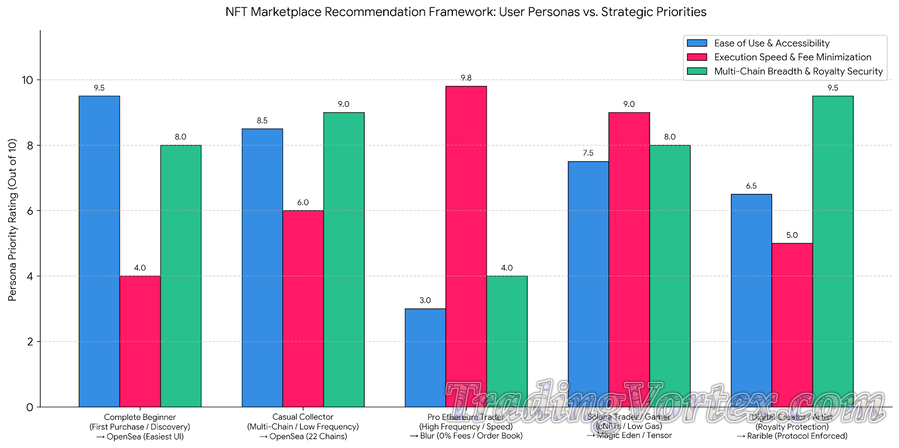
Understanding How User Priorities Dictate Marketplace Selection
This grouped bar chart maps five distinct NFT user personas against three core operational priorities: Ease of Use & Accessibility (Blue Bars), Execution Speed & Fee Minimization (Red Bars), and Multi-Chain Breadth & Royalty Security (Green Bars).
How to Interpret and Utilize This Visual
-
Complete Beginners & Casual Collectors (Primary Recommendation: OpenSea):
-
Priority Profile: Highest demand for Ease of Use (9.5) and Multi-Chain Breadth (8.0–9.0), with low emphasis on high-frequency trading speed (4.0).
-
Takeaway: Beginners and multi-chain collectors benefit most from OpenSea's forgiving onboarding interface, educational discovery tools, and 22-chain ecosystem coverage.
-
-
Professional Ethereum Traders (Primary Recommendation: Blur):
-
Priority Profile: Near-total focus on Execution Speed & Fee Minimization (9.8), placing minimal value on beginner-friendly accessibility (3.0).
-
Takeaway: Active traders executing high-volume bulk orders or floor sweeps should utilize Blur to leverage its 0% marketplace fees and order-book liquidity.
-
-
Solana Traders & Gamers (Primary Recommendation: Magic Eden / Tensor):
-
Priority Profile: Balanced demand for Execution Speed & Low Gas (9.0) alongside strong ecosystem integration (8.0).
-
Takeaway: Solana users and Web3 gamers achieve the smoothest experience on Magic Eden or Tensor, which offer dedicated support for compressed NFTs (cNFTs) and low-latency transaction settlement.
-
-
Digital Creators & Artists (Primary Recommendation: Rarible):
-
Priority Profile: Overwhelming priority placed on Royalty Security & Protocol Protections (9.5).
-
Takeaway: Artists whose business models rely on secondary revenue streams should prioritize Rarible for its 50% royalty cap and protocol-level RARI Chain enforcement.
-
Frequently Asked Questions About the Most User-Friendly NFT Marketplaces
I've been answering these questions in DMs, Discord servers, and coffee shop conversations for years. So instead of repeating myself one more time, I'm putting the answers all in one place.
Whether you're buying your first NFT or optimizing a six-figure trading operation, these are the questions that come up again and again, answered with the same honesty I'd give a friend who just asked me over text. No hype, no gatekeeping, just the practical stuff that actually helps you make better decisions.
Q1. Which NFT marketplace is the most beginner-friendly in 2026?
OpenSea is the most beginner-friendly NFT marketplace in 2026, offering the broadest collection discovery, a forgiving interface, and a mobile app with wallet creation in seconds.
In my experience, the platform that makes you feel stupid is the one you'll abandon. OpenSea does the opposite. It guides you without condescending. With over 80 million NFTs listed across its supported chains and roughly 382,000 monthly active users, it dwarfs Blur and Magic Eden in sheer breadth. The OS2 relaunch brought improved search, rarity indicators, and Apple Pay integration that removes the intimidation factor of crypto wallets entirely. I introduced a friend to NFTs through OpenSea last month, and she was buying her first piece within an hour. That's the kind of onboarding that matters when you're new. Start here to learn the basics, then expand to specialized platforms as your needs evolve.
Q2. What is the difference between OpenSea, Blur, and Magic Eden?
OpenSea is the multi-chain generalist for all users, Blur is the professional Ethereum trading terminal for high-frequency traders, and Magic Eden is the Solana and gaming hub after its 2026 pivot.
Think of them as different tools for different jobs. OpenSea supports 22 blockchains with over 80 million NFTs listed and a 0.5% marketplace fee, making it the go-to for discovery and casual collectors. Blur charges 0% marketplace fees and offers a dense Bloomberg-style interface built for speed, with around $7.4 billion in lifetime gross merchandise value. Magic Eden went Solana-only in February 2026, supports compressed NFTs for gaming assets, and charges 0% to 2% depending on chain. Market share in 2026 tells the story: OpenSea ~51%, Blur ~23%, Magic Eden ~7.7%. Most serious traders I know use two or three platforms, rotating based on the task at hand.
Q3. Which NFT marketplace has the lowest fees?
Blur charges 0% marketplace fees on all Ethereum transactions, the lowest in the industry, but the "cheapest" platform depends on your trading volume and chain.
I've done the math on my own trading history, and switching to Blur for my Ethereum trades saved me enough to buy a decent piece of art every few months. One Reddit user reported saving $1,850 in fees in a single month using Blur's batch tools. OpenSea charges 0.5% with eliminated swap fees on OS2. Magic Eden runs 0% to 2% depending on chain. Rarible charges 1% from buyer and 1% from seller. But here's the thing: a 1% fee on a platform where you can actually sell is worth more than 0% on a platform where you can't. If you're a casual collector buying a few pieces a year, the difference is negligible, and familiarity should matter more. Always calculate total costs including gas and royalties, not just the headline marketplace fee.
Q4. Is Blur suitable for beginners?
No, Blur is not suitable for beginners. Its dense, keyboard-driven interface assumes you already understand order books, collection bids, and gas optimization.
I learned this the hard way. The first time I opened Blur, I genuinely thought I had clicked on the wrong link. No pretty banners, no curated homepages, just rows of numbers and a countdown timer that made me feel like I was defusing a bomb. Setting up Blur properly takes 8 to 12 hours of learning, according to community case studies. The platform offers less guidance for beginners who still need collection history, creator context, or a slower purchase flow. There's also no mobile app, which is a deliberate choice for a professional trading platform. If you're new to NFTs, start with OpenSea to learn the fundamentals, then graduate to Blur when you're ready to execute at scale. Growth requires discomfort, but it shouldn't require drowning.
Q5. What are the most common security risks on NFT marketplaces?
The most common security risks on NFT marketplaces are rug pulls, metadata fragility, phishing scams, and exploitable wallet approvals that remain active long after you stop using a platform.
Let me be blunt: the NFT space has a scam problem, and it's systemic. Rug pulls are depressingly predictable: anonymous team, unrealistic promises, aggressive marketing, no working product, then the developers disappear with the funds. Metadata fragility means your NFT image can vanish if the creator stops paying for hosting. Wash trading inflates volumes and misleads buyers. And approval risks are the silent killer: in September 2026, a security researcher moved 3,832 NFTs from wallets that still had active approvals granted to Magic Eden months after its Ethereum marketplace shut down. OpenSea runs a bug bounty program with rewards up to $100,000 and has paid out $200,000 to ethical hackers. But no platform can protect you from clicking a malicious link. Verify contract addresses before buying, revoke unnecessary approvals regularly using Revoke.cash, use hardware wallets for significant holdings, and check metadata storage before purchasing.
Q6. How do creator royalties work on different NFT marketplaces?
Creator royalties vary dramatically across platforms: Rarible enforces them at the protocol level up to 50%, OpenSea makes them enforced or optional, Blur makes them optional with a 0.5% minimum, and Magic Eden makes them optional on Solana.
Royalties were supposed to be one of the killer features of NFTs. Then the marketplaces killed it. When Blur launched with zero fees and optional royalties, traders flooded in. Other platforms followed suit to compete for volume. Within a couple of years, royalties went from being a core feature to being a tip jar most buyers ignore. Rarible is the outlier that actually protects creators, allowing royalties up to 50% enforced at the protocol level through RARI Chain, making them technically impossible to bypass. OpenSea enforces or makes optional depending on collection settings. Blur made them optional with a 0.5% minimum. Magic Eden makes them optional on Solana unless the collection adopts the MIP-1 standard. If you're a creator who depends on royalty income, Rarible is the only major marketplace that guarantees it. If you're a collector who cares about supporting artists, pay the royalties. It's what keeps the creators you love making more work.
Q7. Which blockchain should I choose for NFT trading?
Ethereum remains the largest NFT blockchain with 45% of all activity, Solana is the fastest-growing for gaming and lower fees, and Bitcoin has emerged for high-value Ordinals.
Your chain choice should be driven by where the assets you want actually live. Ethereum remains the biggest, with $35.56 million in weekly organic sales and 45% of all remaining activity concentrated on mainnet. It's where the blue-chip collections live. Solana is the fastest-growing major chain, with weekly sales rising 11.17% and buyer addresses up 42.97% in a recent period. It's where gaming and lower fees live. Bitcoin has emerged for high-value Ordinals, with BRC-20 NFTs regularly topping individual sale charts. Polygon leads in transaction volume for physical collectible tokens. I've done more experimentation on cheap chains in a month than I did on Ethereum in a year, simply because the cost of failure was low enough to encourage trying things. Most collectors end up using multiple chains and multiple marketplaces to cover their needs.
Q8. How do NFT marketplaces make money if fees are zero?
Zero-fee platforms like Blur make money through token economics and governance incentives, not transaction fees, which creates a tension if token prices fall.
This is one of those questions that reveals how much of the NFT economy is subsidized by speculation. Blur charges 0% marketplace fees but has a BLUR token that serves as a governance and incentive mechanism. OpenSea charges 0.5% marketplace fees and 10% primary mint fees, with a planned $SEA token directing 50% of platform revenue to token buybacks. Magic Eden generates revenue from NFT fees, token trading, prediction markets, and gamified features, with 15% of platform revenue distributed to ME token stakers. Rarible uses 100% of trading fees to buy RARI tokens from the open market since September 2025. The bottom line: if token prices fall, the platform's revenue model weakens. For users, this means the "free" experience is subsidized by speculation. Understand the token model before committing significant volume.
Q9. Can I use the same NFT on multiple marketplaces?
Yes, you can list the same NFT on multiple marketplaces simultaneously because the token lives on the blockchain, not on any single platform.
Your NFT exists on the blockchain. The marketplace is just a storefront that indexes it. That means you can list on OpenSea, Blur, and Rarible at the same time to maximize visibility. Blur aggregates listings from OpenSea, X2Y2, LooksRare, and other marketplaces, routing purchases to the cheapest available venue. This is one of the reasons professional traders love it. However, cross-chain transfers are a different beast entirely. Moving an NFT from Ethereum to Solana is somewhere between difficult and impossible, and the bridges that exist are often slow, expensive, and risky. For most users, buying on the chain where the NFT lives is simpler and safer than bridging. I've tried bridging NFTs between chains, and it's never been a smooth experience. The fees are unpredictable. The wait times are long. And there's always a nagging fear that something will go wrong and your asset will be stuck in limbo forever.
Q10. How are NFTs taxed in 2026?
NFTs are taxed as property with capital gains treatment, and buying with crypto triggers a taxable event on the crypto you spend even if you never touch dollars.
Here's the part nobody wants to talk about but everyone needs to understand. 43 countries now have crypto tax guidance, up from 7 in 2014, but NFT-specific rules remain underdeveloped. Buying with crypto triggers a taxable event on the crypto you spend, because you're disposing of an appreciated asset. If you bought ETH at $1,000 and use it to buy an NFT when ETH is $4,000, you owe capital gains on that $3,000 appreciation, even though you never touched dollars. Trading NFT for NFT is treated as two separate taxable events. Marketplaces have started issuing Form 1099-DA for 2025 transactions, reported to both you and the IRS. Only 7% of jurisdictions had NFT-specific tax guidance as of 2025. My advice: track every transaction's cost basis, sale price, gas fees, and timestamp in USD at the moment of transaction. If you're trading significant volume, consult a tax professional who understands crypto. Good records save you from panic at tax time.
Q11. What is NFT lending and should I use it?
NFT lending lets you borrow against your NFTs or earn yield by lending to others, but it carries significant liquidation risks during market downturns.
Blur's Blend protocol offers peer-to-peer perpetual NFT lending with no fixed expiry date, developed in partnership with Paradigm. You can deposit an NFT as collateral and receive an ETH loan, or deposit ETH against someone else's NFT and earn interest. There's even a Buy Now, Pay Later option that lets you purchase expensive NFTs with a portion upfront, borrowing the remainder against the NFT itself. The global NFT-backed loans market was valued at $0.65 billion in 2024, projected to reach $4.13 billion by 2033 at a 22.8% CAGR. But the risks are real. Blend's Total Value Locked dropped more than 90% from its peak after mass liquidations in 2024. During market downturns, refinancing liquidity evaporates, and borrowers lose their collateral at prices far below original value. I've spoken to borrowers who lost blue-chip NFTs to liquidation during that period, and the experience was brutal. Start small, understand the liquidation mechanics, and never borrow more than you can afford to lose.
Q12. What is the future of NFT marketplaces?
The future of NFT marketplaces is invisible onboarding, AI-powered discovery, multi-chain defaults, and protocol-level royalty enforcement that makes creator payments automatic.
I've been watching these changes closely, and I genuinely believe the next few years will transform how we interact with NFTs. Account abstraction is already here: over 40 million smart accounts deployed, with 87% of UserOperations sponsored by paymasters. The seed phrase era is ending. AI integration is transforming discovery: OpenSea has integrated with AI platforms for natural language queries about on-chain activity across 25+ blockchains. Instead of browsing endless collections, you'll describe what you're looking for and get curated results. Multi-chain will become the default, with users never knowing or caring which chain an NFT lives on. Social reputation will become a portable asset, with your trading history and community participation unlocking better prices and earlier access to drops. And royalties will be enforced through infrastructure, not policy, with protocol-level enforcement making them technically impossible to bypass. The platforms that deliver on these predictions will be the ones that survive. The ones that don't will fade away, replaced by competitors who understand that user experience isn't a feature. It's the foundation of adoption.