
Web3 vs Web2: The Guide to Investment Opportunities is a comprehensive resource for investors seeking to understand how the internet’s two dominant models shape financial opportunities. The guide explains the fundamentals of Web2’s centralized platforms and Web3’s decentralized networks, highlighting their differences in ownership, governance, technology, monetization, security, and regulation.
Readers will gain insights into Web3 sectors such as DeFi, tokenization, gaming, and infrastructure, alongside Web2 strengths in AI, cloud computing, and cybersecurity. The article also explores hybrid strategies that combine stability with innovation, offering practical advice on portfolio diversification, risk management, and long‑term growth.
Written in a clear, engaging, and accessible style, this guide is designed for traders and investors of all levels. It provides actionable takeaways, balanced perspectives, and future‑proof strategies to help readers navigate the shift from centralized to decentralized systems while building resilient portfolios in the evolving digital economy.
Table of Contents:
- Introduction to Web3 vs Web2 for Investors
- What Is Web2? Understanding the Web2 Internet Model
- What Is Web3? Understanding the Web3 Decentralized Economy
- Web3 vs Web2: Key Differences for Investment Opportunities
- Web3 Market Trends and Web2 Market Trends Shaping Investments
- Web3 Investment Opportunities for Long‑Term Investors
- Web2 Investment Opportunities That Remain Strong
- Web3 Regulation vs Web2 Regulation: What Investors Must Know
- Web3 Challenges vs Web2 Challenges for Investors
- Web3 vs Web2 Portfolio Strategy for Investors
- The Future of Web3 vs Web2: Long‑Term Investment Outlook
- Conclusion: How to Navigate Web3 vs Web2 Investment Opportunities
- Frequently Asked Questions: Web3 vs Web2 Investment Opportunities
- Q1. Is Web3 safer to invest in today compared to previous years?
- Q2. Should beginners start with Web2 or Web3 investments?
- Q3. What makes Web3 different from Web2 in terms of ownership?
- Q4. Are Web3 investments too volatile for long‑term portfolios?
- Q5. What are the most promising Web3 sectors for long‑term growth?
- Q6. How does regulation affect Web3 investments?
- Q7. Can Web3 and Web2 coexist in the same portfolio?
- Q8. What role does AI play in the future of Web3 and Web2?
- Q9. How do I reduce risk when investing in Web3?
- Q10. Are tokenized real‑world assets a good investment?
- Q11. Will Web3 replace Web2 in the future?
- Q12. What is the best way to start investing in Web3?
Introduction to Web3 vs Web2 for Investors
If you have been investing for a while, you have probably noticed something interesting happening in the digital world. The internet is no longer just a place where companies build platforms and users show up. It is becoming a place where users actually own pieces of the networks they participate in. That shift, from Web2’s centralized platforms to Web3’s decentralized ownership economy, is one of the biggest investment storylines of this decade. And if you are trying to figure out where the real opportunities lie, you are in the right place.
Why Web3 vs Web2 Matters for Modern Investors
Web2 has dominated the internet for nearly twenty years. It gave us social media, cloud computing, streaming, and global connectivity. It also concentrated enormous power in the hands of a few companies that control the data, the algorithms, and the monetization. Your identity, your content, and even your economic value live on someone else’s servers. That model works, but it comes with limits that investors can no longer ignore.
Web3 flips that model. Instead of platforms owning everything, users hold their assets, identity, and data through wallets and smart contracts. In 2026, this shift is not theoretical anymore. Regulatory clarity is improving, Layer 2 scaling makes decentralized apps feel fast and familiar, and real-world use cases like tokenized treasuries, stablecoin remittances, and decentralized trading are gaining traction. Market projections show the Web3 sector reaching around ten billion dollars in 2026, with even higher estimates when you include tokenization and stablecoin infrastructure.
For investors, this means something simple: the internet is splitting into two models, and both offer very different types of opportunities.
How Web3 and Web2 Shape Today’s Digital Investment Landscape
Web2 is still incredibly strong. Centralized exchanges, cloud platforms, and AI-driven services offer deep liquidity, fast execution, and mature business models. For example, Web2 trading venues still dominate with around 1.2 billion dollars in daily liquidity and execution speeds of 5 to 10 milliseconds. Web3, by comparison, offers about 250 million dollars in liquidity and slower execution due to block confirmation times.
But Web3 brings something Web2 cannot: direct ownership and transparent, auditable systems. On-chain traders own their data, earn token incentives, and participate in governance. Web3 protocols reward liquidity providers with native tokens, while Web2 platforms typically charge fees without sharing upside. For long-term investors, this creates a new category of yield, participation, and value capture that simply did not exist before.
At the same time, Web3 is expanding beyond trading. Decentralized identity, tokenized assets, censorship-resistant platforms, and peer-to-peer financial systems are becoming real alternatives to traditional Web2 services. This is why many analysts describe 2026 as the year Web3 shifts from hype to utility.
Key Differences Investors Must Understand Before Allocating Capital
Before you start allocating capital, it helps to understand the core differences shaping both ecosystems:
- Ownership: Web2 platforms own the data and infrastructure, while Web3 distributes ownership across users and validators.
- Architecture: Web2 relies on centralized servers, while Web3 uses decentralized blockchain networks where every node validates transactions.
- Monetization: Web2 monetizes through ads and platform fees, while Web3 uses token economies that reward participation.
- Governance: Web2 decisions come from corporate boards, while Web3 uses community-driven governance through DAOs.
- Security and Transparency: Web3 offers cryptographic security and transparent ledgers, addressing many of Web2’s privacy and data control issues.
These differences are not just technical. They shape how value is created, who captures it, and how investors can participate.
- Web2 offers stability, scale, and predictable revenue models.
- Web3 offers ownership, transparency, and early-stage upside in a rapidly evolving ecosystem.
As an investor, you do not need to choose one or the other. Instead, you can understand how both models complement each other and build a strategy that captures the strengths of each. Think of Web2 as the established economy and Web3 as the emerging frontier. Both matter, and both can play a role in a balanced, forward-looking portfolio.
📊 Visual Data Insight: Web2 vs Web3 Liquidity for Investors
To help you understand the scale difference between Web2 and Web3 investment environments, the chart below compares their average daily liquidity. This matters because liquidity affects how easily you can enter or exit positions, how volatile prices may be, and how much slippage you might face when trading.
Why This Matters for Your Portfolio:
If you are building a balanced strategy, this visual helps you understand:
- Where stability lives (Web2)
- Where asymmetric upside exists (Web3)
- How both ecosystems complement each other
Use this chart as a quick reference when evaluating risk, execution speed, and long‑term potential across digital investment models.
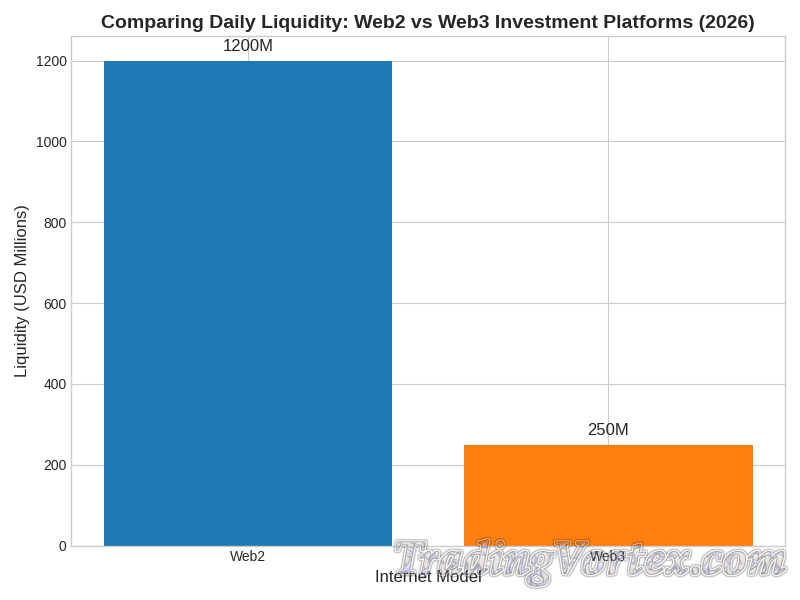 Web2 vs Web3 Daily Liquidity (2026).
How to Read This Chart:
♦ Web2 liquidity (≈ 1.2B USD) shows the maturity and depth of centralized platforms. This is why trades execute in milliseconds and why institutional investors still rely heavily on Web2 infrastructure.
♦ Web3 liquidity (≈ 250M USD) reflects a younger but rapidly growing ecosystem. While smaller today, it offers unique advantages like ownership, transparency, and token‑based incentives that Web2 cannot match.
♦ The gap you see is not a weakness of Web3, but a signal of early‑stage opportunity. Historically, markets with lower liquidity but strong growth drivers tend to offer higher upside for early investors.
What Is Web2? Understanding the Web2 Internet Model
If you think about the internet you grew up with, the one where you scroll through social feeds, shop online, watch videos, and log into apps without thinking twice, that is Web2. It is the version of the internet that turned the world into a connected marketplace, a global conversation, and a digital playground. And for investors, understanding Web2 is important because it explains how value has been created online for the past twenty years, and why a new model like Web3 is gaining momentum.
Web2 is often described as the read and write era of the internet. Users do not just consume content, they create it, share it, remix it, and build entire careers around it. At the same time, companies run the infrastructure, store the data, and control the platforms. This combination of user participation and corporate ownership is what shaped the digital economy we know today.
Web2 Features and Web2 Technology Fundamentals
Web2 became the dominant internet model because it made everything simple. You could sign up with an email, click a button, and instantly join a global network. Behind that simplicity, however, sits a powerful centralized architecture that determines how data flows, who controls it, and who profits from it.
Centralized Platforms, Data Ownership, and User Experience
Most Web2 platforms operate through centralized servers. Companies like Google, Meta, Amazon, and YouTube store user data, manage accounts, and decide how content is distributed. This model allows for fast performance, smooth interfaces, and the kind of user experience that feels almost invisible. When you open an app and everything loads instantly, that is Web2 doing its job.
The tradeoff is that your data lives on someone else’s servers, and the platform decides how it is used. For most people, this was a fair exchange because Web2 made the internet accessible, convenient, and incredibly engaging. For investors, it created some of the most profitable companies in history.
Web2 Monetization Models: Ads, Subscriptions, and Platform Fees
Web2 companies mastered the art of monetization. Their revenue models include:
- Advertising, which turns user attention into profit
- Subscription services, which create predictable recurring income
- Platform fees, which take a percentage of transactions, sales, or creator earnings
These models are powerful because they scale with user activity. The more people interact, the more valuable the platform becomes. This is why Web2 companies grew into trillion‑dollar giants. They built ecosystems where users generate the content, but the platform captures the majority of the economic value.
Web2 Limitations for Investors
As successful as Web2 has been, it comes with limitations that investors should understand, especially when comparing it to Web3. These limitations are not just technical, they affect privacy, ownership, and long‑term value distribution.
Web2 Data Risks, Privacy Issues, and Platform Dependency
One of the biggest weaknesses of Web2 is the concentration of data. When a single company controls millions or billions of user profiles, the risks increase. Data breaches, leaks, and unauthorized access have become common. Users depend on platforms to protect their information, and when something goes wrong, they have little control.
Another issue is platform dependency. If a platform changes its algorithm, policy, or business model, users and creators feel the impact immediately. Entire businesses have collapsed because a platform adjusted its rules. Investors know this well, since platform risk affects everything from advertising revenue to creator income.
Why Web2 Value Capture Favors Corporations Over Users
Web2’s economic structure is built around centralized ownership. Users create the content, generate the engagement, and fuel the growth, but the platform captures most of the value. This imbalance is one of the main reasons Web3 emerged as an alternative.
In Web2, the platform owns the data, the infrastructure, and the monetization channels. In Web3, users can own their assets, identity, and participation. For investors, this shift represents a new frontier of value creation, but it also highlights why Web2’s limitations are becoming more visible.
Still, Web2 remains incredibly strong. It offers scale, reliability, and mature business models that continue to dominate global markets. Understanding these strengths and weaknesses helps investors see how Web2 and Web3 fit together in the broader digital economy.
📊 Web2 Monetization Breakdown: Advertising, Subscriptions, and Platform Fees
To help you understand how Web2 companies generate revenue at scale, the visual below breaks down the three core monetization pillars that have powered the Web2 economy for nearly two decades. As an investor, this snapshot gives you a quick way to see where value is captured, why Web2 platforms became trillion‑dollar giants, and how user activity translates into corporate profit.
Why This Matters for You as an Investor:
This breakdown shows you exactly how Web2 captures value, and why the model has been so profitable. It also highlights the contrast with Web3, where value capture shifts toward users and participants rather than centralized platforms. Understanding this difference helps you evaluate where future growth, ownership, and monetization opportunities may emerge.
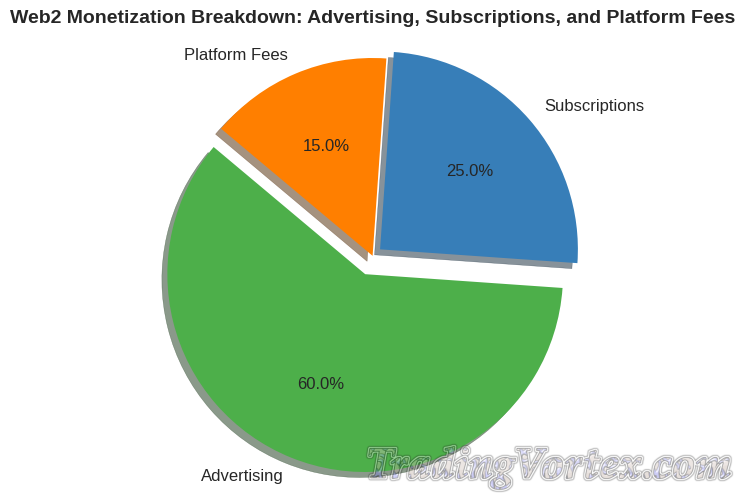 Web2 Monetization Breakdown: Advertising, Subscriptions, and Platform Fees.
How to Read This Visual:
♦ Advertising (60 percent)
This is the engine of Web2. Platforms monetize user attention by selling targeted ads. The more users scroll, post, and engage, the more ad inventory is created. This is why user data and algorithms are so valuable in Web2.
♦ Subscriptions (25 percent)
These create predictable, recurring revenue. Think of services like YouTube Premium, Spotify, or cloud storage. Subscriptions reduce volatility and help companies stabilize long‑term cash flow.
♦ Platform Fees (15 percent)
Marketplaces and creator platforms take a percentage of every sale, transaction, or payout. This model scales beautifully because the platform earns more as user activity increases.
What Is Web3? Understanding the Web3 Decentralized Economy
If Web2 is the internet most people know, Web3 is the version that finally lets users own a piece of the digital world they help create. Think of it as the moment the internet stops being a giant shopping mall owned by a few corporations and starts becoming a global marketplace where everyone can hold their own keys, assets, and identity. It is a shift that feels technical on the surface, but once you understand it, you realize it is actually about something very human: control, ownership, and freedom.
Web3 is often described as the read, write, and own era of the internet. Instead of relying on centralized servers, Web3 uses blockchain networks where data is stored across thousands of nodes. Instead of trusting a company to manage your account, you use a wallet that you control. Instead of platforms capturing all the value, users can earn tokens, participate in governance, and build wealth directly through the networks they use.
Web3 Features and Web3 Blockchain Fundamentals
Web3 is built on a few core principles that completely change how digital systems work. Once you understand these fundamentals, the entire ecosystem starts to make sense.
Decentralization, Smart Contracts, and Tokenized Digital Assets
At the heart of Web3 is decentralization. Instead of one company controlling the servers, the network is maintained by thousands of independent participants. This makes Web3 more transparent, more resilient, and less dependent on any single authority.
Smart contracts are another key ingredient. These are pieces of code that automatically execute rules without needing a middleman. They power everything from decentralized exchanges to lending protocols to tokenized assets. When you interact with a Web3 app, you are often interacting with a smart contract that handles everything behind the scenes.
Then there are tokenized digital assets, which include cryptocurrencies, NFTs, governance tokens, and real‑world asset tokens. These assets give users ownership, voting power, and financial upside.
- In Web2, your account is just a username.
- In Web3, your wallet is your identity, your bank, and your portfolio all in one.
Web3 Wallets, Digital Identity, and Permissionless Access
A Web3 wallet is not just a place to store tokens. It is your digital passport. It lets you log into apps, sign transactions, and prove ownership of assets. And the best part is that you control it, not a company.
Web3 also introduces permissionless access. Anyone can use a decentralized app without asking for approval, submitting documents, or relying on a centralized authority. This creates a more open and inclusive digital economy where innovation can happen anywhere.
Why Web3 Adoption Is Growing
Web3 is not growing because of hype anymore. It is growing because the infrastructure has matured, the use cases are real, and the technology finally feels ready for mainstream adoption.
Web3 Infrastructure Improvements: Layer‑2 Scaling and Interoperability
One of the biggest reasons Web3 is accelerating is the rise of Layer 2 networks. These scaling solutions make transactions faster, cheaper, and more efficient. What used to cost several dollars can now cost a few cents. What used to take minutes now takes seconds.
Interoperability has also improved dramatically. Blockchains can now communicate with each other, share data, and transfer assets across networks. This interconnected ecosystem makes Web3 feel less like a collection of isolated islands and more like a unified digital economy.
These improvements are not just technical upgrades. They are the foundation that allows Web3 to support real‑world applications at scale.
Web3 Use Cases: Tokenization, DeFi, Digital Ownership, and RWAs
Web3 is expanding far beyond trading and speculation. Some of the most promising use cases include:
- Tokenization, which turns real‑world assets like bonds, real estate, and commodities into digital tokens
- DeFi, which offers decentralized lending, borrowing, trading, and yield opportunities
- Digital ownership, which gives creators and users control over their content, identity, and assets
- Real‑world assets (RWAs), which bring traditional financial products onchain with transparency and efficiency
These use cases are attracting both retail users and institutional players. Banks, asset managers, and enterprises are exploring Web3 not because it is trendy, but because it solves real problems that Web2 cannot.
Web3 is no longer a futuristic idea. It is becoming a practical, scalable, and economically meaningful part of the global digital landscape. And for investors, understanding how this decentralized economy works is essential for spotting the opportunities that will define the next decade.
📊 Web3 Adoption Drivers in 2026: Scaling, Interoperability, Tokenization, DeFi, Digital Ownership, and RWAs
To help you clearly understand why Web3 adoption is accelerating, the visual below highlights the six strongest forces driving Web3 growth in 2026. These factors represent real infrastructure improvements and maturing use cases, not hype. As an investor, this chart gives you a quick, data‑driven snapshot of where Web3 is gaining traction and which areas are becoming economically meaningful.
Why This Matters for You as an Investor:
This visual helps you quickly identify where Web3’s real utility is emerging. These drivers represent structural improvements that make Web3 more scalable, more interoperable, and more economically relevant. If you are evaluating long‑term opportunities, these are the areas where innovation, capital, and user adoption are converging.
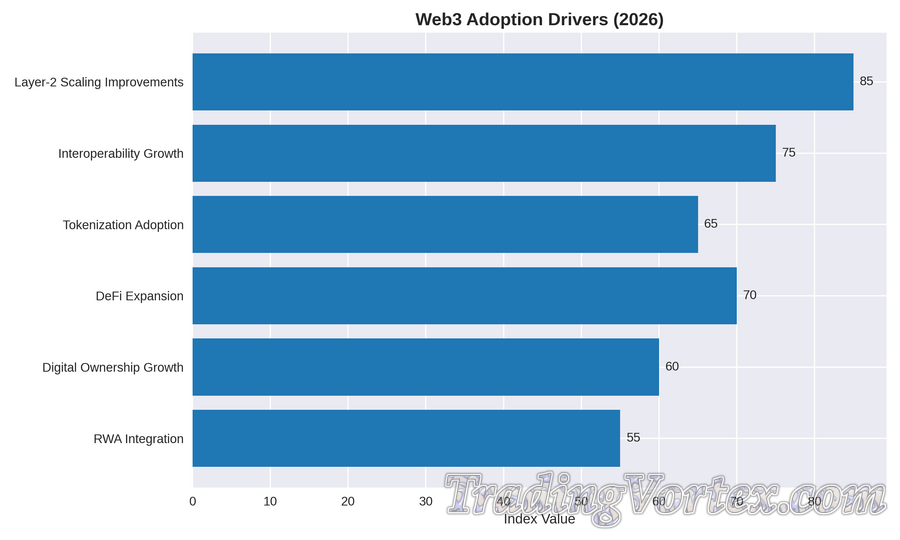 Web3 Adoption Drivers in 2026: Scaling, Interoperability, Tokenization, DeFi, Digital Ownership, and RWAs.
How to Read This Visual:
♦ Layer‑2 scaling (Index 85)
Faster, cheaper transactions make decentralized apps feel as smooth as Web2, removing one of the biggest barriers to mainstream adoption.
♦ Interoperability (Index 75)
Blockchains can now communicate and transfer assets across networks, creating a unified digital economy instead of isolated ecosystems.
♦ DeFi expansion (Index 70)
Lending, borrowing, trading, and yield strategies are becoming more efficient and secure, attracting both retail and institutional capital.
♦ Tokenization (Index 65)
Real‑world assets like bonds, real estate, and commodities are moving onchain, unlocking new liquidity and new markets.
♦ Digital ownership (Index 60)
Users can finally own their identity, content, and assets — something Web2 cannot offer.
♦ RWA integration (Index 55)
Traditional finance is entering Web3 through tokenized treasuries, onchain funds, and institutional‑grade infrastructure.
Web3 vs Web2: Key Differences for Investment Opportunities
When you compare Web2 and Web3 side by side, it becomes clear that they are not just two versions of the internet. They are two completely different economic models. One is built on centralized control, the other on decentralized ownership. One captures value at the platform level, the other distributes value across the network. And for investors, these differences are not just interesting, they are financially meaningful.
Web3 vs Web2 Ownership and Governance
Ownership is the heart of the Web2 versus Web3 debate. It determines who controls the data, who captures the value, and who gets to make decisions.
Centralized Web2 Control vs Decentralized Web3 Ownership
In Web2, platforms own the data, the infrastructure, and the monetization channels. When you post content, the platform decides how it is distributed. When you build an audience, the platform controls the algorithm. When you generate value, the platform takes the largest share.
Web3 flips this model. Users hold their assets, identity, and data through wallets. They can move their assets freely, participate in governance, and earn rewards for contributing to the network. This creates a more balanced ecosystem where ownership is shared instead of concentrated.
For investors, this means Web3 assets often come with built‑in economic rights, such as staking rewards, governance power, or yield opportunities.
Corporate Governance vs DAO Governance Models
- Web2 companies operate through traditional corporate structures. Decisions come from executives, boards, and shareholders. Users have no say in how the platform evolves.
- Web3 introduces DAOs, which allow token holders to vote on upgrades, fees, incentives, and strategic decisions. It is not perfect, but it is a step toward community‑driven governance.
Web3 vs Web2 Technology and Infrastructure
The technological foundations of Web2 and Web3 are completely different, and these differences shape performance, scalability, and investment potential.
Web2 Cloud Servers vs Web3 Distributed Networks
- Web2 relies on centralized cloud servers. This makes it fast, efficient, and easy to scale. It is why Web2 apps feel smooth and responsive.
- Web3 uses distributed blockchain networks, where thousands of nodes validate transactions. This creates transparency and resilience, but it also introduces latency and higher costs, especially on older networks.
Interoperability, Bridges, and Modular Blockchain Architecture
One of the biggest breakthroughs in Web3 is interoperability. Blockchains can now communicate, transfer assets, and share data across networks. This is a major upgrade from the early days when every chain was isolated.
Bridges, cross‑chain messaging, and modular architectures allow developers to build scalable, interconnected ecosystems. For investors, this means Web3 is becoming more efficient, more flexible, and more capable of supporting real‑world applications.
Web3 vs Web2 Monetization Models
Monetization is where Web2 and Web3 differ the most. It is also where investors can clearly see how value flows through each ecosystem.
Web2 Ad‑Driven Revenue vs Web3 Token‑Based Incentives
- Web2 platforms make money through advertising, subscriptions, and fees. Users generate the content, but the platform captures the revenue. This model has created some of the most profitable companies in history, but it leaves users with little economic participation.
- Web3 introduces token‑based incentives, where users can earn tokens for providing liquidity, validating transactions, contributing to governance, or participating in the ecosystem. This creates a more inclusive economic model where value is shared instead of extracted.
Creator Economy: Web2 Platform Cuts vs Web3 Direct Ownership
- In Web2, creators rely on platforms that take significant cuts of their revenue. Whether it is streaming, content creation, or digital sales, the platform always gets a share.
- Web3 gives creators direct ownership of their content and earnings. NFTs, decentralized marketplaces, and onchain royalties allow creators to monetize without intermediaries. This is one of the reasons Web3 is becoming a natural home for artists, developers, and entrepreneurs.
Web3 vs Web2 Security and Privacy
Security and privacy are major concerns for both investors and users. The two models approach these issues in very different ways.
Web2 Vulnerabilities vs Web3 Trustless Security
- Web2 security depends on centralized databases. When those databases are breached, millions of users are affected. This has happened repeatedly across major platforms.
- Web3 uses cryptographic security, where users control their private keys and transactions are validated by decentralized networks. This reduces the risk of mass data breaches, although it introduces new risks such as smart contract vulnerabilities.
For investors, understanding these risks is essential for evaluating protocols, platforms, and infrastructure projects.
Zero‑Knowledge Proofs and Web3 Privacy Innovations
Web2 cannot offer this level of privacy because it relies on centralized data storage. Web3’s cryptographic approach gives users more control and reduces exposure to third‑party risks.
📊 Web3 vs Web2: Key Investment Differences
To help you clearly understand how Web3 and Web2 differ from an investment perspective, the visual below compares both models across five core dimensions: ownership, governance, infrastructure, monetization, and security. These categories represent the structural forces that determine who captures value, how networks grow, and where long‑term opportunities emerge.
Why This Matters for You as an Investor:
This visual helps you quickly identify where Web3 offers structural advantages and where Web2 still dominates. Instead of thinking of Web3 as a replacement for Web2, think of it as a new economic layer that introduces ownership, transparency, and user‑aligned incentives. Understanding these differences helps you position your portfolio for both stability (Web2) and early‑stage upside (Web3).
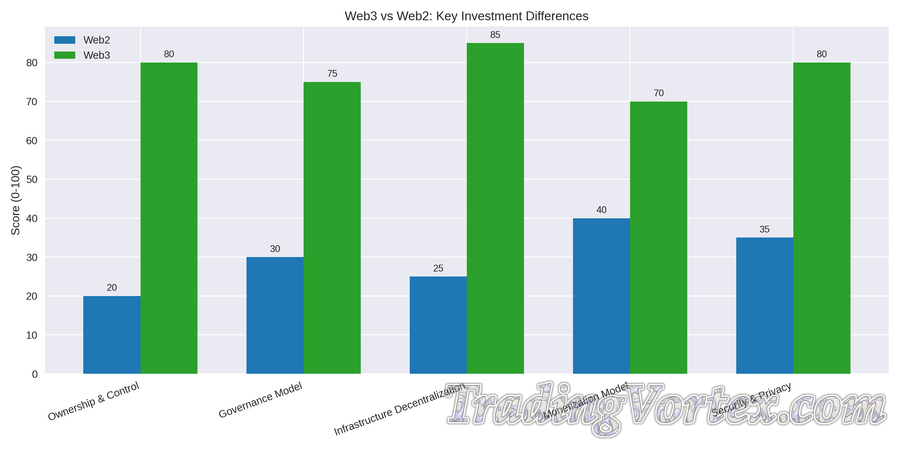 Web3 vs Web2: Key Investment Differences.
How to Read This Visual:
♦ Ownership & Control
Web2 centralizes ownership inside platforms, while Web3 distributes it across users through wallets, tokens, and onchain identity. This is why Web3 scores significantly higher.
♦ Governance Model
Web2 decisions come from corporate boards. Web3 introduces DAOs, giving token holders direct influence over upgrades, fees, and incentives.
♦ Infrastructure Decentralization
Web2 relies on cloud servers. Web3 uses distributed networks validated by thousands of nodes, creating transparency and resilience.
♦ Monetization Model
Web2 monetizes through ads, subscriptions, and platform fees. Web3 uses token‑based incentives that reward participation and distribute value across the network.
♦ Security & Privacy
Web2 depends on centralized databases, which are vulnerable to breaches. Web3 uses cryptographic security and innovations like zero‑knowledge proofs.
Web3 Market Trends and Web2 Market Trends Shaping Investments
If you have been watching the digital markets over the past few years, you have probably noticed something interesting. Web3 is no longer the wild experimental playground it used to be, and Web2 is no longer the unstoppable giant it once was. Both ecosystems are evolving fast, and the investment landscape is shifting with them. What used to be a simple choice between traditional tech stocks and speculative crypto tokens has turned into a much more nuanced environment where infrastructure, regulation, and real utility matter more than hype.
Understanding the trends shaping Web3 and Web2 in 2026 helps investors see where the real opportunities are, where the risks are hiding, and how to position themselves for long‑term growth. And the truth is, both sides of the internet are influencing each other more than ever.
Web3 Market Trends and Growth Outlook
Web3 in 2026 feels very different from the early crypto cycles. The focus has shifted from speculation to sustainability, from hype to utility, and from isolated chains to interconnected ecosystems. The projects gaining traction today are the ones solving real problems, attracting institutional interest, and building long‑term value.
Web3 Market Size, Adoption Trends, and Investor Demand
Web3 is expanding into a mature digital economy with measurable adoption. The market is growing across multiple sectors, including decentralized finance, tokenized assets, identity, and infrastructure. What stands out in 2026 is the shift in who is driving the demand. It is no longer just retail traders. Institutions, enterprises, and even governments are exploring Web3 for efficiency, transparency, and new revenue models.
Growth Drivers: DeFi, RWAs, DAOs, Web3 Gaming, and Tokenization
Several sectors are pushing Web3 forward:
- DeFi, which continues to evolve with institutional liquidity, improved risk management, and more transparent financial products
- Real‑world asset tokenization, which is becoming one of the strongest growth engines as bonds, funds, and commodities move onchain
- DAOs, which are maturing into structured, well‑funded organizations with real governance frameworks
- Web3 gaming, which is shifting from play‑to‑earn gimmicks to sustainable digital economies with real ownership
- Tokenization, which is expanding beyond finance into supply chains, identity, and digital rights
Web2 Market Trends Relevant to Investors
Web2 is not fading away. In fact, it is evolving in ways that make it more relevant than ever. The companies dominating Web2 are doubling down on artificial intelligence, cloud infrastructure, and cybersecurity. These sectors are becoming essential for both Web2 and Web3, which means investors can benefit from growth on both sides.
AI‑Driven Web2 Innovation, Cloud Expansion, and Cybersecurity
Artificial intelligence is the biggest force reshaping Web2. Companies are integrating AI into everything from search engines to enterprise software. This creates new revenue streams, new business models, and new competitive advantages. Cloud computing is also expanding as businesses rely more on distributed systems, automation, and data‑driven decision making.
Cybersecurity is another major trend. As digital threats increase, companies are investing heavily in protection, monitoring, and compliance. This is especially important because Web3 adoption depends on secure Web2 infrastructure. Without strong cybersecurity, neither ecosystem can scale safely.
How Web2 Infrastructure Supports Web3 Growth (Hybrid Models)
One of the most interesting trends in 2026 is the rise of hybrid models. Web2 and Web3 are not competing as much as they are merging. Web2 cloud providers are hosting blockchain nodes, Web2 companies are integrating tokenized assets, and Web2 platforms are experimenting with decentralized identity.
This hybrid approach creates a bridge between the two worlds. It allows Web3 to scale using Web2 infrastructure, and it allows Web2 companies to tap into new revenue opportunities through blockchain technology. For investors, this means you do not have to choose one side. You can build a portfolio that captures the strengths of both ecosystems.
Web3 brings ownership, transparency, and innovation. Web2 brings scale, stability, and enterprise adoption. Together, they are shaping the future of digital investments.
📊 Web3 vs Web2 Market Trends Shaping Investments (2026)
To help you clearly understand how Web3 and Web2 are evolving in 2026, the visual below compares the strength of key market trends across both ecosystems. These trends are based on the forces shaping adoption, institutional interest, infrastructure growth, and long‑term investment potential. As an investor, this chart gives you a quick, data‑driven snapshot of where momentum is building and how both models influence each other.
Why This Matters for You as an Investor:
This visual helps you see where each ecosystem is strongest and how they complement each other. Web3 brings ownership, transparency, and new economic models. Web2 brings scale, enterprise adoption, and AI‑powered innovation. The biggest opportunities in 2026 come from understanding how these trends intersect and building a portfolio that captures both stability and early‑stage upside.
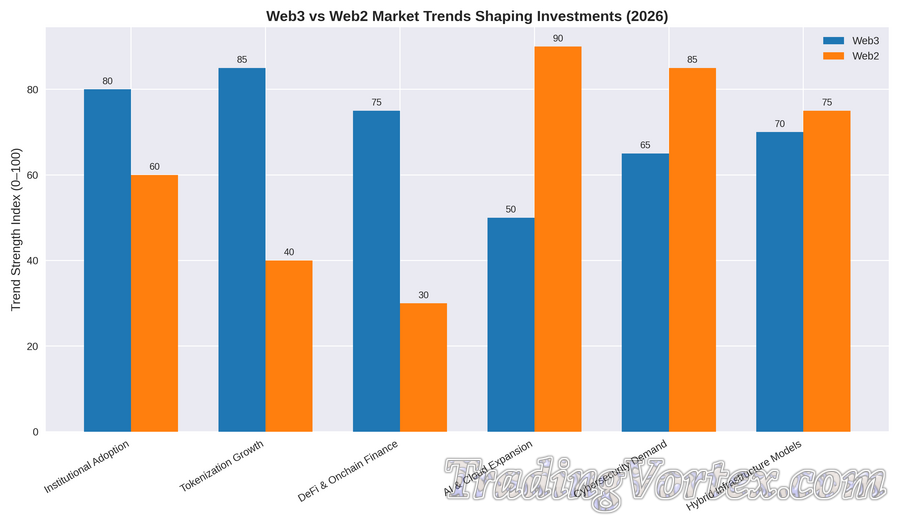 Web3 vs Web2 Market Trends Shaping Investments (2026).
How to Read This Visual:
♦ Institutional Adoption
Web3 is gaining serious traction with banks, asset managers, and enterprises, but Web2 still benefits from long‑established trust and regulatory clarity.
♦ Tokenization Growth
One of Web3’s strongest engines. Real‑world assets like bonds and funds are moving onchain, creating new liquidity and new markets.
♦ DeFi & Onchain Finance
Web3 leads here with transparent, programmable financial systems. Web2 has no equivalent, which is why its score is much lower.
♦ AI & Cloud Expansion
This is where Web2 dominates. AI‑driven innovation and cloud infrastructure remain core to enterprise growth, and Web3 depends on these systems for scaling.
♦ Cybersecurity Demand
Both ecosystems rely heavily on security. Web2 leads due to massive enterprise spending, but Web3 is rapidly improving through cryptographic security and decentralized validation.
♦ Hybrid Infrastructure Models
Web2 and Web3 are merging. Cloud providers host blockchain nodes, enterprises integrate tokenization, and decentralized apps rely on Web2 infrastructure for performance.
Web3 Investment Opportunities for Long‑Term Investors
If you have been watching Web3 evolve over the past few years, you have probably noticed something important. The space is finally growing up. The days of chasing random tokens and hoping for overnight gains are fading, and a more mature, structured, and opportunity‑rich ecosystem is taking shape. Long‑term investors are no longer asking whether Web3 will matter, they are asking where the smartest opportunities are hiding.
What makes Web3 exciting today is that it is not just a new technology trend. It is becoming a foundational layer for global finance, digital ownership, and decentralized infrastructure. And the best part is that many of the strongest opportunities are still early, accessible, and full of long‑term potential.
Web3 Sectors Offering High‑Potential Investment Opportunities
Some Web3 sectors are evolving faster than others, and these are the areas where long‑term investors are finding the most promising opportunities. These sectors combine real utility, strong demand, and improving infrastructure, which is exactly what you want when building a future‑proof portfolio.
DeFi Protocols, Yield Platforms, and Liquidity Markets
Decentralized finance has moved far beyond the experimental phase. Today, DeFi is becoming a transparent and programmable alternative to traditional financial systems. Investors are drawn to DeFi because it offers on‑chain yield, permissionless access, and global liquidity.
Modern DeFi is powered by:
- Lending and borrowing protocols
- Decentralized exchanges
- Stablecoin markets
- On‑chain liquidity networks
RWA Tokenization, Stablecoins, and On‑Chain Financial Products
Real‑world asset tokenization is one of the strongest growth engines in Web3. The value of tokenized assets has surged dramatically, and institutions are entering the space with serious capital. Tokenized treasuries, private credit, real estate, and commodities are becoming accessible to both retail and institutional investors.
What makes RWAs so compelling is their combination of traditional stability and blockchain efficiency. Settlement becomes faster, fractional ownership becomes easier, and markets become more transparent. Stablecoins also play a major role, acting as the bridge between traditional finance and Web3. They power payments, trading, and yield strategies across the entire ecosystem.
Web3 Gaming, Metaverse Assets, and Digital Ownership
Web3 gaming is evolving into a new category of digital economies. Instead of focusing on play‑to‑earn mechanics, modern Web3 games emphasize ownership, interoperability, and player‑driven markets. In these ecosystems, players can own their assets, trade them freely, and participate in the growth of the game’s economy.
Metaverse assets and digital collectibles also fall into this category. They offer exposure to digital ownership models that are becoming increasingly relevant as more of our lives move online. While this sector is still early, it has strong long‑term potential for investors who believe in the future of digital economies.
Web3 Infrastructure Investment Opportunities
Infrastructure is the backbone of Web3. It is not always the most glamorous part of the ecosystem, but it is often the most rewarding for long‑term investors. As the demand for decentralized applications grows, the networks powering them become more valuable.
Layer‑1 and Layer‑2 Blockchain Networks
Layer‑1 blockchains remain essential because they provide the base layer for decentralized applications. However, the real growth in 2026 is happening in Layer‑2 networks, which offer faster transactions, lower fees, and better scalability.
Interoperability Protocols, Oracles, and Data Availability Layers
Web3 is becoming more interconnected, and interoperability is one of the most important trends shaping the ecosystem. Protocols that allow blockchains to communicate, transfer assets, and share data are becoming essential infrastructure.
Oracles also play a critical role by bringing real‑world data onchain. They power everything from DeFi to gaming to tokenized assets. Data availability layers are another emerging category, enabling scalable and secure storage for decentralized applications.
Institutional Web3 Investment Opportunities
Institutions are entering Web3 with more confidence than ever. They are not just experimenting, they are building products, allocating capital, and integrating blockchain into their operations. This shift is creating new opportunities for long‑term investors.
Blockchain‑as‑a‑Service (BaaS) and Enterprise Web3 Solutions
Enterprises are adopting blockchain for supply chains, identity systems, payments, and data verification. Blockchain‑as‑a‑Service platforms make it easy for companies to deploy blockchain solutions without needing deep technical expertise.
Tokenized Funds, Web3 ETFs, and Institutional‑Grade Crypto Products
Institutional‑grade investment products are becoming more common. Tokenized funds, Web3 ETFs, and regulated crypto products allow investors to gain exposure to Web3 without managing wallets or navigating decentralized platforms.
📊 Web3 Long‑Term Investment Opportunity Strength by Sector (2026)
To help you clearly understand where the strongest long‑term opportunities exist in Web3, the visual below compares the investment strength of the major Web3 sectors shaping the 2026 landscape. These scores reflect a blend of adoption momentum, institutional interest, infrastructure maturity, and long‑term economic potential.
As an investor, this chart gives you a quick, data‑driven way to identify which areas of Web3 are most likely to deliver sustainable growth over the next decade.
Why This Matters for You as an Investor:
This visual helps you quickly identify where the deepest, most sustainable opportunities are emerging in Web3. Instead of chasing hype cycles, you can focus on sectors with real utility, strong demand, and long‑term economic fundamentals. These are the areas where early positioning can lead to significant upside as Web3 continues to integrate with global finance and digital infrastructure.
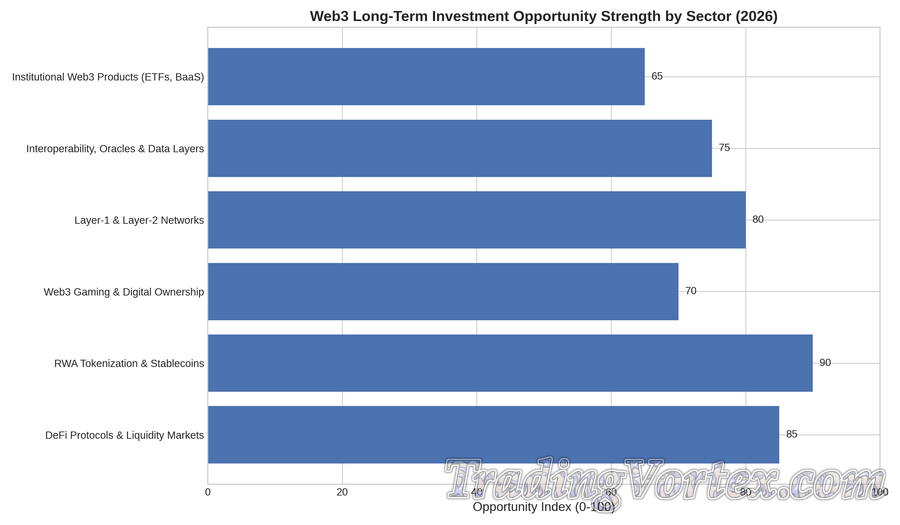 Web3 Long‑Term Investment Opportunity Strength by Sector (2026).
How to Read This Visual:
♦ RWA Tokenization & Stablecoins (Index 90)
This is the strongest long‑term opportunity in Web3. Institutions are pouring capital into tokenized treasuries, private credit, and real‑world assets. Stablecoins remain the backbone of onchain liquidity and global payments.
♦ DeFi Protocols & Liquidity Markets (Index 85)
DeFi is maturing into a transparent, programmable financial system. Real yield, institutional liquidity, and onchain financial products make this one of the most compelling sectors for long‑term exposure.
♦ Layer‑1 & Layer‑2 Networks (Index 80)
These networks are the infrastructure powering the entire ecosystem. Layer‑2 scaling is especially important, offering fast, low‑cost transactions that make Web3 feel like Web2.
♦ Interoperability, Oracles & Data Layers (Index 75)
These technologies connect blockchains, bring real‑world data onchain, and enable scalable applications. They are essential for Web3’s long‑term functionality and enterprise adoption.
♦ Web3 Gaming & Digital Ownership (Index 70)
This sector is early but promising. Ownership‑based gaming economies and interoperable digital assets are gaining traction as user experience improves.
♦ Institutional Web3 Products (Index 65)
Tokenized funds, Web3 ETFs, and enterprise blockchain solutions are expanding access to Web3. This sector offers stability and regulated exposure for long‑term investors.
Web2 Investment Opportunities That Remain Strong
Even with all the excitement around Web3, it is important to remember something simple. Web2 is not going anywhere. In fact, many of the strongest, most stable, and most profitable investment opportunities still live in the Web2 world. These companies power the global internet, secure digital infrastructure, and run the cloud systems that Web3 itself depends on. If Web3 is the shiny new frontier, Web2 is the foundation that keeps the entire digital economy standing.
For long‑term investors, Web2 offers something incredibly valuable, which is predictability. These businesses have established revenue models, massive user bases, and deep integration into enterprise operations. And in 2026, several Web2 sectors are not just surviving, they are thriving.
Web2 AI and Cloud Investment Opportunities
Artificial intelligence and cloud computing are the two engines driving Web2’s continued dominance. They are reshaping industries, transforming business operations, and creating new categories of digital infrastructure that investors cannot ignore.
AI Supercomputing, LLM Infrastructure, and Enterprise Automation
AI is no longer a niche technology. It is becoming the backbone of modern business. Companies are investing heavily in AI supercomputing, large language model infrastructure, and automation tools that streamline everything from customer service to supply chain management.
For investors, this sector offers exposure to:
- AI chips and supercomputing hardware, which power the next generation of intelligent systems
- LLM platforms and enterprise AI tools, which companies use to automate workflows and improve decision making
- AI‑driven analytics, which help businesses operate more efficiently and competitively
Cloud Computing, SaaS Platforms, and Data Infrastructure
Cloud computing remains one of the most reliable and scalable investment categories in Web2. Companies rely on cloud platforms for storage, computing power, security, and application hosting. As digital transformation accelerates, cloud adoption continues to rise across every industry.
SaaS platforms are also expanding, offering subscription‑based tools for communication, collaboration, finance, marketing, and operations. These platforms generate recurring revenue, which investors love because it provides stability and long‑term growth potential.
Data infrastructure is another critical area. As businesses collect more data, they need better tools to store, process, and analyze it. This creates opportunities in data warehousing, analytics platforms, and enterprise data management.
Web2 Cybersecurity and Digital Infrastructure Investments
Cybersecurity is one of the most important sectors in the Web2 world. As digital threats grow more sophisticated, companies are increasing their security budgets and adopting advanced tools to protect their systems. This trend is not slowing down, and it creates strong opportunities for investors.
Web2 Security Solutions Supporting Web3 Adoption
Cybersecurity is essential for both Web2 and Web3. Even decentralized systems rely on Web2 infrastructure for hosting, networking, and user access. This means Web2 security companies play a major role in enabling safe Web3 adoption.
Investors can find opportunities in:
- AI‑powered security platforms, which detect and respond to threats faster than traditional tools
- Identity and access management, which protects user accounts and sensitive data
- Network and cloud security, which safeguard enterprise systems and digital assets
As more businesses adopt blockchain and decentralized technologies, the demand for strong cybersecurity solutions continues to rise.
Enterprise Data Governance and Compliance Technologies
Data governance and compliance are becoming essential for companies operating in a digital world. Regulations are tightening, data privacy expectations are rising, and businesses need tools that help them manage data responsibly.
This creates opportunities in:
- Compliance automation, which helps companies meet regulatory requirements
- Data protection and encryption, which safeguard sensitive information
- Audit and monitoring tools, which ensure transparency and accountability
Web2 may not be as flashy as Web3, but it remains a powerful engine of growth. AI, cloud computing, cybersecurity, and enterprise infrastructure continue to shape the digital economy, and they offer some of the most reliable investment opportunities available today.
📊 Web2 Long‑Term Investment Opportunity Strength by Sector (2026)
To help you clearly understand where the strongest long‑term opportunities remain in Web2, the visual below compares the investment strength of the major Web2 sectors driving growth in 2026. These scores reflect a blend of enterprise demand, infrastructure maturity, revenue stability, and long‑term scalability. As an investor, this chart gives you a quick, data‑driven snapshot of which Web2 sectors continue to offer reliable, high‑potential returns.
Why This Matters for You as an Investor:
This visual helps you quickly identify where Web2 continues to deliver strong, stable, and scalable investment opportunities. While Web3 is growing fast, Web2 remains the backbone of global digital infrastructure. AI, cloud computing, cybersecurity, and enterprise data systems are not just surviving: they are expanding, strengthening, and powering the next generation of digital innovation.
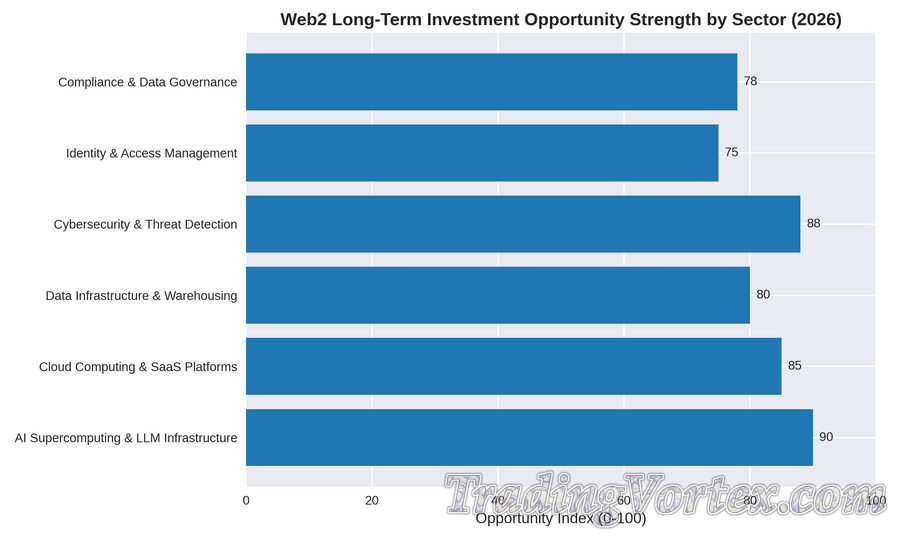 Web2 Long‑Term Investment Opportunity Strength by Sector (2026).
How to Read This Visual:
♦ AI Supercomputing & LLM Infrastructure (Index 90)
This is the strongest Web2 opportunity. Businesses everywhere are adopting AI, and demand for compute power, chips, and enterprise LLM tools is exploding.
♦ Cybersecurity & Threat Detection (Index 88)
As digital threats grow, companies are increasing their security budgets. This sector benefits from mandatory spending and long‑term enterprise contracts.
♦ Cloud Computing & SaaS Platforms (Index 85)
Cloud adoption continues to rise across every industry. SaaS platforms generate recurring revenue, making this one of the most stable Web2 investment categories.
♦ Data Infrastructure & Warehousing (Index 80)
Companies are collecting more data than ever, and they need scalable systems to store, process, and analyze it. This sector grows alongside AI and cloud.
♦ Compliance & Data Governance (Index 78)
With global regulations tightening, businesses must invest in compliance automation, encryption, and audit tools. This creates predictable, long‑term demand.
♦ Identity & Access Management (Index 75)
As cyber risks increase, identity protection becomes essential. This sector supports both Web2 and Web3 adoption by securing user access and sensitive data.
Web3 Regulation vs Web2 Regulation: What Investors Must Know
If you have ever tried to understand crypto regulation, you probably know the feeling. One day everything seems allowed, the next day a new rule drops and suddenly half the industry is scrambling to adjust. The good news is that 2026 is finally bringing clarity.
Governments around the world are moving from vague guidelines to real, enforceable frameworks. And for investors, this shift is incredibly important because regulation shapes liquidity, risk, and long‑term opportunity.
Web2, on the other hand, has been regulated for decades. It operates under familiar rules around data protection, consumer rights, and corporate governance. Web3 is only now catching up, and the way regulators approach it is reshaping the entire digital asset landscape.
Global Web3 Regulatory Trends
Web3 regulation in 2026 is defined by one big theme, which is standardization. After years of uncertainty, major jurisdictions are aligning on stablecoin rules, exchange licensing, AML requirements, and institutional custody standards. This is creating a more predictable environment for investors, builders, and financial institutions.
Stablecoin Rules, Exchange Licensing, and AML Requirements
Stablecoins are at the center of global regulation. Governments want to ensure that stablecoins are backed by high‑quality reserves, offer reliable redemption rights, and operate under strict governance standards. This is not just about consumer protection, it is about financial stability.
Exchanges are also facing clearer licensing requirements. Regulators expect platforms to meet the same standards as traditional financial institutions, including transparency, risk controls, and proper segregation of customer assets.
AML rules are tightening as well. Web3 companies must implement stronger identity verification, transaction monitoring, and reporting systems. This may sound heavy, but it actually helps legitimize the industry and attract institutional capital.
Institutional On‑Ramps and Safer Custody Frameworks
One of the biggest changes in 2026 is the rise of institutional on‑ramps. Banks and regulated financial firms are now allowed to offer custody services, stablecoin issuance, and blockchain‑based payment solutions. This is a major shift because it brings traditional finance and Web3 closer together.
Safer custody frameworks are also emerging. Institutions are required to follow strict rules around asset segregation, insurance, and operational controls. For investors, this means fewer risks related to exchange failures or mismanagement.
These developments make Web3 feel less like the wild west and more like a regulated financial ecosystem with real protections.
How Regulation Impacts Web3 Investment Opportunities
Regulation does not just affect compliance teams. It directly influences which projects survive, which markets grow, and where capital flows. For long‑term investors, understanding these dynamics is essential.
Compliance Costs, Market Consolidation, and Jurisdictional Hubs
As rules become stricter, compliance costs increase. Smaller projects may struggle to keep up, which leads to market consolidation. The winners are usually the teams with strong governance, transparent operations, and sustainable business models.
Jurisdictional hubs are also emerging. Regions with clear, supportive regulations are attracting talent, capital, and innovation. These hubs become hotspots for new projects, institutional partnerships, and long‑term growth.
For investors, this means that regulatory clarity is not just a legal detail, it is a competitive advantage.
Regulatory Clarity as a Catalyst for Web3 Institutional Adoption
The most important impact of regulation is that it unlocks institutional participation. When rules are clear, banks, asset managers, and enterprises feel confident entering the market. This increases liquidity, reduces volatility, and strengthens the entire ecosystem.
Regulatory clarity also encourages the development of new financial products, such as tokenized funds, regulated stablecoins, and compliant DeFi platforms. These products make it easier for investors to gain exposure to Web3 without taking unnecessary risks.
In other words, regulation is not the enemy of innovation. It is the foundation that allows Web3 to scale safely, attract serious capital, and become a long‑term part of the global financial system.
📊 Web3 vs Web2 Regulatory Impact Factors for Investors (2026)
To help you clearly understand how regulation affects Web3 and Web2 differently, the visual below compares the six most important regulatory factors shaping investment decisions in 2026. These factors influence liquidity, institutional participation, market stability, and long‑term risk.
As an investor, this chart gives you a quick, data‑driven way to see where Web3 is catching up, where Web2 still leads, and how regulation shapes opportunity across both ecosystems.
Why This Matters for You as an Investor:
This visual helps you quickly identify how regulation shapes investment risk and opportunity across Web3 and Web2. Clear rules reduce uncertainty, attract institutional capital, and strengthen market infrastructure. As Web3 regulation matures, it becomes safer, more scalable, and more aligned with global financial standards, unlocking new opportunities for long‑term investors.
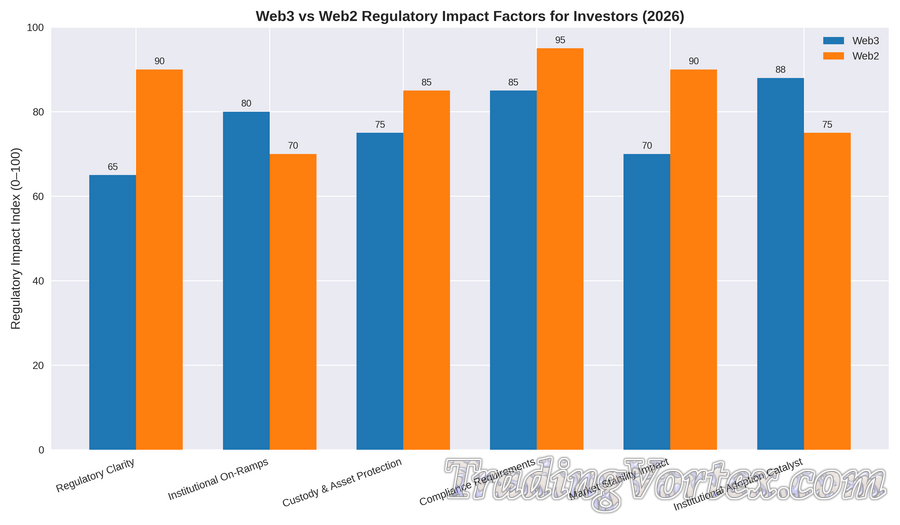 Web3 vs Web2 Regulatory Impact Factors for Investors (2026).
♦ How to Read This Visual:
Regulatory Clarity
Web2 has decades of established rules, while Web3 is still standardizing frameworks for stablecoins, exchanges, and compliance. This is why Web2 scores higher here.
♦ Institutional On‑Ramps
Web3 is rapidly improving thanks to new licensing regimes, bank‑supported custody, and regulated stablecoin frameworks. This is one of Web3’s strongest areas.
♦ Custody & Asset Protection
Web2 benefits from mature custodial systems. Web3 is improving fast with segregated custody, insurance requirements, and institutional‑grade controls.
♦ Compliance Requirements
Web2 has strict, well‑defined compliance standards. Web3 is now adopting similar AML, KYC, and reporting rules, which increases operational demands but also boosts legitimacy.
♦ Market Stability Impact
Web2 markets are more stable due to long‑standing regulation. Web3 is stabilizing as rules become clearer, but volatility remains higher.
♦ Institutional Adoption Catalyst
Regulatory clarity is unlocking institutional capital for Web3. This is one of the areas where Web3 now outperforms Web2 in terms of growth momentum.
Web3 Challenges vs Web2 Challenges for Investors
Every investment ecosystem has its strengths and weaknesses, and both Web3 and Web2 come with their own set of challenges. If you have spent time in the crypto space, you already know that Web3 can feel like a roller coaster. One moment you are excited about decentralized ownership, the next you are wondering why a simple transaction requires three confirmations and a small prayer. Web2 is more stable, but it has its own issues, especially around data control, regulation, and platform dependency.
Understanding these challenges helps investors make smarter decisions, manage risk, and build portfolios that can survive both innovation cycles and market turbulence.
Web3 Adoption Challenges
Web3 is full of potential, but it is also full of friction. The technology is powerful, yet the user experience often feels like it was designed by engineers for other engineers. This creates barriers that slow down mainstream adoption.
Web3 UX Complexity, Wallet Friction, and User Trust Issues
Let’s be honest. Using Web3 for the first time can feel intimidating. Wallets, seed phrases, gas fees, and network switching are not exactly beginner friendly. Even experienced traders sometimes double check their transactions three times before clicking confirm.
This complexity creates friction, which slows adoption and makes new users hesitant. Trust is another issue. Many people still associate Web3 with scams, hacks, and speculative tokens. Even though the ecosystem is maturing, the reputation challenges remain.
For investors, this means adoption may grow slower than expected, especially among mainstream users who prefer convenience over control.
Web3 Security Risks: Bridges, Smart Contracts, and Scams
Web3 security is improving, but it is far from perfect. Bridges, which connect different blockchains, remain one of the biggest attack vectors. Smart contracts can contain bugs, and once deployed, they are difficult to fix. Scams and phishing attacks also continue to target inexperienced users.
These risks do not mean Web3 is unsafe, but they do mean investors must be cautious. Smart contract audits, reputable platforms, and strong security practices are essential for protecting capital.
Web3 Infrastructure Challenges
Web3 infrastructure is evolving quickly, but it still faces technical and educational challenges that affect scalability and adoption.
Interoperability Limitations and Scaling Constraints
Interoperability has improved, but it is not perfect. Some blockchains still operate in silos, and cross‑chain communication can be slow or risky. Scaling is another challenge. Even with Layer 2 networks, high demand can cause congestion and increased fees.
These limitations affect user experience and can slow down the growth of decentralized applications. For investors, this means infrastructure projects that solve these problems may offer strong long‑term potential.
Education Gaps and Onboarding Barriers for New Investors
Web3 requires a level of technical understanding that many new users simply do not have. Concepts like private keys, staking, liquidity pools, and tokenomics can feel overwhelming. Without proper education, users may make mistakes or avoid the ecosystem entirely.
This creates an onboarding barrier that slows adoption. It highlights the importance of platforms that simplify the experience and provide clear, accessible guidance.
Web2 Challenges That Still Affect Investors
Web2 may be more familiar and stable, but it is far from perfect. Many of its challenges are structural, and they affect both users and investors.
Centralized Data Risks, Platform Lock‑In, and Algorithmic Control
Web2 platforms control user data, content distribution, and monetization. This creates platform lock‑in, where users and businesses depend heavily on a single company’s rules and algorithms. A small policy change can impact millions of users overnight.
Data breaches are another major issue. Centralized databases remain attractive targets for hackers, and even the largest companies struggle to protect user information.
For investors, these risks can affect company valuations, regulatory exposure, and long‑term stability.
Increasing Regulatory Pressure on Web2 Tech Giants
Web2 companies face growing regulatory pressure around privacy, data protection, antitrust concerns, and content moderation. Governments are tightening rules, imposing fines, and demanding more transparency.
This regulatory environment creates uncertainty for investors. While Web2 companies remain strong, they must navigate a complex landscape that can impact growth, profitability, and innovation.
📊 Web3 vs Web2 Challenge Severity for Investors (2026)
To help you clearly understand how Web3 and Web2 differ in terms of risk and friction, the visual below compares the severity of key challenges that investors face in each ecosystem. These challenges influence adoption speed, user trust, regulatory exposure, and long‑term investment stability.
As an investor, this chart gives you a quick, data‑driven way to see where Web3 struggles the most, where Web2 still has structural weaknesses, and how these issues shape portfolio decisions.
Why This Matters for You as an Investor:
This visual helps you quickly identify where each ecosystem carries the most risk.
- Web3 challenges are mostly technical and educational, which means they improve over time as infrastructure matures.
- Web2 challenges are structural and regulatory, which means they persist and can impact valuations, compliance costs, and long‑term growth.
Understanding these differences helps you build a portfolio that balances innovation with stability, while avoiding the blind spots that catch many investors off guard.
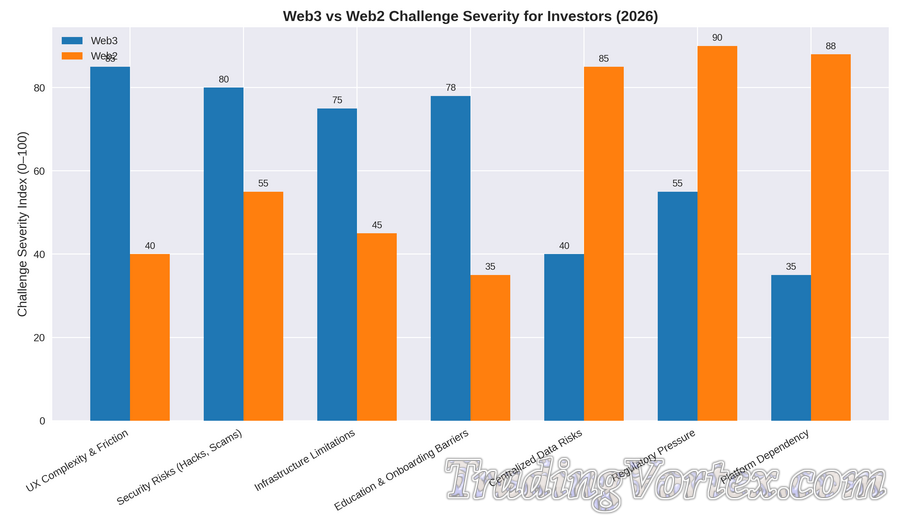 Web3 vs Web2 Challenge Severity for Investors (2026).
How to Read This Visual:
♦ Web3 UX Complexity & Friction (Index 85)
Web3’s biggest challenge is still user experience. Wallets, seed phrases, gas fees, and network switching create friction that slows mainstream adoption.
♦ Web3 Security Risks (Index 80)
Bridges, smart contract bugs, and scams remain major attack vectors. Security is improving, but caution is essential.
♦ Web3 Infrastructure Limitations (Index 75)
Interoperability gaps and scaling constraints still affect performance, especially during high‑demand periods.
♦ Web3 Education Barriers (Index 78)
Concepts like private keys, staking, and tokenomics create onboarding challenges for new investors.
♦ Web2 Centralized Data Risks (Index 85)
Web2’s biggest weakness is centralization. Data breaches and privacy issues remain major concerns.
♦ Web2 Regulatory Pressure (Index 90)
Tech giants face increasing scrutiny around privacy, antitrust, and content moderation, creating uncertainty for investors.
♦ Web2 Platform Dependency (Index 88)
Businesses and creators rely heavily on centralized platforms. Algorithm changes or policy shifts can disrupt entire industries overnight.
Web3 vs Web2 Portfolio Strategy for Investors
Building a smart portfolio in 2026 is not about choosing Web3 or Web2. It is about understanding how both ecosystems create value and how they can complement each other.
- Web2 offers stability, predictable revenue, and mature business models.
- Web3 offers ownership, innovation, and asymmetric upside.
When you combine them thoughtfully, you get a portfolio that can grow steadily while still capturing the explosive potential of emerging technologies.
Think of it like balancing comfort and adventure. Web2 is the comfortable part of your portfolio, the part that lets you sleep at night. Web3 is the adventurous part, the part that keeps things exciting and opens the door to opportunities you cannot find anywhere else.
Web3 vs Web2 Risk Profiles and Investment Horizons
Web3 and Web2 operate on different risk levels, time horizons, and market dynamics. Understanding these differences helps investors allocate capital more intelligently.
High‑Volatility Web3 Assets vs Stable Web2 Tech Equities
Web3 assets tend to be more volatile. Prices can move quickly, liquidity can shift, and narratives can change overnight. This volatility is not necessarily a bad thing. It creates opportunities for outsized returns, especially for long‑term investors who understand the fundamentals.
Web2 tech equities, on the other hand, offer stability and predictable growth. These companies generate revenue, hold market share, and operate in regulated environments. They may not deliver the same explosive upside as early Web3 projects, but they provide a solid foundation for any portfolio.
A balanced approach often includes both, with Web2 acting as the anchor and Web3 providing the growth engine.
Long‑Term vs Short‑Term Investment Considerations
Web3 rewards long‑term conviction. Many of the strongest projects take years to mature, especially in sectors like infrastructure, tokenization, and decentralized finance. Short‑term trading can work, but it requires experience, discipline, and a strong understanding of market cycles.
Web2 investments tend to be more straightforward. They benefit from long‑term trends like cloud adoption, AI integration, and enterprise digital transformation. These trends move slowly and steadily, which makes Web2 ideal for long‑term compounding.
The key is matching your time horizon with the right assets. Web3 for long‑term asymmetric upside, Web2 for steady compounding and risk reduction.
Hybrid Web3 + Web2 Investment Strategies
The smartest investors in 2026 are not choosing sides. They are building hybrid portfolios that combine the strengths of both ecosystems. This approach captures innovation without sacrificing stability.
Combining Web2 AI Infrastructure with Web3 Decentralized Networks
AI and Web3 are becoming deeply interconnected. Web2 companies are building the AI models, cloud systems, and data infrastructure that Web3 applications rely on. At the same time, Web3 is creating decentralized networks that can support AI agents, data marketplaces, and tokenized compute.
A hybrid strategy might include:
- Web2 AI companies that provide the hardware and cloud infrastructure
- Web3 networks that tokenize compute, storage, or data
- Projects that integrate AI with decentralized protocols
This combination gives investors exposure to both sides of the technological revolution.
Diversifying Across Chains, Sectors, and Geographies
Web3 diversification is not just about holding multiple tokens. It is about spreading exposure across:
- Layer 1 and Layer 2 networks
- DeFi, RWAs, gaming, and infrastructure
- Different regulatory jurisdictions
- Multiple ecosystems like Ethereum, Solana, Cosmos, and modular chains
Web2 diversification includes:
- AI companies
- Cloud providers
- Cybersecurity firms
- SaaS platforms
- Data infrastructure companies
A diversified hybrid portfolio reduces risk and increases the chances of capturing long‑term winners.
Building a Balanced Web3 and Web2 Portfolio
Allocating Between Digital Assets, Tokenized Assets, and Tech Stocks
A typical balanced allocation might include:
- Web2 tech stocks, which provide stability and long‑term compounding
- Web3 digital assets, which offer high‑growth potential
- Tokenized assets, which combine traditional stability with blockchain efficiency
- Infrastructure plays, which benefit from both Web2 and Web3 adoption
The exact allocation depends on your risk profile, but the principle remains the same. Web2 provides the foundation, Web3 provides the upside.
Risk Management and Position Sizing for Web3 Investments
Web3 requires thoughtful risk management. Position sizing is essential because volatility can be high. Many long‑term investors use strategies like:
- Smaller positions in early‑stage tokens
- Larger positions in established networks
- Staking or yield strategies to generate passive income
- Avoiding overexposure to any single chain or sector
The goal is not to eliminate risk, but to manage it intelligently so that your portfolio can grow sustainably over time.
A well‑balanced Web3 and Web2 portfolio gives you the best of both worlds. You get the innovation, ownership, and upside of Web3, combined with the stability, scale, and predictability of Web2. In a digital economy that is evolving faster than ever, this hybrid approach is one of the smartest strategies an investor can adopt.
📊 Web3 vs Web2 Portfolio Strategy Factors for Investors (2026)
To help you understand how Web3 and Web2 behave inside a modern investment portfolio, the visual below compares the six most important strategic factors that influence allocation decisions in 2026. These factors shape volatility, growth potential, stability, diversification, and overall risk management.
As an investor, this chart gives you a clear, data‑driven snapshot of how each ecosystem contributes differently to a balanced portfolio.
Why This Matters for You as an Investor:
This visual helps you quickly understand how Web3 and Web2 complement each other inside a portfolio.
- Web3 provides innovation, upside, and exposure to emerging digital economies.
- Web2 provides stability, predictability, and long‑term compounding.
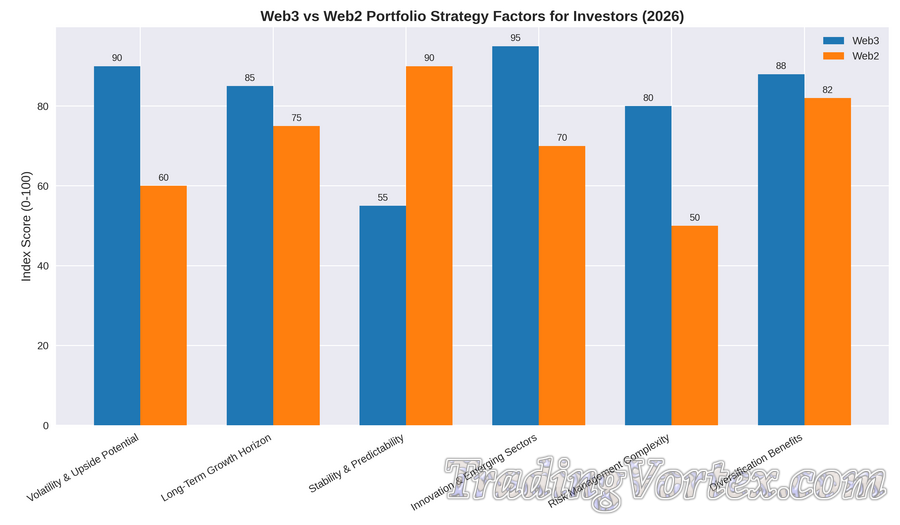 Web3 vs Web2 Portfolio Strategy Factors for Investors (2026).
How to Read This Visual:
♦ Volatility & Upside Potential
Web3 scores much higher because early‑stage networks, tokens, and emerging sectors offer asymmetric upside. This also means higher risk.
♦ Long‑Term Growth Horizon
Both ecosystems offer long‑term potential, but Web3 edges ahead thanks to tokenization, DeFi, and decentralized infrastructure growth.
♦ Stability & Predictability
Web2 dominates here. Mature revenue models, regulatory clarity, and enterprise adoption make Web2 the “anchor” of a hybrid portfolio.
♦ Innovation & Emerging Sectors
Web3 leads by a wide margin. New sectors like RWAs, decentralized AI, and modular blockchains create continuous innovation cycles.
♦ Risk Management Complexity
Web3 requires more active management due to volatility, liquidity shifts, and evolving regulation. Web2 is simpler to manage.
♦ Diversification Benefits
Both ecosystems provide strong diversification, but Web3 offers exposure to entirely new asset classes unavailable in traditional markets.
The Future of Web3 vs Web2: Long‑Term Investment Outlook
If you zoom out and look at the digital world from a long‑term perspective, something fascinating becomes clear. Web2 and Web3 are not fighting for survival. They are evolving side by side, each shaping the future in its own way.
- Web2 continues to dominate global infrastructure, enterprise software, and AI development.
- Web3 is building a new foundation for ownership, decentralization, and programmable value.
And over the next decade, these two worlds will not drift apart, they will converge.
For investors, this convergence opens the door to opportunities that did not exist before. The future is not about choosing one ecosystem over the other. It is about understanding how both will influence global markets, digital economies, and long‑term value creation.
The Convergence of Web3, AI, and IoT
The next decade will be defined by the merging of three major forces: Web3, artificial intelligence, and the Internet of Things. Together, they will create a digital environment that is more autonomous, more interconnected, and more user‑driven than anything we have seen before.
Decentralized Compute, Autonomous Agents, and Smart Economies
AI is becoming more powerful, and Web3 is giving it a new home. Decentralized compute networks allow AI models to run on distributed infrastructure instead of centralized servers. This reduces costs, increases resilience, and opens the door to autonomous agents that can operate onchain.
Imagine AI agents that can:
- Manage portfolios
- Execute smart contract strategies
- Trade on decentralized exchanges
- Interact with tokenized assets
- Perform tasks across multiple blockchains
These agents will power smart economies, where machines transact with each other, settle payments instantly, and operate without intermediaries. For investors, this means exposure to a new category of digital productivity that blends AI intelligence with blockchain transparency.
Modular Blockchains and Zero‑Knowledge‑Powered Applications
Modular blockchains are becoming the backbone of Web3. Instead of one chain doing everything, modular systems separate execution, settlement, and data availability. This makes networks faster, cheaper, and more scalable.
Zero‑knowledge technology is also transforming Web3. It allows users to prove information without revealing sensitive data. This unlocks new applications in identity, compliance, payments, and enterprise adoption.
Together, modular architecture and zero‑knowledge proofs will make Web3 more efficient, more private, and more enterprise friendly. For investors, this means long‑term growth in infrastructure projects that support these innovations.
The Rise of User‑Owned Digital Economies
One of the most powerful ideas behind Web3 is the shift from platform‑owned economies to user‑owned economies. This shift is already happening, and it will accelerate over the next decade.
Tokenized Everything: Assets, Identity, Compute, and Data
Tokenization is expanding far beyond finance. In the future, almost everything that has value can be represented as a digital token. This includes:
- Real estate
- Intellectual property
- Identity credentials
- Compute resources
- Personal data
- Energy credits
- Supply chain assets
This creates a world where ownership is transparent, transferable, and programmable. For investors, tokenization opens the door to new asset classes, new liquidity models, and new ways to generate yield.
How Web3 Could Redefine Global Digital Markets
Web3 has the potential to reshape global markets by making them more open, more efficient, and more inclusive. Instead of relying on centralized intermediaries, markets can operate on decentralized rails with lower fees, faster settlement, and global accessibility.
This shift could redefine:
- Payments
- Lending
- Trading
- Identity verification
- Digital commerce
- Creator monetization
Web2 will still play a major role, especially in AI, cloud computing, and enterprise software. But Web3 will introduce new economic models that give users more control and create new opportunities for investors who understand the long‑term potential.
The future is not Web2 or Web3. It is Web2 plus Web3, working together to build a digital economy that is smarter, more transparent, and more user‑centric than anything we have seen before.
📊 Future Outlook Comparison: Web3 vs Web2 Long‑Term Investment Factors (2026)
To help you understand how Web3 and Web2 are positioned for the next decade, the visual below compares the six most important long‑term investment factors shaping both ecosystems. These factors highlight where Web3 is accelerating, where Web2 remains dominant, and how the two will increasingly converge.
As an investor, this chart gives you a clear, data‑driven snapshot of where long‑term value creation is likely to emerge.
Why This Matters for You as an Investor:
This visual helps you quickly understand how Web3 and Web2 will shape the next decade of digital investment.
- Web3 leads in decentralization, tokenization, and programmable value.
- Web2 leads in AI, cloud, and enterprise infrastructure.
- The biggest opportunities come from the convergence of both ecosystems.
A long‑term portfolio that captures this convergence is positioned to benefit from both stability and innovation.
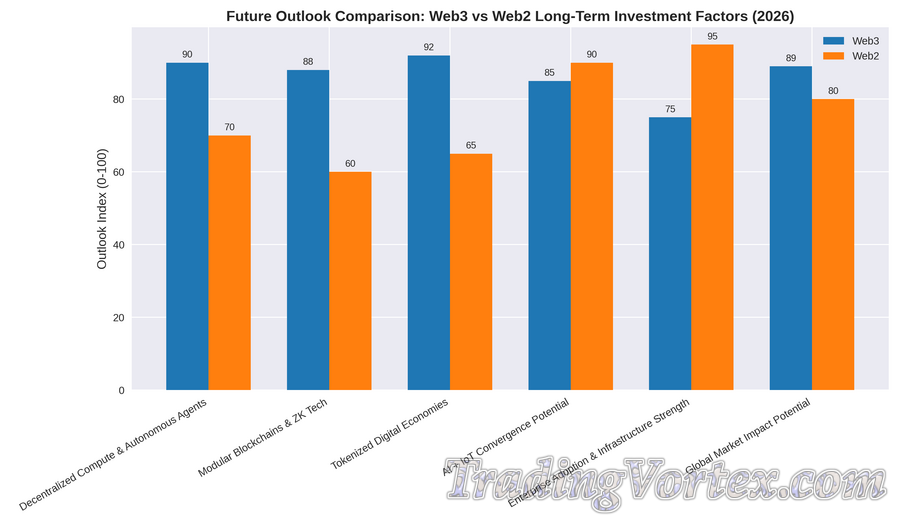 Future Outlook Comparison: Web3 vs Web2 Long‑Term Investment Factors (2026).
How to Read This Visual:
♦ Decentralized Compute & Autonomous Agents
Web3 leads here. Decentralized compute networks and on‑chain AI agents are becoming a new category of digital productivity, blending AI intelligence with blockchain automation.
♦ Modular Blockchains & Zero‑Knowledge Tech
Web3 is rapidly advancing with modular architectures and ZK‑powered applications that improve scalability, privacy, and enterprise readiness.
♦ Tokenized Digital Economies
Web3 dominates this category. Tokenization is expanding into real estate, identity, compute, data, and supply chains: creating new asset classes and liquidity models.
♦ AI + IoT Convergence Potential
Web2 still has the edge thanks to its dominance in AI infrastructure, cloud systems, and enterprise IoT deployments. Web3 is catching up as decentralized compute grows.
♦ Enterprise Adoption & Infrastructure Strength
Web2 remains the backbone of global digital infrastructure. Cloud, AI, and enterprise software give Web2 a strong long‑term foundation.
♦ Global Market Impact Potential
Both ecosystems score high. Web2 drives enterprise transformation, while Web3 introduces new economic models that reshape global markets.
Conclusion: How to Navigate Web3 vs Web2 Investment Opportunities
If you have made it this far, you already understand something that many investors still overlook. Web3 and Web2 are not rivals fighting for dominance. They are two powerful ecosystems shaping the future of the digital economy in different ways.
- Web2 brings stability, scale, and proven business models.
- Web3 brings ownership, transparency, and new forms of value creation.
The smartest investors are not choosing one side, they are learning how to navigate both.
The truth is, the digital world is evolving faster than ever. Technologies are converging, markets are shifting, and new opportunities are emerging every year. The key is staying informed, staying flexible, and staying open to innovation.
Key Takeaways for Web3 and Web2 Investors
If you remember only a few things from this guide, let it be these:
- Web2 remains a strong foundation, especially in AI, cloud computing, cybersecurity, and enterprise software
- Web3 is becoming a mature economic layer, driven by tokenization, decentralized finance, and user‑owned digital assets
- Both ecosystems are converging, creating hybrid opportunities that combine stability with innovation
- Regulation is improving, which increases institutional confidence and long‑term growth potential
- Diversification is essential, because each ecosystem carries different risks and rewards
In other words, Web2 gives you the structure, Web3 gives you the upside, and together they create a balanced digital investment landscape.
How to Build a Future‑Proof Investment Strategy
A future‑proof strategy is not about predicting the next hype cycle. It is about building a portfolio that can grow steadily while still capturing the breakthroughs that will define the next decade.
A strong strategy usually includes:
- Reliable Web2 assets, such as AI companies, cloud providers, and cybersecurity leaders
- High‑potential Web3 assets, including infrastructure networks, DeFi protocols, and tokenized financial products
- Tokenized real‑world assets, which blend traditional stability with blockchain efficiency
- A hybrid approach, where Web2 and Web3 complement each other instead of competing
The goal is not to chase every trend. The goal is to position yourself where long‑term value is being created.
Final Thoughts on the Shift from Centralized to Decentralized Systems
We are living through one of the biggest technological transitions of our lifetime. Web2 built the digital world we know today, but Web3 is redefining how value flows within it. The shift from centralized systems to decentralized ownership is not happening overnight, but it is happening steadily, and it is reshaping everything from finance to identity to global markets.
As an investor, you do not need to predict every twist and turn. You simply need to understand the direction of the movement. And the direction is clear. The future belongs to systems that are more open, more transparent, and more user‑centric.
Web2 will continue to grow. Web3 will continue to expand. And the investors who learn how to navigate both will be the ones who benefit the most.
If you approach this space with curiosity, patience, and a willingness to adapt, you will be well positioned to capture the opportunities that lie ahead.
Frequently Asked Questions: Web3 vs Web2 Investment Opportunities
Q1. Is Web3 safer to invest in today compared to previous years?
Web3 is definitely safer than it used to be, but it is not risk free. The ecosystem now has clearer regulations, better custody solutions, and more mature infrastructure, which helps reduce uncertainty. Still, investors must stay cautious because smart contract bugs, phishing attacks, and bridge vulnerabilities remain common. The safest approach is to combine trusted platforms, hardware wallets, and basic security habits.
Q2. Should beginners start with Web2 or Web3 investments?
If you are completely new to investing, starting with Web2 can feel more comfortable because it offers stable companies, predictable revenue models, and lower volatility. Once you understand the basics, you can explore Web3 for higher‑growth opportunities like DeFi, tokenization, and infrastructure networks. Many investors use Web2 as the foundation and Web3 as the growth layer.
Q3. What makes Web3 different from Web2 in terms of ownership?
Web2 platforms own the data, the algorithms, and the monetization channels. Web3 flips this model by giving users direct ownership of their assets, identity, and participation through wallets and tokens. This shift creates new ways for users to earn, govern, and build wealth online.
Q4. Are Web3 investments too volatile for long‑term portfolios?
Web3 assets are more volatile, but volatility is not always a bad thing. It creates asymmetric upside, especially for early investors who choose strong projects. The key is position sizing, diversification, and long‑term conviction. Many long‑term investors treat Web3 as a smaller but high‑potential part of their portfolio.
Q5. What are the most promising Web3 sectors for long‑term growth?
Some of the strongest sectors in 2026 include DeFi, real‑world asset tokenization, Layer 2 scaling networks, Web3 gaming, decentralized identity, and AI‑powered blockchain applications. These sectors combine real utility with strong demand and improving infrastructure.
Q6. How does regulation affect Web3 investments?
Regulation is becoming clearer, which is great for investors. Governments are introducing stablecoin rules, exchange licensing, AML requirements, and institutional custody frameworks. This reduces uncertainty and encourages institutional participation, which strengthens the entire ecosystem. The main challenge is that compliance costs may push out weaker projects.
Q7. Can Web3 and Web2 coexist in the same portfolio?
Absolutely. In fact, the best portfolios in 2026 combine both. Web2 provides stability and predictable growth, while Web3 offers innovation and high‑potential upside. Together, they create a balanced strategy that captures the strengths of both ecosystems.
Q8. What role does AI play in the future of Web3 and Web2?
AI is becoming deeply integrated into both ecosystems. Web2 companies use AI for automation, analytics, and enterprise solutions. Web3 uses AI for autonomous agents, decentralized compute, and smart economies. The convergence of AI and Web3 is one of the biggest long‑term trends shaping digital markets.
Q9. How do I reduce risk when investing in Web3?
A few simple habits go a long way:
♦ Use hardware wallets for long‑term storage
♦ Stick to audited protocols and reputable platforms
♦ Diversify across chains, sectors, and asset types
♦ Avoid overexposure to early‑stage tokens
♦ Learn the basics of wallet security and transaction verification
Risk cannot be eliminated, but it can be managed intelligently.
Q10. Are tokenized real‑world assets a good investment?
Tokenized RWAs are becoming one of the strongest growth areas in Web3. They combine traditional stability with blockchain efficiency, making them attractive for both retail and institutional investors. They offer exposure to assets like bonds, real estate, and private credit, all with faster settlement and greater transparency.
Q11. Will Web3 replace Web2 in the future?
No, Web3 will not replace Web2. Instead, they will merge and complement each other. Web2 will continue to dominate cloud computing, AI, and enterprise software. Web3 will introduce new models of ownership, identity, and value creation. The future is a hybrid digital economy where both ecosystems work together.
Q12. What is the best way to start investing in Web3?
Start simple. Begin with blue‑chip assets like ETH or BTC, learn how wallets work, and explore trusted platforms. Once you feel comfortable, you can expand into DeFi, Layer 2 networks, tokenized assets, or Web3 gaming. The key is to move at your own pace and never invest in something you do not understand.