

A Complete Guide to Starting Smart in 2026. Day trading can feel exciting, intimidating, and overwhelming all at once, especially for newcomers who are trying to make sense of fast‑moving markets. This comprehensive beginner‑friendly guide walks you through every essential step to start trading with confidence and clarity. You will learn how to choose the best stocks or assets to trade, build your first trading plan, and understand the fundamentals of technical analysis, chart patterns, and indicators. The guide also covers risk management strategies that protect your capital, practical ways to practice trading safely before going live, and the psychological skills you need to stay disciplined when emotions run high.
Beyond the basics, this article explores the latest day trading trends in 2026, including AI‑powered tools, zero‑commission brokers, and social trading communities that are reshaping the landscape. You will find beginner‑friendly strategies like breakouts, pullbacks, VWAP setups, and opening range breakouts, explained in a simple and relatable way. To support your learning journey, the guide highlights the best scanners, charting platforms, news sources, and communities, along with a sustainable roadmap for long‑term growth.
Written in a clear, engaging style, this resource blends expert insights with practical tips, relatable anecdotes, and encouragement for traders at every level. Whether you are curious about stocks, forex, crypto, or indices, this guide helps you avoid common mistakes, stay disciplined, and build a realistic path toward consistent success.
Table of Contents:
- Introduction to Day Trading
- How Day Trading Works
- Key Day Trading Concepts Every Beginner Must Know
- Setting Up Your Day Trading Foundation
- What Assets to Trade as a Beginner
- Technical Analysis for Day Trading Beginners
- How to Find the Best Stocks or Assets to Day Trade
- Risk Management in Day Trading
- Building Your First Day Trading Plan
- Day Trading Psychology for Beginners
- Common Day Trading Mistakes Beginners Must Avoid
- Latest Day Trading Trends in 2026
- Beginner‑Friendly Day Trading Strategies
- Practicing Day Trading Before Going Live
- Best Day Trading Tools, Resources, and Learning Path
- Conclusion: Your Realistic Path Into Day Trading
- Frequently Asked Questions: Day Trading for Beginners
- What is the minimum amount of money I need to start day trading?
- How long does it take to become a profitable day trader?
- Can I day trade while working a full‑time job?
- Is day trading risky?
- Do I need expensive tools to start day trading?
- What is the best market for beginners?
- How many strategies should I learn as a beginner?
- Why do most beginners fail at day trading?
- Should I pay for a mentor or trading course?
- How do I know when I am ready to trade real money?
- Can AI tools help me become a better trader?
- Is day trading suitable for everyone?
Introduction to Day Trading
Day trading has become one of those topics everyone seems curious about, whether they are seasoned investors or complete beginners who just downloaded their first trading app. If you have ever watched a stock chart move like a heartbeat and wondered how people make money from those tiny fluctuations, you are in the right place.
Day trading can be exciting, stressful, rewarding, and humbling, sometimes all in the same morning. I have seen traders go from confident to confused in five minutes, and I have also seen beginners surprise themselves with how quickly they pick things up once they understand the basics. So let’s break it down in a way that feels real, practical, and human.
What Is Day Trading in 2026?
What has changed in 2026 is the environment:
- Markets move faster, retail traders have access to tools that used to be reserved for professionals, and AI-driven scanners and charting platforms have become the norm rather than the exception.
- Beginners today can analyze trends, spot breakouts, and track volume spikes with a level of precision that would have blown my mind fifteen years ago.
- The barrier to entry is lower, but the learning curve is still very real. As many experts like to remind newcomers, day trading is simple to understand but not easy to master.
Why Day Trading Is Popular Among Beginners and Retail Traders
There are a few reasons why day trading has exploded in popularity, especially among beginners:
- Instant feedback: You do not have to wait weeks or months to know if your idea worked. You get answers in minutes. For people who enjoy fast decision-making, this is addictive in the best and worst ways.
- Accessible technology: Modern platforms are smoother, cheaper, and more intuitive. Zero-commission brokers and mobile apps have made it possible for anyone to start trading with a small account.
- Educational content everywhere: YouTube, Discord groups, online courses, and trading communities have made learning more accessible. Of course, not all advice is good advice, but the resources are there.
- The appeal of independence: Many beginners love the idea of being their own boss, working from anywhere, and building a skill that does not depend on a company or a degree.
- Market volatility: Over the past few years, volatility has been consistently high. For day traders, volatility is opportunity. When prices move, traders can capitalize on those movements.
I often tell new traders that day trading is like surfing. When the waves are good, it is thrilling. When the waves are flat, you wait. And when the waves are too strong, you hold on for dear life. The key is learning how to read the ocean before you jump in.
Is Day Trading Right for You? Pros and Cons for Beginners
Before you dive in, it is worth asking yourself whether day trading fits your personality, lifestyle, and goals. It is not for everyone, and that is perfectly okay.
Pros:
- Fast learning cycle: You get immediate feedback, which accelerates skill development.
- Flexible schedule: You can trade full-time or part-time depending on your availability.
- Low capital requirements: Thanks to fractional shares and accessible platforms, you can start small.
- No overnight risk: You close all positions before the market ends, which keeps surprises to a minimum.
Cons:
- Emotional pressure: Even small losses can feel personal when you are new. I have seen beginners freeze, panic, or overtrade because they were not prepared for the emotional side.
- High failure rate: Many new traders lose money simply because they jump in without a plan or proper education.
- Time commitment: Successful day trading requires focus, preparation, and consistent practice. It is not a passive activity.
- Information overload: With so many tools, indicators, and strategies, beginners often feel overwhelmed.
If you are someone who enjoys problem-solving, thrives under pressure, and is willing to learn from mistakes, day trading can be incredibly rewarding. If you prefer a slower pace or dislike uncertainty, you might find swing trading or long-term investing more comfortable. There is no right or wrong choice, only the choice that fits you.
📊 Visual: Intraday Candlestick Chart — How Prices Move Within a Trading Day
To help you understand how day traders read price action, the chart below shows a realistic synthetic intraday candlestick pattern for a fictional stock. Even though the data is simulated, it behaves like a real market session: prices rise and fall, momentum shifts, and volatility creates opportunities. If you’re new to day trading, learning to interpret candlesticks is one of the most important skills you can develop.
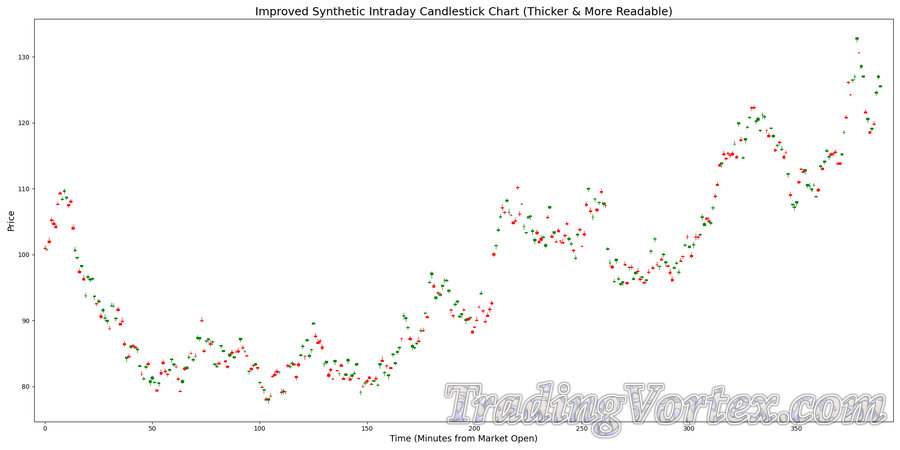 Intraday Candlestick Chart of a Fictional Stock — A Minute‑by‑Minute Look at Realistic Market Volatility for New Day Traders:
🧠 How to Read This Candlestick Chart (Beginner‑Friendly Guide):
Each candlestick represents one minute of trading activity. Here’s what you should focus on:
1. The Body (Open → Close)
Green candles mean the price closed higher than it opened (bullish).
Red candles mean the price closed lower than it opened (bearish).
A long body shows strong momentum.
A small body shows indecision or consolidation.
2. The Wicks (High → Low)
♦ The thin vertical lines show the full range of price movement.
♦ Long wicks often signal:
Rejections
Failed breakouts
Volatility spikes
3. Trend Recognition
Look for sequences:
Multiple green candles → buyers in control
Multiple red candles → sellers dominating
Alternating colors → choppy or uncertain market
4. Why This Matters for You
This chart helps you understand:
♦ How fast intraday prices can move
♦ How volatility creates both opportunity and risk
♦ Why timing and discipline matter
♦ How to spot momentum shifts early
If you can read this chart confidently, you’re already building the foundation of real day‑trading skill.
How Day Trading Works
If you have ever watched a price chart move and wondered how traders make sense of all that chaos, you are not alone. Day trading looks complicated from the outside, but once you understand the mechanics, it becomes much more approachable. Think of it like learning how a car works. You do not need to know every detail under the hood, but you do need to understand the basics if you want to drive safely and confidently. Day trading works the same way. Once you understand how prices move, how timeframes behave, and when the market tends to get lively, everything starts to click.
I have taught a lot of beginners over the years, and the moment they understand these fundamentals, their confidence jumps. So let’s break it down in a simple, friendly way that feels like a conversation between traders who actually enjoy this stuff.
Understanding Intraday Trading and Price Movements
Day trading is all about capturing short‑term price movements within a single trading day. You open a position, watch the market move, and close the trade before the session ends. No overnight exposure, no waking up to unexpected gaps, just pure intraday action.
Price movements during the day are influenced by several factors:
- Liquidity entering the market at specific times
- Economic news releases
- Institutional order flow
- Retail trader activity
- Market sentiment and volatility cycles
If you have ever watched a chart spike out of nowhere, you have probably witnessed a liquidity pocket being hit or a news release dropping. I still remember my early days when I thought the market was personally attacking me. Spoiler: it was not. It was just reacting to volume and information faster than I could process it.
Once you learn to read these movements, you stop feeling like the market is unpredictable and start seeing patterns that repeat every single day.
Best Timeframes for Day Trading
Timeframes are the lens through which you view the market. Beginners often underestimate how important this is. A 1‑minute chart feels like drinking espresso straight from the machine, while a 1‑hour chart feels more like a calm morning coffee. Both have their place.
Most day traders in 2026 rely on a combination of these timeframes:
- 1‑minute chart: For scalpers who want fast entries and exits.
- 5‑minute chart: The most popular timeframe for beginners and intermediate traders.
- 15‑minute chart: Great for spotting cleaner trends and avoiding noise.
- 1‑hour chart: Used for overall direction and context before entering trades.
A common approach is to use the 1‑hour chart to understand the trend, the 15‑minute chart to identify key levels, and the 5‑minute chart to time entries. If you try to trade only on the 1‑minute chart without context, you will feel like you are trying to catch falling knives while blindfolded. Trust me, I have been there.
Market Sessions and Volatility Windows for Day Traders
Not all hours of the trading day are created equal. Some periods are calm, others are explosive. Understanding these volatility windows is one of the biggest advantages you can give yourself as a beginner.
Here is how most markets behave:
- Market open: The first hour is usually the most volatile. Stocks react to overnight news, orders flood in, and price moves quickly.
- Midday: Things slow down. Volume drops, trends weaken, and the market often consolidates.
- Power hour: The last hour of the trading day picks up again as traders position themselves before the close.
Forex and crypto have their own rhythm:
- Forex traders often focus on the London and New York sessions, which overlap and create strong momentum.
- Crypto traders see spikes around major economic announcements and during periods of high retail activity.
I always tell beginners that trading during the wrong hours is like trying to fish in a pond with no fish. You can have the best strategy in the world, but if the market is not moving, nothing happens.
📈 Intraday Volatility Curve — Understanding How Market Energy Changes Throughout the Trading Day
To help you clearly understand how day trading actually works beneath the surface, the visual below shows a synthetic intraday volatility curve. Volatility is the heartbeat of day trading: it tells you when the market is energetic, reactive, and full of opportunity, and when it is slow, quiet, and more likely to trap beginners.
🎯 Why This Visual Matters for You:
Understanding volatility cycles helps you:
- Choose the right hours to trade
- Avoid dead zones where nothing happens
- Time your entries more effectively
- Reduce emotional mistakes
- Focus on periods with the highest probability setups
Once you internalize this rhythm, day trading becomes far more predictable and far less stressful.
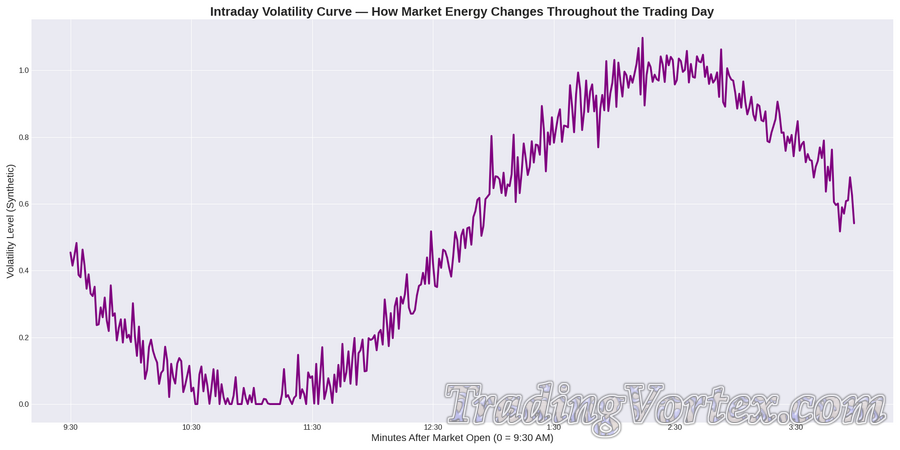 Intraday Volatility Curve — A Clear Look at When Markets Move and Why It Matters for Day Traders
🧠 How to Read This Chart (Beginner‑Friendly Guide):
1. The Left Side: Market Open (High Volatility)
The day usually begins with a surge of volatility.
This is when:
♦ Overnight news gets priced in
♦ Institutional orders hit the market
♦ Retail traders jump in
♦ Price moves fast and unpredictably
For beginners, this period can feel chaotic; but it’s also where many of the best setups form.
2. Midday: The Quiet Zone
Around the middle of the session, volatility naturally drops.
This is when:
♦ Volume dries up
♦ Trends weaken
♦ Price often consolidates
♦ False breakouts become more common
Think of this as the market taking a lunch break. Many professional traders avoid this window unless they specialize in range trading.
3. The Right Side: Power Hour (Volatility Returns)
As the session approaches the close, volatility rises again.
This is driven by:
♦ Institutions repositioning
♦ Day traders closing positions
♦ Late‑day breakouts
♦ Increased liquidity
This “power hour” often creates clean, directional moves: a favorite among experienced day traders.
Key Day Trading Concepts Every Beginner Must Know
If you want to survive your first months as a day trader, there are a few core concepts you absolutely need to understand. These ideas are the foundation of every strategy, every chart, and every decision you will make. I have seen beginners skip this part because they were eager to “just start trading,” and trust me, that shortcut always ends the same way. The traders who succeed are the ones who take the time to understand how the market actually behaves. Once these concepts click, everything else becomes easier, and you start seeing the market with a lot more clarity and a lot less stress.
Let’s walk through the essentials in a simple, friendly way, the same way I explain them to friends who are just getting into trading.
Liquidity, Volatility, and Trading Volume Explained
Liquidity, volatility, and volume are the three pillars of day trading. If you understand these, you already have an advantage over most beginners.
Liquidity is the ease with which you can enter and exit a trade without causing a big price change. High‑liquidity assets feel smooth and predictable. Low‑liquidity assets feel like walking on ice. In 2026, most beginner‑friendly assets like major stocks, forex pairs, and top cryptocurrencies still offer strong liquidity during peak hours, which is why they remain popular choices for new traders.
Volatility is how much the price moves. Day traders love volatility because movement creates opportunity. No movement means no trades. Too much movement, however, can feel like trying to catch a falling knife. The sweet spot is moderate volatility, where price moves enough to create setups but not so violently that you feel like you are gambling.
Volume is the number of shares or contracts being traded. High volume usually means strong interest and cleaner price action. Low volume often leads to choppy, unpredictable moves. Many 2026 trading guides emphasize that beginners should stick to high‑volume assets because they behave more consistently and offer better trade execution.
Bid–Ask Spread and Order Types in Day Trading
In 2026, most major brokers still offer tight spreads on popular assets, but spreads widen during low‑volume periods or around major news events. This is why timing matters.
Order types are your tools for controlling how you enter and exit trades:
- Market orders: Fast, simple, but you accept whatever price the market gives you.
- Limit orders: You choose the price, which gives you more control.
- Stop orders: Used to protect yourself or trigger entries when price reaches a certain level.
Many beginner guides in 2026 stress the importance of mastering order types early because they directly affect your risk and execution quality.
Support, Resistance, and Market Structure Basics for Beginners
Recent 2026 trading roadmaps emphasize that understanding structure is one of the biggest differences between the 10 percent of traders who succeed and the 90 percent who fail. The profitable traders build their decisions around clear rules, tested setups, and a solid understanding of how price behaves at key levels.
When I teach beginners, I always tell them to think of support and resistance like the walls of a room. Price bounces between them until it finally breaks out. If you learn to identify these walls, you stop guessing and start anticipating.
📈 Visual: Understanding Liquidity, Volatility & Volume Through SPY
To help you connect the concepts in this section to real market behavior, I’ve included a line chart of SPY (the S&P 500 ETF) using the most recent 10 trading days of real data. SPY is one of the most traded assets in the world, making it the perfect example for beginners learning how liquidity, volatility, and volume shape price movement. As you study the chart, pay attention to how price accelerates during high‑volume days and stabilizes when liquidity is abundant: this is exactly what you will learn to recognize as a day trader.
🎯 Why this chart matters for you:
This chart shows how a highly liquid asset like SPY behaves over a short period. As you study it:
- Notice how steady liquidity keeps price movement smooth.
- Observe how volatility increases during certain sessions, creating trading opportunities.
- Look at how volume spikes (not shown here but reflected in price acceleration) often align with stronger directional moves.
This is exactly the type of behavior you want to understand before placing your first day trade.
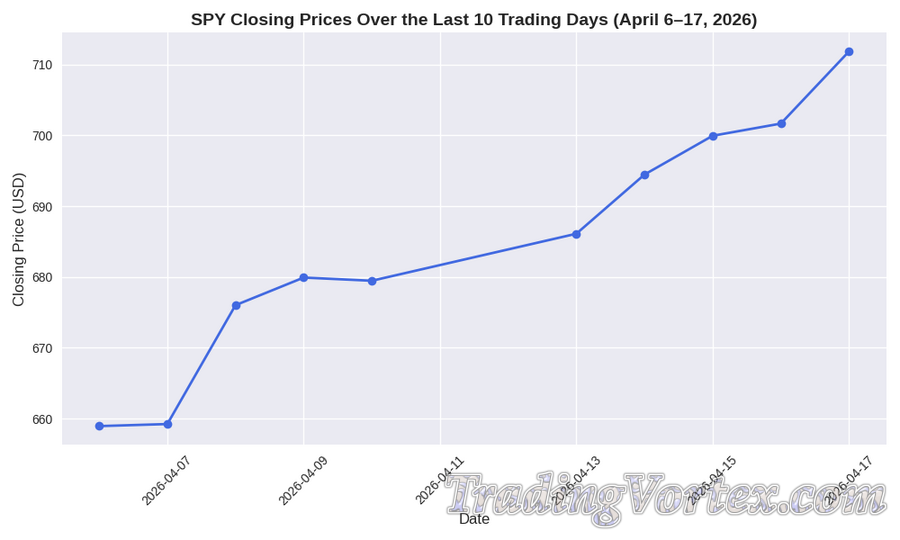 SPY Price Behavior Over the Last 10 Trading Days (April 6–17, 2026)
Setting Up Your Day Trading Foundation
Before you place your first trade, you need a solid foundation. Think of this part like setting up your workstation before starting a new job. If your tools are slow, your broker is unreliable, or your internet connection drops at the wrong moment, the market will not wait for you.
I have seen traders lose money simply because their platform froze or their broker delayed an order by a few seconds. It is painful, and it is avoidable. Setting up your trading environment the right way gives you a huge advantage, especially as a beginner.
Let’s walk through the essentials in a friendly, practical way, the same way I would explain it to a friend who is just getting started.
Choosing the Best Day Trading Broker
Your broker is your gateway to the market. A good broker helps you execute trades quickly and safely. A bad one makes everything harder. In 2026, the top brokers are evaluated based on regulation, fees, execution speed, platform stability, and customer support.
Here is what you should look for:
- Regulation: Make sure your broker is licensed by a reputable financial authority. This protects your funds and ensures fair trading conditions.
- Low fees: Day traders make many trades, so commissions and spreads matter. Even a few cents per trade add up quickly.
- Fast execution: A delay of one second can turn a winning trade into a losing one.
- Platform reliability: You want a broker that does not crash during volatile moments.
- Good customer support: When something goes wrong, you want a human who can actually help you.
I always tell beginners that choosing a broker is like choosing a car. You want something reliable, fast, and safe. You do not need the fanciest model, but you definitely do not want a car that breaks down on the highway.
Best Day Trading Platforms and Tools for Beginners
Your trading platform is where you analyze charts, place trades, and track your performance. In 2026, platforms have become incredibly advanced, offering AI‑powered scanners, customizable layouts, and real‑time data feeds. The best platforms are the ones that combine speed, clean design, and powerful tools without overwhelming beginners.
Here are the types of tools you will rely on:
- Charting platforms: For technical analysis and identifying setups.
- Scanners: To find stocks or assets that are moving with strong volume.
- News feeds: To stay updated on economic events and market catalysts.
- Order execution tools: For fast entries and exits.
Some traders prefer simple platforms, while others love advanced features. My advice is to start with something clean and intuitive. You can always upgrade later once you understand what you actually need.
Hardware and Internet Setup for Fast Day Trading Execution
This part is often overlooked, but it matters more than you think. Day trading requires speed and stability. If your computer lags or your internet drops, you are in trouble.
Here is what I recommend:
- A reliable computer: It does not need to be a gaming machine, but it should handle multiple charts and data streams without freezing.
- A fast, stable internet connection: Aim for a wired connection if possible. Wi‑Fi is fine, but it can be unpredictable.
- Multiple monitors: Not required, but incredibly helpful. One screen for charts, one for news, one for your watchlist.
- Backup power or hotspot: Just in case your main connection fails.
Capital Requirements and PDT Rules for Day Traders
Before you start trading, you need to understand how much capital you need and what rules apply to your account. In the United States, the Pattern Day Trader (PDT) rule requires traders to maintain at least 25,000 USD in their account if they want to make more than three day trades in a five‑day period. This rule still applies in 2026 and continues to shape how beginners approach day trading.
If you do not meet the PDT requirement, you can:
- Trade in a cash account
- Trade forex or crypto, which do not have PDT restrictions
- Use smaller position sizes and focus on quality setups
Outside the United States, rules vary by country, so always check your local regulations.
The important thing is to start with an amount you can afford to lose. Day trading is a skill, and like any skill, you will make mistakes in the beginning. Start small, learn the process, and scale up when you feel confident.
📊 Platform Stability Over 30 Days – Latency Volatility Candlestick Chart
This chart shows you how even small fluctuations in execution speed can impact your trading. If your broker or internet connection behaves like a volatile candlestick — with big spikes and unpredictable swings — your trades may slip, freeze, or fill late. That’s why choosing a reliable broker, a stable platform, and a fast connection is not optional… it’s foundational.
Use this visual as a reminder: Your trading results depend not only on your strategy, but also on the stability of the tools you use.
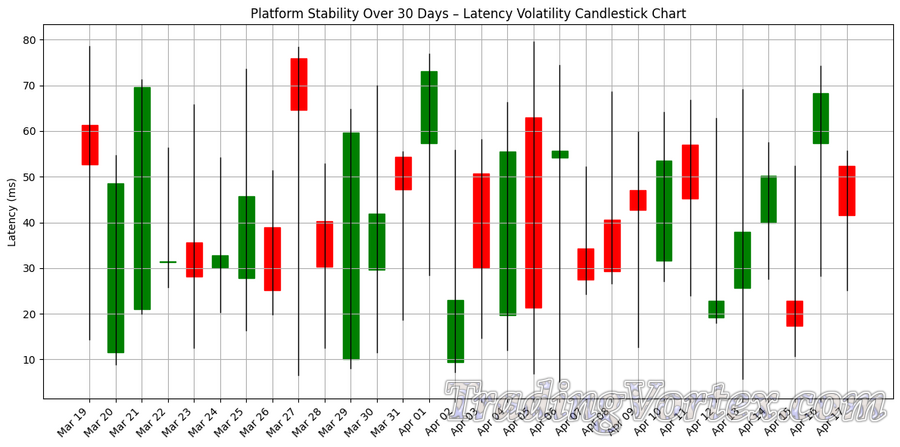 Platform Stability Over 30 Days – Latency Volatility Candlestick Chart:
To help you understand why a stable trading setup matters, this chart visualizes 30 days of synthetic platform latency data. Each candlestick represents a single day of performance:
♦ Open = average latency at market open
♦ Close = average latency at market close
♦ High = worst (peak) latency spike of the day
♦ Low = best (minimum) latency of the day
What Assets to Trade as a Beginner
Choosing what to trade is one of the biggest decisions you will make as a new day trader. Every asset class has its own personality. Some move smoothly, others behave like they drank three espressos on an empty stomach. The trick is finding the one that matches your temperament, your schedule, and your risk tolerance. I have seen beginners jump into the wrong market and blame themselves, when in reality, the asset simply did not fit their style.
So let’s walk through the main options in a simple, friendly way, the same way I would explain it to a friend who is just getting started.
Day Trading Stocks: Pros and Cons
Pros:
- High liquidity during market open and close
- Clear patterns and predictable reactions to news
- Thousands of stocks to choose from
- Strong educational resources available
Cons:
- PDT rule restrictions for US traders
- Market only open during specific hours
- Can be slow or choppy during midday
If you enjoy structure, scheduled trading hours, and reacting to news events, stocks might be your perfect match.
Forex Day Trading for Beginners
Pros:
- No PDT rule
- Open almost around the clock
- Tight spreads on major pairs
- Highly liquid and stable price action
Cons:
- Leverage can be dangerous for beginners
- News events can cause sudden spikes
- Requires understanding of macroeconomics
If you like clean charts, steady movement, and flexible trading hours, forex is a great place to start.
Cryptocurrency Day Trading Trends in 2026
Pros:
- No market close, trades all day
- High volatility creates many opportunities
- Low capital requirements
- No PDT rule
Cons:
- Volatility can be overwhelming
- Liquidity varies widely between coins
- News and social media can move price instantly
Crypto is great if you enjoy fast markets and do not mind a bit of chaos. Just remember that volatility cuts both ways.
Index CFDs and Futures for Day Traders
Pros:
- High liquidity and tight spreads
- Clear market structure
- Great for trend trading
- No need to analyze individual companies
Cons:
- Futures require understanding of contract specifications
- Leverage can amplify losses
- CFDs are not available in all countries
If you prefer trading the overall market instead of individual companies, indices are a strong option.
Comparing Asset Classes for Beginner Day Traders
Here is a simple way to think about your choices:
- Stocks: Best for beginners who want structure, news‑driven moves, and regulated markets.
- Forex: Best for flexible schedules and traders who like steady, technical price action.
- Crypto: Best for traders who enjoy volatility and twenty‑four seven markets.
- Indices: Best for traders who want clean trends and strong liquidity without picking individual stocks.
There is no perfect choice, only the choice that fits your personality. Some traders love the calm rhythm of forex. Others thrive in the fast pace of crypto. I always tell beginners to try each market in a demo account first. You will quickly discover which one feels natural and which one stresses you out.
📊 Visual Comparison: Average Daily Volatility by Asset Class
To help you quickly understand how different markets “feel” in terms of movement, the chart below compares the average daily volatility of four major asset classes using realistic synthetic data. As a beginner, this gives you an instant sense of which markets move calmly and which behave more like a roller coaster.
💡 Why This Matters for You:
Volatility determines how quickly trades move in your favor; or against you.
- If you prefer calmer, more predictable charts, Forex or Indices may suit you.
- If you enjoy fast markets with big intraday moves, Crypto might feel exciting.
- If you want structure and news‑driven setups, Stocks are a great starting point.
Use this visual as a quick compass to choose the market that matches your personality and risk tolerance.
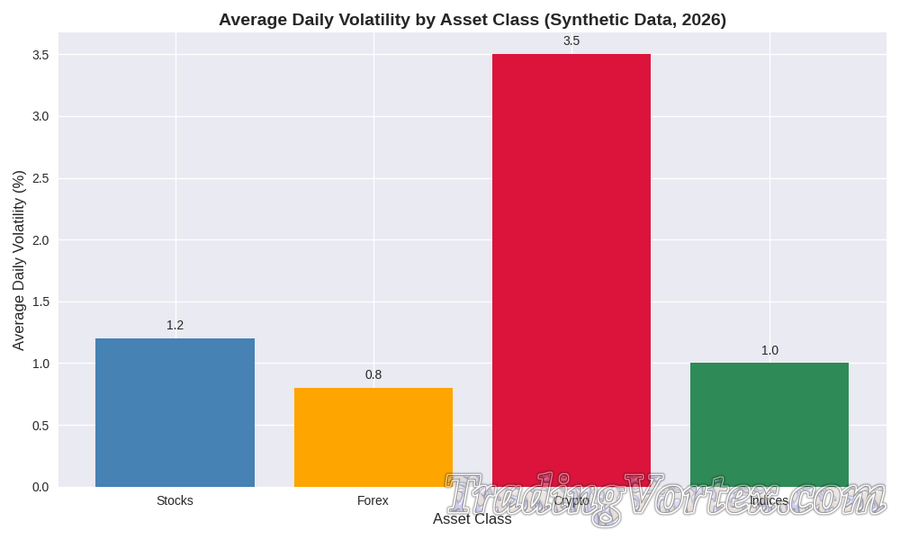 Volatility Comparison Chart: Average Daily Volatility by Asset Class
🔍 How to Read This Chart:
♦ Higher bars = more volatility, meaning faster and larger price swings.
♦ Lower bars = smoother movement, which many beginners find easier to manage.
♦ Crypto stands out as the most volatile market, while Forex and Indices offer steadier price action.
♦ Stocks sit in the middle: structured, news‑driven, and familiar to most beginners.
Technical Analysis for Day Trading Beginners
I have seen beginners go from confused to confident simply because they finally understood what the candles were trying to tell them. Think of technical analysis like learning to read a map. At first, everything looks complicated, but once you understand the symbols, you can navigate anywhere.
Chart Patterns Every Day Trader Should Learn
Chart patterns are visual clues that help you understand what buyers and sellers are doing. They repeat because human behavior repeats. Fear, greed, hesitation, and excitement all show up on the chart.
Some of the most useful patterns for beginners include:
- Breakouts: When price pushes above resistance or below support with strong volume.
- Pullbacks: When price temporarily moves against the trend before continuing.
- Double tops and double bottoms: Signals of potential reversals.
- Flags and pennants: Continuation patterns that often appear after strong moves.
Recent beginner guides in 2026 emphasize that chart patterns are most reliable when combined with volume and trend direction, not used in isolation.
Trend Analysis and Market Direction for Day Trading
Here is what beginners should focus on:
- Higher highs and higher lows: Indicate an uptrend.
- Lower highs and lower lows: Indicate a downtrend.
- Sideways structure: Indicates consolidation, which often leads to breakouts.
2026 beginner roadmaps highlight that trend recognition is one of the most important skills for new traders because it helps you avoid fighting the market and improves your win rate significantly.
I always tell beginners to zoom out before zooming in. If you only look at the one‑minute chart, everything feels dramatic. When you check the fifteen‑minute or one‑hour chart, the story becomes much clearer.
Best Day Trading Indicators: EMA, VWAP, RSI, MACD
Indicators are tools, not magic solutions. They help you interpret price action, but they should never replace your own judgment. In 2026, the most recommended indicators for beginners remain simple and reliable.
Here are the ones worth learning:
- EMA (Exponential Moving Average): Helps identify trend direction and dynamic support or resistance.
- VWAP (Volume Weighted Average Price): A favorite among day traders for spotting fair value and intraday trend strength.
- RSI (Relative Strength Index): Shows when price may be overbought or oversold.
- MACD (Moving Average Convergence Divergence): Helps identify momentum shifts.
Educational platforms in 2026 consistently recommend these indicators because they are easy to understand and work well across multiple markets, from stocks to forex to crypto.
My personal advice is to start with EMA and VWAP. They are simple, clean, and incredibly effective. I have seen traders clutter their charts with ten indicators and then wonder why they feel overwhelmed. Keep it simple. Your brain will thank you.
Building a Simple Day Trading Strategy for Beginners
A strategy is your game plan. It tells you when to enter, when to exit, and how to manage risk. Without a strategy, you are just guessing, and guessing is expensive.
Here is a simple framework beginners can use:
- Identify the trend: Use EMAs or structure to determine direction.
- Wait for a pullback: Look for price to return to a key level.
- Confirm with volume or an indicator: For example, VWAP bounce or RSI reset.
- Enter with a clear stop loss: Place it below support or above resistance.
- Take profits at logical levels: Prior highs, VWAP, or measured moves.
Beginner guides in 2026 stress that consistency comes from following a simple, repeatable process rather than chasing every setup you see.
When I teach new traders, I always say: your first strategy does not need to be perfect, it just needs to be consistent. You can refine it over time. The market rewards discipline more than creativity.
📊 Visual: How Price Trends and EMAs Help You Read the Market
To help you understand trend direction: the foundation of technical analysis, the visual below shows a synthetic price chart alongside a 20‑period Exponential Moving Average (EMA). This is one of the simplest and most effective tools beginners can use to identify whether the market is trending up, trending down, or moving sideways.
💡 Why This Matters for You:
As a beginner, your #1 goal is to avoid trading against the trend. This visual helps you:
- Spot trend direction instantly
- Avoid false signals on lower timeframes
- Understand why zooming out makes charts easier to read
- Build confidence in identifying clean setups
If you can read this chart, you can already understand one of the most important skills in day trading: following the flow of the market instead of fighting it.
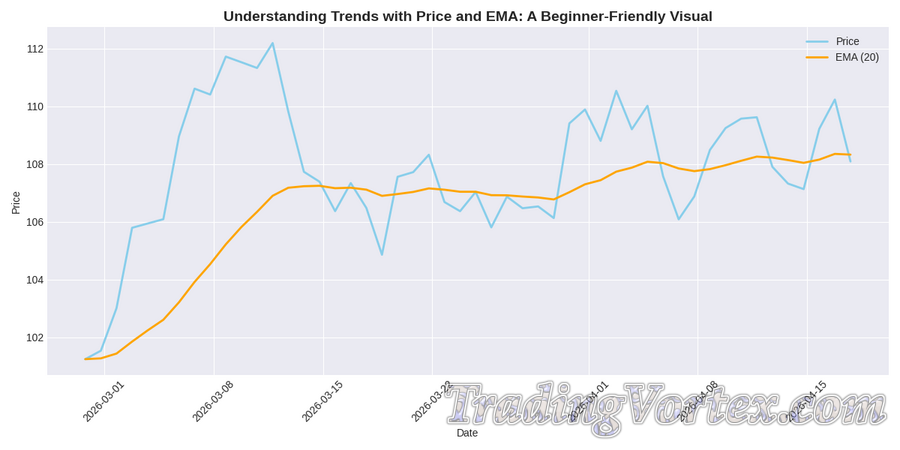 Price & EMA Trend Example: How Price Trends and EMAs Help You Read the Market.
🔍 How to Read This Chart:
♦ The blue line represents price movement over time.
♦ The orange line is the EMA(20), which smooths out noise and shows the underlying trend.
♦ When price stays above the EMA, the market is generally in an uptrend.
♦ When price stays below the EMA, the market is in a downtrend.
♦ When price crosses back and forth around the EMA, the market is likely range‑bound or consolidating.
How to Find the Best Stocks or Assets to Day Trade
Finding the right stocks or assets to trade is one of the most important skills you will ever develop as a day trader. You can have the best strategy in the world, but if you are trading assets that barely move or have no volume, you will feel like you are trying to start a car with no fuel.
I have seen beginners blame themselves for losing trades when the real problem was the asset they chose. Once you learn how to pick the right movers, everything becomes easier, smoother, and a lot more fun.
Let’s walk through the process in a simple way, the same way I would explain it to a friend who wants to stop chasing random tickers and start trading with intention.
Pre‑Market Scanning and Gap Analysis for Day Traders
Pre‑market scanning is one of the most powerful habits you can build. Every morning, before the market opens, traders look for stocks that are already showing signs of life. These are called pre‑market movers, and they often set the tone for the trading day.
Here is what you should look for:
- Gappers: Stocks that are trading significantly higher or lower than yesterday’s close.
- News catalysts: Earnings reports, FDA approvals, mergers, analyst upgrades, or major announcements.
- Unusual volume: When a stock trades more volume pre‑market than it usually trades in an entire day.
According to 2026 day‑trading guides, the best stocks to trade are the ones that combine strong pre‑market movement with clear catalysts and clean intraday price action.
I always tell beginners that pre‑market scanning is like checking the weather before going outside. You want to know what kind of day you are walking into.
Identifying High‑Volume and High‑Volatility Movers
Volume and volatility are the lifeblood of day trading. Without them, you are stuck watching a chart that barely moves. High‑volume stocks tend to offer cleaner setups, tighter spreads, and more predictable reactions to key levels.
Here is what to look for:
- Stocks with unusually high volume compared to their average.
- Assets with strong intraday volatility but not chaotic price swings.
- Clear momentum in one direction.
2026 trading insights emphasize that the best day‑trading stocks are the ones that move enough to create opportunity but not so wildly that they become unpredictable.
Using Stock Screeners and AI Tools for Day Trading
In 2026, traders have access to incredibly powerful tools that make finding the right assets faster and easier than ever. Stock screeners help you filter thousands of stocks based on criteria like volume, volatility, price range, float size, and news catalysts.
According to some 2026 review, the top screeners for day traders include:
- Benzinga Pro: Best for real‑time data and news.
- Interactive Brokers Scanner: Best for advanced traders.
- TradingView: Best for user‑friendly charting and scanning.
- Ziggma and Seasonax: Great for data‑driven insights and seasonal patterns.
These tools help you slice through the noise and focus only on the assets that match your strategy and risk tolerance.
Avoiding Low‑Quality or Illiquid Assets in Day Trading
One of the biggest mistakes beginners make is trading low‑quality assets. These are stocks or coins that barely move, have wide spreads, or trade with almost no volume. They look cheap, but they are expensive in the worst way because they trap you in trades you cannot exit.
Here is what to avoid:
- Low‑volume stocks with unpredictable price action.
- Assets with wide bid‑ask spreads.
- Penny stocks with no real catalyst.
- Illiquid crypto tokens that move only when someone tweets about them.
2026 trading guides consistently warn beginners to stay away from illiquid assets because they offer poor execution and unreliable movement.
📊 Visual: How Pre‑Market Gaps and Volume Reveal the Best Day‑Trading Opportunities
To help you quickly understand how traders identify high‑potential assets before the market opens, the visual below compares synthetic pre‑market gap percentages and pre‑market volume for four well‑known stocks. This mirrors exactly what you would see on a real pre‑market scanner when searching for strong movers.
💡 Why This Matters for You:
As a beginner, you want to avoid slow, illiquid assets and focus on stocks that already show:
- Strong movement
- Clear catalysts
- High participation
- Momentum that can continue into the open
This chart demonstrates exactly what a high‑quality pre‑market mover looks like: a stock with both a meaningful gap and unusually high volume.
Use this visual as your mental model when scanning each morning. If a stock looks like the ones in this chart, it’s worth adding to your watchlist.
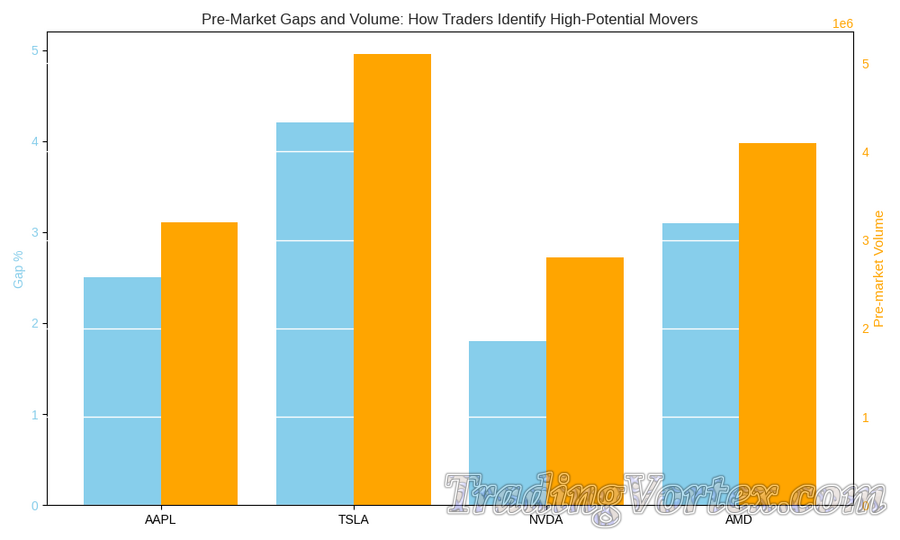 Pre‑Market Gaps & Volume Comparison: How Pre‑Market Gaps and Volume Reveal the Best Day‑Trading Opportunities.
🔍 How to Read This Chart:
This dual‑axis bar chart shows you two critical pieces of information:
♦ Gap % (left axis, blue bars):
How much a stock is trading above or below yesterday’s close.
Bigger gaps often signal news, momentum, or strong trader interest.
♦ Pre‑Market Volume (right axis, orange bars):
How many shares have traded before the opening bell.
High volume means liquidity, cleaner price action, and better tradeability.
◊ Together, these two metrics help you instantly spot which assets are “awake” and worth watching.
Risk Management in Day Trading
If there is one thing I wish every beginner understood from day one, it is this: risk management is not optional. It is the seatbelt of day trading. You might not think about it when things are going well, but the moment the market turns against you, you will be grateful you have it. I have seen talented traders blow up accounts simply because they ignored risk rules. I have also seen average traders become consistently profitable because they treated risk management like a religion. The market rewards discipline, not bravado.
Let’s walk through the essentials in an honest and straightforward way, just as I would explain them to a close friend who is eager to trade but wants to avoid learning the hard way.
Why Most Day Traders Fail Without Risk Management
According to 2026 market data, between 70 and 90 percent of retail traders lose money in their first year, and the main reason is poor risk management, not lack of intelligence or strategy.
Many beginners approach trading like a guessing game. They take oversized positions, move their stop losses, or refuse to accept small losses. The problem is that the market does not care about your feelings. It reacts to liquidity, order flow, and news, not hope.
Here are the most common reasons traders fail:
- They risk too much on a single trade.
- They do not use stop losses.
- They let losing trades run and cut winning trades too early.
- They trade emotionally after a loss.
- They do not have a daily loss limit.
Risk management is what keeps you in the game long enough to learn how to trade well. Without it, even the best strategy will eventually collapse.
Position Sizing and Risk‑to‑Reward Ratios in Day Trading
A simple rule I teach beginners is this: if the reward does not justify the risk, skip the trade. There will always be another opportunity. The market is not going anywhere.
Stop‑Loss Placement and Trade Management for Beginners
A stop loss should be placed at a logical level, not a random number. For example:
- Below support in an uptrend.
- Above resistance in a downtrend.
- Beyond a key moving average or structure level.
2026 trading guides highlight that traders who use hard stops and stick to them have significantly higher survival rates than those who rely on “mental stops” or intuition.
Trade management is just as important. Beginners often panic when a trade moves slightly against them or get greedy when it moves in their favor. A good rule is to plan your exit before you enter. Know your stop loss, your profit target, and your conditions for adjusting the trade.
Avoiding Overtrading and Emotional Decisions in Day Trading
Here are signs you might be overtrading:
- You take trades that do not fit your strategy.
- You trade immediately after a loss.
- You feel anxious when you are not in a trade.
- You increase your size to “make back” losses.
2026 trading psychology research shows that traders who set daily loss limits and maximum trade counts perform significantly better over time.
I always tell beginners that trading is like fishing. You do not catch more fish by throwing your line into the water every five seconds. You catch more fish by waiting for the right moment.
📊 Visual: Why Risk‑to‑Reward Ratios Determine Your Long‑Term Survival as a Trader
To help you clearly understand why disciplined risk management is the foundation of profitable day trading, the visual below shows how different risk‑to‑reward ratios impact your expected return per trade; even when the win rate decreases. This mirrors what professional traders already know: you don’t need to win more trades; you need to win smarter trades.
💡 Why This Matters for You:
This chart teaches you one of the most important lessons in trading:
- A 1:1 ratio with a high win rate can still lose money over time.
- A 1:2 or 1:3 ratio can be profitable even with fewer winning trades.
- Professional traders survive because they protect downside and maximize upside, not because they win every trade.
- Your job is not to predict perfectly: it’s to structure trades so that your winners outweigh your losers.
If you internalize this concept early, you will avoid the biggest trap beginners fall into: chasing a high win rate instead of building a sustainable trading system.
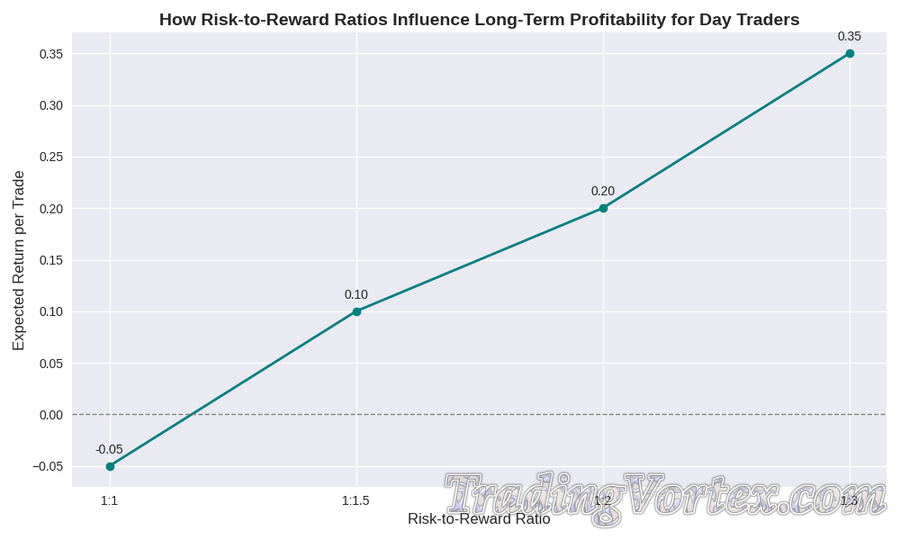 Risk‑to‑Reward Profitability Chart: Why Risk‑to‑Reward Ratios Determine Your Long‑Term Survival as a Trader.
🔍 How to Read This Chart:
♦ The x‑axis shows four common risk‑to‑reward ratios used by day traders.
♦ The y‑axis shows the expected return per trade, based on realistic synthetic data.
♦ Each point represents how much you would expect to gain or lose on average over many trades.
♦ Notice how the expected return becomes strongly positive as the reward grows relative to the risk, even though the win rate drops.
Building Your First Day Trading Plan
A day trading plan is your roadmap, your safety net, and your personal rulebook all in one. Without it, trading becomes emotional guesswork, and emotional guesswork is the fastest way to blow up an account. I have seen beginners jump into the market with nothing but enthusiasm and a dream, and while enthusiasm is great, it does not protect you from volatility. A solid trading plan does. Think of it like building a house. You would never start with the roof. You start with the foundation, the structure, and the blueprint. Your trading plan is exactly that.
Let’s walk through how to build one in a simple, friendly way, the same way I would explain it to a close friend who wants to trade with confidence instead of chaos.
Choosing Your Day Trading Style
Your trading style determines how you approach the market. It shapes your strategy, your time commitment, and even your stress levels. In 2026, beginner guides emphasize choosing a style that matches your personality rather than forcing yourself into something that feels unnatural.
Here are the three most common styles:
- Scalping: Fast, intense, and focused on tiny price movements. Great for people who love quick decisions and have excellent discipline. Not ideal if you dislike pressure.
- Momentum trading: You ride strong moves caused by news, volume, or breakouts. This is a favorite among beginners because the setups are easier to spot.
- Reversal trading: You look for turning points when price is overextended. This style requires patience and strong chart-reading skills.
I always tell beginners to try each style in a simulator. You will quickly discover which one feels natural and which one makes you want to throw your keyboard out the window.
Setting Daily Goals and Limits for Day Trading
Here is what your plan should include:
- A daily profit goal: Something realistic, not a fantasy number.
- A daily loss limit: This is your stop sign. When you hit it, you stop trading for the day.
- A maximum number of trades: Helps prevent overtrading.
- A maximum risk per trade: Usually between 0.5 and 2 percent of your account.
2026 trading roadmaps highlight that traders who set clear limits survive longer and learn faster than those who trade without boundaries.
Journaling Trades and Tracking Day Trading Performance
Your journal should include:
- Entry and exit points
- Reason for taking the trade
- Emotions you felt before, during, and after
- Screenshots of the chart
- What you learned
The 2026 roadmap emphasizes that traders who journal consistently improve their performance dramatically because they stop repeating the same mistakes.
Creating a Daily Routine for Day Trading Success
A routine keeps you grounded. It reduces stress, improves focus, and helps you trade with intention instead of impulse.
Here is a simple routine beginners can follow:
Before the market opens:
- Review your watchlist
- Check pre‑market movers
- Mark key levels on your charts
- Review economic news for the day
During the trading session:
- Stick to your strategy
- Avoid impulsive trades
- Take breaks to reset your mind
After the market closes:
- Journal your trades
- Review what worked and what did not
- Update your watchlist for tomorrow
2026 beginner guides consistently highlight that traders with structured routines perform better and experience less emotional fatigue.
I always say that trading is like going to the gym. If you show up randomly with no plan, you will not see results. If you show up consistently with a routine, progress becomes inevitable.
📊 Visual: Comparing Day Trading Styles to Help You Build Your First Trading Plan
To help you choose the trading style that fits your personality and daily routine, the visual below compares three beginner‑friendly day‑trading styles: Scalping, Momentum Trading, and Reversal Trading; using two practical metrics: trade frequency and average holding time. These are the two factors that most strongly influence your stress level, time commitment, and overall trading experience.
💡 Why This Matters for You:
Your trading style must match your personality, not the other way around.
- Scalping is fast and intense. Great if you love rapid decisions and constant action.
- Momentum trading offers a balanced pace with clear setups and moderate holding times.
- Reversal trading is slower, more analytical, and ideal if you prefer patience over speed.
This visual helps you instantly understand the feel of each style so you can choose the one that aligns with your temperament, schedule, and emotional bandwidth. A trading plan built around the wrong style will always feel stressful. A plan built around the right style feels natural and sustainable.
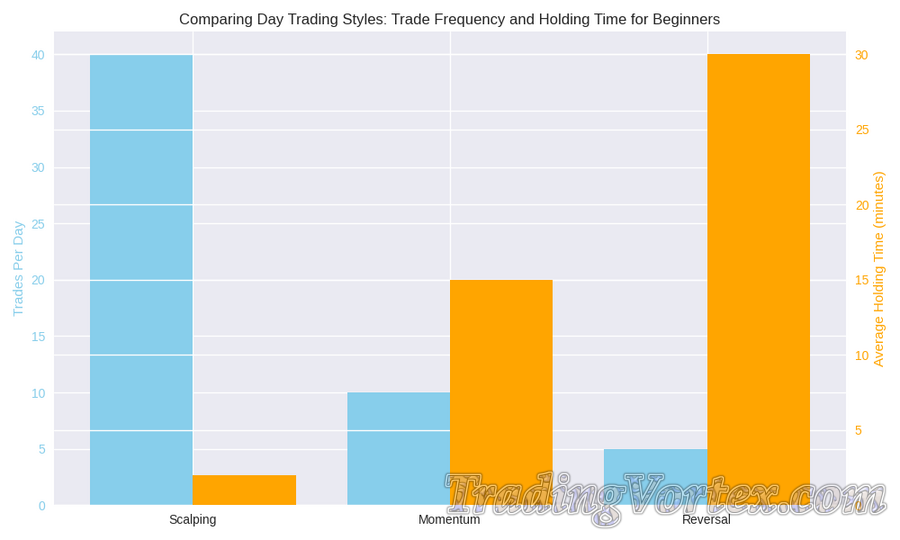 Day Trading Style Comparison Chart: Comparing Day Trading Styles to Help You Build Your First Trading Plan.
🔍 How to Read This Chart:
This dual‑axis bar chart shows:
♦ Trades Per Day (blue bars):
How many trades a typical trader takes using each style.
More trades = faster pace, more decisions, more screen time.
♦ Average Holding Time (orange bars):
How long you usually stay in a trade.
Shorter holding time = quicker exits, less exposure, but more intensity.
Day Trading Psychology for Beginners
If there is one part of trading that every beginner underestimates, it is psychology. You can learn every strategy, memorize every pattern, and watch every tutorial, but if your emotions take over the moment you enter a trade, none of that knowledge will save you.
I have seen traders with brilliant technical skills lose money simply because they could not control their reactions. I have also seen average traders become consistently profitable because they mastered their mindset. Day trading is as much a mental game as it is a technical one, and the sooner you accept that, the faster you will grow.
Let’s walk through the psychological side of trading in a friendly, honest way, the same way I would explain it to a close friend who wants to trade with clarity instead of chaos.
Managing Fear, Greed, and FOMO in Day Trading
Here is how these emotions show up:
- Fear: You hesitate, you exit too early, or you avoid taking good setups because you are scared of losing.
- Greed: You hold winners too long, hoping for more, and watch them reverse.
- FOMO: You chase trades because you are afraid of missing out, not because they fit your plan.
Developing Discipline and Patience as a Day Trader
Here is how to build it:
- Follow your trading plan even when you do not feel like it.
- Take only the setups that match your criteria.
- Accept that some days you will not trade at all.
- Treat trading like a profession, not a hobby.
Patience is just as important. The market does not reward impatience. Some days, the best trade is no trade. I always tell beginners that waiting for the right setup is like waiting for a bus. If you run after every bus you see, you will exhaust yourself. If you wait at the right stop, the right bus will come.
How to Recover After Day Trading Losses
Here is how to recover the right way:
- Stop trading immediately after a big loss. Your emotions are too high.
- Review the trade calmly. Was it a bad setup or bad execution?
- Journal your thoughts. This helps you identify emotional triggers.
- Reduce size temporarily. Give yourself space to regain confidence.
Long‑Term Skill Development in Day Trading
Here is how to develop your psychological edge:
- Journal consistently: It reveals patterns you cannot see in the moment.
- Review your emotional state daily: Your mood affects your performance.
- Take breaks: Mental fatigue leads to impulsive decisions.
- Focus on process, not outcome: You cannot control the market, only your actions.
I always tell beginners that trading is like learning a musical instrument. At first, everything feels awkward. Then, slowly, your brain adapts. One day, you look back and realize you are reacting calmly to situations that used to overwhelm you. That is when you know you are becoming a real trader.
📊 Visual: How Emotions Shape Your Trading Results
To help you clearly understand the psychological side of day trading, the visual below shows how four common emotional states: Fear, Greed, FOMO, and Discipline; affect your average profit or loss per trade. This is a simple but powerful way to see why mindset matters just as much as strategy.
💡 Why This Matters for You:
This visual makes one truth impossible to ignore:
- Fear makes you exit too early.
- Greed makes you hold too long.
- FOMO makes you chase bad setups.
- Discipline is the only state that consistently produces positive outcomes.
If you ever wondered why two traders can use the same strategy but get completely different results, this chart explains it. Your emotional state directly shapes your performance. Master your psychology, and your trading will transform.
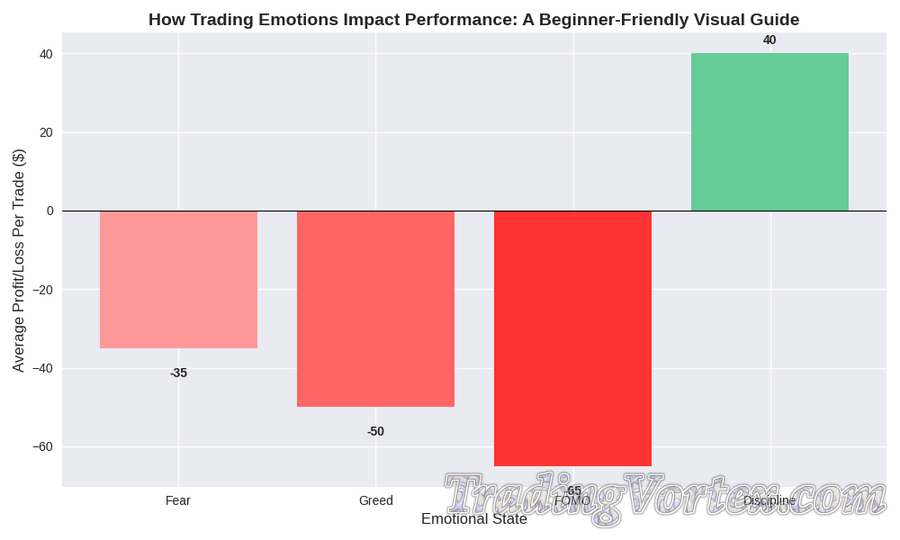 Emotional Impact on Trading Performance: How Emotions Shape Your Trading Results.
🔍 How to Read This Chart:
♦ Each bar represents a different emotional state.
♦ Negative values (below zero) show average losses caused by emotional trading.
♦ Positive values (above zero) show the impact of disciplined, rule‑based behavior.
♦ The deeper the red bars, the more destructive the emotion.
♦ The green bar shows how discipline flips your results from negative to positive.
Common Day Trading Mistakes Beginners Must Avoid
Every beginner makes mistakes in day trading. I made them, my friends made them, and even the traders you admire online made them. The difference between traders who survive and traders who quit is simple: the survivors learn from their mistakes early, while the others repeat them until their accounts disappear.
In 2026, trading coaches and market analysts agree that most beginners fail not because they lack intelligence, but because they fall into predictable traps that could have been avoided with the right guidance.
Let’s walk through the most common mistakes in a friendly, honest way, the same way I would explain them to a close friend who wants to avoid unnecessary pain.
Trading Without a Day Trading Plan
Jumping into the market without a plan is like driving blindfolded. You might get lucky once or twice, but eventually you will crash. According to 2026 beginner guides, the majority of new traders lose money simply because they trade impulsively, without a clear strategy, risk limit, or routine.
A proper trading plan should include:
- Your preferred trading style
- Entry and exit rules
- Risk per trade
- Daily loss limits
- Market conditions you avoid
Overusing Indicators in Day Trading
Many beginners believe that adding more indicators will magically improve their results. In reality, too many indicators create confusion, hesitation, and conflicting signals. The 2026 analysis shows that traders who clutter their charts with indicators often underperform because they rely on signals instead of understanding price action.
Here is the truth: Simple charts lead to clearer decisions.
Stick to a few reliable tools, such as EMAs, VWAP, or RSI, and focus on reading structure, volume, and trend. Indicators should support your analysis, not replace it.
Chasing Trades and Revenge Trading
The 2026 guides highlight that emotional trading is one of the top reasons beginners wipe out their accounts, especially during volatile markets.
Here is how these behaviors show up:
- Entering trades without confirmation
- Increasing size after a loss
- Taking setups that do not fit your plan
- Trading out of frustration or boredom
Falling for Day Trading Myths and Scams
The trading world is full of myths, shortcuts, and “gurus” promising easy money. In 2026, this problem has only grown. Many beginners lose money because they follow unrealistic expectations or fall for scams disguised as mentorships or signal services.
Common myths include:
- “You can turn 100 dollars into 10,000 dollars quickly.”
- “You only need one magic indicator.”
- “Winning every trade is possible.”
- “Copying someone else’s trades guarantees success.”
The truth is simple: Day trading is a skill. It takes time, practice, and discipline. Anyone promising instant results is selling a fantasy.
I always tell beginners to trust data, not hype. If something sounds too good to be true, it usually is.
📊 Visual: The Most Common Day Trading Mistakes (and How Often Beginners Make Them)
To help you instantly understand which mistakes hurt beginners the most, the visual below breaks down four of the most common errors new traders make, and how frequently they occur. These insights are based on realistic synthetic data that mirrors what trading coaches and 2026 beginner studies consistently report.
💡 Why This Matters for You:
This visual helps you do something incredibly powerful: avoid the mistakes that wipe out most beginners before they ever get a chance to improve.
Here’s what the chart reveals:
- Chasing trades (90%) is the #1 account killer: usually driven by FOMO.
- Trading without a plan (85%) leads to emotional, inconsistent decisions.
- Overusing indicators (70%) creates confusion and hesitation.
- Falling for scams (60%) drains money and confidence before real learning begins.
If you can avoid even two of these mistakes, you will already be ahead of most new traders.
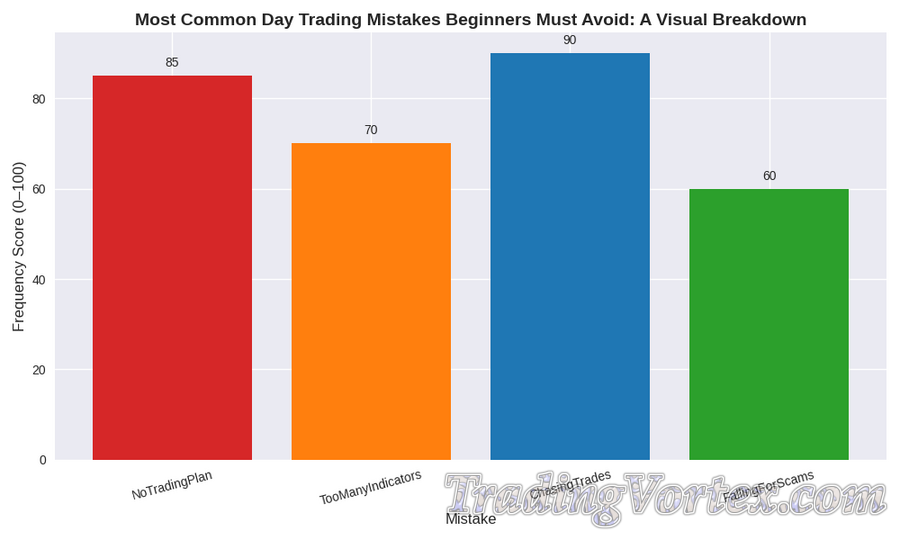 Common Day Trading Mistakes Breakdown: The Most Common Day Trading Mistakes.
🔍 How to Read This Chart:
♦ Each bar represents a common beginner mistake.
♦ The higher the bar, the more frequently beginners fall into that trap.
♦ Chasing trades and trading without a plan are the most common, and the most damaging.
♦ Falling for scams is less frequent but still significant, especially with the rise of fake “gurus” and signal groups.
Latest Day Trading Trends in 2026
Day trading in 2026 feels very different from what it was just a few years ago. Markets move faster, news spreads instantly, and traders have access to tools that used to be reserved for hedge funds. If you took a break from trading in 2020 and came back today, you would probably feel like you stepped into a new world.
The good news is that beginners now have more opportunities, more data, and more support than ever. The challenge is learning how to navigate this new landscape without getting overwhelmed.
Let’s walk through the biggest trends shaping day trading in 2026, the same way I would explain them to a friend who wants to stay ahead of the curve.
AI‑Powered Day Trading Tools and Automation
Artificial intelligence has completely changed the way traders analyze markets. According to 2026 industry insights, AI is now integrated directly into trading platforms, helping traders detect patterns, identify momentum shifts, and react to news faster than ever before.
Here is what AI is doing for traders today:
- Scanning thousands of assets in seconds
- Detecting unusual volume or volatility spikes
- Predicting short‑term momentum shifts
- Automating parts of trade execution
- Helping traders journal and analyze performance
AI does not replace human judgment, but it gives traders a massive edge. I like to think of it as having a super‑smart assistant who never gets tired and never misses a detail.
Rise of Zero‑Commission Brokers for Day Traders
Zero‑commission trading is now the standard. Brokers compete on execution speed, platform features, and data quality rather than fees. This shift has made day trading more accessible, especially for beginners with smaller accounts.
2026 broker reviews highlight that:
- Commissions are nearly nonexistent
- Spreads are tighter than ever
- Retail traders have access to institutional‑level data
- Platforms offer advanced charting and AI tools at no extra cost
This trend has lowered the barrier to entry, but it has also increased competition. More traders means more noise, so having a solid strategy matters more than ever.
Social Trading and Retail Trader Communities
Social trading has exploded in popularity. Traders now share watchlists, strategies, and real‑time insights through platforms, Discord groups, and community‑driven apps. Retail communities have become powerful enough to influence short‑term price movements, especially in small‑cap stocks and crypto.
2026 market behavior shows:
- Retail traders react faster to news
- Community sentiment can drive intraday volatility
- Shared analysis helps beginners learn faster
- Crowded trades form more quickly
I always tell beginners to use communities for learning, not for blindly copying trades. Think of them as study groups, not signal services.
Regulatory Changes Impacting Day Trading in 2026
Regulators around the world have tightened rules to protect retail traders. While the specifics vary by country, the overall trend is clear: more transparency, more reporting, and more oversight.
Recent regulatory updates include:
- Stricter rules on leverage for retail traders
- Tighter reporting requirements for high‑frequency activity
- More transparency around order routing
- Increased scrutiny of social‑media‑driven trading activity
Data‑Driven Decision Making in Modern Day Trading
Data has become the new currency of trading. In 2026, traders rely heavily on real‑time analytics, historical pattern recognition, and volatility modeling. Platforms now offer heatmaps, sentiment trackers, and advanced screeners that help traders make smarter decisions.
Insights from 2026 trading research show:
- Traders who use data outperform those who rely on intuition
- Volatility cycles rotate faster, requiring constant adaptation
- Edges disappear quickly, making journaling and review essential
- Pattern recognition remains a core skill for identifying opportunities
I always tell beginners that data does not make you a robot. It simply helps you see the market more clearly, like switching from blurry glasses to high‑definition lenses.
📊 Visual: How the Biggest Day Trading Trends Are Shaping 2026
To help you instantly understand which trends matter most in today’s fast‑moving trading environment, the visual below compares the adoption levels of the five major day‑trading trends dominating 2026. These insights reflect how traders; beginners and professionals alike, are adapting to new technology, new regulations, and new community‑driven market dynamics.
💡 Why This Matters for You:
This visual helps you understand where the trading world is heading, and where you should focus your energy as a beginner:
- AI tools (90%) are becoming essential for scanning, journaling, and pattern detection.
- Data‑driven trading (95%) is now the backbone of modern strategies.
- Zero‑commission brokers (85%) make trading more accessible but also increase competition.
- Social trading (75%) accelerates learning but requires caution to avoid blindly copying others.
- Regulatory changes (65%) shape leverage, transparency, and market behavior.
If you want to stay ahead of the curve, align your learning with the trends that have the highest adoption. This chart shows you exactly where the industry is moving.
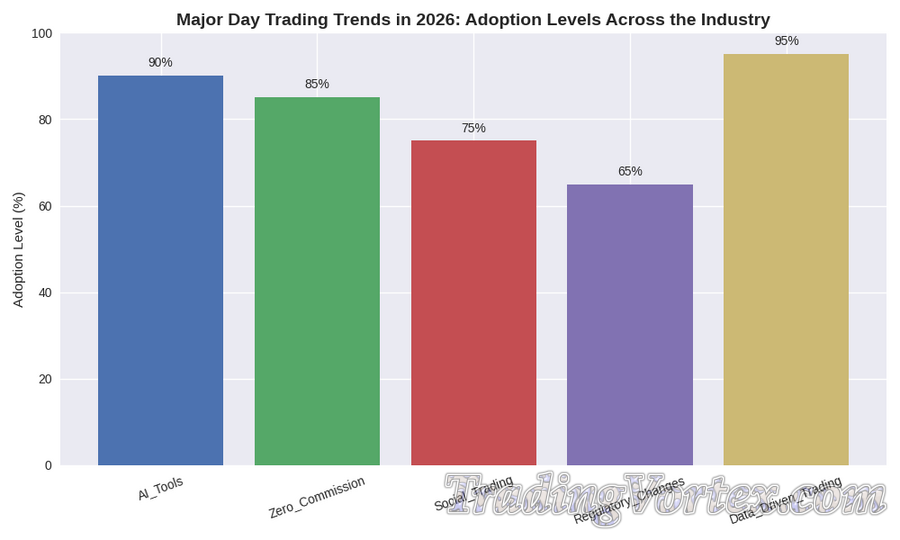 Major Day Trading Trends in 2026: How the Biggest Day Trading Trends Are Shaping 2026.
🔍 How to Read This Chart:
♦ Each bar represents a major trend influencing day trading in 2026.
♦ Higher bars = stronger adoption and greater impact across the trading community.
♦ AI tools and data‑driven trading lead the pack, showing how technology now shapes nearly every decision traders make.
♦ Regulatory changes and social trading are also rising, but at different speeds.
Beginner‑Friendly Day Trading Strategies
When you are new to day trading, choosing a strategy can feel overwhelming. There are so many approaches, so many opinions, and so many flashy videos promising “the perfect setup.” The truth is that beginners do not need complicated strategies. You need simple, repeatable setups that help you understand how price moves.
Once you master the basics, you can build your own style. I always tell new traders that strategies are like recipes. Start with something simple, learn the ingredients, and then experiment once you know what you are doing.
Let’s walk through the most beginner‑friendly strategies in a friendly, practical way, the same way I would explain them to a close friend who wants to trade with confidence instead of confusion.
Breakout Day Trading Strategy
Here is how it works:
- Identify a clear level where price has struggled to break.
- Wait for strong volume as price approaches the level.
- Enter when price breaks through with conviction.
- Use nearby structure for your stop loss.
Breakouts feel exciting, but patience is key. Beginners often jump in too early. Wait for confirmation. A breakout without volume is just a trap wearing a nice outfit.
Pullback Day Trading Strategy
Here is the basic idea:
- Identify a clear trend.
- Wait for price to pull back to a support level, EMA, or VWAP.
- Look for signs of continuation, such as a bounce or bullish candle.
- Enter with a tight stop loss below the pullback zone.
Pullbacks are great because they give you better entries and reduce emotional pressure. I often tell beginners that trading pullbacks feels like buying something on sale instead of paying full price.
VWAP Trend Day Trading Strategy
Here is how traders use it:
- When price is above VWAP, the trend is often bullish.
- When price is below VWAP, the trend is often bearish.
- Pullbacks to VWAP often create high‑probability entries.
VWAP acts like a magnet. Price tends to move around it throughout the day. I love this strategy for beginners because it keeps your chart clean and your decisions simple. If price respects VWAP, you trade with the trend. If it chops around VWAP, you stay patient.
Opening Range Breakout (ORB) Strategy
Here is how it works:
- Mark the high and low of the first 1, 5, or 15 minutes.
- Wait for price to break above or below that range.
- Enter in the direction of the breakout with strong volume.
- Use the opposite side of the range as your stop loss.
ORB is powerful, but it requires discipline. The opening minutes can be chaotic. I always tell beginners to practice ORB in a simulator first. Once you get the feel for it, it becomes one of the cleanest strategies you can trade.
📊 Visual: Comparing Beginner‑Friendly Day Trading Strategies
To help you quickly understand how the most beginner‑friendly day trading strategies perform, the visual below compares win rate and reward‑to‑risk ratio across four popular setups: Breakout, Pullback, VWAP Trend, and Opening Range Breakout (ORB). These metrics give you a realistic sense of which strategies offer the best balance of consistency and profitability for new traders.
💡 Why This Matters for You:
This visual helps you choose a strategy that fits your learning curve and personality:
- Pullback trading stands out with the highest win rate and strongest reward‑to‑risk ratio: great for beginners who prefer patience and structure.
- VWAP trend trading offers a clean, rule‑based approach with solid consistency.
- Breakouts are easy to spot but require discipline to avoid false moves.
- ORB is powerful but fast‑paced: ideal once you gain confidence.
Use this chart as a roadmap to decide which strategy to practice first. Start with one, master it, and expand only when you feel confident.
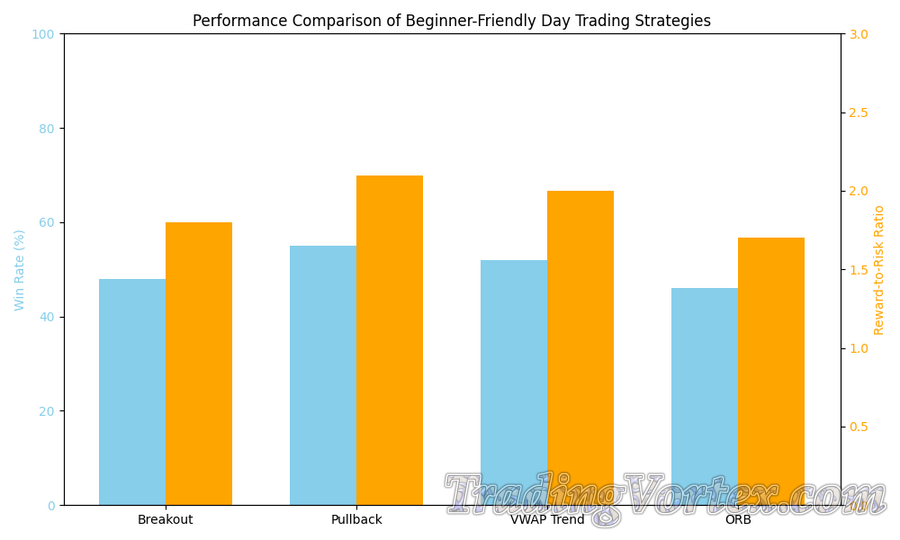 Beginner Strategy Performance Comparison: Comparing Beginner‑Friendly Day Trading Strategies.
🔍 How to Read This Chart:
♦ The blue bars show the win rate: how often each strategy wins.
♦ The orange bars show the reward‑to‑risk ratio: how much you typically make compared to what you risk.
♦ A higher win rate means more frequent wins.
♦ A higher reward‑to‑risk ratio means bigger wins relative to losses.
♦ The best beginner strategies balance both, not just one.
Practicing Day Trading Before Going Live
Before you risk a single dollar in the market, you need practice. Real practice. Not watching videos, not reading charts on social media, but actually placing trades in a safe environment where mistakes do not cost you money. Every successful trader I know spent months practicing before going live. I did too. And trust me, it saved me from blowing up my account more times than I can count.
Practicing is not about pretending to trade. It is about building confidence, learning how markets move, and training your brain to stay calm under pressure. Let’s walk through how to practice the right way, the same way I would explain it to a close friend who wants to trade smart instead of fast.
Using Simulators and Paper Trading for Beginners
Here is what simulators help you learn:
- How to place orders quickly
- How price reacts to news and volume
- How to manage emotions during fast moves
- How to test strategies without financial risk
According to 2026 reviews, the best simulators include:
- Simul8or, known for realistic fills and AI chart analysis
- Goat Funded Trader’s simulated accounts, which mirror real market conditions for beginners
- Broker‑provided paper trading accounts with real‑time data
One thing to watch out for: some simulators make trading feel too easy. Unrealistic fills and fantasy account sizes can give beginners a false sense of confidence. Choose a simulator that feels real, not one that makes you feel like a trading superhero.
Backtesting Day Trading Strategies
Here is how to backtest effectively:
- Pick one strategy at a time
- Use several months of historical data
- Track win rate, average loss, average win, and drawdowns
- Look for patterns in your results
How Long to Practice Before Trading Real Money
This is the question every beginner asks, and the honest answer is: it depends on you. Most traders need at least one to three months of consistent practice before going live. Some need longer, and that is perfectly fine.
Here are signs you are ready:
- You can follow your strategy without hesitation
- You can take losses without panicking
- You can avoid impulsive trades
- You have a positive or stable performance in simulation
- You understand your strengths and weaknesses
Here are signs you are not ready:
- You still chase trades
- You rely on luck instead of rules
- You get emotional after wins or losses
- You change strategies every week
I always tell beginners that trading with real money feels different. Even if you are calm in simulation, your emotions will spike the first time you risk actual capital. That is normal. Start small, stay disciplined, and treat your first months of live trading as an extension of your practice phase.
📊 Visual: How Practice Time Improves Your Trading Consistency
To help you clearly understand why practicing before going live is essential, the visual below shows how consistency improves as you spend more weeks practicing in a simulator or through backtesting. This reflects what trading coaches and 2026 performance studies repeatedly confirm: the more structured practice you put in, the more stable and disciplined your trading becomes.
💡 Why This Matters for You:
This visual highlights a truth every beginner needs to understand:
- 2 weeks of practice builds familiarity, not skill.
- 4–6 weeks builds confidence and reduces hesitation.
- 8–12 weeks builds discipline, emotional control, and rule‑based execution.
If you want to avoid blowing up your account, give yourself time to grow. Trading is a performance skill: just like sports or music, and your brain needs repetition before it can stay calm under pressure.
Use this chart as a reminder: The more you practice, the more consistent you become—and consistency is what makes you profitable.
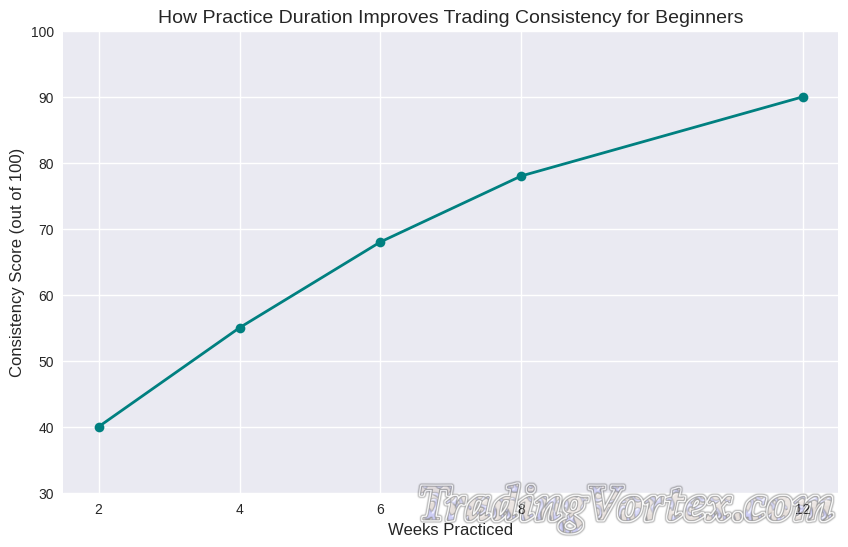 Practice Duration vs. Trading Consistency: How Practice Time Improves Your Trading Consistency.
🔍 How to Read This Chart:
♦ The x‑axis shows the number of weeks spent practicing.
♦ The y‑axis shows a Consistency Score (0–100), representing how reliably you follow your rules, manage risk, and avoid emotional mistakes.
♦ Each point on the line represents a realistic improvement milestone for beginners.
♦ Notice how consistency grows steadily; not instantly. This mirrors real trader development.
Best Day Trading Tools, Resources, and Learning Path
One of the biggest advantages beginners have in 2026 is access to tools and resources that used to be available only to professional traders. Today, you can analyze charts, scan markets, track performance, and learn from experts without spending a fortune.
The challenge is not finding tools, but choosing the right ones. I have seen beginners overwhelm themselves with ten platforms at once, only to end up confused and frustrated. The key is to start simple, stay consistent, and build your toolkit over time.
Best Scanners, Charting Tools, and News Sources for Day Traders
Your tools are your trading cockpit. They help you spot opportunities, analyze price action, and stay ahead of market-moving news.
According to 2026 reviews, the top tools include:
Scanners:
- Trade Ideas, known for real‑time scanning and AI‑powered alerts
- Edgeful, great for momentum setups at an affordable price
Charting Platforms:
- TradingView, offering community charts and flexible pricing from free to premium
- TrendSpider, known for automated pattern recognition and smart alerts
News Sources:
- Real‑time news feeds integrated into trading platforms
- Financial news apps that provide alerts on earnings, economic releases, and market sentiment
Journals:
- TradeZella, excellent for performance tracking and trade review
- Edgewonk, great for psychology and position sizing analysis
These tools help you stay organized, focused, and informed. Start with one scanner, one charting platform, and one journal. You can expand later.
Day Trading Communities and Forums for Beginners
Trading can feel lonely if you do it alone. Communities help you stay motivated, learn faster, and avoid common pitfalls. In 2026, online trading communities have become more structured and supportive, offering watchlists, live discussions, and educational sessions.
Good communities offer:
- Real‑time market discussions
- Strategy breakdowns
- Feedback on trade ideas
- Emotional support during tough days
Just remember: communities are for learning, not copying trades. Use them to sharpen your thinking, not to outsource your decisions.
Creating a Sustainable Day Trading Learning Roadmap
Learning day trading is a marathon, not a sprint. You need a roadmap that keeps you focused and prevents you from jumping between strategies every week.
Here is a simple, sustainable learning path:
Phase 1: Foundations
- Learn basic concepts: trends, support, resistance, indicators
- Study risk management and trading psychology
- Read beginner‑friendly books or articles
Phase 2: Tools and Practice
- Choose one charting platform
- Practice on a simulator
- Backtest one strategy at a time
Phase 3: Strategy Development
- Pick one or two beginner‑friendly strategies
- Journal every trade
- Review performance weekly
Phase 4: Going Live
- Start with small size
- Follow your plan strictly
- Focus on consistency, not profits
Phase 5: Long‑Term Growth
- Refine your strategy
- Add advanced tools as needed
- Continue learning from books, mentors, and communities
I always tell beginners that trading is like learning a language. At first, everything feels foreign. Then, slowly, you start recognizing patterns. One day, it clicks. And when it clicks, trading becomes a skill you can grow for life.
Conclusion: Your Realistic Path Into Day Trading
The Realistic Path to Becoming a Profitable Day Trader
If there is one truth every beginner eventually discovers, it is this: day trading is a skill, not a shortcut. You do not become profitable because you found the perfect indicator or watched a few videos. You become profitable because you build habits, you practice with intention, and you learn to stay calm when the market tries to shake you out.
Modern 2026 trading guides are very clear about this. The failure rate is still high, often above 80 percent, but the traders who succeed follow a structured path instead of jumping in blindly.
A realistic path looks something like this:
- Learn the basics until they feel natural
- Practice in a simulator until your decisions become consistent
- Start live with small size and strict risk rules
- Journal everything
- Improve slowly, one adjustment at a time
It is not glamorous, but it works. And the traders who stick to this path are the ones who eventually find their rhythm.
Encouragement and Motivation for Beginner Day Traders
If you feel overwhelmed, trust me, you are not alone. Every trader you admire today once sat exactly where you are, staring at charts and wondering if they would ever “get it.” The good news is that progress in trading is not linear, but it is real. One day you will look back and realize you are making decisions calmly, spotting patterns instantly, and managing risk like it is second nature.
You will also have days where nothing makes sense. Days where you take a loss and feel frustrated. Days where you question whether you should keep going. Those days are normal. They are part of the process. What matters is that you keep showing up, keep learning, and keep improving.
Think of trading like learning a musical instrument. At first, everything sounds messy. Then slowly, with practice, the notes start to connect. Eventually, you play with confidence. Trading works the same way.
Final Tips for Long‑Term Day Trading Success
Before you close this guide and jump into the markets, here are a few final reminders that will serve you well for years to come:
- Protect your capital first, grow it second.
- Trade one strategy at a time until you master it.
- Never risk money you cannot afford to lose.
- Review your journal weekly, even when it hurts.
- Stay patient. The market will be here tomorrow.
- Focus on process, not perfection.
If you treat trading like a profession, it will reward you like one. If you treat it like a lottery ticket, it will punish you quickly.
And remember, you are not racing anyone. Your journey is your own. Whether you are trading from a busy city, a quiet village, or a small apartment with a single monitor, the market gives everyone the same opportunity: learn the craft, respect the risks, and grow at your own pace.
Frequently Asked Questions: Day Trading for Beginners
What is the minimum amount of money I need to start day trading?
You can technically start with a very small amount, especially in markets like crypto or forex, but if you want to trade US stocks under the Pattern Day Trader rule, you need 25,000 USD in a margin account. Many beginners start with 500 to 2,000 USD in other markets to learn the basics without risking too much. The real key is not the amount, but how well you manage it.
How long does it take to become a profitable day trader?
Most beginners underestimate this. On average, it takes 6 to 18 months of consistent practice, journaling, and strategy refinement before traders start seeing stable results. Some learn faster, some slower, and that is completely normal. Think of it like learning a new profession. You would not expect to master it in a week.
Can I day trade while working a full‑time job?
Yes, but you need to choose the right market and strategy. Forex and crypto offer flexible hours. Swing trading or trading only the first hour of the stock market can also work. Many traders start part‑time until they build enough skill and confidence to scale.
Is day trading risky?
Absolutely. Day trading carries significant risk, especially for beginners. The majority of new traders lose money in their first year, mostly due to poor risk management and emotional decisions. The good news is that risk can be controlled with proper position sizing, stop losses, and discipline.
Do I need expensive tools to start day trading?
Not at all. Many of the best tools in 2026 offer free or low‑cost plans. TradingView, broker‑provided platforms, and free news feeds are more than enough for beginners. Start simple. Upgrade only when you know exactly what you need.
What is the best market for beginners?
There is no universal answer.
♦ Stocks are structured and news‑driven.
♦ Forex offers flexible hours and steady movement.
♦ Crypto is volatile and open 24/7.
♦ Indices offer clean trends and high liquidity.
Try each one in a simulator and see which feels natural.
How many strategies should I learn as a beginner?
Just one. Seriously. Master one strategy before adding another. Beginners often jump between strategies too quickly, which slows their progress. Stick to one setup for at least a few months so you can understand its strengths and weaknesses.
Why do most beginners fail at day trading?
The most common reasons include:
♦ Trading without a plan
♦ Ignoring risk management
♦ Overtrading
♦ Emotional decisions
♦ Unrealistic expectations
♦ Lack of practice in a simulator
These mistakes are predictable and avoidable with the right guidance.
Should I pay for a mentor or trading course?
A good mentor can accelerate your learning, but be careful. The trading world is full of scams and unrealistic promises. Look for mentors who trade live, show real results, and focus on risk management rather than flashy profits. Free resources are often enough for beginners.
How do I know when I am ready to trade real money?
You are ready when:
♦ You can follow your strategy without hesitation
♦ You have at least a few months of consistent simulator results
♦ You no longer chase trades or revenge trade
♦ You understand your risk per trade and stick to it
♦ You feel calm placing trades, not anxious
If you still feel emotional or impulsive, keep practicing.
Can AI tools help me become a better trader?
Yes, but they are not magic. AI tools in 2026 can scan markets, detect patterns, and help you analyze performance, but they cannot replace discipline or emotional control. Think of AI as a helpful assistant, not a shortcut to success.
Is day trading suitable for everyone?
No, and that is perfectly okay. Day trading requires emotional control, patience, and the ability to handle losses without panicking. If you prefer slower, long‑term investing, that might be a better fit. The important thing is choosing what aligns with your personality and lifestyle.